November 2020: Paper 3

240 marks · 40 question parts · Paper, mark scheme and report on AQA's site

This paper was set on the previous specification. 5 parts are on content removed in the 2025 specification and are marked "Old spec only".

Question by question

QTopicMarksAOType
1 Issues and debates 2AO1=2Outline
2 Issues and debates 2AO3=2Explain
3 Issues and debates, Approaches in psychology 4AO2=4Application
4 Issues and debates, Research methods: scientific processes 16AO1=6,AO2=4,AO3=6Extended writing
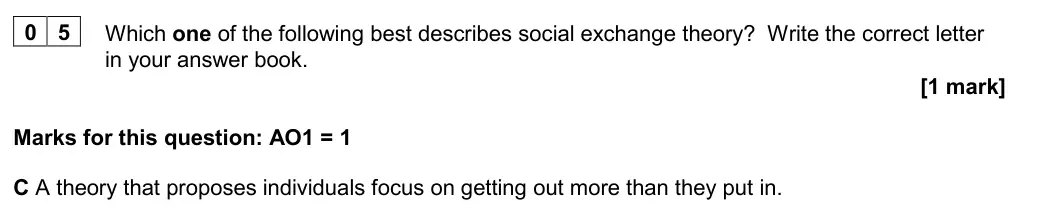
5 Relationships 1AO1=1Multiple choice
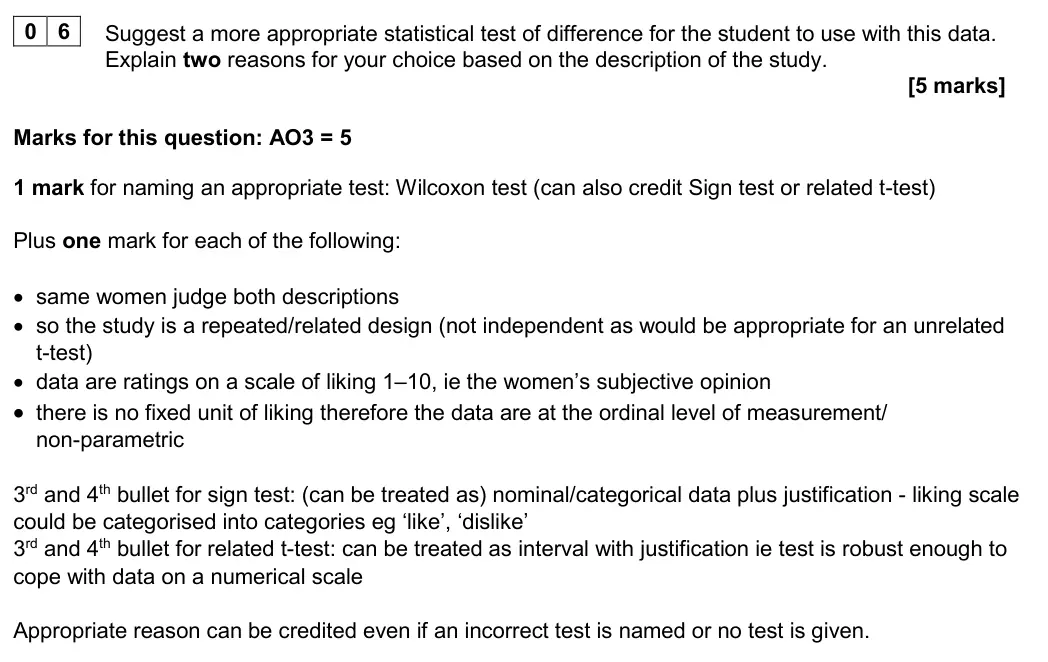
6 Research methods: inferential testing, Research methods: data handling and analysis 5AO3=5Research methods
7 Research methods: scientific processes 2AO3=2Research methods
8 Relationships 8AO1=3,AO2=2,AO3=3Extended writing
9 Relationships 8AO1=3,AO3=5Extended writing
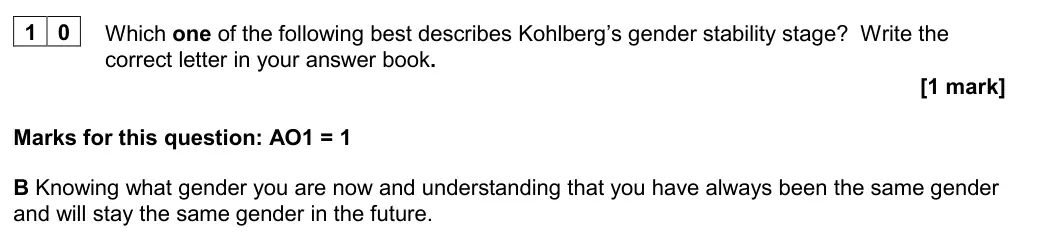
10 Gender 1AO1=1Multiple choice
11 Research methods: inferential testing, Research methods: data handling and analysis 5AO3=5Research methods
12 Research methods: scientific processes 2AO3=2Research methods
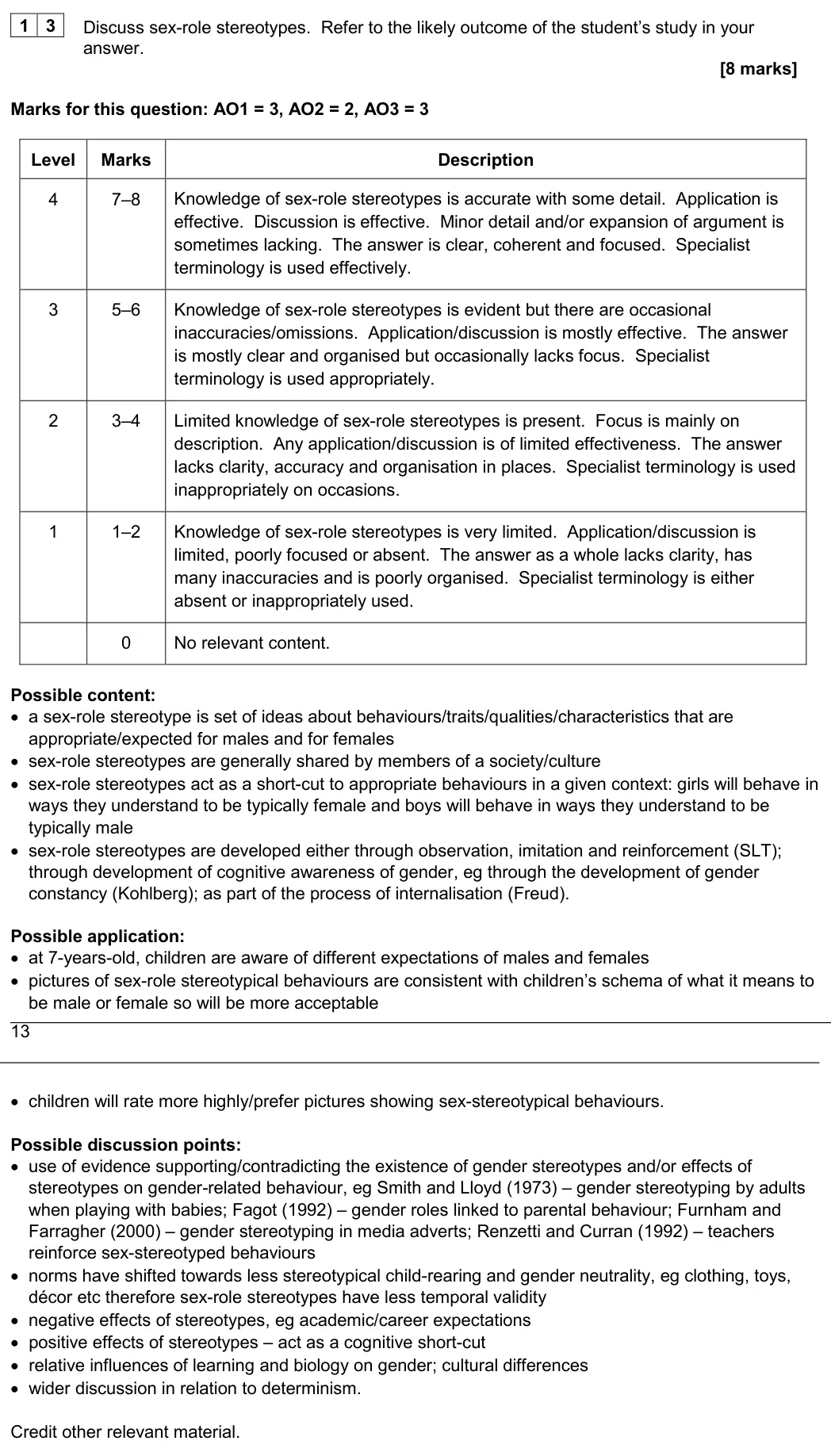
13 GenderOld spec 8AO1=3,AO2=2,AO3=3Extended writing
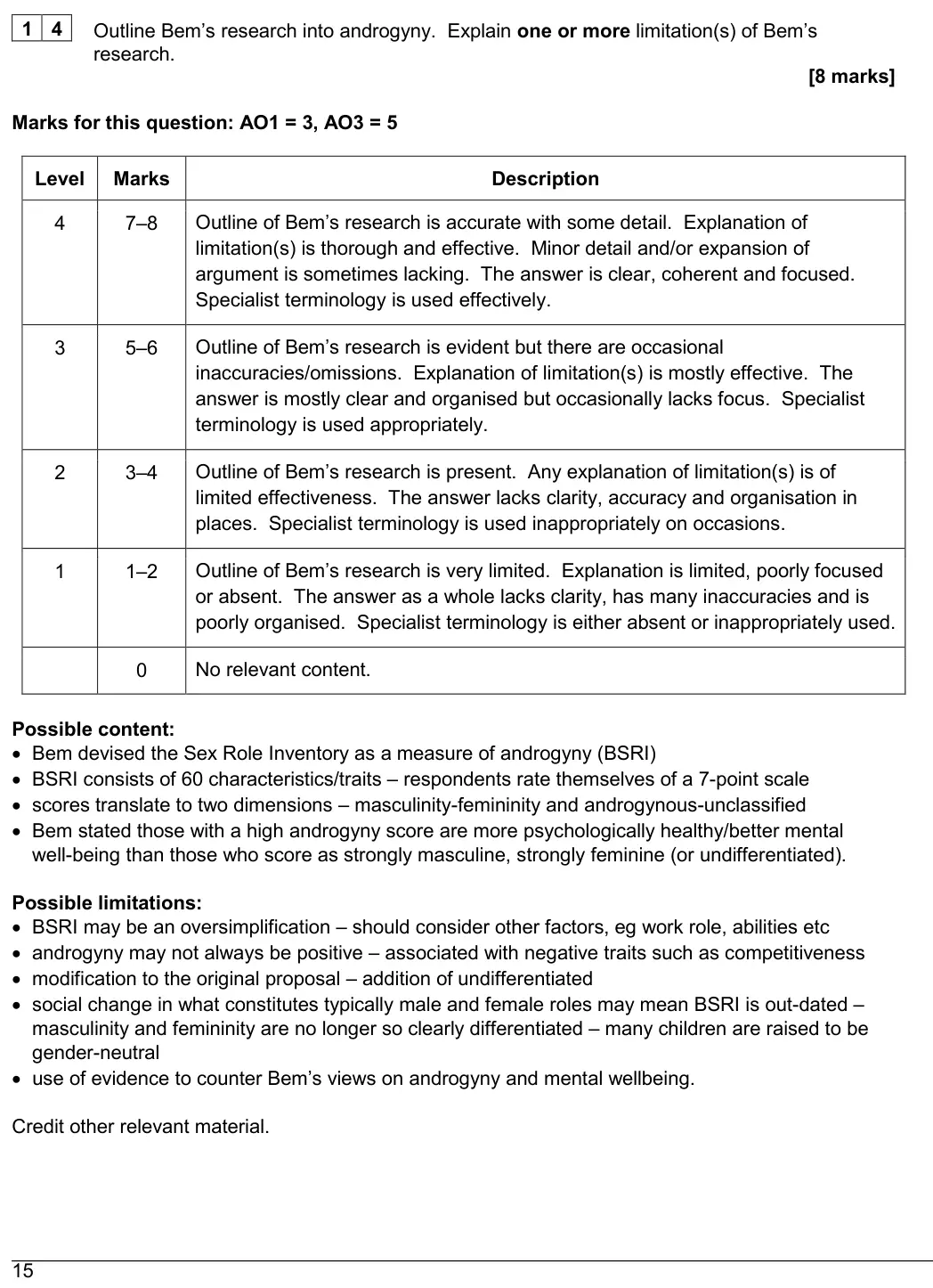
14 GenderOld spec 8AO1=3,AO3=5Extended writing
15 Cognition and development 1AO1=1Multiple choice
16 Research methods: inferential testing, Research methods: data handling and analysis 5AO3=5Research methods
17 Research methods: scientific processes 2AO3=2Research methods
18 Cognition and development 8AO1=3,AO2=2,AO3=3Extended writing
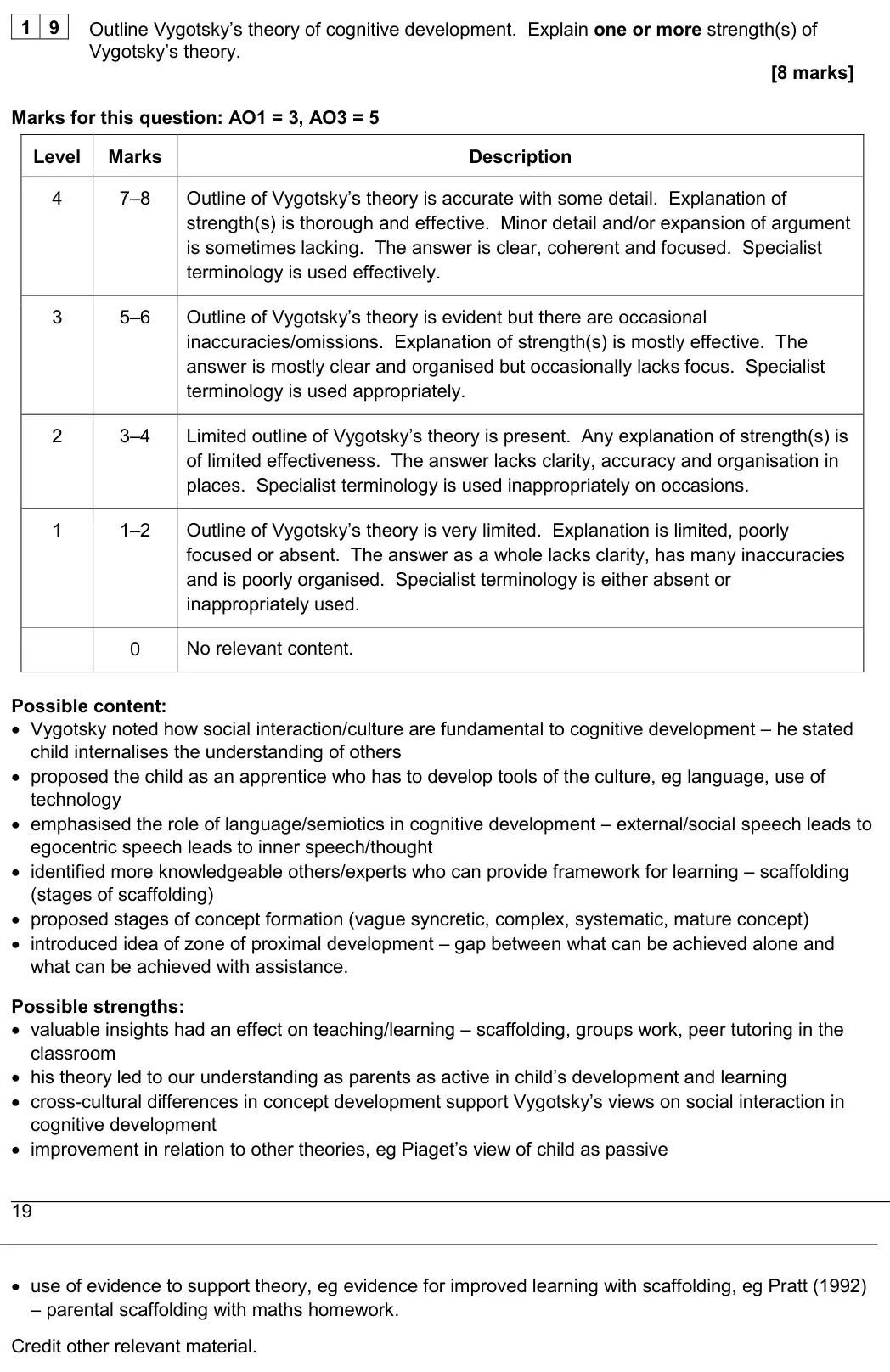
19 Cognition and development 8AO1=3,AO3=5Extended writing
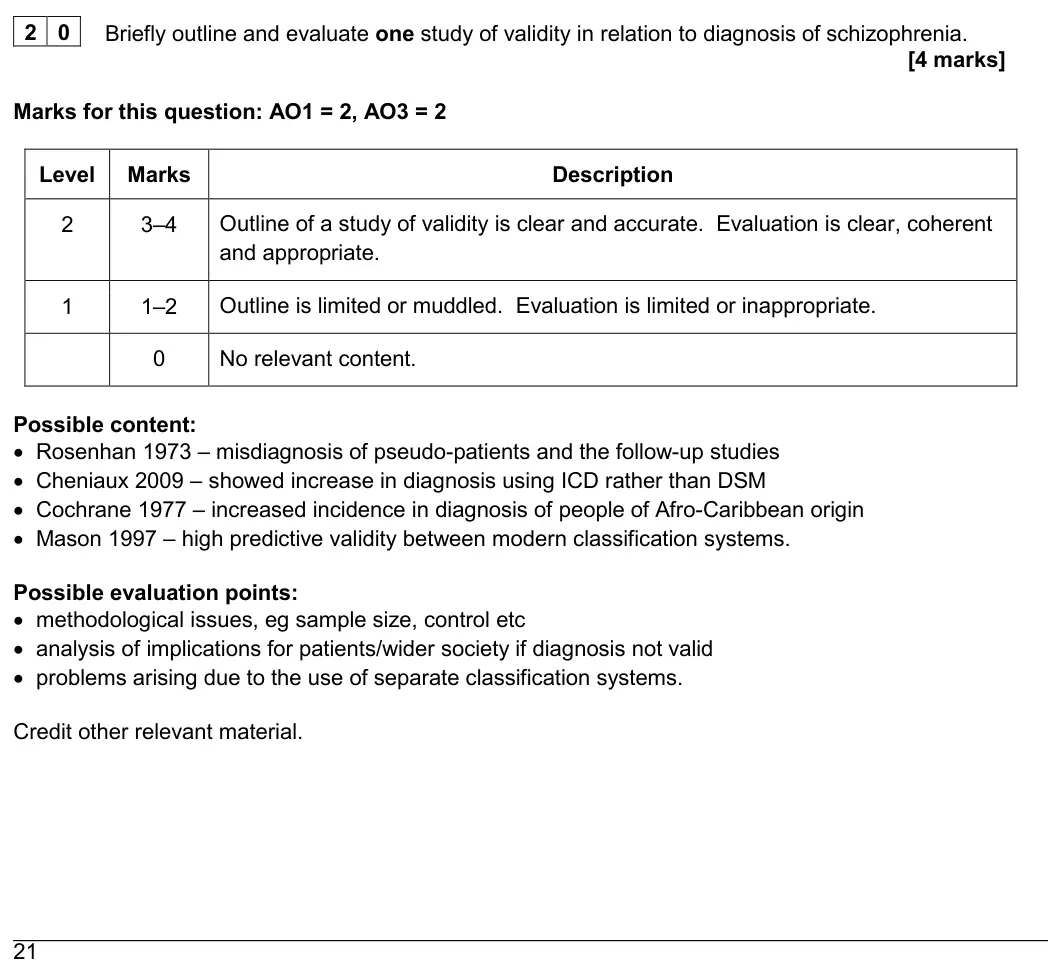
20 SchizophreniaOld spec 4AO1=2,AO3=2Evaluate (short)
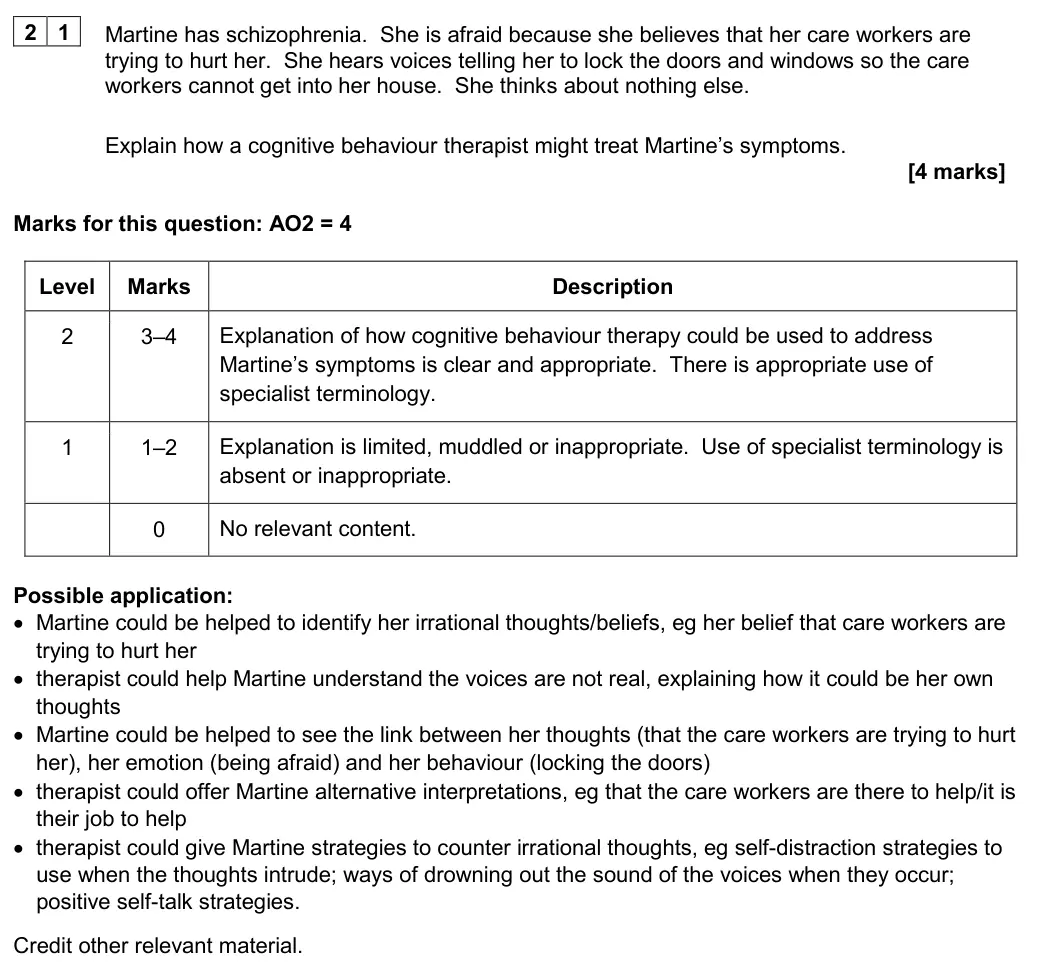
21 Schizophrenia 4AO2=4Application
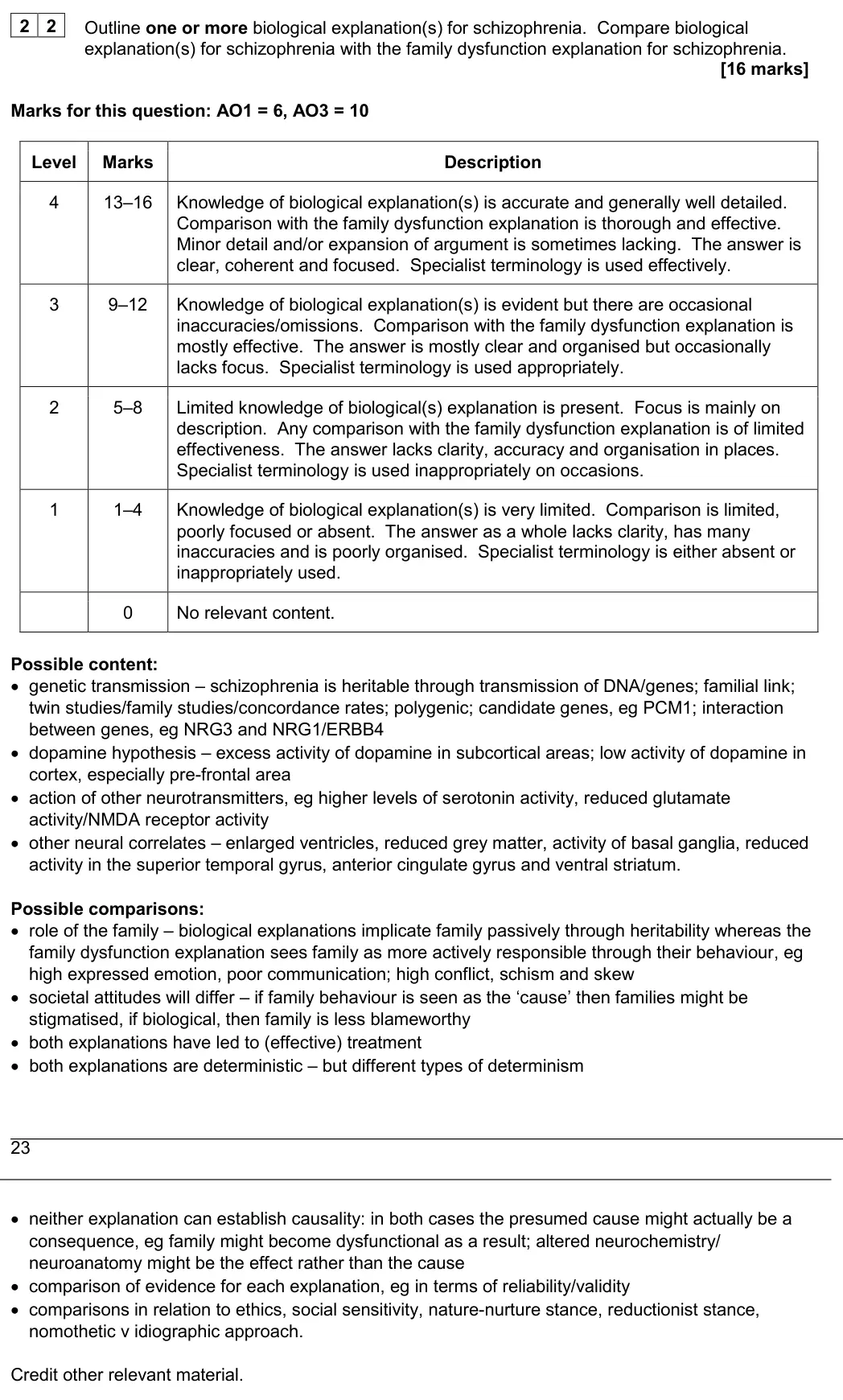
22 Schizophrenia 16AO1=6,AO3=10Extended writing
23 Eating behaviour 4AO1=2,AO3=2Evaluate (short)
24 Eating behaviourOld spec 4AO2=4Application
25 Eating behaviour 16AO1=6,AO3=10Extended writing
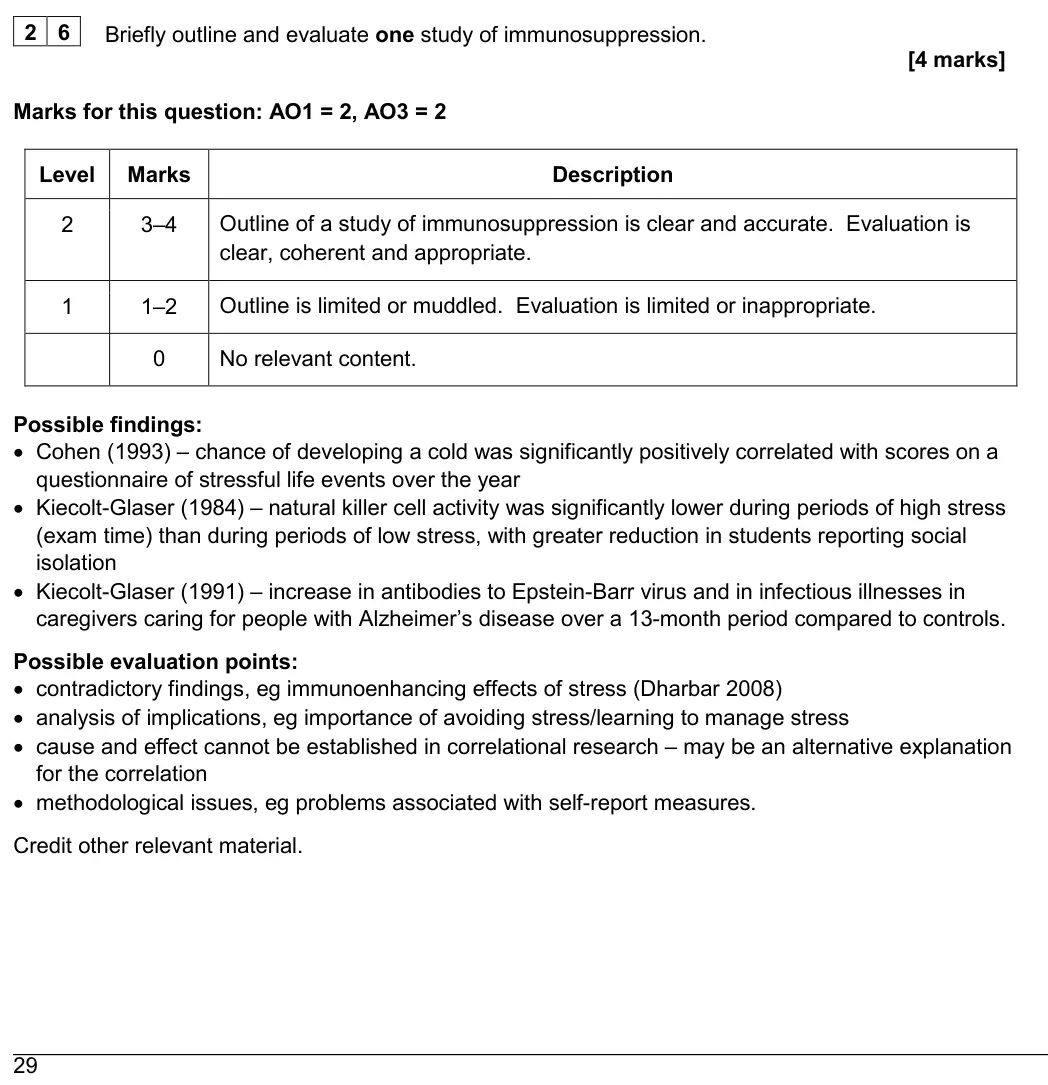
26 Stress 4AO1=2,AO3=2Evaluate (short)
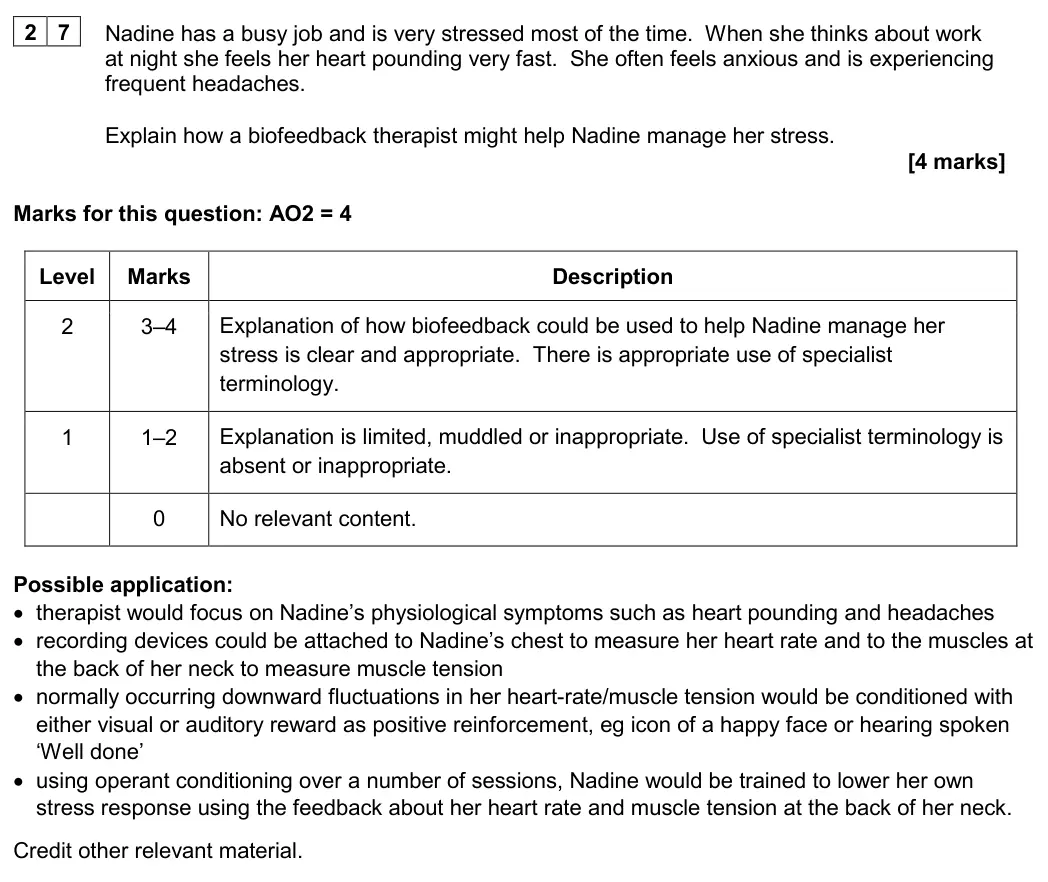
27 Stress 4AO2=4Application
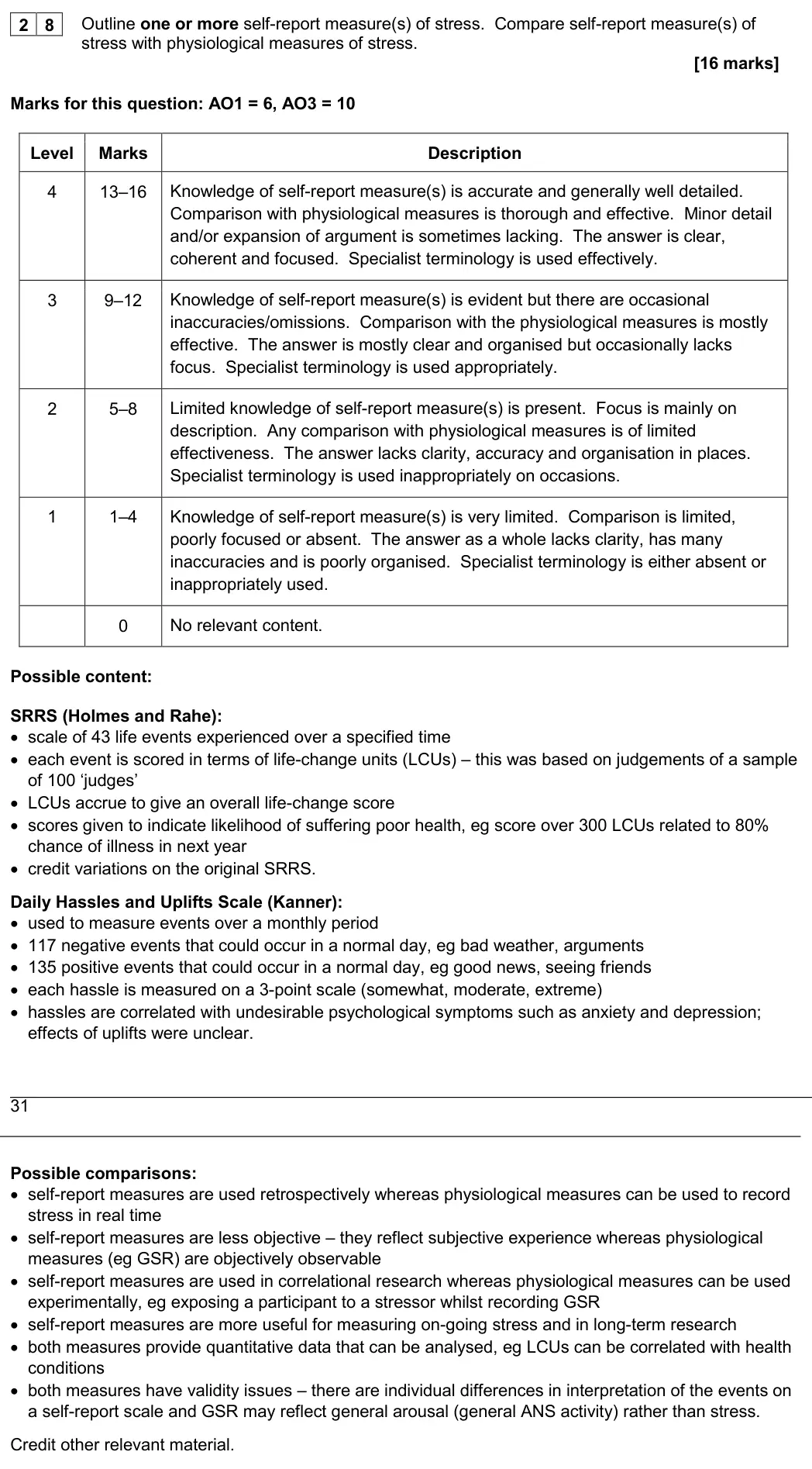
28 Stress 16AO1=6,AO3=10Extended writing
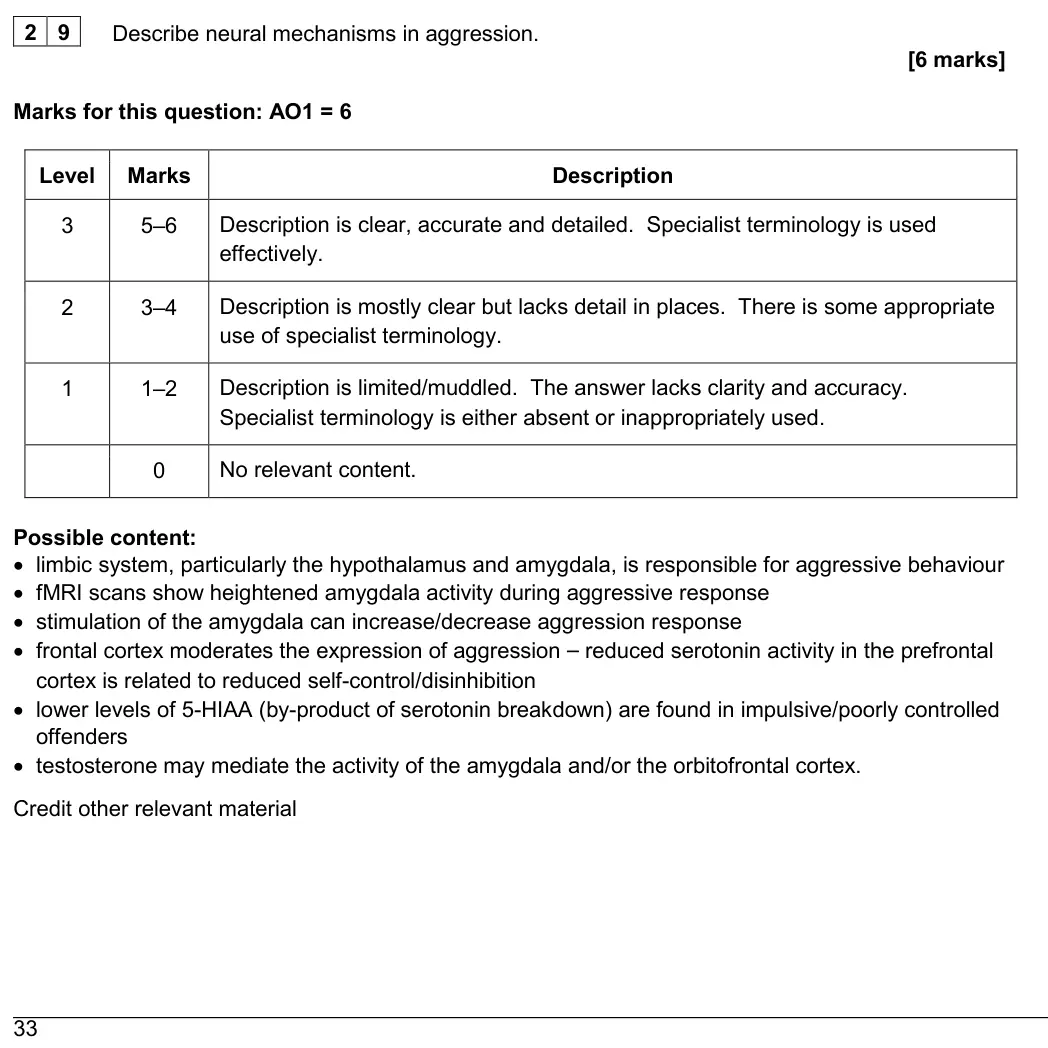
29 Aggression 6AO1=6Outline
30 Aggression 4AO2=4Application
31 Aggression 6AO3=6Evaluate (short)
32 Aggression 8AO1=3,AO3=5Extended writing
33 Approaches in psychology, AttachmentOld spec 6AO1=6Outline
34 Forensic psychology 4AO2=4Application
35 Forensic psychology 6AO3=6Evaluate (short)
36 Forensic psychology 8AO1=3,AO3=5Extended writing
37 Addiction 6AO1=6Outline
38 Addiction 4AO2=4Application
39 Addiction 6AO3=6Evaluate (short)
40 Addiction 8AO1=3,AO3=5Extended writing

The questions

12345678910111213141516171819202122232425262728293031323334353637383940

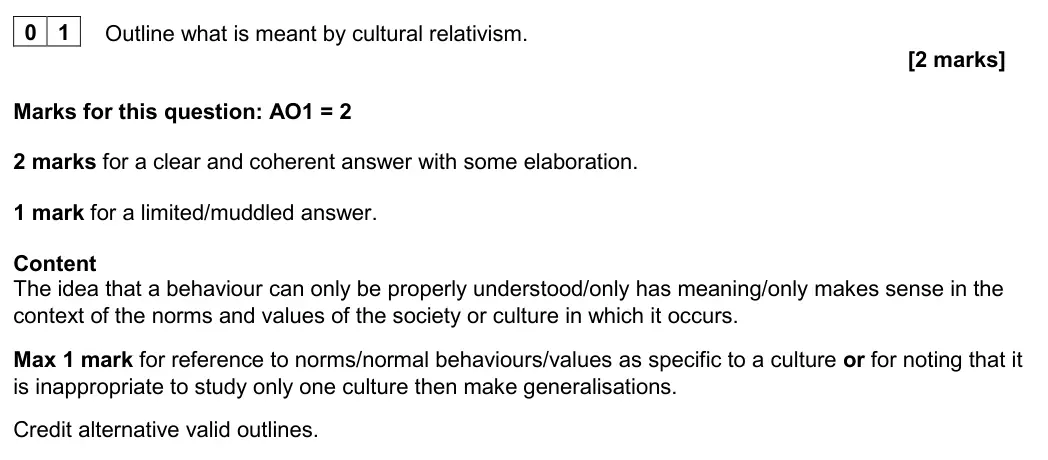
November 2020 · Paper 3 · Q1 2 marks AO1=2 Outline issues and debates
0 1
Outline what is meant by cultural relativism.
[2 marks]
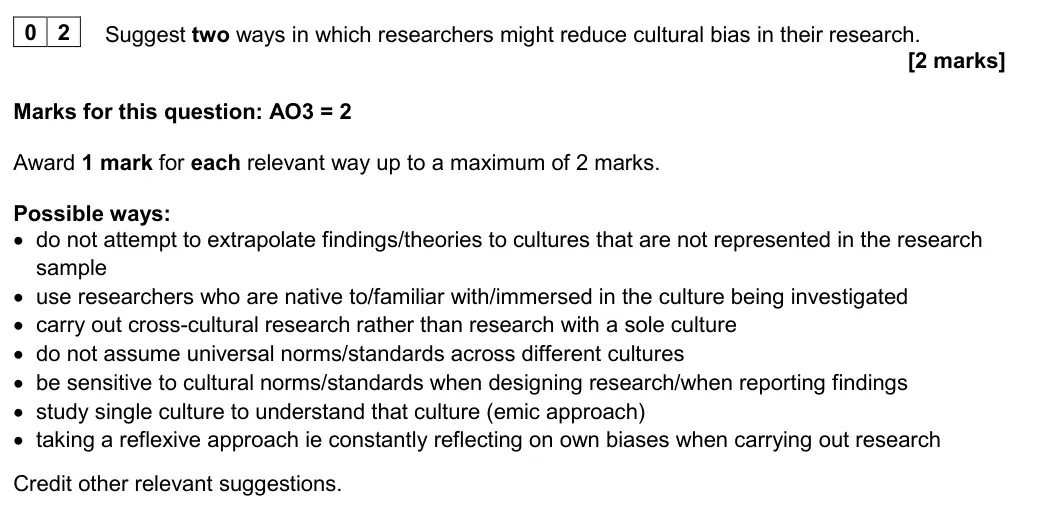
November 2020 · Paper 3 · Q2 2 marks AO3=2 Explain issues and debates
0 2
Suggest two ways in which researchers might reduce cultural bias in their research.
[2 marks]
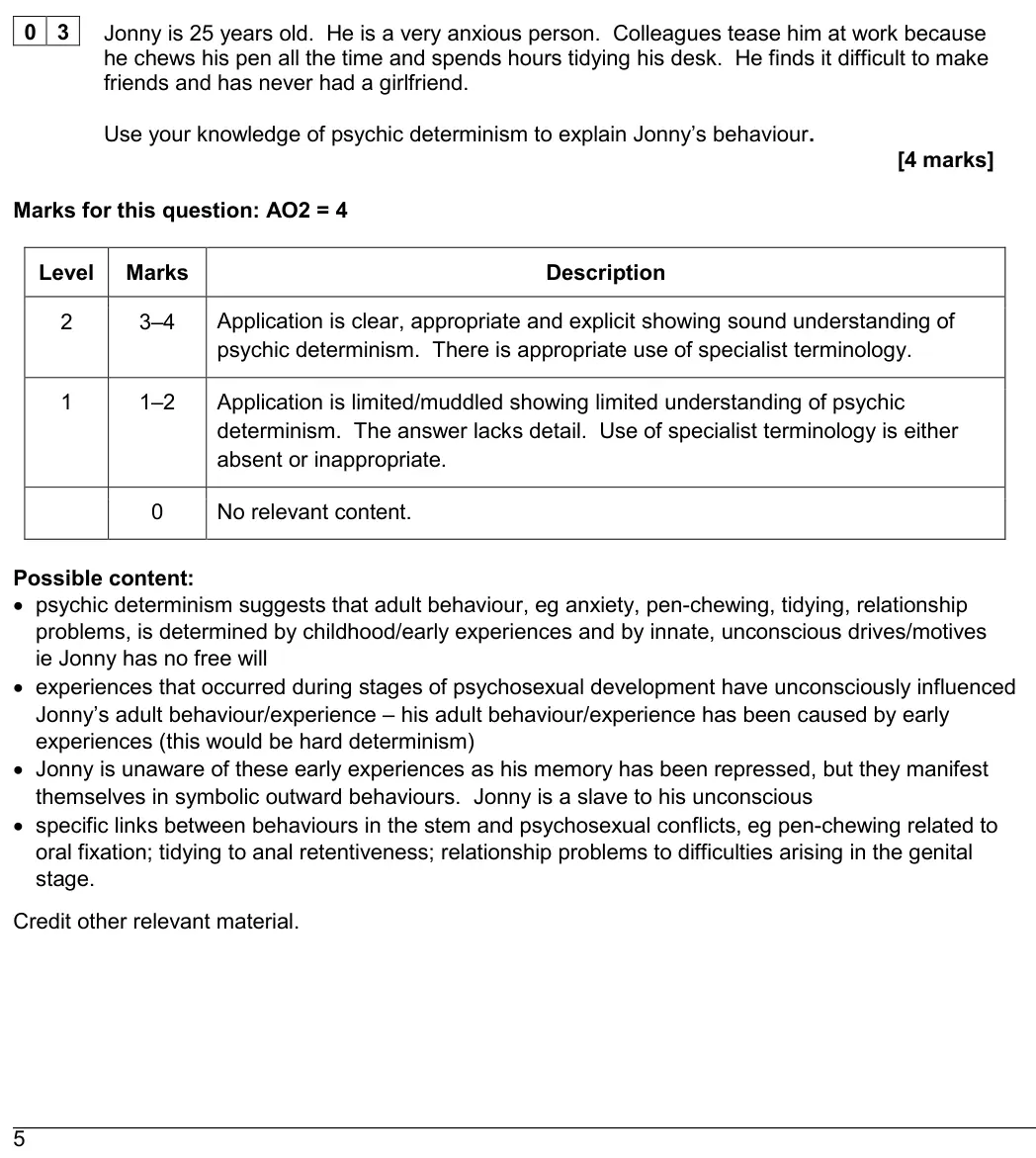
November 2020 · Paper 3 · Q3 4 marks AO2=4 Application issues and debatesapproaches
0 3
Jonny is 25 years old.  He is a very anxious person.  Colleagues tease him at work
because he chews his pen all the time and spends hours tidying his desk.  He finds it
difficult to make friends and has never had a girlfriend.
Use your knowledge of psychic determinism to explain Jonny’s behaviour.
[4 marks]
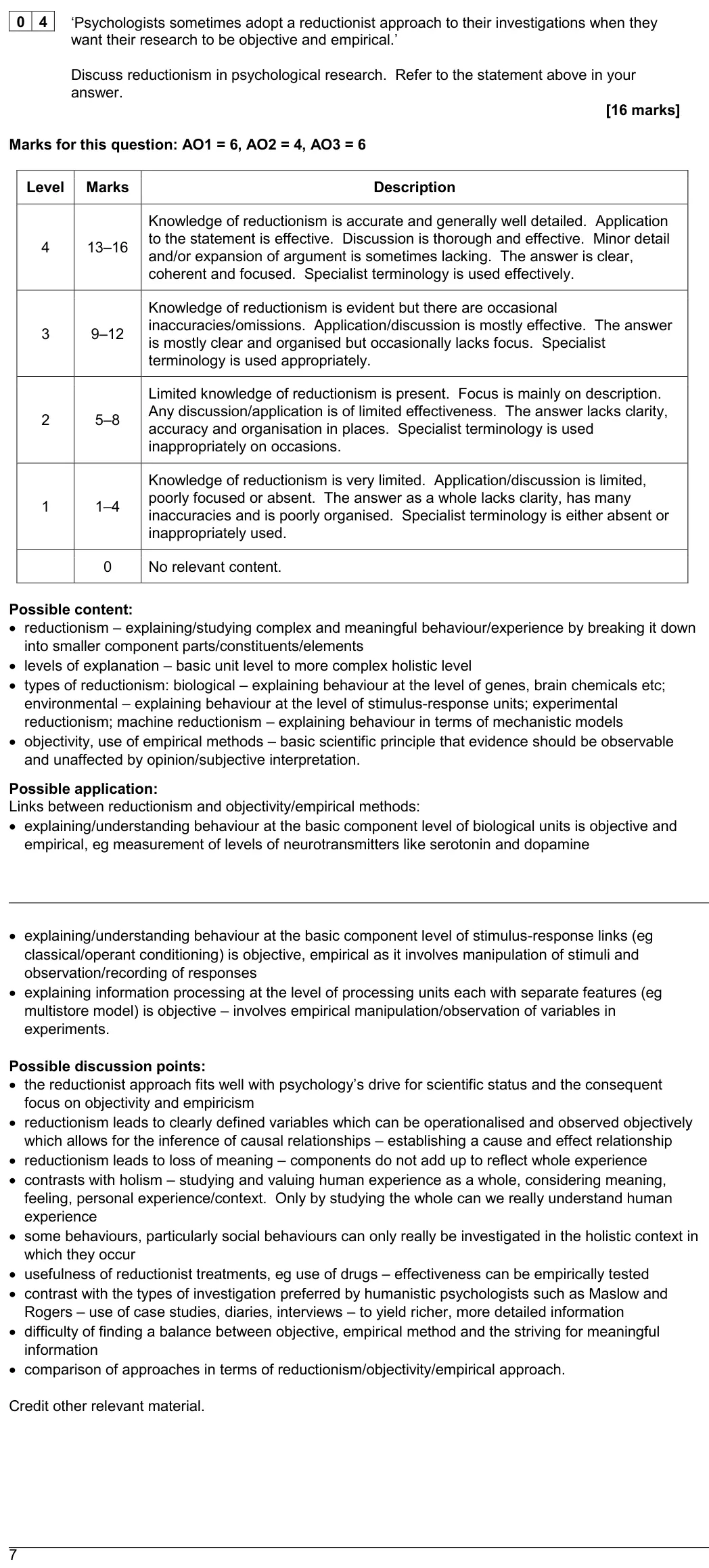
November 2020 · Paper 3 · Q4 16 marks AO1=6, AO2=4, AO3=6 16-mark essay issues and debatesscientific processes
0 4
‘Psychologists sometimes adopt a reductionist approach to their investigations when they
want their research to be objective and empirical.’
Discuss reductionism in psychological research.  Refer to the statement above in your
answer.
[16 marks]
November 2020 · Paper 3 · Q5 1 mark AO1=1 Multiple choice relationships
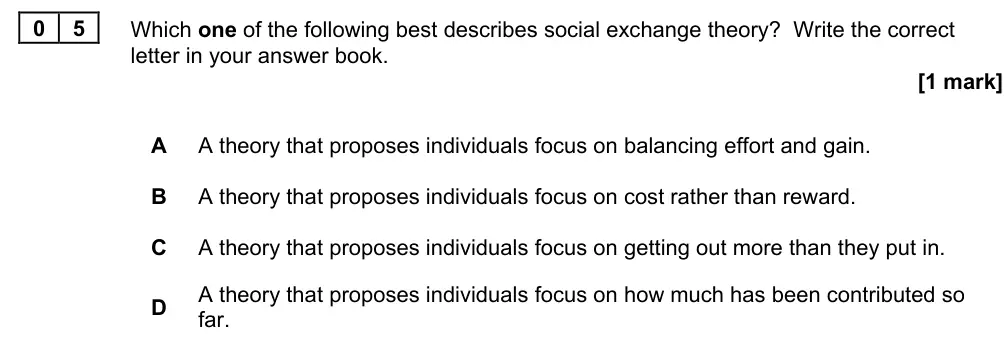
0 5
Which one of the following best describes social exchange theory?  Write the correct
letter in your answer book.
[1 mark]
A
A theory that proposes individuals focus on balancing effort and gain.
B
A theory that proposes individuals focus on cost rather than reward.
C
A theory that proposes individuals focus on getting out more than they put in.
A theory that proposes individuals focus on how much has been contributed so
D
far.
November 2020 · Paper 3 · Q6 5 marks AO3=5 Research methods inferential testingdata handling
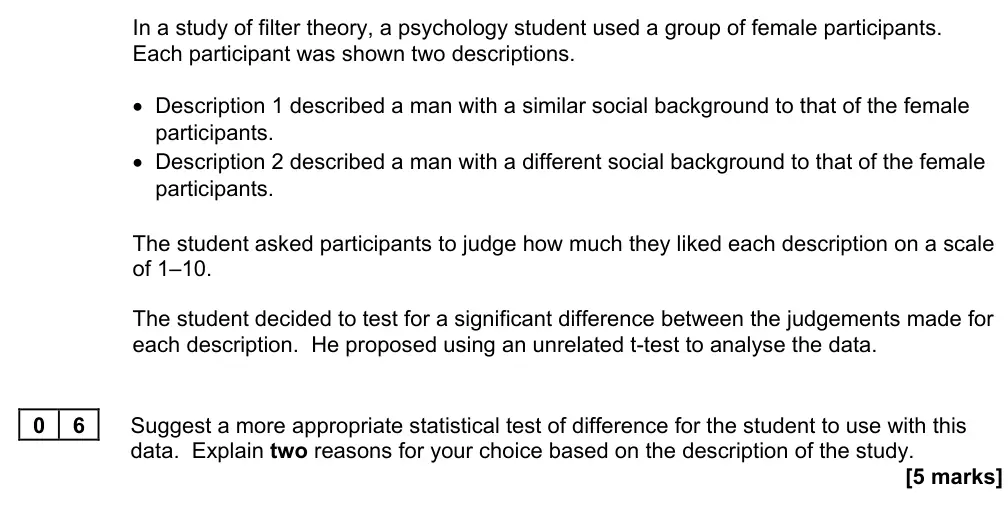
In a study of filter theory, a psychology student used a group of female participants.
Each participant was shown two descriptions.
• Description 1 described a man with a similar social background to that of the female
participants.
• Description 2 described a man with a different social background to that of the female
participants.
The student asked participants to judge how much they liked each description on a scale
of 1–10.
The student decided to test for a significant difference between the judgements made for
each description.  He proposed using an unrelated t-test to analyse the data.
0 6
Suggest a more appropriate statistical test of difference for the student to use with this
data.  Explain two reasons for your choice based on the description of the study.
[5 marks]
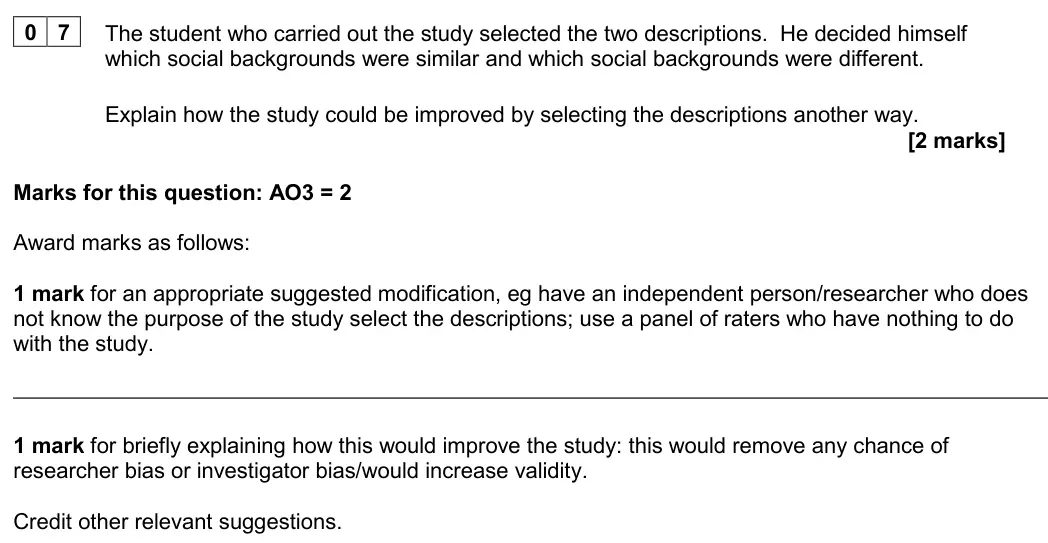
November 2020 · Paper 3 · Q7 2 marks AO3=2 Research methods scientific processes
0 7
The student who carried out the study selected the two descriptions.  He decided himself
which social backgrounds were similar and which social backgrounds were different.
Explain how the study could be improved by selecting the descriptions another way.
[2 marks]
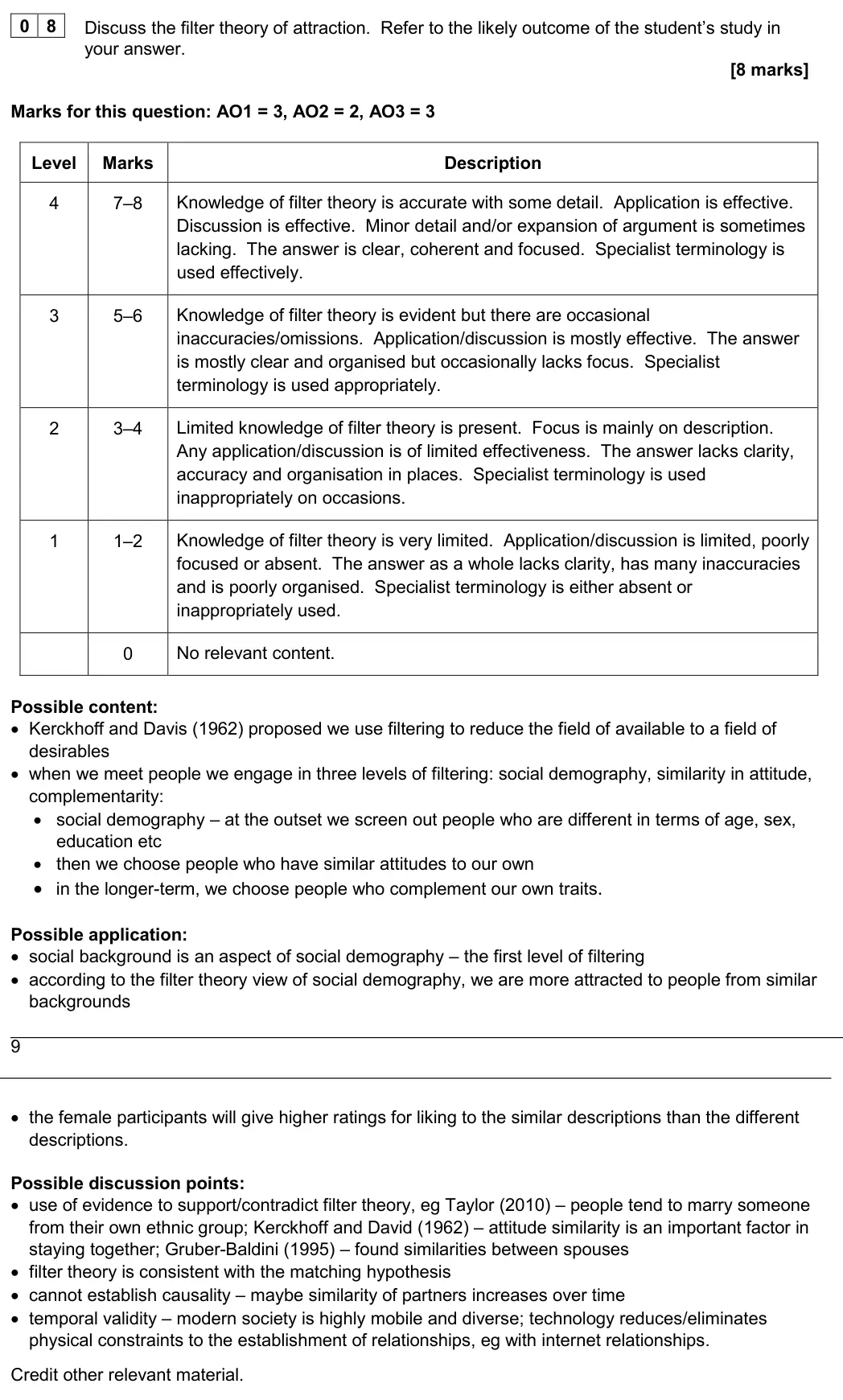
November 2020 · Paper 3 · Q8 8 marks AO1=3, AO2=2, AO3=3 Extended writing relationships
0 8
Discuss the filter theory of attraction.  Refer to the likely outcome of the student’s study in
your answer.
[8 marks]
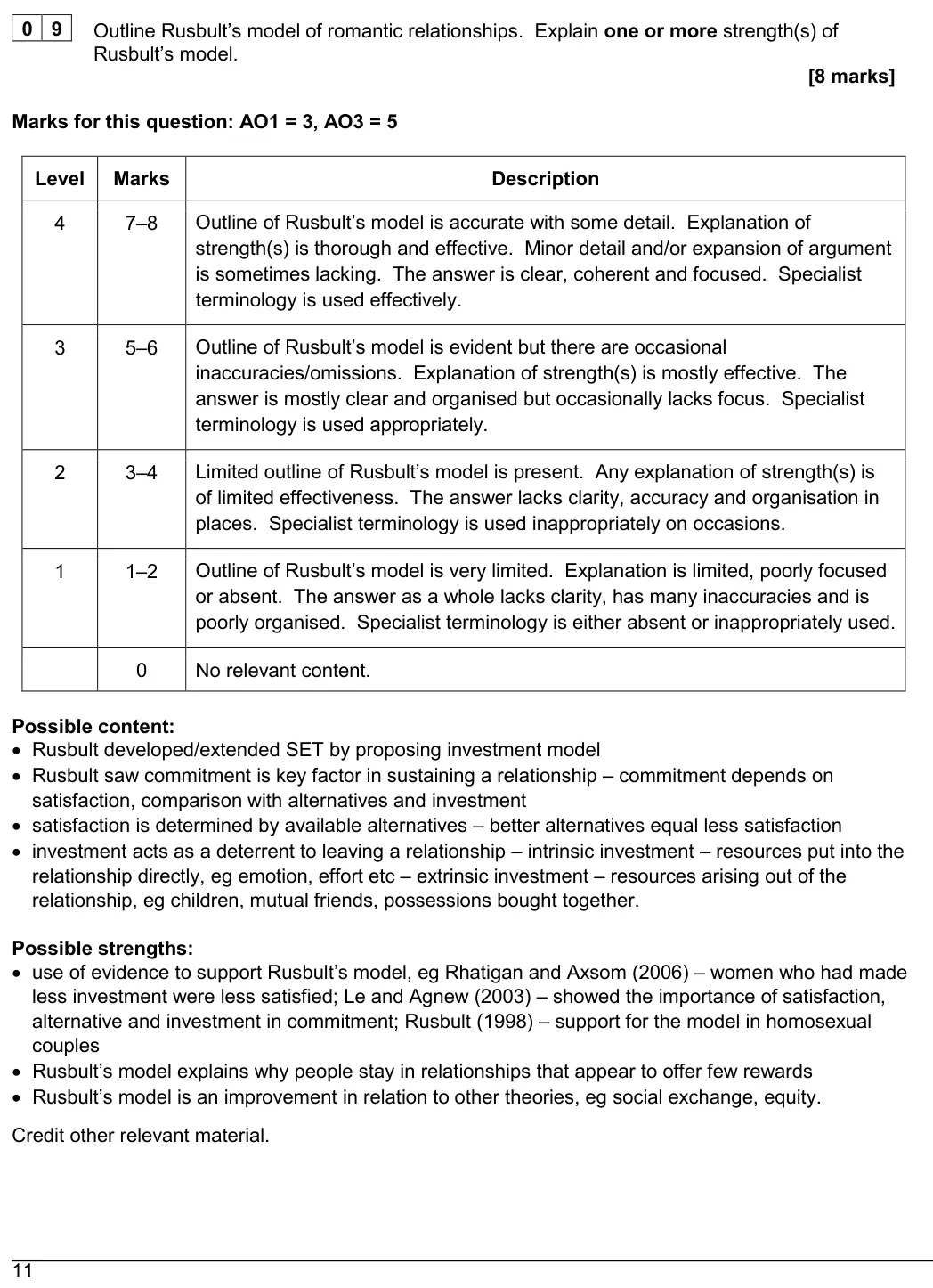
November 2020 · Paper 3 · Q9 8 marks AO1=3, AO3=5 Extended writing relationships
0 9
Outline Rusbult’s model of romantic relationships.  Explain one or more strength(s) of
Rusbult’s model.
[8 marks]
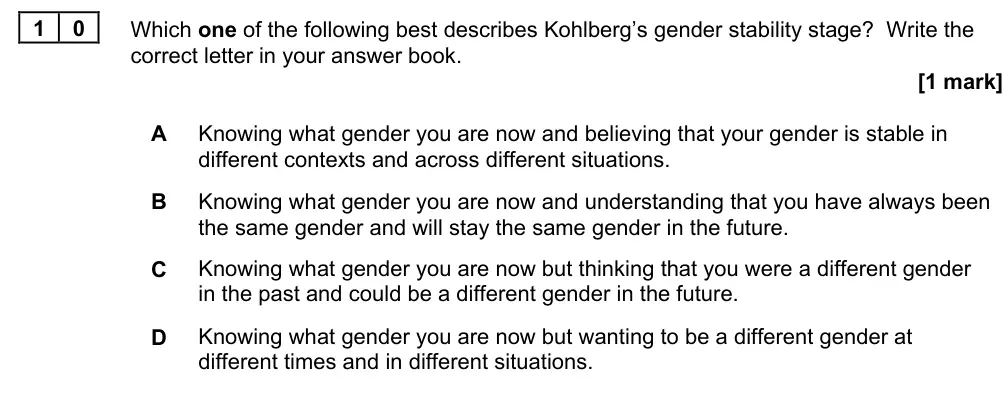
November 2020 · Paper 3 · Q10 1 mark AO1=1 Multiple choice gender
1 0
Which one of the following best describes Kohlberg’s gender stability stage?  Write the
correct letter in your answer book.
[1 mark]
A
Knowing what gender you are now and believing that your gender is stable in
different contexts and across different situations.
B
Knowing what gender you are now and understanding that you have always been
the same gender and will stay the same gender in the future.
C
Knowing what gender you are now but thinking that you were a different gender
in the past and could be a different gender in the future.
D
Knowing what gender you are now but wanting to be a different gender at
different times and in different situations.
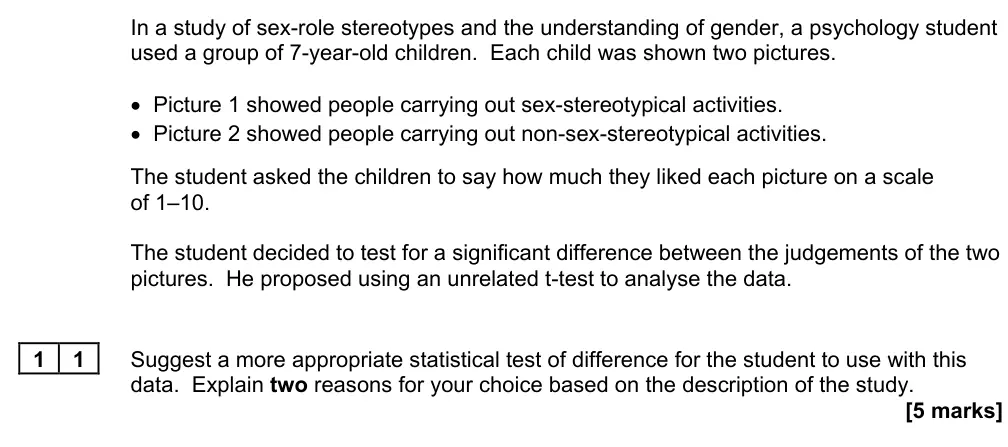
November 2020 · Paper 3 · Q11 5 marks AO3=5 Research methods inferential testingdata handling
In a study of sex-role stereotypes and the understanding of gender, a psychology student
used a group of 7-year-old children.  Each child was shown two pictures.
• Picture 1 showed people carrying out sex-stereotypical activities.
• Picture 2 showed people carrying out non-sex-stereotypical activities.
The student asked the children to say how much they liked each picture on a scale
of 1–10.
The student decided to test for a significant difference between the judgements of the two
pictures.  He proposed using an unrelated t-test to analyse the data.
1 1
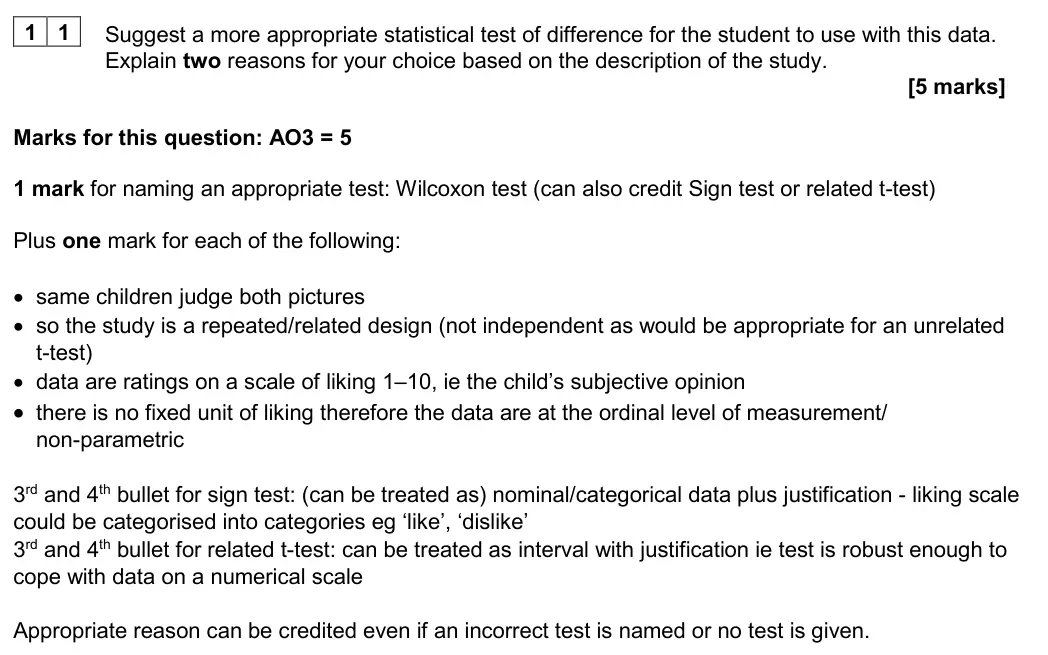
Suggest a more appropriate statistical test of difference for the student to use with this
data.  Explain two reasons for your choice based on the description of the study.
[5 marks]
November 2020 · Paper 3 · Q12 2 marks AO3=2 Research methods scientific processes
1 2
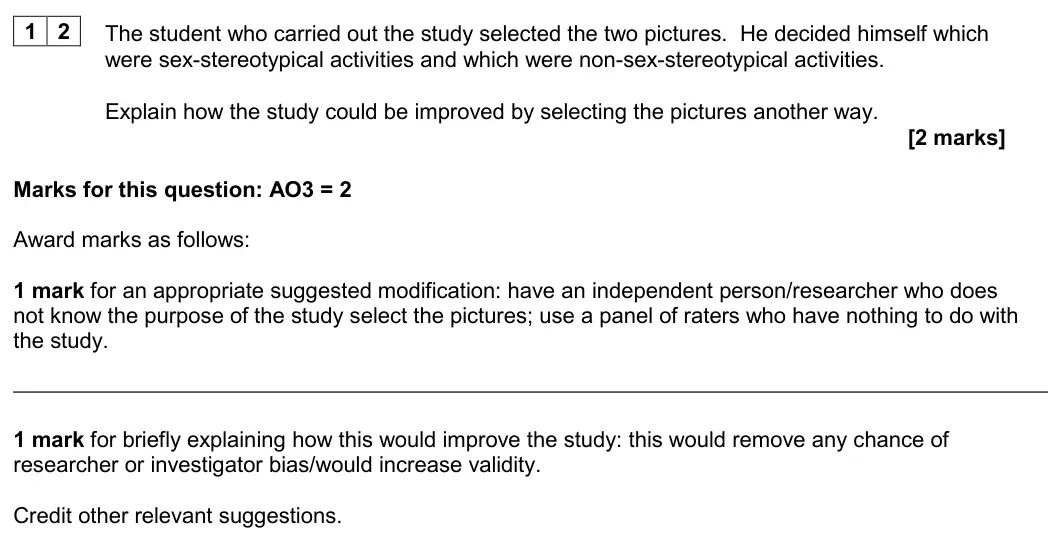
The student who carried out the study selected the two pictures.  He decided himself
which were sex-stereotypical activities and which were non-sex-stereotypical activities.
Explain how the study could be improved by selecting the pictures another way.
[2 marks]
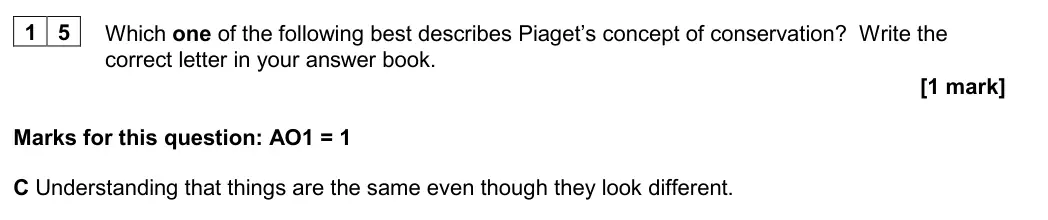
November 2020 · Paper 3 · Q15 1 mark AO1=1 Multiple choice cognition and development
1 5
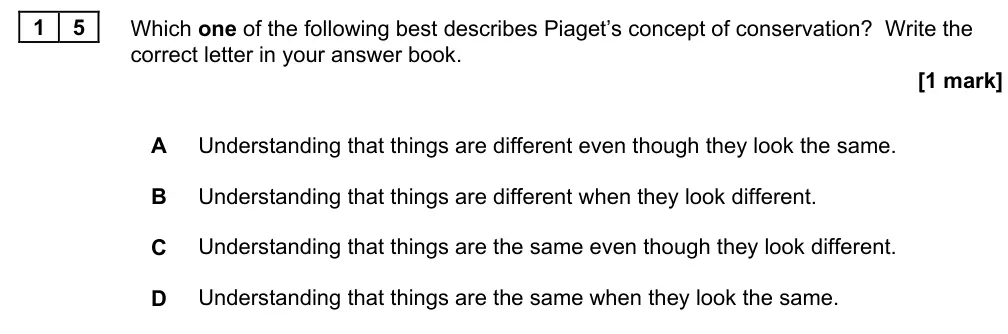
Which one of the following best describes Piaget’s concept of conservation?  Write the
correct letter in your answer book.
[1 mark]
A
Understanding that things are different even though they look the same.
B
Understanding that things are different when they look different.
C
Understanding that things are the same even though they look different.
D
Understanding that things are the same when they look the same.
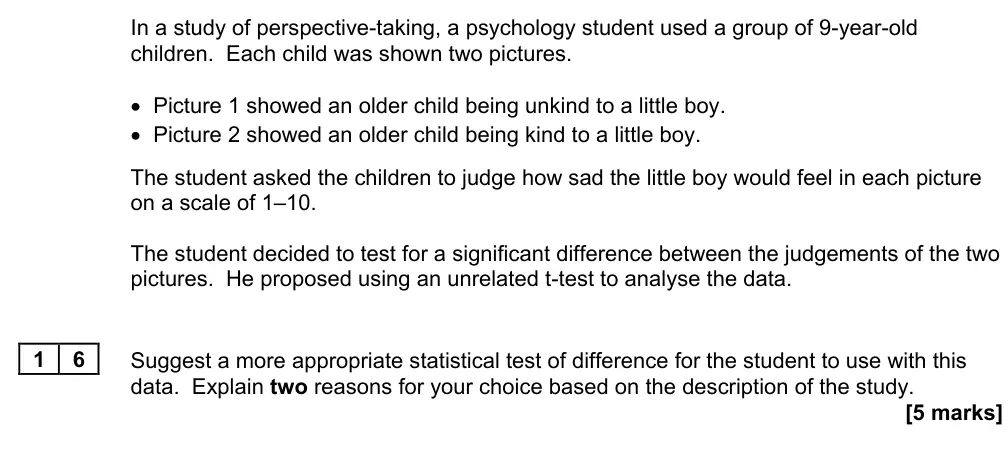
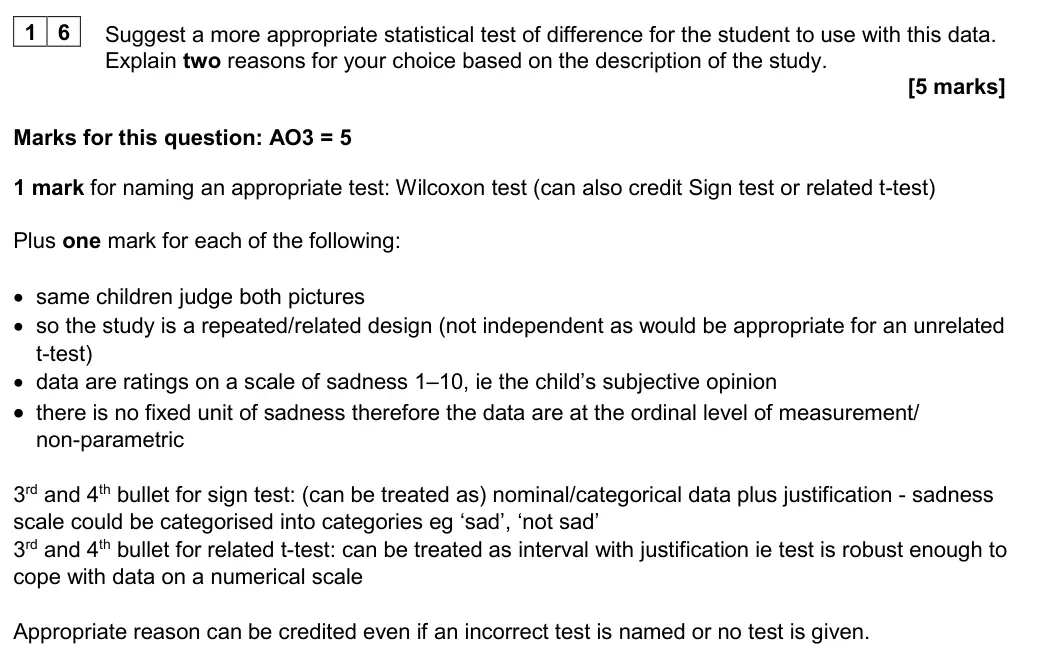
November 2020 · Paper 3 · Q16 5 marks AO3=5 Research methods inferential testingdata handling
In a study of perspective-taking, a psychology student used a group of 9-year-old
children.  Each child was shown two pictures.
• Picture 1 showed an older child being unkind to a little boy.
• Picture 2 showed an older child being kind to a little boy.
The student asked the children to judge how sad the little boy would feel in each picture
on a scale of 1–10.
The student decided to test for a significant difference between the judgements of the two
pictures.  He proposed using an unrelated t-test to analyse the data.
1 6
Suggest a more appropriate statistical test of difference for the student to use with this
data.  Explain two reasons for your choice based on the description of the study.
[5 marks]
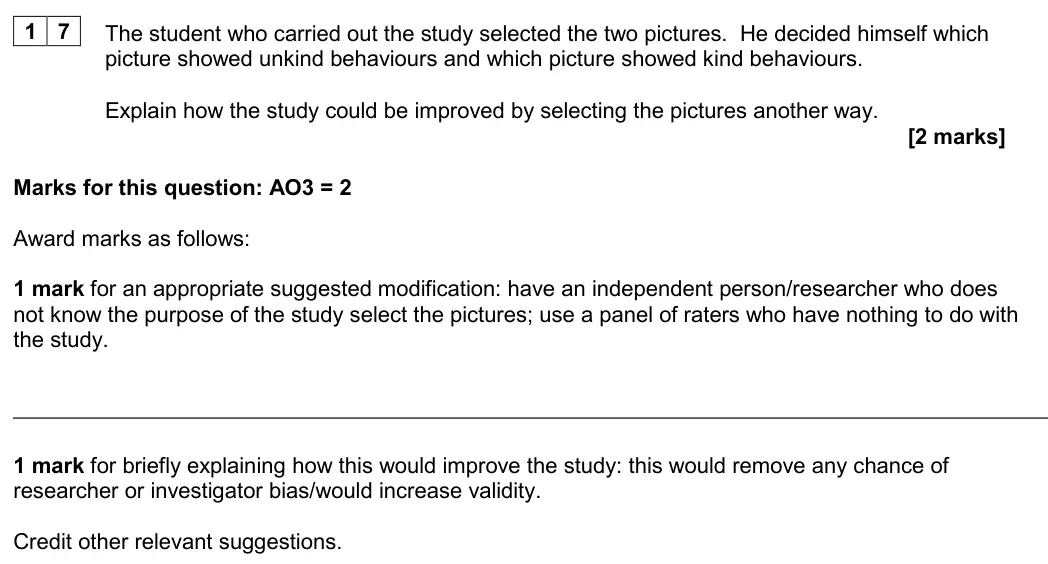
November 2020 · Paper 3 · Q17 2 marks AO3=2 Research methods scientific processes
1 7
The student who carried out the study selected the two pictures.  He decided himself
which picture showed unkind behaviours and which picture showed kind behaviours.
Explain how the study could be improved by selecting the pictures another way.
[2 marks]
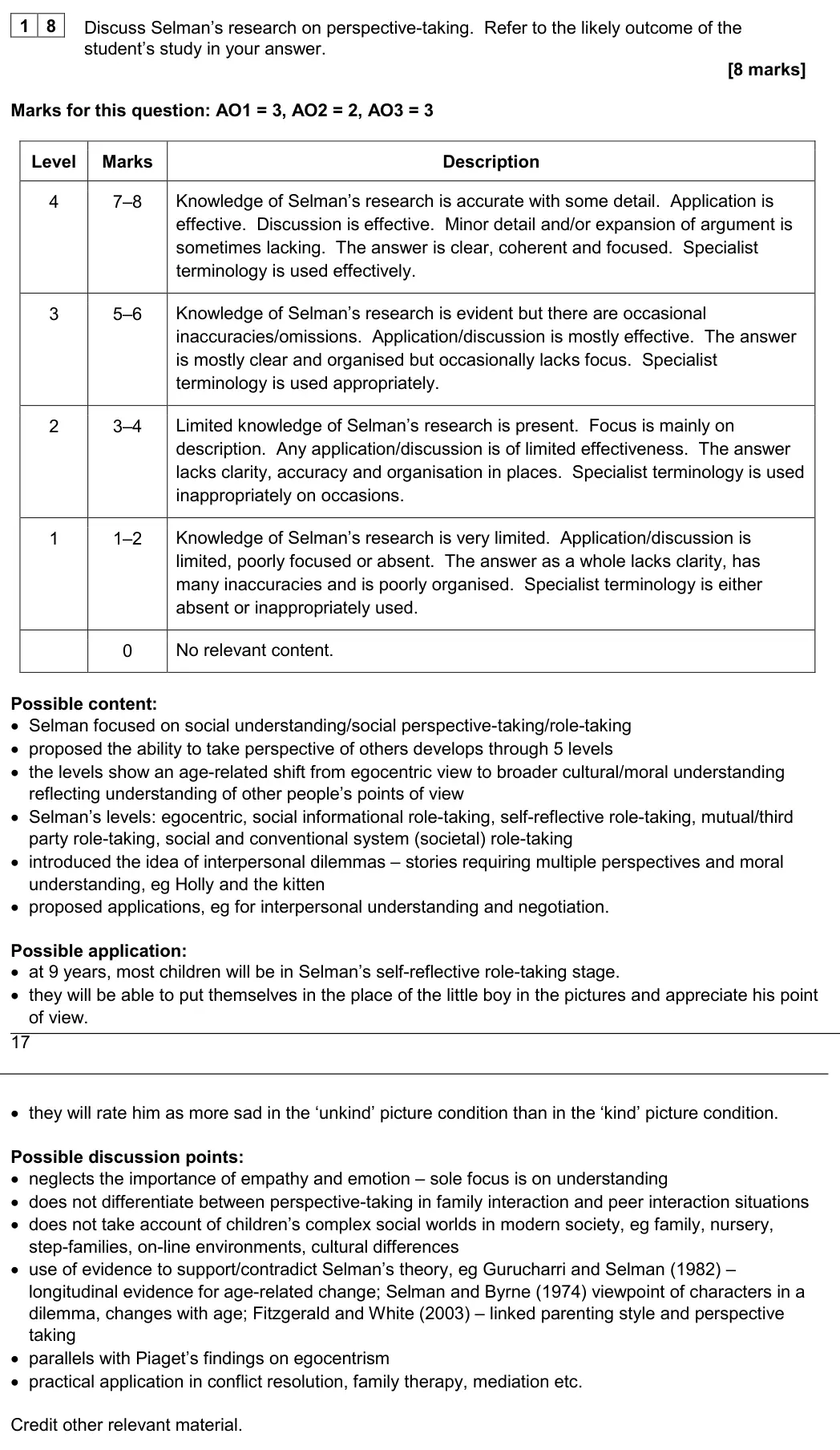
November 2020 · Paper 3 · Q18 8 marks AO1=3, AO2=2, AO3=3 Extended writing cognition and development
1 8
Discuss Selman’s research on perspective-taking.  Refer to the likely outcome of the
student’s study in your answer.
[8 marks]
November 2020 · Paper 3 · Q19 8 marks AO1=3, AO3=5 Extended writing cognition and development
1 9
Outline Vygotsky’s theory of cognitive development.  Explain one or more strength(s) of
Vygotsky’s theory.
[8 marks]
November 2020 · Paper 3 · Q21 4 marks AO2=4 Application schizophrenia
2 1
Martine has schizophrenia.  She is afraid because she believes that her care workers are
trying to hurt her.  She hears voices telling her to lock the doors and windows so the care
workers cannot get into her house.  She thinks about nothing else.
Explain how a cognitive behaviour therapist might treat Martine’s symptoms.
[4 marks]
November 2020 · Paper 3 · Q22 16 marks AO1=6, AO3=10 16-mark essay schizophrenia
2 2
Outline one or more biological explanation(s) for schizophrenia.  Compare biological
explanation(s) for schizophrenia with the family dysfunction explanation for
schizophrenia.
[16 marks]
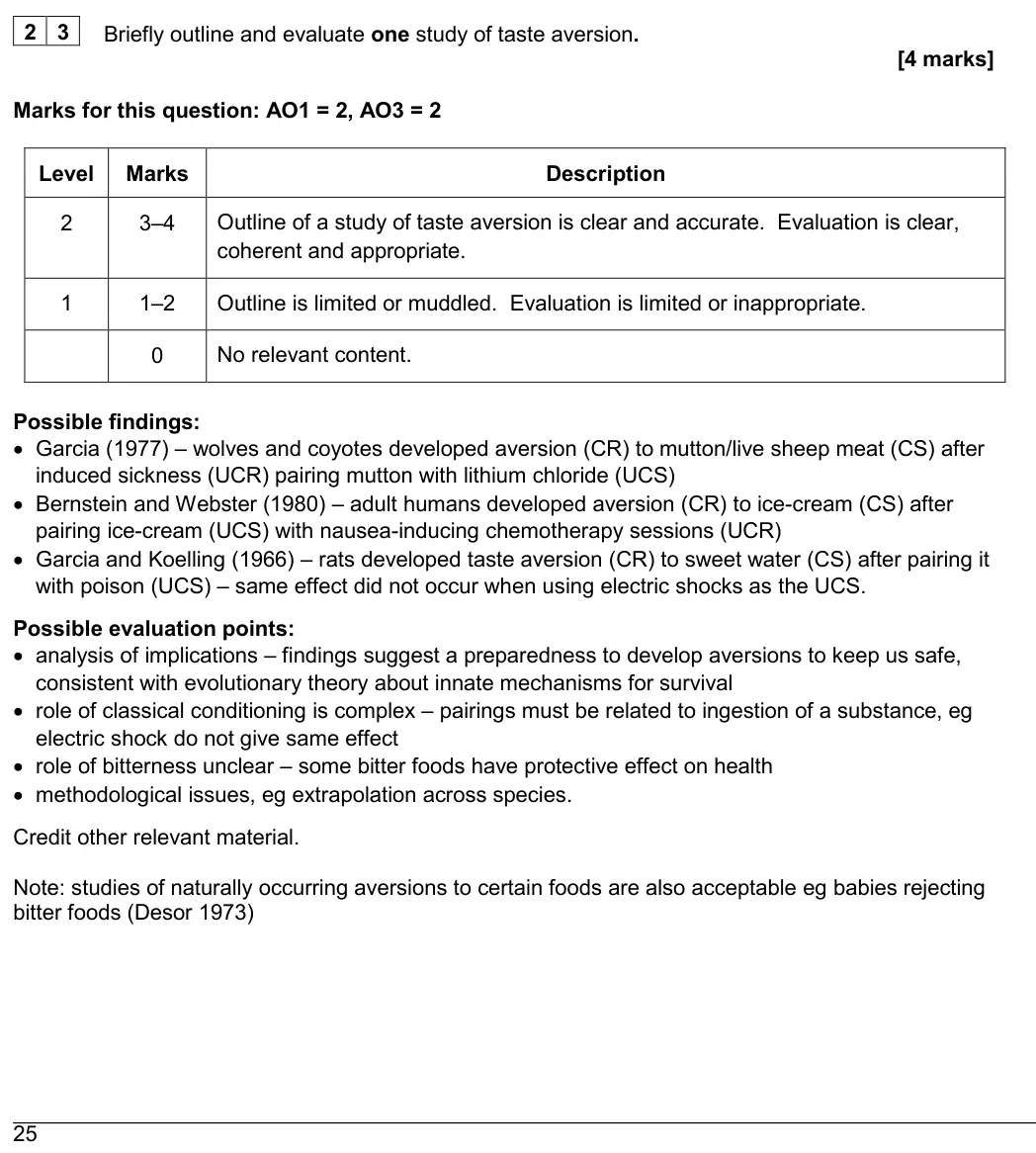
November 2020 · Paper 3 · Q23 4 marks AO1=2, AO3=2 Evaluate (short) eating behaviour
2 3
Briefly outline and evaluate one study of taste aversion.
[4 marks]
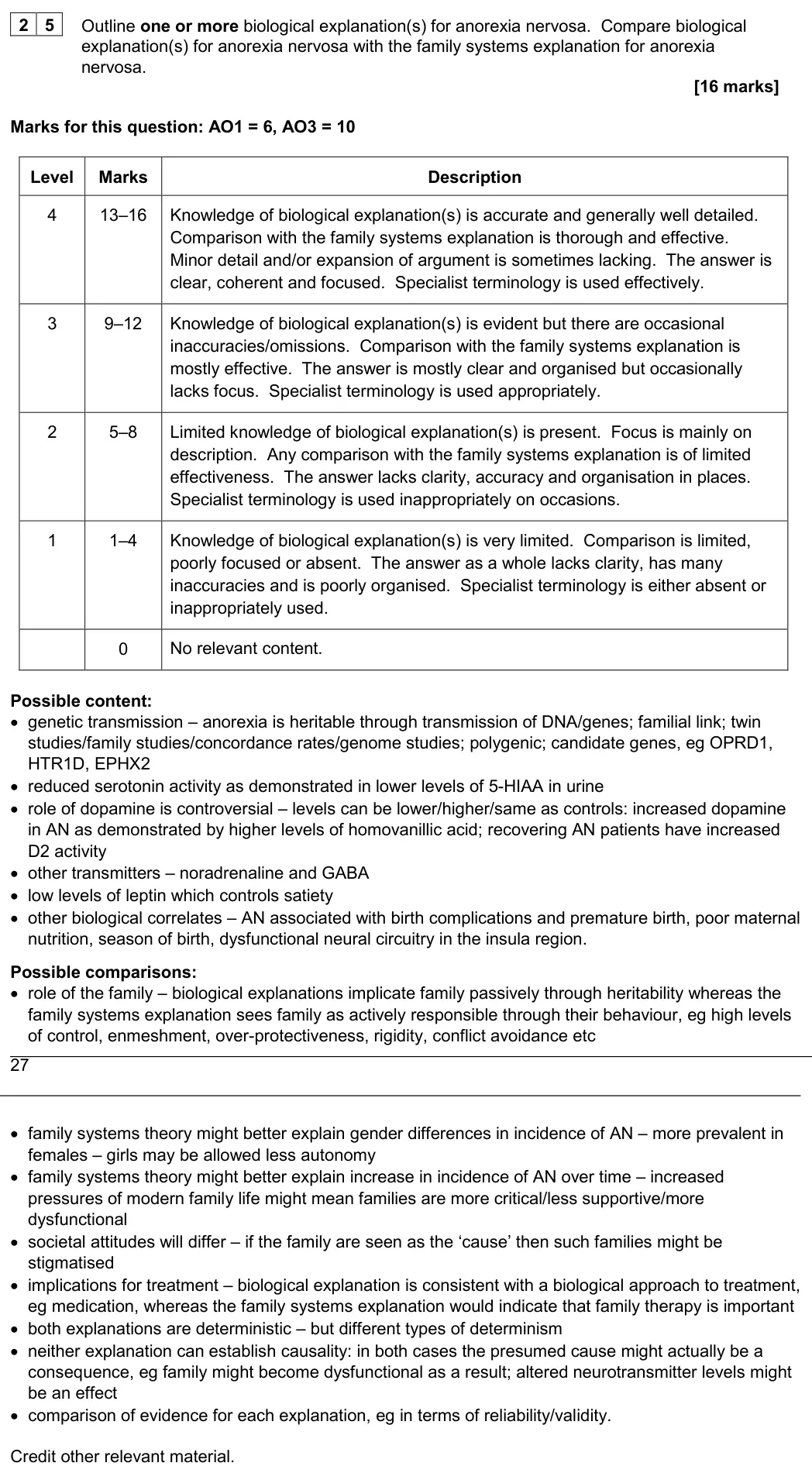
November 2020 · Paper 3 · Q25 16 marks AO1=6, AO3=10 16-mark essay eating behaviour
2 5
Outline one or more biological explanation(s) for anorexia nervosa.  Compare biological
explanation(s) for anorexia nervosa with the family systems explanation for anorexia
nervosa.
[16 marks]
November 2020 · Paper 3 · Q26 4 marks AO1=2, AO3=2 Evaluate (short) stress
2 6
Briefly outline and evaluate one study of immunosuppression.
[4 marks]
November 2020 · Paper 3 · Q27 4 marks AO2=4 Application stress
2 7
Nadine has a busy job and is very stressed most of the time.  When she thinks about
work at night she feels her heart pounding very fast.  She often feels anxious and is
experiencing frequent headaches.
Explain how a biofeedback therapist might help Nadine manage her stress.
[4 marks]
November 2020 · Paper 3 · Q28 16 marks AO1=6, AO3=10 16-mark essay stress
2 8
Outline one or more self-report measure(s) of stress.  Compare self-report measure(s) of
stress with physiological measures of stress.
[16 marks]
November 2020 · Paper 3 · Q29 6 marks AO1=6 Outline aggression
2 9
Describe neural mechanisms in aggression.
[6 marks]
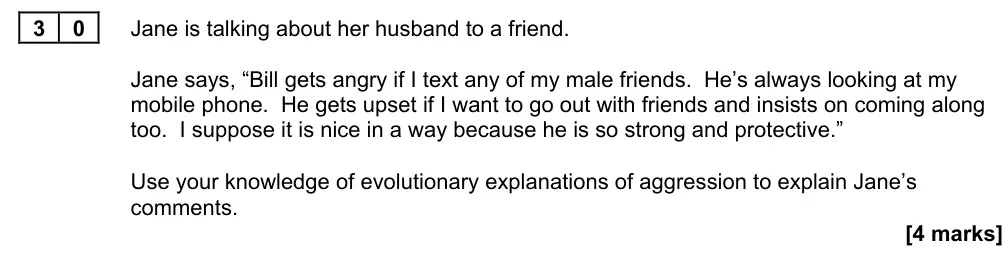
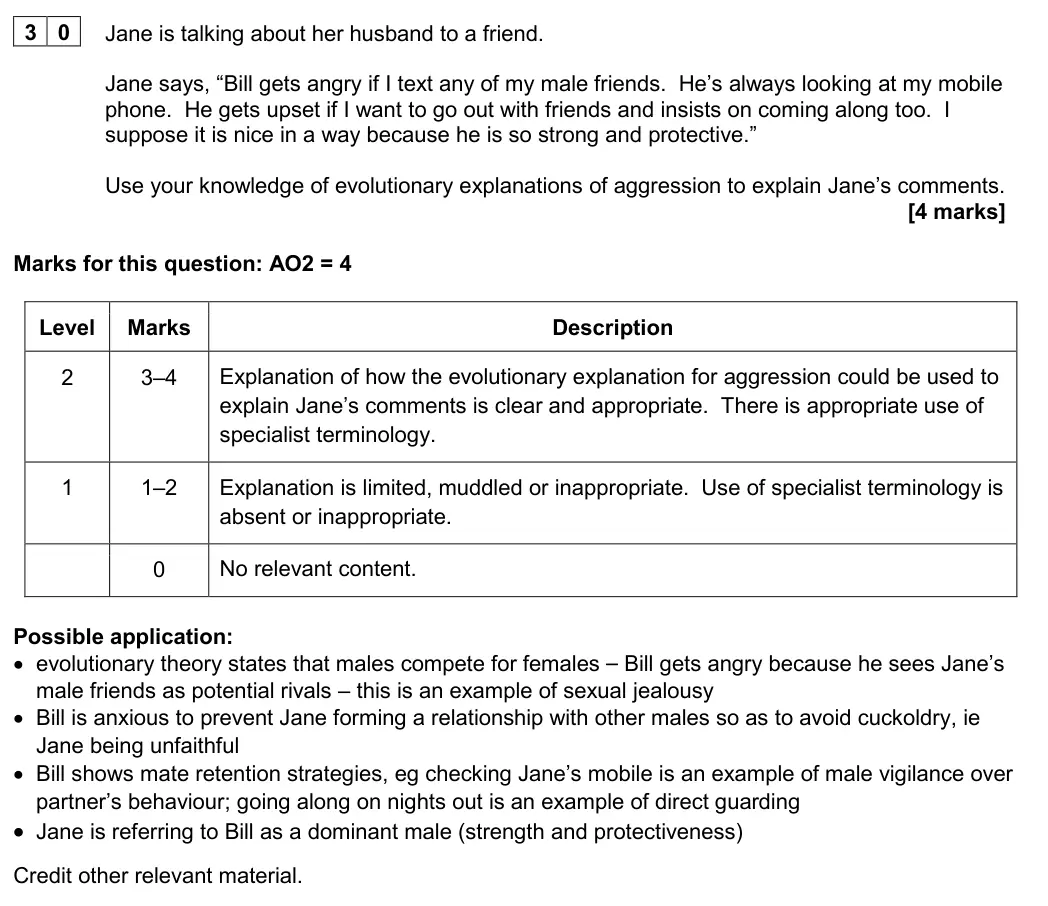
November 2020 · Paper 3 · Q30 4 marks AO2=4 Application aggression
3 0
Jane is talking about her husband to a friend.
Jane says, “Bill gets angry if I text any of my male friends.  He’s always looking at my
mobile phone.  He gets upset if I want to go out with friends and insists on coming along
too.  I suppose it is nice in a way because he is so strong and protective.”
Use your knowledge of evolutionary explanations of aggression to explain Jane’s
comments.
[4 marks]
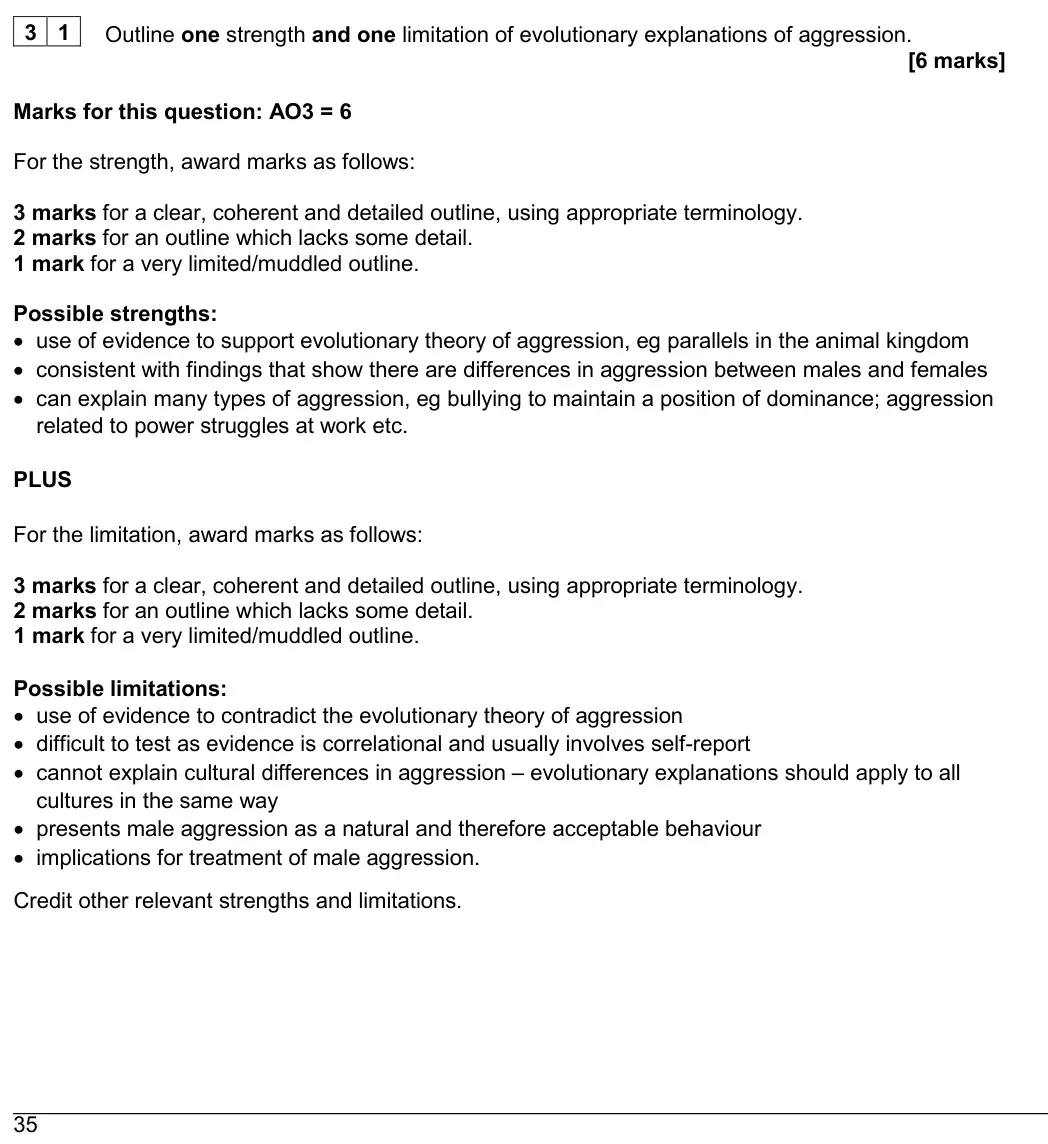
November 2020 · Paper 3 · Q31 6 marks AO3=6 Evaluate (short) aggression
3 1
Outline one strength and one limitation of evolutionary explanations of aggression.
[6 marks]
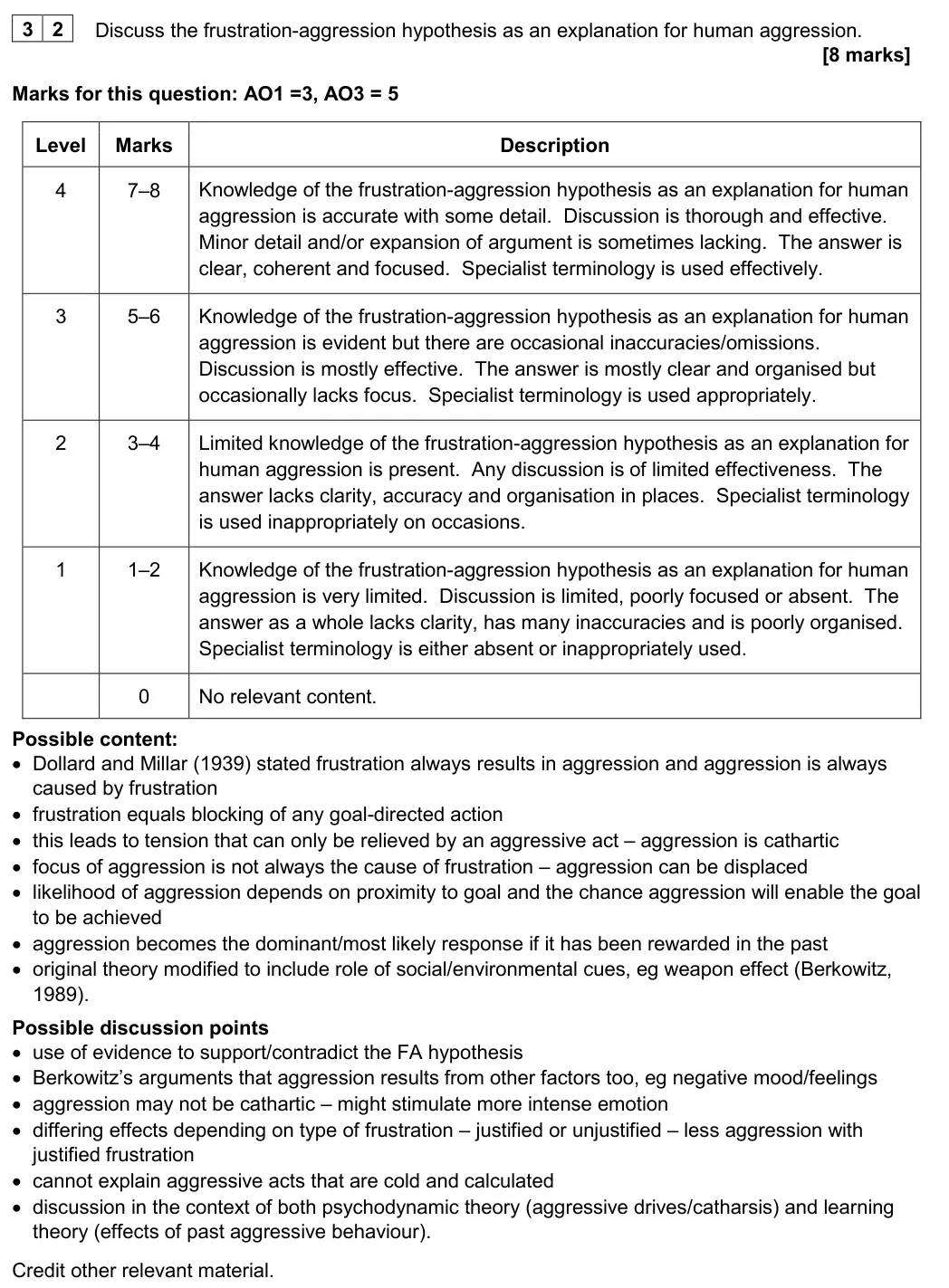
November 2020 · Paper 3 · Q32 8 marks AO1=3, AO3=5 Extended writing aggression
3 2
Discuss the frustration-aggression hypothesis as an explanation for human aggression.
[8 marks]
November 2020 · Paper 3 · Q34 4 marks AO2=4 Application forensic psychology
3 4
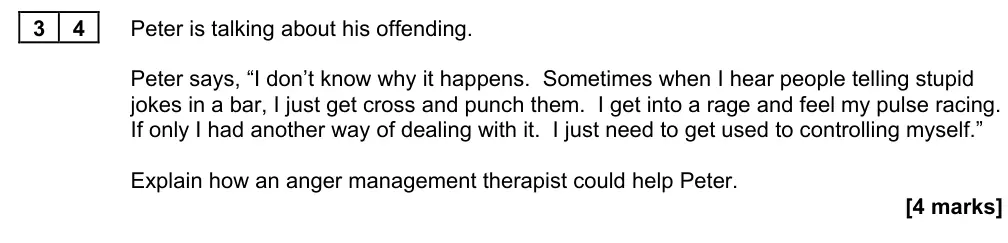
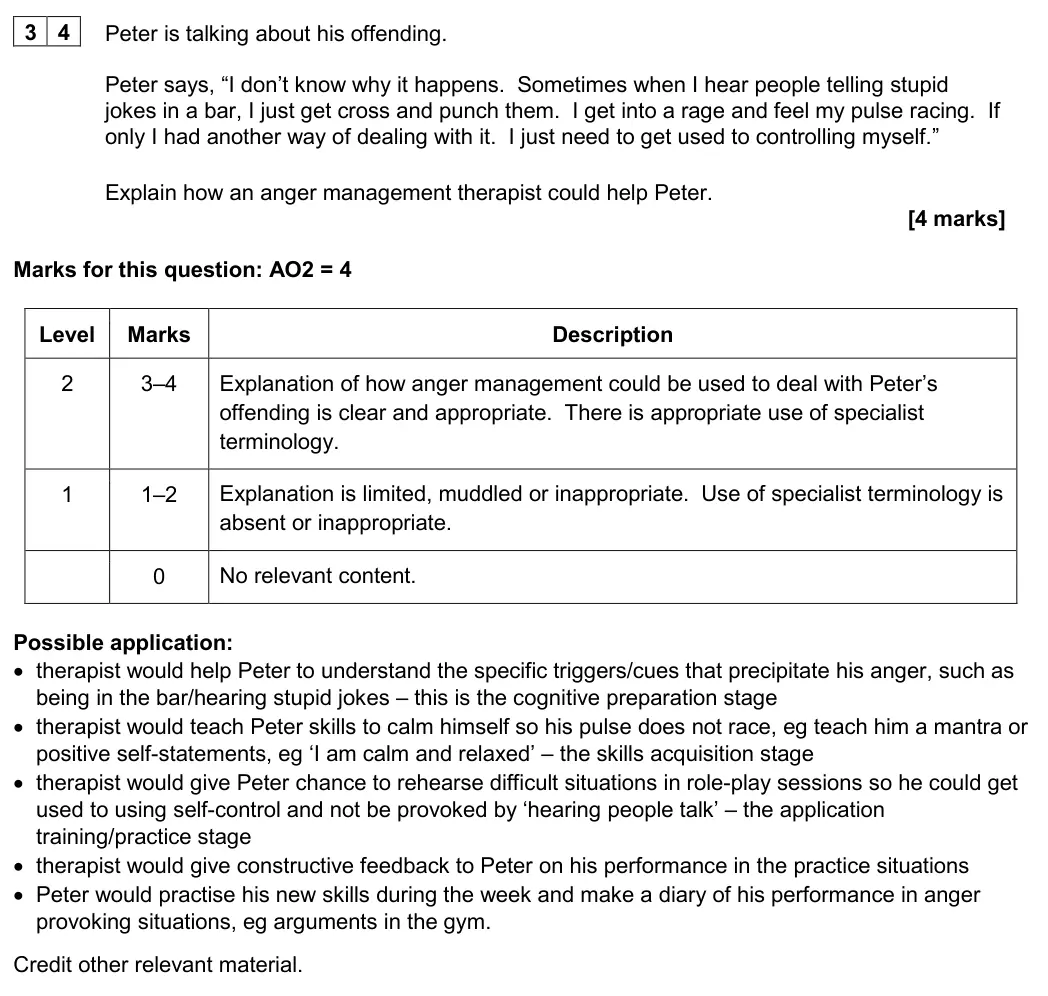
Peter is talking about his offending.
Peter says, “I don’t know why it happens.  Sometimes when I hear people telling stupid
jokes in a bar, I just get cross and punch them.  I get into a rage and feel my pulse racing.
If only I had another way of dealing with it.  I just need to get used to controlling myself.”
Explain how an anger management therapist could help Peter.
[4 marks]
November 2020 · Paper 3 · Q35 6 marks AO3=6 Evaluate (short) forensic psychology
3 5
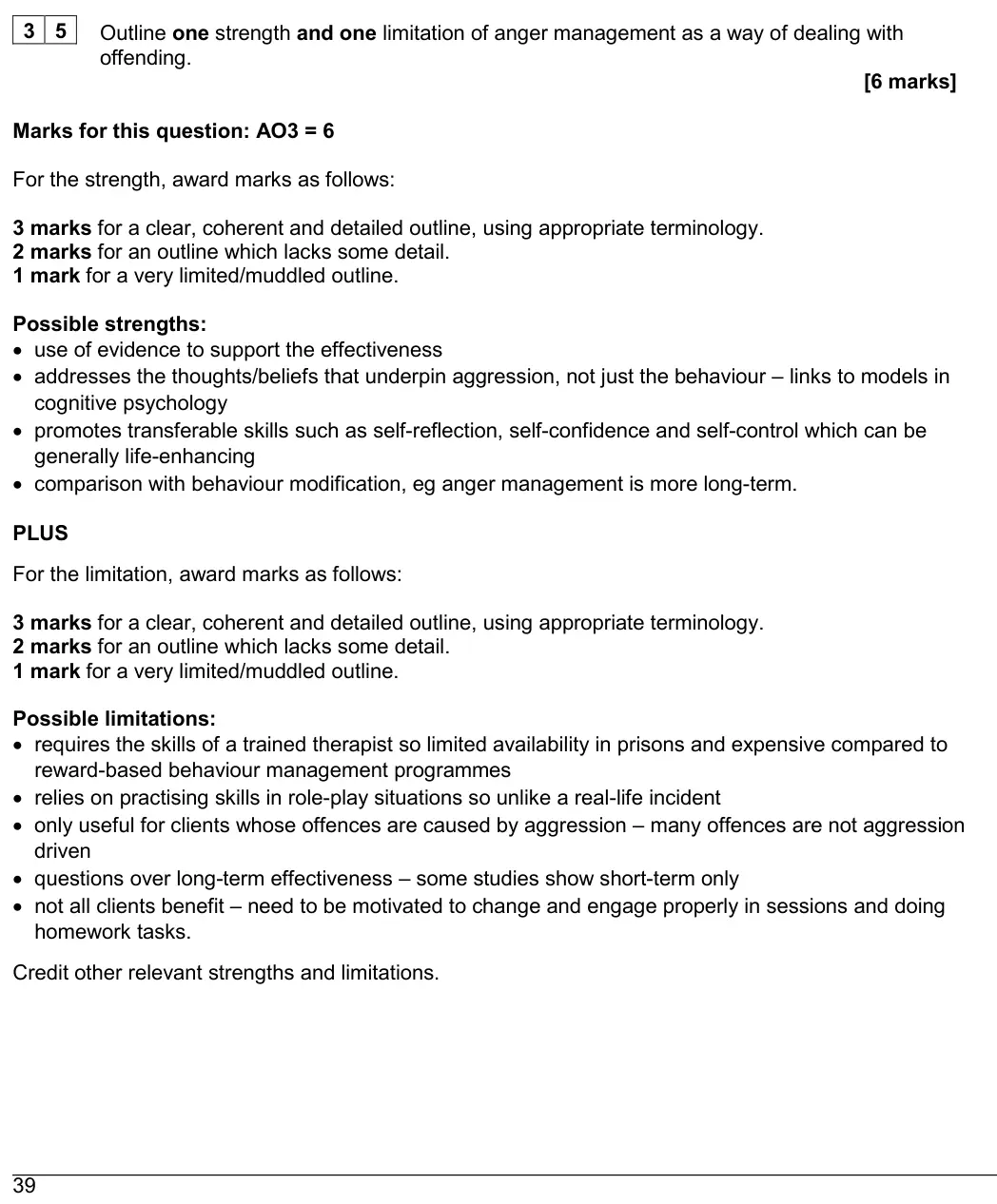
Outline one strength and one limitation of anger management as a way of dealing with
offending.
[6 marks]
November 2020 · Paper 3 · Q36 8 marks AO1=3, AO3=5 Extended writing forensic psychology
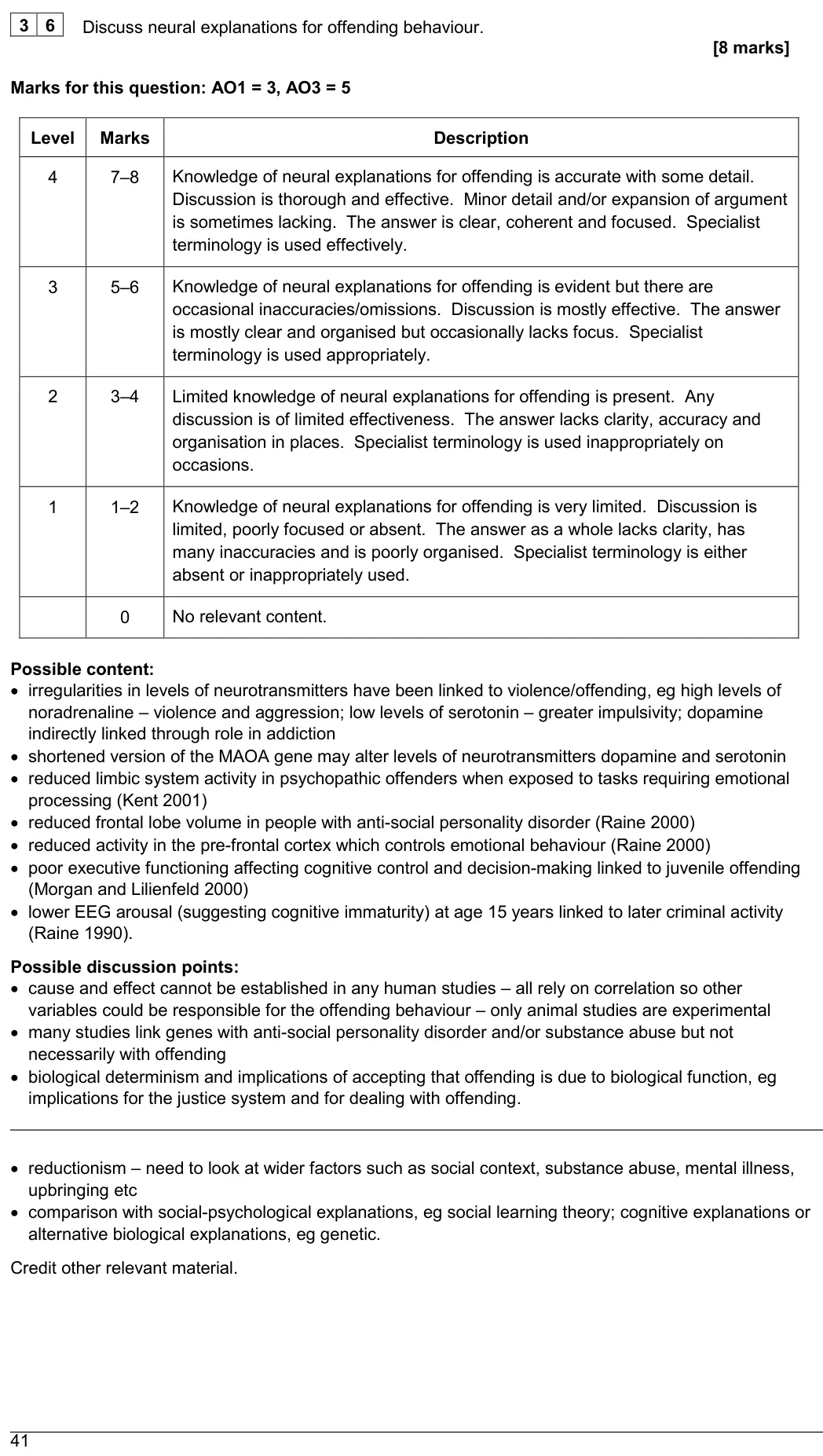
3 6
Discuss neural explanations for offending behaviour.
[8 marks]
November 2020 · Paper 3 · Q37 6 marks AO1=6 Outline addiction
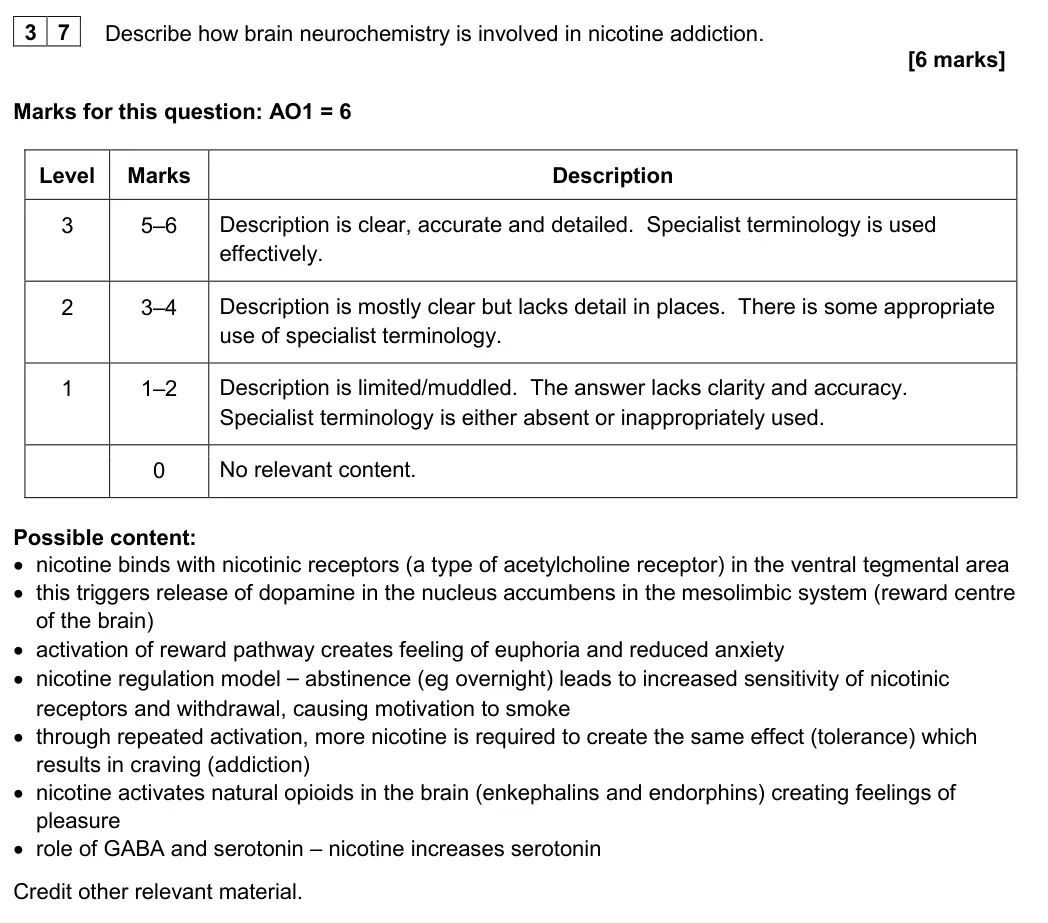
3 7
Describe how brain neurochemistry is involved in nicotine addiction.
[6 marks]
November 2020 · Paper 3 · Q38 4 marks AO2=4 Application addiction
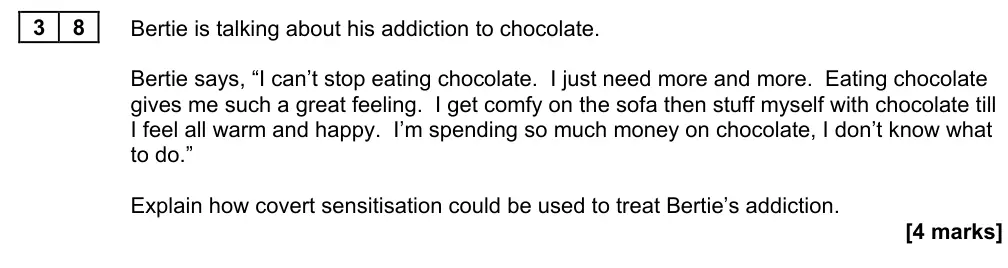
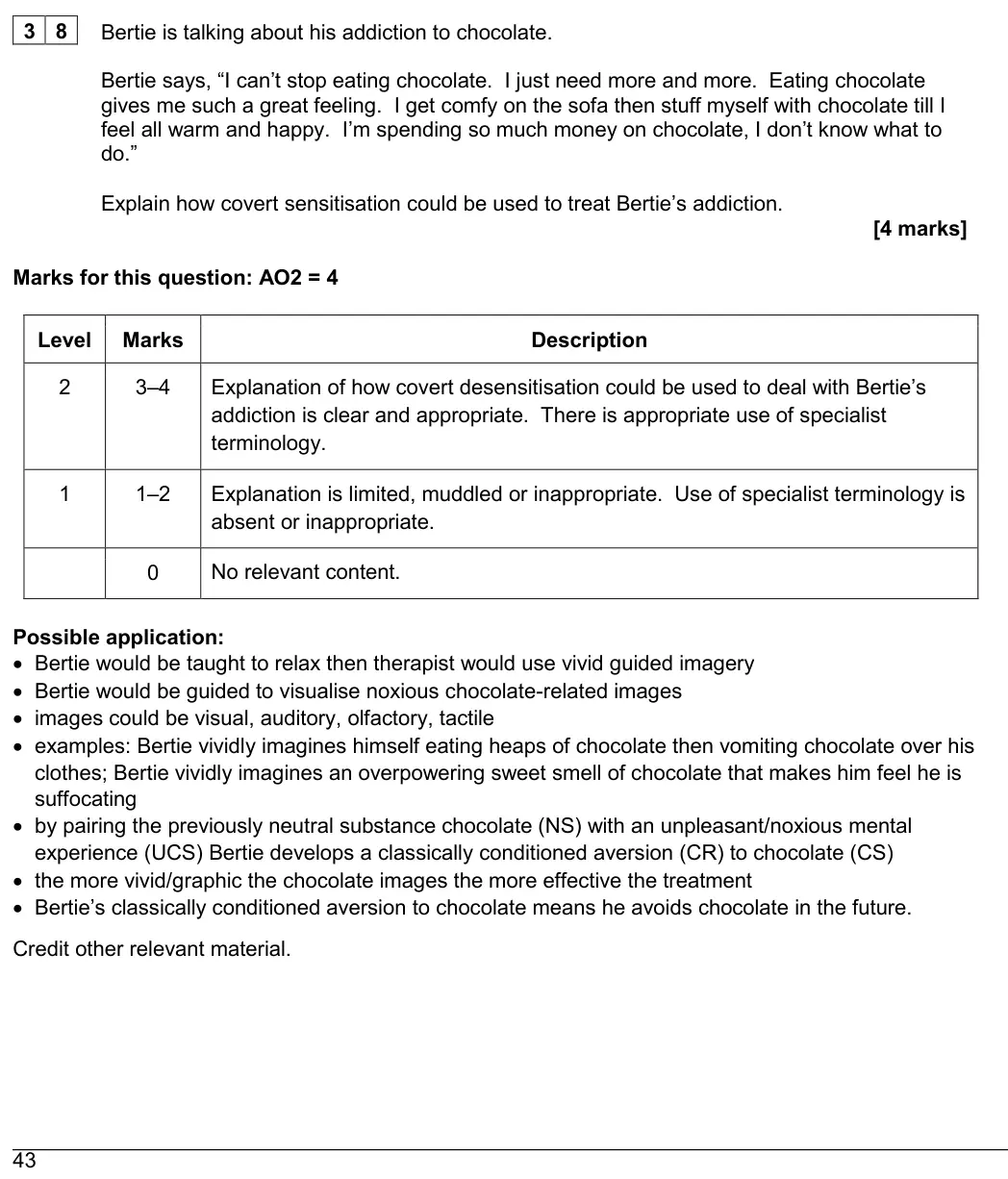
3 8
Bertie is talking about his addiction to chocolate.
Bertie says, “I can’t stop eating chocolate.  I just need more and more.  Eating chocolate
gives me such a great feeling.  I get comfy on the sofa then stuff myself with chocolate till
I feel all warm and happy.  I’m spending so much money on chocolate, I don’t know what
to do.”
Explain how covert sensitisation could be used to treat Bertie’s addiction.
[4 marks]
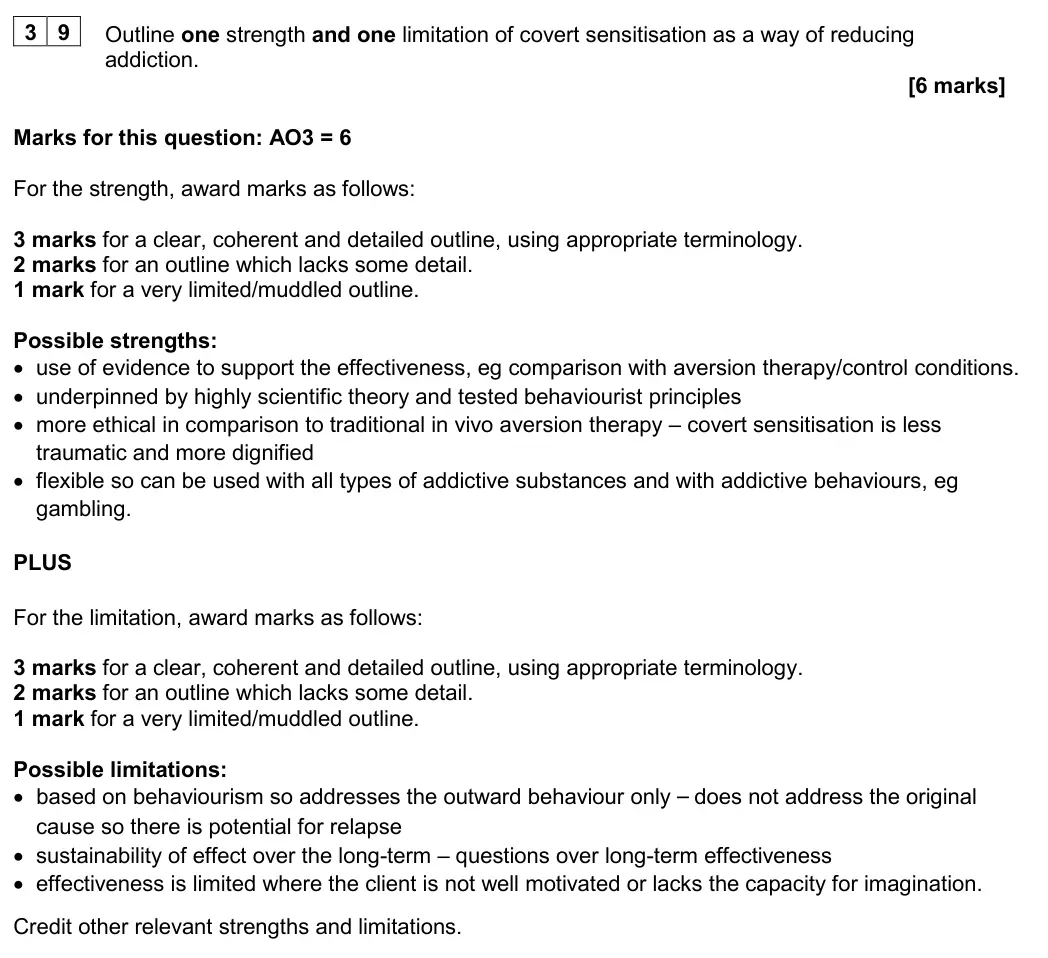
November 2020 · Paper 3 · Q39 6 marks AO3=6 Evaluate (short) addiction
3 9
Outline one strength and one limitation of covert sensitisation as a way of reducing
addiction.
[6 marks]
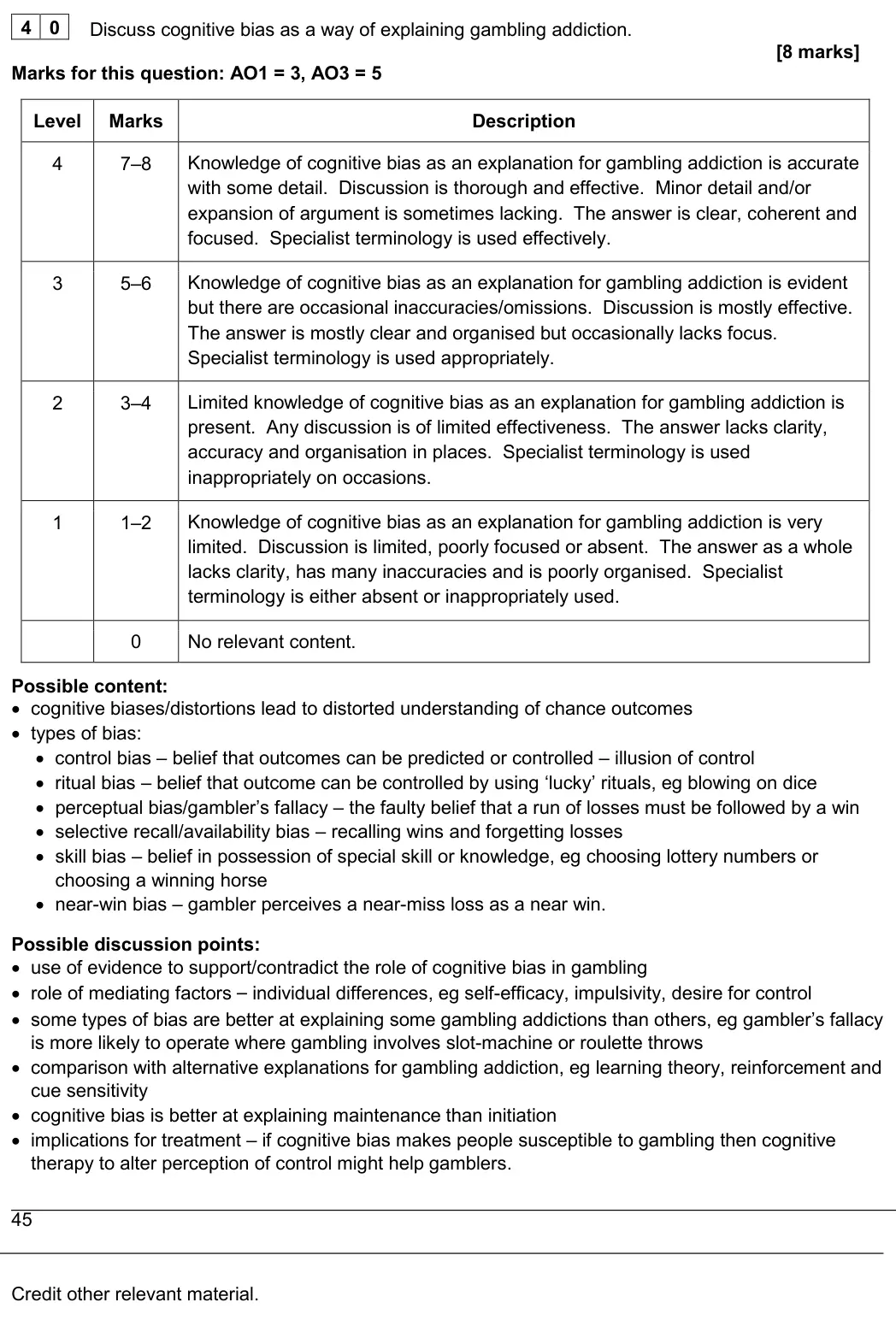
November 2020 · Paper 3 · Q40 8 marks AO1=3, AO3=5 Extended writing addiction
4 0
Discuss cognitive bias as a way of explaining gambling addiction.
[8 marks]

Work with an AQA psychology tutor

Want a paper marked and gone through with you? Message us.

Prefer email? Send an enquiry

If you are under 18, please include a parent's contact details. Enquiries go to enquiries@alevelpsychologytutor.com and are deleted once handled. All tutoring is online.