Notes, key studies and practice items for this topic are being written by our tutors. The past-paper questions below are ready now.
Specification statements
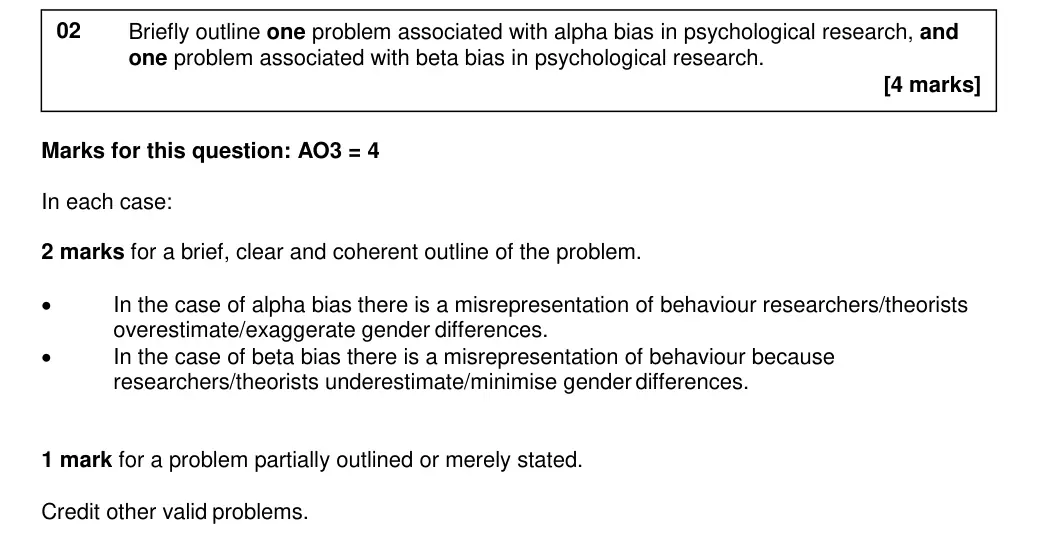
4.3.1-01 Gender and culture in Psychology – universality and bias. Gender bias including androcentrism and alpha and beta bias; cultural bias, including ethnocentrism and cultural relativism.
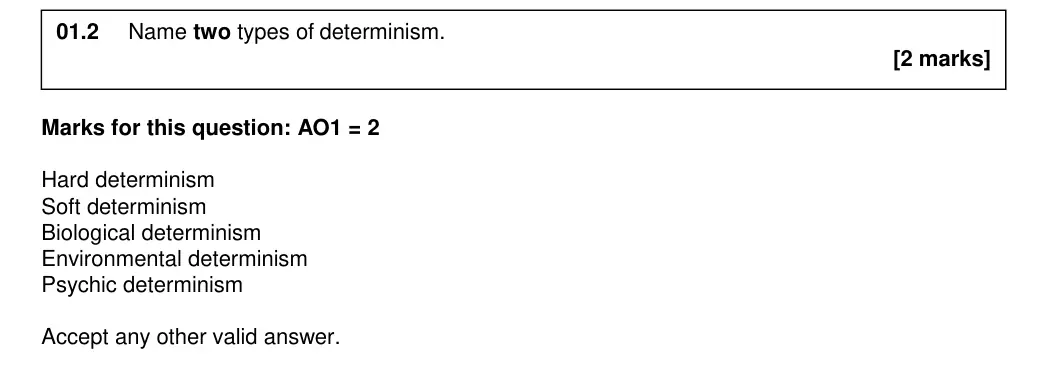
4.3.1-02 Free will and determinism: hard determinism and soft determinism; biological, environmental and psychic determinism. The scientific emphasis on causal explanations.
4.3.1-03 The nature-nurture debate: the relative importance of heredity and environment in determining behaviour; the interactionist approach.
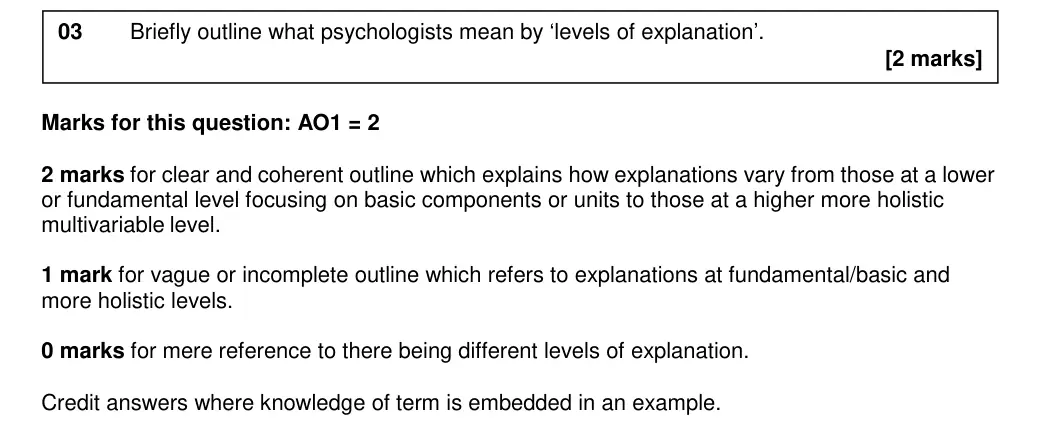
4.3.1-04 Holism and reductionism: levels of explanation in Psychology. Biological reductionism and environmental (stimulus-response) reductionism.
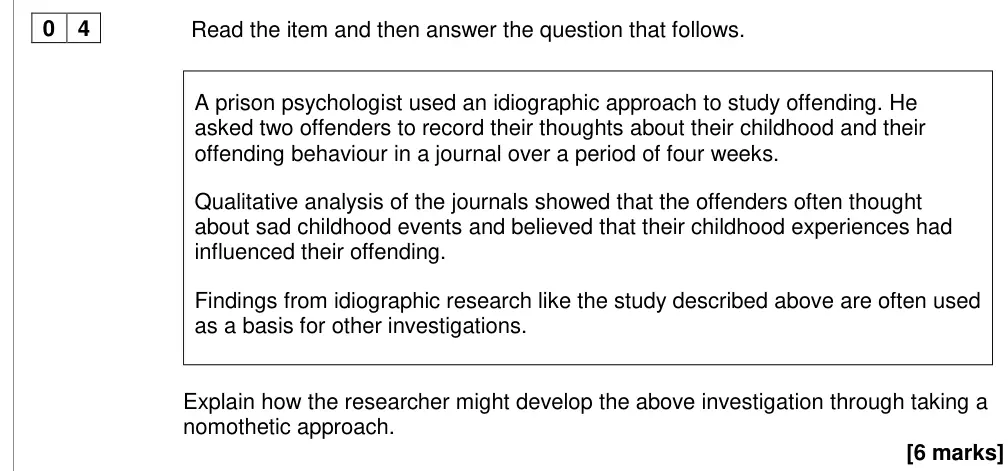
4.3.1-05 Idiographic and nomothetic approaches to psychological investigation.
4.3.1-06 Social sensitivity in psychological research.
Tap a question to zoom it. Mark scheme and examiner's comment open under each question.
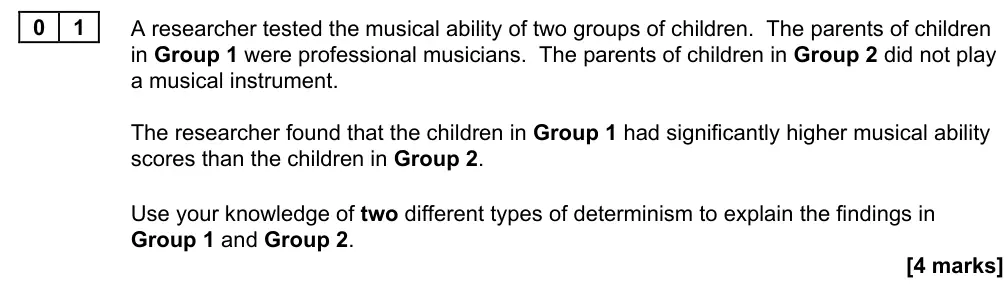
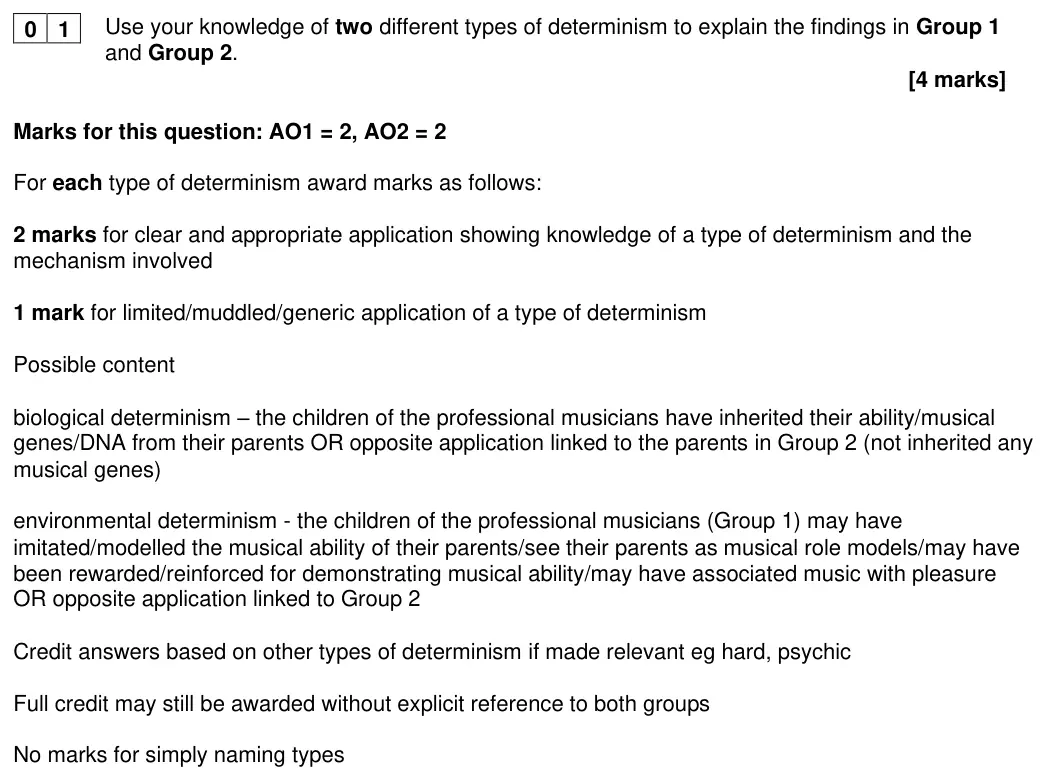
June 2025 · Paper 3 · Q14 marksAO1=2, AO2=2Application
Mark scheme, including level descriptors and indicative content
Examiner's comment
The most selected types of determinism in 01 were biological and environmental. The majority of students had little difficulty conveying their understanding of biological determinism and were able to make an effective link to the stem – usually through some reference to biological disposition or genetic inheritance. Students were also able to demonstrate knowledge of environmental determinism but found the link to the scenario much more difficult. Attempted applications were often commonsense – growing up in a musical family, for instance – when a precise psychological mechanism was required, for example, the influence of parental role models or the association between music and pleasure. Students who offered alternative forms of determinism, such as hard, soft or psychic, often gained the knowledge mark but invariably could not come up with a convincing link.
Notes from the mark scheme and report
per type of determinism: 2 marks for clear application with mechanism (biological: inherited musical genes
environmental: modelling/reinforcement by musician parents), 1 for generic
no marks for just naming types
other types (hard, psychic) credited if made relevant
full credit possible without explicit reference to both groups
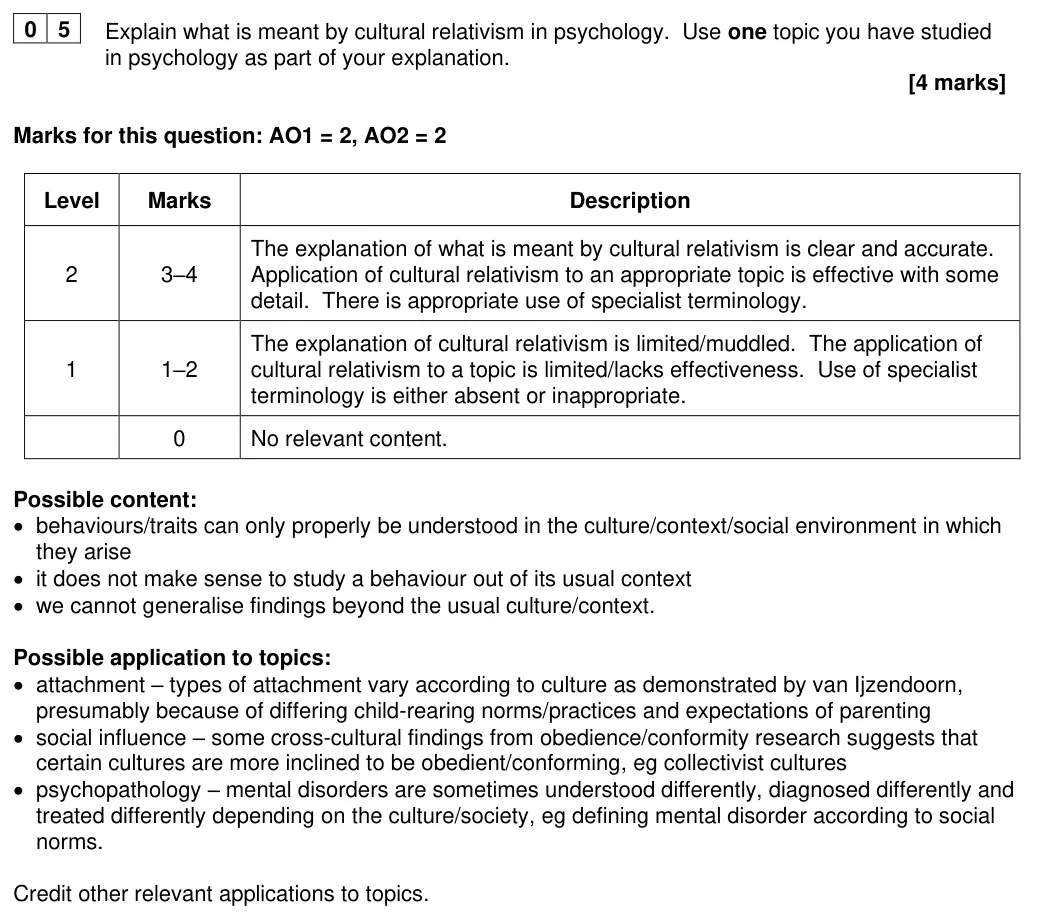
June 2025 · Paper 3 · Q54 marksAO1=2, AO2=2Explain
Mark scheme, including level descriptors and indicative content
Examiner's comment
Many students also found question 05 challenging, particularly the first two definition marks. There were lots of outlines of cultural bias, rather than cultural relativism, and even when accurate knowledge was demonstrated, it was often overly concise. Students fared better when presenting their example of cultural relativism. There were some very good explanations of cross-cultural research in attachment, such as that conducted by Van Ijzendoorn, to illustrate the concept.
Notes from the mark scheme and report
2 marks for meaning (behaviour only understood in its cultural context) + 2 for application to a topic (e.g. van IJzendoorn attachment types, obedience/conformity across cultures, social/cultural norms in mental health)
many described cultural bias instead
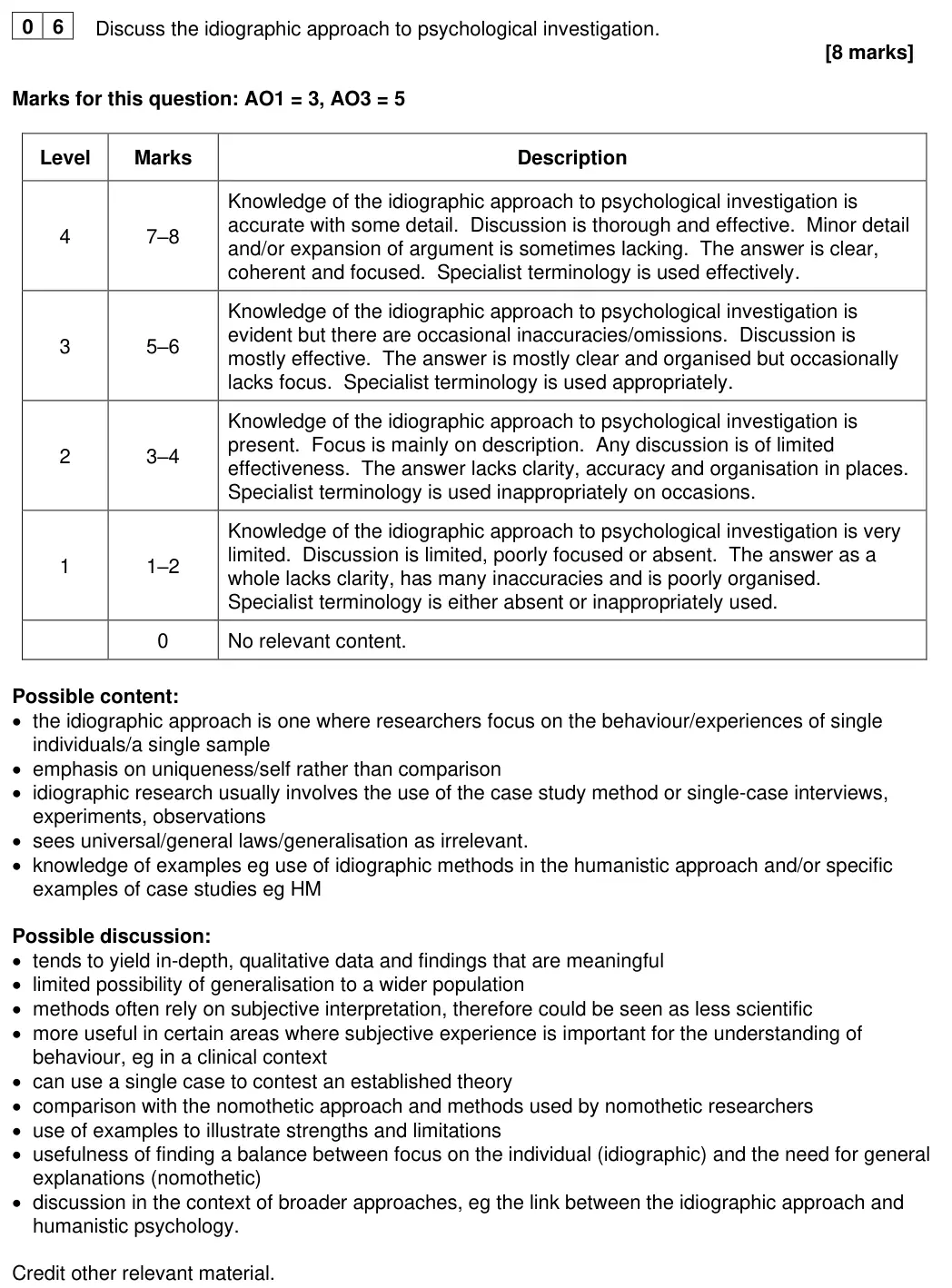
June 2025 · Paper 3 · Q68 marksAO1=3, AO3=5Extended writing
Mark scheme, including level descriptors and indicative content
Examiner's comment
Generally, students did perform reasonably well on question 06. Most recognised that the idiographic approach favours intensive study of the individual using qualitative methods, and that the aim is to carefully catalogue subjective experience rather than create general laws. Examples were often cited, though some of these slightly missed the point, such as the case study of Little Hans which was used by Freud to illustrate the ‘universal’ nature of the Oedipus complex. Most students offered at least two evaluative points of discussion, some based on reasoned comparison with the nomothetic approach. Many simply described the nomothetic approach without any direct comparison and scored less well as a result.
Notes from the mark scheme and report
study of the individual/uniqueness, case studies, qualitative data, rejects general laws
discussion vs nomothetic, generalisation, scientific status
some examples (Little Hans) missed the point as used to support a universal theory
June 2024 · Paper 3 · Q11 markAO2=1Multiple choice
Mark scheme, including level descriptors and indicative content
Examiner's comment
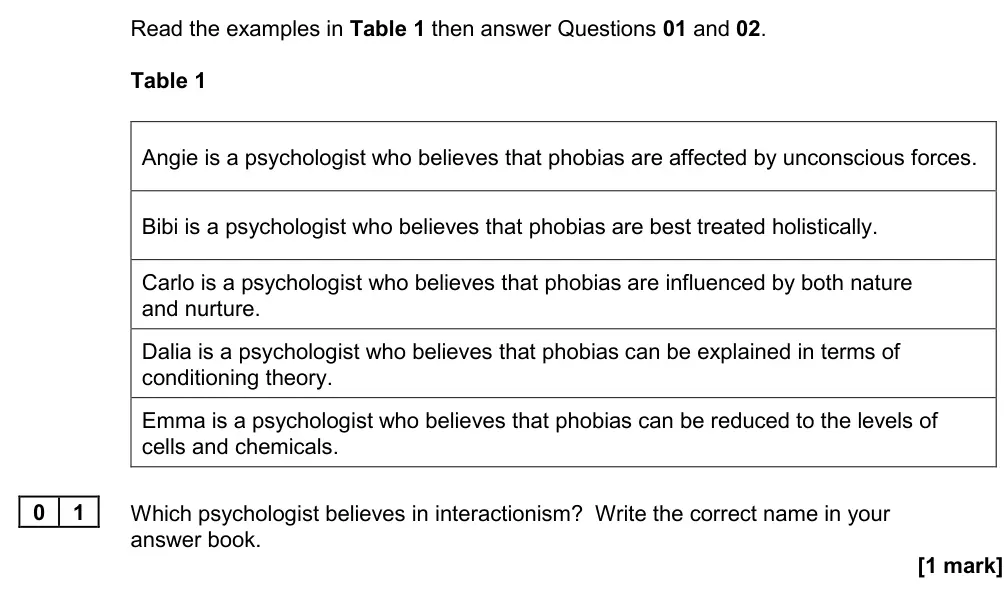
For questions 01 and 02, most students were able to correctly identify ‘Carlo’ in the first instance, and ‘Dalia’ in the second, though there was a considerable number who got these the wrong way round. Some students ‘hedged their bets’ by writing the same name for both of their answers. Of the wrongly selected names, ‘Emma’ was by some distance the most popular, and usually for Question 02.
Notes from the mark scheme and report
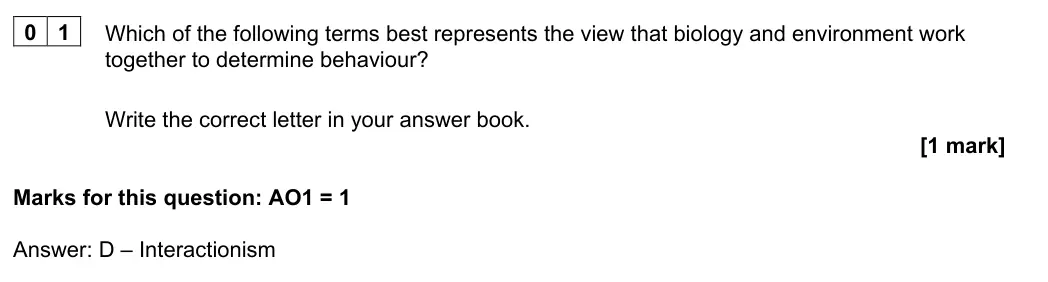
answer Carlo (interactionism)
some reversed answers to 01/02 or wrote the same name for both
June 2024 · Paper 3 · Q21 markAO2=1Multiple choice
Mark scheme, including level descriptors and indicative content
Examiner's comment
For questions 01 and 02, most students were able to correctly identify ‘Carlo’ in the first instance, and ‘Dalia’ in the second, though there was a considerable number who got these the wrong way round. Some students ‘hedged their bets’ by writing the same name for both of their answers. Of the wrongly selected names, ‘Emma’ was by some distance the most popular, and usually for Question 02.
Notes from the mark scheme and report
answer Dalia (environmental reductionism)
'Emma' the most common wrong answer
some reversed answers to 01/02
June 2024 · Paper 3 · Q32 marksAO1=2Short answer
Mark scheme, including level descriptors and indicative content
Examiner's comment
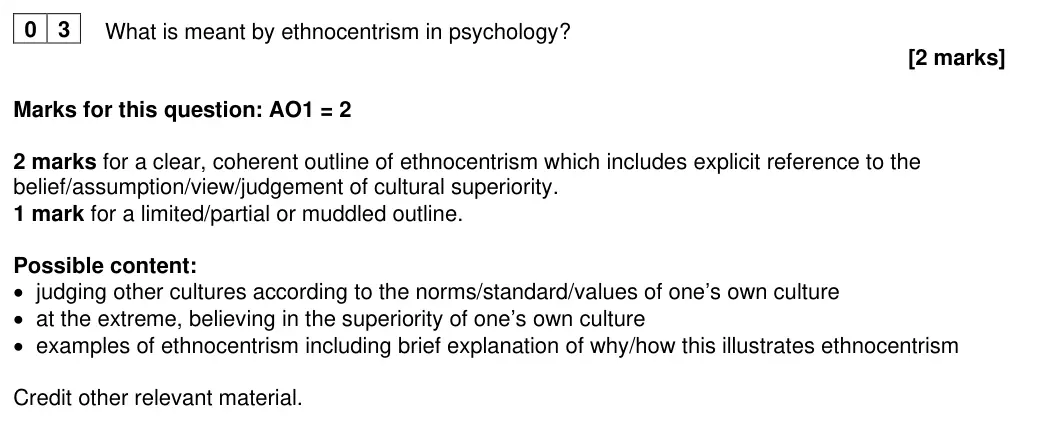
In Question 03, many students were able to provide a clear and coherent definition of ‘ethnocentrism’, and often one that very closely mirrored the suggested content in the mark scheme. Those who fell short often gave a definition of ‘culture bias’, which failed to include appropriate reference to the notion of cultural superiority. Some offered examples of ethnocentric research, but again, the nub of the answer – the implied cultural superiority – was absent.
Notes from the mark scheme and report
2 marks need explicit reference to belief/judgement of cultural superiority
judging other cultures by own culture's norms
defining culture bias generally without superiority scored 1
June 2024 · Paper 3 · Q44 marksAO3=4Evaluate (short)
Mark scheme, including level descriptors and indicative content
Examiner's comment
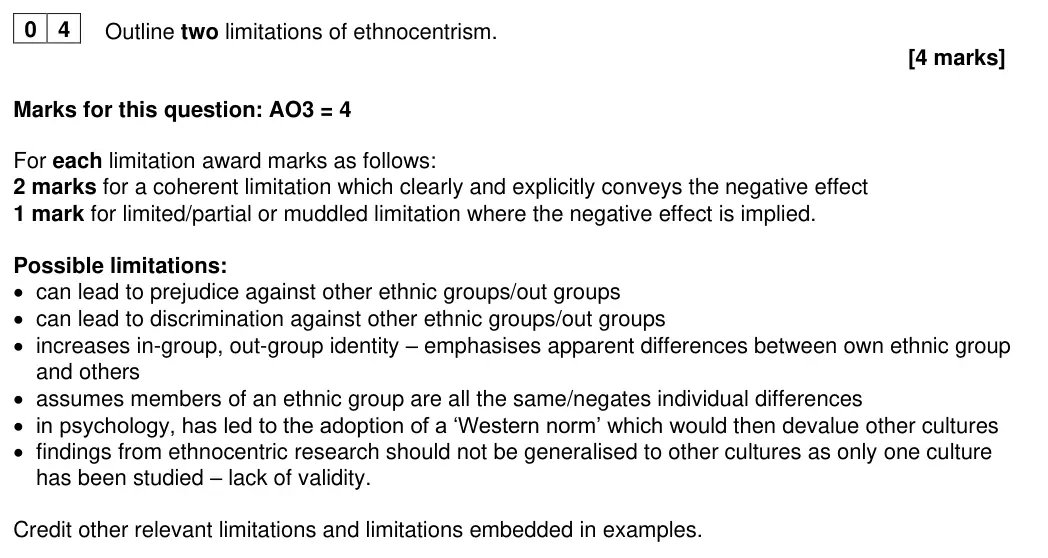
Despite dropping marks in Question 03, many students were still able to access all four marks for Question 04. Again, many interpreted ethnocentrism within the context of ethnocentric/culturally biased research. Thus, the most popular answer was the methodological problem of being unable to generalise findings any further than the culture studied.
Notes from the mark scheme and report
2 marks per limitation where the negative effect is explicit (prejudice, discrimination, in-group/out-group, Western norm devalues other cultures, cannot generalise beyond culture studied)
generalisation point most popular
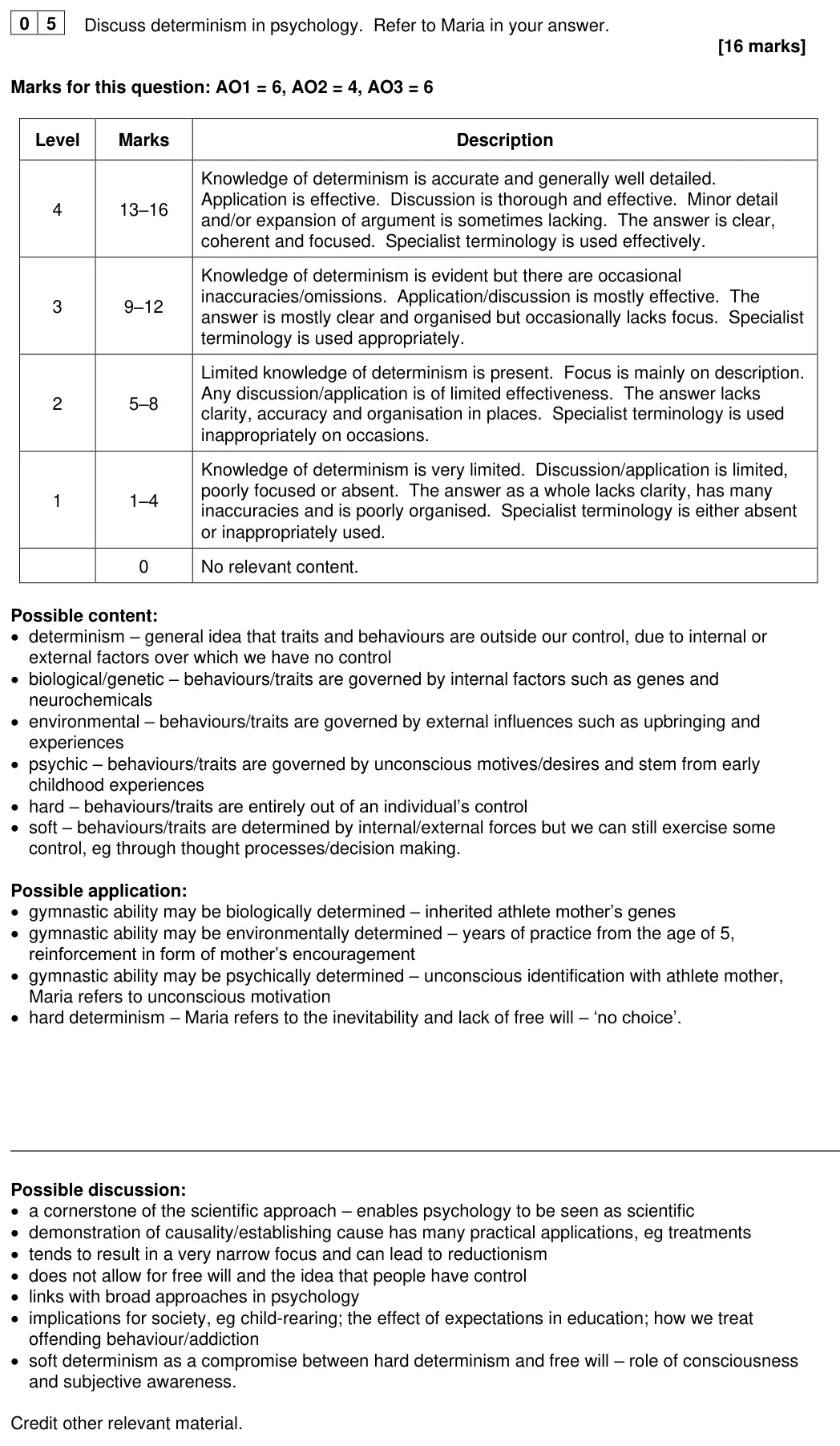
June 2024 · Paper 3 · Q516 marksAO1=6, AO2=4, AO3=616-mark essay
Mark scheme, including level descriptors and indicative content
Examiner's comment
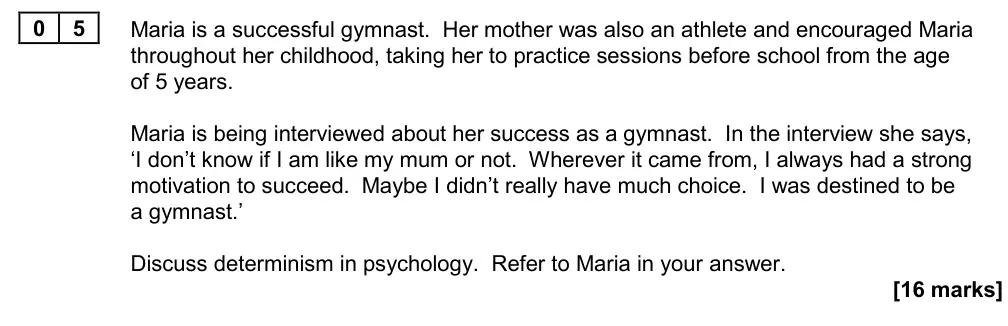
Question 05 was the first of three applied 16-marks extended response questions on the paper, and many students fared well. There was sound knowledge of the different forms of determinism, and there was often effective application to most aspects of the stem. Similarly, there was evidence of good discussion: Libet’s research was typically used effectively to support hard/biological determinism. The argument that deterministic ideas are at odds with the legal system’s notion of moral responsibility was also well-made. Of those students who struggled, many presented their essay as a straightforward debate between free will and determinism which missed the point of the question somewhat. Lots of students tried to reframe the stem as illustrating soft determinism, often unsuccessfully. There was also frequent confusion with other debates, such as nature-nurture and holism-reductionism.
Notes from the mark scheme and report
biological (mother's genes), environmental (practice from age 5, encouragement), psychic (unconscious motivation/identification), hard determinism ('no choice', 'destined')
a straight free will vs determinism debate missed the point
confusion with nature-nurture and holism-reductionism
Libet and moral responsibility used well
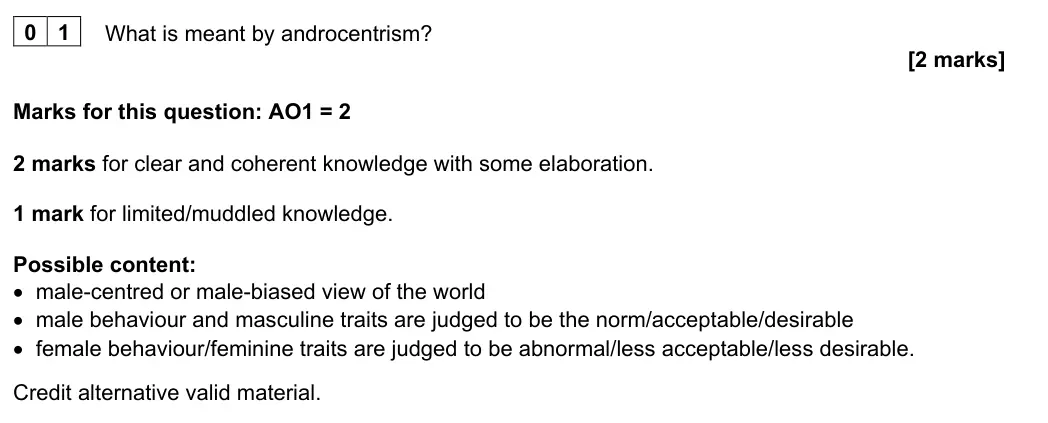
June 2023 · Paper 3 · Q12 marksAO1=2Short answer
Mark scheme, including level descriptors and indicative content
Examiner's comment
Marks were generally awarded for recognising that androcentrism involves male bias in the first instance, followed by some implication of this for the second mark. The notion that female behaviour would be seen as ‘abnormal’ or ‘deficient’ by comparison was the most popular elaboration. Marks were often lost through describing beta bias, or gender bias more generally.
Notes from the mark scheme and report
1 mark male-centred/male-biased view, 2nd for implication (female behaviour judged abnormal/deficient by comparison)
marks lost describing beta bias or gender bias generally
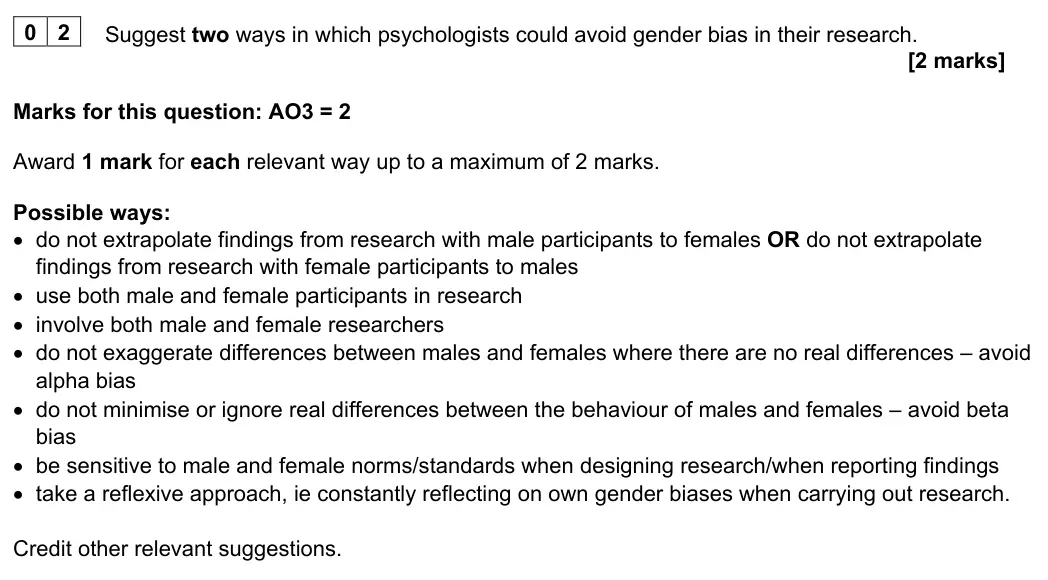
June 2023 · Paper 3 · Q22 marksAO3=2Explain
Mark scheme, including level descriptors and indicative content
Examiner's comment
Most students were able to offer at least one way of dealing with gender bias; most commonly, the idea of using equal numbers of male and female participants. Recommending the involvement of both male and female researchers was also an often-seen answer.
Notes from the mark scheme and report
1 mark per way, max 2: both sexes as participants/researchers, don't extrapolate across sexes, avoid alpha/beta bias, reflexivity
equal numbers of male and female participants most common answer
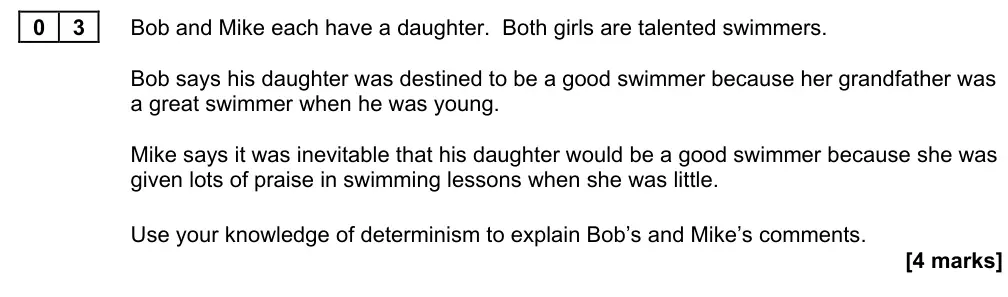
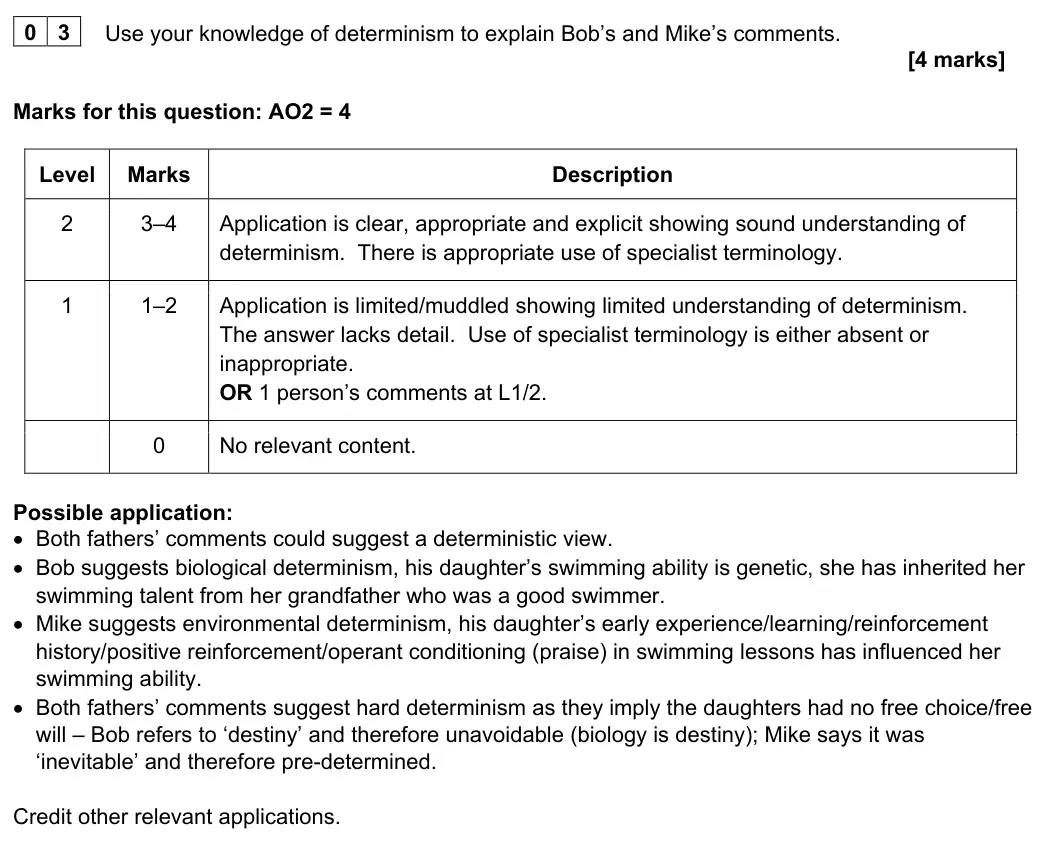
June 2023 · Paper 3 · Q34 marksAO2=4Application
Mark scheme, including level descriptors and indicative content
Examiner's comment
Although most students were able to match Bob’s comments to the concept of biological determinism, and Mike’s to environmental determinism, some students were unsuccessful in trying to make links to other forms of determinism, such as ‘soft’ or ‘psychic’. Many answers offered little more than repetition of the stem by way of explanation. However, lots of students were able to access all four marks.
Notes from the mark scheme and report
Bob = biological (genetic) determinism, Mike = environmental (reinforcement/operant) determinism
both imply hard determinism ('destined', 'inevitable')
one person only = max L1
wrong links to soft or psychic determinism
repeating the stem
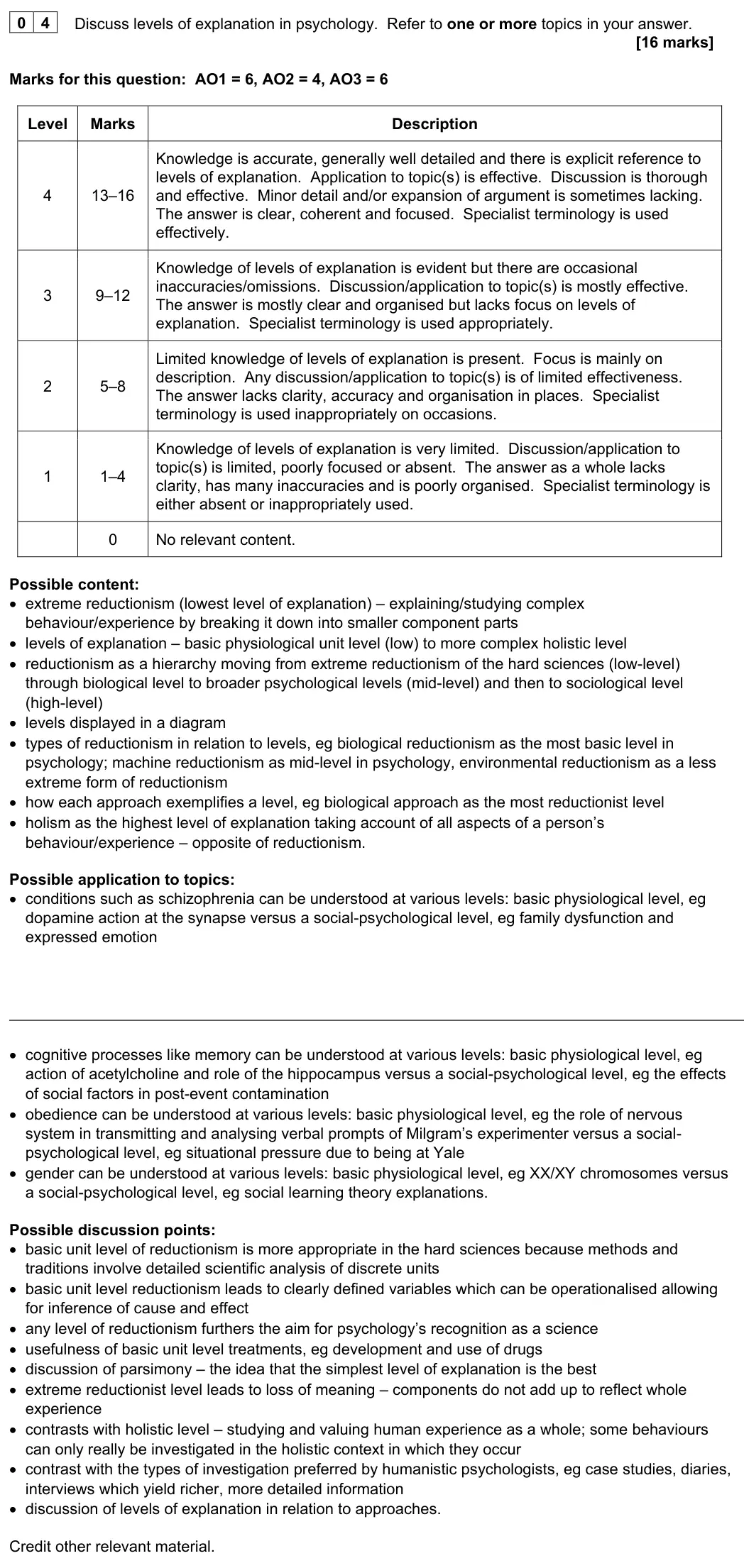
June 2023 · Paper 3 · Q416 marksAO1=6, AO2=4, AO3=616-mark essay
Mark scheme, including level descriptors and indicative content
Examiner's comment
This was a very difficult essay for most students. Most appeared completely unprepared to answer a question on ‘levels of explanation’ and would perhaps have offered little or nothing at all, had there not been reference to reductionism and holism in the stem. Consequently, many answers focused entirely on these two levels, usually in the form of a debate about which one was ‘better’. Those students who did this very well were able to access up to 12 marks. However, in the absence of any explicit reference to levels of explanation, the top level was unattainable for most. There was much confusion between reductionism, holism and other concepts within this topic area, most notably determinism, and idiographic and nomothetic research. Application-wise, students did somewhat better, and examples of psychological approaches were often used effectively to illustrate holism and different forms of reductionism.
Notes from the mark scheme and report
explicit reference to LEVELS of explanation needed for top band (most capped at 12 by a reductionism vs holism debate)
application to topics e.g. schizophrenia, memory, obedience, gender at physiological vs social levels
confusion with determinism and idiographic/nomothetic
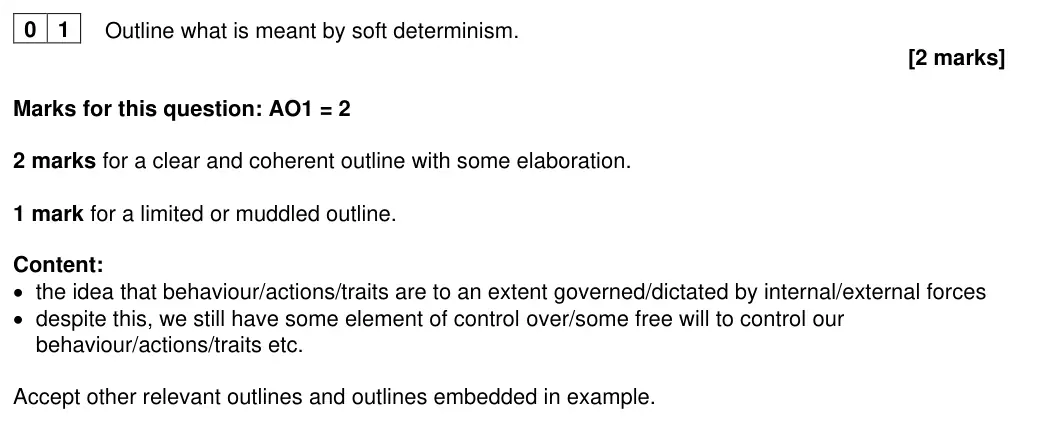
June 2022 · Paper 3 · Q12 marksAO1=2Outline
Mark scheme, including level descriptors and indicative content
Examiner's comment
Question 01 was generally well answered although some responses lacked clarity. Completely contradictory answers describing soft determinism simultaneously as behaviour that is pre- determined but also down to free will were not creditworthy.
Notes from the mark scheme and report
behaviour partly governed by internal/external forces but some element of free will/control remains
contradictory answers (wholly determined AND free) not credited
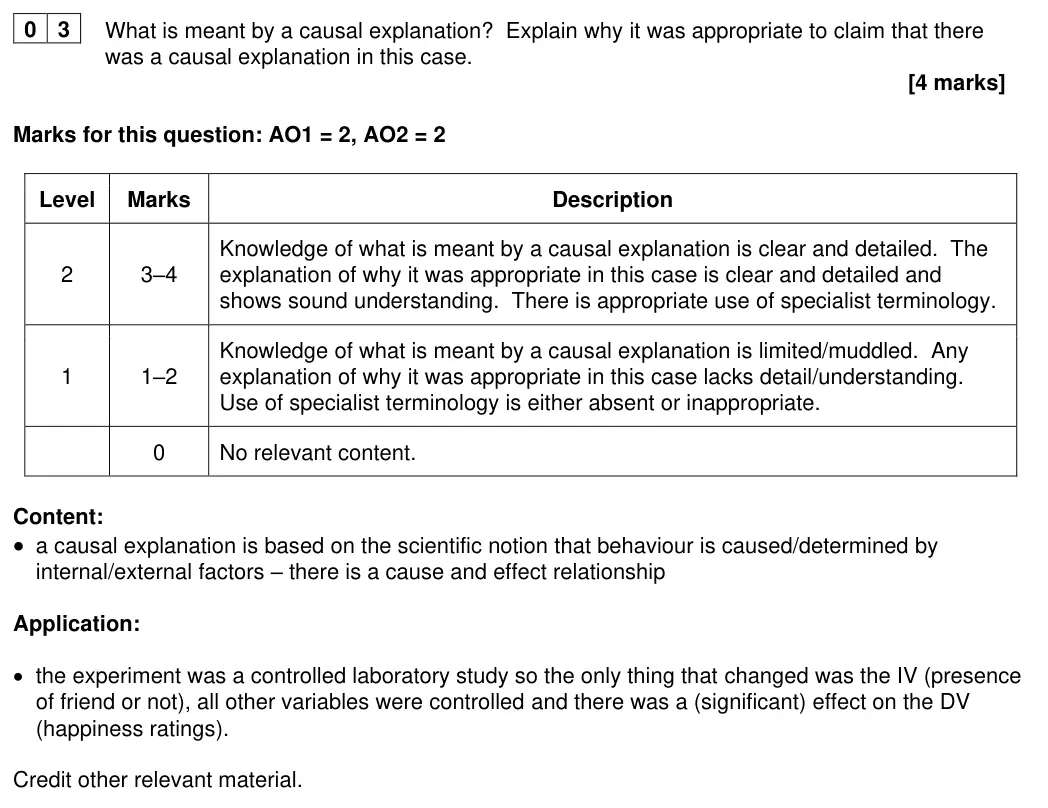
June 2022 · Paper 3 · Q34 marksAO1=2, AO2=2Application
Mark scheme, including level descriptors and indicative content
Examiner's comment
Question 03 was a good discriminator, with better answers responding appropriately to the cues in the stem and noting how a ‘controlled laboratory experiment’ would enable causality to be inferred. Many students completely missed the point, apparently having misread the key word in the question, as they focused on how researchers looking for a ‘casual’ explanation would be relaxed and unscientific.
Notes from the mark scheme and report
causal explanation = cause and effect (scientific emphasis on causality)
appropriate because a controlled lab experiment changed only the IV (friend present or not) with a significant effect on the DV
many misread 'causal' as 'casual'
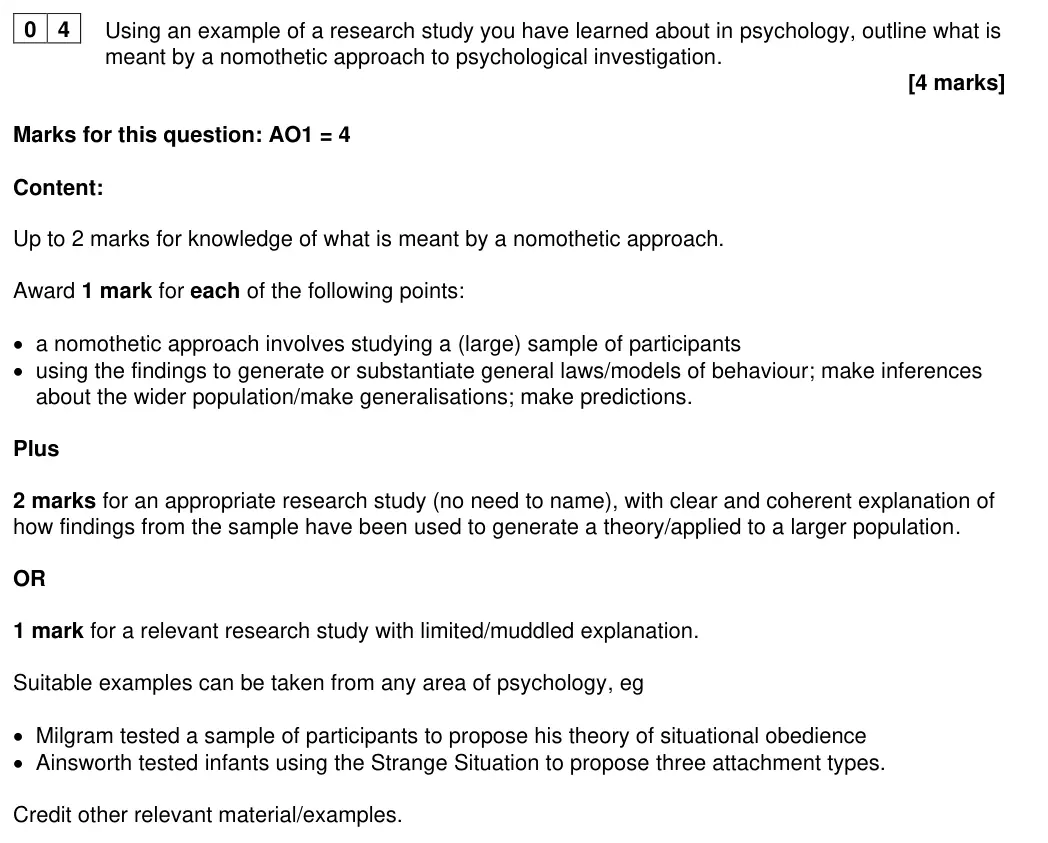
June 2022 · Paper 3 · Q44 marksAO1=4Outline
Mark scheme, including level descriptors and indicative content
Examiner's comment
Most answers to Question 04 received some credit for outlining the term although examples were often not of a study, but rather an approach such as behaviourism or the cognitive approach. Useful studies tended to be those that had most obviously resulted in a general law or theory, for example Ainsworth’s study which resulted in the understanding of attachment types. Answers to Question 05 were creditworthy providing a behaviour had been identified in the answer to Question 04. Students using Pavlov or Skinner in their answer to Question 04 often had difficulty in Question 05 as they tried to argue that carrying out an in-depth case study of a rat or a dog would allow insights into reasoning and private experience.
Notes from the mark scheme and report
2 marks: studying samples to produce general laws/generalisations/predictions + 2 marks: a research study (e.g. Milgram, Ainsworth) used to generate a general theory
examples were often approaches (behaviourism) rather than studies
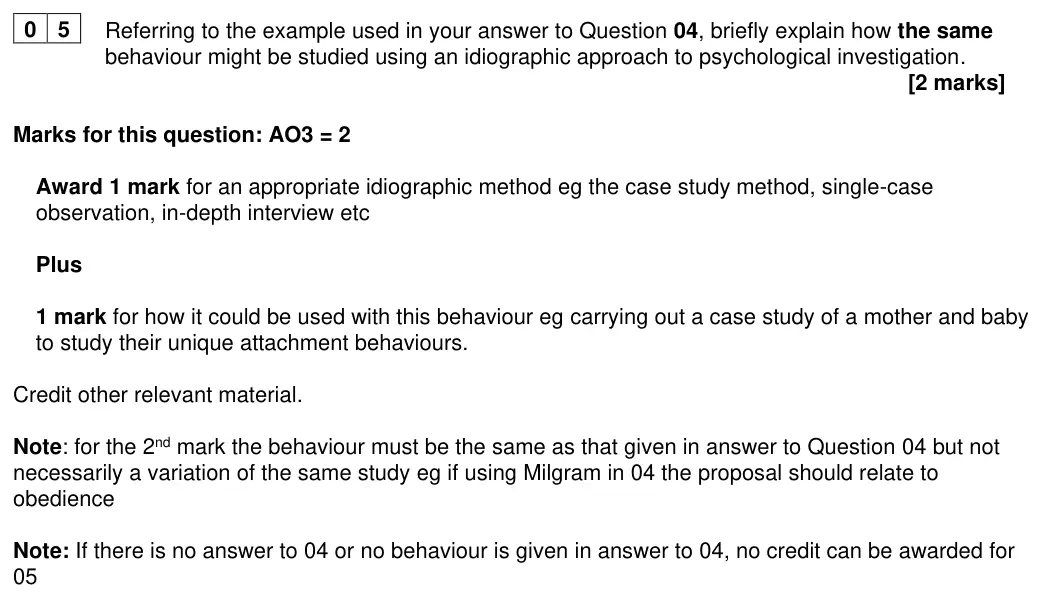
June 2022 · Paper 3 · Q52 marksAO3=2Explain
Mark scheme, including level descriptors and indicative content
Examiner's comment
Answers to Question 05 were creditworthy providing a behaviour had been identified in the answer to Question 04. Students using Pavlov or Skinner in their answer to Question 04 often had difficulty in Question 05 as they tried to argue that carrying out an in-depth case study of a rat or a dog would allow insights into reasoning and private experience.
Notes from the mark scheme and report
idiographic method (case study, in-depth interview) + how it would study the same behaviour as Q04
no credit if no behaviour given in Q04
Pavlov/Skinner examples caused difficulty
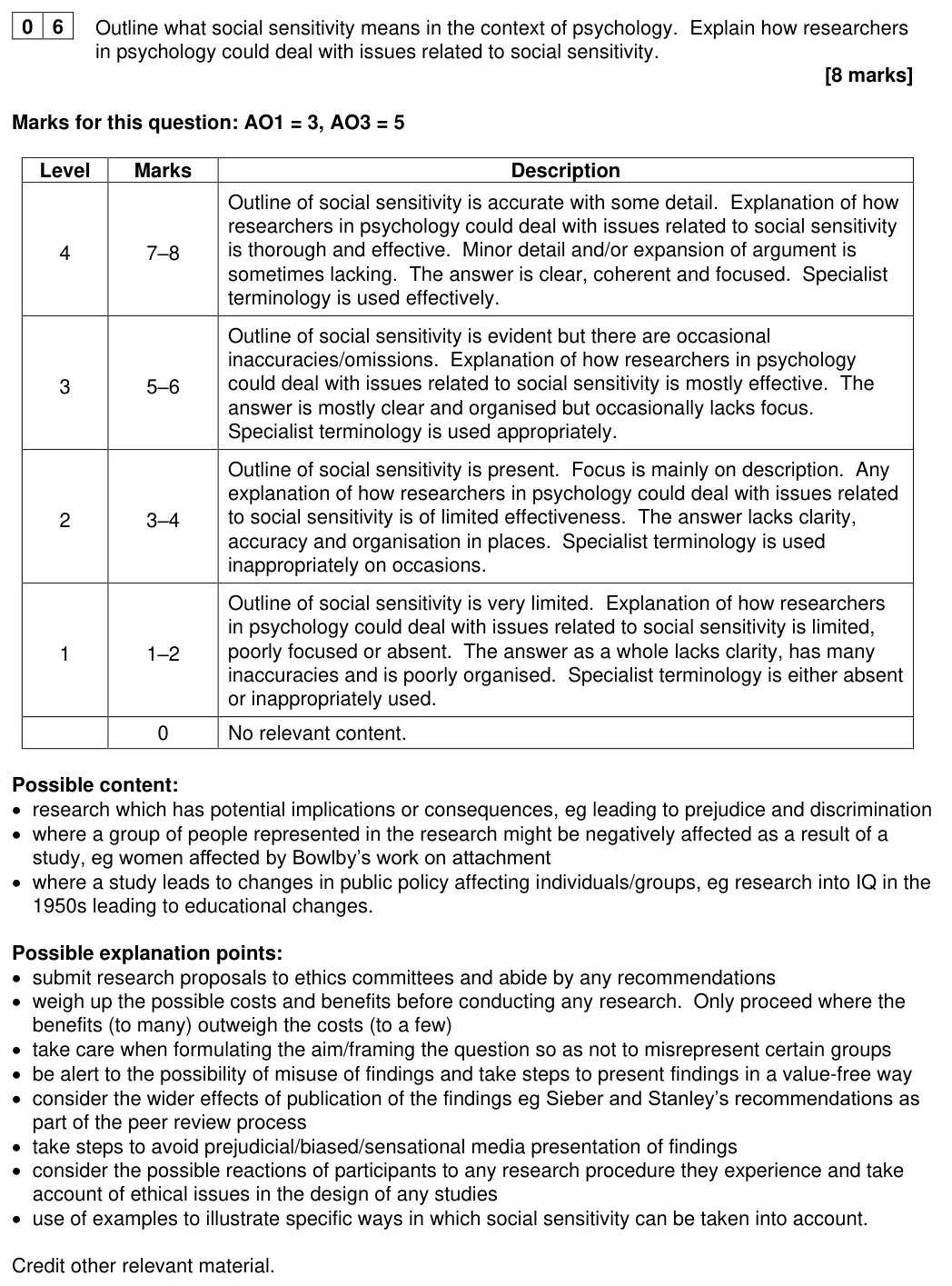
June 2022 · Paper 3 · Q68 marksAO1=3, AO3=5Extended writing
Mark scheme, including level descriptors and indicative content
Examiner's comment
Answers to Question 06 tended to score well by using the recommendations of Sieber and Stanley as the basis for suggestions of how to deal with issues related to socially sensitive research. A fair number of discussions scored lower marks as they focused solely on implications for participants in a study.
Notes from the mark scheme and report
outline social sensitivity (implications for groups represented, e.g. Bowlby and working mothers) + ways of dealing with it (Sieber and Stanley, ethics committees, cost-benefit, careful framing and reporting)
discussions only about participants scored lower
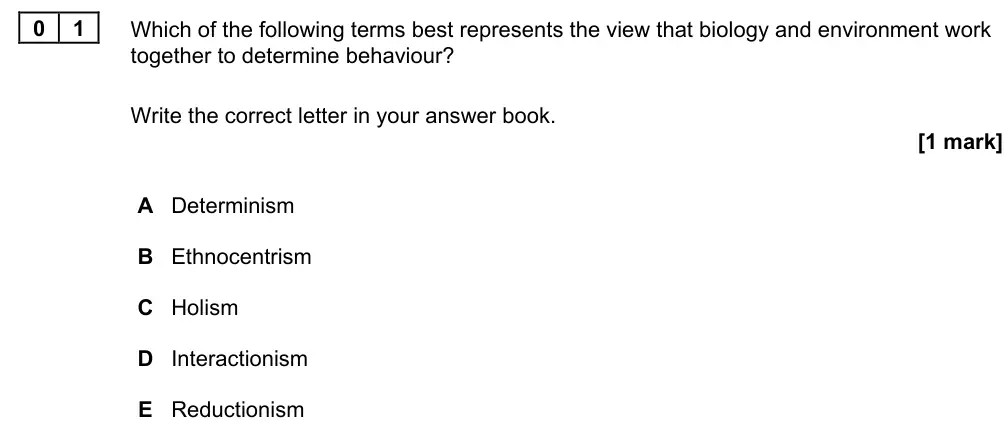
November 2021 · Paper 3 · Q11 markAO1=1Multiple choiceEasy
Answer
D
Mark scheme, including level descriptors and indicative content
Examiner's comment
The majority of students started well with the correct answer to Q01.
November 2021 · Paper 3 · Q53 marksAO1=1, AO2=2Application
Mark scheme, including level descriptors and indicative content
Examiner's comment
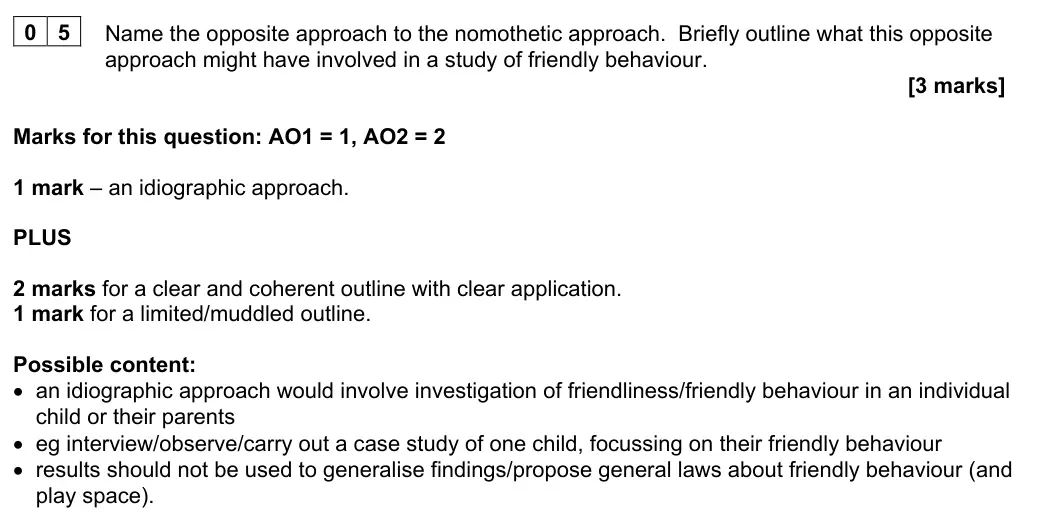
There was widespread misunderstanding in Q05, with students often stating that collecting qualitative data/carrying out interviews would be idiographic.
Notes from the mark scheme and report
1 mark idiographic + 2 marks applied outline (case study/in-depth study of one child's friendly behaviour, no general laws)
common error: equating qualitative data or interviews with idiographic
November 2021 · Paper 3 · Q68 marksAO1=3, AO2=2, AO3=3Extended writing
Mark scheme, including level descriptors and indicative content
Examiner's comment
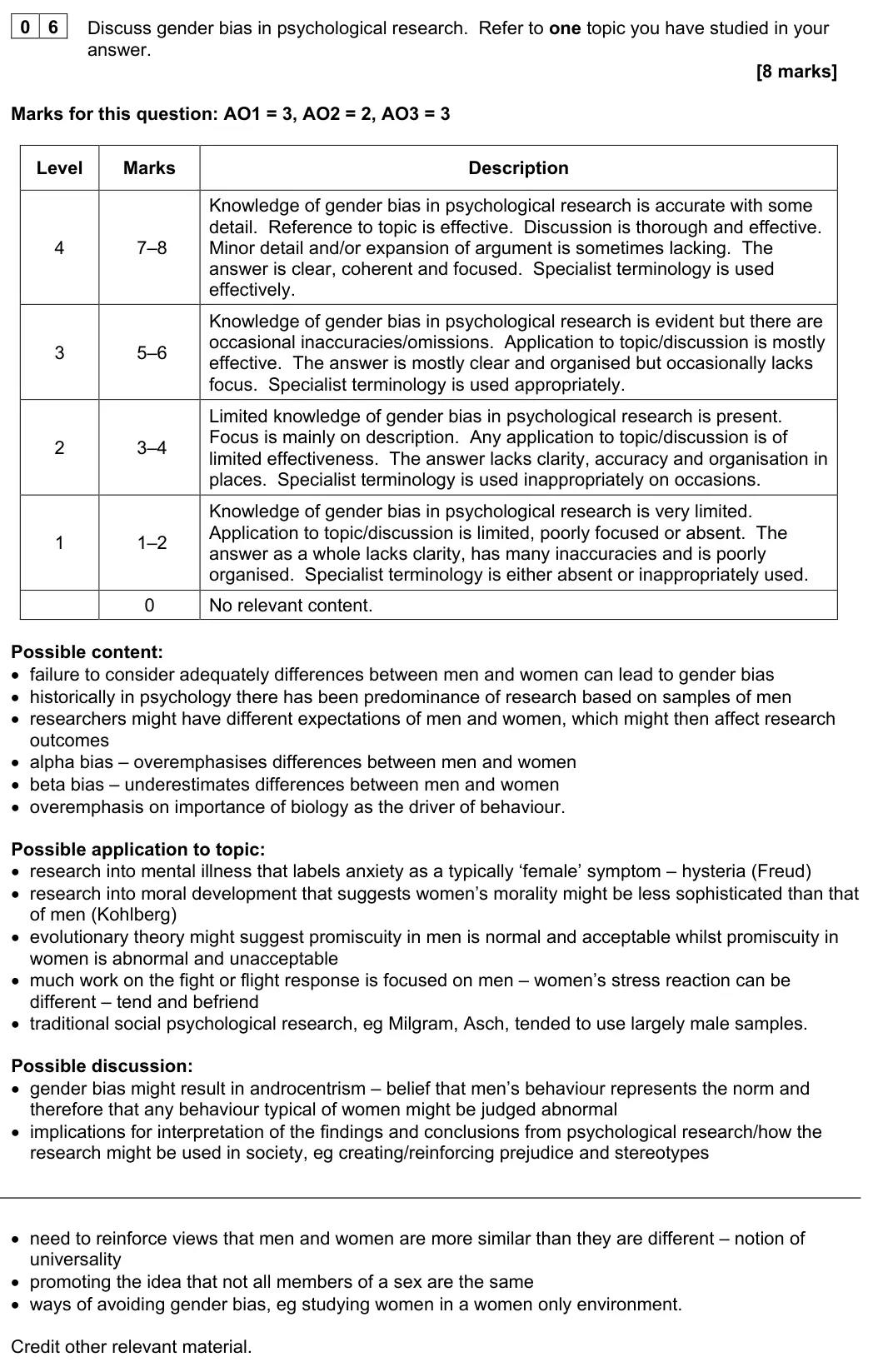
Most students made a fair attempt at Q06. Where students presented more than one topic the best topic was credited and the other credited as evaluation where the content allowed.
Notes from the mark scheme and report
alpha/beta bias, androcentrism
must refer to one topic (e.g. Kohlberg's moral development, fight or flight vs tend and befriend, Asch/Milgram male samples)
if several topics, best credited and others as evaluation
November 2020 · Paper 3 · Q12 marksAO1=2Outline
Mark scheme, including level descriptors and indicative content
Examiner's comment
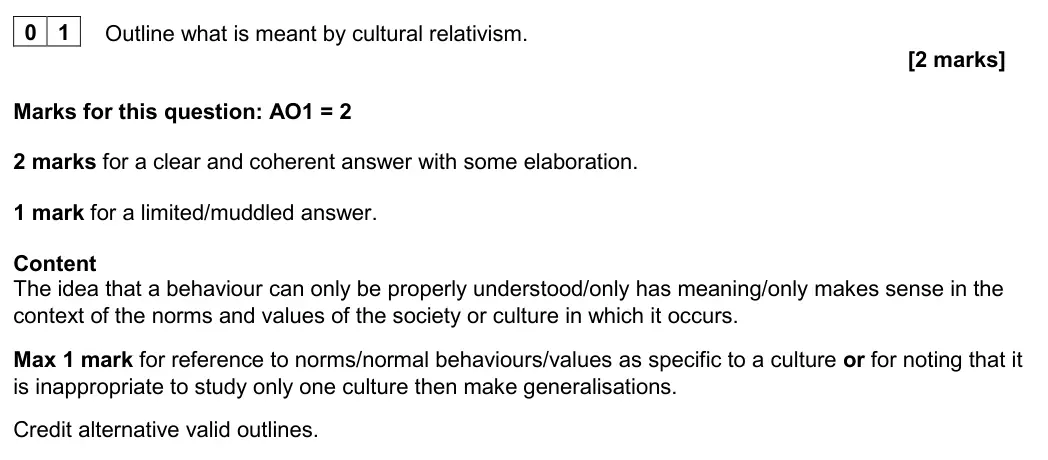
Surprisingly few students could offer an appropriate explanation of cultural relativism but most answers gained some credit for an understanding that it is linked to cultural norms.
Notes from the mark scheme and report
behaviour only has meaning in the context of the norms and values of its culture
max 1 for just 'norms are culture-specific' or 'shouldn't generalise from one culture'
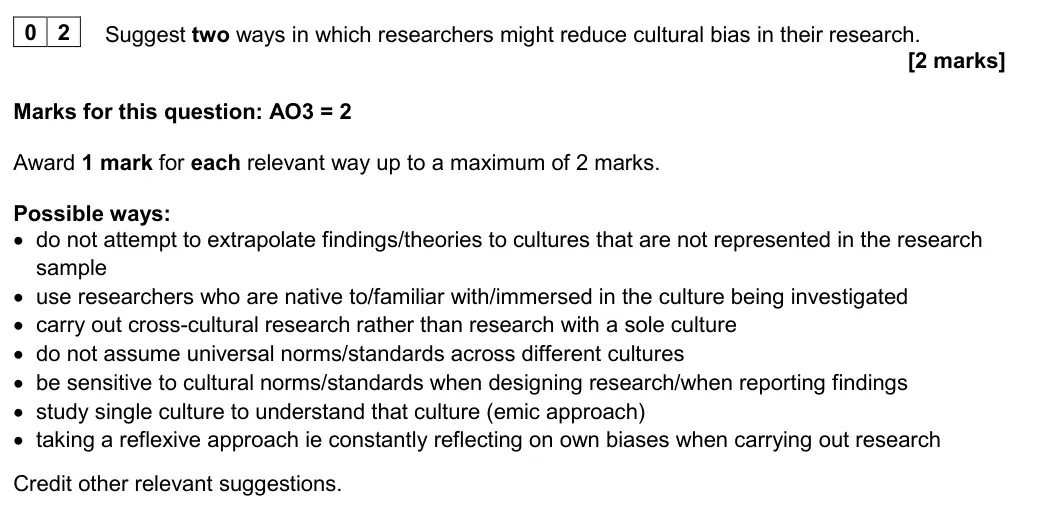
November 2020 · Paper 3 · Q22 marksAO3=2Explain
Mark scheme, including level descriptors and indicative content
Examiner's comment
Ideas for reducing cultural bias varied; a common error here was to offer the same way twice in two variations of ‘studying different cultures’.
Notes from the mark scheme and report
1 mark per way: e.g. indigenous researchers, cross-cultural/emic research, don't assume universal norms, reflexivity
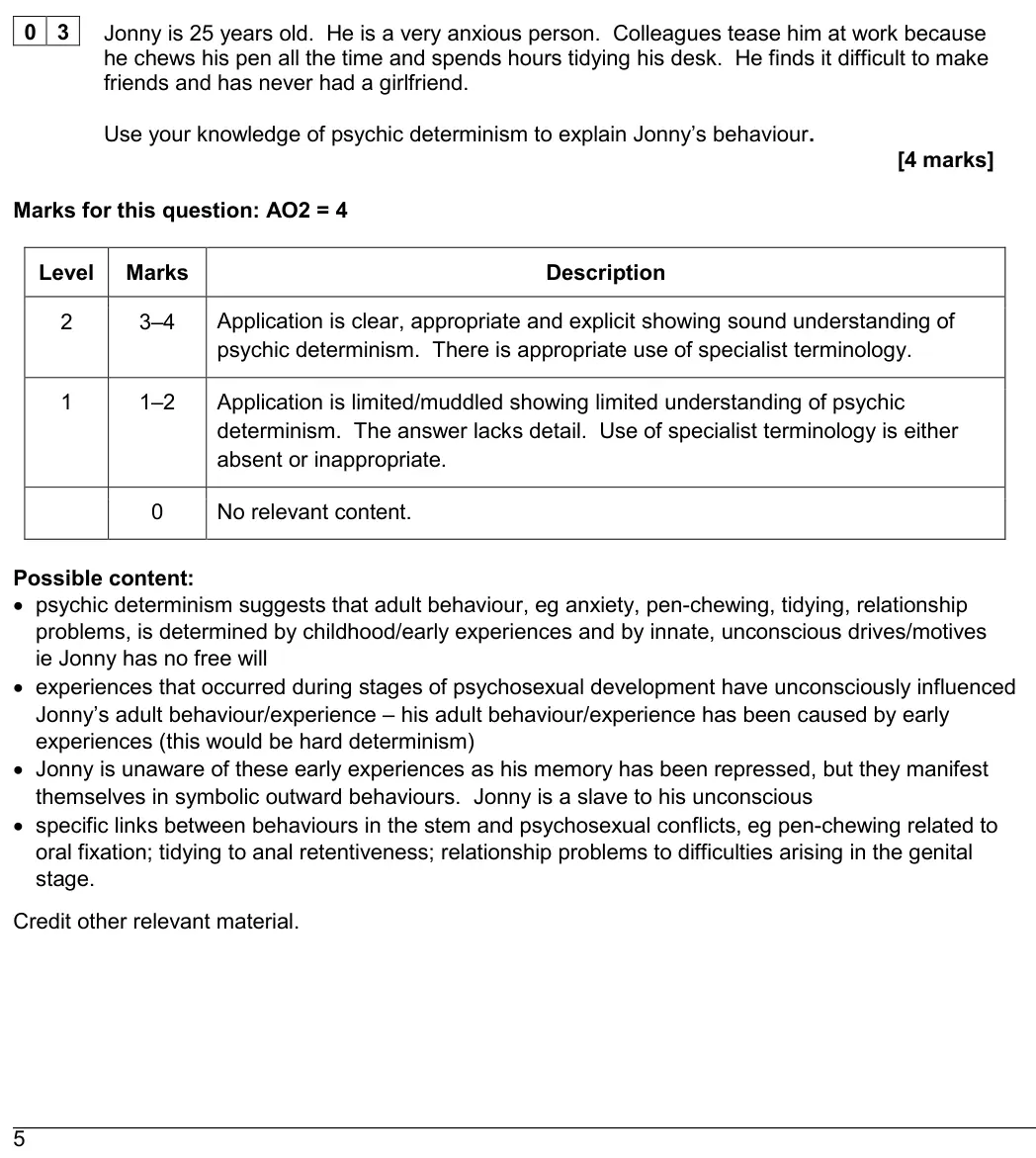
November 2020 · Paper 3 · Q34 marksAO2=4Application
Mark scheme, including level descriptors and indicative content
Examiner's comment
Most answers on psychic determinism could make sensible links to the stem although a significant number had no psychodynamic references at all.
Notes from the mark scheme and report
adult behaviour caused by unconscious drives/early experience (no free will)
link pen-chewing to oral fixation, tidying to anal retentiveness, relationship problems to genital stage
must apply to Jonny
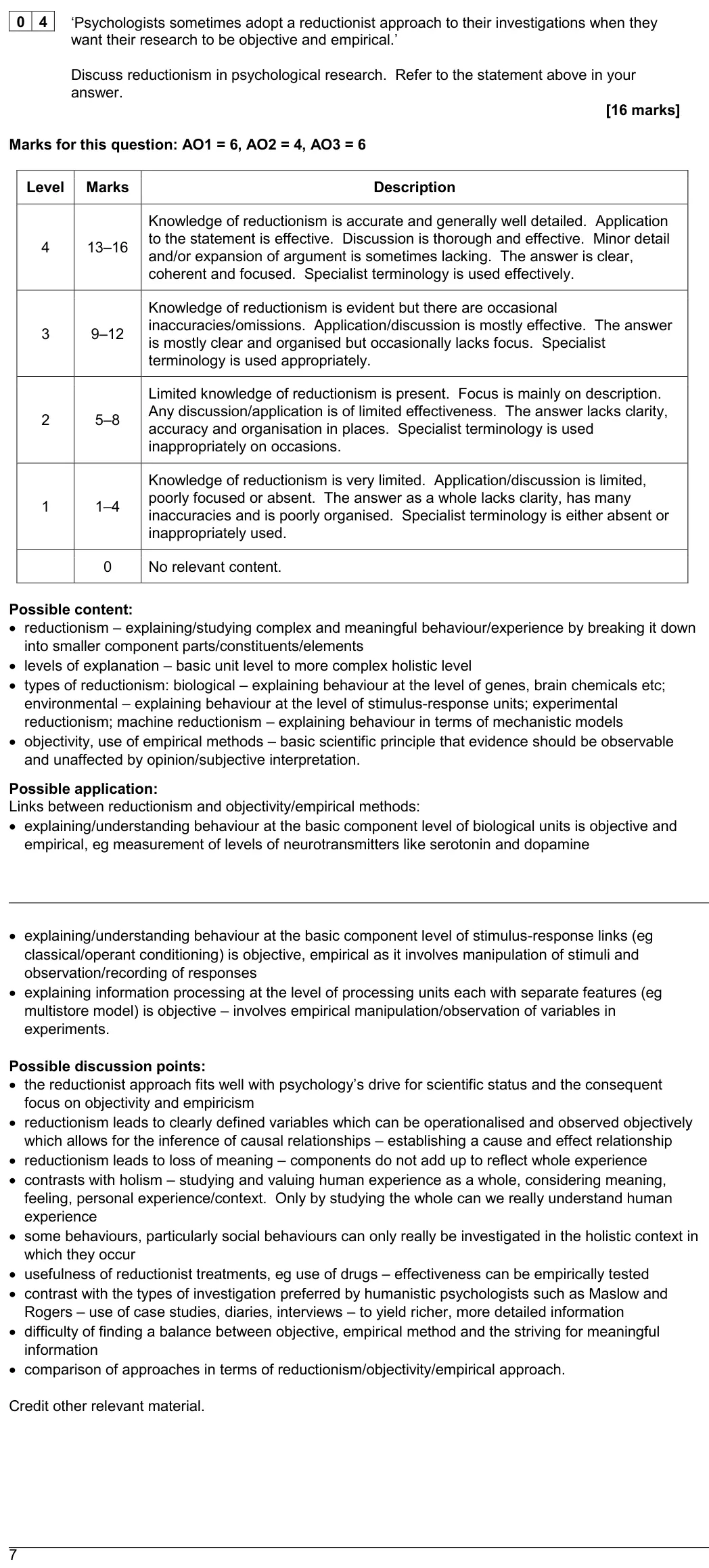
November 2020 · Paper 3 · Q416 marksAO1=6, AO2=4, AO3=616-mark essay
Mark scheme, including level descriptors and indicative content
Examiner's comment
The question on reductionism was not one that students could have pre-prepared with the result that performance tended to be quite limited. Many answers confused reductionism with determinism and/or reductionism with the nomothetic approach. References to objectivity and empiricism were sometimes sprinkled around without any real application. Better answers could offer specific examples of reductionist research and explain how they involved the empirical study of objective evidence. Quite a few answers were simply pre-learned responses on the holism versus reductionism debate.
Notes from the mark scheme and report
must link reductionism to objectivity/empiricism (neurotransmitter levels, S-R units, MSM experiments)
levels of explanation, biological and environmental reductionism
holism as counterpoint
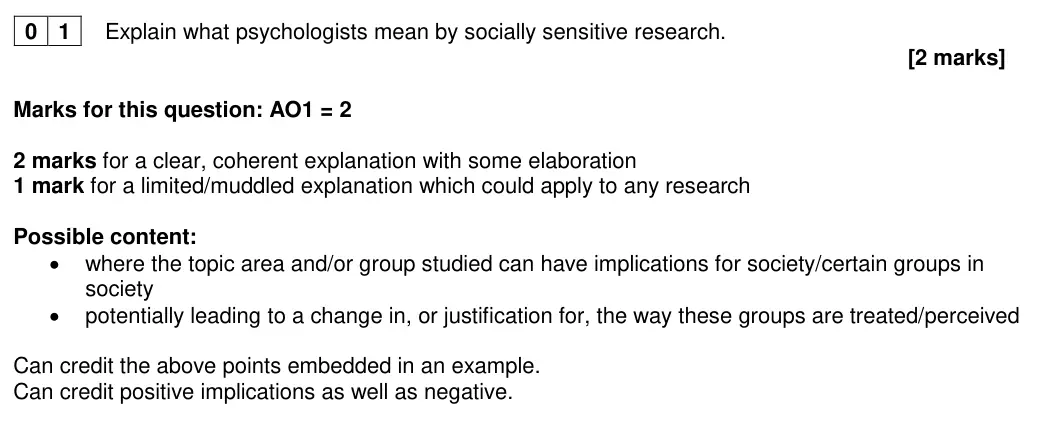
June 2019 · Paper 3 · Q12 marksAO1=2Explain
Mark scheme, including level descriptors and indicative content
Examiner's comment
Answers were often vague or referred simply to ethical issues. More effective responses were those that noted how the outcome of such research might have consequences in the form of change in attitude or behaviour towards the group under investigation or for the population more generally. Vague definitions were often saved by use of an explicit and well-developed example.
Notes from the mark scheme and report
research whose topic/group studied has implications for society or the group (change in treatment/perception)
answers that only referred to ethical issues were vague
a well-developed example could rescue a vague definition
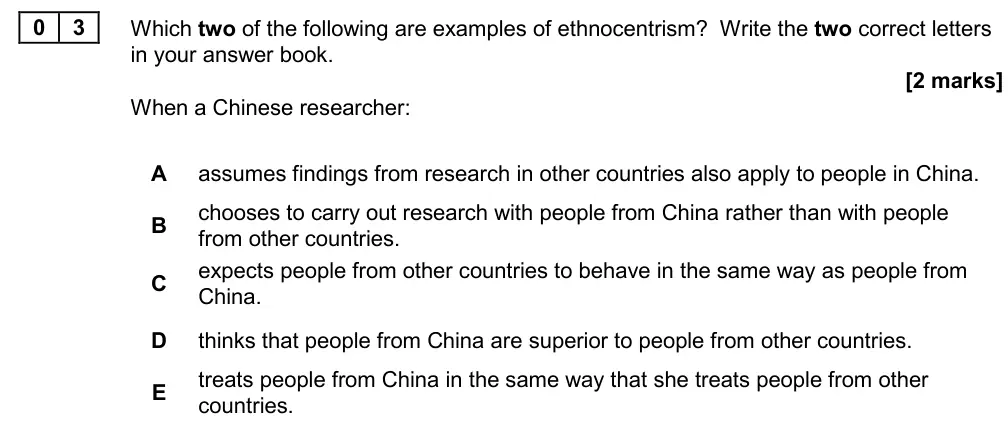
June 2019 · Paper 3 · Q32 marksAO2=2Multiple choice
Answer
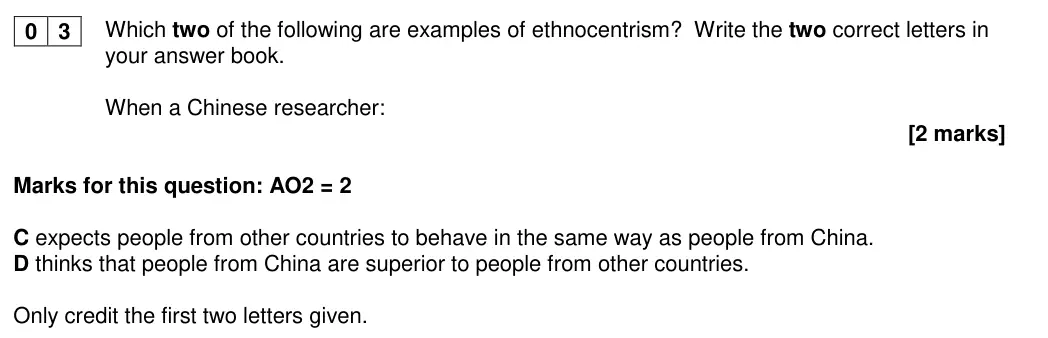
C and D
Mark scheme, including level descriptors and indicative content
Examiner's comment
The modal mark on this question was 1. Most students identified C as correct, with A and E the most common wrong answers.
Notes from the mark scheme and report
correct C and D
modal mark 1
A and E most common wrong answers
only first two letters credited
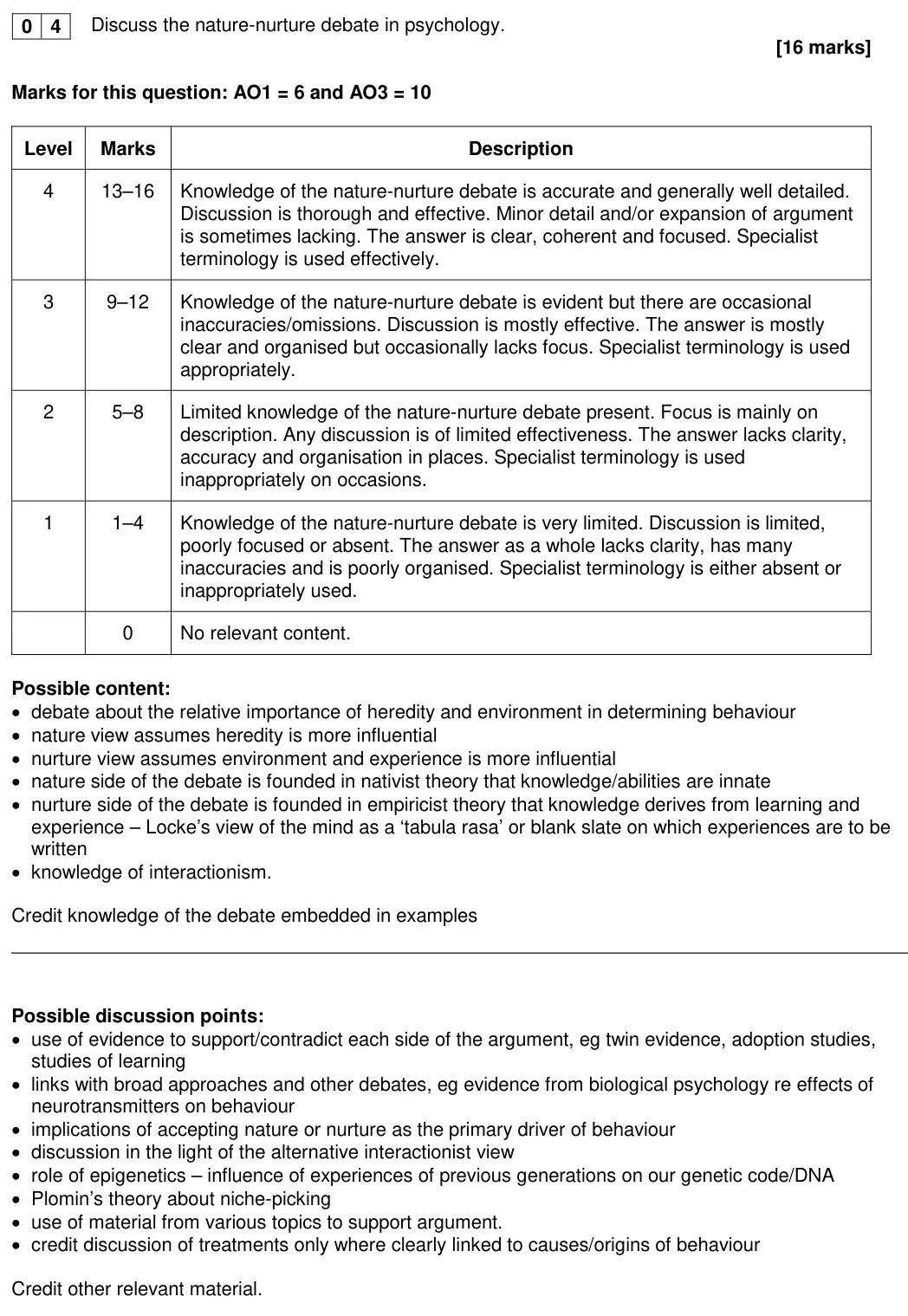
June 2019 · Paper 3 · Q416 marksAO1=6, AO3=1016-mark essay
Mark scheme, including level descriptors and indicative content
Examiner's comment
Given that a nature-nurture question has not appeared as an extended writing question before, students might have been expected to have been better prepared. In fact, answers to this question were generally very disappointing with marks often limited to Level 2 because of basic misunderstanding. The main problem seems to have been a complete lack of understanding of the concept of ‘a debate’. This was evident right at the start of the vast majority of answers where paragraphs would typically begin with ‘The nature debate argues that…’ or, ‘According to the nurture debate …’. Similar problems arose where attempts at discussion included phrases such as, ‘One strength of the nature debate is…’ or ‘One criticism of the nurture debate is...’ Inevitably it was quite hard to award much credit for such answers because the sentences did not make a great deal of sense. Further problems arose for students who offered an ‘approaches’ answer, describing and evaluating the biological and learning approaches in turn, with hardly any reference to nature or nurture. Not surprisingly, focus on treatments was not usually successful, since the debate is really about the origins of behaviour. A relatively small number of competent students recognised the complexities of the debate and referred to constructivism, niche picking and the reciprocal effects of nature and nurture.
Notes from the mark scheme and report
many misunderstood 'debate' ('the nature debate argues...')
approaches-based answers with little nature/nurture scored poorly
treatments only credited if linked to origins of behaviour
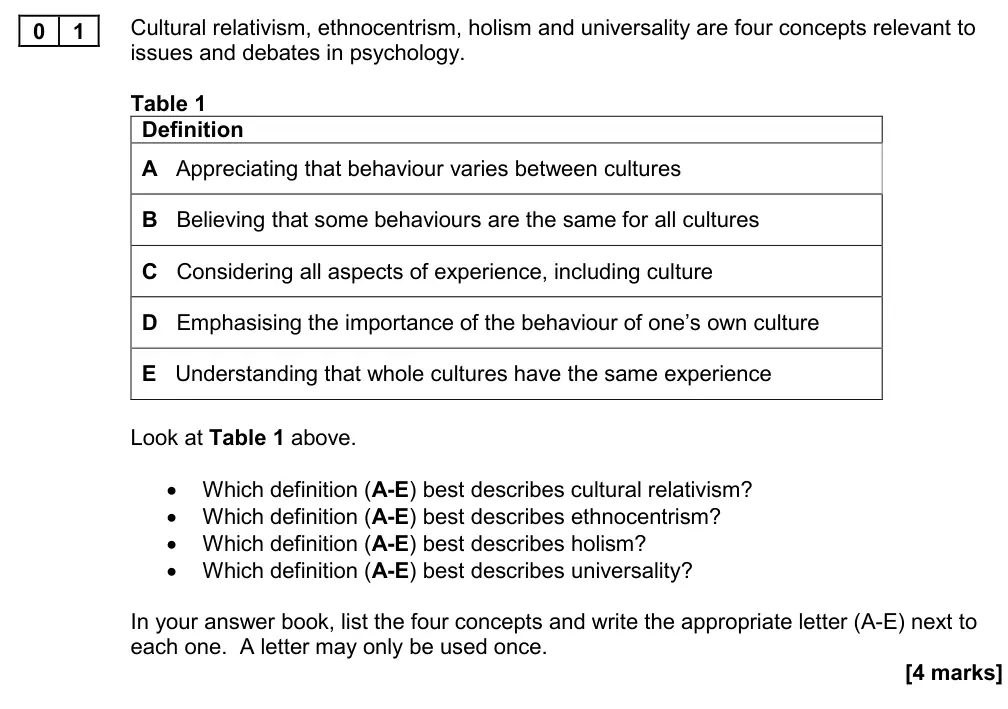
June 2018 · Paper 3 · Q14 marksAO1=4Multiple choice
Answer
A and D and C and B
Mark scheme, including level descriptors and indicative content
Examiner's comment
This question appeared to discriminate quite well. Most students could recognise holism, whilst the least well recognised was universality.
Notes from the mark scheme and report
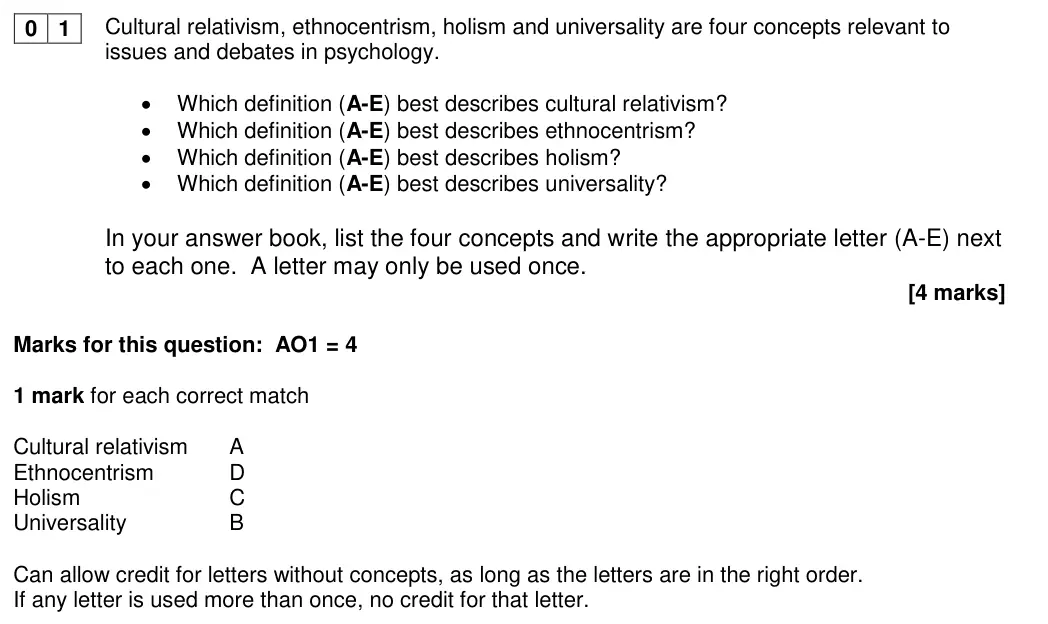
matching: cultural relativism A, ethnocentrism D, holism C, universality B
each letter once only
universality least well recognised, holism best
June 2018 · Paper 3 · Q22 marksAO1=1, AO3=1Short answer
Mark scheme, including level descriptors and indicative content
Examiner's comment
Definitions were not always clear and there was often confusion with generalisation. Mere statements that the nomothetic approach did not take account of individual differences were not sufficient as a limitation without some explanation.
Notes from the mark scheme and report
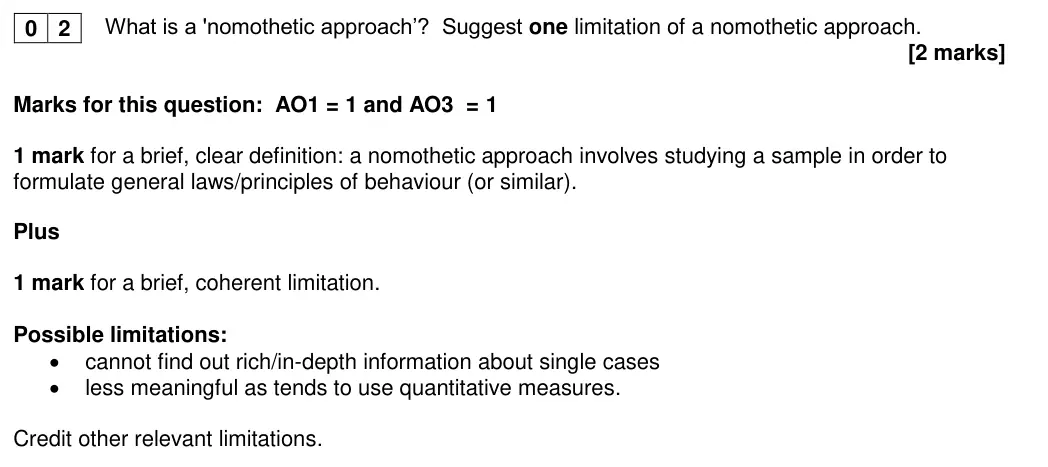
definition must refer to studying groups/samples to formulate general laws
often confused with generalisation
'ignores individual differences' alone not enough without explanation
June 2018 · Paper 3 · Q32 marksAO2=2Application
Mark scheme, including level descriptors and indicative content
Examiner's comment
Performance on this question was surprisingly poor because many students focussed on causes of behaviour rather than measurement. Answers had to be contextualised in order to gain credit.
Notes from the mark scheme and report
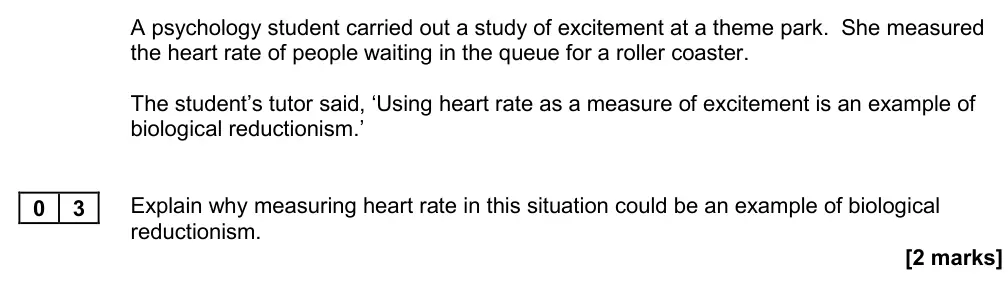
theme-park heart-rate scenario
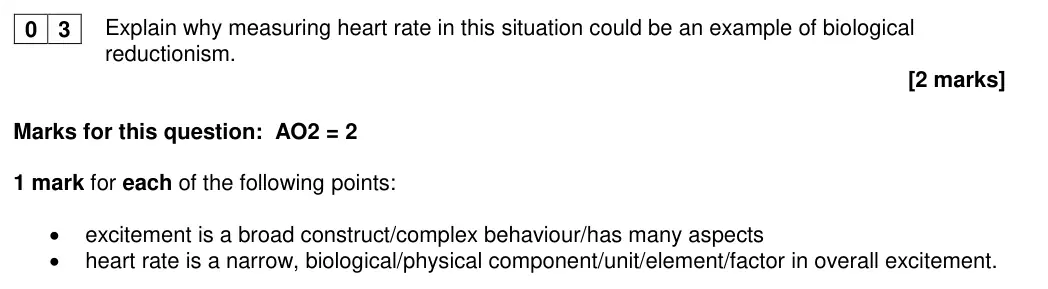
excitement is a complex construct vs heart rate as a narrow biological component
must be contextualised
many wrongly wrote about causes of behaviour rather than measurement
June 2018 · Paper 3 · Q54 marksAO3=4Evaluate (short)
Mark scheme, including level descriptors and indicative content
Examiner's comment
Most students gained some credit and many full mark responses were seen. Quite frequently, students conflated several strengths/limitations rather than sticking to one, with the result that the strength/limitation lacked clarity and therefore did not gain full marks. In this case, the more successful answers were those where students chose one and stayed with it. Given the preceding questions, it was not entirely surprising that some students wrote entirely about biological reductionism but this did not seem to affect their ability to access to marks.
Notes from the mark scheme and report
one strength + one limitation only
listing several conflated points lacked clarity
biological-reductionism-only answers still credited
June 2018 · Paper 3 · Q68 marksAO1=3, AO2=2, AO3=3Extended writing
Mark scheme, including level descriptors and indicative content
Examiner's comment
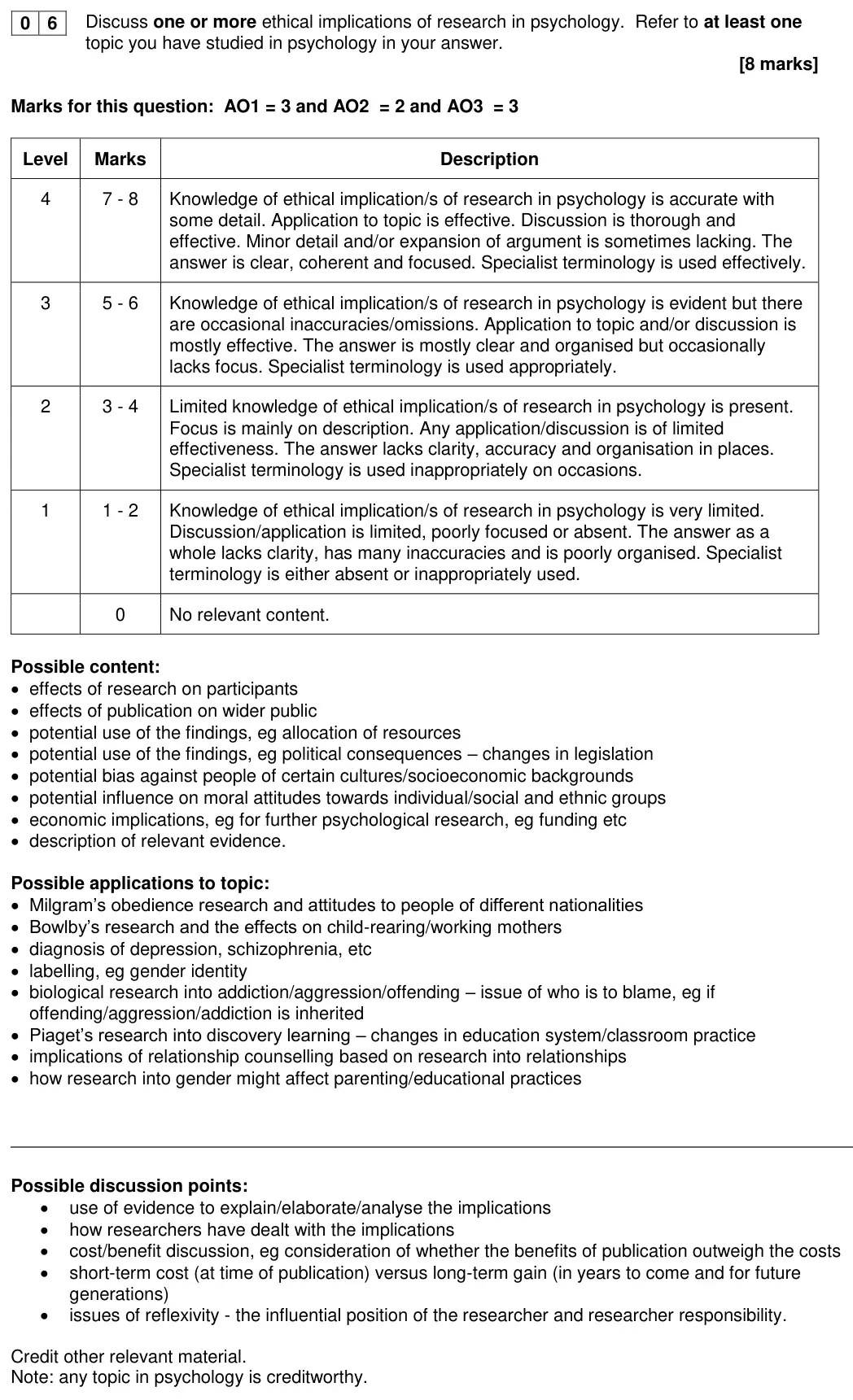
It was quite clear from many of the weaker answers that students did not understand the meaning of ‘implications’. As a result, many responses focussed on issues rather than implications, and consequently some answers scored no marks. Fortunately for many students, some issues-based answers happened to gain marks incidentally where they came to recount examples of instances of ‘harm to participants’, which could legitimately be seen as an implication of the research for the participants. Such cases usually arose in the context of studies of social influence. Better answers covered wide-ranging issues of the type seen in the mark scheme and made good use of such diverse topics as IQ testing, defining abnormality, Bowlby’s influence on attitudes to child-rearing and gender research. Any psychological topic was valid. Some answers were excessively long, possibly because students had prepared for a 16-mark question on this area.
Notes from the mark scheme and report
reworded in v1.4 (ethical implications of research -> social sensitivity in psychological research)
any topic creditworthy
many wrote about ethical issues (deception, consent) rather than implications for society/groups
cost-benefit discussion
June 2017 · Paper 3 · Q11 markAO1=1Multiple choiceEasy
Answer
B
Mark scheme, including level descriptors and indicative content
Examiner's comment
This question was answered correctly by 62% of students.
Notes from the mark scheme and report
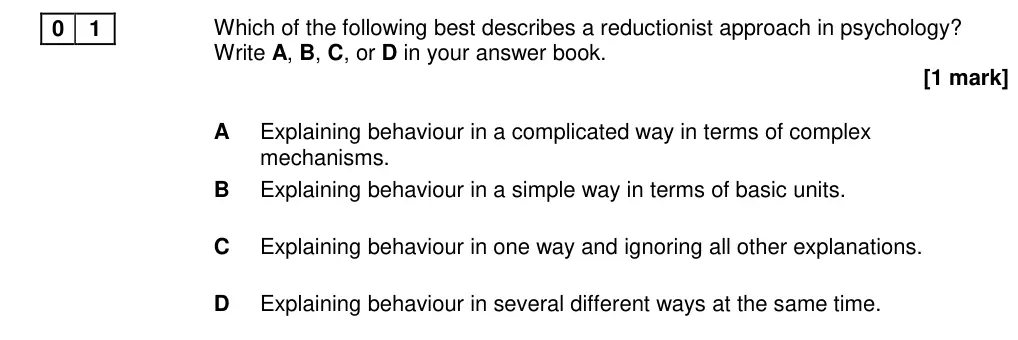
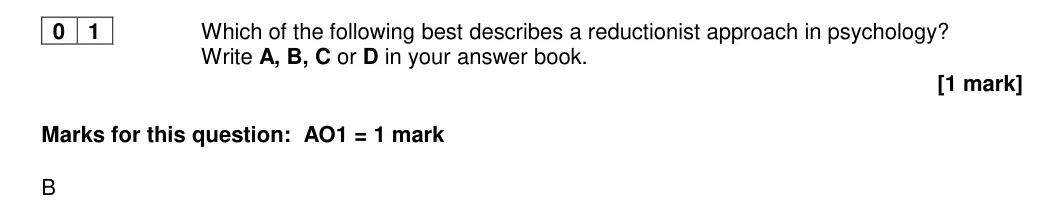
answer B (simple terms, basic units)
62% correct
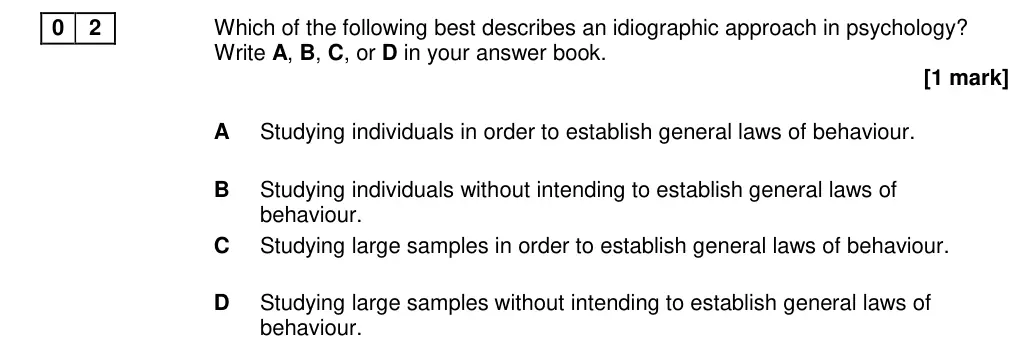
June 2017 · Paper 3 · Q21 markAO1=1Multiple choiceEasy
Answer
B
Mark scheme, including level descriptors and indicative content
Examiner's comment
This question was answered correctly by 71% of students.
Notes from the mark scheme and report
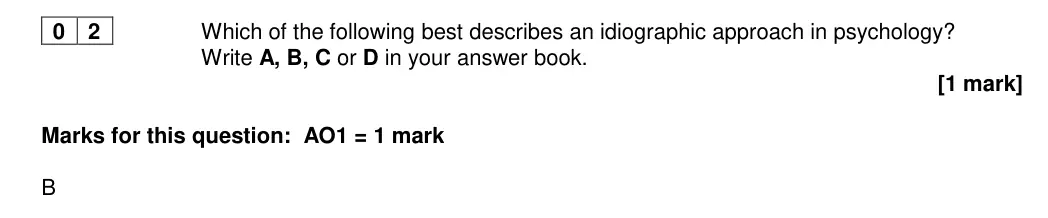
answer B (individuals without intending general laws)
A confuses with nomothetic aims
71% correct
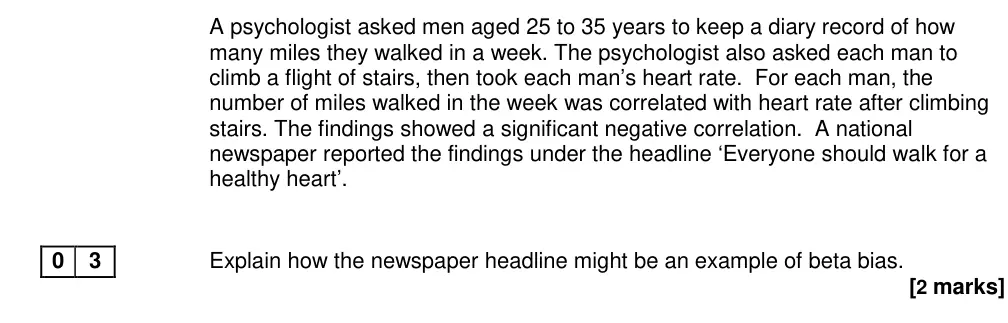
June 2017 · Paper 3 · Q32 marksAO2=2Application
Mark scheme, including level descriptors and indicative content
Examiner's comment
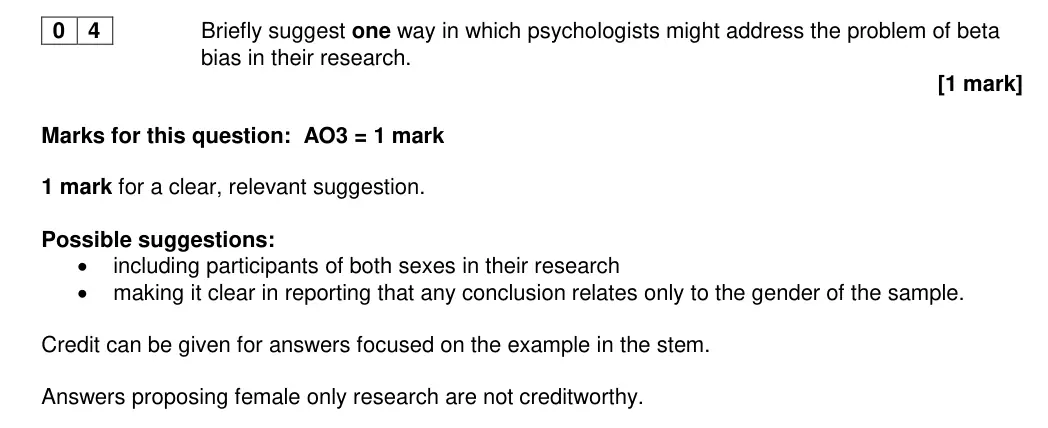
This was generally well answered, although students sometimes forgot to make reference to the headline and simply provided a definition of beta bias. Occasionally, the response focused on the issue of age rather than gender.
Notes from the mark scheme and report
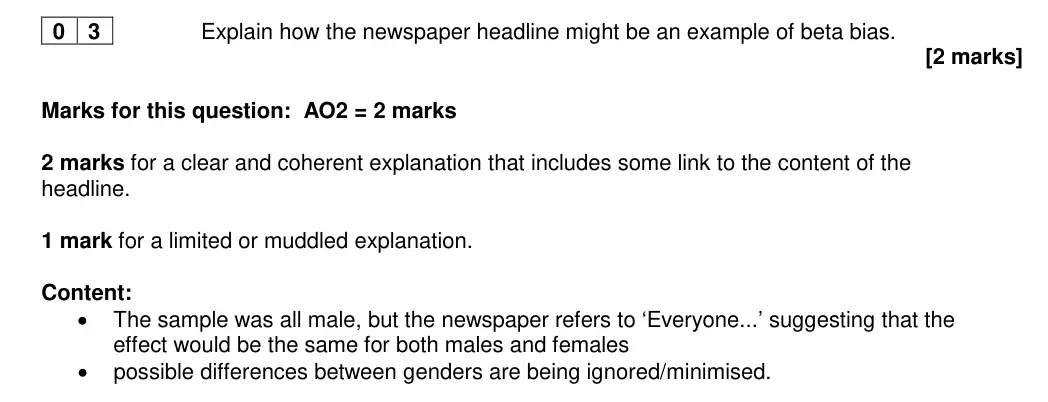
all-male sample but headline says 'Everyone', so gender differences ignored/minimised
must link to the headline - definition of beta bias alone = max 1
some wrongly focused on age
June 2017 · Paper 3 · Q41 markAO3=1Explain
Mark scheme, including level descriptors and indicative content
Examiner's comment
Where students understood the concept of beta bias this was well answered. The most common suggestion was to include women in the sample, but the equally creditworthy suggestion of ensuring that the results of the male only study were generalised only to males was also seen occasionally. Responses suggesting female only research did not gain credit, although a lenient view was taken here if the response implied that findings from a female only sample would be considered alongside the existing male only sample.
Notes from the mark scheme and report
include both sexes, or restrict conclusions to the gender sampled
female-only research not creditworthy
June 2017 · Paper 3 · Q616 marksAO1=6, AO2=4, AO3=616-mark essay
Mark scheme, including level descriptors and indicative content
Examiner's comment
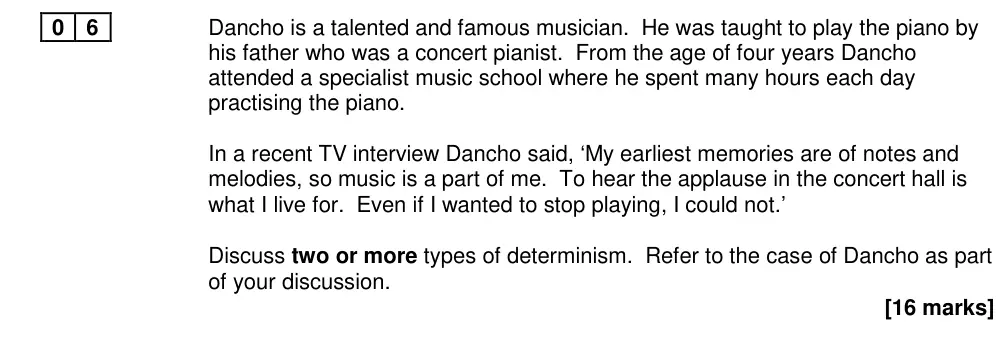
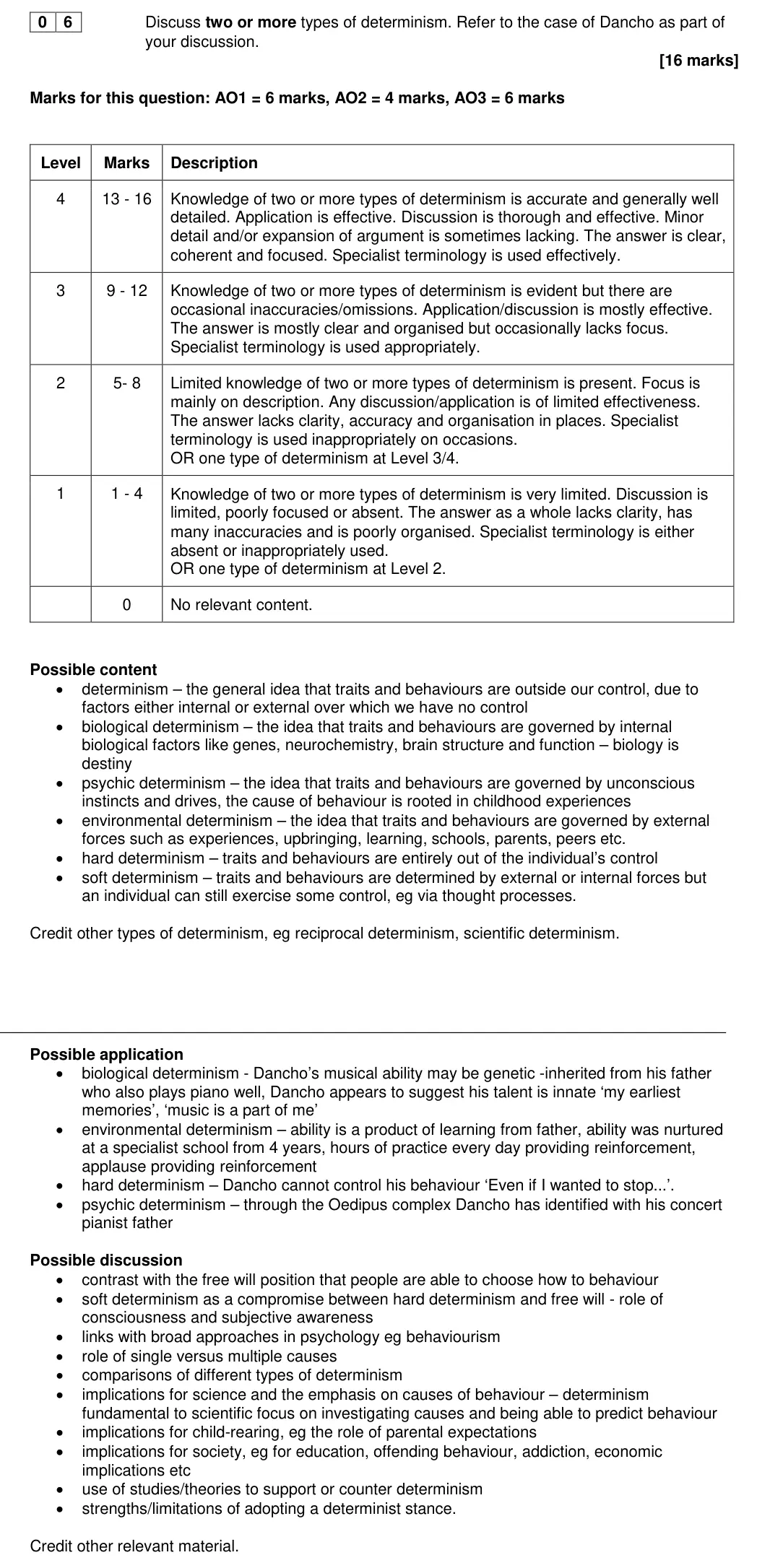
Most students were able to identify at least two types of determinism, although descriptions that followed were often vague. Use of terminology was frequently inappropriate, for example ‘behavioural determinism’ and ‘psychological determinism’ were seen in place of environmental and psychic determinism. Whilst understanding of biological and environmental determinism was usually sound, psychic determinism was less well presented, with many students failing to explain the key point, that behaviour is governed by the unconscious. There was a widespread tendency to conflate broad types, such as hard and soft, with specific types, such as biological and environmental. Application was usually sensible, if fairly perfunctory, although many better answers showed thoughtful and sustained application. Quite sensibly, discussions considered the types of determinism in relation to the various approaches in psychology and often illustrated their points with reference to specific topics. Unfortunately, some students became side-tracked into a discussion on the approaches or nature-nurture debate and completely lost focus on the question. Many discussions confused determinism and reductionism. Consideration of the implications of accepting the various types of determinism provided an effective route to discussion in better answers. A number of students presented fairly ineffective pre-prepared essays on the free-will and determinism debate.
Notes from the mark scheme and report
two or more types (biological, environmental, psychic, hard/soft) applied to Dancho (inherited from father, specialist school/practice/applause, 'could not stop')
one type only = max Level 2
psychic determinism often lacked the unconscious
hard/soft conflated with specific types
confusion with reductionism
MS also credits psychic determinism via the Oedipus complex
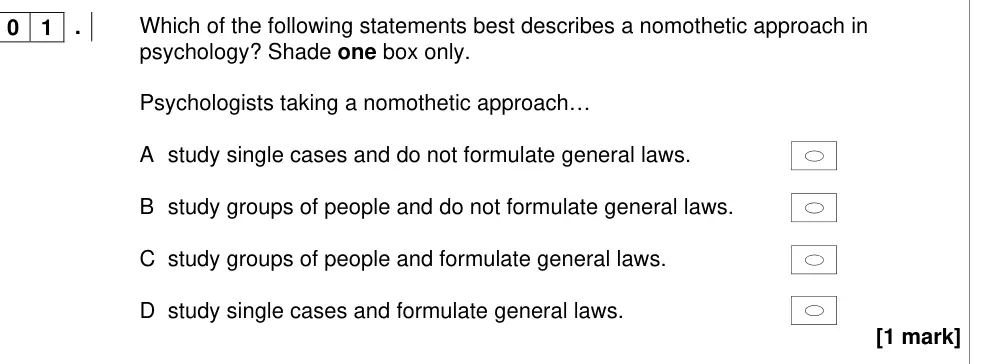
Specimen set 2 · Paper 3 · Q11 markAO1=1Multiple choice
Answer
C
Mark scheme, including level descriptors and indicative content
Notes from the mark scheme and report
answer C (groups of people, general laws)
A describes idiographic
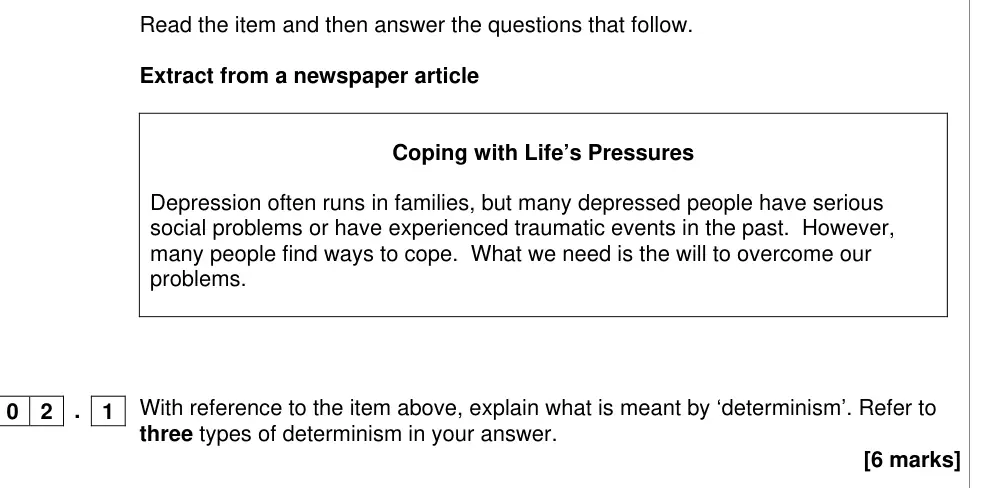
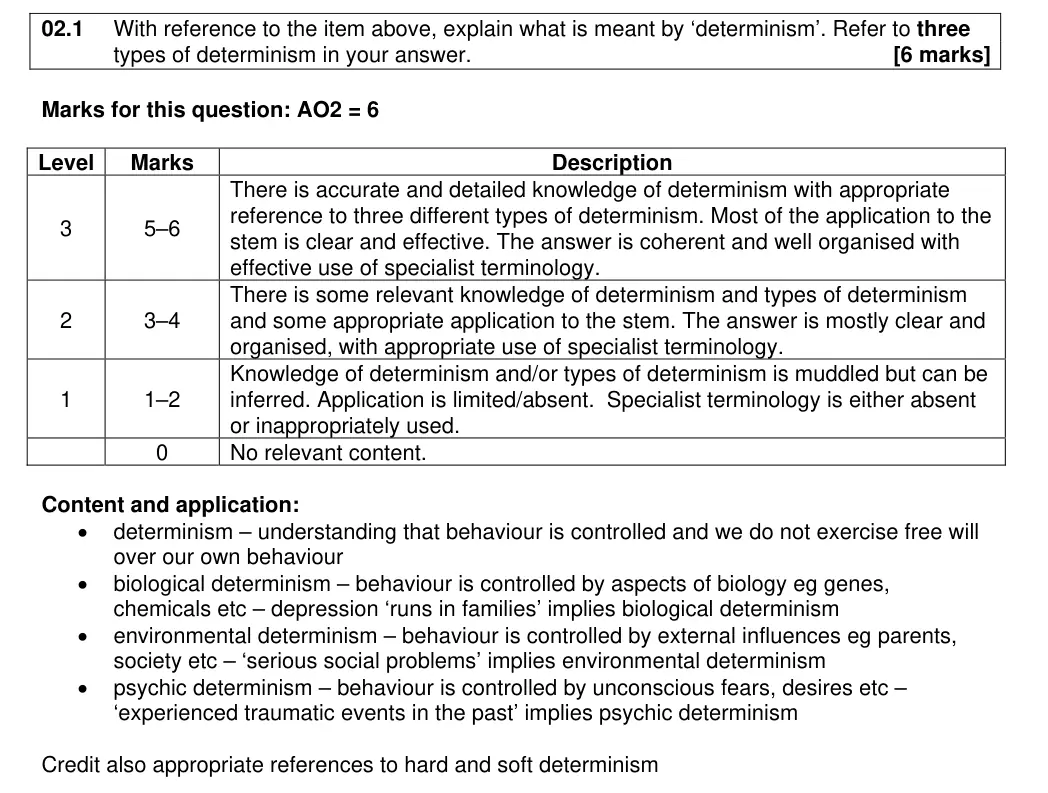
Specimen set 2 · Paper 3 · Q2.16 marksAO2=6Application
Mark scheme, including level descriptors and indicative content
Notes from the mark scheme and report
define determinism (behaviour controlled, no free will) + three types applied to the extract: biological ('runs in families'), environmental ('social problems'), psychic ('traumatic events in the past')
hard/soft also credited
little application = Level 1
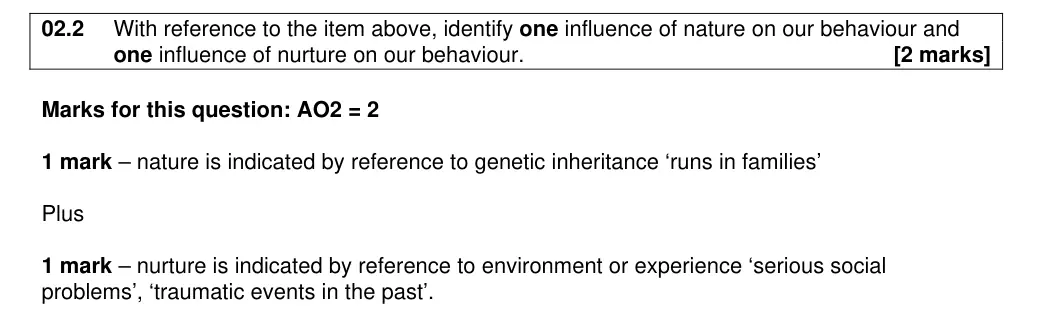
Specimen set 2 · Paper 3 · Q2.22 marksAO2=2Application
Mark scheme, including level descriptors and indicative content
Notes from the mark scheme and report
1 mark nature = genetic inheritance ('runs in families')
1 mark nurture = environment/experience ('social problems', 'traumatic events')
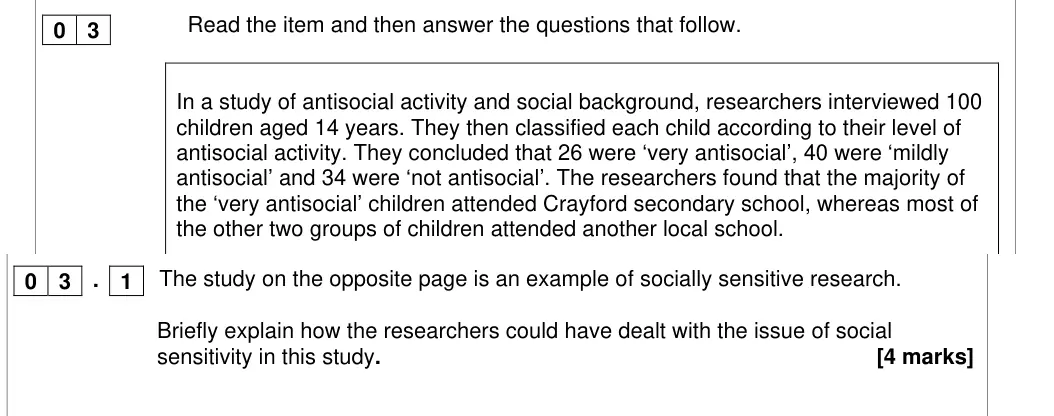
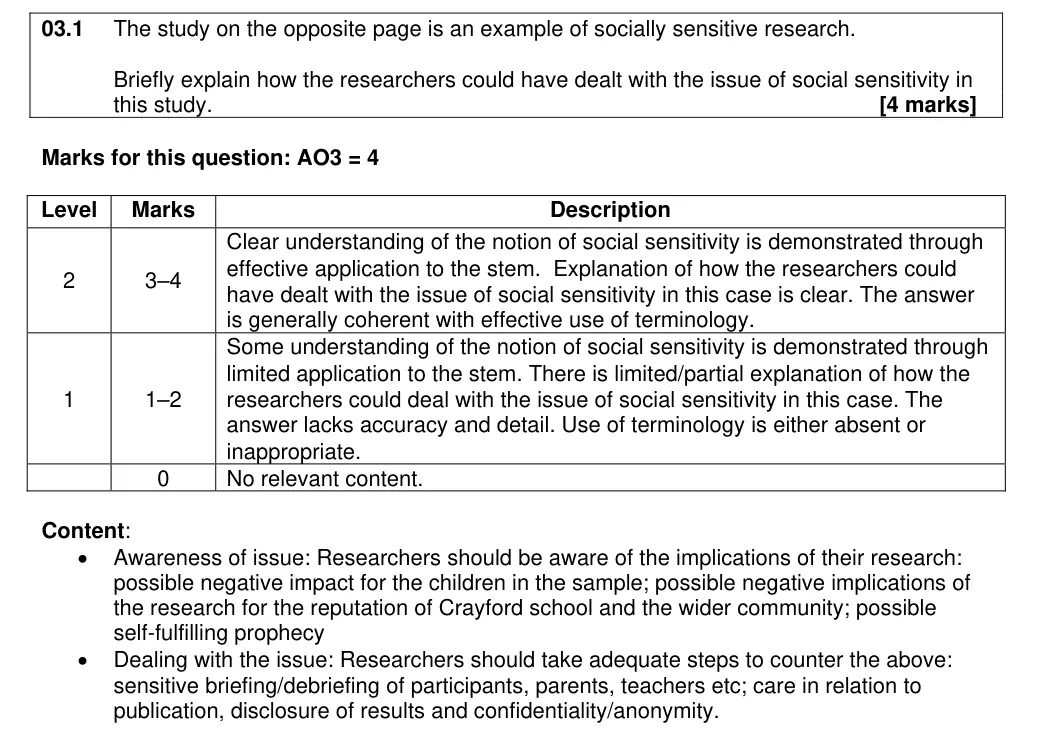
Specimen set 2 · Paper 3 · Q3.14 marksAO3=4Application
Mark scheme, including level descriptors and indicative content
Notes from the mark scheme and report
awareness of implications (stigma for the children, reputation of Crayford school/community, self-fulfilling prophecy) + how to deal with it (sensitive debriefing, care with publication, confidentiality/anonymity)
must be applied to the stem
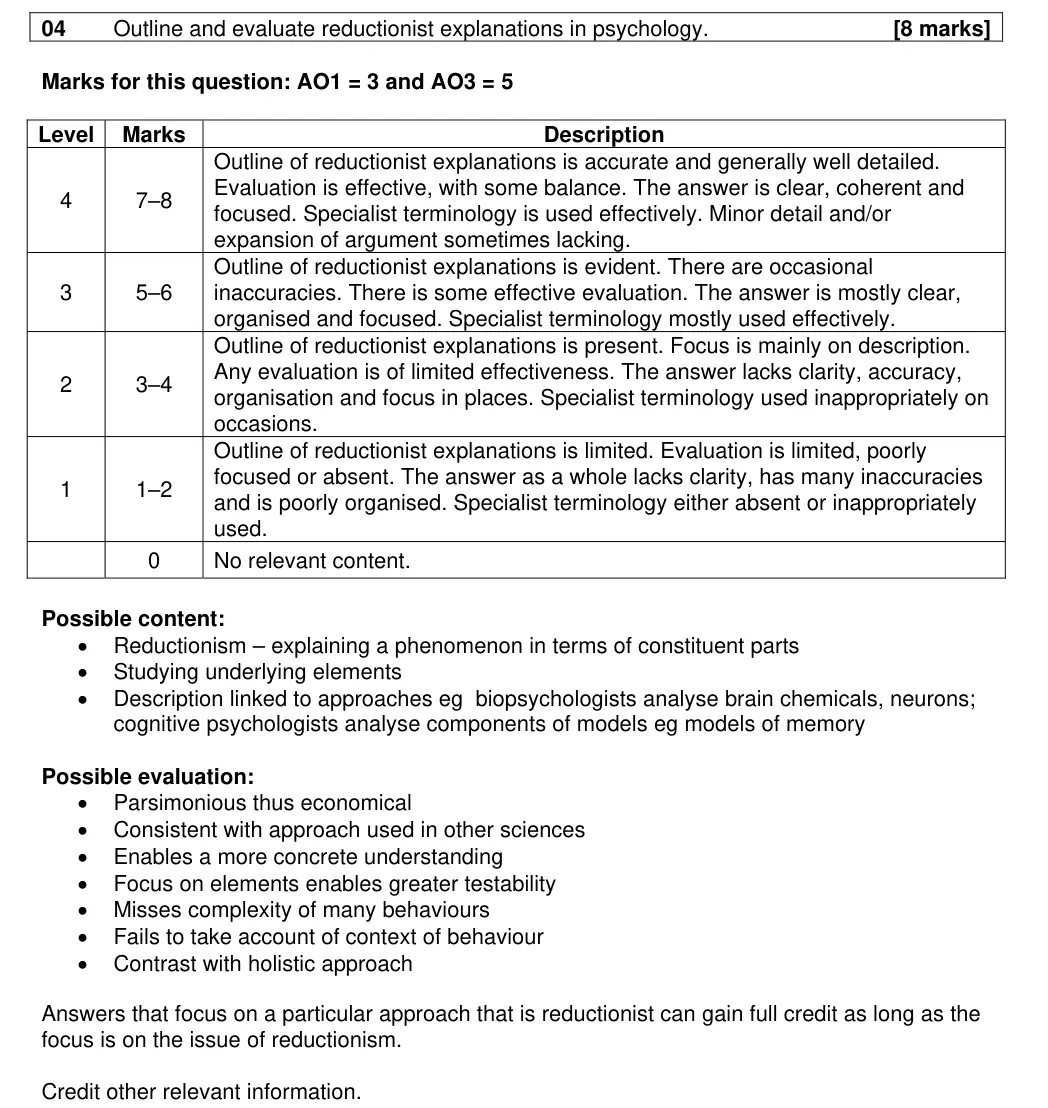
Specimen set 2 · Paper 3 · Q48 marksAO1=3, AO3=5Extended writing
Mark scheme, including level descriptors and indicative content
Notes from the mark scheme and report
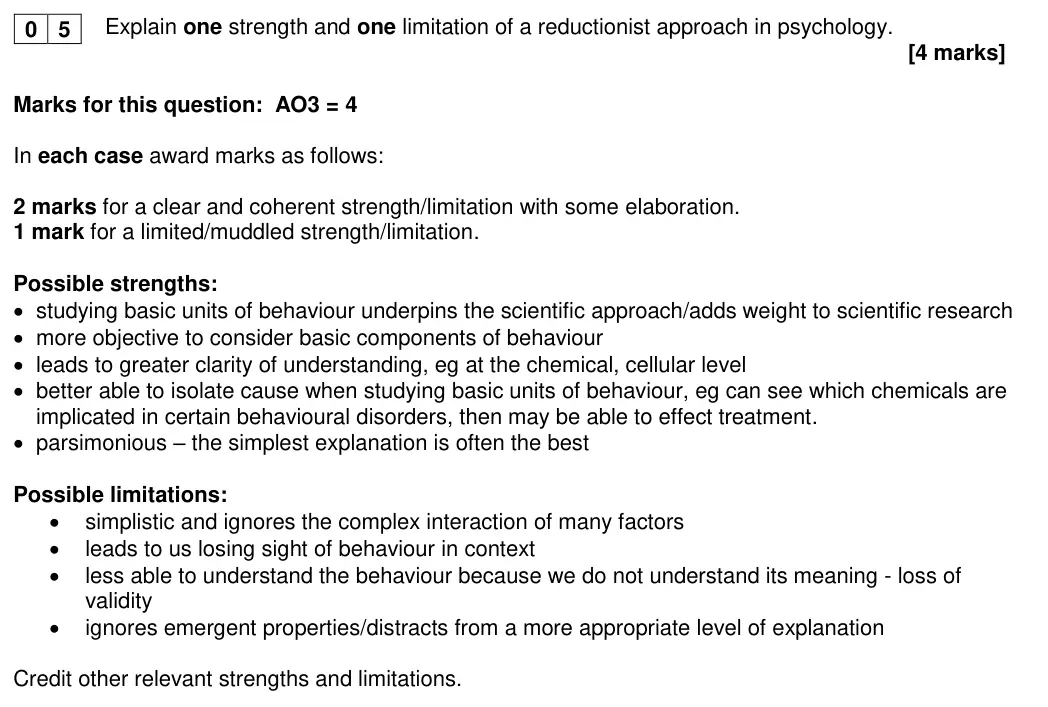
reductionism = explaining in terms of constituent parts, with examples from approaches
evaluation: parsimony, scientific testability vs missing complexity/context, contrast with holism
answers on a reductionist approach credited if focused on the issue
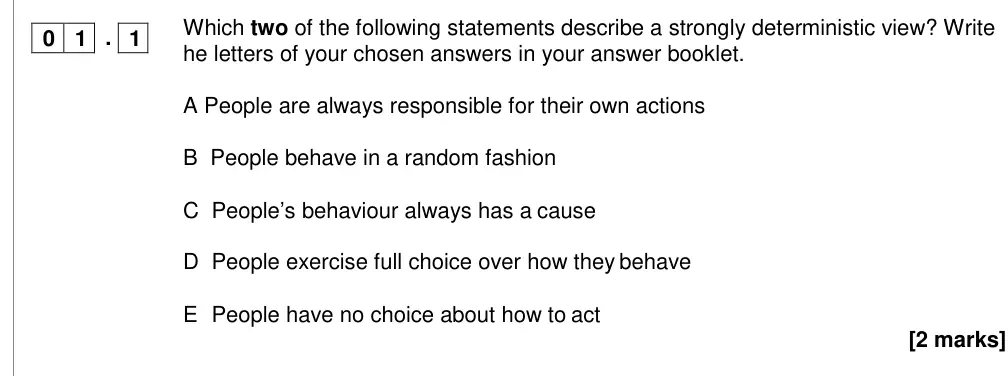
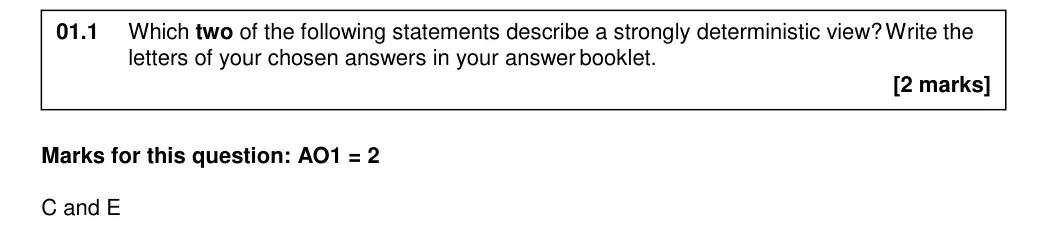
Specimen set 1 · Paper 3 · Q1.12 marksAO1=2Multiple choice
Answer
C and E
Mark scheme, including level descriptors and indicative content
Notes from the mark scheme and report
answers C and E
distractors A and D describe free will, B randomness
Specimen set 1 · Paper 3 · Q1.22 marksAO1=2Short answer
Mark scheme, including level descriptors and indicative content
Notes from the mark scheme and report
any two of hard, soft, biological, environmental, psychic determinism
Specimen set 1 · Paper 3 · Q24 marksAO3=4Outline
Mark scheme, including level descriptors and indicative content
Notes from the mark scheme and report
2 marks each: alpha bias exaggerates gender differences, beta bias minimises them - both misrepresent behaviour
merely stated = 1 mark
Specimen set 1 · Paper 3 · Q32 marksAO1=2Outline
Mark scheme, including level descriptors and indicative content
Notes from the mark scheme and report
must explain range from lower/fundamental (basic units) to higher/holistic explanations
merely saying there are different levels = 0
example-embedded answers accepted
Specimen set 1 · Paper 3 · Q46 marksAO3=6Application
Mark scheme, including level descriptors and indicative content
Notes from the mark scheme and report
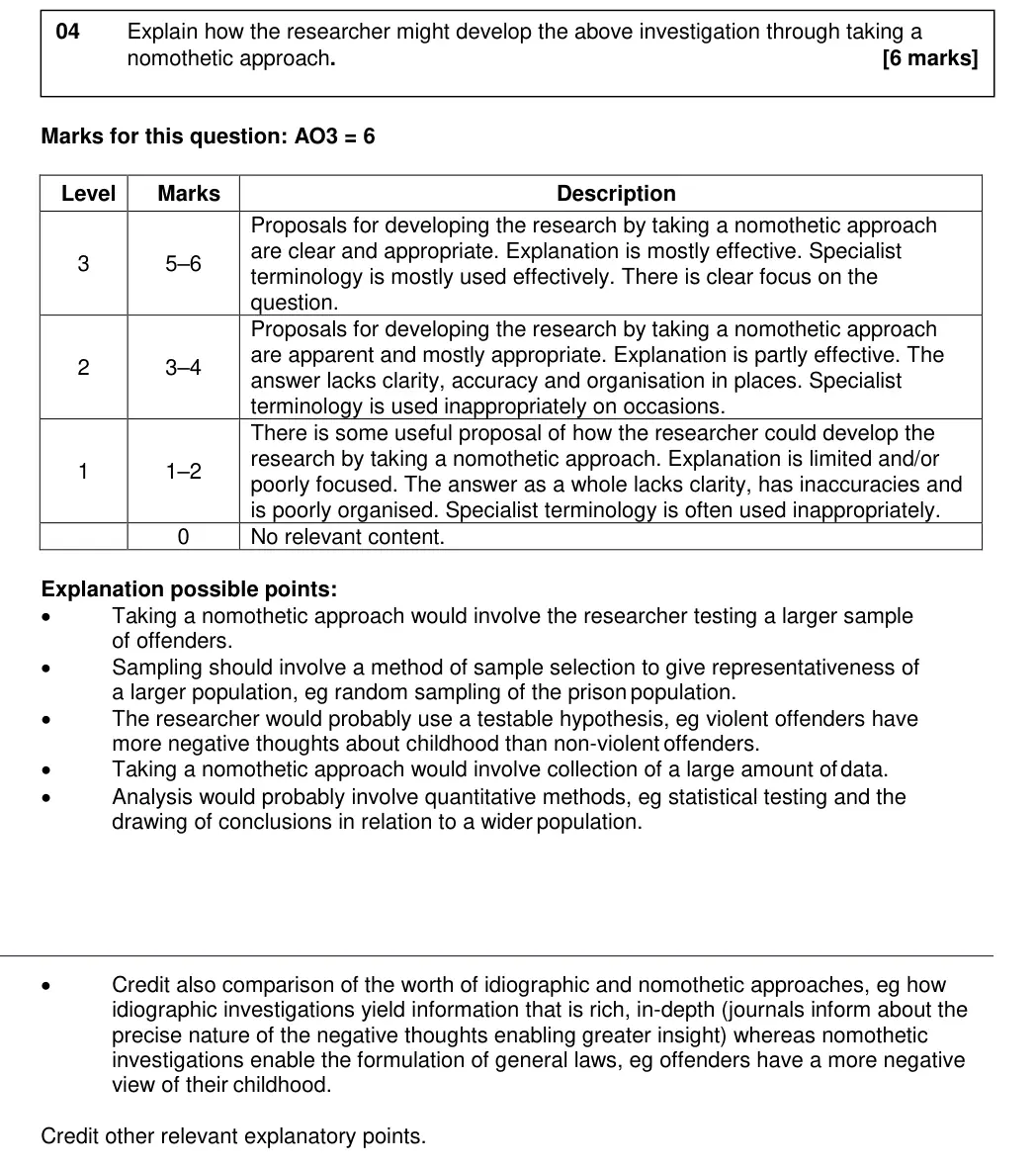
develop the journal study nomothetically: larger representative sample, testable hypothesis, quantitative data and statistical testing, general laws
comparison of idiographic vs nomothetic worth also credited
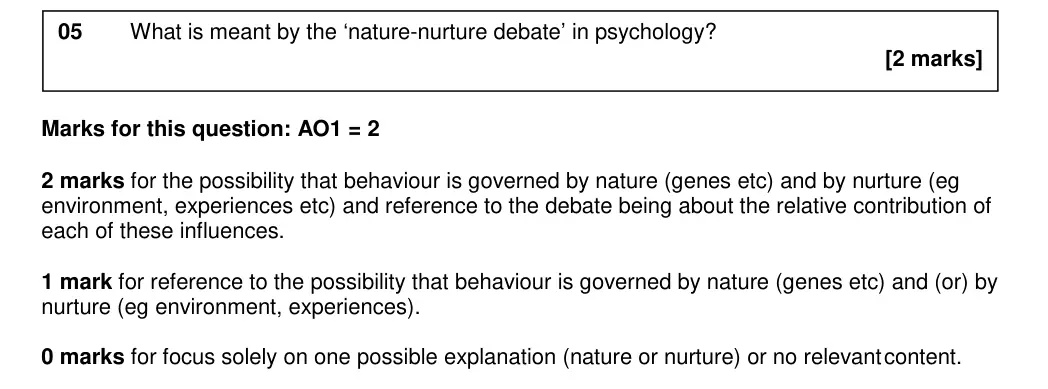
Specimen set 1 · Paper 3 · Q52 marksAO1=2Short answer
Mark scheme, including level descriptors and indicative content
Notes from the mark scheme and report
2 marks needs both nature and nurture plus the debate being about their relative contribution
one side only = 0
Specimen set 1 · Paper 3 · Q6.12 marksAO2=2Application
Mark scheme, including level descriptors and indicative content
Notes from the mark scheme and report
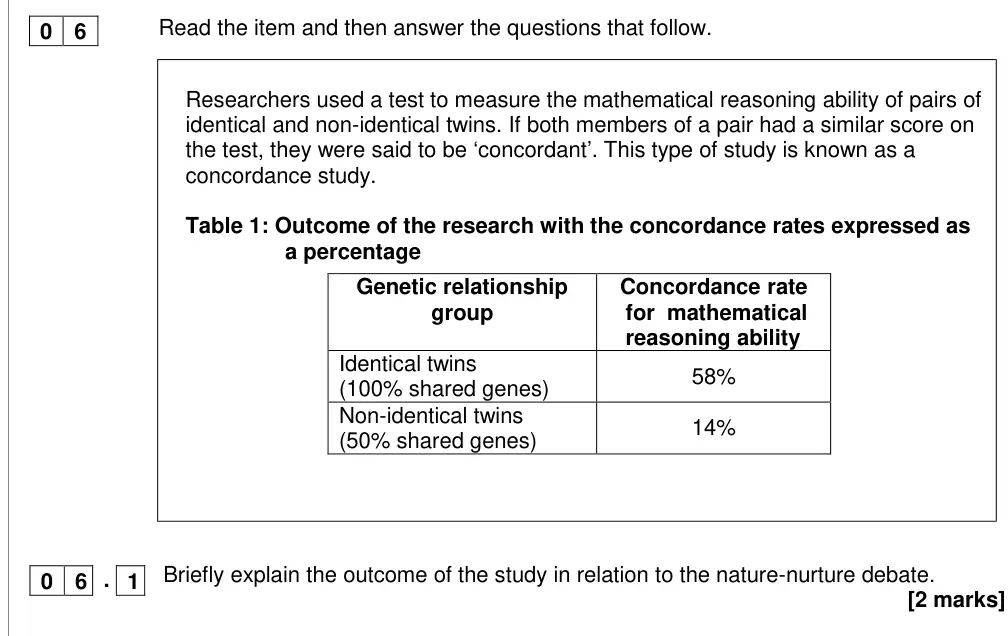
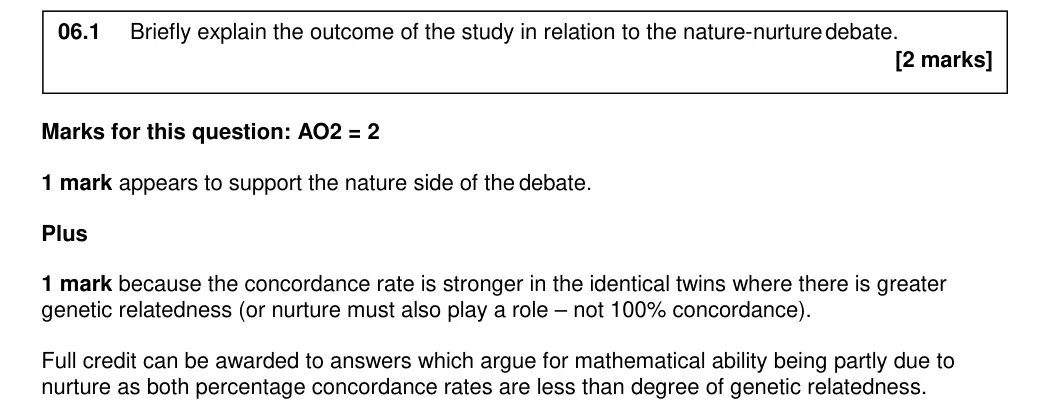
supports nature because concordance higher in identical twins (more shared genes)
full credit also for nurture role as concordance below genetic relatedness
Work with an AQA psychology tutor
Essays not reaching the top band? Book a session with Andy, a former AQA examiner.