30 question parts, 8 sixteen-mark essays, 5 multiple-choice items, plus 5 parts on content removed in 2025
Notes, key studies and practice items for this topic are being written by our tutors. The past-paper questions below are ready now.
Specification statements
4.3.5-01 Positive symptoms of schizophrenia, including hallucinations and delusions. Negative symptoms of schizophrenia, including speech poverty and avolition. Issues in diagnosis: co-morbidity, culture and gender bias and symptom overlap.
4.3.5-02 Biological explanations for schizophrenia: genetics and neural correlates, including the dopamine hypothesis.
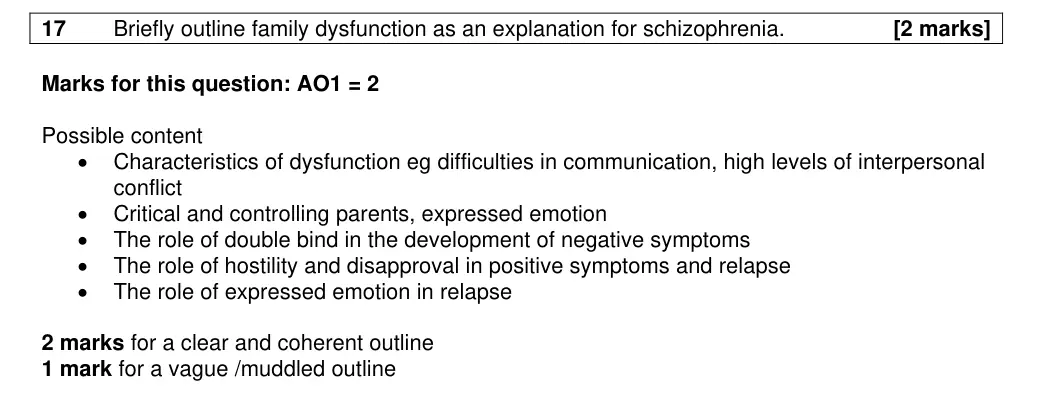
4.3.5-03 Psychological explanations for schizophrenia: family dysfunction and cognitive explanations, including dysfunctional thought processing.
4.3.5-04 Drug therapy: typical and atypical antipsychotics.
4.3.5-05 Cognitive behaviour therapy and family therapy as used in the treatment of schizophrenia.
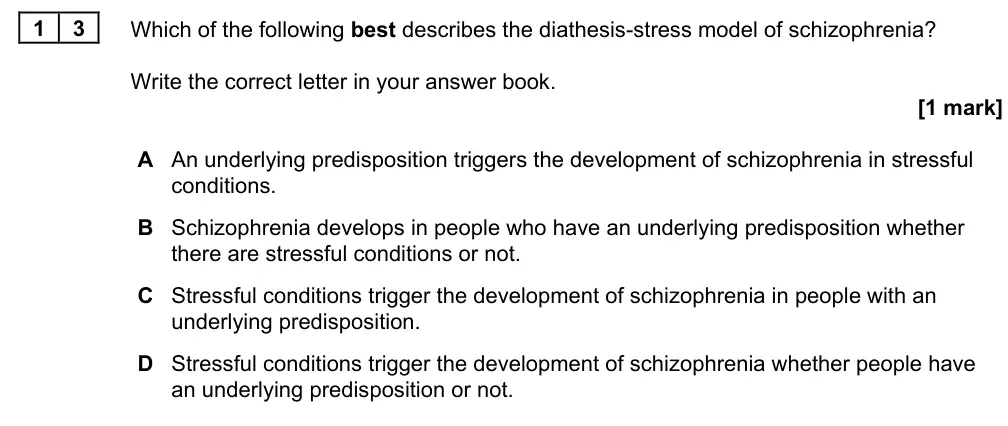
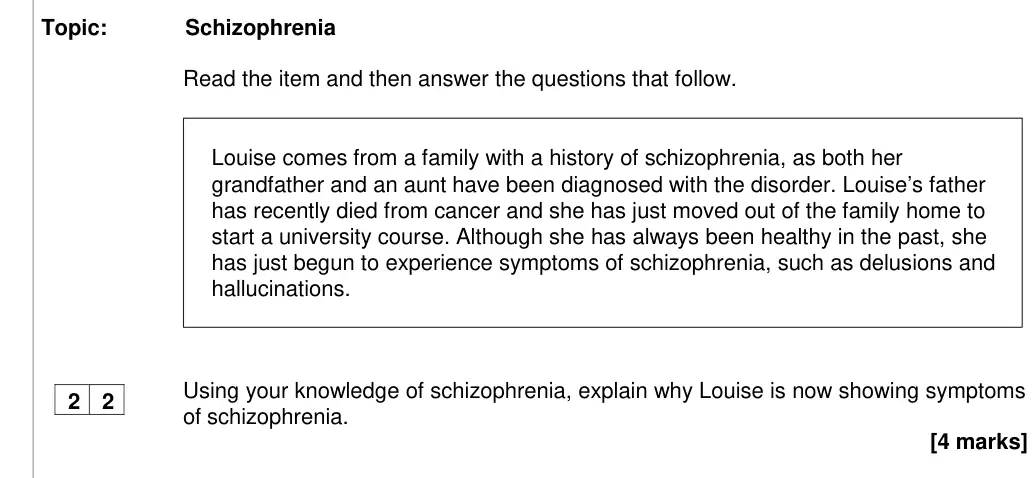
4.3.5-06 The importance of an interactionist approach in explaining and treating schizophrenia; the diathesis-stress model.
Tap a question to zoom it. Mark scheme and examiner's comment open under each question.
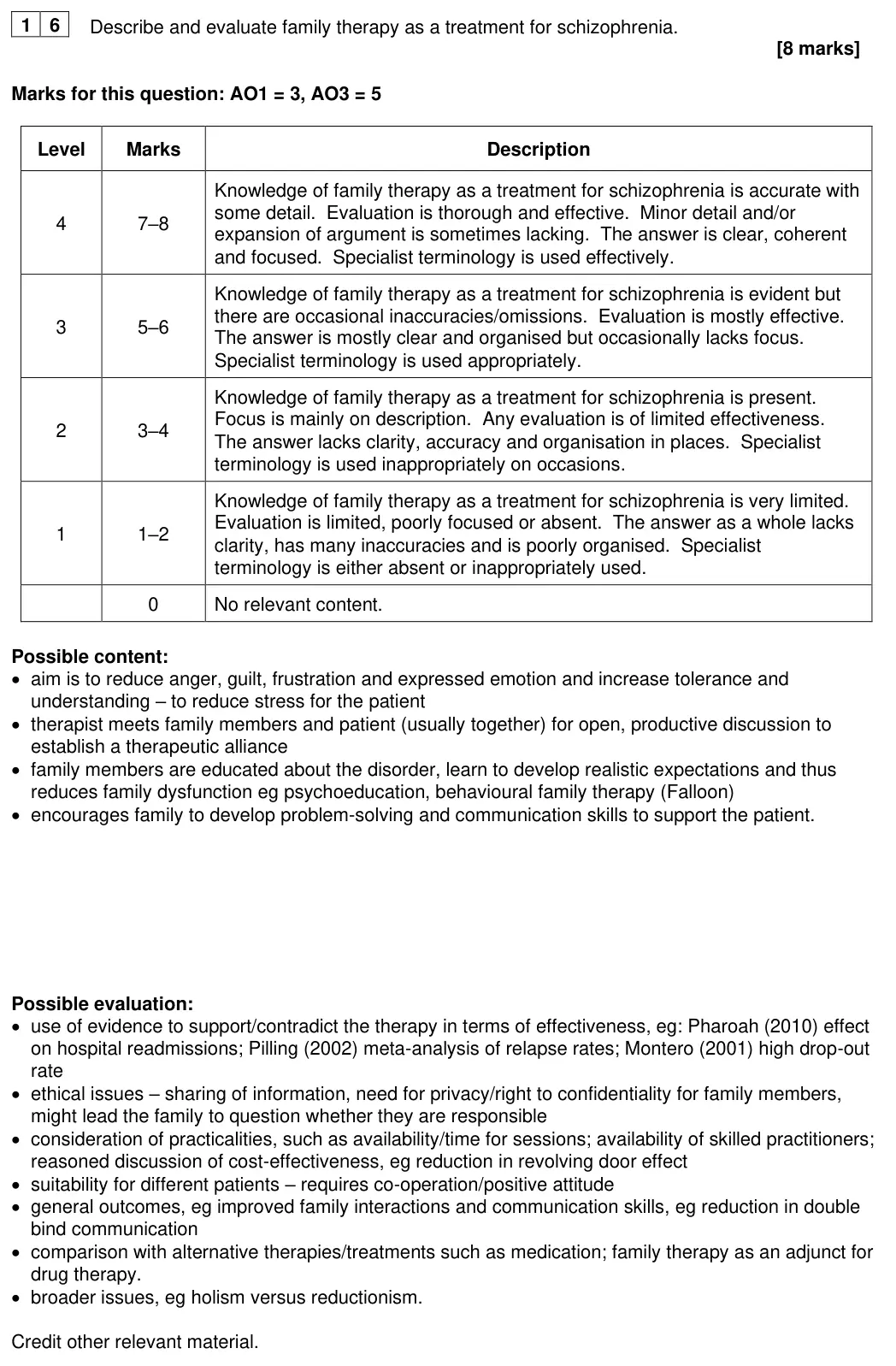
June 2025 · Paper 3 · Q168 marksAO1=3, AO3=5Extended writing
Mark scheme, including level descriptors and indicative content
Examiner's comment
The 8-mark discussion question on family therapy (16) gave rise to quite a lot of commonsense content related to the family being supportive of the patient and helping them with their medication. More sophisticated accounts talked of the need for a therapeutic alliance between family members, psychoeducation and the theoretical underpinnings of the treatment – for example, to reduce dysfunctional communication. As part of evaluation, there were some impressive discussions of relapse studies, but again, some points bordered on the trivial such as all the family not being able to attend appointments.
evaluation relapse/readmission evidence, ethics, cost, adjunct to drugs
many commonsense answers about family support and medication
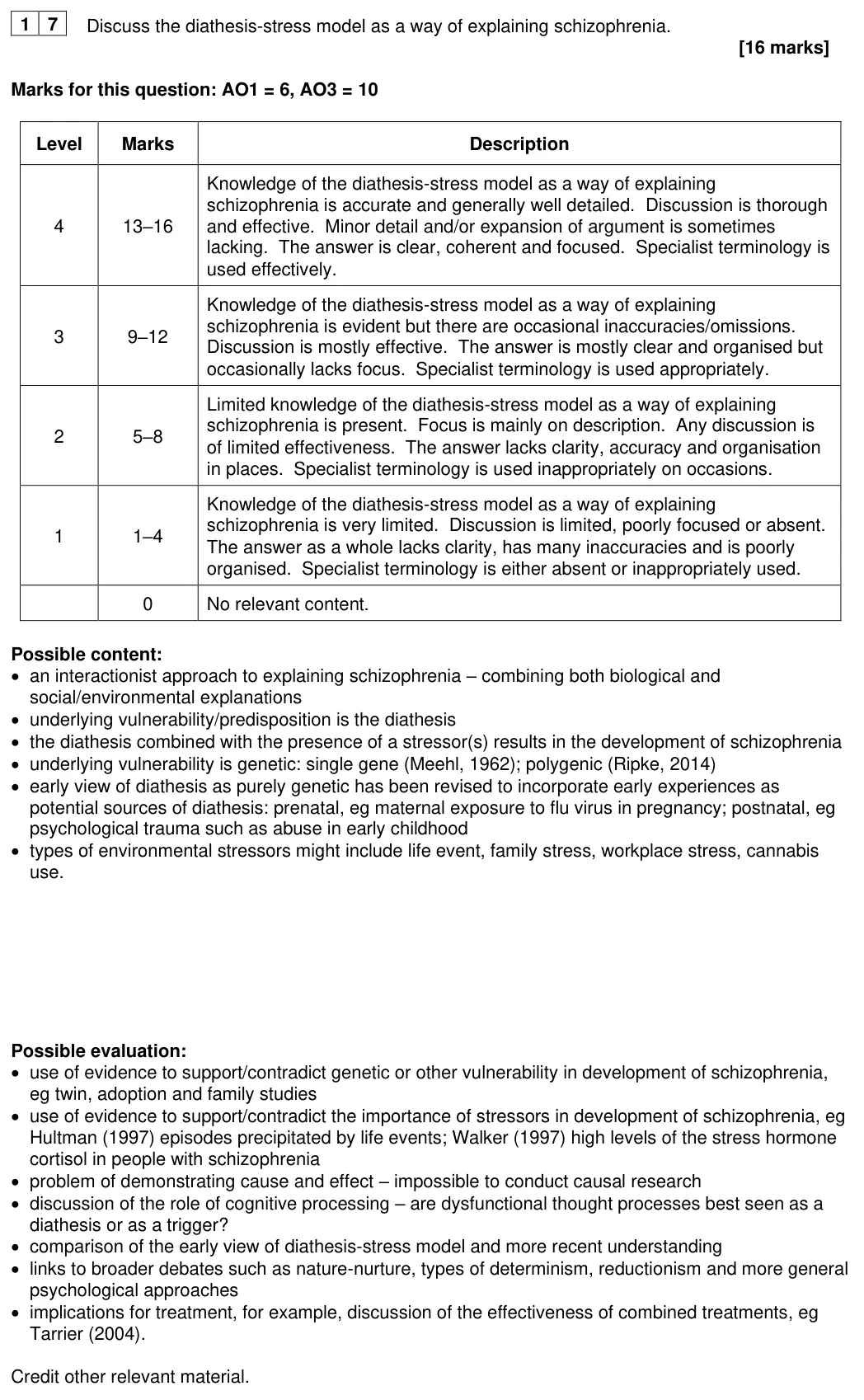
June 2025 · Paper 3 · Q1716 marksAO1=6, AO3=1016-mark essay
Mark scheme, including level descriptors and indicative content
Examiner's comment
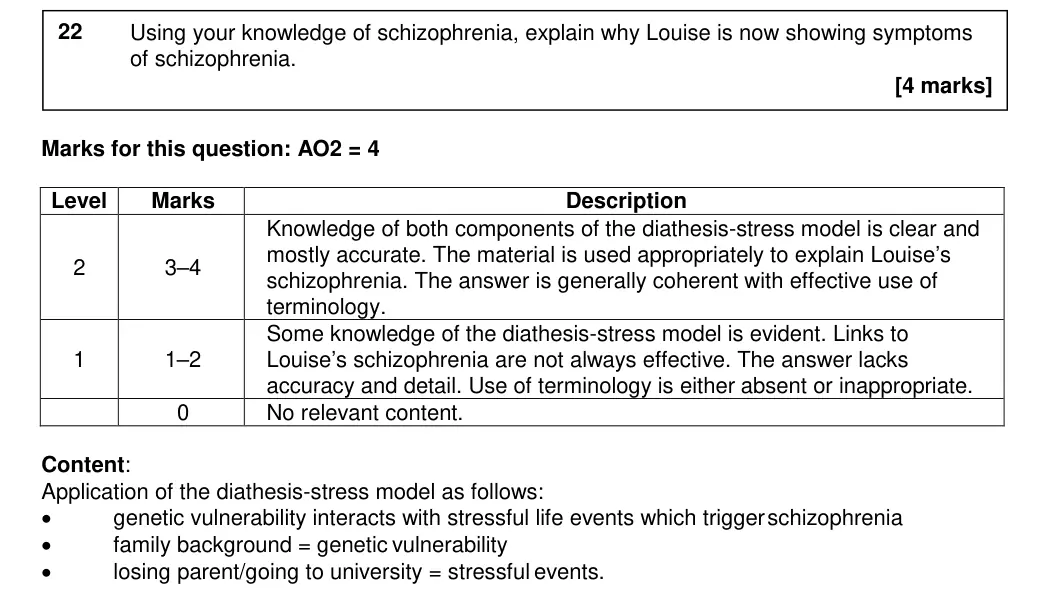
The essay on the diathesis-stress model (17) was inadequately answered overall. Many students did not seem to have access to sufficient material upon which to construct a 16-mark response and offered very brief descriptions followed by minimal evaluation. As a consequence, there were some very short answers. More successful responses talked about the original version of the model followed by examples of how modern understanding of ‘diathesis’ and ‘stress’ came into being. There was often an overfocus on treatment as part of the evaluation, and whilst some of this material was certainly relevant, it did sometimes feel as though students were answering a different question. Finally, some students separated the two parts of the model – diathesis and stress – and dealt with each individually, almost as if they were writing two essays. Again, whilst this material was awarded credit, it did somewhat miss the point of a discussion of an interactionist approach to schizophrenia.
Notes from the mark scheme and report
AO3 = 10 marks
diathesis (genetic, prenatal/early trauma) plus stressors (life events, family stress, cannabis)
evaluation twin/adoption evidence, Hultman, cause and effect, treatment implications (Tarrier)
inadequately answered overall, very short answers
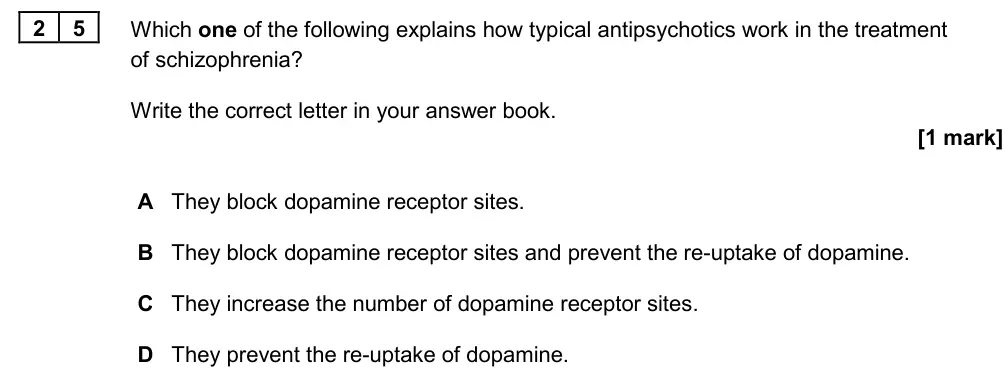
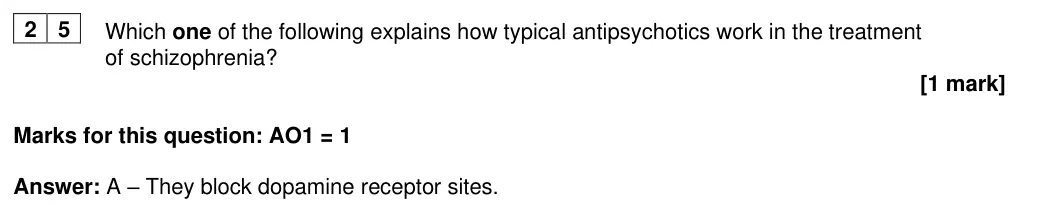
June 2024 · Paper 3 · Q251 markAO1=1Multiple choice
Answer
A
Mark scheme, including level descriptors and indicative content
Examiner's comment
However, there were far fewer who correctly identified option A for Question 25, and those who got it wrong invariably selected option B as their answer.
Notes from the mark scheme and report
answer A (block dopamine receptor sites)
most common wrong answer B (block receptors AND prevent re-uptake)
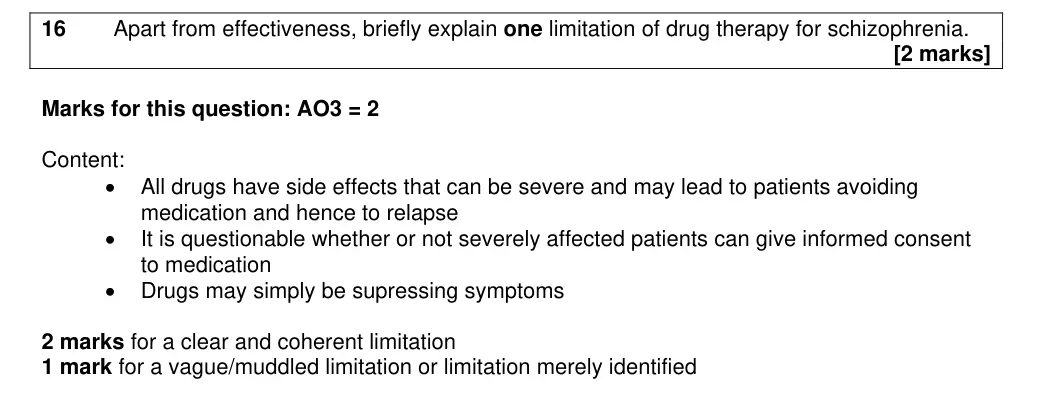
June 2024 · Paper 3 · Q262 marksAO3=2Evaluate (short)
Mark scheme, including level descriptors and indicative content
Examiner's comment
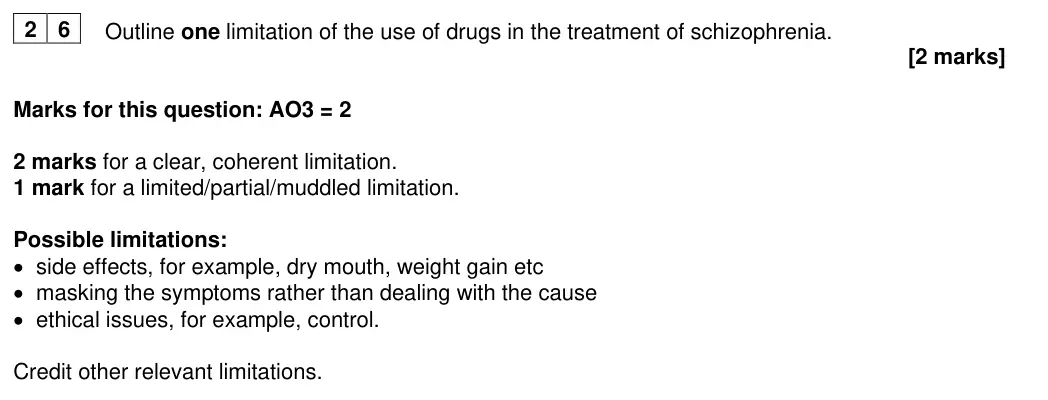
For Question 26, the majority talked about the possible side-effects associated with drug treatment and many went on to point out that these may lead to discontinuation of use as part of their elaboration.
Notes from the mark scheme and report
2 marks for a clear limitation, e.g. side effects (leading to discontinuation), masks symptoms, ethics of control
June 2024 · Paper 3 · Q274 marksAO1=2, AO3=2Explain
Mark scheme, including level descriptors and indicative content
Examiner's comment
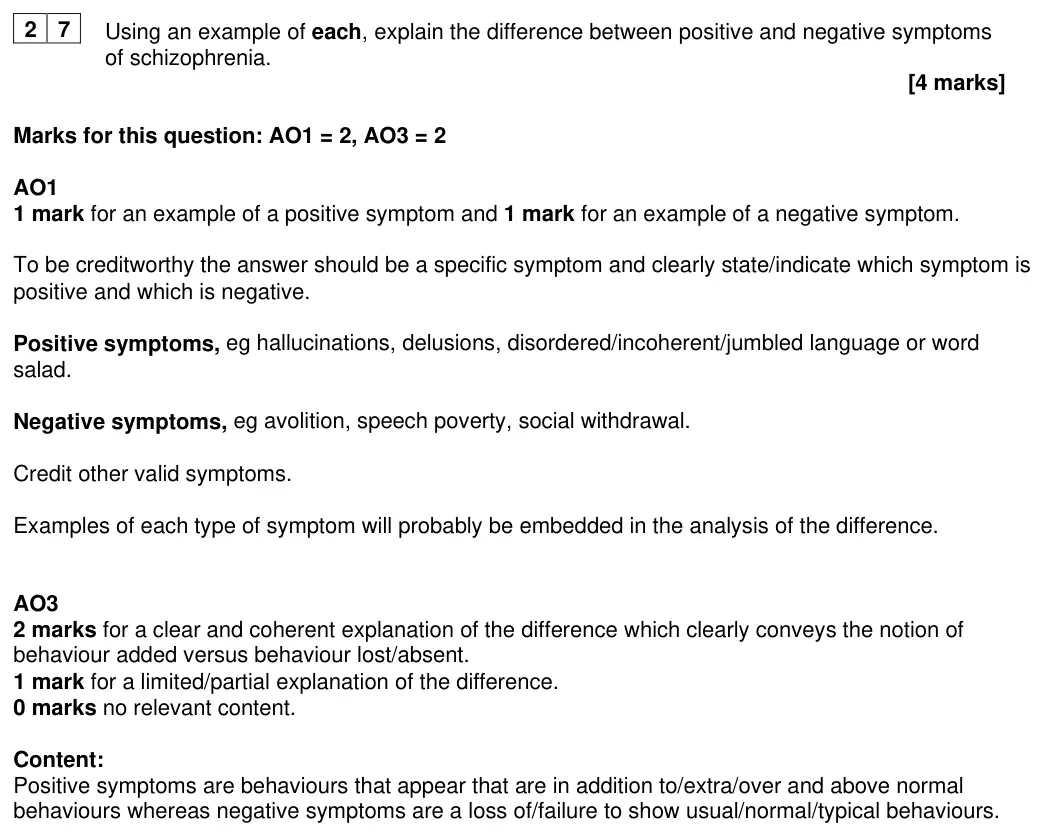
Most students found it relatively straightforward to identify a positive and negative symptom of schizophrenia as part of their answer to Question 27. Popular choices were hallucinations and avolition, respectively. It was also the case that most students could provide a clear and coherent explanation of the difference, though some lost a mark due to the brevity of the response, often offering little more than the words ‘added’ and ‘taken away’.
Notes from the mark scheme and report
AO1: 1 mark positive example + 1 mark negative example, clearly labelled
AO3: 2 marks for difference = behaviour added vs behaviour lost/absent
bare 'added/taken away' lost a mark
June 2024 · Paper 3 · Q2816 marksAO1=6, AO2=4, AO3=616-mark essay
Mark scheme, including level descriptors and indicative content
Examiner's comment
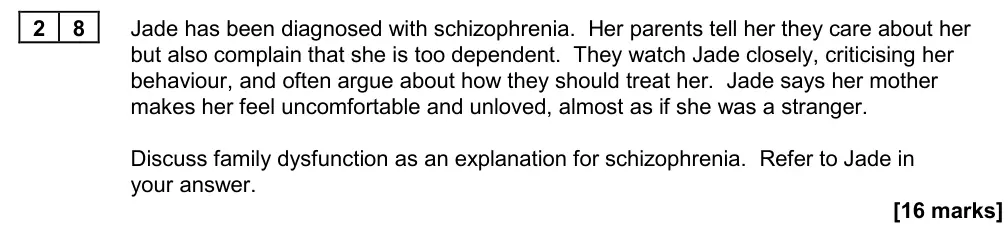
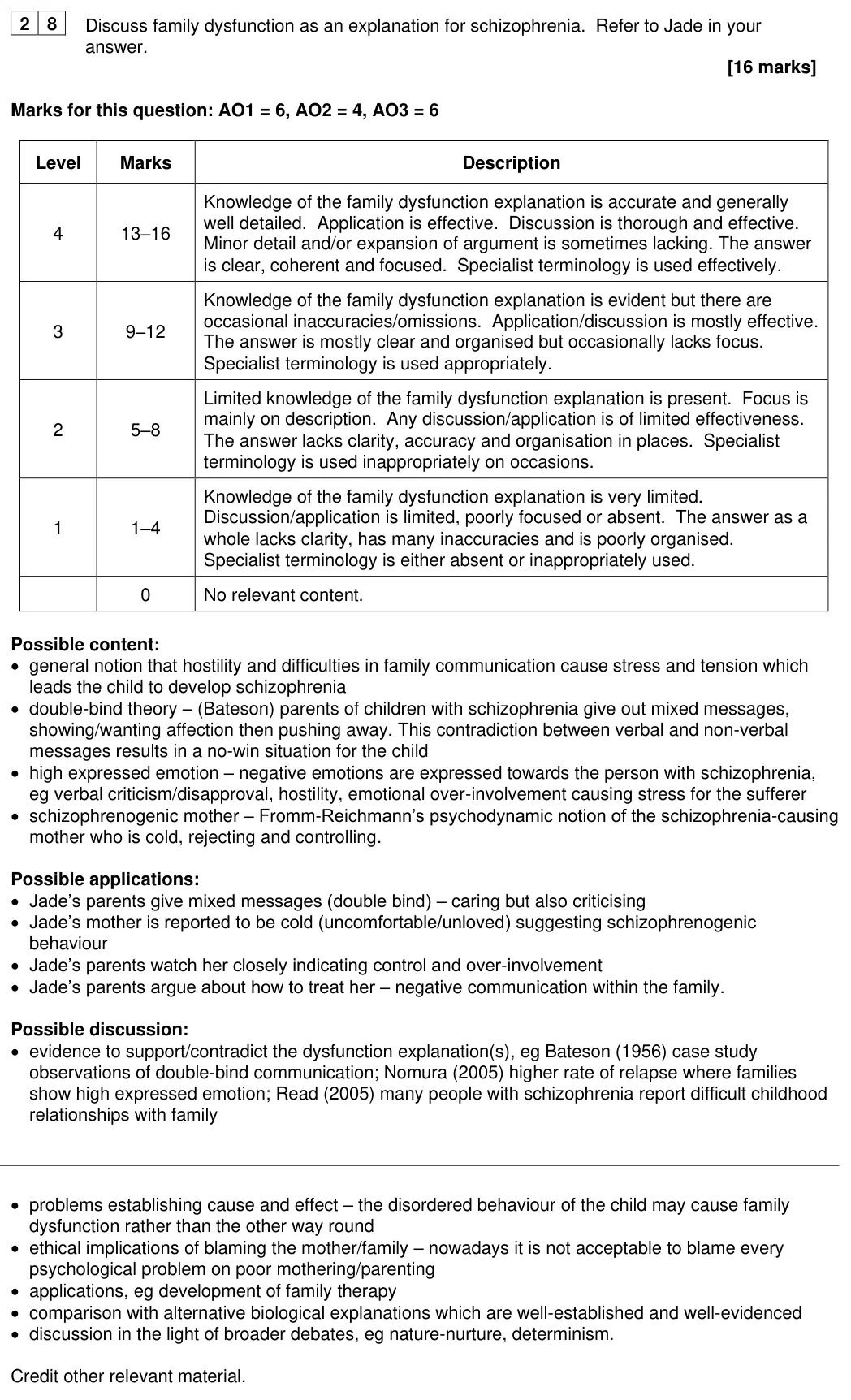
There were some very good answers to the extended response question on the family dysfunction explanation for schizophrenia (Question 28). Most students adopted a breadth over depth approach and talked about all three explanations on the mark scheme. However, this occasionally meant that each was reduced to little more than a couple of sentences which may have restricted access to the top level. It did mean though that students were able to deal with most aspects of the stem. Some very detailed discussions dealt with the ethical implications of blaming the family, practical application to family therapy and the problem of establishing causation.
Notes from the mark scheme and report
double bind (care vs criticism), expressed emotion (watching, criticising), schizophrenogenic mother (cold mother)
breadth approach common but very brief coverage of each limited access to top level
June 2023 · Paper 3 · Q174 marksAO1=4Multiple choiceOld spec only
Answer
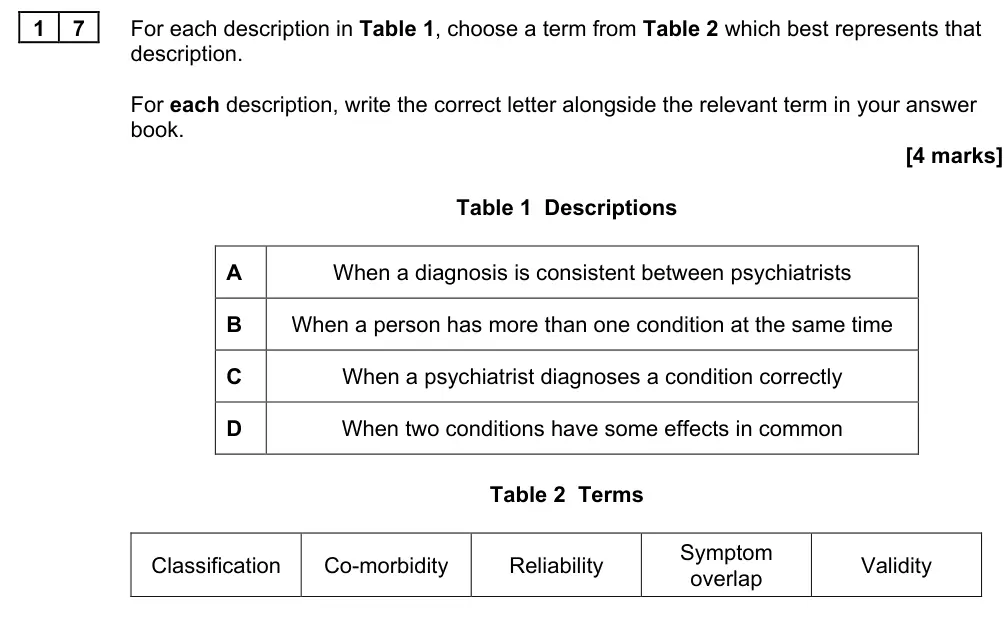
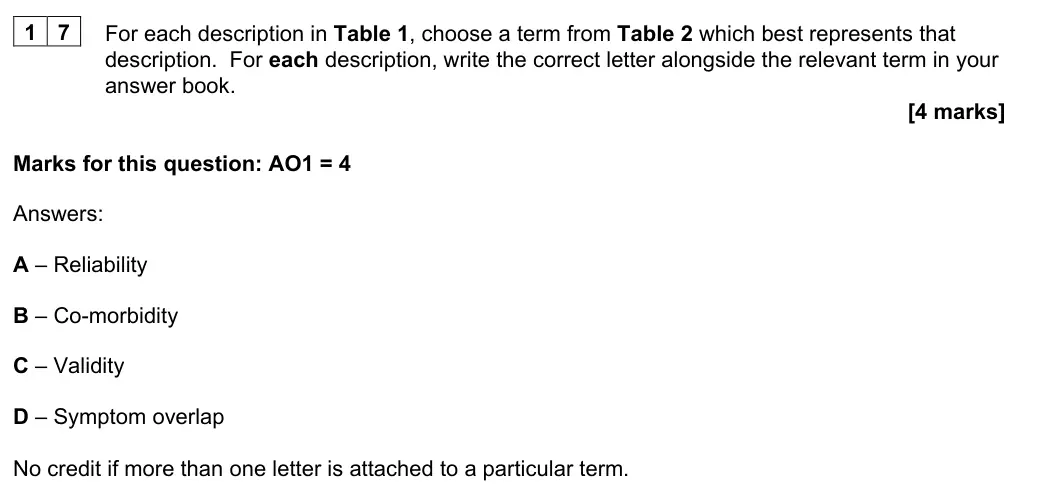
A and B and C and D
Mark scheme, including level descriptors and indicative content
Examiner's comment
Each of the optional topics in Section C began with a 4-mark multiple-choice question, none of which proved particularly problematic for students. Those who did score three marks, rather than four, tended to muddle ‘classification’ – an incorrect answer – with ‘validity’.
Notes from the mark scheme and report
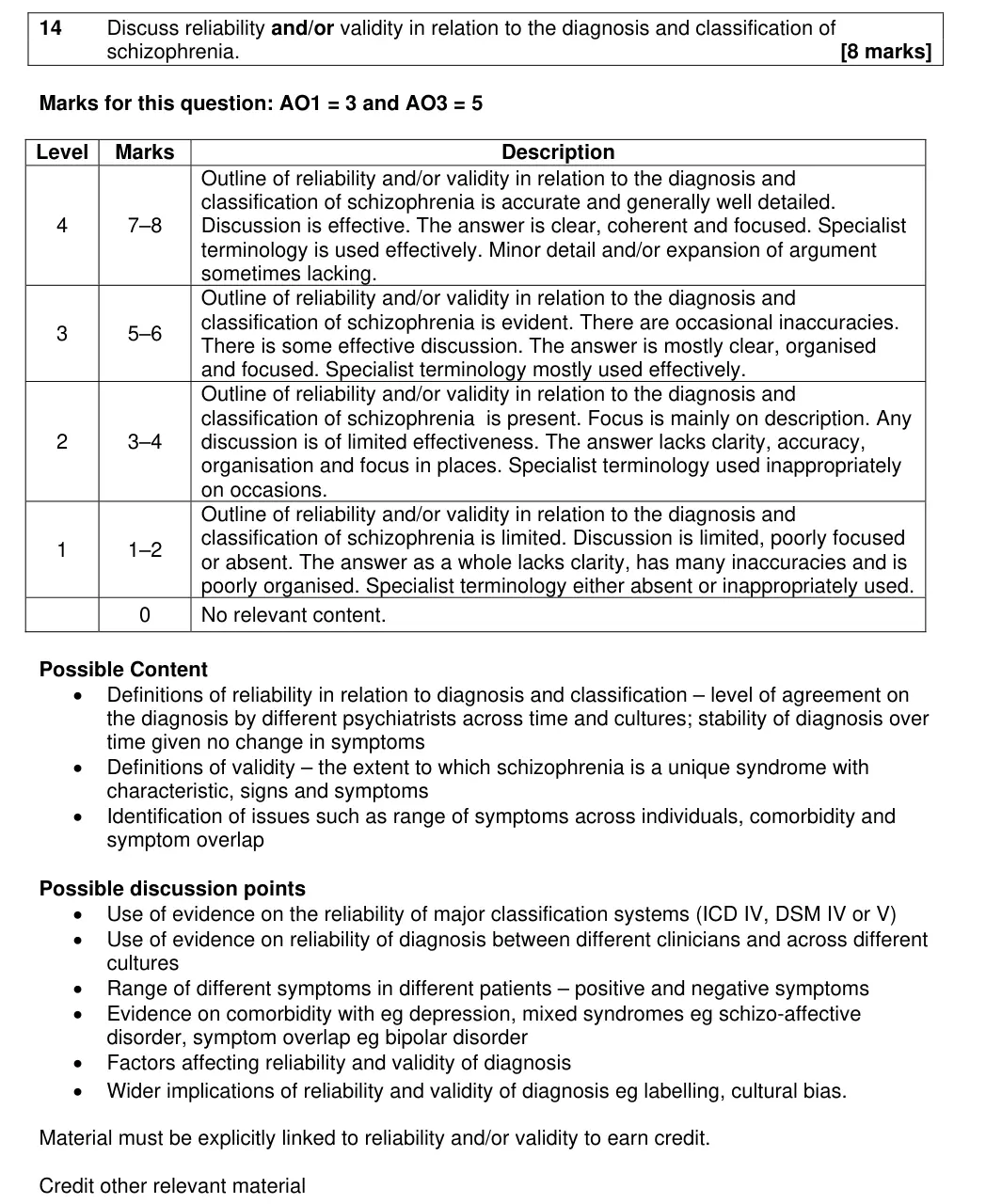
(2 of 4 answers need reliability and validity in diagnosis, removed in v1.4
classification distractor also removed)
A Reliability, B Co-morbidity, C Validity, D Symptom overlap
no credit if more than one letter per term
common error 'classification' for validity
June 2023 · Paper 3 · Q1916 marksAO1=6, AO2=4, AO3=616-mark essay
Mark scheme, including level descriptors and indicative content
Examiner's comment
The 16-mark essay on Schizophrenia was probably the best answered question on the paper. Most students adopted a ‘breadth’ rather than ‘depth’ approach here, helped by the fact that there were many and varied ‘hooks’ in the question upon which to make effective links. Those who scored marks in the top band usually offered four or five different explanations, concisely described and evaluated. In this sense, many answers were well-organised with little irrelevance, and many scored full marks.
June 2022 · Paper 3 · Q131 markAO1=1Multiple choice
Answer
C
Mark scheme, including level descriptors and indicative content
Examiner's comment
Most students answered the first multiple-choice question correctly but many answered the second incorrectly.
Notes from the mark scheme and report
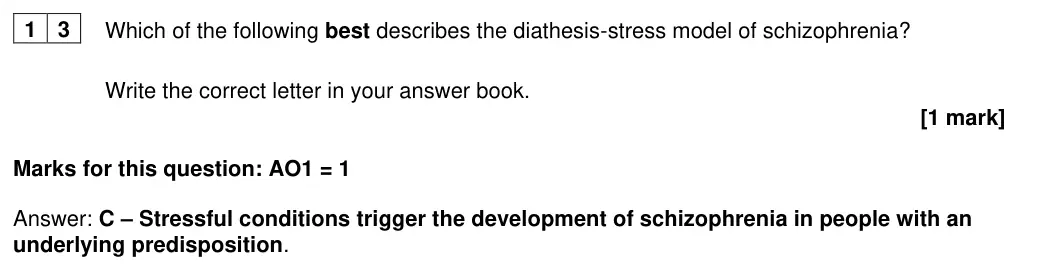
correct C (stress triggers schizophrenia in those with a predisposition)
most answered correctly
June 2022 · Paper 3 · Q156 marksAO1=3, AO3=3Outline
Mark scheme, including level descriptors and indicative content
Examiner's comment
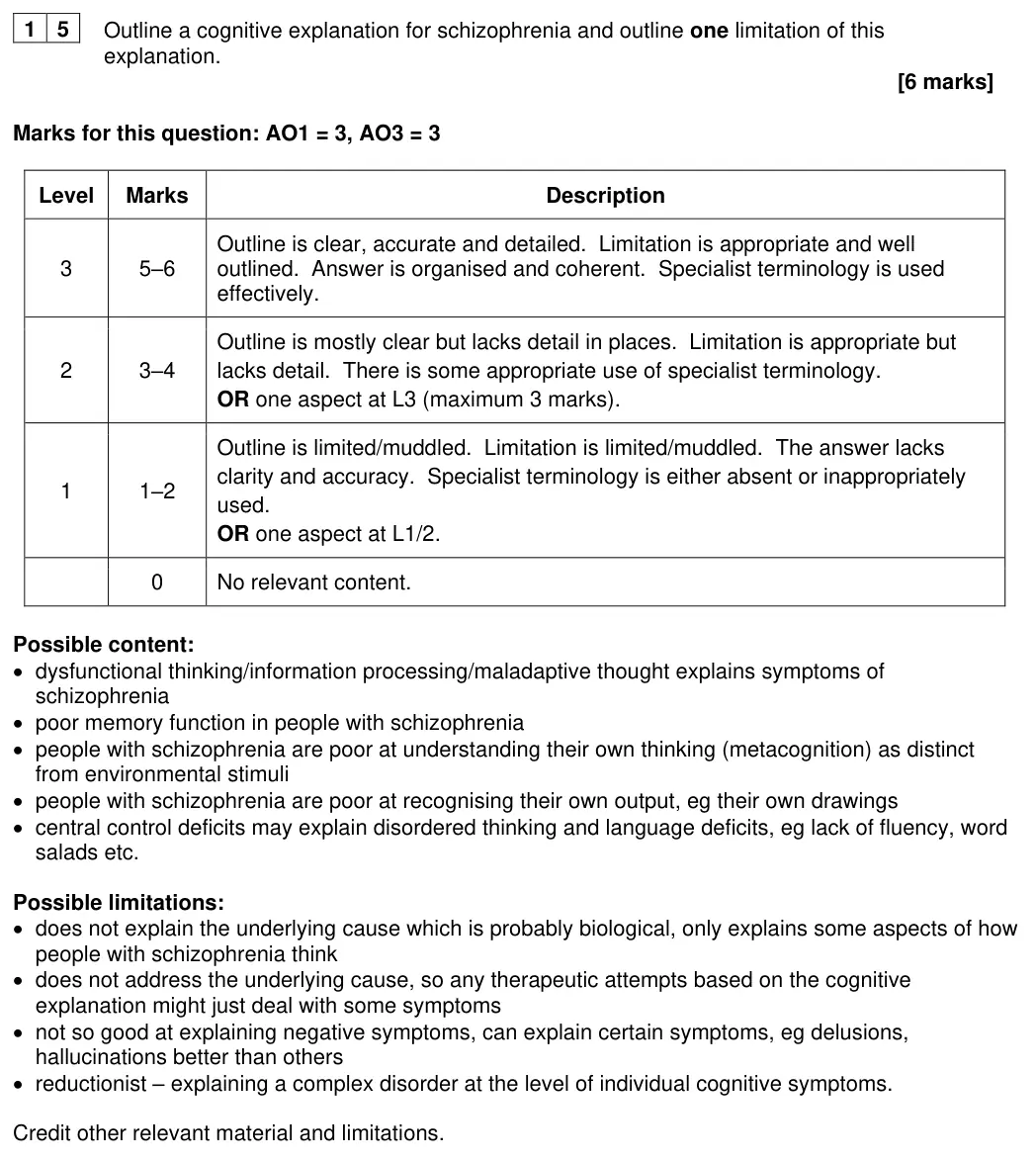
There were many competent answers to Question 15 although students sometimes mistakenly stated that metarepresentation and central coherence explained schizophrenia rather than failure of metarepresentation and central coherence. A considerable number of students used the wrong theory here, typically family dysfunction or occasionally the dopamine hypothesis.
Notes from the mark scheme and report
dysfunctional thought processing, metarepresentation/central control deficits + one limitation
one aspect only = max 3
failure OF metarepresentation explains symptoms
many used family dysfunction or dopamine instead
June 2022 · Paper 3 · Q188 marksAO3=8Extended writing
Mark scheme, including level descriptors and indicative content
Examiner's comment
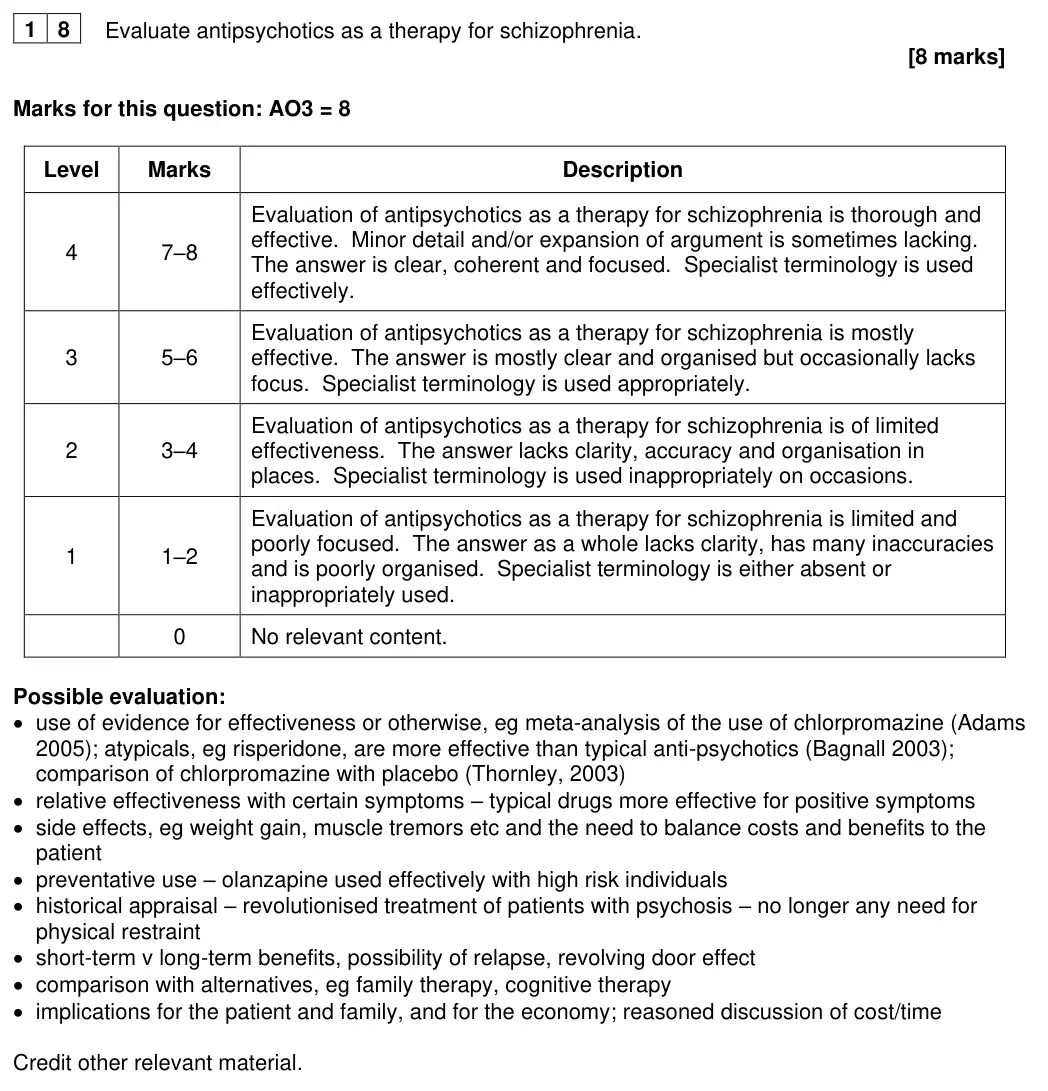
Question 18 was usually well answered except where students wasted time describing drugs and their mode of action. Vague and unsubstantiated assertions that ‘drugs work’ and points about time and cost without reasoned argument were not creditworthy.
Notes from the mark scheme and report
AO3 only: evidence for effectiveness (typical vs atypical), side effects, revolving door, comparison with CBT/family therapy
time spent describing drug action wasted
unsupported 'drugs work'/cost points not credited
November 2021 · Paper 3 · Q162 marksAO1=2Short answer
Mark scheme, including level descriptors and indicative content
Examiner's comment
The definitions questions seemed to discriminate quite well in all topics. Where students wrote more than one term per letter only the first answer was credited.
Notes from the mark scheme and report
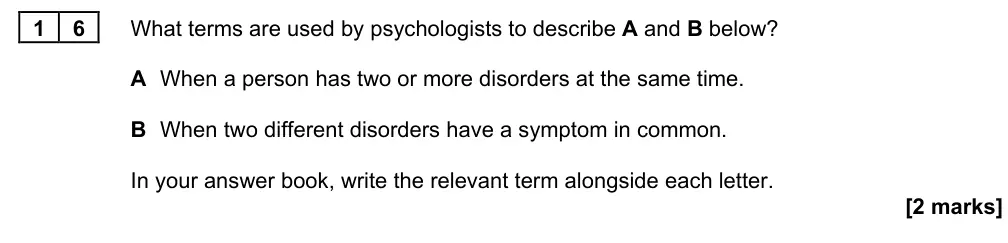
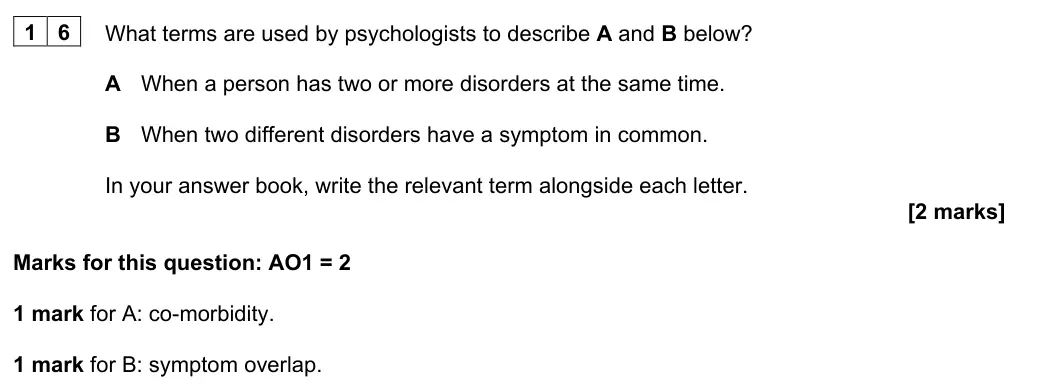
A co-morbidity, B symptom overlap
November 2021 · Paper 3 · Q176 marksAO3=6Evaluate (short)
Mark scheme, including level descriptors and indicative content
Examiner's comment
The 6-mark evaluation questions often scored poorly because students described the explanation instead of evaluating. The most effective evaluations tended to be those that used evidence to either support or counter the explanation. For Qs17 and 20 evaluations of biological explanations were not credited as the Specification differentiates clearly between psychological and biological explanations in 4.3.5 and 4.3.6.
Notes from the mark scheme and report
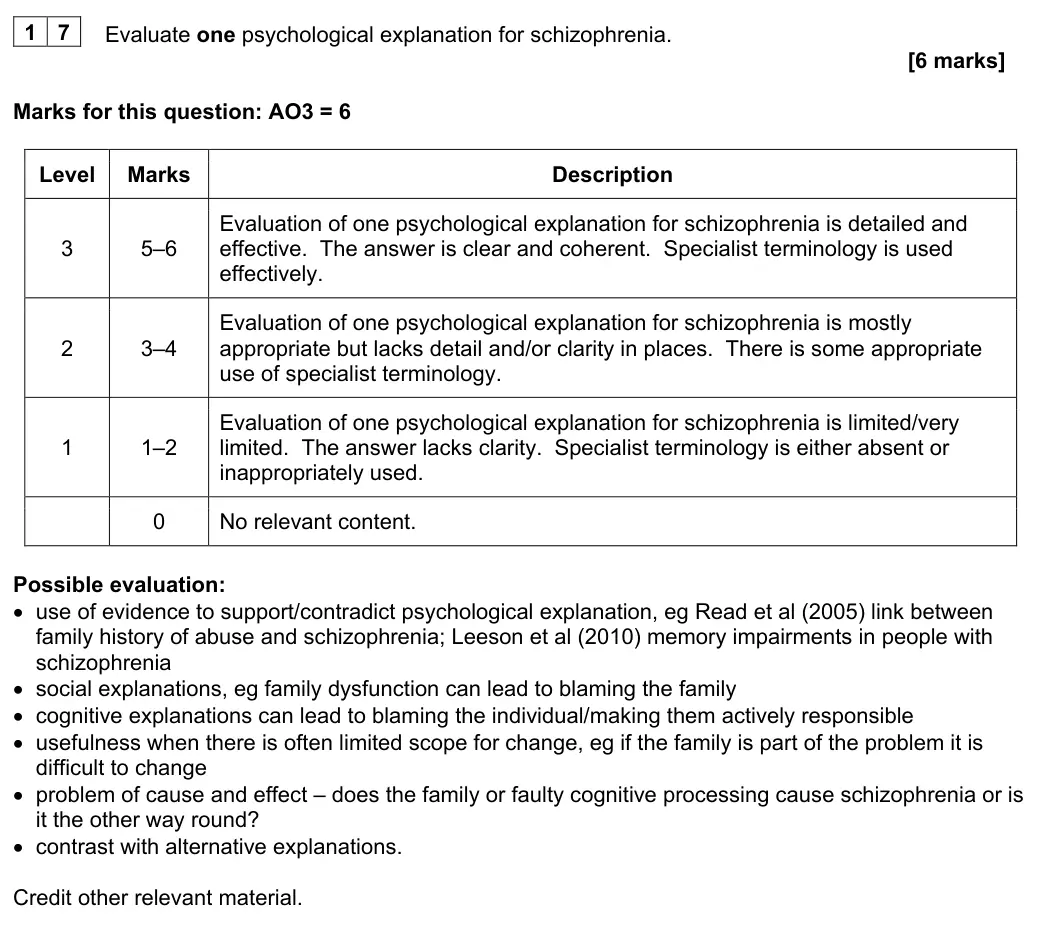
family dysfunction or cognitive explanation
AO3 only
evaluations of biological explanations not credited
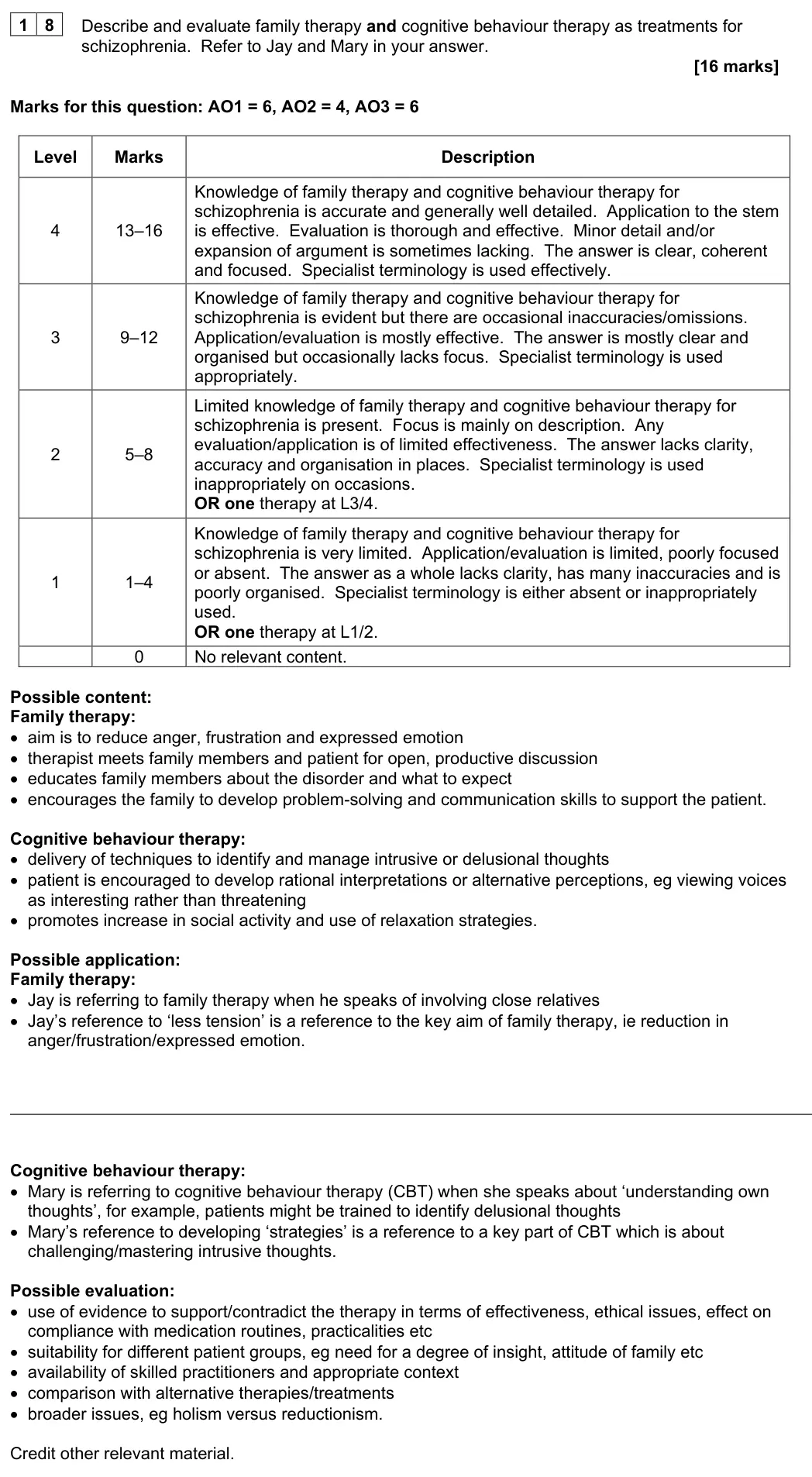
November 2021 · Paper 3 · Q1816 marksAO1=6, AO2=4, AO3=616-mark essay
Mark scheme, including level descriptors and indicative content
Examiner's comment
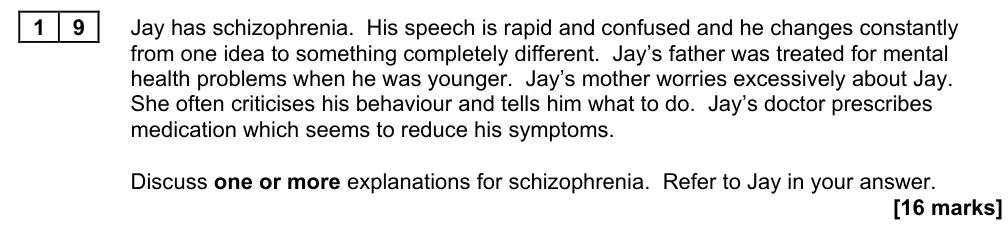
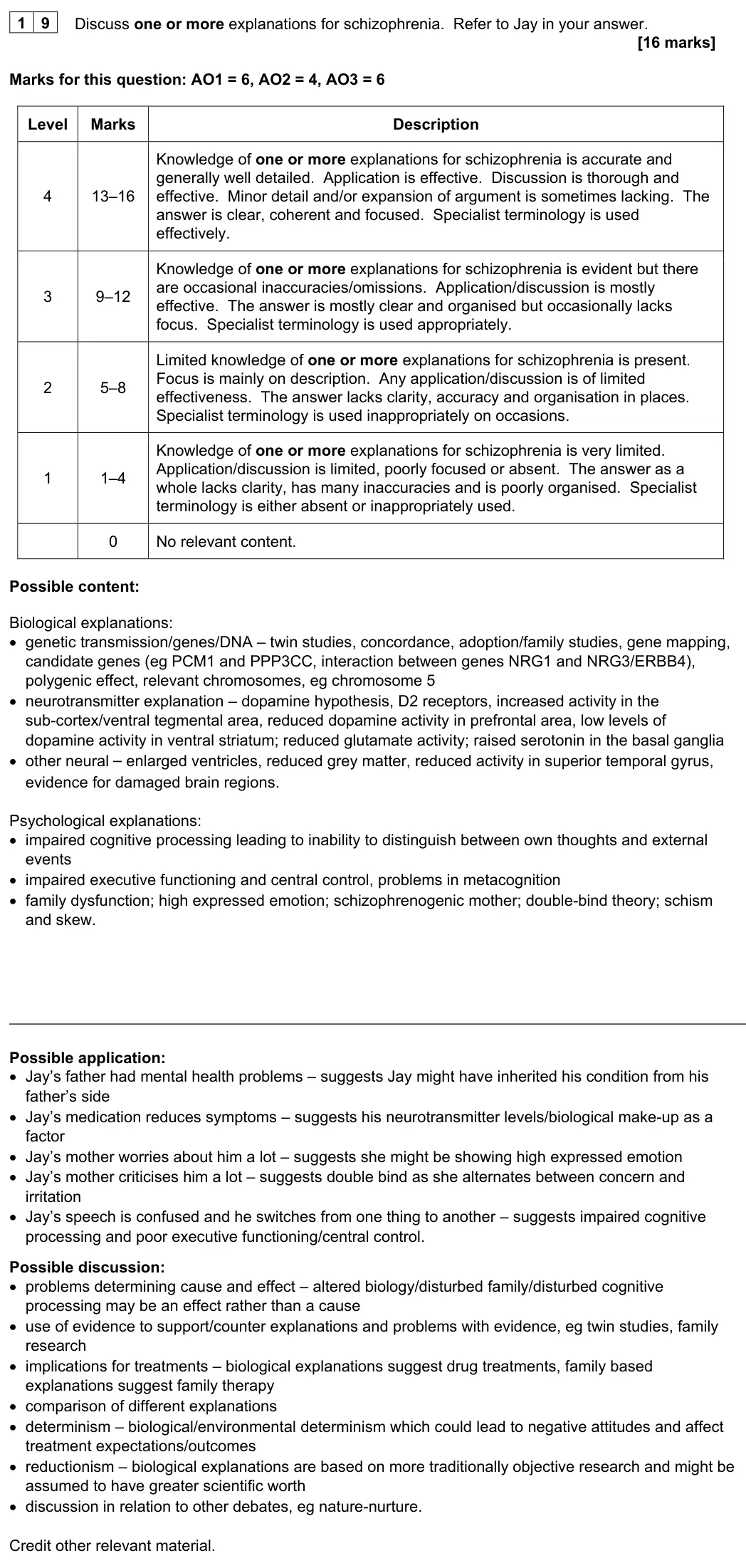
The 16-mark extended writing responses required students to combine all three skills. In Q18 the knowledge element was often vague but there was much better application and evaluation.
Notes from the mark scheme and report
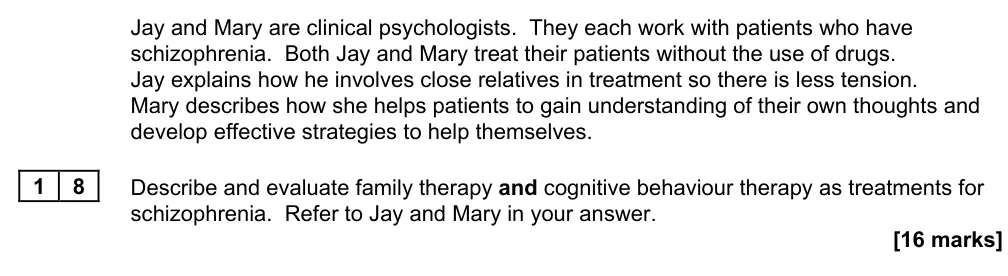
family therapy (Jay: relatives, less tension = reduced expressed emotion) and CBT (Mary: understanding own thoughts, strategies)
one therapy only = max Level 2
knowledge often vague
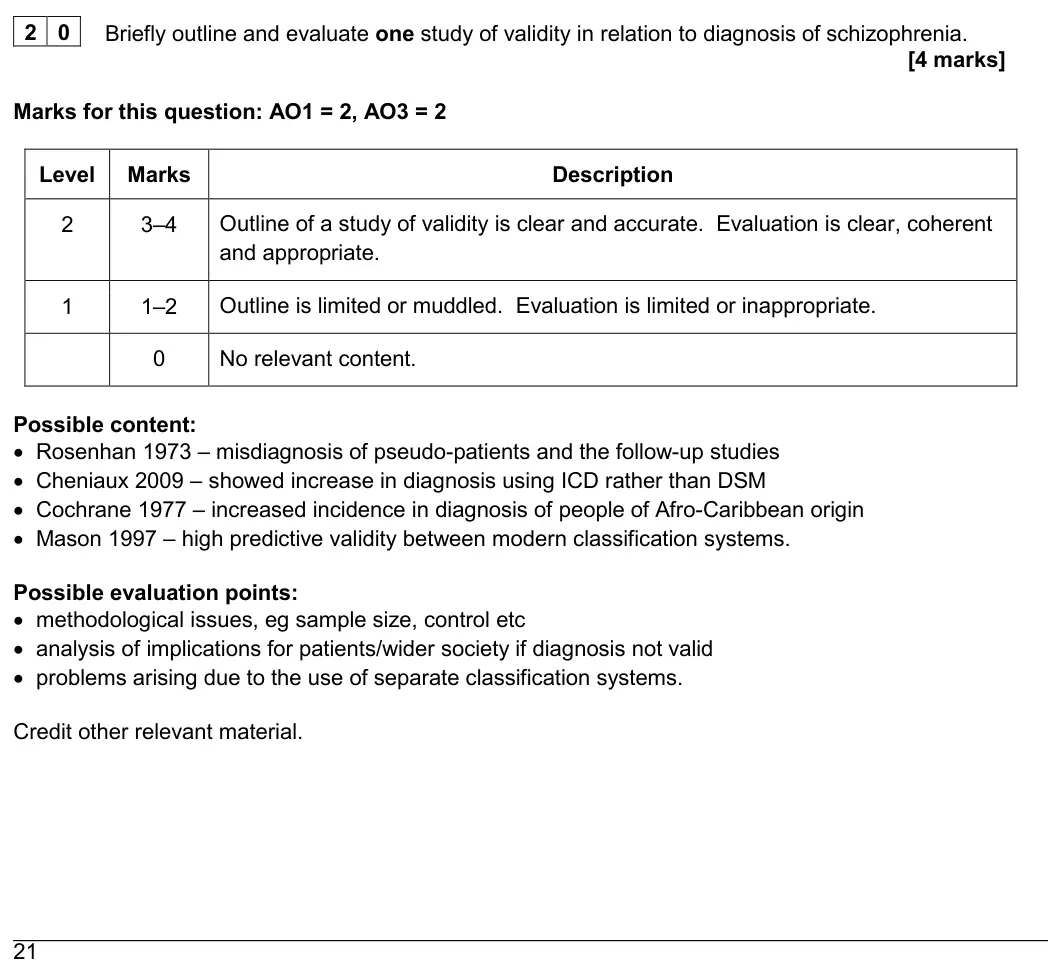
November 2020 · Paper 3 · Q204 marksAO1=2, AO3=2Evaluate (short)Old spec only
Not on the 2025 specification: validity in diagnosis/classification of schizophrenia, removed in v1.4
Mark scheme, including level descriptors and indicative content
Examiner's comment
The 4-mark study questions required both outline and evaluation. Outlines varied but the majority of students failed to offer any evaluation. Any study that could be linked to the validity of diagnosis of schizophrenia was credited, including studies of co-morbidity.
Notes from the mark scheme and report
Off-spec: validity in diagnosis/classification of schizophrenia, removed in v1.4
credited studies include Rosenhan, Cheniaux (ICD vs DSM), Cochrane (culture bias - still relevant to issues in diagnosis)
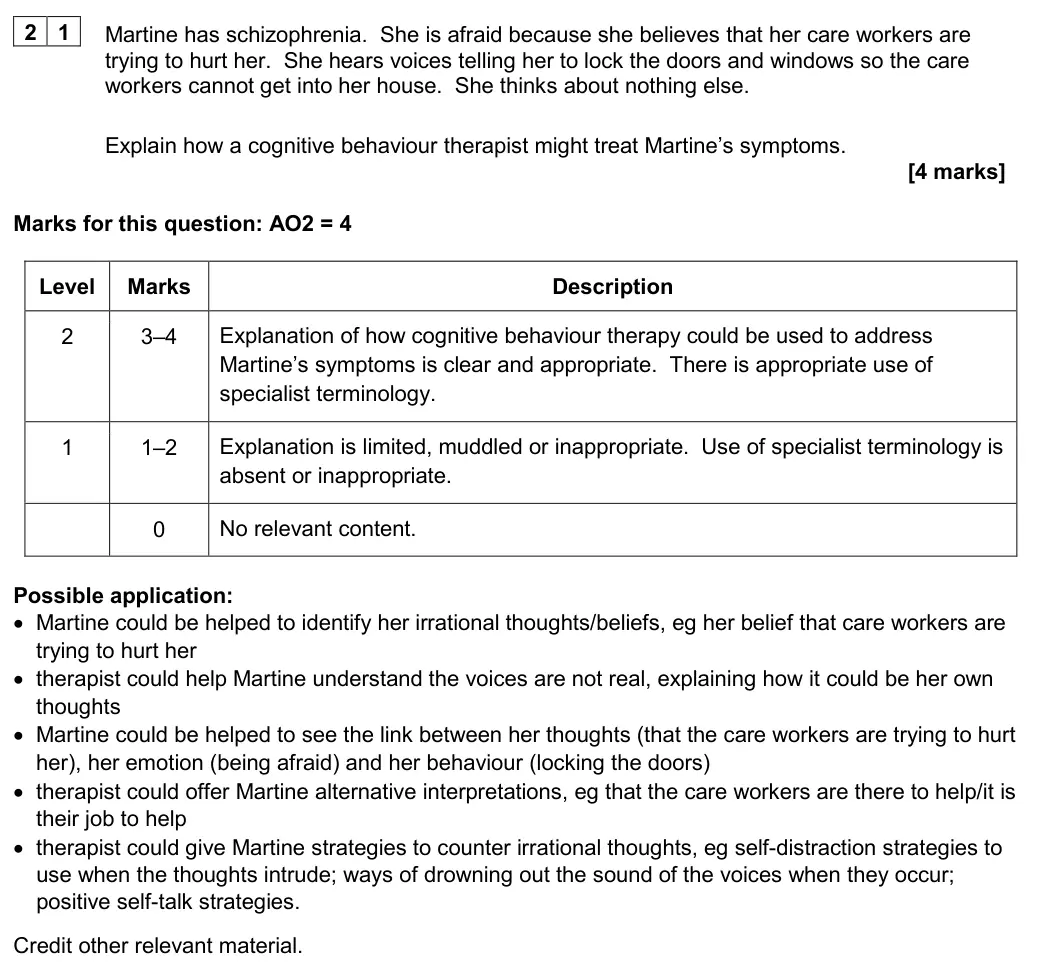
November 2020 · Paper 3 · Q214 marksAO2=4Application
Mark scheme, including level descriptors and indicative content
Examiner's comment
For the application questions in this section most responses included relevant information but not all showed explicit application to the stem for Level 2. Students should be reminded that successful application involves clear engagement with the content in the stem and that simple name dropping is not enough.
Notes from the mark scheme and report
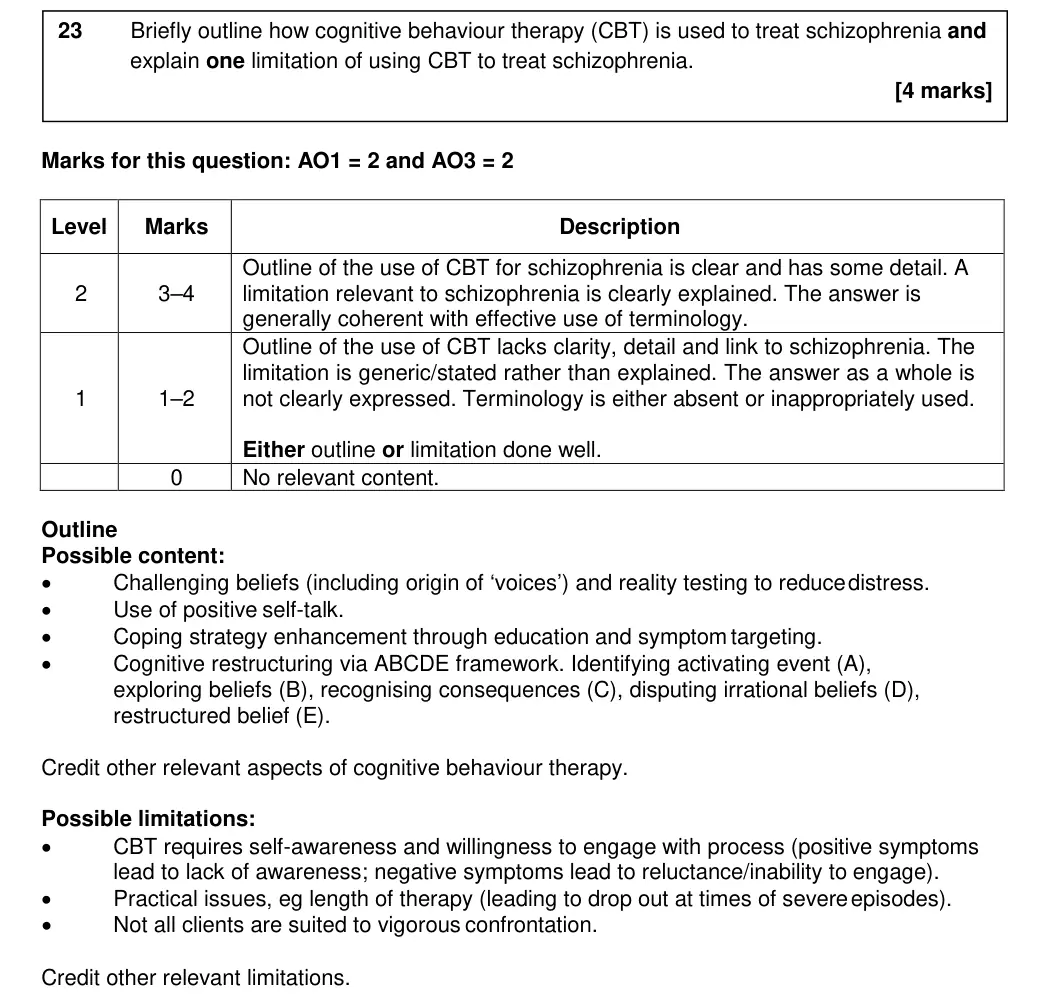
identify irrational beliefs (care workers hurting her), reality-test the voices, link thoughts-emotion-behaviour, alternative interpretations, coping strategies
must apply to Martine
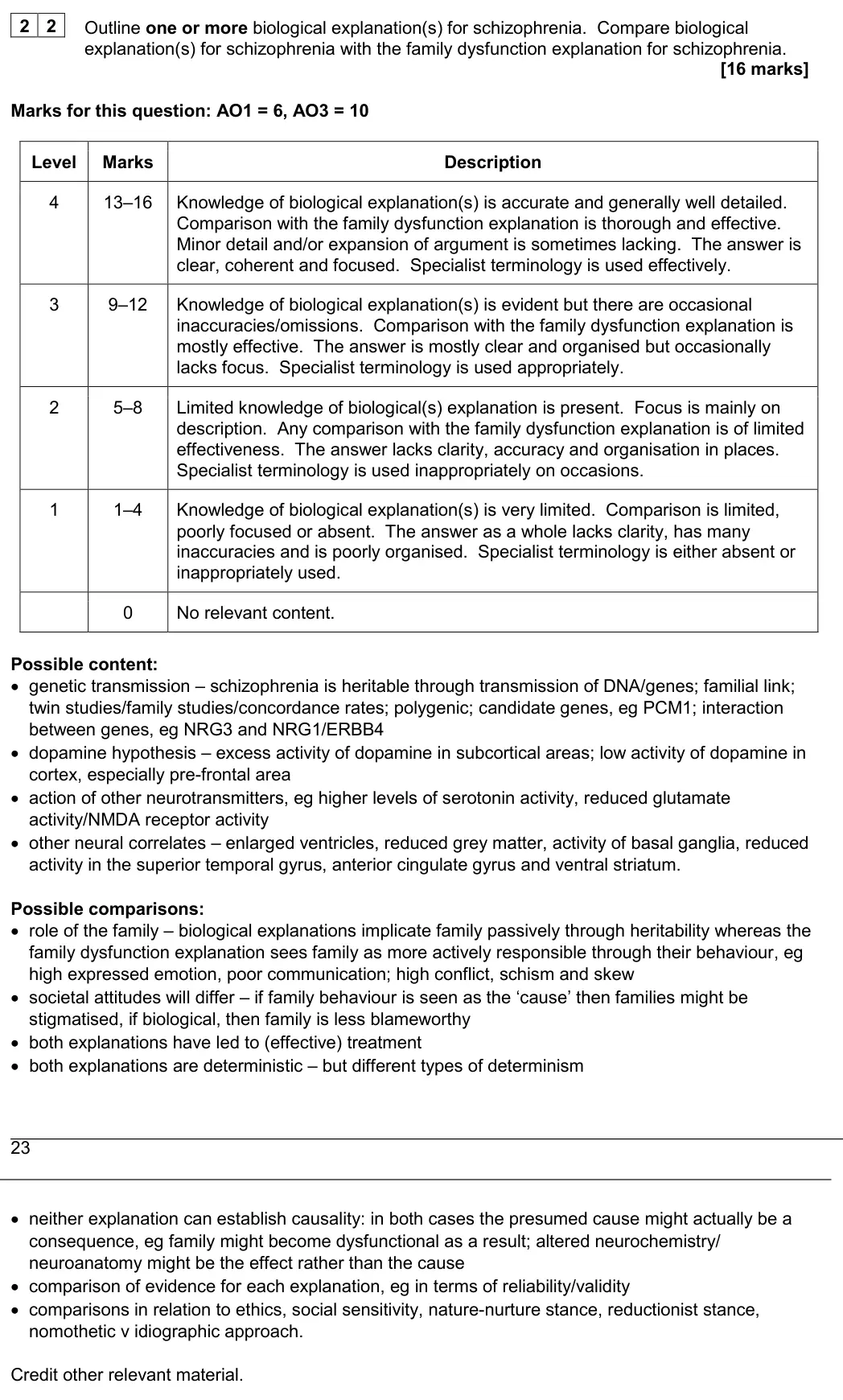
November 2020 · Paper 3 · Q2216 marksAO1=6, AO3=1016-mark essay
Mark scheme, including level descriptors and indicative content
Examiner's comment
In the extended writing questions knowledge was usually sound but clear and explicit comparison was scarce. Students should be reminded of the need to develop the higher-level skill of comparison in all areas of the Specification.
AO3 is a comparison with family dysfunction (passive vs active family role, blame, determinism, cause/effect), not separate evaluation
June 2019 · Paper 3 · Q112 marksAO1=2Short answer
Mark scheme, including level descriptors and indicative content
Examiner's comment
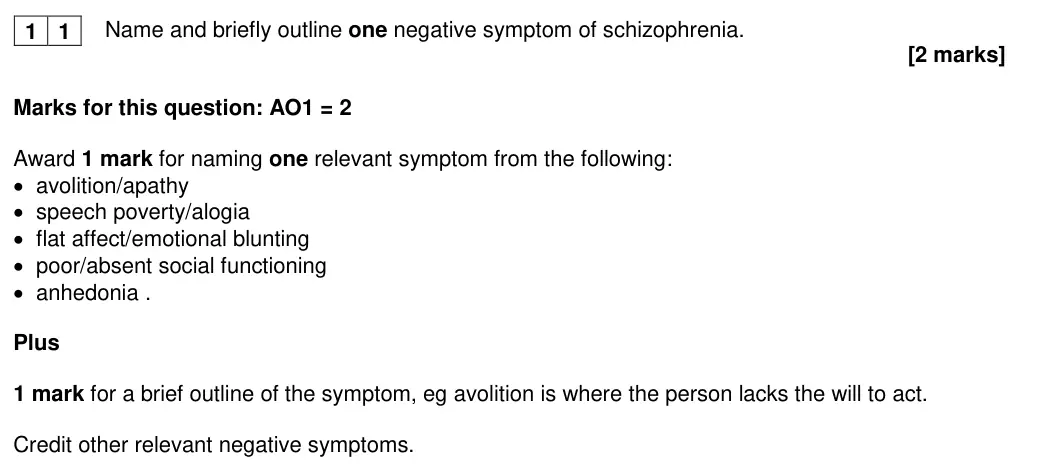
Most students gained 2 marks for this question. The most common answers were ‘speech poverty’ and ‘avolition’. Occasionally, students would name speech poverty but only get one mark because the outline that followed seemed more like disorganised speech which is a positive symptom.
Notes from the mark scheme and report
1 mark name (avolition, speech poverty, flat affect, etc) + 1 outline
describing disorganised speech (positive) for speech poverty = 1 mark
June 2019 · Paper 3 · Q1416 marksAO1=6, AO3=1016-mark essay
Mark scheme, including level descriptors and indicative content
Examiner's comment
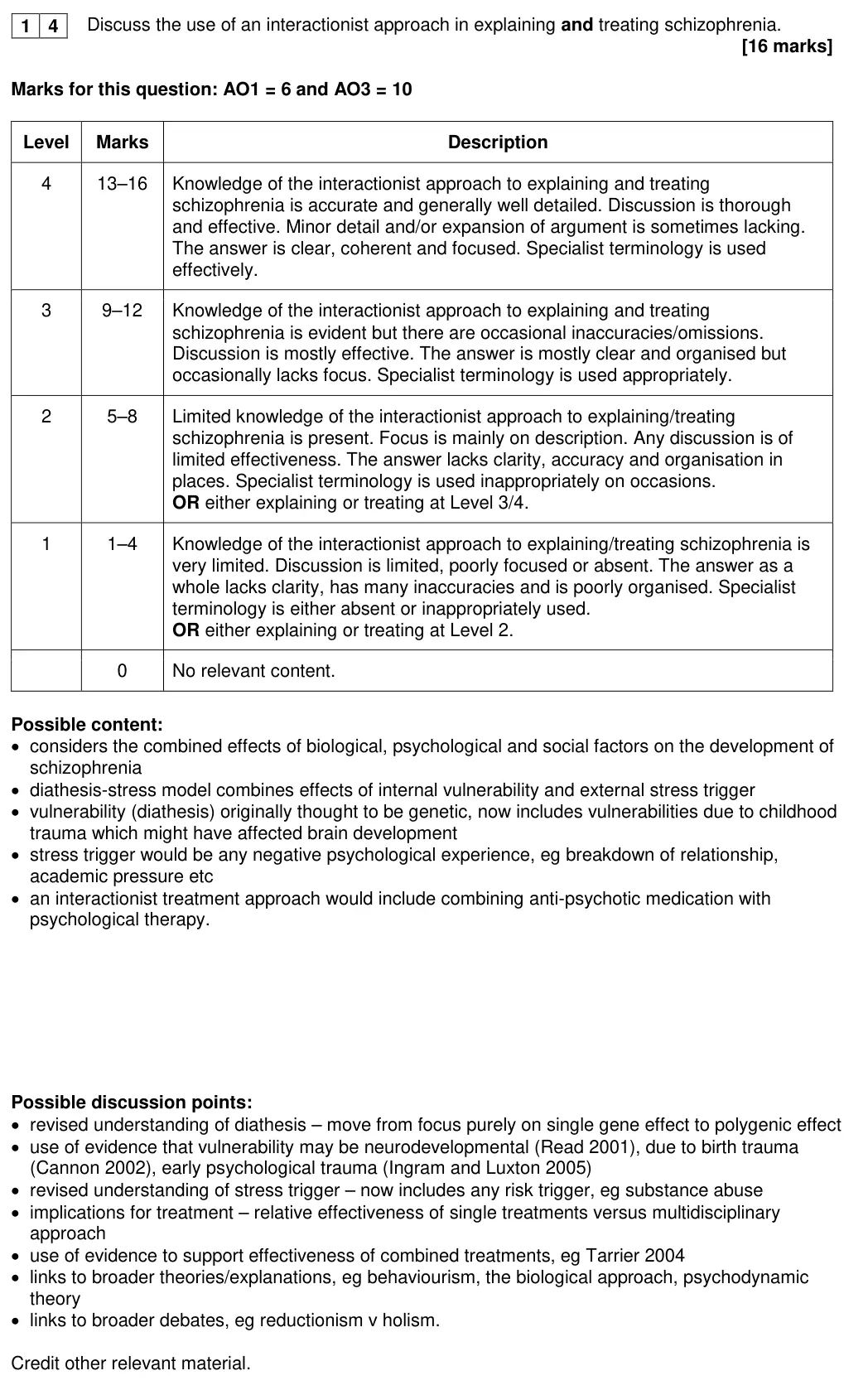
This question was rarely well-answered, although some students could explain different conceptualisations of diathesis-stress and make good use of evidence from twin and adoption research and evidence for the effectiveness of combined treatments. Answers were sometimes poorly balanced, with the emphasis on the interactionist approach to explaining and very little about treating. As with the nature-nurture question, less effective answers often treated each side of the argument separately, with an outline and evaluation of the biological explanation, followed by the same for family dysfunction and the same for treatments. A small number of students seemed unaware of the meaning of the term ‘interactionist’ and misinterpreted this as a question about how dysfunctional family/social interactions might lead to the development of schizophrenia. Occasionally, answers slipped back into nature-nurture mode giving examiners a curious sense of déja vu.
Notes from the mark scheme and report
must cover explaining AND treating: either one only = max Level 2
diathesis-stress
combined treatments
some misread 'interactionist' as family interactions
June 2018 · Paper 3 · Q222 marksAO1=2Outline
Mark scheme, including level descriptors and indicative content
Examiner's comment
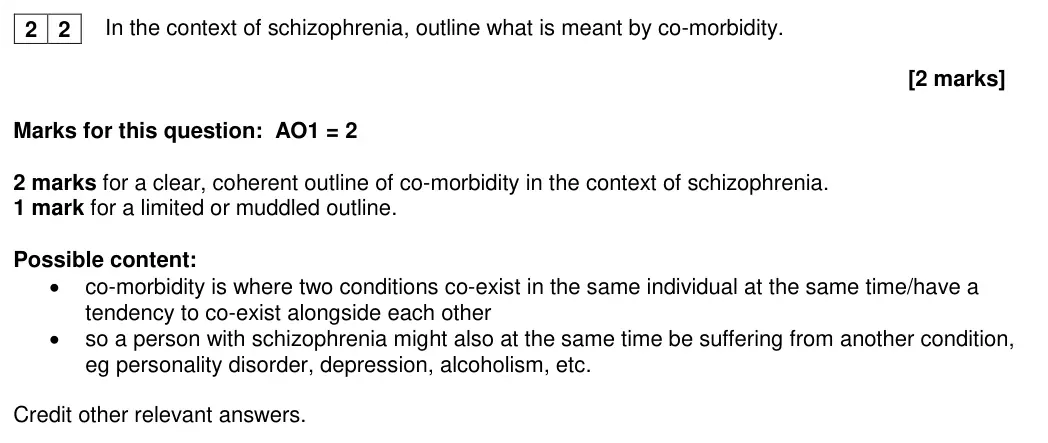
Some answers were quite vague but most were able to gain limited credit by giving an example of a disorder that often occurs alongside schizophrenia, usually depression. Where this question was poorly answered it was often because students confused co-morbidity with symptom overlap.
Notes from the mark scheme and report
two conditions co-existing in one person + example
often confused with symptom overlap
June 2018 · Paper 3 · Q232 marksAO3=2Explain
Mark scheme, including level descriptors and indicative content
Examiner's comment
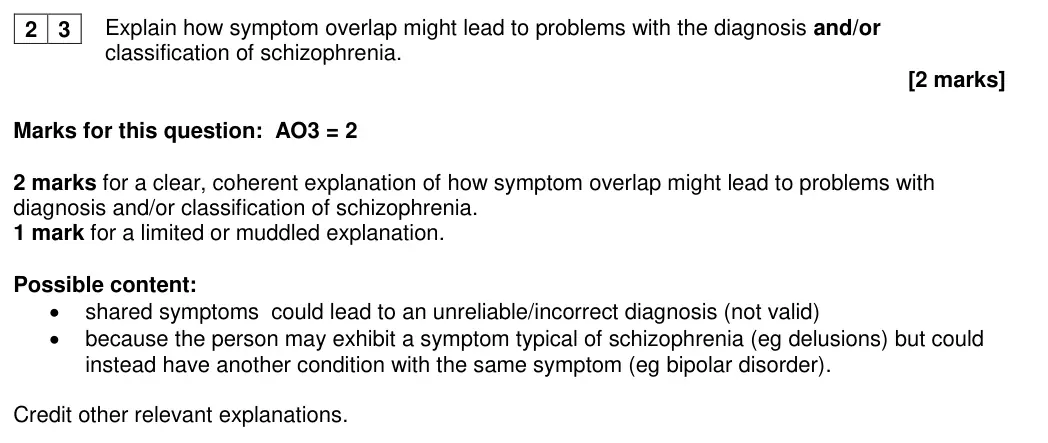
This was generally well-answered, although some responses were unnecessarily long. The best answers were those that started by saying what symptom overlap is, then went on to address the problem. Quite a number of students could say what the problem might be (eg misdiagnosis) but failed to adequately explain the role of ‘symptom overlap’ in this.
Notes from the mark scheme and report
shared symptoms with another disorder (e.g. bipolar) -> misdiagnosis
MS phrases this as unreliable/invalid diagnosis and classification (wording removed in v1.4
symptom overlap remains)
must explain the role of overlap, not just state misdiagnosis
June 2018 · Paper 3 · Q2516 marksAO1=6, AO3=1016-mark essay
Mark scheme, including level descriptors and indicative content
Examiner's comment
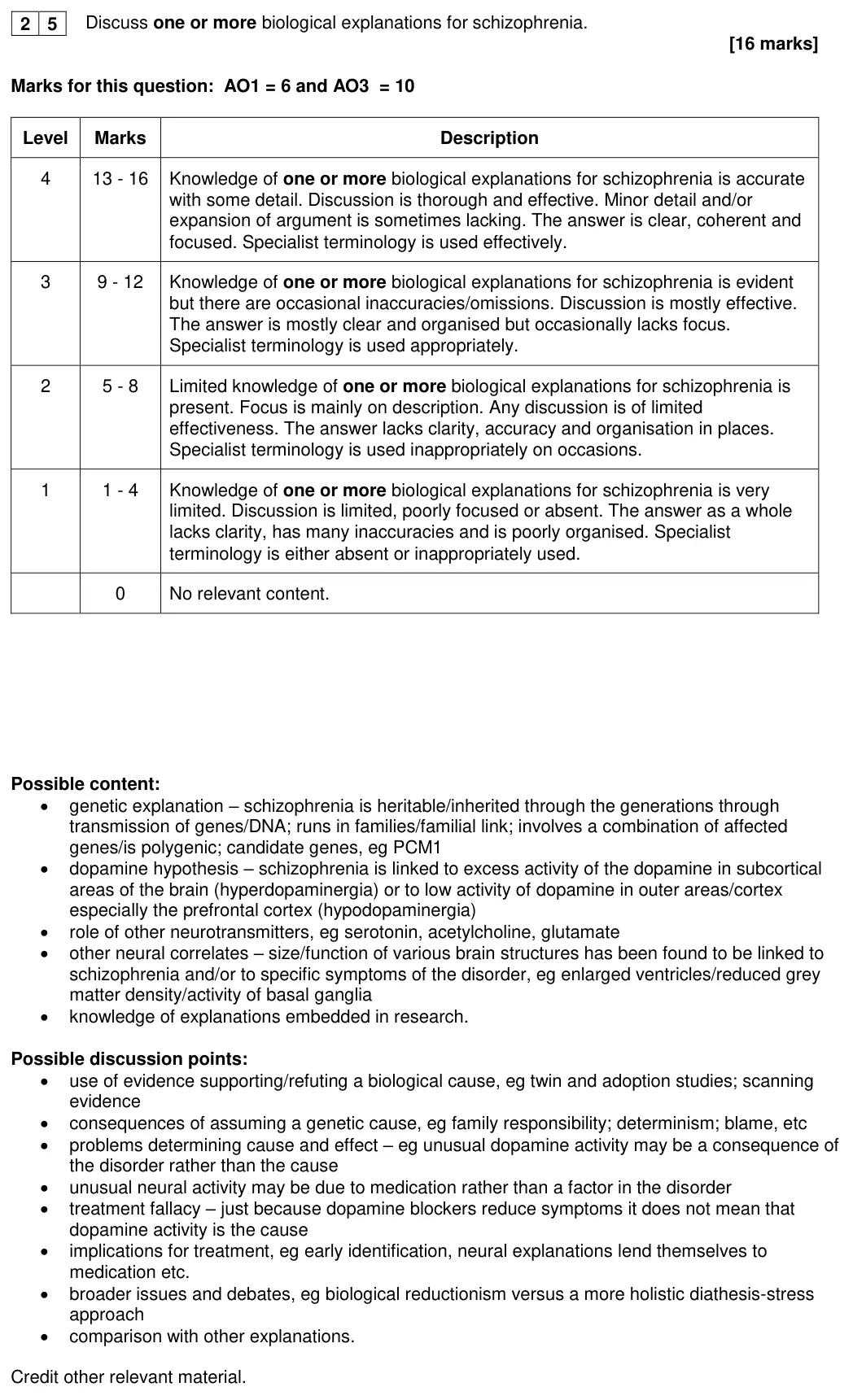
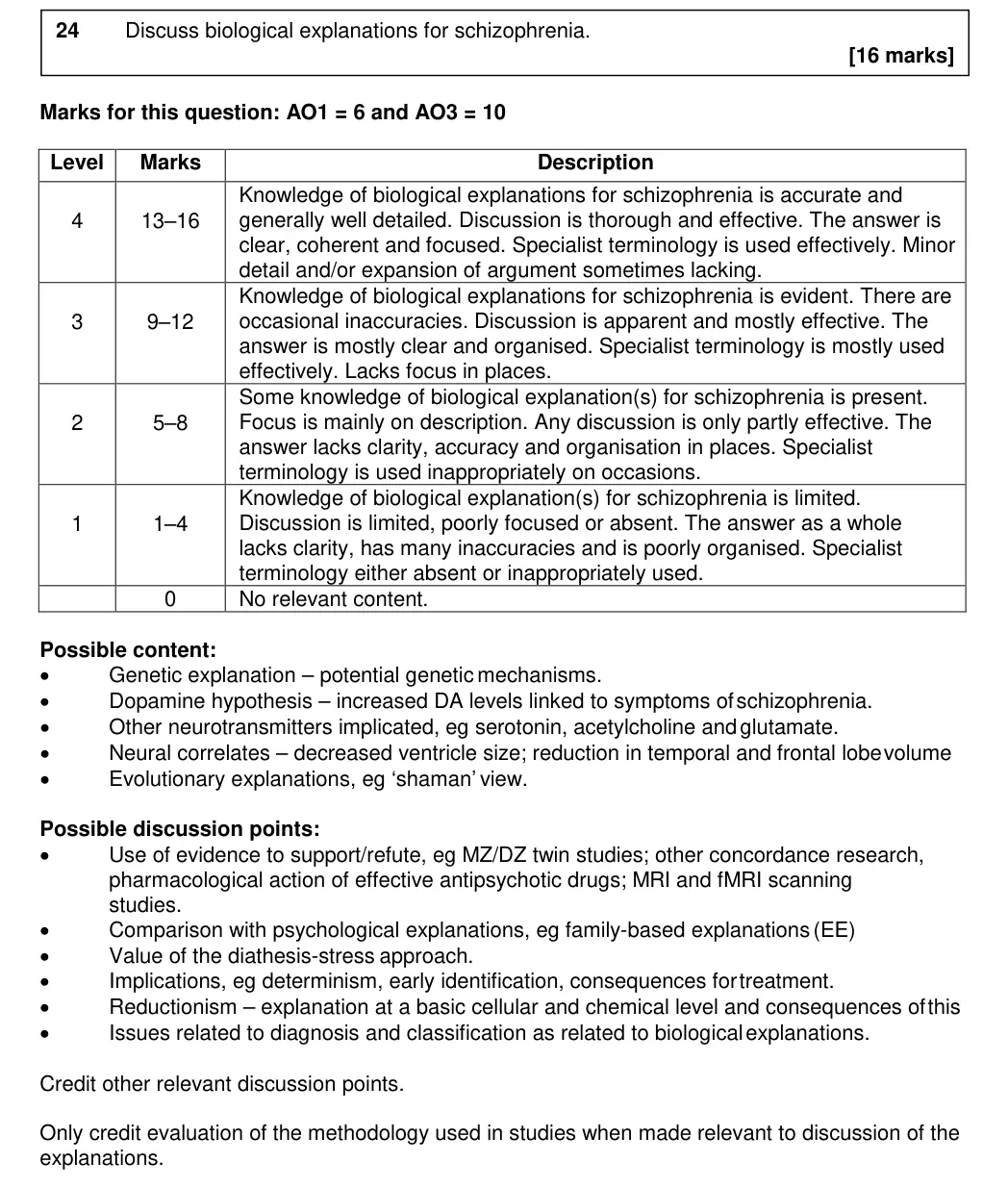
Many answers were very well prepared, or perhaps well learned, with detailed accounts of genetic evidence, dopamine and neural correlates. Whilst knowledge was generally detailed and accurate, discussions sometimes revealed limited understanding or strayed off the topic. A typical example of this is where students might present drug evidence in support of the role of dopamine, then fell into discussion of the use of drugs and comparison with other treatments/therapies. Some answers showed significant confusion, lack of understanding or only the loosest grasp of terminology, for example, weak answers talked of ‘dopamine flowing round the body’ and ‘parts swelling in the brain’. It is worth noting that some of the most successful answers were from those brave students who opted for a depth approach and focused on a single biological explanation. Limiting the range of material meant that they had time to provide detailed description and fully elaborated discussion.
Notes from the mark scheme and report
genetics, dopamine hypothesis, neural correlates
drifting from drug evidence into evaluating treatments
depth on one explanation often scored well
June 2017 · Paper 3 · Q191 markAO1=1Multiple choice
Answer
B
Mark scheme, including level descriptors and indicative content
Examiner's comment
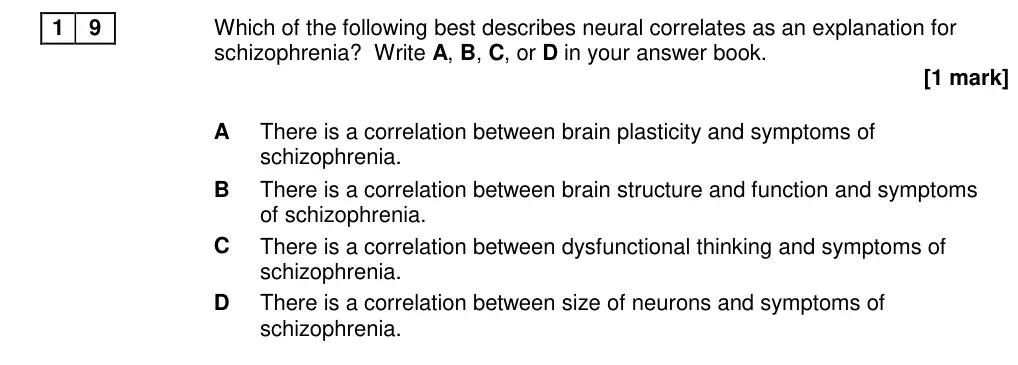
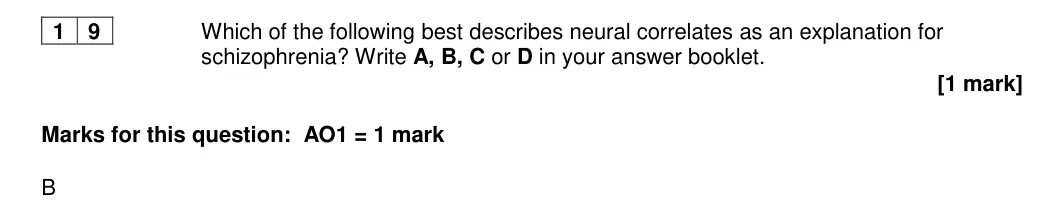
This question was answered correctly by the vast majority of students.
Notes from the mark scheme and report
answer B (brain structure and function)
C describes cognitive explanation
June 2017 · Paper 3 · Q201 markAO3=1Multiple choiceOld spec only
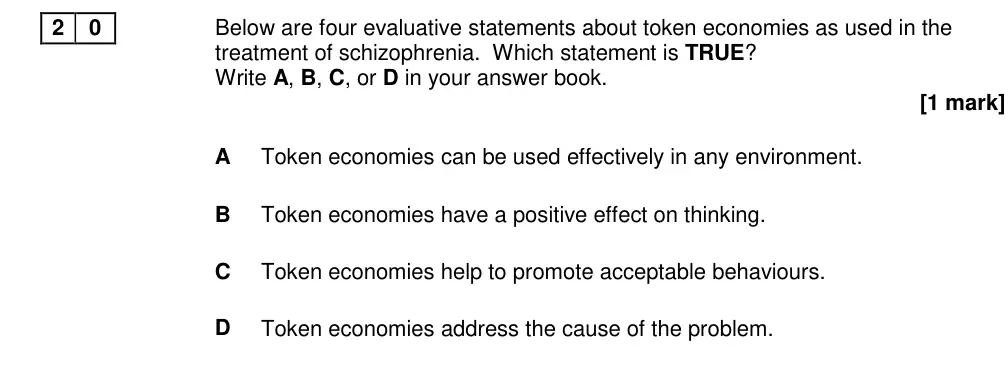
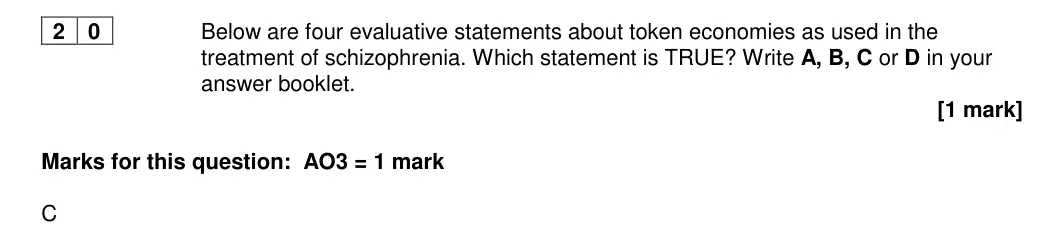
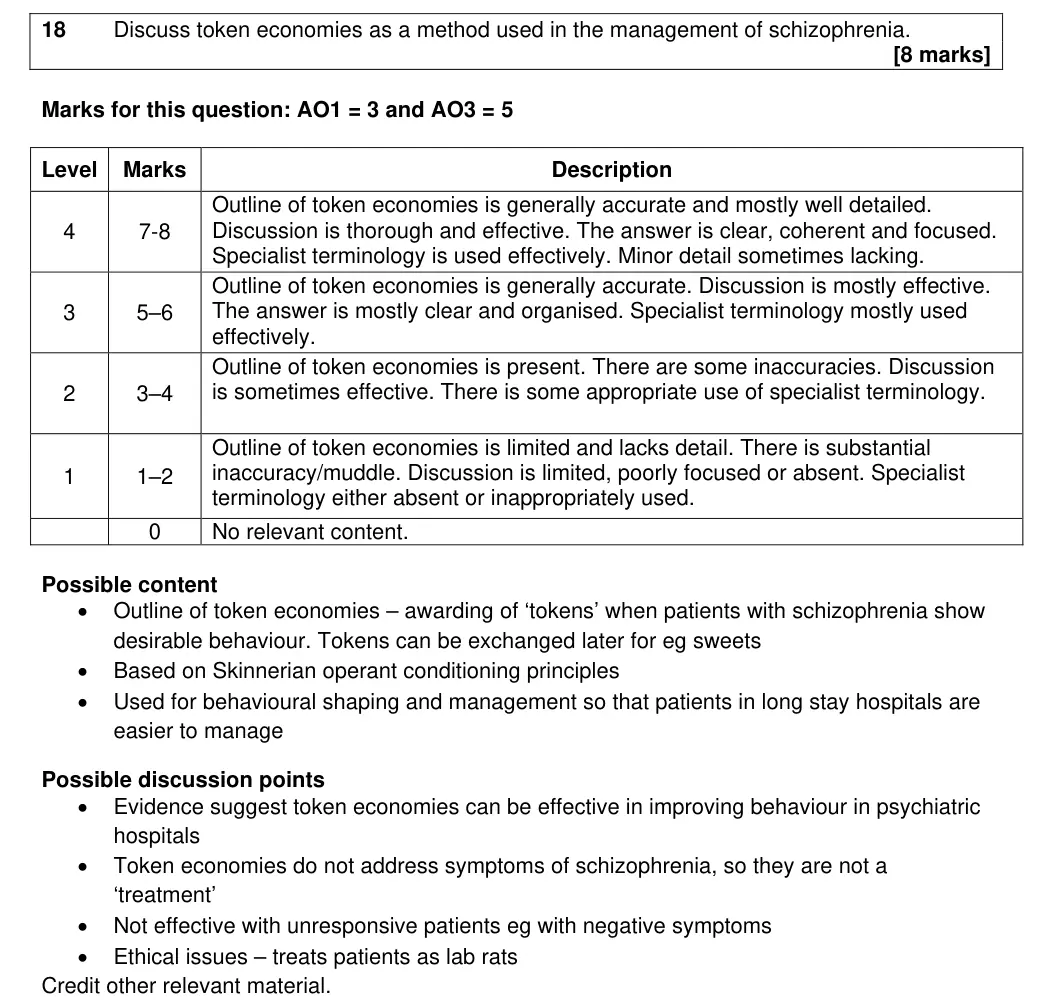
Not on the 2025 specification: token economies in the management of schizophrenia, removed in v1.4
Answer
C
Mark scheme, including level descriptors and indicative content
Examiner's comment
This question was answered correctly by the majority of students.
Notes from the mark scheme and report
Off-spec: token economies in the management of schizophrenia, removed in v1.4
answer C (promote acceptable behaviours)
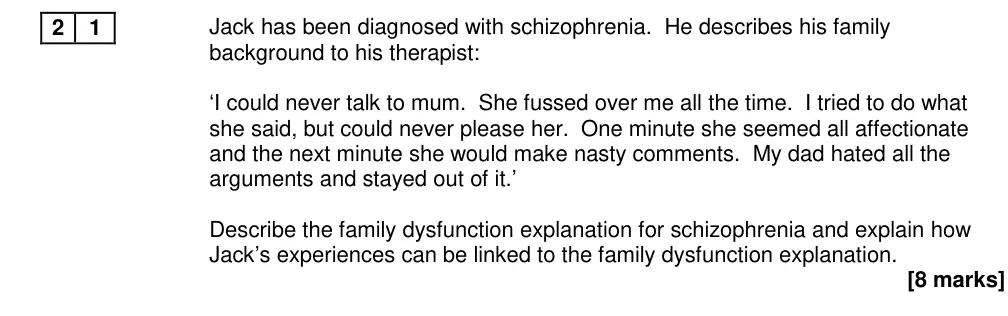
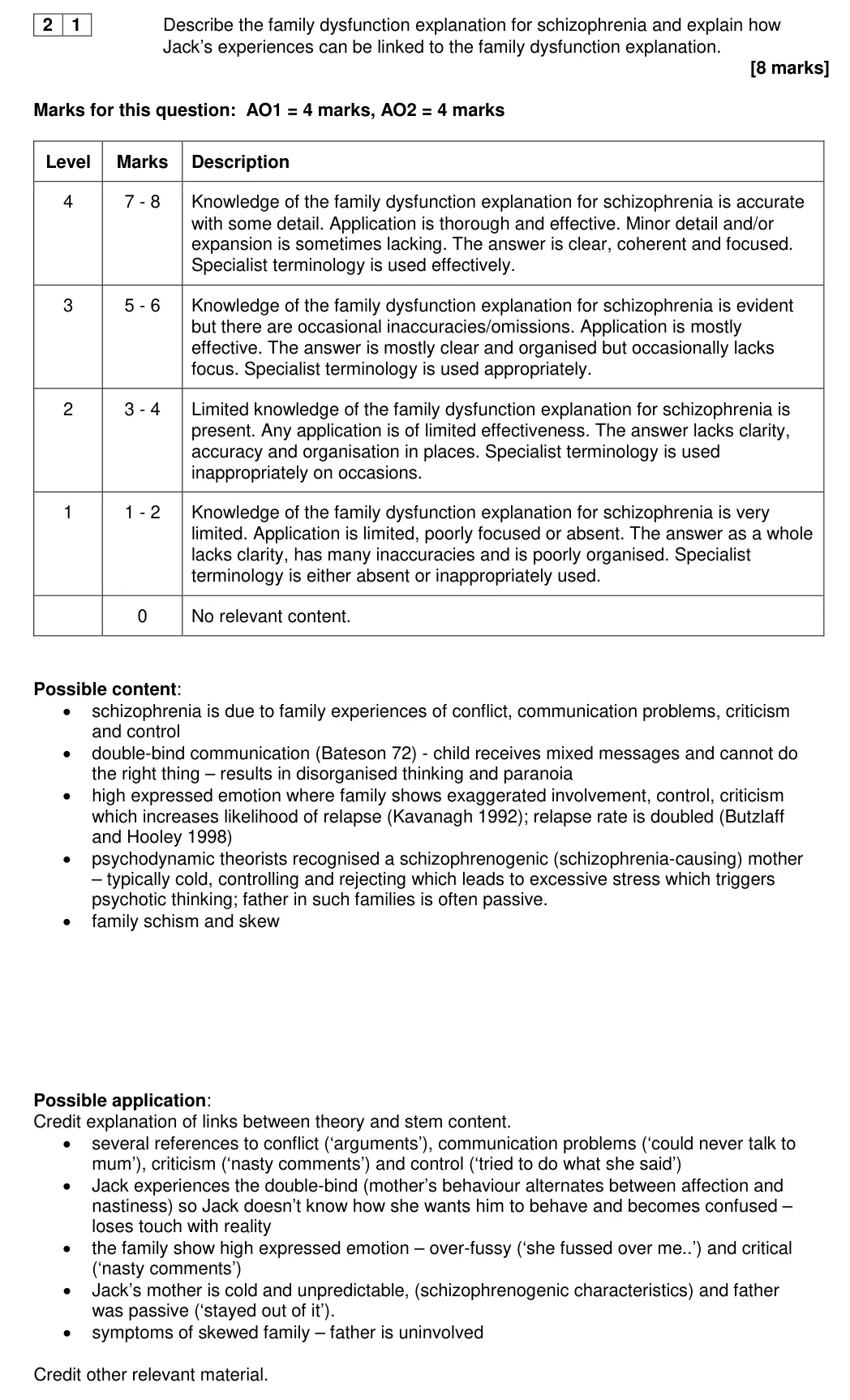
June 2017 · Paper 3 · Q218 marksAO1=4, AO2=4Extended writing
Mark scheme, including level descriptors and indicative content
Examiner's comment
Students tended to respond well to this question up to a point and the stem afforded ample opportunity for application. Most could offer useful description of behaviours typical of family dysfunction and were able to pick out relevant material from the stem for application to Jack. It was less common to see full coverage of the family dysfunction explanation for schizophrenia, in other words, students often failed to make the link between the particular dysfunction (high expressed emotion, double bind, etc) and behaviours typical of schizophrenia. Only students who fully explored this in their answers achieved higher level marks. Other issues noted included confusion between double bind and high expressed emotion, and an unfortunate but understandable tendency for students to refer to the ‘schizophrenic mother’ rather than ‘the schizophrenogenic mother’. Only very rarely did students pick up on the reference to ‘the dad’ who ‘stayed out of it’ as a reference to family schism/skew. Some students wasted time offering evaluation, having then to re-write the same material when they came to the next question.
Notes from the mark scheme and report
describe double bind, expressed emotion, schizophrenogenic mother, schism/skew AND link the dysfunction to schizophrenic symptoms
apply to Jack (mixed messages, criticism, fussing, passive father)
many failed to link dysfunction to schizophrenia
double bind and EE confused
'schizophrenic mother' misused
evaluation not required
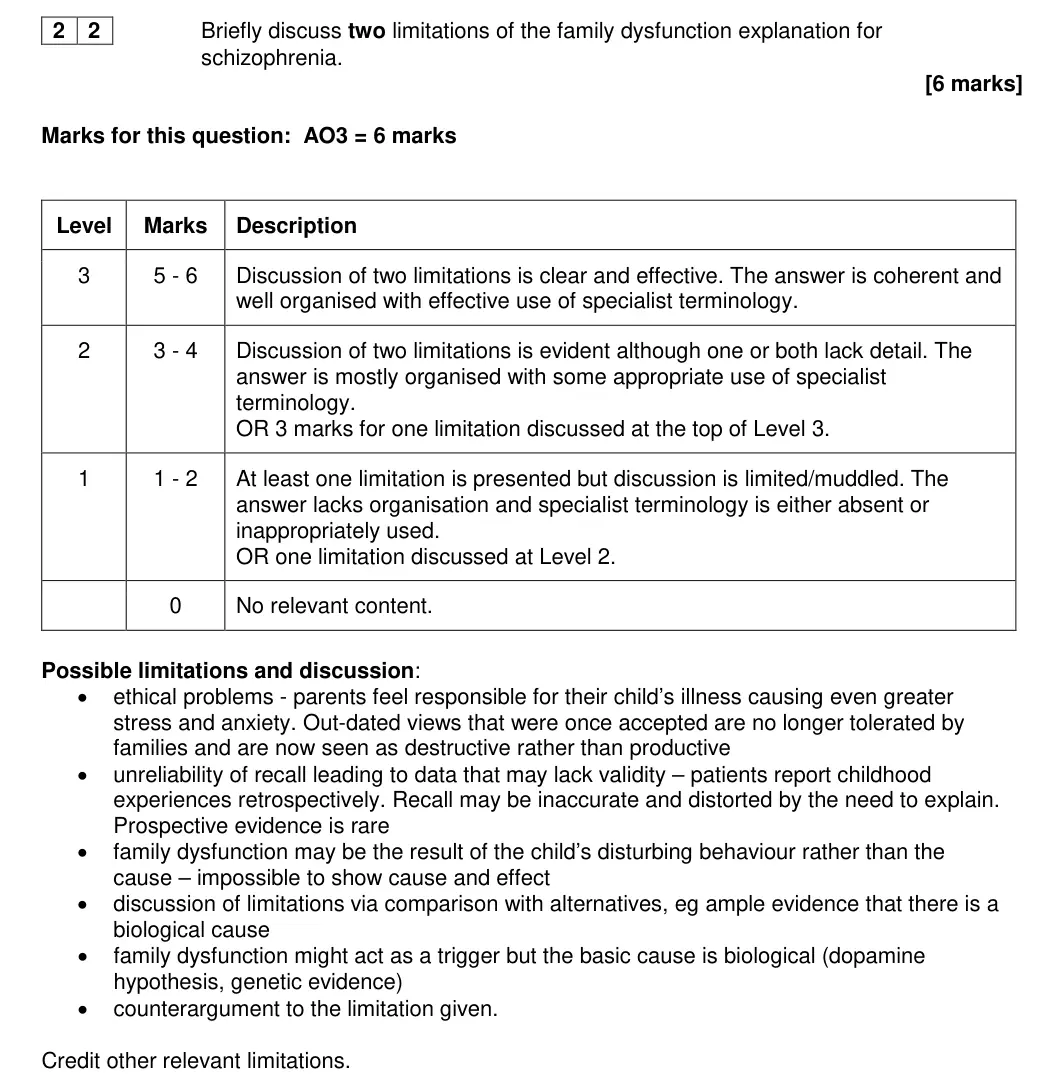
June 2017 · Paper 3 · Q226 marksAO3=6Evaluate (short)
Mark scheme, including level descriptors and indicative content
Examiner's comment
Most students could offer two valid imitations, although these were often cursory or insufficiently discussed. Blaming the family and the issue of cause and effect were usually effective routes to credit. Comparisons with other explanations, mainly biological, were not always very effective as they tended to stray into discussion of the alternative. A number of answers focused on family therapy rather than on the explanation. The frequently seen assertion that the family dysfunction explanation is ‘reductionist’ was surprising given the many and varied ways in which families might be dysfunctional, and only serves to illustrate the widespread misuse of the term.
Notes from the mark scheme and report
two limitations needed (blaming parents/ethics, retrospective recall, cause and effect, biological alternatives)
straying into alternatives or family therapy not credited
'reductionist' claim misused
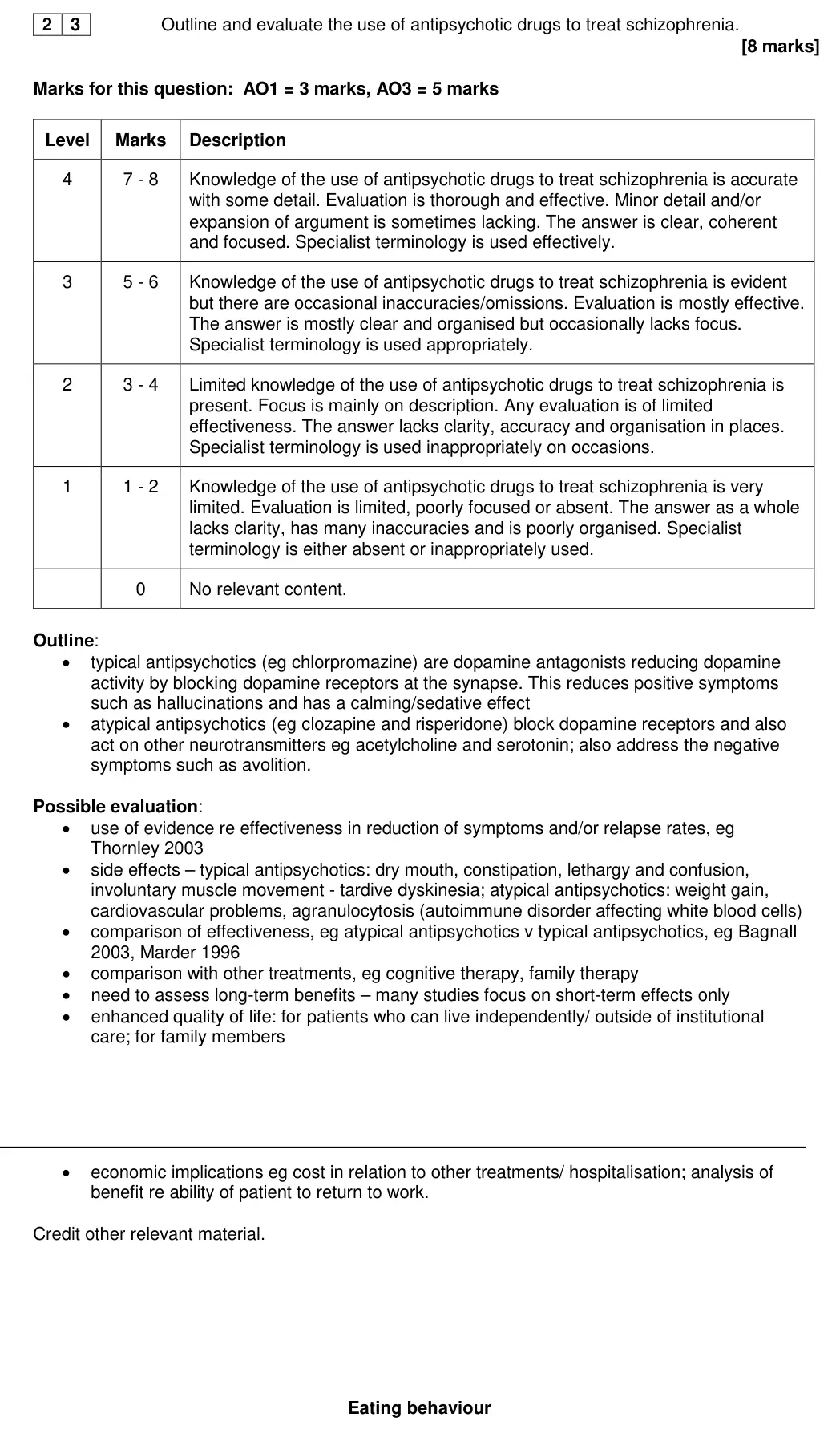
June 2017 · Paper 3 · Q238 marksAO1=3, AO3=5Extended writing
Mark scheme, including level descriptors and indicative content
Examiner's comment
This question was usually well answered. Despite the fact that named drugs were often misspelt or the names appeared to have been deliberately obscured by use of wiggly handwriting, there were some excellent accounts of their action. In less competent answers, typical and atypical antipsychotics were confused, both in terms of names, action and side effects. Evaluations tended to cover side effects, effectiveness and comparison with alternatives. Just occasionally, students considered the implications for the economy to good effect.