4.1.3-01 Animal studies of attachment: Lorenz and Harlow.AS
4.1.3-02 Explanations of attachment: learning theory and Bowlby’s monotropic theory. The concepts of a critical period and an internal working model.AS
4.1.3-03 Ainsworth’s ‘Strange Situation’. Types of attachment: secure, insecure-avoidant and insecure-resistant. Cultural variations in attachment, including van Ijzendoorn.AS
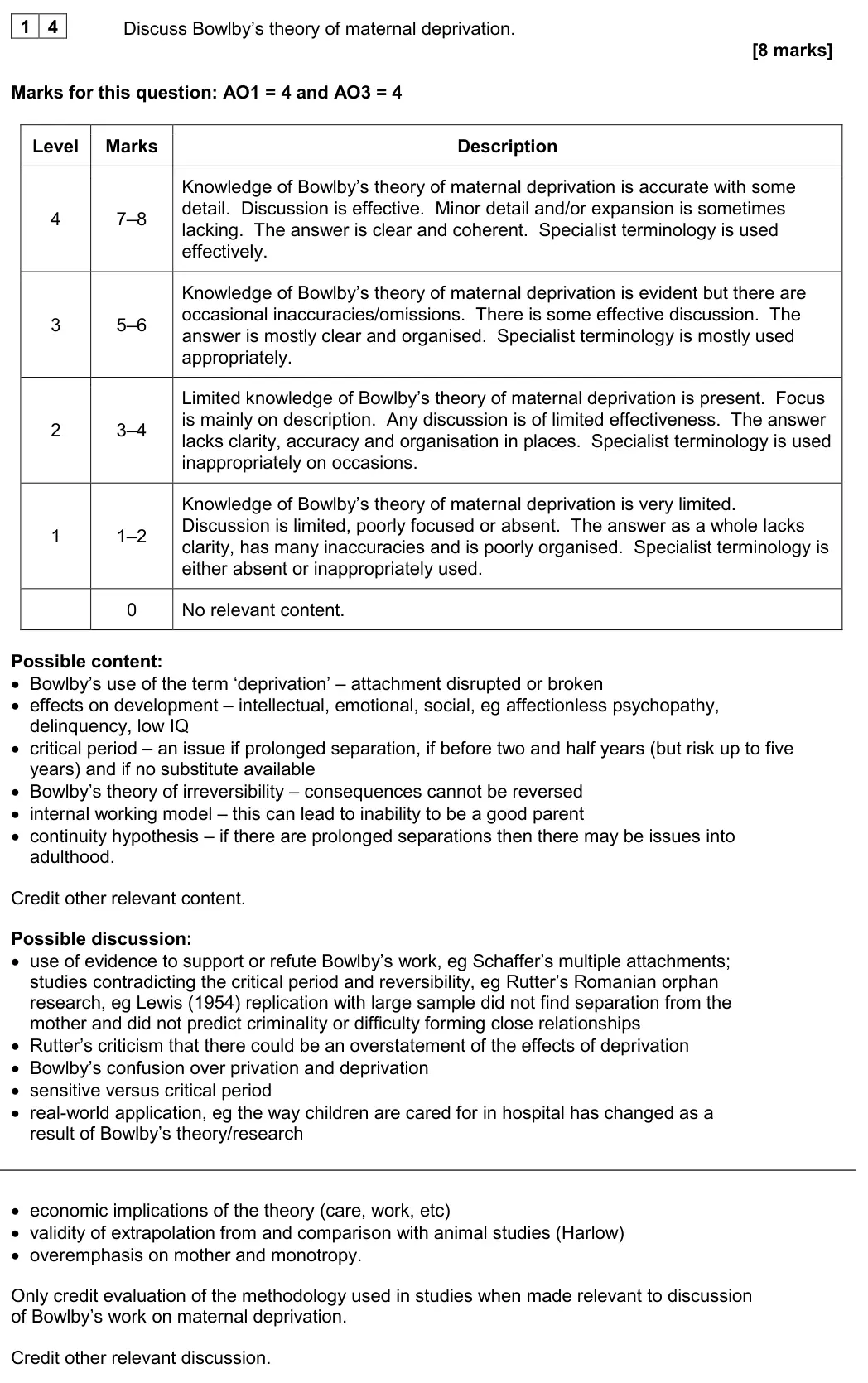
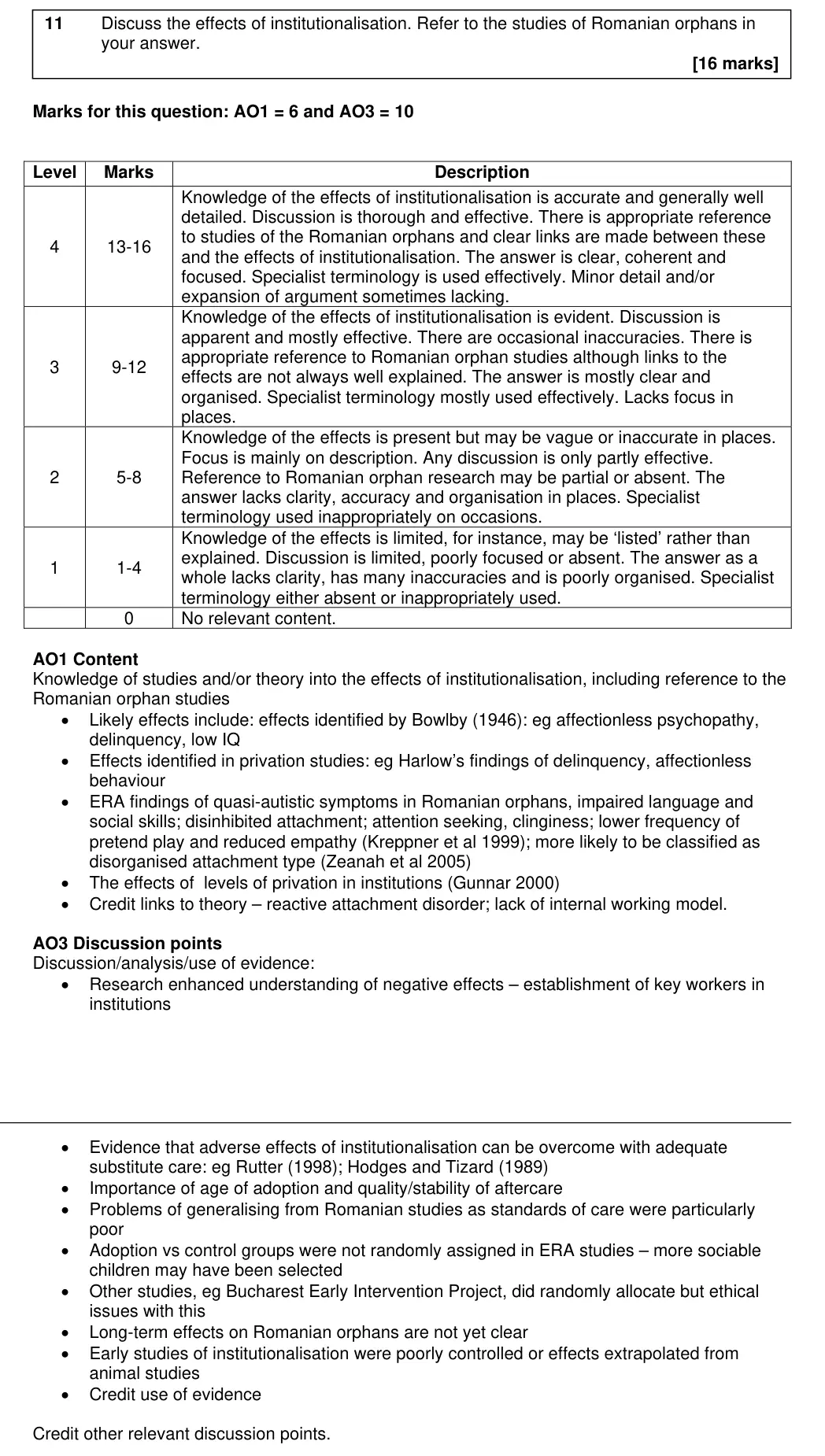
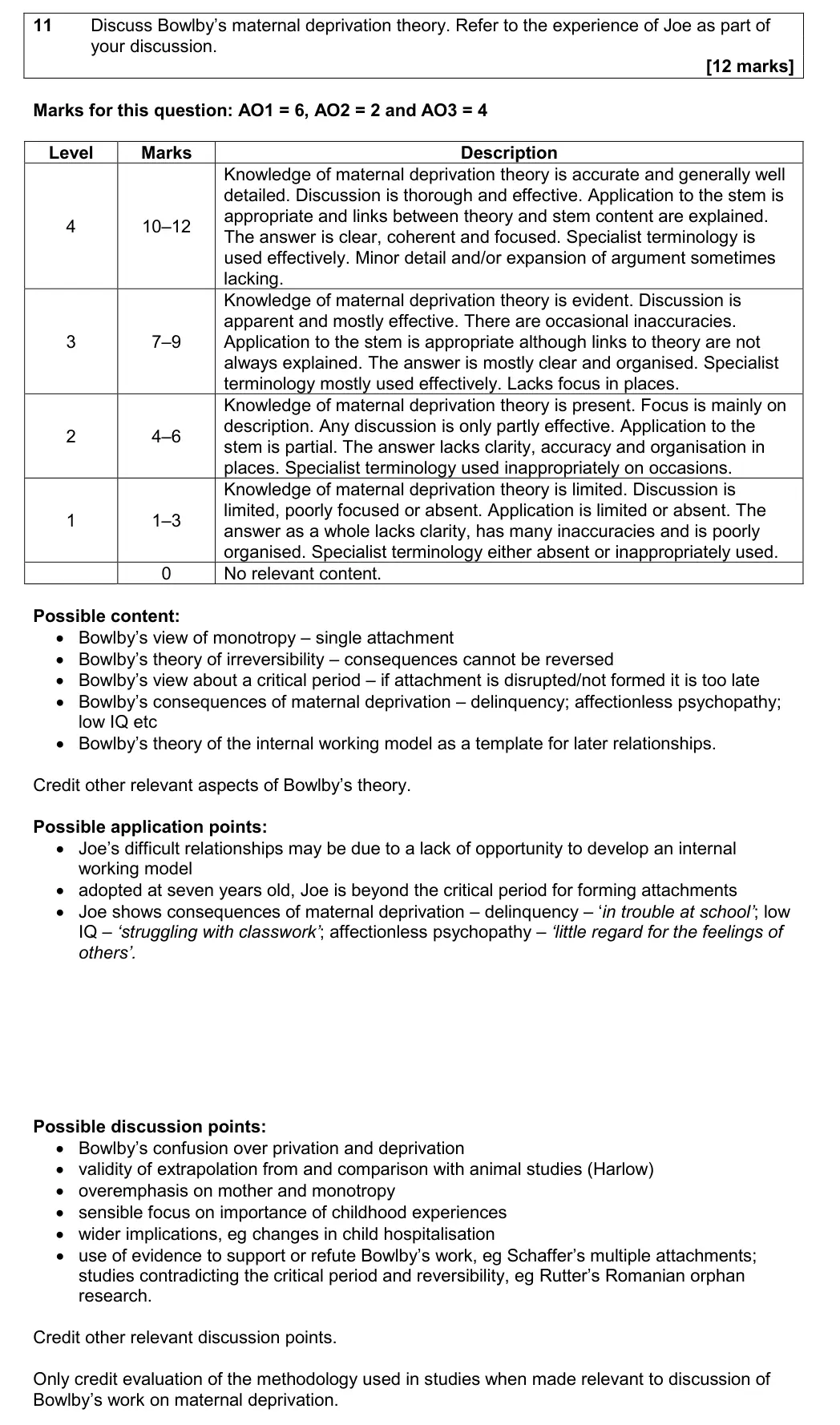
4.1.3-04 Bowlby’s theory of maternal deprivation. Effects of institutionalisation, including the English and Romanian Adoptees project.AS
4.1.3-05 The influence of early attachment on childhood and adult relationships, including the role of an internal working model.AS
Tap a question to zoom it. Mark scheme and examiner's comment open under each question.
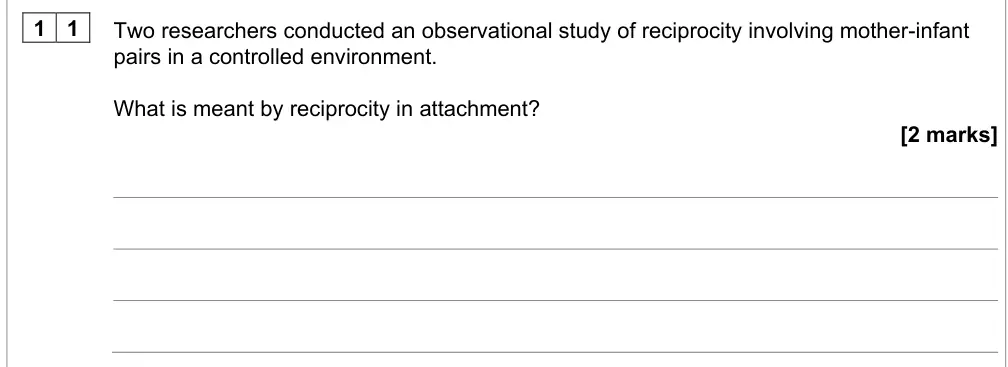
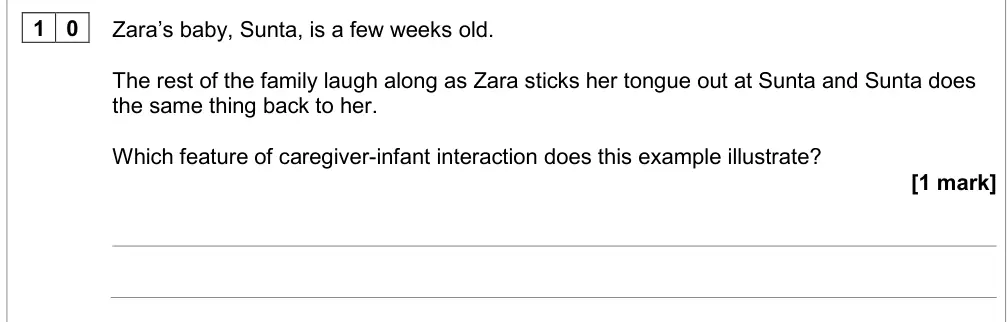
June 2025 · Paper 1 · Q112 marksAO1=2Short answerEasyOld spec only
Not on the 2025 specification: caregiver-infant interactions: reciprocity, removed in v1.4
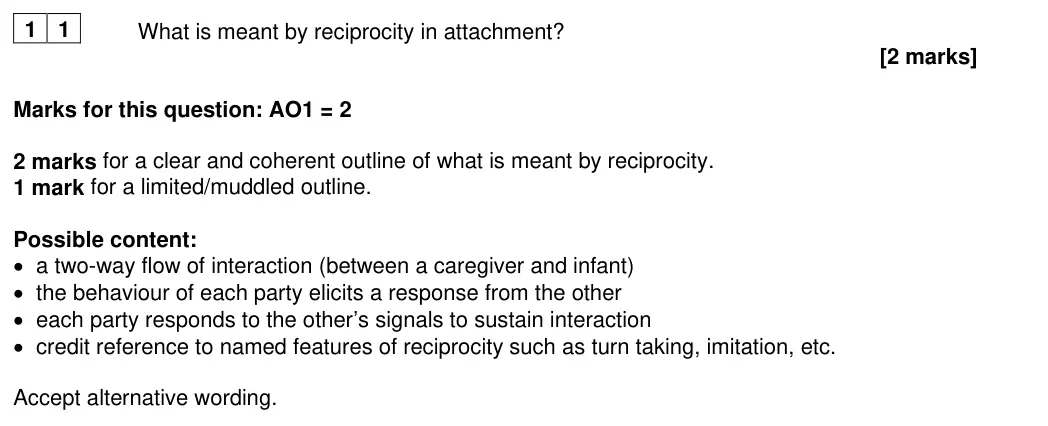
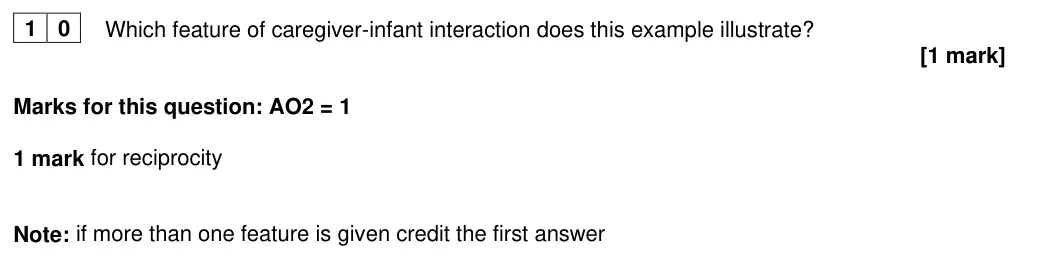
Mark scheme, including level descriptors and indicative content
Examiner's comment
Most students answered this question well with over 55% gaining full marks. Perhaps because reciprocity appeared in last year’s paper, students appeared well prepared for this question.
Notes from the mark scheme and report
Off-spec: caregiver-infant interactions: reciprocity, removed in v1.4
two-way flow of interaction, each elicits a response
well answered
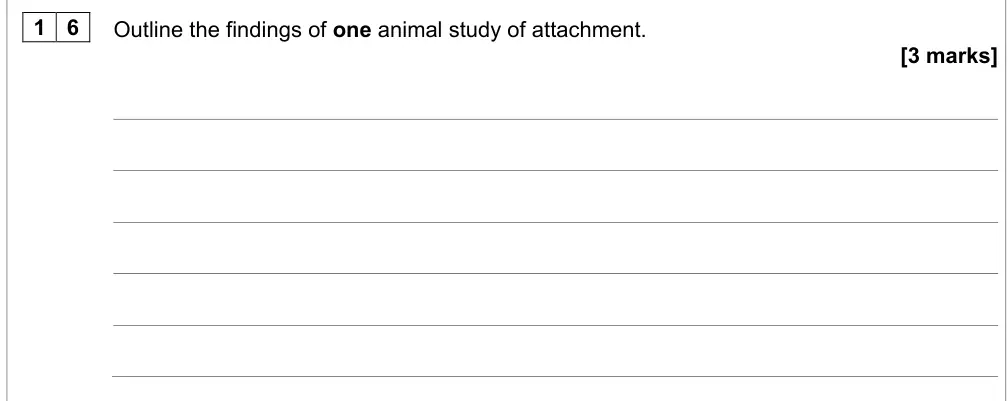
June 2025 · Paper 1 · Q163 marksAO1=3OutlineMedium
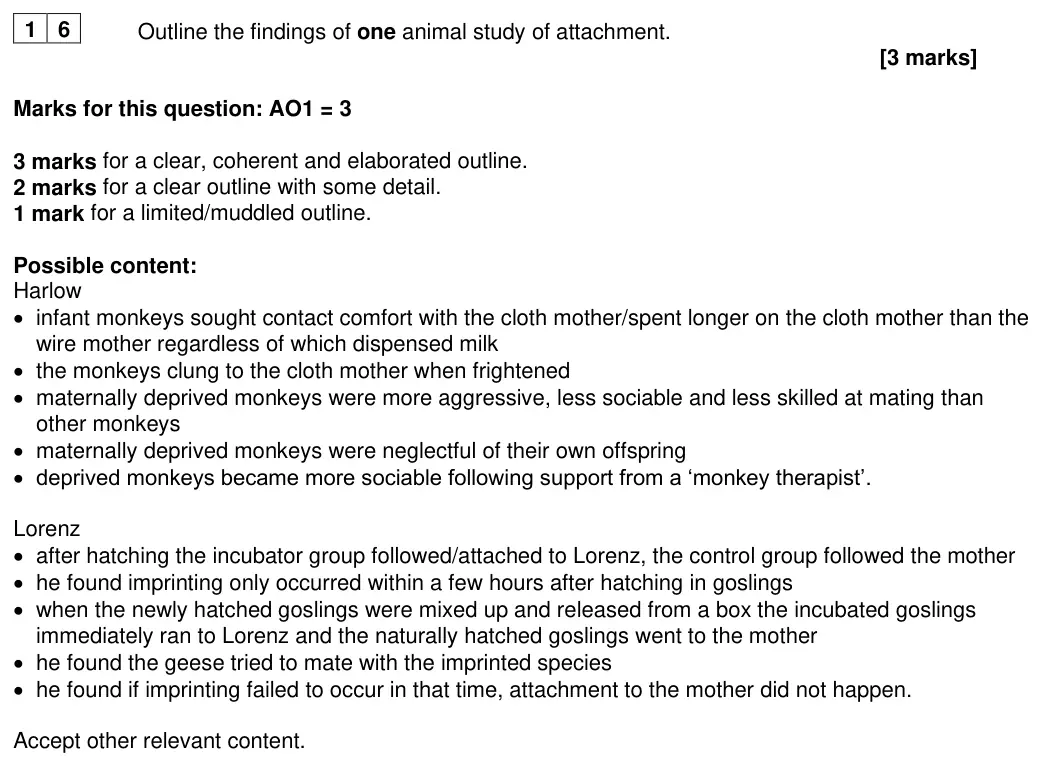
Mark scheme, including level descriptors and indicative content
Examiner's comment
Most students were able to score marks on this question, and many provided an abundance of findings with reference to both Lorenz’s and Harlow’s research studies. Occasionally answers described procedural information and/or conclusions, neither of which were creditworthy. An effective strategy was to briefly outline several findings from the chosen study, which resulted in over 60% of students gaining two or more marks for this question.
Notes from the mark scheme and report
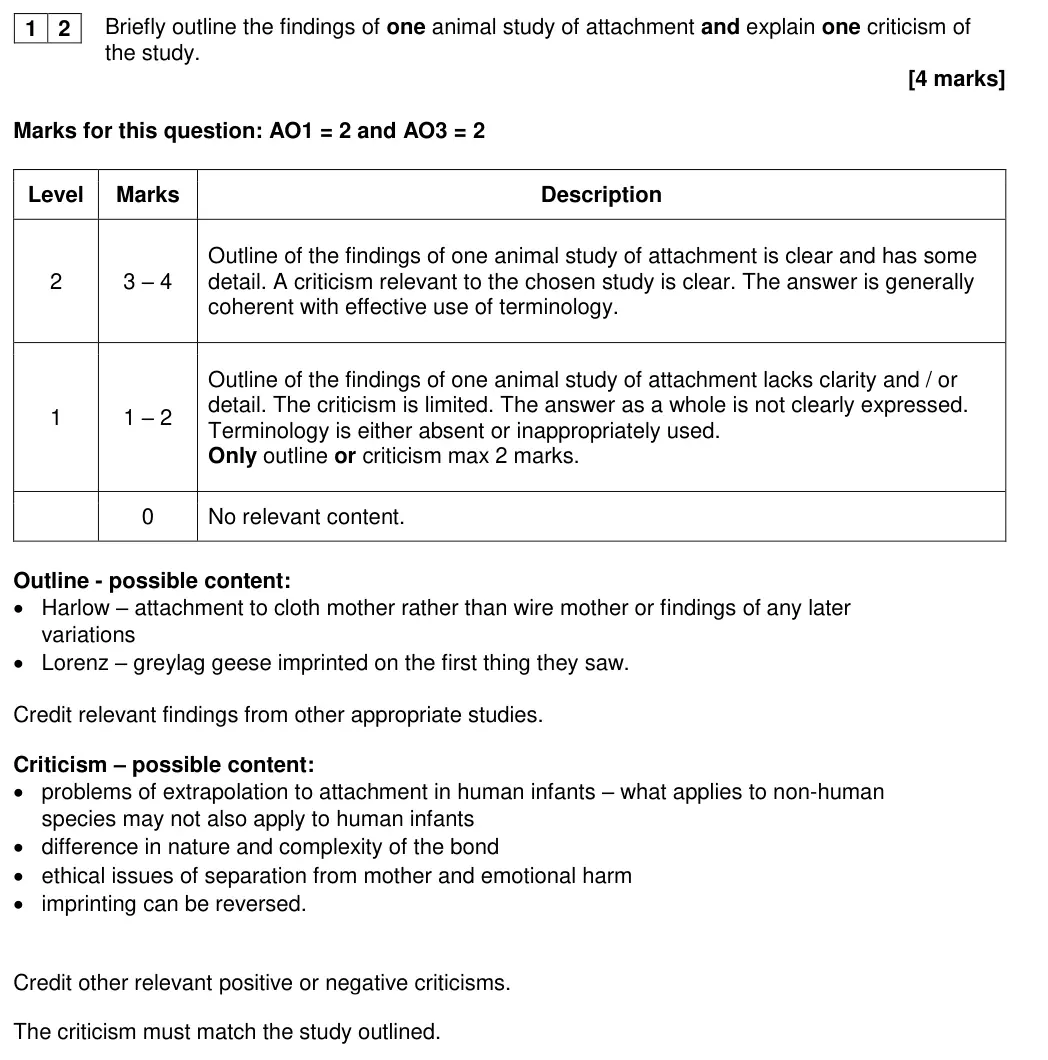
findings only (Harlow or Lorenz)
procedure and conclusions not creditworthy
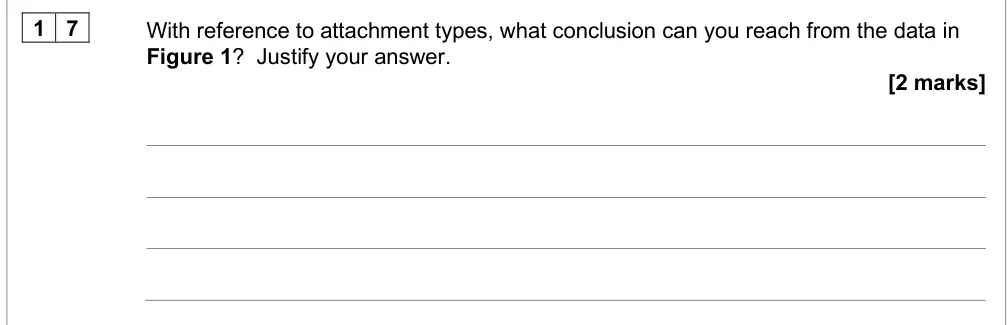
June 2025 · AS Paper 1 · Q172 marksAO2=2Research methods
Mark scheme, including level descriptors and indicative content
Examiner's comment
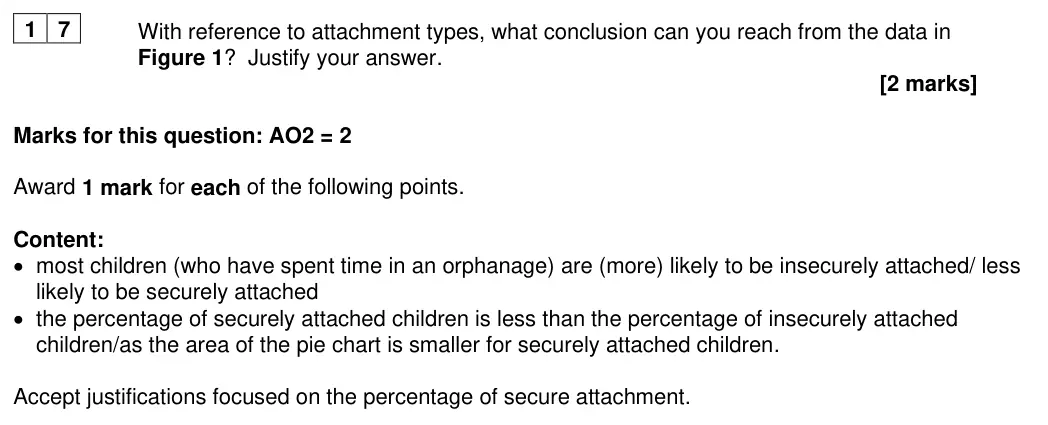
This question was a follow up to Q16, asking students to draw a conclusion about attachment types using the data in the pie chart. Approximately 25% of students referred to the fact that children who had spent time in an orphanage were more likely to be insecurely attached/ less likely to be securely attached and gave an appropriate reference to the pattern of data in the pie chart. Many answers were unable to gain the second mark for the question, either lacking clarity by writing about children ‘mostly being insecure,’ rather than ‘most children’ being insecure, or because of a lack of justification through reference to the data. Some tried to explain why this type of attachment might have occurred by referring to the data in the pie chart which did not address the question.
Notes from the mark scheme and report
conclusion: children who spent time in an orphanage are more likely to be insecurely attached + justification from the pie chart
'mostly insecure' lacked clarity
explaining why rather than concluding not credited
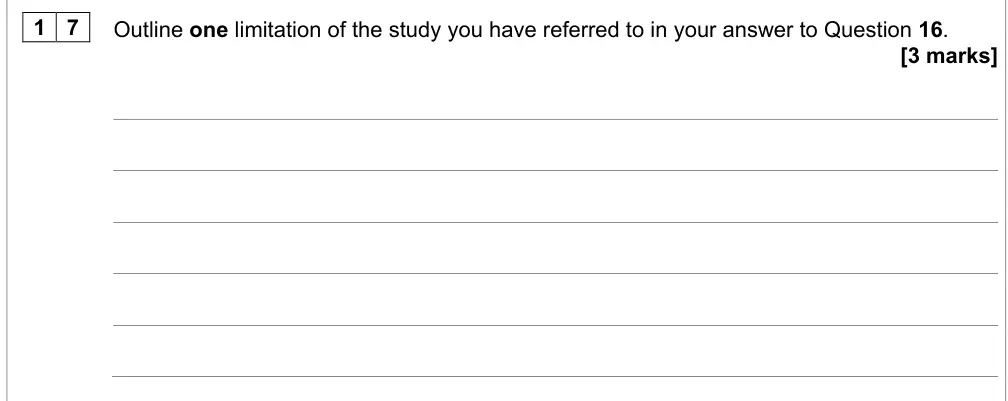
June 2025 · Paper 1 · Q173 marksAO3=3Evaluate (short)Medium
Mark scheme, including level descriptors and indicative content
Examiner's comment
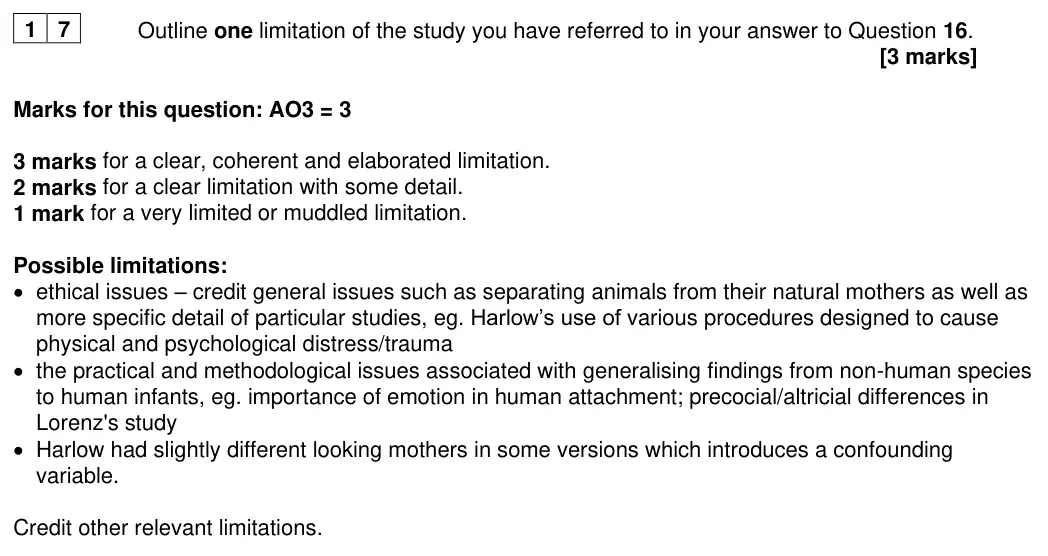
In addition, students generally performed well in research methodology, for example, question 9 and question 17. Students typically performed well in this question with an average mark of 2.17, and over 37% of students gaining full marks. Students made effective use of inadequate generalisability and were able to elaborate on this with specific differences across species e.g. in terms of cognition. In addition, students sometimes cited other methodological issues e.g. poor control over extraneous variables.
Notes from the mark scheme and report
ethics, generalising from animals to humans (precocial/altricial, emotion), Harlow's different-looking mothers as confound
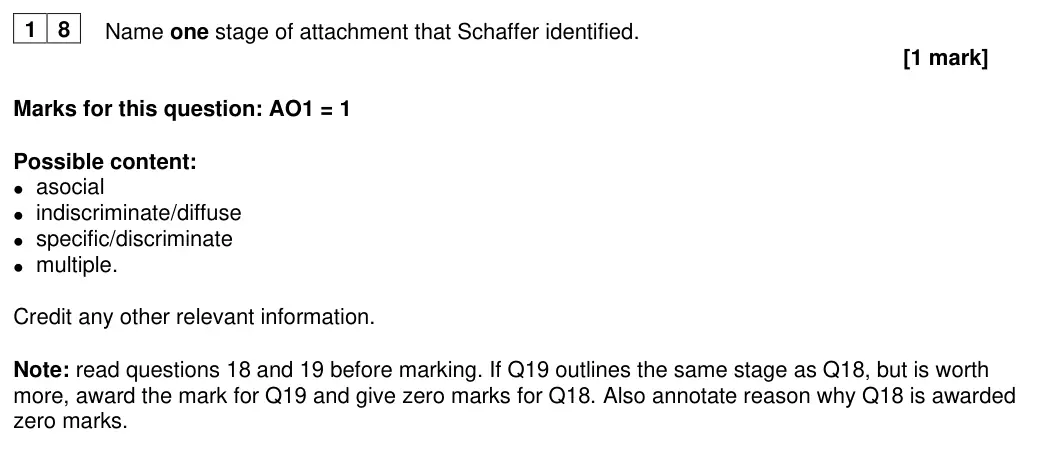
June 2025 · AS Paper 1 · Q181 markAO1=1Short answerEasyOld spec only
Not on the 2025 specification: Schaffer's stages of attachment, removed in v1.4
Mark scheme, including level descriptors and indicative content
Examiner's comment
Q18 was a very straightforward knowledge question where almost 80% of students were awarded the mark for naming one of Schaffer’s stages of attachment.
Notes from the mark scheme and report
Off-spec: Schaffer's stages of attachment, removed in v1.4
asocial, indiscriminate, specific, multiple
if Q19 outlines the same stage, Q18 gets zero
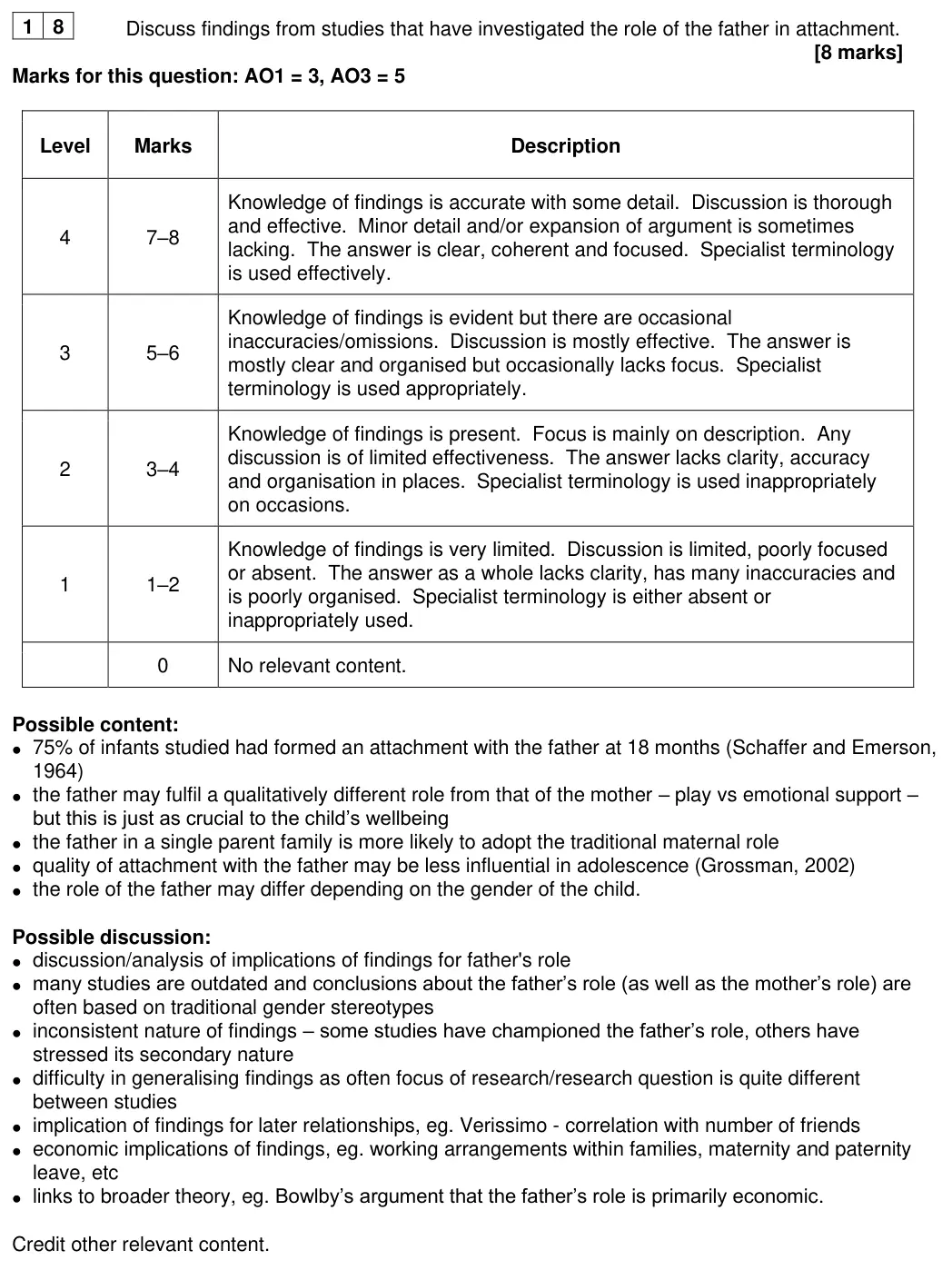
June 2025 · Paper 1 · Q188 marksAO1=3, AO3=5Extended writingOld spec only
Not on the 2025 specification: role of the father in attachment, removed in v1.4
Mark scheme, including level descriptors and indicative content
Examiner's comment
Students generally appeared well prepared for this question and could cite an array of research findings. Effective use was made of Schaffer and Emerson, Grossman, Field and Geiger. Less effective commentary included lengthy descriptions of studies as opposed to just the findings. A useful approach from students was to cite contradictory research findings enabling useful discussion e.g. of the role of the father as a primary or secondary carer. Further effective discussion included reference to economic implications of the role of the father, how this type of research might challenge the gender pay gap and the sensitivities with this area of research.
Notes from the mark scheme and report
Off-spec: role of the father in attachment, removed in v1.4
Schaffer and Emerson, Grossman, Field, Geiger
lengthy study descriptions rather than findings
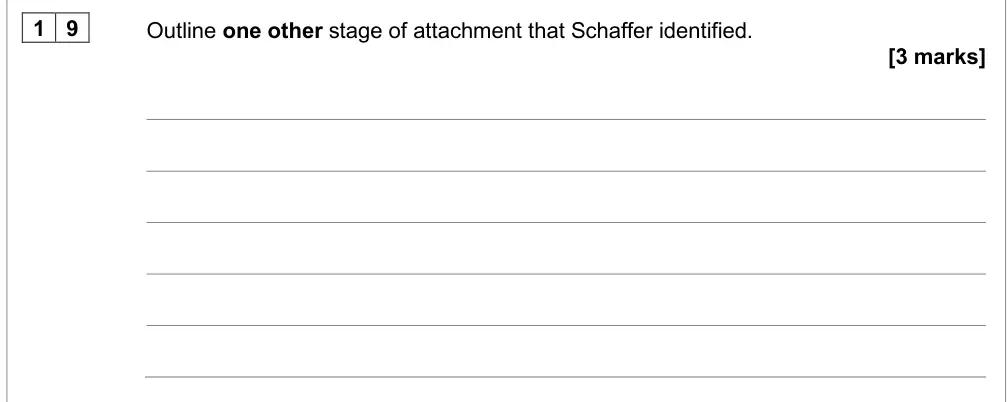
June 2025 · AS Paper 1 · Q193 marksAO1=3OutlineOld spec only
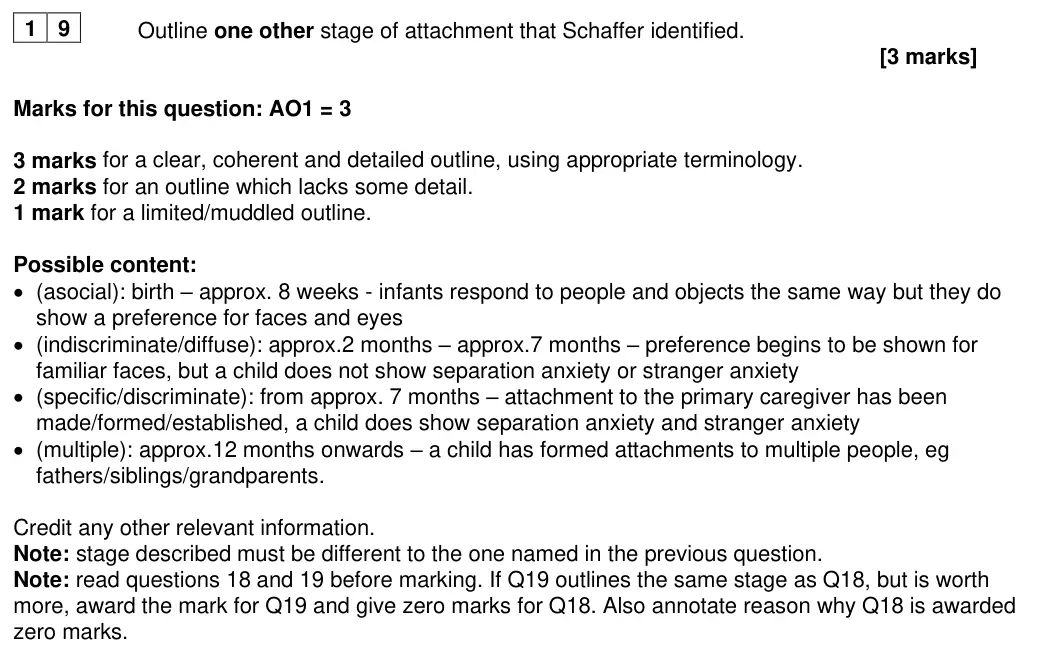
Not on the 2025 specification: Schaffer's stages of attachment, removed in v1.4
Mark scheme, including level descriptors and indicative content
Examiner's comment
However, Q19 required another of Schaffer’s stages to be outlined. While over 40% of students wrote a clear, coherent and detailed outline, with appropriate terminology of a different stage, some students just named another stage. Others did not give enough detail in their description to merit three marks. Some students muddled ages and features of the stage they described. A very few students appeared to have misunderstood the question and identified/outlined types of attachment rather than stages.
Notes from the mark scheme and report
Off-spec: Schaffer's stages of attachment, removed in v1.4
must be a different stage from Q18
ages and features of the stage often muddled
some just named a stage or gave attachment types
June 2025 · AS Paper 1 · Q201 markAO1=1Multiple choiceEasy
Answer
A
Mark scheme, including level descriptors and indicative content
Examiner's comment
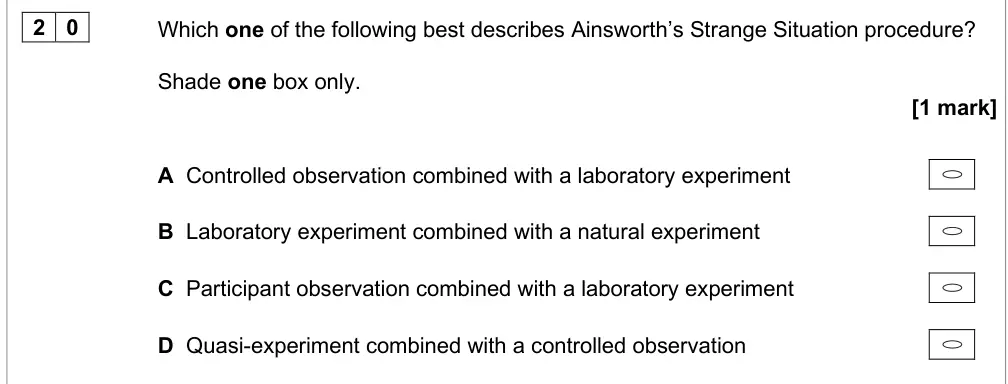
This multiple-choice question was more challenging with two thirds of students correctly choosing the best description of Ainsworth’s Strange Situation as option A. Only a small number of students did not attempt the question.
Notes from the mark scheme and report
correct answer A (controlled observation combined with a laboratory experiment)
June 2025 · AS Paper 1 · Q212 marksAO3=2Evaluate (short)Hard
Mark scheme, including level descriptors and indicative content
Examiner's comment
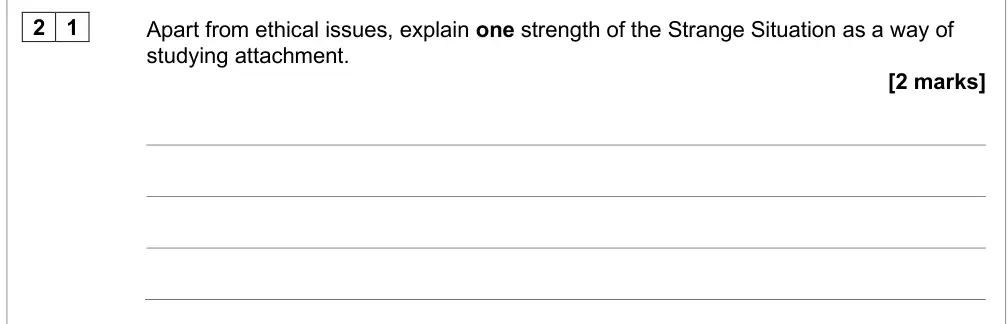
This question asked for an explanation of one strength of the Strange Situation as a way of studying attachment, apart from ethical issues. While just over a third of students answered this question clearly and coherently, many did not focus on the demand of the question which included the phrase ‘as a way of studying attachment.’ Some students referred to the implications of the research or referred to other research support, neither of which was creditworthy. About 40% of students were unable to score marks for this question.
Notes from the mark scheme and report
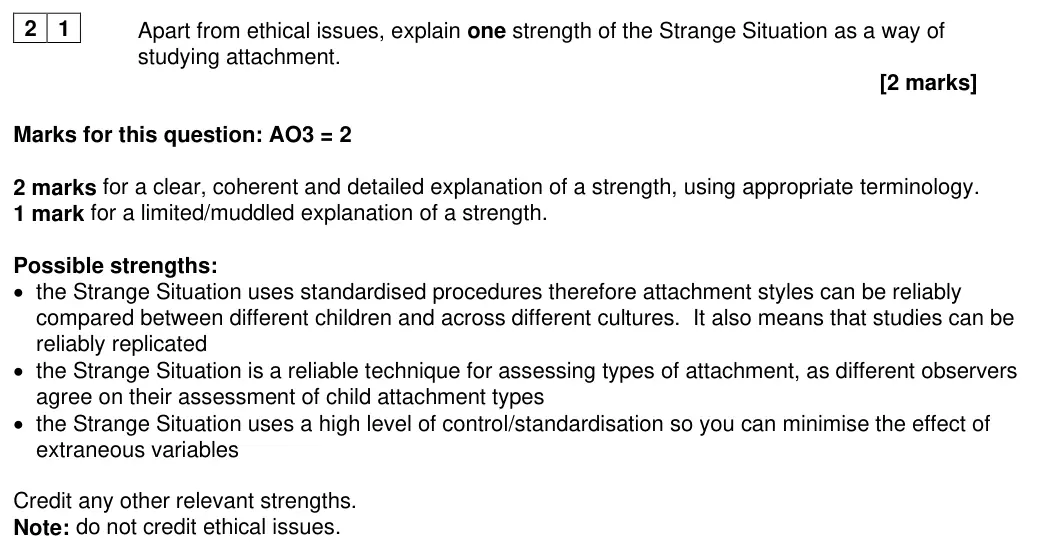
must be a strength of the method of studying attachment (standardisation, inter-observer reliability, control)
ethical issues, implications or supporting research not credited
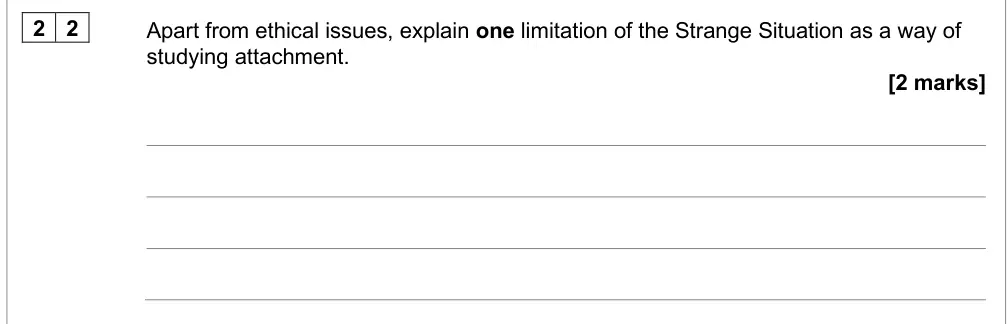
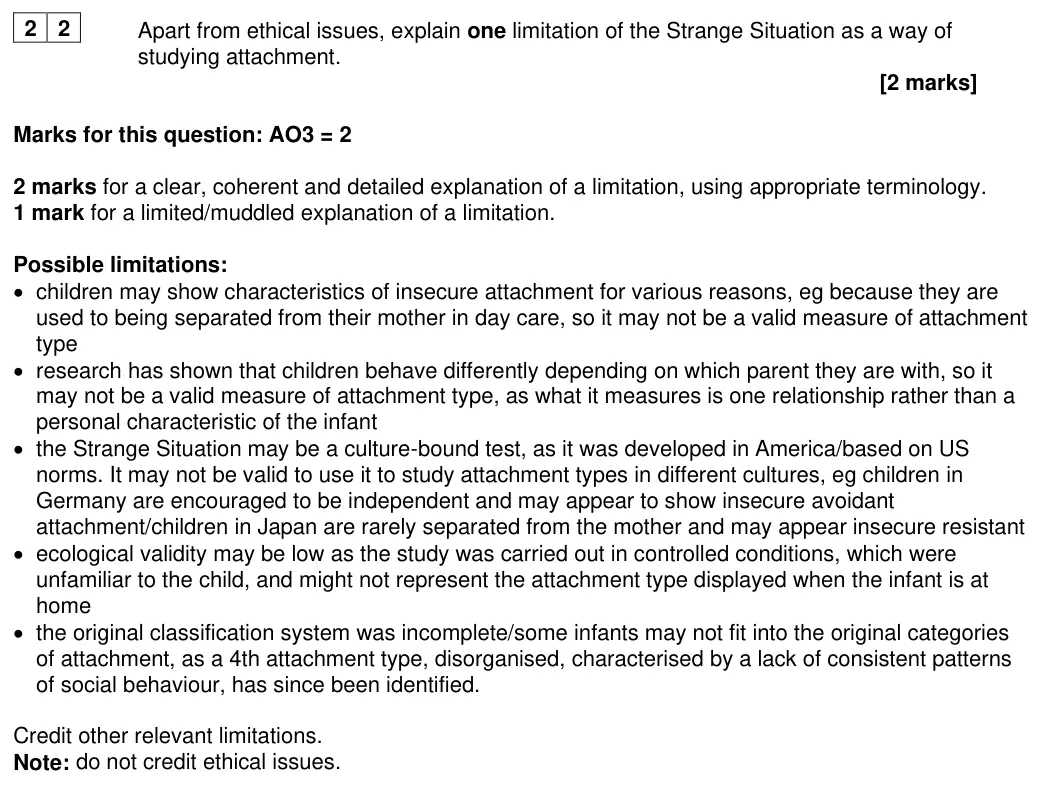
June 2025 · AS Paper 1 · Q222 marksAO3=2Evaluate (short)Easy
Mark scheme, including level descriptors and indicative content
Examiner's comment
This question required an explanation of a limitation of the Strange Situation as a way of studying attachment and was answered more successfully than Q16. Just over 50% of students scored full marks, and about 20% scored zero marks. Some focused on the issue of the findings of the Strange Situation research rather than its method of measuring attachment. Only a very small minority referred to ethical issues.
Notes from the mark scheme and report
limitation of the procedure as a measure (validity, culture-bound, one relationship only, disorganised type)
findings-focused answers not credited
ethical issues not credited
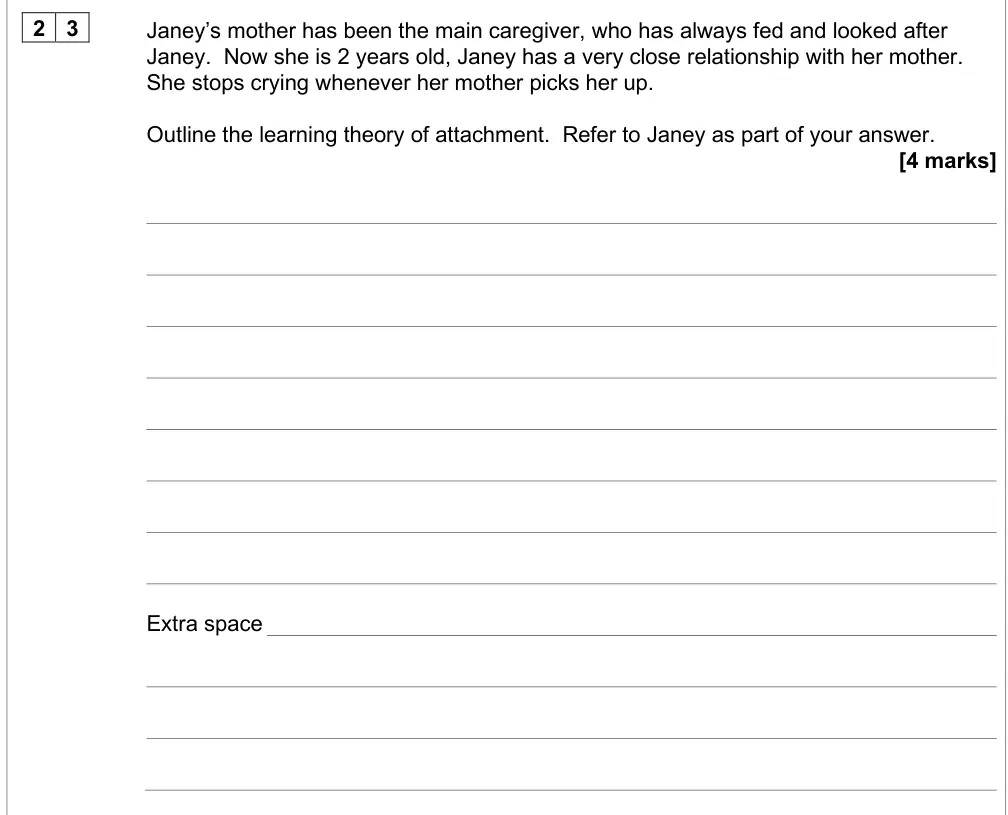
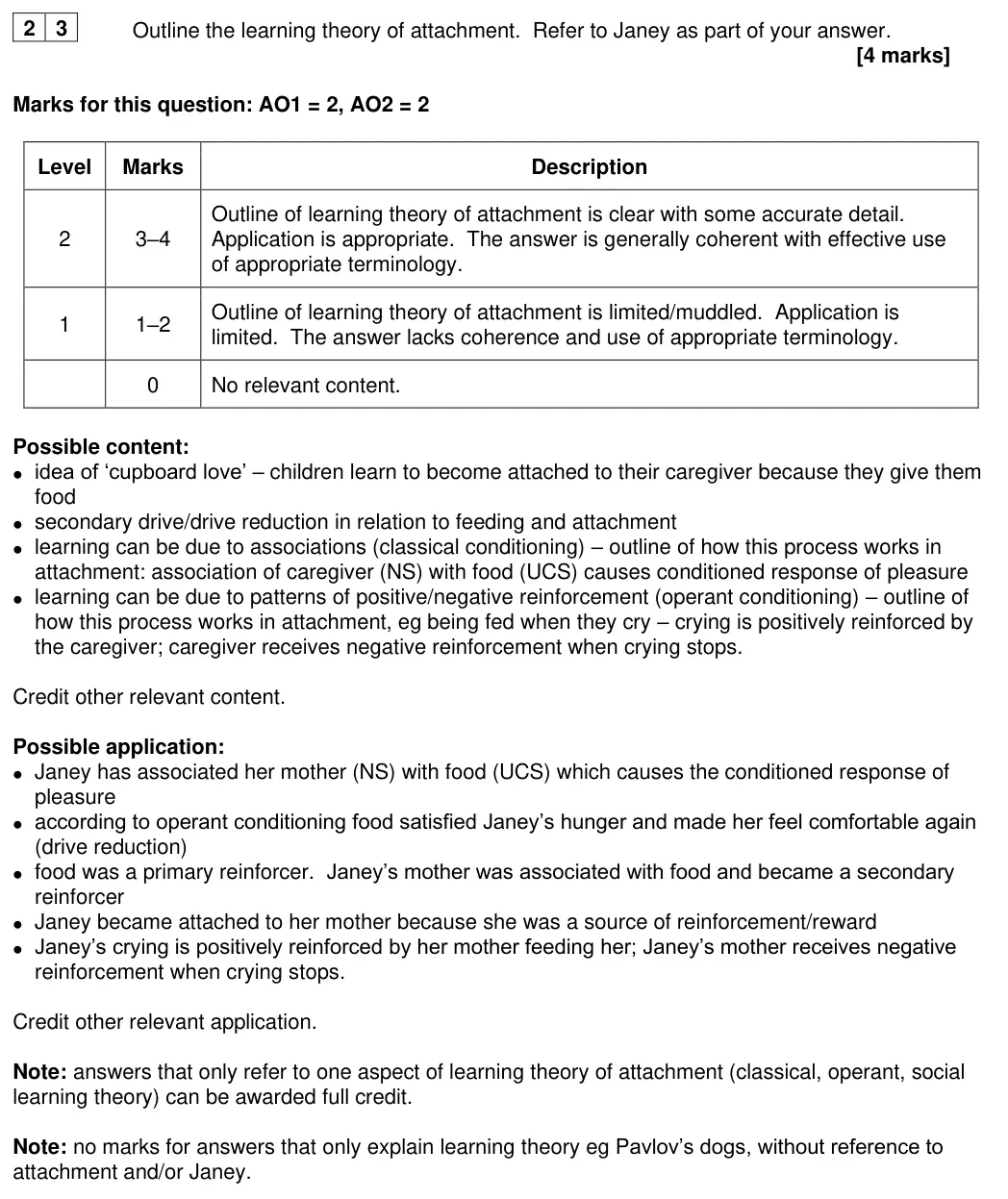
June 2025 · AS Paper 1 · Q234 marksAO1=2, AO2=2Application
Mark scheme, including level descriptors and indicative content
Examiner's comment
Performance on Q3, Q13 and Q23 suggested that many students should work to improve their AO2 skills. They need to ensure they fully engage with the stem/scenario and do not just state the name of the person in the stem, which is not effective application. They must use their knowledge and understanding to explain what is happening in the scenario. This was the third question on the paper where students were required to demonstrate their knowledge (of the learning theory of attachment) and then apply this to the scenario. This question was answered slightly less successfully than Q3. There was generally good knowledge of the learning theory explanation of attachment. Indeed, some students wrote an unnecessarily lengthy description. However, students often did not move into the level 2 band because there was little, if any application to the scenario. There was a good deal of variation in the use of specialist terminology and some students showed muddled understanding of the terms. There was also evidence of a misunderstanding of role of operant conditioning in attachment. This question was a good discriminator of student performance.
no marks for learning theory (e.g. Pavlov's dogs) without reference to attachment/Janey
little application kept many at Level 1
June 2025 · AS Paper 1 · Q248 marksAO1=4, AO3=4Extended writingHard
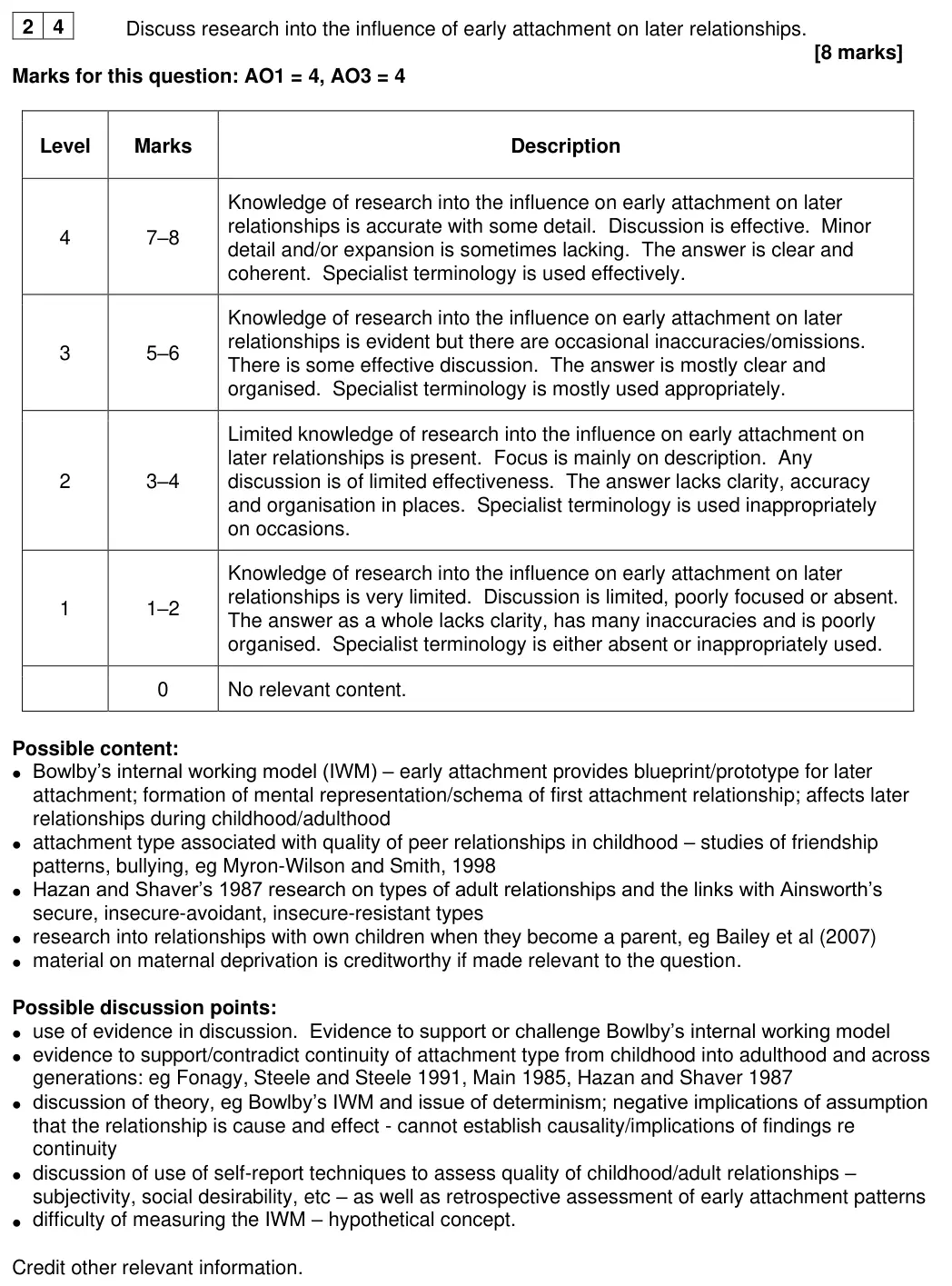
Mark scheme, including level descriptors and indicative content
Examiner's comment
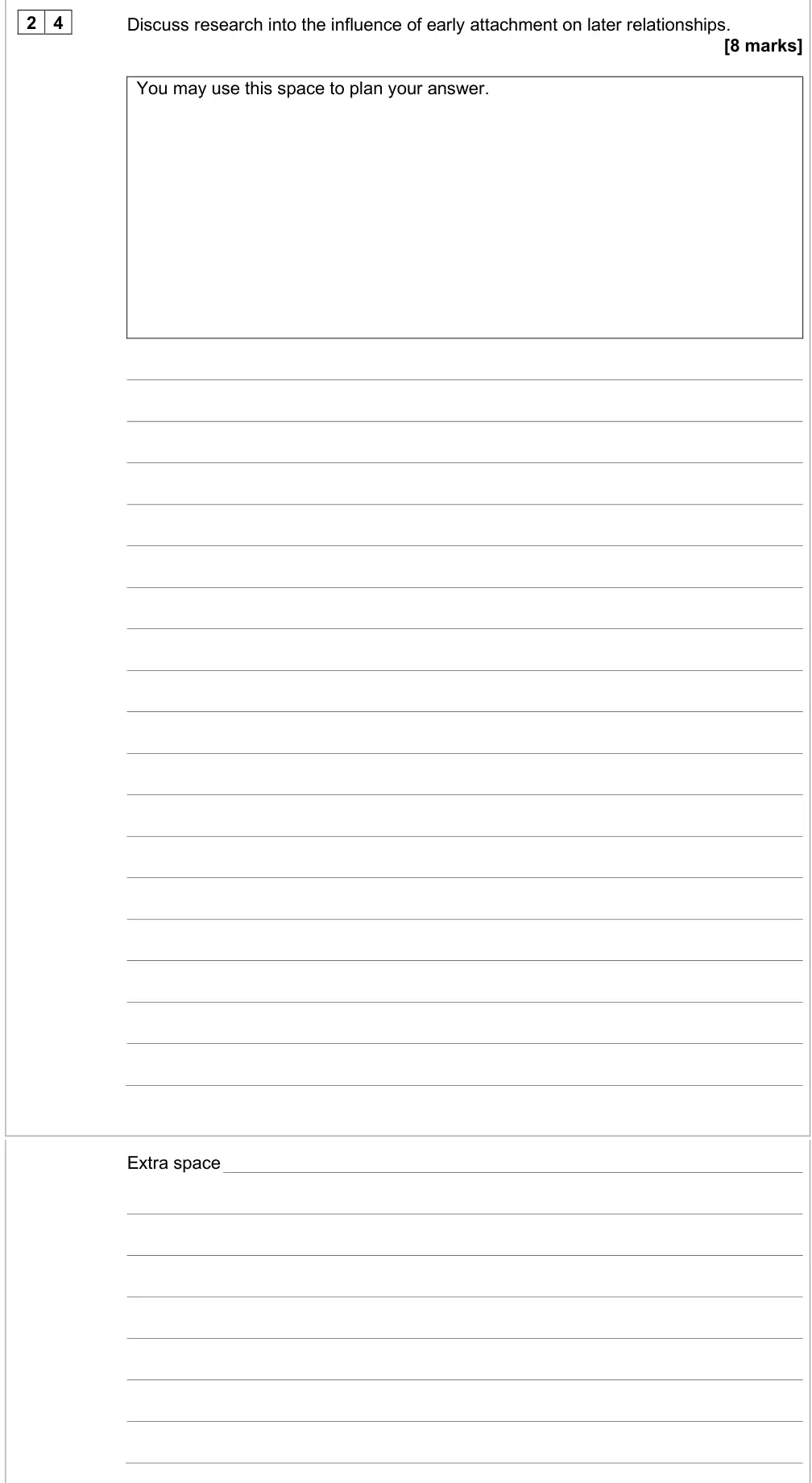
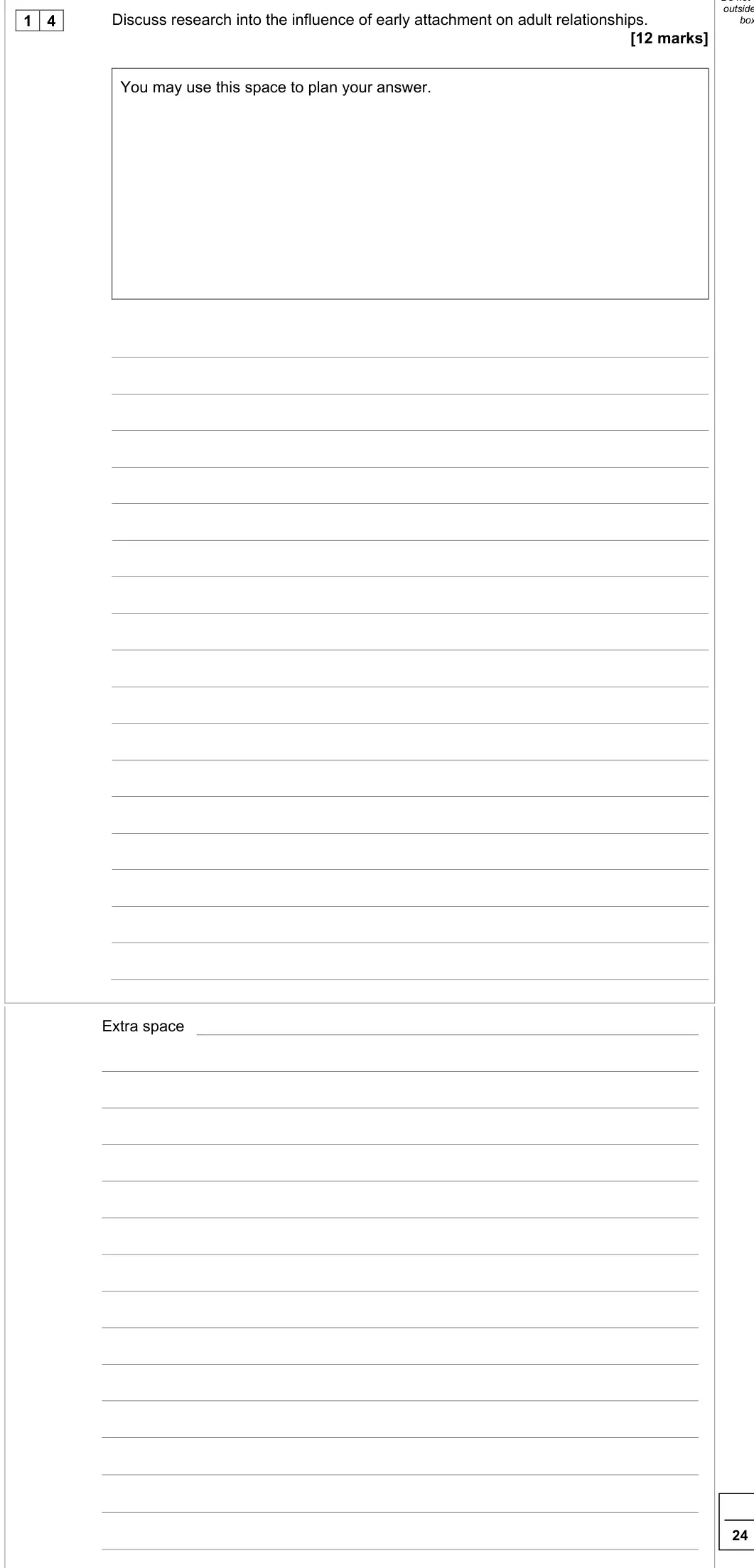
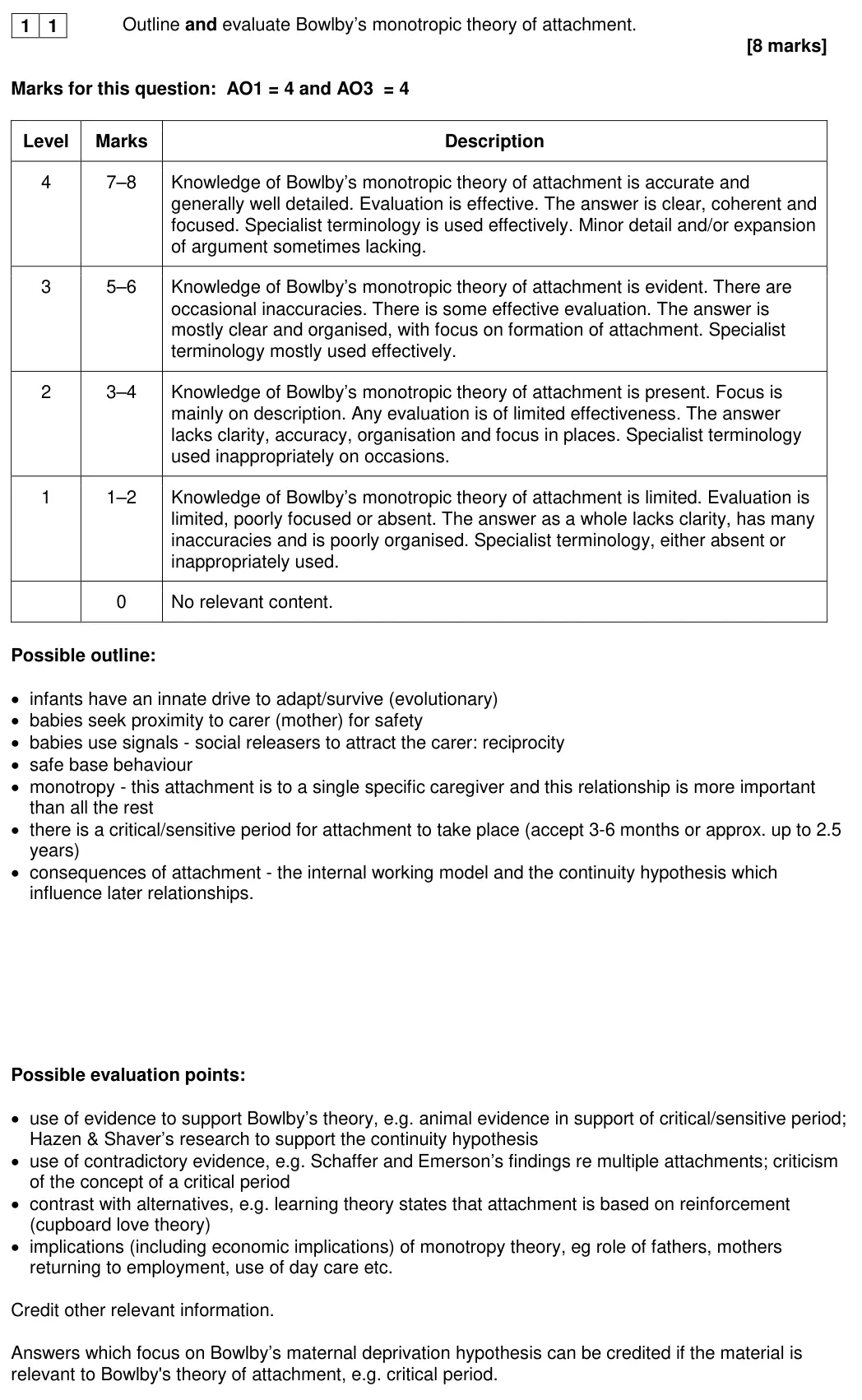
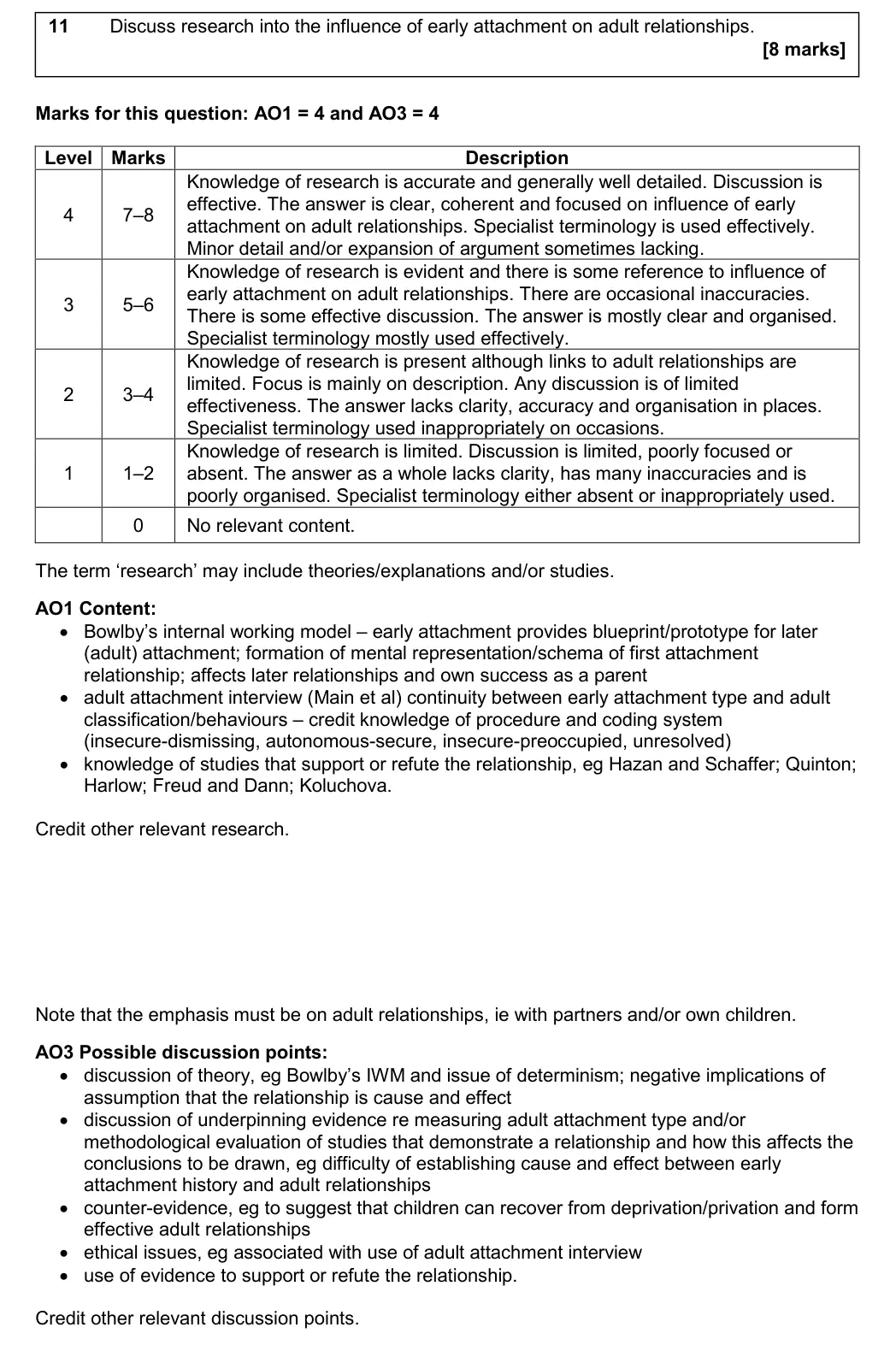
While there were some impressive responses, some students did not include sufficient detail in their answers, particularly in the extended response questions, Q5 and Q24. The final extended response question on the paper (8 marks) asked students to discuss the influence of early attachment on later relationships. It was pleasing to see how many students answered the question, compared to the last 2 years when the final question was often not attempted. This question acted as a good discriminator. There was a near normal distribution of scores with a mean mark of 3.5. While about 40% of students scored half or more marks, only about 10% reached level 4. Good answers were able to outline research showing the link between attachment type and behaviours in later life such as peer relationships, bullying behaviour, adult romantic relationships and/or relationships with own children. However, some students did not shape their answer to the question. This was especially the case of those who chose to use material on maternal deprivation and then often failed to focus on the effects on later relationships. Some responses were largely descriptive with little, if any, evaluation. Others attempted some evaluation, but this was not always fully elaborated and therefore was not effective.
Notes from the mark scheme and report
internal working model, peer relationships, Hazan and Shaver, parenting
maternal deprivation creditworthy only if related to later relationships
many answers descriptive
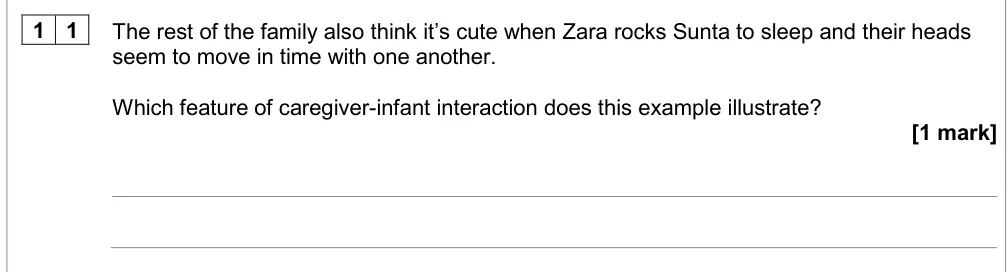
June 2024 · Paper 1 · Q101 markAO2=1ApplicationOld spec only
Not on the 2025 specification: caregiver-infant interactions: reciprocity, removed in v1.4
Mark scheme, including level descriptors and indicative content
Examiner's comment
These short questions both required students to identify the aspect of caregiver-infant interaction shown within scenarios, and as such were classified as ‘application’ questions. The only caregiver- infant interactions named in the specification are reciprocity and interactional synchrony. Students did particularly well in these questions with mean averages of 0.78 and 0.81 and had minimal difficulty in identifying which caregiver-infant interaction fitted each scenario.
Notes from the mark scheme and report
Off-spec: caregiver-infant interactions: reciprocity, removed in v1.4
answer: reciprocity
first answer credited
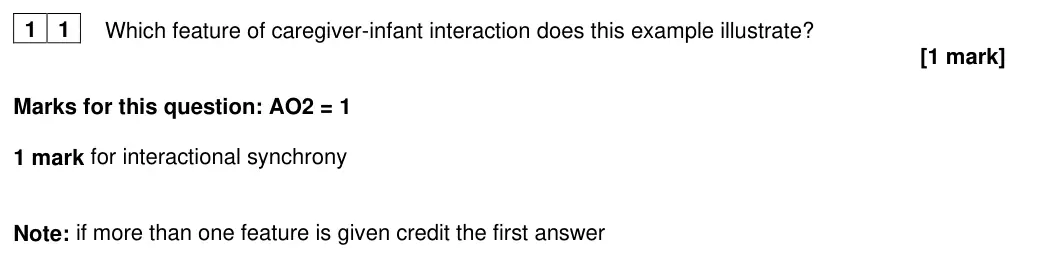
June 2024 · Paper 1 · Q111 markAO2=1ApplicationOld spec only
Not on the 2025 specification: caregiver-infant interactions: interactional synchrony, removed in v1.4
Mark scheme, including level descriptors and indicative content
Examiner's comment
These short questions both required students to identify the aspect of caregiver-infant interaction shown within scenarios, and as such were classified as ‘application’ questions. The only caregiver- infant interactions named in the specification are reciprocity and interactional synchrony. Students did particularly well in these questions with mean averages of 0.78 and 0.81 and had minimal difficulty in identifying which caregiver-infant interaction fitted each scenario.
Notes from the mark scheme and report
Off-spec: caregiver-infant interactions: interactional synchrony, removed in v1.4
answer: interactional synchrony
first answer credited
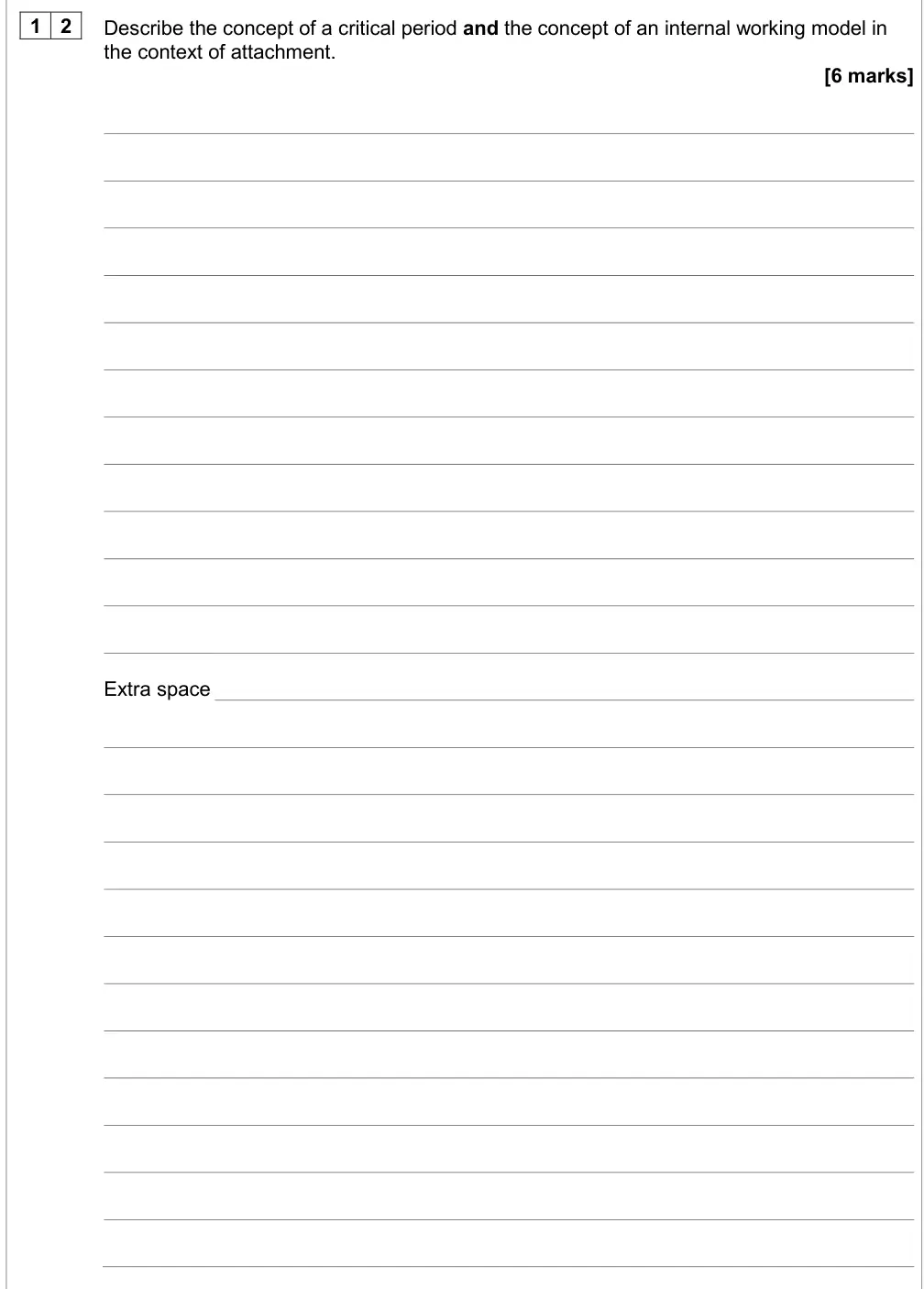
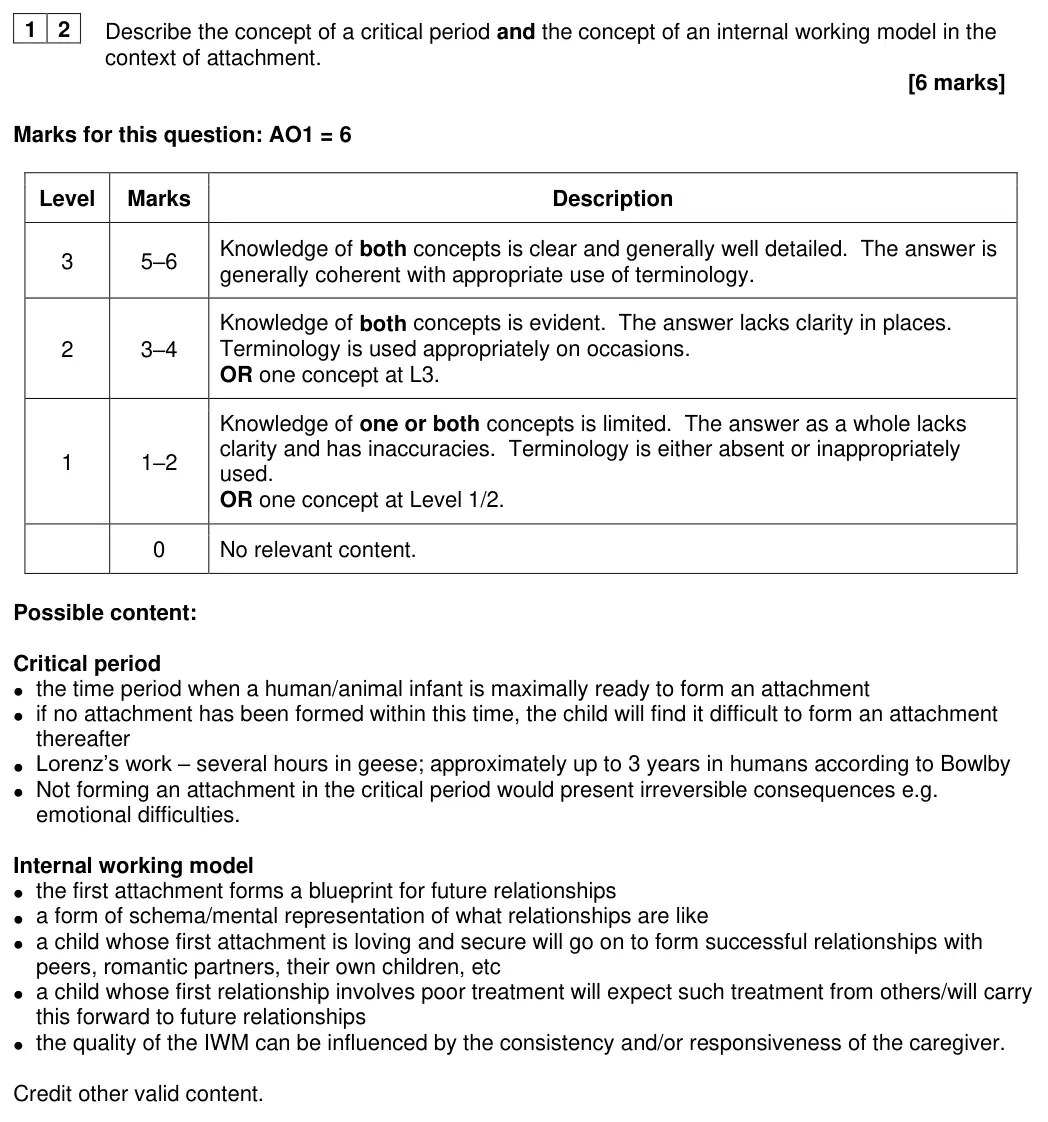
June 2024 · Paper 1 · Q126 marksAO1=6OutlineEasy
Mark scheme, including level descriptors and indicative content
Examiner's comment
This was generally answered well by candidates, who were able to give precise and accurate information about the critical period and the internal working model. The mean for this question was 3.66 marks, with less than two percent of students failing to score marks on this question. The mark scheme was very inclusive and did not overly penalise students for providing more or fewer details on only one concept. Several aspects of the critical period are addressed,with good elaboration of the model
Notes from the mark scheme and report
both concepts needed for Level 3
one concept at Level 3 = max 4
answered well
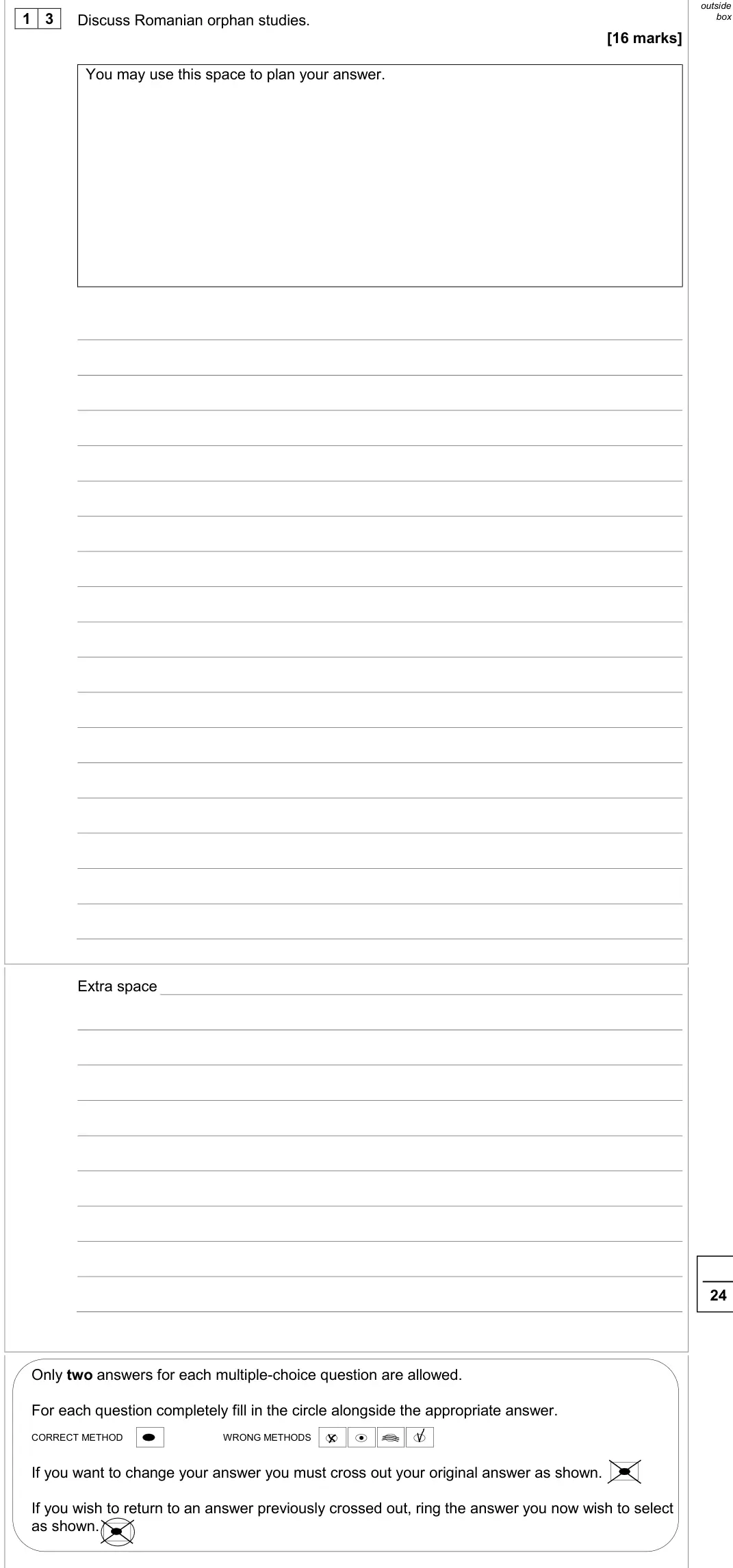
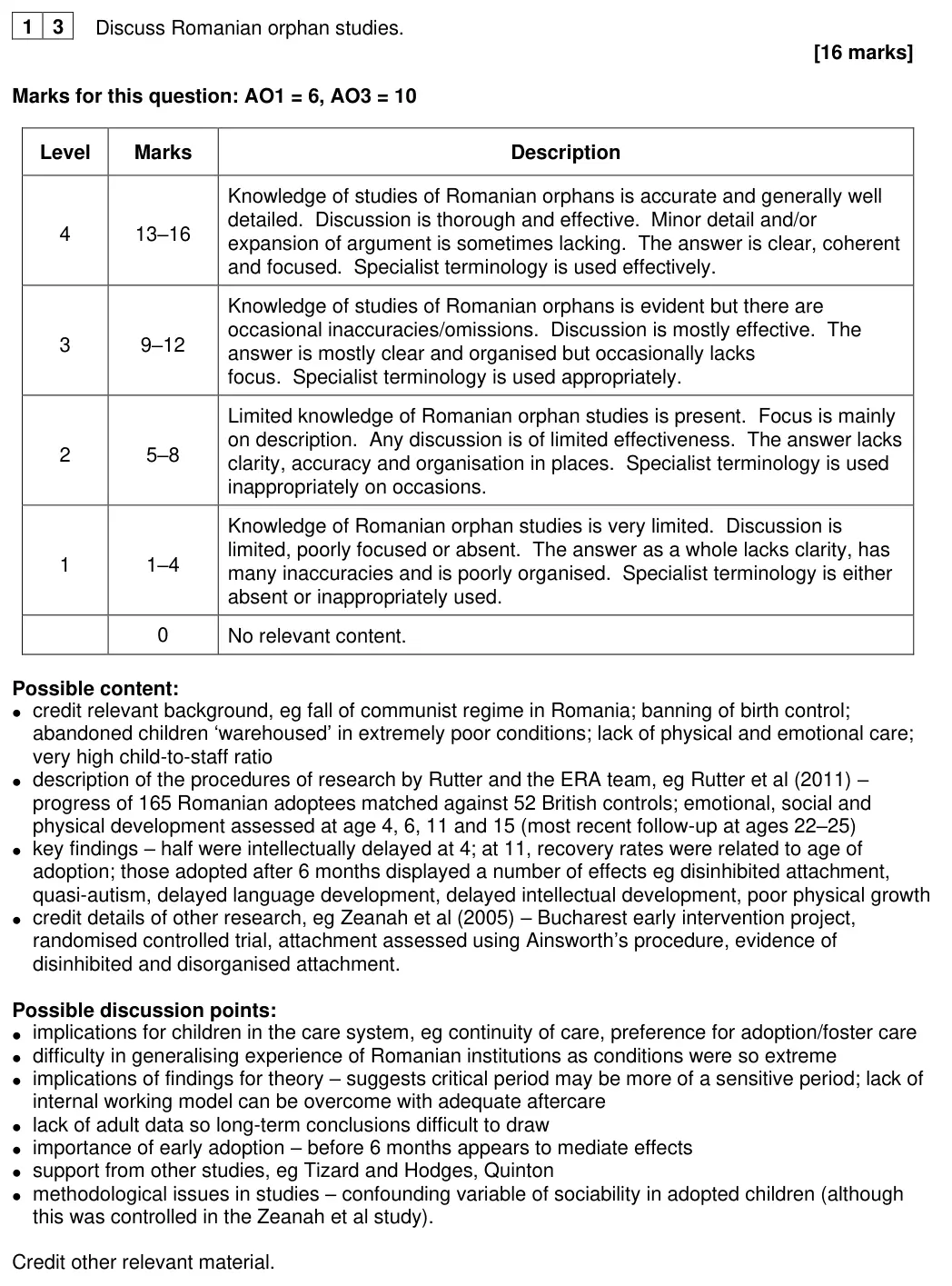
June 2024 · Paper 1 · Q1316 marksAO1=6, AO3=1016-mark essay
Mark scheme, including level descriptors and indicative content
Examiner's comment
This was a straightforward essay question about Romanian orphan studies, generally answered well by students with over ten percent of students gaining level 4 marks. Due to the nature of the question some marks were awarded for relevant background to the Romanian orphan studies i.e. the fall of Romania’s communist regime, and a large number of students cited this. Many students made effective use of research by Rutter, Zeanah et al and to a lesser extent that by Le Mare and Audet, citing an impressive level of detail in both procedures and results of these studies. However, despite this many struggled with the ‘discussion’ demands where students often provided generic/weak commentary e.g. about levels of ecological validity and control of extraneous variables without key details. The student’s response contains a wealth of thorough and effective ‘discussion’ that includes specific details that relate well to the question. The ‘knowledge’ commentary is accurate and well-focused, yet not as effective as the ‘discussion’ in this essay. However, this essay scored well overall.
Notes from the mark scheme and report
'Romanian orphan studies' reworded to English and Romanian Adoptees project in v1.4
Rutter ERA, Zeanah et al (Bucharest), background credited
discussion often generic (ecological validity, control) without detail
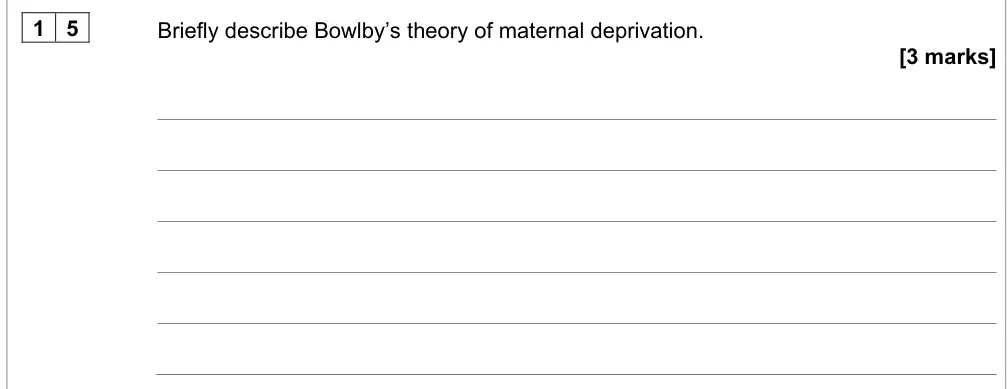
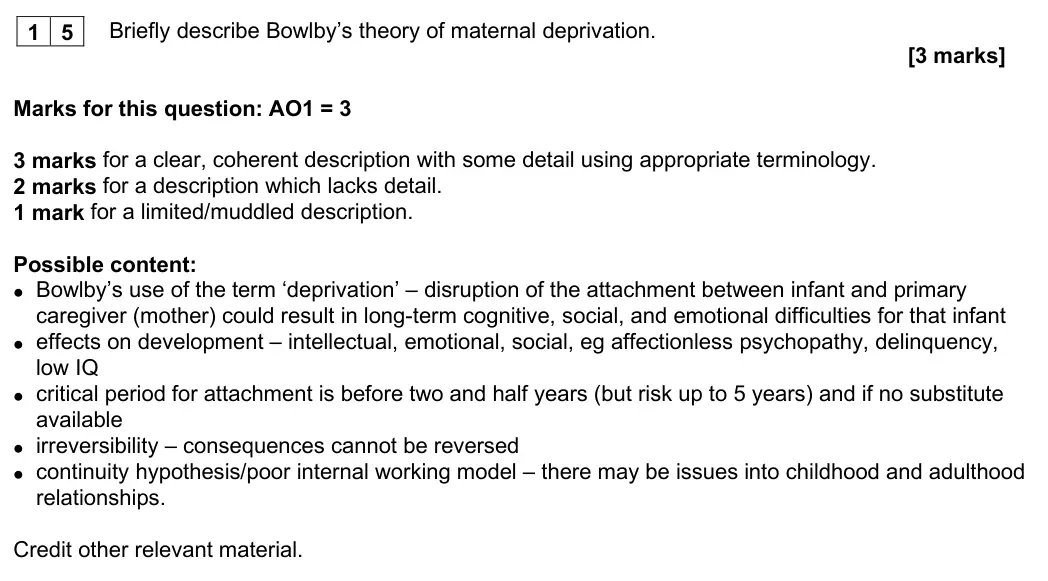
June 2024 · AS Paper 1 · Q153 marksAO1=3OutlineMedium
Mark scheme, including level descriptors and indicative content
Examiner's comment
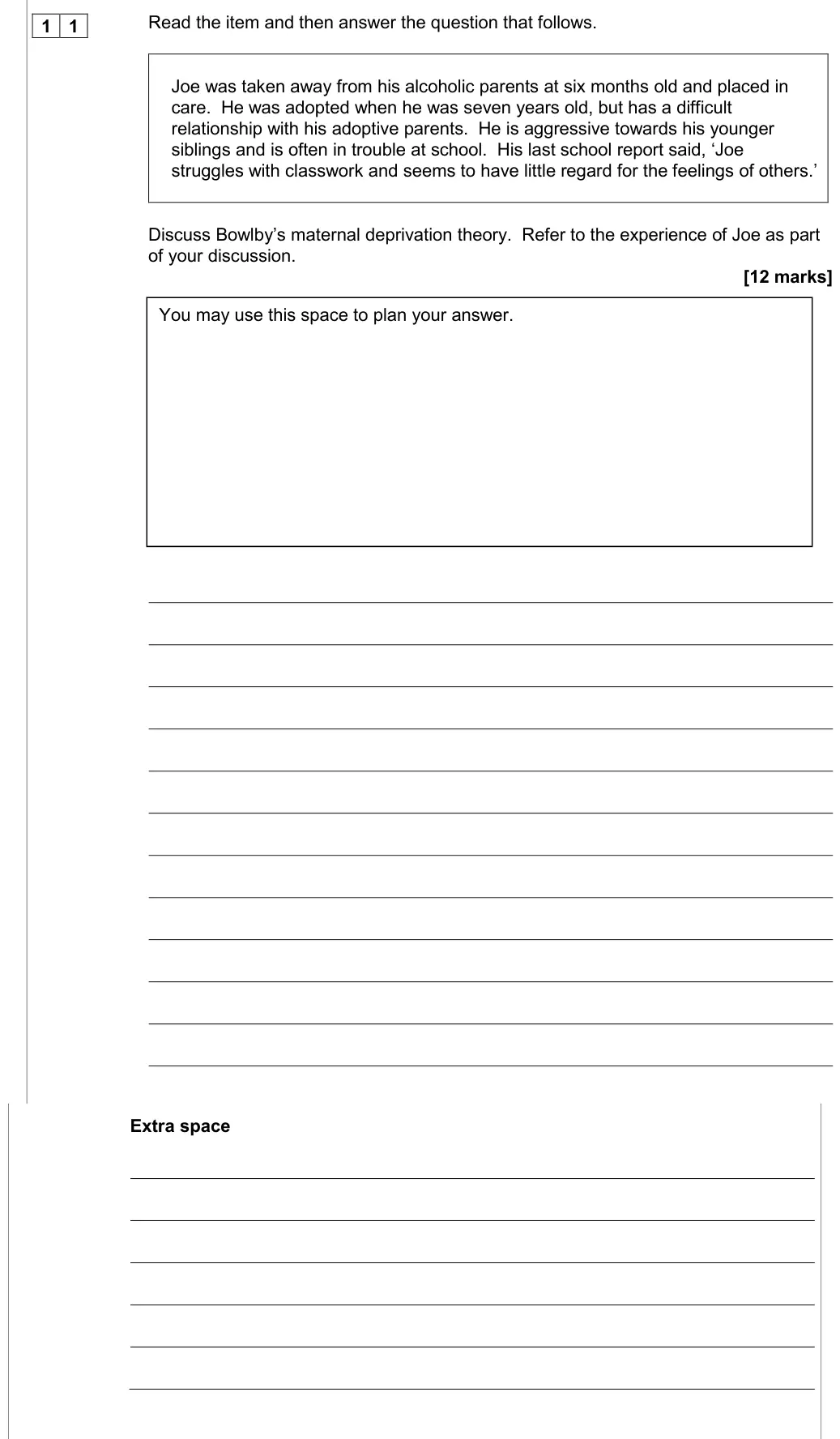
A pleasing number of students gave a clear and coherent description of Bowlby’s theory of maternal deprivation, with 30% scoring full marks. However, there were some students who explained his attachment theory, rather than focusing on maternal deprivation. Strong answers gave some detail about one or more aspects of maternal deprivation and used appropriate terminology, for example, critical period, poor internal working model. This was the best answered question of the Attachment section.
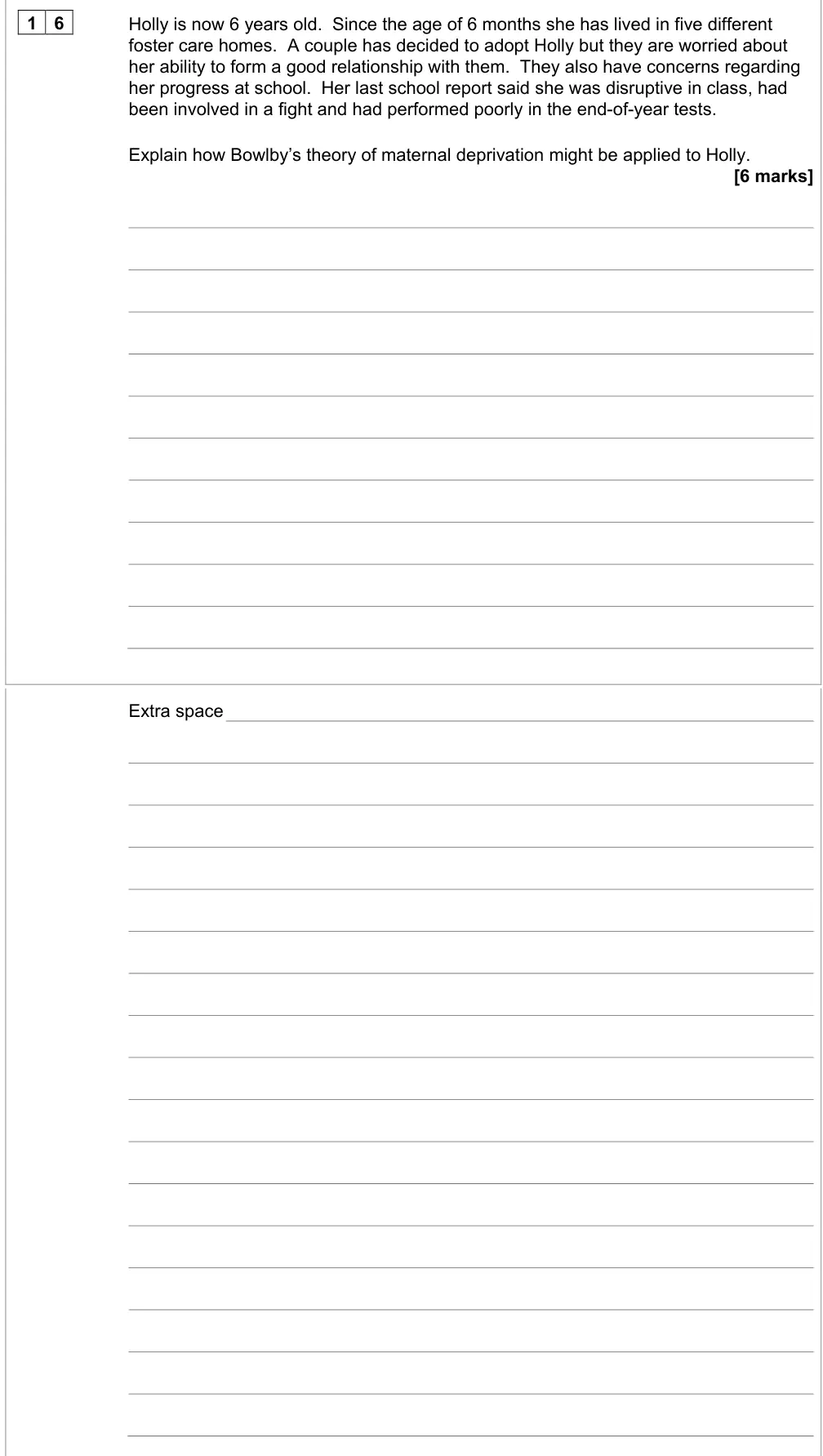
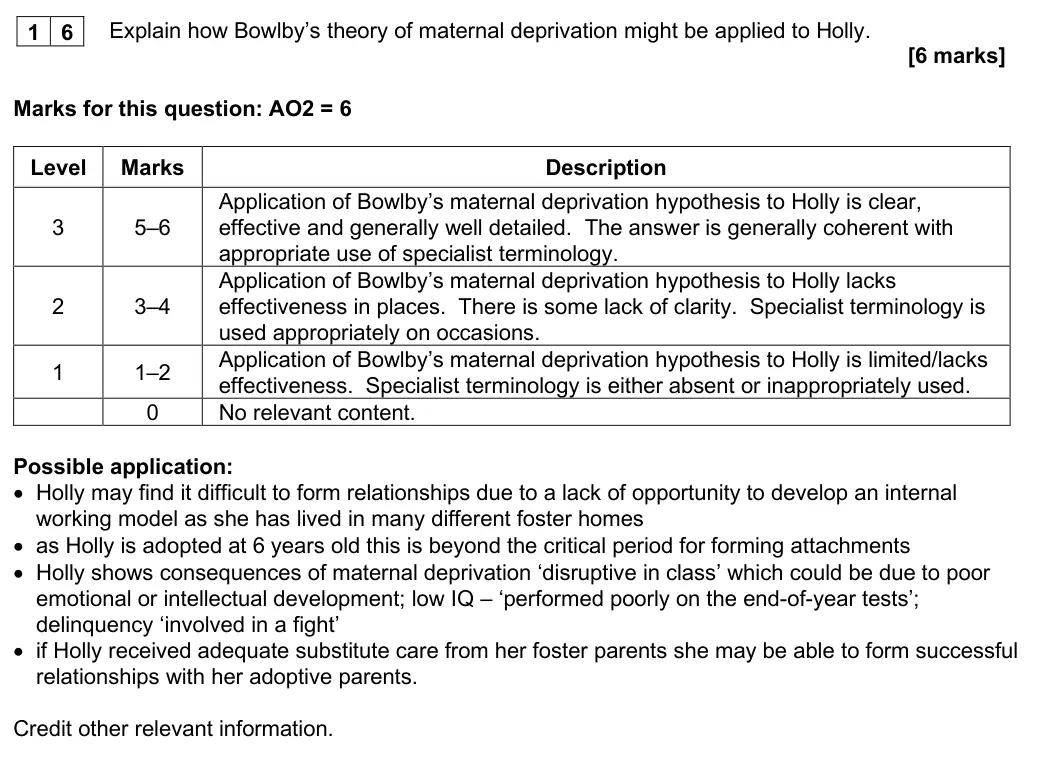
June 2024 · AS Paper 1 · Q166 marksAO2=6Application
Mark scheme, including level descriptors and indicative content
Examiner's comment
There were some highly effective answers to this question, where students were able to link knowledge of Bowlby’s maternal deprivation hypothesis to the scenario with effective and detailed application. Seventy- five percent of students scored at least half the available marks, with a third achieving level 3. Weaker answers just described Bowlby’s maternal deprivation theory which was the requirement of the previous question and not the requirement of this question, which needed application of knowledge to the scenario. Some students showed only superficial engagement with the stem, just saying ‘Holly’ rather than referring to her behaviour and linking it to aspects of the theory. Some answers gave speculative suggestions rather than focusing on the information within the stem.
Notes from the mark scheme and report
apply to Holly: no stable IWM after five foster homes, beyond critical period at 6, disruptive/fight = delinquency, poor tests = low IQ
describing the theory only (previous question) not credited
superficial use of the stem
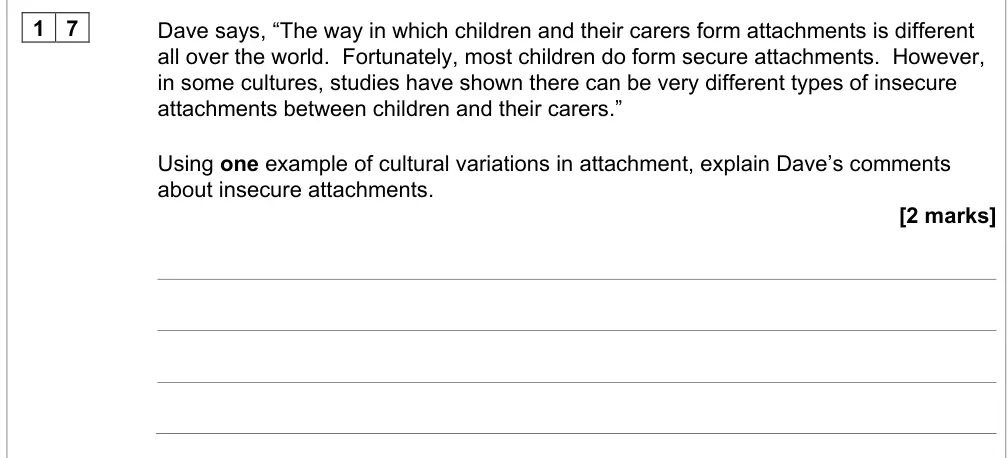
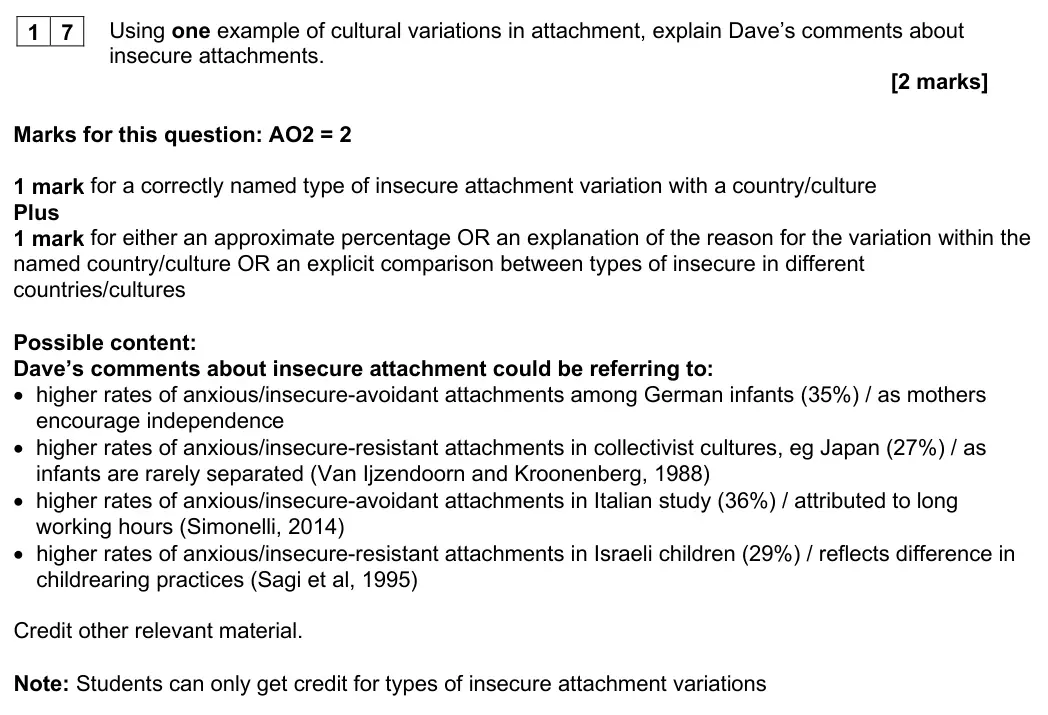
June 2024 · AS Paper 1 · Q172 marksAO2=2ApplicationMedium
Mark scheme, including level descriptors and indicative content
Examiner's comment
There was a good deal of variation in the response to this question. A significant number of students found this question challenging, with the highest number of not attempted answers across the paper (just under 5%) and almost 45% scoring no marks. However, there were also some strong answers with 30% of students scoring full marks. A considerable number of students referred to cultural variations in secure attachments which did not address the question. Good answers identified a variation in a type of insecure attachment, linked to a country or culture and were able to give details of the difference or explain why the variation occurred.
Notes from the mark scheme and report
must be an INSECURE type variation with a country (Germany avoidant, Japan/Israel resistant, Italy avoidant) + percentage, reason or comparison
secure-attachment variations not credited
~45% scored zero
June 2024 · AS Paper 1 · Q181 markAO3=1Short answerEasy
Mark scheme, including level descriptors and indicative content
Examiner's comment
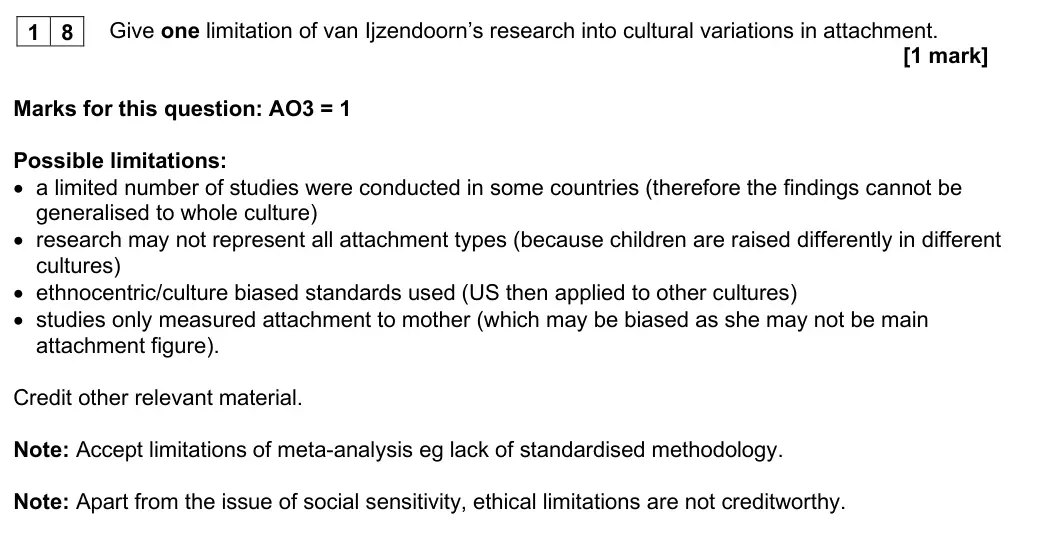
There was also variation in the response to this question. Many students found it challenging, with the second highest number of not attempted answers across the paper (4.5%) and almost 40% scoring no marks. However, a pleasing 60% scored full marks. Some students gave a limitation of strange situation research per se and did not focus their answer on requirements of the question, which was a limitation of van Ijzendoorn’s research. With a range of possible creditworthy options, most students focused on ethnocentrism, generalisability issues or lack of standardised methodology across the studies within the meta-analysis.
Notes from the mark scheme and report
few studies in some countries, imposed etic/ethnocentric Strange Situation, mother only, meta-analysis methodology
ethics not credited (except social sensitivity)
limitations of the Strange Situation per se not credited
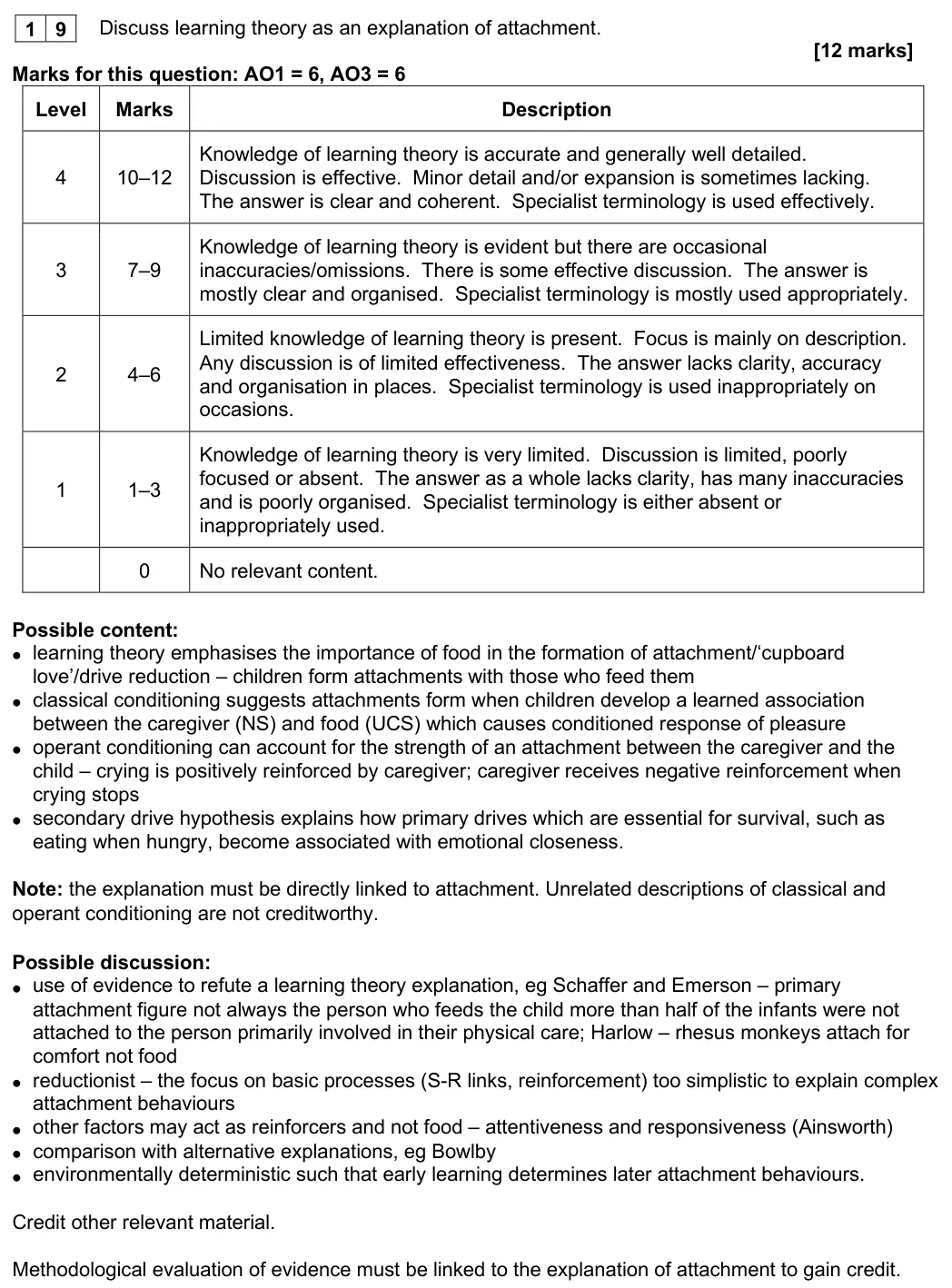
June 2024 · AS Paper 1 · Q1912 marksAO1=6, AO3=6Extended writingMedium
Mark scheme, including level descriptors and indicative content
Examiner's comment
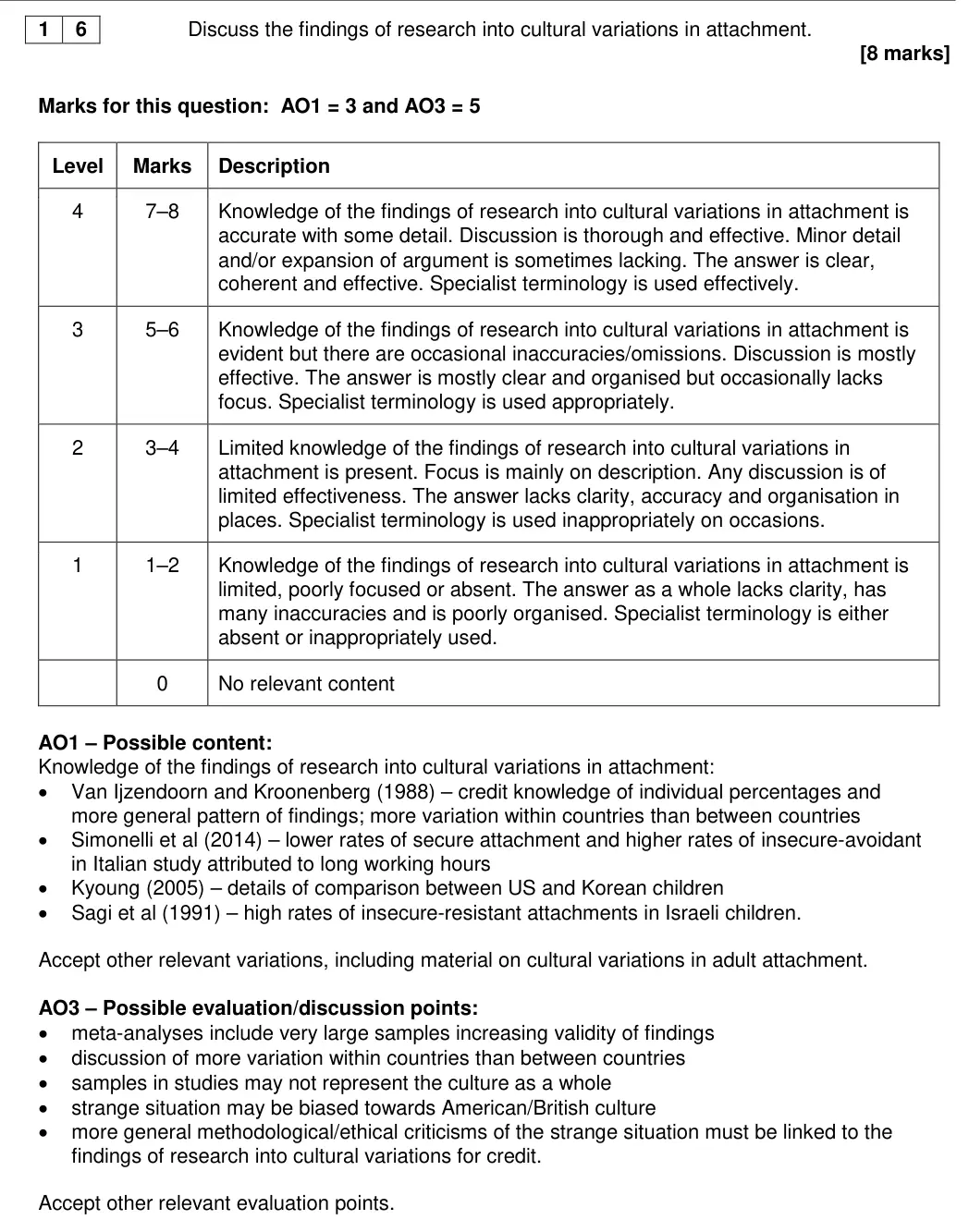
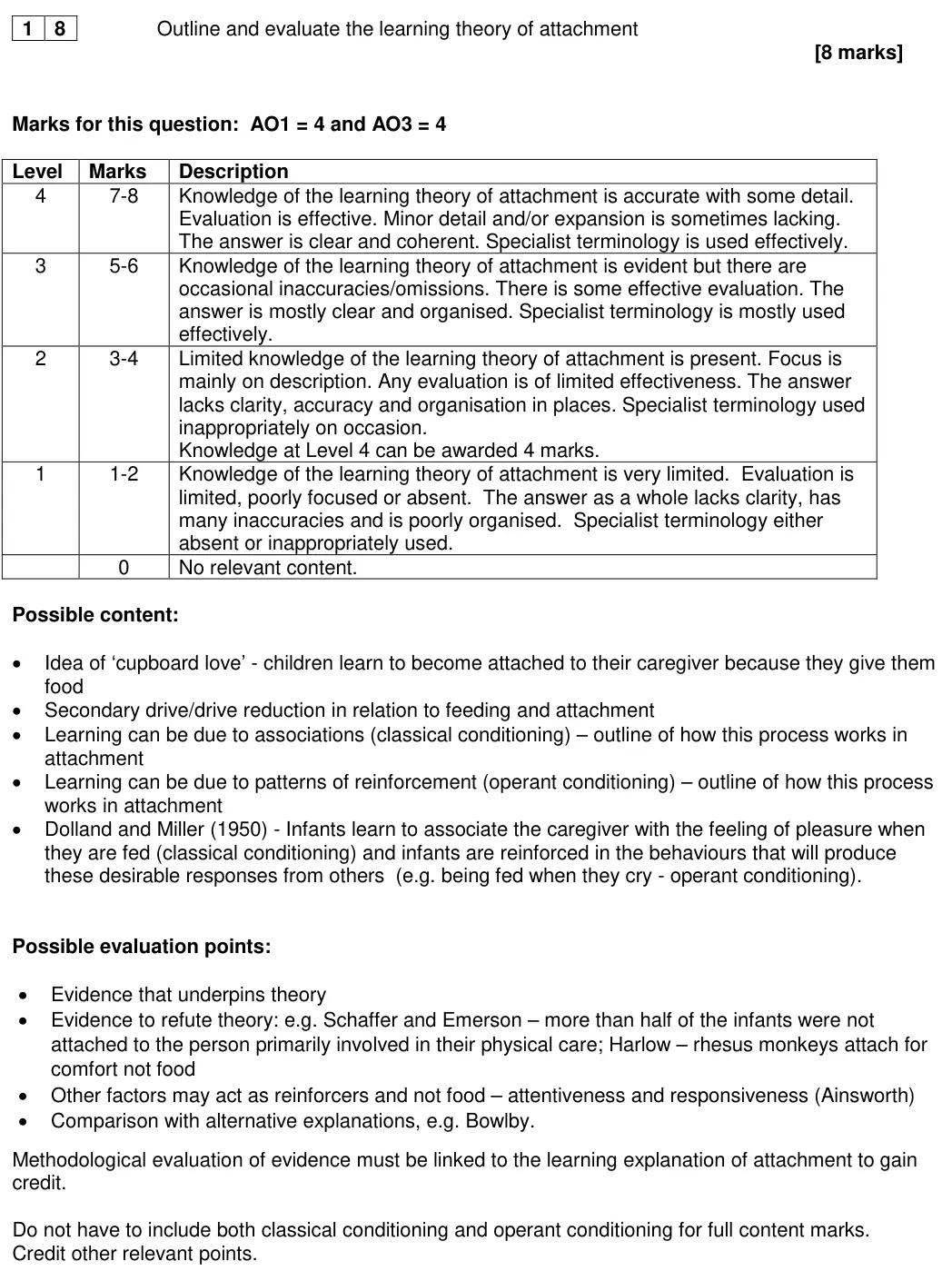
This was one of the least well answered questions on the paper with mean of 38% of the available marks. Whilst 30% of students produced level 3 and 4 answers, poorer responses tended to focus solely on description or contained no/limited effective discussion. Almost 16% of students scored no marks and 3% did not attempt the question. Some students simply provided a very brief and thus limited description. It is important to remind students that in these questions there should be an equal amount of knowledge and discussion/evaluation. The best discussion linked evidence to the theory and some students did this extremely well. It is important that students use appropriate classical/operant conditioning terminology here as this was required for top level responses. Some students used relevant terminology for the learning theory but used it incorrectly. It was pleasing to see fewer responses that did not focus their answer on how learning theory explained attachment and simply described the process of classical and/or operant conditioning. There were still students who continue to confuse learning theory with Bowlby’s theory of attachment, or gave details of Pavlov’s dog study, both of which were not creditworthy. This question was answered slightly better by students than the equivalent question last year, with 41% as opposed to 33% achieving half marks or more. This question provided the greatest discrimination across the paper.
Notes from the mark scheme and report
cupboard love, classical/operant conditioning, secondary drive linked to attachment
discussion via Harlow, Schaffer and Emerson, reductionism, determinism, Bowlby alternative
unlinked conditioning/Pavlov not credited
greatest discrimination on paper
June 2023 · Paper 1 · Q84 marksAO1=4Outline
Mark scheme, including level descriptors and indicative content
Examiner's comment
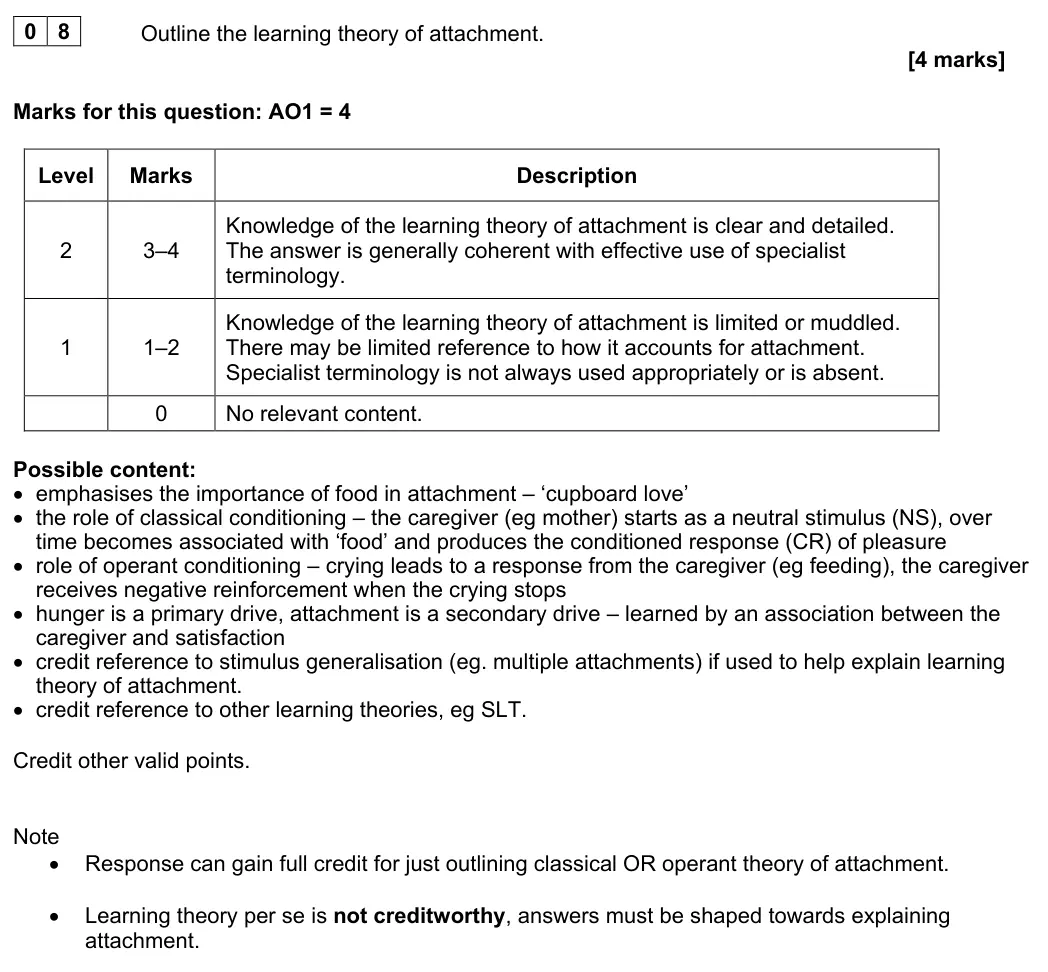
Many students were able to complete impressive and focused responses to this question. Often students cited classical and operant conditioning explanations of attachment, yet rarely did they mention Social Learning Theory. Students often utilised the correct terminology from behaviourism to explain attachment, which was often accompanied by a small appropriate diagram. Students were clearly well prepared for this area of the specification. A very small minority of students described learning theory without any reference to attachment, which often resulted in no marks.
Notes from the mark scheme and report
full marks possible for classical OR operant conditioning alone
describing learning theory with no reference to attachment scores nothing
June 2023 · Paper 1 · Q94 marksAO1=4Outline
Mark scheme, including level descriptors and indicative content
Examiner's comment
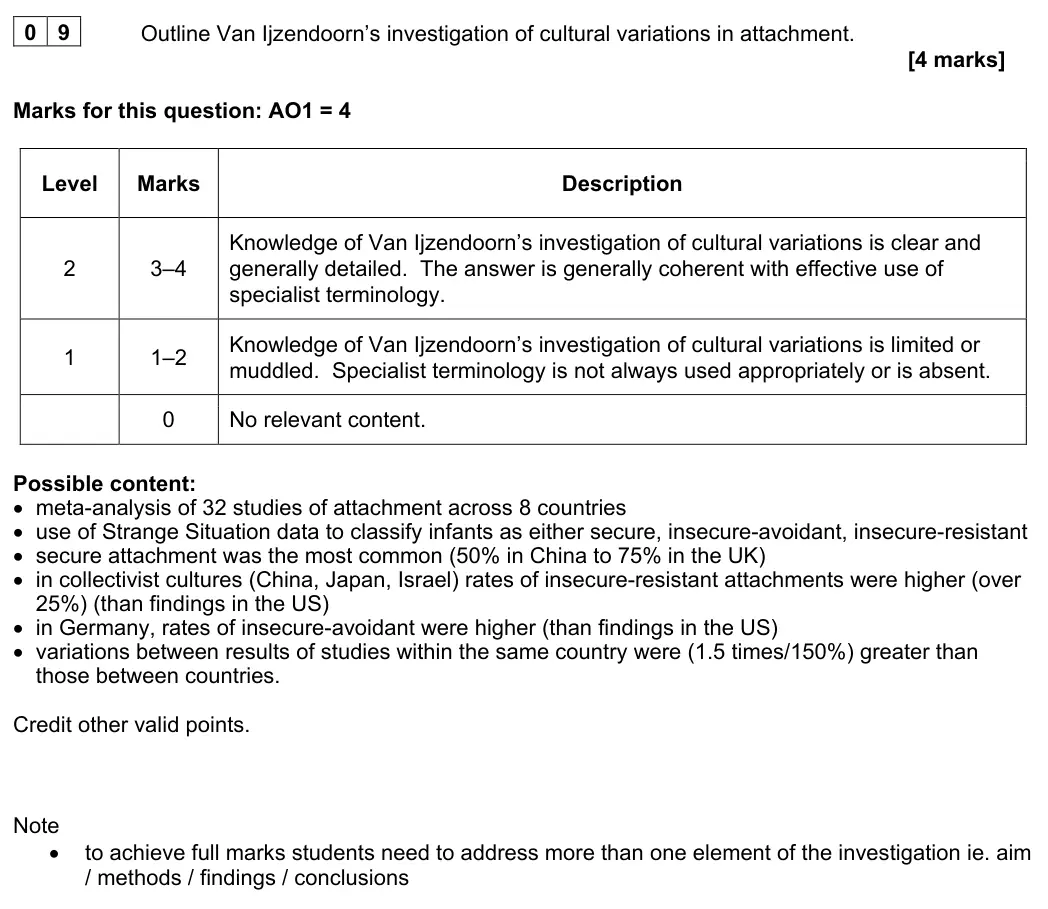
Although this type of question had not been seen before, many students were able to answer accurately with detail. Students were able to capture key components of the research in a concise way, often citing accurate percentages of attachment types. The best responses incorporated small amounts of procedural knowledge as well as several findings for the investigation. On occasion students confused the number of studies and/or countries that were included in this meta- analysis, as well as confusing the types of insecure attachments which were more common in specific countries. Students ought to be able to acknowledge that the most common attachment type in all countries is secure, as on occasion students were suggesting that either avoidant or resistant attachment types were the ‘most common’ in some countries. This misunderstanding can easily be corrected.
Notes from the mark scheme and report
needs more than one element (aim/method/findings/conclusion) for full marks
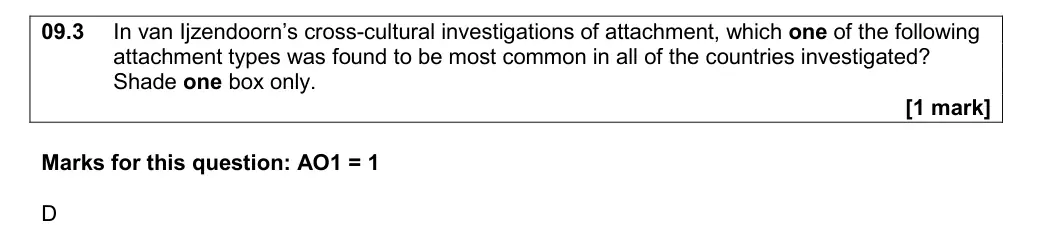
secure is the most common type in every country
muddling numbers of studies/countries
June 2023 · Paper 1 · Q1016 marksAO1=6, AO2=4, AO3=616-mark essay
Mark scheme, including level descriptors and indicative content
Examiner's comment
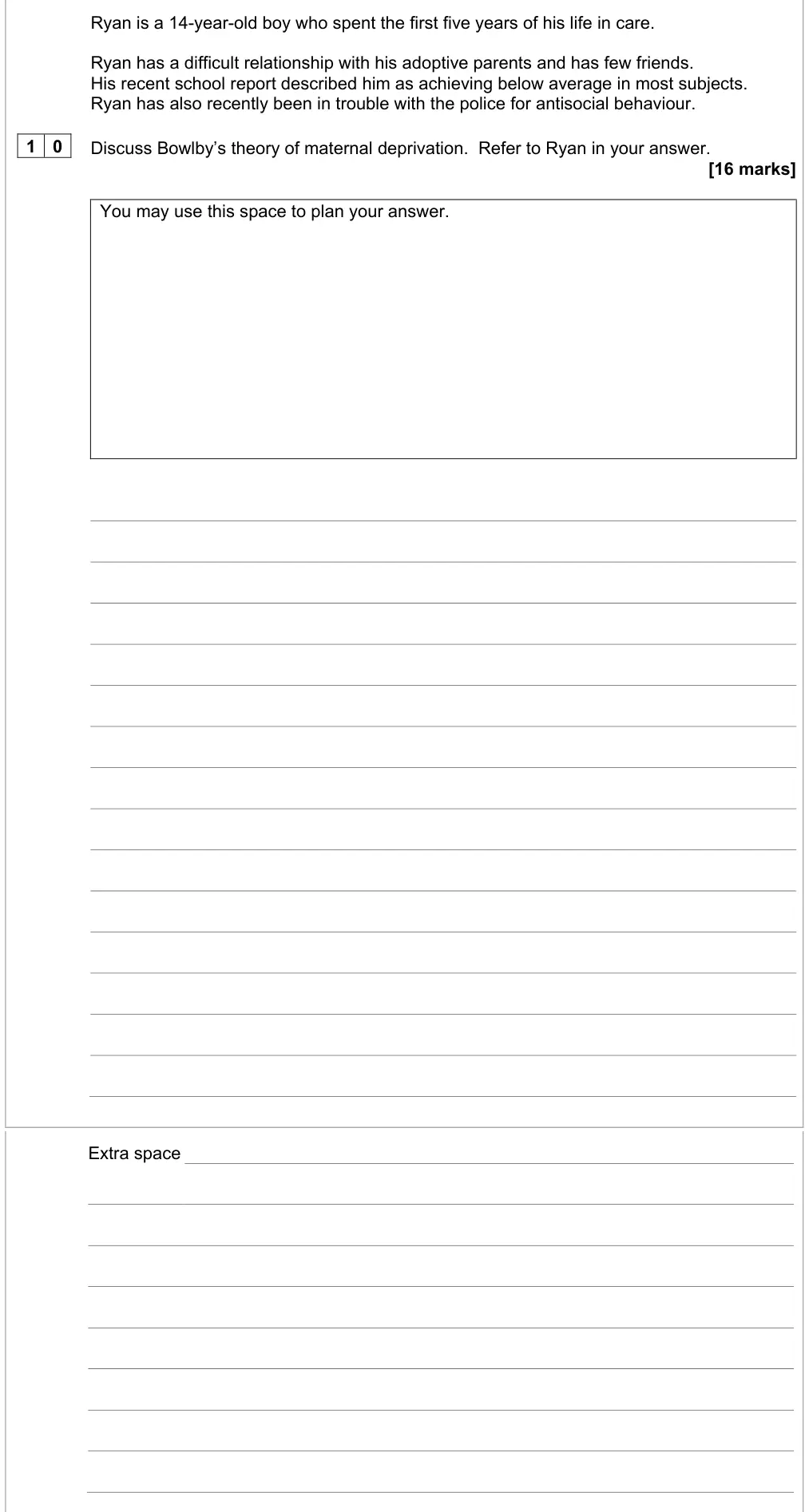
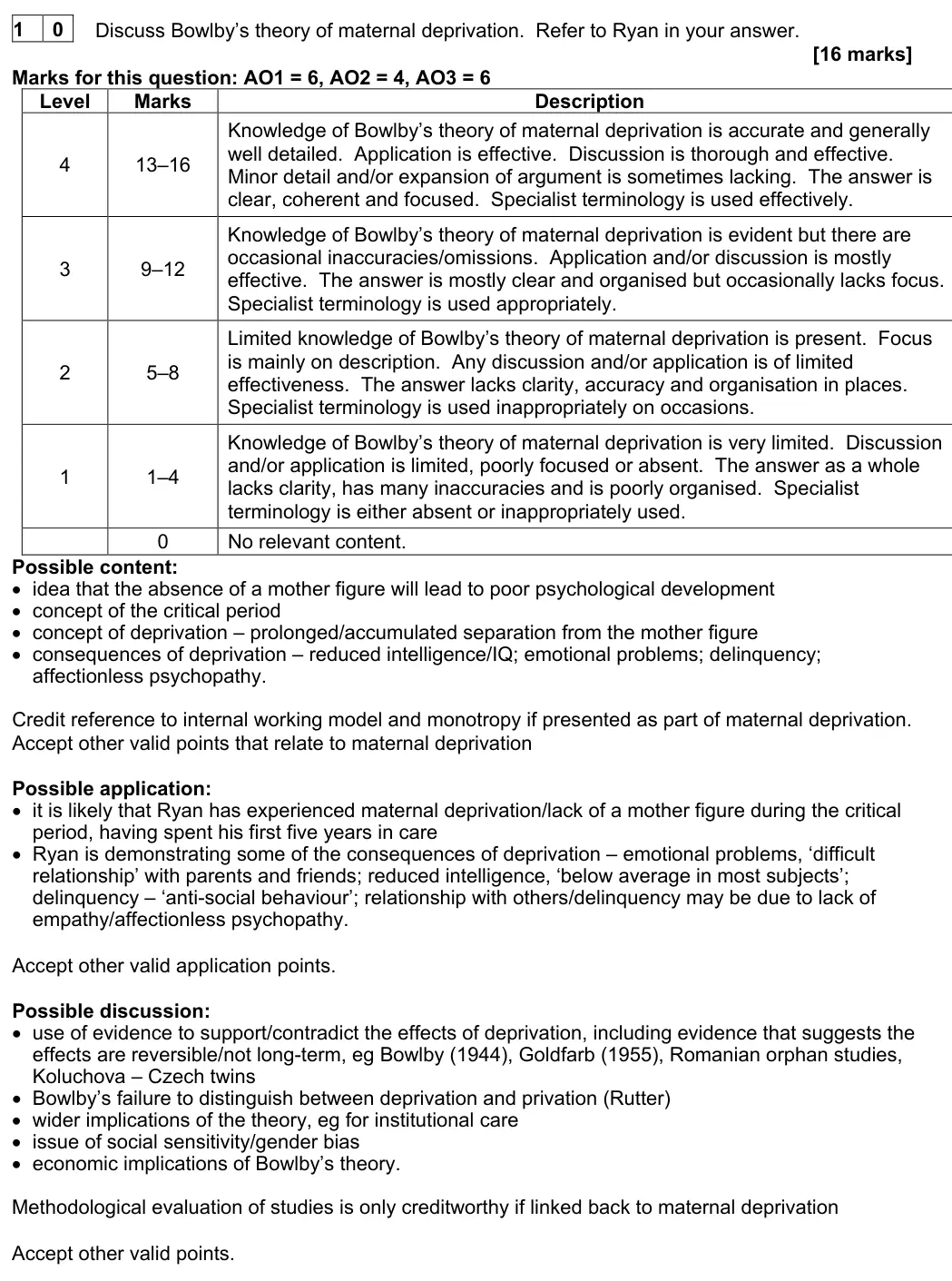
It appeared that students were well prepared for this question with many giving effective and detailed responses about Bowlby’s maternal deprivation hypothesis. This typically centred around the risks of missing the critical period, documented effects of maternal deprivation and accumulated separation from the mother figure. Further effective use of aspects of Bowlby’s work that were related to the consequences of maternal deprivation included an impaired internal working model and the continuity hypothesis. All the above was suitable to apply to the scenario and students typically completed this effectively. The discussion element of the question was also answered in an impressive manner. Useful commentary included various research evidence such as the use of Bowlby’s 44 juvenile thieves, Rutter’s work with Romanian orphans as well as contradictory evidence eg Koluchova’s work with the Czech twins. Furthermore, effective comments also included the socially sensitive nature of the maternal deprivation hypothesis and the multiple practical applications to come out of this work. On occasion, some students lost focus on the question and gave excessive details of research. This clearly impacted the time they had to complete the question. Students must always keep the wording of the questions in mind and make greater attempts to summarise research in a more concise manner.
Notes from the mark scheme and report
critical period, internal working model and monotropy credited only as part of maternal deprivation
methodological points only creditworthy if linked to maternal deprivation
over-long descriptions of research
June 2023 · AS Paper 1 · Q134 marksAO1=4Explain
Mark scheme, including level descriptors and indicative content
Examiner's comment
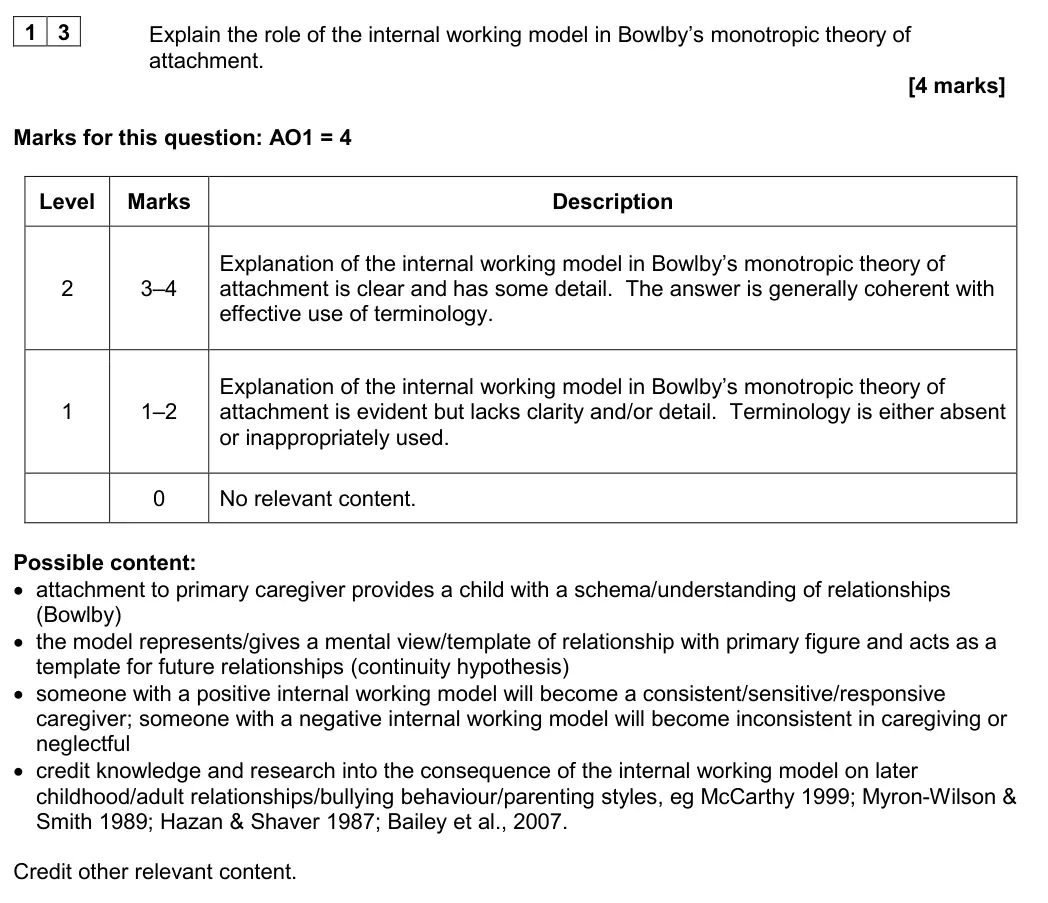
This question was a good discriminator of student responses. Many students appeared to have at least some knowledge of the internal working model (IWM) and its role in Bowlby’s monotropic theory. Good answers outlined what the IWM was, how it developed from the monotropic bond with the primary caregiver and linked it to later development. Some students described Bowlby’s monotropic theory and not the role of the IWM. Students should read questions carefully and would benefit from work identifying command and content words within questions, to enable greater focus in their answers. There were a number of students who did not attempt this question.
Notes from the mark scheme and report
IWM as schema/template from monotropic bond -> continuity into later relationships and parenting
describing monotropic theory without the IWM role
many blanks
June 2023 · AS Paper 1 · Q146 marksAO2=6Application
Mark scheme, including level descriptors and indicative content
Examiner's comment
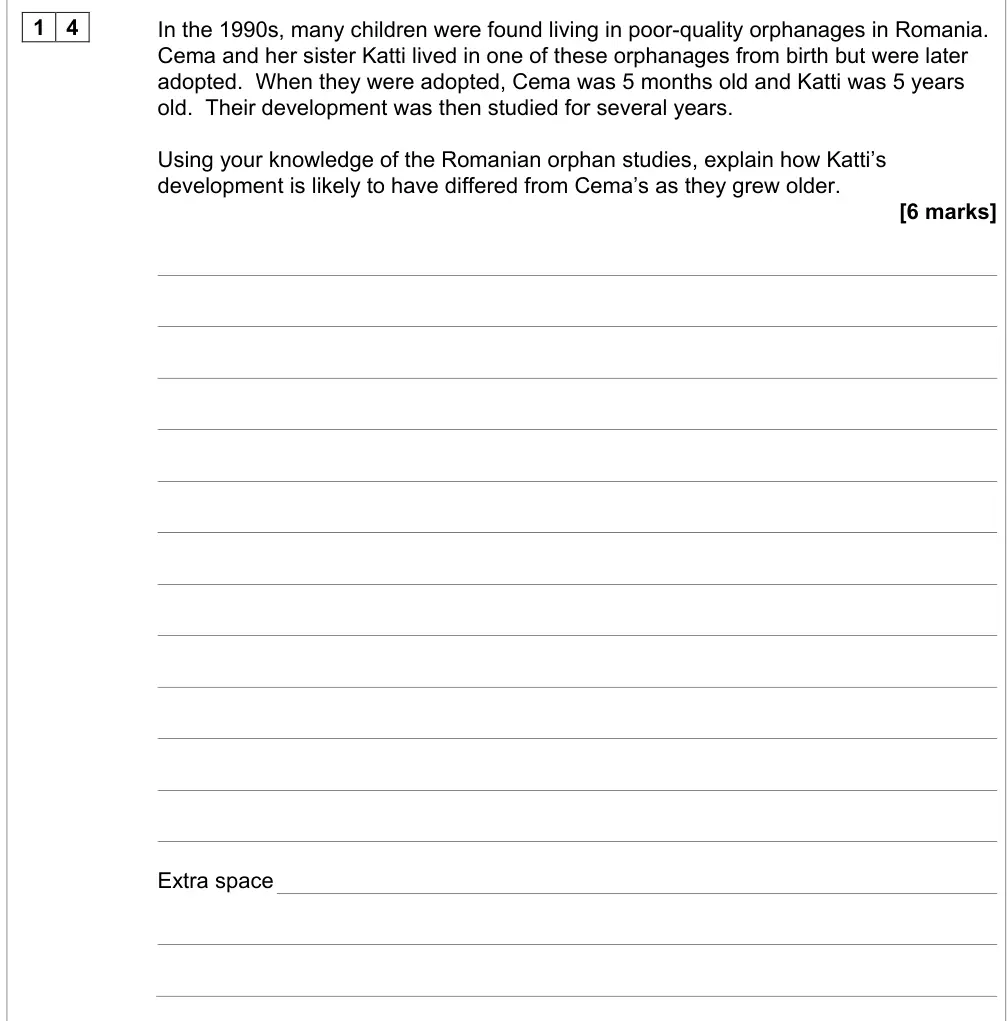
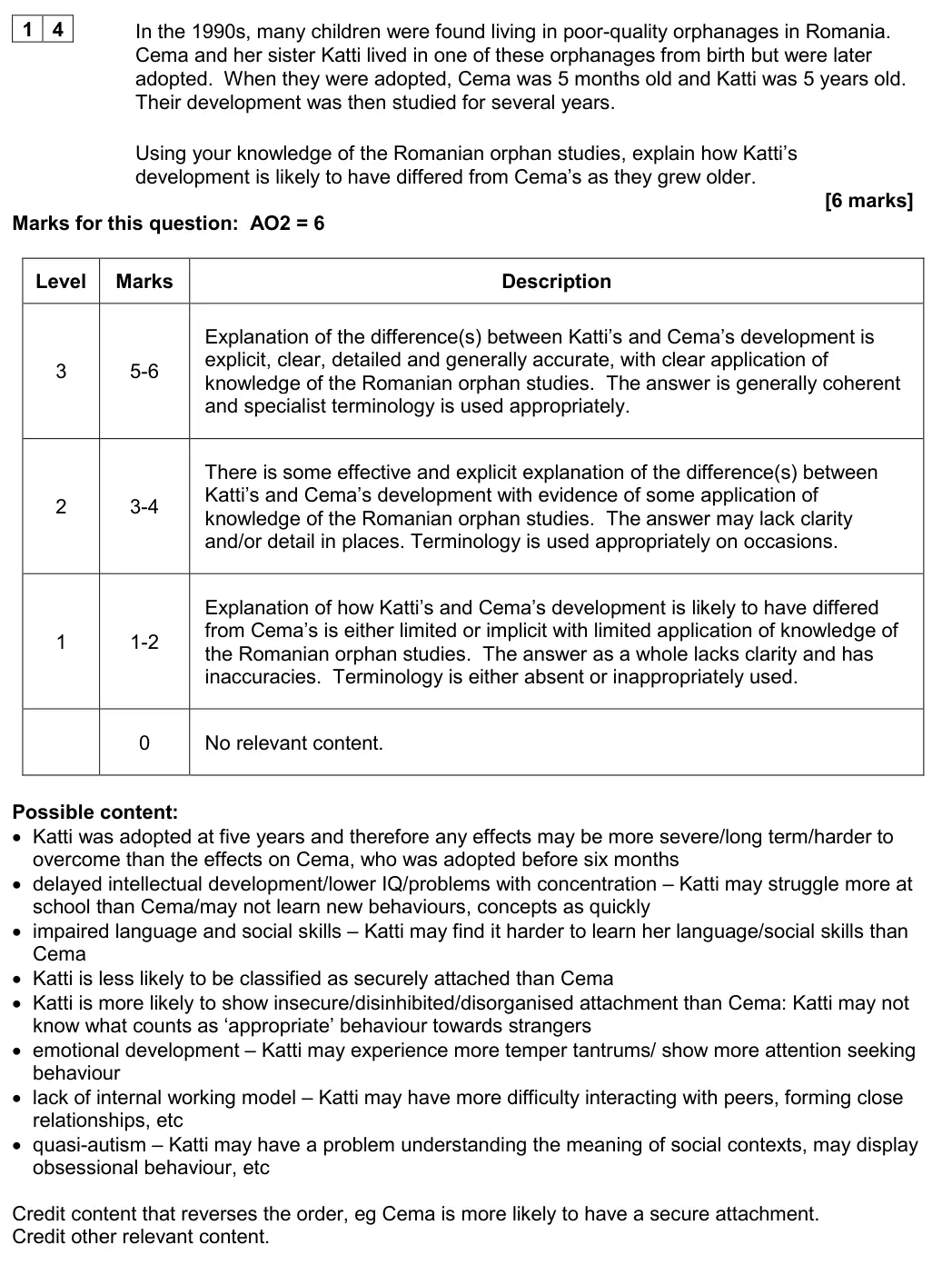
This appeared to be a relatively straightforward question with many students scoring at least half marks. There was clearly a good understanding of the findings from Romanian orphan studies. The best answers were able to fully address the demands of the question by explaining how the development of the girls would have differed, by making explicit comparisons. Weaker answers only explained how one child’s development would be affected. Some students only made one comparison which was too limited for this 6 mark question. Students should be mindful of the marks available and use this as a guide for how much they should write. A minority of answers gave long descriptions of the Romanian orphan studies which did not directly answer the question.
Notes from the mark scheme and report
Romanian orphan studies = ERA project in v1.4
explicit comparisons Katti (adopted at 5 years) vs Cema (5 months): IQ, disinhibited attachment, language/social skills, quasi-autism
one child only or one comparison limited
long study descriptions
June 2023 · AS Paper 1 · Q1612 marksAO1=6, AO3=6Extended writing
Mark scheme, including level descriptors and indicative content
Examiner's comment
This was one of the least well answered questions on the paper. Whilst some students produced level 3 and 4 answers, poorer responses tended to focus solely on description or contained no/limited effective discussion. Some students simply provided a very brief and thus limited description. It is important to remind students that in these questions there should be an equal amount of AO1 and AO3. The best discussion linked evidence to the theory and some students did this extremely well. It is important that students use appropriate classical/operant conditioning terminology here as this is required for top level responses. Some students used the appropriate terminology for the learning theory but used it incorrectly. It was pleasing to see fewer responses that did not focus their answer on how learning theory explained attachment and simply described the process of classical and/or operant conditioning. A small number of students confused learning theory with Bowlby’s theory of attachment, or gave details of Pavlov’s dog study, both of which were not creditworthy.
Notes from the mark scheme and report
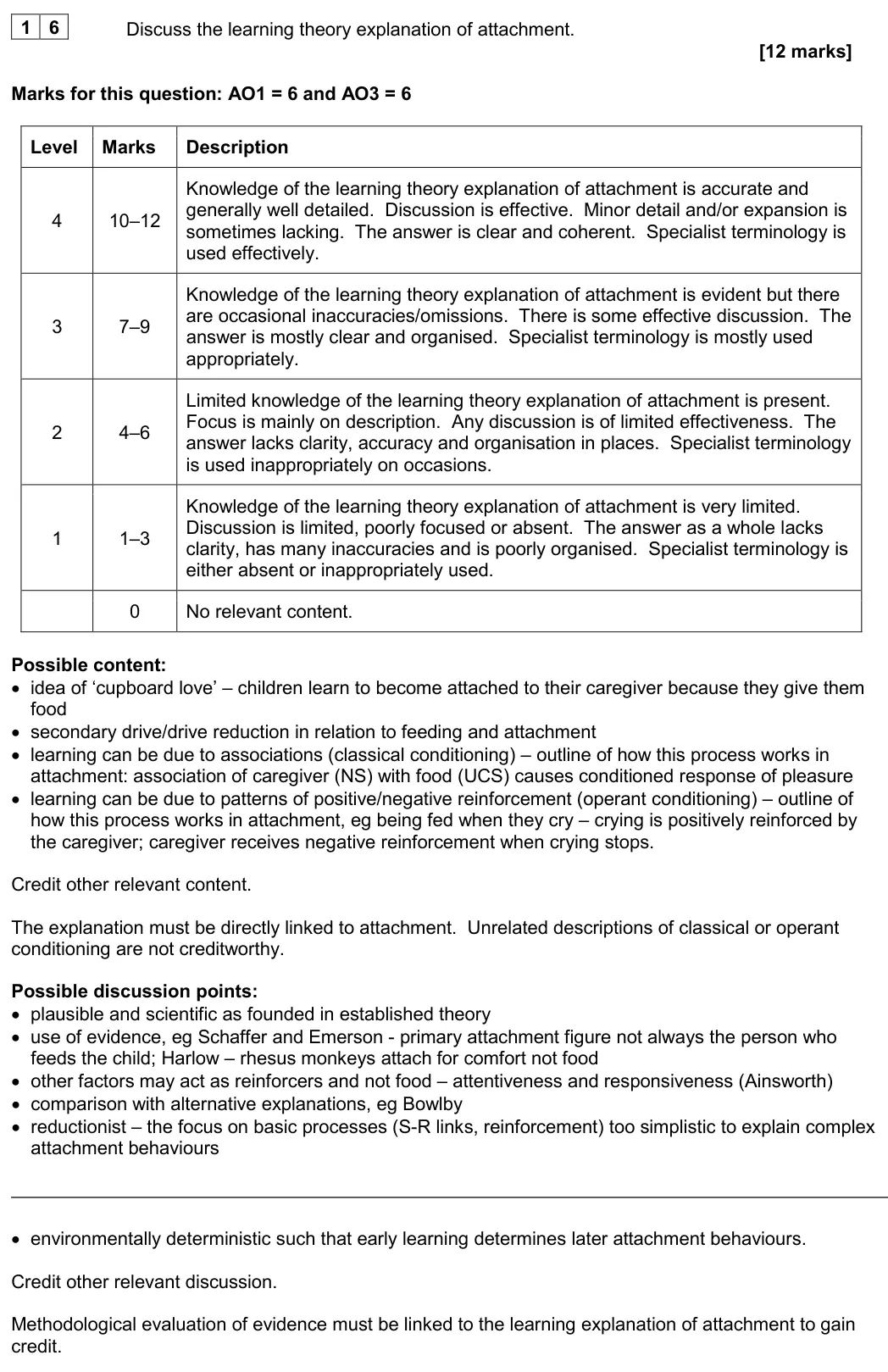
cupboard love, classical and operant conditioning linked to attachment
discussion via Harlow, Schaffer and Emerson, reductionism, determinism, Bowlby alternative
unlinked conditioning/Pavlov not credited
one of least well answered questions
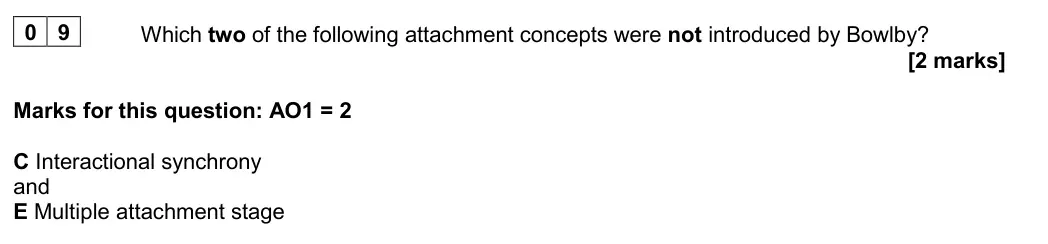
June 2022 · Paper 1 · Q92 marksAO1=2Multiple choiceOld spec only
Answer
C and E
Mark scheme, including level descriptors and indicative content
Examiner's comment
Along with Questions 01 and 02, 09 was the best answered on the paper.
Notes from the mark scheme and report
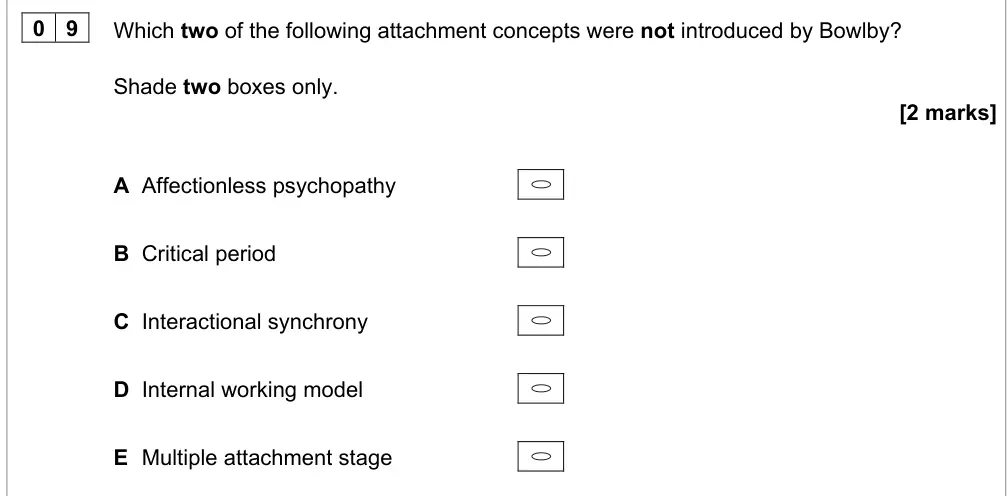
(correct answers C interactional synchrony and E multiple attachment stage, Schaffer's stages, are removed in v1.4
answerable by eliminating Bowlby's critical period, internal working model, affectionless psychopathy)
best-answered question
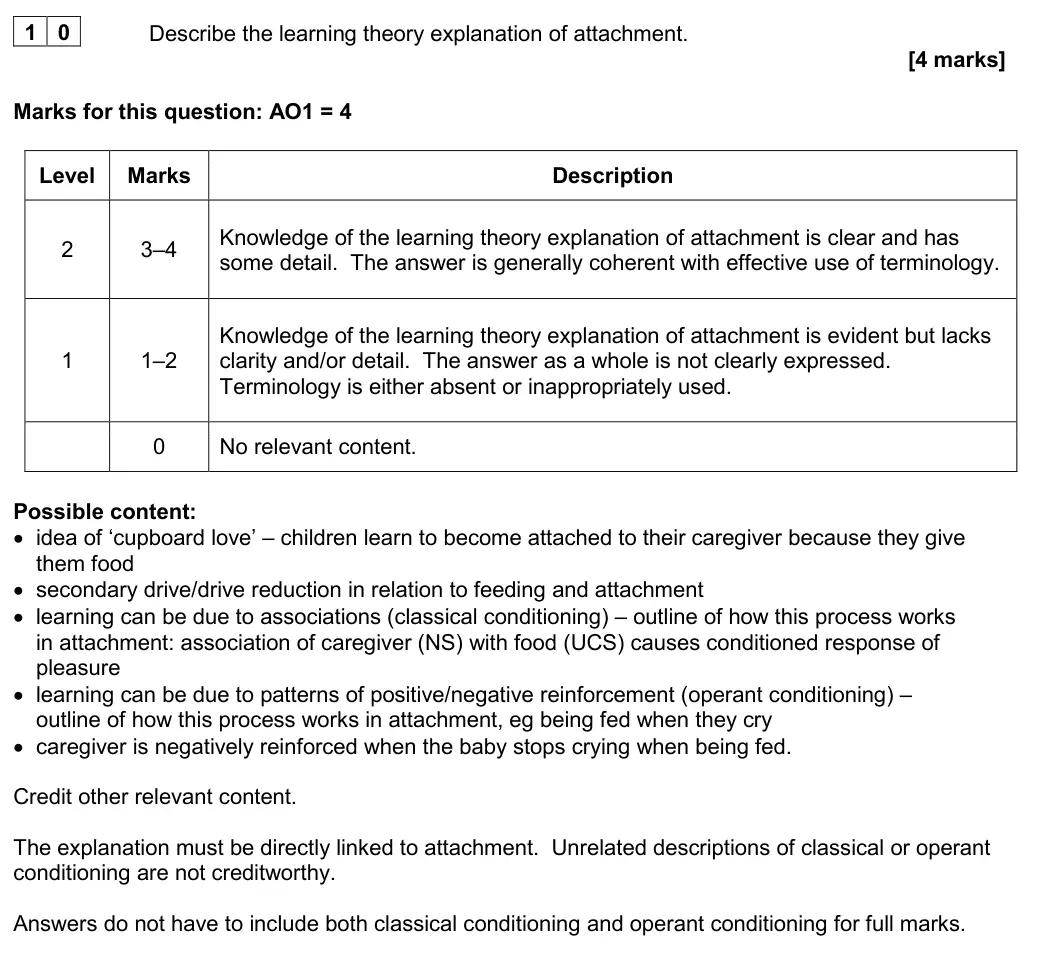
June 2022 · AS Paper 1 · Q104 marksAO1=4Outline
Mark scheme, including level descriptors and indicative content
Examiner's comment
Many students appeared to have a detailed and thorough knowledge of how learning theory explains attachment and used appropriate terminology in their answers. A significant minority of students did not focus their answer on how learning theory explained attachment and gave, what appeared to be, rote learnt responses which simply described the process of classical and/or operant conditioning. It was important for students to use appropriate classical/operant conditioning terminology in this question as this was required for top level responses. A small number of students confused learning theory with Bowlby’s theory of attachment or gave details of Pavlov’s dog study, both of which were not creditworthy.
Notes from the mark scheme and report
cupboard love, classical and/or operant conditioning linked directly to attachment
rote descriptions of conditioning or Pavlov not credited
one form of conditioning can gain full marks
June 2022 · Paper 1 · Q102 marksAO1=2Outline
Mark scheme, including level descriptors and indicative content
Examiner's comment
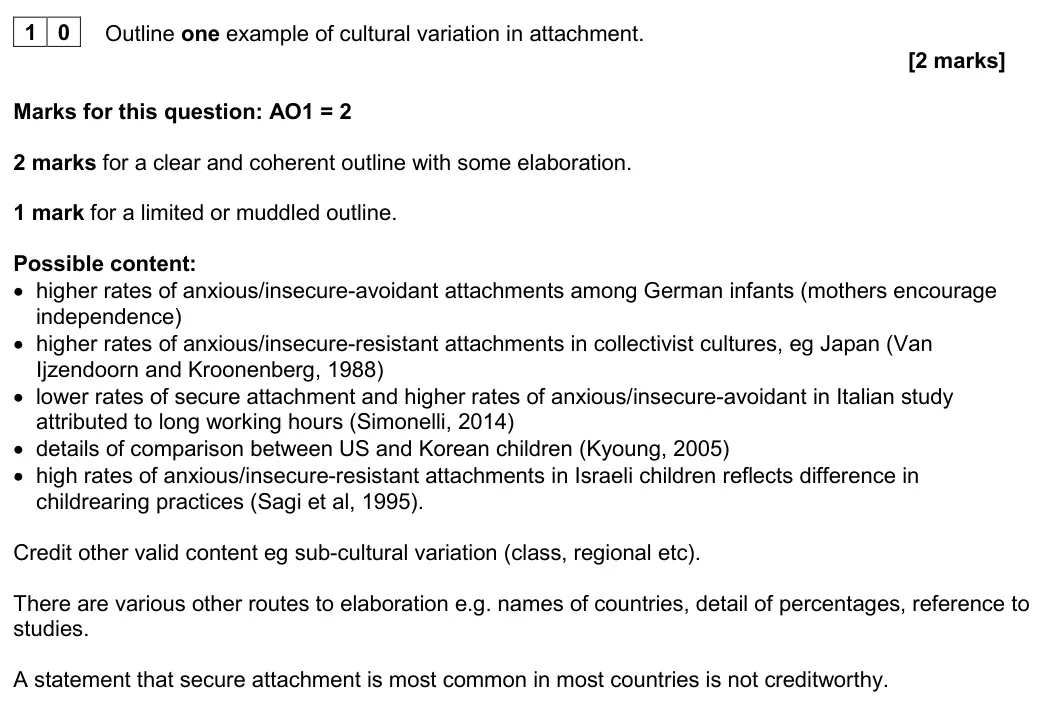
While answered well overall, the question asked for an example of cultural variation in attachment, so for two marks there needed to be some comparison made, for example between securely attached levels in China and in the UK. Some students simply stated that one country had high levels of, for example insecure resistant, without emphasising that they were the highest, or focusing on a comparison with other countries. An alternative means to elaboration was to link higher rates to cultural differences in childrearing.
Notes from the mark scheme and report
2 marks need a comparison (e.g. highest rate vs other countries) or link to childrearing
'secure most common in most countries' not creditworthy
June 2022 · AS Paper 1 · Q114 marksAO1=4Outline
Mark scheme, including level descriptors and indicative content
Examiner's comment
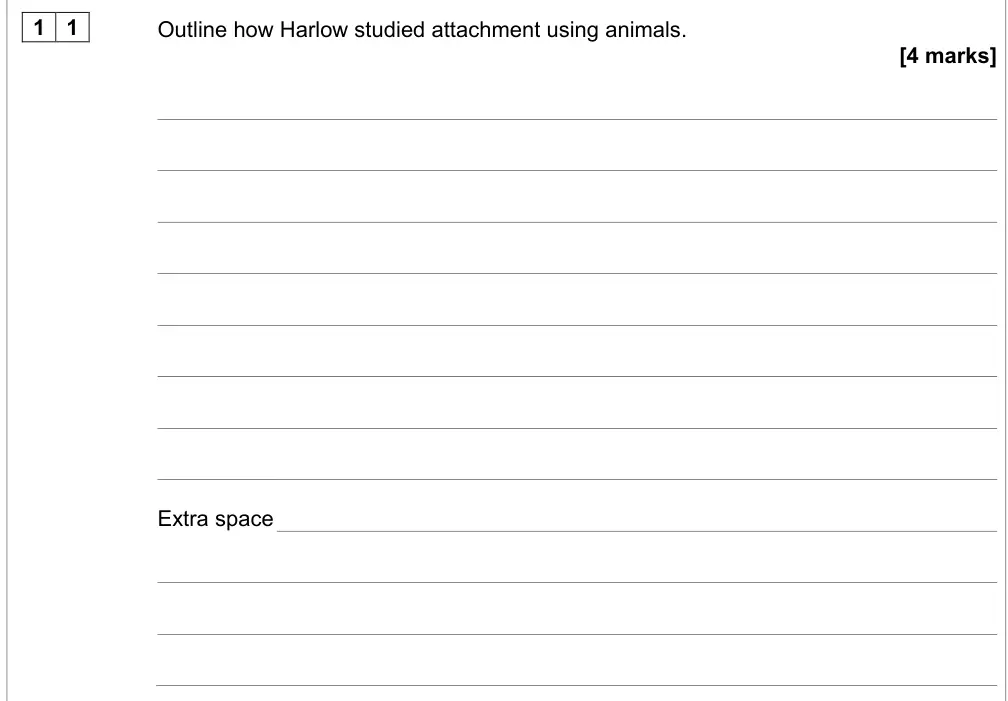
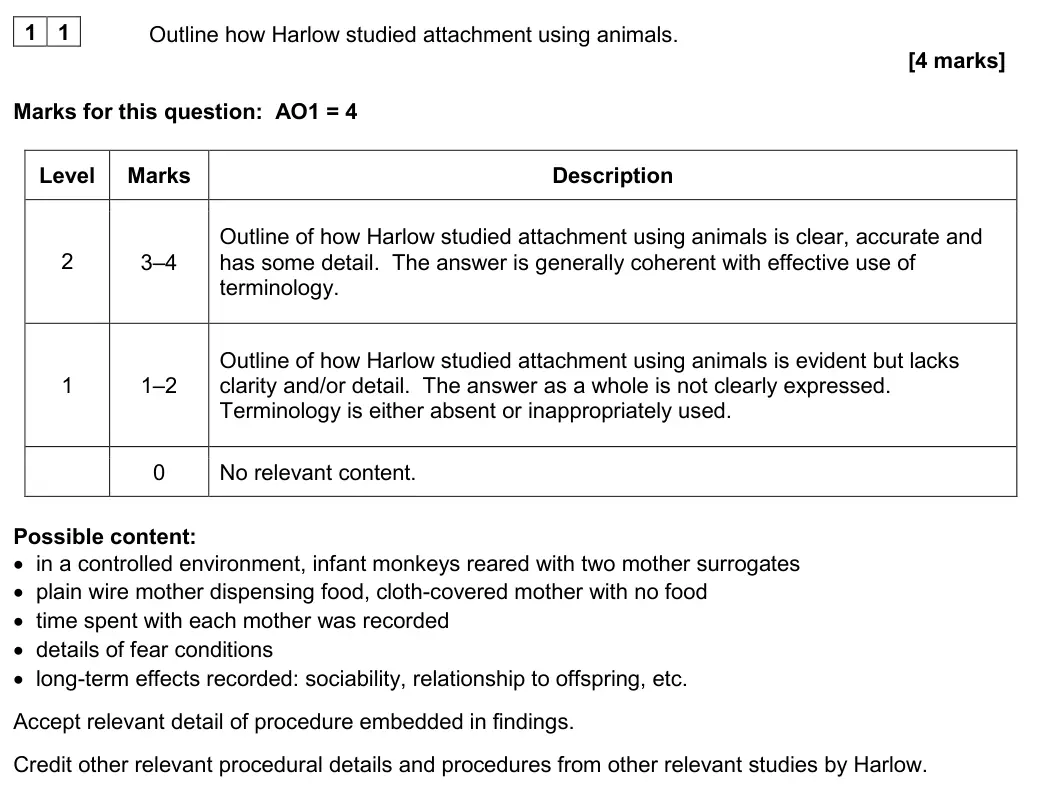
This appeared to be a relatively accessible question with many students scoring at least half marks. Student responses indicated there was clearly a good understanding of Harlow’s research. However, some students wrote everything they knew about the study and did not focus on the wording of the question: how he studied attachment. This meant many wasted time giving details that did not attract any credit.
Notes from the mark scheme and report
how Harlow studied attachment (wire vs cloth surrogates, time recorded, fear conditions, long-term effects)
everything-I-know answers wasted time
June 2022 · Paper 1 · Q114 marksAO2=4Application
Mark scheme, including level descriptors and indicative content
Examiner's comment
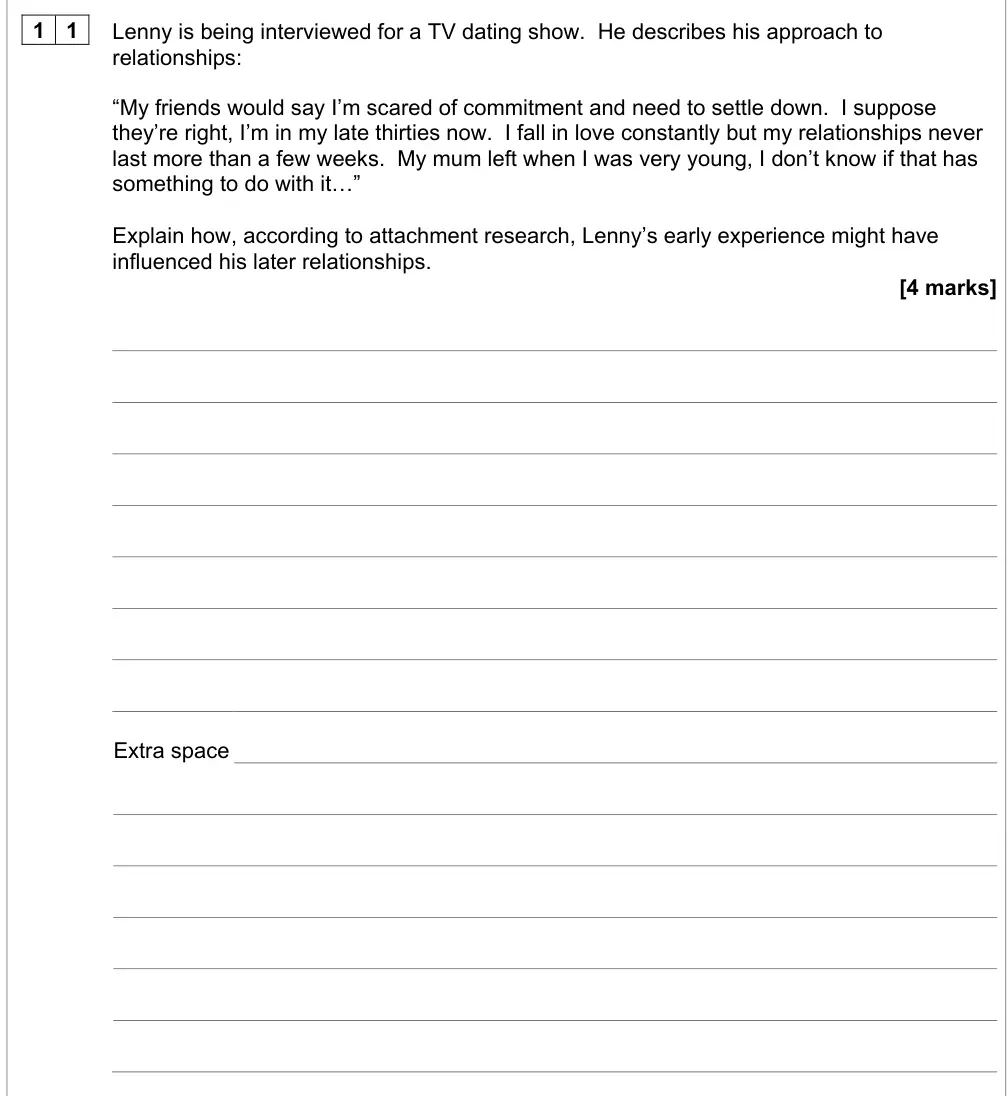
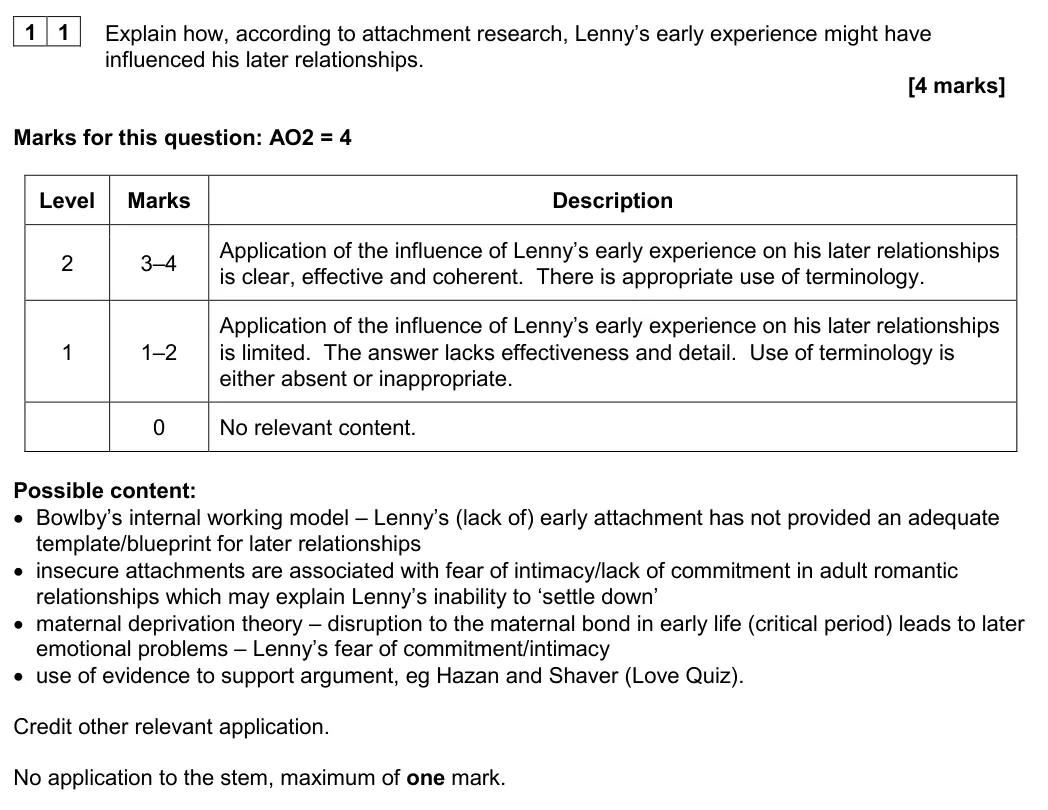
Rather like Question 03, most students could access some marks on this question, but the key to full marks was to provide specialist terminology and understanding. The internal working model was a popular explanation, though a few students implied that Lenny would not develop an IWM at all, rather than his having acquired one based on his early experience. Other approaches used maternal deprivation and insecure attachment as explanations. Hazan and Shaver’s study was occasionally used as effective elaboration.
Notes from the mark scheme and report
no application to Lenny = max 1
IWM, insecure attachment and fear of intimacy, maternal deprivation
some implied Lenny would have no IWM at all
June 2022 · AS Paper 1 · Q124 marksAO3=4Evaluate (short)
Mark scheme, including level descriptors and indicative content
Examiner's comment
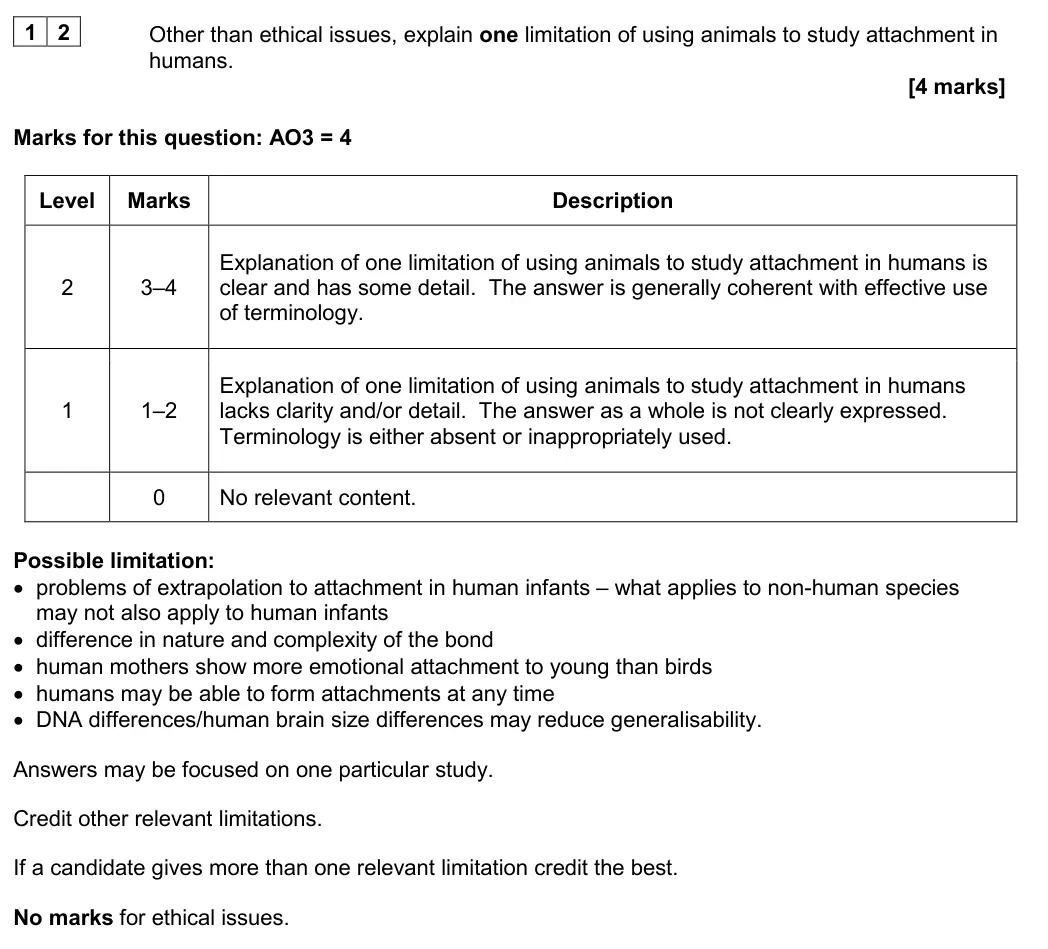
This question was relatively well answered with many students scoring level 2 marks. Some answers did not fully address the question, for example some students evaluated animal research but did not go on to explain why this was a limitation for understanding human attachment. It was pleasing to see that almost all students read the question carefully and only a very few offered an ethical issue in their answer.
Notes from the mark scheme and report
ethics excluded
extrapolation to human attachment, complexity of bond, brain differences
must explain why it limits understanding of HUMAN attachment
June 2022 · Paper 1 · Q1216 marksAO1=6, AO3=1016-mark essay
Mark scheme, including level descriptors and indicative content
Examiner's comment
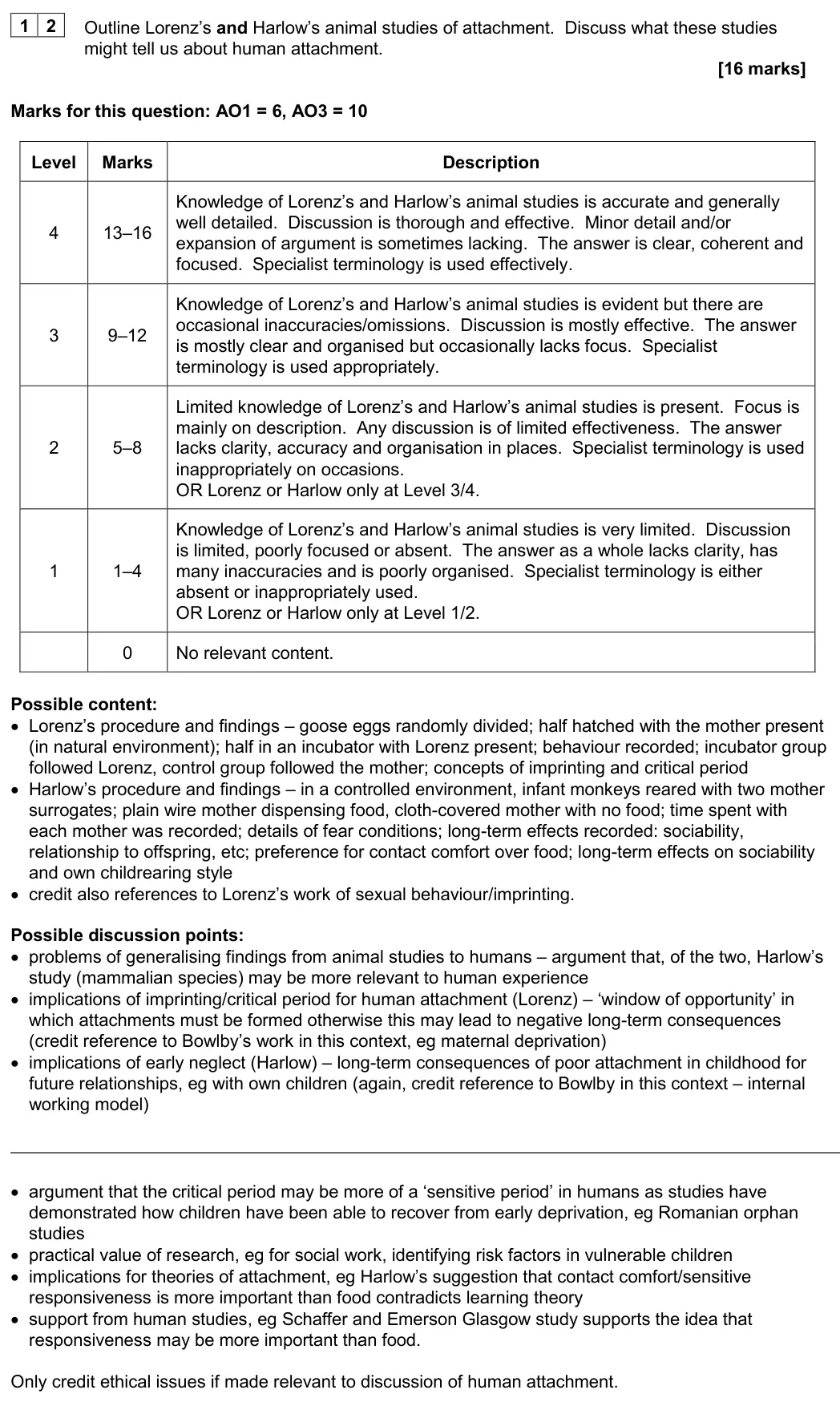
Perhaps the main message from students’ performances was seen in the three 16-mark essays. In Question 12 they were required to discuss what the work of Lorenz and Harlow might tell us about ‘human attachment’. Virtually all responses could describe the relevant research, in varying degrees of detail, but the AO3 requirement was a clear discriminator. Many students produced evaluation of the original studies (Milgram, Lorenz, Harlow), without linking that explicitly to the AO3 requirements in the questions. Virtually all answers provided some detail of the studies of Lorenz and Harlow. Accuracy of detail of Harlow was very variable. The question asked for discussion of what these studies tell us about human attachment, and this was a great discriminator. Many students focused on evaluation of the original studies without linking that to the question, with many quoting other studies of imprinting or being side-tracked into a discussion of ethical issues, which were rarely made relevant. Better answers referred to concepts such as critical periods, monotropy, maternal deprivation, long term consequences, internal working model, comfort versus learning theory, etc. Discussion was often justifiably critical, with species differences being a popular point with the better answers detailing this through reference to phylogeny and genetics. While there was occasional irrelevant reference to improved treatment of animals in zoos, some answers did refer to identifying risk factors in vulnerable children and improved care for babies and children. But overall, there was a common failure to link the findings of Lorenz and Harlow to theories of human attachment.
Notes from the mark scheme and report
Lorenz or Harlow only = max Level 2
discussion must link to human attachment (critical period, IWM, contact comfort vs learning theory)
ethics only if linked to human attachment
many evaluated the studies without linking to humans
MS also credits Schaffer and Emerson support, removed in v1.4
June 2022 · AS Paper 1 · Q134 marksAO3=4Explain
Mark scheme, including level descriptors and indicative content
Examiner's comment
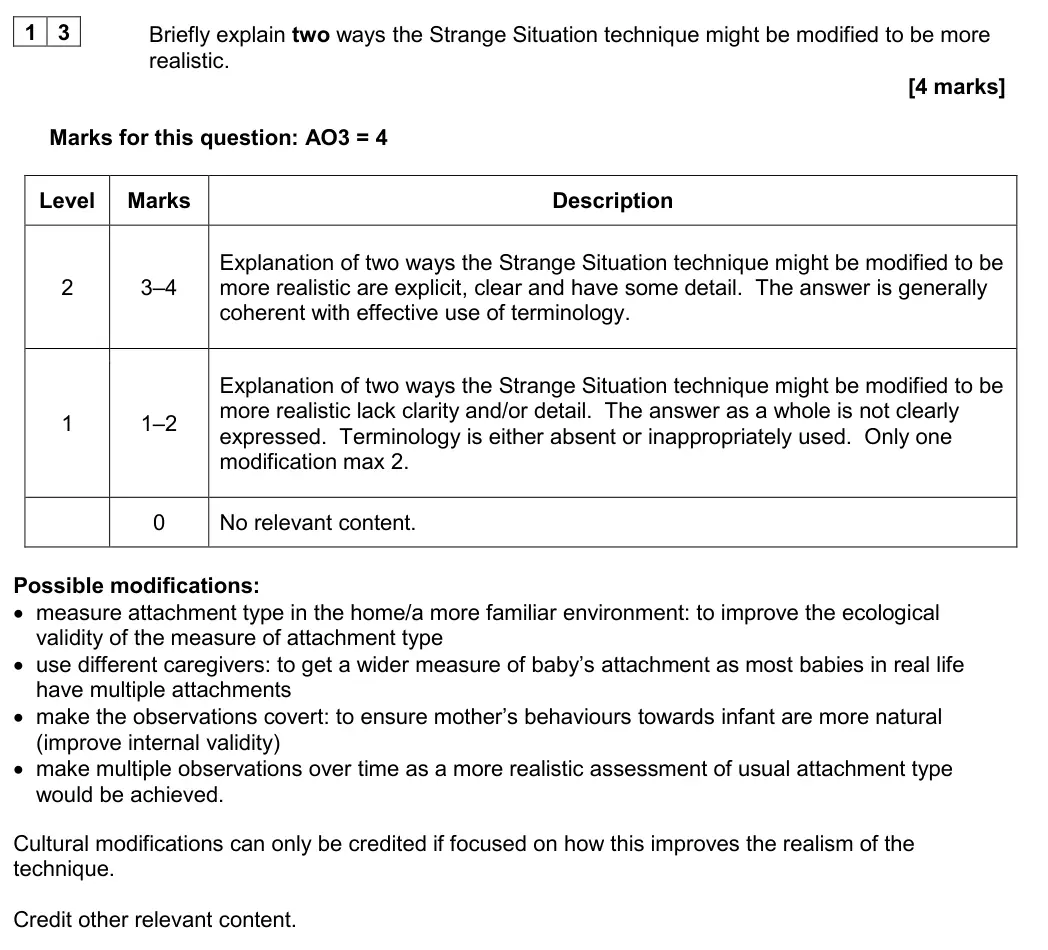
Most students were able to give some accurate explanation of at least one way of modifying the strange situation technique to make it more realistic. Many students focused on changing the setting to a more natural environment like the home. However, only a minority of students were able to give two suggestions. Other students incorrectly evaluated the strange situation without giving any modifications. Some suggestions were inappropriate or not focused on modifying the technique. A small minority of students did not attempt the question.
Notes from the mark scheme and report
two modifications to increase realism (home setting/ecological validity, covert observation, repeated observations, different caregivers)
one only = max 2
evaluating without modification not credited
MS rationale for 'different caregivers' cites multiple attachments (removed in v1.4)
June 2022 · AS Paper 1 · Q148 marksAO1=4, AO3=4Extended writing
Mark scheme, including level descriptors and indicative content
Examiner's comment
Some wrote much more than was required, which was particularly noticeable in questions 4, 8 and 14. However, others wrote very little and did not include sufficient detail, particularly in questions 9 and 14. Performance on questions 4, 9 and 14 suggested that many students should work to improve the higher order skills of evaluation/discussion. It was pleasing to note that nearly all students attempted this question and therefore did not run out of time on the paper. A good range of responses were seen across the cohort with many students producing level 3 and 4 answers. These responses tended to accurately describe Bowlby’s theory of maternal deprivation with some detail and also included some effective discussion. Poorer responses tended to focus solely on description or contained no/limited discussion. Some students simply provided a very brief and thus limited description. Some students focused on Bowlby’s attachment theory which did not fully address the question. The best discussion linked evidence to specific assumptions of the theory and some students did this extremely well.
discussion via Lewis, Rutter/ERA, privation vs deprivation, hospital care
methodological evaluation only if linked to the theory
some wrote Bowlby's attachment theory instead
MS also credits Schaffer's multiple attachments (removed in v1.4)
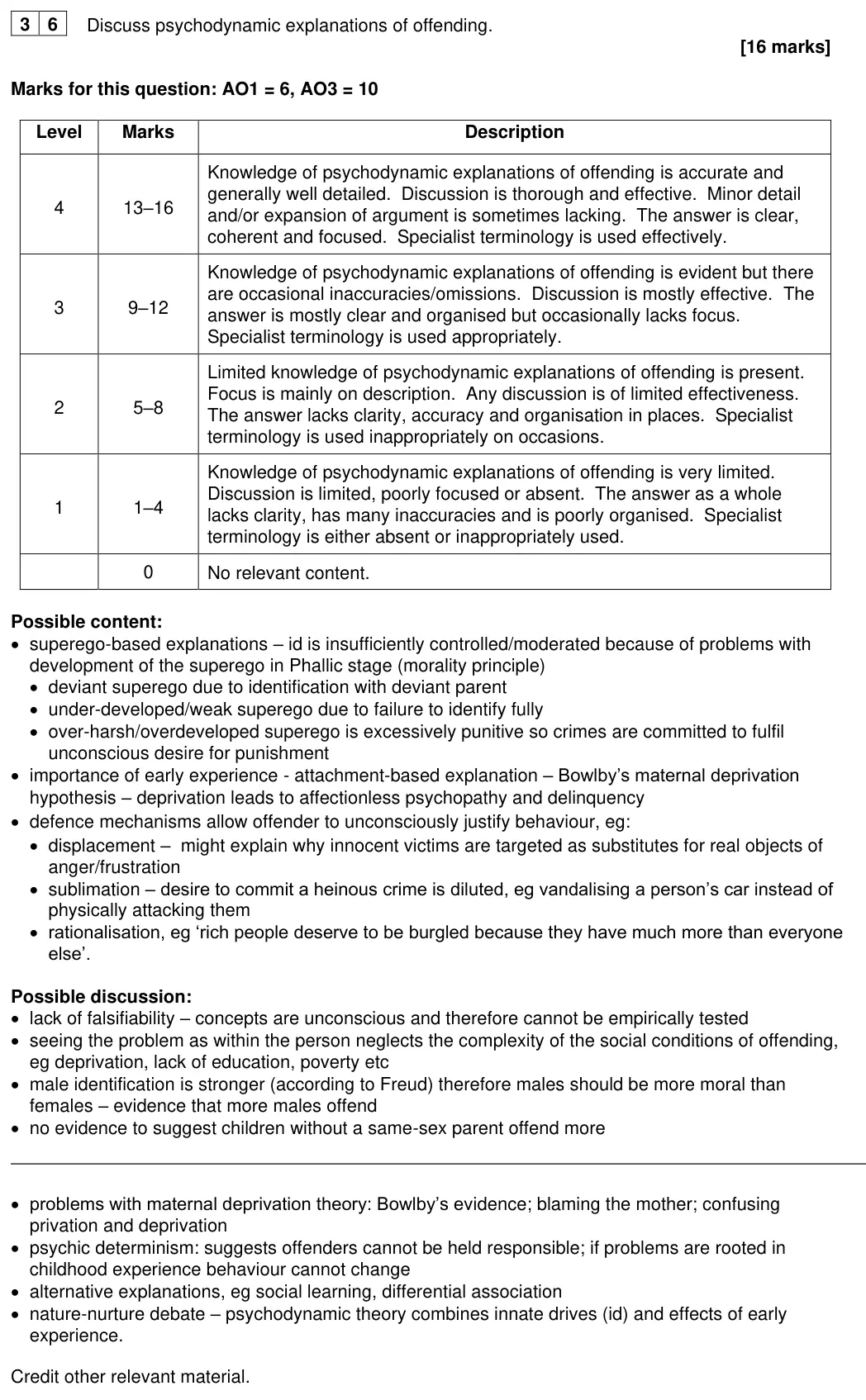
June 2022 · Paper 3 · Q3616 marksAO1=6, AO3=1016-mark essayOld spec only
Not on the 2025 specification: psychodynamic explanations of offending: Blackburn's superego types, maternal deprivation, defence mechanisms, removed in v1.4
Mark scheme, including level descriptors and indicative content
Examiner's comment
Descriptions of how psychodynamic theory might be used to explain offending varied in detail and depth of understanding. Many students could name Blackburn’s three types of superego, but explanations often sounded more like social learning theory, reinforcement and differential association than the Freudian conceptualisation of identification as an unconscious process. A fair number of students wrote about Eysenck’s theory of the criminal personality instead. Discussion points were often not very convincing, although falsifiability was usually well argued.
Notes from the mark scheme and report
Off-spec: psychodynamic explanations of offending: Blackburn's superego types, maternal deprivation, defence mechanisms, removed in v1.4
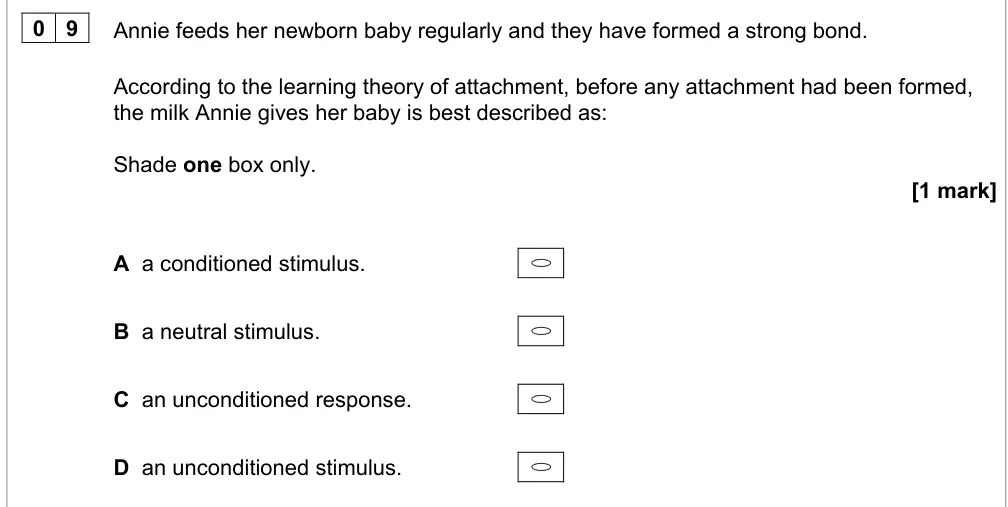
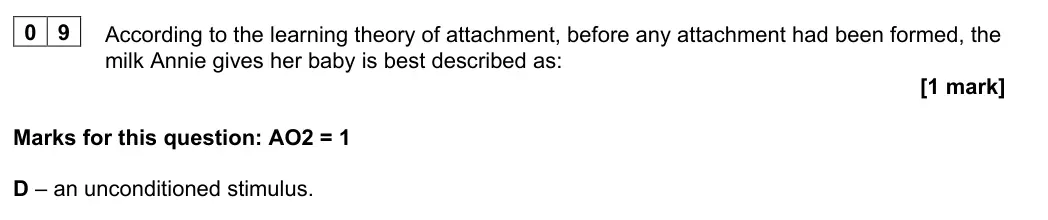
November 2021 · Paper 1 · Q91 markAO2=1Multiple choice
Answer
D
Mark scheme, including level descriptors and indicative content
Notes from the mark scheme and report
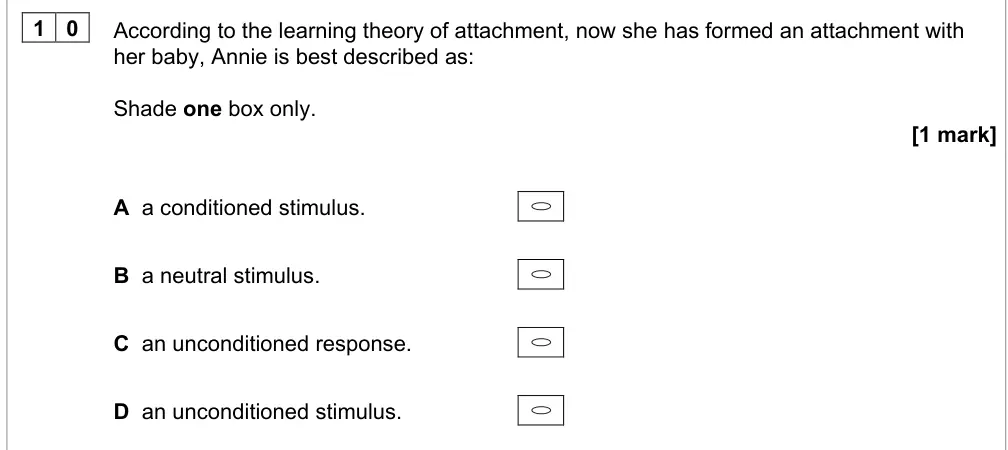
correct answer D (unconditioned stimulus)
needs classical conditioning terms within learning theory of attachment
November 2021 · Paper 1 · Q101 markAO2=1Multiple choice
Answer
A
Mark scheme, including level descriptors and indicative content
Notes from the mark scheme and report
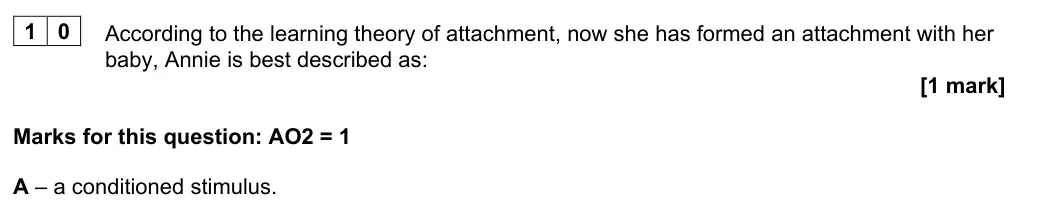
correct answer A (conditioned stimulus)
November 2021 · Paper 1 · Q112 marksAO1=2Outline
Mark scheme, including level descriptors and indicative content
Examiner's comment
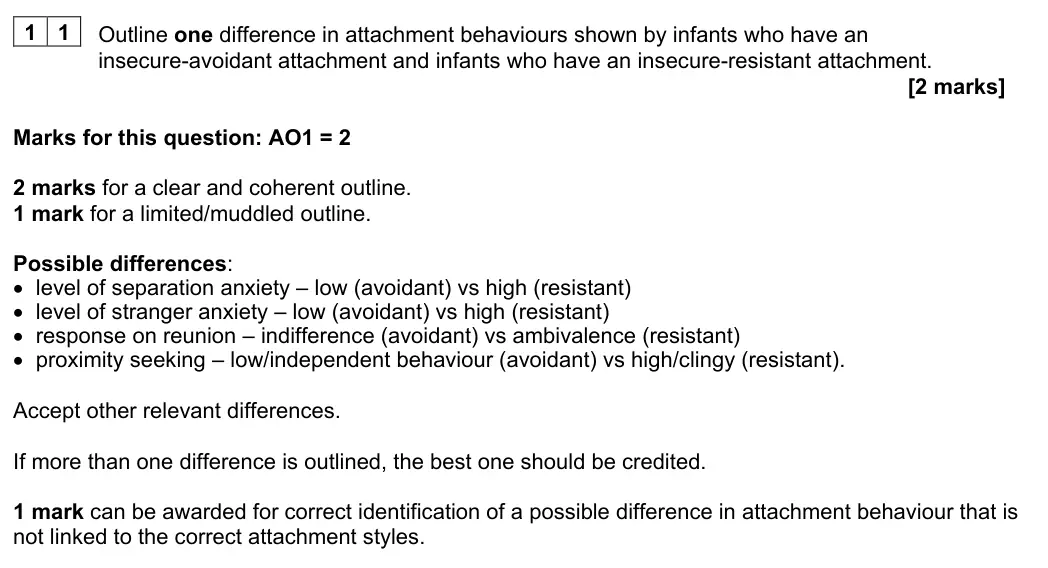
Accessible question answered well. Some students had the two attachment styles the wrong way around, but could receive a mark for an accurate difference.
Notes from the mark scheme and report
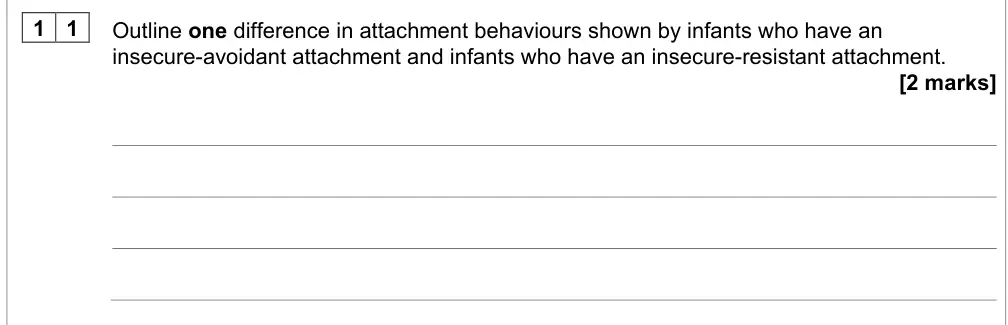
one difference only (best credited): separation/stranger anxiety, reunion behaviour, proximity seeking
1 mark if difference not linked to the correct styles
some had the two styles the wrong way round
November 2021 · Paper 1 · Q125 marksAO3=5Evaluate (short)
Mark scheme, including level descriptors and indicative content
Examiner's comment
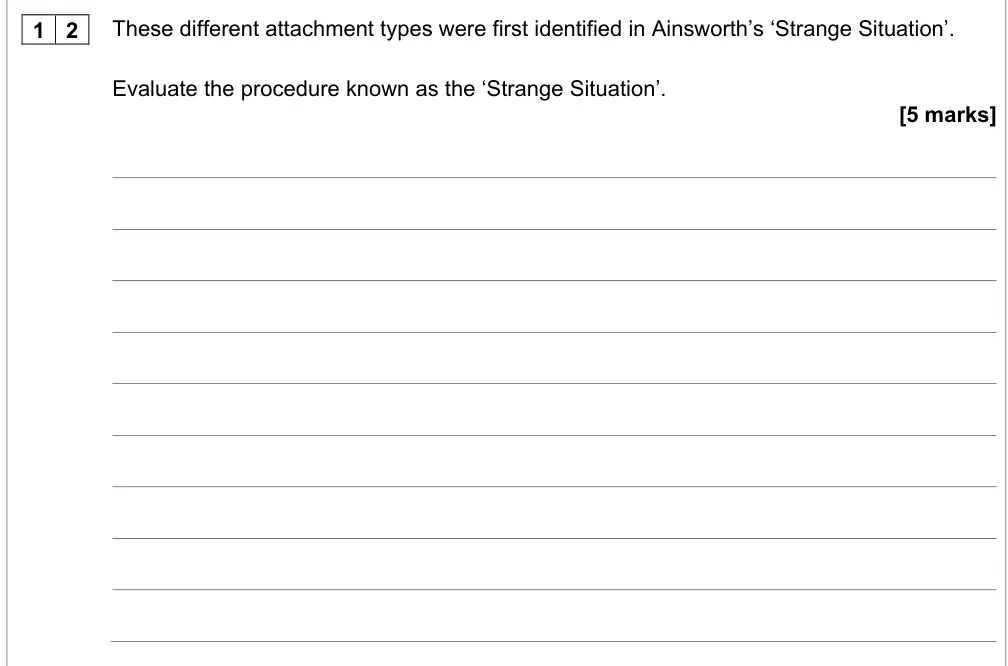
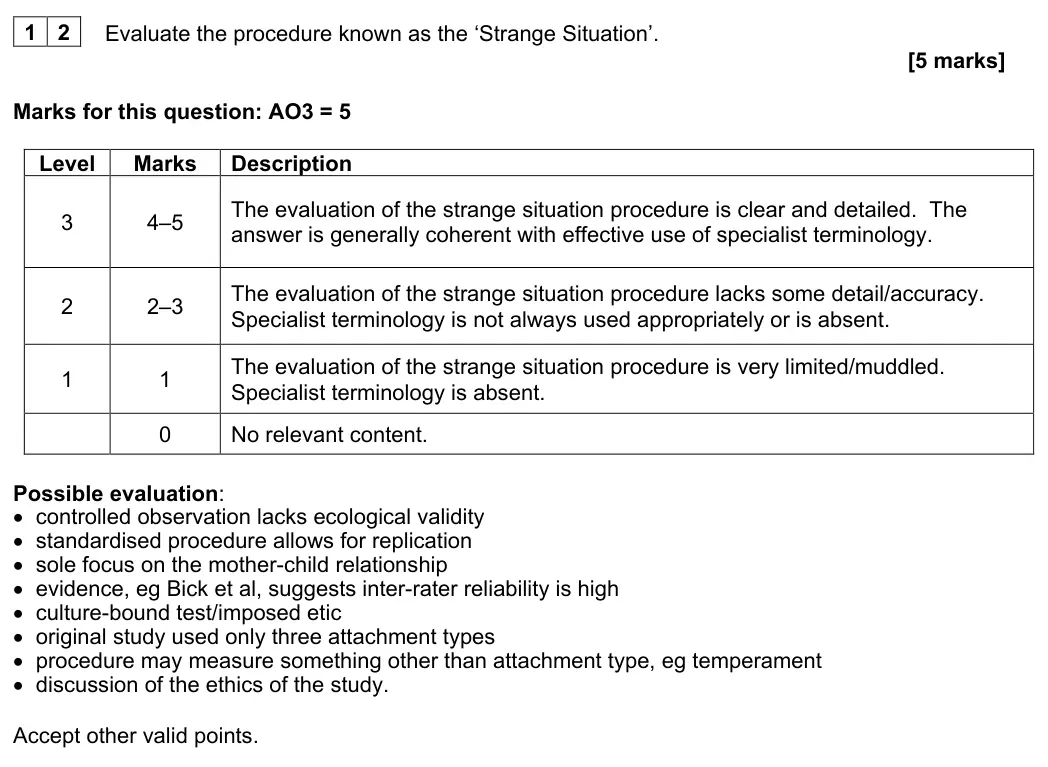
Some very good answers covering control and reliability, demand characteristics, focus just on the mother, and cultural and ethical issues. Some students presented procedural details and/or findings, which were not relevant.
Notes from the mark scheme and report
evaluation of the procedure only: ecological validity, standardisation, inter-rater reliability, culture-bound/imposed etic, temperament, ethics
procedural details/findings not relevant
November 2021 · Paper 1 · Q148 marksAO1=3, AO2=2, AO3=3Extended writing
Mark scheme, including level descriptors and indicative content
Examiner's comment
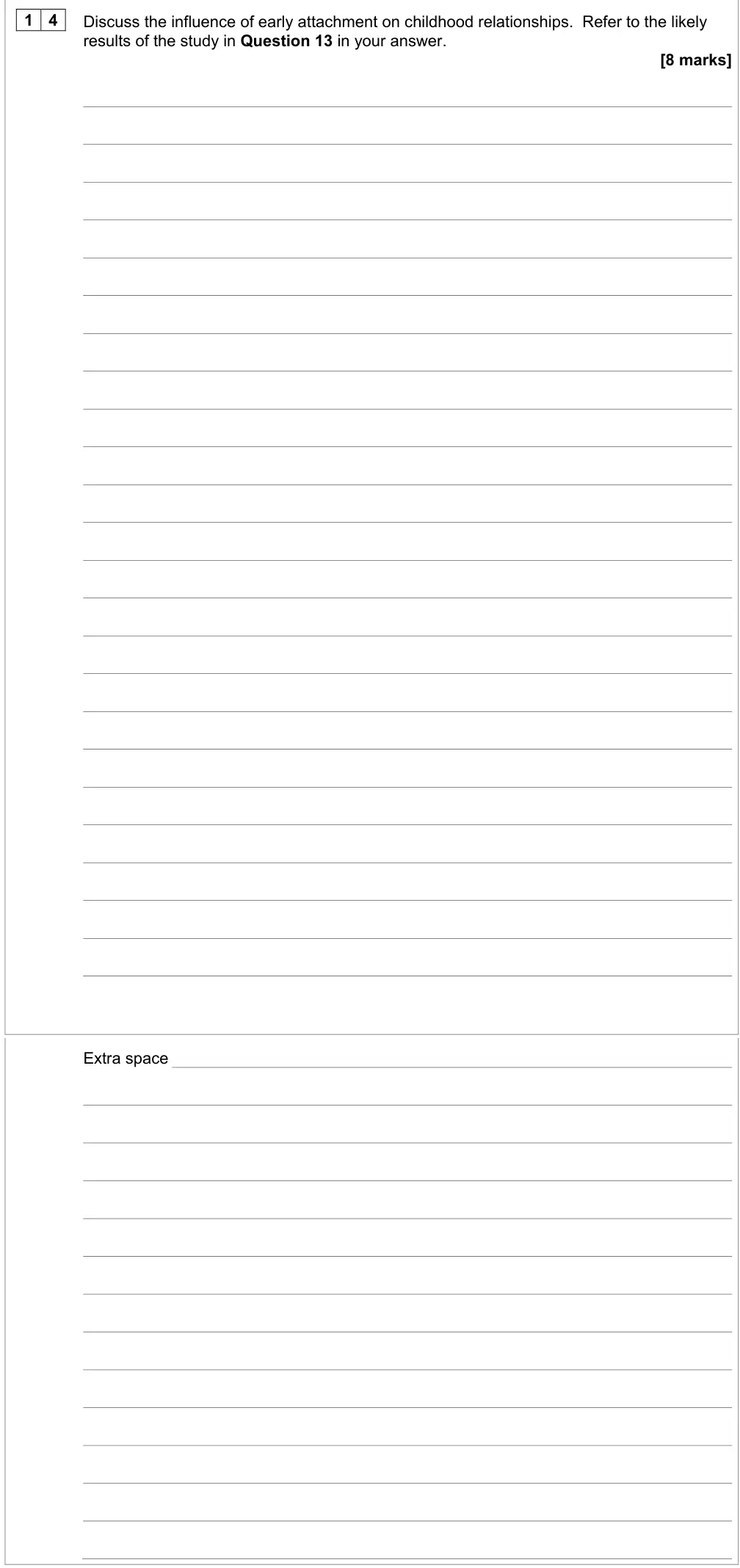
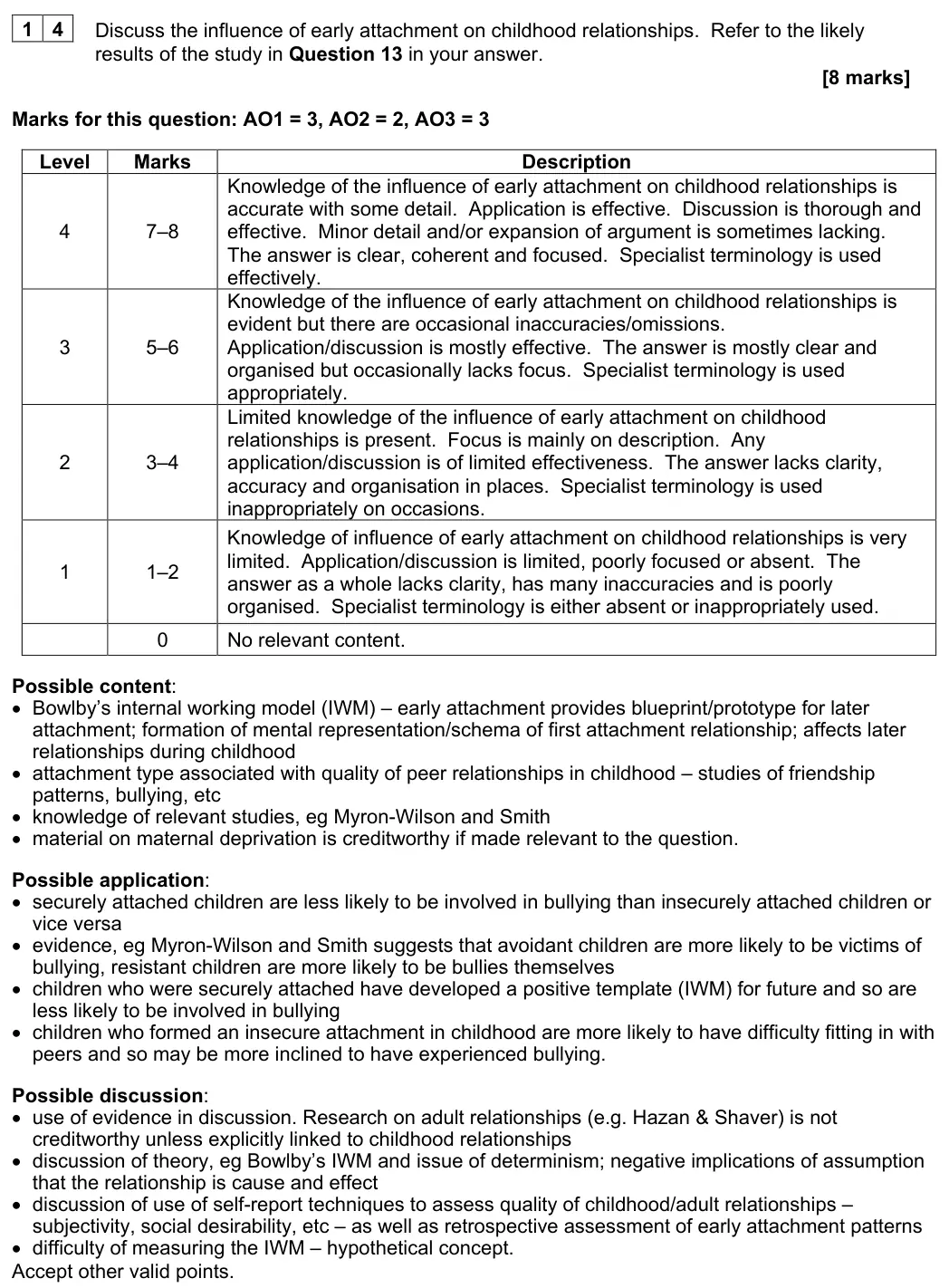
Many answers to this question failed to focus on ‘childhood relationships’. Material such as Bowlby, Hazan & Shaver, Rutter etc was frequently presented but not shaped explicitly to the question, and there was a general lack of directly relevant studies. AO3 was generally quite limited. Better answers used the internal working model and its implications effectively, and applied it appropriately to the scenario.
Notes from the mark scheme and report
must focus on childhood (not adult) relationships
Hazan & Shaver not creditworthy unless linked to childhood
apply likely results (secure less likely to be involved in bullying
Myron-Wilson and Smith)
maternal deprivation creditworthy only if made relevant
many presented Bowlby/Hazan & Shaver/Rutter without shaping
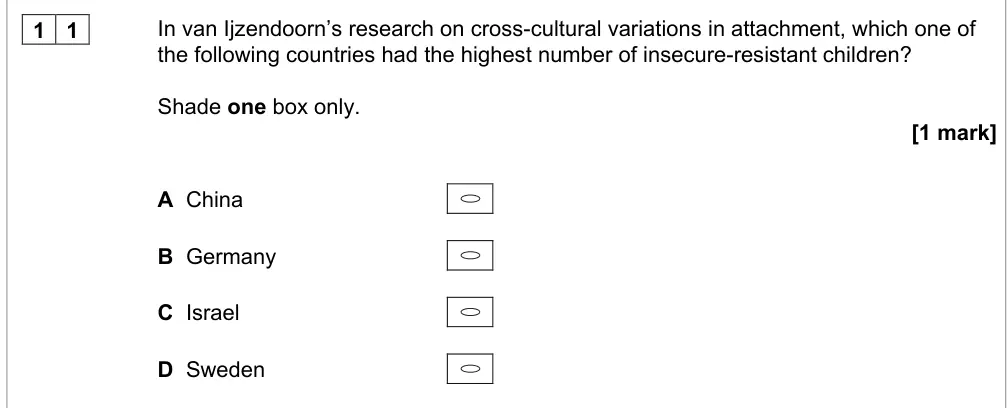
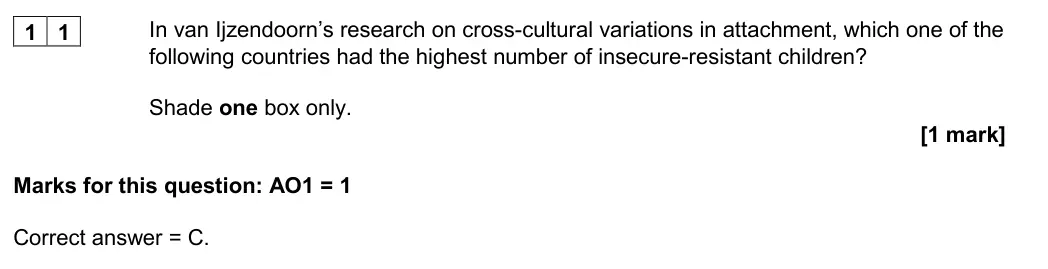
November 2020 · AS Paper 1 · Q111 markAO1=1Multiple choice
Answer
C
Mark scheme, including level descriptors and indicative content
Notes from the mark scheme and report
correct C Israel
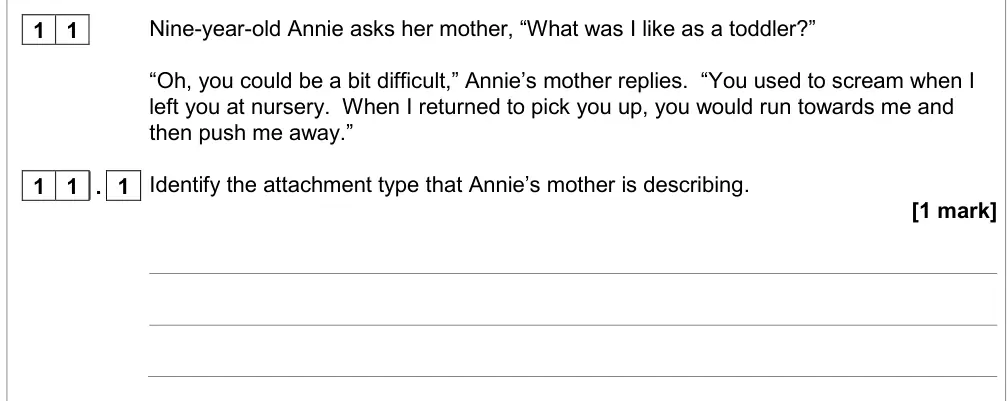
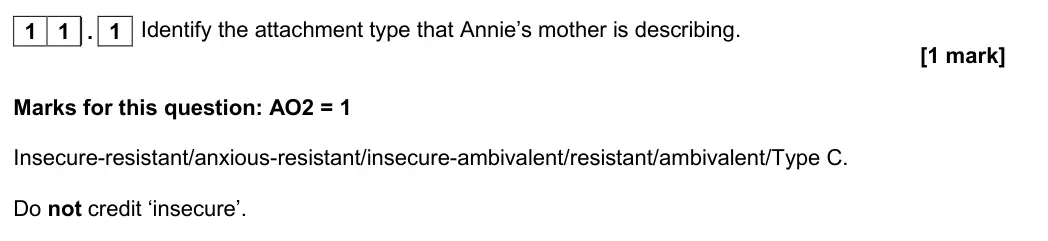
November 2020 · Paper 1 · Q11.11 markAO2=1Application
Mark scheme, including level descriptors and indicative content
Notes from the mark scheme and report
insecure-resistant/type C
'insecure' alone not credited
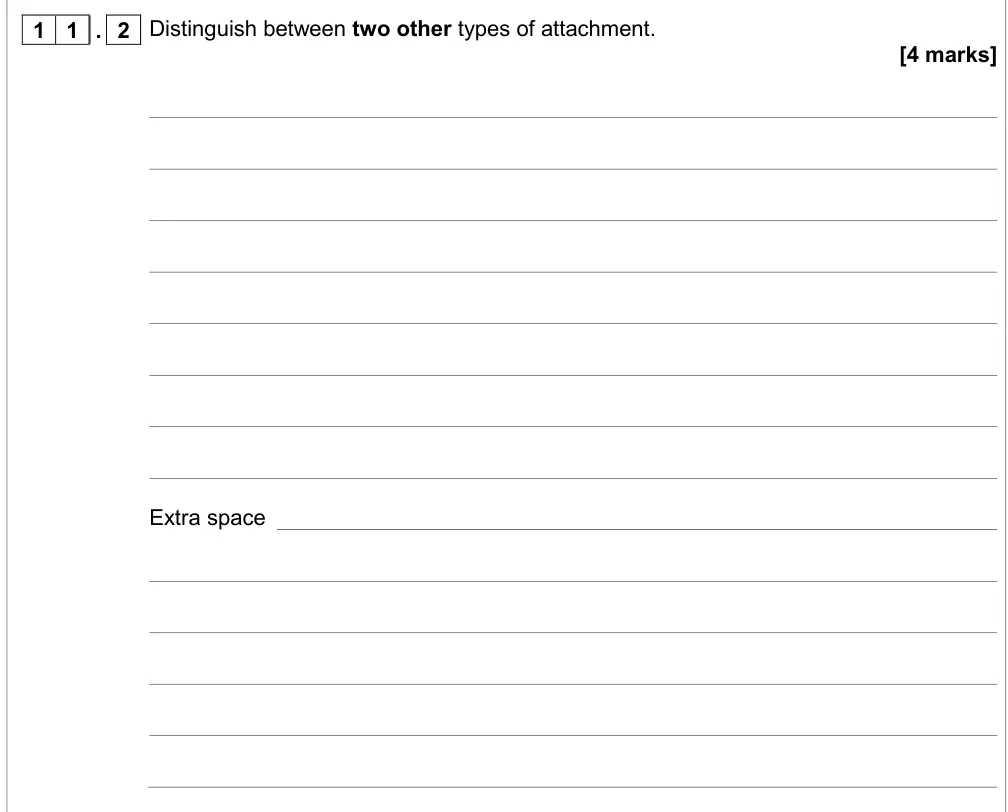
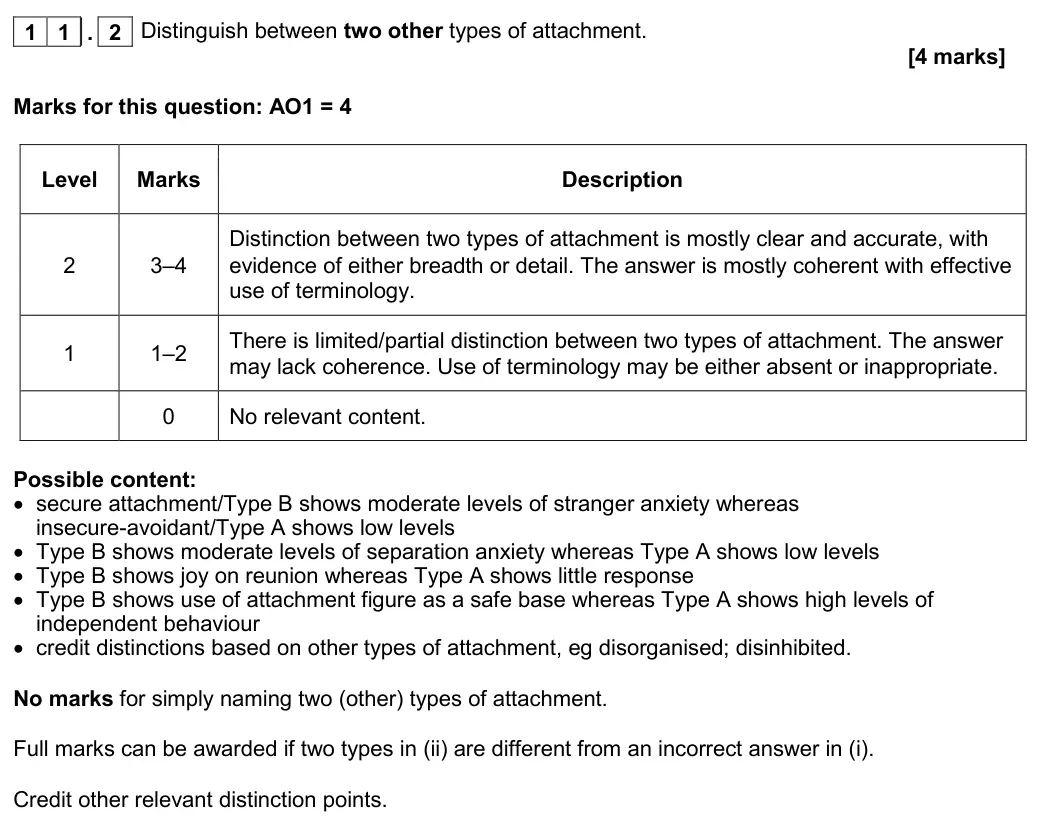
November 2020 · Paper 1 · Q11.24 marksAO1=4Outline
Mark scheme, including level descriptors and indicative content
Examiner's comment
Although overall performance was reasonably good, some marks were missed by students not addressing the ‘Distinguish between’ injunction. A significant number of answers provided clear outlines of two other types of attachment, but with no effort to explicitly juxtapose or distinguish between them. A small number of students misread the question and distinguished between Type C and two other types of attachment.
Notes from the mark scheme and report
must explicitly distinguish (e.g. secure vs avoidant on stranger anxiety, separation anxiety, reunion, safe base)
two separate outlines not juxtaposed lose marks
naming only = 0
some wrongly included type C
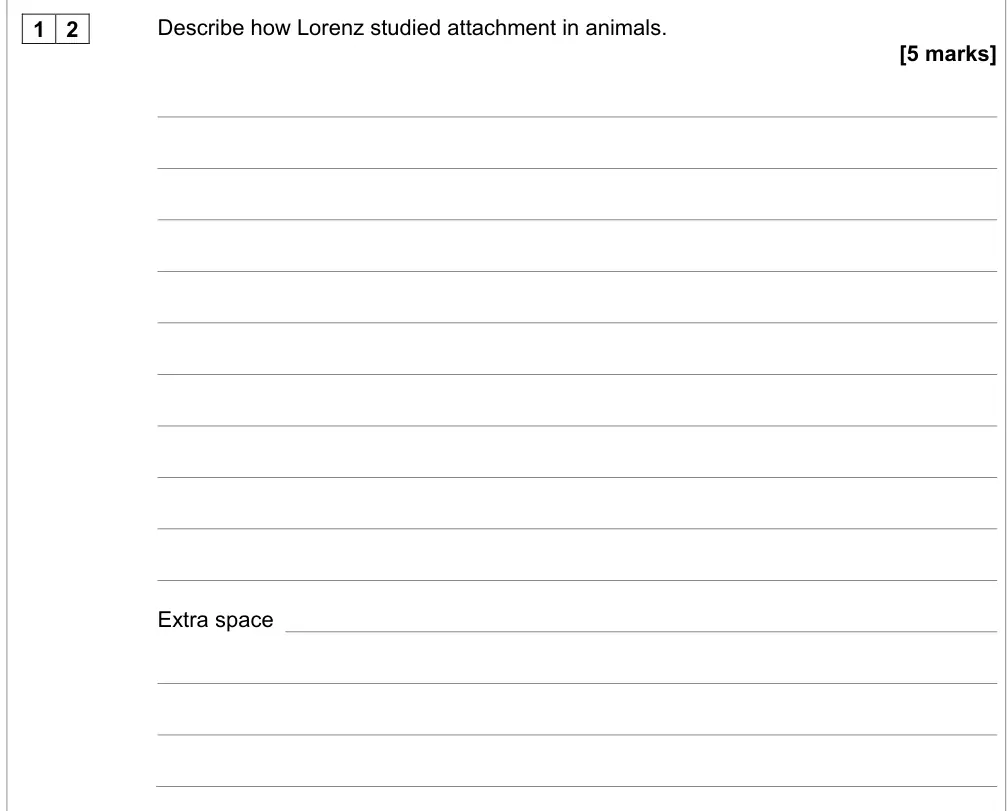
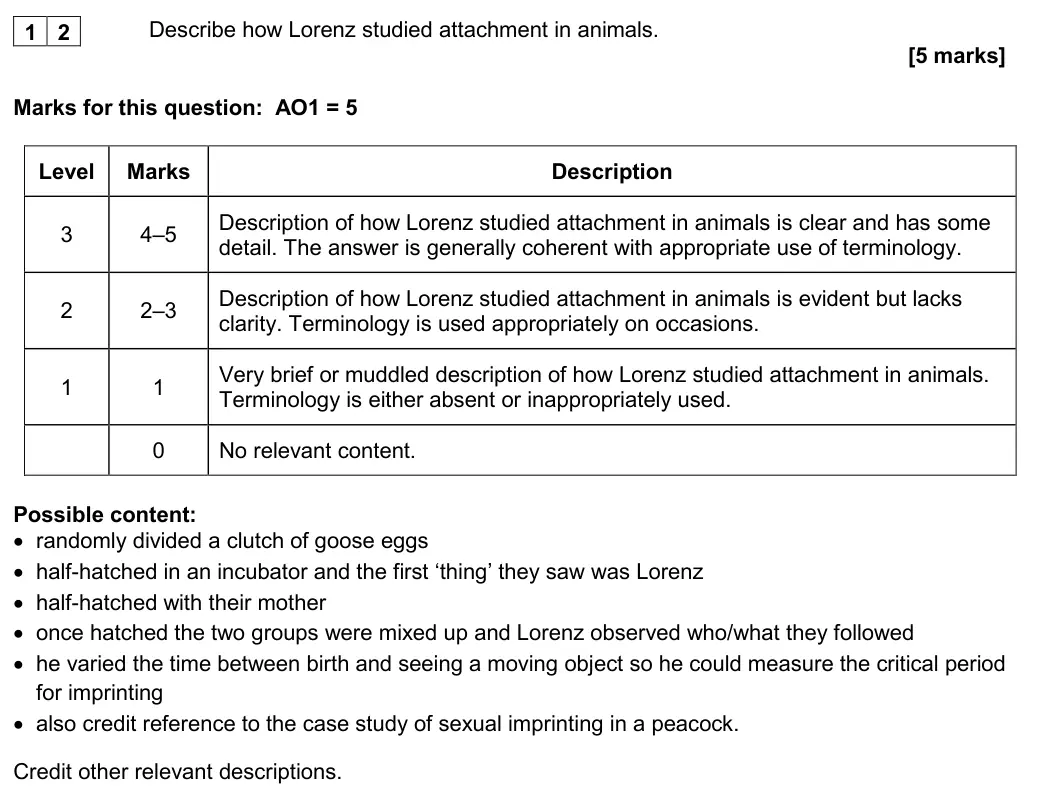
November 2020 · AS Paper 1 · Q125 marksAO1=5Outline
Mark scheme, including level descriptors and indicative content
Notes from the mark scheme and report
procedure of Lorenz's imprinting study (split clutch, incubator vs mother, mixed and observed following, critical period)
peacock case credited
November 2020 · AS Paper 1 · Q1412 marksAO1=6, AO3=6Extended writing
Mark scheme, including level descriptors and indicative content
Notes from the mark scheme and report
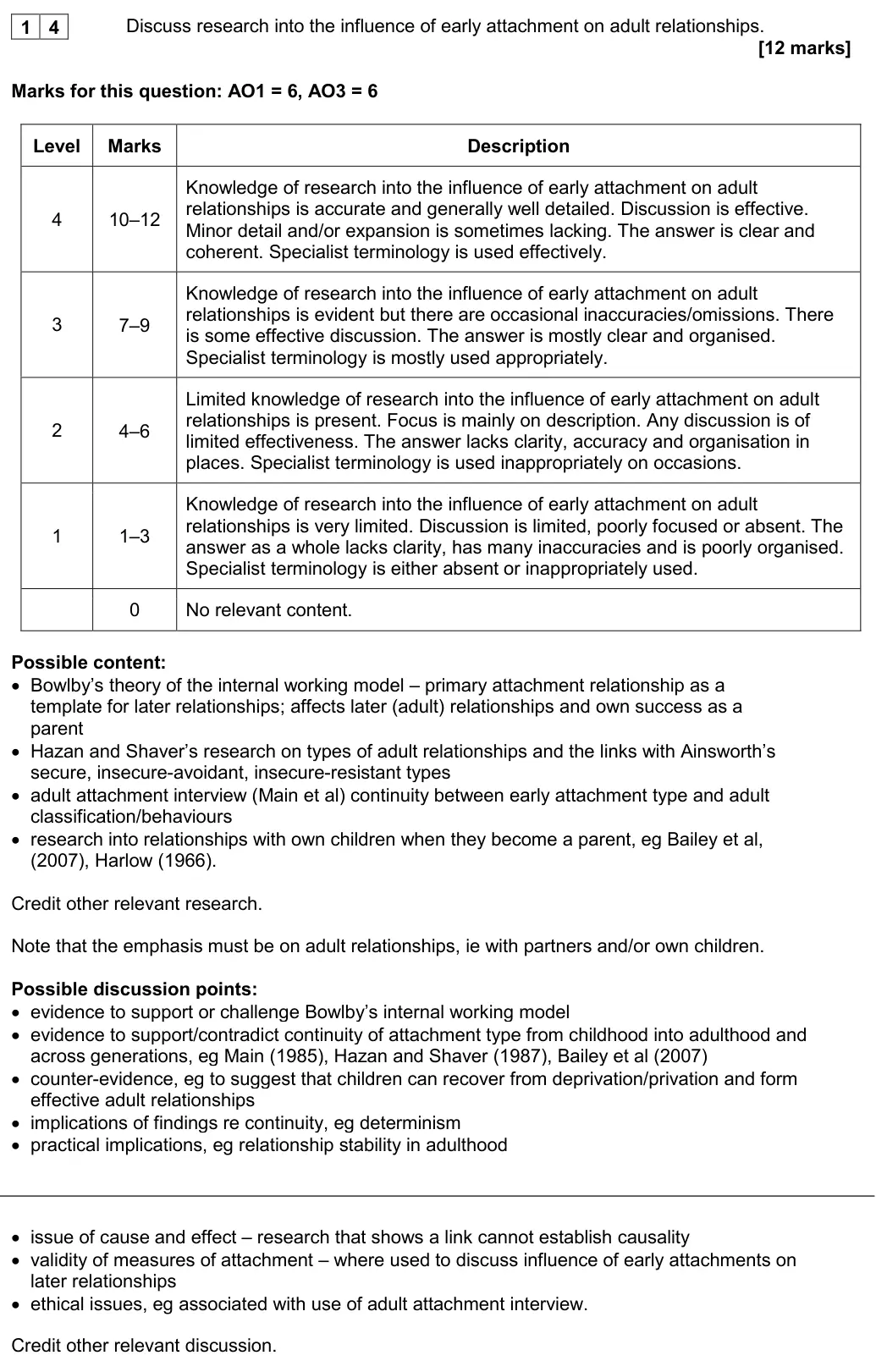
emphasis must be on ADULT relationships (partners, own children)
IWM, Hazan and Shaver, adult attachment interview, Bailey et al
discussion via continuity evidence, recovery, determinism, cause and effect, validity of measures
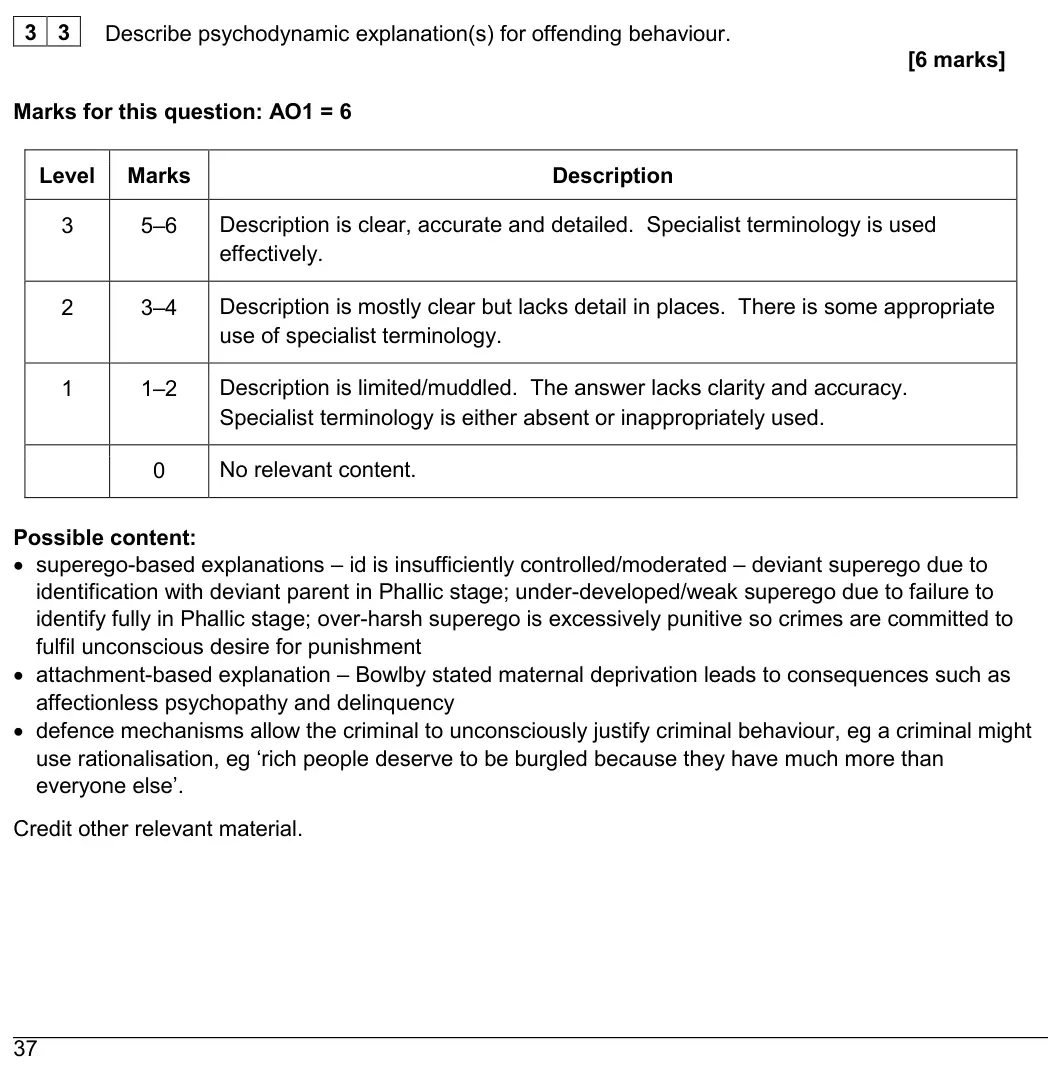
November 2020 · Paper 3 · Q336 marksAO1=6OutlineOld spec only
Not on the 2025 specification: psychodynamic explanations of offending: weak/deviant/harsh superego, maternal deprivation, defence mechanisms, removed in v1.4
Mark scheme, including level descriptors and indicative content
Examiner's comment
The 6-mark questions required description only and were usually competently tackled. A few students wasted time by offering evaluation.
Notes from the mark scheme and report
Off-spec: psychodynamic explanations of offending: weak/deviant/harsh superego, maternal deprivation, defence mechanisms, removed in v1.4
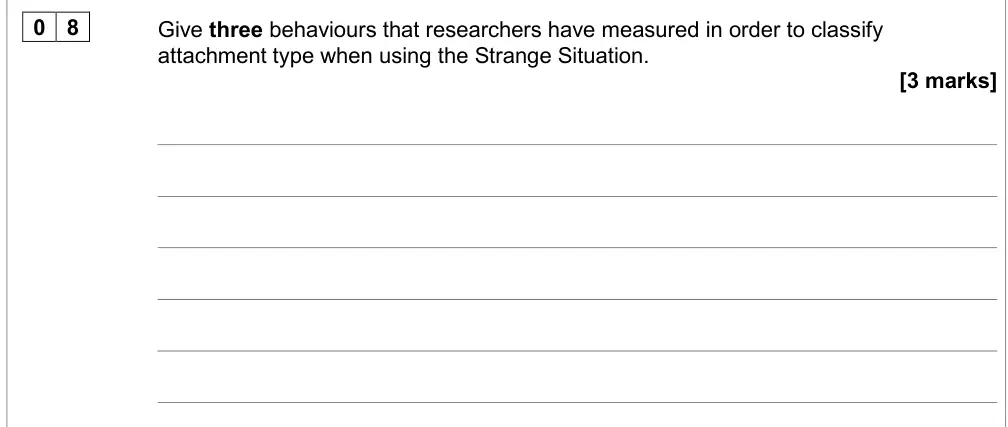
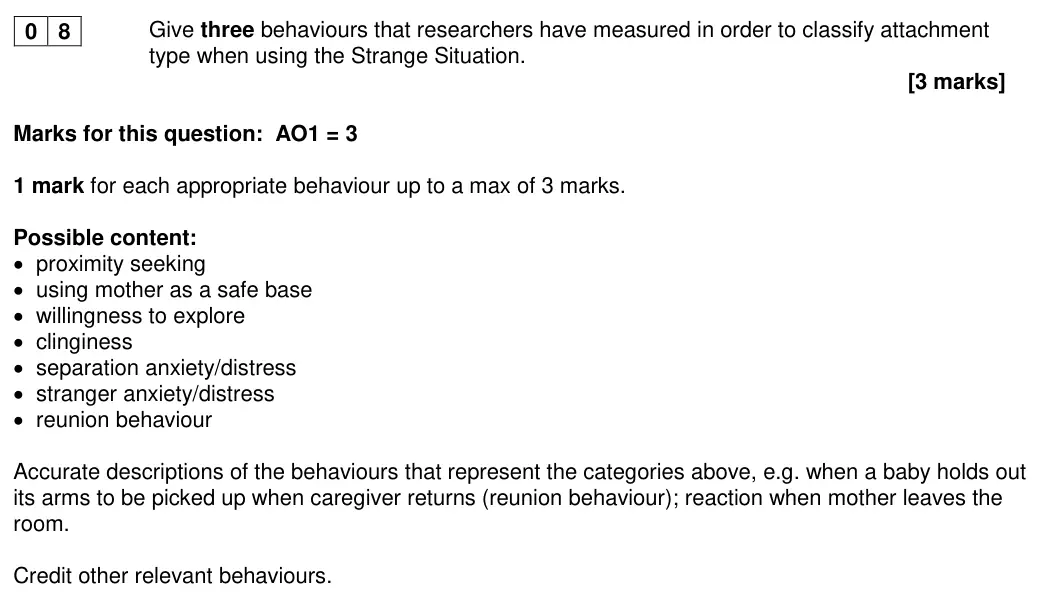
June 2019 · AS Paper 1 · Q83 marksAO1=3Short answer
Mark scheme, including level descriptors and indicative content
Examiner's comment
The majority of students found this question easy. However, a few appeared to have mis-read the question and wrote about types of attachment rather than the behaviours measured in order to classify attachment type.
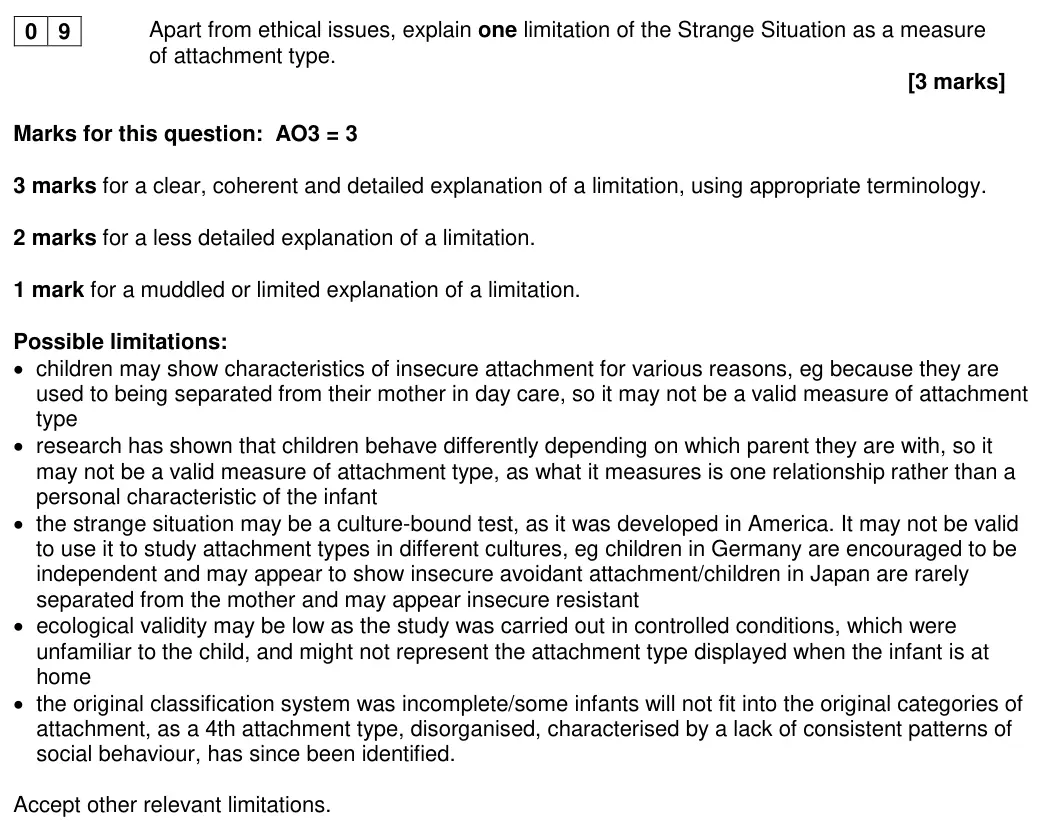
June 2019 · AS Paper 1 · Q93 marksAO3=3Evaluate (short)
Mark scheme, including level descriptors and indicative content
Examiner's comment
Students should take time to read the specific demands of each question carefully. This was particularly the case for Questions 5.1 and 9, where some answers suffered because students did not pay close attention to the question. Most students were able to identify an appropriate limitation of the use of the Strange Situation as a measure of attachment. Cultural differences and lack of ecological validity were popular points. Where students chose to write about cultural differences and did not know the findings of a cross- cultural study very well, their responses could be quite muddled. Some students offered ethical issues, despite the question stating ‘apart from ethical issues...’. There were some good answers which showed an understanding of the methodology used. Better marks were achieved by students who could develop an evaluation point. Students who suggested, 'it does not work if children go to day care' needed to explain this statement. Some students gave a limitation of the strange situation study by Ainsworth rather than a limitation of this way of measuring attachment. This highlights the need for students to tailor their response carefully to the question that is set.
Notes from the mark scheme and report
ethical issues excluded
limitation of the Strange Situation as a MEASURE (culture-bound/imposed etic, day care, measures one relationship, ecological validity, disorganised type) not of Ainsworth's study
June 2019 · Paper 1 · Q94 marksAO1=4OutlineOld spec only
Not on the 2025 specification: role of the father in attachment, removed in v1.4
Mark scheme, including level descriptors and indicative content
Examiner's comment
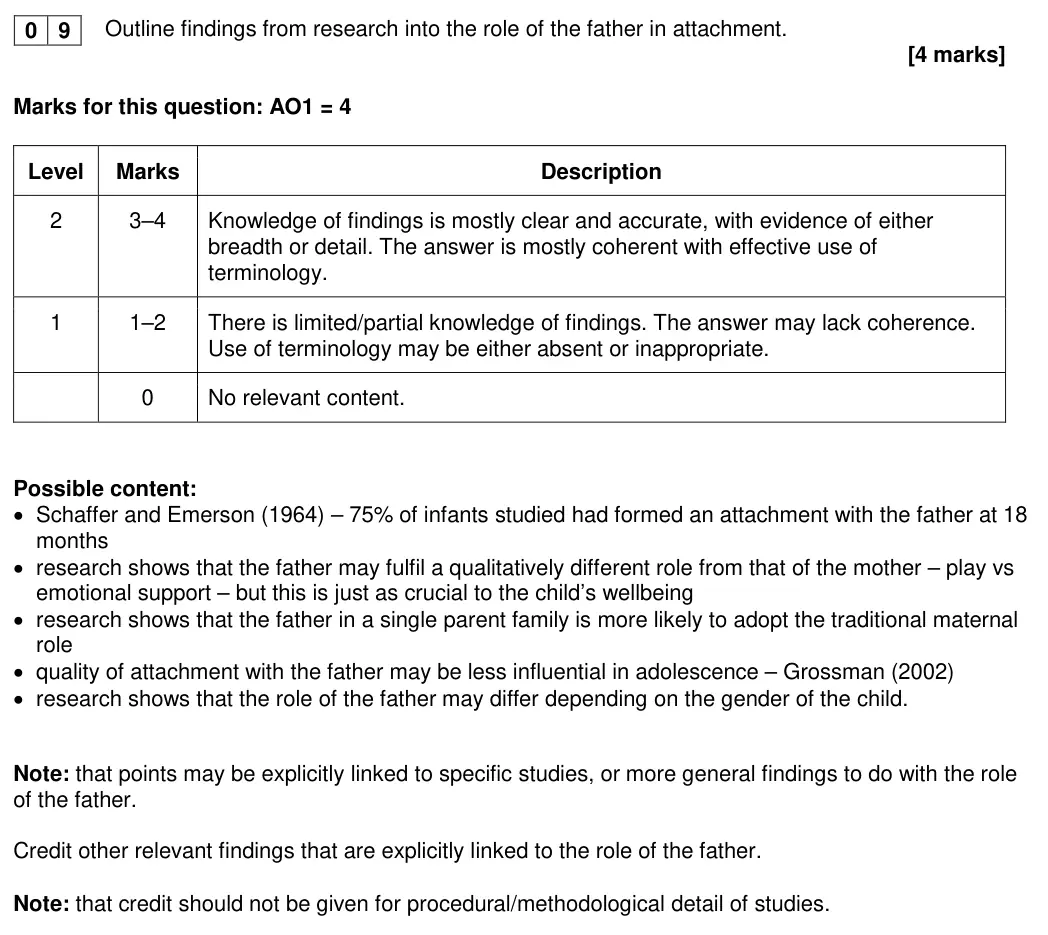
The key to this question was the focus on ‘findings from research’. General theories, ideas on the role of the father or common-sense points were not creditable, and procedural/methodological details were not required. Most students avoided these pitfalls and were able to refer to relevant findings, though detail was sometimes lacking. These included findings on the development of primary/secondary attachment, the role of the father (play vs emotional support) and implications for the child’s development. Some effective answers covered single parent families and the adoption by the father of the maternal role. At the lower end answers focused more on the role of the mother (eg Bowlby) and/or presented general statements on the role of the father.
Notes from the mark scheme and report
Off-spec: role of the father in attachment, removed in v1.4
findings only, no procedures
e.g. Schaffer and Emerson, play vs emotional support, Grossmann
June 2019 · AS Paper 1 · Q106 marksAO1=6Outline
Mark scheme, including level descriptors and indicative content
Examiner's comment
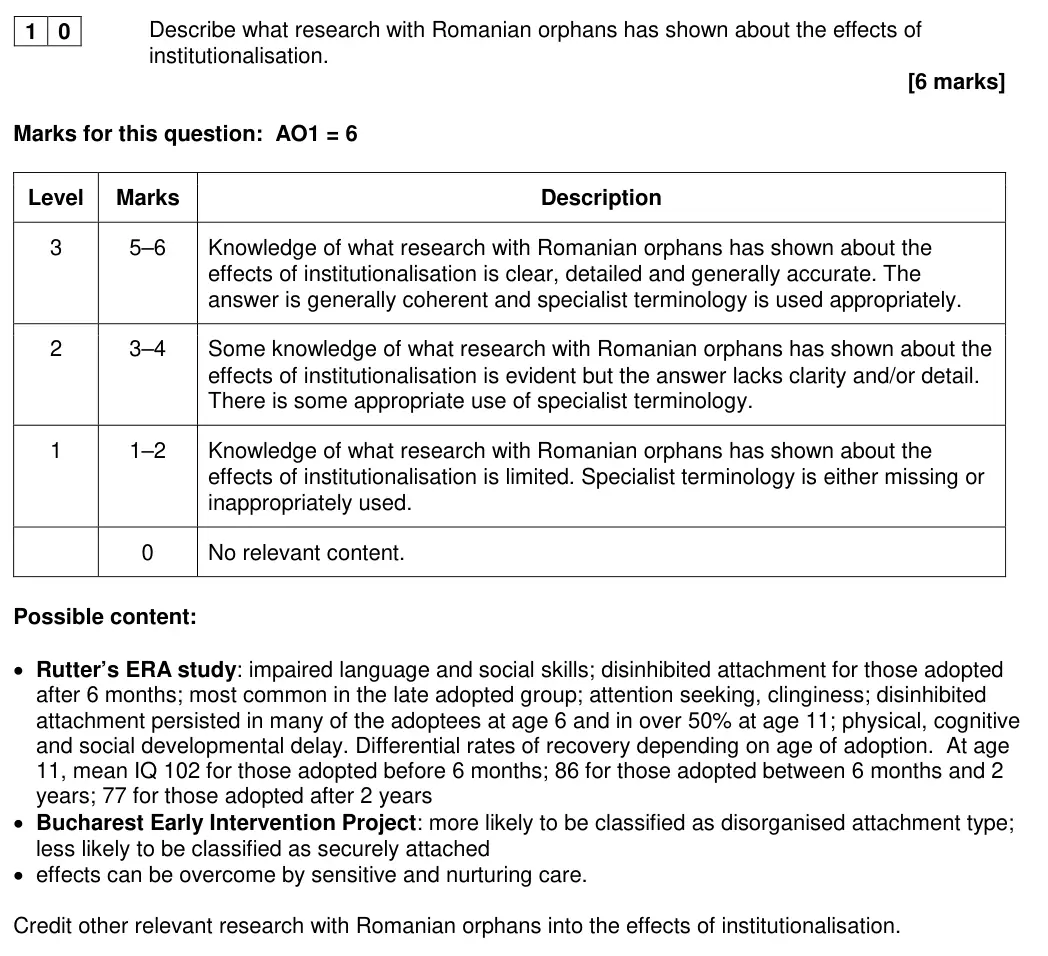
Questions that tended to differentiate best were questions 1, 3, 6, 10 and 11. This question discriminated well. Some students demonstrated detailed knowledge of what research with Romanian orphans had shown about the effects of institutionalisation. Most popular answers described the effects on IQ and attachment. Good answers included accurate IQ scores, and clearly explained disinhibited attachments and the effects of being adopted at different ages. Some students focused too much on describing the procedures of the research, rather than the findings and conclusions. Level 3 answers included detailed findings. Weaker answers gave generic findings, such as it reduces IQ, with some students showing no clear link to findings from research with Romanian orphans. A few students described Bowlby’s 44 thieves study which was not relevant to the question. Some students left this question blank and had either not prepared for this part of the specification, or had not managed their time effectively across the exam paper.
Notes from the mark scheme and report
Romanian orphan research = ERA project in v1.4
findings not procedures: Rutter's ERA IQ by age of adoption, disinhibited attachment, BEIP
generic findings or Bowlby's 44 thieves not relevant
June 2019 · AS Paper 1 · Q118 marksAO1=4, AO3=4Extended writing
Mark scheme, including level descriptors and indicative content
Examiner's comment
Questions that tended to differentiate best were questions 1, 3, 6, 10 and 11. Considering the straightforward nature of this question, it was not well answered overall. Generally, the outline of Bowlby’s monotropic theory was stronger than the evaluation. Some students confused attachment and maternal deprivation. Evaluation of Bowlby’s explanation was often muddled. Reporting of Hazen & Shaver’s, Lorenz’s and Harlow’s work was often poor, relying too heavily on description of the studies, rather than whether these studies supported Bowlby’s theory or not. Schaffer and Emerson’s study was often cited but the implications for Bowlby’s theory were not accurately explained. The number of short or absent answers for this straightforward question suggested a failure of time management across the exam paper.
Notes from the mark scheme and report
innate, social releasers, safe base, monotropy, critical period, IWM, continuity
evaluation via Lorenz/Harlow, Hazan and Shaver, learning theory alternative
many confused with maternal deprivation
MS also credits reciprocity and Schaffer and Emerson's multiple attachments (removed in v1.4)
June 2019 · Paper 1 · Q1116 marksAO1=6, AO3=1016-mark essay
Mark scheme, including level descriptors and indicative content
Examiner's comment
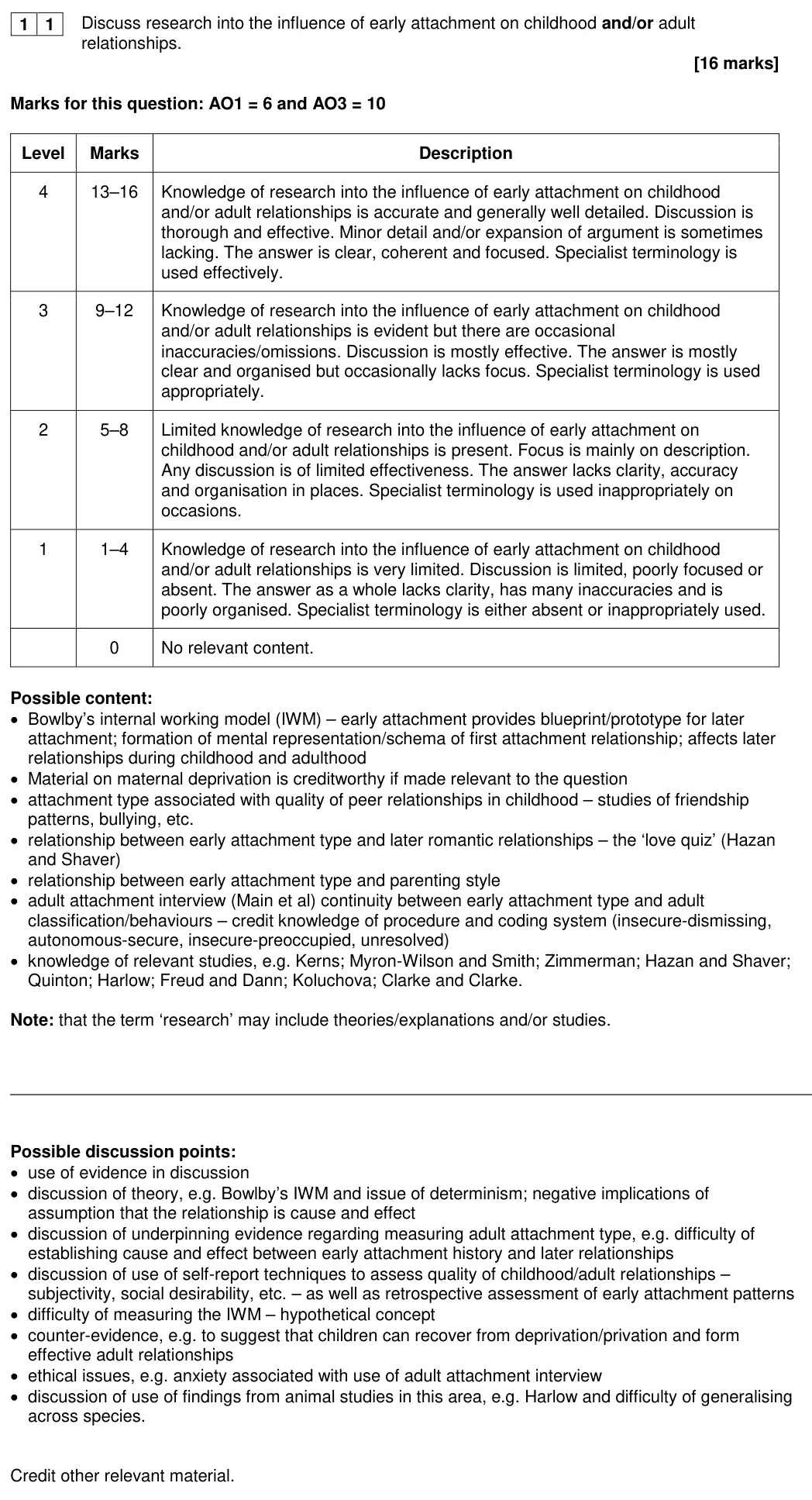
Although there were some very good answers to this question, overall the standard was lower. It was a very straightforward question but many students either did not read the question or had clearly prepared essays on maternal deprivation/privation. In the latter case they had great trouble shaping their material to the question of early attachment and later childhood and/or adult relationships. A good example was Bowlby’s study on the 44 thieves. ‘Affectionless psychopathy’ has implications for the ability to form and sustain relationships but most answers using this material failed to consider this, with no explicit link to the question. A similar issue arose with respect to Koluchova’s work and the Romanian orphans. Such research could have been made relevant, but often this link was missing. A far more effective approach used by many students was structured around Bowlby’s internal working model as a model for later relationships (eg romantic relationships, parenting style). The findings of Hazan and Shaver, Myron-Wilson & Smith, Zimmerman, Main et al etc were then used to evaluate the model. At the top end, answers considered research both supporting and contradicting the model. This was also a question where methodological evaluation could be used effectively – the use of questionnaires, retrospective analysis of early attachment type, cause/effect relationships etc – to undermine the validity of findings. In some cases students spent far too long evaluating a single study (usually Hazan and Shaver), limiting the scope of their answer. Some students made effective use of general issues such as determinism and negative aspects of the continuity model. A number of students made reference to non-human animal work such as Harlow. This was credited where there were explicit links to the question, especially if combined with an awareness of the problems of applying such findings to humans Finally, a few answers were side-tracked into Ainsworth, the Strange Situation and development of attachment, describing and evaluating procedures and attachment types in far too much detail and not making it relevant to the question.
Notes from the mark scheme and report
internal working model, Hazan and Shaver, peer relationships, parenting, Adult Attachment Interview
maternal deprivation/Romanian/Koluchova material only credited if linked to later relationships
methodological points (retrospective self-report, cause and effect) effective
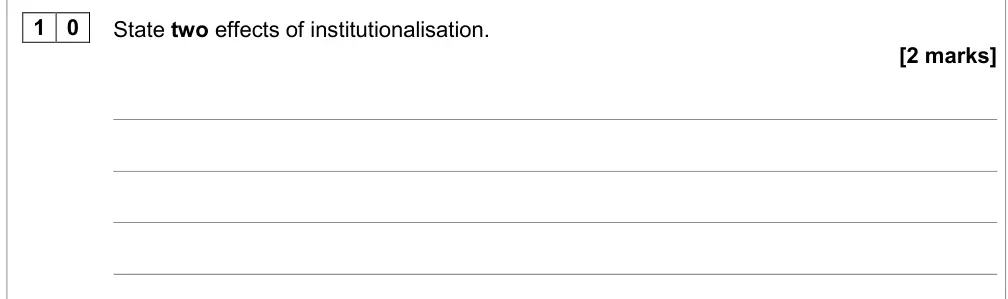
June 2018 · Paper 1 · Q102 marksAO1=2Short answer
Mark scheme, including level descriptors and indicative content
Examiner's comment
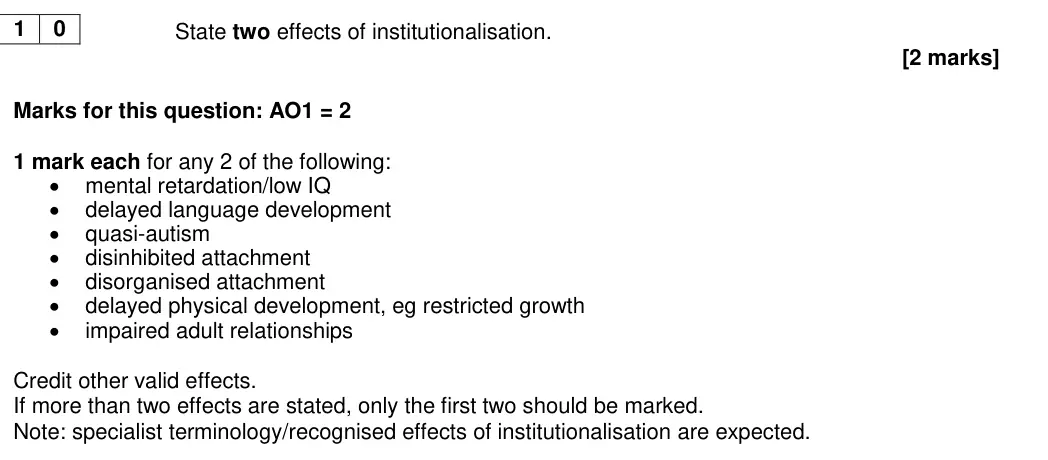
Most students could state two effects of institutionalisation using appropriate specialist terminology. Most popular were disinhibited attachment and low IQ. A few answers referred to deprivation and privation as though they were effects of institutionalisation. More commonly, students wrote too much for a question that simply required them to ‘state’ two effects.
Notes from the mark scheme and report
e.g. low IQ, quasi-autism, disinhibited attachment, delayed physical development
first two only marked
deprivation/privation are not effects
June 2018 · Paper 1 · Q116 marksAO1=6Outline
Mark scheme, including level descriptors and indicative content
Examiner's comment
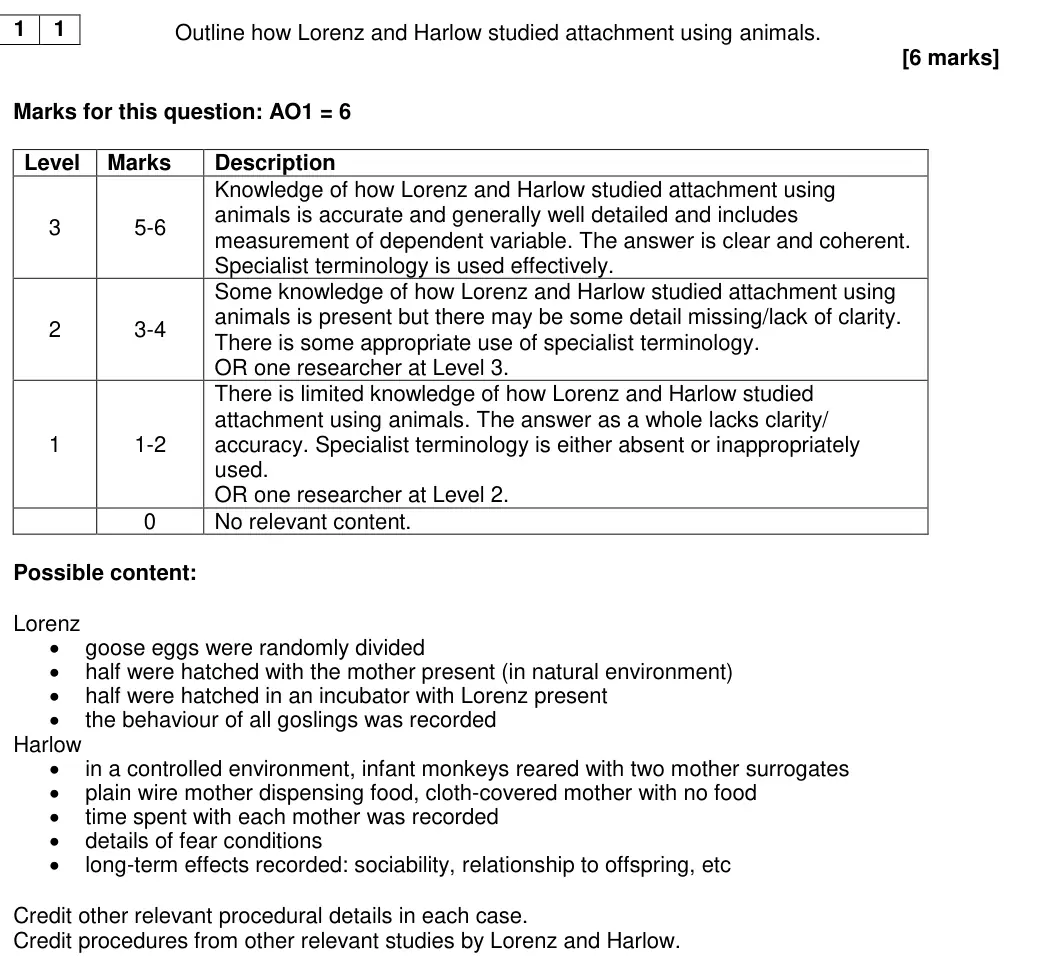
Probably the question most often misread by students was Question 11. This required an outline of ‘how’ Lorenz and Harlow studied attachment using animals. However the vast majority of answers included findings and implications of findings, and some even included evaluation of the studies. None of this material was relevant to the question. Performance on this question was disappointing. Despite the clear injunction in the question referring to ‘how’ Lorenz and Harlow studied attachment, the great majority of students outlined the findings and conclusions, which did not receive credit. Some even evaluated the studies. Very few focused on the methodology or explicitly identified the dependent variables. Better answers did outline the methods and variables, and also covered extensions of the research e.g. in terms of studying effects on later emotional and sexual behaviour.
Notes from the mark scheme and report
HOW they studied (procedures, DVs), not findings
one researcher only = max 4
most gave findings/conclusions and scored poorly
June 2018 · AS Paper 1 · Q124 marksAO1=2, AO3=2Evaluate (short)
Mark scheme, including level descriptors and indicative content
Examiner's comment
It is worth students taking time to read the specific demands of each question carefully, rather than simply writing everything they know about the topic. This was also the case with Question 12, where much time was wasted in descriptions of the procedures of the chosen study, instead of addressing the specific requirements of the question. Once again, this is a question where students must select the relevant material and shape it to the specific requirements of the question. The question asked for findings, not procedures and for one criticism not two or more. Lengthy descriptions of procedures were not creditworthy. Students often could not separate procedures from findings, especially with Lorenz’s study. The criticism of the study needed to be explained, not merely stated. However, with Harlow’s studies, there were some effective criticisms made. For example, the two wire monkeys were not only different in terms of what they were made of (cloth or wire) but also their heads were also very different, thus introducing a confounding variable. Other effective criticisms involved the difficulty of extrapolating from animal behaviour to human behaviour. Ethical issues were also considered, but needed to be explained carefully.
Notes from the mark scheme and report
findings not procedure (Harlow or Lorenz)
ONE criticism explained and matching the study (extrapolation, ethics, imprinting reversible, confound of different heads)
only outline or criticism = max 2
June 2018 · Paper 1 · Q1216 marksAO1=6, AO2=4, AO3=616-mark essay
Mark scheme, including level descriptors and indicative content
Examiner's comment
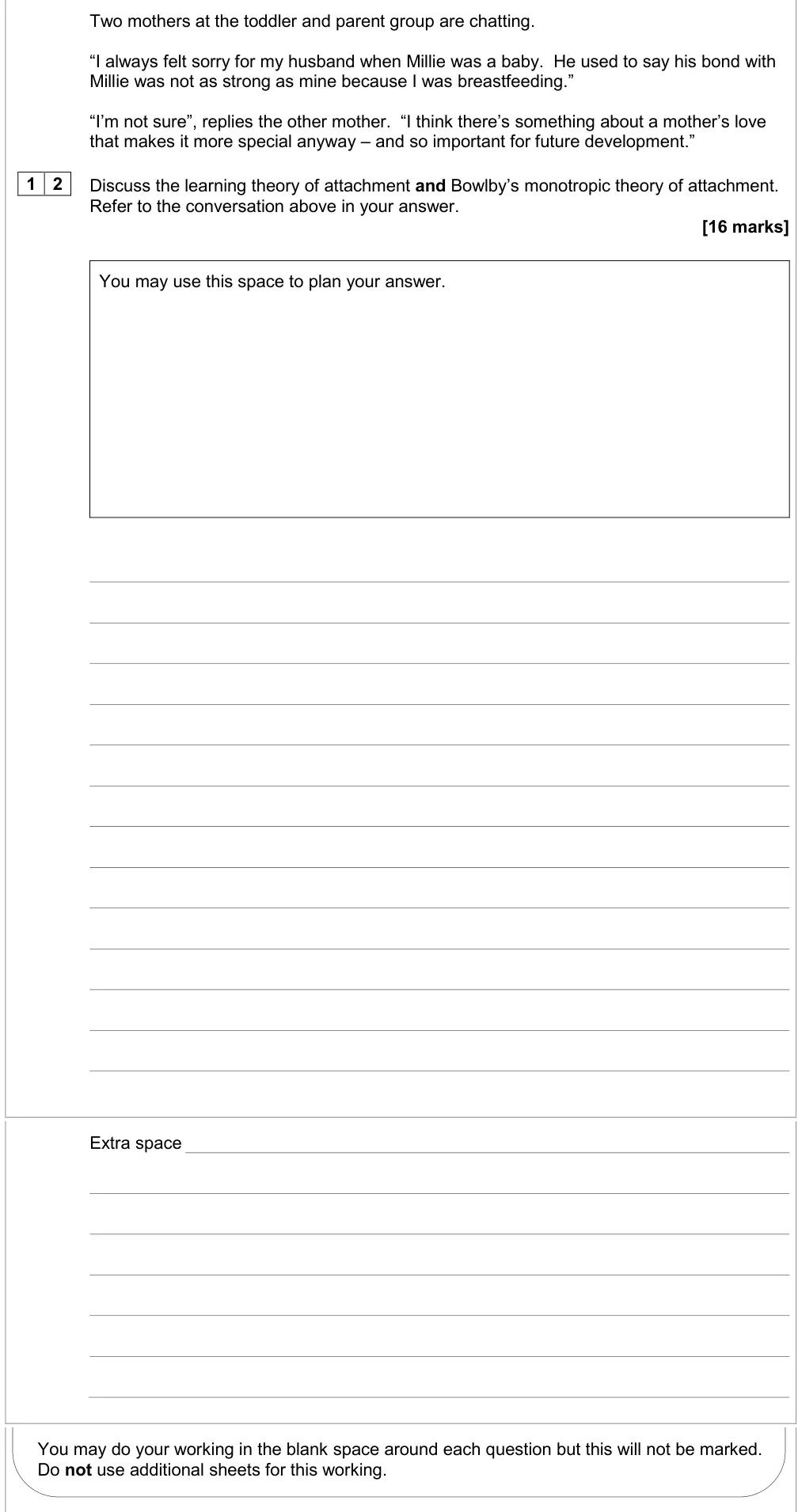
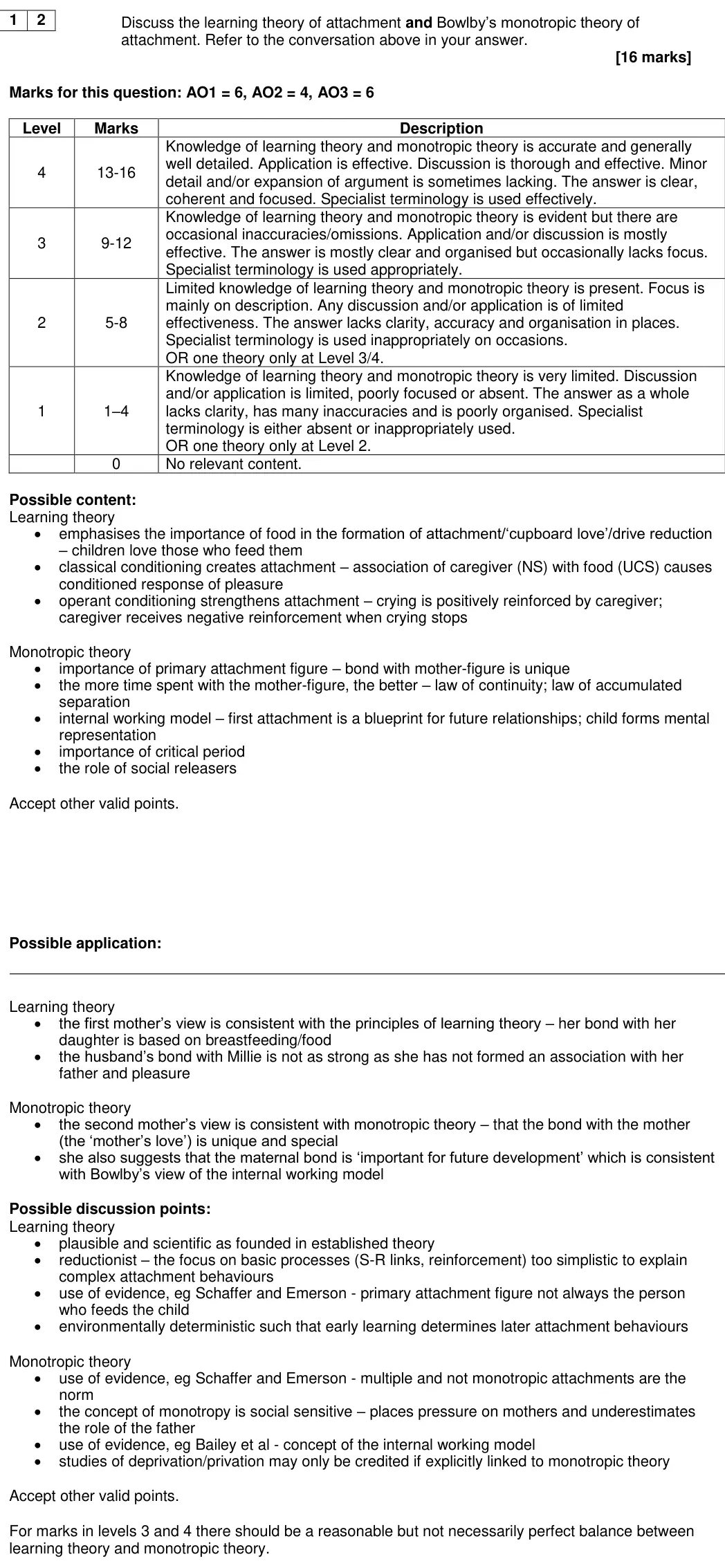
This was the best answered of the 16 mark questions, with many students showing excellent understanding of learning theory and monotropic theory, and able to apply their knowledge to the scenario. Particularly impressive was the general understanding of the role of classical and operant conditioning in learning theory of attachment. Less impressive answers often had good understanding of learning theory, but presented very general accounts of Bowlby’s work without a specific focus on monotropic theory. Findings of studies were an effective route to evaluation for both learning theory and monotropic theory, although some students became too bogged down in methodological issues for studies to be fully effective. Use of phrases from the conversation in the stem material was usually appropriate, with answers able to link phrases to specific aspects of learning theory and monotropic theory. Occasionally students neglected to refer to the conversation, and a few were able only to cover one theory, usually monotropic theory, as they presumably had not covered learning theory.
Notes from the mark scheme and report
both theories needed in reasonable balance for Levels 3-4, one only = max Level 2
link breastfeeding to learning theory and 'mother's love/future development' to monotropy and IWM
MS also credits Schaffer and Emerson's multiple attachments and the role of the father as evaluation, removed in v1.4
June 2018 · AS Paper 1 · Q13.13 marksAO2=3Application
Mark scheme, including level descriptors and indicative content
Examiner's comment
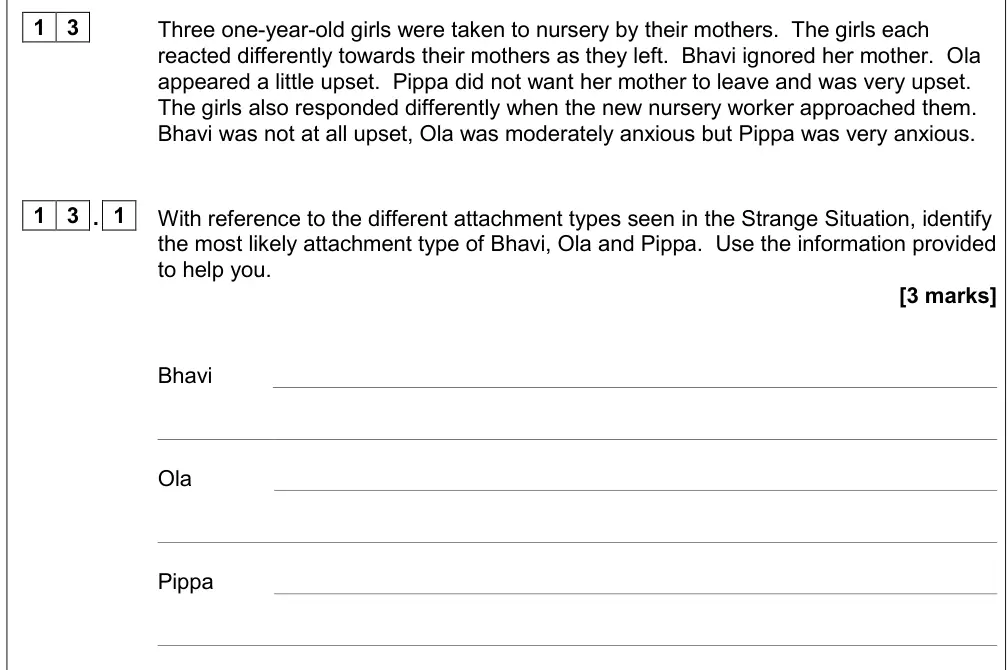
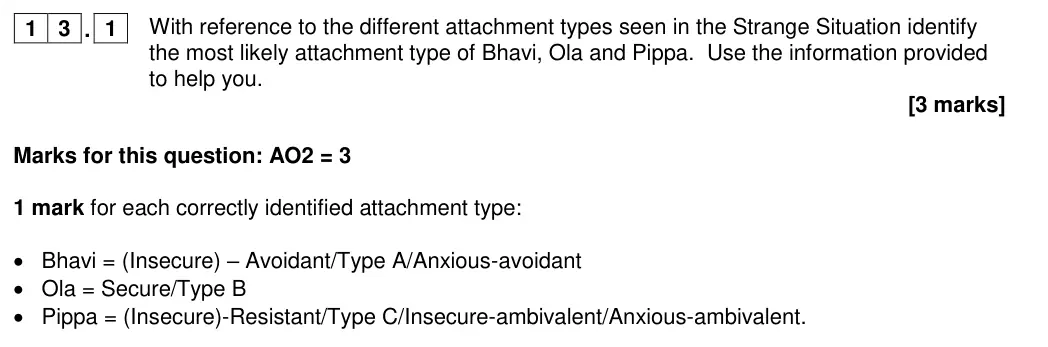
Question 13.1 The term “identify” merely requires naming the attachment type and so lengthy descriptions were not needed. Most students could correctly identify Bhavi as being (insecure) Avoidant or Type A. It was Ola and Pippa who were often muddled. Students were less successful in identifying Ola as Secure or Type B and Pippa as (insecure) resistant or Type C.
Notes from the mark scheme and report
Bhavi insecure-avoidant, Ola secure, Pippa insecure-resistant
'identify' needs no description
Ola and Pippa often muddled
June 2018 · AS Paper 1 · Q13.23 marksAO2=3Application
Mark scheme, including level descriptors and indicative content
Examiner's comment
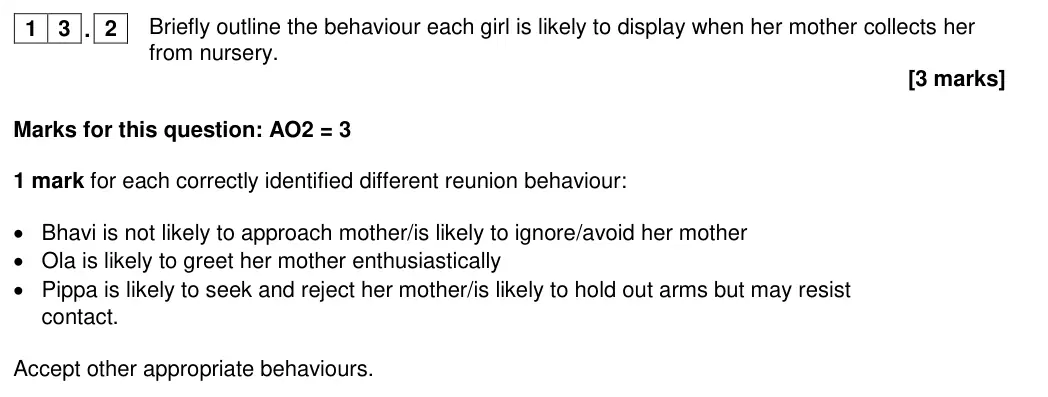
Question 13.2 It was important for students to focus on the behaviour shown by each child. Some students were unable to capture this aspect of the question. Bhavi would ignore her mother or be “not bothered” by her return. Ola would show joy, happiness, greet her mother enthusiastically. Pippa would show ambivalence by going to greet her mother and then reject her as well.
Notes from the mark scheme and report
reunion behaviour: Bhavi ignores/avoids, Ola greets enthusiastically, Pippa seeks then resists contact
June 2018 · AS Paper 1 · Q1412 marksAO1=6, AO3=6Extended writing
Mark scheme, including level descriptors and indicative content
Examiner's comment
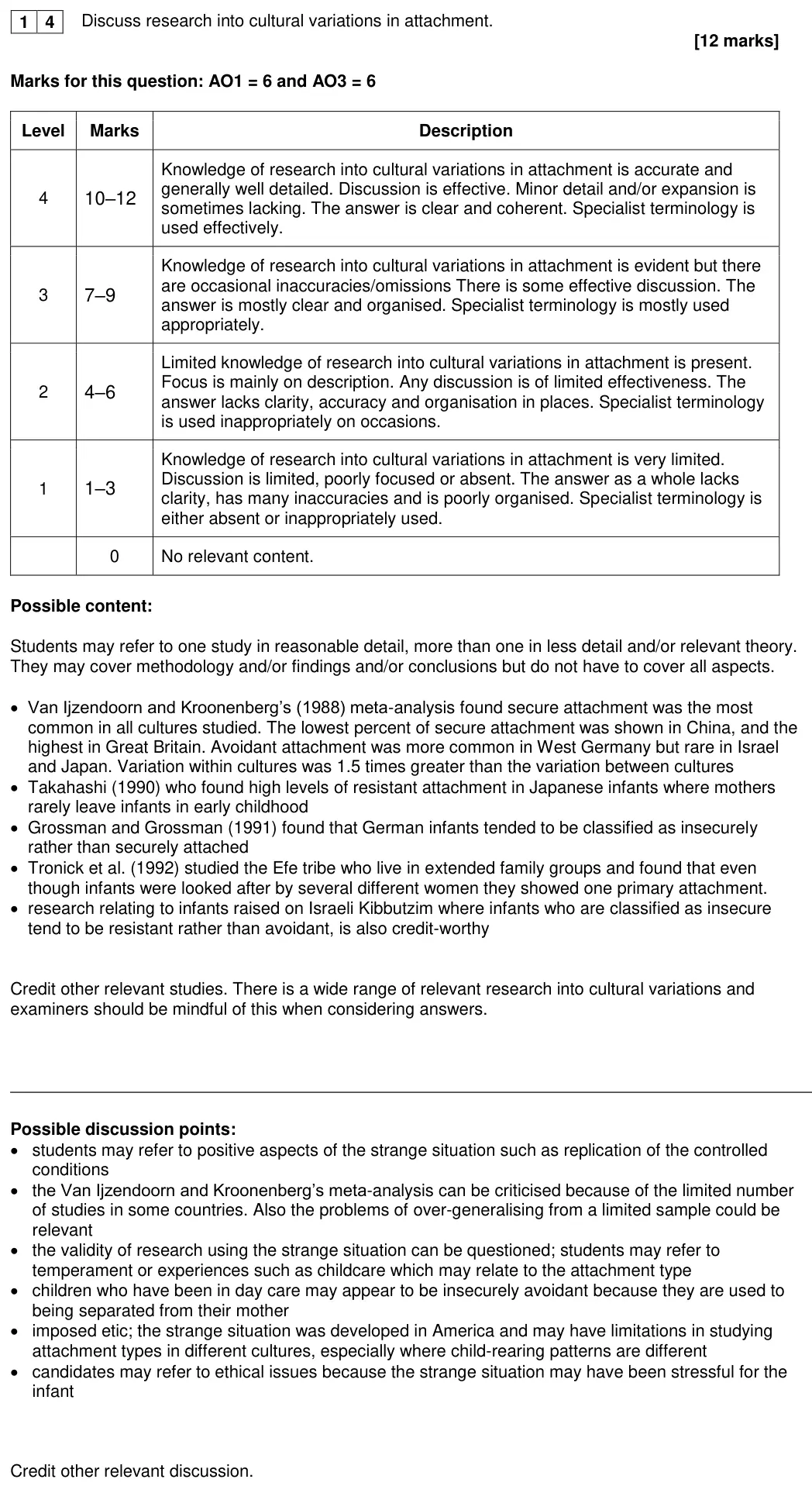
The questions that seemed to differentiate well were 05, 07, 08, 09.4 and 14. Students need to take care with the balance of AO1 and AO3, particularly with the extended writing in questions such as 04 and 14. There should be an equal amount of each skill, however many students were producing much more AO3 than AO1 and consequently not gaining all the marks available for the latter. This was a challenging question, which showed good discrimination. The meta-analysis by Van Ijzendoorn and Kroonenberg was the most common study used, with some students showing excellent, accurate and detailed knowledge of their results. At the other end were those students with very muddled knowledge of the findings. If students are to use such findings effectively, they do need to be clear which country had greater percentages of different types of attachment. Other studies were also used effectively either as knowledge or as discussion. These included research by Takahashi; Simonella; Grossman and Grossman among others. While knowledge was often very well detailed, the discussion was not as effective. For example, while many students knew that West Germany had the highest levels of avoidant attachment, few could explain why this appeared to be the case. The same was true for the high levels of resistant attachment in Japan. Students seemed unaware that it was the quality of the measuring tool that was important in the labelling of attachment type. Better discussion focused on the issue of an imposed etic; the limited number of studies in some countries; the validity of using the strange situation. Lengthy descriptions of the strange situation itself were of little relevance and did not add much to the answer. Ainsworth’s research was not looking at cultural variations, but was the tool used in the meta-analysis.
Notes from the mark scheme and report
van Ijzendoorn and Kroonenberg, Takahashi, Grossman and Grossman, Tronick
discussion via imposed etic, validity of the Strange Situation across cultures, limited studies per country
muddled findings by country
long descriptions of the Strange Situation itself of little relevance
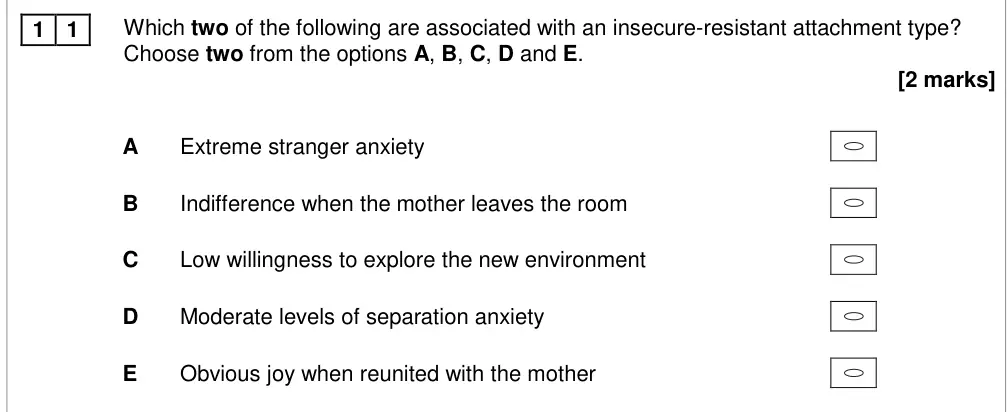
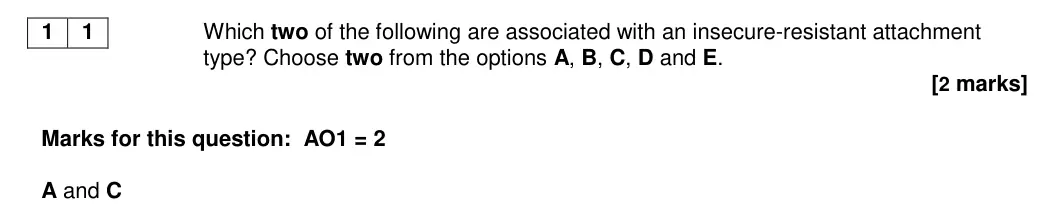
June 2017 · Paper 1 · Q112 marksAO1=2Multiple choice
Answer
A and C
Mark scheme, including level descriptors and indicative content
Examiner's comment
This was a multiple choice question where the answers were A and C. Most students achieved full marks on this question.
Notes from the mark scheme and report
answers A (extreme stranger anxiety) and C (low willingness to explore)
most scored full marks
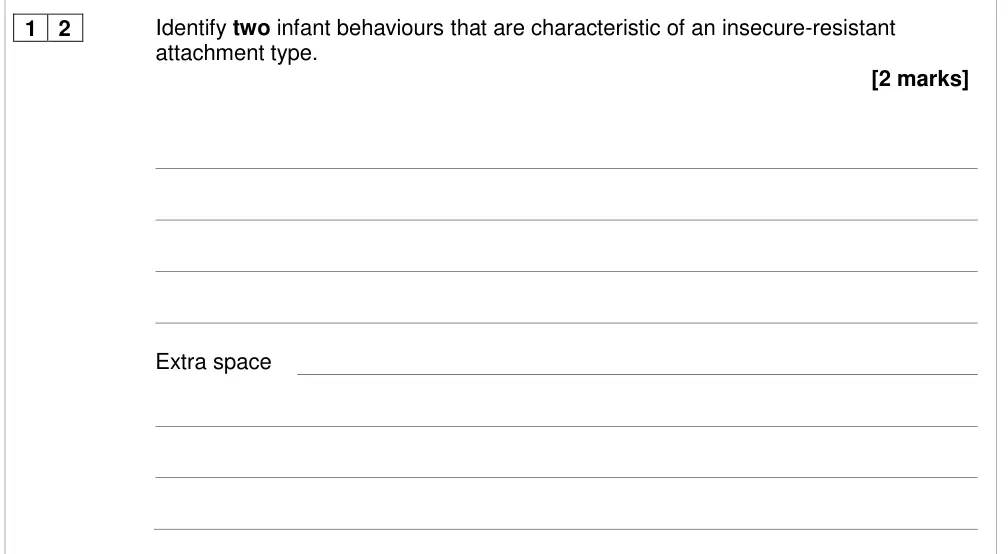
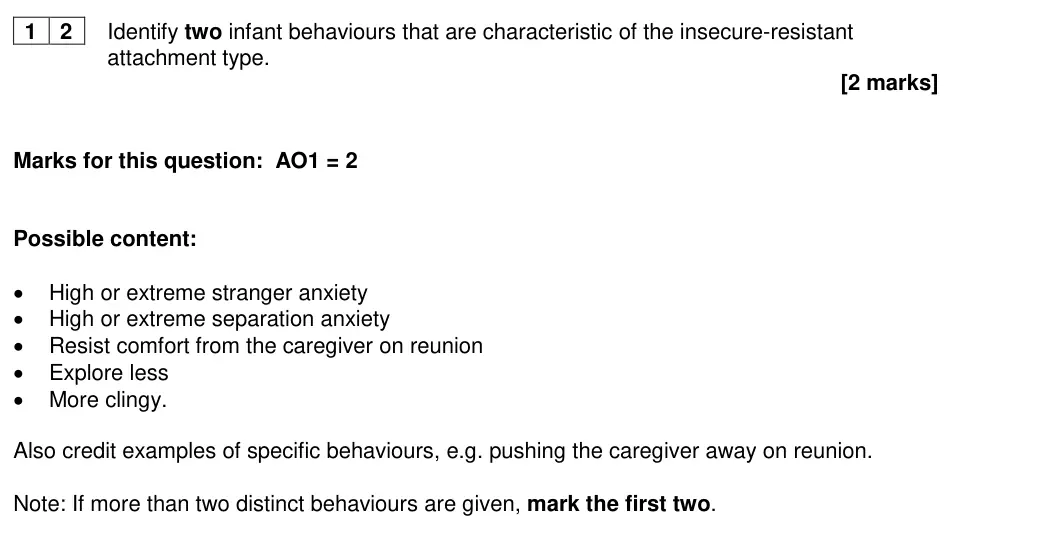
June 2017 · AS Paper 1 · Q122 marksAO1=2Short answer
Mark scheme, including level descriptors and indicative content
Examiner's comment
Credit was only given to the first two infant behaviours and many students wasted time by describing more. To gain credit there had to be some kind of qualifier, eg “high separation anxiety” or “extreme stranger anxiety”. Without such qualifiers, the behaviour could apply to other types of attachment.
Notes from the mark scheme and report
needs qualifiers (high/extreme separation or stranger anxiety, resists comfort on reunion)
only first two behaviours marked
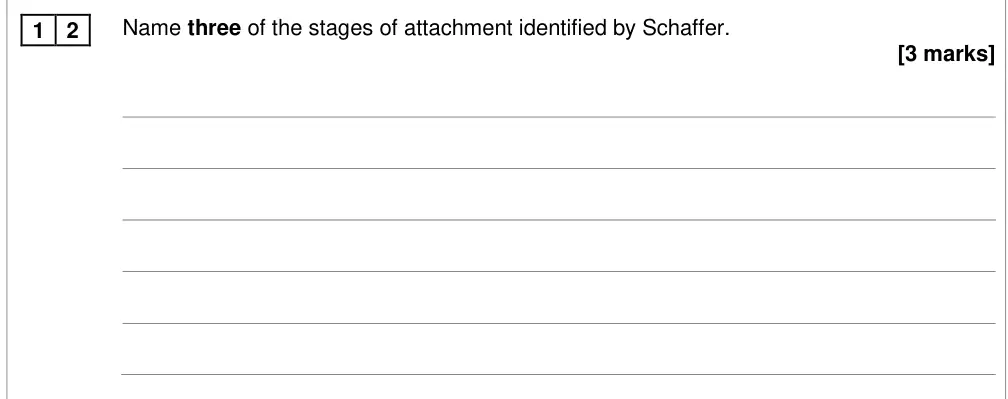
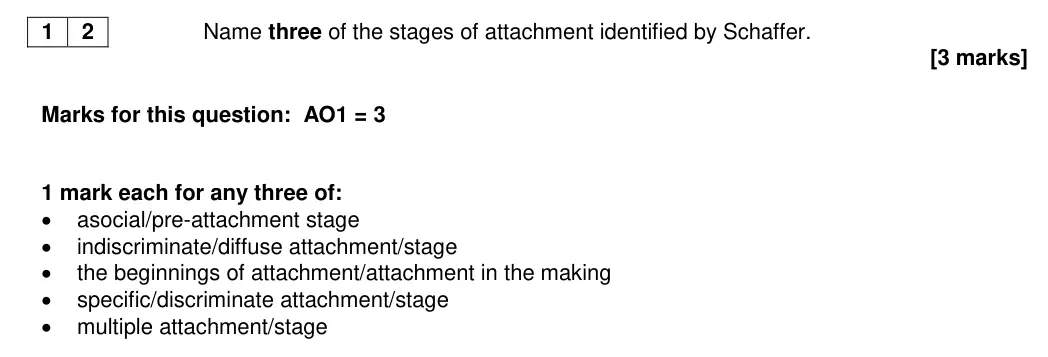
June 2017 · Paper 1 · Q123 marksAO1=3Short answerOld spec only
Not on the 2025 specification: Schaffer's stages of attachment removed in v1.4
Mark scheme, including level descriptors and indicative content
Examiner's comment
This question elicited the best performance on the paper, with most students able to name three of Schaffer’s stages. In fact the most common error was for students to waste time explaining what was involved in each of the three stages. The question only asked for the stages to be named. A few answers confused Schaffer’s stages with types of attachment in the strange situation.
Notes from the mark scheme and report
Off-spec: Schaffer's stages of attachment removed in v1.4
naming only required
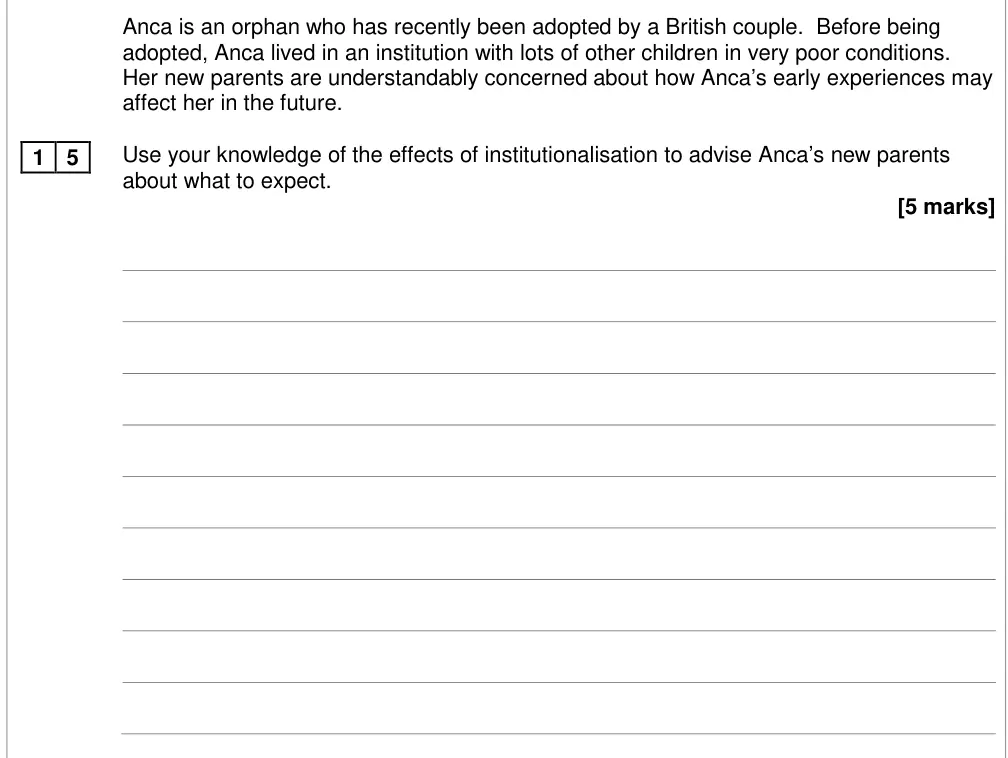
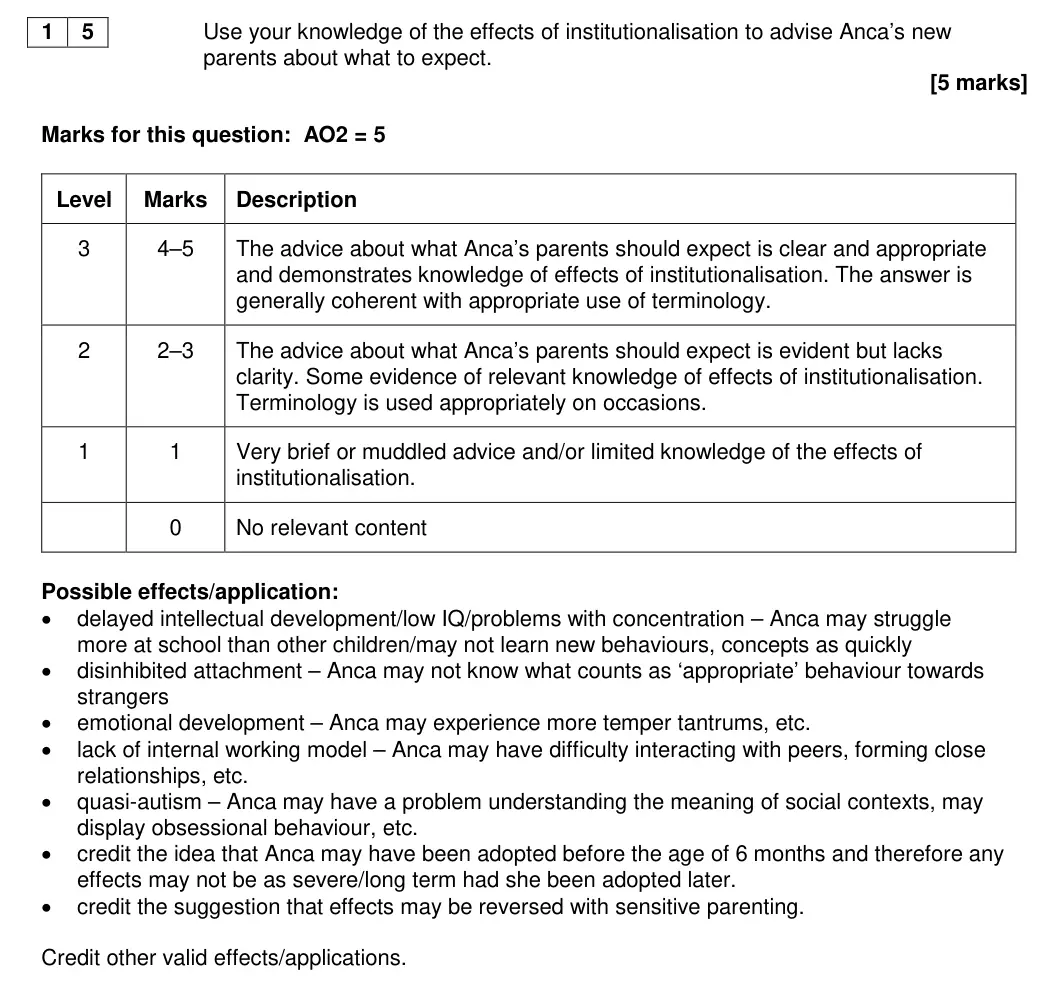
June 2017 · Paper 1 · Q155 marksAO2=5Application
Mark scheme, including level descriptors and indicative content
Examiner's comment
Effective application is a test of understanding of material and it was clear that some students were vulnerable in this respect. In question 15 there were some excellent summaries of the effects of institutionalisation, but a number of students forgot to refer to Anca’s new parents at all, as required by the question. Answers to this question showed reasonable awareness of the effects of institutionalisation, in terms of intellectual and emotional development, disinhibited attachment, lack of an internal working model for relationships, etc. However a common weakness was a failure to structure the material around advice to Anca’s new parents, preventing access to the top level. There were some very sophisticated answers that considered the age of adoption as a critical variable. There is historical research, still relevant, that used terms such as ‘mental retardation’, and this phrase was quoted quite often. In the specific context of a particular historical research study this is acceptable, but as a general and contemporary description of the effects of institutionalisation it is not. Alternatives such as ‘intellectual delay’ should be used instead.
Notes from the mark scheme and report
must be framed as advice to Anca's parents for the top level: low IQ/intellectual delay, disinhibited attachment, lack of internal working model, quasi-autism
age of adoption (before 6 months) and reversibility credited
avoid 'mental retardation' outside historical study context
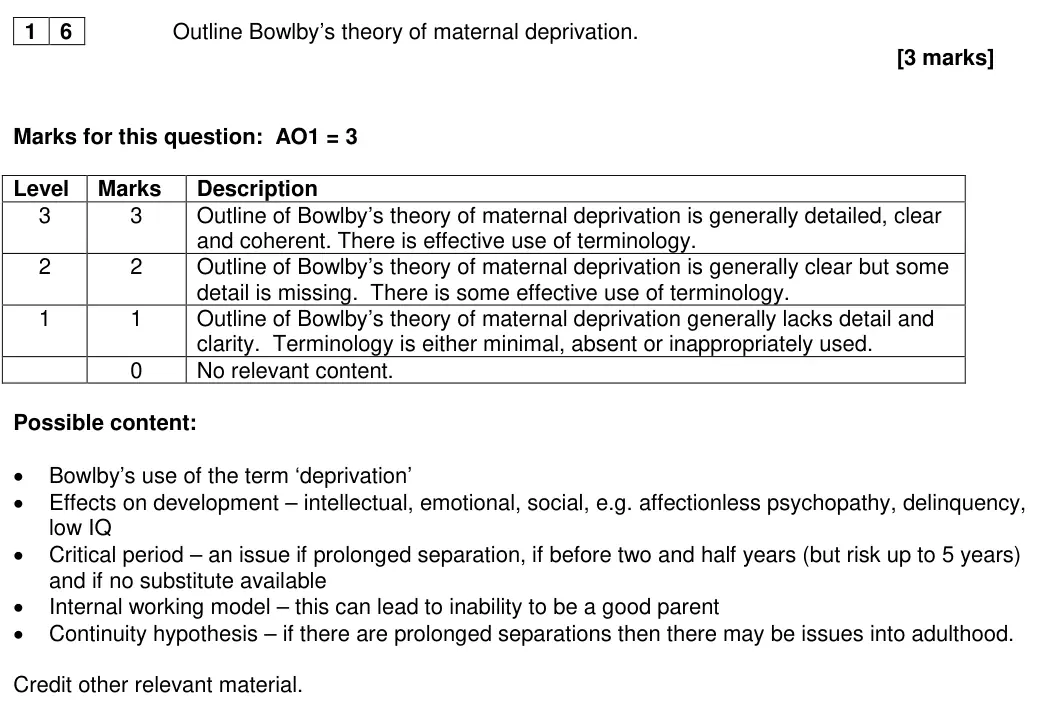
June 2017 · AS Paper 1 · Q163 marksAO1=3Outline
Mark scheme, including level descriptors and indicative content
Examiner's comment
There was a wide range of answers to this question. Some students gave extremely accurate and detailed answers. For example, referring to the critical period, consequences for future relationships and effects on further development. Unfortunately, other students confused Bowlby’s theory of maternal deprivation with his theory of attachment and wrote about the latter. Such answers gained no credit.
confusing maternal deprivation with Bowlby's monotropic theory gained no credit
June 2017 · Paper 1 · Q168 marksAO1=3, AO3=5Extended writing
Mark scheme, including level descriptors and indicative content
Examiner's comment
In ‘discuss’ or ‘outline and evaluate’ questions, students often spent too much time on descriptive material, leaving too little time to develop effective discussion and evaluation. This was particularly the case in questions 10 and 16. Overall this question was not done well. The question required discussion of the findings of research into cultural variations, so extensive descriptions of the methodology of the strange situation were not creditworthy. There was great variability in the accuracy of the description of the findings of relevant studies, in particular of Van Ijzendoorn and Kroonenberg’s metareview. Confusion between the insecure types of attachment was quite common, and discussion tended to be generic. Although better answers showed understanding of the strengths and weaknesses of metareviews, weaker students clearly failed to understand that key studies were in fact metareviews and not single pieces of research. Much of the evaluation was methodological and could be effective, for example cultural specificity of the strange situation. Other creditworthy points, such as greater variation in attachment patterns within countries as opposed to between them, were also relatively common. However, many students focused on methodological evaluation of the strange situation (eg ethics) without making it relevant to cultural variations in attachment so earned little credit.
Notes from the mark scheme and report
findings not methodology of the Strange Situation
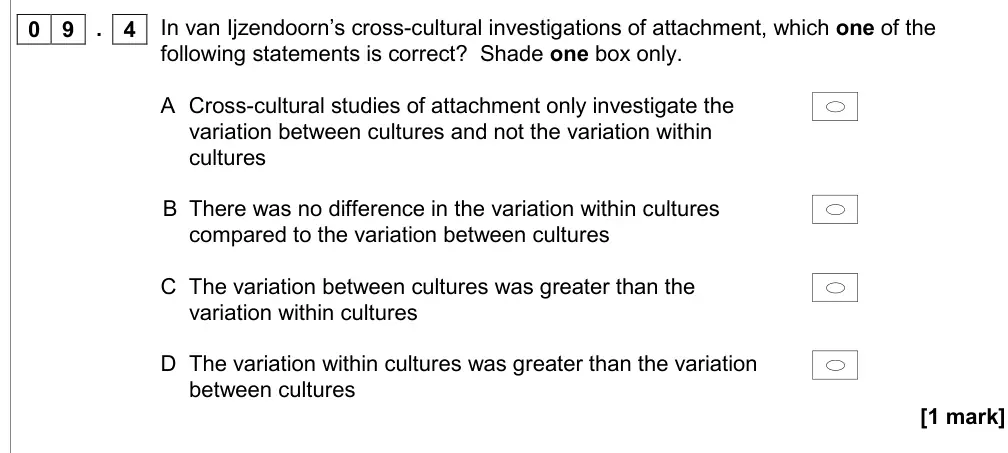
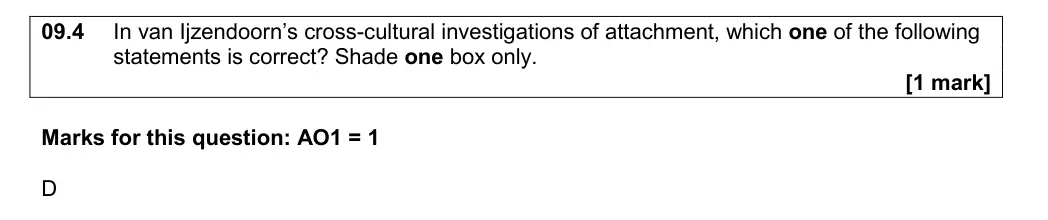
van Ijzendoorn and Kroonenberg (meta-analysis), more variation within than between countries
confusion between insecure types
generic Strange Situation criticisms must be linked to cultural variation
June 2017 · AS Paper 1 · Q173 marksAO3=3Evaluate (short)
Mark scheme, including level descriptors and indicative content
Examiner's comment
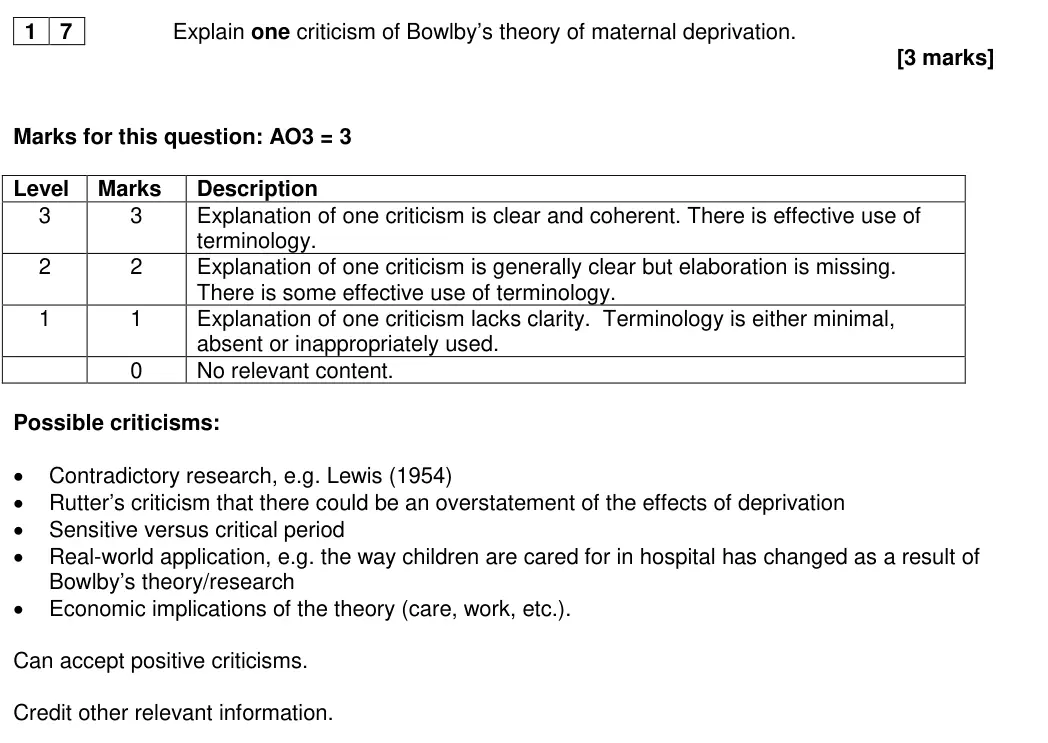
This question again showed that students need to understand that criticising a study is not the same as criticising a theory. They need to know how to use a study to critique a theory. Lengthy criticisms of Bowlby’s 44 Thieves were not creditworthy, unless they were used to challenge his theory. Evaluation of a study is not the same as evaluation of a theory. More successful answers used studies to refute Bowlby’s findings, or to challenge his idea of a critical period. As with the previous question, some students criticised Bowlby’s theory of attachment.
Notes from the mark scheme and report
criticism of the THEORY not a study (44 thieves criticism only credited if used to challenge the theory)
e.g. Lewis, Rutter, sensitive vs critical period, real-world application
some criticised monotropic theory instead
June 2017 · AS Paper 1 · Q188 marksAO1=4, AO3=4Extended writing
Mark scheme, including level descriptors and indicative content
Examiner's comment
Assessment of extended writing as in Q6, Q11 and Q18 differentiated well. Weaker responses to these questions suggest that students need to focus on developing their higher order skills. There were some extremely good answers demonstrating accurate and detailed knowledge of both classical and operant conditioning, clearly linked to attachment. For some students, while their understanding of conditioning was good, they did not make any links with attachment and therefore did not receive credit. Students struggled with evaluation of a theory, but successful answers cited studies that contradict the learning theory. Harlow’s studies demonstrated that comfort was more important than food, and Schaffer and Emerson showed that over half of the infants they studied were not attached to the person who fed them. Alternative explanations were also used as effective evaluation.
Notes from the mark scheme and report
cupboard love, classical and/or operant conditioning linked to attachment
no link to attachment = no credit
knowledge at Level 4 = max 4
evaluation e.g. Harlow, Schaffer and Emerson (MS uses multiple-attachment findings, removed in v1.4), Bowlby alternative
methodological points must link to the theory
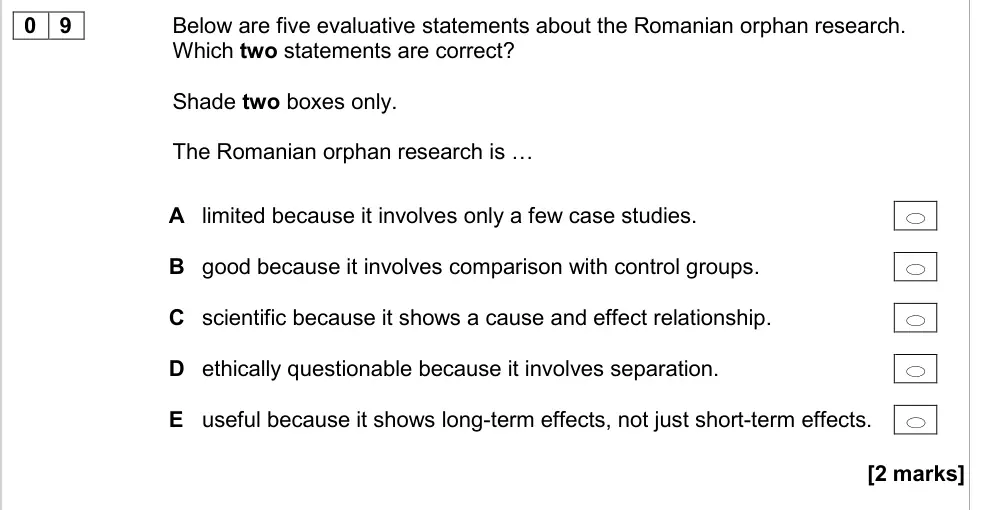
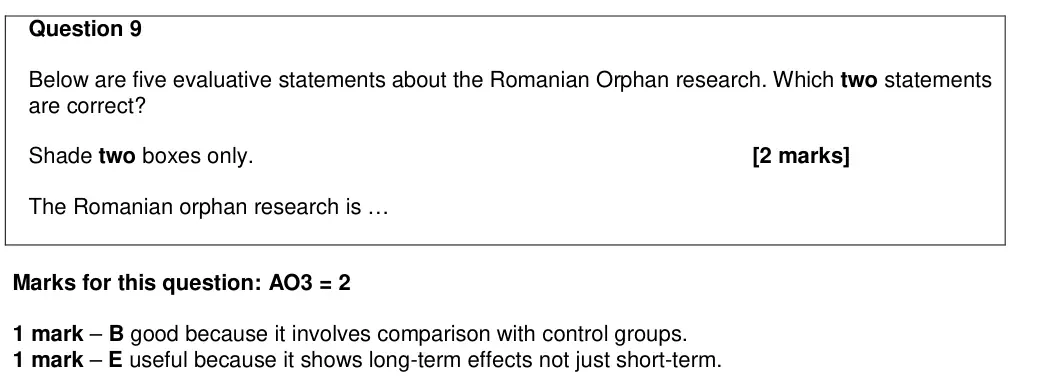
June 2016 · AS Paper 1 · Q92 marksAO3=2Multiple choiceEasy
Answer
B and E
Mark scheme, including level descriptors and indicative content
Examiner's comment
This question discriminated well with just under half the responses gaining full marks and just under half the responses gaining one mark.
Notes from the mark scheme and report
Romanian orphan research = ERA project in v1.4
correct B (control groups) and E (long-term effects)
distractor C needs understanding that natural experiments cannot show cause and effect
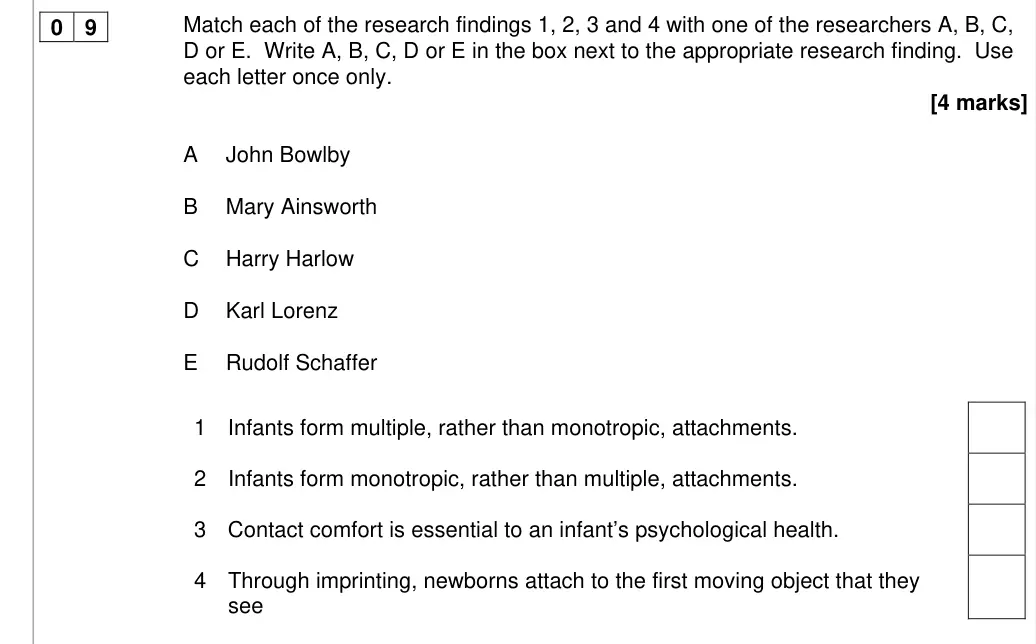
Specimen set 2 · Paper 1 · Q94 marksAO1=4Multiple choice
Mark scheme, including level descriptors and indicative content
Notes from the mark scheme and report
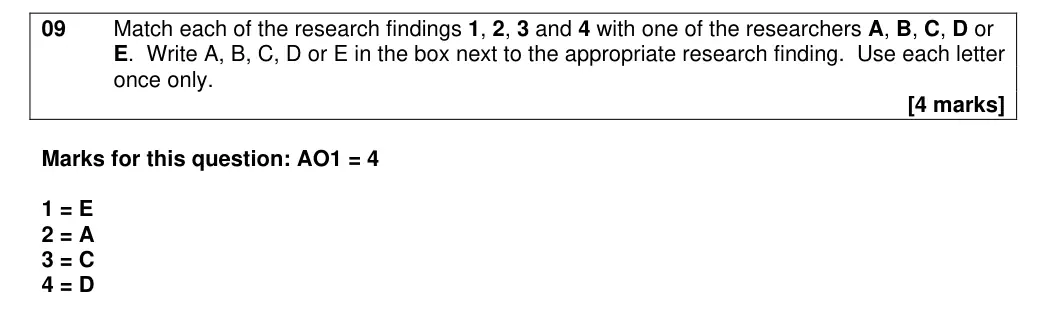
1 = E (Schaffer), 2 = A (Bowlby), 3 = C (Harlow), 4 = D (Lorenz)
finding 1 (Schaffer, multiple attachments) removed in v1.4 so 1 of the 4 marks is off-spec
June 2016 · AS Paper 1 · Q10.12 marksAO1=2Short answer
Mark scheme, including level descriptors and indicative content
Examiner's comment
These two questions proved to be highly accessible. Most students could answer 10.1 correctly, with slightly fewer obtaining two marks on 10.2.
Notes from the mark scheme and report
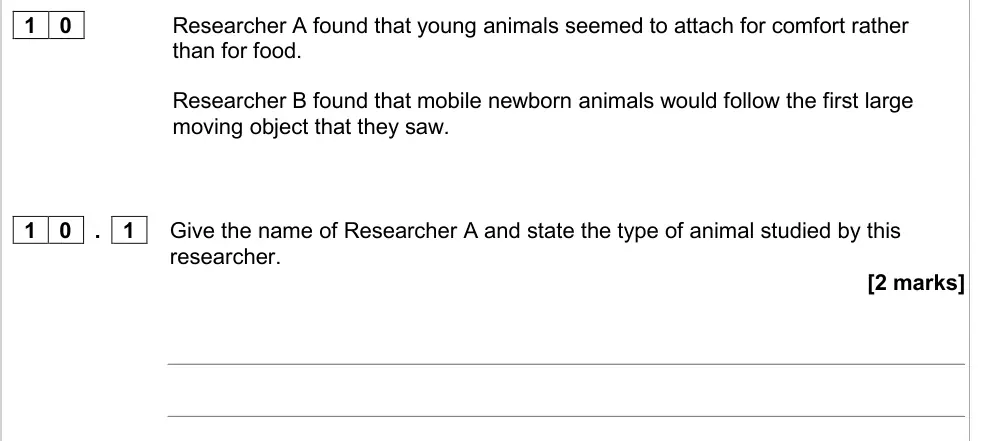
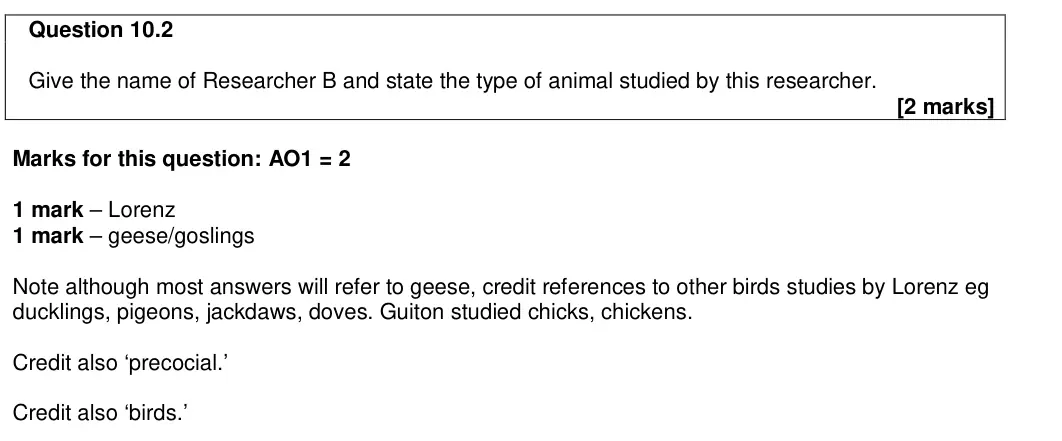
Harlow
(rhesus) monkeys
June 2016 · AS Paper 1 · Q10.22 marksAO1=2Short answer
Mark scheme, including level descriptors and indicative content
Examiner's comment
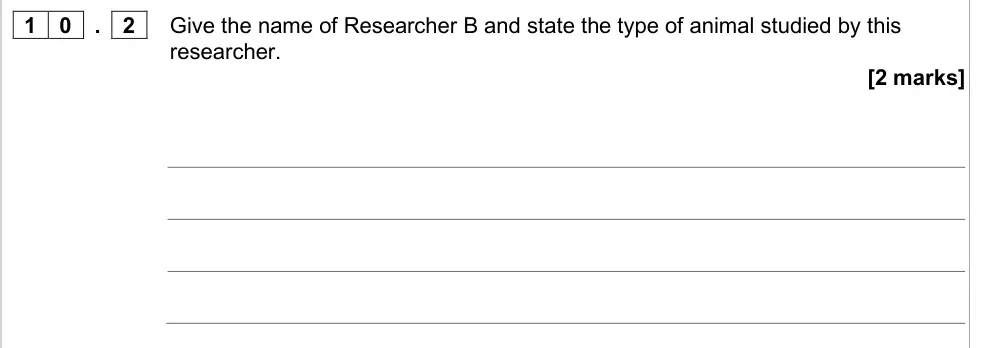
Questions 10.1 and 10.2 These two questions proved to be highly accessible. Most students could answer 10.1 correctly, with slightly fewer obtaining two marks on 10.2. Although most responses to 10.2 cited Lorenz, other imprinting researchers (and their animals) were credited.
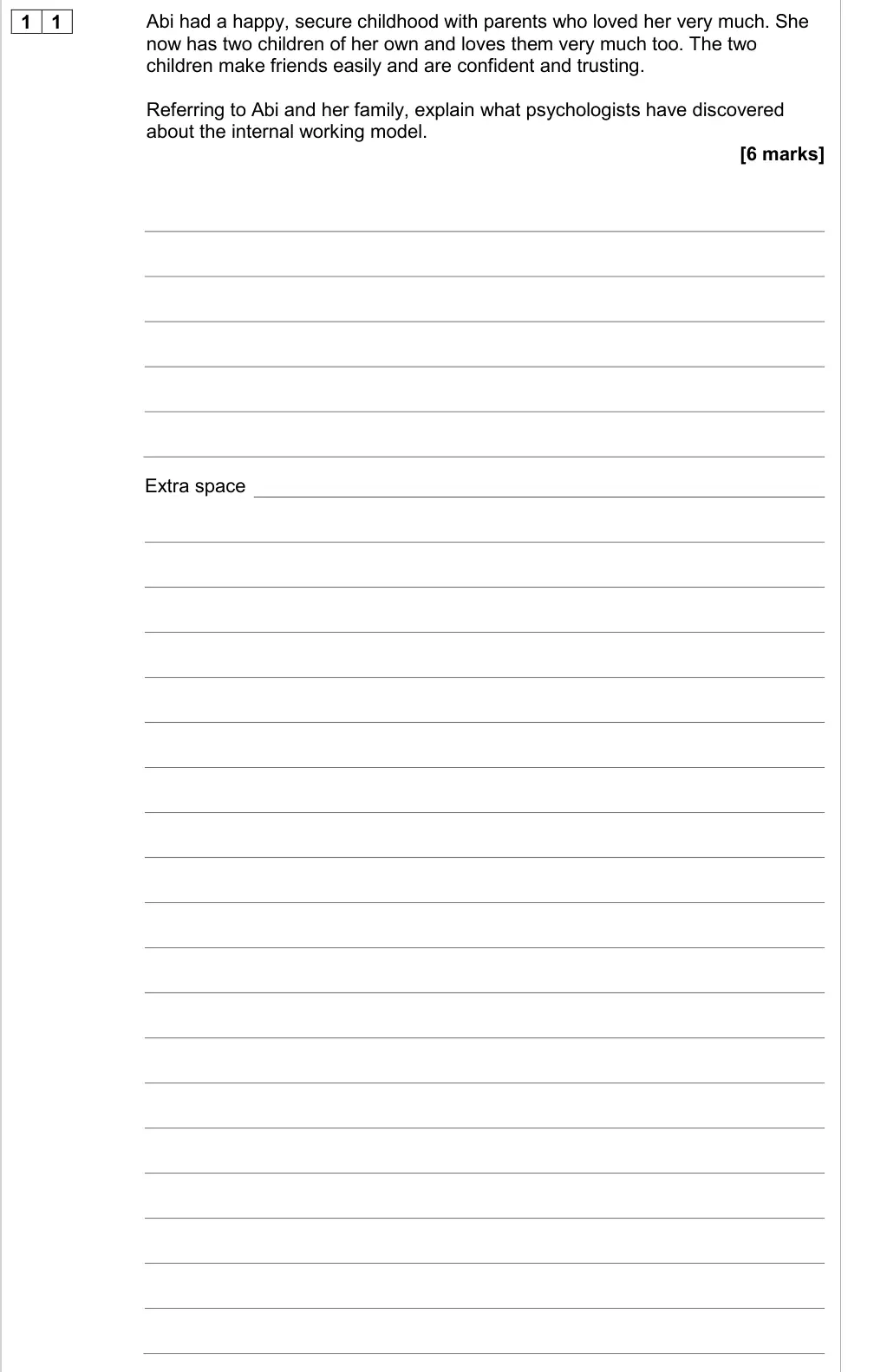
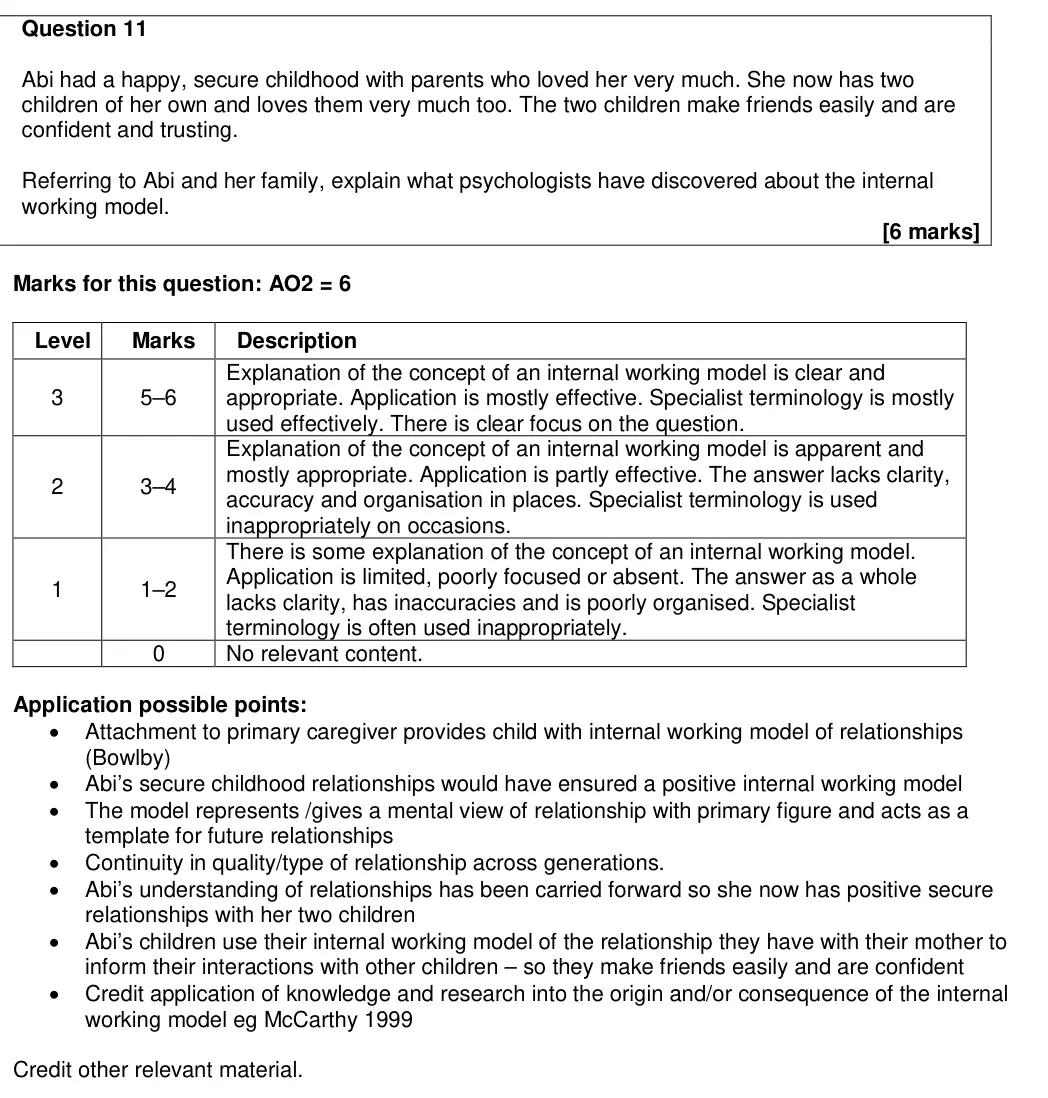
June 2016 · AS Paper 1 · Q116 marksAO2=6Application
Mark scheme, including level descriptors and indicative content
Examiner's comment
Questions that tended to differentiate best were questions 1.2, 3, 8, 11 and 12. This question often presented difficulties. Largely ineffective responses were those that included scant, if any, psychological content and consisted mostly of reiterations of the stem and vague anecdotal suggestions about past experience or growing up in a happy family. Other unsuccessful answers focussed solely on type of attachment. Many answers indicated a common misunderstanding that people either have an internal working model and so can experience healthy relationships with others, or they do not have an internal working model so cannot experience healthy relationships. There were some better responses that showed understanding and application of the internal working model as a mental construct or schema, along with an appreciation of how the model arises out of the initial attachment and how it serves as a template for future relationships.
Notes from the mark scheme and report
all AO2: explain IWM as template/schema from first attachment and apply to Abi and her children (intergenerational continuity, making friends)
answers restating the stem with little psychology
misconception that people either have or lack an IWM
focusing only on attachment type
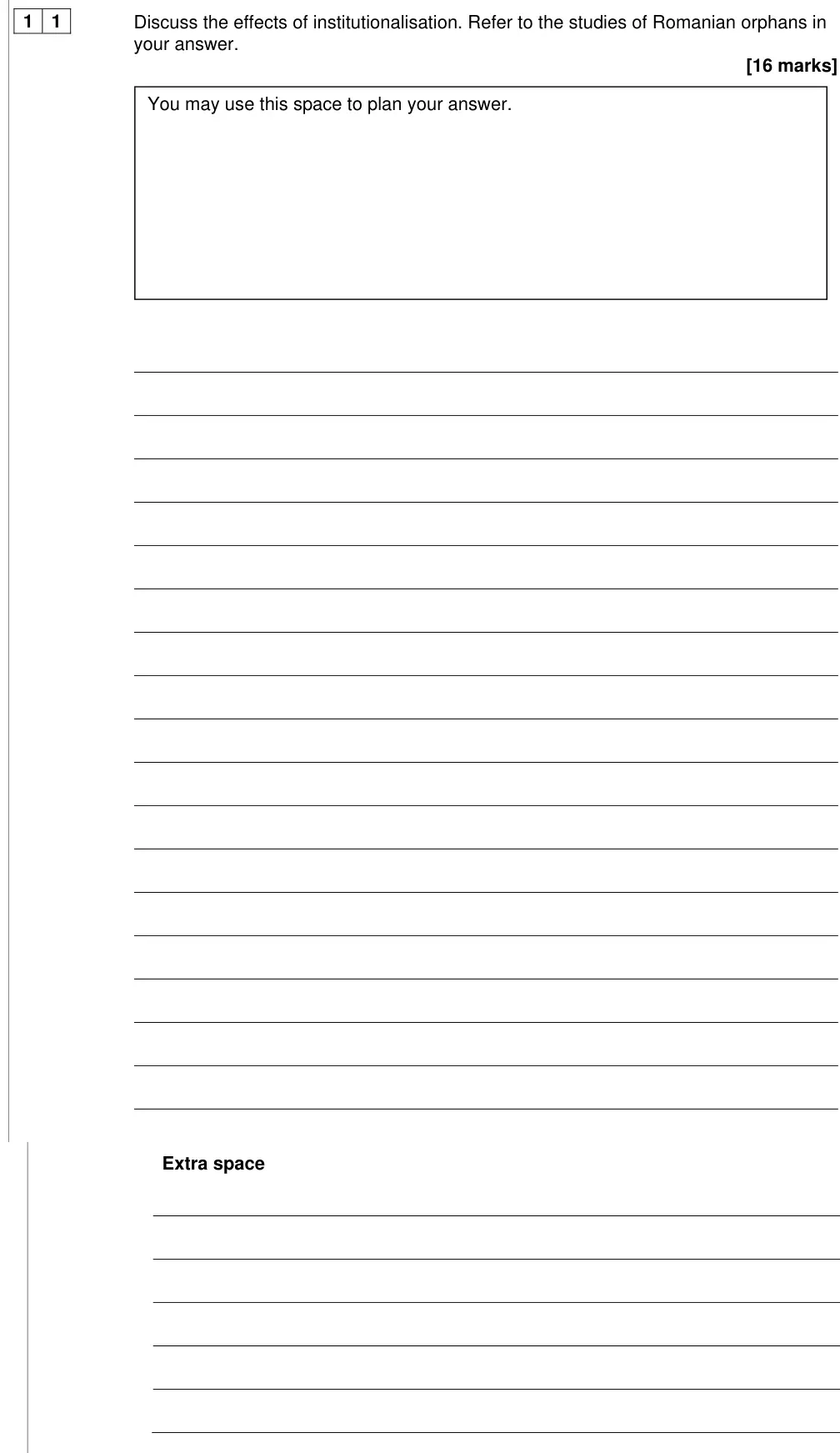
Specimen set 2 · Paper 1 · Q1116 marksAO1=6, AO3=1016-mark essay
Mark scheme, including level descriptors and indicative content
Notes from the mark scheme and report
must refer to Romanian orphan studies (now the English and Romanian Adoptees project)
effects e.g. disinhibited attachment, quasi-autism, low IQ
recovery with adequate substitute care, age of adoption, non-random allocation in ERA
June 2016 · AS Paper 1 · Q1212 marksAO1=6, AO3=6Extended writing
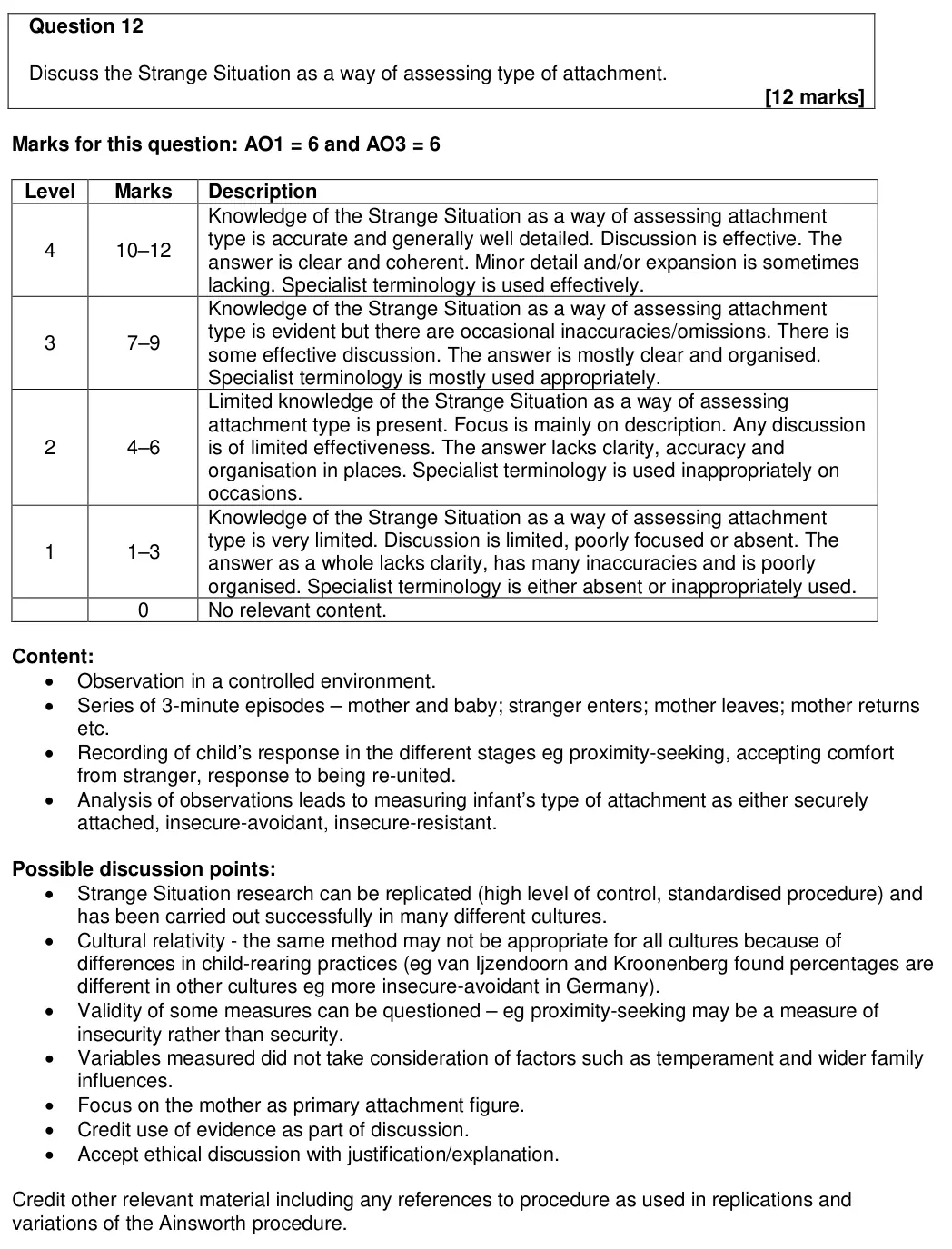
Mark scheme, including level descriptors and indicative content
Examiner's comment
Questions that tended to differentiate best were questions 1.2, 3, 8, 11 and 12. This question elicited some extremely detailed descriptions of the Strange Situation although, oddly, even extensive descriptions often omitted to refer to the method as controlled. Students were divided as to whether Ainsworth used a one-way or a two-way mirror. That said, descriptions were generally quite successful although there was often confusion between avoidant and resistant types. The majority of discussions were pre-prepared ‘Describe and evaluate the Strange Situation’ answers, whilst more successful answers explicitly addressed the matter of the appropriateness or usefulness of the procedure for measuring type of attachment. It was quite common to see discussions where students would offer cross-cultural findings of similar/different percentages of Ainsworth’s three types, but would fail to make the point that such findings supported the validity of the Strange Situation, or otherwise. Many answers included lengthy discussions of the findings where it would have been much more productive to concentrate on the method. Very rarely did students compare the Strange Situation with other ways of measuring type of attachment. The least successful discussions tended to consist of completely generic points about ethics and lack of ecological validity.
Notes from the mark scheme and report
must address the Strange Situation as a way of ASSESSING attachment type (validity, reliability, cultural relativism, temperament, mother focus)
pre-learned generic evaluation and long accounts of cross-cultural findings scored less
confusion between avoidant and resistant
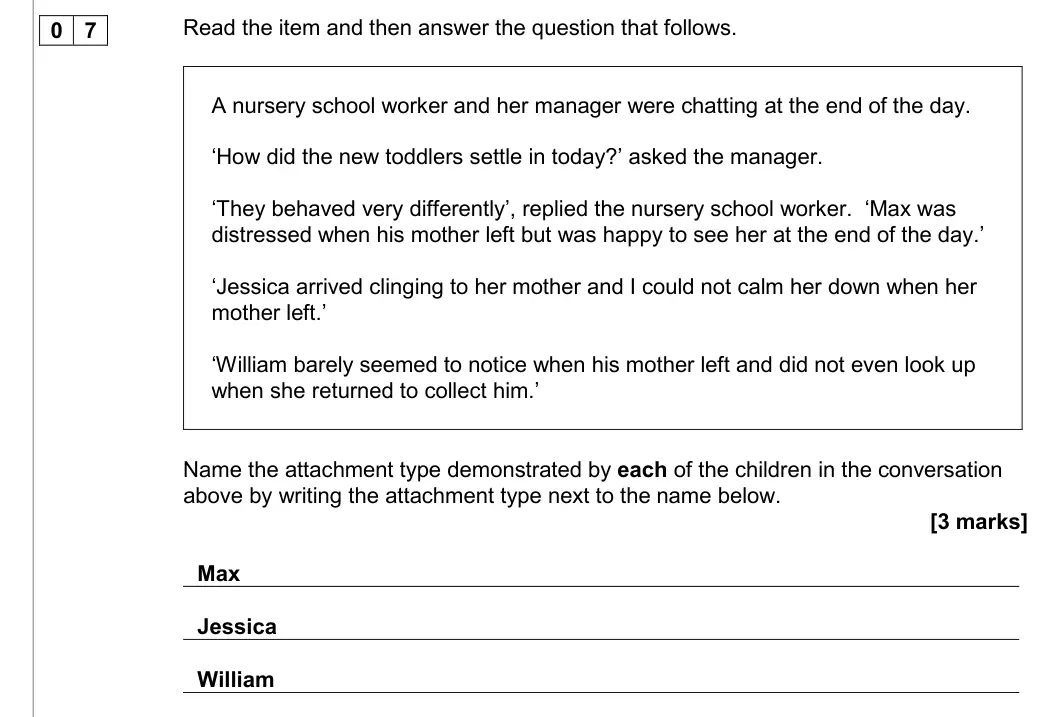
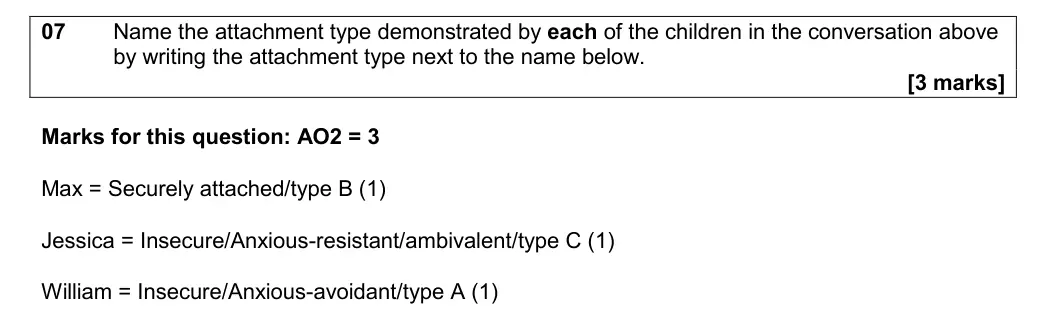
Specimen set 1 · Paper 1 · Q73 marksAO2=3Application
Mark scheme, including level descriptors and indicative content
Notes from the mark scheme and report
Max = secure (type B), Jessica = insecure-resistant (type C), William = insecure-avoidant (type A)
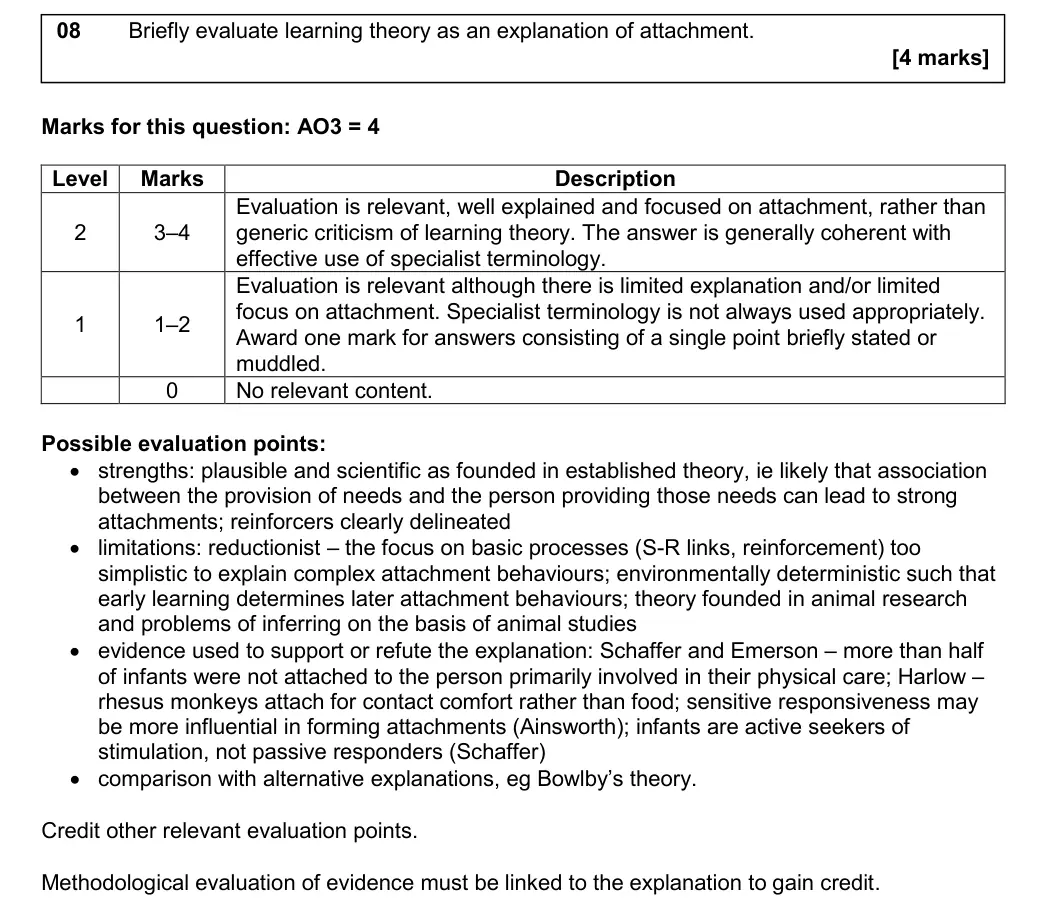
Specimen set 1 · Paper 1 · Q84 marksAO3=4Evaluate (short)
Mark scheme, including level descriptors and indicative content
Notes from the mark scheme and report
must focus on attachment, not generic criticism of learning theory
Harlow contact comfort, sensitive responsiveness, comparison with Bowlby
methodology must be linked to the explanation
MS also credits Schaffer and Emerson's multiple-attachment findings, removed in v1.4
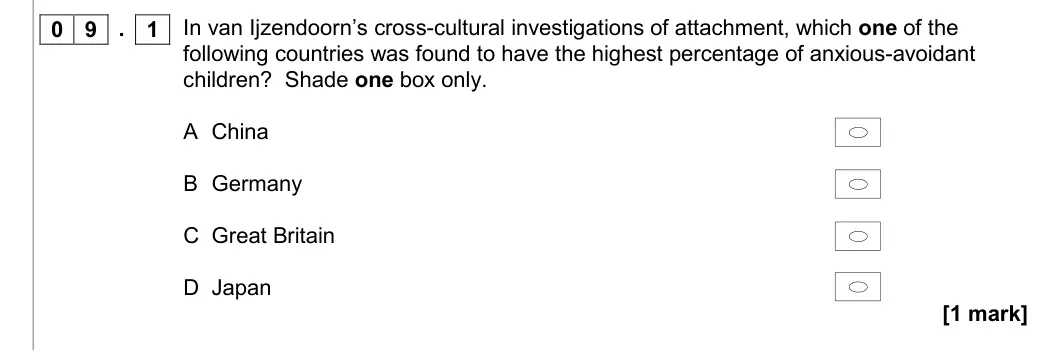
Specimen set 1 · AS Paper 1 · Q9.11 markAO1=1Multiple choice
Answer
B
Mark scheme, including level descriptors and indicative content
Notes from the mark scheme and report
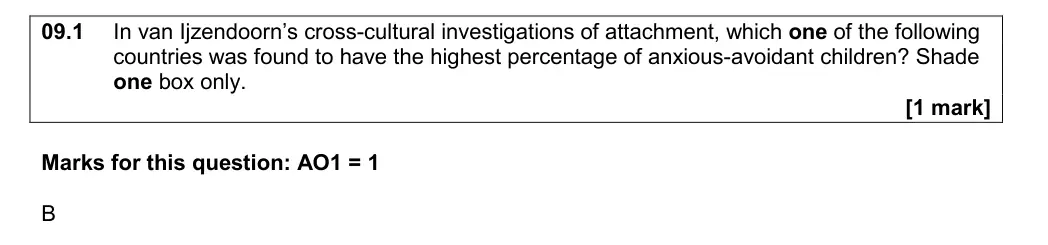
correct answer B Germany
anxious-avoidant = insecure-avoidant
Specimen set 1 · AS Paper 1 · Q9.21 markAO1=1Multiple choice
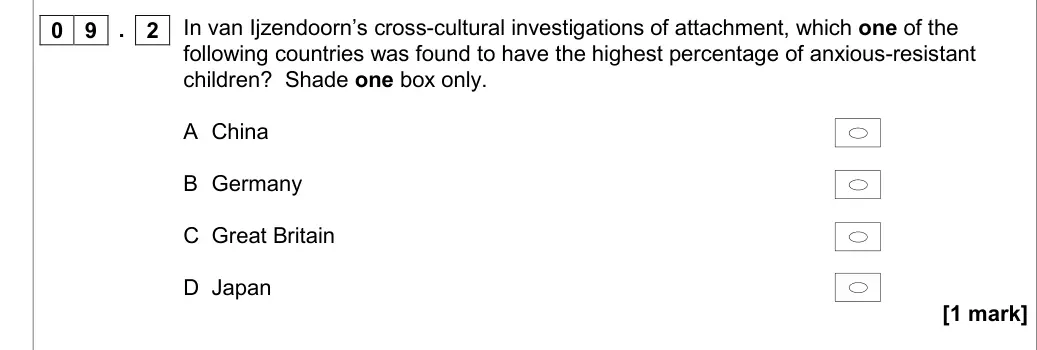
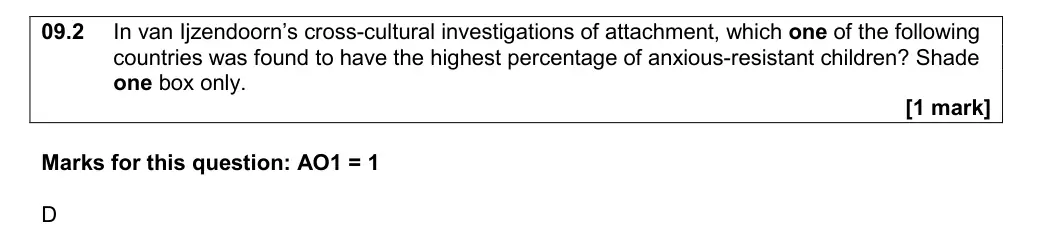
Answer
D
Mark scheme, including level descriptors and indicative content
Notes from the mark scheme and report
correct answer D Japan
anxious-resistant = insecure-resistant
Specimen set 1 · AS Paper 1 · Q9.31 markAO1=1Multiple choice
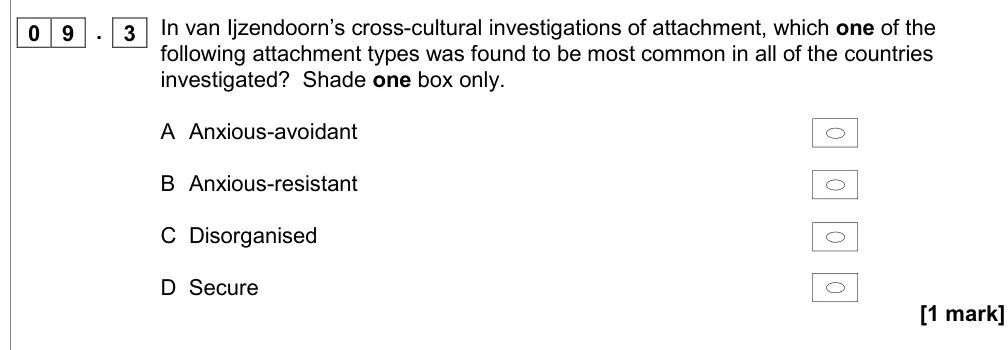
Answer
D
Mark scheme, including level descriptors and indicative content
Notes from the mark scheme and report
correct answer D secure
distractor 'disorganised' is not a spec attachment type
Specimen set 1 · AS Paper 1 · Q9.41 markAO1=1Multiple choice
Answer
D
Mark scheme, including level descriptors and indicative content
Notes from the mark scheme and report
correct answer D: variation within cultures greater than between (van Ijzendoorn and Kroonenberg)
Specimen set 1 · AS Paper 1 · Q1112 marksAO1=6, AO2=2, AO3=4Extended writing
Mark scheme, including level descriptors and indicative content
Notes from the mark scheme and report
AO2: apply to Joe (adopted at 7 = beyond critical period, delinquency, low IQ, affectionless psychopathy, internal working model)
methodological evaluation only creditworthy if linked to maternal deprivation
MS also credits Schaffer's multiple attachments as counter-evidence (removed in v1.4)
Romanian orphan research = ERA project
Specimen set 1 · Paper 1 · Q118 marksAO1=4, AO3=4Extended writing
Mark scheme, including level descriptors and indicative content
Notes from the mark scheme and report
emphasis must be on ADULT relationships (partners, own children)
internal working model, Adult Attachment Interview, Hazan and Shaver
determinism, cause-and-effect problems, recovery from privation
Work with an AQA psychology tutor
Essays not reaching the top band? Book a session with Andy, a former AQA examiner.