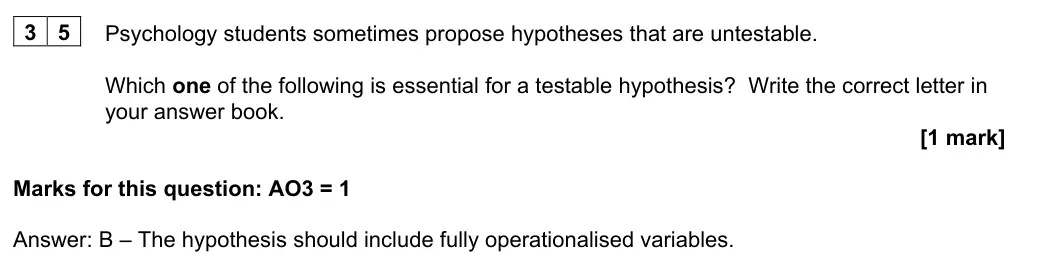
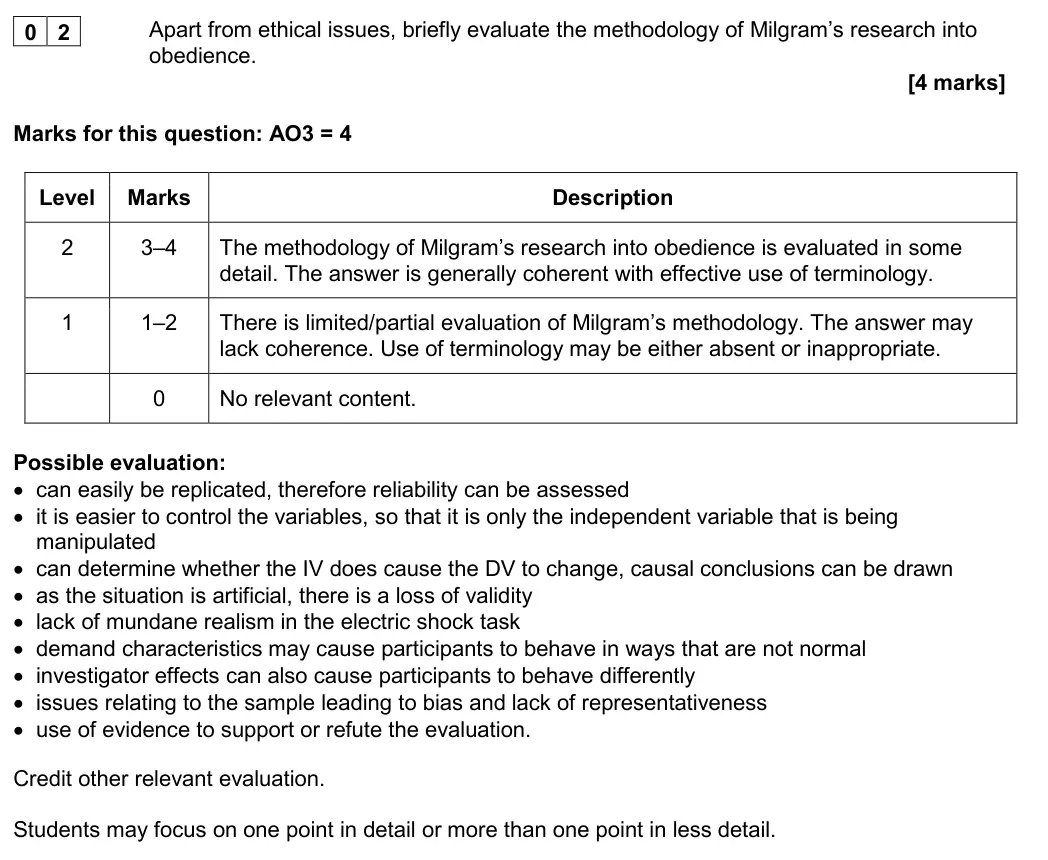
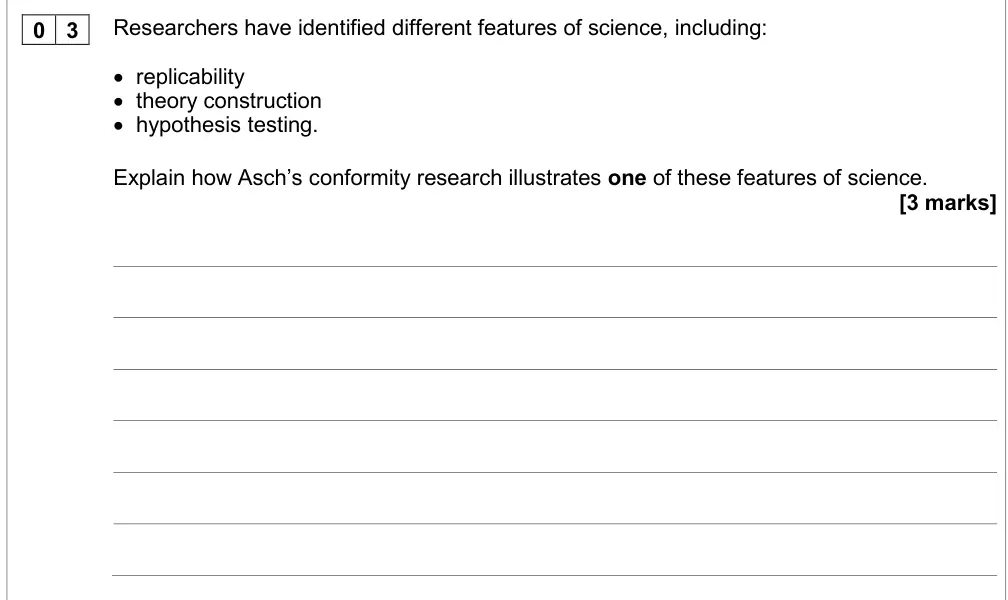
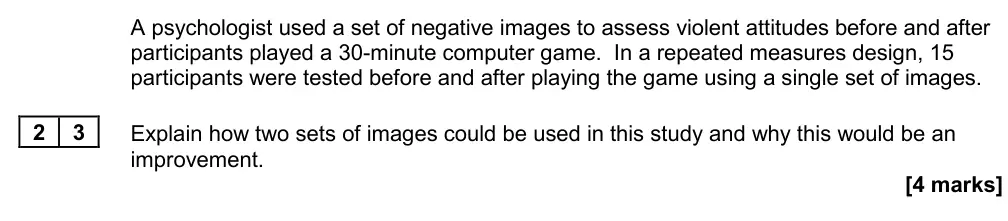
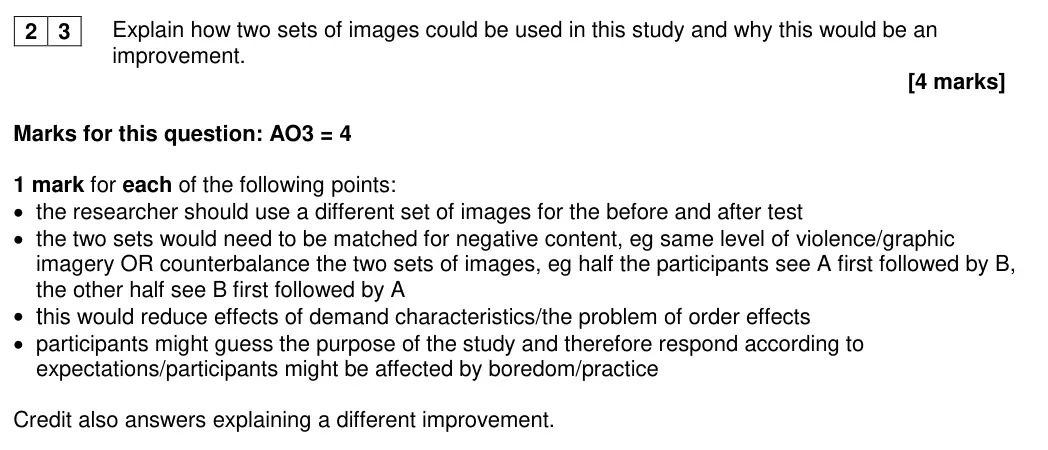
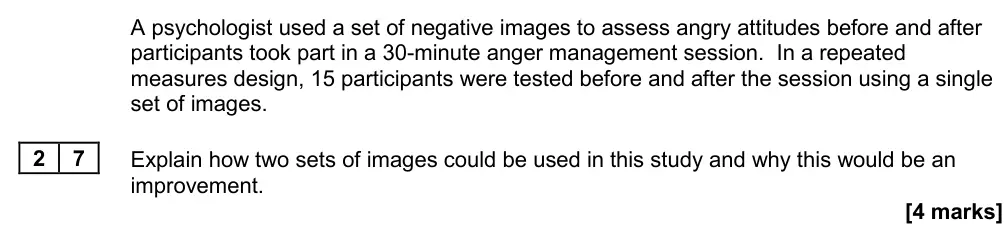
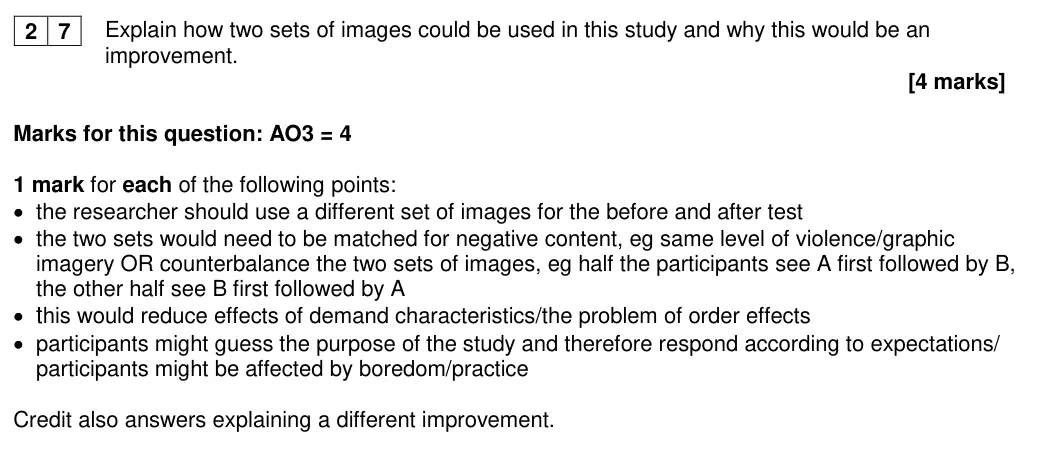
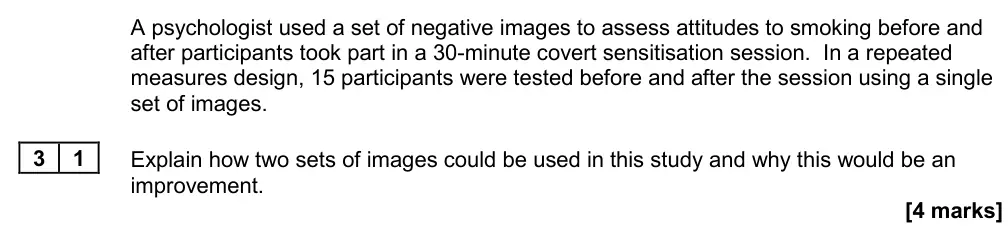
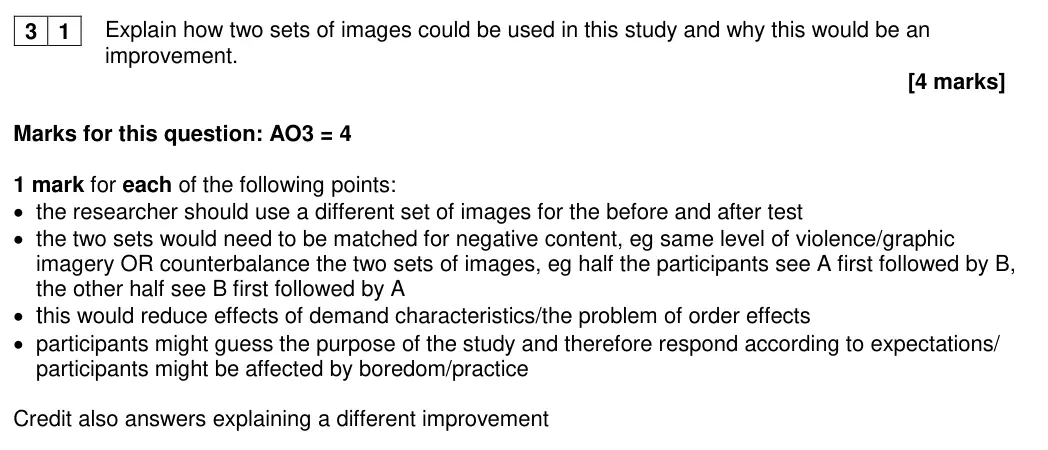
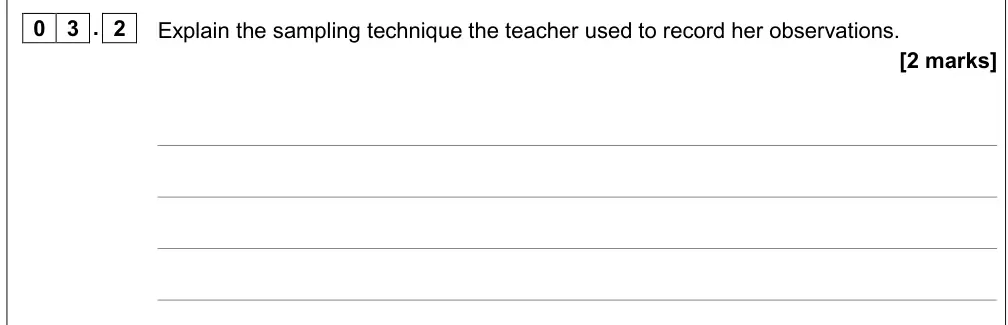
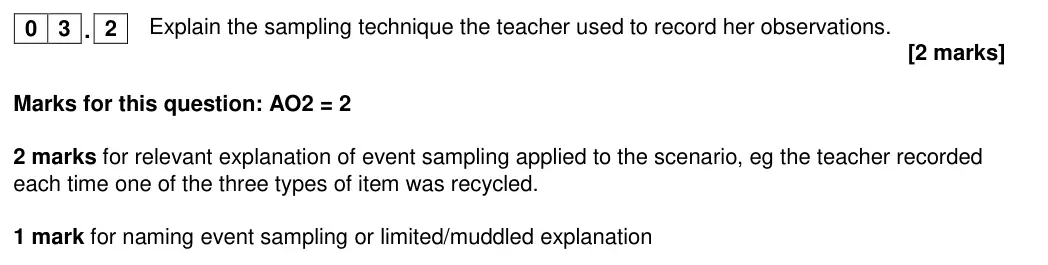
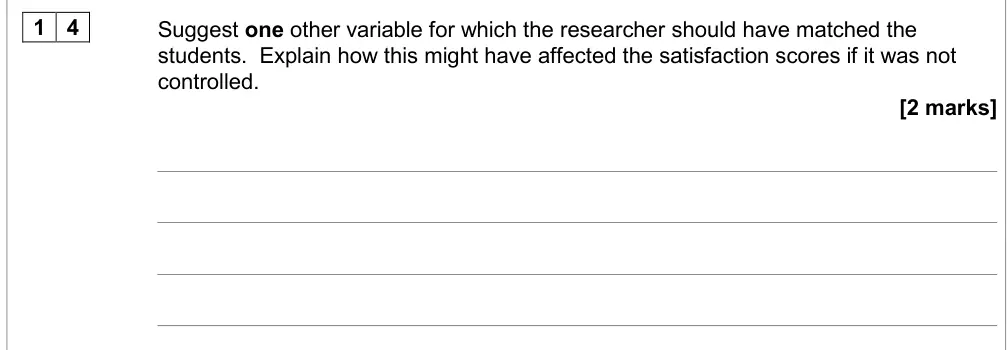
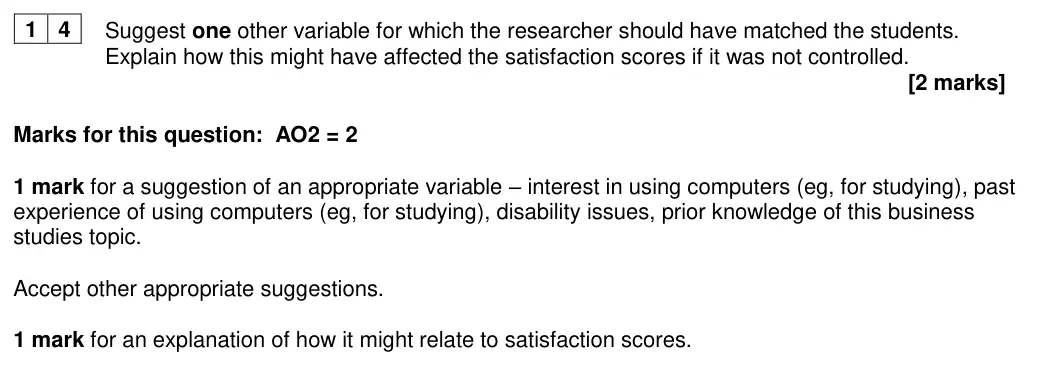
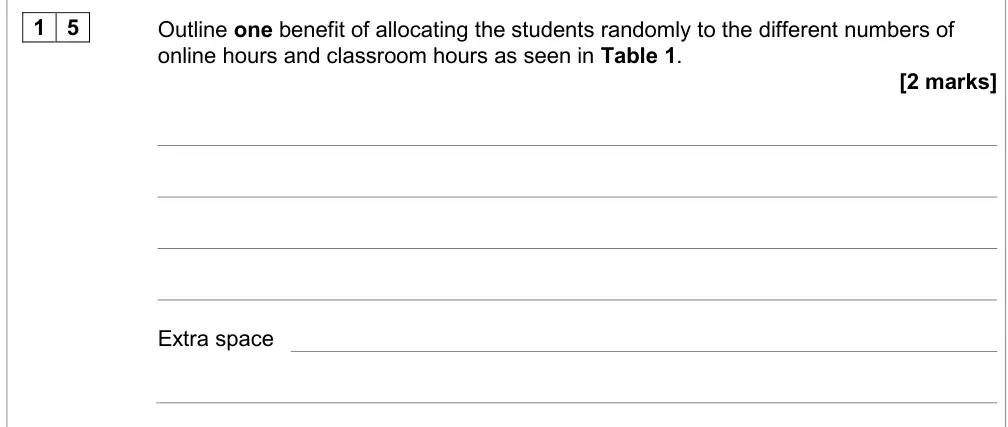
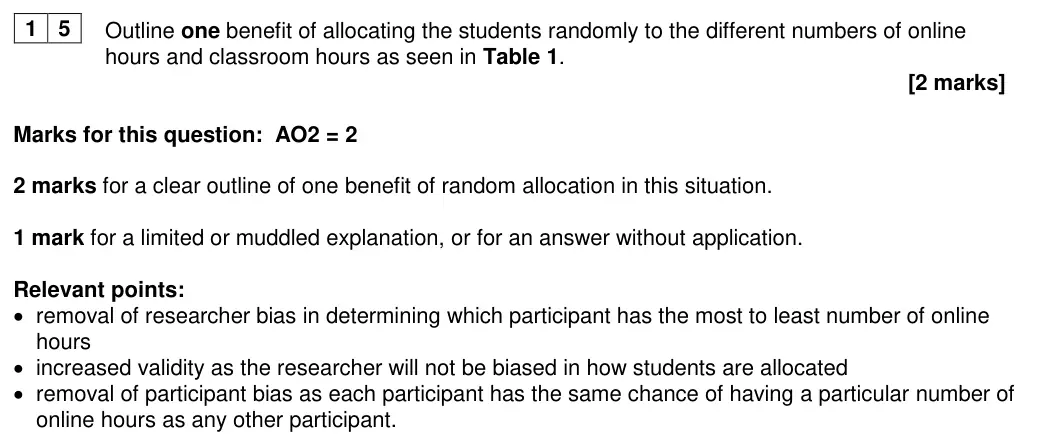
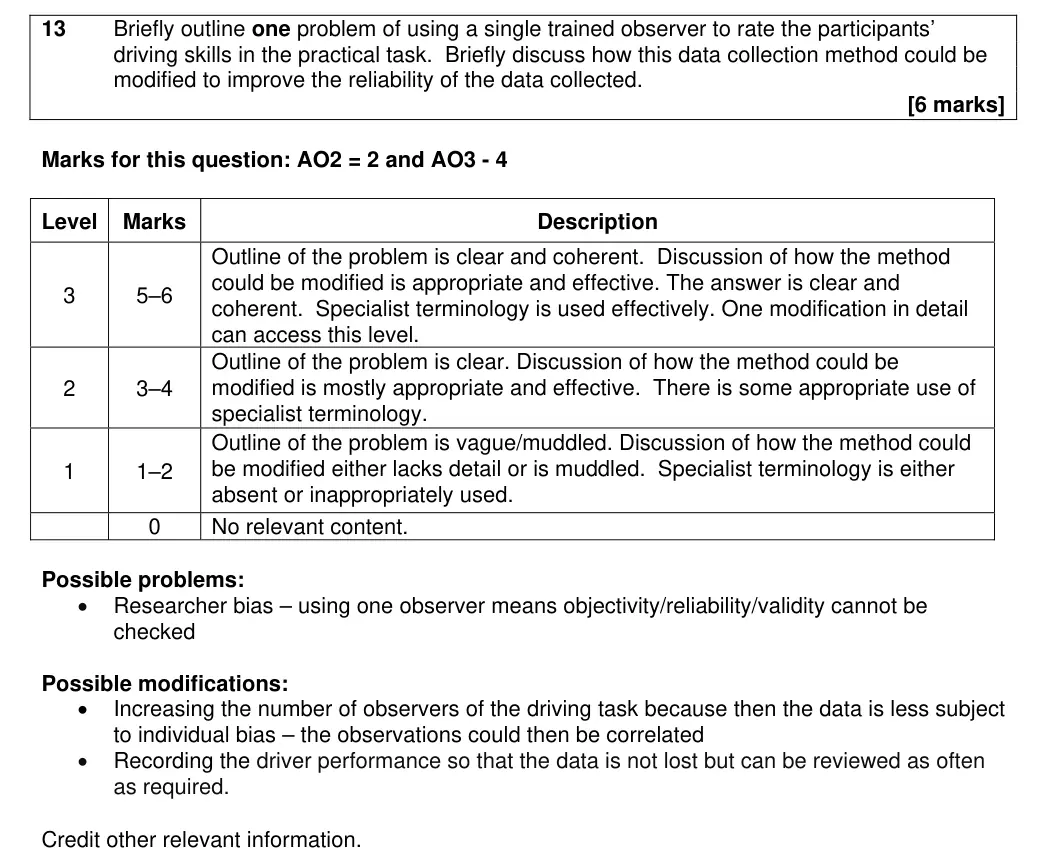
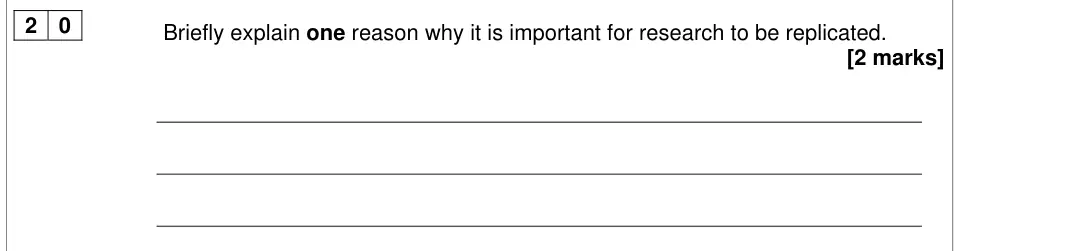
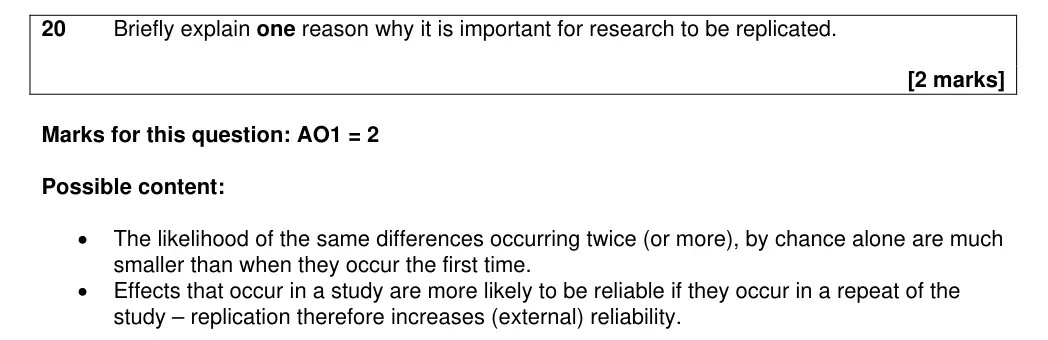
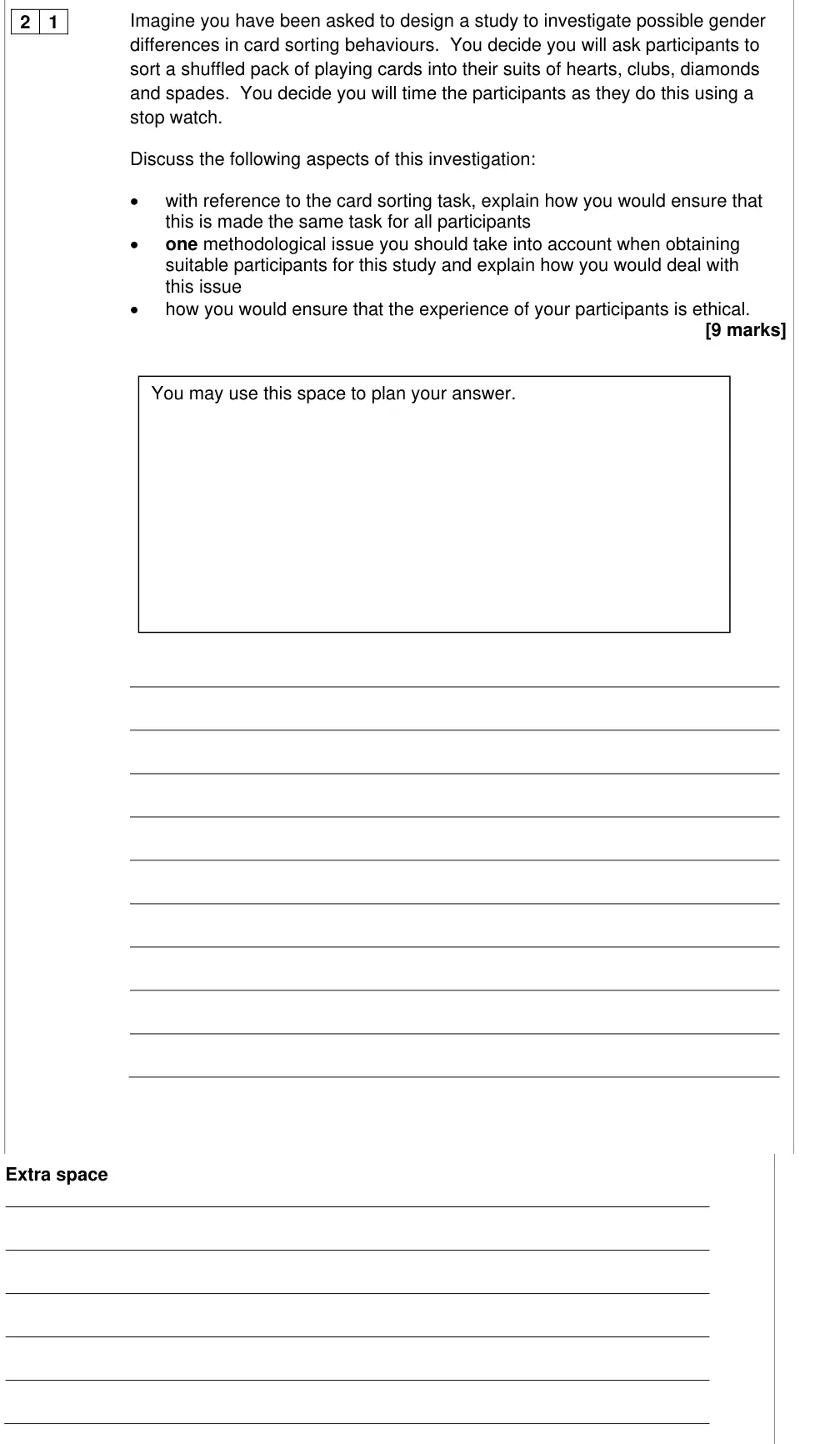
254 question parts, 1 sixteen-mark essays, 14 multiple-choice items, plus 9 parts on content removed in 2025
Notes, key studies and practice items for this topic are being written by our tutors. The past-paper questions below are ready now.
Specification statements
4.2.3.1-01 Aims: stating aims, the difference between aims and hypotheses.AS
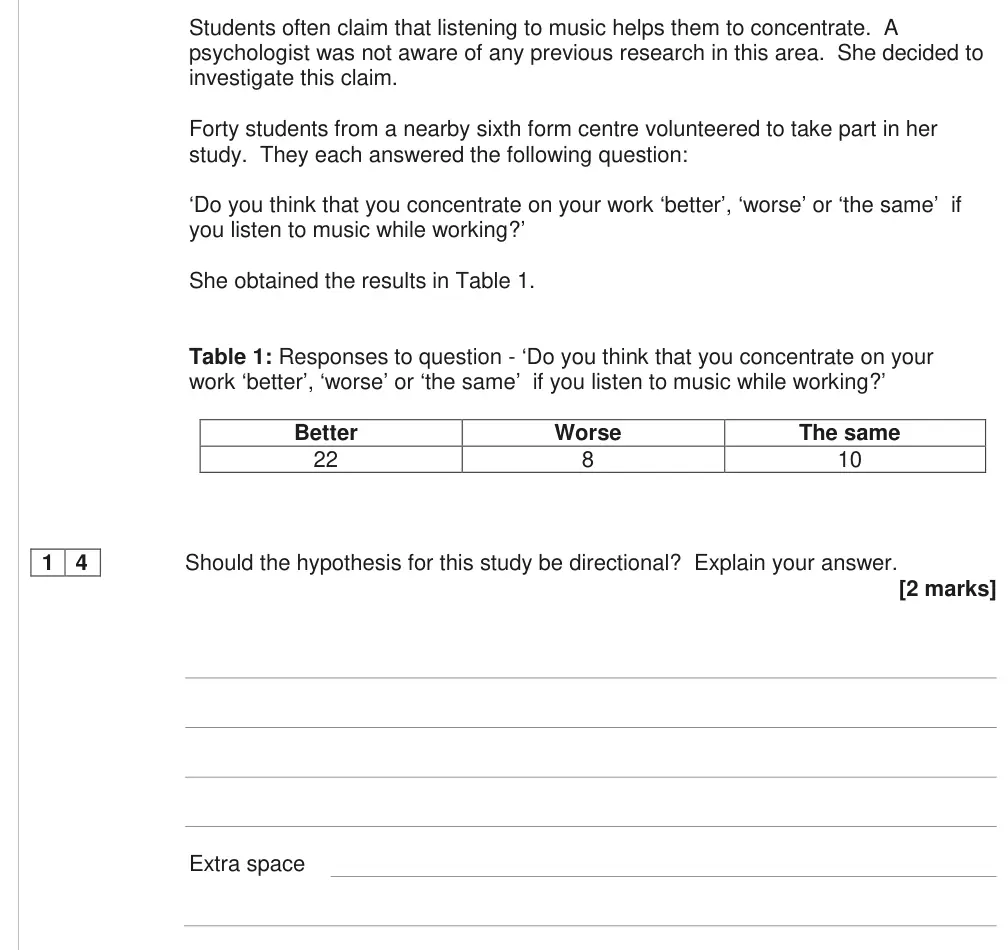
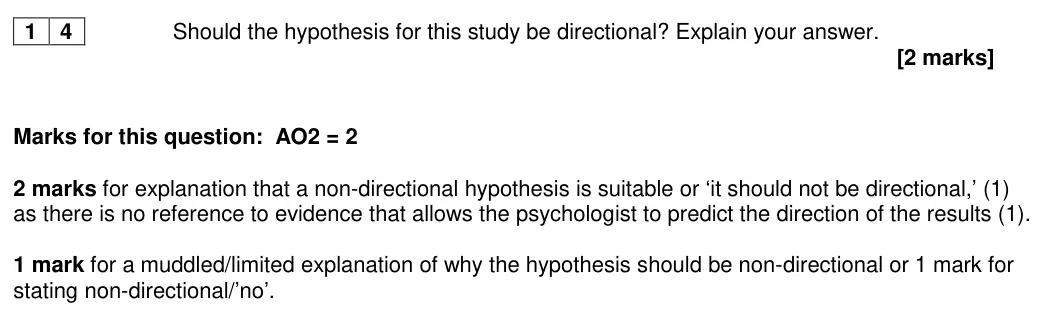
4.2.3.1-02 Hypotheses: directional and non-directional.AS
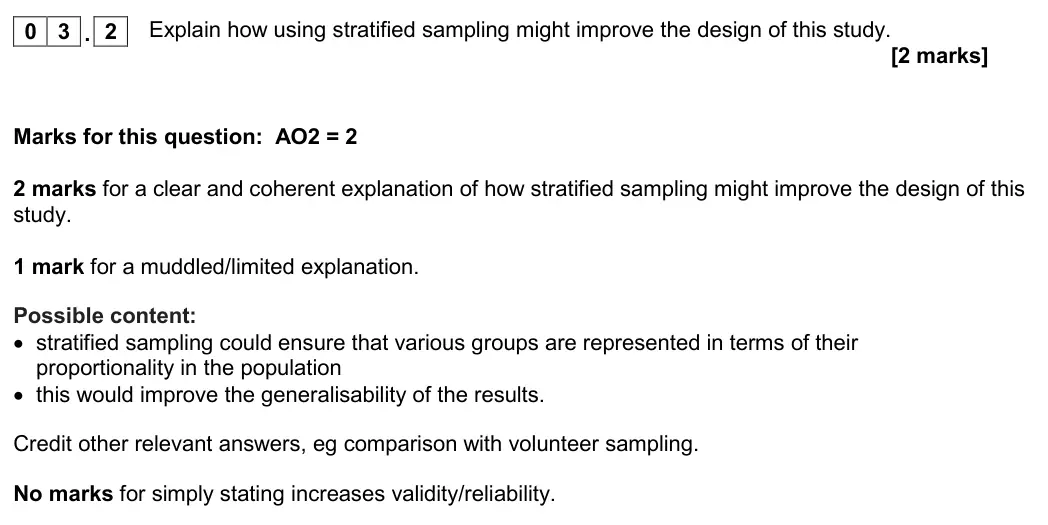
4.2.3.1-03 Sampling: the difference between population and sample; sampling methods including: random, systematic, stratified, opportunity and volunteer; implications of sampling methods, including bias and generalisation.AS
4.2.3.1-04 Pilot studies and the aims of piloting.AS
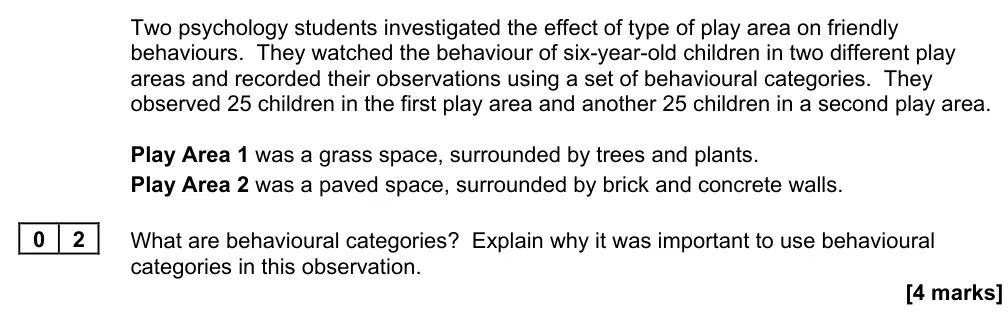
4.2.3.1-06 Observational design: behavioural categories; event sampling; time sampling.AS
4.2.3.1-07 Questionnaire construction, including use of open and closed questions; design of interviews.AS
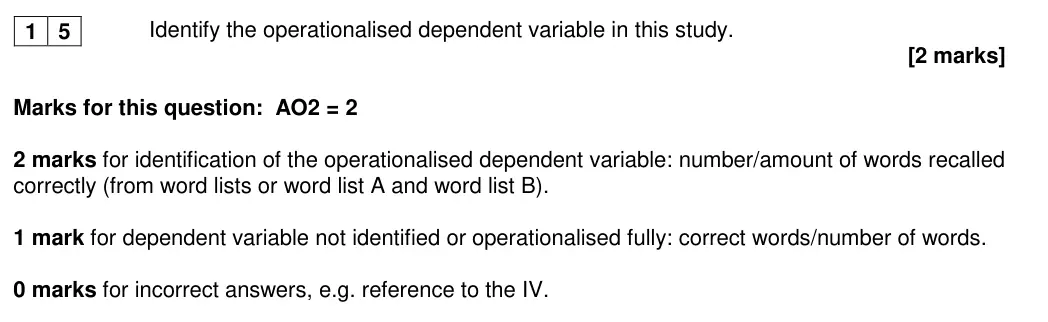
4.2.3.1-08 Variables: manipulation and control of variables, including independent, dependent, extraneous; operationalisation of variables.AS
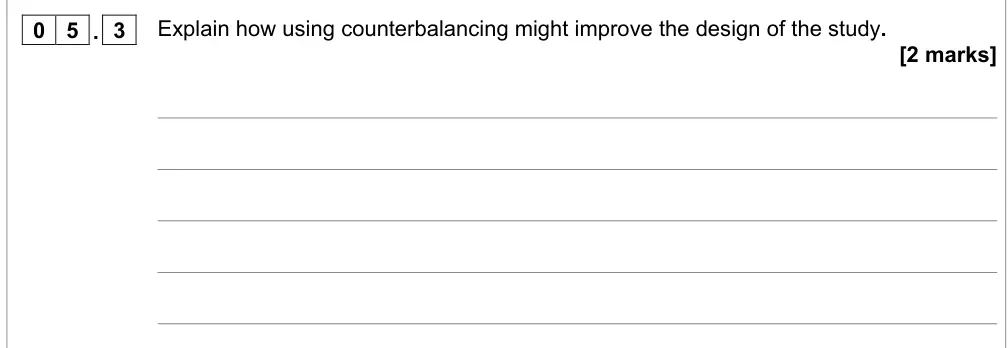
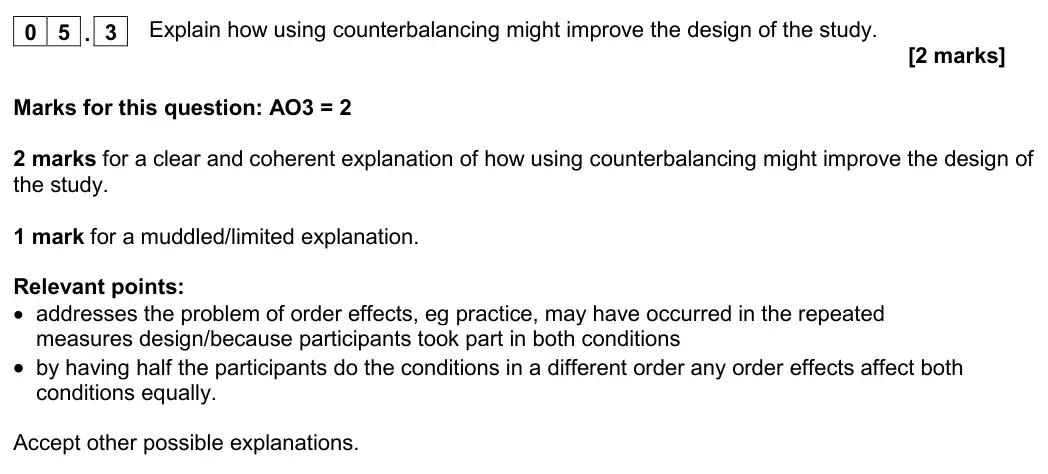
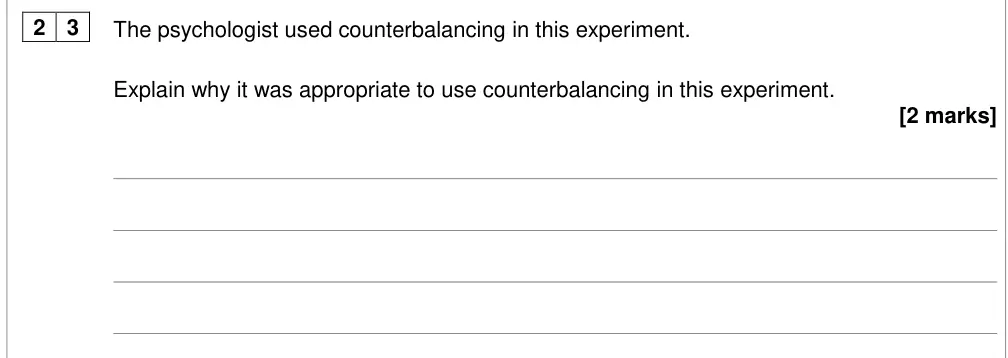
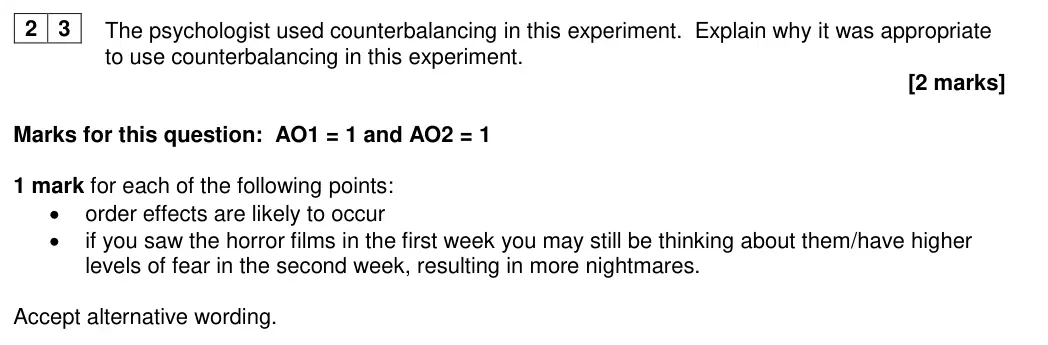
4.2.3.1-09 Control: random allocation and counterbalancing, randomisation, standardisation and control groups.AS
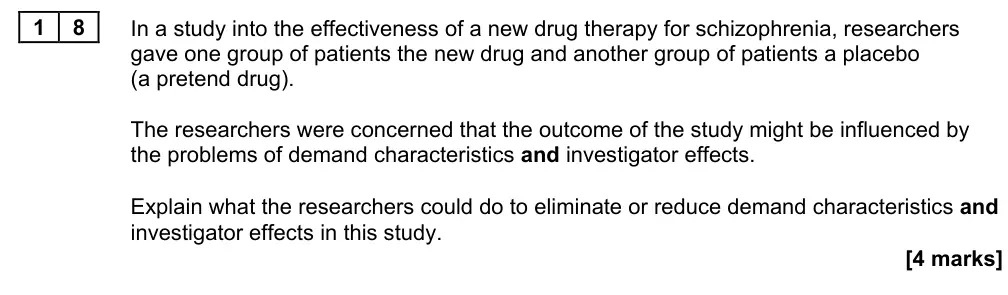
4.2.3.1-10 Demand characteristics and investigator effects.AS
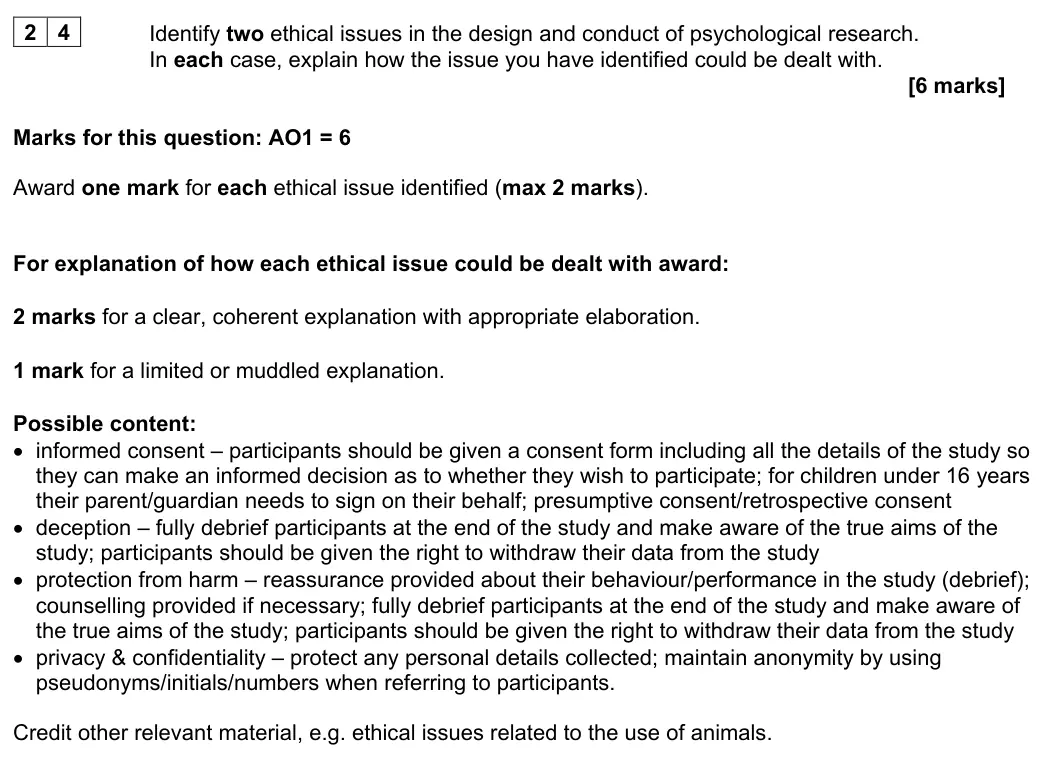
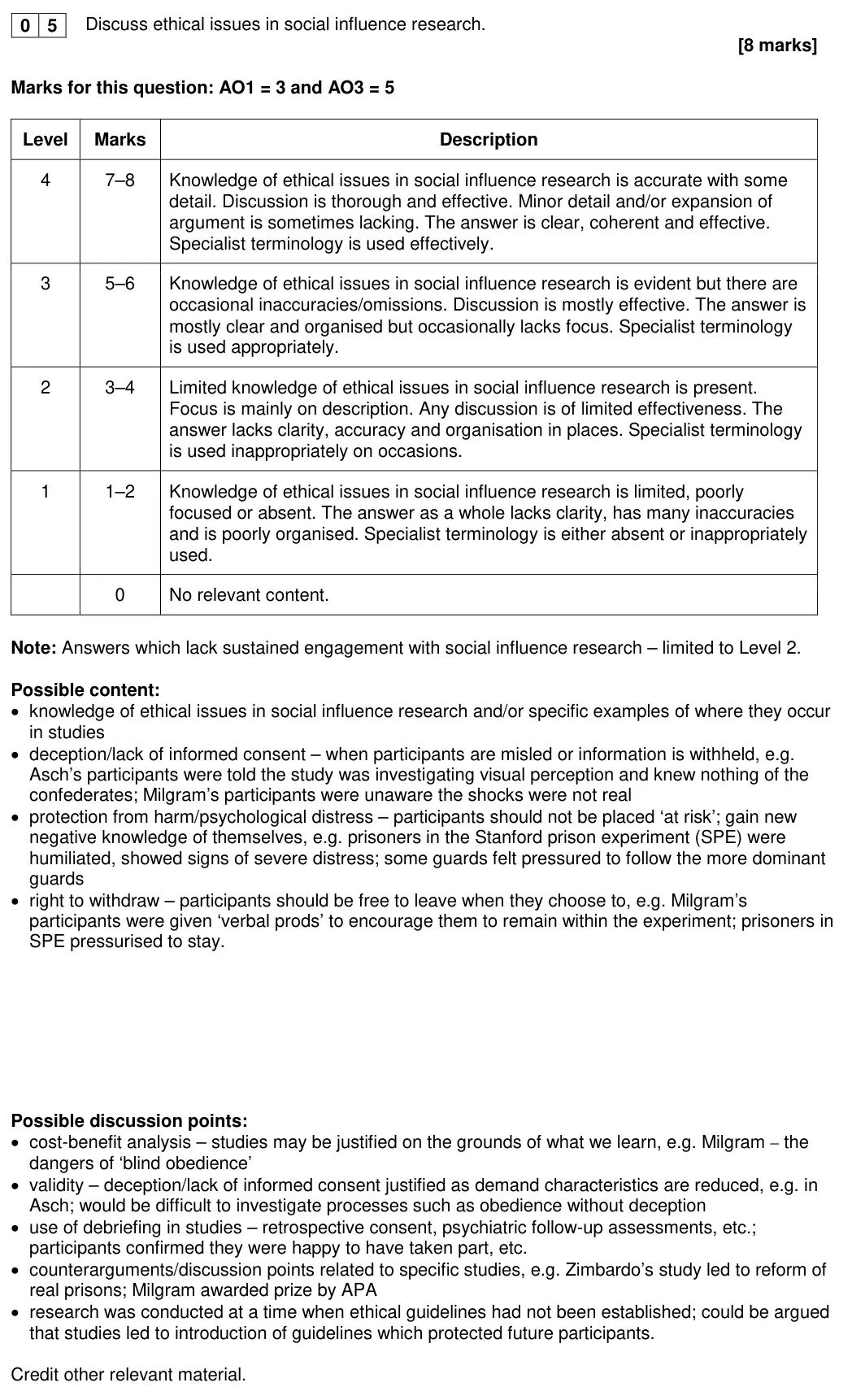
4.2.3.1-11 Ethics, including the role of the British Psychological Society’s code of ethics; ethical issues in the design and conduct of psychological studies; dealing with ethical issues in research.AS
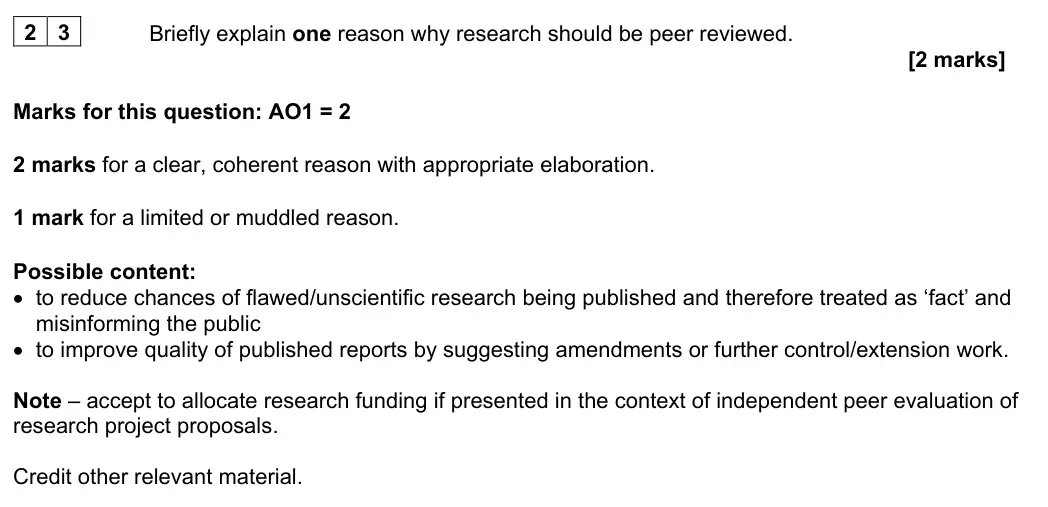
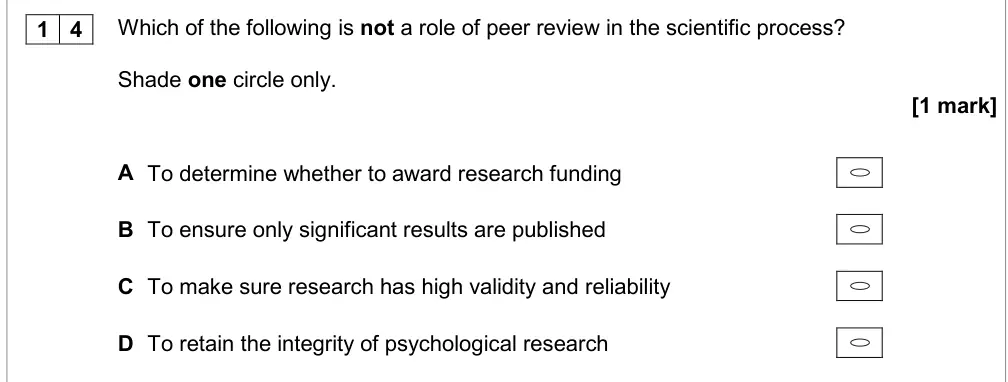
4.2.3.1-12 The role of peer review in the scientific process.AS
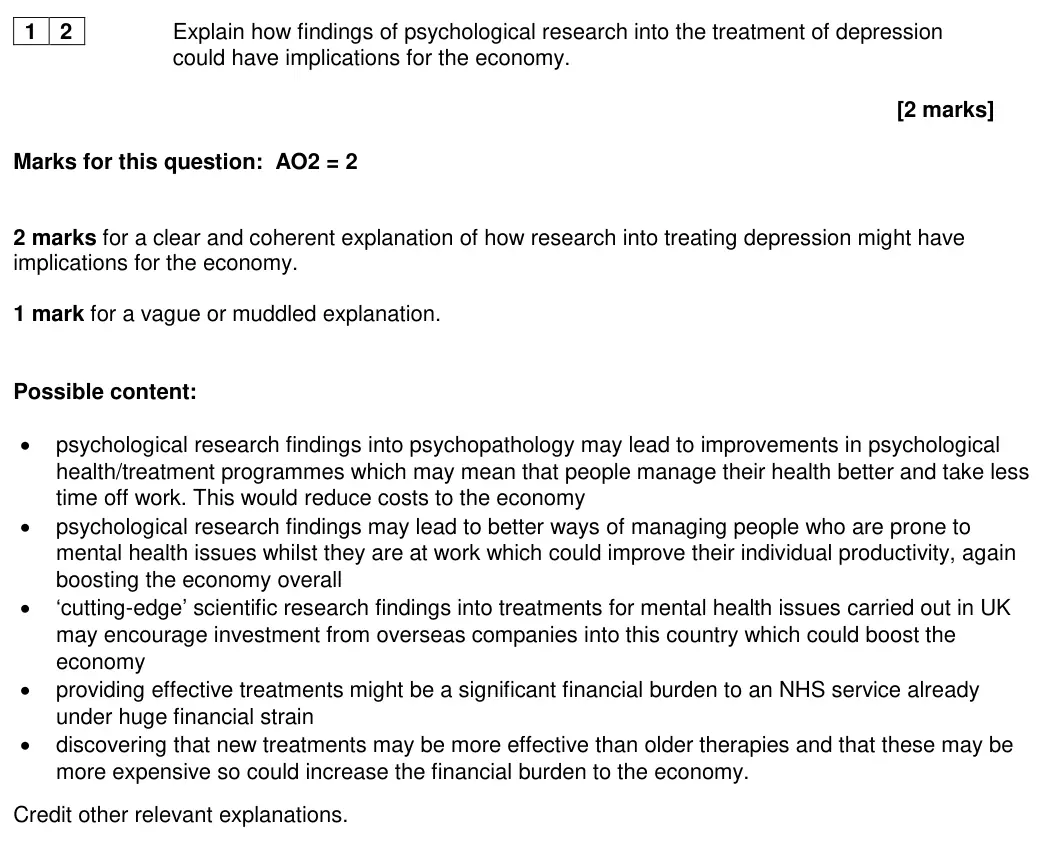
4.2.3.1-13 The implications of psychological research for the economy.AS
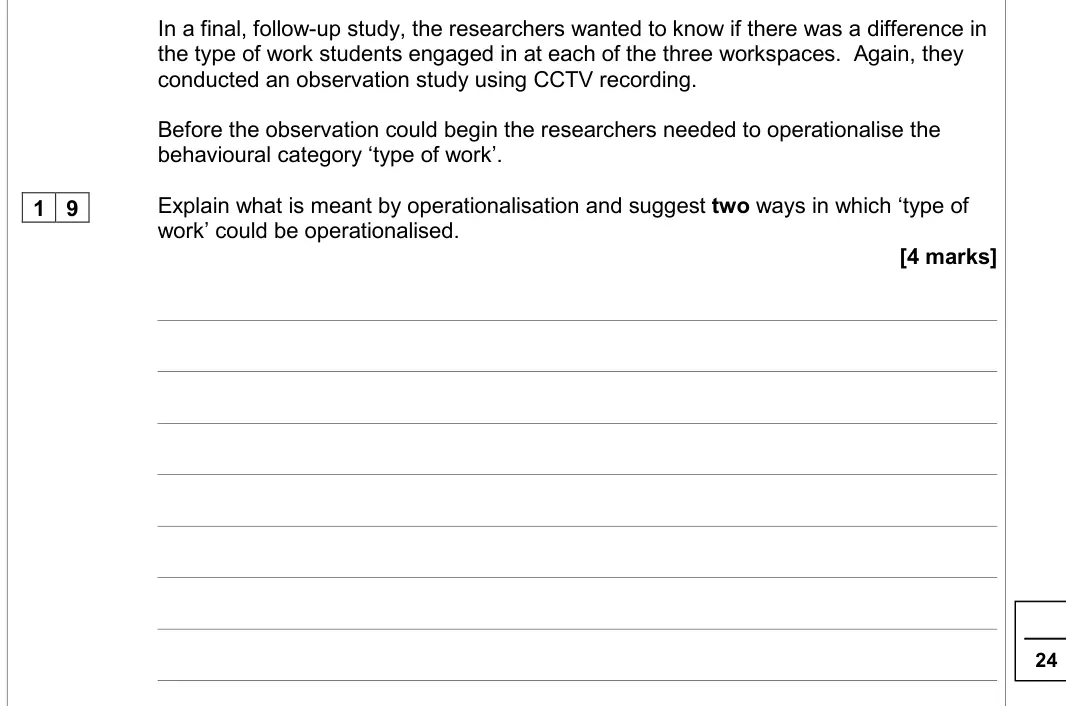
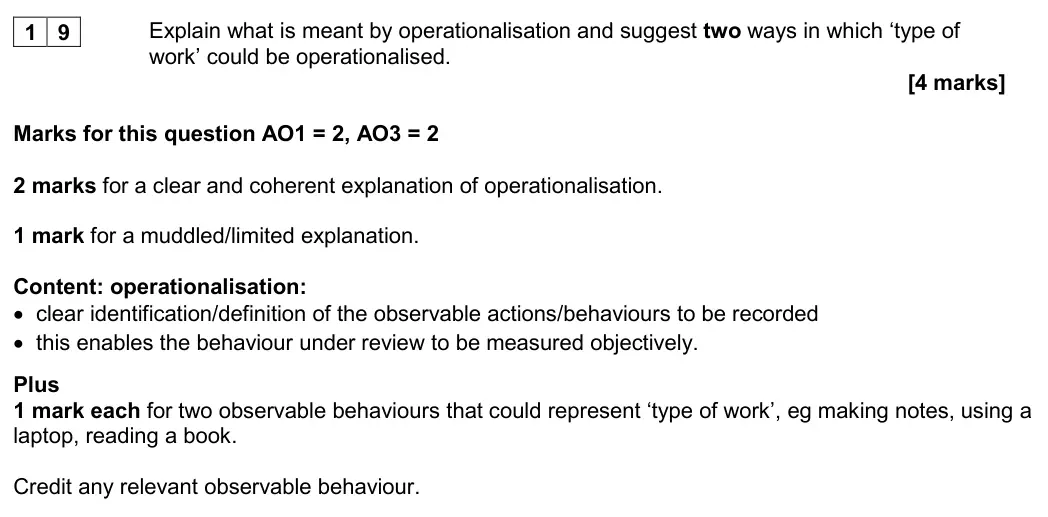
4.2.3.1-14 Reliability across all methods of investigation. Ways of measuring reliability: test-retest and inter-observer; improving reliability.
4.2.3.1-15 Types of validity across all methods of investigation: face validity, concurrent validity, ecological validity and temporal validity. Measurement of validity. Improving validity.
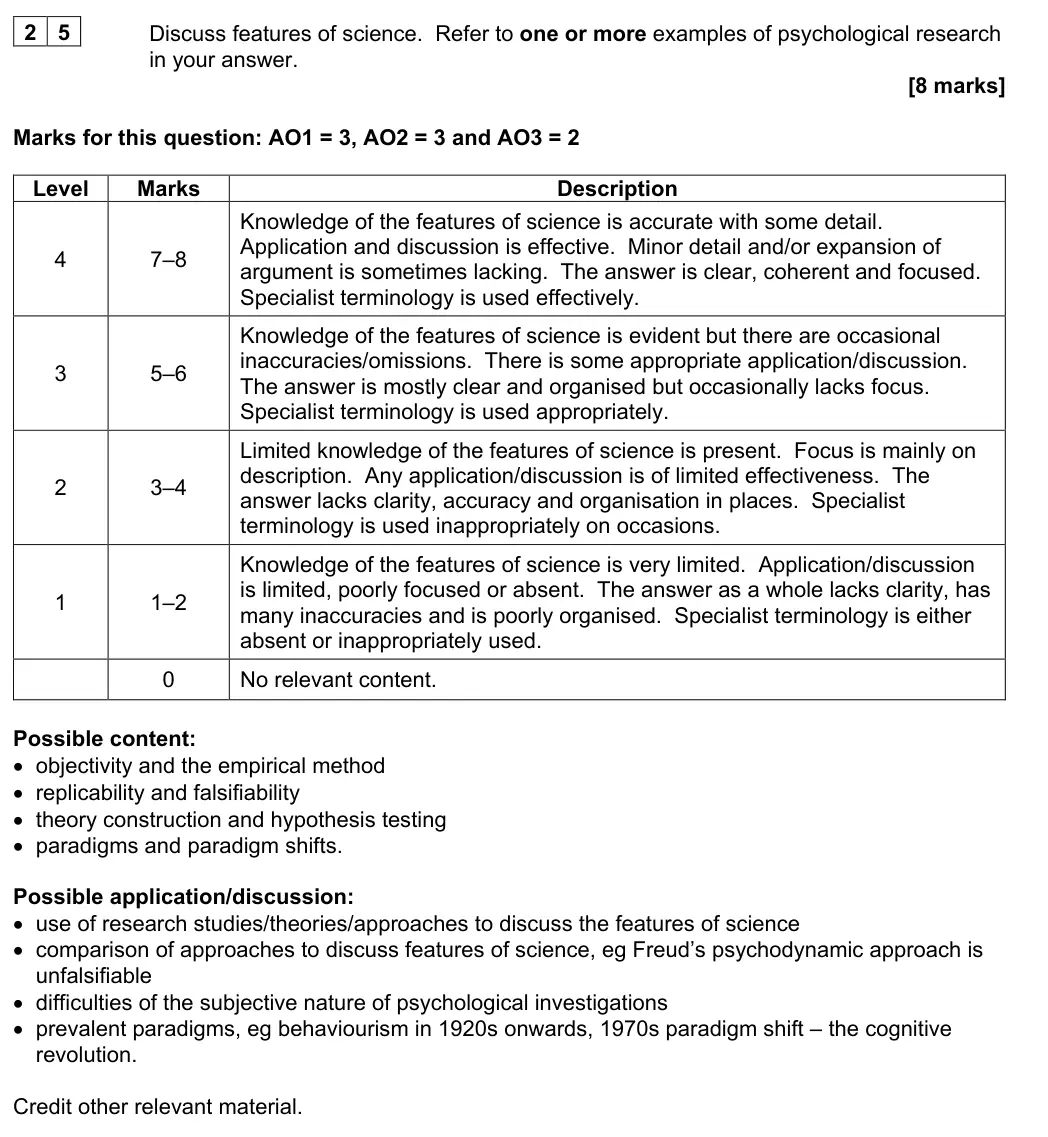
4.2.3.1-16 Features of science: objectivity and the empirical method; replicability and falsifiability; theory construction and hypothesis testing; paradigms and paradigm shifts.
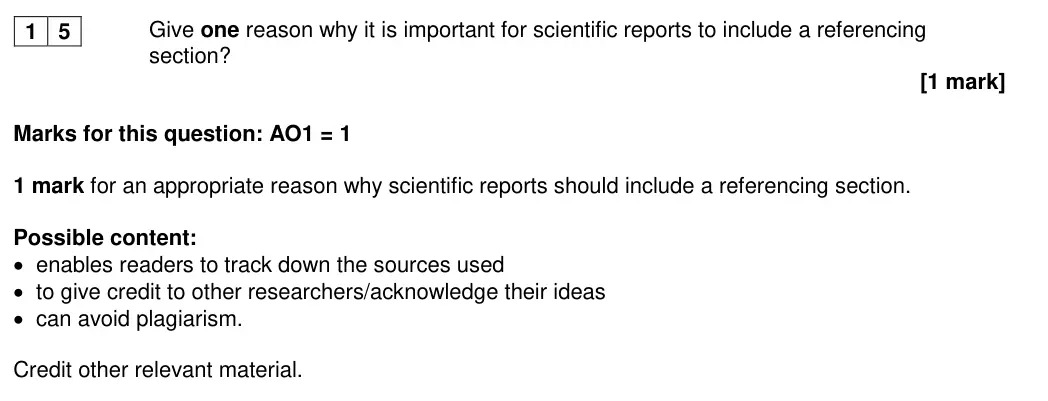
4.2.3.1-17 Reporting psychological investigations. Sections of a scientific report: abstract, introduction, method, results, discussion and referencing.
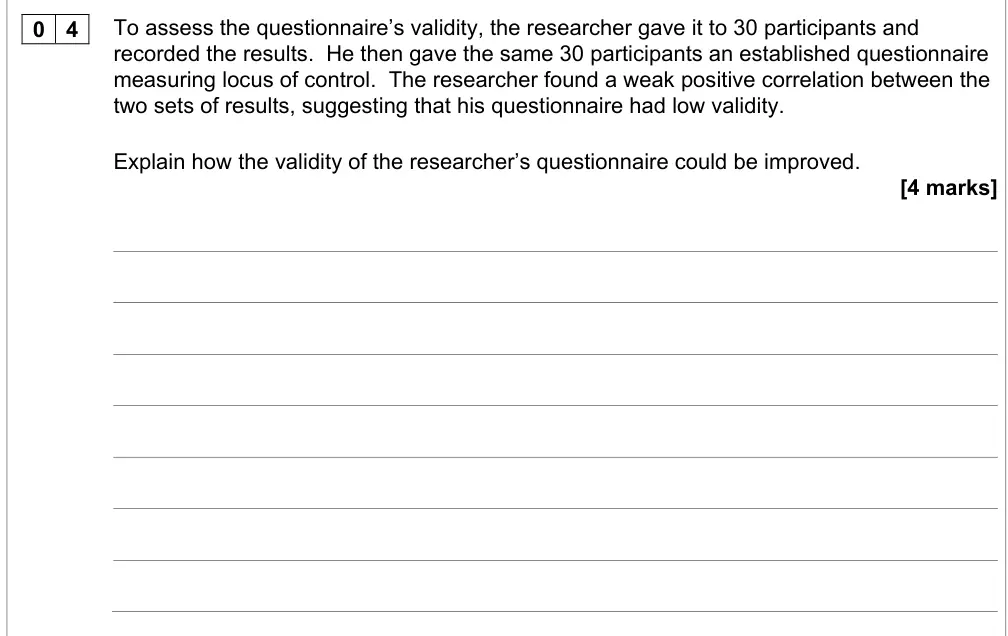
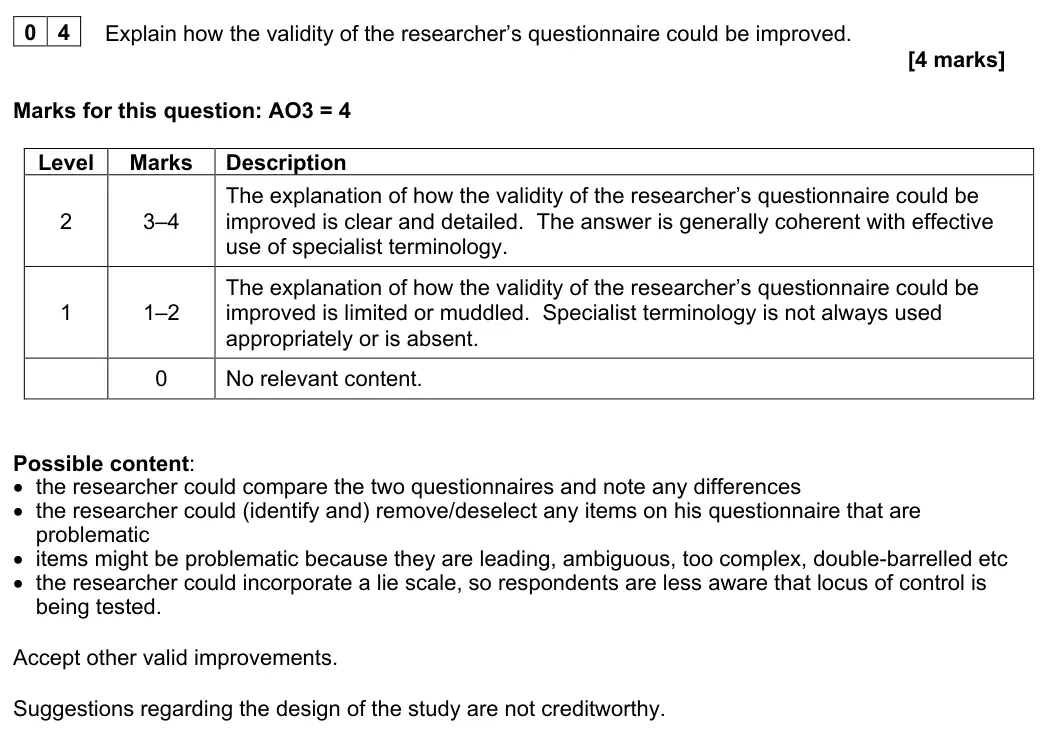
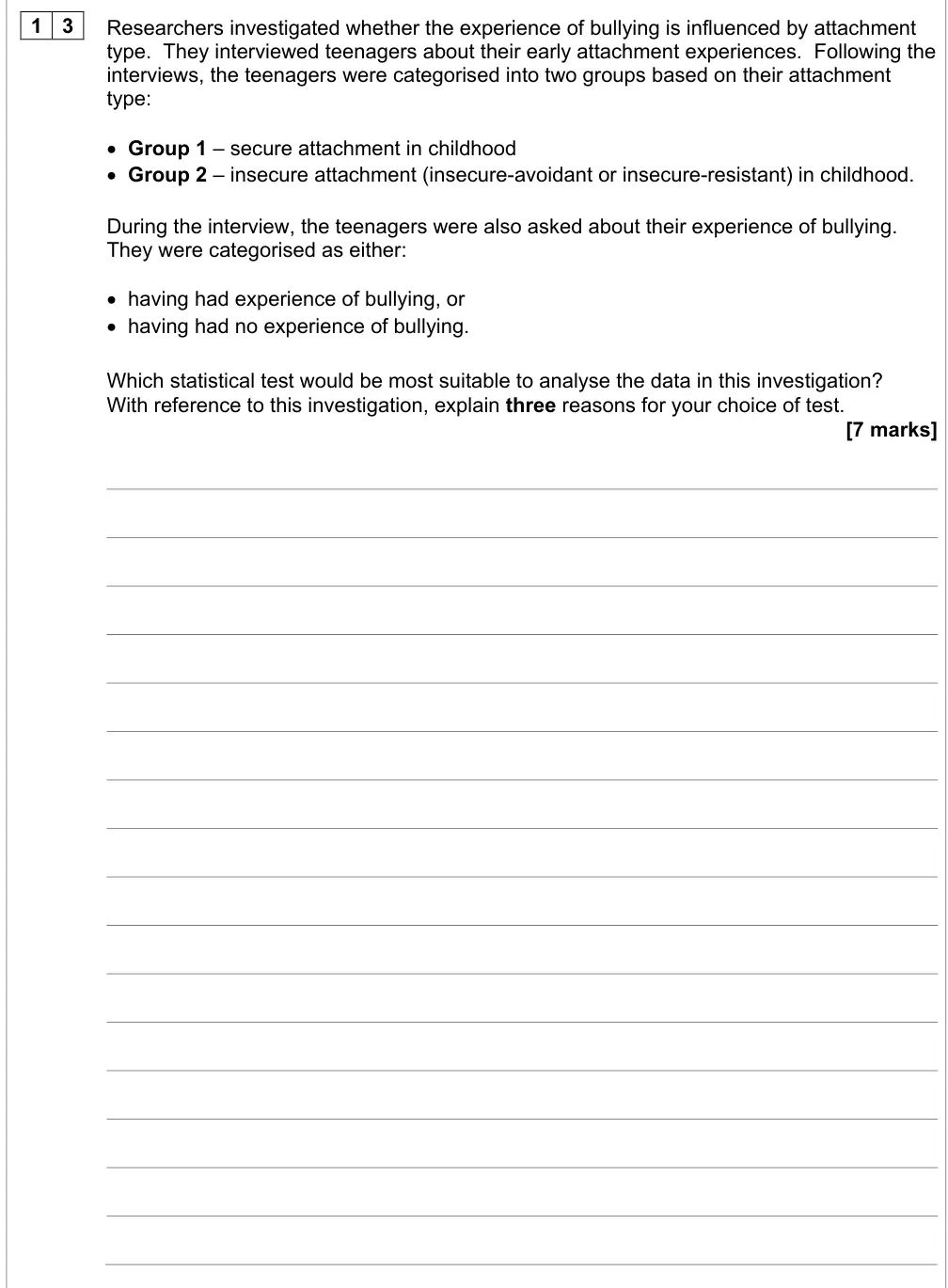
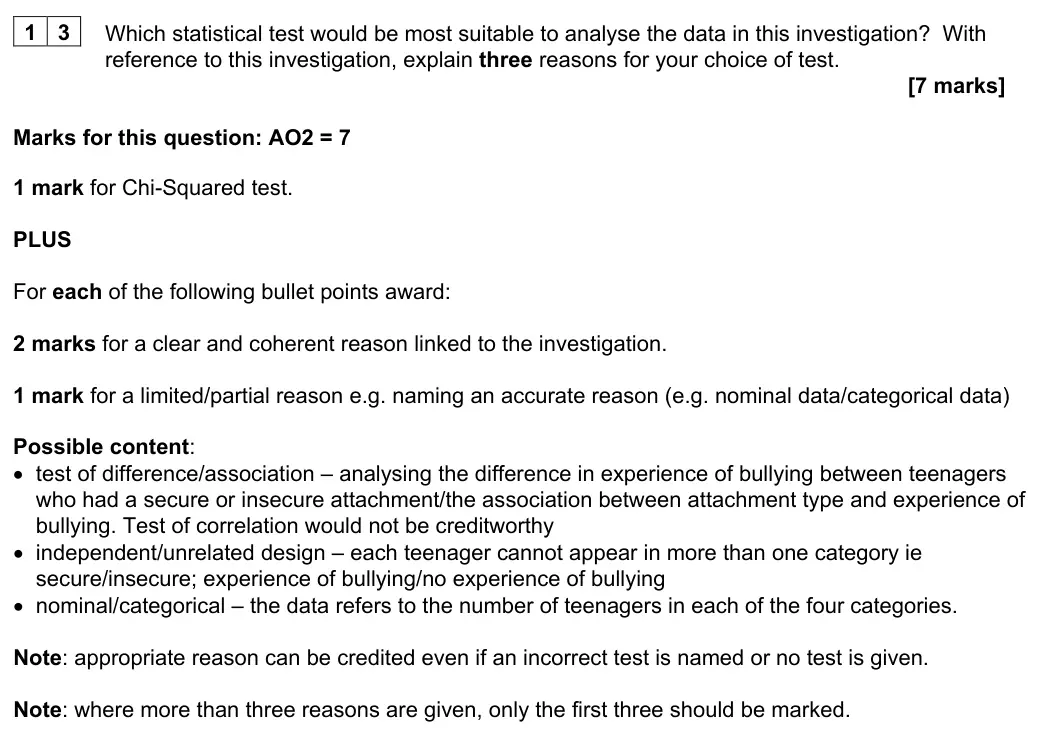
Tap a question to zoom it. Mark scheme and examiner's comment open under each question.
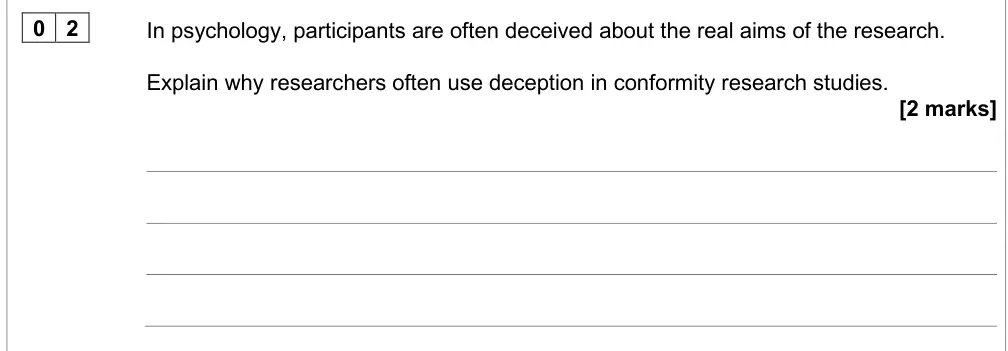
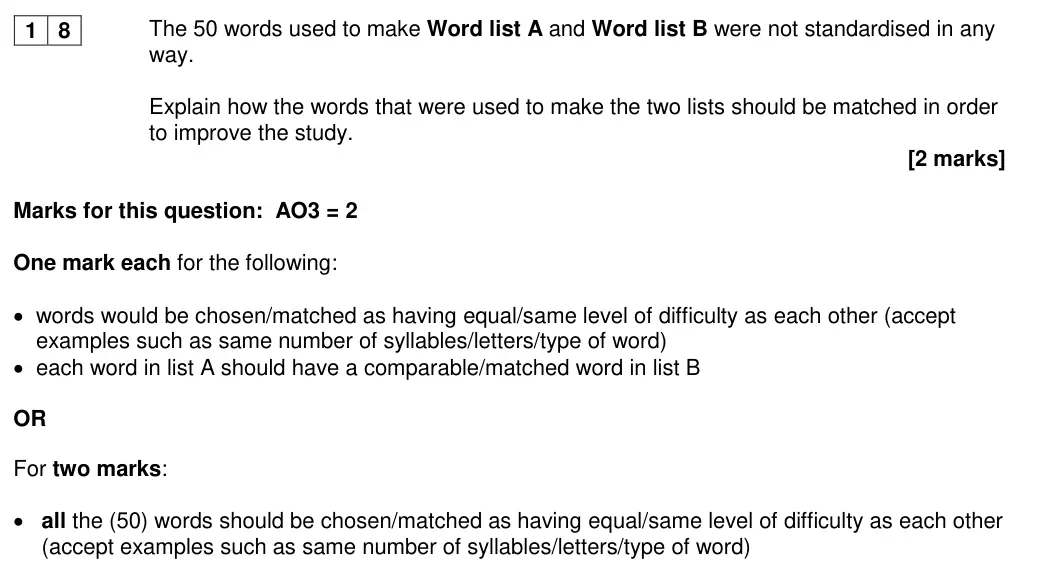
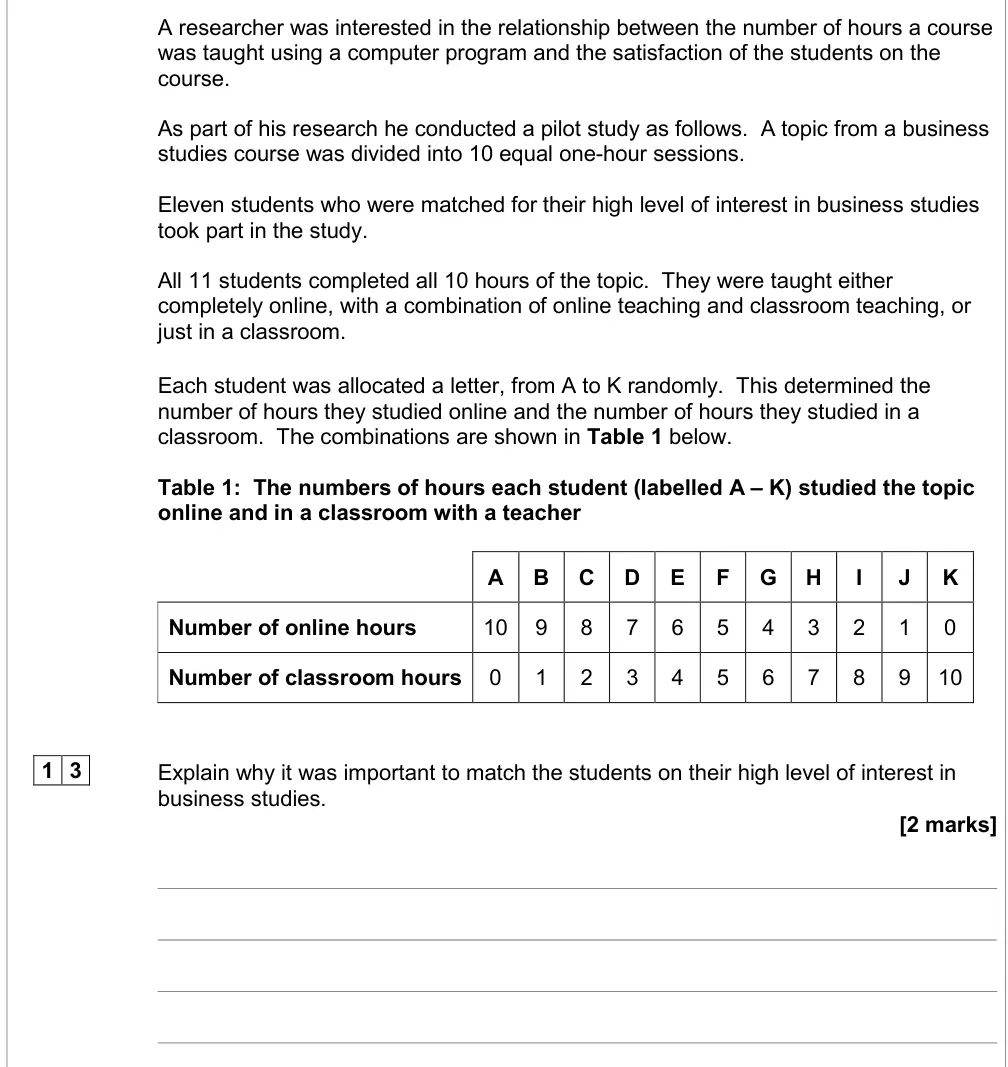
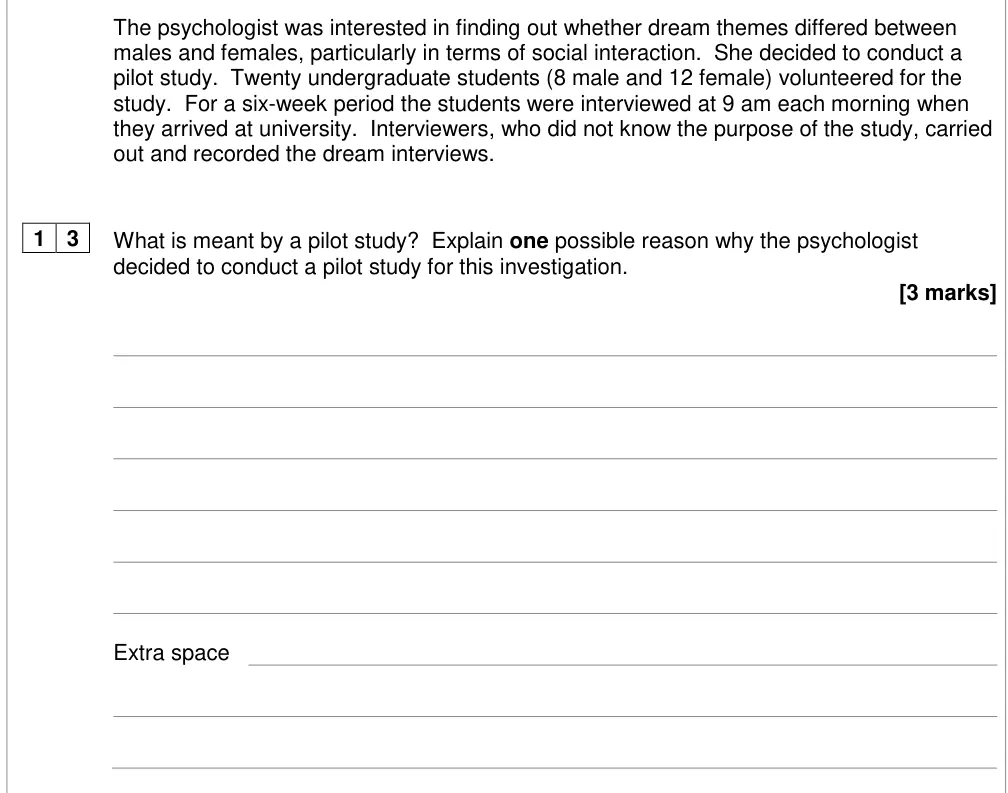
June 2025 · AS Paper 1 · Q22 marksAO3=2Research methodsEasy
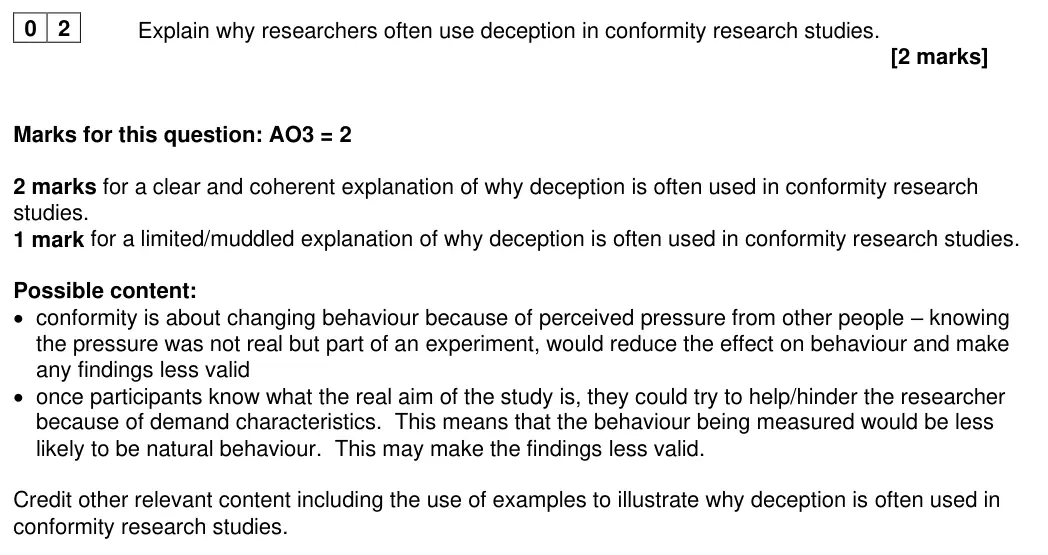
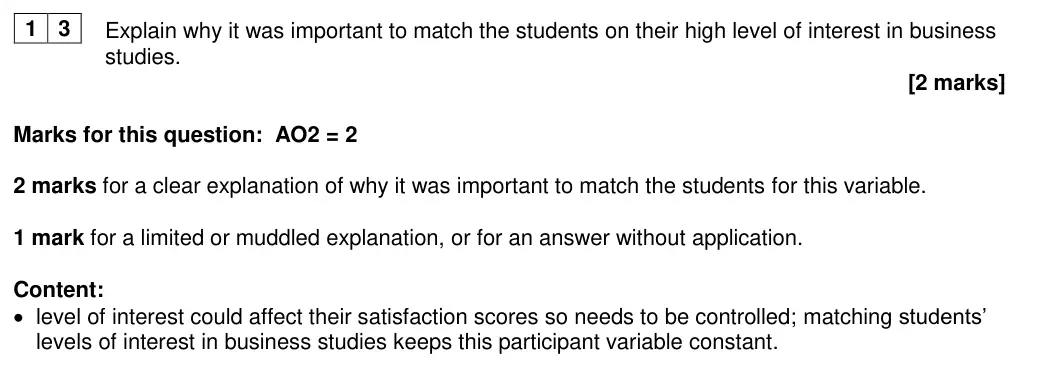
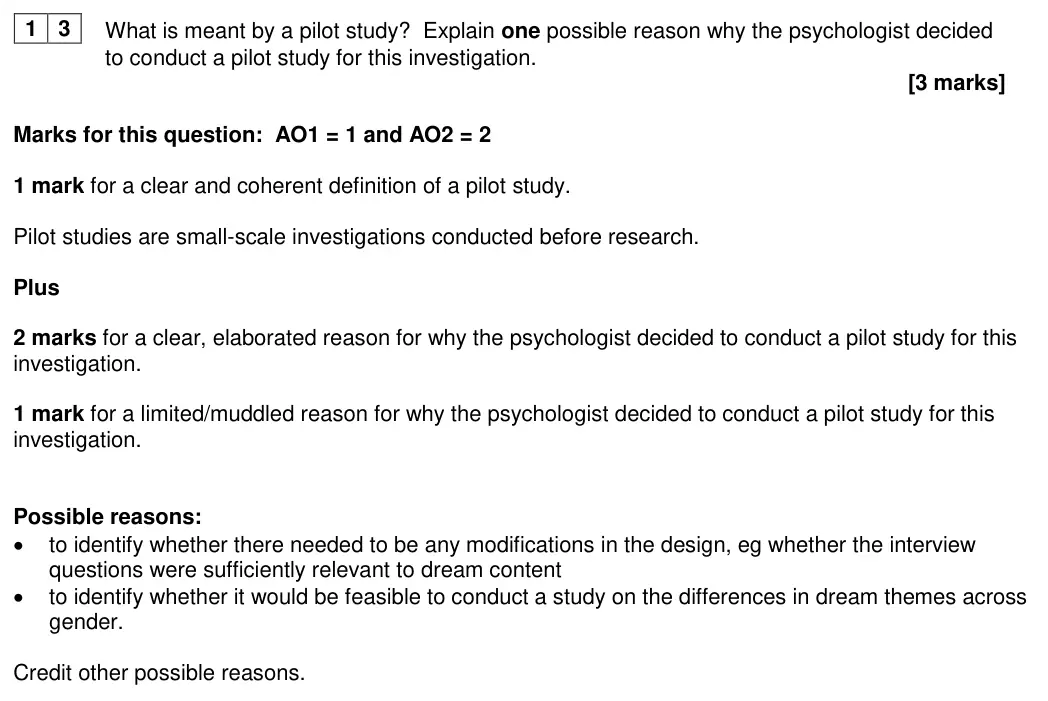
Mark scheme, including level descriptors and indicative content
Examiner's comment
This was also a relatively straightforward question, with almost 50% of students scoring full marks. Many students clearly knew that deception was used in conformity research studies to prevent the possibility of demand characteristics occurring, but only some elaborated on how this might affect validity. The more successful answers linked to the impact it would have on measuring conformity accurately. Some students explained their answers within the context of a specific piece of research such as Asch’s study.
Notes from the mark scheme and report
credit: knowing the pressure is not real would reduce its effect/demand characteristics, so findings less valid
few elaborated the effect on validity
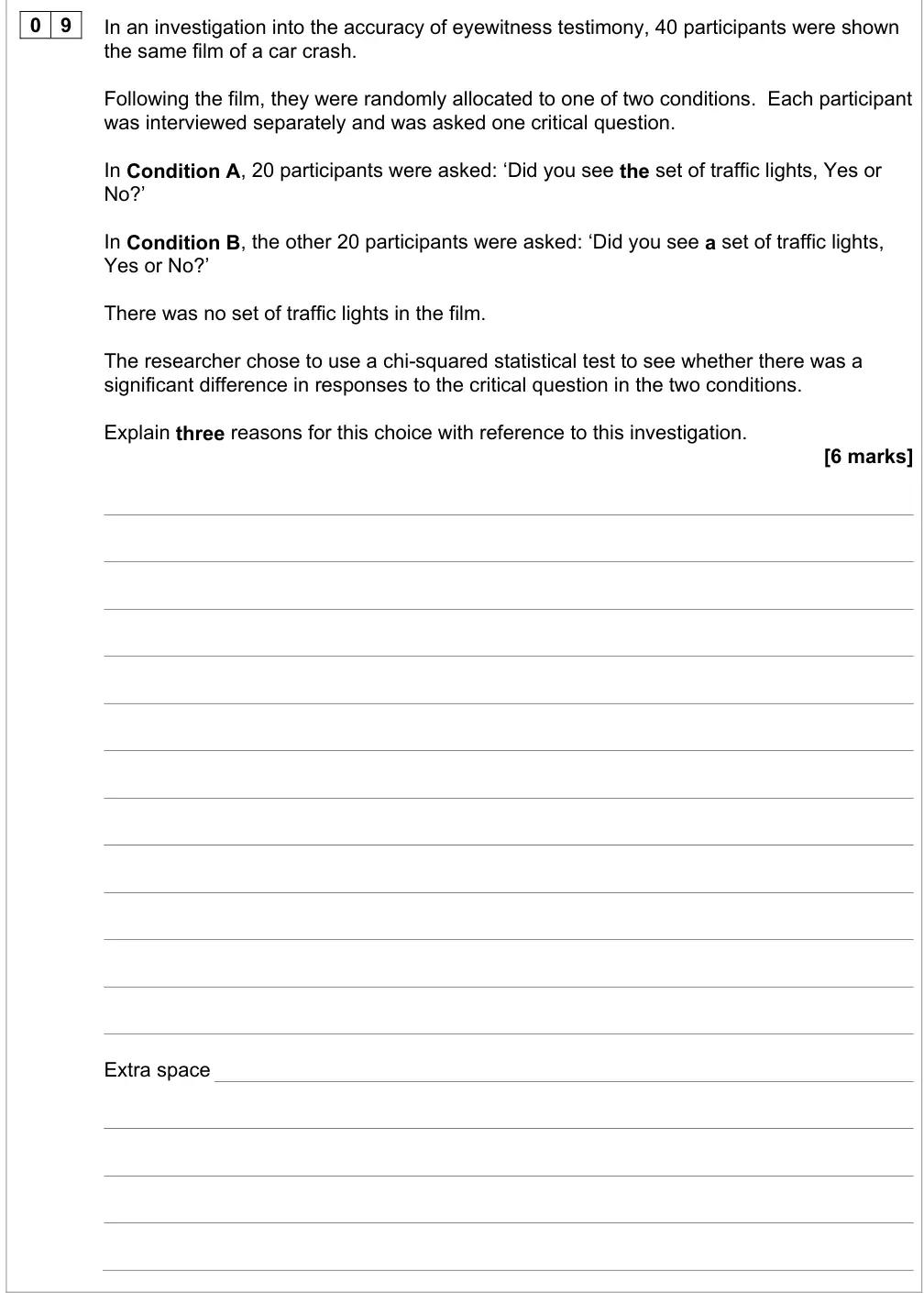
June 2025 · Paper 1 · Q96 marksAO2=6Research methodsMedium
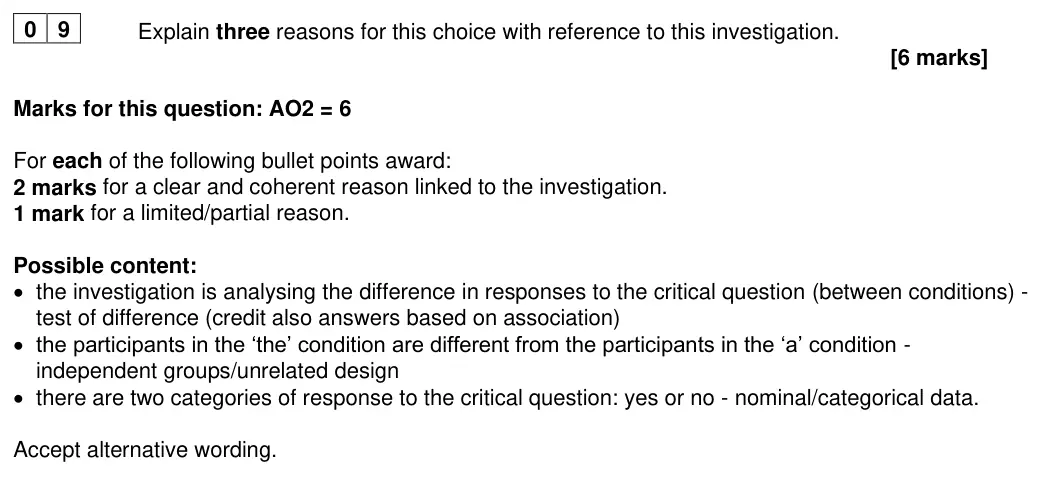
Mark scheme, including level descriptors and indicative content
Examiner's comment
In addition, students generally performed well in research methodology, for example, question 9 and question 17. The ability to justify the choice of an inferential test is seemingly getting stronger in this paper, with over 40% of students gaining 5 or 6 marks. Many students (more than 64%) were able to give at least one contextualised reason for using the chi square test. The average mark for this question was 3.78, with fewer than 9% of students scoring no marks.
Notes from the mark scheme and report
3 reasons x 2 marks linked to the study: test of difference (association accepted), independent groups ('the' vs 'a' conditions), nominal data (yes/no)
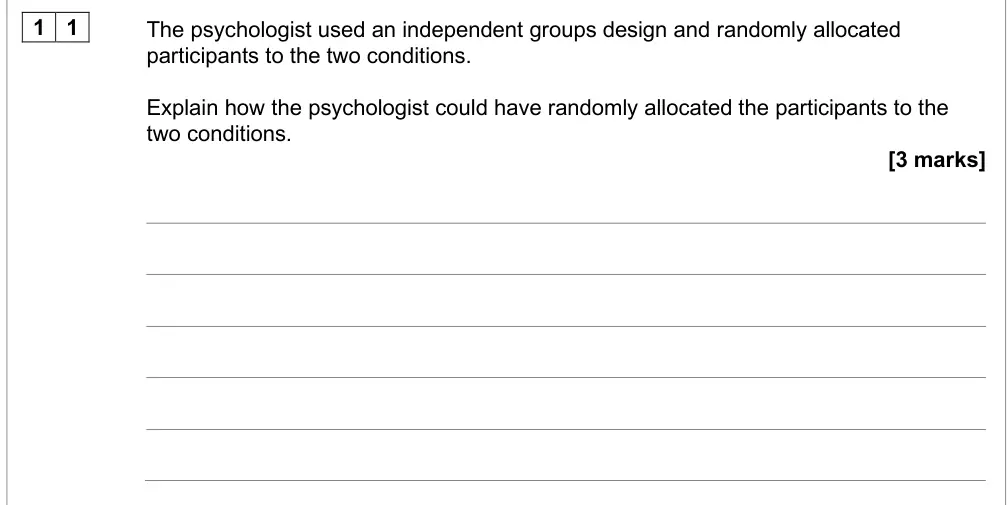
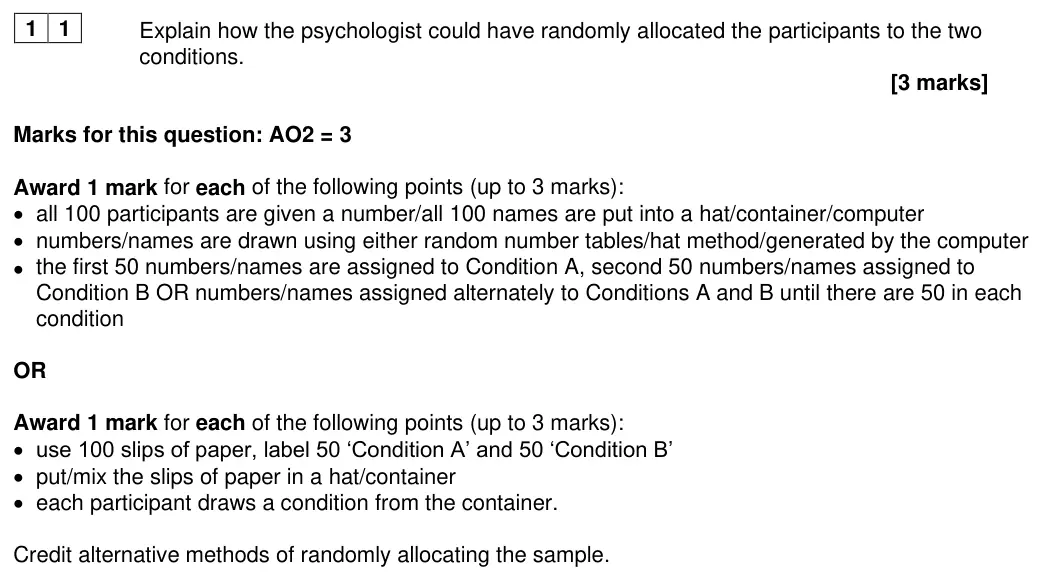
June 2025 · AS Paper 1 · Q113 marksAO2=3Research methodsMedium
Mark scheme, including level descriptors and indicative content
Examiner's comment
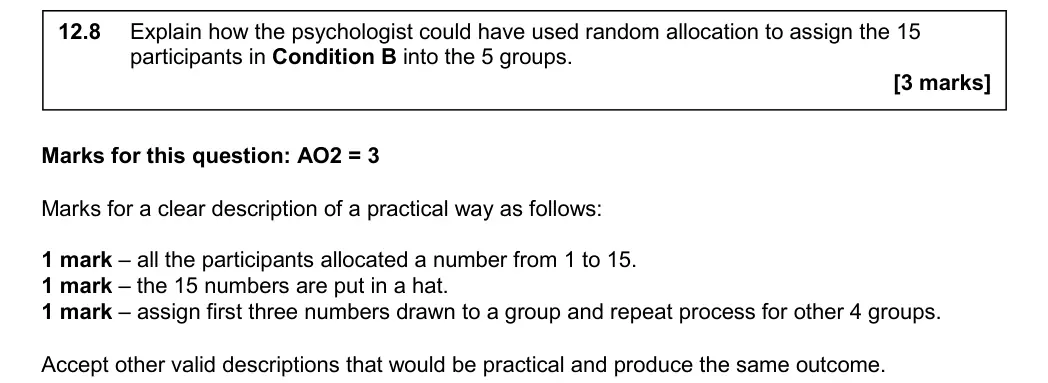
This question was answered well by many students who not only described the steps involved in random allocation but also gave some appropriate application to the stem. Over a third of students achieved full marks. Some students muddled more than one method by referring to numbering the participants and then using a random name generator. Answers which attracted full marks fully explained the final step of how the participants would be allocated (either alternately or first 50 in condition A then second 50 in condition B) but some students did not explain or omitted this final step.
Notes from the mark scheme and report
number all 100/names in hat, draw randomly, first 50 to A and next 50 to B (final allocation step often omitted)
muddling methods
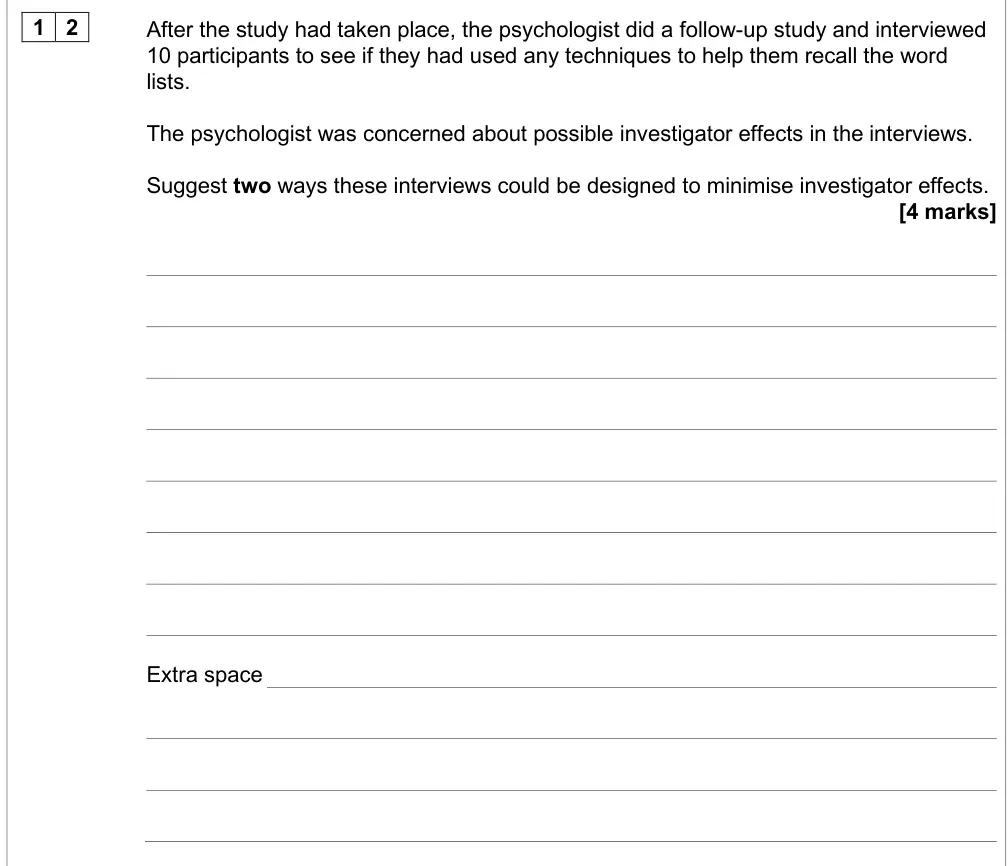
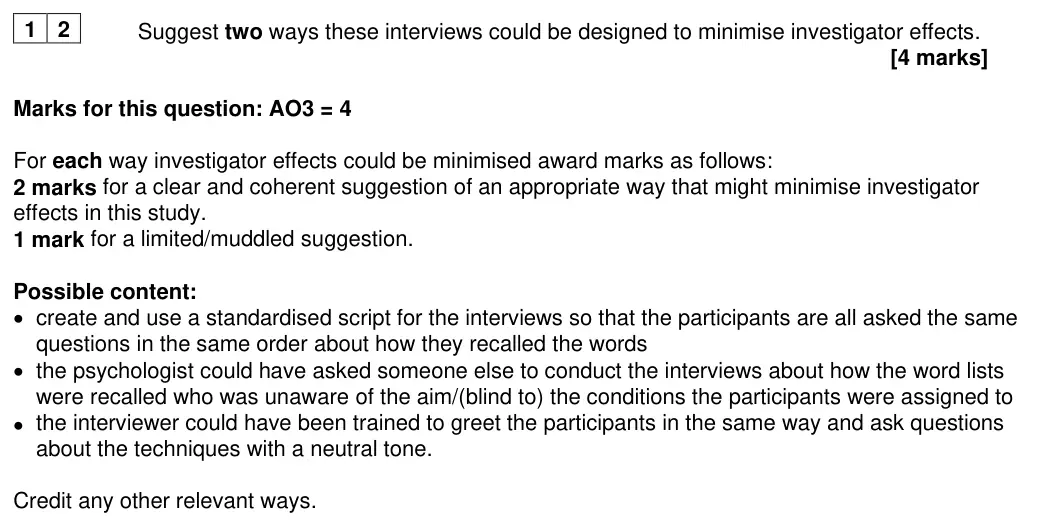
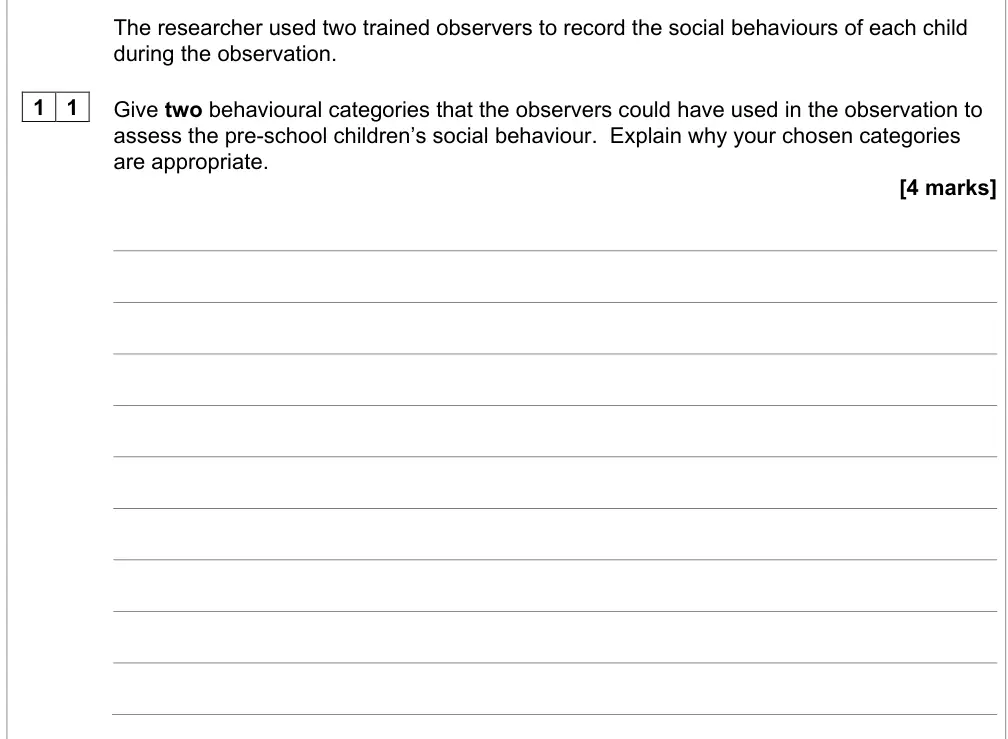
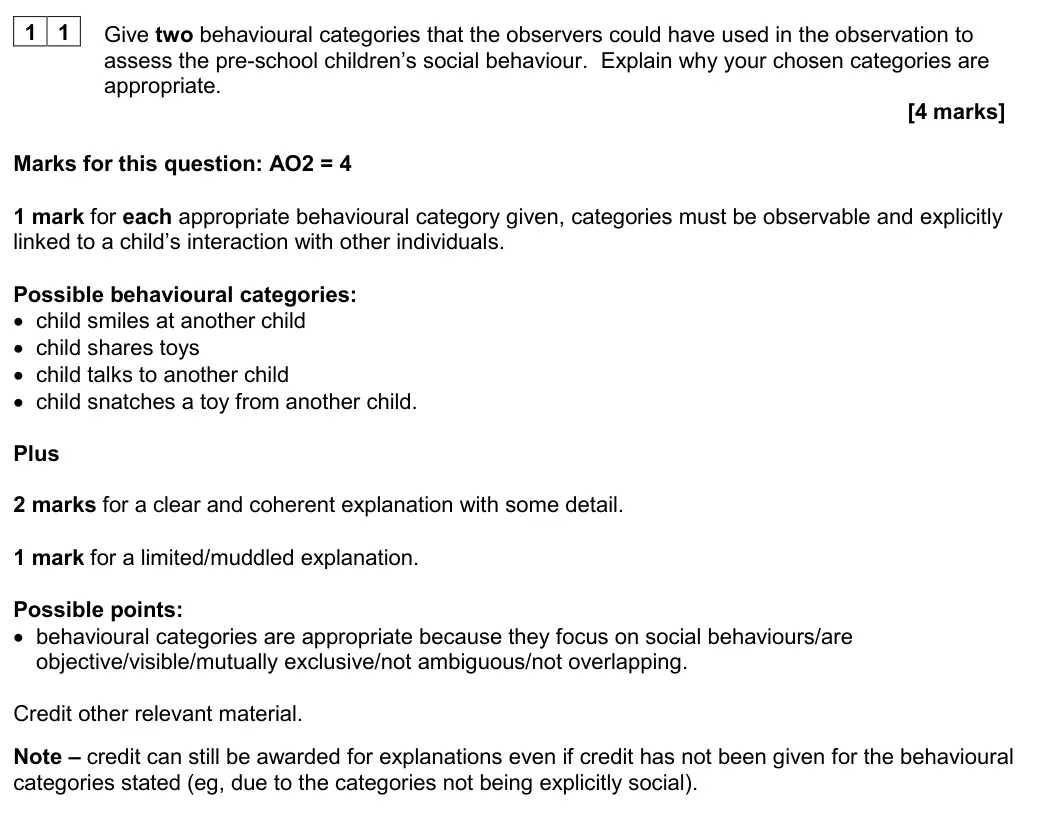
June 2025 · AS Paper 1 · Q124 marksAO3=4Research methodsMedium
Mark scheme, including level descriptors and indicative content
Examiner's comment
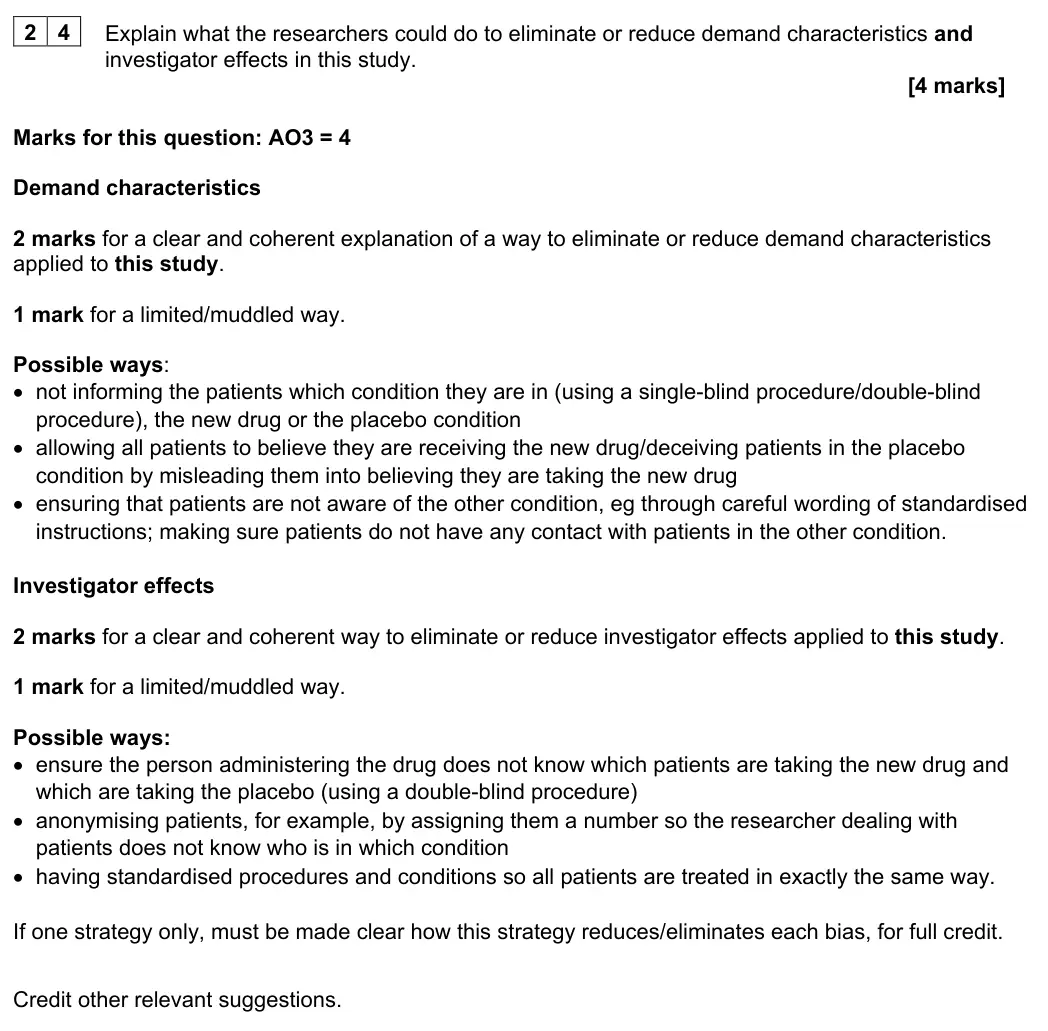
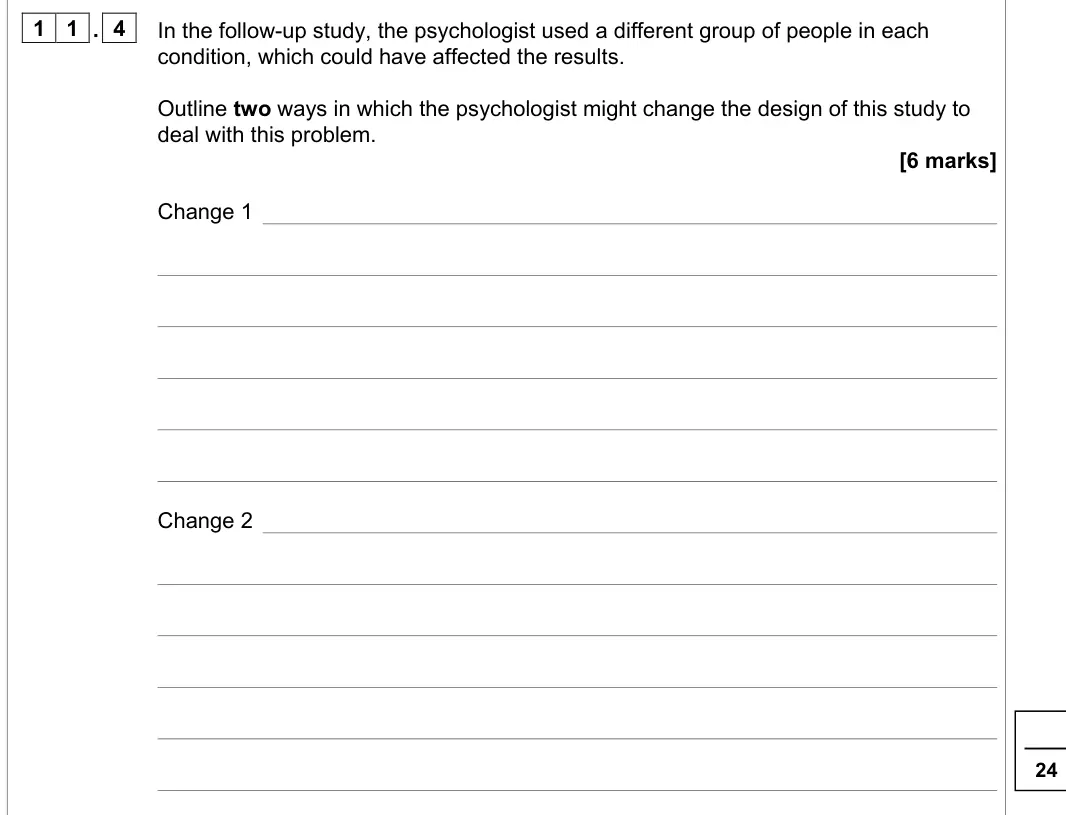
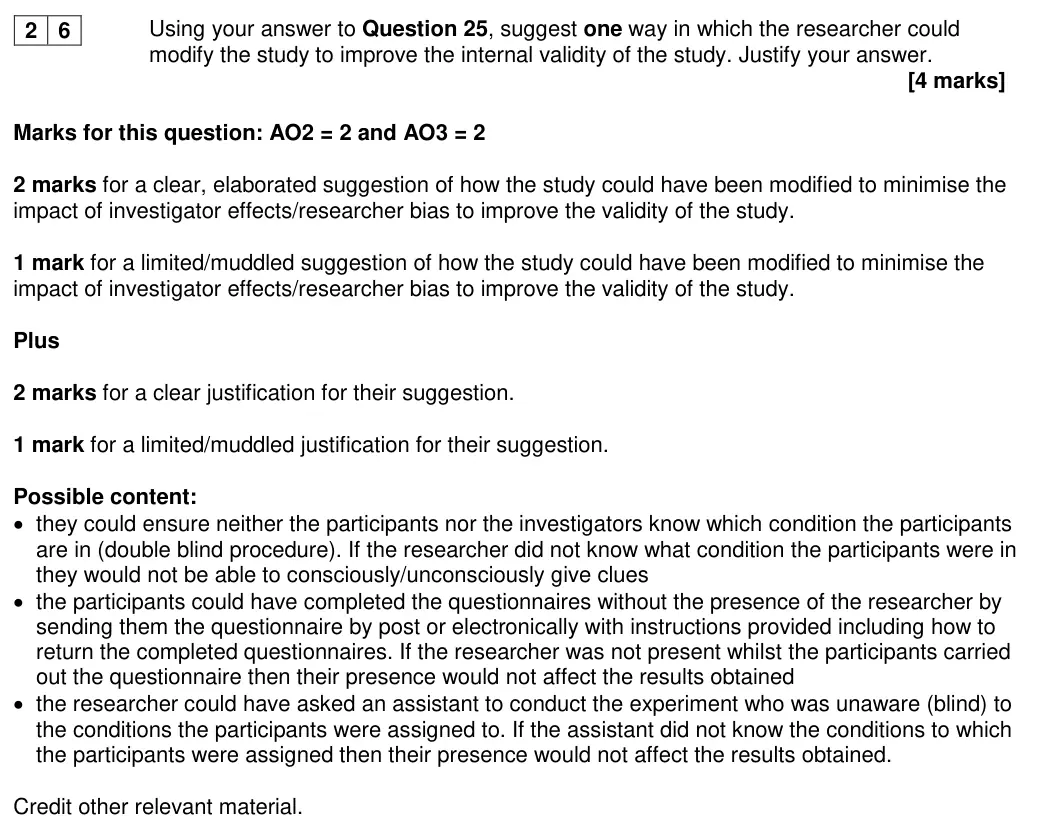
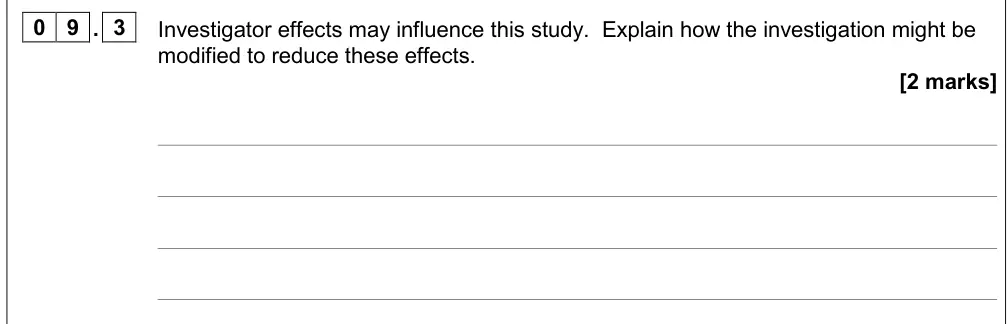
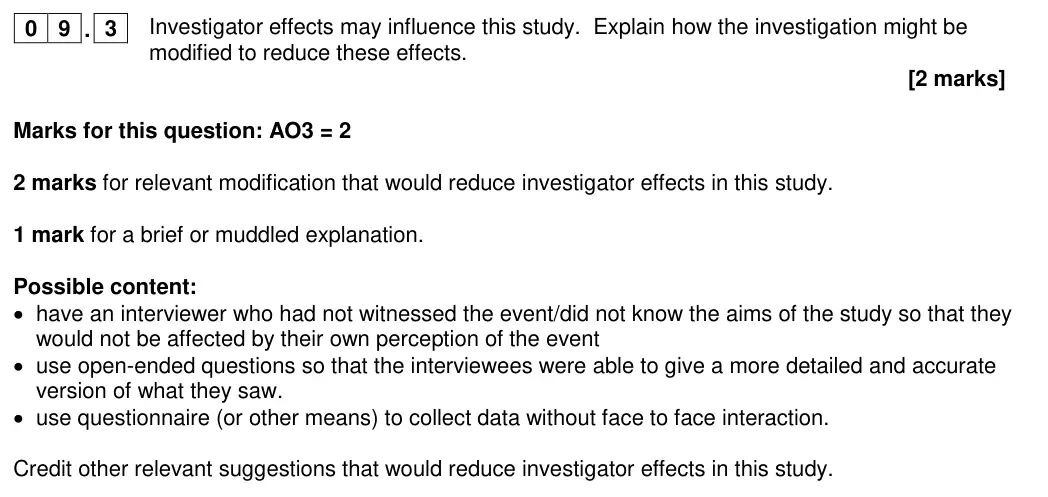
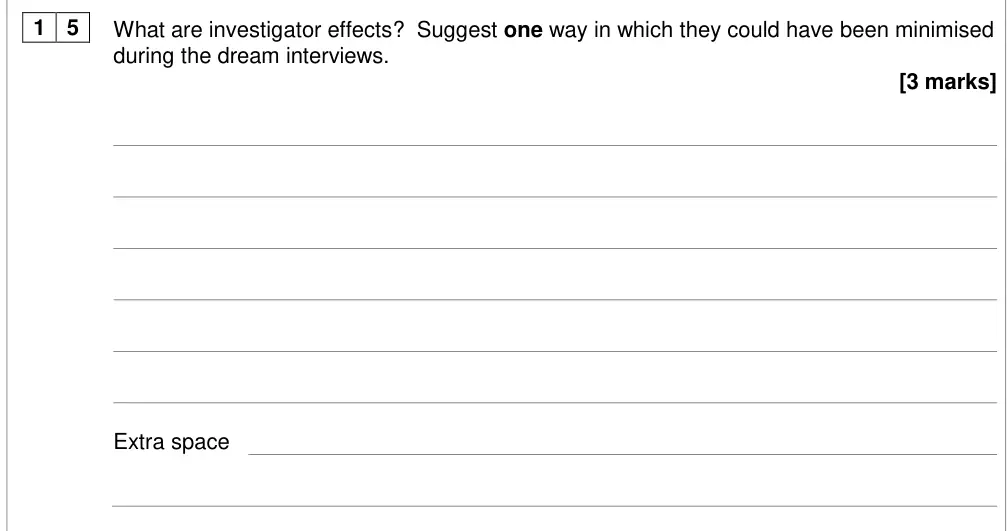
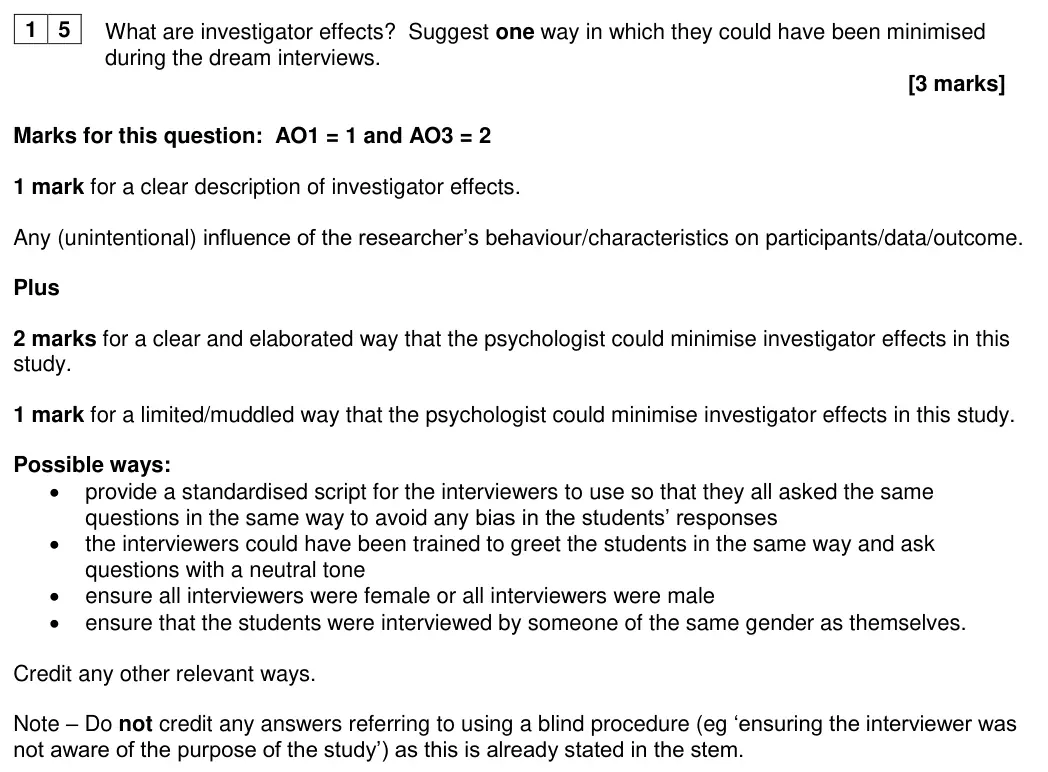
This question worth four marks asking for two ways the interviews could be designed to minimise investigator effects was a challenging question for many students. With a mean mark of just over one, some students did not attempt the question and about a third received no marks. Only just over 10% of students achieved more than half marks. There were some good answers that explained two clear and coherent ways that would reduce investigator effects. However, many students suggested changing to another method such as using a questionnaire, rather than explaining how the design of the interviews could be modified. Some students gave limited or muddled suggestions or described ways to reduce demand characteristics rather than investigator effects. Some answers explained ways to assess whether there were investigator effects e.g. recording the interviews and checking, rather than suggestions for how to minimise such effects. Questions that require modifications to the design of research, appear to be challenging and students need to practise these.
Notes from the mark scheme and report
standardised script, interviewer blind to conditions, neutral tone
many changed the method (e.g. questionnaire) or reduced demand characteristics instead
ways to assess (record and check) not credited
June 2025 · Paper 1 · Q122 marksAO3=2Research methodsMediumOld spec only
Mark scheme, including level descriptors and indicative content
Examiner's comment
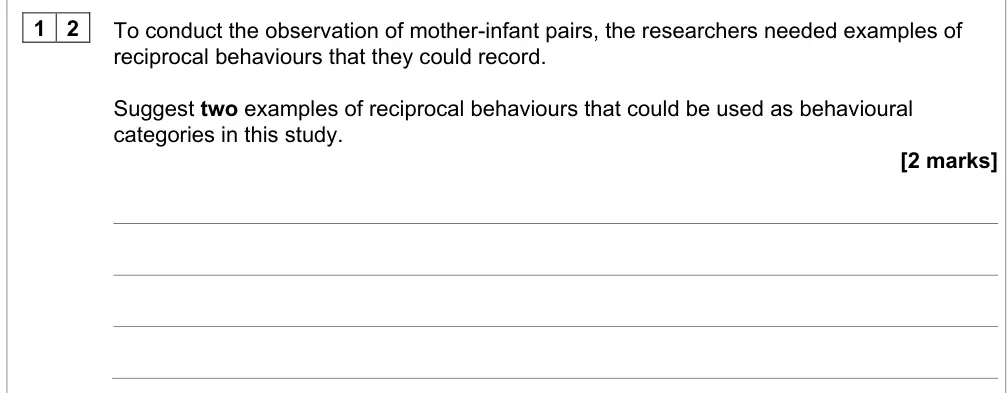
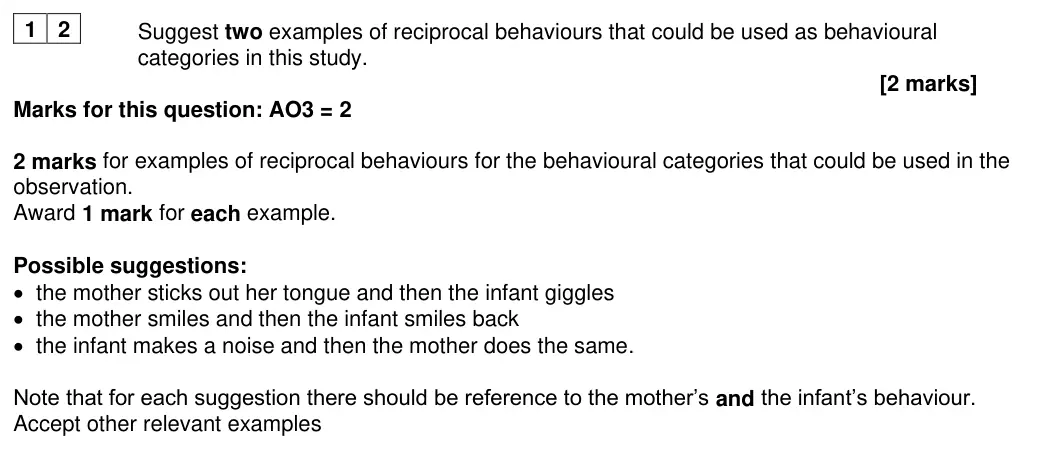
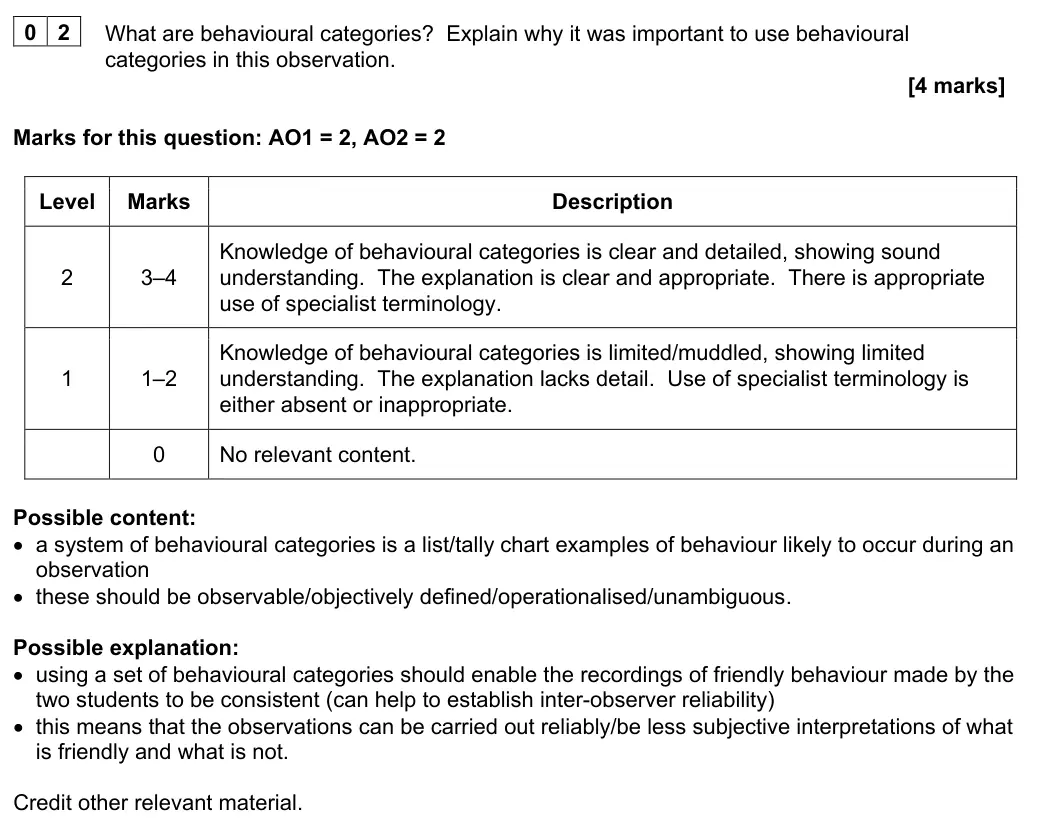
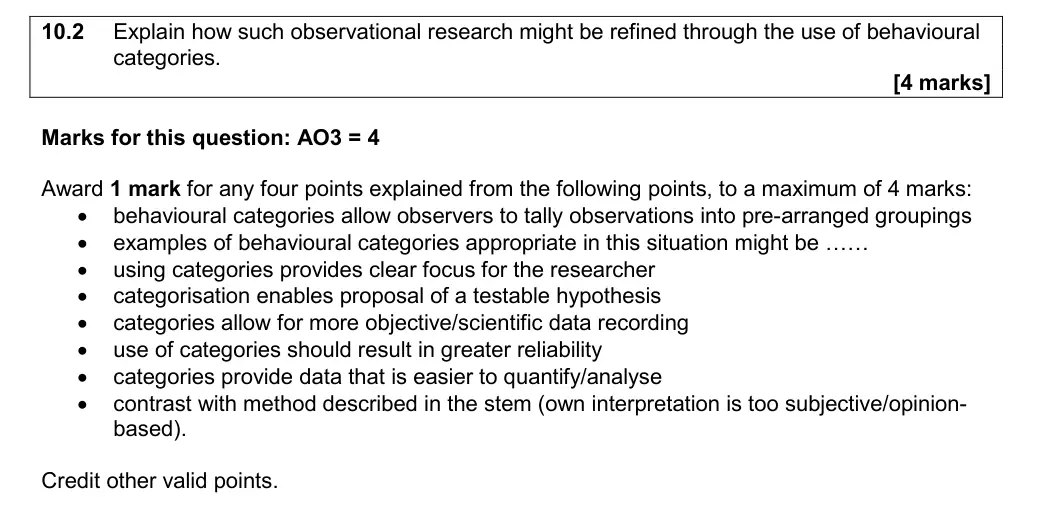
Many students had difficulty with this question despite credit being available for various examples. Most common responses included the caregiver smiling and the infant smiling back, and the caregiver waving and the infant waving back. The common error was for students to only suggest one side of the interaction and not include explicit reference to both the infant and caregiver. This resulted in over 50% of students not scoring marks in this question.
Notes from the mark scheme and report
(examples need knowledge of reciprocity, removed in v1.4
behavioural categories themselves are current)
each example must include both mother's and infant's behaviour
over 50% scored 0 by giving one side only
June 2025 · Paper 1 · Q132 marksAO2=2Research methods
Mark scheme, including level descriptors and indicative content
Examiner's comment
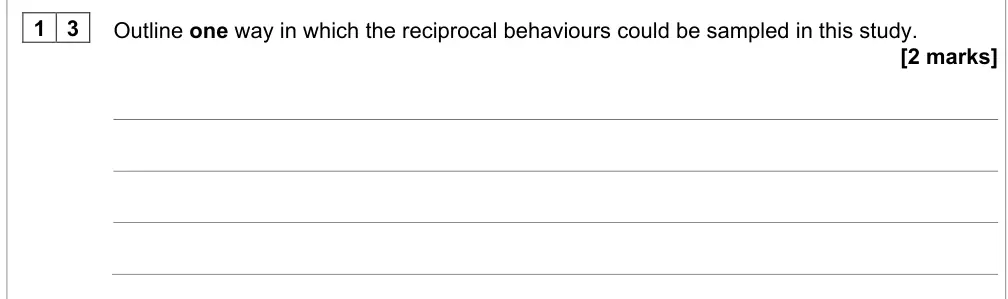
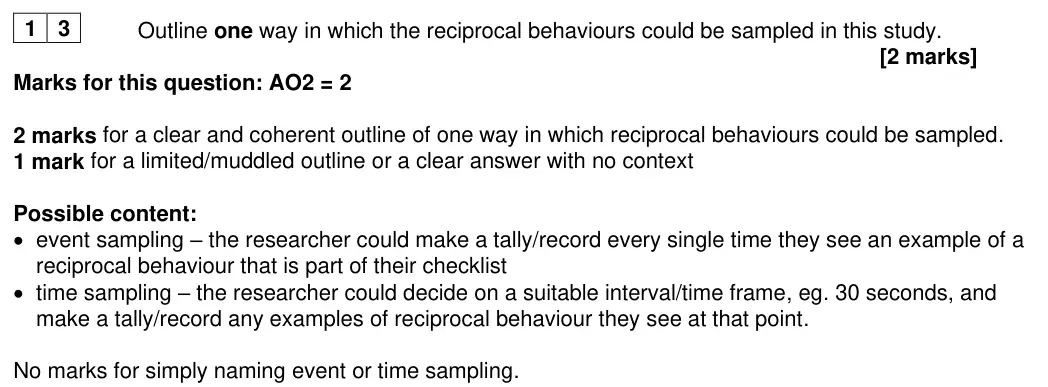
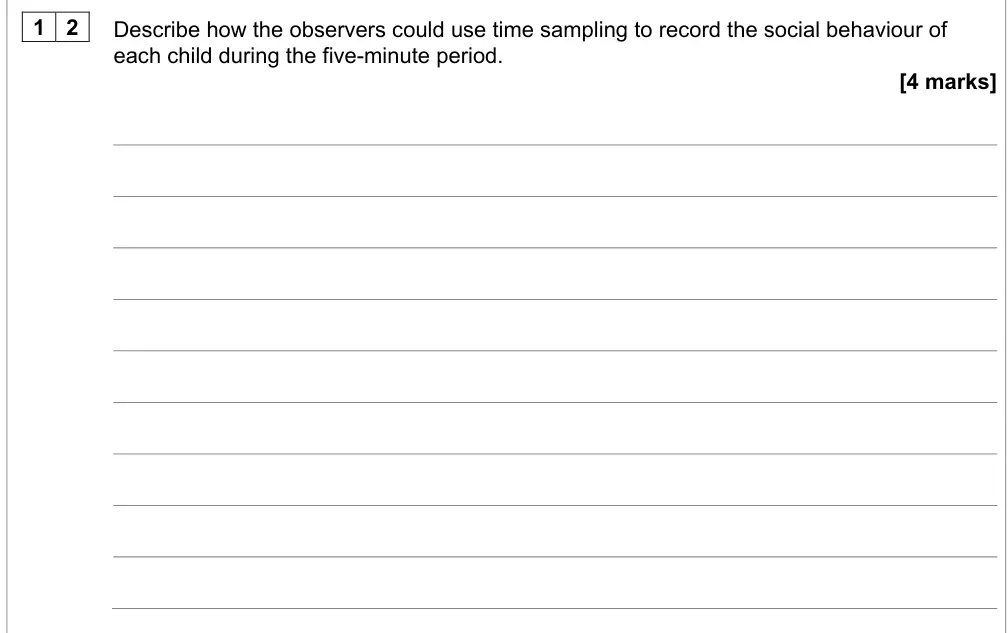
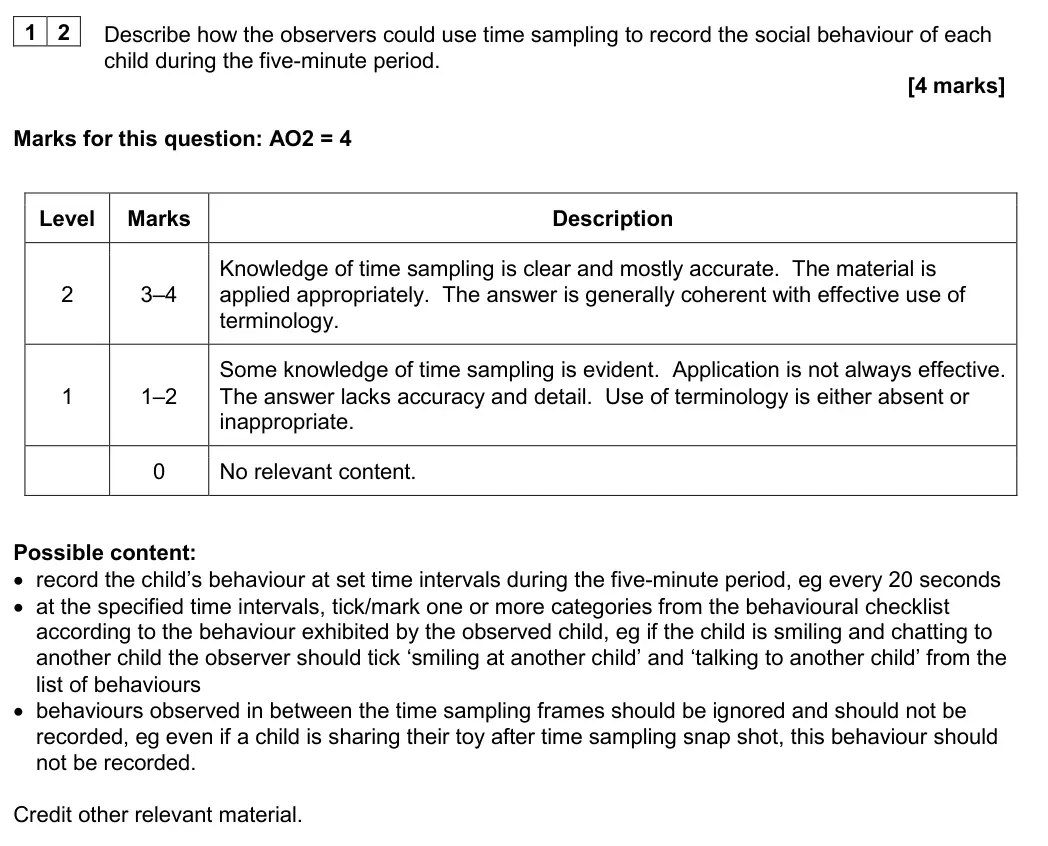
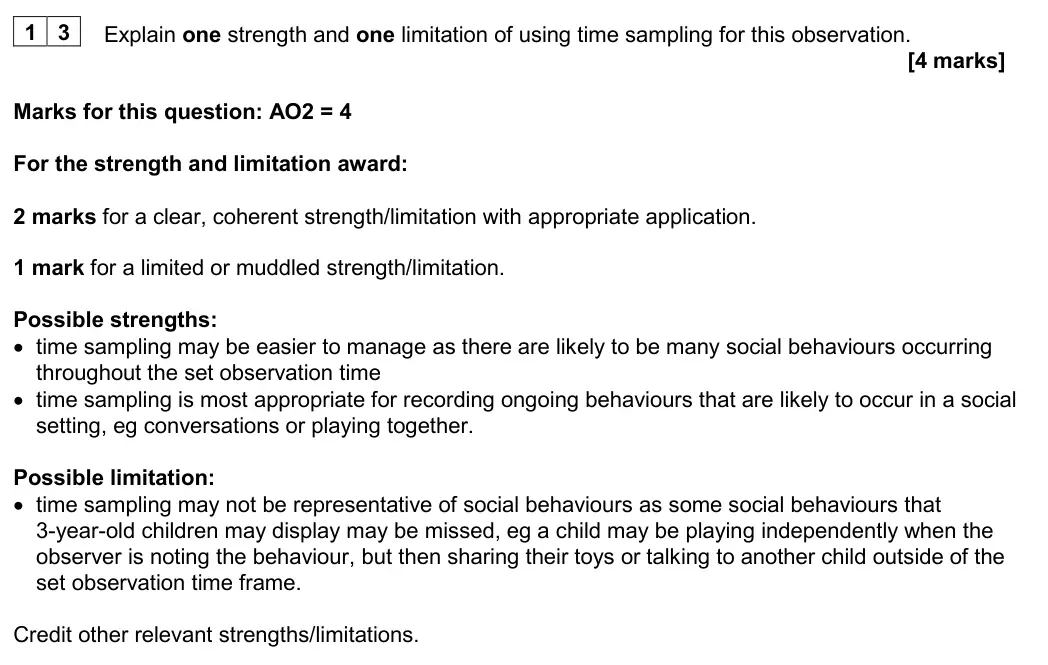
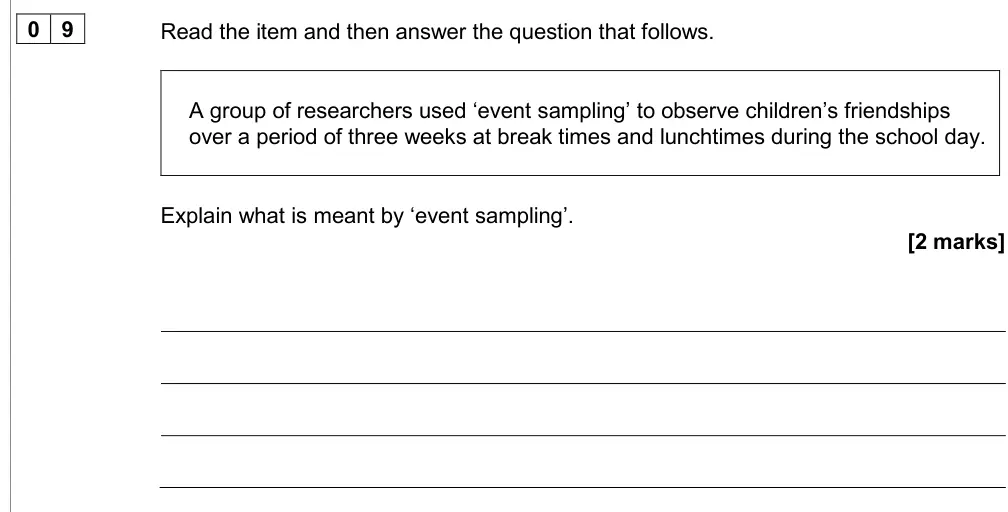
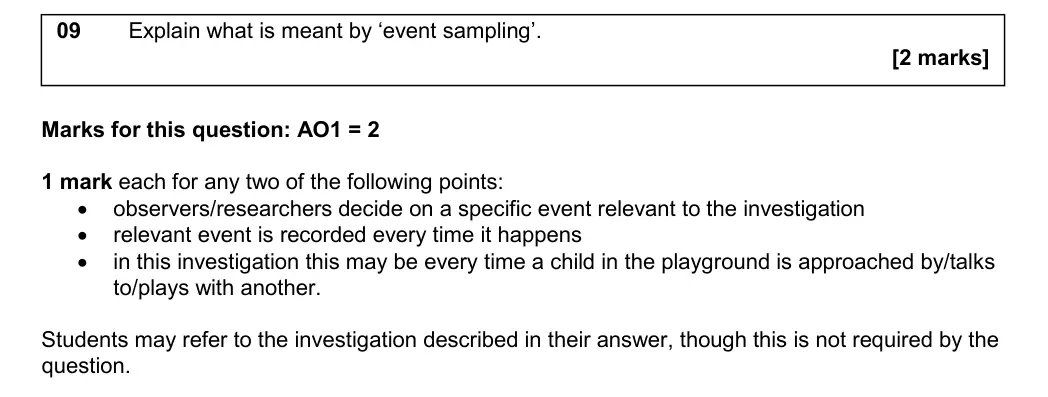
This question focused on how reciprocal behaviours could be sampled so students needed to outline either time sampling or event sampling. Although 25% were able to complete this effectively and include explicit reference to reciprocal caregiver-infant behaviours, a fair number of unsuccessful answers were based on sample selection methods e.g. random sampling. Time sampling seemed to be less well understood than event sampling.
Notes from the mark scheme and report
event or time sampling outlined in context (tally reciprocal behaviours)
naming only = 0
clear answer with no context = 1
many described participant sampling methods (random etc)
time sampling less well understood
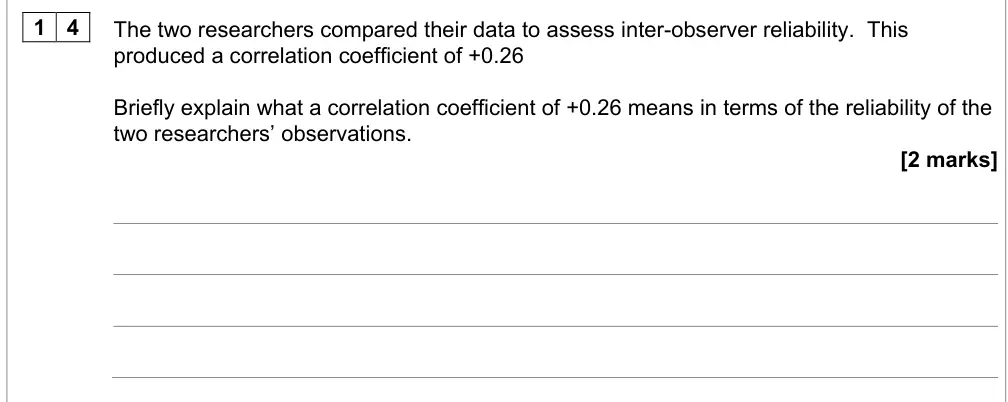
June 2025 · Paper 1 · Q142 marksAO2=2Research methods
Mark scheme, including level descriptors and indicative content
Examiner's comment
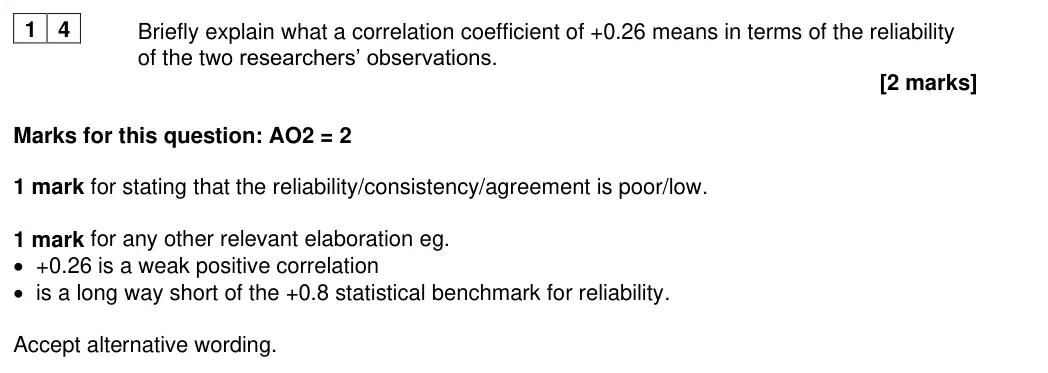
This was typically answered well by students who were largely able to deduce that a correlational coefficient of +0.26 indicated low inter-observer reliability. Effective reference to a more desirable correlational coefficient of +0.8 was frequently made.
Notes from the mark scheme and report
1 mark low/poor reliability + 1 mark elaboration (weak positive correlation
well below +0.8 benchmark)
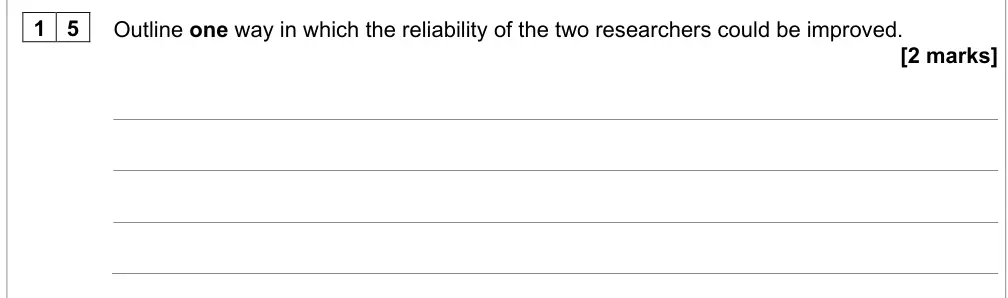
June 2025 · Paper 1 · Q152 marksAO3=2Research methodsMedium
Mark scheme, including level descriptors and indicative content
Examiner's comment
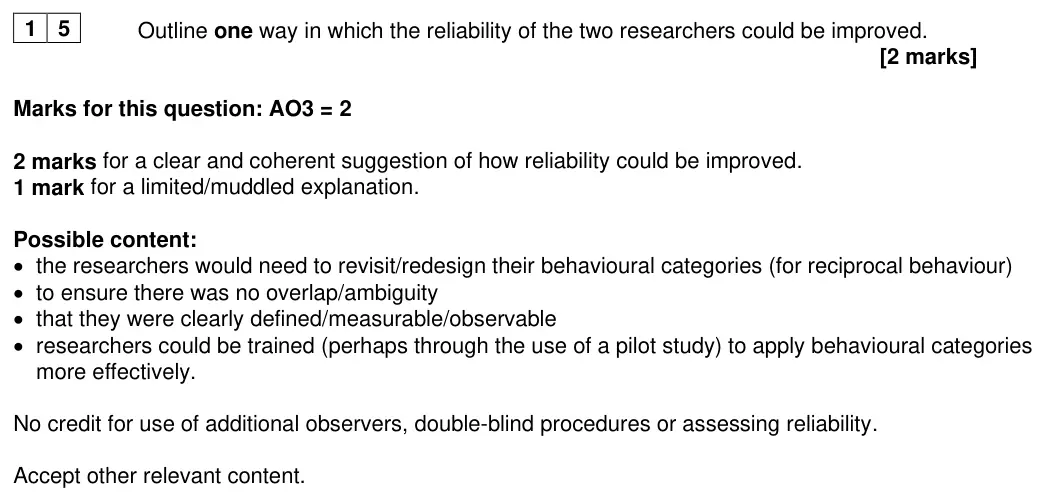
This question discriminated well between lower and higher attaining students. Although over 20% of students gained full marks, over 50% did not score any marks. Despite a similar question appearing in the 2023 series, many students struggled to outline a way in which reliability could be improved. Effective answers revolved around clearer operationalisation of behavioural categories, raising the objectivity of the behavioural categories and how observers could undergo further training in the use of the behavioural categories.
Notes from the mark scheme and report
improve: redefine/operationalise behavioural categories to remove overlap, train observers (pilot)
no credit for extra observers, double-blind, or assessing reliability
over 50% scored 0
June 2025 · Paper 2 · Q92 marksAO2=2Research methods
Mark scheme, including level descriptors and indicative content
Examiner's comment
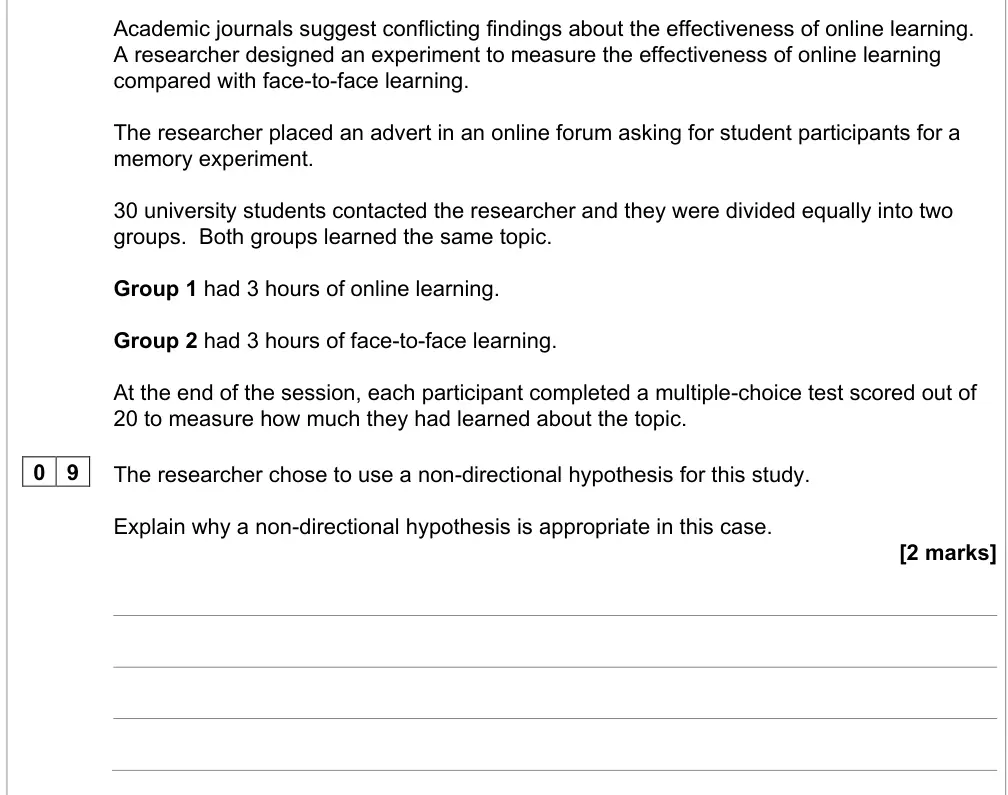
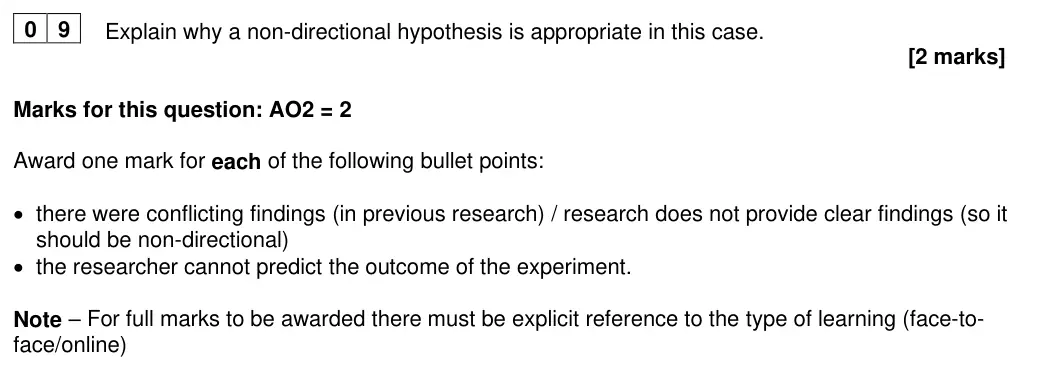
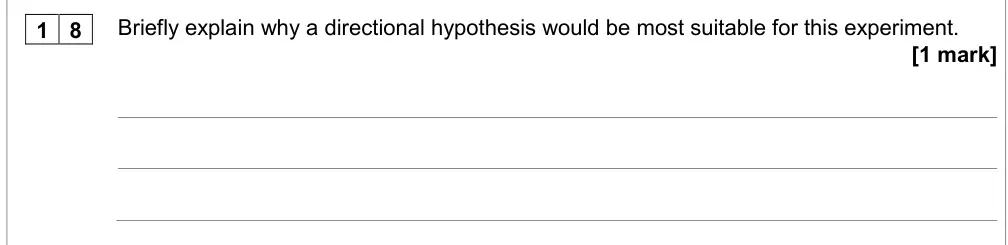
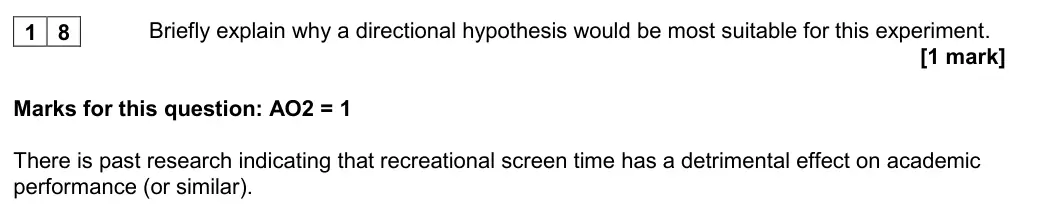
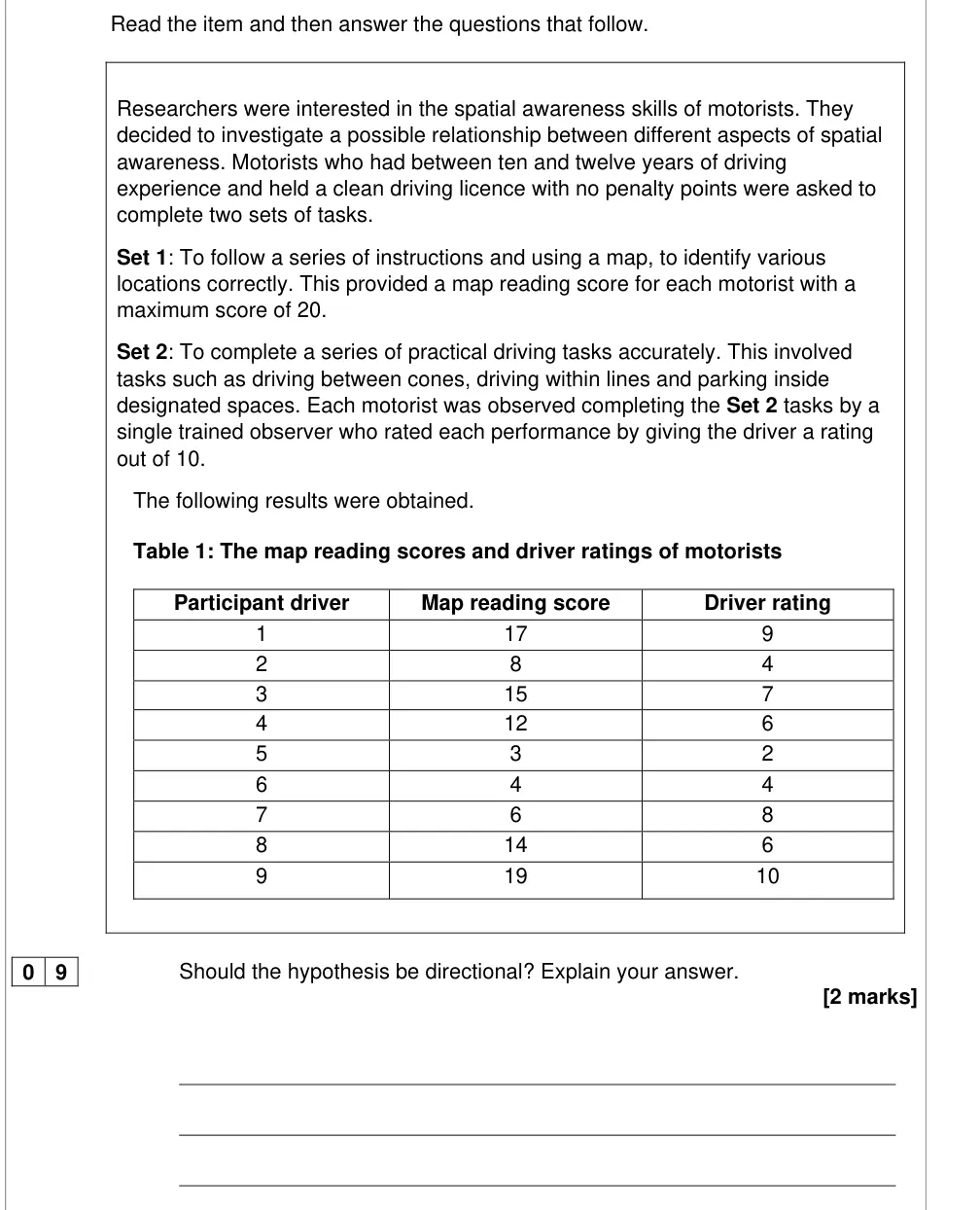
This question was answered with mixed success. Whilst most students recognised the importance of previous research, many claimed that a non-directional hypothesis should be used because there was no previous research rather than because of conflicting evidence as noted in the stem. This suggests possible reliance on pre-learned answers. Most students were unable to achieve full marks due to their answer not being in context and/or due to not giving the second bullet point of the mark scheme.
Notes from the mark scheme and report
1 mark conflicting previous findings (in stem), 1 mark cannot predict outcome
full marks need explicit reference to online/face-to-face learning
many wrongly said 'no previous research'
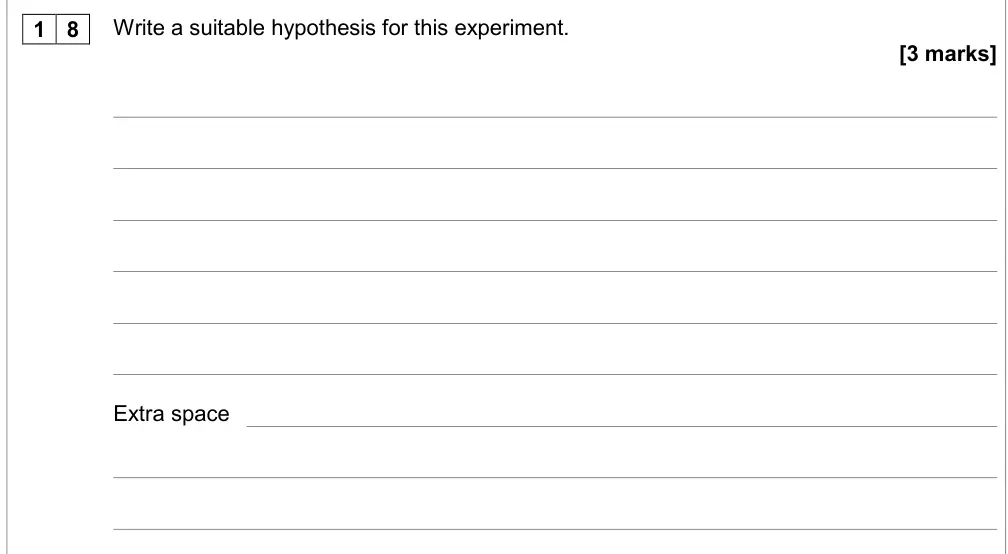
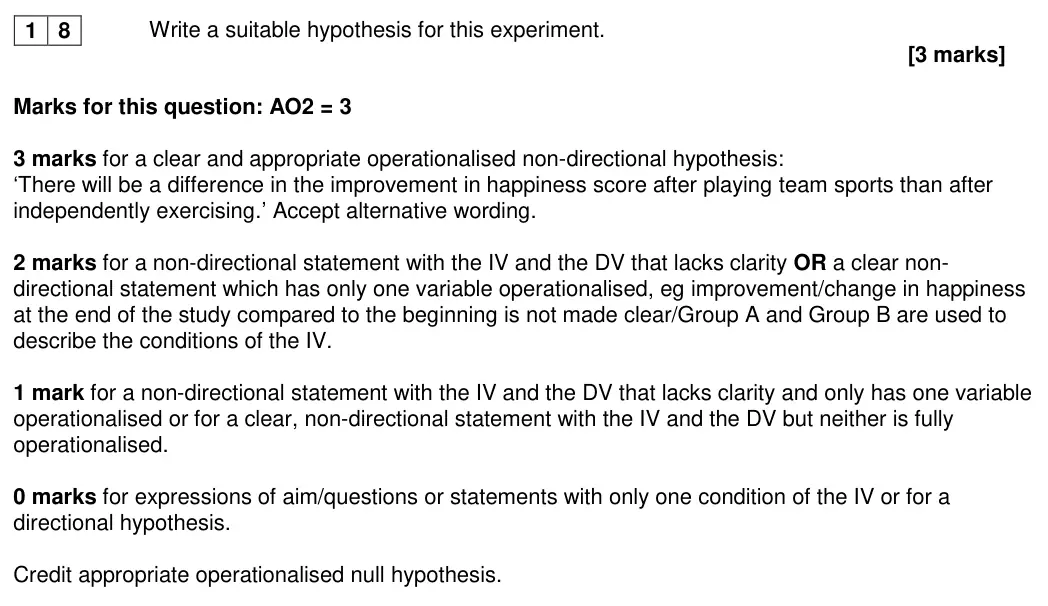
June 2025 · Paper 2 · Q103 marksAO2=3Research methods
Mark scheme, including level descriptors and indicative content
Examiner's comment
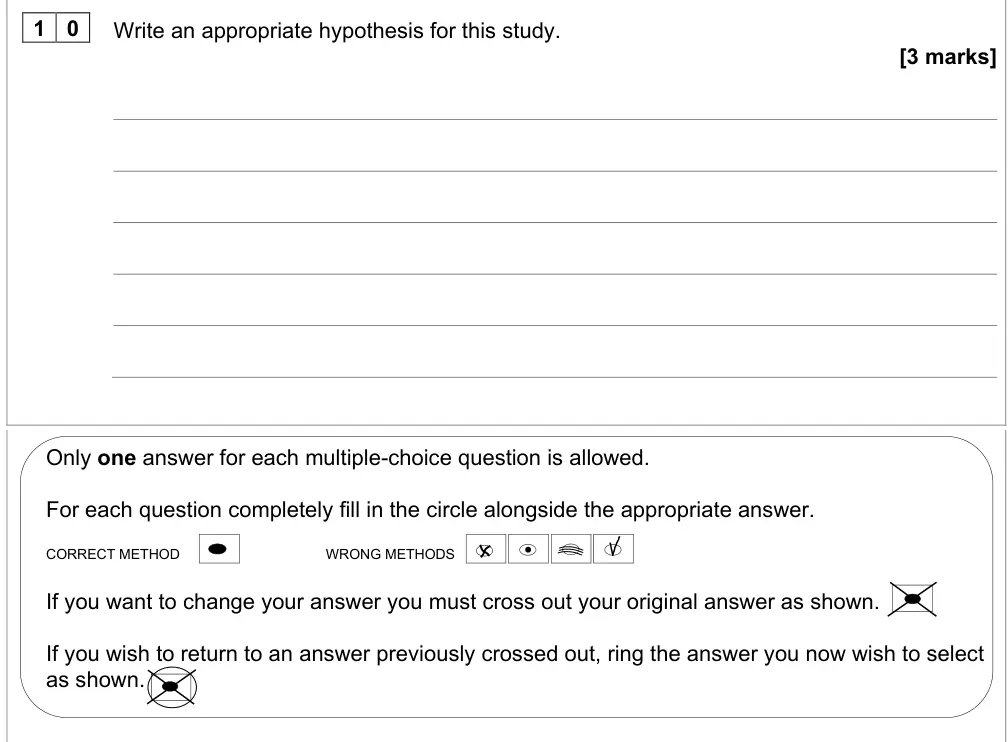
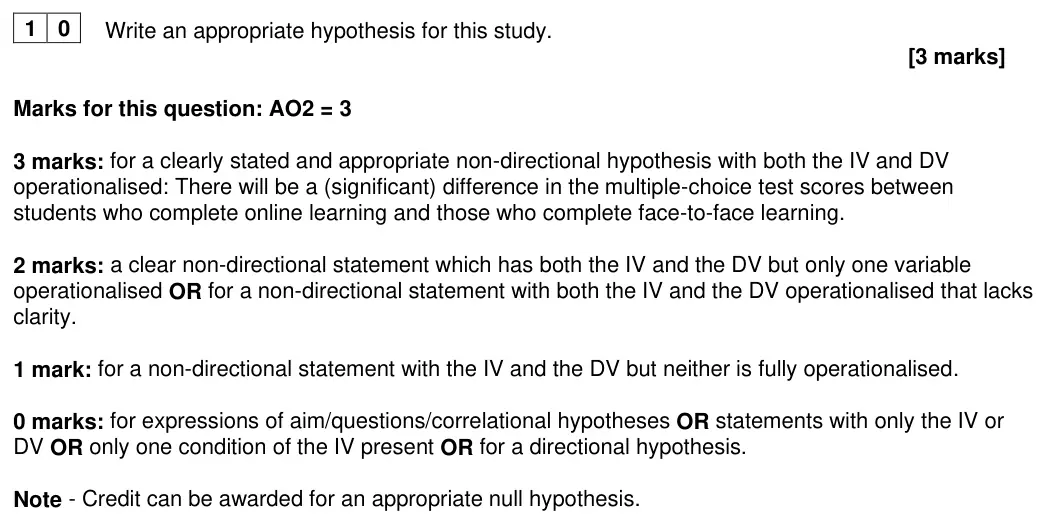
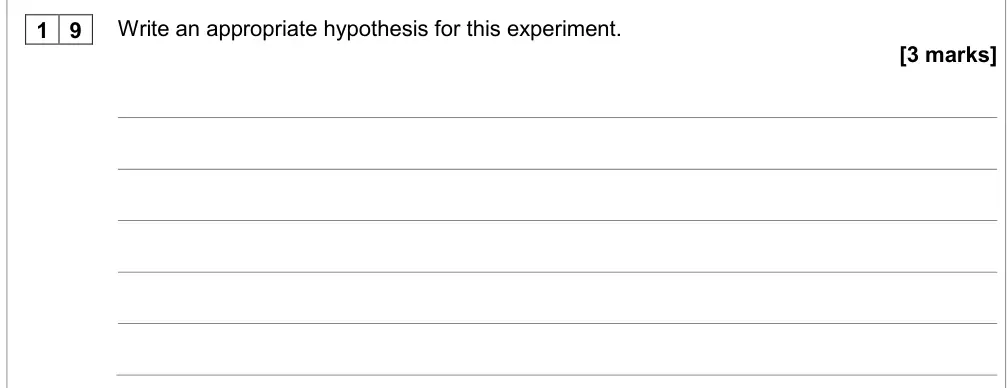
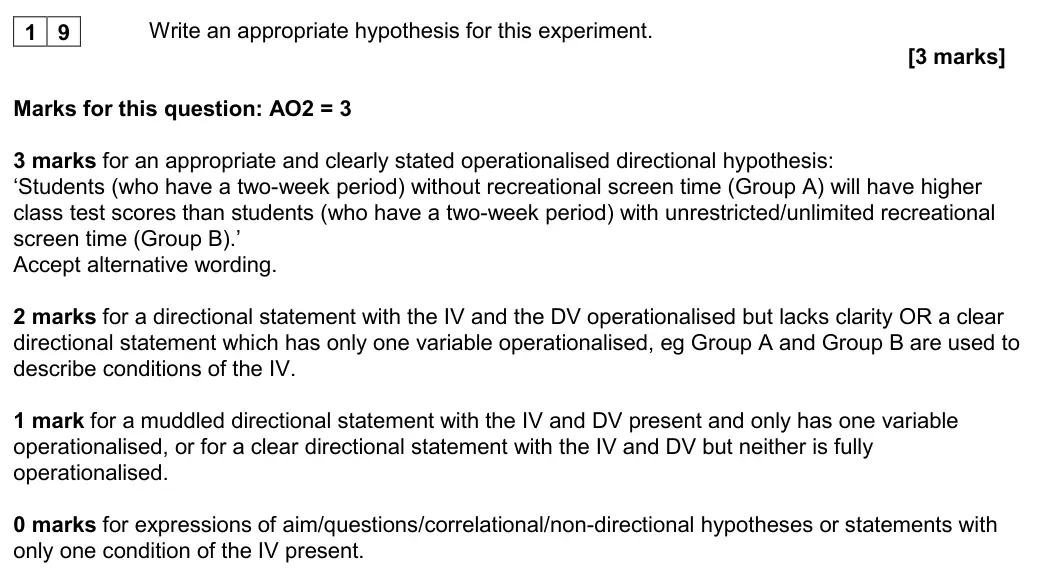
This question was generally well answered with many students demonstrating an understanding that the independent and dependent variables need to be fully operationalised. However, many responses were limited to two marks due to a lack of clarity or inadequate operationalisation of the dependent variable. Evidently, practice at writing clear operationalised hypotheses would be of benefit to some students.
Notes from the mark scheme and report
must be non-directional with IV (online vs face-to-face) and DV (multiple-choice test score) both operationalised for 3 marks
directional/correlational/aim = 0
null hypothesis accepted
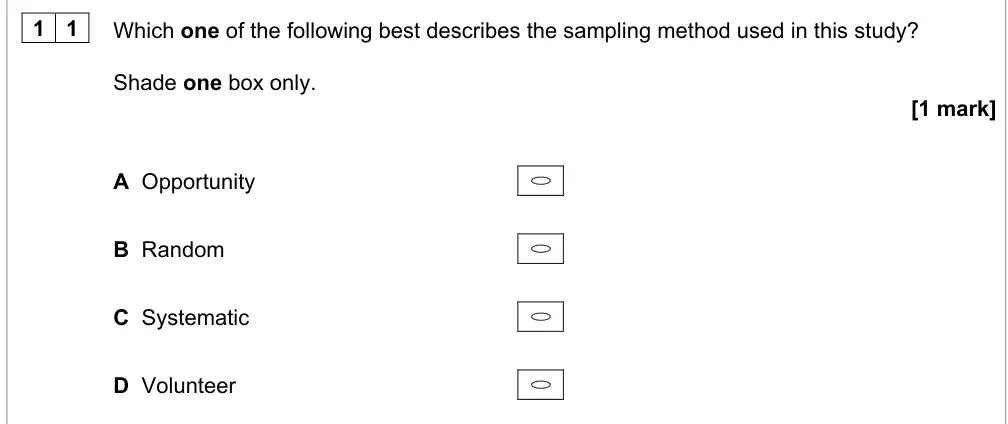
June 2025 · Paper 2 · Q111 markAO2=1Multiple choice
Answer
D
Mark scheme, including level descriptors and indicative content
Examiner's comment
This was a very well answered question with almost all students identifying D as the correct response.
Notes from the mark scheme and report
answer D (volunteer - advert on online forum)
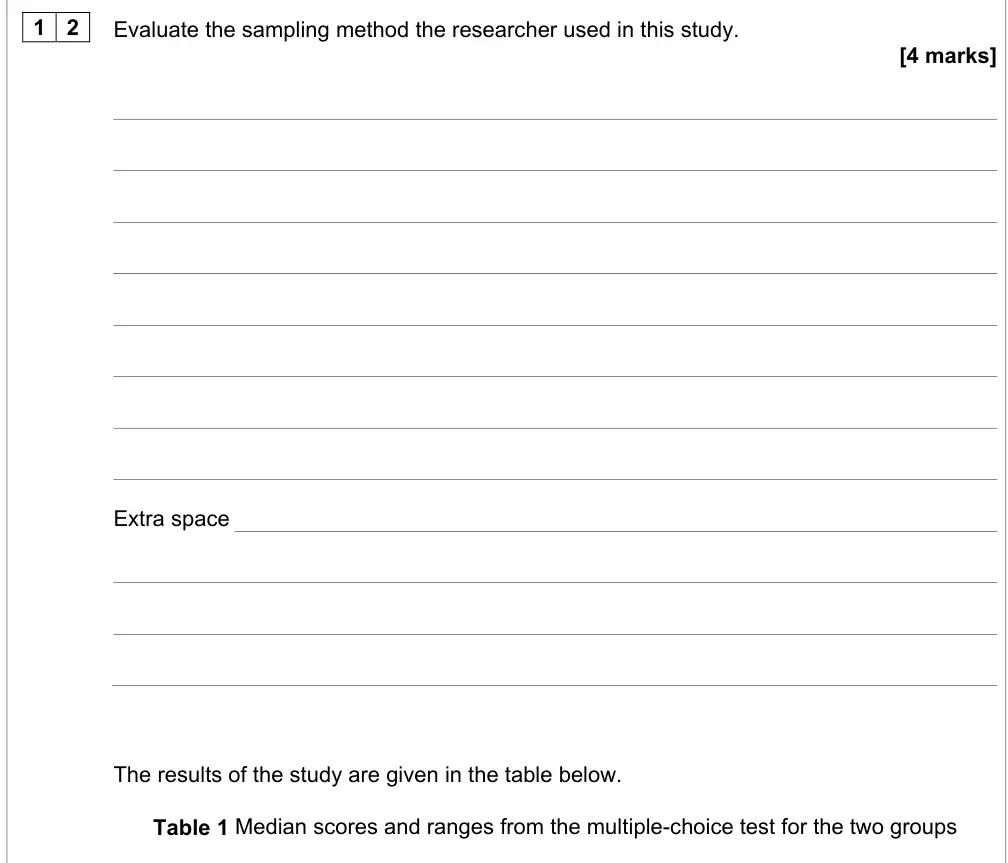
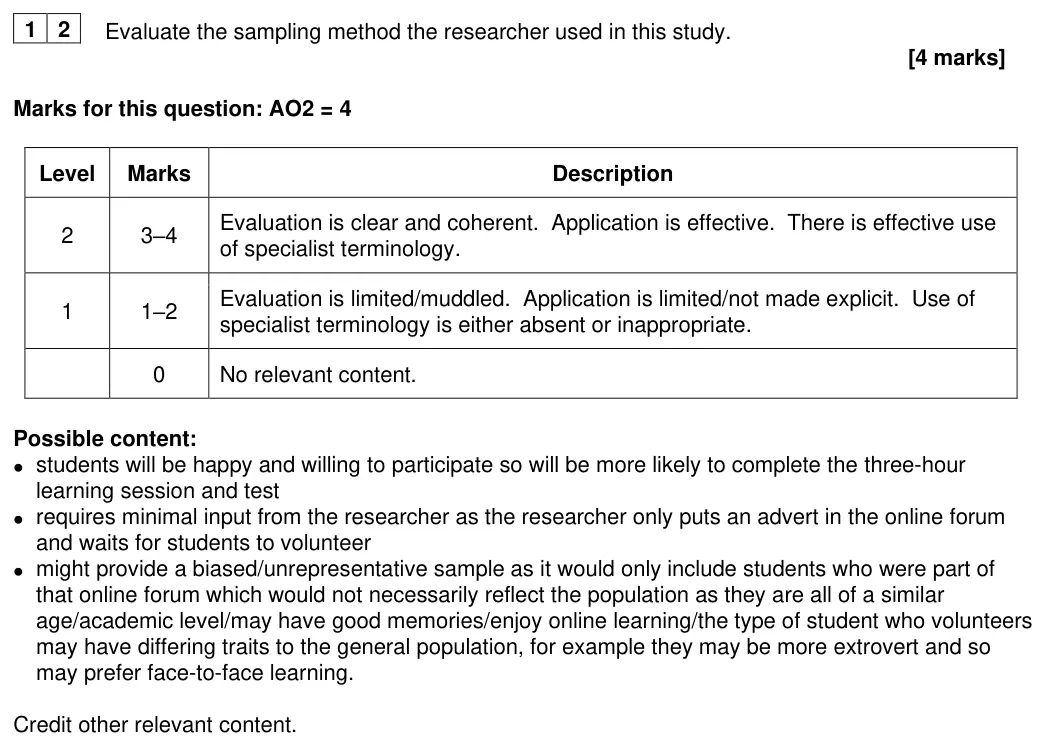
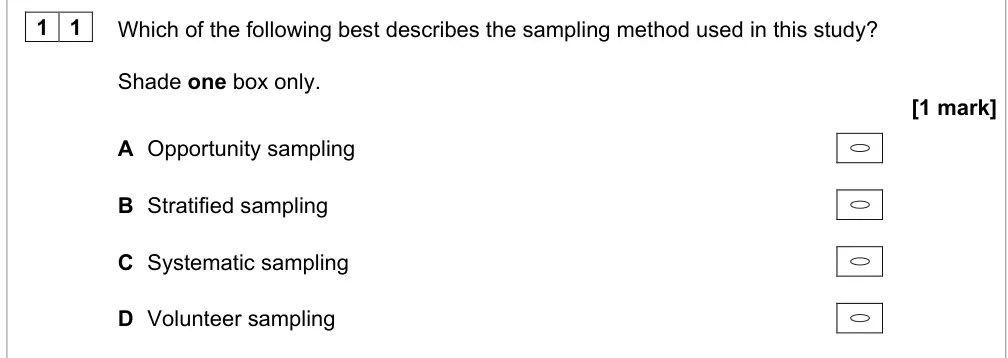
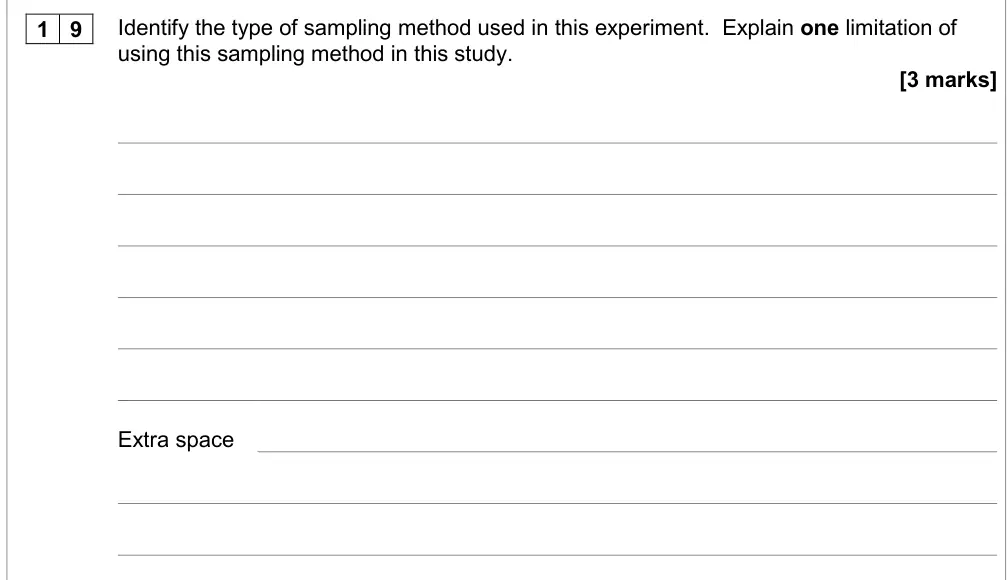
June 2025 · Paper 2 · Q124 marksAO2=4Research methods
Mark scheme, including level descriptors and indicative content
Examiner's comment
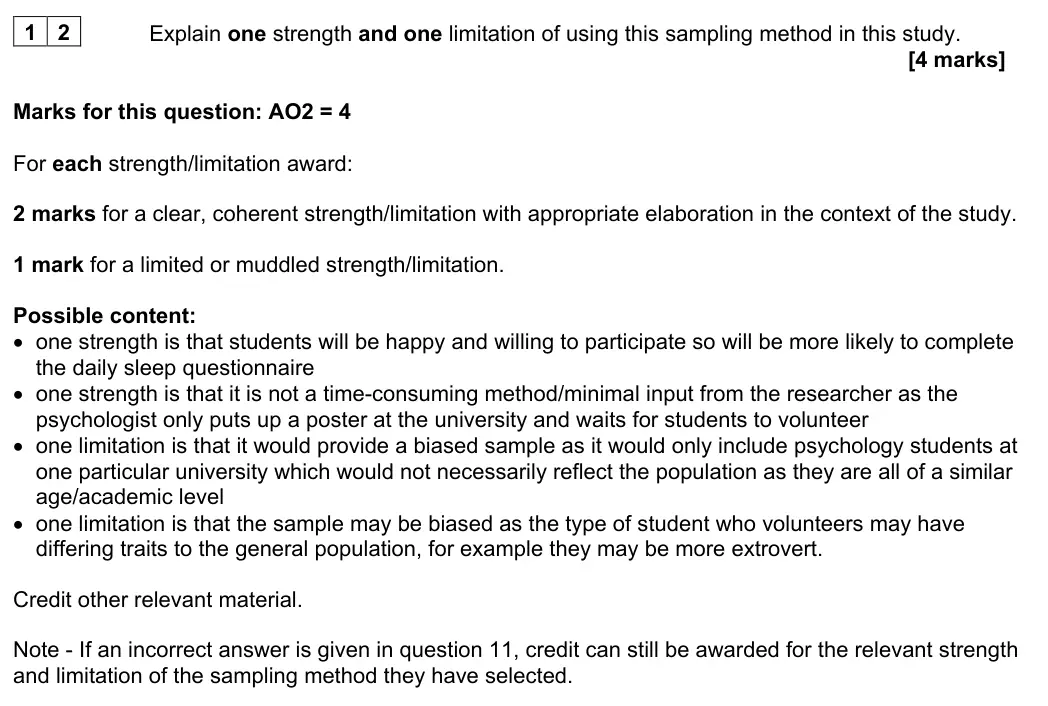
While knowledge of strengths and limitations of volunteer sampling was evident in many answers, most responses were limited to level 1 due to a lack of effective application. It was common to see generic evaluation of volunteer sampling and/or just a list of evaluative points with very limited application. A common strength offered was that it was less time consuming than other sampling methods which is not necessarily correct. Other responses engaged with the stem to provide limited elaboration and application by explaining that it was more time efficient ‘because the researcher only has to post an advert’. A common limitation related to the issue of having a biased sample that cannot necessarily be generalised. Surprisingly, a large proportion of students suggested volunteer sampling made the study more ethical as the participants have already given informed consent by volunteering so there would be no ethical issues. Students are reminded that the words ‘in this study’ means that the answer should use context to demonstrate understanding. Whilst many answers were in context, only fully effective application and well-developed responses achieved the highest marks. The best answers related explicitly to the study and the characteristics that a volunteer who uses online forums may have, and how these might interact with type of learning or memory.
Notes from the mark scheme and report
evaluation must be applied to this study (advert in online forum, students who use forums may prefer online learning/be extrovert)
generic list = Level 1
'volunteering removes ethical issues' and 'less time-consuming' not accepted as stated
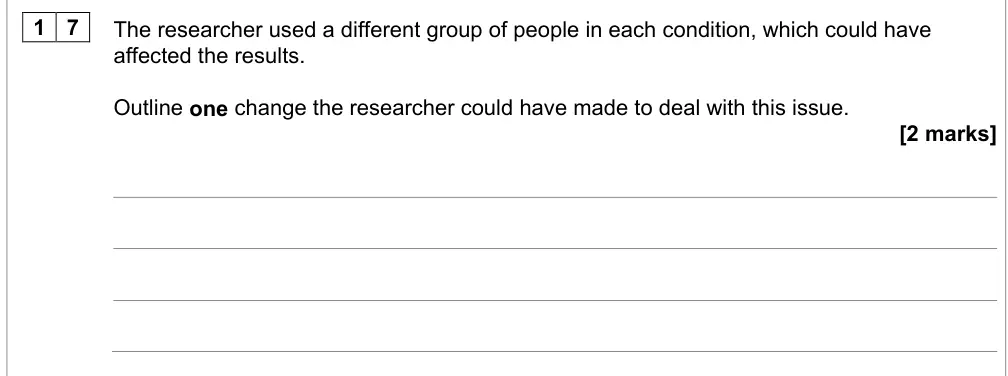
June 2025 · Paper 2 · Q172 marksAO3=2Research methodsEasy
Mark scheme, including level descriptors and indicative content
Examiner's comment
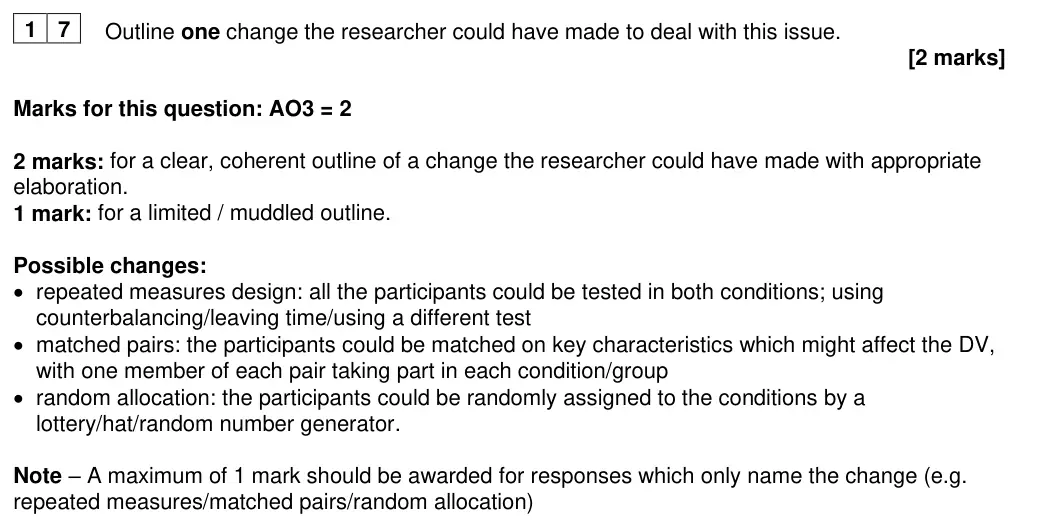
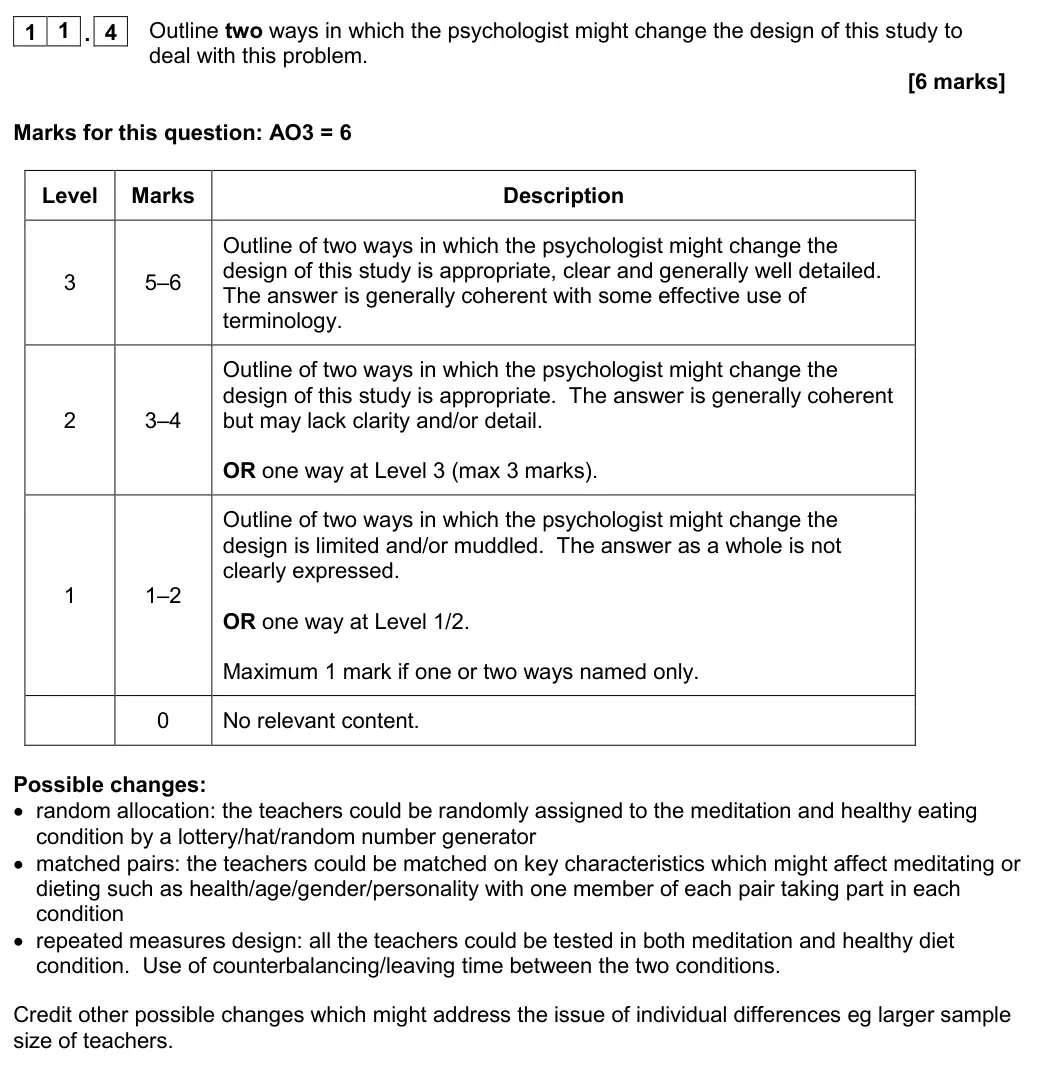
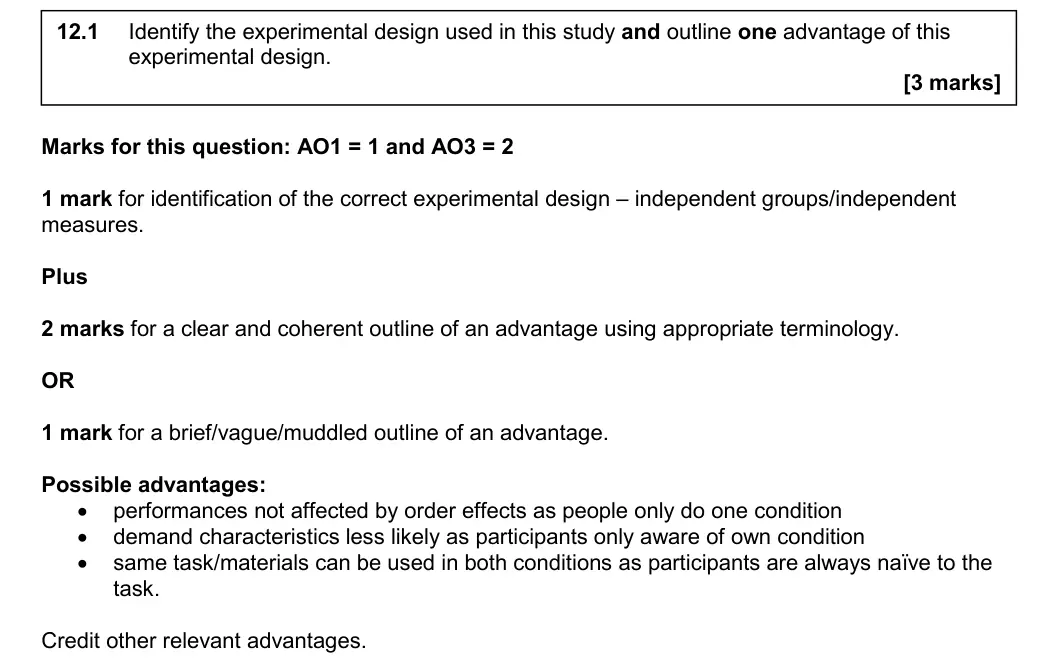
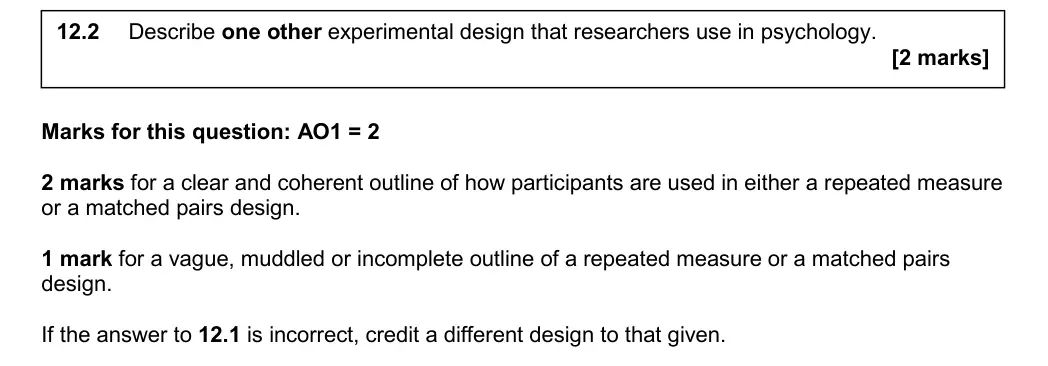
This was well answered, with the majority of students achieving the maximum mark, although some students then went on to discuss why they would do it rather than ‘how.’ Repeated measures design was better used than matched pairs design in terms of elaboration, as matched pairs design was more often presented with justification rather than elaboration. Random allocation was rarely used but answered well by the few who selected it. There was some confusion where counterbalancing was used synonymously with repeated measure design.
Notes from the mark scheme and report
repeated measures (with counterbalancing/different test), matched pairs or random allocation
naming only = max 1 mark
elaborate HOW not why
counterbalancing confused with repeated measures
June 2025 · Paper 2 · Q184 marksAO2=4Research methods
Mark scheme, including level descriptors and indicative content
Examiner's comment
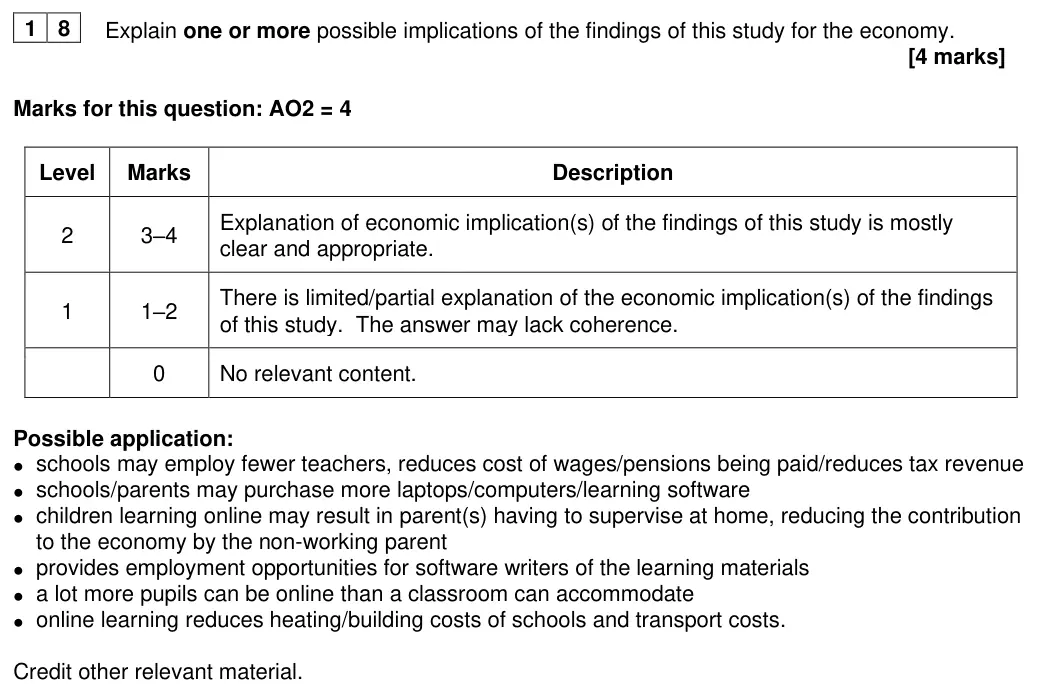
The full range of marks was awarded with a wide variety of responses given. Some students did not focus on the findings of the study and instead gave implications for more face-to-face learning, which was not creditworthy. Some students also gave implications but not ‘for the economy’ and/or gave economic implications for individual people but did not explain the impact on the economy in general. Teachers losing jobs was the most frequently seen response, but the more inventive answers explained how the results may have had a positive or negative result more widely on various people and then discussed the implications of these on the wider economy. Some answers talked thoughtfully about the impact on mental health from lack of contact with others (as in COVID). Others referred to the impact on mental health services and the NHS/government having to find more money for these services. Some answers discussed improved access to education for people with access needs and the consequences for the economy.
Notes from the mark scheme and report
implications must follow from the findings (online more effective) and be for the economy, not individuals (fewer teachers, laptops/software, building costs, parental supervision)
implications of more face-to-face learning not creditworthy
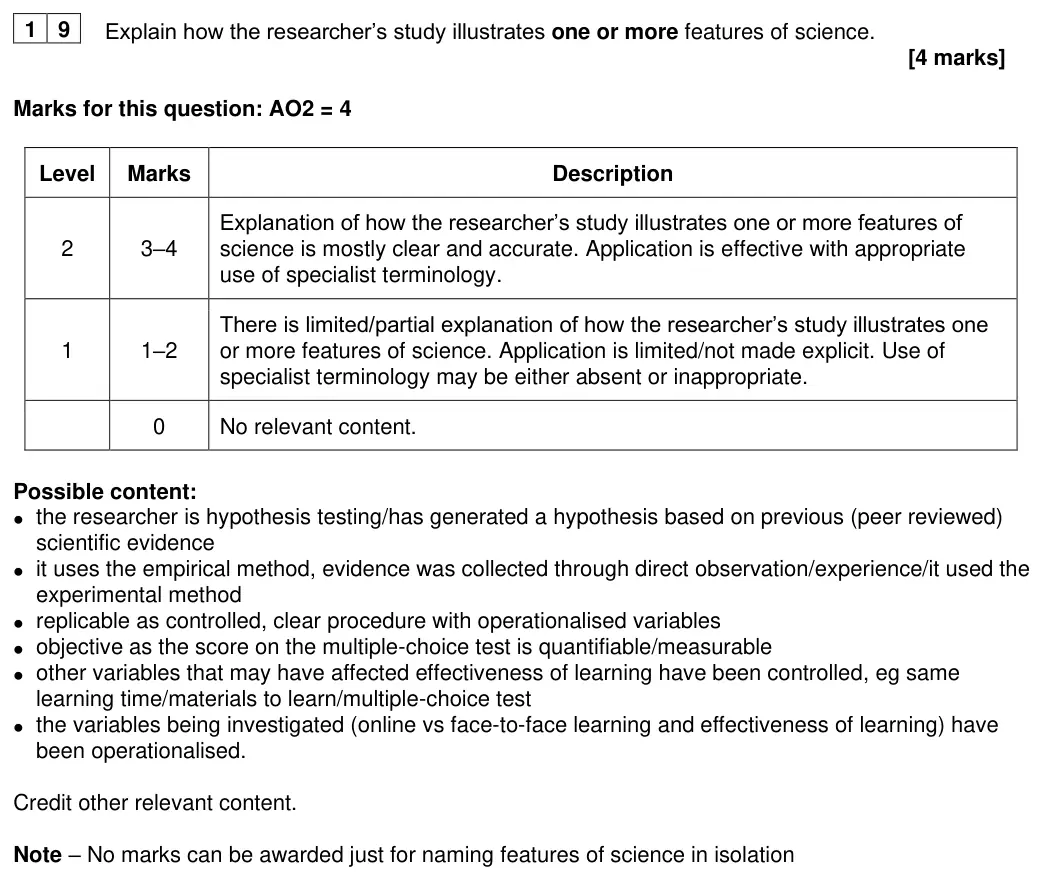
June 2025 · Paper 2 · Q194 marksAO2=4Research methods
Mark scheme, including level descriptors and indicative content
Examiner's comment
Whilst this question discriminated well it was generally not well answered and had the largest percentage of not attempted responses. While many students knew the features of science most had trouble moving beyond listing these to effective application, suggesting a lack of understanding. Replicability, objectivity, and falsifiability were the most successful features used by students. There was a common confusion regarding paradigm shifts occurring because of the findings from one study. Falsifiability was also often explained incorrectly. Overall, the responses suggest that students need to develop a deeper understanding of the features rather than focussing on learning a list.
Notes from the mark scheme and report
no marks for naming features in isolation
must apply to this study (hypothesis testing, empirical, replicable, objective quantifiable test score, controls)
largest non-attempt rate
paradigm shift from one study and falsifiability often wrong
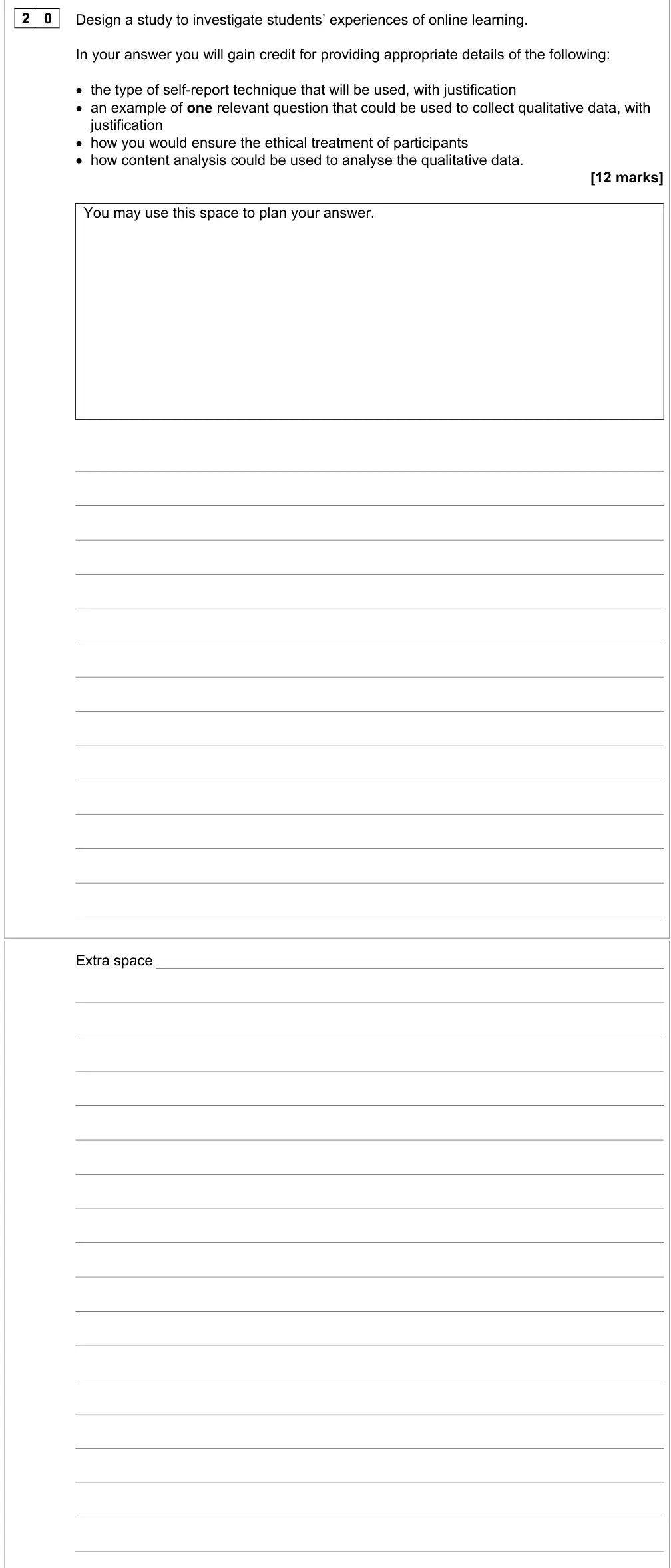
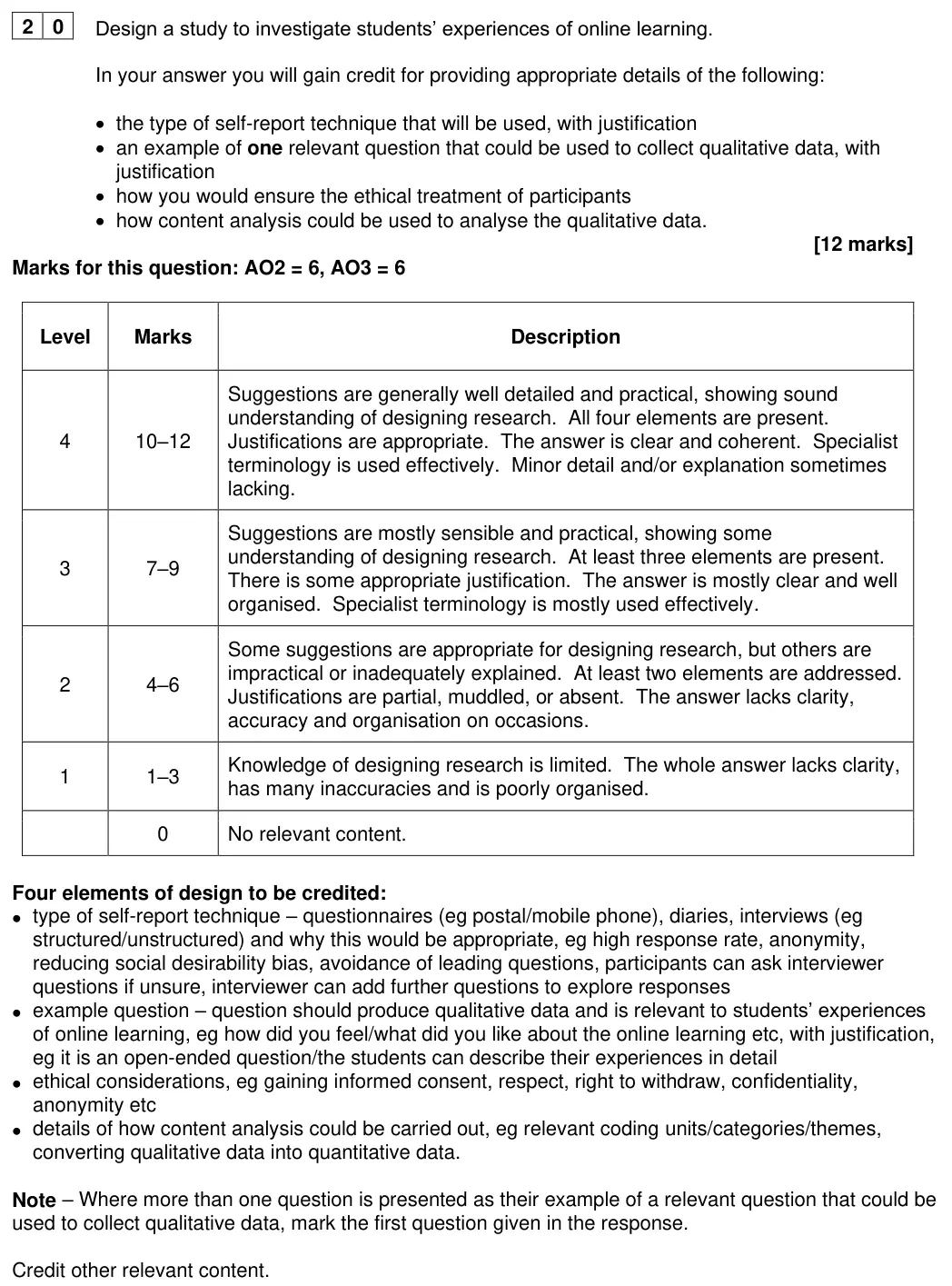
June 2025 · Paper 2 · Q2012 marksAO2=6, AO3=6Extended writing
Mark scheme, including level descriptors and indicative content
Examiner's comment
This question discriminated well. Students took different approaches. Some focussed on designing a study to investigate students’ experiences of online learning, covering the bullet points but also including details of the sampling methods, hypothesis, data analysis, etc. The majority addressed the four bullet points as separate questions. The improved examination technique of focussing on the specific bullet points and providing the necessary justifications rather than trying to design a complete study suggests past paper practice and use of feedback. Unfortunately, some who just focussed on the bullet points provided very few details, especially regarding the technique, although often good justifications were given. Those who provided procedural detail tended to score highly as they were able to shape the rest of their response to their design. Some excellent justifications were provided although some were generic. Some answers gave advantages and disadvantages of different self-report techniques without clear justification for the one selected. Suggested questions were mostly appropriate although some would clearly yield quantitative data. Credit was given for various justifications, including the context set, features of a good question and/or justification for being a qualitative question or for gathering qualitative data. In terms of ethics, students often used protection from harm, for example, keeping results confidential etc without explaining how they would do this. There was frequent muddling of brief and debrief. Better answers were those where the ethics were clearly linked to the study. Where analysis was covered this was usually done well, however, some responses lacked detail, and others did not provide the full process. Stronger responses provided the full process and put their analysis in context, for example, by suggesting relevant categories.
Notes from the mark scheme and report
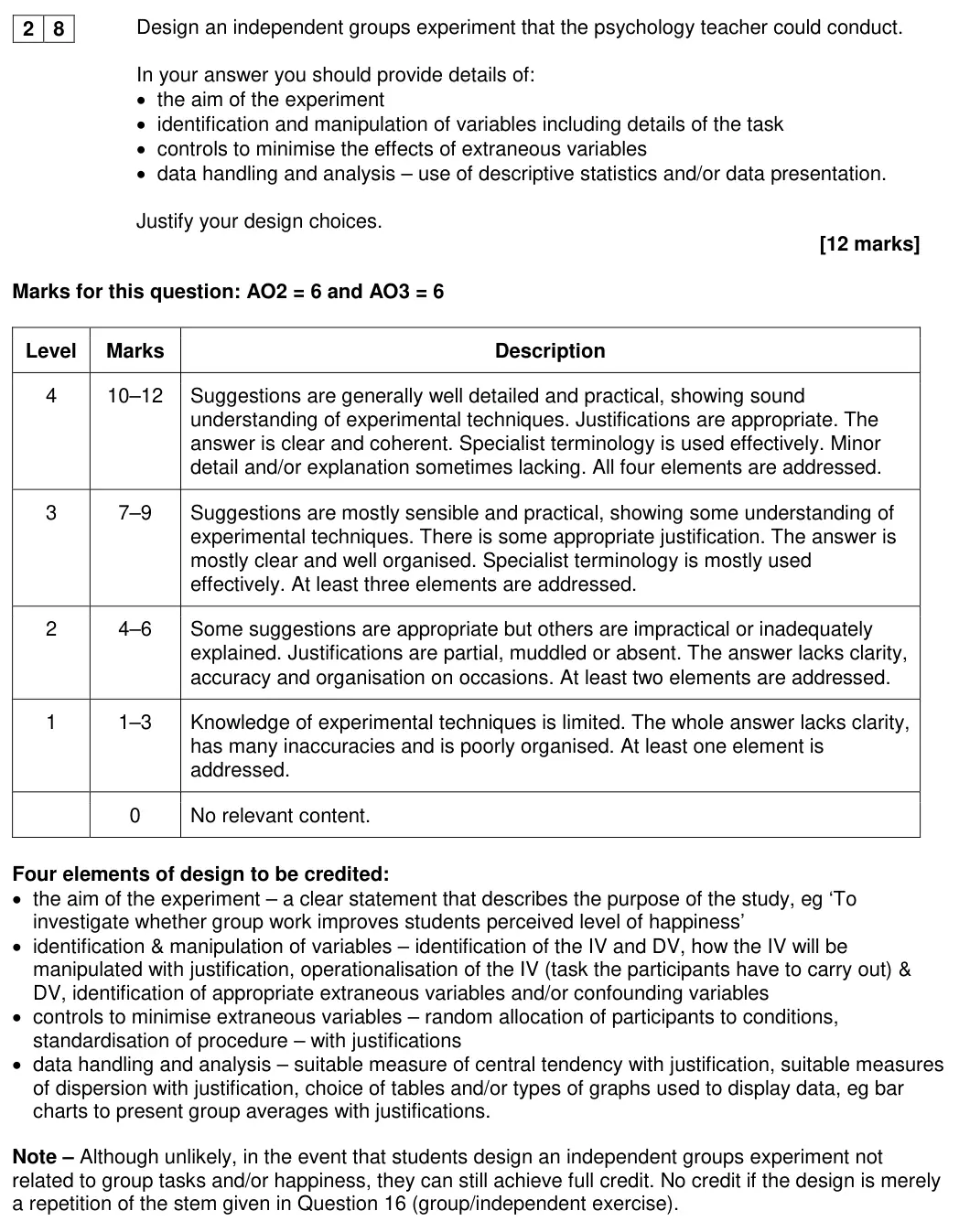
four elements: self-report technique with justification, one qualitative question with justification (only first question marked), ethics explained HOW, content analysis (coding units/categories, converting to quantitative)
Level 4 needs all four
some example questions would produce quantitative data
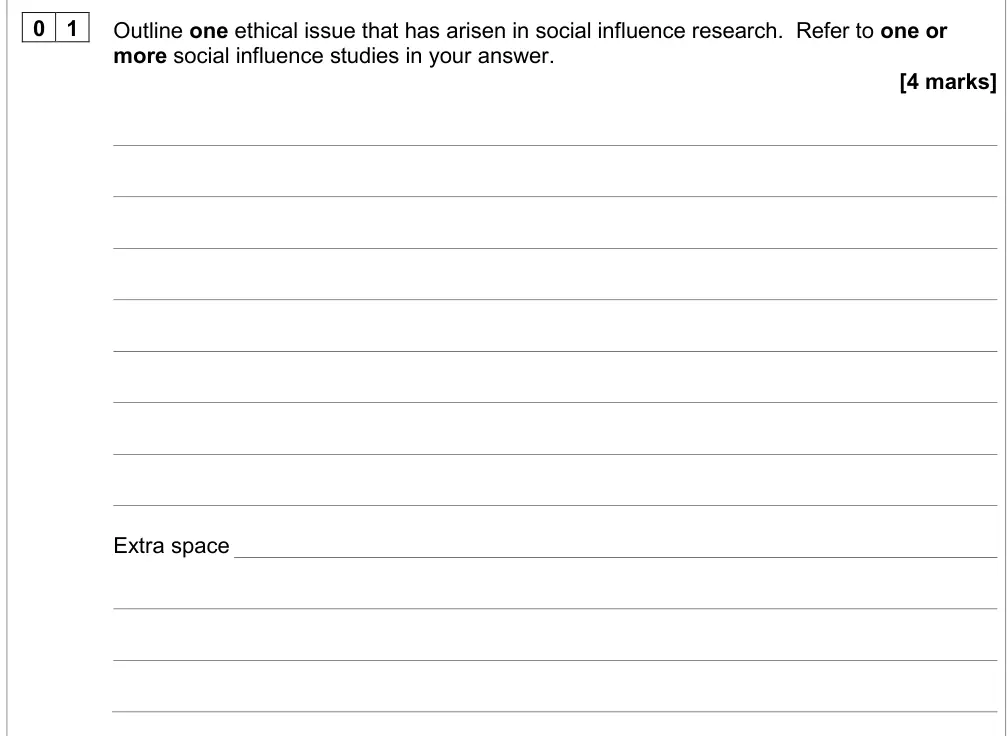
June 2024 · Paper 1 · Q14 marksAO1=4Research methodsEasy
Mark scheme, including level descriptors and indicative content
Examiner's comment
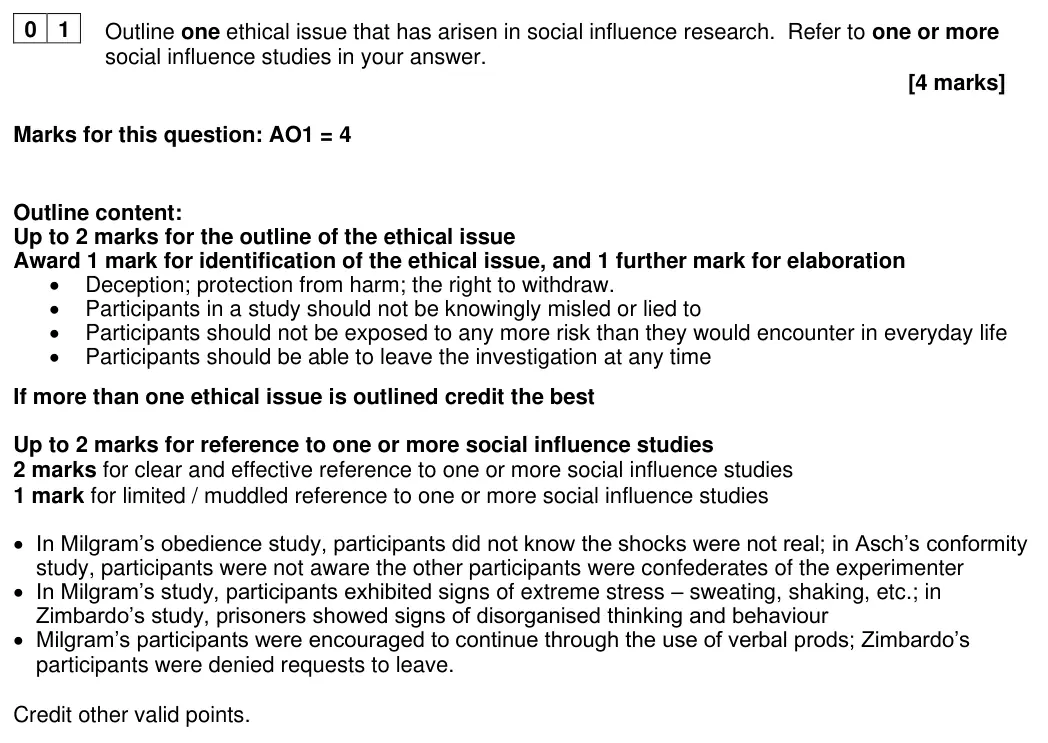
Outline one ethical issue that has arisen in social influence research. Refer to one or more social influence studies in your answer (4 marks) Typically, students were able to score well with nearly seventy percent of students scoring 3 or 4 marks in this question, with a mean average of 2.78. Students were able to readily identify an ethical issue in social influence research and to refer to one or more social influence studies to elaborate this. The most common and well used studies were Milgram and Zimbardo’s research, and to a lesser extent Asch’s conformity study. The minor issue with this question was when students failed to outline the ethical issue in sufficient depth.
Notes from the mark scheme and report
up to 2 marks: identify + elaborate one ethical issue (deception, protection from harm, right to withdraw), best one credited
up to 2 marks: reference to social influence studies (Milgram, Asch)
MS also credits Zimbardo examples, removed in v1.4
issue often not outlined in enough depth
June 2024 · AS Paper 1 · Q24 marksAO3=4Evaluate (short)Medium
Mark scheme, including level descriptors and indicative content
Examiner's comment
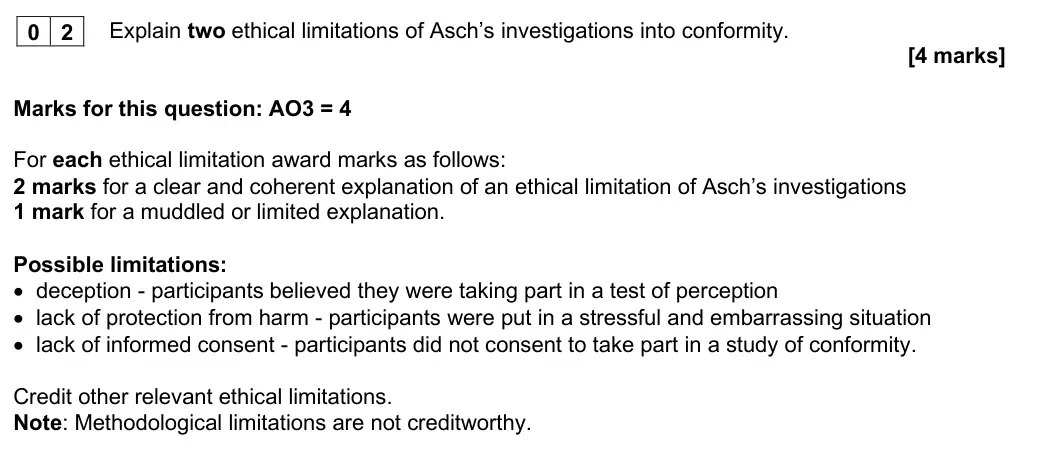
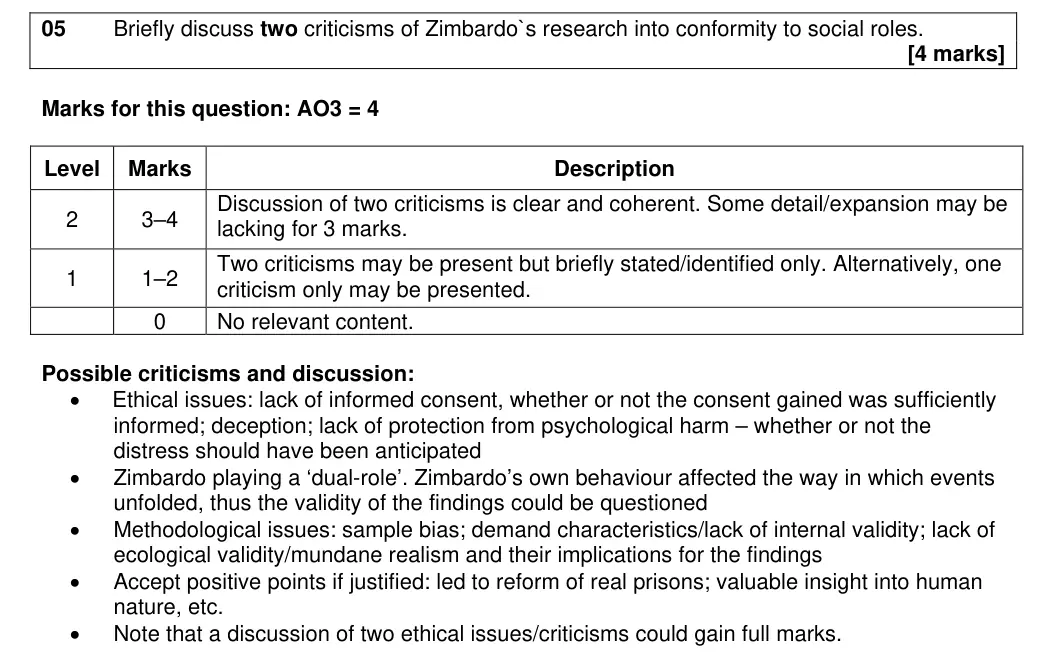
Another Asch question which many students answered well, with 30% of students gaining full marks. However, some students did not read the question and their answer did not focus on ethical limitations. Some students gave general weaknesses of Asch’s research: students need to be reminded to read the question carefully and address the question set. Good answers explained their chosen ethical limitations within the context of Asch’s investigations.
Notes from the mark scheme and report
two ETHICAL limitations explained in the context of Asch (deception about perception test, protection from harm/stress and embarrassment, informed consent)
methodological limitations not creditworthy
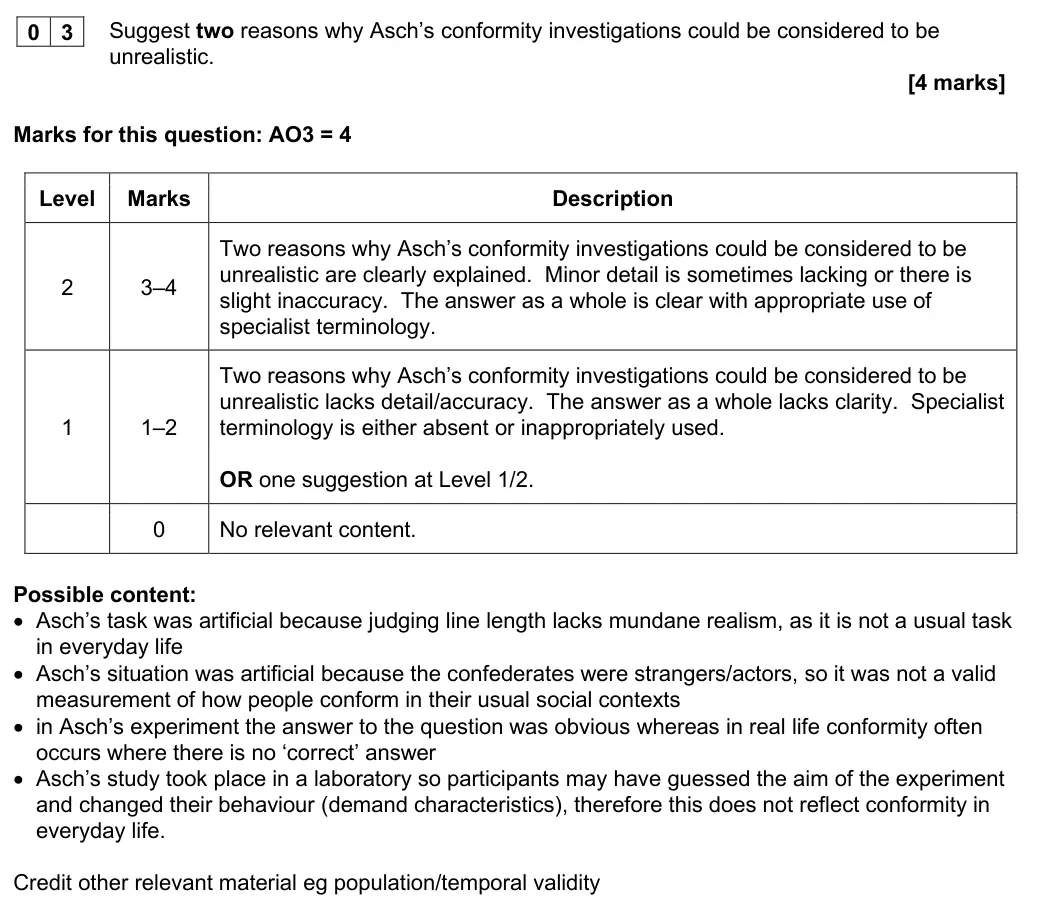
June 2024 · AS Paper 1 · Q34 marksAO3=4Evaluate (short)Medium
Mark scheme, including level descriptors and indicative content
Examiner's comment
Some students gave particularly good answers outlining two distinct reasons why Asch’s conformity investigations could be considered unrealistic within the context of Asch’s research, with 25% of students achieving full marks. The strongest answers also used specialist terminology appropriately, for example, lack of mundane realism. Some students only gave general weaknesses of Asch’s research without explaining why it was unrealistic or they were only able to give one suggestion.
Notes from the mark scheme and report
two reasons Asch is unrealistic (mundane realism of line task, strangers as confederates, obvious answer, lab/demand characteristics)
general weaknesses not explained as unrealistic
one reason only = max Level 1
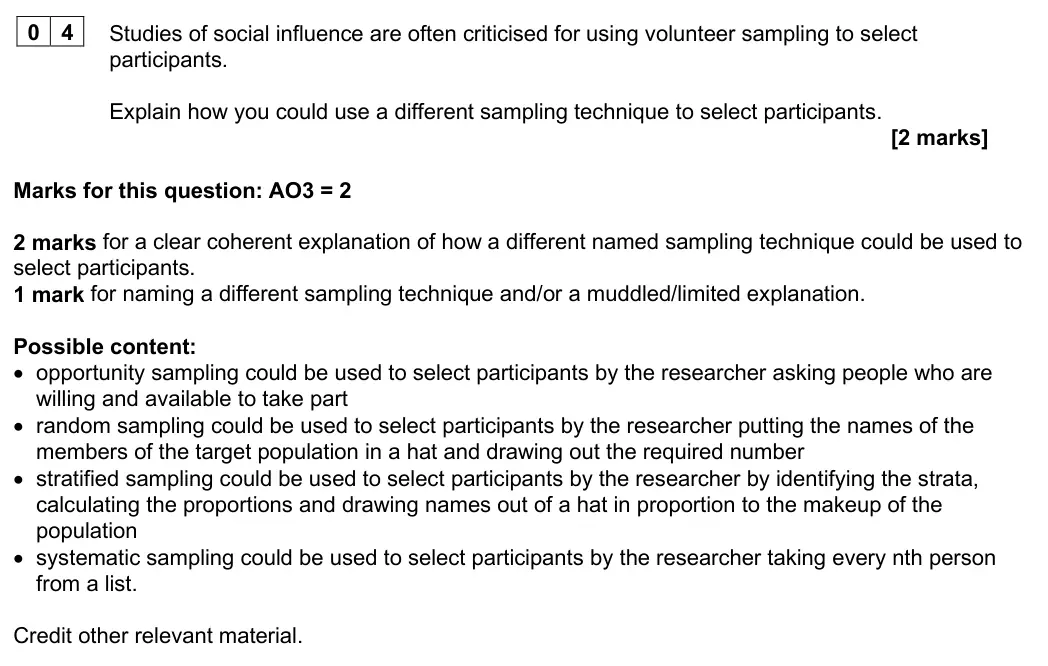
June 2024 · AS Paper 1 · Q42 marksAO3=2Research methods
Mark scheme, including level descriptors and indicative content
Examiner's comment
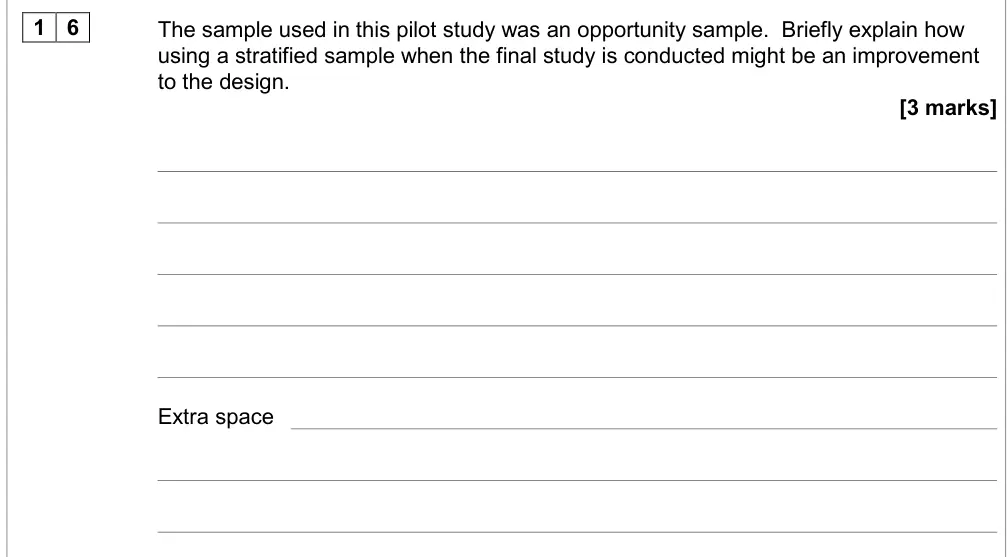
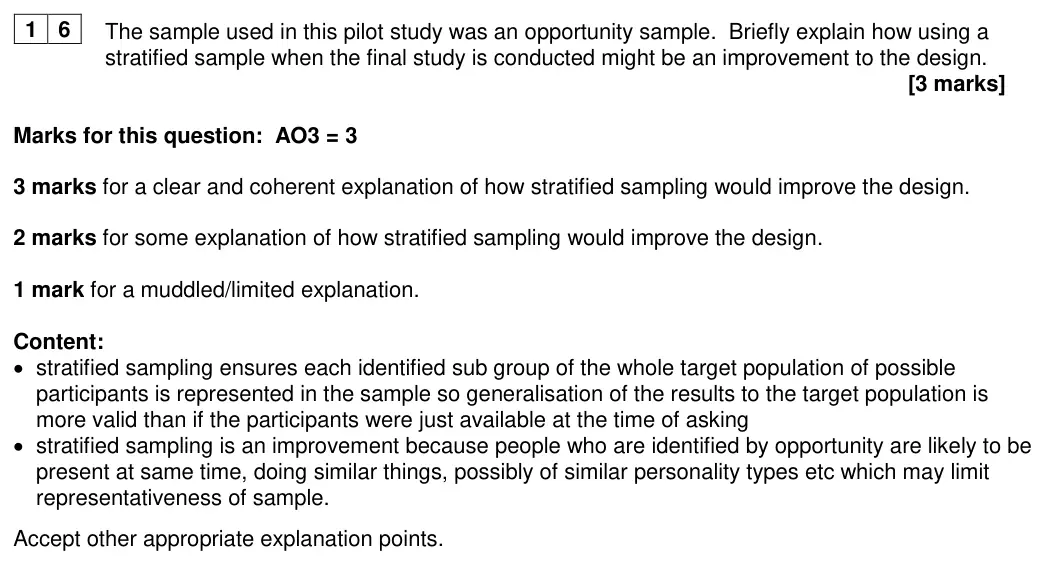
Most students could identify an appropriate alternative sampling technique to volunteer sampling, but not all could explain how it could be carried out. Explaining random sampling still seems to be causing some students issues, with a lack of clarity in many answers trying to explain how it would be carried out. Stating ‘names out of a hat’ is not detailed enough for 2 marks. A minority of students named stratified but described how they would carry out systematic sampling.
Notes from the mark scheme and report
must name an alternative AND explain how it is carried out
'names out of a hat' not detailed enough for 2 marks
named stratified but described systematic
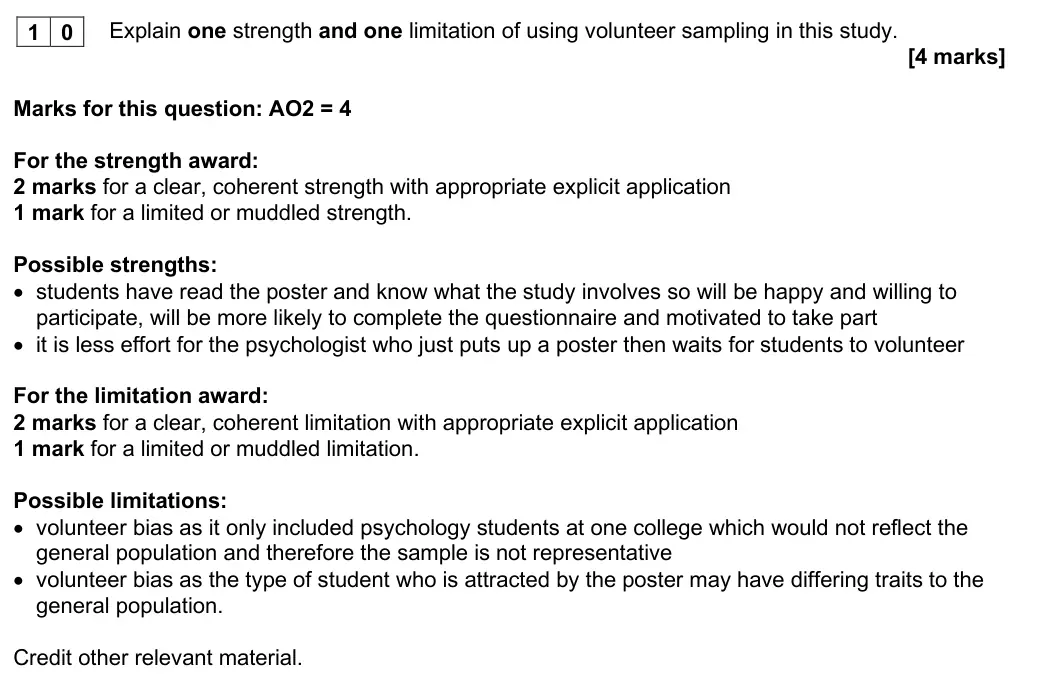
June 2024 · AS Paper 1 · Q104 marksAO2=4Research methodsMedium
Mark scheme, including level descriptors and indicative content
Examiner's comment
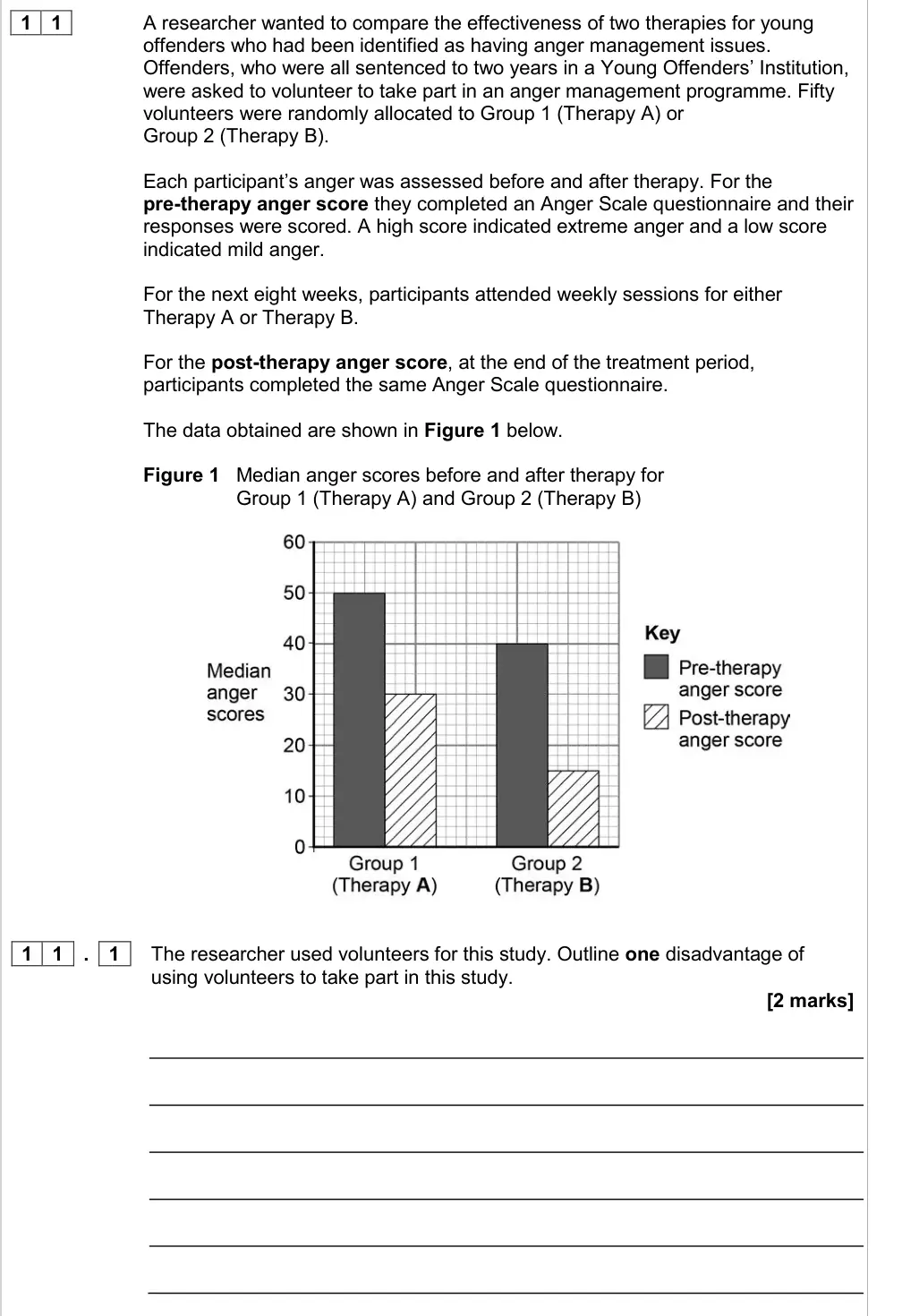
Many students understood a strength and/or limitation of volunteer sampling, but many also did not apply their knowledge to the scenario as the question asked them to do. Some students gave limitations of the (target) population identified in the question, not the sampling method. Strong answers were able to provide explicit application, for example, the students being more motivated to complete the questionnaire as they had read the poster and knew what they were signing up to. A third of students gained 3 or 4 marks on this question, with only just over 6% scoring no marks at all.
Notes from the mark scheme and report
strength and limitation of volunteer sampling with explicit application (motivated after reading poster
psychology students at one college unrepresentative)
limitations of target population rather than sampling method not credited
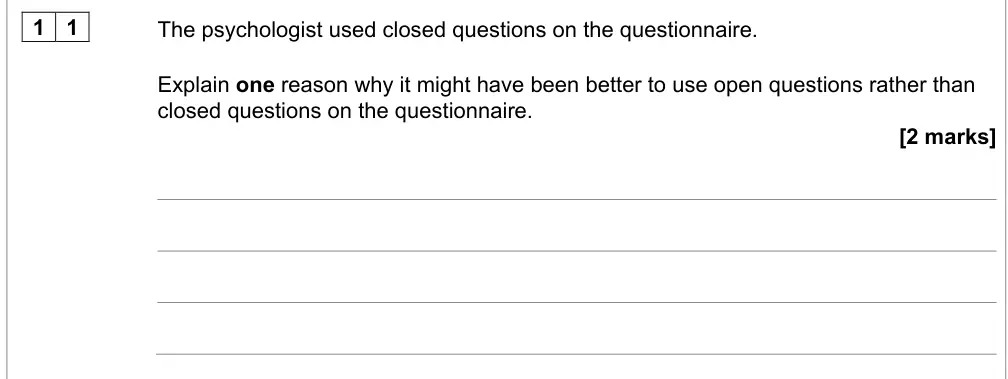
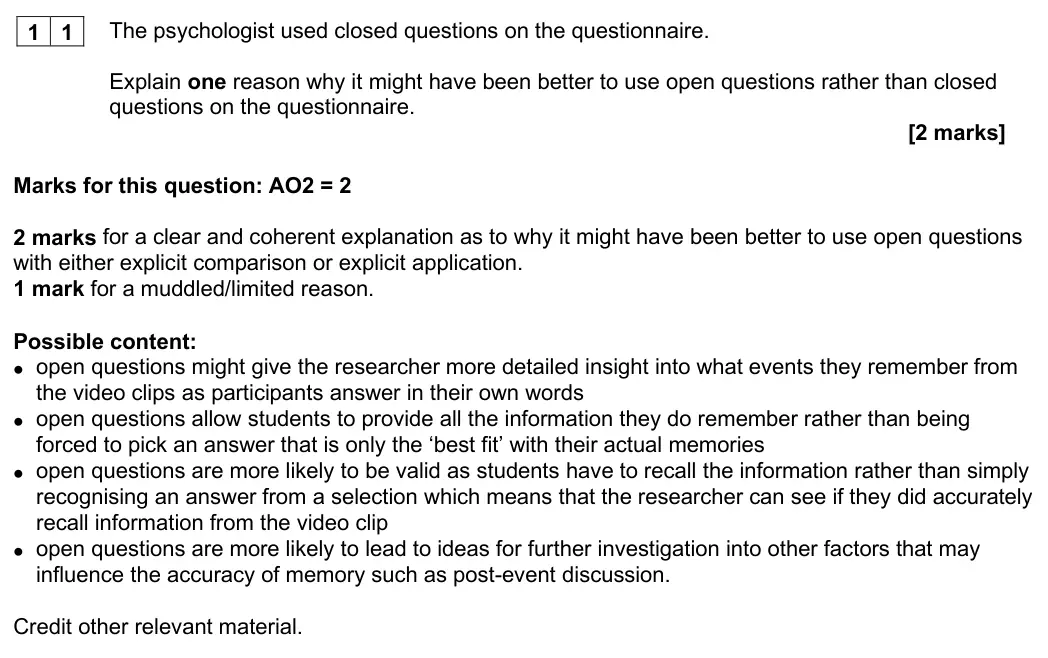
June 2024 · AS Paper 1 · Q112 marksAO2=2Research methodsMedium
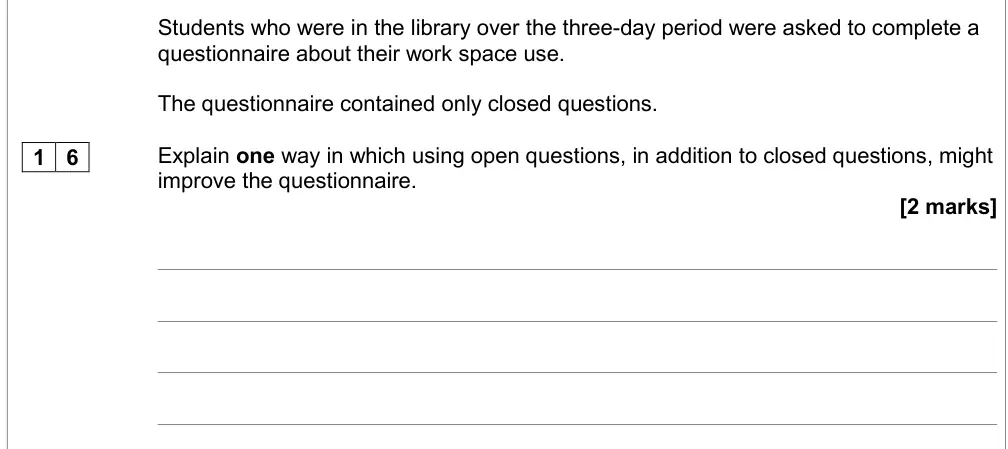
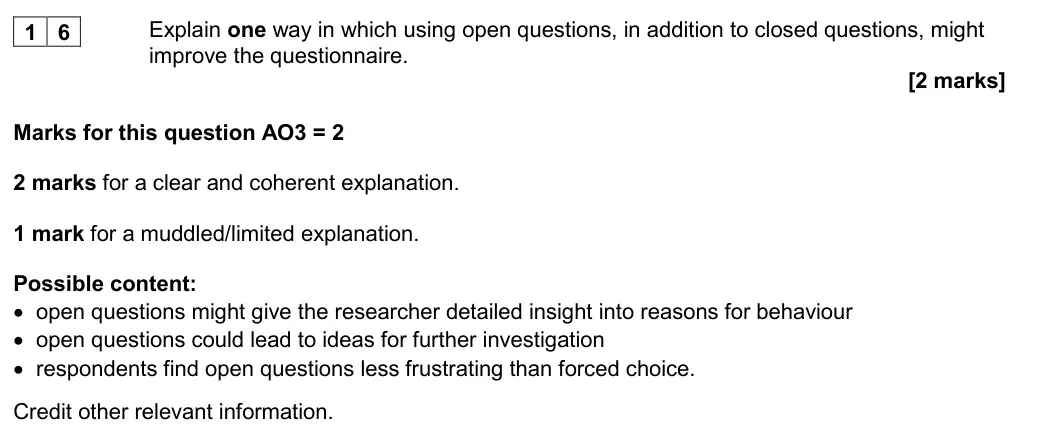
Mark scheme, including level descriptors and indicative content
Examiner's comment
There was generally a good understanding of strengths of open questions, but answers were not always placed in context. Some students focused on the problem of closed questions rather than explaining why using open might have been better, which was not explicitly answering the question. Good answers went beyond saying ‘gives more detail’ and were able to give explicit application to the scenario, for example, gives the researcher more detail into which parts/aspects of the video clips the participants remembered. For this question, 46% of students scored full marks and the mean score was one of the highest on the Memory section, with 66% of the max marks available.
Notes from the mark scheme and report
open questions: richer detail of what was remembered from the films, recall vs recognition
needs explicit comparison or application
criticising closed questions alone did not answer
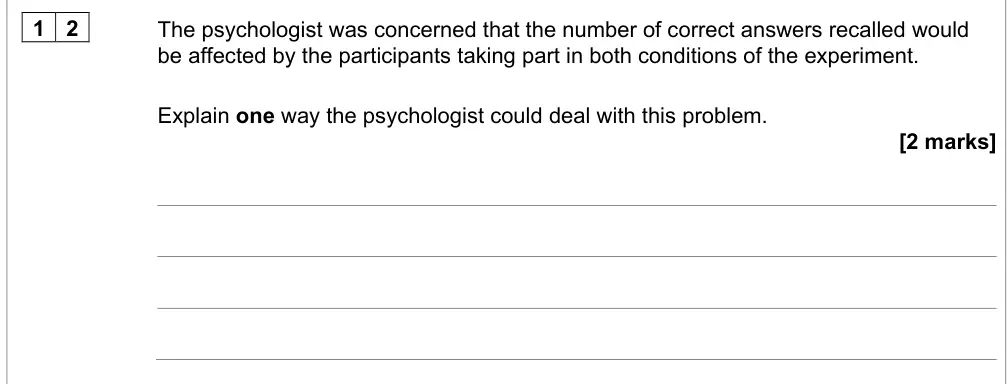
June 2024 · AS Paper 1 · Q122 marksAO3=2Research methodsEasy
Mark scheme, including level descriptors and indicative content
Examiner's comment
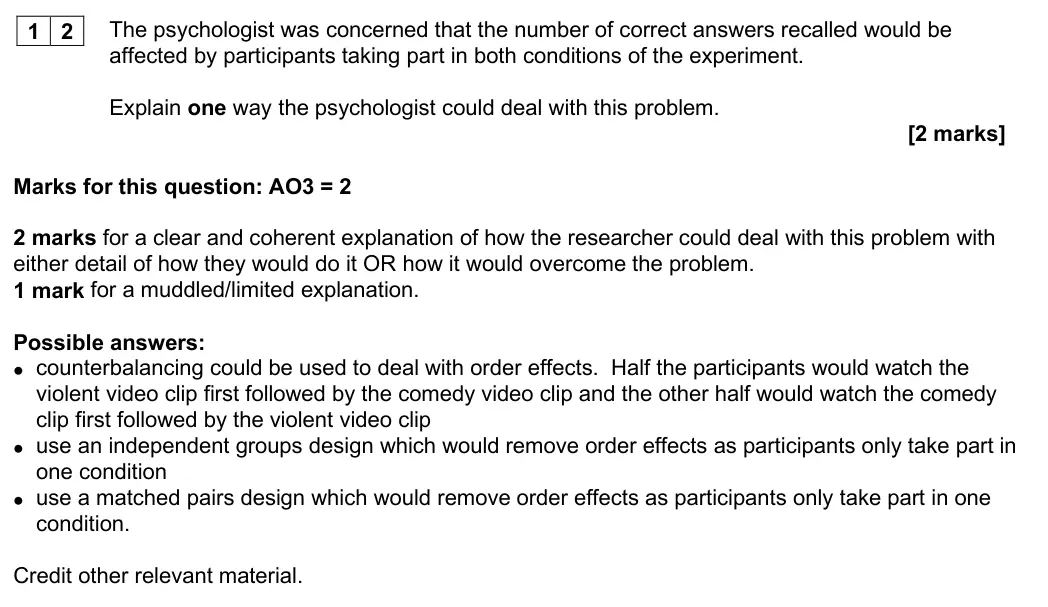
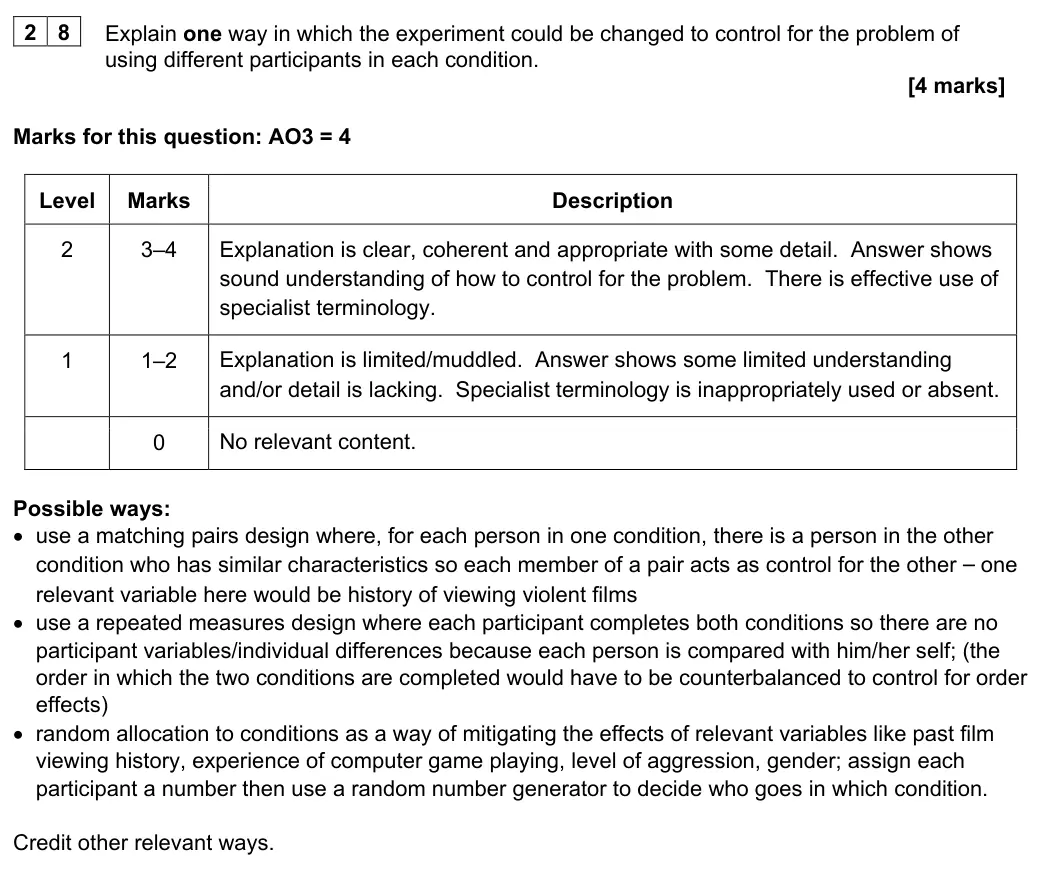
This question was answered particularly well, as 62% of students scored full marks with a mean of 74% of the max marks. Most students could identify an appropriate alternative experimental design or solution to the problem of participants taking part in both conditions of the experiment, such as a time delay between the conditions, but not all could explain how it would be carried out.
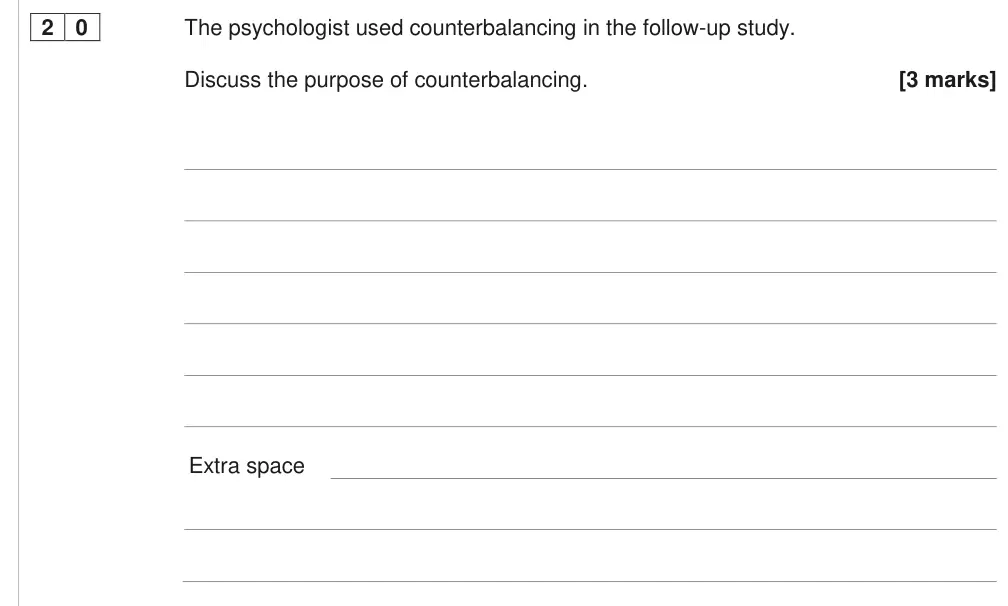
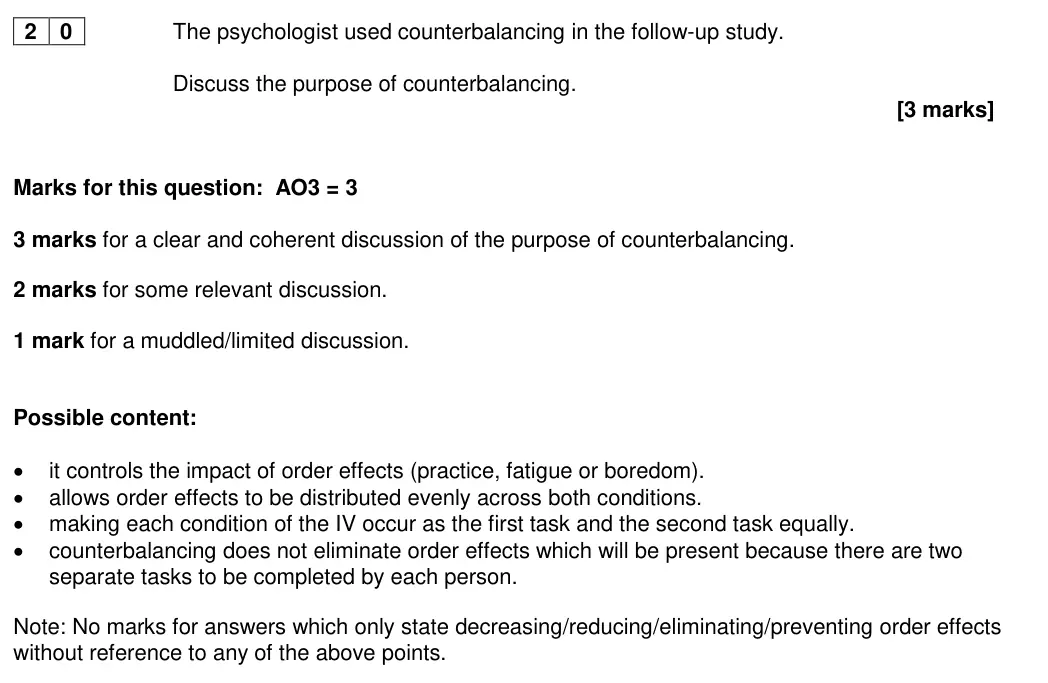
Notes from the mark scheme and report
order effects in repeated measures: counterbalancing (half violent first) or independent groups/matched pairs
must explain how or how it overcomes the problem
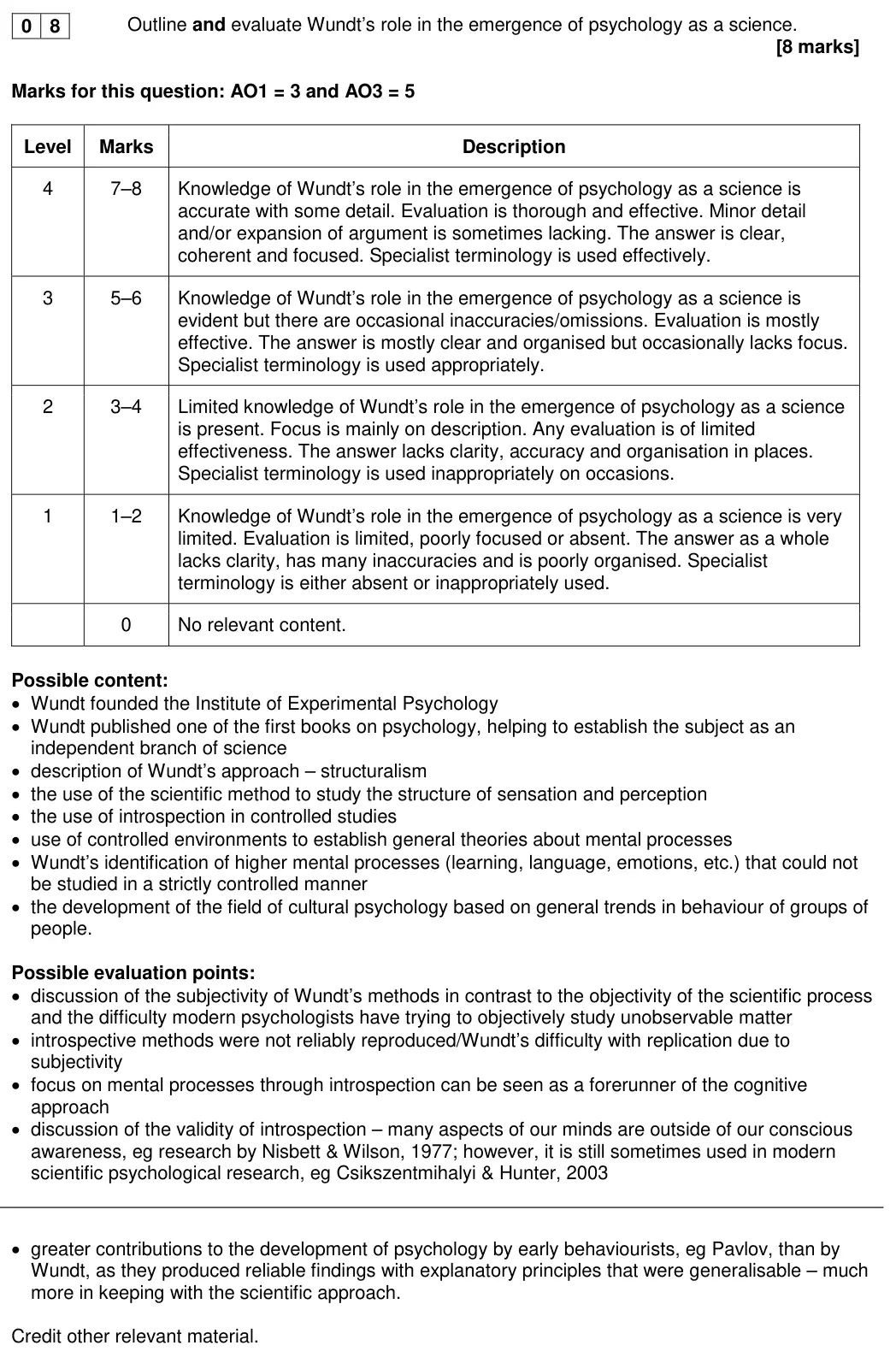
June 2024 · AS Paper 2 · Q14 marksAO1=4OutlineOld spec only
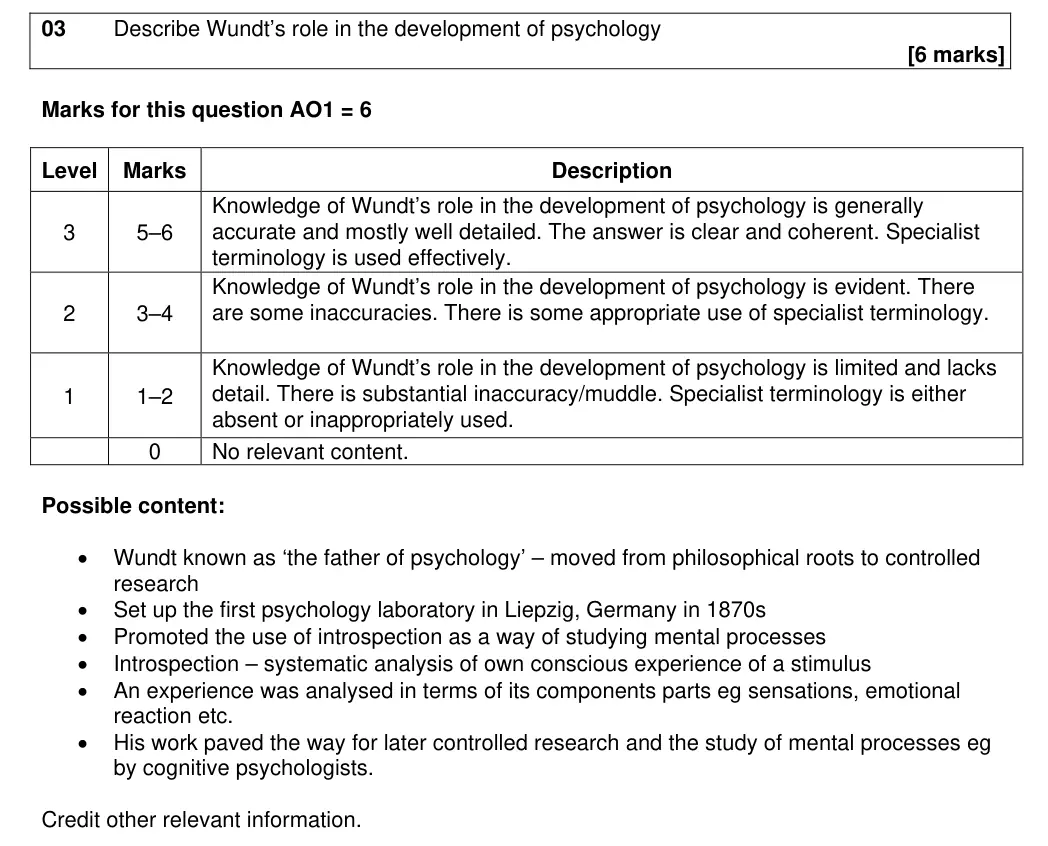
Not on the 2025 specification: origins of Psychology: Wundt and the emergence of Psychology as a science, removed in v1.4
Mark scheme, including level descriptors and indicative content
Examiner's comment
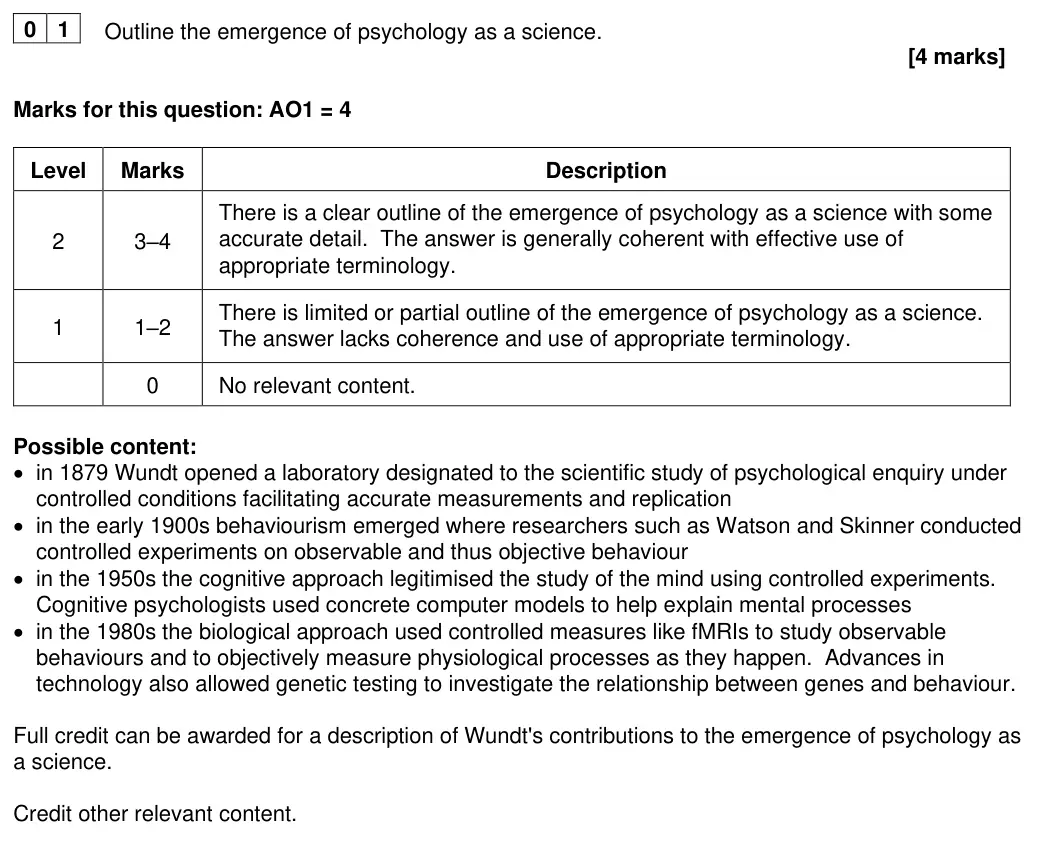
Students performed less well in Q1, outlining the emergence of psychology as a science, and in Q4, outlining one role of schema. Q1 appeared to be a challenging question for many students, most likely due to this being the first time this has been directly asked about in an AS examination. This question had one of the highest proportion of responses not attempted (over 2%) on the paper. Many students focused their answers to this question on the work of Wundt but failed to gain many marks as it was not focused upon his contribution to the emergence of psychology as a science but was merely a description of his research. A few students did produce some excellent responses which used their knowledge of the timeline of approaches in psychology to explain how they contributed to the emergence of psychology as a science. Exemplification of a successful response A clear and accurate outline with a clear focus on how psychology has emerged (and developed) as a scientific discipline. Exemplification of a less successful response A typical example of a level 1 response which has outlined the work of Wundt but has not effectively linked this to the emergence of psychology as a science.
Notes from the mark scheme and report
Off-spec: origins of Psychology: Wundt and the emergence of Psychology as a science, removed in v1.4
full credit possible for Wundt's contribution alone
MS also credits timeline of behaviourist, cognitive and biological approaches using controlled methods
many just described Wundt's research without linking to psychology becoming a science
June 2024 · Paper 2 · Q92 marksAO2=2Research methods
Mark scheme, including level descriptors and indicative content
Examiner's comment
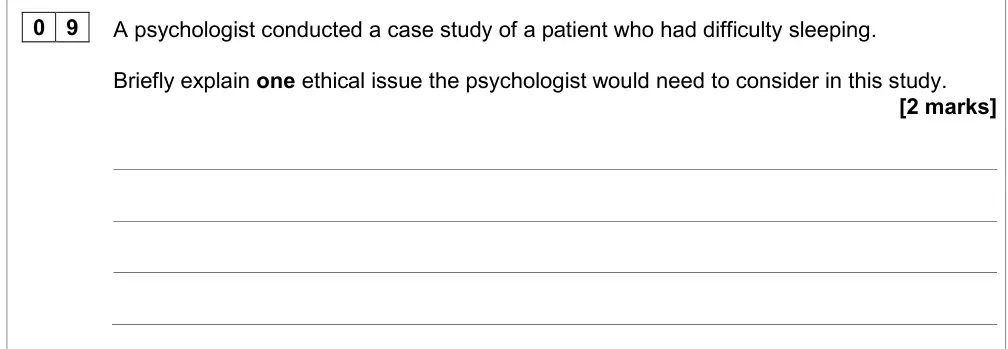
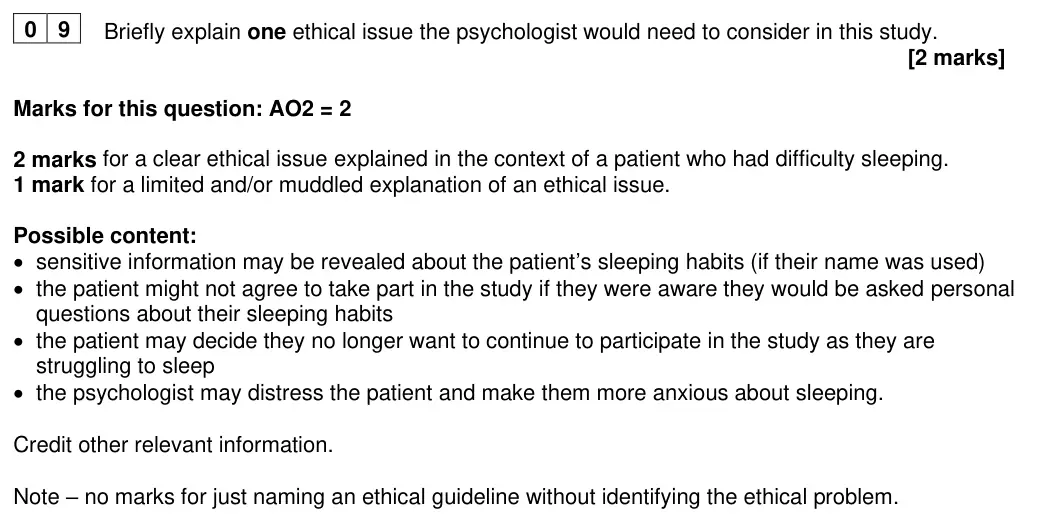
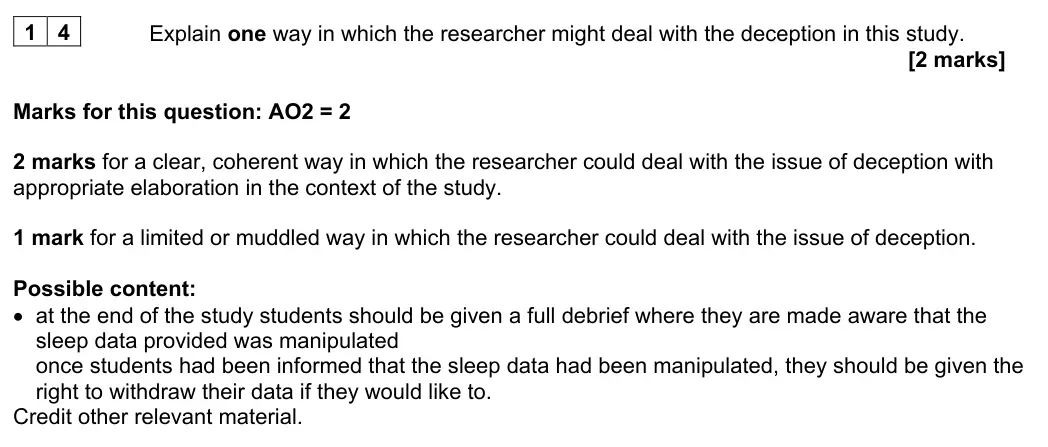
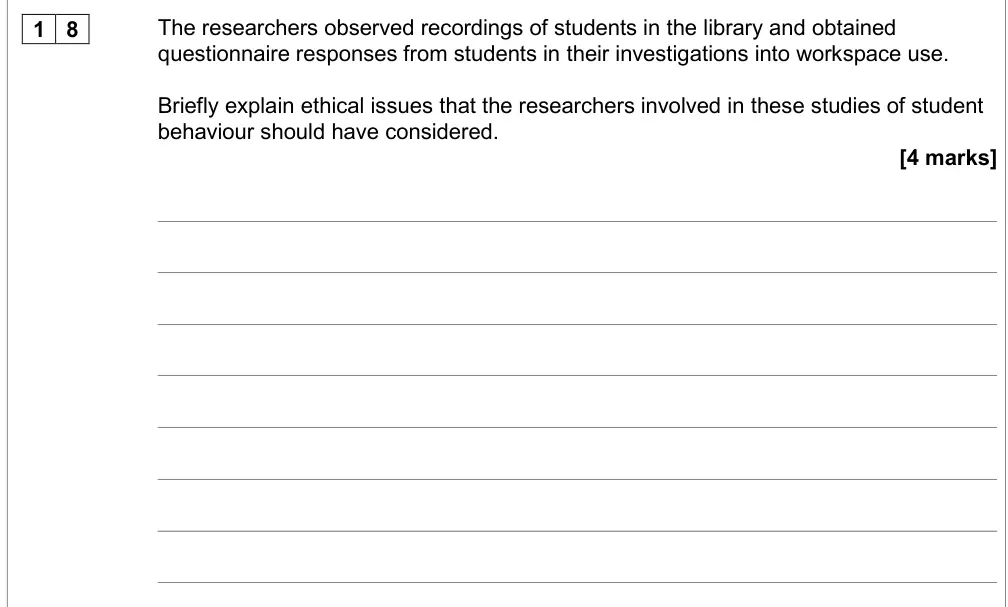
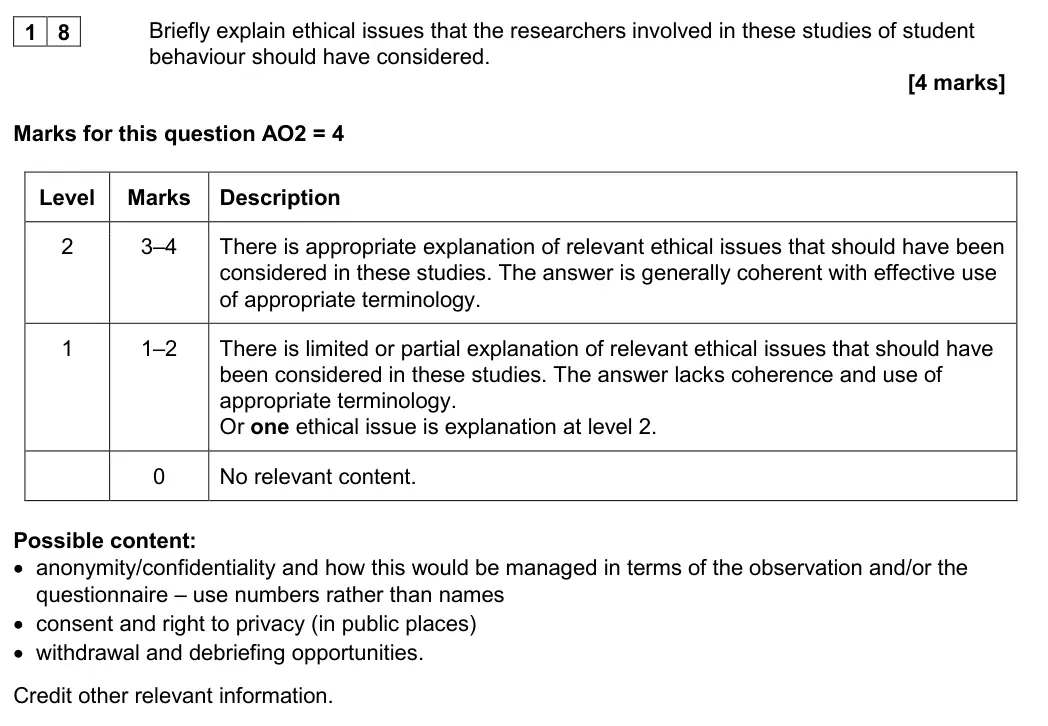
This question produced mixed responses. Students appear to have good knowledge of ethical guidelines and how to deal with these but did not engage well with the question set, limiting marks achieved. Many students just named an ethical guideline and how to deal with this and therefore did not gain any marks. Some limited ethical issues were given, such as participants being harmed or having personal details published, but these were not explained explicitly in context. Better responses were provided when students really engaged with the context of the study and there was a range of excellent, well considered ethical issues presented which were explained in the context of a patient who had difficulty sleeping. Students should be aware that ethical issues require the student to explain the problem linked to ethics.
Notes from the mark scheme and report
an ethical problem explained in context of the sleep patient (sensitive information about sleep, distress/anxiety about sleeping, withdrawing)
naming a guideline or how to deal with it scored 0
June 2024 · AS Paper 2 · Q123 marksAO2=3Research methodsMedium
Mark scheme, including level descriptors and indicative content
Examiner's comment
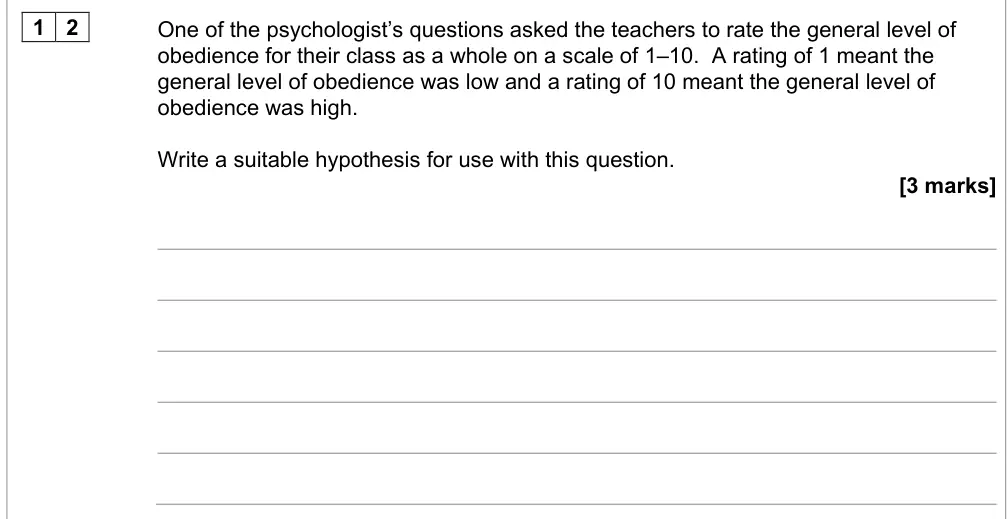
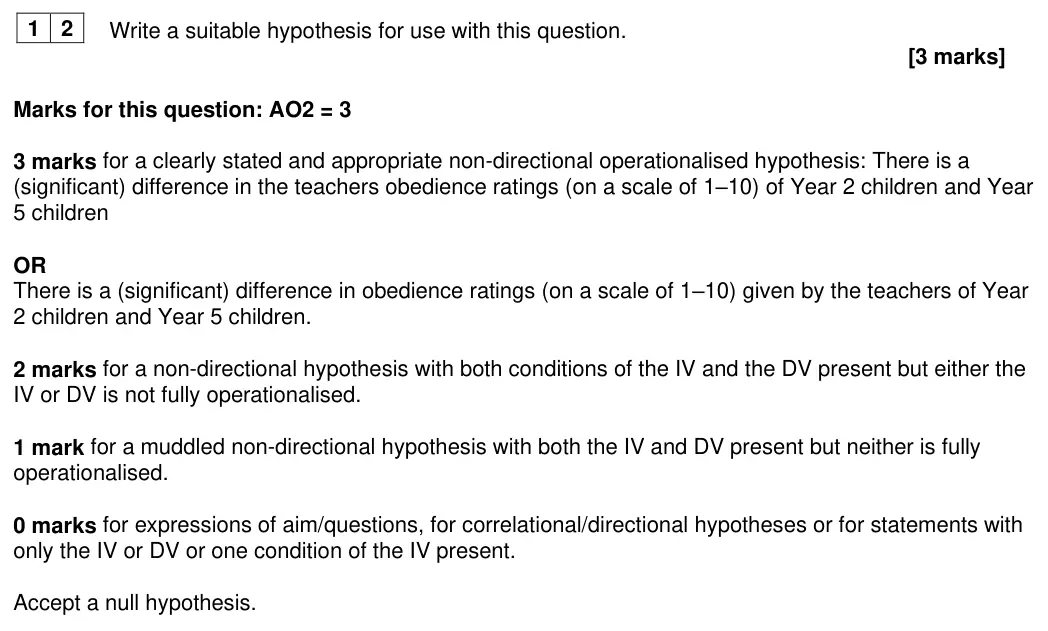
One notable area of for development was students’ ability to formulate hypotheses in Q12 and this seems to be a common area of difficulty which has occurred historically across previous series. There was significant confusion and inaccuracy in the responses to this question. Disappointingly, around two-thirds of students were not awarded any marks for this question. Many students wrote an incorrect type of hypothesis, with the most common incorrect response being a directional hypothesis, despite it clearly saying in the stimulus material that ‘Previous research showed inconsistent findings.” Of those students who did write a non-directional hypothesis, many failed to fully operationalise the IV and/or the DV by failing to include ‘teachers’ either in the IV (teachers’ ratings of obedience) or in the DV (teachers of year 2 and year 5 children). It is important that students can write accurate hypotheses, and this appears to be an area where many students need much more practice and support. Exemplification of a successful response An excellent response which has identified the need for a non-directional hypothesis, and which has fully operationalised both the IV (‘ratings…by the teacher’) and the DV (‘teachers of year 2… teachers of year 5’). Exemplification of a less successful response A typical 2-mark response. The student has identified the need for a non-directional hypothesis but has failed to fully operationalise either the IV or the DV (or both) which need to contain ‘teachers.’ For example, the teachers of year 2 and year 5 for the IV or the teachers’ ratings of obedience for the DV. A typical example of a response which cannot be awarded any marks as the wrong type of hypothesis (directional) has been written.
Notes from the mark scheme and report
must be non-directional (previous research inconsistent): difference in teachers' obedience ratings (1-10) of Year 2 vs Year 5 children
directional/correlational = 0
null accepted
about two-thirds scored 0
often failed to include 'teachers'
June 2024 · AS Paper 2 · Q131 markAO2=1Research methods
Mark scheme, including level descriptors and indicative content
Examiner's comment
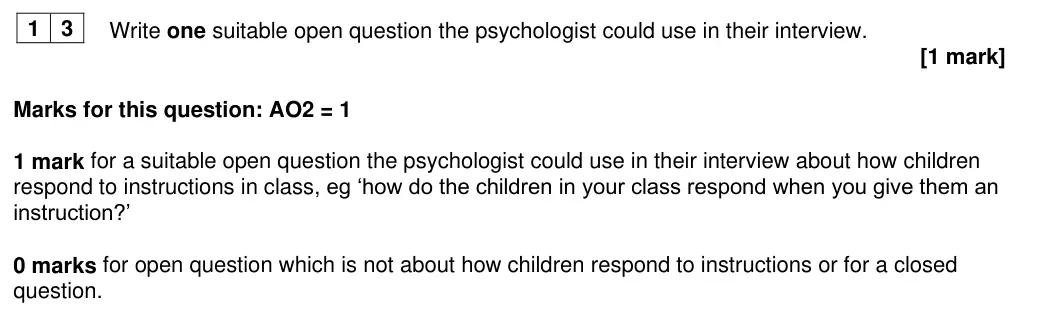
Students performed relatively well in Q11 (identifying and justifying a type of interview), Q13 (writing an open question) and Q16 (how to conduct random sampling).
Notes from the mark scheme and report
open question must be about how children respond to instructions
closed question = 0
June 2024 · Paper 2 · Q134 marksAO2=4Research methods
Mark scheme, including level descriptors and indicative content
Examiner's comment
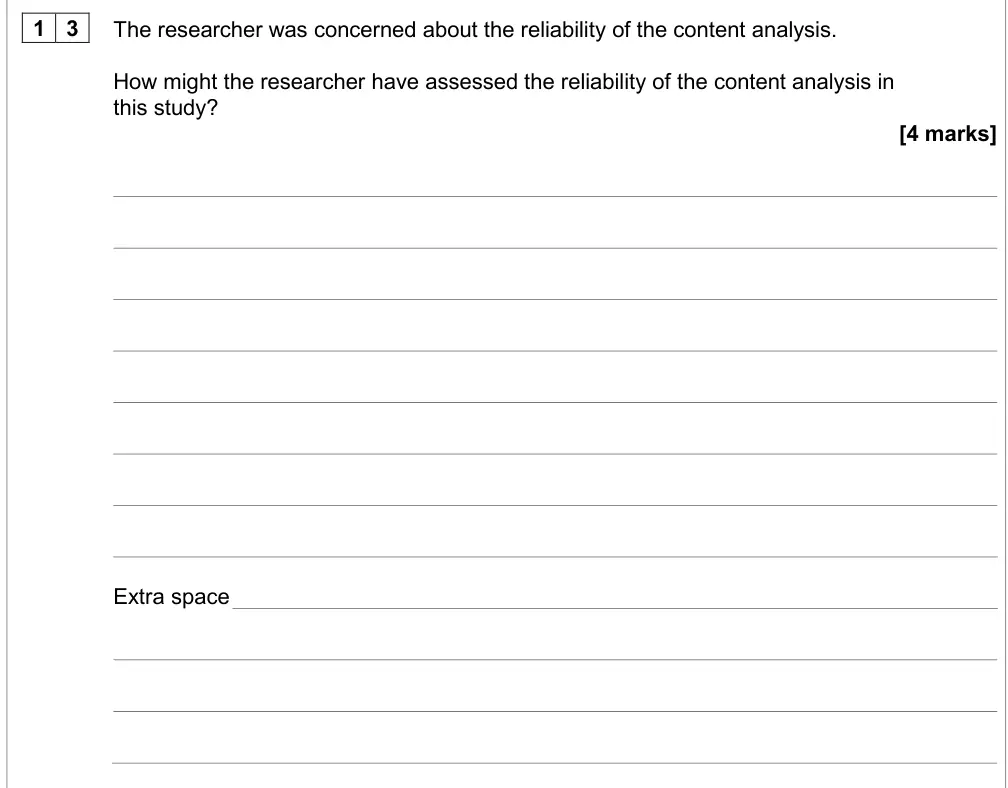
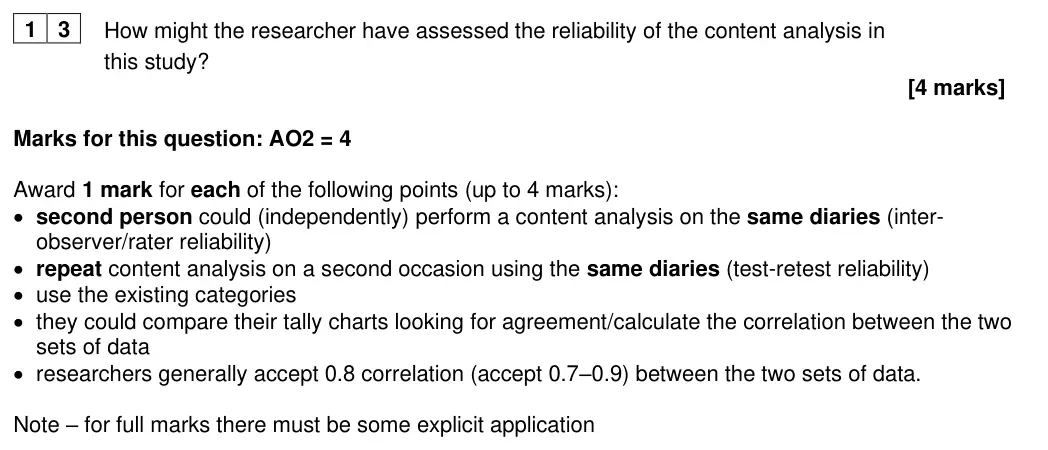
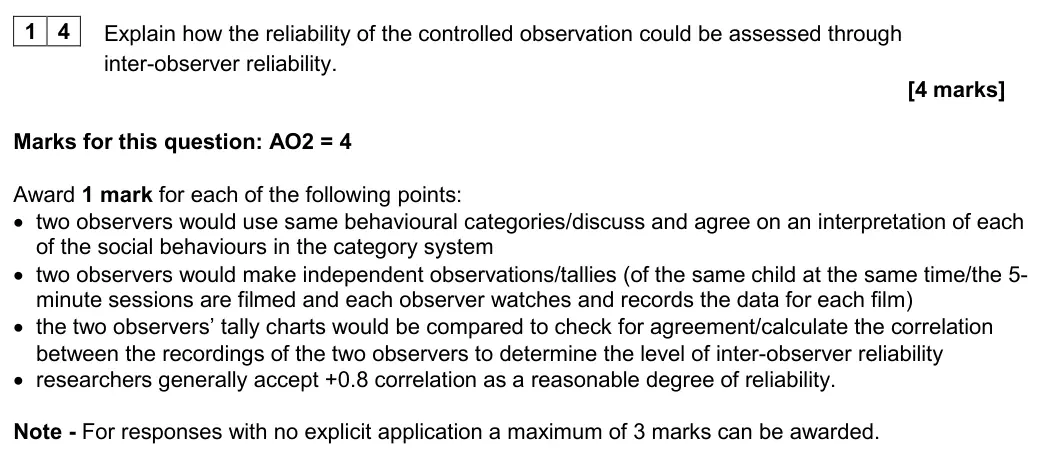
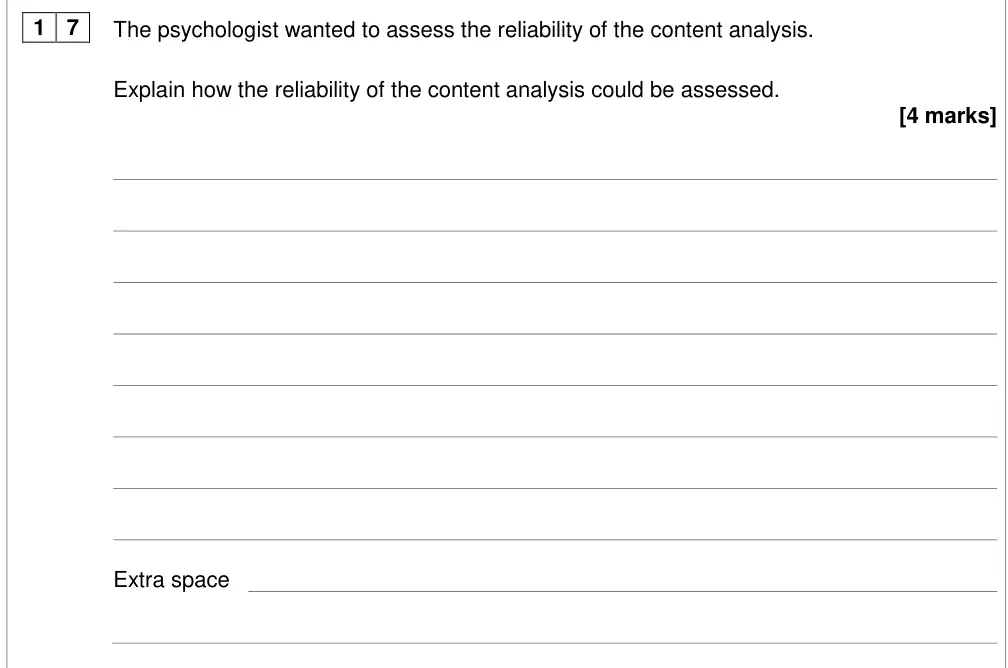
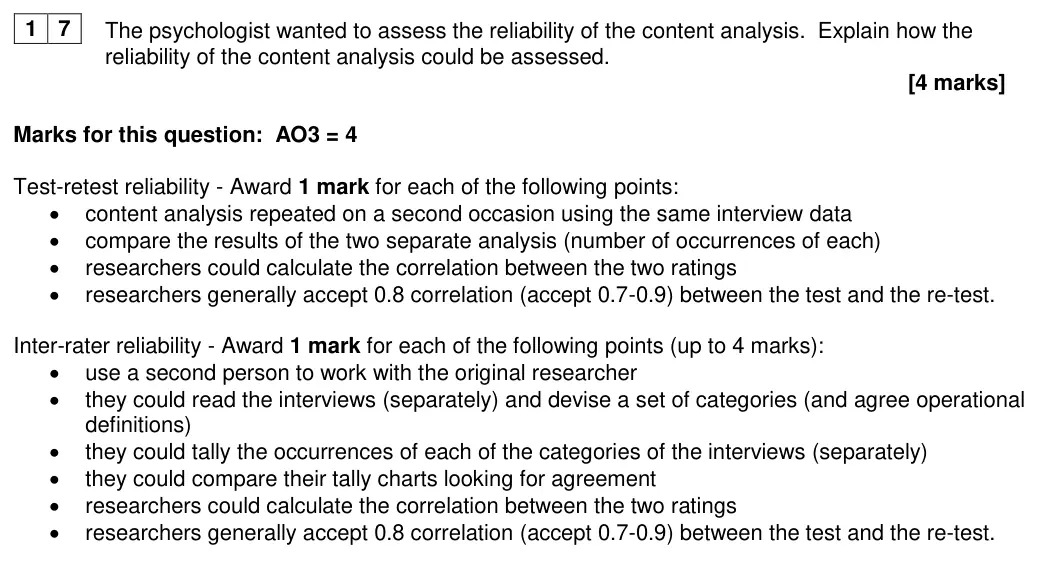
This question was another good discriminator. Students generally had good knowledge of inter-observer reliability and test-retest reliability and applied it appropriately. Where students lost marks, it was for not acknowledging that the other observer would use the same diary/data or for not explaining that the existing categories would be used. Other common errors were; not focusing on the ‘how’ requirement of the question, suggesting that the whole study should be repeated, suggesting ways to improve rather than assess reliability and a surprisingly high number of responses suggesting peer review.
Notes from the mark scheme and report
second person independently analyses SAME diaries with EXISTING categories (or test-retest), compare tallies/correlate, 0.8 accepted
explicit application needed for full marks
repeating the whole study, improving rather than assessing, peer review
June 2024 · AS Paper 2 · Q142 marksAO2=2Research methodsHard
Mark scheme, including level descriptors and indicative content
Examiner's comment
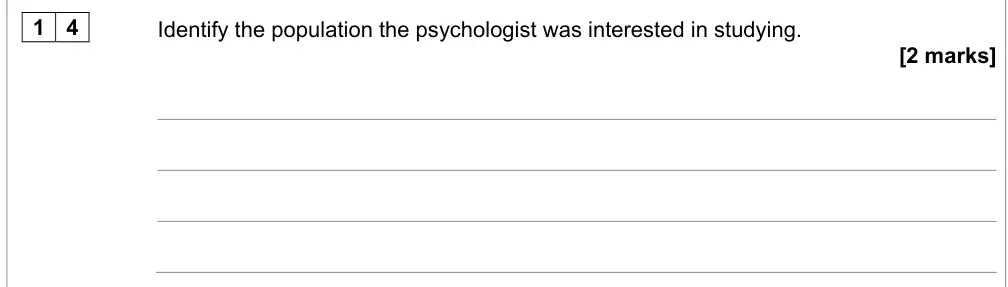
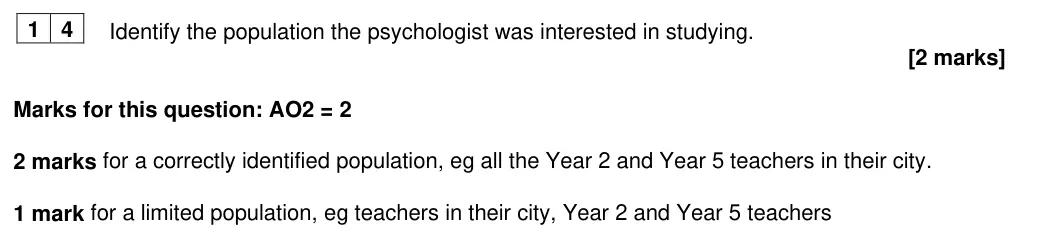
Students also appeared to struggle with Q14 and Q15 which asked them to identify the population and sample used in the study respectively. Students performed significantly less well on this question and most seemed unable to correctly identify the population. Indeed, less than 20% of the cohort of students were able to access any marks on this question. Students appeared to have very little, if any, understanding of what a population was so were unable to apply this in their answer. There was significant confusion between teachers and children, with many students incorrectly identifying year 2 and year 5 children as the population rather than the teachers of these children. Of those students who could identify the teachers as the population, few could go on to fully identify the population coming from the primary schools in the city. It appears that this needs to be an area of focus for students moving forward. Exemplification of a successful response A clear and correctly identified population which includes both key elements of teachers of year 2 and year 5 and being from the primary schools in the city. Exemplification of a less successful response An incomplete and therefore 1-mark response which, although correctly identifying the teachers (of Year 2 and Year 5), has failed to include that they come from the primary schools in the city. A typical example of a response which cannot be awarded any marks as the population has been mis-identified as the children not the teachers.
Notes from the mark scheme and report
all Year 2 and Year 5 teachers in (primary schools in) the city = 2
partial = 1
under 20% scored
many named the children instead of teachers
June 2024 · AS Paper 2 · Q151 markAO2=1Research methods
Mark scheme, including level descriptors and indicative content
Examiner's comment
Students also appeared to struggle with Q14 and Q15 which asked them to identify the population and sample used in the study respectively. Responses to this question were very weak. This question relied on the students being able to answer Q14 thus required an understanding of what a population was and then being able to correctly apply this to the study. Unfortunately, around 90% of students were unable to identify the sample. There was significant confusion between the sample (which the question asked for) and the sampling method (which they were told in Q15). It appeared that many students did not understand what was meant by the sample and, once they had looked at Q15, went back and wrote ‘random sampling’ as they were told this in Q15. As with Q14, there was significant confusion between teachers and children with many students incorrectly identifying year 2 and year 5 children as the sample rather than the teachers of these children. Of those students who could identify the teachers as the sample, few could go on to fully identify the sample being the teachers of year 2 and year 5 from the four schools who agreed to take part. As with population, it appears that samples (rather than the sampling method) need to be an area of focus for students moving forward. Exemplification of a successful response A clear and correctly identified sample which includes the key elements of teachers of year 2 and year 5 and being from the four primary schools (who agreed to take part). Exemplification of a less successful response Typical examples of a responses which cannot be awarded any marks as either the sampling method rather than the sample has been identified (as in the first response) or an incomplete sample has been identified (as in the second response).
Notes from the mark scheme and report
Year 2 and Year 5 teachers in the four schools
about 90% wrong
confusion of sample with sampling method
children instead of teachers
June 2024 · Paper 2 · Q152 marksAO2=2Research methods
Mark scheme, including level descriptors and indicative content
Examiner's comment
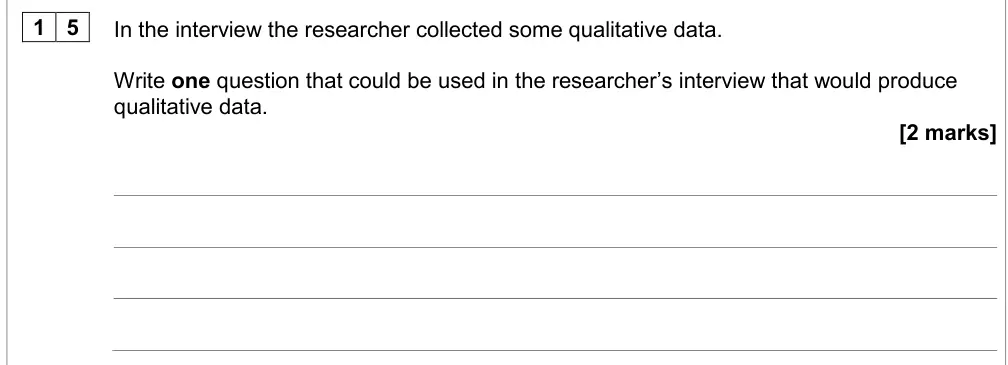
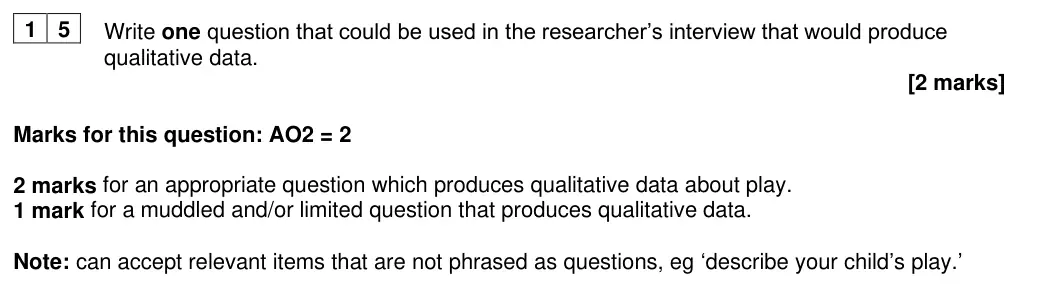
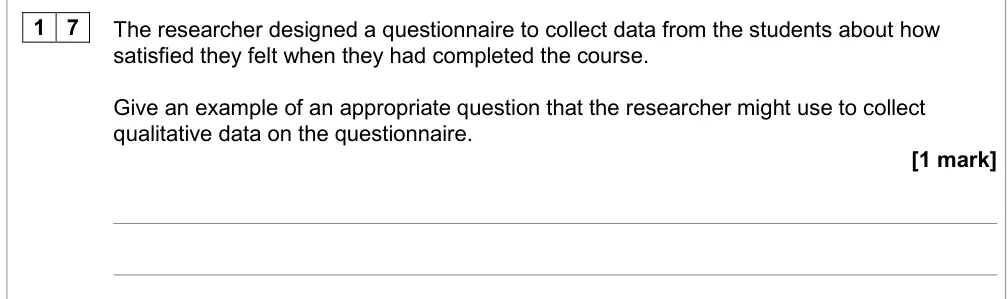
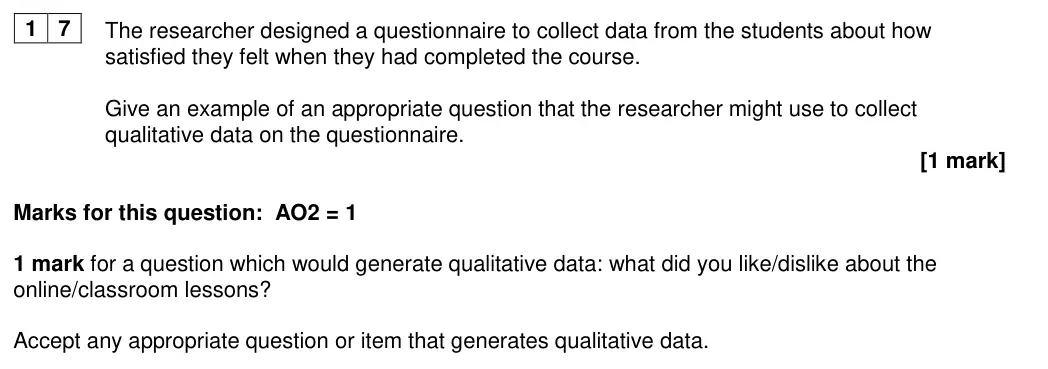
This was a very well answered question. Most students achieved full marks, showing a thorough understanding of qualitative data. Closed questions which yielded responses in words were awarded credit. It was rare to see questions which yielded quantitative data and most responses were focused on play.
Notes from the mark scheme and report
open question about the child's play producing qualitative data (instructions like 'describe your child's play' accepted)
very well answered
June 2024 · AS Paper 2 · Q162 marksAO2=2Research methods
Mark scheme, including level descriptors and indicative content
Examiner's comment
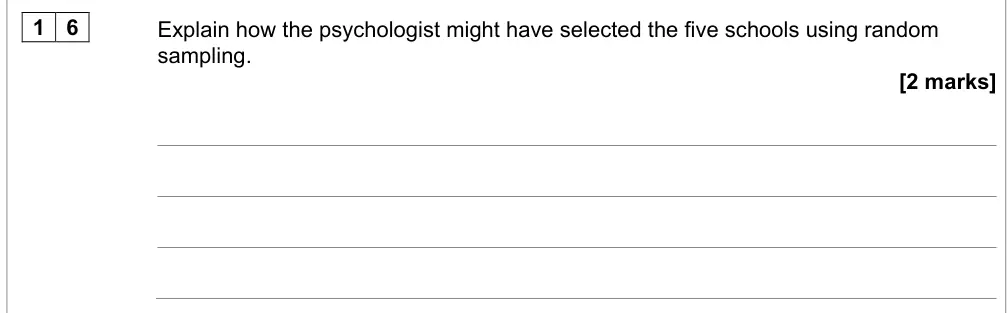
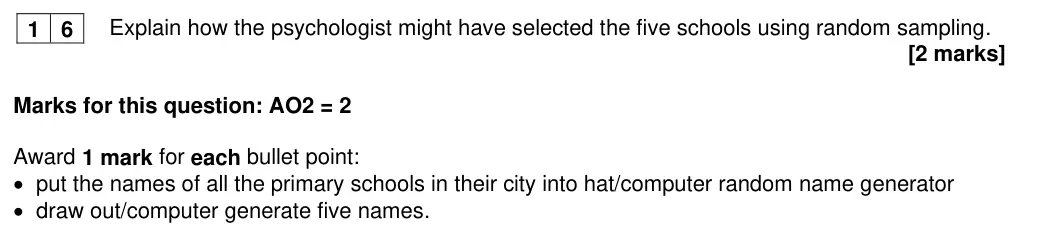
Students performed relatively well in Q11 (identifying and justifying a type of interview), Q13 (writing an open question) and Q16 (how to conduct random sampling).
Notes from the mark scheme and report
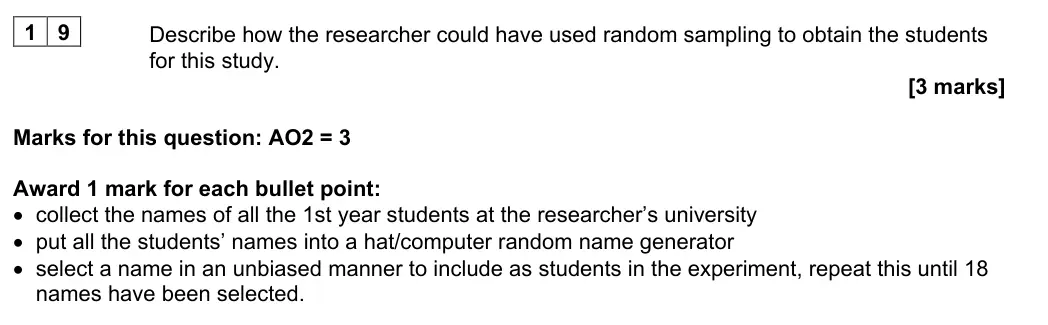
all primary schools in the city into hat/random generator + draw five
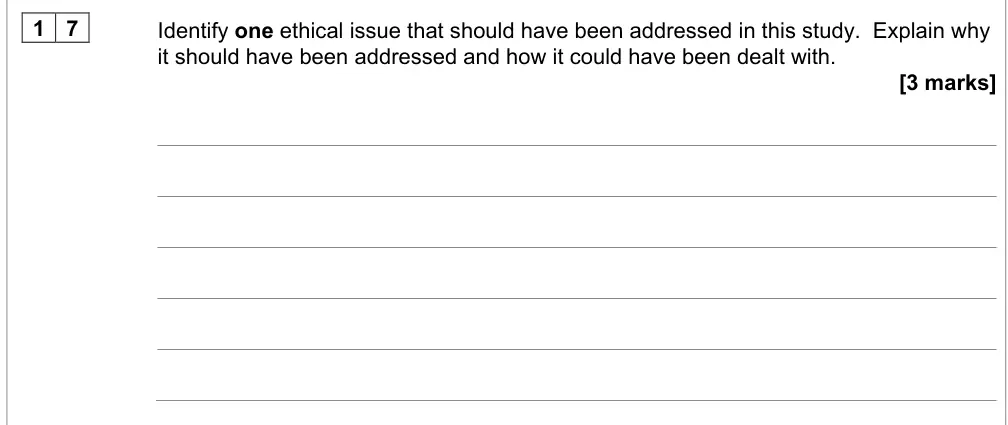
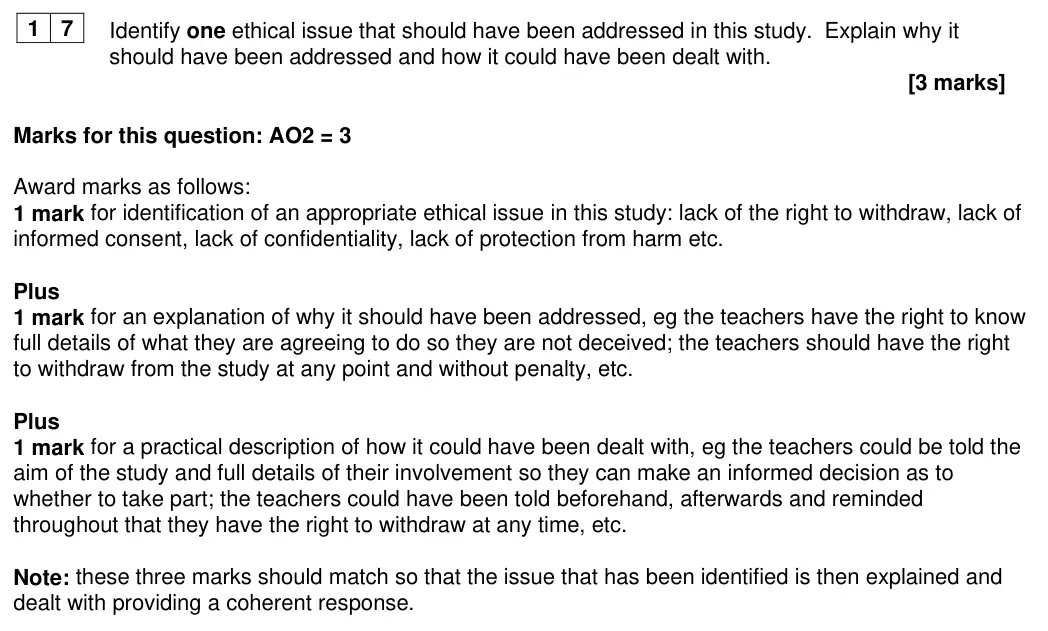
June 2024 · AS Paper 2 · Q173 marksAO2=3Research methods
Mark scheme, including level descriptors and indicative content
Examiner's comment
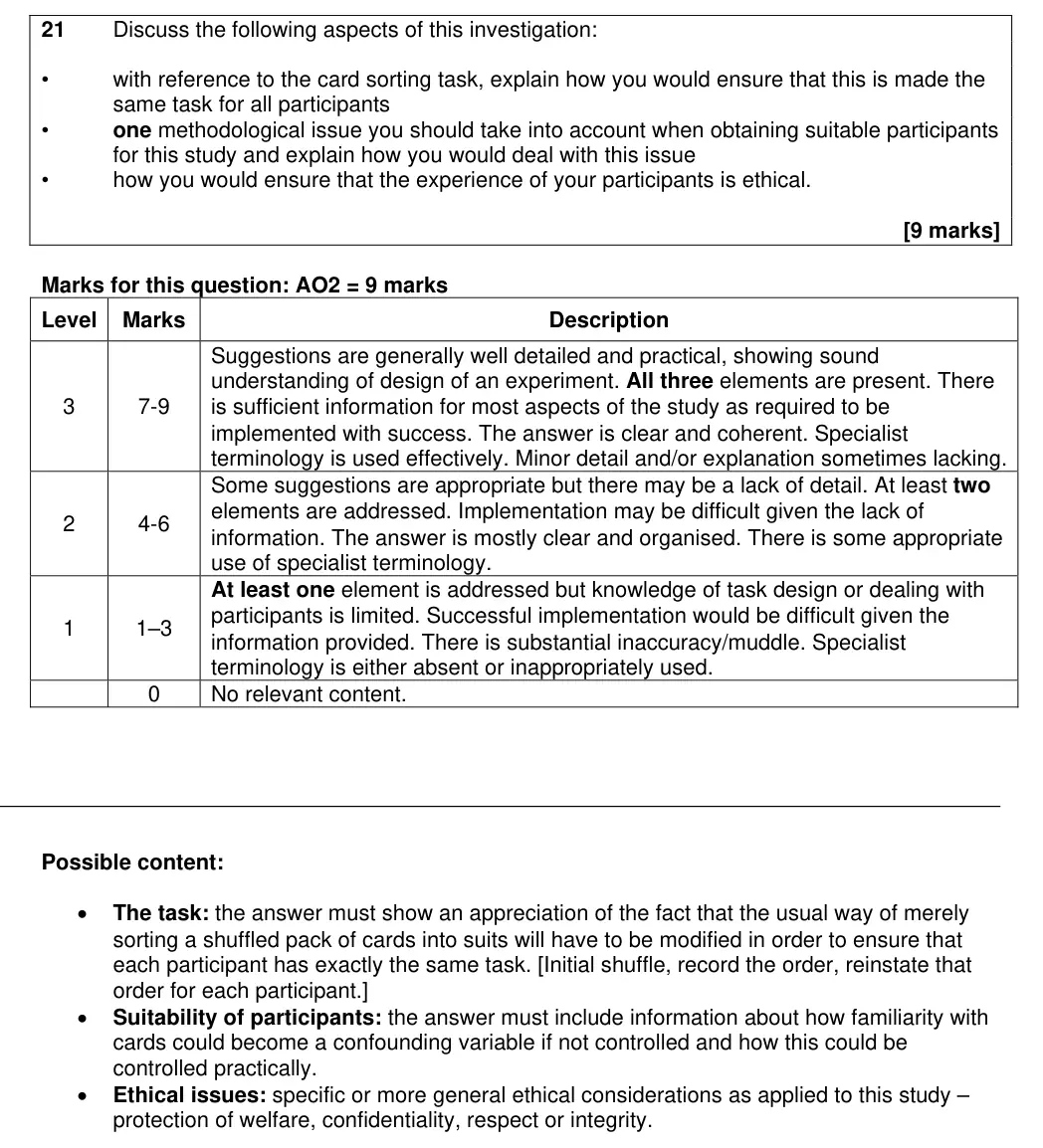
Performance on Q17, where students had to identify an ethical issue, explain why it was important to address this issue and how the issue could have been dealt with, was also varied. Disappointingly, students performed less well on this question despite the format of the question being very similar to those seen in previous AS examinations. Similar to previous questions, there was much confusion between who was involved in the study. The ethical issue identified, the explanation of why it should be addressed and the method for dealing with it need to be about the parties involved in the study which is predominantly the teachers and possibly the schools. Many students talked about informed consent from the children or their parents which was not relevant as they were not part of the study. Exemplification of a successful response An excellent 3-mark response. This student has clearly identified a relevant ethical issue (‘Confidentiality’), has explained why it should have been addressed (‘…answer honestly…having disobedient classes.’ and has explained how it could have been dealt with (‘…using numbers instead of names…’) Exemplification of a less successful response A typical example of a response which cannot be awarded any marks as the children were not involved in the study, so their privacy, confidentiality and informed consent are not relevant.
Notes from the mark scheme and report
identify + why + how, all three must match
issue must concern the teachers (participants), not the children/parents
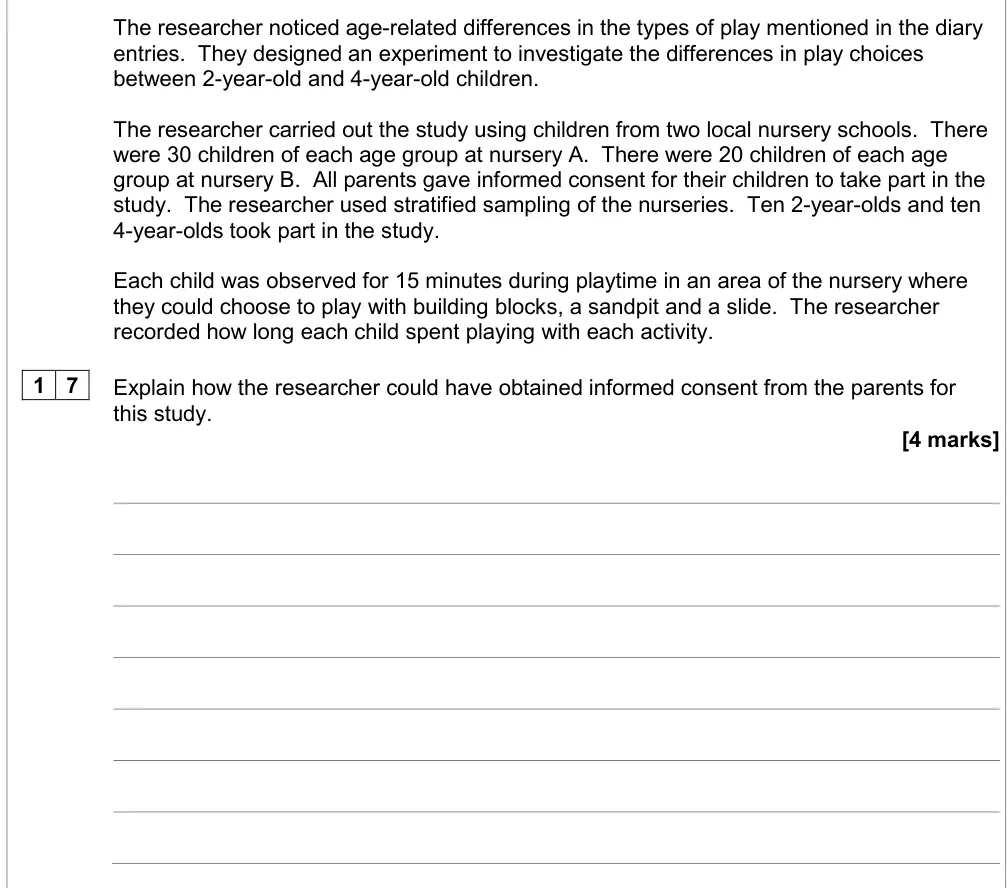
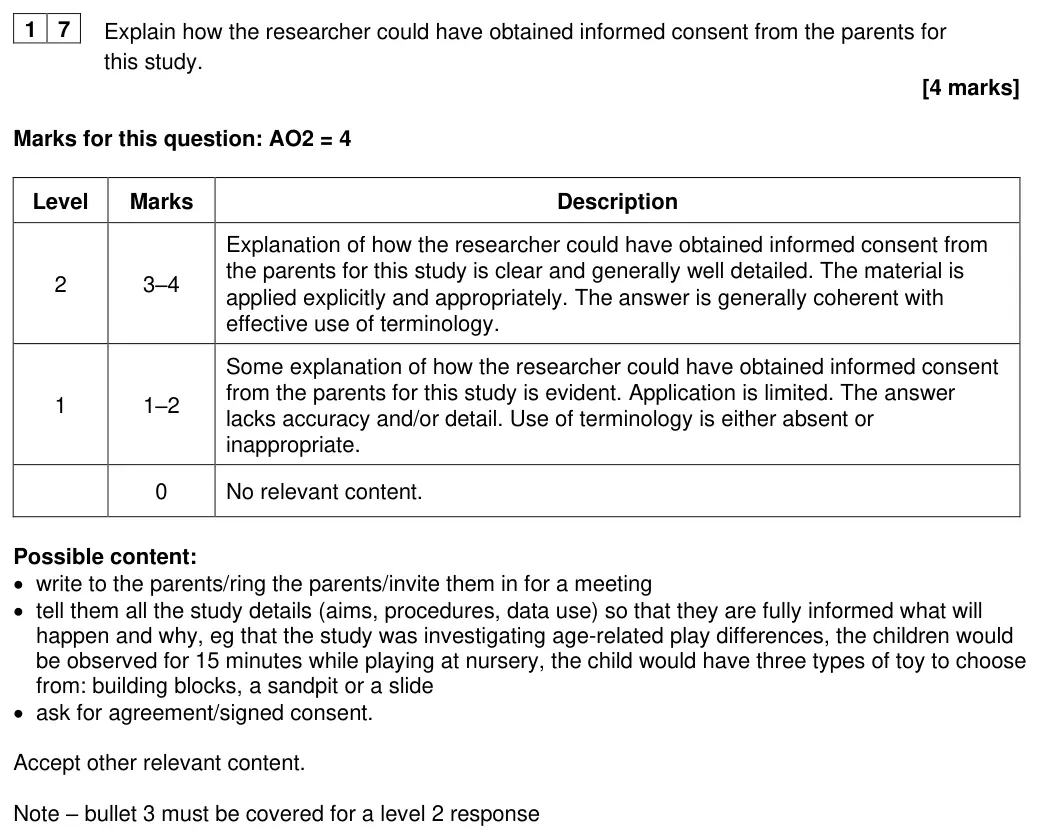
June 2024 · Paper 2 · Q174 marksAO2=4Research methods
Mark scheme, including level descriptors and indicative content
Examiner's comment
This question produced mixed results with most students achieving 2 marks, mainly due to limited application to the context of this study. Most students knew how to obtain consent and the general nature of consent forms however, they did not elaborate enough on the details that parents would need to know. Another common error was for students to forget to include the requirement for parental agreement/signed consent, which was necessary to gain a mark in level 2, and/or to confuse ‘brief’ and ‘debrief’. Students should be reminded that a 4 marks question which asks them to ‘explain how,’ will require good detail of the process, as many responses were brief and lacked the necessary breadth/depth. Students should recognise that if the question says, ‘for this study,’ it is a reminder that their response must be explicitly applied to the context given.
Notes from the mark scheme and report
contact parents, give full details (aims, 15-min observation at nursery, three activities, data use), obtain signed agreement
signed agreement required for level 2
brief vs debrief confusion
limited application
June 2024 · AS Paper 2 · Q196 marksAO3=6Research methodsMedium
Mark scheme, including level descriptors and indicative content
Examiner's comment
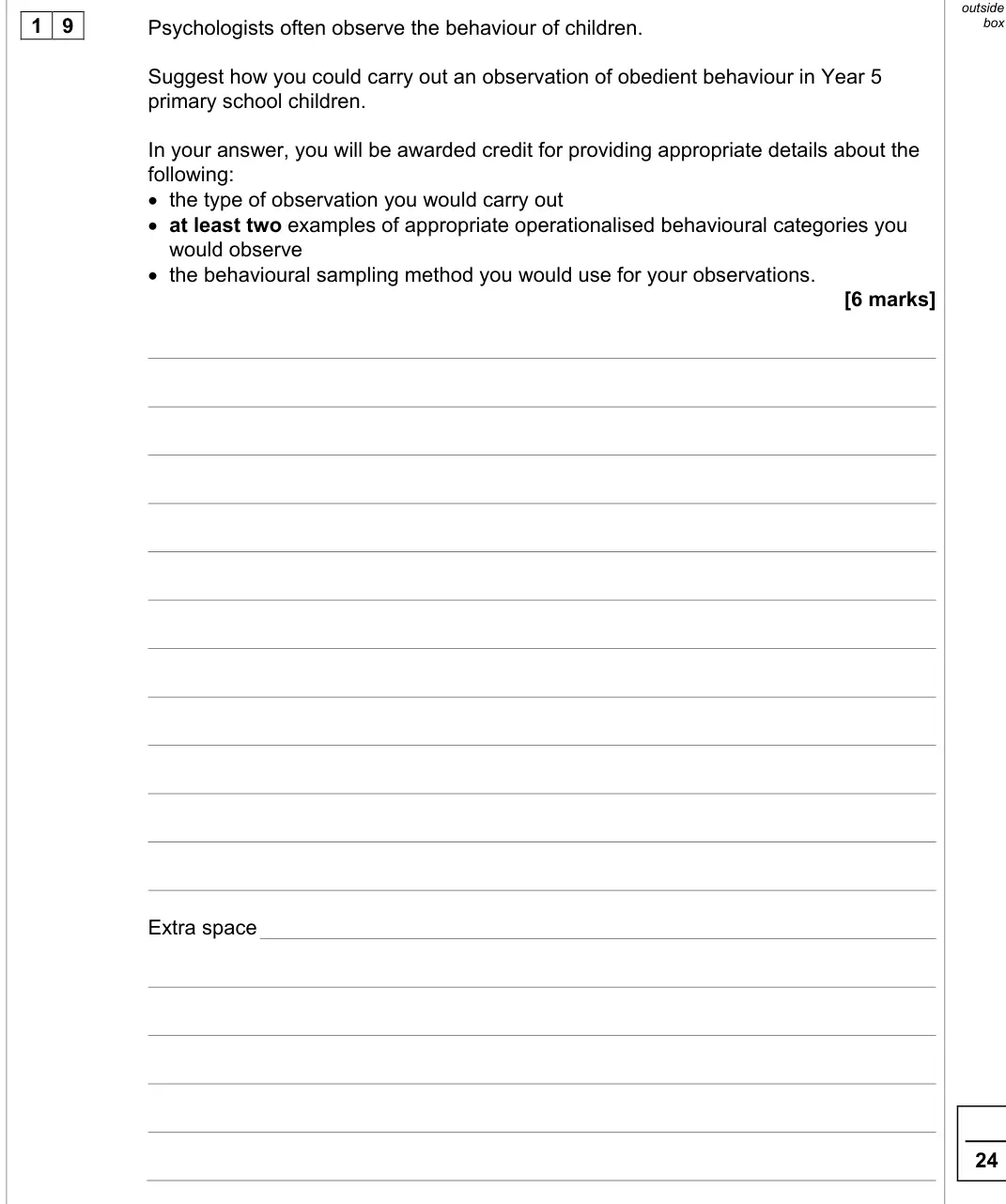
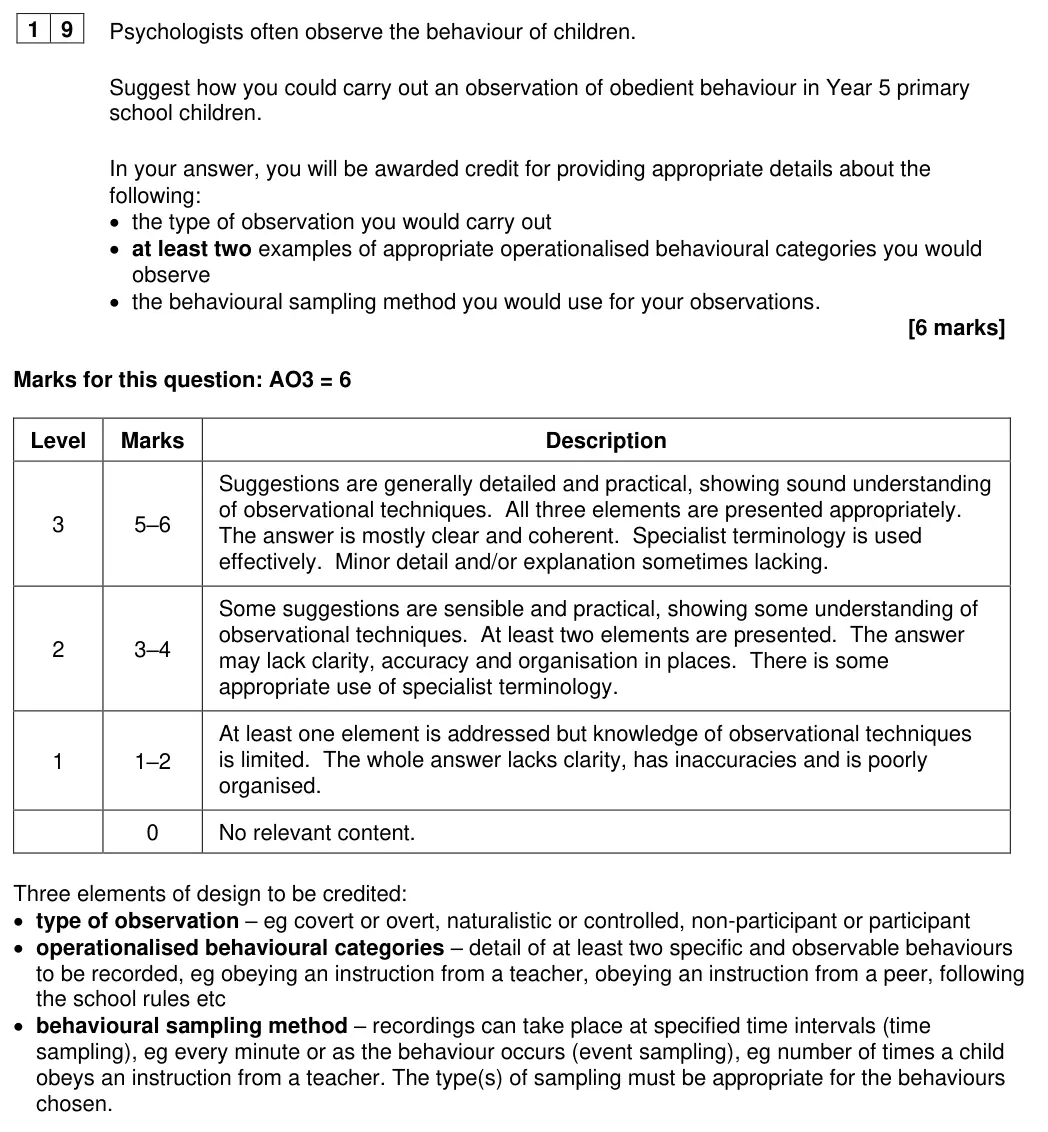
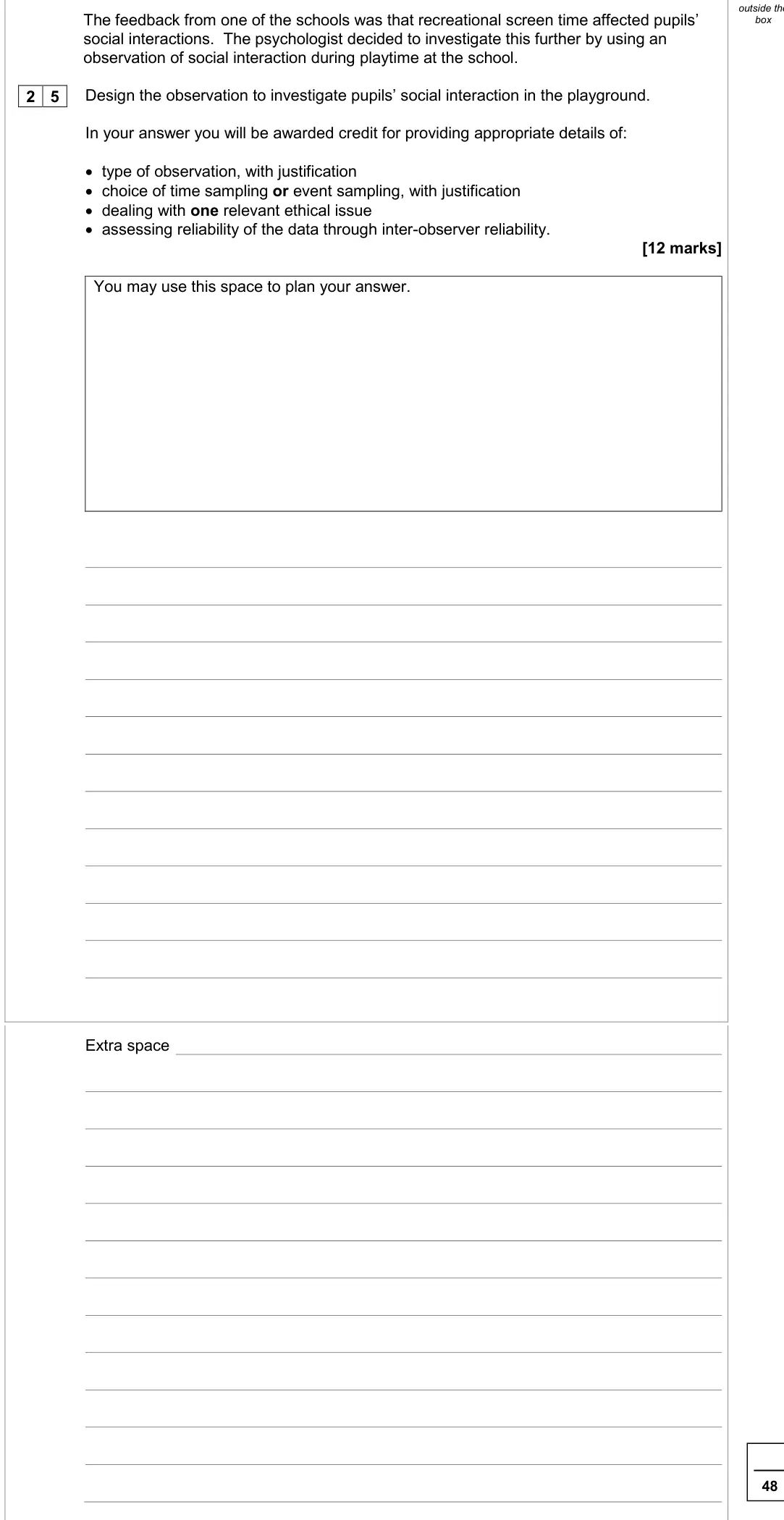
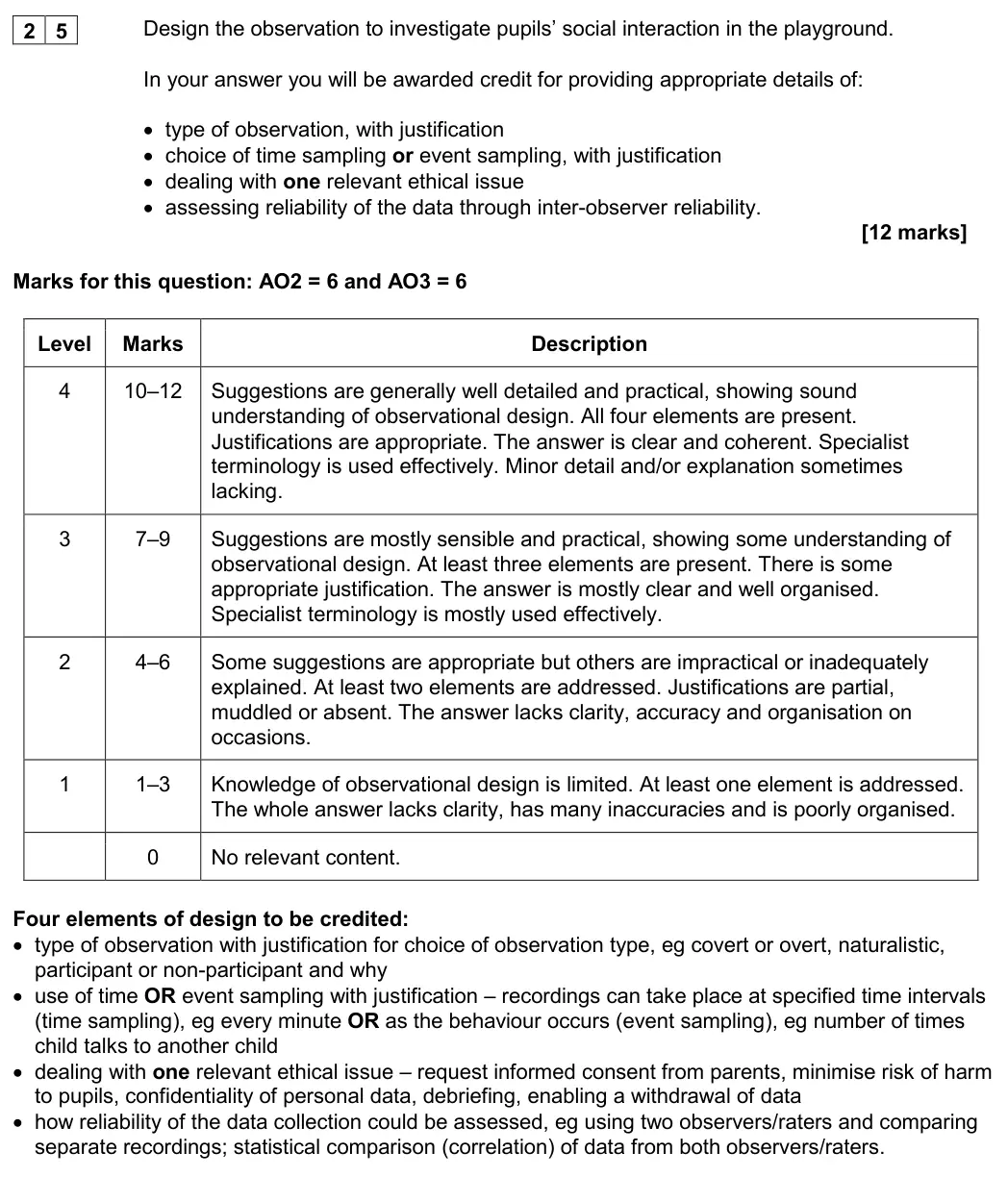
Although varied, there were some impressive responses in Q19 where many students were able to suggest how they would carry out an observation, demonstrating their ability to design practical procedures. Q19 was a challenging question as it was the first time this style of question has been asked on an AS examination. Although similar in style to the format of some previous A Level questions, it is important to note that the demands of this question are focused on the students’ suggestions of how the psychologist could carry out the observation and not justification. Despite this being a novel style of question for AS examinations, encouragingly many students were able to provide some relevant suggestions . It is clear that students are gaining important practical experience of how to design and/or carry out psychological research and so understand concepts fully and can apply them in an examination setting. Students’ performance varied greatly on this question but encouragingly, most students were able to gain at least some marks and nearly two thirds of the responses were awarded 3 marks or more. It is important that students address the demands of this question and address all three bullet points. Additionally, students need to provide some details of how they would carry out the type of observation they have identified (the first bullet point) and how they would use the type of behavioural sampling method they have identified (the third bullet point). Students should avoid wasting time on justification of their suggestions as this is not what the question demands. Unfortunately, too many students simply named a type of interview and/or behavioural sampling method and failed to outline how they would use them but instead included irrelevant justification of why they had chosen them. For the second bullet point it is important that the examples of behavioural categories to be observed are operationalised (as the question asks), to actually measure obedient (or disobedient) behaviour and align with the behavioural sampling method chosen. There was also some significant misunderstanding of behavioural sampling methods; many students wrote about the participant sampling method and thus did not get any credit for this bullet point. Exemplification of a successful response Despite some irrelevant justification of the type of observation towards the beginning, this response contains all of the elements needed for a level 3 response. The student has identified a type of observation (lines 2 and 3) and given some detail of how this would be carried out (lines 9 and 10). They have then given some examples of operationalised behaviour categories. Although the first and second categories suggested are implicit measurements of obedience, the third suggestion is explicitly measuring (dis)obedience. The student then goes on to identify an appropriate behavioural sampling method which would work with their suggested behavioural categories and also gives some detail as to how they would use this to record observations. Exemplification of a less successful response A fairly typical example of a response where the student has at least attempted to engage with each of the bullet points. The final point is confused and is about the sampling of the participants, not the behavioural categories which is not required and so cannot gain credit. However, there is some very implicit knowledge of event sampling, even though it is not named, in the attempt at behaviour categories (‘the amount of times all children…’). The student has attempted to give two examples of behavioural categories at the start and although these are about obedience, these are not operationalised as it is unclear how ‘listening’ and ‘not listening’ could be observed. In the middle paragraph, the student has identified a type of observation but has not explained how this (covert) observation could be carried out.
Notes from the mark scheme and report
three elements: type of observation, at least two operationalised behavioural categories, time/event sampling appropriate to the behaviours
must say how, not justify choices
many named methods without outlining their use
June 2024 · Paper 2 · Q194 marksAO3=4Research methods
Mark scheme, including level descriptors and indicative content
Examiner's comment
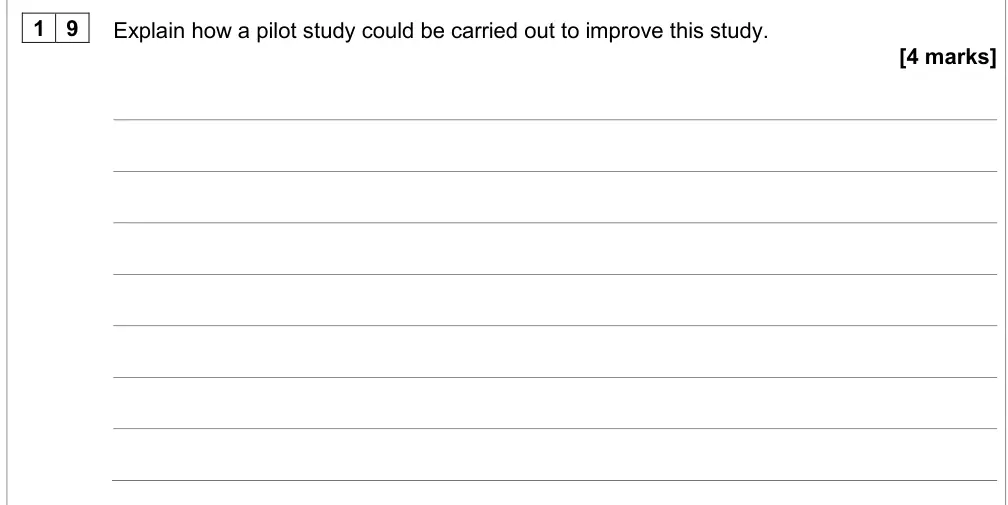
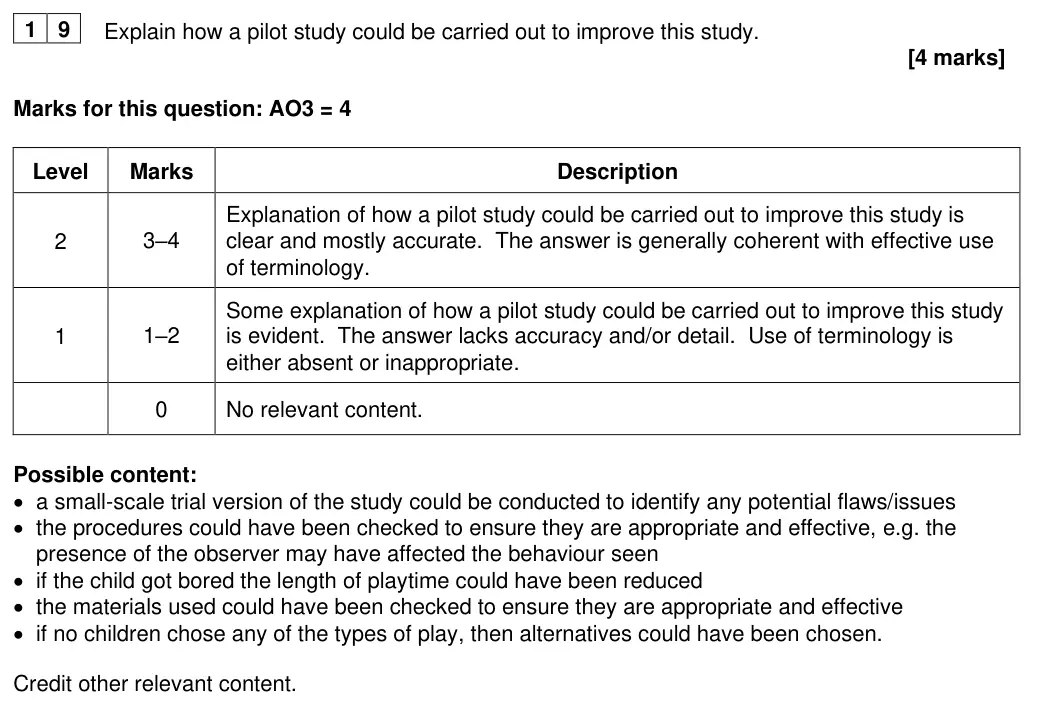
This question produced mixed results. Many students described the purpose of a pilot study or provided a definition of a pilot study but did not focus on the requirements of the question – to explain how the pilot study would be carried out and how conducting a pilot study would improve the present study. Some only focused on one aspect of the question, for example stating that a pilot study can identify flaws in the proposed study but did not go on to say that modifications can then be made. There was some effective application seen with students providing details of the number of participants they would include in their smaller sample for the pilot study and examples of changes in choice of play activities or timing for the play sessions. A common error was to suggest that a pilot study would check the findings of the study and therefore, focused on reliability. There was also a lot of focus on ethics. It should be noted that ethics could only be relevant if the issue identified was explicitly linked to an unforeseen ethical problem.
Notes from the mark scheme and report
small-scale trial to identify flaws (observer presence, playtime length, activity choice) AND modify the study
purpose/definition alone limited
'checks findings/reliability' and ethics answers not creditworthy unless an unforeseen issue
June 2024 · Paper 2 · Q204 marksAO2=4Research methods
Mark scheme, including level descriptors and indicative content
Examiner's comment
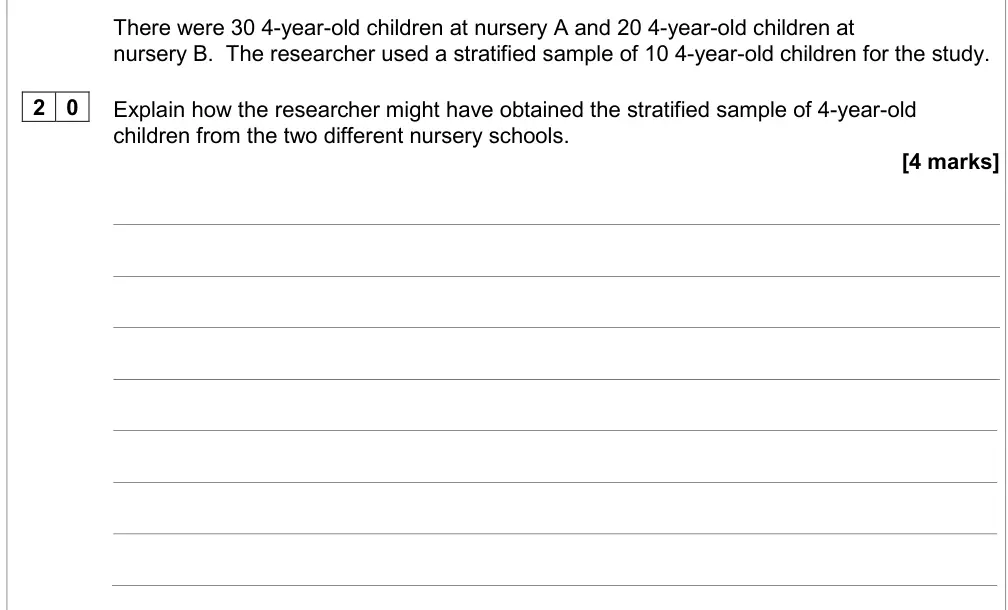
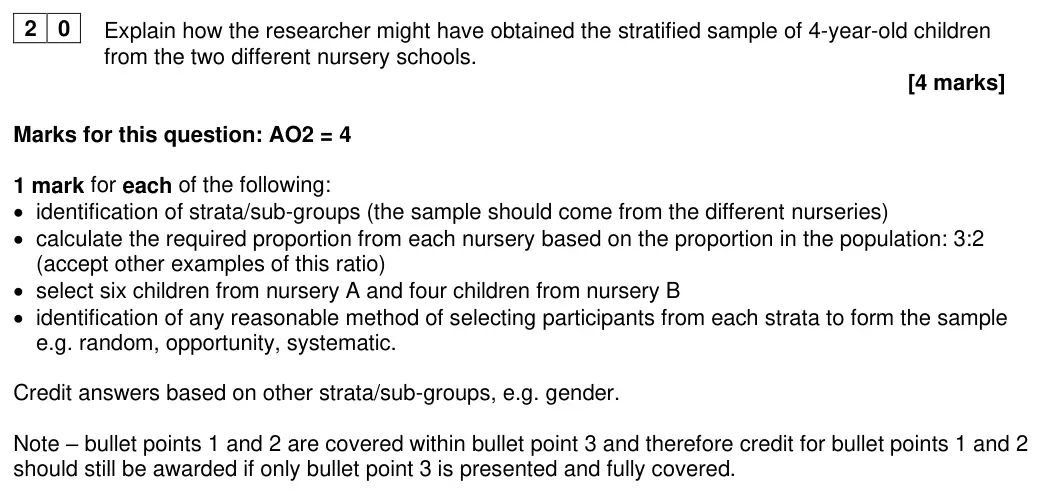
This question was generally not answered well with a lot of students confusing stratified and systematic sampling. Some gave generic responses of how stratified sampling could be carried out with no link to the question, whilst others gave appropriately applied responses but used different strata and thus struggled to achieve full marks without proportions being given. Those who did understand what stratified sampling was and then focused on selecting 4-year-old children from the two different nursery centres were generally able to achieve 3 or 4 marks efficiently. Those who achieved 3 marks tended to miss out the final bullet point on the mark scheme regarding the method for selection d.
Notes from the mark scheme and report
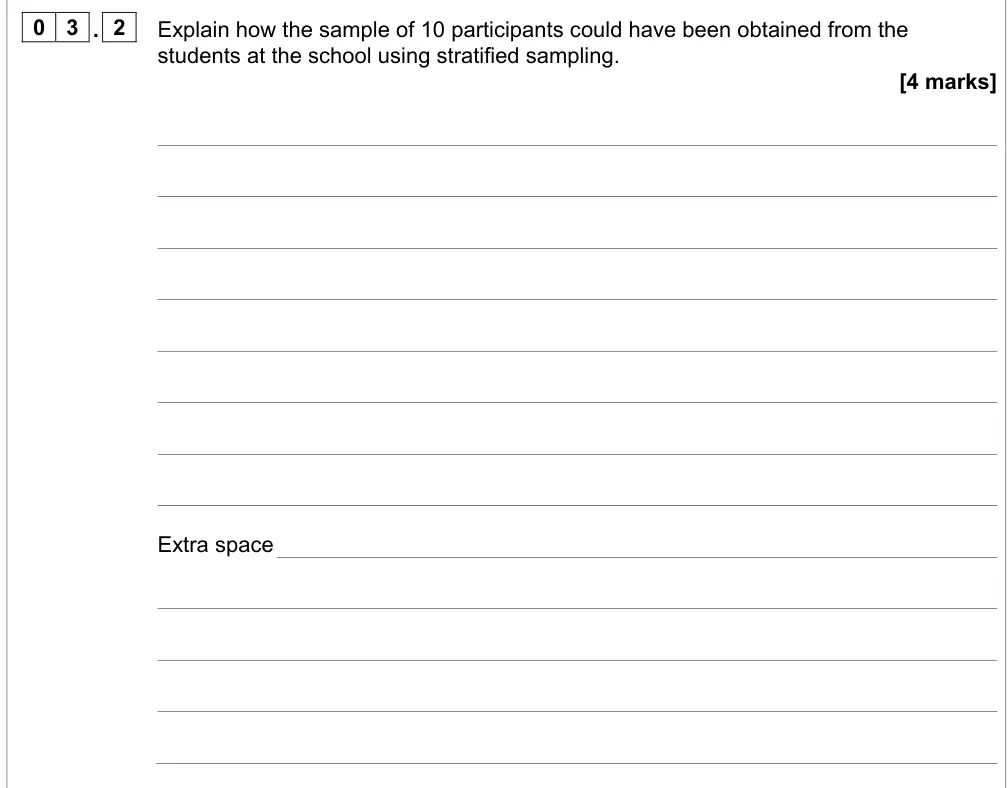
strata = nurseries, proportion 3:2, select 6 from A and 4 from B, by a stated method (e.g. random)
confused with systematic sampling
other strata lacked proportions
June 2024 · Paper 3 · Q63 marksAO3=3Research methods
Mark scheme, including level descriptors and indicative content
Examiner's comment
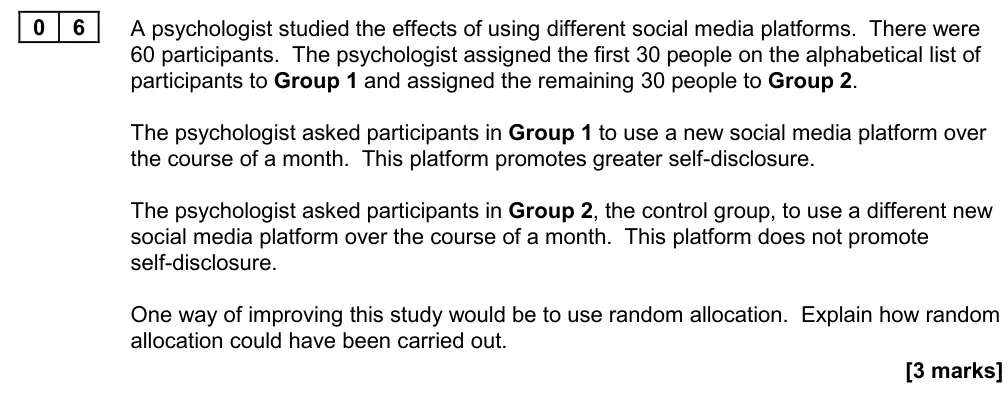
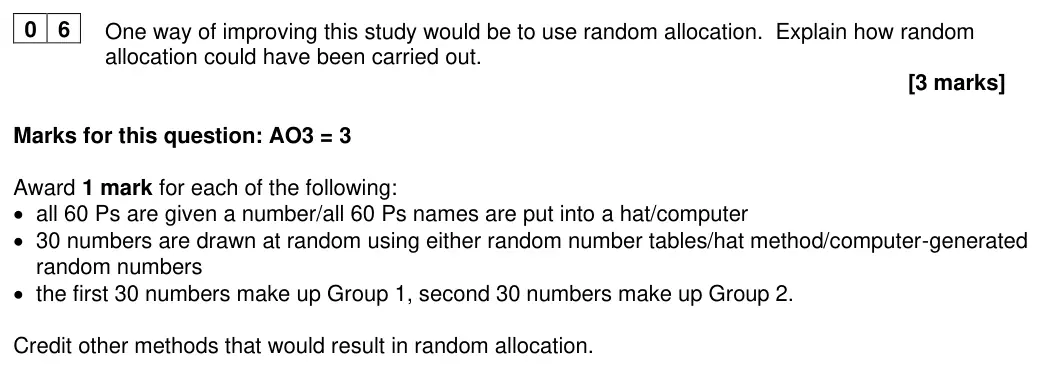
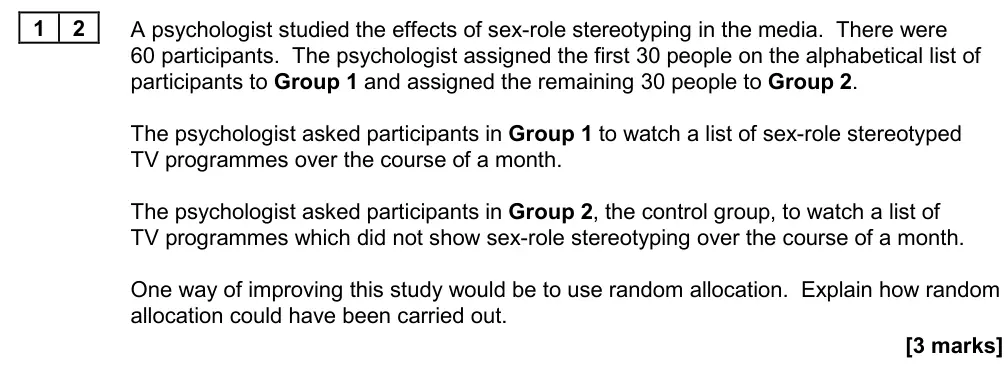
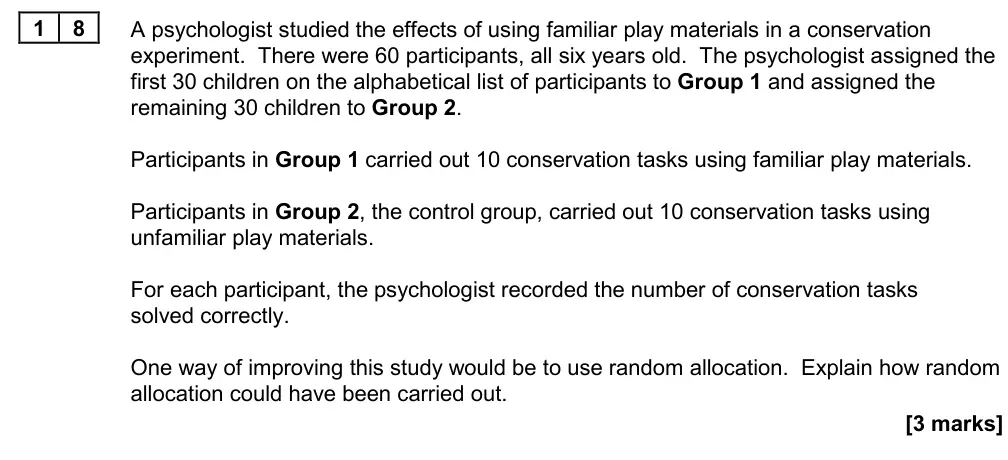
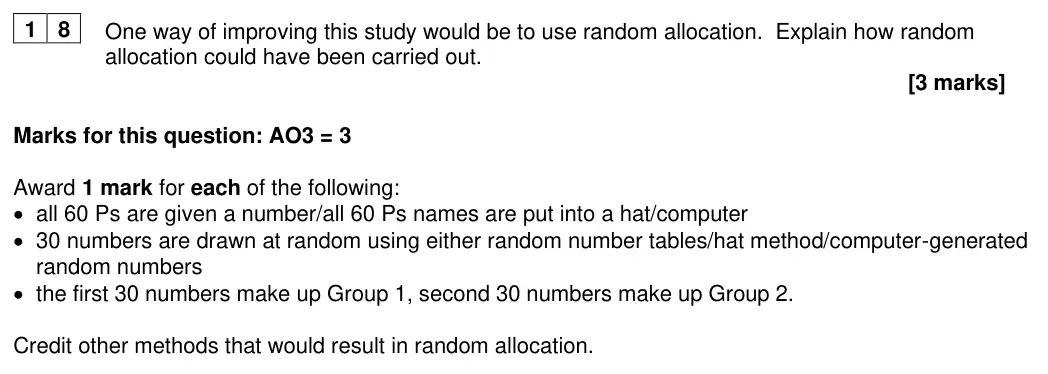
For Question 06, most students were able to access at least two marks by stating that all the names/numbers of the people in the study would be subject to some sort of lottery method. The third mark, for explaining how those names/numbers would be allocated to Group 1 or Group 2 proved more elusive for some. Generally, though, this was a very well-answered question.
Notes from the mark scheme and report
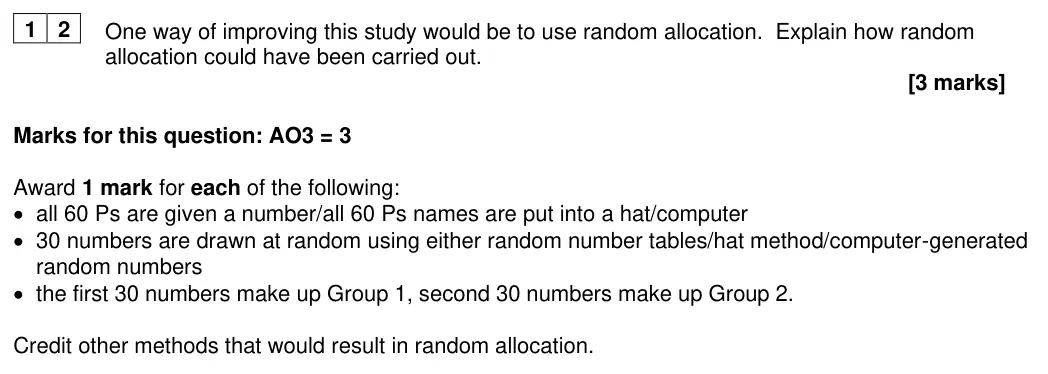
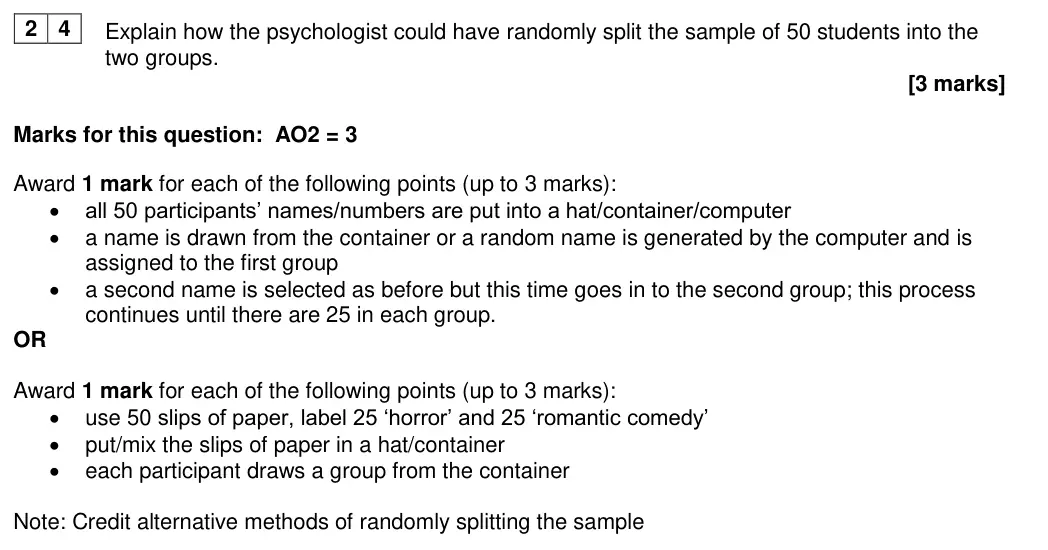
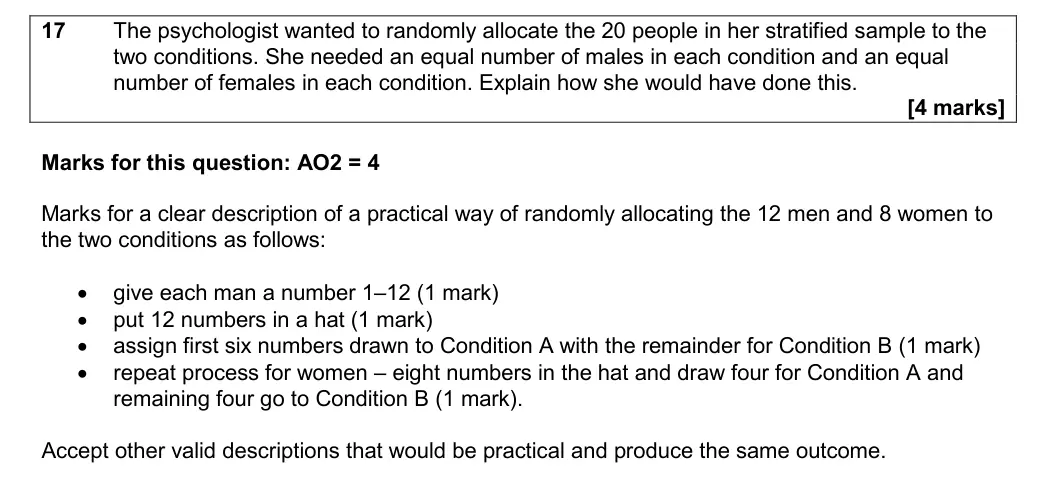
1 mark each: number/name all 60 Ps
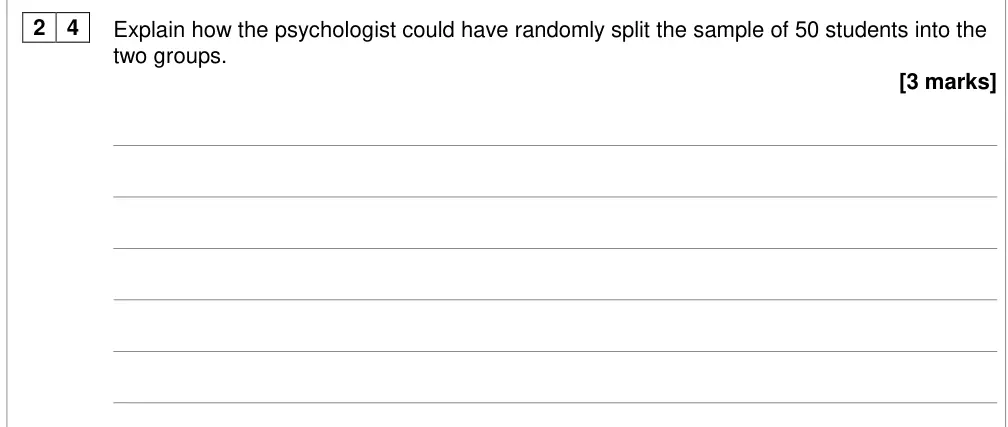
draw at random (hat, random number table/generator)
first 30 drawn = Group 1, rest = Group 2
third (allocation) mark most often missed
June 2024 · Paper 3 · Q81 markAO2=1Research methods
Mark scheme, including level descriptors and indicative content
Examiner's comment
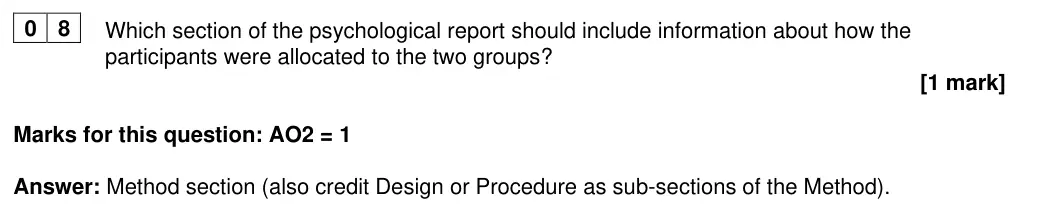
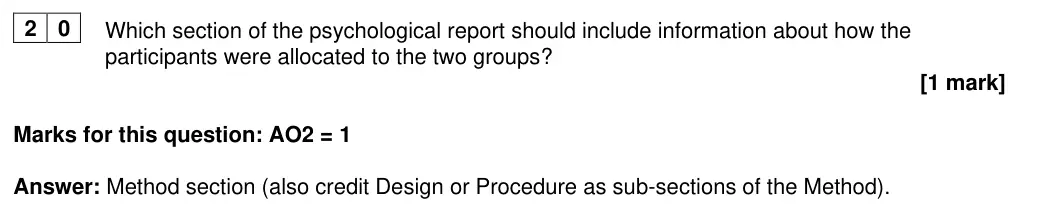
For Question 08, most students were able to identify either the ‘method’, ‘design; or ‘procedure’ as creditworthy alternatives and as such were awarded a mark. There were no marks given for ‘methodology’, although this was a popular answer. Other common incorrect answers were the ‘abstract’ and the ‘introduction’.
Notes from the mark scheme and report
Method section (also credit Design or Procedure)
'methodology' not credited
abstract and introduction common wrong answers
June 2024 · Paper 3 · Q123 marksAO3=3Research methods
Mark scheme, including level descriptors and indicative content
Examiner's comment
For Question 12, most students were able to access at least two marks by stating that all the names/numbers of the people in the study would be subject to some sort of lottery method. The third mark, for explaining how those names/numbers would be allocated to Group 1 or Group 2 proved more elusive for some. Generally, though, this was a very well-answered question.
Notes from the mark scheme and report
1 mark each: number/name all 60 Ps
draw at random
first 30 drawn = Group 1, rest = Group 2
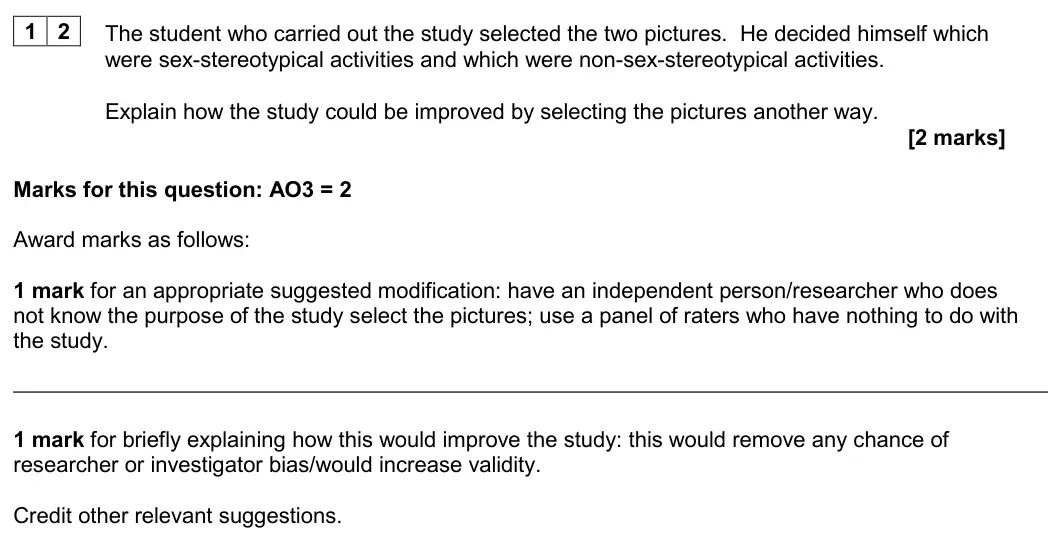
stem study on sex-role stereotyping in TV (the 'sex-role stereotypes' heading was removed in v1.4, media influence on gender roles remains)
June 2024 · Paper 3 · Q141 markAO2=1Research methods
Mark scheme, including level descriptors and indicative content
Examiner's comment
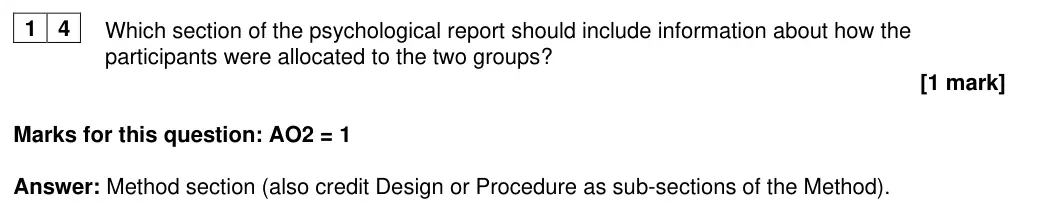
For Question 14, most students were able to identify either the ‘method’, ‘design; or ‘procedure’ as creditworthy alternatives and as such were awarded a mark. There were no marks given for ‘methodology’, although this was a popular answer. Other common incorrect answers were the ‘abstract’ and the ‘introduction’.
Notes from the mark scheme and report
Method section (also credit Design or Procedure)
'methodology' not credited
abstract and introduction common wrong answers
June 2024 · Paper 3 · Q183 marksAO3=3Research methods
Mark scheme, including level descriptors and indicative content
Examiner's comment
For Question 18, most students were able to access at least two marks by stating that all the names/numbers of the people in the study would be subject to some sort of lottery method. The third mark, for explaining how those names/numbers would be allocated to Group 1 or Group 2 proved more elusive for some. Generally, though, this was a very well-answered question.
Notes from the mark scheme and report
1 mark each: number/name all 60 Ps
draw at random
first 30 drawn = Group 1, rest = Group 2
third (allocation) mark most often missed
June 2024 · Paper 3 · Q201 markAO2=1Research methods
Mark scheme, including level descriptors and indicative content
Examiner's comment
For Question 20, most students were able to identify either the ‘method’, ‘design; or ‘procedure’ as creditworthy alternatives and as such were awarded a mark. There were no marks given for ‘methodology’, although this was a popular answer. Other common incorrect answers were the ‘abstract’ and the ‘introduction’.
Notes from the mark scheme and report
Method section (also credit Design or Procedure)
'methodology' not credited
abstract and introduction common wrong answers
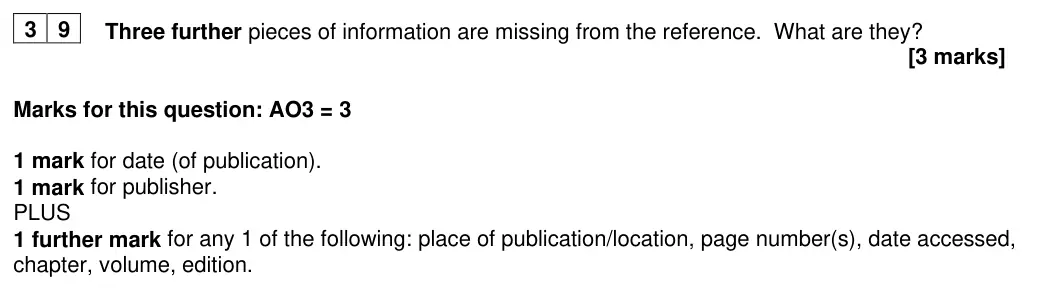
June 2024 · Paper 3 · Q393 marksAO3=3Research methods
Mark scheme, including level descriptors and indicative content
Examiner's comment
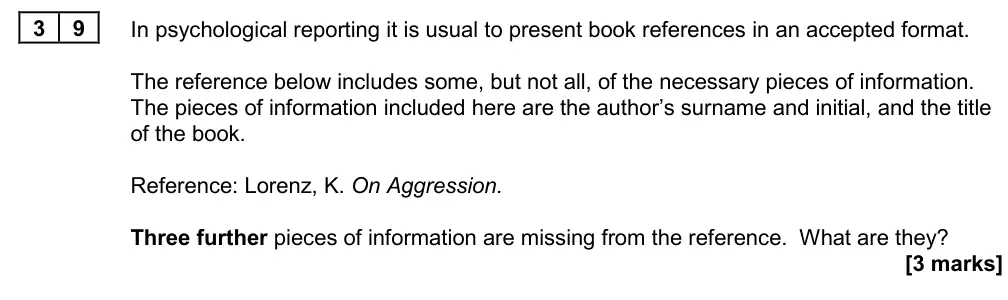
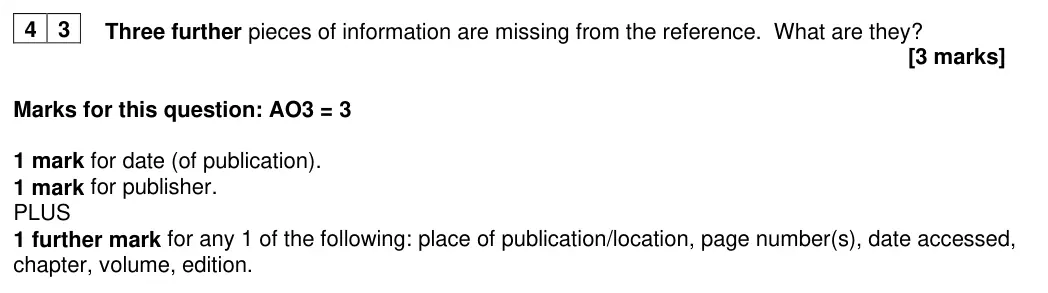
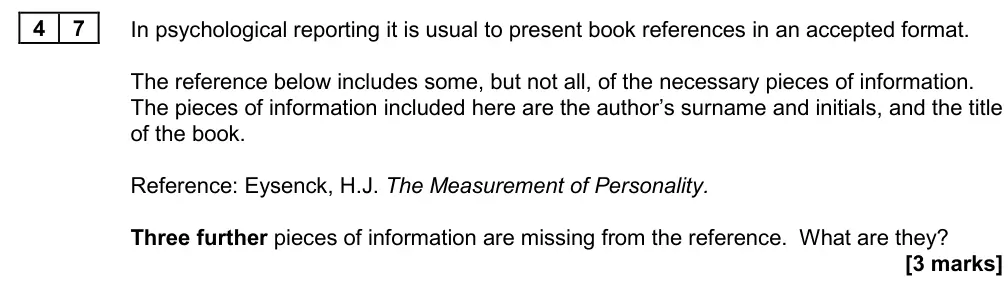
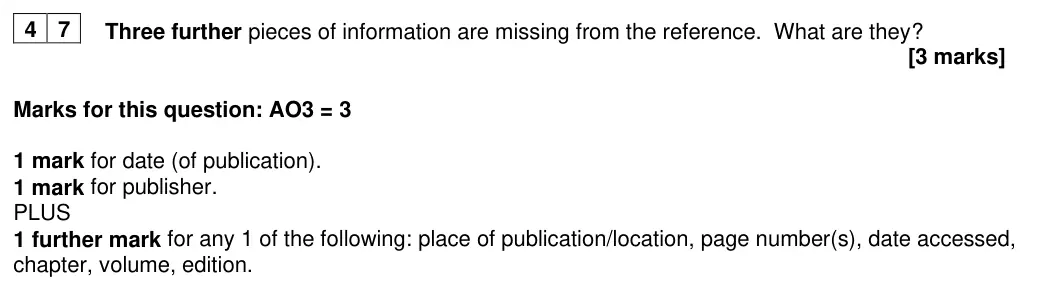
The question on referencing, albeit worth only 3 marks, also proved challenging for many. Question 39 produced a wide variety of answers and discriminated well between those students who had clearly come across the structure of a reference before, and those who were left to guess. Many students knew that the date of publication was missing but far fewer were able to identify other details, such as the name and location of the publisher.
Notes from the mark scheme and report
1 mark date of publication + 1 mark publisher + 1 mark for one of place of publication, page numbers, edition etc
many knew date only
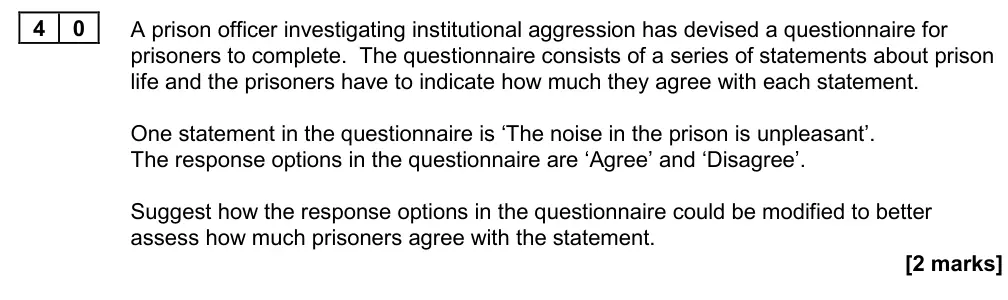
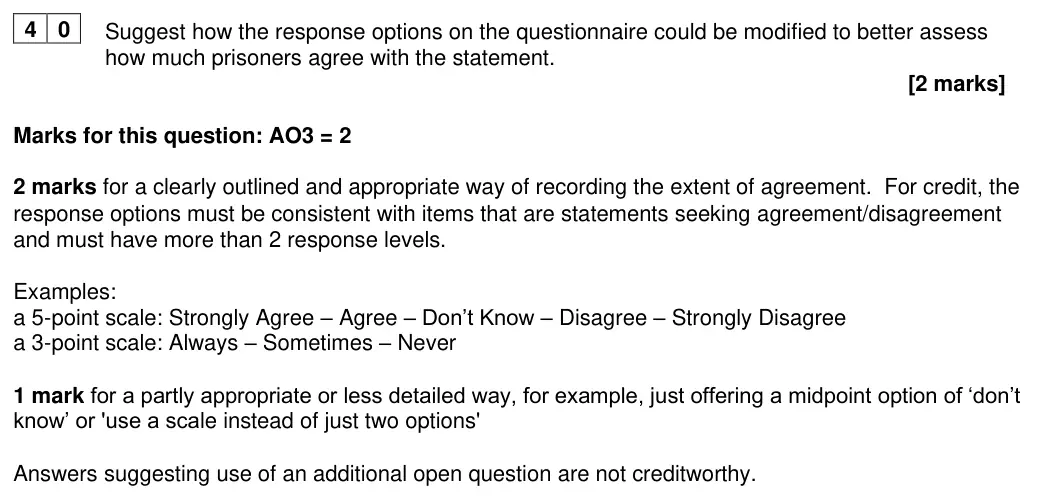
June 2024 · Paper 3 · Q402 marksAO3=2Research methods
Mark scheme, including level descriptors and indicative content
Examiner's comment
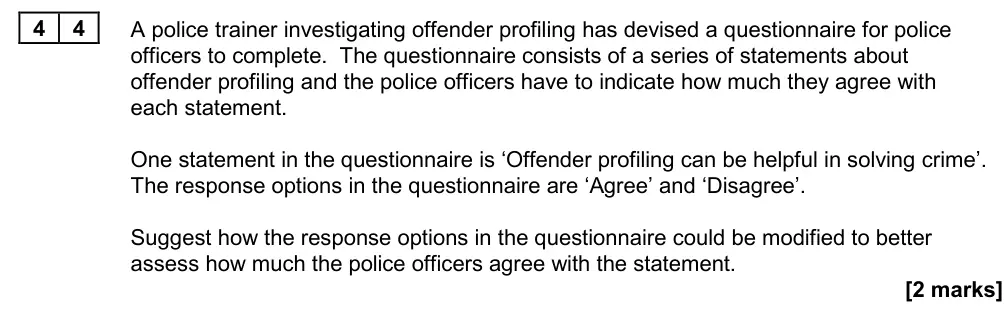
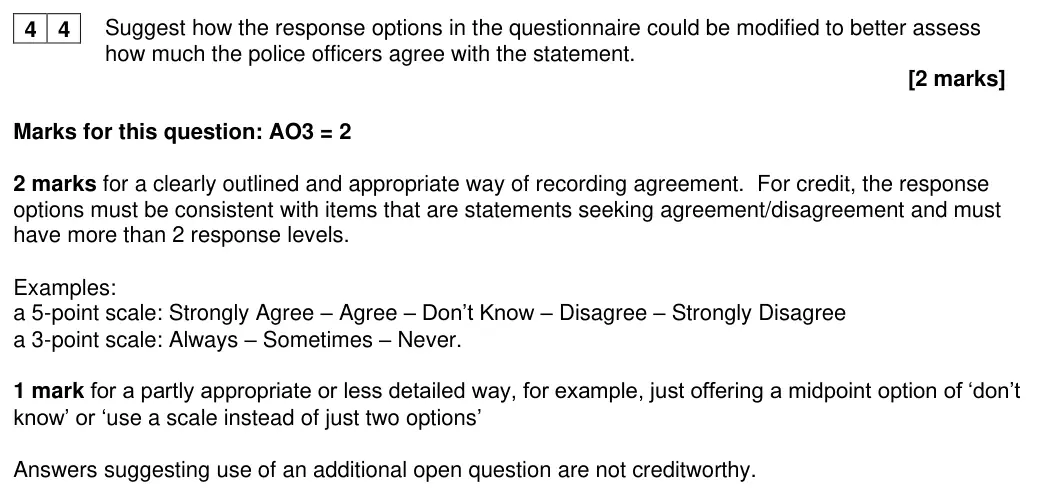
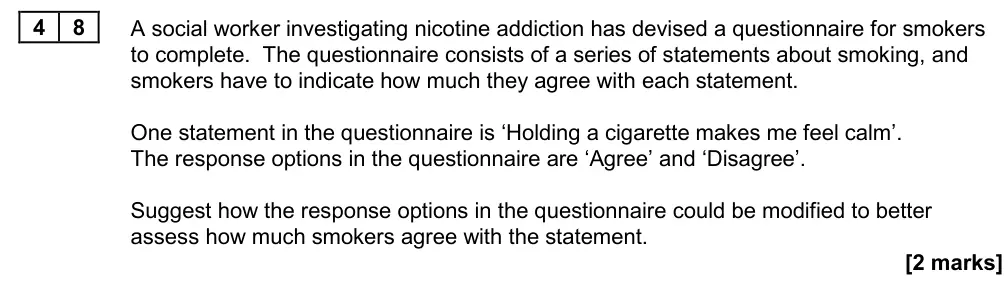
Question 40 also proved challenging for many students. There was widespread misunderstanding of the key requirement of the question; namely, to modify the response options on the questionnaire, rather than create a completely new ‘open’ question – which was the suggestion that many students gave. A high number of students said there should be a numbered scale between the two extreme options of ‘agree’ and ‘disagree’ but did not elaborate further. Answers of this type were awarded one mark.
Notes from the mark scheme and report
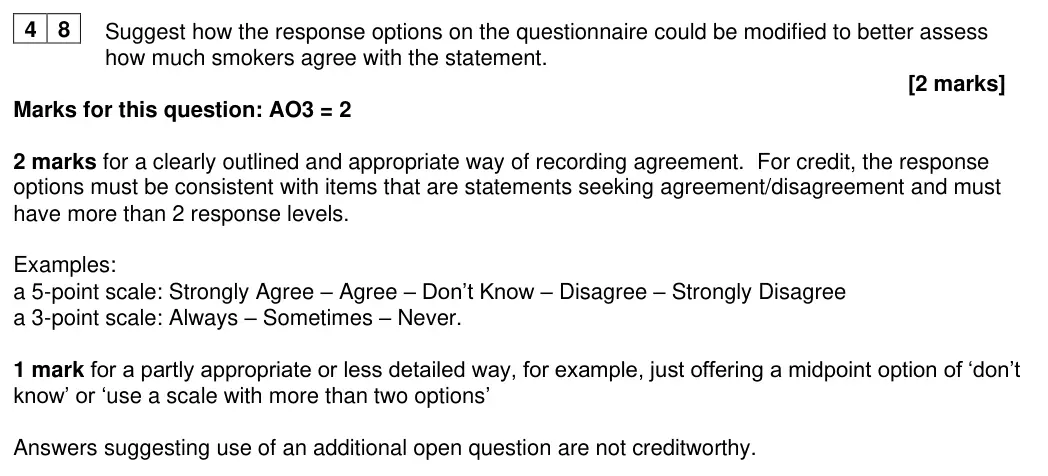
2 marks: more than two response levels consistent with an agreement statement (e.g. 5-point Likert scale)
1 mark for just adding 'don't know' or 'use a scale'
adding an open question not creditworthy (common error)
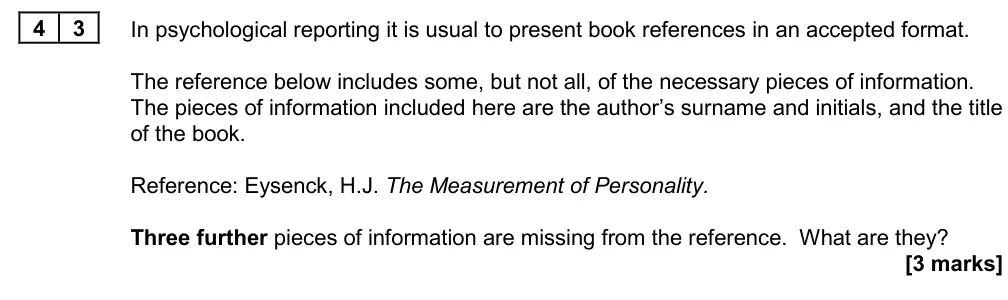
June 2024 · Paper 3 · Q433 marksAO3=3Research methods
Mark scheme, including level descriptors and indicative content
Examiner's comment
The question on referencing, albeit worth only 3 marks, also proved challenging for many. Question 43 produced a wide variety of answers and discriminated well between those students who had clearly come across the structure of a reference before, and those who were left to guess. Many students knew that the date of publication was missing but far fewer were able to identify other details, such as the name and location of the publisher.
Notes from the mark scheme and report
1 mark date of publication + 1 mark publisher + 1 mark for one of place of publication, page numbers, edition etc
many knew date only
June 2024 · Paper 3 · Q442 marksAO3=2Research methods
Mark scheme, including level descriptors and indicative content
Examiner's comment
Question 44 also proved challenging for many students. There was widespread misunderstanding of the key requirement of the question; namely, to modify the response options on the questionnaire, rather than create a completely new ‘open’ question – which was the suggestion that many students gave. A high number of students said there should be a numbered scale between the two extreme options of ‘agree’ and ‘disagree’ but did not elaborate further.
Notes from the mark scheme and report
2 marks: more than two response levels consistent with an agreement statement (e.g. 5-point Likert scale)
1 mark for just adding 'don't know' or 'use a scale'
adding an open question not creditworthy (common error)
June 2024 · Paper 3 · Q473 marksAO3=3Research methods
Mark scheme, including level descriptors and indicative content
Examiner's comment
The question on referencing, albeit worth only 3 marks, also proved challenging for many. Question 47 produced a wide variety of answers and discriminated well between those students who had clearly come across the structure of a reference before, and those who were left to guess. Many students knew that the date of publication was missing but far fewer were able to identify other details, such as the name and location of the publisher.
Notes from the mark scheme and report
1 mark date of publication + 1 mark publisher + 1 mark for one of place of publication, page numbers, edition etc
many knew date only
June 2024 · Paper 3 · Q482 marksAO3=2Research methods
Mark scheme, including level descriptors and indicative content
Examiner's comment
Question 48 also proved challenging for many students. There was widespread misunderstanding of the key requirement of the question; namely, to modify the response options on the questionnaire, rather than create a completely new ‘open’ question – which was the suggestion that many students gave. A high number of students said there should be a numbered scale between the two extreme options of ‘agree’ and ‘disagree’ but did not elaborate further.
Notes from the mark scheme and report
2 marks: more than two response levels consistent with an agreement statement (e.g. 5-point Likert scale)
1 mark for just adding 'don't know' or 'use a scale'
adding an open question not creditworthy (common error)
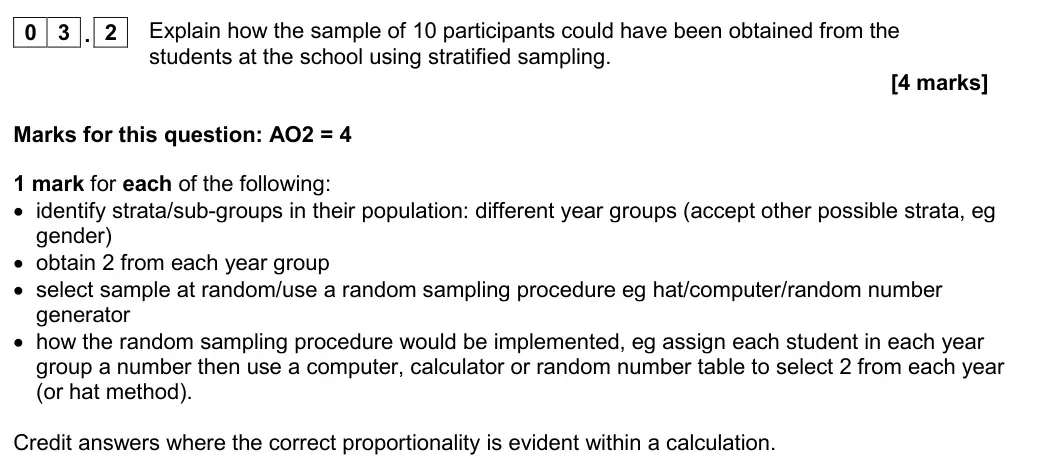
June 2023 · AS Paper 1 · Q3.24 marksAO2=4Research methodsMedium
Mark scheme, including level descriptors and indicative content
Examiner's comment
This question produced a wide range of responses. The majority of answers were able to identify the strata and how many people from each strata were needed. However, few students then explained how the participants would then be chosen from the strata using random selection. Very few students achieved all 4 marks by explaining how the random selection method chosen would be used to choose the participants from the identified strata. Some students muddle stratified sampling with systematic, and some simply explained random sampling, not within the context of choosing from the strata. Students found this the hardest of the Research Methods questions.
Notes from the mark scheme and report
strata = year groups
2 from each year (proportional)
random selection within strata
how the random method is implemented
few explained random selection within strata
confused with systematic
hardest RM question
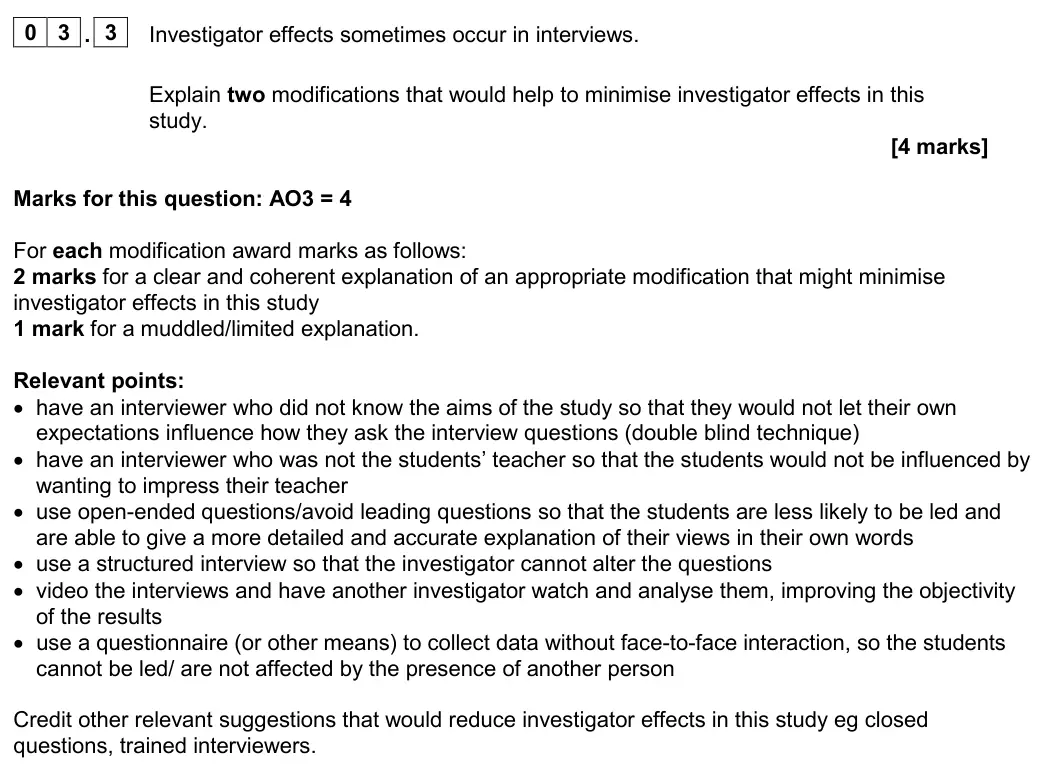
June 2023 · AS Paper 1 · Q3.34 marksAO3=4Research methods
Mark scheme, including level descriptors and indicative content
Examiner's comment
This question was answered well by some students but there were some answers that simply named a modification rather than explained it. Students would benefit from being able to discriminate between ‘name’ and ‘explain’ command words. Weaker students only gave one modification instead of two for this question.
Notes from the mark scheme and report
two explained modifications (interviewer blind to aims/not their teacher, open or non-leading questions, structured interview, video and second rater, questionnaire)
naming without explaining
only one modification
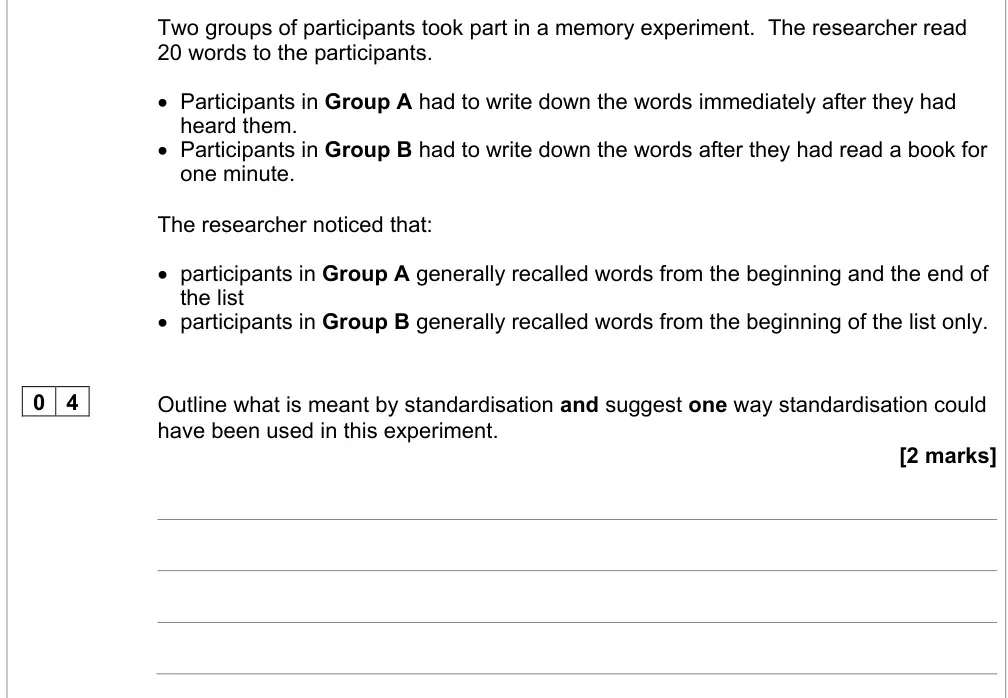
June 2023 · Paper 1 · Q42 marksAO1=1, AO2=1Research methodsMedium
Mark scheme, including level descriptors and indicative content
Examiner's comment
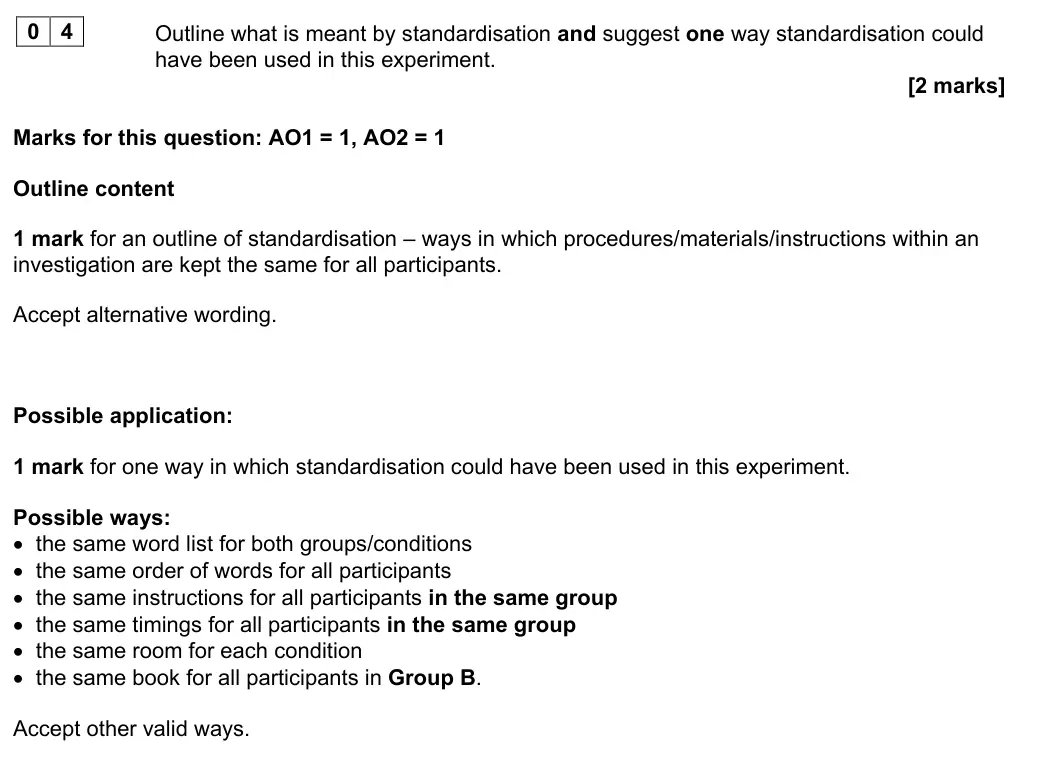
Many students were able to answer this question well and had a clear understanding of what is meant by ‘standardisation,’ with over 60% scoring marks on this question. Students were also able to make a range of suitable suggestions about how standardisation could have been applied to the scenario.
Notes from the mark scheme and report
stem is a serial-position memory experiment
application must fit this experiment (same word list, order, instructions, timings)
June 2023 · Paper 1 · Q52 marksAO1=1, AO2=1Research methods
Mark scheme, including level descriptors and indicative content
Examiner's comment
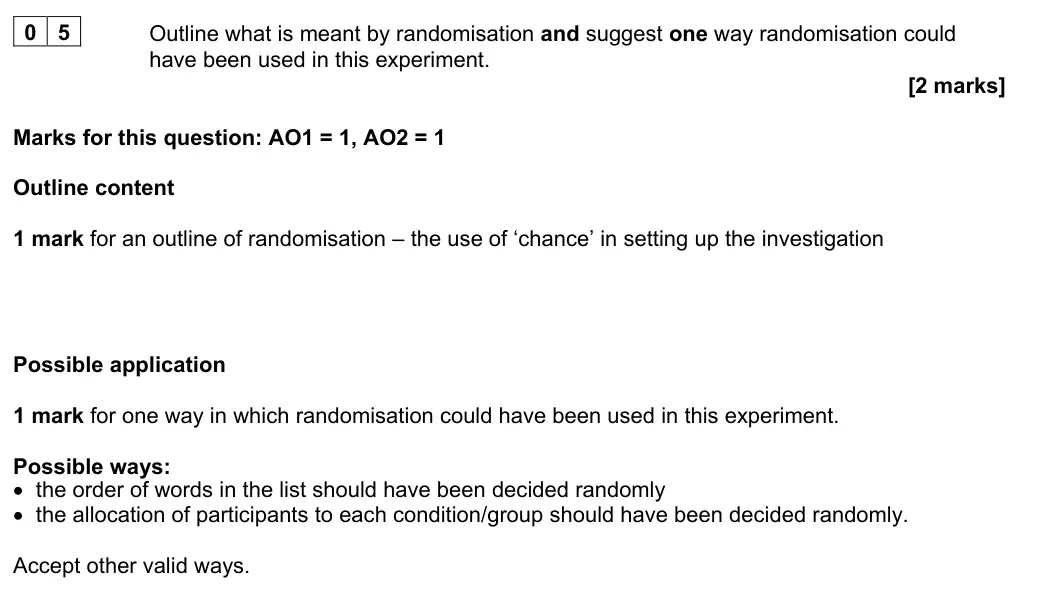
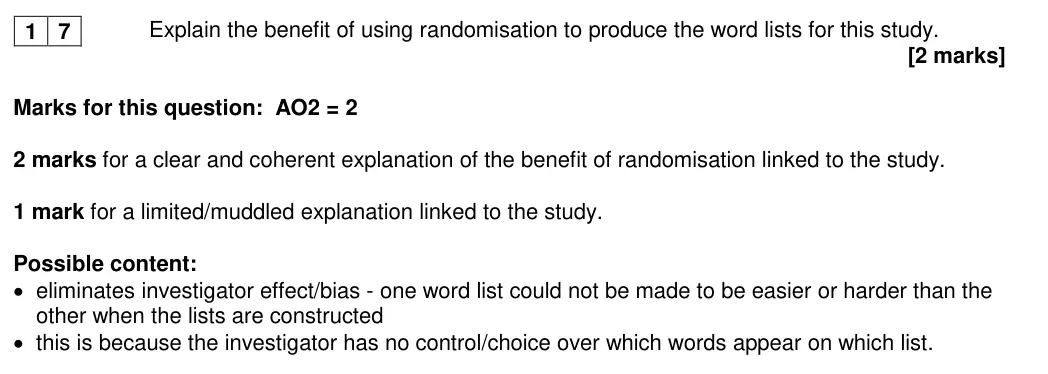
Students generally had difficulty with this question and often did not acknowledge the use of ‘chance’ in the setting up of an investigation. Many students confused the term ‘randomisation’ with random sampling, whereas others mistakenly used tautology in their response. It is apparent that students need to understand the distinction between random sampling and randomisation much more clearly. The second part of the question was answered more effectively. Many students suggested the use of random allocation of participants, or for the order of words in the wordlist to be decided randomly.
Notes from the mark scheme and report
randomisation = use of chance in setting up the study
confusing randomisation with random sampling
tautological definitions
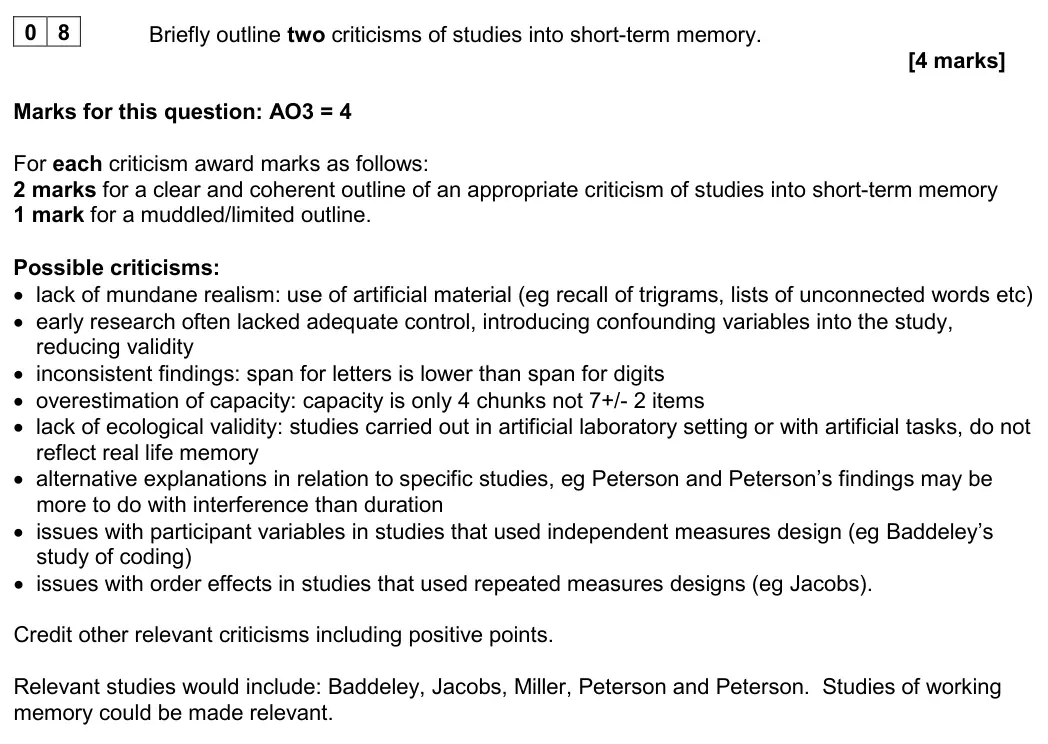
June 2023 · AS Paper 1 · Q84 marksAO3=4Evaluate (short)
Mark scheme, including level descriptors and indicative content
Examiner's comment
This question seemed challenging for a number of students, with few scoring full marks. Some students criticised models of memory, not studies of short-term memory. Some students were only able to give one criticism, not two. Weaker criticisms were often generic. The best answers offered criticisms that were tied to specific studies.
Notes from the mark scheme and report
criticisms of STUDIES of STM (Jacobs, Miller, Peterson and Peterson, Baddeley) e.g. artificial material, poor control, order effects/participant variables, interference alternative
criticising models not credited
generic criticisms weak
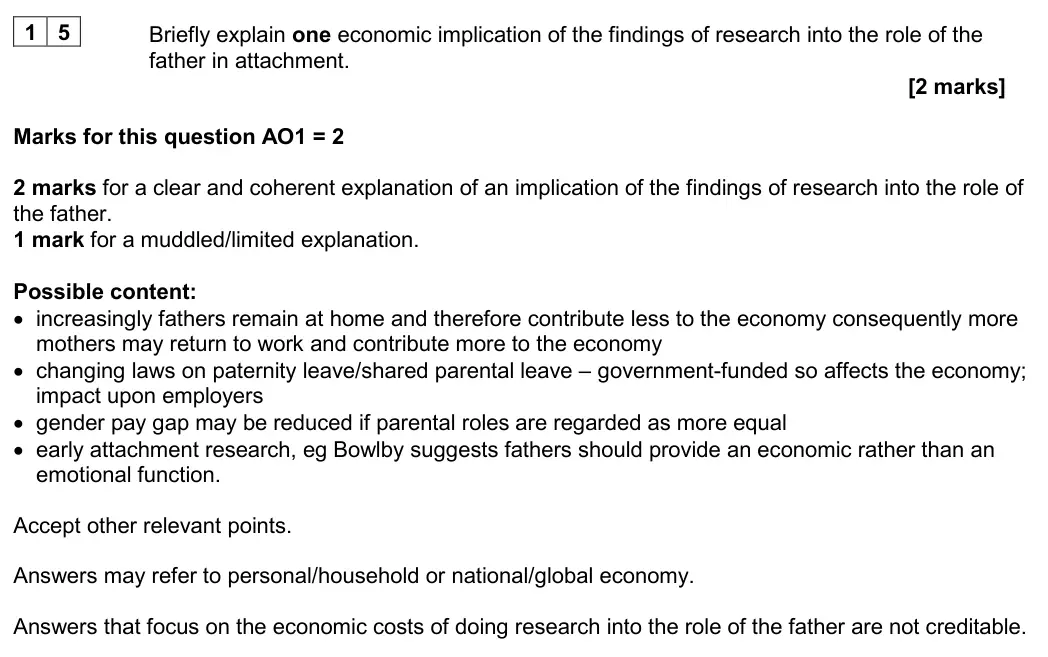
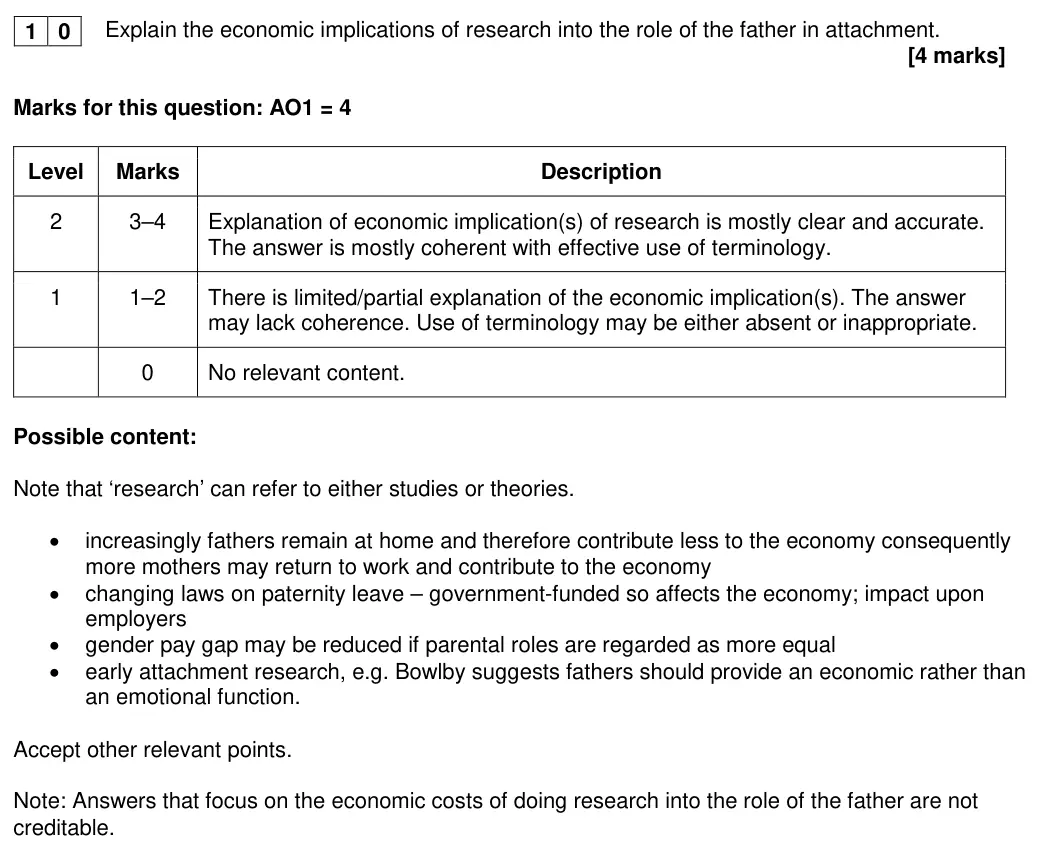
June 2023 · AS Paper 1 · Q152 marksAO1=2Research methodsOld spec only
Not on the 2025 specification: needs findings of research into the role of the father, removed in v1.4
Mark scheme, including level descriptors and indicative content
Examiner's comment
This question was answered poorly. Whilst some students knew the findings of research into the role of the father, they failed to explain any economic impact. A number of students simply stated that the father’s role was for play. A number of students did not even attempt the question. Economic implications of research is clearly an area where students struggle to answer exam questions and where they need further guidance.
Notes from the mark scheme and report
Off-spec: needs findings of research into the role of the father, removed in v1.4
economic implication e.g. fathers as caregivers allow mothers to work, shared parental leave
cost of doing the research not creditable
answered poorly, many blank
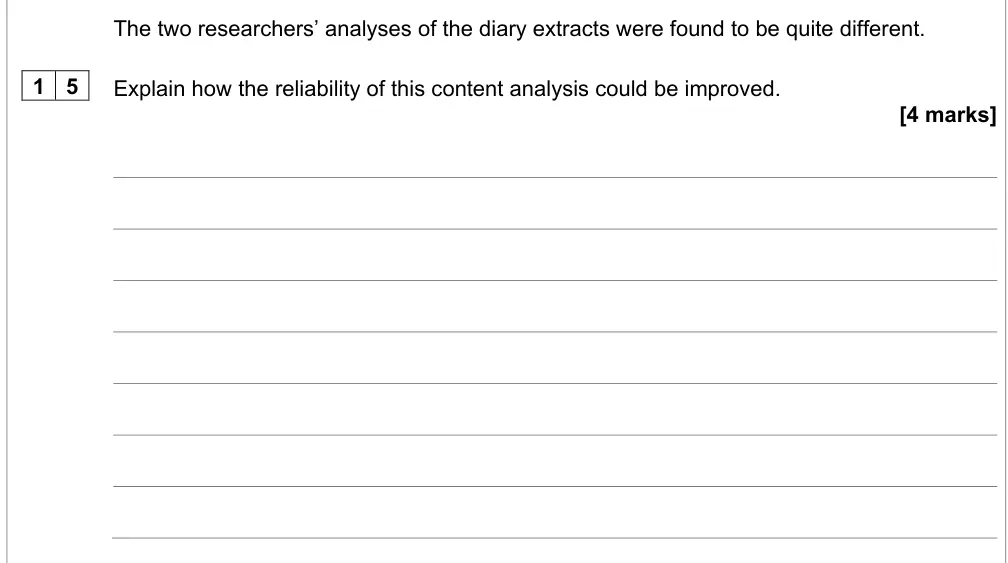
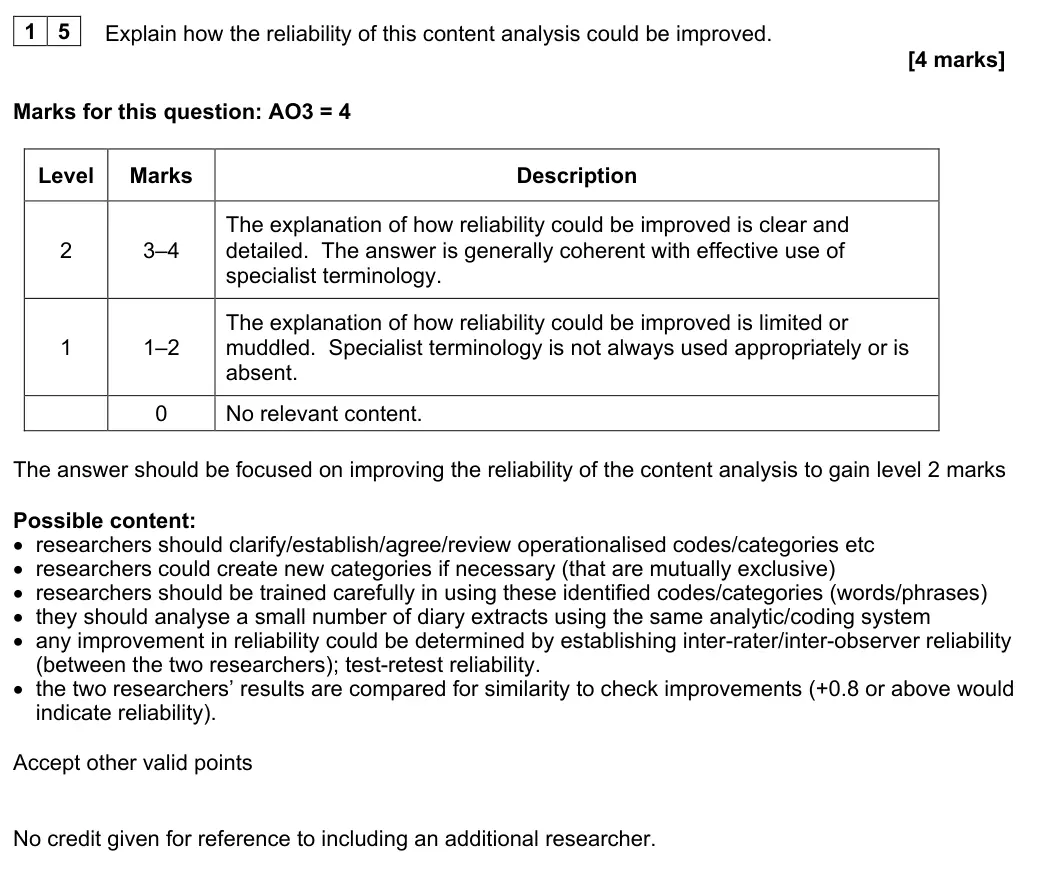
June 2023 · Paper 1 · Q154 marksAO3=4Research methods
Mark scheme, including level descriptors and indicative content
Examiner's comment
Students found this question difficult and often misinterpreted its meaning. The students were asked to suggest how the reliability of the content analysis could be improved. Instead, many responses focused on how reliability can be assessed. In addition, many did not read the information carefully. They did not acknowledge that two researchers were already involved in the analyses of the diary extracts, meaning that marks could not be gained for suggesting using an additional researcher.
Notes from the mark scheme and report
asks how to IMPROVE reliability, many explained how to assess it
two researchers already involved, so 'add another researcher' scored nothing
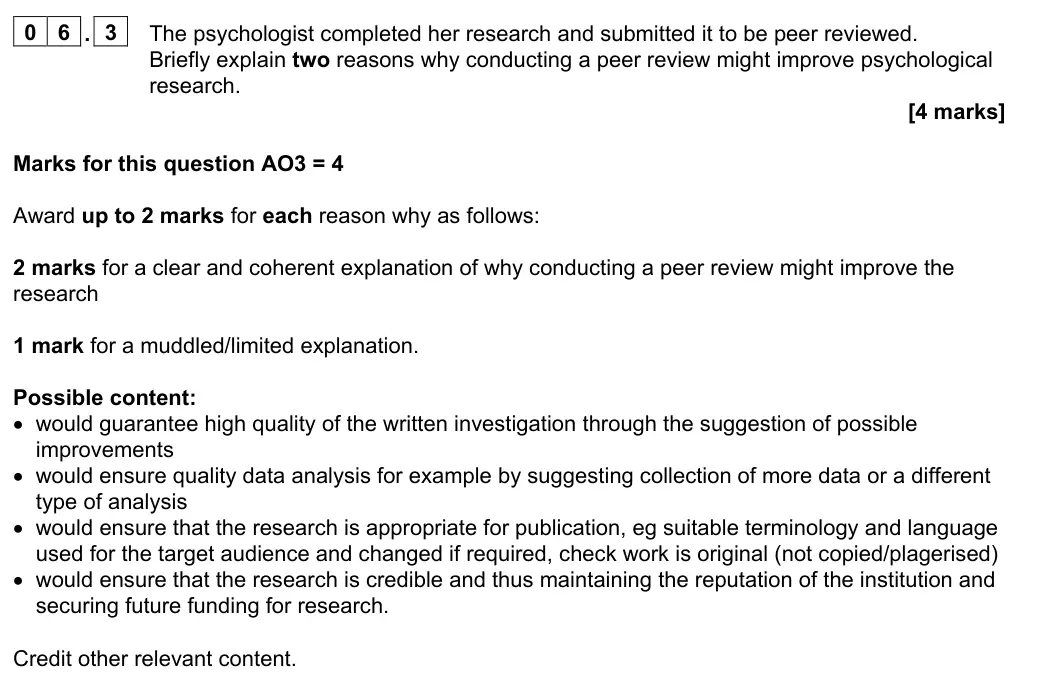
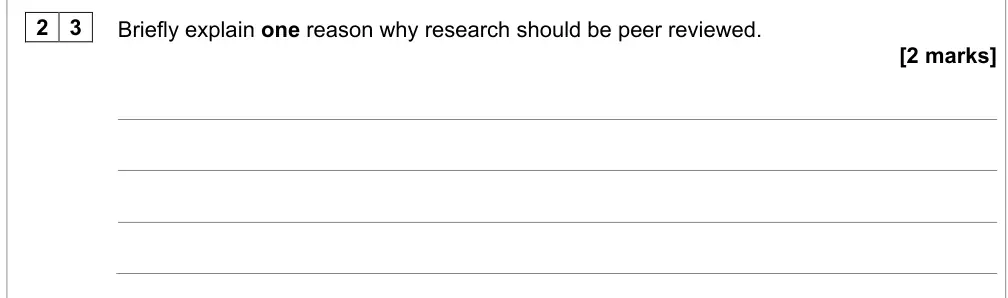
June 2023 · AS Paper 2 · Q6.34 marksAO3=4Research methods
Mark scheme, including level descriptors and indicative content
Examiner's comment
Many students were able to at least give some reasoning as to why conducting a peer review could improve psychological research, and thus were awarded some marks. However, some students simply described the process of a peer review, whilst others appeared to have no understanding of the purpose of peer review. Many students focused upon checking for errors and making subsequent improvements, but few could offer and explain any other reasons for conducting a peer review. It is important that students can identify and explain several reasons why peer reviews are conducted.
Notes from the mark scheme and report
explain why peer review improves research (quality, analysis, suitability for publication, credibility/funding)
many described the process instead
most only gave 'checking for errors'
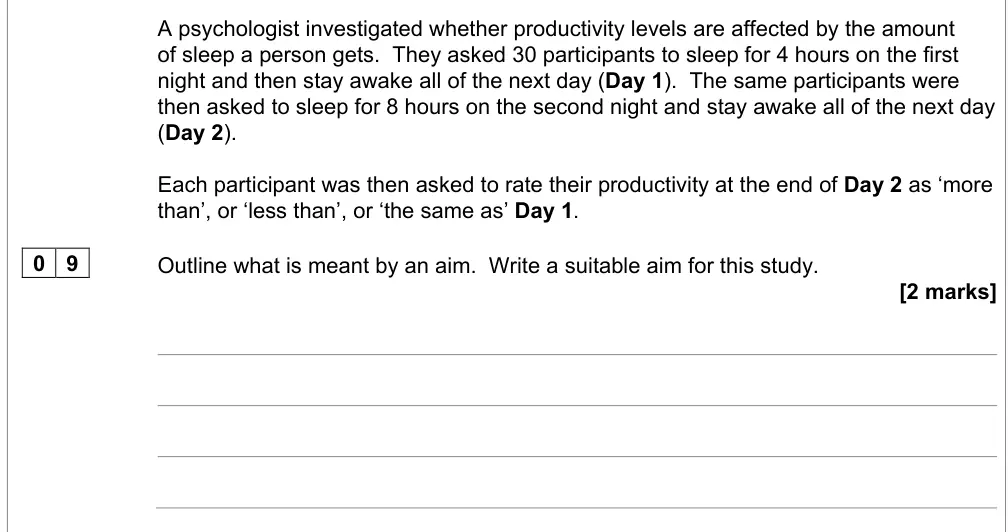
June 2023 · AS Paper 2 · Q92 marksAO1=1, AO2=1Research methodsEasy
Mark scheme, including level descriptors and indicative content
Examiner's comment
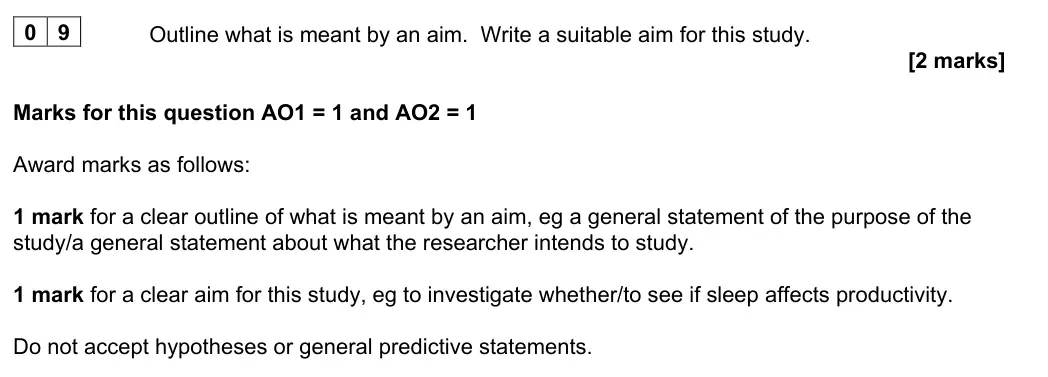
This question was generally answered very well, and it was clear from responses seen that many students appeared to have some understanding of an aim and were able to write a suitable aim for the study. The mean as a percentage of the maximum mark for this question was around 75%. There was some confusion with research questions and/or hypotheses, whilst other students struggled to articulate what is meant by an aim. Additionally, a small minority of students only answered half the question, either just stating what is meant by an aim or just writing an aim for the study. It is important for students to remember that they must address all the demands of the question in their response.
Notes from the mark scheme and report
1 mark definition (general statement of purpose) + 1 mark aim for this study
hypotheses/predictions not accepted
confusion with research questions
June 2023 · AS Paper 2 · Q104 marksAO2=4Research methodsHard
Mark scheme, including level descriptors and indicative content
Examiner's comment
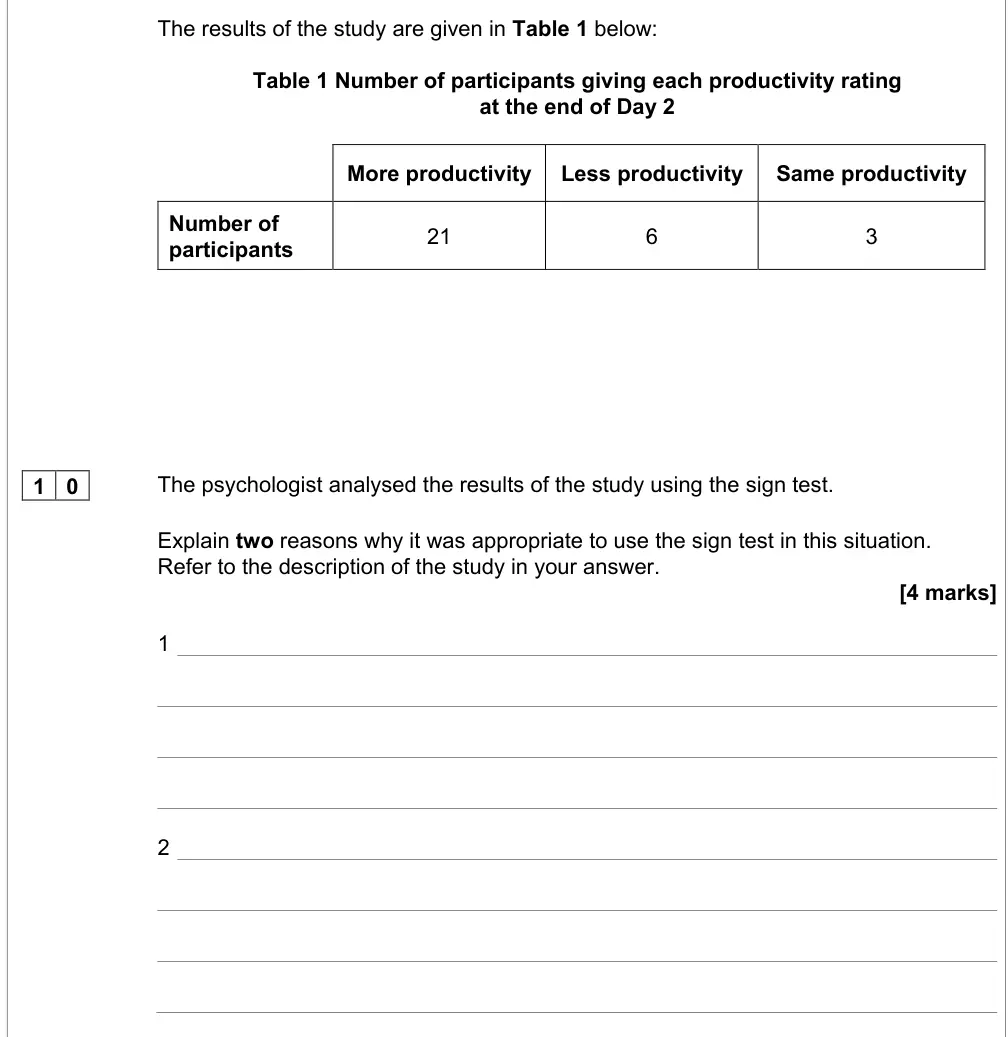
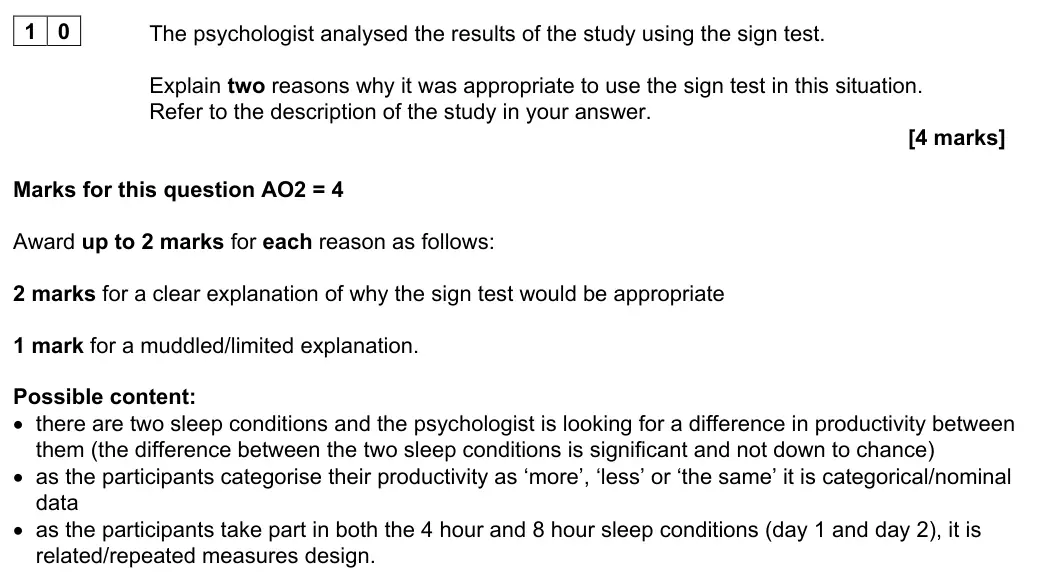
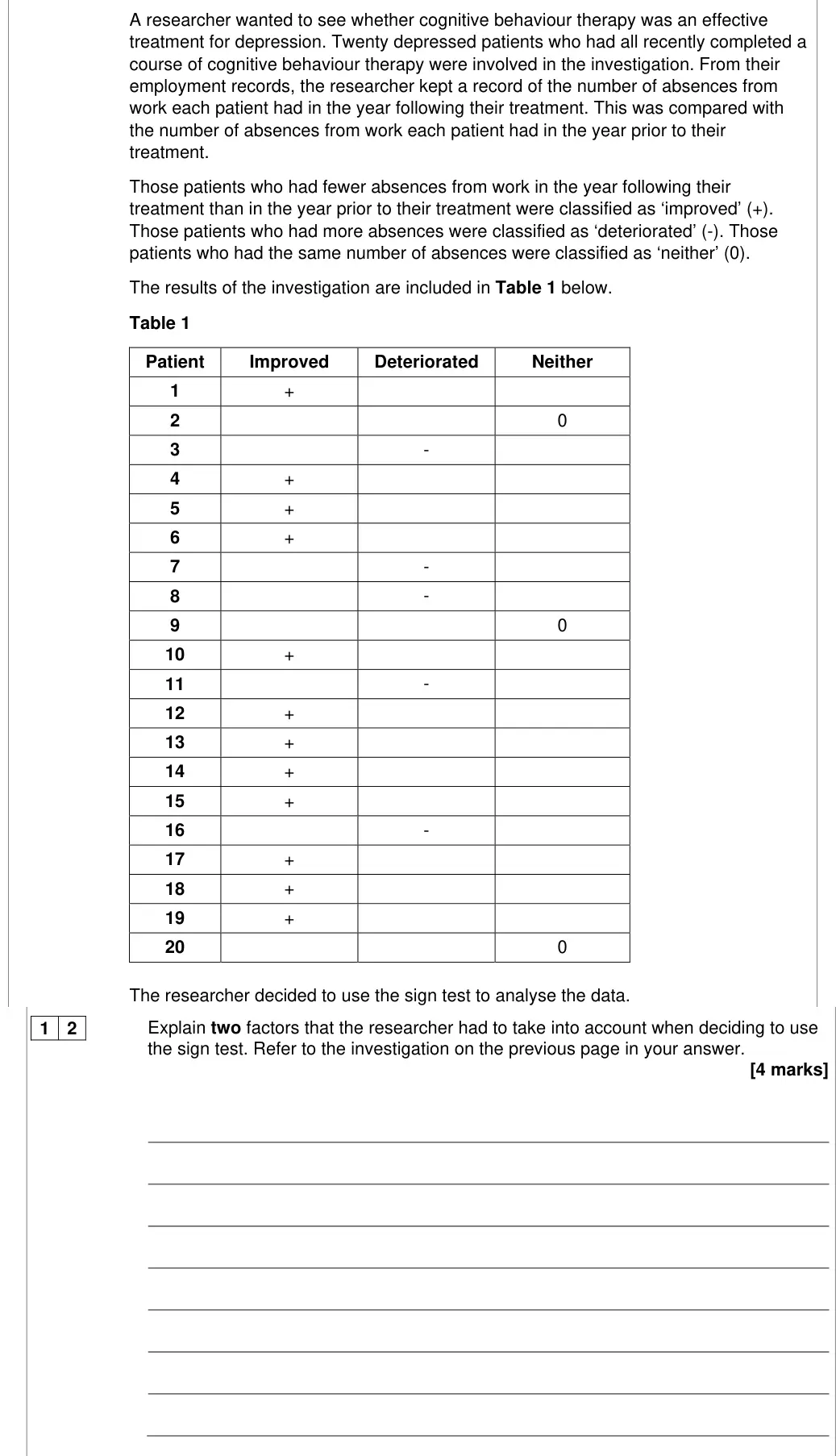
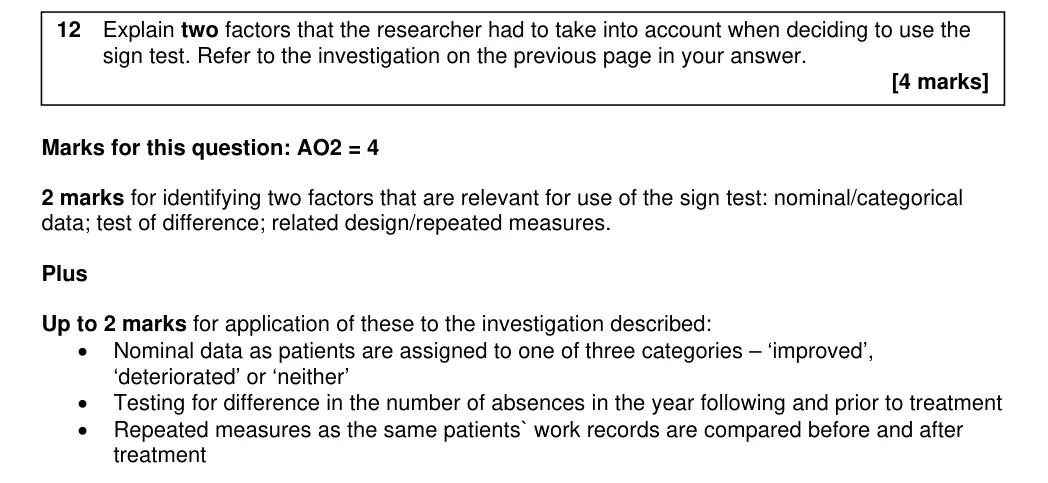
Most students appeared to have little, if any, knowledge of the sign test and thus could not access any marks on this question. The mean as a percentage of the maximum mark for this question was less than 20%. Of those who did appear to have some knowledge, some could only give one reason whilst others failed to apply their reasoning to the study. Very few students were able to give two reasons of why the sign test was appropriate to use in the study with reference to the study itself. This question appeared to demonstrate a general lack of understanding of the sign test and specifically when it should be used.
Notes from the mark scheme and report
test of difference
nominal/categorical data (more/less/same)
repeated measures/related design
must refer to the study
very poorly answered (mean under 20%)
June 2023 · Paper 2 · Q101 markAO2=1Multiple choice
Answer
B
Mark scheme, including level descriptors and indicative content
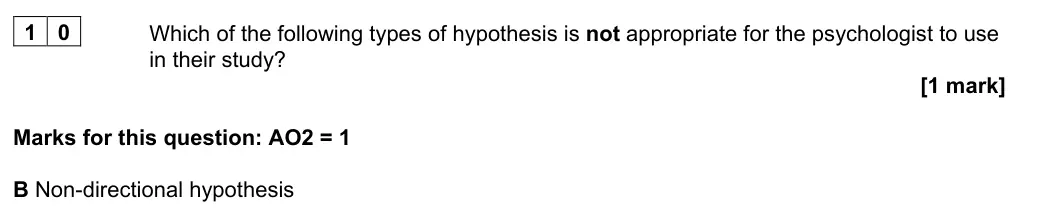
Examiner's comment
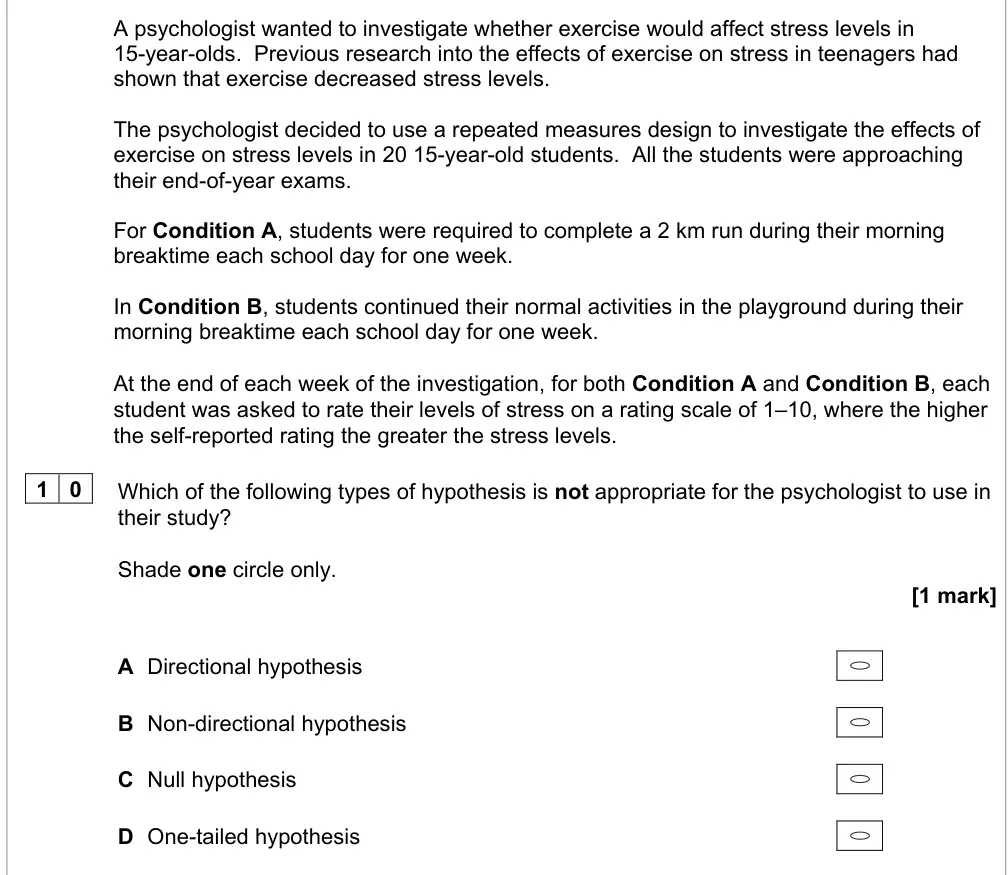
Most students selected the correct response. Although incorrect responses were seen across the three distractors, the most common incorrect response was C (null hypothesis).
Notes from the mark scheme and report
correct answer B (non-directional not appropriate - previous research shows exercise decreases stress)
most common wrong answer C (null)
June 2023 · Paper 2 · Q112 marksAO2=2Research methods
Mark scheme, including level descriptors and indicative content
Examiner's comment
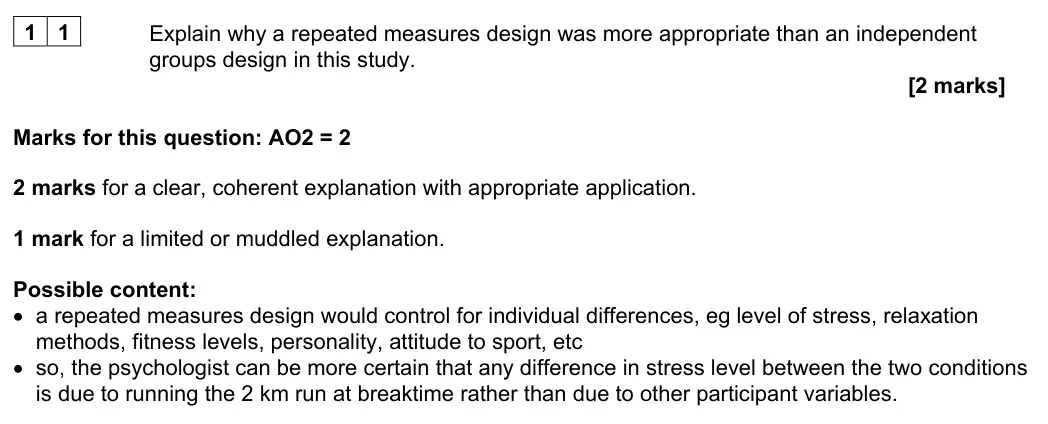
Generally, this question was answered well with most responses stating individual differences were controlled through using a repeated measures design. The factor which prevented around half of these responses achieving full marks was being able to provide appropriate application in the context of the question. Where students achieved full marks, students often gave fitness levels, subjectivity of stress ratings and differences in normal playground activities as applied examples of individual differences. Some students provided muddled responses, for example suggesting a repeated measures design would reduce order effects or there needing to be two groups.
Notes from the mark scheme and report
repeated measures controls participant variables (fitness, baseline stress, attitude to sport) applied to this study
lack of application capped half at 1
claims it reduces order effects
June 2023 · AS Paper 2 · Q122 marksAO3=2Research methods
Mark scheme, including level descriptors and indicative content
Examiner's comment
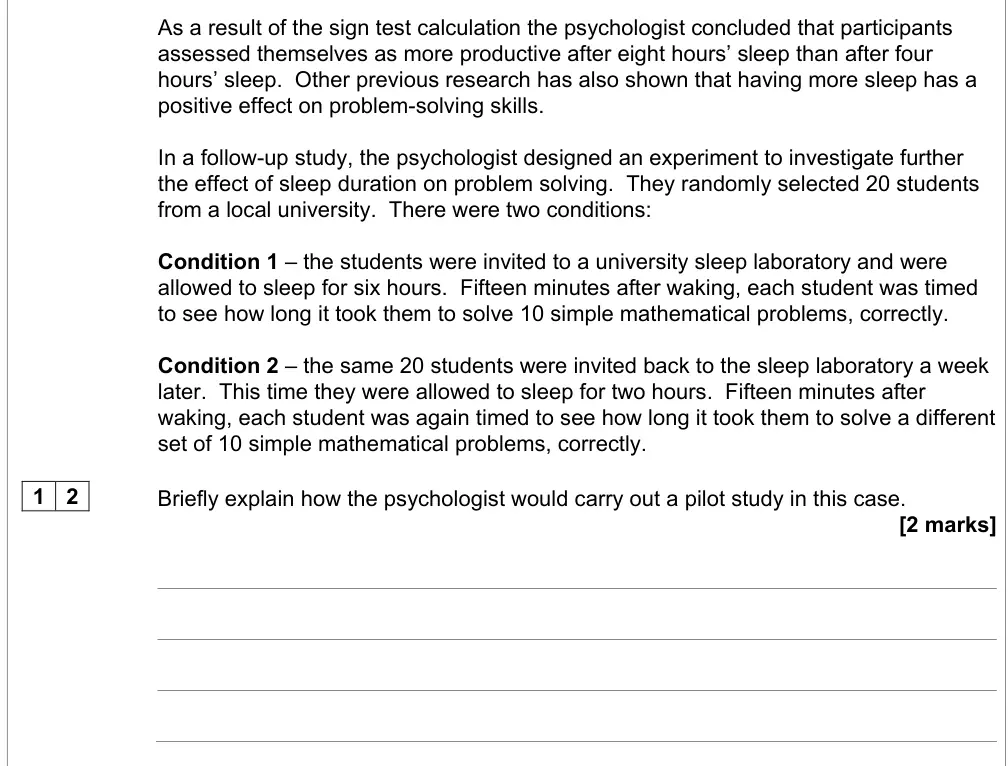
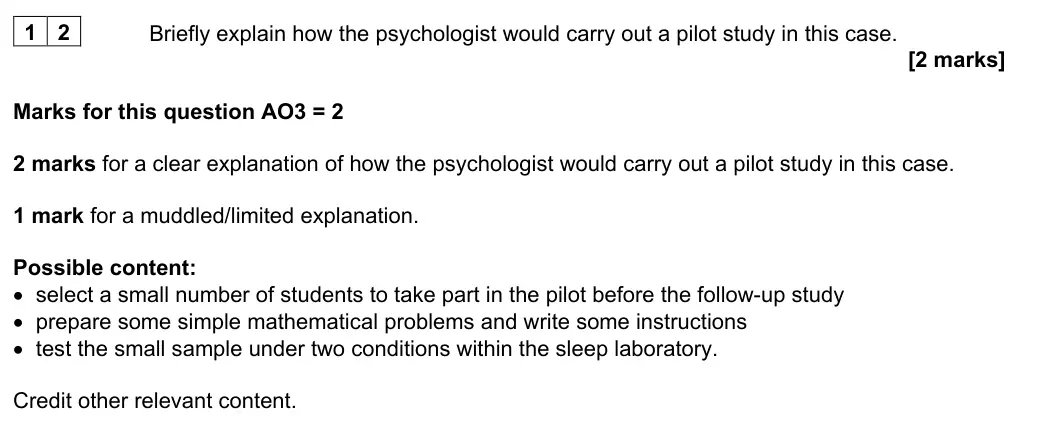
Many students could articulate some explanation of how the psychologist could carry out a pilot study. However, some students did not fully understand the question and instead explained why they should conduct a pilot study rather than how to conduct one. Many students were able to explain some methodology, but others failed to apply it to the study and simply wrote generic statements about ‘carrying it out beforehand with a smaller number of participants’. It is important to remind students to ensure they fully apply their response to the stimulus material where this a requirement of the question.
Notes from the mark scheme and report
how, not why, to pilot: small number of students, prepare problems/instructions, test under both conditions in the sleep lab
generic answers not applied limited
June 2023 · Paper 2 · Q123 marksAO2=3Research methods
Mark scheme, including level descriptors and indicative content
Examiner's comment
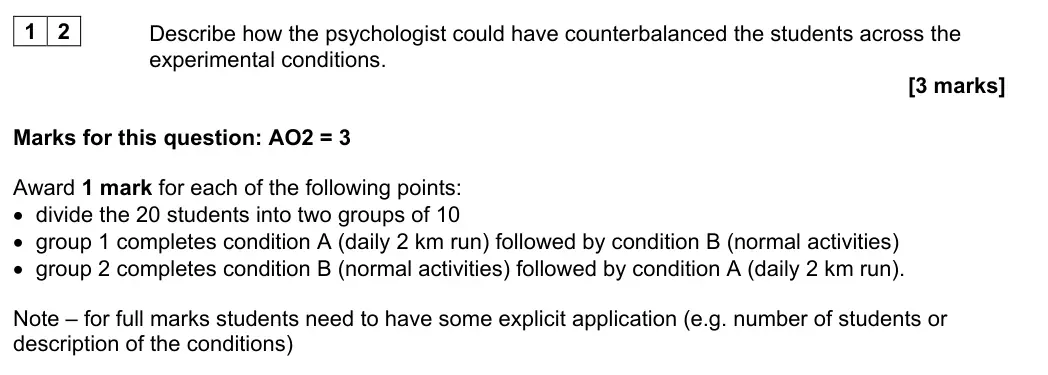
This question was answered well by those students who knew what the term ‘counterbalancing’ meant. A surprising number of students did not know the term, confused it with random allocation or only knew that counterbalancing was a way of dealing with order effects but did not know what it involved. Those who did understand the term generally described all three bullet points on the mark scheme, but some were prevented from achieving full marks due to a lack of explicit application (such as a reference to the number of students or description of the conditions).
Notes from the mark scheme and report
split 20 into two groups of 10, one does A then B, other B then A
explicit application needed for full marks
many did not know the term or confused it with random allocation
June 2023 · AS Paper 2 · Q132 marksAO2=2Research methodsEasy
Mark scheme, including level descriptors and indicative content
Examiner's comment
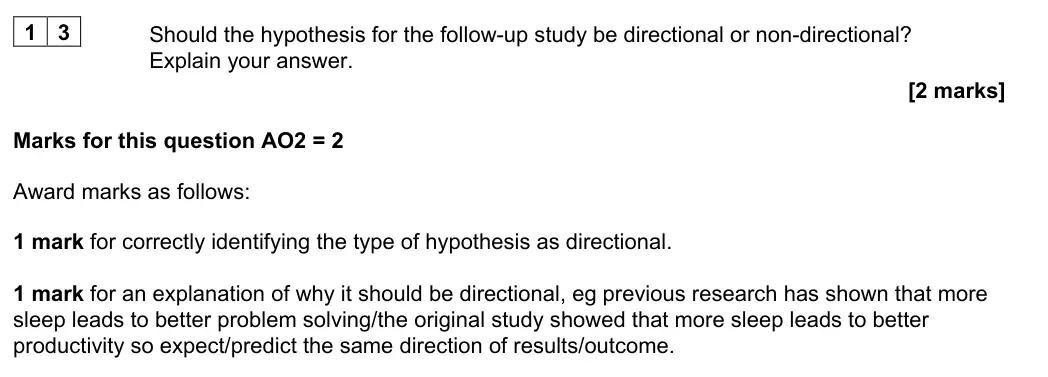
There were many full mark responses to this question. Most students clearly demonstrated an understanding of when directional and non-directional hypotheses should be used. The mean as a percentage of the maximum mark for this question was around 60%. Some students were not awarded the explanation mark as they simply wrote statements such as ‘because there is previous research’. This is not sufficient explanation because this research could be conflicting and students need to be clear here by explicitly stating what the previous research showed.
Notes from the mark scheme and report
directional + explanation stating what previous research showed (more sleep → better problem solving/productivity)
'because there is previous research' alone not credited
June 2023 · Paper 2 · Q134 marksAO2=4Research methods
Mark scheme, including level descriptors and indicative content
Examiner's comment
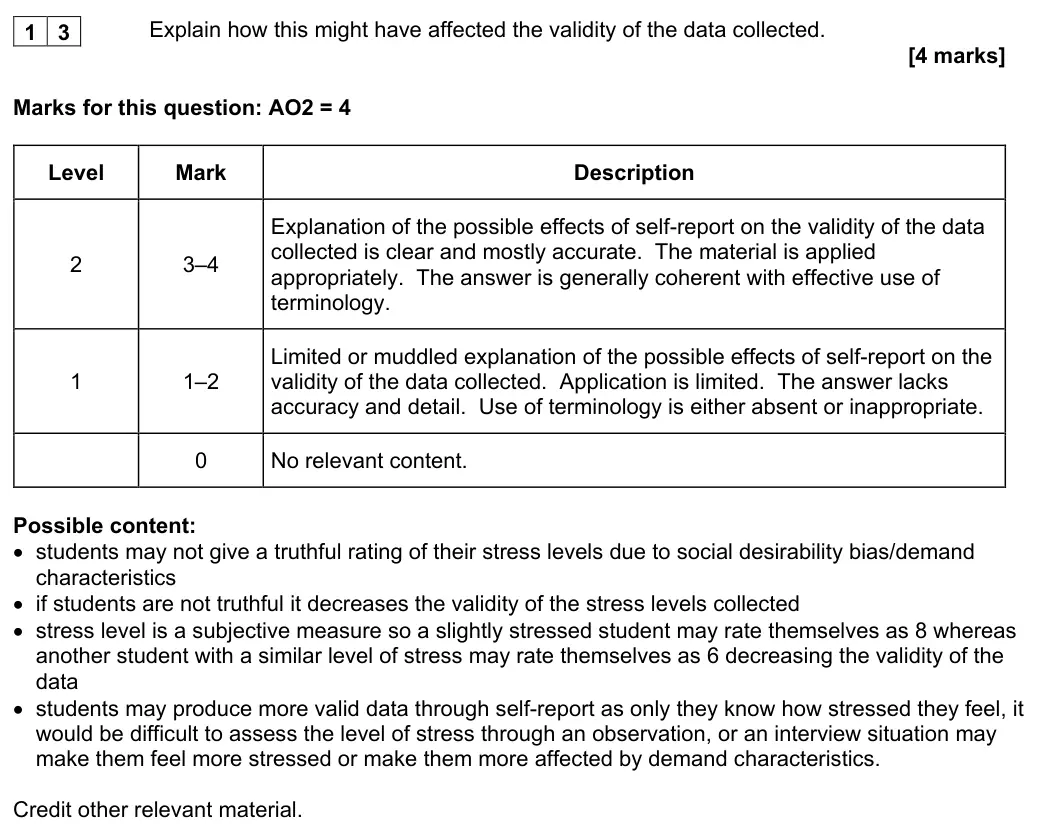
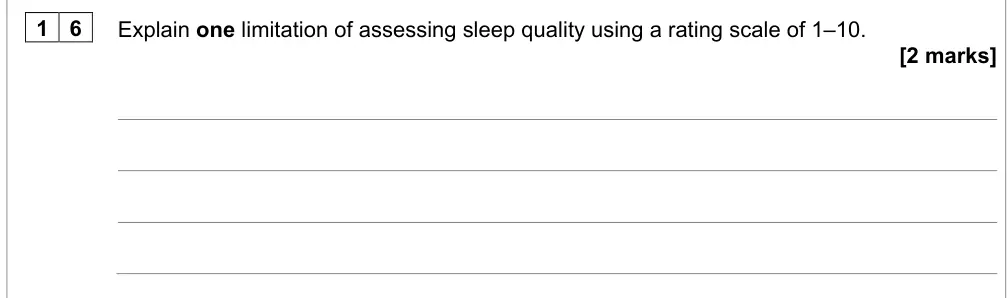
This question was generally well answered and was effective in differentiating between students. Some responses were limited to level 1 due to lack of appropriate context or not discussing the clear impact on validity. Level 2 responses explained how self-reporting stress levels on a scale would affect validity, often discussing subjectivity of the rating system with examples from the question stem. Many also then went on to discuss the impact of social desirability effectively and in context. Overall, the main differentiator was being able to move beyond stating factors which could affect validity (such as demand characteristics, lying, subjectivity, etc) to explain how these would affect validity in the study, using effective examples in context to illustrate their points. There were some creditworthy responses which presented an improvement in validity.
Notes from the mark scheme and report
social desirability/demand characteristics, subjectivity of the 1-10 scale (one student's 8 = another's 6)
possible improvement in validity also credited
stating factors without explaining the effect on validity = level 1
June 2023 · AS Paper 2 · Q143 marksAO2=3Research methodsHard
Mark scheme, including level descriptors and indicative content
Examiner's comment
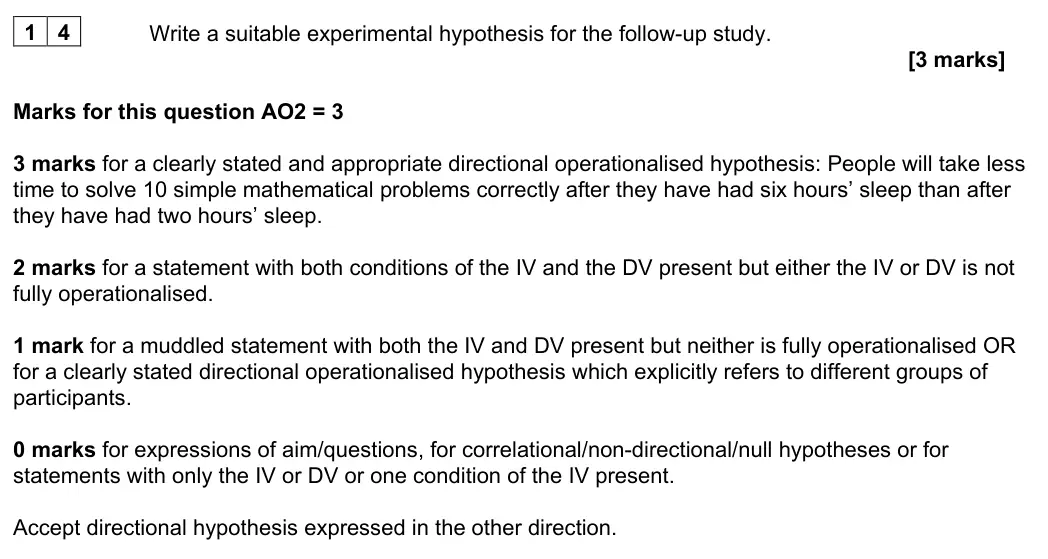
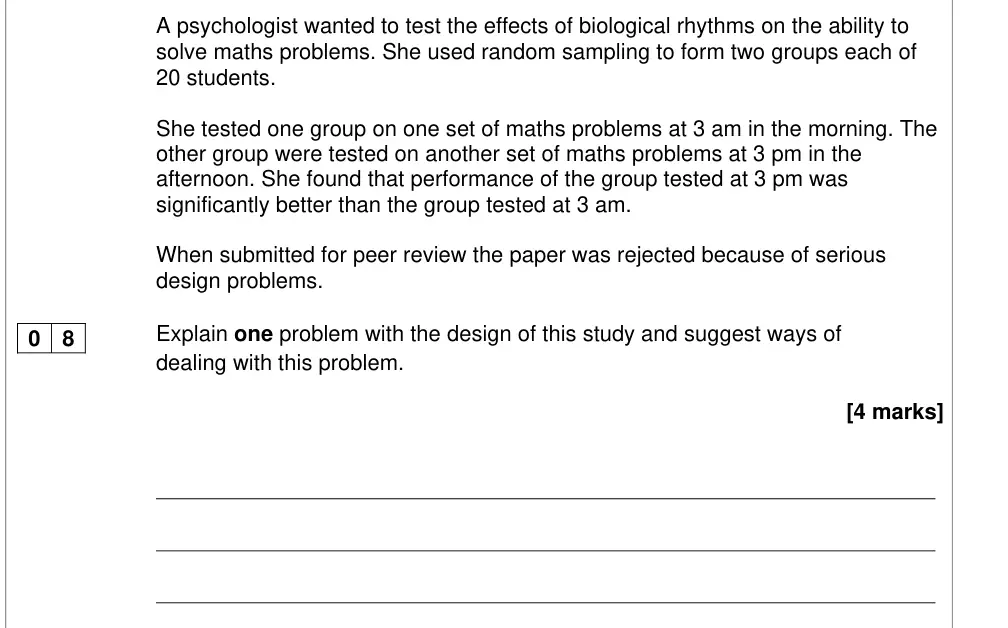
It appears that many students do not seem to have the skills to enable them to write an operationalised experimental hypothesis. The mean as a percentage of the maximum mark for this question was less than 20%. There were many errors made in the responses to this question ranging from some students writing either non-directional or correlational hypotheses, to some writing aims or research questions. Other responses identified an incorrect dependent variable (such as the number of mathematical problems solved) or omitted one of the conditions of the IV and thus were not awarded any marks. When students did write a directional experimental hypothesis, it was often poorly expressed and the independent and/or dependent variable was not operationalised. Common errors included omitting ‘correctly’ from the dependent variable, or confusing the two conditions of the independent variable in the follow-up study with those in the original study. As in question 4, students appear to be making similar mistakes as previous cohorts and it is recommended that they read examiner reports, to learn from these. It is also important that students have sufficient practice at identifying the nature of investigations and writing appropriate hypotheses, so they understand this process fully and can then apply this understanding to a novel situation in an examination setting.
Notes from the mark scheme and report
directional, operationalised: less time to solve 10 simple maths problems correctly after 6 hours vs 2 hours sleep
different groups = max 1
non-directional/correlational/null = 0
common errors: wrong DV (number solved), omitting 'correctly', using conditions of the original study
mean under 20%
June 2023 · AS Paper 2 · Q153 marksAO2=3Research methods
Mark scheme, including level descriptors and indicative content
Examiner's comment
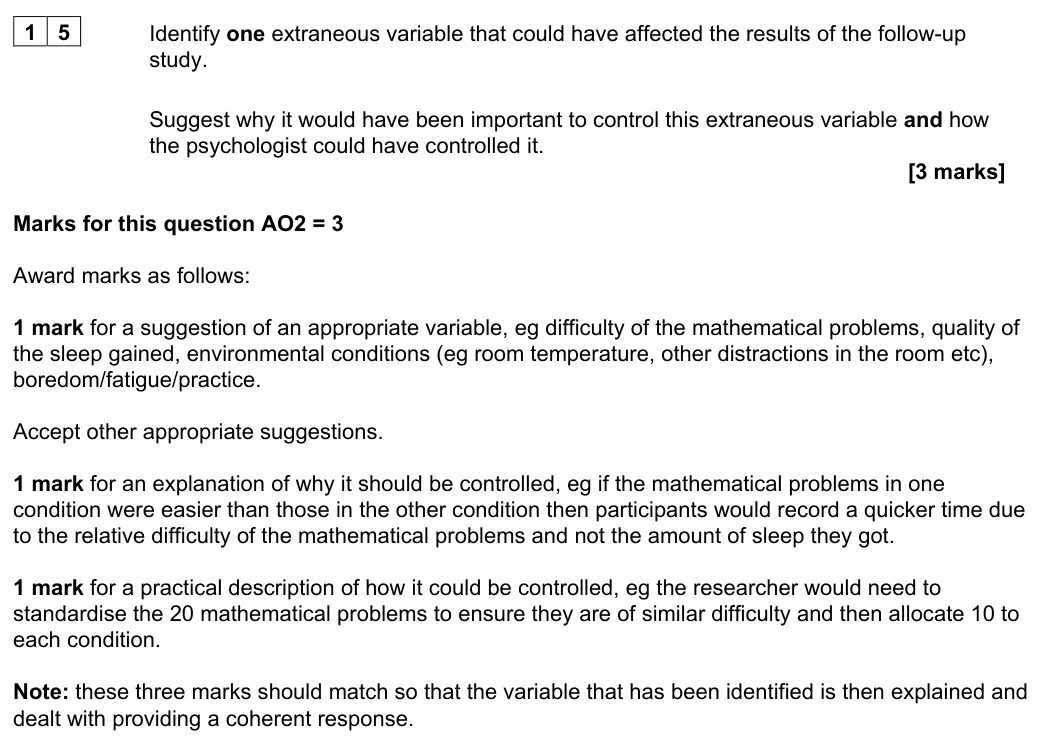
Many students were able to identify an appropriate extraneous variable and give a practical description of how it could be controlled. However, fewer students could explain why it should be controlled. They wrote vague statements about ‘affecting the results’, rather than explicitly explaining how the variable could affect the time taken to correctly complete the mathematical problems. A significant minority of students did not understand that this was a repeated measures design and gave individual differences/participant variables which were almost always incorrect.
Notes from the mark scheme and report
identify EV + why control (explicit effect on time taken) + how to control
three marks must match
repeated measures so participant variables almost always wrong
June 2023 · AS Paper 2 · Q163 marksAO2=3Research methods
Mark scheme, including level descriptors and indicative content
Examiner's comment
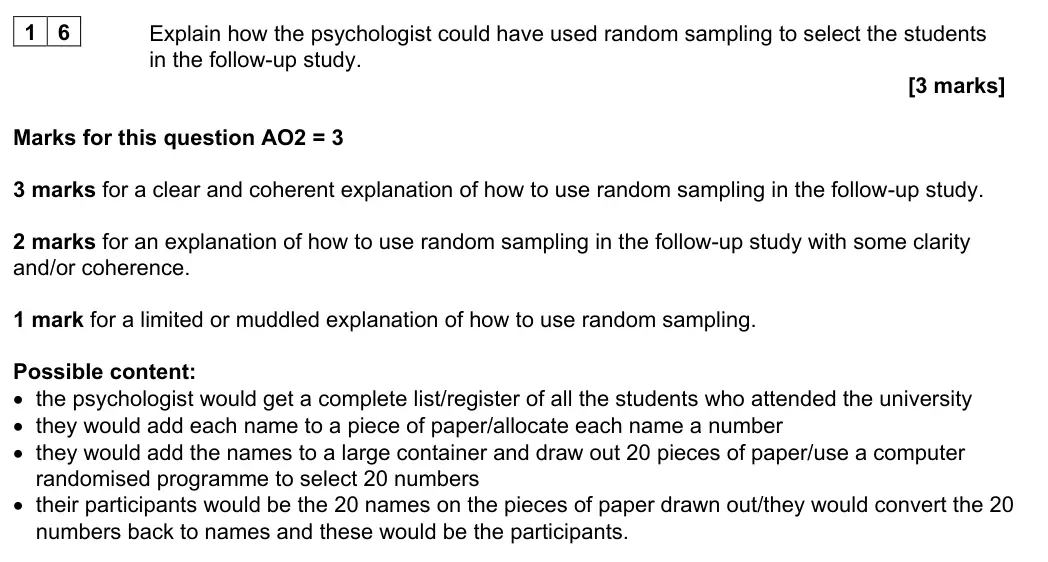
Most students were able to engage with the demands of this question and achieve at least one mark. Most students demonstrated the concept of randomisation of names either through the hat method or random number generator. Fewer students were able to put this into context to the follow-up study. Many omitted the fact that the psychologist would need a list of all the students’ names at the university, whilst others did not include the selection of twenty names to use as the sample. It is important for students to ensure that they fully apply their response to the stimulus material where this is a requirement of the question.
Notes from the mark scheme and report
list of all university students, names/numbers, draw 20 by lottery or random number generator
many omitted the list or selecting twenty
June 2023 · AS Paper 2 · Q172 marksAO2=2Research methods
Mark scheme, including level descriptors and indicative content
Examiner's comment
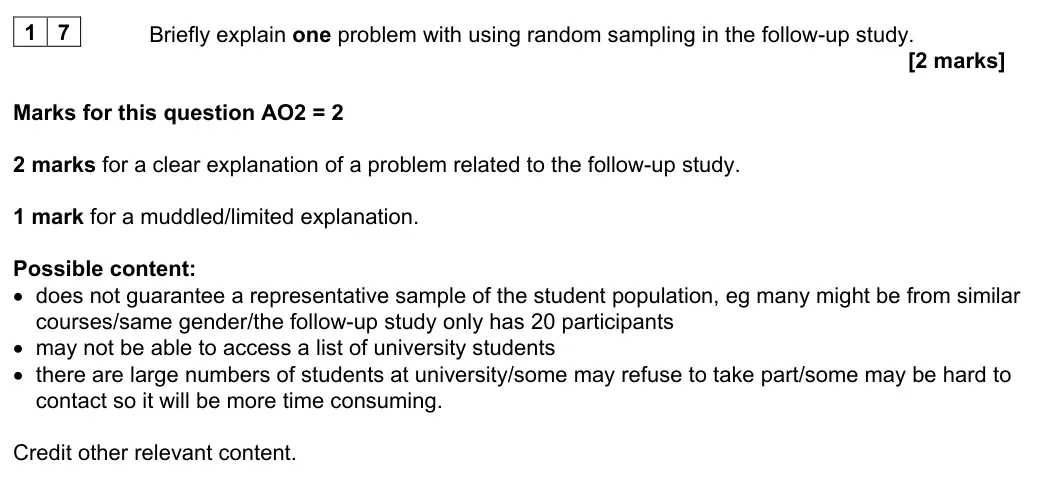
Many students were able to give some explanation of one problem with random sampling, but as with previous questions, many failed to apply their answer to the follow-up study and thus did not fully address the demands of the question. Most students explained a possible problem with representation, but often these were generic statements that were not explicitly about the follow-up study. As with previous questions, it is imperative that students fully apply their response to the stimulus material where this is a requirement of the question.
Notes from the mark scheme and report
problem must relate to the follow-up study (not representative with only 20, access to a list, time consuming, refusals)
generic answers limited
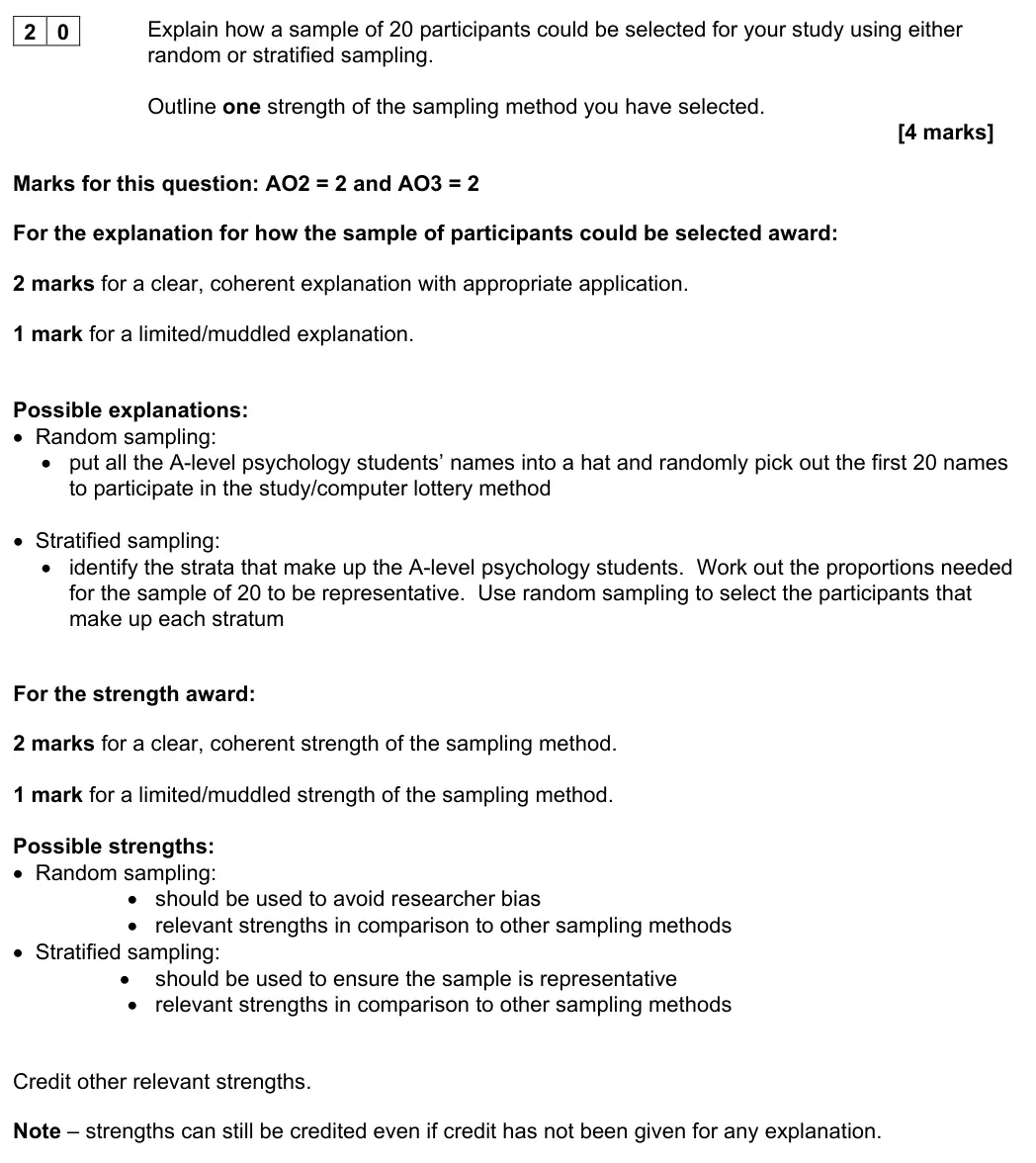
June 2023 · Paper 2 · Q204 marksAO2=2, AO3=2Research methods
Mark scheme, including level descriptors and indicative content
Examiner's comment
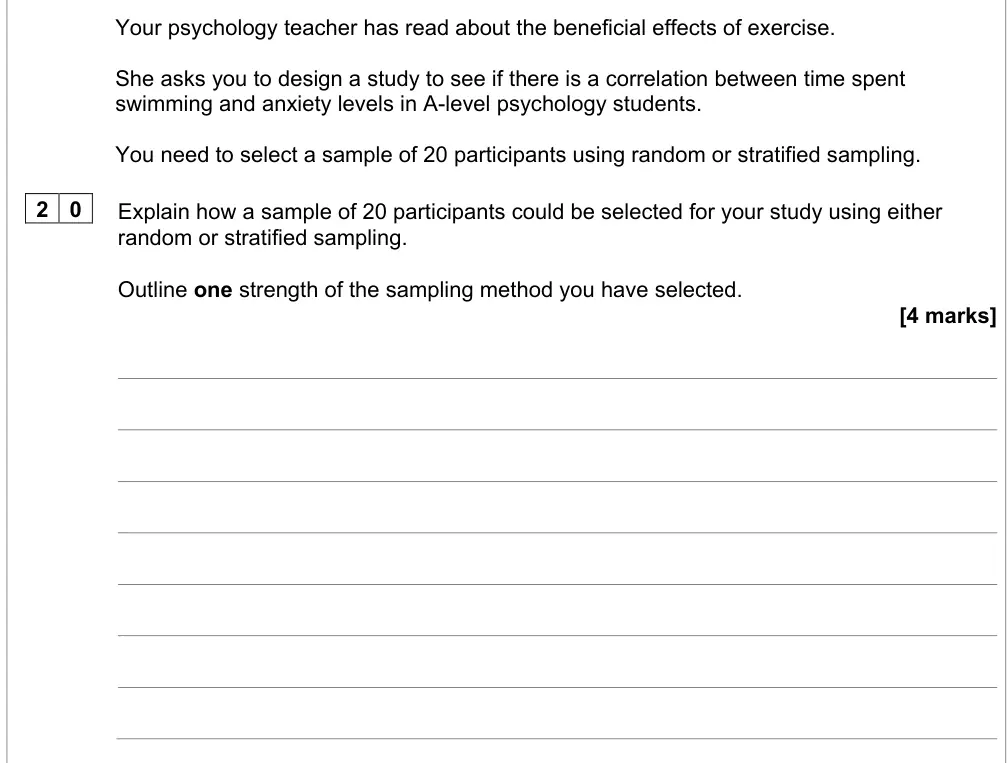
Although a good spread of marks were awarded on this question, it was generally well answered. Most students opted for random sampling. Although there were some good stratified sampling responses seen, often this was not as well answered as those who opted for random sampling. Some confused stratified sampling for systematic sampling, and there was some confusion with random allocation seen. For some, the explanation of how the sample could be selected was limited, most often due to a lack of appropriate application. The strength of the sampling methods was answered well. Overall outlines of the strengths of stratified sampling were better than those of random sampling. Unfortunately, some students failed to address the whole question, only providing an outline of a strength of one of the sampling methods without explaining how a sample could be collected. Students must read an entire question carefully and address all components required.
Notes from the mark scheme and report
how to select 20 A-level psychology students by random (names in hat/computer) or stratified (proportional strata then random) sampling + one strength
strength credited even if explanation not
stratified confused with systematic
confusion with random allocation
June 2023 · Paper 2 · Q214 marksAO2=2, AO3=2Research methodsMedium
Mark scheme, including level descriptors and indicative content
Examiner's comment
This question was generally not well answered. Many missed the instruction to not use self-report to measure anxiety levels, or did not understand the term self-report or that interviews were a form of self-report. However, the anxiety levels covariable was done better than time spent swimming, where a common response was to measure time swimming with a stopwatch, which was not deemed creditworthy in isolation of further detail. Very few gave a detailed enough suggestion to gain maximum marks as they did not identify how the variable could be measured with necessary detail to be practical. Another common error was to create two groups to measure swimming time.
Notes from the mark scheme and report
practical operationalised measures of both co-variables, NOT self-report for anxiety (observation of behavioural signs, pulse/blood pressure)
2 marks each
many used self-report/interviews for anxiety
'stopwatch' alone not credited
creating two groups
June 2023 · Paper 2 · Q232 marksAO1=2Research methods
Mark scheme, including level descriptors and indicative content
Examiner's comment
This question was generally answered well and generated a range of responses. The most common creditworthy answer was to identify errors, so amendments could be made before publishing, increasing quality of published research. Limited reasons were often stated, such as ‘to check for mistakes’, or ‘reduces bias.’ Students found it more challenging to provide appropriate elaboration, although there were some strong responses seen. There were some students who suggested that peer review took place before the study occurred or that it was a way of testing reliability. A number of students simply suggested that it increased validity, with no further explanation.
Notes from the mark scheme and report
e.g. prevents flawed research being published as fact, improves quality via amendments
funding allocation accepted in context
'check for mistakes'/'increases validity' without elaboration limited
peer review wrongly placed before the study
June 2023 · Paper 2 · Q246 marksAO1=6Research methods
Mark scheme, including level descriptors and indicative content
Examiner's comment
This was generally a well answered question with students demonstrating good understanding of ethical issues. The question differentiated between those who could only name ethical issues and those who could fully describe ways of dealing with them. Many students wasted a lot of time describing/justifying their issue rather than following the command word to ‘identify’. Students should know the difference between giving an example of an ethical issue and providing practical ways of dealing with these. Overall, most students were able to identify an ethical issue and give some explanation of dealing with it, although many students lost a mark for each issue by not giving enough detail. Lack of informed consent, confidentiality and deception were common responses. Some identified ‘not having a right to withdraw’ as an ethical issue but then struggled to explain how the issue could be dealt with beyond providing the right to withdraw (which was not creditworthy in isolation for this ethical issue). Some chose to apply the question to specific research such as Milgram, or to the study described in the question stem, but this was not always successful.
Notes from the mark scheme and report
identify two issues (1 each) + how each could be dealt with (2 each): informed consent, deception, protection from harm, confidentiality
over-describing the issue instead of identifying
'right to withdraw' as an issue then 'give right to withdraw' not creditworthy
June 2023 · Paper 3 · Q184 marksAO3=4Research methods
Mark scheme, including level descriptors and indicative content
Examiner's comment
Most students preferred to present one strategy, the double-blind technique, rather than two. However, those that went down this route often lost marks because they failed to explain how this would reduce or eliminate both demand characteristics and investigator effects.
Notes from the mark scheme and report
2 marks for a way to reduce demand characteristics + 2 for investigator effects, applied to the drug/placebo study
single/double-blind, standardisation
if only one strategy (e.g. double-blind) must explain how it reduces BOTH biases
June 2023 · Paper 3 · Q214 marksAO3=4Research methods
Mark scheme, including level descriptors and indicative content
Examiner's comment
Most students preferred to present one strategy, the double-blind technique, rather than two. However, those that went down this route often lost marks because they failed to explain how this would reduce or eliminate both demand characteristics and investigator effects.
Notes from the mark scheme and report
2 marks for a way to reduce demand characteristics + 2 for investigator effects, applied to the appetite-drug/placebo study
if only one strategy (e.g. double-blind) must explain how it reduces BOTH biases
June 2023 · Paper 3 · Q244 marksAO3=4Research methods
Mark scheme, including level descriptors and indicative content
Examiner's comment
Most students preferred to present one strategy, the double-blind technique, rather than two. However, those that went down this route often lost marks because they failed to explain how this would reduce or eliminate both demand characteristics and investigator effects.
Notes from the mark scheme and report
2 marks for a way to reduce demand characteristics + 2 for investigator effects, applied to the stress-drug/placebo study
if only one strategy (e.g. double-blind) must explain how it reduces BOTH biases
June 2023 · Paper 3 · Q284 marksAO3=4Research methods
Mark scheme, including level descriptors and indicative content
Examiner's comment
Most answers included an appropriate ‘way’ - usually changing the design to matched pairs or repeated measures. However, there was often a lack of detail in how this change would control for the problem outlined in the question. As this was a requirement for the top level, many answers ended up being capped at two marks.
Notes from the mark scheme and report
matched pairs (e.g. violent film viewing history), repeated measures with counterbalancing, or random allocation
must explain HOW the change controls participant variables for top level, otherwise capped at 2
June 2023 · Paper 3 · Q334 marksAO3=4Research methods
Mark scheme, including level descriptors and indicative content
Examiner's comment
Most answers included an appropriate ‘way’ - usually changing the design to matched pairs or repeated measures. However, there was often a lack of detail of how this change would control for the problem outlined in the question. As this was a requirement for the top level, many answers ended up being capped at two marks.
Notes from the mark scheme and report
matched pairs (e.g. profiling experience), repeated measures with counterbalancing, or random allocation
must explain HOW the change controls participant variables for top level, otherwise capped at 2
June 2023 · Paper 3 · Q384 marksAO3=4Research methods
Mark scheme, including level descriptors and indicative content
Examiner's comment
Most answers included an appropriate ‘way’ - usually changing the design to matched pairs or repeated measures. However, there was often a lack of detail in how this change would control for the problem outlined in the question. As this was a requirement for the top level, many answers ended up being capped at two marks.
Notes from the mark scheme and report
matched pairs (e.g. gambling history), repeated measures with counterbalancing, or random allocation
must explain HOW the change controls participant variables for top level, otherwise capped at 2
June 2022 · AS Paper 1 · Q7.12 marksAO2=2Research methods
Mark scheme, including level descriptors and indicative content
Examiner's comment
It was pleasing to see that a good number of students had understood the question and focused on experimental design. However, as with previous series, there were still a reasonable number of students that confused the term experimental design with experimental method. Of those who identified the design correctly, only just over half of these students were able to correctly justify their answer. The focus of future students should be on the correct definitions for experimental designs as many justifications were muddled or incomplete.
Notes from the mark scheme and report
independent groups + different participants in each condition
experimental design confused with experimental method
June 2022 · AS Paper 1 · Q7.22 marksAO2=2Research methods
Mark scheme, including level descriptors and indicative content
Examiner's comment
It was pleasing to see that the majority of students could identify the dependent variable (DV). However, not all of them understood how to operationalise it by referring to how it was measured (in metres). As with previous series, a number of students are still confusing the independent variable (IV) and DV and those scoring no marks often gave the IV. It is important that students have sufficient practice at identifying IVs and DV so they understand the difference and can then apply this understanding to a novel situation in an examination setting.
Notes from the mark scheme and report
(estimated) height of thief in metres
without 'metres' = 1 mark
IV and DV confused
June 2022 · AS Paper 1 · Q134 marksAO3=4Explain
Mark scheme, including level descriptors and indicative content
Examiner's comment
Most students were able to give some accurate explanation of at least one way of modifying the strange situation technique to make it more realistic. Many students focused on changing the setting to a more natural environment like the home. However, only a minority of students were able to give two suggestions. Other students incorrectly evaluated the strange situation without giving any modifications. Some suggestions were inappropriate or not focused on modifying the technique. A small minority of students did not attempt the question.
Notes from the mark scheme and report
two modifications to increase realism (home setting/ecological validity, covert observation, repeated observations, different caregivers)
one only = max 2
evaluating without modification not credited
MS rationale for 'different caregivers' cites multiple attachments (removed in v1.4)
June 2022 · Paper 1 · Q174 marksAO2=4Research methods
Mark scheme, including level descriptors and indicative content
Examiner's comment
Similarly, a significant number of students did not attempt Question 17 (interpreting statistical results). Most students who answered this question did reasonably well. There were four marks available, and if any were missed it tended to be because students hadn’t grasped that it was a directional (one-tailed) hypothesis and/or hadn’t identified the correct degrees of freedom. Marks were awarded if there was clear annotation of the critical values table. It is important to note that a significant number of students failed to attempt Questions 15 and 17, potentially indicating a lack of preparation for the statistics element of the exam.
Notes from the mark scheme and report
1 mark significant at 0.05 + 1 each: 0.42 > critical value 0.378, one-tailed because directional hypothesis, df = 18 (N-2)
marks lost for missing one-tailed and/or wrong df
annotation of table credited
June 2022 · Paper 2 · Q94 marksAO2=4Research methods
Mark scheme, including level descriptors and indicative content
Examiner's comment
A number of answers for this question showed knowledge of a controlled observation and standardised script, without recognising the demands of the question being focused on applying knowledge to explain why the researcher used these in the study presented. This lack of explicit and appropriate application limited some students to level 1 of the mark scheme. When a question says, ‘in this study’, students should ensure that their answer is explained in the context of the study described. Overall, students explained why the researcher used a controlled observation better than the use of a standardised script, with a reduction in extraneous variables being a common response.
Notes from the mark scheme and report
why controlled observation (reduces extraneous variables affecting social behaviour) AND standardised script (same greeting, avoids investigator bias) in this study
one element only = max 2
generic knowledge without application = level 1
June 2022 · AS Paper 2 · Q10.13 marksAO2=3Research methods
Mark scheme, including level descriptors and indicative content
Examiner's comment
Many students struggled to write an operationalised non-directional correlational hypothesis. There were many errors made in the responses to this question ranging from some students writing either directional or causal hypotheses, to some writing aims or research questions. When students did write a non-directional correlational hypothesis, it was often poorly expressed with neither co-variable fully operationalised. Many students omitted ‘on a scale from 1 to 10’ for the stress co-variable and ‘from work due to sickness in the previous six months’ for the illness co-variable. It is important that students have sufficient practice at identifying the nature of investigations and writing appropriate hypotheses, so they understand this process fully and can then apply this understanding to a novel situation in an examination setting.
Notes from the mark scheme and report
must be a non-directional correlational hypothesis with both co-variables operationalised (stress 1-10 scale
days absent due to sickness in previous 6 months)
directional/causal/aims = 0
null form accepted
many omitted the operationalisation
June 2022 · AS Paper 2 · Q10.21 markAO2=1Research methodsHard
Mark scheme, including level descriptors and indicative content
Examiner's comment
Most students were able to answer this question correctly and had sufficient knowledge of sampling methods to be able to identify the one used in the study provided. There was some inaccuracy seen and a small minority of students gave responses that lacked precision.
Notes from the mark scheme and report
volunteer/self-selected (advert on noticeboard)
June 2022 · Paper 2 · Q114 marksAO2=4Research methods
Mark scheme, including level descriptors and indicative content
Examiner's comment
This question proved challenging, with many students giving behavioural categories which were not explicitly linked to a child’s interaction with other individuals, eg crying, laughing, etc. Students seemed to struggle to justify why the categories were appropriate. Many gave categories used in Ainsworth’s ‘Strange Situation’, such as separation anxiety and free exploratory play. Most students did not understand that a behavioural category needs to be observable, measurable and specific. Those who did attempt to justify why their chosen categories were appropriate tended to focus on it being a social behaviour or objective.
Notes from the mark scheme and report
two observable categories explicitly about interaction with others (shares toys, talks to another child) + explanation (social, objective, observable, not overlapping)
crying/laughing not social
Strange Situation categories wrongly used
explanation credited even if categories rejected
June 2022 · AS Paper 2 · Q11.33 marksAO2=3Research methods
Mark scheme, including level descriptors and indicative content
Examiner's comment
Many students appeared to have a good understanding of how to obtain informed consent. Most were able to give some outline but better answers addressed both the ‘informed’ and the ‘consent’ components. It is also important that students frame their response in the context of the follow-up study as the question demands.
Notes from the mark scheme and report
must cover both 'informed' (meditation/diet for a week, heart rate measured, right to withdraw) and 'consent' (agreement/signature) with explicit detail of the follow-up study
June 2022 · AS Paper 2 · Q11.46 marksAO3=6Research methods
Mark scheme, including level descriptors and indicative content
Examiner's comment
Most students were able to give an accurate outline of at least one way of changing the design and most responses scored at least 2 marks. Most students seemed to understand the meaning of the term ‘design’ in the question and the most common responses were to change the experimental design to matched pairs or repeated measures. However, a significant minority of students did not frame their answer in the context of the study, which was required for Level 2 and 3 responses. Other students focused incorrectly on the reasons why the design should be changed rather than how it should be changed. For those who chose a matched pairs design, many demonstrated some knowledge of matching participants on some key variable in the experiment. However, fewer students went on to describe the idea of one person from each pair undergoing a different condition of the independent variable (in this case meditation or healthy diet).
Notes from the mark scheme and report
random allocation, matched pairs (one of each pair per condition), repeated measures with counterbalancing
naming only = max 1
must be in context for Level 2/3
many explained why rather than how to change
June 2022 · Paper 2 · Q124 marksAO2=4Research methods
Mark scheme, including level descriptors and indicative content
Examiner's comment
Students struggled with this question due to a poor understanding of what time sampling meant. They missed out on the point of sampling being completed at set time intervals during the five minutes. Many students described time sampling as timing how long a behaviour lasts.
Notes from the mark scheme and report
record behaviour at set intervals (e.g. every 20 s) during the 5 minutes, tick checklist categories, ignore behaviour between intervals
many described timing how long a behaviour lasts
June 2022 · Paper 2 · Q134 marksAO2=4Research methods
Mark scheme, including level descriptors and indicative content
Examiner's comment
Despite struggling on question 12, students were generally able to give a strength and/or limitation of time sampling. Overall students gave more creditworthy limitations than strengths but most responses lacked appropriate application of the strength/ limitation to the observation described. Only the most able students were able to give a clear strength and limitation with appropriate application for the full marks to be awarded and, although few, there were some very good responses seen.
Notes from the mark scheme and report
strength (manageable for frequent ongoing social behaviours) and limitation (behaviours between intervals missed, unrepresentative) applied to the 3-year-olds, 2 marks each
application usually missing
June 2022 · Paper 2 · Q144 marksAO2=4Research methods
Mark scheme, including level descriptors and indicative content
Examiner's comment
This question discriminated well. There was evidence that students understood inter-observer reliability, yet some missed the question requirements of ‘how’, resulting in a lack of necessary detail of the method/process, which limited the marks awarded. Some students focused on improving as opposed to assessing reliability. Most students who addressed the question appropriately covered bullet point three of the mark scheme, regarding comparison of the observers’ tally charts. Bullet points one and two discriminated better due to the requirement for the ‘same’ behavioural categories and the need for ‘independent’ observations to be made.
Notes from the mark scheme and report
same agreed behavioural categories, independent tallies of the same child (or filmed sessions), compare/correlate tallies, +0.8 accepted
no explicit application = max 3
improving rather than assessing reliability
'same' categories and 'independent' observation discriminated
June 2022 · Paper 2 · Q162 marksAO2=1, AO3=1Research methods
Mark scheme, including level descriptors and indicative content
Examiner's comment
This question was generally well answered, although many students were restricted to one mark due to a lack of appropriate elaboration in the context of the study. Additionally, there was some confusion between quantitative and qualitative data with students explaining why collecting qualitative data could reduce the validity of the study.
Notes from the mark scheme and report
quantifying complex contextual social behaviour loses detail (e.g. sarcastic vs friendly smile), reducing validity
lack of contextual elaboration limited to 1
some explained why QUALITATIVE data reduces validity
June 2022 · Paper 2 · Q173 marksAO2=3Research methods
Mark scheme, including level descriptors and indicative content
Examiner's comment
This question was generally well answered, with most students demonstrating a good understanding of possible implications of the study for the economy. Many used additional paper for their answer and gave far more detail than was required for maximum marks, often giving a variety of possibilities. Some students focused their answers on minor financial implications of conducting the study, such as cost of carrying out the study, time off work for parents to participate in the study, etc, rather than the wider implications for society and the economy. These unexpected responses were limited to a maximum of one mark.
Notes from the mark scheme and report
wider implications of findings (parents delaying/returning to work, childcare costs, nursery employment)
focusing on cost of running the study = max 1
June 2022 · Paper 2 · Q183 marksAO1=3Research methods
Mark scheme, including level descriptors and indicative content
Examiner's comment
This question revealed a poor understanding of features of an abstract section in a psychological report and a surprisingly high number of students did not attempt the question. There were some students that confused the abstract with an appendix or with features of science. Other students confused features of an abstract with the purpose of an abstract and wrote about why the abstract is beneficial, rather than what constitutes an abstract. Those who understood what an abstract was generally covered the middle bullet point of the mark scheme (brief/summary), with only a small percentage of students accessing all three marks for this question.
Notes from the mark scheme and report
first section, brief summary (100-300 words), summarises aims, method, results, conclusions - 1 mark each
poorly known, many blanks
confused with appendix or features of science
purpose rather than features
June 2022 · Paper 2 · Q1912 marksAO2=6, AO3=6Extended writing
Mark scheme, including level descriptors and indicative content
Examiner's comment
This question yielded a real spread of marks across the cohort. Students appeared more aware that only material relating to the bullet points would be creditworthy, as answers were more focused this year. Unfortunately, as in previous series, many responses were not practical or not sufficiently explained, eg simply naming the type of design or self-report method of data collection. The requirement for justification differentiated well, with only the best responses giving effective justification in context. Justification was often either missing or generic in nature, with comments such as ‘removes individual differences’ given. Overall, students engaged best with the content on the self-report method of data collection whilst they seemed more challenged to offer a control for an extraneous variable. An extraneous variable was often identified without considering whether it could be appropriately controlled. Consequently, there were lots of impractical suggestions regarding sleep, social interaction or screen time for young children. Many confused experimental design with types of experimental method and some missed the information in the stem about data being collected from the parents using a self-report method. For this type of question, teachers should encourage students to consider why certain experimental designs/methods of data collection are better than others for a given research question and also why certain controls of extraneous variables are needed. Teachers are advised to try to incorporate planning and implementing practical investigations in class where possible. This is to enable students to gain practical experience and deeper understanding of designing experiments, which will help them when answering these types of questions in an examination. However, this may have been more challenging for the cohort this year, given the more limited contact teaching time.
Notes from the mark scheme and report
three elements each justified: experimental design (independent groups/repeated measures/matched pairs), self-report method from parents (questionnaire/interview, question design), control of ONE extraneous variable with why
naming without justification limited
generic 'removes individual differences'
impractical controls (sleep, screen time)
experimental design confused with type of experiment
missed that data come from parents
November 2021 · Paper 1 · Q44 marksAO3=4Research methods
Mark scheme, including level descriptors and indicative content
Examiner's comment
As with 03 it was clear that a significant number of students did not understand the concept of validity as applied to questionnaires. There were many suggestions of alternative experimental designs (matched pairs, counterbalancing, sample size etc), which were not relevant to the question.
Notes from the mark scheme and report
improving validity of a questionnaire: compare with established questionnaire, remove problematic (leading, ambiguous, double-barrelled) items, lie scale
suggestions about study design not creditworthy
common error: alternative experimental designs (matched pairs, counterbalancing, sample size)
November 2021 · Paper 1 · Q137 marksAO2=7Research methods
Mark scheme, including level descriptors and indicative content
Examiner's comment
Overall performance was disappointing, with many students not even attempting this question. There were some excellent answers, and a number of students earned marks for their reasoning even where the incorrect test was identified.
Notes from the mark scheme and report
1 mark Chi-Squared + 3 reasons x 2 marks each linked to the study (difference/association, independent design, nominal data)
test of correlation not creditworthy
reasons credited even if wrong test
only first three reasons marked
many did not attempt
November 2021 · Paper 2 · Q22 marksAO1=2Research methods
Mark scheme, including level descriptors and indicative content
Examiner's comment
Most students understood what was meant by the term ‘ecological validity’, but some explanations were limited. The most common mistake on this question was confusing ecological validity with population validity.
Notes from the mark scheme and report
extent to which behaviour in a study reflects real-world behaviour
most common error confusing ecological with population validity
November 2021 · Paper 2 · Q103 marksAO2=3Research methodsMedium
Mark scheme, including level descriptors and indicative content
Examiner's comment
This question was generally not answered very successfully with very few students achieving all 3 marks. Aims, questions, correlational/null/non-directional hypotheses were frequently seen. The most common error was to give only one condition of the IV. These errors were surprisingly common and may reflect issues with remote learning and lack of practice, which were unique to the cohort in the current series.
Notes from the mark scheme and report
e.g. students rate themselves better rested after seeing good sleep data than poor sleep data
both IV conditions needed
aims, null, correlational or non-directional = 0
very few scored 3
November 2021 · Paper 2 · Q111 markAO2=1Multiple choice
Answer
D
Mark scheme, including level descriptors and indicative content
Examiner's comment
This question was well answered with most students identifying the correct response as D. Incorrect responses were distributed across the three distractors although A was the most common.
Notes from the mark scheme and report
correct answer D (volunteer sampling - advert)
most common wrong answer A (opportunity)
November 2021 · Paper 2 · Q124 marksAO2=4Research methodsMedium
Mark scheme, including level descriptors and indicative content
Examiner's comment
Most students were able to give a strength and a limitation of the sampling method, but the answers overall were very generic with only a very few students achieving full marks for explaining the strength and limitation in the context of the study described. Overall, the limitation was explained better than the strength.
Notes from the mark scheme and report
strength and limitation of volunteer sampling in context (e.g. willing to complete daily questionnaire
only psychology students at one university/volunteer traits)
generic answers limited to 1 each
follow-through from Q11 allowed
November 2021 · Paper 2 · Q142 marksAO2=2Research methods
Mark scheme, including level descriptors and indicative content
Examiner's comment
Students overall demonstrated a strong knowledge and understanding of debriefing and the right to withdraw but were often limited to 1 mark due to a lack of context. Those students who explained a way in which the researcher could deal with the deception involved in the study described achieved full marks for this question.
Notes from the mark scheme and report
full debrief revealing the manipulated sleep data + right to withdraw data, in context
lack of context limited many to 1 mark
November 2021 · Paper 2 · Q152 marksAO2=2Research methods
Mark scheme, including level descriptors and indicative content
Examiner's comment
This question was generally not answered well, with most students achieving only one of the two available marks. Most students identified demand characteristics but often did not elaborate, resulting in a limited 1 mark response. Some students did not appear to have fully read the question, specifically that these responses were not analysed, as it was common to say that these additional questions will provide more detail.
many ignored that the extra responses were NOT analysed ('more detail')
November 2021 · Paper 2 · Q162 marksAO2=2Research methods
Mark scheme, including level descriptors and indicative content
Examiner's comment
This was generally a well answered question with most students able to explain one limitation of using a rating scale. The most common reason for not achieving full marks was due to a lack of context, where students did not explain the limitation in the context of the study.
Notes from the mark scheme and report
rating of restedness is subjective/interpreted differently, cannot explain rating
lack of context limited marks
November 2021 · Paper 2 · Q174 marksAO3=4Research methodsMedium
Mark scheme, including level descriptors and indicative content
Examiner's comment
There was a real spread of marks across the cohort for this question with very few students achieving full marks. This was either due to not answering the question set (all three components) or giving inappropriate extraneous variables (such as the actual number of hours slept or individual differences). Students should be reminded when answering questions such as this to note the experimental design procedures used in the study to ensure their answers are appropriate.
Notes from the mark scheme and report
suggest an EV (e.g. delay before answering questionnaire, caffeine/alcohol), why it matters, how to control - all three components
number of hours slept not credited
participant variables inappropriate as it is repeated measures
November 2021 · Paper 2 · Q193 marksAO2=3Research methods
Mark scheme, including level descriptors and indicative content
Examiner's comment
The modal mark for this question was three; students generally showed a good understanding of random sampling, however there was a full range of marks awarded across the cohort. Students often lost marks for giving a generic description as opposed to contextualising their answers to the study presented. Some students muddled random sampling with systematic or gave descriptions of stratified sampling and a few gave evaluation rather than a description of the method.
Notes from the mark scheme and report
list all first-year students, names in hat/random generator, select until 18 chosen (1 mark each)
generic answers lost marks
muddled with systematic or stratified
November 2021 · Paper 2 · Q258 marksAO1=3, AO2=3, AO3=2Extended writing
Mark scheme, including level descriptors and indicative content
Examiner's comment
This question differentiated well. Unfortunately, too many students did not attempt this question, either due to timing issues or due to gaps in knowledge. Although the full range of marks was accessed across the cohort, the mean mark awarded for this question was 2 out of the 8 marks available. Students who had learned and understood the features of science generally attained high marks. Most students were able to apply knowledge to examples of psychological research but sometimes there were lengthy descriptions of psychological research which were poorly linked to the question. Overall knowledge and understanding of features of science was limited. Lower attaining students often described the scientific method with some psychological research but tended to lose focus and a number identified ethics as a feature of science. Replicability was the most commonly identified feature of science but often this was muddled with an assessment of reliability and validity, losing focus and not scoring well. Some students described the emergence of psychology as a science, rather than the features of science. Whilst this is an unusual cohort, it is worth noting that overall students may need more support to learn the features of science, developing their understanding through discussion of psychological research.
Notes from the mark scheme and report
objectivity/empirical method, replicability/falsifiability, theory construction/hypothesis testing, paradigms with examples of research (e.g. Freud unfalsifiable, cognitive revolution)
mean mark 2/8
ethics wrongly given as a feature of science
replicability muddled with reliability/validity
some described the emergence of psychology as a science (removed in v1.4) instead
November 2021 · Paper 3 · Q24 marksAO1=2, AO2=2Research methods
Mark scheme, including level descriptors and indicative content
Examiner's comment
Performance on Q02 was rather poorer than anticipated with very few full-mark responses. Students had difficulty explaining the term with many just re-arranging the wording of the question. Many students failed to realise the problem of having two observers and thus failed to grasp the essential point of the second part of the question.
Notes from the mark scheme and report
definition: list of operationalised/observable behaviours to tally
explanation must use the TWO observers: consistent recording/inter-observer reliability, less subjective
many just rearranged the question wording and missed the two-observer point
November 2021 · Paper 3 · Q34 marksAO3=4Research methods
Mark scheme, including level descriptors and indicative content
Examiner's comment
Q03 was usually well answered although understanding of validity was mostly implicit rather than explicit.
Notes from the mark scheme and report
1 mark each for two observable friendly behaviours (sharing, holding hands, talking) + 2 marks for why more valid (face validity
Table 1 'near to' behaviours have no friendly element)
validity understanding usually only implicit
November 2021 · Paper 3 · Q251 markAO3=1Multiple choice
Answer
B
Mark scheme, including level descriptors and indicative content
Examiner's comment
It was pleasing to see how many students answered the multiple-choice question correctly.
Notes from the mark scheme and report
correct B (fully operationalised variables)
generic RM item repeated in each Option 3 topic
November 2021 · Paper 3 · Q301 markAO3=1Multiple choice
Answer
B
Mark scheme, including level descriptors and indicative content
Examiner's comment
It was pleasing to see how many students answered the multiple-choice question correctly.
Notes from the mark scheme and report
correct B (fully operationalised variables)
November 2021 · Paper 3 · Q351 markAO3=1Multiple choice
Answer
B
Mark scheme, including level descriptors and indicative content
Examiner's comment
It was pleasing to see how many students answered the multiple-choice question correctly.
Notes from the mark scheme and report
correct B (fully operationalised variables)
November 2020 · AS Paper 1 · Q24 marksAO3=4Evaluate (short)
Mark scheme, including level descriptors and indicative content
Notes from the mark scheme and report
ethical issues excluded
methodological evaluation of lab experiment (control, replicability, causal conclusions vs artificiality/mundane realism, demand characteristics, sample bias)
one point in detail or several in less detail
November 2020 · Paper 1 · Q33 marksAO2=3Research methods
Mark scheme, including level descriptors and indicative content
Examiner's comment
This was not done well. ‘Replicability’ was most popular, though some answers confused it with actual replications. Most students understood the importance of standardised procedures, but a significant number did not contextualise their answer. There were some good answers on ‘hypothesis testing’, though again occasionally lacking sufficient elaboration or clarity for full marks. There were few responses on ‘theory construction’. At the lower end there were indications of lack of preparation and coverage of the Specification (e.g. Q13), while research methods questions were on the whole not done well (e.g. 03, 07).
Notes from the mark scheme and report
explicit contextualisation to Asch needed for 3 marks: replicability (standardised procedures), theory construction (normative social influence), hypothesis testing (IV/DV)
replicability confused with actual replications
done poorly
November 2020 · AS Paper 1 · Q3.14 marksAO2=4Research methods
Mark scheme, including level descriptors and indicative content
Notes from the mark scheme and report
must be written verbatim as a consent form (else max 3)
no detail of procedure and no request for agreement = max 1
include group interview on homework policy, right to withdraw, confidentiality
November 2020 · AS Paper 1 · Q3.22 marksAO2=2Research methods
Mark scheme, including level descriptors and indicative content
Notes from the mark scheme and report
subgroups represented in proportion to the school population -> better generalisation
November 2020 · AS Paper 1 · Q5.32 marksAO3=2Research methods
Mark scheme, including level descriptors and indicative content
Notes from the mark scheme and report
repeated measures design -> order effects (practice/fatigue)
half do conditions in each order so effects balance out
November 2020 · Paper 1 · Q61 markAO3=1Research methods
Mark scheme, including level descriptors and indicative content
Notes from the mark scheme and report
e.g. no order effects, fewer demand characteristics
November 2020 · AS Paper 2 · Q4.32 marksAO3=2Research methods
Mark scheme, including level descriptors and indicative content
Notes from the mark scheme and report
matched pairs (ability, standard of work, not age), repeated measures, or random allocation to groups
November 2020 · Paper 2 · Q82 marksAO2=2Research methods
Mark scheme, including level descriptors and indicative content
Examiner's comment
Whilst nearly all students were able to give one limitation of self-report, many of these were limited and generic. Better answers tended to focus on the subjectivity of pain although there were also some nice answers on social desirability.
Notes from the mark scheme and report
limitation linked to the Zapurpain survey: social desirability or subjectivity of pain
generic answers limited
November 2020 · AS Paper 2 · Q122 marksAO2=2Research methods
Mark scheme, including level descriptors and indicative content
Notes from the mark scheme and report
1 mark non-directional + 1 mark previous research is contradictory
November 2020 · Paper 2 · Q121 markAO1=1Multiple choiceHard
Answer
B
Mark scheme, including level descriptors and indicative content
Examiner's comment
Overall, students seemed to be challenged by this question, with only a third of students identifying the correct response. Although all the distractors functioned well, C was the most common incorrect response.
Notes from the mark scheme and report
correct answer B (abstract, results and discussion)
only a third correct
most common wrong answer C
November 2020 · AS Paper 2 · Q132 marksAO2=2Multiple choice
Answer
B and D
Mark scheme, including level descriptors and indicative content
Notes from the mark scheme and report
correct answers B (event sampling) and D (naturalistic observation)
distractors controlled observation, natural experiment, random sampling
November 2020 · AS Paper 2 · Q142 marksAO2=2Research methods
Mark scheme, including level descriptors and indicative content
Notes from the mark scheme and report
students unaware they are watched so cannot change behaviour, so behaviour is natural
November 2020 · AS Paper 2 · Q162 marksAO3=2Research methods
Mark scheme, including level descriptors and indicative content
Notes from the mark scheme and report
open questions give detailed insight into reasons, ideas for further research, less frustrating than forced choice
November 2020 · Paper 2 · Q172 marksAO2=2Multiple choice
Mark scheme, including level descriptors and indicative content
Examiner's comment
The modal mark for this question was zero due to a surprising number of students struggling to follow the instructions to place one tick in each column. It was sadly common to see ticks in every row. Overall, students seemed to struggle more with identifying the population than the sample.
Notes from the mark scheme and report
population = all Year 5 pupils in the county
sample = the 58 pupils with parental consent
modal mark 0 - many ticked every row
population harder than sample
November 2020 · AS Paper 2 · Q184 marksAO2=4Research methods
Mark scheme, including level descriptors and indicative content
Notes from the mark scheme and report
e.g. anonymity/confidentiality on CCTV and questionnaire, consent and privacy in a public place, withdrawal and debriefing
one issue only = Level 1
November 2020 · Paper 2 · Q181 markAO2=1Research methodsMedium
Mark scheme, including level descriptors and indicative content
Examiner's comment
It was surprising that the modal mark for this question was zero. Unfortunately, a lot of students just defined what a directional hypothesis was or gave the conclusion of the study. Just under half of the responses managed to correctly explain that there was past research indicating that recreational screen time would reduce academic performance.
Notes from the mark scheme and report
past research suggests screen time harms academic performance
modal mark 0 - many just defined a directional hypothesis
November 2020 · AS Paper 2 · Q194 marksAO1=2, AO3=2Research methods
Mark scheme, including level descriptors and indicative content
Notes from the mark scheme and report
2 marks operationalisation (clearly defining observable behaviours so they can be measured objectively) + 1 each for two observable behaviours (making notes, using a laptop, reading a book)
November 2020 · Paper 2 · Q193 marksAO2=3Research methods
Mark scheme, including level descriptors and indicative content
Examiner's comment
Despite having just explained the use of a directional hypothesis in question 18, many then went on to write a correlational hypothesis or non-directional hypothesis and thus failed to achieve any marks for this question. Those who wrote a directional hypothesis were generally able to operationalise the dependent and independent variables, although some still used ‘Group A’ and ‘Group B’ to describe conditions of the independent variable and some hypotheses were muddled.
Notes from the mark scheme and report
operationalised DIRECTIONAL hypothesis (no screen time -> higher class test scores than unrestricted screen time)
correlational or non-directional = 0
'Group A/B' as IV conditions loses a mark
November 2020 · Paper 2 · Q234 marksAO2=4Research methods
Mark scheme, including level descriptors and indicative content
Examiner's comment
This question differentiated well, with some clear and contextualised explanations detailing the whole process and others providing partial answers or muddling up the process or purpose of matching. This is an area teachers would be well advised to check understanding as although it may appear a simple process many students fail to grasp the key elements. Those who did understand the process and could describe it in context, generally covered the first 3 bullet points with only a few covering the final bullet point.
Notes from the mark scheme and report
measure typical screen time (questionnaire/parents), example question, pair similar pupils, randomly allocate one of each pair to each group
final random allocation step rarely given
purpose of matching muddled
November 2020 · Paper 2 · Q242 marksAO2=2Research methods
Mark scheme, including level descriptors and indicative content
Examiner's comment
This question was generally well answered with most students identifying academic ability/IQ/sleep as an appropriate variable. Those who did not achieve 2 marks for this question generally failed to explain how the variable identified would have affected test performance if it was not controlled.
Notes from the mark scheme and report
other participant variable (e.g. academic ability, sleep) + how it would affect test performance if uncontrolled
second mark often missed
November 2020 · Paper 2 · Q2512 marksAO2=6, AO3=6Extended writing
Mark scheme, including level descriptors and indicative content
Examiner's comment
Responses to this question generally showed a sound understanding of different types of observations and the rationale for choosing these as well as knowledge of key ethical issues. However, the responses also demonstrated that students are still struggling to understand what time and event sampling are. It was rare to see time sampling explained accurately and students often referred to sampling methods (e.g. opportunity sampling) rather than time/event sampling. Students often described a range of potential ethical issues whereas the question required them to detail how they would deal with one relevant ethical issue. Those who correctly addressed this bullet point tended to focus on requiring parental/guardian consent, but this was often merely stated with generic justification rather than providing practical detail of how to deal with the ethical issue. Reliability was tackled with mixed success. Some students had an excellent understanding of inter- observer reliability, detailing a practical explanation of how reliability of the data could be assessed through inter-observer reliability. However, there were also too many students who did not seem to understand the procedure and some suggested repeating the study at different times. Some answers also focussed on how to improve inter-observer reliability rather than how it would be assessed. Overall, there is little evidence that students are engaged in or completing their own practical work. Responses generally consisted of a plethora of relevant key terms that were not applied appropriately and generic justifications rather than practical details. With more practical experience and less rote learning of theoretical concepts, students would be far less likely to confuse the alternative sampling terms. Teachers should be encouraged to deliver as much of the research studies content as practically as possible in order to develop the skills their students require to tackle design questions and even for students’ potential further study in this field.
Notes from the mark scheme and report
four elements each justified: observation type, time OR event sampling, dealing with ONE ethical issue (e.g. parental consent), assessing inter-observer reliability (two observers, correlate tallies)
time sampling rarely accurate, confused with participant sampling methods
listing many ethical issues
improving rather than assessing reliability
repeating the study at different times
November 2020 · Paper 3 · Q416 marksAO1=6, AO2=4, AO3=616-mark essay
Mark scheme, including level descriptors and indicative content
Examiner's comment
The question on reductionism was not one that students could have pre-prepared with the result that performance tended to be quite limited. Many answers confused reductionism with determinism and/or reductionism with the nomothetic approach. References to objectivity and empiricism were sometimes sprinkled around without any real application. Better answers could offer specific examples of reductionist research and explain how they involved the empirical study of objective evidence. Quite a few answers were simply pre-learned responses on the holism versus reductionism debate.
Notes from the mark scheme and report
must link reductionism to objectivity/empiricism (neurotransmitter levels, S-R units, MSM experiments)
levels of explanation, biological and environmental reductionism
holism as counterpoint
November 2020 · Paper 3 · Q72 marksAO3=2Research methods
Mark scheme, including level descriptors and indicative content
Examiner's comment
Answers to the next question often showed misunderstanding with the suggestion that the participants themselves should choose the pictures/descriptions.
Notes from the mark scheme and report
independent person/panel blind to the aim selects descriptions + removes investigator/researcher bias, increases validity
November 2020 · Paper 3 · Q122 marksAO3=2Research methods
Mark scheme, including level descriptors and indicative content
Examiner's comment
Answers to the next question often showed misunderstanding with the suggestion that the participants themselves should choose the pictures/descriptions.
Notes from the mark scheme and report
independent person/panel blind to the aim selects pictures + removes investigator bias, increases validity
November 2020 · Paper 3 · Q172 marksAO3=2Research methods
Mark scheme, including level descriptors and indicative content
Examiner's comment
Answers to the next question often showed misunderstanding with the suggestion that the participants themselves should choose the pictures/descriptions.
Notes from the mark scheme and report
independent person/panel blind to the aim selects pictures + removes investigator bias, increases validity
June 2019 · Paper 1 · Q34 marksAO2=4Research methods
Mark scheme, including level descriptors and indicative content
Examiner's comment
Exceptions were question 3, where a significant minority of answers demonstrated a lack of understanding of statistics and experimental design, and question 10, on economic implications of research into the role of fathers in attachment. To achieve full marks students had to identify the chi square test as a test of difference for nominal/categorical data using an independent/unrelated design. As marks were awarded for identifying the reasons correctly even if the wrong test was named, most students did reasonably well on this question. However, a significant minority did poorly, referring for example to correlations, interval data, related design, sign test or t-test etc, reflecting a weak understanding of statistics and experimental design.
Notes from the mark scheme and report
chi-squared + test of difference/association, nominal data (smoker/non-smoker), independent groups
reasons credited even if wrong test named
first three reasons only
June 2019 · AS Paper 1 · Q4.13 marksAO2=3Research methods
Mark scheme, including level descriptors and indicative content
Examiner's comment
Question 04.1 Students were required to operationalise the independent variable and dependent variable in order to score full marks. The most challenging element of this appeared to be correctly operationalising the dependent variable. In this question the operationalised dependent variable was ‘number of people who conformed’. However, many students wrote either ‘conformity rate’ or ‘conformity was more likely’, both of which were an incorrect operationalisation. This resulted in few answers achieving full marks. Many answers received no credit because they either wrote a correlational hypothesis, a non-directional hypothesis or an aim.
Notes from the mark scheme and report
DV operationalised as 'number of people who conform' (not 'conformity rate')
non-directional, correlational hypotheses or aims = 0
June 2019 · AS Paper 1 · Q4.23 marksAO2=3Research methods
Mark scheme, including level descriptors and indicative content
Examiner's comment
Question 04.2 Students were still confused about the term ‘experimental design’, often thinking it referred to conducting a field or laboratory experiment. Some students only answered the first part of the question, and many of those that did give an advantage of the design were unable to link this advantage to the stem of the question. Students often chose to use ‘reduced order effects’ or ‘fewer demand characteristics’ as their advantage but the explanation given did not make it clear why this would have been an advantage in this study. This question was left blank by more students than any other question on the paper.
Notes from the mark scheme and report
independent groups + advantage applied to this study (order effects, demand characteristics, same materials)
many confused 'experimental design' with lab/field
most-often blank question
June 2019 · Paper 1 · Q58 marksAO1=3, AO3=5Extended writing
Mark scheme, including level descriptors and indicative content
Examiner's comment
Similarly, in question 5 there were many excellent outlines describing ethical issues in social influence research, but a frequent failure to discuss them. This question was not generally done well. Students tended to focus too much on describing actual ethical issues, which were often given in overwhelming detail, and not enough on discussing various relevant aspects. The most popular issues covered included deception/lack of consent, protection from harm and right to withdraw. There were a variety of aspects to discuss. These included the need for deception to prevent demand characteristics and improve the validity of studies; presumptive or retrospective consent; debriefing and psychological support after the study; the social/cultural significance of findings (cost-benefit analysis); the positive impact on ethical approaches in psychology, etc.
Notes from the mark scheme and report
no sustained engagement with social influence research = max Level 2
deception (Asch, Milgram), protection from harm, right to withdraw
discussion via cost-benefit, validity, debriefing, historical guidelines
most over-described issues with too little discussion
MS also credits Zimbardo's prison study, removed in v1.4
June 2019 · AS Paper 1 · Q5.24 marksAO3=4Research methods
Mark scheme, including level descriptors and indicative content
Examiner's comment
Question 05.2 There were some excellent answers to this question, often giving one or more detailed reasons why random sampling would be an improvement on the study. However, some students did not fully address the question, only explaining how a random sample would be created, not how it would be an improvement. Such answers were limited to a maximum of one mark. Differentiation of answers was seen in the level of detail given and the extent to which answers had been applied to the study.
Notes from the mark scheme and report
must explain why random sample is an IMPROVEMENT (representativeness, generalisation beyond psychology class, less researcher bias)
only describing how to select = max 1
June 2019 · Paper 1 · Q104 marksAO1=4Research methodsOld spec only
Mark scheme, including level descriptors and indicative content
Examiner's comment
Exceptions were question 3, where a significant minority of answers demonstrated a lack of understanding of statistics and experimental design, and question 10, on economic implications of research into the role of fathers in attachment. It was disappointing that so many students struggled with this question, as, even if unprepared, some lateral thinking would have led to ideas such as, cost implications of paternity leave given evidence of the importance of the father’s role versus allowing more women to go back to work if the father can be at home. This question clearly came as a surprise to a number of students, although a few moments’ thought would have led them to some relevant material such as research showing the importance of the paternal role and hence to an increase in availability of paternal leave. This, in turn, can free up mothers to return to work if they wish. Many answers referred to the implications of these changes – cost of paternity leave versus economic gain of mothers’ returning to work. A few students discussed ways in which having the father at home might reduce later adolescent problems and criminality and consequently reduce economic costs to society. Where such speculations were psychologically informed, credit was given. Some less successful answers focused on older research that devalued the father’s role, implying that paternal leave was wasted and fathers should stay at work.
Notes from the mark scheme and report
(economic implications of research into the role of the father, which was removed in v1.4
implications of research for the economy remain current)
paternity leave, mothers returning to work, gender pay gap
costs of doing the research not creditable
June 2019 · Paper 2 · Q88 marksAO1=3, AO3=5Extended writingOld spec only
Not on the 2025 specification: Wundt, introspection and the emergence of psychology as a science were removed in v1.4
Mark scheme, including level descriptors and indicative content
Examiner's comment
This question was relatively poorly answered, although there were some very effective responses. Generally, knowledge was much stronger than evaluation. Most students able to name and define introspection with some going on to detail structuralism, but evaluation tended to be limited, focusing on reliability and validity at a generic level. More able students discussed the validity and reliability of introspection and current research that utilises the method. Some students correctly referred to methods of introspection being subjective, but their elaboration focused on demand characteristics and claims of participants lying, suggesting little understanding of the training/procedures involved. Teachers should remind students that there are only three knowledge marks available on an 8- mark ‘Outline and evaluate’ question and thus they should ensure they have prepared enough evaluation so that their answer reflects this division in marks. Students who did not have much knowledge of Wundt instead focused on providing a timeline of the emergence of the approaches, or simply described the features of science, without engaging in Wundt’s role. Some students were also quite dismissive of Wundt’s role, demonstrating little grasp of the context and time in which he worked.
Notes from the mark scheme and report
Off-spec: Wundt, introspection and the emergence of psychology as a science were removed in v1.4
evaluation draws on objectivity/replicability (features of science, 4.2.3.1-16)
only 3 AO1 marks so evaluation must dominate
weak answers gave a timeline of approaches or described features of science without Wundt
June 2019 · AS Paper 2 · Q8.12 marksAO1=2Research methods
Mark scheme, including level descriptors and indicative content
Examiner's comment
Question 08.1 Many students demonstrated some knowledge of matched pairs design, most typically the idea of participants being matched together on some key variable in the experiment. However, fewer students went on to describe the idea of one person from each pair being assigned to a different condition of the independent variable. Some students applied their response to the stimulus material and, although there was no requirement for students to do this, could still gain full credit if their responses contained the two required components.
Notes from the mark scheme and report
1 mark matched on key variables + 1 mark one of each pair in each condition
second point often missing
June 2019 · AS Paper 2 · Q8.21 markAO3=1Research methods
Mark scheme, including level descriptors and indicative content
Examiner's comment
Question 08.2 This question was generally answered less well than question 8.1 suggesting that students had better methodological knowledge of what a matched pairs design was than why it may be more useful than an independent groups design. The most common error was students being too strong in their reasoning, incorrectly arguing that a matched pairs design removes all participant variables. As in question 8.1, some students applied their response to the stimulus material and, although there was no requirement for students to do this, they could still gain full credit if their response was accurate.
Notes from the mark scheme and report
reduces participant variables so differences more likely due to the conditions
claiming it removes ALL participant variables is wrong
June 2019 · AS Paper 2 · Q91 markAO2=1Research methods
Mark scheme, including level descriptors and indicative content
Examiner's comment
Most students answered this question very well and could correctly identify a variable on which the clients must be matched. Correct responses varied with an even mix of the first three possible responses seen in the mark scheme. Some students wrote generic variables such as IQ which clients did not have to be matched on.
Notes from the mark scheme and report
e.g. severity/type of OCD, pre-therapy satisfaction rating, other treatment
age and gender already matched
generic IQ not credited
June 2019 · AS Paper 2 · Q131 markAO2=1Multiple choice
Answer
B
Mark scheme, including level descriptors and indicative content
Examiner's comment
Most students were able to answer this question correctly, and many appeared to have enough knowledge of types of experiments to be able to identify the one used in the study provided.
Notes from the mark scheme and report
correct answer B (laboratory)
distractors include designs and natural/quasi experiments
June 2019 · Paper 2 · Q131 markAO1=1Multiple choice
Answer
B
Mark scheme, including level descriptors and indicative content
Examiner's comment
This was very well answered, with most students correctly identifying that the reliability refers to the consistency of the data. As expected, the most common wrong answer was response A, muddling reliability with validity.
Notes from the mark scheme and report
correct answer B (consistency)
most common wrong answer A (accuracy - confusing reliability with validity, 4.2.3.1-15)
June 2019 · AS Paper 2 · Q141 markAO2=1Multiple choice
Answer
F
Mark scheme, including level descriptors and indicative content
Examiner's comment
Most students were able to answer this question correctly, and most appeared to have sufficient knowledge of experimental design to be able to identify the one used in the study provided. This question was generally answered better than question 13 suggesting that students were better at identifying experimental designs than types of experiment.
Notes from the mark scheme and report
correct answer F (repeated measures)
June 2019 · Paper 2 · Q141 markAO1=1Multiple choiceHard
Answer
B
Mark scheme, including level descriptors and indicative content
Examiner's comment
Overall, students were challenged by this question, with very few of the students identifying the correct response. Each of the distractors were effective but the most common wrong answer was response A.
Notes from the mark scheme and report
correct answer B (NOT a role: ensuring only significant results are published)
very few correct
most common wrong answer A (awarding research funding)
June 2019 · AS Paper 2 · Q152 marksAO2=2Research methods
Mark scheme, including level descriptors and indicative content
Examiner's comment
This question was generally poorly attempted. Many students incorrectly stated the independent variable or failed to operationalise the dependent variable at all and thus got no marks. Others attempted to operationalise the dependent variable but failed to do this fully with many omitting ‘correct(ly)’ from their response. It is important that students gain practical experience of operationalising variables, so they understand this process fully and can then apply this understanding to a novel situation in an examination setting.
Notes from the mark scheme and report
number of words correctly recalled (from each list)
'correct' often omitted = 1 mark
many gave the IV
June 2019 · Paper 2 · Q151 markAO1=1Research methods
Mark scheme, including level descriptors and indicative content
Examiner's comment
Question 15 was generally answered well with a good range of answers demonstrating sound knowledge of the importance of referencing. Some incorrectly referred to checking the validity of this study rather than the sources used, and others lacked clarity over what was being checked.
Notes from the mark scheme and report
e.g. allows readers to track down sources, credits other researchers, avoids plagiarism
some wrongly referred to checking the validity of this study
June 2019 · AS Paper 2 · Q163 marksAO2=3Research methods
Mark scheme, including level descriptors and indicative content
Examiner's comment
Most students were able to engage with the demands of this question and achieved some marks. Many students used raffle method 1 or 2 and produced a clear explanation of how randomisation could be used to produce the two word lists. However, some students omitted to explain how the words would be allocated to the two lists (stage 2 and/or stage 3). Some students attempted to use the computer method but many of these responses were very unclear as to how the computer would randomly select the numbers and allocate them to the two words lists (stage 2) and/or omitted the conversion of the numbers back to words (stage 3).
Notes from the mark scheme and report
1 mark per stage (all 50 words in a container/numbered, draw alternately or 25 for each list/computer parameters, stop at 25 each/convert numbers back to words)
allocation stages often omitted
June 2019 · Paper 2 · Q161 markAO2=1Multiple choice
Answer
B
Mark scheme, including level descriptors and indicative content
Examiner's comment
This question was well answered with most students identifying the correct response. The most common incorrect response was A.
Notes from the mark scheme and report
correct answer B (groups are IV conditions, happiness is DV)
most common wrong answer A
June 2019 · AS Paper 2 · Q172 marksAO2=2Research methods
Mark scheme, including level descriptors and indicative content
Examiner's comment
There were many full mark responses to this question with students demonstrating a clear understanding of randomisation and applying this knowledge to the study. As with question 11, some students failed to link their response to the study and thus were award no marks. It is important to remind students to read questions careful and to apply their answers to the context of the study when this is required by the question.
Notes from the mark scheme and report
removes investigator bias: researcher cannot make one list easier/harder
unlinked to the study = 0
June 2019 · Paper 2 · Q172 marksAO2=2Research methods
Mark scheme, including level descriptors and indicative content
Examiner's comment
Question 17 was generally answered well, with most students identifying that a non-directional hypothesis would be most suitable due to a lack of previous research. Most incorrect answers stated that a directional hypothesis was appropriate as they were trying to find a difference/not a correlational study or they were trying to find the effect of the IV on the DV.
Notes from the mark scheme and report
non-directional + justification that no previous research existed to predict direction
wrong answers argued directional because looking for a difference/effect of IV on DV
June 2019 · AS Paper 2 · Q182 marksAO3=2Research methodsMedium
Mark scheme, including level descriptors and indicative content
Examiner's comment
It was clear from responses seen that many students appeared to have some understanding of the process of matching and many students correctly explained a key variable on which the words should be matched. However, fewer students seemed to be able to explain how the words should be matched together in each list and thus only a minority of students were awarded full marks.
Notes from the mark scheme and report
words matched for difficulty (syllables, letters, word type) and each word in A paired with a matched word in B
few explained the pairing
June 2019 · Paper 2 · Q183 marksAO2=3Research methods
Mark scheme, including level descriptors and indicative content
Examiner's comment
Most students demonstrated good knowledge of how to write a non-directional hypothesis, but many failed to achieve full marks due to not clearly operationalising the DV and/or IV. Only strong students were able to operationalise the DV, with the improvement in happiness scores being made clear. A small minority gave null hypotheses and were able to achieve full credit. Most of the students receiving no marks provided a directional hypothesis or correlational hypothesis.
Notes from the mark scheme and report
3 marks need non-directional AND both IV and DV operationalised (improvement in happiness score)
directional hypothesis or aim/question = 0
'Group A/Group B' as IV conditions loses a mark
null hypothesis credited
June 2019 · Paper 2 · Q193 marksAO2=3Research methods
Mark scheme, including level descriptors and indicative content
Examiner's comment
Whilst a large proportion of students correctly identified the right sampling technique, the limitations provided were very generic and non-contextualised. The most common incorrect sampling techniques provided were random and volunteer sampling. There were a few very strong examples of well contextualised and clear responses, but it was surprising how many students did not seem to understand sampling methods, with many getting confused with random allocation.
Notes from the mark scheme and report
opportunity sample (first 20 in student cafe) + contextualised limitation (unrepresentative, e.g. outgoing cafe students may enjoy team sports)
generic limitations limited
random/volunteer common wrong answers
confusion with random allocation
June 2019 · Paper 2 · Q204 marksAO2=4Research methods
Mark scheme, including level descriptors and indicative content
Examiner's comment
Students showed some knowledge of matched pairs, with most being able to identify a variable on which the participants should be matched, usually focusing on personality type/fitness/enjoyment of sport or gender. Lots of students wasted time justifying the choice of variable given without explaining how the researcher could assign the matched participants to the groups. Students who gave ‘gender’ as their variable tended to struggle more to provide detail of how the pairs would be matched, often matching female to male participants. There was some muddle with the random allocation to conditions, with some omitting to describe random allocation at all and others incorrectly placing all of one type of person in to one condition, eg all extroverts to the team sports condition and all introverts to the independent exercise condition, to make participants happier. Some answers were very effective and achieved full marks, describing the matching process accurately. However, it was clear that many students did not understand matched pairs design sufficiently well.
Notes from the mark scheme and report
variable (e.g. initial happiness) + how measured + pairing top-down + random allocation of one of each pair to each condition
many justified the variable instead of explaining assignment
matching male to female with 'gender'
putting all of one type into one condition
June 2019 · Paper 2 · Q212 marksAO3=2Research methods
Mark scheme, including level descriptors and indicative content
Examiner's comment
Students were generally able to correctly identify a strength of matched pairs, with the majority focusing on order effects rather than demand characteristics. The wording of the question seemed to help direct students to elaborate their answers, enabling most to gain the second mark. However, a surprisingly large proportion made the mistake of choosing participant characteristics/individual differences, assuming a comparison with an independent groups design rather than a repeated measures design, and therefore did not get credit. Some students also suggested that a matched pairs design would be less time consuming for the researcher than a repeated measures design, which was not creditworthy.
Notes from the mark scheme and report
strength vs REPEATED MEASURES: fewer order effects or demand characteristics
June 2019 · AS Paper 2 · Q223 marksAO3=3Research methods
Mark scheme, including level descriptors and indicative content
Examiner's comment
Most students answered this question well and a range of ethical issues were seen in responses. The most common issue identified was the right to withdraw, and many students were able to clearly explain the reasons why it should have been addressed and how it could be dealt with. Some students wasted time outlining the ethical issue which was not required by the question. Some students identified debriefing as an ethical issue, and it is important to note that debriefing is a tool used by researchers to help deal with ethical issues and is not an ethical issue.
Notes from the mark scheme and report
1 identify issue (not consent) + 1 why + 1 how dealt with, all matching
debriefing is a way of dealing with issues, not an issue
June 2019 · Paper 2 · Q242 marksAO1=2Research methodsHard
Mark scheme, including level descriptors and indicative content
Examiner's comment
This question revealed a very poor understanding of concurrent validity with only a small minority of students being able to achieve any marks on this question. Those who understood the term often went on to gain both marks. Most explanations of what ‘high’ concurrent validity was were limited with many suggesting that there must be a high level of similarity, which was deemed just sufficient to gain the second mark. Unfortunately, there were too many students who clearly had no idea what concurrent validity was. The most common errors were to describe internal validity or to discuss the reliability of the results.
Notes from the mark scheme and report
high concurrent validity = close agreement between new test and established test (e.g. correlation exceeding +0.8)
definition alone = 1 mark
very poorly understood
common errors describing internal validity or reliability
June 2019 · Paper 2 · Q254 marksAO2=4Research methods
Mark scheme, including level descriptors and indicative content
Examiner's comment
This question differentiated students well, with more able students embedding their answers fully into the stem material to produce some very effective answers. Less able students gave generic responses regarding researcher bias/investigator effects. Teachers should remind students of the need to apply their answers effectively when requested. The most common mistake was to focus on researcher bias when allocating students into their groups, which was not appropriate in the context of a matched pairs study. There was also some lack of clarity between researcher bias and deliberate fraud.
Notes from the mark scheme and report
investigator effects/researcher bias when participants completed the happiness questionnaire, applied to the stem
generic answers limited
bias in allocation inappropriate in a matched-pairs study
confusion with deliberate fraud
June 2019 · Paper 2 · Q264 marksAO2=2, AO3=2Research methods
Mark scheme, including level descriptors and indicative content
Examiner's comment
Regrettably, there was an error in this question as it contained the word ‘internal’ when referring to the type of validity. This term is not included in the specification, therefore the question was discounted. All students were awarded full marks for this question.
Notes from the mark scheme and report
e.g. double-blind procedure, questionnaires completed without researcher present, blind assistant + justification
QUESTION DISCOUNTED - 'internal validity' is not a spec term, all students awarded full marks
AQA discounted this question in June 2019 (it used the term internal validity); every student was awarded full marks
June 2019 · Paper 2 · Q2812 marksAO2=6, AO3=6Extended writing
Mark scheme, including level descriptors and indicative content
Examiner's comment
Responses to this question overall showed an excellent understanding of the four elements asked for, yet many students did not justify their design choices. For this type of question students need to think about why certain controls and data analysis is needed. There were some very effective answers where students gave appropriate suggestions that were well justified. Unfortunately, many responses were not practical or not sufficiently explained, with students frequently failing to give a task and merely providing generic extraneous variables and controls. Data handling and analysis was also generally poorly done, with inappropriate graphs being suggested and measures of dispersion being rarely mentioned. As in previous series, many students wasted precious time providing details such as hypothesis, ethical considerations, inferential statistics, etc. rather than focusing on the requested information in the bullet points. A number of students presented their answer with an abstract and reference sections and provided results of the study, drawing graphs, etc. which was time consuming and not creditworthy. Students should be aware that only material relating to the bullet points will be creditworthy. Whilst most students designed an experiment on the effects of group tasks on students’ happiness, some designed alternative experiments and could gain credit for these. Unfortunately, there were some experiments which were designed as a repeated measures study meaning that many of their design decisions were inappropriate.
Notes from the mark scheme and report
four elements: aim (4.2.3.1-01), IV/DV and task, controls (random allocation, standardisation), descriptive statistics/graphs with justification
all four elements needed for top band
justification often missing
time wasted on hypotheses, ethics, inferential tests, abstracts
must not repeat the Q16 sport design
MS also credits confounding variables, removed in v1.4
June 2019 · Paper 3 · Q24 marksAO2=4Application
Mark scheme, including level descriptors and indicative content
Examiner's comment
Although something on paradigms might have been anticipated in this third examination series, many students seemed quite unprepared by this question and it was often very badly done, with few answers scoring above Level 1. Many responses showed absolutely no understanding of what a paradigm is and simply referred to people’s ideas or beliefs shifting over time, as could have been gleaned from reading the stem. Such non-specific answers amounted to little more than a reiteration of the stem. Occasionally, students gained marks when they noted how the focus on cognitive and biological factors may have occurred because of technological developments in science. It was rare indeed to see any reference to a scientific revolution.
Notes from the mark scheme and report
paradigm = shared assumptions of a scientific community
shift when new/contradictory evidence leads to a new way of explaining (scientific revolution)
apply to the text (causal -> free will -> biology/cognition)
very badly done, many just restated the stem
June 2019 · Paper 3 · Q134 marksAO2=2, AO3=2Research methods
Mark scheme, including level descriptors and indicative content
Examiner's comment
Students who recognised the problem of using a volunteer sample tended to do quite well on the question, often scoring 3 or 4 marks. Answers focusing on researcher bias gained no credit since this would not have had any bearing on generalisation. Some students completely misunderstood the situation and thought that having people with schizophrenia in one condition and people without schizophrenia in the other condition would make the study unfair (biased). Such answers missed the point that these were the two conditions of the independent variable. In such cases, the modification tended to make little sense. Occasionally, students only answered half of the question, explaining the reason for bias but omitting to suggest a modification.
Notes from the mark scheme and report
volunteer/self-help sample unrepresentative -> cannot generalise to all people with schizophrenia (must be applied) + modification (random/systematic sample, non-self-help group) + why better
researcher bias not credited
some thought comparing groups was the bias
June 2019 · Paper 3 · Q174 marksAO2=2, AO3=2Research methods
Mark scheme, including level descriptors and indicative content
Examiner's comment
Students who recognised the problem of using a volunteer sample tended to do quite well on the question, often scoring 3 or 4 marks. Answers focusing on researcher bias gained no credit since this would not have had any bearing on generalisation. Some students completely misunderstood the situation and thought that having people with eating disorders in one condition and people without eating disorders in the other condition would make the study unfair (biased). Such answers missed the point that these were the two conditions of the independent variable. In such cases, the modification tended to make little sense. Occasionally, students only answered half of the question, explaining the reason for bias but omitting to suggest a modification.
Notes from the mark scheme and report
volunteer/self-help sample unrepresentative -> cannot generalise to all with eating disorders (must be applied) + modification + why better
researcher bias not credited
June 2019 · Paper 3 · Q214 marksAO2=2, AO3=2Research methods
Mark scheme, including level descriptors and indicative content
Examiner's comment
Students who recognised the problem of using a volunteer sample tended to do quite well on the question, often scoring 3 or 4 marks. Answers focusing on researcher bias gained no credit since this would not have had any bearing on generalisation. Some students completely misunderstood the situation and thought that having people with stress in one condition and people without stress in the other condition would make the study unfair (biased). Such answers missed the point that these were the two conditions of the independent variable. In such cases, the modification tended to make little sense. Occasionally, students only answered half of the question, explaining the reason for bias but omitting to suggest a modification.
Notes from the mark scheme and report
volunteer/self-help sample unrepresentative -> cannot generalise to all people with stress (must be applied) + modification + why better
researcher bias not credited
June 2019 · Paper 3 · Q234 marksAO3=4Research methods
Mark scheme, including level descriptors and indicative content
Examiner's comment
This question discriminated well, testing whether students really understood the problem associated with the use of same materials twice in a repeated design. Some students saw the problem straightaway and began their answer by referring clearly to how using the same images a second time might lead to demand characteristics and/or order effects. More able students then went on to explain how it would be necessary to use a different set of images in the after condition. Only in the most effective answers did students explain how it would be important to match the two sets of images for negative content to avoid the introduction of a confounding variable. Many students were unable to comprehend the problem and suggested using a set of positive images as well, which would have ruined the investigation by introducing another variable. As in the case of the earlier question on bias, some students failed to attempt to both parts of the question.
Notes from the mark scheme and report
different matched image sets for before/after (or counterbalance sets) -> reduces demand characteristics/order effects
adding positive images (new variable) not credited
many answered only one half
June 2019 · Paper 3 · Q274 marksAO3=4Research methods
Mark scheme, including level descriptors and indicative content
Examiner's comment
This question discriminated well, testing whether students really understood the problem associated with the use of same materials twice in a repeated design. Some students saw the problem straightaway and began their answer by referring clearly to how using the same images a second time might lead to demand characteristics and/or order effects. More able students then went on to explain how it would be necessary to use a different set of images in the after condition. Only in the most effective answers did students explain how it would be important to match the two sets of images for negative content to avoid the introduction of a confounding variable. Many students were unable to comprehend the problem and suggested using a set of positive images as well, which would have ruined the investigation by introducing another variable. As in the case of the earlier question on bias, some students failed to attempt to both parts of the question.
Notes from the mark scheme and report
different matched image sets for before/after (or counterbalance) -> reduces demand characteristics/order effects
adding positive images not credited
June 2019 · Paper 3 · Q314 marksAO3=4Research methods
Mark scheme, including level descriptors and indicative content
Examiner's comment
This question discriminated well, testing whether students really understood the problem associated with the use of same materials twice in a repeated design. Some students saw the problem straightaway and began their answer by referring clearly to how using the same images a second time might lead to demand characteristics and/or order effects. More able students then went on to explain how it would be necessary to use a different set of images in the after condition. Only in the most effective answers did students explain how it would be important to match the two sets of images for negative content to avoid the introduction of a confounding variable. Many students were unable to comprehend the problem and suggested using a set of positive images as well, which would have ruined the investigation by introducing another variable. As in the case of the earlier question on bias, some students failed to attempt to both parts of the question.
Notes from the mark scheme and report
different matched image sets for before/after (or counterbalance) -> reduces demand characteristics/order effects
adding positive images not credited
June 2018 · AS Paper 1 · Q3.22 marksAO2=2Research methods
Mark scheme, including level descriptors and indicative content
Examiner's comment
Question 03.2 Very few students could identify the sampling technique as event sampling. It seemed that they interpreted the word “sampling” to refer to the way in which participants were obtained. Those who did correctly identify event sampling were able to give an accurate and detailed explanation.
Notes from the mark scheme and report
event sampling applied to the scenario (recorded each time an item was recycled)
very few identified it - most thought 'sampling' meant participant selection
June 2018 · AS Paper 1 · Q3.42 marksAO3=2Research methods
Mark scheme, including level descriptors and indicative content
Examiner's comment
Question 03.4 This question asked for one way in which this particular observation could have been improved. This is not the same as asking for a completely different study, which was not creditworthy. Better answers referred to the use of more than one observer, or to carry out the observation over several different days or locations.
Notes from the mark scheme and report
improvement to THIS observation (more observers, more lunchtimes/days/locations, ethical considerations)
proposing a completely different study not credited
June 2018 · Paper 1 · Q54 marksAO3=4Research methods
Mark scheme, including level descriptors and indicative content
Examiner's comment
Question 05 required students to ‘briefly explain’, not simply state ways in which the experiment could be improved; some students missed out on marks by not elaborating on their answers. A key term in this question was ‘Briefly explain’, meaning that simply stating a way the experiment could be improved received no credit. Popular ways were different sampling methods to improve representation, and use of matched pairs/repeated measures. There was substantial variation in how these could be implemented, but many answers showed good understanding of the underlying principles of design, sampling and control. A number of students referred to the use of more realistic tasks, and the use of field studies. These were credited to the extent that they were practicable.
Notes from the mark scheme and report
2 marks each: sampling method, alternative design, realistic tasks, field setting, random allocation
simply stating a way = 0
June 2018 · AS Paper 1 · Q9.12 marksAO2=2Calculation
Mark scheme, including level descriptors and indicative content
Examiner's comment
Question 09.1 This was an easy question for most students. However, they do need to be very careful with the clarity of their handwriting in questions such as this one. It was sometimes difficult to determine whether the answer was 250 or 230. There were some careless maths errors, such as “losing” a zero, or by giving the answer in minutes rather than hours.
Notes from the mark scheme and report
250 hours (1000/10 x 2.5)
1 mark for correct working
answers in minutes or 'lost' zeros
June 2018 · AS Paper 1 · Q9.32 marksAO3=2Research methods
Mark scheme, including level descriptors and indicative content
Examiner's comment
Question 09.3 While some students were able to provide accurate answers showing good understanding, others merely described what the investigator effect was, rather than how to reduce it. This is yet another example of the need to read the question carefully. Better answers were able to suggest getting someone else who had not been at the concert to ask the questions, or to avoid having the investigator present by using a questionnaire.
Notes from the mark scheme and report
asks how to REDUCE investigator effects (interviewer who did not witness event/blind to aims, questionnaire instead of face-to-face, open questions)
many just described investigator effects
June 2018 · AS Paper 1 · Q9.42 marksAO2=2Research methods
Mark scheme, including level descriptors and indicative content
Examiner's comment
The questions that seemed to differentiate well were 05, 07, 08, 09.4 and 14. Question 09.4 It was very clear from the answers to this question that a large number of students had no idea what the purpose of a peer review is. They seemed to think that a journal was something the psychologist kept herself. However, a small minority of students were able to explain that the process was to determine whether or not the journal should publish her report. This would involve a group of experts in the same field evaluating her report to make this decision.
Notes from the mark scheme and report
independent scrutiny by experts in the field to decide on publication (validity, ethics, errors, significance)
'other psychologists look at the research' = 0
many had no idea what peer review is
June 2018 · AS Paper 2 · Q23 marksAO3=3Evaluate (short)Old spec only
Not on the 2025 specification: Wundt's role in the emergence of psychology as a science, removed in v1.4
Mark scheme, including level descriptors and indicative content
Examiner's comment
There were some excellent responses to this question and it was clear that many students had a secure and detailed knowledge of Wundt’s role in the emergence of psychology as a science. Many students discussed more than one point but, on occasion, this led to some very long responses with excessive detail which was not required for full credit. Some responses were limited as they were not focused on discussion of Wundt’s role and simply described who Wundt was. It is important to remind students that the command word discuss means ‘present key points about different ideas or strengths and weaknesses of an idea.’
Notes from the mark scheme and report
Off-spec: Wundt's role in the emergence of psychology as a science, removed in v1.4
credit first lab, controlled conditions/replication, structuralism, introspection's legacy
many described who Wundt was rather than discussing his role
June 2018 · AS Paper 2 · Q132 marksAO2=2Research methods
Mark scheme, including level descriptors and indicative content
Examiner's comment
This question was generally answered very well and most students were able to explain why matching the students was important. However, some failed to apply their response to this specific situation as thus were limited to 1 mark.
Notes from the mark scheme and report
interest could affect satisfaction scores, so matching controls this participant variable
unapplied = 1 mark
June 2018 · Paper 2 · Q133 marksAO1=1, AO2=2Research methodsMedium
Mark scheme, including level descriptors and indicative content
Examiner's comment
Most students understood what is meant by a pilot study, with the vast majority of students achieving at least 1 mark but only half of these students were able to provide a reason why a pilot study should be conducted in the context of the investigation, with many giving elaborated generic responses but unable to use their knowledge flexibly to apply it appropriately. Of the approximate one quarter of students achieving full marks, the most common route was to focus on whether participants would be able to recall their dreams by 9am each morning or whether the questions asked by the interviewers were clear and appropriate for gathering the necessary detail regarding dream themes.
Notes from the mark scheme and report
1 mark definition (small-scale trial run) + 2 marks reason applied (e.g. can participants recall dreams by 9 am, are interview questions appropriate)
generic elaborated reasons common
June 2018 · AS Paper 2 · Q142 marksAO2=2Research methods
Mark scheme, including level descriptors and indicative content
Examiner's comment
Many students were able to identify an appropriate variable to match the students on and then go onto explain how this might affect satisfaction scores. There were many possible accurate responses with the most common being how difficult they may find the topic (often linked to IQ) and prior knowledge of business studies. A significant minority of students identified an appropriate variable but then failed to apply it to this situation and explain how it may have affected satisfaction scores. There was also a significant number of students who failed to engage with the question and simply suggested one of a number of generic variables such as IQ, gender or age. Unless these variables were clearly linked to an appropriate variable (such as linking age to interest/experience of using computers) they would not be appropriate variables to match students on in this study and thus would not receive credit. It is important to remind students to engage with the question posed and tailor their answer to that specific question not to simply produce a response of non-specific rote-learned material.
Notes from the mark scheme and report
1 mark variable (computer experience/interest, prior knowledge) + 1 effect on satisfaction
generic IQ/age/gender not credited unless linked
June 2018 · AS Paper 2 · Q152 marksAO2=2Research methods
Mark scheme, including level descriptors and indicative content
Examiner's comment
It was clear from student responses that the vast majority of students appeared to have some understanding of the process of random allocation. However, fewer students seem to clearly understand the reasons why random allocation is used and thus failed to answer the question posed. Of those students who did answer the question correctly some failed to apply it to this situation and thus were limited to 1 mark. It is important to note that simply referring to removal of bias without any outline or application is not sufficient to gain any credit. Reference to bias needed to be clearly focused on either removal of researcher bias or removal of participant bias and should be outlined and applied for full credit.
Notes from the mark scheme and report
removes researcher (or participant) bias in who gets most online hours
'removes bias' alone = 0
unapplied = 1 mark
June 2018 · Paper 2 · Q153 marksAO1=1, AO3=2Research methodsHard
Mark scheme, including level descriptors and indicative content
Examiner's comment
Overall, this question was poorly answered. Although over two thirds of students managed to give a description of investigator effects, it was clear that many students do not fully understand the term. Students often failed to distinguish between investigator effects and deliberate fraud with others muddling investigator effects up with demand characteristics or simply stating ‘the effects of the investigators’. Application was poor with less than a third of students achieving marks for their suggestions. Most common errors were to suggest employing a blind procedure despite the stem stating that interviewers ‘did not know the purpose of the study’. Students either did not read the stem material carefully enough or do not actually understand what a blind procedure is and therefore did not spot this in the stem but instead just provided a generic response to deal with issues in research.
Notes from the mark scheme and report
1 mark definition (unintentional influence of researcher) + 2 marks way to minimise (standardised script, neutral tone, same-gender interviewers)
blind procedure not credited as already in the stem (most common error)
confusion with fraud or demand characteristics
June 2018 · AS Paper 2 · Q163 marksAO3=3Research methods
Mark scheme, including level descriptors and indicative content
Examiner's comment
Most students clearly understood the strengths of stratified sampling and/or the weaknesses of opportunity sampling. However, many failed to tailor this knowledge to the actual question posed and did not explain why stratified sampling might be better than opportunity sampling in this study. Most students produced limited responses where they simply explained the strengths of stratified sampling or the weaknesses of opportunity sampling. Some students did explain why stratified sampling was an improvement in general but failed to apply their reasoning to this specific design. Equally there were many responses which had implicit explanation of improvements which was not clear and so not sufficient for full marks. A significant minority of students either produced responses which had no relevant content or did not attempt the question suggesting that some students did not have the knowledge to enable them to answer this question. There was also some confusion with systematic sampling. This is particularly disappointing considering there was a similar question on the previous examination paper in the June 2017 series which also asked about how stratified sampling could be an improvement (although in comparison to volunteer sampling). It is important to remind students that just because a topic appears on an exam in one series does not mean that the same topic cannot appear on the exam in the following series. It is also important to use previous examination questions with students to ensure they are familiar with the style and type of questions which they may be presented with in their actual examination.
Notes from the mark scheme and report
subgroups of target population represented, so better generalisation than opportunity sample
must compare with opportunity sampling in this study
confusion with systematic sampling
similar question in June 2017
June 2018 · AS Paper 2 · Q171 markAO2=1Research methods
Mark scheme, including level descriptors and indicative content
Examiner's comment
The overwhelming majority of students answered this question correctly and there was a wide range of appropriate questions which would generate qualitative data seen in student responses. Unfortunately, a very small minority of students wrote Likert scale questions which would have generated quantitative data.
Notes from the mark scheme and report
open question, e.g. what did you like/dislike about online lessons
Likert items (quantitative) not credited
June 2018 · Paper 2 · Q174 marksAO3=4Research methods
Mark scheme, including level descriptors and indicative content
Examiner's comment
Following on from question 16, those students who did not know what content analysis was focussed on how reliability of experiments could be improved more generally, focussing on repeating experiments, peer review or statistically analysing the results. Those who did understand what content analysis was often demonstrated excellent knowledge, although there was some muddle between test-retest and inter-rater reliability. Unfortunately some responses were poorly focussed, concentrating on how reliability can be ensured rather than assessed.
Notes from the mark scheme and report
test-retest or inter-rater: repeat/second coder, compare tallies, correlate, accept about +0.8
focus on ensuring rather than assessing reliability lost marks
muddle between test-retest and inter-rater
June 2018 · AS Paper 2 · Q191 markAO2=1Research methods
Mark scheme, including level descriptors and indicative content
Examiner's comment
Most students answered this question correctly and a wide range of outlined ethical issues was seen in responses. Unfortunately, a few students simply named an ethical issue without outlining it.
Notes from the mark scheme and report
outlined issue (confidentiality, right to withdraw, informed consent)
naming alone = 0
June 2018 · Paper 2 · Q206 marksAO2=6Research methods
Mark scheme, including level descriptors and indicative content
Examiner's comment
This question was generally quite poorly answered. Although many students could gain some credit for providing detail from the study and/or giving ethical issues, few were able to demonstrate sound understanding of the requirements of a practical consent form with many not referring to consent at all. Ethical issues were generally covered reasonably well and were the strongest of the three elements, whilst format/style was the weakest and was often inappropriate (eg ‘You will’, or ‘You must’, or ‘You have taken part’). Although there were some excellent responses, generally it appeared that the students had not really thought about the nature of giving informed consent, with sparse experimental detail and the incorrect tone used, often reading more like a brief/debrief from or a legal disclaimer. This is perhaps an area that schools/colleges could look at in more detail.
Notes from the mark scheme and report
consent form: detail of procedure (films each night for two weeks, text replies), ethical issues (withdrawal, confidentiality, debrief), appropriate format (signature, date)
generic forms = Level 1
tone often wrong ('you will', 'you must')
June 2018 · Paper 2 · Q213 marksAO2=3Research methods
Mark scheme, including level descriptors and indicative content
Examiner's comment
Despite many students showing an understanding of directional hypothesis, just less than half failed to achieve any marks, mainly due to a focus on horror films leading to more nightmares with no reference to the romantic comedy condition. Additionally, many students failed to fully operationalise the variables and some struggled to write an appropriate hypothesis for a repeated measures design, employing a writing frame for an independent measures design.
Notes from the mark scheme and report
directional operationalised hypothesis naming both conditions (horror vs romantic comedy) and nightmares reported
null, non-directional, one condition only or 'group 1/group 2' = 0
nearly half scored 0
June 2018 · Paper 2 · Q222 marksAO2=2Research methods
Mark scheme, including level descriptors and indicative content
Examiner's comment
Most students identified individual differences as a reason to use a repeated measures design but only about half of these students managed to clearly link their reason to the experiment. Surprisingly, there was some confusion over the term ‘repeated measures’, with some students focussing their answers on reliability and others on order effects. Responses to this question again suggest that students need to gain more practical experience of designing and conducting experiments as part of their course, rather than focussing on theoretical learning of these concepts.
Notes from the mark scheme and report
removes individual differences in nightmare frequency, linked to the experiment
some confused with reliability or order effects
June 2018 · Paper 2 · Q232 marksAO1=1, AO2=1Research methodsHard
Mark scheme, including level descriptors and indicative content
Examiner's comment
This question offered a great opportunity to distinguish genuine understanding of reasoning behind the use of counterbalancing as opposed to whether students had merely rote learned what it is and why it is used. Overall, there appeared very little understanding with approximately half of students failing to achieve any marks and approximately one tenth of students accessing both marks. Most students achieving marks identified the issue of order effects but application to the experiment was limited, with many rote learned, inappropriate responses such as boredom/tiredness given rather than engaging with this study.
Notes from the mark scheme and report
1 mark order effects + 1 mark application (fear from horror week carrying into the next week)
rote boredom/tiredness answers
half scored 0
June 2018 · Paper 2 · Q243 marksAO2=3Research methodsEasy
Mark scheme, including level descriptors and indicative content
Examiner's comment
This question was generally well answered with over half of the students accessing all 3 marks. Generally, answers referring to a hat/container were more successful than those involving a random number generator/computer, as these responses often failed to fully describe the process.
Notes from the mark scheme and report
names in a hat/computer, alternate draws into groups until 25 each (or slips labelled by condition)
computer methods often not fully described
June 2018 · Paper 2 · Q273 marksAO2=1, AO3=2Research methods
Mark scheme, including level descriptors and indicative content
Examiner's comment
This question was generally not well answered. A huge range of modifications to the design of the experiment were given but unfortunately a lot of these were inappropriate, such as ‘use a control group’, ‘use a blind procedure’, ‘use a repeated measures design’ or ‘use an independent measures design’, suggesting either a lack of understanding of the reasoning for experimental design or a failure to recall the experimental protocol. Some students suggested using a matched pairs design and went on to explain effectively how this could improve validity by reducing the likelihood of participants guessing the aim of the study which would reduce demand characteristics. More commonly students justified the modified design by inappropriately suggesting that it would avoid individual differences. Changing the sample was a common answer but it was often not clear how this would improve validity, with few being able to give more than a generic explanation. Stronger responses generally focussed on the problem of using a text message to ascertain whether a nightmare had been experienced, suggesting a questionnaire/interview to reduce the chances of participants lying or to help distinguish nightmares from unpleasant dreams.
Notes from the mark scheme and report
1 mark modification + 2 marks how it improves validity (more text questions/less obvious aim reduces demand characteristics, anonymity, broader sample)
independent groups not appropriate (matched pairs can be argued)
inappropriate suggestions: control group, blind procedure
June 2018 · Paper 3 · Q94 marksAO2=4Research methods
Mark scheme, including level descriptors and indicative content
Examiner's comment
Marks were awarded independently for this question so many answers gained a mark for identification of strata. Whilst the stem was meant to cue the students in to ‘the 4 schools’ as strata, some students invented possible strata of their own, for example, male/female or A Level subjects studied. Thereafter, marks were less easily gained because further credit was dependent on whether or not students could explain the need for proportionality in the sample. References to proportionality were not always explicit; other terms could receive credit, for example, many students used the word ‘ratio’ which was accepted. It was also acceptable and quite commonly the case that the idea was explained through the use of a concrete example, or via a mathematical formula. Having achieved marks for strata and proportionality, it was then possible to be credited for the random selection from each stratum. Relatively few answers did attain full marks.
Notes from the mark scheme and report
strata (the four schools) + proportion from each stratum + random selection within strata
3rd/4th marks only if strata and proportionality given
few gained full marks
June 2018 · Paper 3 · Q104 marksAO3=4Research methods
Mark scheme, including level descriptors and indicative content
Examiner's comment
This question tended to yield high marks, with confidentiality, withdrawal of data, enquiries about possible harm and explanation of the aim as the basis of most answers. Verbatim responses tended to gain the higher marks, usually because they included fairly elaborate explanation as would typically occur when dealing with real participants. Some answers strayed into reasons why certain points would be important, which was not really answering the question. Despite taking a fairly eclectic approach to what might be construed as ‘ethical’, examiners occasionally noted points of general small talk that were not deemed creditworthy, such as ‘Have you travelled far?’
Notes from the mark scheme and report
e.g. confidentiality, right to withdraw data, check for distress, explain full aim
just naming an ethical issue = 0
verbatim answers scored well
small talk not credited
June 2018 · Paper 3 · Q144 marksAO2=4Research methods
Mark scheme, including level descriptors and indicative content
Examiner's comment
Marks were awarded independently for this question so many answers gained a mark for identification of strata. Whilst the stem was meant to cue the students in to ‘the 4 schools’ as strata, some students invented possible strata of their own, for example male/female or A Level subjects studied. Thereafter, marks were less easily gained because further credit was dependent on whether or not students could explain the need for proportionality in the sample. References to proportionality were not always explicit; other terms could receive credit, for example, many students used the word ‘ratio’ which was accepted. It was also acceptable and quite commonly the case that the idea was explained through the use of a concrete example, or via a mathematical formula. Having achieved marks for strata and proportionality, it was then possible to be credited for the random selection from each stratum. Relatively few answers did attain full marks.
Notes from the mark scheme and report
stem is an androgyny/psychological-health survey (androgyny removed in v1.4) but marks need only stratified sampling
strata + proportion + random selection
3rd/4th marks only if strata and proportionality given
June 2018 · Paper 3 · Q154 marksAO3=4Research methods
Mark scheme, including level descriptors and indicative content
Examiner's comment
This question tended to yield high marks, with confidentiality, withdrawal of data, enquiries about possible harm and explanation of the aim as the basis of most answers. Verbatim responses tended to gain the higher marks, usually because they included fairly elaborate explanation as would typically occur when dealing with real participants. Some answers strayed into reasons why certain points would be important, which was not really answering the question. Despite taking a fairly eclectic approach to what might be construed as ‘ethical’, examiners occasionally noted points of general small talk that were not deemed creditworthy, such as ‘Have you travelled far?’
Notes from the mark scheme and report
e.g. confidentiality, right to withdraw data, check for distress, explain full aim
just naming an ethical issue = 0
June 2018 · Paper 3 · Q194 marksAO2=4Research methods
Mark scheme, including level descriptors and indicative content
Examiner's comment
Marks were awarded independently for this question so many answers gained a mark for identification of strata. Whilst the stem was meant to cue the students in to ‘the 4 schools’ as strata, some students invented possible strata of their own, for example male/female or A Level subjects studied. Thereafter, marks were less easily gained because further credit was dependent on whether or not students could explain the need for proportionality in the sample. References to proportionality were not always explicit; other terms could receive credit, for example, many students used the word ‘ratio’ which was accepted. It was also acceptable and quite commonly the case that the idea was explained through the use of a concrete example, or via a mathematical formula. Having achieved marks for strata and proportionality, it was then possible to be credited for the random selection from each stratum. Relatively few answers did attain full marks.
Notes from the mark scheme and report
strata + proportion from each stratum + random selection
3rd/4th marks only if strata and proportionality given
June 2018 · Paper 3 · Q204 marksAO3=4Research methods
Mark scheme, including level descriptors and indicative content
Examiner's comment
This question tended to yield high marks, with confidentiality, withdrawal of data, enquiries about possible harm and explanation of the aim as the basis of most answers. Verbatim responses tended to gain the higher marks, usually because they included fairly elaborate explanation as would typically occur when dealing with real participants. Some answers strayed into reasons why certain points would be important, which was not really answering the question. Despite taking a fairly eclectic approach to what might be construed as ‘ethical’, examiners occasionally came across points of general small talk that were not deemed creditworthy, such as ‘Have you travelled far?’
Notes from the mark scheme and report
e.g. confidentiality, right to withdraw data, check for distress, explain full aim
just naming an ethical issue = 0
June 2017 · Paper 1 · Q34 marksAO3=4Research methods
Mark scheme, including level descriptors and indicative content
Examiner's comment
This was a demanding question as students had to explain how the researchers might have addressed this issue in sufficient detail for 4 marks. Many chose matched pairs as an appropriate method, but were vague about what participants might be matched on, how matching might be carried out, and how participants would then by distributed across conditions. There were, however, some very good answers covering all these aspects. A significant minority chose repeated measures as an appropriate method, but this was unlikely to be practical given the nature of the study. Such answers earned credit only if they showed awareness of the need, for example a very long interval between testing, the use of different but comparable questionnaires, etc.
Notes from the mark scheme and report
1 mark random allocation or matched pairs + 3 marks for how in this experiment
matched pairs answers vague about matching variable and allocation
repeated measures credited only if practical detail (parallel questionnaires, long gap)
June 2017 · AS Paper 1 · Q84 marksAO3=4Research methods
Mark scheme, including level descriptors and indicative content
Examiner's comment
Many students simply described how memory studies are unrealistic, gaining no marks. The question required students to suggest ways in which this criticism could be addressed. The majority of students were unable to do this with the modal mark being zero. However, some students were able to suggest appropriate ways and received credit. These included changing from a laboratory to a real world situation, such as a field study in a school, or to change the task of meaningless numbers/trigrams to recalling meaningful material, such as phone numbers or shopping lists.
Notes from the mark scheme and report
must suggest how to ADDRESS artificiality (natural settings/field studies, everyday tasks, meaningful material) not describe it
modal mark zero
ecological validity is A-level only in v1.4
June 2017 · AS Paper 1 · Q102 marksAO2=2Research methodsEasy
Mark scheme, including level descriptors and indicative content
Examiner's comment
Nearly all students did well on this question (over 80% scored full marks), covering a range of ethical issues that should be considered. Most referred to the fact that by interviewing the girls, it may bring up painful memories, so protection from harm is an issue.
Notes from the mark scheme and report
2 marks only if ethical issue made relevant to interviewing Zina and Amanda (e.g. protection from psychological harm recalling the attack)
over 80% full marks
June 2017 · Paper 2 · Q82 marksAO2=2Research methods
Mark scheme, including level descriptors and indicative content
Examiner's comment
Nearly all students managed to gain at least one mark and many gained full credit. The quantitative question suggested was generally effective, but the qualitative question suggested could have produced a quantitative response, so did not gain credit. Some students got qualitative and quantitative the wrong way round and consequently gained no marks. The most popular method of answering the quantitative part was either to give a rating scale or to pose a question followed by the words ”Yes/No”. Although giving a closed answer response that is not officially quantitative, it was credited for this series. However, schools and colleges should ensure students are able to distinguish between quantitative and closed questions for future series.
Notes from the mark scheme and report
1 mark quantitative question + 1 mark qualitative question
qualitative item that could produce quantitative answer not credited
yes/no closed question accepted this series only
June 2017 · Paper 2 · Q112 marksAO2=2Research methods
Mark scheme, including level descriptors and indicative content
Examiner's comment
Almost half of the students gained full credit for this question. Unfortunately, a few gave the independent variable instead of the dependent variable, or got confused with speed or the distance they had to run. Many students failed to state that the running time was measured in seconds.
Notes from the mark scheme and report
2 marks: running time (in seconds) for 400m
not operationalised = 1
speed or the IV = 0
many omitted 'seconds'
June 2017 · AS Paper 2 · Q122 marksAO2=2Research methods
Mark scheme, including level descriptors and indicative content
Examiner's comment
This question was generally answered well by most students. Many responses focused on the fact that people could go back to work and generate money for the economy. A number of responses also focused on the cost implications to the NHS, such as a comparison of drugs being cheaper than CBT or the cost of training therapists for CBT compared to drugs. In some responses the link to the economy was not clearly explained and these responses were only awarded one mark. Responses that were not linked to the treatment of depression did not gain any marks.
Notes from the mark scheme and report
e.g. fewer days off work, productivity, NHS costs of treatments (CBT vs drugs)
link to the economy must be explained
not linked to treating depression = 0
June 2017 · AS Paper 2 · Q142 marksAO2=2Research methods
Mark scheme, including level descriptors and indicative content
Examiner's comment
There was evidently much confusion amongst students as to when a directional or non-directional hypothesis should be used and many failed to get any marks on this question. Those who did correctly state the hypothesis should be non-directional portrayed this is many ways, ranging from ‘the hypothesis should be non-directional’ or ‘the hypothesis should not be directional’, to simply ‘no’ in response to the question stated. However, only around half of these correct responses went on to accurately explain the reason for this in relation to the fact that there was no previous research. Many students stated that ‘the hypothesis should be directional as it was clearly seen from the data that participants…’. It appears that many have not had sufficient practical experience of selecting an appropriate hypothesis and thus did not understand how to apply their knowledge in order to accurately answer this question.
Notes from the mark scheme and report
non-directional because there is no previous research/evidence to predict direction
'no' alone = 1 mark
many argued directional from the data
June 2017 · AS Paper 2 · Q162 marksAO3=2Research methods
Mark scheme, including level descriptors and indicative content
Examiner's comment
Most students clearly understood that stratified sampling was more representative or reduces research bias but many did not refer to subsets of students in the correct proportions. A minority confused stratified sampling with systematic sampling. There were also a number of students that didn’t attempt the question, suggesting that they did not have the knowledge.
Notes from the mark scheme and report
more representative/generalisable via subgroups in correct proportions, less researcher bias
simply 'more valid/reliable' = 0
some confused with systematic sampling
June 2017 · Paper 2 · Q165 marksAO2=5Research methodsEasy
Mark scheme, including level descriptors and indicative content
Examiner's comment
Questions that discriminated the best were 03, 04, 09, 16, 17 and 21. This question was generally answered very well, with the majority of students achieving all five marks. Impressively, nearly all students identified the points in mark scheme for choice of test and most could justify why the result was not significant, although a few picked the wrong critical value from the table.
Notes from the mark scheme and report
3 reasons (difference, interval data, repeated measures) + not significant because 1.4377 < critical value 1.833 (one-tailed, df 9)
some picked wrong critical value
June 2017 · Paper 2 · Q183 marksAO2=2, AO3=1Research methodsMedium
Mark scheme, including level descriptors and indicative content
Examiner's comment
From the stem of the question, a clearly uncontrolled variable was the type of music participants listened to in condition B. Surprisingly few students identified this extraneous variable but there were a variety of environmental factors given that received credit, if they could have feasibly changed within one week and affected the running times. Unfortunately, over half of the students appeared not to have read the stem properly and therefore offered inappropriate extraneous variables, thus gaining zero marks. The most common inappropriate variables were participant variables, which would not have feasibly changed within the week, for example running ability, fitness level, age or gender, or issues regarding order effects, which would have been addressed by the design of the study.
Notes from the mark scheme and report
1 EV (type/rhythm of music, equipment, environment
participant variables only if changeable within a week) + 1 why (effect on DV) + 1 how controlled
over half gave fixed participant variables or order effects and scored 0
June 2017 · Paper 2 · Q196 marksAO1=6Research methods
Mark scheme, including level descriptors and indicative content
Examiner's comment
This question was generally quite poorly answered. Although many students could gain some credit by defining what peer review is, very few demonstrated a detailed understanding of the processes or the purposes of it, with the majority achieving level 2. Many students made no reference to publication and saw it as a simple checking method, often with the misconception that it involves the reviewer repeating the study. Stronger students gave the process and then proceeded to give its purpose, whereas weaker ones wrote all they knew, including pre-learned evaluative points that did not gain credit. Despite some impressive answers that showed detailed knowledge of both process and purpose, overall students had very limited or no practical understanding of what peer review involves and teachers are encouraged to address this.
Notes from the mark scheme and report
process (independent scrutiny by experts, accept/revise/reject, editor decides) and purposes (quality, accuracy, funding)
misconception that reviewers repeat the study
evaluation not credited
June 2017 · AS Paper 2 · Q203 marksAO3=3Research methods
Mark scheme, including level descriptors and indicative content
Examiner's comment
It was very clear from responses to this question that most students did not understand the purpose of counterbalancing and so scored zero marks. Most responses incorrectly stated that the purpose was to ‘reduce, eliminate or prevent’ order effects. Students seemed to be unaware that the purpose of counterbalancing is to control or equally distribute the impact of order effects. Other responses were tailored towards an explanation of how you would do counterbalancing rather than discussing the purpose. There were also a significant number of blank spaces suggesting that some students did not have the knowledge to enable them to attempt this question.
Notes from the mark scheme and report
controls/evenly distributes order effects (practice, fatigue) across conditions
does not eliminate them
'reduce/eliminate/prevent order effects' alone = 0 (most common answer)
describing how to counterbalance not credited
June 2017 · Paper 2 · Q203 marksAO2=3Research methodsEasy
Mark scheme, including level descriptors and indicative content
Examiner's comment
This was a well-answered question with almost 90% of students achieving two or three marks. Most students knew disadvantages of questionnaires but lacked an understanding of observations, often stating that they were better as the “researcher could see for themselves”. Weaker students merely paraphrased the stem, stating “people’s perception of how they spend their time in the gym is often not very accurate”.
Notes from the mark scheme and report
questionnaire would give socially desirable/inaccurate self-reports so lack validity
observation shows actual behaviour
paraphrasing the stem scores little
June 2017 · AS Paper 2 · Q213 marksAO2=3Research methodsMedium
Mark scheme, including level descriptors and indicative content
Examiner's comment
There were some excellent answers to this question with appropriate extraneous variables (EVs) identified and elaborated. However, many students failed to achieve the third mark as they did not explicitly state what effect the EV would have on the time taken to complete the spot the difference task (DV). Many correct responses referred to the type or volume of music being played, or the difficulty of the spot the difference tasks. However, a minority of students failed to achieve any marks as their responses referred to participant variables, such as poor eyesight or IQ, which would have been accounted for through the use of a repeated measures design. Additionally, some answers were vague and referred to ‘environmental conditions’ as an EV without explicitly referring to the change in these conditions between the tasks and thus limited the marks awarded.
Notes from the mark scheme and report
1 identify EV (task difficulty, headphones, music, instructions, environment) + 1 elaboration + 1 effect on time taken (DV)
participant variables not accepted (repeated measures)
June 2017 · Paper 2 · Q2112 marksAO2=6, AO3=6Extended writing
Mark scheme, including level descriptors and indicative content
Examiner's comment
Questions that discriminated the best were 03, 04, 09, 16, 17 and 21. Students generally did reasonably well on this question. Types of observation were generally understood and justified. Weaker responses sometimes lacked detail/explanations. Behavioural categories were generally poor and operationalisation was rarely evident. Time/event sampling was often stated but for their use was absent or muddled. Confusion was often evident, particularly in relation to time sampling (often mistakenly presented as how long a behaviour lasted). Reliability was often covered well with detailed descriptions of inter-rater reliability given. However, test-retest was frequently suggested inappropriately as a way of assessing reliability and students confused the purpose of assessing reliability with ensuring reliability. Unfortunately, students frequently focussed on additional material, such as ethical issues, sampling of participants, etc, at the expense of covering all the bulleted requirements successfully. Furthermore, some students designed a complete study and a few wrote a whole report, including abstracts, statistical analysis, etc. However, these did not receive credit.
Notes from the mark scheme and report
four elements: type of observation + justification, at least two operationalised behavioural categories, time/event sampling + justification, inter-/intra-observer reliability
test-retest not credited
time sampling misunderstood
extra material (ethics, participant sampling, whole reports) not credited
June 2017 · Paper 3 · Q53 marksAO3=3Research methods
Mark scheme, including level descriptors and indicative content
Examiner's comment
This question was generally well answered. Most students could suggest a valid problem and included some explanation of how it might have affected the outcome of the study. Less successful responses cited concepts such as social desirability or demand characteristics without offering any explanation of how these factors might operate in this situation. Suggestions for alternative ways of measuring the distance usually focused on some sort of technological device, for example steppers, GPS trackers, phone apps and fit-bits. Occasionally, students forgot to offer any alternative or offered an impractical suggestion, such as covert observation. Some students appeared to have completely misapprehended the question and offered bizarre solutions, for example measuring the height and tread of the stairs and converting this into miles.
Notes from the mark scheme and report
2 marks problem with self-reported diary estimate (reliability/validity: forgetting, over/underestimating, wanting to appear sporty) and its effect on results + 1 mark objective alternative (pedometer, GPS app)
naming social desirability/demand characteristics without explanation scored little
'accuracy' alone = 1 mark
June 2017 · Paper 3 · Q82 marksAO3=2Research methods
Mark scheme, including level descriptors and indicative content
Examiner's comment
This question appeared to be unexpected despite ‘referencing’ appearing on the specification. Very rarely did responses receive full credit for the correct information in the correct order. The mark scheme was relaxed to enable a small proportion of responses to be awarded 1 mark for including the surname, date and title, with the surname first. Referencing is a crucial skill which students will find invaluable as they continue their studies beyond A-level and, whilst it was disappointing to see so few students gaining credit on this question, all students were equally affected because the same question appeared across all three options.
Notes from the mark scheme and report
Duck, S. (1992) Human relationships. London: Sage
1 mark needs at least surname first, date and title
very rarely full marks - referencing unexpected
June 2017 · Paper 3 · Q122 marksAO3=2Research methods
Mark scheme, including level descriptors and indicative content
Examiner's comment
This question appeared to be unexpected despite ‘referencing’ appearing on the specification. Very rarely did responses receive full credit for the correct information in the correct order. The mark scheme was relaxed to enable a small proportion of responses to be awarded 1 mark for including the surname, date and title, with the surname first. Referencing is a crucial skill which students will find invaluable as they continue their studies beyond A-level and, whilst it was disappointing to see so few students gaining credit on this question, all students were equally affected because the same question appeared across all three options.
Notes from the mark scheme and report
Bem, S. L. (1993) The lenses of gender... New Haven: Yale University Press
1 mark needs at least surname first, date and title
very rarely full marks
June 2017 · Paper 3 · Q162 marksAO3=2Research methods
Mark scheme, including level descriptors and indicative content
Examiner's comment
This question appeared to be unexpected despite ‘referencing’ appearing on the specification. Very rarely did responses receive full credit for the correct information in the correct order. The mark scheme was relaxed to enable a small proportion of responses to be awarded 1 mark for including the surname, date and title, with the surname first. Referencing is a crucial skill which students will find invaluable as they continue their studies beyond A-level and, whilst it was disappointing to see so few students gaining credit on this question, all students were equally affected because the same question appeared across all three options.
Notes from the mark scheme and report
Selman, R. L. (1980) The growth of interpersonal understanding... New York: Academic Press
1 mark needs at least surname first, date and title
very rarely full marks
Specimen set 2 · Paper 1 · Q54 marksAO3=4Evaluate (short)Old spec only
Not on the 2025 specification: criticisms of Zimbardo's research into conformity to social roles, removed in v1.4
Mark scheme, including level descriptors and indicative content
Notes from the mark scheme and report
Off-spec: criticisms of Zimbardo's research into conformity to social roles, removed in v1.4
Specimen set 2 · Paper 1 · Q104 marksAO3=4Research methodsOld spec only
Not on the 2025 specification: research into caregiver-infant interaction, removed in v1.4
Mark scheme, including level descriptors and indicative content
Notes from the mark scheme and report
Off-spec: research into caregiver-infant interaction, removed in v1.4
credit natural settings for validity, multiple observers to counter bias, short observation periods, extra ethical care
must link to caregiver-infant research
Specimen set 2 · Paper 1 · Q124 marksAO2=4Research methods
Mark scheme, including level descriptors and indicative content
Notes from the mark scheme and report
2 marks for factors (nominal data, test of difference, related/repeated measures design) + 2 for application to the absence-record study
Specimen set 2 · Paper 1 · Q165 marksAO1=3, AO2=2Research methods
Mark scheme, including level descriptors and indicative content
Notes from the mark scheme and report
implications e.g. reduced absenteeism, productivity, investment
application to CBT and work absences
one implication briefly stated = 1
Specimen set 2 · Paper 2 · Q36 marksAO1=6OutlineOld spec only
Not on the 2025 specification: origins of Psychology: Wundt, introspection, emergence as a science, removed in v1.4
Mark scheme, including level descriptors and indicative content
Notes from the mark scheme and report
Off-spec: origins of Psychology: Wundt, introspection, emergence as a science, removed in v1.4
first laboratory in Leipzig, introspection, paved the way for controlled research
Specimen set 2 · Paper 2 · Q84 marksAO3=4Research methods
Mark scheme, including level descriptors and indicative content
Notes from the mark scheme and report
stem set in a biological-rhythms study (removed in v1.4) but the design problems are current: independent groups individual differences (matched pairs/repeated measures with counterbalancing), unmatched maths tests
problem + plausible solution
Specimen set 2 · Paper 2 · Q92 marksAO2=2Research methods
Mark scheme, including level descriptors and indicative content
Notes from the mark scheme and report
2 marks: non-directional because no previous evidence to predict direction
stating non-directional only = 1
Specimen set 2 · Paper 2 · Q103 marksAO2=3Research methods
Mark scheme, including level descriptors and indicative content
Notes from the mark scheme and report
3 marks non-directional operationalised correlational hypothesis (map reading score and driver rating)
null form accepted
causal statements/aims = 0
June 2016 · AS Paper 2 · Q11.12 marksAO2=2Research methods
Mark scheme, including level descriptors and indicative content
Examiner's comment
Question 11.1 For full credit students needed to apply their knowledge of a problem associated with volunteers in this particular study. Many only referred to bias or representativeness and did not relate their responses to type of offender/ possible effect on therapy or on anger scores.
Notes from the mark scheme and report
2 marks only if the disadvantage is related to this study (type of offender, response to therapy)
bias/representativeness alone = 1 mark
June 2016 · AS Paper 2 · Q11.23 marksAO2=3Research methods
Mark scheme, including level descriptors and indicative content
Examiner's comment
Question 11.2 There were many different suggestions given for random allocation and all suggestions that were practical and would result in the required groups were credited. However, many responses never went beyond the idea of putting names in a hat or into a random number generator, meaning that all the researcher would have is names in a hat or in a generator. Students should be able to describe accurately what they would do to reach the final stage of having the required number of people in the required groups. It was very clear that many students had no idea of what they would have to instruct the computer or random number generator to do in order to reach this stage.
Notes from the mark scheme and report
number/name all 50, put in container/computer, allocate alternately until 25 per group
many stopped at 'names in a hat' without the final allocation step
June 2016 · AS Paper 2 · Q11.33 marksAO2=3Research methods
Mark scheme, including level descriptors and indicative content
Examiner's comment
Question 11.3 Full marks were rarely achieved as most responses failed to show understanding of what was being measured in this study (the DV) which was a reduction in anger scores not anger scores or anger. Some students thought the study was looking for a difference between the start and end of therapy rather than between two different therapies.
Notes from the mark scheme and report
DV is the REDUCTION in anger scores between Therapy A and Therapy B
many wrote before vs after therapy
null form accepted
June 2016 · AS Paper 2 · Q11.54 marksAO3=4Research methods
Mark scheme, including level descriptors and indicative content
Examiner's comment
Question 11.5 Many students overlooked the most significant improvement to be derived from using a matched pairs design, ie the matching on pre-therapy anger scores. These students resorted to explaining matched pairs in a generic way without reference to the criteria which could be used for matching. Instead they often suggested IQ, age and sex as the crucial points, rather than pre-therapy anger scores. While credit was available for demonstrating an understanding of matched pairs design these responses did have to be contextualised and unfortunately many answers were generic.
Notes from the mark scheme and report
Level 2 needs matching on pre-therapy anger scores (Group 1 median 50 vs Group 2 median 40)
generic matched pairs/matching on IQ, age, sex = Level 1
June 2016 · AS Paper 2 · Q11.64 marksAO2=2, AO3=2Research methods
Mark scheme, including level descriptors and indicative content
Examiner's comment
Question 11.6 It was surprising that a number of students missed the second part of this question. An appropriate ethical issue was outlined (often fully) but then there was a failure to explain how this issue could have been dealt with. The importance of keeping the whole question in mind is highlighted in this case. Some responses presented a muddle of possible issues and markers had to try to match an appropriate issue with its appropriate solution. More worrying were the responses where one issue was described and a different issue was dealt with.
Notes from the mark scheme and report
2 marks issue in this study (coercion in custody, psychological harm) + 2 marks matched way of dealing with it
many omitted the second part or dealt with a different issue
June 2016 · AS Paper 2 · Q11.82 marksAO2=2Research methods
Mark scheme, including level descriptors and indicative content
Examiner's comment
Question 11.8 This was generally answered well by the majority of students. However, there were quite a number of responses where knowledge was evident but marks were not obtained because the answer was not contextualised.
Notes from the mark scheme and report
e.g. reporting reduced anger because they expect therapy to work, or repeat questionnaire signals that answers should change
uncontextualised answers lost marks
Specimen set 2 · Paper 2 · Q136 marksAO2=2, AO3=4Research methods
Mark scheme, including level descriptors and indicative content
Notes from the mark scheme and report
problem: single observer bias, reliability cannot be checked
modifications: more observers and correlate ratings (inter-observer), video record for review
one detailed modification can reach Level 3
Specimen set 2 · Paper 2 · Q202 marksAO1=2Research methods
Mark scheme, including level descriptors and indicative content
Notes from the mark scheme and report
replication reduces likelihood of chance findings
repeated effects are more reliable (external reliability)
Specimen set 2 · Paper 2 · Q219 marksAO2=9Extended writing
Mark scheme, including level descriptors and indicative content
Notes from the mark scheme and report
all three elements for Level 3: standardise card order (shuffle once, record and reinstate the order), participant familiarity with cards as an uncontrolled variable and how to control it (MS calls it a confounding variable, a term removed in v1.4
control of extraneous variables remains), ethics applied to the study
Specimen set 1 · AS Paper 1 · Q6.24 marksAO3=4Research methods
Mark scheme, including level descriptors and indicative content
Notes from the mark scheme and report
match on key variables relevant to memory (e.g. eyesight, age, intelligence)
pre-test participants
assign matched partner to other condition
must be applied to this EWT study
Specimen set 1 · Paper 1 · Q92 marksAO1=2Research methods
Mark scheme, including level descriptors and indicative content
Notes from the mark scheme and report
decide specific event, record every time it occurs
reference to the study not required
Specimen set 1 · Paper 1 · Q104 marksAO3=4Research methods
Mark scheme, including level descriptors and indicative content
Notes from the mark scheme and report
control of extraneous variables (with examples), cause-and-effect inference, replicability/reliability
must focus on improvement
Specimen set 1 · AS Paper 1 · Q10.24 marksAO3=4Research methods
Mark scheme, including level descriptors and indicative content
Notes from the mark scheme and report
tallying into pre-arranged categories, example categories for mother-infant observation, objectivity, reliability, easier to quantify
contrast with subjective note-taking described in stem
stem set in caregiver-infant observation (removed in v1.4)
Specimen set 1 · Paper 1 · Q15.22 marksAO3=2Research methods
Mark scheme, including level descriptors and indicative content
Notes from the mark scheme and report
appropriate way of dealing with a relevant issue (consent, right to withdraw, confidentiality) for depressed patients
irrelevant issue = 0
Specimen set 1 · Paper 1 · Q15.34 marksAO3=4Research methods
Mark scheme, including level descriptors and indicative content
Notes from the mark scheme and report
same participants complete questionnaire twice
correlate scores (scattergram)
Spearman's rho/Pearson's r
compare with critical value, strong positive correlation needed
Specimen set 1 · Paper 2 · Q122 marksAO2=2Research methods
Mark scheme, including level descriptors and indicative content
Notes from the mark scheme and report
2 marks operationalised DV: number of verbal errors
1 mark not operationalised (verbal errors, fluency)
Specimen set 1 · AS Paper 2 · Q12.13 marksAO1=1, AO3=2Research methods
Mark scheme, including level descriptors and indicative content
Notes from the mark scheme and report
1 mark independent groups + 2 for advantage (no order effects, fewer demand characteristics, same materials)
Specimen set 1 · AS Paper 2 · Q12.22 marksAO1=2Research methods
Mark scheme, including level descriptors and indicative content
Notes from the mark scheme and report
repeated measures or matched pairs
if 12.1 wrong, credit a different design from the one given
Specimen set 1 · AS Paper 2 · Q12.32 marksAO3=2Research methods
Mark scheme, including level descriptors and indicative content
Notes from the mark scheme and report
1 mark suggestion (same room, same instructions/standardisation, same researcher) + 1 justification
random allocation excluded
Specimen set 1 · AS Paper 2 · Q12.43 marksAO2=3Research methods
Mark scheme, including level descriptors and indicative content
Notes from the mark scheme and report
operationalised IV (alone vs group) and DV (number of ideas)
directional, non-directional or null accepted
aims/questions/correlational = 0
Specimen set 1 · AS Paper 2 · Q12.83 marksAO2=3Research methods
Mark scheme, including level descriptors and indicative content
Notes from the mark scheme and report
number 1-15, put in a hat, first three drawn form a group, repeat for other 4 groups
The specimen mark-scheme PDF contains a hidden draft line ("NEW MATHS Q TO GO HERE") at this part; it does not show on the printed page
Specimen set 1 · AS Paper 2 · Q12.106 marksAO2=6Research methods
Mark scheme, including level descriptors and indicative content
Notes from the mark scheme and report
required: aim (creativity and presence of others) + information about the other condition
verbatim format for top level
optional ethics points (right to withdraw data, welfare)
Specimen set 1 · Paper 2 · Q133 marksAO2=3Research methods
Mark scheme, including level descriptors and indicative content
Notes from the mark scheme and report
3 marks operationalised directional or non-directional hypothesis with both IV conditions (5 vs 100 listeners) and DV
null form accepted
aims/questions/correlational hypotheses = 0
Specimen set 1 · Paper 2 · Q143 marksAO2=3Research methods
Mark scheme, including level descriptors and indicative content
Notes from the mark scheme and report
1 mark EV (same article, conditions, instructions) + 2 marks how it would affect the DV
unelaborated 'avoiding confounding' = 1 mark
gender (already controlled) and time to complete not credited
Specimen set 1 · Paper 2 · Q152 marksAO2=2Research methods
Mark scheme, including level descriptors and indicative content
Notes from the mark scheme and report
representative: males and females in the company represented in correct proportions
Specimen set 1 · Paper 2 · Q163 marksAO2=3Calculation
Mark scheme, including level descriptors and indicative content
Notes from the mark scheme and report
1 mark each: list/number all 60 men, proportion 60%, 60% of 20 = 12 drawn randomly (hat or random number table/computer)
Specimen set 1 · Paper 2 · Q174 marksAO2=4Research methods
Mark scheme, including level descriptors and indicative content
Notes from the mark scheme and report
1 mark each: number men 1-12, draw from hat, first six to Condition A, repeat for women (4 + 4)
any practical method giving same outcome
Specimen set 1 · Paper 2 · Q204 marksAO2=4Research methods
Mark scheme, including level descriptors and indicative content
Notes from the mark scheme and report
1 mark unrelated t-test or Mann-Whitney + up to 3: interval (or ordinal) data, independent groups, test of difference
SDs quite different supports Mann-Whitney
Specimen set 1 · Paper 2 · Q222 marksAO2=2Research methods
Mark scheme, including level descriptors and indicative content
Notes from the mark scheme and report
any type of validity, applied to study: face (are verbal errors a good measure of fluency) or concurrent (correlate with an established fluency test)
loosely applied = 1
Specimen set 1 · Paper 2 · Q232 marksAO3=2Research methods
Mark scheme, including level descriptors and indicative content
Notes from the mark scheme and report
e.g. prevents unwarranted claims/fraud, independent scrutiny, identifies errors authors miss
Specimen set 1 · Paper 2 · Q2412 marksAO2=12Extended writing
Mark scheme, including level descriptors and indicative content
Notes from the mark scheme and report
all four elements needed for Level 4 (at least three for Level 3): task beyond 'give a presentation', specific observable behavioural categories + recording method, inter-observer reliability, ethical issues applied to the study
global constructs like 'body language' not enough
Specimen set 1 · Paper 3 · Q6.24 marksAO2=4Research methods
Mark scheme, including level descriptors and indicative content
Notes from the mark scheme and report
correlate scores with an established maths reasoning test on the same people
Spearman's rho or Pearson's r
valid if significant positive correlation
must focus on concurrent validity for Level 2
Specimen set 1 · Paper 3 · Q192 marksAO3=2Research methods
Mark scheme, including level descriptors and indicative content
Notes from the mark scheme and report
must explain not state (parents lack objectivity about own child, questionable validity) + elaboration of consequence for the research
Work with an AQA psychology tutor
Essays not reaching the top band? Book a session with Andy, a former AQA examiner.