Notes, key studies and practice items for this topic are being written by our tutors. The past-paper questions below are ready now.
Specification statements
4.3.8-01 Neural and hormonal mechanisms in aggression, including the roles of the limbic system, serotonin and testosterone. Genetic factors in aggression, including the MAOA gene.
4.3.8-02 The ethological explanation of aggression, including reference to innate releasing mechanisms and fixed action patterns. Evolutionary explanations of human aggression.
4.3.8-03 Social psychological explanations of human aggression, including the frustration-aggression hypothesis, social learning theory as applied to human aggression, and de-individuation.
4.3.8-04 Institutional aggression in the context of prisons: dispositional and situational explanations.
4.3.8-05 Media influences on aggression, including the effects of computer games. The role of desensitisation, disinhibition and cognitive priming.
Tap a question to zoom it. Mark scheme and examiner's comment open under each question.
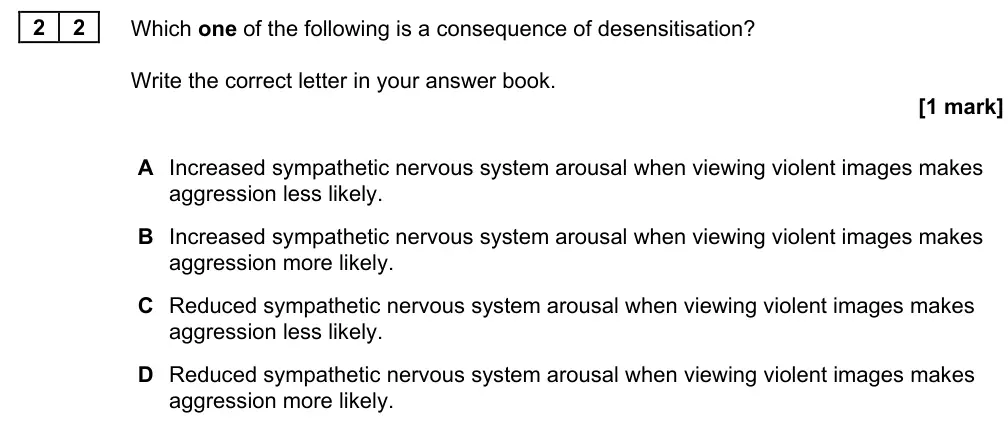
June 2025 · Paper 3 · Q221 markAO1=1Multiple choice
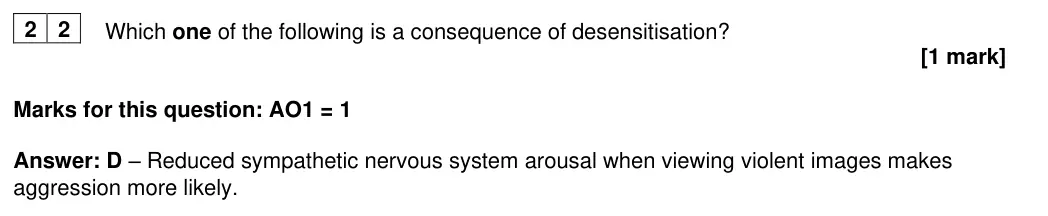
Answer
D
Mark scheme, including level descriptors and indicative content
Examiner's comment
The first multiple-choice question did not prove troublesome for many students (22), but question 23 did wrongfoot some due to confusion between disinhibition and desensitisation.
Notes from the mark scheme and report
answer D (reduced SNS arousal makes aggression more likely)
rarely troublesome
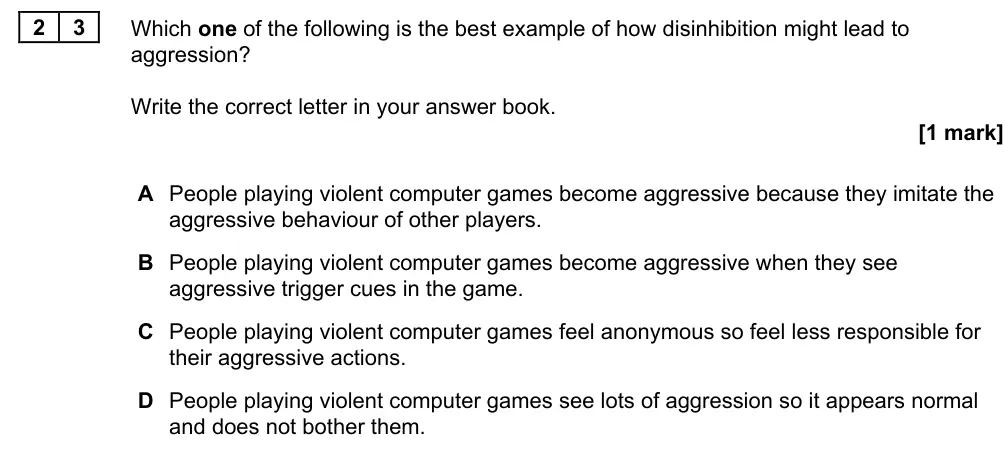
June 2025 · Paper 3 · Q231 markAO1=1Multiple choice
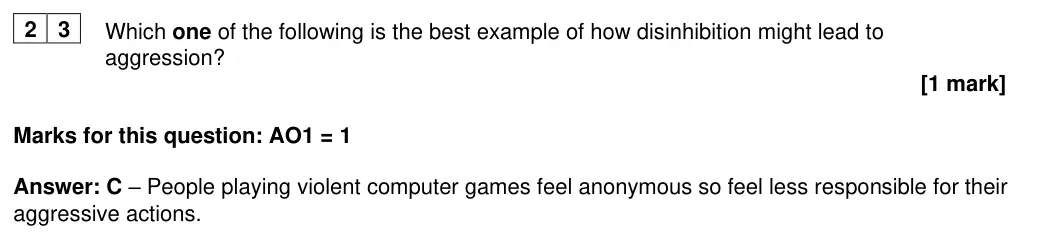
Answer
C
Mark scheme, including level descriptors and indicative content
Examiner's comment
The first multiple-choice question did not prove troublesome for many students (22), but question 23 did wrongfoot some due to confusion between disinhibition and desensitisation.
Notes from the mark scheme and report
answer C (anonymity reduces responsibility)
distractors describe imitation (SLT), cognitive priming and desensitisation
confusion between disinhibition and desensitisation
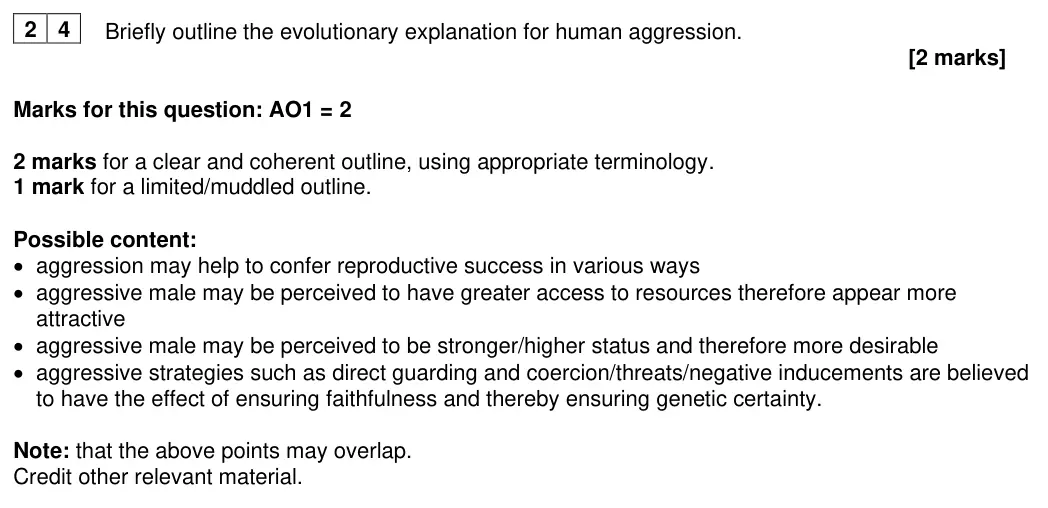
June 2025 · Paper 3 · Q242 marksAO1=2Outline
Mark scheme, including level descriptors and indicative content
Examiner's comment
For 24, some students missed the instruction to talk about human aggression in the question and instead gave descriptive detail and examples of aggression in the animal kingdom. Responses that took male mating and reproductive success as the central theme tended to do best.
Notes from the mark scheme and report
aggression confers reproductive success: access to resources, status, mate retention (direct guarding, negative inducements) to ensure paternity certainty
some described animal aggression instead of human
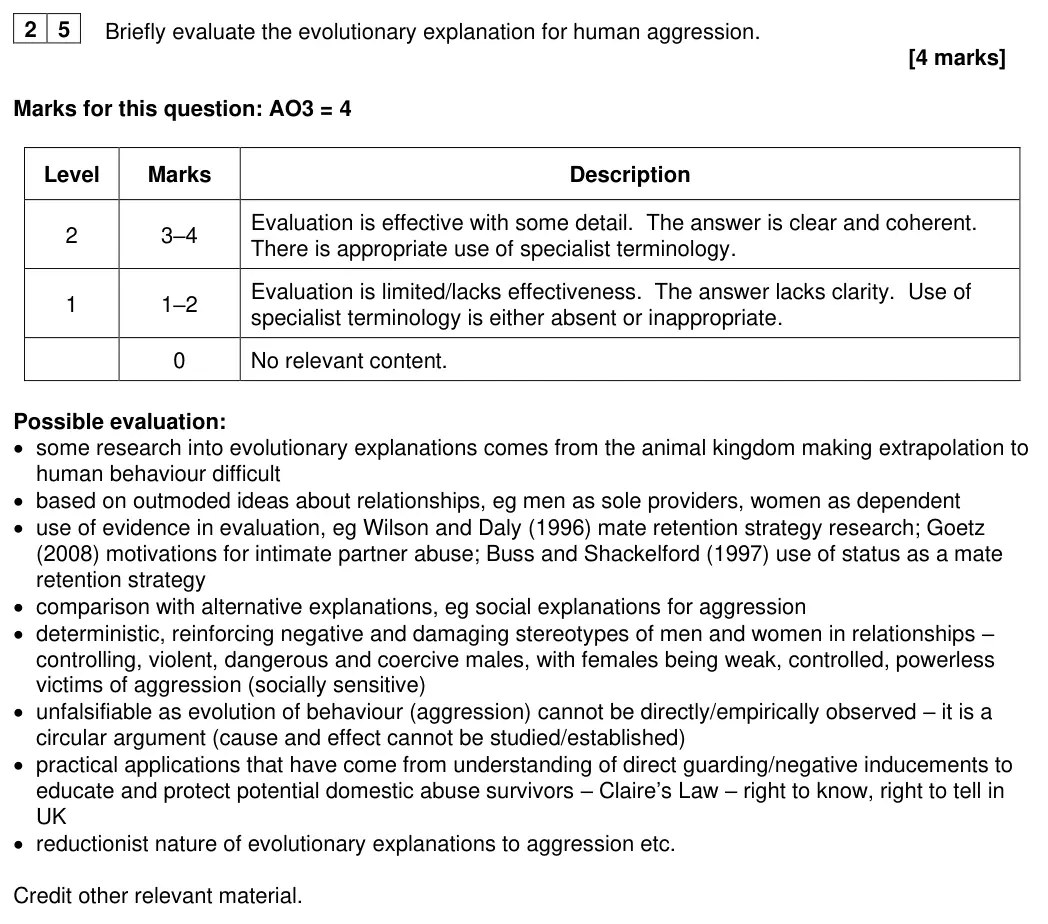
June 2025 · Paper 3 · Q254 marksAO3=4Evaluate (short)
Mark scheme, including level descriptors and indicative content
Examiner's comment
The quality of evaluation in 25 generally mirrored the quality of answers in 24. Students who knew this area well were able to offer sustained critique to do with the problematic legitimisation of domestic violence implied by the theory, alongside broader themes of reductionism and determinism.
Notes from the mark scheme and report
evidence (Wilson and Daly, Buss and Shackelford), outdated gender roles, socially sensitive/deterministic, unfalsifiable, practical applications (Clare's Law), alternatives
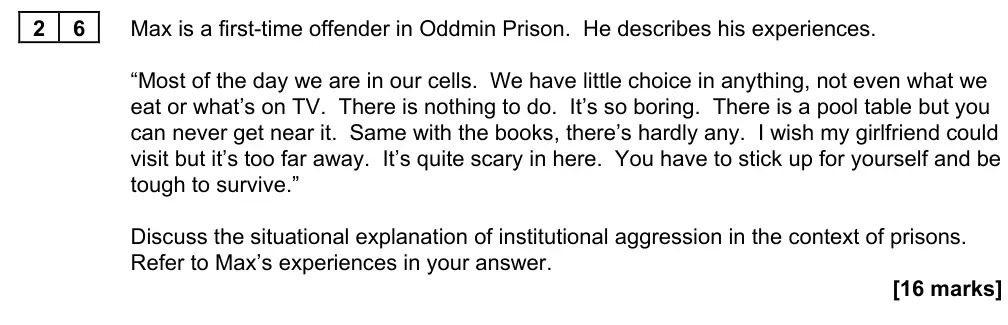
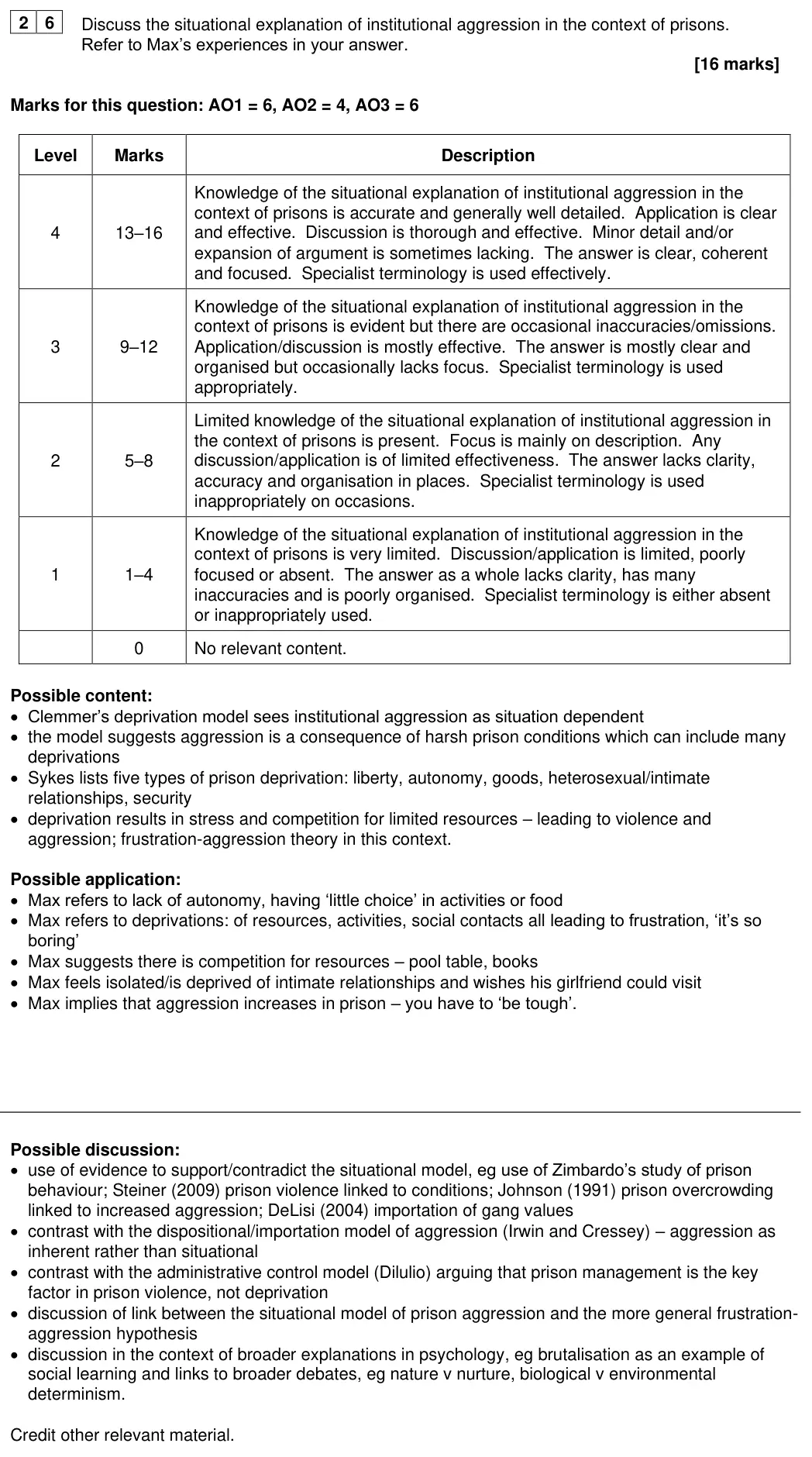
June 2025 · Paper 3 · Q2616 marksAO1=6, AO2=4, AO3=616-mark essay
Mark scheme, including level descriptors and indicative content
Examiner's comment
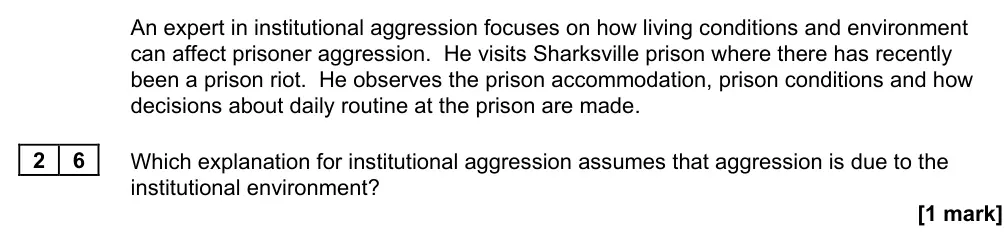
The 16-mark essay on the situational explanation of institutional aggression (25) gave rise to some very good answers. Those students who framed their answer around the deprivation model and Sykes’ five types of deprivation produced the better answers: matching concise descriptions of the various forms of deprivation to the relevant link in the stem and picking up marks quite quickly. There were some very good discussions of the situational model versus the importation model; however, those students who relied on the Stanford Prison Experiment as evidence often struggled to account for the passivity of the prisoners in that study and were left to rather spuriously focus on the behaviour of the guards.
Notes from the mark scheme and report
deprivation model (Clemmer, Sykes' five deprivations) applied to Max (no choice, boredom, competition for pool table/books, no girlfriend visits, need to be tough)
contrast with importation model
relying on Stanford Prison Experiment struggled to explain passive prisoners
June 2024 · Paper 3 · Q413 marksAO1=3Short answer
Mark scheme, including level descriptors and indicative content
Examiner's comment
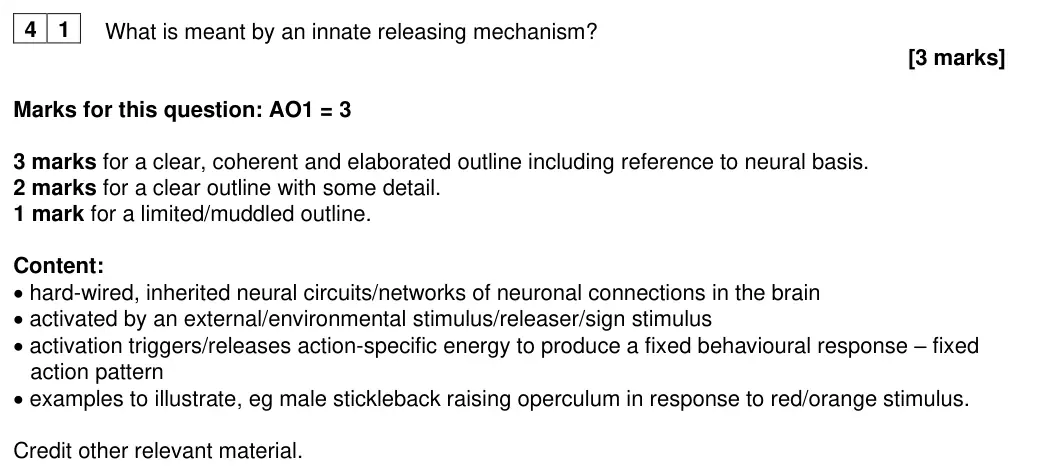
For Question 41, a high percentage of answers was awarded two marks. Most students knew that an innate releasing mechanism produces a fixed action pattern in response to an environmental stimulus, but far fewer talked about the neural system that underpins this process.
Notes from the mark scheme and report
3 marks need reference to the neural basis (inherited neural circuits) + external sign stimulus triggering fixed action pattern
most gained 2 by omitting neural basis
June 2024 · Paper 3 · Q4216 marksAO1=6, AO2=4, AO3=616-mark essay
Mark scheme, including level descriptors and indicative content
Examiner's comment
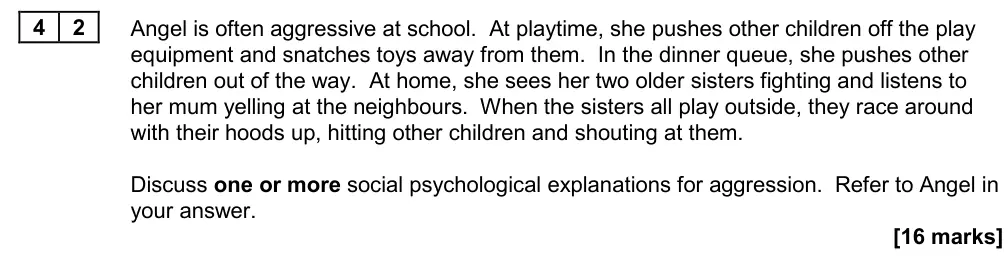
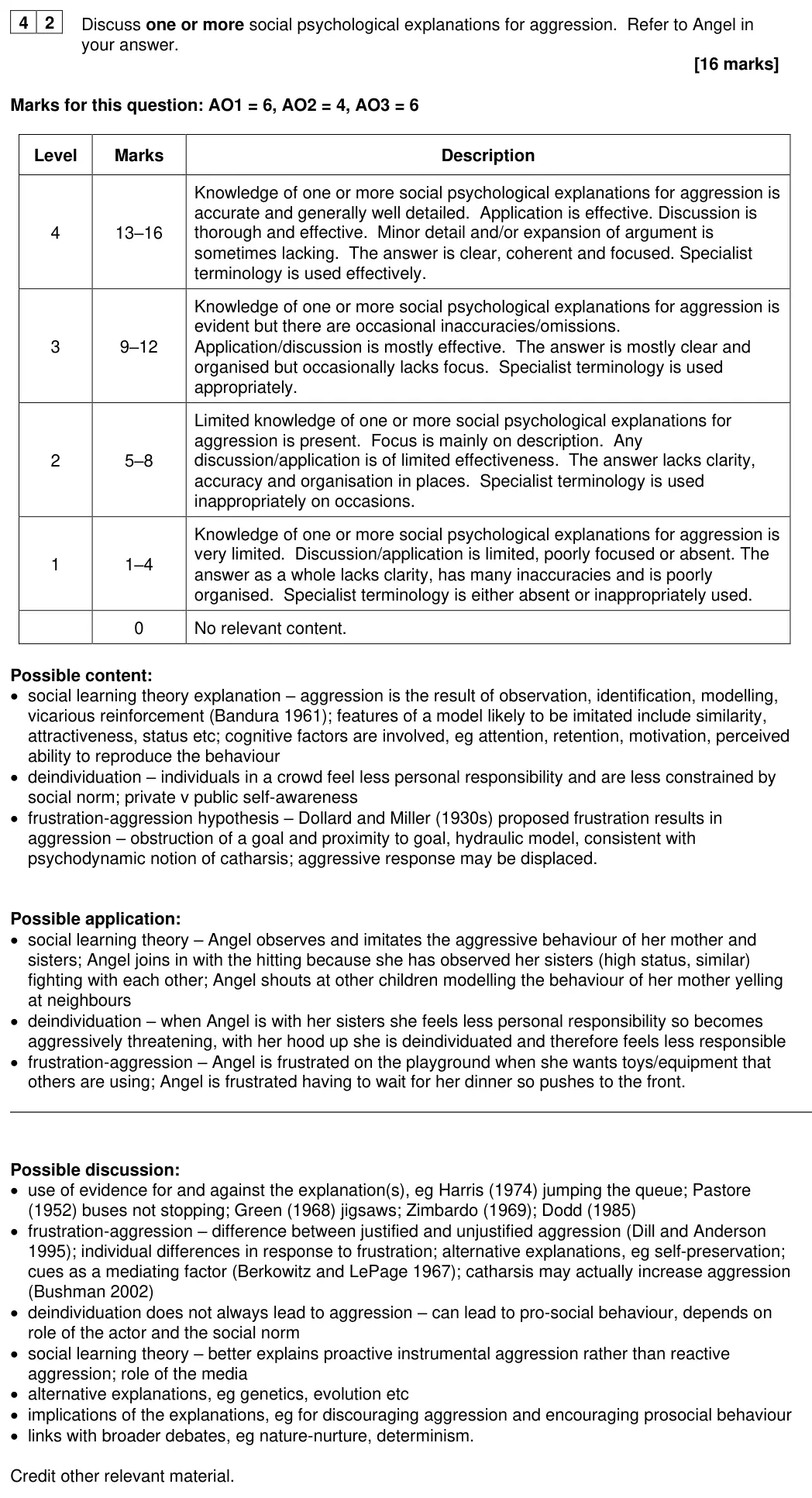
There were some well-crafted answers for Question 42. All three explanations on the mark scheme were seen, and sometimes within the same answer. Some students had to rely on alternatives which only met the threshold of social-psychological if there was some justification as part of the answer, such as the importation model. Many students produced accounts of social learning theory that were not distinct from operant conditioning – though in the context of the question, these gained some credit. Those students who discussed deindividuation generally did so adroitly, producing lots of relevant knowledge and discussion. The frustration-aggression hypothesis was done less impressively on the whole, and applied links to the stem were sometimes somewhat speculative.
Notes from the mark scheme and report
SLT (sisters/mother as models), de-individuation (hoods up, in a group), frustration-aggression (play equipment, dinner queue)
other explanations (e.g. importation model) only credited if justified as social psychological
June 2023 · Paper 3 · Q274 marksAO2=2, AO3=2Application
Mark scheme, including level descriptors and indicative content
Examiner's comment
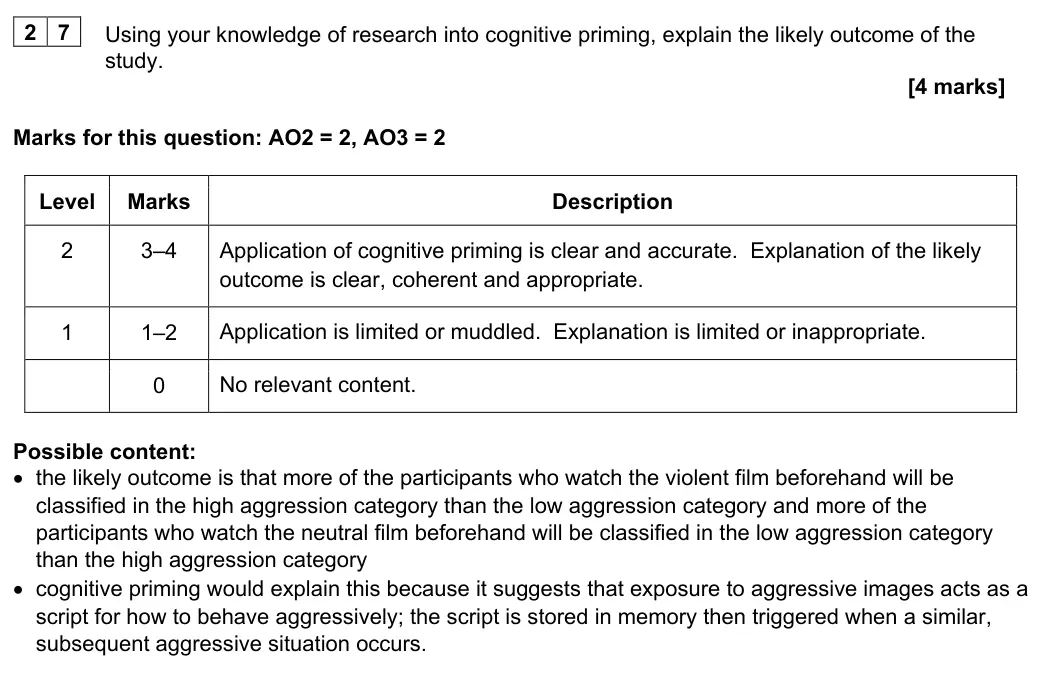
Full marks required a clear explanation of the likely outcome of the study described, but many students only talked about one of the conditions rather than both. In addition, explanations of the likely outcome were sometimes underdeveloped. Lots of students made brief reference to the idea of a ‘script’ or ‘schema’ but did not go beyond this by explaining how it would be triggered by a subsequent aggressive event.
Notes from the mark scheme and report
must predict outcome for BOTH conditions (more high aggression after violent film) and explain via priming scripts stored in memory and triggered later
brief mention of 'script' without how it is triggered limited marks
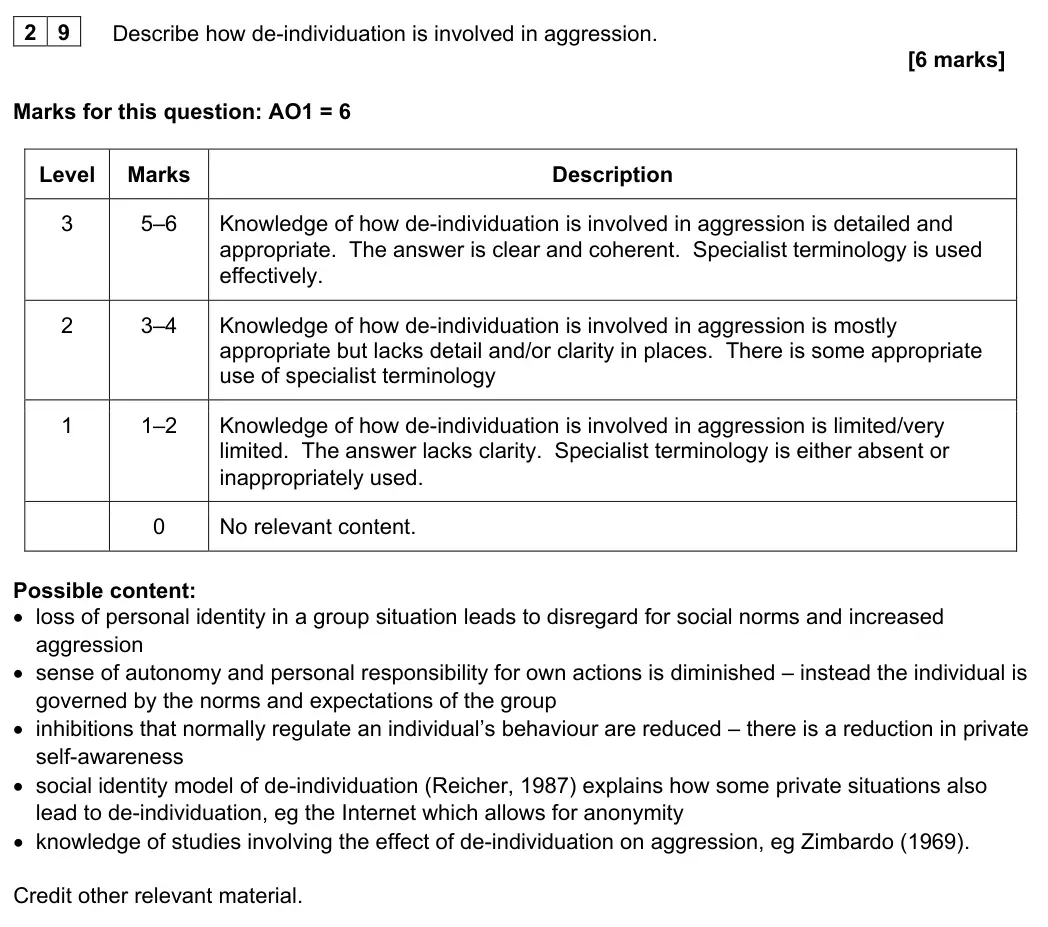
June 2023 · Paper 3 · Q296 marksAO1=6Outline
Mark scheme, including level descriptors and indicative content
Examiner's comment
This question produced some very impressive answers. There were detailed accounts that made use of specialist terminology, these were coherent and clear, and included relevant examples of deindividuation. Weaker answers were constructed around rather long-winded descriptions of evidence, such as the Stanford Prison study.
Notes from the mark scheme and report
loss of personal identity/self-awareness, reduced responsibility, group norms, SIDE model
weaker answers long descriptions of the Stanford Prison study
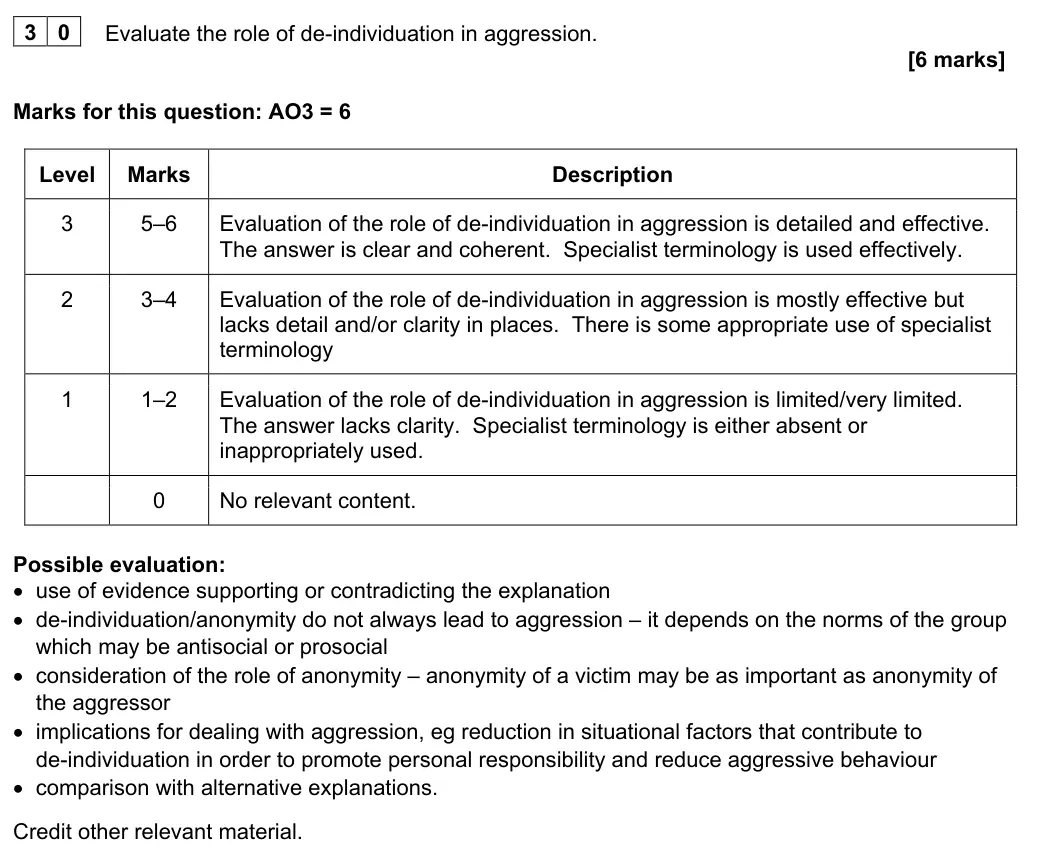
June 2023 · Paper 3 · Q306 marksAO3=6Evaluate (short)
Mark scheme, including level descriptors and indicative content
Examiner's comment
Students who did well in question 29 typically made an equally competent job of this question. The implications of a range of evidence were presented, most commonly the baiting crowd study, whereas Gergen’s dark room study was often discussed effectively as counterargument.
Notes from the mark scheme and report
evidence (baiting crowd for, Gergen dark room against), depends on group norms, anonymity of victim, implications, alternatives
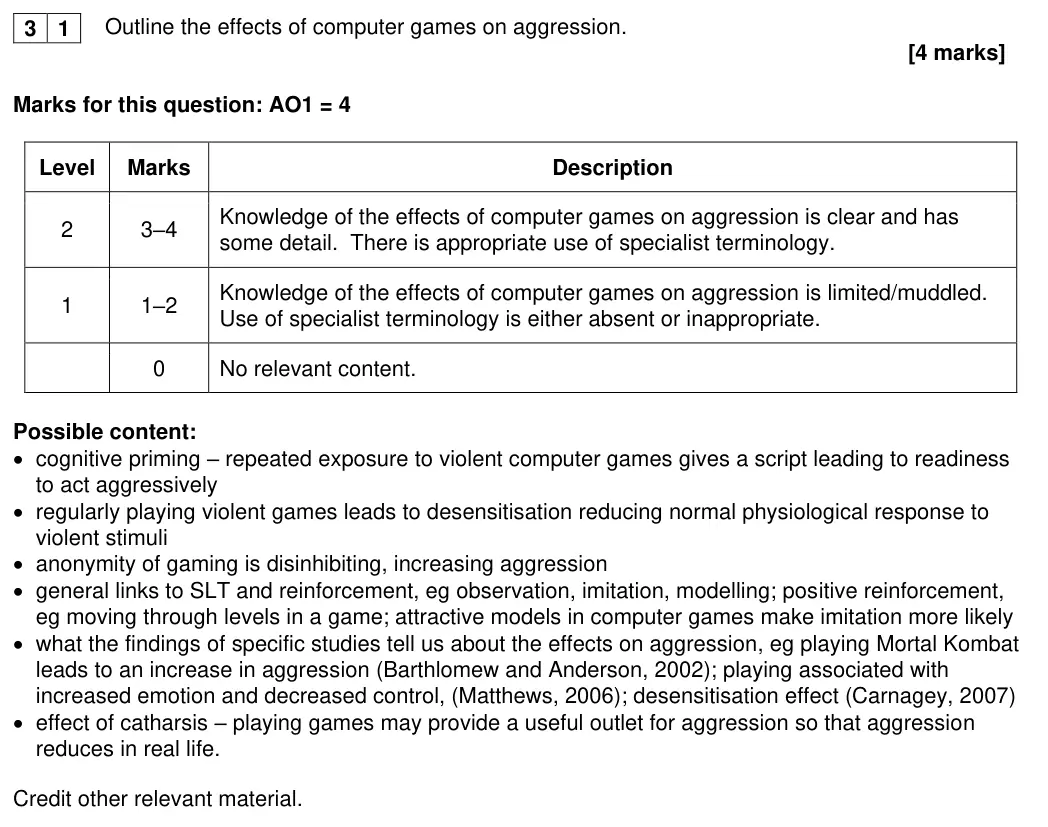
June 2022 · Paper 3 · Q314 marksAO1=4Outline
Mark scheme, including level descriptors and indicative content
Examiner's comment
There were some low scoring answers to Question 31, usually because the answer consisted of a detailed description of a study. In such cases, the only part of the response that really answered the question was the conclusion that playing computer games might lead to more aggressive behaviour. Better answers came to the same general conclusion but explained the increased aggression in terms of desensitisation, disinhibition and cognitive priming. It was rare to see answers suggesting that playing computer games might lead to a decrease in aggression due to catharsis.
describing a single study with only its conclusion scored low
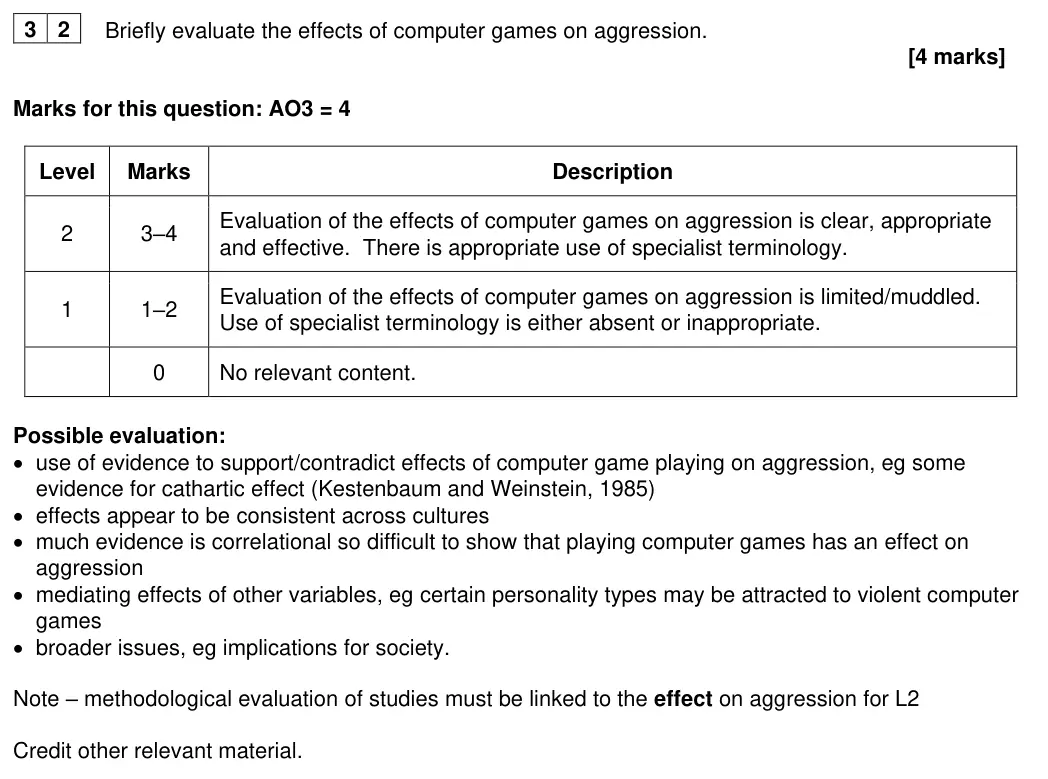
June 2022 · Paper 3 · Q324 marksAO3=4Evaluate (short)
Mark scheme, including level descriptors and indicative content
Examiner's comment
Catharsis occasionally appeared as an effective counterargument in answers to Question 32, with use of studies and contrasting explanations such as biology also used to good effect.
methodological points must be linked to effect on aggression for Level 2
June 2022 · Paper 3 · Q3316 marksAO1=6, AO3=1016-mark essay
Mark scheme, including level descriptors and indicative content
Examiner's comment
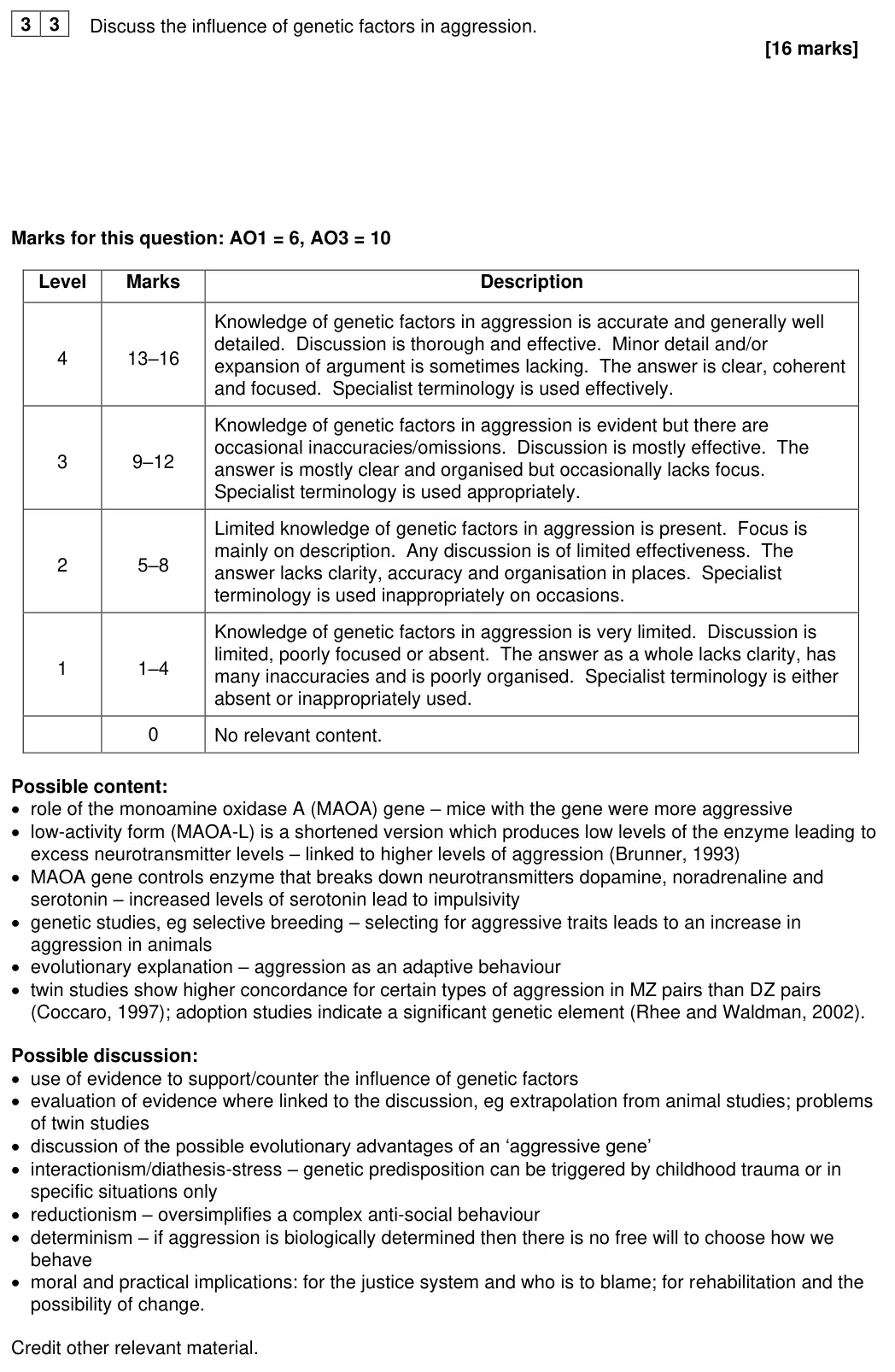
Answers to Question 33 varied considerably, possibly because students often misconstrued it as a question about biological explanations in general. On the one hand there were detailed, accurate descriptions of genetic influences on aggression with associated evidence, whereas at the other extreme were answers that barely mentioned genetics but focused almost exclusively on neural explanations. This neural material could have been made relevant if students had noted the likely genetic underpinnings and shaped their content to the question, but often this did not happen.
many wrote general biological/neural answers without genetic link
November 2021 · Paper 3 · Q261 markAO1=1Short answer
Mark scheme, including level descriptors and indicative content
Examiner's comment
The naming question after each of the stems was generally answered correctly except for Q31 where several students were unable to name ‘restorative justice’. Fortunately, this did not seem to affect the performance on follow-on questions.
Notes from the mark scheme and report
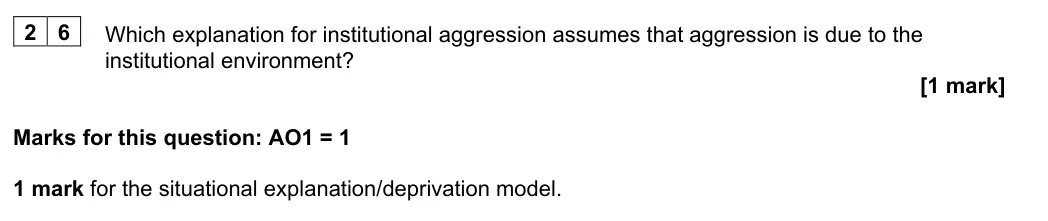
situational explanation/deprivation model
November 2021 · Paper 3 · Q274 marksAO2=4Application
Mark scheme, including level descriptors and indicative content
Examiner's comment
The 4-mark application questions requiring use of the stem were usually competently answered, although there were some weaker answers with little foundation in psychology.
Notes from the mark scheme and report
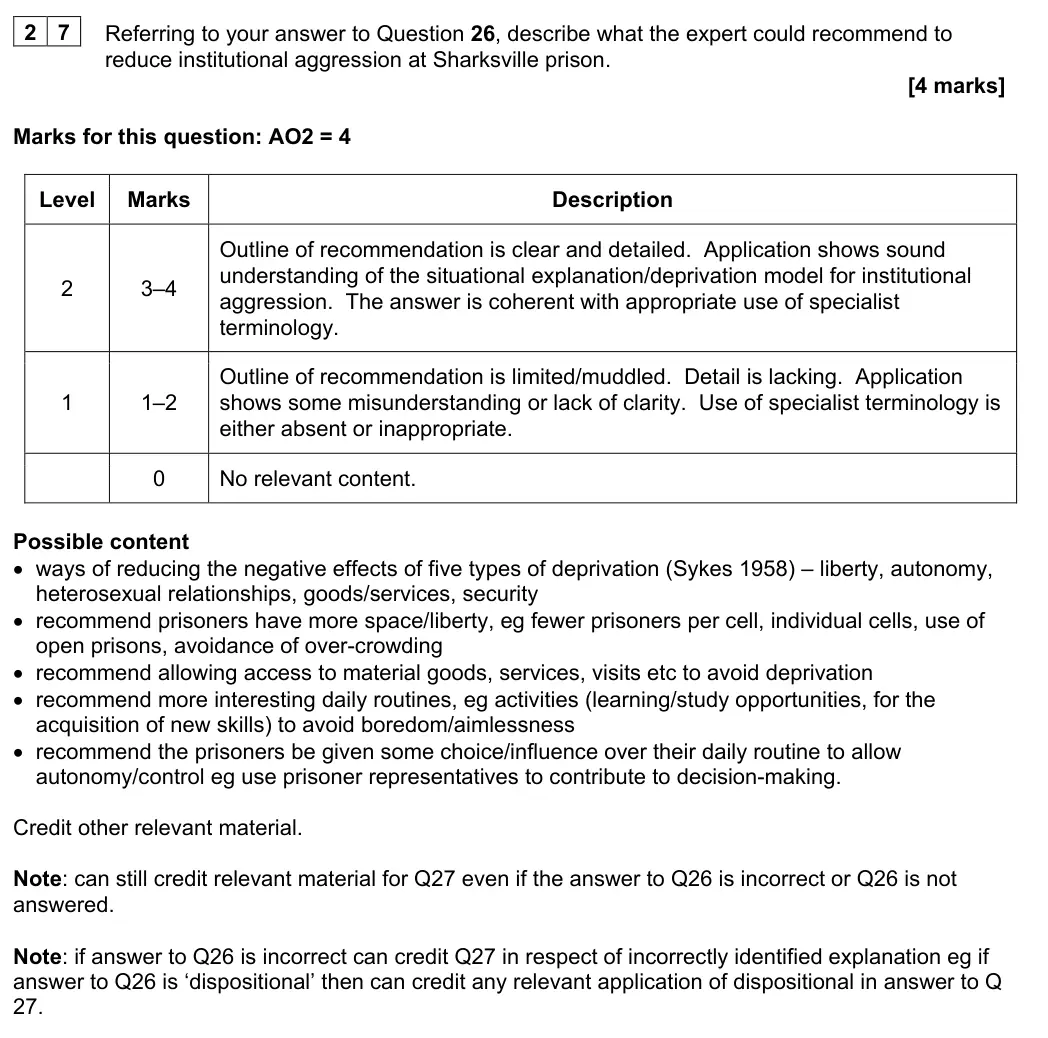
reduce Sykes' deprivations at Sharksville: less overcrowding, access to goods/visits, purposeful activities, prisoner say in routine
credit consistent with an incorrect Q26 answer
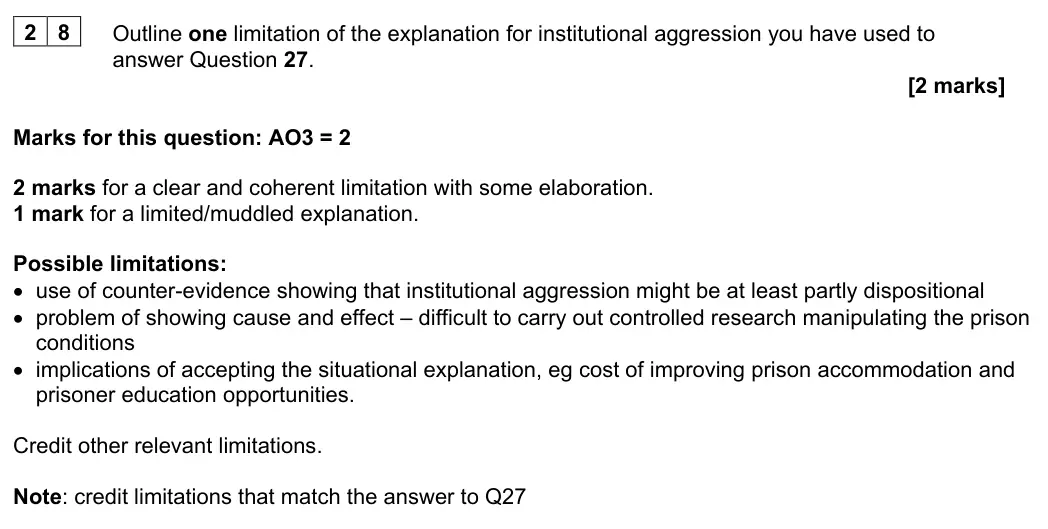
November 2021 · Paper 3 · Q282 marksAO3=2Evaluate (short)
Mark scheme, including level descriptors and indicative content
Notes from the mark scheme and report
limitation must match explanation used in Q27, e.g. counter-evidence for importation, cause and effect
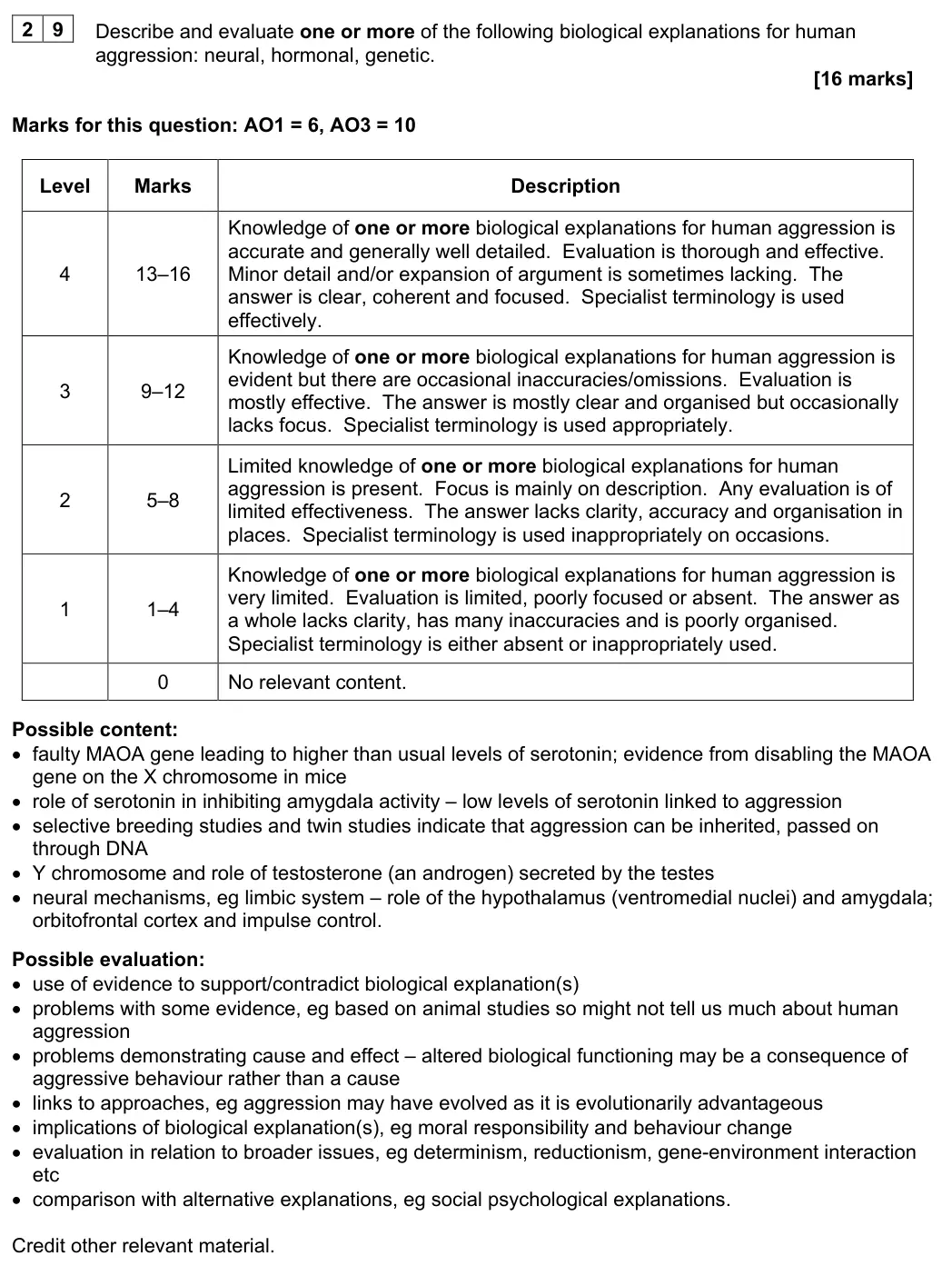
November 2021 · Paper 3 · Q2916 marksAO1=6, AO3=1016-mark essay
Mark scheme, including level descriptors and indicative content
Examiner's comment
The straightforward 16-mark questions yielded a wide range of marks with some impressively detailed and well-argued answers at the top end.
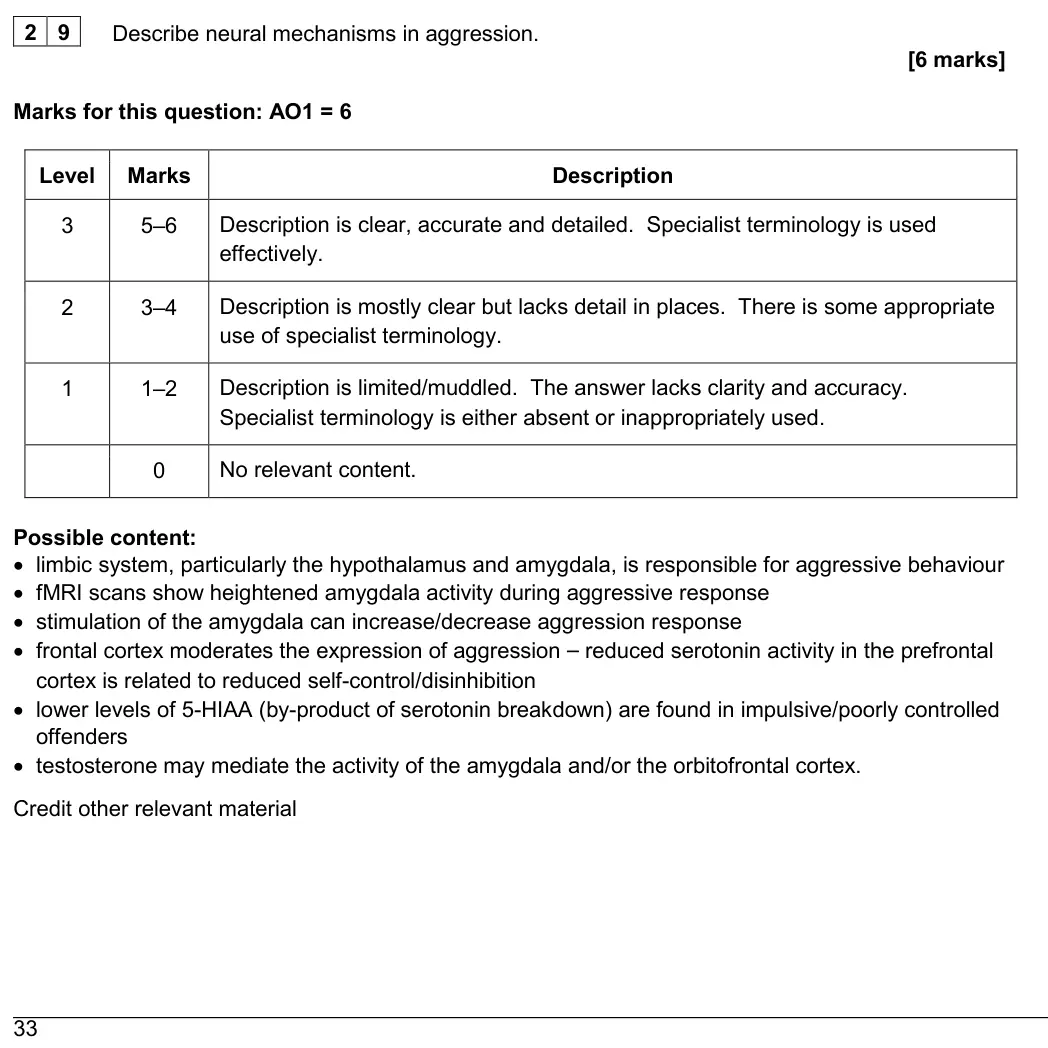
Mark scheme, including level descriptors and indicative content
Examiner's comment
The 6-mark questions required description only and were usually competently tackled. A few students wasted time by offering evaluation. It is worth noting that in questions on neural mechanisms (Q29 aggression, Q36 offending), material about genetics/specific genes could only be credited if the student made some neural link ie linking genetics/genes to brain structure, function or neurochemistry.
Notes from the mark scheme and report
limbic system/amygdala, prefrontal cortex and serotonin, testosterone mediation
genes only credited if linked to brain structure/function/neurochemistry
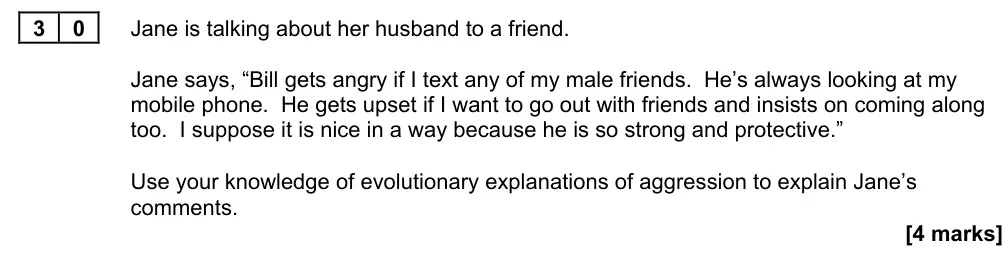
November 2020 · Paper 3 · Q304 marksAO2=4Application
Mark scheme, including level descriptors and indicative content
Examiner's comment
The application questions elicited sound engagement from many students who used the hooks in the stems effectively. Weaker answers were those where students simply name dropped into an otherwise purely knowledge-based answer.
Notes from the mark scheme and report
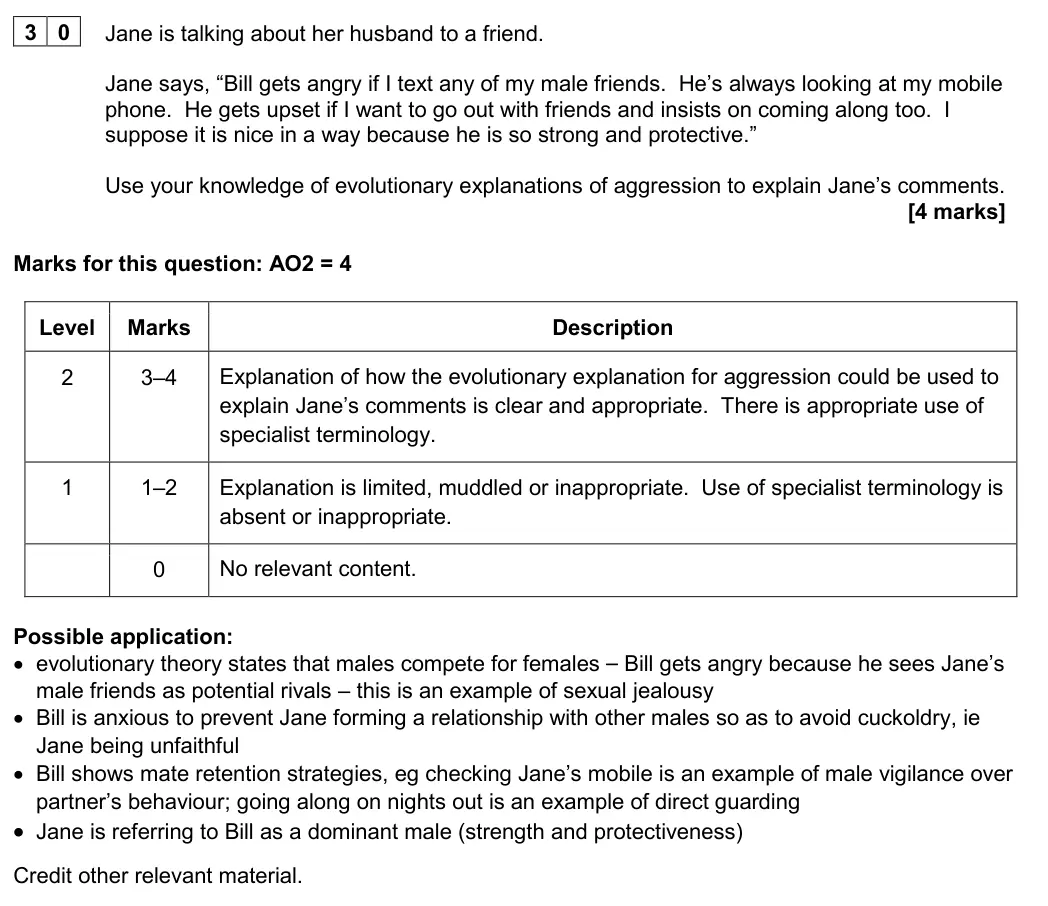
sexual jealousy, cuckoldry avoidance, mate retention (vigilance, direct guarding) applied to Bill and Jane's comments
November 2020 · Paper 3 · Q316 marksAO3=6Evaluate (short)
Mark scheme, including level descriptors and indicative content
Examiner's comment
The strengths/limitations questions tended to yield high marks where students wrote enough to develop and sustain their points. Strengths and limitations of evolutionary explanations of aggression were sometimes not very effective because they showed fundamental misunderstanding, for example, stating that evolutionary explanations ignore biology.
Notes from the mark scheme and report
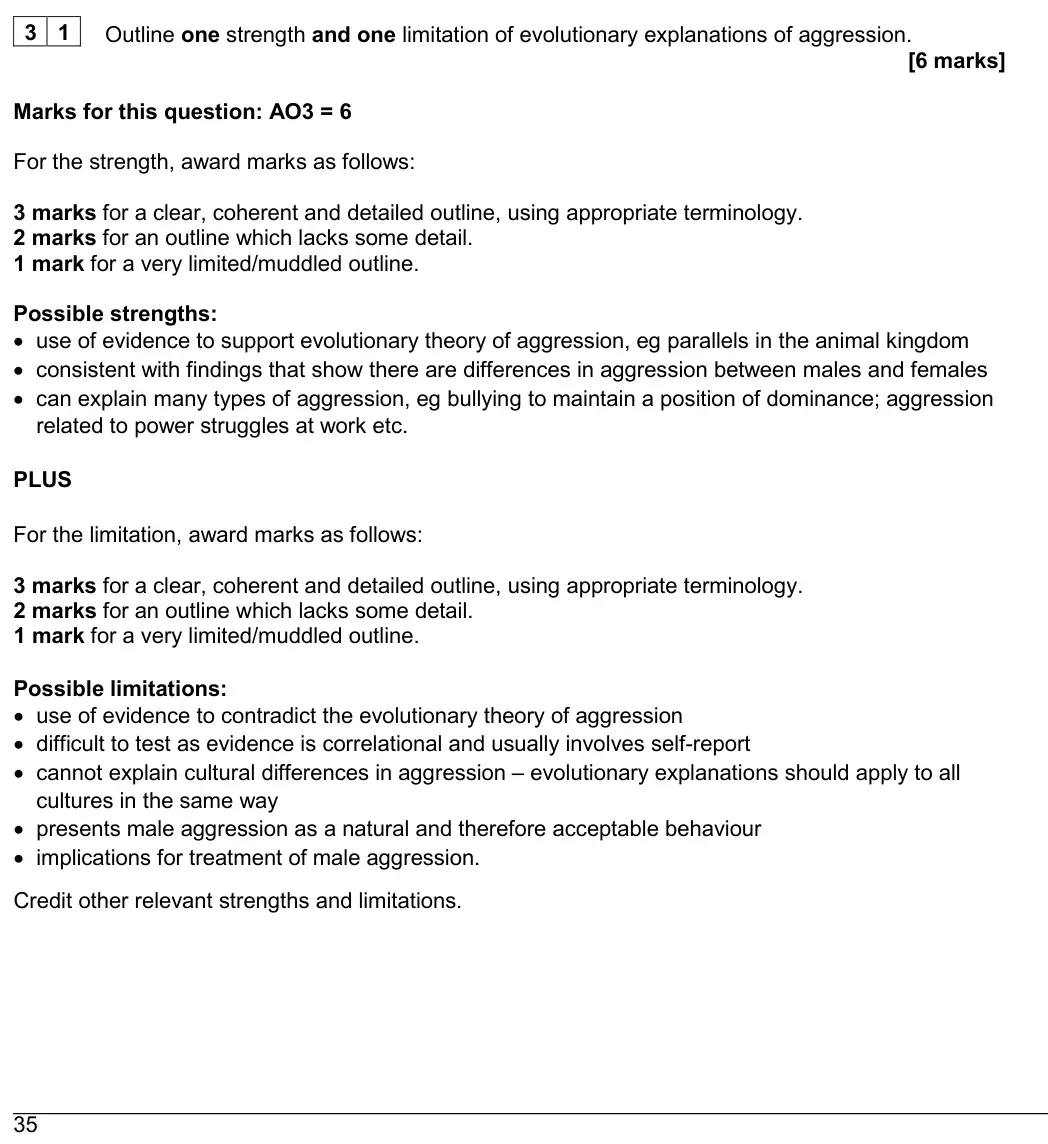
3 marks strength + 3 marks limitation, e.g. sex differences/animal parallels vs cultural differences, untestable, legitimises male aggression
November 2020 · Paper 3 · Q328 marksAO1=3, AO3=5Extended writing
Mark scheme, including level descriptors and indicative content
Notes from the mark scheme and report
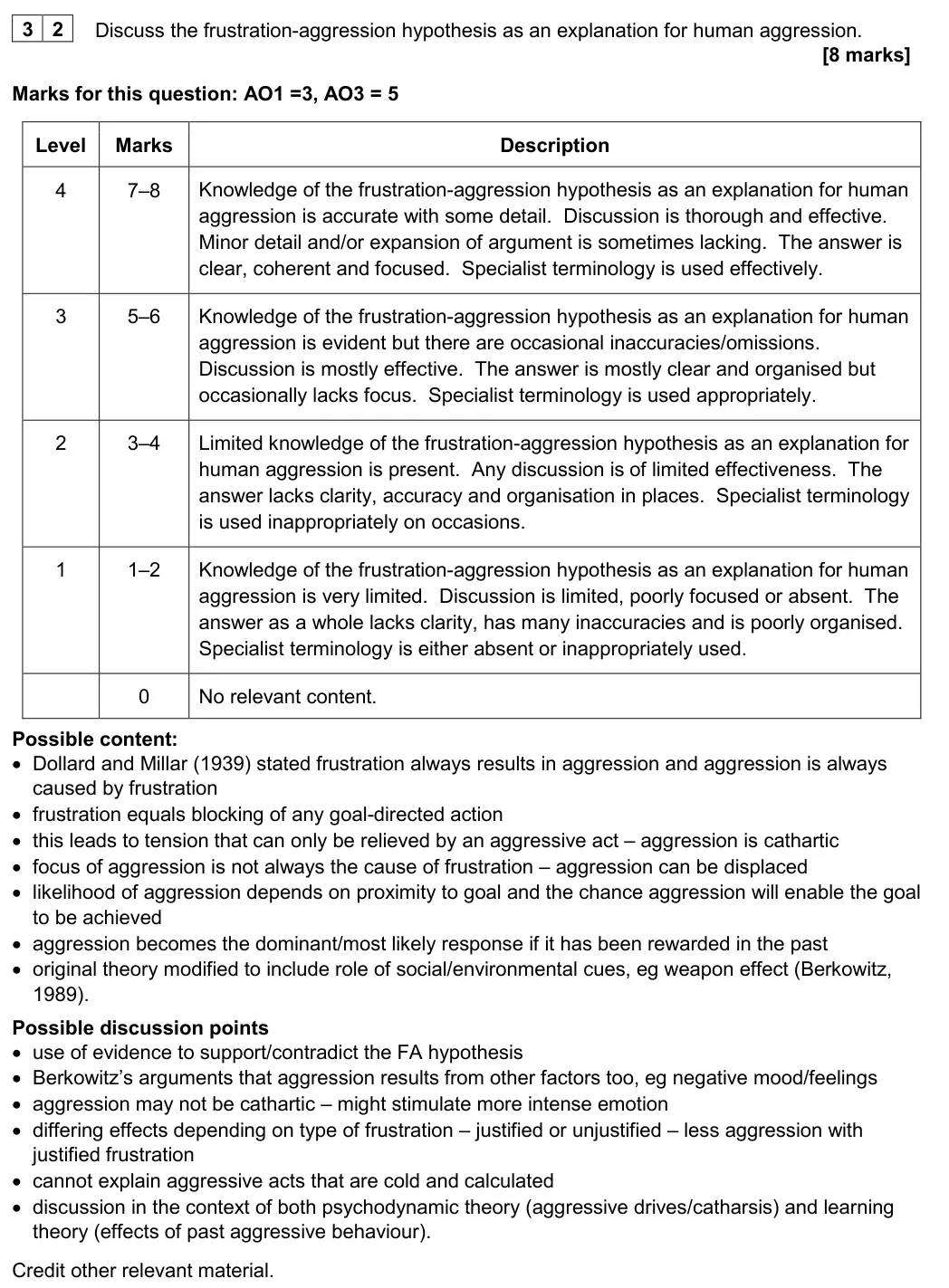
Dollard et al., catharsis, displacement, Berkowitz revision/cues
justified vs unjustified frustration
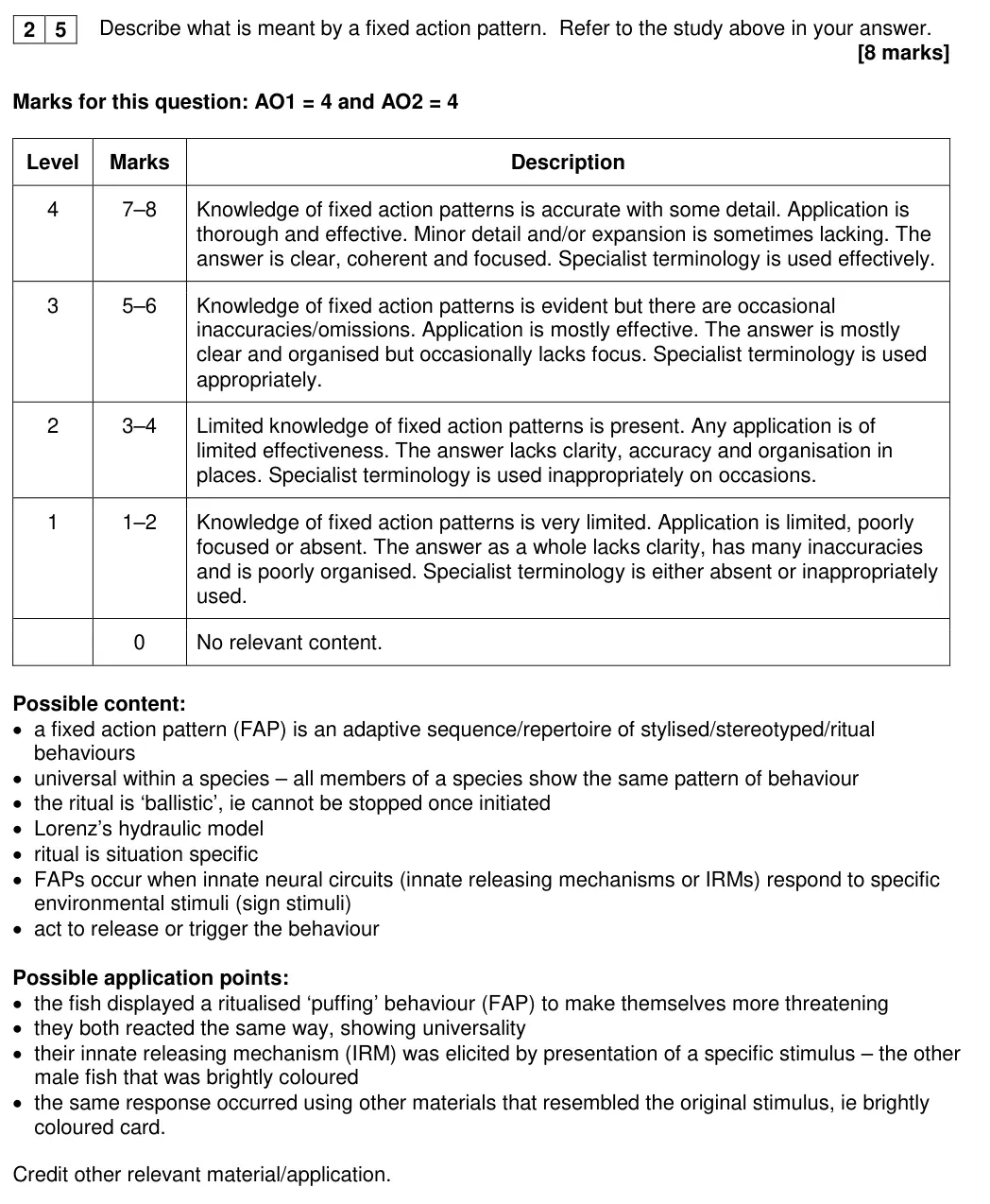
June 2019 · Paper 3 · Q258 marksAO1=4, AO2=4Extended writing
Mark scheme, including level descriptors and indicative content
Examiner's comment
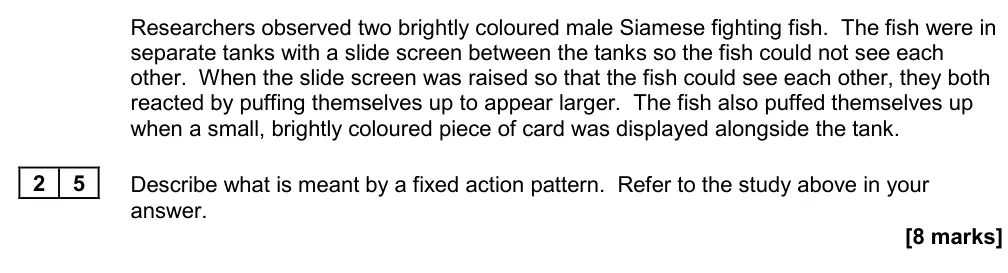
Many students were well-prepared for this question, giving detailed accounts of the nature of fixed action patterns then applying the key features (eg universality, sign stimulus, ritualised nature) effectively to the stem. Less effective answers recounted Tinbergen’s research or focused on the purpose of fixed action patterns rather than their nature. In many of the less effective responses, students made anthropomorphic references, for example, noting how the fish might ‘recognise’ each other, ‘want’ to frighten the other fish and ‘feel’ angry. Quite frequently answers included evaluation/discussion which was not creditworthy.
Notes from the mark scheme and report
FAP features (stereotyped, universal, ballistic, triggered by sign stimulus via IRM) applied to the fighting fish and the coloured card
anthropomorphic answers and evaluation not credited
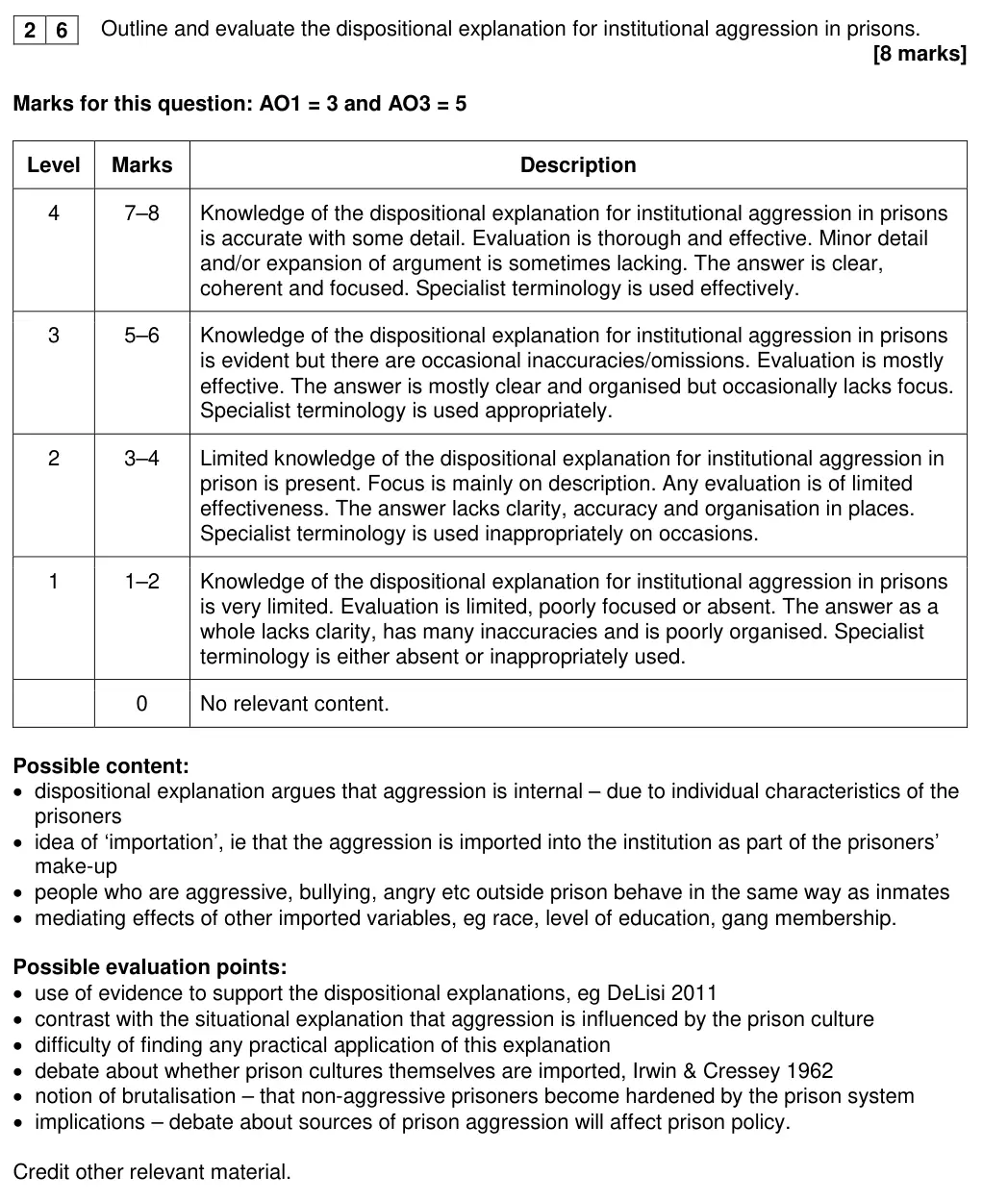
June 2019 · Paper 3 · Q268 marksAO1=3, AO3=5Extended writing
Mark scheme, including level descriptors and indicative content
Examiner's comment
This question was often poorly answered with a fair number of students confusing dispositional and situational explanations. Even where there was understanding of the dispositional explanation, descriptive content was often weak or anecdotal. Many answers indicated that, for most students, the dispositional explanation is synonymous with the importation model and examiners took a broad view on what constitutes disposition. Very few answers included evidence and some that did made inappropriate use of evidence that would normally be used to support situational explanations.
Notes from the mark scheme and report
importation model
often confused with situational explanation
little evidence used
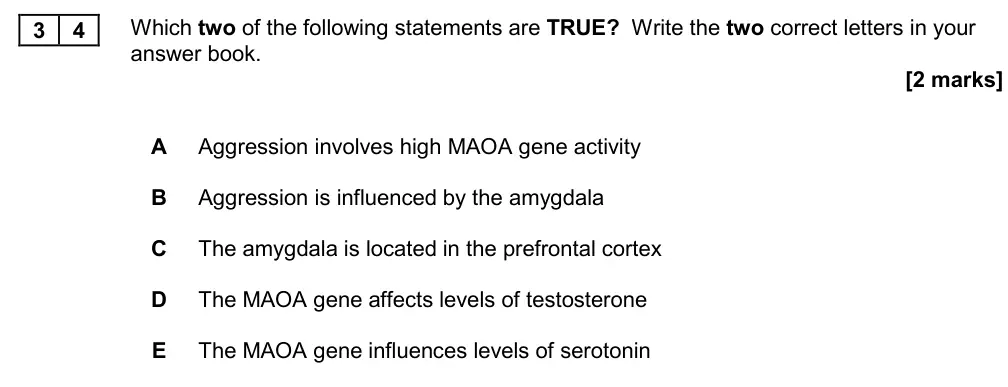
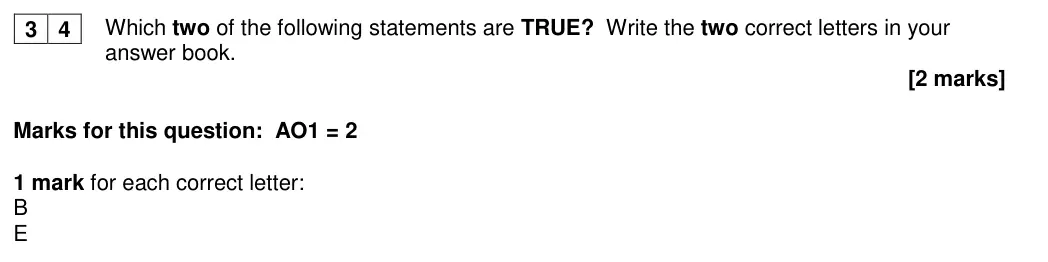
June 2018 · Paper 3 · Q342 marksAO1=2Multiple choice
Answer
B and E
Mark scheme, including level descriptors and indicative content
Examiner's comment
Most students gained at least one mark for this question.
Notes from the mark scheme and report
correct B and E (amygdala
MAOA influences serotonin)
A wrong (low MAOA activity), C, D distractors
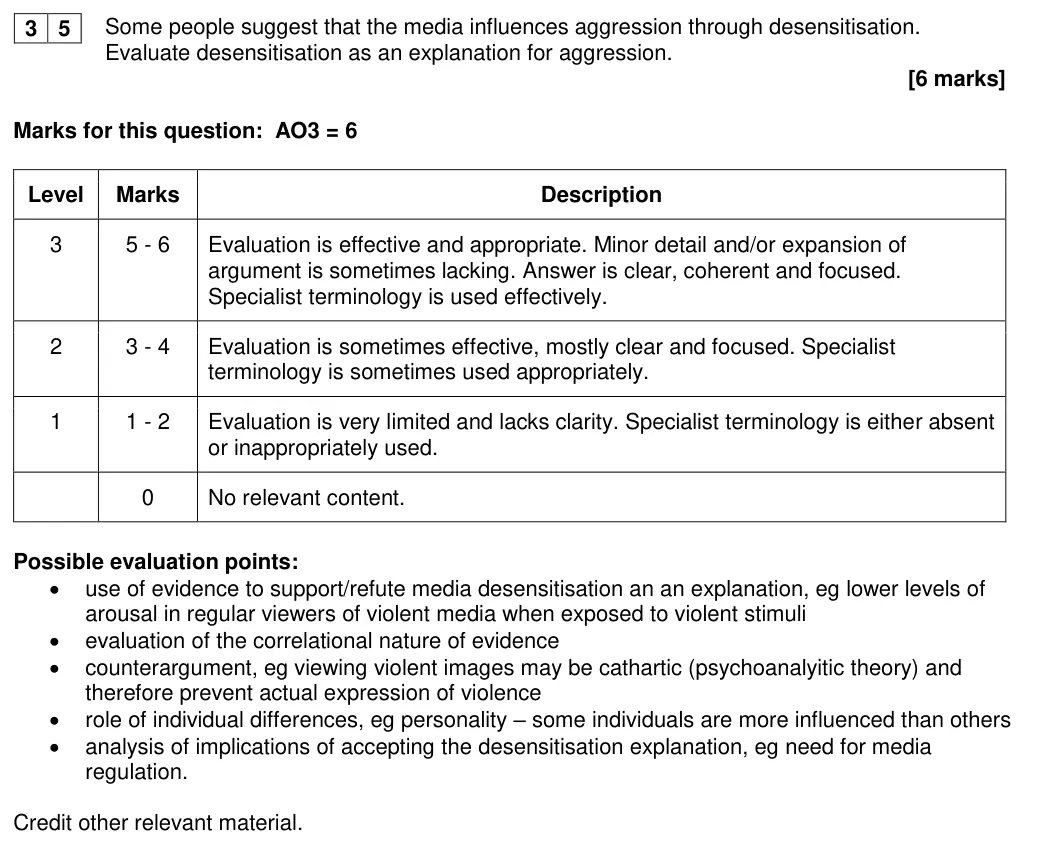
June 2018 · Paper 3 · Q356 marksAO3=6Evaluate (short)
Mark scheme, including level descriptors and indicative content
Examiner's comment
A further challenge was noted on Section D where the 6 mark questions required evaluation only, but students often preceded any evaluation with lengthy descriptions, particularly in the Aggression topic. This was generally quite poorly answered, with many answers comprising a long paragraph of description followed by a cursory evaluation point, usually reference to supporting evidence. Some evaluations did little more than to suggest desensitisation was a good explanation for aggression because it explained it. Several very weak responses gave lurid accounts of well-known examples of crimes that had been attributed to perpetrators having been exposed to media violence. A few students confused desensitisation with deindividuation.
Notes from the mark scheme and report
AO3 only: long description with one cursory evaluation point scored poorly
confusion with deindividuation
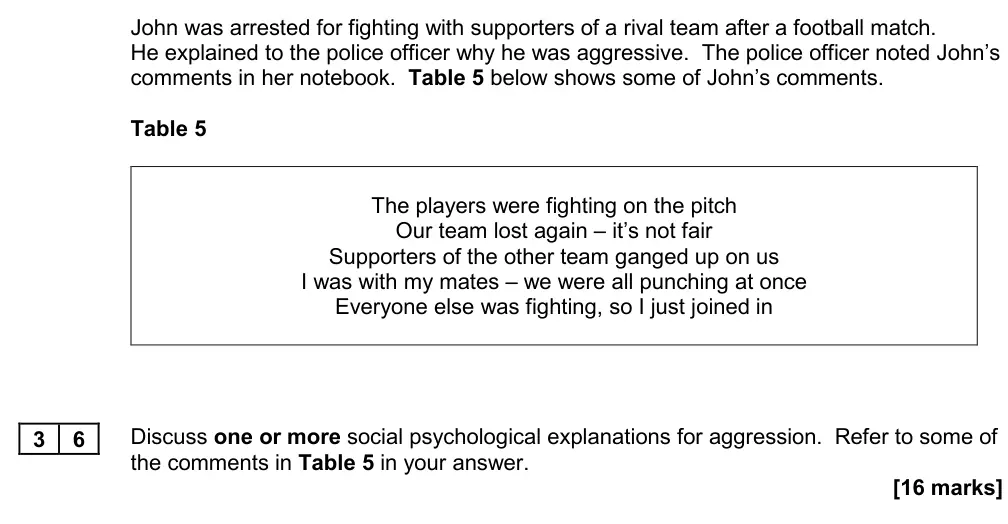
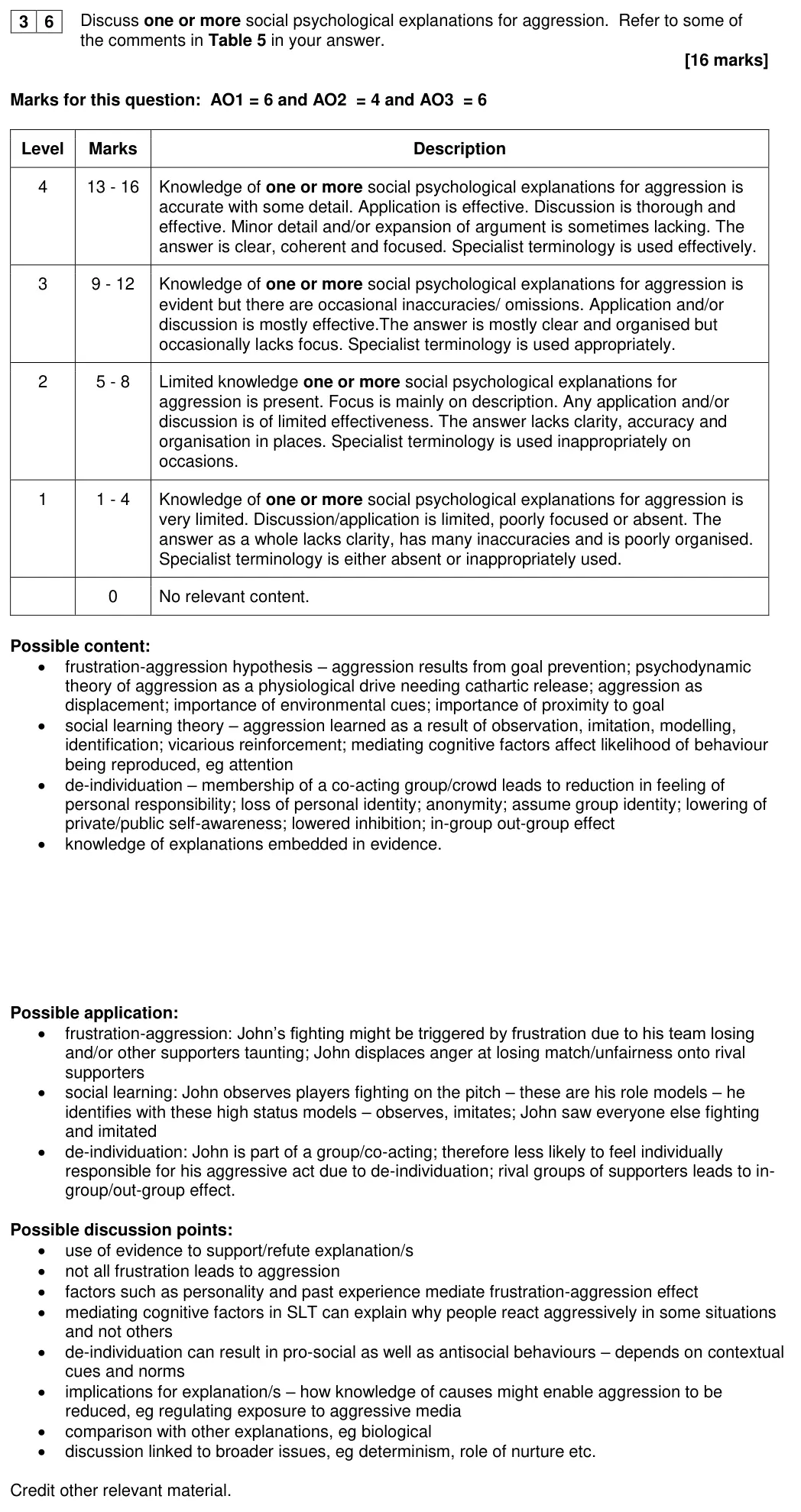
June 2018 · Paper 3 · Q3616 marksAO1=6, AO2=4, AO3=616-mark essay
Mark scheme, including level descriptors and indicative content
Examiner's comment
This tended to be very well answered, with many students referring to deindividuation, frustration- aggression and more general social psychological concepts, such as conformity and social learning. Many answers contained minimal application, merely noting the relevant comment from the table as being an example of whatever explanation was under discussion. Some really excellent answers presented whole paragraphs of integrated knowledge and application, teasing out aspects, for example, of deindividuation, and linking them to the scenario. Discussion points varied in terms of content and effectiveness, with the least effective being those that talked in a highly generic way about reductionism, determinism and nature nurture.
Notes from the mark scheme and report
frustration-aggression, SLT, deindividuation applied to John's comments in Table 5
merely labelling a comment = minimal application
generic issues-and-debates discussion least effective
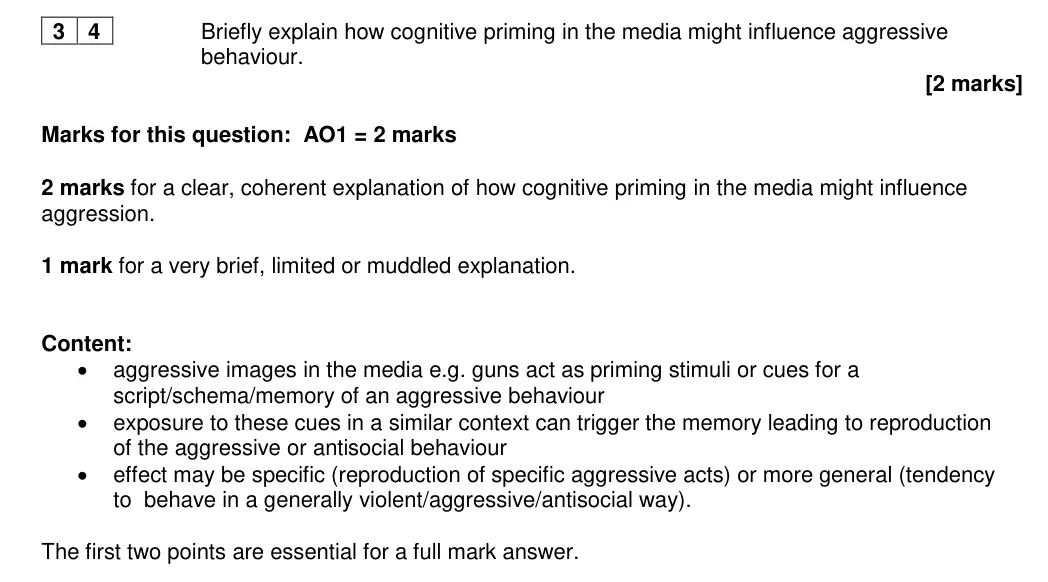
June 2017 · Paper 3 · Q342 marksAO1=2Explain
Mark scheme, including level descriptors and indicative content
Examiner's comment
A surprising number of students based their response on social learning theory or social norms, making no mention of cognitive factors. Of those who did understand the concept, many managed to gain one mark for the idea of an aggressive ‘script’ as a memory based on past experience of aggressive situations on television, film or computer games. Relatively few students gained the second mark for pointing out how the script could be triggered by a similar situation. Note that reference to media was essential for credit in this question.
Notes from the mark scheme and report
first two points essential: media images act as primes/cues for an aggressive script/schema + a similar context triggers it
must refer to media
many used SLT instead
June 2017 · Paper 3 · Q3716 marksAO1=6, AO3=1016-mark essay
Mark scheme, including level descriptors and indicative content
Examiner's comment
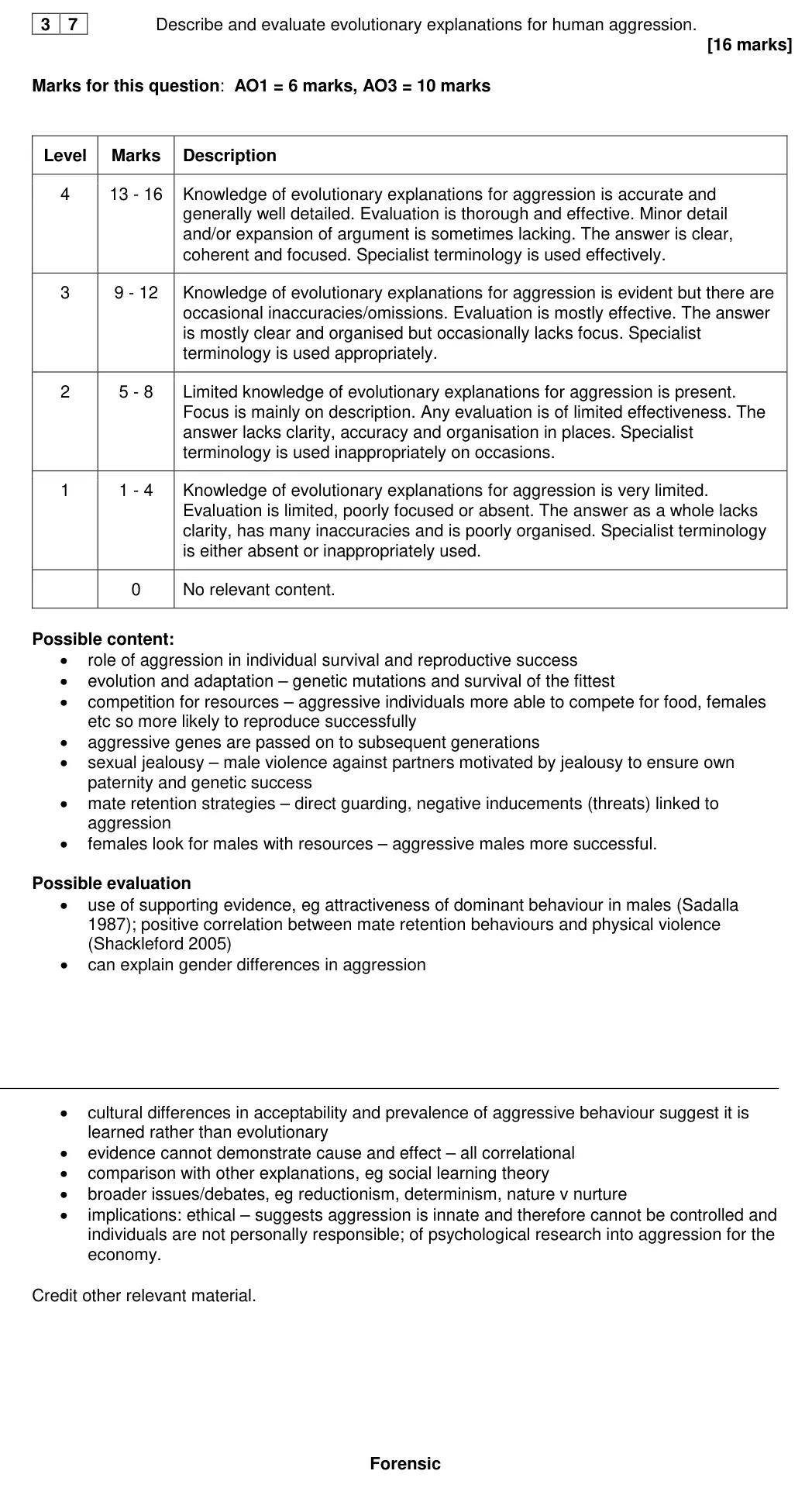
Most students could offer reasonable descriptions of dominance, sexual jealousy and mate retention strategies but these often failed to include any explicit mention of aggression or any explanation of how these behaviours have evolved. More able students emphasised the key mate retention tactics explicitly linked to aggression. Warfare and bullying were also used effectively. Despite the wording of the question, it was fairly common to see description of animal studies, often sticklebacks, which could only gain credit if used as part of an evaluation. The way that evolutionary explanations ‘ignore biological explanations’ or ‘ignore genetic explanations’ was a common evaluative point, showing basic misunderstanding. Similarly, it was sometimes stated that evolutionary explanations for aggression could not explain cases of genocide, with an apparent failure to recognise how elimination of an entire race would thereby confer advantage on the perpetrators who could survive, prosper and propagate their own genes.
Notes from the mark scheme and report
survival/reproductive advantage, sexual jealousy, mate retention, dominance, explicitly linked to aggression
evaluation: gender differences, cultural variation, correlational evidence, SLT alternative
animal studies credited only as evaluation
'ignores biology' is a misconception
Specimen set 2 · Paper 3 · Q2916 marksAO1=6, AO3=1016-mark essay
Mark scheme, including level descriptors and indicative content
Notes from the mark scheme and report
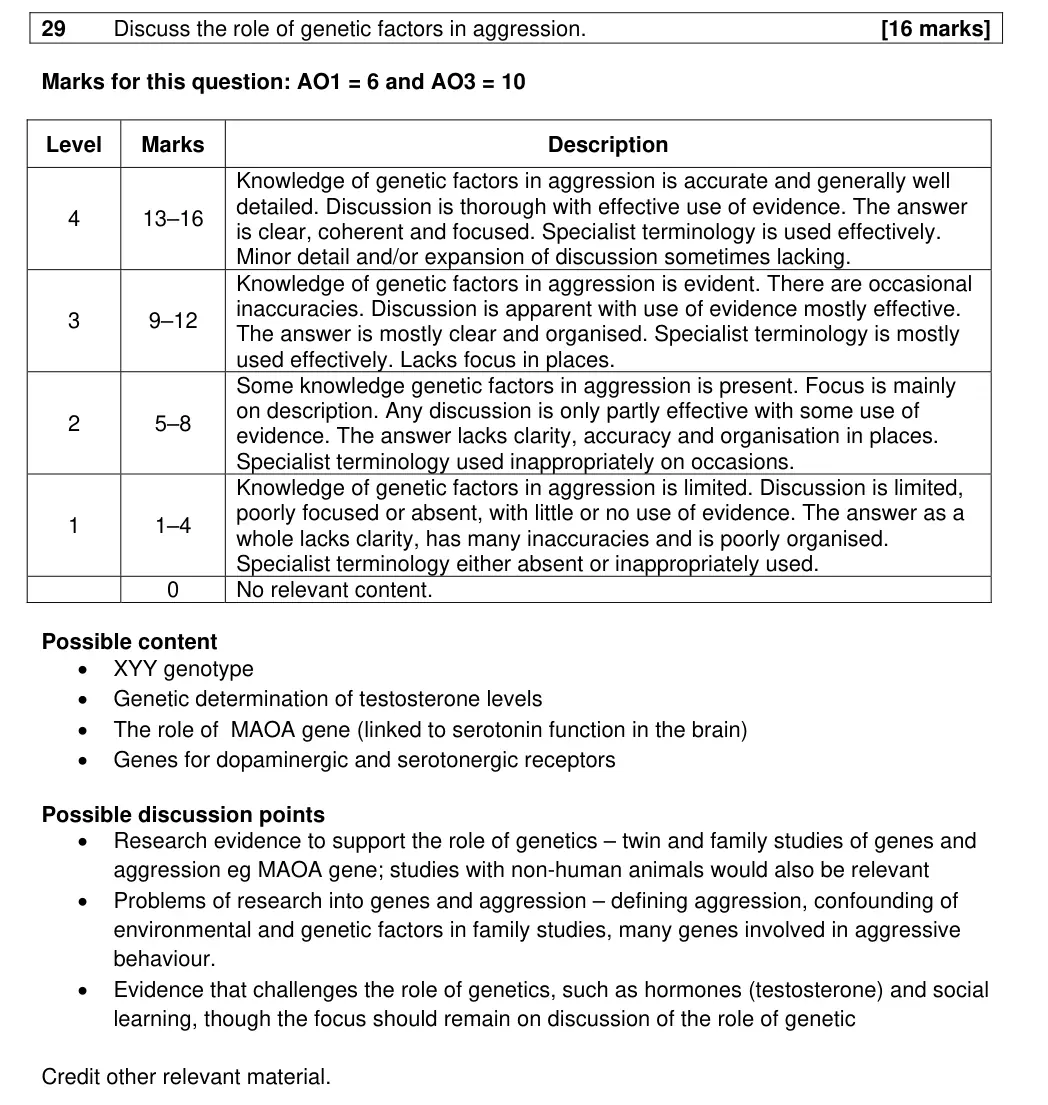
MAOA, XYY, genetic influence on testosterone and receptors
twin/family/animal evidence
confounding with environment, polygenic
alternatives only if focus stays genetic
Specimen set 2 · Paper 3 · Q312 marksAO1=2Outline
Mark scheme, including level descriptors and indicative content
Notes from the mark scheme and report
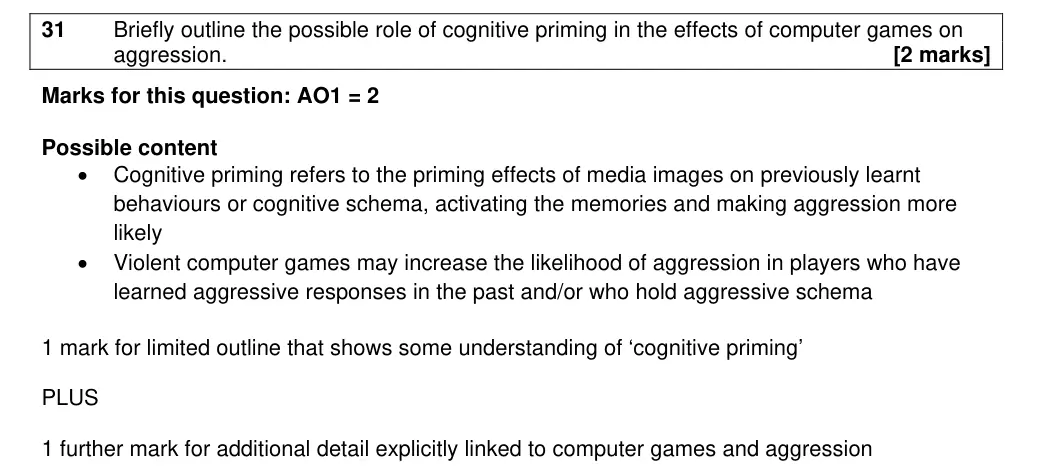
1 mark media images activate stored aggressive schemas/memories + 1 mark explicitly linked to computer games and aggression
Specimen set 2 · Paper 3 · Q322 marksAO3=2Evaluate (short)
Mark scheme, including level descriptors and indicative content
Notes from the mark scheme and report
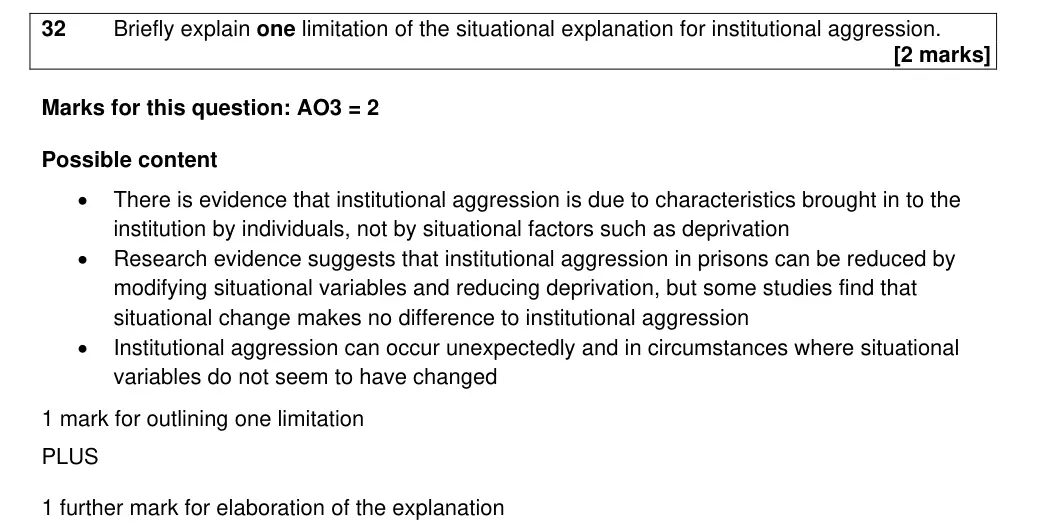
importation/dispositional evidence, inconsistent effects of reducing deprivation, unpredictable violence
1 mark limitation + 1 mark elaboration
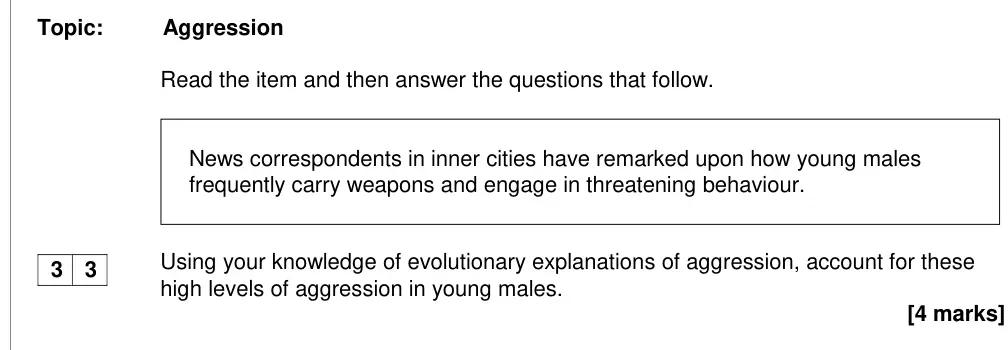
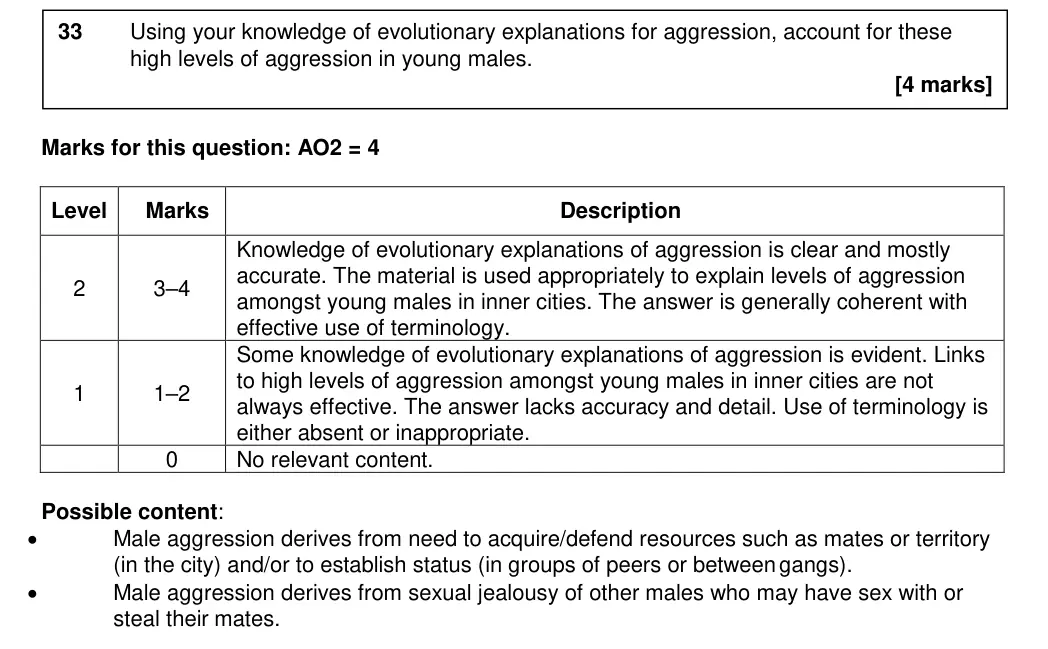
Specimen set 1 · Paper 3 · Q334 marksAO2=4Application
Mark scheme, including level descriptors and indicative content
Notes from the mark scheme and report
acquiring/defending resources, territory, status among peers/gangs
sexual jealousy/mate retention
must be applied to young inner-city males
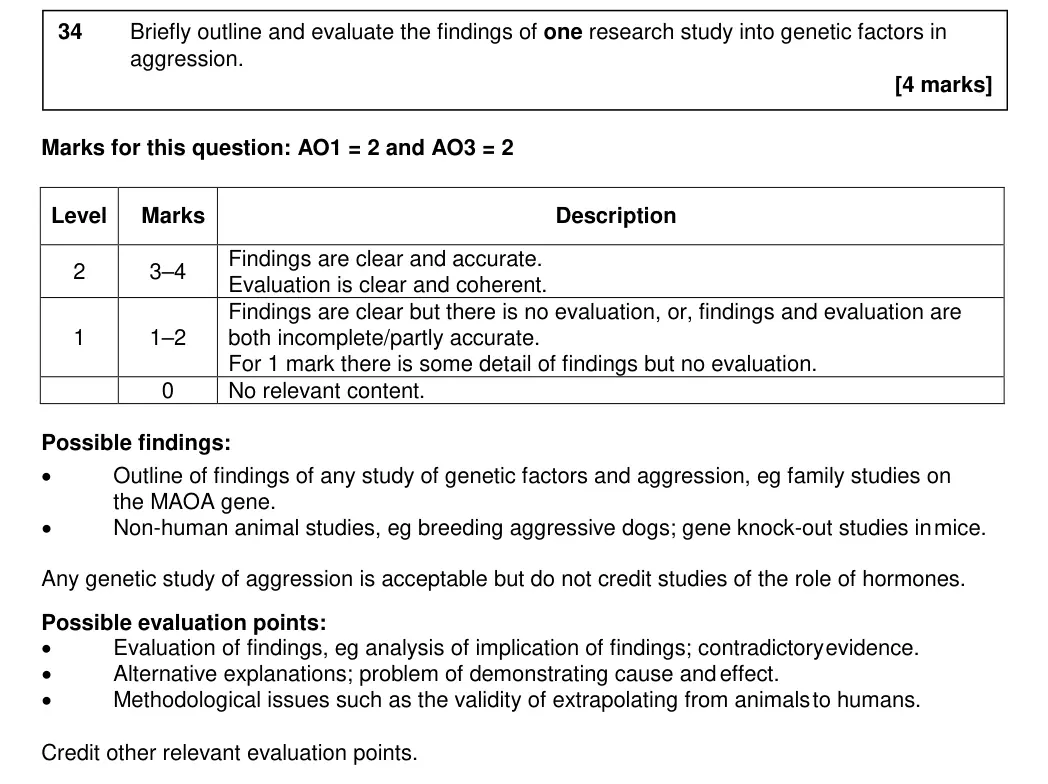
Specimen set 1 · Paper 3 · Q344 marksAO1=2, AO3=2Evaluate (short)
Mark scheme, including level descriptors and indicative content
Notes from the mark scheme and report
findings of one genetic study (MAOA, twin/adoption, animal breeding/knock-out) + evaluation
hormone studies not credited
findings without evaluation max Level 1
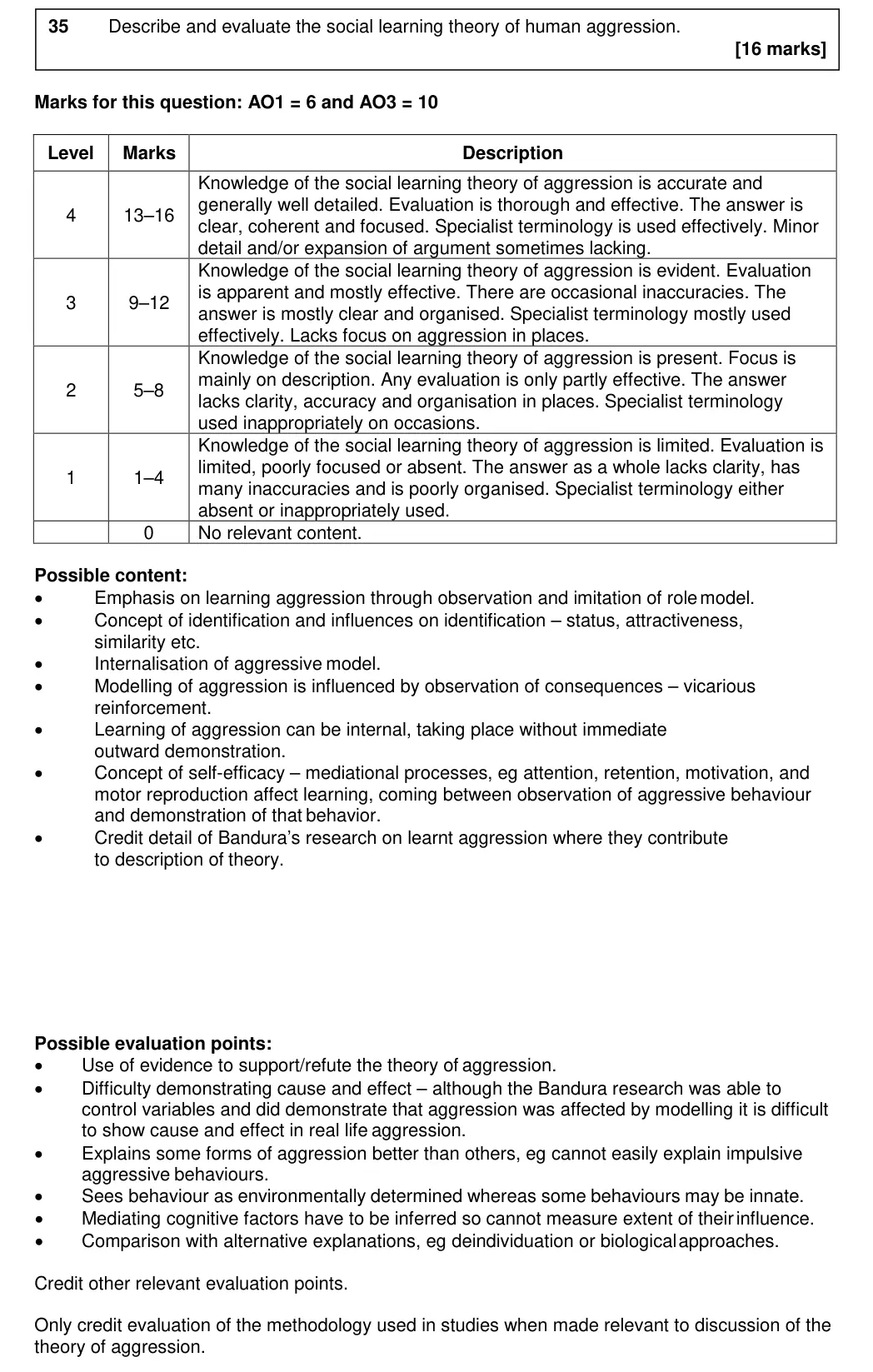
Specimen set 1 · Paper 3 · Q3516 marksAO1=6, AO3=1016-mark essay
Mark scheme, including level descriptors and indicative content