30 question parts, 7 sixteen-mark essays, 3 multiple-choice items, plus 2 parts on content removed in 2025
Notes, key studies and practice items for this topic are being written by our tutors. The past-paper questions below are ready now.
Specification statements
4.3.9-01 Offender profiling: the typology approach, including organised and disorganised types; the data-driven approach, including investigative Psychology; geographical profiling.
4.3.9-02 Biological explanations of offending behaviour: genetics and neural explanations.
4.3.9-03 Psychological explanations of offending behaviour: Eysenck’s theory of the criminal personality; cognitive explanations; level of moral reasoning and cognitive distortions, including hostile attribution bias and minimalisation; differential association theory.
4.3.9-04 Dealing with offending behaviour: the aims of custodial sentencing and the psychological effects of custodial sentencing. Behaviour modification in custody. Anger management and restorative justice programmes.
Tap a question to zoom it. Mark scheme and examiner's comment open under each question.
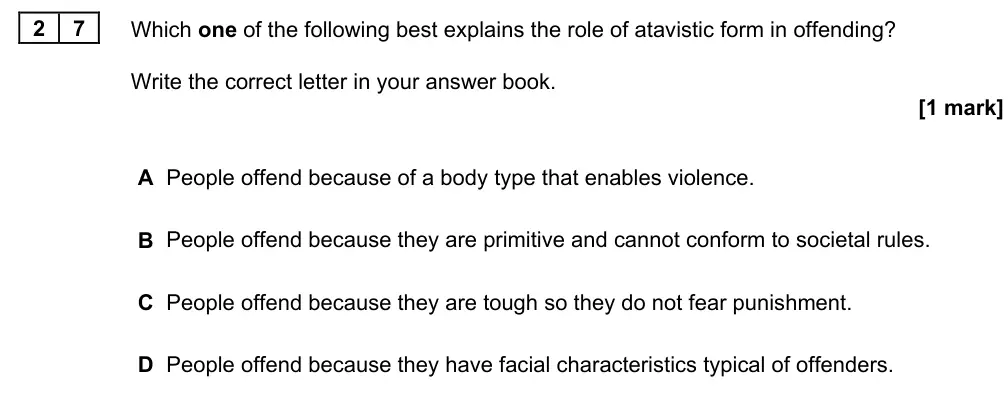
June 2025 · Paper 3 · Q271 markAO1=1Multiple choiceEasyOld spec only
Not on the 2025 specification: atavistic form removed from biological explanations of offending in v1.4
Answer
B
Mark scheme, including level descriptors and indicative content
Examiner's comment
Most students dealt very well with the short-answer questions, but the essay proved very challenging for the majority. The vast majority were able to identify option B as the correct answer for 26 and 27.
Notes from the mark scheme and report
Off-spec: atavistic form removed from biological explanations of offending in v1.4
answer B (primitive, cannot conform to societal rules)
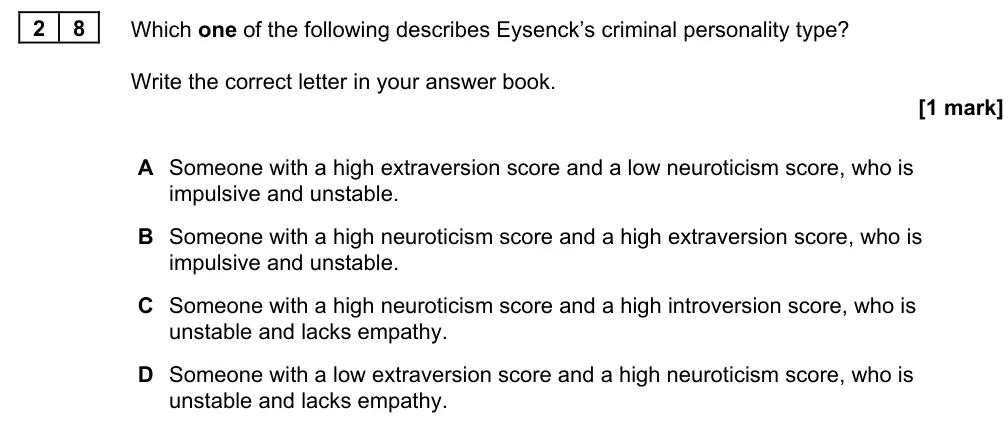
June 2025 · Paper 3 · Q281 markAO1=1Multiple choiceEasy
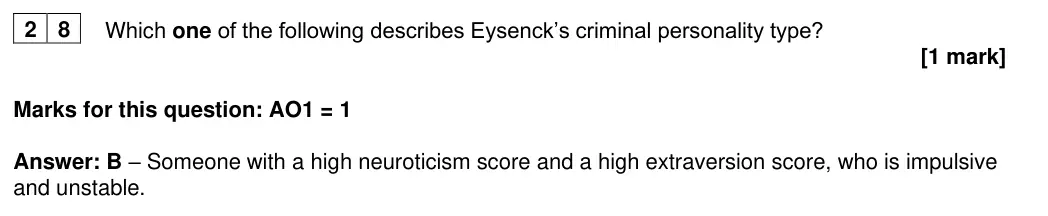
Answer
B
Mark scheme, including level descriptors and indicative content
Examiner's comment
Most students dealt very well with the short-answer questions, but the essay proved very challenging for the majority. The vast majority were able to identify option B as the correct answer for 26 and 27.
Notes from the mark scheme and report
answer B (high neuroticism and high extraversion, impulsive and unstable)
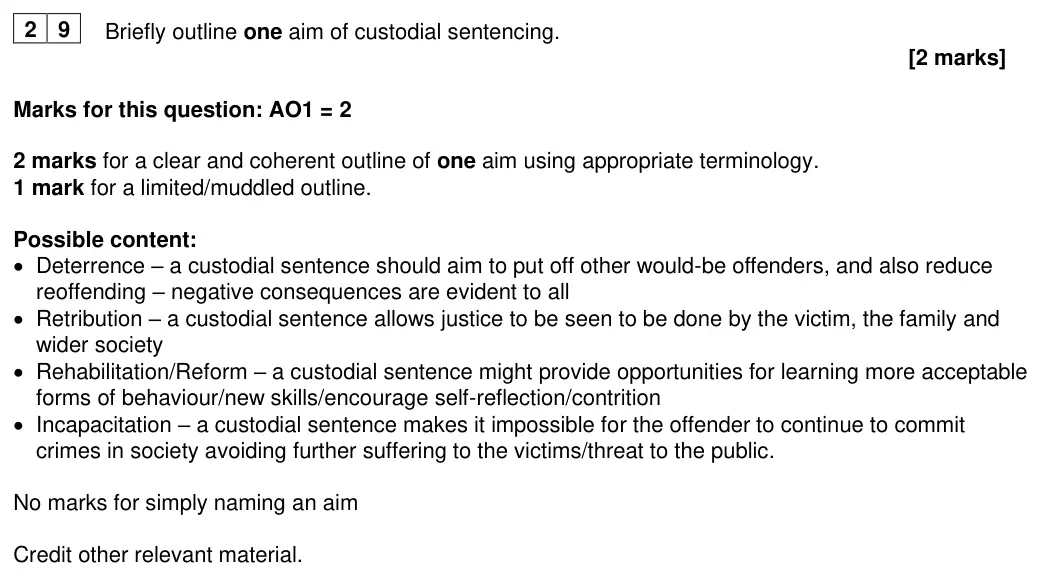
June 2025 · Paper 3 · Q292 marksAO1=2Outline
Mark scheme, including level descriptors and indicative content
Examiner's comment
Most students dealt very well with the short-answer questions, but the essay proved very challenging for the majority. Most students also experienced little difficulty outlining one aim of custodial sentencing in 28. Deterrence was the most popular response, closely followed by rehabilitation.
Notes from the mark scheme and report
2 marks for a clear outline of one aim (deterrence, retribution, rehabilitation, incapacitation)
no marks for simply naming an aim
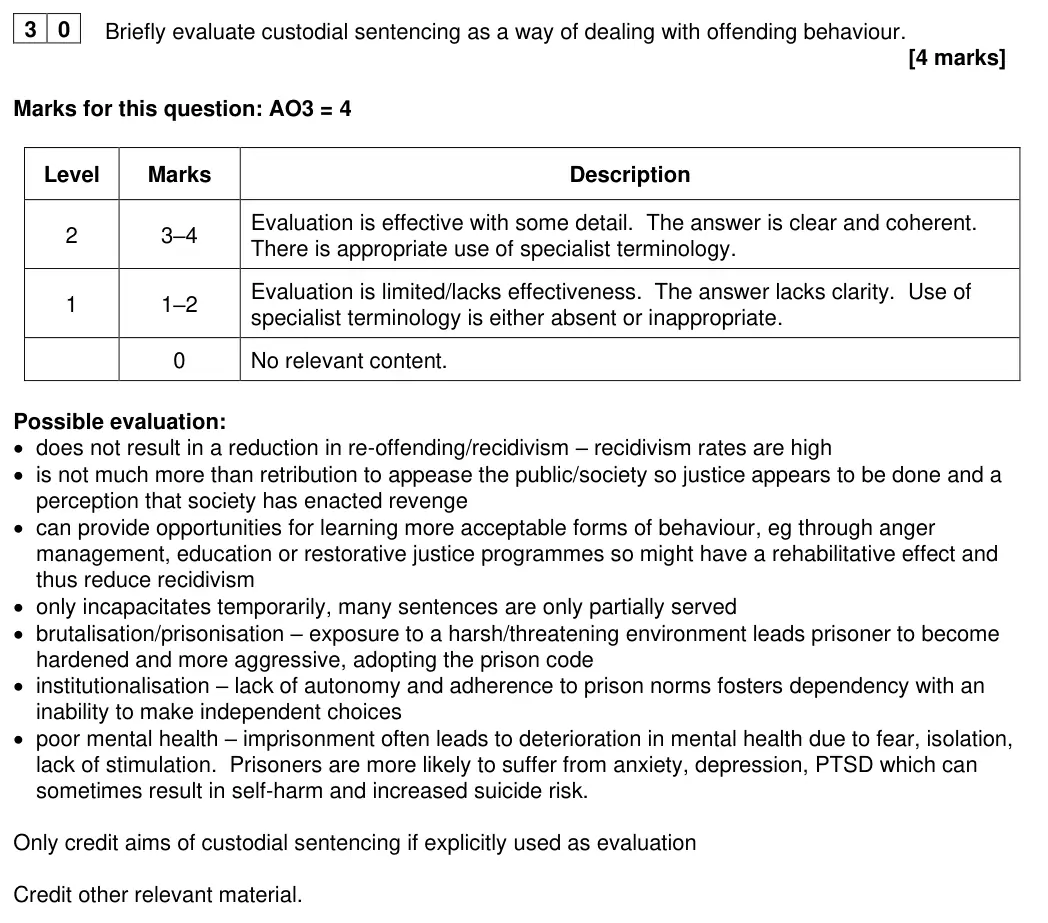
June 2025 · Paper 3 · Q304 marksAO3=4Evaluate (short)
Mark scheme, including level descriptors and indicative content
Examiner's comment
Most students dealt very well with the short-answer questions, but the essay proved very challenging for the majority. Question 29 was well done too – even though some students continued to restate aims of sentencing rather than offer evaluative content. Many students wrote very well about the problem of high recidivism rates suggesting that offenders had not been rehabilitated during their time ‘inside’. There were lots of references to the notion of a school for crime as well as reasoned debates about cost.
Notes from the mark scheme and report
high reoffending rates, retribution only, rehabilitation opportunities, temporary incapacitation, brutalisation, institutionalisation, poor mental health
aims only credited if used as evaluation
MS also credits recidivism (removed as a heading in v1.4)
school for crime and cost arguments common
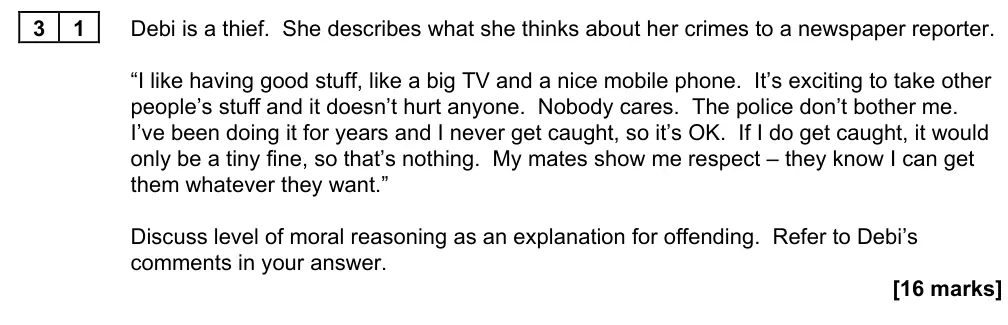
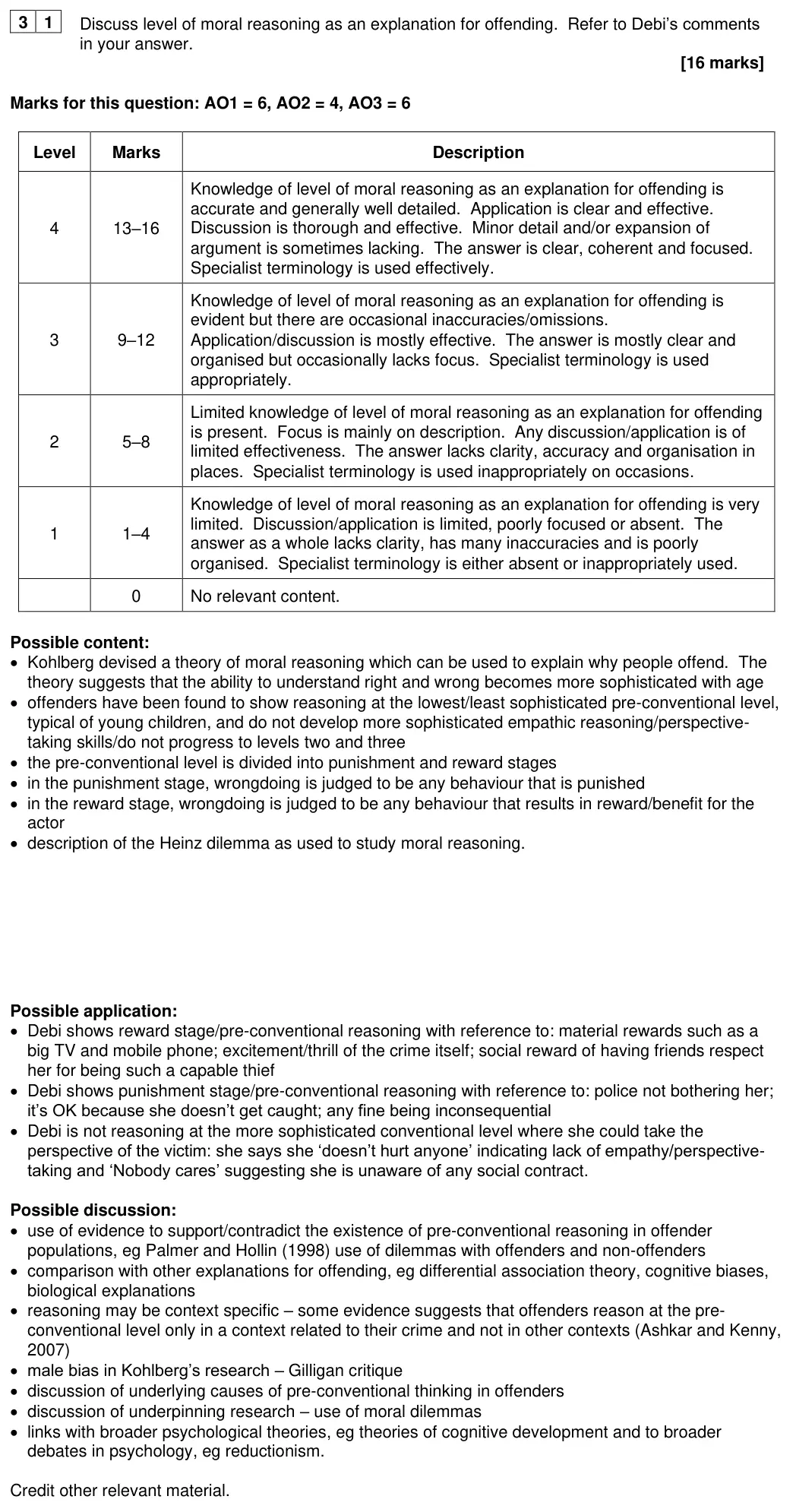
June 2025 · Paper 3 · Q3116 marksAO1=6, AO2=4, AO3=616-mark essay
Mark scheme, including level descriptors and indicative content
Examiner's comment
Most students dealt very well with the short-answer questions, but the essay proved very challenging for the majority. In contrast, question 30 was a real struggle. The fact that there are two cognitive explanations of offending on the specification probably did not help. Many students were determined to write about minimalization and hostile attribution bias, and then tried, in vain, to link these to features of the stem. Those that did possess some knowledge of Kohlberg’s stage theory could say very little beyond the need to avoid punishment and gain reward and then make limited links to the stem. There were very few answers that included discussion. Those that did criticised the moral dilemma technique on the basis of its hypothetical nature.
many wrote about hostile attribution bias/minimalisation instead and could not link to the stem
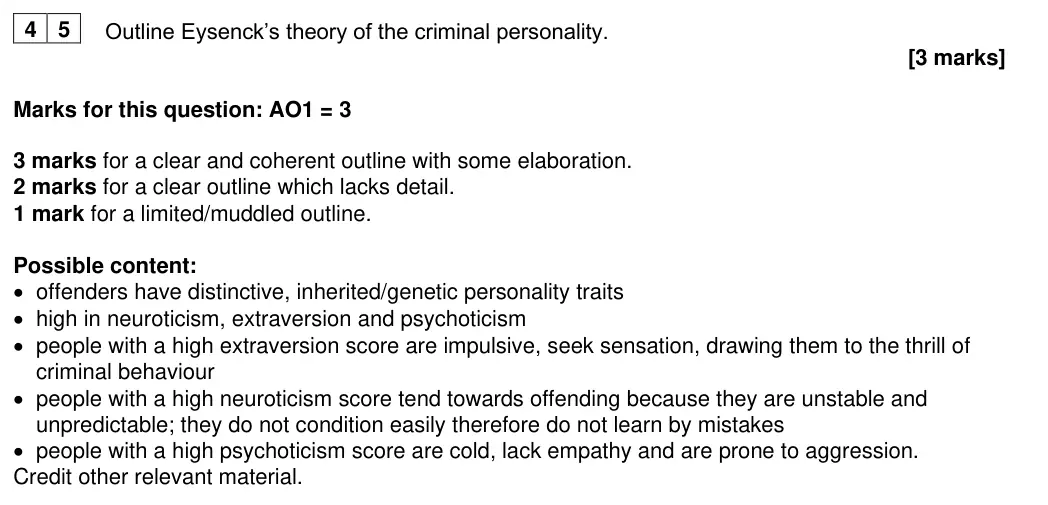
June 2024 · Paper 3 · Q453 marksAO1=3Outline
Mark scheme, including level descriptors and indicative content
Examiner's comment
For Question 45, most students could state the three elements of the criminal personality – or two elements for those students who drew on Eysenck’s original work. There was also frequent creditworthy reference to the biological basis of personality. Although not a requirement of the question, if there was sufficient other information present, a surprising number of students did not make it clear why someone who scored highly on all three traits would be more likely to offend.
Notes from the mark scheme and report
extraversion, neuroticism, psychoticism with link to offending
innate/biological basis creditworthy
many did not explain why high scores lead to offending
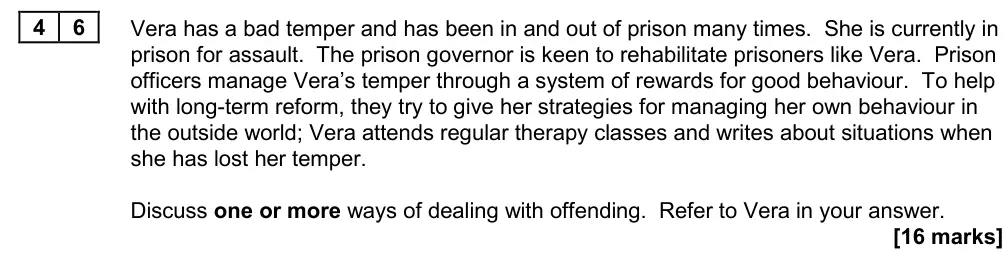
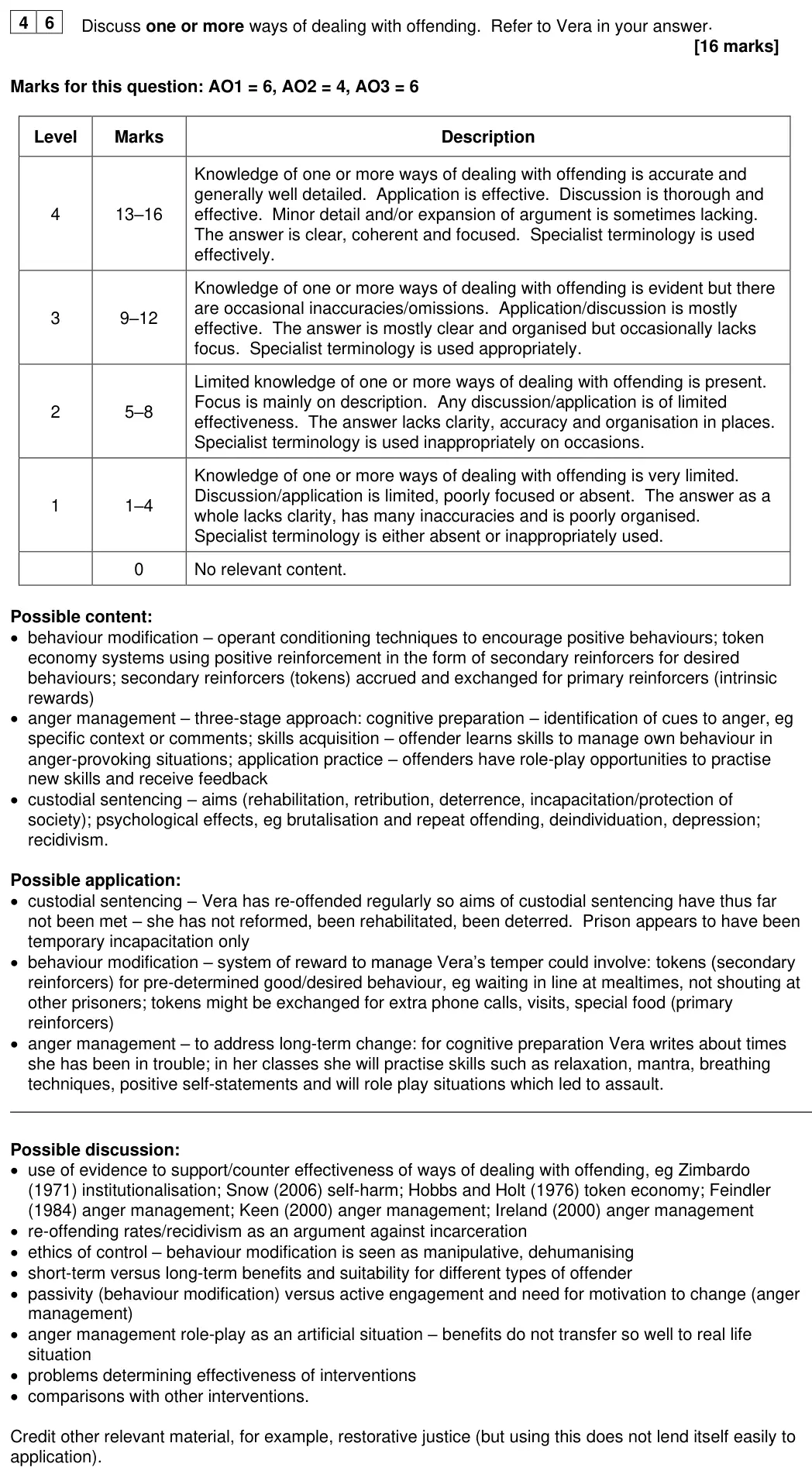
June 2024 · Paper 3 · Q4616 marksAO1=6, AO2=4, AO3=616-mark essay
Mark scheme, including level descriptors and indicative content
Examiner's comment
Again, for Question 46, a breadth rather than depth approach proved most popular as many students sought to describe three ways of dealing with offending to broaden the scope for application. Even with those who did not pursue this route, behaviour modification/token economy was by far the most chosen option, followed by anger management. Those who discussed custodial sentencing produced the least convincing accounts, and often seemed unsure of which material to include. Restorative justice was also included in some essays, and was reasonably well-described and discussed, although in terms of application, students quickly ‘ran out of road’ as there were no obvious links in the stem.
Notes from the mark scheme and report
behaviour modification/token economy (rewards), anger management (therapy classes, writing about lost temper), custodial sentencing (repeat imprisonment)
MS also credits recidivism, removed in v1.4
custodial sentencing accounts least convincing
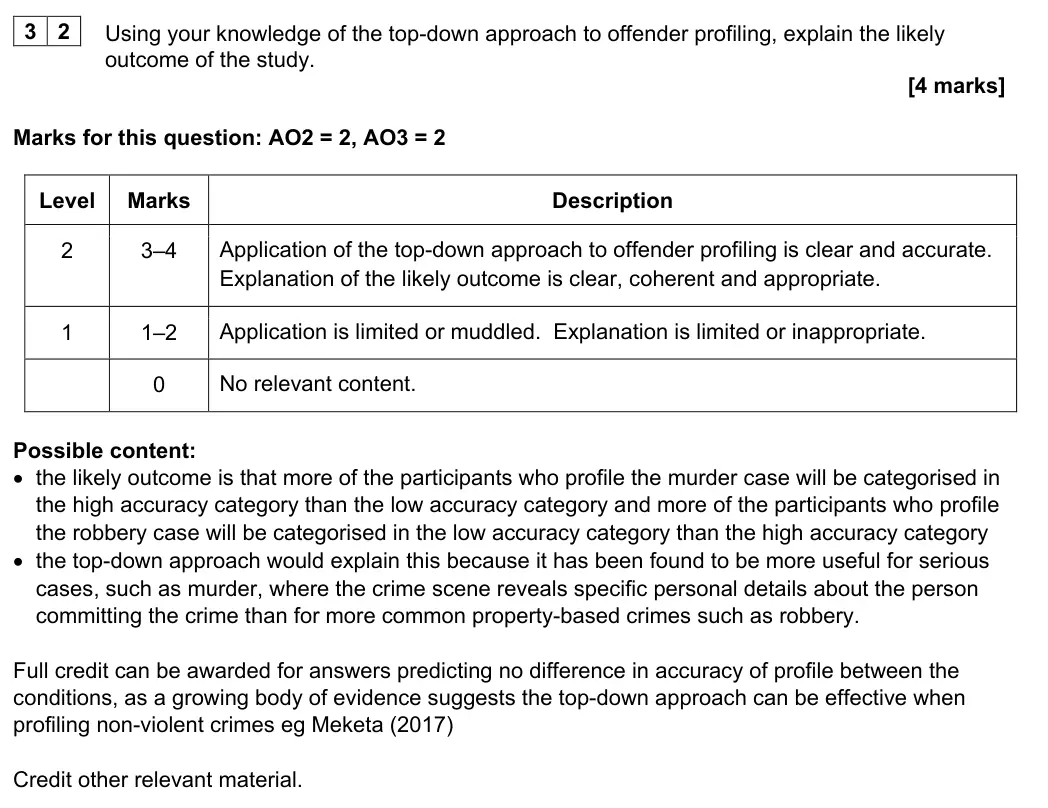
June 2023 · Paper 3 · Q324 marksAO2=2, AO3=2Application
Mark scheme, including level descriptors and indicative content
Examiner's comment
Full marks required a clear explanation of the likely outcome of the study described, but many students only talked about one of the conditions rather than both. There were lots of answers that missed the point completely and instead described the top-down approach without really addressing the question. Those that scored well often made links between the study in the question and the way in which the top-down approach was developed through interviews with high- profile serial killers. A small minority asserted that there would be little or no difference in profiling accuracy and followed this line of argument though by giving recent evidence that suggests the approach can be successfully applied to non-violent crime. They were awarded all four marks on that basis.
Notes from the mark scheme and report
'top-down' = typology approach in v1.4
predict outcome for BOTH conditions (murder profiles more accurate) explained by approach suiting serious crimes with revealing crime scenes
predicting no difference with evidence (Meketa 2017) also full credit
many just described the approach
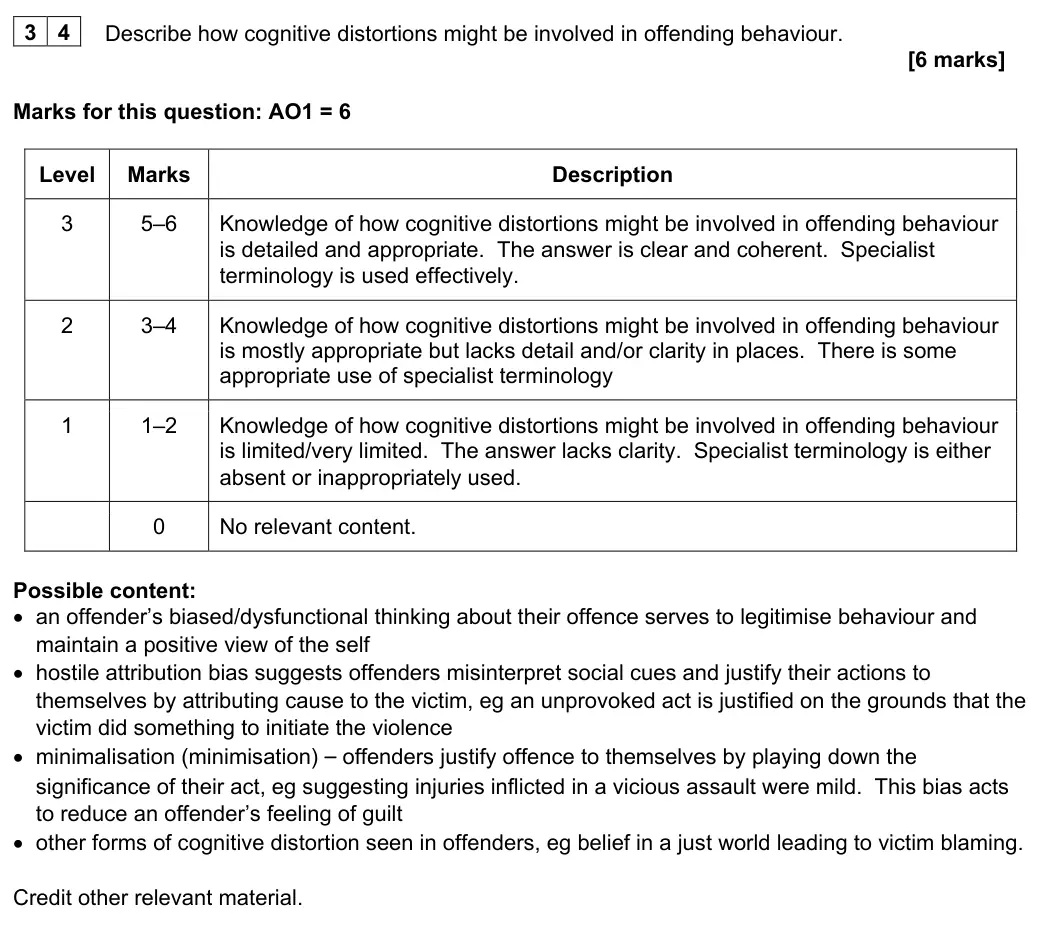
June 2023 · Paper 3 · Q346 marksAO1=6Outline
Mark scheme, including level descriptors and indicative content
Examiner's comment
This question proved difficult for many students. Indeed, a substantial number of students left both Question 34 and Question 35 blank. Responses tended to be quite brief. Hostile attribution bias and minimalization were usually identified and outlined but there was little other information provided. Those students who were able to access the top level gave additional detail about cognitive distortions in general, and the purpose they serve for the offender. For example, legitimising criminal behaviour and reducing guilt.
Notes from the mark scheme and report
hostile attribution bias and minimalisation plus general purpose of distortions (legitimise offence, reduce guilt) for top level
many left 34 and 35 blank
answers brief
June 2023 · Paper 3 · Q356 marksAO3=6Evaluate (short)
Mark scheme, including level descriptors and indicative content
Examiner's comment
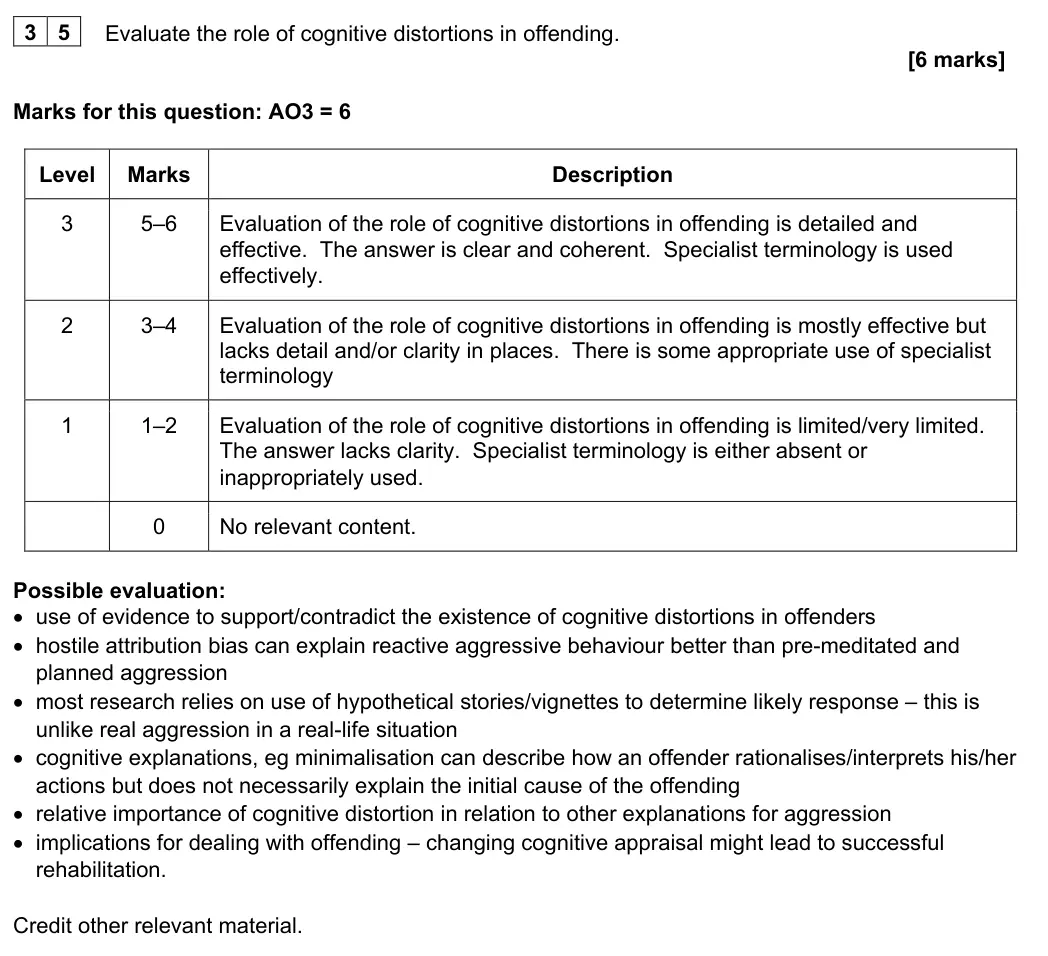
Indeed, a substantial number of students left both Question 34 and Question 35 blank. Higher scoring answers offered supportive or contradictory evidence for each distortion, and often talked about the implications for therapeutic intervention and possible rehabilitation. However, as documented, these were few and far between.
Notes from the mark scheme and report
evidence, HAB fits reactive more than planned aggression, vignette methodology, describes rather than explains cause, implications for rehabilitation
few high-scoring answers
June 2022 · Paper 3 · Q344 marksAO1=4Outline
Mark scheme, including level descriptors and indicative content
Examiner's comment
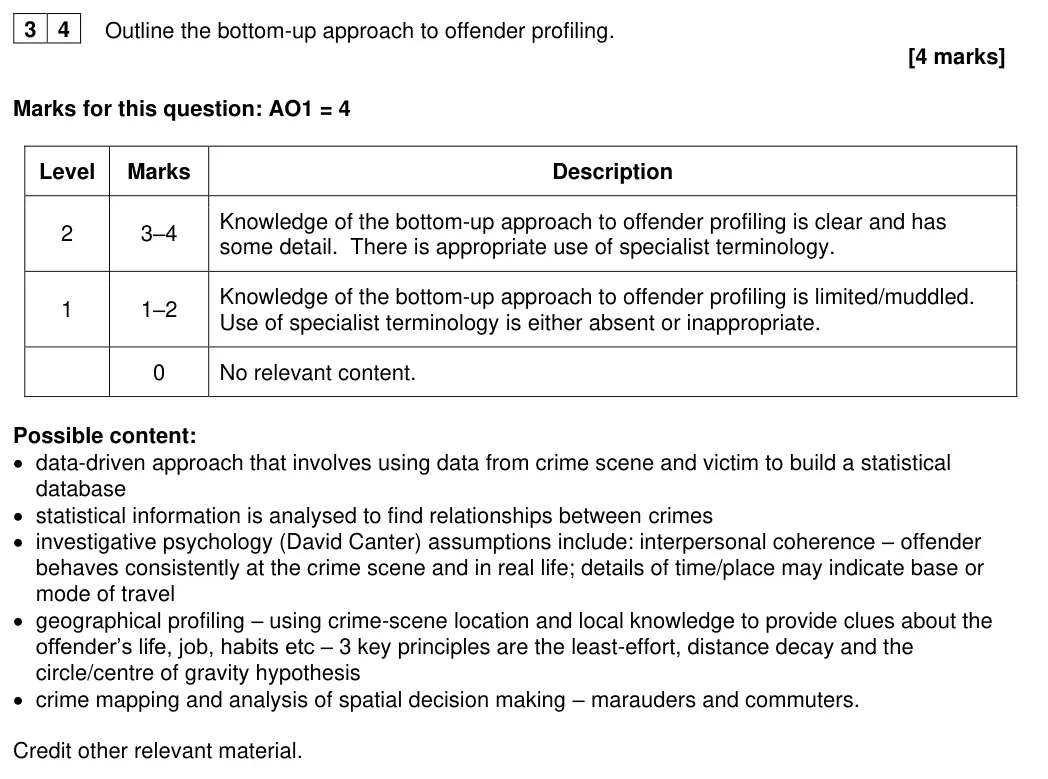
Answers to Question 34 often scored well although even quite detailed answers sometimes neglected the fundamental point that the bottom-up approach is data driven. Some answers were restricted to marks in Level 1 because they consisted of a list of terms (interpersonal coherence, forensic awareness, etc) without any explanation. Occasionally students completely confused the top-down and bottom-up approaches in both Questions 34 and 35.
June 2022 · Paper 3 · Q354 marksAO3=4Evaluate (short)
Mark scheme, including level descriptors and indicative content
Examiner's comment
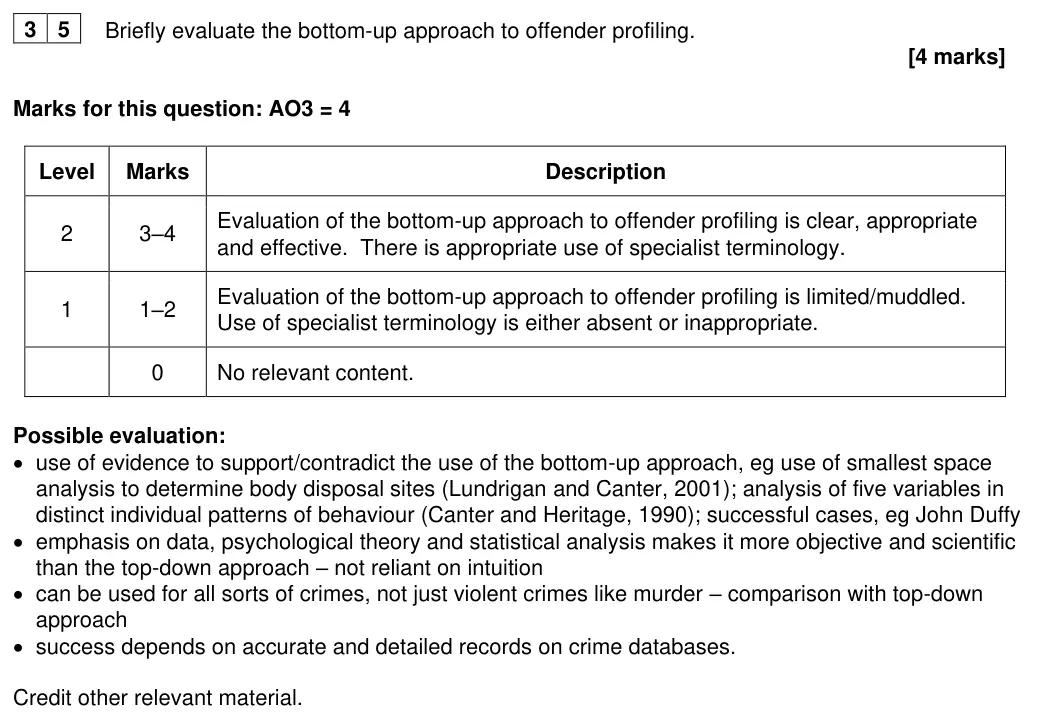
Question 35 was generally effectively answered. Students used evidence in relation to effectiveness or offered comparison with the top-down approach. Occasionally students completely confused the top-down and bottom-up approaches in both Questions 34 and 35.
Notes from the mark scheme and report
evidence (Canter), more objective/scientific than typology approach, applicable to more crime types, depends on database quality
November 2021 · Paper 3 · Q311 markAO1=1Short answer
Mark scheme, including level descriptors and indicative content
Examiner's comment
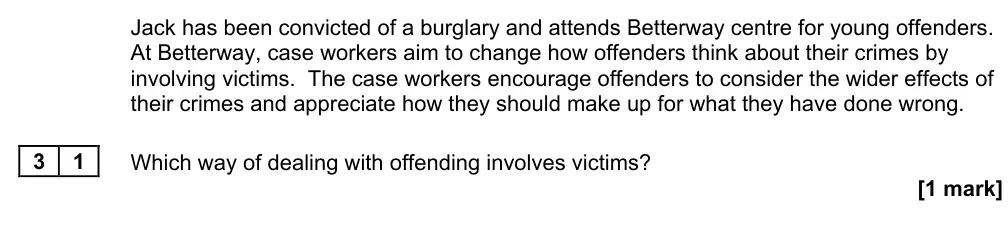
The naming question after each of the stems was generally answered correctly except for Q31 where several students were unable to name ‘restorative justice’. Fortunately, this did not seem to affect the performance on follow-on questions.
Notes from the mark scheme and report
restorative justice
several could not name it
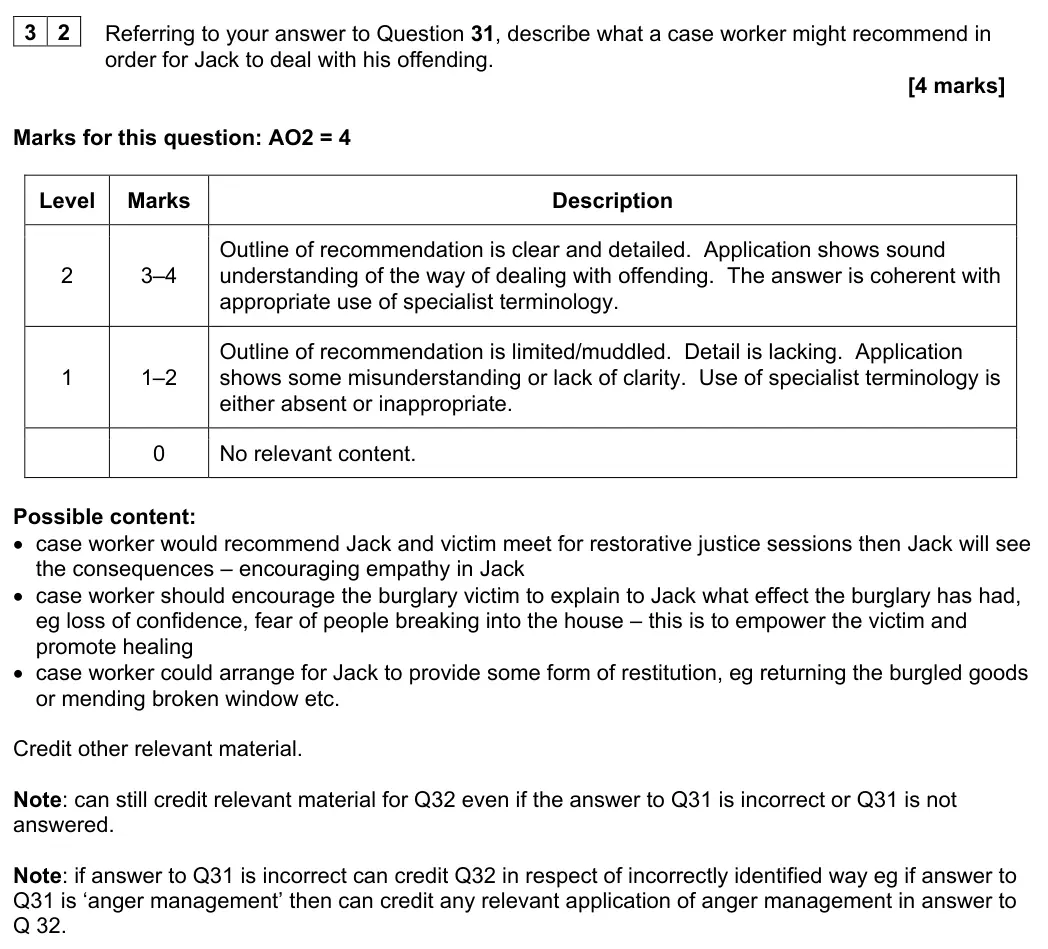
November 2021 · Paper 3 · Q324 marksAO2=4Application
Mark scheme, including level descriptors and indicative content
Examiner's comment
The 4-mark application questions requiring use of the stem were usually competently answered, although there were some weaker answers with little foundation in psychology.
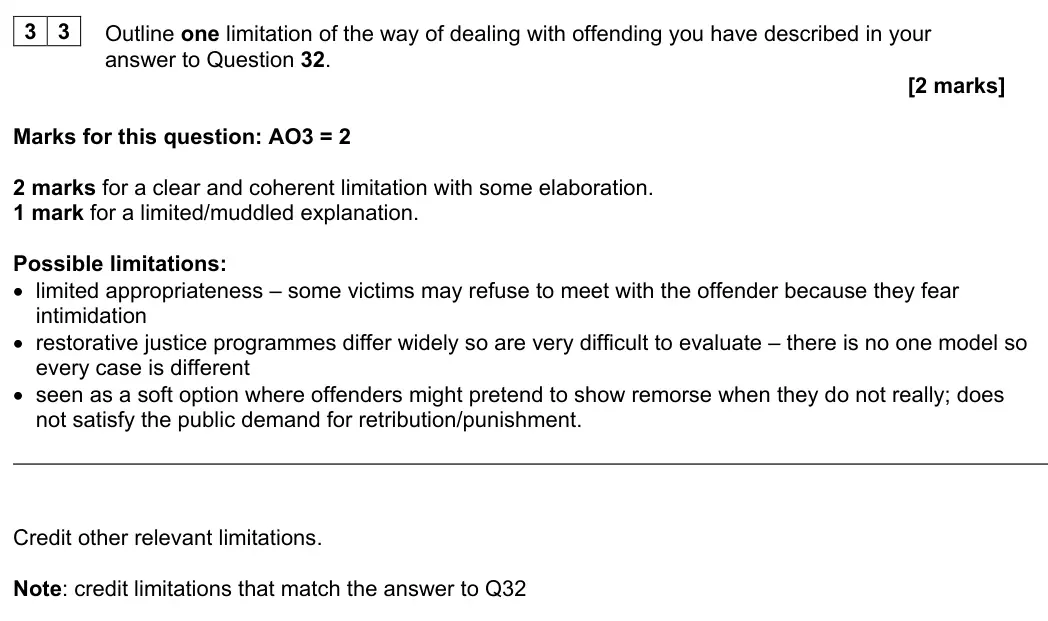
November 2021 · Paper 3 · Q332 marksAO3=2Evaluate (short)
Mark scheme, including level descriptors and indicative content
Notes from the mark scheme and report
limitation must match Q32, e.g. victims may refuse, programmes vary, seen as a soft option
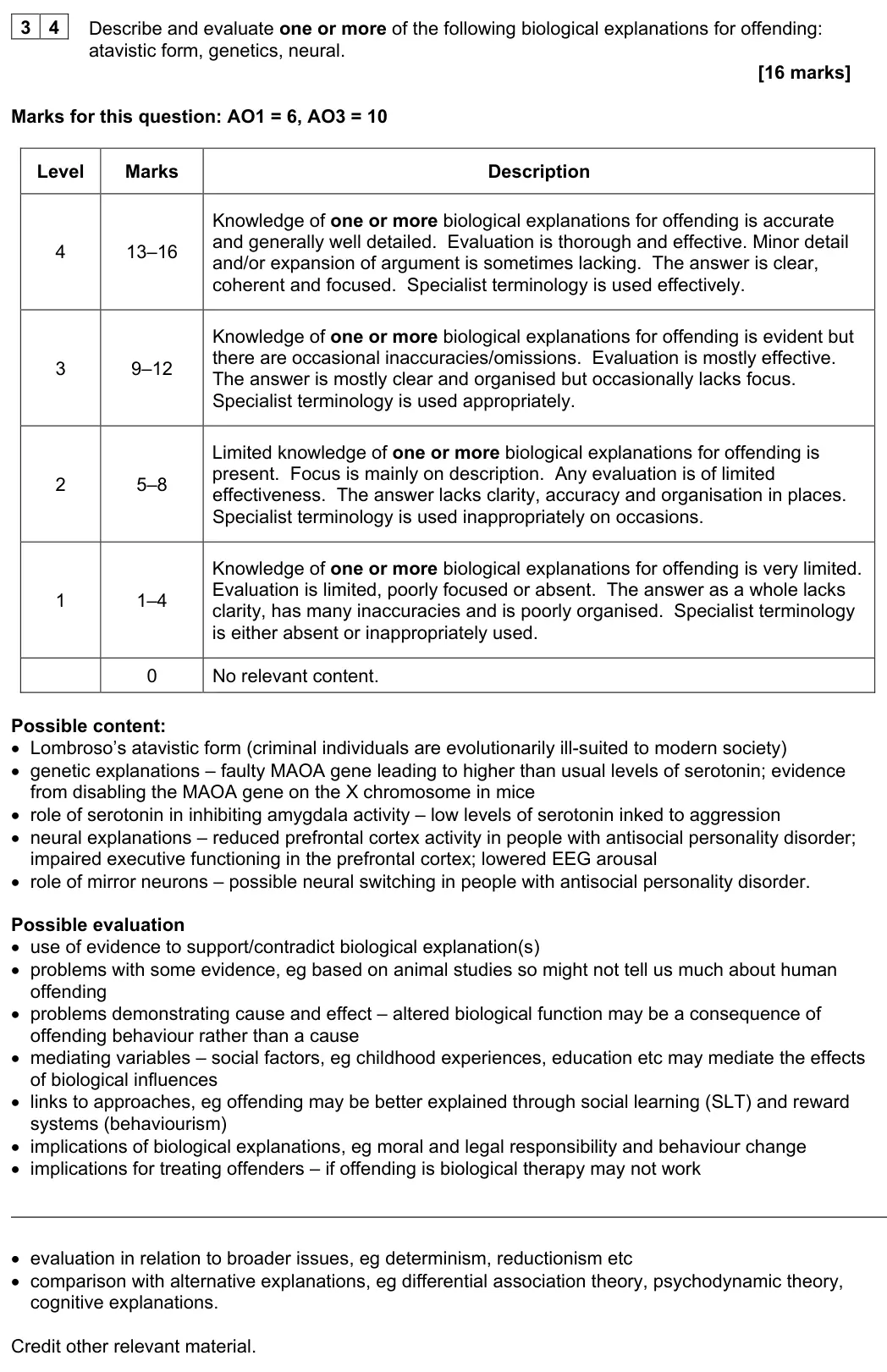
November 2021 · Paper 3 · Q3416 marksAO1=6, AO3=1016-mark essay
Mark scheme, including level descriptors and indicative content
Examiner's comment
The straightforward 16-mark questions yielded a wide range of marks with some impressively detailed and well-argued answers at the top end.
Notes from the mark scheme and report
genetics and/or neural
MS also credits atavistic form (removed in v1.4) as a choice, full marks available without it
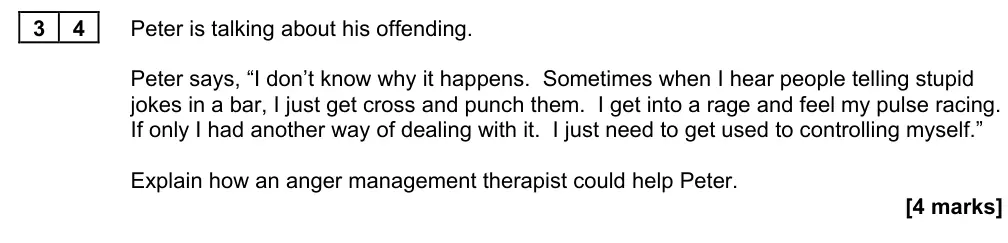
November 2020 · Paper 3 · Q344 marksAO2=4Application
Mark scheme, including level descriptors and indicative content
Examiner's comment
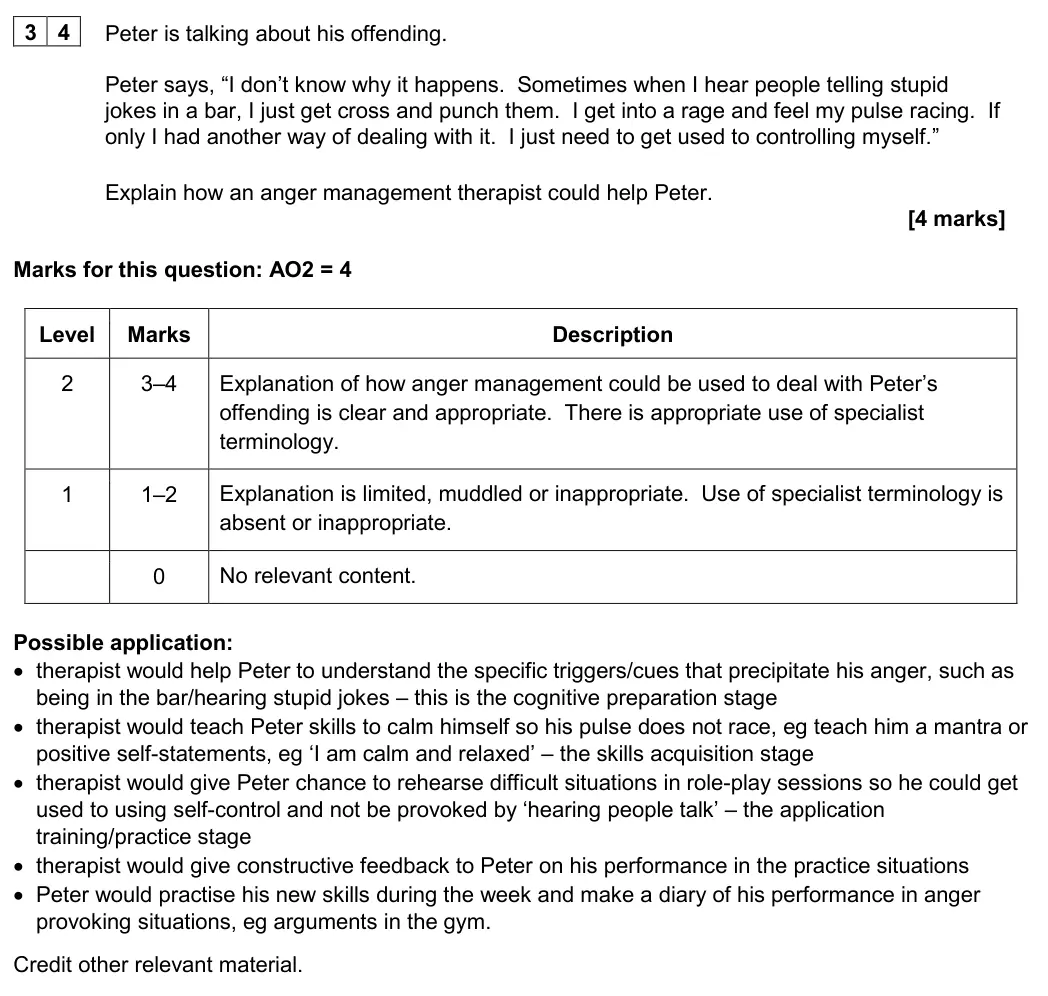
The application questions elicited sound engagement from many students who used the hooks in the stems effectively. Weaker answers were those where students simply name dropped into an otherwise purely knowledge-based answer.
Notes from the mark scheme and report
cognitive preparation (triggers: bar, jokes), skills acquisition (calming, mantra), application practice (role-play) applied to Peter
November 2020 · Paper 3 · Q356 marksAO3=6Evaluate (short)
Mark scheme, including level descriptors and indicative content
Examiner's comment
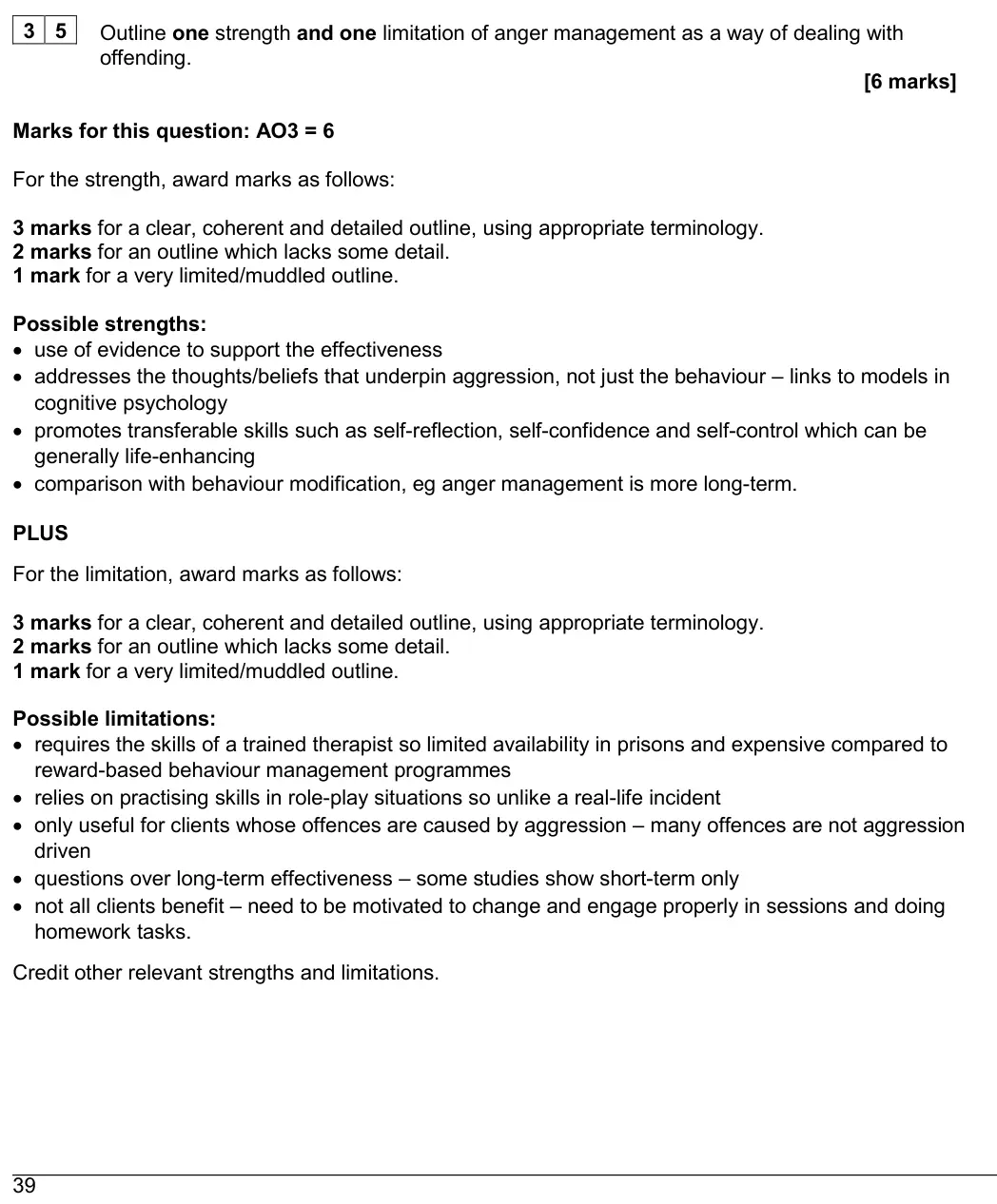
The strengths/limitations questions tended to yield high marks where students wrote enough to develop and sustain their points.
Notes from the mark scheme and report
3 marks strength + 3 marks limitation, e.g. addresses cognitions/transferable skills vs needs trained staff, role-play unlike real life, motivation
November 2020 · Paper 3 · Q368 marksAO1=3, AO3=5Extended writing
Mark scheme, including level descriptors and indicative content
Examiner's comment
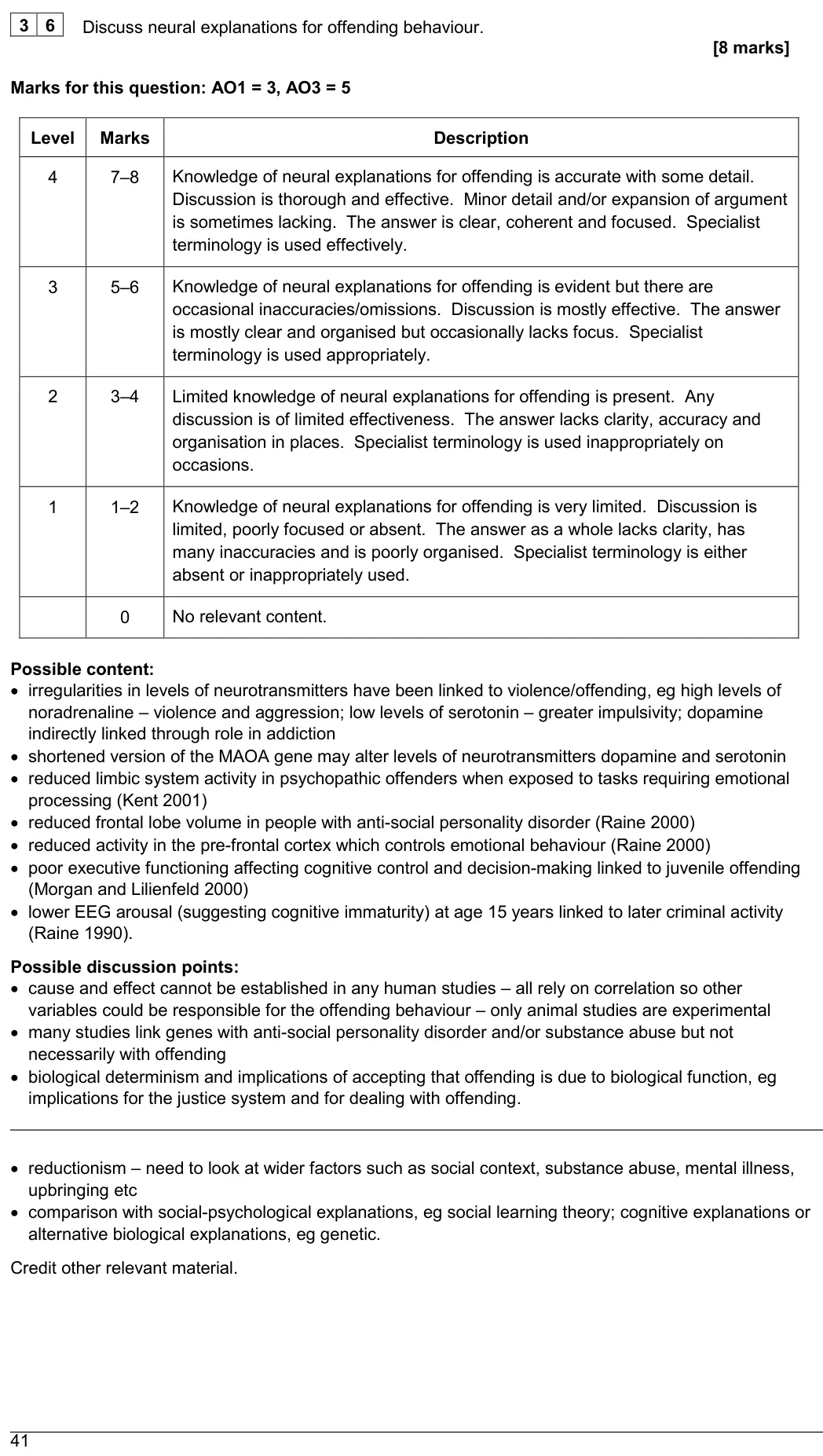
It is worth noting that in questions on neural mechanisms (Q29 aggression, Q36 offending), material about genetics/specific genes could only be credited if the student made some neural link ie linking genetics/genes to brain structure, function or neurochemistry.
genes only credited if linked to brain structure/function/neurochemistry
correlational, determinism
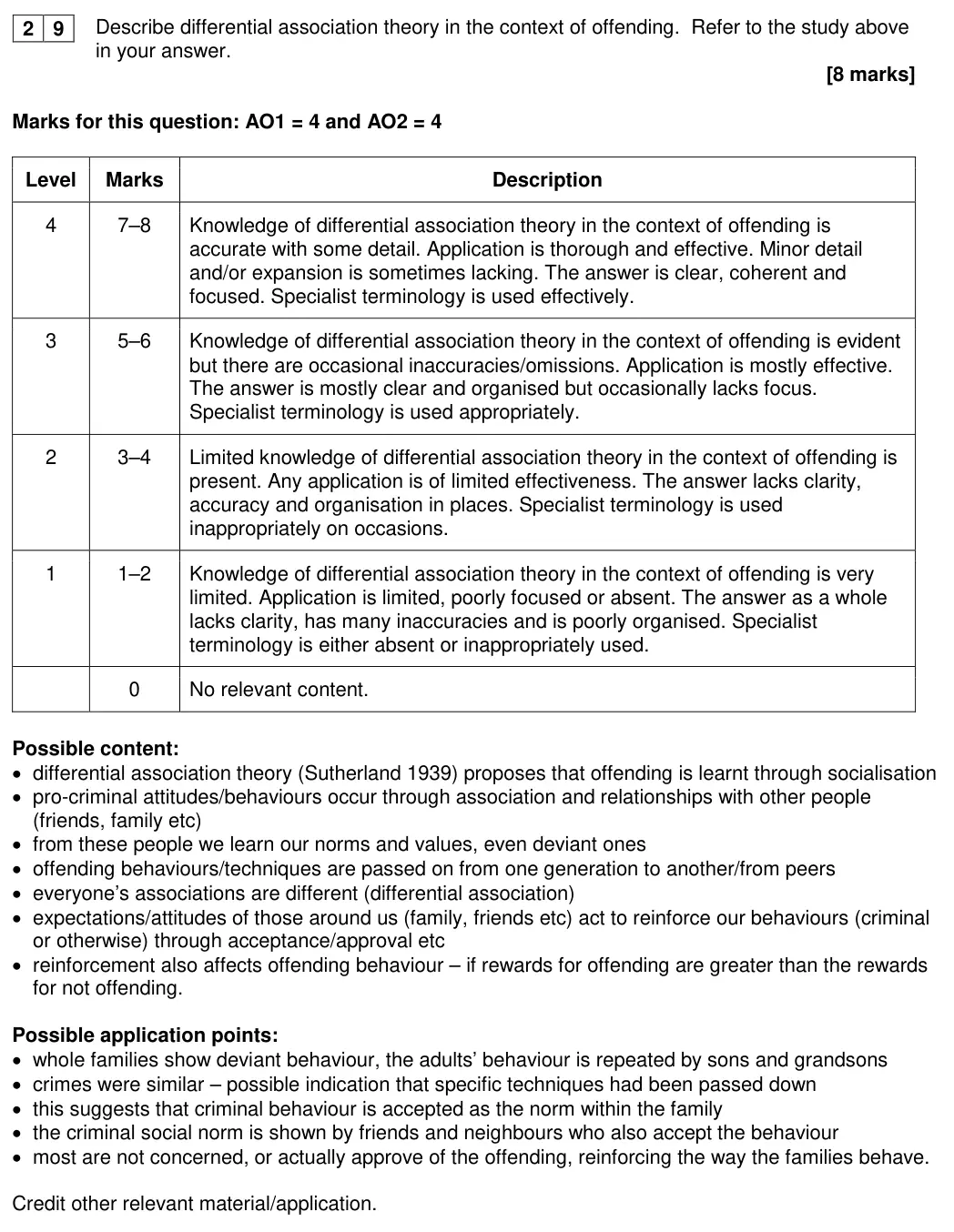
June 2019 · Paper 3 · Q298 marksAO1=4, AO2=4Extended writing
Mark scheme, including level descriptors and indicative content
Examiner's comment
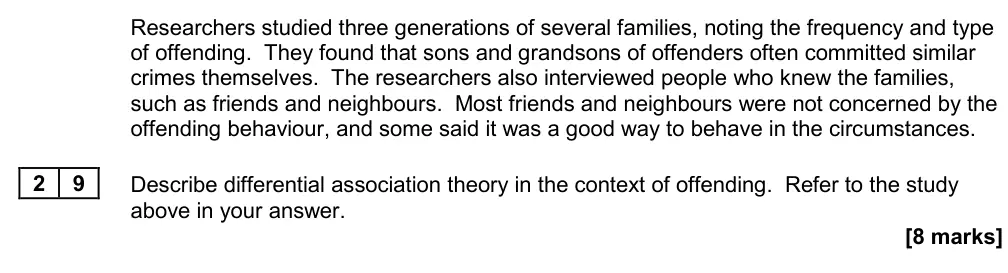
This question was often poorly answered, with many responses giving vague or anecdotal accounts of how growing up in a problem area or difficult family circumstances might lead to imitation and modelling of criminal behaviour. Many answers showed very little knowledge that was specific to differential association theory and appeared to be based simply on social learning theory. Where students seemed to have no specific knowledge of differential association theory, they sometimes nevertheless attempted answers hinged on the word ‘association’ and managed to get limited credit. The more well-informed students referred to pro- and anti-crime attitudes, social norms, social acceptance, social approval and socialisation.
Notes from the mark scheme and report
DAT: offending learned through association, pro-criminal attitudes and techniques, reinforcement/approval
apply to three generations and accepting neighbours
many gave generic SLT accounts
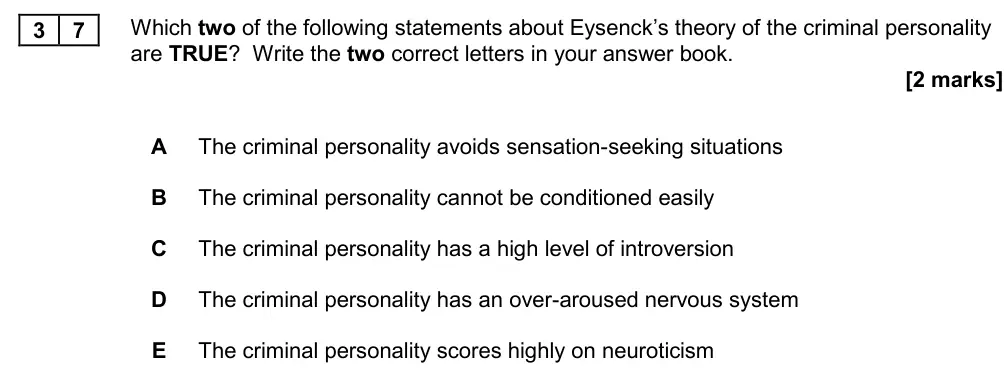
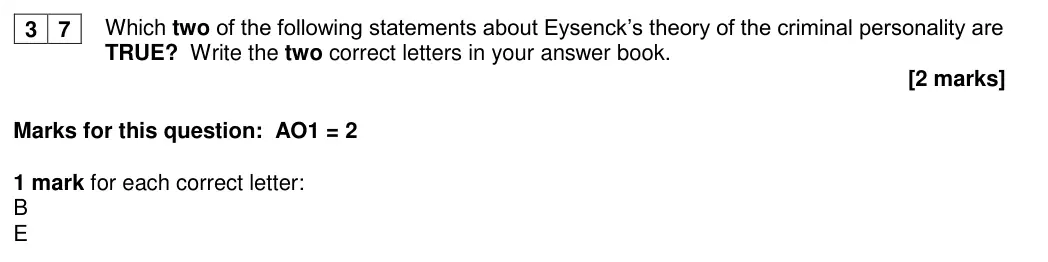
June 2018 · Paper 3 · Q372 marksAO1=2Multiple choice
Answer
B and E
Mark scheme, including level descriptors and indicative content
Examiner's comment
Most students gained at least one mark for this question.
Notes from the mark scheme and report
correct B (hard to condition) and E (high neuroticism)
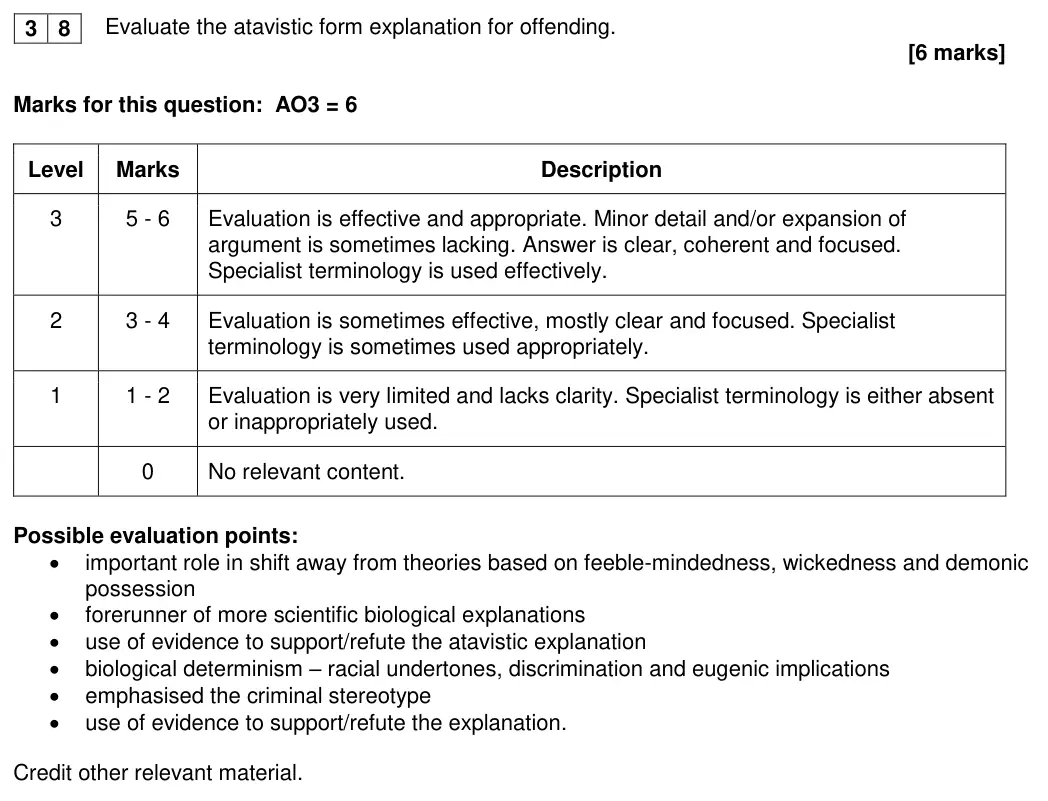
June 2018 · Paper 3 · Q386 marksAO3=6Evaluate (short)Old spec only
Not on the 2025 specification: Lombroso's atavistic form explanation, removed in v1.4
Mark scheme, including level descriptors and indicative content
Examiner's comment
A further challenge was noted on Section D where the 6 mark questions required evaluation only, but students often preceded any evaluation with lengthy descriptions, particularly in the Aggression topic. This question was well answered, with many students presenting issues such as scientific racism and use of evidence. Evaluations varied immensely in terms of clarity and coherence.
Notes from the mark scheme and report
Off-spec: Lombroso's atavistic form explanation, removed in v1.4
June 2018 · Paper 3 · Q3916 marksAO1=6, AO2=4, AO3=616-mark essay
Mark scheme, including level descriptors and indicative content
Examiner's comment
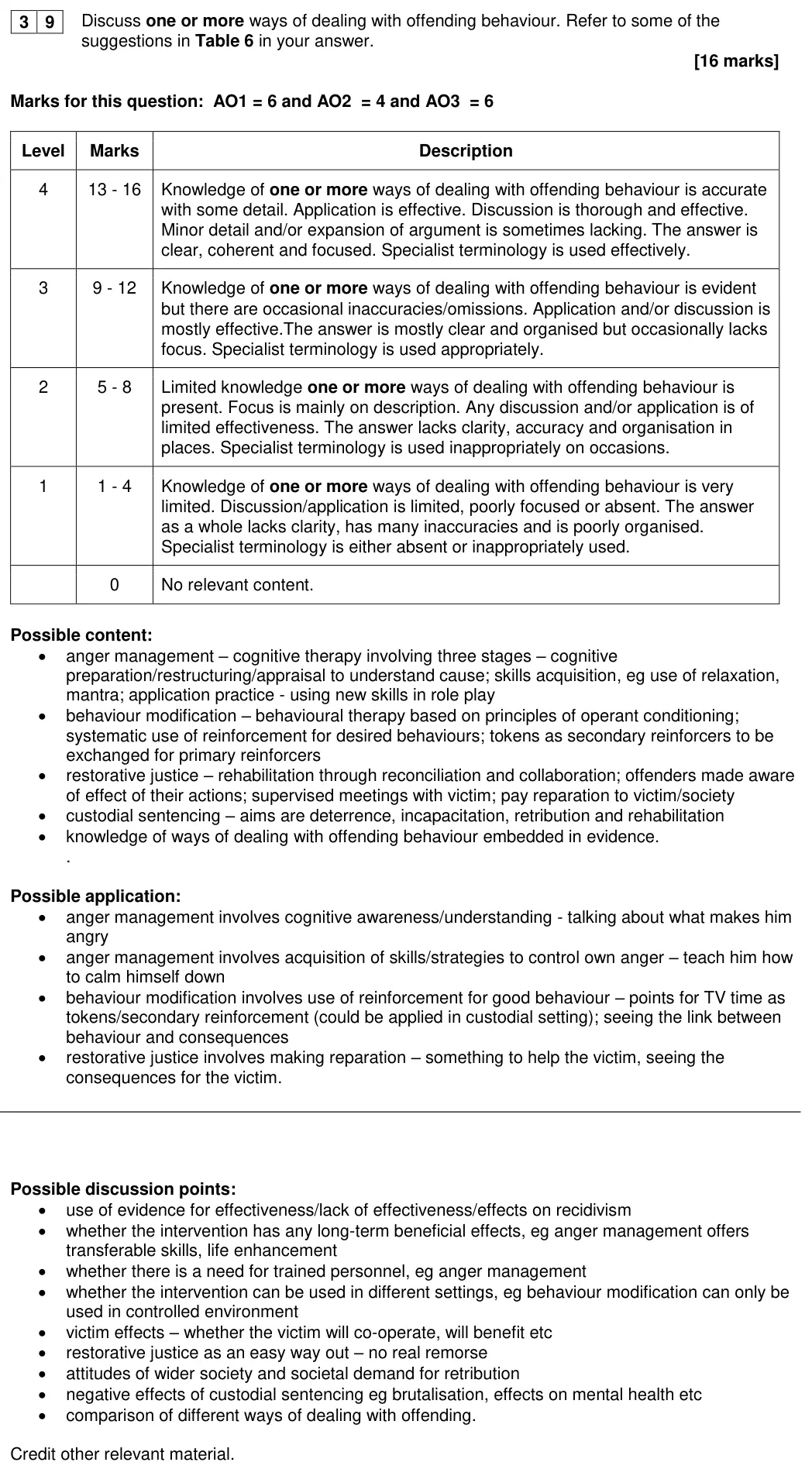
This was usually well answered, with many effective responses including material on restorative justice, token economy and anger management. Whilst many answers were detailed and well applied, the application here was often less well-developed than in Q36. Where students performed less well overall it was often because knowledge was lacking, for example, where token economy was presented there was little or no reference to operant conditioning theory and reinforcement. Similarly, with restorative justice, the knowledge in some responses consisted of ‘a meeting between the victim and the offender’. Relatively few answers used custodial sentencing as the basis for a response, and those that did, tended to score lower marks. Discussions were often informed and well elaborated.
Notes from the mark scheme and report
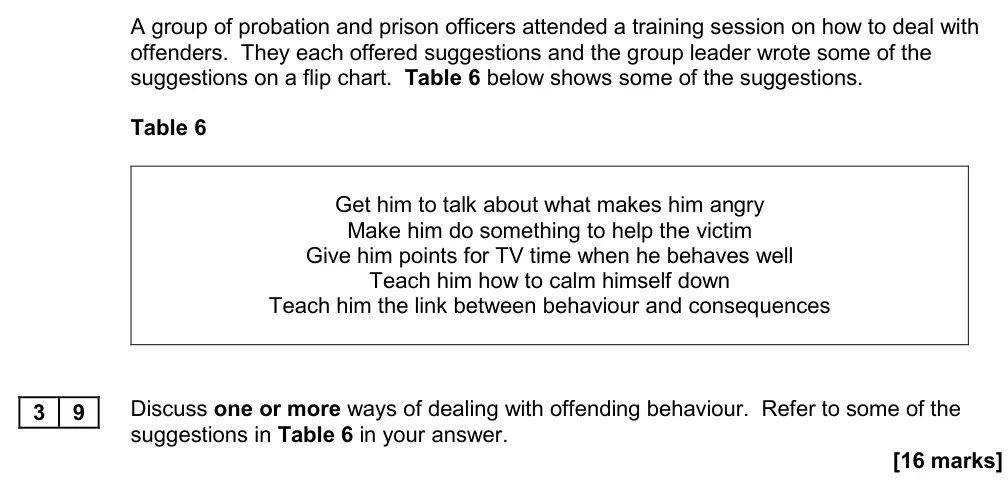
anger management, behaviour modification (points for TV time), restorative justice, custodial sentencing applied to Table 6
MS discussion includes effects on recidivism (removed in v1.4)
token economy answers often lacked operant theory
June 2017 · Paper 3 · Q382 marksAO1=2Explain
Mark scheme, including level descriptors and indicative content
Examiner's comment
Most students gained one mark for referring to the organised/disorganised distinction. Rather fewer could explain that this categorisation was dependent on analysis of evidence from the crime scene. Some students provided unnecessary background information about the origins of the top-down approach or gave detailed information about the stages of profile generation.
Notes from the mark scheme and report
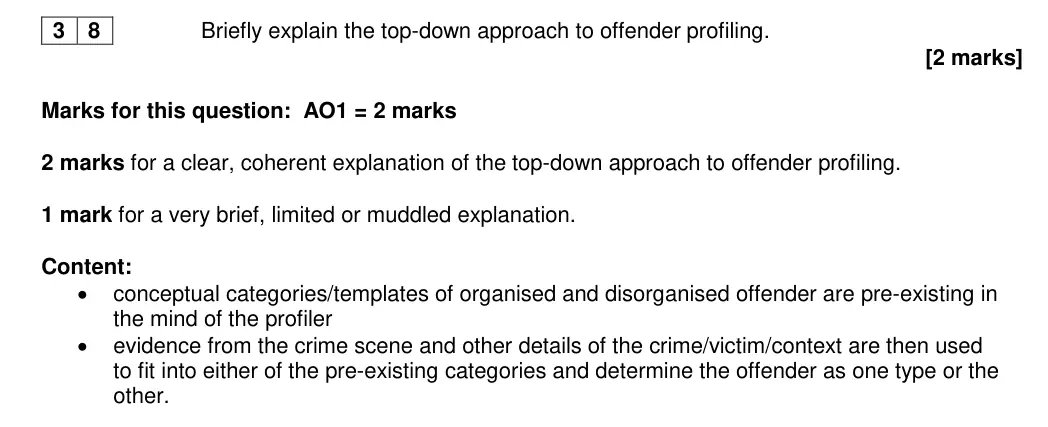
pre-existing organised/disorganised templates + crime-scene evidence fitted to a type
most got 1 mark for organised/disorganised only
top-down = typology approach in v1.4
June 2017 · Paper 3 · Q4116 marksAO1=6, AO3=1016-mark essay
Mark scheme, including level descriptors and indicative content
Examiner's comment
This straightforward question clearly posed a problem for many students. Most could give some descriptive account of appropriate material, such as theory of moral reasoning, hostile attribution bias and minimalisation. Unfortunately, there was often insufficient focus on offending, where students presented long accounts of Kohlberg’s theory of moral development, with details of stages and the Heinz dilemma, but with no mention of offending. Better answers focused primarily on the pre-conventional level and explanation of how reasoning at this level might lead to offending behaviour. Similarly, hostile attribution bias was outlined, but relatively infrequently did students explain how it might lead to offending. With minimalisation, it was not often clear how it operates to enable the offender to justify the offending act to him or herself and thus avoid feelings of guilt. A significant number of students tried to use Eysenck, differential association or psychodynamic theory to answer this question. Unless some cognitive element was obvious, these answers gained no credit.
Notes from the mark scheme and report
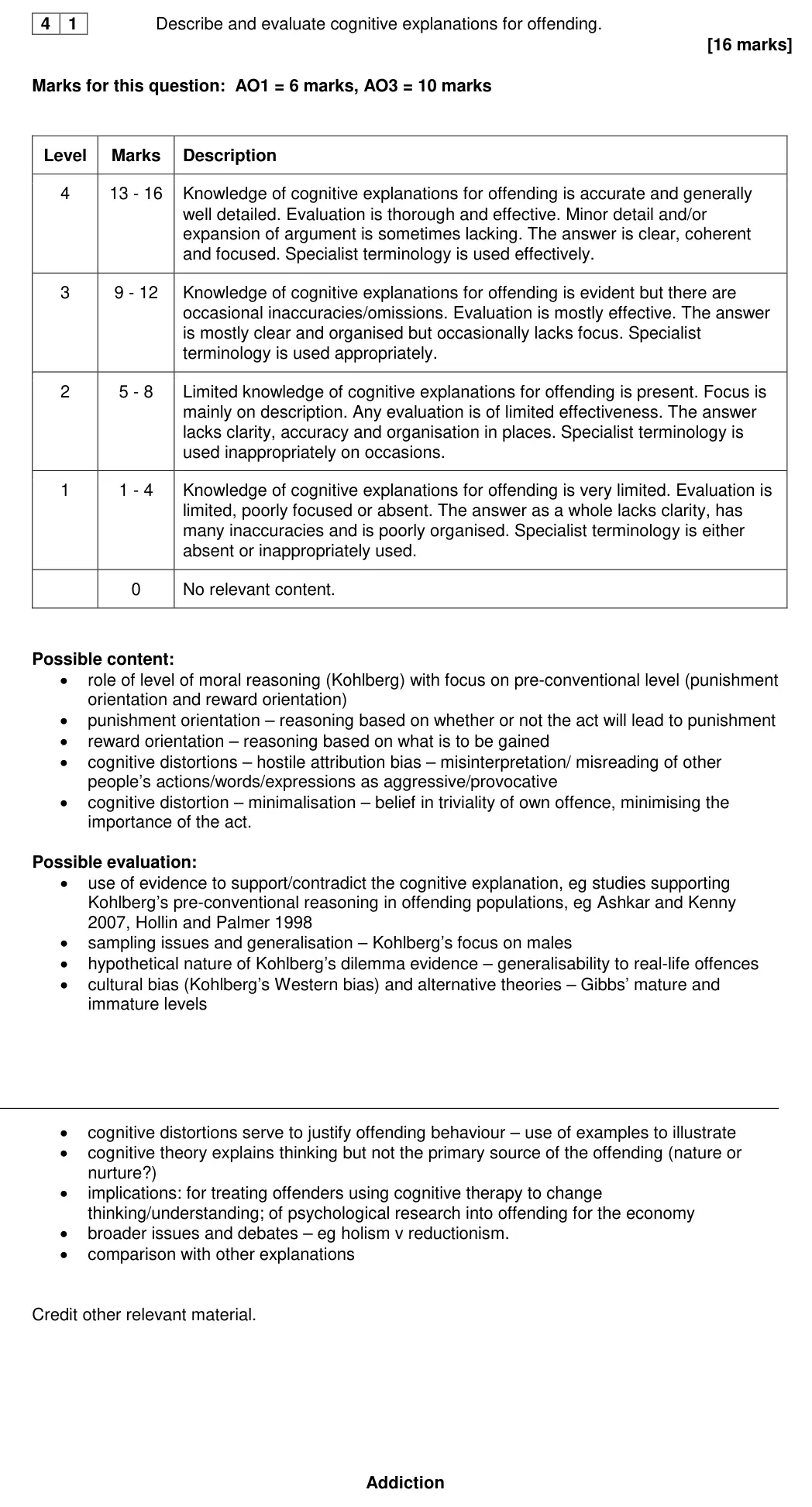
Kohlberg's pre-conventional moral reasoning, hostile attribution bias, minimalisation - each must be linked to offending
long accounts of Kohlberg's stages/Heinz without offending scored little
Eysenck, differential association or psychodynamic answers not credited
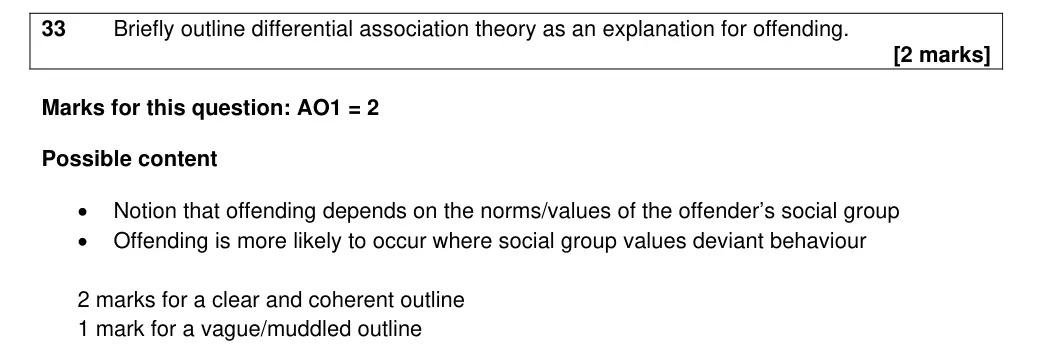
Specimen set 2 · Paper 3 · Q332 marksAO1=2Outline
Mark scheme, including level descriptors and indicative content
Notes from the mark scheme and report
offending learned from norms/values of social group
more likely where group values deviance
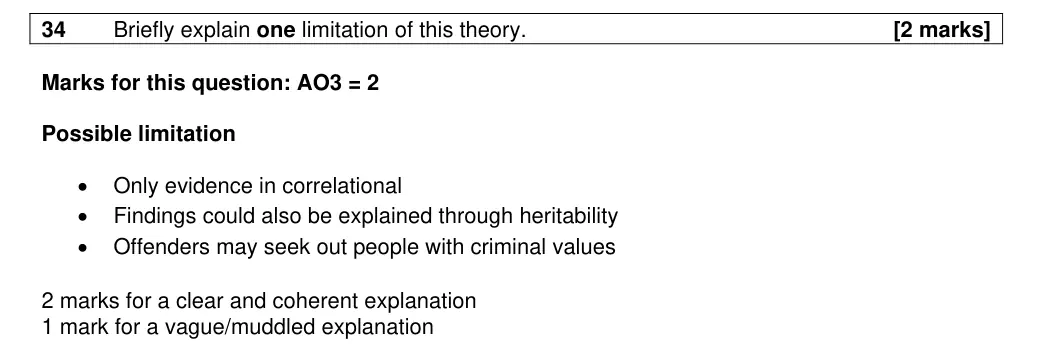
Specimen set 2 · Paper 3 · Q342 marksAO3=2Evaluate (short)
Mark scheme, including level descriptors and indicative content
Notes from the mark scheme and report
correlational evidence only, heritability alternative, offenders may seek out criminal peers
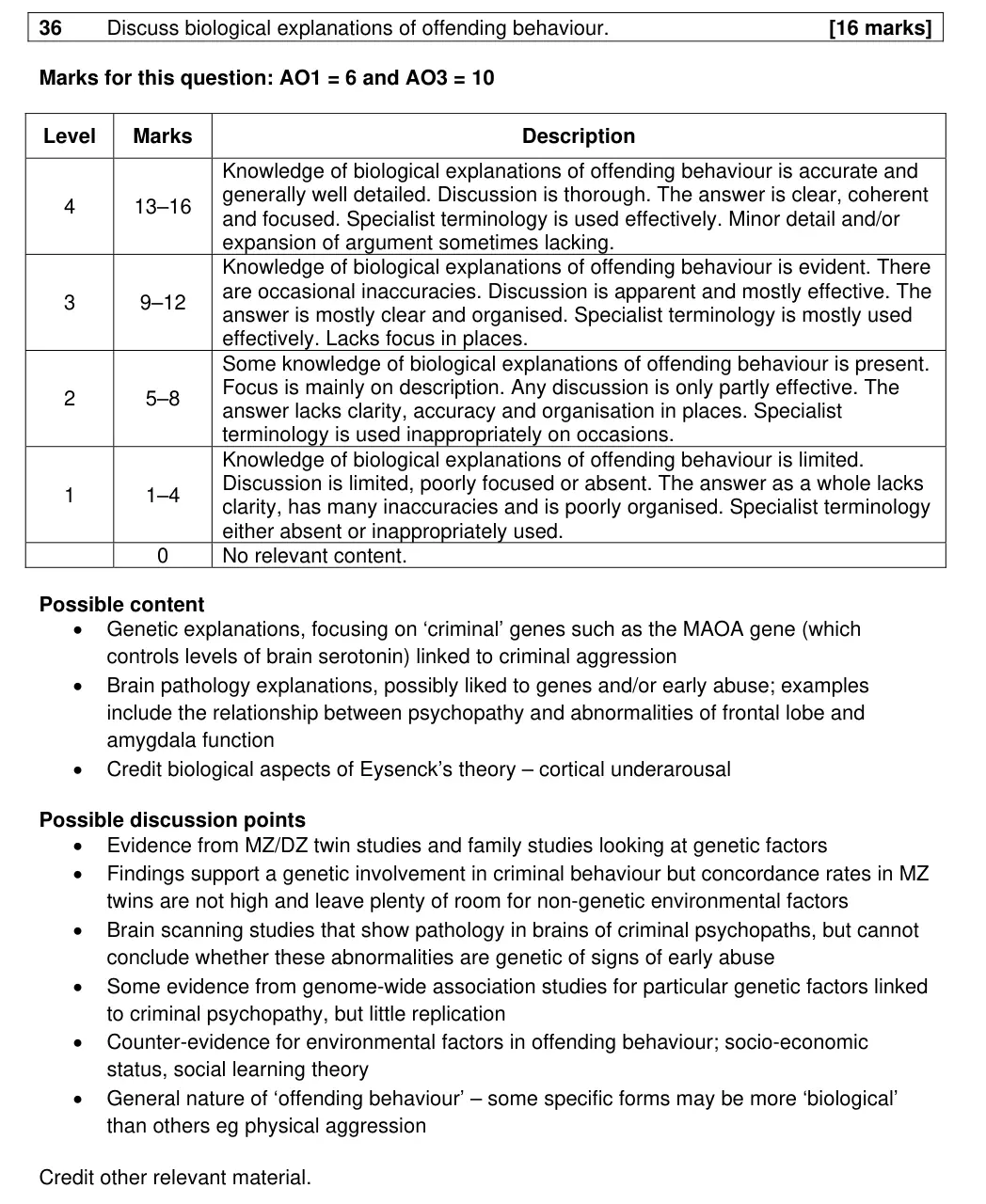
Specimen set 2 · Paper 3 · Q3616 marksAO1=6, AO3=1016-mark essay
Mark scheme, including level descriptors and indicative content
Notes from the mark scheme and report
genetic (MAOA, twin/family studies), neural (frontal lobe, amygdala in psychopathy)
Eysenck's cortical under-arousal also credited
evaluation: modest concordance, scanning can't separate genes from abuse, environmental alternatives
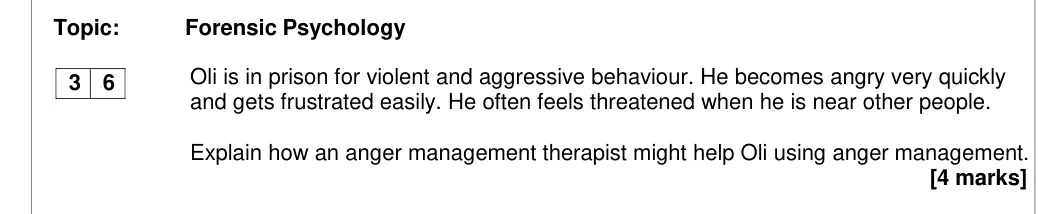
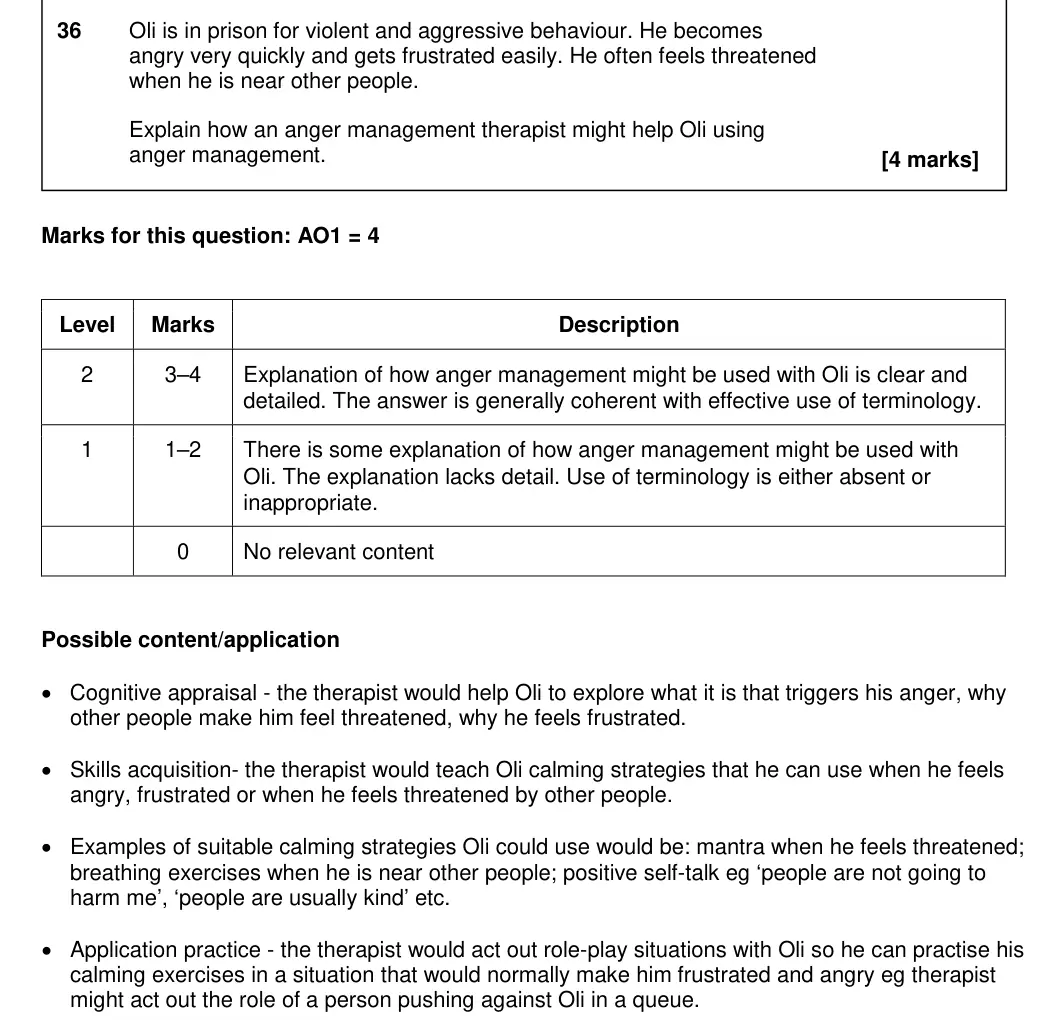
Specimen set 1 · Paper 3 · Q364 marksAO1=4Application
Mark scheme, including level descriptors and indicative content
Notes from the mark scheme and report
cognitive appraisal of Oli's triggers, skills acquisition (calming strategies, self-talk), application practice via role play
must be applied to Oli
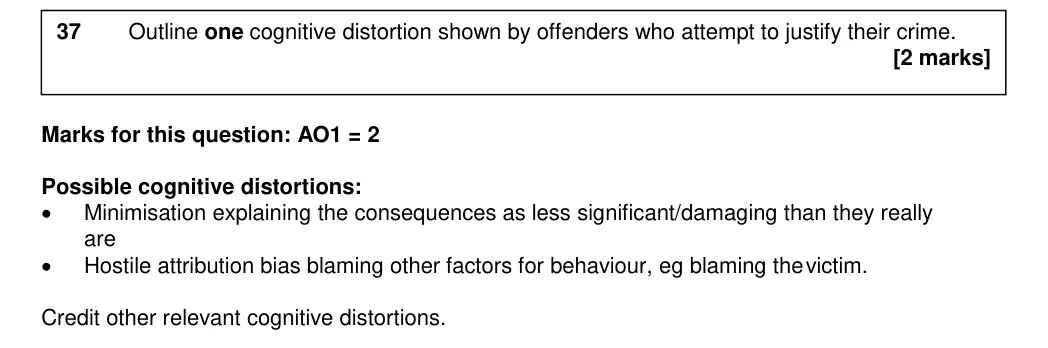
Specimen set 1 · Paper 3 · Q372 marksAO1=2Outline
Mark scheme, including level descriptors and indicative content
Notes from the mark scheme and report
minimalisation or hostile attribution bias with outline
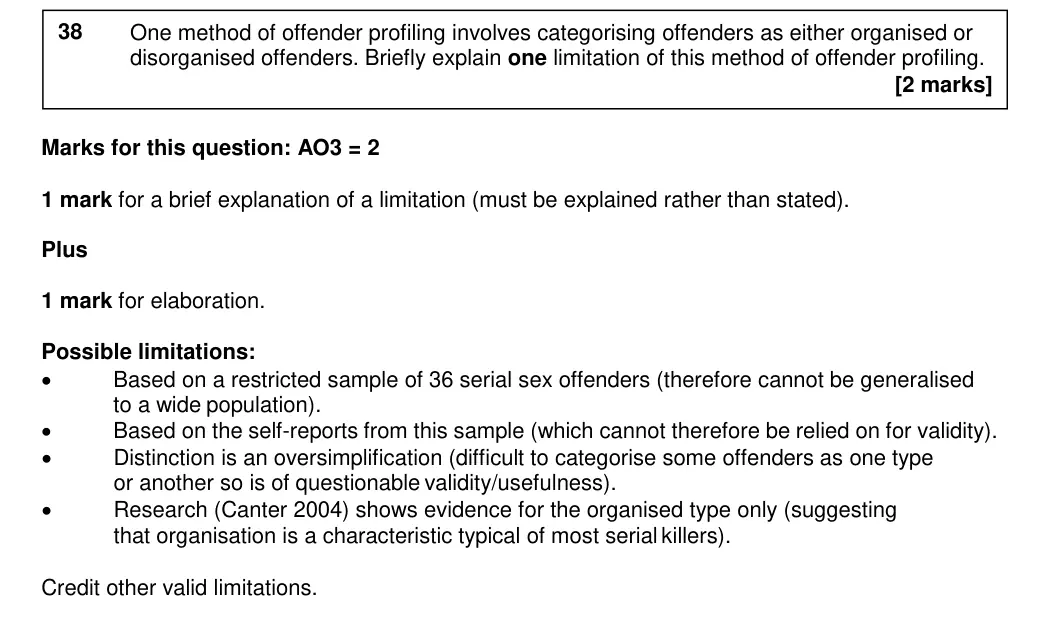
Specimen set 1 · Paper 3 · Q382 marksAO3=2Evaluate (short)
Mark scheme, including level descriptors and indicative content
Notes from the mark scheme and report
explain not state + elaboration (small sample of 36 serial killers, self-report, oversimplification, Canter 2004 found only organised type)
organised/disorganised = typology approach in v1.4
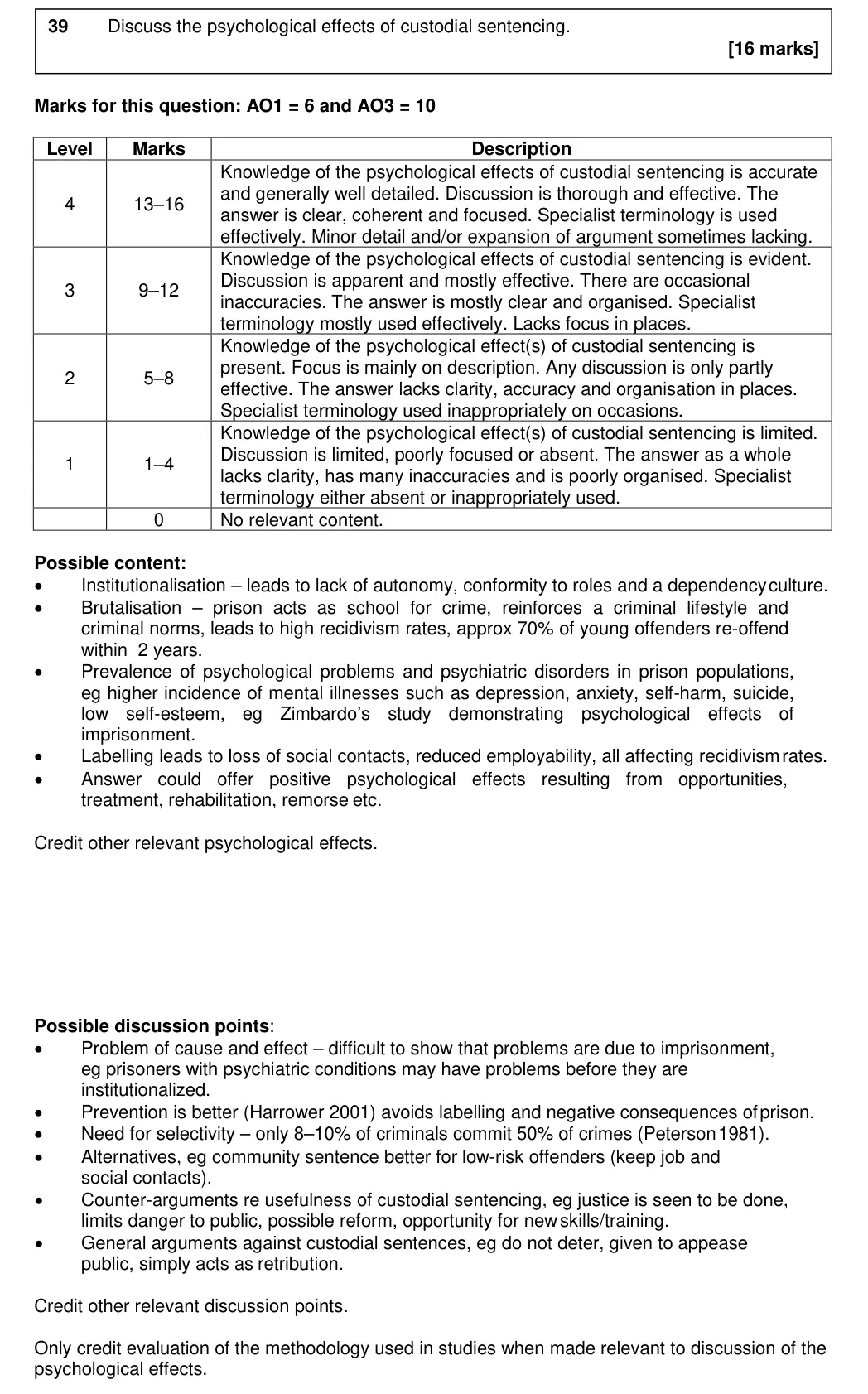
Specimen set 1 · Paper 3 · Q3916 marksAO1=6, AO3=1016-mark essay
Mark scheme, including level descriptors and indicative content