28 question parts, 6 sixteen-mark essays, 3 multiple-choice items, plus 1 parts on content removed in 2025
Notes, key studies and practice items for this topic are being written by our tutors. The past-paper questions below are ready now.
Specification statements
4.3.2-01 Factors affecting attraction in romantic relationships: self-disclosure; physical attractiveness, including the matching hypothesis; filter theory, including social demography, similarity in attitudes and complementarity.
4.3.2-02 Theories of romantic relationships: social exchange theory, equity theory and Rusbult’s investment model of commitment, satisfaction, comparison with alternatives and investment. Duck’s phase model of relationship breakdown: intra-psychic, dyadic, social and grave dressing phases.
4.3.2-03 Online relationships: self-disclosure, use of deception, effects of absence of gating.
4.3.2-04 Parasocial relationships: levels of parasocial relationships, the absorption addiction model and the attachment theory explanation.
Tap a question to zoom it. Mark scheme and examiner's comment open under each question.
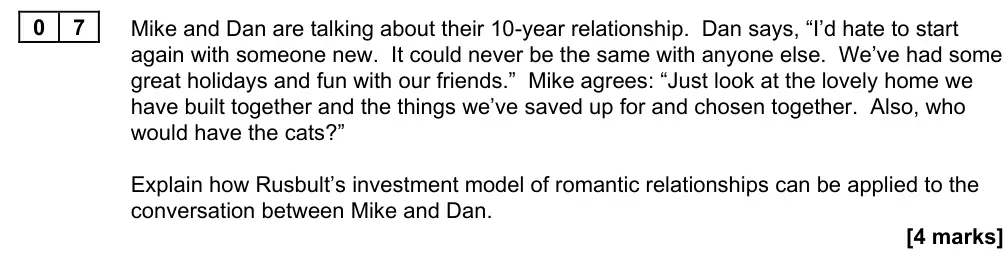
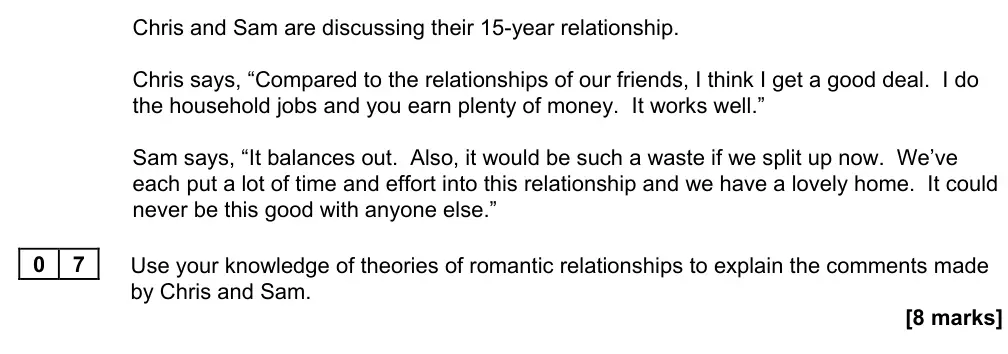
June 2025 · Paper 3 · Q74 marksAO2=4Application
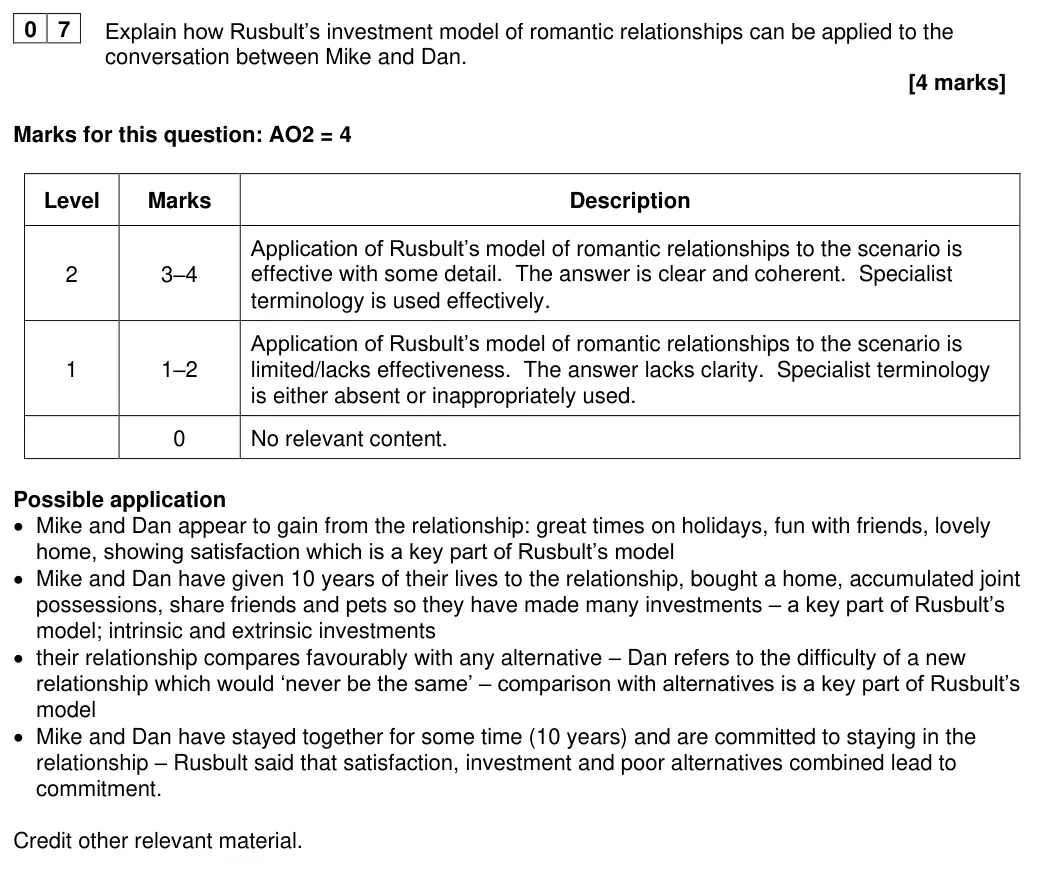
Mark scheme, including level descriptors and indicative content
Examiner's comment
For question 07, lots of students described the key elements of Rusbult’s model whilst making clear links to the stem. Some favoured an alternative route: describing the model in some detail first, then applying their knowledge towards the end of the answer. Whilst this was less economical, such answers were still able to score well. A fair number of students did little more than discuss the concept of investments, perhaps taken directly from the question, and made some speculative links to the stem.
Notes from the mark scheme and report
satisfaction (holidays, fun), investment (10 years, home, possessions, cats, shared friends), comparison with alternatives ('never be the same'), commitment
describing the model first then applying was less economical but could still score well
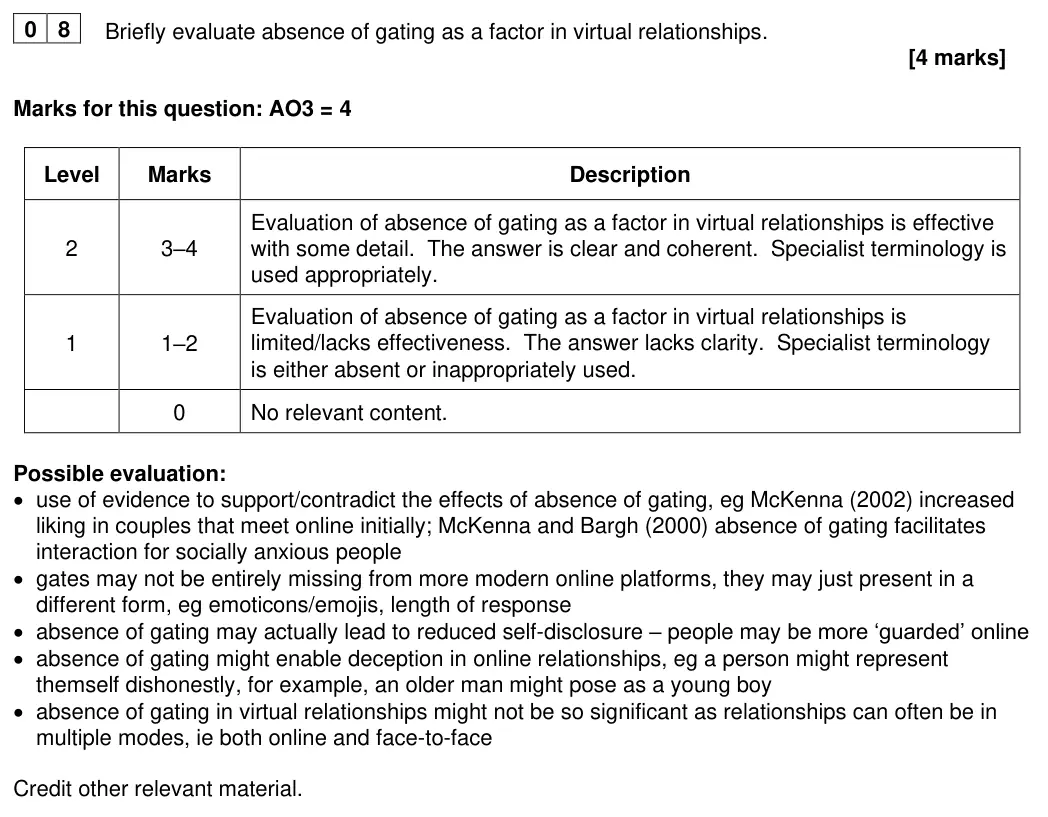
June 2025 · Paper 3 · Q84 marksAO3=4Evaluate (short)
Mark scheme, including level descriptors and indicative content
Examiner's comment
For question 08, there was a tendency for students to describe the theory of absence of gating whilst presenting it as evaluation – such as the idea that online relationships have the potential to benefit shy people, or there is increased disclosure on-line. Better answers made similar points, but these were at least rooted in evidence. This topic does seem to be one where students lapse into commonsense accounts of relationships which often verge on the anecdotal.
Notes from the mark scheme and report
'virtual relationships' reworded 'online relationships' in v1.4
evidence (McKenna), gates present in other forms (emojis), may reduce disclosure, enables deception, multi-modal relationships
many described absence of gating as if evaluation
anecdotal answers
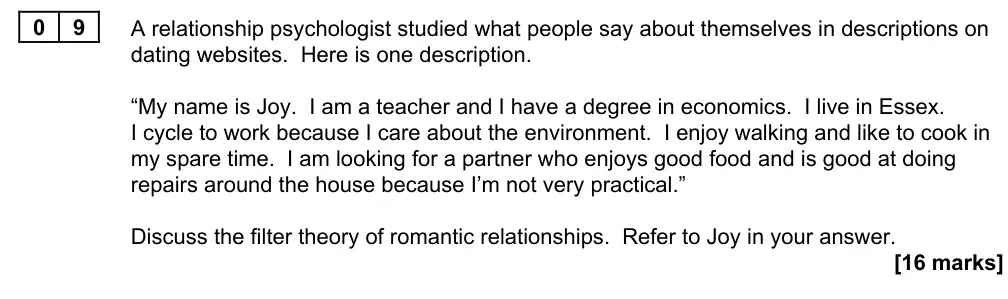
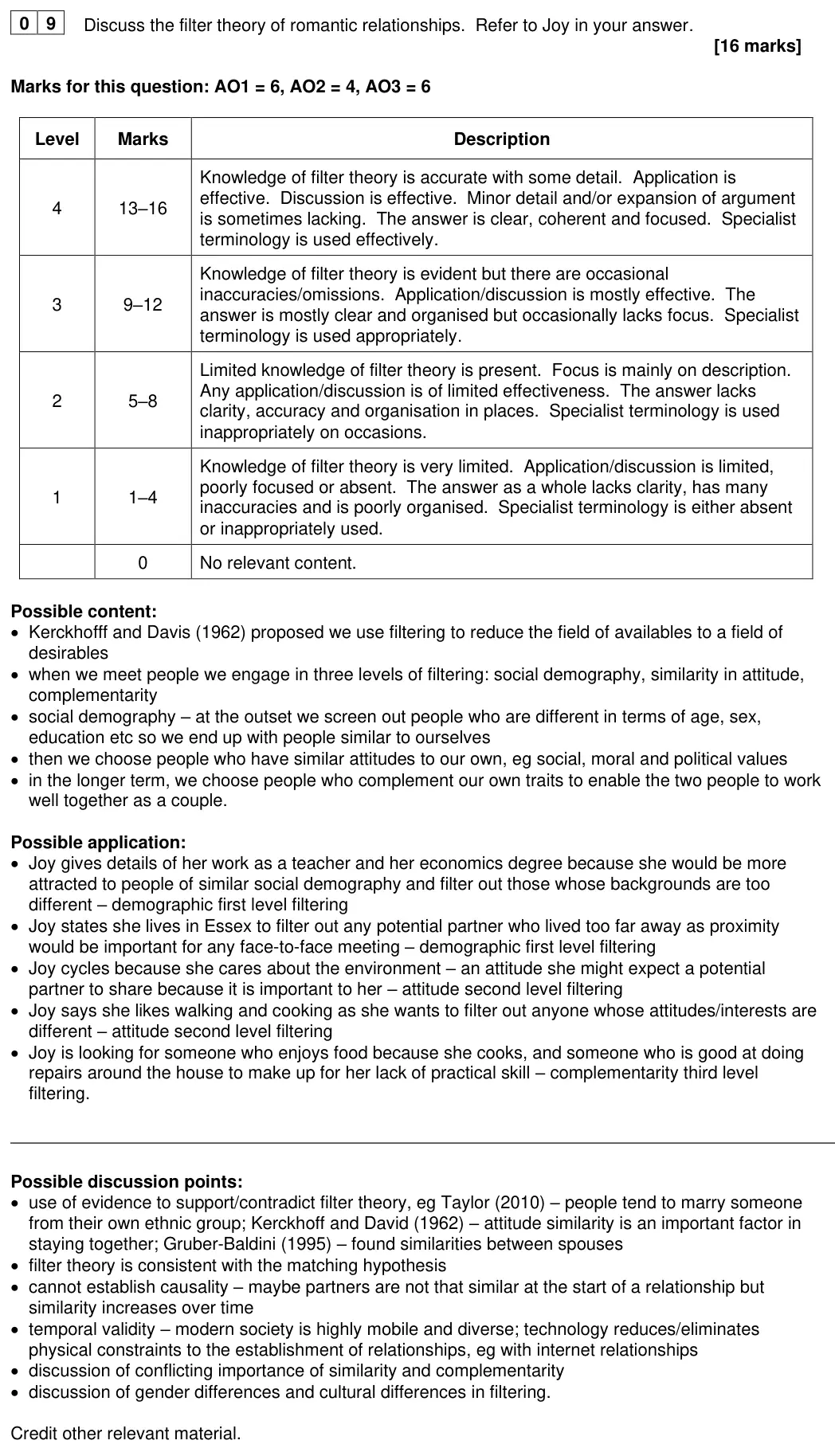
June 2025 · Paper 3 · Q916 marksAO1=6, AO2=4, AO3=616-mark essay
Mark scheme, including level descriptors and indicative content
Examiner's comment
There were many 16-mark essays on filter theory (09) that scored at the higher end of the mark range. Generally, students seemed to be well-prepared for this question and could convincingly, and often succinctly, describe the three levels – though occasionally these were presented in the wrong order. Application to the character in the stem was usually effective too. Where some answers did fall down was in the quality of the evaluation, sometimes denying them access to the top band. There were some vague references to studies, usually presented in generic format, that did not include key detail and so could not be identified. There was very good use of evidence too though: the outdated nature of the model was often discussed successfully, as was its cultural relativity.
Notes from the mark scheme and report
social demography (teacher, degree, Essex), similarity of attitudes (environment, walking, cooking), complementarity (wants someone practical)
levels sometimes in the wrong order
generally well prepared
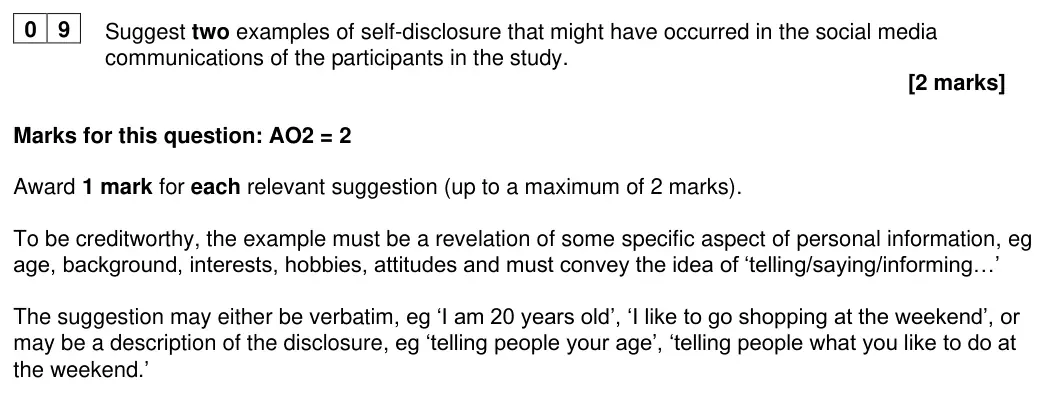
June 2024 · Paper 3 · Q92 marksAO2=2Application
Mark scheme, including level descriptors and indicative content
Examiner's comment
The key watchword in Question 09 was ‘specific’. For this reason, answers that simply read, ‘disclosing personal information’ were judged to be too vague for credit. That said, this question posed most students little difficulty and there was a wide variety of correct answers.
Notes from the mark scheme and report
1 mark each
example must reveal a SPECIFIC piece of personal information (age, hobbies, attitudes) as telling/saying
'disclosing personal information' too vague
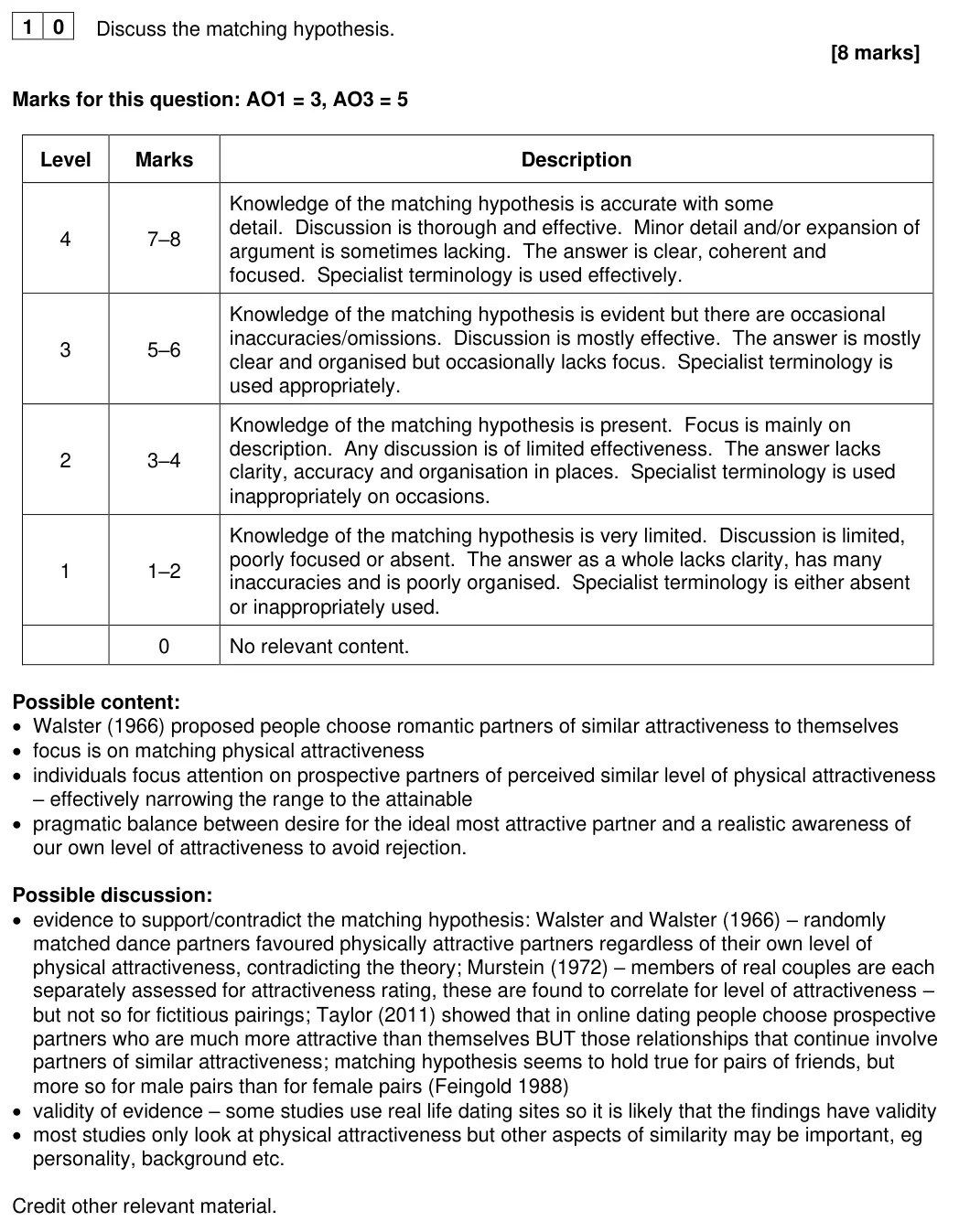
June 2024 · Paper 3 · Q108 marksAO1=3, AO3=5Extended writing
Mark scheme, including level descriptors and indicative content
Examiner's comment
Question 10 was surprisingly poorly answered. Many students described the matching hypothesis not in terms of physical attractiveness, but as a host of other potentially matched traits, such as wealth or hobbies and interests. Many wrongly interpreted the Walster dance study as supporting the predictions of the theory, and there were some vague real-life examples masquerading as evidence, such as the use of dating apps. There were very few answers in the top level.
Notes from the mark scheme and report
matching on PHYSICAL attractiveness (Walster)
many described matching on wealth/hobbies
Walster dance study wrongly cited as support (it contradicts)
real-life anecdotes as evidence
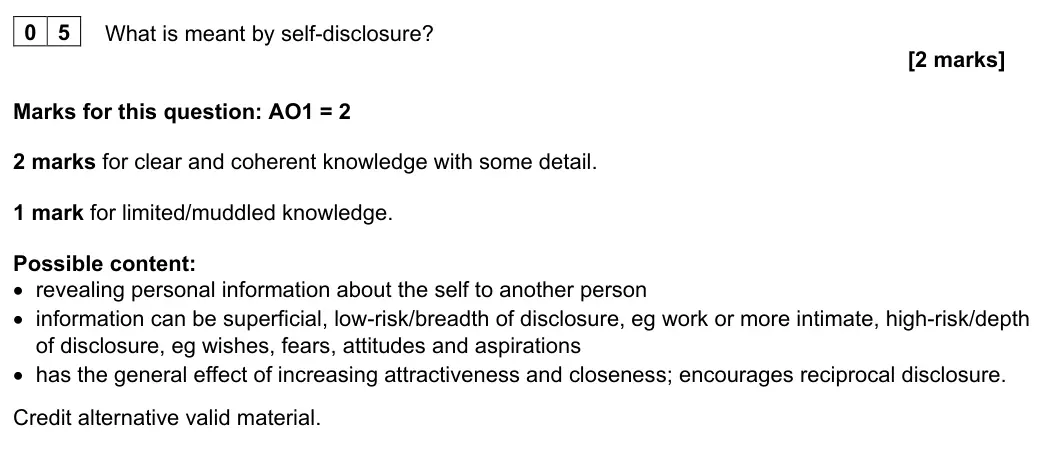
June 2023 · Paper 3 · Q52 marksAO1=2Short answer
Mark scheme, including level descriptors and indicative content
Examiner's comment
Most students were aware that self-disclosure involves the reveal of personal information, but some definitions failed to elaborate beyond that.
Notes from the mark scheme and report
revealing personal information to another
2nd mark for elaboration (breadth/depth, increases attraction, reciprocity)
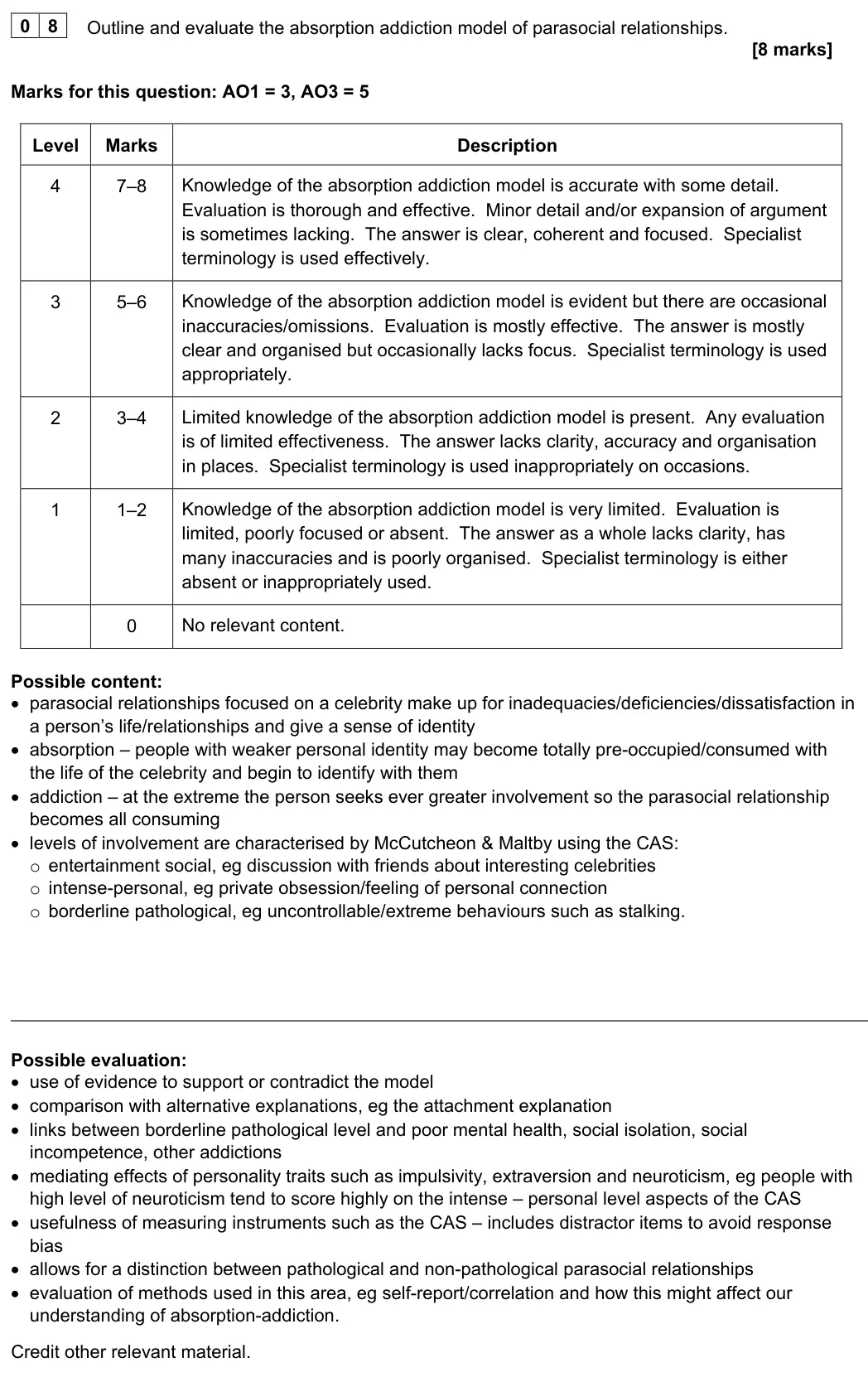
June 2023 · Paper 3 · Q66 marksAO3=6Evaluate (short)
Mark scheme, including level descriptors and indicative content
Examiner's comment
This question was generally poorly answered. Many students wrote about a strength and limitation of self-disclosure in a relationship, rather than the theory of self-disclosure, so answers were often not grounded in evidence. There were lots of unsubstantiated statements such as ‘it would deepen the relationship’ or ‘it might put people off’ that were judged to be anecdotal and so scored few marks.
Notes from the mark scheme and report
3 marks each for strength and limitation
evaluate self-disclosure as an EXPLANATION of attraction (evidence, social penetration, filter theory, culture, cause and effect), not its effect within a relationship
anecdotal/unsubstantiated statements scored little
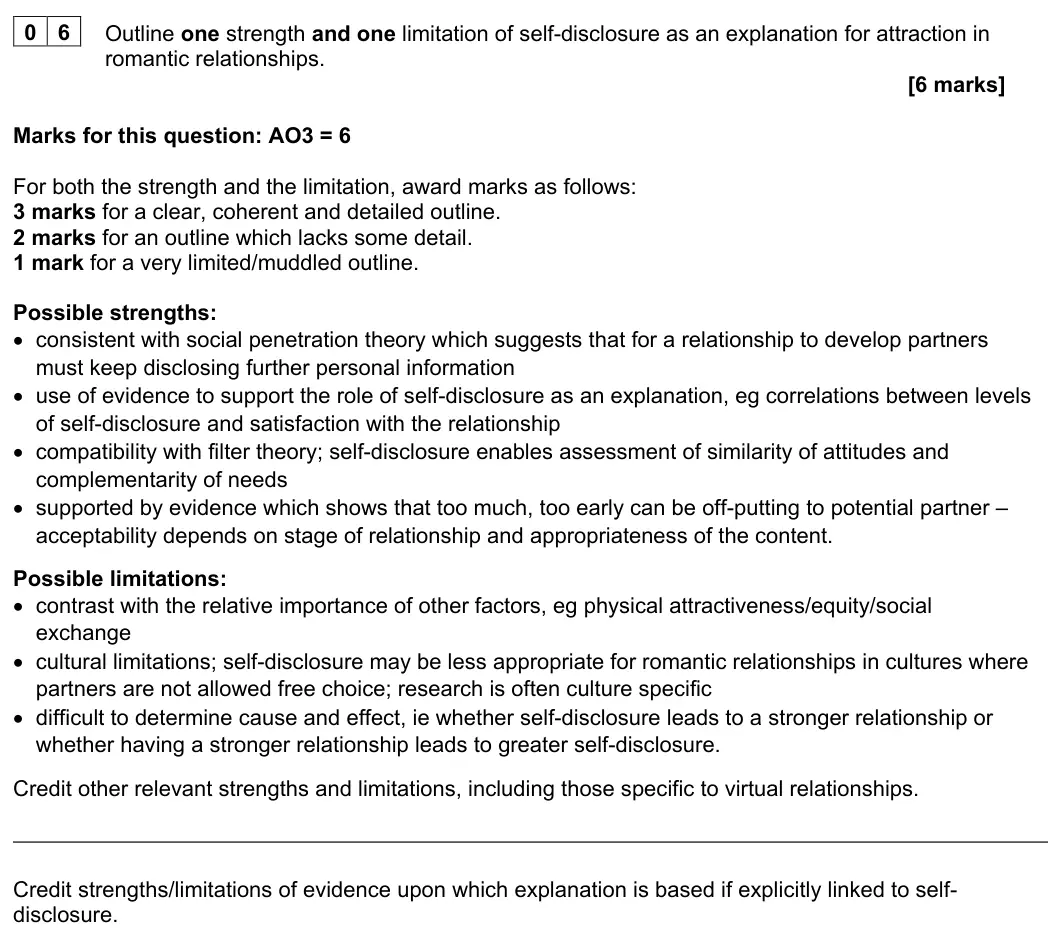
June 2023 · Paper 3 · Q78 marksAO1=3, AO3=5Extended writing
Mark scheme, including level descriptors and indicative content
Examiner's comment
This was among the better answered 8-mark questions on the paper. Most students were able to offer a reasonable account of Duck’s phase model, though occasionally stages were incorrectly named or in the wrong order. Evaluation was quite strong: many students wrote about the cultural bias in Duck’s work and/or how the addition of a fifth stage rendered the original version incomplete.
Notes from the mark scheme and report
breadth or depth of phases acceptable
phases sometimes mis-named or out of order
evaluation e.g. cultural bias, addition of 5th 'resurrection' phase, retrospective self-report evidence
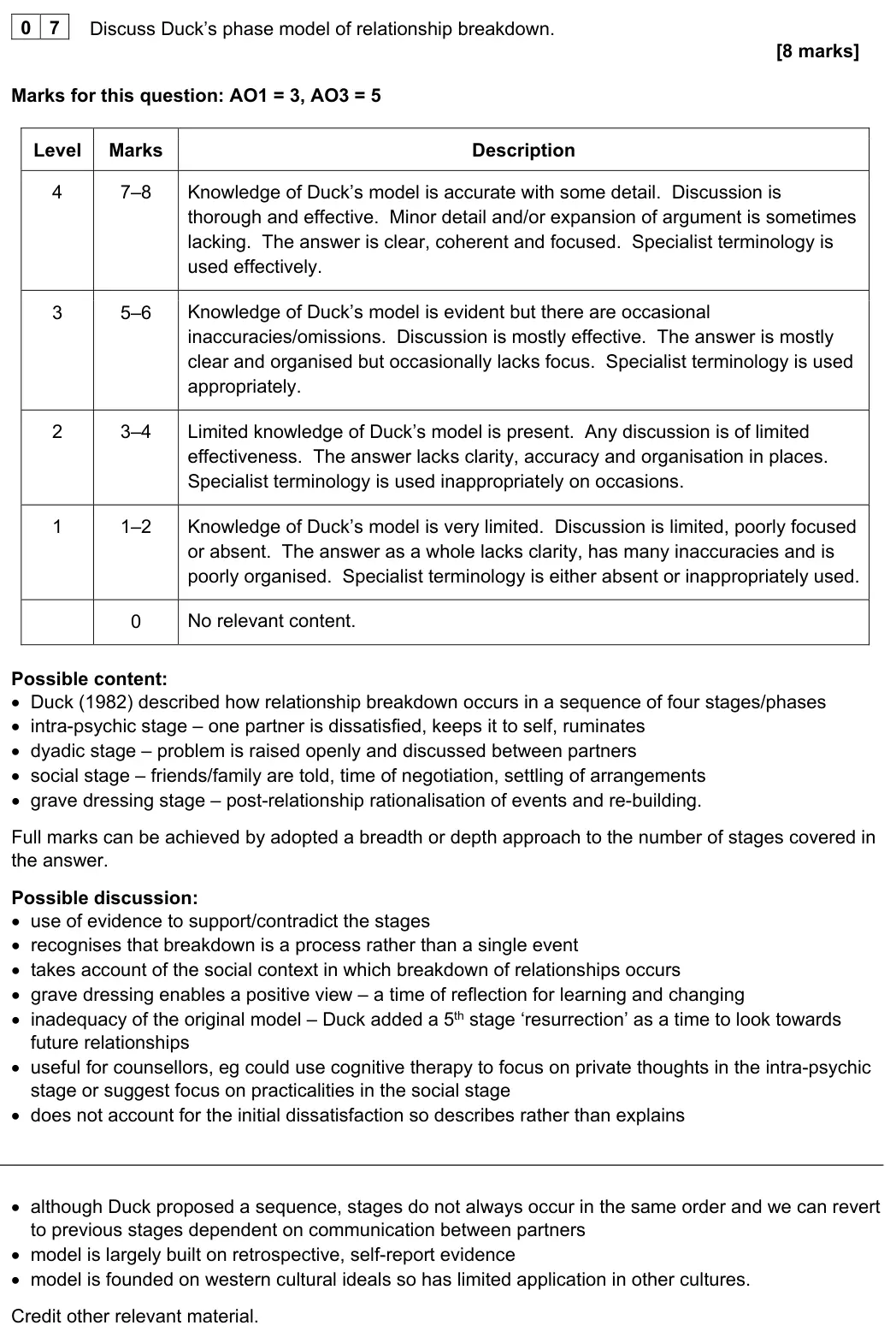
June 2023 · Paper 3 · Q88 marksAO1=3, AO3=5Extended writing
Mark scheme, including level descriptors and indicative content
Examiner's comment
Students did less well when tackling the absorption-addition model. Description was often too short, or was too reliant on common sense understanding to score highly, and evaluations were often vague and underdeveloped.
Notes from the mark scheme and report
absorption, addiction and CAS levels (entertainment-social, intense-personal, borderline-pathological)
descriptions often too short or common-sense
evaluation vague
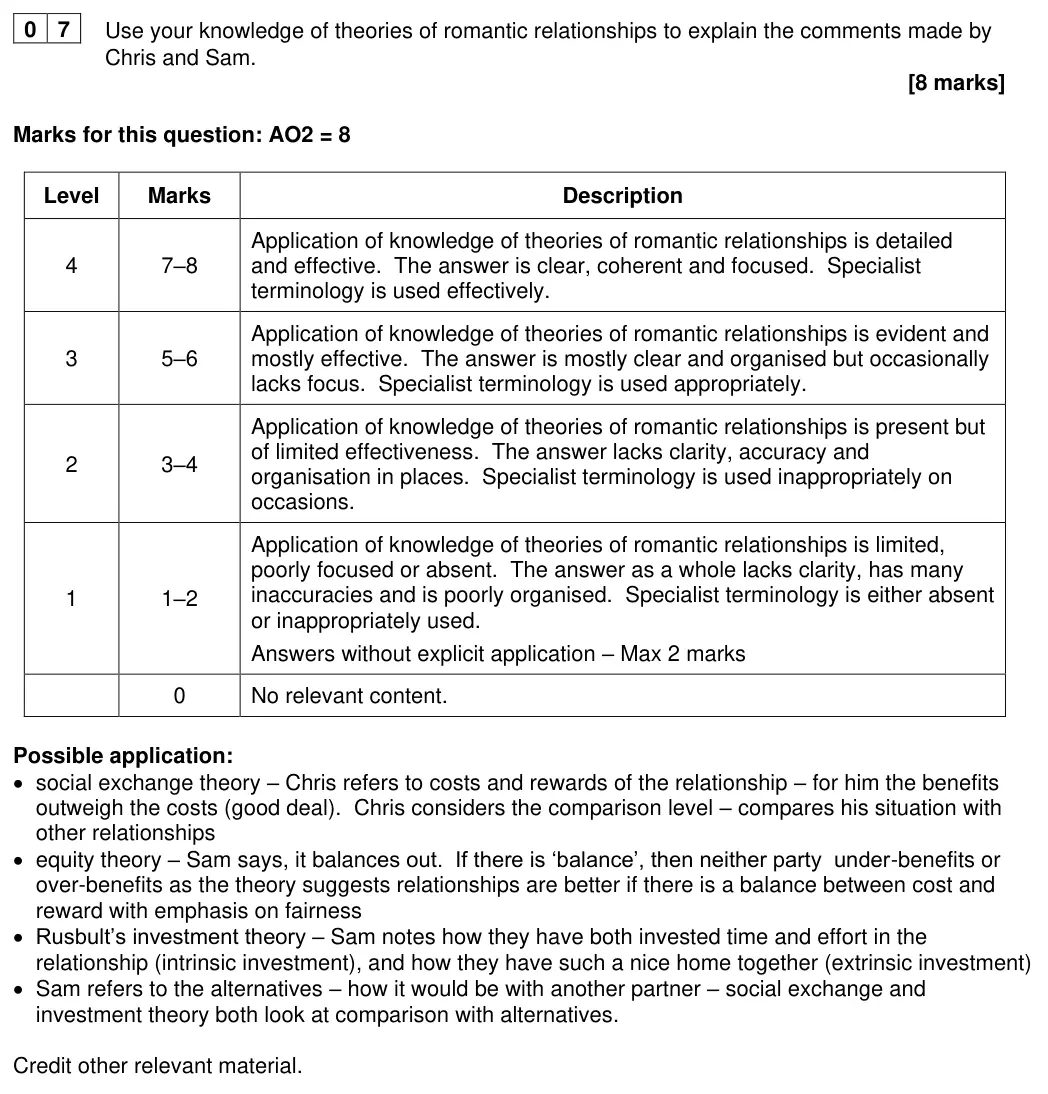
June 2022 · Paper 3 · Q78 marksAO2=8Extended writing
Mark scheme, including level descriptors and indicative content
Examiner's comment
The stem in Question 07 elicited some excellent application, with students working successfully to make links between various aspects of the text and the different relationship theories. Equity theory and Rusbult’s investment theory were usually very well applied. Some students failed to attend to the command in the question and wasted time here by offering redundant discussion.
Notes from the mark scheme and report
all AO2: social exchange (good deal, comparison level), equity (it balances out), Rusbult investment (time, effort, home
no better alternative) applied to Chris and Sam
no explicit application = max 2
evaluation wasted time
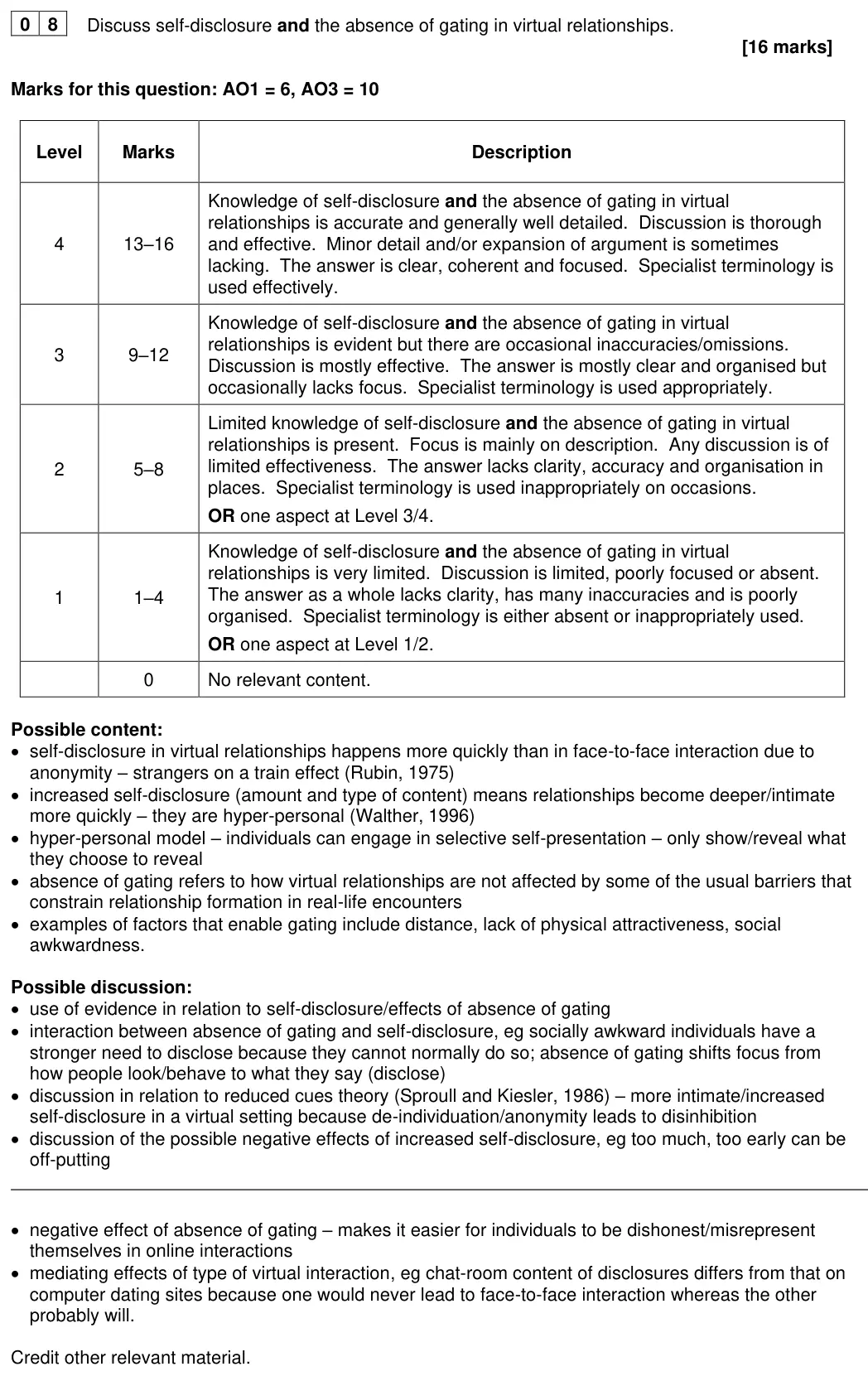
June 2022 · Paper 3 · Q816 marksAO1=6, AO3=1016-mark essay
Mark scheme, including level descriptors and indicative content
Examiner's comment
Answers to Question 08 varied; some were well-focused on self-disclosure and gating, others consisted of pre-prepared answers to a rather different question along the lines of ‘Discuss virtual relationships.’ More general discussion could be credited where it was applicable to either self- disclosure or gating, but quite often students failed to make any link.
Notes from the mark scheme and report
self-disclosure (hyperpersonal model, strangers on a train) AND absence of gating
one aspect only = max Level 2
pre-prepared 'virtual relationships' essays often failed to link to either aspect
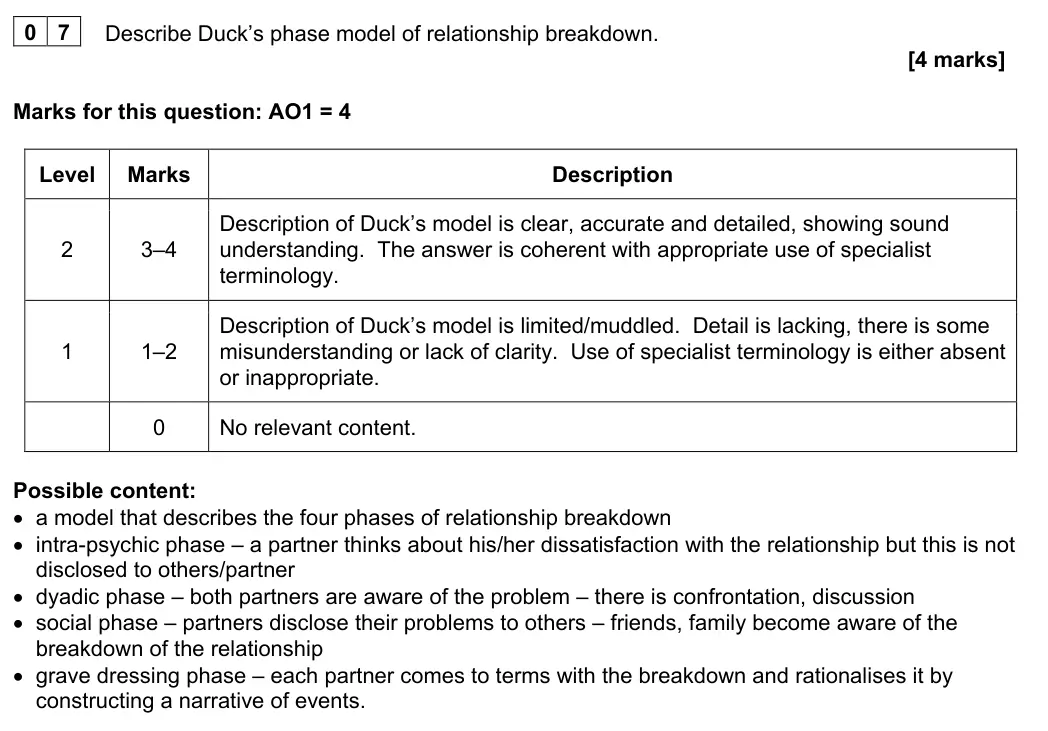
November 2021 · Paper 3 · Q74 marksAO1=4Outline
Mark scheme, including level descriptors and indicative content
Examiner's comment
The 4-mark knowledge questions tended to be well answered, especially Q07.
Notes from the mark scheme and report
intra-psychic, dyadic, social, grave-dressing phases with detail
well answered
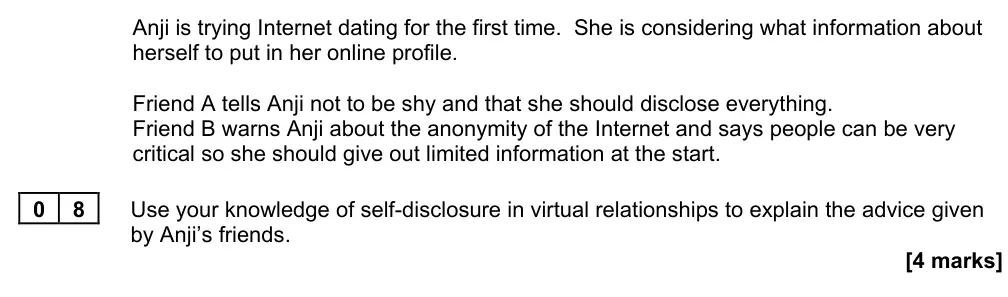
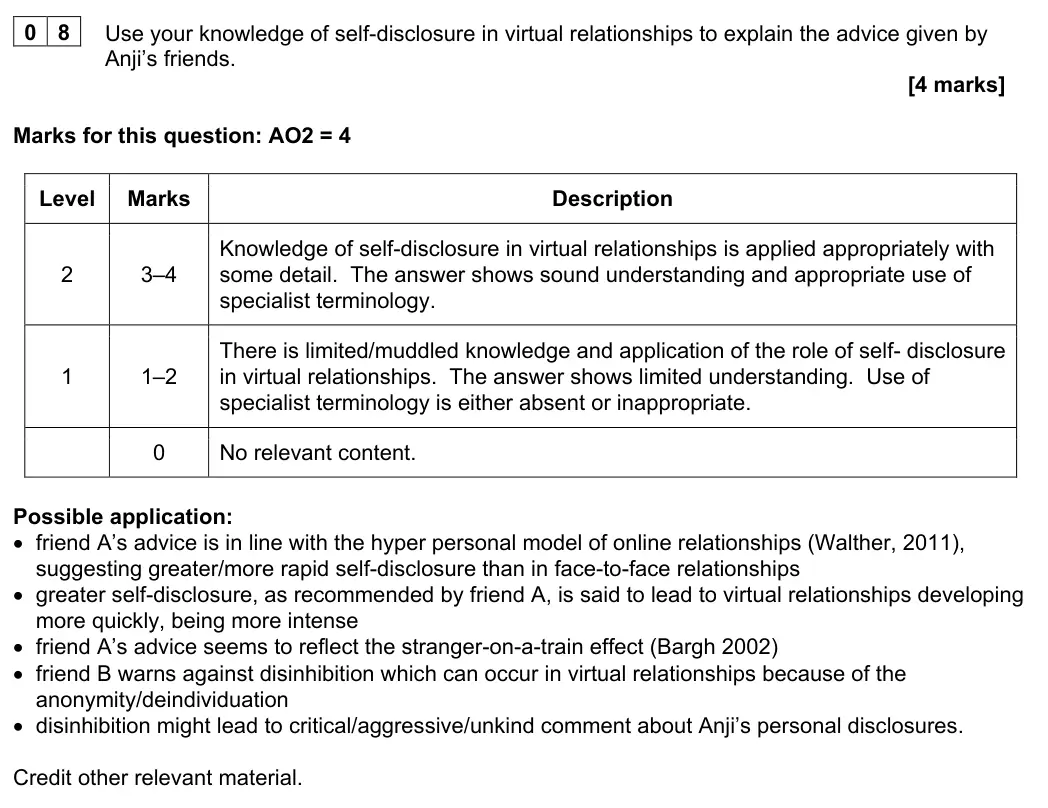
November 2021 · Paper 3 · Q84 marksAO2=4Application
Mark scheme, including level descriptors and indicative content
Examiner's comment
The 4-mark application questions were less well done, often because there was very little psychological content in the answers. This was particularly the case for Q08.
Notes from the mark scheme and report
Friend A = hyperpersonal model/stranger-on-a-train (more rapid, intense self-disclosure)
Friend B = anonymity -> disinhibition/critical comments
answers often had little psychology
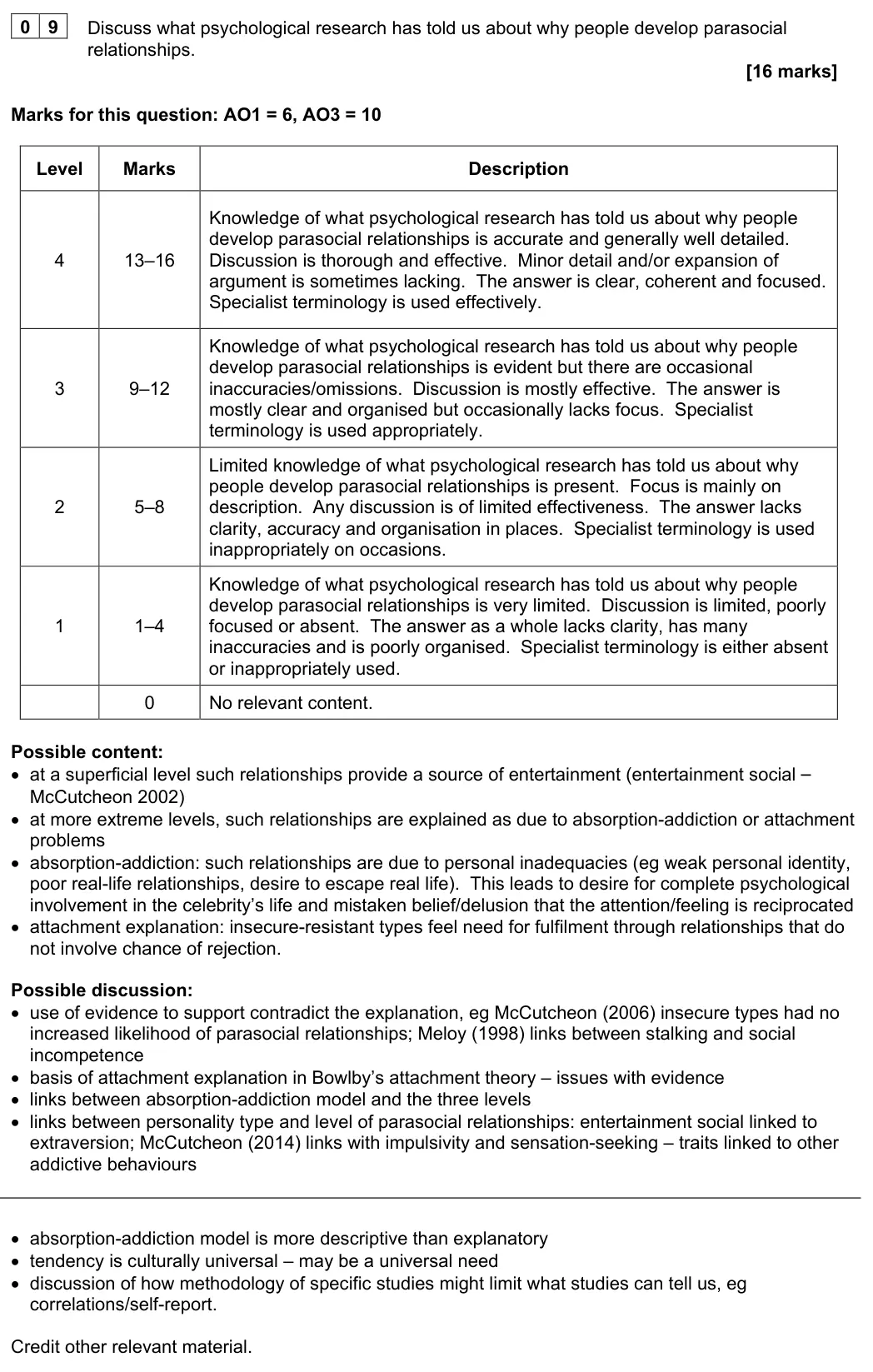
November 2021 · Paper 3 · Q916 marksAO1=6, AO3=1016-mark essay
Mark scheme, including level descriptors and indicative content
Examiner's comment
Answers to the extended writing questions varied; less successful answers to Q09 often focused on the general nature of parasocial relationships rather than on ‘why’ they developed, whereas low scoring answers to Q12 tended to be generalised discussions of social learning theory with scant reference to gender.
Notes from the mark scheme and report
must address WHY people develop PSRs (absorption-addiction, attachment, entertainment-social), not just their nature/levels
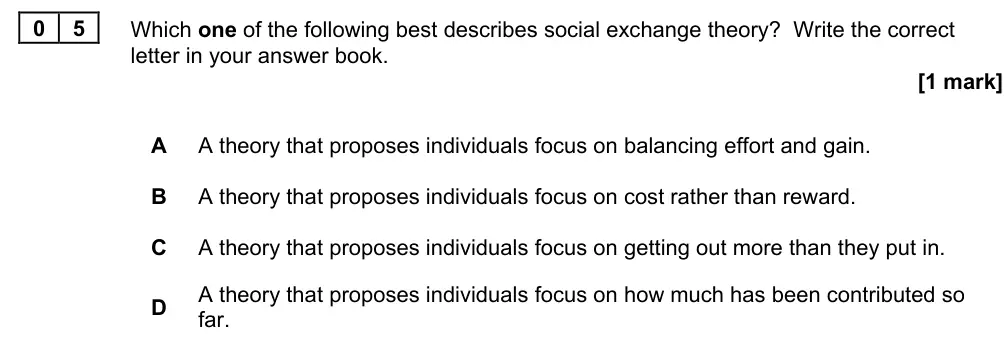
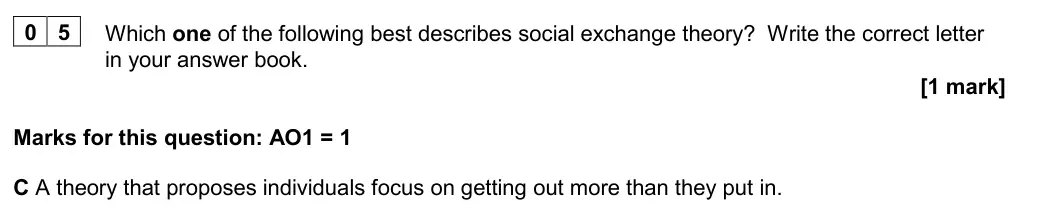
November 2020 · Paper 3 · Q51 markAO1=1Multiple choice
Answer
C
Mark scheme, including level descriptors and indicative content
Examiner's comment
Multiple choice distractors appeared to have been particularly effective in relationships and gender.
Notes from the mark scheme and report
correct C (getting out more than you put in)
A describes equity, D investment
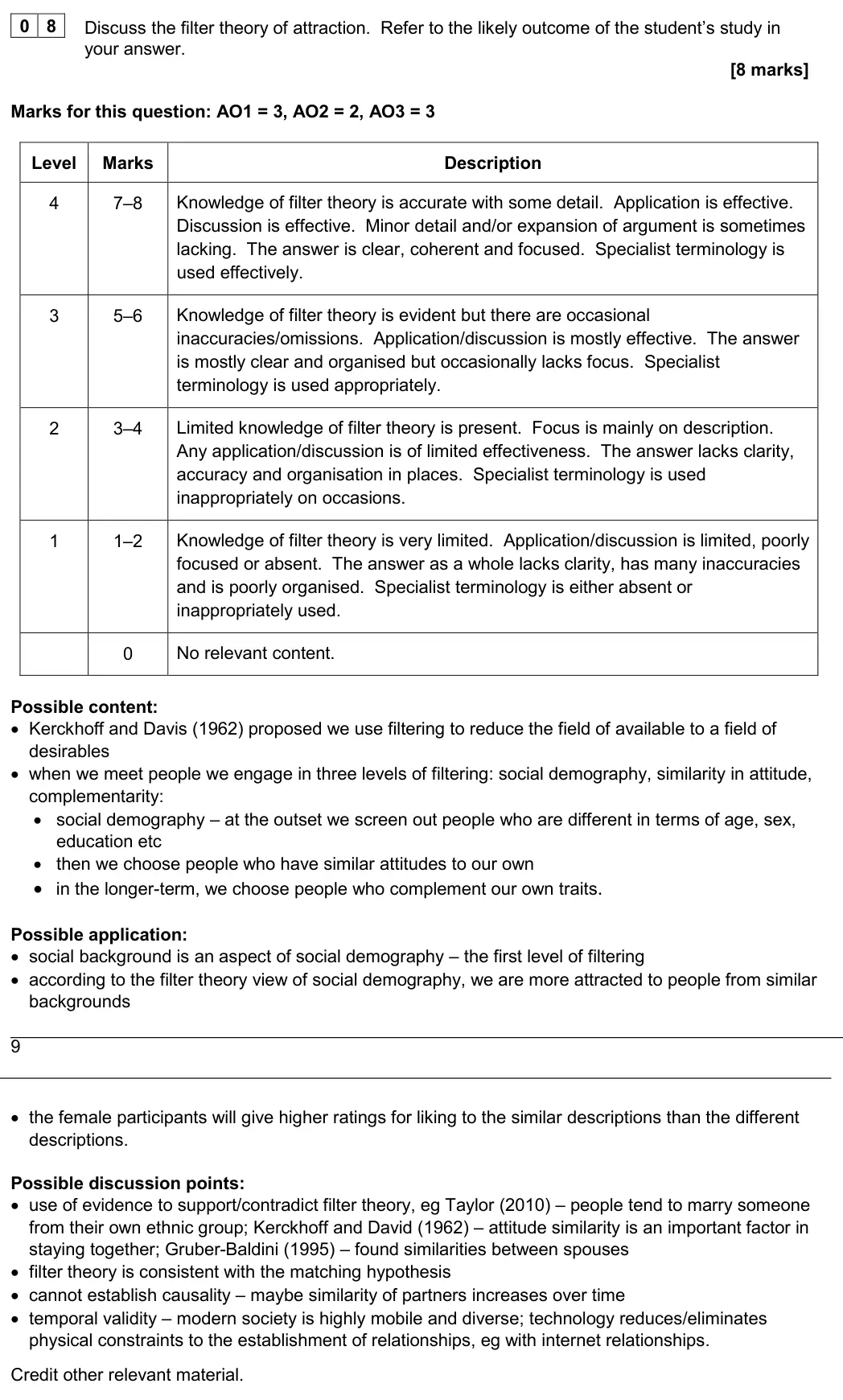
November 2020 · Paper 3 · Q88 marksAO1=3, AO2=2, AO3=3Extended writing
Mark scheme, including level descriptors and indicative content
Examiner's comment
The applied questions on filter theory, sex-role stereotypes and Selman usually evidenced sound knowledge and application but discussion was often brief or absent.
Notes from the mark scheme and report
social demography -> similarity in attitudes -> complementarity
similar social background = demography filter, so similar description rated higher
temporal validity, causality discussion
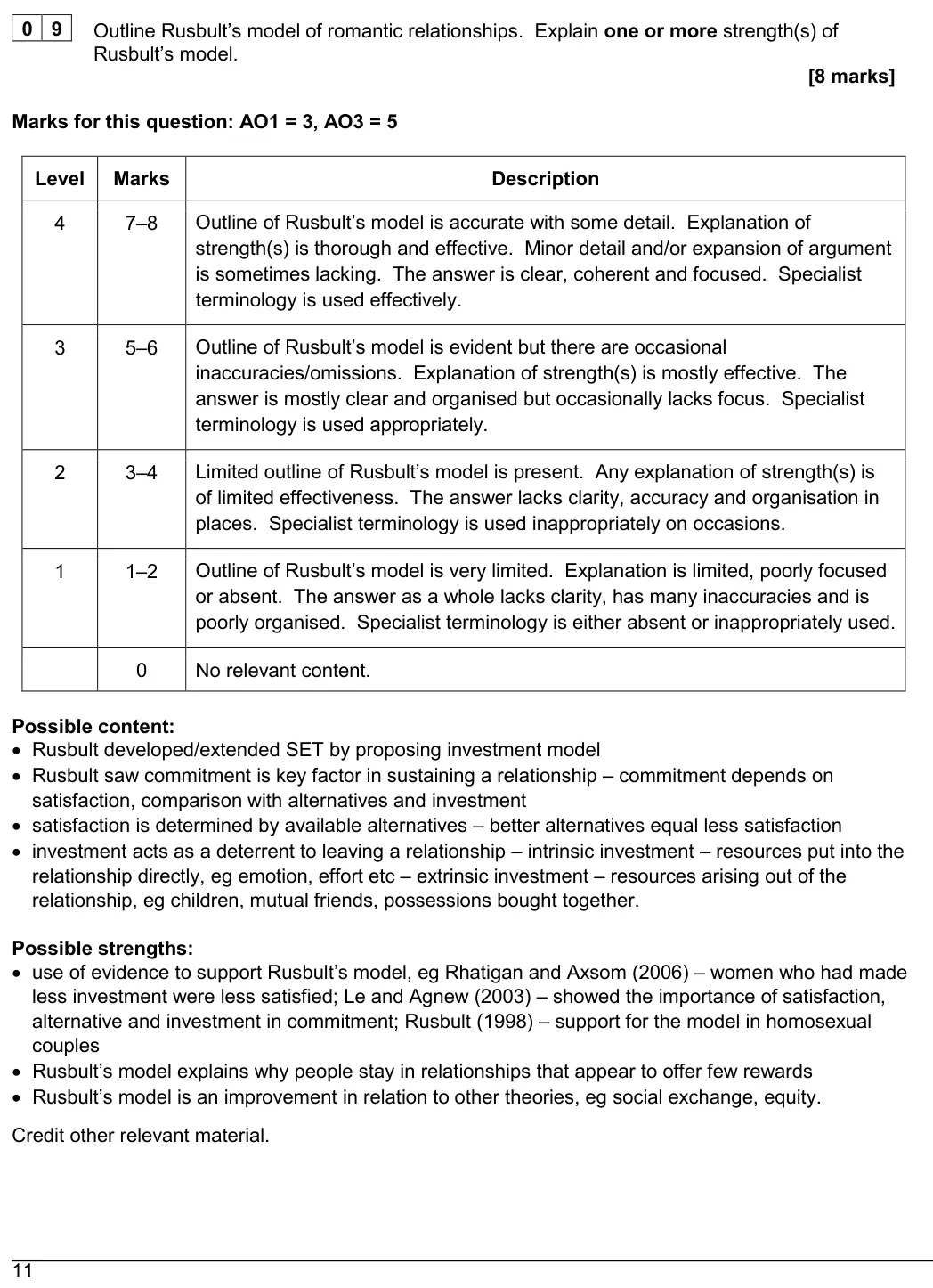
November 2020 · Paper 3 · Q98 marksAO1=3, AO3=5Extended writing
Mark scheme, including level descriptors and indicative content
Examiner's comment
Approximately 25% of students did not attempt the question on Rusbult or wrote about the wrong theory.
Notes from the mark scheme and report
commitment from satisfaction, comparison with alternatives and investment (intrinsic/extrinsic)
strengths only, e.g. supporting evidence, explains staying in unrewarding relationships
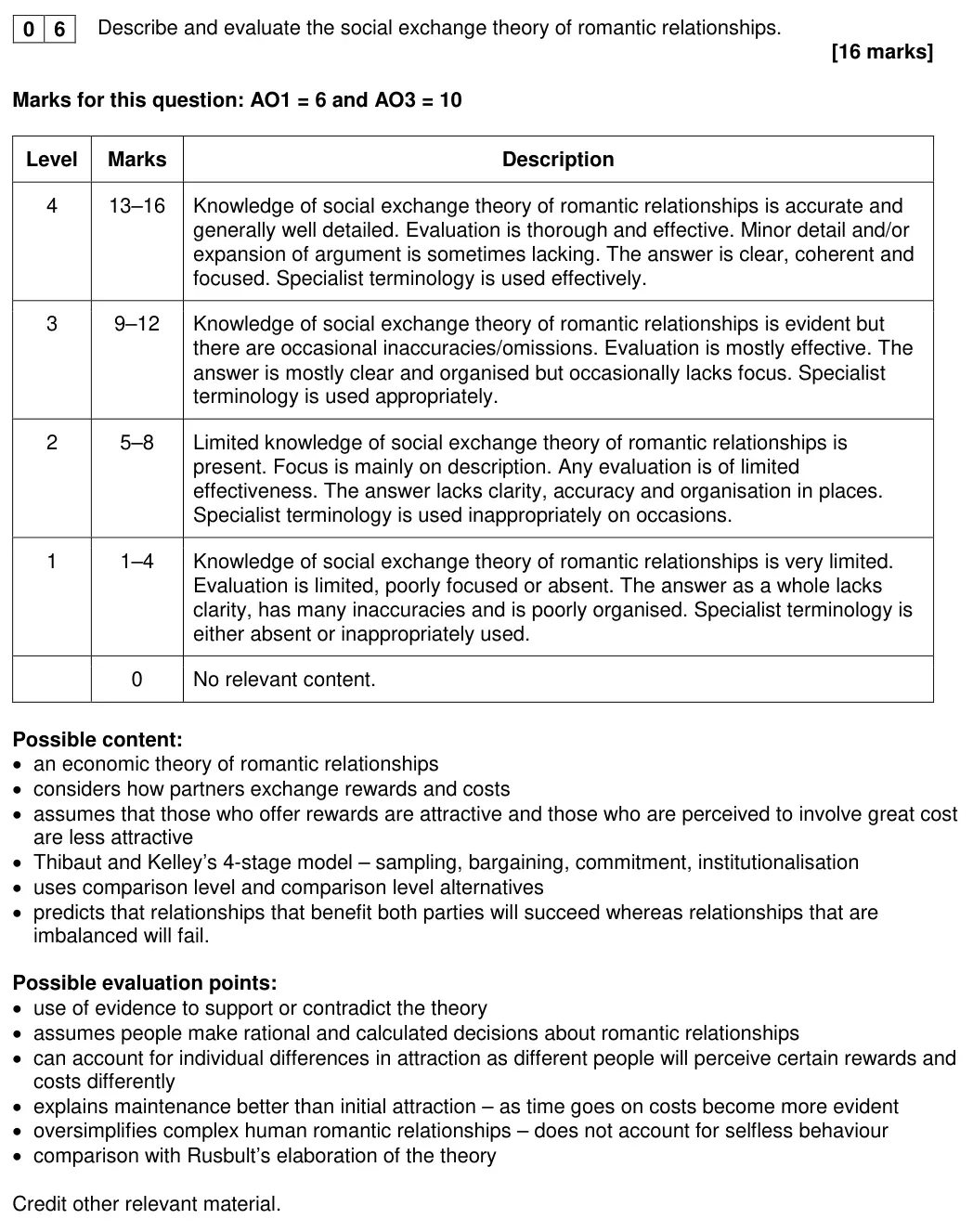
June 2019 · Paper 3 · Q616 marksAO1=6, AO3=1016-mark essay
Mark scheme, including level descriptors and indicative content
Examiner's comment
This was generally well done, particularly the descriptive element, although quite a number of students confused social exchange theory with equity. Many listed the four stages (sampling, bargaining etc), but relatively few elaborated their description with detailed explanation of how rewards and costs are involved in the four stages. Comparison level (CL) was sometimes confused with comparison level for alternatives (CAlt). A small minority seemed to misunderstand the question as one about social exchange in the form of social interactions, presenting detailed answers on self-disclosure which could gain no credit. Answers that were generally on the right track sometimes scored limited credit because evaluation was confined to a list of weak or generic points.
Notes from the mark scheme and report
often confused with equity theory
CL vs CLalt confused
four stages listed without explaining rewards/costs
self-disclosure answers scored nothing
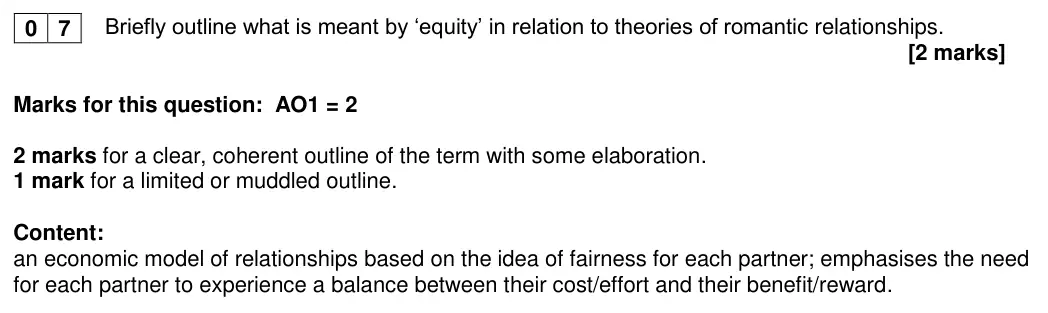
June 2018 · Paper 3 · Q72 marksAO1=2Outline
Mark scheme, including level descriptors and indicative content
Examiner's comment
Most students gained some credit, although outlines often lacked clarity or were confused, for example, stating that equity meant equal. Quite a number of the outlines sounded much more like social exchange theory.
Notes from the mark scheme and report
fairness/balance of costs and rewards for each partner
'equity means equal' or a social-exchange-style answer limited
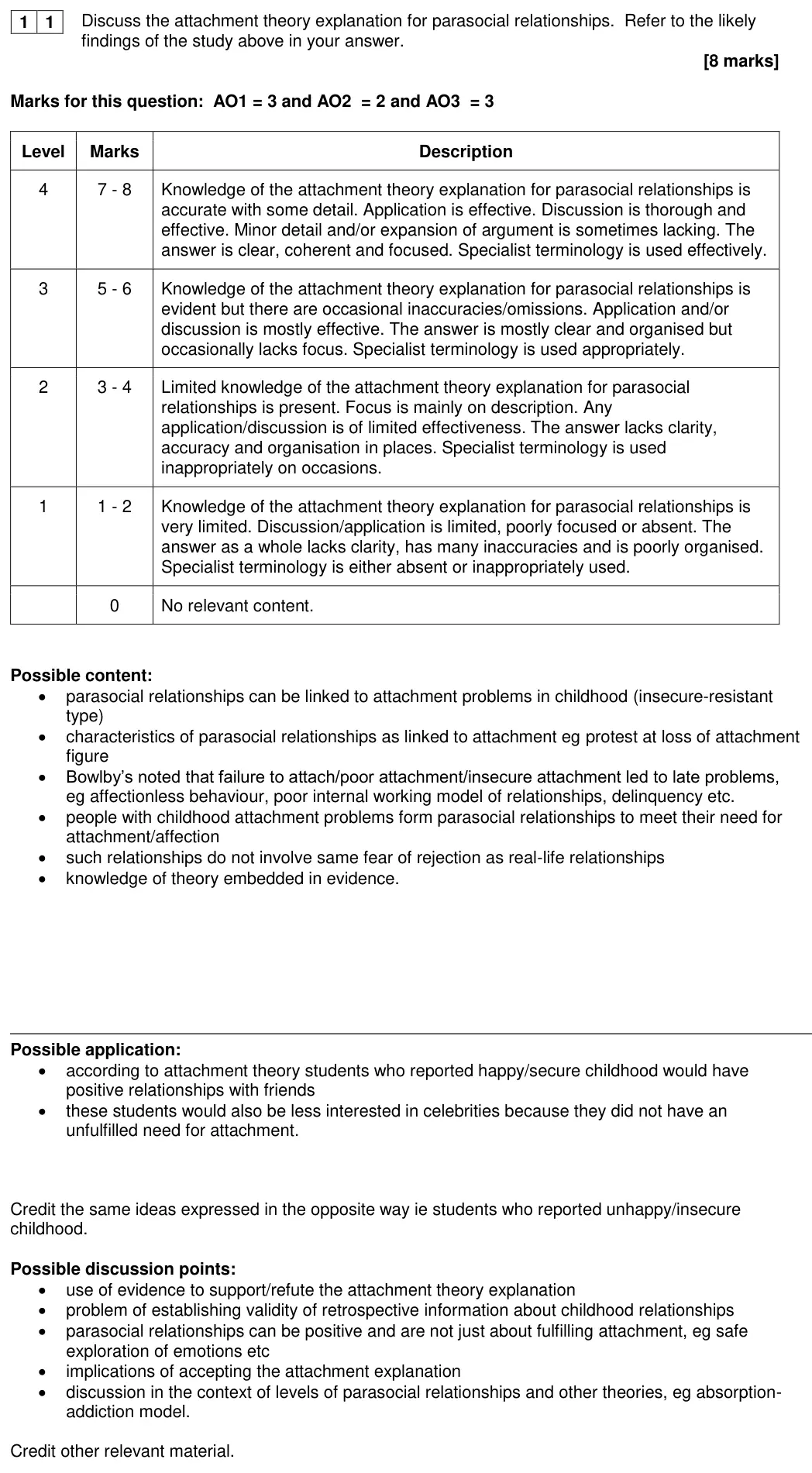
June 2018 · Paper 3 · Q118 marksAO1=3, AO2=2, AO3=3Extended writing
Mark scheme, including level descriptors and indicative content
Examiner's comment
Performance on this question depended on whether or not students were able to organise their response efficiently and address the three skills in a relatively short time. Less well scoring answers got bogged down in theory of maternal deprivation and barely mentioned parasocial relationships, or wasted time explaining the three different levels or types of parasocial relationship and forgot to mention attachment theory. There was some confusion with the absorption-addiction model. Effective discussion tended to centre around use of evidence or the possible benefits of parasocial relationships, but was not very common. Students sometimes wasted valuable time on anecdotal account of the effects of the death of famous people.
Notes from the mark scheme and report
must link attachment type (e.g. insecure-resistant) to likely survey findings on childhood, celebrity feelings and friendships
weaker answers drifted into maternal deprivation or levels of PSR
confusion with absorption-addiction
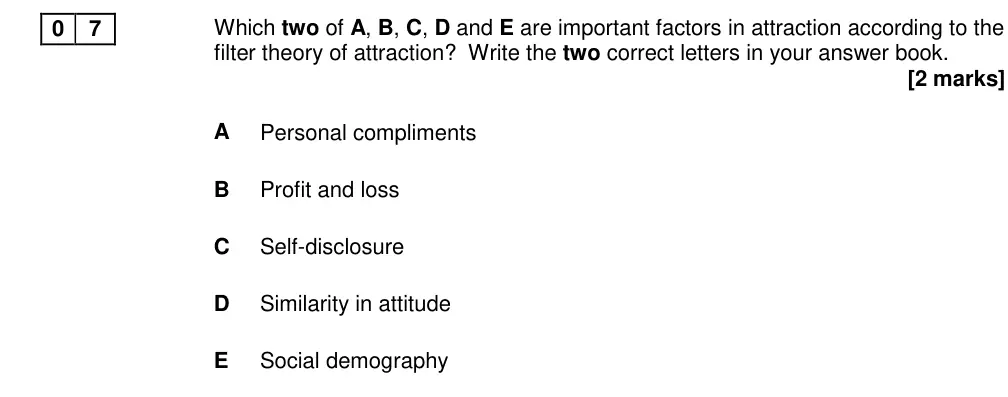
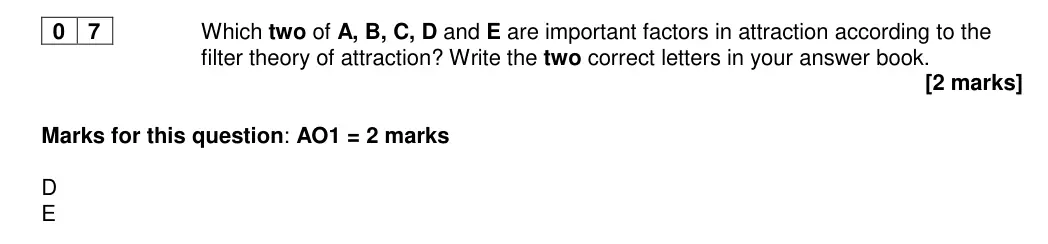
June 2017 · Paper 3 · Q72 marksAO1=2Multiple choiceEasy
Answer
D and E
Mark scheme, including level descriptors and indicative content
Examiner's comment
Students did well on this question with the majority getting the full 2 marks.
Notes from the mark scheme and report
answers D and E (similarity in attitudes, social demography)
distractors self-disclosure (C) and profit and loss (B, social exchange)
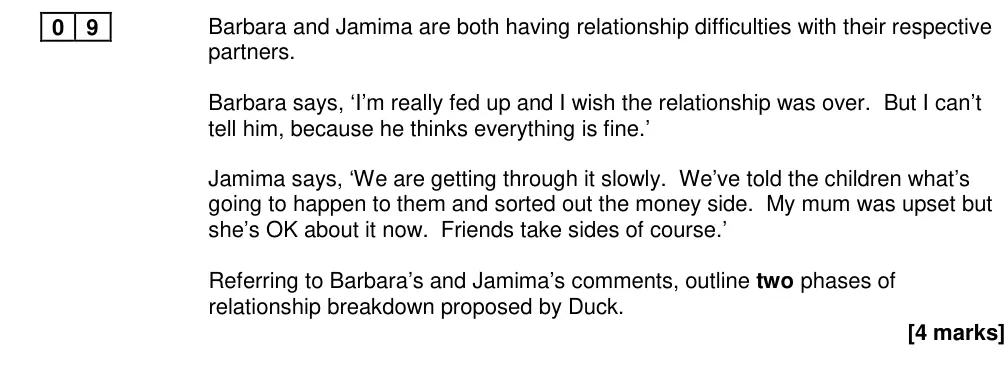
June 2017 · Paper 3 · Q94 marksAO2=4Application
Mark scheme, including level descriptors and indicative content
Examiner's comment
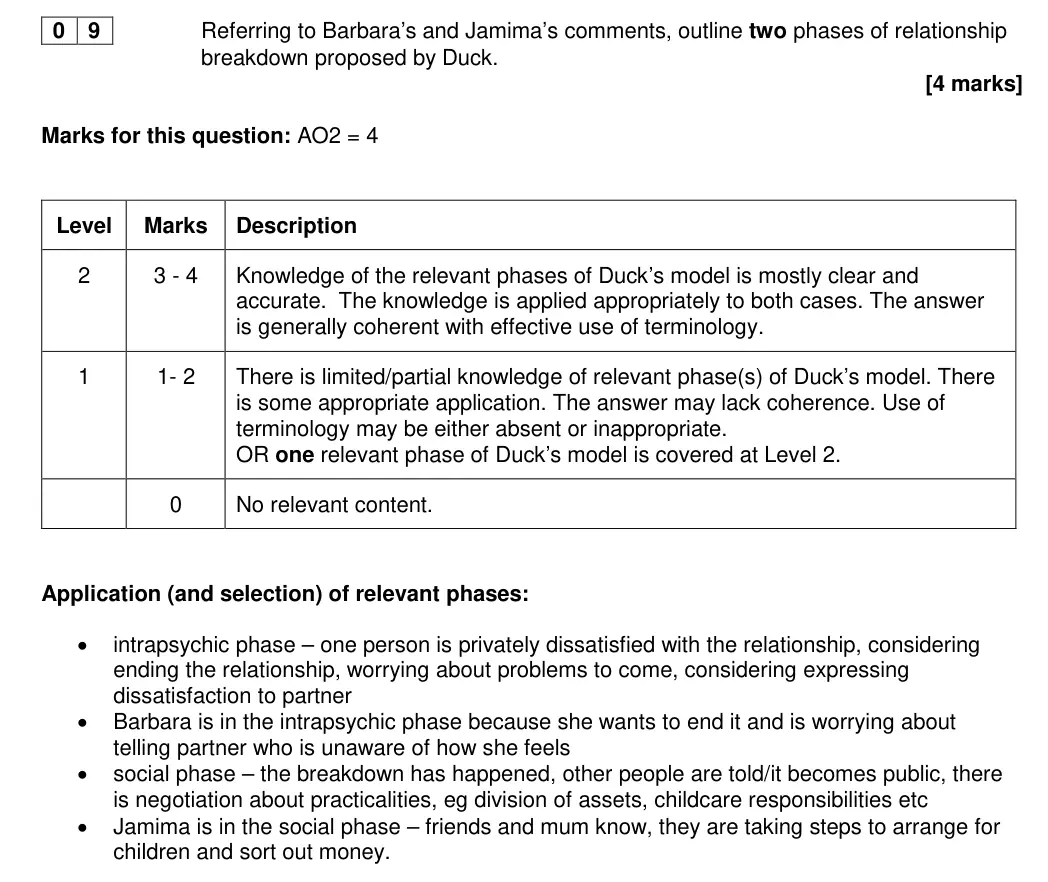
There were many full-mark responses to this question, although a significant number incorrectly identified Jamima’s situation as the grave-dressing phase. The simplest route to achieving full credit was to identify the relevant phase, summarise the main aspects, then link this to the stem material. Weaker responses were those where the student contributed no knowledge or understanding of the stage but merely copied whole chunks of the stem, although even then some minimal credit could be achieved by matching the characters with the correct phase. As this was an application question, answers without any links to stem received no credit.
Notes from the mark scheme and report
Barbara = intra-psychic phase (private dissatisfaction, partner unaware)
Jamima = social phase (others told, practicalities of children and money)
no stem link = 0
common error: Jamima as grave-dressing
June 2017 · Paper 3 · Q1016 marksAO1=6, AO3=1016-mark essay
Mark scheme, including level descriptors and indicative content
Examiner's comment
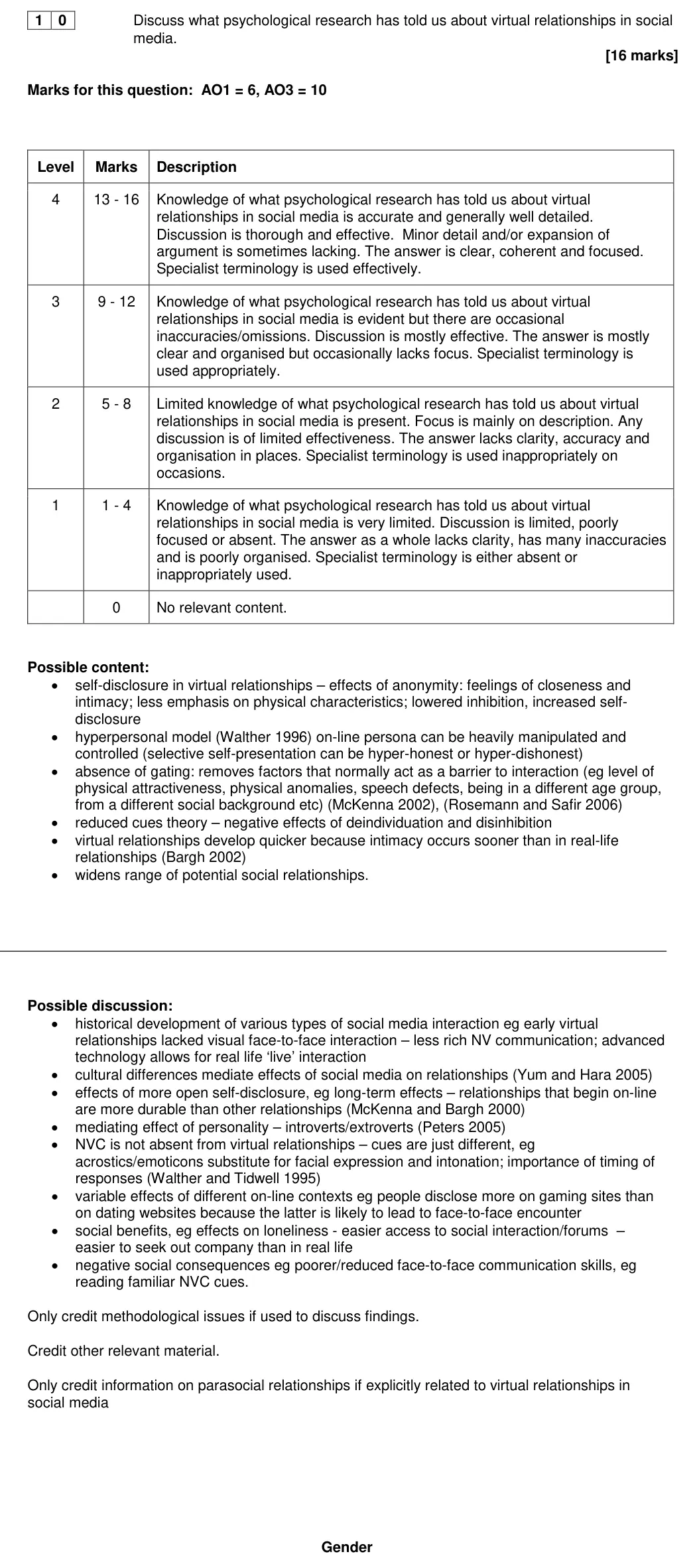
Answers focused mainly on the reduced cues theory, the hyperpersonal model and absence of gating, and the implications of some or all of these for levels of self-disclosure. Weaker responses tended to simply describe these ‘theories’ and were often repetitive. Better answers included the use of evidence to support arguments and analysis in relation to more general psychological concepts, such as deindividuation and anonymity. Analysis of the differences between face-to-face relationships and relationships in social media provided a useful route to discussion for many. Information on parasocial relationships was awarded credit if it was explained in the context of social media, which was rarely the case. More than most other topic areas, this is one where appropriate use of psychological terminology and specific reference to evidence can help to elevate an answer which might otherwise seem like a common-sense response.
Notes from the mark scheme and report
self-disclosure, hyperpersonal model, absence of gating, reduced cues theory
parasocial material only credited if linked to social media
methodology only if used to discuss findings
'virtual relationships in social media' is now 'online relationships' in v1.4
Specimen set 2 · Paper 3 · Q52 marksAO1=2Outline
Mark scheme, including level descriptors and indicative content
Notes from the mark scheme and report
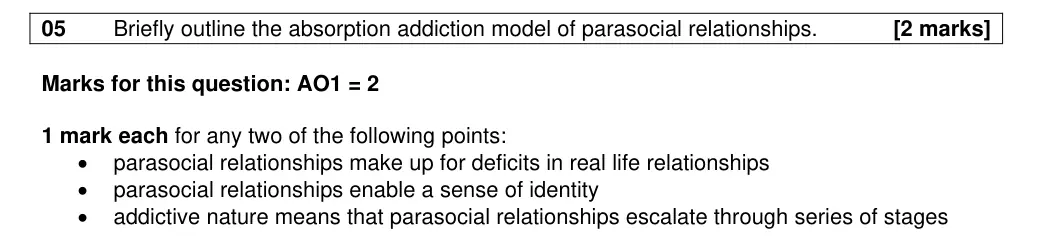
1 mark each: compensates for deficits in real relationships
gives a sense of identity
addictive escalation through stages
Specimen set 2 · Paper 3 · Q66 marksAO3=6Evaluate (short)
Mark scheme, including level descriptors and indicative content
Notes from the mark scheme and report
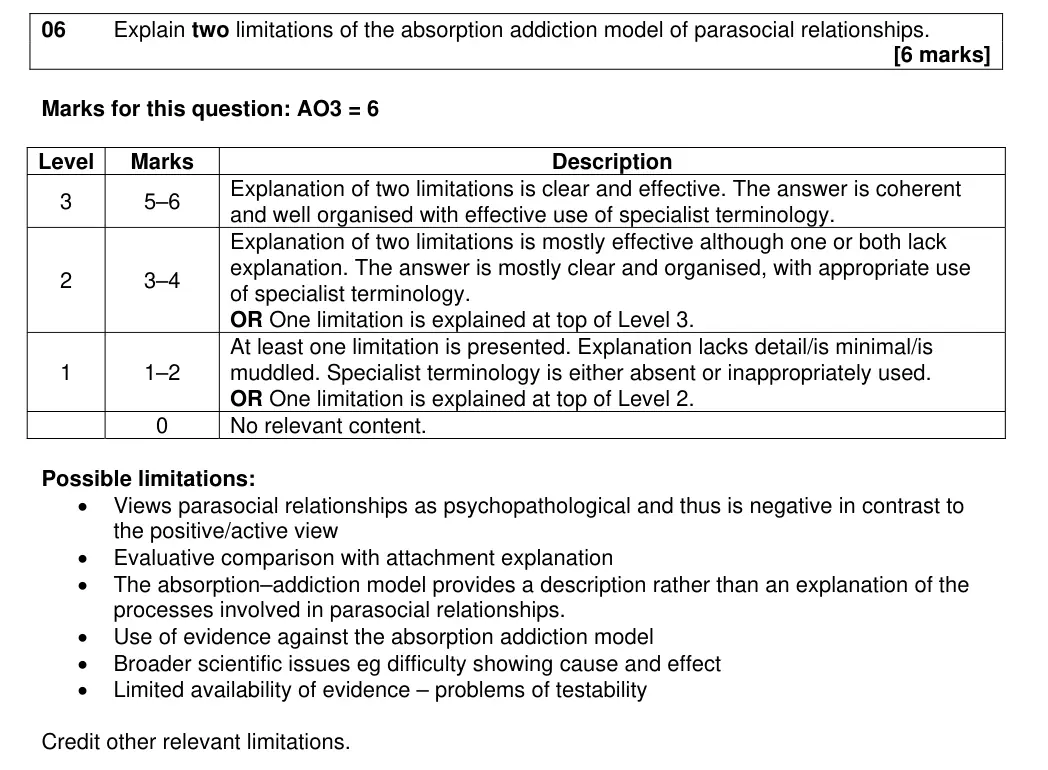
two limitations needed above Level 1 unless one is very well explained
e.g. pathologises PSRs, descriptive not explanatory, cause and effect, comparison with attachment explanation
Specimen set 2 · Paper 3 · Q716 marksAO1=6, AO2=4, AO3=616-mark essay
Mark scheme, including level descriptors and indicative content
Notes from the mark scheme and report
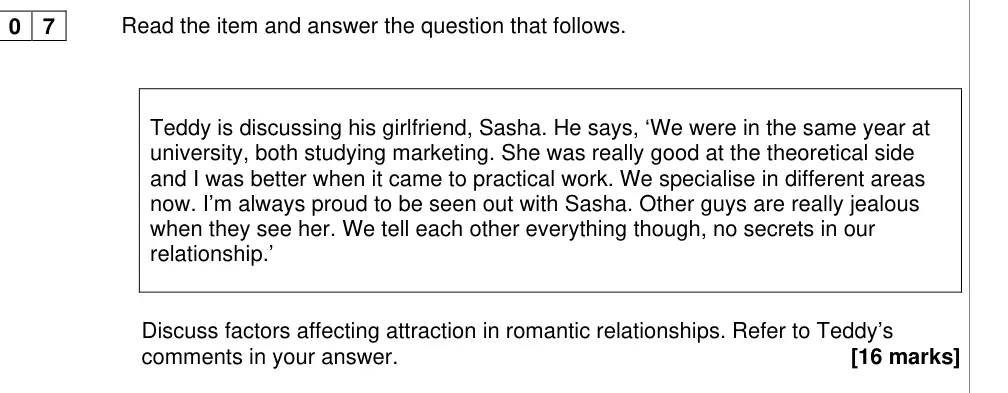
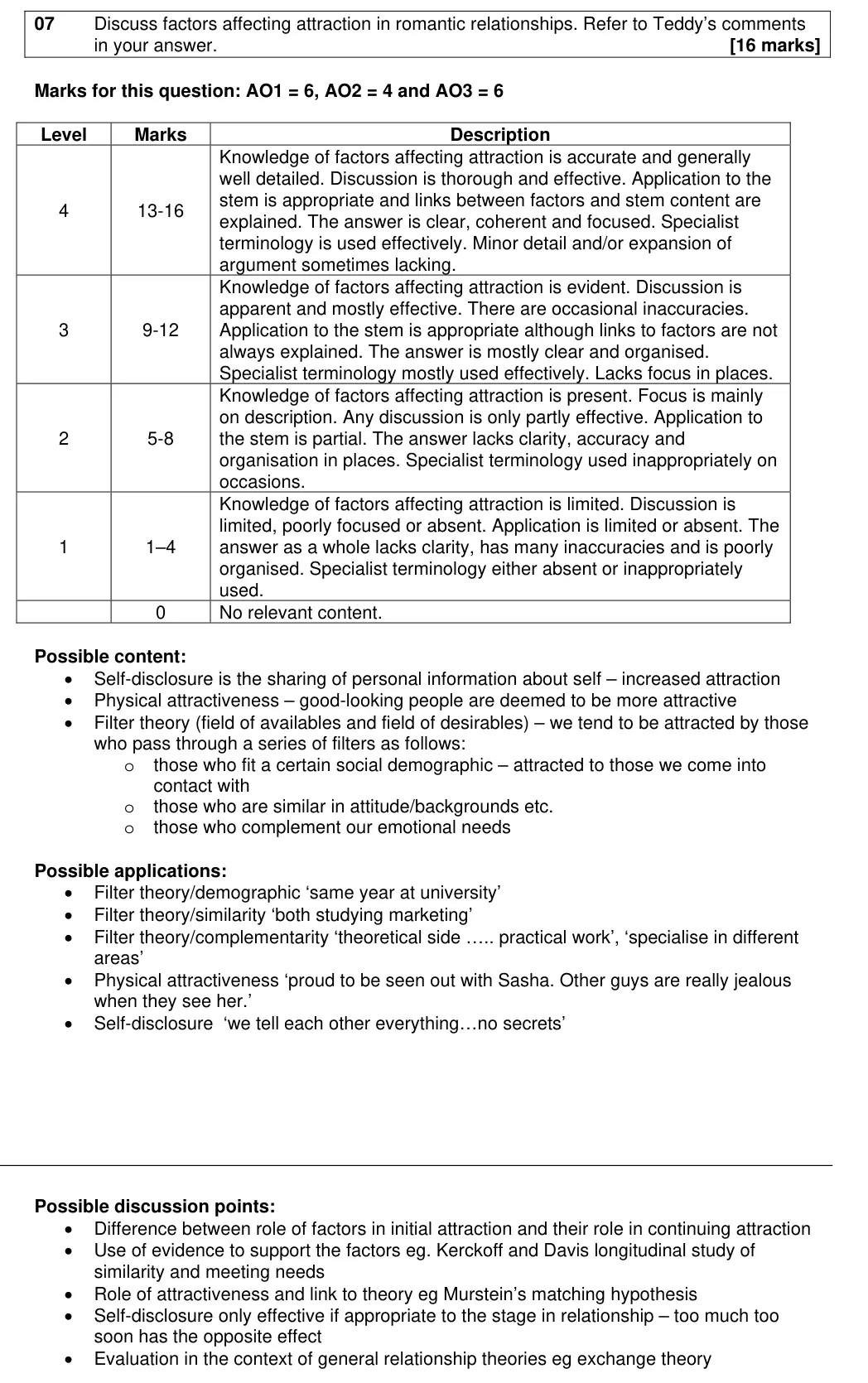
apply filter theory (same year = social demography
both marketing = similarity
theory vs practical = complementarity), physical attractiveness ('proud to be seen out'), self-disclosure ('no secrets')
Level 4 needs links between factors and stem explained
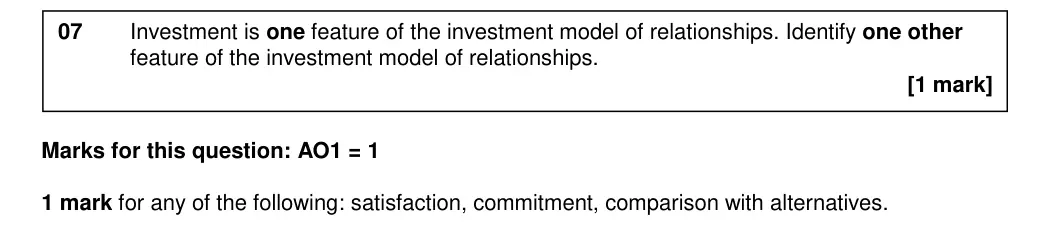
Specimen set 1 · Paper 3 · Q71 markAO1=1Short answer
Mark scheme, including level descriptors and indicative content
Notes from the mark scheme and report
satisfaction, commitment or comparison with alternatives
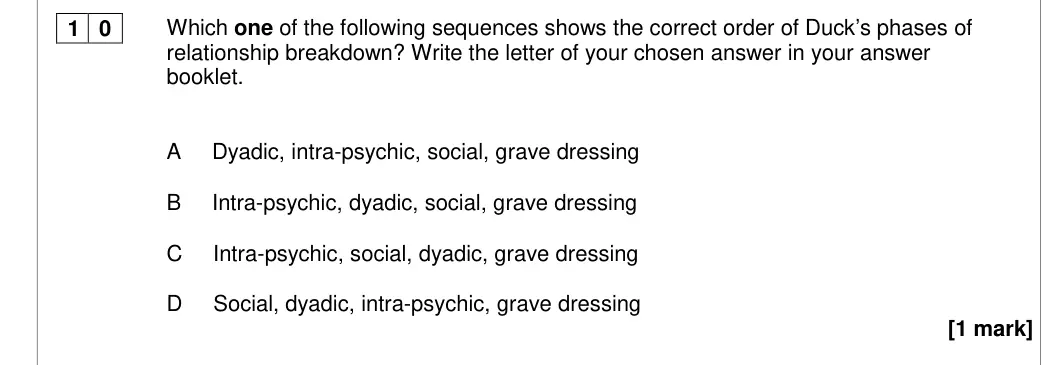
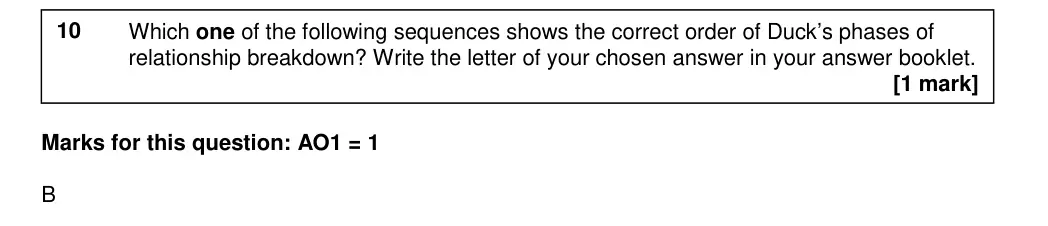
Specimen set 1 · Paper 3 · Q101 markAO1=1Multiple choice
Answer
B
Mark scheme, including level descriptors and indicative content
Notes from the mark scheme and report
answer B (intra-psychic, dyadic, social, grave dressing)
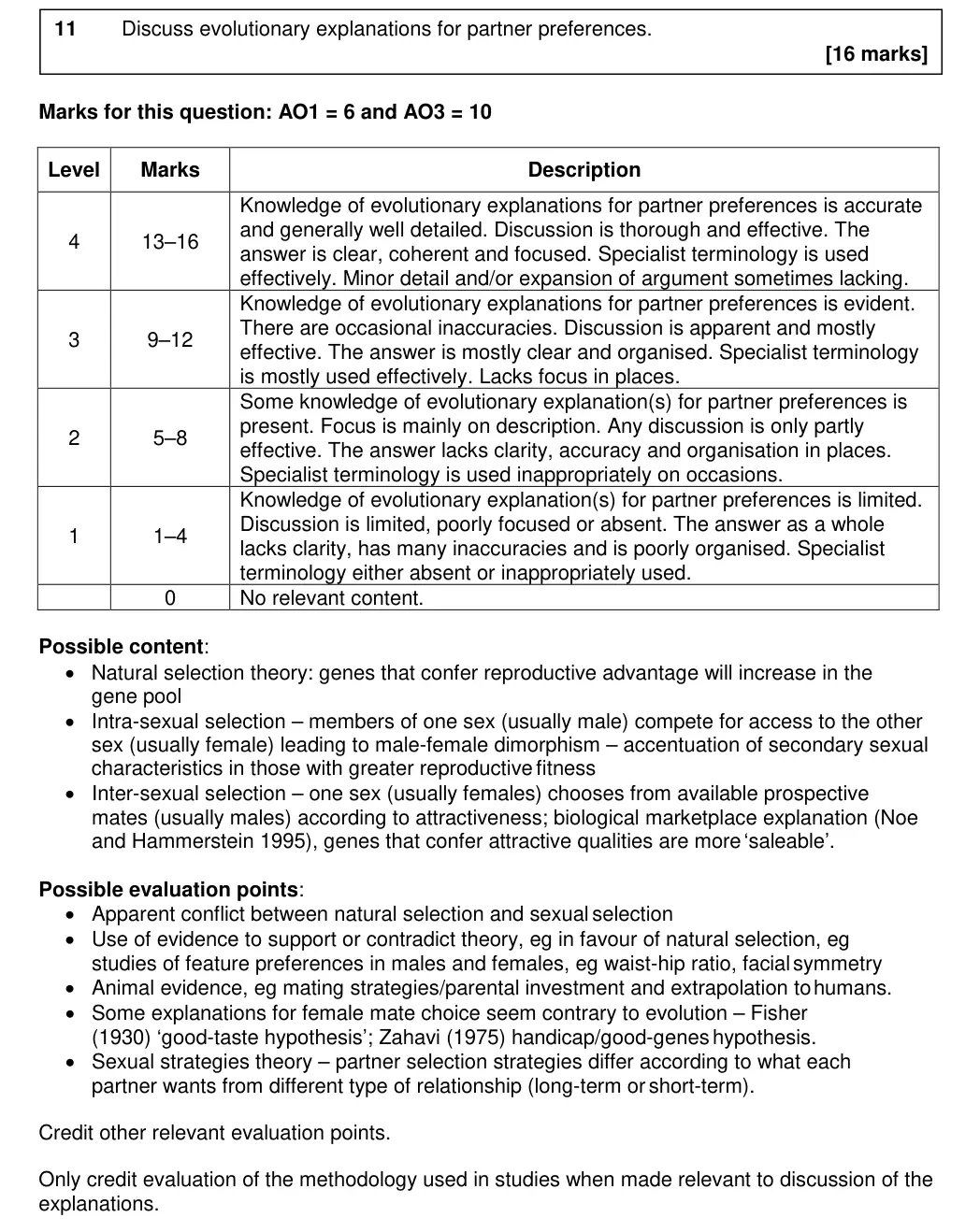
Specimen set 1 · Paper 3 · Q1116 marksAO1=6, AO3=1016-mark essayOld spec only
Not on the 2025 specification: evolutionary explanations for partner preferences / sexual selection, removed in v1.4
Mark scheme, including level descriptors and indicative content
Notes from the mark scheme and report
Off-spec: evolutionary explanations for partner preferences / sexual selection, removed in v1.4
intra- and inter-sexual selection, waist-hip ratio, sexual strategies theory
methodology only creditworthy if linked to the explanations
Work with an AQA psychology tutor
Essays not reaching the top band? Book a session with Andy, a former AQA examiner.