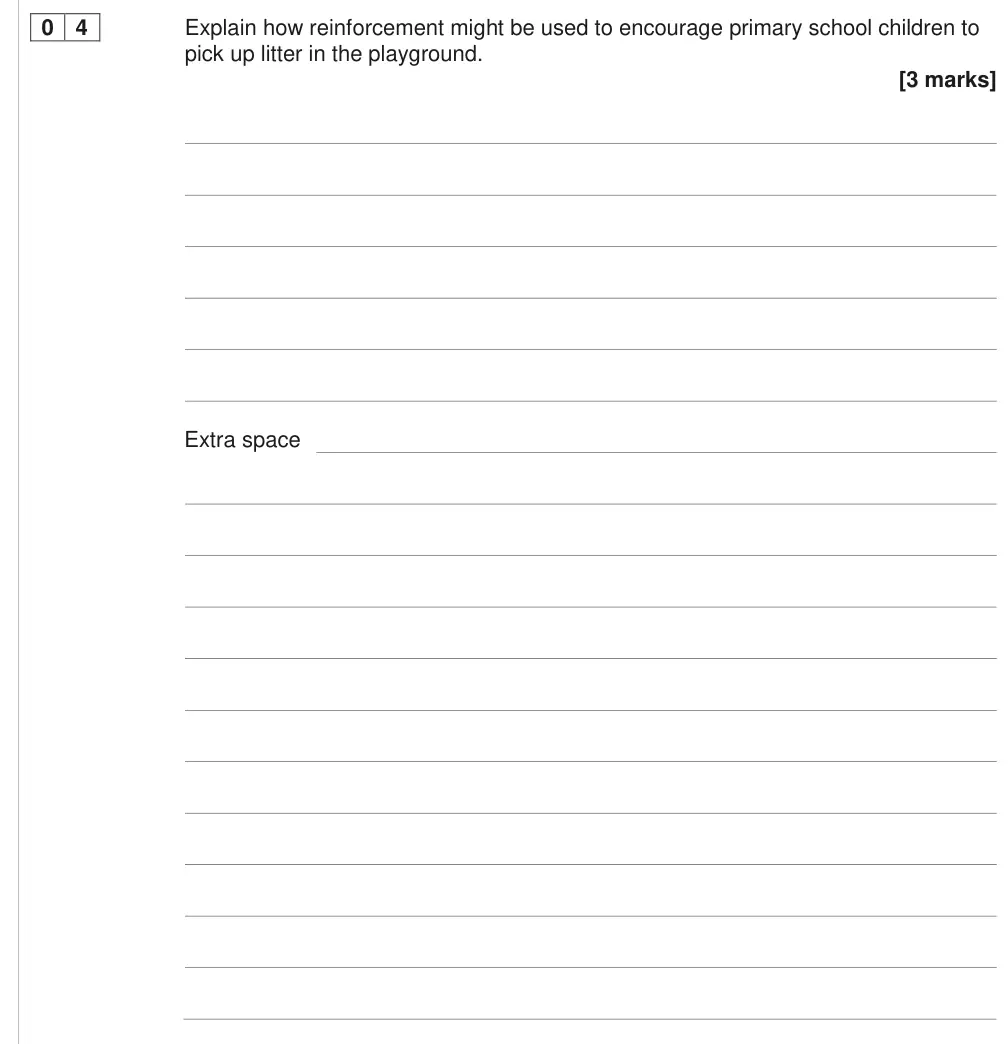
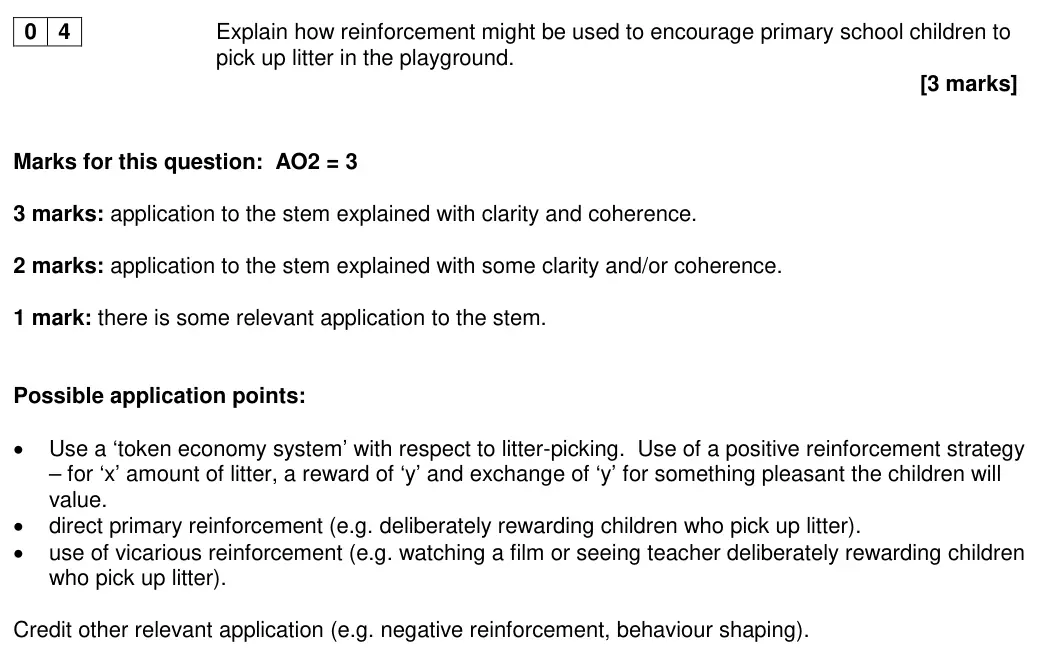
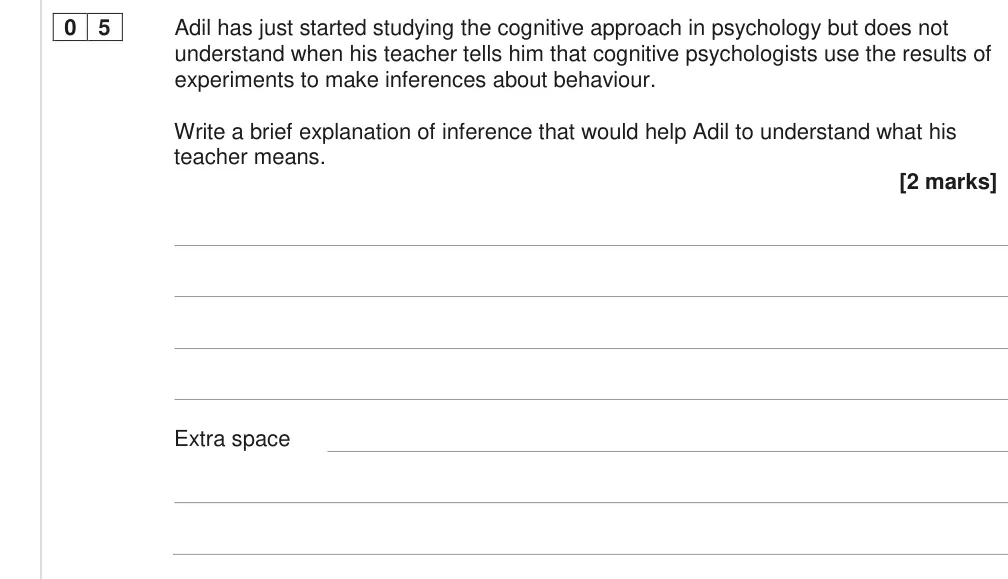
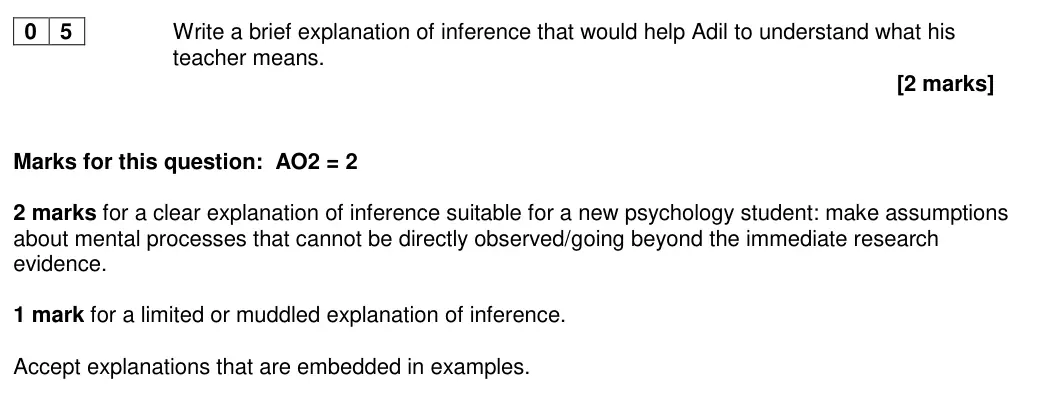
4.2.1-01 Learning approaches: i) the behaviourist approach, including classical conditioning and Pavlov’s research, operant conditioning, types of reinforcement and Skinner’s research; ii) social learning theory including imitation, identification, vicarious reinforcement, the role of mediational processes and Bandura’s research.AS
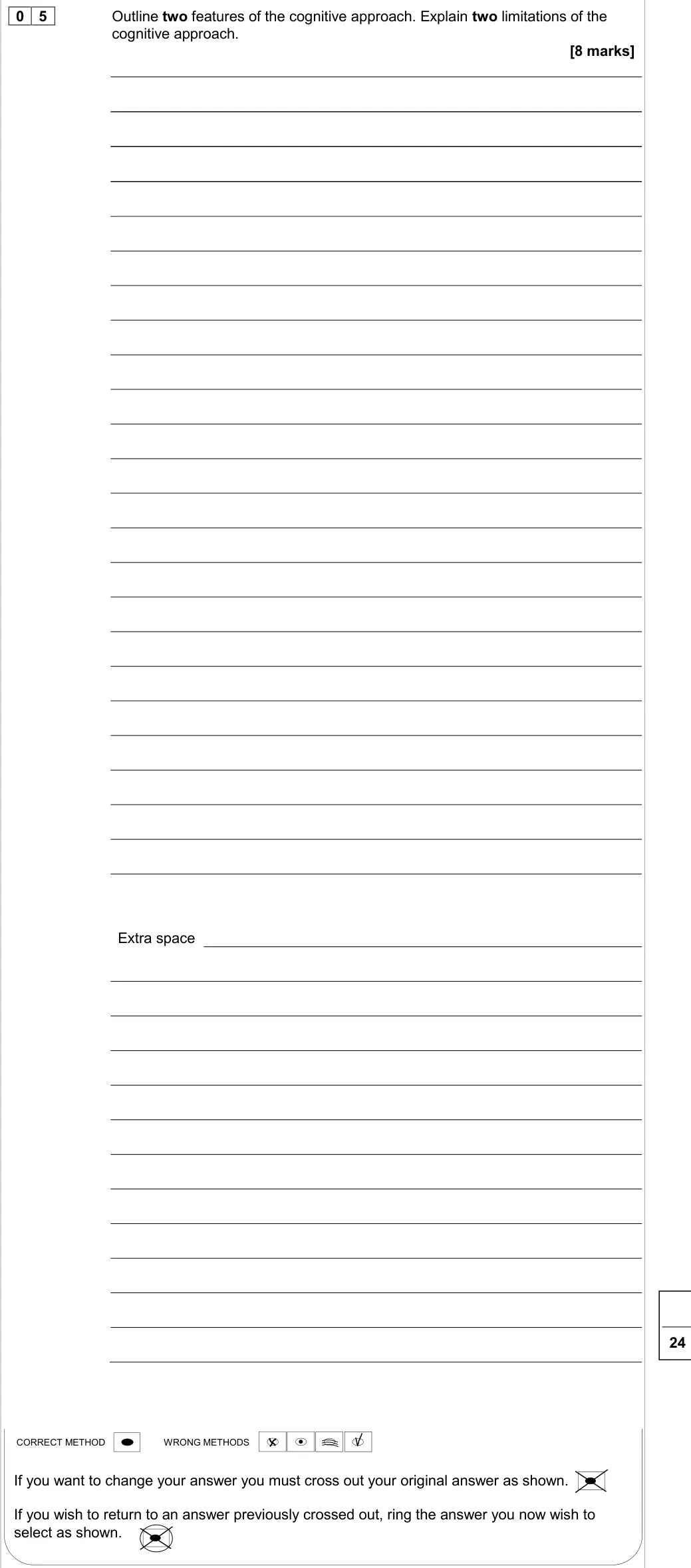
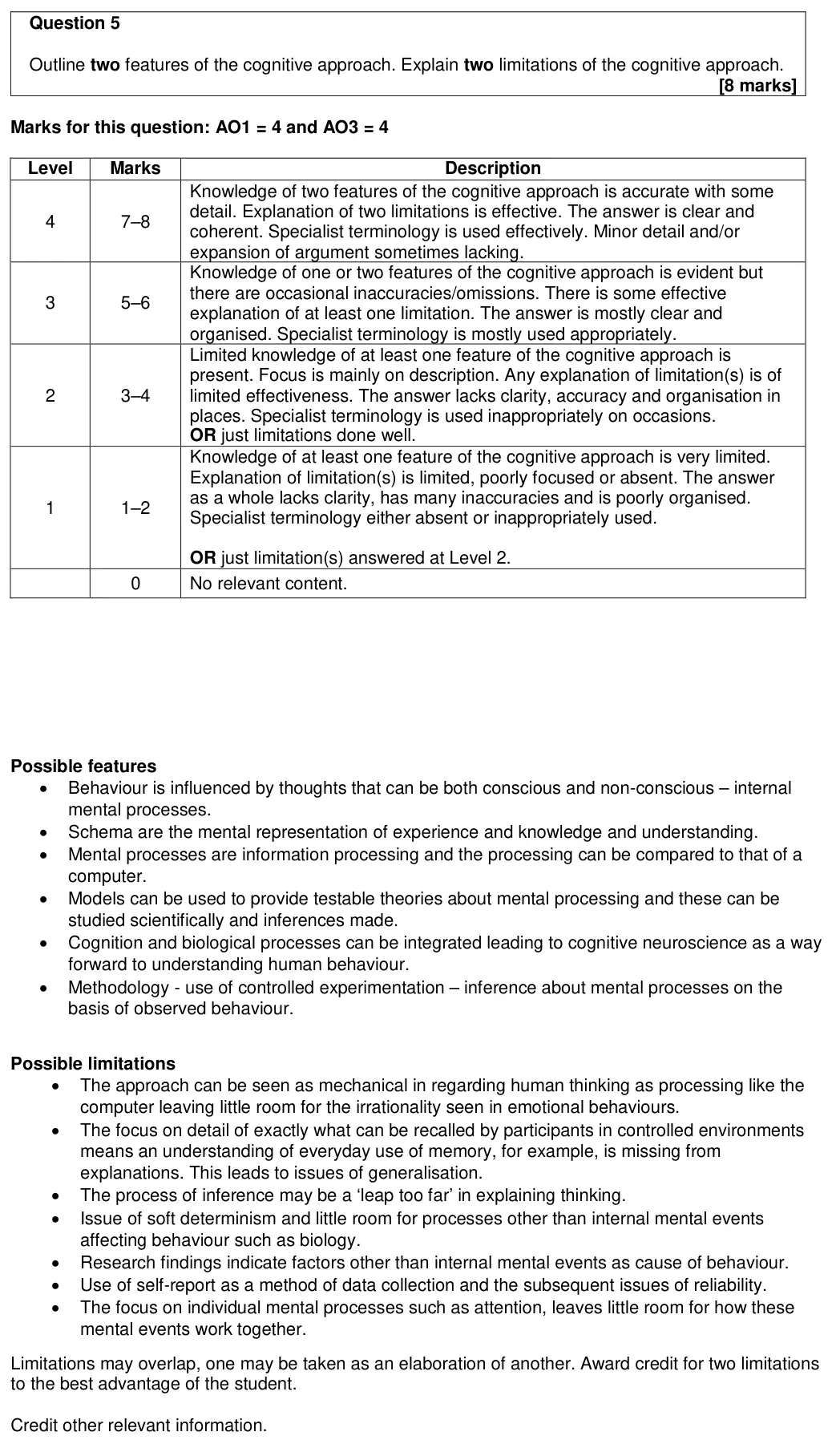
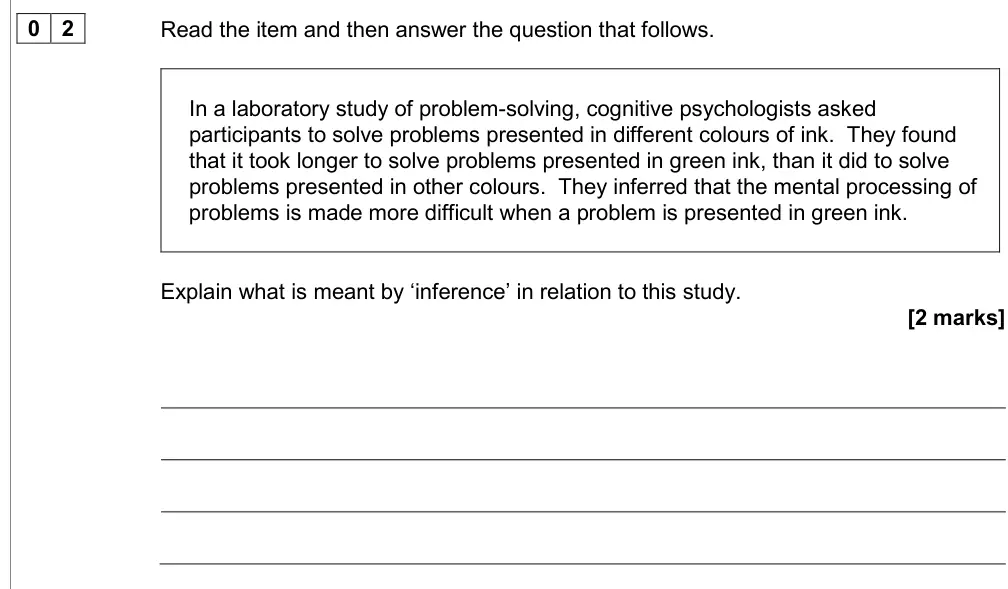
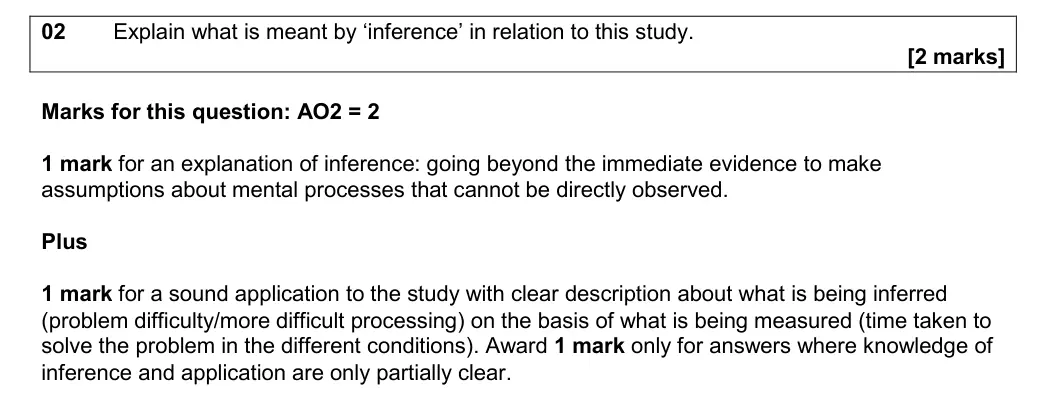
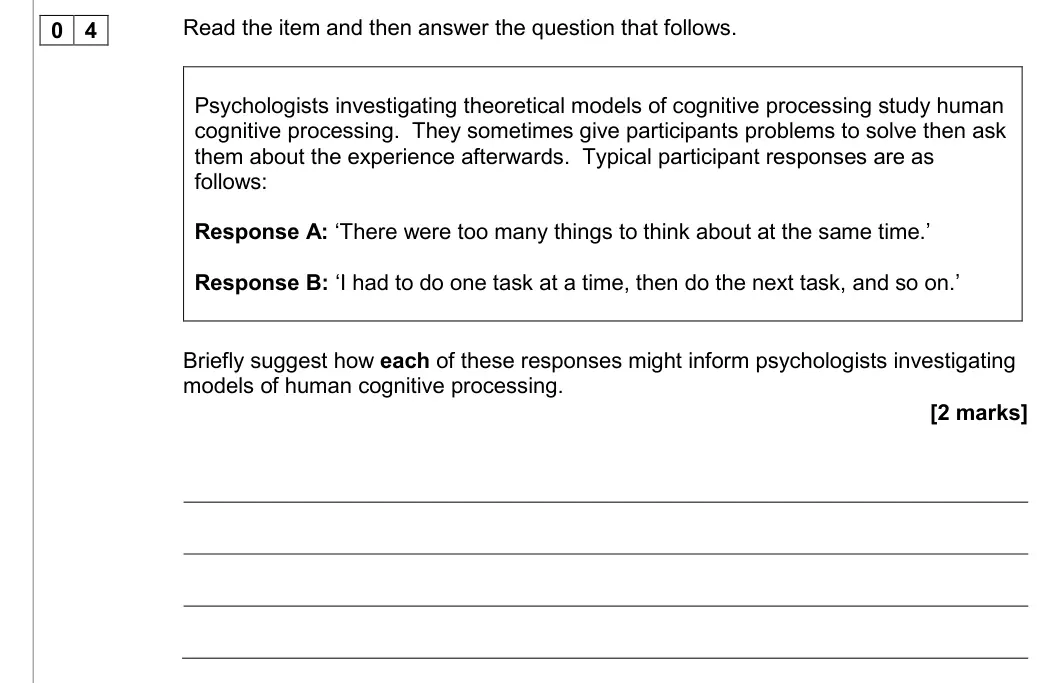
4.2.1-02 The cognitive approach: the study of internal mental processes, the role of schema, the use of models to explain and make inferences about mental processes.AS
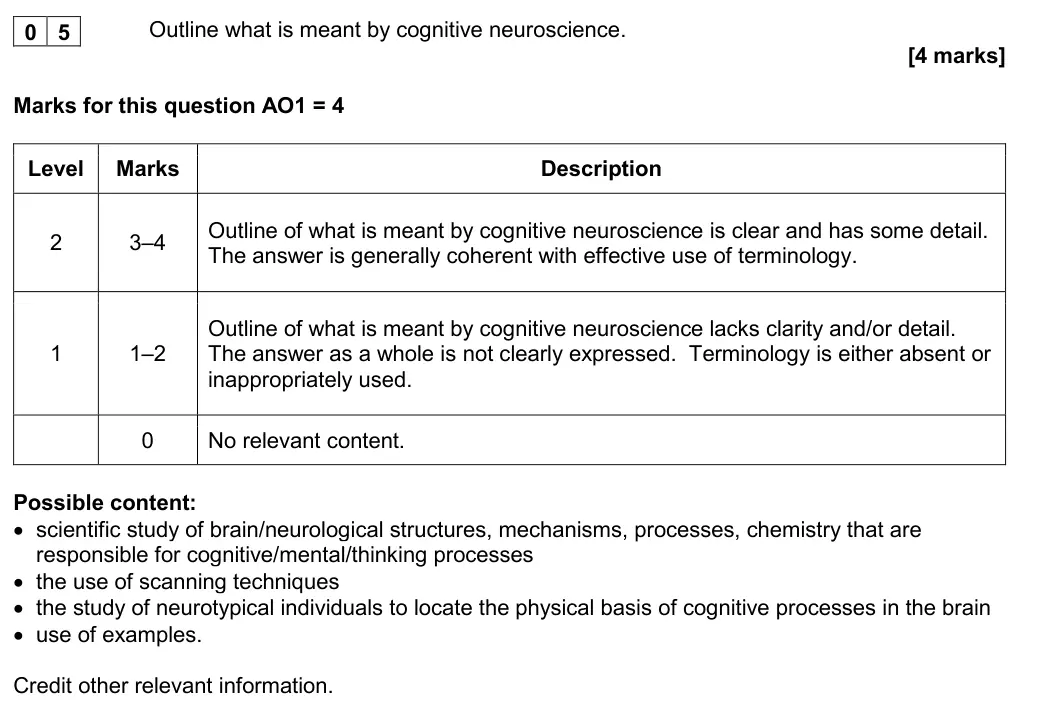
4.2.1-03 The biological approach: the genetic basis of behaviour: genotype, phenotype and evolution. Influence of biological structures and neurochemistry on behaviour. Cognitive neuroscience.AS
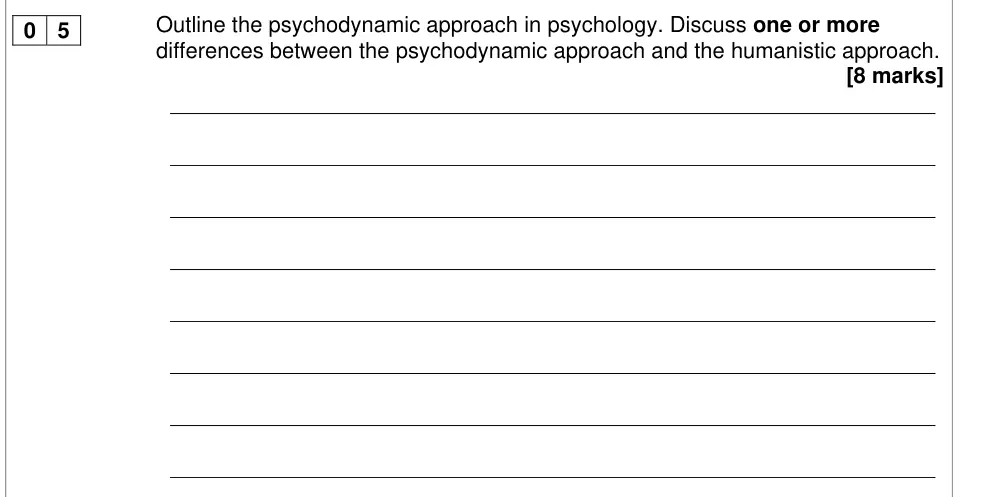
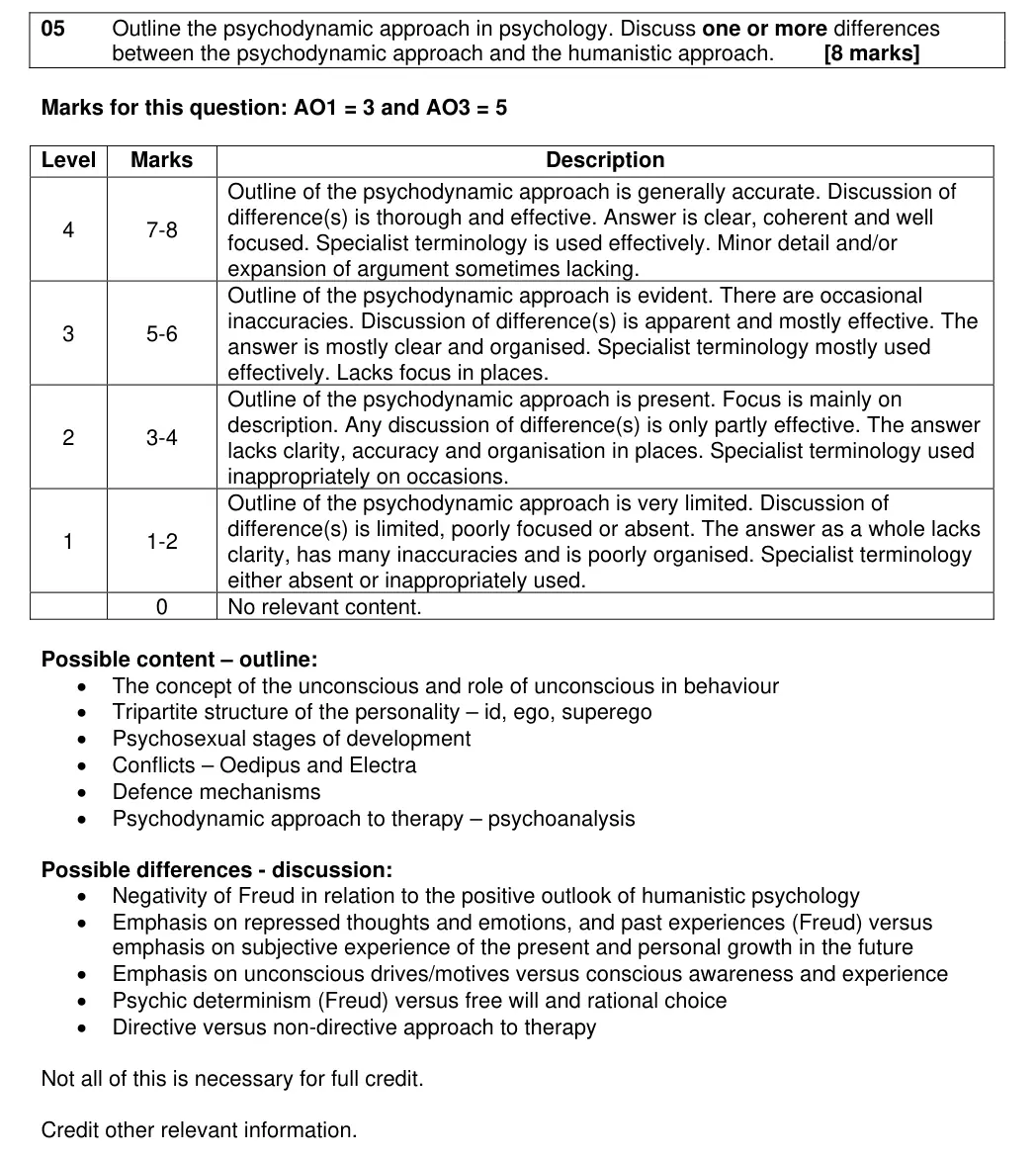
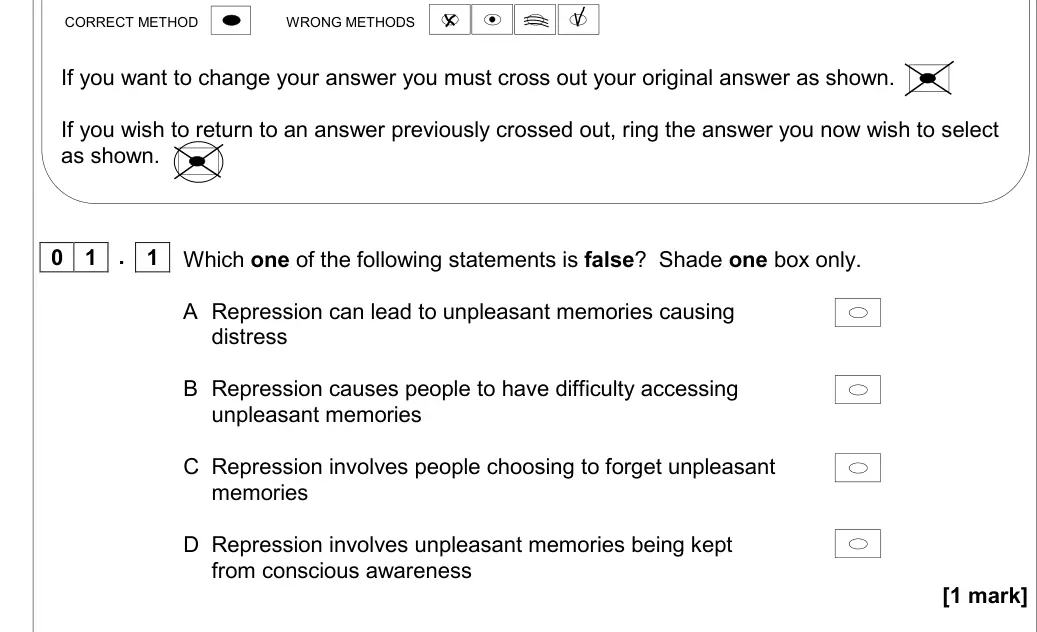
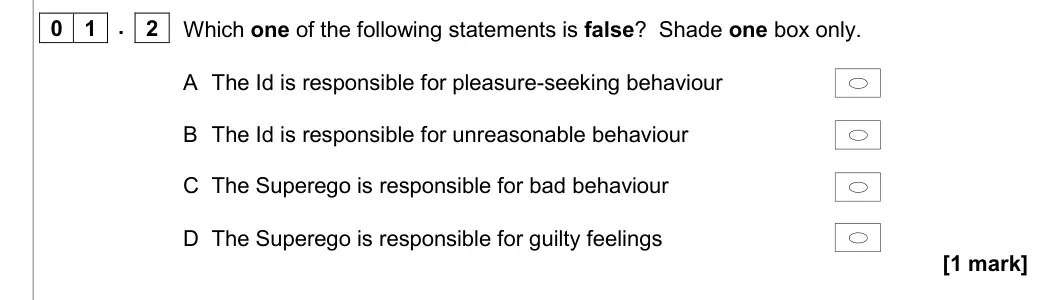
4.2.1-04 The psychodynamic approach: the role of the unconscious, the structure of personality, that is Id, Ego and Superego, defence mechanisms including repression, denial and displacement, psychosexual stages.
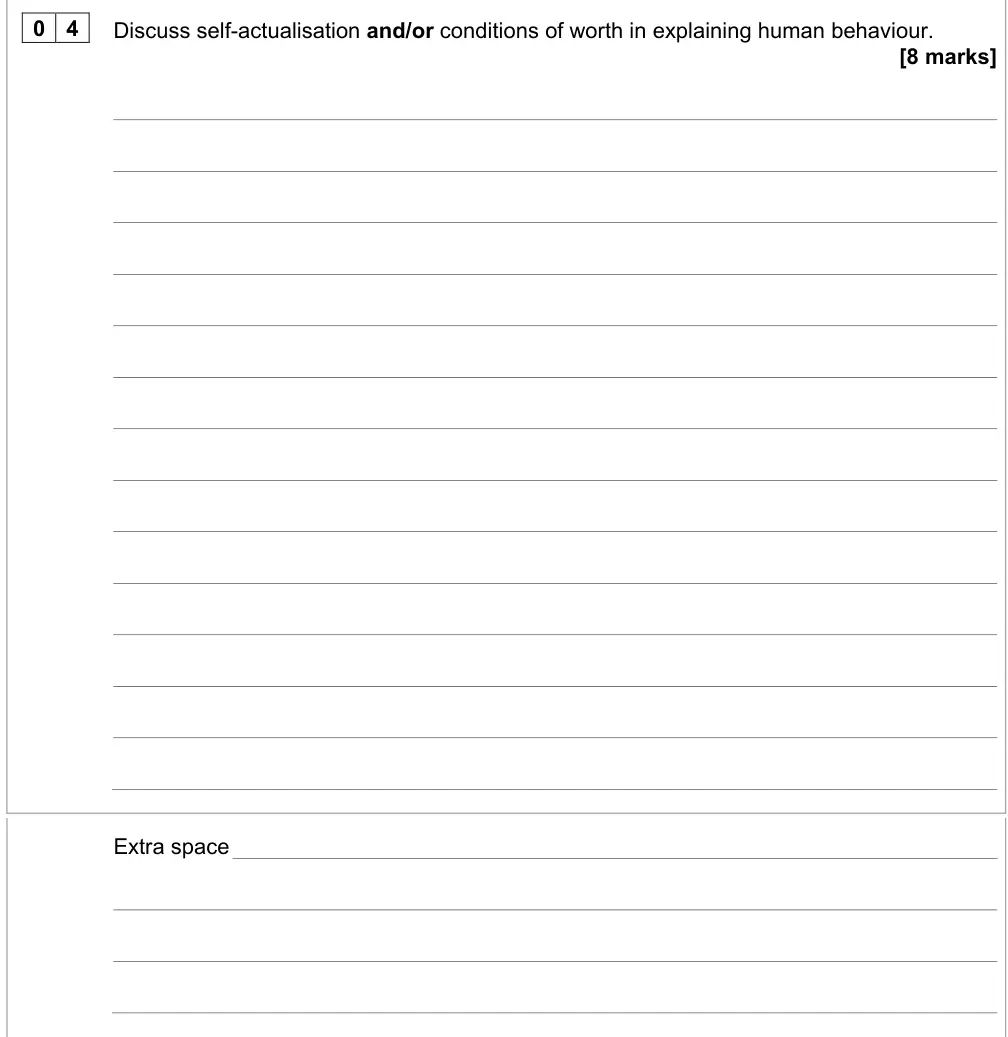
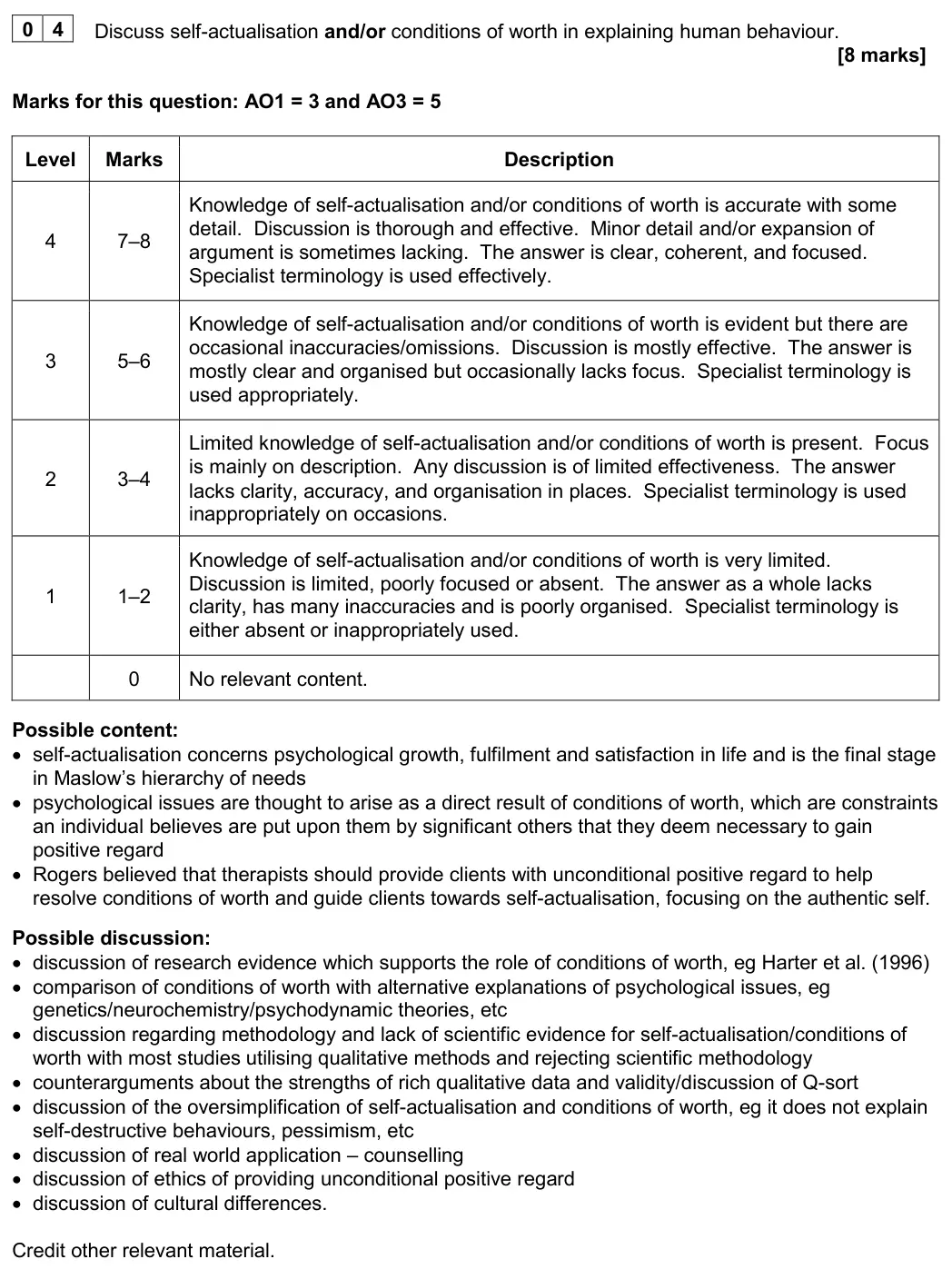
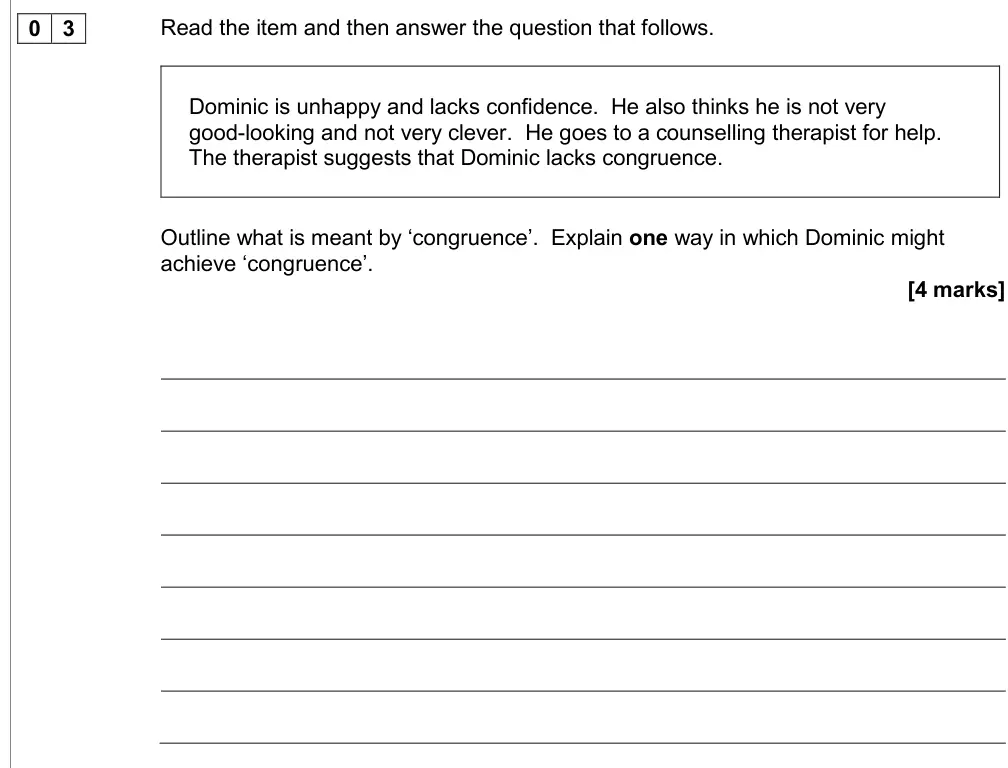
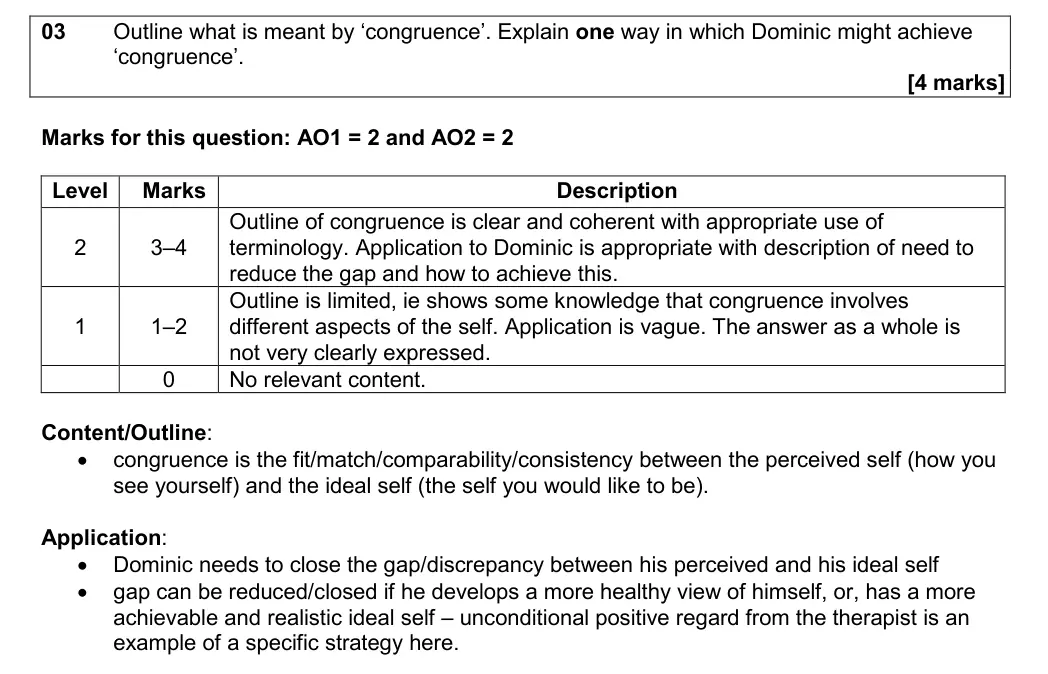
4.2.1-05 Humanistic Psychology: free will, self-actualisation and Maslow’s hierarchy of needs, congruence, the role of conditions of worth.
Tap a question to zoom it. Mark scheme and examiner's comment open under each question.
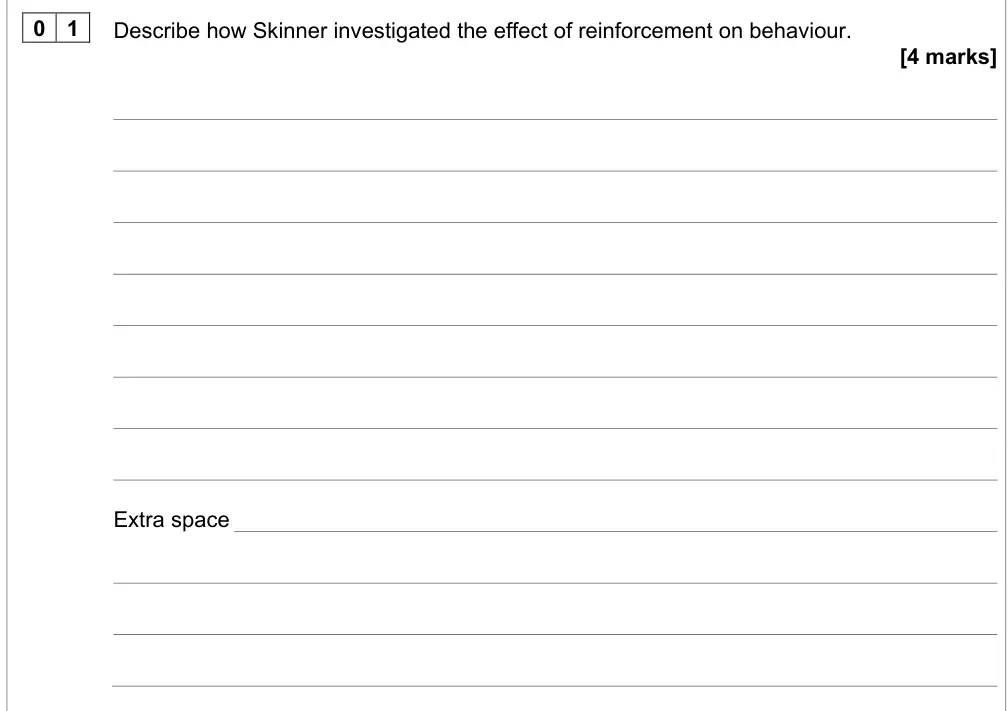
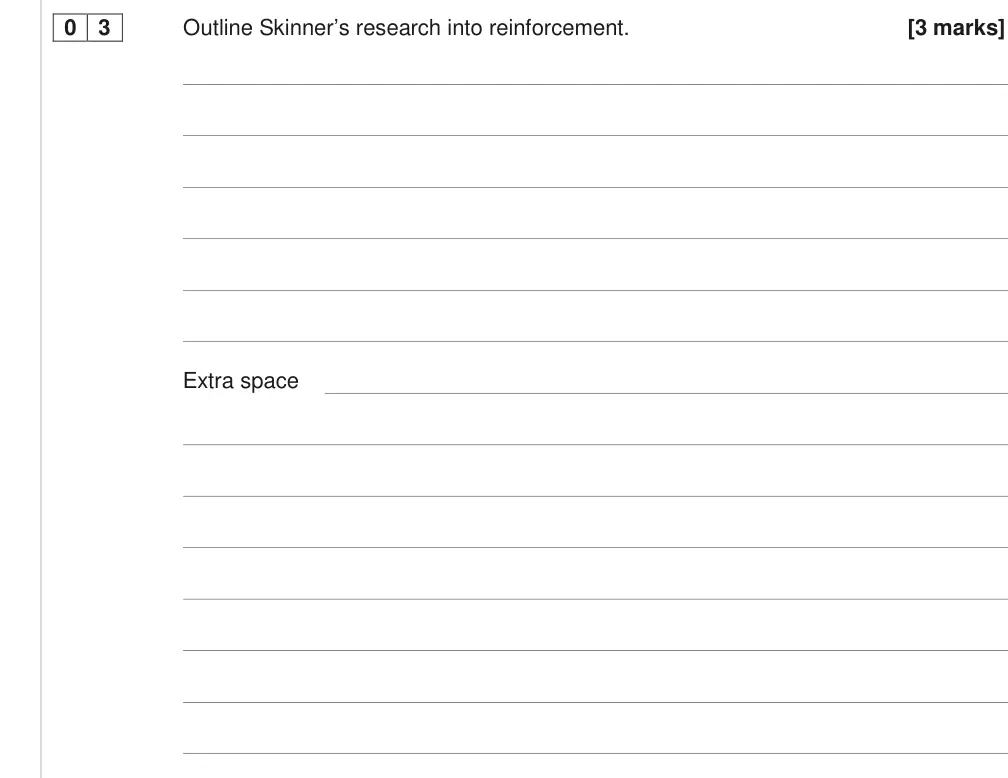
June 2025 · Paper 2 · Q14 marksAO1=4Outline
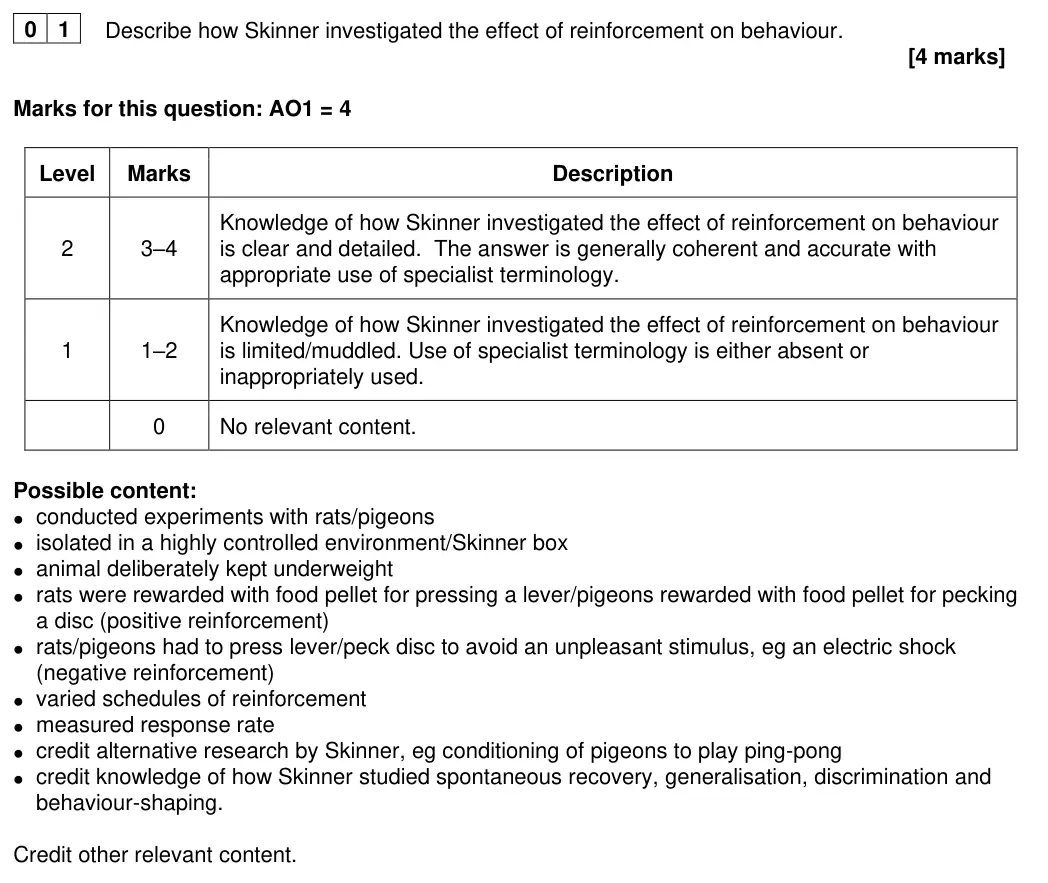
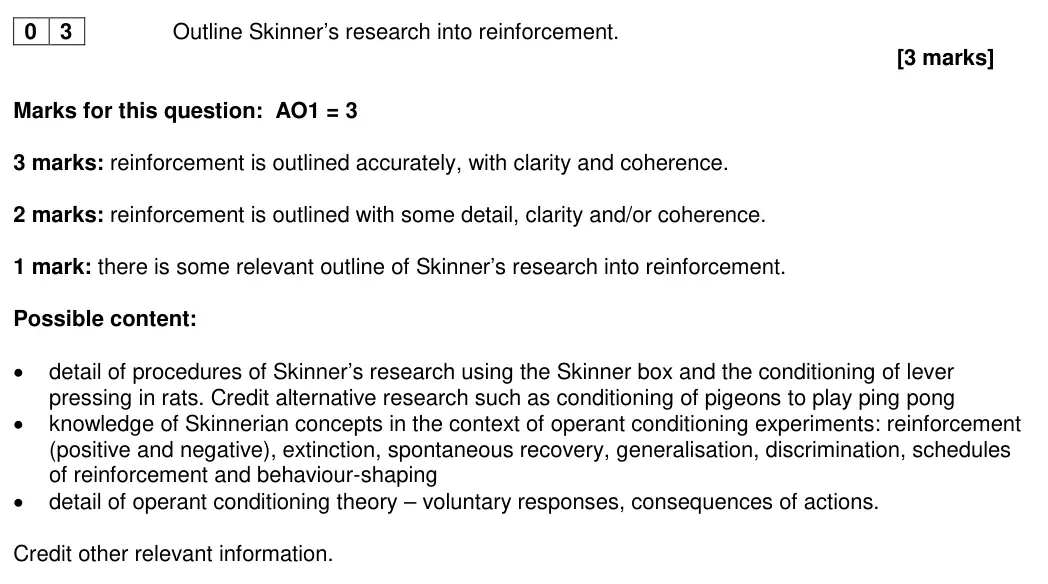
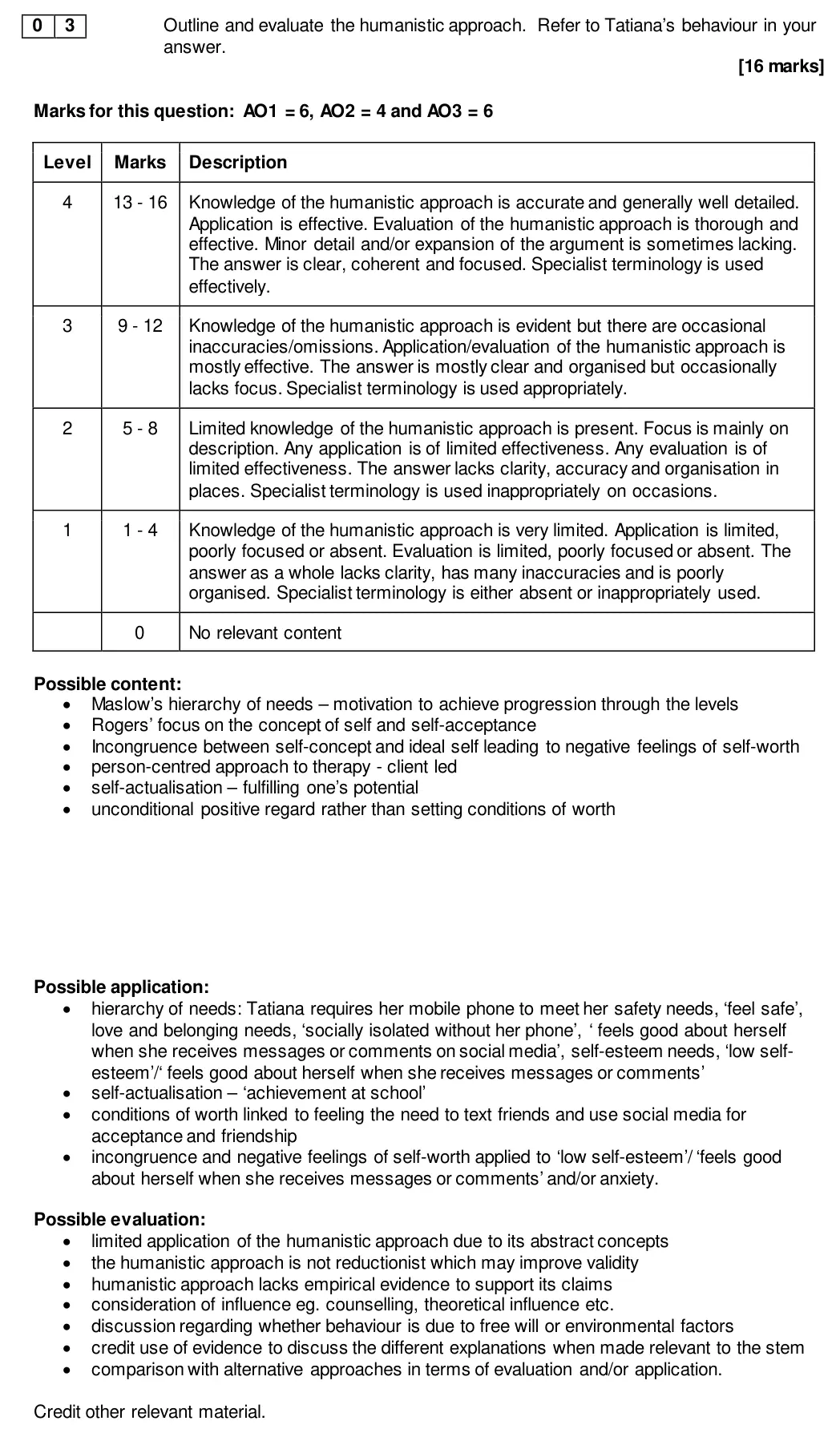
Mark scheme, including level descriptors and indicative content
Examiner's comment
This question was generally answered well with most students demonstrating good knowledge of Skinner’s research and reinforcement. However, responses were often focussed on definitions of reinforcement and/or on findings rather than ‘how’ Skinner investigated reinforcement. Better responses focussed on procedural details. As in previous years, many students still muddled negative reinforcement with punishment and there was some confusion over whether pressing levers caused or prevented the electric shock. There was very little reference to schedules of reinforcement or measuring response rate.
Notes from the mark scheme and report
focus on HOW Skinner investigated (procedure: Skinner box, lever/disc, food/shock, schedules, response rate) not definitions or findings
negative reinforcement muddled with punishment
confusion over whether lever press caused or prevented shock
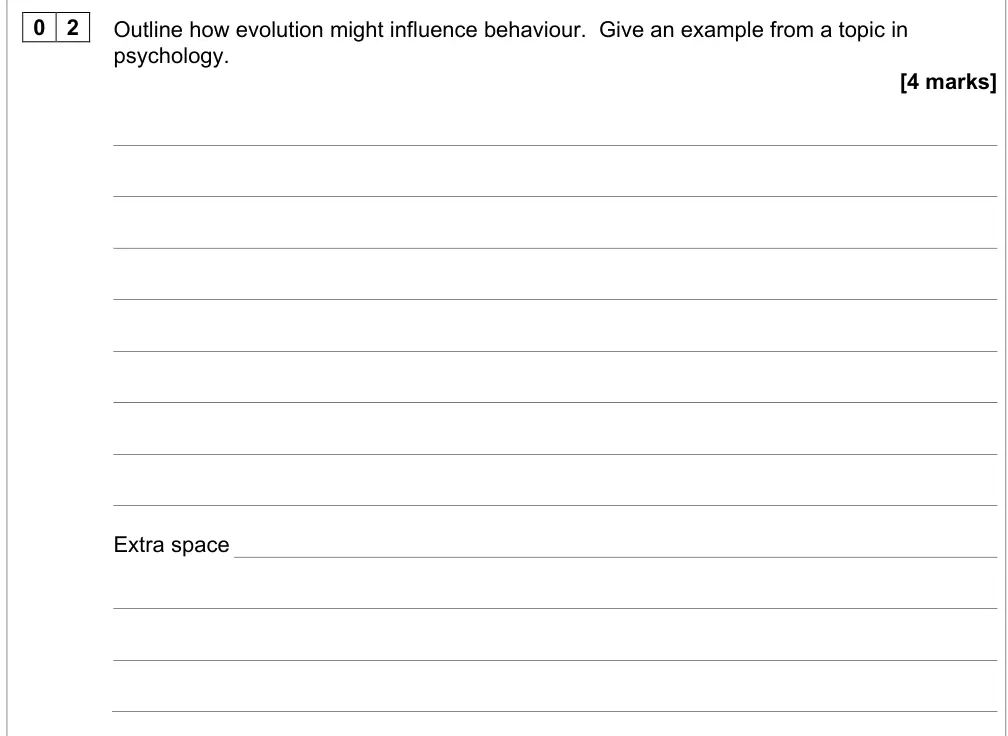
June 2025 · Paper 2 · Q24 marksAO1=3, AO2=1Outline
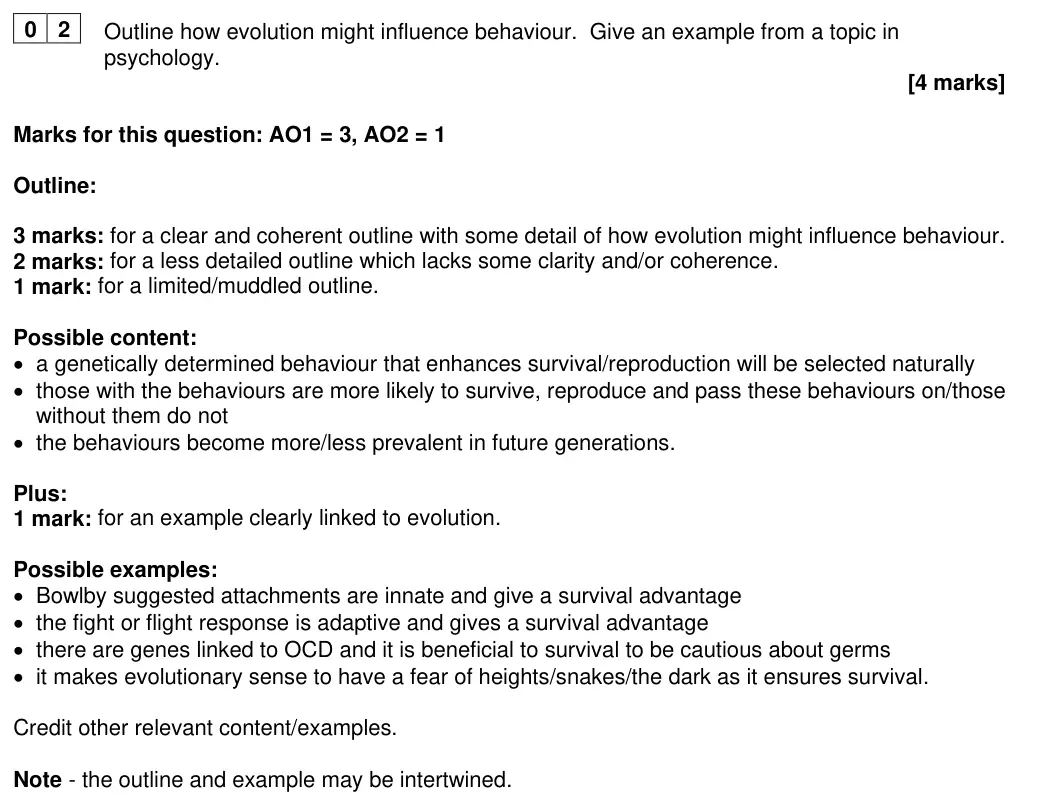
Mark scheme, including level descriptors and indicative content
Examiner's comment
This question discriminated well with a spread of marks awarded. A range of examples for evolution was seen from topics across the specification, the most common coming from attachment, fight/flight response and phobias. However, responses were often not shaped to how evolution might influence behaviour, limiting the marks awarded. Some gave an example, such as a giraffe having a long neck, but did not link this to any behaviour and therefore did not gain credit. Other responses just focussed on an outline of evolution but did not provide an example. Students should be reminded to answer all aspects of the question. There were varying degrees of success in the outline of how evolution may explain behaviour. Whilst some responses acknowledged that an advantageous trait will be passed to offspring, they did not then explain how this will make the behaviour more prevalent over time in future generations or explain the behaviour being genetically determined. There was some confusion in responses suggesting that behavioural adaptions occur within individuals who learn a behaviour through conditioning to aid survival and adapt to their environment. Wayward answers focused on the evolution of psychology as a science, the evolution of technology to study the brain and/or the evolution of definitions of mental health.
Notes from the mark scheme and report
3 marks outline (selection of genetically determined adaptive behaviour, passed on, more prevalent in later generations) + 1 mark example clearly linked to evolution (e.g. Bowlby attachment, fight or flight, OCD, phobias)
example not linked to behaviour (giraffe neck) not credited
answers on 'evolution of psychology as a science' wayward
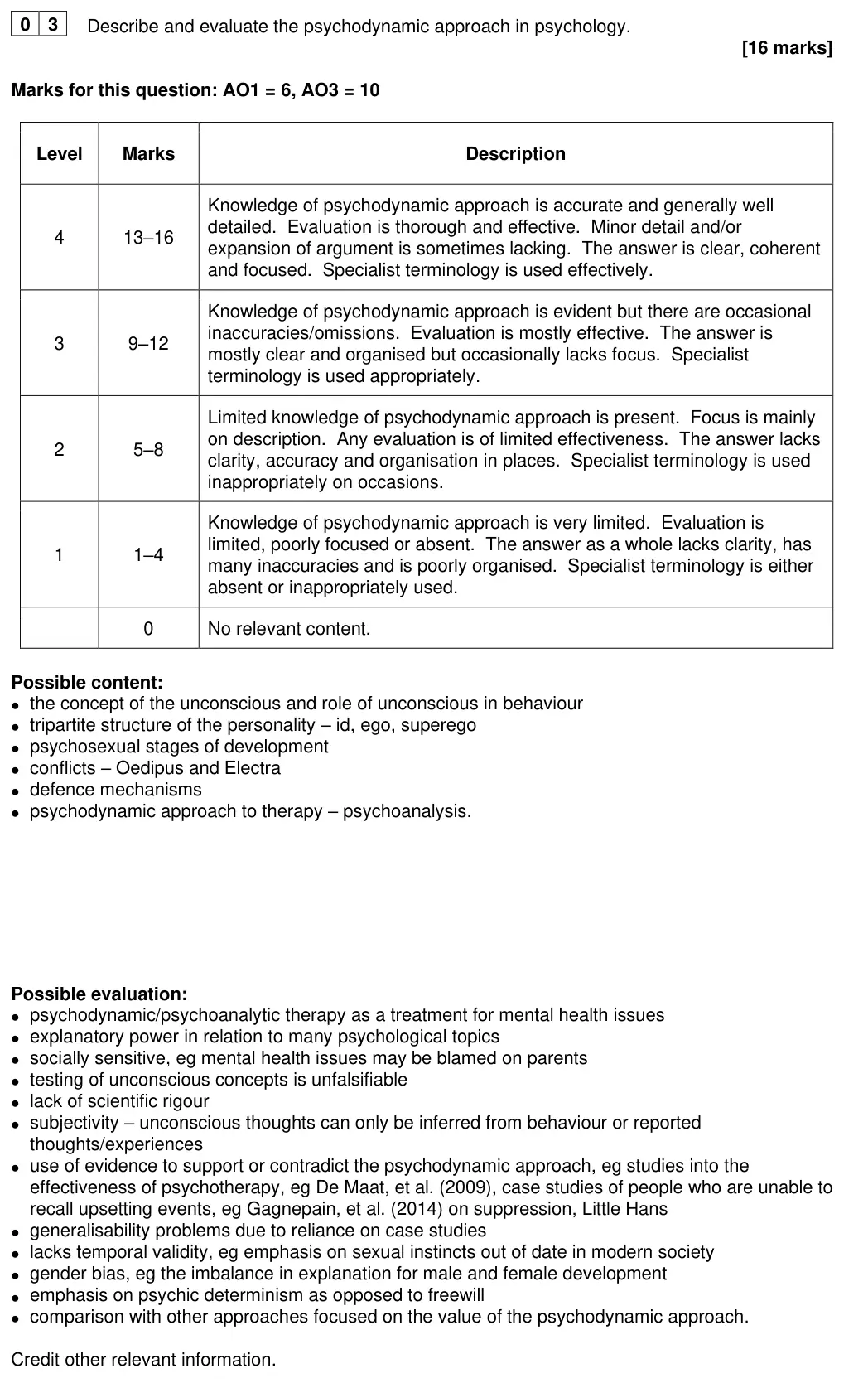
June 2025 · Paper 2 · Q316 marksAO1=6, AO3=1016-mark essay
Mark scheme, including level descriptors and indicative content
Examiner's comment
Overall, students appeared well-prepared for this question and a wealth of material was presented. Most students were able to describe the tripartite personality, defence mechanisms and the psychosexual stages, including details of fixations. Descriptions of the Oedipus complex and the case study of Little Hans were more variable. Often students wrote detailed descriptions but did not have the required breadth/depth in the evaluation. Students should be mindful of the 6/10 split for knowledge/evaluation in 16-mark questions. Some impressive answers demonstrated a real depth and breadth of knowledge, effective use of evidence with effective evaluation integrated through the whole response. Common evaluative points focused on the contribution of this approach to psychoanalytic therapy and explanatory power. The issue of falsifiability was a common limitation, alongside the focus on case studies and psychic determinism. Better answers included details of how behaviour is determined through fixations, for example. The issue of reductionism was often muddled and reference to gender bias frequently lacked accurate detail.
Notes from the mark scheme and report
possible content: unconscious, id/ego/superego, psychosexual stages, Oedipus/Electra, defence mechanisms, psychoanalysis
evaluation: unfalsifiable, case studies (Little Hans), psychic determinism, gender bias, social sensitivity
mind the 6/10 AO1/AO3 split - many over-described
reductionism and gender bias points often muddled
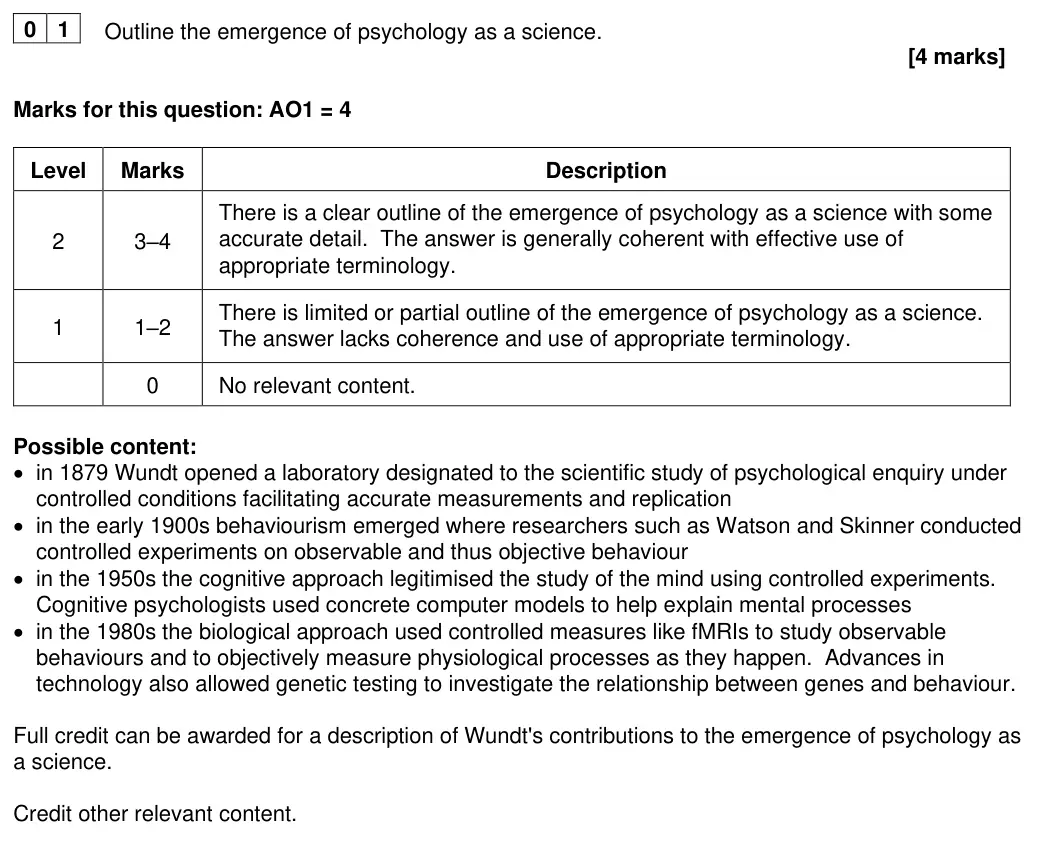
June 2024 · AS Paper 2 · Q14 marksAO1=4OutlineOld spec only
Not on the 2025 specification: origins of Psychology: Wundt and the emergence of Psychology as a science, removed in v1.4
Mark scheme, including level descriptors and indicative content
Examiner's comment
Students performed less well in Q1, outlining the emergence of psychology as a science, and in Q4, outlining one role of schema. Q1 appeared to be a challenging question for many students, most likely due to this being the first time this has been directly asked about in an AS examination. This question had one of the highest proportion of responses not attempted (over 2%) on the paper. Many students focused their answers to this question on the work of Wundt but failed to gain many marks as it was not focused upon his contribution to the emergence of psychology as a science but was merely a description of his research. A few students did produce some excellent responses which used their knowledge of the timeline of approaches in psychology to explain how they contributed to the emergence of psychology as a science. Exemplification of a successful response A clear and accurate outline with a clear focus on how psychology has emerged (and developed) as a scientific discipline. Exemplification of a less successful response A typical example of a level 1 response which has outlined the work of Wundt but has not effectively linked this to the emergence of psychology as a science.
Notes from the mark scheme and report
Off-spec: origins of Psychology: Wundt and the emergence of Psychology as a science, removed in v1.4
full credit possible for Wundt's contribution alone
MS also credits timeline of behaviourist, cognitive and biological approaches using controlled methods
many just described Wundt's research without linking to psychology becoming a science
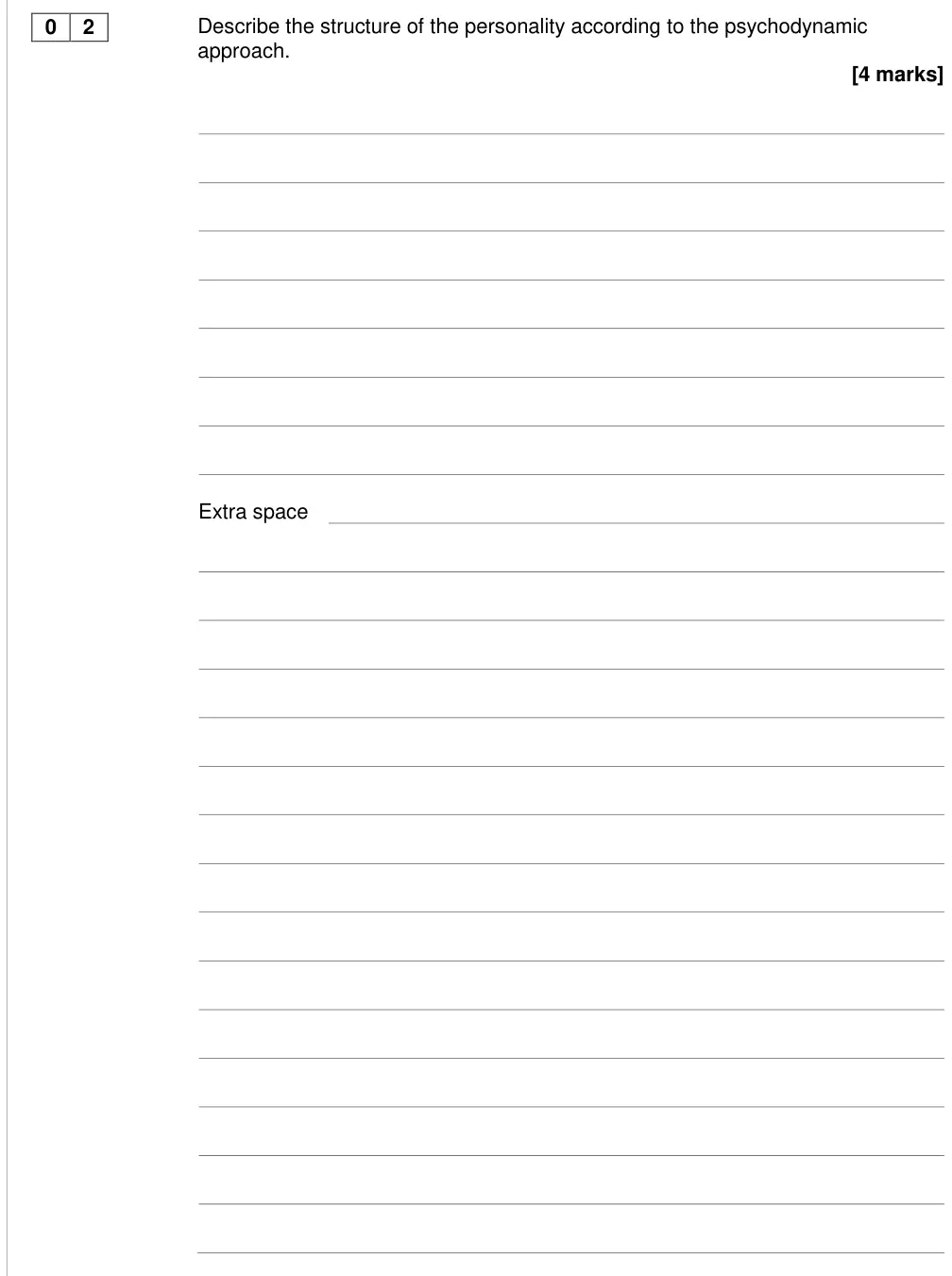
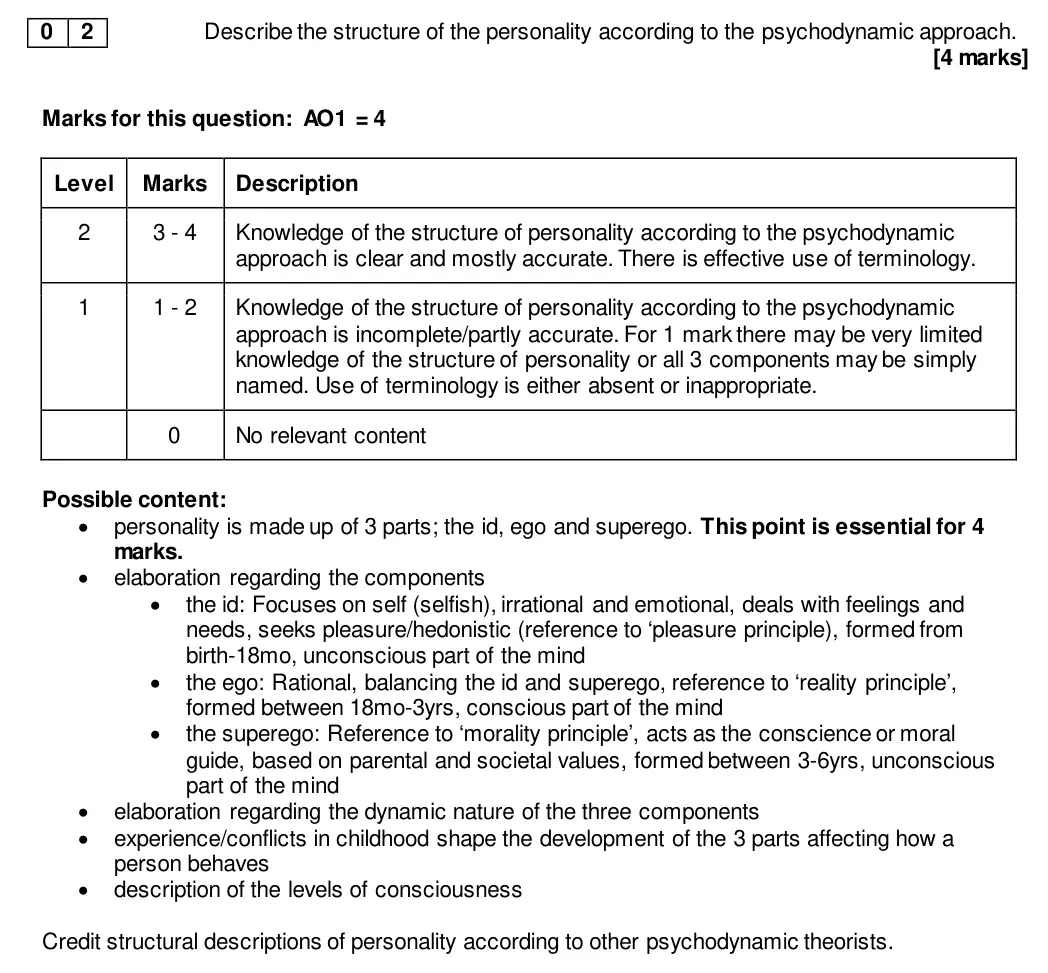
June 2024 · Paper 2 · Q14 marksAO1=4Outline
Mark scheme, including level descriptors and indicative content
Examiner's comment
This question was generally answered well with most students able to provide a description of the ego and superego. There were some excellent answers which provided accurate and detailed descriptions, demonstrating impressive knowledge and understanding of both the ego and superego. However, some students muddled the parts, described the id or provided only a very limited description. Some responses gave vague or muddled descriptions of where the ego/superego operated or gave vague examples of how the component would act in various scenarios.
Notes from the mark scheme and report
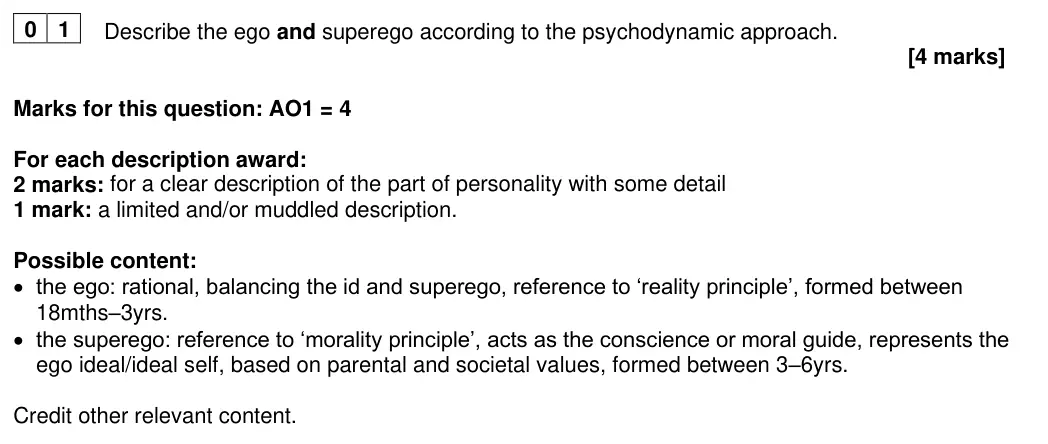
2 marks each: ego (reality principle, rational, balances id and superego) and superego (morality principle, conscience, ego ideal, parental/societal values)
describing the id instead
muddling the parts
June 2024 · AS Paper 2 · Q24 marksAO1=4Outline
Mark scheme, including level descriptors and indicative content
Examiner's comment
Students performed relatively well on Q2 and Q3 where they were asked to demonstrate their knowledge of how Bandura investigated social learning and then to asked to explain one limitation with this. It is important to note that students must ensure that their answers are focused upon how Bandura investigated social learning, i.e. his methodology, and not his findings or conclusions.
Notes from the mark scheme and report
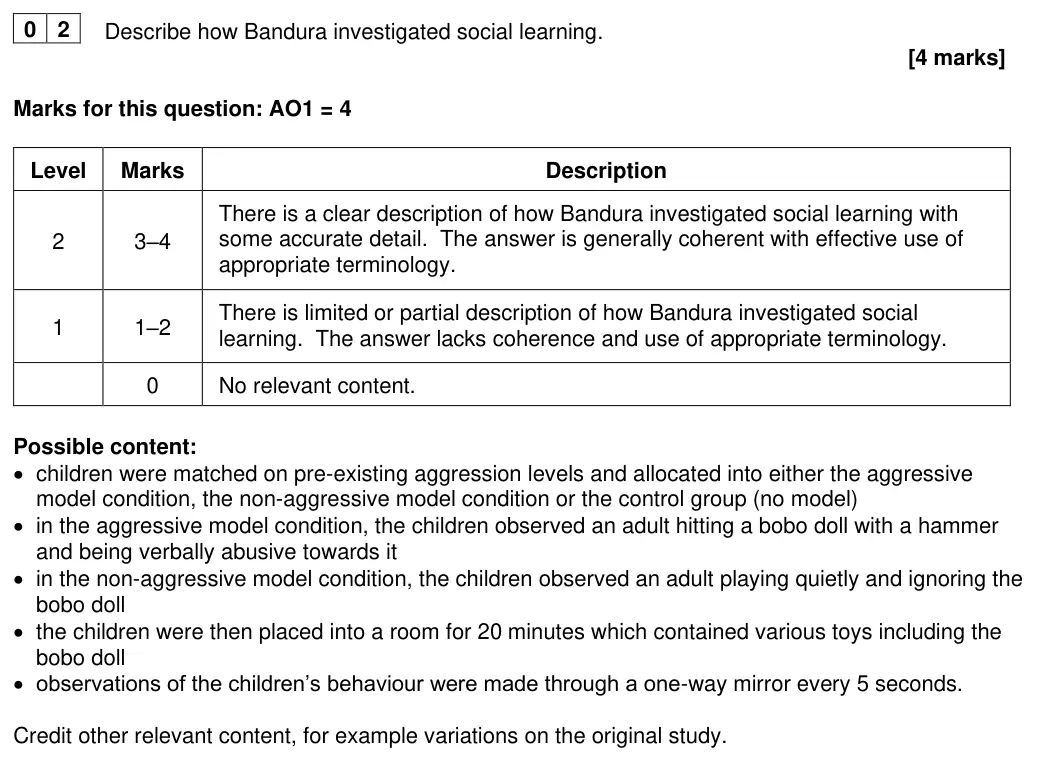
focus on methodology (matching on aggression, aggressive/non-aggressive model/control, bobo doll, observation via one-way mirror) not findings or conclusions
variations on the original study credited
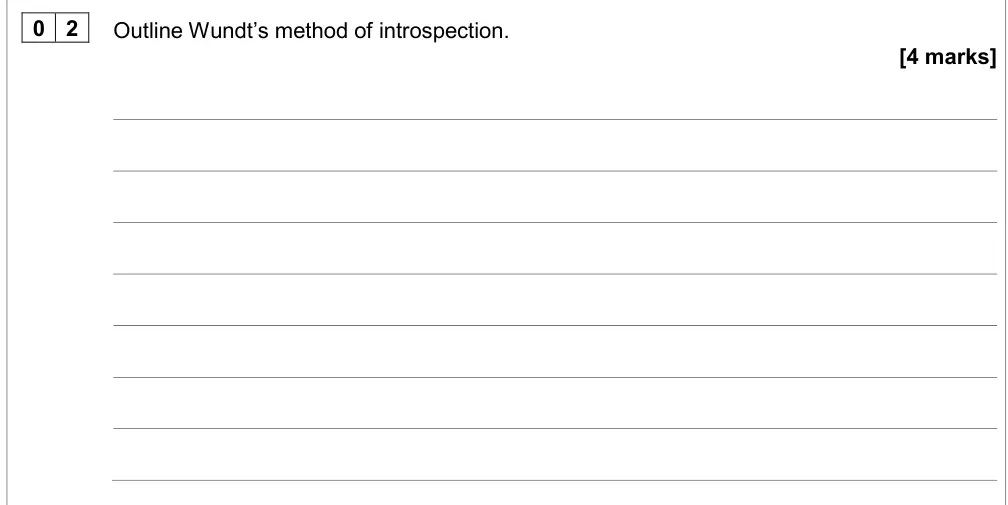
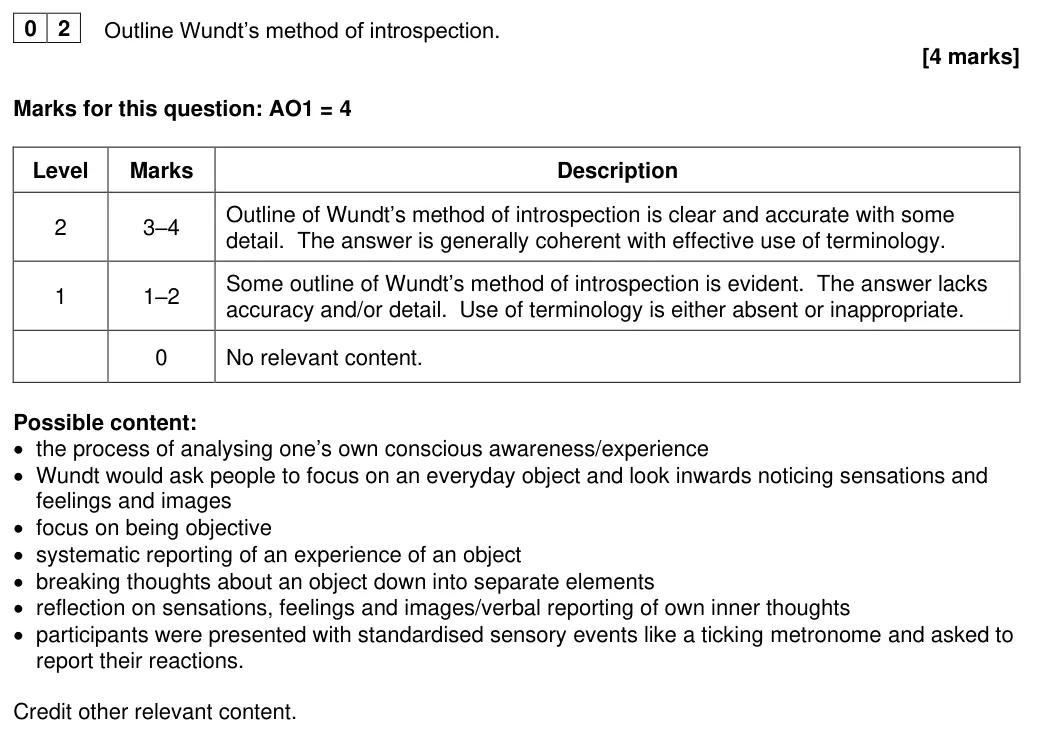
June 2024 · Paper 2 · Q24 marksAO1=4OutlineOld spec only
Not on the 2025 specification: Wundt and introspection were removed in v1.4
Mark scheme, including level descriptors and indicative content
Examiner's comment
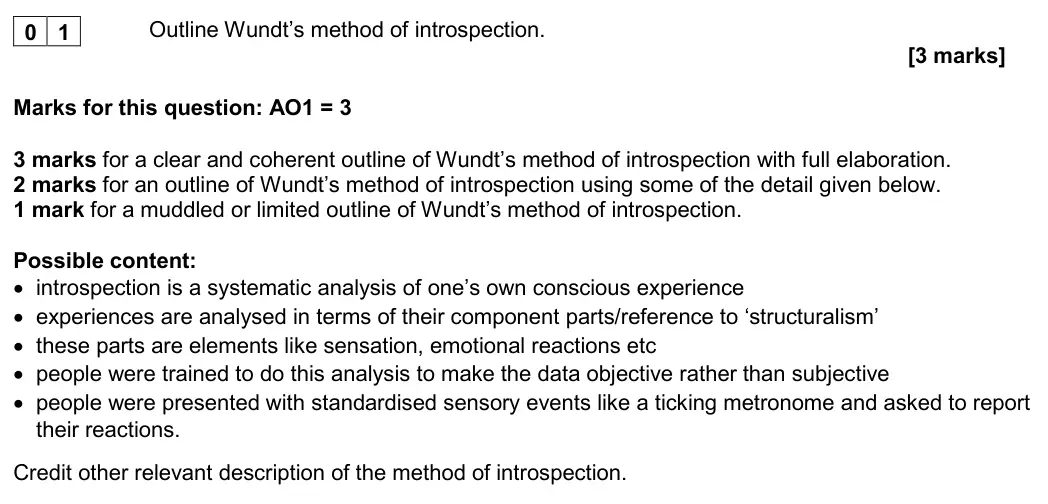
This question was a good differentiator. There were some very good responses which provided an accurate and detailed outline of Wundt’s method of introspection with effective use of terminology. However, despite students demonstrating good knowledge overall, some did not focus on the method of introspection, instead providing details such as, ‘father of psychology,’ ‘opened the first laboratory in Leipzig,’ etc., suggesting that students were relying on pre-prepared responses which focused on outlining and evaluating Wundt’s role in the emergence of psychology as a science rather than the question set. Students should be encouraged to ensure that they understand the detail about Wundt’s method of introspection and not just the background to his work.
Notes from the mark scheme and report
Off-spec: Wundt and introspection were removed in v1.4
method: systematic, standardised reporting of sensations/feelings/images to stimuli (e.g. metronome)
background ('father of psychology', Leipzig lab) not creditworthy - pre-prepared 'emergence of psychology as a science' answers
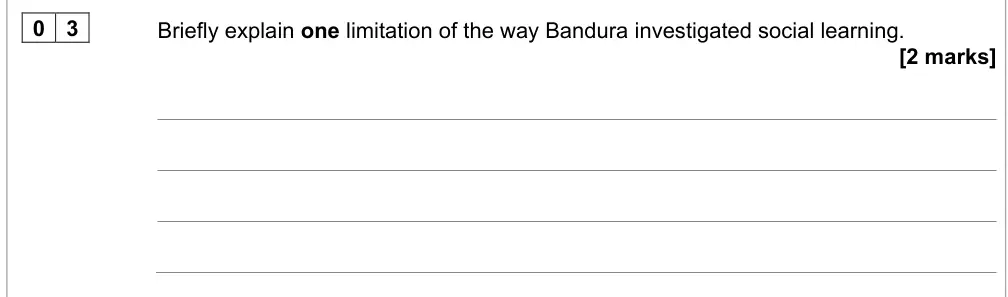
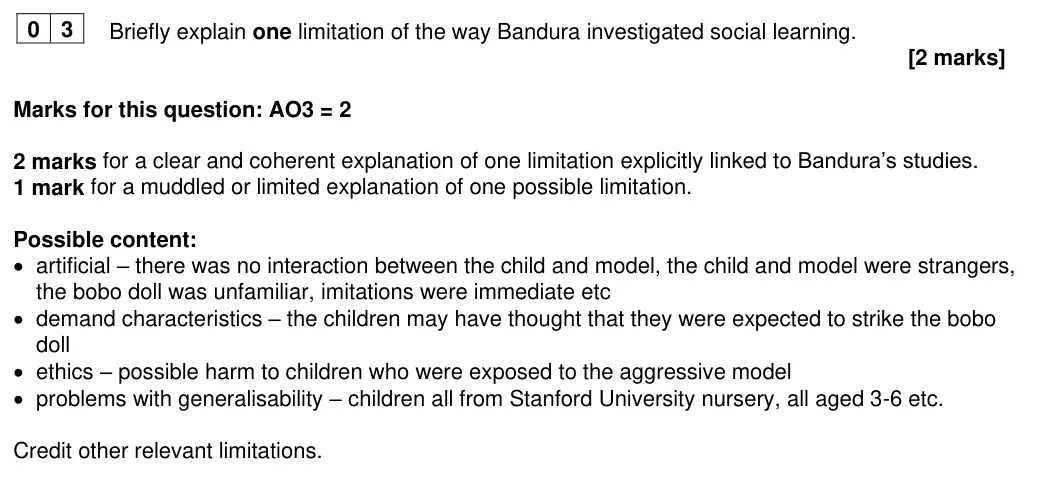
June 2024 · AS Paper 2 · Q32 marksAO3=2Evaluate (short)
Mark scheme, including level descriptors and indicative content
Examiner's comment
Students generally performed well in Q3, explaining a limitation of Bandura methodology, and in Q5, labelling a typical neuron. This was particularly pleasing to see in Q3 as historically students have tended to struggle more with evaluation questions (AO3), and it is encouraging to see this improve with each subsequent examination series. Students performed relatively well on Q2 and Q3 where they were asked to demonstrate their knowledge of how Bandura investigated social learning and then to asked to explain one limitation with this. It is important to note that students must ensure that their answers are focused upon how Bandura investigated social learning, i.e. his methodology, and not his findings or conclusions. This was particularly evident in Q3 where some students explained a limitation of social learning theory or of Bandura’s findings and not of his methodology as the question demanded.
Notes from the mark scheme and report
limitation must be explicitly linked to Bandura's studies (artificiality, demand characteristics, ethics, generalisability)
some evaluated SLT or Bandura's findings instead of the method
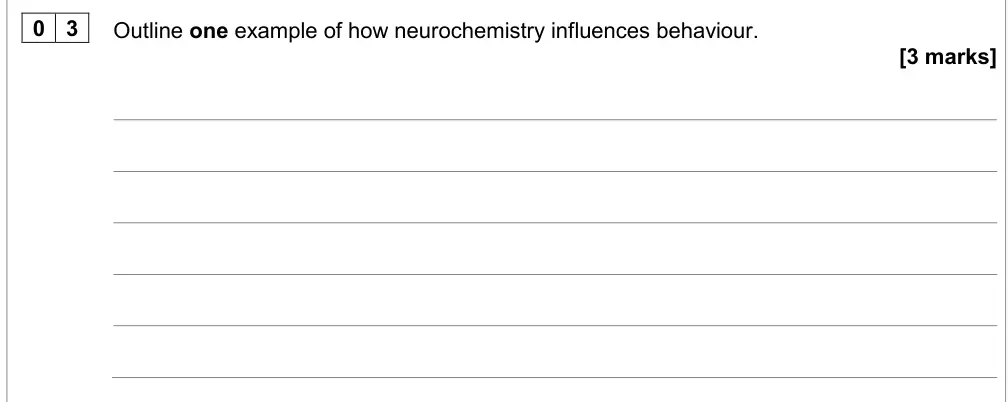
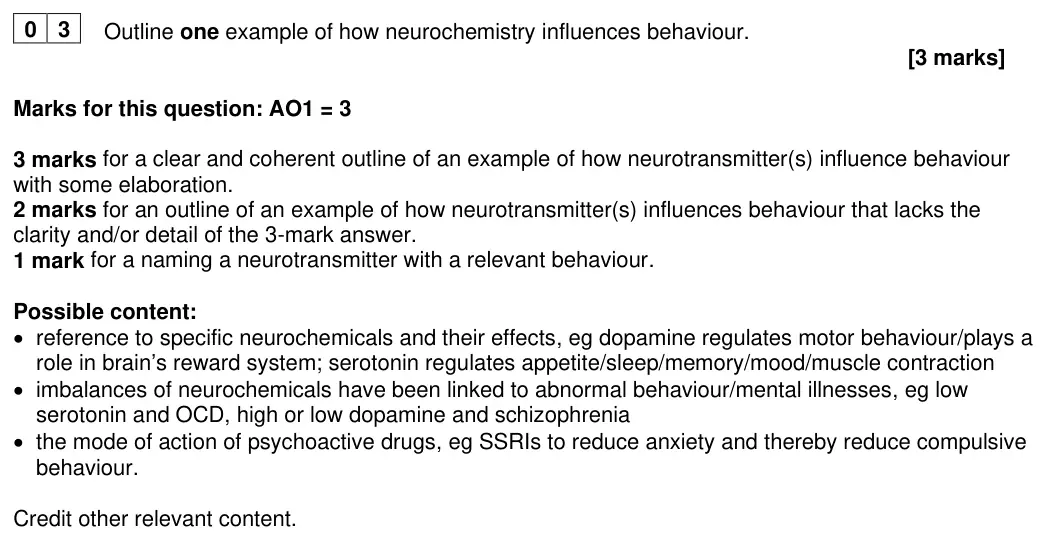
June 2024 · Paper 2 · Q33 marksAO1=3Outline
Mark scheme, including level descriptors and indicative content
Examiner's comment
This question yielded mixed responses with many confusing hormones with neurotransmitters or neurotransmitters with reflex arcs, neurogenetics or neural structures. Those students who understood what neurotransmitters were, were able to achieve 2 or 3 marks for this question, depending on the level of clarity and/or detail given. Those who achieved well on this question, gave examples from other topics like depression, OCD or schizophrenia, describing how abnormally low/high levels of serotonin/dopamine results in the behavioural symptoms of the disorder. Many students then provided further elaboration of how psychoactive drugs act to amend these imbalances of neurochemicals and thus change the behavioural symptoms. The responses overall suggest that whilst some students have some excellent knowledge and understanding, others may benefit from learning the explicit similarities and differences between hormones and neurochemicals and accurate understanding of specific neural features, such as neurogenetics, neurotransmitters, synaptic transmission, neural networks, brain structures, etc. and how these interact, using familiar examples from across the course.
Notes from the mark scheme and report
named neurotransmitter + behaviour = 1
elaborated example (e.g. low serotonin and OCD, dopamine and schizophrenia, SSRIs) for 3
confusing hormones with neurotransmitters, or with reflex arcs/neural structures
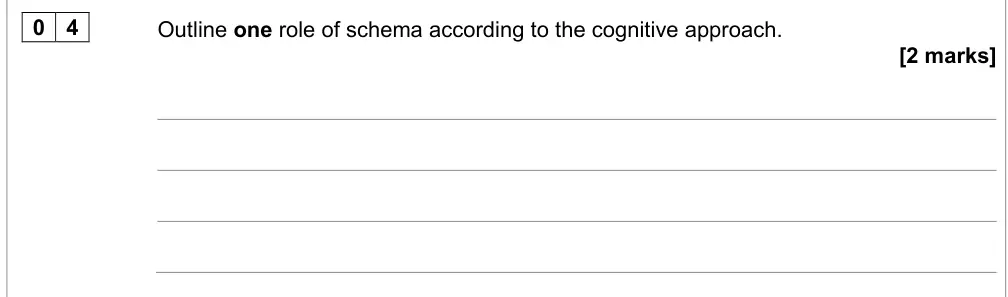
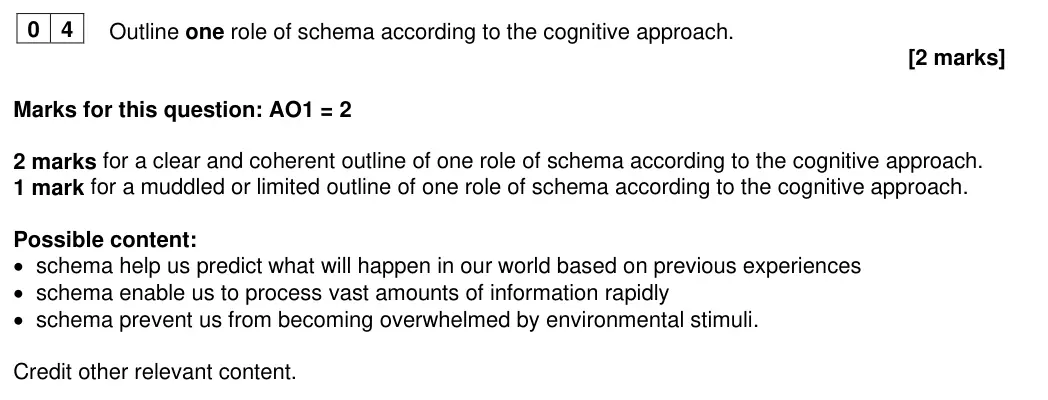
June 2024 · AS Paper 2 · Q42 marksAO1=2OutlineHard
Mark scheme, including level descriptors and indicative content
Examiner's comment
Students performed less well in Q1, outlining the emergence of psychology as a science, and in Q4, outlining one role of schema. Students also appeared to struggle with the demands of Q4, which asked them to outline one role of schema. Performance on this question was relatively weak as many students appeared to misunderstand the demand of the question and simply gave an outline of what schema are rather than outline one role of schema. Over a third of students were not awarded any marks on the question suggesting they either failed to understand the demands of the question or lacked the knowledge to be able to answer it correctly. Exemplification of a successful response An excellent answer which has gone well beyond the requirements of the question. This response has cleverly combined several roles of schema into one coherent outline. Despite the irrelevance of the first sentence, which simply outlines what schema are, this response develops, in the second sentence, into a clear and coherent outline of one role of schema. Exemplification of a less successful response This response is a typical example of one which attempts to outline what schema are rather than outline one role of schema and thus cannot be awarded any credit.
Notes from the mark scheme and report
outline a ROLE of schema (prediction, rapid processing, avoiding overload), not what schema are
over a third scored 0
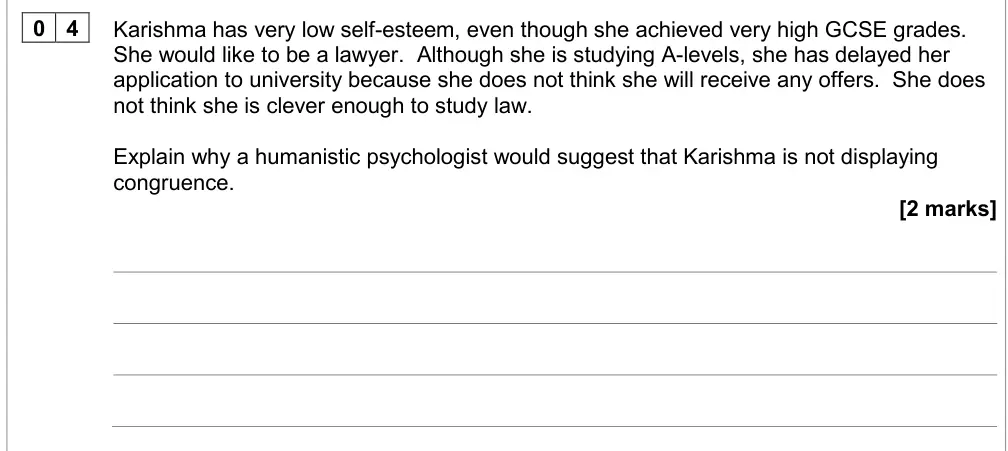
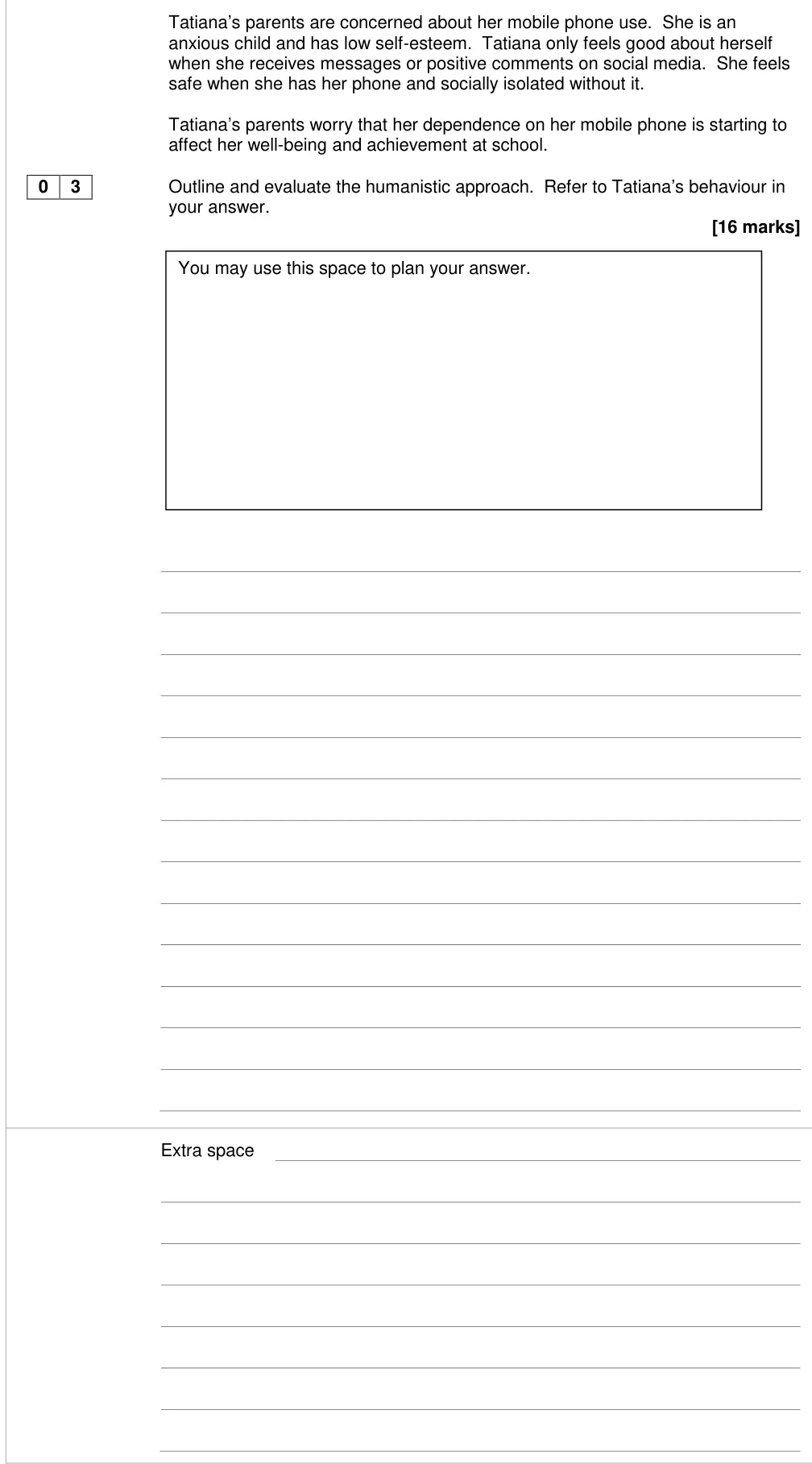
June 2024 · Paper 2 · Q42 marksAO2=2Application
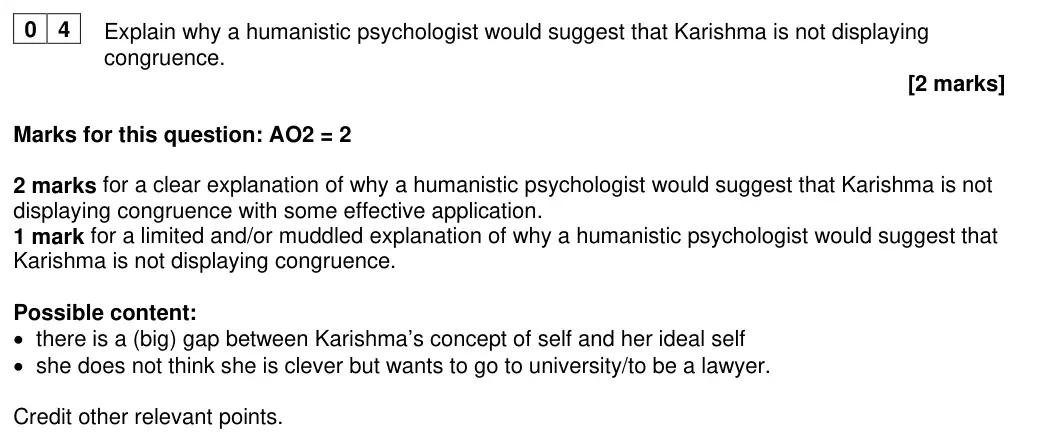
Mark scheme, including level descriptors and indicative content
Examiner's comment
This question provided a mixed response. Many students were able to demonstrate some knowledge of incongruence being the gap between ideal and actual self, but fewer were able to apply this explicitly to the stem. They often became muddled when trying to choose which part of the stem to apply their knowledge of congruence to and there was also some misunderstanding of what congruence is and confusion of this with Maslow’s hierarchy of needs. Although some students demonstrated excellent understanding, overall it appears that students have some difficulty applying their knowledge of specific features of the humanistic approach appropriately. Collectively, questions 4 and 5 indicate that some students may benefit from consolidating the humanistic approach beyond Maslow’s hierarchy of needs and practising applied (past paper) questions to help develop effective application skills.
Notes from the mark scheme and report
gap between self-concept and ideal self, applied (doesn't think she is clever but wants to be a lawyer)
confusion with Maslow's hierarchy
weak application
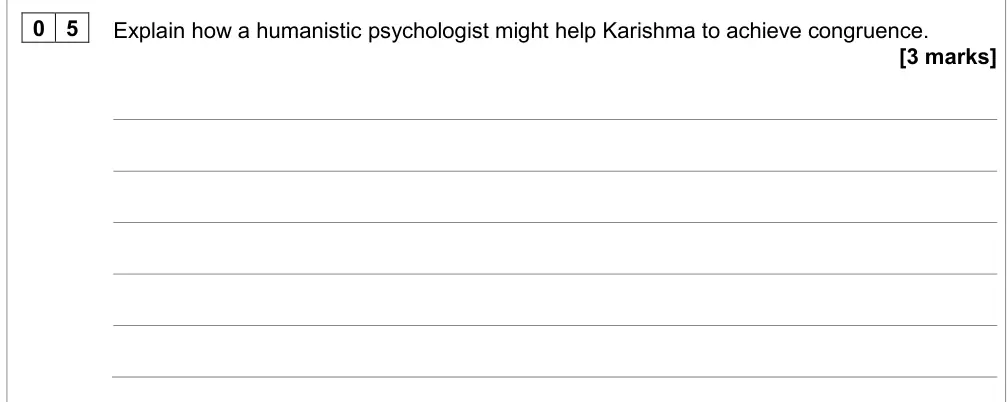
June 2024 · Paper 2 · Q53 marksAO2=3ApplicationMedium
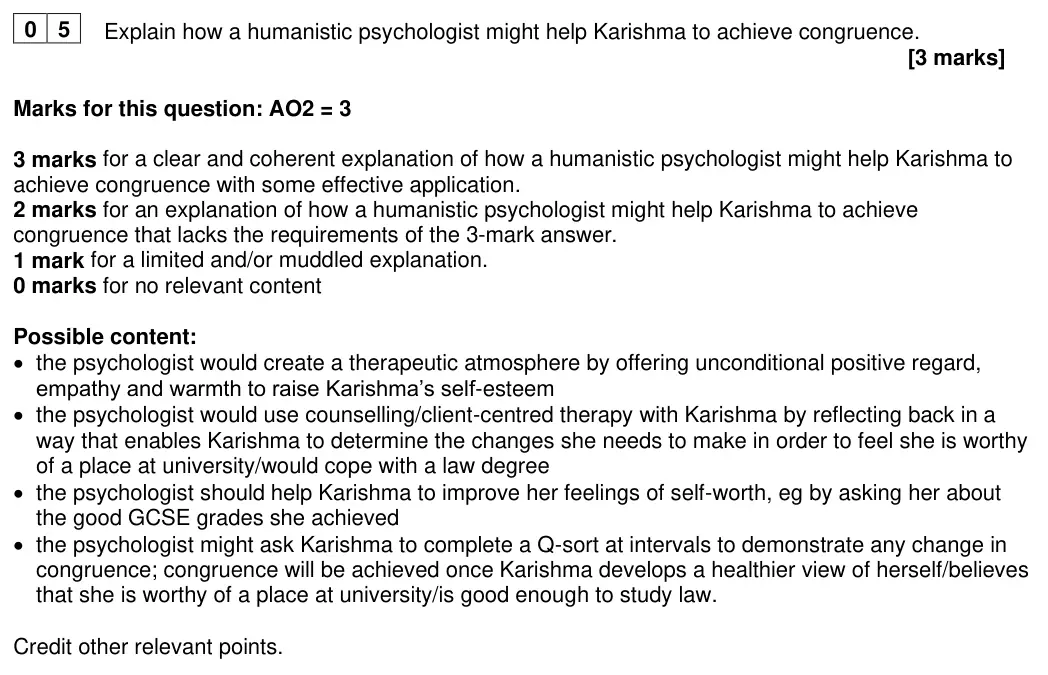
Mark scheme, including level descriptors and indicative content
Examiner's comment
Generally, this question was not answered well and revealed gaps in knowledge with some students just focussing on the hierarchy of needs or explaining how CBT or psychoanalysis could be used. There were some detailed responses of how a humanistic psychologist would help a client through client-centred therapy, with effective use of terminology, but often these were generic with a lack of effective application. Most were able to identify unconditional positive regard but did not focus on explaining how the humanistic psychologist would help Karishma achieve congruence, as requested in the question. Very few students were able to fulfil all the requirements of this question to achieve the full 3 marks available. Collectively, questions 4 and 5 indicate that some students may benefit from consolidating the humanistic approach beyond Maslow’s hierarchy of needs and practising applied (past paper) questions to help develop effective application skills.
Notes from the mark scheme and report
unconditional positive regard, empathy, raising self-worth (e.g. discussing her GCSE grades), Q-sort to track congruence, applied to Karishma
CBT, psychoanalysis or hierarchy of needs not creditworthy
very few scored 3
MS centres on client-centred therapy/counselling ('influence on counselling psychology' removed in v1.4) but UPR and self-worth remain within congruence/conditions of worth
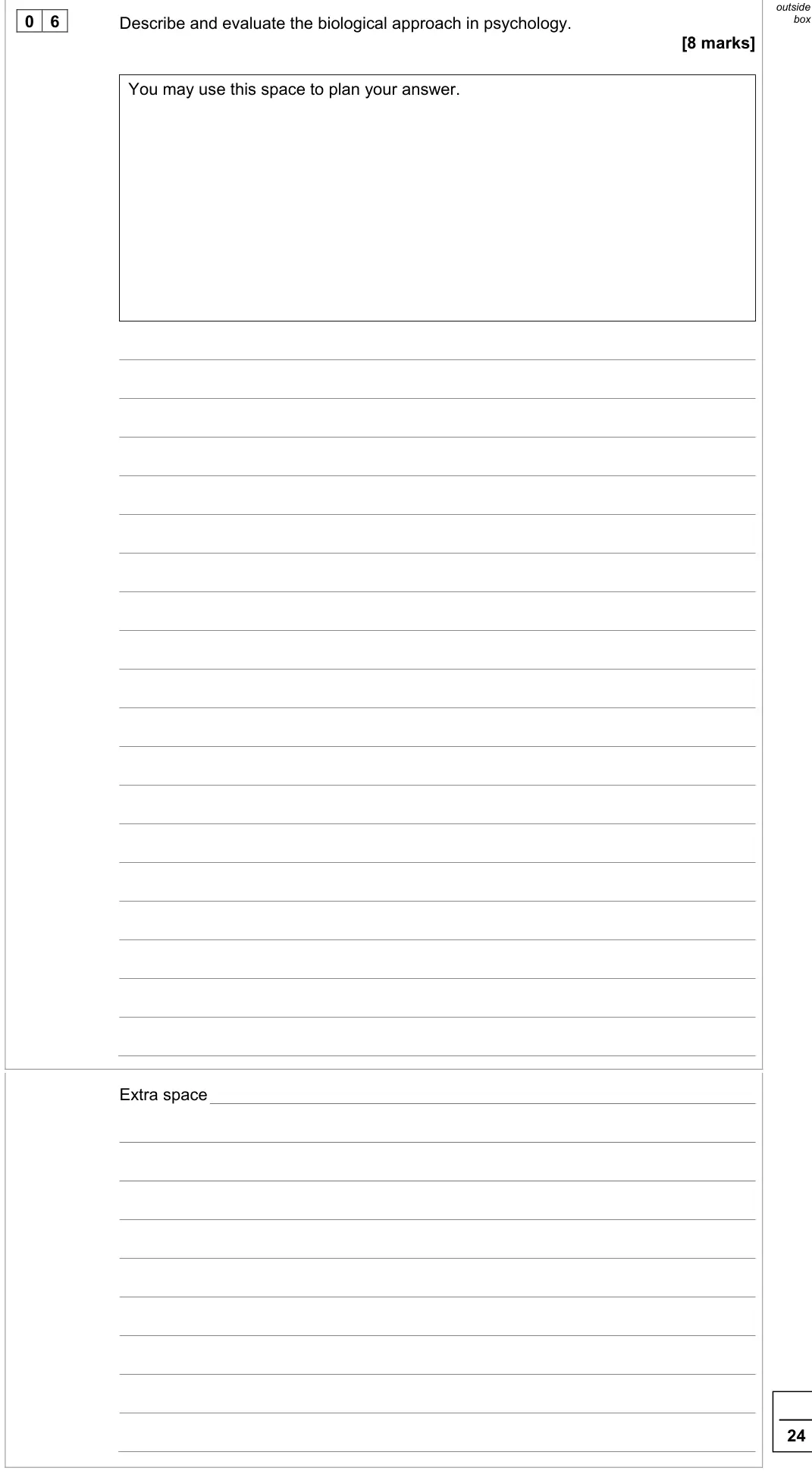
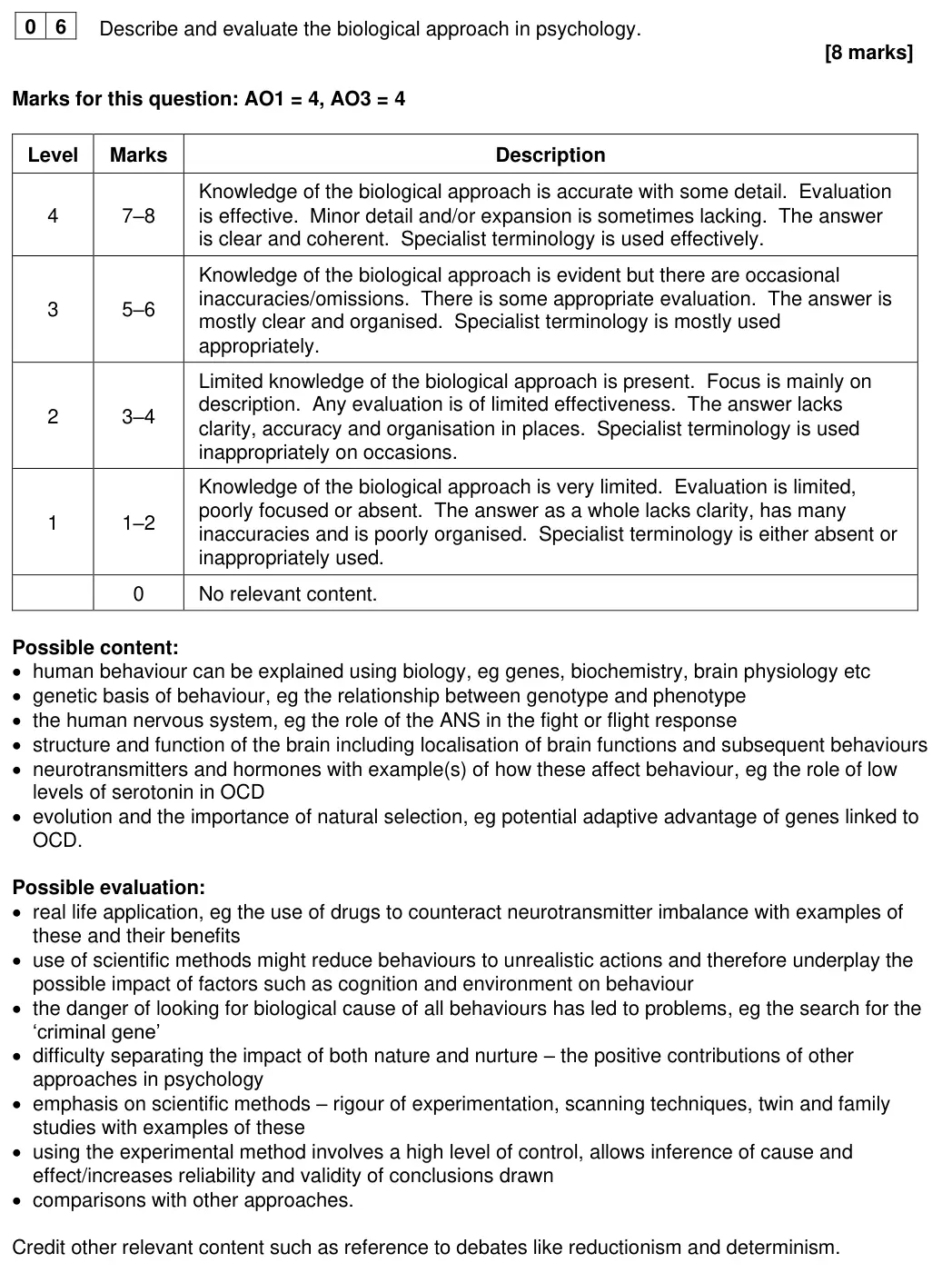
June 2024 · AS Paper 2 · Q68 marksAO1=4, AO3=4Extended writing
Mark scheme, including level descriptors and indicative content
Examiner's comment
Q6 asked students to describe and evaluate the biological approach in psychology (8 marks). There was more variation seen in responses here compared to Q10 (the other extended writing question). Some students wrote detailed and effective responses which were clearly focused upon the question, enabling them to achieve high marks. However, there were many other responses which failed to fully address the demands of the question for example: some were muddled and confused, some were largely descriptive and contained very little evaluation, some responses were focused on OCD rather than the biological approach in in general and others were not focused on the use of the approach in psychology. Exemplification of a successful response This section of a response demonstrates accurate and detailed knowledge and understanding of the biological approach and is clearly linked to how we can use the approach to explain behaviour (i.e. how the approach is used in psychology). A clear and effective paragraph which explains one strength of the biological approach in psychology. This strength is not only clearly linked to psychology, but it is also developed as it goes on to explain why this is a strength. Exemplification of a less successful response These paragraphs illustrate a common problem with many students’ responses to this question. In the first paragraph, the student has attempted to explain genotype and phenotype and clearly says how the phenotype ‘can be affected by the environment.’ They then go onto to contradict themselves by saying how the biological approach ‘doesn’t take into account…the environment.’ Additionally, even if the second paragraph had been accurate, it is not effective as it does not fully explain why the biological approach being reductionist is a limitation for the approach.
evaluation must explain why a point is a strength/limitation for the approach
contradicting genotype-phenotype point by claiming approach ignores environment
some focused on OCD rather than the approach in general
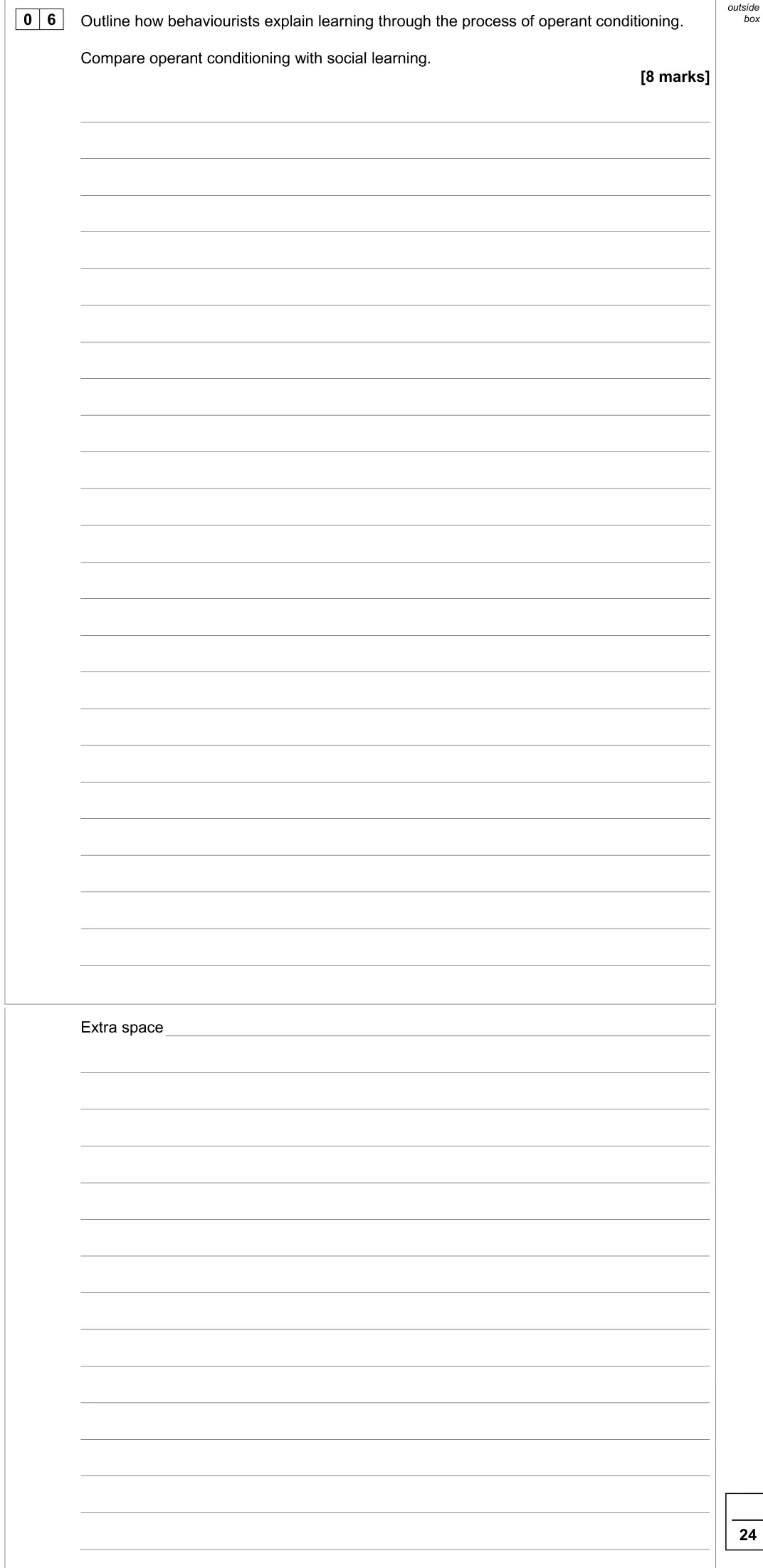
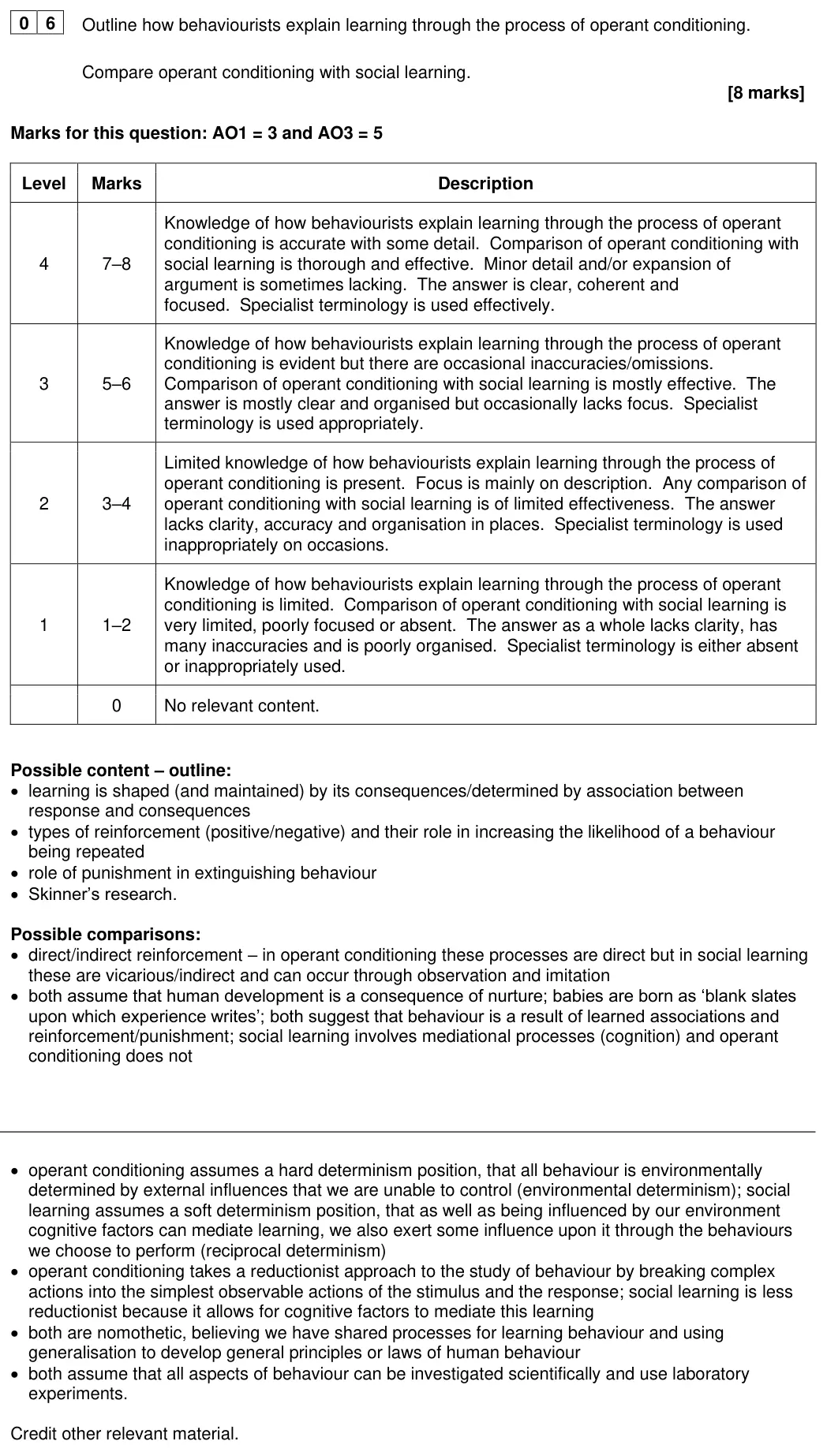
June 2024 · Paper 2 · Q68 marksAO1=3, AO3=5Extended writing
Mark scheme, including level descriptors and indicative content
Examiner's comment
This question on the whole was well answered with the majority of students providing detailed descriptions of operant conditioning, often including Skinner’s research as part of their outline, and there were some impressive comparisons with social learning. The full range of marks was awarded, and marks were well-distributed. The question enabled differentiation between students who can recall an answer outlining and evaluating operant conditioning and/or social learning and those who can use their knowledge flexibly to draw out effective comparison points, providing sufficient detail to make these effective without losing focus on the question. There was some confusion between negative reinforcement and punishment, and operant and classical conditioning. However, the main differentiator was seen in the comparison skill. Students often wrote impressive, lengthy descriptions of operant conditioning and Skinner’s research but then did not provide any comparison or just described social learning without making direct comparisons or just evaluated the theory, all of which yielded no comparison marks. More limited comparison generally focused on whether reinforcement was direct or indirect and/or whether research generally used human or animal participants. Better responses tended to give a more concise outline of operant conditioning, describing the content often in the context of Skinner’s research and then provided effective comparison points, focusing on determinism, reductionism, real world application and/or the nature/nurture debate, with effective examples/evidence, counter points and elaboration.
Notes from the mark scheme and report
outline operant conditioning (reinforcement, punishment, Skinner) then compare with SLT: direct vs vicarious reinforcement, mediational processes, hard vs soft determinism, reductionism, nomothetic, scientific methods
describing or evaluating SLT without direct comparison scores no comparison marks
only 3 AO1 marks
negative reinforcement/punishment and operant/classical confusion
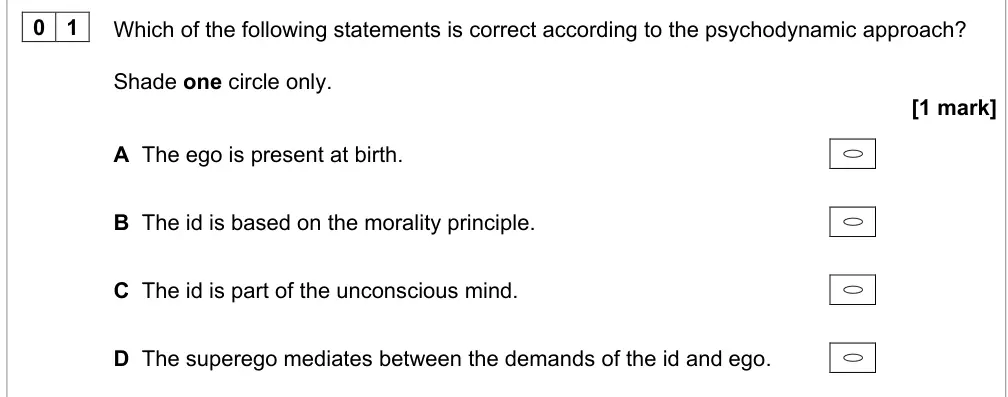
June 2023 · Paper 2 · Q11 markAO1=1Multiple choice
Answer
C
Mark scheme, including level descriptors and indicative content
Examiner's comment
Most students successfully identified the correct response, demonstrating a good knowledge of the id, ego and superego. Incorrect responses were distributed relatively equally across the three distractors, although the most common incorrect response was D (‘the superego mediates between the demands of the id and ego’).
Notes from the mark scheme and report
correct answer C (id is part of the unconscious)
most common wrong answer D (superego mediates between id and ego)
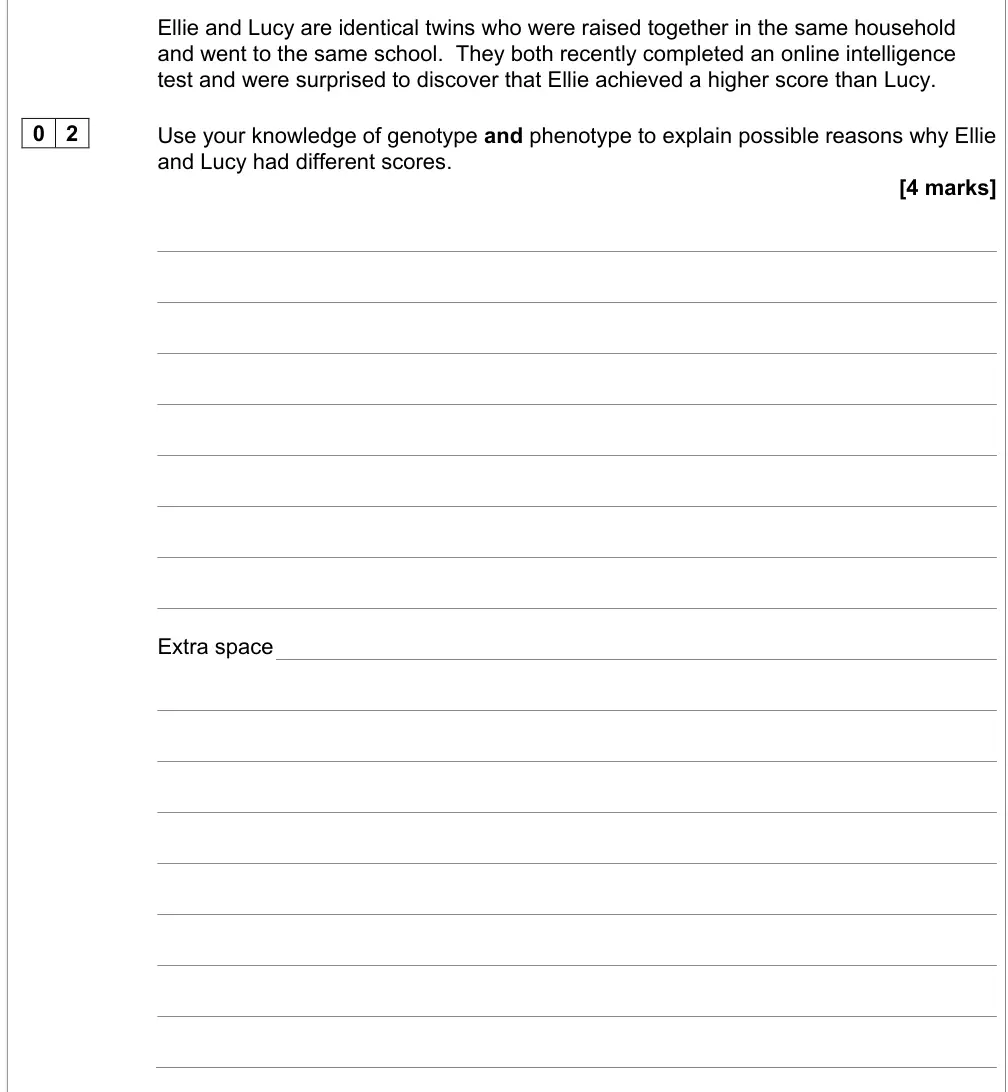
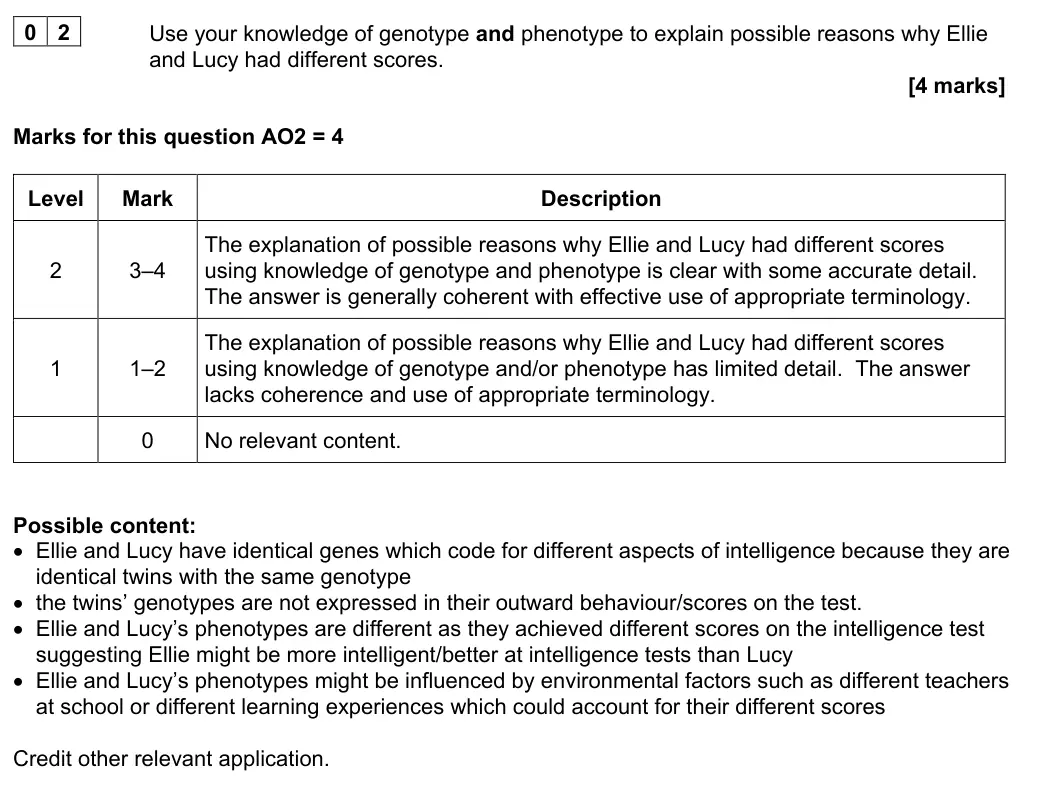
June 2023 · AS Paper 2 · Q24 marksAO2=4Application
Mark scheme, including level descriptors and indicative content
Examiner's comment
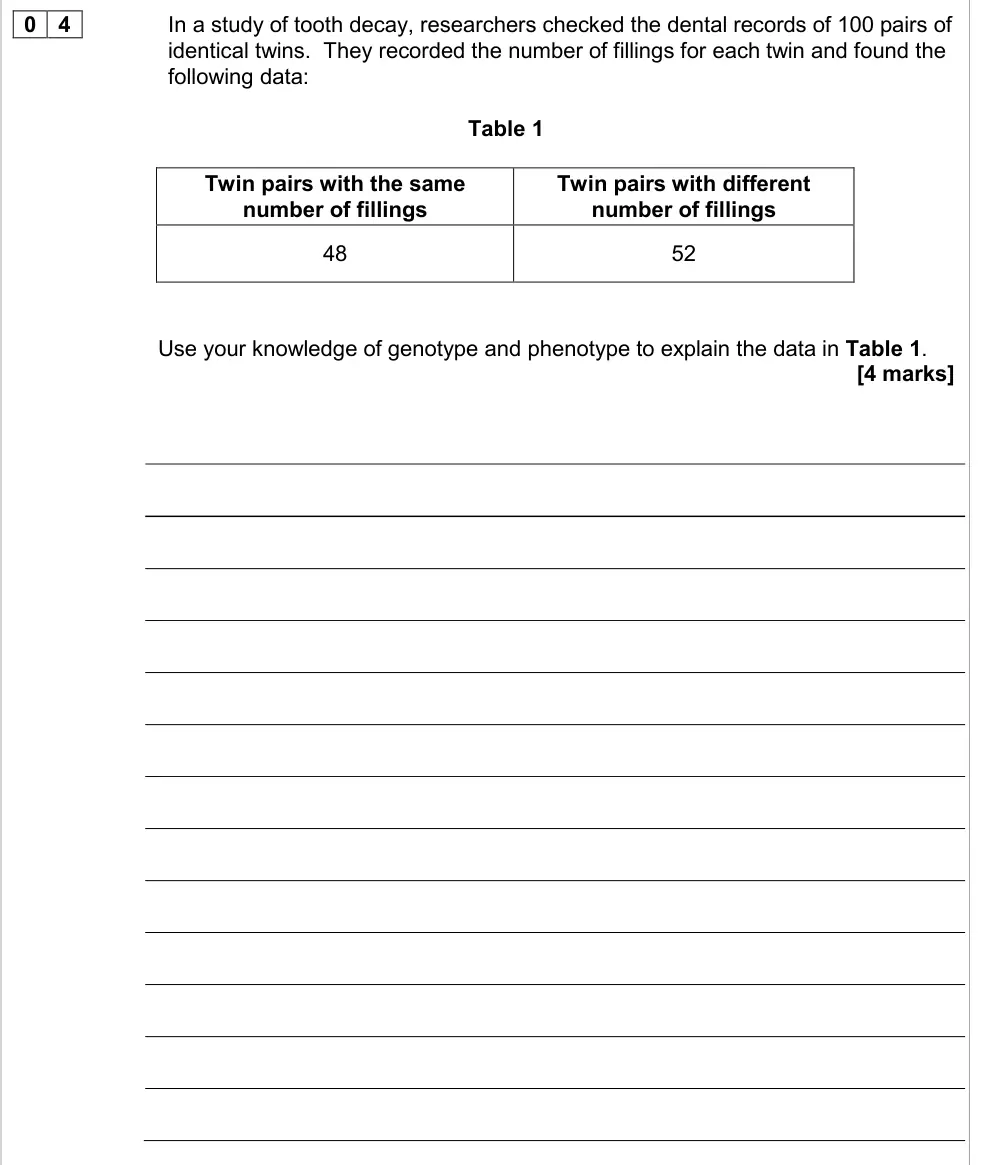
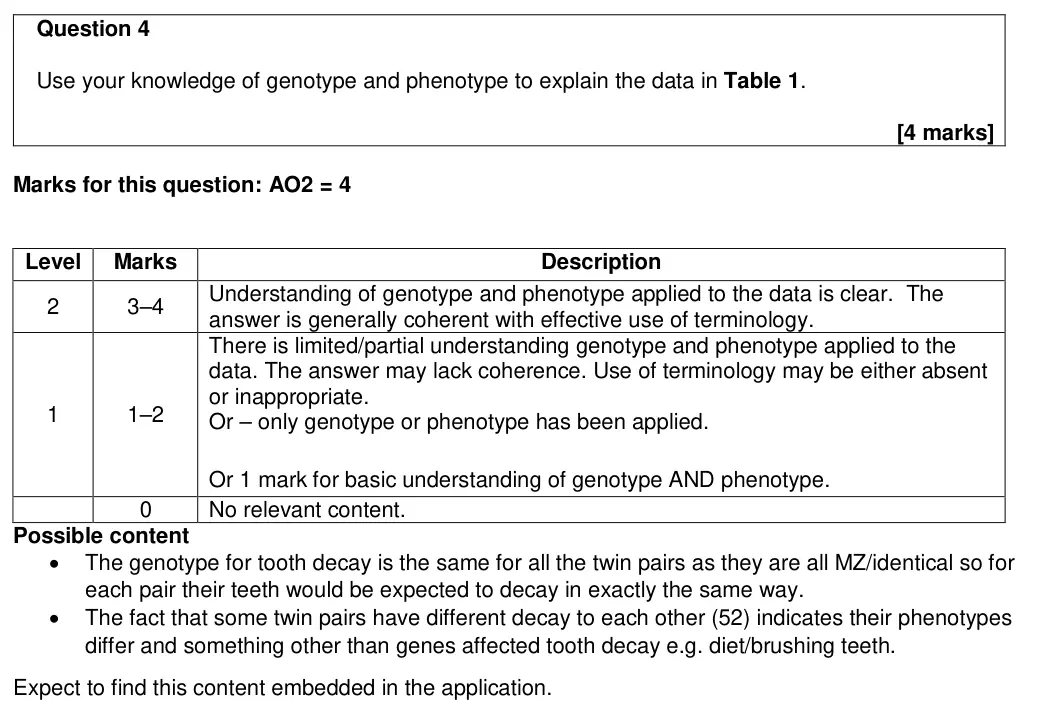
This question was generally answered well, with many students producing Level 2 responses. However, some answers did not focus on the question and offered little more than a description of genotype and/or phenotype without applying this knowledge to the stimulus material. Additionally, there was some confusion between the two terms. Some students appeared to lack a sound understanding of phenotype in particular and so were unable to effectively apply this to the stimulus material.
Notes from the mark scheme and report
all AO2: identical genotype, different phenotype due to environmental influence (different teachers/experiences)
describing the terms without applying to Ellie and Lucy limited
confusion between genotype and phenotype
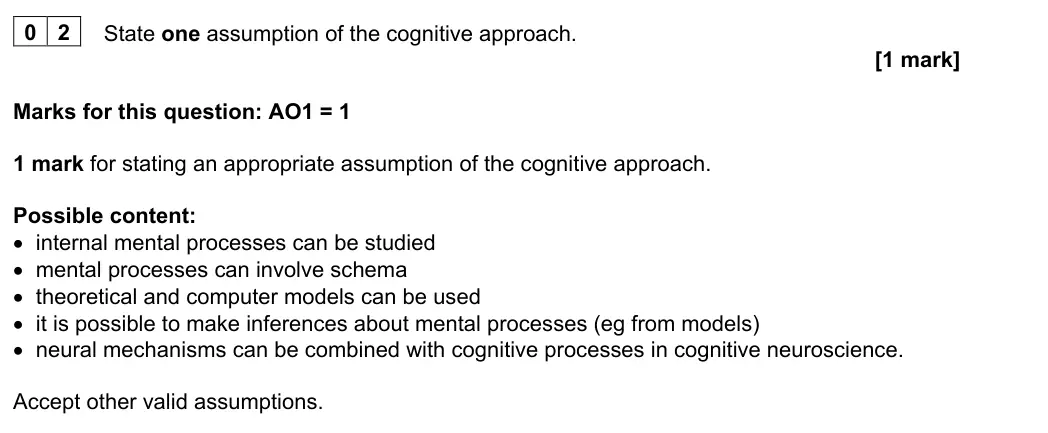
June 2023 · Paper 2 · Q21 markAO1=1Short answer
Mark scheme, including level descriptors and indicative content
Examiner's comment
This question was generally answered concisely and accurately. Most of the responses scored the available mark. Responses covered all possible content provided in the mark scheme; schema and computer models appeared to be the most common responses.
Notes from the mark scheme and report
e.g. internal mental processes can be studied, schema, models to make inferences, cognitive neuroscience
schema and computer models most common
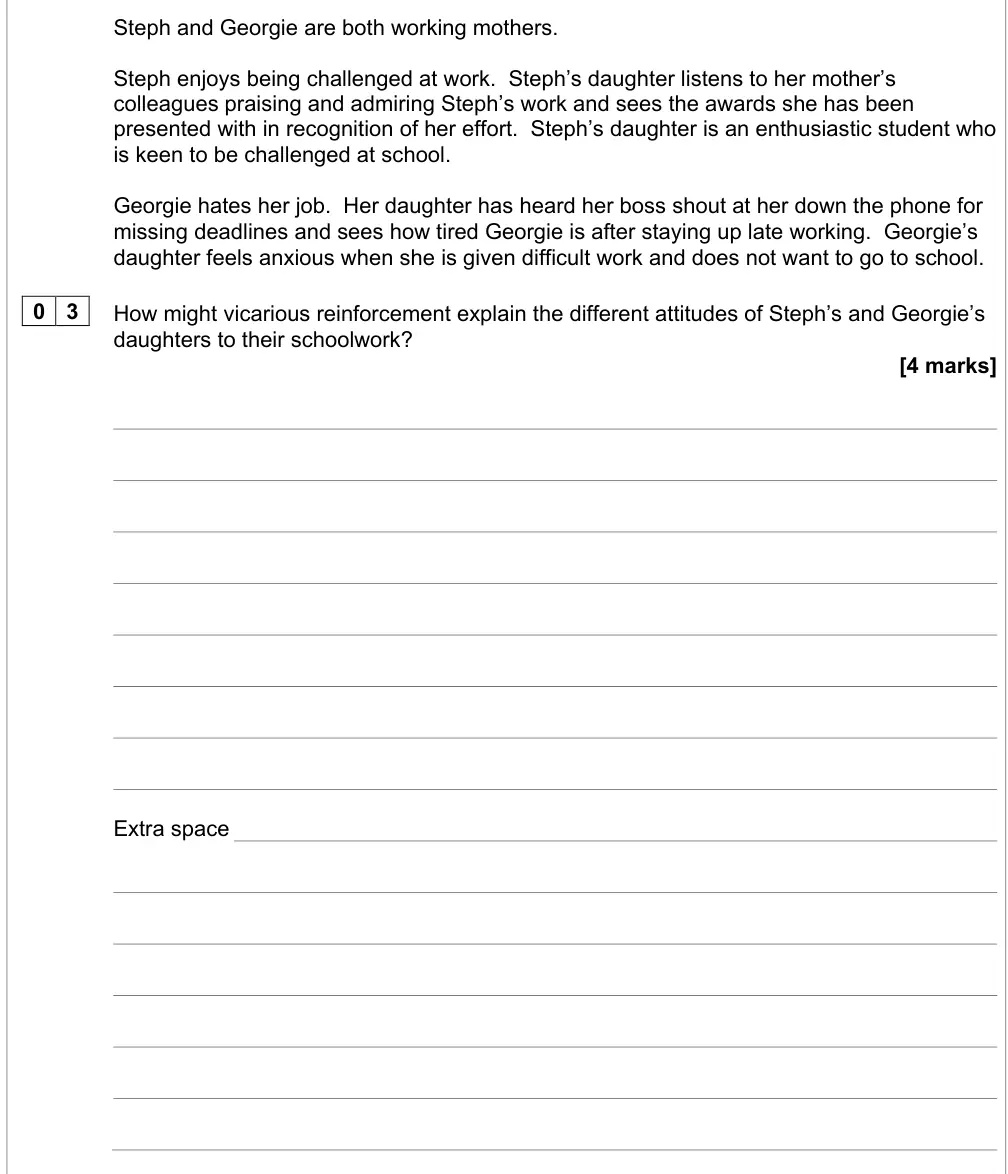
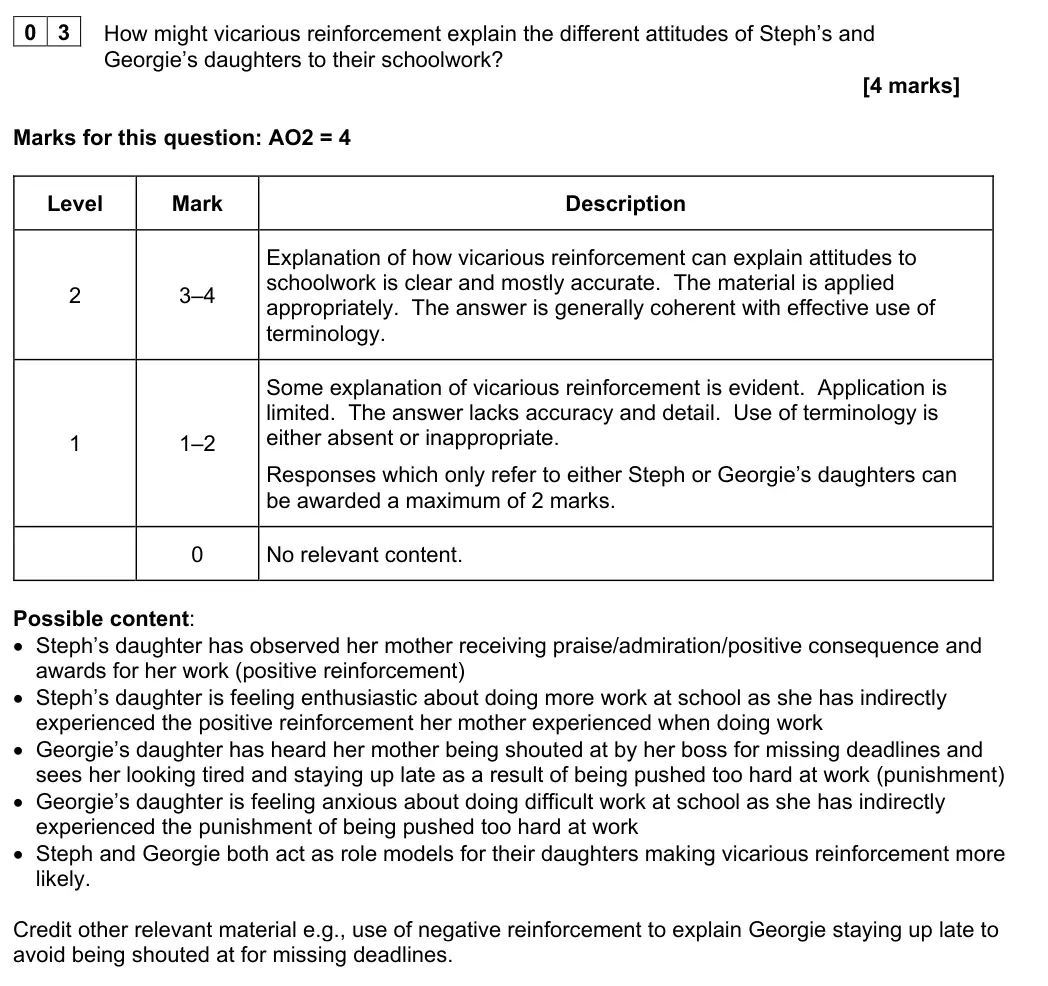
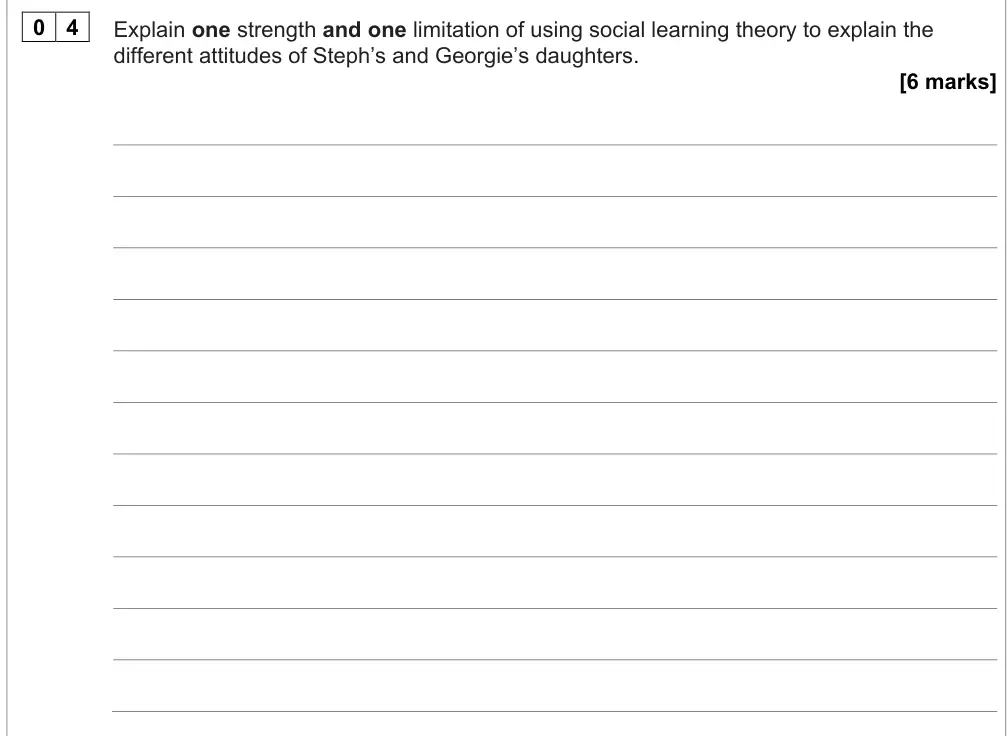
June 2023 · Paper 2 · Q34 marksAO2=4Application
Mark scheme, including level descriptors and indicative content
Examiner's comment
Overall, this question was answered well, with most students achieving level 2. Responses showed evidence of good knowledge of vicarious reinforcement, with better responses applying it to the question stem to effectively explain Georgie’s and Steph’s daughters’ attitudes to schoolwork. Effective use of terminology and in context was the main discriminator. More limited responses explained Steph’s daughter’s attitude better with vicarious reinforcement and imitation. However, students struggled to apply vicarious reinforcement to Georgie’s daughter appropriately. Those achieving a level 1 response often muddled negative reinforcement and punishment and/or had more limited application. Some only focussed on application with no use of psychological terminology or evidence of psychological knowledge. Some students referred to Steph/Georgie as opposed to their daughters which made answers muddled/lacking clarity. A proportion of responses provided definitions of vicarious reinforcement with no application. Additionally, some responses only applied their answers to either Steph’s daughter or Georgie’s daughter, limiting the number of marks which could be awarded to 2. Students must answer the full question set, utilising psychological terminology, and some need to understand the difference between effective application and just referencing details from the question stem.
writing about the mothers rather than the daughters
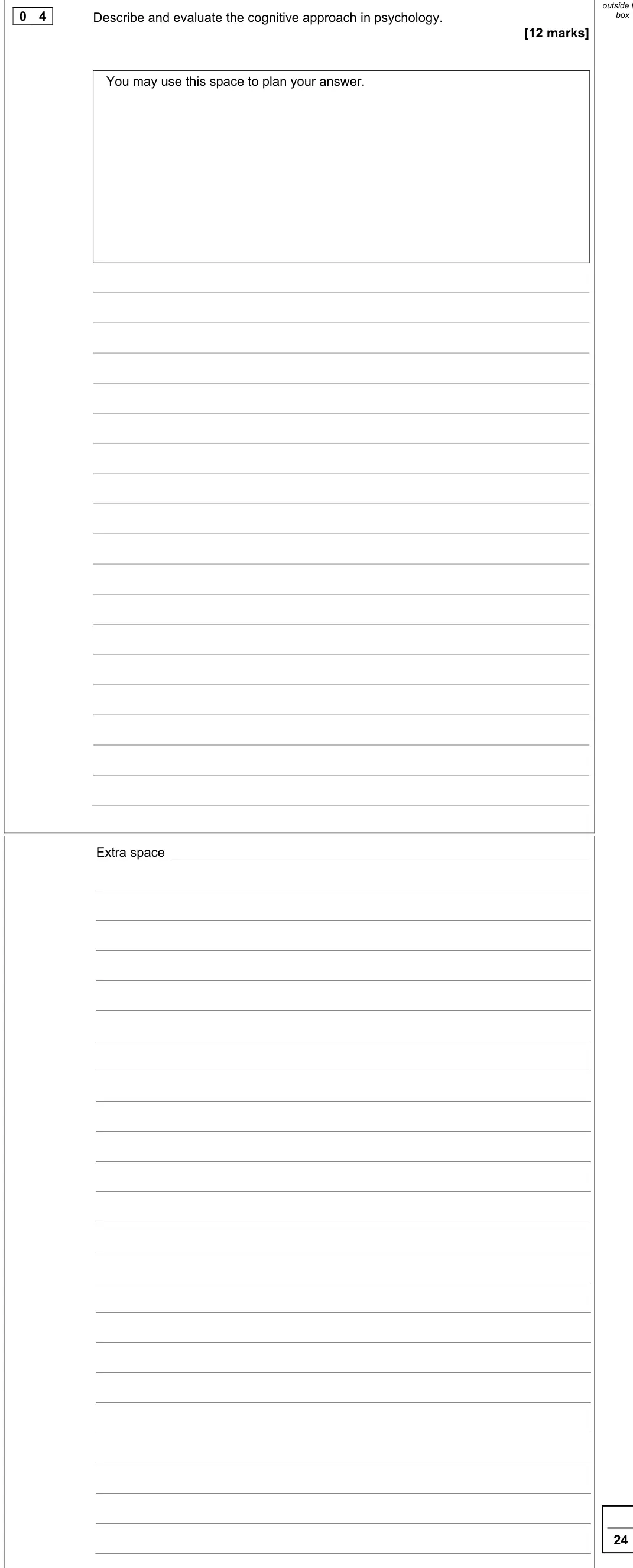
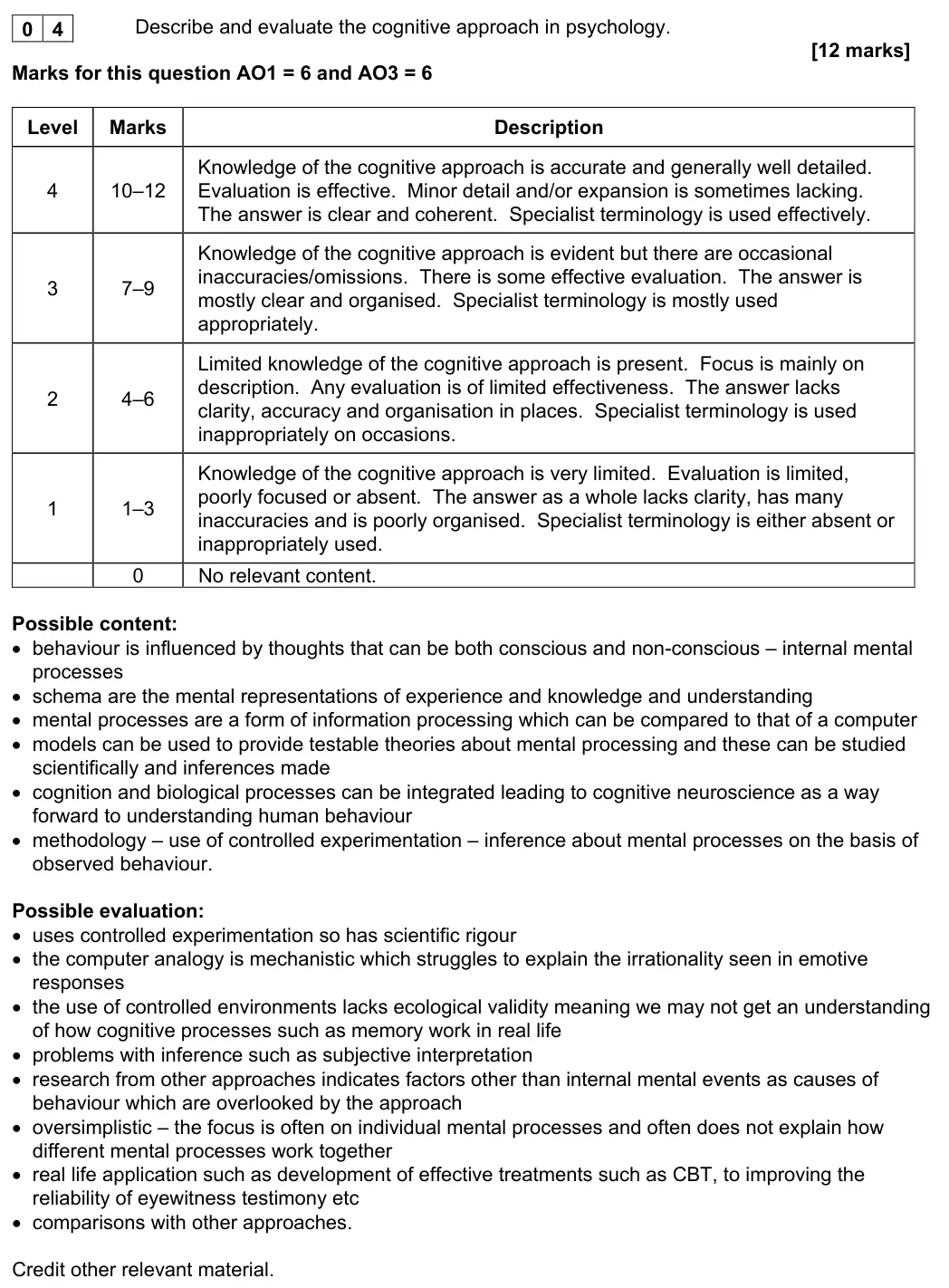
June 2023 · AS Paper 2 · Q412 marksAO1=6, AO3=6Extended writing
Mark scheme, including level descriptors and indicative content
Examiner's comment
This question appeared to discriminate well between students, with a full range of responses awarded. However, there was a minority of students who described and evaluated cognitive explanations and/or treatments of depression rather than the cognitive approach in general and thus performed poorly. Description of the cognitive approach was varied with some accurate and detailed responses. Of these, some students described a wide range of assumptions in less detail whilst other students picked two or three and went into greater depth. However, many other responses contained little accurate description, and in a significant minority, there was confusion with learning approaches or the biological approach. There was a significant minority of students who simply described the cognitive approach and did not offer any evaluation. Many students appeared to have some knowledge of the strengths and limitations of the cognitive approach and were able to give some evaluation. However, many of these points were brief and undeveloped and thus were not used effectively; a requirement for a Level 3 or 4 response. Students appear to be making similar mistakes as previous cohorts and it is recommended that they read examiner reports, to learn from these. A significant minority of students still confuse the methods used by an approach with the approach itself. For example, in the cognitive approach, although many of the methods used are objective, the approach itself is not. This is because a significant proportion of it is based upon inference. If students chose a methodological point as a strength or limitation, it is important that they explain how this is a strength or limitation for the approach itself. Students also continue to write inaccurate statements regarding an approach ignoring other approaches. For example, the cognitive approach does not ignore environment or biology as both are involved in the formation of schemata. Students need to moderate their language and explain how the cognitive approach focuses on information processing and mental processes and underemphasises the role of the environment and/or biology.
some wrote about cognitive explanations/treatments of depression instead and scored poorly
confusion with learning or biological approaches
confusing objective methods with the approach being objective
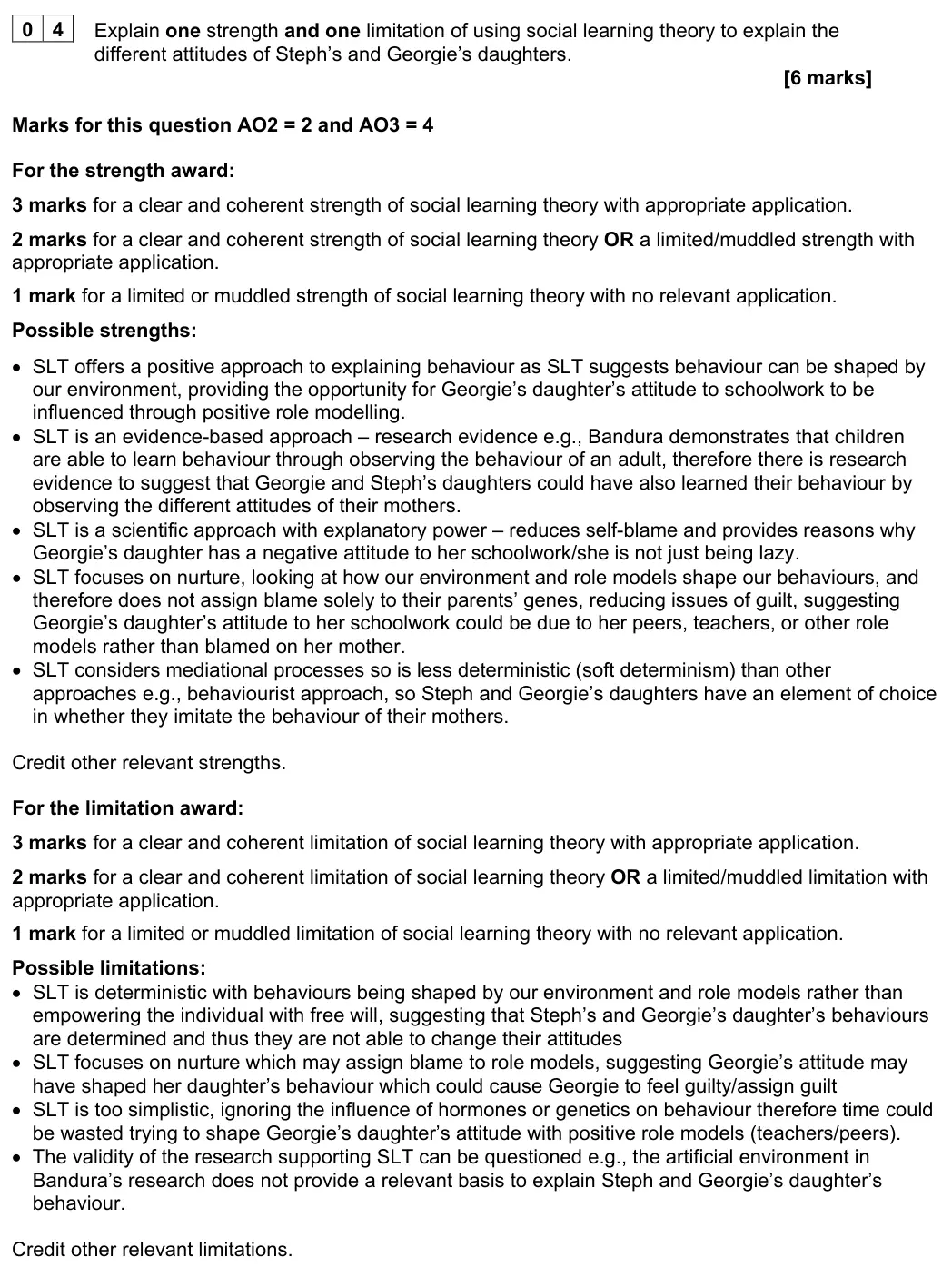
June 2023 · Paper 2 · Q46 marksAO2=2, AO3=4Application
Mark scheme, including level descriptors and indicative content
Examiner's comment
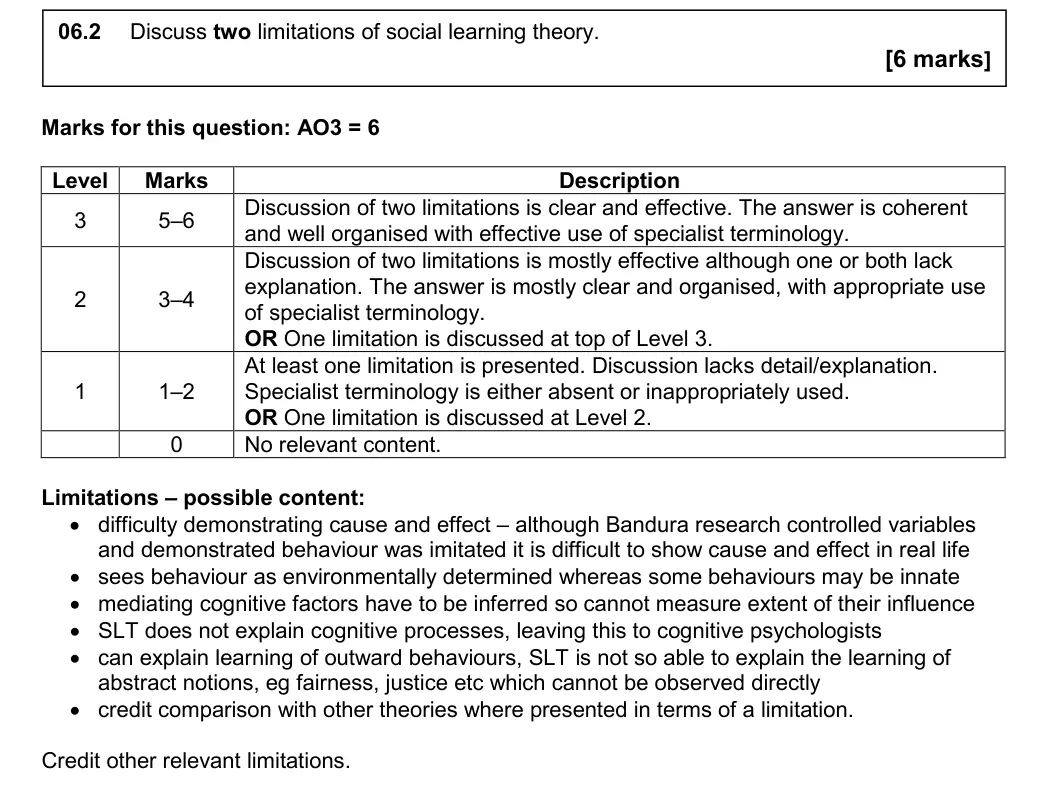
There was a good spread of marks for this question. Many answers were muddled, eg with the behaviourist approach. Students often struggled with the requirement to explain and apply the strength/limitation, revealing a lack of understanding of the strengths and limitations of SLT. Students should know that, for this type of question, they must demonstrate understanding and be able to flexibly apply their knowledge to explain novel scenarios. Therefore, they need to try to understand the strengths and limitations of the approaches and how and why these are strengths/limitations, rather than just rote learning the evaluative points. Overall, strengths were explained better than limitations. The most common strength was linked to having research support from Bandura. Some good responses applied the results of Bandura’s research to the question stem, and explained how the research evidence strengthens the theory. The most common limitation was that SLT was too simplistic, ignoring the role of genes for example. Some students effectively used mirror neurons to evidence this point. However, often limitations were of Bandura’s research and not linked to the theory or the question stem.
Notes from the mark scheme and report
strength (e.g. Bandura research support, nurture-based so changeable, soft determinism via mediational processes) and limitation (deterministic, ignores genes/hormones, artificial Bandura research), 3 marks each with application
muddling with the behaviourist approach
limitations of Bandura's study not linked to the theory
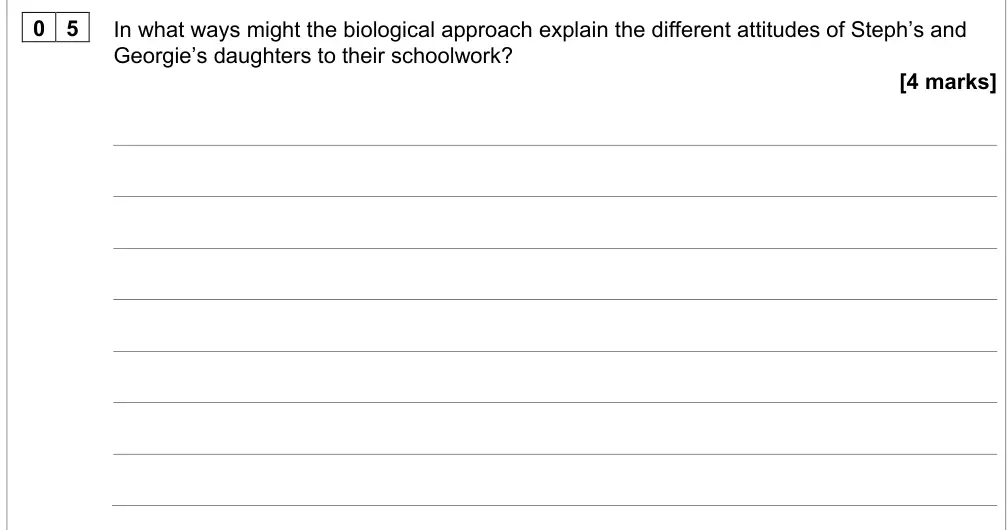
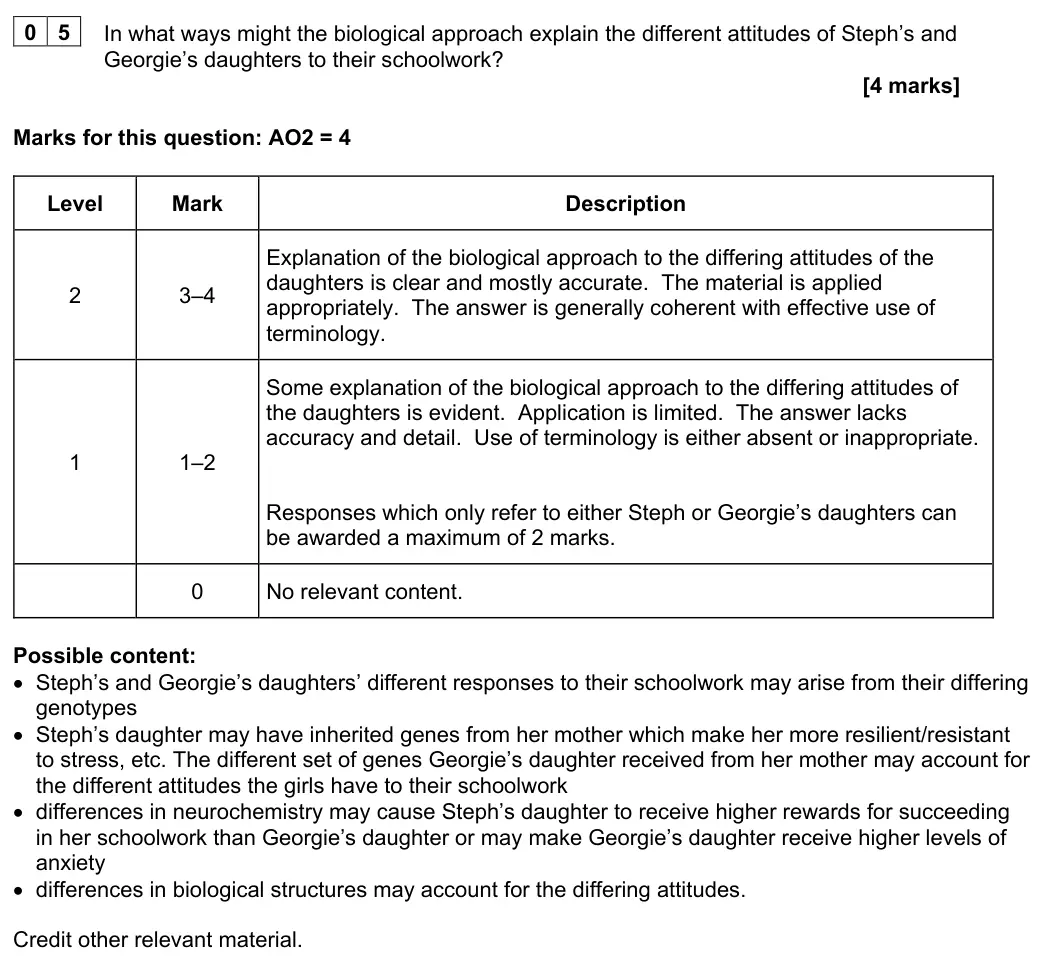
June 2023 · Paper 2 · Q54 marksAO2=4Application
Mark scheme, including level descriptors and indicative content
Examiner's comment
This question discriminated well with a good range of responses covering genetic, neurochemical, and biological structures. Effectiveness of application was often the discriminating factor. The most common responses focussed on genetic similarities between mothers and daughters for the traits described in the question stem. Better responses broadened their response to discuss potential neurochemical differences between the girls. Some responses focussed on behaviour being an adaptive response but failed to use this to explain Georgie’s daughter’s behaviour. Knowledge of genotype and phenotype was evident. However, for some, there was confusion about monozygotic and dizygotic twins. This was most likely due to experience of questions asked in past papers, which could not be effectively adapted to this question as the two girls were not biologically related to each other.
Notes from the mark scheme and report
different genotypes (inherited resilience), neurochemistry (reward, anxiety), biological structures applied to both daughters
only one daughter = max 2
MZ/DZ twin answers inappropriate as the girls are not related
June 2023 · Paper 2 · Q68 marksAO1=3, AO3=5Extended writing
Mark scheme, including level descriptors and indicative content
Examiner's comment
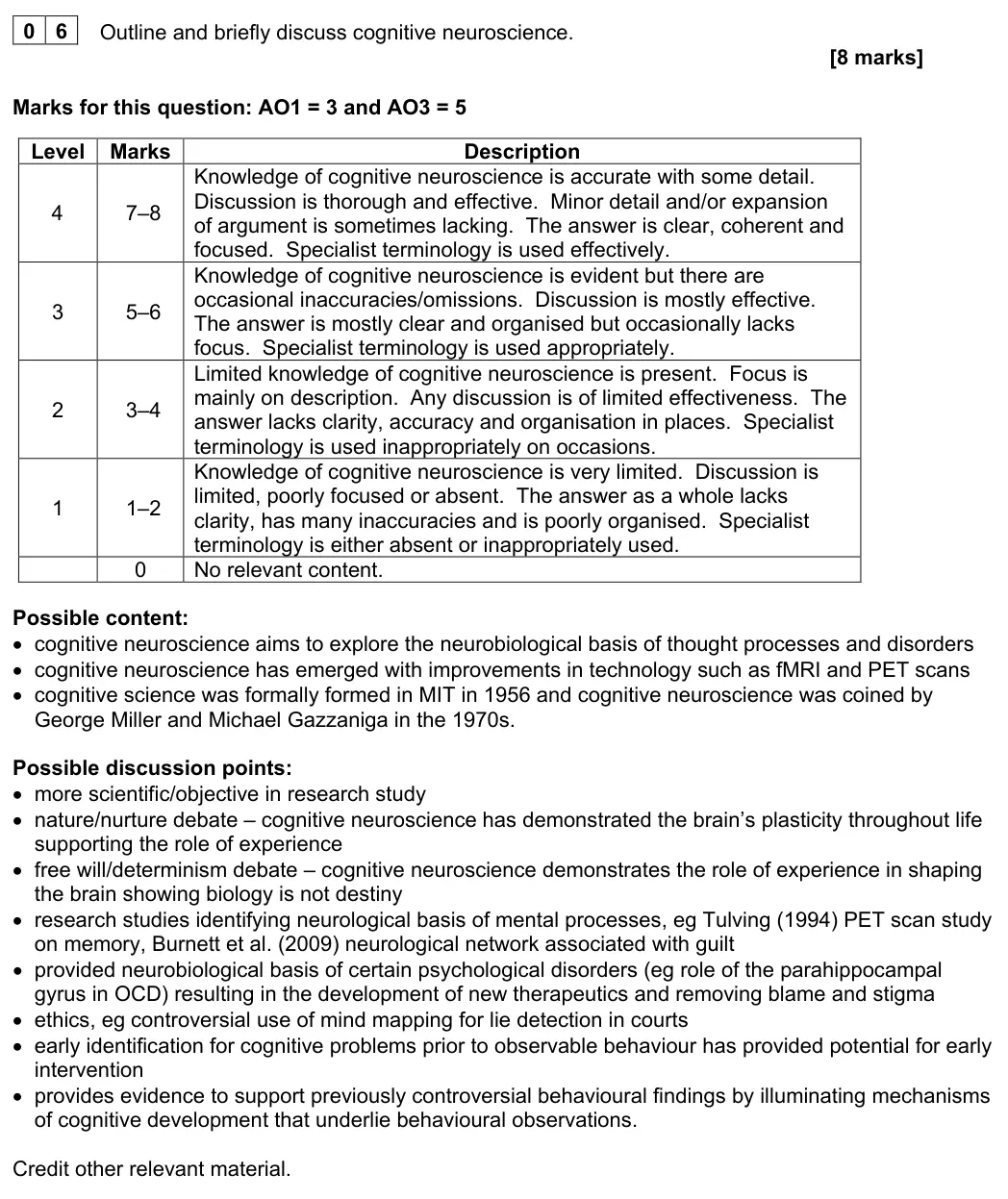
This question was a good discriminator between students. Although the full range of marks was awarded, it appeared that students were unprepared for this question, with few able to achieve level 3 or 4. Whilst it appeared that students had not focussed on this topic in depth, those with a good understanding of what cognitive neuroscience was were able to use their knowledge flexibly, linking this to studies they had covered in other topic areas, and utilised their knowledge of issues and debates to discuss cognitive neuroscience effectively. For those who had a more limited understanding of cognitive neuroscience, responses often lacked focus, concentrating on ways of studying the brain, the cognitive approach, or the biological approach. Evaluation was often limited and poorly focussed. Students must explicitly link their evaluative points back to the essay title, explaining the impact of their evaluative point/evidence on the title to help keep it focussed. Remember that credit is only given for evaluating studies when these comments are discussed in the context of their possible impact on the results obtained in the study.
Notes from the mark scheme and report
cognitive neuroscience (now within the biological approach in v1.4): neurobiological basis of mental processes, scanning
discussion via scientific status, plasticity/nature-nurture, research (Tulving, Burnett), applications, ethics
students unprepared
drifted into ways of studying the brain or the cognitive/biological approach generally
MS also credits its historical emergence ('the emergence of' removed in v1.4)
June 2022 · Paper 2 · Q16 marksAO1=6Outline
Mark scheme, including level descriptors and indicative content
Examiner's comment
Students were generally well prepared for this question and most were able to provide an accurate and often detailed response with specialist terminology included. There was some good knowledge of fixation demonstrated at each of the stages described. The most commonly seen confusion was between the phallic and genital stages.
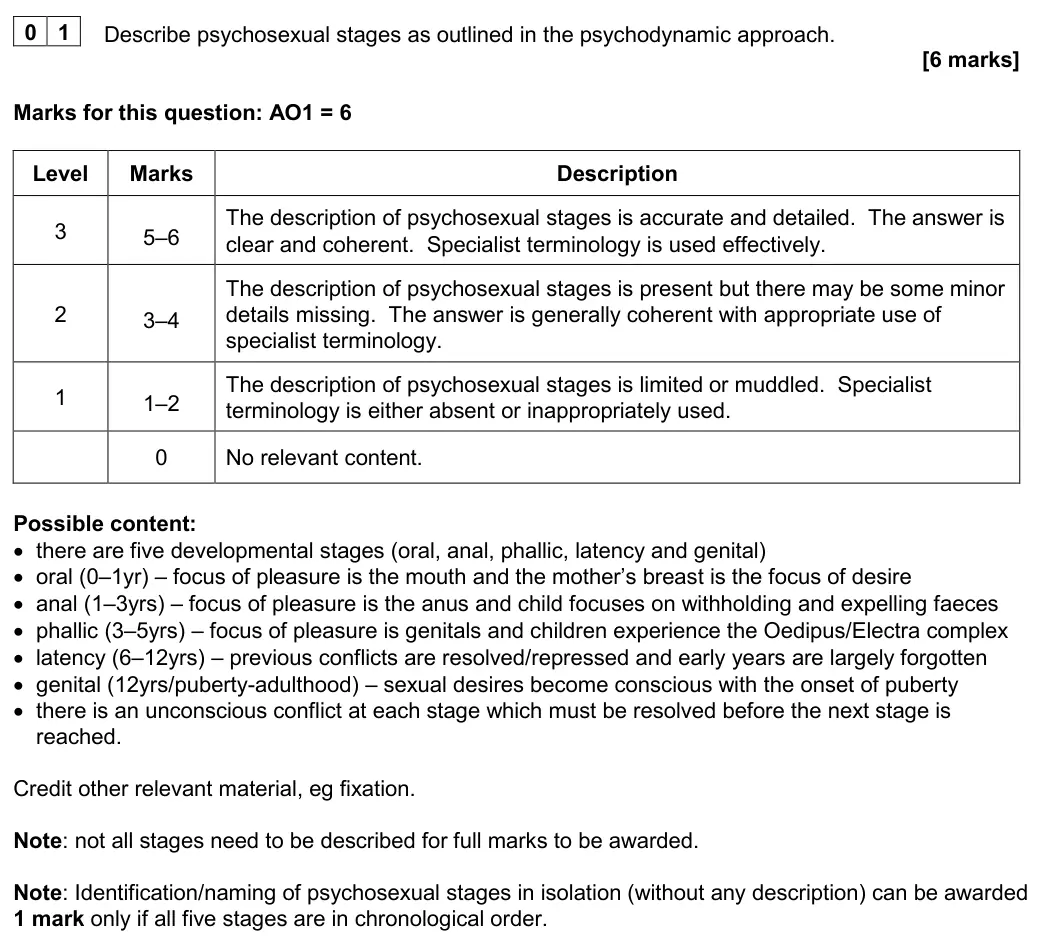
Notes from the mark scheme and report
oral, anal, phallic (Oedipus/Electra), latency, genital with focus of pleasure and conflict/fixation
not all stages needed for full marks
naming all five in order without description = 1 mark only
most common confusion phallic vs genital
June 2022 · Paper 2 · Q26 marksAO2=6Application
Mark scheme, including level descriptors and indicative content
Examiner's comment
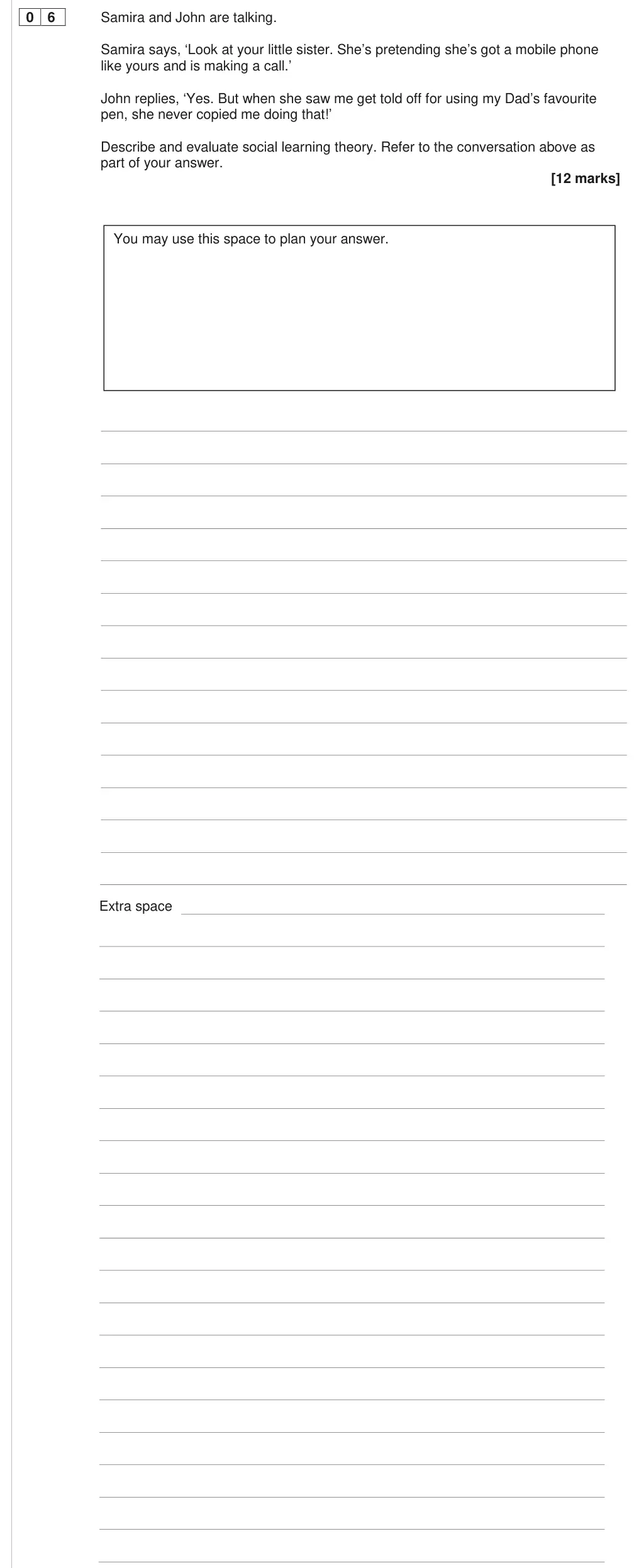
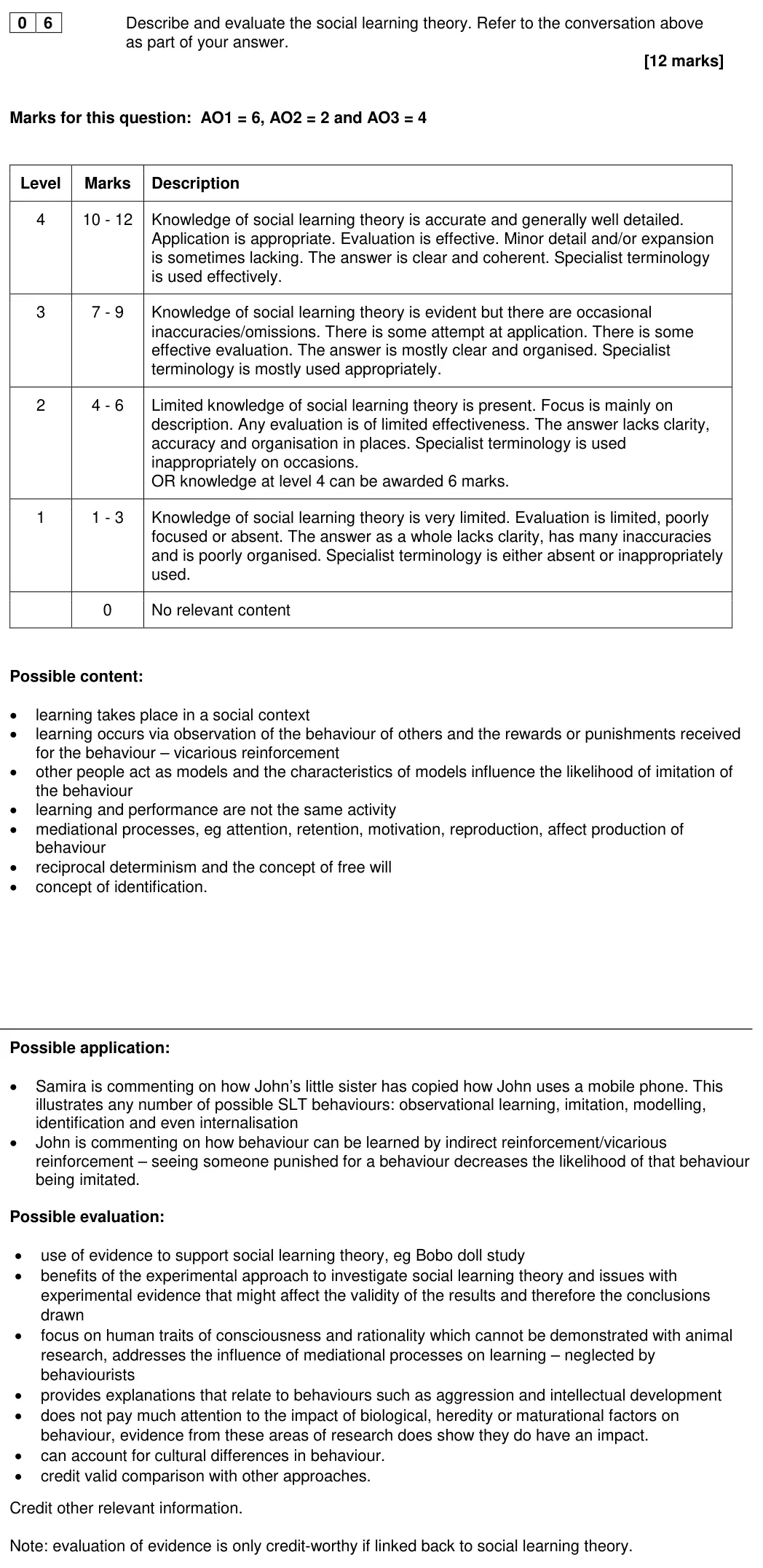
Most students demonstrated knowledge of Social Learning Theory but were more challenged by the demand for effective application of their knowledge. The application given by some students did not extend much beyond directly quoting from the stem, which made their answers limited. There were some students who misread the question and provided material relating to mediational processes, which was not creditworthy.
Notes from the mark scheme and report
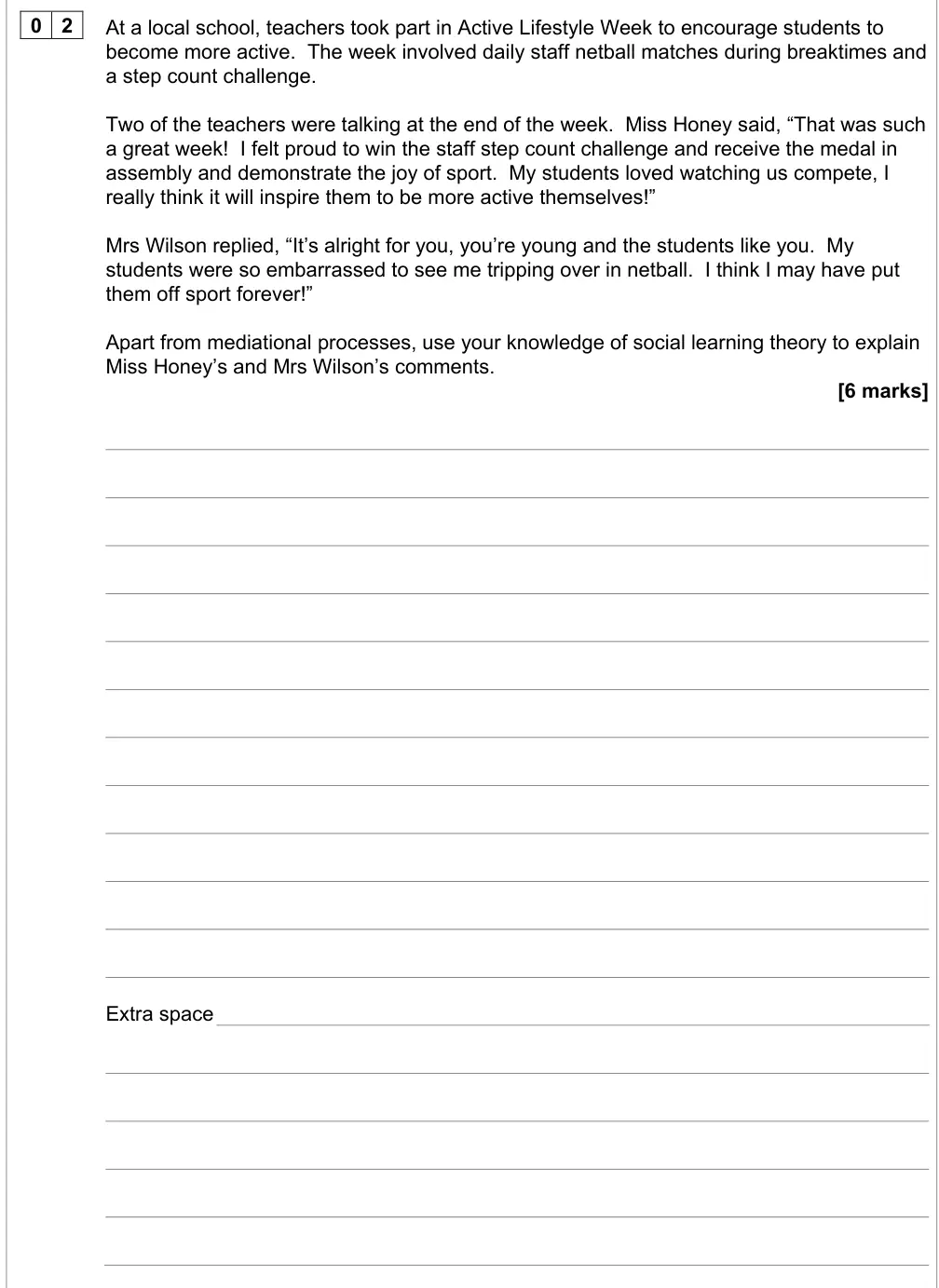
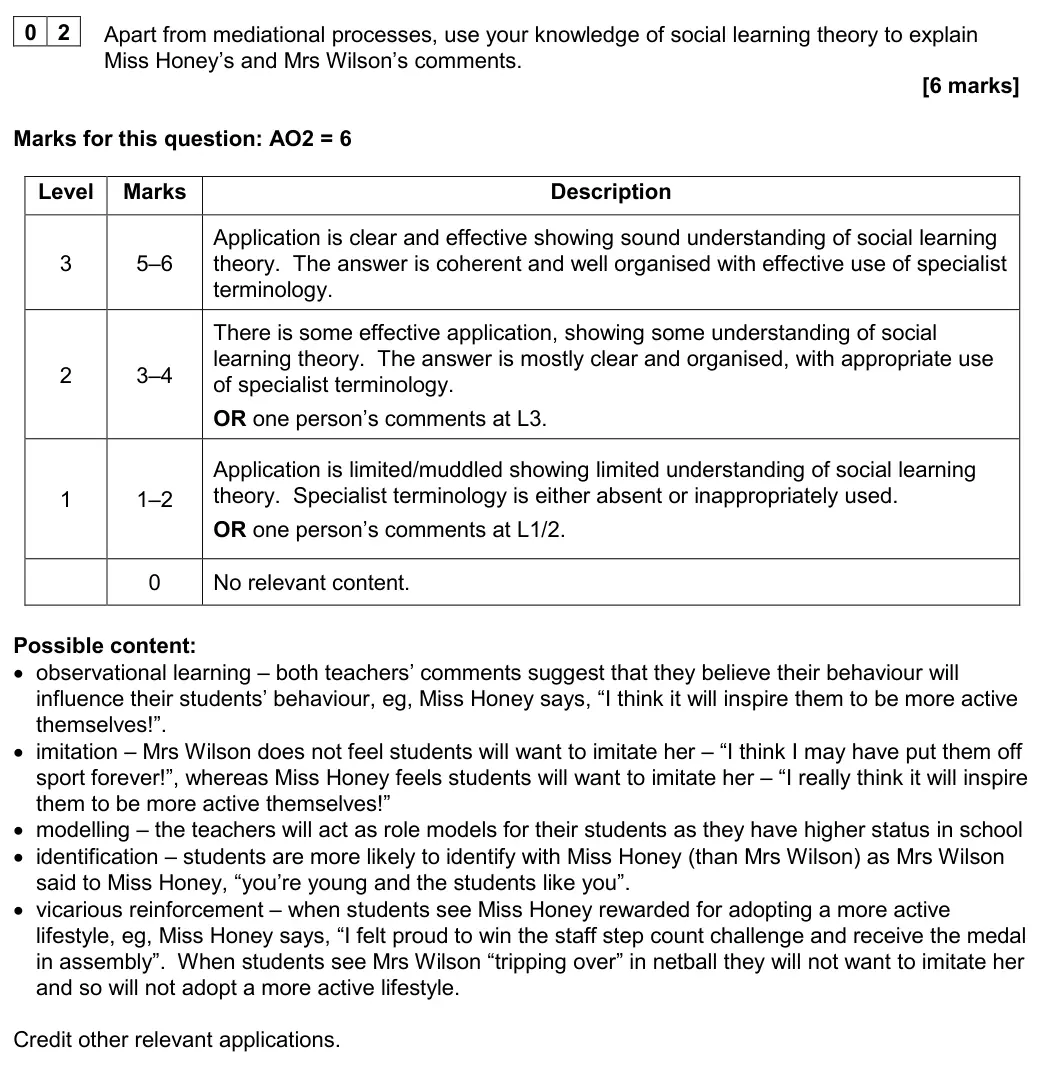
apart from mediational processes (not creditworthy): observational learning, imitation, identification (young, liked Miss Honey), vicarious reinforcement (medal vs tripping over) applied to BOTH teachers
one teacher only = max 4
quoting the stem without explanation limited
MS also credits modelling, removed in v1.4
June 2022 · AS Paper 2 · Q33 marksAO1=3Outline
Mark scheme, including level descriptors and indicative content
Examiner's comment
Many students appeared to have a detailed and thorough knowledge of Pavlov’s methodology and used appropriate terminology throughout. A significant minority of students did not focus their answer on how Pavlov investigated classical conditioning and gave what appeared to be rote learnt responses which simply described the process of classical conditioning and were not focused on Pavlov’s methodology. It is also important that students use appropriate classical conditioning terminology here as this is required for top level responses.
Notes from the mark scheme and report
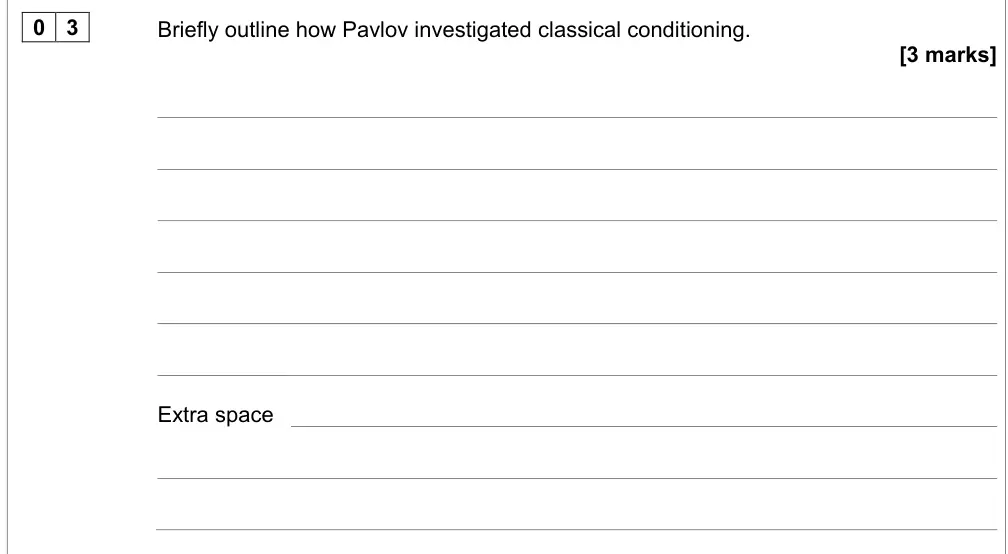
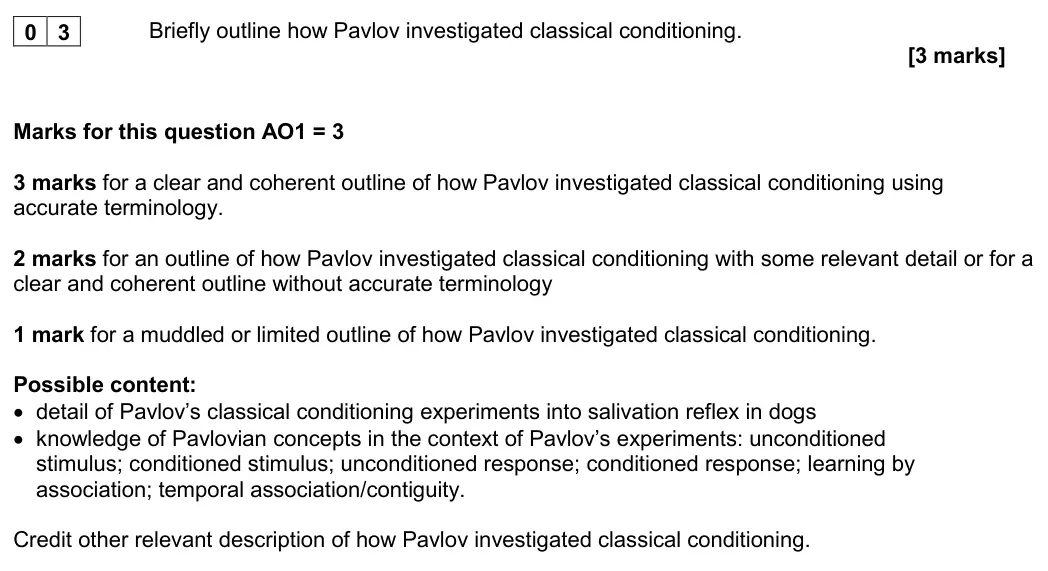
must focus on Pavlov's methodology (salivation in dogs) not just the process of classical conditioning
UCS/CS/UCR/CR terminology needed for 3 marks
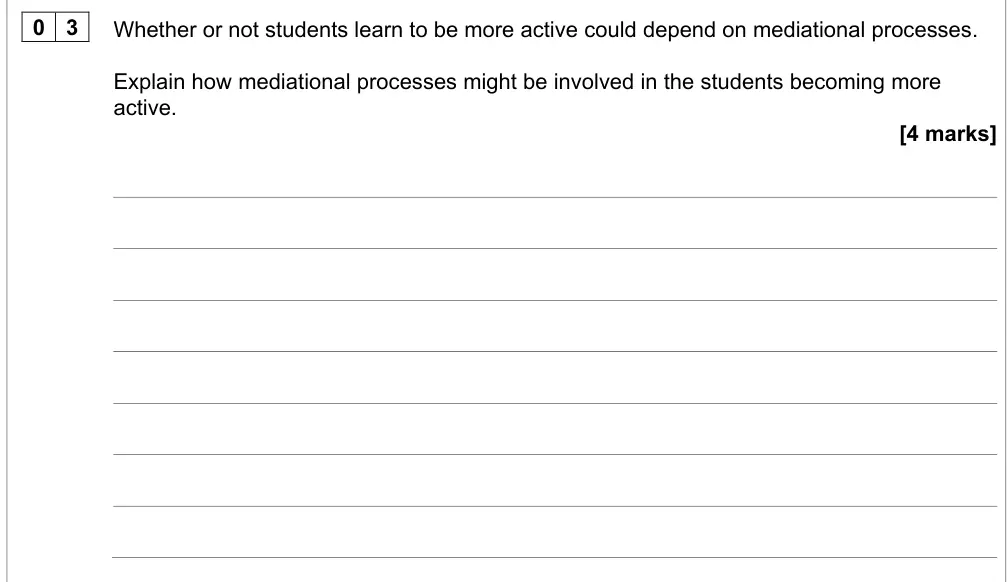
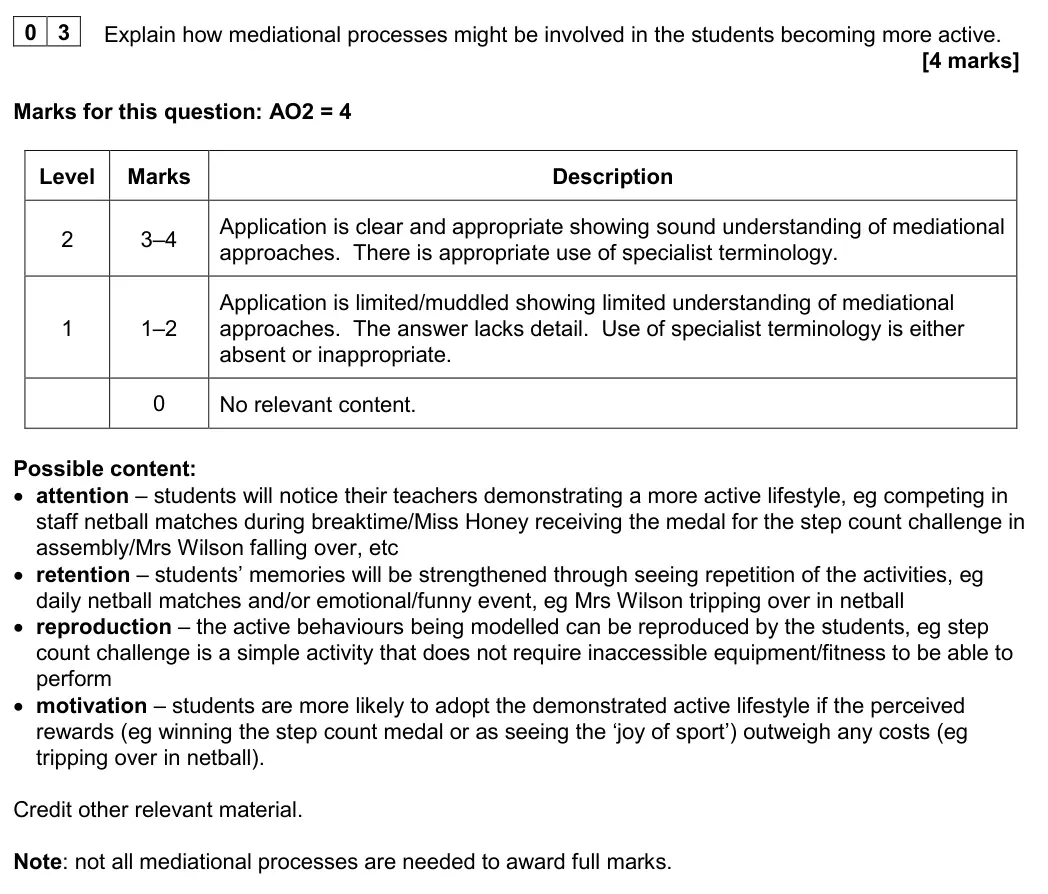
June 2022 · Paper 2 · Q34 marksAO2=4Application
Mark scheme, including level descriptors and indicative content
Examiner's comment
Overall, students demonstrated excellent knowledge of mediational processes. However, they found it harder to apply their knowledge effectively to explain how these may be involved in the students in the scenario becoming more active, limiting many responses to level 1 on the mark scheme. The most effectively applied point overall was attention.
Notes from the mark scheme and report
attention, retention, reproduction, motivation applied to the students and the scenario
not all four needed
knowledge good but application weak, many at level 1
attention best applied
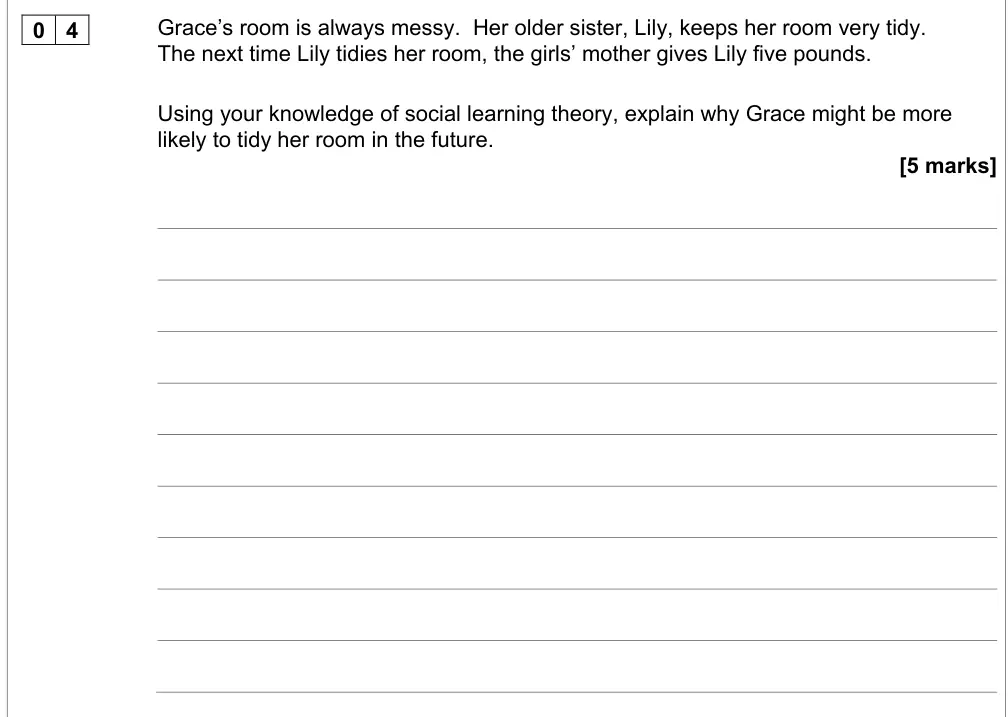
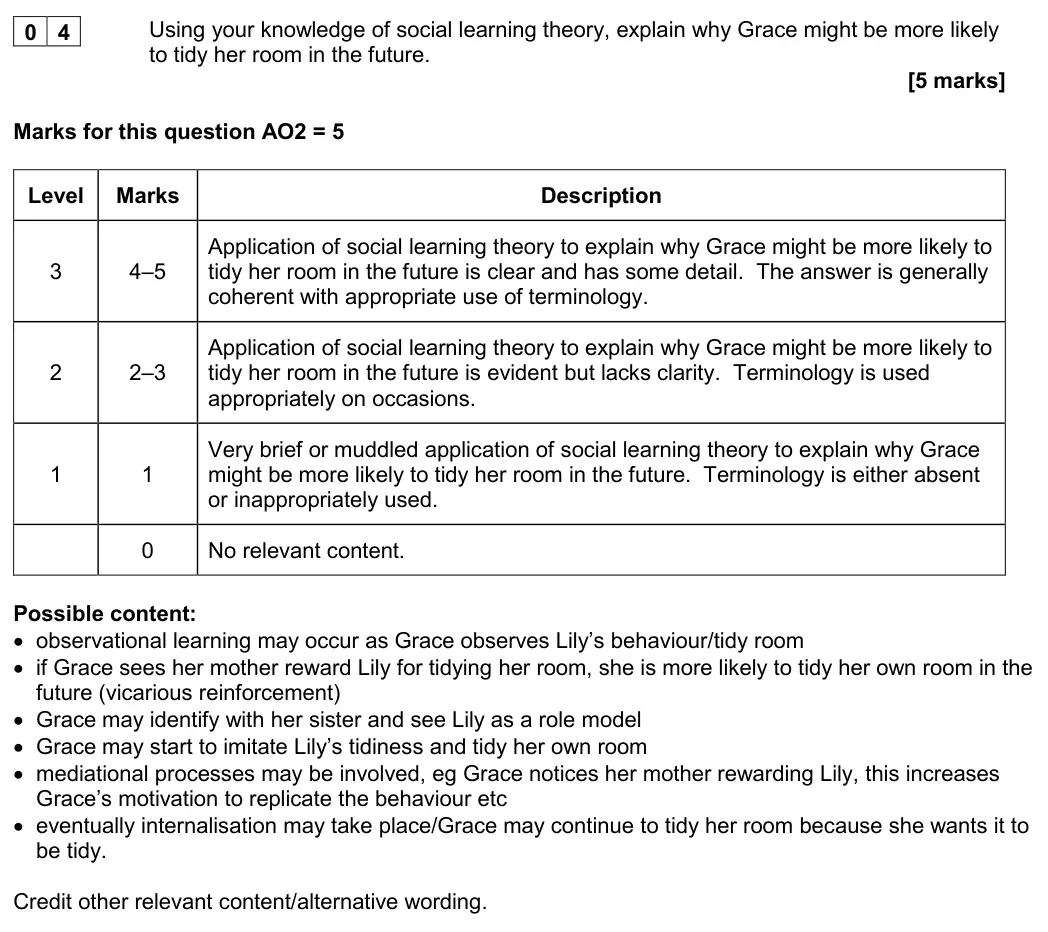
June 2022 · AS Paper 2 · Q45 marksAO2=5Application
Mark scheme, including level descriptors and indicative content
Examiner's comment
Most students had sound knowledge of social learning theory and many were able to clearly apply this knowledge to the scenario. However, some students simply named or outlined concepts and did not apply them to the scenario as the question asked. Where students did attempt to apply their knowledge to the scenario, this application was varied with some fully applying the concepts of social learning theory to the stimulus material, whilst others simply quoted parts of the stimulus material with no explanation or link to any of the concepts of social learning theory. As with the previous question, it is important that students use appropriate terminology from social learning theory here as this is required for Level 2 and Level 3 responses.
Notes from the mark scheme and report
all AO2: vicarious reinforcement, identification, imitation, mediational processes applied to Grace and Lily
naming concepts without applying, or quoting the stem without explanation, scored poorly
June 2022 · Paper 2 · Q48 marksAO1=3, AO3=5Extended writing
Mark scheme, including level descriptors and indicative content
Examiner's comment
This question discriminated well with the full range of marks awarded. Many students appeared to have prepared for a question outlining and evaluating the humanistic approach and therefore some had difficulty focusing on the required elements of this question. Although most students concentrated on self-actualisation, there was often too much focus on each level of Maslow’s hierarchy with insufficient consideration of self-actualisation specifically. Knowledge of conditions of worth was variable with many students confusing the concept. As in previous series, knowledge was much stronger than the evaluative discussion presented. Many students simply discussed the humanistic approach and issues and debates with no attempt to shape their answers to the specific question set, whilst others gave a series of generic evaluation points or focused entirely on knowledge. Teachers are advised to continue to remind students that there are only 3 knowledge marks available on an 8-mark question. They should ensure they have discussed sufficient evaluative points thoroughly enough to access the 5 marks available for this skill.
Notes from the mark scheme and report
self-actualisation (top of Maslow's hierarchy) and/or conditions of worth, unconditional positive regard
discussion via research (Harter), lack of scientific evidence, Q-sort, alternatives, culture
too much on each level of Maslow
conditions of worth often confused
generic humanistic approach essays
only 3 AO1 marks
MS also credits counselling application and the 'authentic self', removed in v1.4
June 2022 · AS Paper 2 · Q54 marksAO1=4Outline
Mark scheme, including level descriptors and indicative content
Examiner's comment
Some wrote excessive amounts of content, which was particularly noticeable in questions 1, 5 and 8. This question appeared to discriminate well between students as a wide range of responses were seen. A significant minority of students simply described the cognitive approach in general and thus performed poorly. Many students gained some marks but did not fully engage with the question and wrote about the use of scanning techniques to measure brain structure and/or function, but did not actually outline cognitive neuroscience. Some students had a detailed understanding of cognitive neuroscience and wrote excessively long answers, often going on to the additional pages at the back of the question paper. Although students did not lose marks for this, they did potentially lose valuable time which could have been better spent elsewhere.
Notes from the mark scheme and report
cognitive neuroscience now sits in the biological approach (4.2.1-03) in v1.4
many described the cognitive approach in general
mentioning scanning only without defining cognitive neuroscience limited marks
June 2022 · AS Paper 2 · Q62 marksAO3=2Evaluate (short)
Mark scheme, including level descriptors and indicative content
Examiner's comment
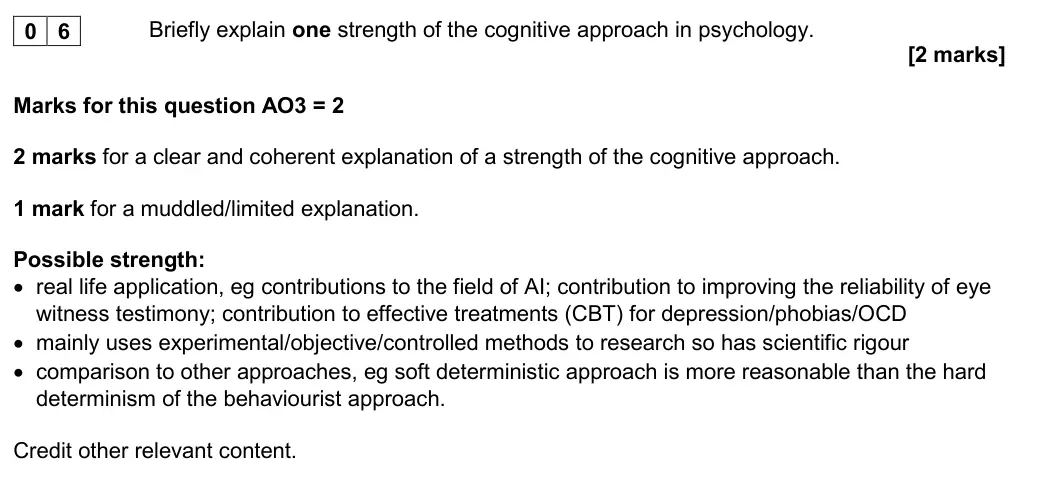
This question was generally answered well, suggesting that students had a clear knowledge of the strengths of the cognitive approach. Most correct responses were based around real life application and the development of effective treatments. A minority of students simply wrote vague and potentially incorrect statements, such as ‘it is objective’. It is important to note that although many of the methods used by the cognitive approach are objective (such as the use of laboratory experiments and brain scanning techniques), the approach itself is not entirely objective as a significant proportion of it is based upon inference. As in previous series, if students chose a methodological point as a strength (such as the use of highly controlled methods of investigation), it is important that they explain how this is a strength for the approach itself.
Notes from the mark scheme and report
real-life application (CBT, EWT, AI) most common
'it is objective' alone not credited as the approach relies on inference
methodological strengths must be linked to the approach
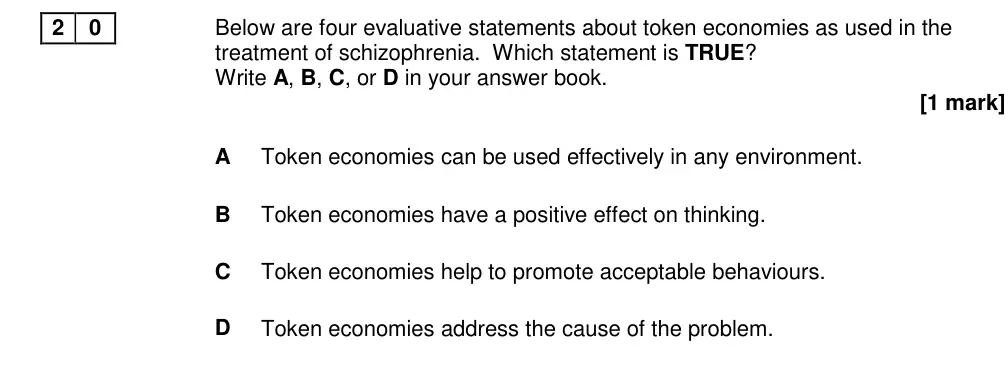
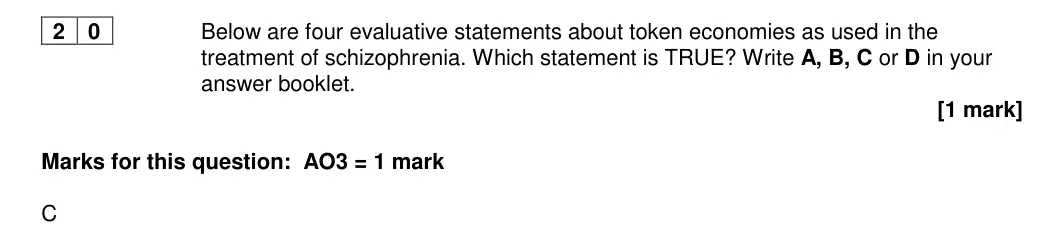
June 2022 · Paper 3 · Q141 markAO1=1Multiple choiceOld spec only
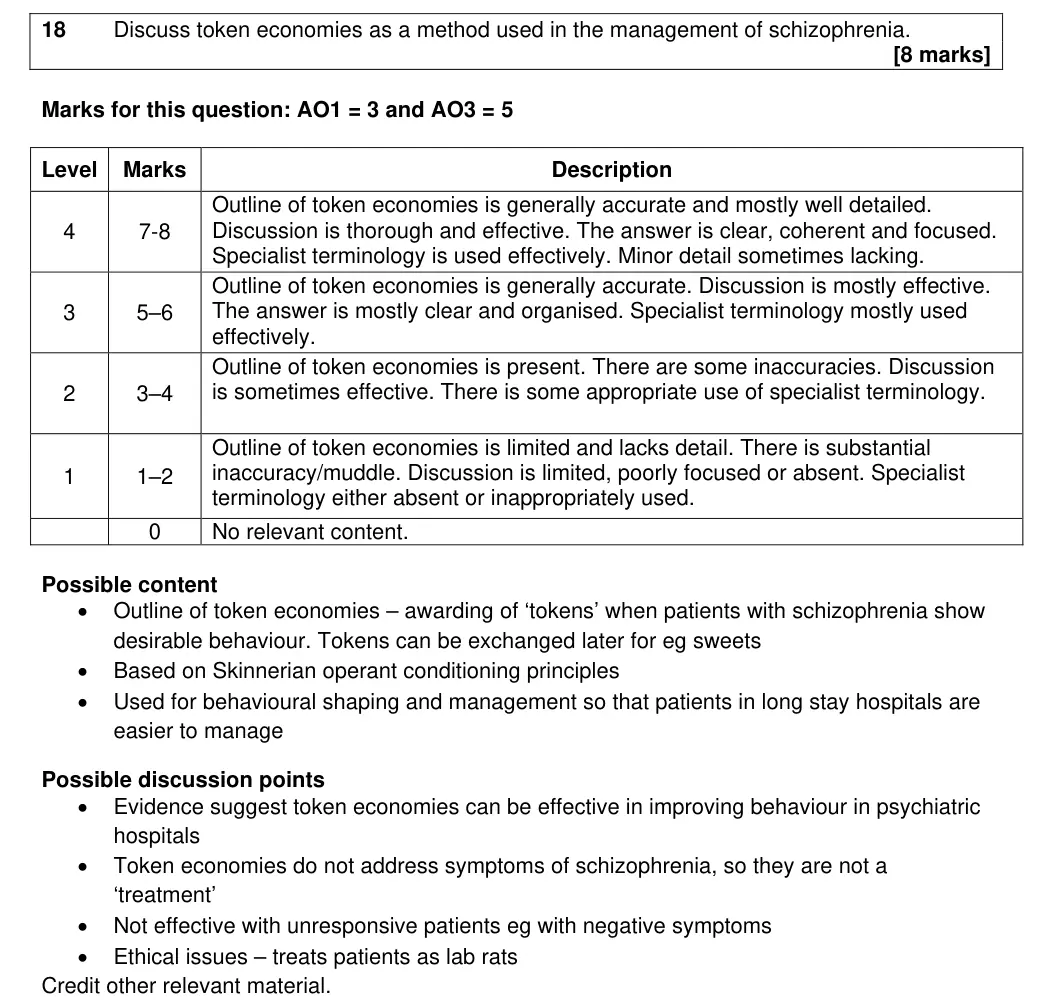
Not on the 2025 specification: token economies in the management of schizophrenia, removed in v1.4
Answer
C
Mark scheme, including level descriptors and indicative content
Examiner's comment
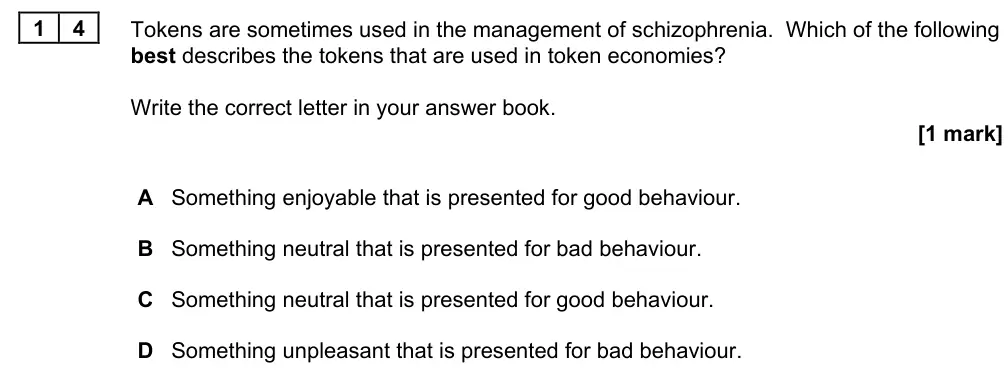
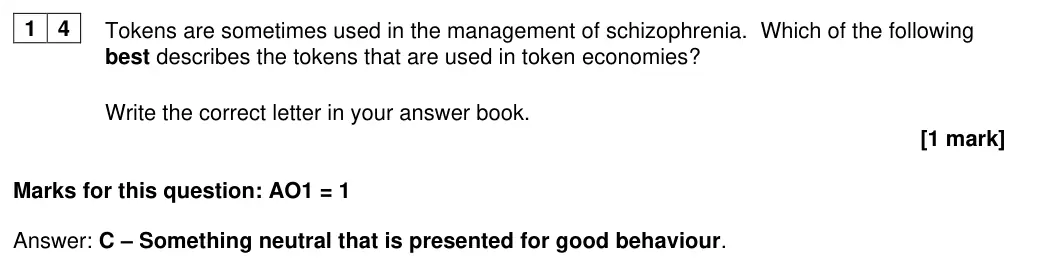
Most students answered the first multiple-choice question correctly but many answered the second incorrectly. It should be noted that tokens are secondary reinforcers and as such, they are not enjoyable in themselves but acquire reinforcing properties because they can be exchanged for a primary reinforcer that is intrinsically enjoyable.
Notes from the mark scheme and report
Off-spec: token economies in the management of schizophrenia, removed in v1.4
correct C (neutral token given for good behaviour = secondary reinforcer)
many answered incorrectly
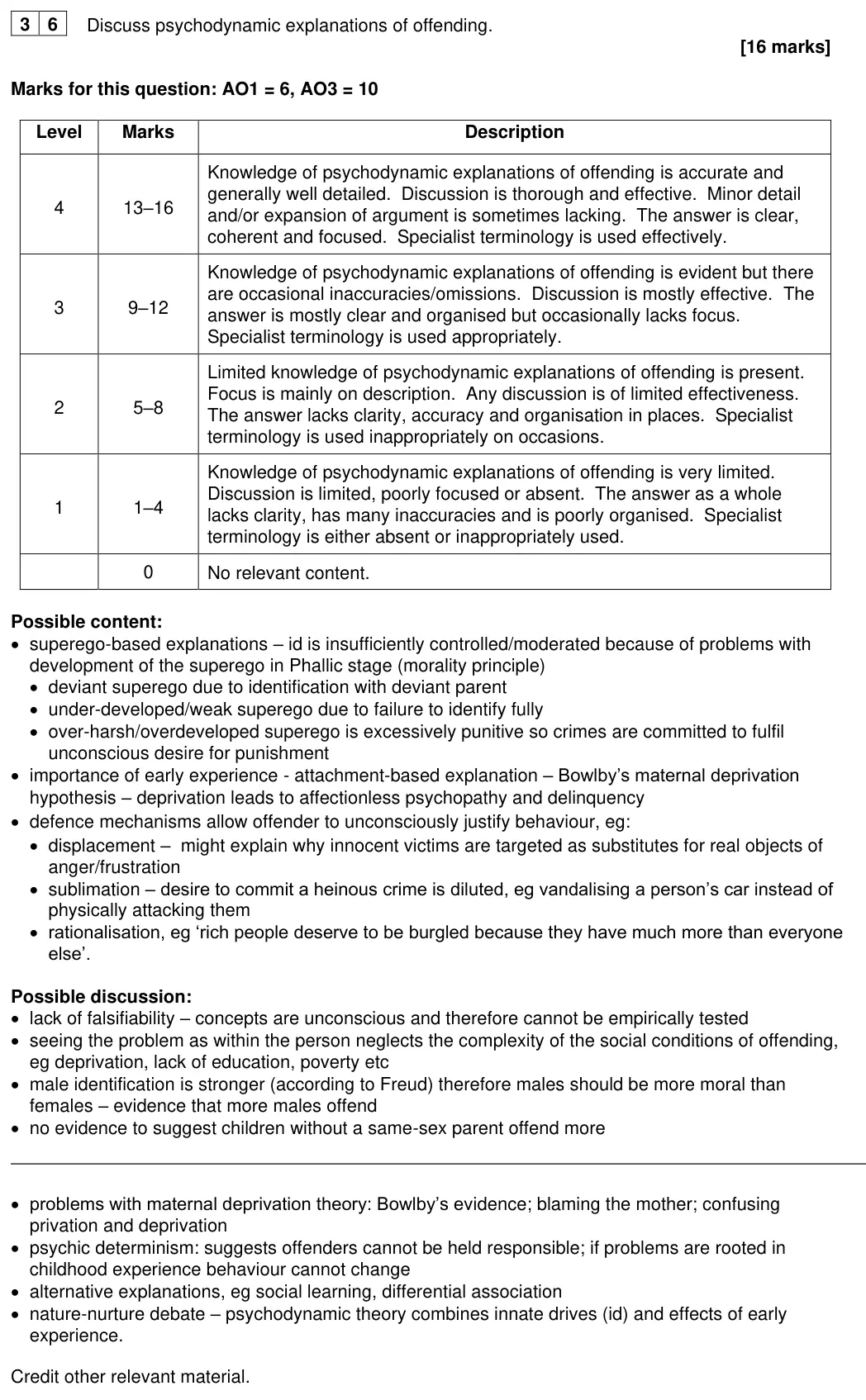
June 2022 · Paper 3 · Q3616 marksAO1=6, AO3=1016-mark essayOld spec only
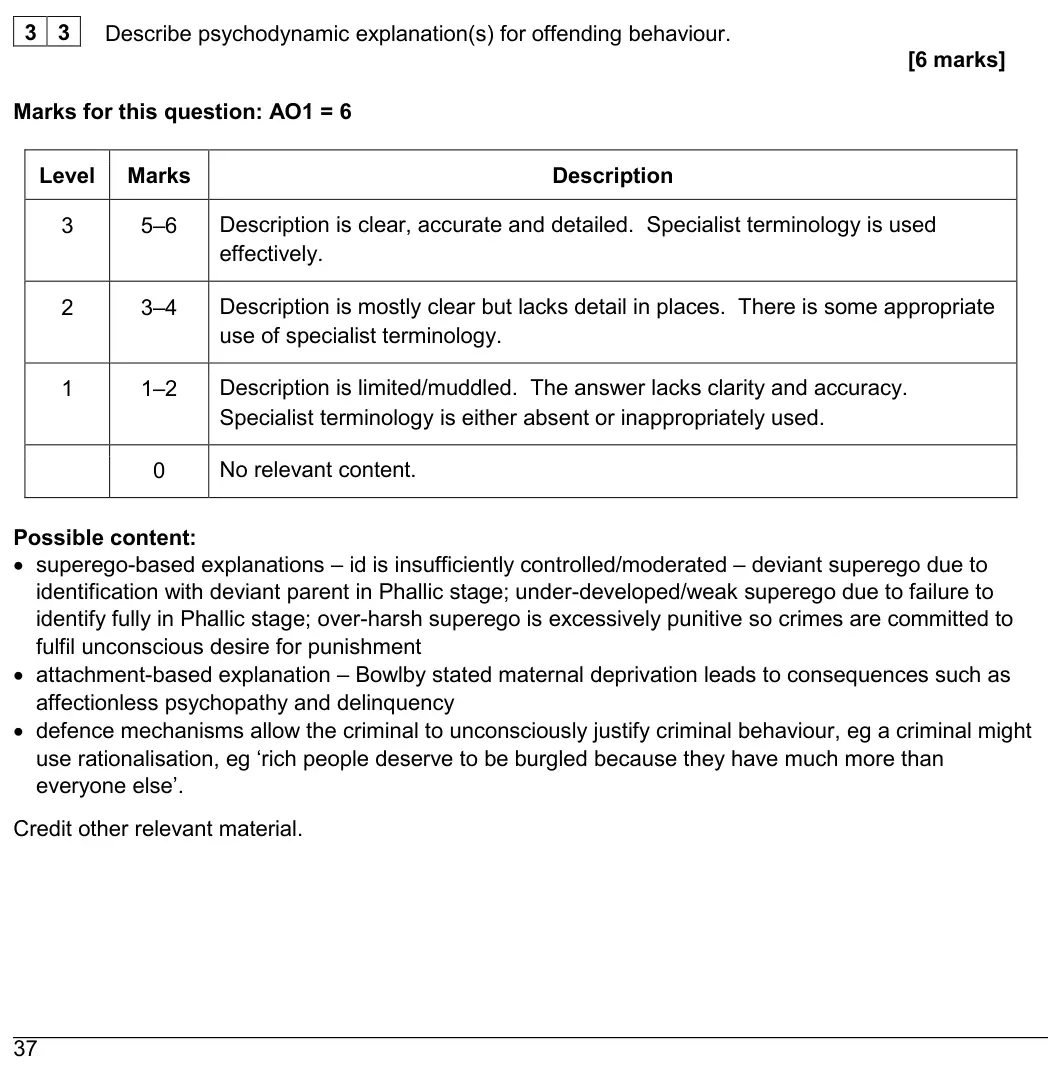
Not on the 2025 specification: psychodynamic explanations of offending: Blackburn's superego types, maternal deprivation, defence mechanisms, removed in v1.4
Mark scheme, including level descriptors and indicative content
Examiner's comment
Descriptions of how psychodynamic theory might be used to explain offending varied in detail and depth of understanding. Many students could name Blackburn’s three types of superego, but explanations often sounded more like social learning theory, reinforcement and differential association than the Freudian conceptualisation of identification as an unconscious process. A fair number of students wrote about Eysenck’s theory of the criminal personality instead. Discussion points were often not very convincing, although falsifiability was usually well argued.
Notes from the mark scheme and report
Off-spec: psychodynamic explanations of offending: Blackburn's superego types, maternal deprivation, defence mechanisms, removed in v1.4
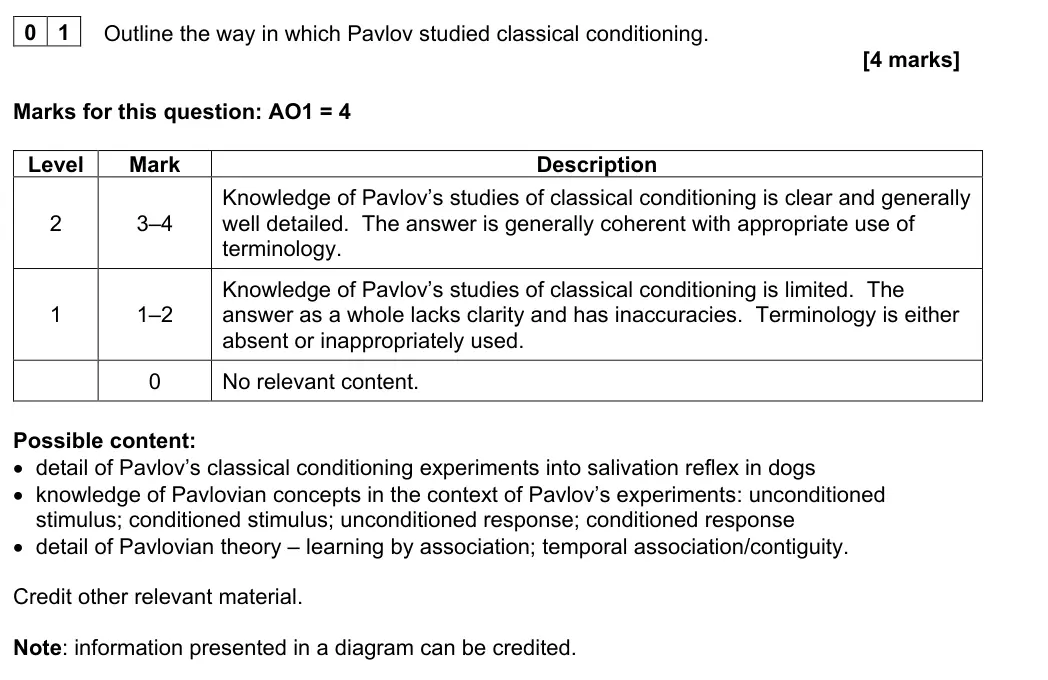
November 2021 · Paper 2 · Q14 marksAO1=4Outline
Mark scheme, including level descriptors and indicative content
Examiner's comment
This was a very well addressed question, with the majority of students achieving a level 2 mark. Overall, students demonstrated a sound understanding of Pavlov’s classical conditioning experiments and of Pavlovian concepts. There was some confusion over terminology for some students, the most common of which was muddling the neutral stimulus with unconditioned stimulus, but generally this question was answered well.
Notes from the mark scheme and report
Pavlov's salivation experiments with dogs, UCS/NS/CS/UCR/CR in context, learning by association
diagrams creditable
most common error muddling neutral stimulus with unconditioned stimulus
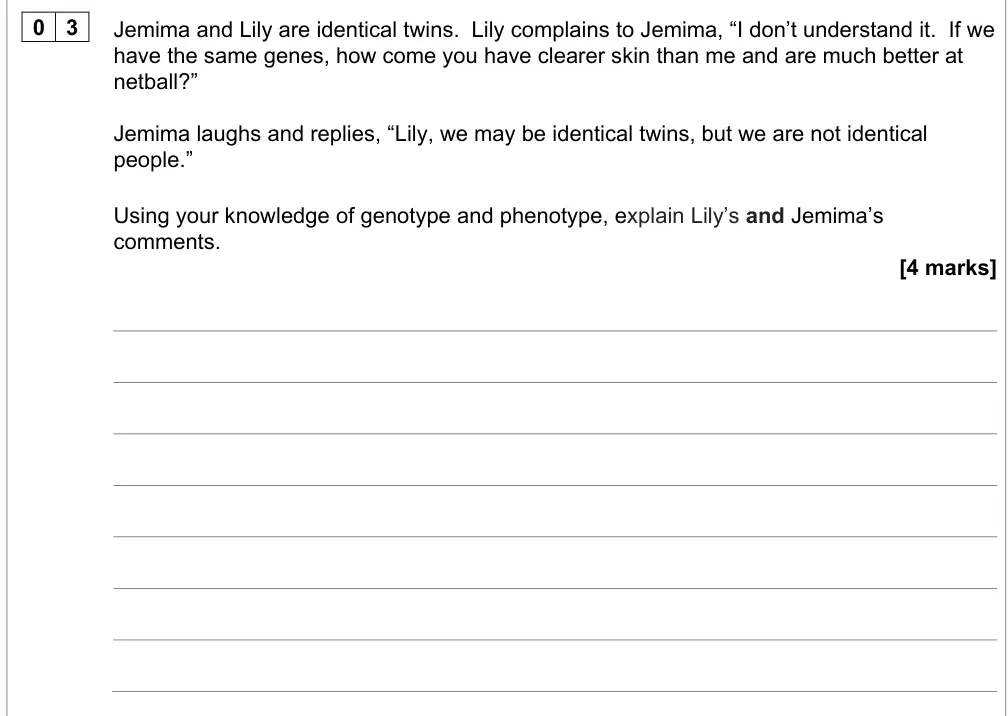
November 2021 · Paper 2 · Q34 marksAO2=4Application
Mark scheme, including level descriptors and indicative content
Examiner's comment
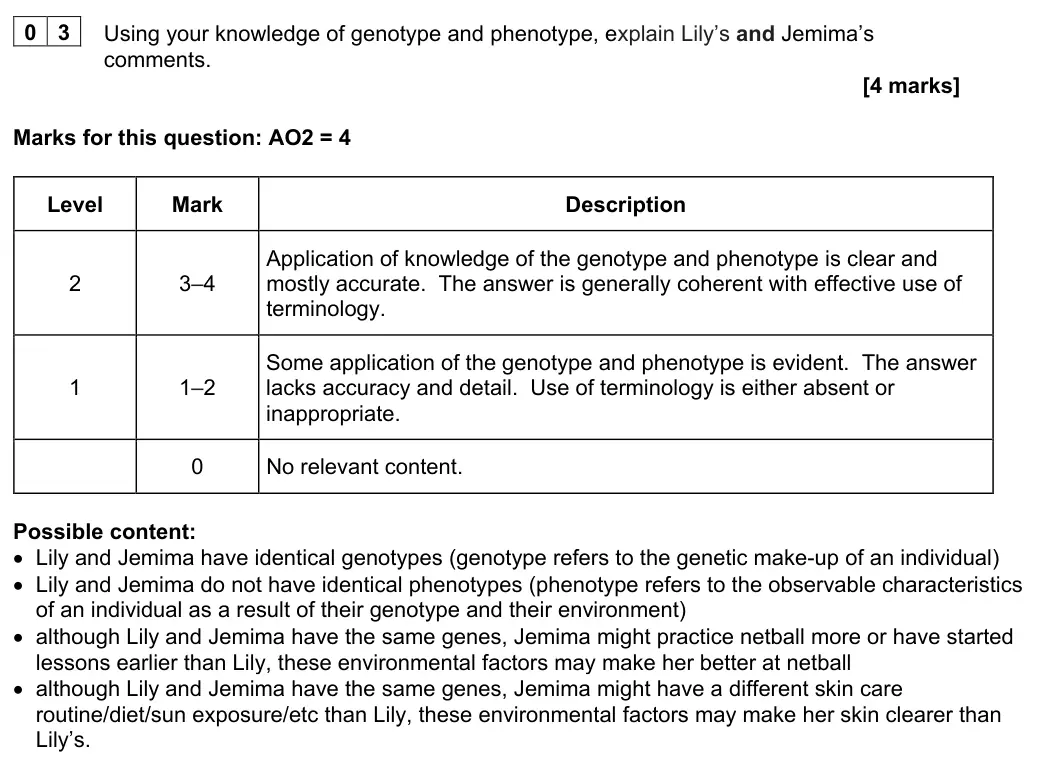
Overall students demonstrated excellent knowledge of genotype and phenotype with the majority of students achieving a level 2 mark. The most common reasons for students not achieving a level 2 mark were either due to confusion between monozygotic and dizygotic twins or due to a lack of effective application to explain Lily and Jemima’s comments. It was encouraging to see how much better the answers were overall to those given on a similar question in the 2017 series, in terms of knowledge of phenotype and genotype as well as the application of this knowledge. There were some impressive answers which demonstrated excellent understanding through their engagement with the stem material.
Notes from the mark scheme and report
identical genotypes but different phenotypes due to environment (netball practice, skin care/diet) applied to both comments
errors: confusing MZ and DZ twins, weak application
November 2021 · Paper 2 · Q46 marksAO2=4, AO3=2Application
Mark scheme, including level descriptors and indicative content
Examiner's comment
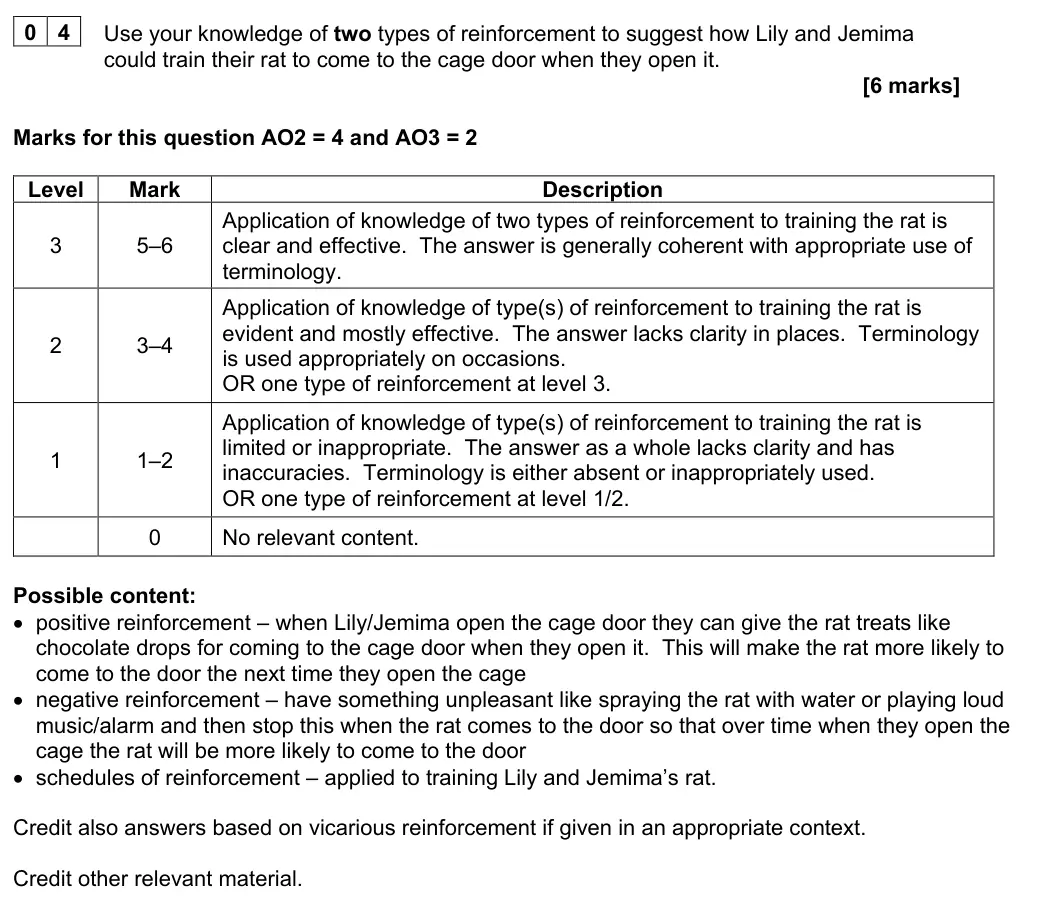
This question discriminated well. There were some excellent responses where students gave some fantastic suggestions as to how Lily and Jemima could train their rat, using both positive and negative reinforcement, demonstrating understanding through appropriate application. Other students demonstrated knowledge of positive and negative reinforcement but struggled to apply their knowledge to give appropriate suggestions. A common error was to muddle negative reinforcement with punishment. Although positive and negative reinforcement were most commonly selected, credit was given to students who used vicarious reinforcement to offer appropriate suggestions in the context of the stem. Overall responses were well focused with good context, but some included ethical evaluation, which was not creditworthy.
Notes from the mark scheme and report
two types of reinforcement (positive: treats
negative: remove unpleasant stimulus when rat comes to door) applied to training the rat
one type only = max 4
vicarious reinforcement credited in context
muddling negative reinforcement with punishment
ethical evaluation not creditworthy
November 2021 · Paper 2 · Q58 marksAO1=3, AO3=5Extended writing
Mark scheme, including level descriptors and indicative content
Examiner's comment
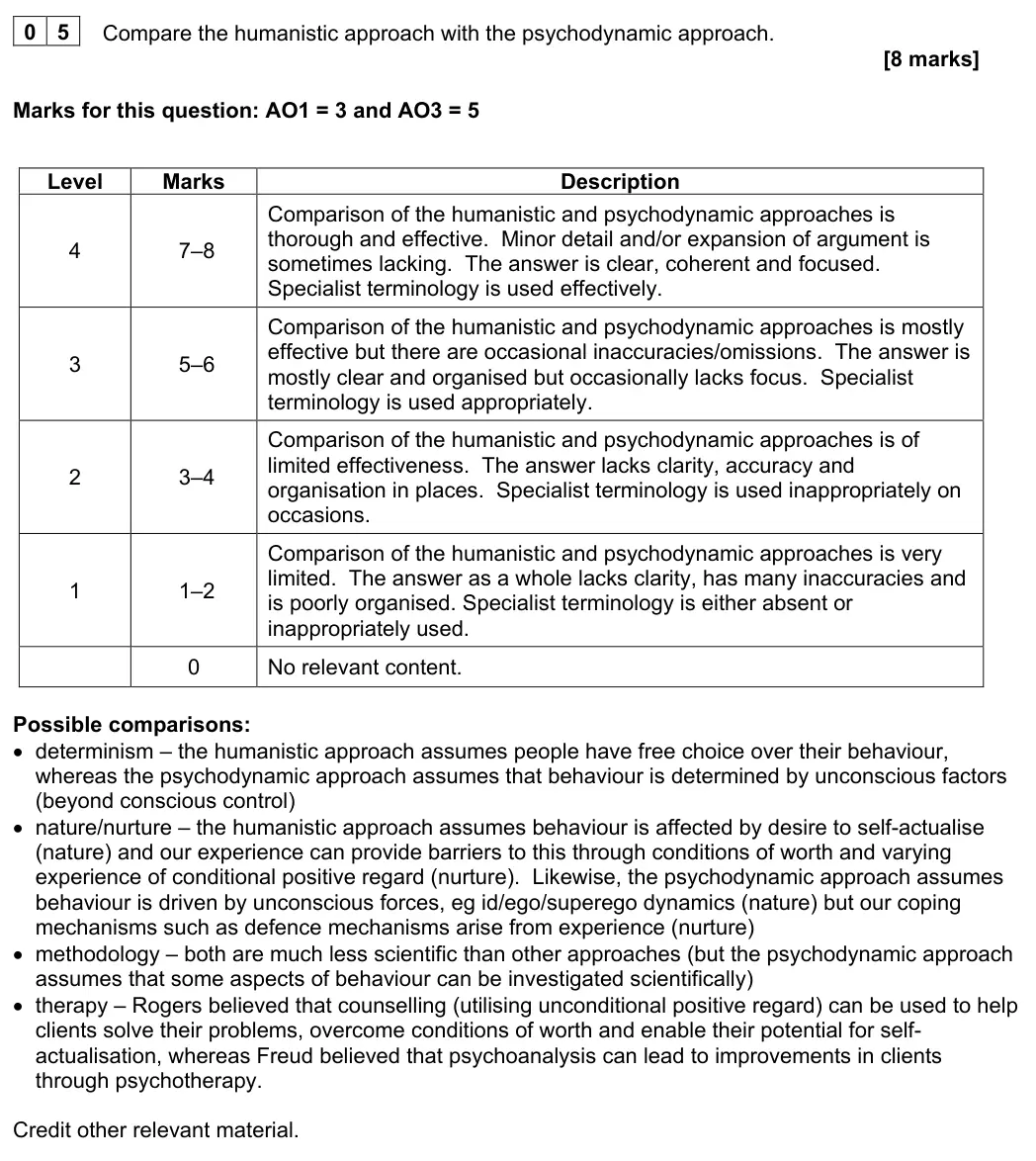
This challenging question discriminated well. Most students demonstrated good knowledge of the two approaches, but description of the approaches alone was not creditworthy without explicit comparison. This mistake in reading the question or understanding the command term was often costly. Those who focused on comparison generally achieved well although there was some muddle in terms of free will and reductionism. Higher-attaining students were able to discuss similarities as well as differences. When therapy was discussed, the comparison was generally effective.
Notes from the mark scheme and report
must be explicit comparison - description of each approach alone not creditworthy
comparisons: free will vs determinism, nature/nurture, scientific status, therapy
similarities as well as differences for top marks
MS also credits Rogers' counselling as a therapy comparison ('influence on counselling psychology' removed in v1.4)
November 2020 · AS Paper 2 · Q13 marksAO1=3OutlineOld spec only
Not on the 2025 specification: Wundt's method of introspection, origins of Psychology removed in v1.4
Mark scheme, including level descriptors and indicative content
Notes from the mark scheme and report
Off-spec: Wundt's method of introspection, origins of Psychology removed in v1.4
systematic analysis of conscious experience into component parts (structuralism), trained observers, standardised stimuli (metronome)
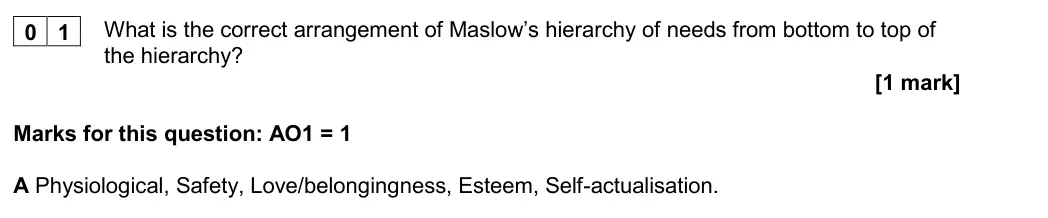
November 2020 · Paper 2 · Q11 markAO1=1Multiple choice
Answer
A
Mark scheme, including level descriptors and indicative content
Examiner's comment
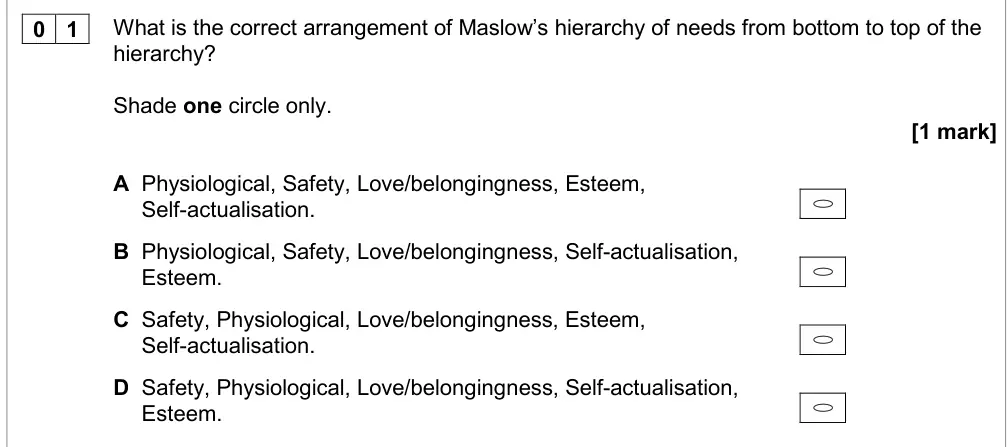
This question was generally well-answered with most students selecting the correct response. The most common incorrect response was distractor C.
Notes from the mark scheme and report
correct answer A (physiological, safety, love/belongingness, esteem, self-actualisation)
most common wrong answer C
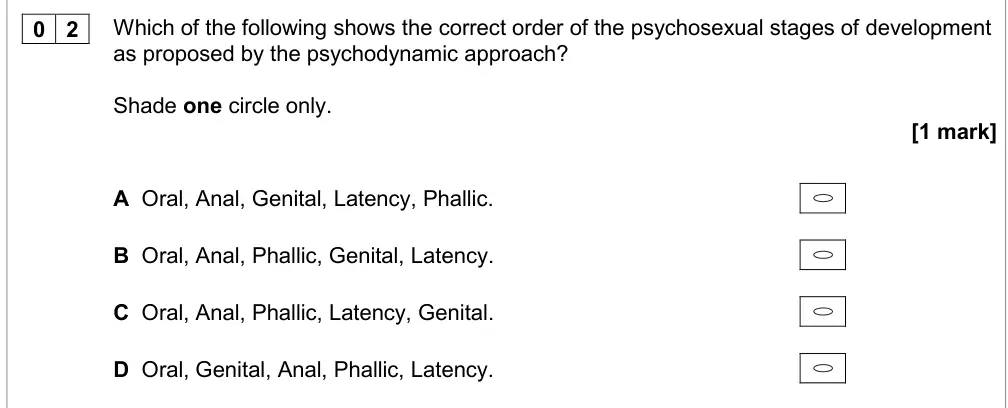
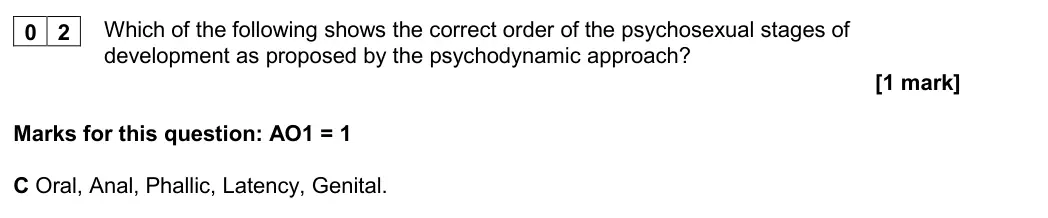
November 2020 · Paper 2 · Q21 markAO1=1Multiple choice
Answer
C
Mark scheme, including level descriptors and indicative content
Examiner's comment
This question was well-answered with most students identifying the correct response. Incorrect responses were distributed across the three distractors although B was the most common.
Notes from the mark scheme and report
correct answer C (oral, anal, phallic, latency, genital)
most common wrong answer B
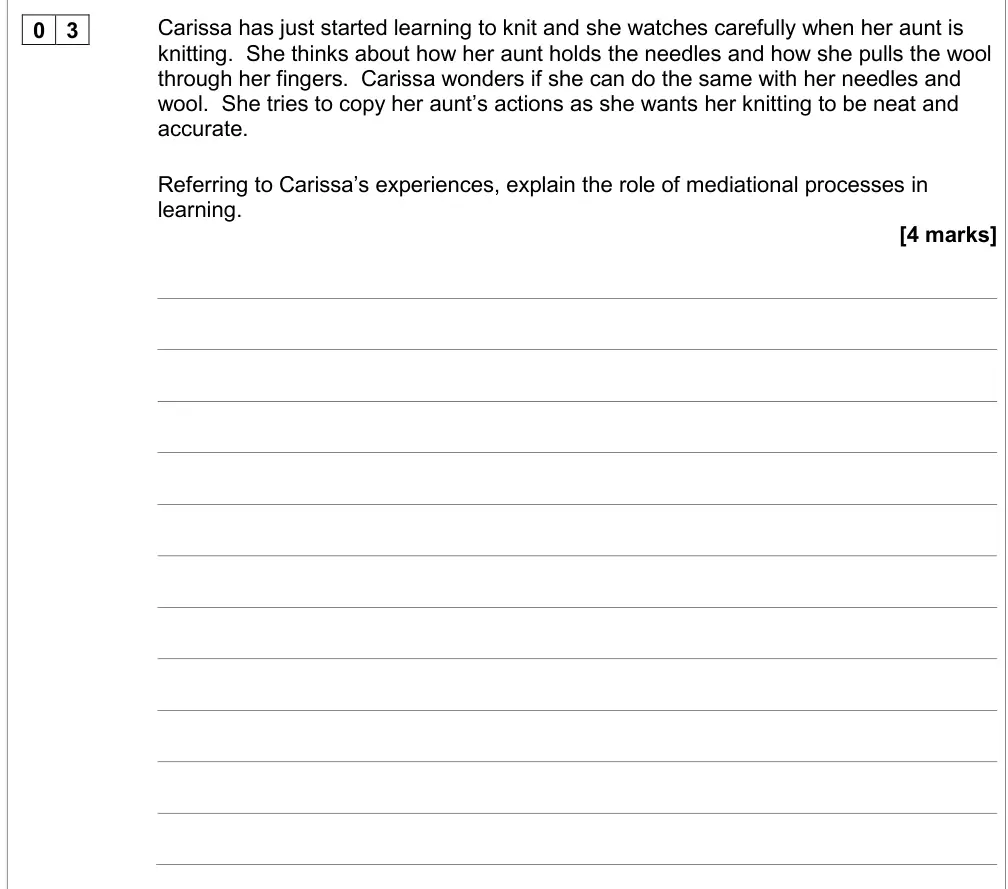
November 2020 · AS Paper 2 · Q34 marksAO2=4Application
Mark scheme, including level descriptors and indicative content
Notes from the mark scheme and report
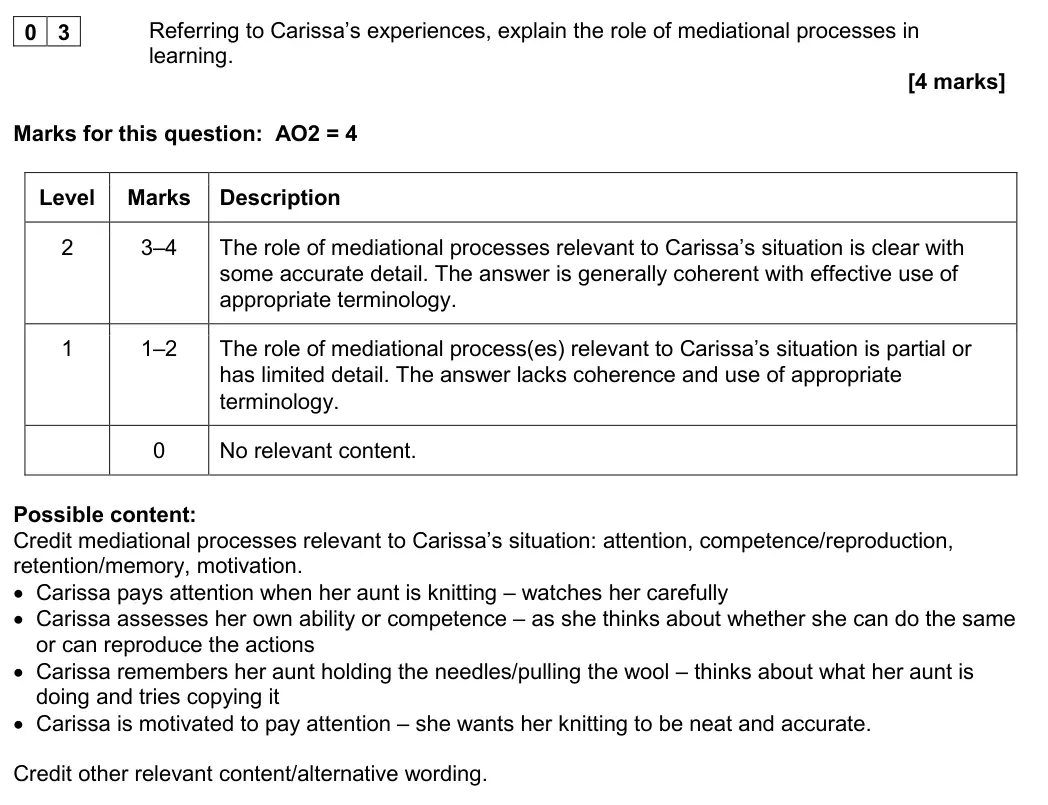
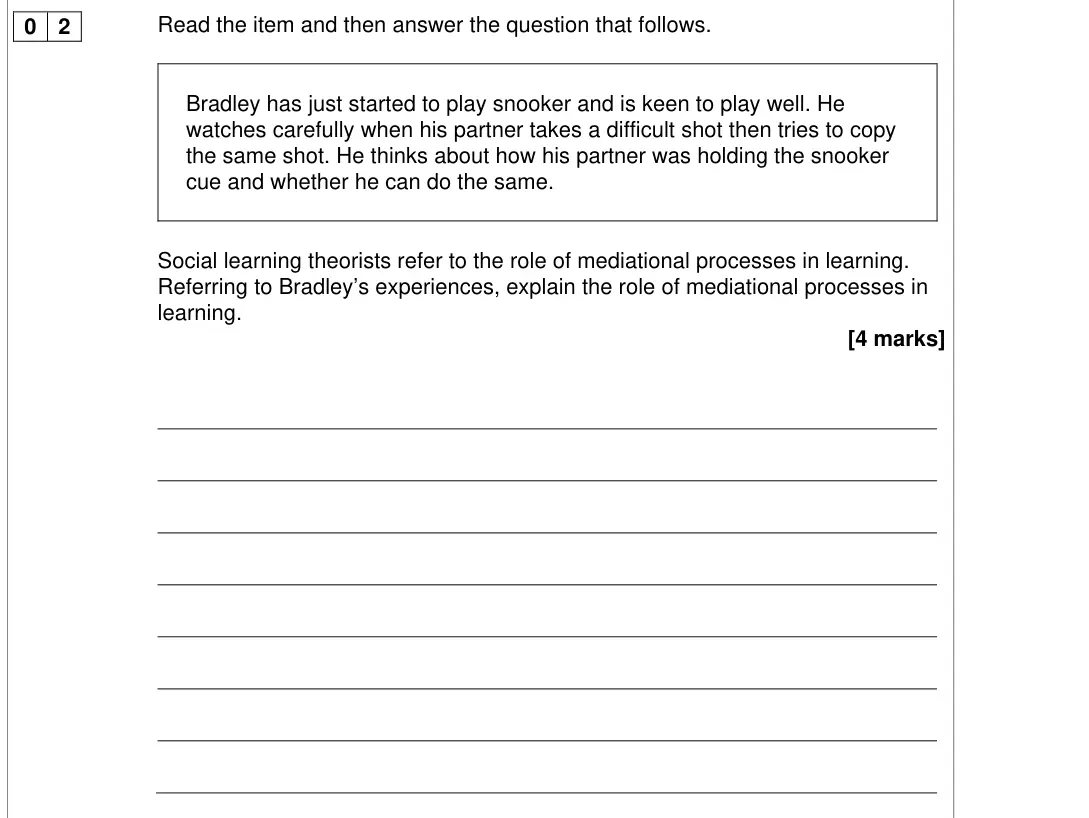
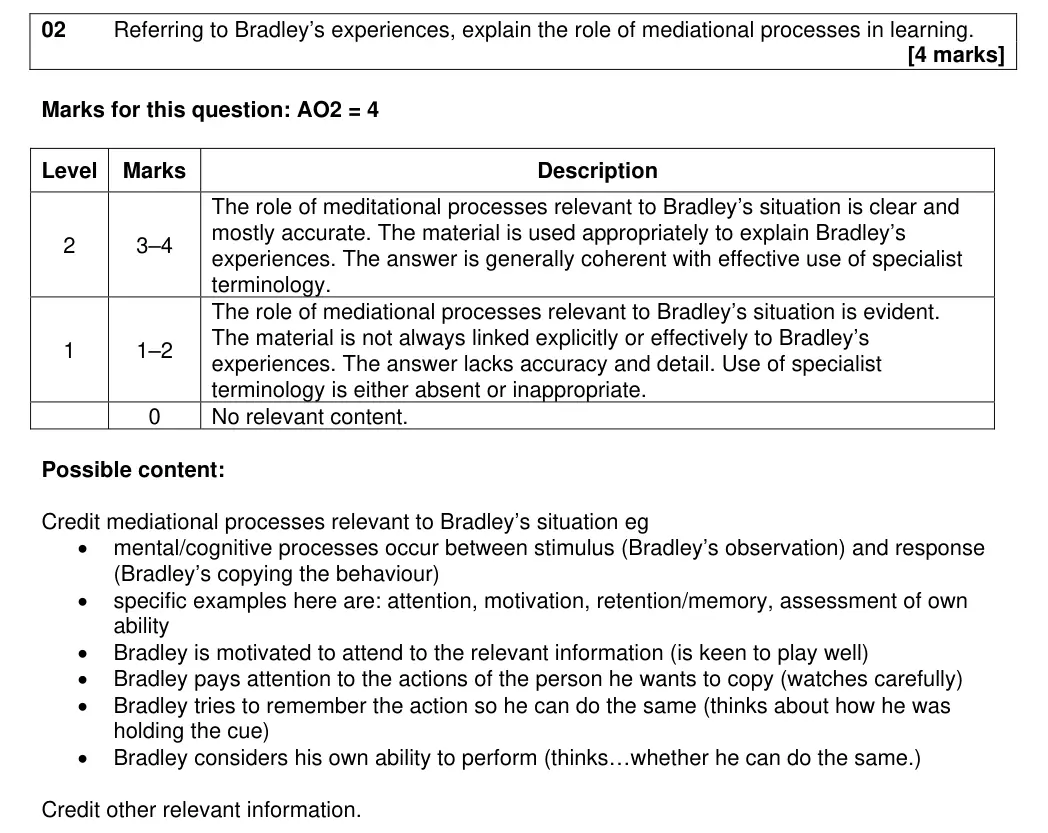
mediational processes applied to Carissa: attention (watches carefully), retention (remembers how needles held), reproduction (wonders if she can do the same), motivation (wants neat knitting)
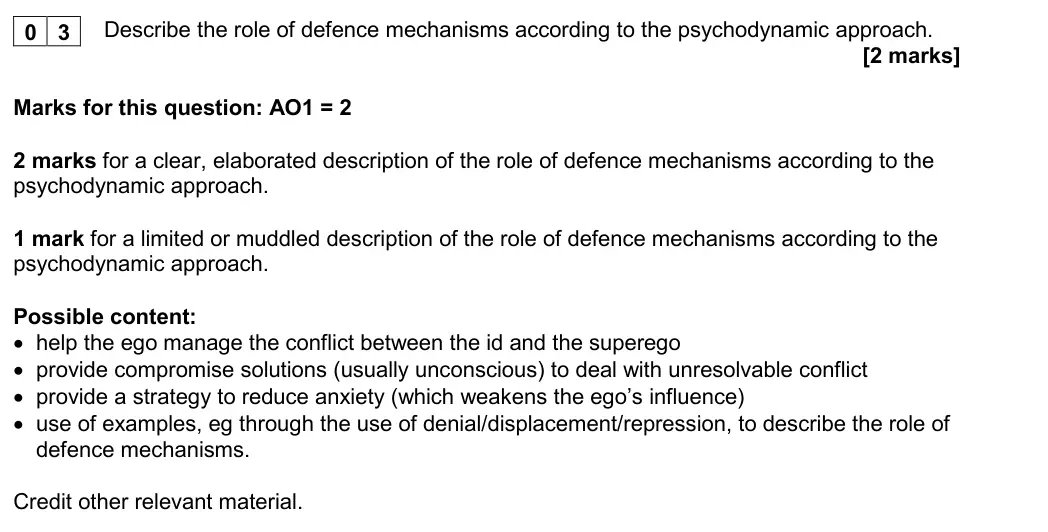
November 2020 · Paper 2 · Q32 marksAO1=2Outline
Mark scheme, including level descriptors and indicative content
Examiner's comment
This question was a good discriminator of students’ understanding. There were some excellent, clear descriptions of the role of defence mechanisms, showing an impressive understanding and use of terminology but also a surprising number of students did not attempt this question. Those students gaining only one of the two marks generally provided a limited description which lacked clear elaboration. Some students were only able to name defence mechanisms but seemed unclear on their role and thus could not gain credit for their answers.
examples (denial, displacement, repression) as elaboration
naming defence mechanisms without their role gained no credit
many did not attempt
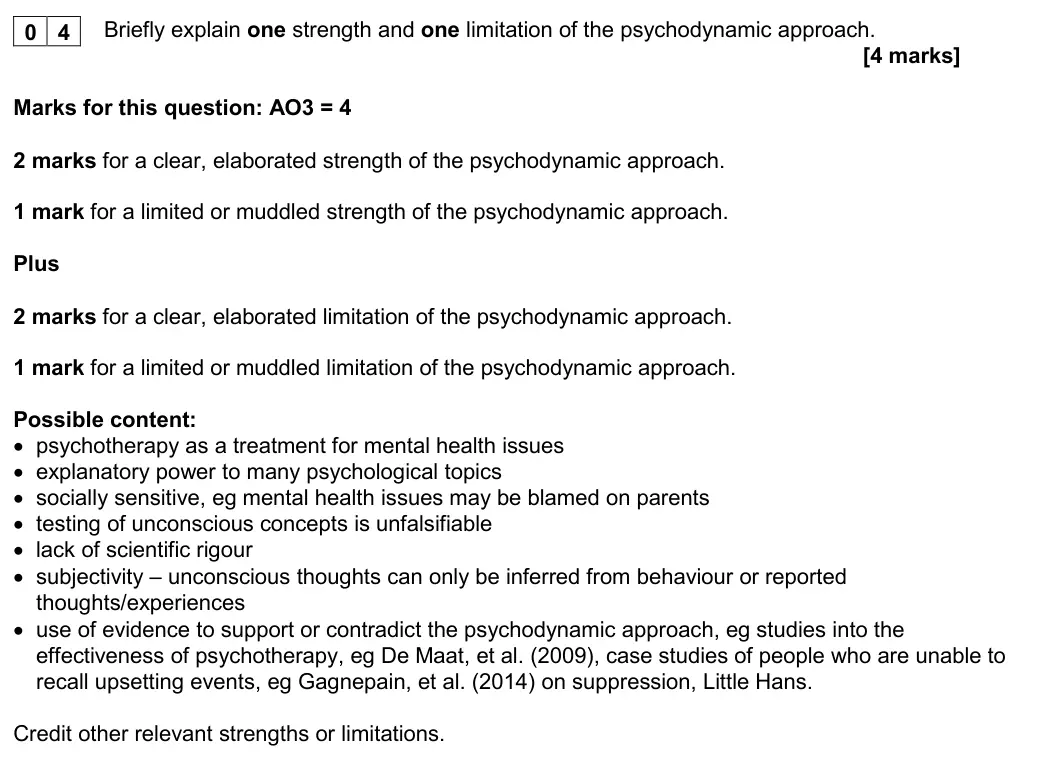
November 2020 · Paper 2 · Q44 marksAO3=4Evaluate (short)
Mark scheme, including level descriptors and indicative content
Examiner's comment
This question produced a mixed response. Overall limitations were attempted better than the strengths, with most focussing on the lack of scientific rigour/unfalsifiablity of the psychodynamic approach, although there were some strong responses using issues and debates from 7182/3 e.g. those which focussed on androcentrism. Strengths tended to be quite general with those relating to treatments most common but overall strengths were often limited or muddled.
Notes from the mark scheme and report
2+2 marks: e.g. psychotherapy/explanatory power vs unfalsifiable, lack of scientific rigour, subjectivity
strengths often general/muddled
issues and debates (e.g. androcentrism) credited as limitation
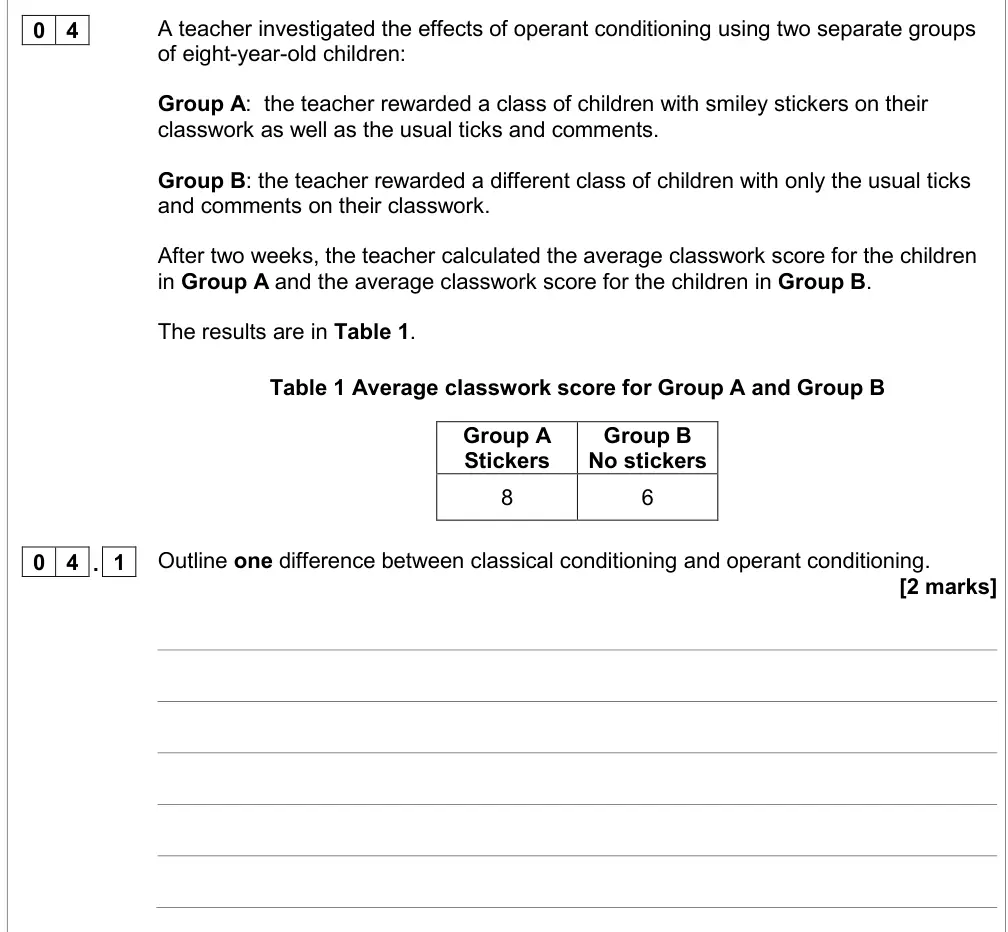
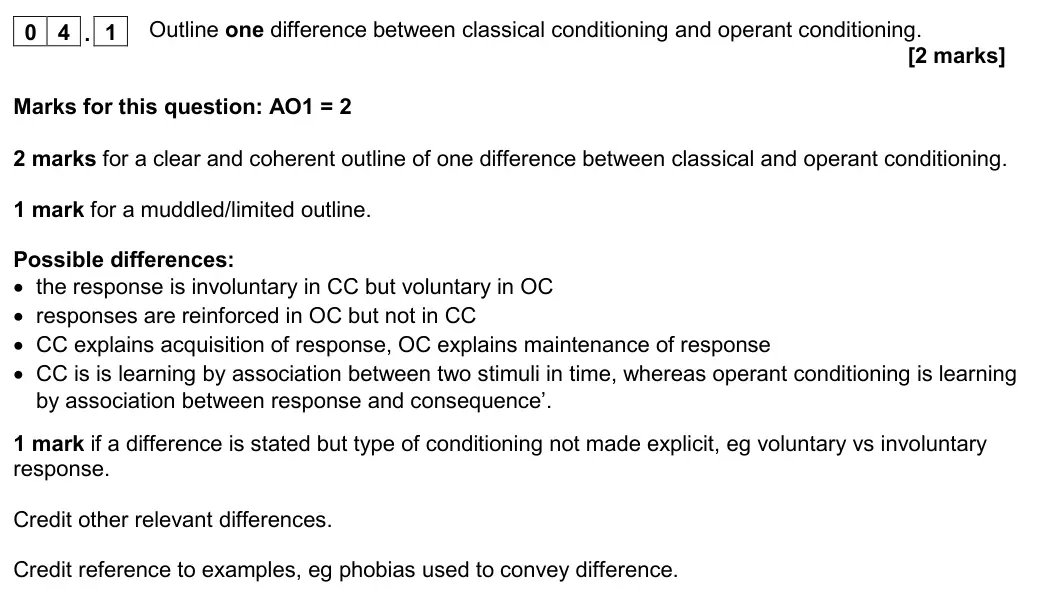
November 2020 · AS Paper 2 · Q4.12 marksAO1=2Outline
Mark scheme, including level descriptors and indicative content
Notes from the mark scheme and report
e.g. involuntary vs voluntary responses, association between stimuli vs between response and consequence
difference stated without saying which type = 1 mark
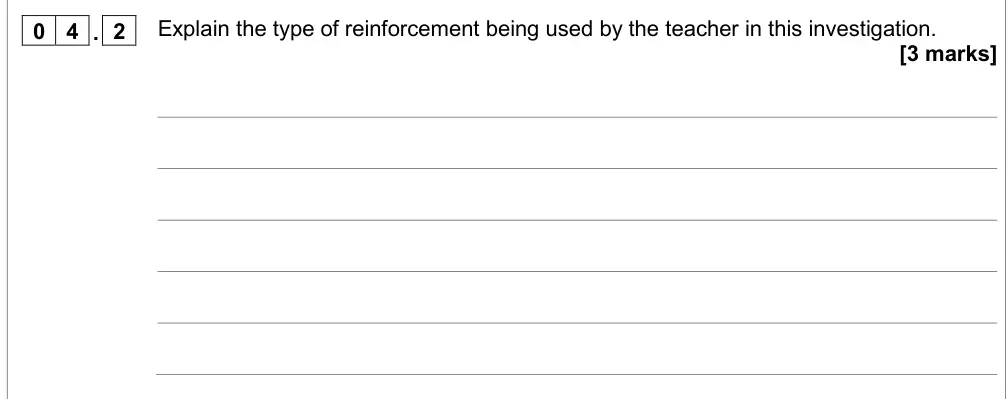
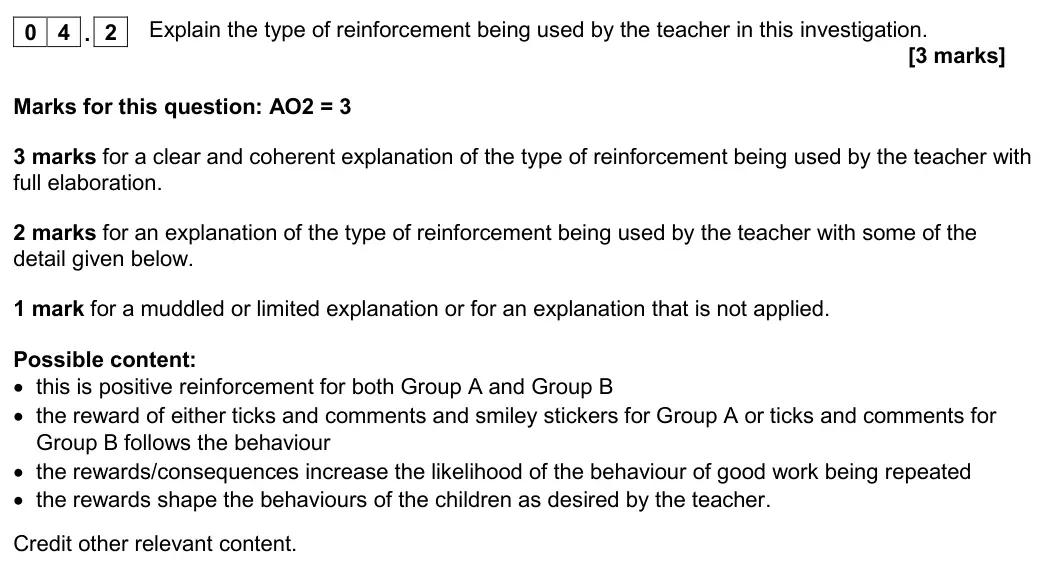
November 2020 · AS Paper 2 · Q4.23 marksAO2=3Application
Mark scheme, including level descriptors and indicative content
Notes from the mark scheme and report
positive reinforcement for both groups (stickers and/or ticks/comments) increases likelihood of good work being repeated
unapplied = 1 mark
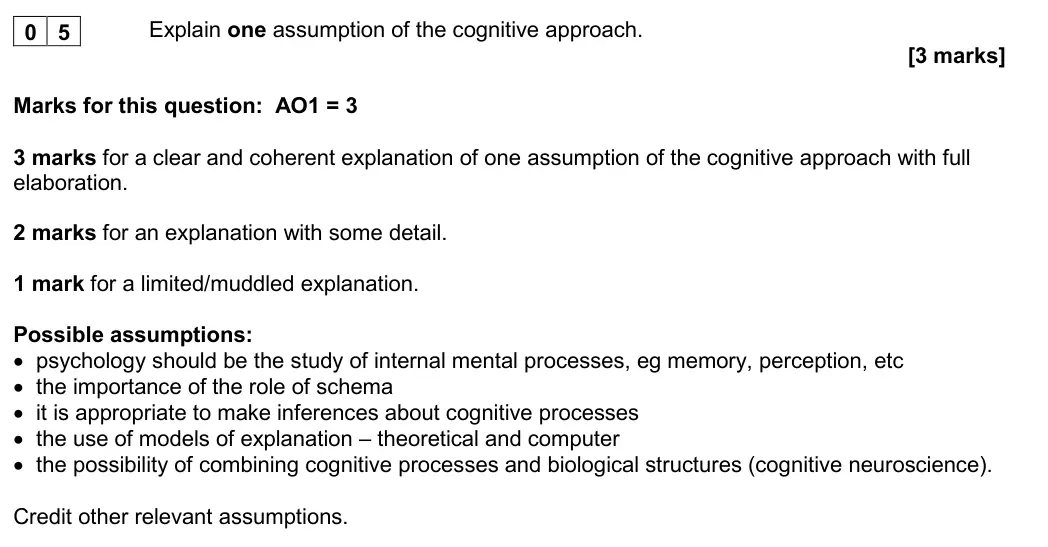
November 2020 · AS Paper 2 · Q53 marksAO1=3Explain
Mark scheme, including level descriptors and indicative content
Notes from the mark scheme and report
e.g. study of internal mental processes, schema, inference, theoretical/computer models, cognitive neuroscience
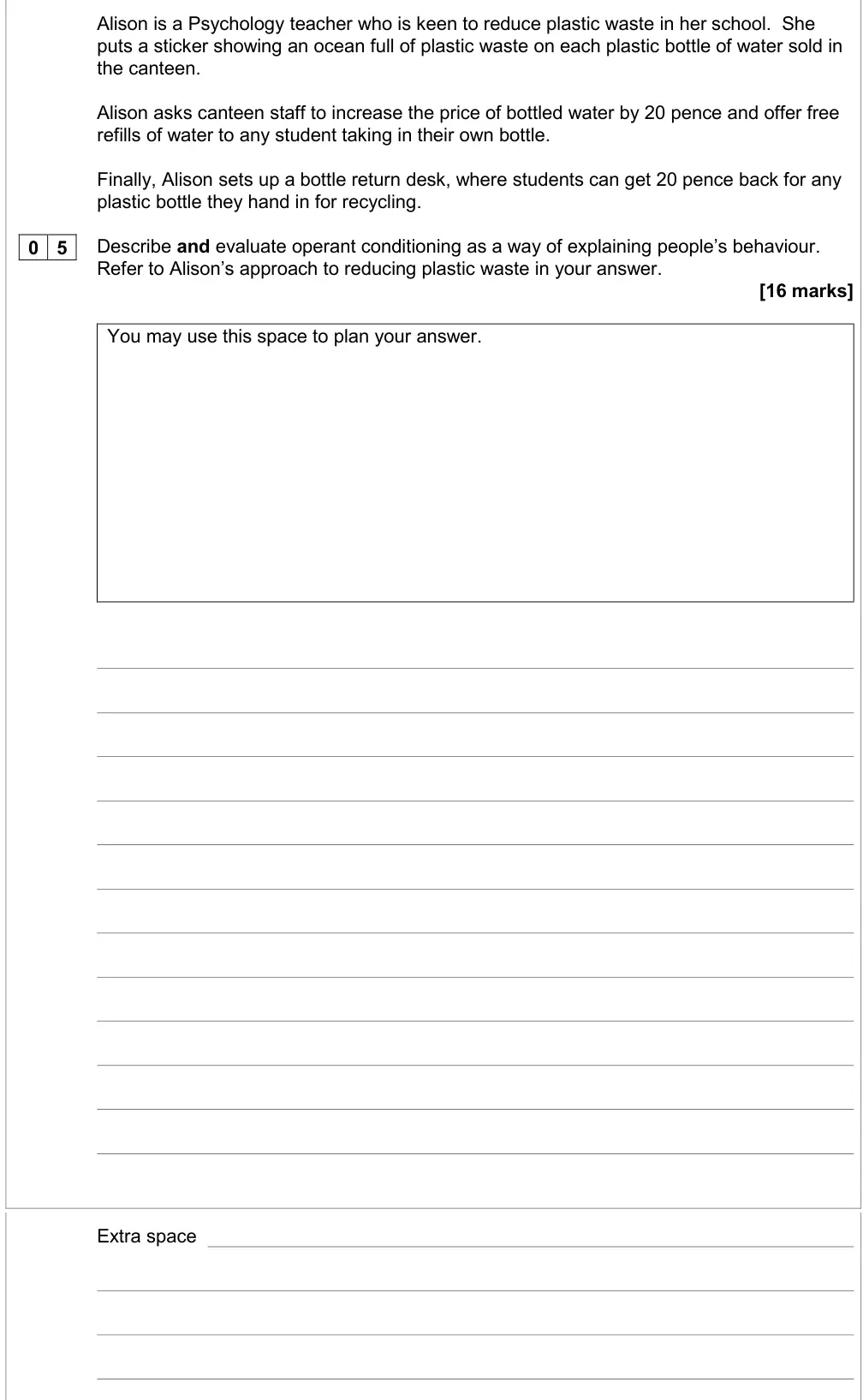
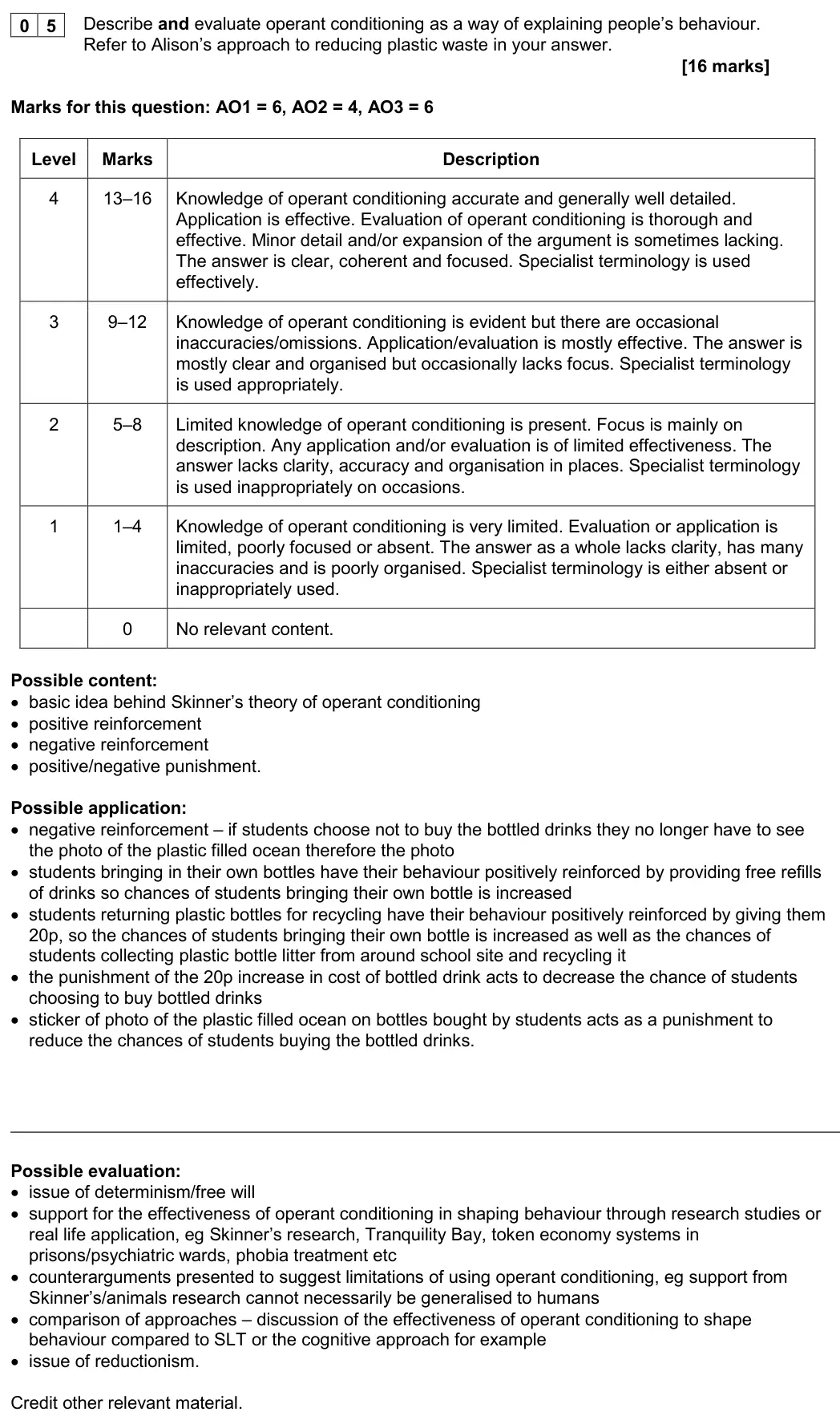
November 2020 · Paper 2 · Q516 marksAO1=6, AO2=4, AO3=616-mark essay
Mark scheme, including level descriptors and indicative content
Examiner's comment
Overall, students seemed to have a sound understanding of operant conditioning and could outline the basic ideas and types of reinforcement. Sadly, students continue to muddle the learning approaches with some students describing classical conditioning and/or social learning theory. Application was the strongest of the three assessed skills, with weaker students able to explain the types of reinforcement more clearly through application and more able students able to integrate application throughout their description and evaluation. Positive reinforcement and punishment were generally explained accurately but negative reinforcement tended to be more muddled. Although there were cases of thorough and effective evaluation, sadly many responses still tended to present generic evaluation with weaker answers focussing on methodological issues of Skinners’ research rather than a critique of operant conditioning. The issue of generalising Pavlov’s research from animals to humans was often stated but not developed, focussing on ethics, and demonstrating little awareness of the importance of animal research in the behavioural approach. There was some effective and well- discussed evaluation focussing on token economy systems and linking this back to application in terms of the issues of long-term behavioural changes once rewards were discontinued. Unfortunately there was also evidence of pre-learned behaviourist essays which were not altered for this question.
Notes from the mark scheme and report
positive/negative reinforcement and punishment applied to the sticker, price rise, free refills and 20p return
negative reinforcement often muddled
describing classical conditioning or SLT not creditworthy
evaluation often generic or about Skinner's methodology rather than the theory
unaltered pre-learned behaviourist essays
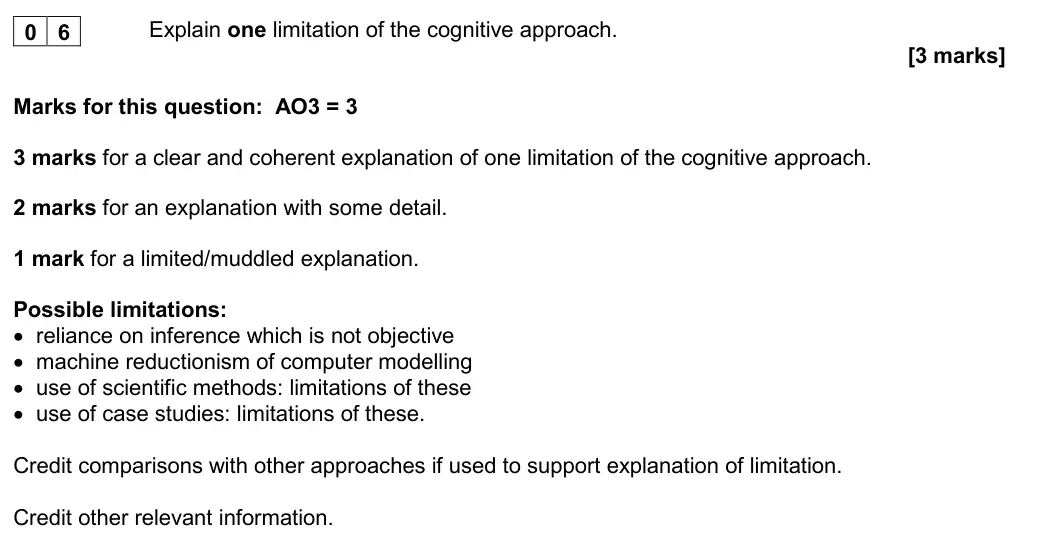
November 2020 · AS Paper 2 · Q63 marksAO3=3Evaluate (short)
Mark scheme, including level descriptors and indicative content
Notes from the mark scheme and report
e.g. inference not objective, machine reductionism, limitations of scientific methods/case studies
comparison credited only if used to explain a limitation
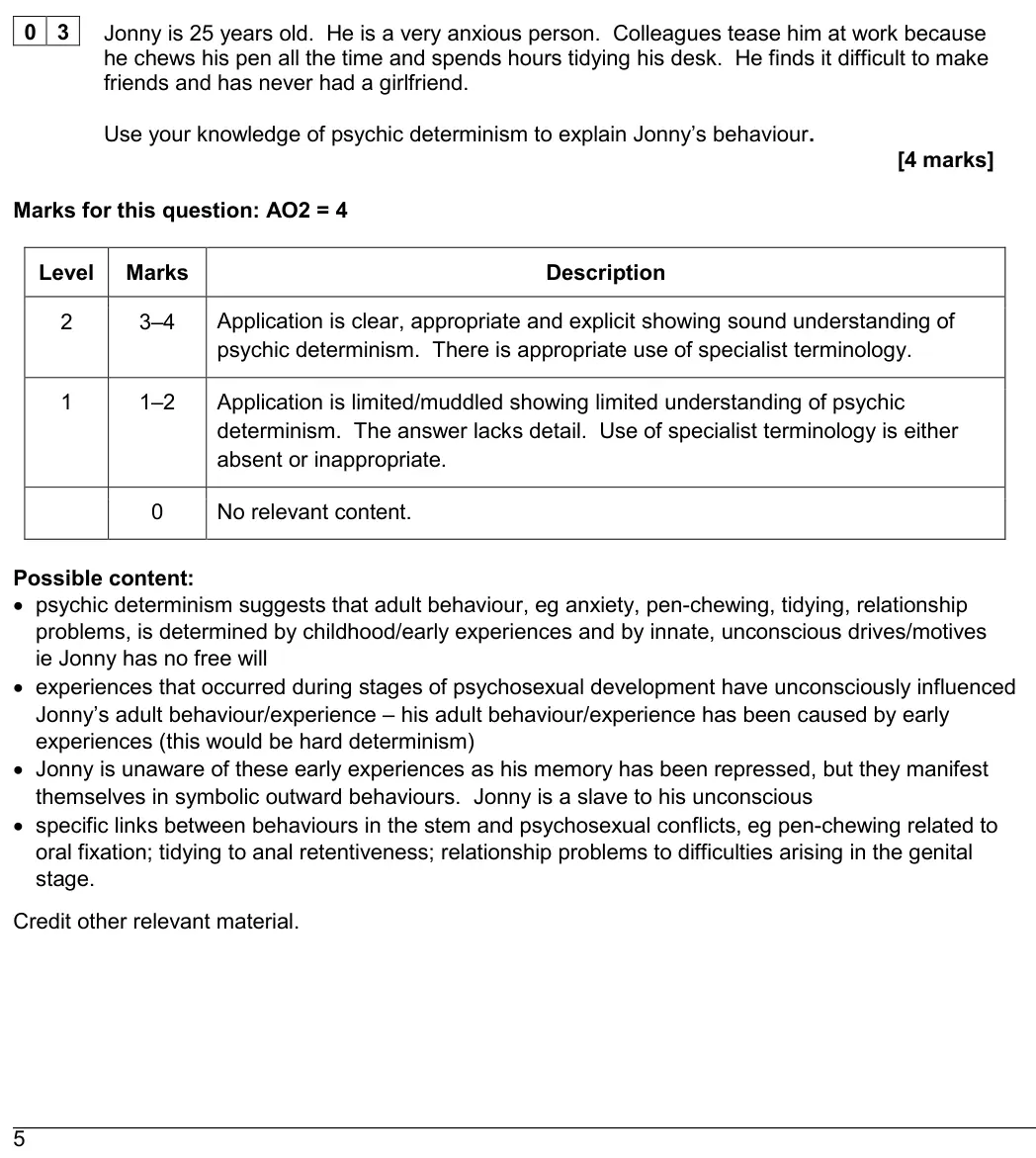
November 2020 · Paper 3 · Q34 marksAO2=4Application
Mark scheme, including level descriptors and indicative content
Examiner's comment
Most answers on psychic determinism could make sensible links to the stem although a significant number had no psychodynamic references at all.
Notes from the mark scheme and report
adult behaviour caused by unconscious drives/early experience (no free will)
link pen-chewing to oral fixation, tidying to anal retentiveness, relationship problems to genital stage
must apply to Jonny
November 2020 · Paper 3 · Q336 marksAO1=6OutlineOld spec only
Not on the 2025 specification: psychodynamic explanations of offending: weak/deviant/harsh superego, maternal deprivation, defence mechanisms, removed in v1.4
Mark scheme, including level descriptors and indicative content
Examiner's comment
The 6-mark questions required description only and were usually competently tackled. A few students wasted time by offering evaluation.
Notes from the mark scheme and report
Off-spec: psychodynamic explanations of offending: weak/deviant/harsh superego, maternal deprivation, defence mechanisms, removed in v1.4
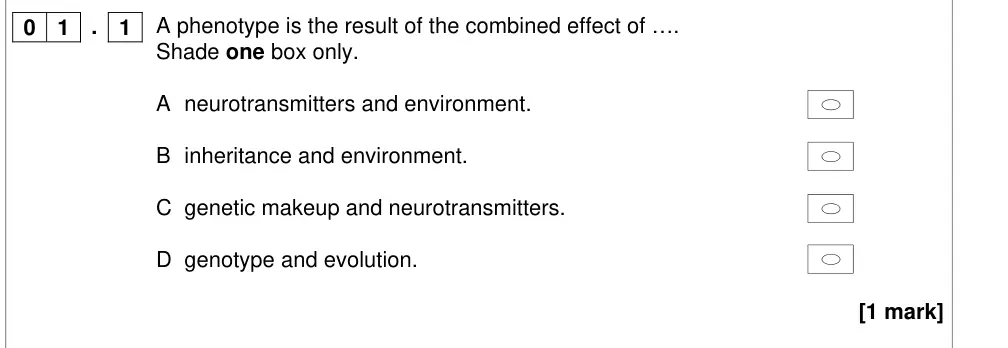
June 2019 · Paper 2 · Q11 markAO1=1Multiple choiceHard
Answer
A
Mark scheme, including level descriptors and indicative content
Examiner's comment
This was a challenging question with only a minority of students correctly identifying the right answer. All the distractors worked effectively but the most common incorrect response was option C.
Notes from the mark scheme and report
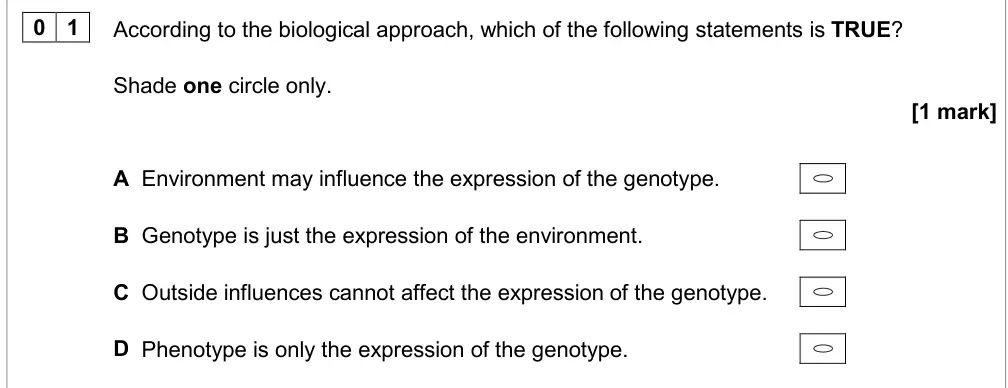
correct answer A (environment may influence expression of the genotype)
genotype/phenotype distinction
challenging, only a minority correct
most common wrong answer C
June 2019 · AS Paper 2 · Q21 markAO1=1Multiple choiceEasy
Answer
B
Mark scheme, including level descriptors and indicative content
Examiner's comment
The majority of students were able to answer this question correctly and it appeared that many had sufficient knowledge of the cognitive approach to be able to identify the feature which was not part of the approach.
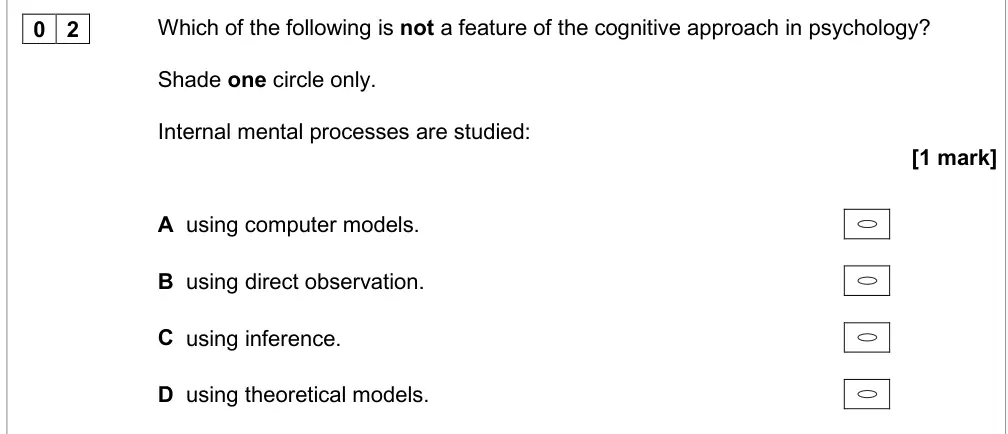
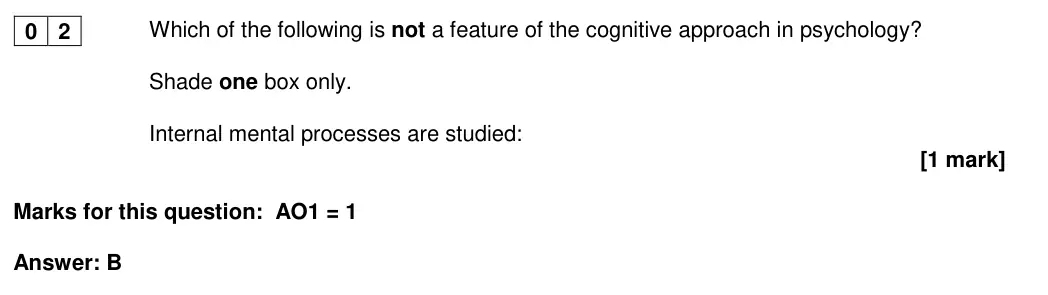
Notes from the mark scheme and report
correct answer B (direct observation is NOT a feature)
computer models, inference and theoretical models are
June 2019 · Paper 2 · Q21 markAO1=1Multiple choice
Answer
B
Mark scheme, including level descriptors and indicative content
Examiner's comment
This question was generally well answered with most students selecting the correct response. The most common incorrect response was distractor C.
Notes from the mark scheme and report
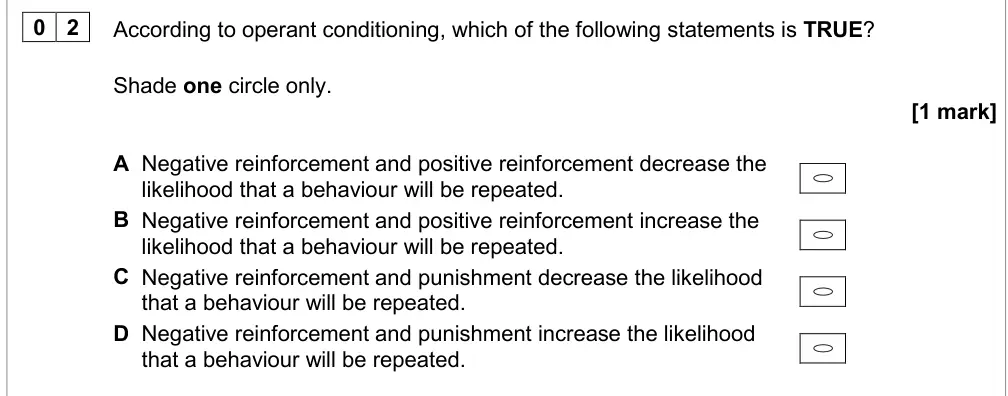
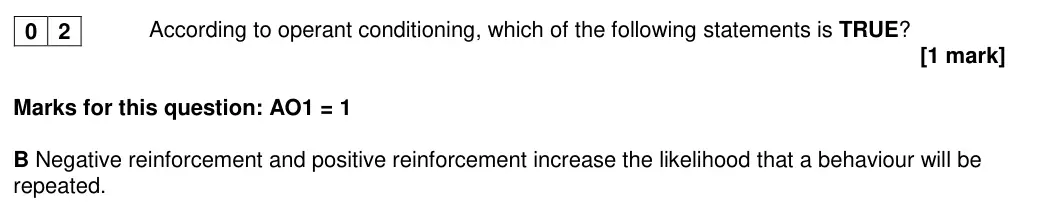
correct answer B (negative and positive reinforcement both increase repetition)
most common wrong answer C (confusing negative reinforcement with punishment)
June 2019 · AS Paper 2 · Q31 markAO3=1Evaluate (short)Easy
Mark scheme, including level descriptors and indicative content
Examiner's comment
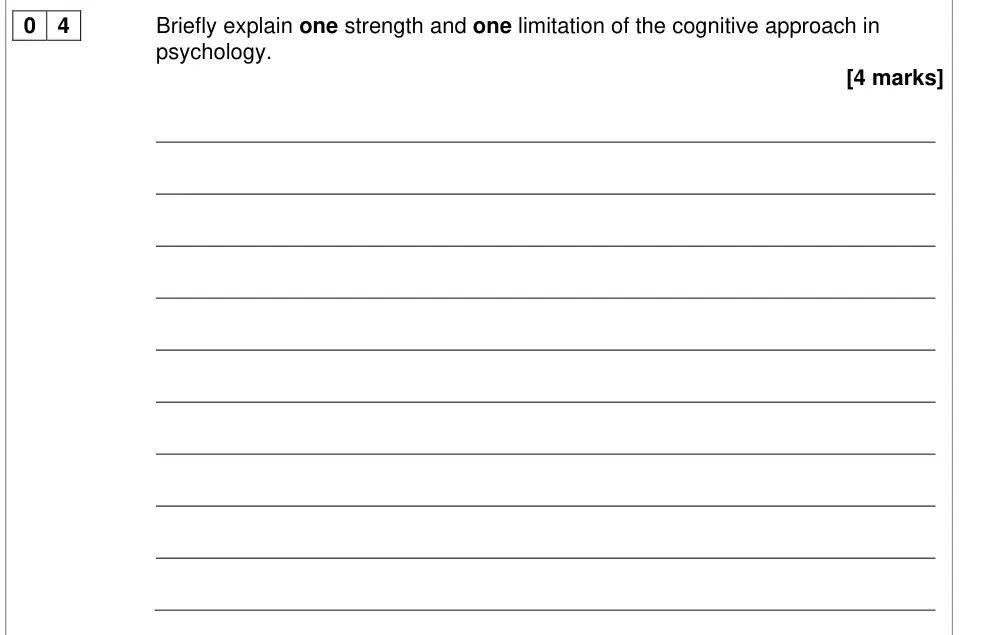
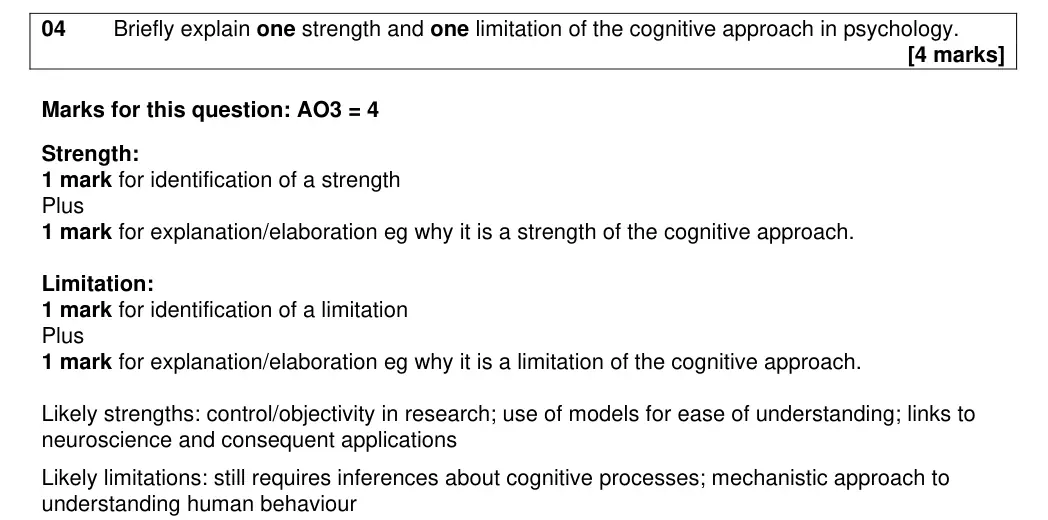
This question was generally answered less well than question 2 suggesting that students had better knowledge of the features of the cognitive approach than the limitations of the approach. The majority of correct responses were based around machine reductionism or artificial testing. A significant minority of students simply wrote vague and potentially incorrect statements such as ‘ignores the biological approach’. It is important to remind students that although the approaches are distinct, they are not ignorant of each other and merely provide a different approach for explaining behaviour. There was also some significant confusion surrounding reductionism in this question where it appeared students did not seem to understand the concept so would apply it inaccurately to the cognitive approach.
Notes from the mark scheme and report
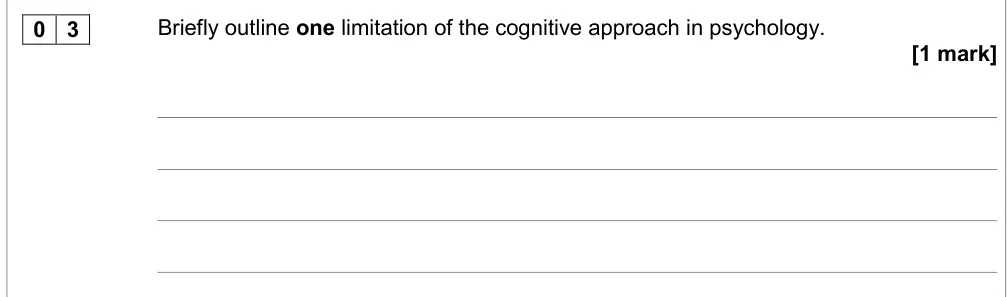
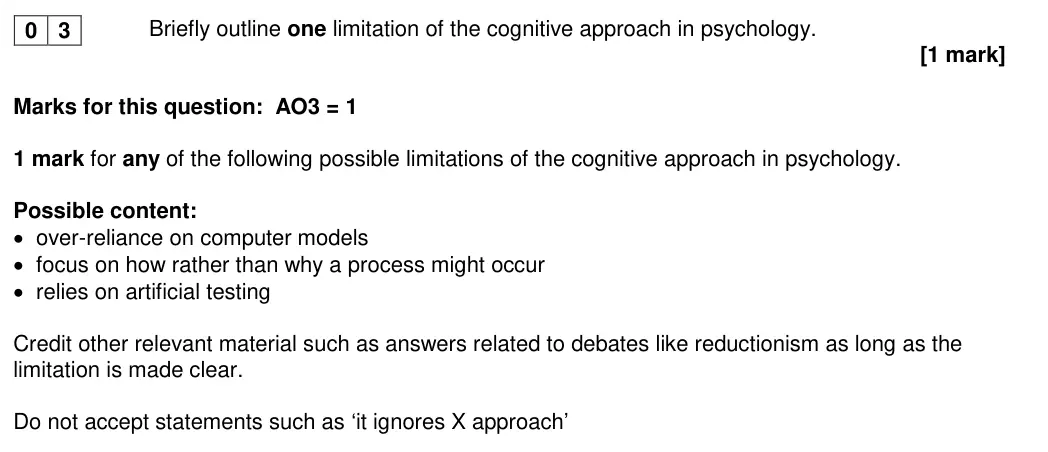
e.g. over-reliance on computer models (machine reductionism), how not why, artificial testing
'ignores X approach' not accepted
reductionism often misapplied
June 2019 · Paper 2 · Q32 marksAO1=2Outline
Mark scheme, including level descriptors and indicative content
Examiner's comment
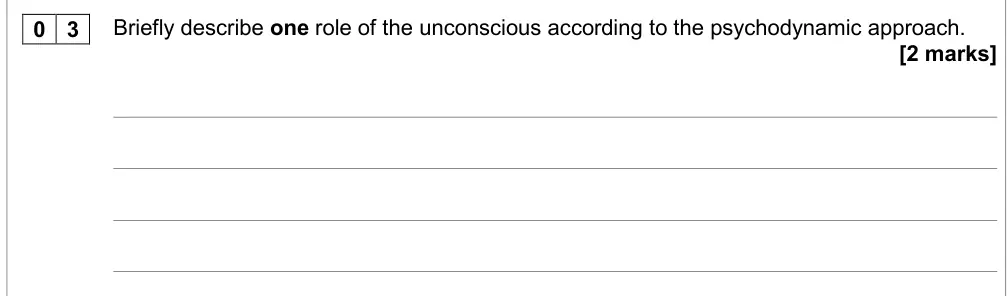
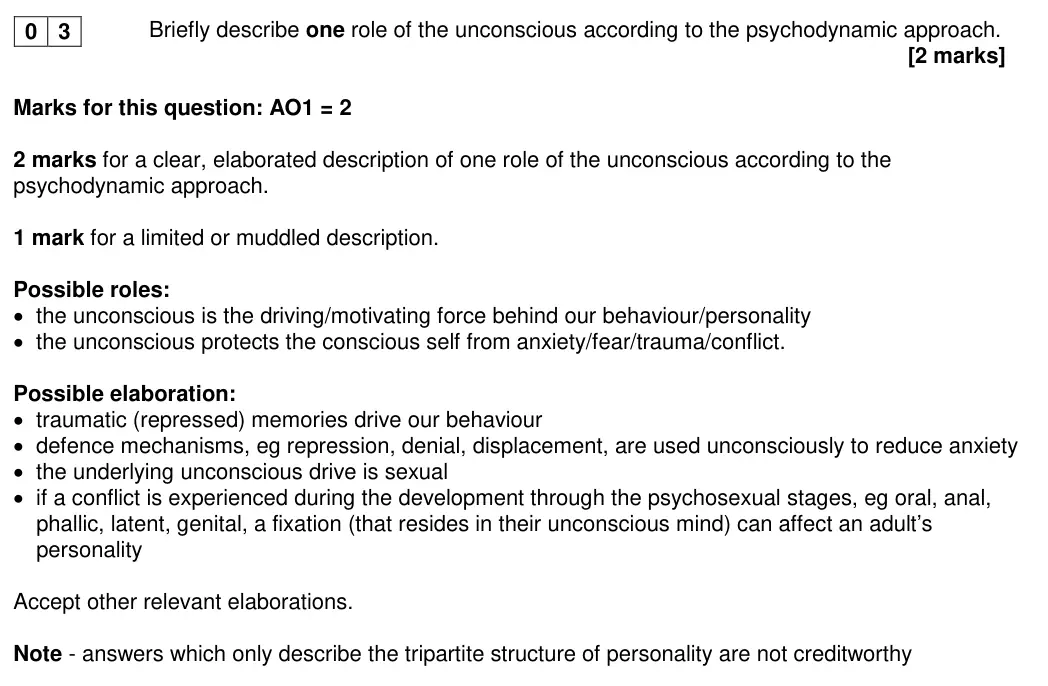
This question on the whole was answered reasonably well, although most students achieved 1 mark through lack of relevant elaboration. There was some good knowledge of the psychodynamic approach presented, however some students described the tripartite structure of personality rather than focusing on the role of the unconscious. Some students did not follow the instruction to focus on the psychodynamic approach and instead described the unconscious in general terms.
Notes from the mark scheme and report
role e.g. driving force behind behaviour or protecting the conscious self from anxiety
elaboration via defence mechanisms, repression, psychosexual fixation
describing only the tripartite structure of personality not creditworthy
most scored 1 for lack of elaboration
June 2019 · AS Paper 2 · Q46 marksAO1=3, AO2=3Application
Mark scheme, including level descriptors and indicative content
Examiner's comment
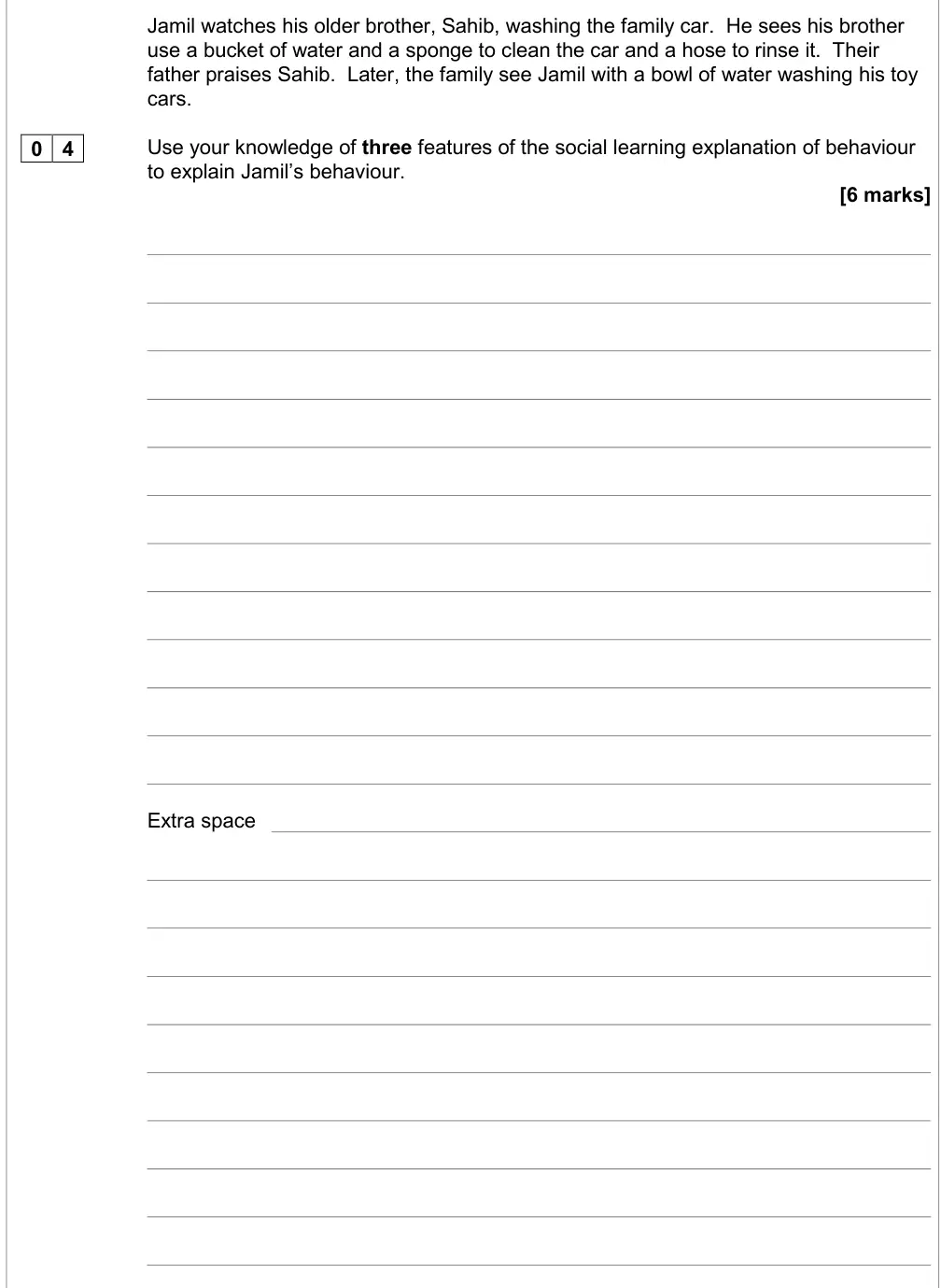
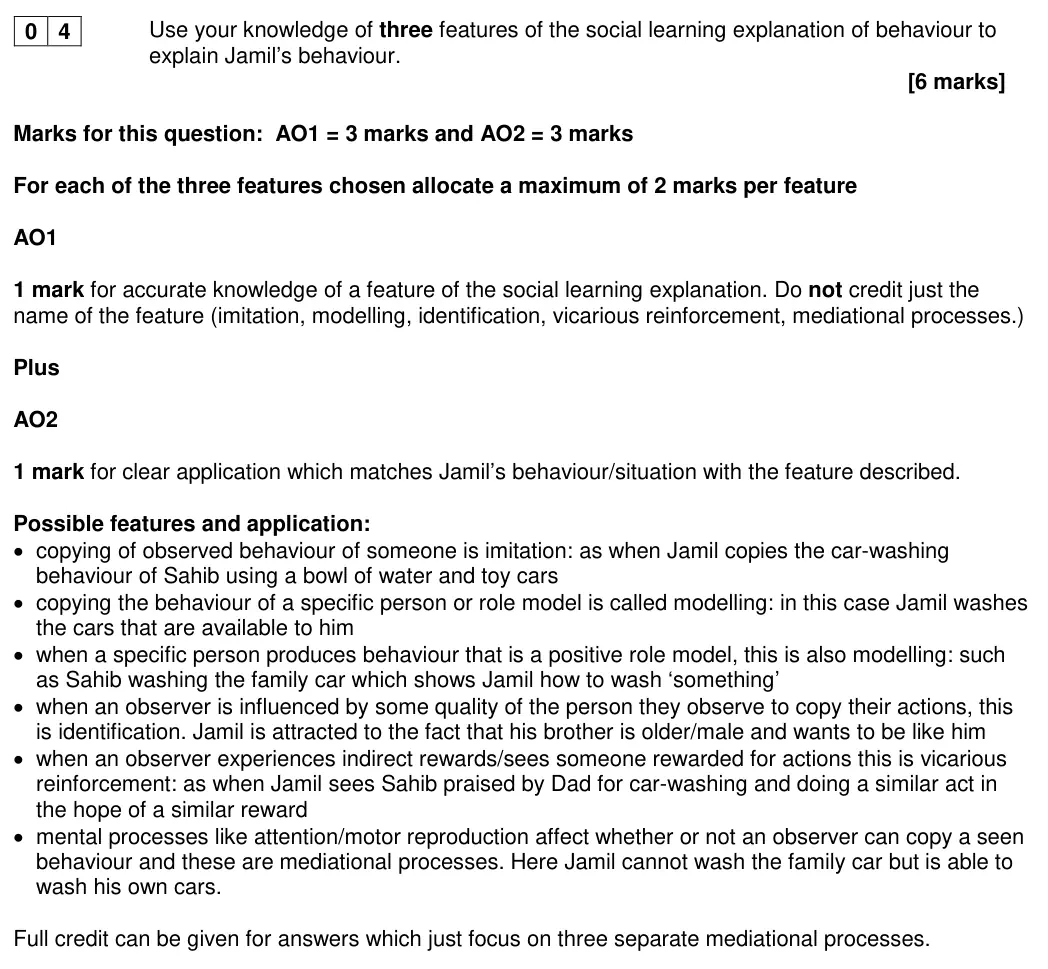
A significant majority of students clearly had knowledge of social learning theory and there were many clear and coherent outlines of three different features. However, some students simply named the features and did not outline them as the question asked. The application to the scenario was also mixed with many students fully applying the features to the stimulus material whilst others failed to apply any of the features of social learning theory to the situation.
Notes from the mark scheme and report
per feature: 1 mark accurate knowledge (not just naming) + 1 application to Jamil (imitation, identification with older brother, vicarious reinforcement from father's praise, mediational processes)
three mediational processes alone can get full marks
MS also lists 'modelling', a term removed from the v1.4 SLT wording
June 2019 · Paper 2 · Q46 marksAO2=6Application
Mark scheme, including level descriptors and indicative content
Examiner's comment
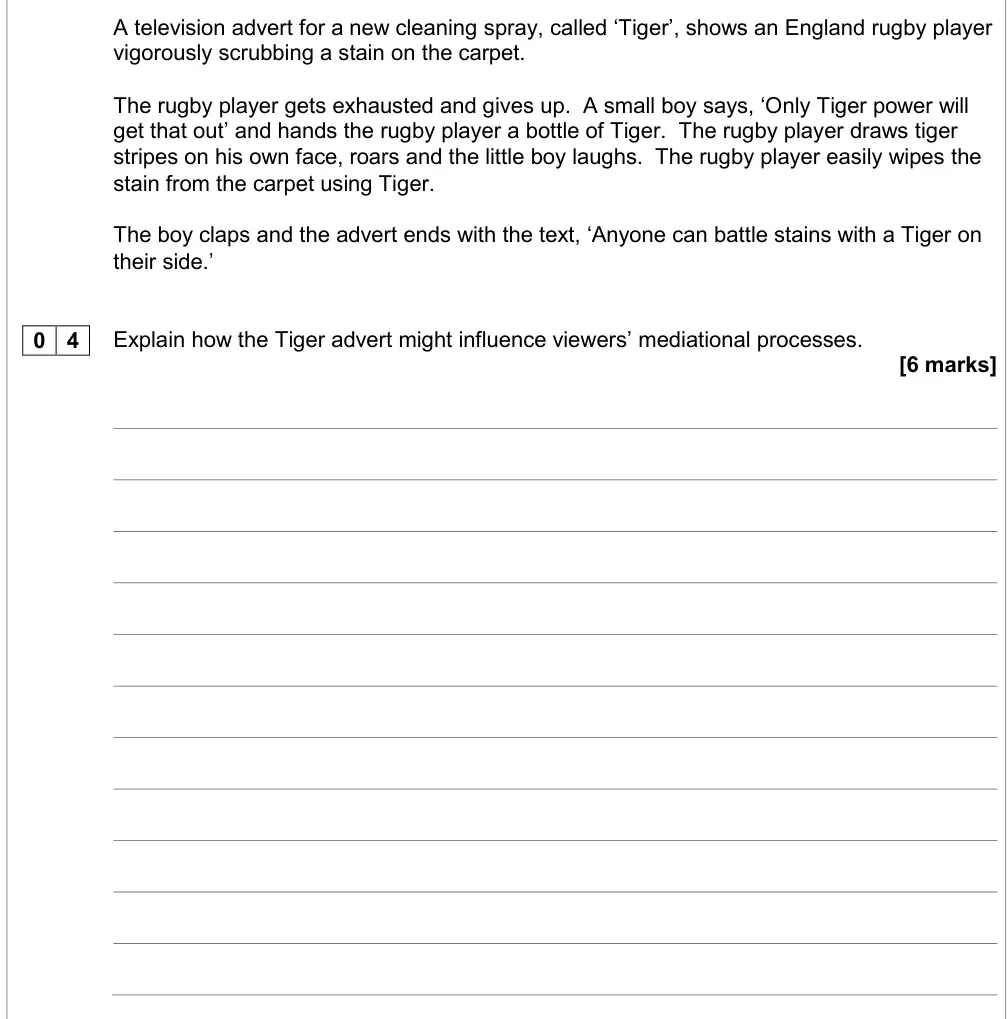
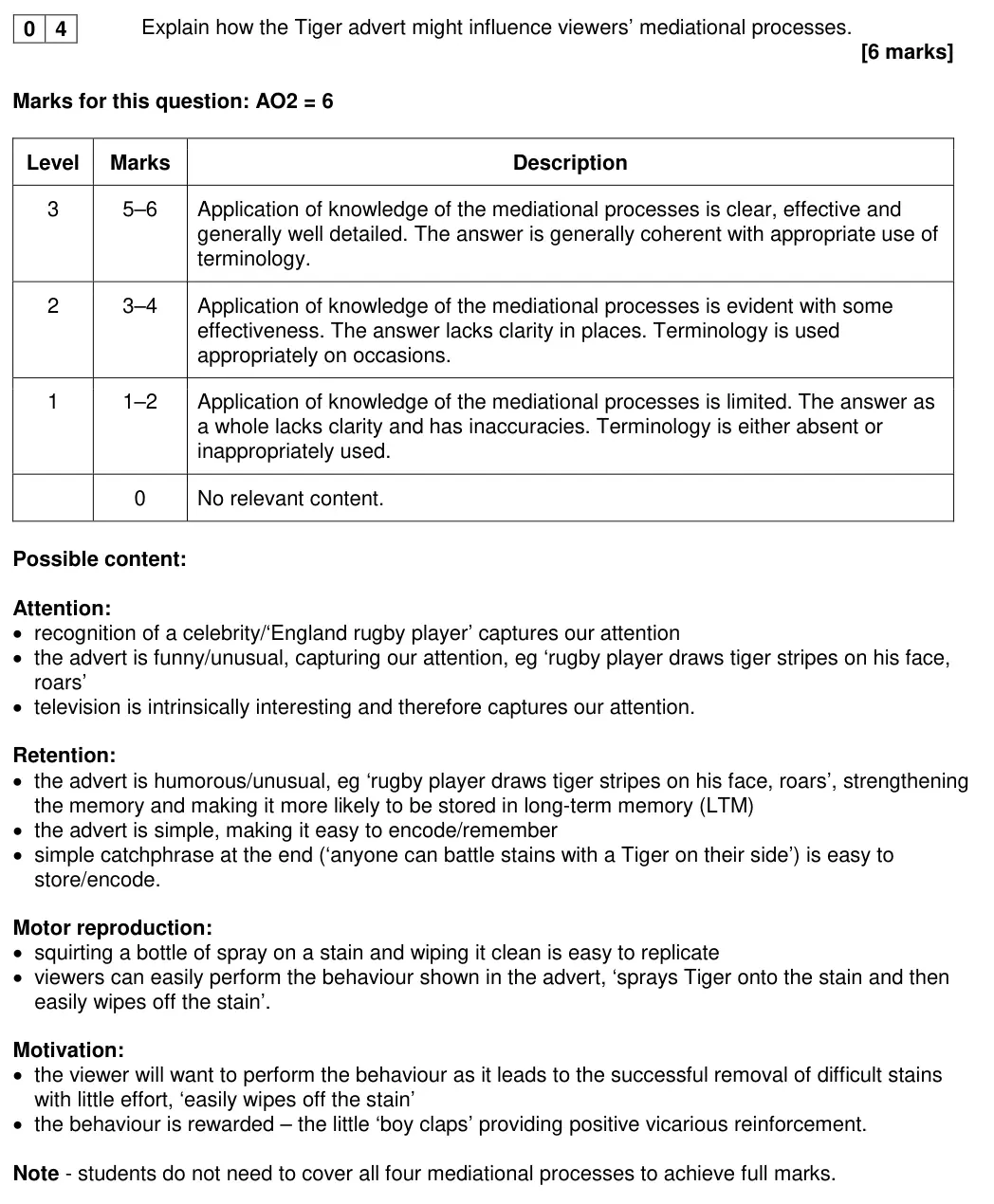
This question produced mixed results. There was clear evidence of a good knowledge of mediational processes, yet rather a large proportion of students did not manage to apply the material effectively to explain how the advert might influence viewers’ mediational processes. There were some very effective answers that combined their knowledge of mediational processes with excellent application. Less effective responses only provided limited references to the advert. Students who focused their application effectively on the advert’s influence on viewers’ mediational processes often did very well, while those who wrote more generally about social learning theory, imitation and vicarious reinforcement did less well. There were many cases where students gave the theoretical knowledge first and then repeated this information in their application. Students should be made aware that knowledge will still be creditworthy when embedded in application/discussion to avoid wasting precious time by repeating information.
Notes from the mark scheme and report
apply attention, retention, motor reproduction and motivation to the Tiger advert
need not cover all four for full marks
many wrote generally about SLT/imitation/vicarious reinforcement with limited reference to the advert
knowledge embedded in application is creditworthy, no need to repeat
June 2019 · AS Paper 2 · Q512 marksAO1=6, AO3=6Extended writingMedium
Mark scheme, including level descriptors and indicative content
Examiner's comment
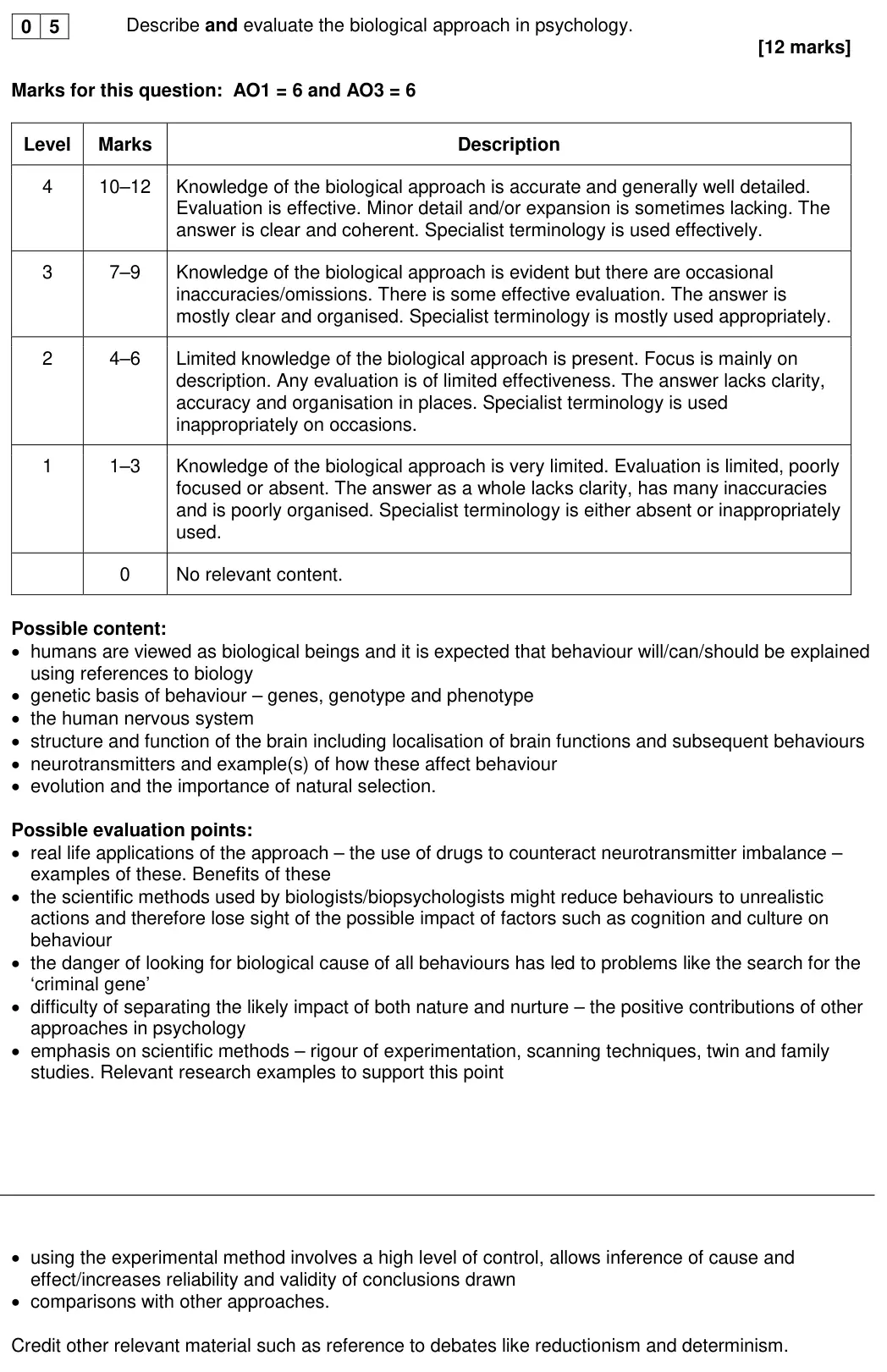
Students should also take care with the balance of assessment objectives in questions which involve extended writing such as questions 5 and 12. In these questions, there should be an equal balance of knowledge/understanding and discussion/evaluation, but some students were producing excessive amounts of one assessment objective and minimal amounts of the other and thus were not able to access the higher levels and marks. This question appeared to discriminate well between students as a wide range of responses were seen. A minority of students described and evaluated a different approach, most commonly the behavioural approach, and thus were awarded 0 marks. Description of the biological approach was typically better than the evaluation. Most students demonstrated some accurate knowledge of genetics and better responses also described the nervous system, neurotransmitters and evolution. The evaluation often centred on the benefits of drug therapies, but these were not always explicitly linked to the biological approach. A range of evaluation was seen in some responses, but a number showed confusion. For example, a significant minority of students accurately described phenotype and then went on to claim that the biological approach ignored the environment. Students should also be reminded to ensure all content is linked clearly psychological as some very poor examples were seen, for example, the use of clothing to illustrate phenotype.
evaluation: drug applications, scientific methods, reductionism, nature-nurture
describing another approach = 0
drug benefits not always linked to the approach
claiming it ignores environment after describing phenotype
June 2019 · Paper 2 · Q52 marksAO2=2Application
Mark scheme, including level descriptors and indicative content
Examiner's comment
This question was generally answered well. The majority of students were able to use their knowledge of social learning theory effectively to explicitly describe the identification with, and imitation of, the model.
Notes from the mark scheme and report
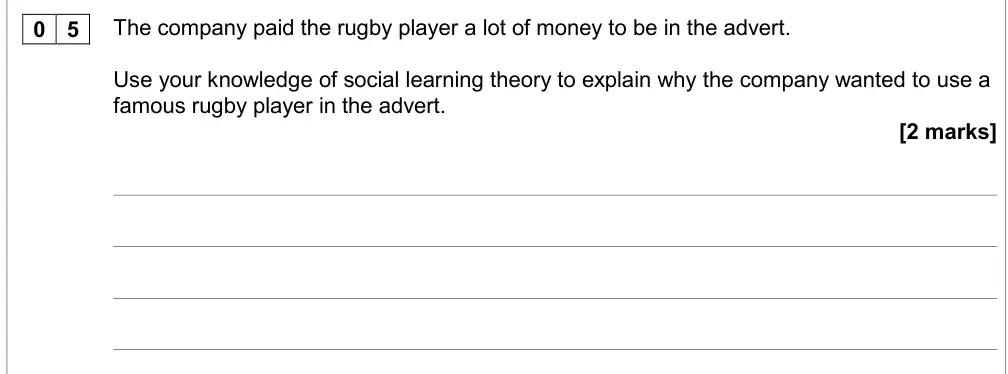
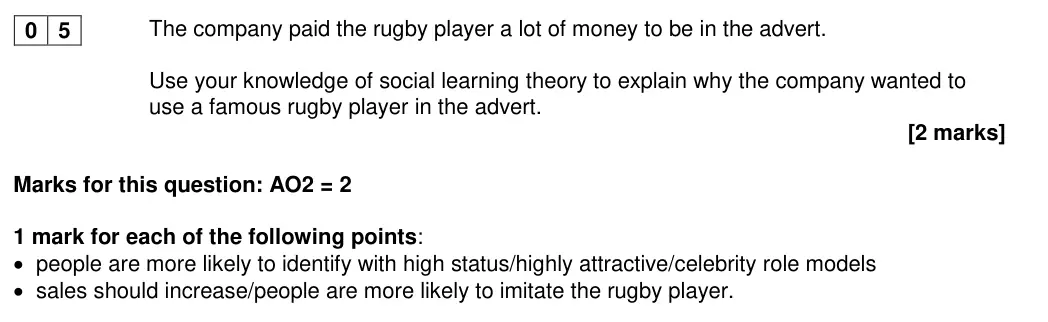
1 mark identification with a high-status/celebrity role model + 1 mark more likely to imitate/increase sales
June 2019 · Paper 2 · Q71 markAO2=1Application
Mark scheme, including level descriptors and indicative content
Examiner's comment
This question was very well answered; almost all students were able to provide a modification to increase identification in female viewers. Most students suggested that a female sport player or media celebrity should be used, often with named examples. Some students misunderstood who the identification figure was and suggested replacing the little boy.
Notes from the mark scheme and report
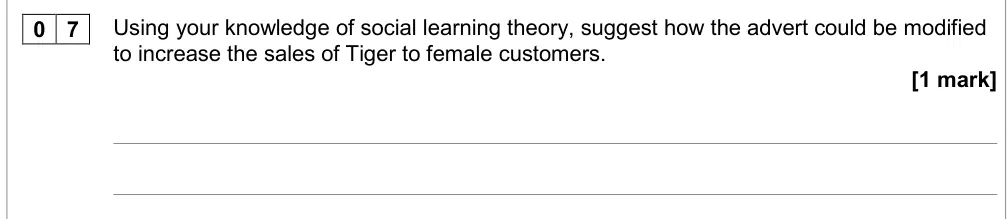
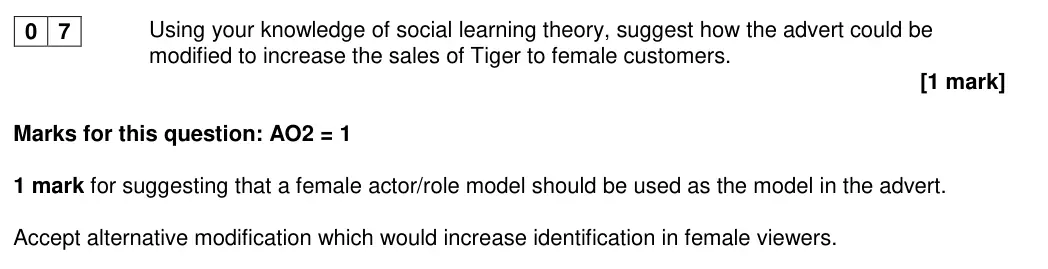
use a female role model/actor to increase identification
some wrongly suggested replacing the little boy
June 2019 · Paper 3 · Q58 marksAO1=3, AO3=5Extended writingOld spec only
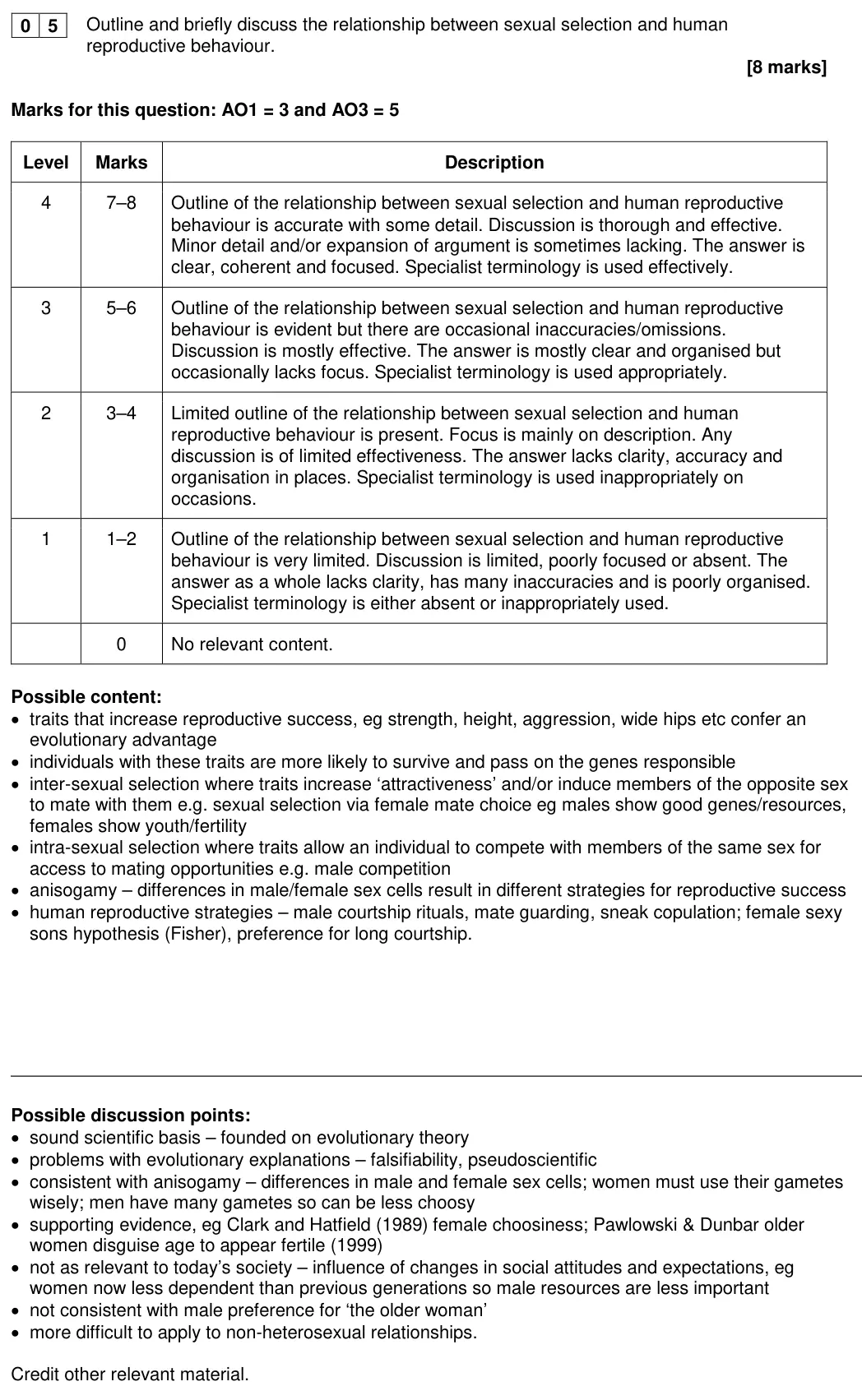
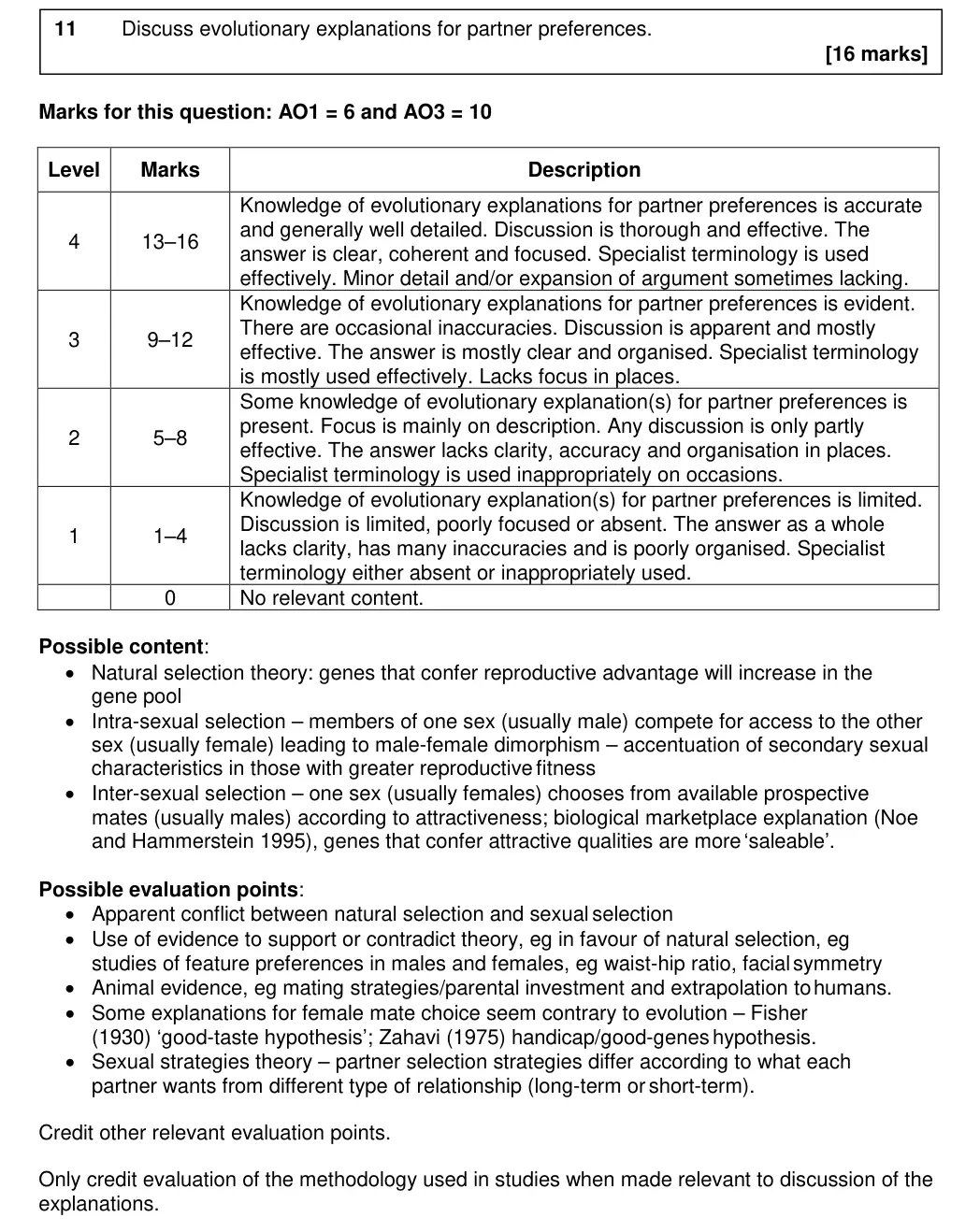
Not on the 2025 specification: sexual selection and human reproductive behaviour / evolutionary partner preferences, removed in v1.4
Mark scheme, including level descriptors and indicative content
Examiner's comment
Answers to this question varied in terms of depth of understanding, although most were successful to some degree. Less effective responses offered a free-standing explanation of anisogamy. This was then followed by simplistic and inadequate explanations of intra- and inter-sexual selection. A disappointing number of students merely referenced ‘quantity over quality’ and ‘quality over quantity’, explaining how men sow their seed liberally and women are just interested in money and a nice house. More able students were able to explain how intra-sexual selection involves the evolution of traits to allow for better competition and inter-sexual selection involves the evolution of traits to increase attractiveness. A significant number of students failed to notice the discuss command and presented wholly descriptive answers.
Notes from the mark scheme and report
Off-spec: sexual selection and human reproductive behaviour / evolutionary partner preferences, removed in v1.4
many answers wholly descriptive despite 'discuss'
June 2019 · Paper 3 · Q78 marksAO1=3, AO3=5Extended writingOld spec only
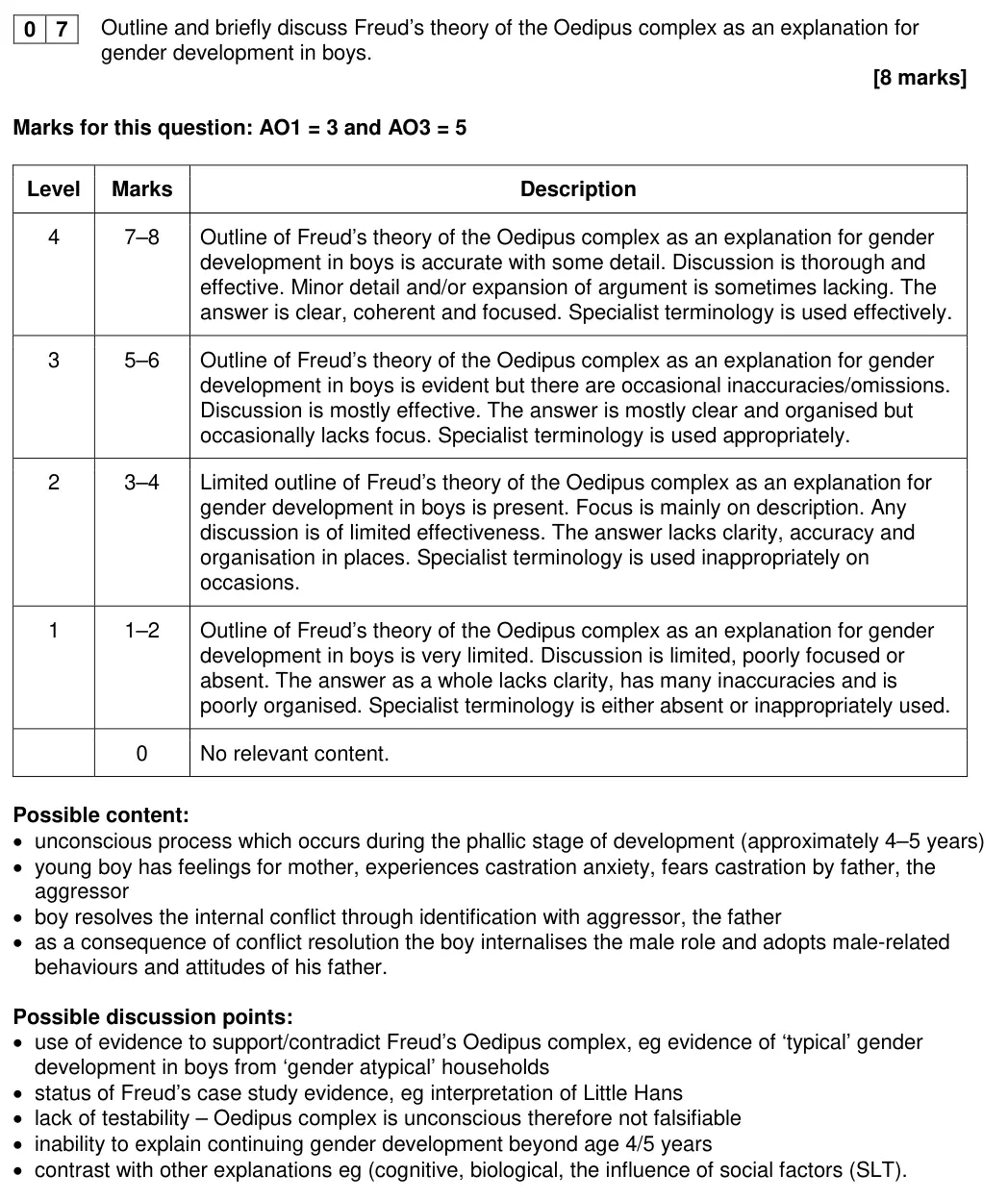
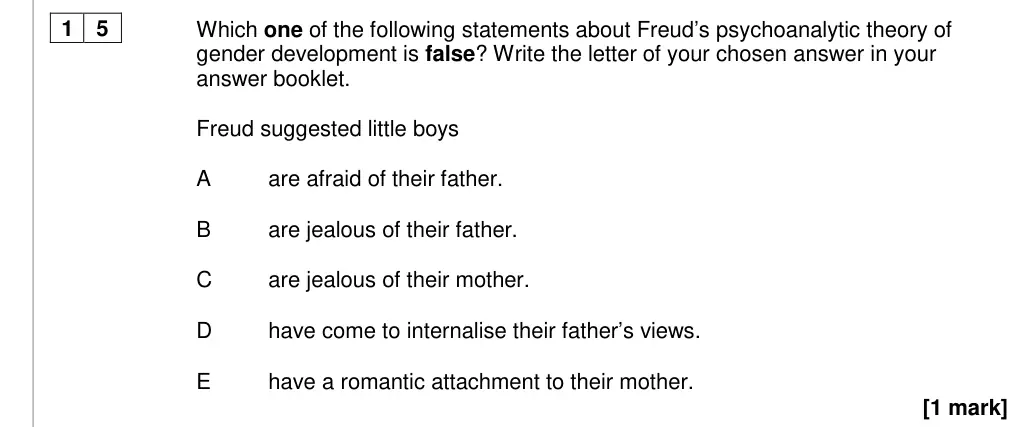
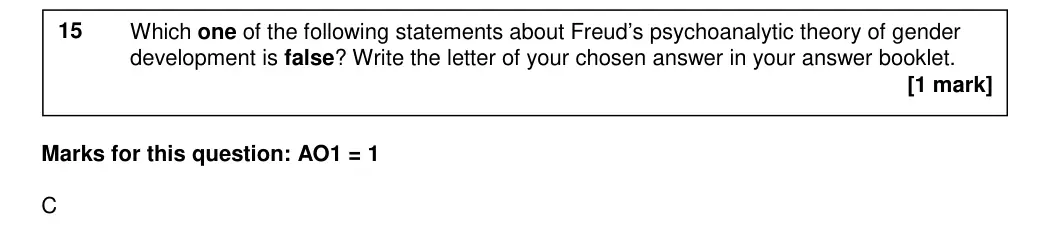
Not on the 2025 specification: psychodynamic explanation of gender development: Freud's Oedipus complex, identification/internalisation, removed in v1.4
Mark scheme, including level descriptors and indicative content
Examiner's comment
Most students could describe Freud’s theory of the Oedipus complex, although not all confined their description to the development of gender in boys. Descriptions varied in sophistication and use of appropriate terminology as might have been expected; even very good descriptions that included reference to identification and internalisation sometimes omitted an explicit link to gender development. Discussions were often limited to ‘the use of a single case study’ or general points about falsifiability. Comments about how the theory does not explain female gender development gained no credit as the question only asked about boys. The most effective discussions were those which explored the problems with the theory specifically as it explains development of male identity. A significant number of students failed to notice the ‘discuss’ command and presented wholly descriptive answers.
Notes from the mark scheme and report
Off-spec: psychodynamic explanation of gender development: Freud's Oedipus complex, identification/internalisation, removed in v1.4
boys only, so comments that it does not explain girls gained no credit
many answers wholly descriptive
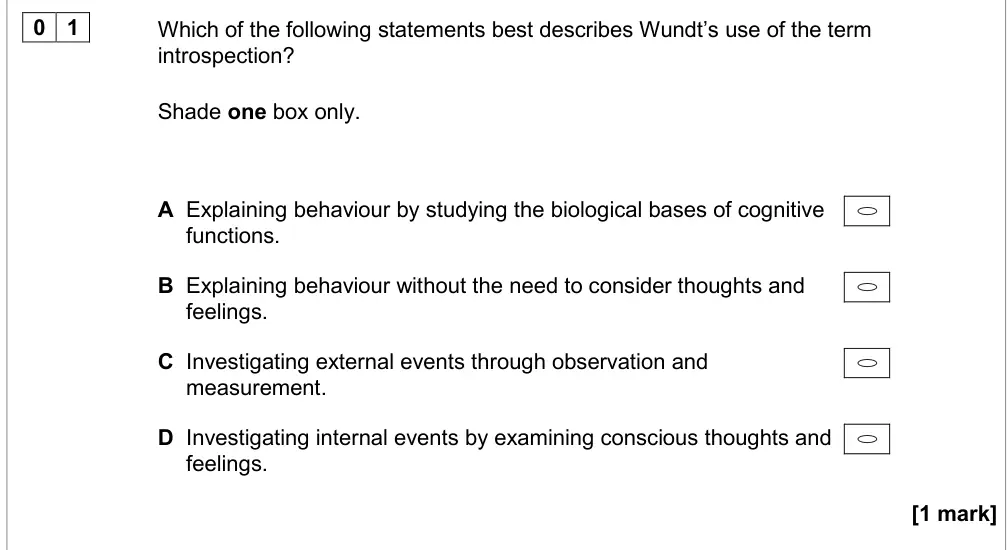
June 2018 · AS Paper 2 · Q11 markAO1=1Multiple choiceOld spec only
Not on the 2025 specification: Wundt and introspection, origins of Psychology removed in v1.4
Answer
D
Mark scheme, including level descriptors and indicative content
Examiner's comment
There were many correct answers to this question and it was apparent that the majority of students had the knowledge to be able to identify the description of introspection.
Notes from the mark scheme and report
Off-spec: Wundt and introspection, origins of Psychology removed in v1.4
correct answer D (investigating internal events by examining conscious thoughts and feelings)
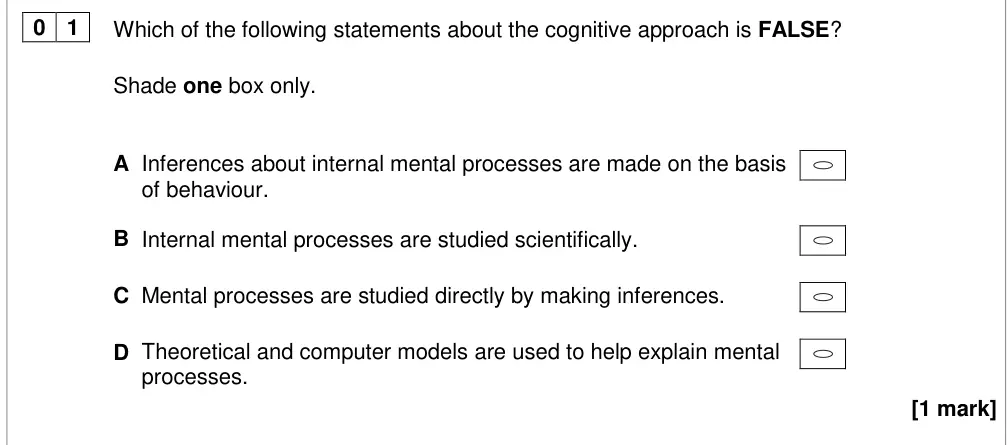
June 2018 · Paper 2 · Q11 markAO1=1Multiple choice
Answer
C
Mark scheme, including level descriptors and indicative content
Examiner's comment
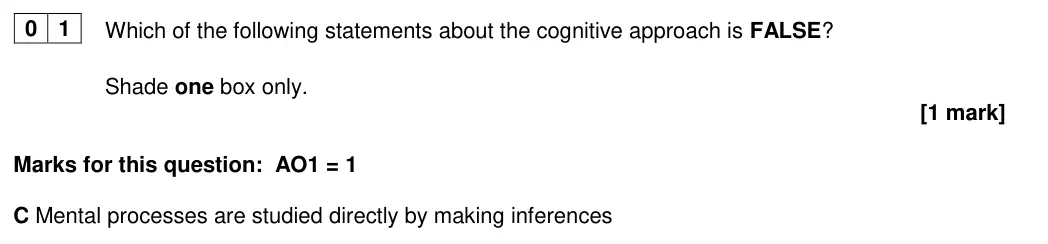
This question was answered correctly by just under half of the students. The distractors worked well to distinguish those who understood the cognitive approach as opposed to those who had just learned the definition of the approach, with incorrect answers representing all the alternative choices.
Notes from the mark scheme and report
false statement is C (mental processes are studied indirectly by inference)
just under half correct, all distractors chosen
option D wording 'theoretical and computer models' reworded to 'the use of models' in v1.4
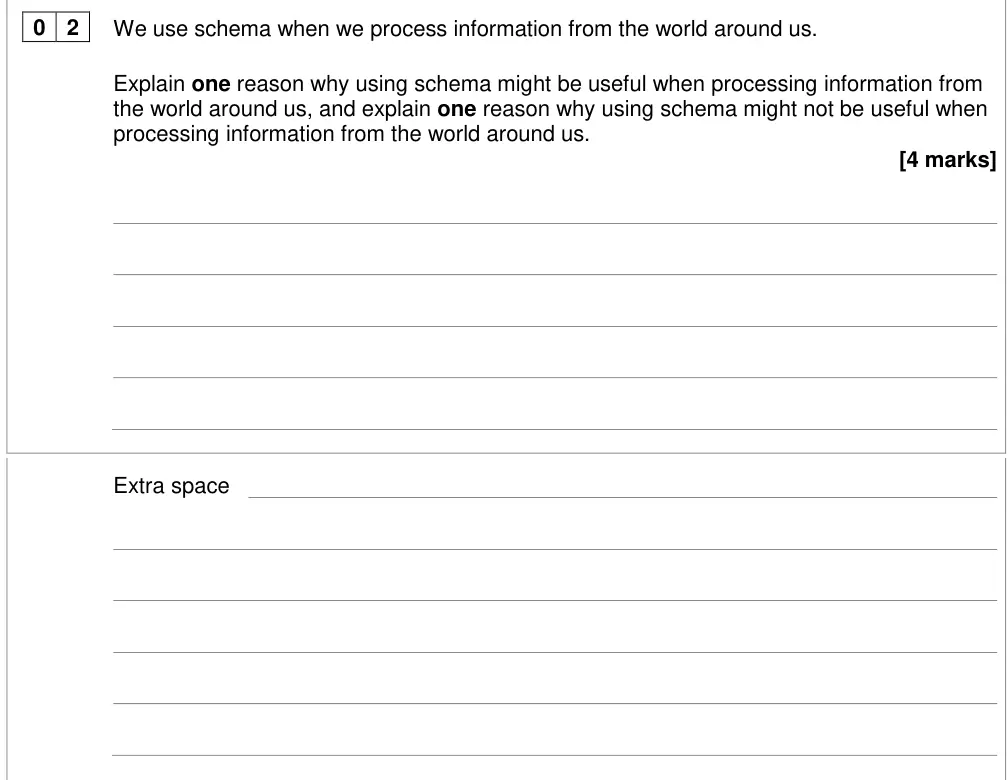
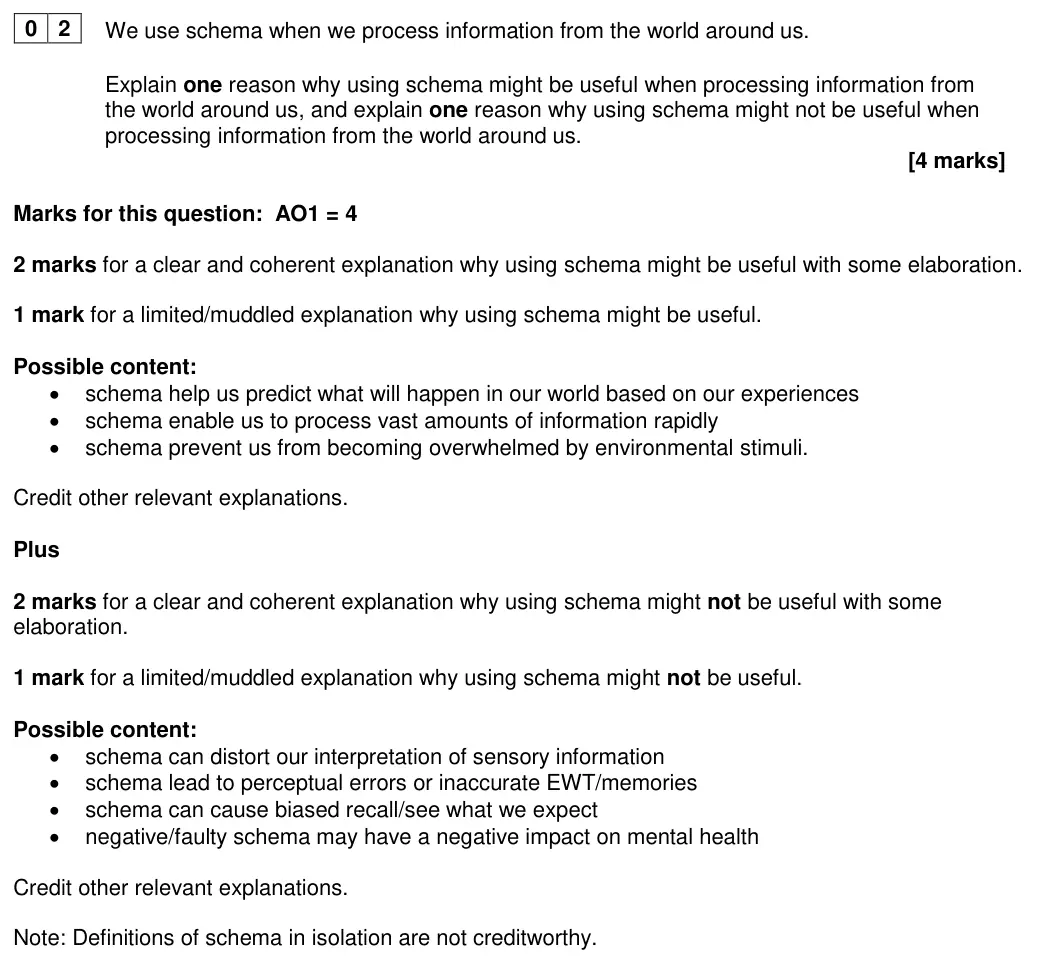
June 2018 · Paper 2 · Q24 marksAO1=4Explain
Mark scheme, including level descriptors and indicative content
Examiner's comment
This question was reasonably well answered, although students were generally better at explaining why schemas might not be useful, with some good examples drawn from EWT and some on negative self-schema and depression. Unfortunately, the strengths were weaker and often gave little beyond definitions.
Notes from the mark scheme and report
2 marks why useful (prediction, rapid processing, not overwhelmed) + 2 marks why not useful (distortion, inaccurate EWT/recall, negative schema and mental health)
definitions alone not creditworthy
strengths often weak
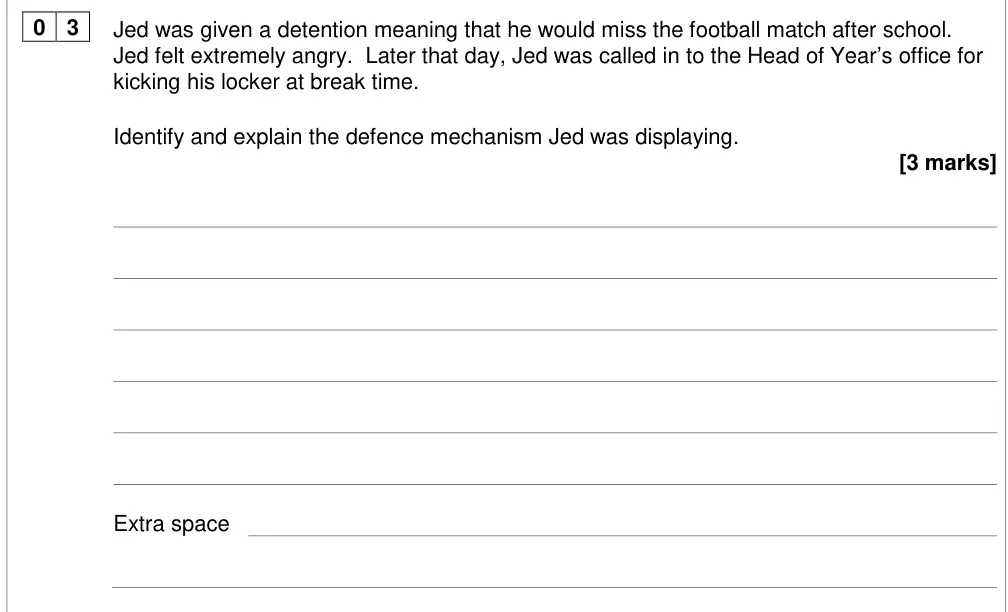
June 2018 · Paper 2 · Q33 marksAO1=1, AO2=2ApplicationEasy
Mark scheme, including level descriptors and indicative content
Examiner's comment
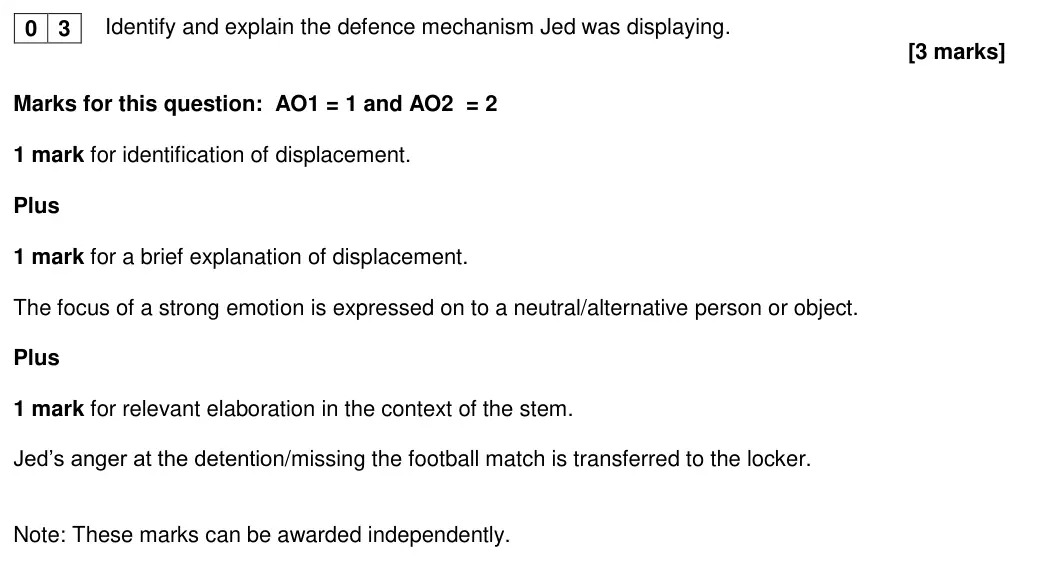
This question was generally well answered with just under half of the students achieving full marks. There were very few incorrect defence mechanisms presented and application was clear, however, explanations were sometimes limited. Teachers should remind students to explain terms fully, ie not using the term ‘displace’ to describe what ‘displacement’ means.
Notes from the mark scheme and report
1 mark displacement + 1 mark explanation (emotion redirected to a neutral object) + 1 mark application (anger at detention transferred to locker)
marks independent
using 'displace' to define displacement not enough
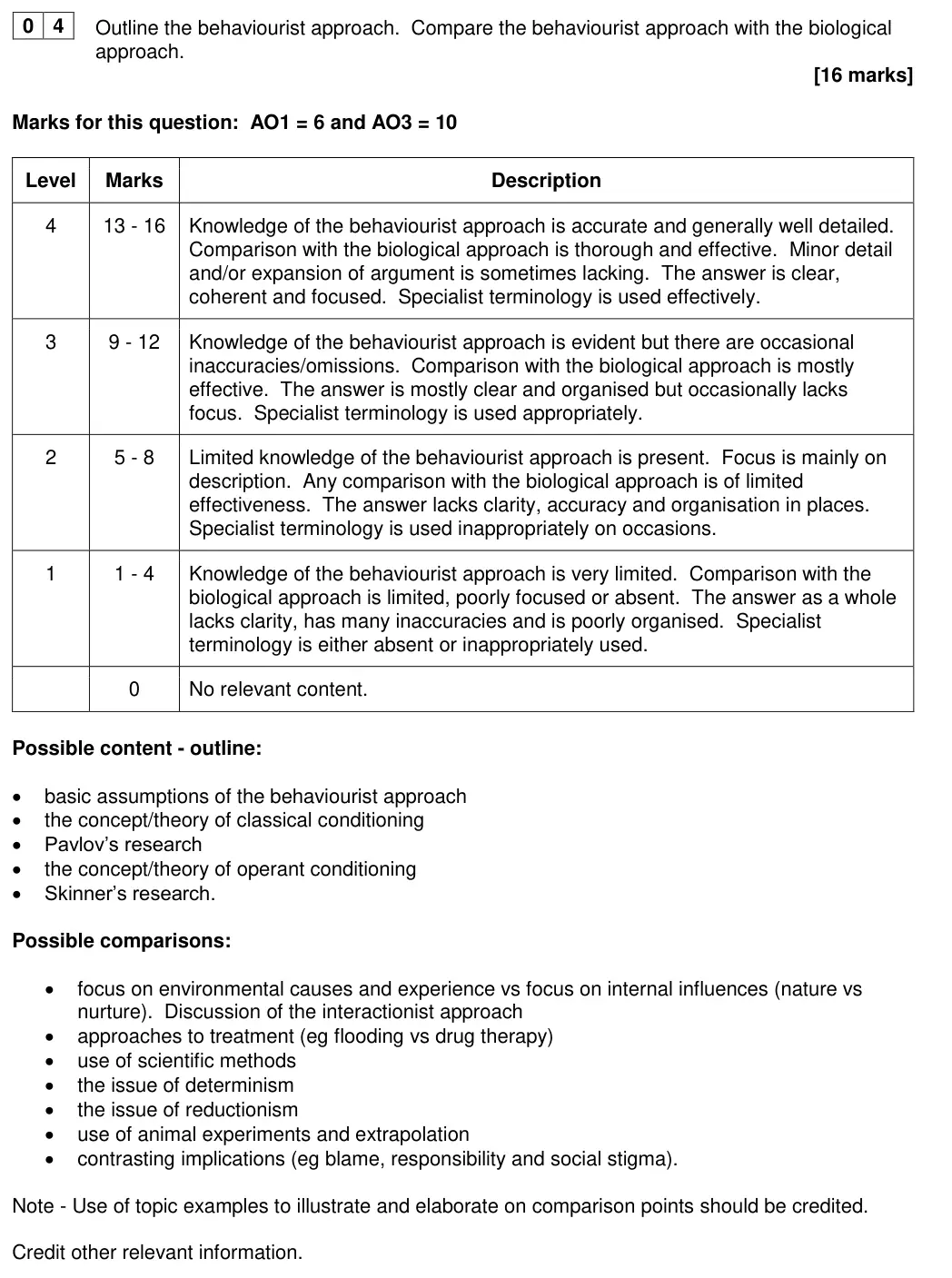
June 2018 · Paper 2 · Q416 marksAO1=6, AO3=1016-mark essay
Mark scheme, including level descriptors and indicative content
Examiner's comment
Overall this question was well answered with some impressive responses. Students appeared to be well prepared, demonstrating good, detailed knowledge of classical and operant conditioning and of Pavlov and Skinner’s research, with stronger students outlining general assumptions upon which the approach is founded. Some schools/colleges appear to be teaching all the learning approaches together rather than distinguishing between the behaviourist approach and social learning theory therefore many students incorrectly included the social learning theory in their outline of the behaviourist approach. The comparisons given were variable. Whilst there were some excellent, well discussed and effective comparisons, weaker students exposed their limited knowledge of the approaches and terminology in the inappropriate comparisons given. A worrying number of students claimed that the biological approach does not use animals in their research and poses no ethical issues. Furthermore, some claimed the behaviourist approach focusses on free will and is subjective and unscientific in its methodology. Understanding of reductionism was often limited and nature and nurture were frequently muddled. The most successful comparisons tended to focus their discussion around determinism and comparing and contrasting explanations and treatments for phobias. Unfortunately, many students provided pre-learned essays, focussing on outlining and evaluating the approaches, as opposed to providing effective comparison. This meant that students often wasted time providing a wealth of material which lacked relevance but could have easily been rearranged to provide effective comparison.
many wrote pre-learned outline/evaluate essays rather than comparisons
June 2018 · AS Paper 2 · Q78 marksAO1=4, AO3=4Extended writing
Mark scheme, including level descriptors and indicative content
Examiner's comment
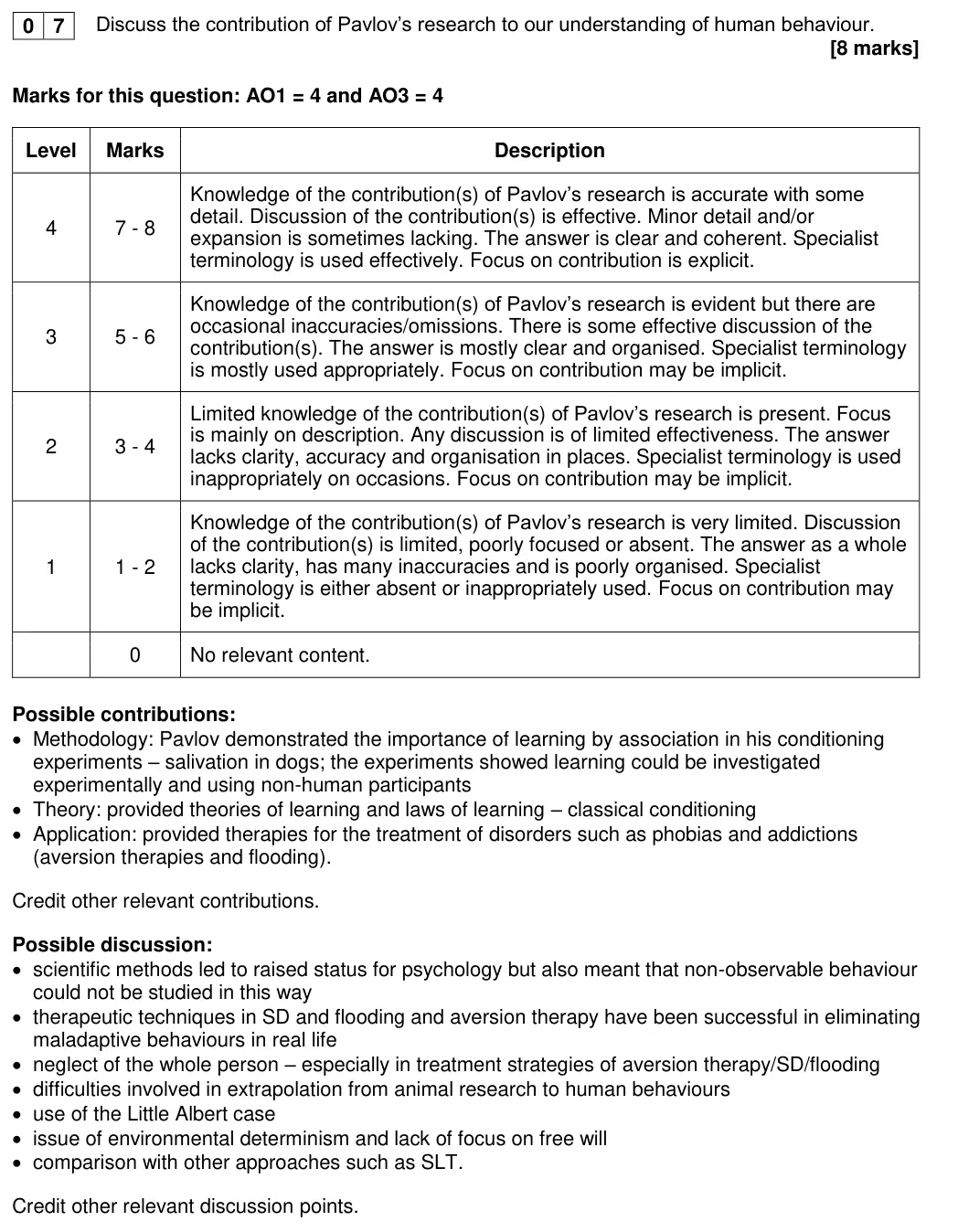
In Section A and B there were two questions (7 and 10) where students appeared to produce pre-prepared answers on a different question to that posed. The majority of responses did not focus upon the question and appeared to have been pre-planned answers to a different question either about Pavlov’s salivation in dogs experiment or behaviourism in general. As a consequence, few students achieved Level 4 which required an explicit focus on Pavlov’s contribution. Additionally there was a lack of focus on understanding of human behaviour in some student responses which was also a requirement of the question. Due to this lack of focus on Pavlov’s contributions and human behaviour the majority of responses were limited in their effectiveness and thus at Level 2. Most students simply provided detailed descriptive accounts of Pavlov’s salivation in dogs experiment which was not linked to his contribution and then simply evaluated this experiment rather than discussing how this experiment may or may not have contributed to our understanding of human behaviour. A minority muddled Pavlov with other behaviourists such as Skinner or with social learning theory which also had a significant detrimental effect on the level and mark awarded.
Notes from the mark scheme and report
contribution: learning by association, experimental method with animals, classical conditioning laws, therapies (SD, flooding, aversion therapy)
many pre-planned answers describing the dog study or behaviourism generally
must focus on contribution to understanding HUMAN behaviour
muddled with Skinner/SLT
June 2018 · Paper 3 · Q86 marksAO1=3, AO3=3OutlineOld spec only
Not on the 2025 specification: evolutionary explanations for partner preferences / sexual selection, removed in v1.4
Mark scheme, including level descriptors and indicative content
Examiner's comment
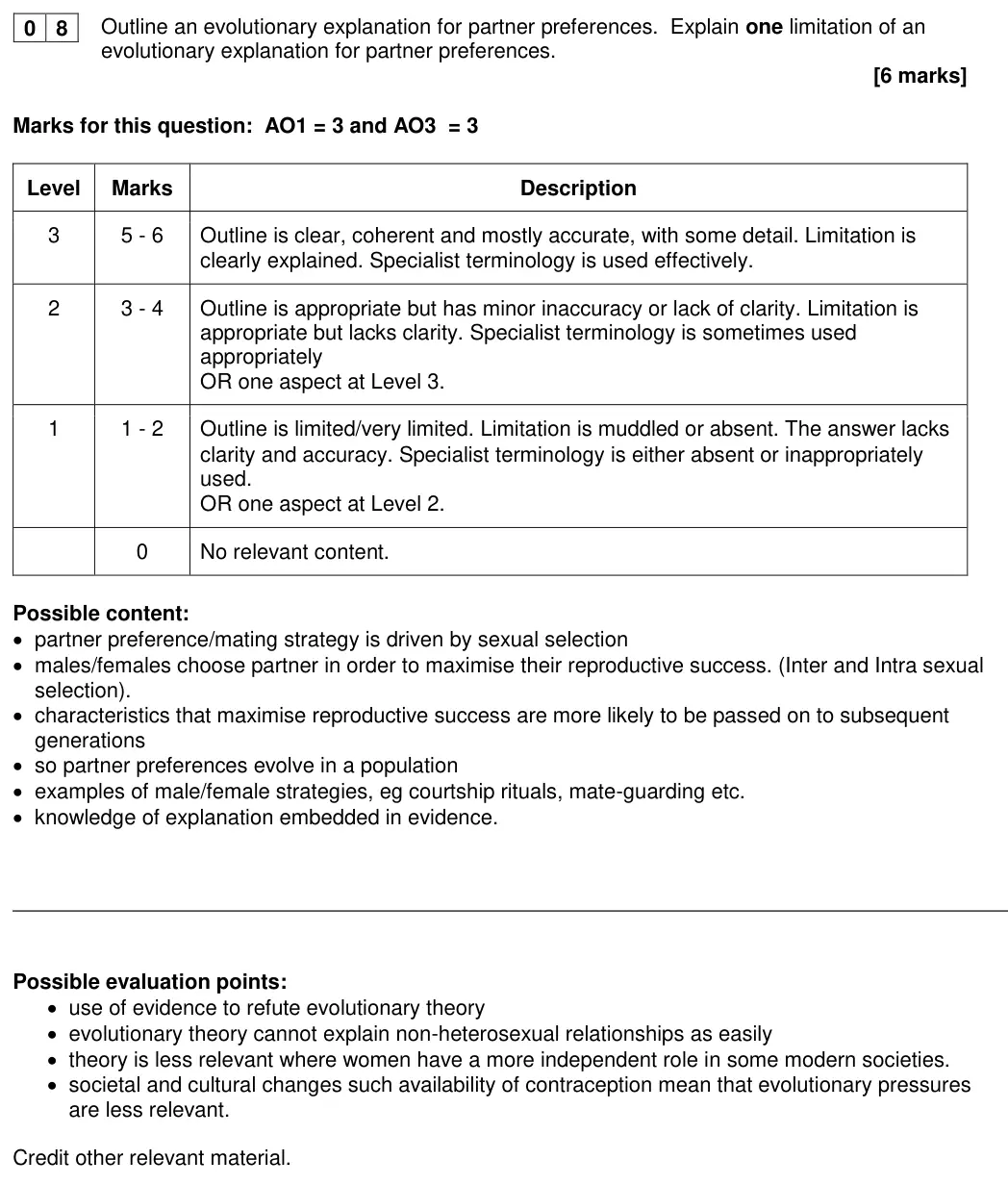
Most answers consisted of a prolonged outline followed by a very brief limitation, which was stated rather than explained. As a consequence, relatively few answers were awarded marks in the top level. Outlines focussing on inter and intra sexual selection were commonly seen and often comprehensive. In these responses, it was usual to see limited applicability to non-heterosexual relationships or lack of relevance to modern society as the limitation. Some quite detailed outlines failed to address the matter of ‘preferences’ as per the question, although preference was often implicit. Weak responses were anecdotal, typically arguing that ‘men are not fussy’, and ‘women are picky’.
Notes from the mark scheme and report
Off-spec: evolutionary explanations for partner preferences / sexual selection, removed in v1.4
limitation usually only stated, not explained
many failed to address 'preferences'
June 2017 · AS Paper 2 · Q11 markAO1=1Multiple choice
Answer
A
Mark scheme, including level descriptors and indicative content
Examiner's comment
Most students answered this question correctly. However, some provided more than one answer when the instruction clearly stated ‘Shade one box only’. It is important to remind students to read and follow the instructions for multiple-choice questions.
Notes from the mark scheme and report
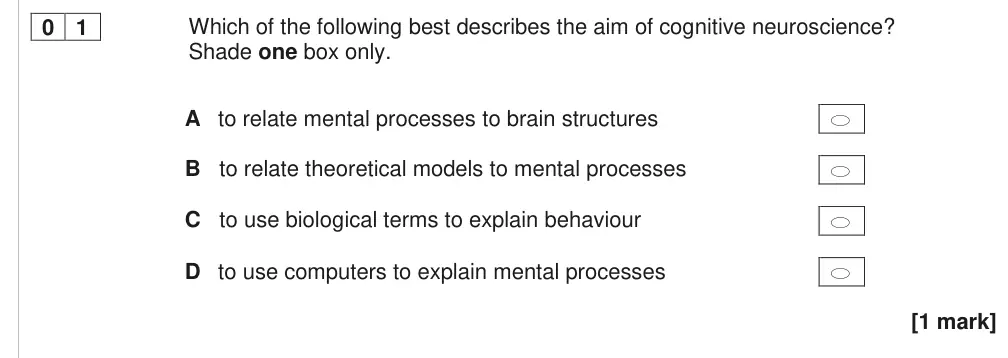
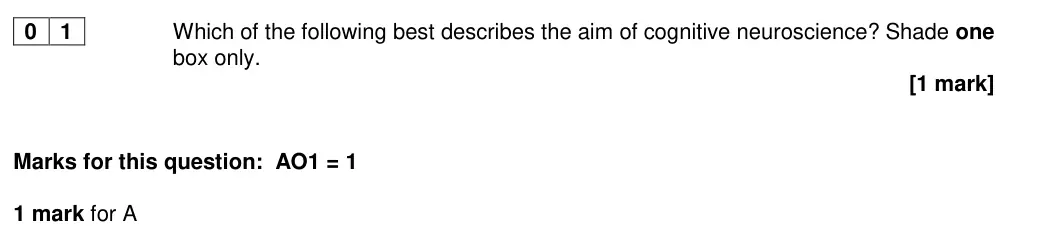
correct answer A (relate mental processes to brain structures)
distractors describe the cognitive approach (models, computer analogy) and biological approach
cognitive neuroscience now sits within the biological approach bullet in v1.4
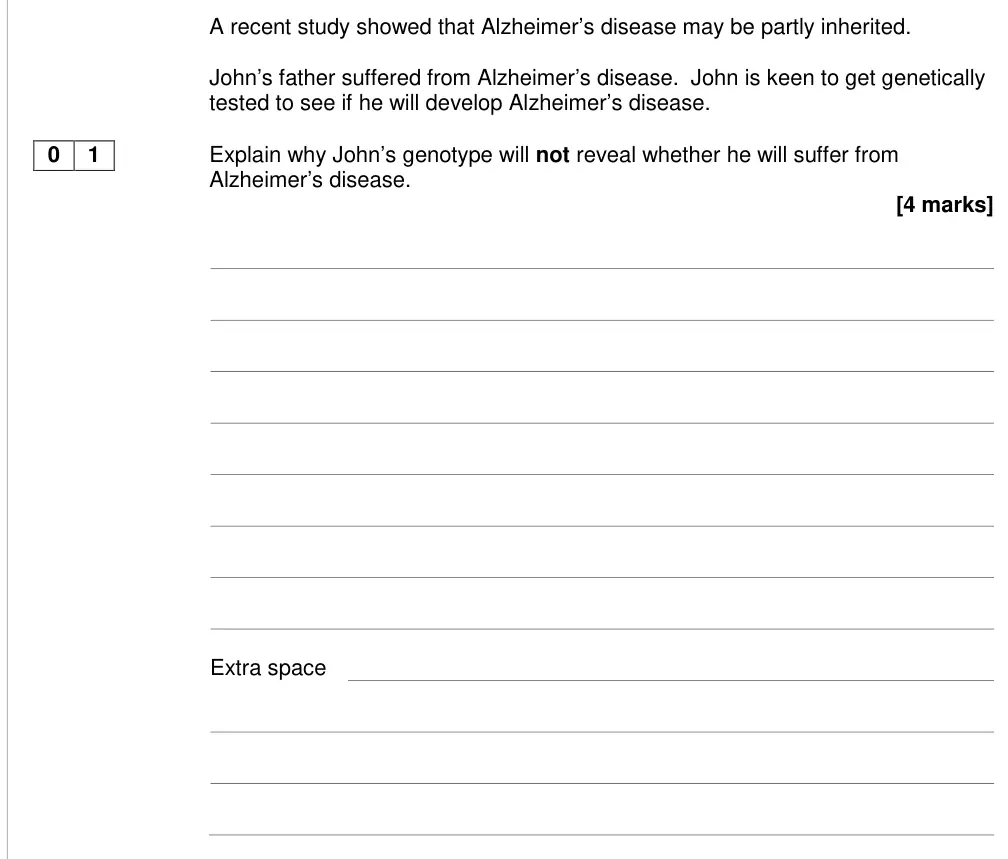
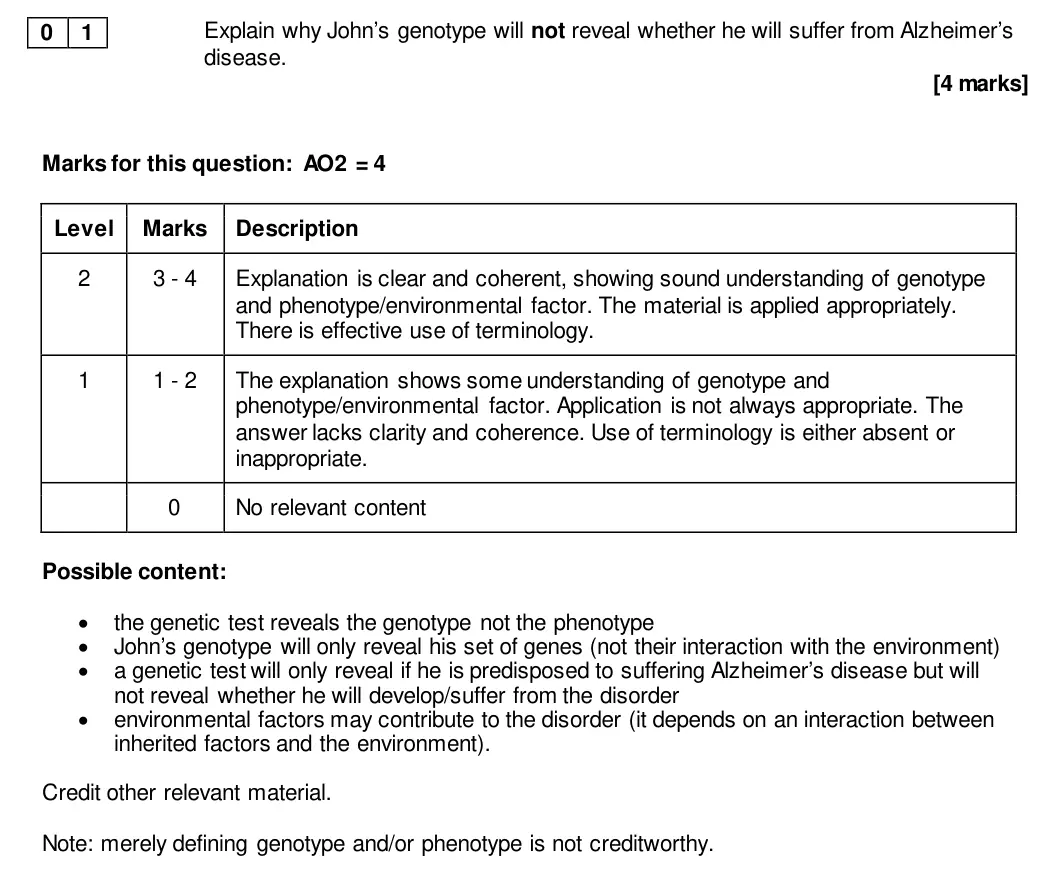
June 2017 · Paper 2 · Q14 marksAO2=4ApplicationHard
Mark scheme, including level descriptors and indicative content
Examiner's comment
This question was quite poorly answered, with almost two thirds of students failing to achieve level 2, mainly due to weak application. Most students understood the difference between genotype and phenotype, but many did not go on to discuss the interaction with the environment and the diathesis-stress argument convincingly. Students wasted a lot of time providing definitions of genotype and phenotype, mentioning characteristics, such as eye colour, and discussing recessive genes, missing the general focus of the question. Some students failed to apply their knowledge appropriately, simply paraphrasing content from the stem as opposed to engaging with the material and applying their knowledge effectively. Overall, there was a relatively poor understanding of genotype and phenotype. The most common error regarding genotype involved trying to relate John’s genotype to his mother. With regard to phenotype, many students mistakenly suggested that John’s phenotype should be tested. Schools and colleges should therefore ensure that students fully understand these terms in a psychological context.
Notes from the mark scheme and report
genetic test shows genotype (predisposition) not phenotype
environment interacts with genes
merely defining genotype/phenotype not creditworthy
almost two thirds below Level 2 through weak application
errors: relating genotype to his mother, suggesting testing his phenotype
June 2017 · Paper 2 · Q24 marksAO1=4OutlineEasy
Mark scheme, including level descriptors and indicative content
Examiner's comment
Generally done very well with over two-thirds of students achieving level 2 but some lacked the elaboration necessary to gain full marks. There were some good descriptions provided, with quite remarkable detail in some cases and some good answers on levels of consciousness presented. However, there was some confusion over the role of the superego and ego, and many students mistakenly wrote ”the id mediates between the demands of the id and the demands of the superego”. Additionally, some students focussed on the psychosexual stages, which was not awarded credit.
Notes from the mark scheme and report
'three parts: id, ego, superego' essential for 4 marks
naming all three only = 1 mark
confusion over ego/superego roles (ego mediates, not id)
psychosexual stages not credited
June 2017 · AS Paper 2 · Q33 marksAO1=3Outline
Mark scheme, including level descriptors and indicative content
Examiner's comment
This question was answered very well by the majority of students, with answers referring to variations of the Skinner box/rat/pigeon experiments. Most responses focused on Skinner’s studies rather than his theory but it is important to note that ‘research’ refers to studies or theory and thus students could have outlined operant conditioning theory and gained credit. Answers that described vicarious reinforcement or punishment without any link to (negative) reinforcement could not gain credit.
Notes from the mark scheme and report
Skinner box/rats/pigeons, positive and negative reinforcement, schedules, shaping
operant theory also creditworthy
vicarious reinforcement or punishment without link to reinforcement not credited
June 2017 · Paper 2 · Q316 marksAO1=6, AO2=4, AO3=616-mark essay
Mark scheme, including level descriptors and indicative content
Examiner's comment
Questions that discriminated the best were 03, 04, 09, 16, 17 and 21. There were some very good responses, which were accurate and far more detailed than necessary, with extremely effective and insightful application. However, most of the responses were level 2 or level 3 standard with weaker students struggling to describe abstract ideas coherently using specialist terminology. Students were generally able to provide an accurate description of the humanistic approach with good descriptions of Maslow’s hierarchy of needs, although many believed that self-actualisation meant nothing more than doing well in your exams. Better students could explain Rogers’ work effectively and some demonstrated very detailed knowledge. Evaluation was mixed, often focussing on the lack of a scientific approach or a discussion of the practical applications of the humanistic approach to counselling theory. There was some confusion relating to reductionism with the common claim that this approach is reductionist because it fails to consider biological mechanisms, which often led to some contradictory evaluations. Some more sophisticated responses used research evidence to support the points posed and elaborated on this effectively. Application was usually attempted, with varying degrees of success. Weaker application either demonstrated a lack of understanding or inappropriate use of terminology, and/or consisted mostly of reiterations of the stem. Evaluation was sometimes better than the outline of the concepts of the humanistic approach. It appeared that many students had prepared to write an essay on the comparison between approaches and thus struggled to give the necessary detail the question required, and struggled to link other approaches back to the question. Thus comparative evaluations often lacked focus. Better students used the stem to construct convincing arguments with appropriate knowledge and evaluation intertwined within their application. The very best were able to blend these elements together in a highly sophisticated manner, effectively referring to other approaches as part of the discussion. Students should be encouraged to take time to plan their answers and construct concise and fluent essays with the appropriate use of paragraphs in order to improve coherence and focus.
Notes from the mark scheme and report
apply Maslow (safety, belonging, esteem needs), conditions of worth, incongruence to Tatiana
self-actualisation misunderstood as doing well in exams
confusion about reductionism
MS also credits Rogers' concept of self and influence on counselling, removed in v1.4
June 2017 · AS Paper 2 · Q43 marksAO2=3Application
Mark scheme, including level descriptors and indicative content
Examiner's comment
This question was generally answered very well with some clear and coherent application. Most responses focused on direct reinforcement with few students using token economy or vicarious reinforcement. A minority of students confused negative reinforcement with punishment or provided an answer focusing on punishment rather than reinforcement.
Notes from the mark scheme and report
token economy, direct positive reinforcement, vicarious reinforcement, shaping
some confused negative reinforcement with punishment
June 2017 · AS Paper 2 · Q52 marksAO2=2Application
Mark scheme, including level descriptors and indicative content
Examiner's comment
Few students appeared to understand the meaning of inference and thus many were unable to apply this to the stem and gain any marks. Some answers conveyed an understanding of inference but without referring to mental processes. A number of responses were limited as they referred to biology (ie the ‘brain’) rather than cognition (ie the ‘mind’). There were also a number of examples seen where no answer was attempted, suggesting that some students did not have the knowledge to enable them to answer this question.
Notes from the mark scheme and report
making assumptions about mental processes that cannot be directly observed
few understood inference
referring to the brain rather than the mind limited marks
many blanks
June 2017 · AS Paper 2 · Q612 marksAO1=6, AO2=2, AO3=4Extended writing
Mark scheme, including level descriptors and indicative content
Examiner's comment
In Sections A and B most students seemed to engage with the actual question posed rather than writing pre-prepared answers, and this was particularly pleasing on the 12 mark question in Section A, where most students engaged with stem and produced effective application. Many students had a good level of knowledge and understanding of social learning theory with appropriate application. However, most responses were at level 2 and level 3 largely due to the limited effectiveness of the evaluation, which tended to be generic, unexplained or not clearly linked to social learning theory. Detailed descriptive accounts of Bandura’s Bobo Doll study were not creditworthy and evaluation of this study was only creditworthy if it was used to evaluate social learning theory. A minority muddled social learning theory with behaviourism, which had a detrimental effect on the level and mark awarded.
apply: sister imitates phone (model/identification), does not copy pen use after seeing punishment (vicarious punishment)
knowledge only at Level 4 = 6 marks
Bobo doll description not creditworthy, evaluation of it only if linked to SLT
MS also credits 'modelling', removed from the v1.4 SLT wording
June 2017 · Paper 3 · Q112 marksAO1=2Multiple choiceEasyOld spec only
Not on the 2025 specification: psychoanalytic explanation of gender development - identification and internalisation, removed from the Gender topic in v1.4
Answer
A and D
Mark scheme, including level descriptors and indicative content
Examiner's comment
The vast majority of students were able to pick up at least one mark on this question, with many able to identify two key features of the psychoanalytic explanation of gender development.
Notes from the mark scheme and report
Off-spec: psychoanalytic explanation of gender development - identification and internalisation, removed from the Gender topic in v1.4
answers A and D
June 2017 · Paper 3 · Q201 markAO3=1Multiple choiceOld spec only
Not on the 2025 specification: token economies in the management of schizophrenia, removed in v1.4
Answer
C
Mark scheme, including level descriptors and indicative content
Examiner's comment
This question was answered correctly by the majority of students.
Notes from the mark scheme and report
Off-spec: token economies in the management of schizophrenia, removed in v1.4
answer C (promote acceptable behaviours)
Specimen set 2 · Paper 2 · Q1.11 markAO1=1Multiple choice
Answer
B
Mark scheme, including level descriptors and indicative content
Notes from the mark scheme and report
answer B (inheritance and environment)
Specimen set 2 · Paper 2 · Q1.21 markAO1=1Multiple choice
Answer
D
Mark scheme, including level descriptors and indicative content
Notes from the mark scheme and report
false statement is D (evolution is not change in behaviour from one generation to the next)
Specimen set 2 · Paper 2 · Q24 marksAO2=4Application
Mark scheme, including level descriptors and indicative content
Notes from the mark scheme and report
attention (watches carefully), retention (thinks about how cue was held), motor reproduction/own ability, motivation (keen to play well)
must link to Bradley
June 2016 · AS Paper 2 · Q36 marksAO2=6Application
Mark scheme, including level descriptors and indicative content
Examiner's comment
This was answered very well by many students who demonstrated a good understanding of both classical conditioning and Social Learning Theory and could apply the concepts/features associated with these effectively to the novel behaviours in the stem. Some responses did have muddled reference to the neutral stimulus (NS), the unconditioned stimulus (UCS) and the conditioned stimulus (CS), in particular, that the fear was the UCS rather than the ‘being trapped’ element. However, the majority were impressive in their accurate application of schedule terms. It was acceptable for responses to be a combination of both classical conditioning and avoidance behaviour. Some students focused only on direct reinforcement and operant conditioning principles in part B rather than the indirect effects of vicarious reinforcement.
Notes from the mark scheme and report
A: classical conditioning (or operant/avoidance, two-process model credited) + elaboration + application to the lift
B: social learning/vicarious reinforcement + elaboration + application to Jerry/James
common errors: fear labelled as UCS, direct reinforcement only in B
June 2016 · AS Paper 2 · Q44 marksAO2=4Application
Mark scheme, including level descriptors and indicative content
Examiner's comment
Many students had some understanding of genotype and phenotype but struggled to apply their knowledge to this novel scenario about ‘fillings’. Even some sound answers had an imprecise use of terminology, especially references to monozygotic (MZ) twins or identical twins as having ‘similar’ genes or having ‘almost identical’ genes. Many students failed to appreciate that all identical twins have identical genes and that all people exhibit traits that are a function of both genetic and environmental influences. Instead, they suggested that the data could be explained as either a result of genes or of phenotype.
Notes from the mark scheme and report
identical twins share the same genotype, so differences (52 pairs) show phenotype affected by environment (diet, brushing)
'similar'/'almost identical' genes imprecise
only one of genotype/phenotype applied = Level 1
Specimen set 2 · Paper 2 · Q44 marksAO3=4Evaluate (short)
Mark scheme, including level descriptors and indicative content
Notes from the mark scheme and report
1 + 1 for strength (control/objectivity, models, links to neuroscience) and 1 + 1 for limitation (still relies on inference, mechanistic)
June 2016 · AS Paper 2 · Q58 marksAO1=4, AO3=4Extended writing
Mark scheme, including level descriptors and indicative content
Examiner's comment
There were some very good answers to this question and students had sound knowledge of features of the cognitive approach. Responses to explaining two limitations of the cognitive approach were less successful, sometimes lacking explanation or even being incorrect. A significant number of responses, for example, seemed to suggest schemas lead to stereotypes and therefore this limits the cognitive approach because stereotyping is a ‘bad thing.’ Understanding that people are cognitive misers in the way they process information and therefore might stereotype, is a useful piece of information, as such awareness might in fact help us to deal with stereotyping in society. There were also a number of attempts at limitations which were too extreme in their assertion such as, cognitive psychology ignores emotion, ignores biology and ignores culture or only uses experiments. Students need to construct more coherent discussions about apparent weaknesses of approaches and should be more circumspect in the way they present these ideas. Some students misread the question and produced answers that focused on the cognitive approach to depression. These were rarely creditworthy.
Notes from the mark scheme and report
features: internal mental processes, schema, information processing/computer analogy, use of models, cognitive neuroscience
differences with humanistic: negative vs positive, past vs present/future, unconscious vs conscious, psychic determinism vs free will
Specimen set 2 · Paper 3 · Q188 marksAO1=3, AO3=5Extended writingOld spec only
Not on the 2025 specification: token economies in the management of schizophrenia, removed in v1.4
Mark scheme, including level descriptors and indicative content
Notes from the mark scheme and report
Off-spec: token economies in the management of schizophrenia, removed in v1.4
operant conditioning, tokens exchanged for rewards
management not treatment, ethics
Specimen set 1 · Paper 2 · Q1.11 markAO1=1Multiple choice
Answer
C
Mark scheme, including level descriptors and indicative content
Notes from the mark scheme and report
false statement is C (repression is unconscious, not chosen)
Specimen set 1 · Paper 2 · Q1.21 markAO1=1Multiple choice
Answer
C
Mark scheme, including level descriptors and indicative content
Notes from the mark scheme and report
false statement is C (the Superego is not responsible for bad behaviour)
Specimen set 1 · Paper 2 · Q22 marksAO2=2Application
Mark scheme, including level descriptors and indicative content
Notes from the mark scheme and report
1 mark inference = going beyond evidence to assume unobservable mental processes + 1 mark application (inferring processing difficulty from time taken)
Specimen set 1 · Paper 2 · Q34 marksAO1=2, AO2=2Application
Mark scheme, including level descriptors and indicative content
Notes from the mark scheme and report
congruence = match between perceived self and ideal self
application: close the gap with healthier self-view or more realistic ideal self
unconditional positive regard credited (influence on counselling Psychology removed in v1.4 but congruence is current)
Specimen set 1 · AS Paper 2 · Q42 marksAO2=2Application
Mark scheme, including level descriptors and indicative content
Notes from the mark scheme and report
response A shows limited-capacity processing, response B shows sequential processing
1 mark per response
Specimen set 1 · Paper 2 · Q416 marksAO1=6, AO3=1016-mark essay
Mark scheme, including level descriptors and indicative content
Notes from the mark scheme and report
focus must be contributions to understanding human behaviour
laws of learning, reinforcement, scientific objectivity
reductionism, determinism, animal research, ethics, comparison with other approaches
Specimen set 1 · AS Paper 2 · Q5.12 marksAO2=2Application
Mark scheme, including level descriptors and indicative content
Notes from the mark scheme and report
1 mark operant conditioning + 1 mark explaining that the desired response (pulling string) is followed by a positive consequence (escape/treat)
Specimen set 1 · AS Paper 2 · Q6.16 marksAO1=2, AO2=4Application
Mark scheme, including level descriptors and indicative content
Notes from the mark scheme and report
outline observation, imitation, identification, vicarious reinforcement, mediational processes + apply to the boy/puppy film (same-age role model, psychologist's comments as vicarious reinforcement)
MS also uses 'modelling', a term removed from the v1.4 SLT bullet (imitation remains)
Specimen set 1 · AS Paper 2 · Q6.26 marksAO3=6Evaluate (short)
Mark scheme, including level descriptors and indicative content
Notes from the mark scheme and report
two limitations needed (one only = max Level 2)
e.g. environmental determinism, mediational processes inferred, cause and effect
comparison with other theories credited only as a limitation
Specimen set 1 · Paper 3 · Q1116 marksAO1=6, AO3=1016-mark essayOld spec only
Not on the 2025 specification: evolutionary explanations for partner preferences / sexual selection, removed in v1.4
Mark scheme, including level descriptors and indicative content
Notes from the mark scheme and report
Off-spec: evolutionary explanations for partner preferences / sexual selection, removed in v1.4
intra- and inter-sexual selection, waist-hip ratio, sexual strategies theory
methodology only creditworthy if linked to the explanations
Specimen set 1 · Paper 3 · Q151 markAO1=1Multiple choiceOld spec only
Answer
C
Mark scheme, including level descriptors and indicative content
Notes from the mark scheme and report
(Freud's psychoanalytic theory of gender development / Oedipus complex, removed from the Gender topic in v1.4
Oedipus knowledge still available via the psychodynamic approach)
answer C (false - boys are jealous of the father, not the mother)
Work with an AQA psychology tutor
Essays not reaching the top band? Book a session with Andy, a former AQA examiner.