23 question parts, 7 sixteen-mark essays, 1 multiple-choice items, plus 6 parts on content removed in 2025
Notes, key studies and practice items for this topic are being written by our tutors. The past-paper questions below are ready now.
Specification statements
4.3.3-01 The role of chromosomes and hormones (testosterone, oestrogen and oxytocin) in biological sex. Diversity in sex development, including androgen insensitivity syndrome, Klinefelter’s syndrome and Turner syndrome.
4.3.3-02 Gender identities, including binary, non-binary and gender fluid. How gender has been measured using the Bem Sex Role Inventory.
4.3.3-03 Biological explanations of gender development, including chromosomes and hormones.
4.3.3-04 Cognitive explanations of gender development, Kohlberg’s theory, gender identity, gender stability and gender constancy; Martin and Halverson's gender schema theory.
4.3.3-05 Social learning theory as applied to gender development. The influence of culture and media on gender roles.
4.3.3-06 Gender incongruence: biological and social/cultural explanations.
Tap a question to zoom it. Mark scheme and examiner's comment open under each question.
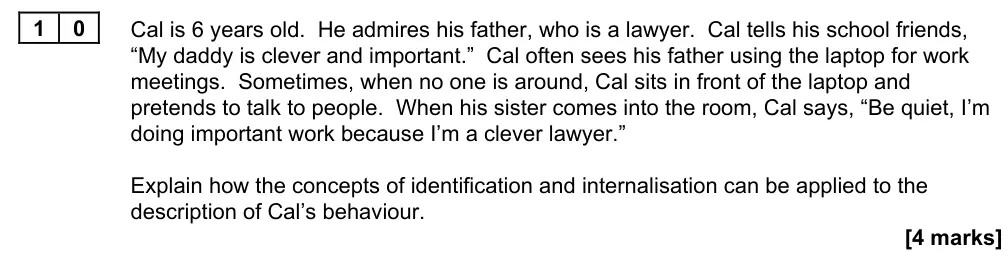
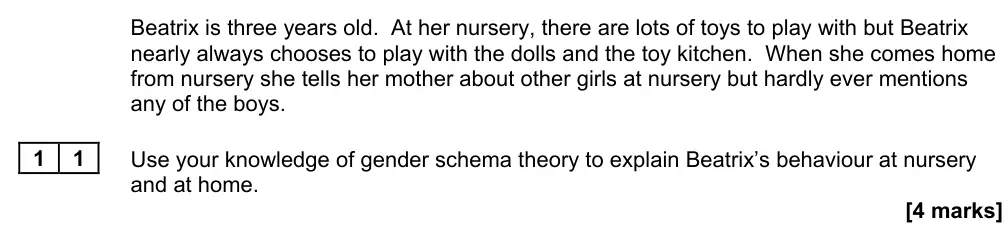
June 2025 · Paper 3 · Q104 marksAO2=4Application
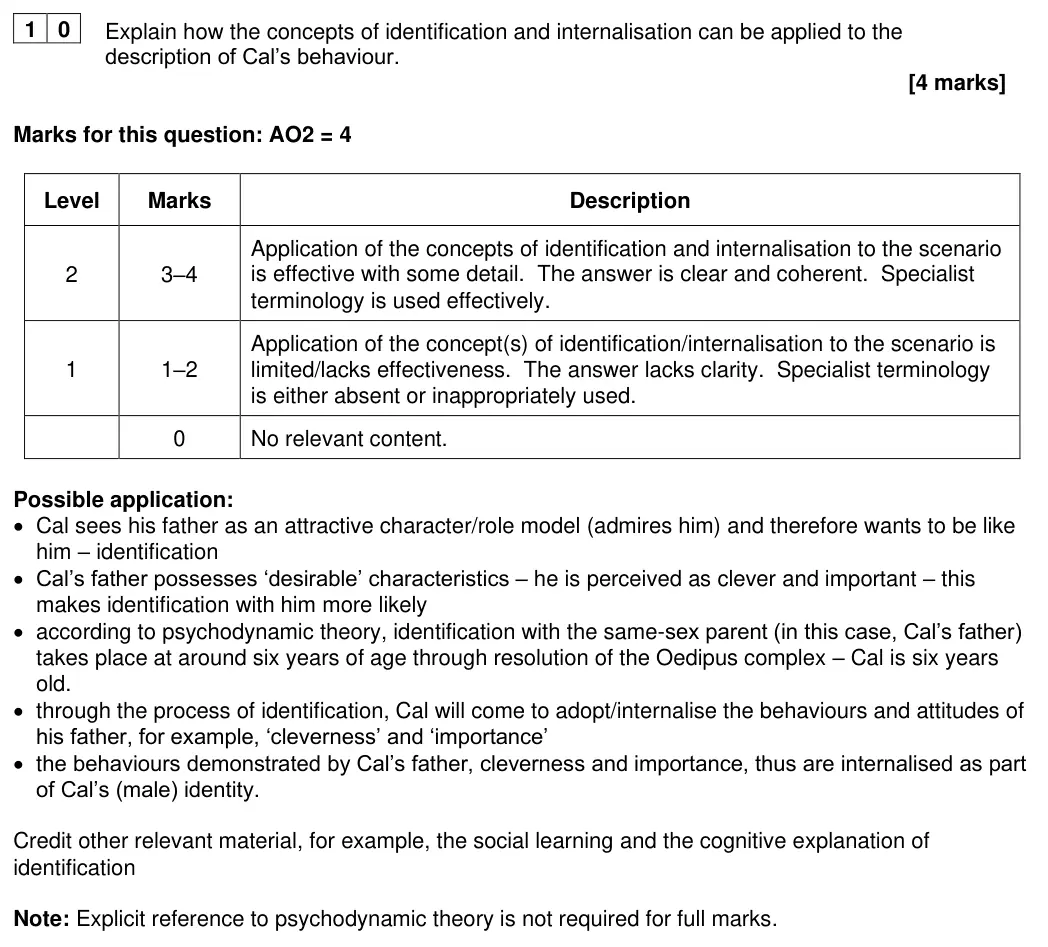
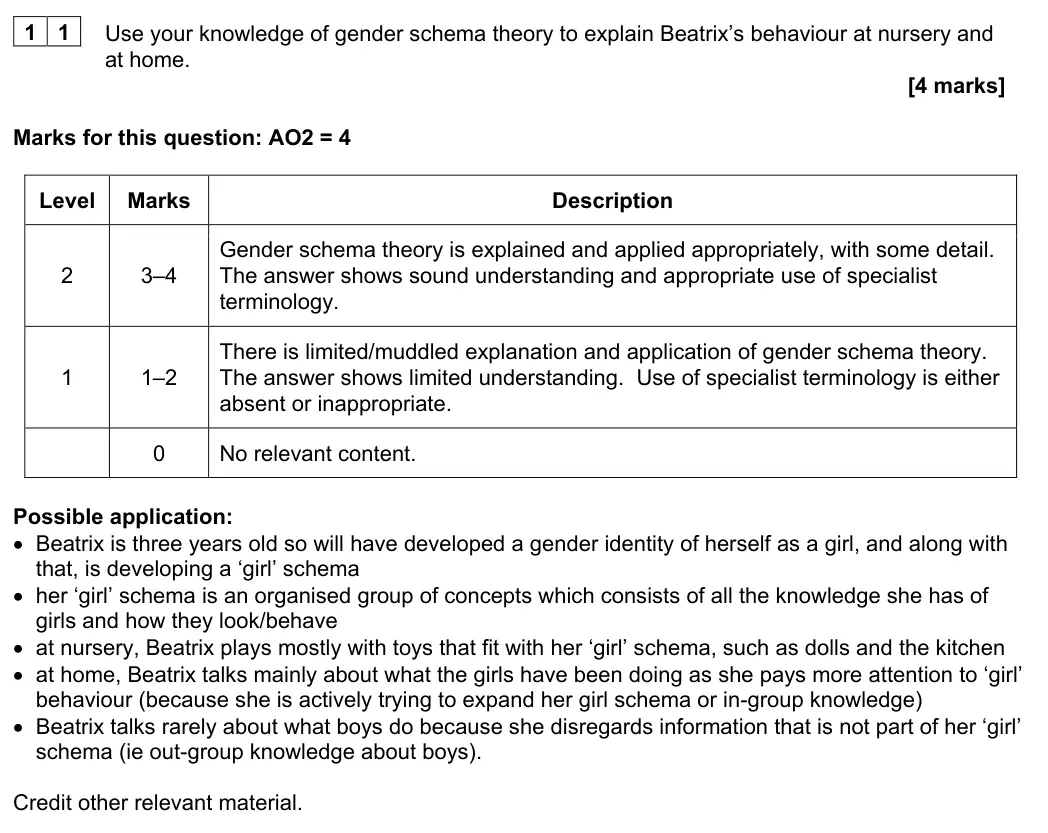
Mark scheme, including level descriptors and indicative content
Examiner's comment
The applied question on identification and internalisation (10) produced some lengthy descriptions with minimal links to the stem. Although the mark scheme allowed for material based on psychodynamic theory, social learning theory or cognitive development, it was often unclear which approach students were taking, and answers appeared somewhat muddled as a result. Better answers drew a clear distinction between the two concepts in the question and made explicit links to the stem.
Notes from the mark scheme and report
identification (admires clever, important father as role model) and internalisation (adopts his behaviour/attitudes as own identity)
MS also credits psychodynamic identification via Oedipus complex (removed in v1.4) but explicit psychodynamic reference not required (SLT or cognitive accepted)
answers muddled about which theory
lengthy descriptions with minimal links to the stem
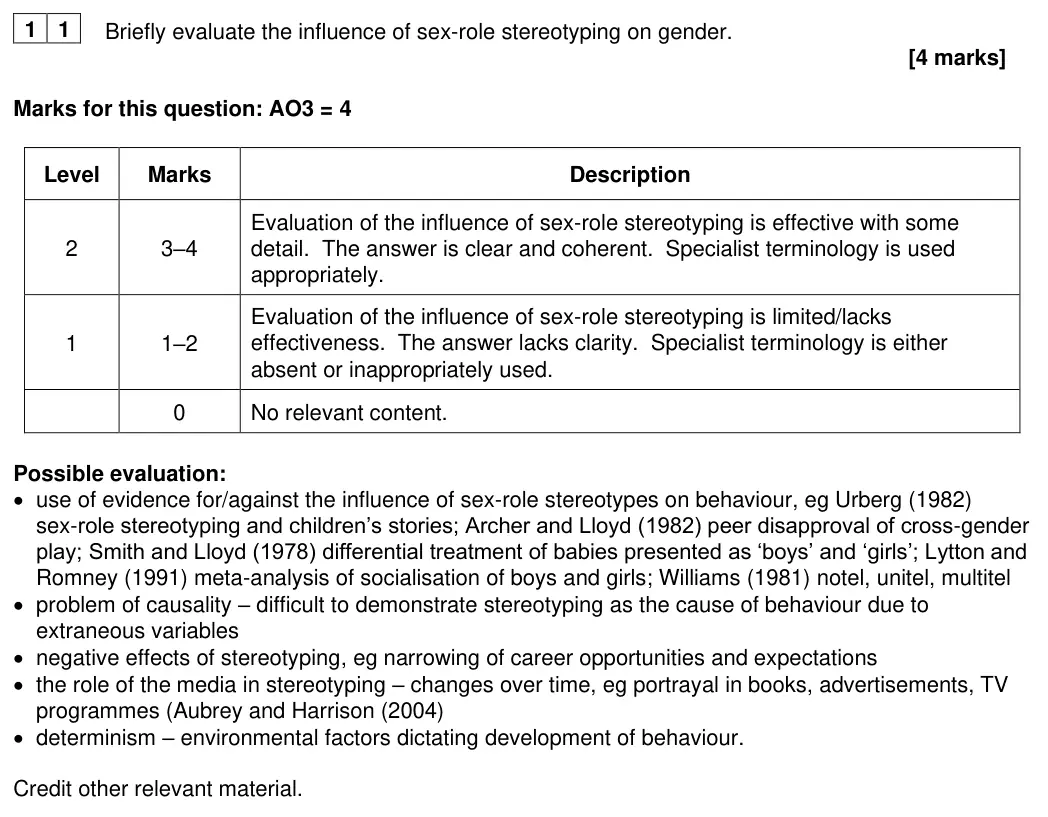
June 2025 · Paper 3 · Q114 marksAO3=4Evaluate (short)Old spec only
Mark scheme, including level descriptors and indicative content
Examiner's comment
Question 11 also proved troublesome for many. Lots of students seemed unsure how to tackle the question so simply wrote, sometimes at length, about specific gender stereotypes and subsequently did not score. There were attempts at evidence-based evaluations, but these were often not executed well. The best answers tended to provide a detailed account of one study, usually Smith and Lloyd, with analysis of how this illustrated the key concept at the end.
Notes from the mark scheme and report
(sex-role stereotypes were removed from the gender topic in v1.4
overlaps with the current 'influence of culture and media on gender roles')
evidence e.g. Smith and Lloyd baby X, Williams notel, Lytton and Romney
many just described stereotypes and scored nothing
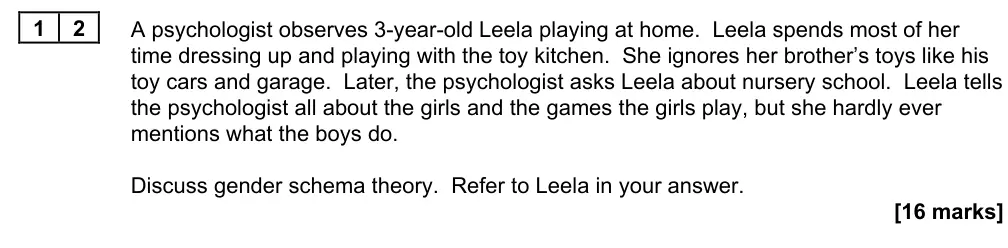
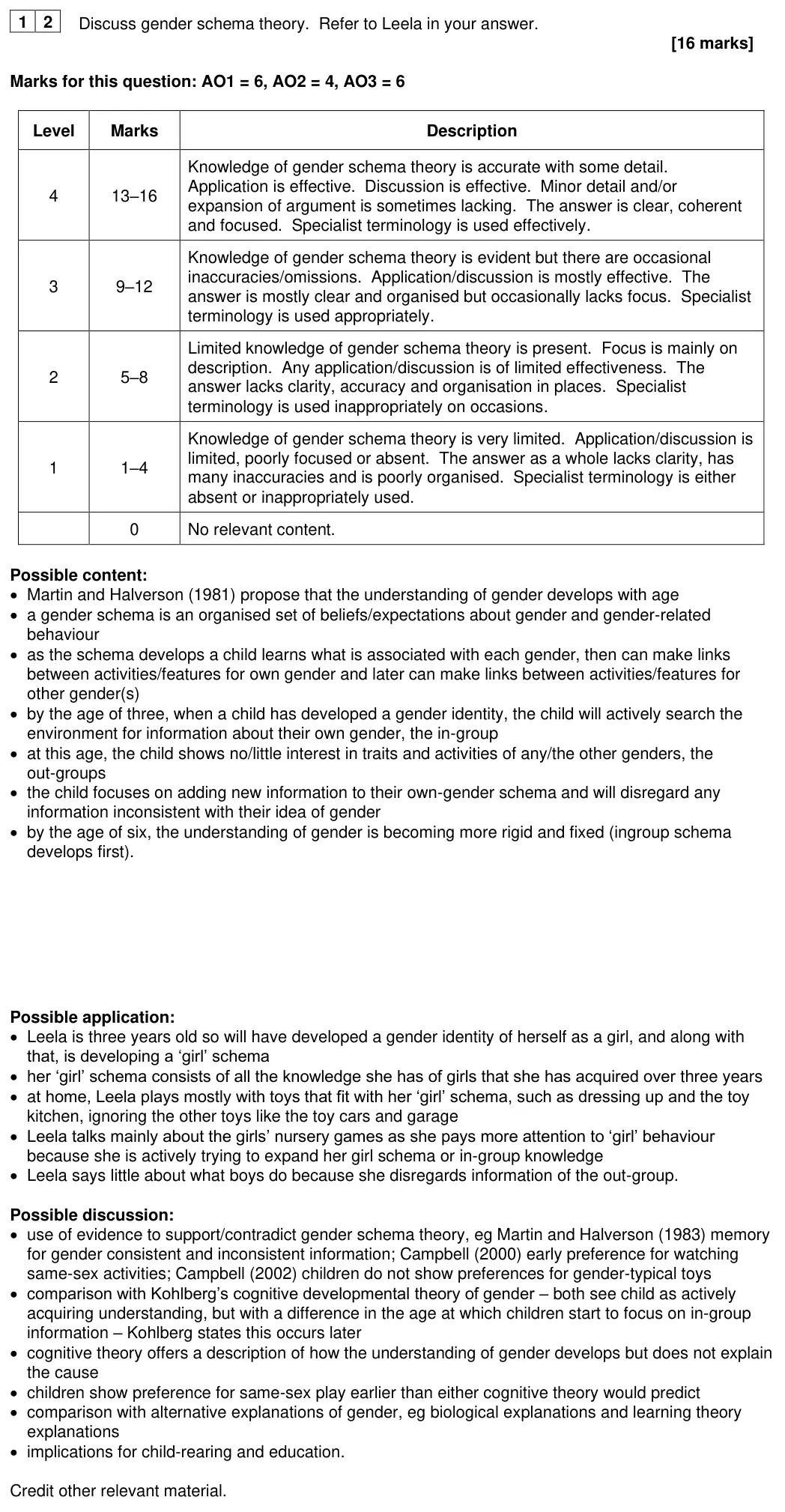
June 2025 · Paper 3 · Q1216 marksAO1=6, AO2=4, AO3=616-mark essay
Mark scheme, including level descriptors and indicative content
Examiner's comment
The gender schema essay (Question 12) produced a very wide range of answers. There were some excellent responses that included detailed understanding of the concept of schema, the idea of ingroups/outgroups and how children disregard information that conflicts with their existing schema. Such knowledge was effectively linked to the information in the stem, and supported by evidence, typically the Martin and Halverson study, alongside reasoned comparison with Kohlberg’s theory. There were also lots of answers that muddled gender schema and Kohlberg’s theory or were simply too vague to gain much credit.
Notes from the mark scheme and report
gender schema, in-group/out-group (Leela attends to girls, ignores brother's toys and the boys)
evidence Martin and Halverson
comparison with Kohlberg (age at which in-group focus starts)
many muddled gender schema and Kohlberg
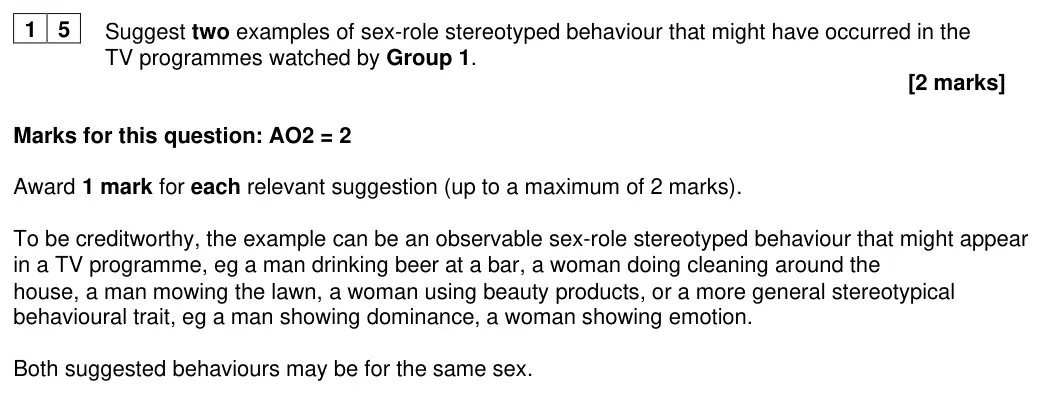
June 2024 · Paper 3 · Q152 marksAO2=2Application
Mark scheme, including level descriptors and indicative content
Examiner's comment
Question 15 caused few problems, particularly because students could either give examples of sex-stereotyped behaviours, or more general behavioural traits. Those who did lose marks gave examples that would not necessarily be associated with one sex or the other, such as keeping fit.
Notes from the mark scheme and report
1 mark each: observable gender-stereotyped behaviour on TV (man mowing lawn, woman cleaning) or trait (male dominance, female emotion)
both may be the same sex
not credited if not sex-typed (e.g. keeping fit)
'sex-role stereotypes' heading removed in v1.4 but media influence on gender roles remains
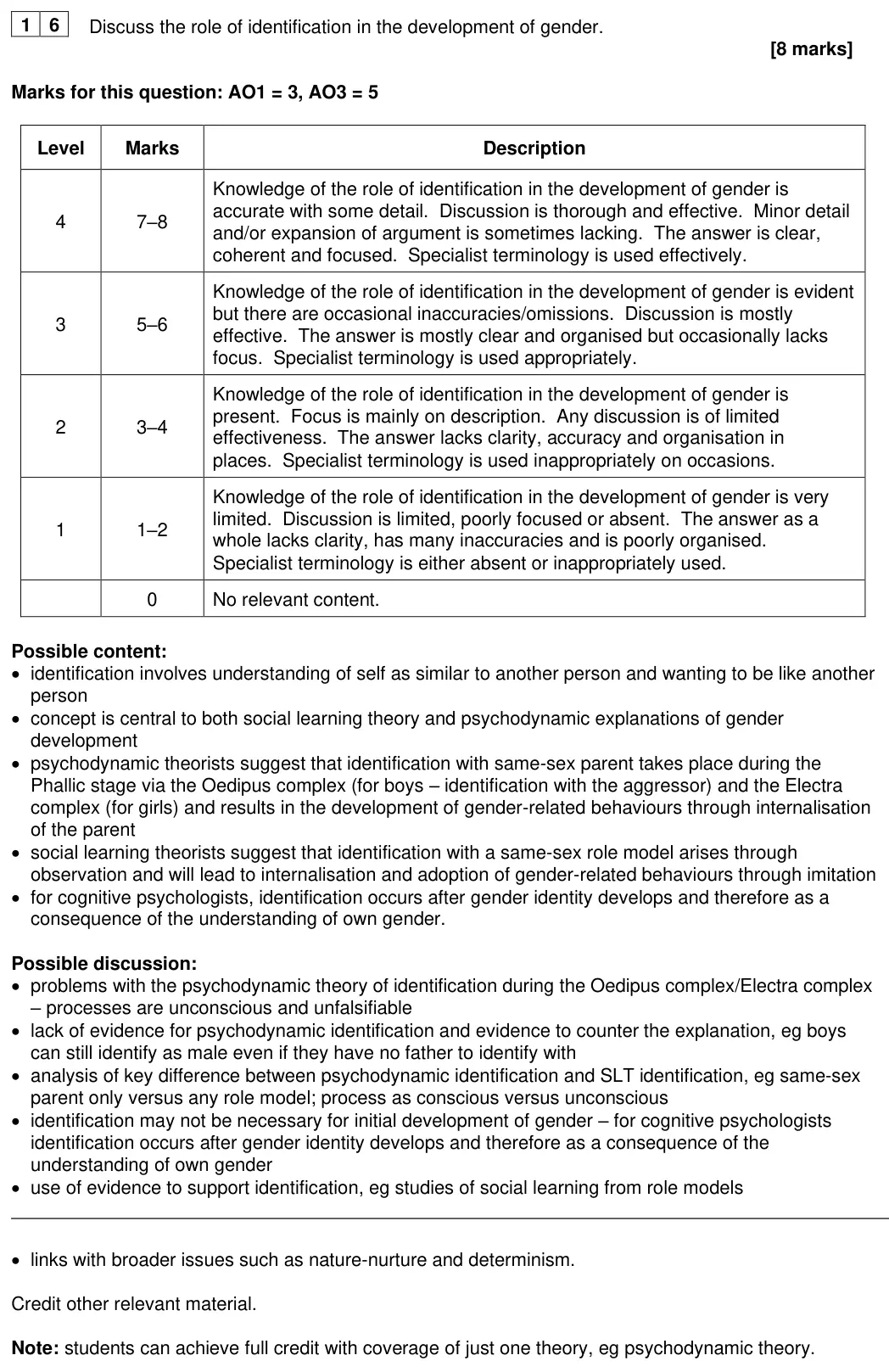
June 2024 · Paper 3 · Q168 marksAO1=3, AO3=5Extended writing
Mark scheme, including level descriptors and indicative content
Examiner's comment
Question 16 wrongfooted many students who seemed underprepared for a question of this type. There were some good answers though, mainly from those who discussed the psychodynamic and social learning theory versions of identification, resulting in effective analyses of both.
Notes from the mark scheme and report
MS also credits psychodynamic identification (Oedipus/Electra complex), removed in v1.4, and says full credit possible for one theory: answer via SLT identification (current)
many underprepared
best answers compared psychodynamic and SLT identification
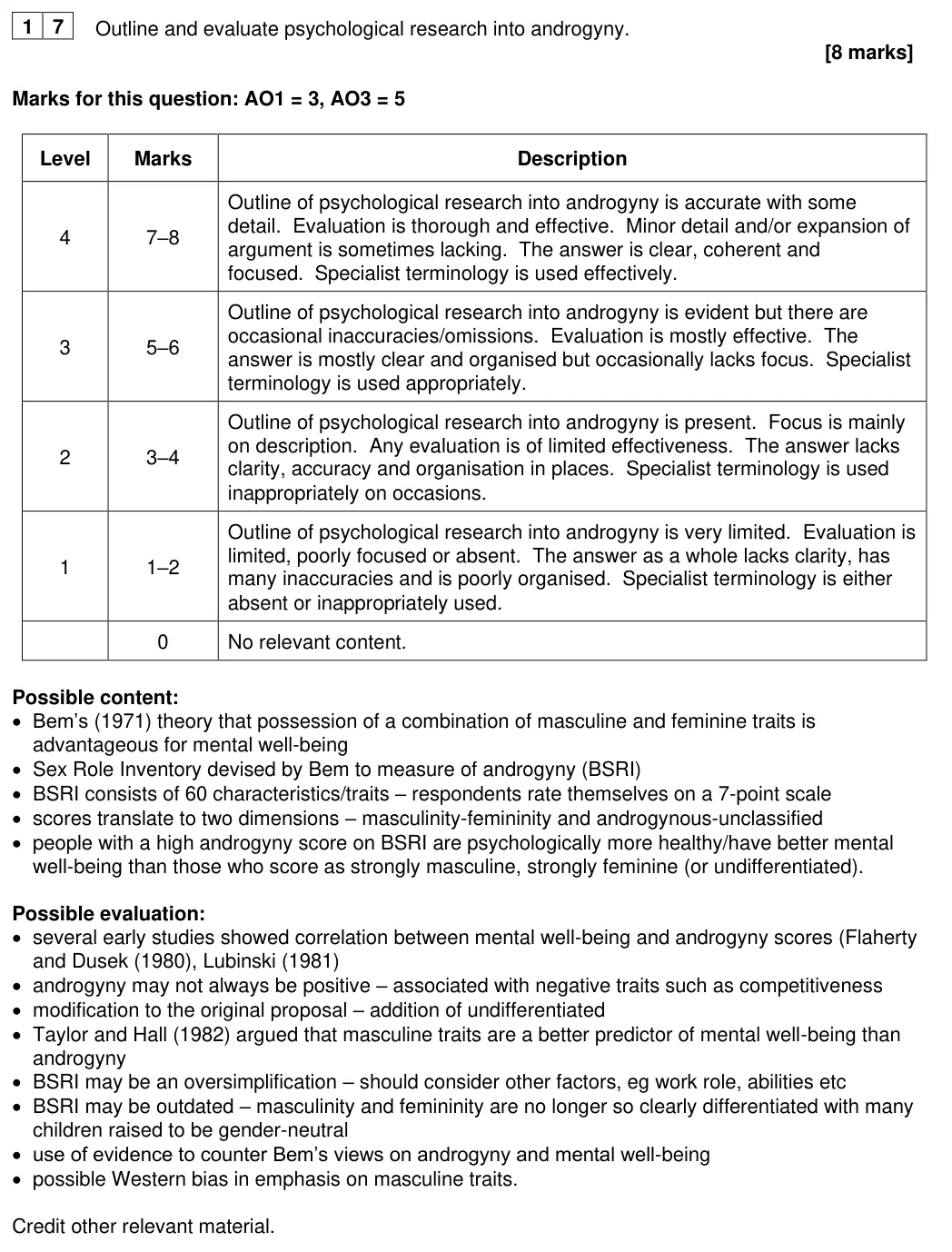
June 2024 · Paper 3 · Q178 marksAO1=3, AO3=5Extended writingOld spec only
Mark scheme, including level descriptors and indicative content
Examiner's comment
Question 17 was one of the better answered 8-marks questions on the paper. Many students gave convincing accounts of Bem’s methodology and were able to assess the sex role inventory in terms of its reliability and validity.
Notes from the mark scheme and report
(androgyny and Bem's androgyny/well-being research removed in v1.4
measuring gender with the BSRI remains)
good accounts of BSRI methodology, reliability and validity
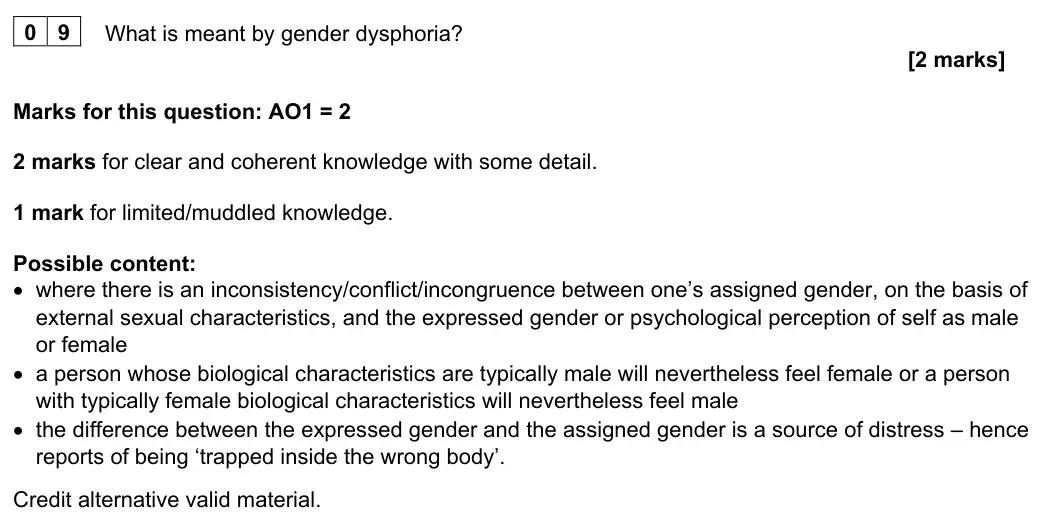
June 2023 · Paper 3 · Q92 marksAO1=2Short answer
Mark scheme, including level descriptors and indicative content
Examiner's comment
Most students picked up the first mark for a basic definition of gender dysphoria, and some the second, usually for suggesting that dysphoria may produce a state of discomfort in those who experience it.
Notes from the mark scheme and report
'gender dysphoria' is reworded 'gender incongruence' in v1.4 (still current)
conflict between assigned and experienced gender
2nd mark for distress/'trapped in wrong body'
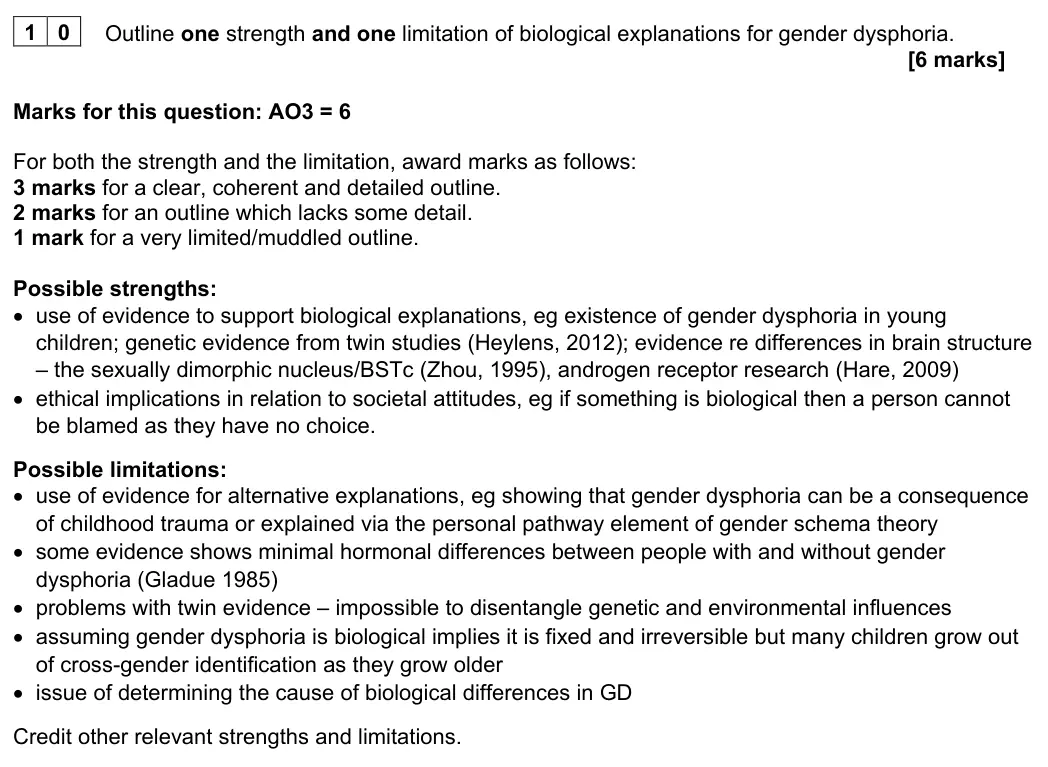
June 2023 · Paper 3 · Q106 marksAO3=6Evaluate (short)
Mark scheme, including level descriptors and indicative content
Examiner's comment
Students who scored highly tended to talk about evidence supporting brain sex theory as a strength. They then presented further evidence as counterargument for the limitation, typically questioning the causal relationship between dimorphic brain areas and gender dysphoria.
Notes from the mark scheme and report
wording 'gender dysphoria' = gender incongruence in v1.4
strengths e.g. twin studies, BSTc brain-sex evidence
limitations e.g. alternative explanations (trauma, gender schema), twin evidence confounds, causality of brain differences
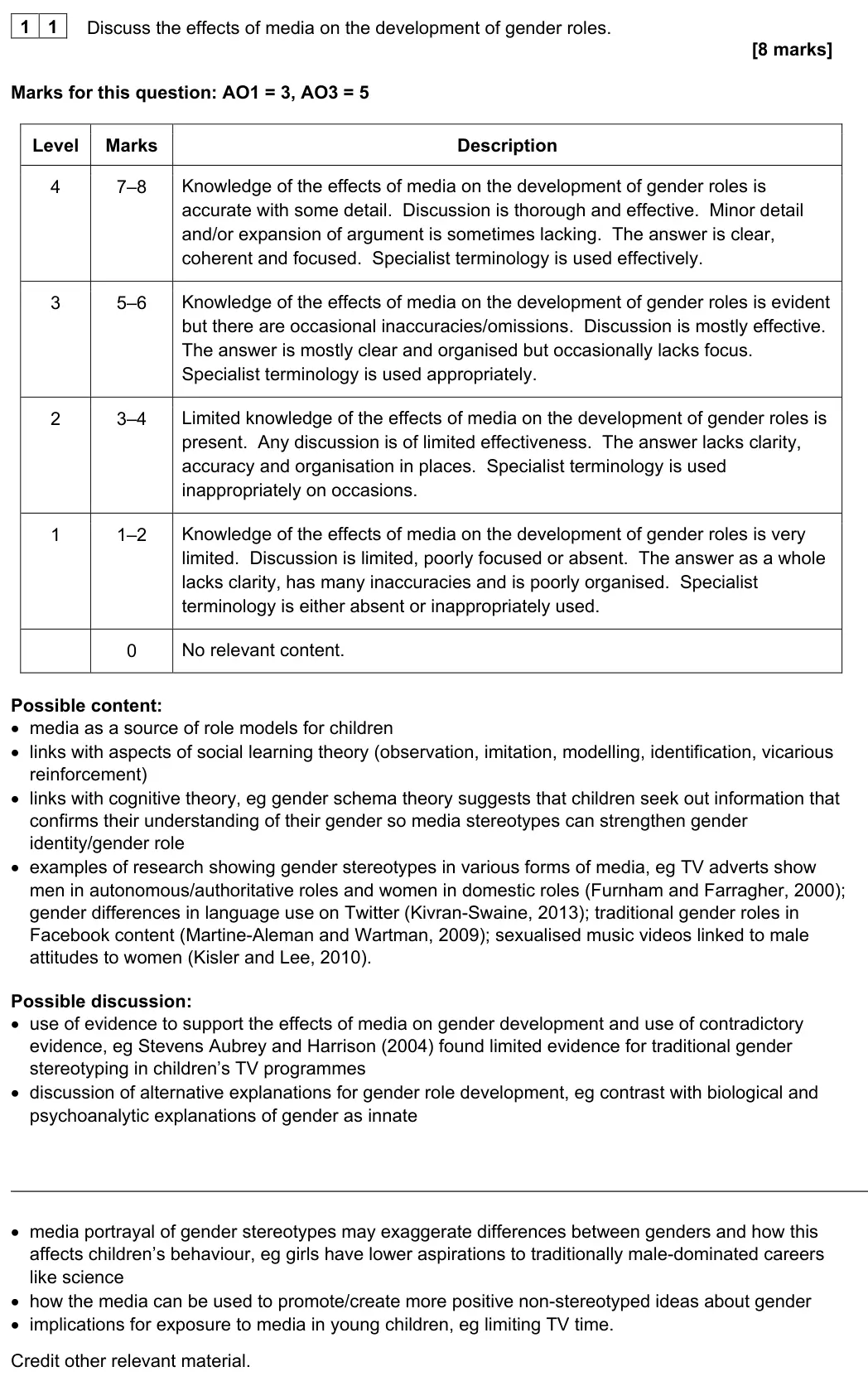
June 2023 · Paper 3 · Q118 marksAO1=3, AO3=5Extended writing
Mark scheme, including level descriptors and indicative content
Examiner's comment
Many found this question challenging. There were a significant number of basic and anecdotal accounts of the influence of media on gender, and a general lack of convincing evidence. Those students who did perform well tended to present social learning concepts linked to gendered role models. The Williams television study was often used effectively. Finally, several students confused the effects of media with the effects of culture on gender. This is perhaps not surprising as the two topics are part of the same section on the specification.
Notes from the mark scheme and report
media as source of role models with SLT/gender schema links and evidence
many answers anecdotal with little evidence
confused effects of media with culture
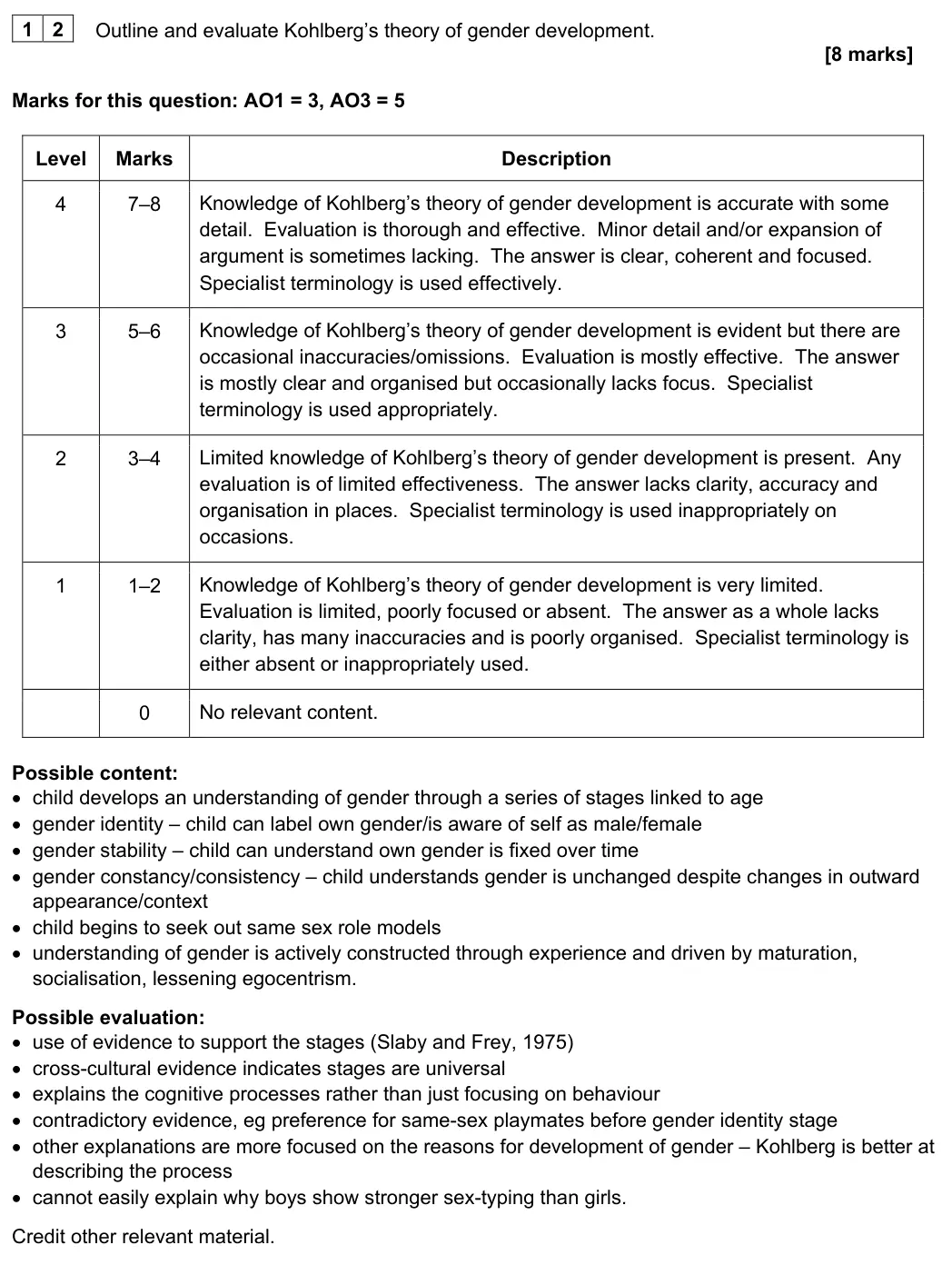
June 2023 · Paper 3 · Q128 marksAO1=3, AO3=5Extended writing
Mark scheme, including level descriptors and indicative content
Examiner's comment
This question produced some very good answers. Knowledge of Kohlberg’s stages was generally sound, though there was occasional confusion between ‘stability’ and ‘constancy’. Evaluation/discussion was of a good standard here. Most students could provide relevant evidence, as well as general discussion points – such as the universality of Kohlberg’s theory, and the methodological difficulties associated with interviewing very young children.
Notes from the mark scheme and report
gender identity, stability, constancy
confusion between stability and constancy
evaluation e.g. Slaby and Frey, universality, interviewing young children
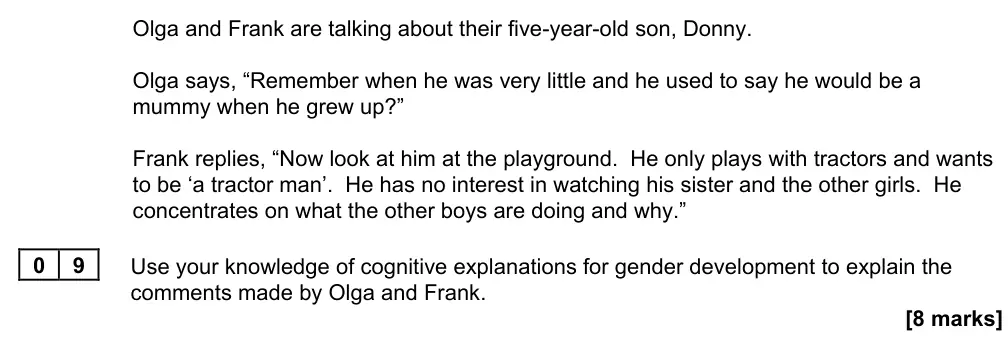
June 2022 · Paper 3 · Q98 marksAO2=8Extended writing
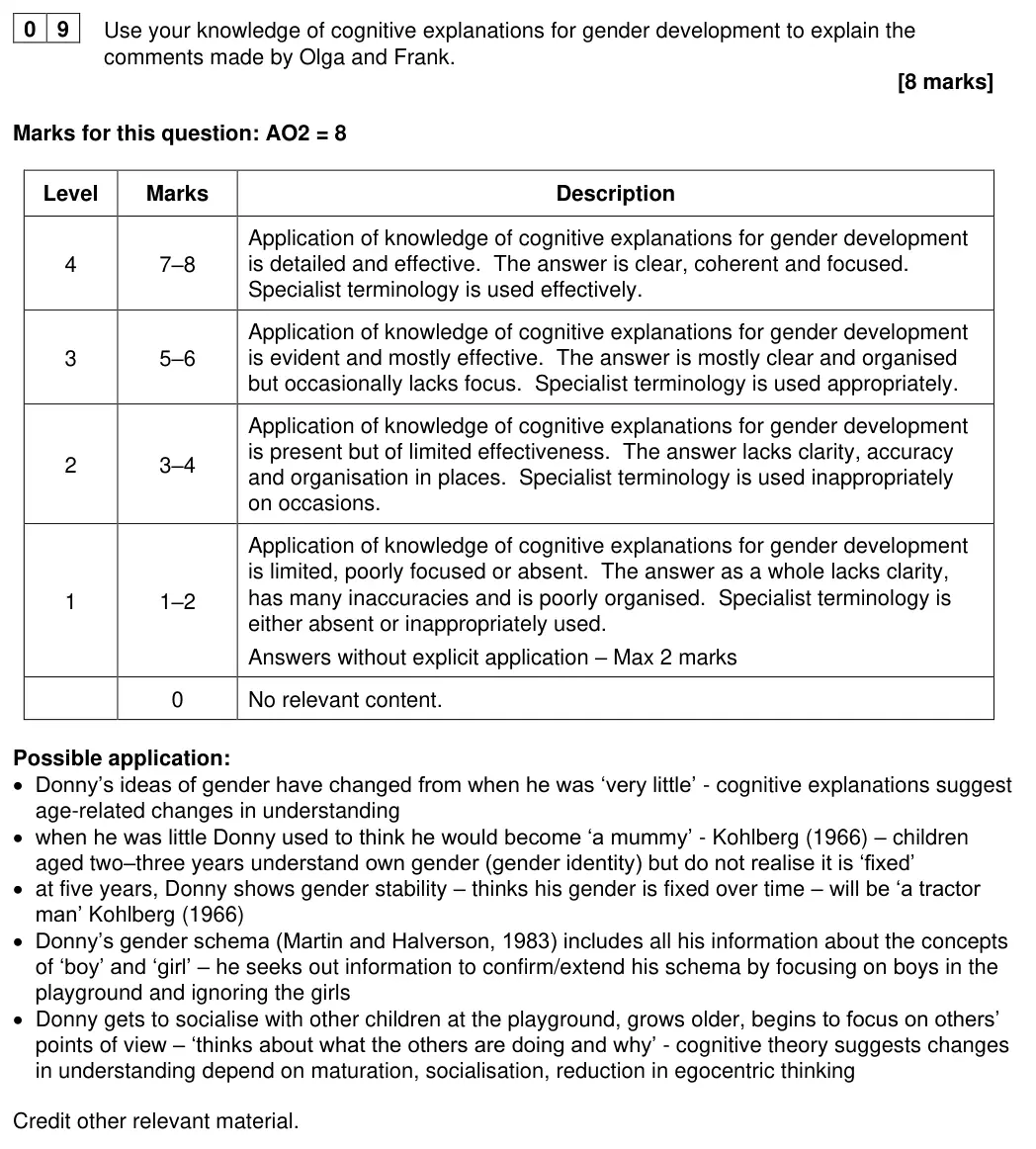
Mark scheme, including level descriptors and indicative content
Examiner's comment
The stem in Question 09 tended to elicit effective application, particularly in relation to gender schema theory. Use of Kohlberg’s stages sometimes focused more on lengthy description of the theory than on application and there was often some confusion over the different stages. Unfortunately, some less well scoring answers read more like application of social learning theory with the emphasis on observation, imitation and stereotypes.
Notes from the mark scheme and report
all AO2: Kohlberg (gender identity without stability when 'a mummy'
stability at 5) and gender schema theory (attends to boys, ignores girls) applied to Donny
no explicit application = max 2
confusion of stages
SLT answers not credited
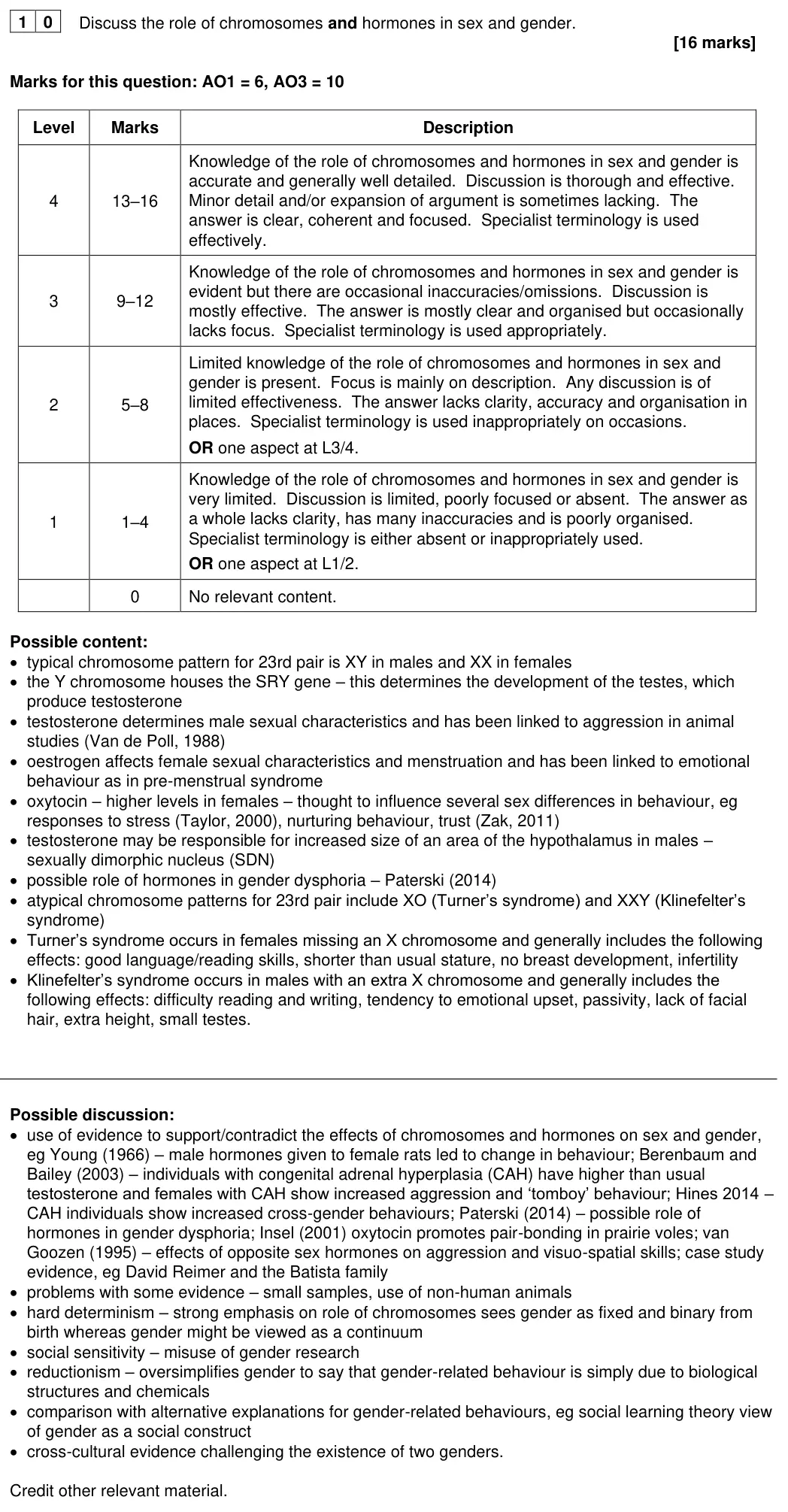
June 2022 · Paper 3 · Q1016 marksAO1=6, AO3=1016-mark essay
Mark scheme, including level descriptors and indicative content
Examiner's comment
Answers to Question 10 were generally strong on knowledge and understanding but less competent when it came to discussion. In some cases, the whole of the discussion seemed to focus on evidence supporting the role of testosterone and/or the Y chromosome on aggression, often without any reference whatsoever to gender. Whilst such material might not be wholly irrelevant it could have been made much more effective had it been shaped better to the question.
Notes from the mark scheme and report
chromosomes AND hormones (testosterone, oestrogen, oxytocin), Klinefelter's/Turner's, CAH
one aspect only = max Level 2
discussion often only about testosterone and aggression without gender
v1.4 rewords as 'biological sex'
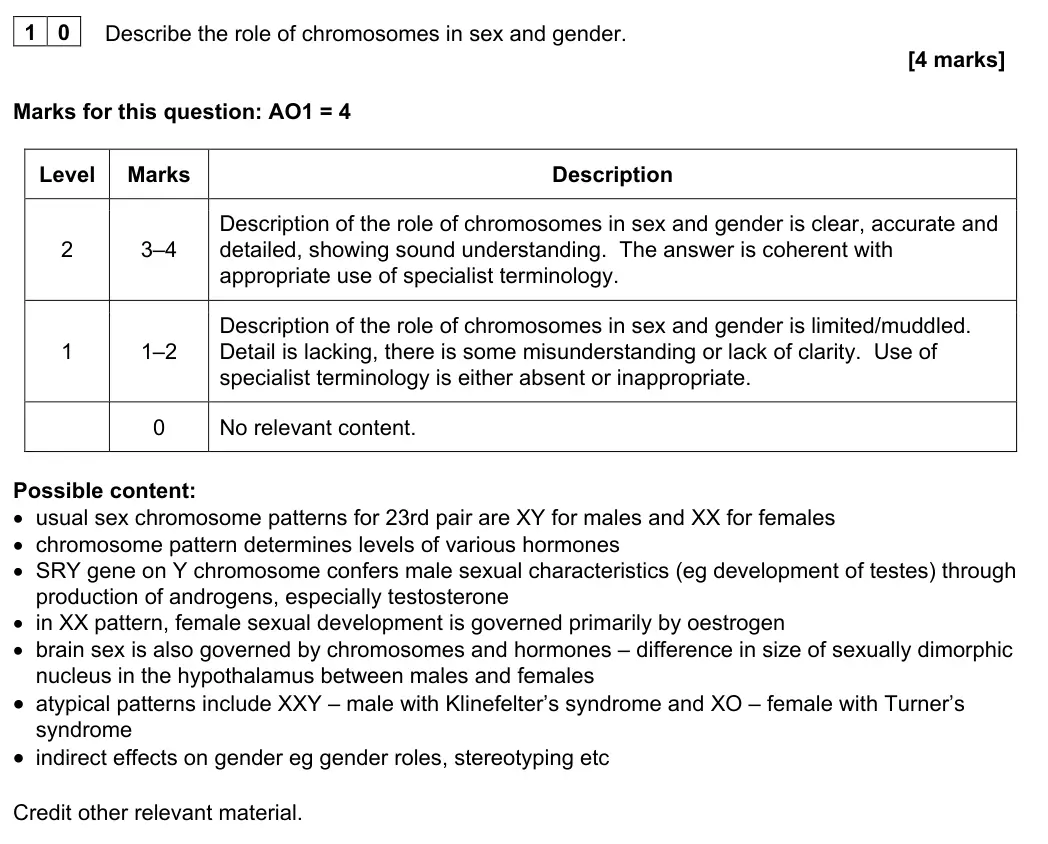
November 2021 · Paper 3 · Q104 marksAO1=4Outline
Mark scheme, including level descriptors and indicative content
Examiner's comment
The 4-mark knowledge questions tended to be well answered, especially Q07.
Notes from the mark scheme and report
XX/XY, SRY gene and testosterone, oestrogen, Klinefelter's (XXY) and Turner's (XO)
v1.4 rewords this as chromosomes in biological sex
November 2021 · Paper 3 · Q114 marksAO2=4Application
Mark scheme, including level descriptors and indicative content
Examiner's comment
The 4-mark application questions were less well done, often because there was very little psychological content in the answers. Common errors in Q11 were lack of focus on the cognitive aspect and confusion with social learning.
Notes from the mark scheme and report
Beatrix (3) has gender identity and a 'girl' schema: plays with schema-consistent toys, attends to in-group (girls) and ignores out-group
common errors: no cognitive focus, confusion with SLT
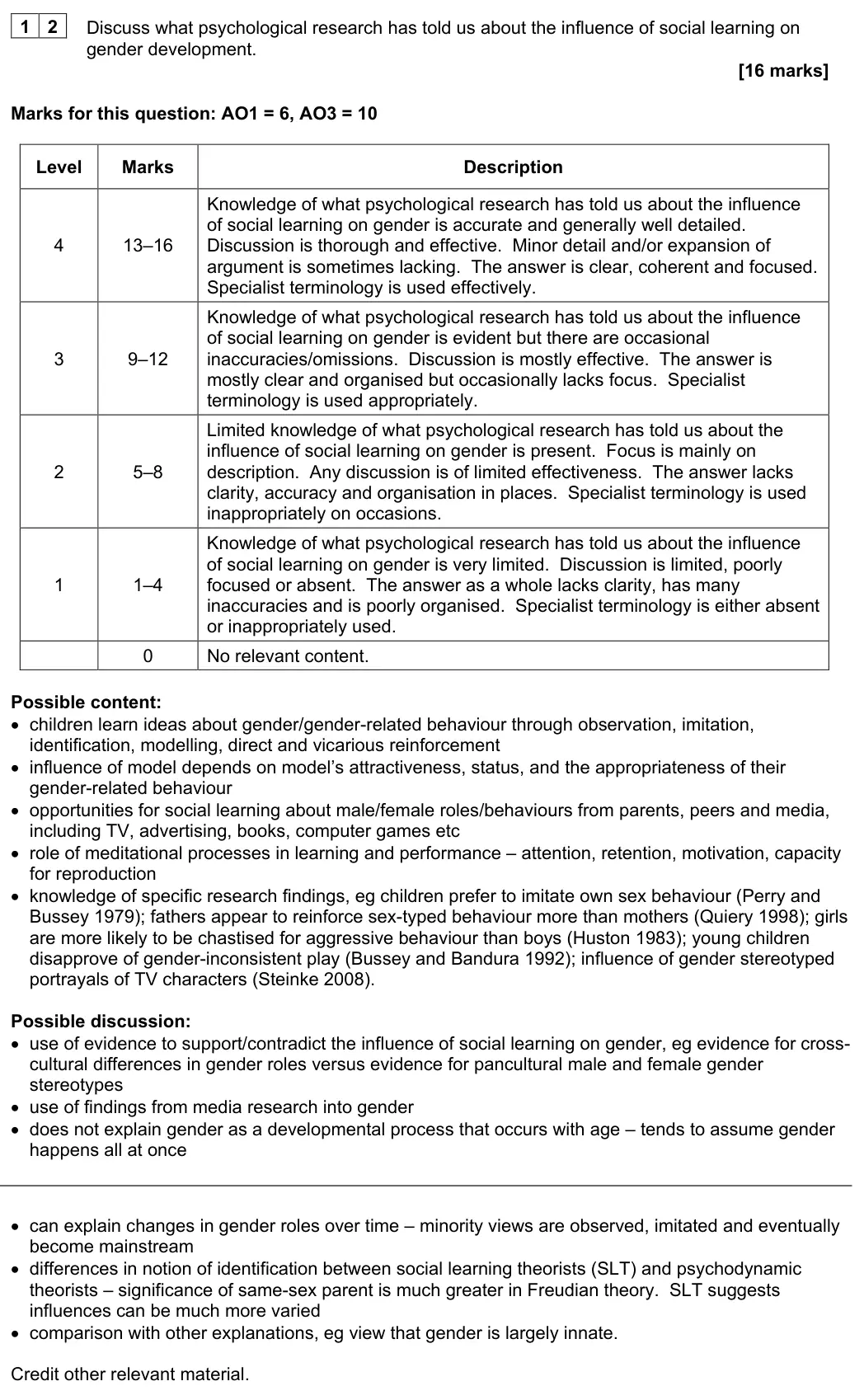
November 2021 · Paper 3 · Q1216 marksAO1=6, AO3=1016-mark essay
Mark scheme, including level descriptors and indicative content
Examiner's comment
Answers to the extended writing questions varied; less successful answers to Q09 often focused on the general nature of parasocial relationships rather than on ‘why’ they developed, whereas low scoring answers to Q12 tended to be generalised discussions of social learning theory with scant reference to gender.
Notes from the mark scheme and report
research on observation, imitation, reinforcement, identification and media influence on gender
low scorers gave generic SLT with scant gender reference
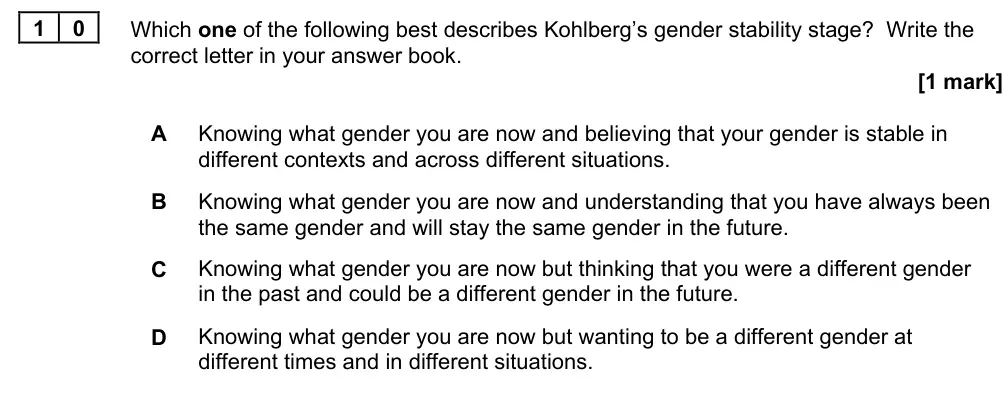
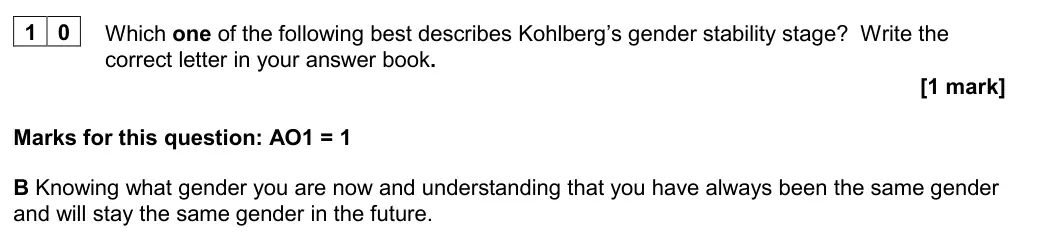
November 2020 · Paper 3 · Q101 markAO1=1Multiple choice
Answer
B
Mark scheme, including level descriptors and indicative content
Examiner's comment
Multiple choice distractors appeared to have been particularly effective in relationships and gender.
Notes from the mark scheme and report
correct B (always been and will stay the same gender)
A describes constancy
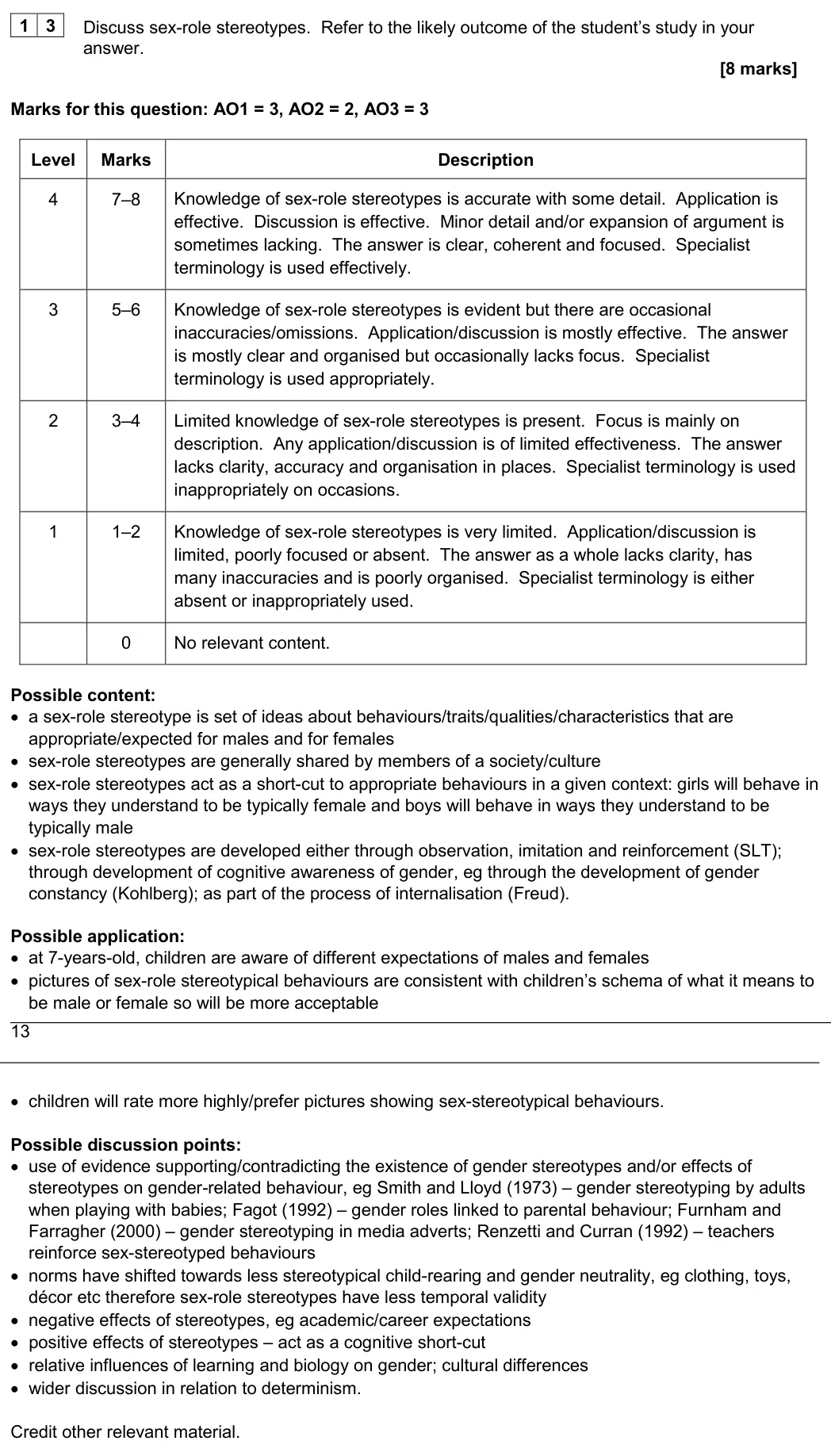
November 2020 · Paper 3 · Q138 marksAO1=3, AO2=2, AO3=3Extended writingOld spec only
Mark scheme, including level descriptors and indicative content
Examiner's comment
The applied questions on filter theory, sex-role stereotypes and Selman usually evidenced sound knowledge and application but discussion was often brief or absent.
Notes from the mark scheme and report
(sex-role stereotypes, removed in v1.4
culture/media influence on gender roles remains)
apply: 7-year-olds will prefer stereotypical pictures
MS also credits Freud's internalisation (removed)
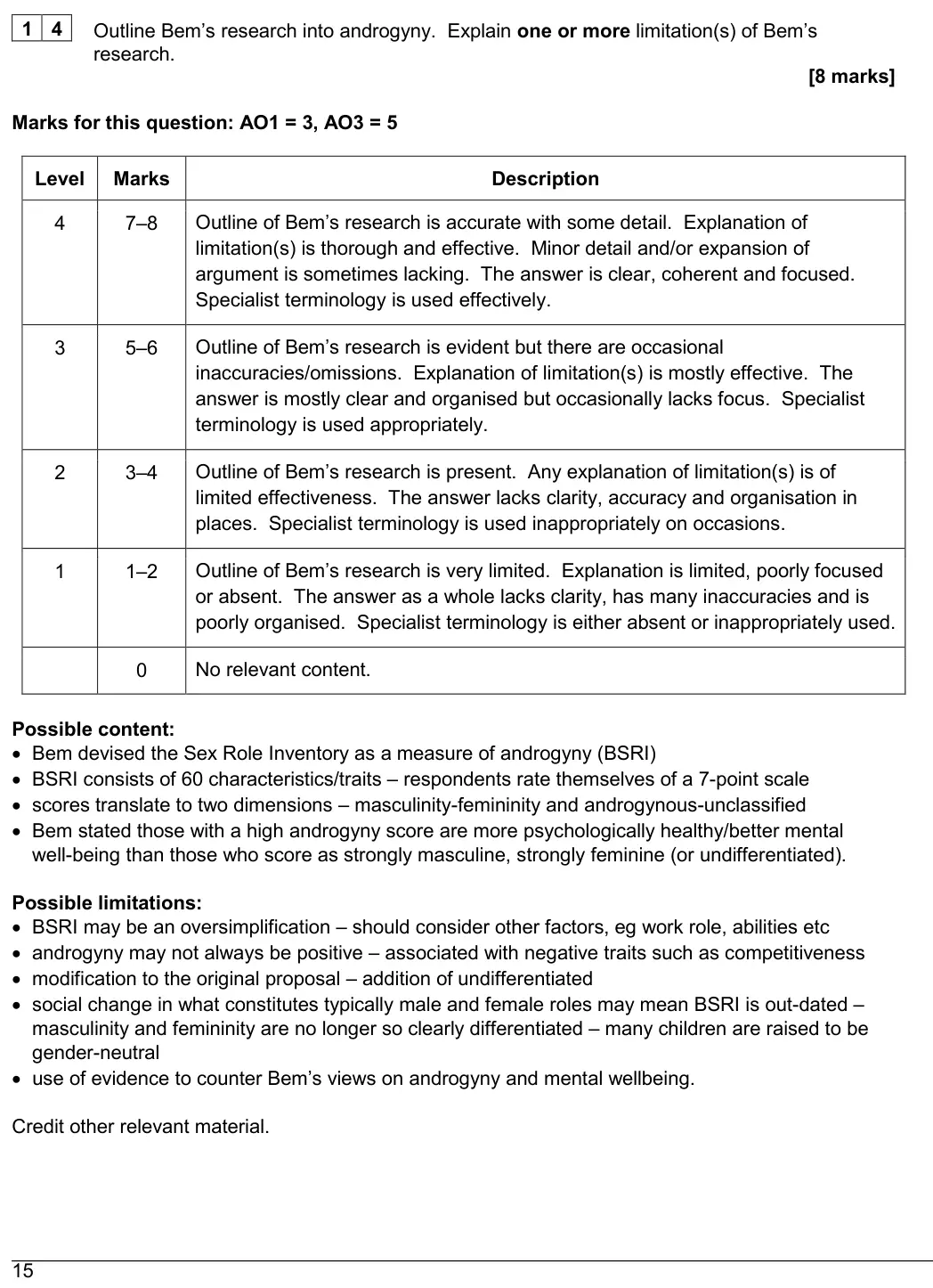
November 2020 · Paper 3 · Q148 marksAO1=3, AO3=5Extended writingOld spec only
Mark scheme, including level descriptors and indicative content
Examiner's comment
Limitations of Bem’s research often consisted of weak generic points about the use of questionnaires.
Notes from the mark scheme and report
(Bem's research into androgyny and psychological health
only measuring gender with the BSRI remains in v1.4)
limitations only, e.g. outdated with social change, oversimplification
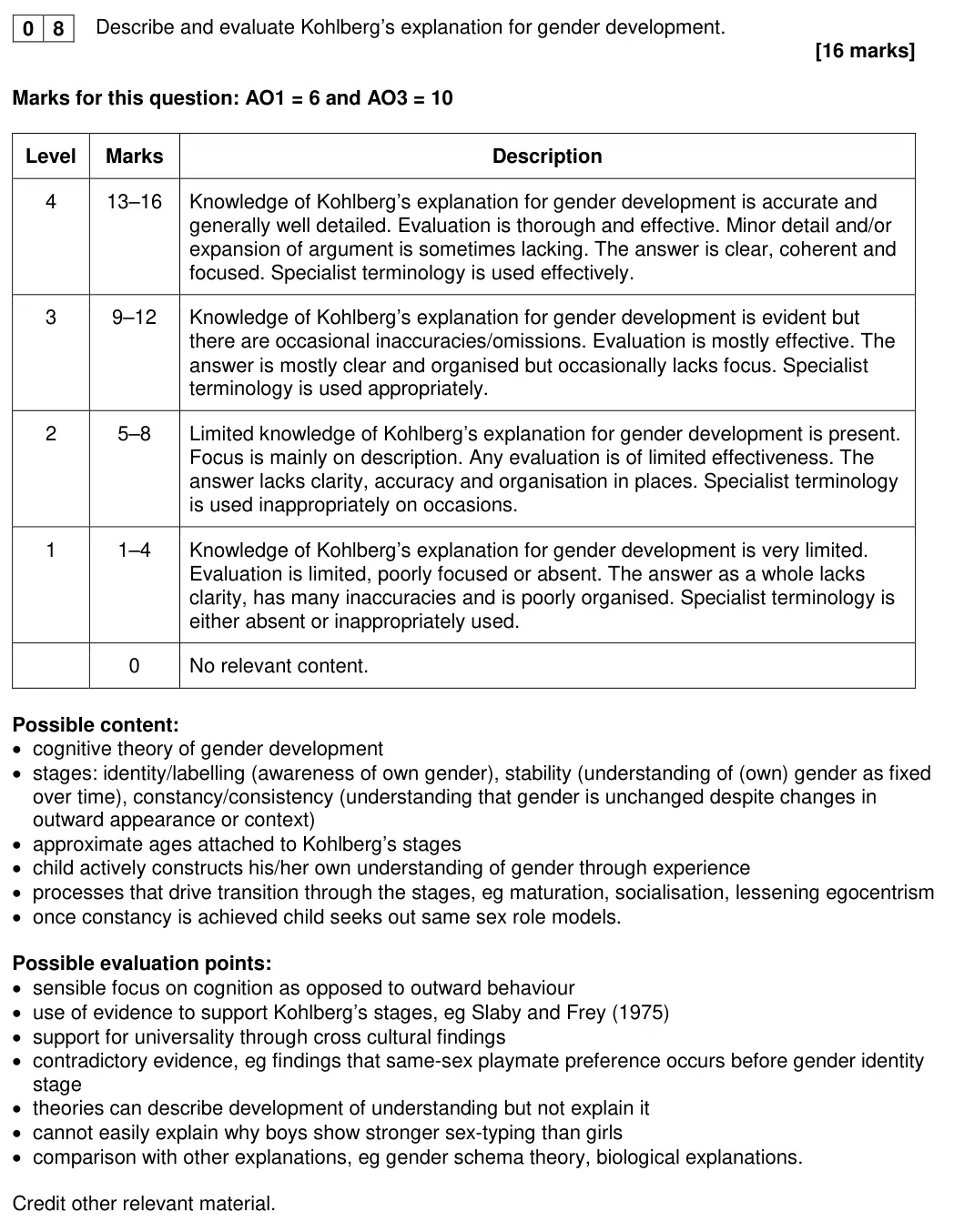
June 2019 · Paper 3 · Q816 marksAO1=6, AO3=1016-mark essay
Mark scheme, including level descriptors and indicative content
Examiner's comment
Descriptions of Kohlberg’s three stages tended to be mostly effective although some students mixed up the names. Less effective answers had descriptions of each stage that did not pick out the most salient distinguishing feature of the stage and thus rendered the stages indistinguishable. As an example, students might say how in the stability stage children cannot understand that gender stays the same even though clothes/hairstyles change (true, but not the most obvious feature of that stage) and then gave the same description for the constancy stage. The Slaby and Frey research featured in most evaluations although some students could have answered more effectively if they had fully explained how the results supported the theory.
Notes from the mark scheme and report
identity, stability, constancy with the distinguishing feature of each stage
Slaby and Frey support must be explained
comparison with gender schema theory
June 2018 · Paper 3 · Q122 marksAO1=2Outline
Mark scheme, including level descriptors and indicative content
Examiner's comment
Many answers gained only 1 mark, either because they lacked clarity and coherence, or because they lacked any explicit cognitive element.
Notes from the mark scheme and report
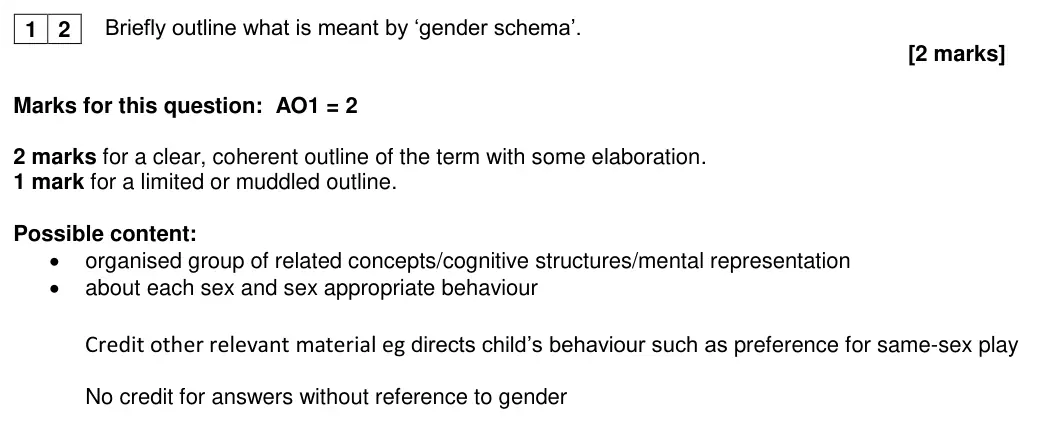
cognitive structure about each sex and sex-appropriate behaviour
no credit without reference to gender
many lacked explicit cognitive element
June 2018 · Paper 3 · Q136 marksAO1=3, AO3=3Outline
Mark scheme, including level descriptors and indicative content
Examiner's comment
Most answers gained marks in Level 2. A common error here was to present a detailed outline of social learning theory with only brief reference to gender. In the worst cases, the answer was almost entirely devoid of gender content and therefore gained little, if any, credit. Mainstream answers consisted of a reasonable outline with some link to gender, and a briefly noted strength. To attain Level 3 marks the strength required explanation, and despite the question requiring only one strength, some students presented a list leaving the examiner to try to disentangle them and award credit for the best.
Notes from the mark scheme and report
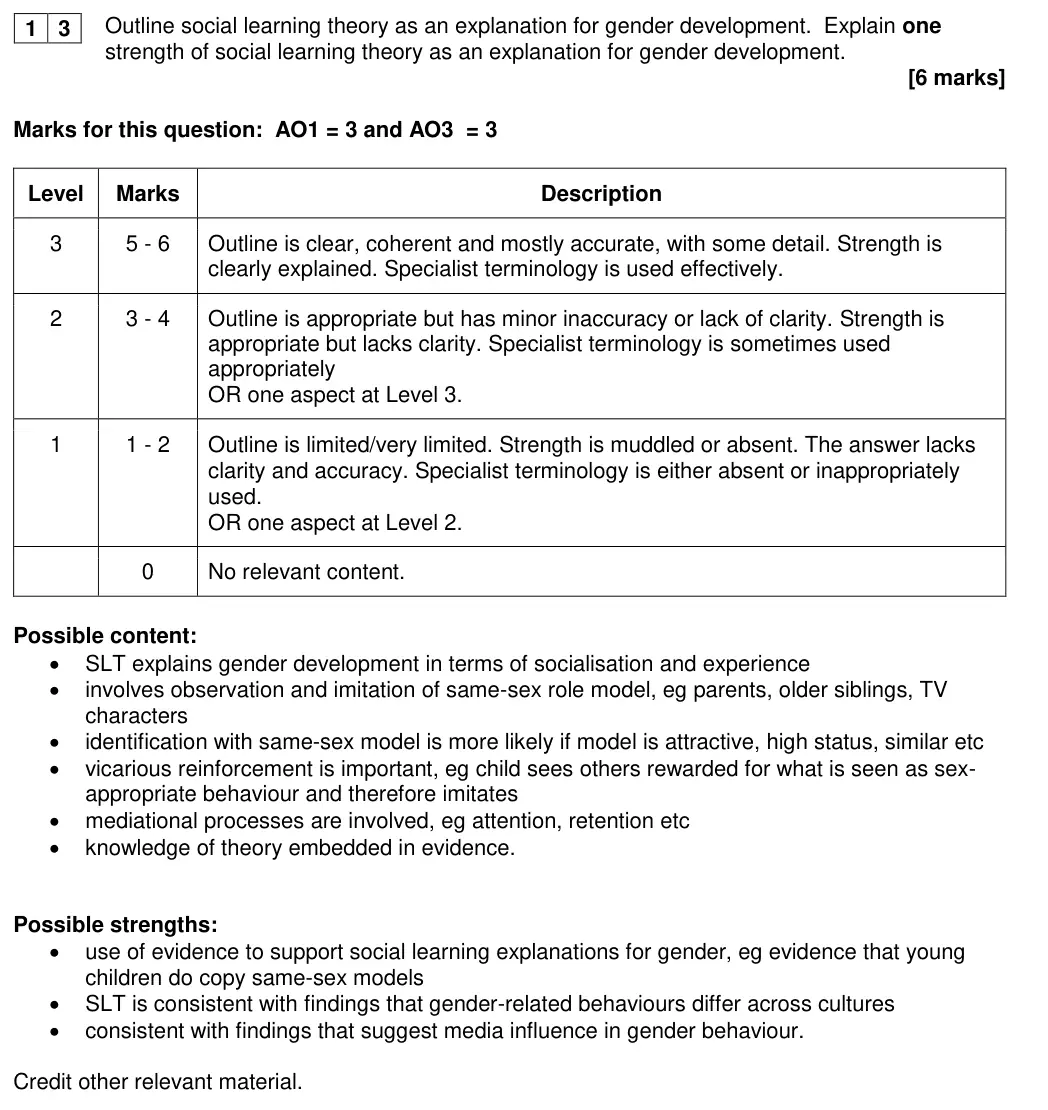
outline must be linked to gender (same-sex models, vicarious reinforcement, identification)
strength must be explained
generic SLT scored little
June 2018 · Paper 3 · Q168 marksAO1=3, AO2=2, AO3=3Extended writingOld spec only
Mark scheme, including level descriptors and indicative content
Examiner's comment
As in the case of the parallel questions, marks were largely dependent on the ability to organise material and address the three skills in limited time. Despite the diverse requirements, answers tended to be high scoring with many accurate and through accounts of Bem’s work, including the BSRI and more general theory. Whilst most students offered some valid application, it was surprisingly rare to see effective links to self-esteem. Discussions varied both in terms of content and quality, with many of the better answers commenting on relevance in relation to social changes since Bem’s original work.
Notes from the mark scheme and report
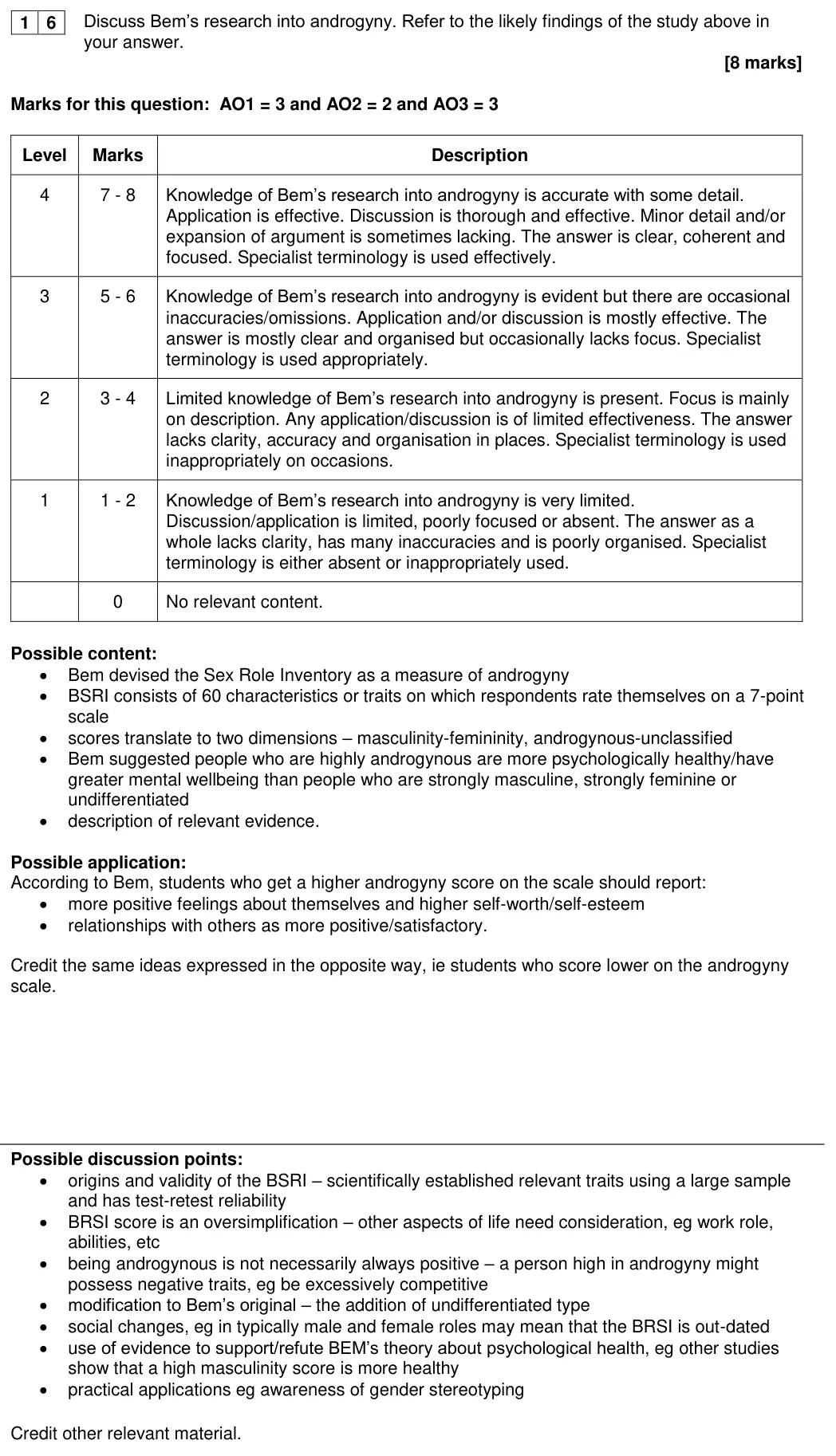
(androgyny and Bem's claim that androgyny = psychological health
only measuring gender with the BSRI remains in v1.4)
apply to self-esteem and relationship findings
discussion often on social change since Bem
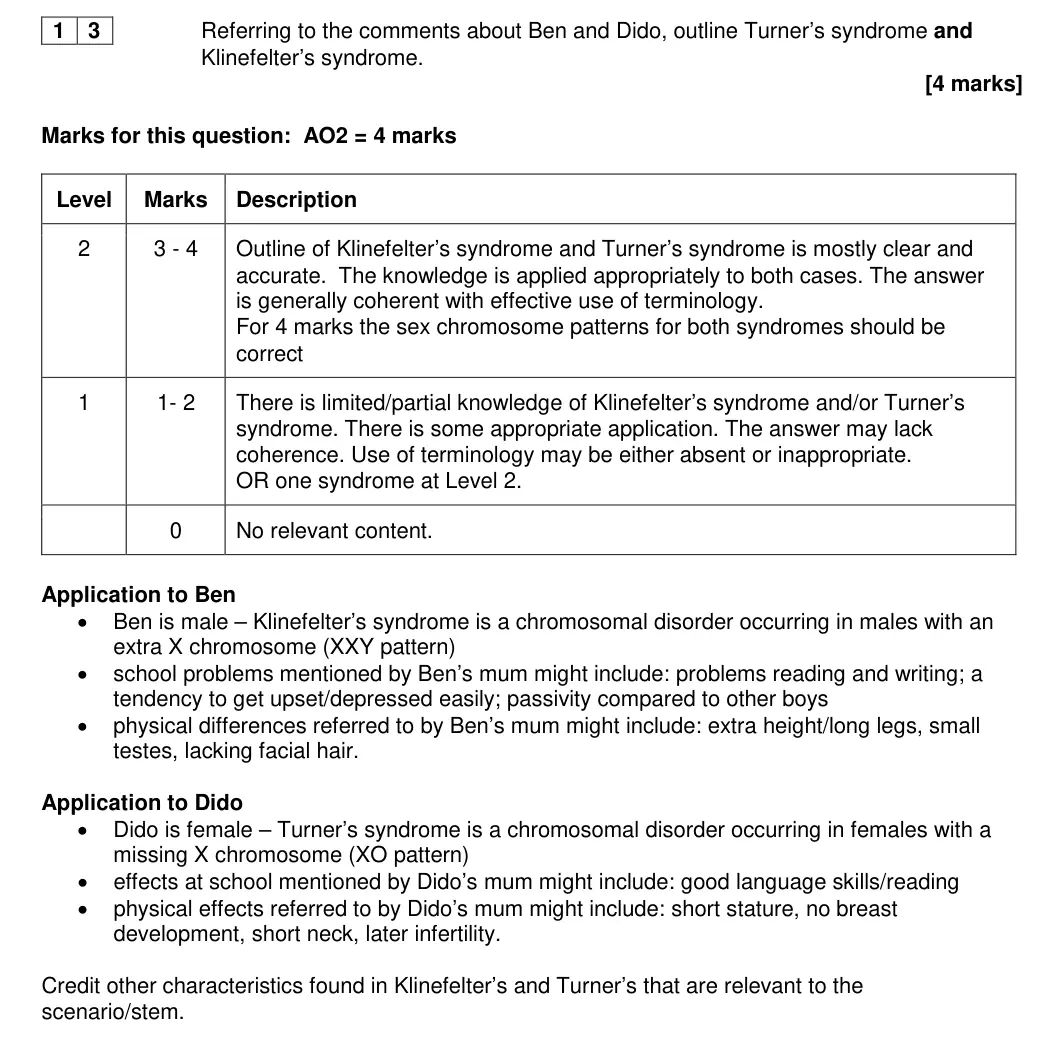
June 2017 · Paper 3 · Q134 marksAO2=4Application
Mark scheme, including level descriptors and indicative content
Examiner's comment
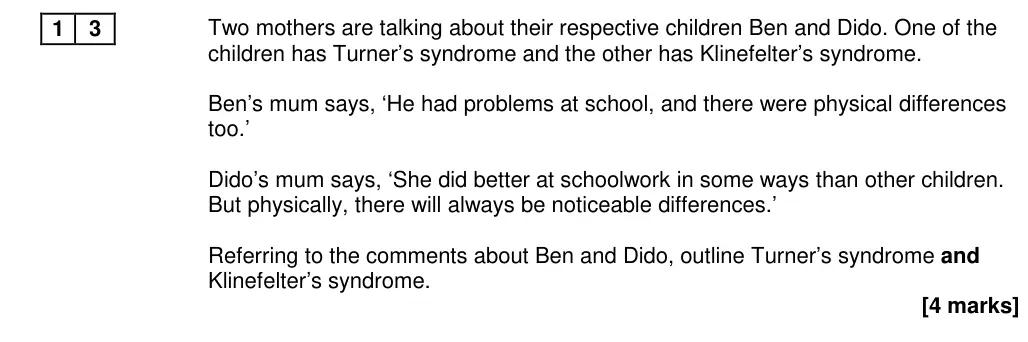
This question was generally well answered, with many students gaining full marks. As it was an application question, students needed to refer to the stem to gain credit. This was usually achieved by simply stating that the ‘physical differences would be ….’ or Dido did ‘better at school because she …’. Some students confused Turner’s syndrome and Klinefelter’s syndrome completely. It was fairly common to see confusion about which of the two conditions involved better language skills, mathematical skills and spatial ability. Just occasionally, an otherwise very good answer did not receive full credit because the relevant sex chromosome patterns were omitted.
Notes from the mark scheme and report
Ben = Klinefelter's (XXY
reading/language difficulties, passivity
tall, small testes, little facial hair), Dido = Turner's (XO
good verbal skills
short stature, no breast development)
4 marks needs correct chromosome patterns
both cases must be applied
syndromes often confused
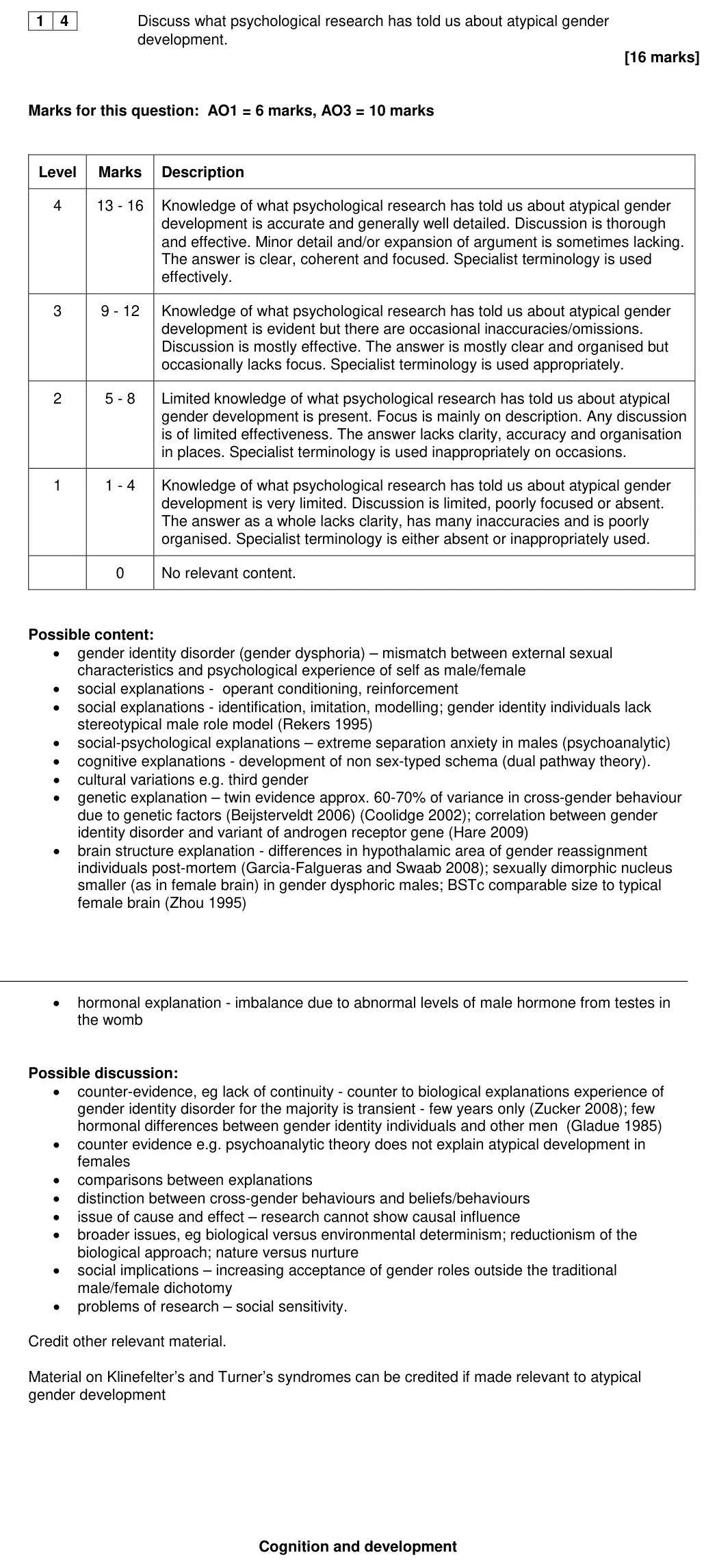
June 2017 · Paper 3 · Q1416 marksAO1=6, AO3=1016-mark essay
Mark scheme, including level descriptors and indicative content
Examiner's comment
Despite the fact that the term ‘atypical gender development’ appears at the start of the final bullet point in section 4.3.3 of the specification, some students appeared ill-prepared to answer this question, possibly because they were looking more specifically for ‘Gender Identity Disorder’, or because they felt somewhat wrong-footed by the preceding question on atypical sex chromosome patterns. In the event, any material that could be linked to atypical gender development was credited, including material on Klinefelter’s and Turner’s syndromes, as long as the focus was on atypical gender development. Whilst many answers focused on biological research into gender dysphoria, also successful were those where students took a more eclectic approach, including material on atypical cases such as David Reimer, cultural variations in gender, Freudian identification and gender schema theory.
Notes from the mark scheme and report
'atypical gender development' = gender incongruence in v1.4: biological (twin evidence, androgen receptor gene, BSTc brain structure, prenatal hormones) and social explanations, cultural variation
MS also credits psychoanalytic explanations (removed in v1.4) and Klinefelter's/Turner's if linked to gender development
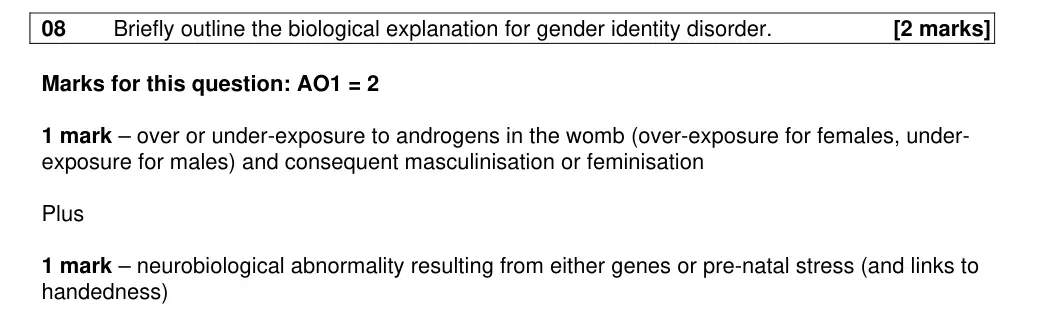
Specimen set 2 · Paper 3 · Q82 marksAO1=2Outline
Mark scheme, including level descriptors and indicative content
Notes from the mark scheme and report
1 mark prenatal over/under-exposure to androgens + 1 mark neurobiological abnormality from genes or prenatal stress
'gender identity disorder' is now 'gender incongruence' in v1.4
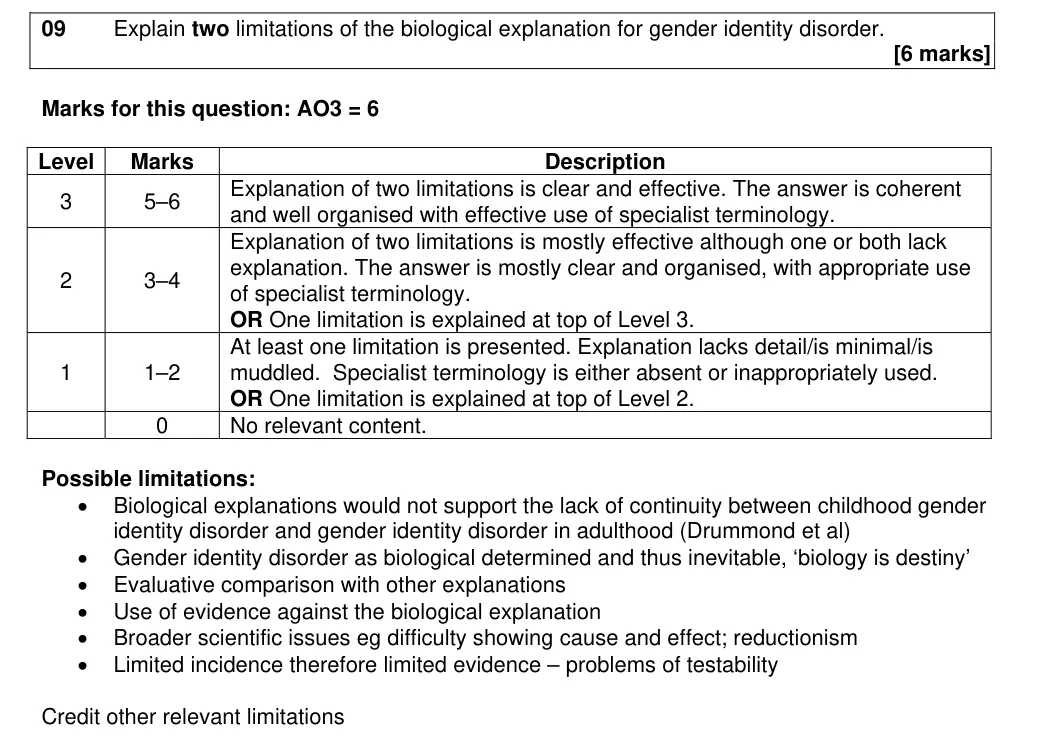
Specimen set 2 · Paper 3 · Q96 marksAO3=6Evaluate (short)
Mark scheme, including level descriptors and indicative content
Notes from the mark scheme and report
two limitations, e.g. discontinuity between childhood and adult cases (Drummond), biological determinism, reductionism, limited evidence due to low incidence
'gender identity disorder' is now 'gender incongruence' in v1.4
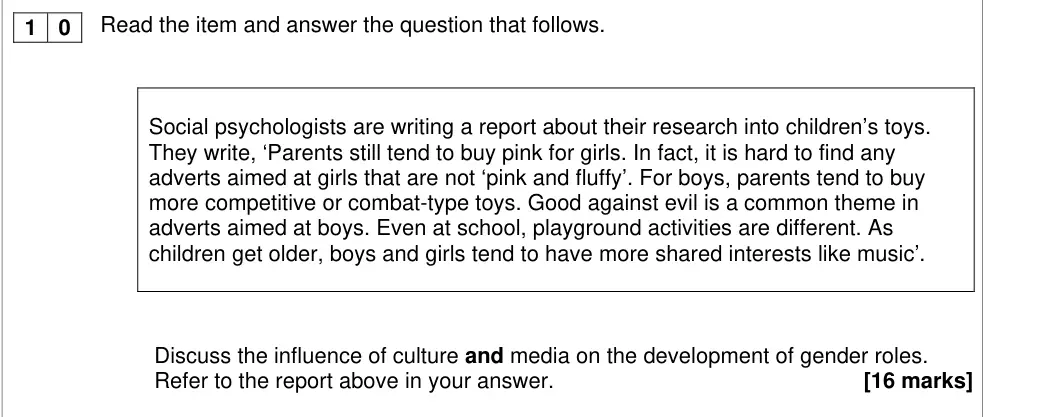
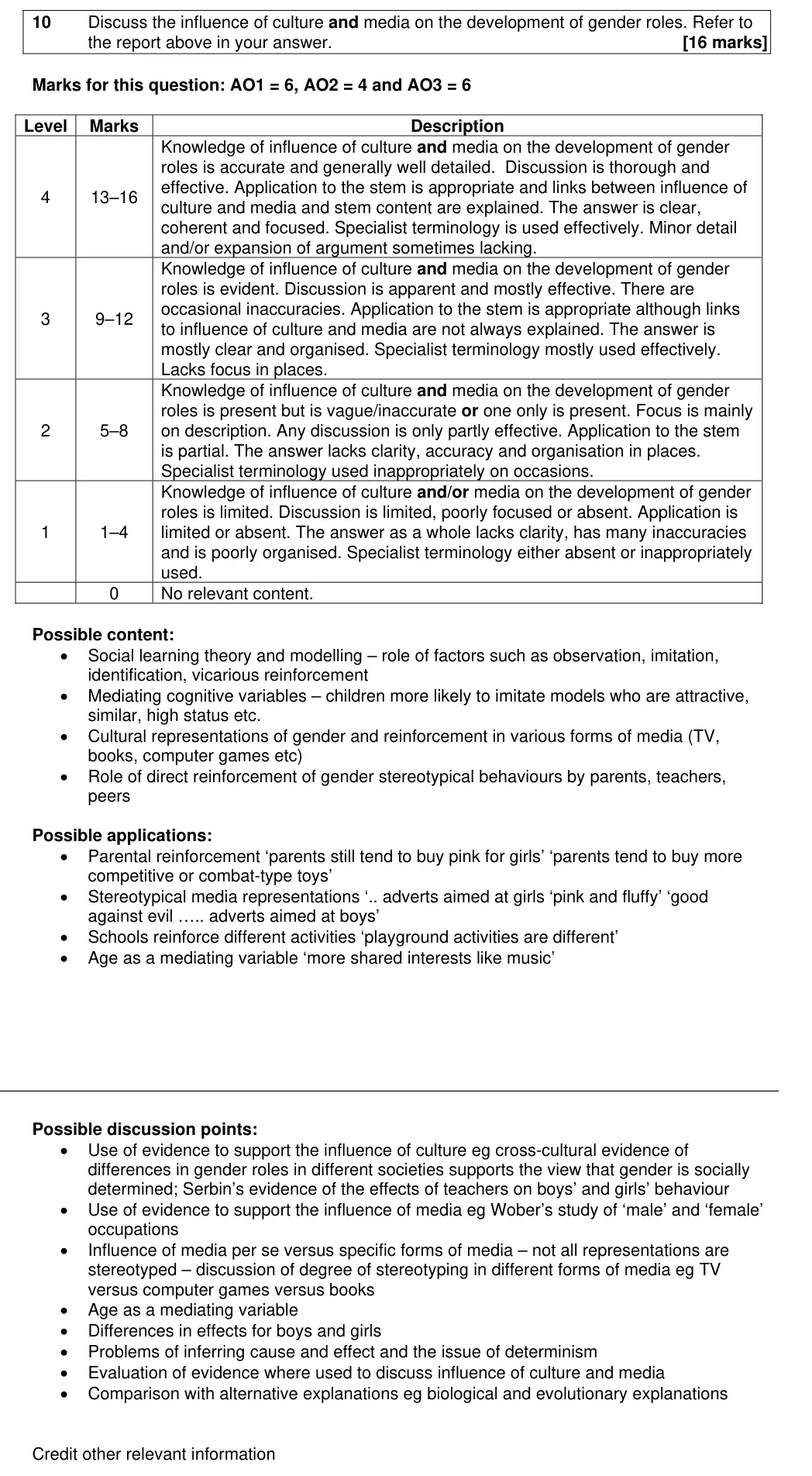
Specimen set 2 · Paper 3 · Q1016 marksAO1=6, AO2=4, AO3=616-mark essay
Mark scheme, including level descriptors and indicative content
Notes from the mark scheme and report
SLT (observation, imitation, vicarious and direct reinforcement) and media/cultural representations applied to the report (pink toys, combat toys, adverts, playground, age)
evaluation e.g. cross-cultural evidence, cause and effect, biological alternatives
one influence only = max Level 2
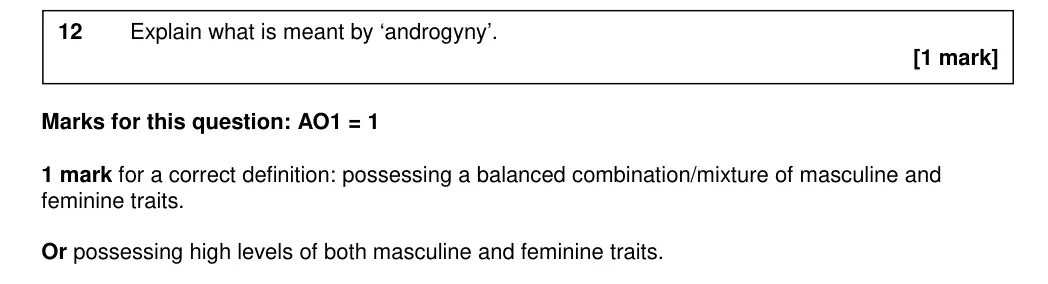
Specimen set 1 · Paper 3 · Q121 markAO1=1Short answerOld spec only
Mark scheme, including level descriptors and indicative content
Notes from the mark scheme and report
(definition of androgyny, removed in v1.4
BSRI measurement remains)
balanced or high levels of both masculine and feminine traits
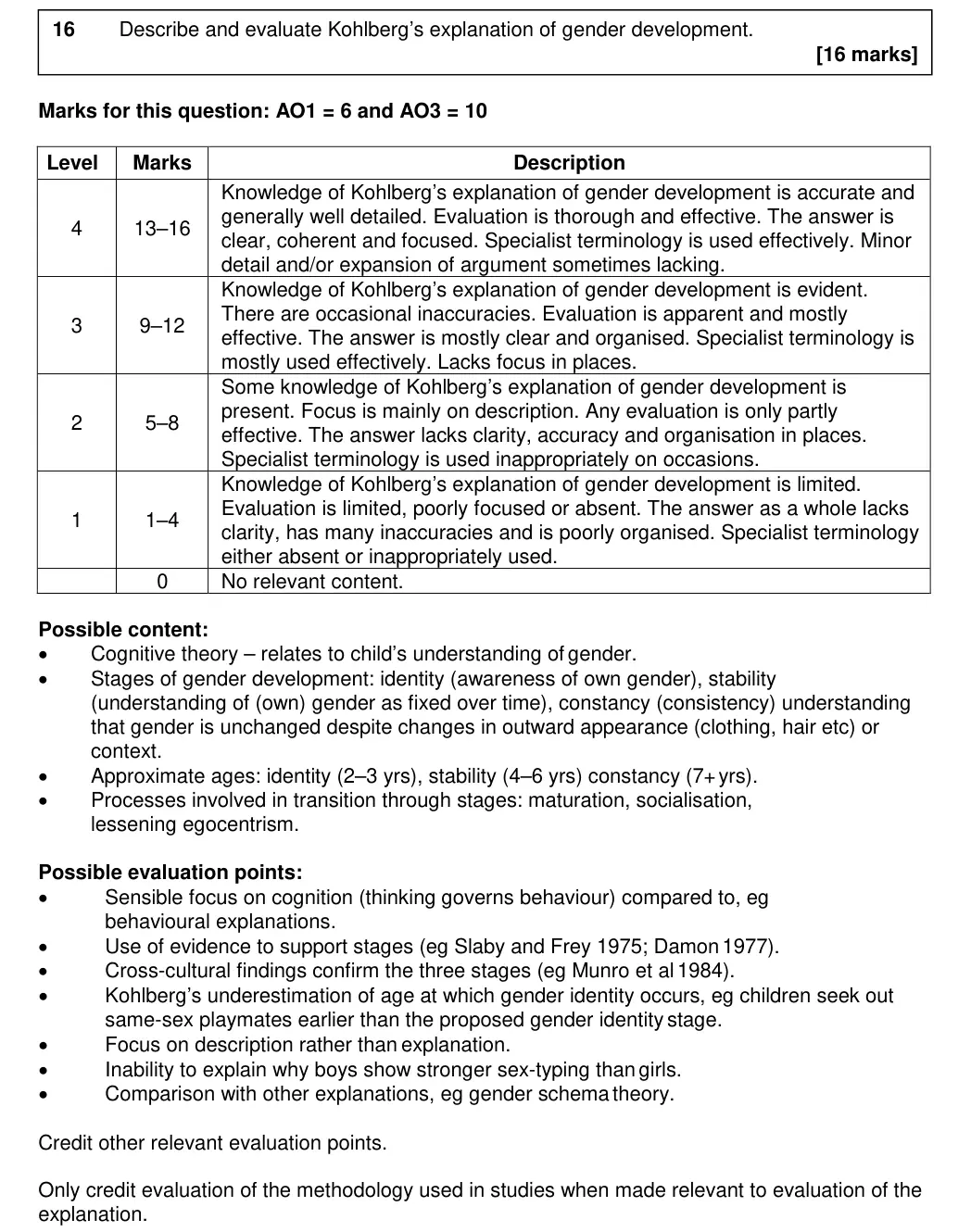
Specimen set 1 · Paper 3 · Q1616 marksAO1=6, AO3=1016-mark essay
Mark scheme, including level descriptors and indicative content
Notes from the mark scheme and report
identity, stability, constancy with approximate ages
evaluation e.g. Slaby and Frey, Munro cross-cultural, identity occurs earlier, comparison with gender schema theory
methodology only if linked to the explanation
Work with an AQA psychology tutor
Essays not reaching the top band? Book a session with Andy, a former AQA examiner.