27 question parts, 7 sixteen-mark essays, 3 multiple-choice items, plus 5 parts on content removed in 2025
Notes, key studies and practice items for this topic are being written by our tutors. The past-paper questions below are ready now.
Specification statements
4.3.4-01 Piaget’s theory of cognitive development: schemas, assimilation, accommodation, equilibration, stages of intellectual development. Characteristics of these stages, including object permanence, conservation, egocentrism and class inclusion.
4.3.4-02 Vygotsky’s theory of cognitive development, including the zone of proximal development and scaffolding.
4.3.4-03 Baillargeon’s explanation of early infant abilities, including knowledge of the physical world; violation of expectation research.
4.3.4-04 The development of social cognition: Selman’s levels of perspective-taking; theory of mind; the Sally-Anne study. The role of the mirror neuron system in social cognition.
Tap a question to zoom it. Mark scheme and examiner's comment open under each question.
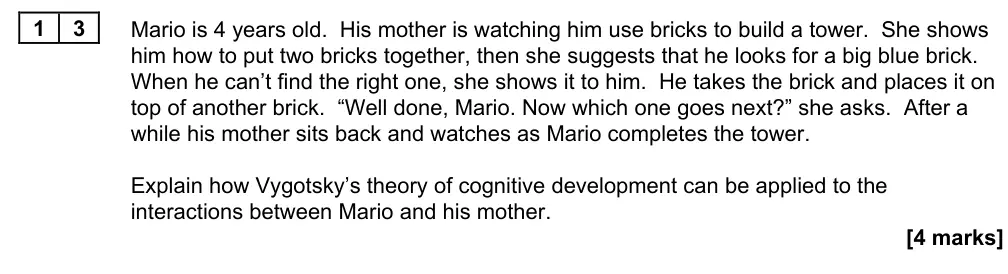
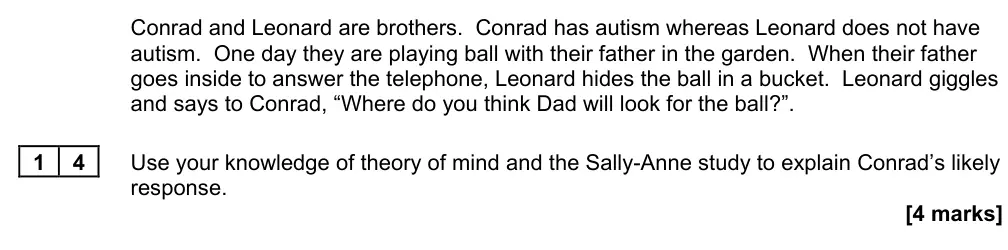
June 2025 · Paper 3 · Q134 marksAO2=4Application
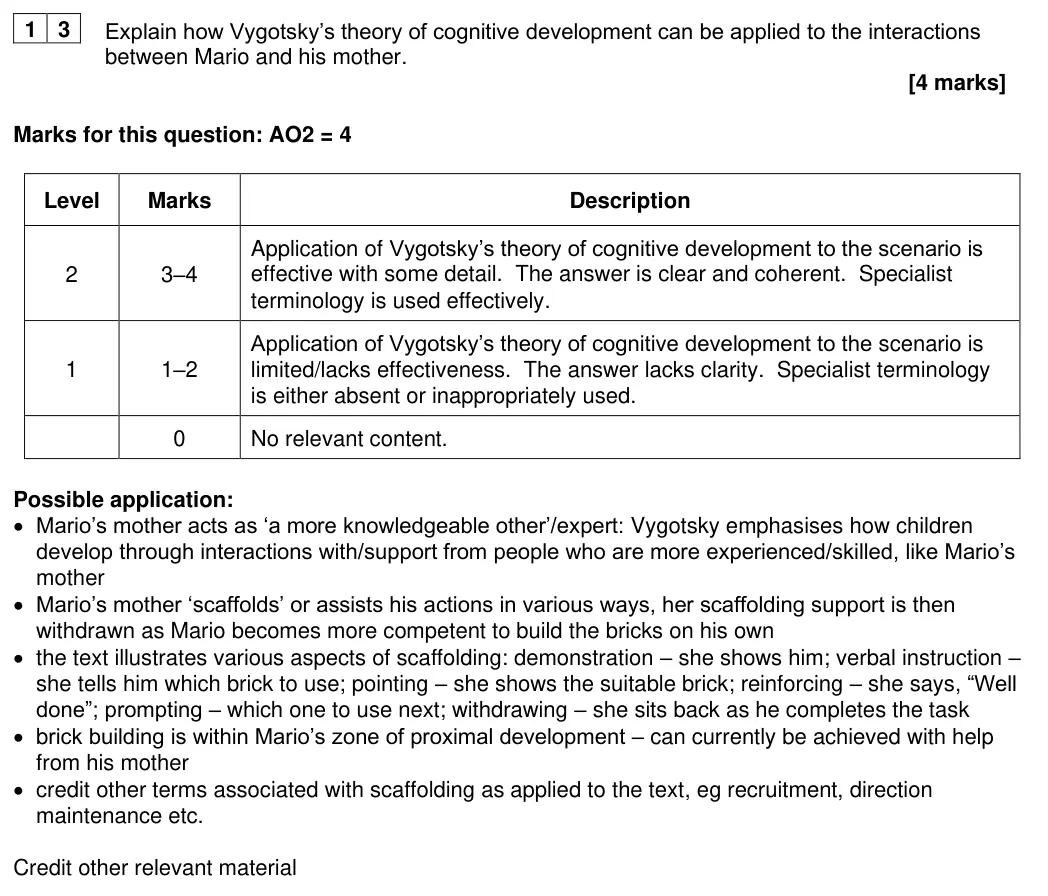
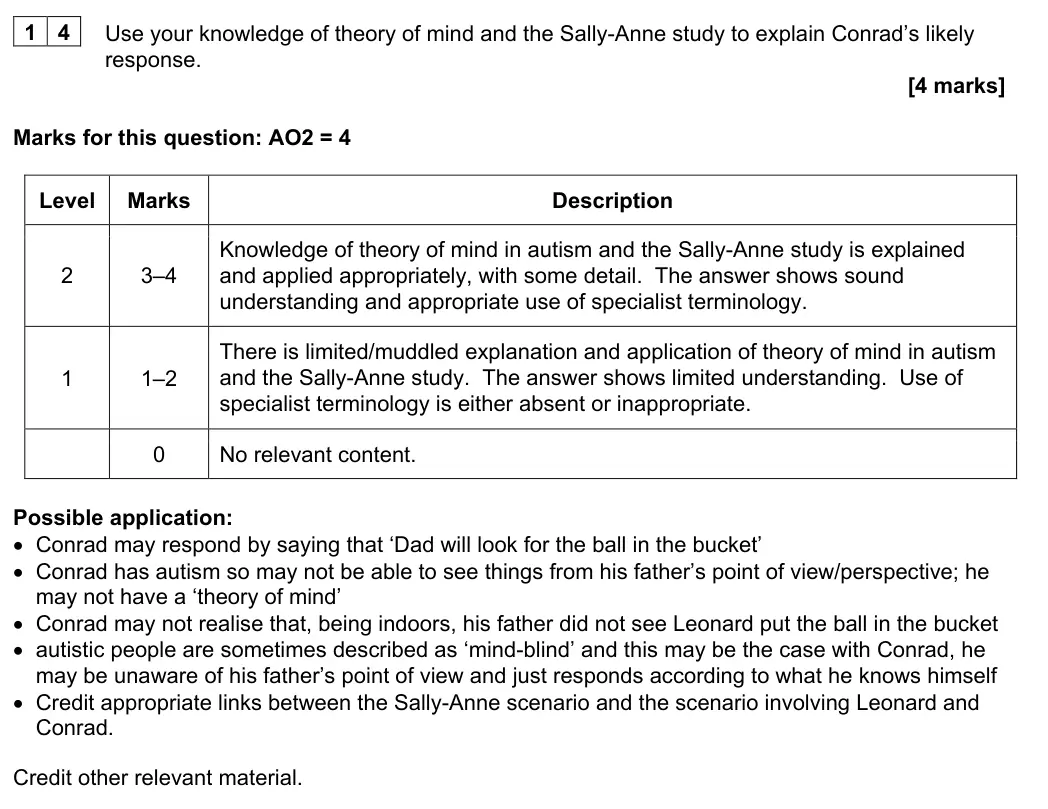
Mark scheme, including level descriptors and indicative content
Examiner's comment
The scaffolding question (13) was one of the better answered questions on the paper. Many students demonstrated an excellent working knowledge of scaffolding, and its key elements, and were able to link most of these to the ‘hooks’ in the stem. Even those who were less well informed were able to achieve at least a couple of marks with a more global understanding of the concept.
Notes from the mark scheme and report
mother as more knowledgeable other
scaffolding elements (demonstration, verbal instruction, pointing, praise, prompting, withdrawal as she sits back)
ZPD
one of the better answered questions
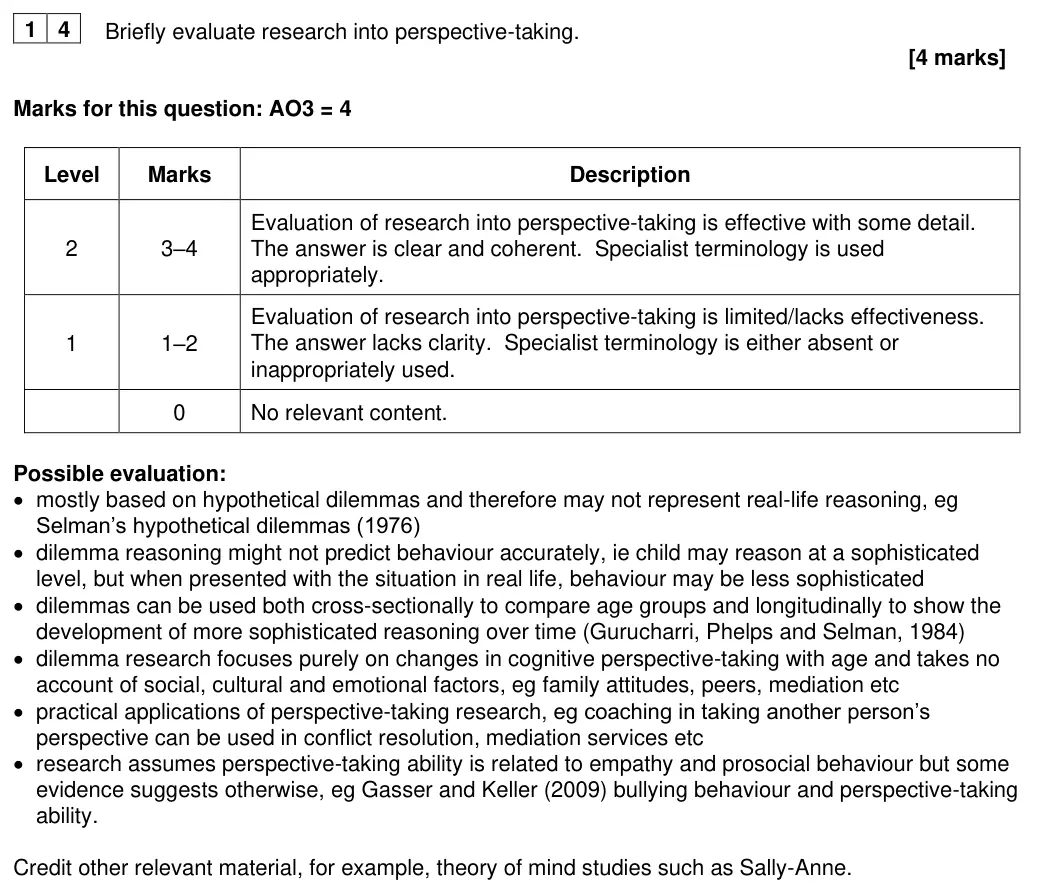
June 2025 · Paper 3 · Q144 marksAO3=4Evaluate (short)
Mark scheme, including level descriptors and indicative content
Examiner's comment
For question 14, some students missed the requirement to evaluate perspective taking research in the question, and instead simply described – typically Selman’s – research. Some lower scoring responses offered generic methodological points that could have been reasonably applied to any study or studies and were not necessarily exclusive to perspective taking research. That said, there were many sophisticated full-mark answers here.
Notes from the mark scheme and report
Selman's hypothetical dilemmas (may not predict real behaviour), longitudinal support (Gurucharri), ignores social/emotional factors, applications
many just described Selman's research
generic methodological points not credited
ToM/Sally-Anne evaluation also credited
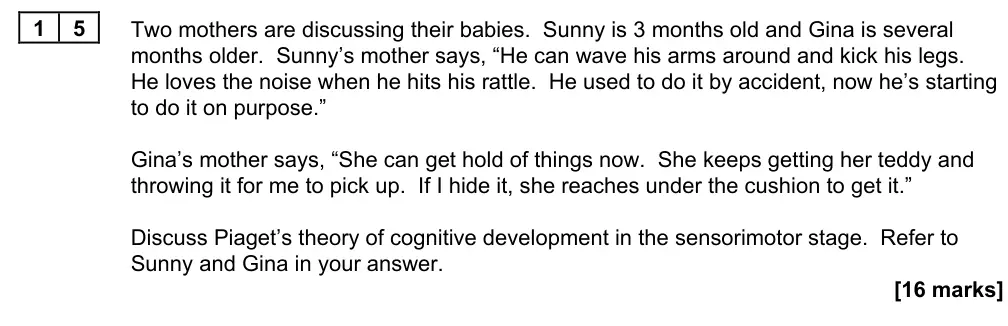
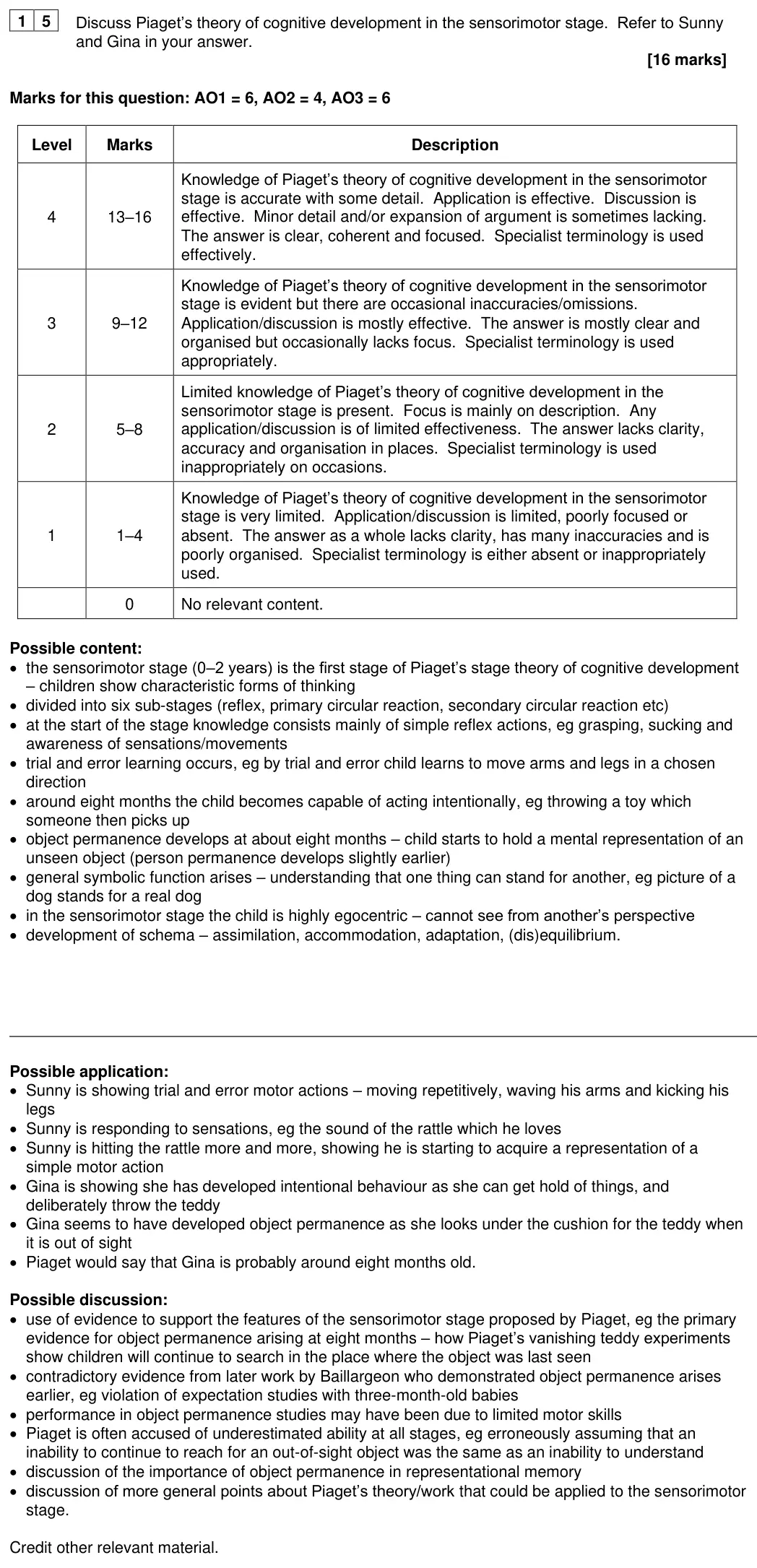
June 2025 · Paper 3 · Q1516 marksAO1=6, AO2=4, AO3=616-mark essay
Mark scheme, including level descriptors and indicative content
Examiner's comment
Whilst the Piaget question (15) appeared quite narrow in its focus, there were some very good answers, and most students fared reasonably well. The most oft cited concept was object permanence, and this was clearly applied to the different developmental experiences of the two children in the stem. There were some excellent contrasts drawn with the work of Baillargeon in this context too. Many answers included description of the development of schema, and again, there were clear links made to ‘Sonny’ in the stem. Some answers erroneously talked about Piagetian concepts from later stages of the theory but recognising that both children were egocentric earned credit. General criticisms of Piaget’s work that were not necessarily linked to the sensorimotor stage, but could feasibly have been, were still awarded marks.
Notes from the mark scheme and report
sensorimotor sub-stages: Sunny = reflexes, trial and error/circular reactions
Gina = intentional behaviour and object permanence (about 8 months)
discussion via Baillargeon's earlier object permanence, motor-skill confound
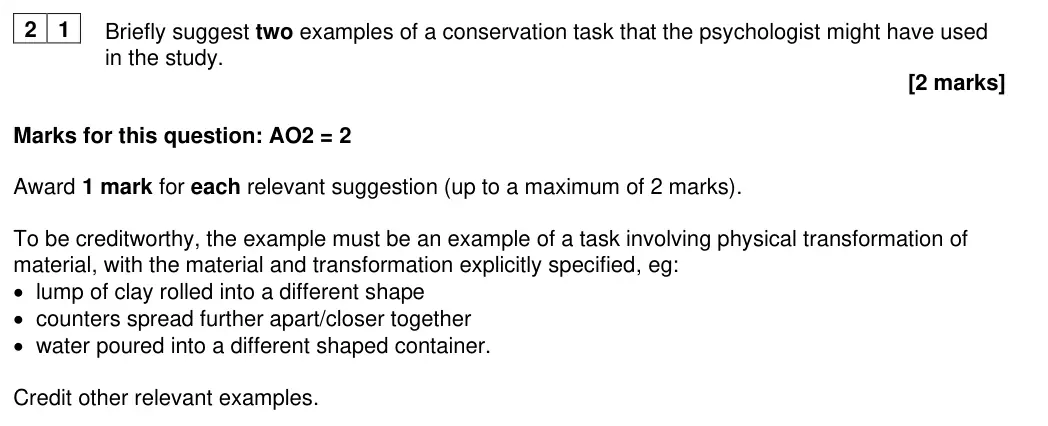
June 2024 · Paper 3 · Q212 marksAO2=2Application
Mark scheme, including level descriptors and indicative content
Examiner's comment
In Question 21, most students were able to provide two examples of conservation tasks, mostly based on the work of Piaget. There were some bizarre answers though; perhaps some students assumed they were not able to draw on Piaget’s original conservation tasks and felt compelled to invent their own, with varying degrees of success.
Notes from the mark scheme and report
1 mark each
must specify the material AND the transformation (clay rolled, counters spread, water poured into different container)
some invented odd tasks instead of Piaget's
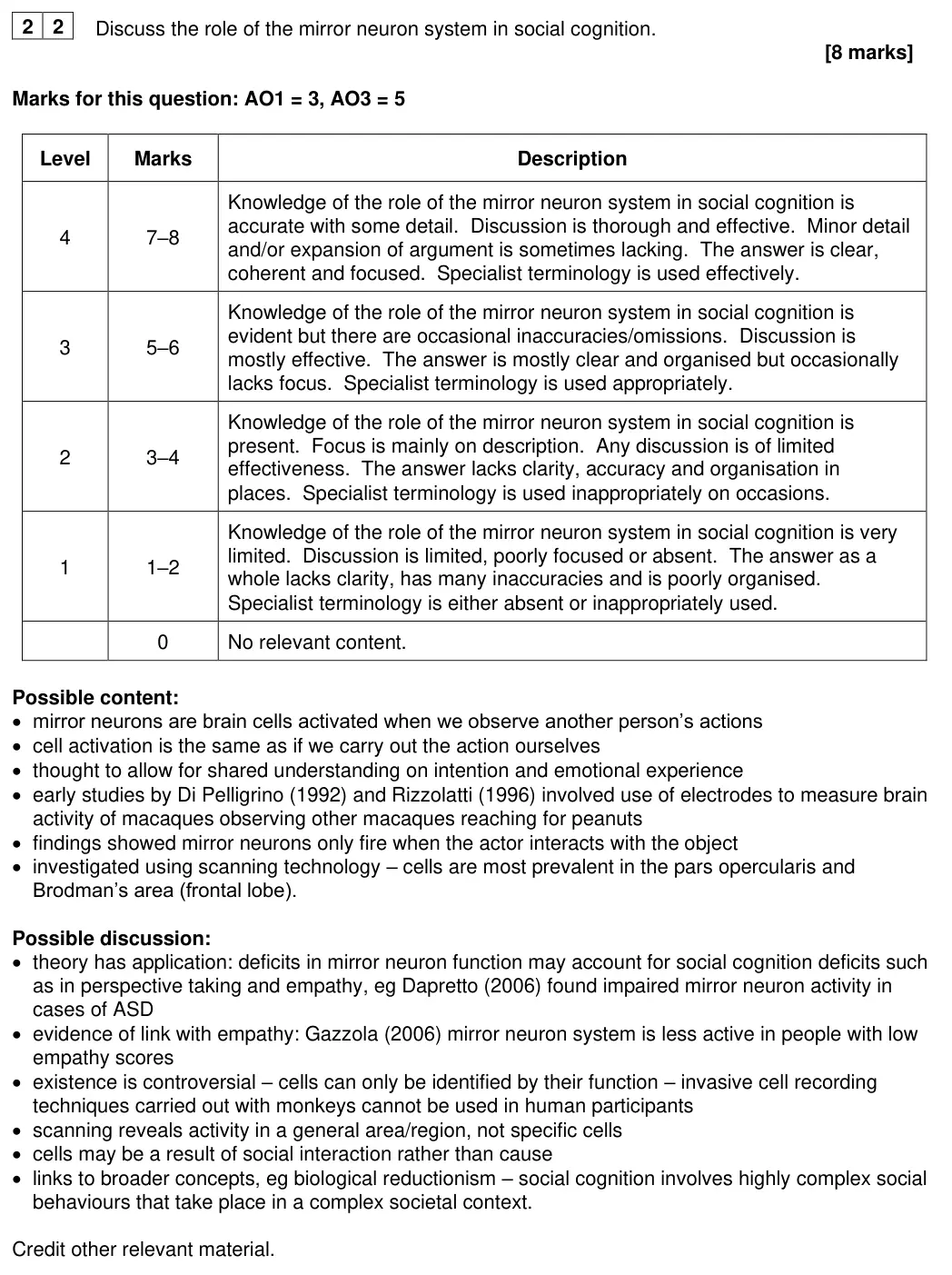
June 2024 · Paper 3 · Q228 marksAO1=3, AO3=5Extended writing
Mark scheme, including level descriptors and indicative content
Examiner's comment
Question 22 produced some good answers. Many students were able to describe mirror neurons and their role in social cognition. There was frequent reference to the links with ASD as well as effective use of evidence, of which the work of Rizzolatti was the most oft cited.
Notes from the mark scheme and report
mirror neurons fire when observing and performing an action
Rizzolatti macaque studies
links to ASD/empathy
evaluation: existence controversial, cannot record single cells in humans, cause vs effect
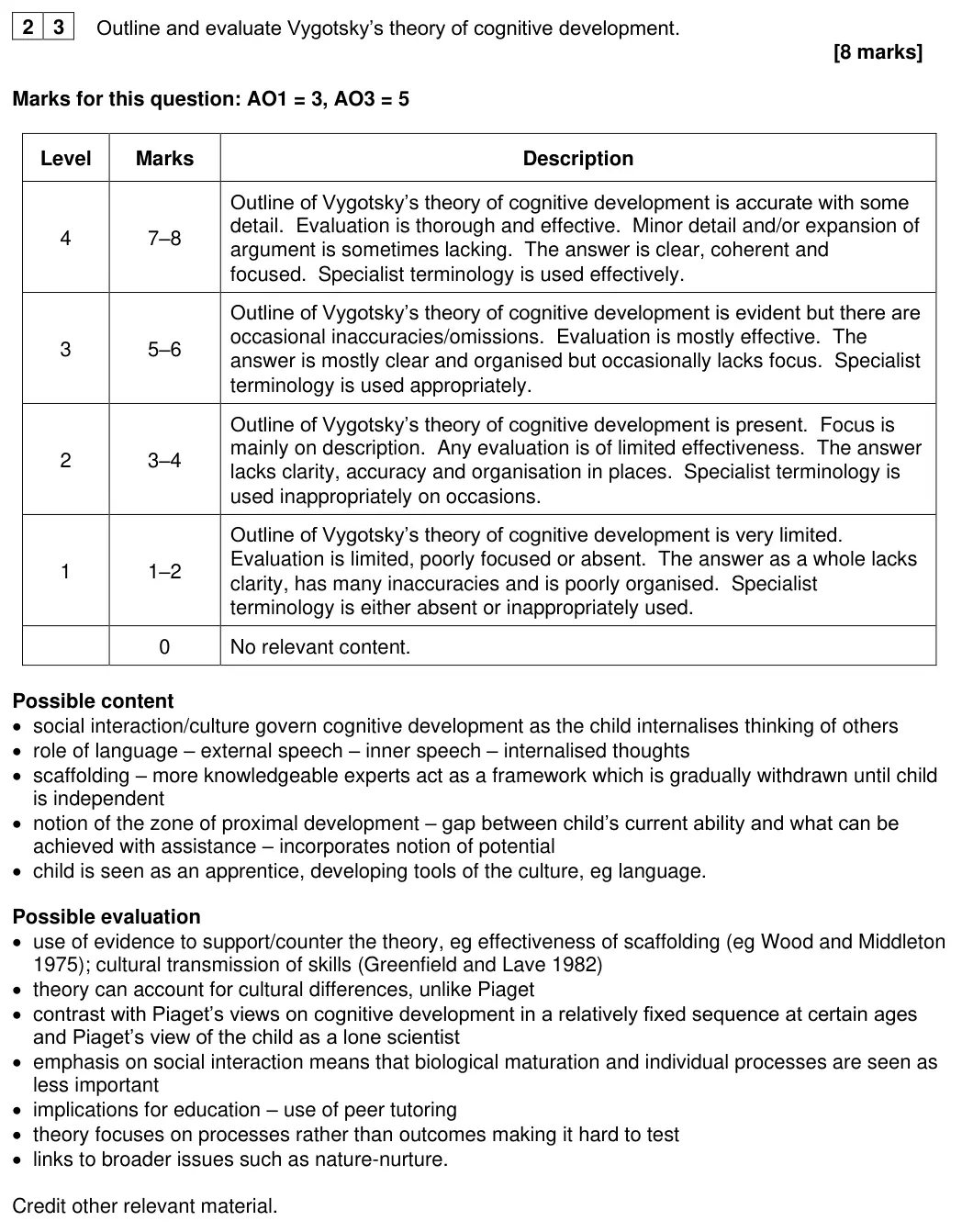
June 2024 · Paper 3 · Q238 marksAO1=3, AO3=5Extended writing
Mark scheme, including level descriptors and indicative content
Examiner's comment
Question 23 also gave rise to coherent responses, although these tended to be overly descriptive so that students penalised themselves in terms of time. There was very good technical detail of Vygotsky’s theory, alongside effective use of terminology, and when students did evaluate, there was decent analysis of the applications of Vygostkian concepts to education. Many students tried to compare Vygotsky’s theory to Piaget’s, but this was less impressive, as Piaget’s theory was often simply described rather than used as effective comparison.
Notes from the mark scheme and report
ZPD, scaffolding, role of language/culture
answers overly descriptive
comparison with Piaget often just described Piaget
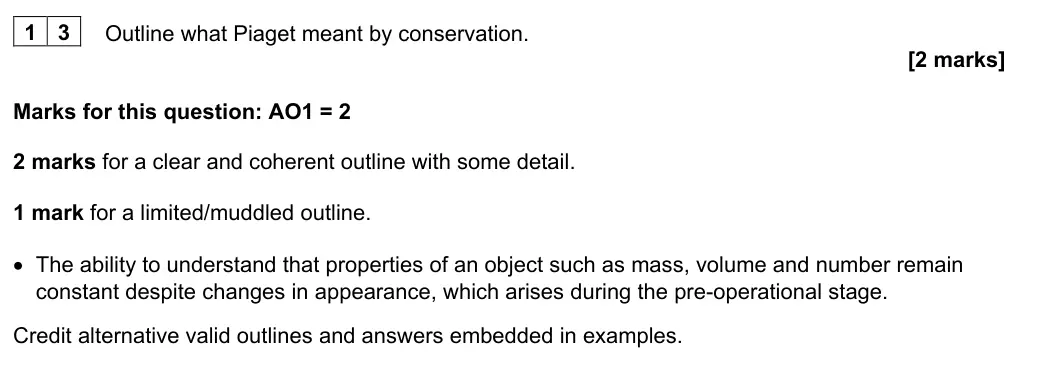
June 2023 · Paper 3 · Q132 marksAO1=2Outline
Mark scheme, including level descriptors and indicative content
Examiner's comment
Students were generally confident in their knowledge of the concept of ‘conservation’ and provided relevant examples for the second mark.
Notes from the mark scheme and report
properties (mass, volume, number) stay the same despite changes in appearance
examples credited for 2nd mark
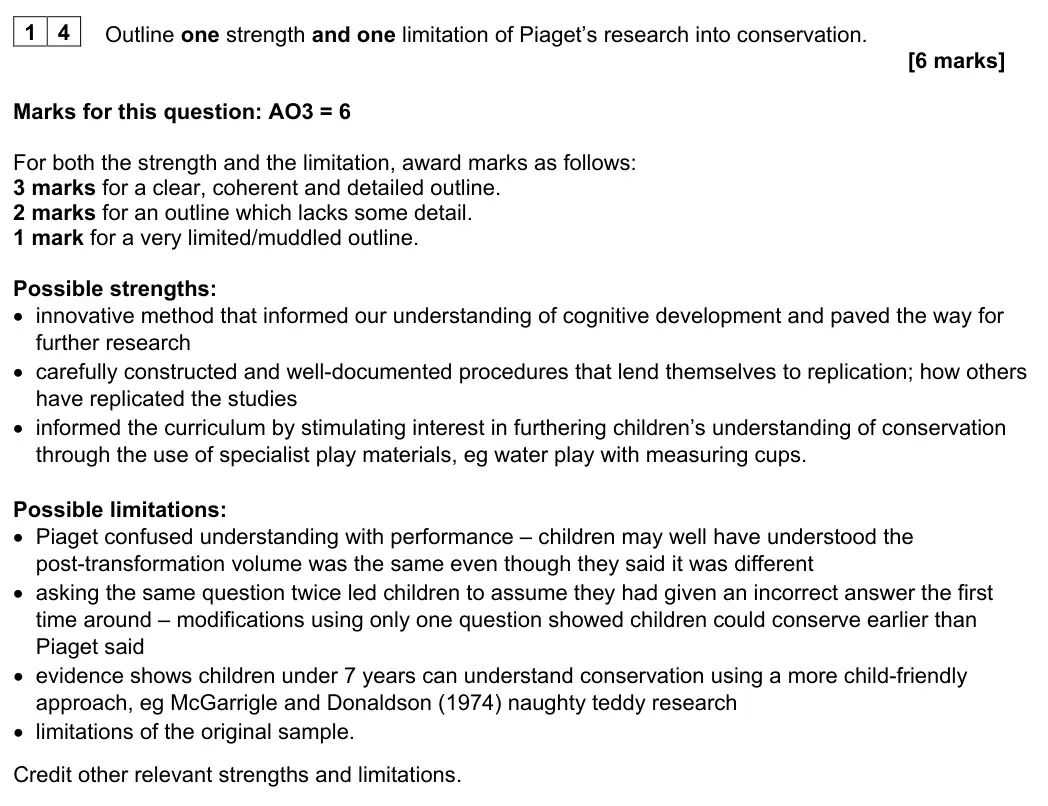
June 2023 · Paper 3 · Q146 marksAO3=6Evaluate (short)
Mark scheme, including level descriptors and indicative content
Examiner's comment
Students were much better at explaining a limitation of conservation experiments than a strength. For the former, McGarrigle’s naughty teddy experiments were often a feature. Those who were able to come up with a convincing strength tended to talk about the fact that Piaget’s experiments can be replicated because of their standardised procedure.
Notes from the mark scheme and report
strength e.g. standardised replicable procedure, influence on education
limitation e.g. asking question twice, McGarrigle and Donaldson naughty teddy
strengths answered less well than limitations
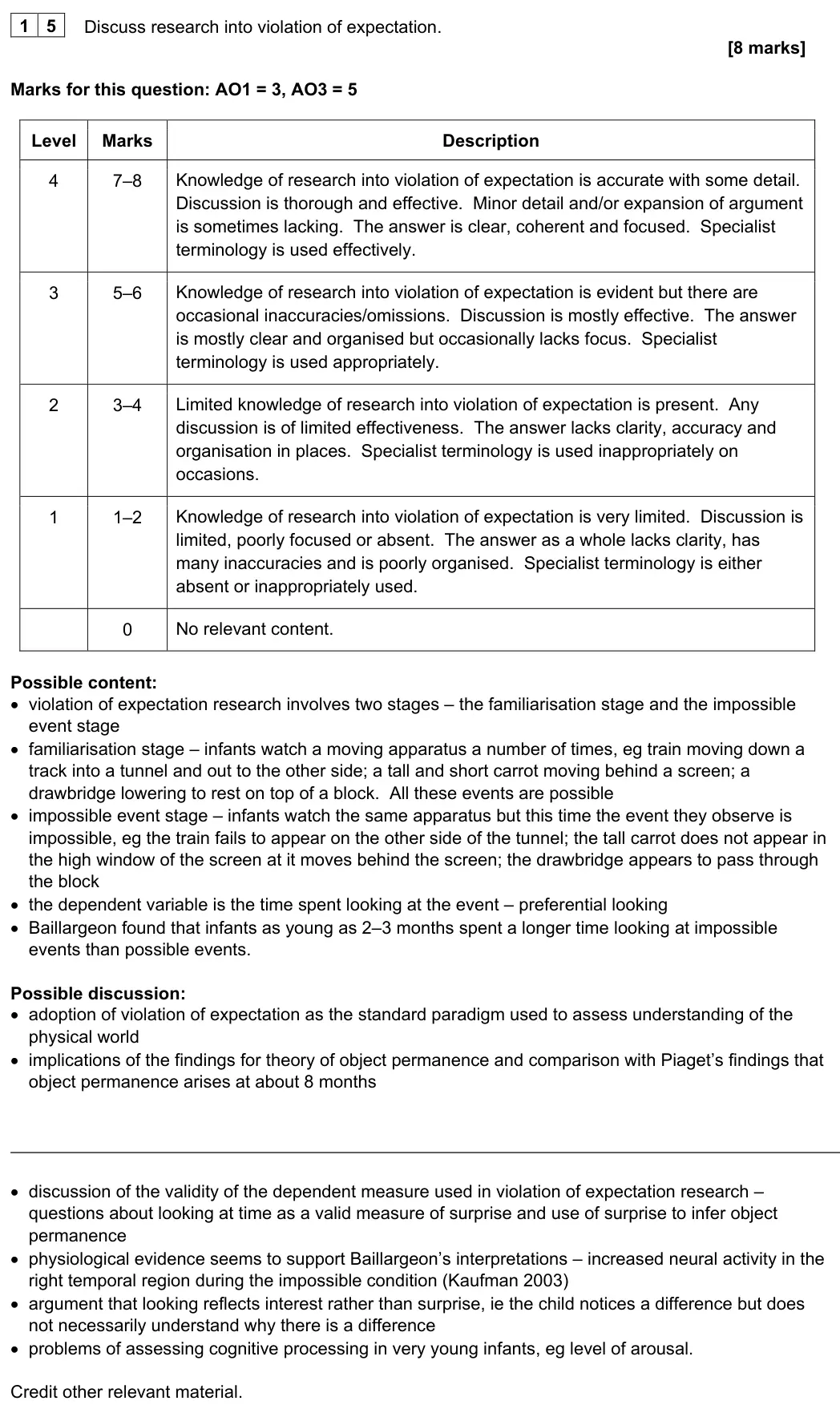
June 2023 · Paper 3 · Q158 marksAO1=3, AO3=5Extended writing
Mark scheme, including level descriptors and indicative content
Examiner's comment
There were some impressive and detailed summaries of violation of expectation studies. Most students preferred to describe one experiment in detail – usually the carrot study – and then evaluate violation of expectation research in general. There was some reasoned comparison with Piaget’s work on object permanence, most notably the fact that Baillargeon was able to control for confounding variables such as lack of motor skills or lack of attention.
Notes from the mark scheme and report
familiarisation then impossible event
looking time as DV
evaluation: comparison with Piaget's object permanence, validity of looking time as a measure of surprise
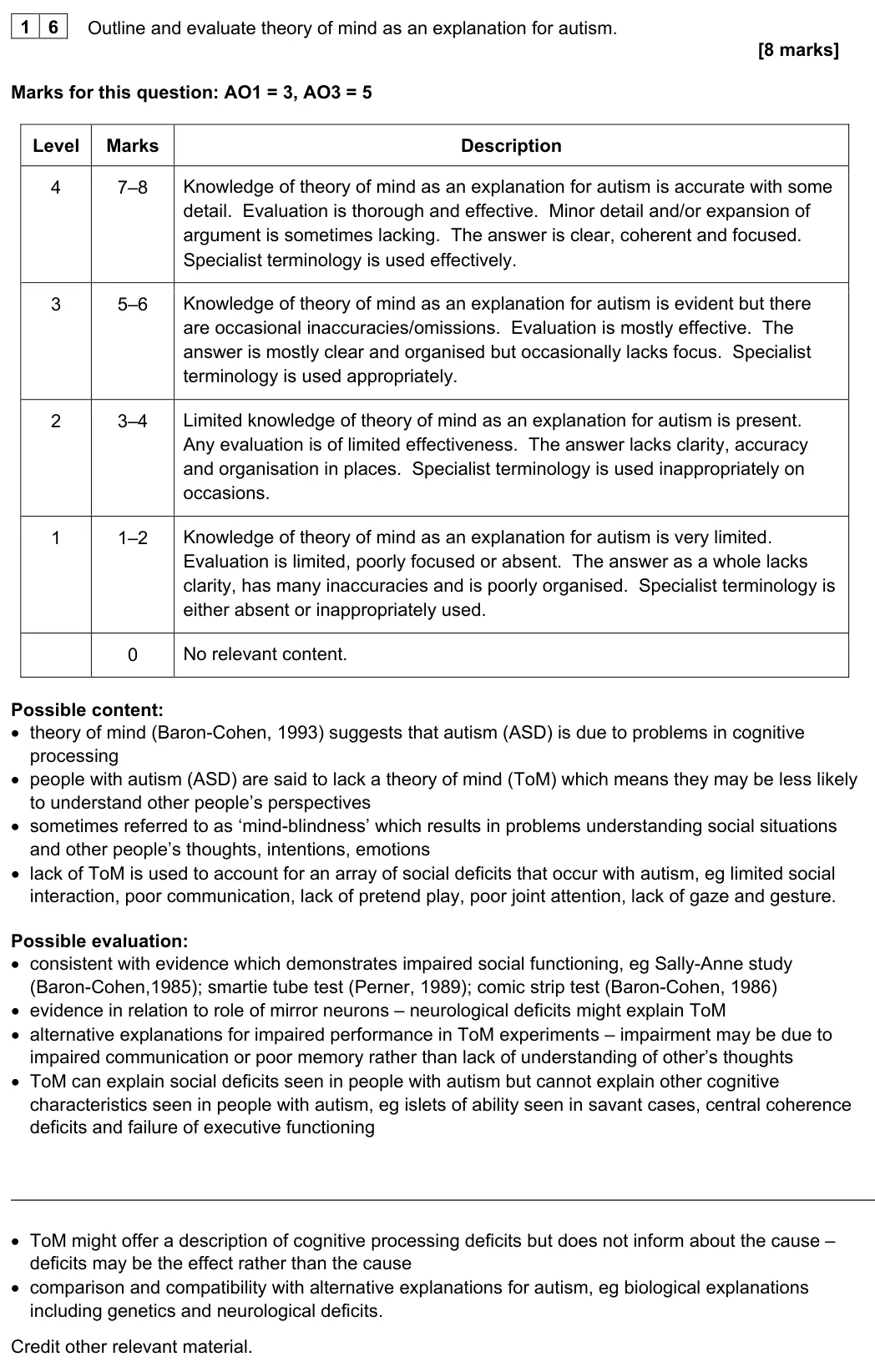
June 2023 · Paper 3 · Q168 marksAO1=3, AO3=5Extended writingOld spec only
Mark scheme, including level descriptors and indicative content
Examiner's comment
This question was rather less well done. Despite the focus of the question, relatively few students provided effective definitions of theory of mind, and fewer still were able to make convincing links between the central concept and those deficits typically seen in cases of autism. Instead, there were many long-winded descriptions of supporting evidence, most commonly the Sally-Anne study. Consequently, evaluation often centred around the evidence, rather than the theory, which meant there were relatively few top-band answers.
Notes from the mark scheme and report
(theory of mind as an explanation of autism was removed in v1.4
theory of mind and Sally-Anne remain)
few defined ToM or linked it to autistic deficits
evaluation centred on evidence not the theory
June 2022 · Paper 3 · Q118 marksAO2=8Extended writing
Mark scheme, including level descriptors and indicative content
Examiner's comment
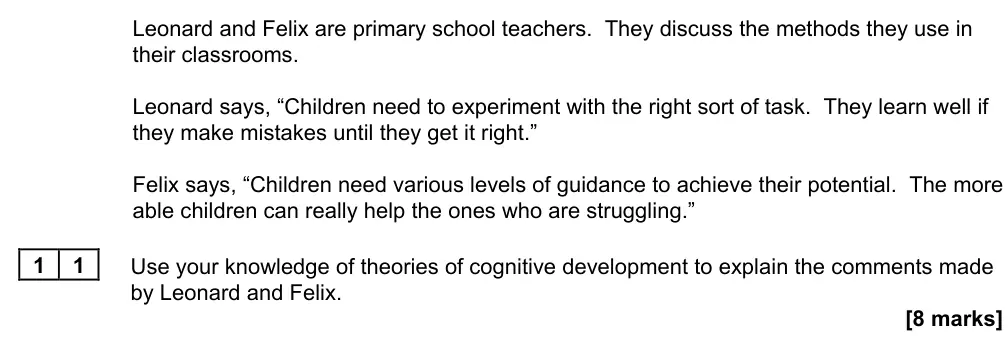
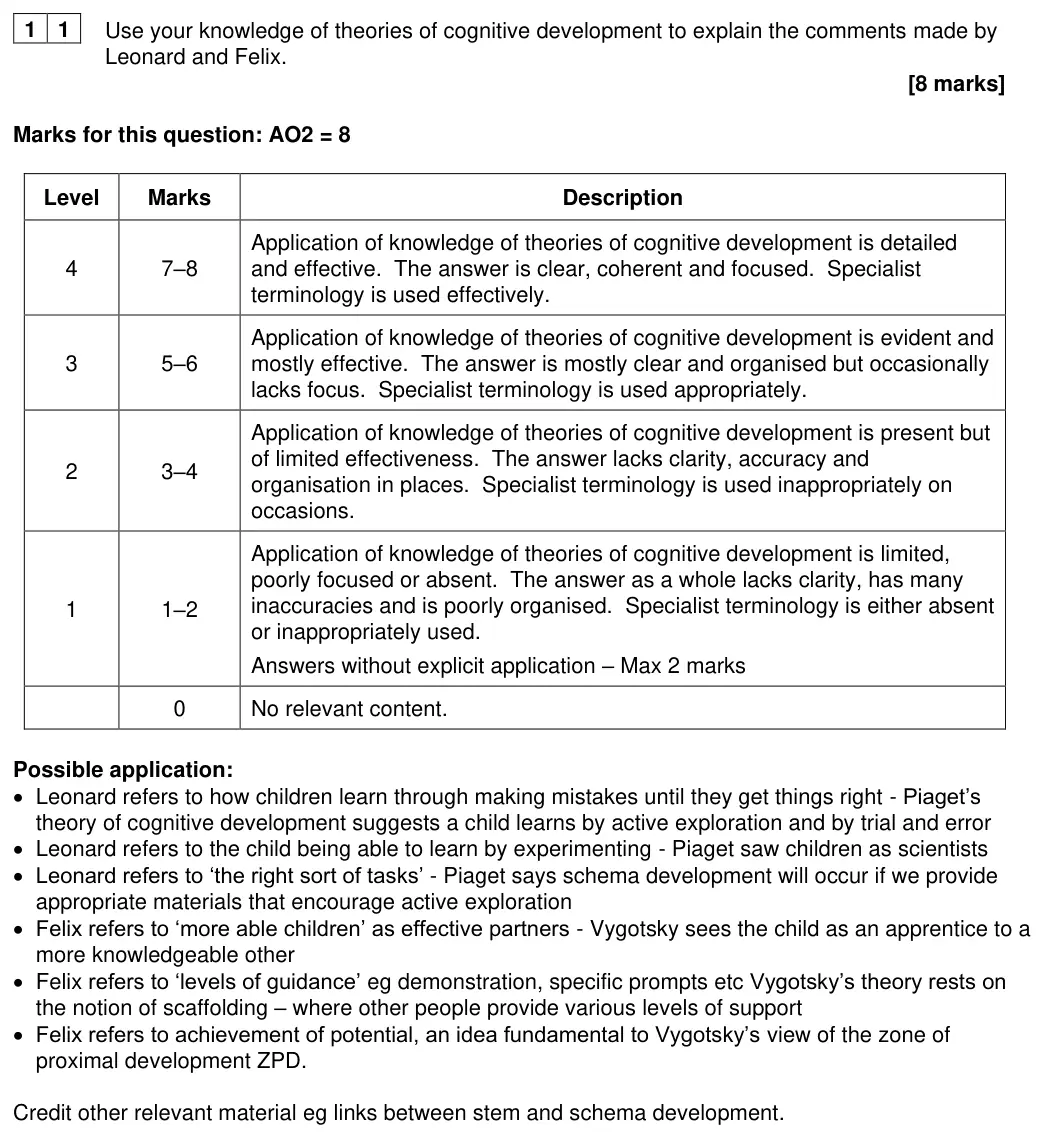
The stem for Question 11 usually triggered application of the appropriate theories of Piaget and Vygotsky. Students seemed less well able to make explicit application between aspects of the text and the theory than in the other two topics in this section, although better students worked effectively with key words and phrases such as ‘experiment’, ‘make mistakes’, ‘levels of guidance’ and ‘potential,’ drawing parallels with the relevant developmental theory.
Notes from the mark scheme and report
all AO2: Piaget (child as scientist, learning by trial and error, appropriate tasks) for Leonard
Vygotsky (MKO, scaffolding levels, ZPD 'potential') for Felix
no explicit application = max 2
June 2022 · Paper 3 · Q1216 marksAO1=6, AO3=1016-mark essay
Mark scheme, including level descriptors and indicative content
Examiner's comment
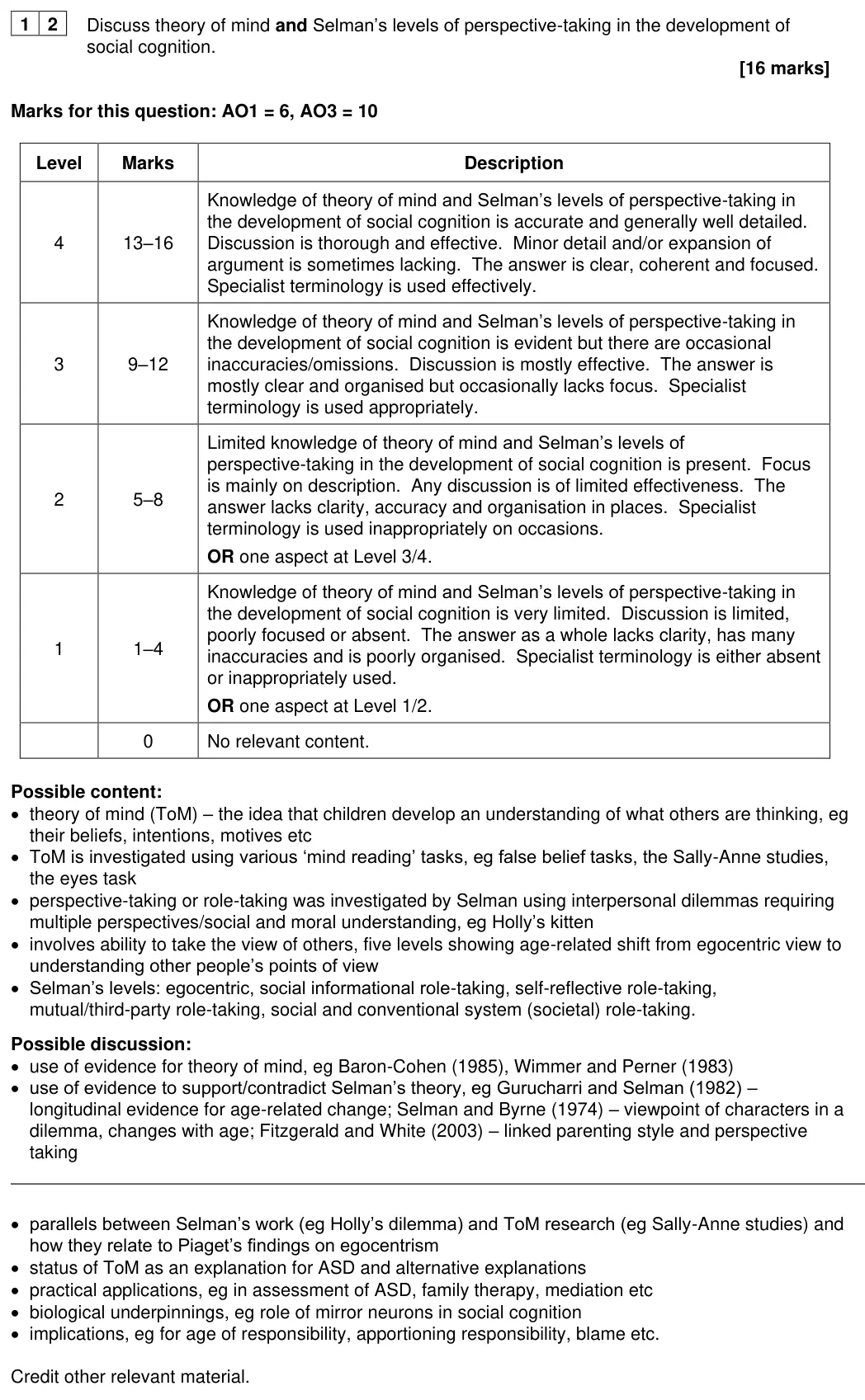
Answers to Question 12 were usually strong on knowledge and understanding, perhaps with greater emphasis on Selman’s theory than on theory of mind. Discussions tended to be variable with many consisting solely of use of evidence to support the theory.
Notes from the mark scheme and report
theory of mind (false-belief/Sally-Anne, eyes task) AND Selman's levels
one aspect only = max Level 2
MS also credits ToM as an explanation of ASD (removed in v1.4) as discussion
November 2021 · Paper 3 · Q134 marksAO1=4Outline
Mark scheme, including level descriptors and indicative content
Examiner's comment
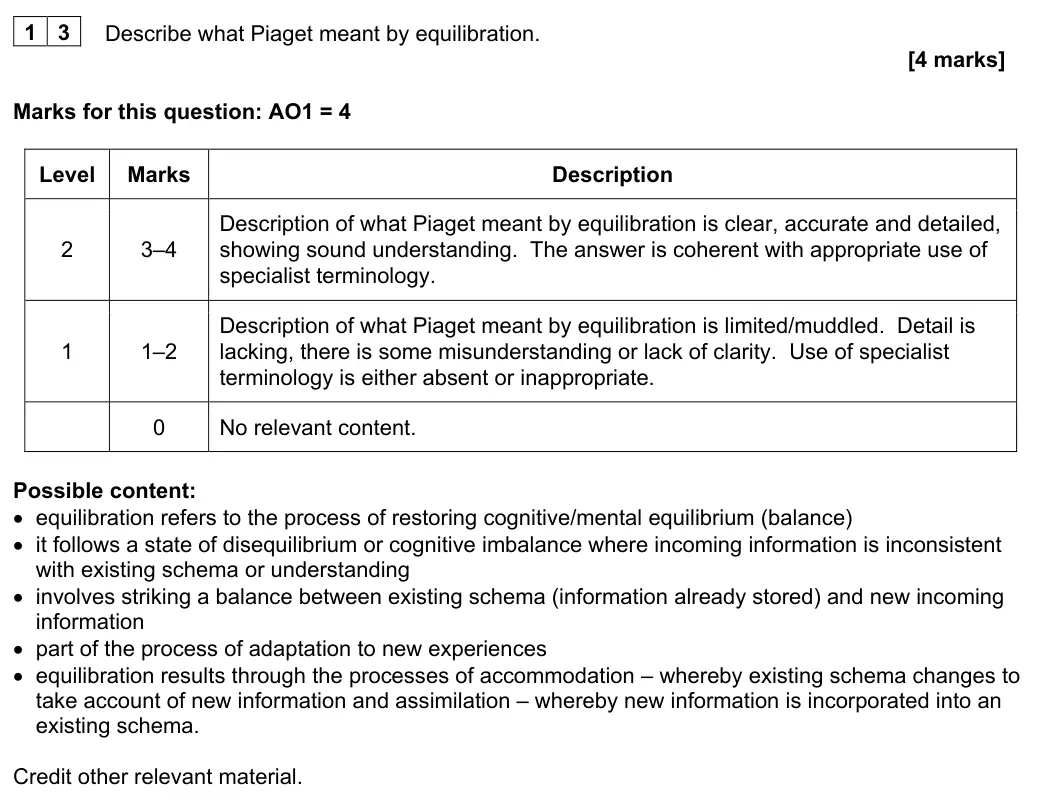
The 4-mark knowledge questions tended to be well answered, especially Q07.
Notes from the mark scheme and report
restoring balance after disequilibrium caused by information inconsistent with schema, via assimilation and accommodation
November 2021 · Paper 3 · Q144 marksAO2=4ApplicationOld spec only
Mark scheme, including level descriptors and indicative content
Examiner's comment
The 4-mark application questions were less well done, often because there was very little psychological content in the answers. Q14 was rarely seen.
Notes from the mark scheme and report
(theory of mind as an explanation of autism, removed in v1.4
theory of mind and the Sally-Anne study remain)
Conrad likely says 'in the bucket' as he cannot take Dad's perspective (mind-blindness)
links to Sally-Anne false-belief task
rarely attempted
November 2021 · Paper 3 · Q1516 marksAO1=6, AO3=1016-mark essay
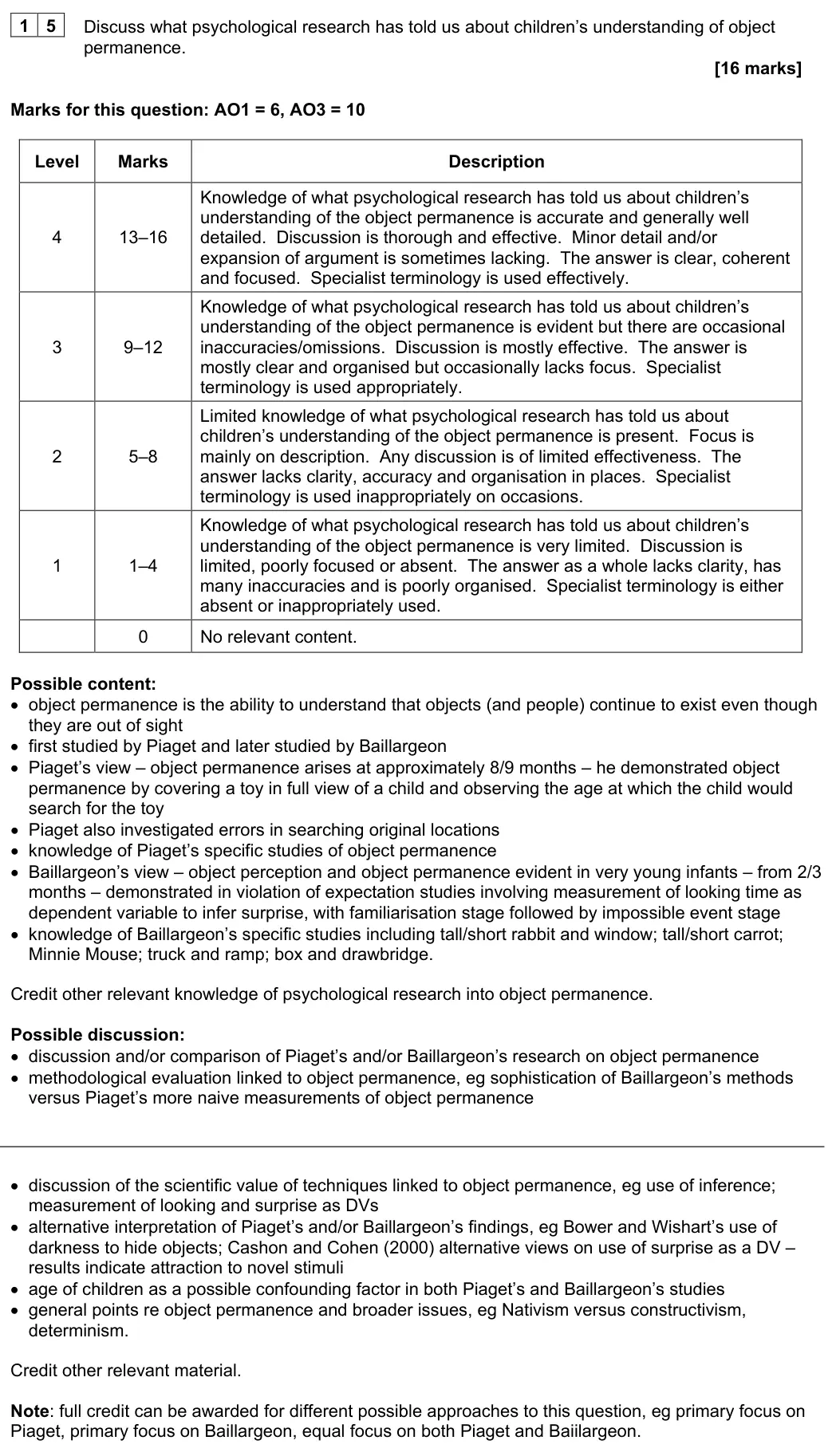
Mark scheme, including level descriptors and indicative content
Examiner's comment
Q15 was rarely seen, though well done except where answers comprised a laboured account of Piaget’s stage theory.
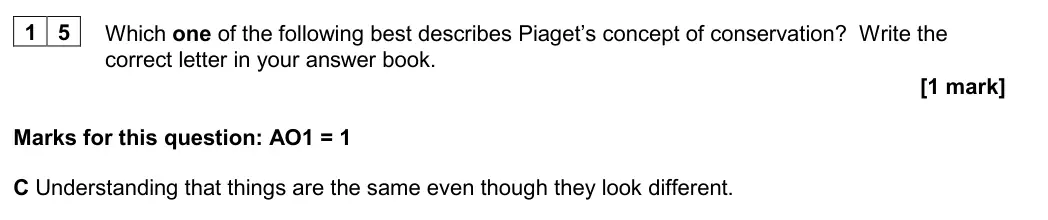
November 2020 · Paper 3 · Q151 markAO1=1Multiple choice
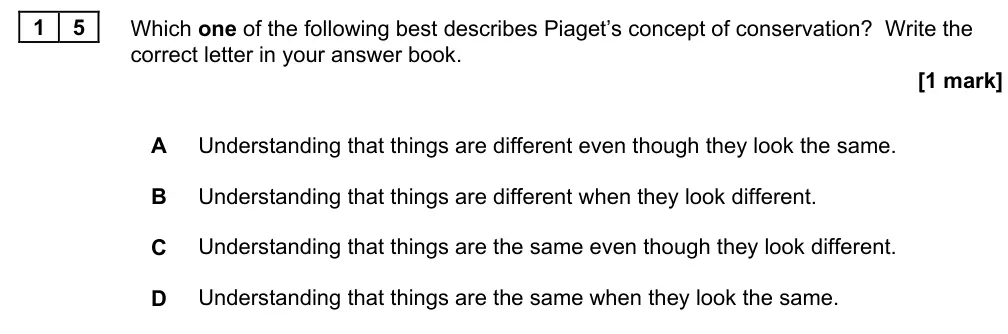
Answer
C
Mark scheme, including level descriptors and indicative content
Notes from the mark scheme and report
correct C (same even though they look different)
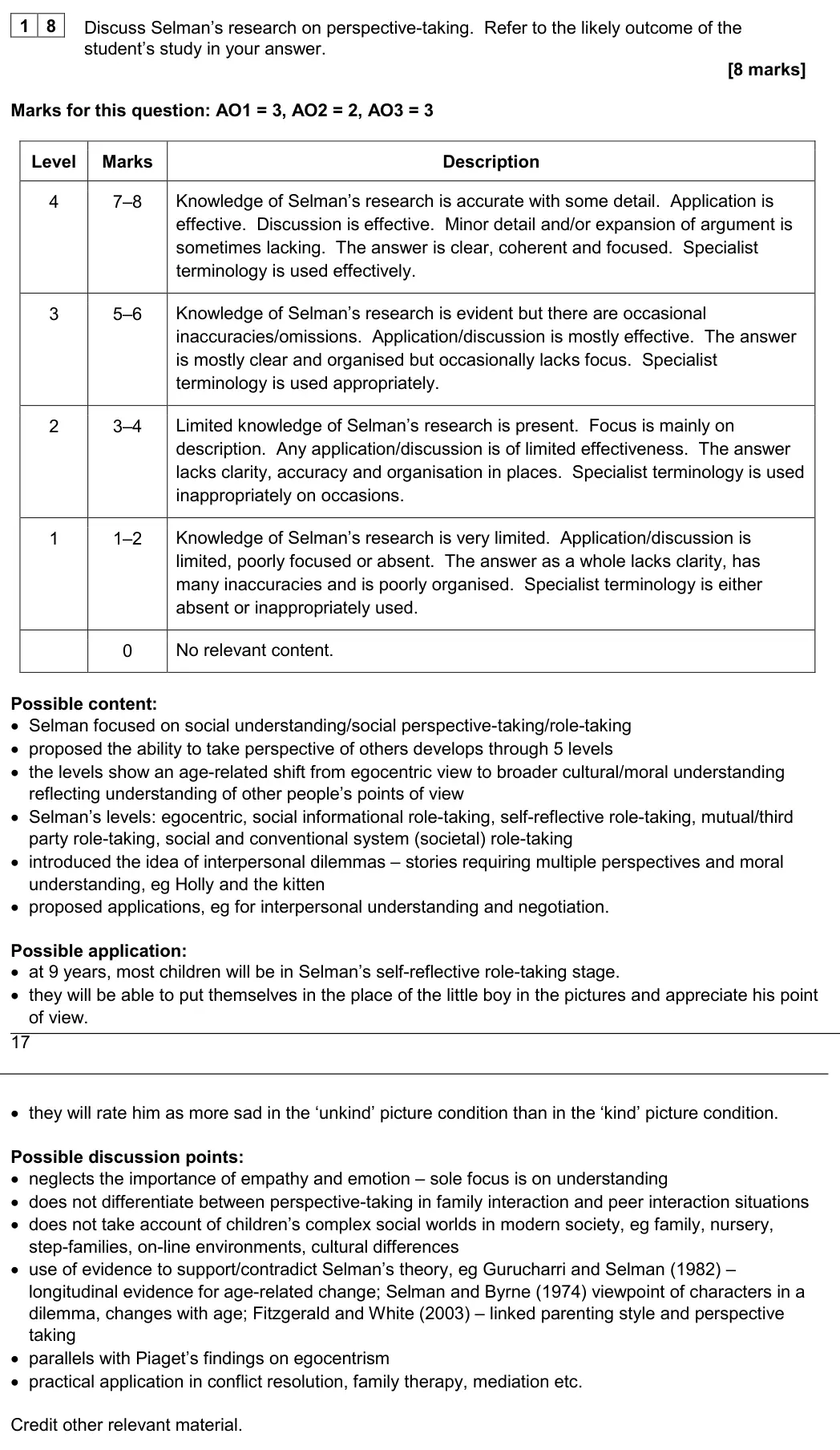
November 2020 · Paper 3 · Q188 marksAO1=3, AO2=2, AO3=3Extended writing
Mark scheme, including level descriptors and indicative content
Examiner's comment
The applied questions on filter theory, sex-role stereotypes and Selman usually evidenced sound knowledge and application but discussion was often brief or absent.
Notes from the mark scheme and report
Selman's levels of perspective-taking and dilemmas (Holly)
apply: 9-year-olds at self-reflective level so rate boy sadder in unkind picture
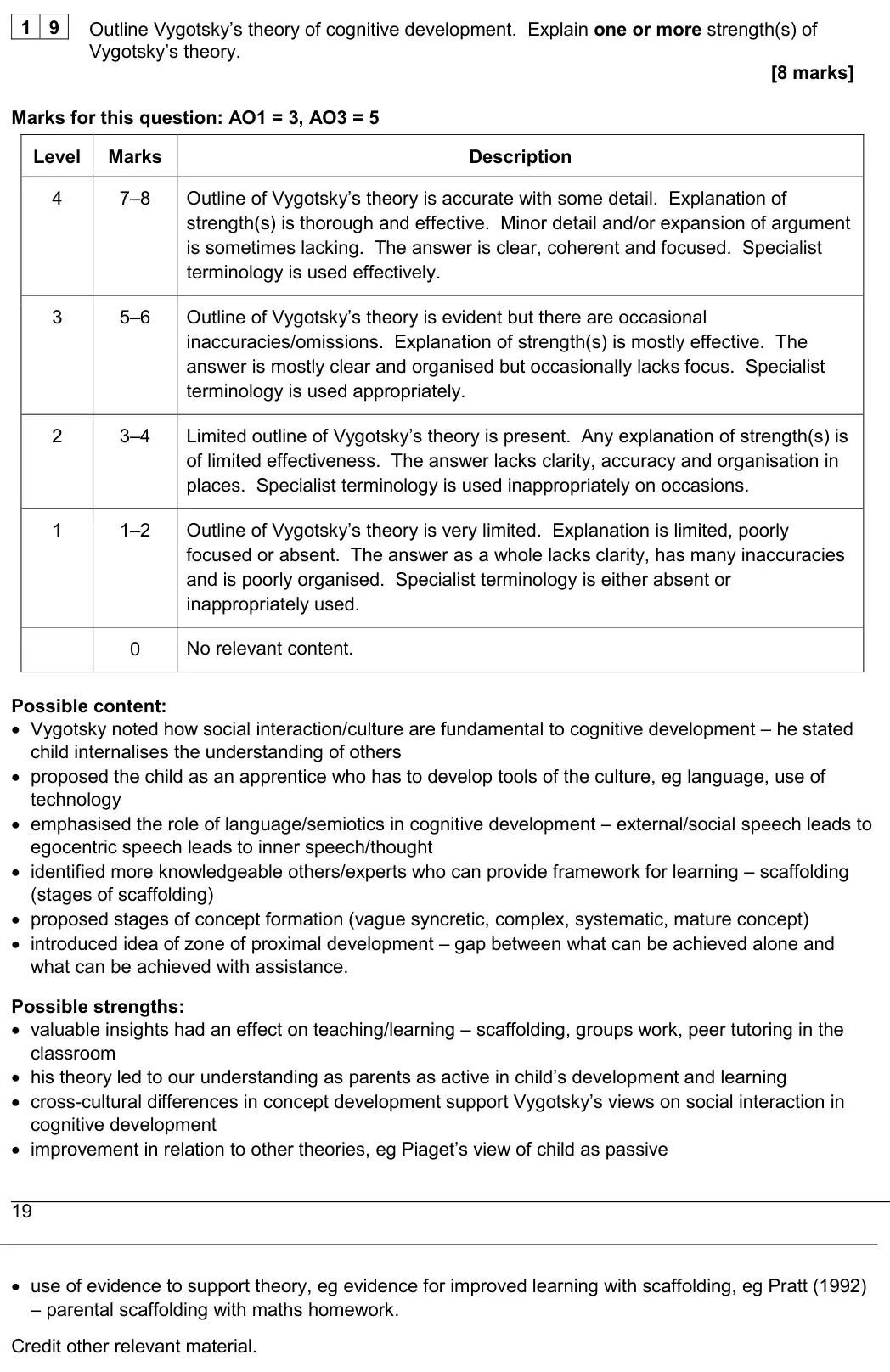
November 2020 · Paper 3 · Q198 marksAO1=3, AO3=5Extended writing
Mark scheme, including level descriptors and indicative content
Examiner's comment
A few discussions of Vygotsky’s work were excellent.
Notes from the mark scheme and report
ZPD, scaffolding, MKO, role of language/culture
strengths only, e.g. educational applications, supporting evidence
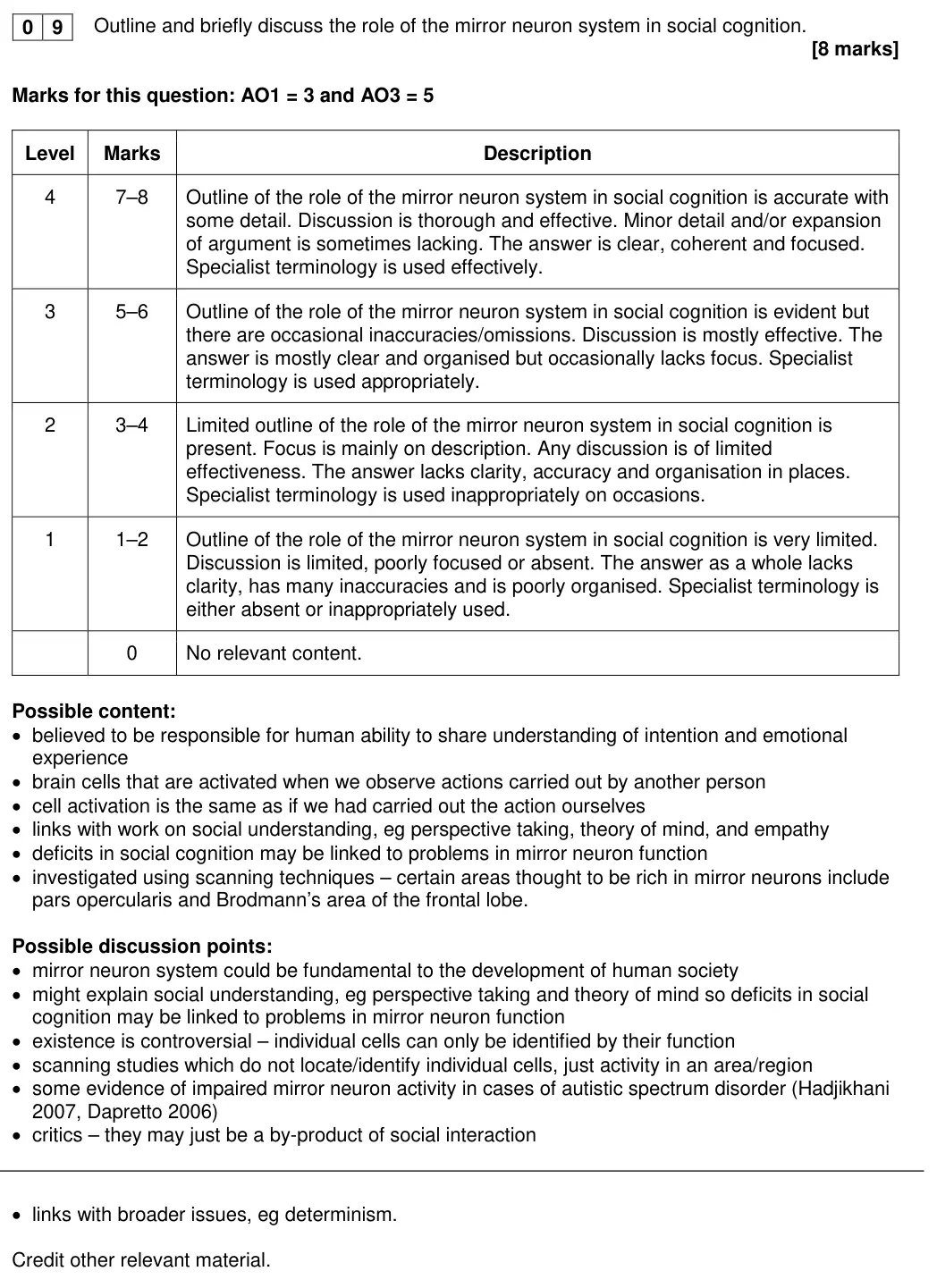
June 2019 · Paper 3 · Q98 marksAO1=3, AO3=5Extended writing
Mark scheme, including level descriptors and indicative content
Examiner's comment
There were some detailed and well-informed responses to this question which were supported with references to evidence and clearly linked to social cognition. At the other end of the scale there were answers that consisted of vague explanations of how brains/thinking enables social learning and copying. Some students who showed strong knowledge and understanding of mirror neurons made little attempt to explain their role in social cognition.
Notes from the mark scheme and report
mirror neurons must be linked to social cognition (perspective-taking, ToM, empathy)
MS also credits autism evidence (ToM as an explanation of autism removed in v1.4)
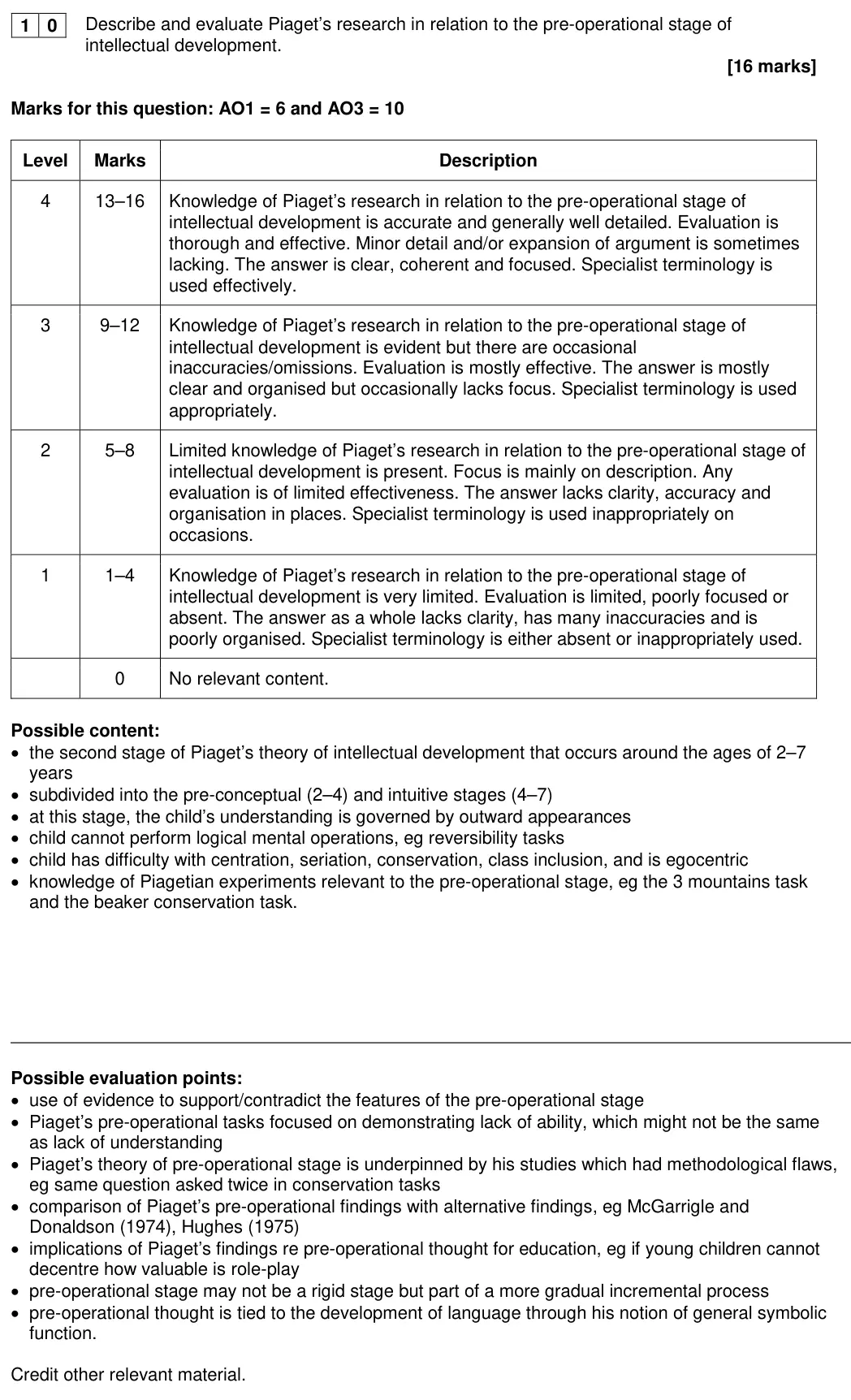
June 2019 · Paper 3 · Q1016 marksAO1=6, AO3=1016-mark essay
Mark scheme, including level descriptors and indicative content
Examiner's comment
Students who stuck to the pre-operational stage tended to do well, at least with the descriptive part of this question. They detailed the concepts of conservation (sometimes referred to as conversation or conservativism), egocentrism and class inclusion, and presented detailed descriptions of Piaget’s studies in these areas. Evaluations were not always so successful because points were often general to the whole theory rather than specific to the pre-operational stage. Having described Piaget’s conservation research, it should have been relatively easy to make a specific critical point about ‘asking the same question twice’ instead of the generic criticism, ‘language was too complicated’. An unfortunate few offered pre-prepared essays on Piaget’s entire theory, leaving examiners to extract the relevant pre-operational content.
Notes from the mark scheme and report
pre-operational stage only (egocentrism, conservation, class inclusion, centration)
evaluation generic to whole theory scored less
pre-prepared whole-theory essays
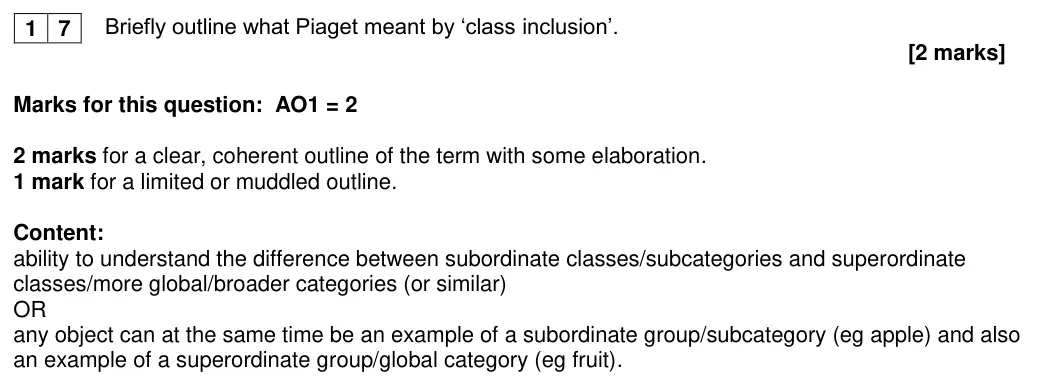
June 2018 · Paper 3 · Q172 marksAO1=2Outline
Mark scheme, including level descriptors and indicative content
Examiner's comment
Students who evidently knew the concept often presented answers in the form of illustrative examples rather than giving a clear definition, and thereby gained limited credit. Class inclusion was sometimes confused with other Piagetian ideas such as centration, whereby children can deal with only one property of an object at a time. Some answers indicated that students had no idea of the meaning at all, for example, where they stated it was about sharing and being kind to everyone in the class.
Notes from the mark scheme and report
subordinate vs superordinate classes
examples alone gained limited credit
confusion with centration
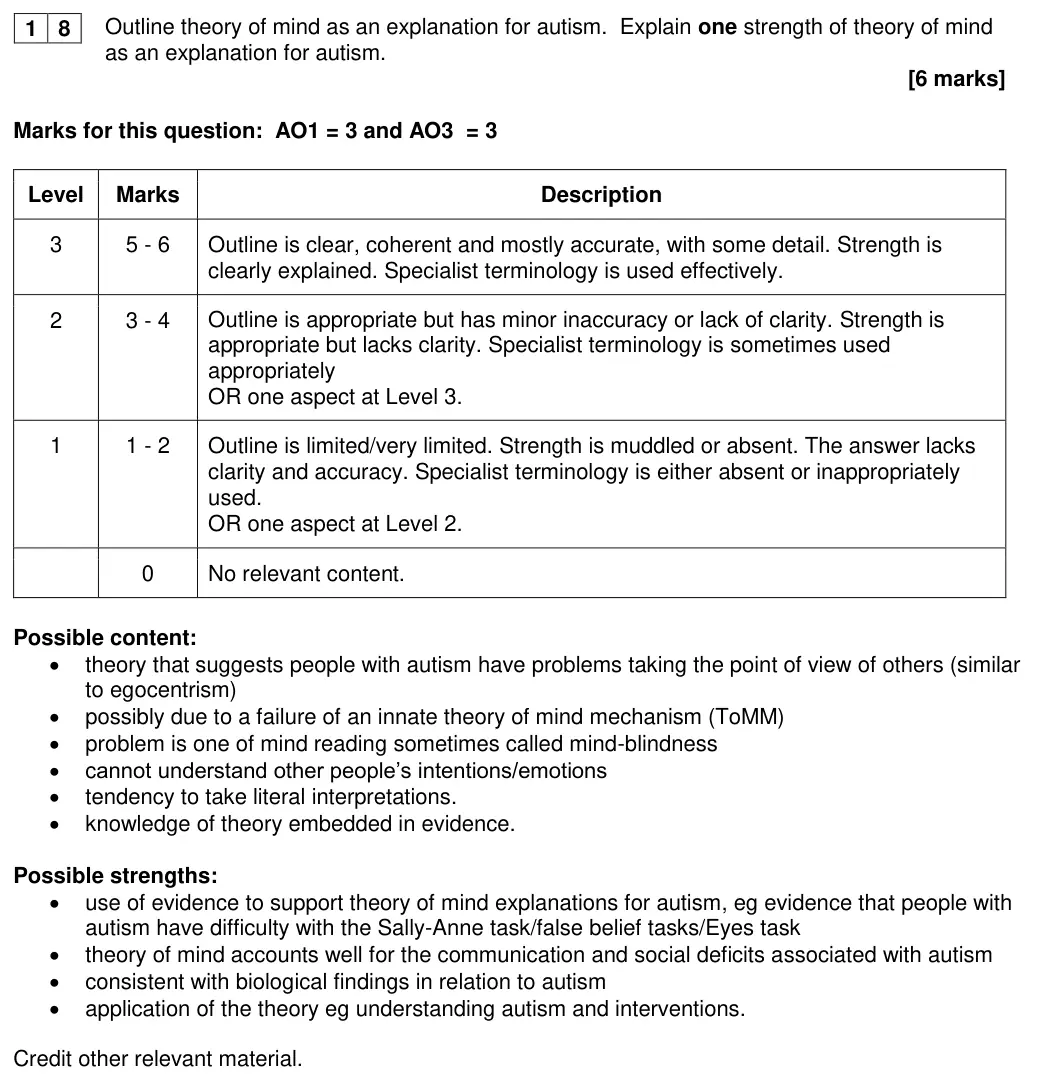
June 2018 · Paper 3 · Q186 marksAO1=3, AO3=3OutlineOld spec only
Mark scheme, including level descriptors and indicative content
Examiner's comment
Most answers gained credit in Level 2. Occasionally, students wrote a great deal about theory of mind and barely mentioned autism. Other students presented long accounts of the Sally-Anne study but said little about theory of mind. The strength often lacked explanation, or, despite the question requiring only one strength, students presented a list leaving the examiner to try to disentangle them and award marks for the best.
Notes from the mark scheme and report
(theory of mind as an explanation of autism, removed in v1.4
theory of mind and Sally-Anne remain)
answers about ToM without autism or long Sally-Anne accounts scored less
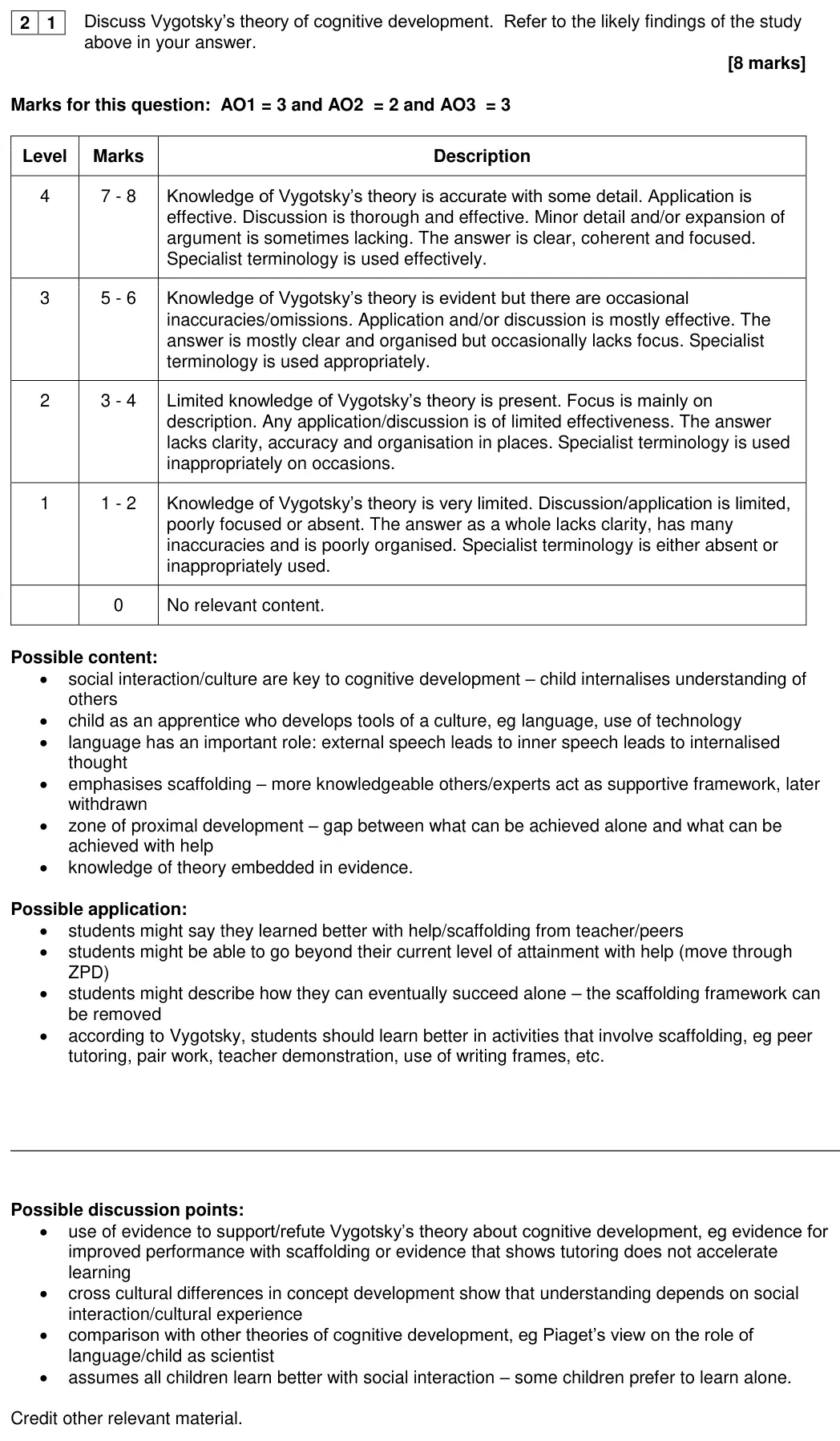
June 2018 · Paper 3 · Q218 marksAO1=3, AO2=2, AO3=3Extended writing
Mark scheme, including level descriptors and indicative content
Examiner's comment
This question was often well answered, but, as in the case of the parallel questions, marks were largely dependent on the ability to organise material and address the three skills in limited time. What might have been very worthy accounts of Vygotsky’s theory were sometimes marred by students’ lack of ability to use specialist terminology effectively. Discussion tended to focus on implications for education and comparisons with Piaget. Despite there being ample scope for application, this was often very limited, with the barest mention that ‘students who say they are helped in the classroom would learn better’.
Notes from the mark scheme and report
apply ZPD/scaffolding to students' likely reports on how they learn
application often minimal
discussion usually education and comparison with Piaget
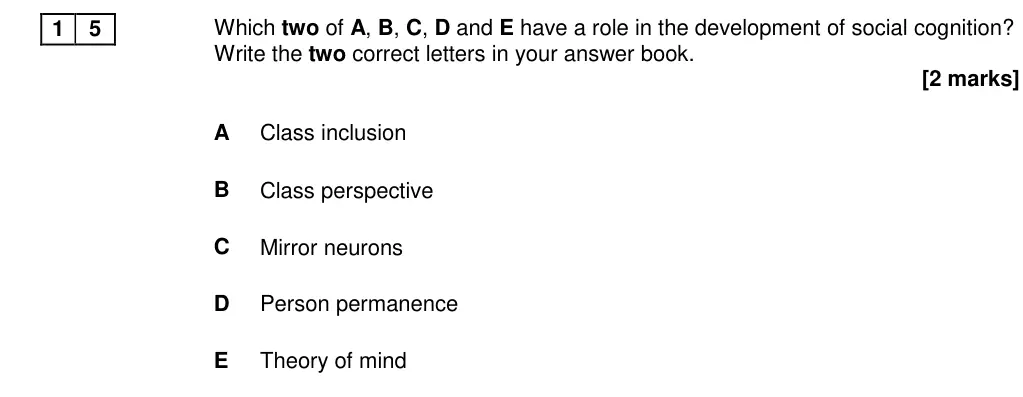
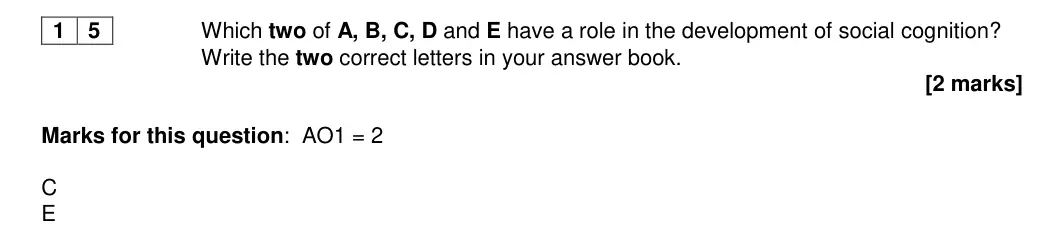
June 2017 · Paper 3 · Q152 marksAO1=2Multiple choiceEasy
Answer
C and E
Mark scheme, including level descriptors and indicative content
Examiner's comment
The vast majority of students were able to pick up at least one mark on this question, with many able to identify both relevant concepts.
Notes from the mark scheme and report
answers C and E (mirror neurons, theory of mind)
distractors include class inclusion (Piaget) and made-up terms
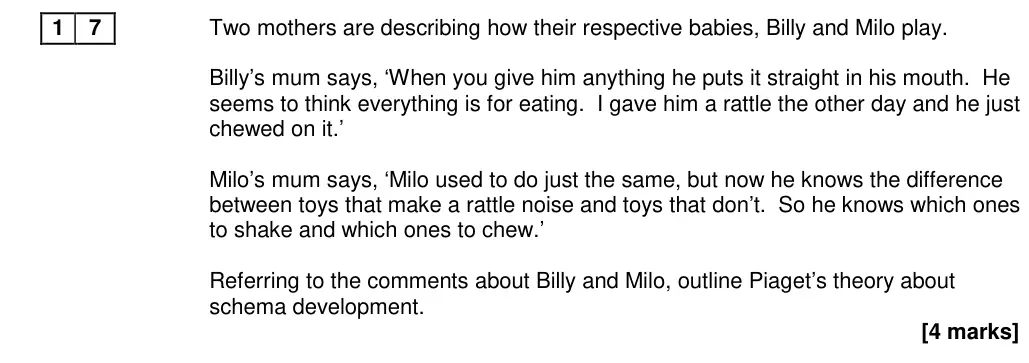
June 2017 · Paper 3 · Q174 marksAO2=4Application
Mark scheme, including level descriptors and indicative content
Examiner's comment
This was probably the most badly answered of the 4-mark application questions in Section B. Sound understanding of Piagetian concepts and a good grasp of terminology were necessary to enable effective application to the cases of Billy and Milo. Many students did not even refer to assimilation and accommodation, or completely confused the two. Whilst assimilation and accommodation were probably the most obvious concepts to apply to the stem material, some capable students managed to achieve credit by appropriate application of alternative Piagetian notions, such as equilibrium and disequilibrium. Completely irrelevant descriptions of Piaget’s stages were sometimes presented.
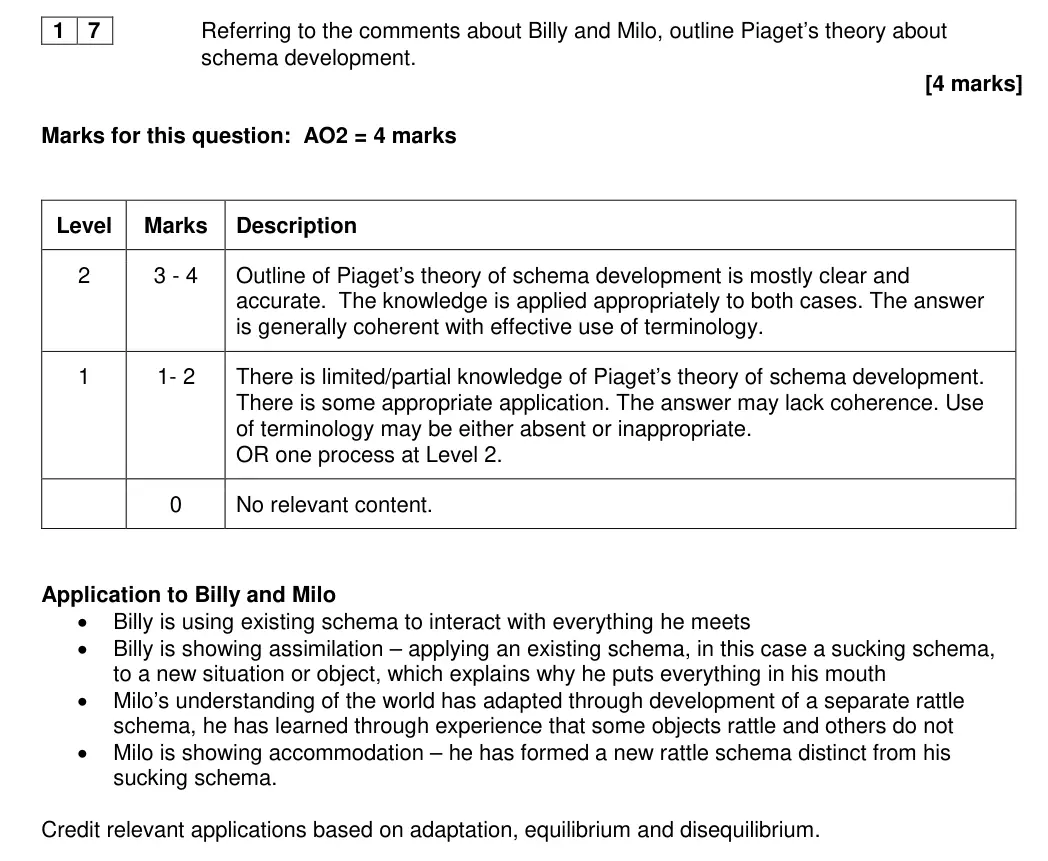
Notes from the mark scheme and report
Billy = assimilation (existing sucking schema applied to everything)
Milo = accommodation (new rattle schema)
equilibration/disequilibrium also credited
worst-answered 4-mark application in Section B - assimilation/accommodation confused or omitted, irrelevant stage descriptions
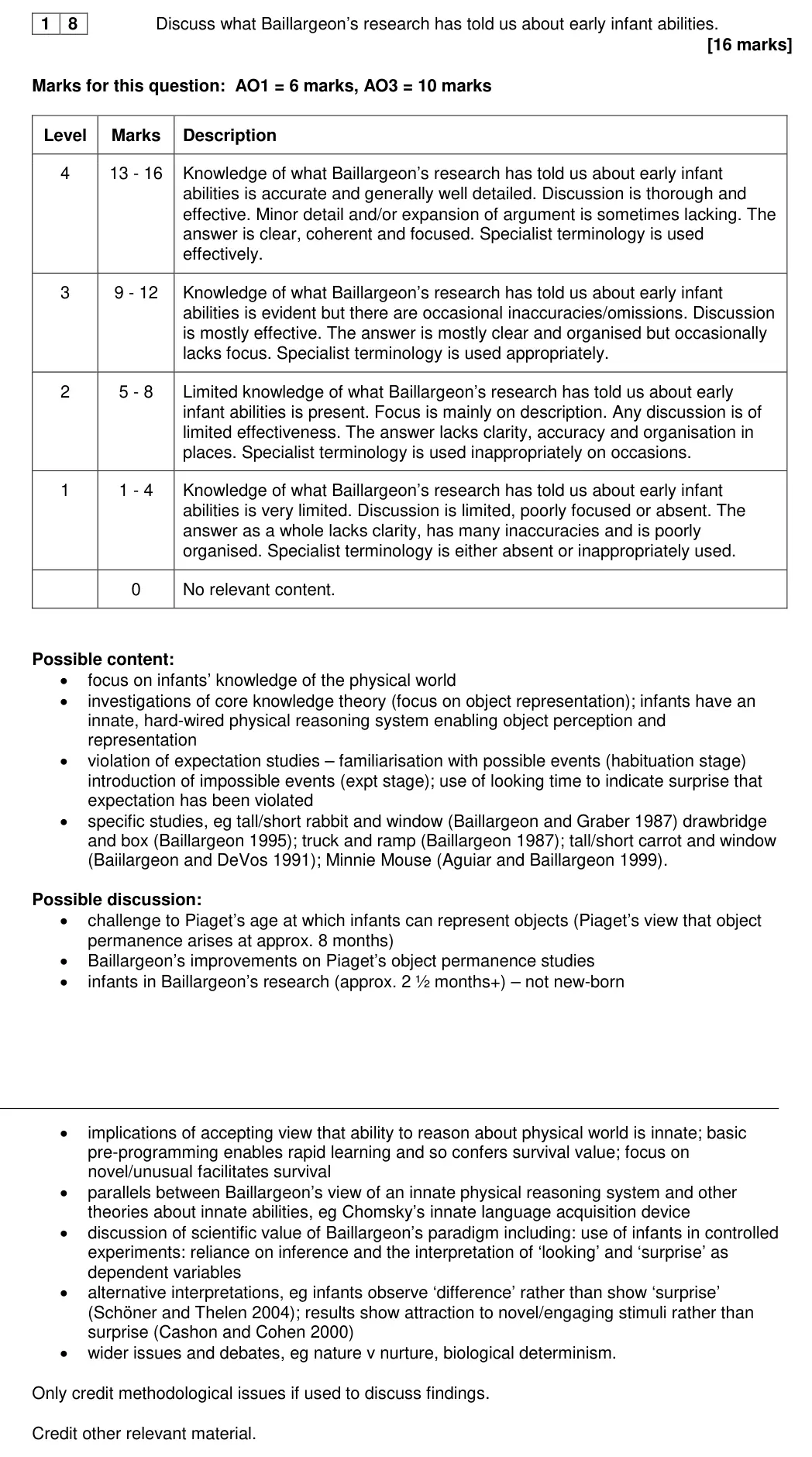
June 2017 · Paper 3 · Q1816 marksAO1=6, AO3=1016-mark essay
Mark scheme, including level descriptors and indicative content
Examiner's comment
This question was generally competently answered, although there was a tendency to give lengthy methodological descriptions of the violation of expectation research rather than focus on what the research has shown. Weaker answers gave detailed and often muddled descriptions of the antics of rabbits of all sizes and barely mentioned the findings, or crucially omitted the ages of the children. Better discussions were those that considered not just the experimental work, but also the more general core knowledge theory, a route that enabled broader analysis in relation to nature- nurture and determinism. Comparisons with Piaget’s work on object permanence were usually effective.
Notes from the mark scheme and report
violation of expectation, looking time, core knowledge, specific studies with infant ages
discussion: challenge to Piaget's object permanence age, interpretation of looking as surprise, nature-nurture
lengthy procedural descriptions without findings scored poorly
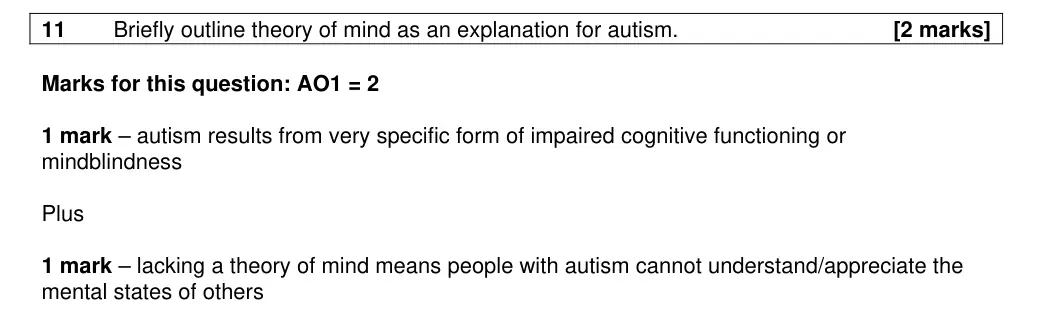
Specimen set 2 · Paper 3 · Q112 marksAO1=2OutlineOld spec only
Mark scheme, including level descriptors and indicative content
Notes from the mark scheme and report
(theory of mind as an explanation of autism, removed in v1.4
theory of mind itself remains)
1 mark impaired cognition/mindblindness + 1 mark cannot understand others' mental states
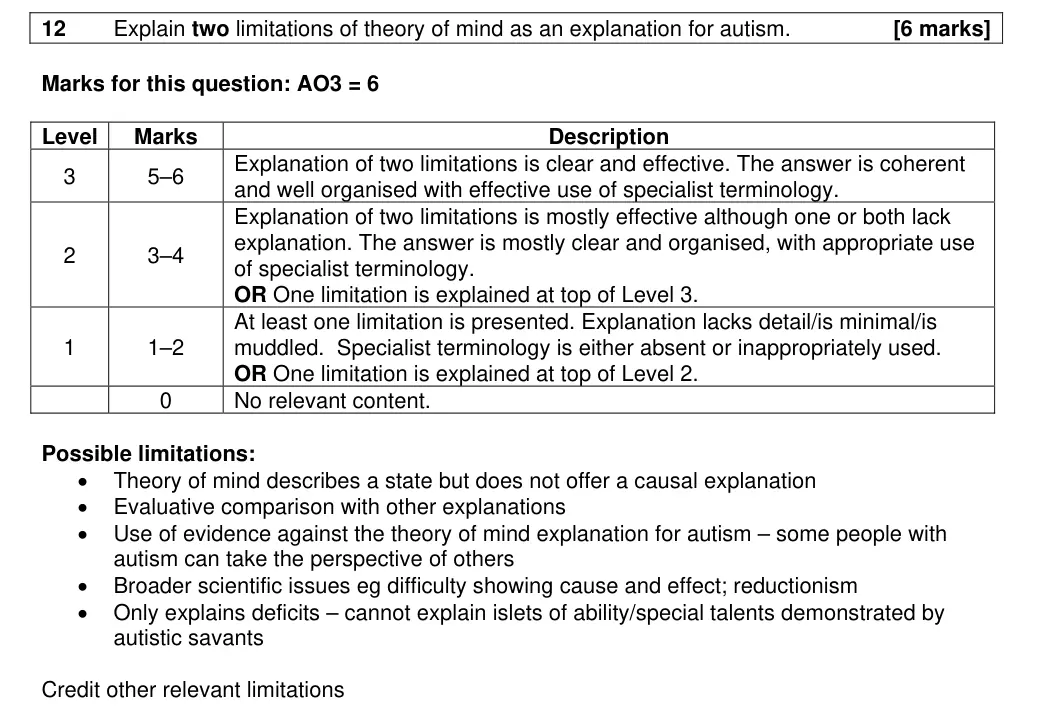
Specimen set 2 · Paper 3 · Q126 marksAO3=6Evaluate (short)Old spec only
Not on the 2025 specification: limitations of theory of mind as an explanation of autism, removed in v1.4
Mark scheme, including level descriptors and indicative content
Notes from the mark scheme and report
Off-spec: limitations of theory of mind as an explanation of autism, removed in v1.4
e.g. describes rather than explains, some autistic people pass perspective tasks, cannot explain savant abilities
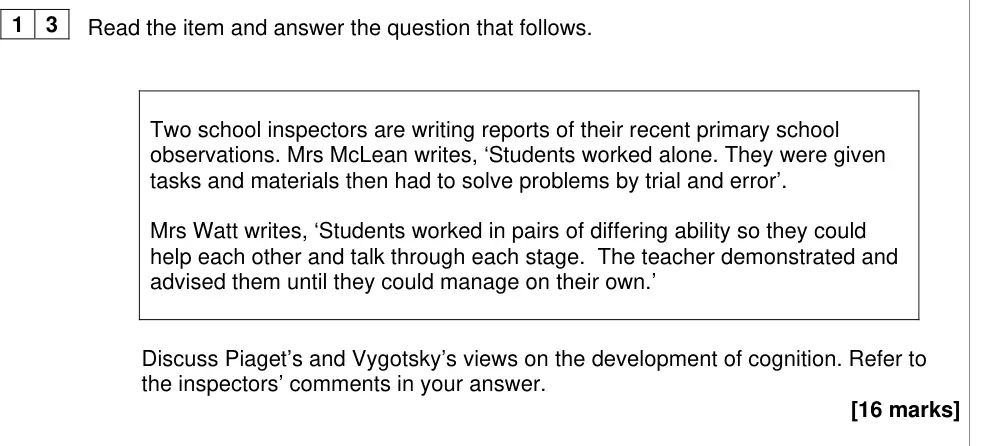
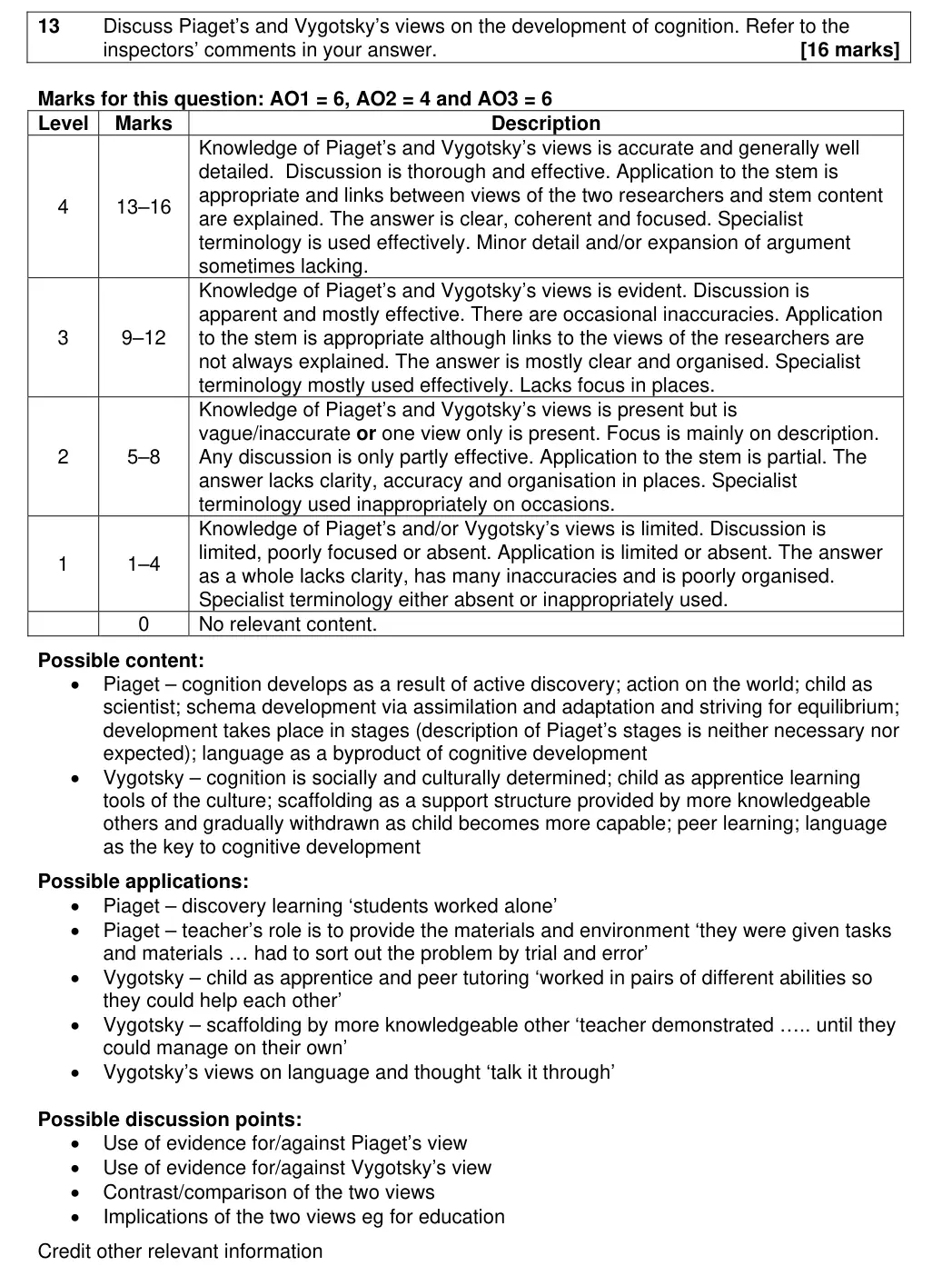
Specimen set 2 · Paper 3 · Q1316 marksAO1=6, AO2=4, AO3=616-mark essay
Mark scheme, including level descriptors and indicative content
Notes from the mark scheme and report
Piaget (discovery learning - 'worked alone', trial and error) vs Vygotsky (peer tutoring, scaffolding by teacher, language - 'talk through')
stage descriptions not needed
one theorist only = max Level 2
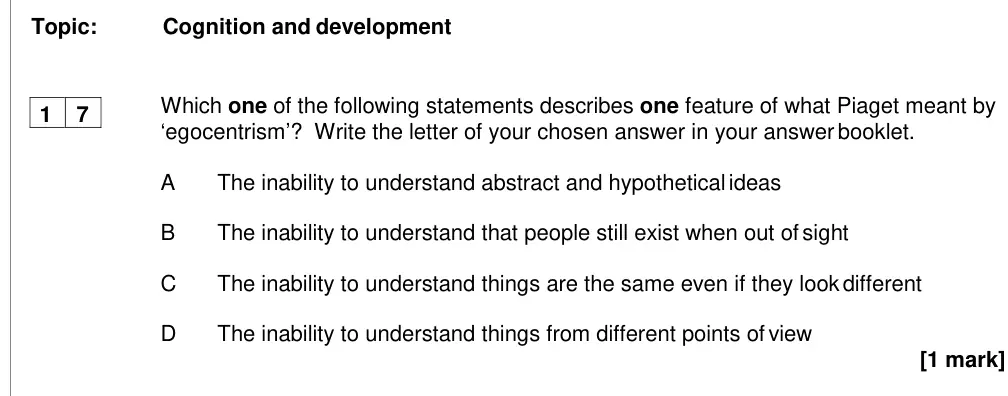
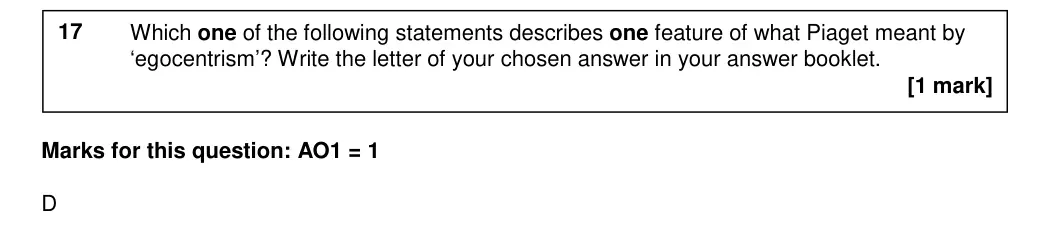
Specimen set 1 · Paper 3 · Q171 markAO1=1Multiple choice
Answer
D
Mark scheme, including level descriptors and indicative content
Notes from the mark scheme and report
answer D
distractors describe abstract thought (A), object permanence (B), conservation (C)
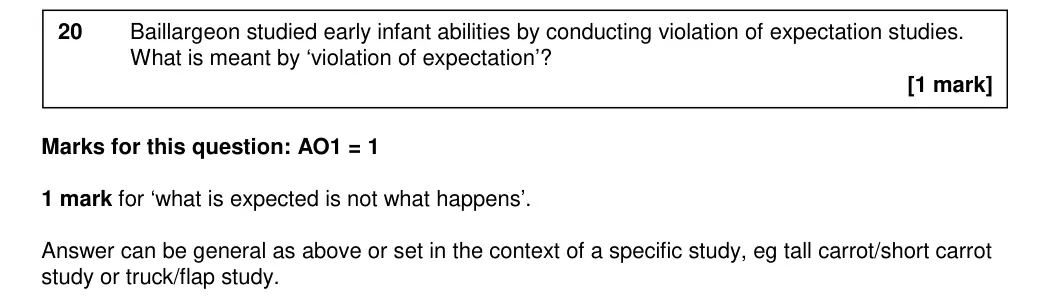
Specimen set 1 · Paper 3 · Q201 markAO1=1Short answer
Mark scheme, including level descriptors and indicative content
Notes from the mark scheme and report
what is expected is not what happens
may be set in a study (carrot, truck/flap)
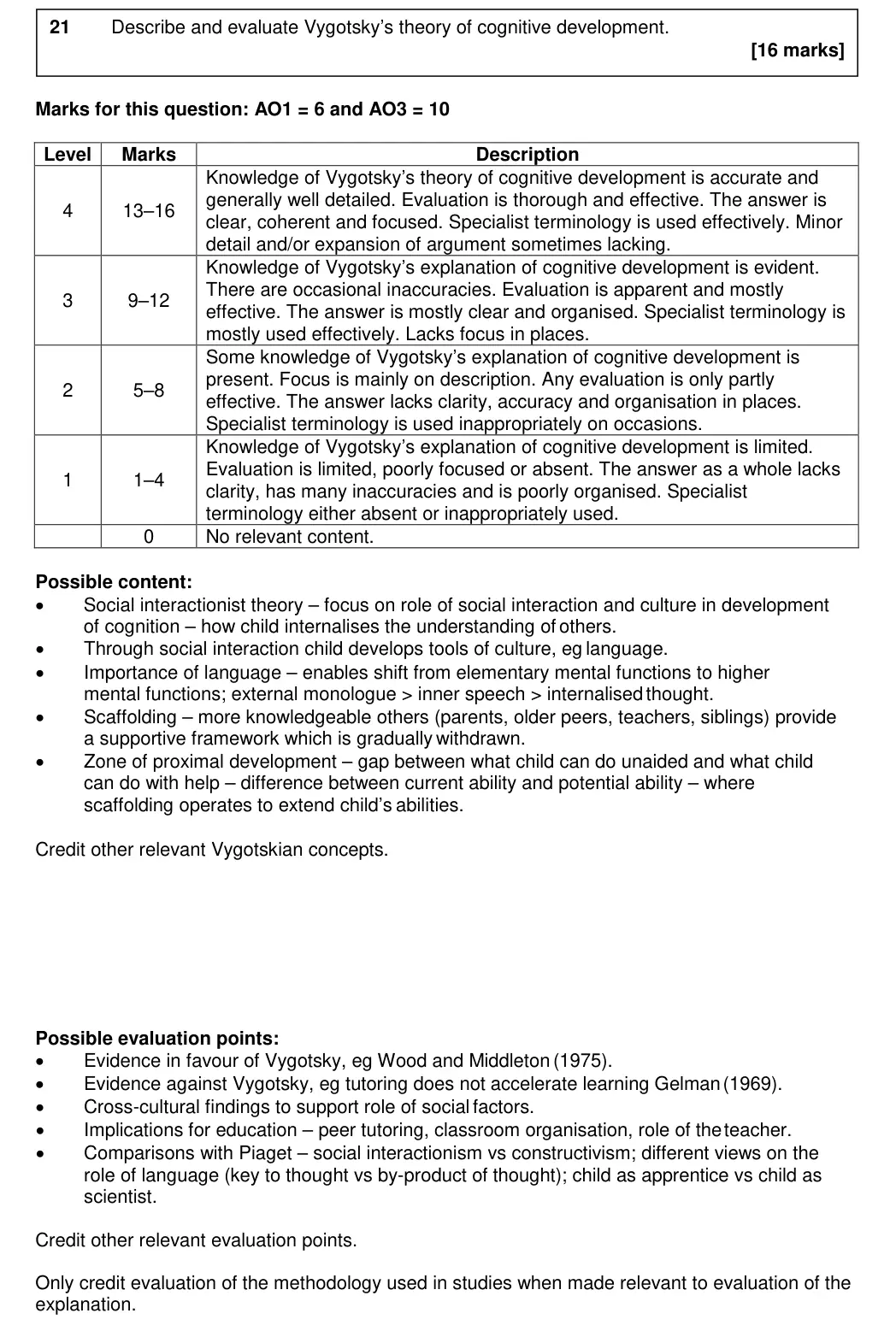
Specimen set 1 · Paper 3 · Q2116 marksAO1=6, AO3=1016-mark essay
Mark scheme, including level descriptors and indicative content
Notes from the mark scheme and report
social interaction, language/inner speech, scaffolding, ZPD
evaluation e.g. Wood and Middleton, Gelman, educational applications, comparison with Piaget
methodology only if linked
Work with an AQA psychology tutor
Essays not reaching the top band? Book a session with Andy, a former AQA examiner.