36 question parts, 8 sixteen-mark essays, 6 multiple-choice items, plus 1 parts on content removed in 2025
Notes, key studies and practice items for this topic are being written by our tutors. The past-paper questions below are ready now.
Specification statements
4.3.6-01 Explanations for food preferences: the evolutionary explanation, including reference to neophobia and taste aversion; the role of learning in food preference, including social and cultural influences.
4.3.6-02 Neural and hormonal mechanisms involved in the control of eating behaviour, including the role of the hypothalamus, ghrelin and leptin.
4.3.6-03 Biological explanations for anorexia nervosa: genetic and neural.
4.3.6-04 Psychological explanations for anorexia nervosa: family systems theory, including enmeshment, autonomy and control; social learning theory, including modelling, reinforcement and media; cognitive theory, including distortions and irrational beliefs.
4.3.6-05 Biological explanations for obesity, including genetic and neural.
4.3.6-06 Psychological explanations for obesity, including restraint theory, disinhibition and the boundary model.
Tap a question to zoom it. Mark scheme and examiner's comment open under each question.
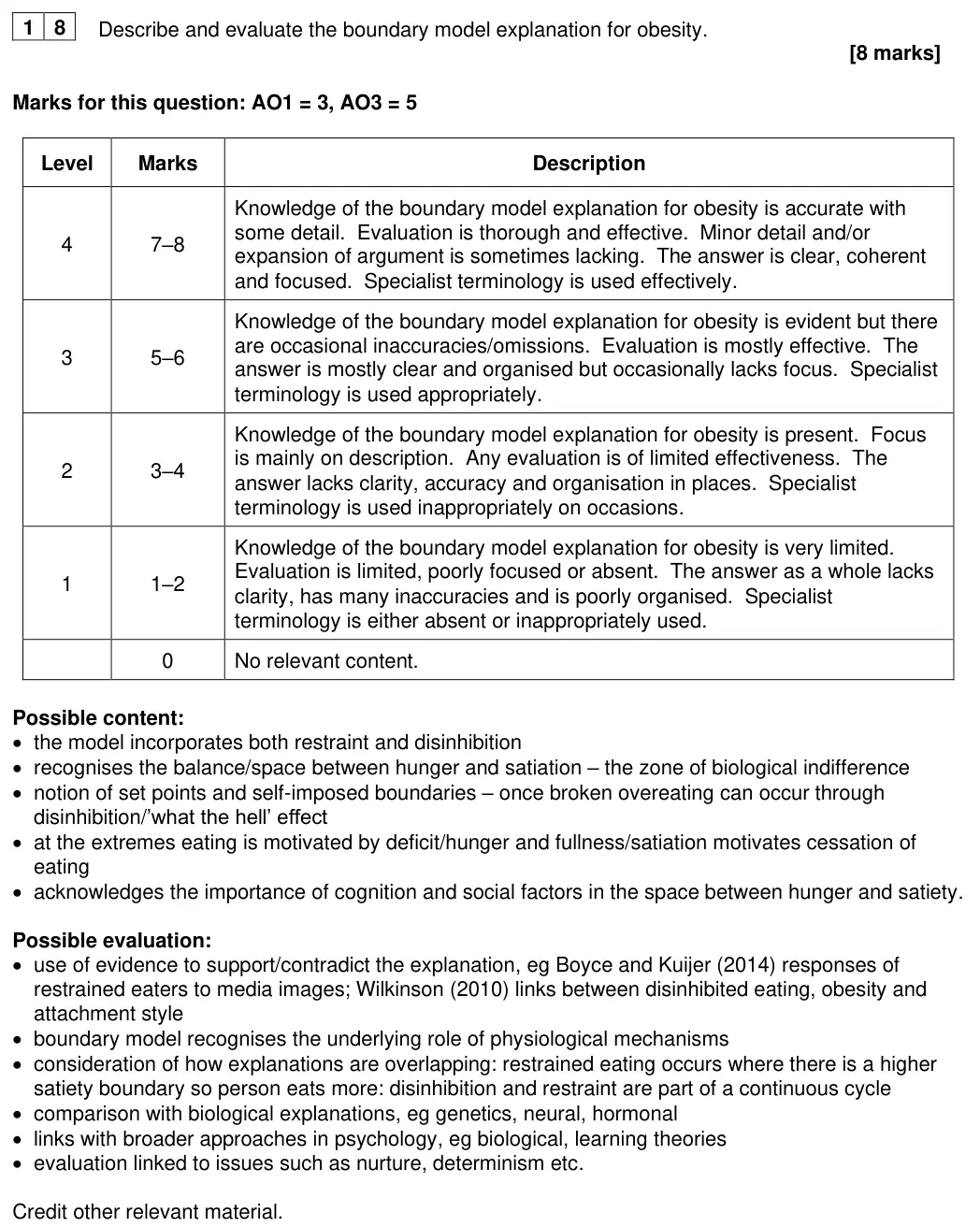
June 2025 · Paper 3 · Q188 marksAO1=3, AO3=5Extended writing
Mark scheme, including level descriptors and indicative content
Examiner's comment
The 8-mark boundary model question (18) tended to produce responses that were rich in description, but marginally less successful when it came to evaluation. Most were able to articulate the model as integrating ideas from restraint and disinhibition theory, as well as provide practical examples of how this would explain obesity. That said, there were several responses where reference to obesity was almost absent, and these tended not to progress beyond the middle bands. Although some students had access to evidence to support discussion, many did not, and their evaluation points were less convincing as a result.
Notes from the mark scheme and report
combines restraint and disinhibition, zone of biological indifference, self-imposed boundaries, 'what the hell' effect
answers rich in description but weaker evaluation
some barely referred to obesity
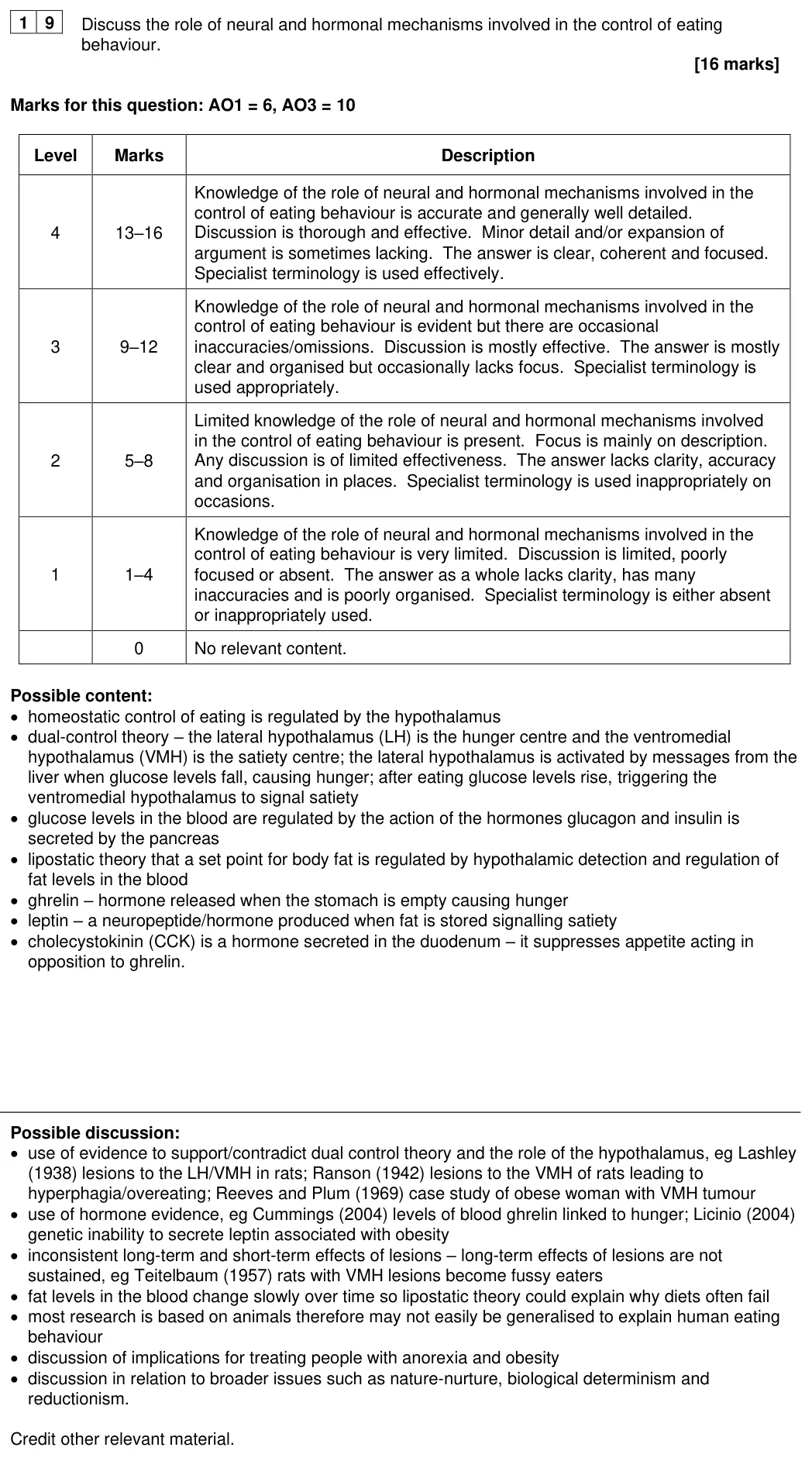
June 2025 · Paper 3 · Q1916 marksAO1=6, AO3=1016-mark essay
Mark scheme, including level descriptors and indicative content
Examiner's comment
The 16-mark essay question on neural and hormonal influences (19) saw some impressive technical detail in many answers. Descriptions referred to both elements of the question and were accurate and detailed. That said, some students muddled the role of ghrelin and leptin, and the precise mechanisms involved. Discussion points in this question tended to be more sophisticated than for the previous question; the most popular being the use of animal studies and evidence involving lesioning.
evaluation lesion studies in rats, generalisation from animals, implications for anorexia/obesity
ghrelin and leptin roles sometimes muddled
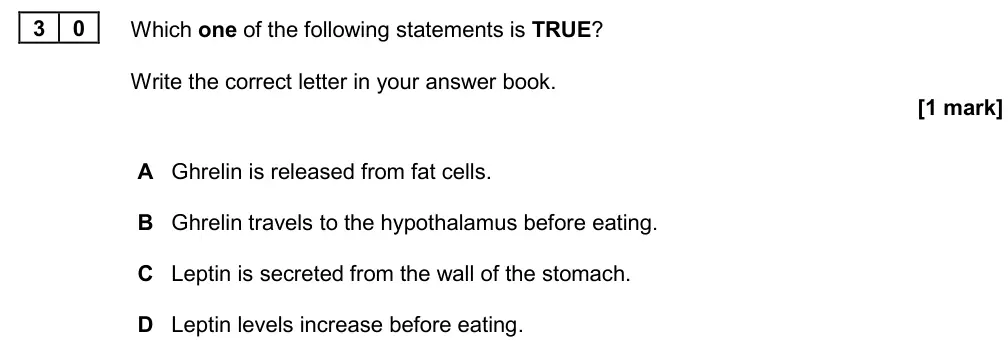
June 2024 · Paper 3 · Q301 markAO1=1Multiple choice
Answer
B
Mark scheme, including level descriptors and indicative content
Examiner's comment
Almost as many were able to correctly identify the true statement as option B for Question 30.
Notes from the mark scheme and report
answer B (ghrelin travels to the hypothalamus before eating)
distractors swap ghrelin (stomach) and leptin (fat cells) sources/timing
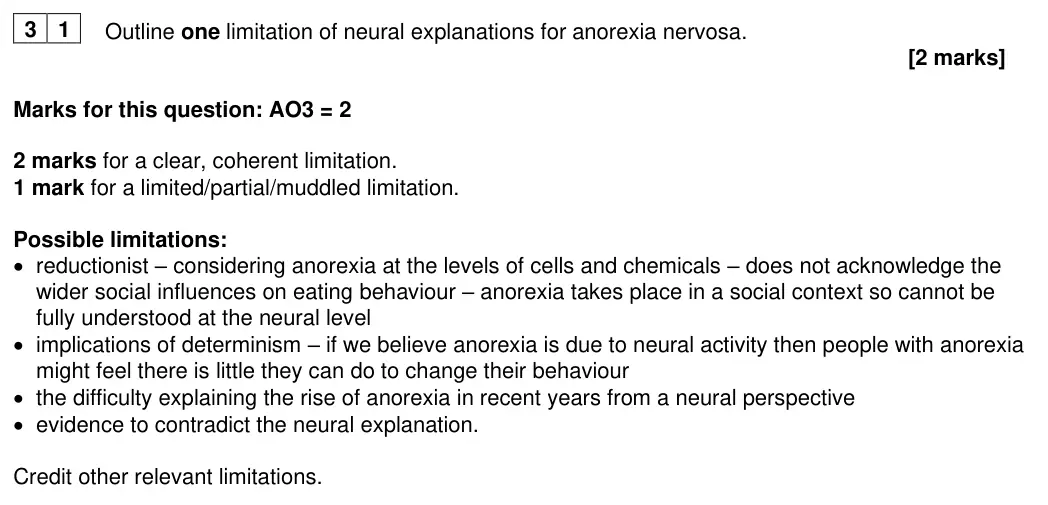
June 2024 · Paper 3 · Q312 marksAO3=2Evaluate (short)
Mark scheme, including level descriptors and indicative content
Examiner's comment
A number of students found Question 31 difficult. They often simply listed alternative explanations for eating disorders without any meaningful comparison with the neural explanation. Those who talked about ‘reductionism’ were usually the most successful.
Notes from the mark scheme and report
2 marks for a clear limitation, e.g. reductionist, deterministic, cannot explain recent rise in incidence, contradictory evidence
listing alternatives without comparison scored little
reductionism answers most successful
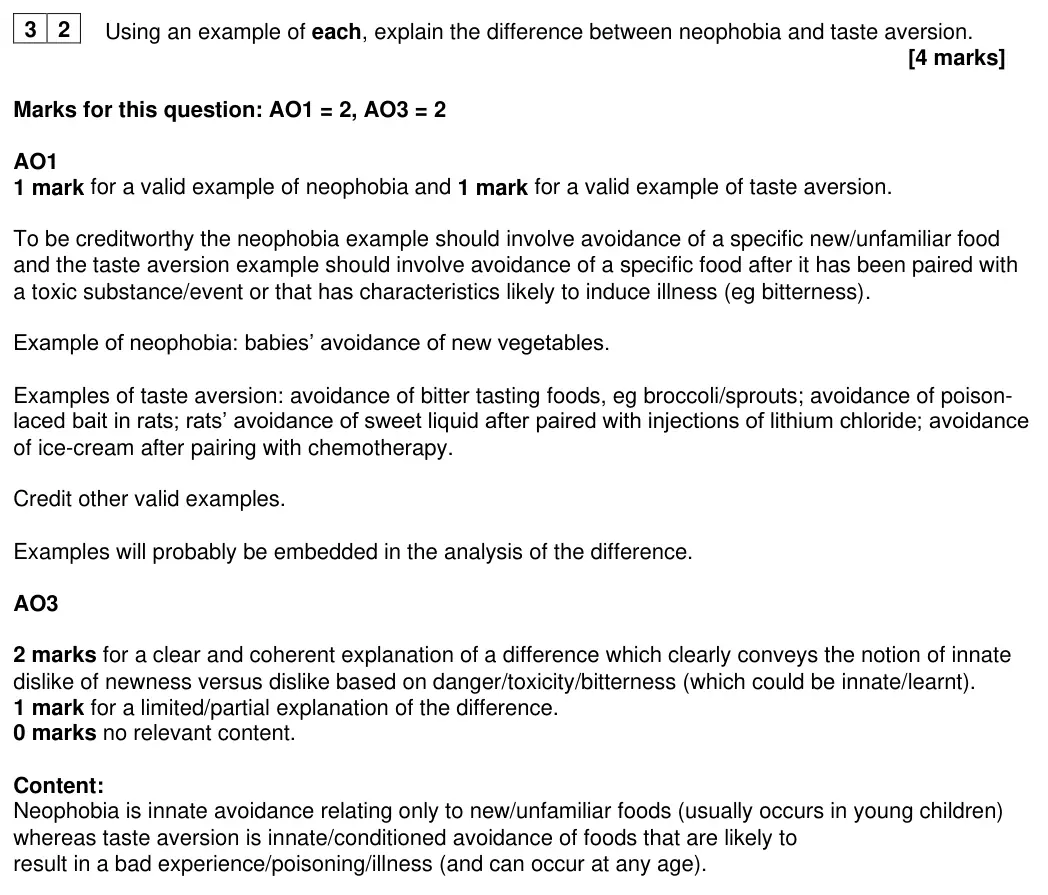
June 2024 · Paper 3 · Q324 marksAO1=2, AO3=2Explain
Mark scheme, including level descriptors and indicative content
Examiner's comment
Question 32 proved not to be straightforward. Some students got their definitions of neophobia and taste aversion the wrong way round, and there was a general tendency to offer up a partial repeat of the definition as the example. This was especially true of neophobia.
Notes from the mark scheme and report
AO1: 1 mark specific example of neophobia (new/unfamiliar food) + 1 mark taste aversion (food paired with illness/bitterness)
AO3: 2 marks innate fear of newness vs avoidance after illness/toxicity
definitions often reversed
examples just repeated definitions
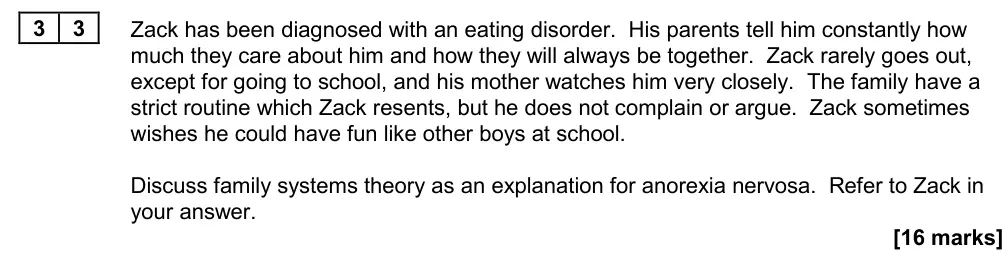
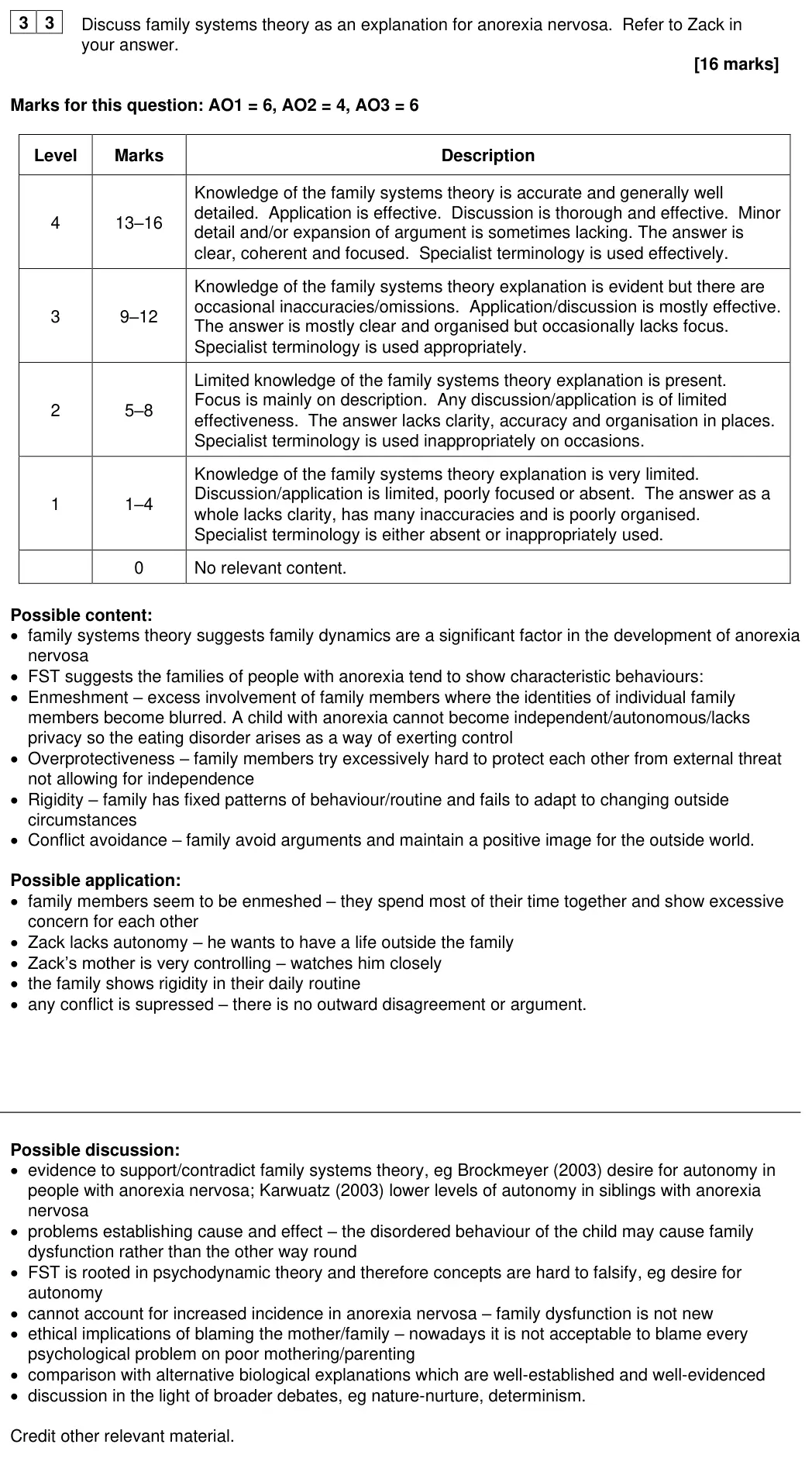
June 2024 · Paper 3 · Q3316 marksAO1=6, AO2=4, AO3=616-mark essay
Mark scheme, including level descriptors and indicative content
Examiner's comment
As with the corresponding Schizophrenia question, there were some very good top-level answers for Question 33. Those who knew the key elements of family systems theory were able to describe these succinctly, and then match their description to the appropriate part of the stem. It was striking how well evidence was used in this essay; students who had been taught this topic seemed to have lots of studies at their disposal.
Notes from the mark scheme and report
enmeshment, overprotectiveness, rigidity (strict routine), conflict avoidance (doesn't argue), lack of autonomy (wants fun like other boys), controlling mother
evidence used well
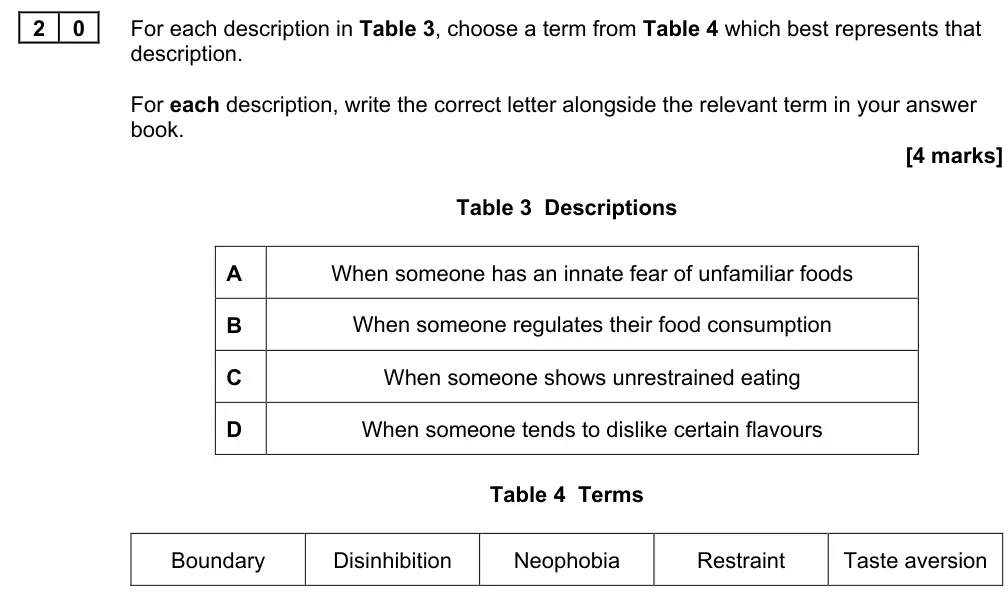
June 2023 · Paper 3 · Q204 marksAO1=4Multiple choice
Answer
A and B and C and D
Mark scheme, including level descriptors and indicative content
Examiner's comment
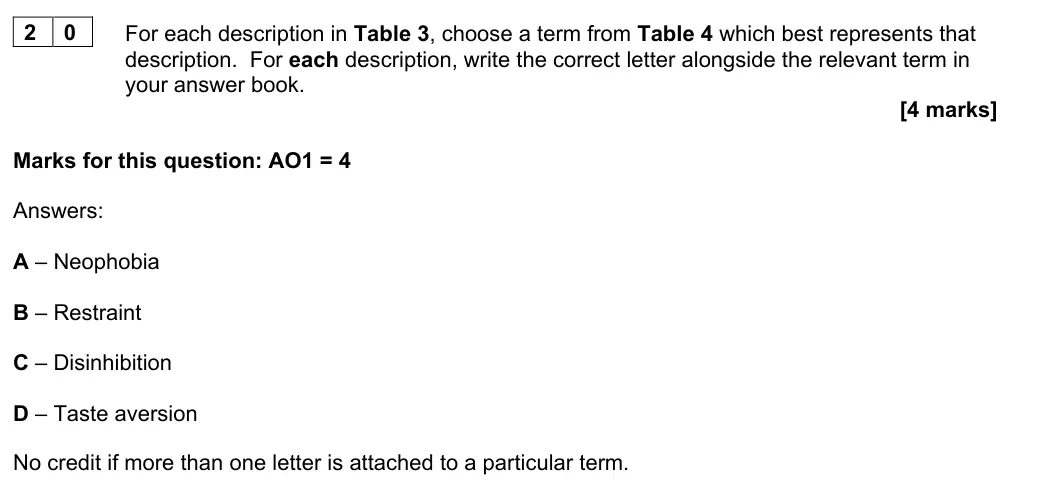
Each of the optional topics in Section C began with a 4-mark multiple-choice question, none of which proved particularly problematic for students. Many answers to this multiple-choice question were correct. Those who did make a mistake, commonly substituted ‘restraint’ for ‘boundary’, which was an incorrect option.
Notes from the mark scheme and report
A Neophobia, B Restraint, C Disinhibition, D Taste aversion
'boundary' is the distractor
no credit if more than one letter per term
June 2023 · Paper 3 · Q2216 marksAO1=6, AO2=4, AO3=616-mark essay
Mark scheme, including level descriptors and indicative content
Examiner's comment
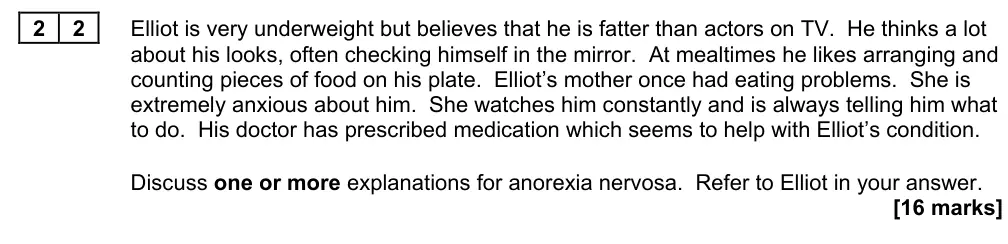
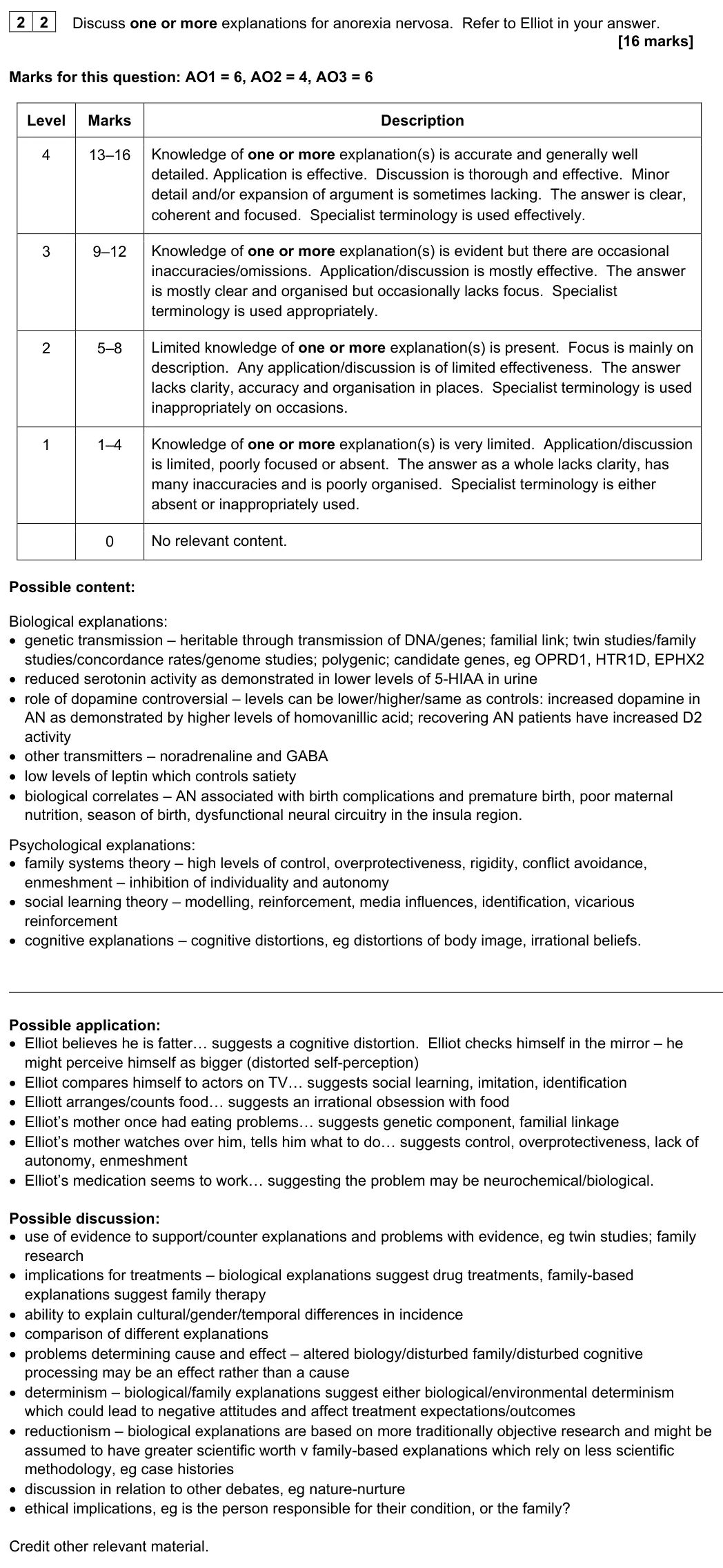
Overall, this 16-mark extended response question was answered well. The very open style of this question meant that many explanations could be included, and this ‘breadth’ approach lent itself well to application as there were many different ‘hooks’ within the question. Family systems theory was a popular choice, as was genetic transmission. Some students chose social learning theory and were able to make links both to the actors on TV as well as the influence of Elliot’s mother. Use of evidence was best deployed in relation to the biological explanations: analysis of twin studies and the implications for treatment were the points seen most often.
Notes from the mark scheme and report
many hooks: cognitive distortion (fatter than actors, mirror), SLT (TV actors), family systems (controlling mother, enmeshment), genetics (mother's eating problems), neurochemistry (medication)
family systems and genetics most popular
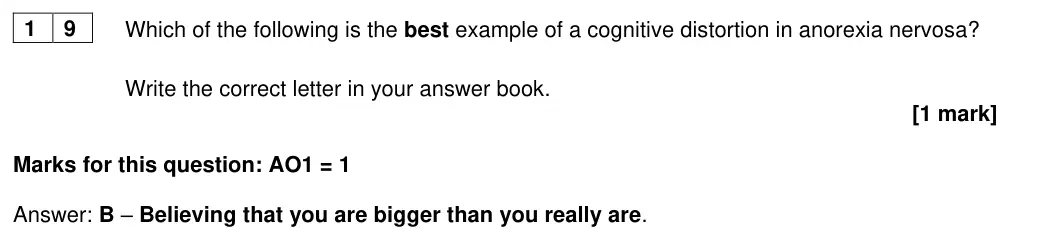
June 2022 · Paper 3 · Q191 markAO1=1Multiple choice
Answer
B
Mark scheme, including level descriptors and indicative content
Examiner's comment
Many answers to the multiple-choice questions were correct.
Notes from the mark scheme and report
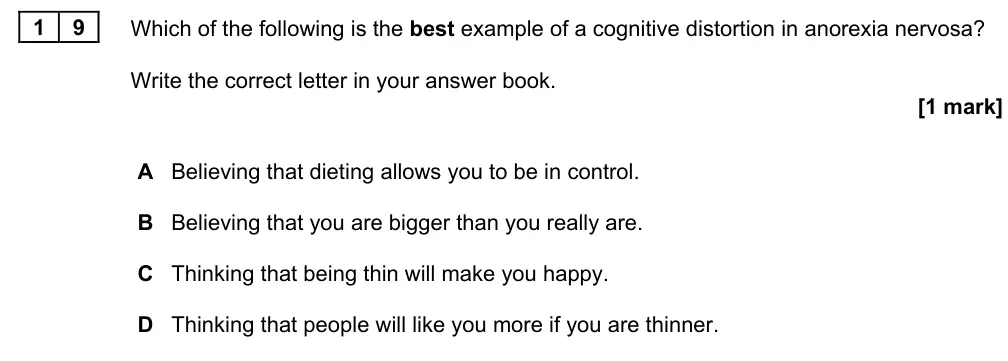
correct B (believing you are bigger than you are)
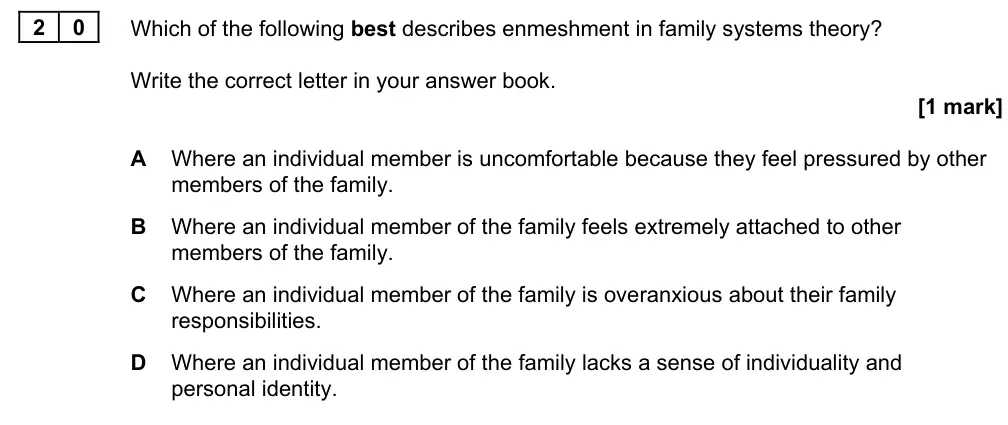
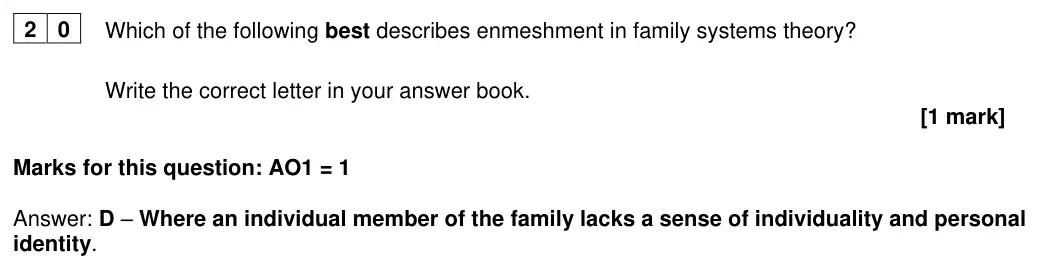
June 2022 · Paper 3 · Q201 markAO1=1Multiple choice
Answer
D
Mark scheme, including level descriptors and indicative content
Examiner's comment
Many answers to the multiple-choice questions were correct.
Notes from the mark scheme and report
correct D (lack of individuality and personal identity)
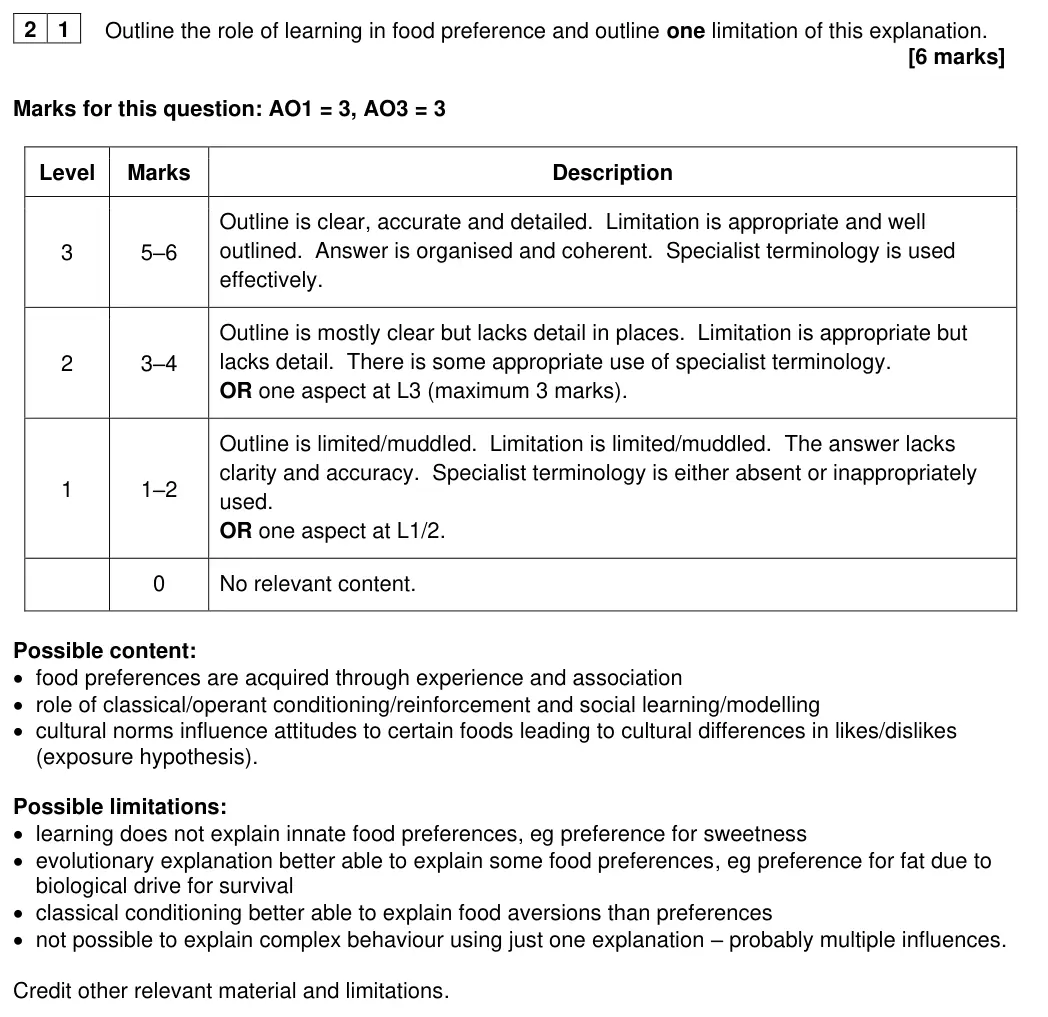
June 2022 · Paper 3 · Q216 marksAO1=3, AO3=3Outline
Mark scheme, including level descriptors and indicative content
Examiner's comment
Answers to Question 21 tended to be quite well done although a number seemed to have very little to do with learning, referring instead to how parents could restrict available foodstuffs which wouldn’t really explain how preferences might be learnt. The most usual creditworthy limitation was a comparison of learning theory with evolutionary preferences.
Notes from the mark scheme and report
conditioning, social learning/modelling, cultural influences + one limitation (e.g. cannot explain innate sweet preference)
one aspect only = max 3
answers about parents restricting food did not explain learning
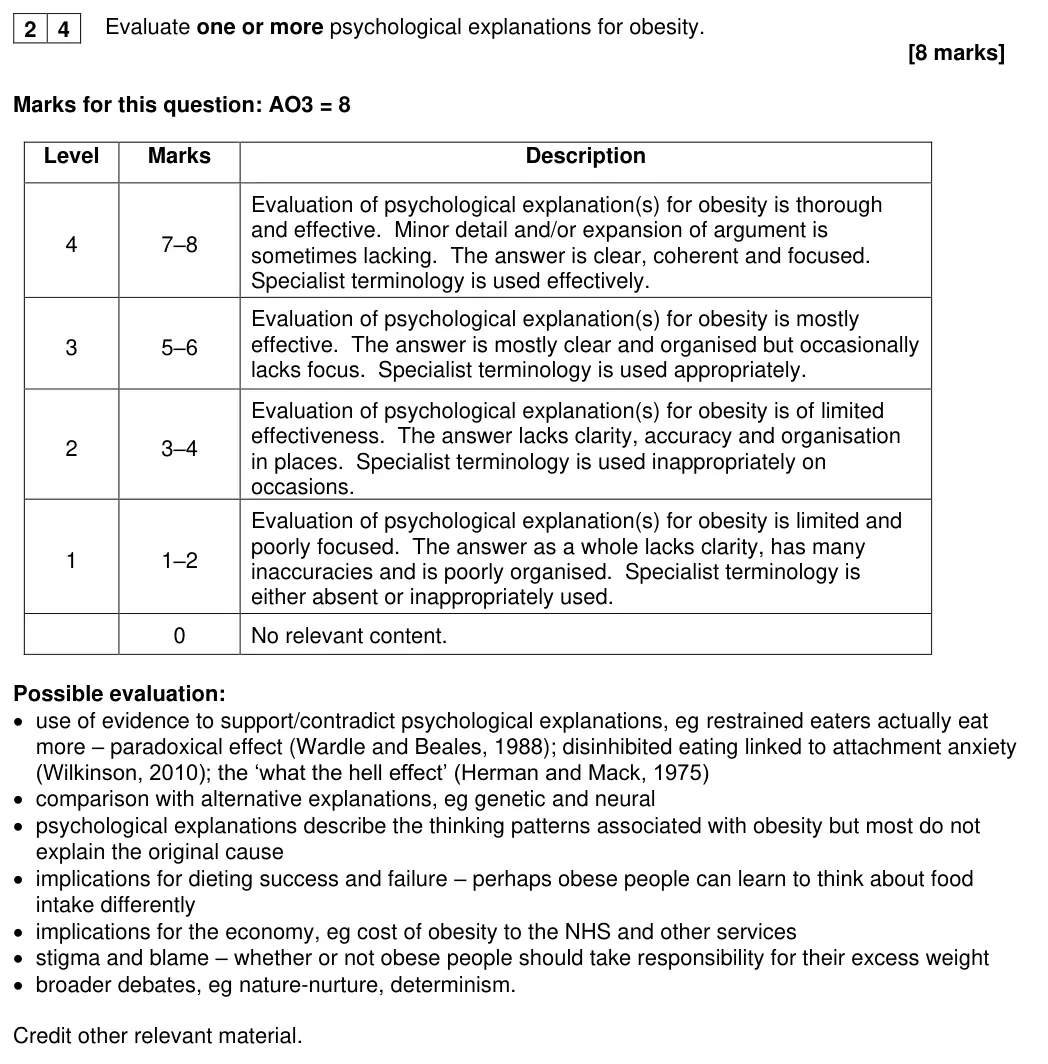
June 2022 · Paper 3 · Q248 marksAO3=8Extended writing
Mark scheme, including level descriptors and indicative content
Examiner's comment
Question 24 was generally not as well-answered as the matching question for the other two topics in this section, perhaps because this question was about explanations rather than therapy.
Notes from the mark scheme and report
AO3 only: restraint theory, disinhibition, boundary model evidence (Wardle and Beales, Herman and Mack)
MS also credits implications for dieting success/failure (removed in v1.4)
less well answered than parallel questions
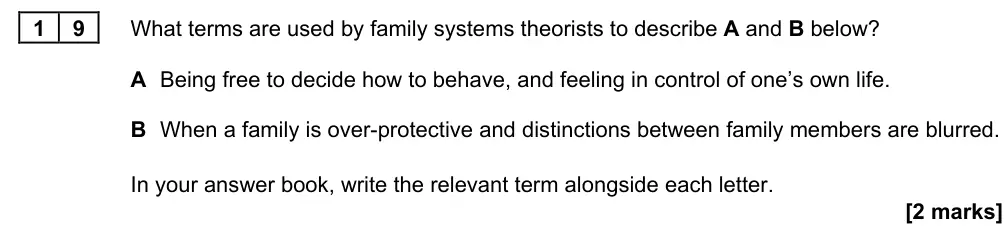
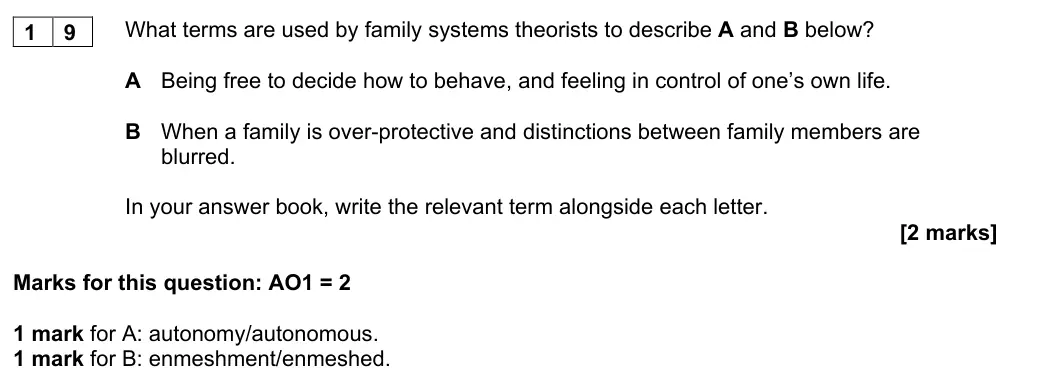
November 2021 · Paper 3 · Q192 marksAO1=2Short answer
Mark scheme, including level descriptors and indicative content
Examiner's comment
Very few answers to the Eating and Stress questions were seen. The definitions questions seemed to discriminate quite well in all topics. Where students wrote more than one term per letter only the first answer was credited.
Notes from the mark scheme and report
A autonomy, B enmeshment
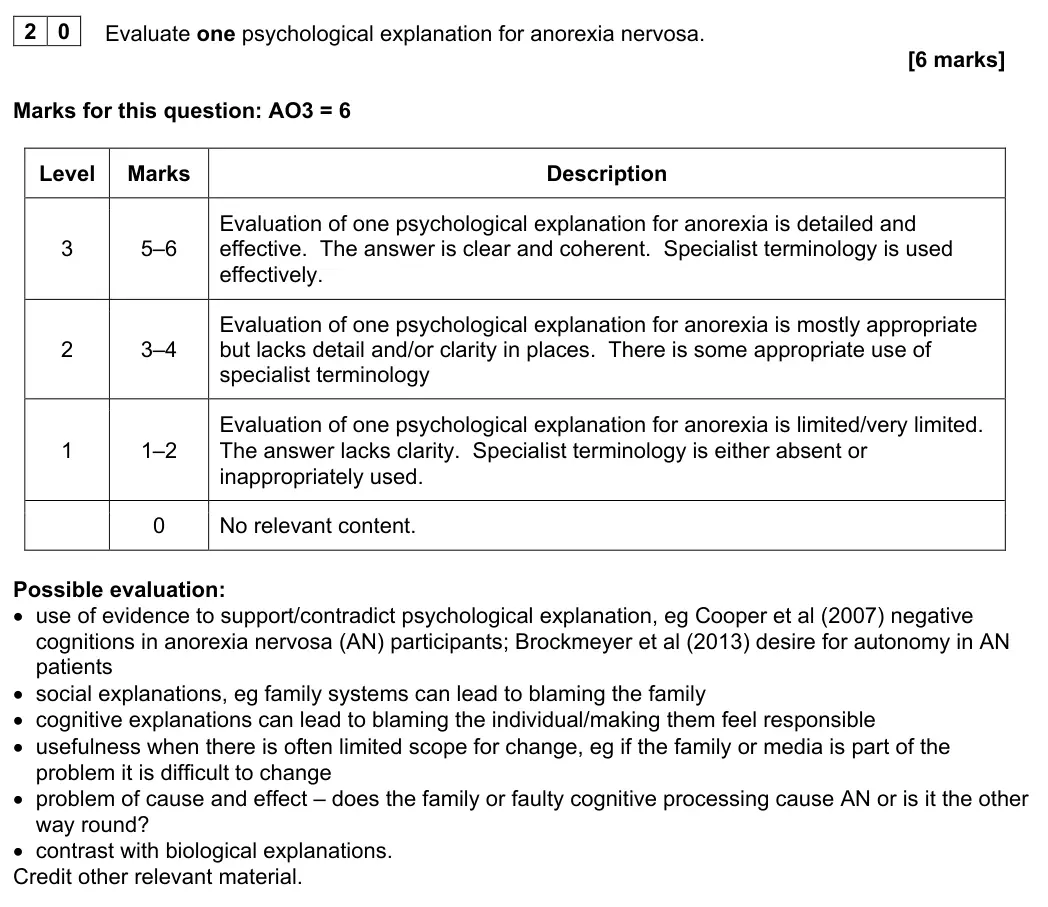
November 2021 · Paper 3 · Q206 marksAO3=6Evaluate (short)
Mark scheme, including level descriptors and indicative content
Examiner's comment
Very few answers to the Eating and Stress questions were seen. The 6-mark evaluation questions often scored poorly because students described the explanation instead of evaluating. The most effective evaluations tended to be those that used evidence to either support or counter the explanation. For Qs17 and 20 evaluations of biological explanations were not credited as the Specification differentiates clearly between psychological and biological explanations in 4.3.5 and 4.3.6.
Notes from the mark scheme and report
family systems, SLT or cognitive
AO3 only
evaluations of biological explanations not credited
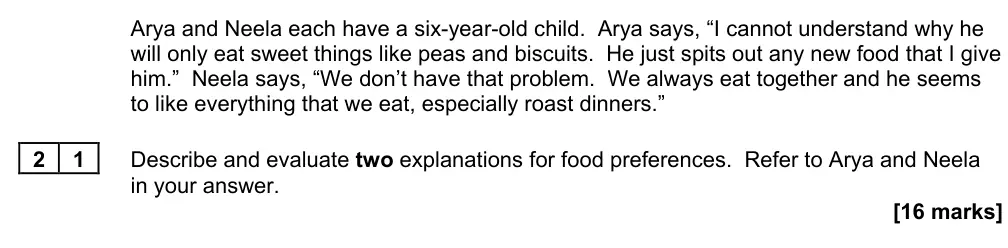
November 2021 · Paper 3 · Q2116 marksAO1=6, AO2=4, AO3=616-mark essay
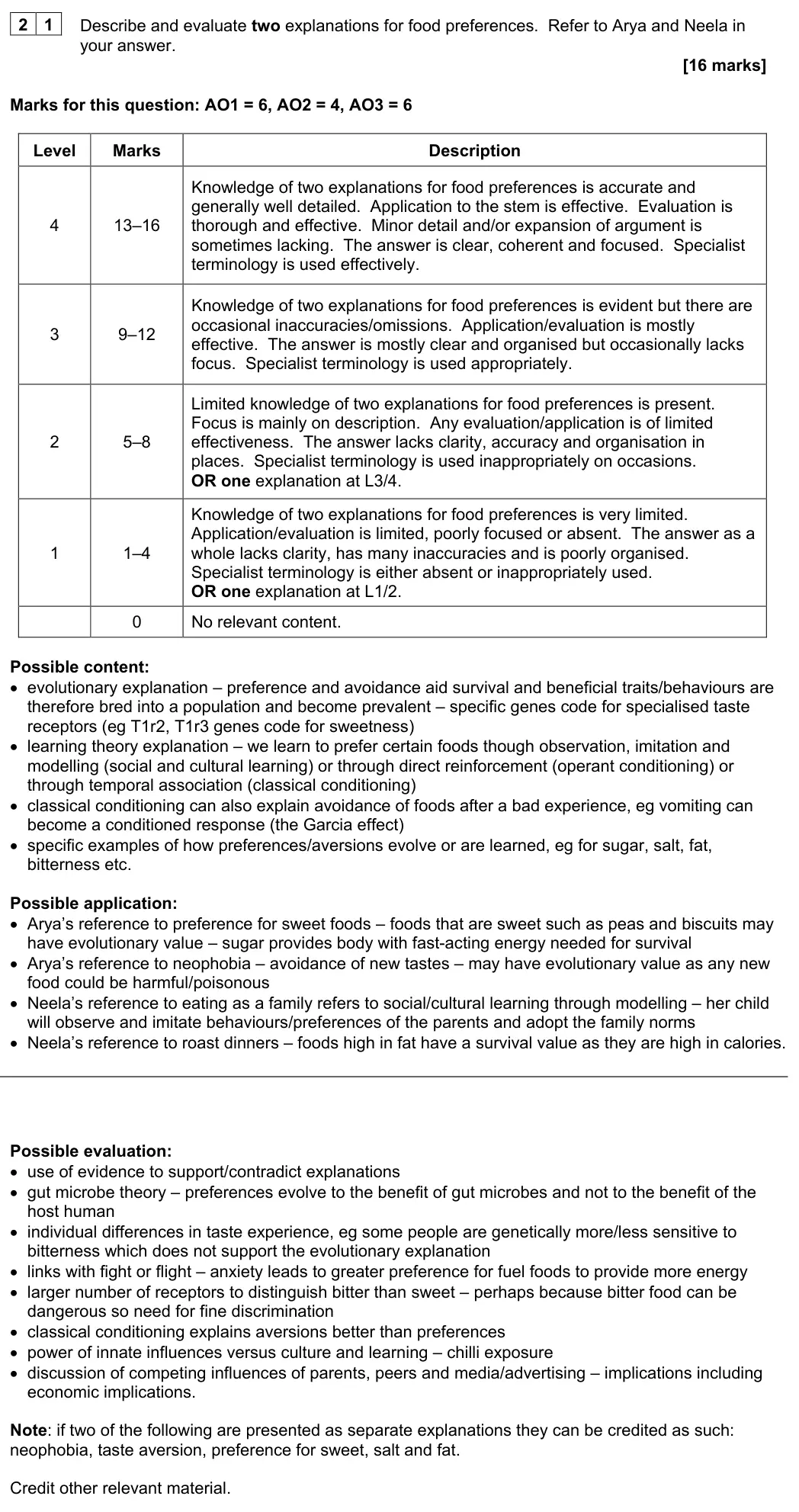
Mark scheme, including level descriptors and indicative content
Examiner's comment
Very few answers to the Eating and Stress questions were seen. The 16-mark extended writing responses required students to combine all three skills. In Q21 all three skills tended to be well done.
Notes from the mark scheme and report
two explanations (evolutionary: sweet preference, neophobia
learning: modelling at family meals)
one explanation only = max Level 2
neophobia/taste aversion/sweet/salt/fat may count as separate explanations
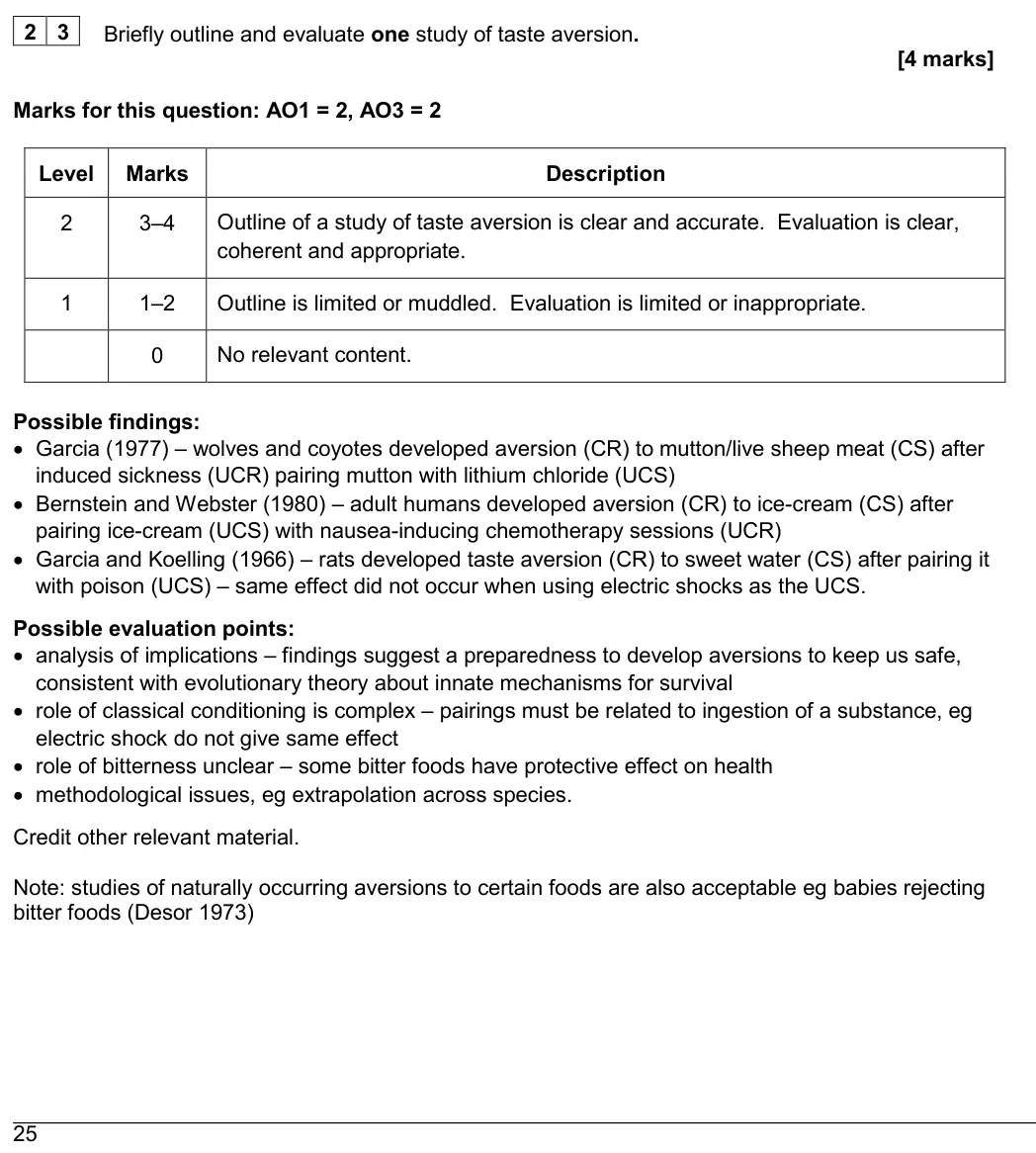
November 2020 · Paper 3 · Q234 marksAO1=2, AO3=2Evaluate (short)
Mark scheme, including level descriptors and indicative content
Examiner's comment
The 4-mark study questions required both outline and evaluation. Outlines varied but the majority of students failed to offer any evaluation. Although not originally anticipated, studies of naturally occurring food aversions were creditworthy.
Notes from the mark scheme and report
e.g. Garcia, Garcia and Koelling, Bernstein and Webster
classical conditioning terms
preparedness/evolutionary implications
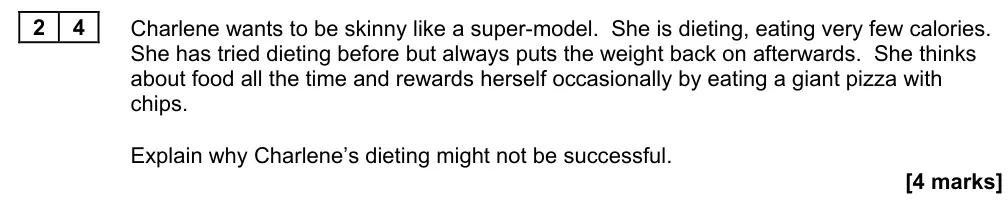
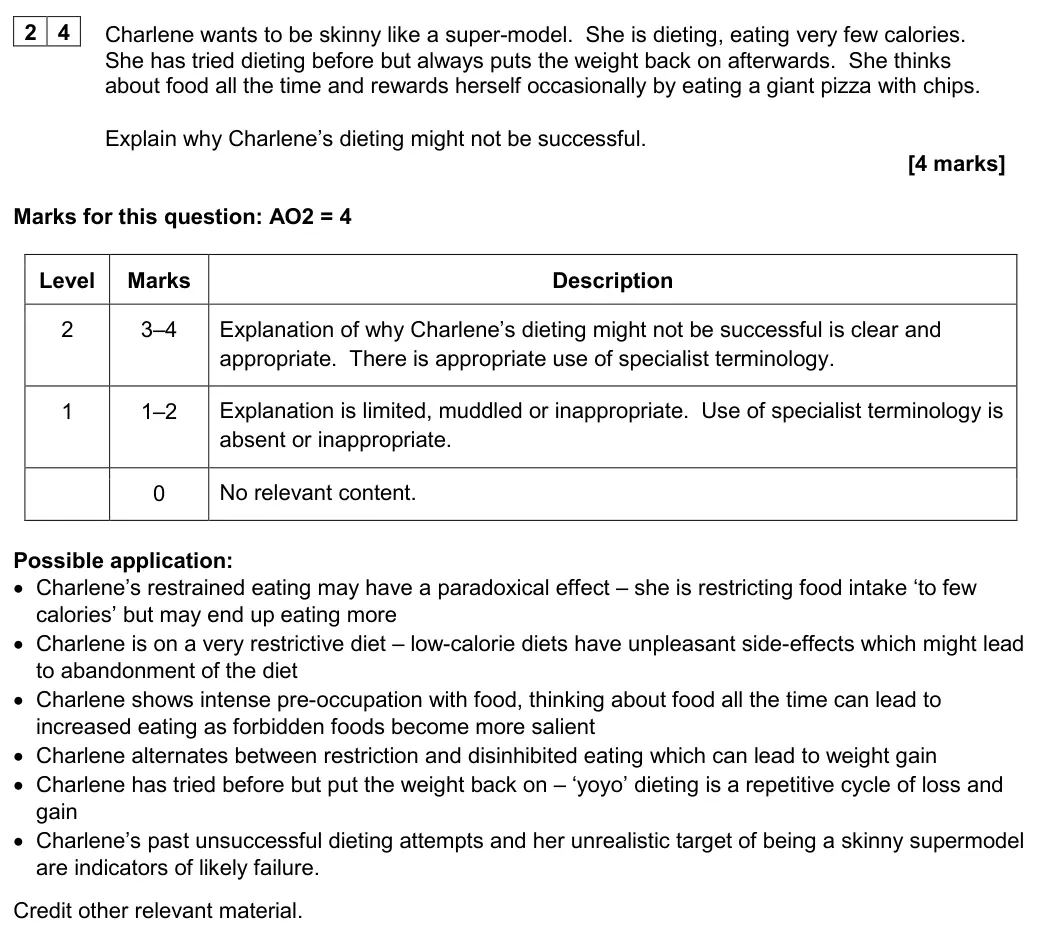
November 2020 · Paper 3 · Q244 marksAO2=4ApplicationOld spec only
Mark scheme, including level descriptors and indicative content
Examiner's comment
For the application questions in this section most responses included relevant information but not all showed explicit application to the stem for Level 2. Students should be reminded that successful application involves clear engagement with the content in the stem and that simple name dropping is not enough.
Notes from the mark scheme and report
(explanations for the success and failure of dieting, removed in v1.4
restraint theory and disinhibition remain and supply the answer)
paradoxical restraint, preoccupation with food, disinhibited pizza binges, yo-yo dieting applied to Charlene
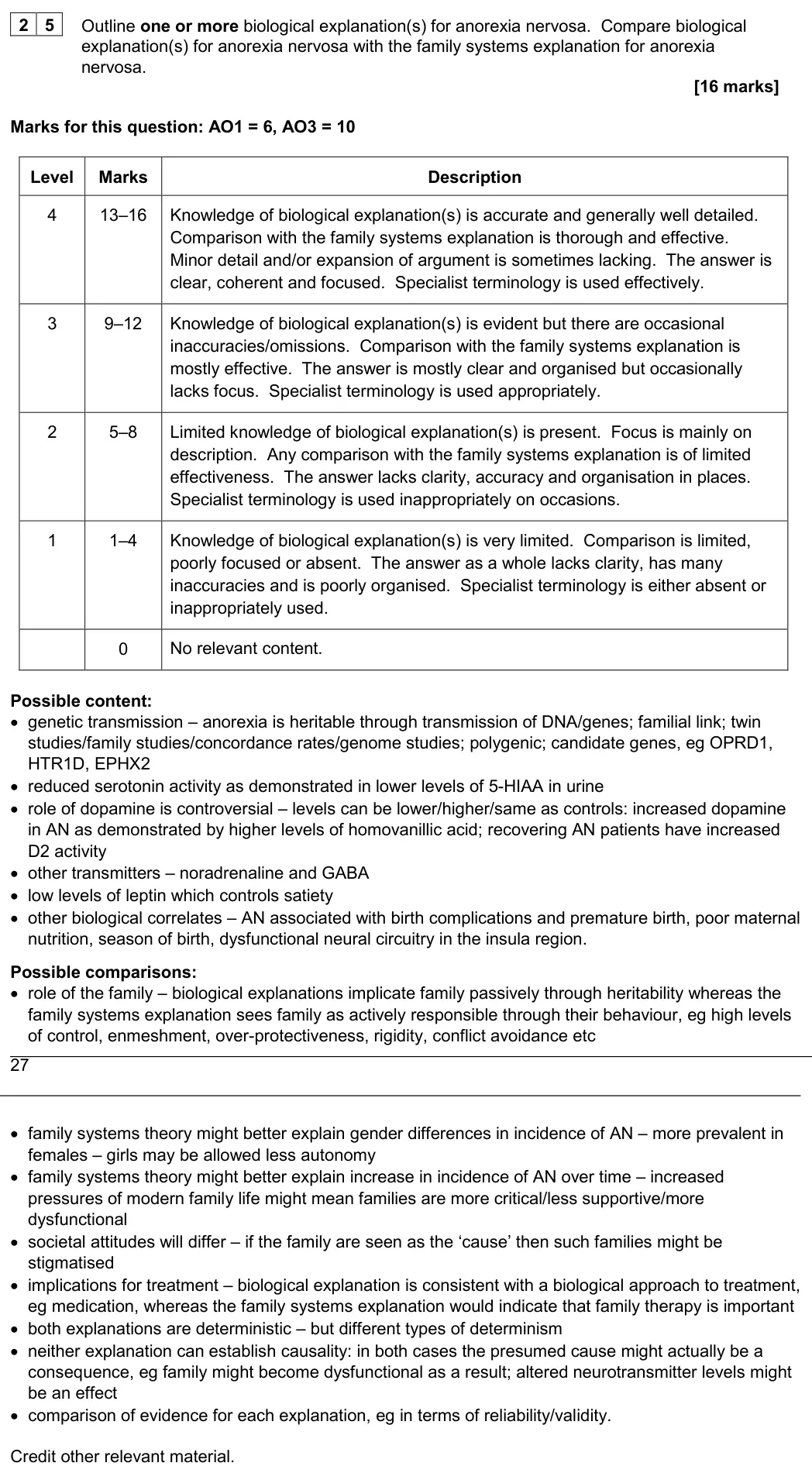
November 2020 · Paper 3 · Q2516 marksAO1=6, AO3=1016-mark essay
Mark scheme, including level descriptors and indicative content
Examiner's comment
In the extended writing questions knowledge was usually sound but clear and explicit comparison was scarce. Students should be reminded of the need to develop the higher-level skill of comparison in all areas of the Specification.
AO3 is a comparison with family systems theory (passive vs active family, gender differences, treatment implications)
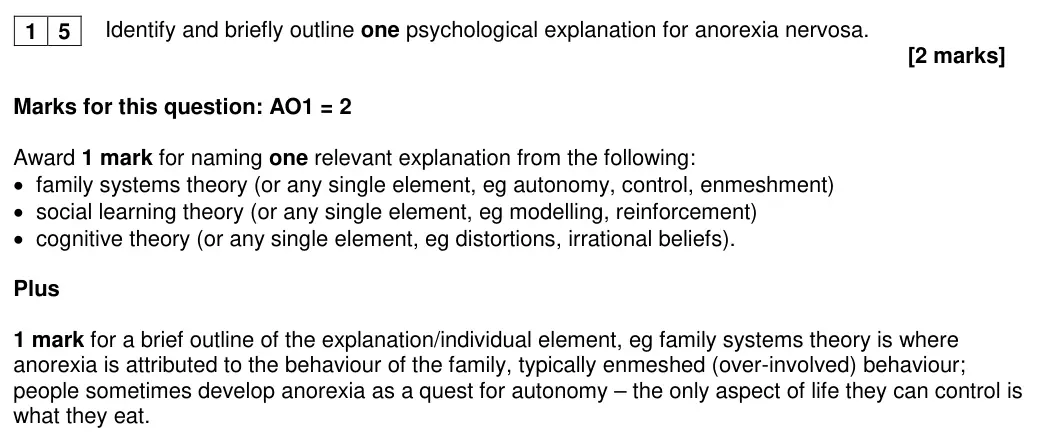
June 2019 · Paper 3 · Q152 marksAO1=2Short answer
Mark scheme, including level descriptors and indicative content
Examiner's comment
Most students gained two marks here, with family systems theory the most common explanation. Just occasionally, the explanation was so vague as to be unidentifiable.
Notes from the mark scheme and report
1 mark identify (family systems, SLT, cognitive or one element) + 1 outline
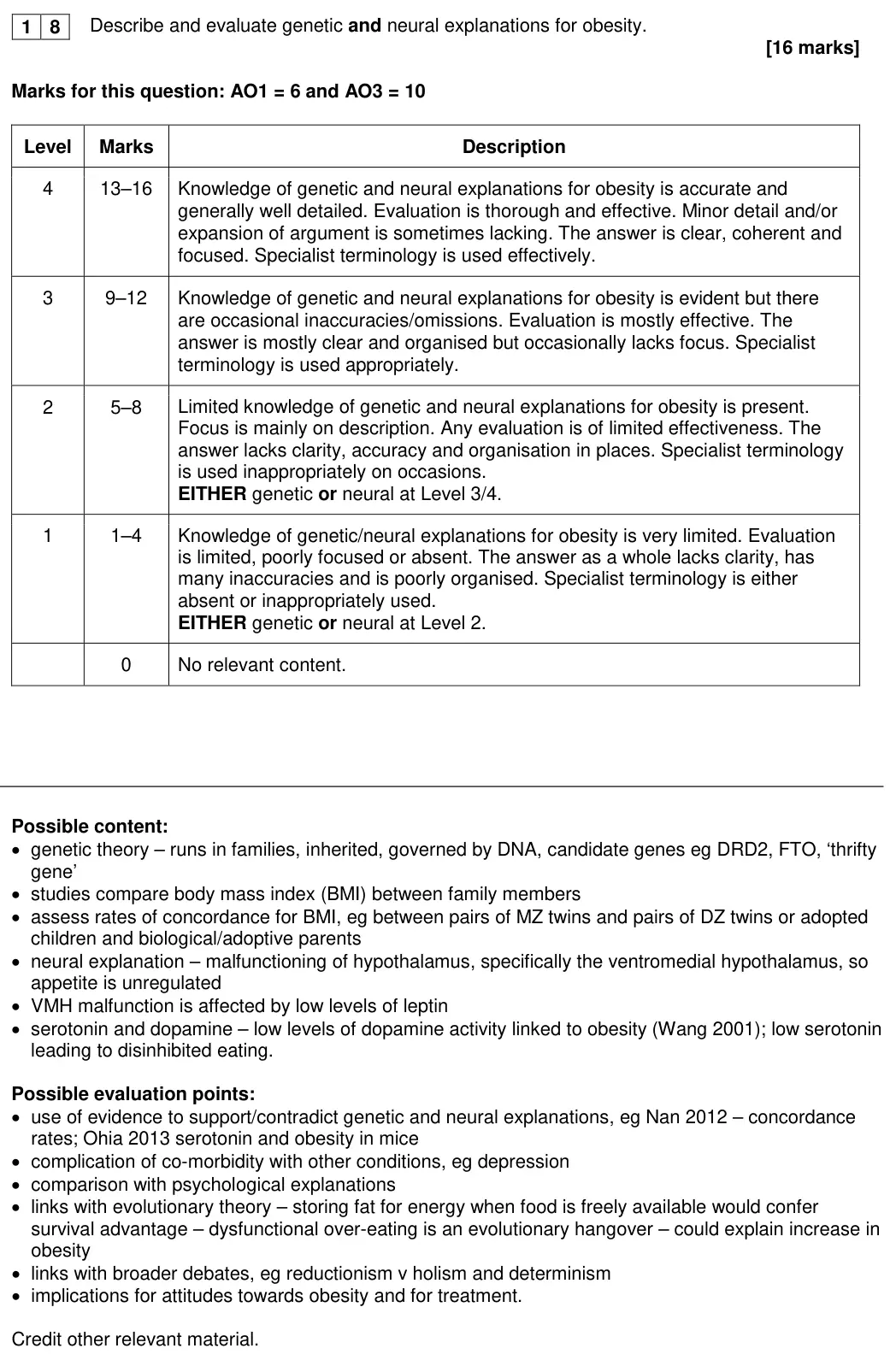
June 2019 · Paper 3 · Q1816 marksAO1=6, AO3=1016-mark essay
Mark scheme, including level descriptors and indicative content
Examiner's comment
Answers varied in the amount of detail. Most referred to twin studies and concordance but very few referred to specific student genes. The ventromedial hypothalamus studies using rats were often presented in some detail. Very few answers included material on the thrifty gene and evolution. Given the wording of the question, information on ghrelin and leptin was only relevant where it was linked to neural (or genetic) explanations. Some students did this very effectively, but many did not and consequently could not gain credit. Evaluations tended to mostly consist of use of evidence to support or contradict the explanations, with very few students offering comparison with psychological explanations or broader comment on implications.
Notes from the mark scheme and report
genetic (twins, FTO, thrifty gene) and neural (VMH, serotonin, dopamine)
either one only = max Level 2
ghrelin/leptin only credited if linked to neural/genetic
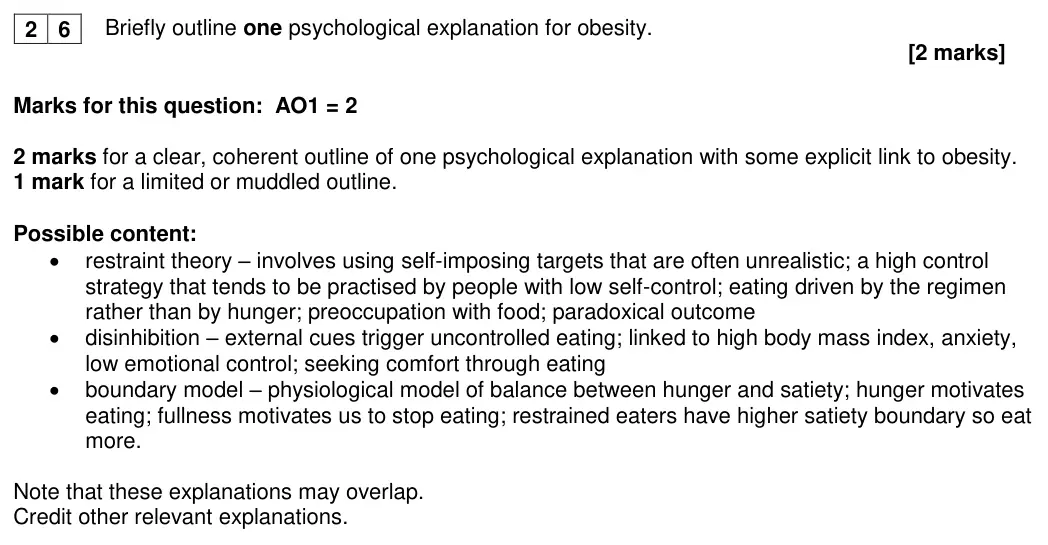
June 2018 · Paper 3 · Q262 marksAO1=2Outline
Mark scheme, including level descriptors and indicative content
Examiner's comment
This was usually well answered, with most students choosing restraint or disinhibition. Even weak answers usually managed to gain one mark.
Notes from the mark scheme and report
restraint theory, disinhibition or boundary model with explicit link to obesity
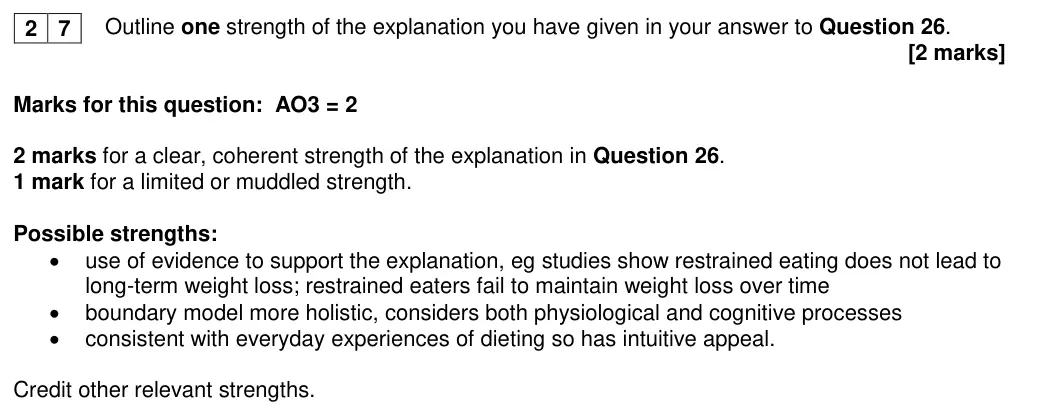
June 2018 · Paper 3 · Q272 marksAO3=2Evaluate (short)
Mark scheme, including level descriptors and indicative content
Examiner's comment
This was generally well answered, either through use of evidence, or through relating the theory to everyday experiences of dieters.
Notes from the mark scheme and report
strength must relate to the explanation given in Q26 (e.g. supporting evidence, intuitive appeal)
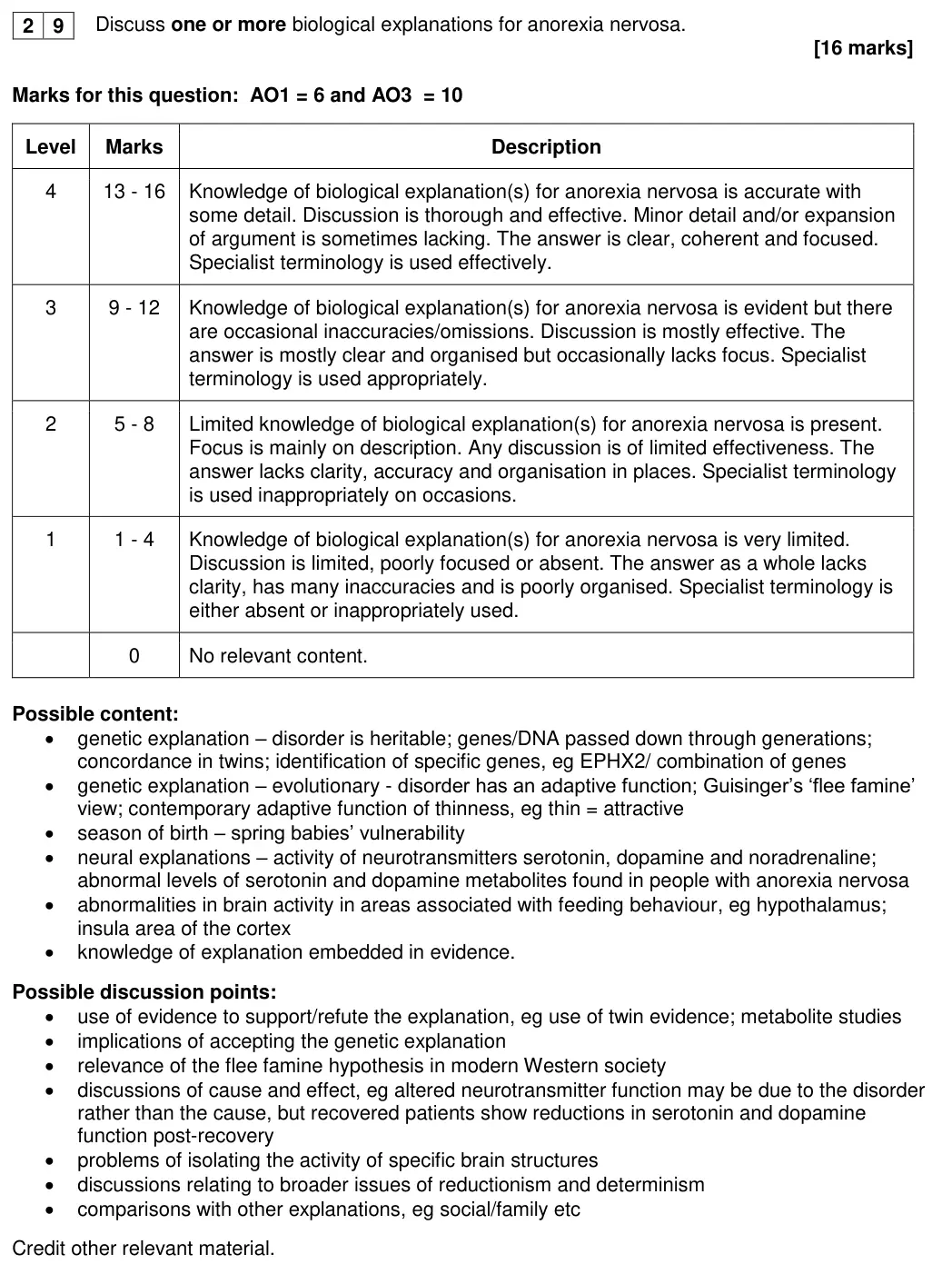
June 2018 · Paper 3 · Q2916 marksAO1=6, AO3=1016-mark essay
Mark scheme, including level descriptors and indicative content
Examiner's comment
This question elicited some detailed responses, although the knowledge was not always accurate. As with question 25, students often tried to include too much and would have been better to limit the range of material, giving themselves time to provide detailed knowledge and more thorough discussion. A number of the weakest answers attempted a response based solely on ghrelin and leptin. It was evident from some answers that students would have preferred a question on psychological explanations.
Notes from the mark scheme and report
genetic (twins, candidate genes) and neural (serotonin, dopamine, hypothalamus, insula)
answers based only on ghrelin/leptin were weak
too much breadth limited discussion
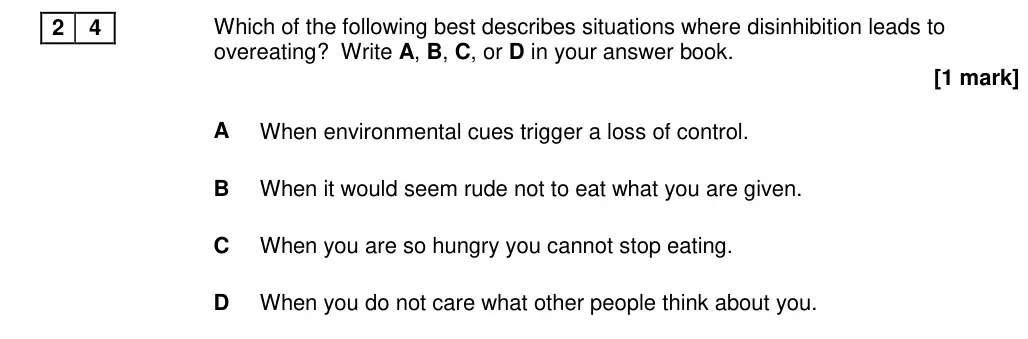
June 2017 · Paper 3 · Q241 markAO1=1Multiple choice
Answer
A
Mark scheme, including level descriptors and indicative content
Examiner's comment
This question was answered correctly by the vast majority of students.
Notes from the mark scheme and report
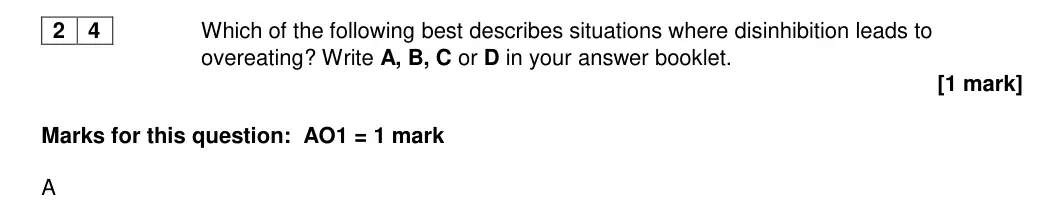
answer A (environmental cues trigger loss of control)
June 2017 · Paper 3 · Q251 markAO3=1Multiple choice
Answer
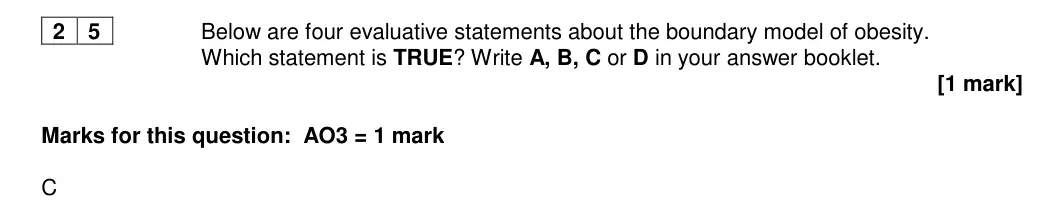
C
Mark scheme, including level descriptors and indicative content
Examiner's comment
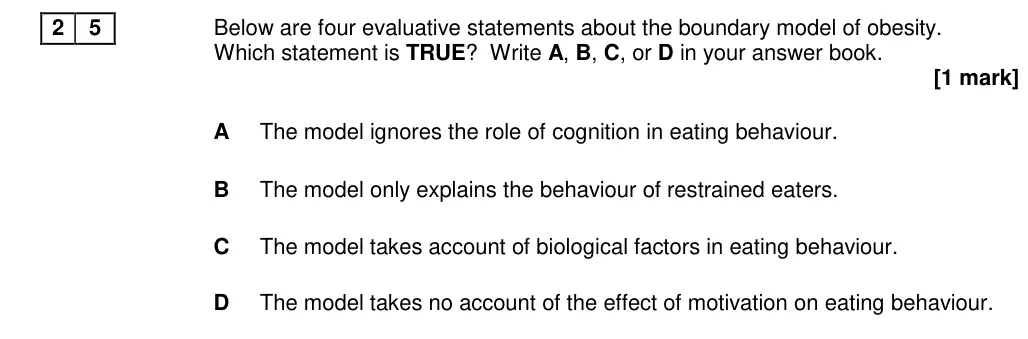
Surprisingly, this question was not answered well by a significant proportion of students. It seems that students have limited understanding of the boundary model and teachers are encouraged to address this.
Notes from the mark scheme and report
answer C (takes account of biological factors - hunger/satiety boundaries)
surprisingly poorly answered, boundary model weakly understood
June 2017 · Paper 3 · Q268 marksAO1=4, AO2=4Extended writing
Mark scheme, including level descriptors and indicative content
Examiner's comment
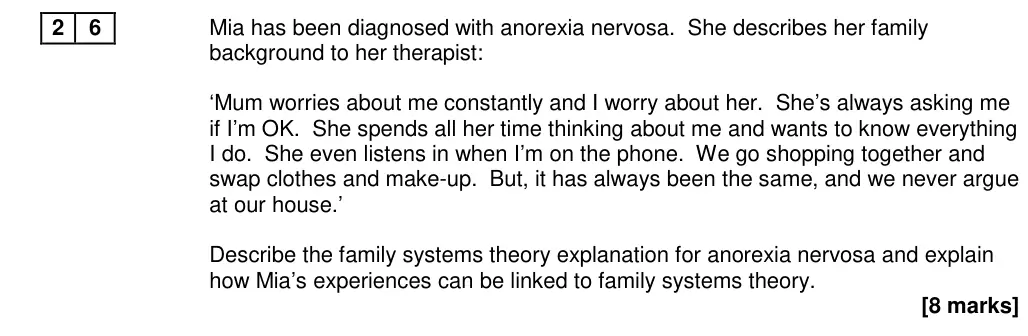
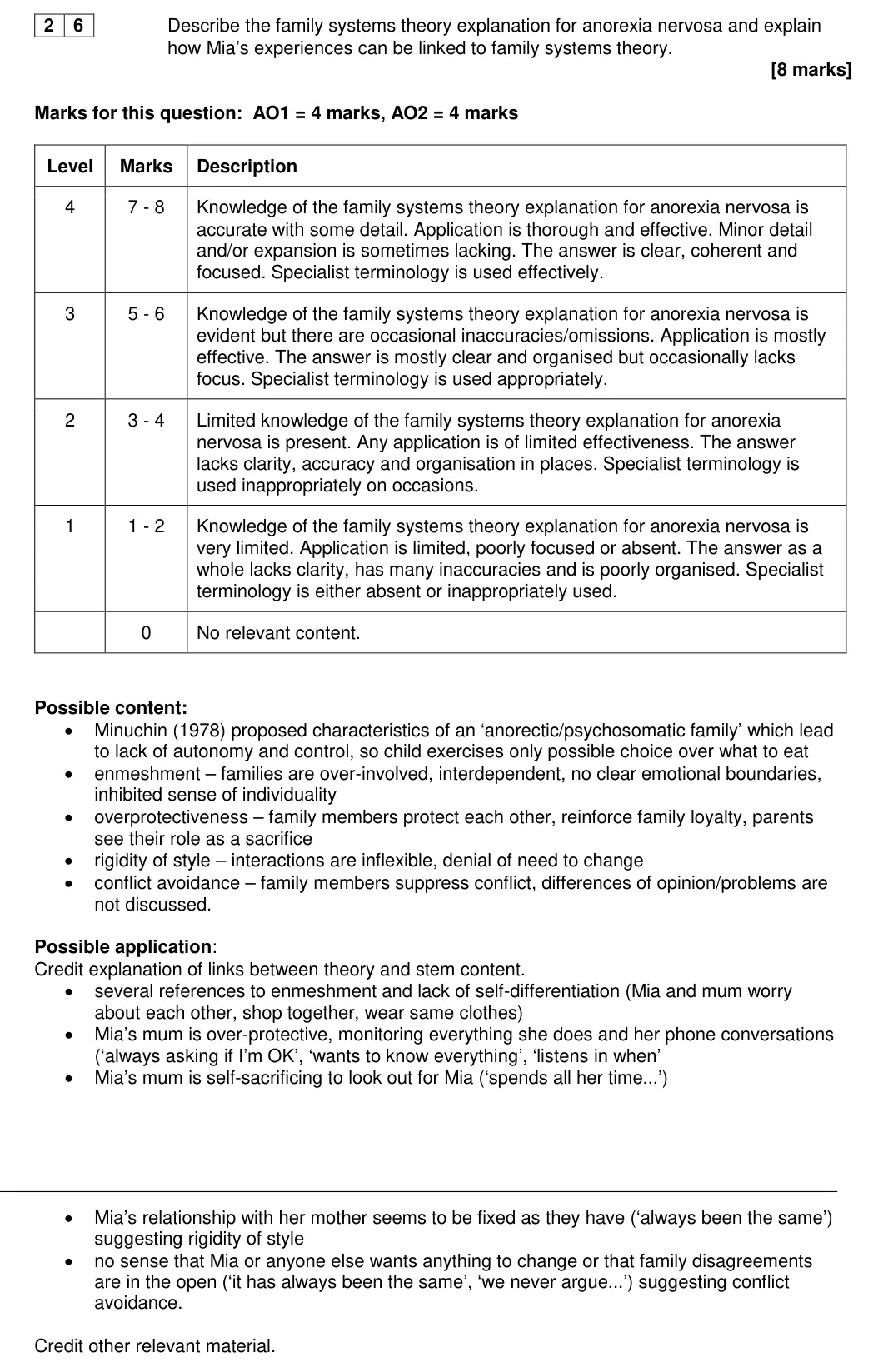
Students tended to respond well to this question up to a point and the stem afforded ample opportunity for application. Most could offer useful description of family systems theory and were able to pick out relevant material from the stem for application to Mia. It was less common to see full coverage of the family systems theory explanation for anorexia nervosa, in other words, students often failed to describe how the behaviours (enmeshment, control, etc) might lead to the development of anorexia nervosa. Only students who fully explored this in their answers achieved higher level marks. Weaker responses consisted of repetition of the stem or basic paraphrasing of the stem in common sense terms, and thus showed no evidence of psychological knowledge or understanding.
Notes from the mark scheme and report
Minuchin's psychosomatic family: enmeshment, overprotectiveness, rigidity, conflict avoidance, leading to lack of autonomy/control over eating
apply to Mia (mum worries, listens in, swap clothes, never argue)
must explain how these lead to anorexia for higher levels
paraphrasing the stem scored nothing
June 2017 · Paper 3 · Q276 marksAO3=6Evaluate (short)
Mark scheme, including level descriptors and indicative content
Examiner's comment
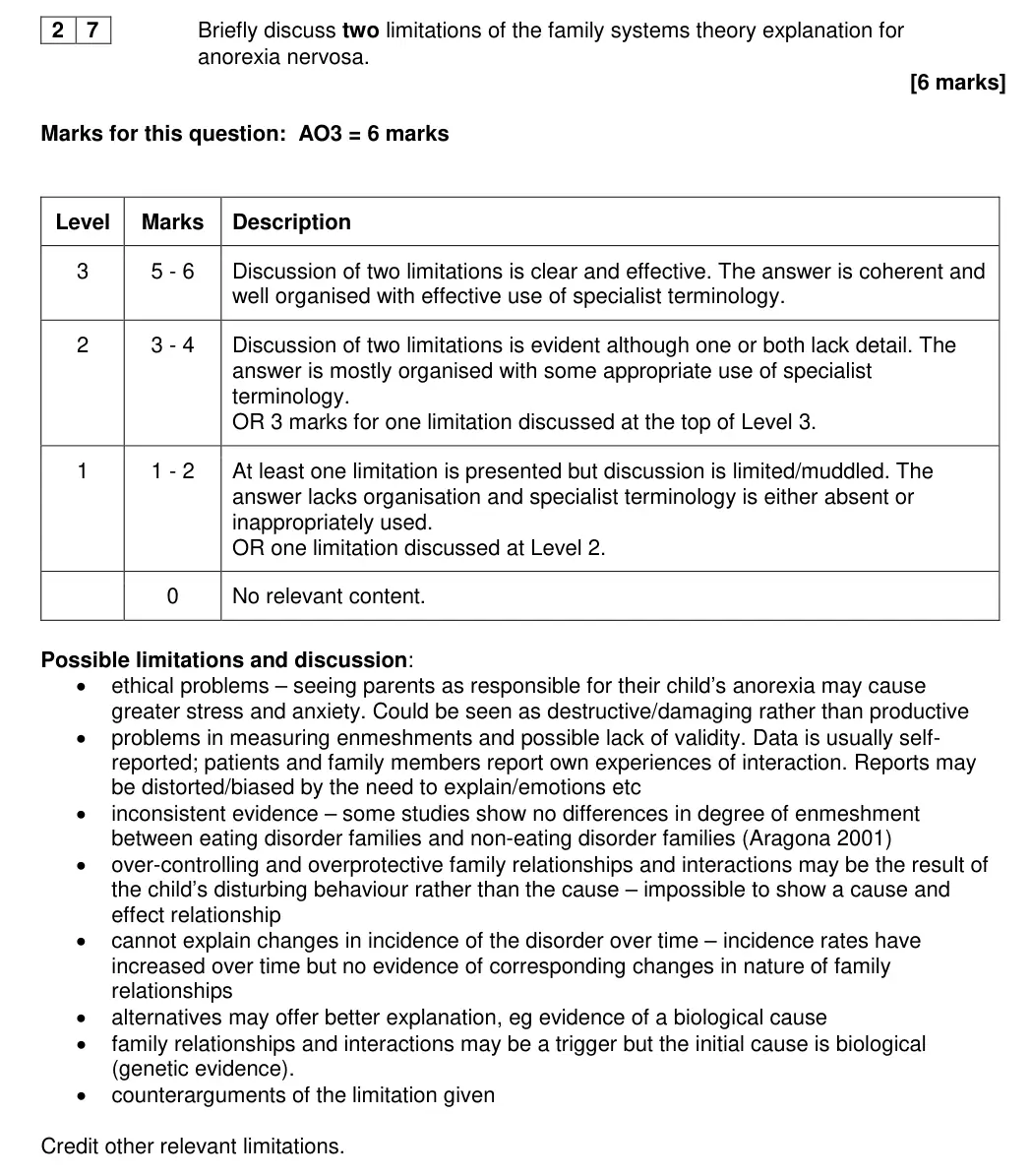
Blaming the family and the issue of cause and effect were probably the most effective limitations, although these were often quite brief. Comparisons with other explanations, mainly biological, were not always very effective, as they tended to stray into discussion of the alternative. A number of answers focused on therapy rather than on the explanation. As with the parallel question on schizophrenia, many students asserted inappropriately that the family dysfunction explanation is ‘reductionist’.
Notes from the mark scheme and report
two limitations (blaming families, measuring enmeshment/self-report validity, inconsistent evidence, cause and effect, changes in incidence over time, biological alternatives)
answers about therapy not credited
'reductionist' misused
June 2017 · Paper 3 · Q288 marksAO1=3, AO3=5Extended writing
Mark scheme, including level descriptors and indicative content
Examiner's comment
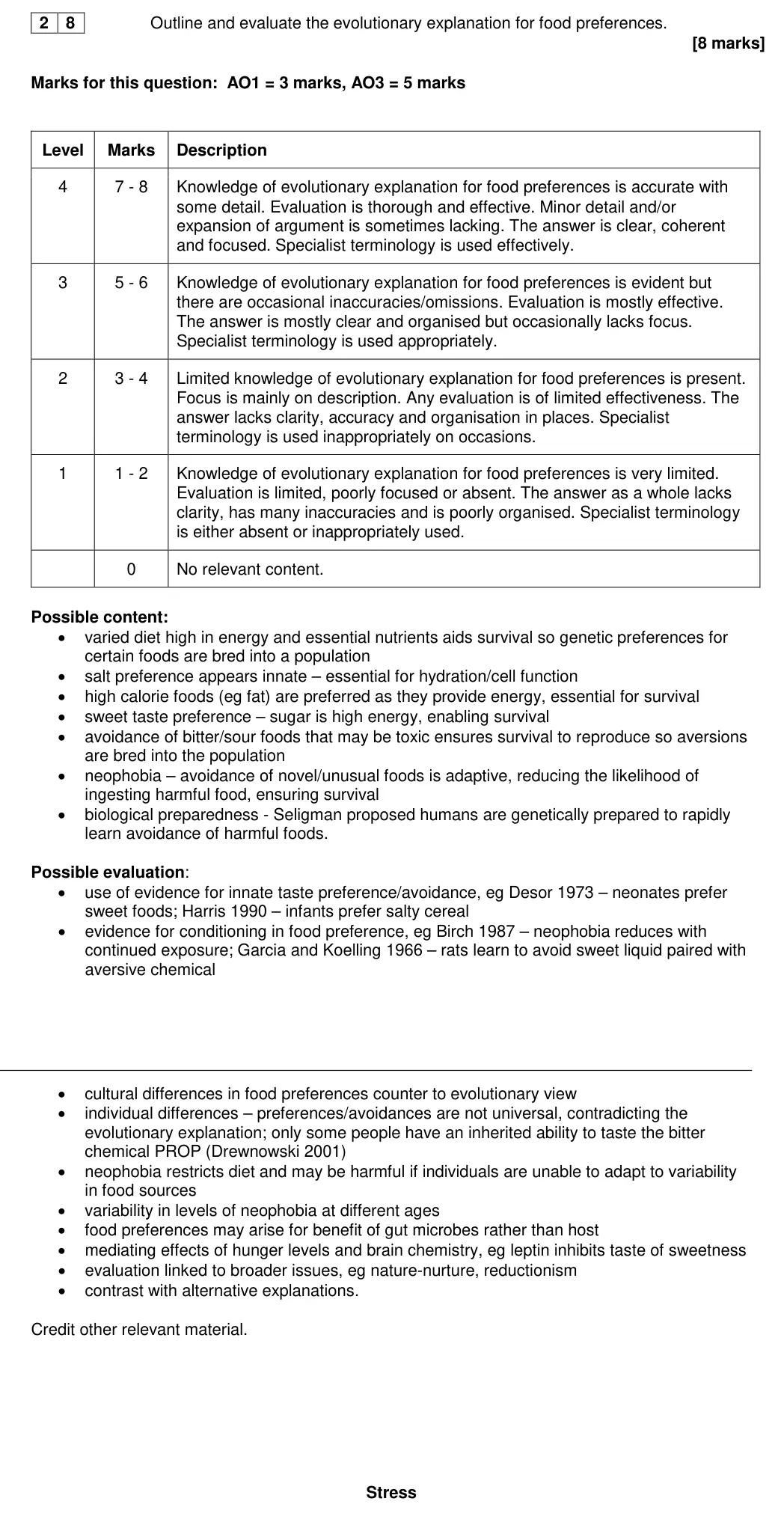
Despite evident knowledge, this question was not usually well answered. Most students could happily give a long list of innate food preferences, often supporting the information with references to research, but in many cases there was no explanation of these preferences in terms of evolution. As an example, it was often stated that people have an ‘innate dislike of bitter tasting foods because they are toxic’, but there was no explanation of how this might have come about, ie only people who had this dislike would have survived and their genes would thus continue in the gene pool, perpetuating and reinforcing the dislike in the population.
Notes from the mark scheme and report
must explain HOW preferences evolved (survivors with the preference passed on genes), not just list innate preferences (sweet, salt, fat, bitter avoidance, neophobia, preparedness)
evaluation via neonate studies, cultural differences, PROP tasting
Specimen set 2 · Paper 3 · Q198 marksAO1=3, AO3=5Extended writing
Mark scheme, including level descriptors and indicative content
Notes from the mark scheme and report
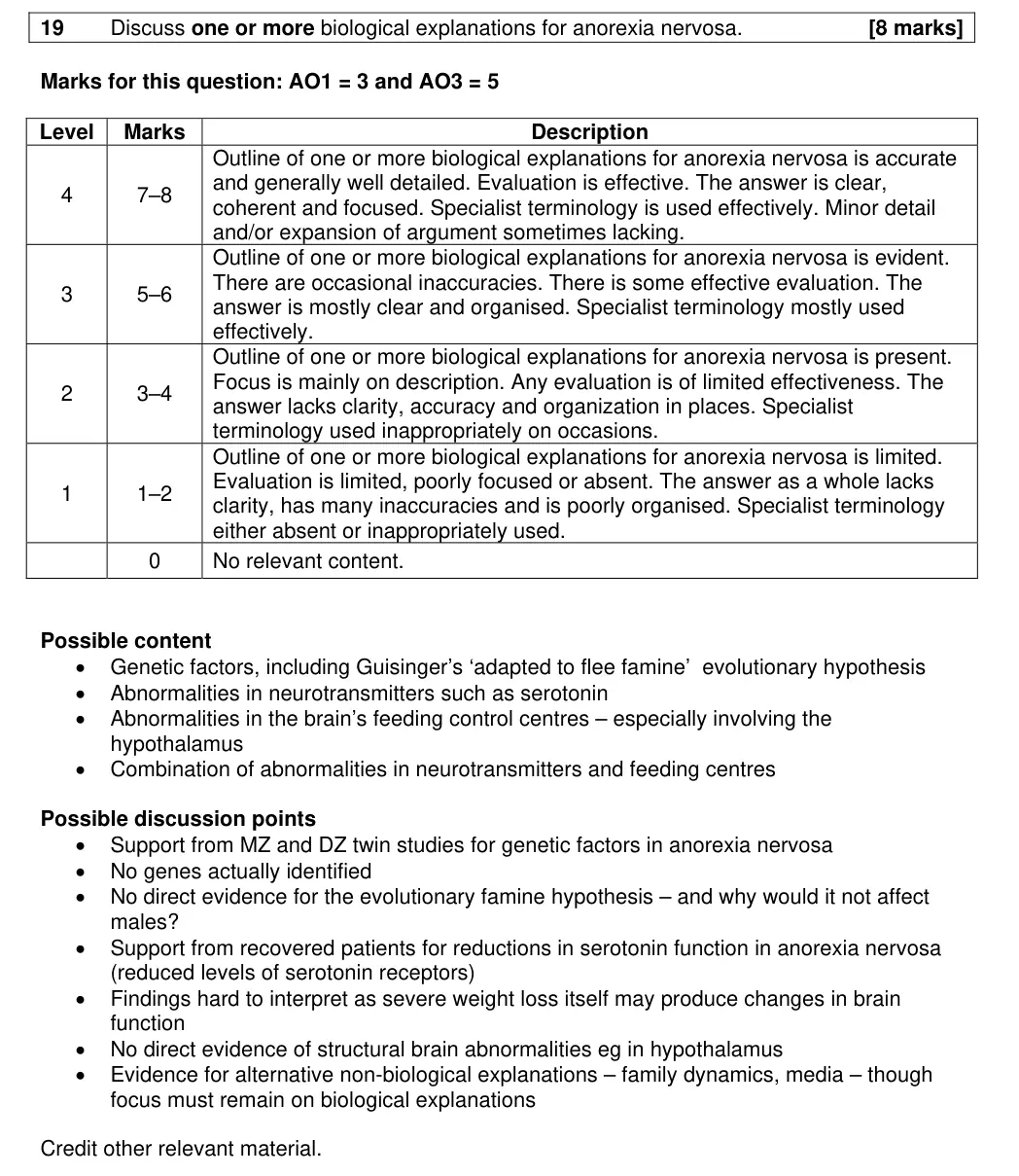
genetic (twin studies), serotonin, hypothalamus
discussion e.g. no genes identified, weight loss may cause brain changes
MS also credits Guisinger's evolutionary famine hypothesis
alternatives only if focus stays biological
Specimen set 2 · Paper 3 · Q204 marksAO2=4Application
Mark scheme, including level descriptors and indicative content
Notes from the mark scheme and report
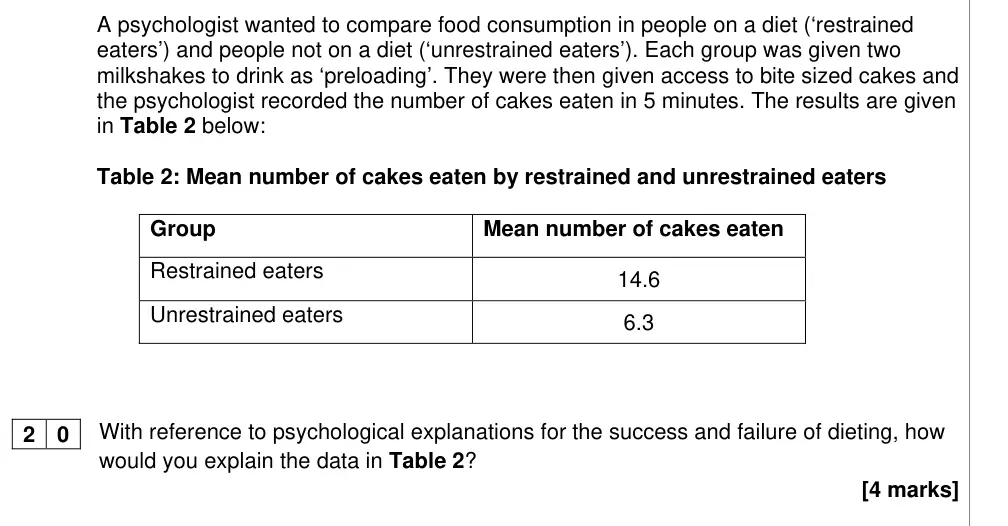
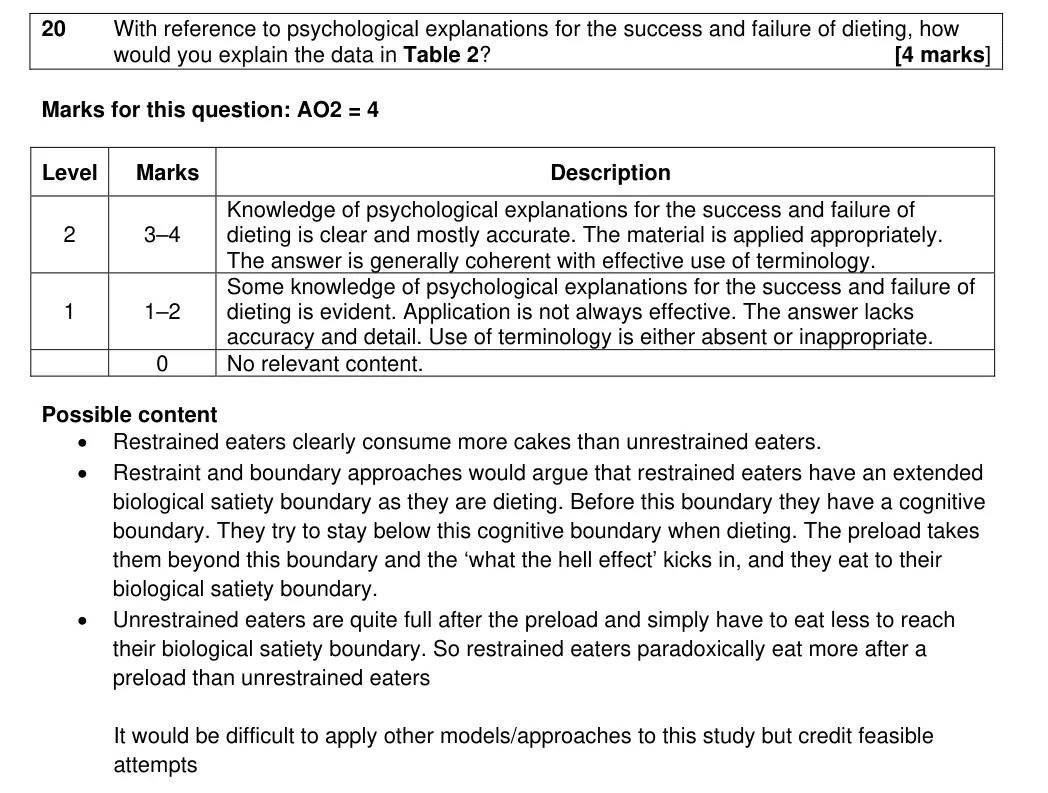
restraint theory/boundary model: preload breaks the diet's cognitive boundary, 'what the hell' effect, restrained eaters eat to satiety boundary so eat more (14.6 vs 6.3)
stem frames this as explanations for the success and failure of dieting (removed in v1.4) but credited content is restraint theory and the boundary model
Specimen set 2 · Paper 3 · Q218 marksAO1=3, AO3=5Extended writing
Mark scheme, including level descriptors and indicative content
Notes from the mark scheme and report
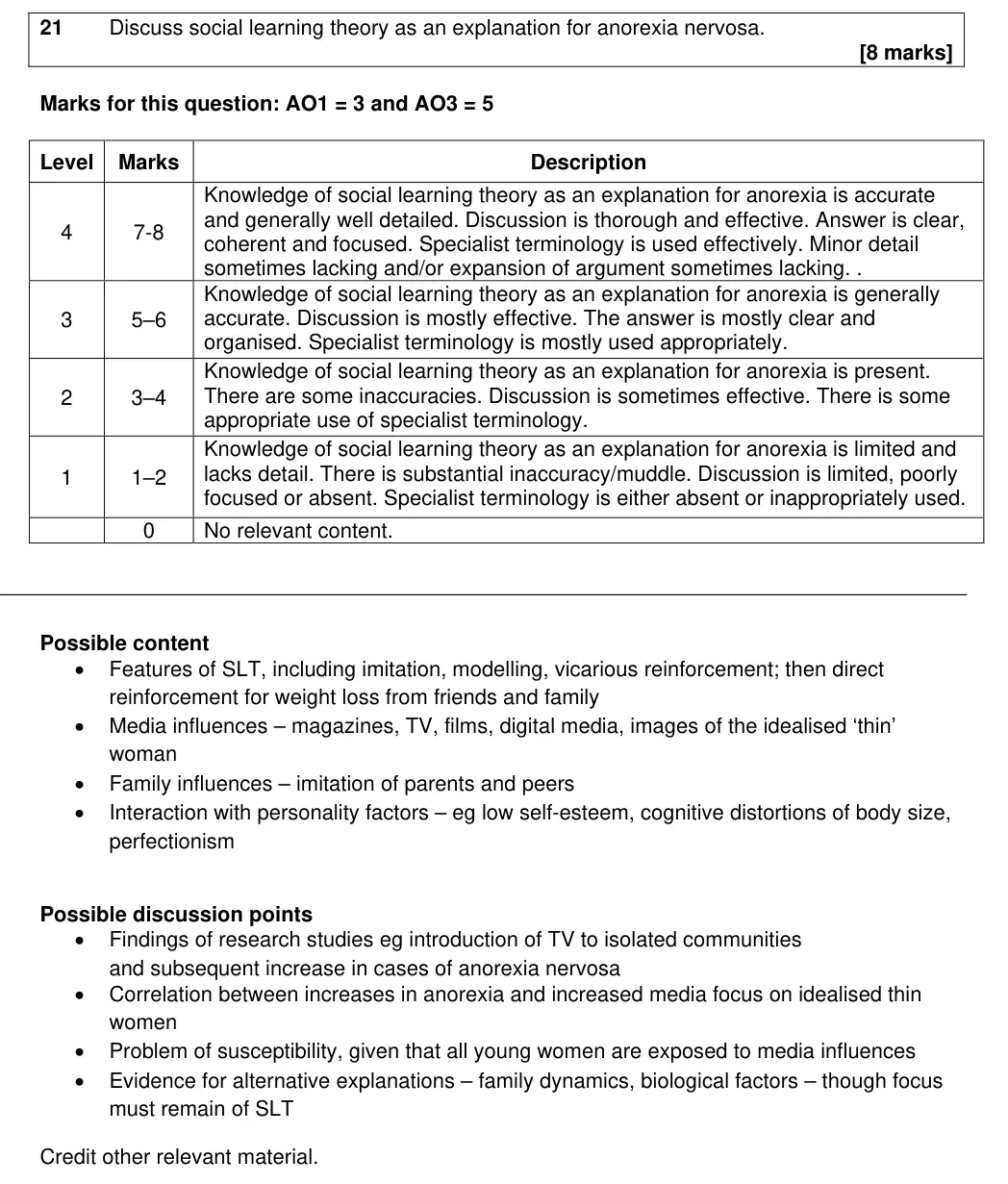
modelling, imitation, vicarious/direct reinforcement, media thin ideal
evaluation e.g. TV introduction studies (Fiji), susceptibility problem, alternatives with focus kept on SLT
Specimen set 2 · Paper 3 · Q222 marksAO3=2Evaluate (short)
Mark scheme, including level descriptors and indicative content
Notes from the mark scheme and report
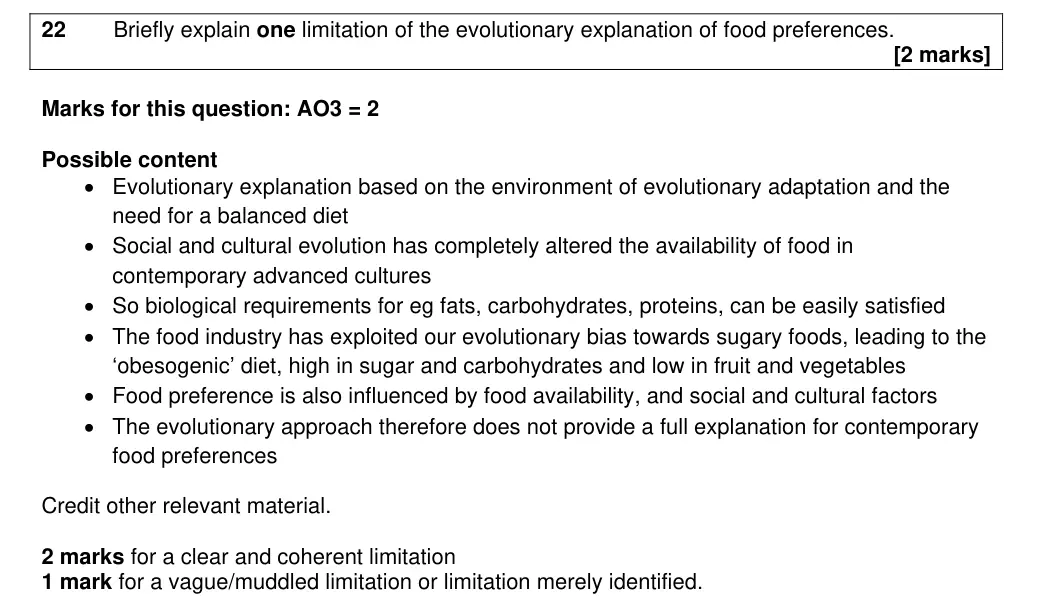
mismatch between environment of evolutionary adaptation and modern food availability
ignores social/cultural factors
merely identified = 1 mark
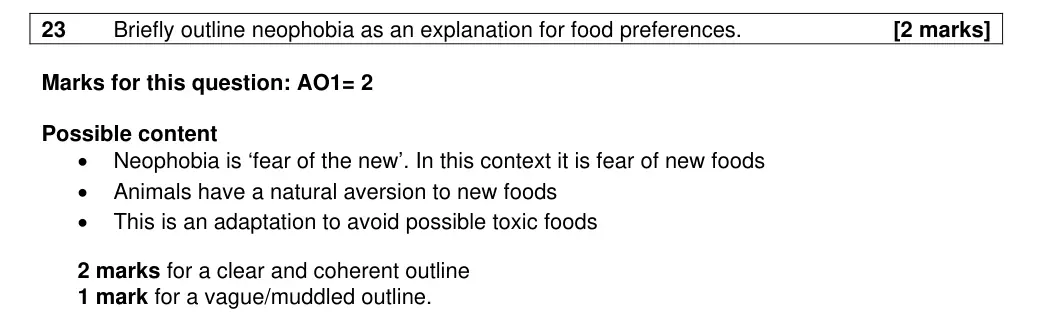
Specimen set 2 · Paper 3 · Q232 marksAO1=2Outline
Mark scheme, including level descriptors and indicative content
Notes from the mark scheme and report
fear/avoidance of new foods
adaptive to avoid toxins
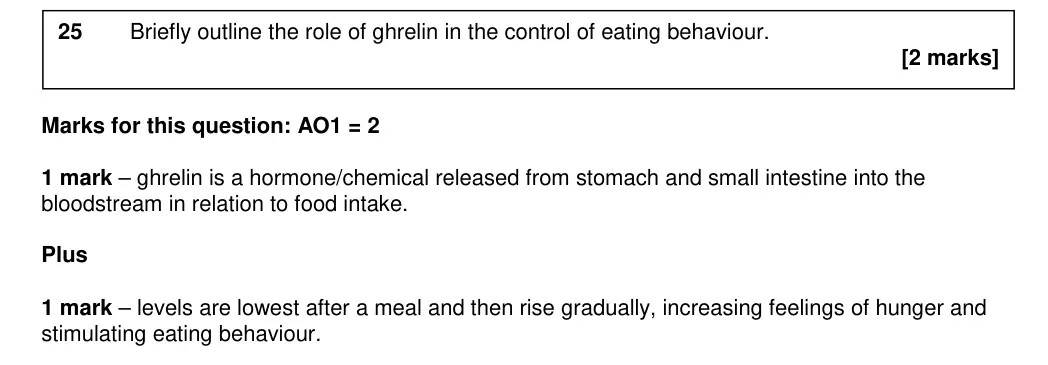
Specimen set 1 · Paper 3 · Q252 marksAO1=2Outline
Mark scheme, including level descriptors and indicative content
Notes from the mark scheme and report
1 mark hormone released from stomach into blood + 1 mark lowest after a meal then rises, increasing hunger/stimulating eating
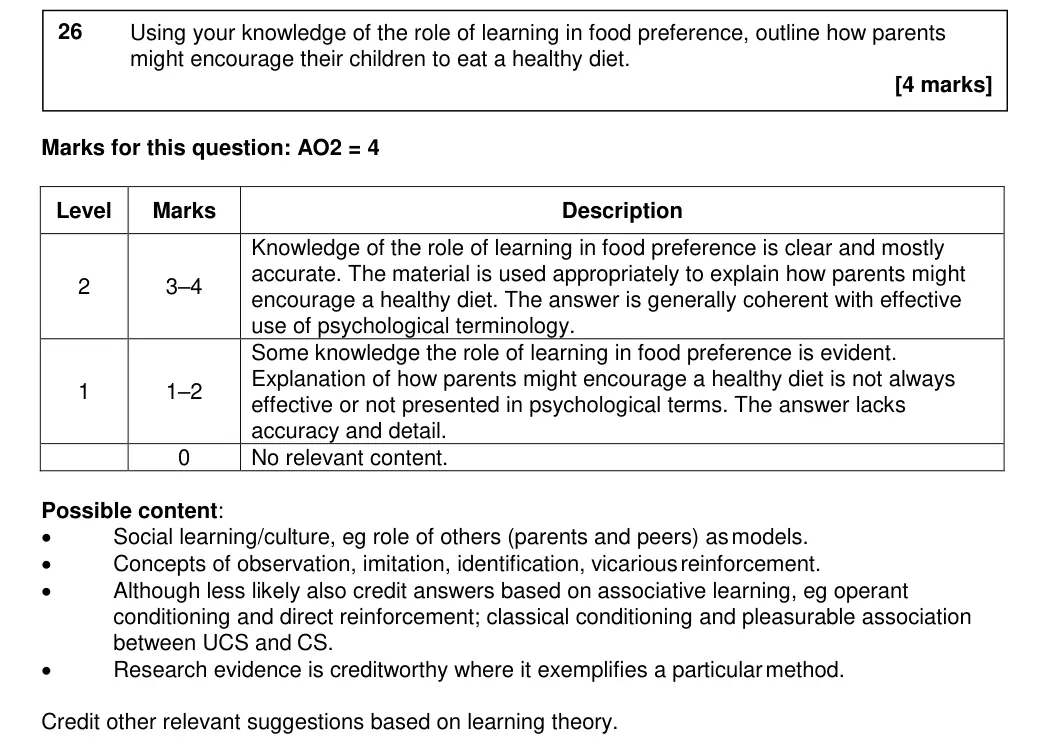
Specimen set 1 · Paper 3 · Q264 marksAO2=4Application
Mark scheme, including level descriptors and indicative content
Notes from the mark scheme and report
social learning/culture (parents as models, imitation, vicarious reinforcement) applied to encouraging a healthy diet
operant/classical conditioning also credited
must be in psychological terms
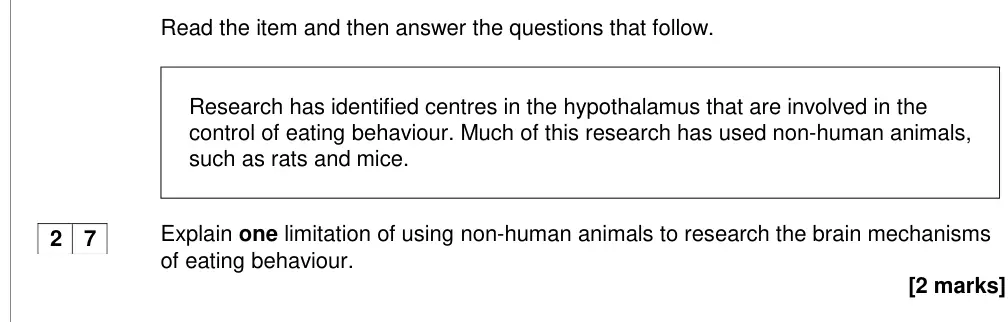
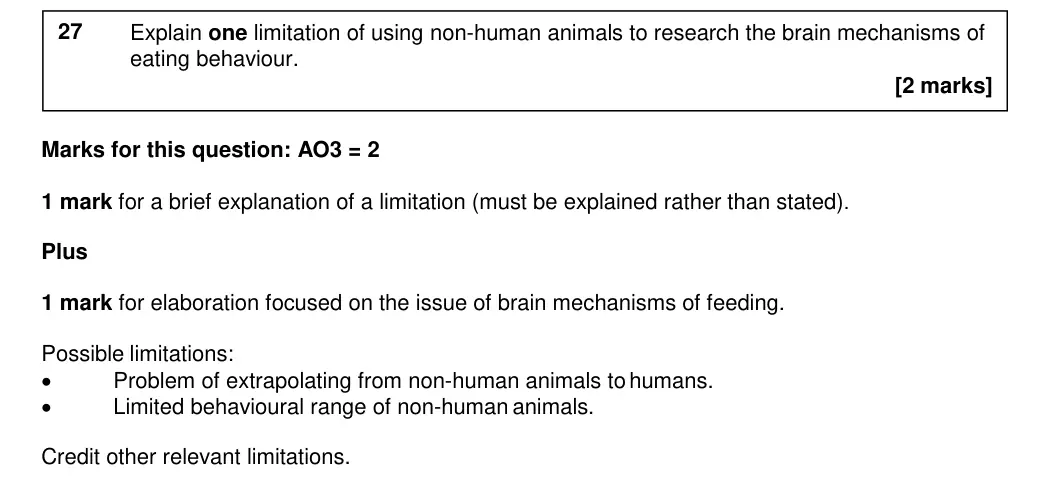
Specimen set 1 · Paper 3 · Q272 marksAO3=2Evaluate (short)
Mark scheme, including level descriptors and indicative content
Notes from the mark scheme and report
explain not state (extrapolation from rodents to humans, limited behavioural range) + elaboration focused on brain mechanisms of feeding
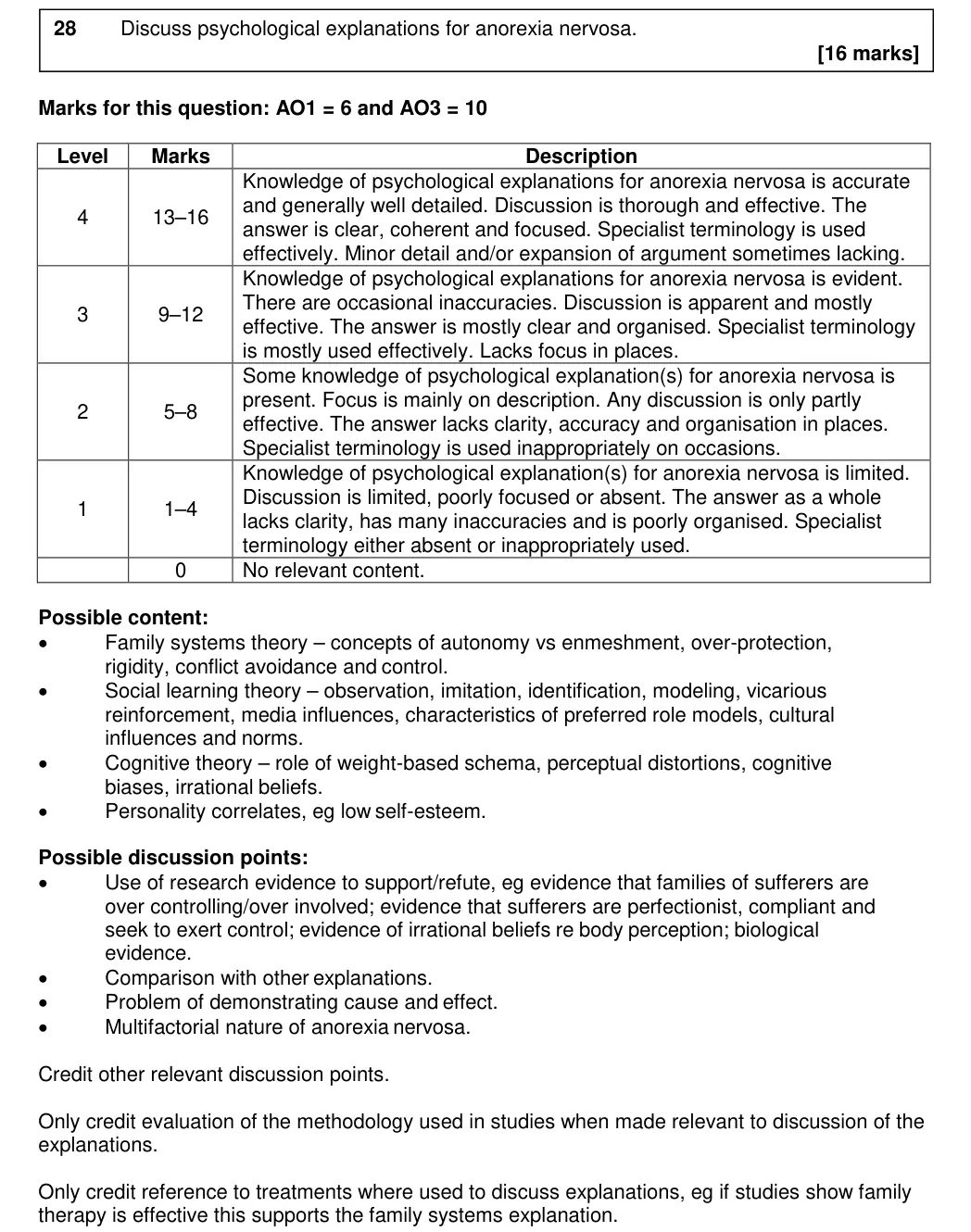
Specimen set 1 · Paper 3 · Q2816 marksAO1=6, AO3=1016-mark essay
Mark scheme, including level descriptors and indicative content
Notes from the mark scheme and report
family systems, SLT/media, cognitive distortions, personality
discussion via evidence, cause and effect, multifactorial nature
treatments credited only if used to discuss explanations
Work with an AQA psychology tutor
Essays not reaching the top band? Book a session with Andy, a former AQA examiner.