30 question parts, 8 sixteen-mark essays, 3 multiple-choice items, plus 4 parts on content removed in 2025
Notes, key studies and practice items for this topic are being written by our tutors. The past-paper questions below are ready now.
Specification statements
4.3.10-01 Describing addiction: physical and psychological dependence, tolerance and withdrawal syndrome.
4.3.10-02 Risk factors in the development of addiction, including genetic vulnerability, personality and social influences.
4.3.10-03 Explanations for nicotine addiction: brain neurochemistry, including the role of dopamine, and learning theory as applied to nicotine addiction, including reference to cue reactivity.
4.3.10-04 Explanations for gambling addiction: learning theory as applied to gambling, including reference to partial and variable reinforcement; cognitive theory as applied to gambling, including reference to cognitive bias.
4.3.10-05 Reducing addiction: drug therapy; behavioural interventions, including aversion therapy and covert sensitisation; cognitive behaviour therapy.
4.3.10-06 The application of Prochaska’s six-stage model of behaviour change.
Tap a question to zoom it. Mark scheme and examiner's comment open under each question.
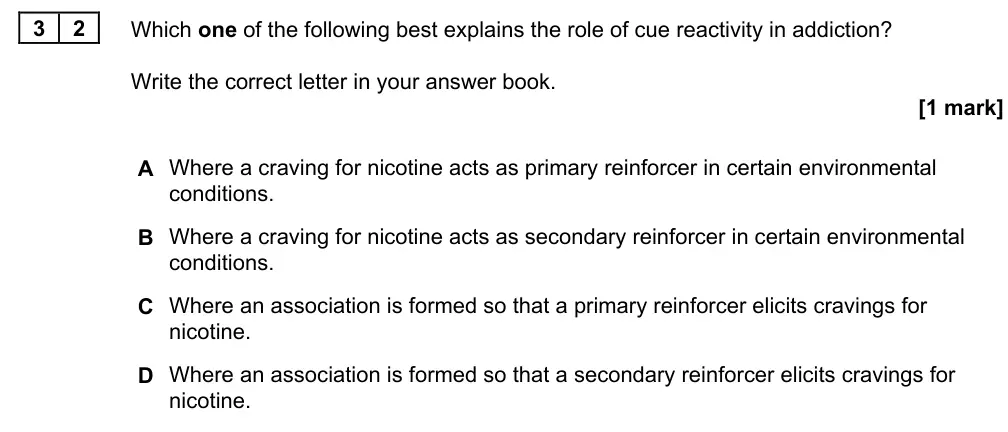
June 2025 · Paper 3 · Q321 markAO1=1Multiple choice
Answer
D
Mark scheme, including level descriptors and indicative content
Examiner's comment
Compared to the other two topic areas in Section D, students were more likely to struggle with the multiple-choice question here, and this was slightly more the case in 33 than 32.
Notes from the mark scheme and report
answer D (association so a secondary reinforcer elicits cravings)
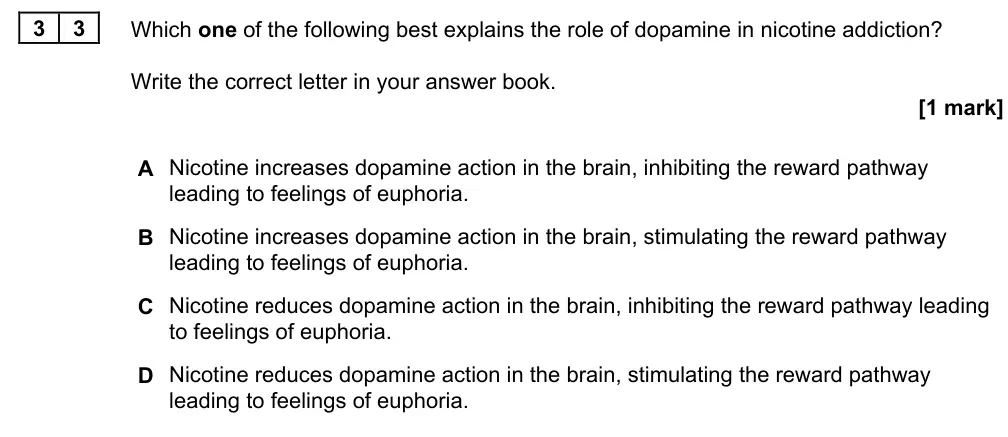
June 2025 · Paper 3 · Q331 markAO1=1Multiple choice
Answer
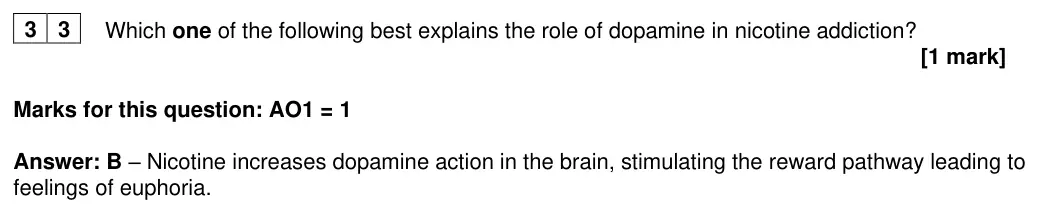
B
Mark scheme, including level descriptors and indicative content
Examiner's comment
Compared to the other two topic areas in Section D, students were more likely to struggle with the multiple-choice question here, and this was slightly more the case in 33 than 32.
Notes from the mark scheme and report
answer B (nicotine increases dopamine, stimulating reward pathway)
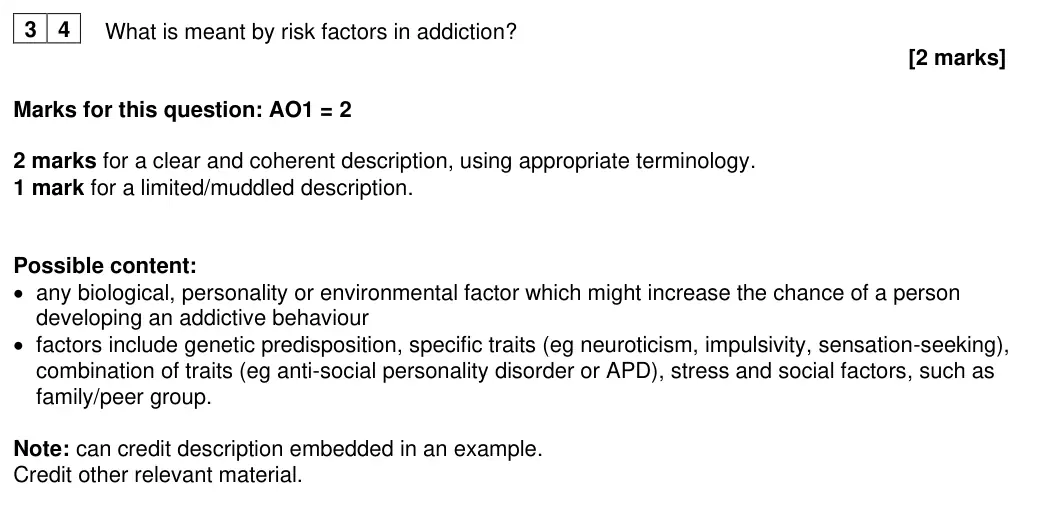
June 2025 · Paper 3 · Q342 marksAO1=2Short answerHard
Mark scheme, including level descriptors and indicative content
Examiner's comment
Question 34 presented students with few problems: most recognised that risk factors can be internal or external and were able to provide relevant examples. Very few students achieved fewer than the two marks available.
Notes from the mark scheme and report
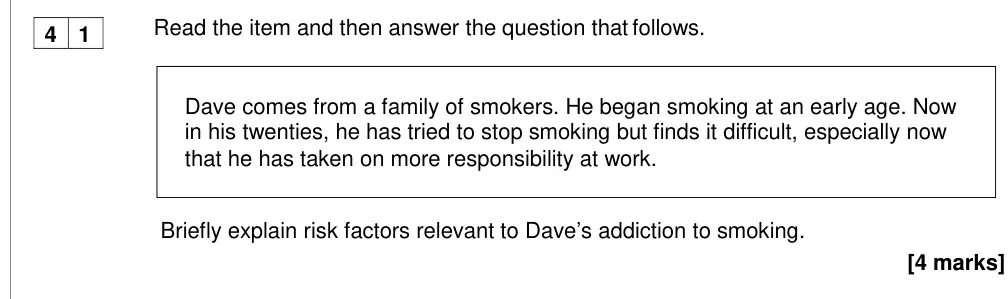
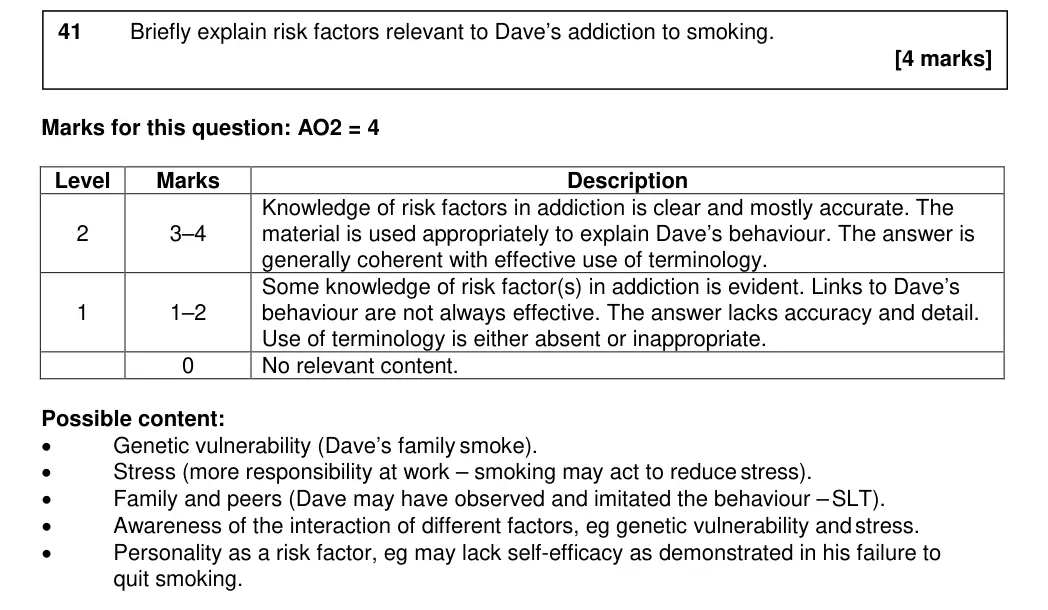
any biological, personality or environmental factor increasing the chance of addiction, with examples (genes, impulsivity, stress, peers)
very few scored under 2
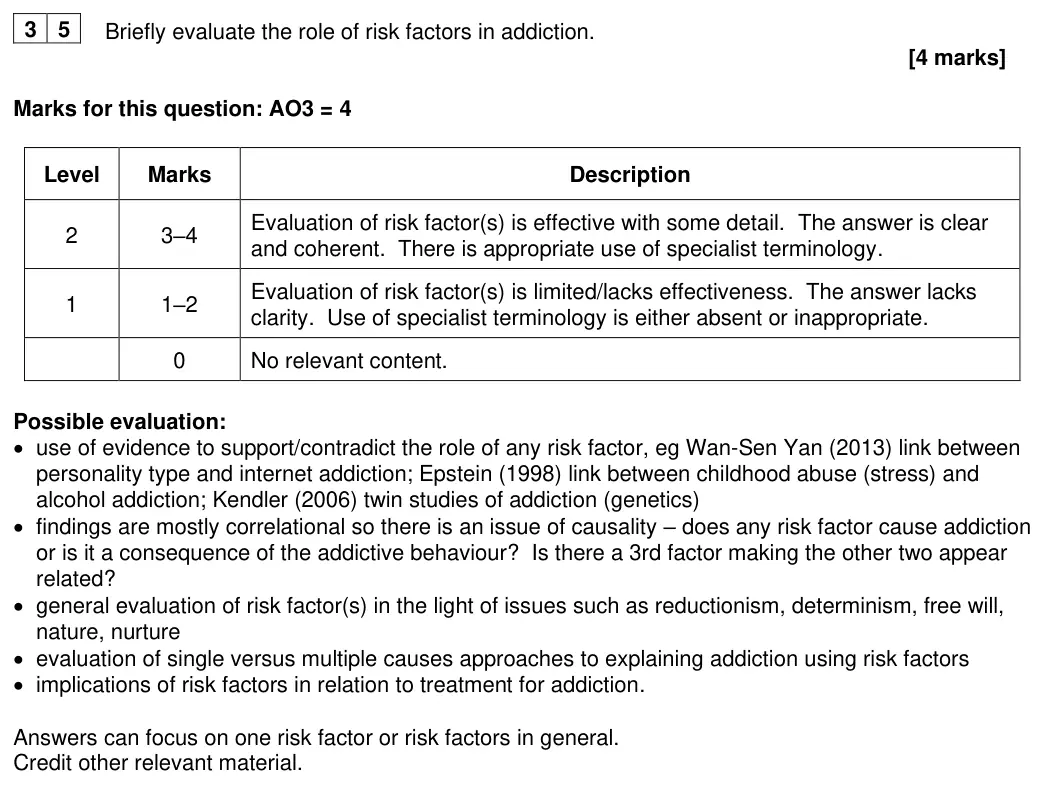
June 2025 · Paper 3 · Q354 marksAO3=4Evaluate (short)
Mark scheme, including level descriptors and indicative content
Examiner's comment
The next evaluation question (35) was reasonably impressive too. Most had relevant evidence at their disposal for at least two risk factors, and this was often enough to score all four marks. In the absence of evidence, the argument that it is not realistic to study risk factors in isolation as this ignores their inter-related nature was often advanced to good effect.
Notes from the mark scheme and report
evidence for any risk factor (Kendler twins, personality and internet addiction), correlational/causality, multiple interacting factors, treatment implications
one risk factor or several acceptable
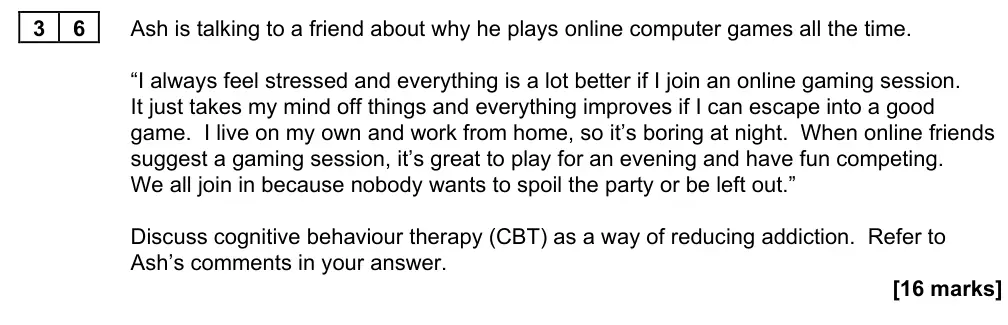
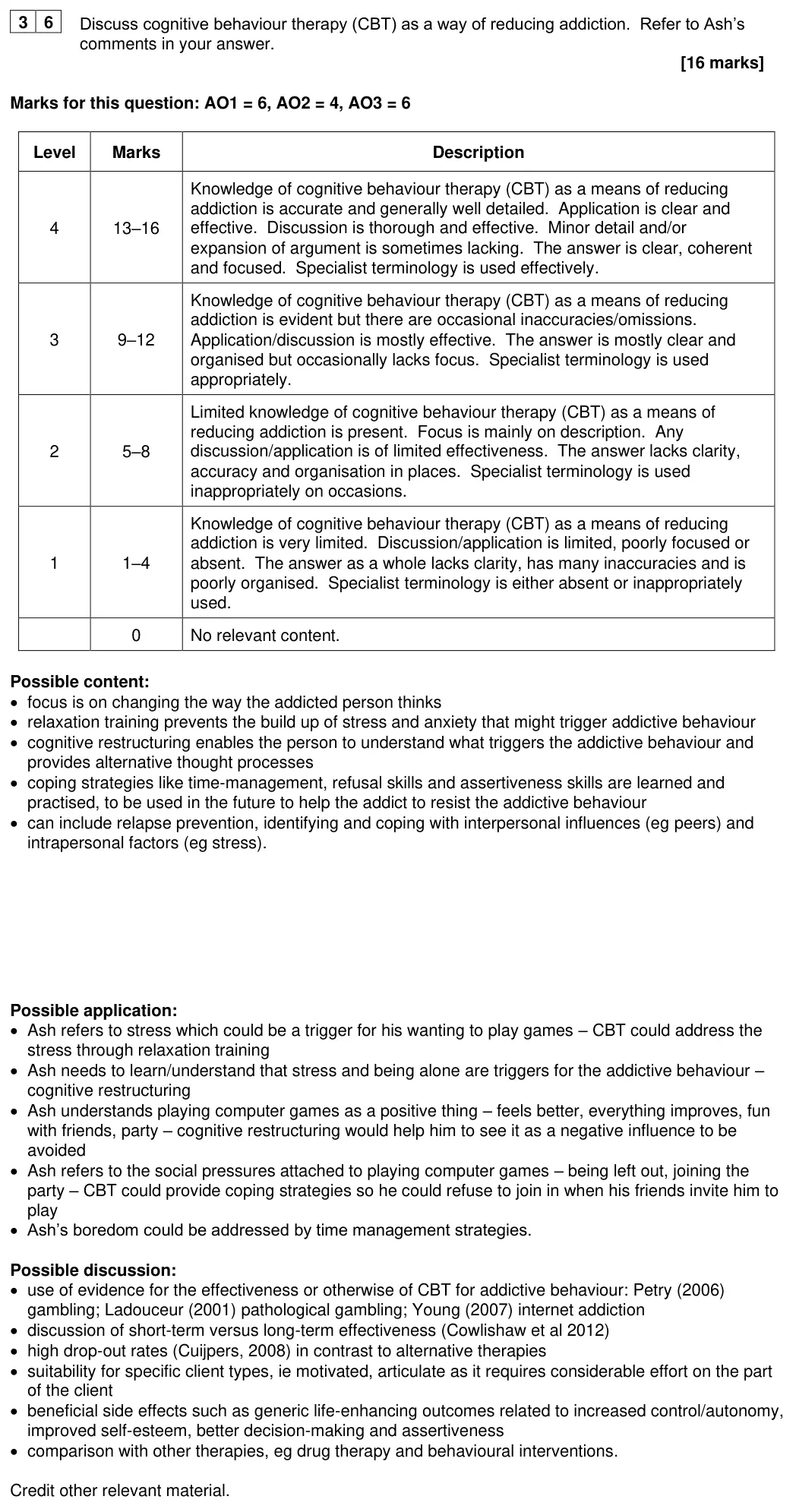
June 2025 · Paper 3 · Q3616 marksAO1=6, AO2=4, AO3=616-mark essay
Mark scheme, including level descriptors and indicative content
Examiner's comment
There were some very good answers for the 16-mark question on cognitive-behaviour therapy. Descriptive accounts often included some impressive technical detail of both cognitive and behavioural strategies, illustrated by examples and appropriate terminology. Where some students did struggle was with the application content. Because the stem described Ash’s gaming addiction, students were required to apply features of this to a probable treatment plan – and this proved to be a tall order for many. In fact, there was a fair number of answers that included very high-level knowledge and discussion but no application at all. As is consistent with the ‘best fit’ approach to holistic marking, such responses were still able to score up to 12 marks.
Notes from the mark scheme and report
relaxation training for stress, cognitive restructuring of positive beliefs about gaming, coping/refusal skills for peer pressure, time management for boredom
evaluation Petry, Young, drop-out, suitability for motivated clients
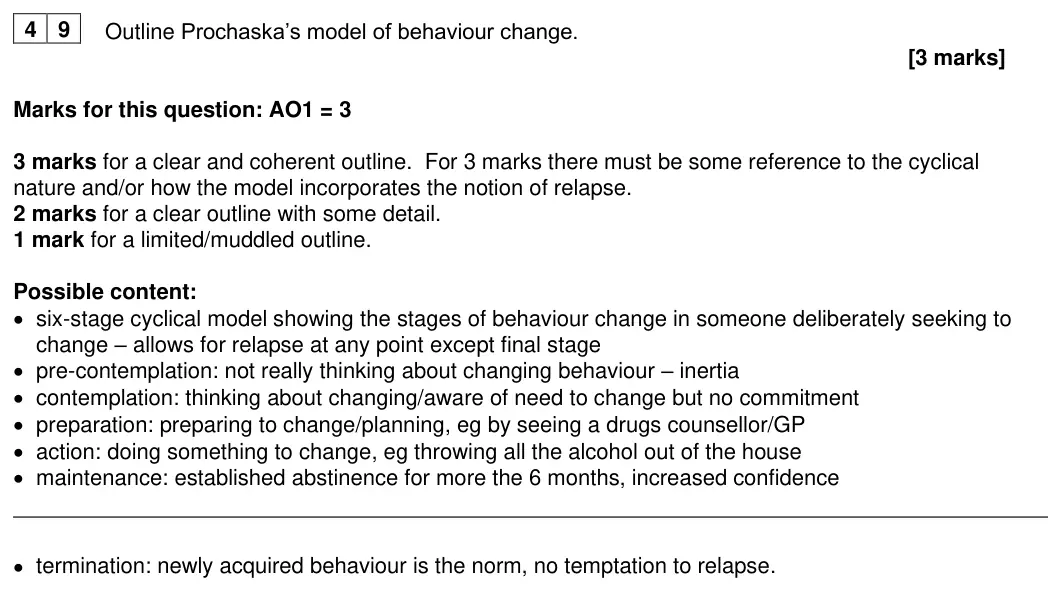
June 2024 · Paper 3 · Q493 marksAO1=3Outline
Mark scheme, including level descriptors and indicative content
Examiner's comment
There were some good answers to Question 49. The most economical path to three marks was some reference to the cyclical nature of Prochaska’s model, a list of the six stages and the notion that relapse is an integral part. Some students perhaps penalised themselves in terms of time by producing lengthy descriptions of each stage.
Notes from the mark scheme and report
3 marks need reference to cyclical nature and/or relapse
six stages pre-contemplation to termination
lengthy stage descriptions wasted time
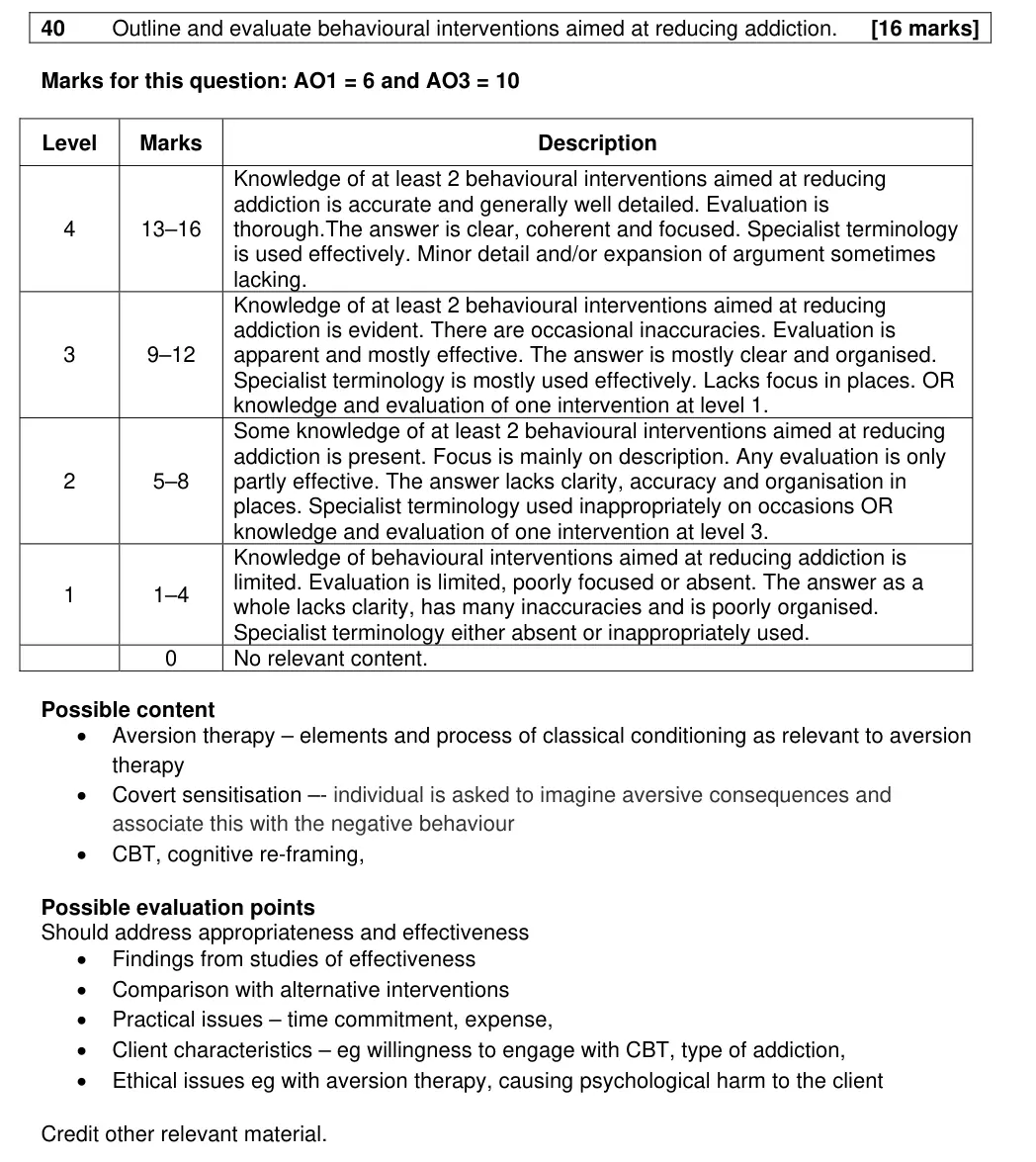
June 2024 · Paper 3 · Q5016 marksAO1=6, AO2=4, AO3=616-mark essay
Mark scheme, including level descriptors and indicative content
Examiner's comment
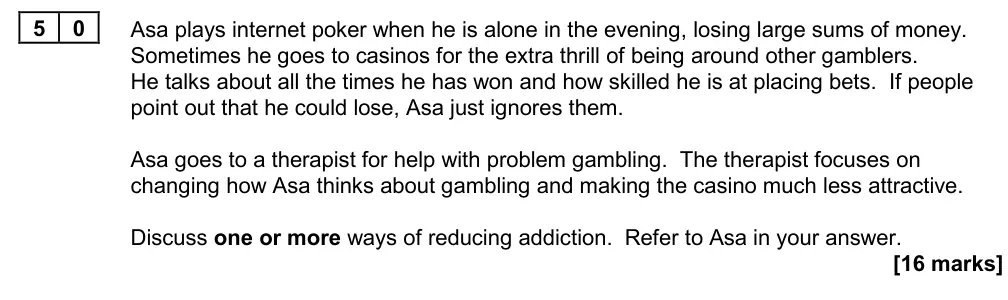
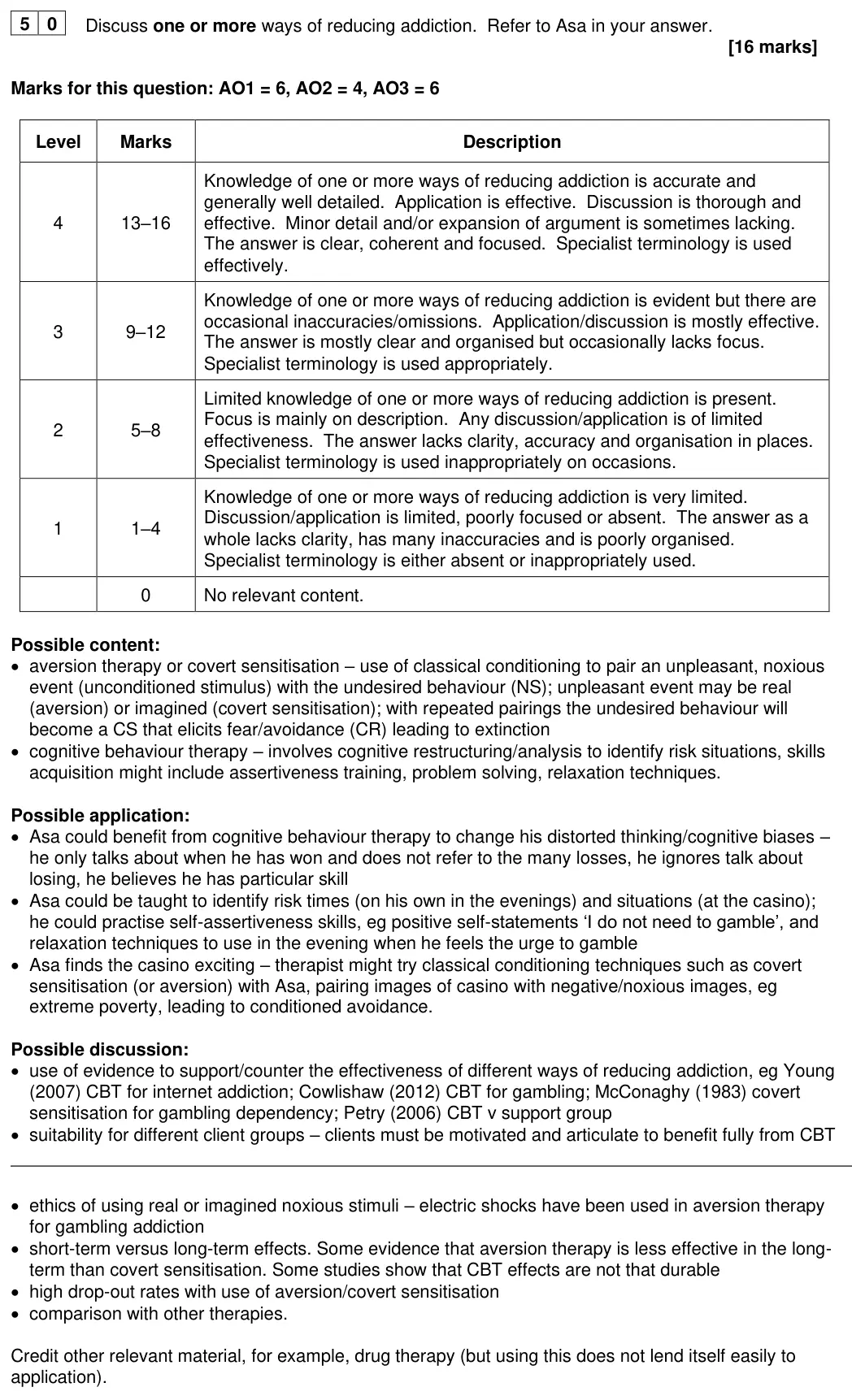
Overall, the standard of responses for Question 50 was rather broad. There were some very good and clear accounts of aversion therapy and/or covert sensitisation which included explicit links to behaviourist principles as well as to the stem. Others provided impressive knowledge of cognitive behaviour therapy and how this could be used to tackle Asa’s evident ‘skill bias’. Other answers were much less convincing, however. Attempted discussion was often vague, involving efficacy studies which appeared to have been made up on the spot, and some fairly speculative remarks related to time and cost of different treatment methods.
Notes from the mark scheme and report
CBT for cognitive biases (skill bias, selective recall of wins), aversion therapy/covert sensitisation to make the casino less attractive
drug therapy creditworthy but hard to apply
June 2023 · Paper 3 · Q374 marksAO2=2, AO3=2Application
Mark scheme, including level descriptors and indicative content
Examiner's comment
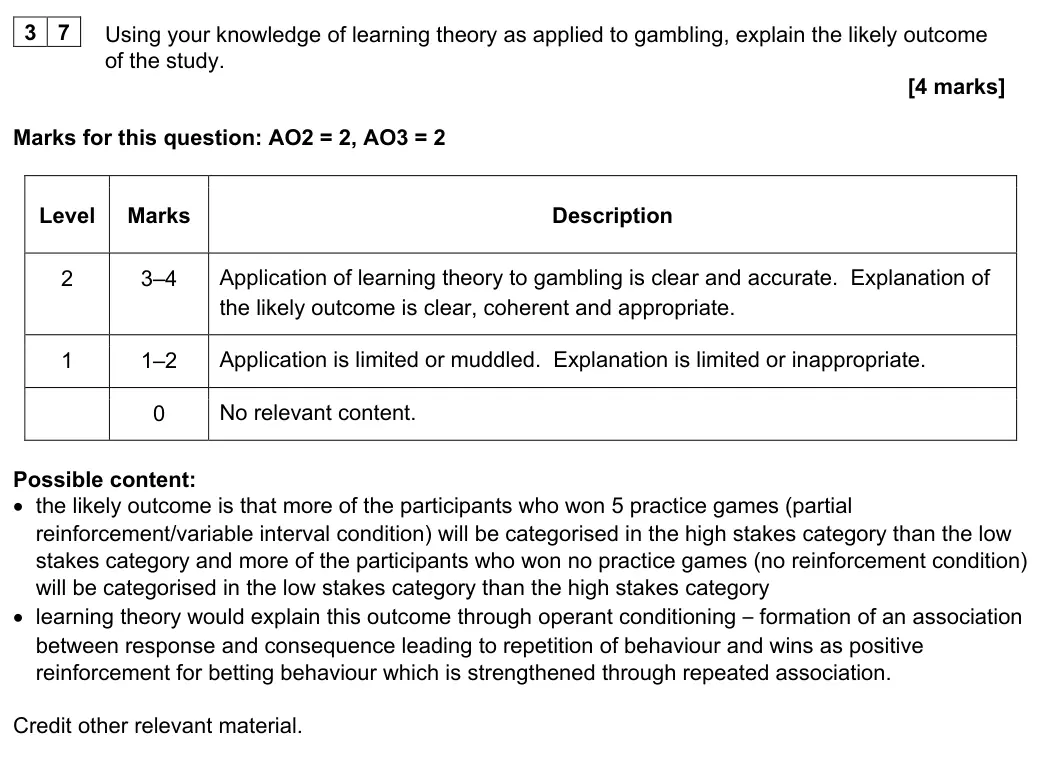
In this question, full marks required a clear explanation of the likely outcome of the study described, but many students only talked about one of the conditions rather than both. There were some answers that missed the point and suggested that those participants who had lost every bet would take the higher stakes gamble as they would be compelled by their lack of success first time around. Those that did predict the likely outcome correctly often gave vague or hasty explanations for this, usually through some brief reference to operant conditioning/positive reinforcement, which secured a further mark. Very few talked in terms of schedules of reinforcement.
Notes from the mark scheme and report
predict outcome for BOTH conditions (partially reinforced group more high stakes) and explain via operant conditioning/partial reinforcement
some wrongly predicted losers would bet higher
few used schedules of reinforcement
June 2023 · Paper 3 · Q396 marksAO1=6Outline
Mark scheme, including level descriptors and indicative content
Examiner's comment
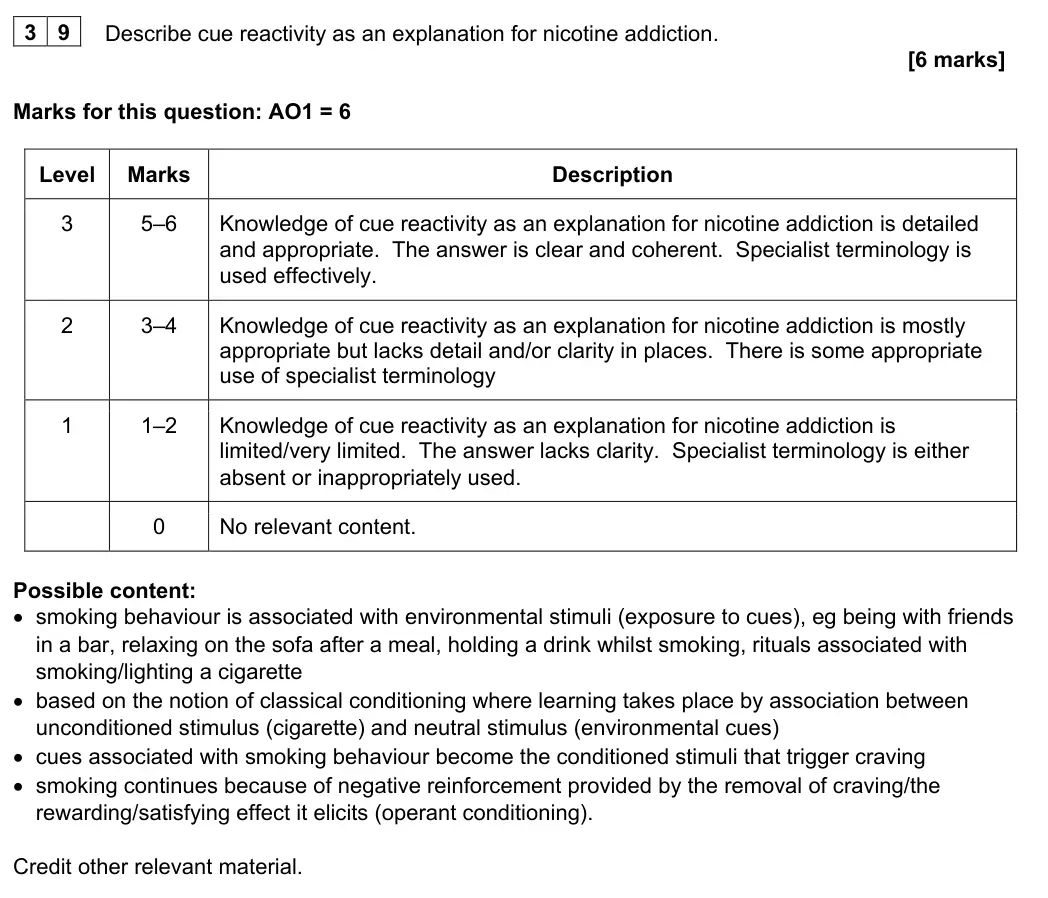
Generally, this question was poorly answered. Many students seemed to be unaware that cue reactivity is a behaviourist/learning theory. They could only talk very generally about examples of possible cues. There was much confusion with biological theories of addiction, and there were some lengthy accounts of neural pathways and dopamine. Those that did achieve marks tended to focus on classical conditioning and made little reference to how operant conditioning can be used to explain the maintenance of smoking addiction.
Notes from the mark scheme and report
classical conditioning of environmental cues (CS) triggering craving
maintenance via negative reinforcement
many unaware it is a learning theory and wrote about dopamine pathways
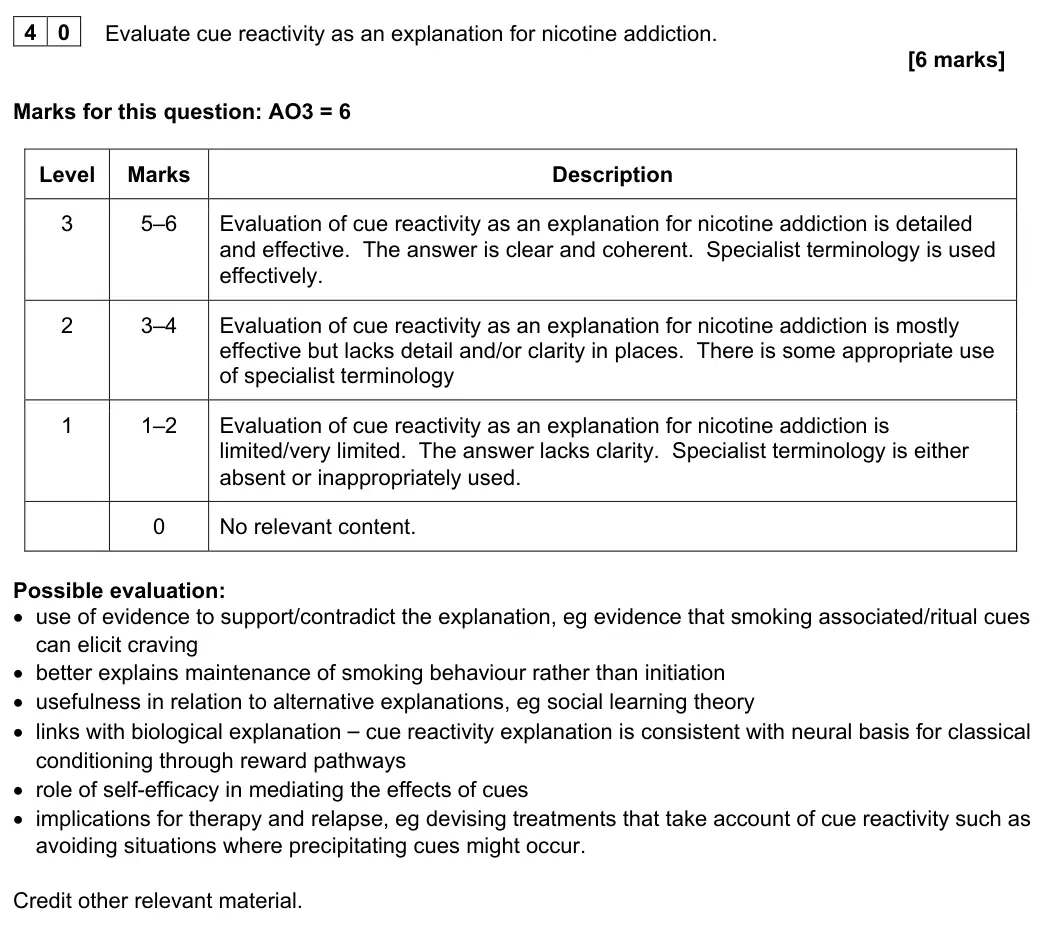
June 2023 · Paper 3 · Q406 marksAO3=6Evaluate (short)
Mark scheme, including level descriptors and indicative content
Examiner's comment
Responses to this question were generally poor and vague. Although creditworthy, there was an over-reliance on application to treatment within these answers.
Notes from the mark scheme and report
evidence that cues elicit craving, explains maintenance not initiation, links to reward pathways, implications for therapy/relapse
over-reliance on treatment points
generally poor and vague
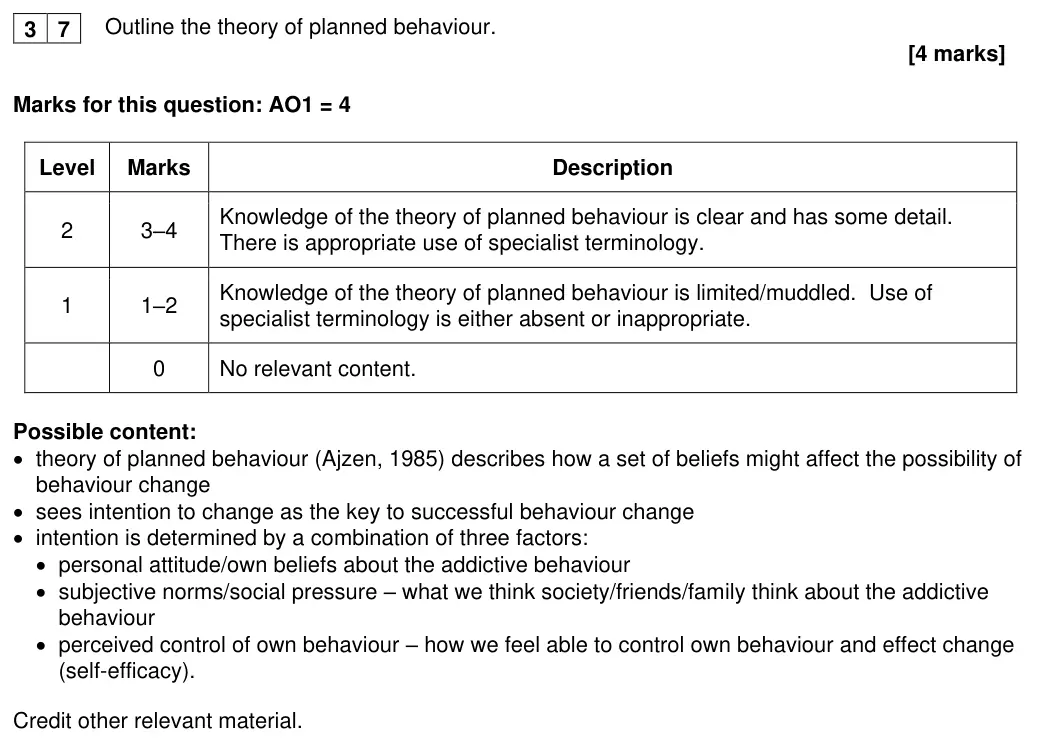
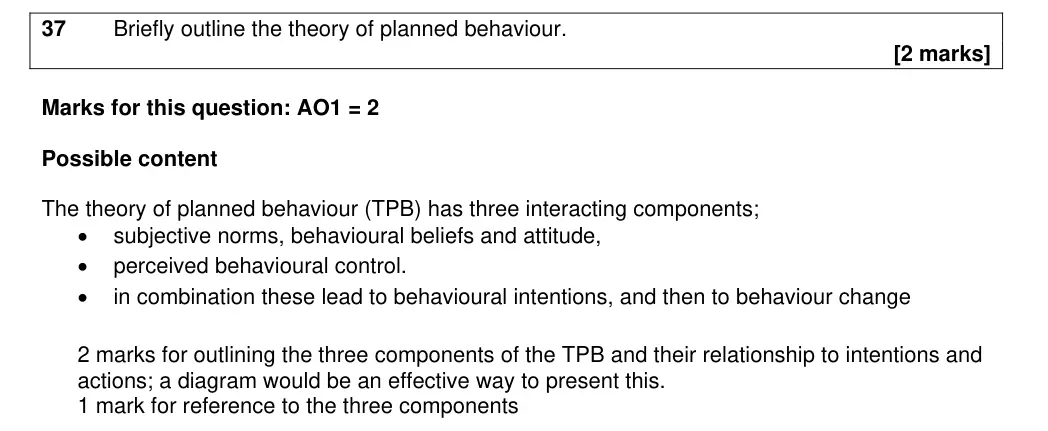
June 2022 · Paper 3 · Q374 marksAO1=4OutlineOld spec only
Not on the 2025 specification: theory of planned behaviour, removed in v1.4
Mark scheme, including level descriptors and indicative content
Examiner's comment
Most answers to Question 37 showed good knowledge of the theory of planned behaviour although some otherwise very good responses omitted the key point that the three factors combine to affect intention.
Notes from the mark scheme and report
Off-spec: theory of planned behaviour, removed in v1.4
key point that attitude, subjective norms and perceived control combine to determine intention often omitted
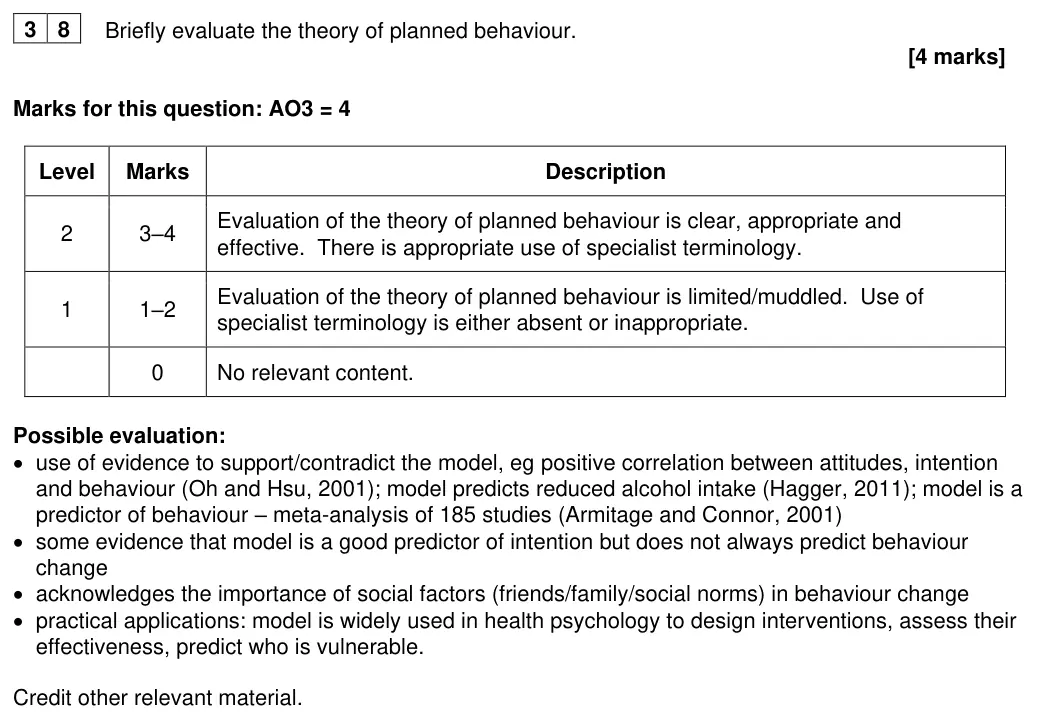
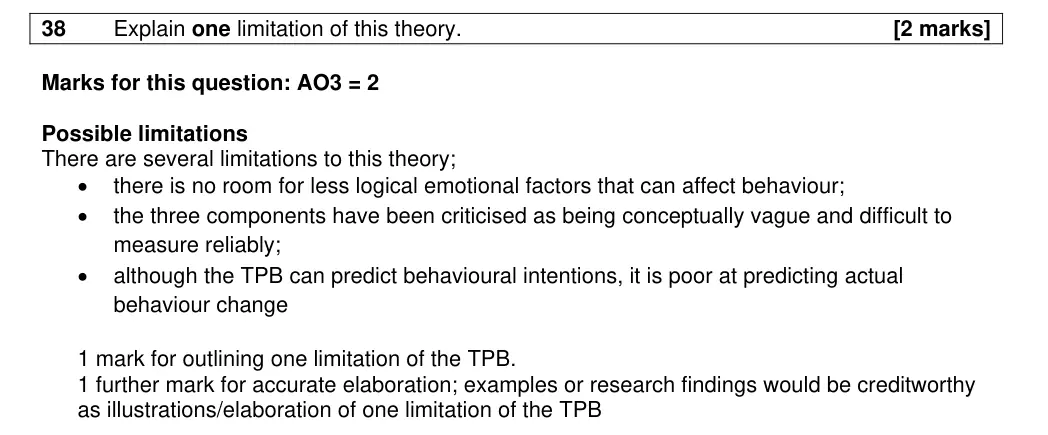
June 2022 · Paper 3 · Q384 marksAO3=4Evaluate (short)Old spec only
Not on the 2025 specification: theory of planned behaviour, removed in v1.4
Mark scheme, including level descriptors and indicative content
Examiner's comment
Evaluations varied for Question 38. Some students made good use of evidence to support the role of some/all factors in behaviour change whereas weaker evaluations often consisted of vague suggestions that the theory was somehow reductionist or deterministic.
Notes from the mark scheme and report
Off-spec: theory of planned behaviour, removed in v1.4
weak evaluations were vague claims of reductionism/determinism
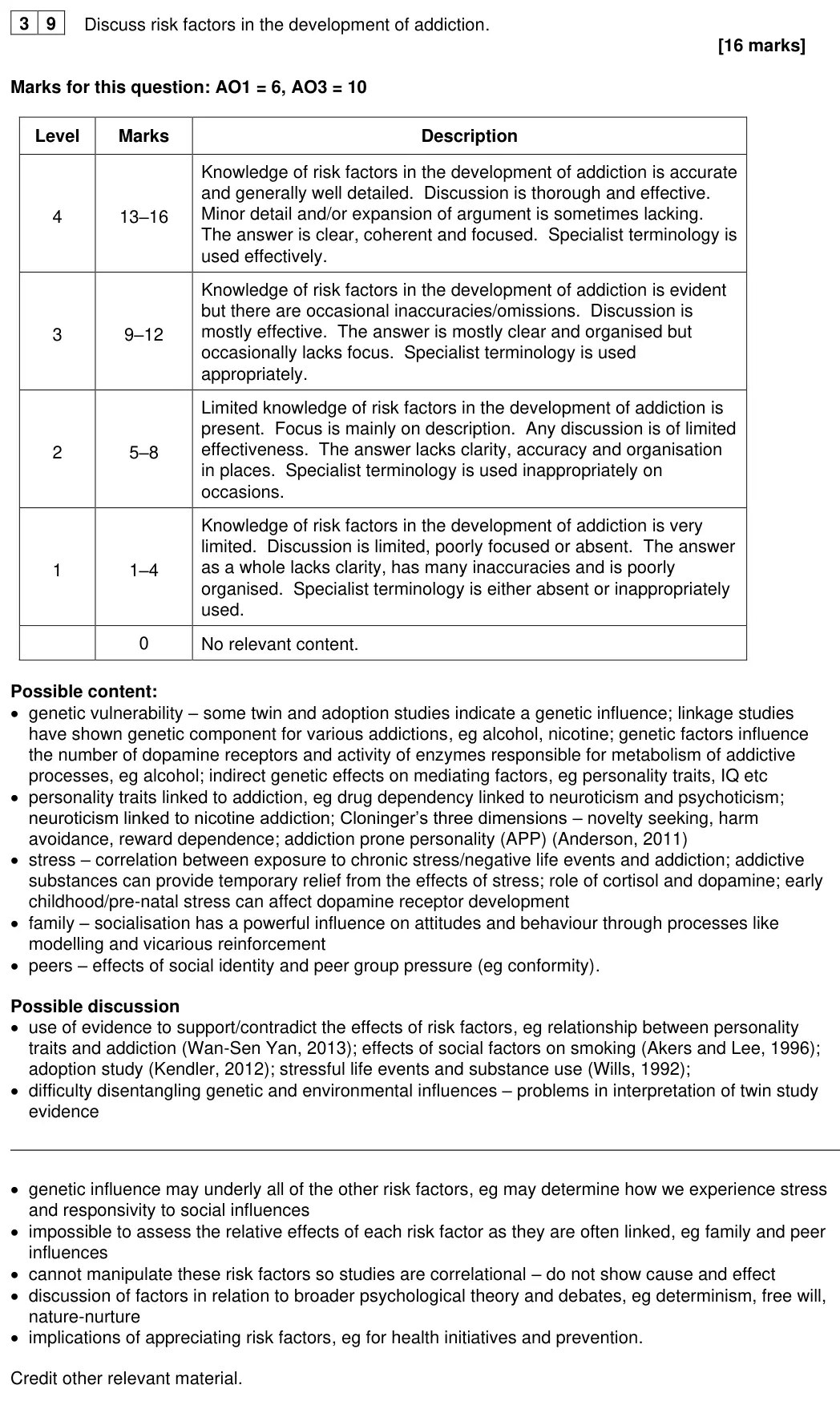
June 2022 · Paper 3 · Q3916 marksAO1=6, AO3=1016-mark essay
Mark scheme, including level descriptors and indicative content
Examiner's comment
Answers to Question 39 tended to be extremely well-prepared in terms of knowledge and understanding. Students often raced through a whole range of risk factors offering evidence for discussion of each. Higher achieving students took the trouble to explain factors in psychological terms, for example, how parental influences could be linked to social learning theory and how the influence of peers could be explained in terms of conformity/normative influence. The implications of understanding risk factors for intervention proved to be a useful discussion point in some of the higher scoring answers.
Notes from the mark scheme and report
genetic vulnerability, personality, social influences
MS lists stress, family and peers separately (subsumed under 'social influences' in v1.4)
best answers explained family/peer effects via SLT and conformity
November 2021 · Paper 3 · Q361 markAO1=1Short answer
Mark scheme, including level descriptors and indicative content
Examiner's comment
The naming question after each of the stems was generally answered correctly except for Q31 where several students were unable to name ‘restorative justice’. Fortunately, this did not seem to affect the performance on follow-on questions.
Notes from the mark scheme and report
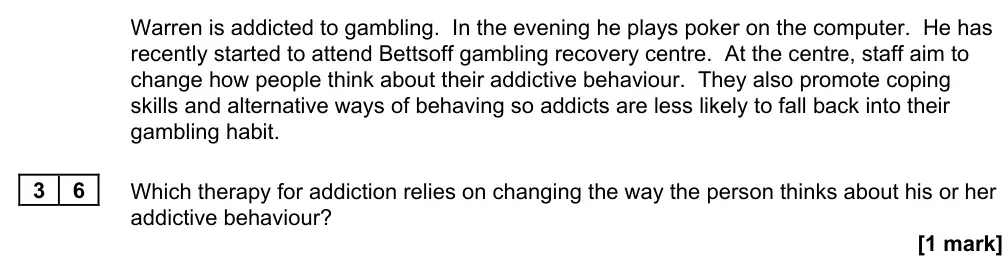
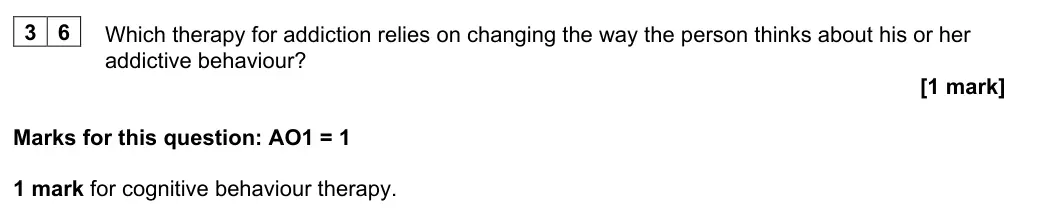
cognitive behaviour therapy
November 2021 · Paper 3 · Q374 marksAO2=4Application
Mark scheme, including level descriptors and indicative content
Examiner's comment
The 4-mark application questions requiring use of the stem were usually competently answered, although there were some weaker answers with little foundation in psychology.
Notes from the mark scheme and report
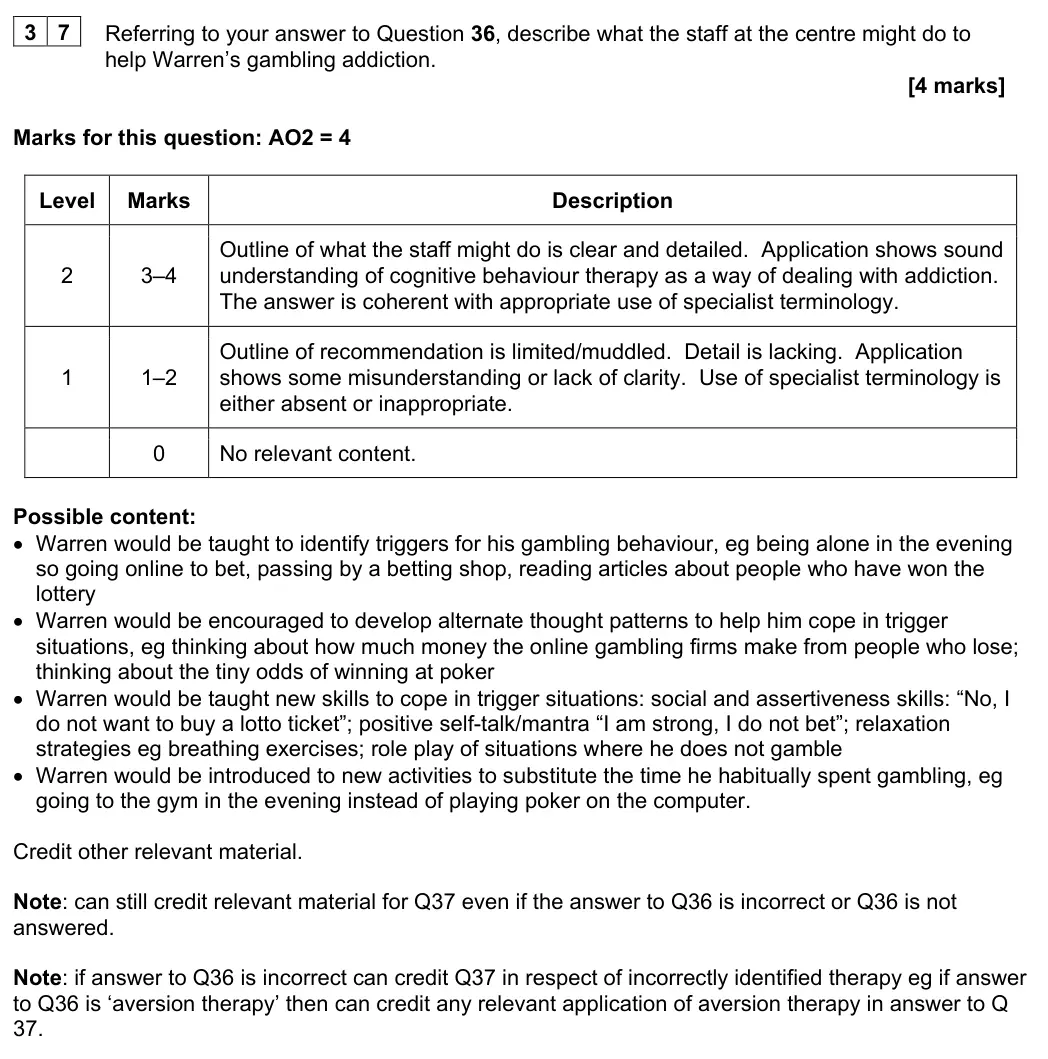
CBT applied to Warren: identify triggers, challenge distorted thoughts about odds, coping/assertiveness skills, alternative activities
credit consistent with an incorrect Q36 answer
November 2021 · Paper 3 · Q382 marksAO3=2Evaluate (short)
Mark scheme, including level descriptors and indicative content
Notes from the mark scheme and report
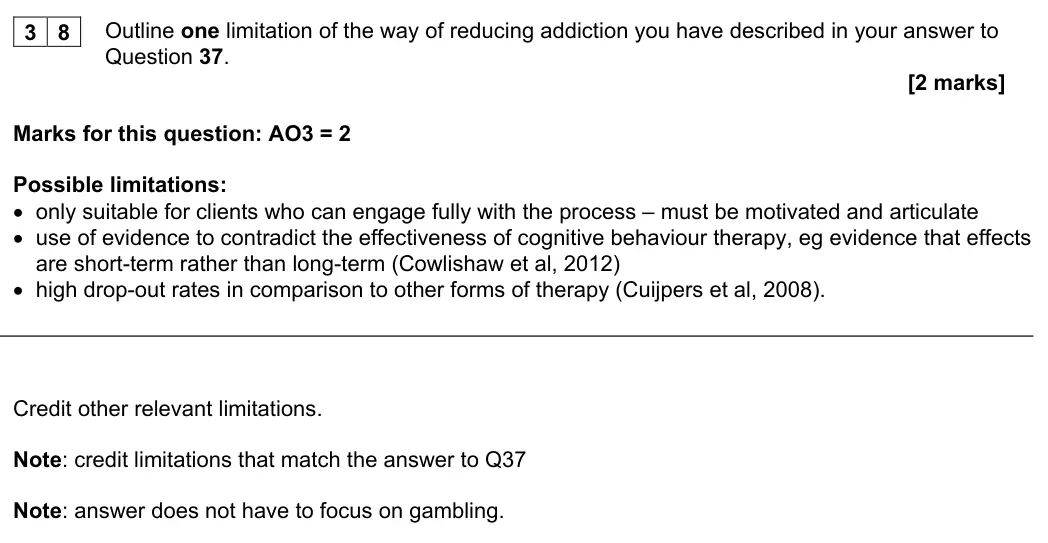
limitation must match Q37, e.g. needs motivated client, short-term effects, drop-out
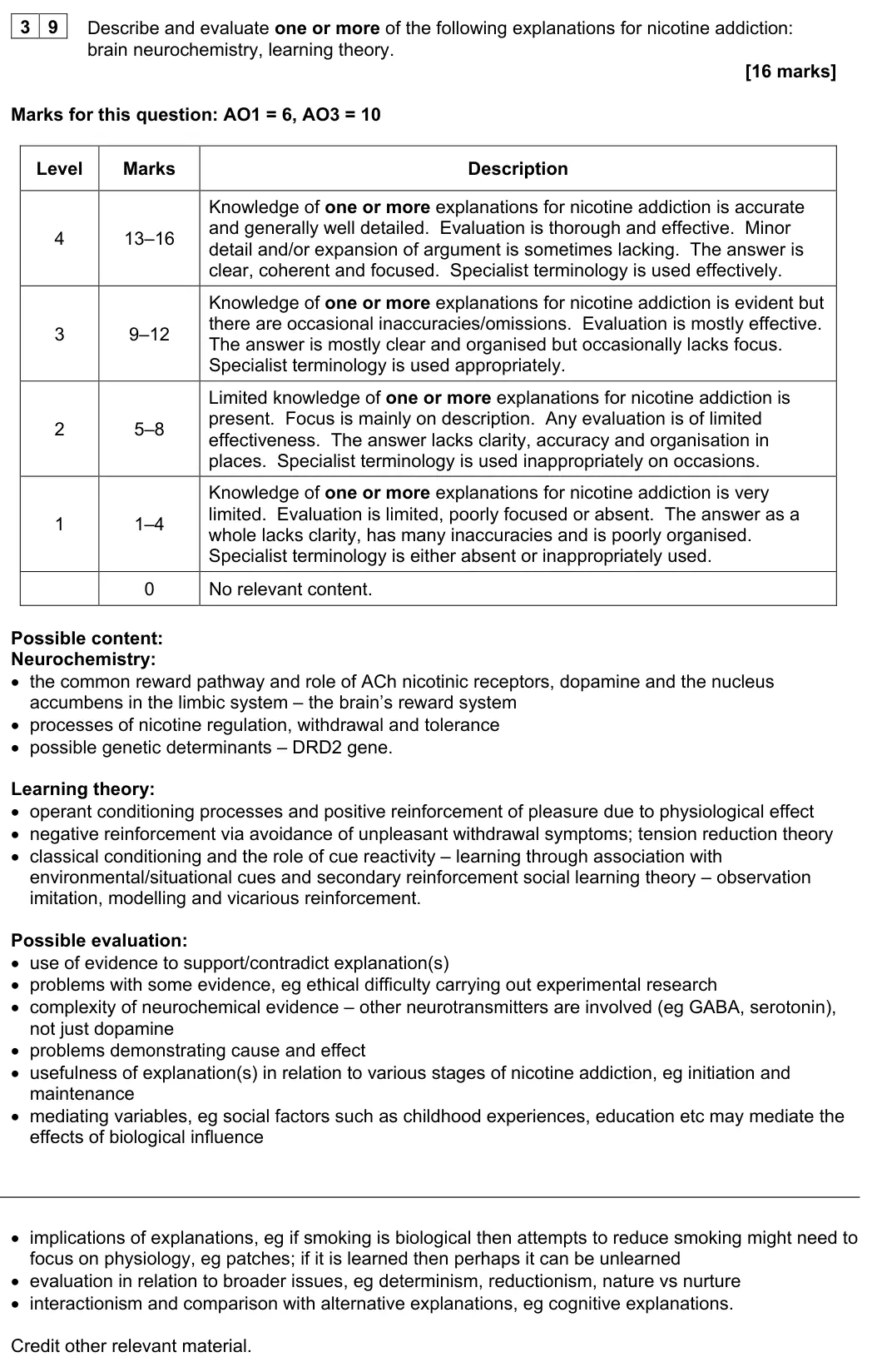
November 2021 · Paper 3 · Q3916 marksAO1=6, AO3=1016-mark essay
Mark scheme, including level descriptors and indicative content
Examiner's comment
The straightforward 16-mark questions yielded a wide range of marks with some impressively detailed and well-argued answers at the top end.
Notes from the mark scheme and report
neurochemistry (nicotinic ACh receptors, dopamine, nucleus accumbens) and/or learning theory (reinforcement, cue reactivity)
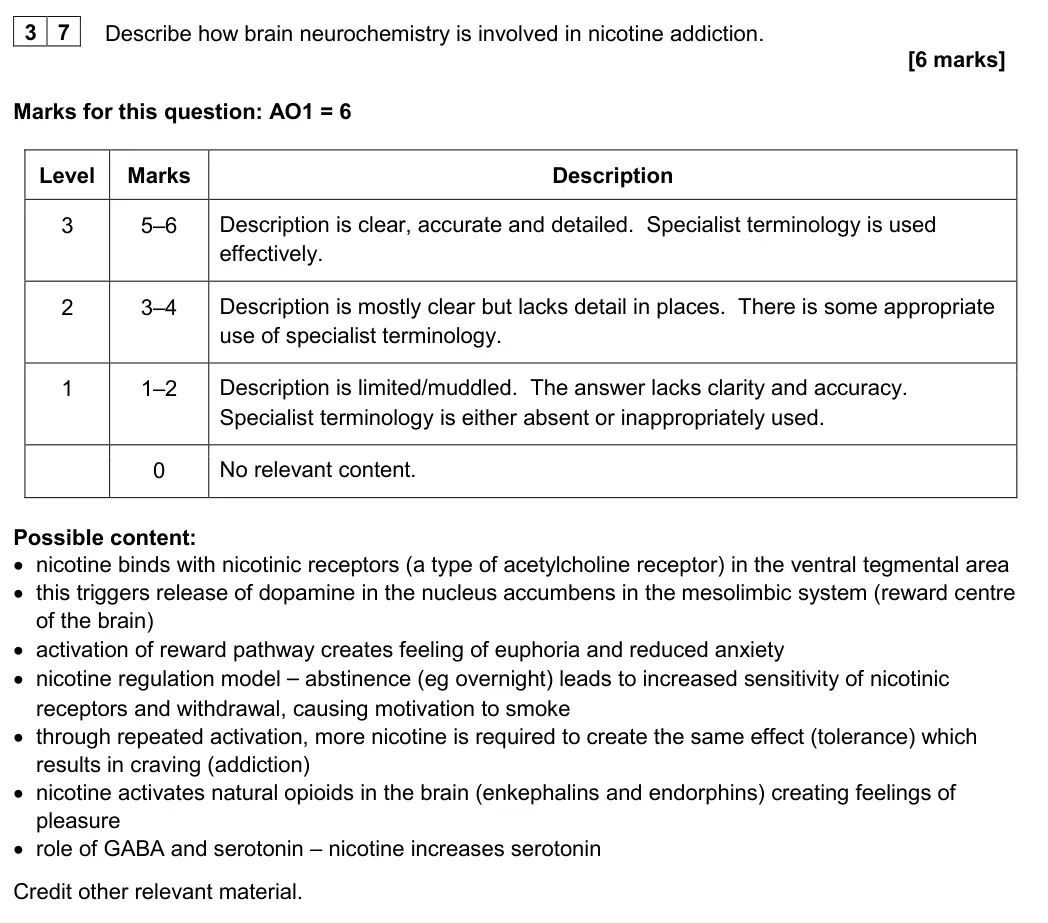
November 2020 · Paper 3 · Q376 marksAO1=6Outline
Mark scheme, including level descriptors and indicative content
Examiner's comment
The 6-mark questions required description only and were usually competently tackled. A few students wasted time by offering evaluation.
Notes from the mark scheme and report
nicotinic ACh receptors in VTA, dopamine release in nucleus accumbens/mesolimbic pathway, nicotine regulation model, tolerance
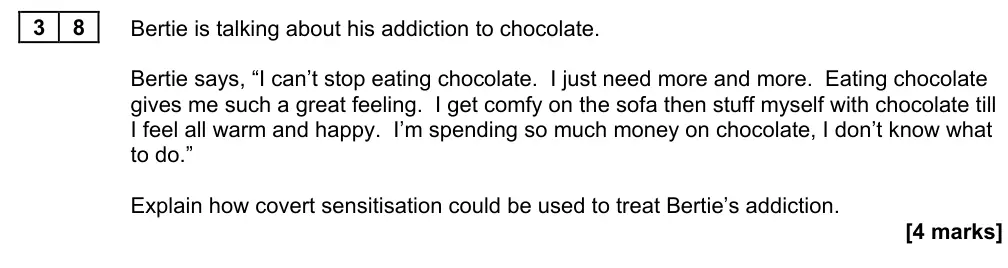
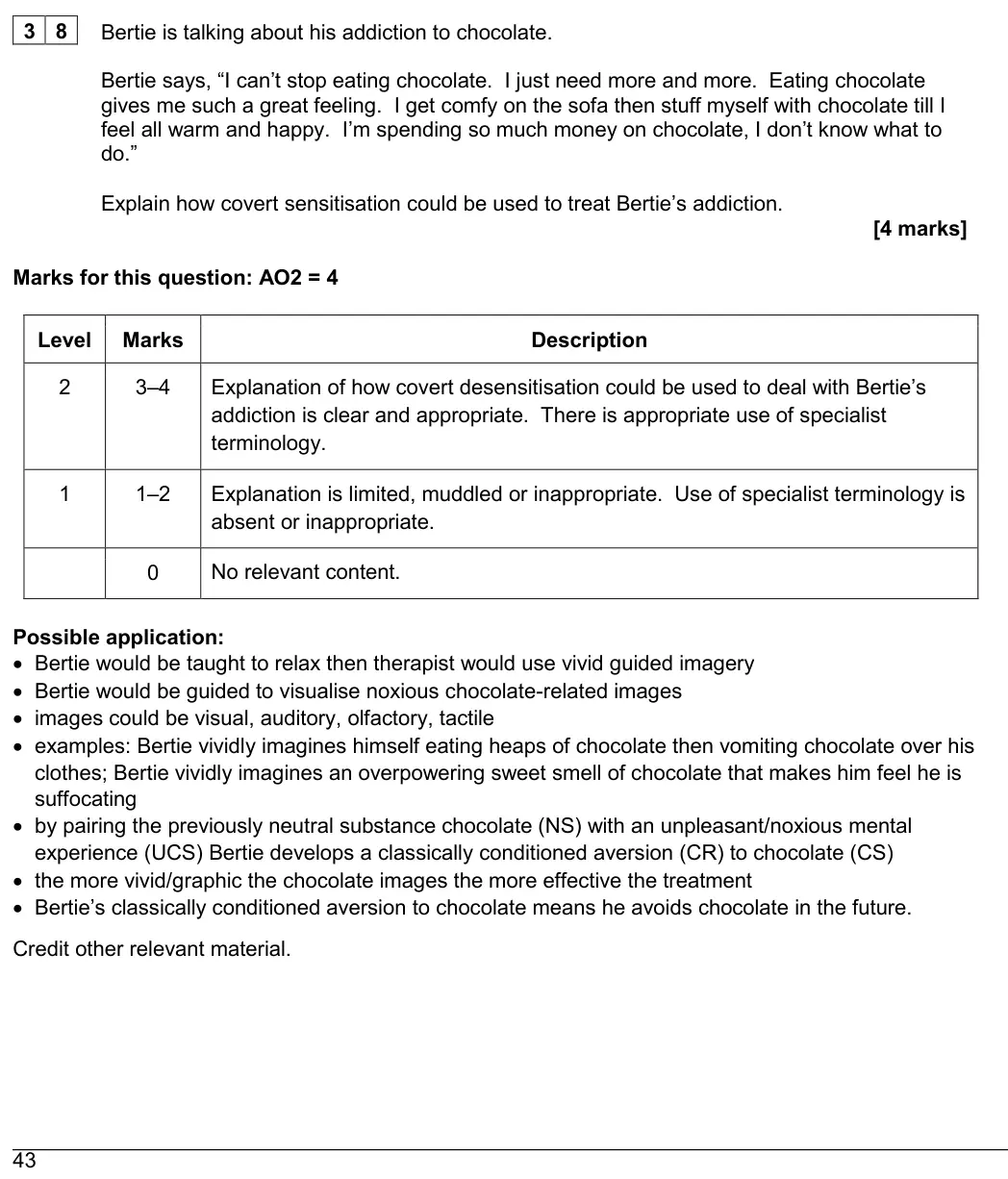
November 2020 · Paper 3 · Q384 marksAO2=4Application
Mark scheme, including level descriptors and indicative content
Examiner's comment
The application questions elicited sound engagement from many students who used the hooks in the stems effectively. Weaker answers were those where students simply name dropped into an otherwise purely knowledge-based answer. Some answers showed confusion between covert sensitisation and aversion therapy.
Notes from the mark scheme and report
relaxation then vivid noxious imagery paired with chocolate (UCS with CS) -> conditioned aversion
must apply to Bertie
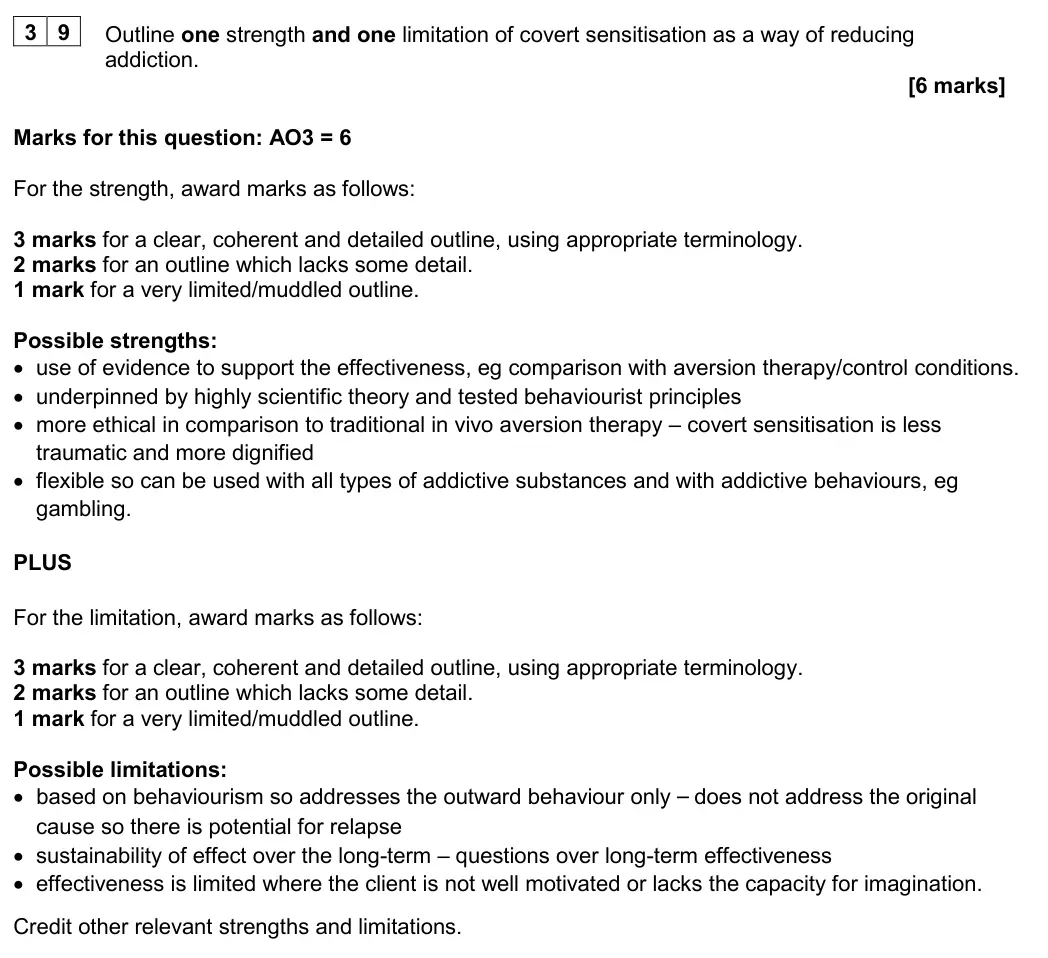
November 2020 · Paper 3 · Q396 marksAO3=6Evaluate (short)
Mark scheme, including level descriptors and indicative content
Examiner's comment
The strengths/limitations questions tended to yield high marks where students wrote enough to develop and sustain their points. Some answers showed confusion between covert sensitisation and aversion therapy.
Notes from the mark scheme and report
3 marks strength + 3 marks limitation, e.g. more ethical than aversion therapy vs relapse, needs motivation/imagination
November 2020 · Paper 3 · Q408 marksAO1=3, AO3=5Extended writing
Mark scheme, including level descriptors and indicative content
Notes from the mark scheme and report
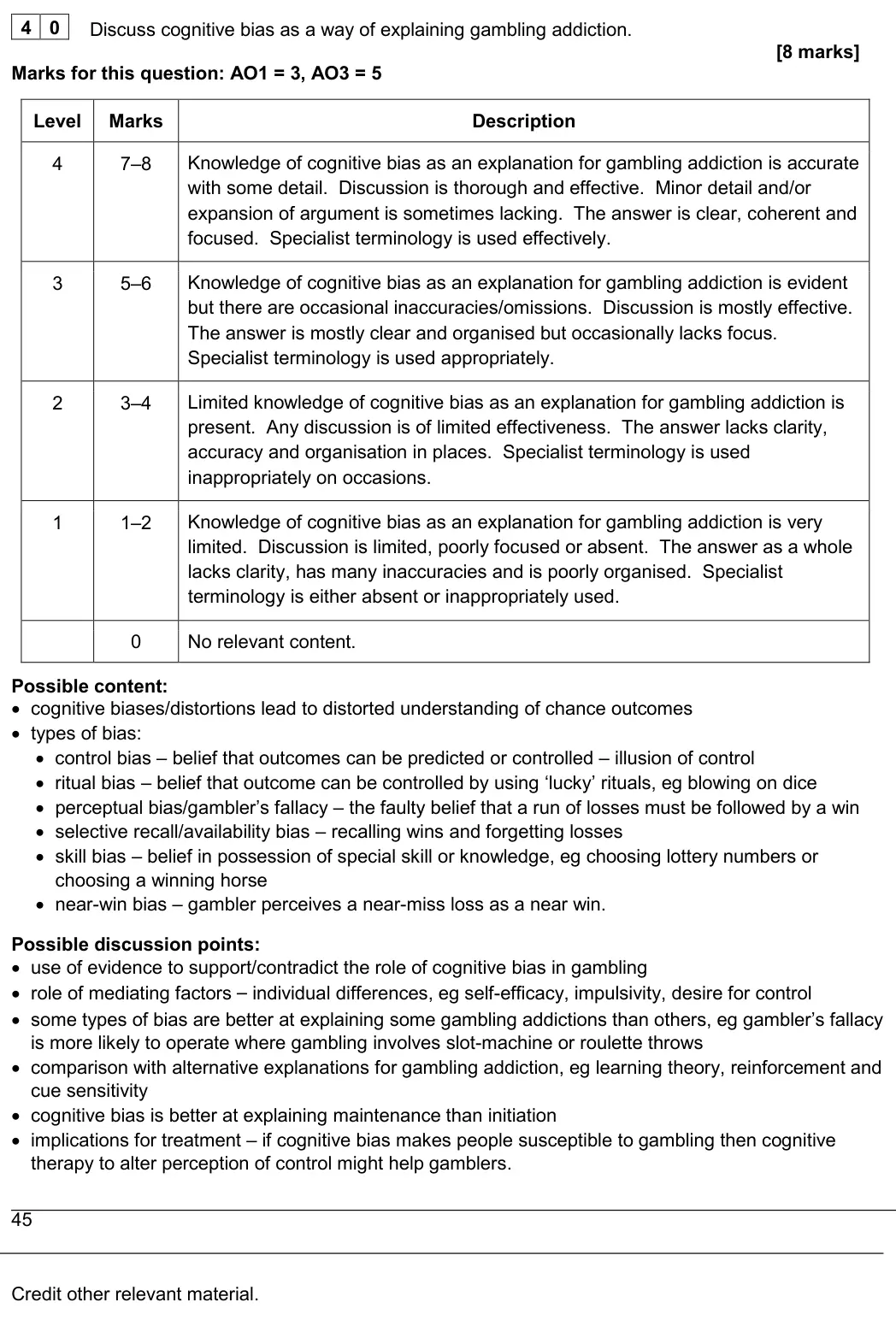
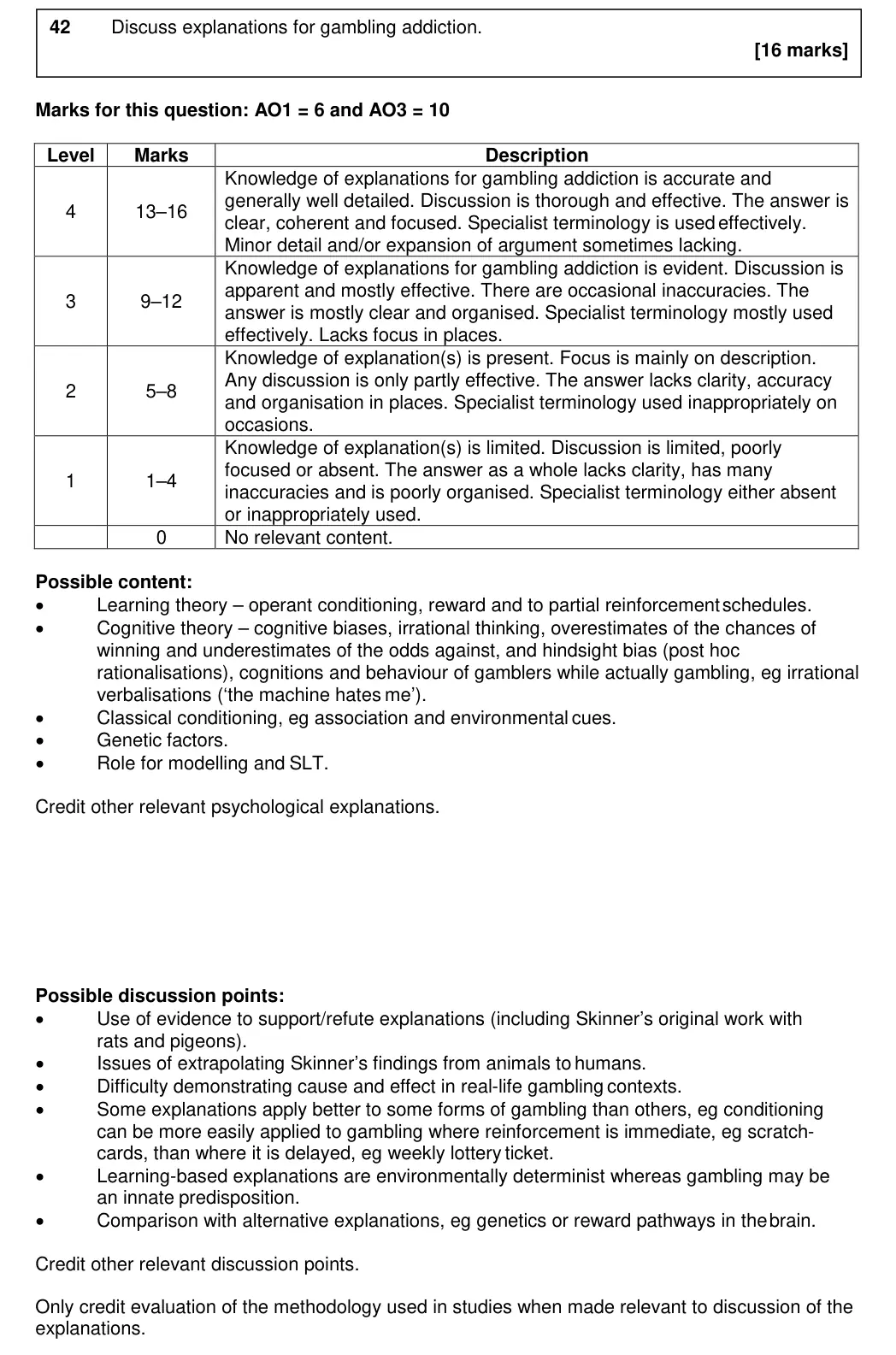
illusion of control, gambler's fallacy, near-miss, selective recall
comparison with learning theory
better explains maintenance than initiation
June 2019 · Paper 3 · Q338 marksAO1=4, AO2=4Extended writing
Mark scheme, including level descriptors and indicative content
Examiner's comment
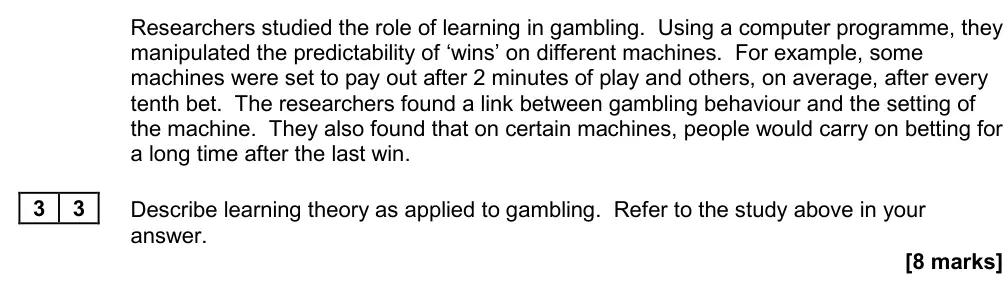
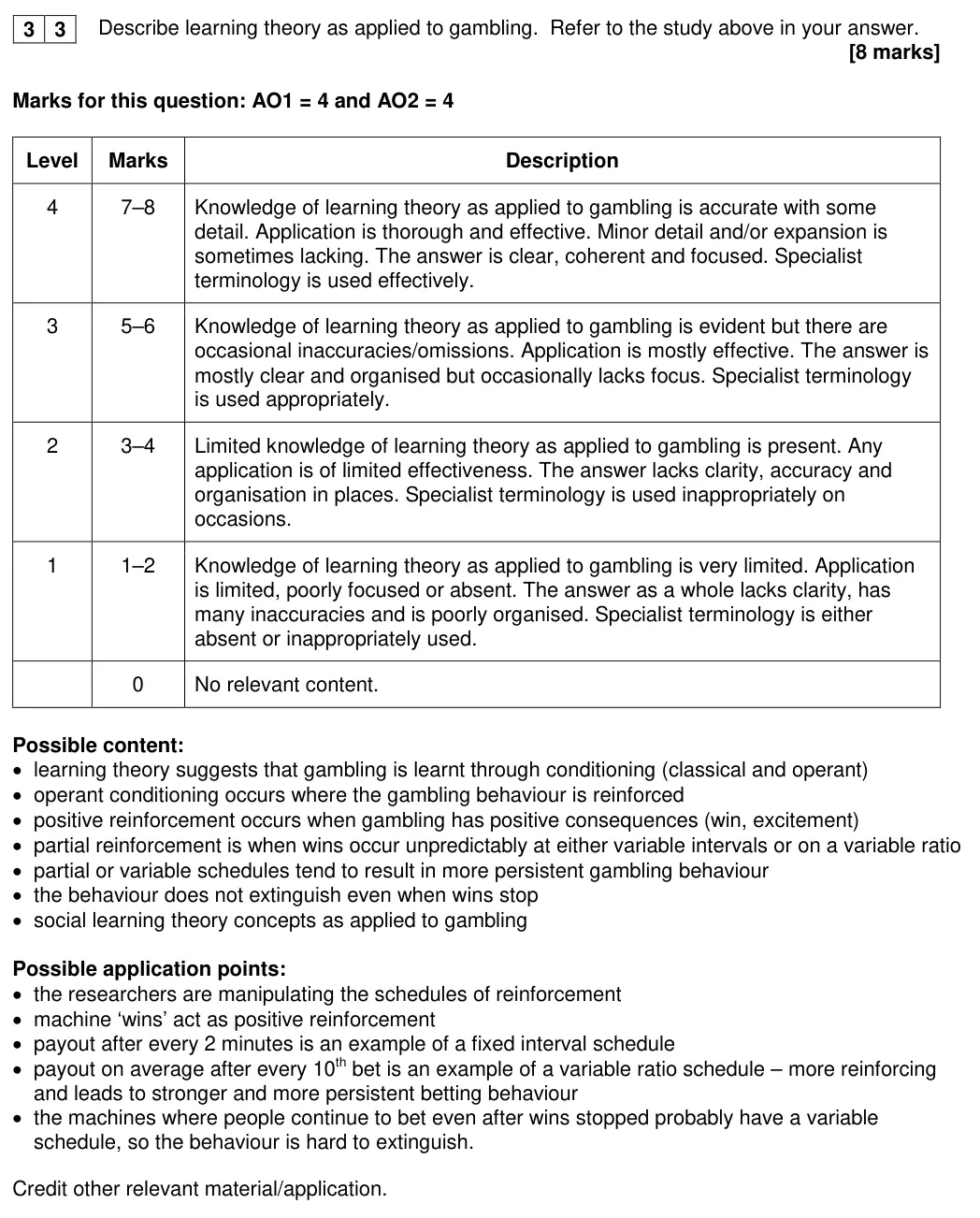
Answers were often well done, with detailed information about different schedules of reinforcement and their various consequences for frequency and persistence of gambling behaviour. Given the nature of the stem it was expected that most answers would focus mainly on the role of operant conditioning. However, it became evident that quite a lot of students had taken an alternative interpretation of ‘the setting of the machine’, assuming this was a reference to the location of the machine rather than the way it had been programmed to make pay-outs. Taking this alternative interpretation of ‘setting’ meant that cue reactivity could be applied to the stem and this was therefore deemed creditworthy. Very few students seemed to realise that ‘on average, after every 10th bet’ was a reference to a variable ratio schedule.
Notes from the mark scheme and report
operant conditioning, partial/variable reinforcement applied to machine settings (every 10th bet on average = variable ratio
persistence after last win = resistance to extinction)
'setting' read as location with cue reactivity also credited
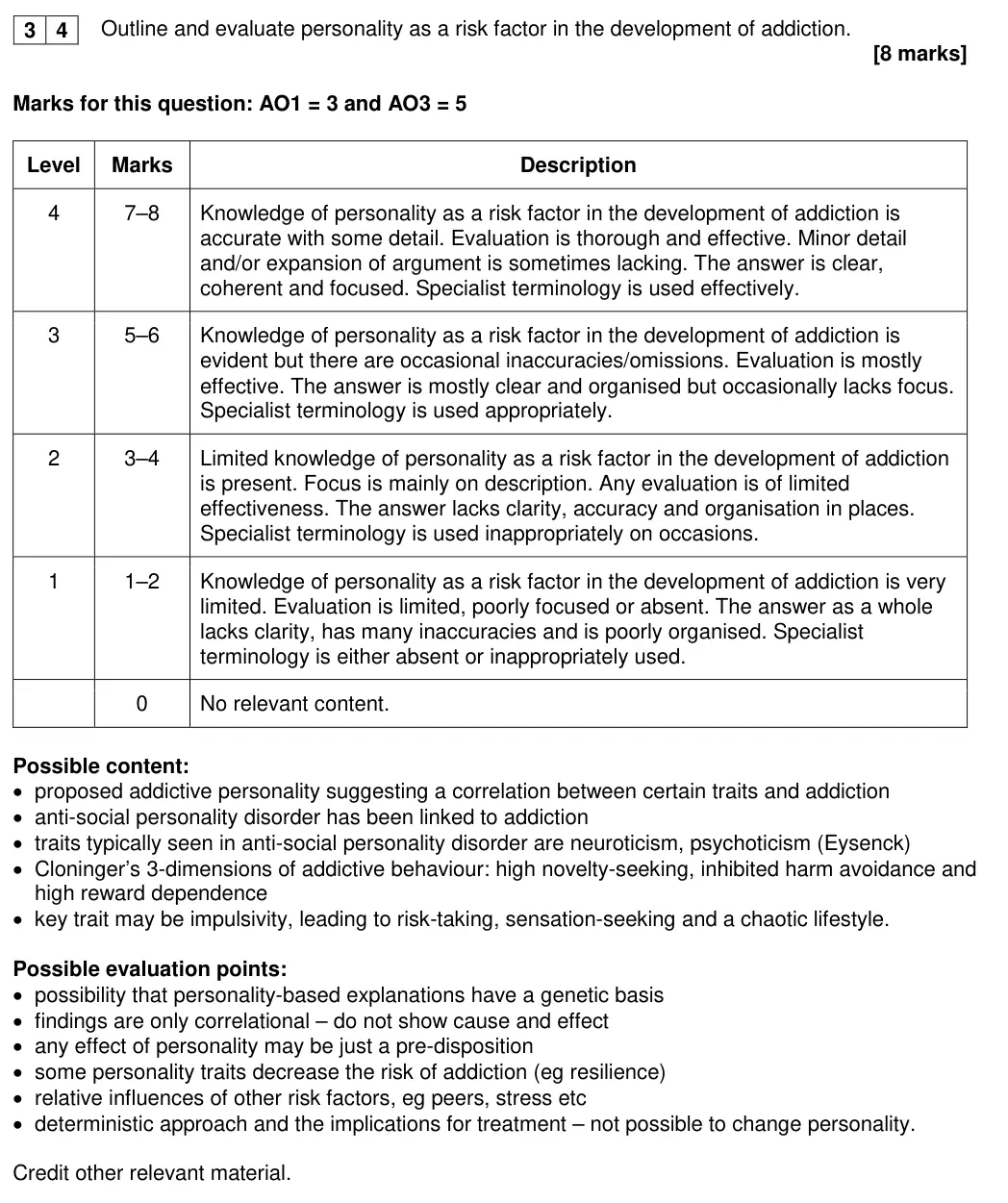
June 2019 · Paper 3 · Q348 marksAO1=3, AO3=5Extended writing
Mark scheme, including level descriptors and indicative content
Examiner's comment
This question was not usually well-answered, often being thin on content and offering only cursory evaluation. Although most students could refer to anti-social personality and impulsivity, very few responses included reference to other material, for example, Cloninger’s 3-dimensions explanation. More able students explained how the personality traits mentioned might work to increase the risk of addiction. Very few answers took the alternative stance by explaining how certain personality traits might actually help someone avoid addictive behaviours. Although the question asked about addiction in general, and thus students could have used any material from this topic area, some students had evidently seen this as linked to the previous question and confined their answer to information on gambling addiction.
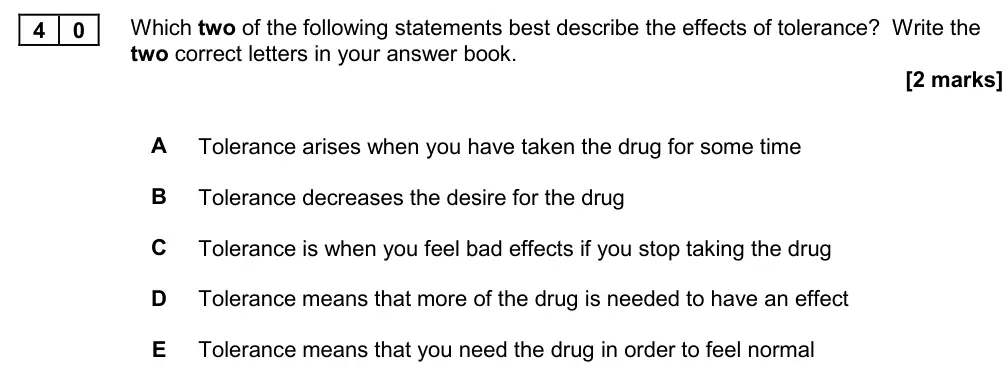
June 2018 · Paper 3 · Q402 marksAO1=2Multiple choiceEasy
Answer
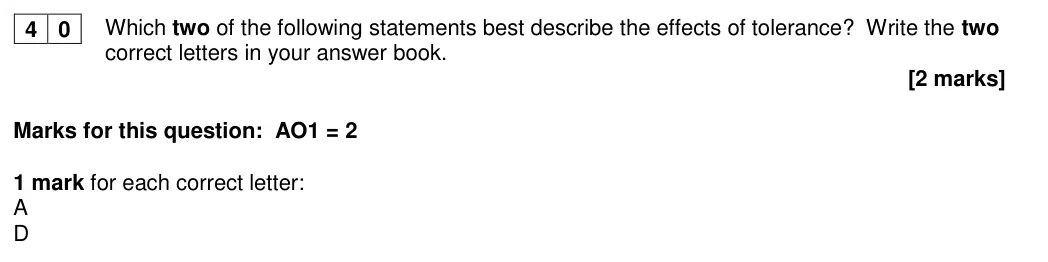
A and D
Mark scheme, including level descriptors and indicative content
Examiner's comment
The majority of students scored full marks on this question.
Notes from the mark scheme and report
correct A and D
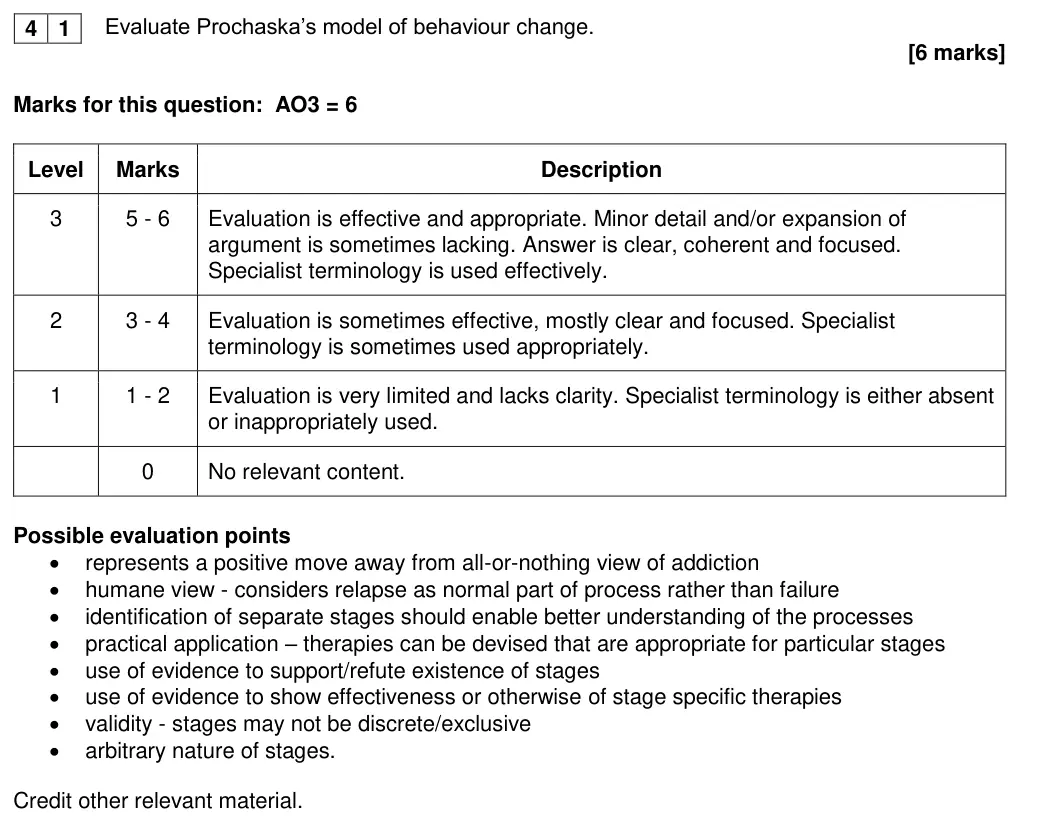
June 2018 · Paper 3 · Q416 marksAO3=6Evaluate (short)
Mark scheme, including level descriptors and indicative content
Examiner's comment
A further challenge was noted on Section D where the 6 mark questions required evaluation only, but students often preceded any evaluation with lengthy descriptions, particularly in the Aggression topic. This was often badly answered, usually because students confused the model with a treatment.
Notes from the mark scheme and report
AO3 only
often confused the model with a treatment
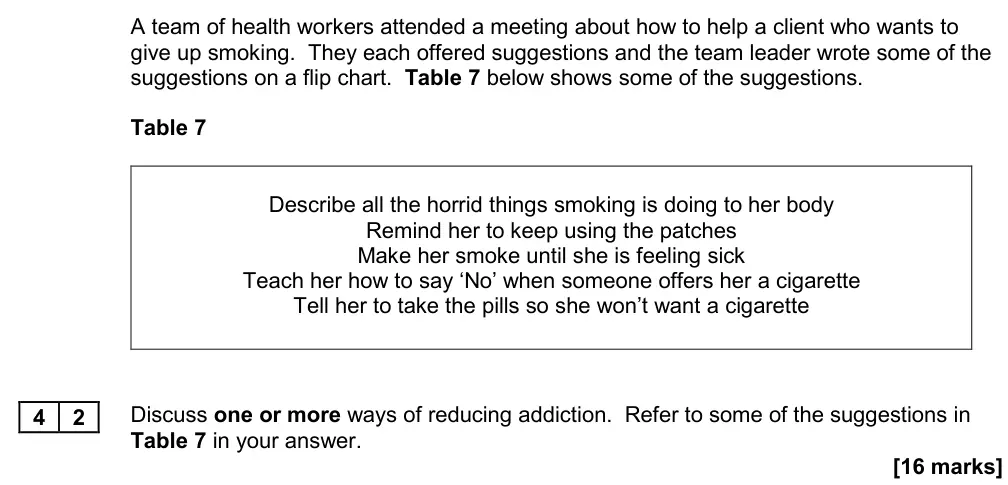
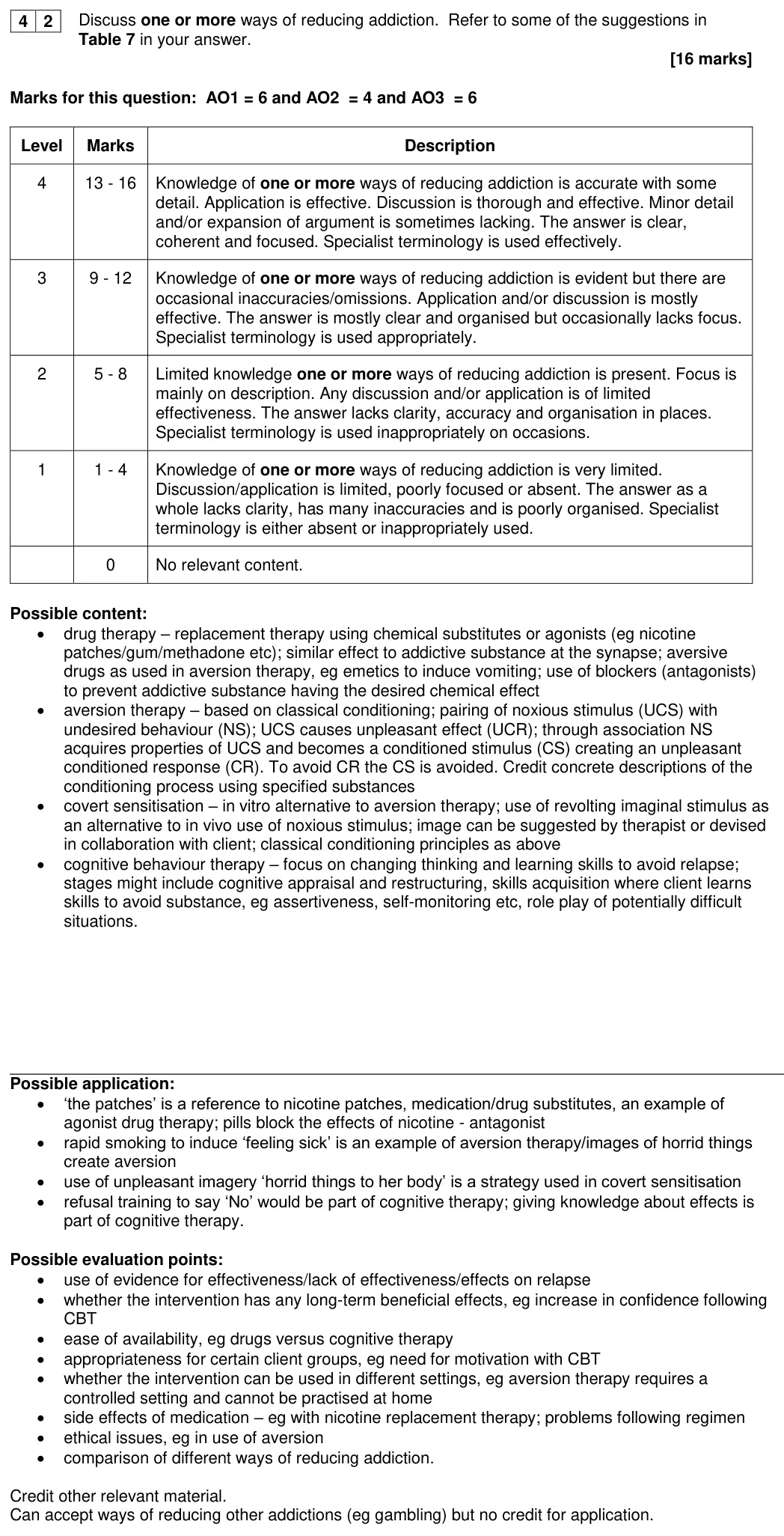
June 2018 · Paper 3 · Q4216 marksAO1=6, AO2=4, AO3=616-mark essay
Mark scheme, including level descriptors and indicative content
Examiner's comment
There were many high scoring responses. Most answers referred to combinations of drug therapy, aversion therapy and covert sensitisation. Very few used cognitive behaviour therapy. Weaker responses were characterised by sparse knowledge, for example, students referring to drug therapy failed to explain the difference between the effects of agonists and antagonists. Similarly, explanations of the conditioning principles underpinning aversion/covert sensitisation were absent from the weaker answers. As with parallel questions, applications ranged from merely likening a named way to one of the quotes in the Table, to detailed and sustained explanatory links with different aspects of the therapy.
Notes from the mark scheme and report
drug therapy (patches agonist, pills antagonist), aversion therapy (smoke until sick), covert sensitisation (horrid things), CBT (say no) applied to Table 7
no credit for application if another addiction used
weak answers lacked agonist/antagonist or conditioning detail
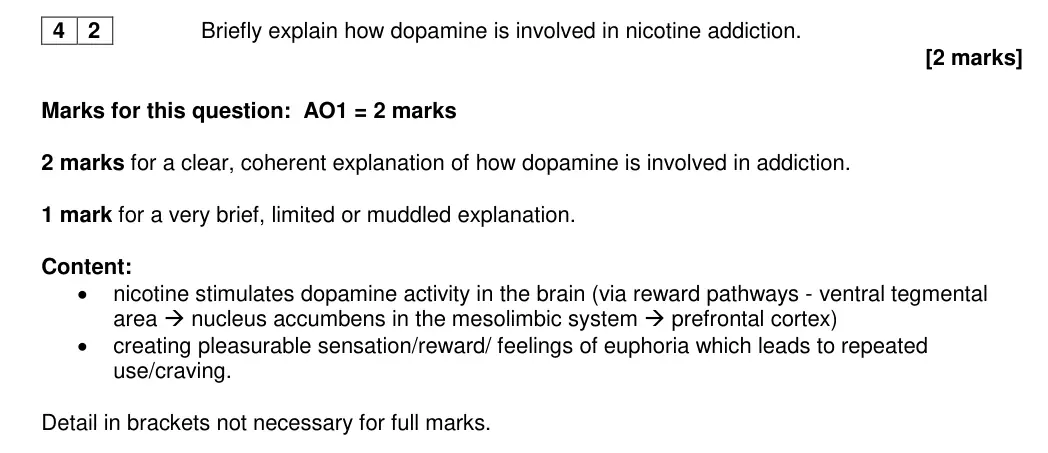
June 2017 · Paper 3 · Q422 marksAO1=2ExplainEasy
Mark scheme, including level descriptors and indicative content
Examiner's comment
This question was generally well answered, with over half of students gaining full marks.
Notes from the mark scheme and report
nicotine stimulates dopamine release in reward pathway (mesolimbic) + pleasure leading to repeated use/craving
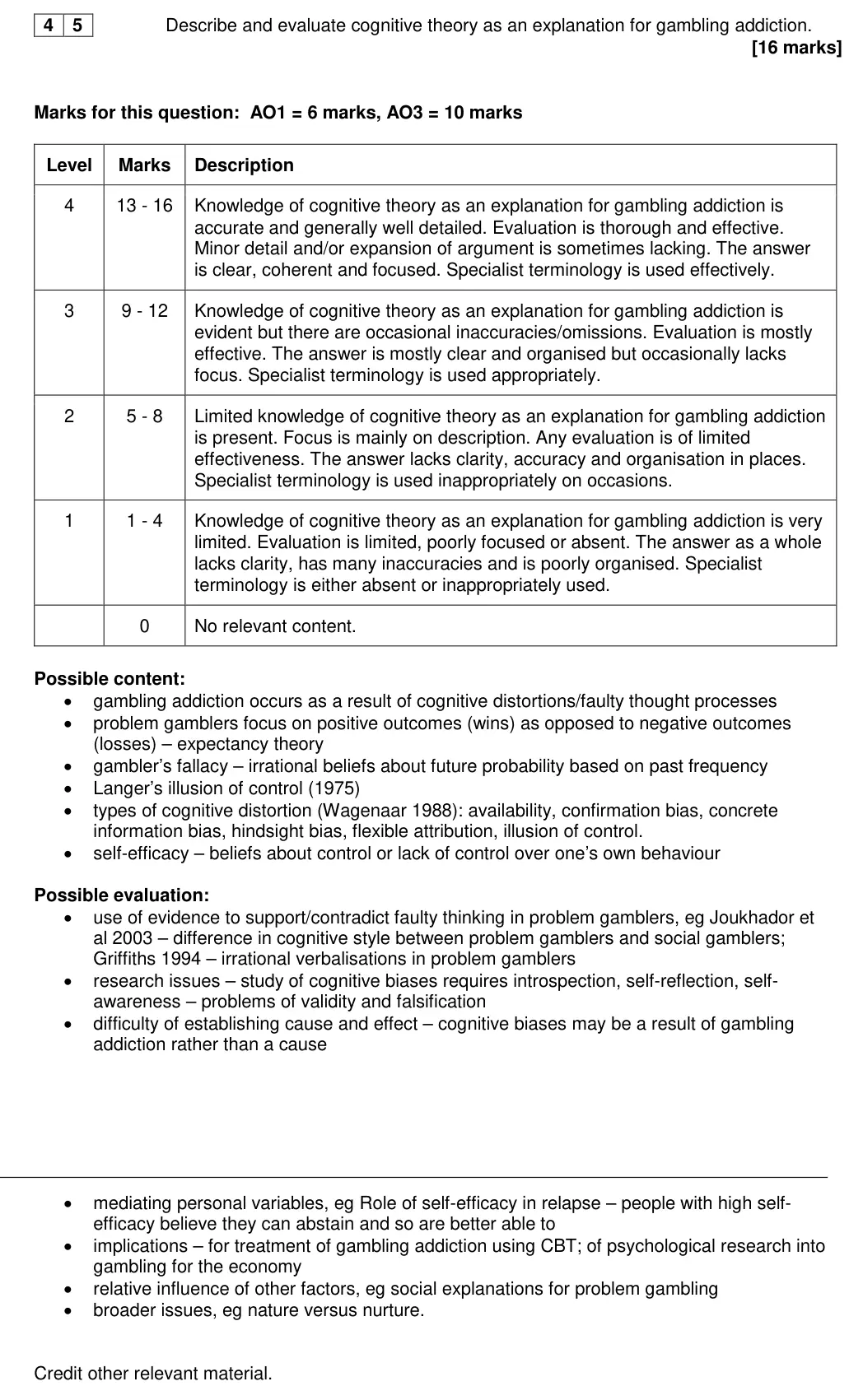
June 2017 · Paper 3 · Q4516 marksAO1=6, AO3=1016-mark essay
Mark scheme, including level descriptors and indicative content
Examiner's comment
This was a straightforward question that elicited many good responses. The mark scheme was inclusive of any content relevant to cognition, such as expectancy theory, cognitive biases, and self-efficacy. In the event, cognitive biases formed the basis of most answers and such answers tended to score well. Students often went for depth, with a few well-chosen cognitive biases plus illustrative examples. Other students covered a greater number in less depth. The latter approach sometimes resulted in a list-like answer without sufficient explanation. Discussion often made good use of research by Griffiths and the potential practical applications to come out of cognitive explanations for gambling.