36 question parts, 8 sixteen-mark essays, 6 multiple-choice items, plus 1 parts on content removed in 2025
Notes, key studies and practice items for this topic are being written by our tutors. The past-paper questions below are ready now.
Specification statements
4.3.7-01 The physiology of stress, including general adaptation syndrome, the hypothalamic pituitary-adrenal system, the sympathomedullary pathway and the role of cortisol.
4.3.7-02 The role of stress in illness, including reference to immunosuppression and cardiovascular disorders.
4.3.7-03 Sources of stress: life changes and daily hassles. Workplace stress, including the effects of workload and control.
4.3.7-04 Measuring stress: self-report scales (Social Readjustment Ratings Scale and Hassles and Uplifts Scale) and physiological measures, including skin conductance response.
4.3.7-05 Individual differences in stress: personality types A, B and C and associated behaviours; hardiness, including commitment, challenge and control.
4.3.7-06 Managing and coping with stress: drug therapy, stress inoculation therapy and biofeedback. Gender differences in coping with stress. The role of social support in coping with stress; types of social support, including instrumental, emotional and esteem support.
Tap a question to zoom it. Mark scheme and examiner's comment open under each question.
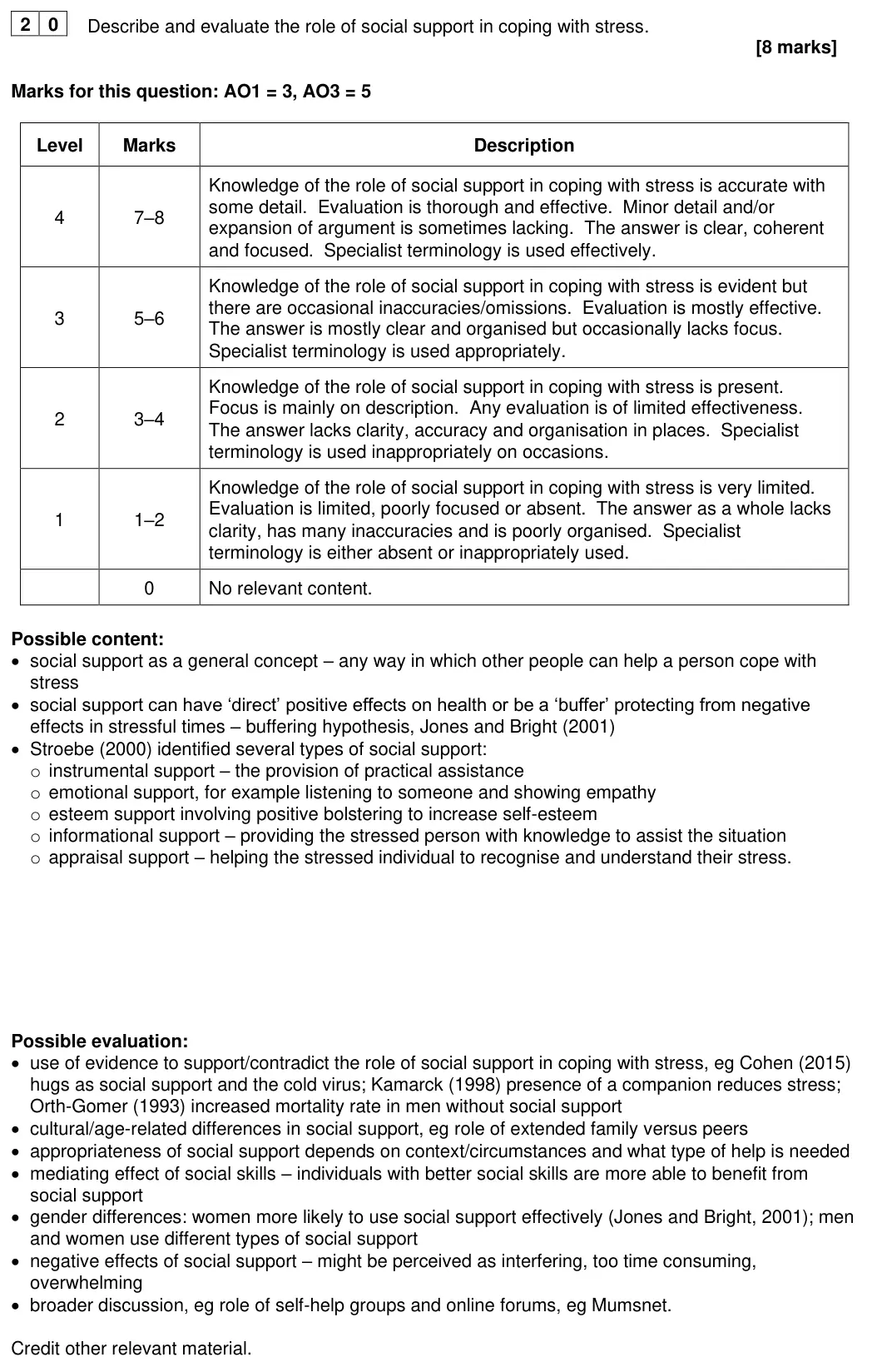
June 2025 · Paper 3 · Q208 marksAO1=3, AO3=5Extended writing
Mark scheme, including level descriptors and indicative content
Examiner's comment
For 20, most students were able to provide a summary of different types of social support – usually instrumental, emotional and esteem – supported by relevant examples. This was typically enough to satisfy the descriptive criteria required by the mark scheme. The evaluation was perhaps slightly less successful, but there was creditworthy commentary about the fact that some forms of support may not be welcomed and may even be inappropriate in some circumstances. There was a noticeable paucity of evidence for this question – students tended to confine themselves to general strengths and limitations rather than evidence-based discussion.
Notes from the mark scheme and report
types of support (instrumental, emotional, esteem), direct and buffering effects
evaluation evidence (Cohen hugs, Kamarck), gender and cultural differences, negative effects of support
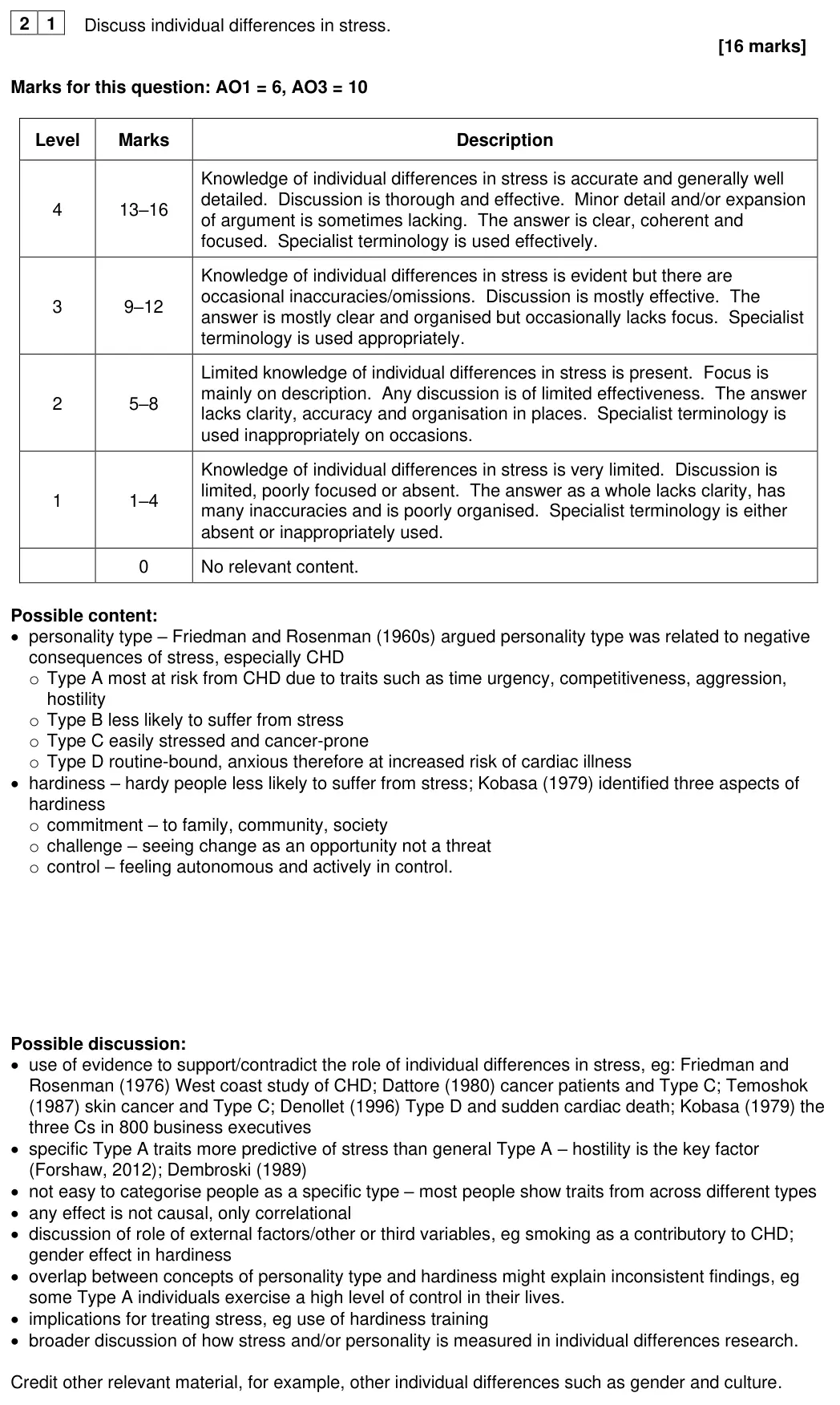
June 2025 · Paper 3 · Q2116 marksAO1=6, AO3=1016-mark essay
Mark scheme, including level descriptors and indicative content
Examiner's comment
The 16-mark essay on individual differences (21) was one of the most well answered on the paper. Many students were well versed in the different personality types: A, B, C and hardiness, and made explicit links to stress throughout. There were lots of examples of relevant evidence, though it was not uncommon for these to be a little muddled when it came to the detail – Kiecolt-Glaser’s research was probably the main culprit here. Oddly, there were many accounts of the Johanneson sawmill study even though it was not directly relevant to the question. That said, there were many very good answers for this question.
Notes from the mark scheme and report
AO3 = 10 marks
Type A, B, C (and D) and hardiness (commitment, challenge, control)
evidence Friedman and Rosenman, Kobasa, hostility as key factor
one of the best answered
evidence detail sometimes muddled
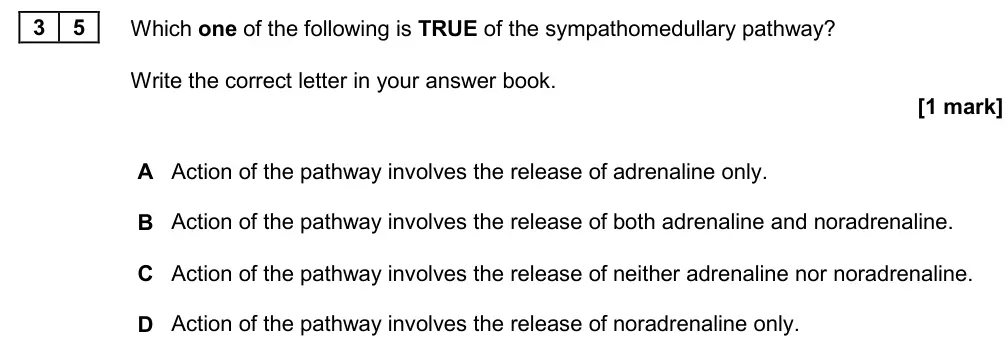
June 2024 · Paper 3 · Q351 markAO1=1Multiple choice
Answer
B
Mark scheme, including level descriptors and indicative content
Examiner's comment
Although Question 35 proved slightly more problematic, there were still lots of correct answers.
Notes from the mark scheme and report
answer B (SAM releases both adrenaline and noradrenaline)
slightly more problematic than other MCQs
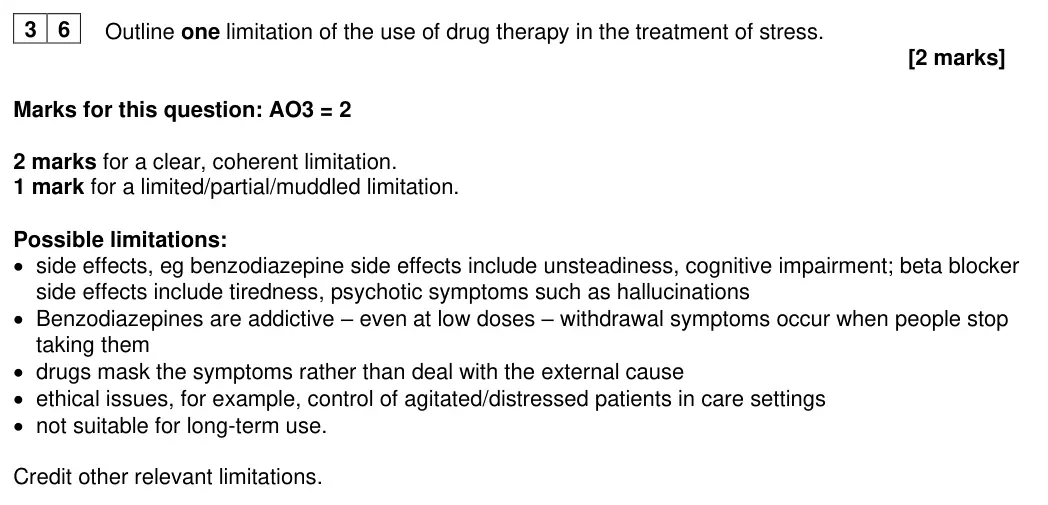
June 2024 · Paper 3 · Q362 marksAO3=2Evaluate (short)
Mark scheme, including level descriptors and indicative content
Examiner's comment
Students approached Question 36 in a similar way to the corresponding Schizophrenia question, and so marks were often awarded for reference to side-effects, plus some elaboration. For this section, students were more likely to talk about the issue of drugs ‘masking’ the problem and not tackling the true source of stress.
Notes from the mark scheme and report
2 marks for a clear limitation: side effects, addiction/withdrawal, masks symptoms not cause, not for long-term use
MS examples name benzodiazepines/beta blockers (named drugs removed in v1.4) but generic drug therapy limitations suffice
June 2024 · Paper 3 · Q374 marksAO1=2, AO3=2Explain
Mark scheme, including level descriptors and indicative content
Examiner's comment
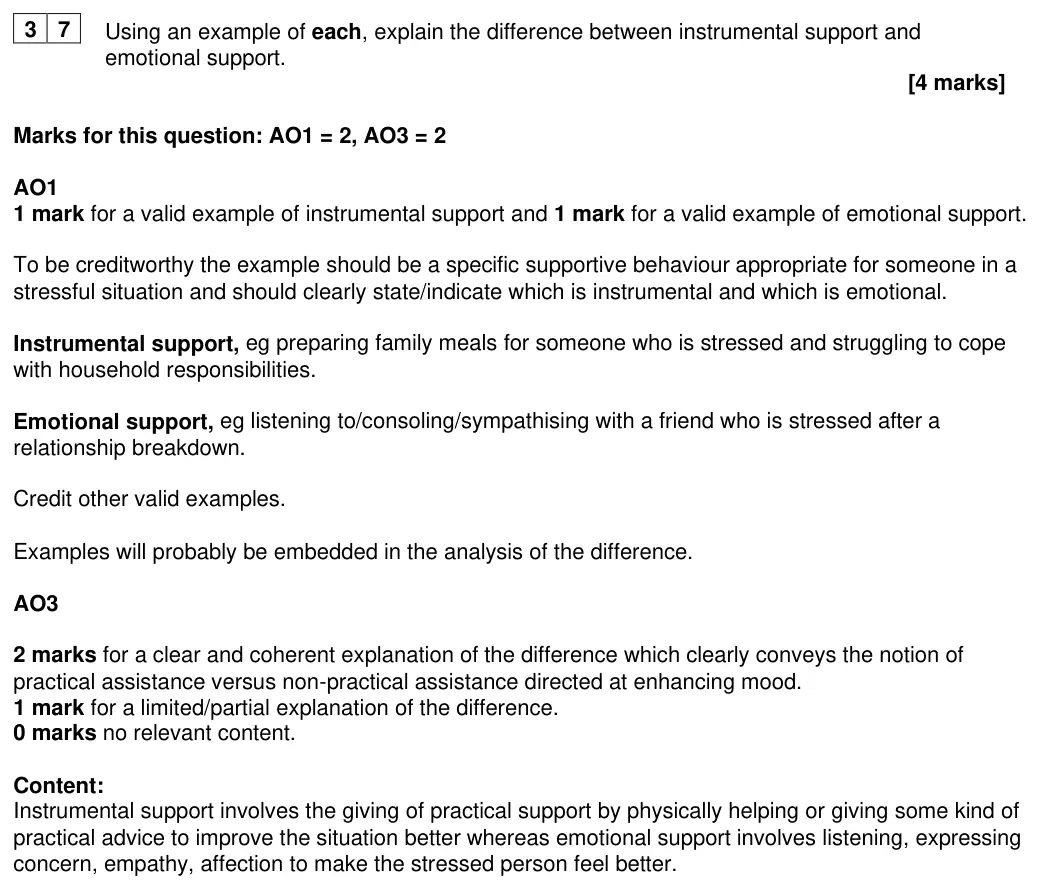
In Question 37, students were typically much more effective when outlining and giving examples of instrumental support than emotional support. For the latter, definitions and examples too often overlapped and were somewhat repetitive.
Notes from the mark scheme and report
AO1: 1 mark specific instrumental example (practical help) + 1 mark emotional example (listening/consoling), clearly labelled
AO3: 2 marks practical help vs mood-enhancing support
emotional support examples often overlapped with definitions
June 2024 · Paper 3 · Q3816 marksAO1=6, AO2=4, AO3=616-mark essay
Mark scheme, including level descriptors and indicative content
Examiner's comment
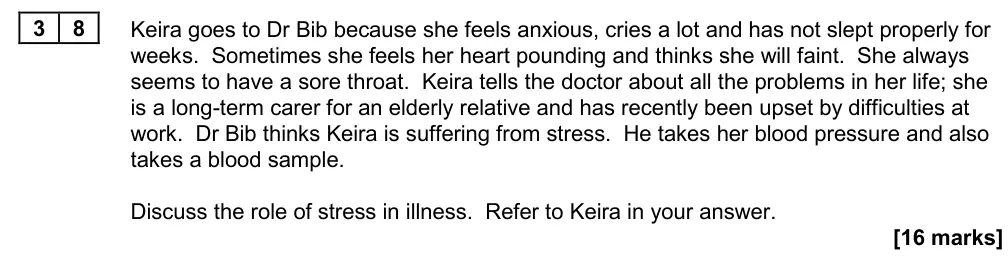
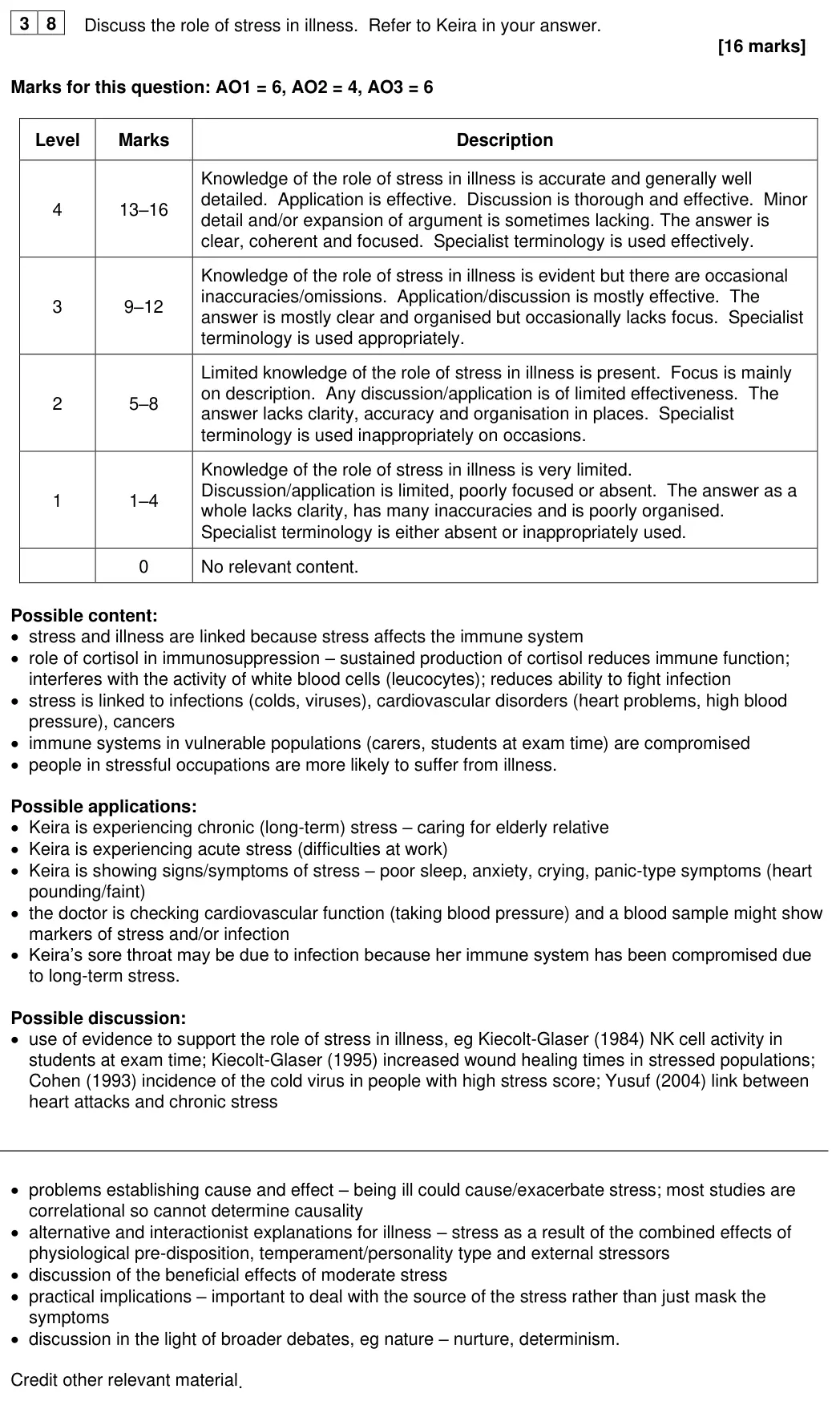
Answers for the extended response question (Q38) were probably the weakest of the three in Section C, although there were some very good responses, nevertheless. Most students went down the route of describing research evidence, and picked up knowledge marks that way, rather than describing the biological links between stress and illness. Some of the evidence presented was muddled, with an amalgam of two or three different studies at once. This also meant that students were less able to successfully apply their knowledge to the example of Kiera in the question. In terms of discussion, many students recognised the problem of mediating variables, usually diet and/or personality, when trying to assess the impact of stress on illness.
Notes from the mark scheme and report
immunosuppression via cortisol, cardiovascular disorders
most relied on describing research rather than the biological mechanism
studies muddled together
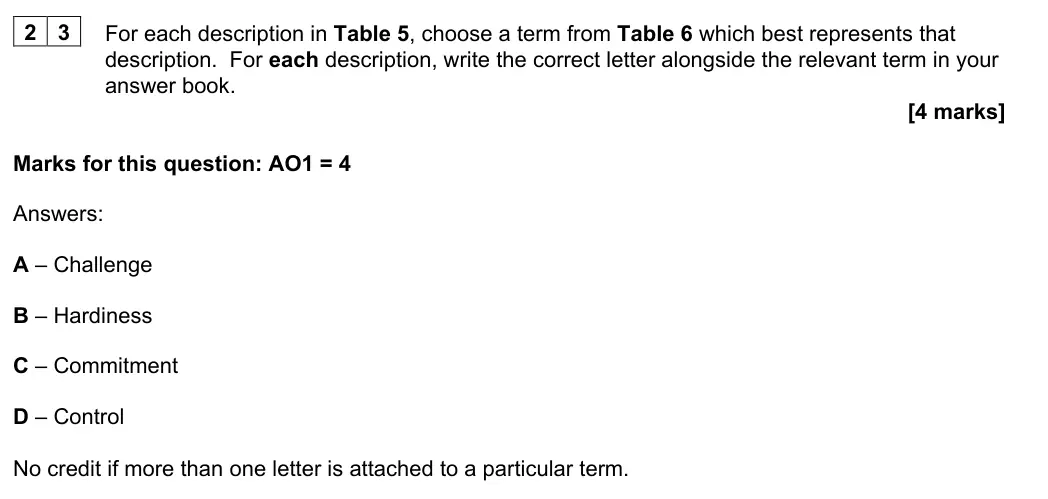
June 2023 · Paper 3 · Q234 marksAO1=4Multiple choice
Answer
A and B and C and D
Mark scheme, including level descriptors and indicative content
Examiner's comment
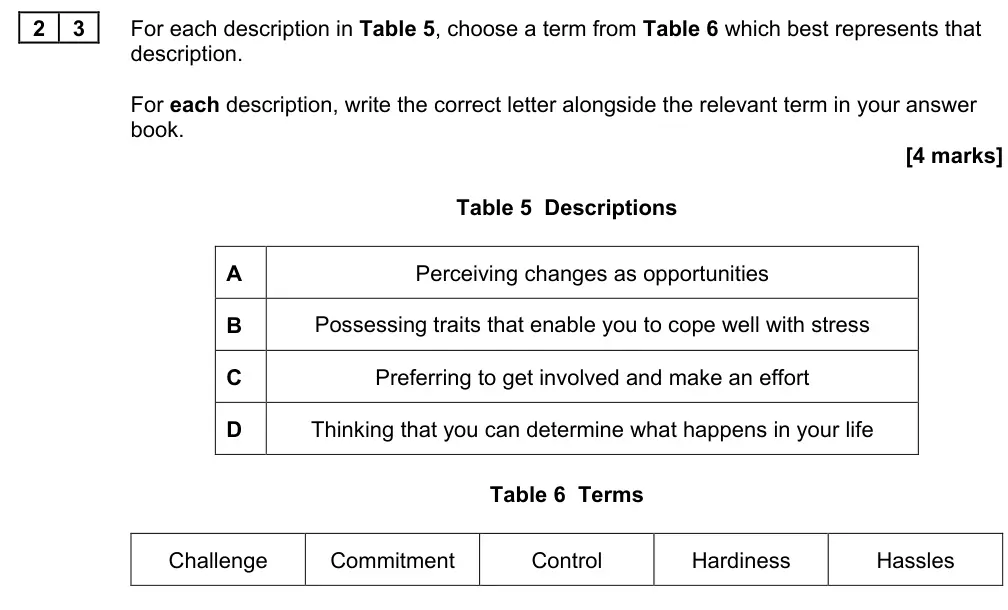
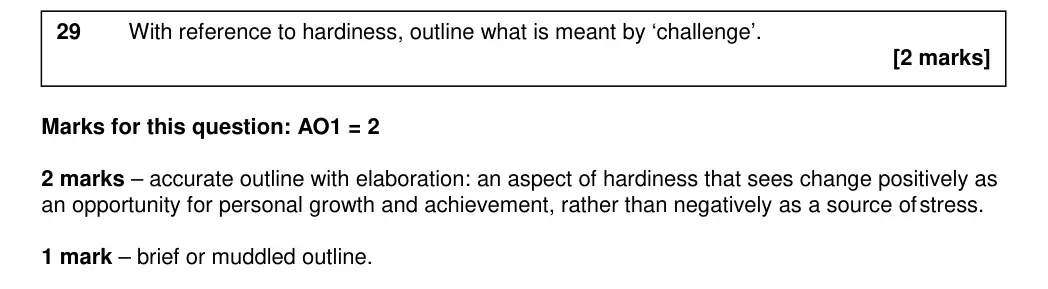
Each of the optional topics in Section C began with a 4-mark multiple-choice question, none of which proved particularly problematic for students. Most answers achieved all four marks, though there was occasional confusion between challenge and commitment. The incorrect option ‘hassles’ was very rarely seen as part of an answer.
Notes from the mark scheme and report
A Challenge, B Hardiness, C Commitment, D Control
'hassles' is the distractor
occasional confusion of challenge and commitment
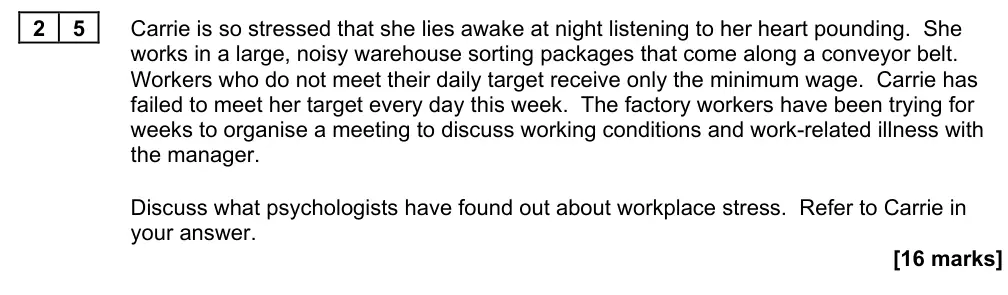
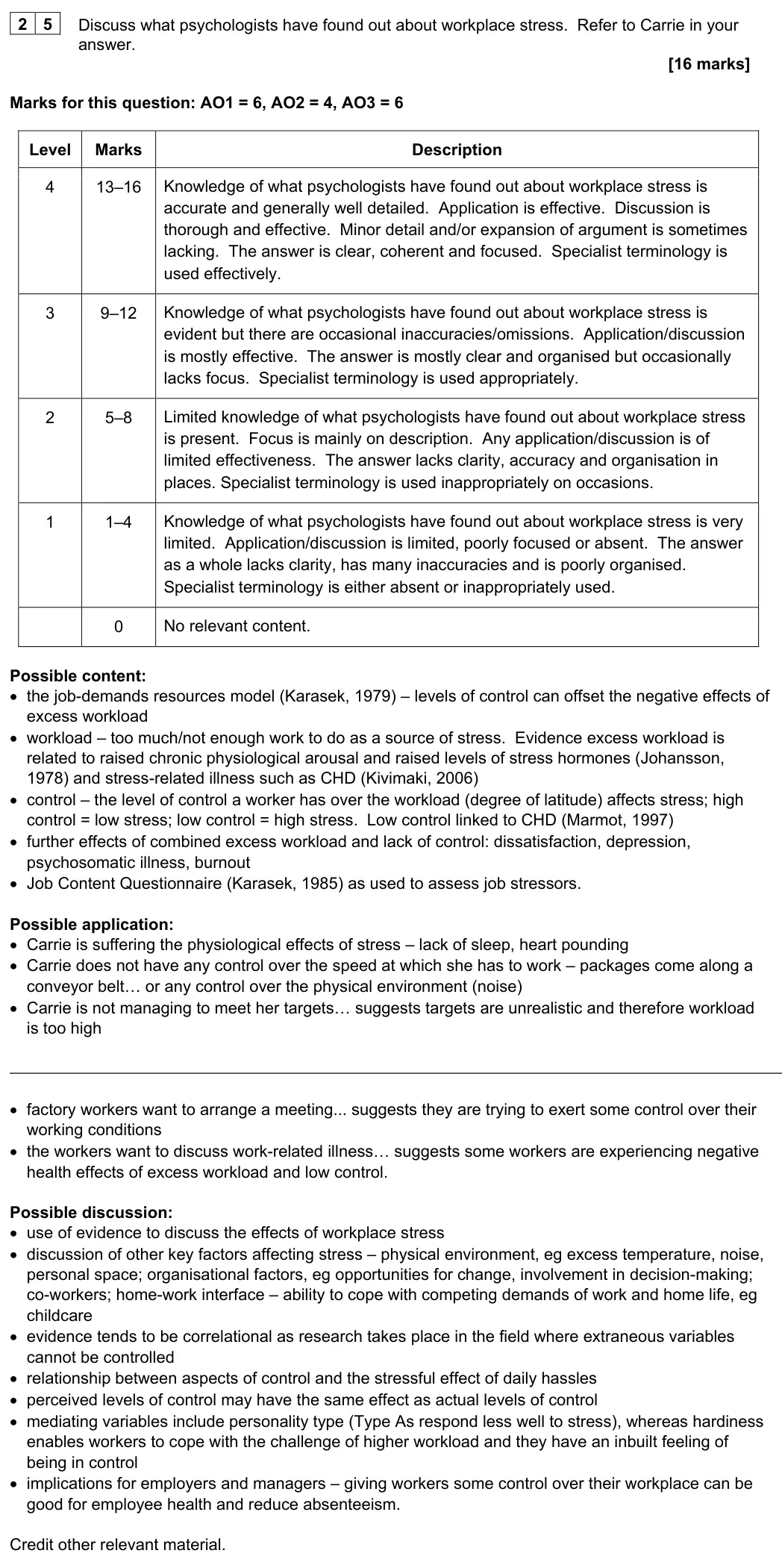
June 2023 · Paper 3 · Q2516 marksAO1=6, AO2=4, AO3=616-mark essay
Mark scheme, including level descriptors and indicative content
Examiner's comment
This question was generally well-answered. But unusually, students seemed to struggle most with the descriptive content of the question. Having made the point that stress at work tends to be associated with high workload and low control, many students seemed unsure of where to go next. Therefore, most knowledge marks were accessed through description of evidence, such as Marmot et al’s study of civil servants and/or Johannson et al’s study of sawmill workers. Evaluation and application marks proved easier to come by, mostly because of the many ‘hooks’ in the question. This meant that any number of brief descriptive points could be linked to Carrie’s situation.
Notes from the mark scheme and report
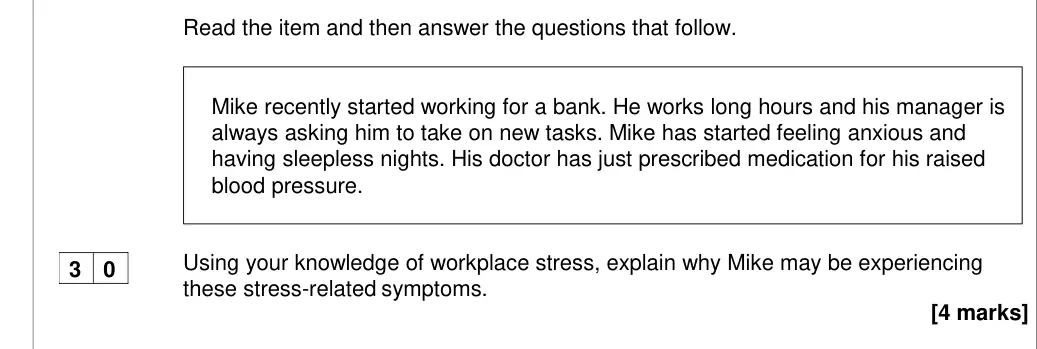
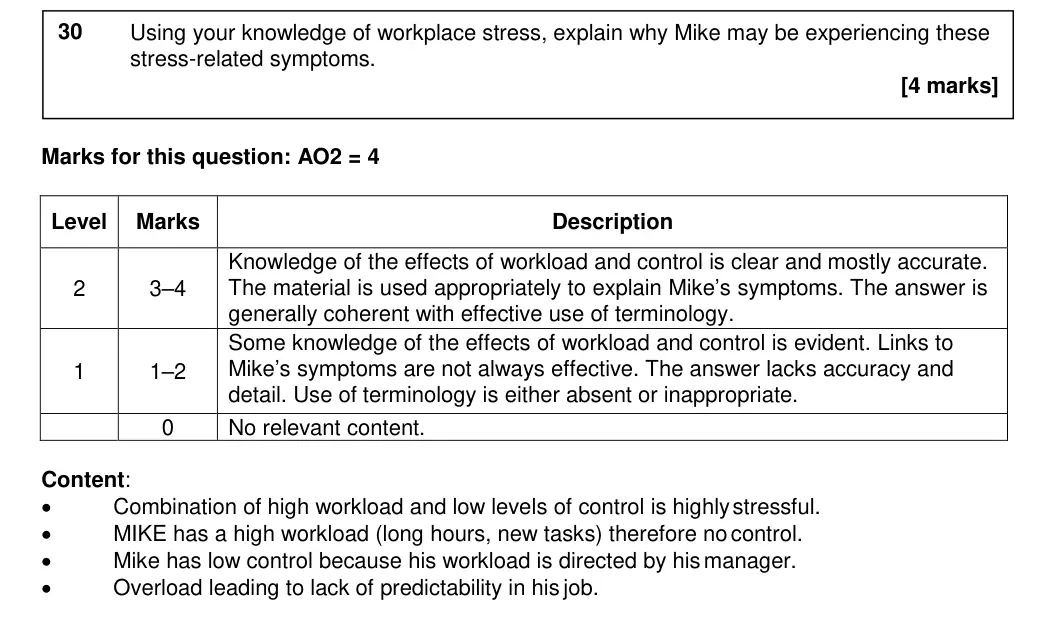
workload and control (Karasek, Marmot, Johansson) applied to Carrie (conveyor belt = low control, missed targets = high workload, physiological symptoms)
students struggled with descriptive content beyond workload/control and relied on describing studies
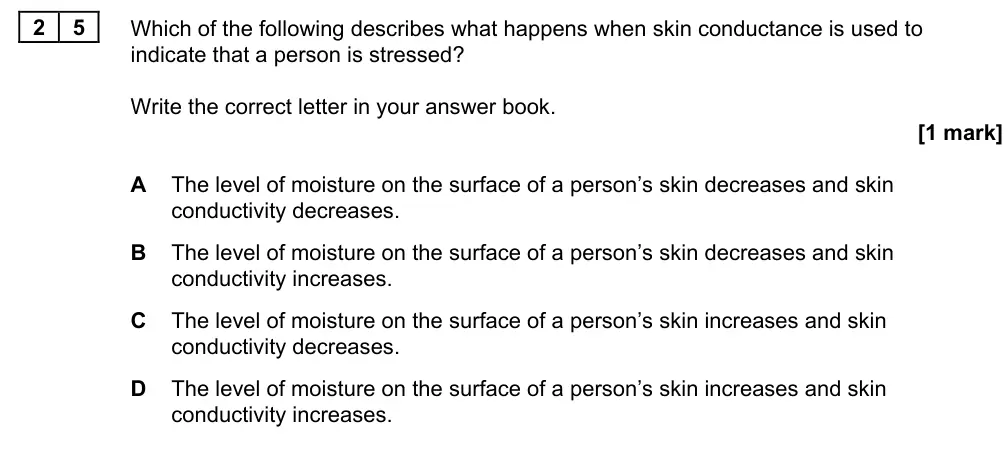
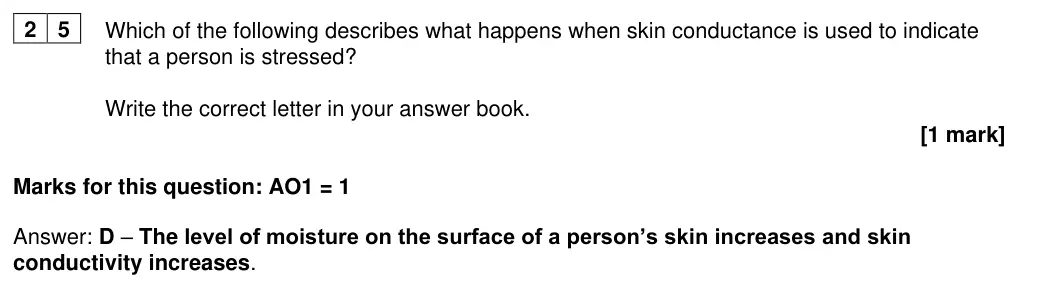
June 2022 · Paper 3 · Q251 markAO1=1Multiple choiceMedium
Answer
D
Mark scheme, including level descriptors and indicative content
Examiner's comment
Most answers to the first multiple-choice question were correct whereas roughly half the answers to the second multiple-choice question were correct.
Notes from the mark scheme and report
correct D (moisture increases, conductivity increases)
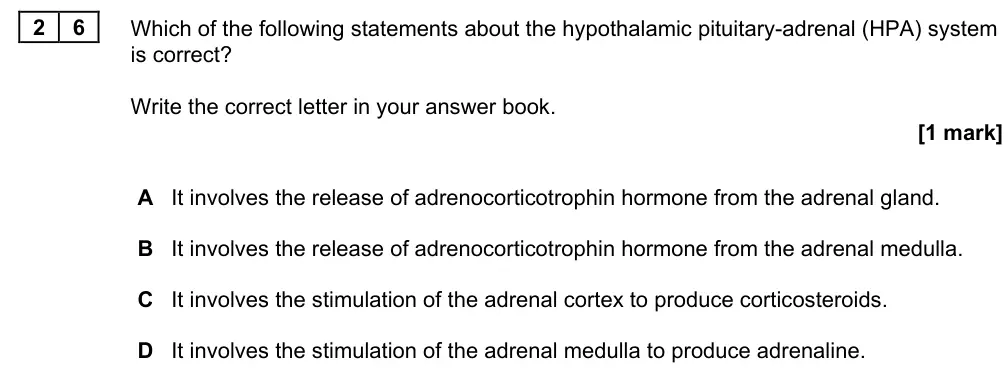
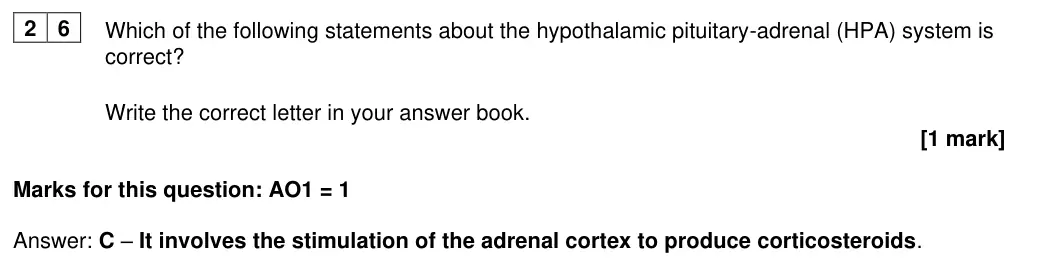
June 2022 · Paper 3 · Q261 markAO1=1Multiple choiceMedium
Answer
C
Mark scheme, including level descriptors and indicative content
Examiner's comment
Most answers to the first multiple-choice question were correct whereas roughly half the answers to the second multiple-choice question were correct.
Notes from the mark scheme and report
correct C (adrenal cortex produces corticosteroids)
distractors confuse ACTH source and SAM (adrenal medulla/adrenaline)
only about half correct
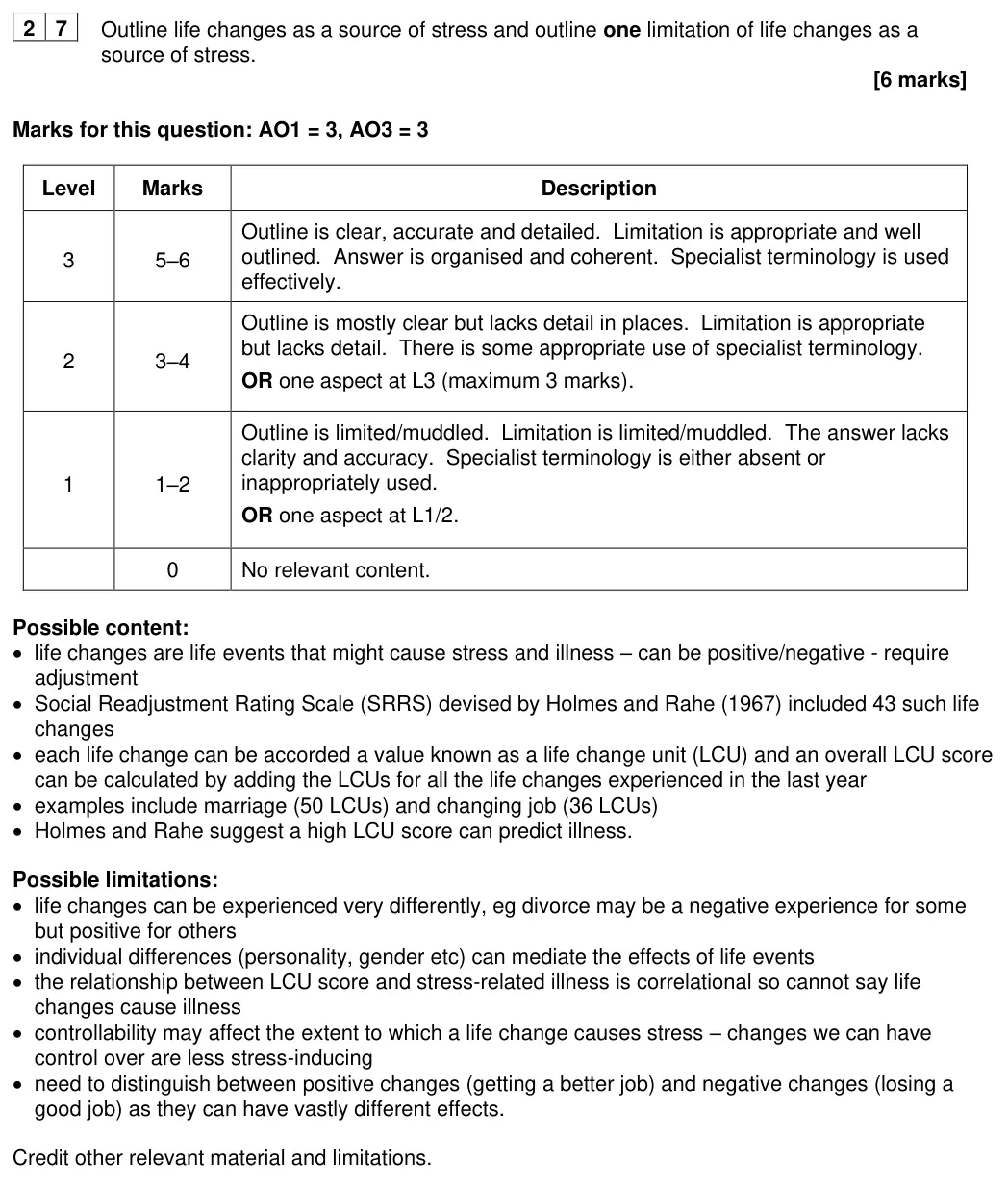
June 2022 · Paper 3 · Q276 marksAO1=3, AO3=3Outline
Mark scheme, including level descriptors and indicative content
Examiner's comment
Question 27 often elicited sound knowledge and understanding which included useful detail of the SRRS and life change units. The limitation tended to be less well done than the description with a tendency to focus on evaluation of the scale rather than on life changes as a source of stress. The simplest and most effective limitation tended to be the subjective nature of life change experience so that a given life event might not be stressful for everyone.
Notes from the mark scheme and report
life changes, SRRS, LCUs + one limitation of life changes as a SOURCE of stress (e.g. subjective experience, correlational)
one aspect only = max 3
limitations of the scale itself were less effective
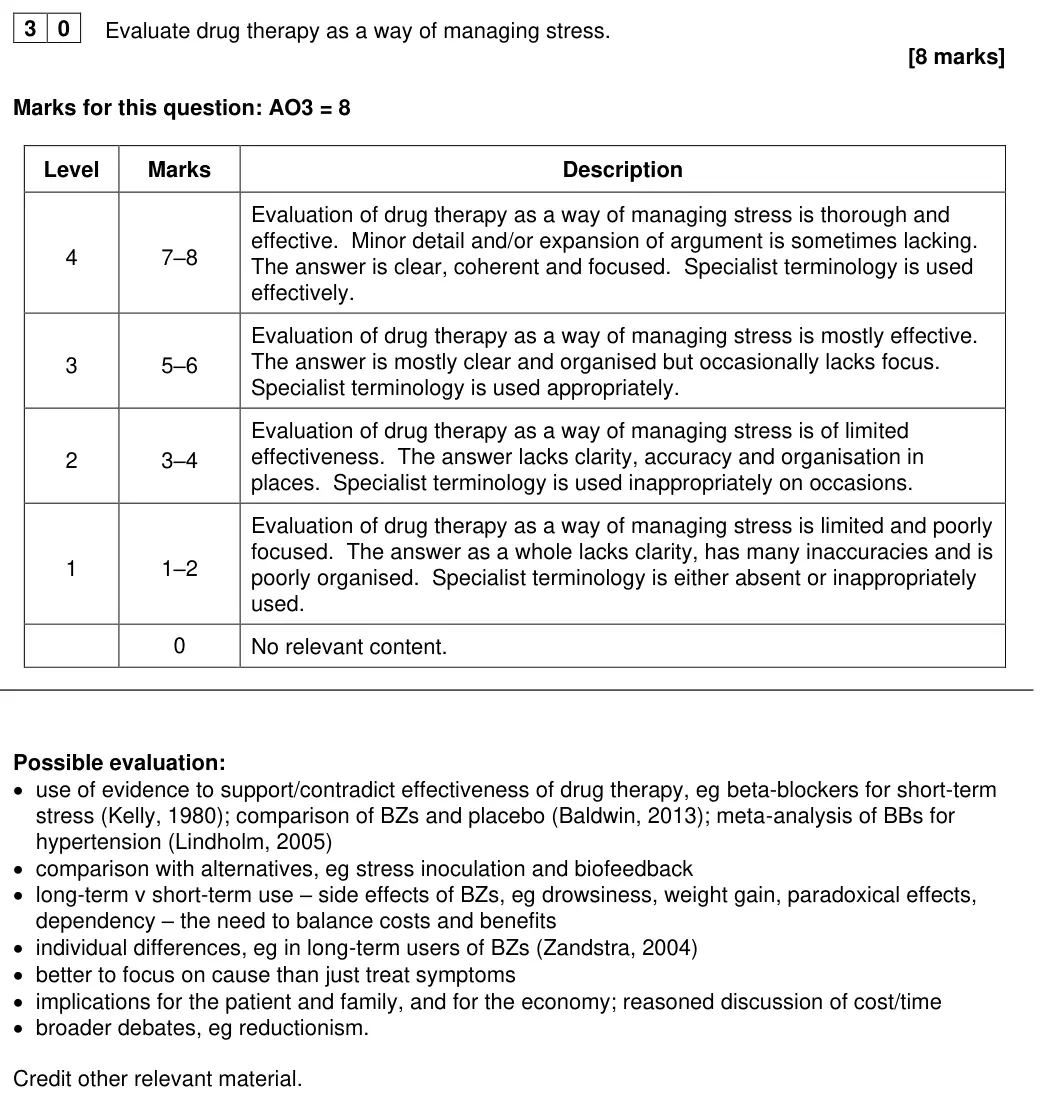
June 2022 · Paper 3 · Q308 marksAO3=8Extended writing
Mark scheme, including level descriptors and indicative content
Examiner's comment
Question 30 was usually well answered except where students wasted time describing drugs and their mode of action. Vague and unsubstantiated assertions that ‘drugs work’ and points about time and cost without reasoned argument were not creditworthy.
Notes from the mark scheme and report
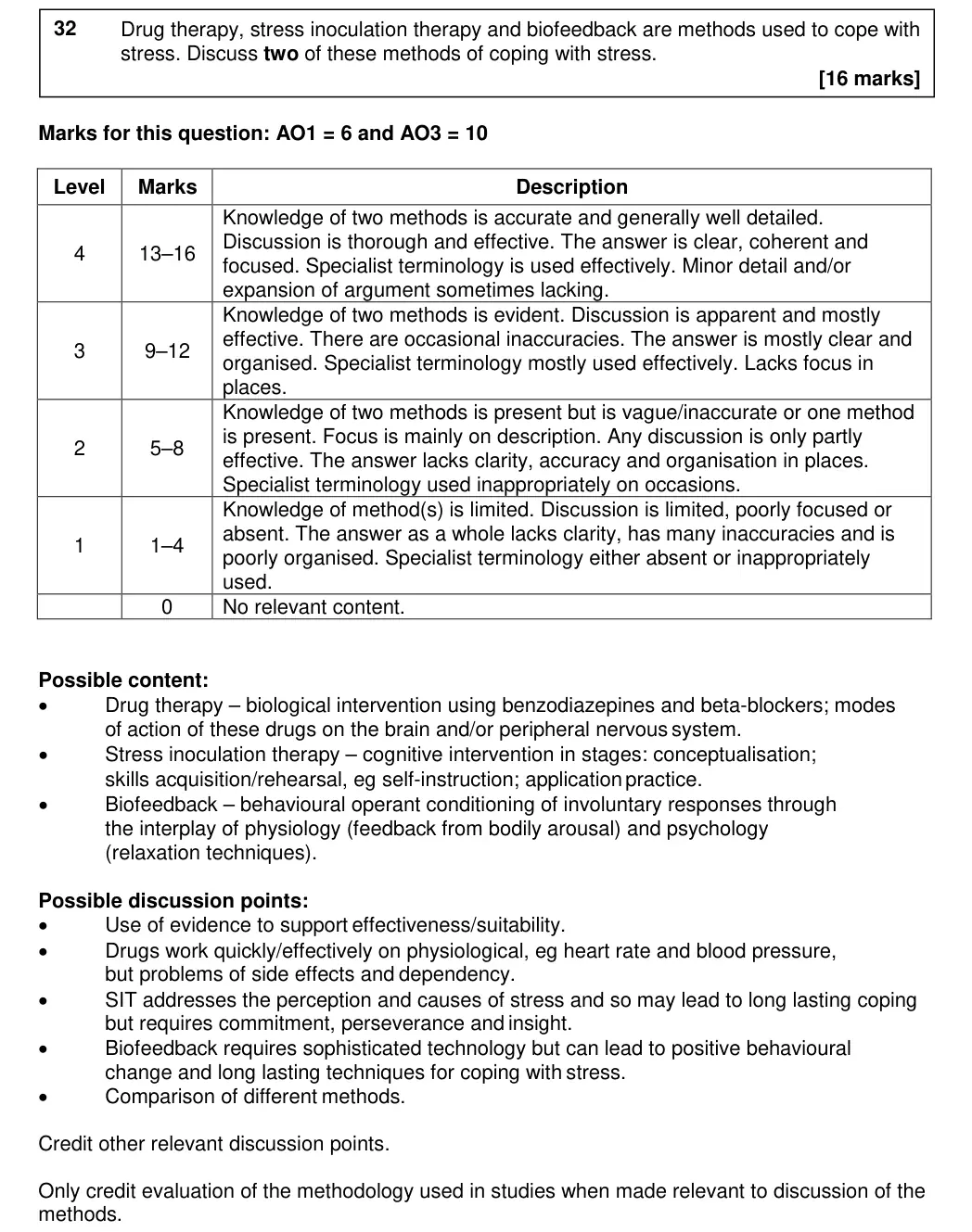
AO3 only: effectiveness evidence, side effects/dependency, symptoms not causes, comparison with SIT/biofeedback
MS cites named drugs (benzodiazepines, beta blockers), removed in v1.4 but drug therapy remains
describing drug action wasted time
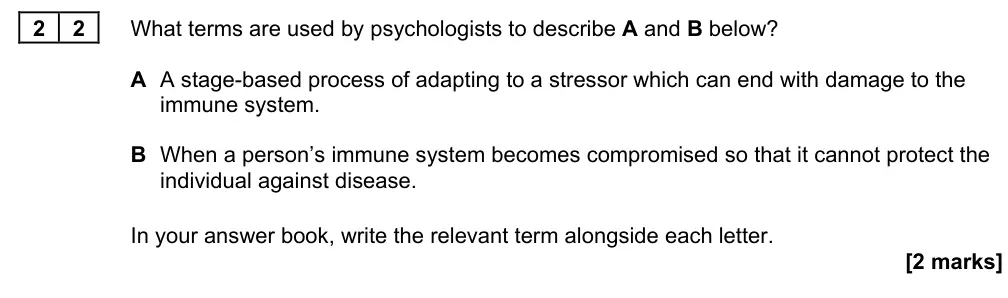
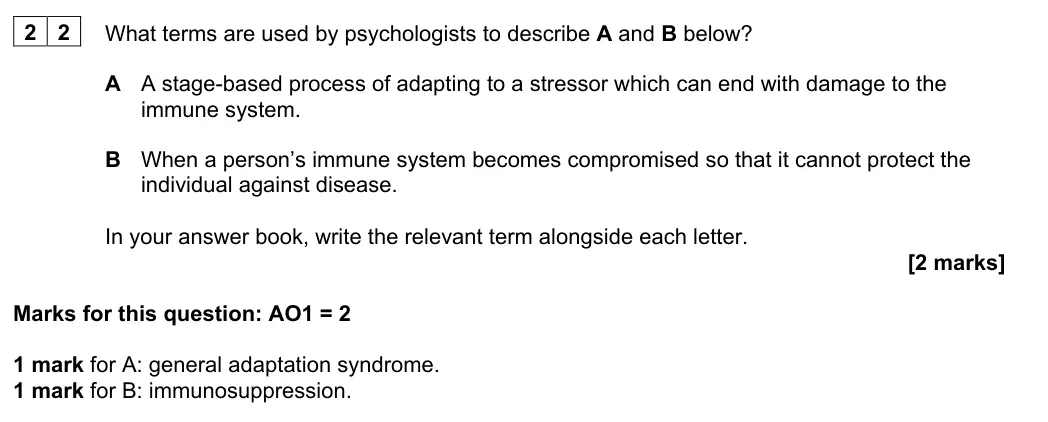
November 2021 · Paper 3 · Q222 marksAO1=2Short answer
Mark scheme, including level descriptors and indicative content
Examiner's comment
Very few answers to the Eating and Stress questions were seen. The definitions questions seemed to discriminate quite well in all topics. Where students wrote more than one term per letter only the first answer was credited.
Notes from the mark scheme and report
A general adaptation syndrome, B immunosuppression
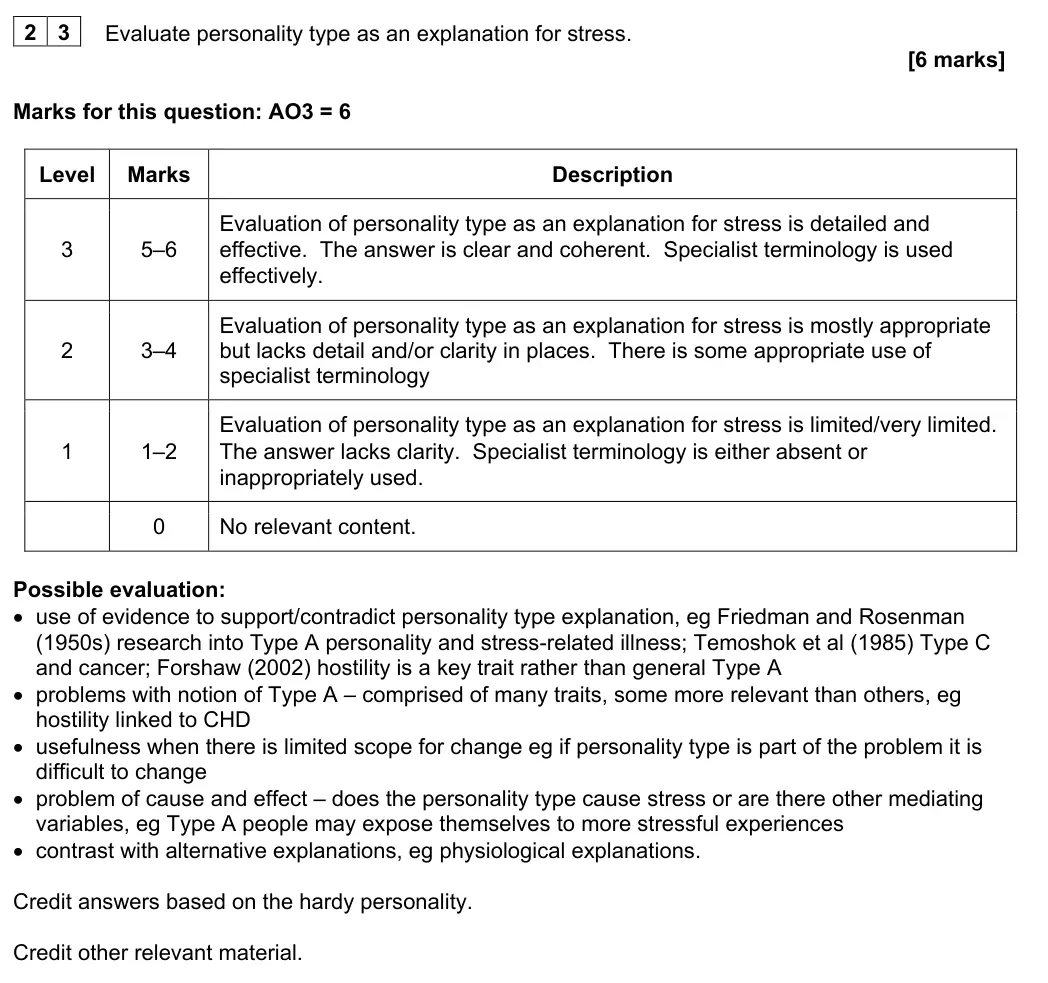
November 2021 · Paper 3 · Q236 marksAO3=6Evaluate (short)
Mark scheme, including level descriptors and indicative content
Examiner's comment
Very few answers to the Eating and Stress questions were seen. The 6-mark evaluation questions often scored poorly because students described the explanation instead of evaluating. The most effective evaluations tended to be those that used evidence to either support or counter the explanation. In answers to Q23, Kobasa’s hardiness theory was credited as a personality type where it was offered.
Notes from the mark scheme and report
Type A/B/C evidence, hostility as key trait, cause and effect
hardiness credited as a personality type
November 2021 · Paper 3 · Q2416 marksAO1=6, AO2=4, AO3=616-mark essay
Mark scheme, including level descriptors and indicative content
Examiner's comment
Very few answers to the Eating and Stress questions were seen. The 16-mark extended writing responses required students to combine all three skills. In the few responses to Q24, knowledge of social support was often particularly weak despite specific types being named in the Specification.
Notes from the mark scheme and report
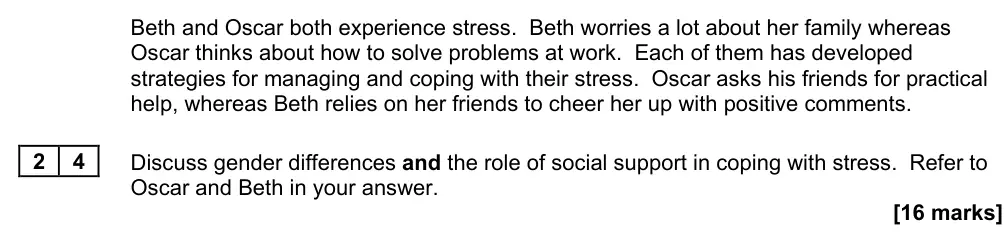
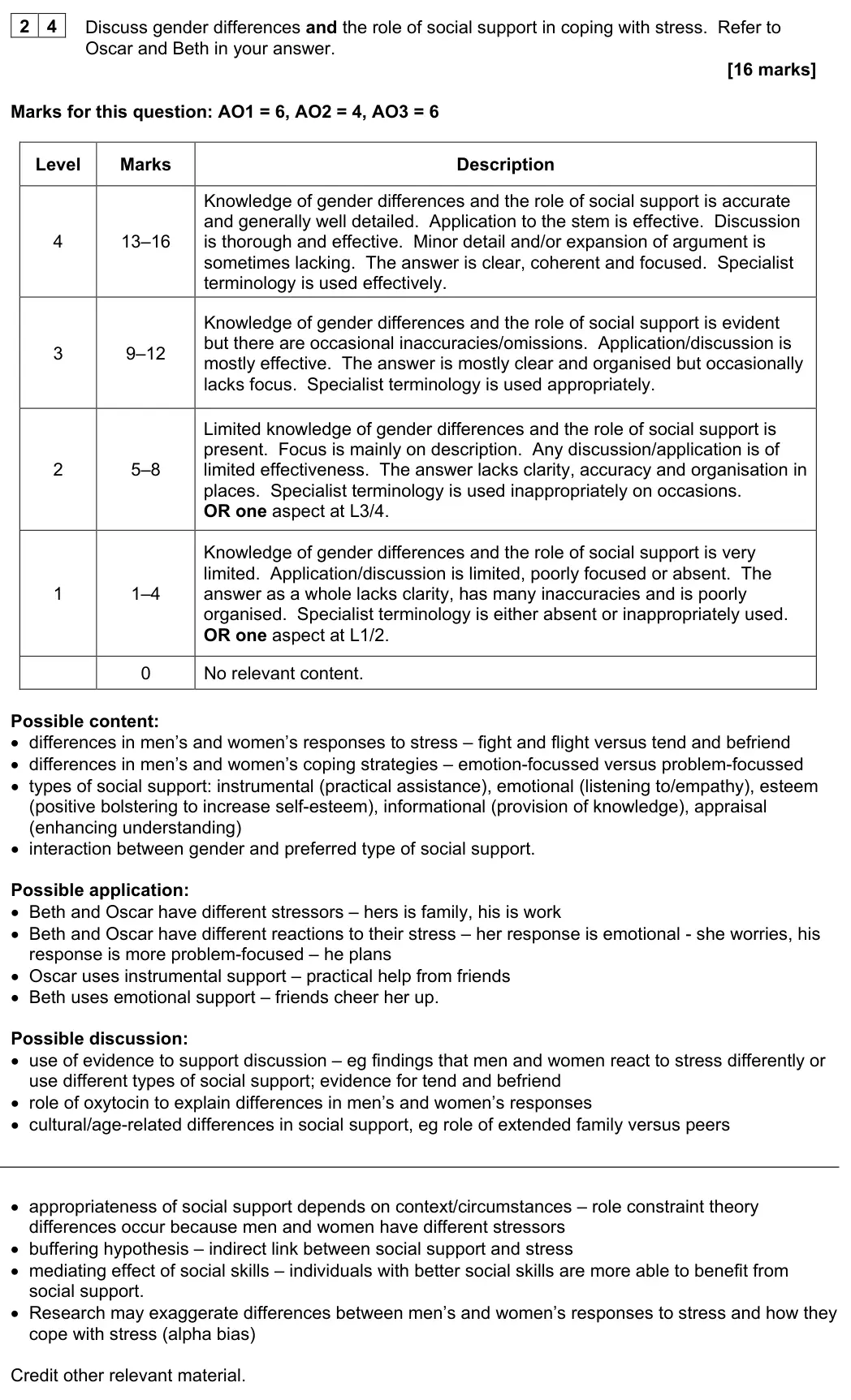
gender differences (tend and befriend, emotion- vs problem-focused) AND social support types (Oscar instrumental, Beth emotional)
one aspect only = max Level 2
knowledge of support types often weak
November 2020 · Paper 3 · Q264 marksAO1=2, AO3=2Evaluate (short)
Mark scheme, including level descriptors and indicative content
Examiner's comment
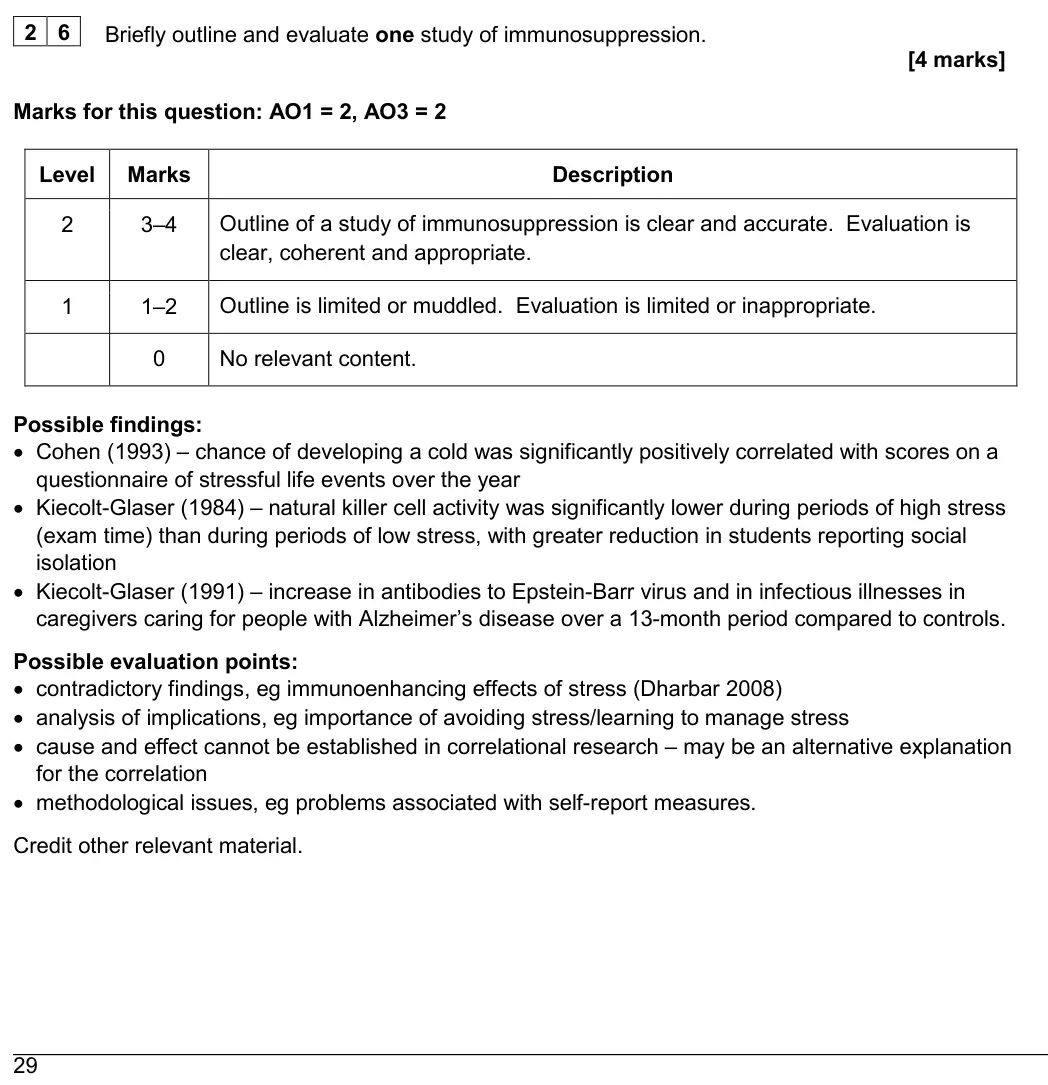
The 4-mark study questions required both outline and evaluation. Outlines varied but the majority of students failed to offer any evaluation.
Notes from the mark scheme and report
e.g. Kiecolt-Glaser exam stress/NK cells, Cohen colds
correlational evaluation
November 2020 · Paper 3 · Q274 marksAO2=4Application
Mark scheme, including level descriptors and indicative content
Examiner's comment
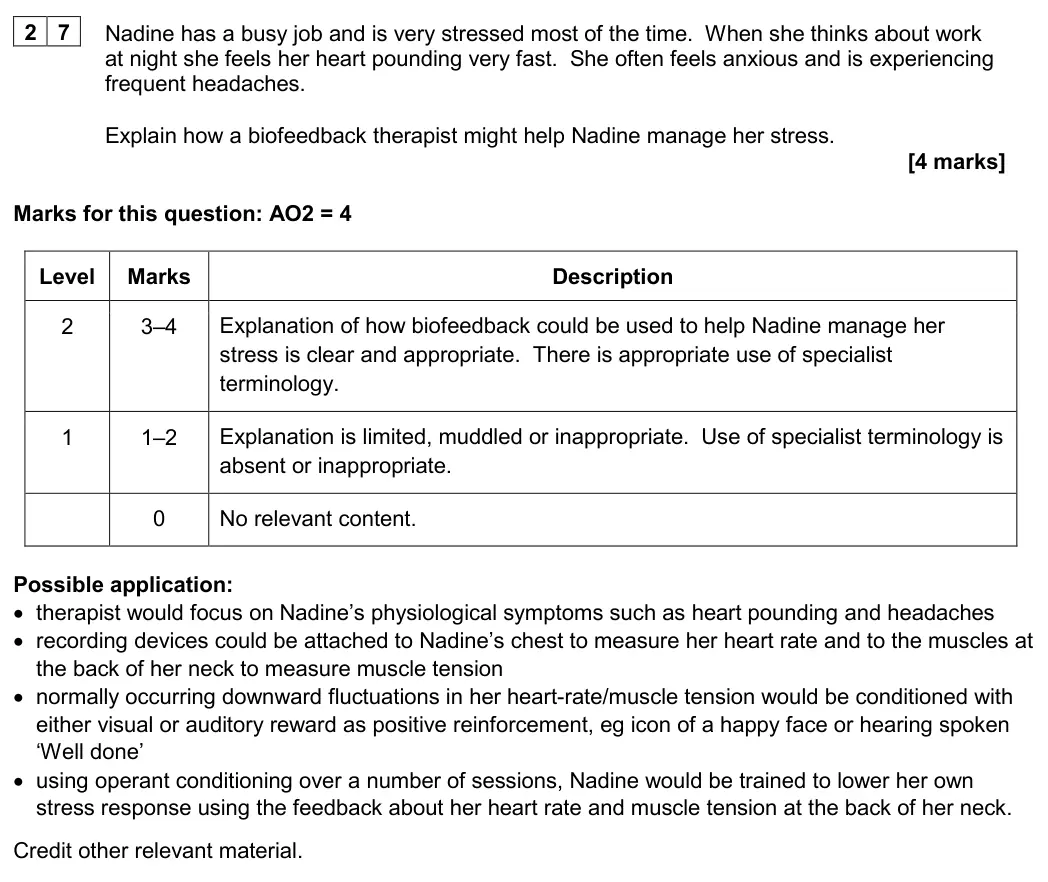
For the application questions in this section most responses included relevant information but not all showed explicit application to the stem for Level 2. Students should be reminded that successful application involves clear engagement with the content in the stem and that simple name dropping is not enough. For the Stress question on biofeedback, very few students mentioned aspects of conditioning theory.
Notes from the mark scheme and report
measure heart rate/muscle tension, feedback, operant reinforcement of reductions, practice over sessions
must apply to Nadine's pounding heart and headaches
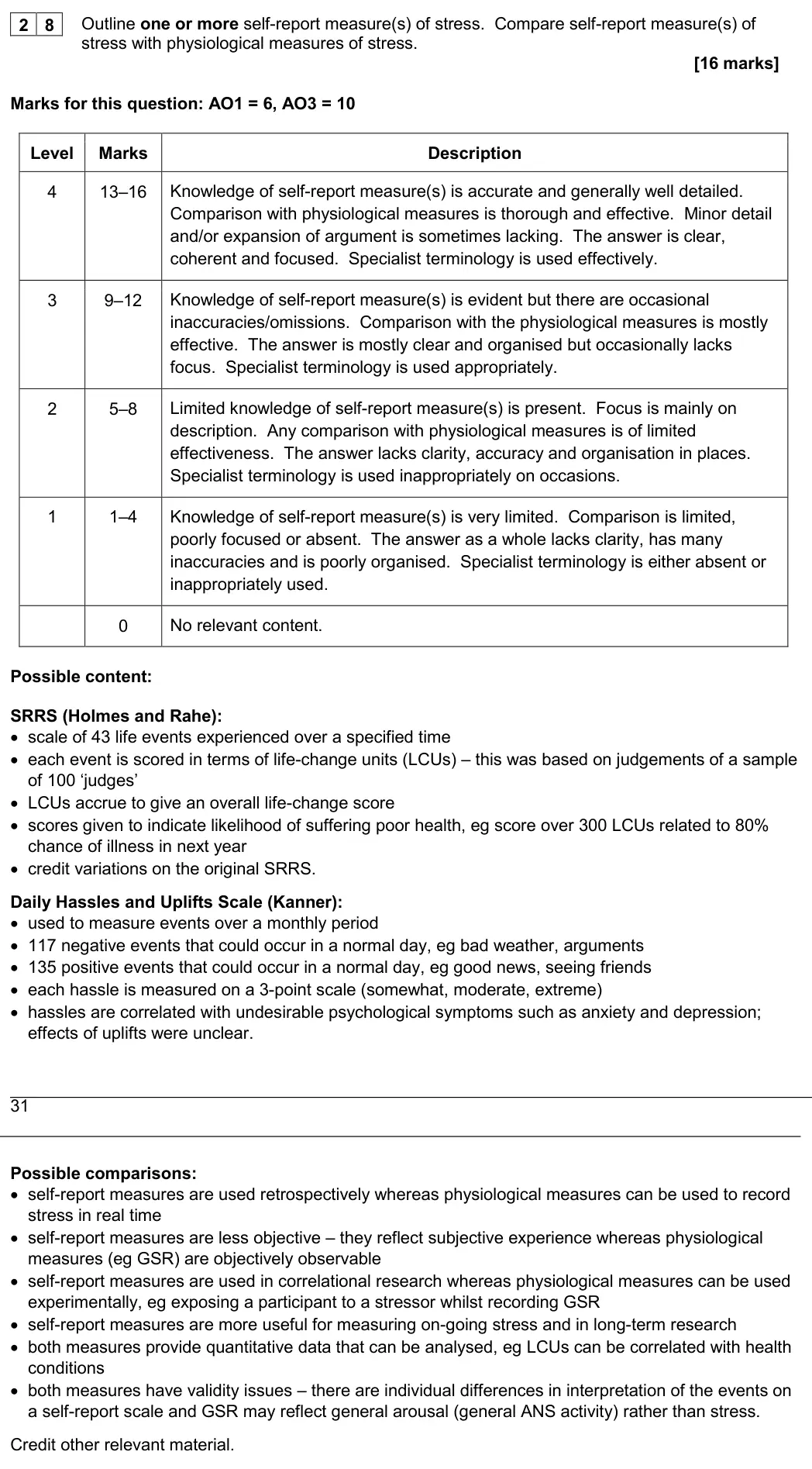
November 2020 · Paper 3 · Q2816 marksAO1=6, AO3=1016-mark essay
Mark scheme, including level descriptors and indicative content
Examiner's comment
In the extended writing questions knowledge was usually sound but clear and explicit comparison was scarce. Students should be reminded of the need to develop the higher-level skill of comparison in all areas of the Specification.
Notes from the mark scheme and report
SRRS (LCUs) and/or Hassles and Uplifts
AO3 is a comparison with physiological measures (e.g. skin conductance): retrospective vs real-time, subjective vs objective
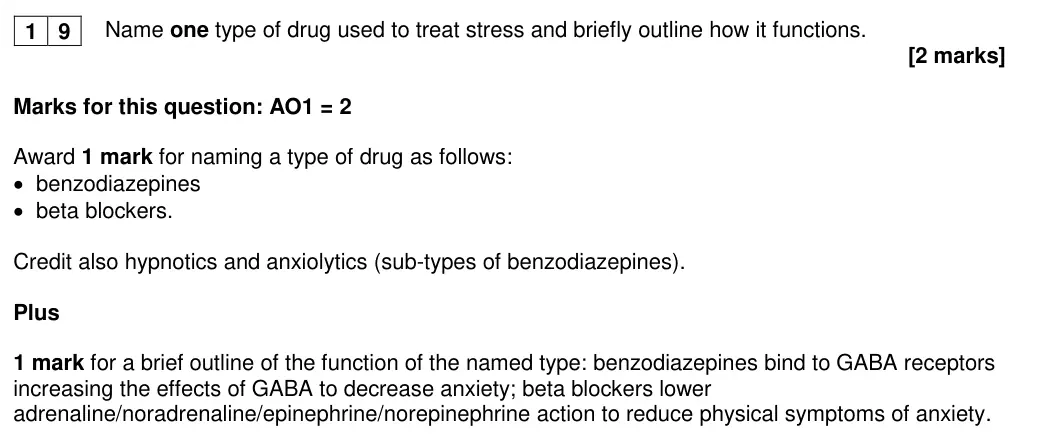
June 2019 · Paper 3 · Q192 marksAO1=2Short answerOld spec only
Mark scheme, including level descriptors and indicative content
Examiner's comment
Most students could name either beta-blockers or benzodiazepines. As the question asked for naming, ‘BZs’ was not accepted. The majority of answers included some brief outline of how the drug functions, either referring to GABA action or adrenaline/noradrenaline action. Occasionally, the outline was a vague reference to the effect, for example, calming the nervous system, rather than the function.
Notes from the mark scheme and report
(needs a named stress drug type: benzodiazepines or beta blockers, removed in v1.4
drug therapy remains)
'BZs' not accepted
vague 'calms the nervous system' not a function
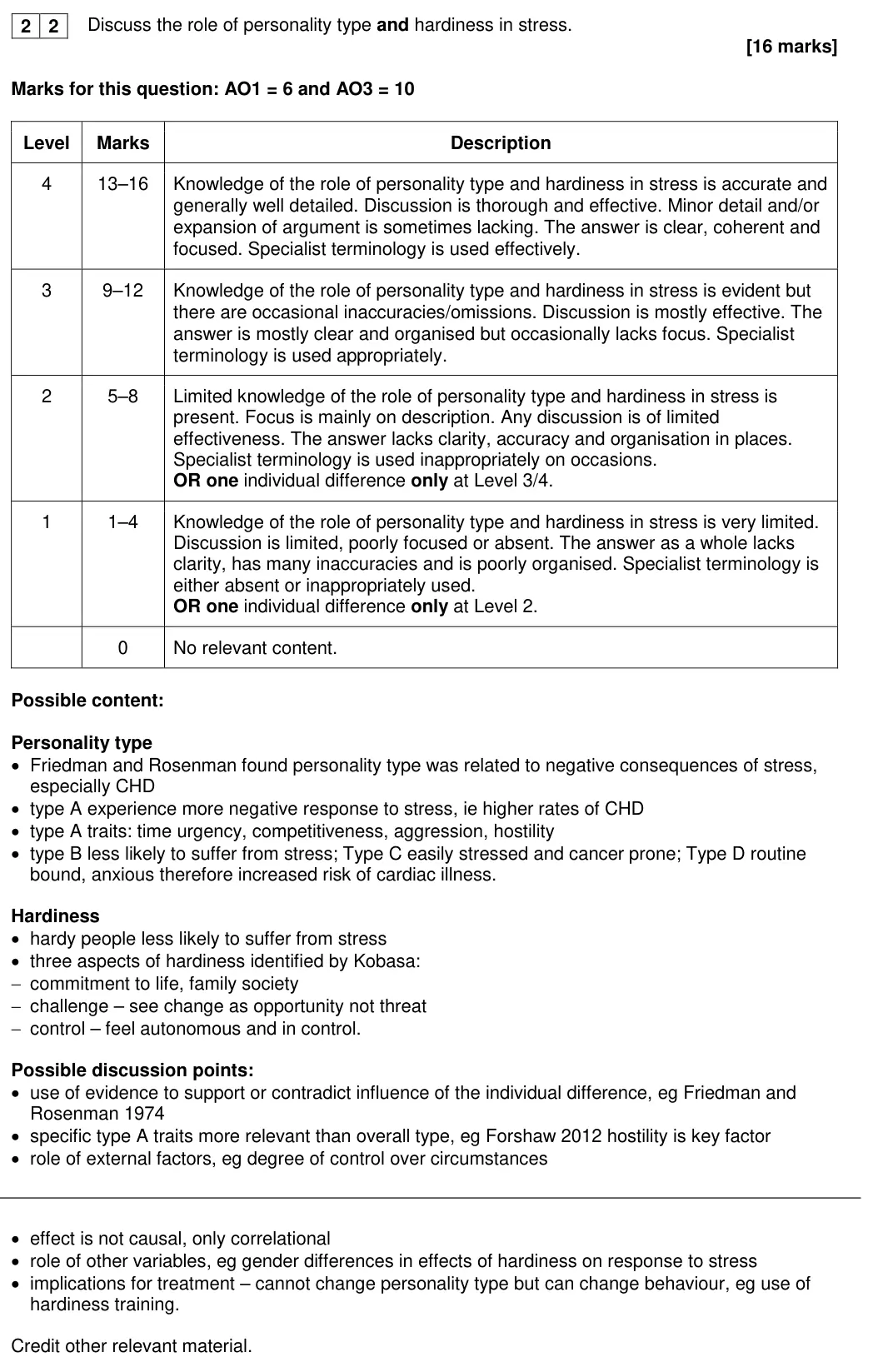
June 2019 · Paper 3 · Q2216 marksAO1=6, AO3=1016-mark essay
Mark scheme, including level descriptors and indicative content
Examiner's comment
Although most answers showed sound knowledge of Friedman and Rosenman’s personality types, and specifically the link between Type A and CHD (coronary heart disease), students often omitted to make any explicit link to stress, which rather detracted from the answer. Providing there was something in the answer that recognised that CHD can be related to stress then that gave a link to the question. Totally free-standing descriptions of the three personality types gained limited credit. On the other hand, hardiness was usually explicitly linked to stress, especially where students explained in detail the effects of each of the three ‘Cs’. Evaluation was mostly focused on the use of evidence, but also often covered the impossibility of establishing causality and the relative importance of other variables.
Notes from the mark scheme and report
personality type AND hardiness: one only = max Level 2
Type A descriptions must be linked to stress, not just CHD
correlational/causality discussion
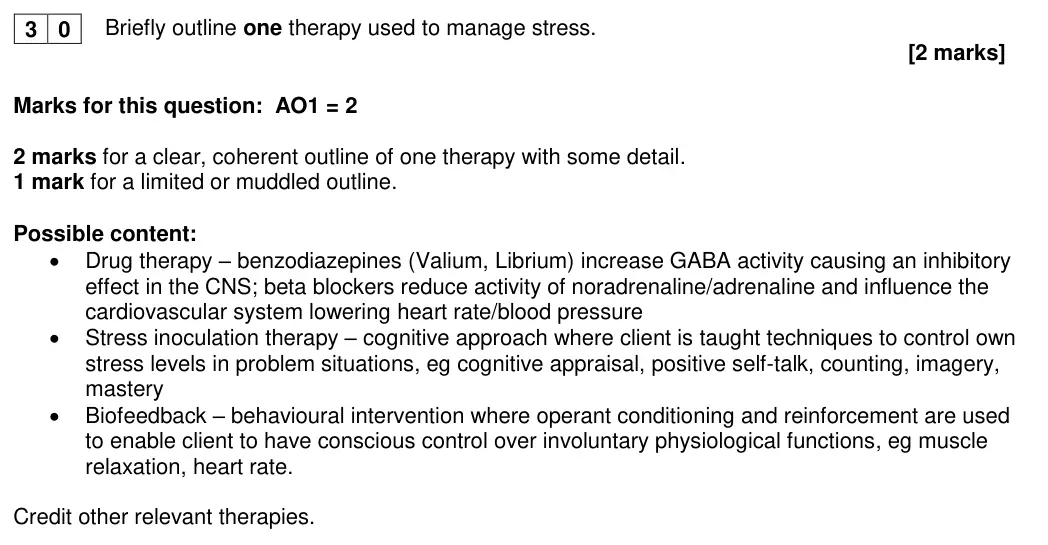
June 2018 · Paper 3 · Q302 marksAO1=2Outline
Mark scheme, including level descriptors and indicative content
Examiner's comment
This tended to be well answered, with many strong accounts of stress inoculation therapy and drug therapy. Biofeedback was not always so well done, usually because students failed to be clear about the reinforcement element.
Notes from the mark scheme and report
drug therapy, SIT or biofeedback
MS credits named drugs (benzodiazepines, beta blockers), removed in v1.4 (drug therapy remains)
biofeedback answers often missed reinforcement
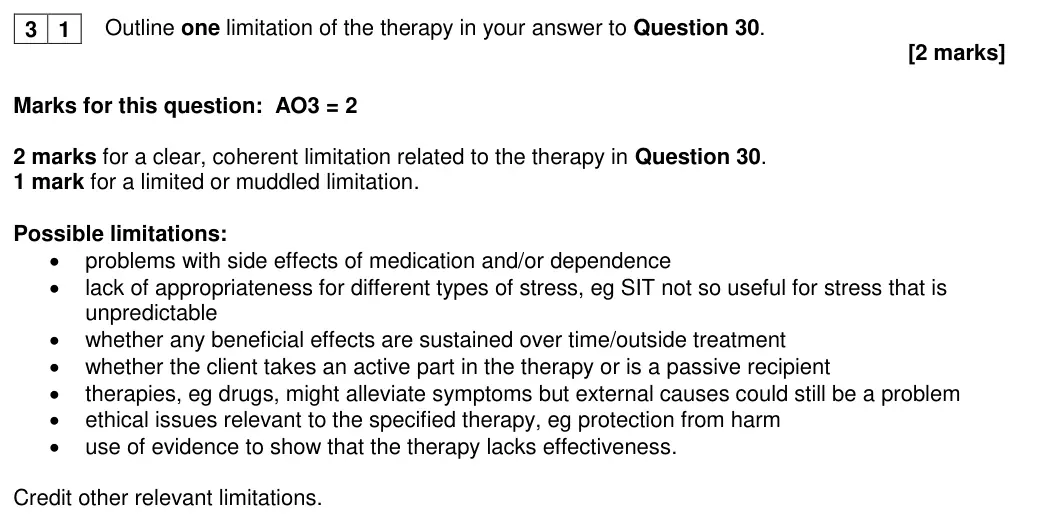
June 2018 · Paper 3 · Q312 marksAO3=2Evaluate (short)
Mark scheme, including level descriptors and indicative content
Examiner's comment
Content varied according to the therapy used in Q30, but most scored at least one mark.
Notes from the mark scheme and report
limitation must relate to the therapy in Q30
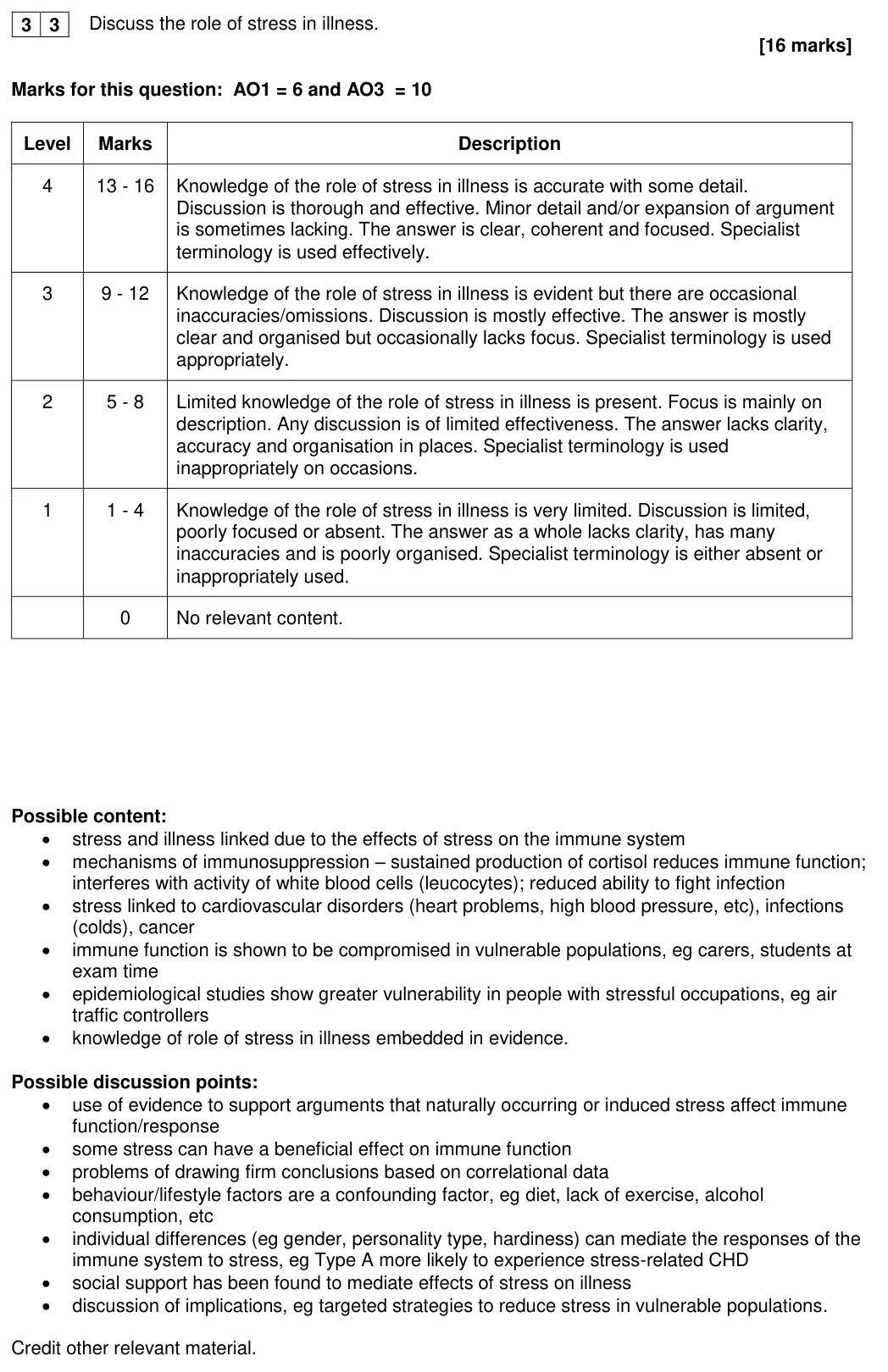
June 2018 · Paper 3 · Q3316 marksAO1=6, AO3=1016-mark essay
Mark scheme, including level descriptors and indicative content
Examiner's comment
This question was often very well answered, with some quite detailed accounts of the physiological mechanisms involved. Most answers referred to immunosuppression, and associated evidence and the body of research into the link between stress and cardiovascular disorders was used to good effect. The mediating effects of personality type often formed part of the discussion, but relatively few students opted to discuss the way in which workplace stress might result in illness, perhaps because they had compartmentalised their material and did not see it as appropriate.
Notes from the mark scheme and report
immunosuppression and cardiovascular disorders
individual differences (Type A, hardiness) and social support credited as discussion
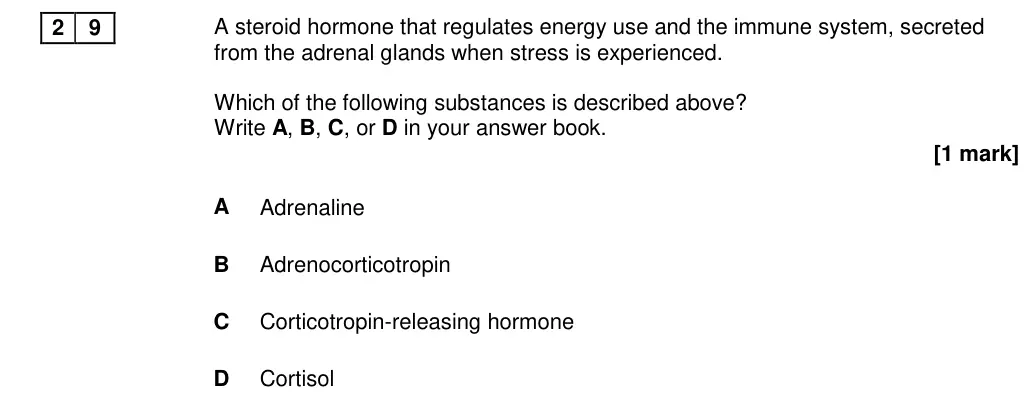
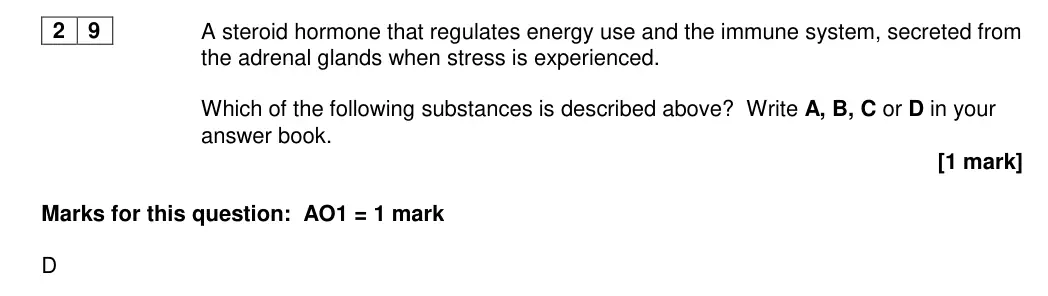
June 2017 · Paper 3 · Q291 markAO1=1Multiple choice
Answer
D
Mark scheme, including level descriptors and indicative content
Examiner's comment
This question was answered correctly by around half of students.
Notes from the mark scheme and report
answer D (cortisol)
distractors adrenaline, ACTH, CRH
only about half correct
June 2017 · Paper 3 · Q301 markAO3=1Multiple choice
Answer
D
Mark scheme, including level descriptors and indicative content
Examiner's comment
This question was answered correctly by the vast majority of students.
Notes from the mark scheme and report
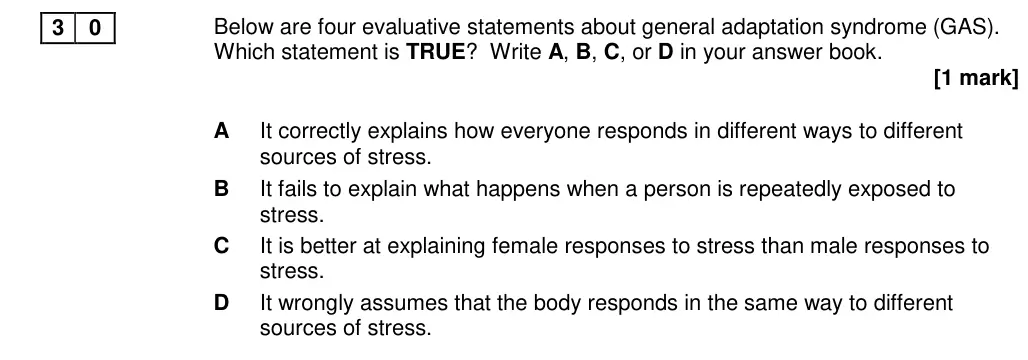
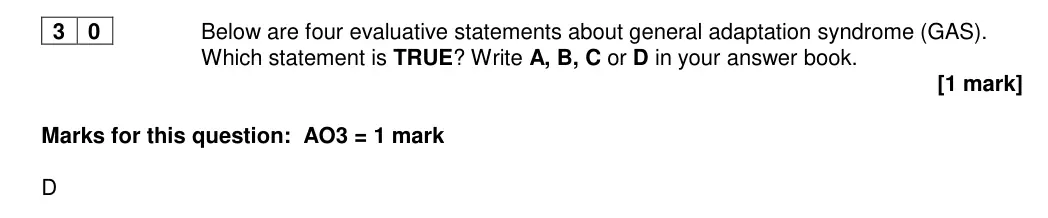
answer D (assumes same response to different stressors)
June 2017 · Paper 3 · Q318 marksAO1=4, AO2=4Extended writing
Mark scheme, including level descriptors and indicative content
Examiner's comment
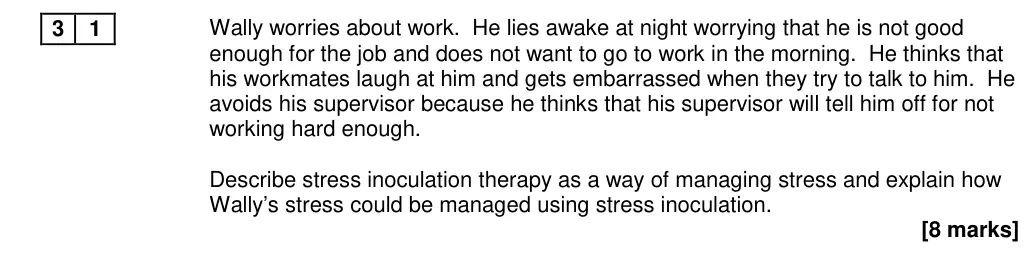
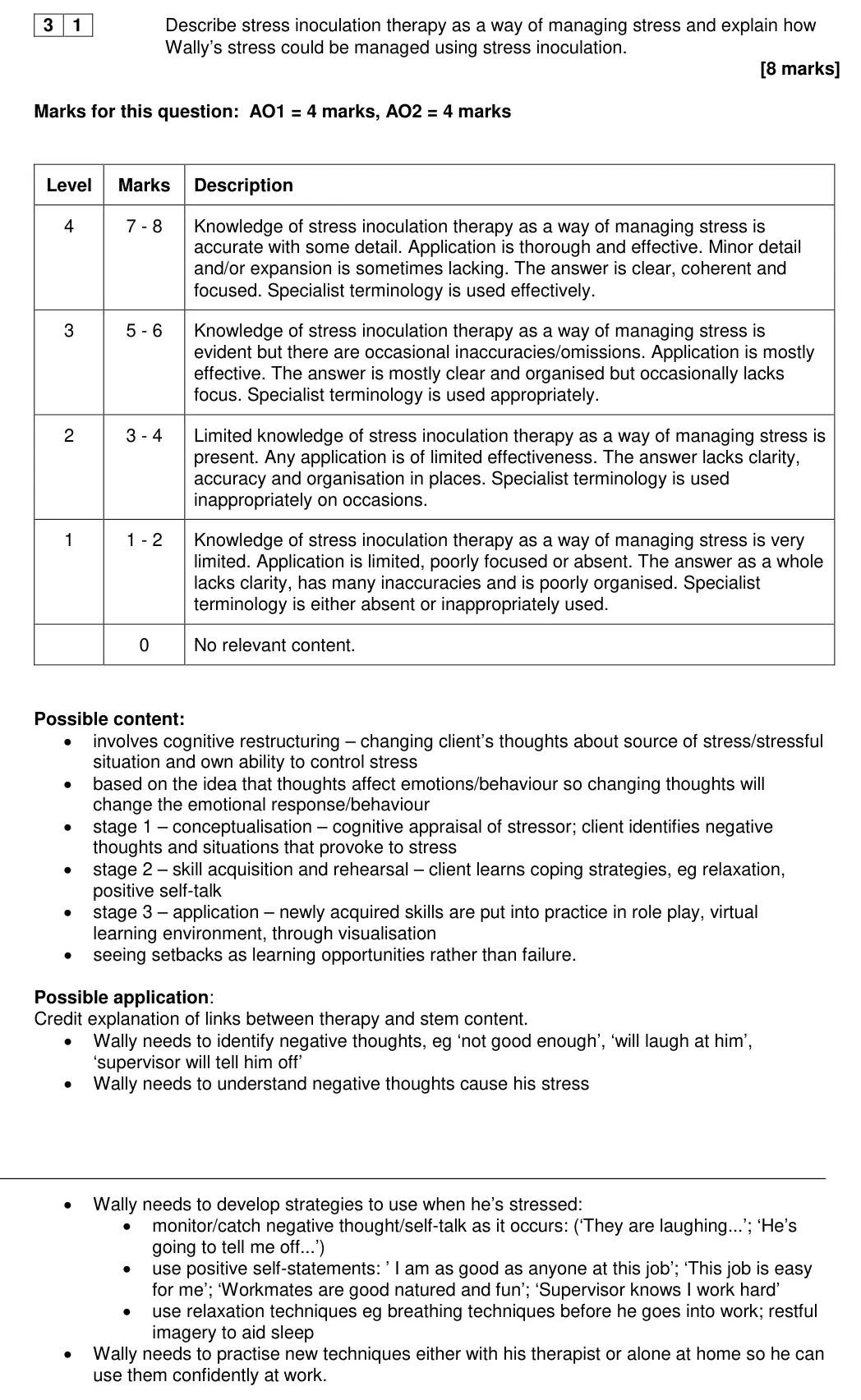
Better students gave sound descriptions of the stages and techniques involved in stress inoculation therapy and were able to apply their knowledge to Wally’s situation. Weaker answers consisted of vague descriptions of therapy where the therapist and client would ‘talk about it’, then Wally would ‘realise there was nothing to worry about’, so he could ‘chat happily to his colleagues’. Effective application is that which is concrete and specific to the scenario. As an example, instead of saying ‘Wally could then use the strategies from his therapy’, it is more effective to say ‘Wally could use his breathing exercise, and repeat a positive self-statement such as…in the car each morning before he goes into work’.
apply concretely to Wally (identify 'not good enough' thoughts, positive self-statements, relaxation before work, practise)
vague 'talk about it' answers weak
June 2017 · Paper 3 · Q326 marksAO3=6Evaluate (short)
Mark scheme, including level descriptors and indicative content
Examiner's comment
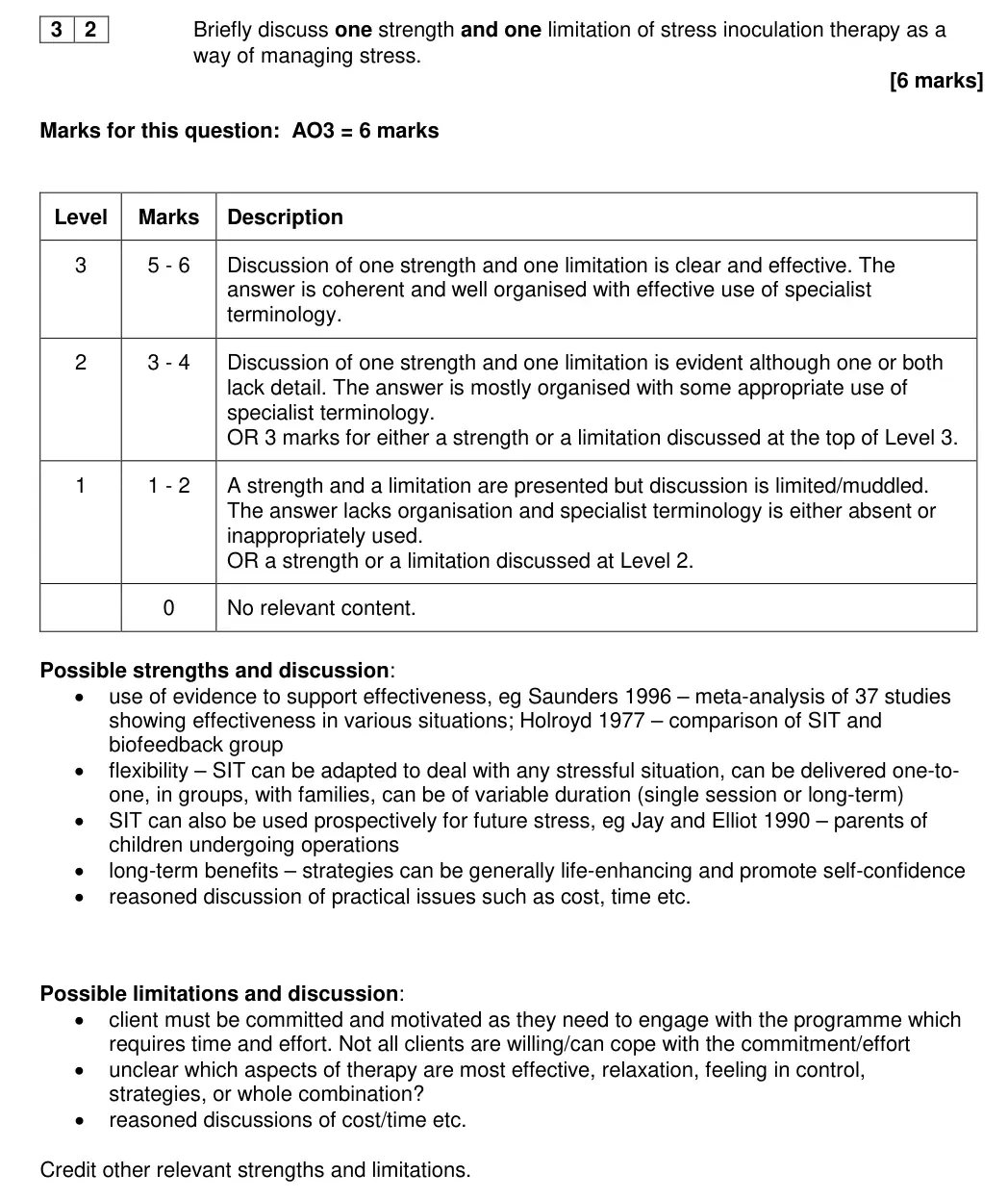
This question was usually answered competently, although sufficient elaboration for full marks was quite rare. The most common strength was the long-term benefit, for example, how the techniques acquired in therapy could be used in other similar situations in the future. Limitations tended to focus on the requirement for commitment and engagement on the part of the client and how this might not always be possible.
Notes from the mark scheme and report
one strength (evidence e.g. Saunders meta-analysis, flexibility, long-term/prospective use) + one limitation (commitment and motivation, unclear active component, cost/time)
full elaboration rare
June 2017 · Paper 3 · Q338 marksAO1=3, AO3=5Extended writing
Mark scheme, including level descriptors and indicative content
Examiner's comment
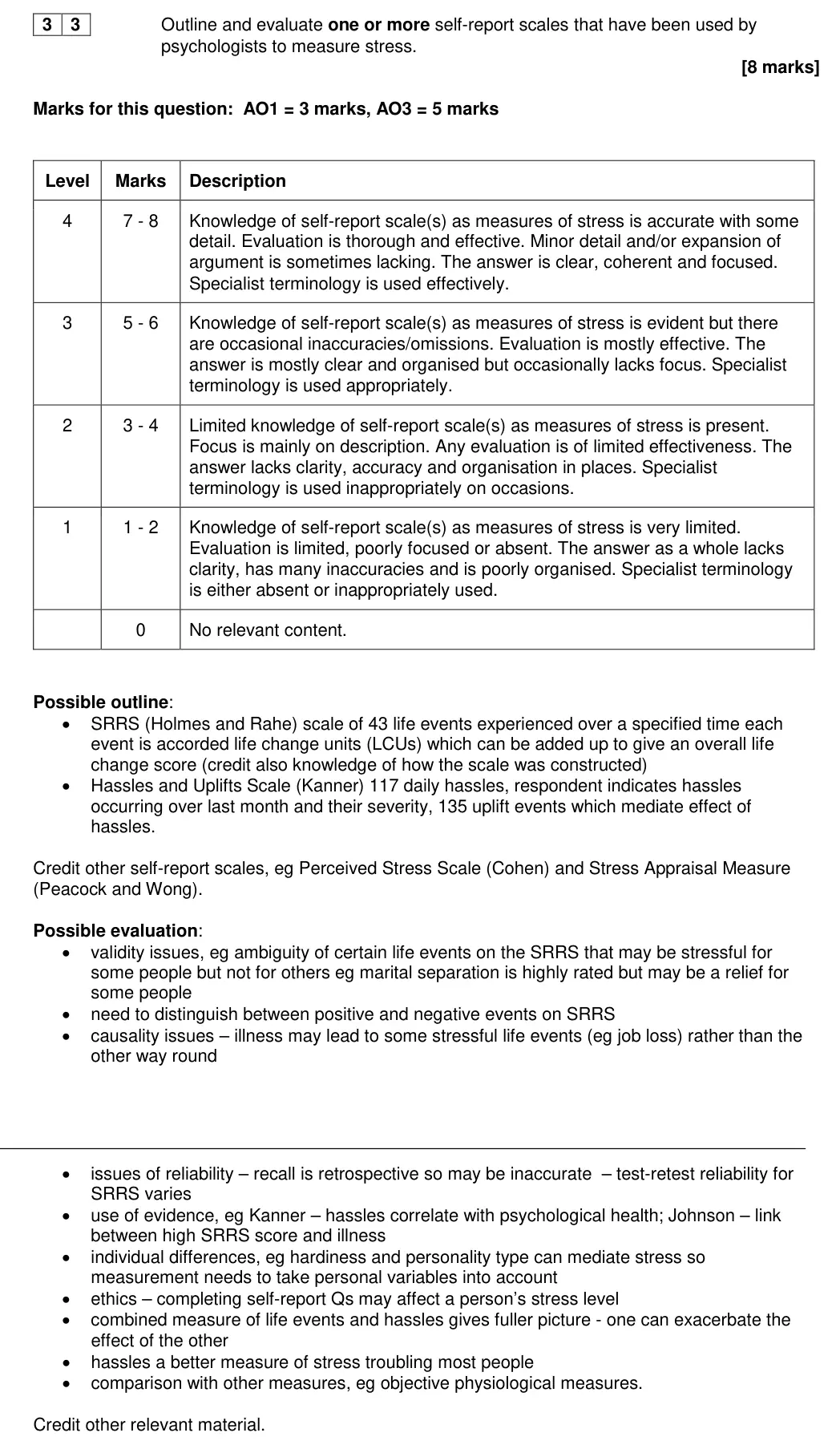
This fairly straightforward question was usually competently answered, with most students offering both the SRRS and the Hassles and Uplifts scale. Some detailed accounts of the types of items and the scoring of the SRRS were seen. Effective evaluations tended to consider the appropriateness of having a fixed LCU for each life event when different individuals would experience the same event quite differently and comparisons between the scales. Appropriateness of the SRRS for various age groups was also a useful discussion point. Weaker discussions referred to internal validity, external validity, reductionism and determinism, without any sensible explanation.
Notes from the mark scheme and report
SRRS (life change units) and/or Hassles and Uplifts
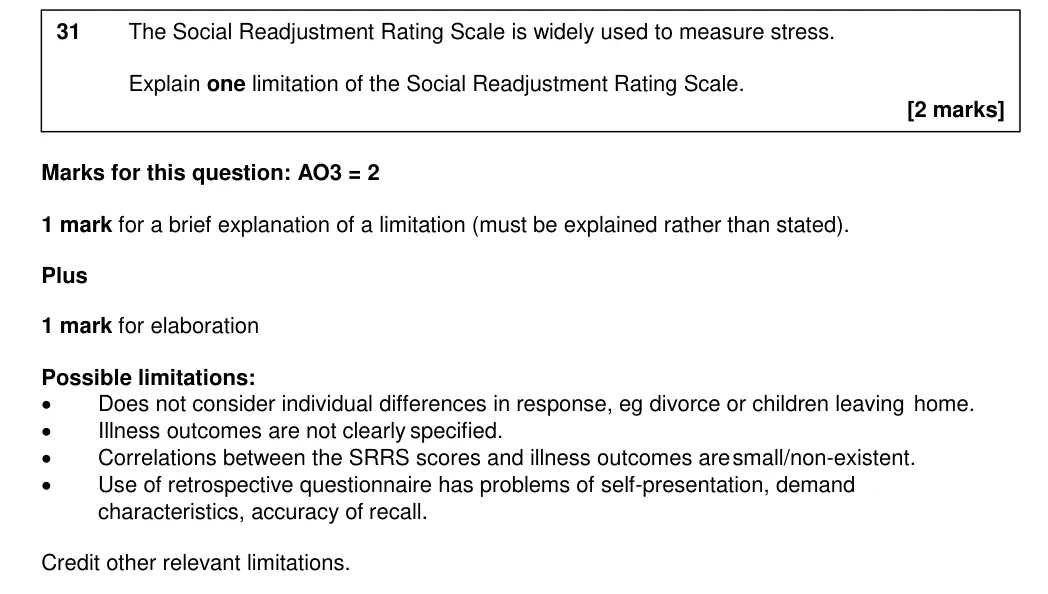
evaluation: fixed LCUs ignore individual differences, positive vs negative events, causality, retrospective recall, comparison with physiological measures
vague internal/external validity points scored little
Specimen set 2 · Paper 3 · Q242 marksAO1=2Short answer
Mark scheme, including level descriptors and indicative content
Notes from the mark scheme and report
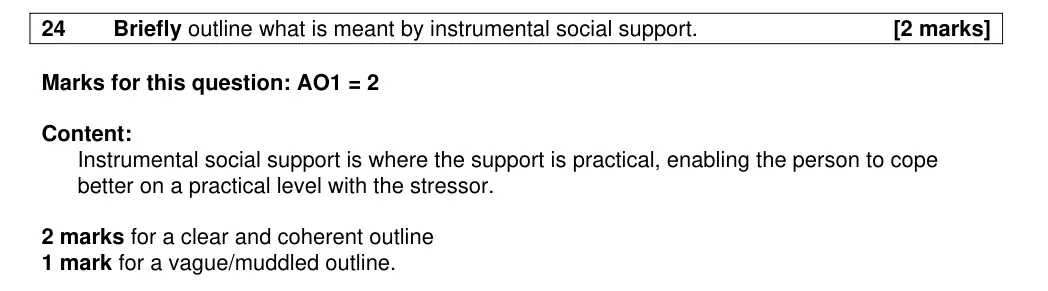
practical/tangible help enabling coping with the stressor
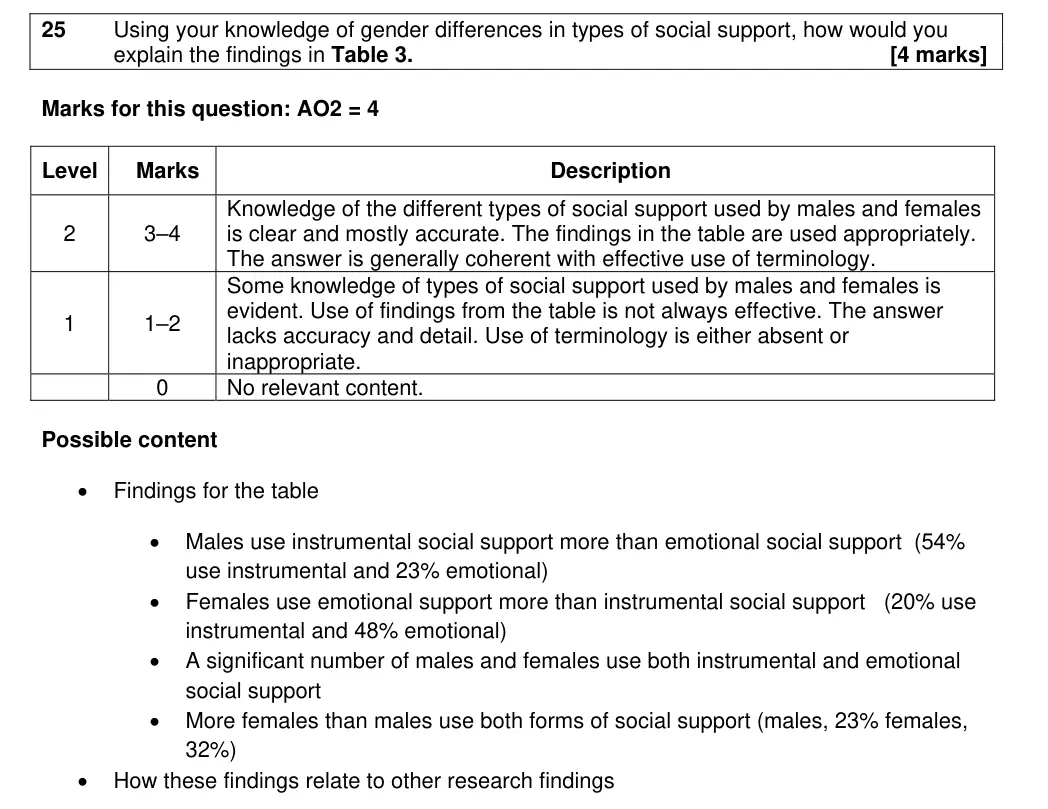
Specimen set 2 · Paper 3 · Q254 marksAO2=4Application
Mark scheme, including level descriptors and indicative content
Notes from the mark scheme and report
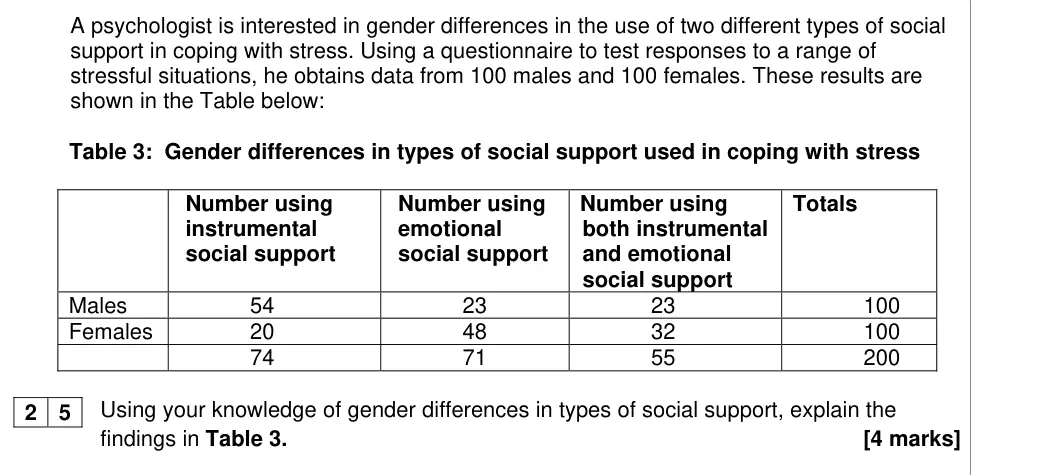
males mostly instrumental (54 vs 23), females mostly emotional (48 vs 20), more females use both (32 vs 23)
relate to research on gender differences
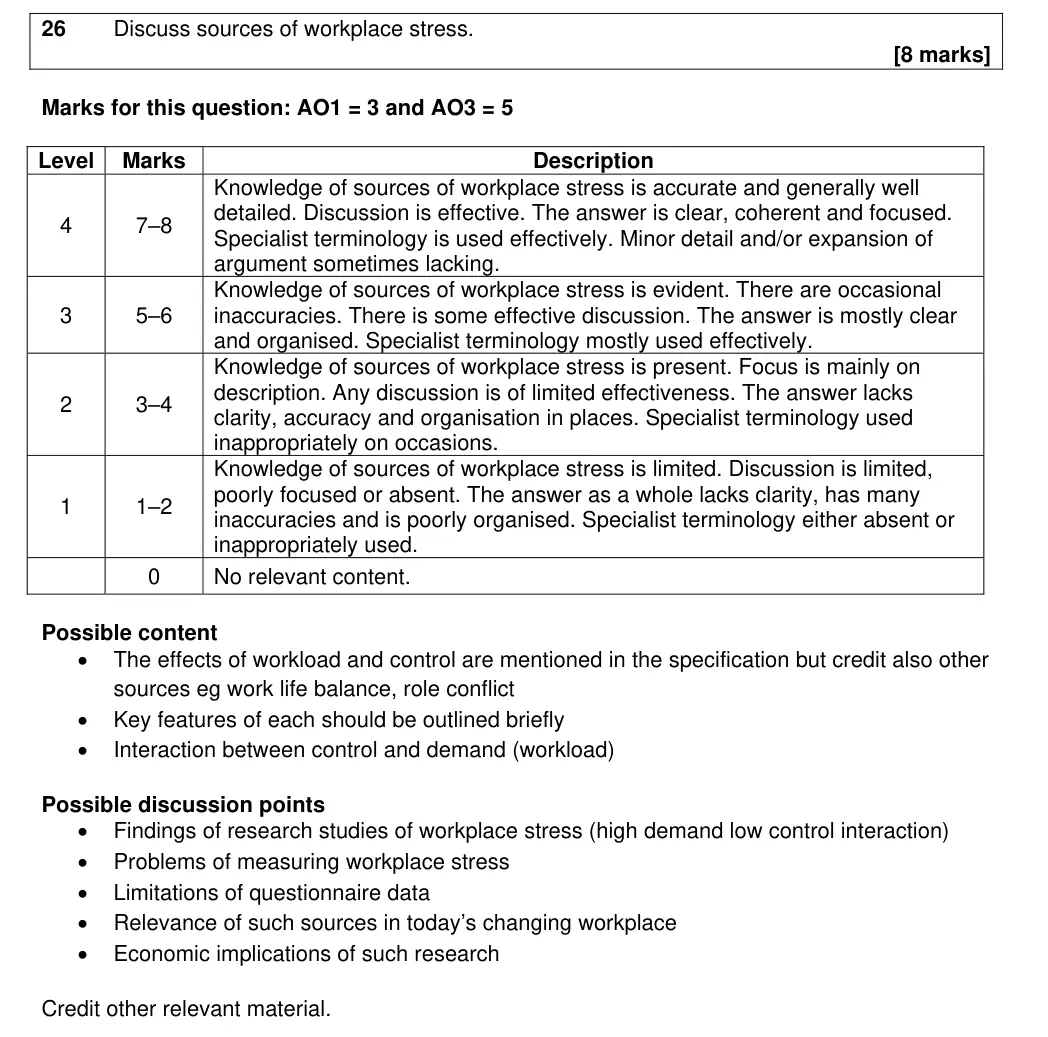
Specimen set 2 · Paper 3 · Q268 marksAO1=3, AO3=5Extended writing
Mark scheme, including level descriptors and indicative content
Notes from the mark scheme and report
workload and control (high demand/low control interaction)
other sources e.g. role conflict also credited
evaluation e.g. Marmot, measurement problems, changing workplace
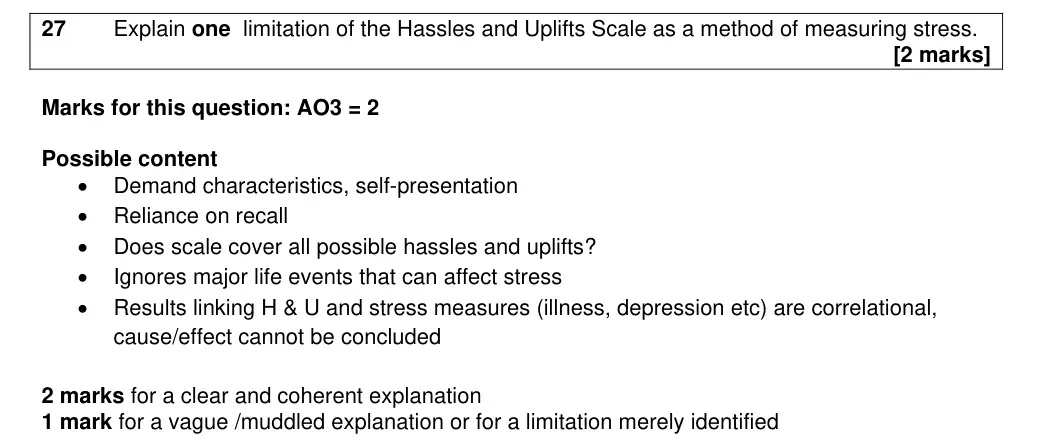
Specimen set 2 · Paper 3 · Q272 marksAO3=2Evaluate (short)
Mark scheme, including level descriptors and indicative content
Notes from the mark scheme and report
social desirability, reliance on recall, coverage of hassles, ignores major life events, correlational
merely identified = 1 mark
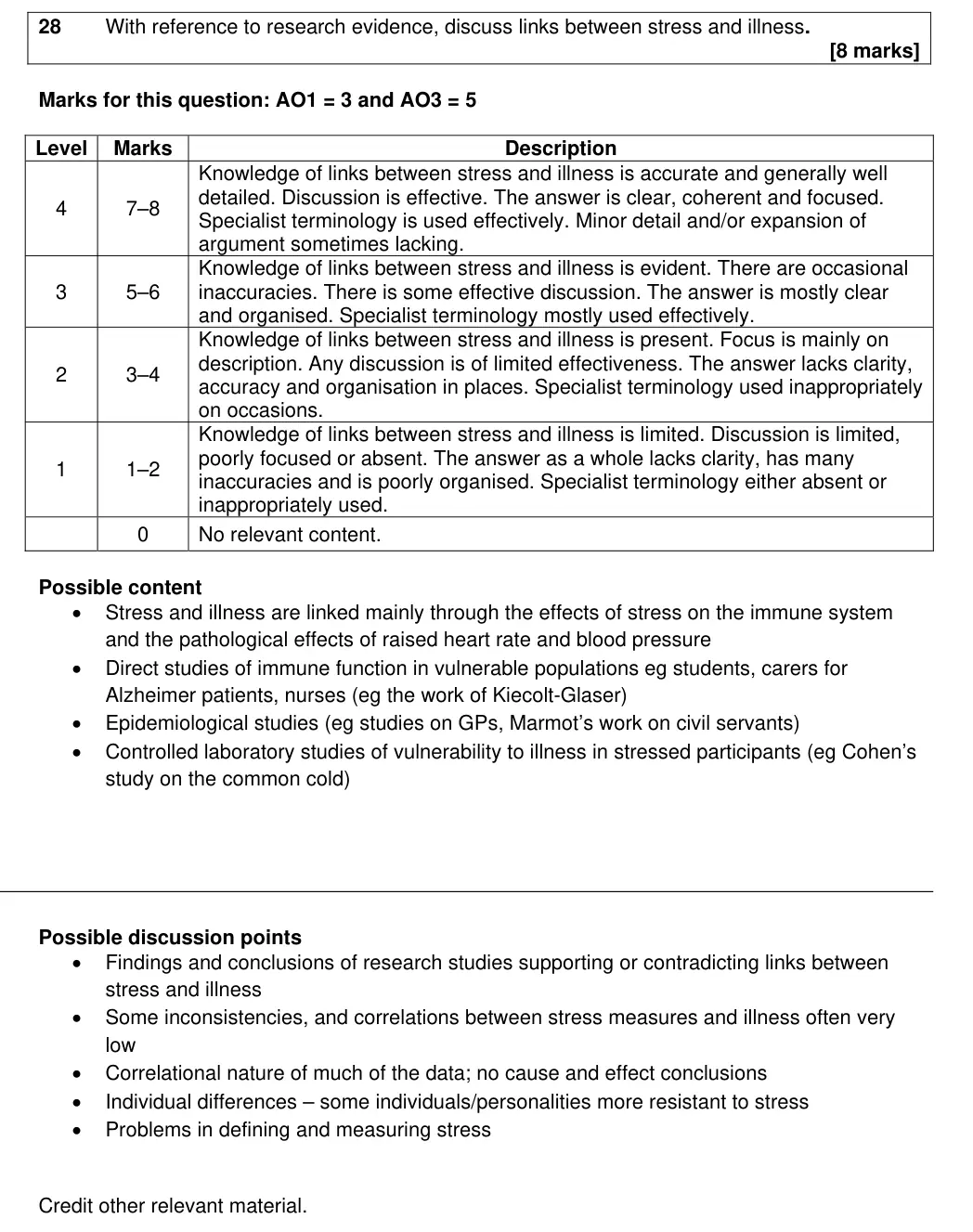
Specimen set 2 · Paper 3 · Q288 marksAO1=3, AO3=5Extended writing
Mark scheme, including level descriptors and indicative content
Notes from the mark scheme and report
immunosuppression (Kiecolt-Glaser, Cohen) and cardiovascular effects (Marmot)