Mark scheme, including level descriptors and indicative content
Examiner's comment
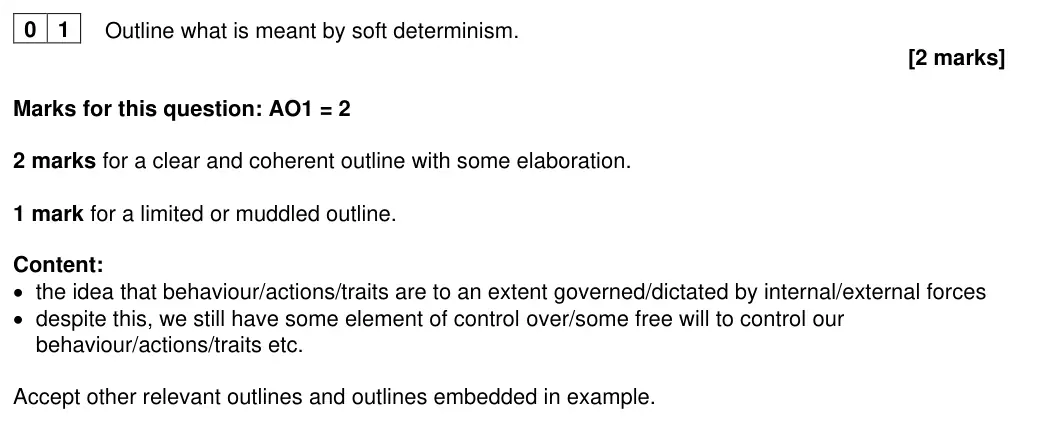
Question 01 was generally well answered although some responses lacked clarity. Completely contradictory answers describing soft determinism simultaneously as behaviour that is pre- determined but also down to free will were not creditworthy.
Notes from the mark scheme and report
behaviour partly governed by internal/external forces but some element of free will/control remains
contradictory answers (wholly determined AND free) not credited
Mark scheme, including level descriptors and indicative content
Examiner's comment
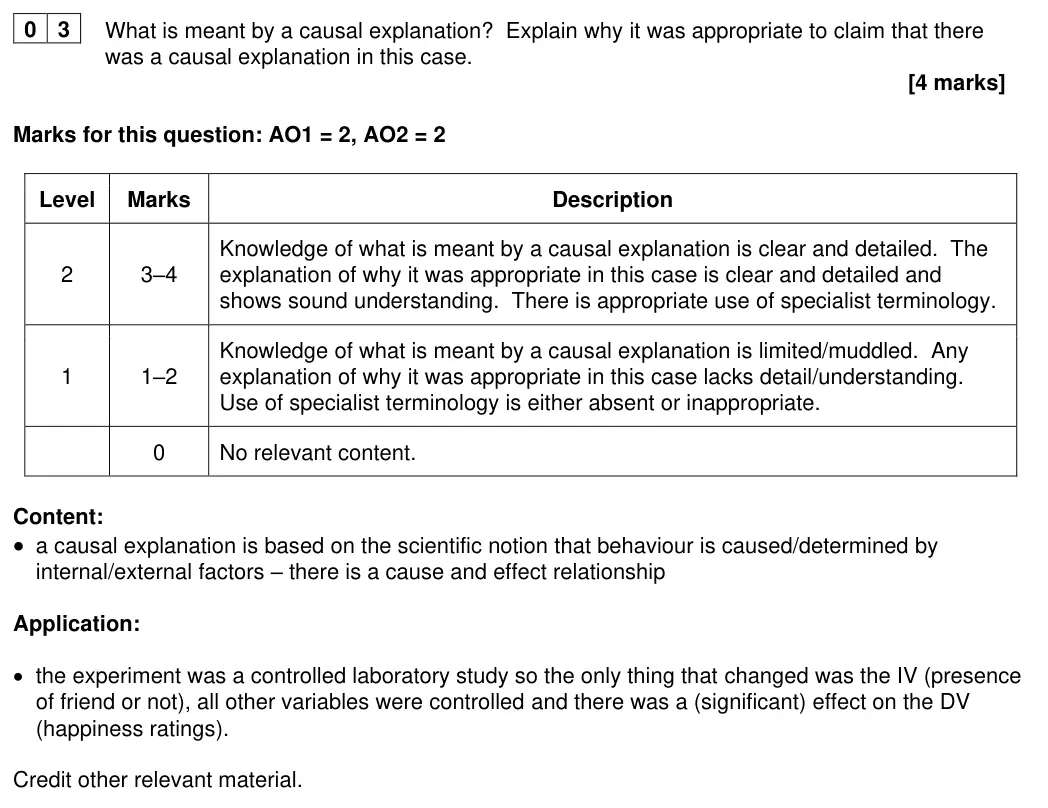
Question 03 was a good discriminator, with better answers responding appropriately to the cues in the stem and noting how a ‘controlled laboratory experiment’ would enable causality to be inferred. Many students completely missed the point, apparently having misread the key word in the question, as they focused on how researchers looking for a ‘casual’ explanation would be relaxed and unscientific.
Notes from the mark scheme and report
causal explanation = cause and effect (scientific emphasis on causality)
appropriate because a controlled lab experiment changed only the IV (friend present or not) with a significant effect on the DV
Mark scheme, including level descriptors and indicative content
Examiner's comment
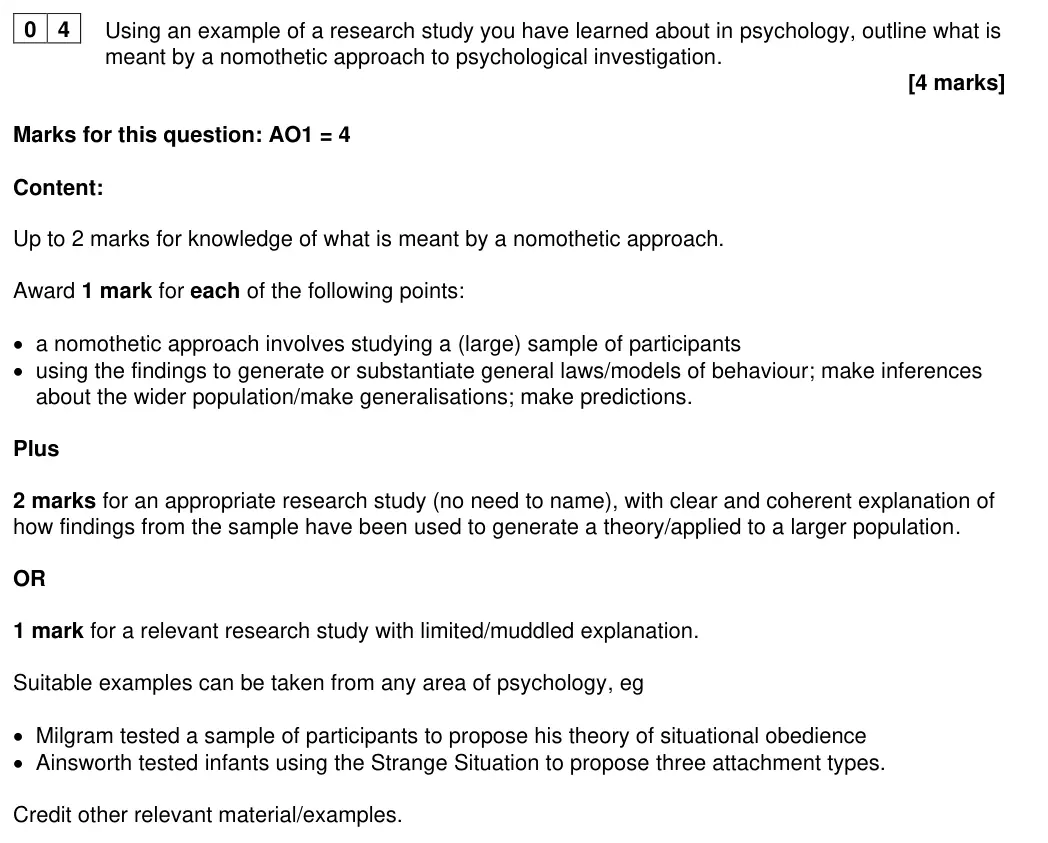
Most answers to Question 04 received some credit for outlining the term although examples were often not of a study, but rather an approach such as behaviourism or the cognitive approach. Useful studies tended to be those that had most obviously resulted in a general law or theory, for example Ainsworth’s study which resulted in the understanding of attachment types. Answers to Question 05 were creditworthy providing a behaviour had been identified in the answer to Question 04. Students using Pavlov or Skinner in their answer to Question 04 often had difficulty in Question 05 as they tried to argue that carrying out an in-depth case study of a rat or a dog would allow insights into reasoning and private experience.
Notes from the mark scheme and report
2 marks: studying samples to produce general laws/generalisations/predictions + 2 marks: a research study (e.g. Milgram, Ainsworth) used to generate a general theory
examples were often approaches (behaviourism) rather than studies
Mark scheme, including level descriptors and indicative content
Examiner's comment
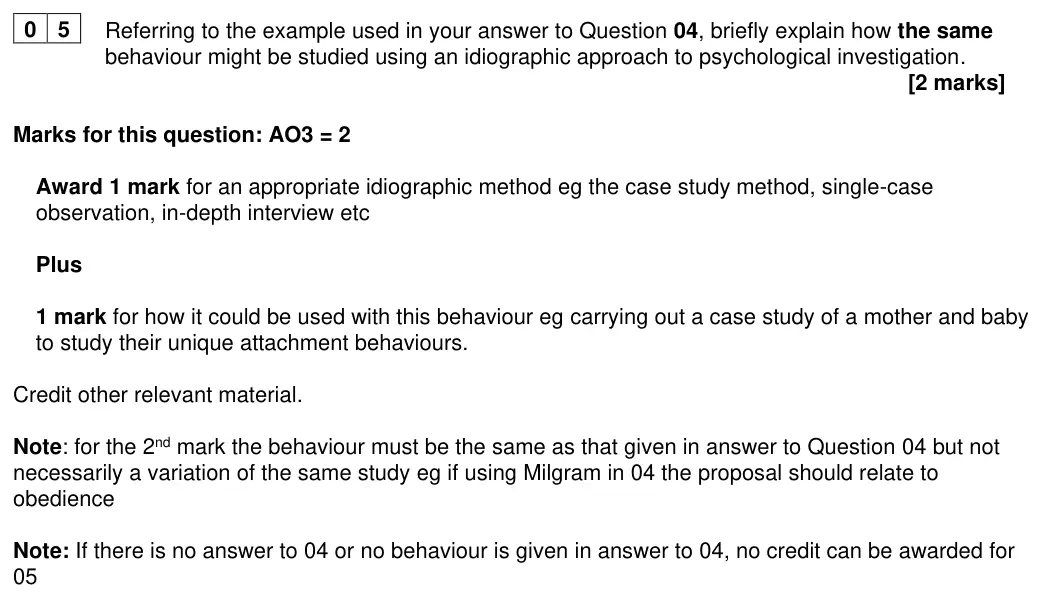
Answers to Question 05 were creditworthy providing a behaviour had been identified in the answer to Question 04. Students using Pavlov or Skinner in their answer to Question 04 often had difficulty in Question 05 as they tried to argue that carrying out an in-depth case study of a rat or a dog would allow insights into reasoning and private experience.
Notes from the mark scheme and report
idiographic method (case study, in-depth interview) + how it would study the same behaviour as Q04
no credit if no behaviour given in Q04
Pavlov/Skinner examples caused difficulty
June 2022 · Paper 3 · Q68 marksAO1=3, AO3=5Extended writingissues and debates
Mark scheme, including level descriptors and indicative content
Examiner's comment
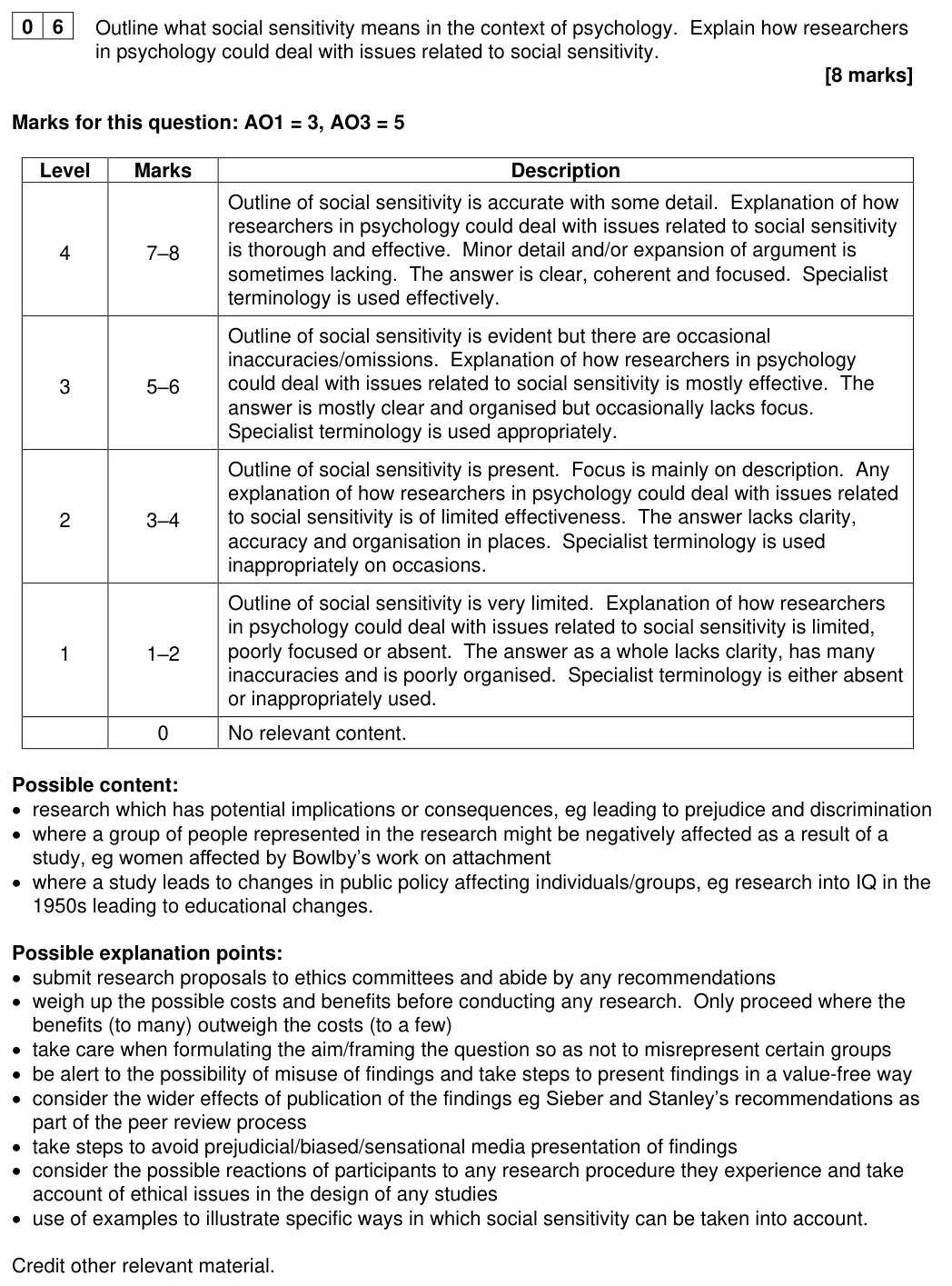
Answers to Question 06 tended to score well by using the recommendations of Sieber and Stanley as the basis for suggestions of how to deal with issues related to socially sensitive research. A fair number of discussions scored lower marks as they focused solely on implications for participants in a study.
Notes from the mark scheme and report
outline social sensitivity (implications for groups represented, e.g. Bowlby and working mothers) + ways of dealing with it (Sieber and Stanley, ethics committees, cost-benefit, careful framing and reporting)
discussions only about participants scored lower
June 2022 · Paper 3 · Q78 marksAO2=8Extended writingrelationships
Mark scheme, including level descriptors and indicative content
Examiner's comment
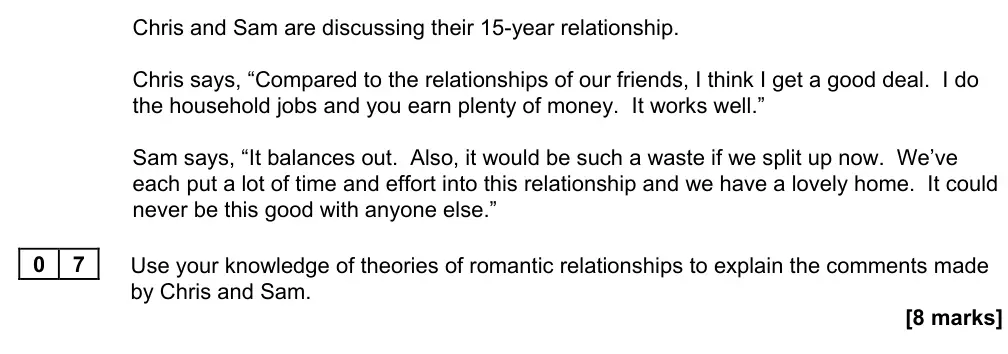
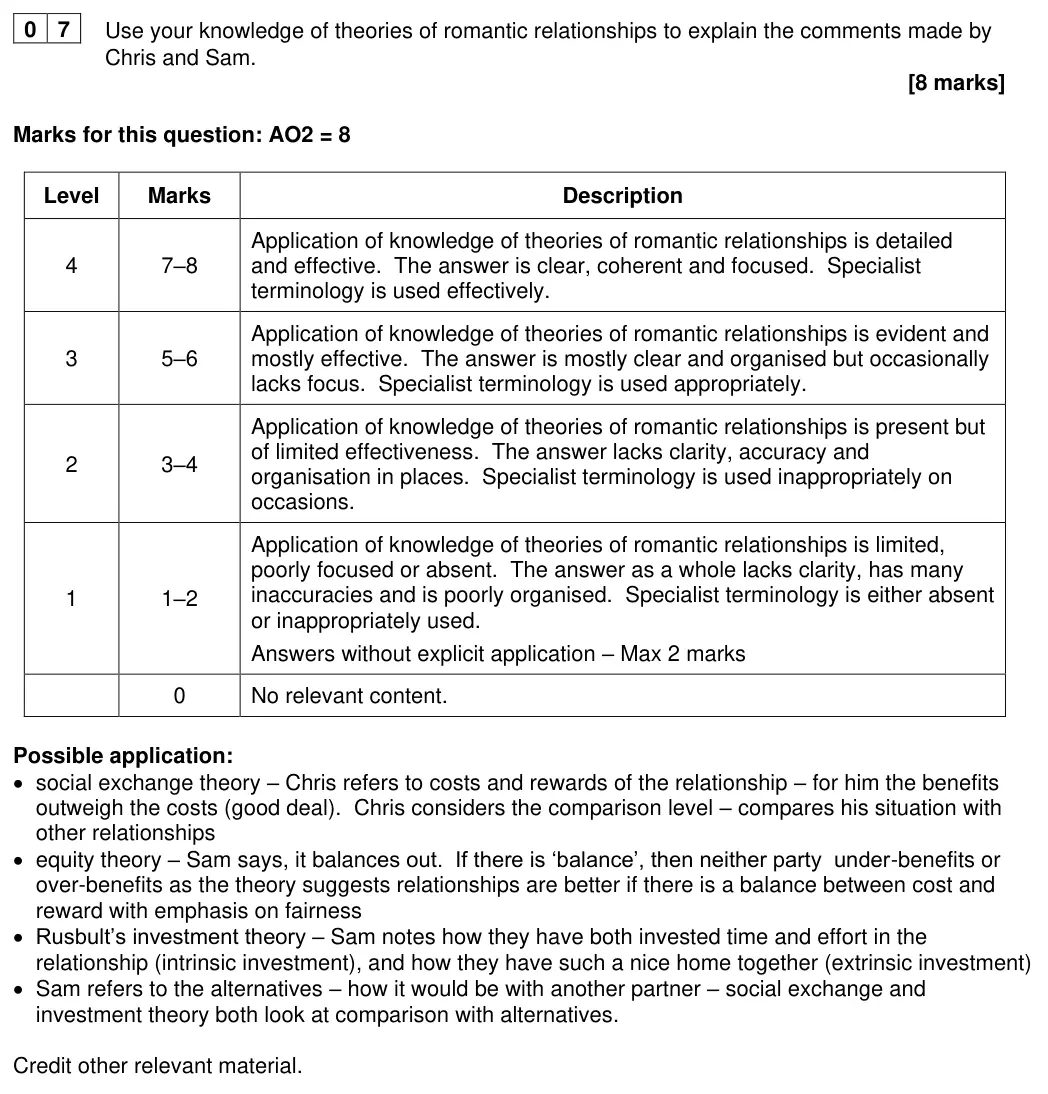
The stem in Question 07 elicited some excellent application, with students working successfully to make links between various aspects of the text and the different relationship theories. Equity theory and Rusbult’s investment theory were usually very well applied. Some students failed to attend to the command in the question and wasted time here by offering redundant discussion.
Notes from the mark scheme and report
all AO2: social exchange (good deal, comparison level), equity (it balances out), Rusbult investment (time, effort, home
no better alternative) applied to Chris and Sam
no explicit application = max 2
evaluation wasted time
June 2022 · Paper 3 · Q816 marksAO1=6, AO3=1016-mark essayrelationships
Mark scheme, including level descriptors and indicative content
Examiner's comment
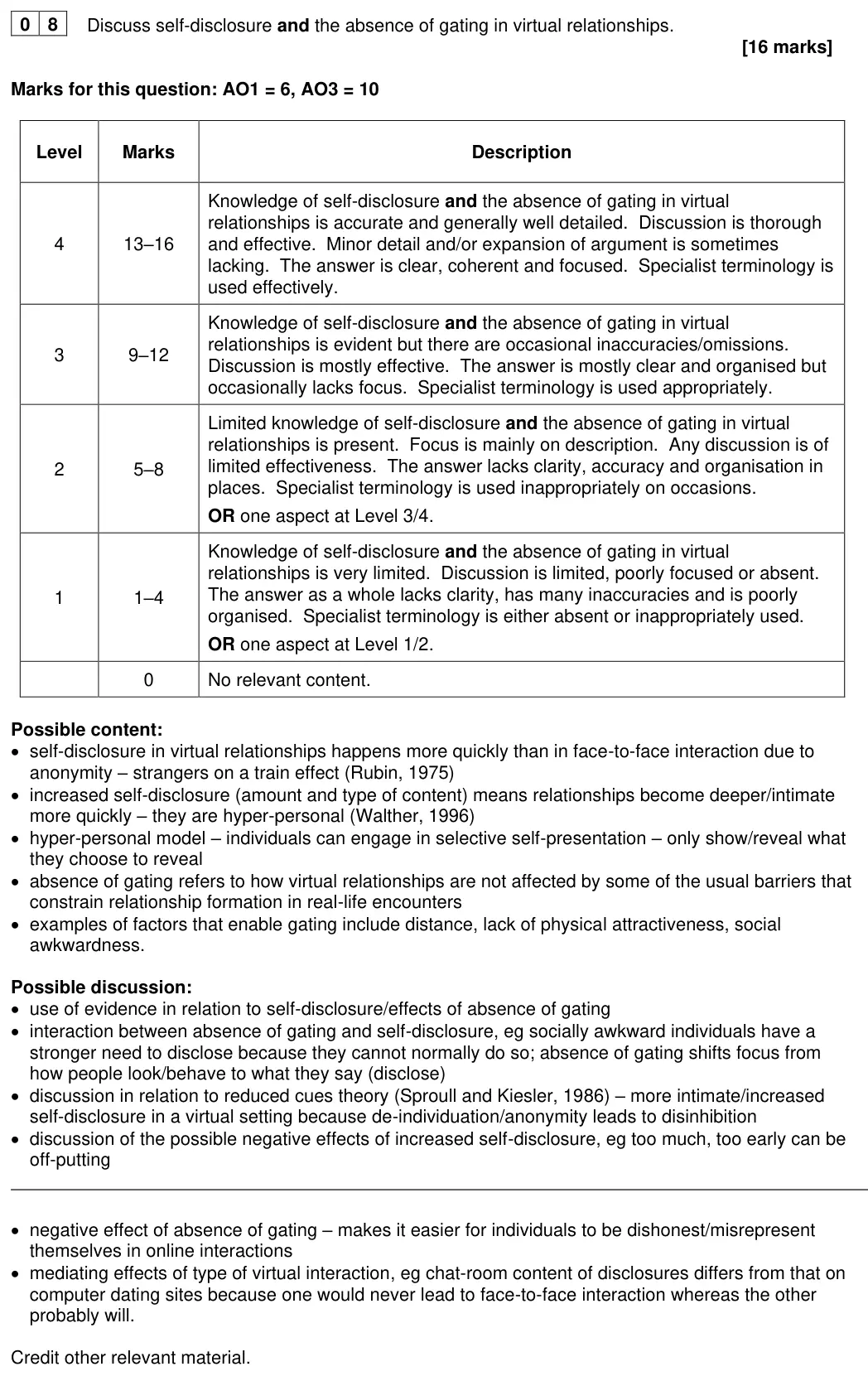
Answers to Question 08 varied; some were well-focused on self-disclosure and gating, others consisted of pre-prepared answers to a rather different question along the lines of ‘Discuss virtual relationships.’ More general discussion could be credited where it was applicable to either self- disclosure or gating, but quite often students failed to make any link.
Notes from the mark scheme and report
self-disclosure (hyperpersonal model, strangers on a train) AND absence of gating
one aspect only = max Level 2
pre-prepared 'virtual relationships' essays often failed to link to either aspect
June 2022 · Paper 3 · Q98 marksAO2=8Extended writinggender
Mark scheme, including level descriptors and indicative content
Examiner's comment
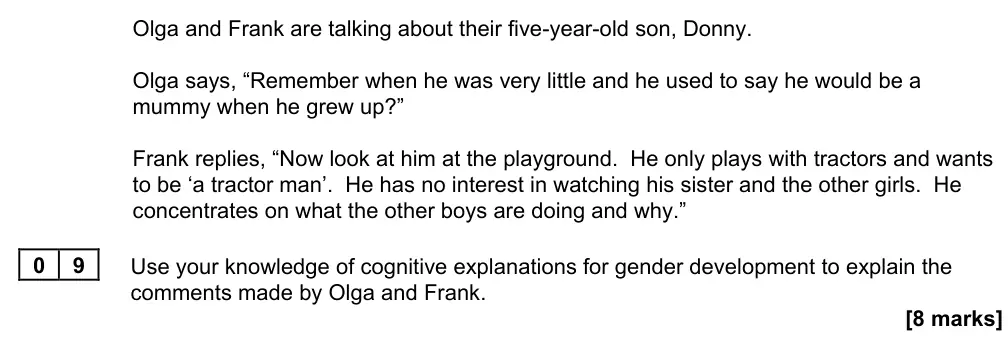
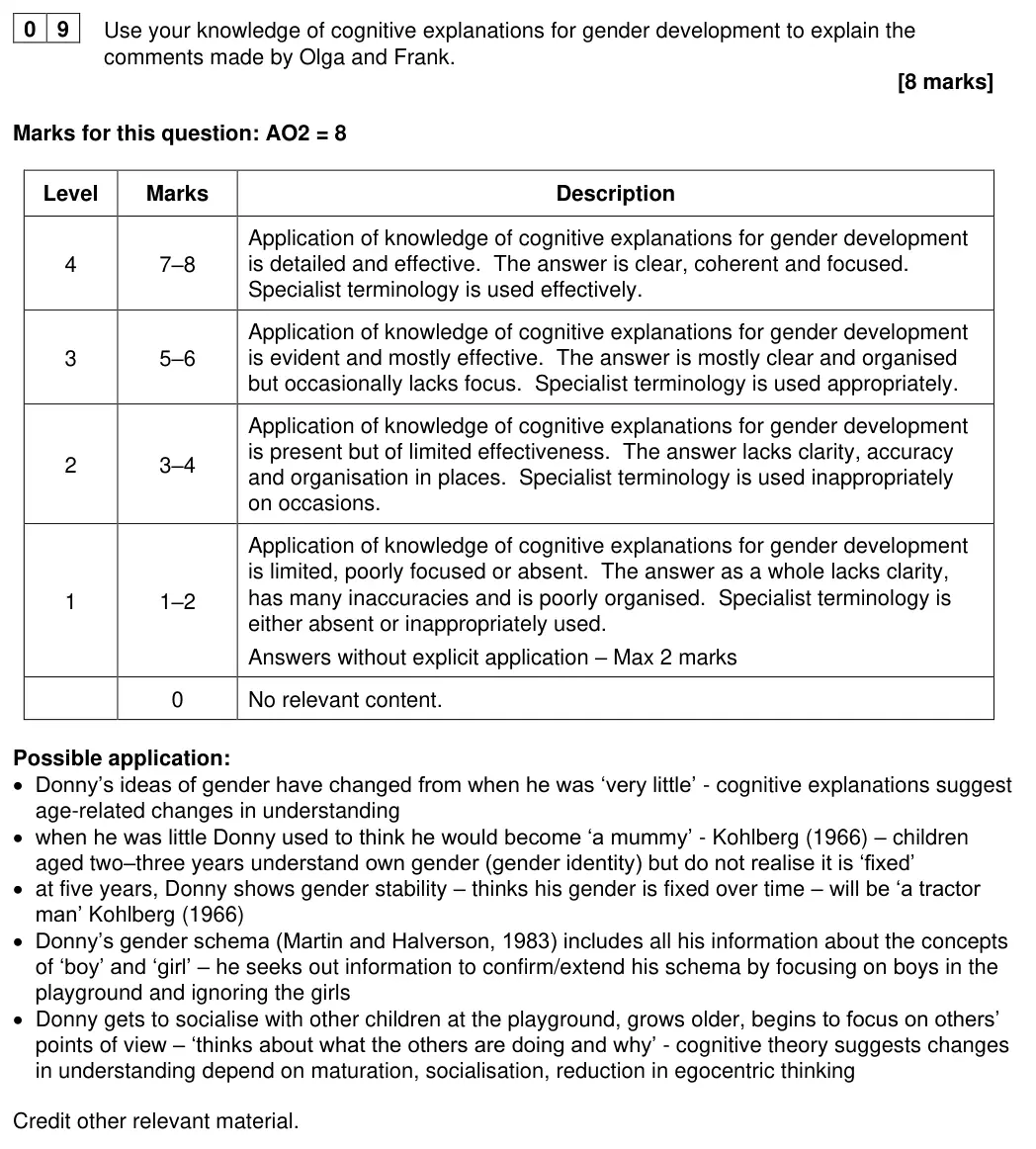
The stem in Question 09 tended to elicit effective application, particularly in relation to gender schema theory. Use of Kohlberg’s stages sometimes focused more on lengthy description of the theory than on application and there was often some confusion over the different stages. Unfortunately, some less well scoring answers read more like application of social learning theory with the emphasis on observation, imitation and stereotypes.
Notes from the mark scheme and report
all AO2: Kohlberg (gender identity without stability when 'a mummy'
stability at 5) and gender schema theory (attends to boys, ignores girls) applied to Donny
no explicit application = max 2
confusion of stages
SLT answers not credited
June 2022 · Paper 3 · Q1016 marksAO1=6, AO3=1016-mark essaygender
Mark scheme, including level descriptors and indicative content
Examiner's comment
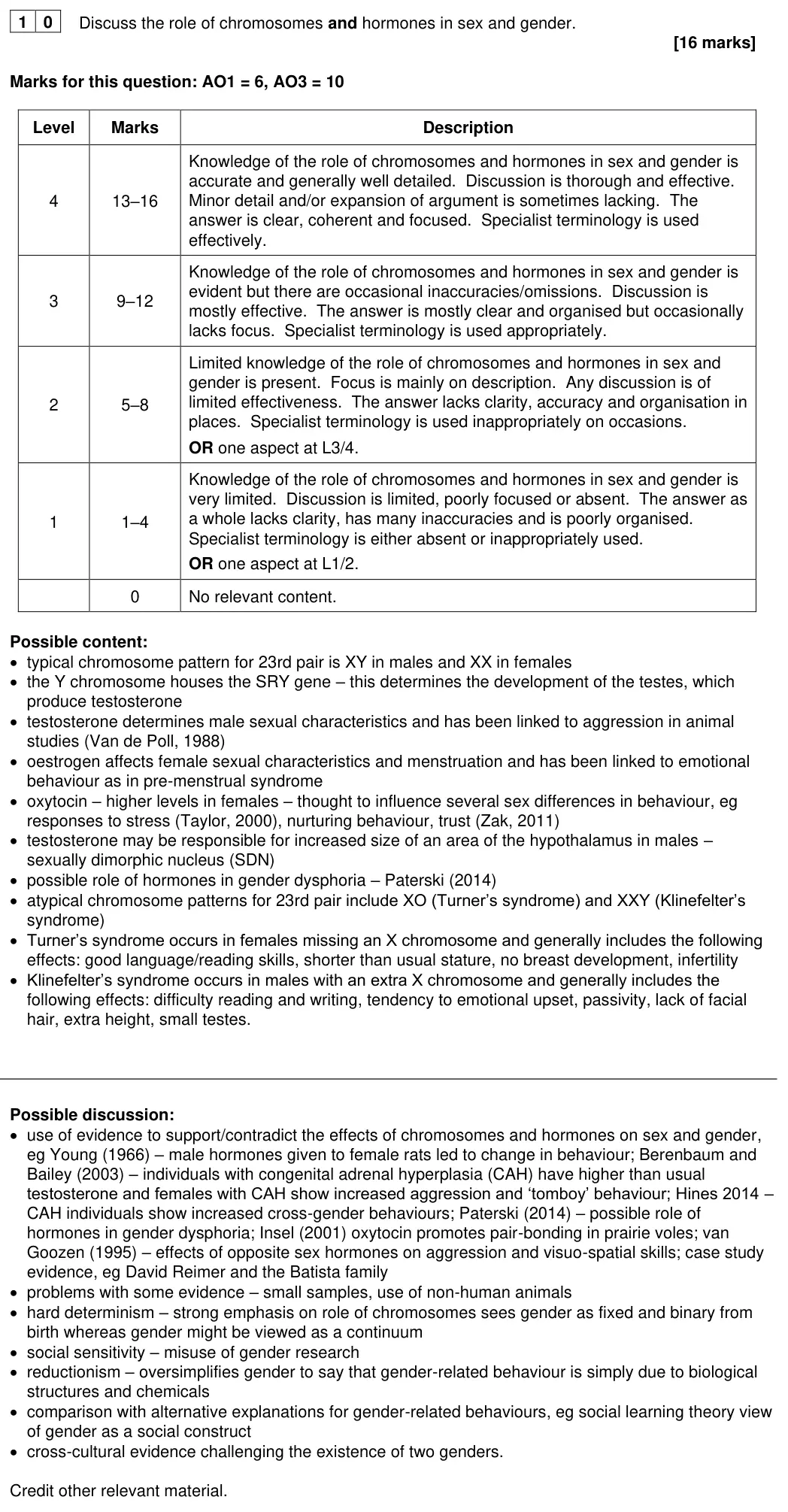
Answers to Question 10 were generally strong on knowledge and understanding but less competent when it came to discussion. In some cases, the whole of the discussion seemed to focus on evidence supporting the role of testosterone and/or the Y chromosome on aggression, often without any reference whatsoever to gender. Whilst such material might not be wholly irrelevant it could have been made much more effective had it been shaped better to the question.
Notes from the mark scheme and report
chromosomes AND hormones (testosterone, oestrogen, oxytocin), Klinefelter's/Turner's, CAH
one aspect only = max Level 2
discussion often only about testosterone and aggression without gender
Mark scheme, including level descriptors and indicative content
Examiner's comment
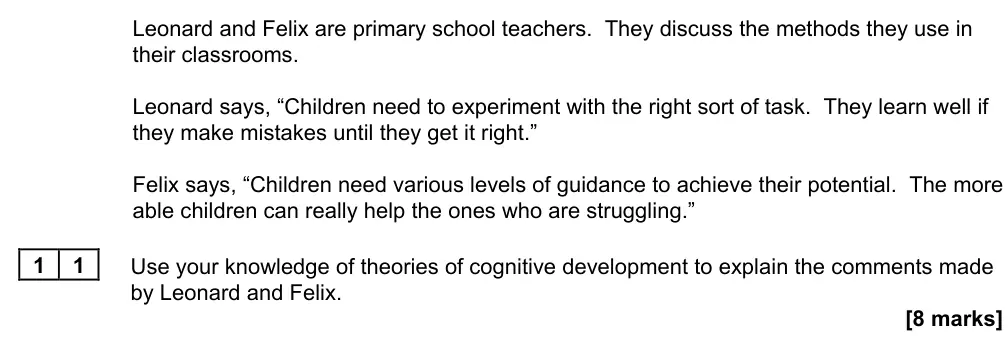
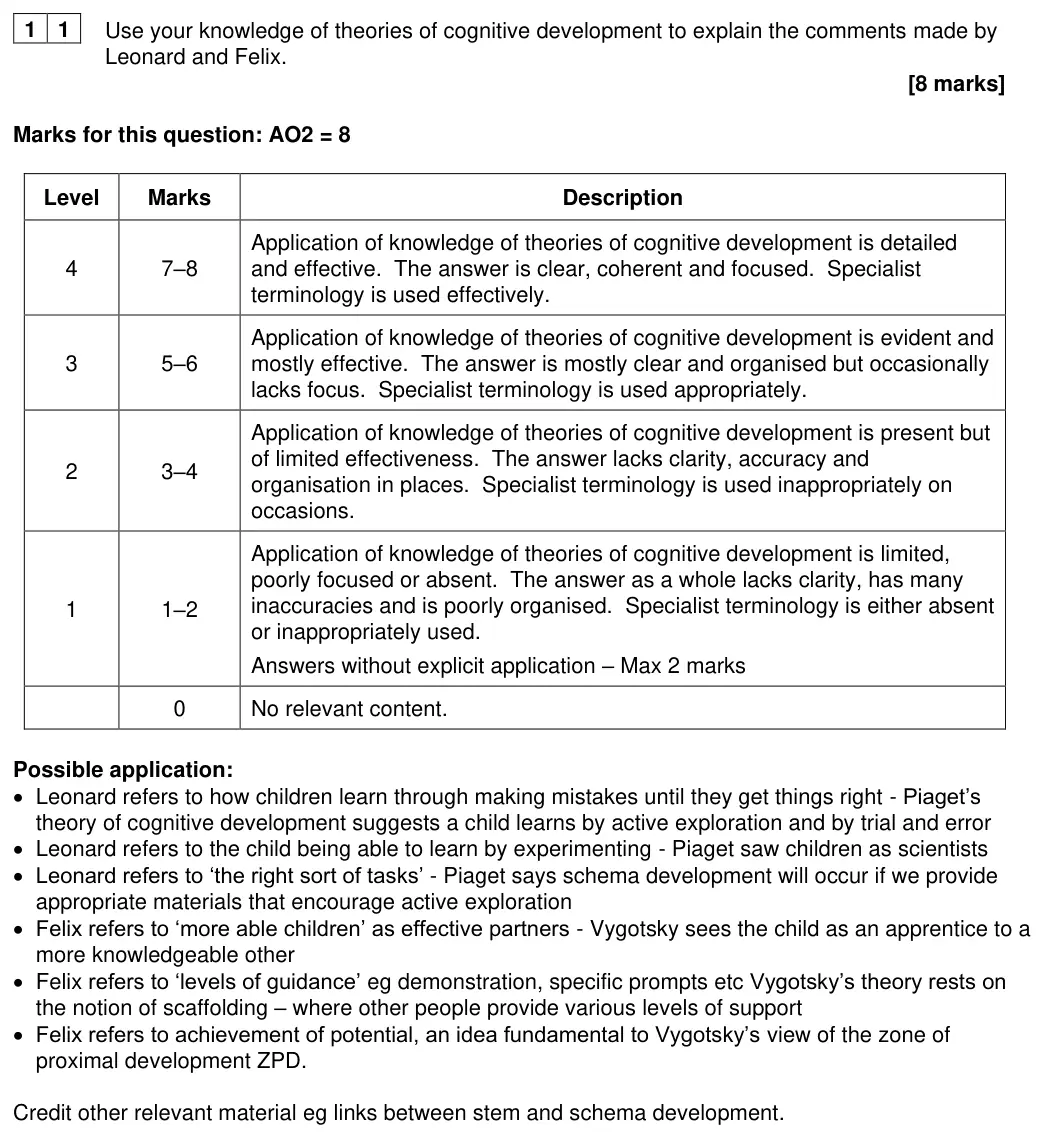
The stem for Question 11 usually triggered application of the appropriate theories of Piaget and Vygotsky. Students seemed less well able to make explicit application between aspects of the text and the theory than in the other two topics in this section, although better students worked effectively with key words and phrases such as ‘experiment’, ‘make mistakes’, ‘levels of guidance’ and ‘potential,’ drawing parallels with the relevant developmental theory.
Notes from the mark scheme and report
all AO2: Piaget (child as scientist, learning by trial and error, appropriate tasks) for Leonard
Vygotsky (MKO, scaffolding levels, ZPD 'potential') for Felix
Mark scheme, including level descriptors and indicative content
Examiner's comment
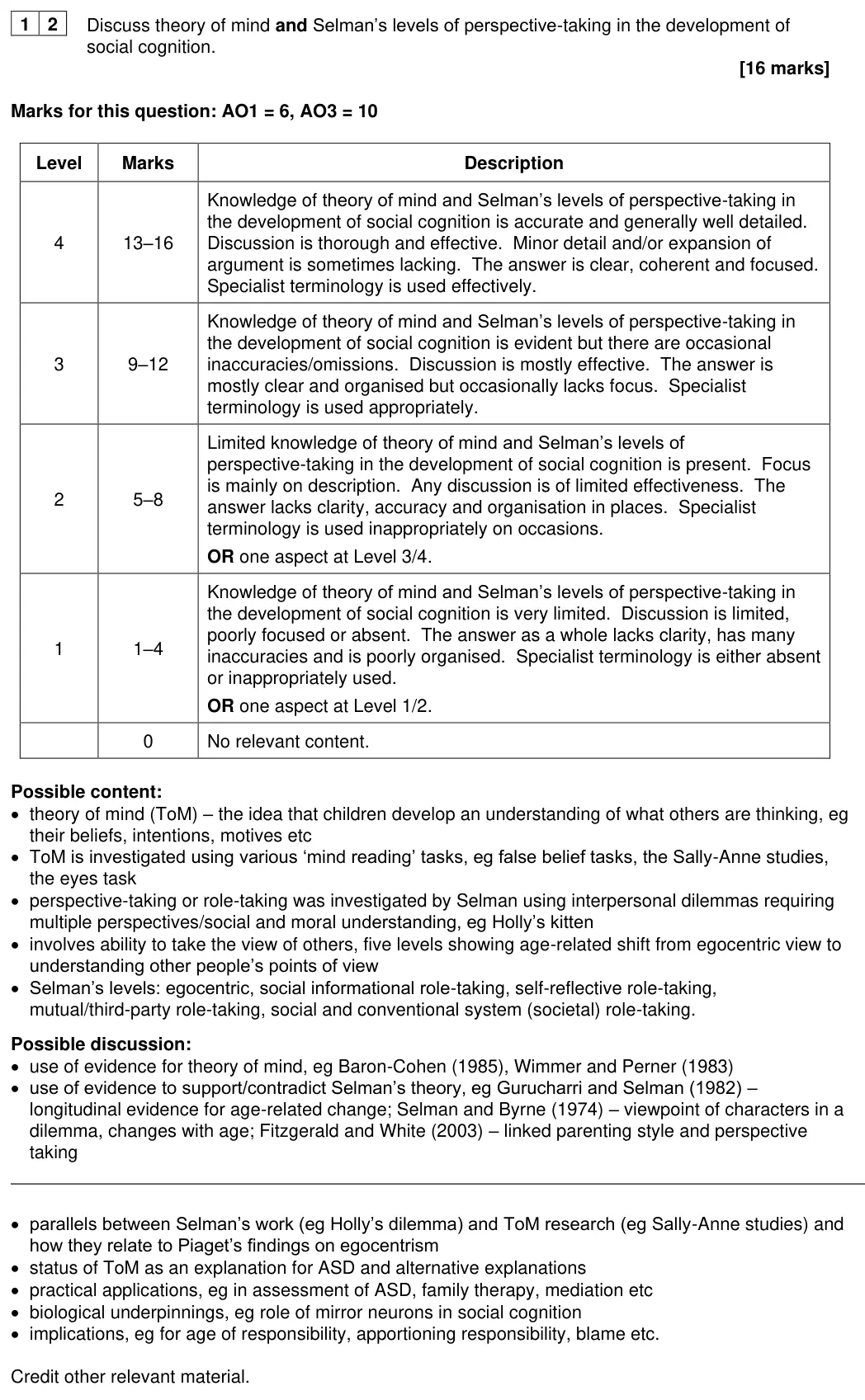
Answers to Question 12 were usually strong on knowledge and understanding, perhaps with greater emphasis on Selman’s theory than on theory of mind. Discussions tended to be variable with many consisting solely of use of evidence to support the theory.
Notes from the mark scheme and report
theory of mind (false-belief/Sally-Anne, eyes task) AND Selman's levels
one aspect only = max Level 2
MS also credits ToM as an explanation of ASD (removed in v1.4) as discussion
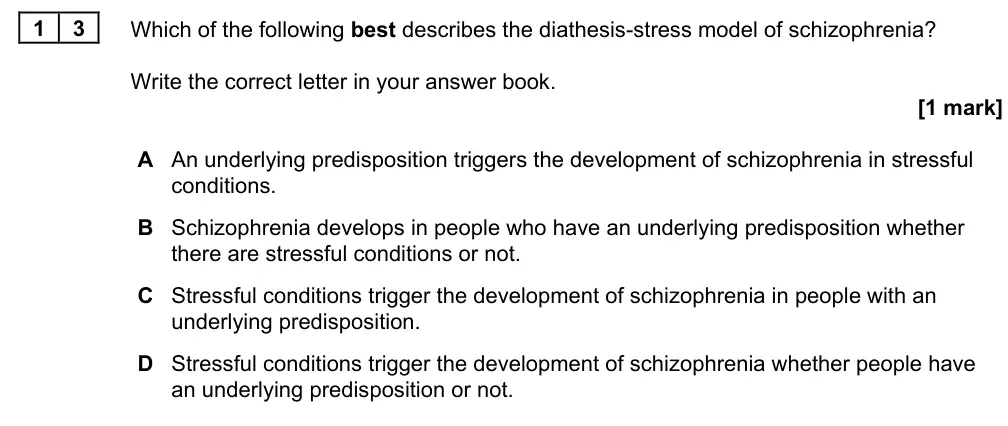
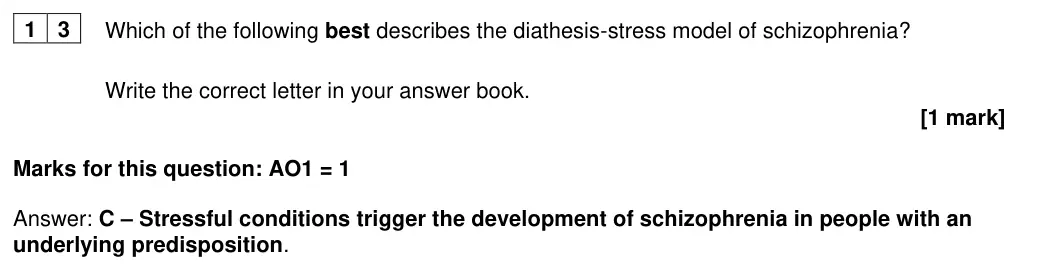
June 2022 · Paper 3 · Q131 markAO1=1Multiple choiceschizophrenia
Answer
C
Mark scheme, including level descriptors and indicative content
Examiner's comment
Most students answered the first multiple-choice question correctly but many answered the second incorrectly.
Notes from the mark scheme and report
correct C (stress triggers schizophrenia in those with a predisposition)
most answered correctly
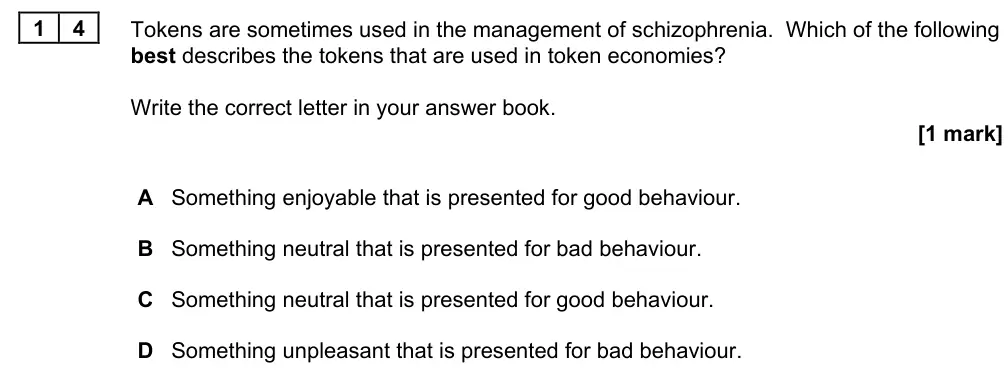
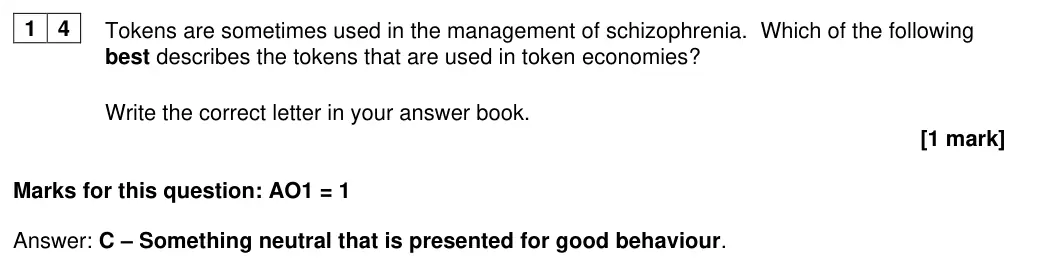
June 2022 · Paper 3 · Q141 markAO1=1Multiple choiceOld spec onlyapproaches
Not on the 2025 specification: token economies in the management of schizophrenia, removed in v1.4
Answer
C
Mark scheme, including level descriptors and indicative content
Examiner's comment
Most students answered the first multiple-choice question correctly but many answered the second incorrectly. It should be noted that tokens are secondary reinforcers and as such, they are not enjoyable in themselves but acquire reinforcing properties because they can be exchanged for a primary reinforcer that is intrinsically enjoyable.
Notes from the mark scheme and report
Off-spec: token economies in the management of schizophrenia, removed in v1.4
correct C (neutral token given for good behaviour = secondary reinforcer)
many answered incorrectly
June 2022 · Paper 3 · Q156 marksAO1=3, AO3=3Outlineschizophrenia
Mark scheme, including level descriptors and indicative content
Examiner's comment
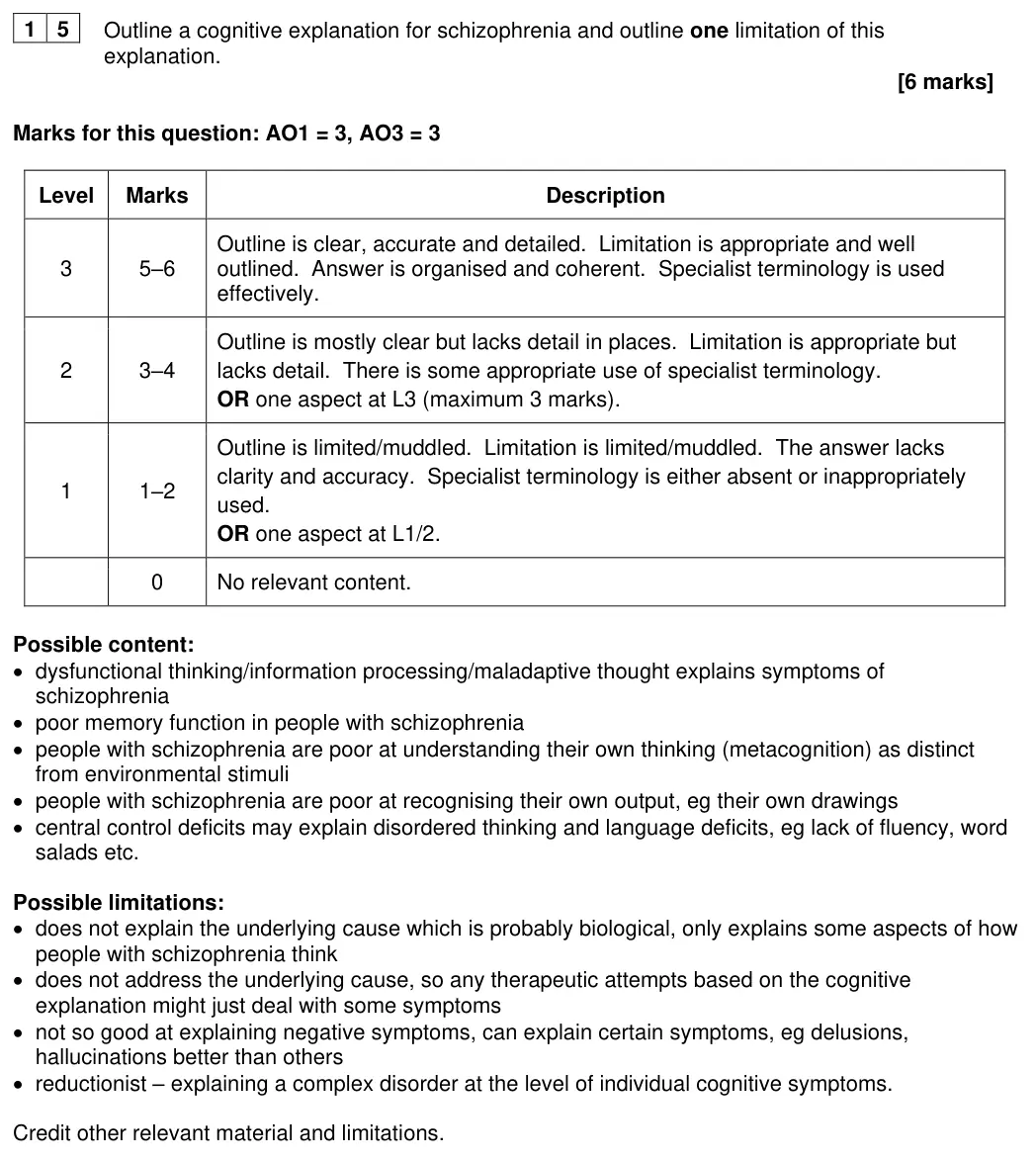
There were many competent answers to Question 15 although students sometimes mistakenly stated that metarepresentation and central coherence explained schizophrenia rather than failure of metarepresentation and central coherence. A considerable number of students used the wrong theory here, typically family dysfunction or occasionally the dopamine hypothesis.
Notes from the mark scheme and report
dysfunctional thought processing, metarepresentation/central control deficits + one limitation
one aspect only = max 3
failure OF metarepresentation explains symptoms
many used family dysfunction or dopamine instead
June 2022 · Paper 3 · Q164 marksAO3=4Research methodsdata handling
Mark scheme, including level descriptors and indicative content
Examiner's comment
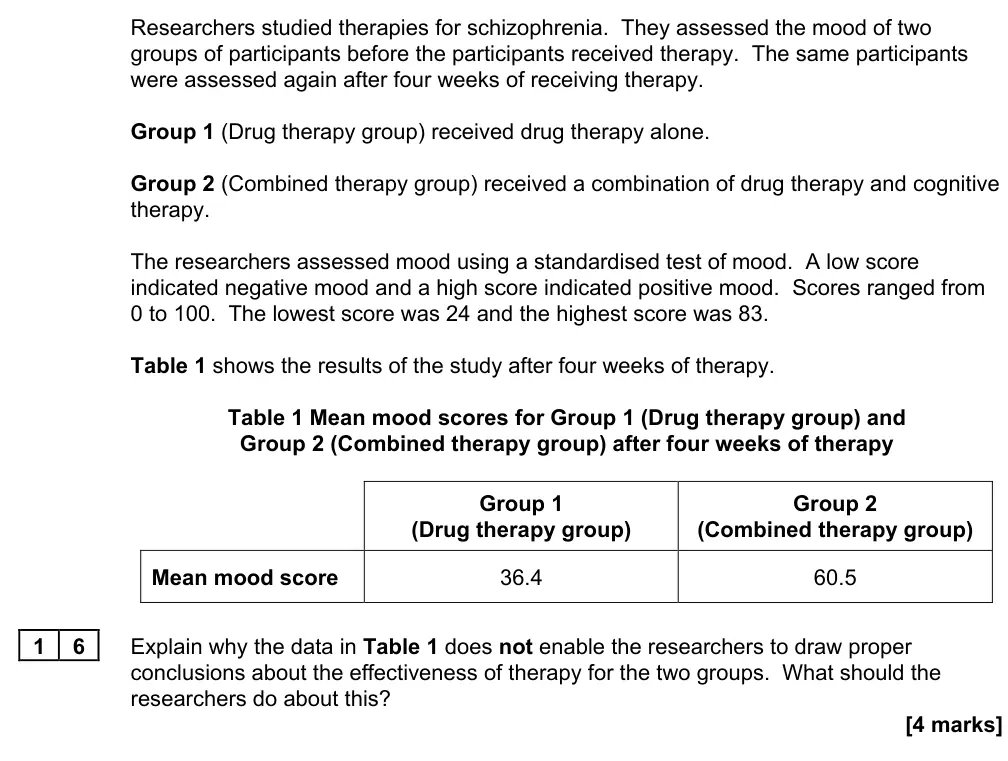
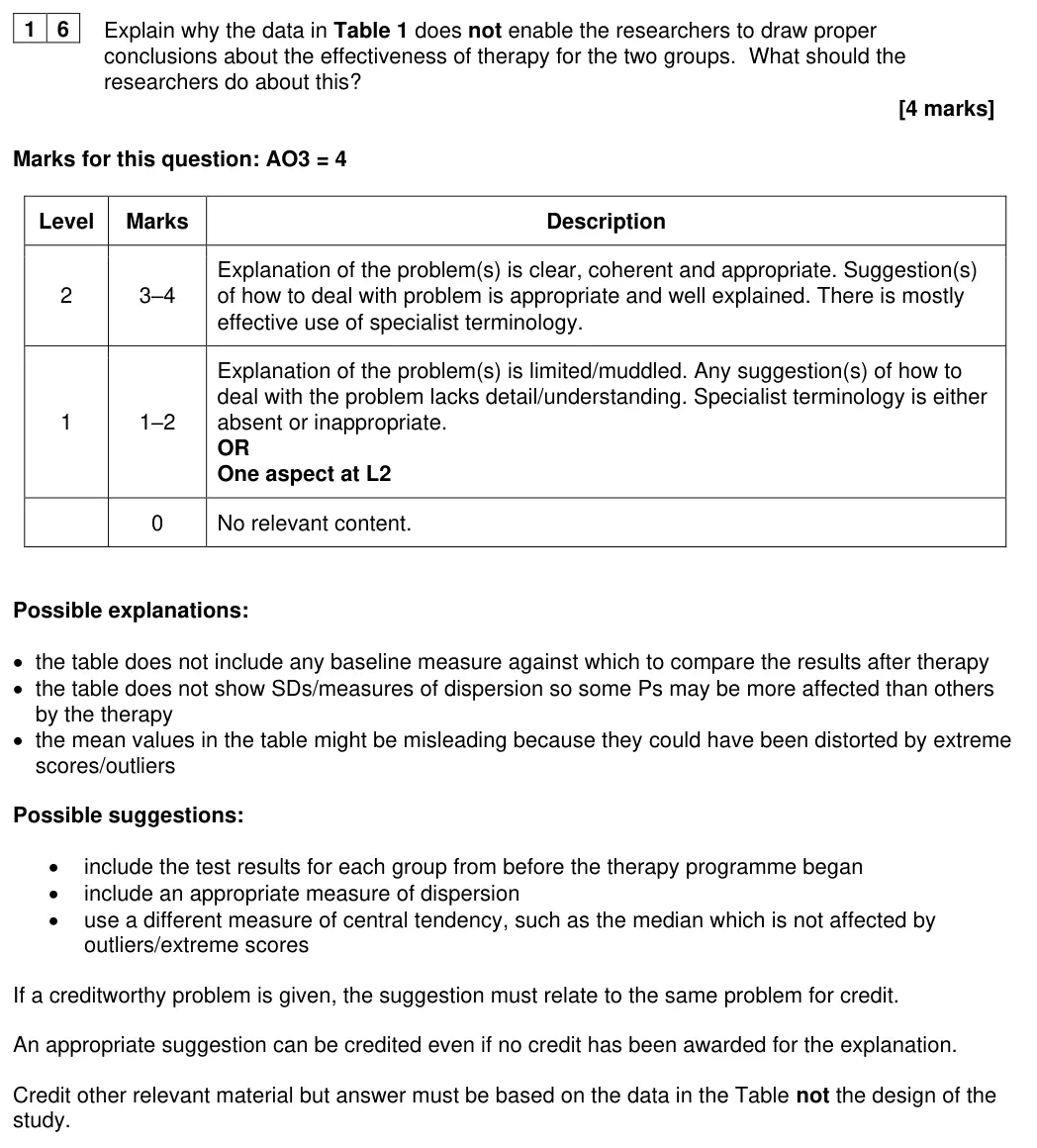
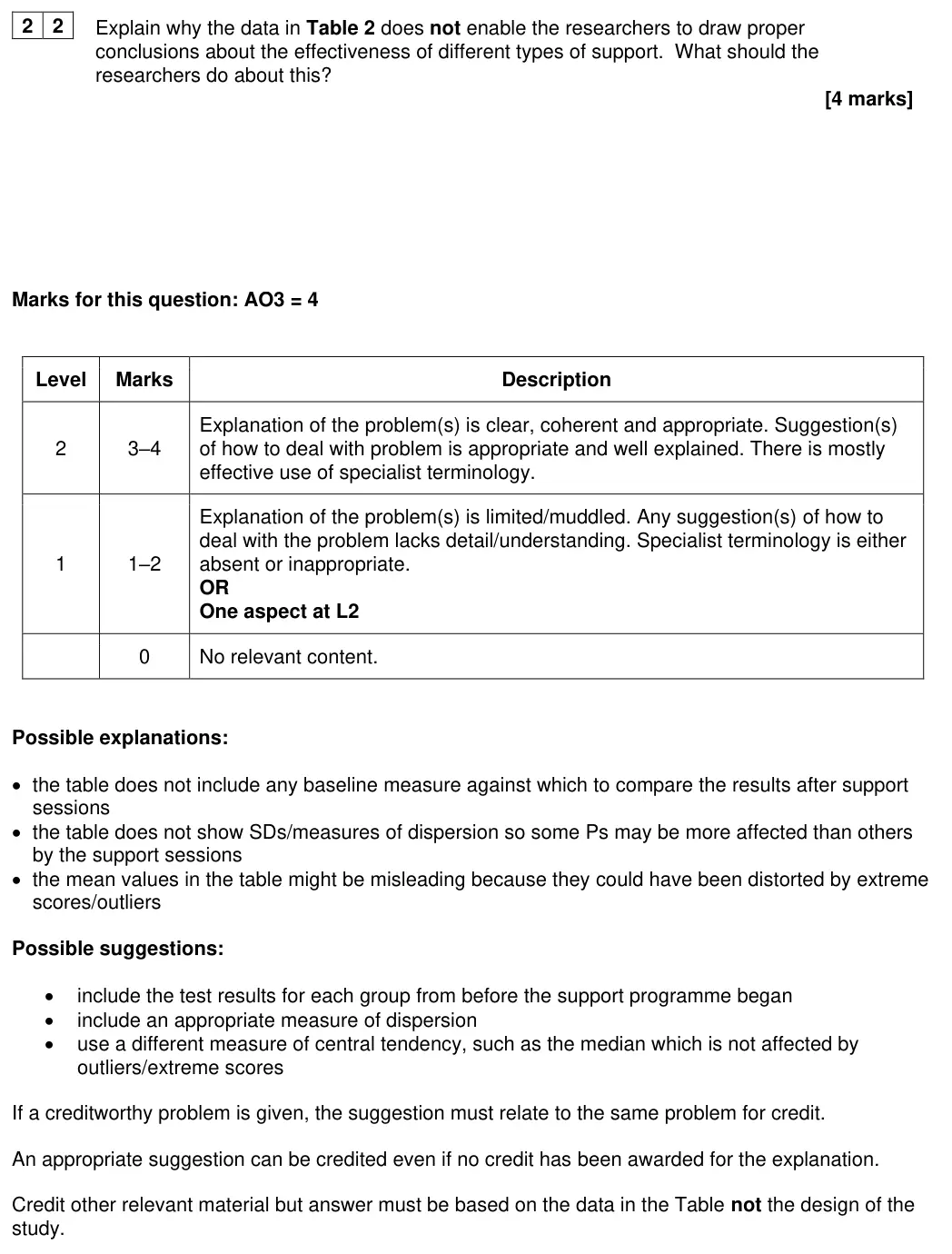
Question 16 was generally not well answered because students focused on aspects of the design of the study rather than on the data in the table. Despite the stem clearly stating that mood was assessed before the therapy began, relatively few students recognised that this data should have been included in the table. Other acceptable reasons included problems with interpretation of the mean and absence of any measure of dispersion. Even where students identified a creditworthy reason for the first part of the question, they sometimes forgot to attend to the second part of the question, offering no solution.
Notes from the mark scheme and report
problem with the DATA not the design: no baseline (pre-therapy) scores, no measure of dispersion, means distorted by outliers + matching remedy (add pre-scores, SD, use median)
design-focused answers scored poorly
many omitted the remedy
June 2022 · Paper 3 · Q174 marksAO2=4Research methodsdata handling
Mark scheme, including level descriptors and indicative content
Examiner's comment
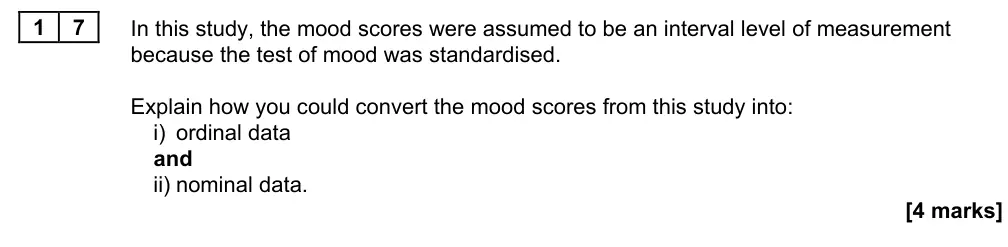
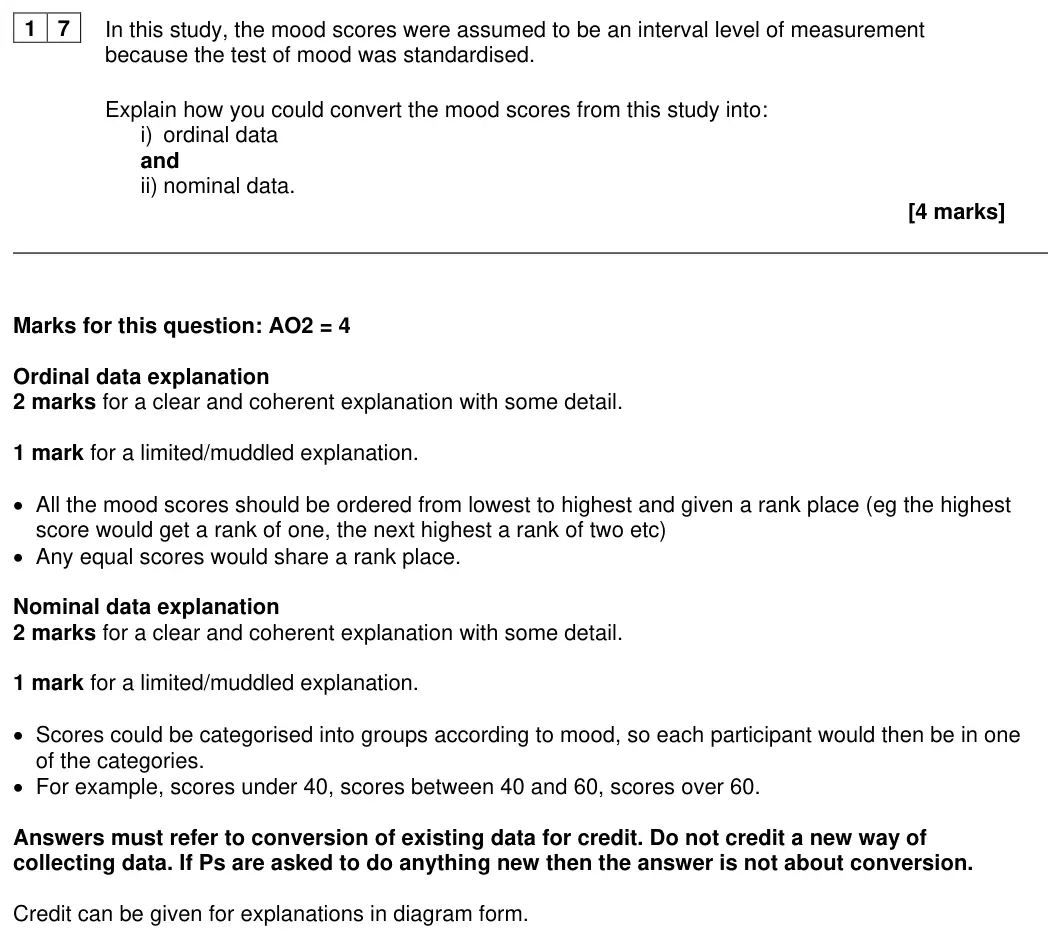
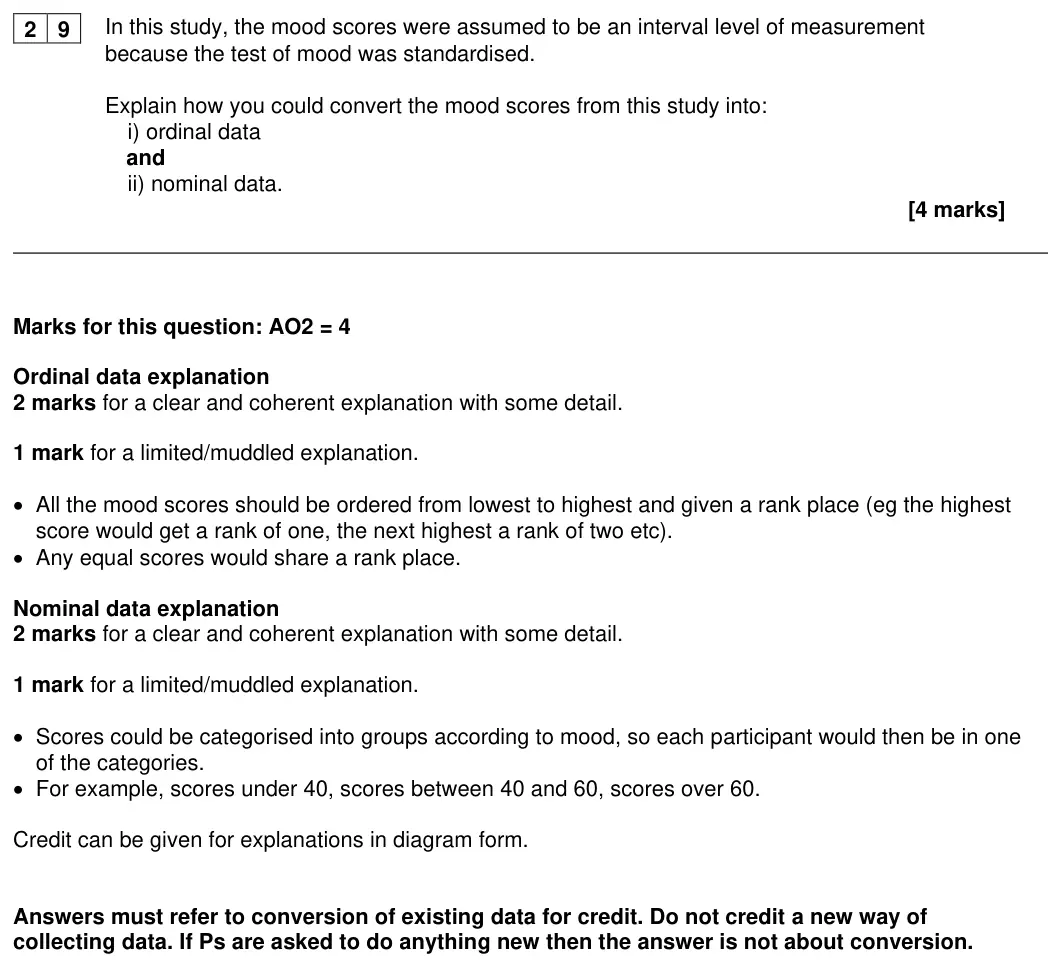
Question 17 was very poorly answered by most students, mainly because entirely new ways of collecting data were suggested rather than ways to convert the existing scores. Converting interval data into ordinal data and then into nominal data is a useful classroom activity, but evidently many students had not benefitted from such experience.
Notes from the mark scheme and report
ordinal: rank all scores (tied ranks shared)
nominal: categorise scores into mood bands (e.g. <40, 40-60, >60)
must convert existing data, not collect new data
very poorly answered
June 2022 · Paper 3 · Q188 marksAO3=8Extended writingschizophrenia
Mark scheme, including level descriptors and indicative content
Examiner's comment
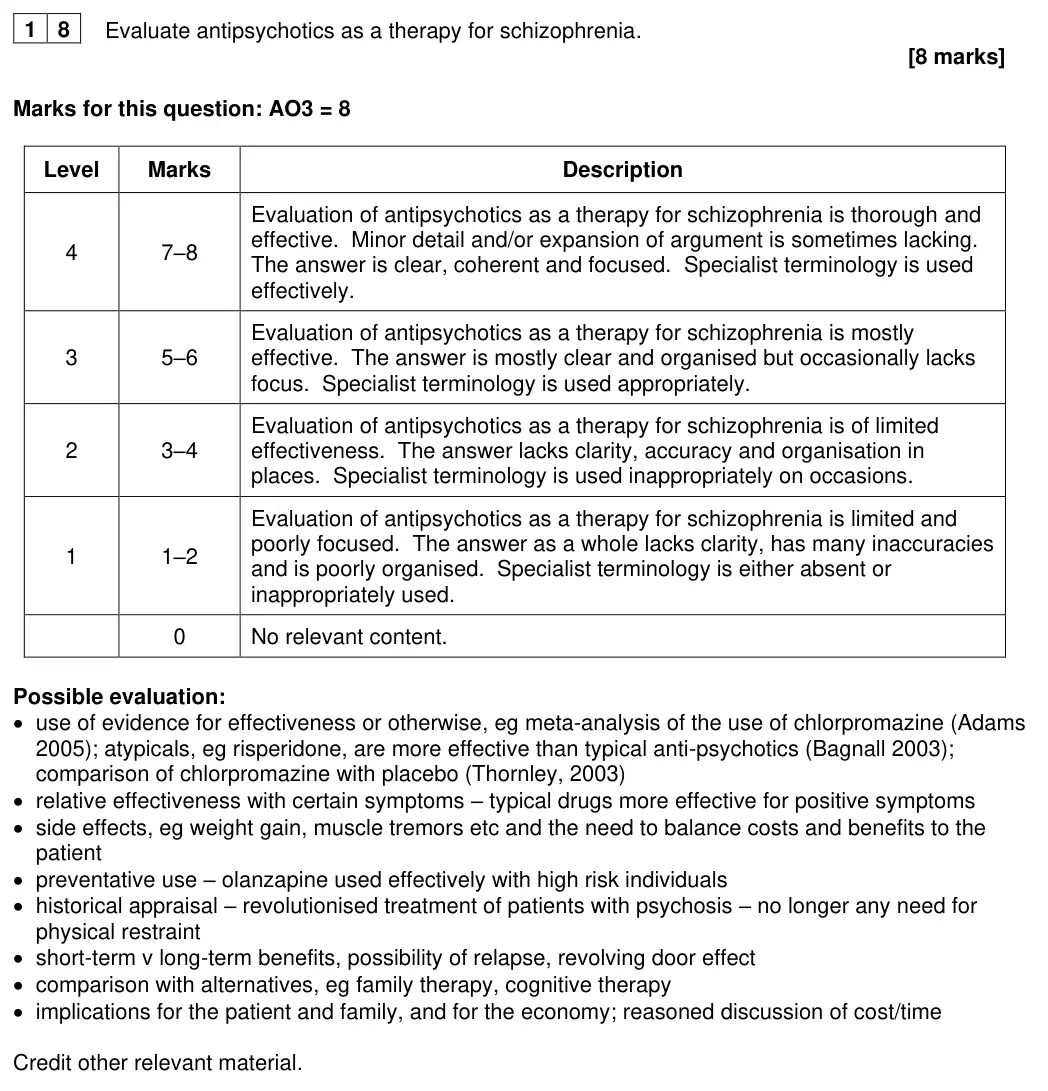
Question 18 was usually well answered except where students wasted time describing drugs and their mode of action. Vague and unsubstantiated assertions that ‘drugs work’ and points about time and cost without reasoned argument were not creditworthy.
Notes from the mark scheme and report
AO3 only: evidence for effectiveness (typical vs atypical), side effects, revolving door, comparison with CBT/family therapy
time spent describing drug action wasted
unsupported 'drugs work'/cost points not credited
June 2022 · Paper 3 · Q191 markAO1=1Multiple choiceeating behaviour
Answer
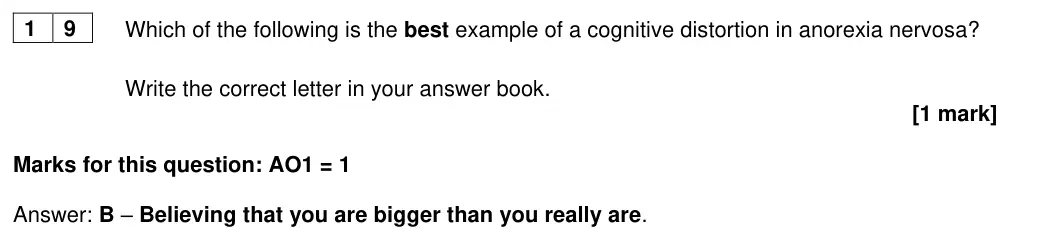
B
Mark scheme, including level descriptors and indicative content
Examiner's comment
Many answers to the multiple-choice questions were correct.
Notes from the mark scheme and report
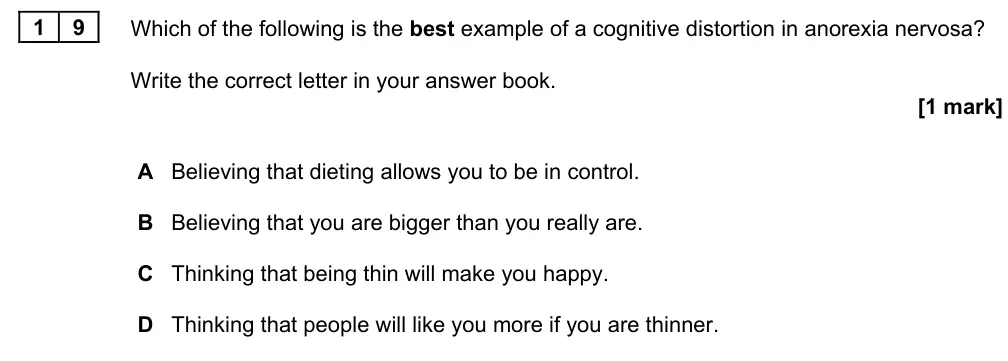
correct B (believing you are bigger than you are)
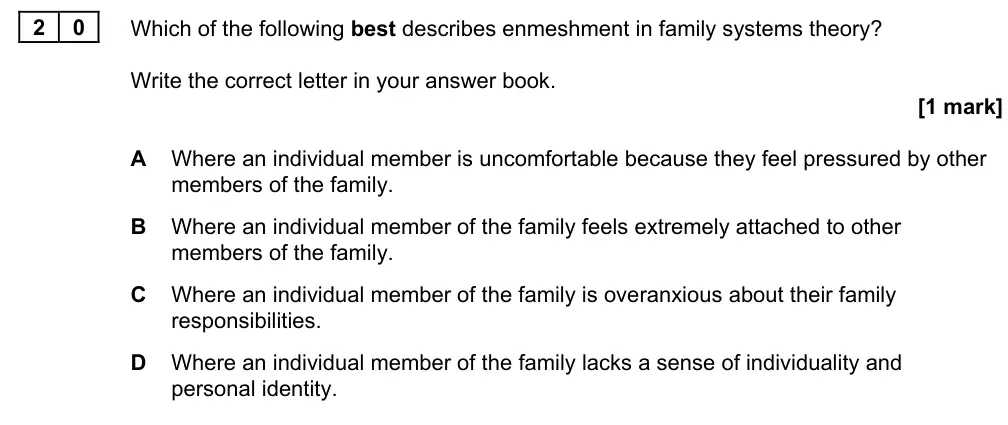
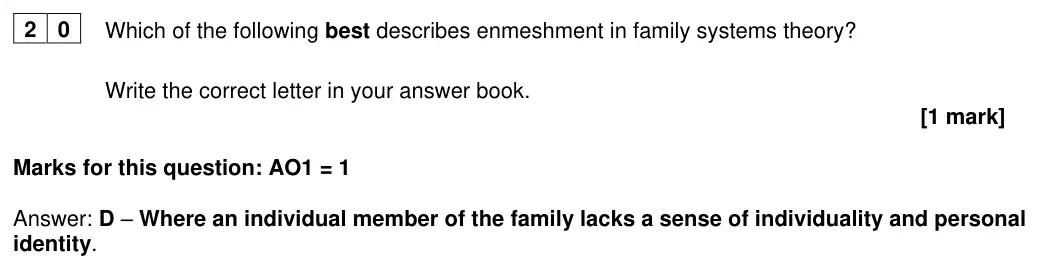
June 2022 · Paper 3 · Q201 markAO1=1Multiple choiceeating behaviour
Answer
D
Mark scheme, including level descriptors and indicative content
Examiner's comment
Many answers to the multiple-choice questions were correct.
Notes from the mark scheme and report
correct D (lack of individuality and personal identity)
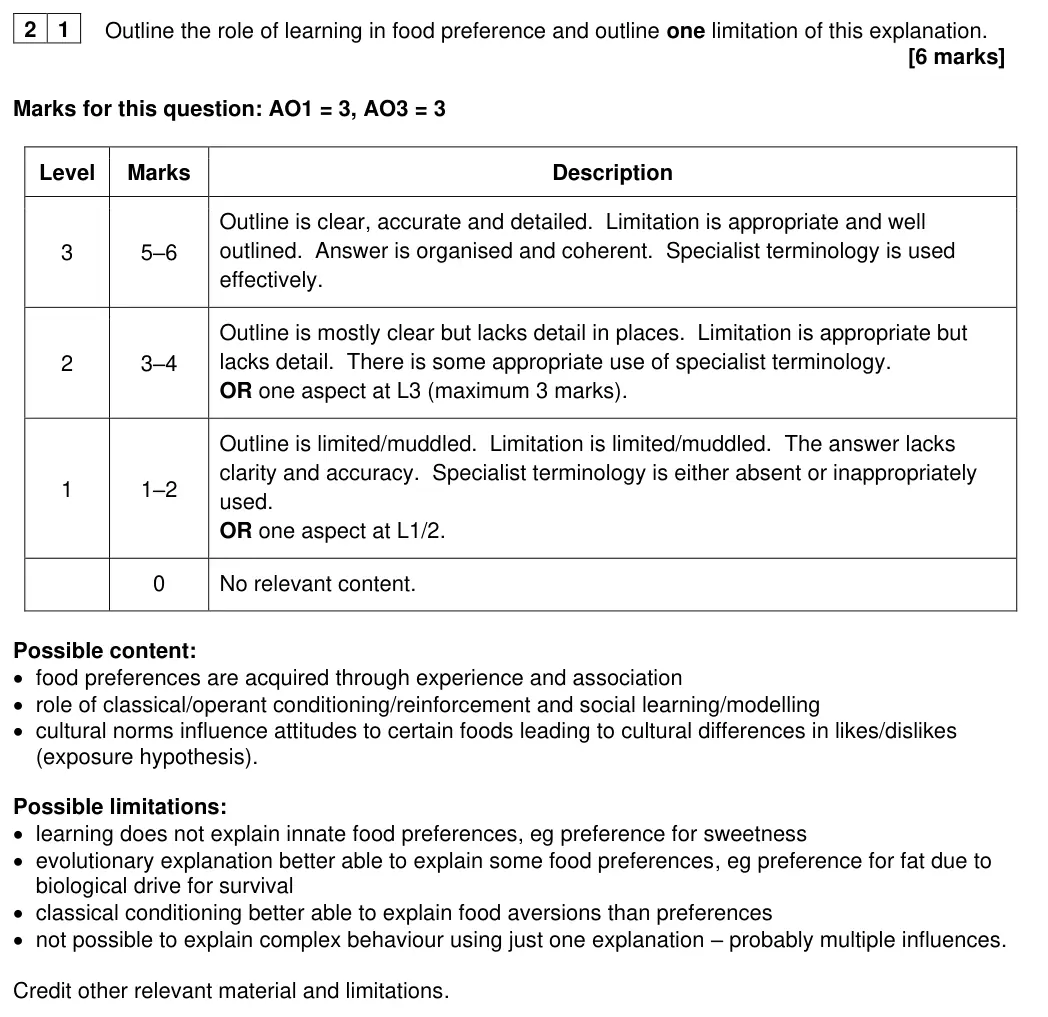
June 2022 · Paper 3 · Q216 marksAO1=3, AO3=3Outlineeating behaviour
Mark scheme, including level descriptors and indicative content
Examiner's comment
Answers to Question 21 tended to be quite well done although a number seemed to have very little to do with learning, referring instead to how parents could restrict available foodstuffs which wouldn’t really explain how preferences might be learnt. The most usual creditworthy limitation was a comparison of learning theory with evolutionary preferences.
Notes from the mark scheme and report
conditioning, social learning/modelling, cultural influences + one limitation (e.g. cannot explain innate sweet preference)
one aspect only = max 3
answers about parents restricting food did not explain learning
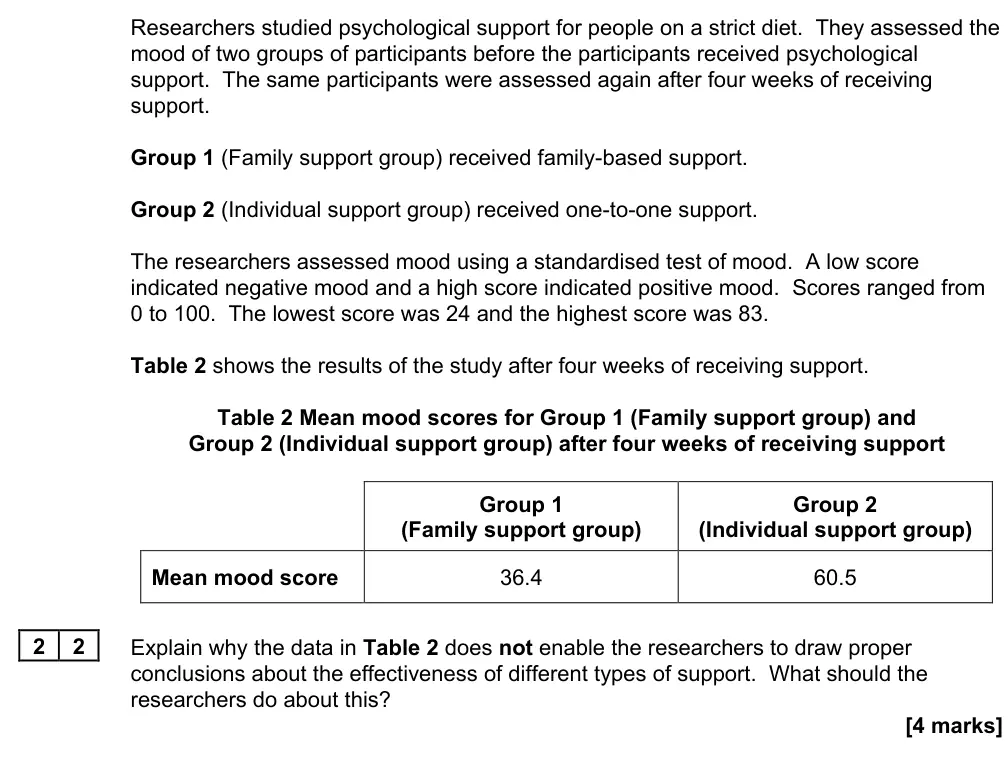
June 2022 · Paper 3 · Q224 marksAO3=4Research methodsdata handling
Mark scheme, including level descriptors and indicative content
Examiner's comment
Question 22 was generally not well answered because students focused on aspects of the design of the study rather than on the data in the table. Despite the stem clearly stating that mood was assessed before the support programme began, relatively few students recognised that this data should have been included in the table. Other acceptable reasons included problems with interpretation of the mean and absence of any measure of dispersion. Even where students identified a creditworthy reason for the first part of the question, they sometimes forgot to attend to the second part of the question, offering no solution.
Notes from the mark scheme and report
stem is support for people on a strict diet (dieting removed in v1.4) but marks need only data handling: no baseline scores, no dispersion, outliers + matching remedy
design-focused answers scored poorly
June 2022 · Paper 3 · Q234 marksAO2=4Research methodsdata handling
Mark scheme, including level descriptors and indicative content
Examiner's comment
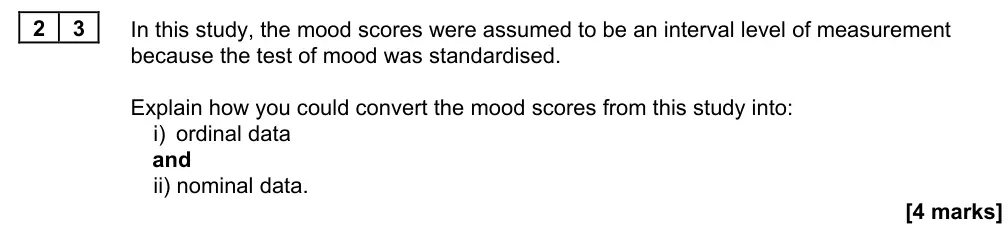
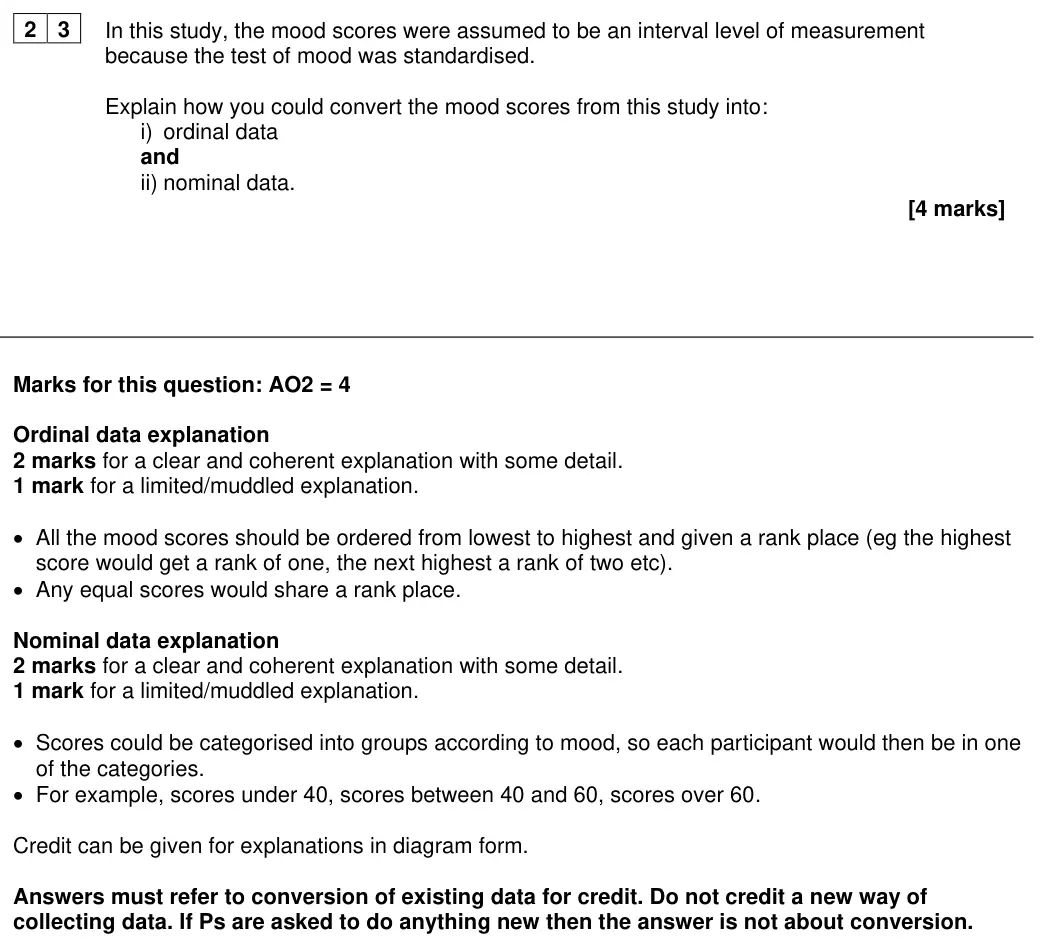
Question 23 was very poorly answered by most students, mainly because entirely new ways of collecting data were suggested rather than ways to convert the existing scores. Converting interval data into ordinal data and then into nominal data is a useful classroom activity, but evidently many students had not benefitted from such experience.
Notes from the mark scheme and report
ordinal: rank all scores
nominal: categorise into mood bands
must convert existing data, not collect new data
very poorly answered
June 2022 · Paper 3 · Q248 marksAO3=8Extended writingeating behaviour
Mark scheme, including level descriptors and indicative content
Examiner's comment
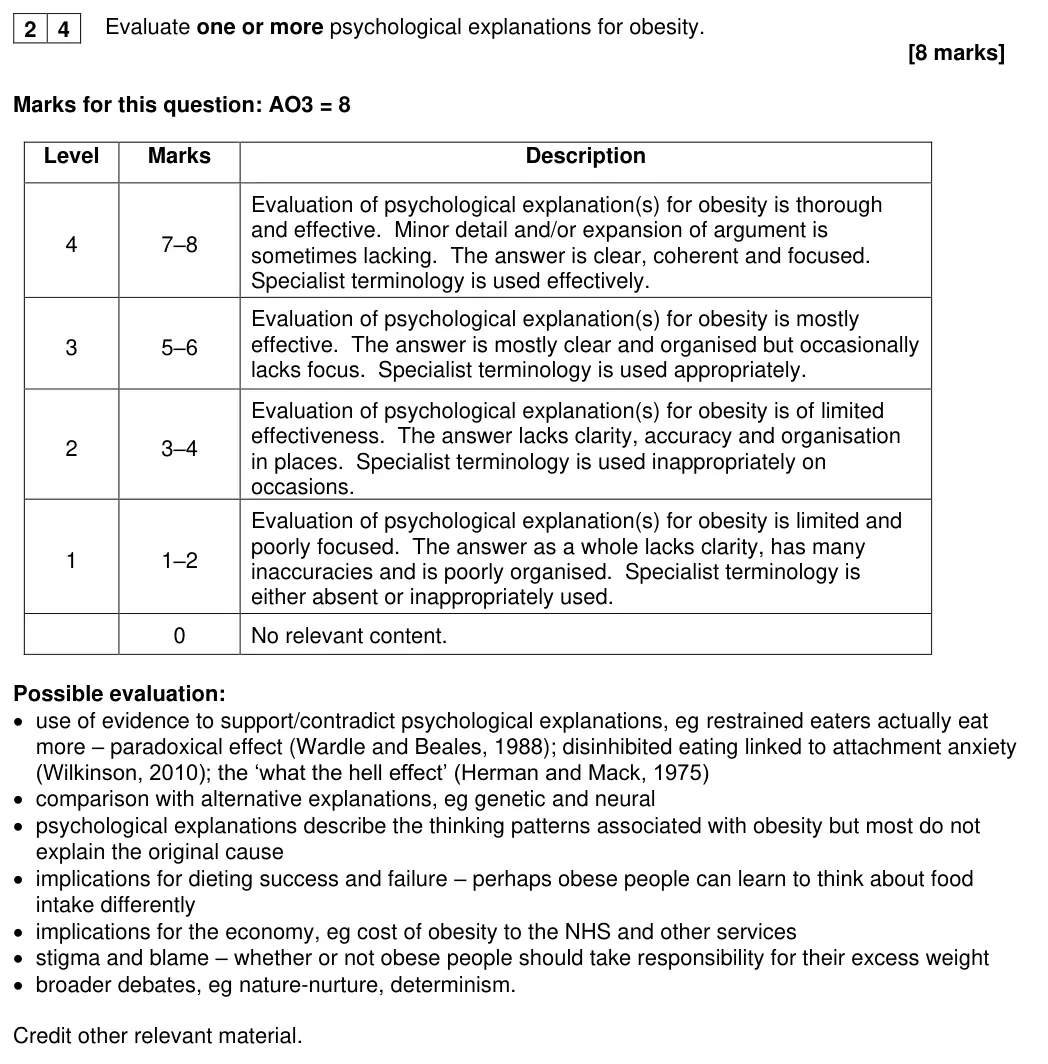
Question 24 was generally not as well-answered as the matching question for the other two topics in this section, perhaps because this question was about explanations rather than therapy.
Notes from the mark scheme and report
AO3 only: restraint theory, disinhibition, boundary model evidence (Wardle and Beales, Herman and Mack)
MS also credits implications for dieting success/failure (removed in v1.4)
less well answered than parallel questions
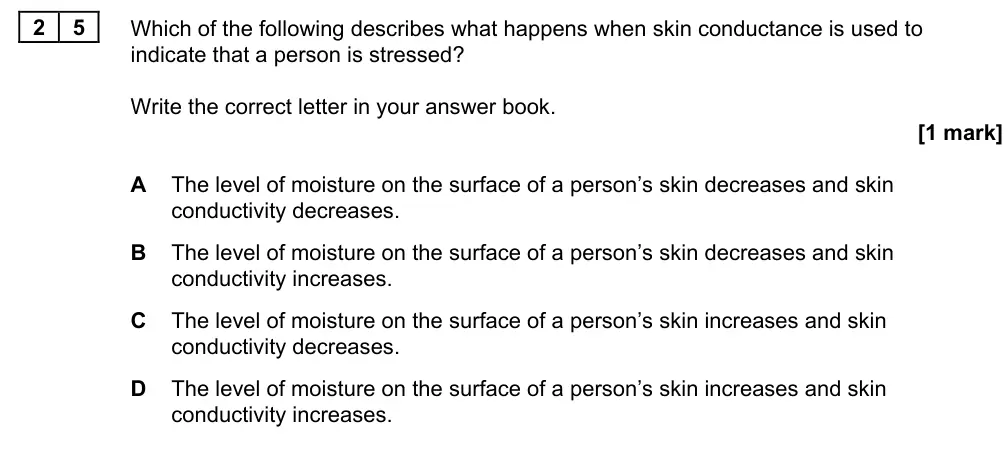
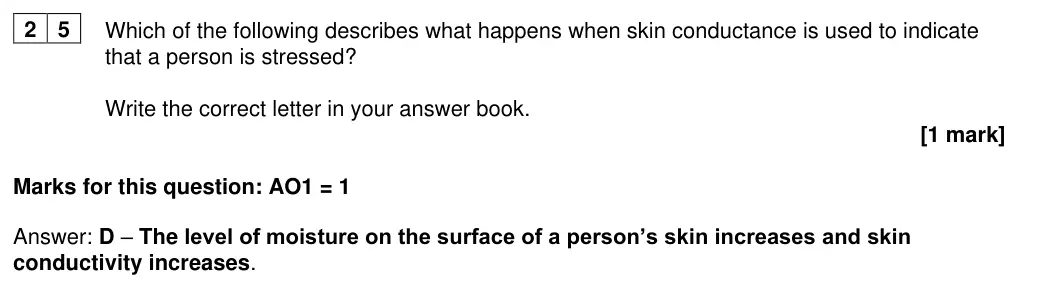
June 2022 · Paper 3 · Q251 markAO1=1Multiple choiceMediumstress
Answer
D
Mark scheme, including level descriptors and indicative content
Examiner's comment
Most answers to the first multiple-choice question were correct whereas roughly half the answers to the second multiple-choice question were correct.
Notes from the mark scheme and report
correct D (moisture increases, conductivity increases)
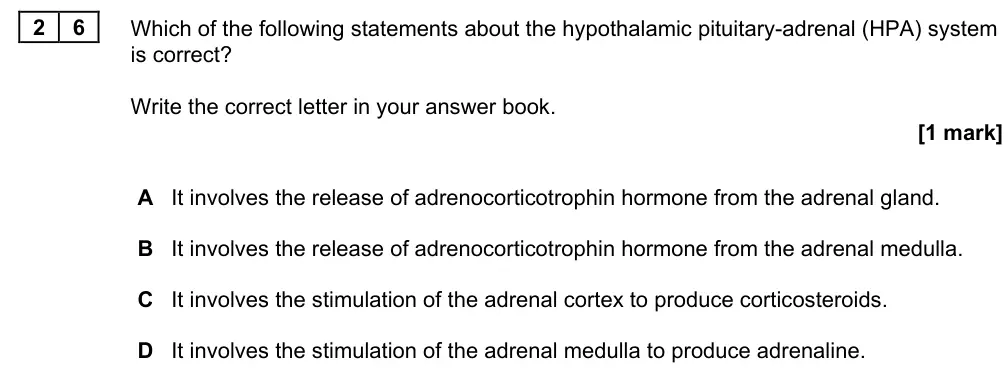
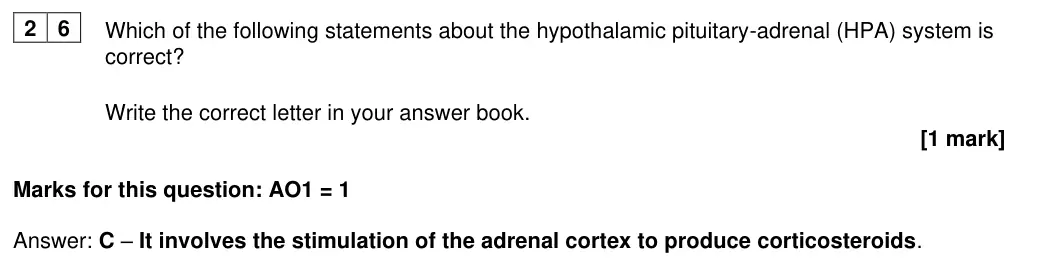
June 2022 · Paper 3 · Q261 markAO1=1Multiple choiceMediumstress
Answer
C
Mark scheme, including level descriptors and indicative content
Examiner's comment
Most answers to the first multiple-choice question were correct whereas roughly half the answers to the second multiple-choice question were correct.
Notes from the mark scheme and report
correct C (adrenal cortex produces corticosteroids)
distractors confuse ACTH source and SAM (adrenal medulla/adrenaline)
only about half correct
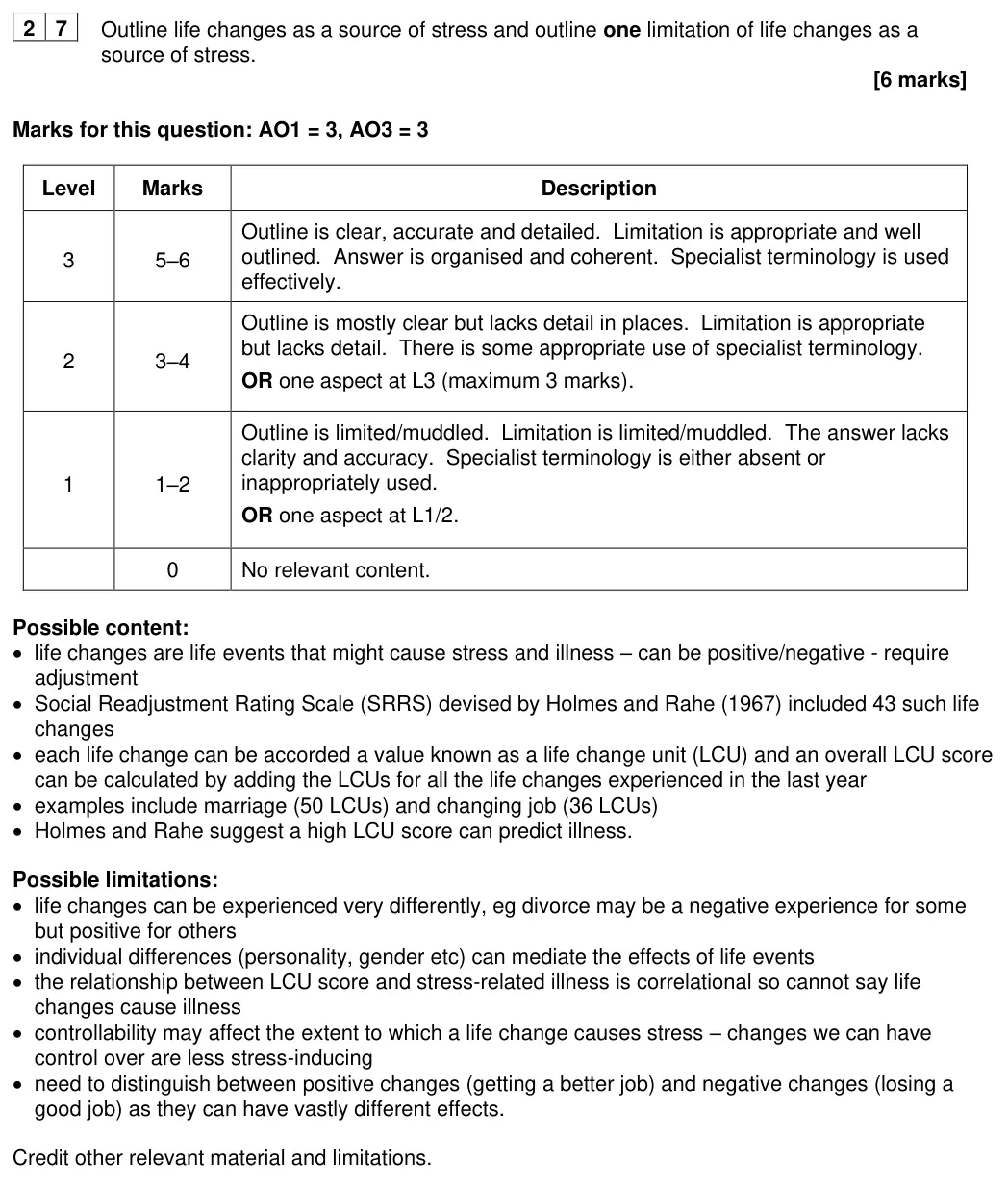
June 2022 · Paper 3 · Q276 marksAO1=3, AO3=3Outlinestress
Mark scheme, including level descriptors and indicative content
Examiner's comment
Question 27 often elicited sound knowledge and understanding which included useful detail of the SRRS and life change units. The limitation tended to be less well done than the description with a tendency to focus on evaluation of the scale rather than on life changes as a source of stress. The simplest and most effective limitation tended to be the subjective nature of life change experience so that a given life event might not be stressful for everyone.
Notes from the mark scheme and report
life changes, SRRS, LCUs + one limitation of life changes as a SOURCE of stress (e.g. subjective experience, correlational)
one aspect only = max 3
limitations of the scale itself were less effective
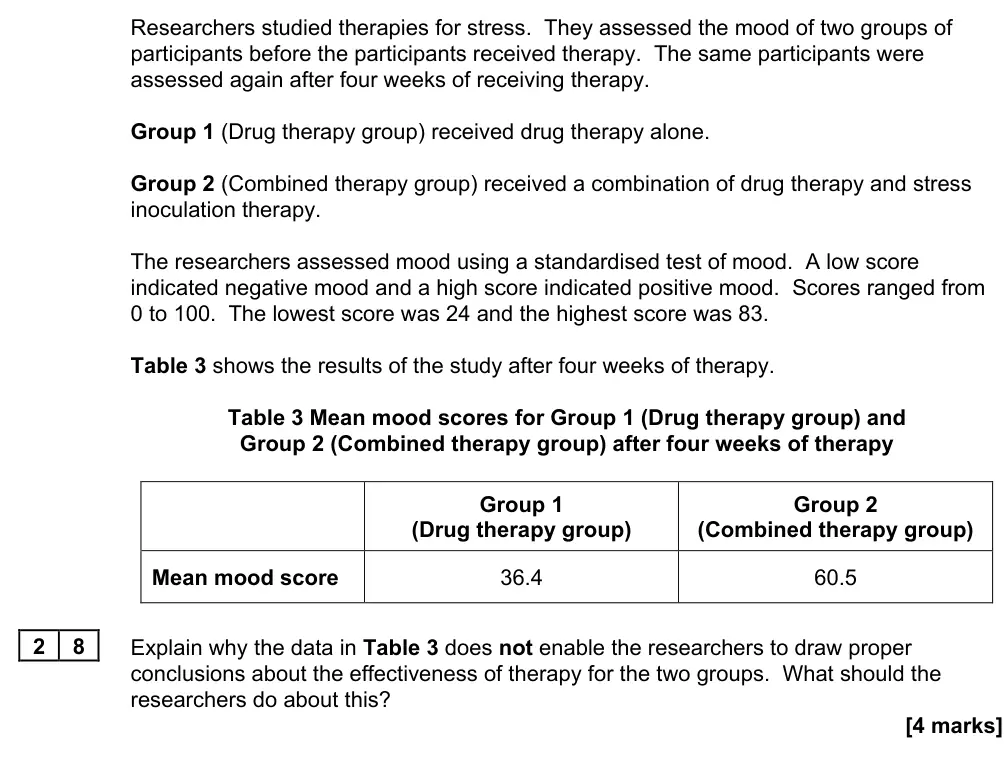
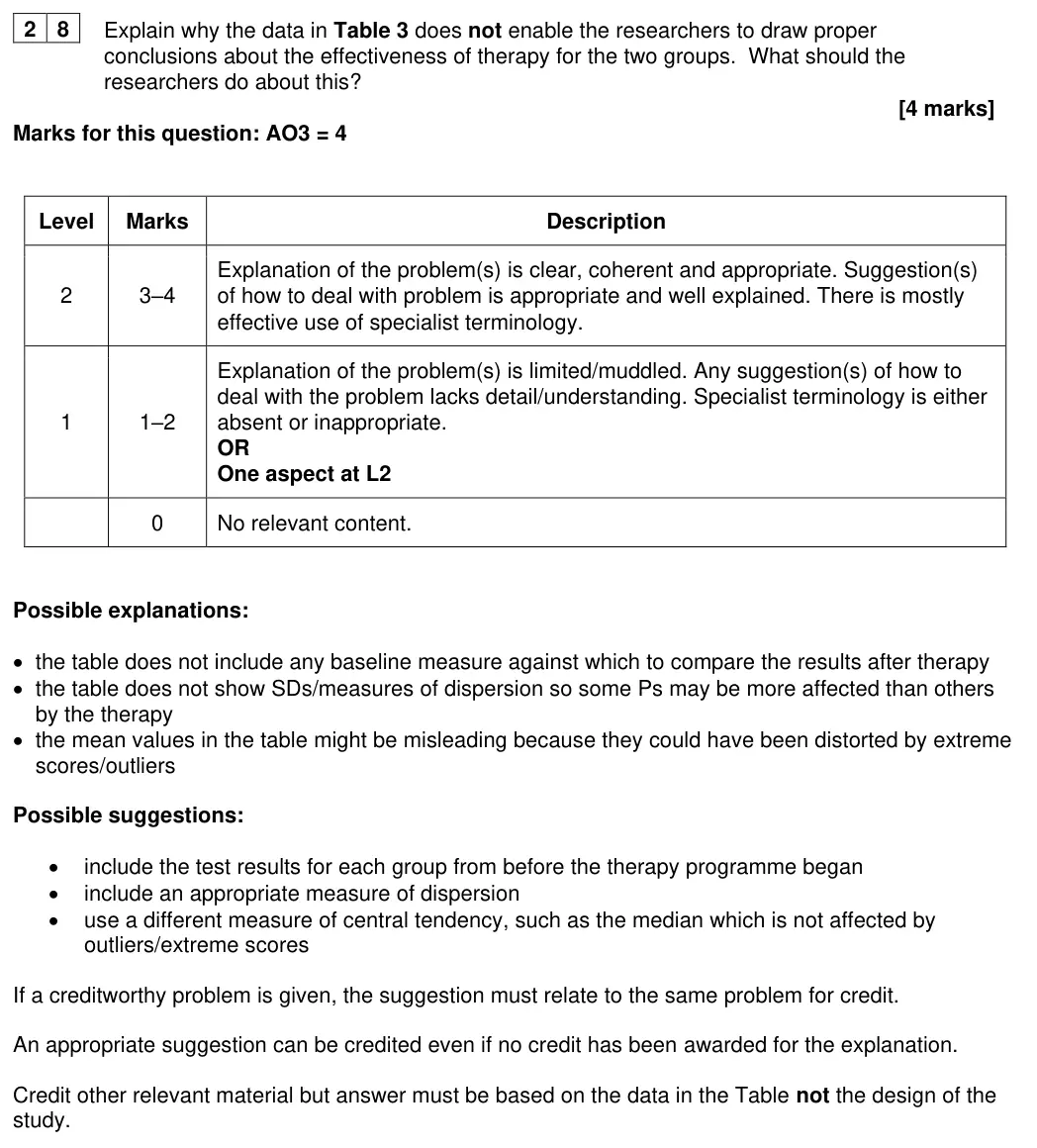
June 2022 · Paper 3 · Q284 marksAO3=4Research methodsdata handling
Mark scheme, including level descriptors and indicative content
Examiner's comment
Question 28 was generally not well answered because students focused on aspects of the design of the study rather than on the data in the table. Despite the stem clearly stating that mood was assessed before the therapy began, relatively few students recognised that this data should have been included in the table. Other acceptable reasons included problems with interpretation of the mean and absence of any measure of dispersion. Even where students identified a creditworthy reason for the first part of the question, they sometimes forgot to attend to the second part of the question, offering no solution.
Notes from the mark scheme and report
problem with the DATA not the design: no baseline scores, no dispersion, outliers + matching remedy
June 2022 · Paper 3 · Q294 marksAO2=4Research methodsdata handling
Mark scheme, including level descriptors and indicative content
Examiner's comment
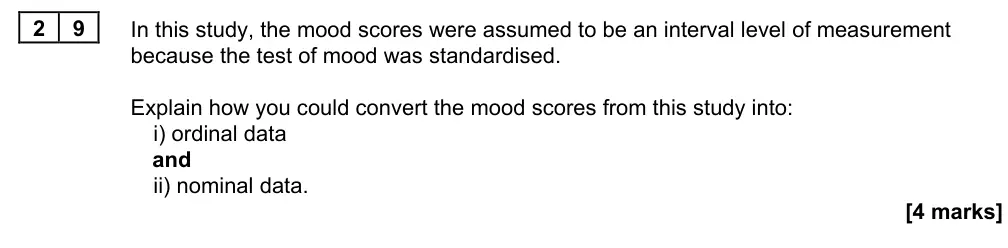
Question 29 was very poorly answered by most candidates, mainly because entirely new ways of collecting data were suggested rather than ways to convert the existing scores. Converting interval data into ordinal data and then into nominal data is a useful classroom activity, but evidently many students had not benefitted from such experience.
Notes from the mark scheme and report
ordinal: rank all scores
nominal: categorise into mood bands
must convert existing data, not collect new data
very poorly answered
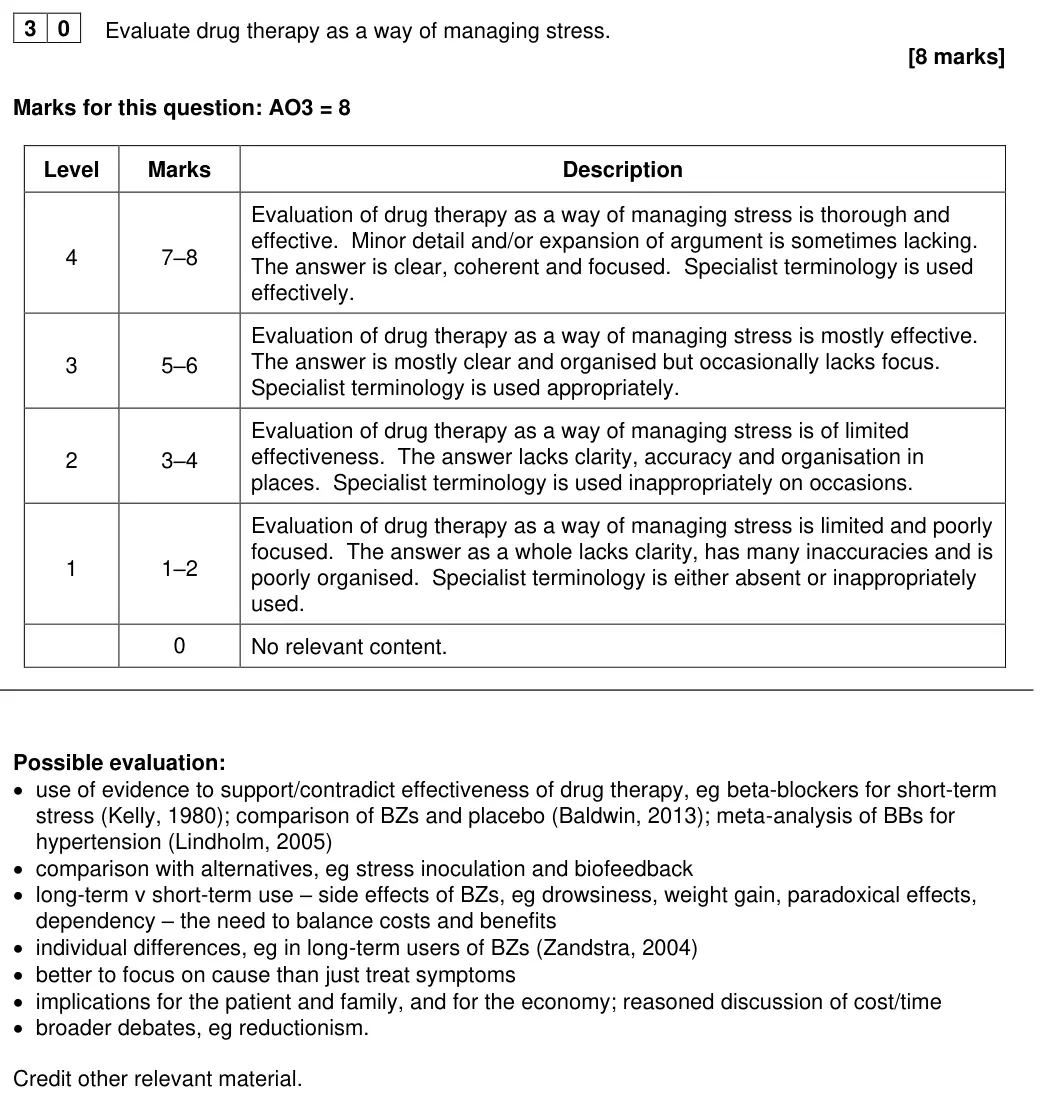
June 2022 · Paper 3 · Q308 marksAO3=8Extended writingstress
Mark scheme, including level descriptors and indicative content
Examiner's comment
Question 30 was usually well answered except where students wasted time describing drugs and their mode of action. Vague and unsubstantiated assertions that ‘drugs work’ and points about time and cost without reasoned argument were not creditworthy.
Notes from the mark scheme and report
AO3 only: effectiveness evidence, side effects/dependency, symptoms not causes, comparison with SIT/biofeedback
MS cites named drugs (benzodiazepines, beta blockers), removed in v1.4 but drug therapy remains
describing drug action wasted time
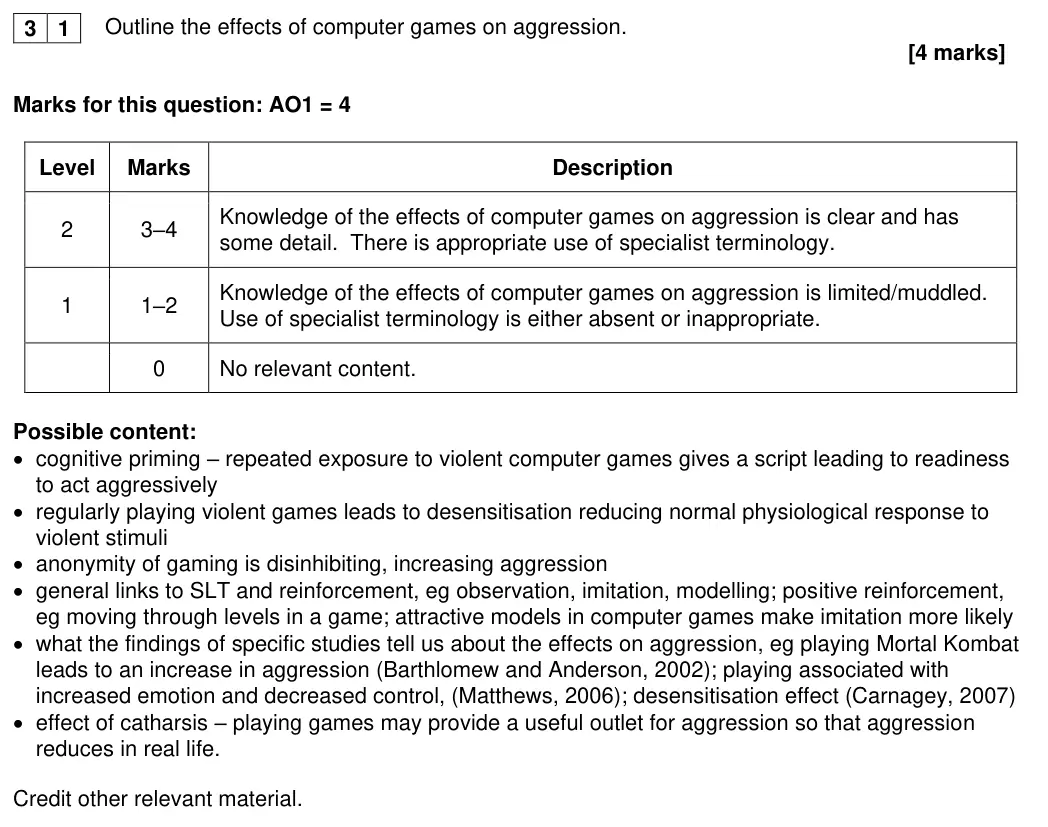
June 2022 · Paper 3 · Q314 marksAO1=4Outlineaggression
Mark scheme, including level descriptors and indicative content
Examiner's comment
There were some low scoring answers to Question 31, usually because the answer consisted of a detailed description of a study. In such cases, the only part of the response that really answered the question was the conclusion that playing computer games might lead to more aggressive behaviour. Better answers came to the same general conclusion but explained the increased aggression in terms of desensitisation, disinhibition and cognitive priming. It was rare to see answers suggesting that playing computer games might lead to a decrease in aggression due to catharsis.
describing a single study with only its conclusion scored low
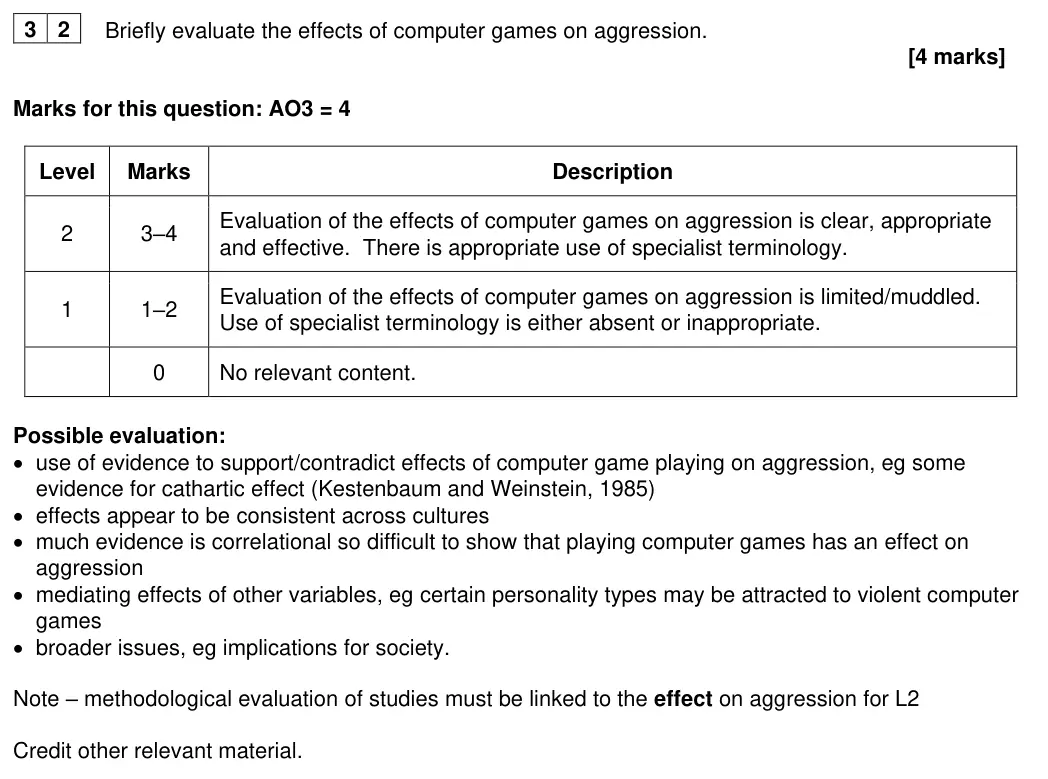
June 2022 · Paper 3 · Q324 marksAO3=4Evaluate (short)aggression
Mark scheme, including level descriptors and indicative content
Examiner's comment
Catharsis occasionally appeared as an effective counterargument in answers to Question 32, with use of studies and contrasting explanations such as biology also used to good effect.
methodological points must be linked to effect on aggression for Level 2
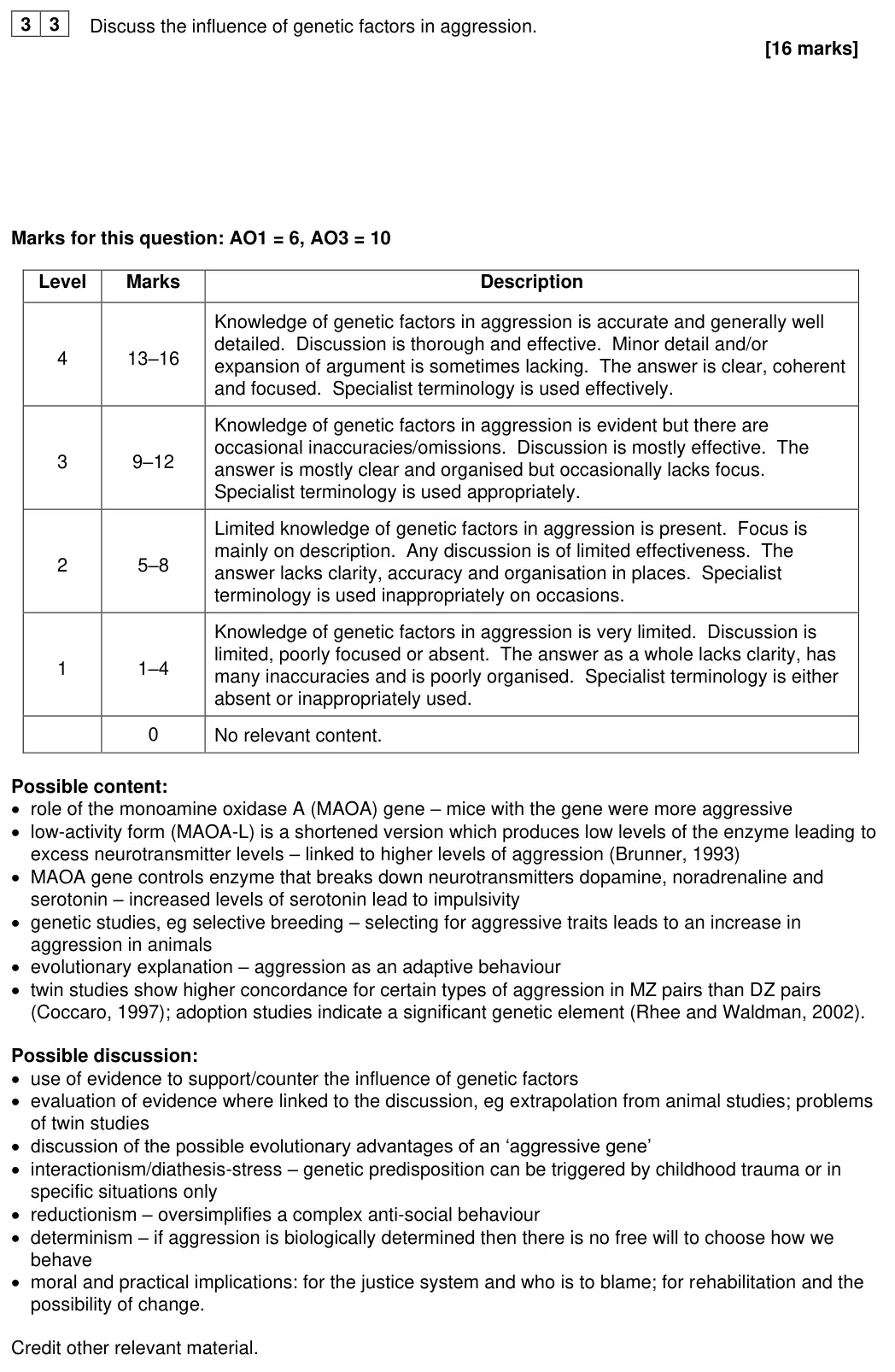
June 2022 · Paper 3 · Q3316 marksAO1=6, AO3=1016-mark essayaggression
Mark scheme, including level descriptors and indicative content
Examiner's comment
Answers to Question 33 varied considerably, possibly because students often misconstrued it as a question about biological explanations in general. On the one hand there were detailed, accurate descriptions of genetic influences on aggression with associated evidence, whereas at the other extreme were answers that barely mentioned genetics but focused almost exclusively on neural explanations. This neural material could have been made relevant if students had noted the likely genetic underpinnings and shaped their content to the question, but often this did not happen.
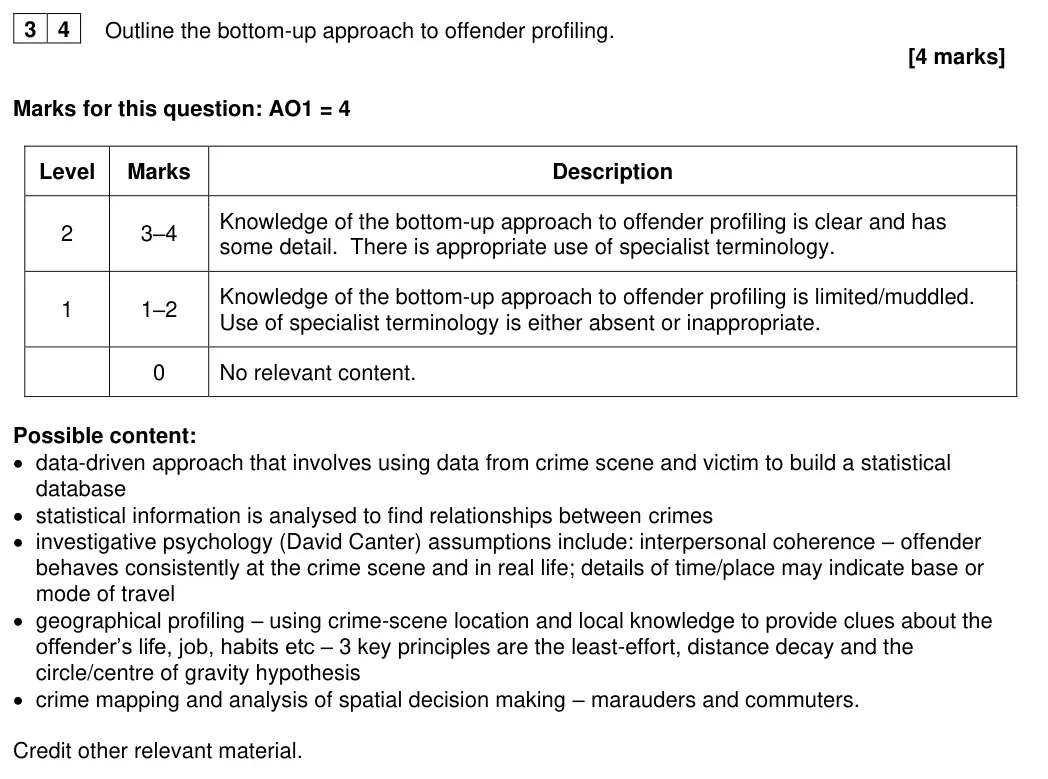
Mark scheme, including level descriptors and indicative content
Examiner's comment
Answers to Question 34 often scored well although even quite detailed answers sometimes neglected the fundamental point that the bottom-up approach is data driven. Some answers were restricted to marks in Level 1 because they consisted of a list of terms (interpersonal coherence, forensic awareness, etc) without any explanation. Occasionally students completely confused the top-down and bottom-up approaches in both Questions 34 and 35.
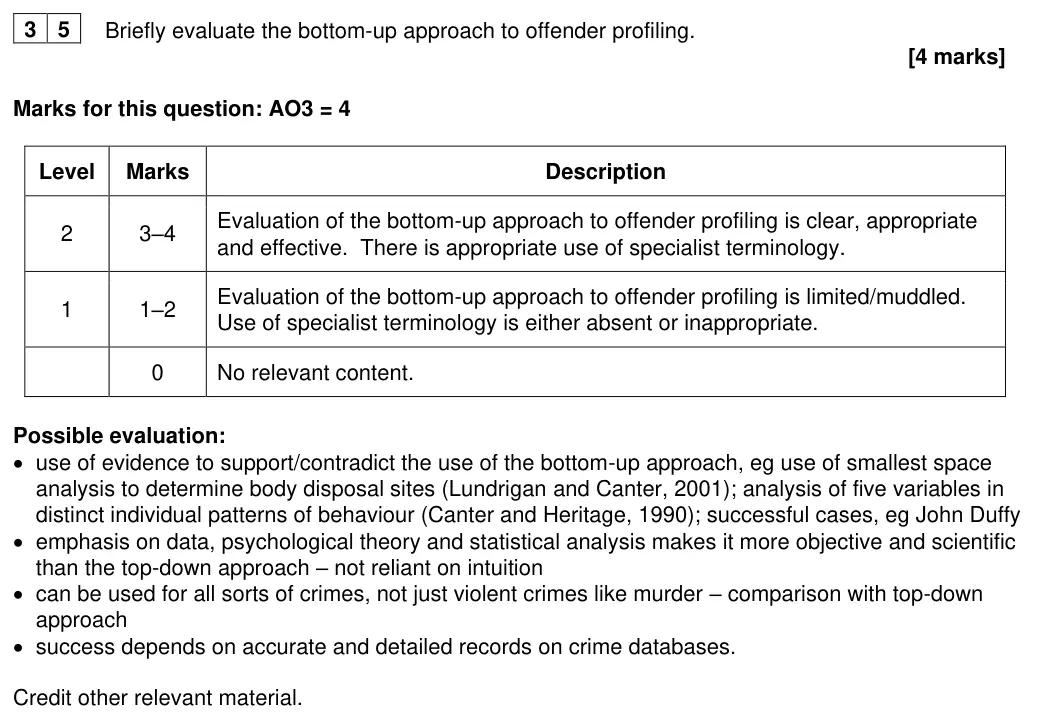
Mark scheme, including level descriptors and indicative content
Examiner's comment
Question 35 was generally effectively answered. Students used evidence in relation to effectiveness or offered comparison with the top-down approach. Occasionally students completely confused the top-down and bottom-up approaches in both Questions 34 and 35.
Notes from the mark scheme and report
evidence (Canter), more objective/scientific than typology approach, applicable to more crime types, depends on database quality
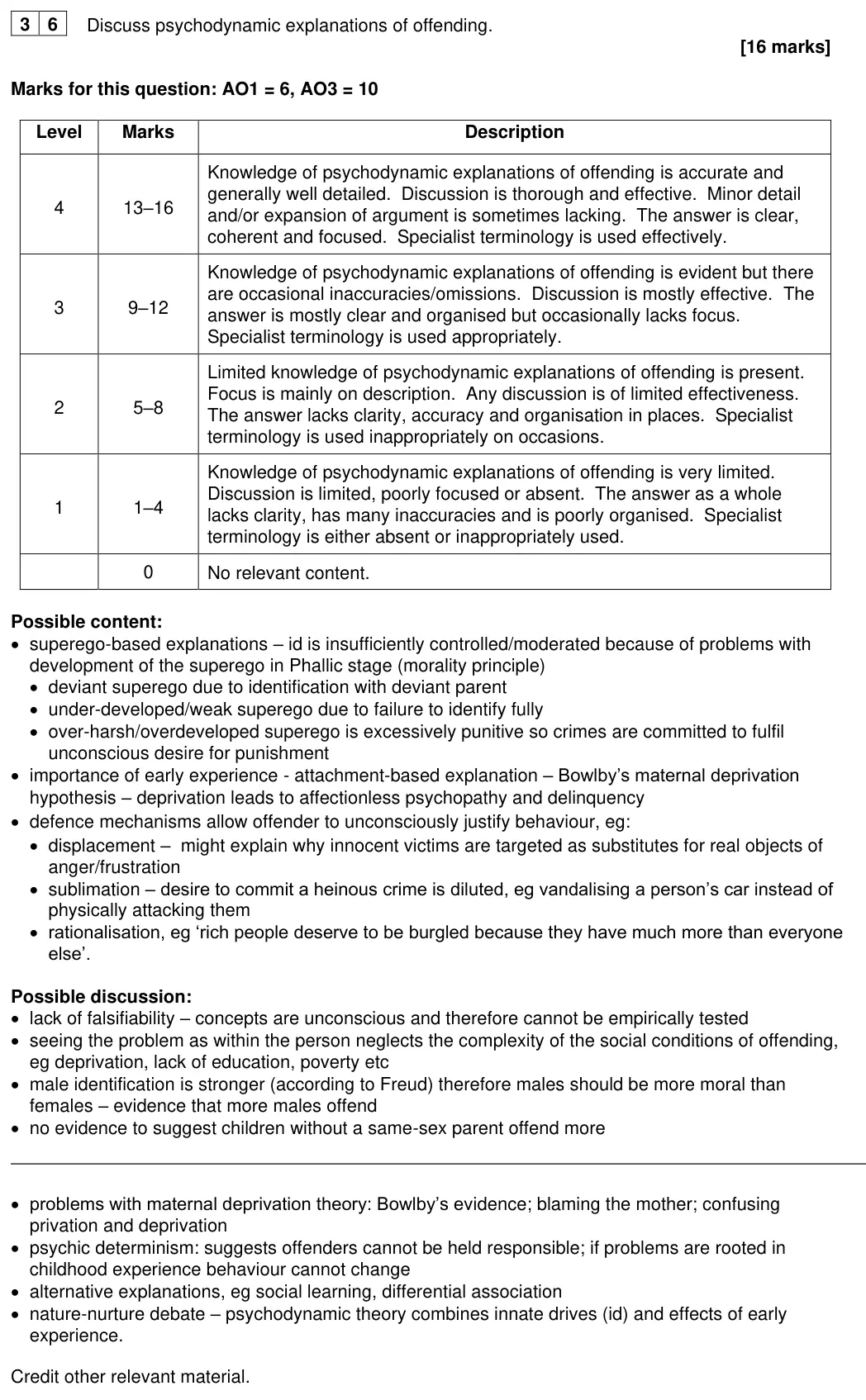
June 2022 · Paper 3 · Q3616 marksAO1=6, AO3=1016-mark essayOld spec onlyapproachesattachment
Not on the 2025 specification: psychodynamic explanations of offending: Blackburn's superego types, maternal deprivation, defence mechanisms, removed in v1.4
Mark scheme, including level descriptors and indicative content
Examiner's comment
Descriptions of how psychodynamic theory might be used to explain offending varied in detail and depth of understanding. Many students could name Blackburn’s three types of superego, but explanations often sounded more like social learning theory, reinforcement and differential association than the Freudian conceptualisation of identification as an unconscious process. A fair number of students wrote about Eysenck’s theory of the criminal personality instead. Discussion points were often not very convincing, although falsifiability was usually well argued.
Notes from the mark scheme and report
Off-spec: psychodynamic explanations of offending: Blackburn's superego types, maternal deprivation, defence mechanisms, removed in v1.4
June 2022 · Paper 3 · Q374 marksAO1=4OutlineOld spec onlyaddiction
Not on the 2025 specification: theory of planned behaviour, removed in v1.4
Mark scheme, including level descriptors and indicative content
Examiner's comment
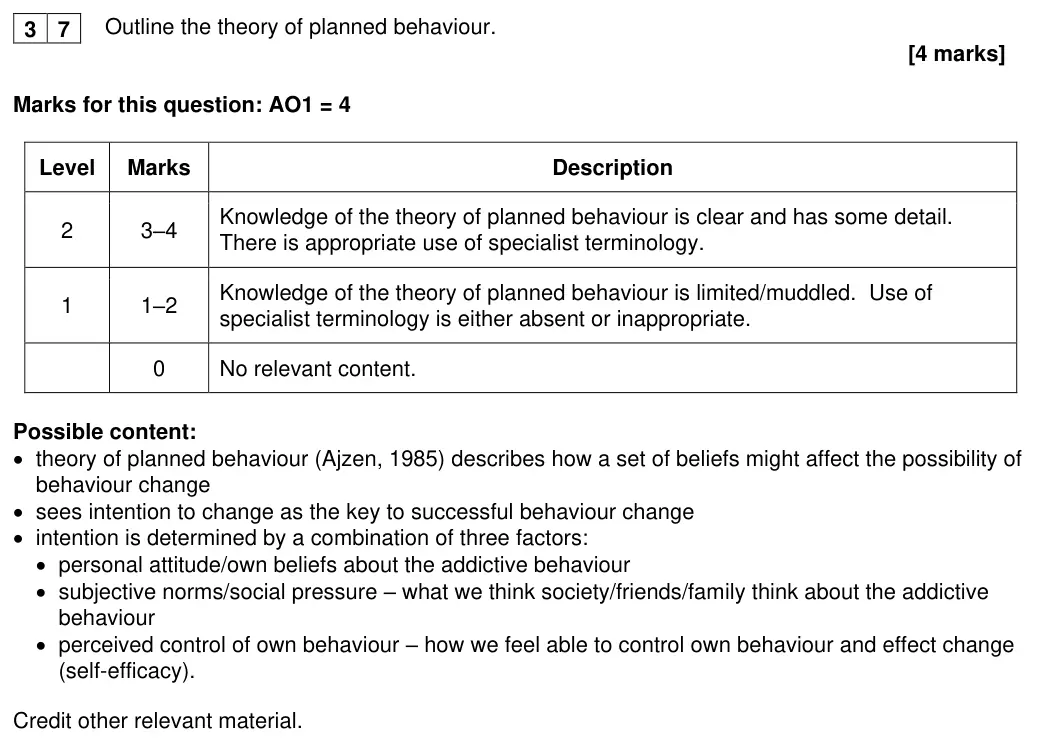
Most answers to Question 37 showed good knowledge of the theory of planned behaviour although some otherwise very good responses omitted the key point that the three factors combine to affect intention.
Notes from the mark scheme and report
Off-spec: theory of planned behaviour, removed in v1.4
key point that attitude, subjective norms and perceived control combine to determine intention often omitted
June 2022 · Paper 3 · Q384 marksAO3=4Evaluate (short)Old spec onlyaddiction
Not on the 2025 specification: theory of planned behaviour, removed in v1.4
Mark scheme, including level descriptors and indicative content
Examiner's comment
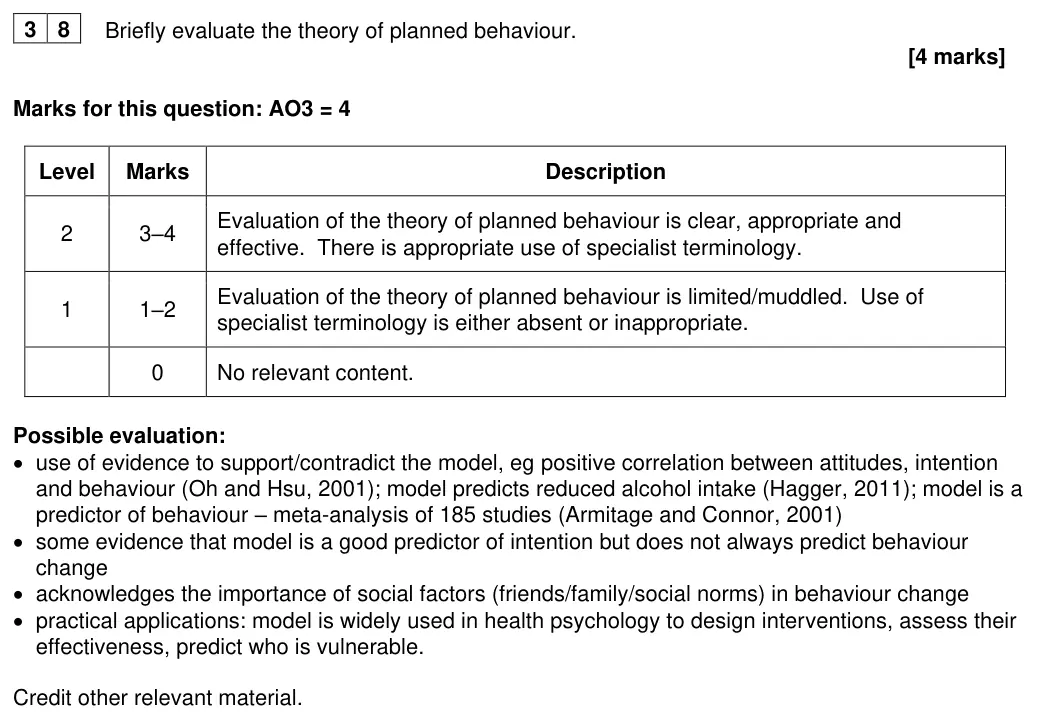
Evaluations varied for Question 38. Some students made good use of evidence to support the role of some/all factors in behaviour change whereas weaker evaluations often consisted of vague suggestions that the theory was somehow reductionist or deterministic.
Notes from the mark scheme and report
Off-spec: theory of planned behaviour, removed in v1.4
weak evaluations were vague claims of reductionism/determinism
June 2022 · Paper 3 · Q3916 marksAO1=6, AO3=1016-mark essayaddiction
Mark scheme, including level descriptors and indicative content
Examiner's comment
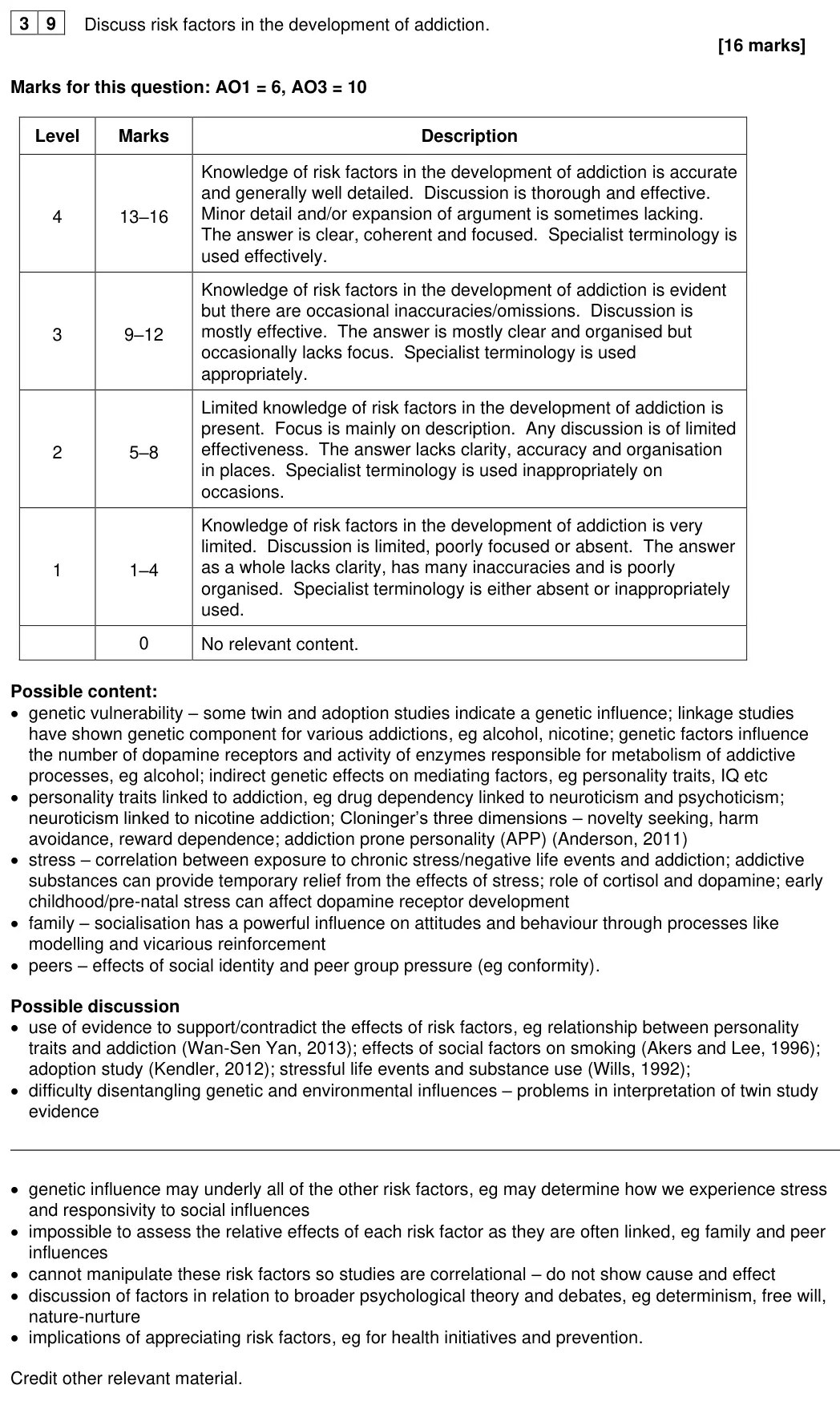
Answers to Question 39 tended to be extremely well-prepared in terms of knowledge and understanding. Students often raced through a whole range of risk factors offering evidence for discussion of each. Higher achieving students took the trouble to explain factors in psychological terms, for example, how parental influences could be linked to social learning theory and how the influence of peers could be explained in terms of conformity/normative influence. The implications of understanding risk factors for intervention proved to be a useful discussion point in some of the higher scoring answers.
Notes from the mark scheme and report
genetic vulnerability, personality, social influences
MS lists stress, family and peers separately (subsumed under 'social influences' in v1.4)
best answers explained family/peer effects via SLT and conformity
Work with an AQA psychology tutor
Want a paper marked and gone through with you? Message us.