66 question parts, 0 sixteen-mark essays, 12 multiple-choice items, plus 10 parts on content removed in 2025
Notes, key studies and practice items for this topic are being written by our tutors. The past-paper questions below are ready now.
Specification statements
4.2.3-01 Experimental method. Types of experiment, laboratory and field experiments; natural and quasi-experiments.AS
4.2.3-02 Observational techniques. Types of observation: naturalistic and controlled observation; covert and overt observation; participant and non-participant observation.AS
4.2.3-03 Self-report techniques. Questionnaires; interviews, structured and unstructured.AS
4.2.3-04 Correlations. Analysis of the relationship between co-variables. The difference between correlations and experiments.AS
Tap a question to zoom it. Mark scheme and examiner's comment open under each question.
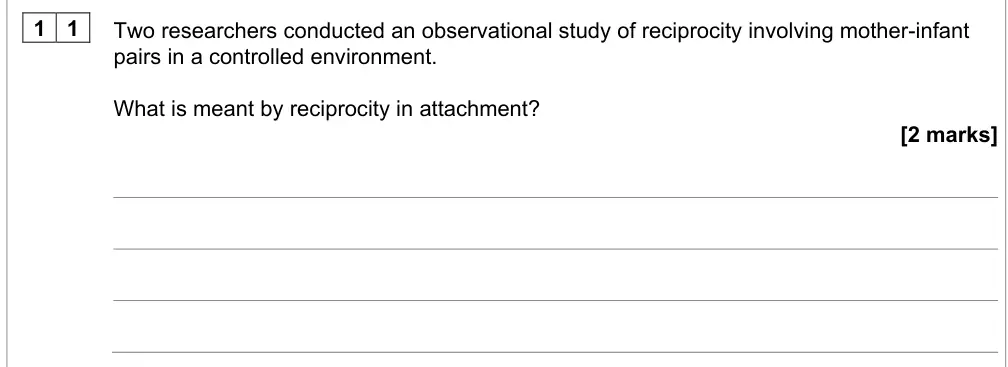
June 2025 · Paper 1 · Q112 marksAO1=2Short answerEasyOld spec only
Not on the 2025 specification: caregiver-infant interactions: reciprocity, removed in v1.4
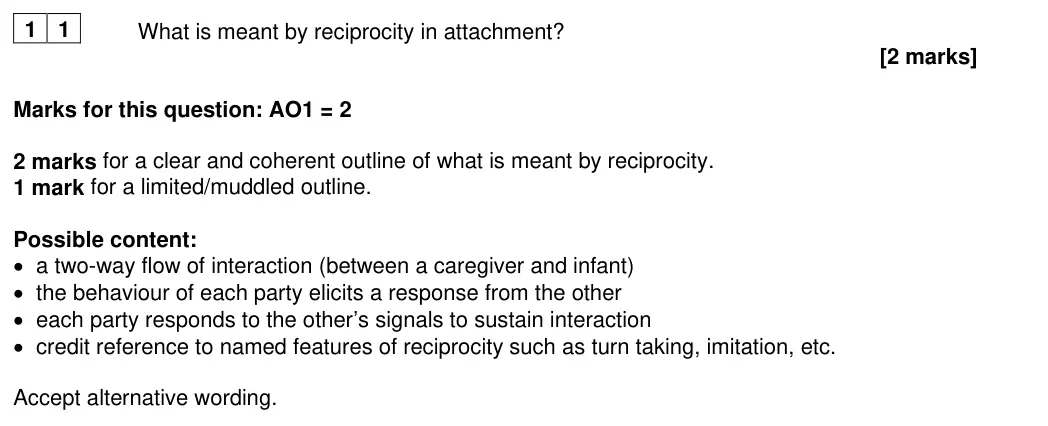
Mark scheme, including level descriptors and indicative content
Examiner's comment
Most students answered this question well with over 55% gaining full marks. Perhaps because reciprocity appeared in last year’s paper, students appeared well prepared for this question.
Notes from the mark scheme and report
Off-spec: caregiver-infant interactions: reciprocity, removed in v1.4
two-way flow of interaction, each elicits a response
well answered
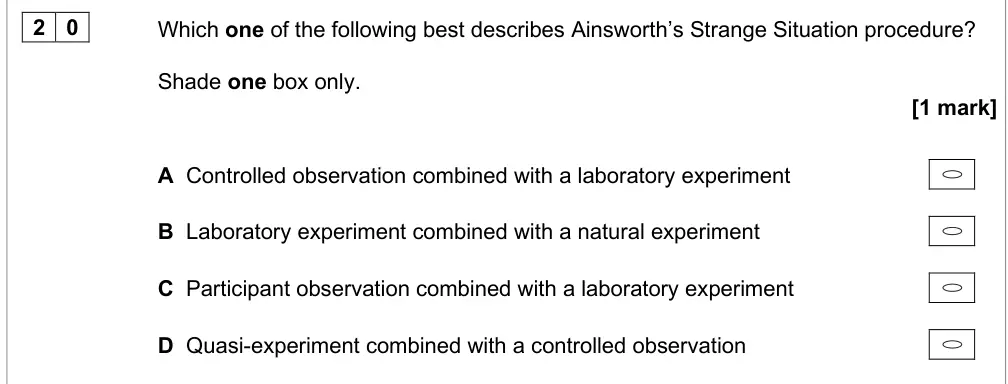
June 2025 · AS Paper 1 · Q201 markAO1=1Multiple choiceEasy
Answer
A
Mark scheme, including level descriptors and indicative content
Examiner's comment
This multiple-choice question was more challenging with two thirds of students correctly choosing the best description of Ainsworth’s Strange Situation as option A. Only a small number of students did not attempt the question.
Notes from the mark scheme and report
correct answer A (controlled observation combined with a laboratory experiment)
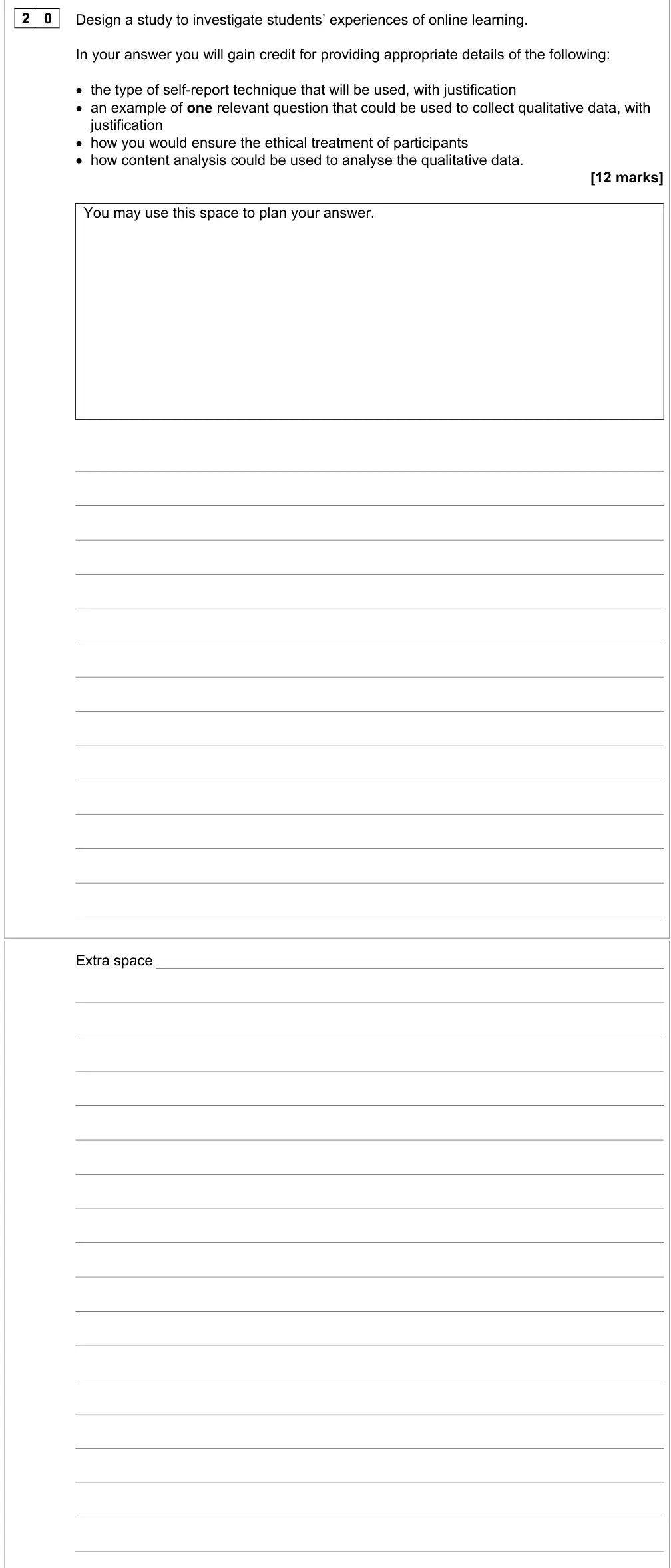
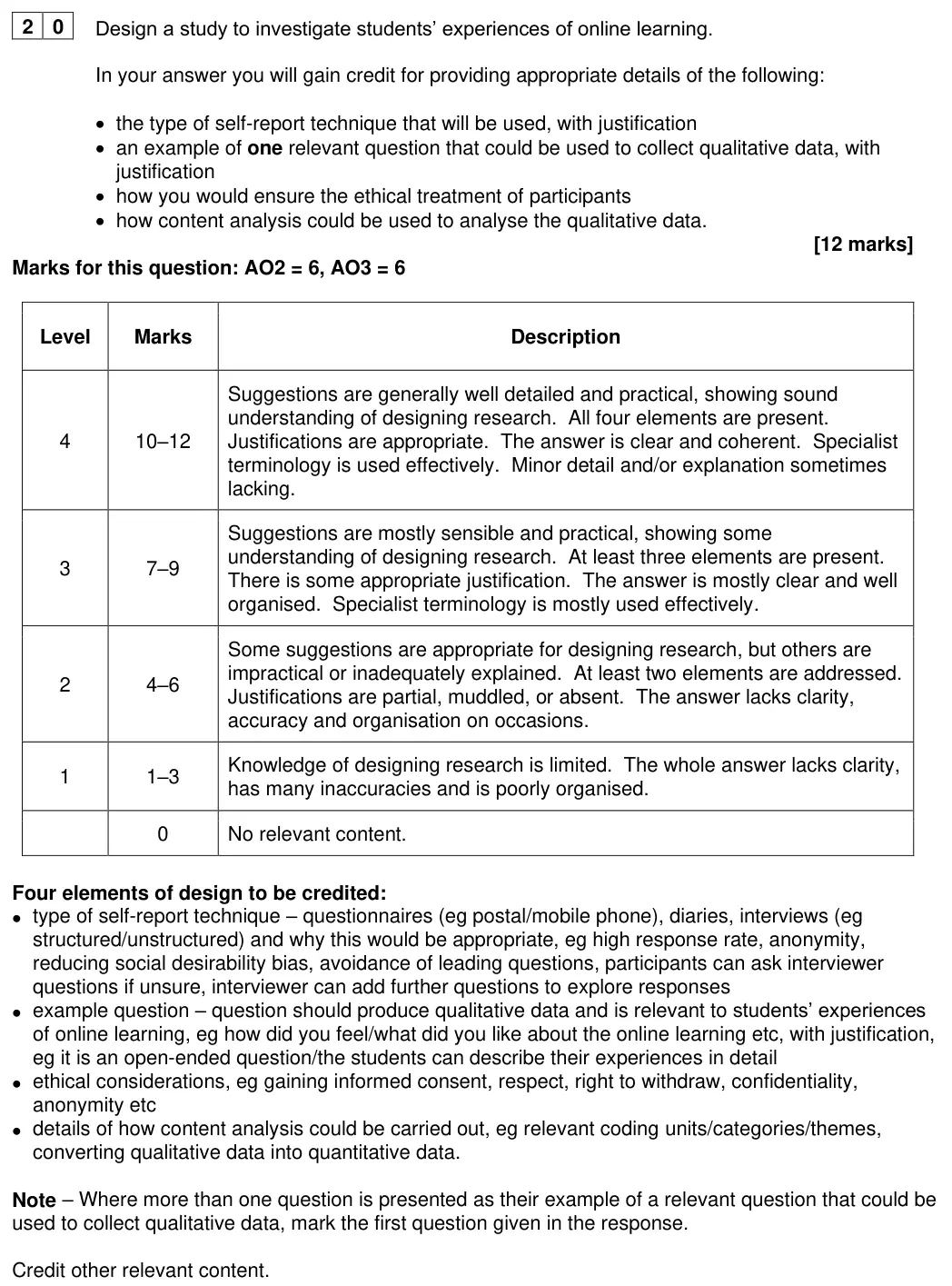
June 2025 · Paper 2 · Q2012 marksAO2=6, AO3=6Extended writing
Mark scheme, including level descriptors and indicative content
Examiner's comment
This question discriminated well. Students took different approaches. Some focussed on designing a study to investigate students’ experiences of online learning, covering the bullet points but also including details of the sampling methods, hypothesis, data analysis, etc. The majority addressed the four bullet points as separate questions. The improved examination technique of focussing on the specific bullet points and providing the necessary justifications rather than trying to design a complete study suggests past paper practice and use of feedback. Unfortunately, some who just focussed on the bullet points provided very few details, especially regarding the technique, although often good justifications were given. Those who provided procedural detail tended to score highly as they were able to shape the rest of their response to their design. Some excellent justifications were provided although some were generic. Some answers gave advantages and disadvantages of different self-report techniques without clear justification for the one selected. Suggested questions were mostly appropriate although some would clearly yield quantitative data. Credit was given for various justifications, including the context set, features of a good question and/or justification for being a qualitative question or for gathering qualitative data. In terms of ethics, students often used protection from harm, for example, keeping results confidential etc without explaining how they would do this. There was frequent muddling of brief and debrief. Better answers were those where the ethics were clearly linked to the study. Where analysis was covered this was usually done well, however, some responses lacked detail, and others did not provide the full process. Stronger responses provided the full process and put their analysis in context, for example, by suggesting relevant categories.
Notes from the mark scheme and report
four elements: self-report technique with justification, one qualitative question with justification (only first question marked), ethics explained HOW, content analysis (coding units/categories, converting to quantitative)
Level 4 needs all four
some example questions would produce quantitative data
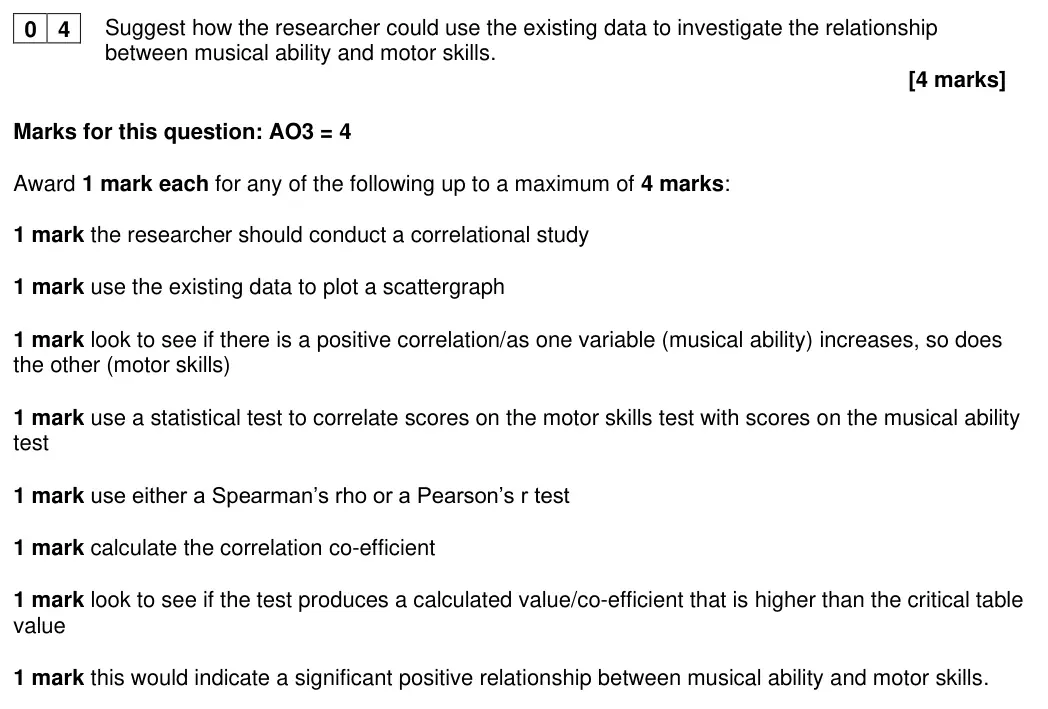
June 2025 · Paper 3 · Q44 marksAO3=4Research methods
Mark scheme, including level descriptors and indicative content
Examiner's comment
Most students were able to score at least 2 marks on question 04. Some notion that the researcher would be looking for a correlation between the two variables was the most popular route to the first mark, followed by reference to the drawing of a scattergraph. A small number of better-informed students talked of the need to calculate a correlation coefficient, and still fewer suggested the use of a statistical test of significance, for example Spearman’s.
Notes from the mark scheme and report
1 mark each up to 4: correlational analysis, plot scattergram, look for positive correlation, Spearman's rho/Pearson's r, calculate coefficient, compare with critical value, significant positive relationship
few mentioned coefficient or significance test
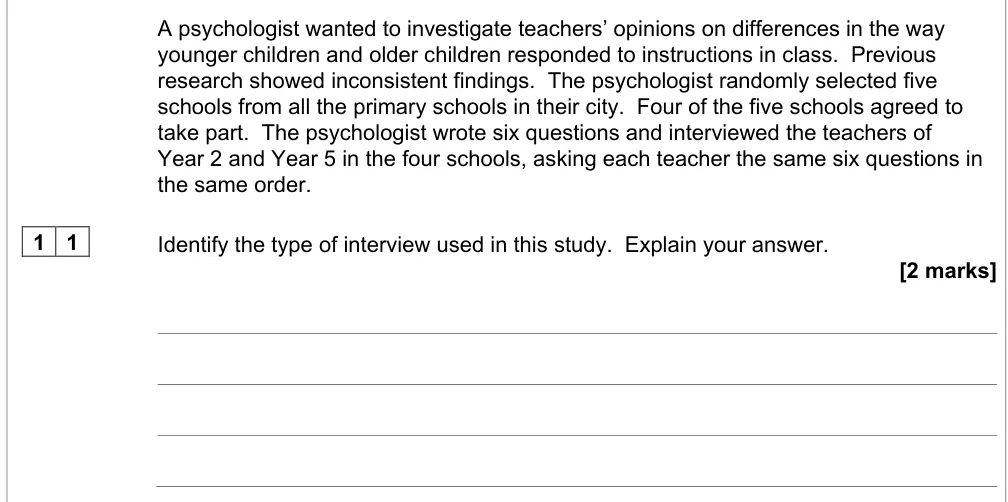
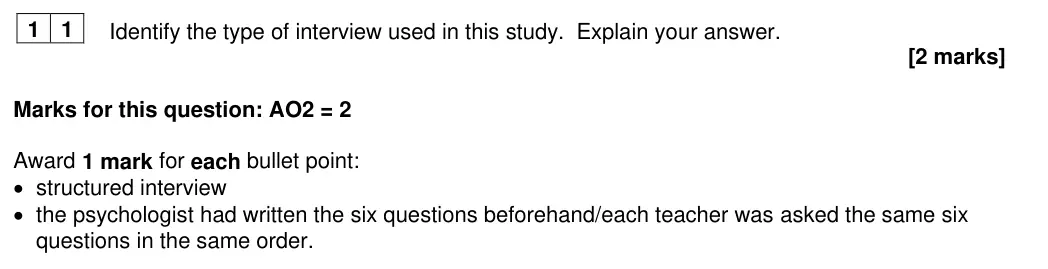
June 2024 · AS Paper 2 · Q112 marksAO2=2Research methods
Mark scheme, including level descriptors and indicative content
Examiner's comment
Students performed relatively well in Q11 (identifying and justifying a type of interview), Q13 (writing an open question) and Q16 (how to conduct random sampling).
Notes from the mark scheme and report
structured + justification (same six questions written beforehand, same order)
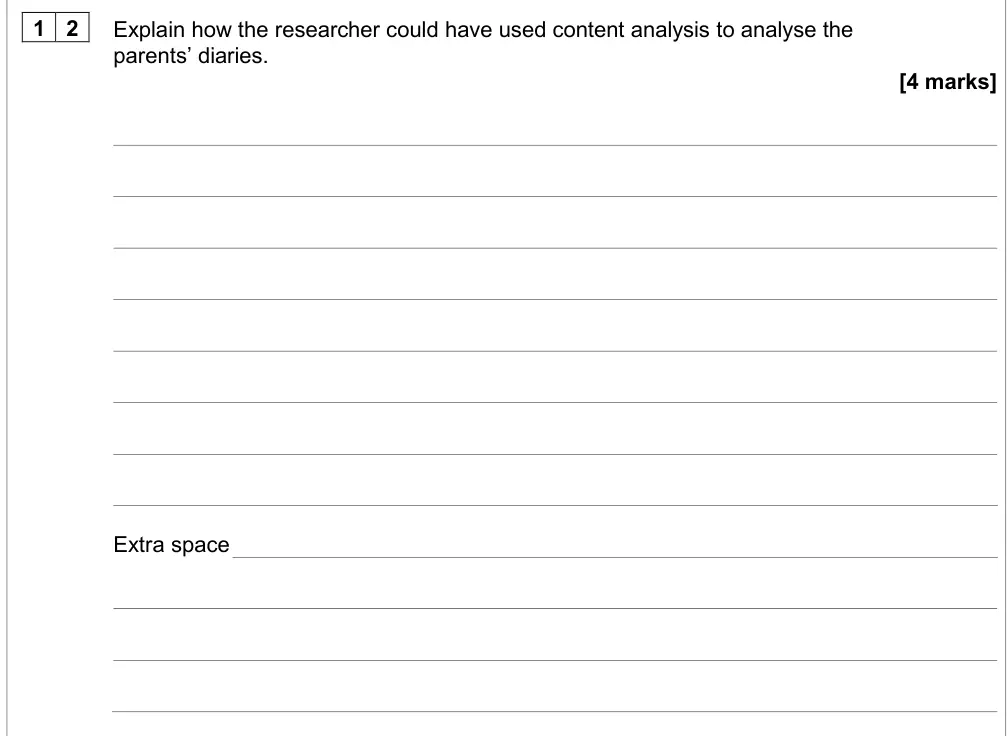
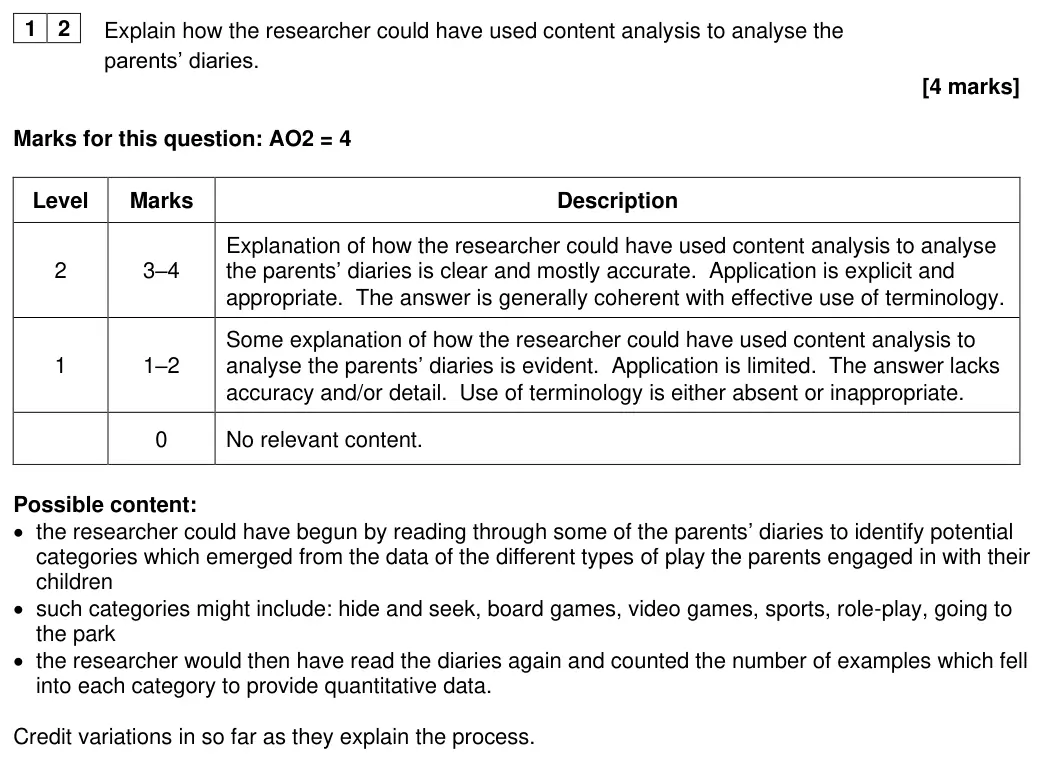
June 2024 · Paper 2 · Q124 marksAO2=4Research methods
Mark scheme, including level descriptors and indicative content
Examiner's comment
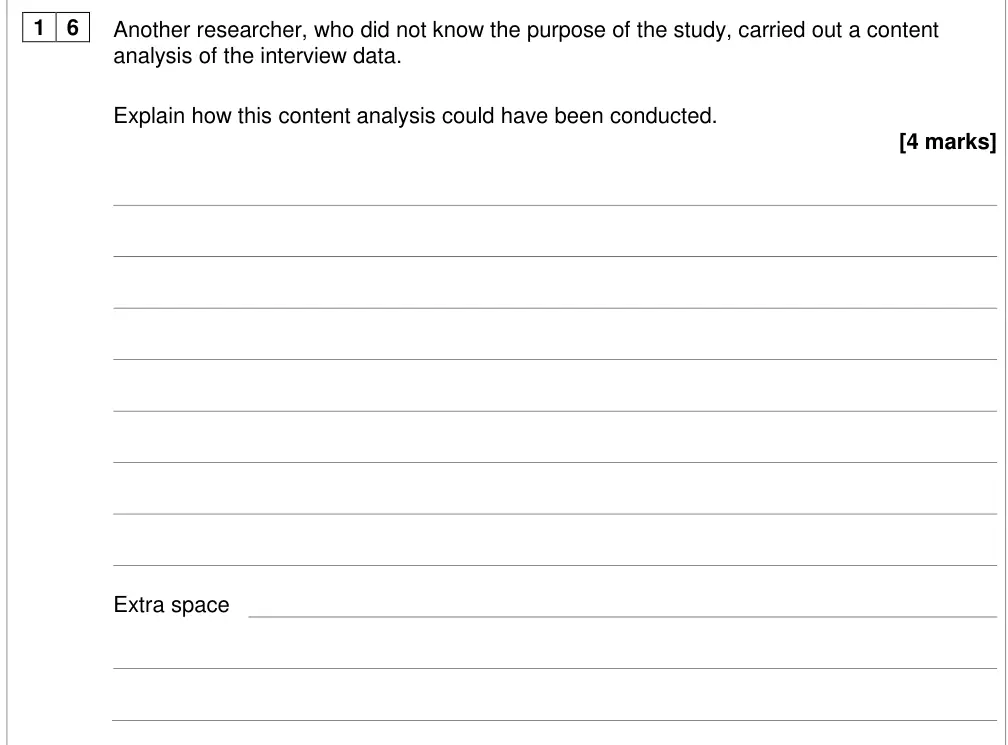
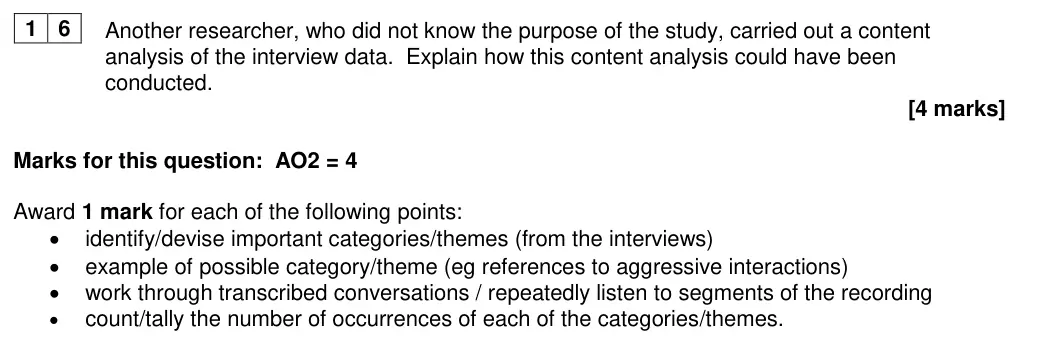
This question discriminated well. There were some excellent responses provided by students who clearly had a good knowledge of how to use content analysis and were able to apply this effectively throughout their responses, giving a range of suitable categories of different types of play and presenting the whole process clearly and accurately. Many students could define what content analysis was but could not describe how it could be used. Other limited responses described the process but did not apply it to the context given. Contrastingly, some were able to apply their knowledge to create categories in the context of the stem but did not describe the rest of the process. Whilst others were clearly unaware of what the term meant and provided a range of suggestions for how one may analyse the content of the diaries, from plotting data onto graphs, to inferential statistics, to comparing data with other studies. There was also a lot of confusion with thematic analysis. Students may benefit from using content analysis in a practical context, so they gain a deeper understanding of how it is used to analyse data. Students should know what an ‘explain how’ question is requiring and should apply their responses to the context given and ensure they describe the whole process for these types of questions.
Notes from the mark scheme and report
read diaries to identify play categories (hide and seek, board games...), re-read and tally examples to give quantitative data
whole process applied for level 2
definitions only
confusion with thematic analysis (removed in v1.4)
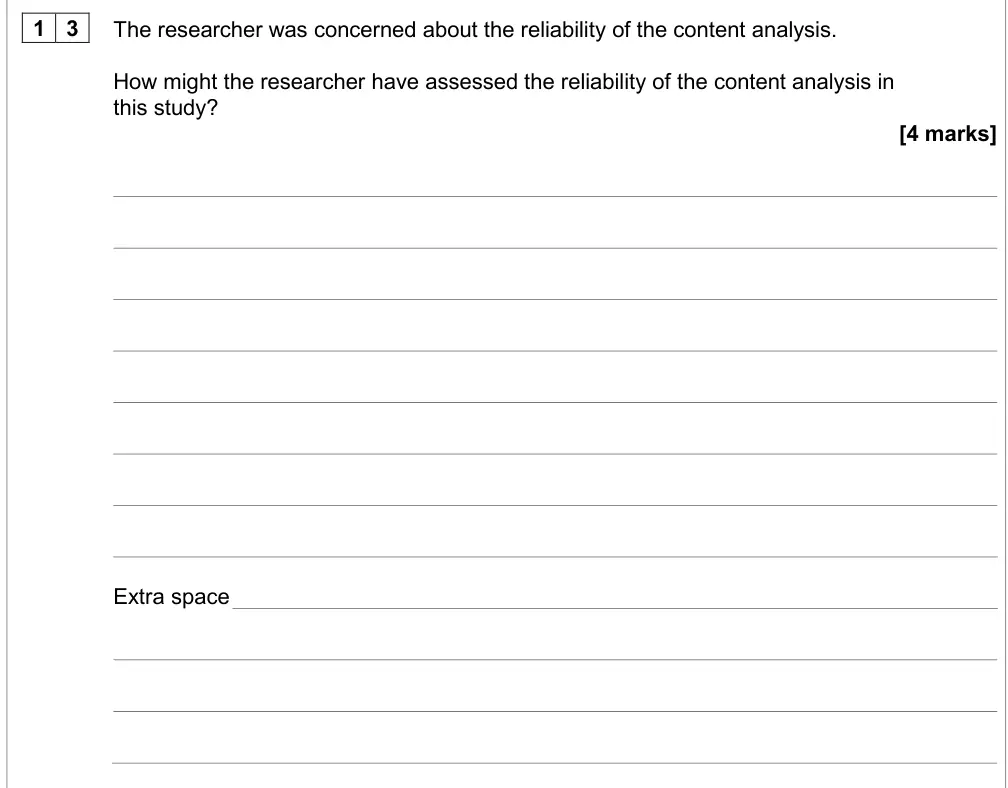
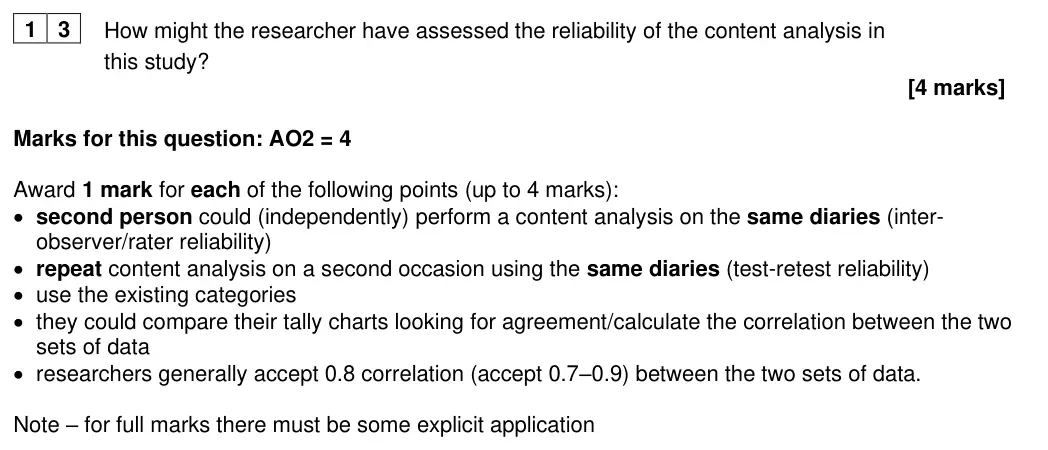
June 2024 · Paper 2 · Q134 marksAO2=4Research methods
Mark scheme, including level descriptors and indicative content
Examiner's comment
This question was another good discriminator. Students generally had good knowledge of inter-observer reliability and test-retest reliability and applied it appropriately. Where students lost marks, it was for not acknowledging that the other observer would use the same diary/data or for not explaining that the existing categories would be used. Other common errors were; not focusing on the ‘how’ requirement of the question, suggesting that the whole study should be repeated, suggesting ways to improve rather than assess reliability and a surprisingly high number of responses suggesting peer review.
Notes from the mark scheme and report
second person independently analyses SAME diaries with EXISTING categories (or test-retest), compare tallies/correlate, 0.8 accepted
explicit application needed for full marks
repeating the whole study, improving rather than assessing, peer review
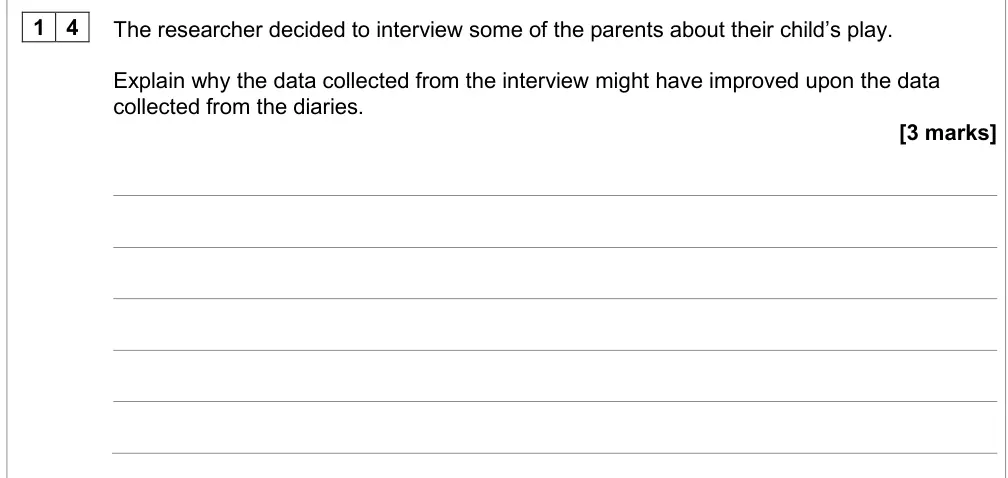
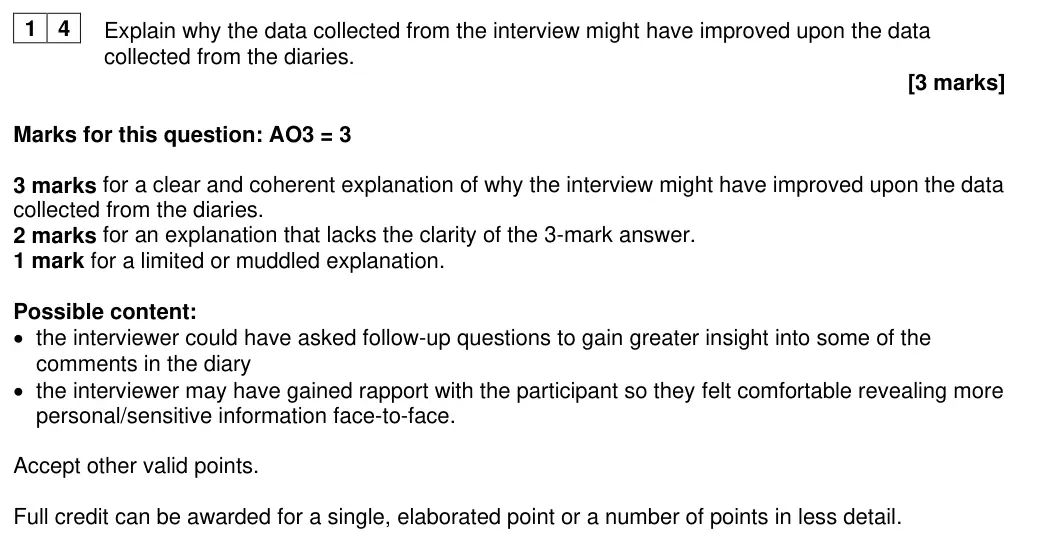
June 2024 · Paper 2 · Q143 marksAO3=3Research methods
Mark scheme, including level descriptors and indicative content
Examiner's comment
This question was generally well answered although responses were quite varied. Overall students were able to identify why an interview would improve upon the data collected from the diary, but the differentiator was how effectively they were able to elaborate to explain the “consequence” of this and the why this would be an improvement. A common error was to suggest the interview would yield qualitative data and then provide strengths of qualitative data or to recall the strengths of using interviews without elaborating on how this would improve the present data.
Notes from the mark scheme and report
follow-up questions for greater insight into diary comments, rapport allowing sensitive disclosure
must explain the consequence/why it improves the data
generic strengths of qualitative data or interviews
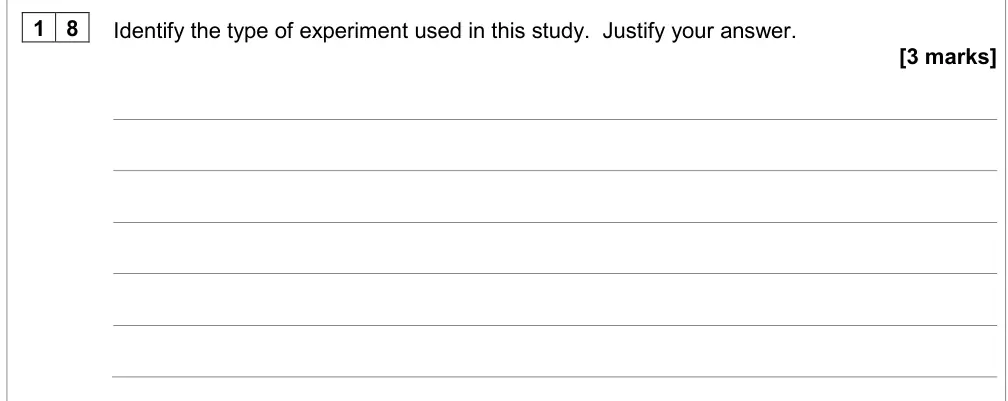
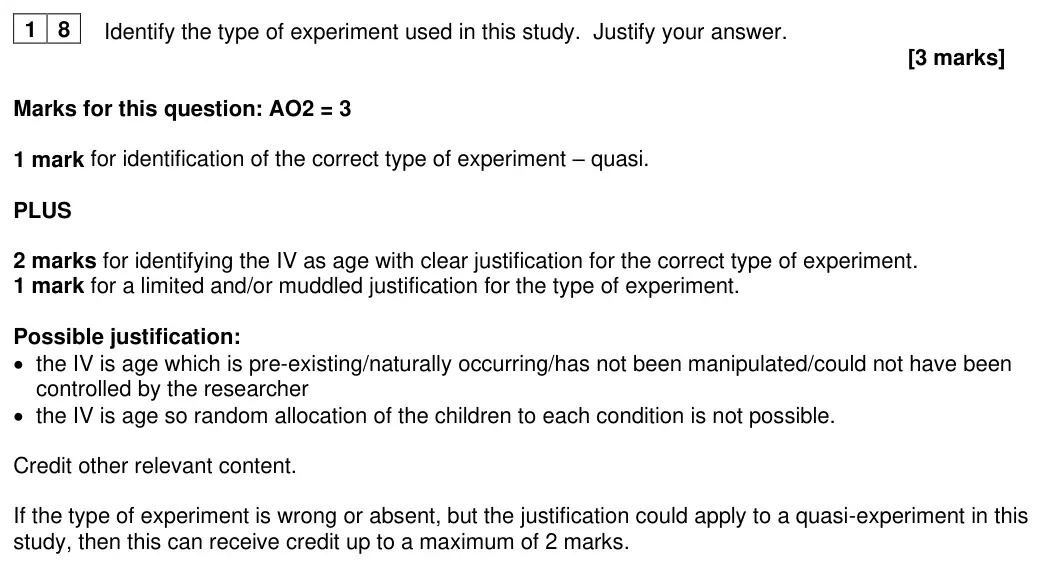
June 2024 · Paper 2 · Q183 marksAO2=3Research methods
Mark scheme, including level descriptors and indicative content
Examiner's comment
This question was generally not answered well. There was considerable challenge with what a ‘type of experiment’ means and much confusion in terms of understanding the types of experiment that are conducted in psychological research. Most students were not able to gain any marks on this question. A frequent, incorrect response was to identify a field or natural experiment/observation and to justify this by stating that the experiment was conducted in a natural environment. Many students focused on the type of observation and others justified the field experiment by stating that the independent variable had been controlled as the experimenter had controlled the choice of play activities. Most of those who correctly identified a quasi-experiment were able to gain the justification marks. Responses overall would suggest that students must develop their understanding of different types of experiments.
Notes from the mark scheme and report
quasi-experiment (1) + IV is age, pre-existing/cannot be manipulated or randomly allocated (2)
most scored 0 - field/natural experiment justified by natural environment
wrong type with valid justification max 2
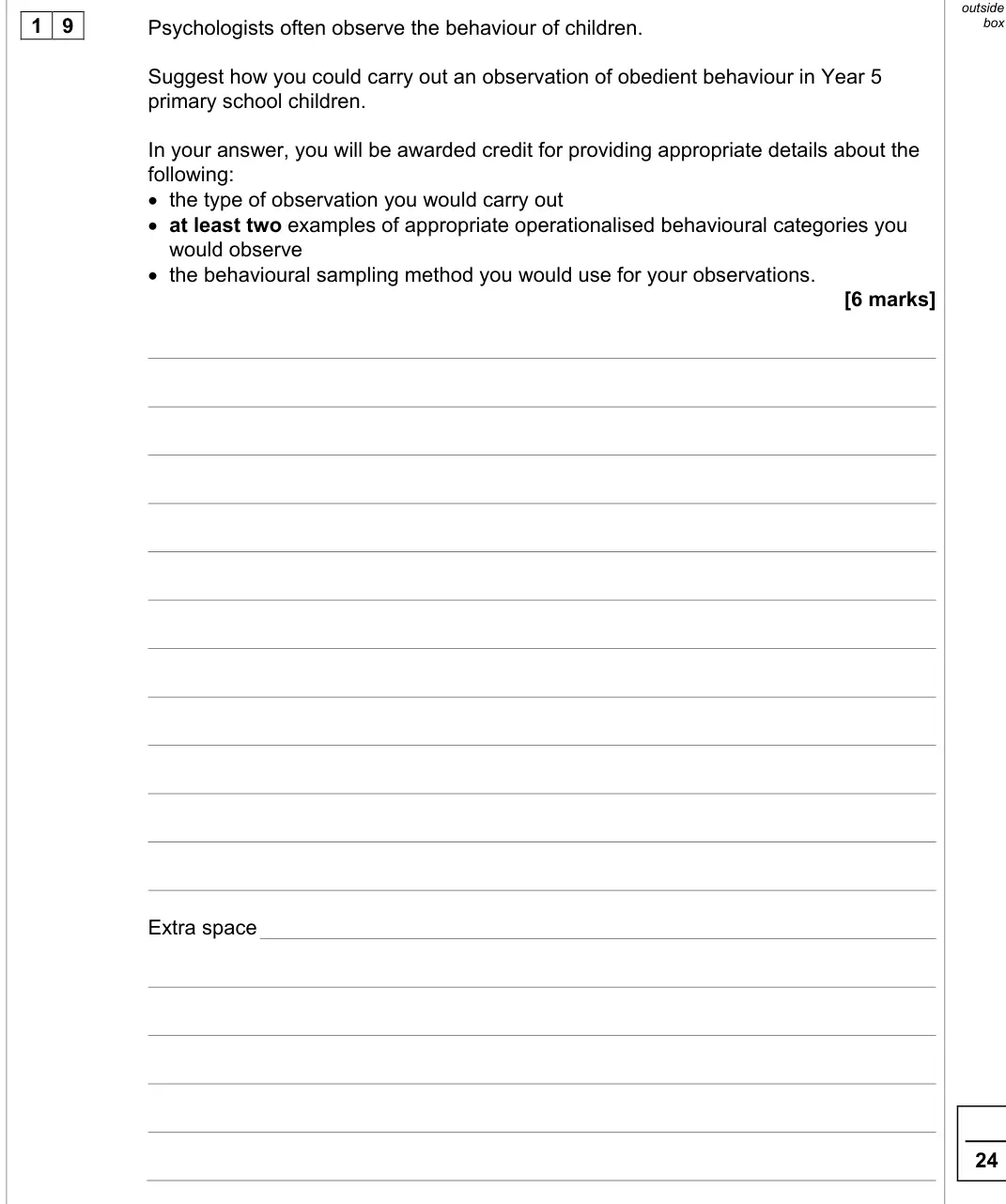
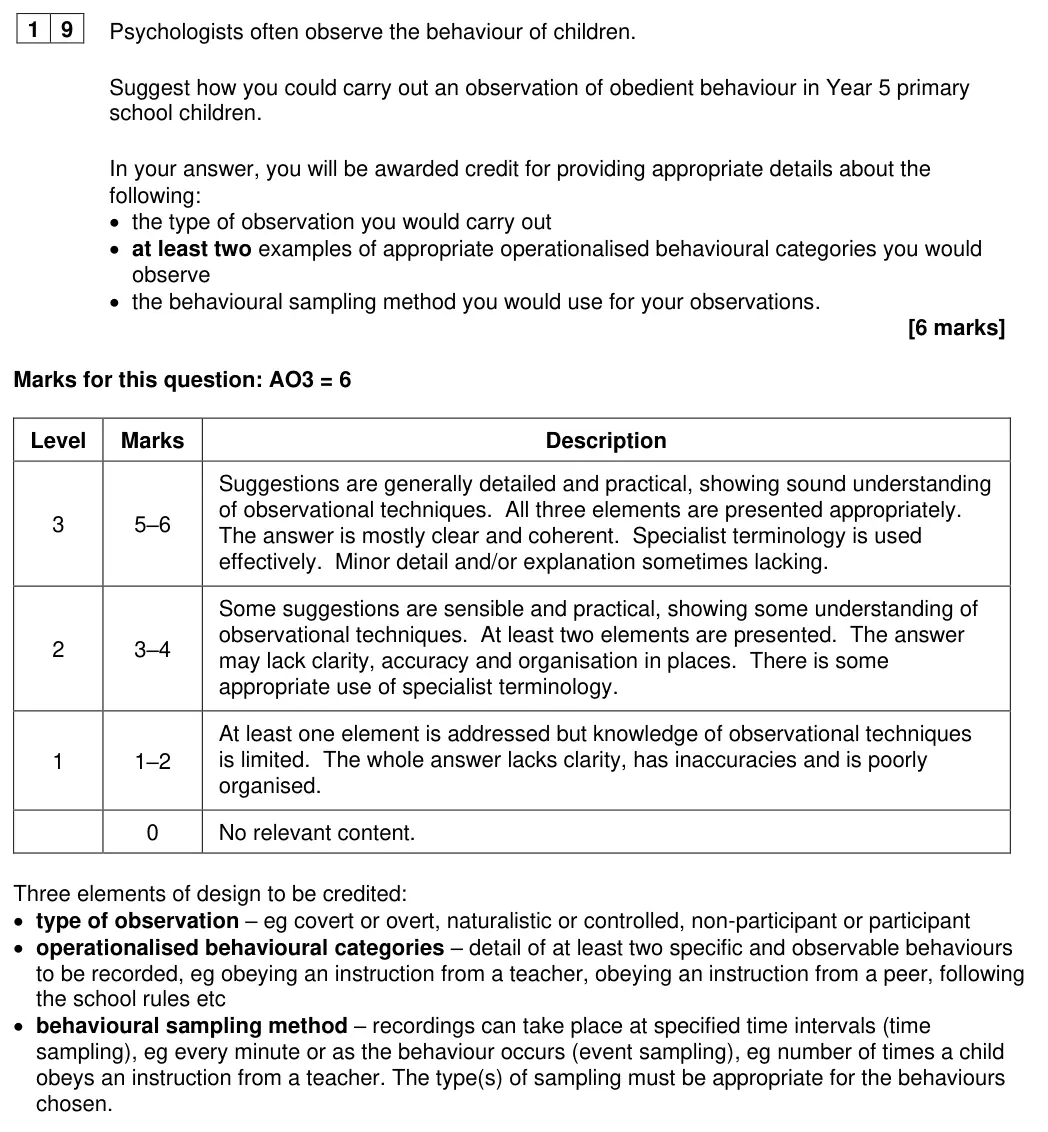
June 2024 · AS Paper 2 · Q196 marksAO3=6Research methodsMedium
Mark scheme, including level descriptors and indicative content
Examiner's comment
Although varied, there were some impressive responses in Q19 where many students were able to suggest how they would carry out an observation, demonstrating their ability to design practical procedures. Q19 was a challenging question as it was the first time this style of question has been asked on an AS examination. Although similar in style to the format of some previous A Level questions, it is important to note that the demands of this question are focused on the students’ suggestions of how the psychologist could carry out the observation and not justification. Despite this being a novel style of question for AS examinations, encouragingly many students were able to provide some relevant suggestions . It is clear that students are gaining important practical experience of how to design and/or carry out psychological research and so understand concepts fully and can apply them in an examination setting. Students’ performance varied greatly on this question but encouragingly, most students were able to gain at least some marks and nearly two thirds of the responses were awarded 3 marks or more. It is important that students address the demands of this question and address all three bullet points. Additionally, students need to provide some details of how they would carry out the type of observation they have identified (the first bullet point) and how they would use the type of behavioural sampling method they have identified (the third bullet point). Students should avoid wasting time on justification of their suggestions as this is not what the question demands. Unfortunately, too many students simply named a type of interview and/or behavioural sampling method and failed to outline how they would use them but instead included irrelevant justification of why they had chosen them. For the second bullet point it is important that the examples of behavioural categories to be observed are operationalised (as the question asks), to actually measure obedient (or disobedient) behaviour and align with the behavioural sampling method chosen. There was also some significant misunderstanding of behavioural sampling methods; many students wrote about the participant sampling method and thus did not get any credit for this bullet point. Exemplification of a successful response Despite some irrelevant justification of the type of observation towards the beginning, this response contains all of the elements needed for a level 3 response. The student has identified a type of observation (lines 2 and 3) and given some detail of how this would be carried out (lines 9 and 10). They have then given some examples of operationalised behaviour categories. Although the first and second categories suggested are implicit measurements of obedience, the third suggestion is explicitly measuring (dis)obedience. The student then goes on to identify an appropriate behavioural sampling method which would work with their suggested behavioural categories and also gives some detail as to how they would use this to record observations. Exemplification of a less successful response A fairly typical example of a response where the student has at least attempted to engage with each of the bullet points. The final point is confused and is about the sampling of the participants, not the behavioural categories which is not required and so cannot gain credit. However, there is some very implicit knowledge of event sampling, even though it is not named, in the attempt at behaviour categories (‘the amount of times all children…’). The student has attempted to give two examples of behavioural categories at the start and although these are about obedience, these are not operationalised as it is unclear how ‘listening’ and ‘not listening’ could be observed. In the middle paragraph, the student has identified a type of observation but has not explained how this (covert) observation could be carried out.
Notes from the mark scheme and report
three elements: type of observation, at least two operationalised behavioural categories, time/event sampling appropriate to the behaviours
must say how, not justify choices
many named methods without outlining their use
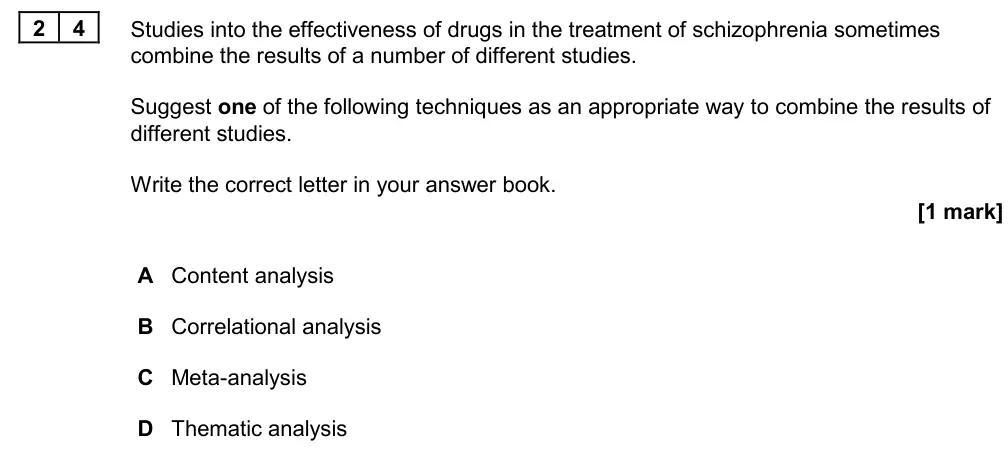
June 2024 · Paper 3 · Q241 markAO3=1Multiple choice
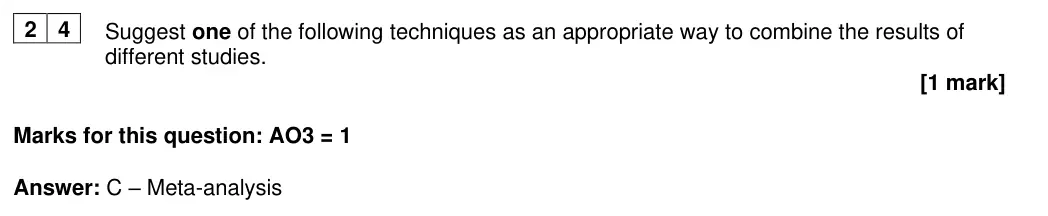
Answer
C
Mark scheme, including level descriptors and indicative content
Examiner's comment
There were very few students indeed who did not know that Question 24 was describing meta-analysis.
Notes from the mark scheme and report
answer C meta-analysis
distractors content analysis, correlational analysis and thematic analysis (thematic analysis removed in v1.4)
almost all correct
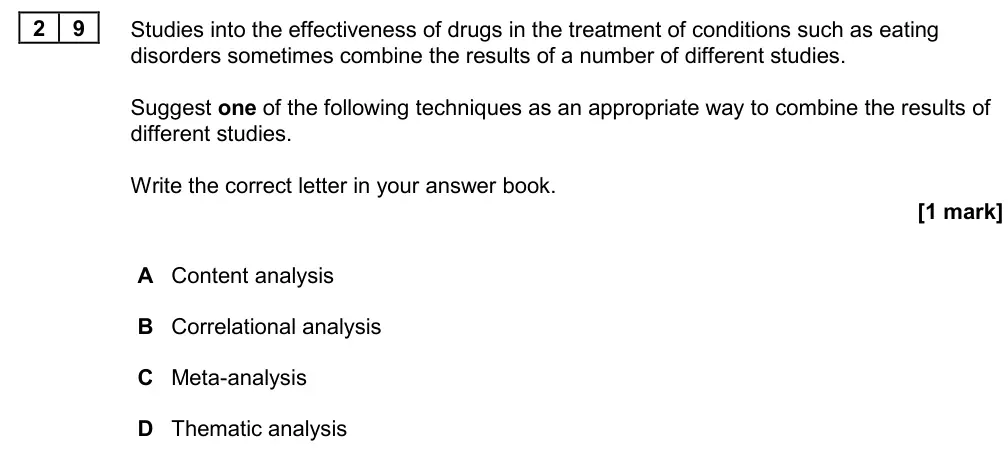
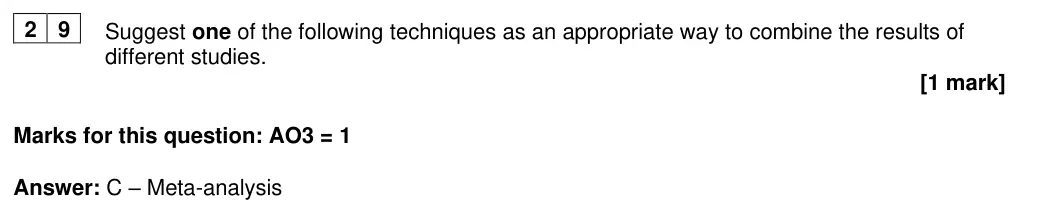
June 2024 · Paper 3 · Q291 markAO3=1Multiple choice
Answer
C
Mark scheme, including level descriptors and indicative content
Examiner's comment
There were very few students indeed who did not know that Question 29 was describing meta-analysis.
Notes from the mark scheme and report
answer C meta-analysis
distractors content analysis, correlational analysis and thematic analysis (thematic analysis removed in v1.4)
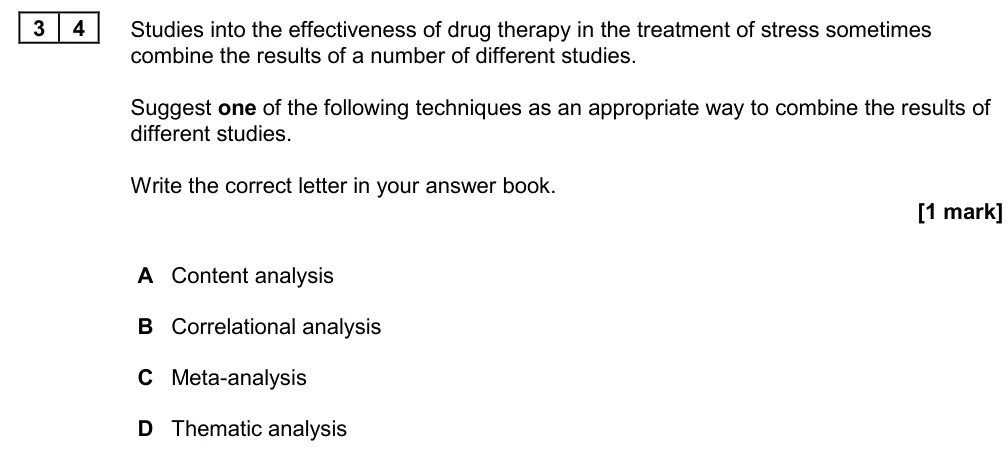
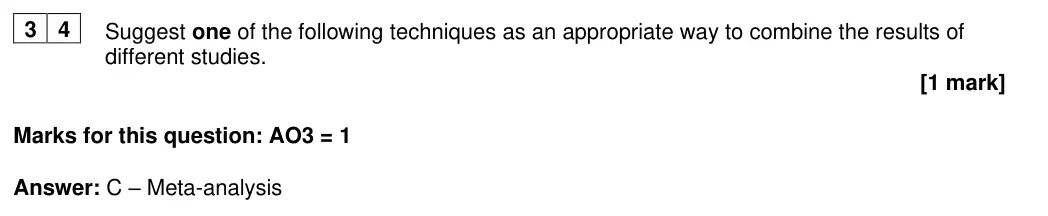
June 2024 · Paper 3 · Q341 markAO3=1Multiple choice
Answer
C
Mark scheme, including level descriptors and indicative content
Examiner's comment
There were very few students indeed who did not know that Question 34 was describing meta-analysis.
Notes from the mark scheme and report
answer C meta-analysis
distractors content analysis, correlational analysis and thematic analysis (thematic analysis removed in v1.4)
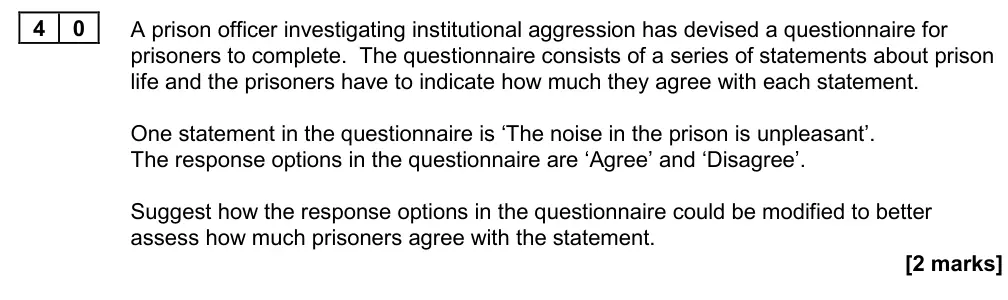
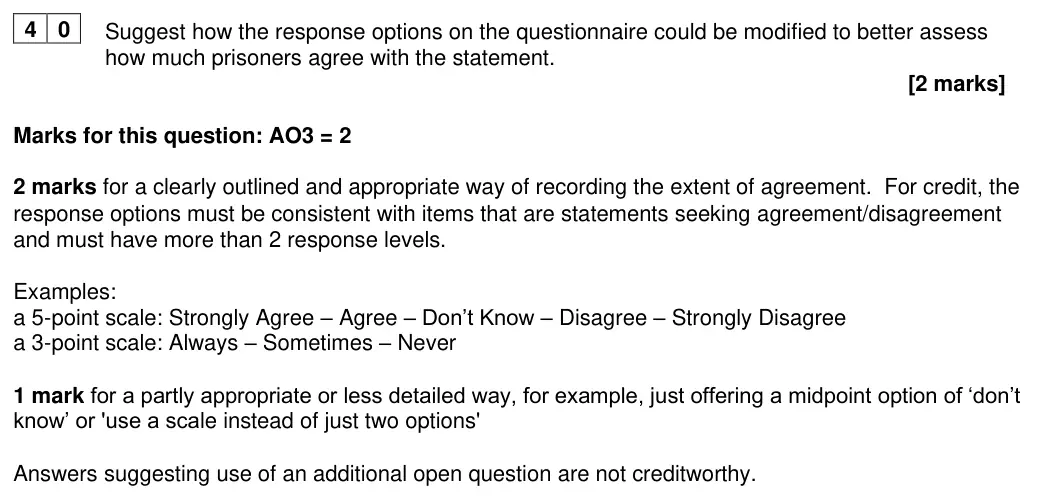
June 2024 · Paper 3 · Q402 marksAO3=2Research methods
Mark scheme, including level descriptors and indicative content
Examiner's comment
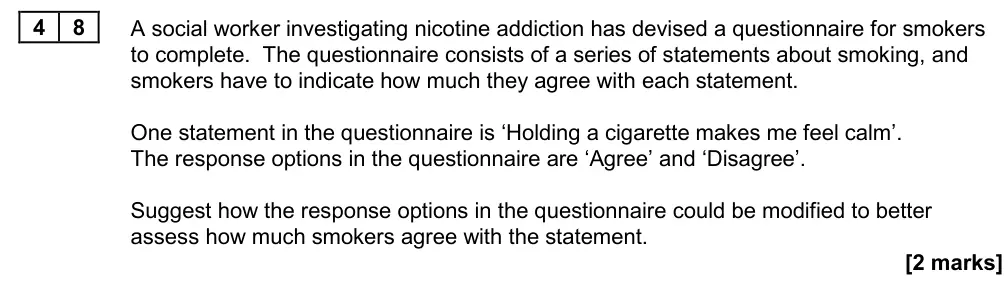
Question 40 also proved challenging for many students. There was widespread misunderstanding of the key requirement of the question; namely, to modify the response options on the questionnaire, rather than create a completely new ‘open’ question – which was the suggestion that many students gave. A high number of students said there should be a numbered scale between the two extreme options of ‘agree’ and ‘disagree’ but did not elaborate further. Answers of this type were awarded one mark.
Notes from the mark scheme and report
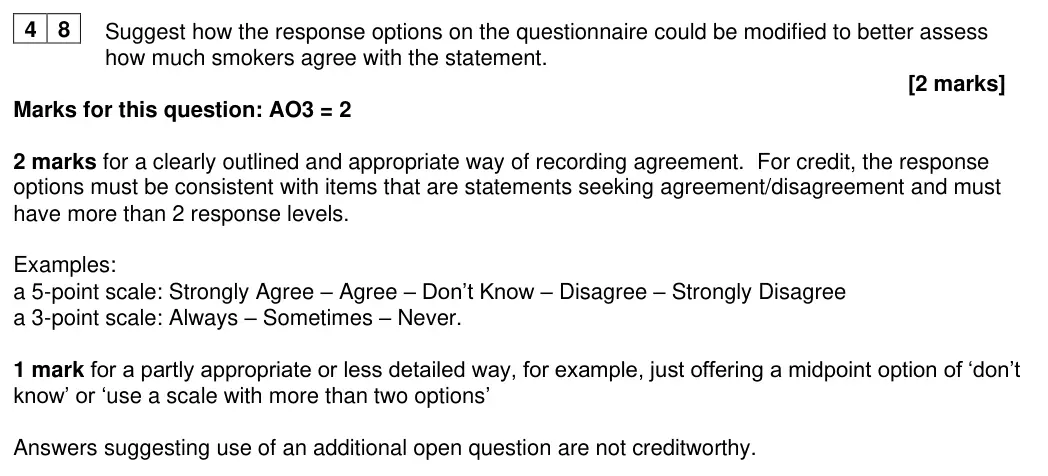
2 marks: more than two response levels consistent with an agreement statement (e.g. 5-point Likert scale)
1 mark for just adding 'don't know' or 'use a scale'
adding an open question not creditworthy (common error)
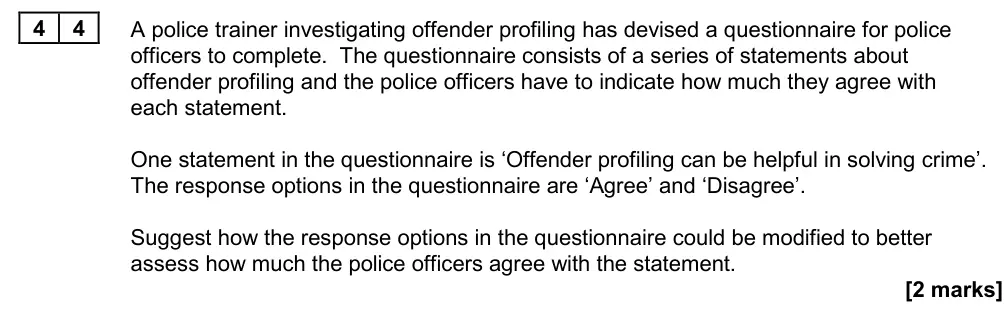
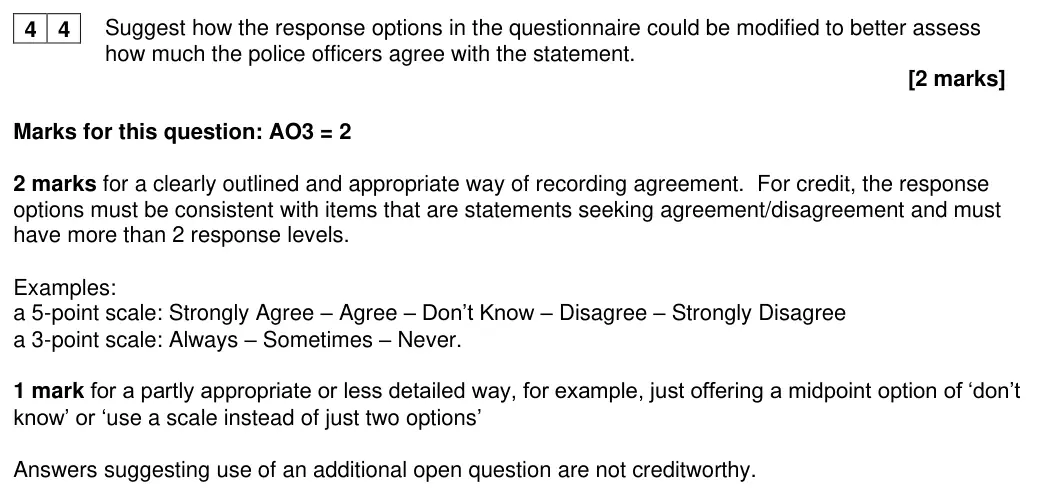
June 2024 · Paper 3 · Q442 marksAO3=2Research methods
Mark scheme, including level descriptors and indicative content
Examiner's comment
Question 44 also proved challenging for many students. There was widespread misunderstanding of the key requirement of the question; namely, to modify the response options on the questionnaire, rather than create a completely new ‘open’ question – which was the suggestion that many students gave. A high number of students said there should be a numbered scale between the two extreme options of ‘agree’ and ‘disagree’ but did not elaborate further.
Notes from the mark scheme and report
2 marks: more than two response levels consistent with an agreement statement (e.g. 5-point Likert scale)
1 mark for just adding 'don't know' or 'use a scale'
adding an open question not creditworthy (common error)
June 2024 · Paper 3 · Q482 marksAO3=2Research methods
Mark scheme, including level descriptors and indicative content
Examiner's comment
Question 48 also proved challenging for many students. There was widespread misunderstanding of the key requirement of the question; namely, to modify the response options on the questionnaire, rather than create a completely new ‘open’ question – which was the suggestion that many students gave. A high number of students said there should be a numbered scale between the two extreme options of ‘agree’ and ‘disagree’ but did not elaborate further.
Notes from the mark scheme and report
2 marks: more than two response levels consistent with an agreement statement (e.g. 5-point Likert scale)
1 mark for just adding 'don't know' or 'use a scale'
adding an open question not creditworthy (common error)
June 2023 · Paper 1 · Q12 marksAO1=2Multiple choiceMediumOld spec only
Answer
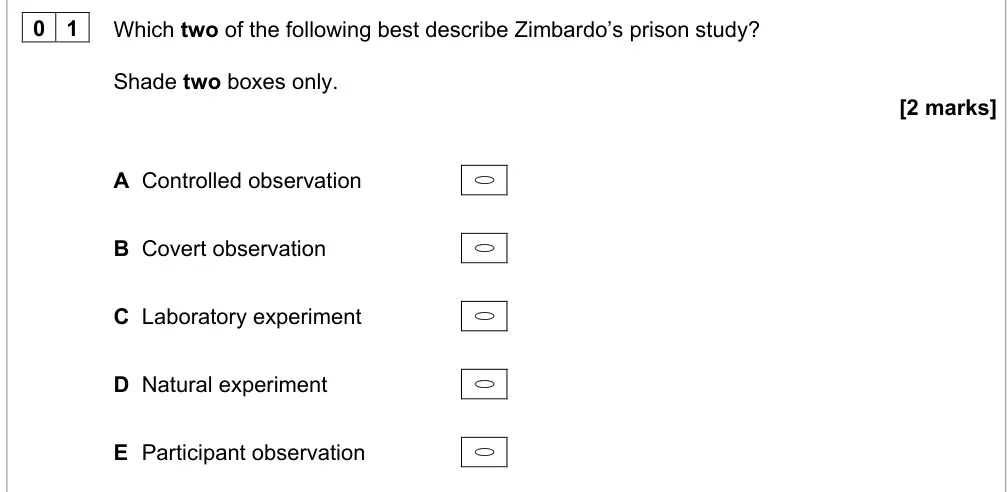
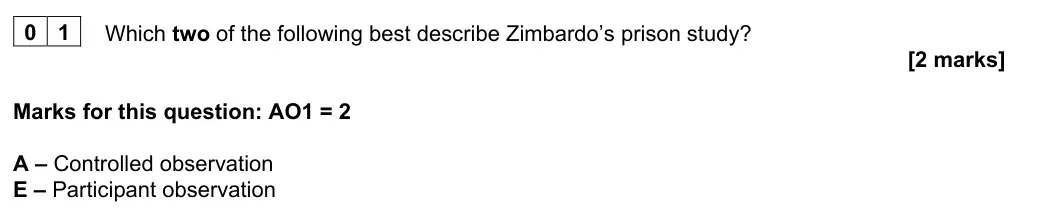
A and E
Mark scheme, including level descriptors and indicative content
Examiner's comment
This was a challenging question that made many students carefully consider their knowledge of research methodology. Over 70% of students were able to score marks in this question and the most common incorrect response given was option C (laboratory experiment).
Notes from the mark scheme and report
(needs knowledge of Zimbardo's prison study
conformity to social roles was removed in v1.4)
correct answers A and E are both types of observation
most common wrong answer C (laboratory experiment)
June 2023 · Paper 1 · Q131 markAO1=1Research methods
Mark scheme, including level descriptors and indicative content
Examiner's comment
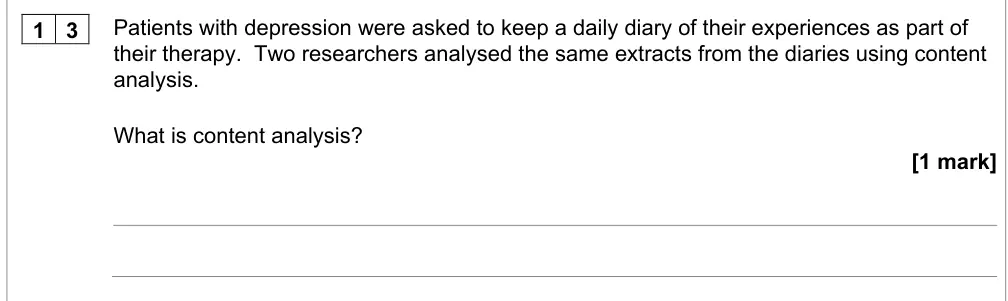
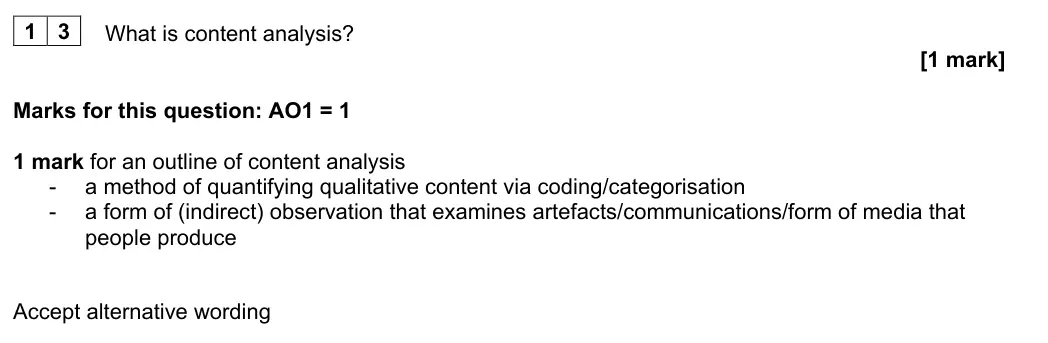
Overall, this question was answered poorly by most students, despite content analysis being a named research method on the specification. A significant minority of students described thematic analysis instead of content analysis. Students must be able to outline what a content analysis entails and understand the distinct differences between this and thematic analysis.
Notes from the mark scheme and report
answered poorly
many described thematic analysis (removed from the spec in v1.4) instead of content analysis
June 2023 · Paper 1 · Q142 marksAO2=2Research methods
Mark scheme, including level descriptors and indicative content
Examiner's comment
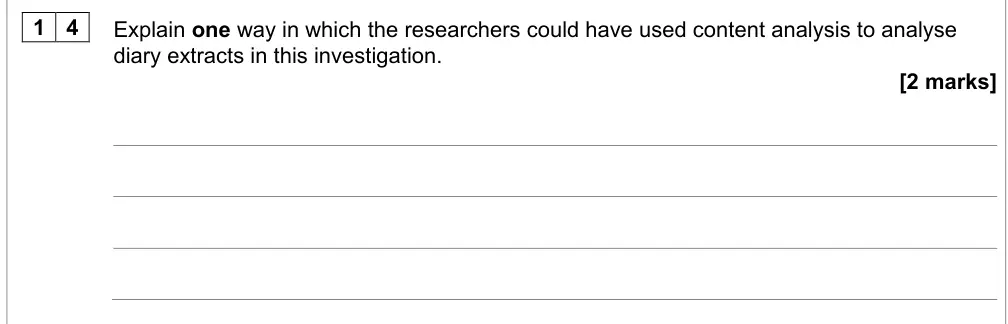
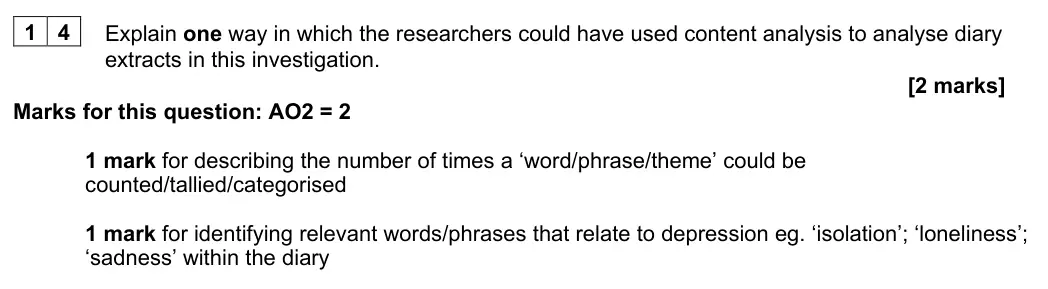
Students who understood what is meant by a content analysis were able to score well, applying their knowledge to the scenario of analysing the diary extracts. A small minority of students who did not understand content analysis struggled to score marks.
Notes from the mark scheme and report
two marks: counting/tallying categories + naming depression-related words from the diaries
June 2023 · Paper 2 · Q134 marksAO2=4Research methods
Mark scheme, including level descriptors and indicative content
Examiner's comment
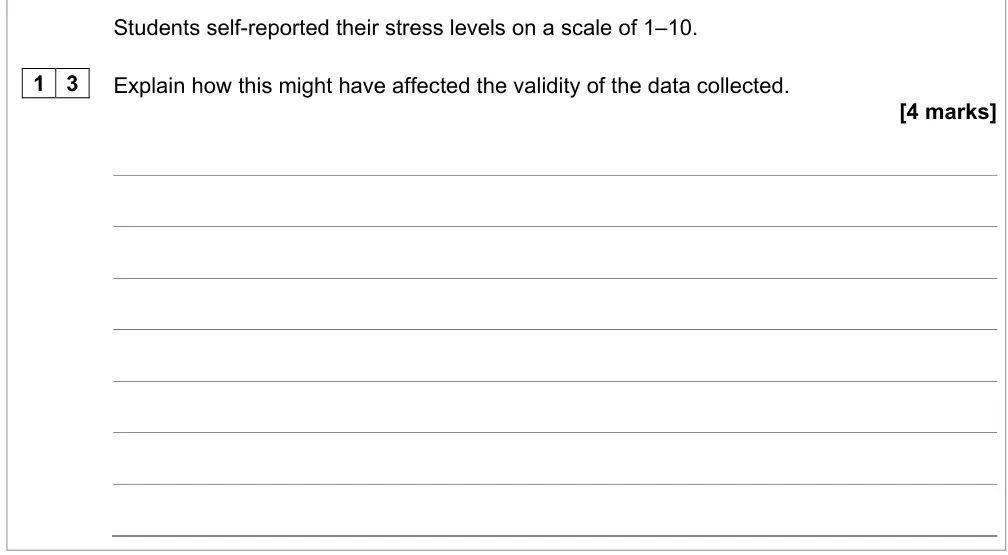
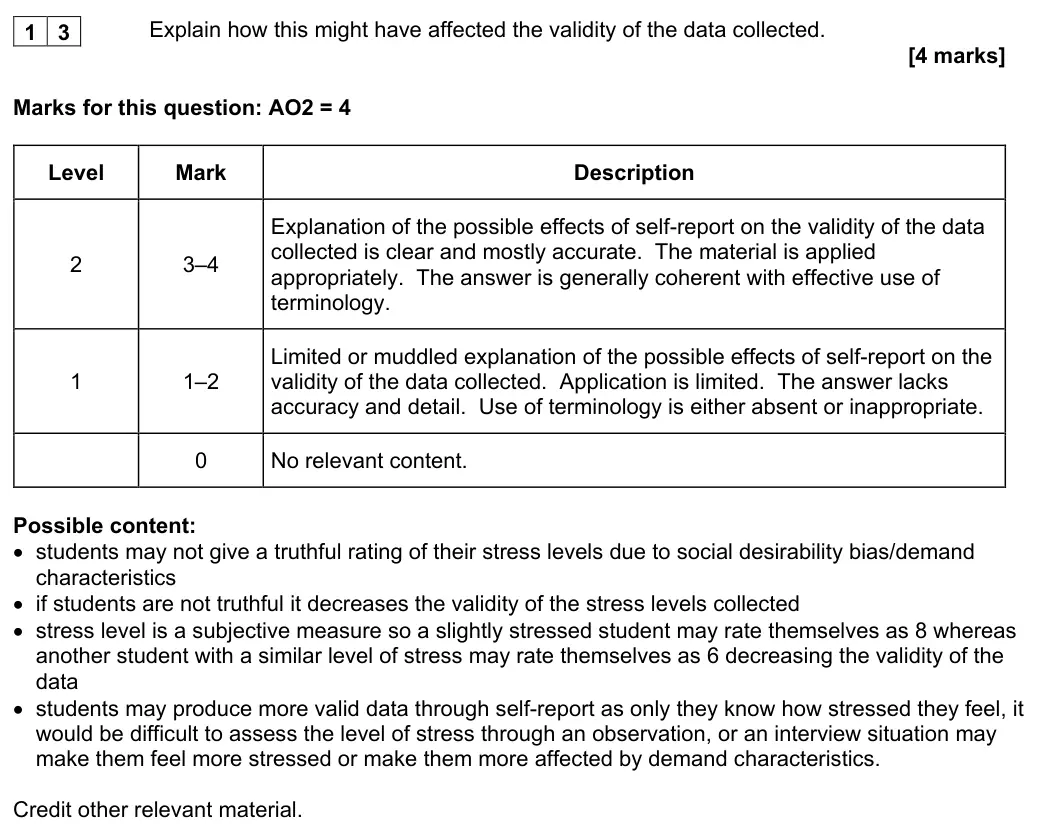
This question was generally well answered and was effective in differentiating between students. Some responses were limited to level 1 due to lack of appropriate context or not discussing the clear impact on validity. Level 2 responses explained how self-reporting stress levels on a scale would affect validity, often discussing subjectivity of the rating system with examples from the question stem. Many also then went on to discuss the impact of social desirability effectively and in context. Overall, the main differentiator was being able to move beyond stating factors which could affect validity (such as demand characteristics, lying, subjectivity, etc) to explain how these would affect validity in the study, using effective examples in context to illustrate their points. There were some creditworthy responses which presented an improvement in validity.
Notes from the mark scheme and report
social desirability/demand characteristics, subjectivity of the 1-10 scale (one student's 8 = another's 6)
possible improvement in validity also credited
stating factors without explaining the effect on validity = level 1
June 2023 · Paper 2 · Q214 marksAO2=2, AO3=2Research methodsMedium
Mark scheme, including level descriptors and indicative content
Examiner's comment
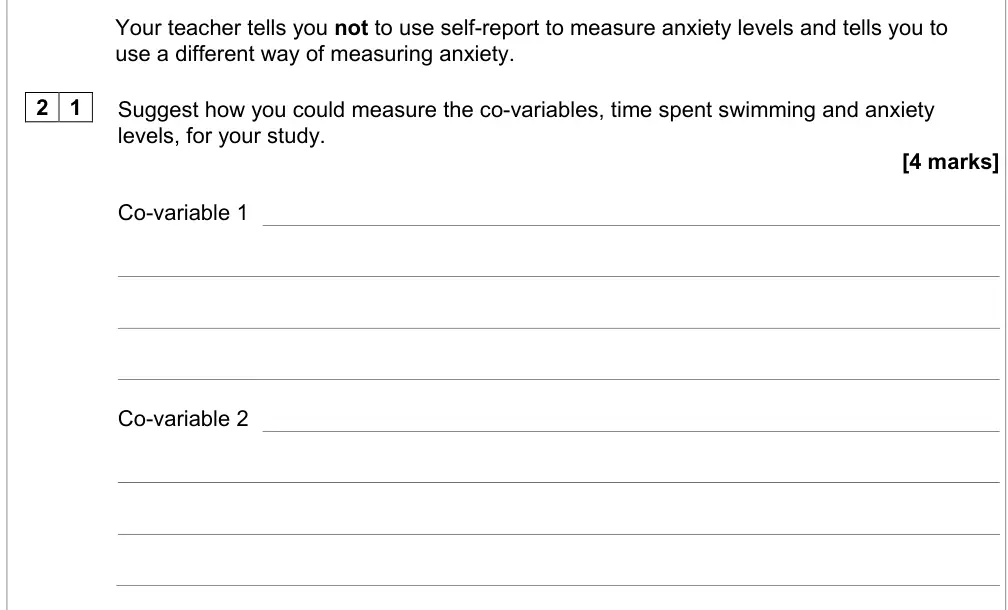
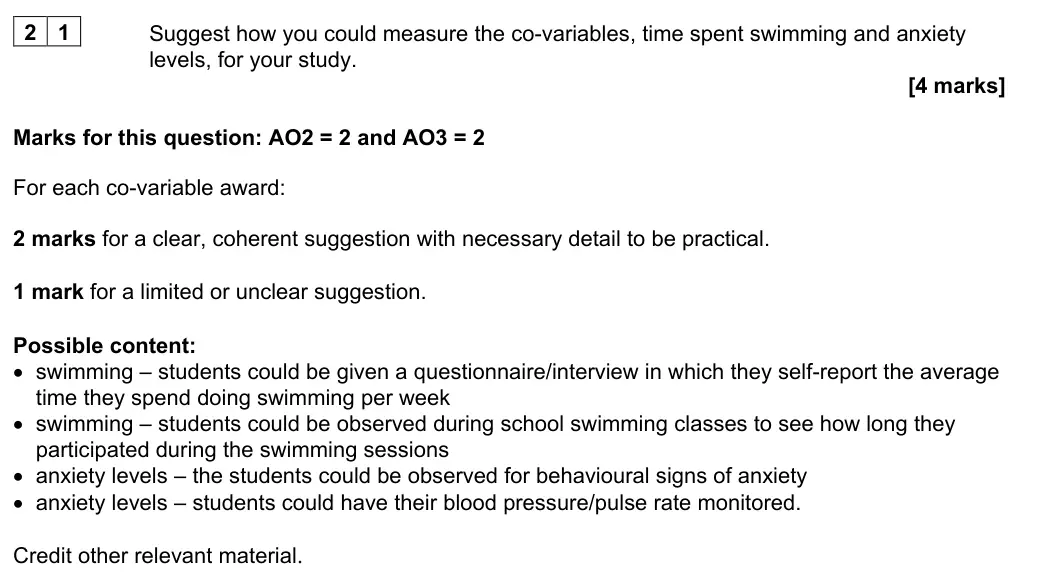
This question was generally not well answered. Many missed the instruction to not use self-report to measure anxiety levels, or did not understand the term self-report or that interviews were a form of self-report. However, the anxiety levels covariable was done better than time spent swimming, where a common response was to measure time swimming with a stopwatch, which was not deemed creditworthy in isolation of further detail. Very few gave a detailed enough suggestion to gain maximum marks as they did not identify how the variable could be measured with necessary detail to be practical. Another common error was to create two groups to measure swimming time.
Notes from the mark scheme and report
practical operationalised measures of both co-variables, NOT self-report for anxiety (observation of behavioural signs, pulse/blood pressure)
2 marks each
many used self-report/interviews for anxiety
'stopwatch' alone not credited
creating two groups
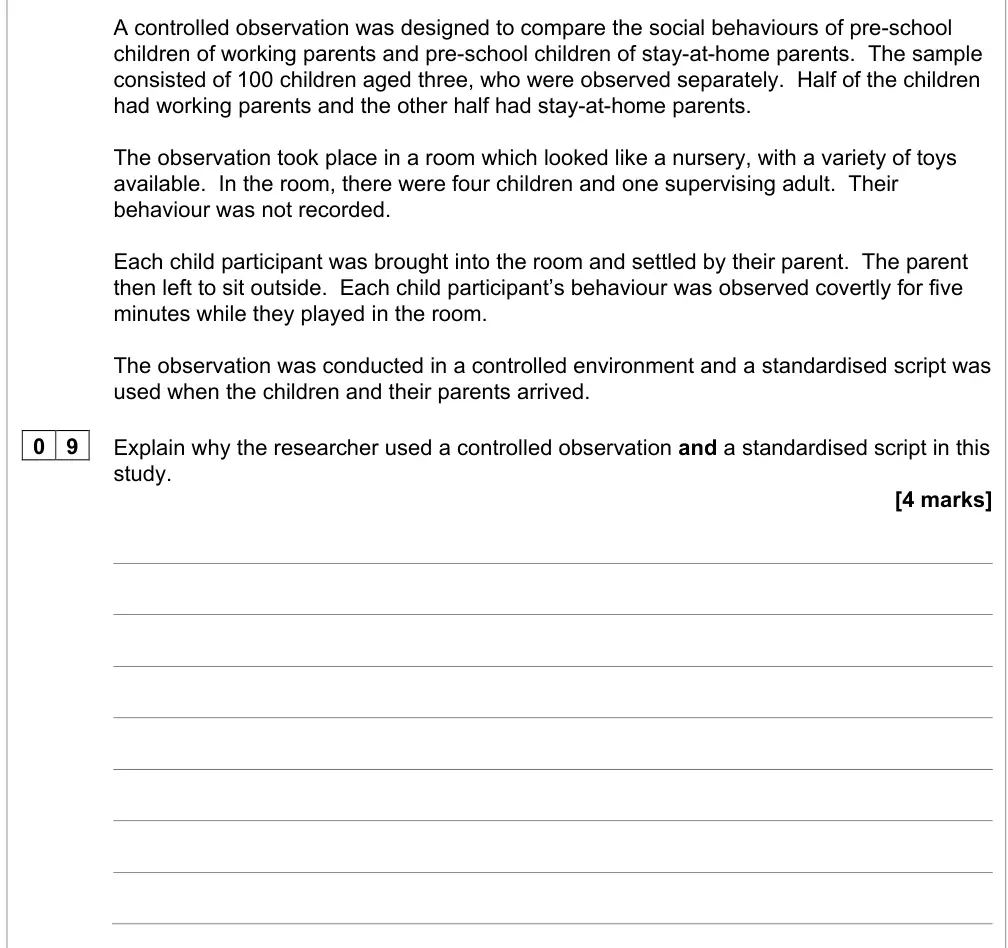
June 2022 · Paper 2 · Q94 marksAO2=4Research methods
Mark scheme, including level descriptors and indicative content
Examiner's comment
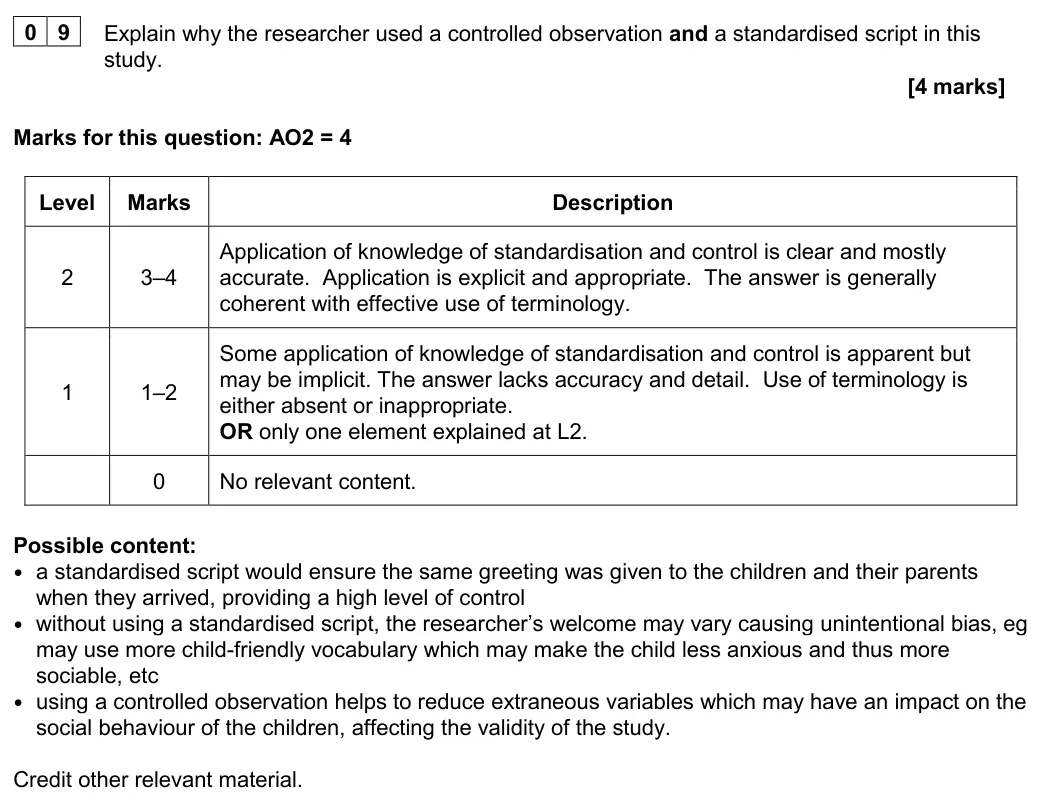
A number of answers for this question showed knowledge of a controlled observation and standardised script, without recognising the demands of the question being focused on applying knowledge to explain why the researcher used these in the study presented. This lack of explicit and appropriate application limited some students to level 1 of the mark scheme. When a question says, ‘in this study’, students should ensure that their answer is explained in the context of the study described. Overall, students explained why the researcher used a controlled observation better than the use of a standardised script, with a reduction in extraneous variables being a common response.
Notes from the mark scheme and report
why controlled observation (reduces extraneous variables affecting social behaviour) AND standardised script (same greeting, avoids investigator bias) in this study
one element only = max 2
generic knowledge without application = level 1
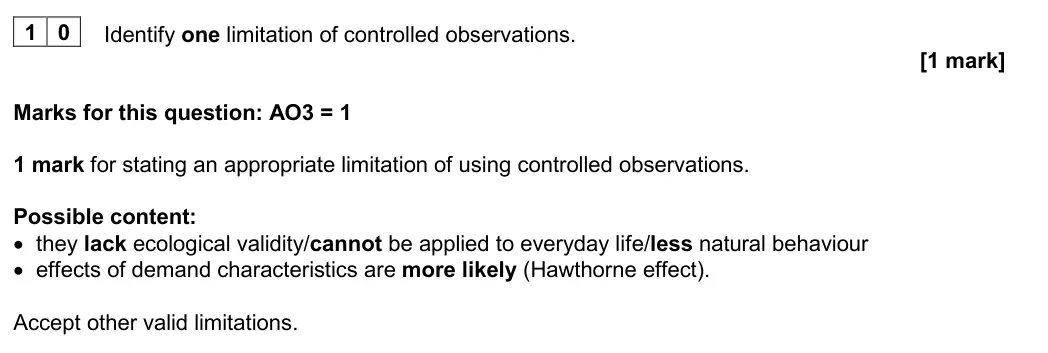
June 2022 · Paper 2 · Q101 markAO3=1Research methods
Mark scheme, including level descriptors and indicative content
Examiner's comment
This question was very well answered. Almost all students were able to provide one limitation of controlled observations with most focusing on a lack of ecological validity and fewer natural behaviours. There were a few students who muddled types of observation.
Notes from the mark scheme and report
e.g. lacks ecological validity/less natural behaviour, demand characteristics
some muddled types of observation
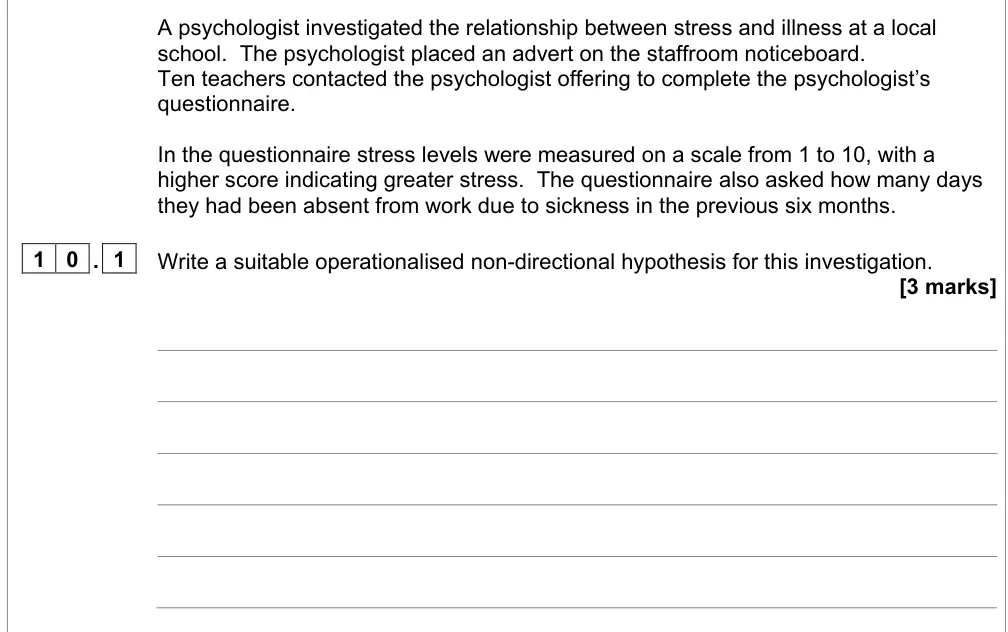
June 2022 · AS Paper 2 · Q10.13 marksAO2=3Research methods
Mark scheme, including level descriptors and indicative content
Examiner's comment
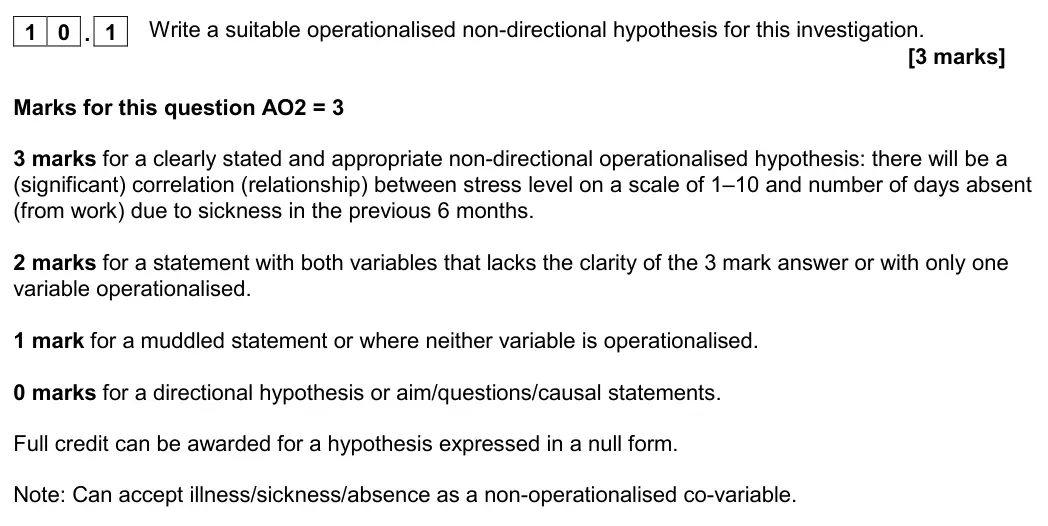
Many students struggled to write an operationalised non-directional correlational hypothesis. There were many errors made in the responses to this question ranging from some students writing either directional or causal hypotheses, to some writing aims or research questions. When students did write a non-directional correlational hypothesis, it was often poorly expressed with neither co-variable fully operationalised. Many students omitted ‘on a scale from 1 to 10’ for the stress co-variable and ‘from work due to sickness in the previous six months’ for the illness co-variable. It is important that students have sufficient practice at identifying the nature of investigations and writing appropriate hypotheses, so they understand this process fully and can then apply this understanding to a novel situation in an examination setting.
Notes from the mark scheme and report
must be a non-directional correlational hypothesis with both co-variables operationalised (stress 1-10 scale
days absent due to sickness in previous 6 months)
directional/causal/aims = 0
null form accepted
many omitted the operationalisation
June 2022 · AS Paper 2 · Q10.43 marksAO3=3Research methods
Mark scheme, including level descriptors and indicative content
Examiner's comment
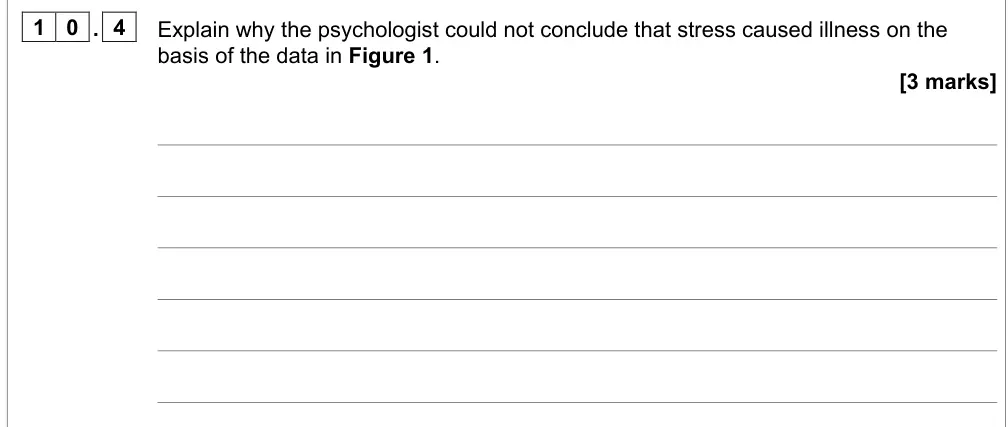
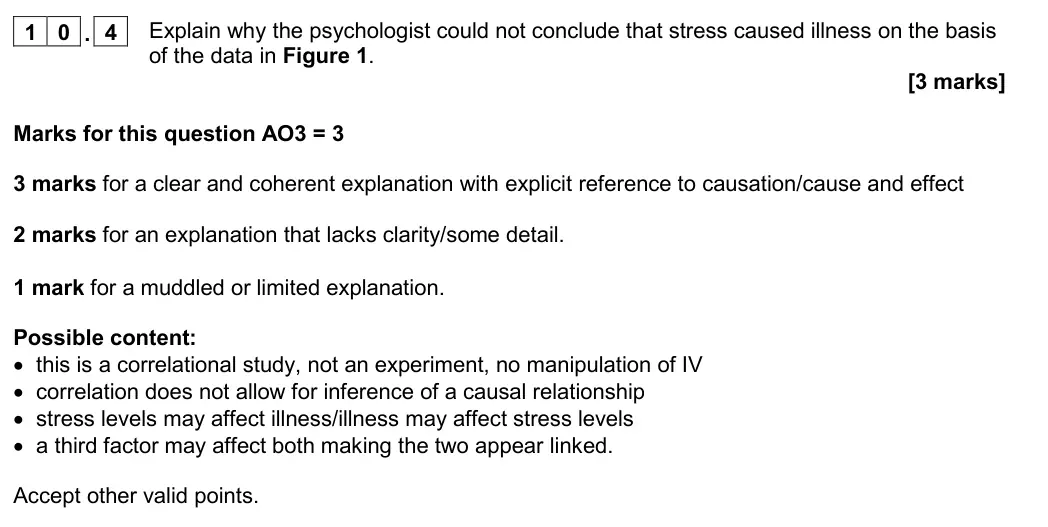
Many students seemed unable to engage with the demands of this question and could not articulate why causal conclusions cannot be drawn from correlational analysis. Of those students who could offer a valid explanation, many simply talked about intervening variables, which were frequently and inaccurately referred to as extraneous variables. As with previous questions, this question appeared to demonstrate a general lack of understanding of correlations and specifically how they are different to experimentation.
Notes from the mark scheme and report
explicit reference to cause and effect needed for 3 marks
no manipulation of an IV, direction of causality, third variable
many wrongly called intervening variables 'extraneous variables'
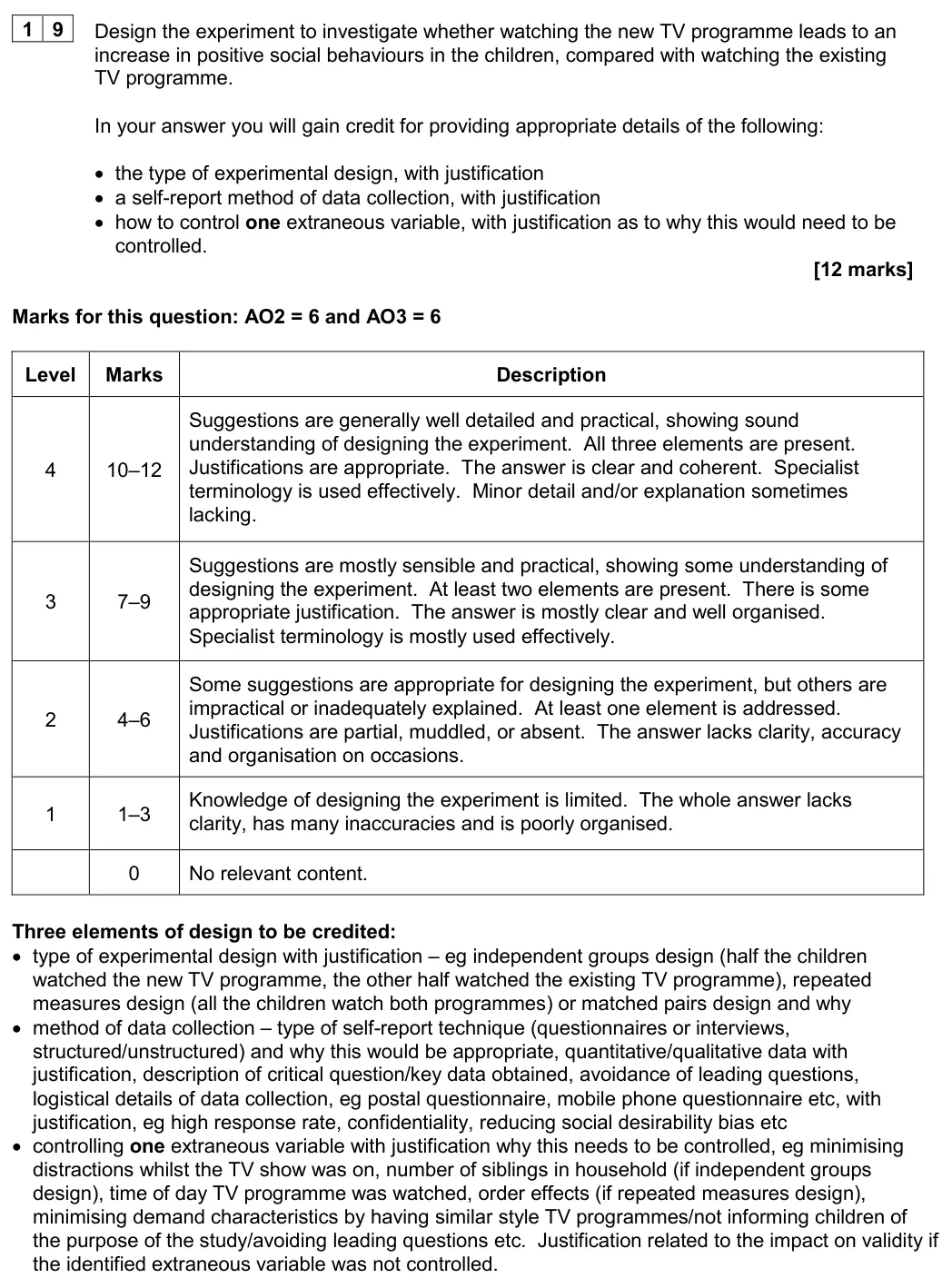
June 2022 · Paper 2 · Q1912 marksAO2=6, AO3=6Extended writing
Mark scheme, including level descriptors and indicative content
Examiner's comment
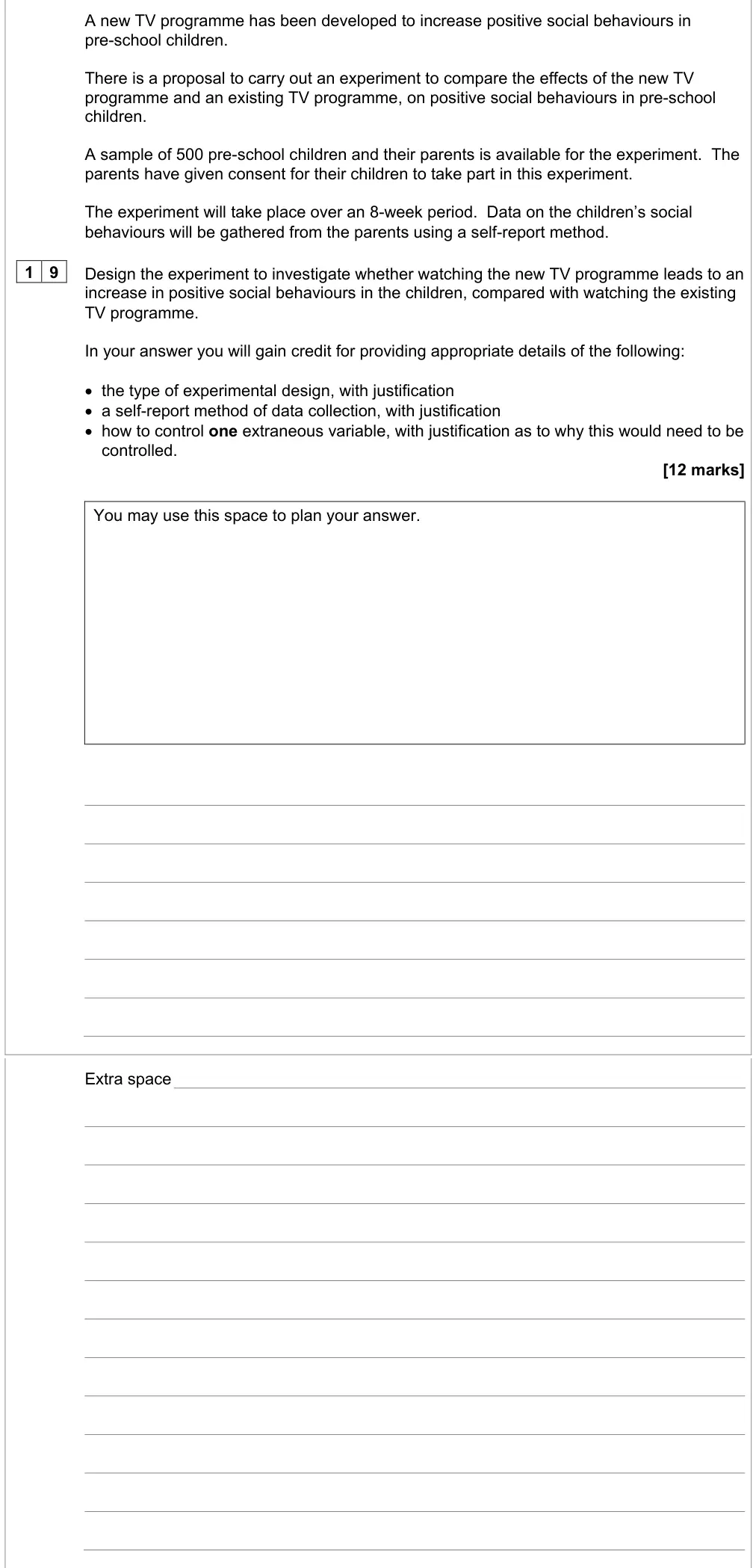
This question yielded a real spread of marks across the cohort. Students appeared more aware that only material relating to the bullet points would be creditworthy, as answers were more focused this year. Unfortunately, as in previous series, many responses were not practical or not sufficiently explained, eg simply naming the type of design or self-report method of data collection. The requirement for justification differentiated well, with only the best responses giving effective justification in context. Justification was often either missing or generic in nature, with comments such as ‘removes individual differences’ given. Overall, students engaged best with the content on the self-report method of data collection whilst they seemed more challenged to offer a control for an extraneous variable. An extraneous variable was often identified without considering whether it could be appropriately controlled. Consequently, there were lots of impractical suggestions regarding sleep, social interaction or screen time for young children. Many confused experimental design with types of experimental method and some missed the information in the stem about data being collected from the parents using a self-report method. For this type of question, teachers should encourage students to consider why certain experimental designs/methods of data collection are better than others for a given research question and also why certain controls of extraneous variables are needed. Teachers are advised to try to incorporate planning and implementing practical investigations in class where possible. This is to enable students to gain practical experience and deeper understanding of designing experiments, which will help them when answering these types of questions in an examination. However, this may have been more challenging for the cohort this year, given the more limited contact teaching time.
Notes from the mark scheme and report
three elements each justified: experimental design (independent groups/repeated measures/matched pairs), self-report method from parents (questionnaire/interview, question design), control of ONE extraneous variable with why
naming without justification limited
generic 'removes individual differences'
impractical controls (sleep, screen time)
experimental design confused with type of experiment
missed that data come from parents
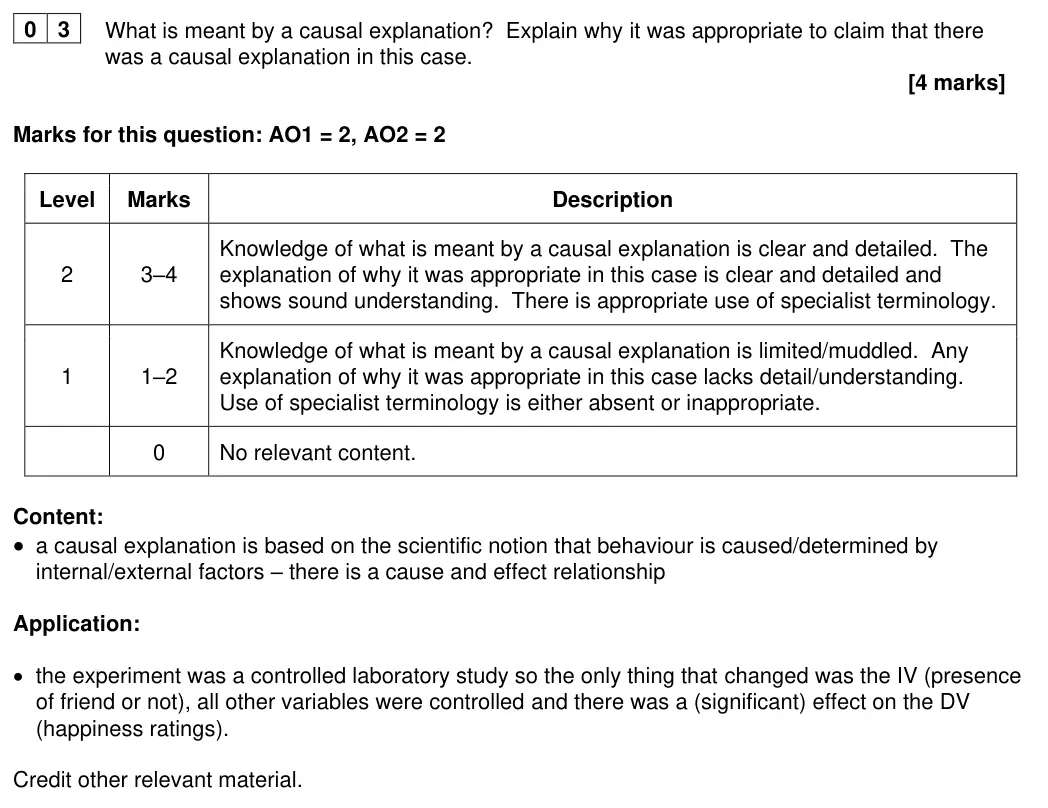
June 2022 · Paper 3 · Q34 marksAO1=2, AO2=2Application
Mark scheme, including level descriptors and indicative content
Examiner's comment
Question 03 was a good discriminator, with better answers responding appropriately to the cues in the stem and noting how a ‘controlled laboratory experiment’ would enable causality to be inferred. Many students completely missed the point, apparently having misread the key word in the question, as they focused on how researchers looking for a ‘casual’ explanation would be relaxed and unscientific.
Notes from the mark scheme and report
causal explanation = cause and effect (scientific emphasis on causality)
appropriate because a controlled lab experiment changed only the IV (friend present or not) with a significant effect on the DV
many misread 'causal' as 'casual'
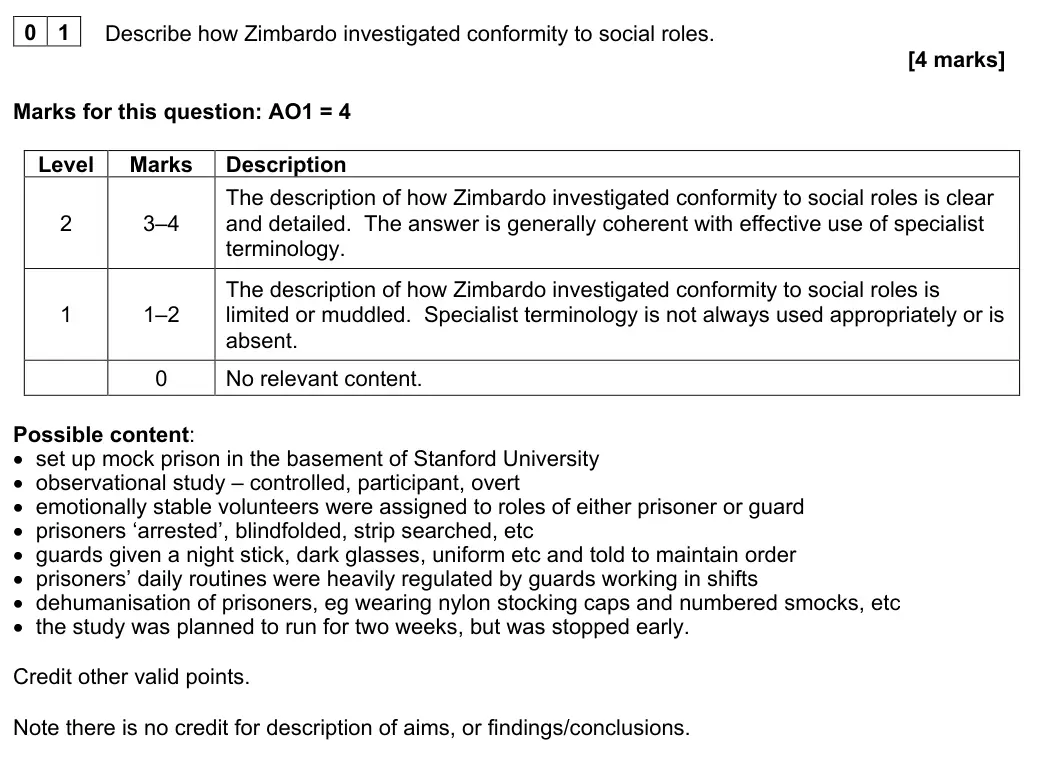
November 2021 · Paper 1 · Q14 marksAO1=4OutlineOld spec only
Mark scheme, including level descriptors and indicative content
Examiner's comment
Virtually all answers focused on Zimbardo’s Prison study. Many good answers had full details of the methods used, some in fact writing too much for four marks. A common mistake was to provide details of findings, which were not required by the question.
Notes from the mark scheme and report
(needs knowledge of Zimbardo's prison study
conformity to social roles was removed in v1.4)
no credit for aims, findings or conclusions
common error: describing findings
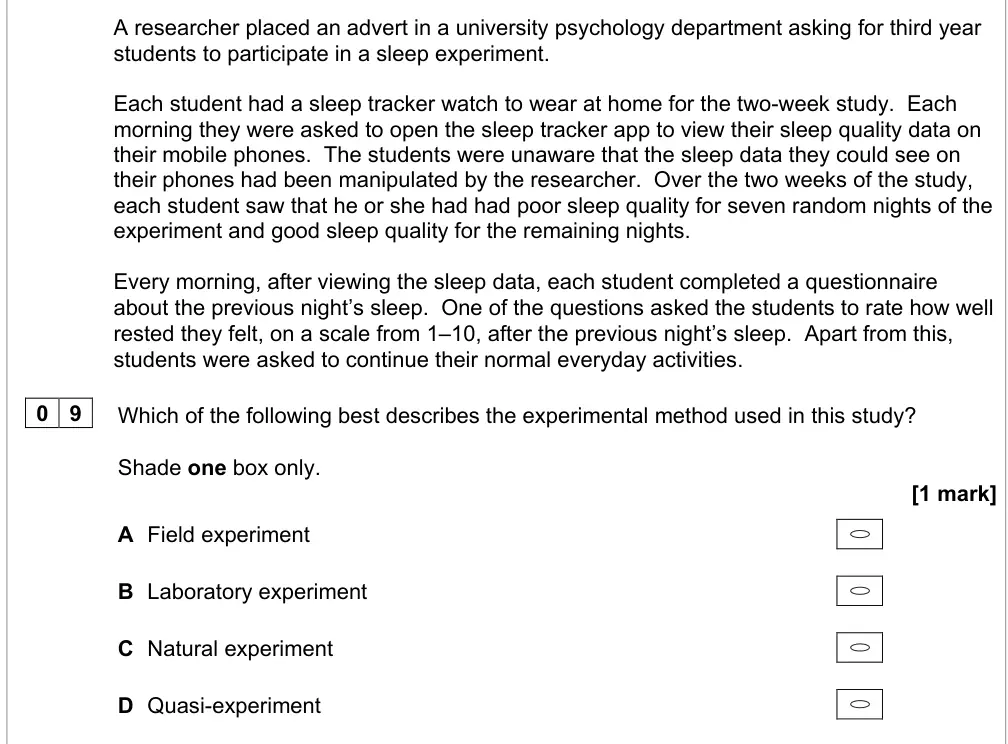
November 2021 · Paper 2 · Q91 markAO2=1Multiple choice
Answer
A
Mark scheme, including level descriptors and indicative content
Examiner's comment
This question was generally well answered with most students selecting the correct response. Incorrect responses were distributed across the three distractors although the most common incorrect response was C.
Notes from the mark scheme and report
correct answer A (field experiment - IV manipulated in participants' everyday setting)
most common wrong answer C (natural experiment)
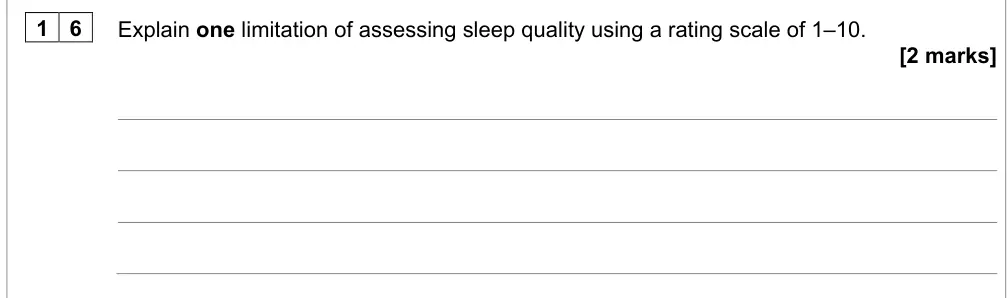
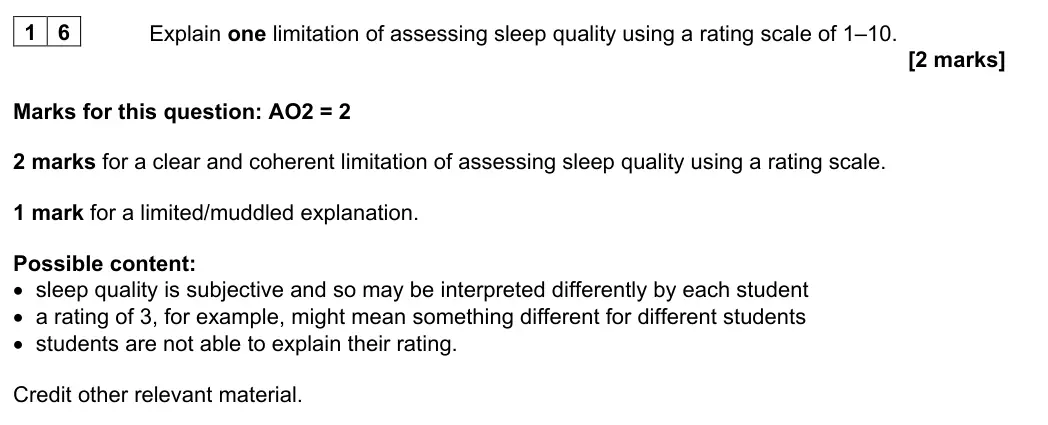
November 2021 · Paper 2 · Q162 marksAO2=2Research methods
Mark scheme, including level descriptors and indicative content
Examiner's comment
This was generally a well answered question with most students able to explain one limitation of using a rating scale. The most common reason for not achieving full marks was due to a lack of context, where students did not explain the limitation in the context of the study.
Notes from the mark scheme and report
rating of restedness is subjective/interpreted differently, cannot explain rating
lack of context limited marks
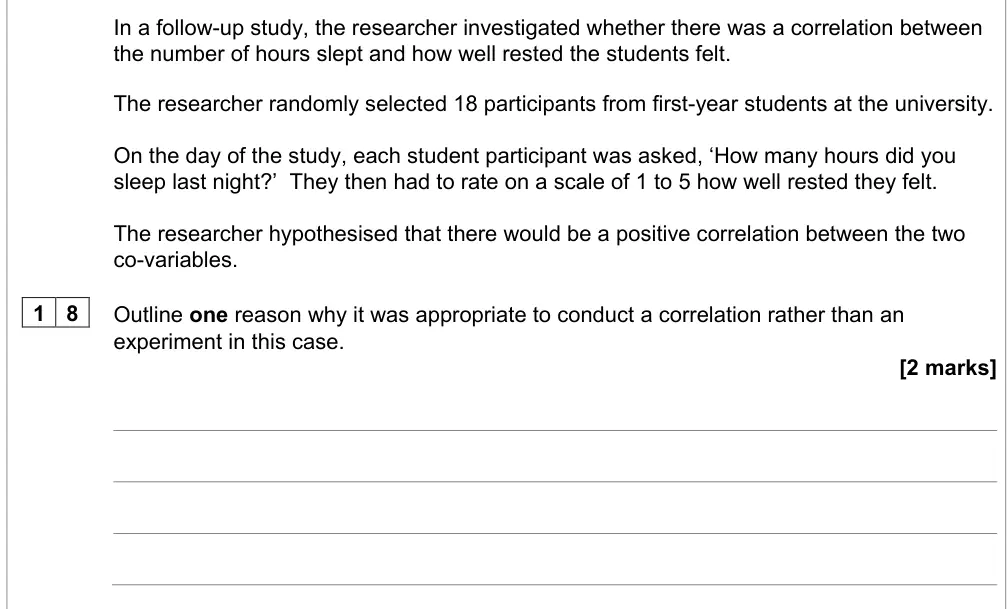
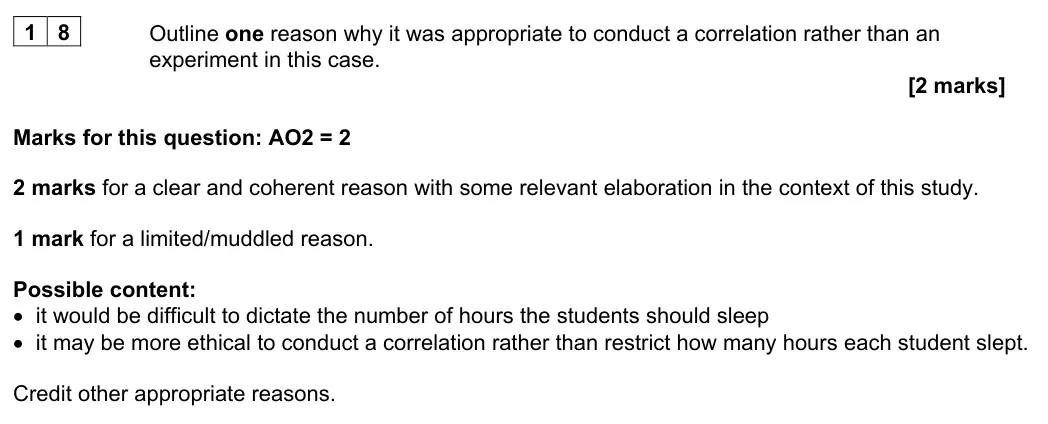
November 2021 · Paper 2 · Q182 marksAO2=2Research methodsHard
Mark scheme, including level descriptors and indicative content
Examiner's comment
This question was not well answered with the majority of students failing to gain marks. This was mainly due to students not answering the question set, instead either explaining why an experiment would have been better or justifying what makes it a correlation. There also appeared a lot of confusion regarding causation and correlation.
Notes from the mark scheme and report
hard/unethical to dictate hours slept, so correlation appropriate, in context
many explained why an experiment would be better or what makes it a correlation
causation confusion
November 2020 · AS Paper 1 · Q24 marksAO3=4Evaluate (short)
Mark scheme, including level descriptors and indicative content
Notes from the mark scheme and report
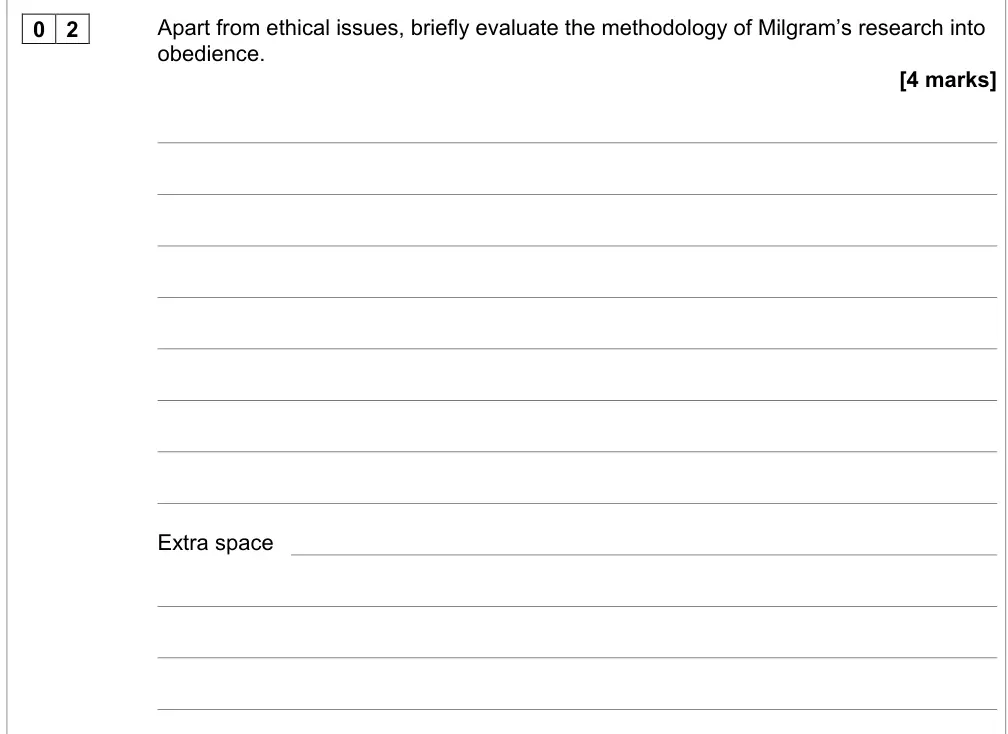
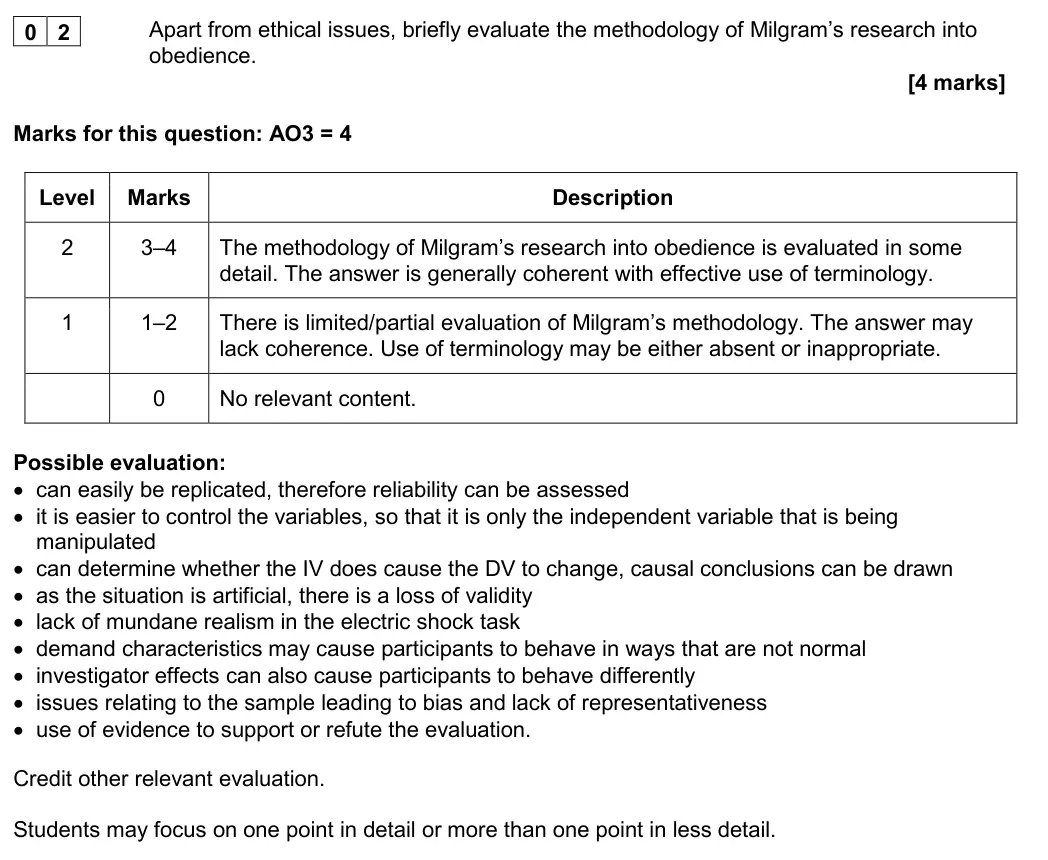
ethical issues excluded
methodological evaluation of lab experiment (control, replicability, causal conclusions vs artificiality/mundane realism, demand characteristics, sample bias)
one point in detail or several in less detail
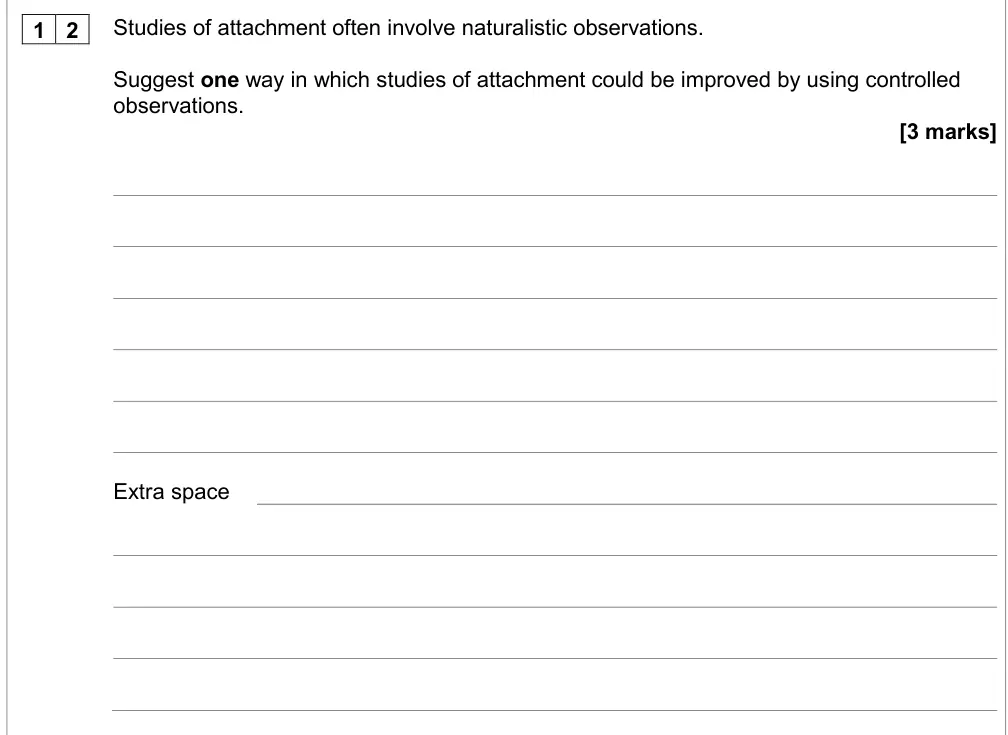
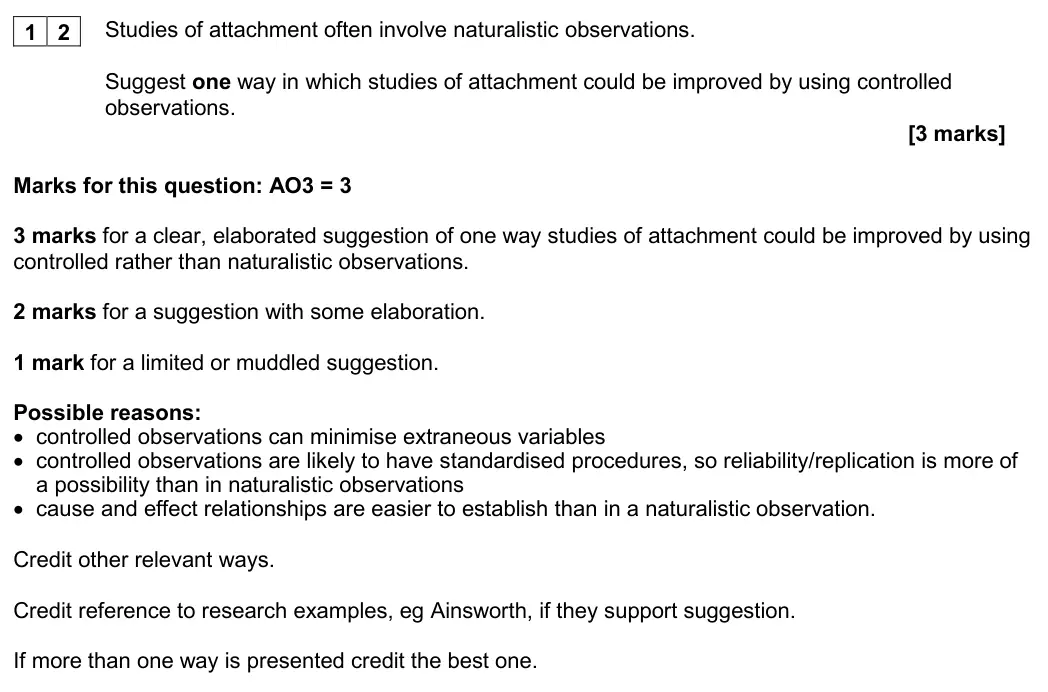
November 2020 · Paper 1 · Q123 marksAO3=3Research methods
Mark scheme, including level descriptors and indicative content
Examiner's comment
The key weakness with this question was students making suggestions that were not specific to controlled observations e.g. use of behavioural categories, multiple observers, video etc. However, there were many very competent answers.
Notes from the mark scheme and report
control of extraneous variables, standardised procedures/replication, cause and effect
suggestions not specific to controlled observation (behavioural categories, multiple observers, video) not credited
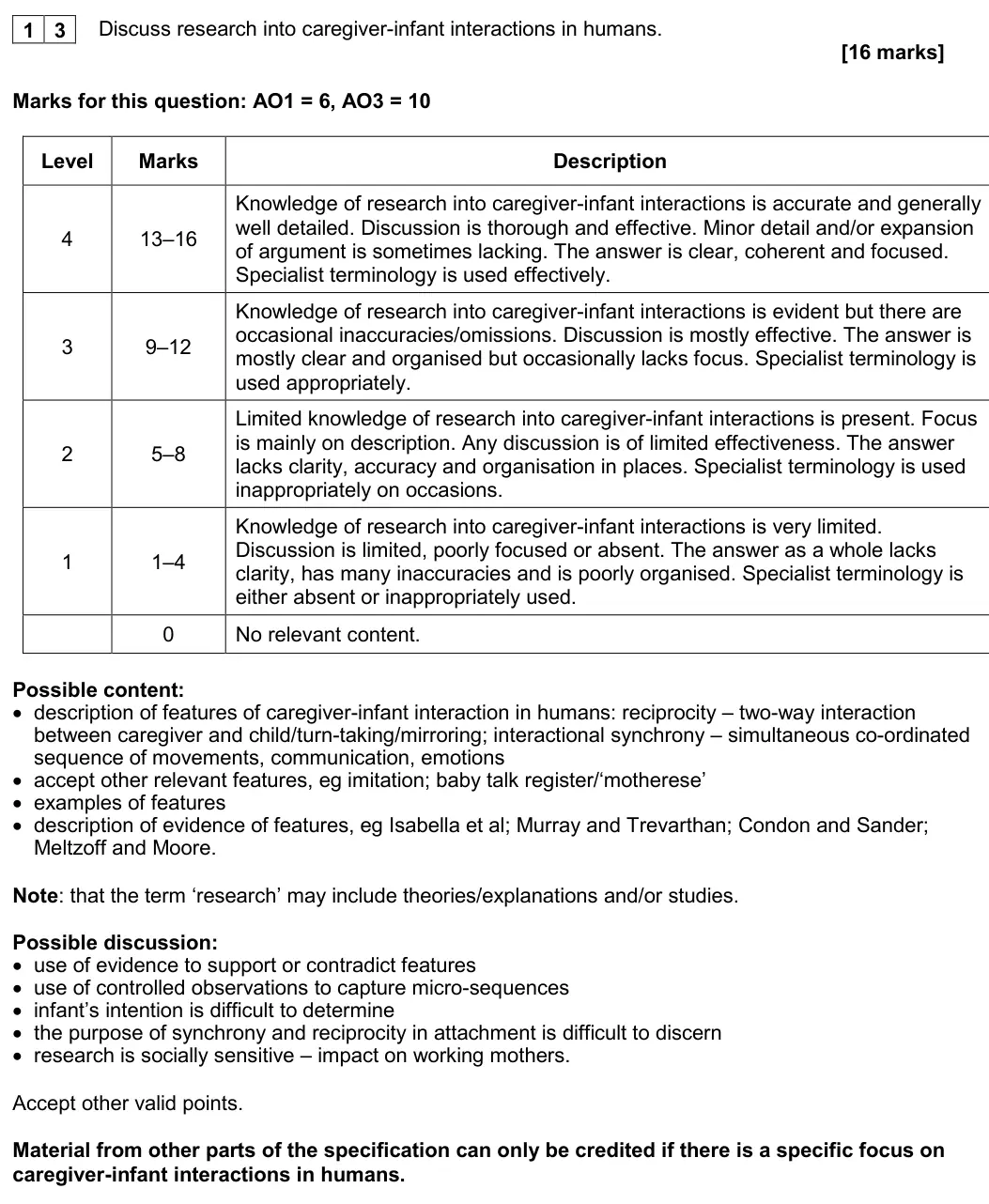
November 2020 · Paper 1 · Q1316 marksAO1=6, AO3=1016-mark essayOld spec only
Not on the 2025 specification: caregiver-infant interactions in humans: reciprocity and interactional synchrony, removed in v1.4
Mark scheme, including level descriptors and indicative content
Examiner's comment
This was clearly the most demanding question on the paper. The question itself is taken directly from a specific subsection covering reciprocity and interactional synchrony. However a significant minority of students took the question to be generally about attachment, and produced answers focusing on e.g. Ainsworth, Bowlby, Schaffer, and even Lorenz and Harlow. Where there was explicit reference to interactions between infant and caregivers in humans, some credit could be given, but overall such answers did not do well. Essays covering interactions had occasional problems distinguishing between reciprocity and interactional synchrony but often made good use of supporting studies. Further evaluation points included the problem of identifying ‘intentionality’ in babies, artificiality of settings, and the socially-sensitive nature of such research. At the lower end there were indications of lack of preparation and coverage of the Specification (e.g. Q13), while research methods questions were on the whole not done well (e.g. 03, 07).
Notes from the mark scheme and report
Off-spec: caregiver-infant interactions in humans: reciprocity and interactional synchrony, removed in v1.4
general attachment material only credited if focused on caregiver-infant interaction
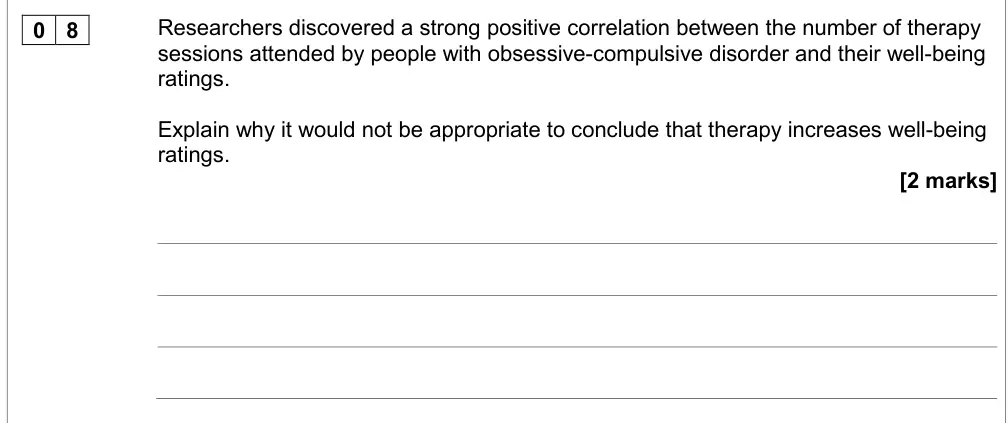
November 2020 · AS Paper 2 · Q82 marksAO3=2Research methods
Mark scheme, including level descriptors and indicative content
Notes from the mark scheme and report
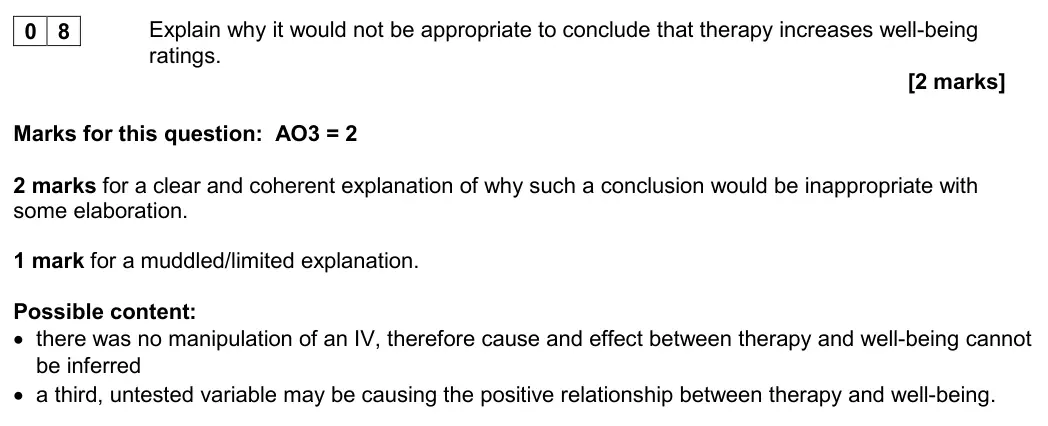
no IV manipulated so no cause and effect
a third untested variable could cause the relationship
November 2020 · Paper 2 · Q82 marksAO2=2Research methods
Mark scheme, including level descriptors and indicative content
Examiner's comment
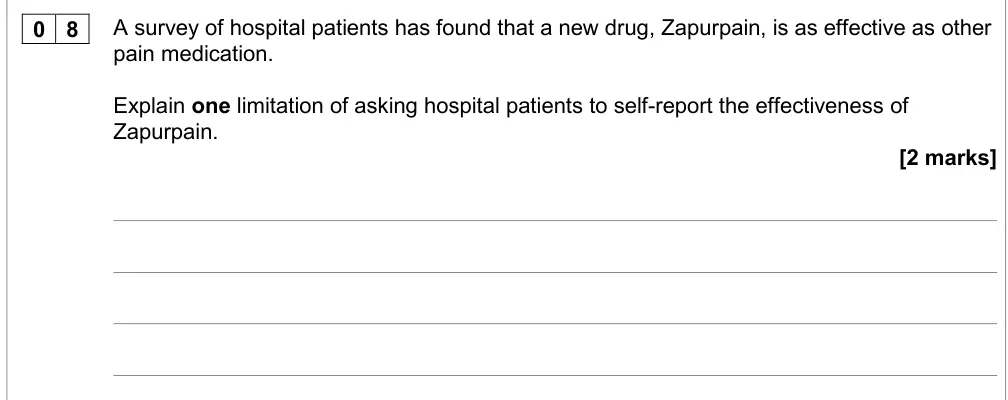
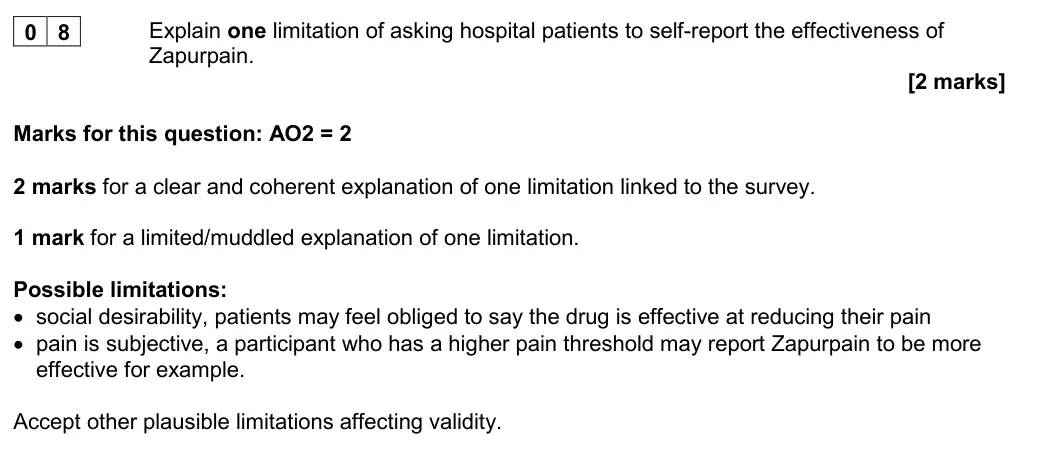
Whilst nearly all students were able to give one limitation of self-report, many of these were limited and generic. Better answers tended to focus on the subjectivity of pain although there were also some nice answers on social desirability.
Notes from the mark scheme and report
limitation linked to the Zapurpain survey: social desirability or subjectivity of pain
generic answers limited
November 2020 · AS Paper 2 · Q132 marksAO2=2Multiple choice
Answer
B and D
Mark scheme, including level descriptors and indicative content
Notes from the mark scheme and report
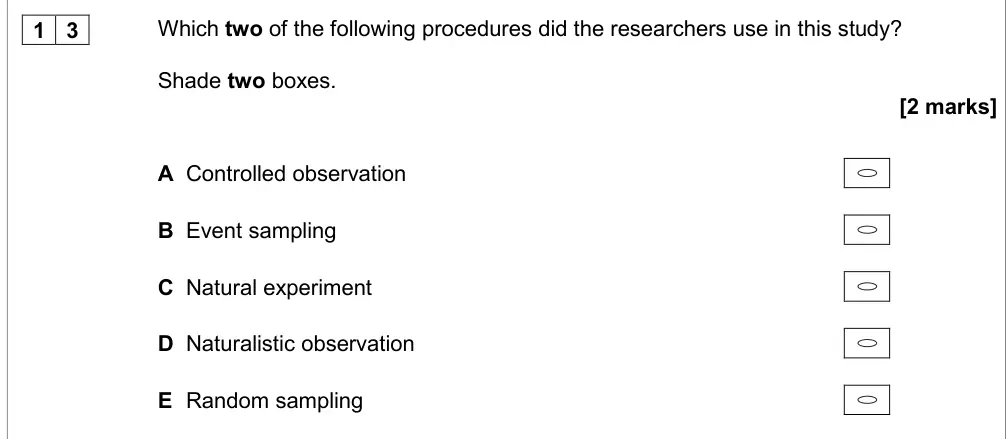
correct answers B (event sampling) and D (naturalistic observation)
distractors controlled observation, natural experiment, random sampling
November 2020 · AS Paper 2 · Q142 marksAO2=2Research methods
Mark scheme, including level descriptors and indicative content
Notes from the mark scheme and report
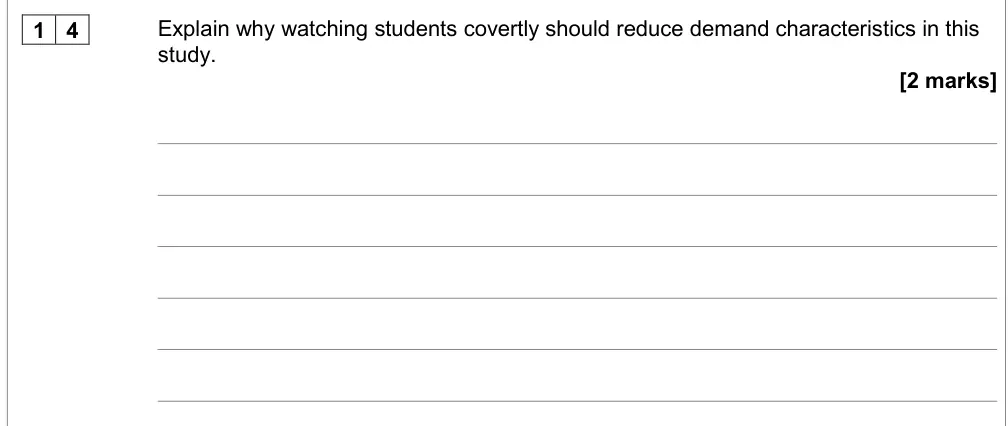
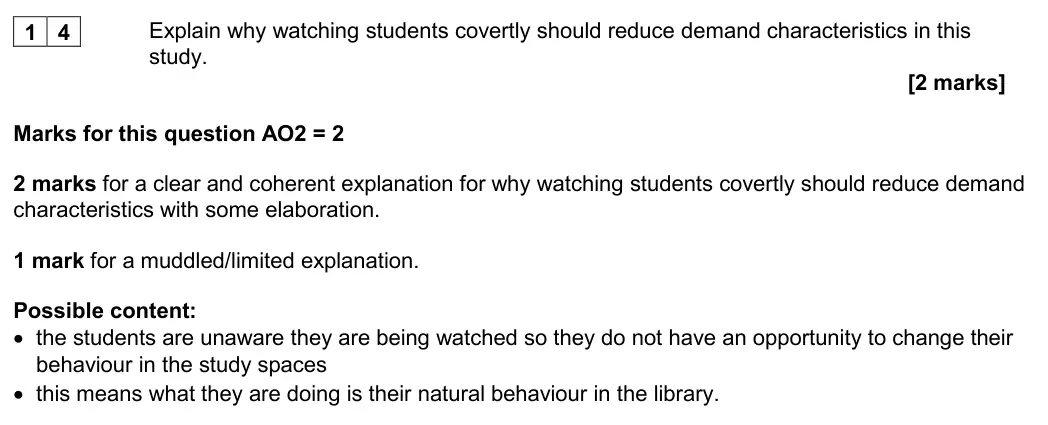
students unaware they are watched so cannot change behaviour, so behaviour is natural
November 2020 · Paper 2 · Q143 marksAO2=3Research methods
Mark scheme, including level descriptors and indicative content
Examiner's comment
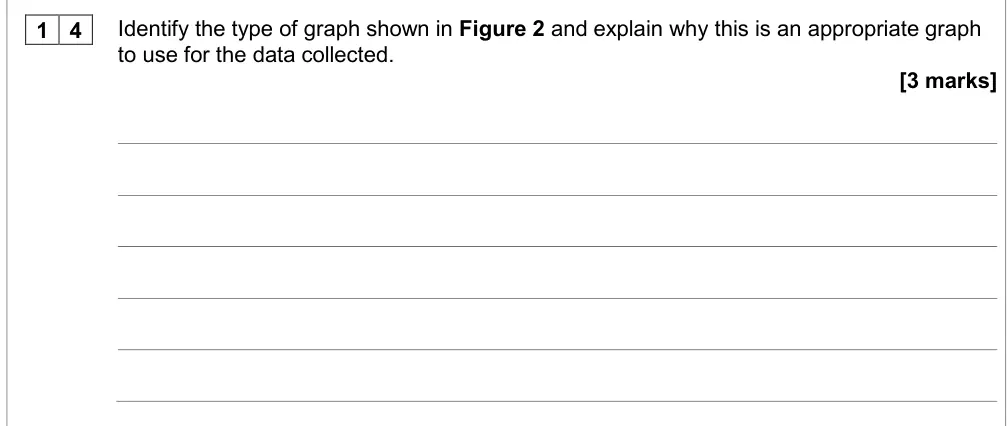
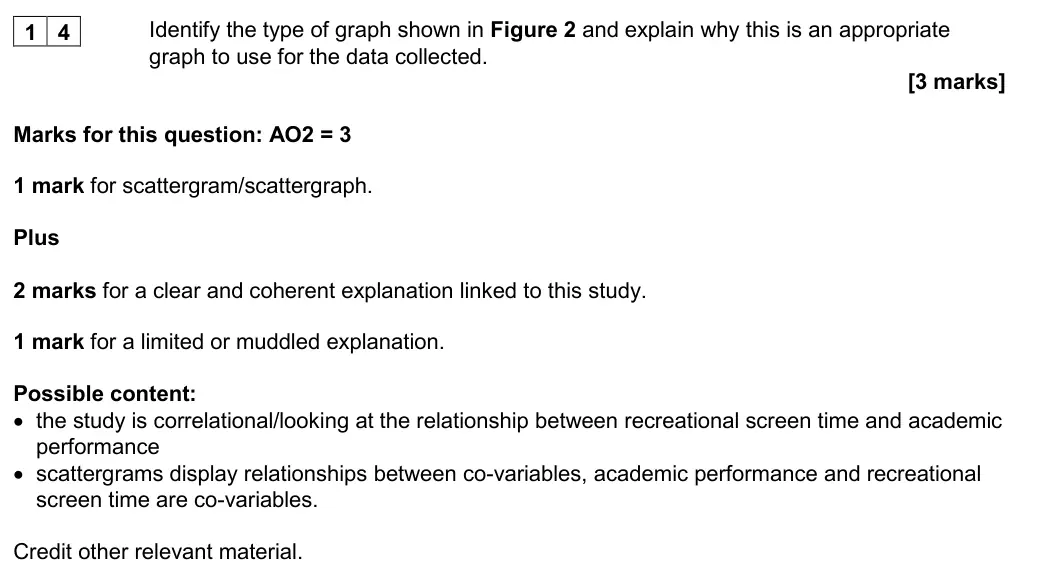
Most students were able to identify the graph as being a scattergram and were able to give a limited explanation of why this would be appropriate but fewer managed to provide an explanation that referred to the actual data collected.
Notes from the mark scheme and report
scattergram (1) + explanation linked to this study: correlational study of co-variables screen time and academic performance
few referred to the actual data
November 2020 · Paper 2 · Q152 marksAO2=2Research methods
Mark scheme, including level descriptors and indicative content
Examiner's comment
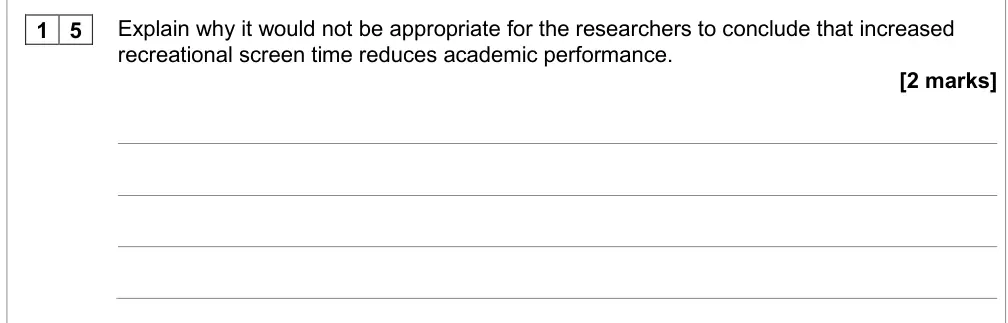
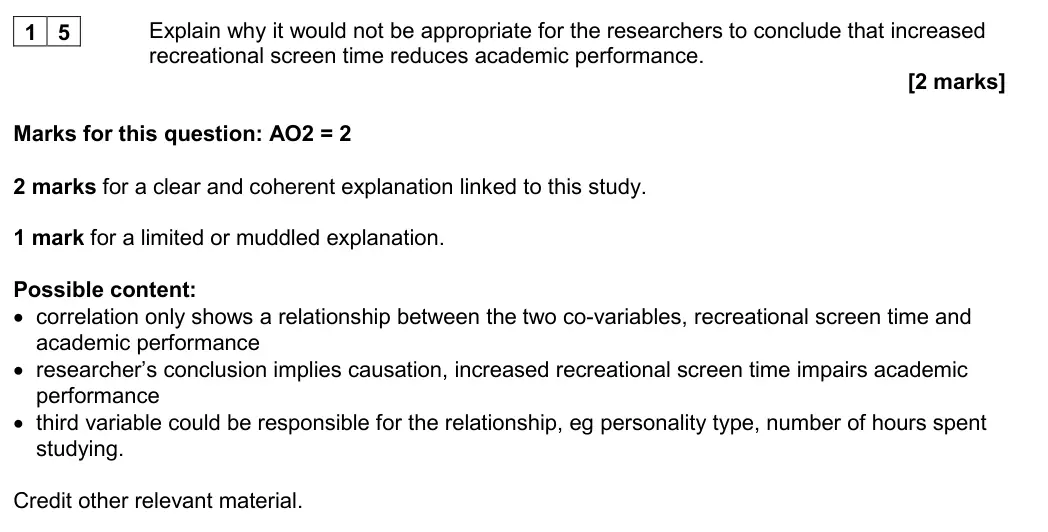
It was surprising that the modal mark for this question was zero, with many students explaining it would be inappropriate as the correlation was too weak, despite the majority of students correctly identifying the correlation co-efficient to be -0.80 in question 13. Many also suggested that it would be inappropriate to draw a conclusion when there were outliers. Good responses explained that recreational screen time and academic performance were only co-variables and thus a third variable such as sleep could be responsible for the results and thus causation could not be inferred. However, a lot of responses were limited/generic stating merely that it was not appropriate as it was correlational.
Notes from the mark scheme and report
correlation does not show causation
third variable (e.g. hours studying, sleep) linked to this study
modal mark 0 - many said the correlation was too weak or mentioned outliers
November 2020 · AS Paper 2 · Q174 marksAO2=2, AO3=2Research methods
Mark scheme, including level descriptors and indicative content
Notes from the mark scheme and report
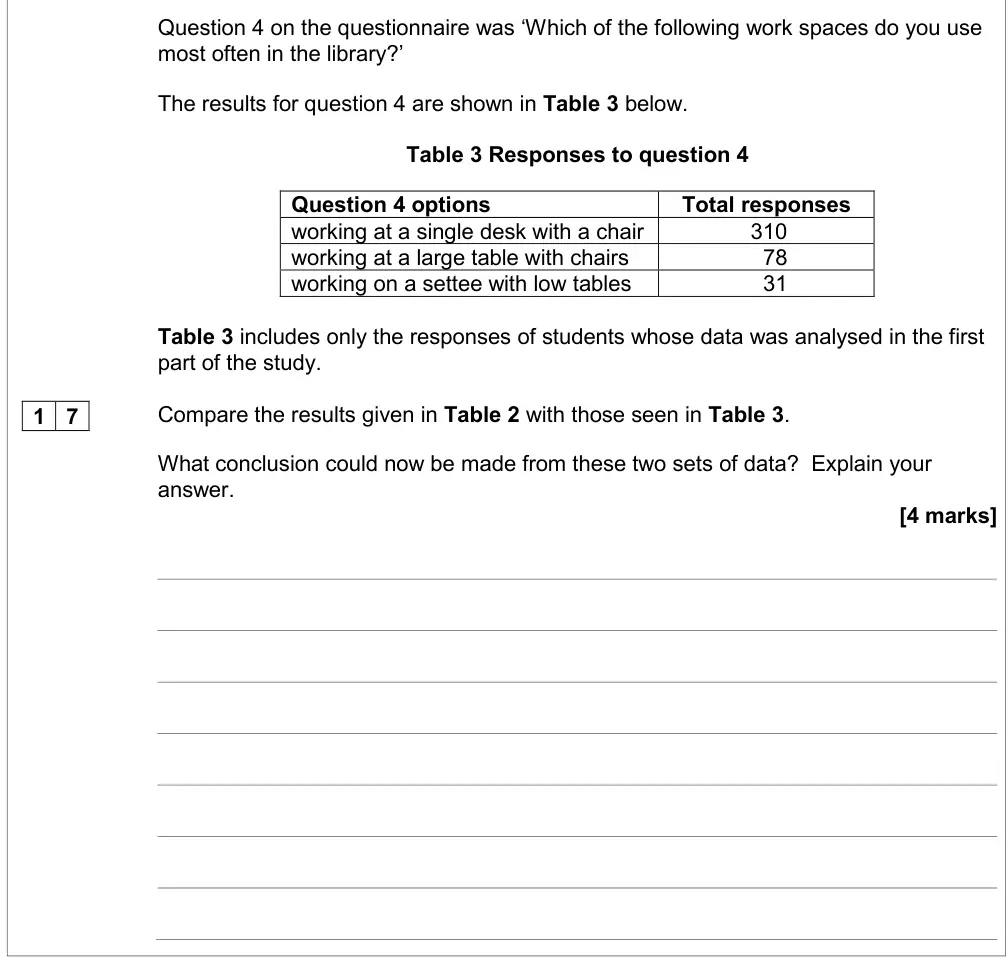
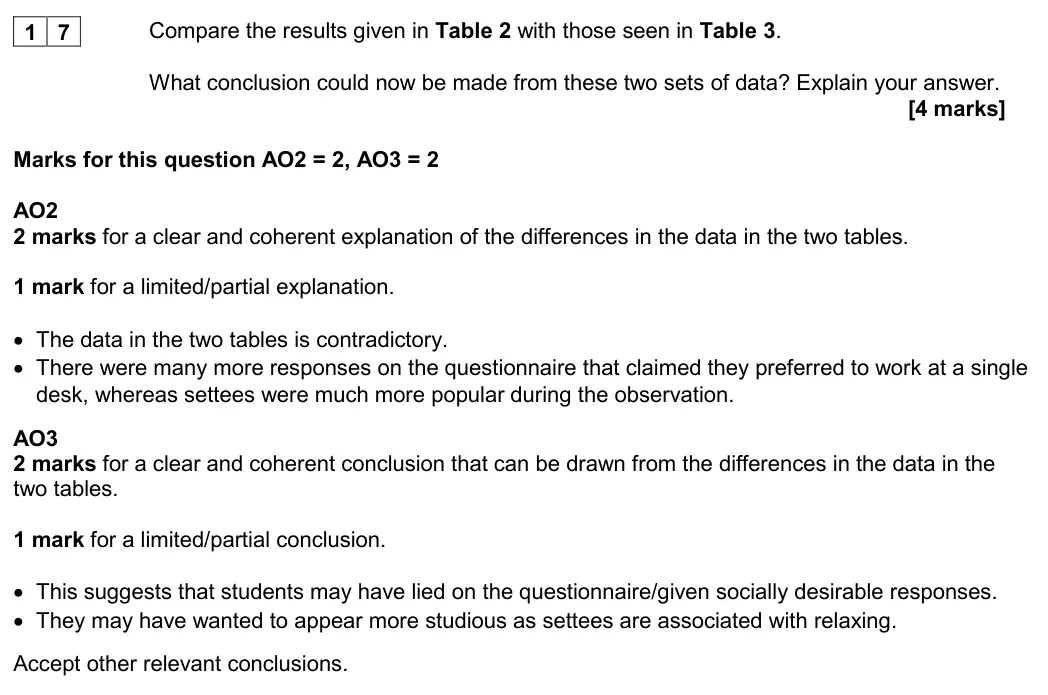
AO2: data contradictory (questionnaire favours single desks, observation favours settees)
AO3: conclusion that students gave socially desirable/untruthful answers (wanting to appear studious)
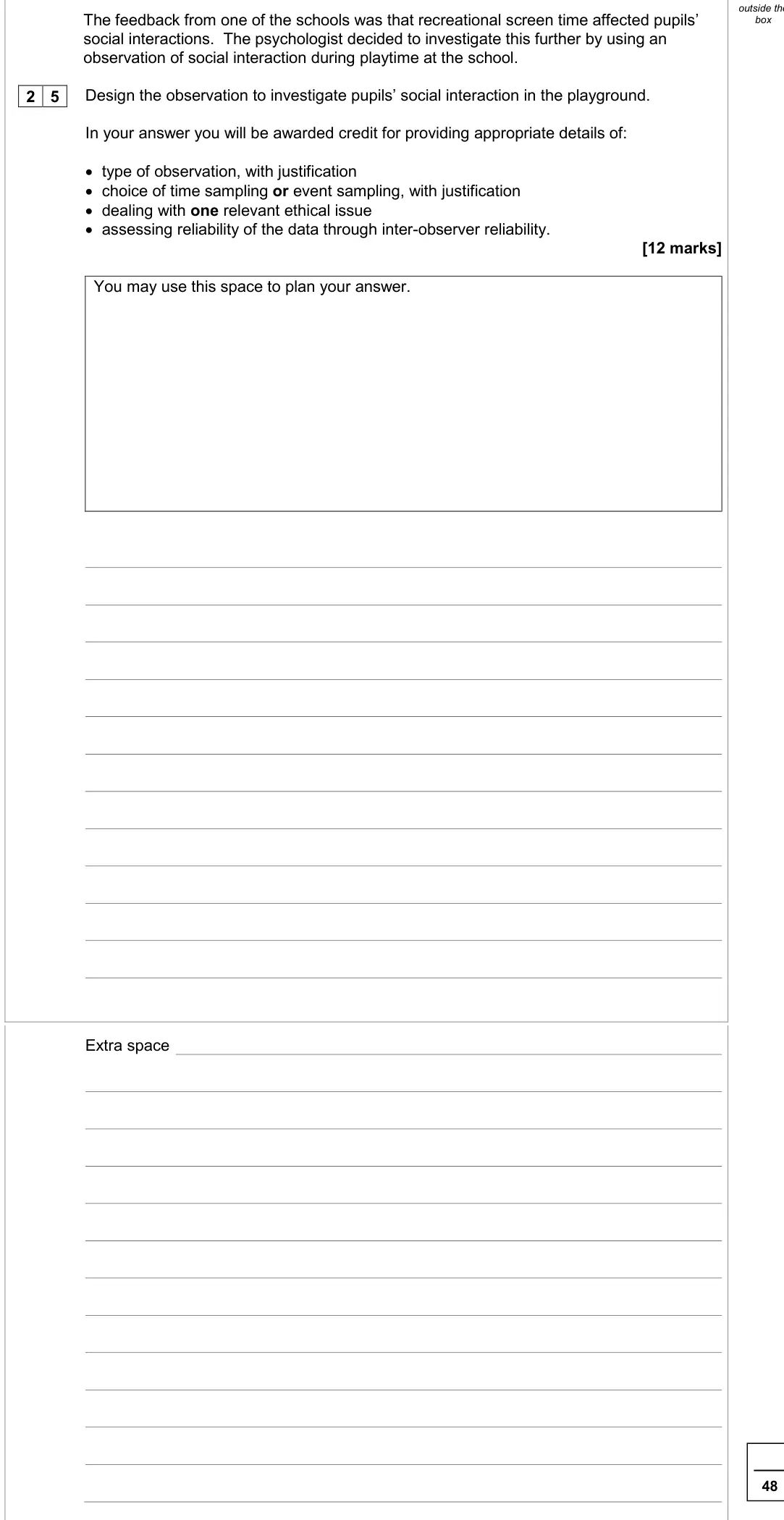
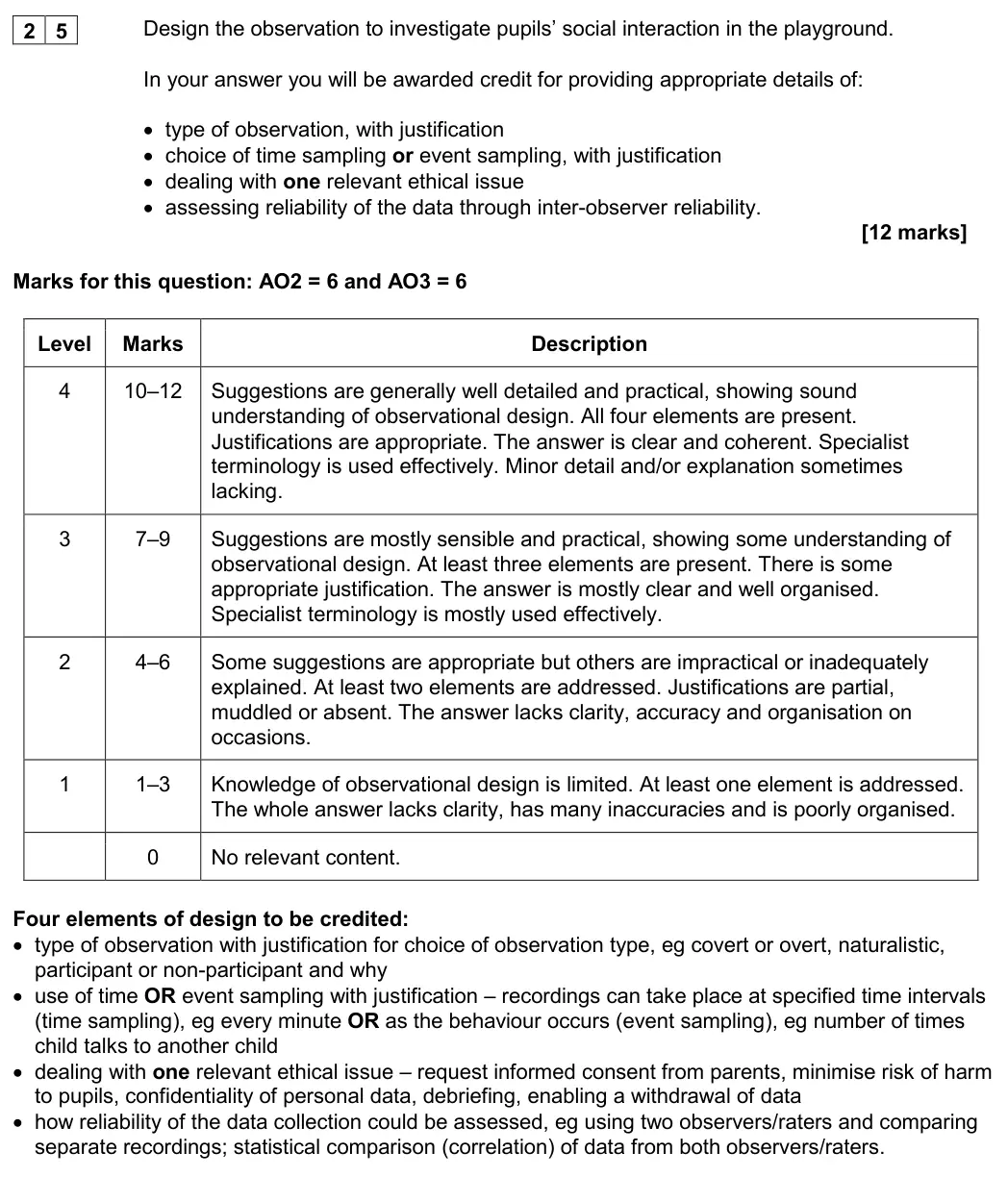
November 2020 · Paper 2 · Q2512 marksAO2=6, AO3=6Extended writing
Mark scheme, including level descriptors and indicative content
Examiner's comment
Responses to this question generally showed a sound understanding of different types of observations and the rationale for choosing these as well as knowledge of key ethical issues. However, the responses also demonstrated that students are still struggling to understand what time and event sampling are. It was rare to see time sampling explained accurately and students often referred to sampling methods (e.g. opportunity sampling) rather than time/event sampling. Students often described a range of potential ethical issues whereas the question required them to detail how they would deal with one relevant ethical issue. Those who correctly addressed this bullet point tended to focus on requiring parental/guardian consent, but this was often merely stated with generic justification rather than providing practical detail of how to deal with the ethical issue. Reliability was tackled with mixed success. Some students had an excellent understanding of inter- observer reliability, detailing a practical explanation of how reliability of the data could be assessed through inter-observer reliability. However, there were also too many students who did not seem to understand the procedure and some suggested repeating the study at different times. Some answers also focussed on how to improve inter-observer reliability rather than how it would be assessed. Overall, there is little evidence that students are engaged in or completing their own practical work. Responses generally consisted of a plethora of relevant key terms that were not applied appropriately and generic justifications rather than practical details. With more practical experience and less rote learning of theoretical concepts, students would be far less likely to confuse the alternative sampling terms. Teachers should be encouraged to deliver as much of the research studies content as practically as possible in order to develop the skills their students require to tackle design questions and even for students’ potential further study in this field.
Notes from the mark scheme and report
four elements each justified: observation type, time OR event sampling, dealing with ONE ethical issue (e.g. parental consent), assessing inter-observer reliability (two observers, correlate tallies)
time sampling rarely accurate, confused with participant sampling methods
listing many ethical issues
improving rather than assessing reliability
repeating the study at different times
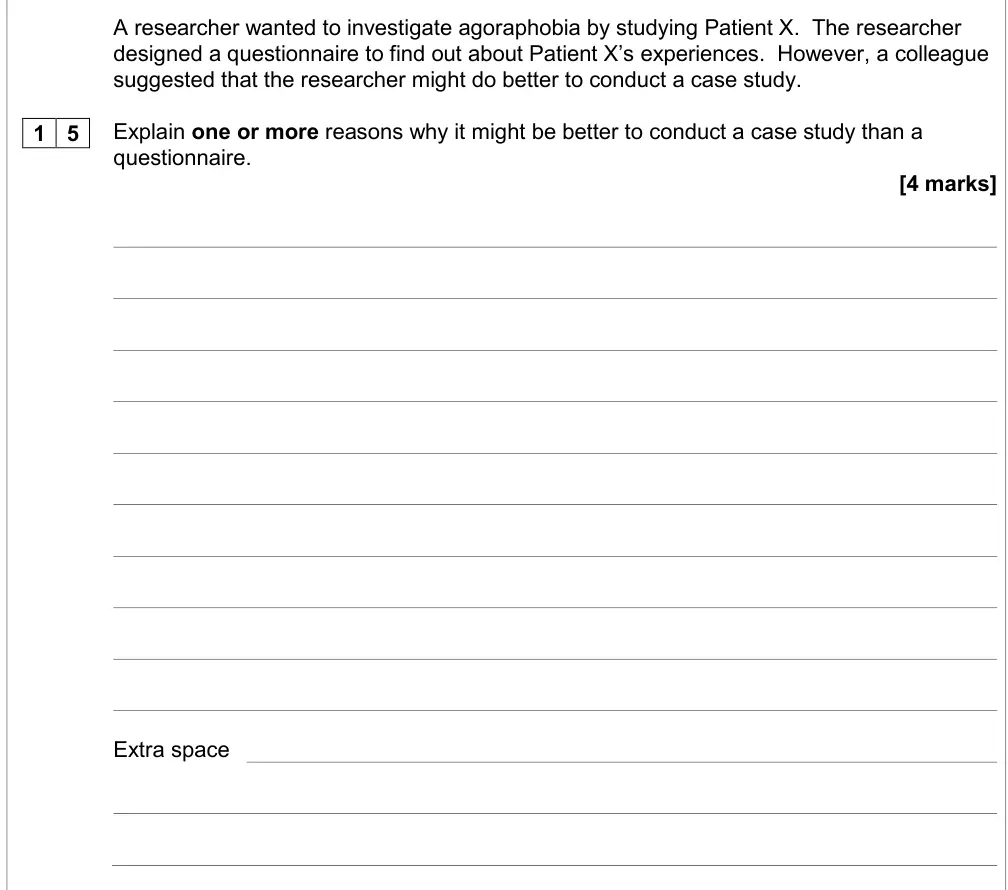
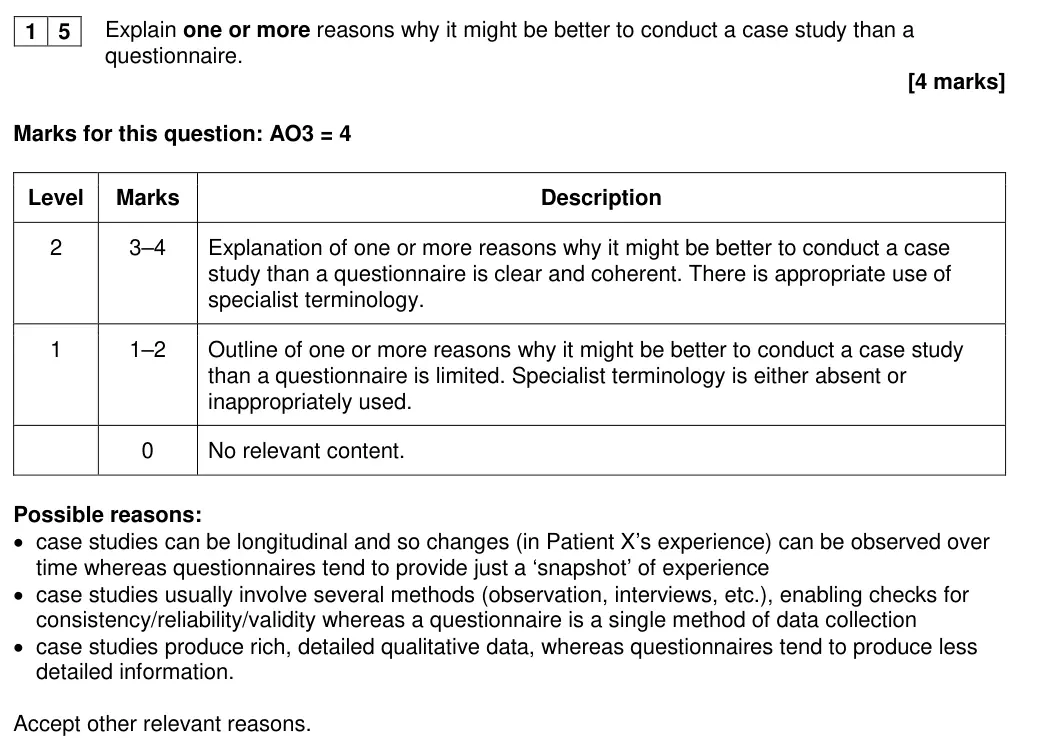
June 2019 · Paper 1 · Q154 marksAO3=4Research methods
Mark scheme, including level descriptors and indicative content
Examiner's comment
In question 15 many students focused on the limitations of questionnaires rather than the advantages of case studies. Answers to this question were generally of a lower standard than expected. Many students focused on problems with questionnaires rather than the advantages of case studies. References to the longitudinal nature of case studies or the possibility of using a range of methods to generate large amounts of qualitative and quantitative data were rare. Often the only relevant comment was ‘case studies generate rich qualitative data’ with little detail or explanation. More effective answers did refer to the value of the relationship between investigator and Patient X in improving the reliability and validity of data collected.
Notes from the mark scheme and report
advantages of case studies over questionnaires (longitudinal, multiple methods for reliability/validity checks, rich qualitative data) not just problems with questionnaires
rarely detailed
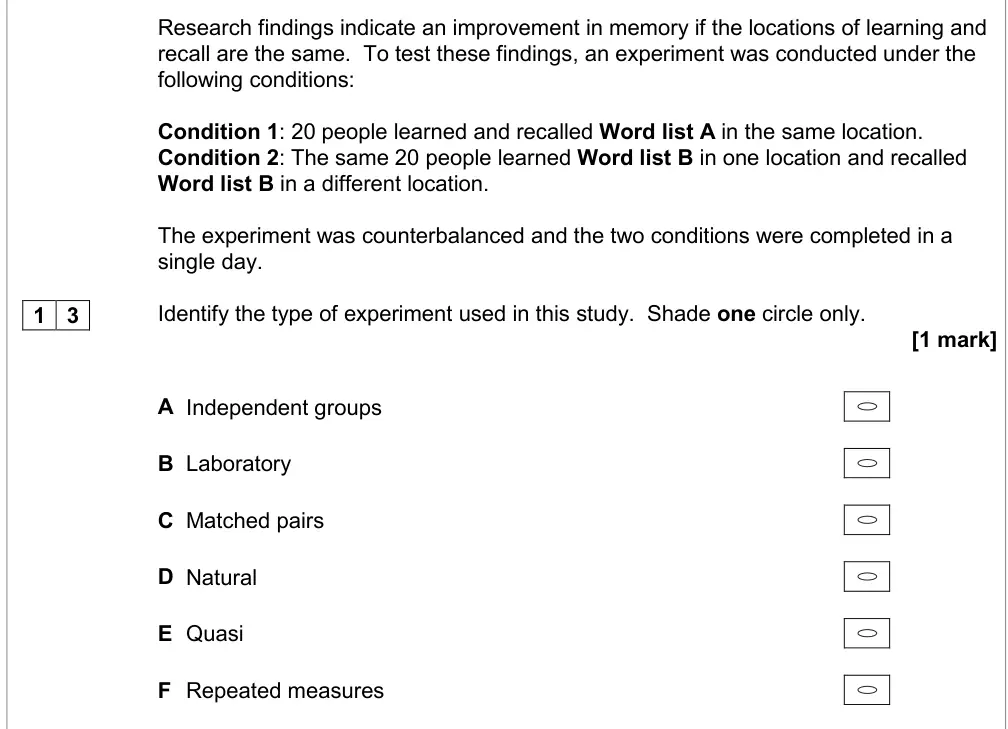
June 2019 · AS Paper 2 · Q131 markAO2=1Multiple choice
Answer
B
Mark scheme, including level descriptors and indicative content
Examiner's comment
Most students were able to answer this question correctly, and many appeared to have enough knowledge of types of experiments to be able to identify the one used in the study provided.
Notes from the mark scheme and report
correct answer B (laboratory)
distractors include designs and natural/quasi experiments
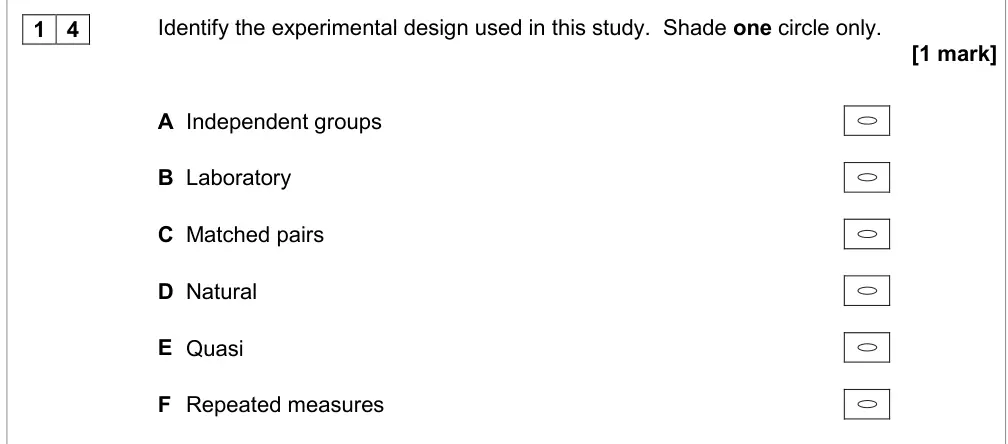
June 2019 · AS Paper 2 · Q141 markAO2=1Multiple choice
Answer
F
Mark scheme, including level descriptors and indicative content
Examiner's comment
Most students were able to answer this question correctly, and most appeared to have sufficient knowledge of experimental design to be able to identify the one used in the study provided. This question was generally answered better than question 13 suggesting that students were better at identifying experimental designs than types of experiment.
Notes from the mark scheme and report
correct answer F (repeated measures)
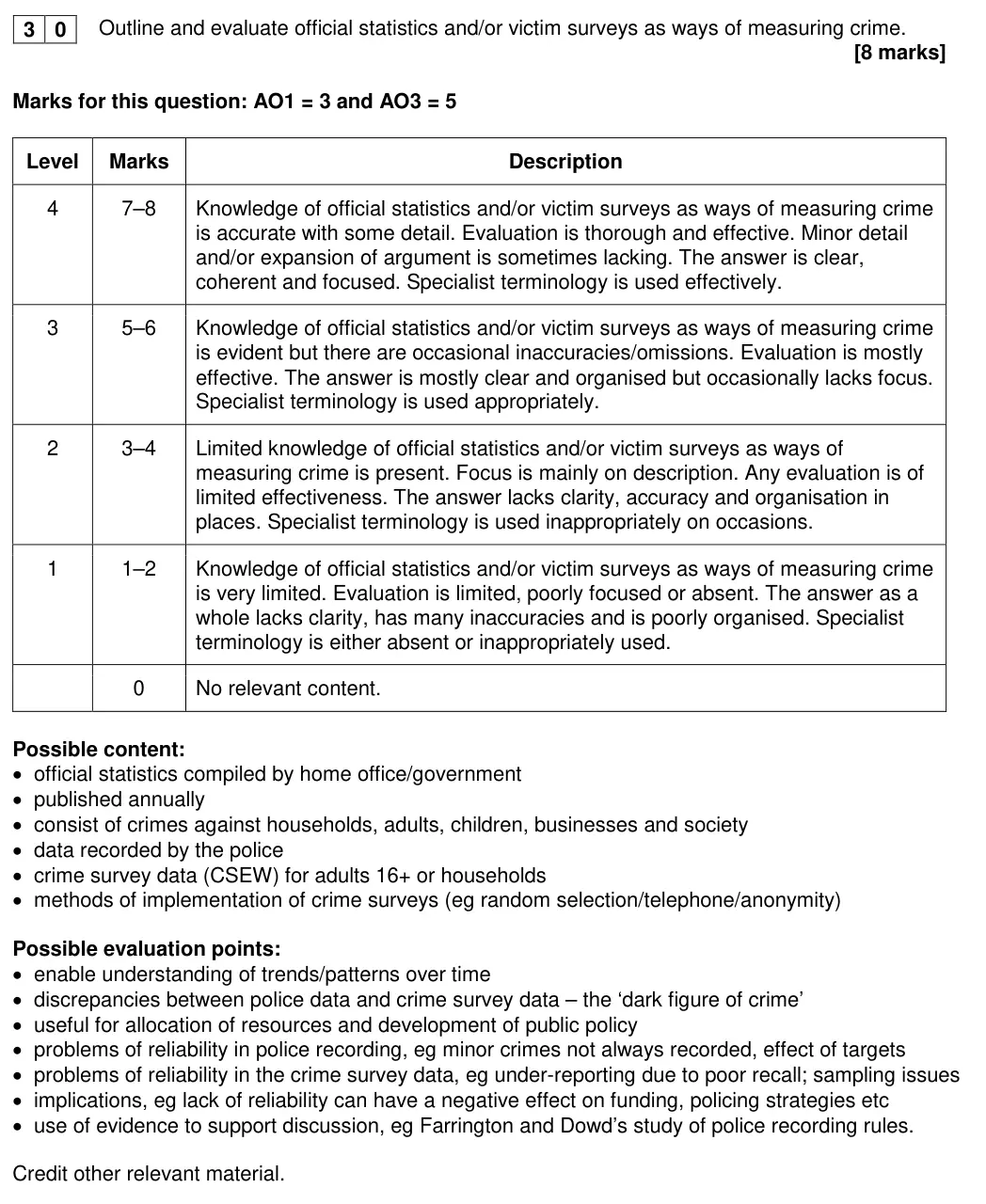
June 2019 · Paper 3 · Q308 marksAO1=3, AO3=5Extended writingOld spec only
Not on the 2025 specification: ways of measuring crime: official statistics and victim surveys are not in v1.4 Forensic Psychology content
Mark scheme, including level descriptors and indicative content
Examiner's comment
The vast majority of answers to this question dealt with both official statistics and victim surveys. Descriptions tended to be quite limited with very little detail, for example, few students named or described specific victim surveys or referred to the techniques used to gather the information. Occasionally, descriptions of victim surveys sounded rather more like offender surveys or restorative justice interviews. Evaluations tended to be brief but covered appropriate material, with the ‘dark figure’ much in evidence.
Notes from the mark scheme and report
Off-spec: ways of measuring crime: official statistics and victim surveys are not in v1.4 Forensic Psychology content
dark figure of crime much used
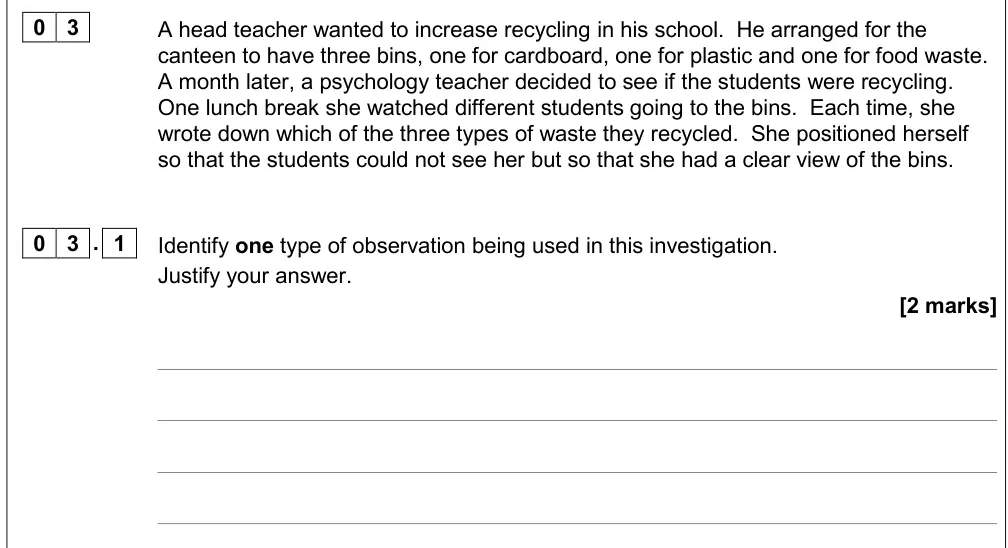
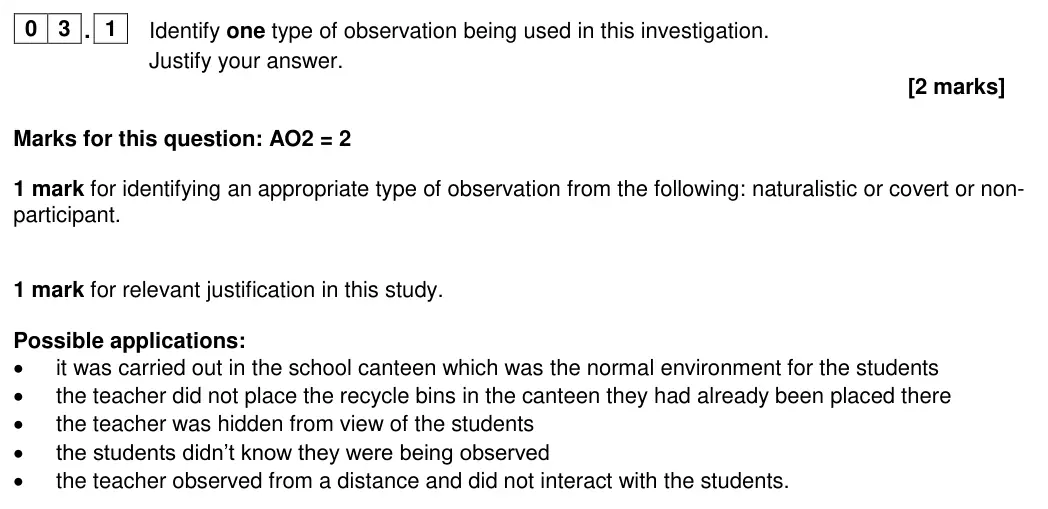
June 2018 · AS Paper 1 · Q3.12 marksAO2=2Research methods
Mark scheme, including level descriptors and indicative content
Examiner's comment
Question 03.1 Most students scored well and were able to identify the type of observation accurately.
Notes from the mark scheme and report
naturalistic, covert or non-participant + justification from the canteen scenario
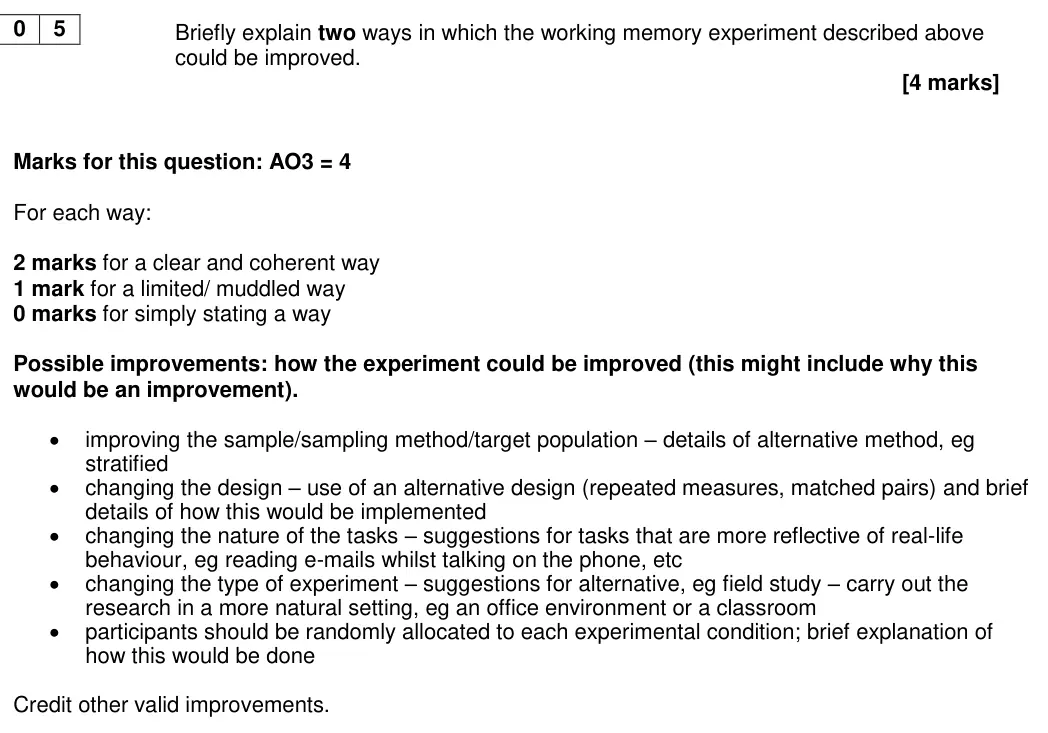
June 2018 · Paper 1 · Q54 marksAO3=4Research methods
Mark scheme, including level descriptors and indicative content
Examiner's comment
Question 05 required students to ‘briefly explain’, not simply state ways in which the experiment could be improved; some students missed out on marks by not elaborating on their answers. A key term in this question was ‘Briefly explain’, meaning that simply stating a way the experiment could be improved received no credit. Popular ways were different sampling methods to improve representation, and use of matched pairs/repeated measures. There was substantial variation in how these could be implemented, but many answers showed good understanding of the underlying principles of design, sampling and control. A number of students referred to the use of more realistic tasks, and the use of field studies. These were credited to the extent that they were practicable.
Notes from the mark scheme and report
2 marks each: sampling method, alternative design, realistic tasks, field setting, random allocation
simply stating a way = 0
June 2018 · Paper 1 · Q144 marksAO2=4Research methods
Mark scheme, including level descriptors and indicative content
Examiner's comment
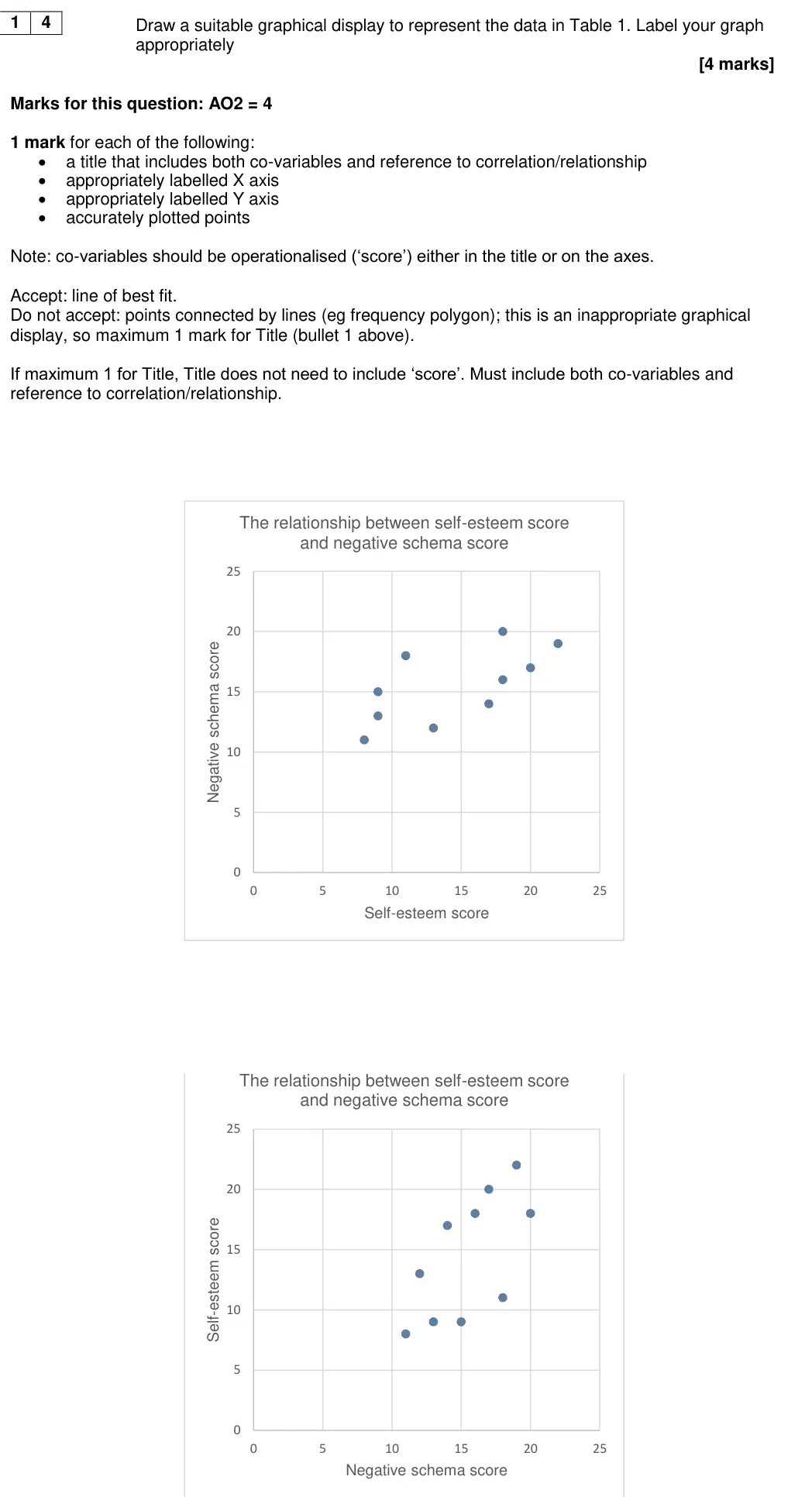
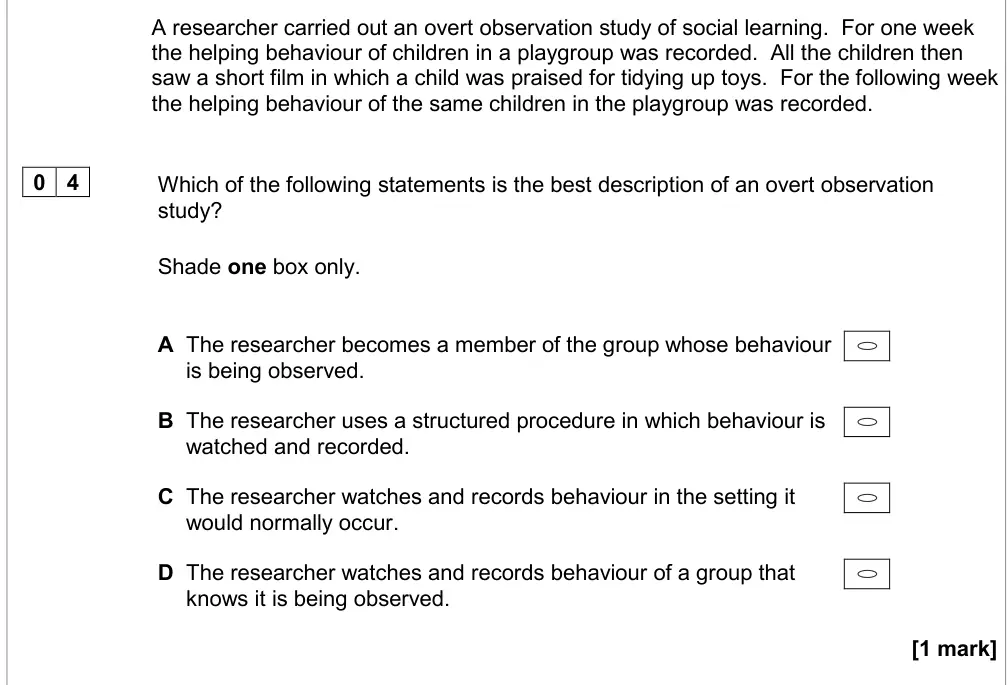
Many students were able to provide appropriate scattergrams, with accurate title, axes, and plotting. Others missed out on one or two marks with vague titles and/or axes. However some students, despite the questions in this section mentioning ‘relationship’, Spearman’s rho and ‘correlation’, provided completely inappropriate graphical displays e.g. histograms and bar charts. A small minority did not attempt this question at all.
Notes from the mark scheme and report
scattergram: title with both co-variables and 'relationship', labelled axes (operationalised 'score'), accurate points
joined points/bar charts = max 1 for title
June 2018 · AS Paper 2 · Q41 markAO1=1Multiple choice
Answer
D
Mark scheme, including level descriptors and indicative content
Examiner's comment
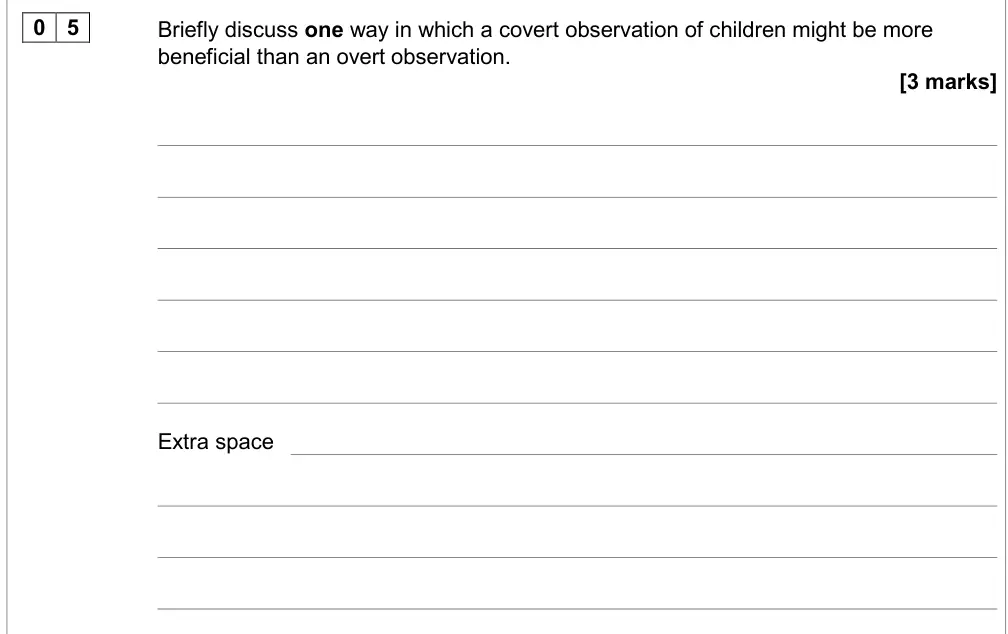
There were many correct answers to this question and it was apparent that the majority of students had the knowledge to be able to identify the description of an overt observation.
Notes from the mark scheme and report
correct answer D (group knows it is being observed)
distractors describe participant, controlled and naturalistic observation
June 2018 · AS Paper 2 · Q53 marksAO3=3Research methods
Mark scheme, including level descriptors and indicative content
Examiner's comment
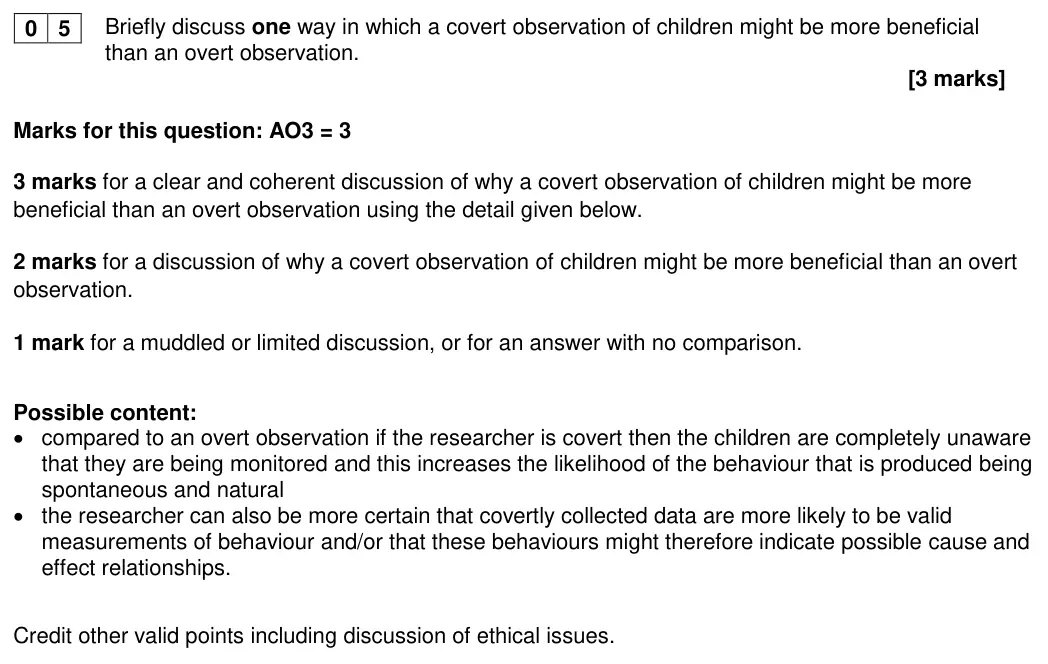
On several research methods questions in Section C and question 5 in Section A, students failed to address the actual demands of the question. Most students appeared to have a good knowledge of the strengths and limitations of the two types of observation. However, many failed to actually use this knowledge to answer the question on discussing reasons why covert may have been more beneficial than overt. There were many limited responses which either explained limitations of overt observations or strengths of covert observations but without comparison. Equally there were many responses which had implicit discussion of benefits which was not clear and thus not sufficient for full marks.
Notes from the mark scheme and report
must compare covert with overt (natural, spontaneous behaviour, higher validity)
answers with no comparison = 1 mark
ethical points credited
June 2018 · Paper 2 · Q164 marksAO2=4Research methodsMedium
Mark scheme, including level descriptors and indicative content
Examiner's comment
When students understood the concept of content analysis, this was well answered; however, over one third of students failed to achieve any marks. A worrying number of students had no idea what content analysis is, with students frequently describing correlational analysis, statistical analysis, concurrent validity, descriptive statistics and even peer review in an attempt to explain how the content (data) from an experiment could be analysed. Those that understood the term generally explained how occurrences of each category could be tallied, with better students able to explain how categories would be identified from the interview data and giving appropriate examples of these. A surprisingly small number of students seemed to have a sound practical understanding of how content analysis should be conducted and teachers should be encouraged to offer further opportunities for students to develop their understanding of content analysis through practical research.
Notes from the mark scheme and report
1 mark each: devise categories/themes, example category, work through transcripts, tally occurrences
over a third scored 0, many did not know what content analysis is
June 2018 · AS Paper 2 · Q204 marksAO2=4Research methods
Mark scheme, including level descriptors and indicative content
Examiner's comment
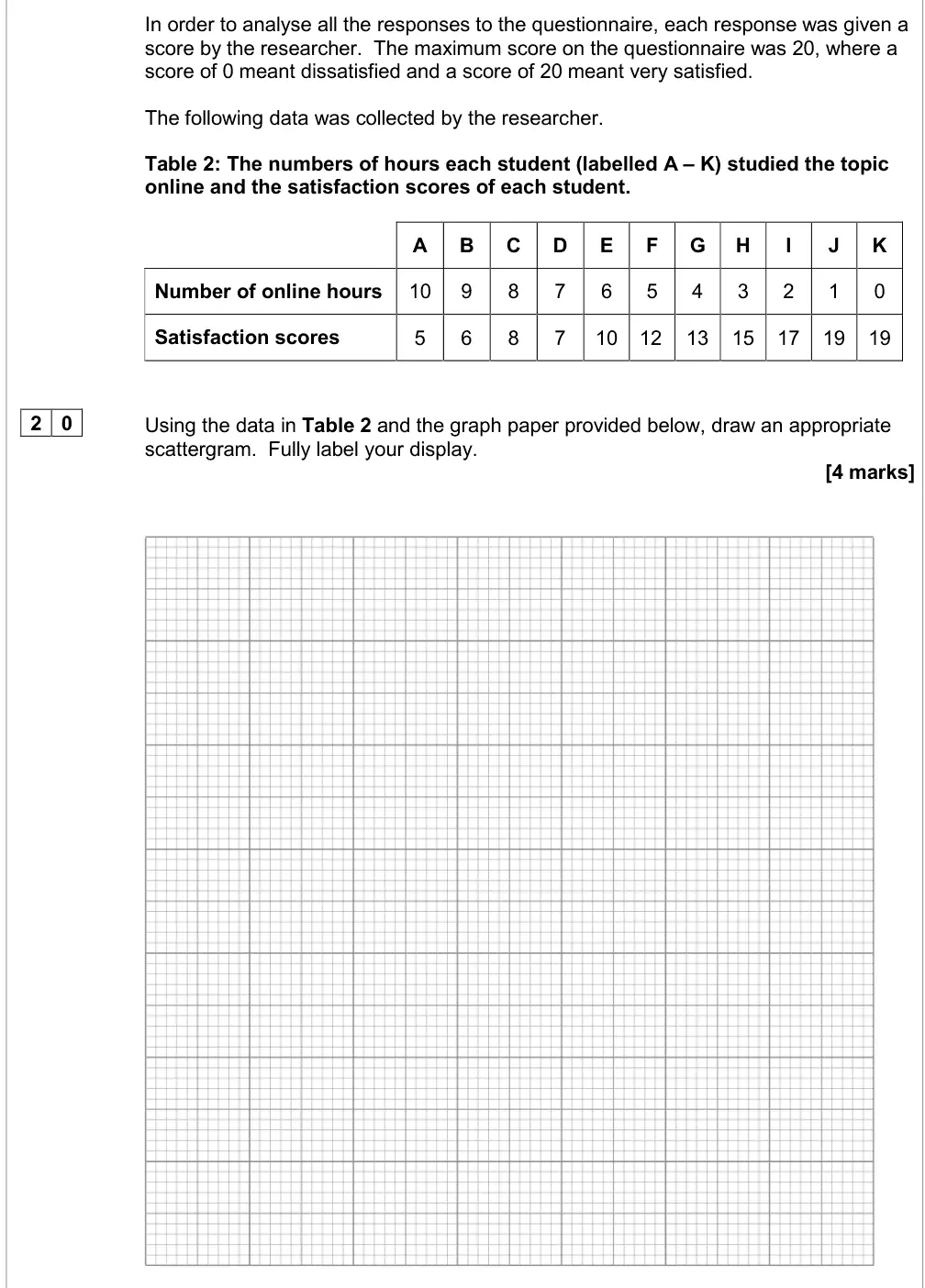
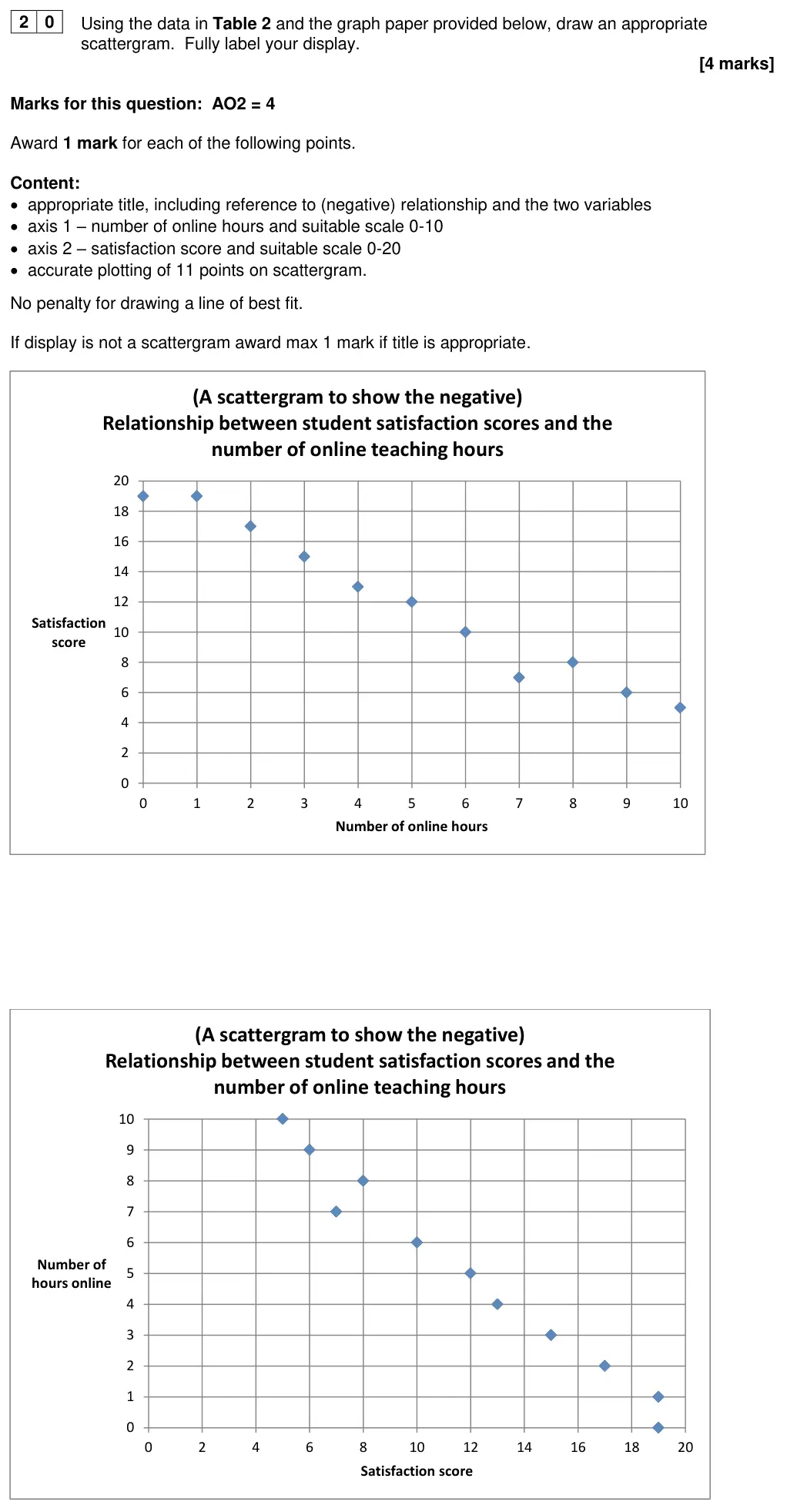
Most students were able to draw an accurate scattergram with two appropriately labelled axes on suitable scales. A small minority of these students also produced an accurate and appropriate title which referred to the relationship between the two co-variables. However, many students failed to either provide a title for their graph or produced an inaccurate or vague title which was not sufficient for credit. There were also errors in plotting points in some responses and some students produced very small graphs with inappropriate scaling. Some students failed to read the question correctly and did not draw a scattergram. A variety of incorrect types of graph were seen but the most common was a line graph where students had joined up the plotted points.
Notes from the mark scheme and report
1 mark each: title naming the (negative) relationship and both co-variables, x axis 0-10 online hours, y axis 0-20 satisfaction, 11 points plotted accurately
not a scattergram = max 1
many omitted/vague titles
line graphs drawn
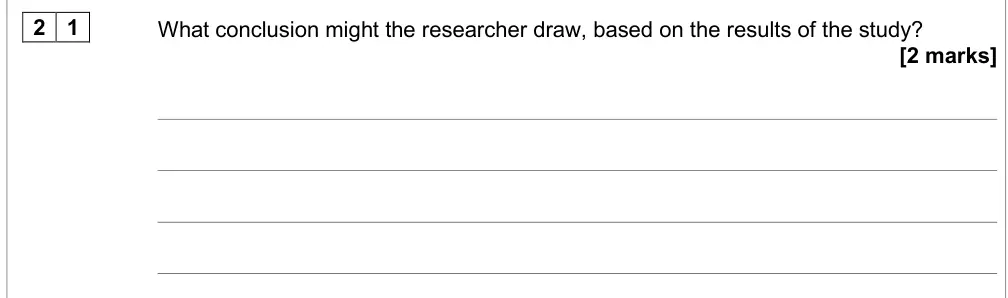
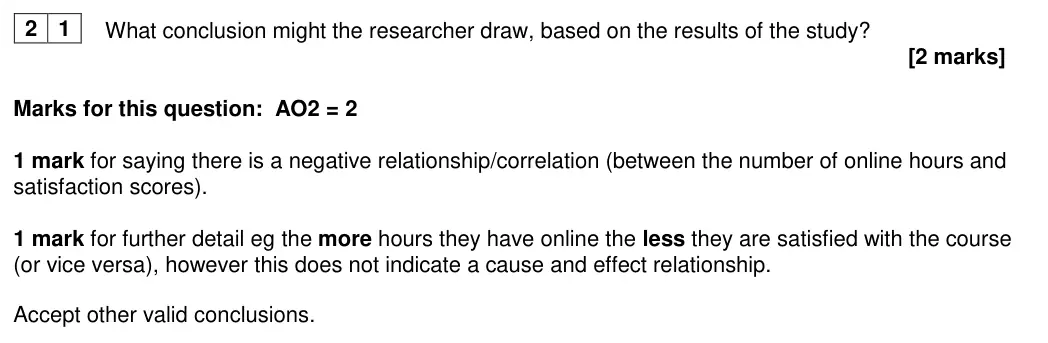
June 2018 · AS Paper 2 · Q212 marksAO2=2Research methods
Mark scheme, including level descriptors and indicative content
Examiner's comment
The vast majority of students scored one mark for this question as few responses had both components required for two marks. Most responses only included a description of the relationship between online hours and satisfaction but did not identify the relationship as a negative correlation. The description of the relationship was expressed in several different accurate ways but the most common was more online hours the less satisfied they were. A small number of students produced confused conclusions based on causal relationships which were incorrect.
Notes from the mark scheme and report
1 mark negative correlation + 1 detail (more online hours, less satisfied
no cause and effect)
most described the relationship without naming it
causal conclusions incorrect
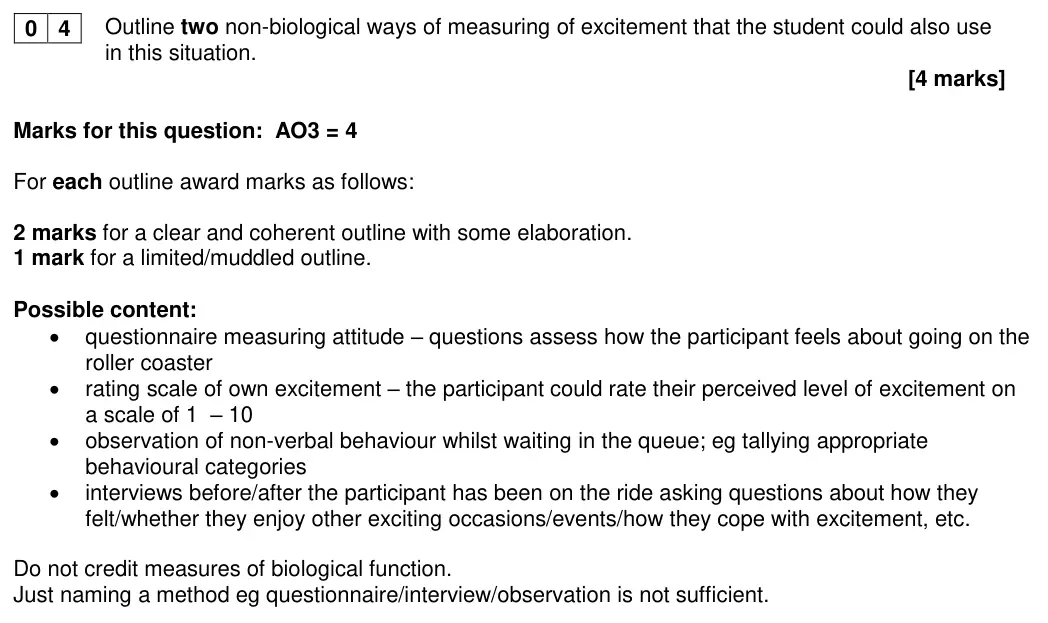
June 2018 · Paper 3 · Q44 marksAO3=4Research methods
Mark scheme, including level descriptors and indicative content
Examiner's comment
Most students gained some credit here and there were some excellent straightforward suggestions. High scoring answers often suggested the use of a Likert scale with scale and gave example statements, or observations of behaviour in the queue, with examples of behavioural categories and details of event or time sampling. There were some ingenious suggestions, such as analysing facial expressions from the photographs taken by auto cameras at the top of the roller coaster. Other ideas were just too impractical or implausible to credit. Vague suggestions, such as ‘interview them in the queue and ask how they feel’ gained limited credit, but a few responses were just too brief, for example, simply stating ‘interview’ or ‘questionnaire’. A few biological suggestions were seen.
Notes from the mark scheme and report
e.g. questionnaire/rating scale with example items, interview, observation with behavioural categories in the queue
just naming a method is not enough
no credit for biological measures
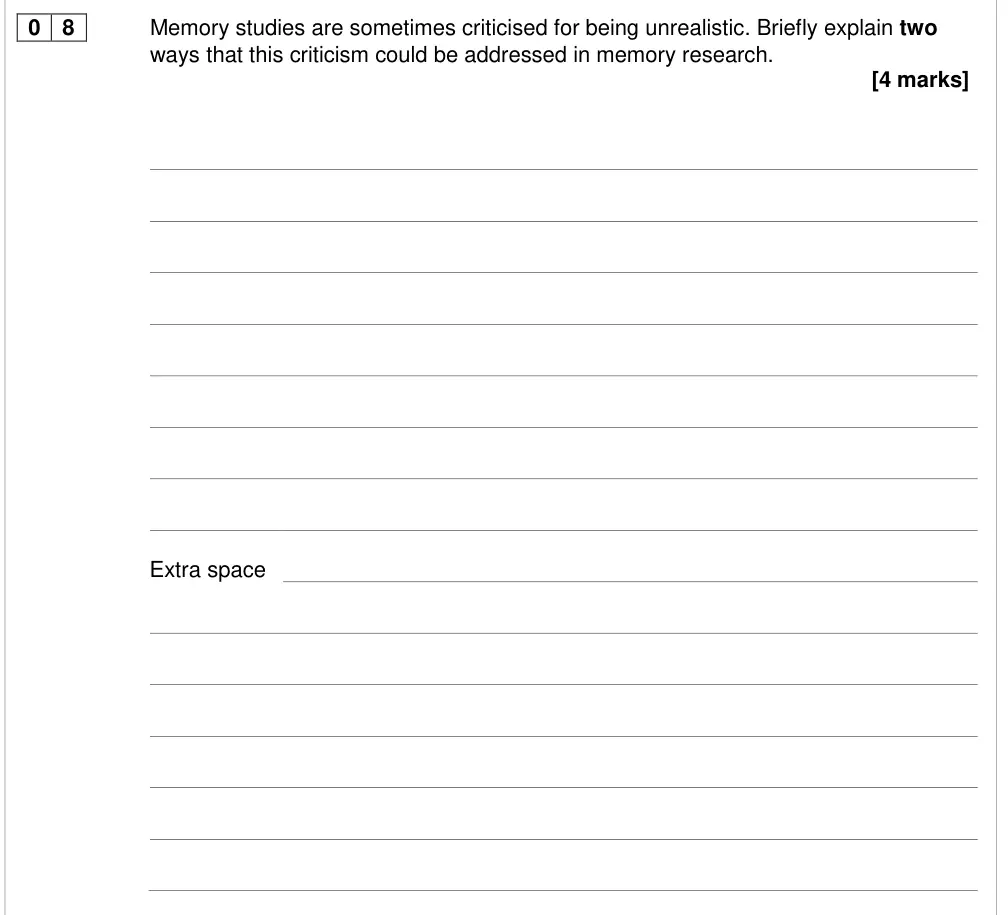
June 2017 · AS Paper 1 · Q84 marksAO3=4Research methods
Mark scheme, including level descriptors and indicative content
Examiner's comment
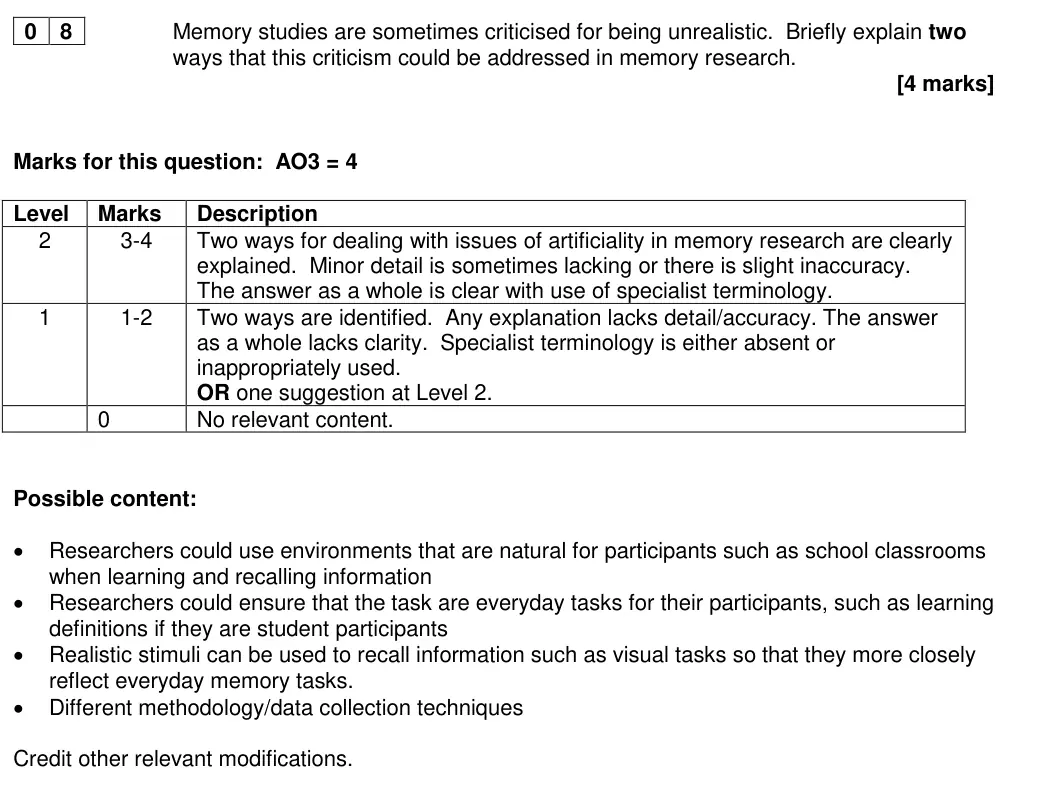
Many students simply described how memory studies are unrealistic, gaining no marks. The question required students to suggest ways in which this criticism could be addressed. The majority of students were unable to do this with the modal mark being zero. However, some students were able to suggest appropriate ways and received credit. These included changing from a laboratory to a real world situation, such as a field study in a school, or to change the task of meaningless numbers/trigrams to recalling meaningful material, such as phone numbers or shopping lists.
Notes from the mark scheme and report
must suggest how to ADDRESS artificiality (natural settings/field studies, everyday tasks, meaningful material) not describe it
modal mark zero
ecological validity is A-level only in v1.4
June 2017 · Paper 1 · Q144 marksAO3=4Evaluate (short)Old spec only
Not on the 2025 specification: research into caregiver-infant interaction, removed in v1.4
Mark scheme, including level descriptors and indicative content
Examiner's comment
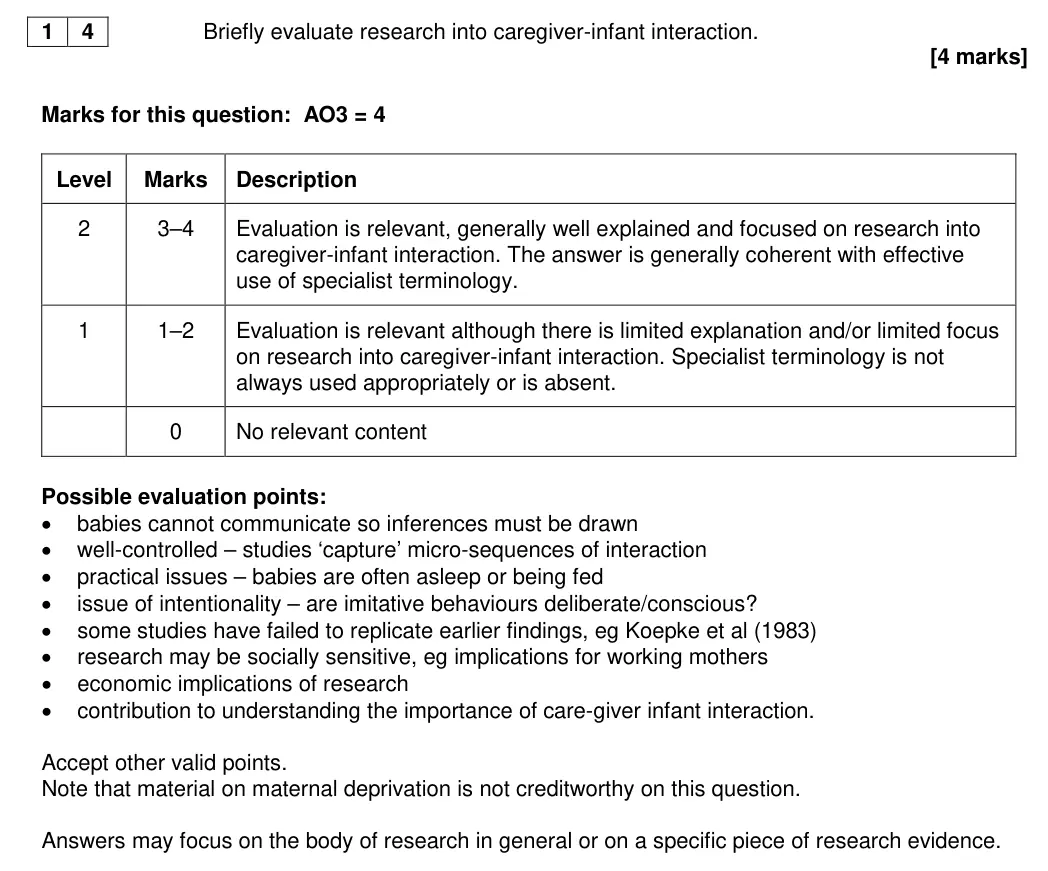
This was a demanding question as students had to decide on their approach. As ‘research’ includes both specific studies and the whole body of research evidence, alternatives were to focus on one study and evaluate it, or to present a general evaluation of research into caregiver-infant interaction. Effective evaluation of single studies usually considered the implications of results for theory and/or practice. Effective general evaluation looked at problems such as the issue of correctly interpreting infant behaviour in terms of e.g. intentionality. Less successful evaluation tended to be generic, focusing on issues such as ethics and cultural relativity. A substantial number of answers also included far too much description rather than evaluation.
Notes from the mark scheme and report
Off-spec: research into caregiver-infant interaction, removed in v1.4
maternal deprivation not creditworthy
generic evaluation (ethics, cultural relativity) and description scored little
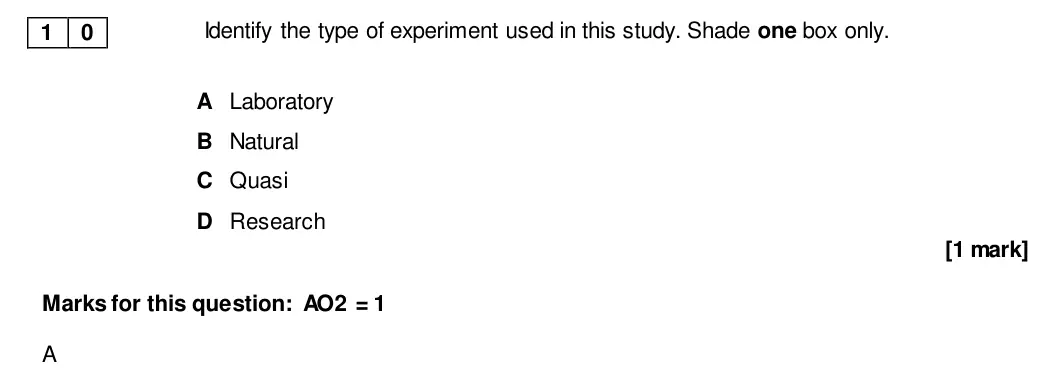
June 2017 · Paper 2 · Q101 markAO2=1Multiple choiceEasy
Answer
A
Mark scheme, including level descriptors and indicative content
Examiner's comment
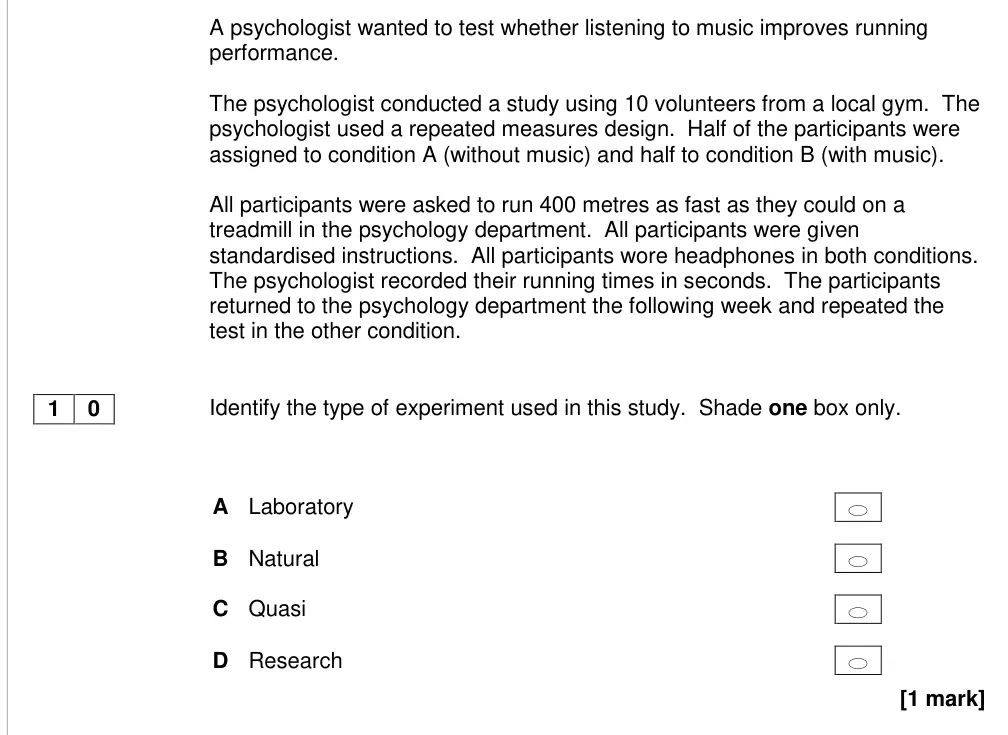
This question was well answered with over 90% of students correctly identifying the type of experiment used in the study.
Notes from the mark scheme and report
answer A (laboratory)
over 90% correct
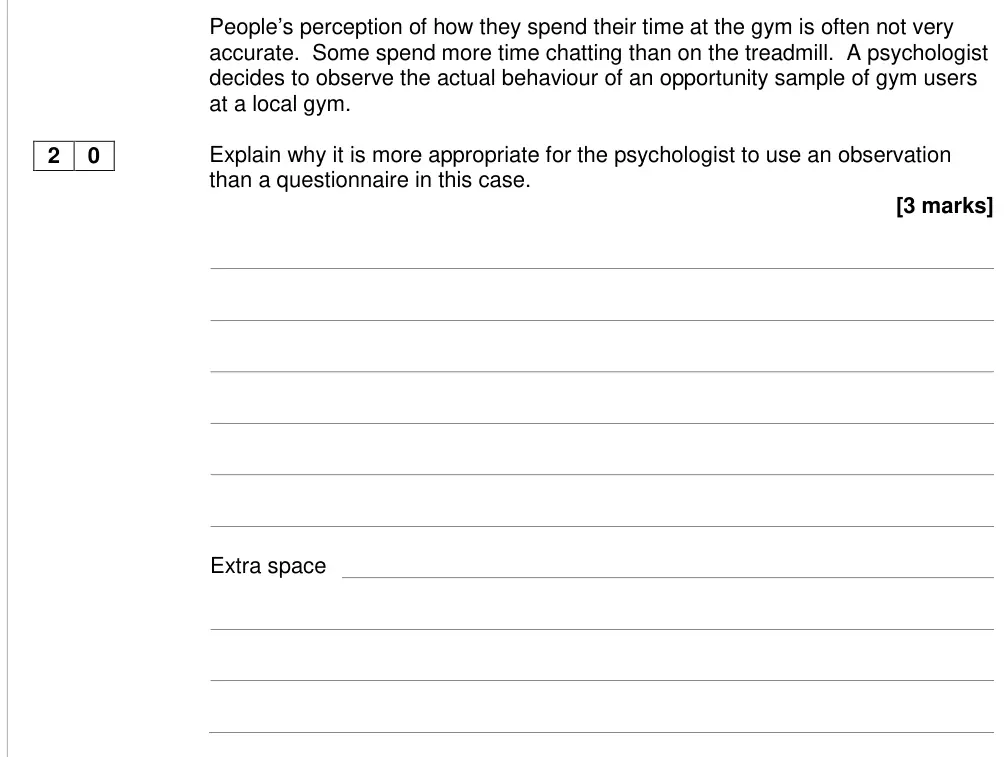
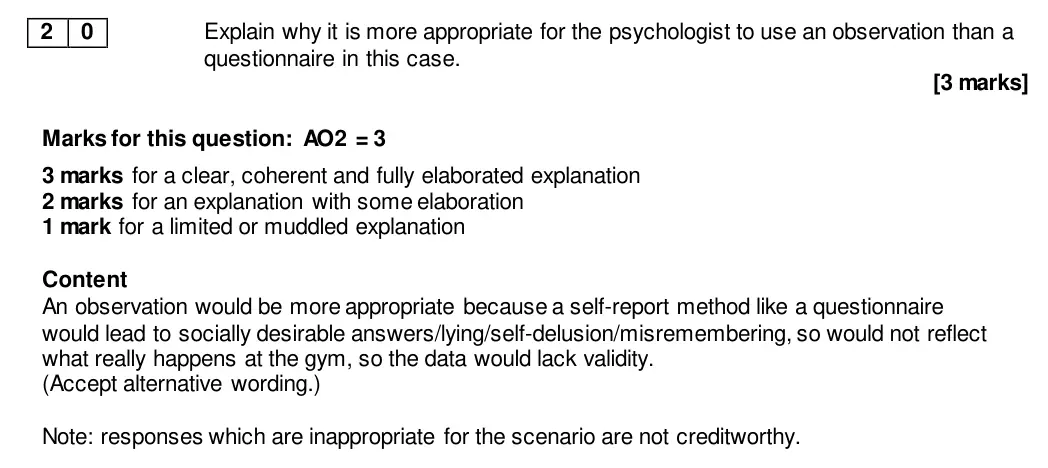
June 2017 · Paper 2 · Q203 marksAO2=3Research methodsEasy
Mark scheme, including level descriptors and indicative content
Examiner's comment
This was a well-answered question with almost 90% of students achieving two or three marks. Most students knew disadvantages of questionnaires but lacked an understanding of observations, often stating that they were better as the “researcher could see for themselves”. Weaker students merely paraphrased the stem, stating “people’s perception of how they spend their time in the gym is often not very accurate”.
Notes from the mark scheme and report
questionnaire would give socially desirable/inaccurate self-reports so lack validity
observation shows actual behaviour
paraphrasing the stem scores little
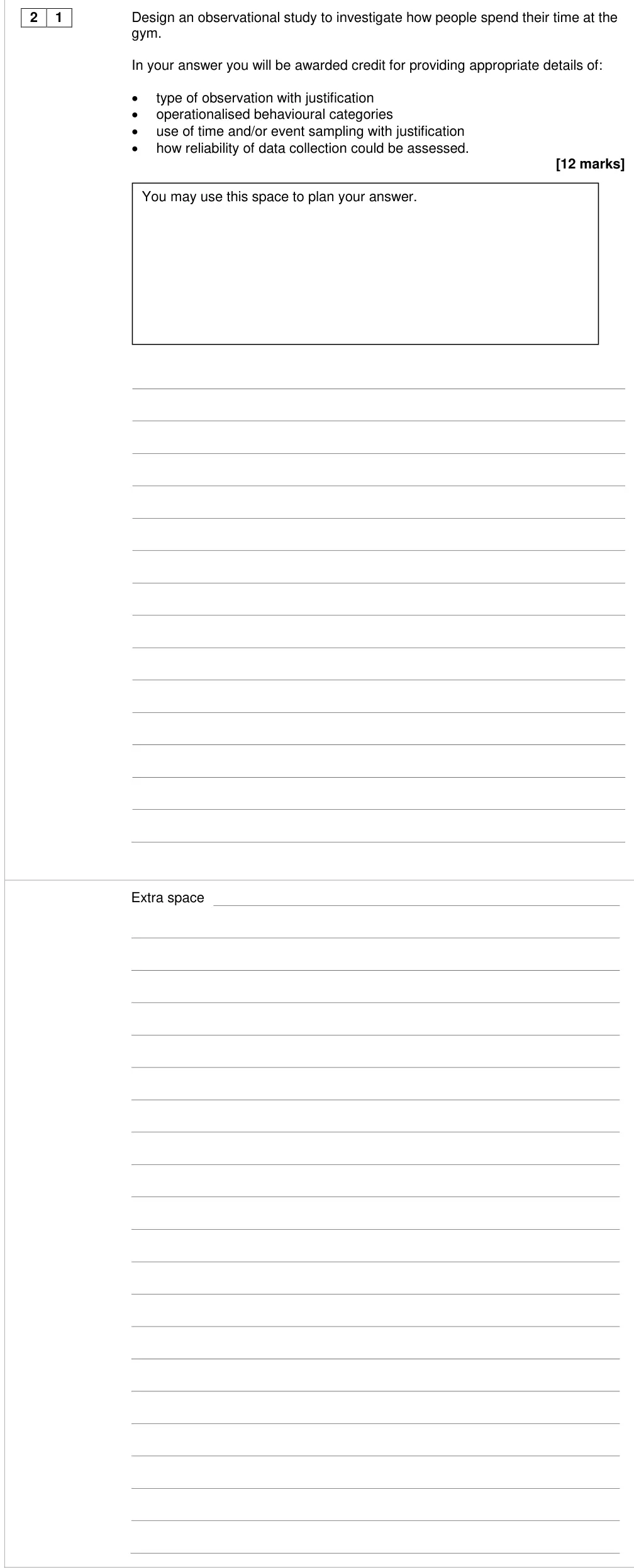
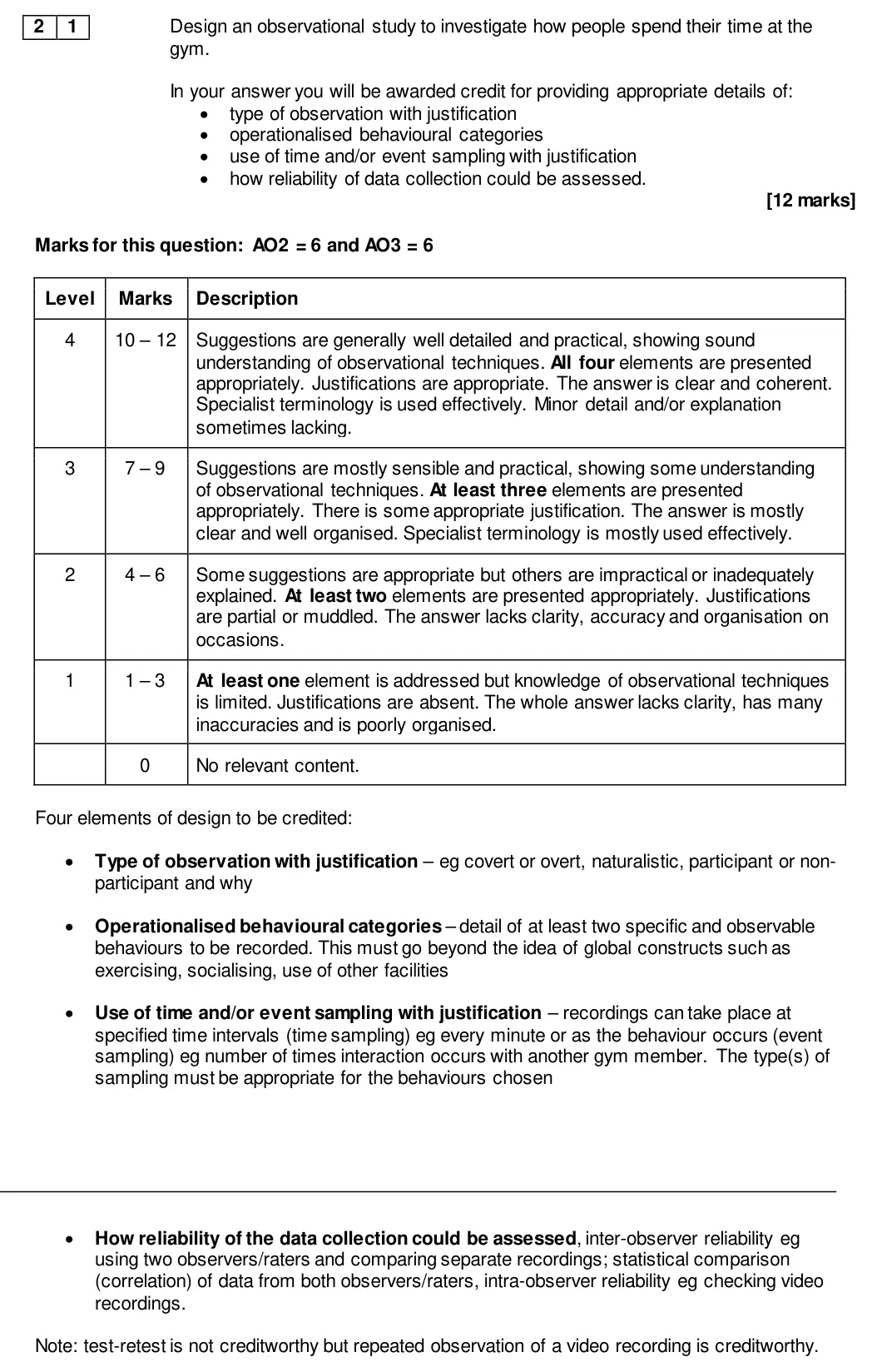
June 2017 · Paper 2 · Q2112 marksAO2=6, AO3=6Extended writing
Mark scheme, including level descriptors and indicative content
Examiner's comment
Questions that discriminated the best were 03, 04, 09, 16, 17 and 21. Students generally did reasonably well on this question. Types of observation were generally understood and justified. Weaker responses sometimes lacked detail/explanations. Behavioural categories were generally poor and operationalisation was rarely evident. Time/event sampling was often stated but for their use was absent or muddled. Confusion was often evident, particularly in relation to time sampling (often mistakenly presented as how long a behaviour lasted). Reliability was often covered well with detailed descriptions of inter-rater reliability given. However, test-retest was frequently suggested inappropriately as a way of assessing reliability and students confused the purpose of assessing reliability with ensuring reliability. Unfortunately, students frequently focussed on additional material, such as ethical issues, sampling of participants, etc, at the expense of covering all the bulleted requirements successfully. Furthermore, some students designed a complete study and a few wrote a whole report, including abstracts, statistical analysis, etc. However, these did not receive credit.
Notes from the mark scheme and report
four elements: type of observation + justification, at least two operationalised behavioural categories, time/event sampling + justification, inter-/intra-observer reliability
test-retest not credited
time sampling misunderstood
extra material (ethics, participant sampling, whole reports) not credited
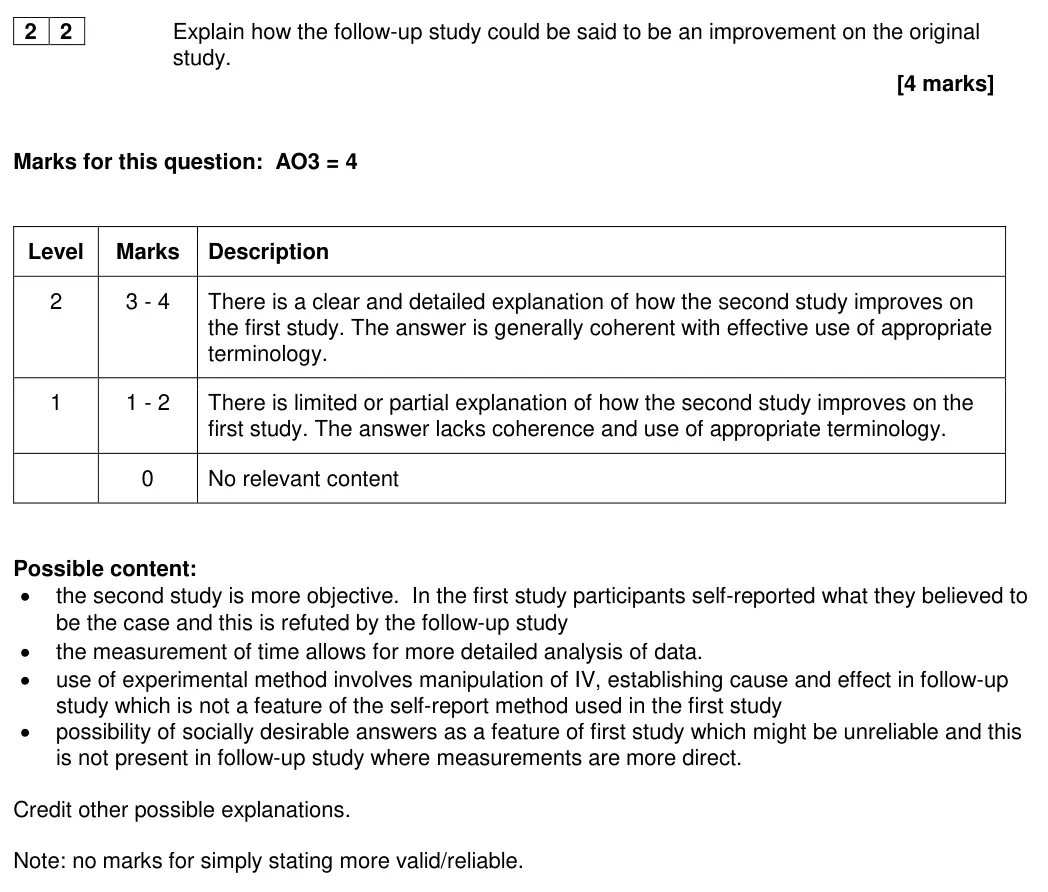
June 2017 · AS Paper 2 · Q224 marksAO3=4Research methods
Mark scheme, including level descriptors and indicative content
Examiner's comment
Most students produced some limited explanation of how the follow up study improved upon the first study and thus achieved level 1. However, few went on to give a detailed explanation of this improvement, often only focussing on either why the follow up study was positive or why the original study was negative without comparison. Those students who achieved level 2 tended to focus on the follow-up study being more objective, a more scientific measurement or allowing cause and effect to be established, and then compared this with the relevant opposing weakness of the original study (more subjective, less scientific and only opinion so does not establish cause and effect). A minority of students mistakenly assumed that the first study generated qualitative data as it was self-report and so focused on the limitation of that versus the quantitative element of the follow-up study, and so scored no marks.
Notes from the mark scheme and report
objective timed measure vs self-report opinion, IV manipulation allows cause and effect, social desirability in first study
must compare the two studies
'more valid/reliable' alone = 0
first study is not qualitative
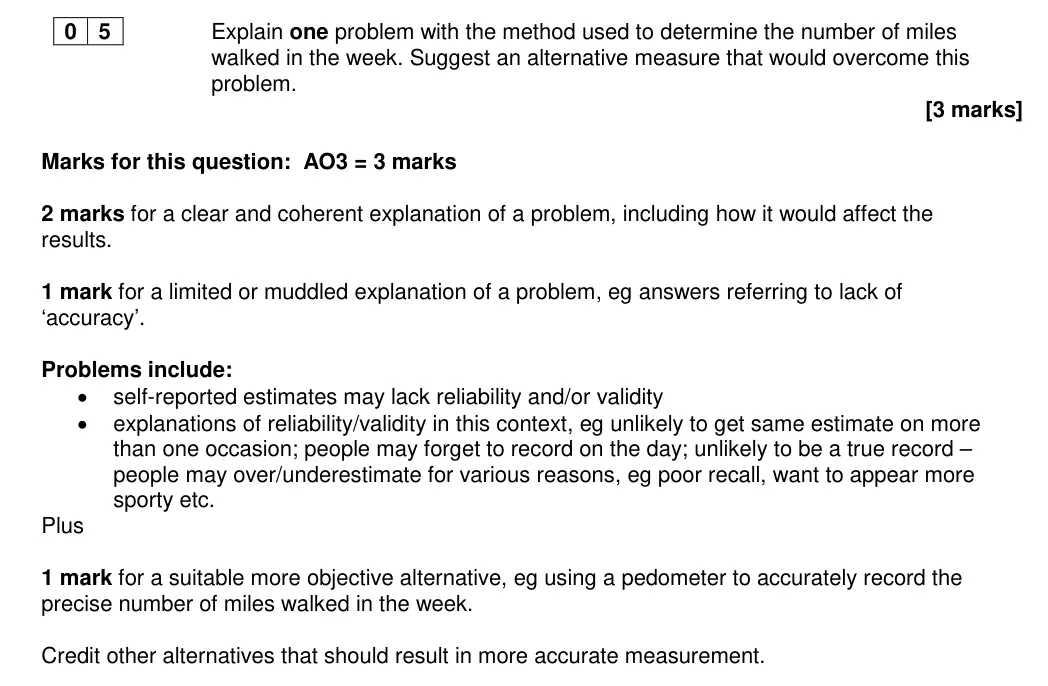
June 2017 · Paper 3 · Q53 marksAO3=3Research methods
Mark scheme, including level descriptors and indicative content
Examiner's comment
This question was generally well answered. Most students could suggest a valid problem and included some explanation of how it might have affected the outcome of the study. Less successful responses cited concepts such as social desirability or demand characteristics without offering any explanation of how these factors might operate in this situation. Suggestions for alternative ways of measuring the distance usually focused on some sort of technological device, for example steppers, GPS trackers, phone apps and fit-bits. Occasionally, students forgot to offer any alternative or offered an impractical suggestion, such as covert observation. Some students appeared to have completely misapprehended the question and offered bizarre solutions, for example measuring the height and tread of the stairs and converting this into miles.
Notes from the mark scheme and report
2 marks problem with self-reported diary estimate (reliability/validity: forgetting, over/underestimating, wanting to appear sporty) and its effect on results + 1 mark objective alternative (pedometer, GPS app)
naming social desirability/demand characteristics without explanation scored little
'accuracy' alone = 1 mark
June 2017 · Paper 3 · Q362 marksAO3=2Research methodsOld spec only
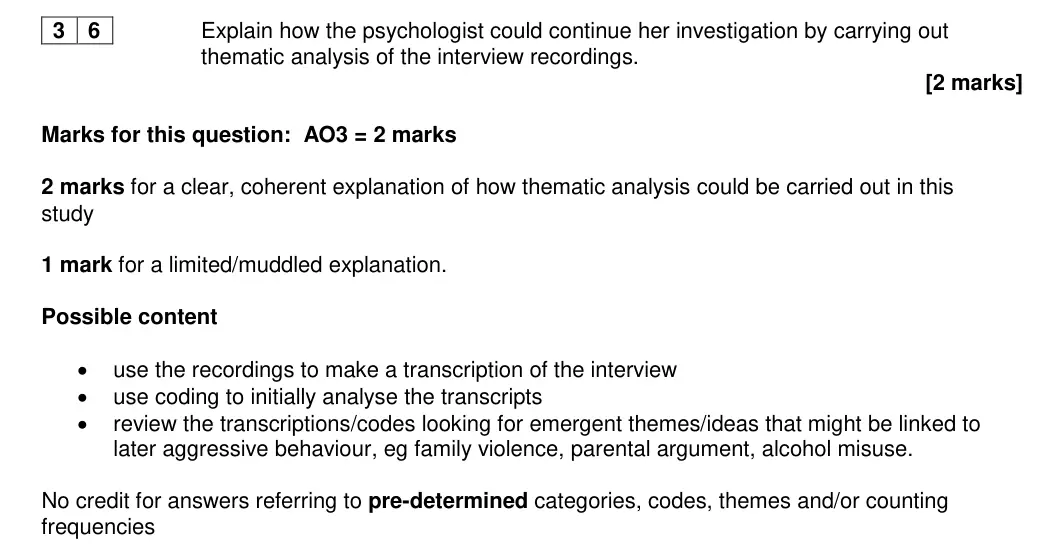
Not on the 2025 specification: thematic analysis, removed in v1.4
Mark scheme, including level descriptors and indicative content
Examiner's comment
Many students left this question blank and most of those who did attempt an answer based their response on some form of quantitative analysis, referring to categories being established prior to analysis and tallying or counting frequencies. Very rarely did students refer to transcription of the recordings, coding or emergent themes.
Notes from the mark scheme and report
Off-spec: thematic analysis, removed in v1.4
transcribe, code, look for emergent themes
no credit for pre-determined categories or counting frequencies (i.e. content analysis)
often left blank
June 2017 · Paper 3 · Q402 marksAO3=2Research methodsOld spec only
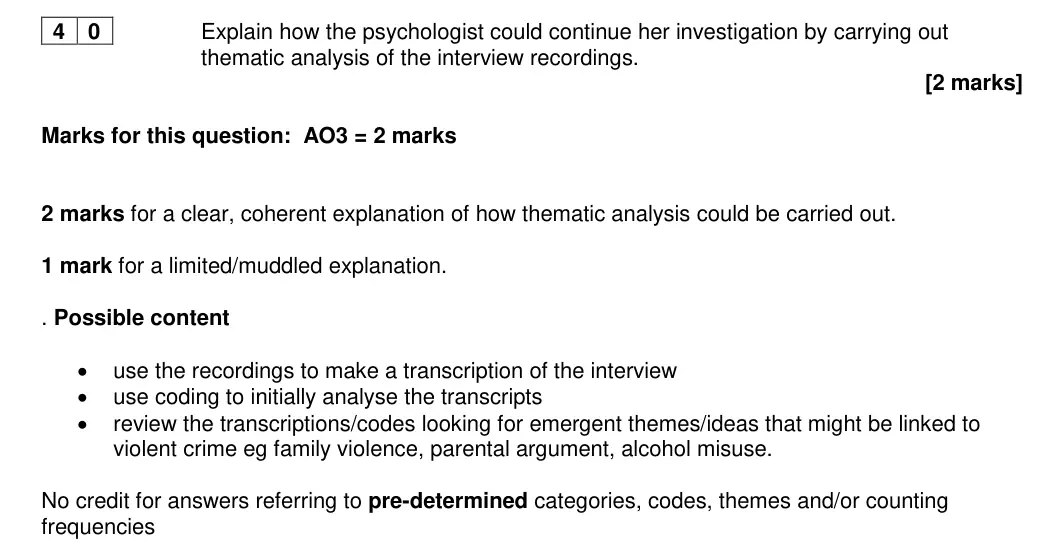
Not on the 2025 specification: thematic analysis, removed in v1.4
Mark scheme, including level descriptors and indicative content
Examiner's comment
Many students left this question blank and most of those who did attempt an answer based their response on some form of quantitative analysis, referring to categories being established prior to analysis and tallying or counting frequencies. Very rarely did students refer to transcription of the recordings, coding or emergent themes.
Notes from the mark scheme and report
Off-spec: thematic analysis, removed in v1.4
transcribe, code, emergent themes
no credit for pre-determined categories or counting frequencies
often left blank
June 2017 · Paper 3 · Q442 marksAO3=2Research methodsOld spec only
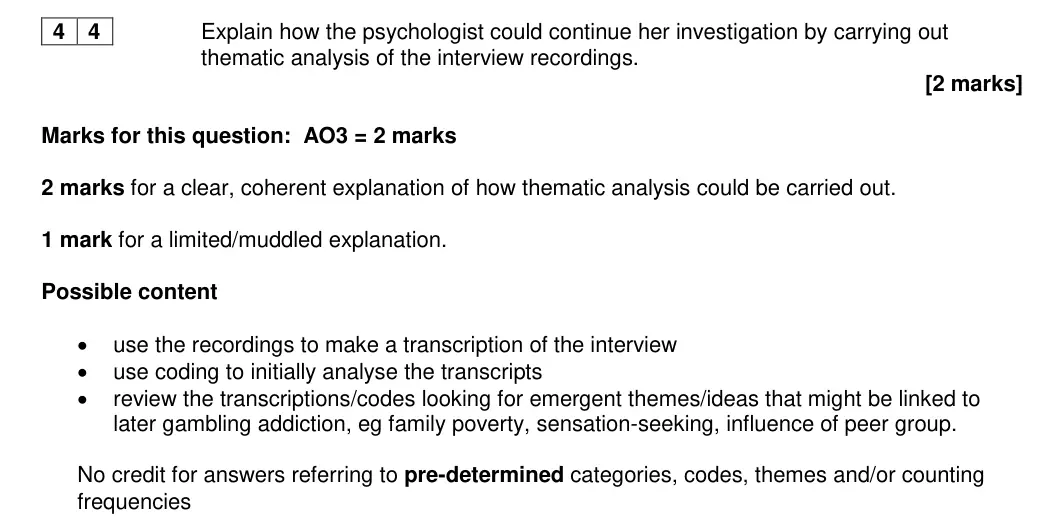
Not on the 2025 specification: thematic analysis, removed in v1.4
Mark scheme, including level descriptors and indicative content
Examiner's comment
Many students left this question blank and most of those who did attempt an answer based their response on some form of quantitative analysis, referring to categories being established prior to analysis and tallying or counting frequencies. Very rarely did students refer to transcription of the recordings, coding or emergent themes.
Notes from the mark scheme and report
Off-spec: thematic analysis, removed in v1.4
transcribe, code, emergent themes
no credit for pre-determined categories or counting frequencies
often left blank
June 2016 · AS Paper 1 · Q33 marksAO1=3Research methods
Mark scheme, including level descriptors and indicative content
Examiner's comment
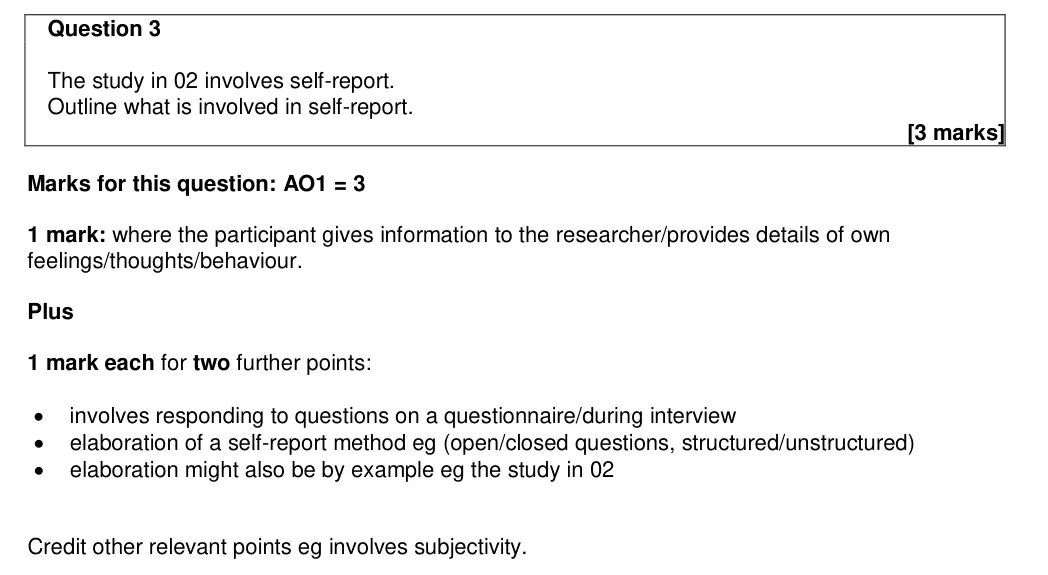
Questions that tended to differentiate best were questions 1.2, 3, 8, 11 and 12. This question was generally quite poorly answered. Although many students could gain some credit by suggesting that self-report often involved questionnaires and interviews, many confused self-report with peer review or report writing. A number of students offered pre-learned evaluative points that did not gain credit.
Notes from the mark scheme and report
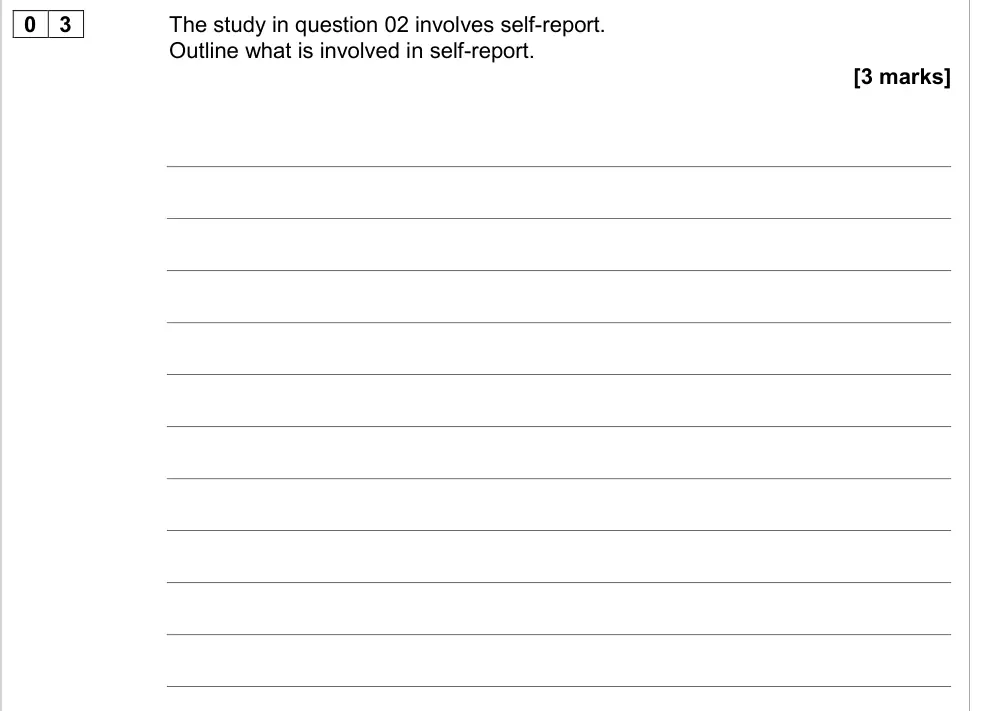
1 mark: participant reports own thoughts/feelings/behaviour + 2 elaboration (questionnaire/interview, open/closed, structured/unstructured, example from 02)
poorly answered - confused with peer review/report writing
evaluation not credited
June 2016 · AS Paper 1 · Q92 marksAO3=2Multiple choiceEasy
Answer
B and E
Mark scheme, including level descriptors and indicative content
Examiner's comment
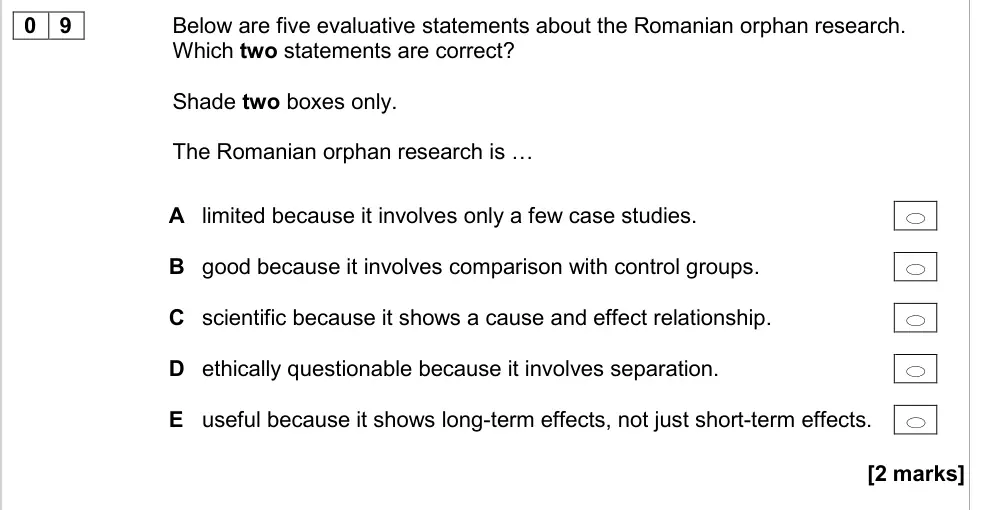
This question discriminated well with just under half the responses gaining full marks and just under half the responses gaining one mark.
Notes from the mark scheme and report
Romanian orphan research = ERA project in v1.4
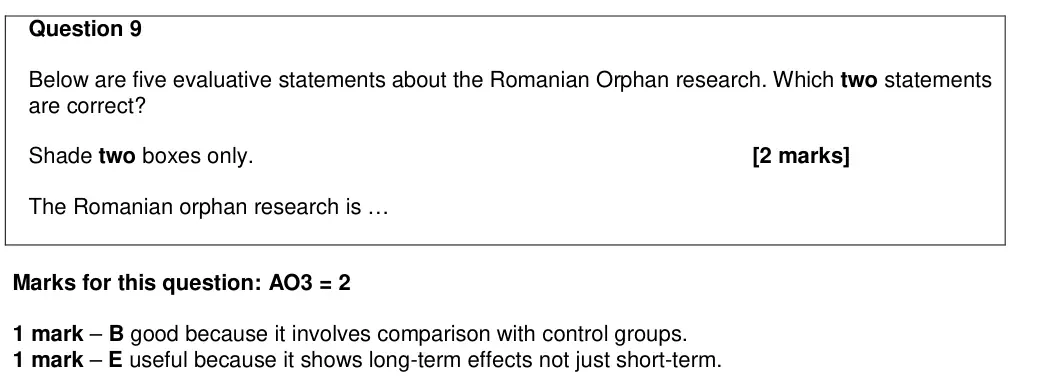
correct B (control groups) and E (long-term effects)
distractor C needs understanding that natural experiments cannot show cause and effect
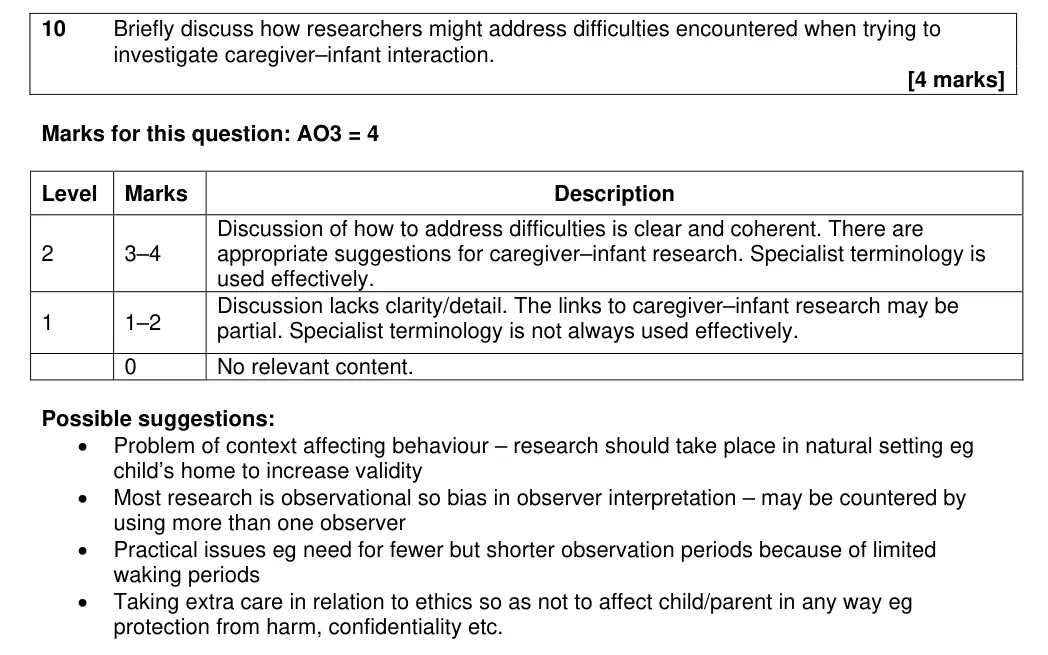
Specimen set 2 · Paper 1 · Q104 marksAO3=4Research methodsOld spec only
Not on the 2025 specification: research into caregiver-infant interaction, removed in v1.4
Mark scheme, including level descriptors and indicative content
Notes from the mark scheme and report
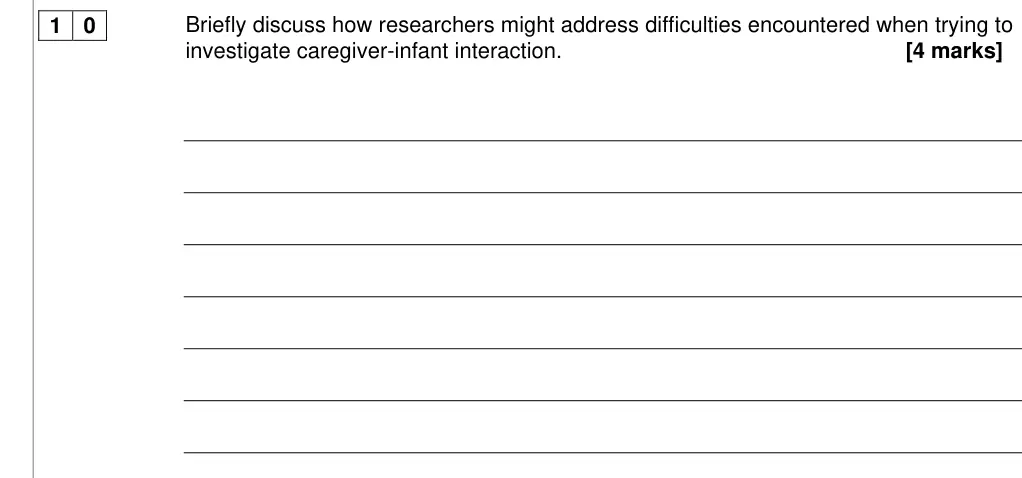
Off-spec: research into caregiver-infant interaction, removed in v1.4
credit natural settings for validity, multiple observers to counter bias, short observation periods, extra ethical care
must link to caregiver-infant research
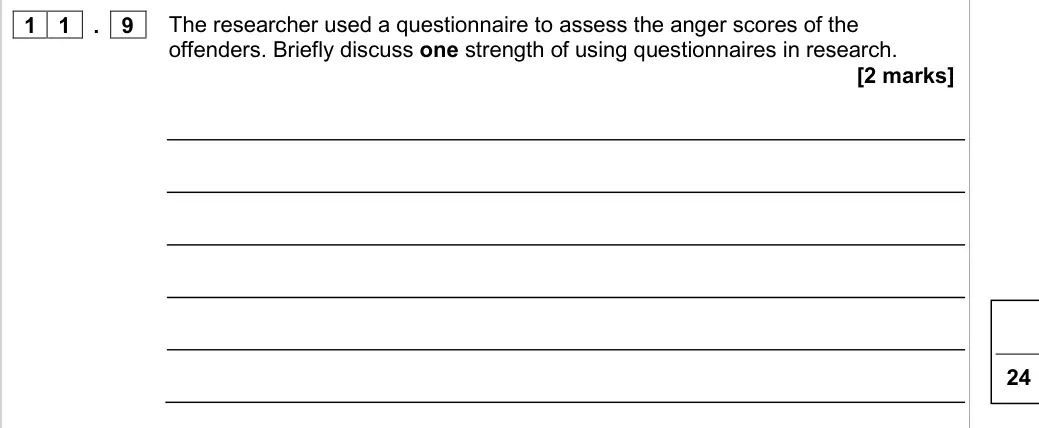
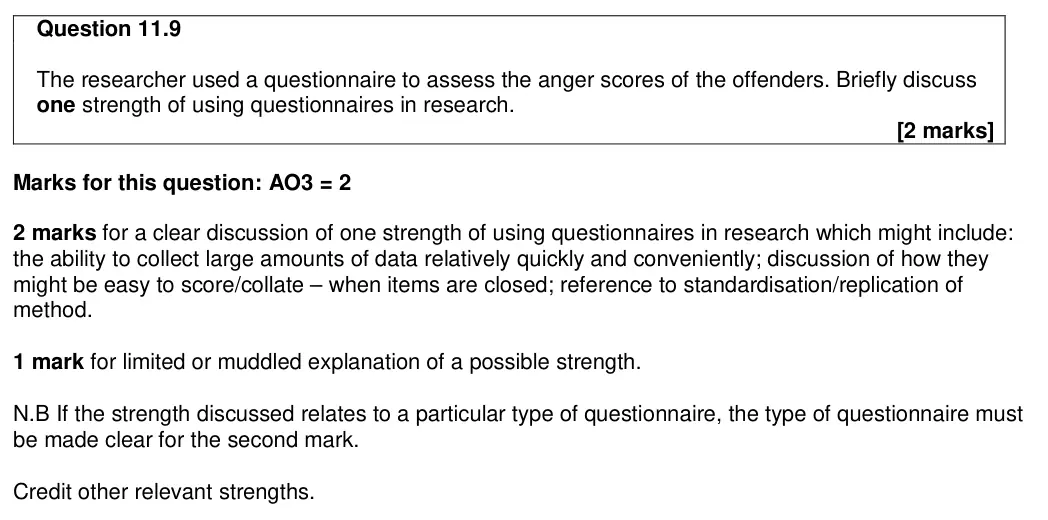
June 2016 · AS Paper 2 · Q11.92 marksAO3=2Research methods
Mark scheme, including level descriptors and indicative content
Examiner's comment
Question 11.9 It was again difficult to give full credit to responses in some cases as they were often vague or undeveloped so the information about the strength of using questionnaires as a technique for data collection often lacked clarity.
Notes from the mark scheme and report
e.g. large amounts of data quickly, closed questions easy to score, standardised/replicable
strength of a particular type of questionnaire needs that type stated for 2nd mark
answers often vague
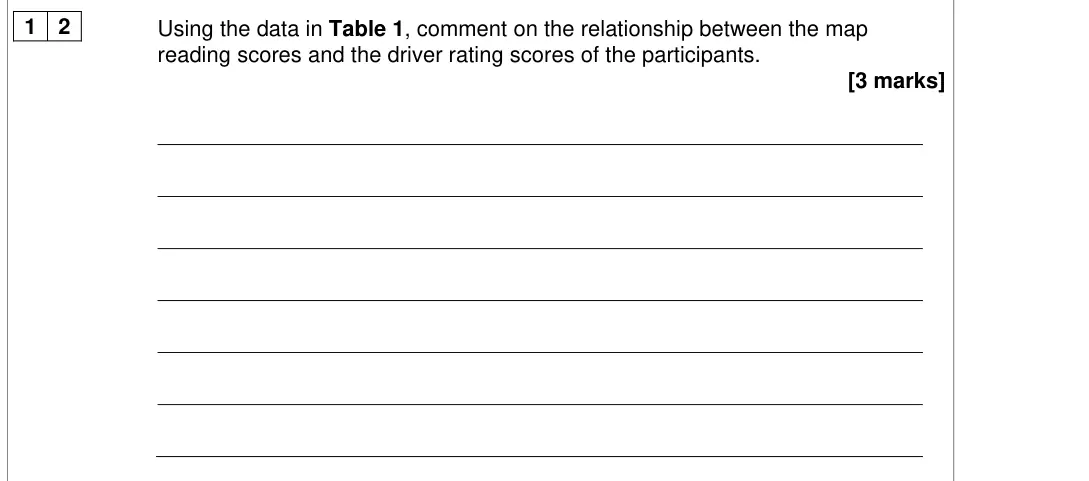
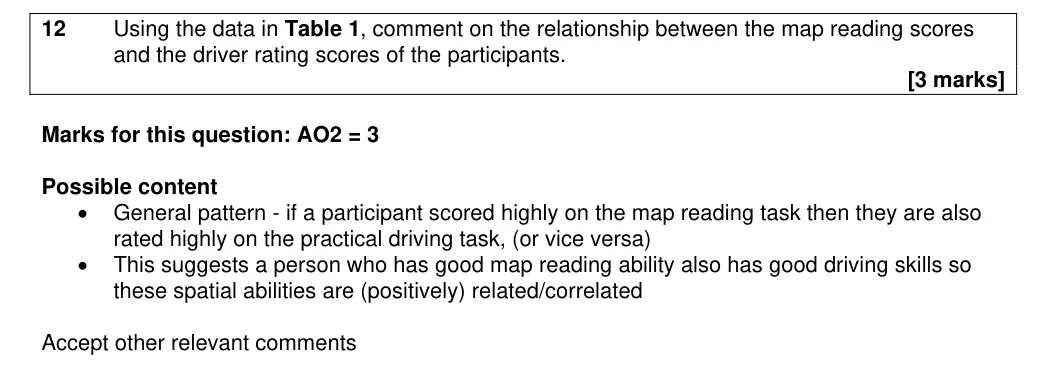
Specimen set 2 · Paper 2 · Q123 marksAO2=3Research methods
Mark scheme, including level descriptors and indicative content
Notes from the mark scheme and report
high map reading scores go with high driver ratings
positive correlation between the spatial abilities
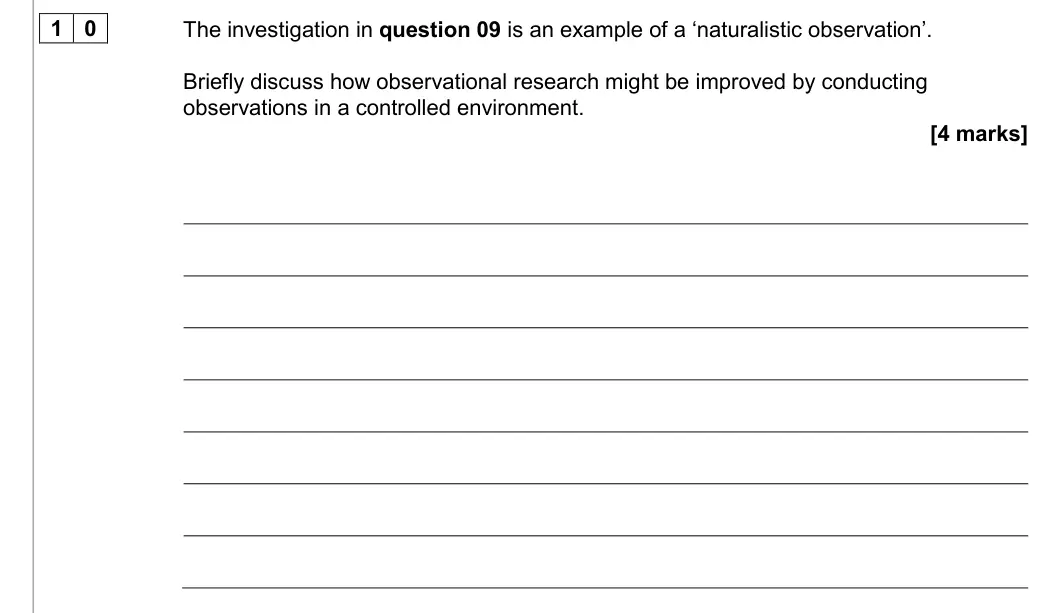
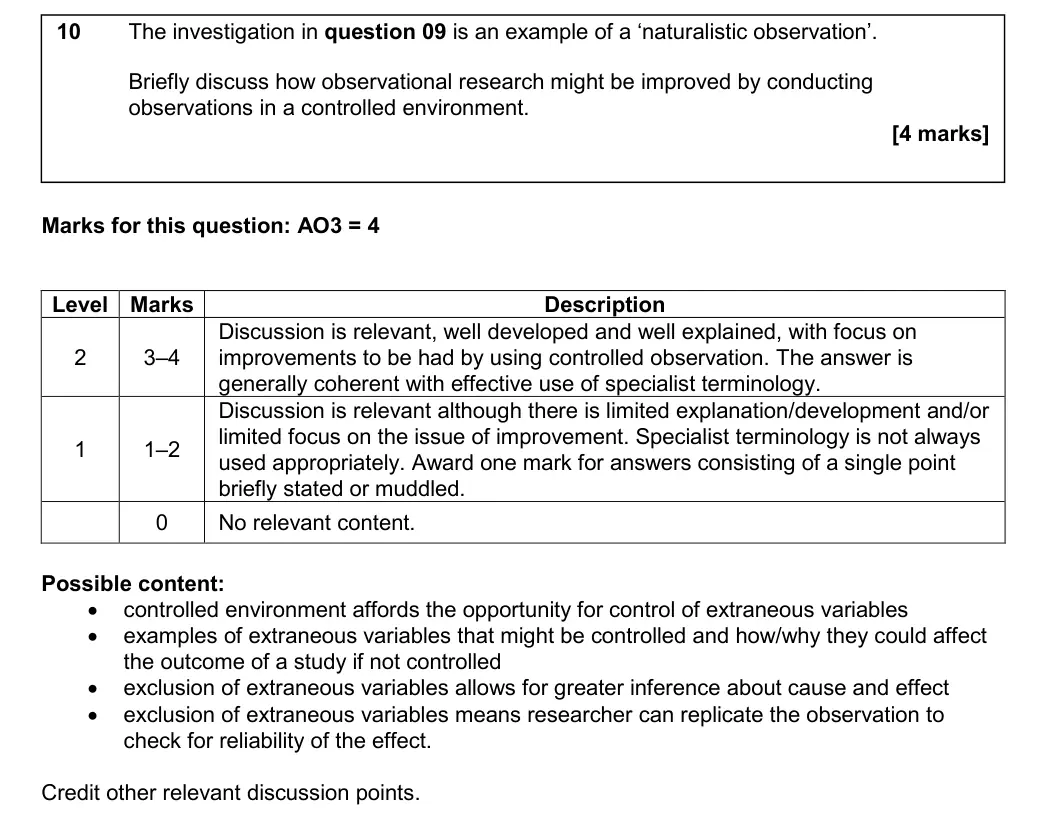
Specimen set 1 · Paper 1 · Q104 marksAO3=4Research methods
Mark scheme, including level descriptors and indicative content
Notes from the mark scheme and report
control of extraneous variables (with examples), cause-and-effect inference, replicability/reliability
must focus on improvement
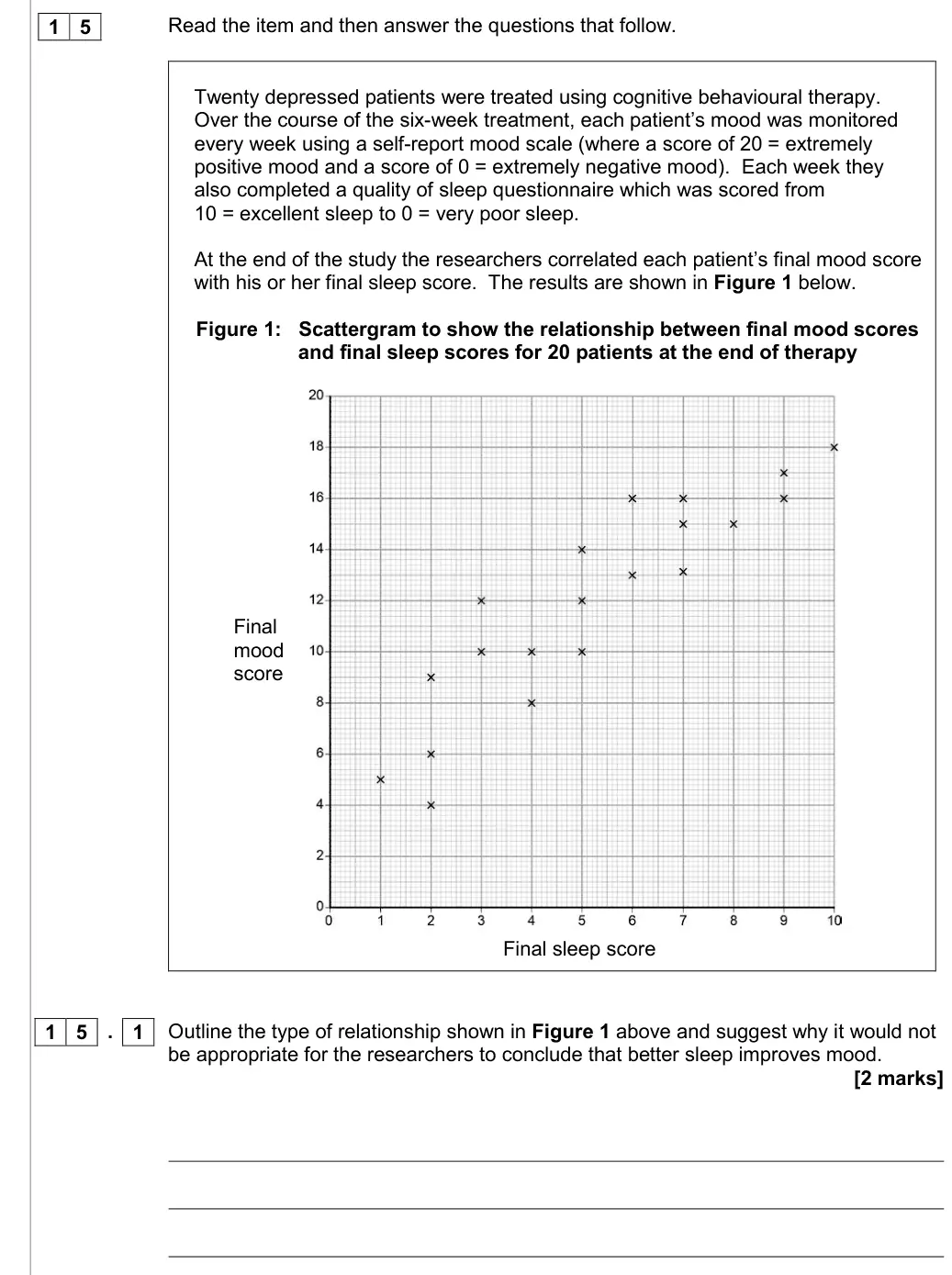
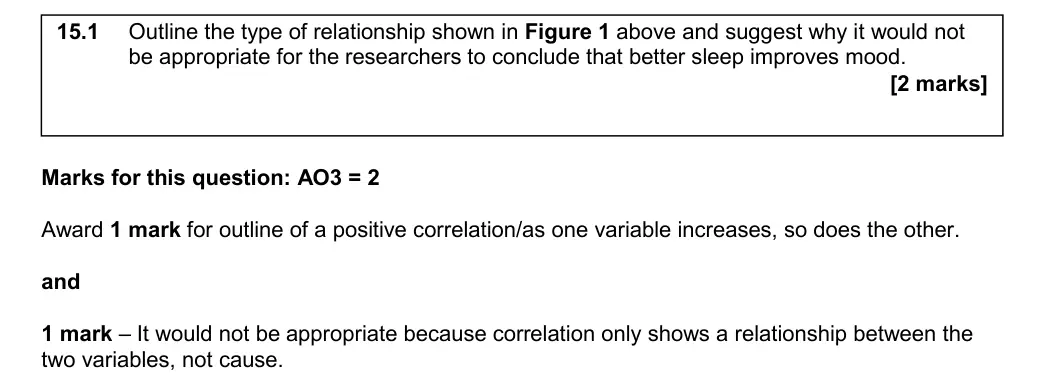
Specimen set 1 · Paper 1 · Q15.12 marksAO3=2Research methods
Mark scheme, including level descriptors and indicative content
Notes from the mark scheme and report
positive correlation + correlation shows relationship not cause
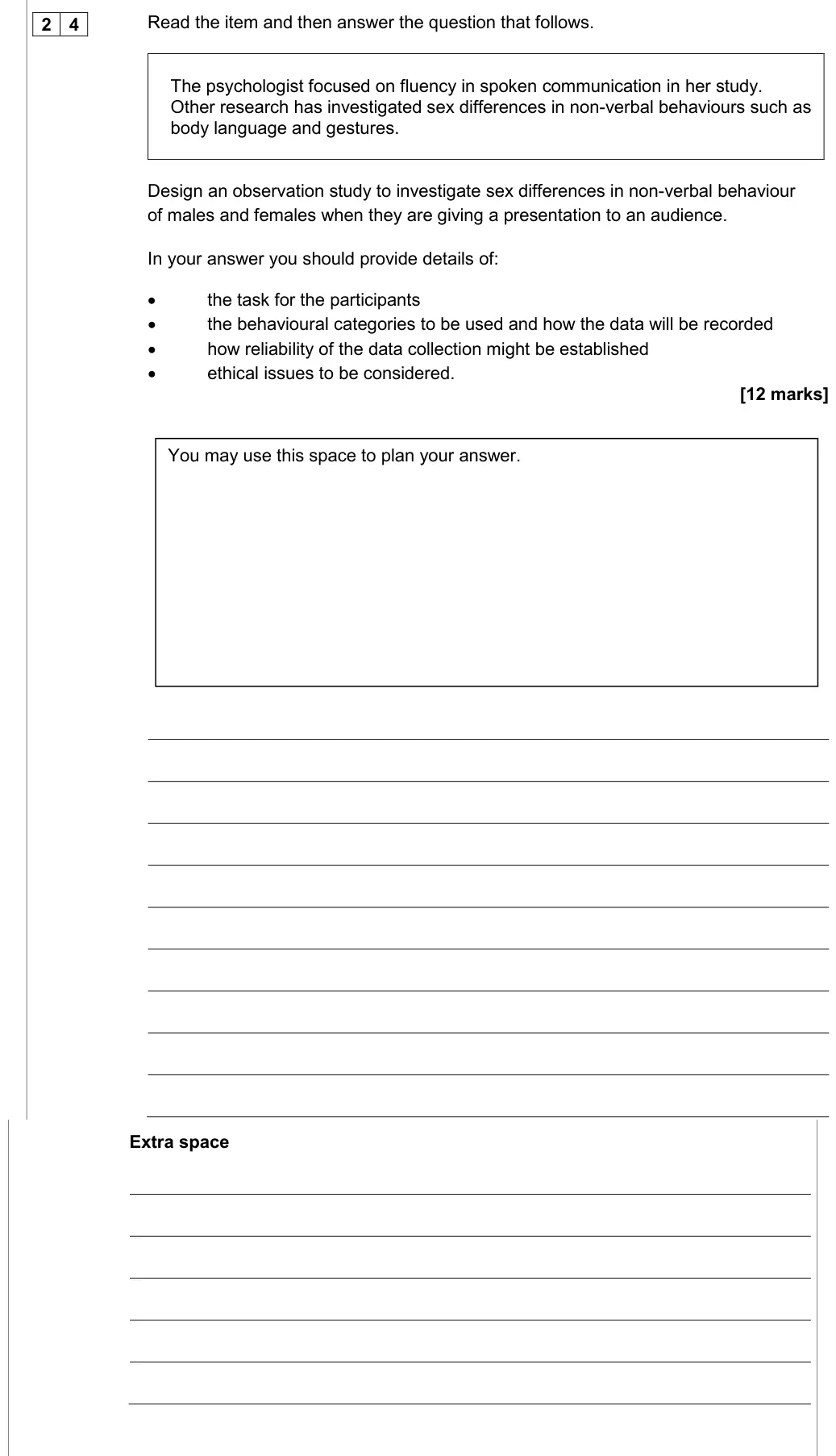
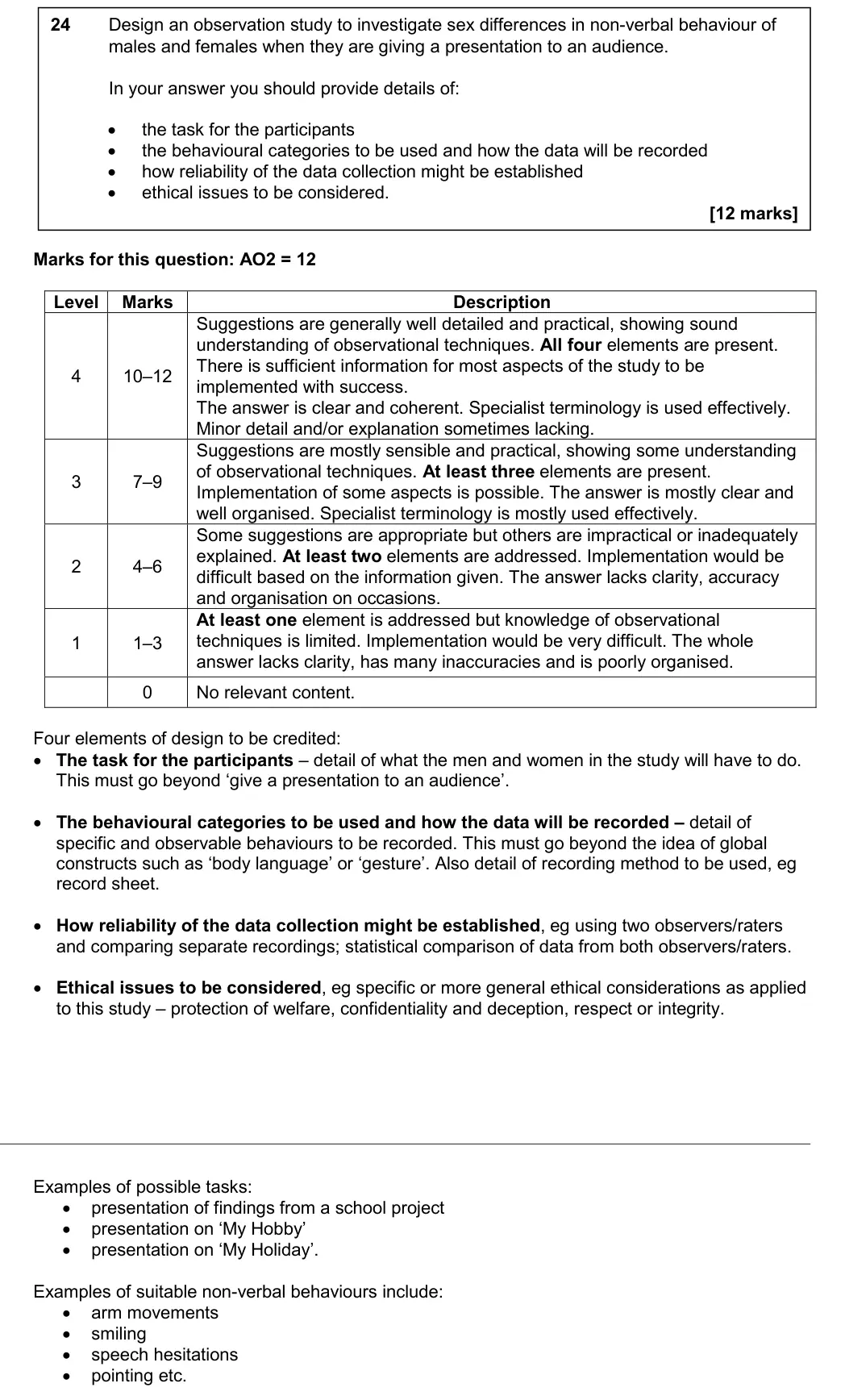
Specimen set 1 · Paper 2 · Q2412 marksAO2=12Extended writing
Mark scheme, including level descriptors and indicative content
Notes from the mark scheme and report
all four elements needed for Level 4 (at least three for Level 3): task beyond 'give a presentation', specific observable behavioural categories + recording method, inter-observer reliability, ethical issues applied to the study
global constructs like 'body language' not enough
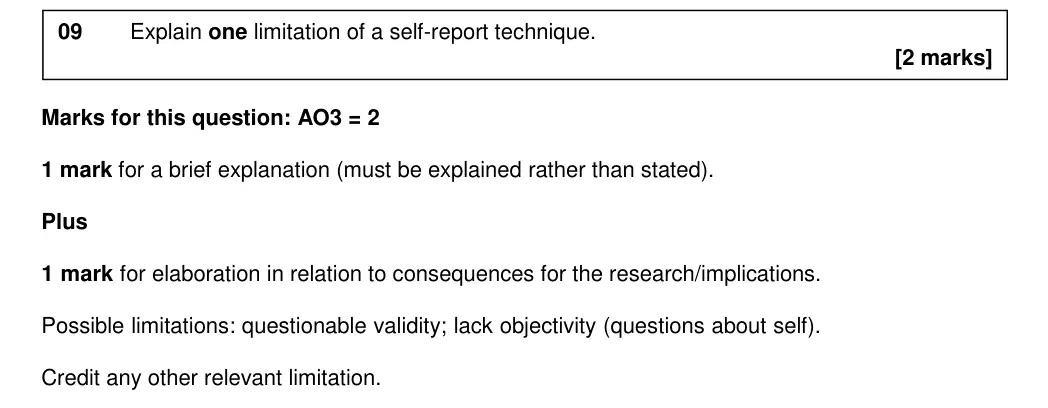
Specimen set 1 · Paper 3 · Q92 marksAO3=2Research methods
Mark scheme, including level descriptors and indicative content
Notes from the mark scheme and report
the question paper misprints Q09 (it repeats Q05, 'What is meant by the nature-nurture debate')
tagged from the mark scheme's Q09 (limitation of a self-report technique)
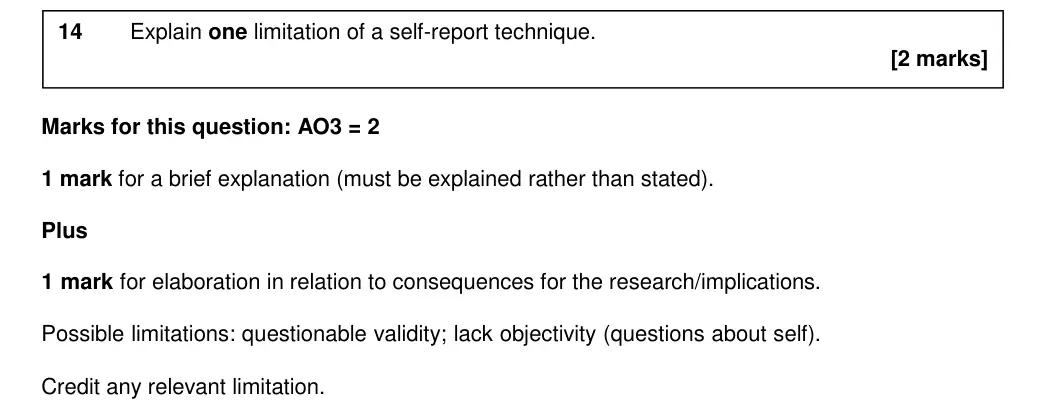
must explain not state (e.g. social desirability/validity, lack of objectivity) + elaboration of consequence for the research
The specimen question paper misprints Q09 (it repeats Q05, the nature-nurture question); the mark scheme's Q09 is 'Explain one limitation of a self-report technique' [2 marks]
Specimen set 1 · Paper 3 · Q142 marksAO3=2Research methods
Mark scheme, including level descriptors and indicative content
Notes from the mark scheme and report
must explain not state (validity, social desirability, lack of objectivity) + elaboration of consequence for the research
QP prints [1 mark] but the mark scheme awards 2 (AO3 = 2) and the paper total is 240
Specimen set 1 · Paper 3 · Q192 marksAO3=2Research methods
Mark scheme, including level descriptors and indicative content
Notes from the mark scheme and report
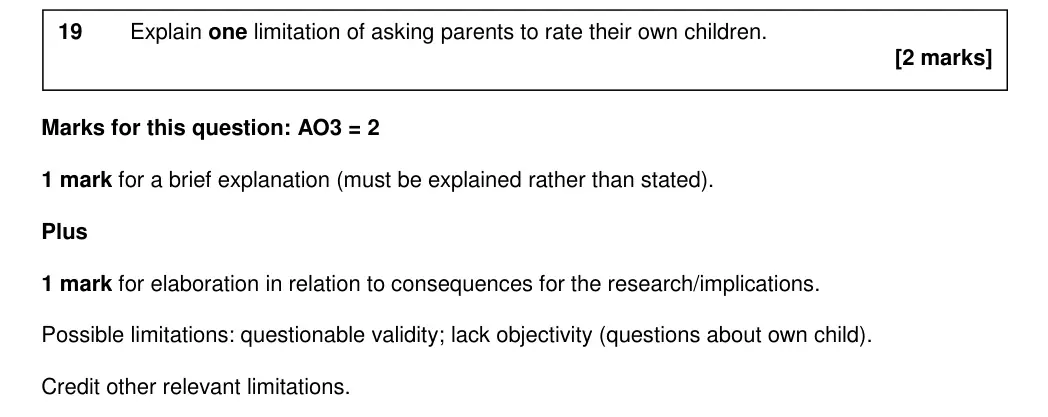
must explain not state (parents lack objectivity about own child, questionable validity) + elaboration of consequence for the research
Work with an AQA psychology tutor
Essays not reaching the top band? Book a session with Andy, a former AQA examiner.