June 2018: Paper 3

240 marks · 42 question parts · AQA no longer hosts this series; the copies here come from third-party archives

This paper was set on the previous specification. 4 parts are on content removed in the 2025 specification and are marked "Old spec only".

Question by question

QTopicMarksAOType
1 Issues and debates 4AO1=4Multiple choice
2 Issues and debates 2AO1=1,AO3=1Short answer
3 Issues and debates 2AO2=2Application
4 Research methods: methods and techniques 4AO3=4Research methods
5 Issues and debates 4AO3=4Evaluate (short)
6 Issues and debates 8AO1=3,AO2=2,AO3=3Extended writing
7 Relationships 2AO1=2Outline
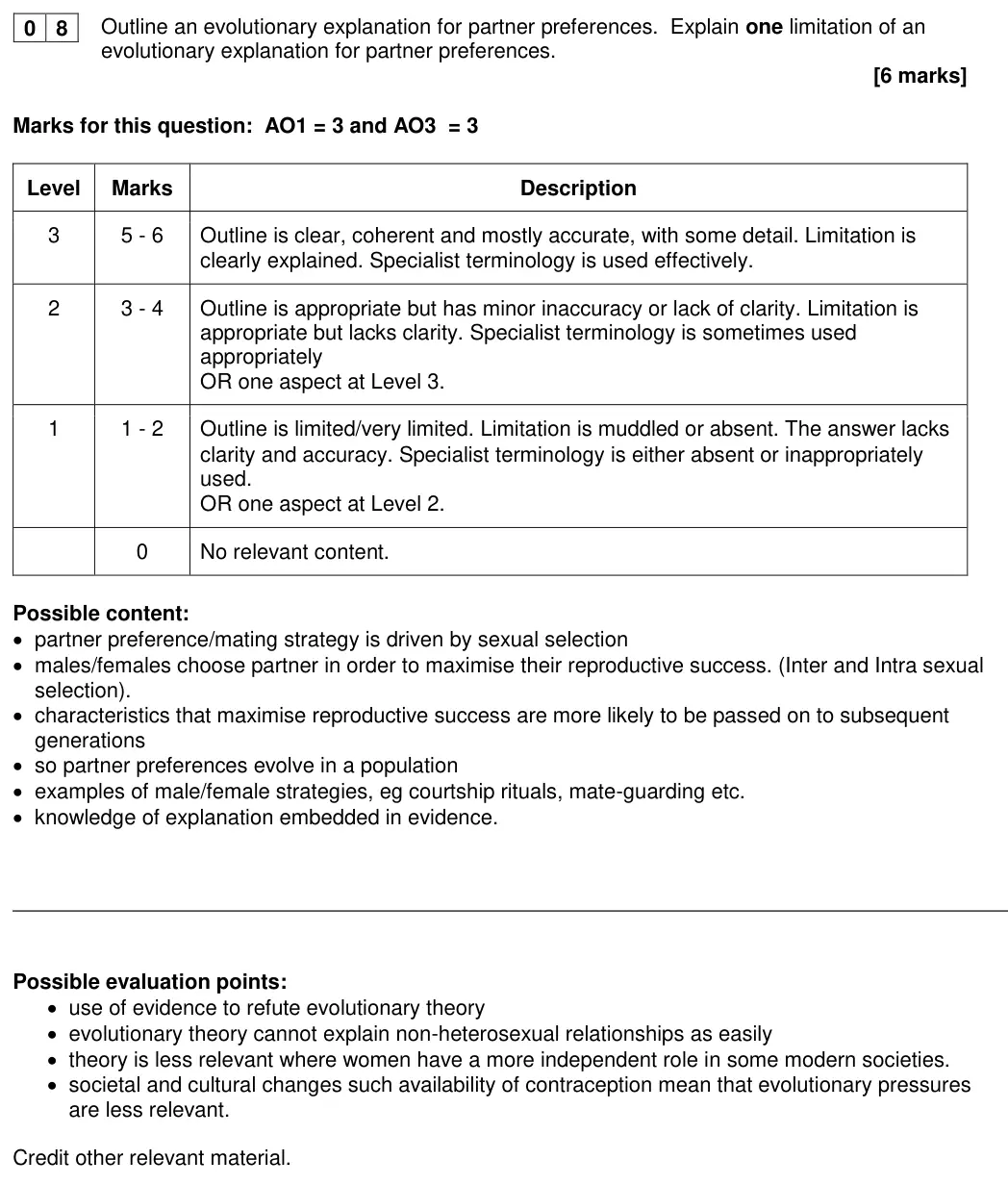
8 Approaches in psychologyOld spec 6AO1=3,AO3=3Outline
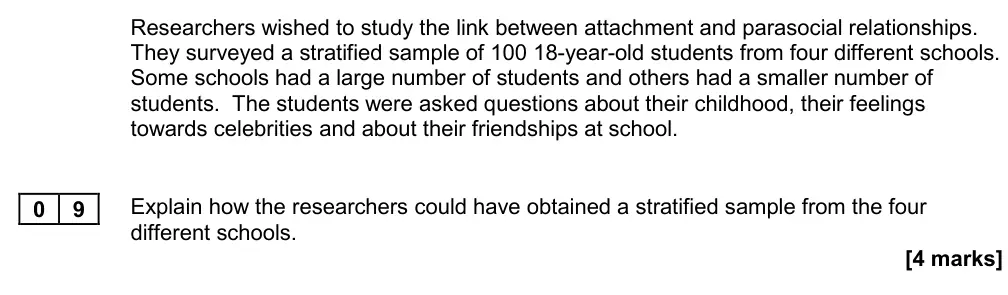
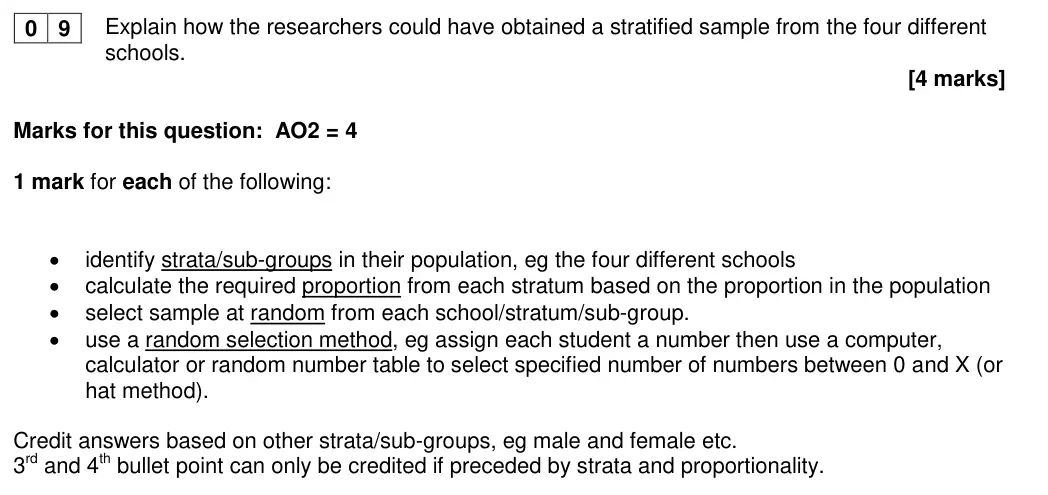
9 Research methods: scientific processes 4AO2=4Research methods
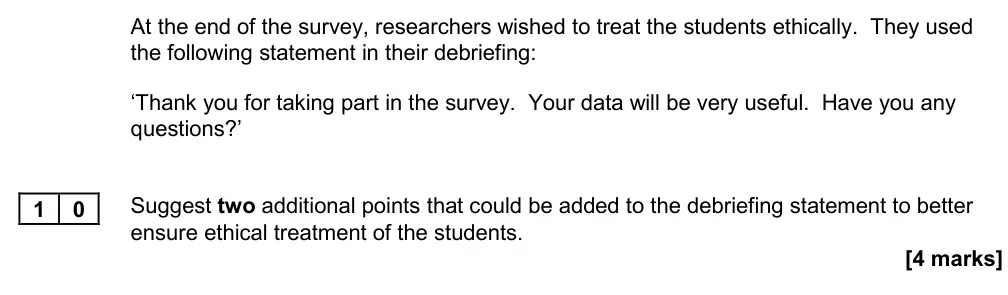
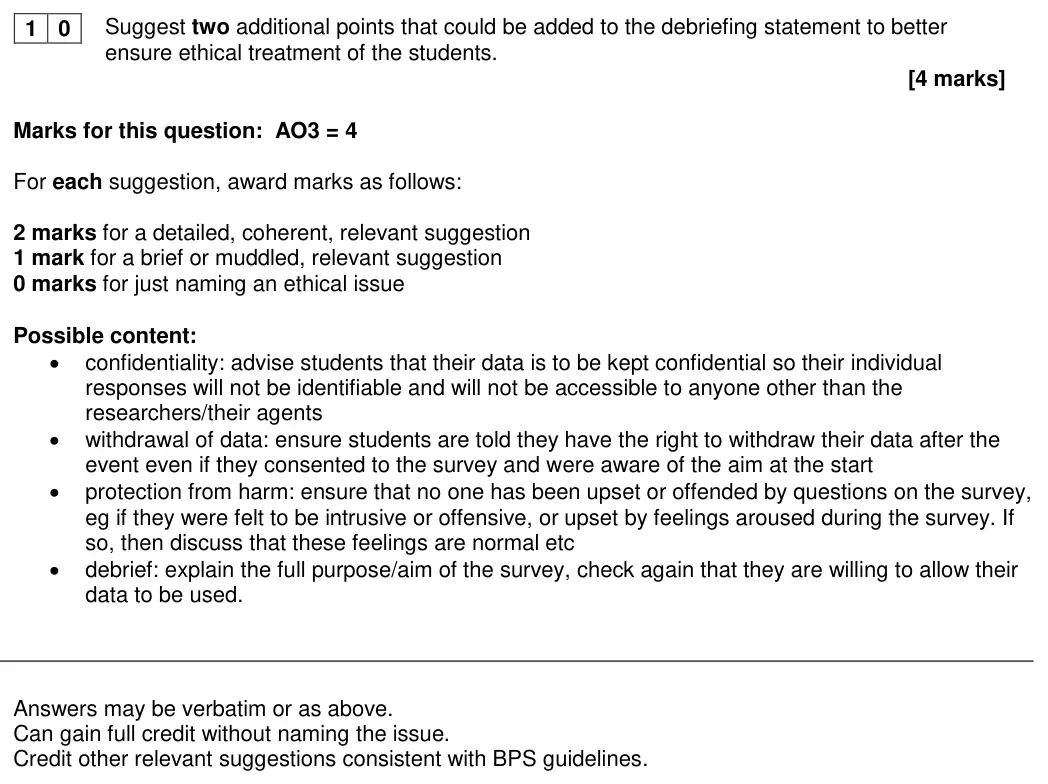
10 Research methods: scientific processes 4AO3=4Research methods
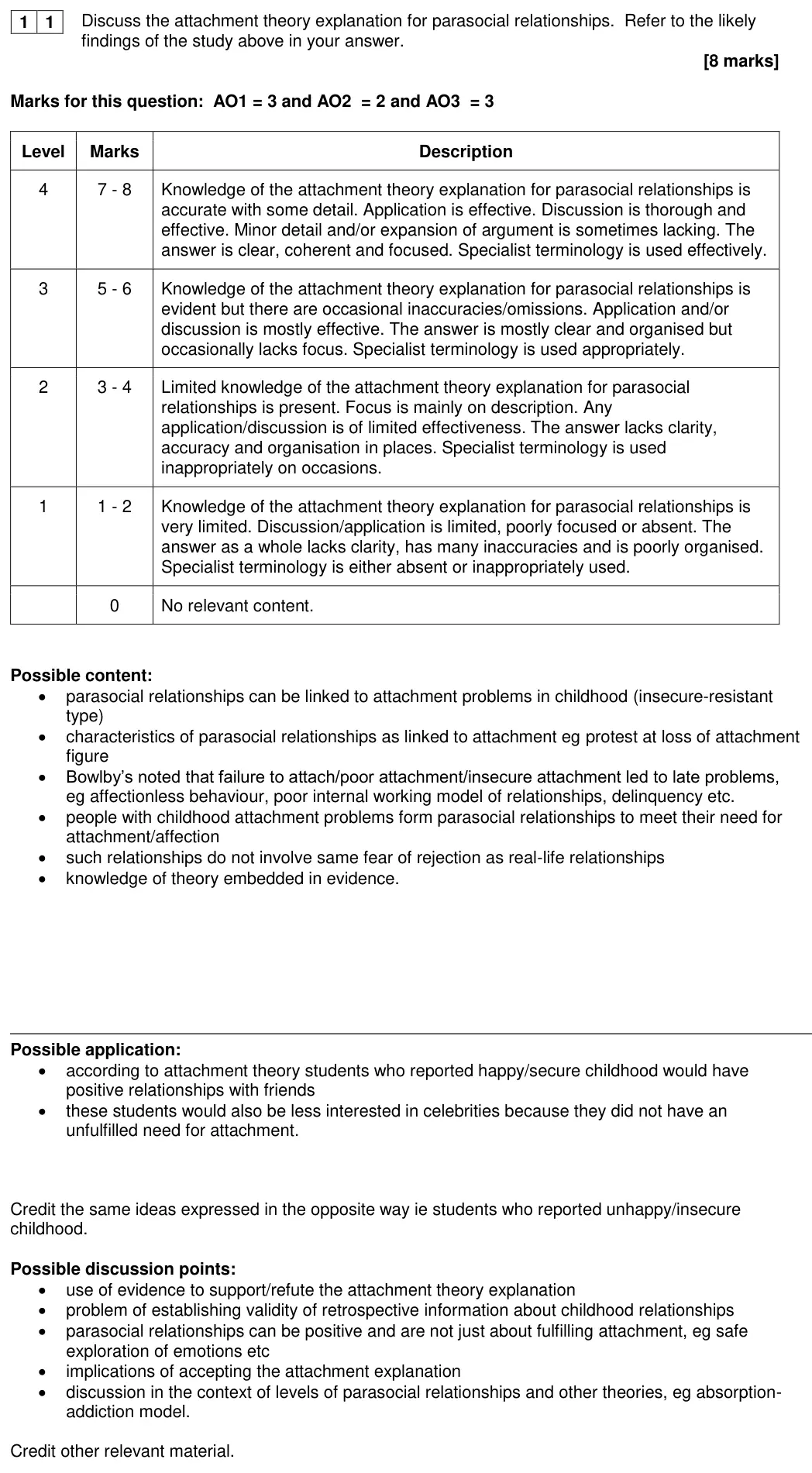
11 Relationships 8AO1=3,AO2=2,AO3=3Extended writing
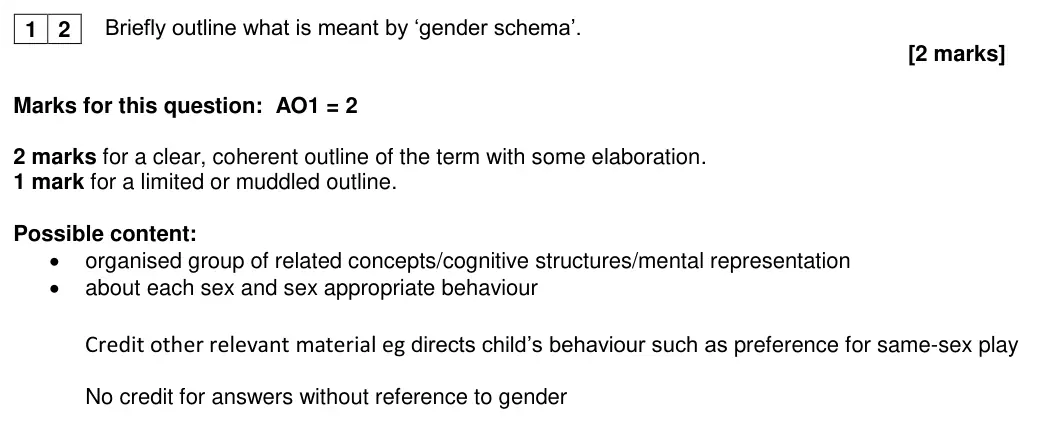
12 Gender 2AO1=2Outline
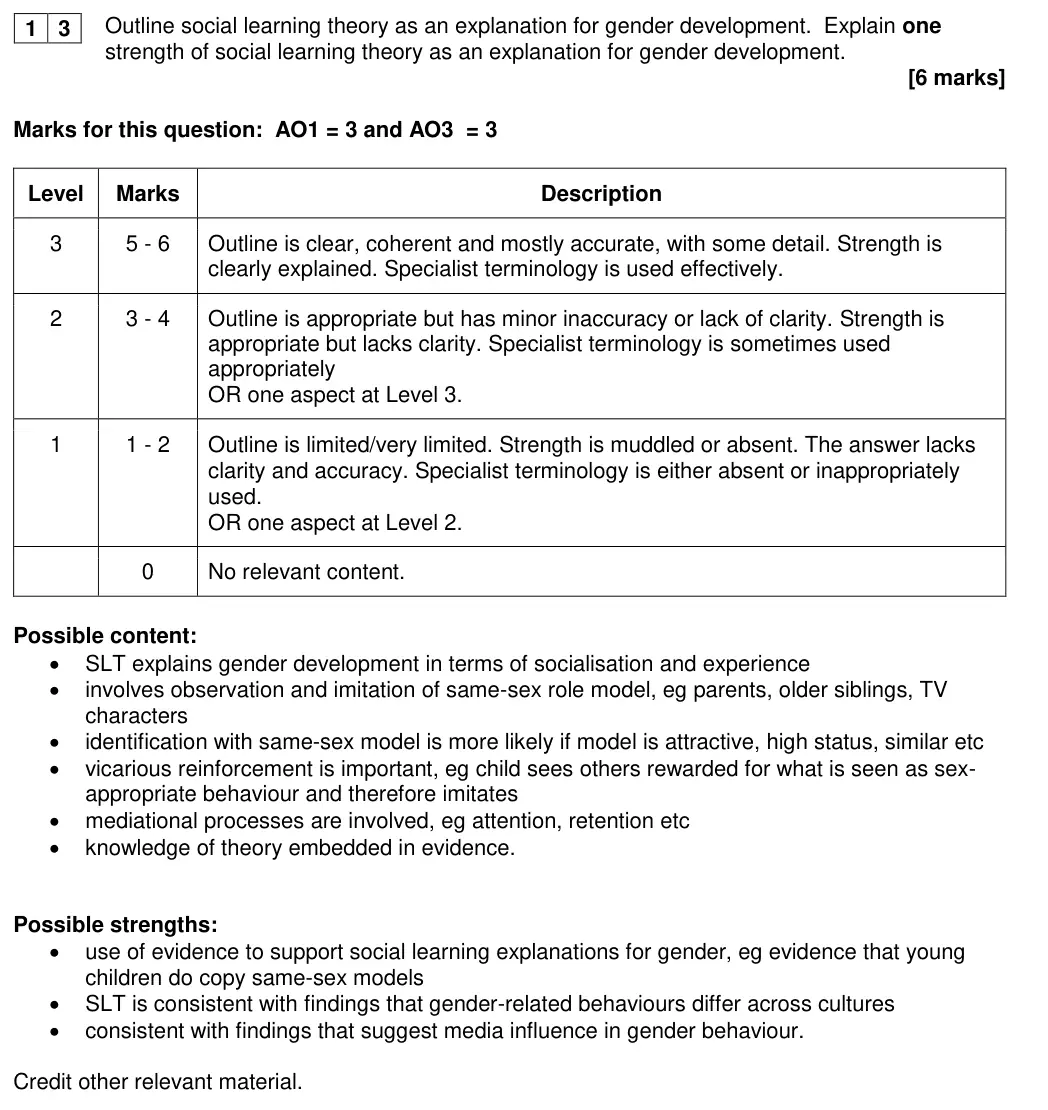
13 Gender 6AO1=3,AO3=3Outline
14 Research methods: scientific processes 4AO2=4Research methods
15 Research methods: scientific processes 4AO3=4Research methods
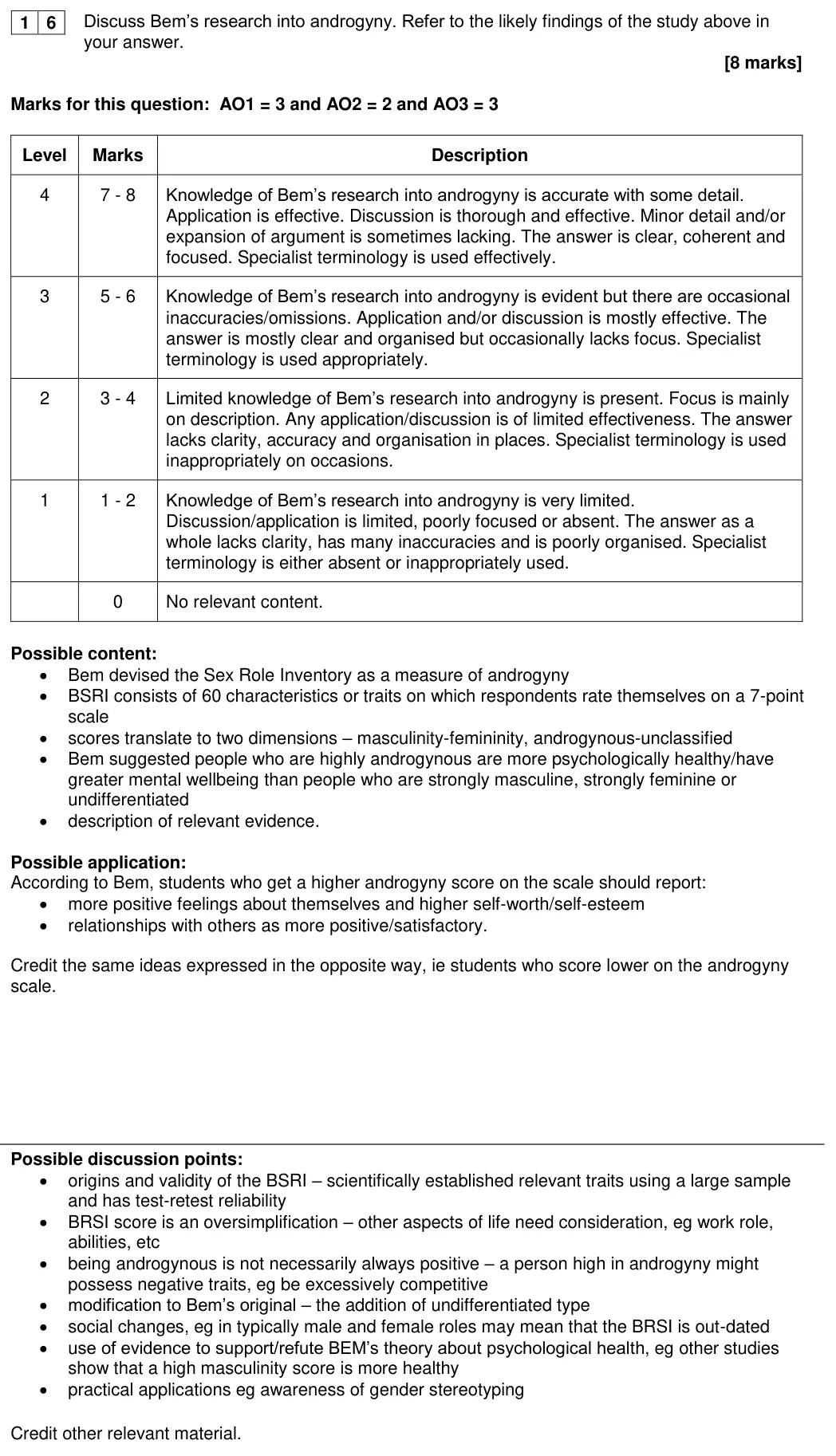
16 GenderOld spec 8AO1=3,AO2=2,AO3=3Extended writing
17 Cognition and development 2AO1=2Outline
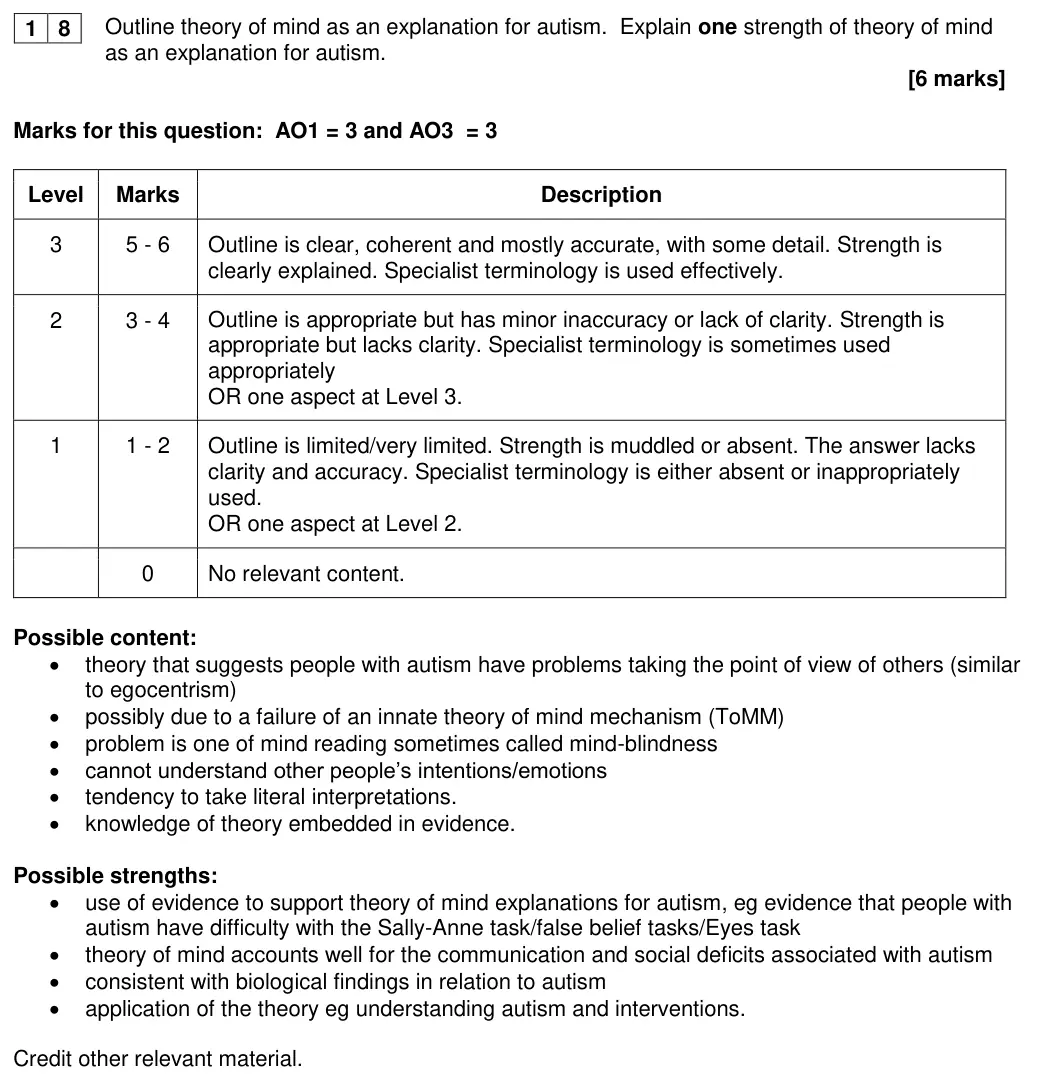
18 Cognition and developmentOld spec 6AO1=3,AO3=3Outline
19 Research methods: scientific processes 4AO2=4Research methods
20 Research methods: scientific processes 4AO3=4Research methods
21 Cognition and development 8AO1=3,AO2=2,AO3=3Extended writing
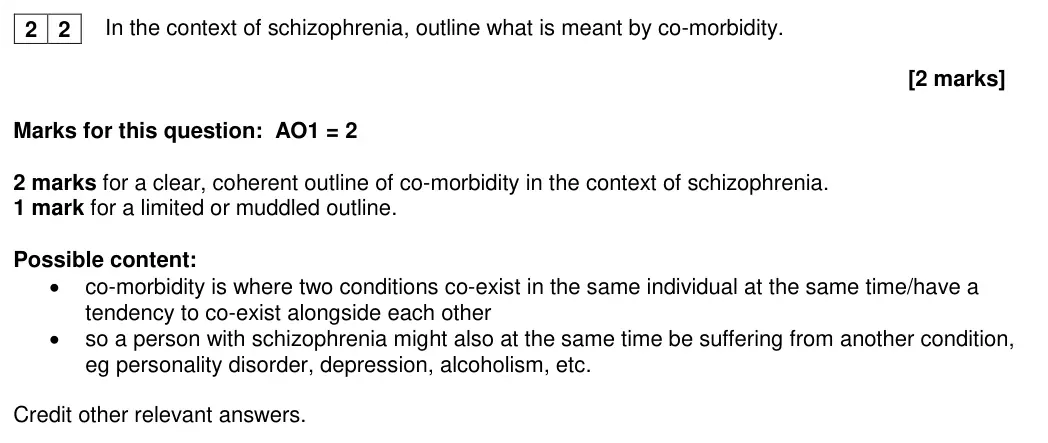
22 Schizophrenia 2AO1=2Outline
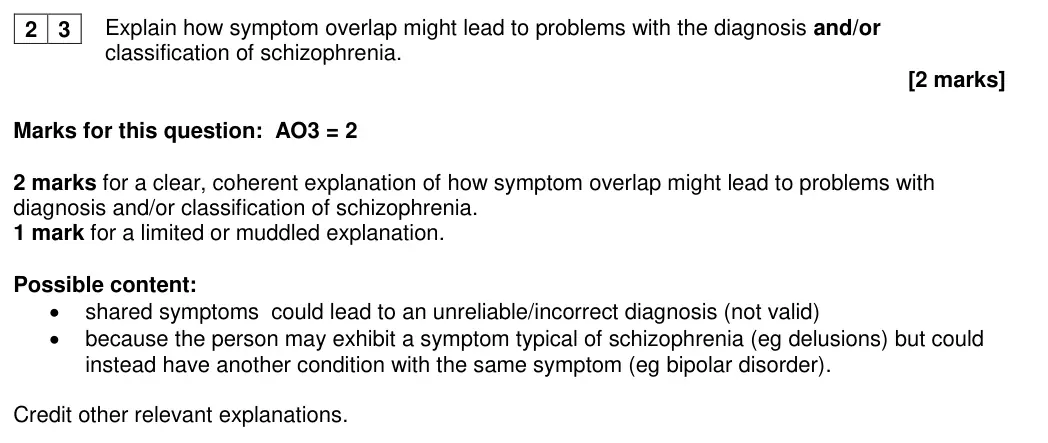
23 Schizophrenia 2AO3=2Explain
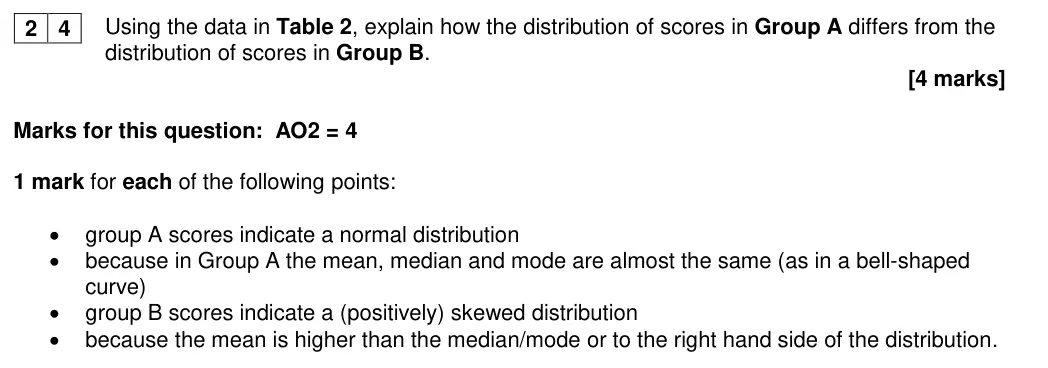
24 Research methods: data handling and analysis 4AO2=4Research methods
25 Schizophrenia 16AO1=6,AO3=10Extended writing
26 Eating behaviour 2AO1=2Outline
27 Eating behaviour 2AO3=2Evaluate (short)
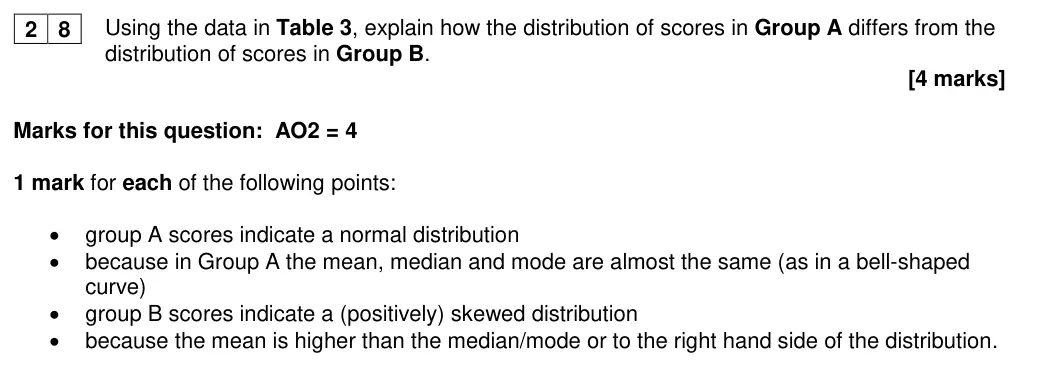
28 Research methods: data handling and analysis 4AO2=4Research methods
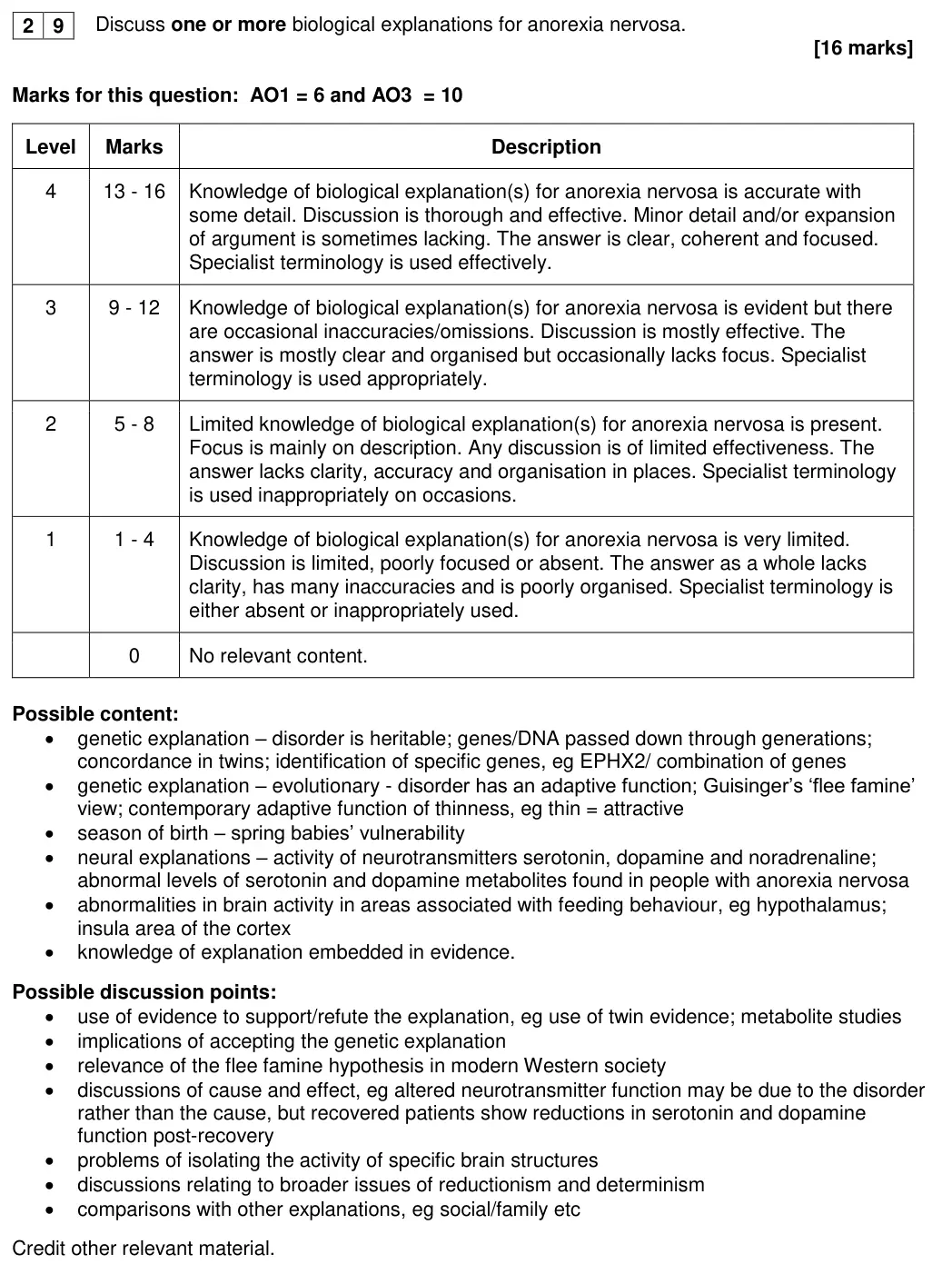
29 Eating behaviour 16AO1=6,AO3=10Extended writing
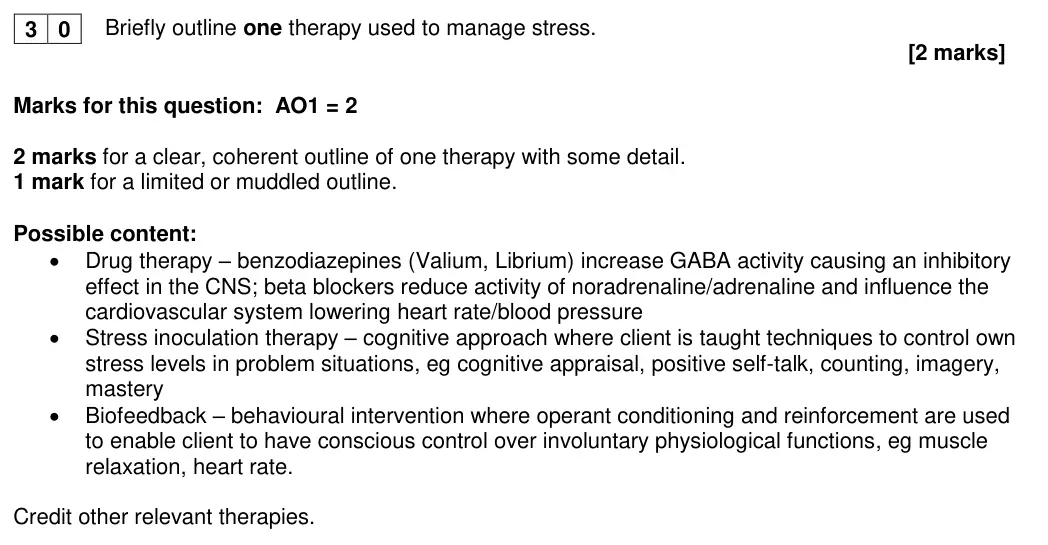
30 Stress 2AO1=2Outline
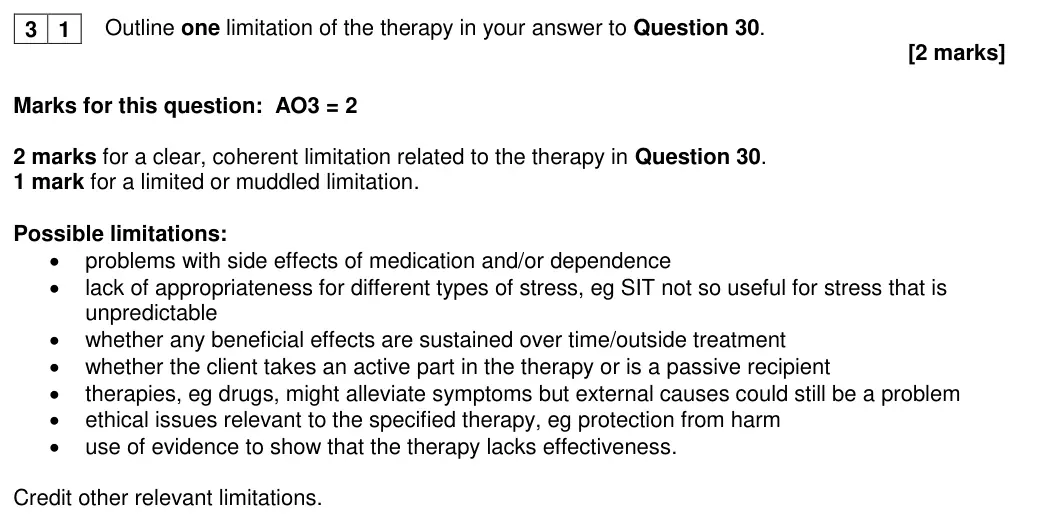
31 Stress 2AO3=2Evaluate (short)
32 Research methods: data handling and analysis 4AO2=4Research methods
33 Stress 16AO1=6,AO3=10Extended writing
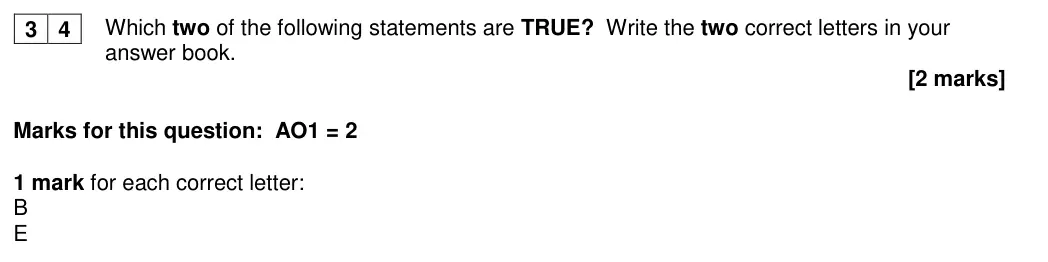
34 Aggression 2AO1=2Multiple choice
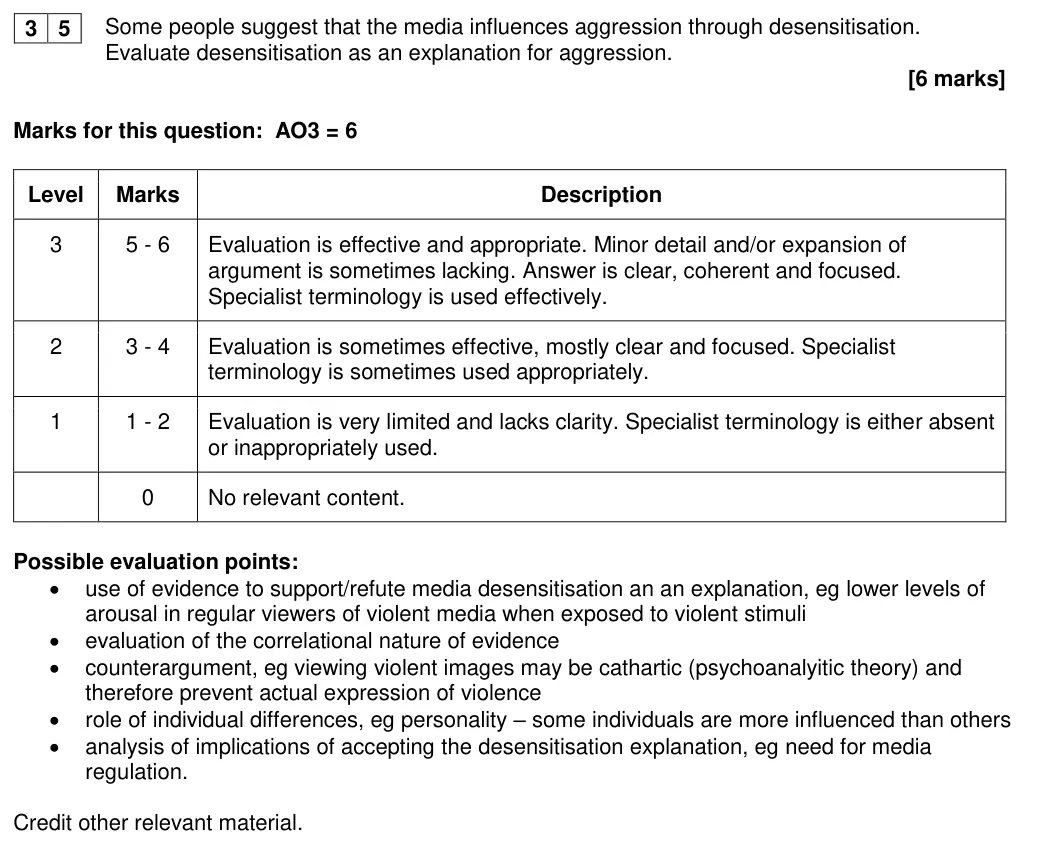
35 Aggression 6AO3=6Evaluate (short)
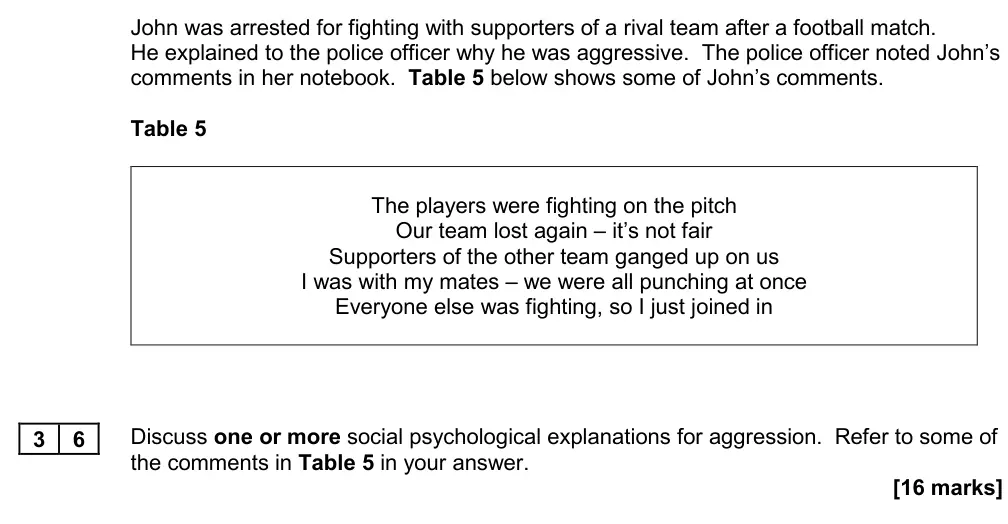
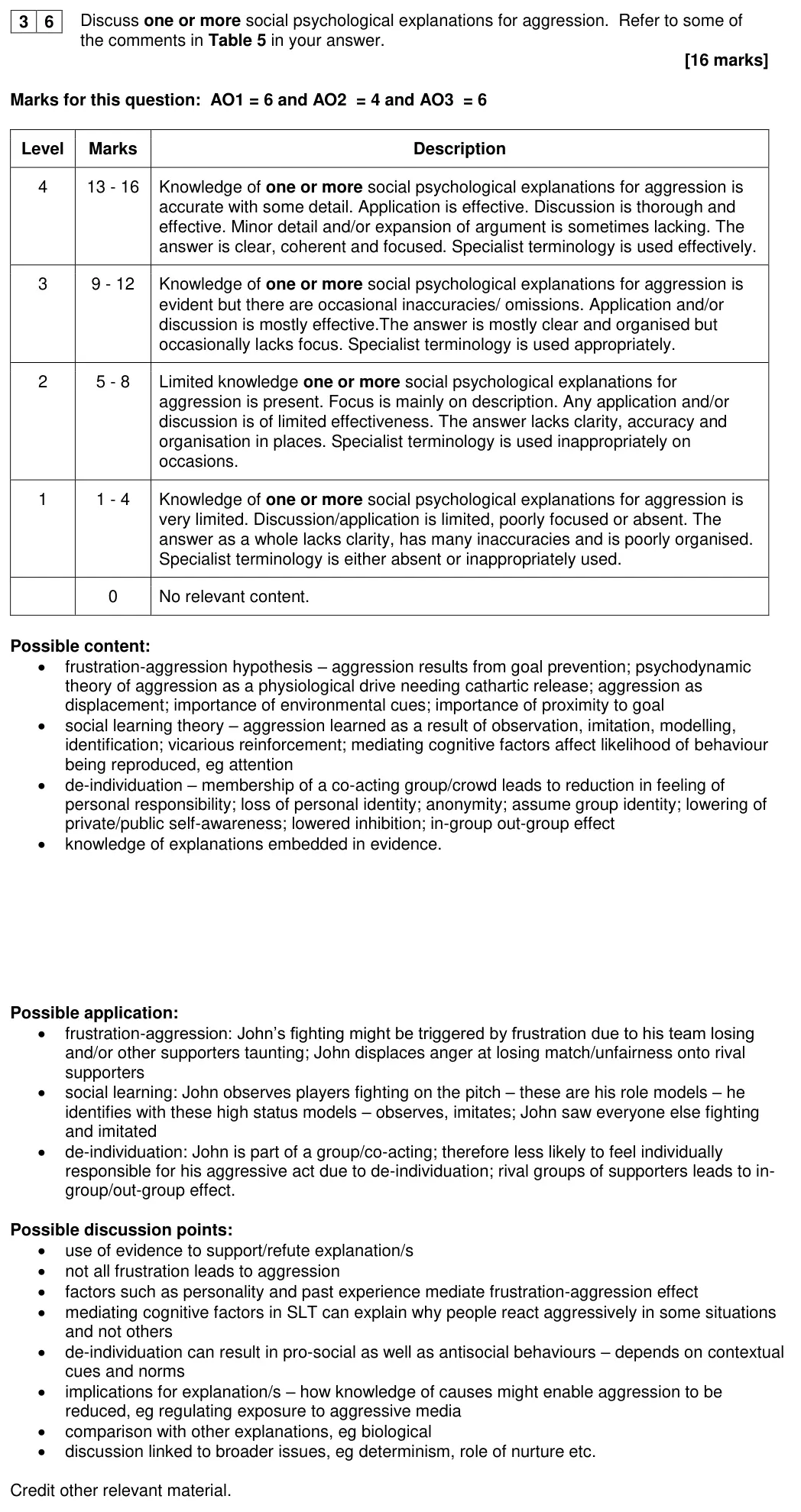
36 Aggression 16AO1=6,AO2=4,AO3=6Extended writing
37 Forensic psychology 2AO1=2Multiple choice
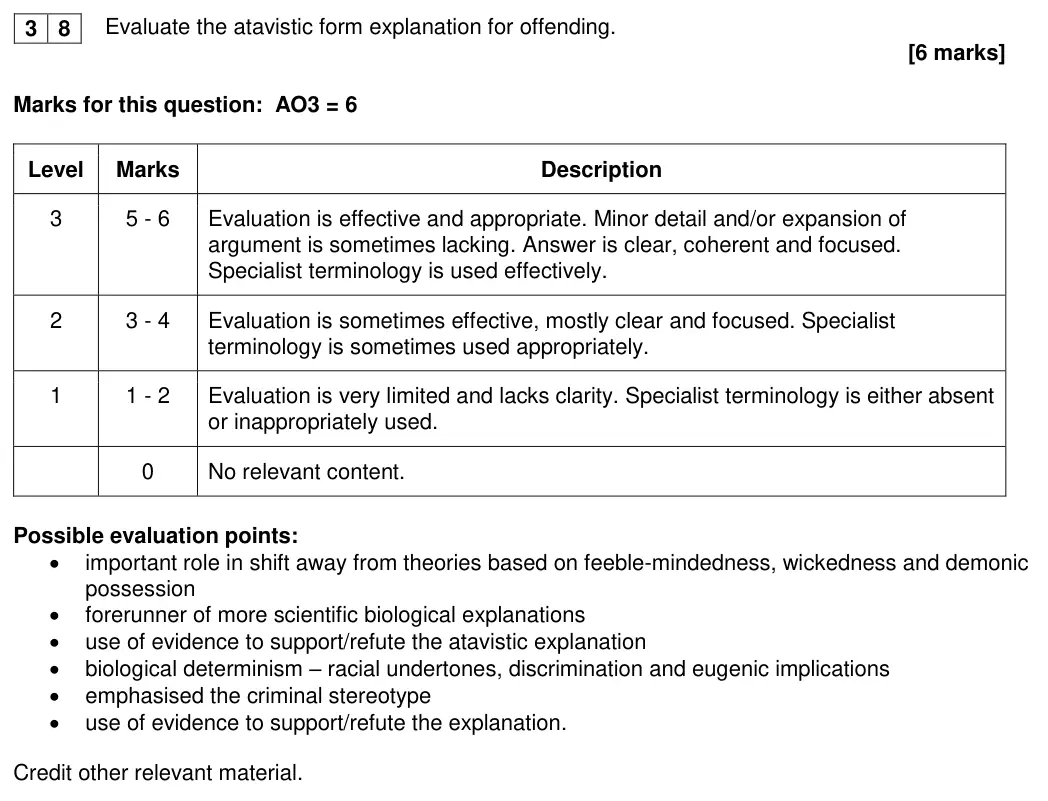
38 Forensic psychologyOld spec 6AO3=6Evaluate (short)
39 Forensic psychology 16AO1=6,AO2=4,AO3=6Extended writing
40 Addiction 2AO1=2Multiple choice
41 Addiction 6AO3=6Evaluate (short)
42 Addiction 16AO1=6,AO2=4,AO3=6Extended writing

The questions

123456789101112131415161718192021222324252627282930313233343536373839404142

June 2018 · Paper 3 · Q1 4 marks AO1=4 Multiple choice issues and debates
0 1
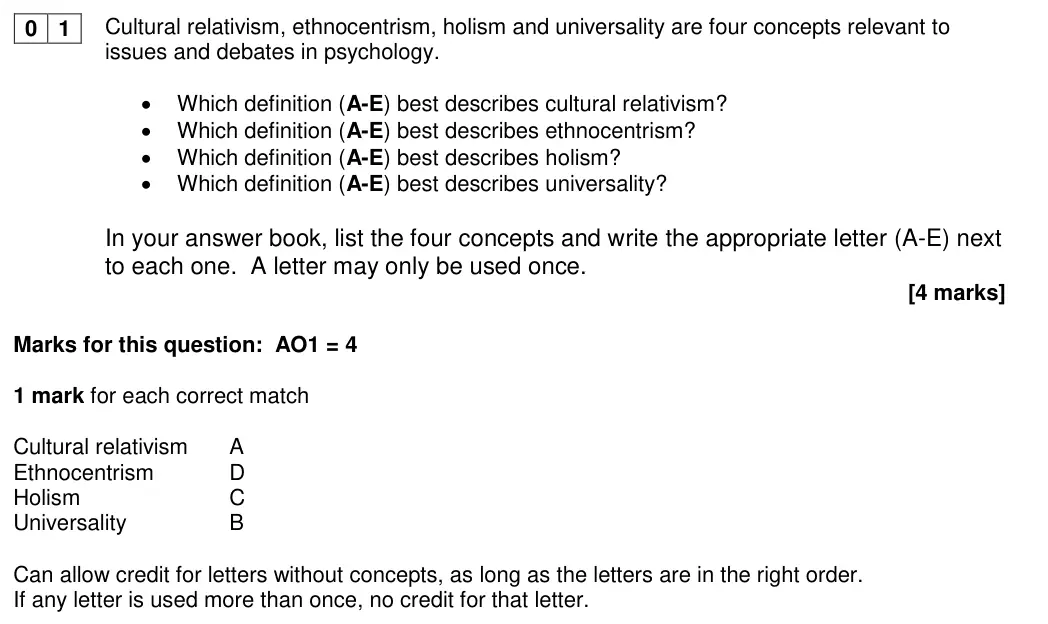
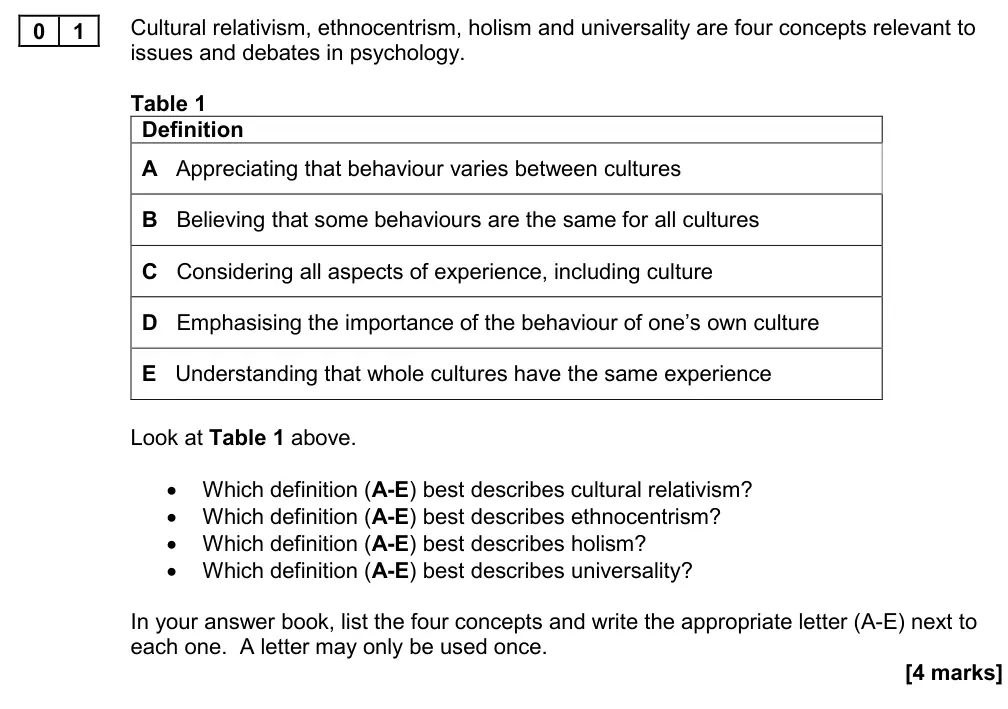
Cultural relativism, ethnocentrism, holism and universality are four concepts relevant to
issues and debates in psychology.
Table 1
Definition
A   Appreciating that behaviour varies between cultures
B   Believing that some behaviours are the same for all cultures
C   Considering all aspects of experience, including culture
D   Emphasising the importance of the behaviour of one’s own culture
E   Understanding that whole cultures have the same experience
Look at Table 1 above.
•
Which definition (A-E) best describes cultural relativism?
•
Which definition (A-E) best describes ethnocentrism?
•
Which definition (A-E) best describes holism?
•
Which definition (A-E) best describes universality?
In your answer book, list the four concepts and write the appropriate letter (A-E) next to

each one.  A letter may only be used once.
[4 marks]
June 2018 · Paper 3 · Q2 2 marks AO1=1, AO3=1 Short answer issues and debates
0 2
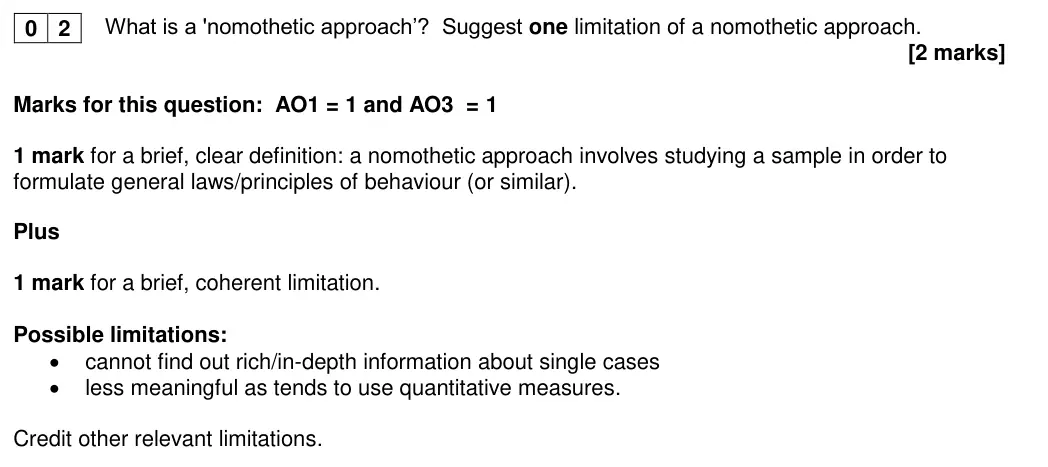
What is a 'nomothetic approach’?  Suggest one limitation of a nomothetic approach.
[2 marks]
June 2018 · Paper 3 · Q3 2 marks AO2=2 Application issues and debates
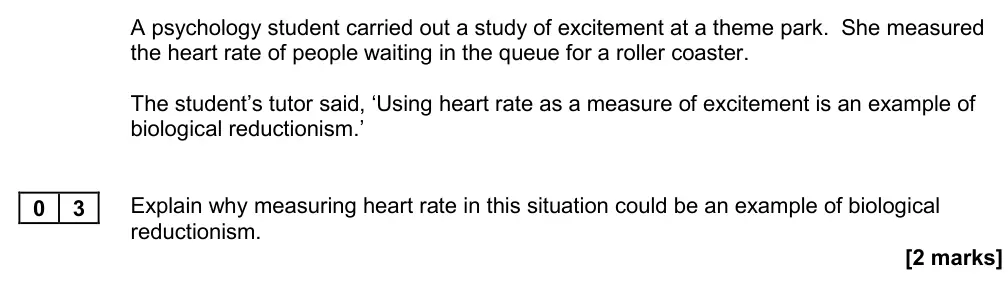
A psychology student carried out a study of excitement at a theme park.  She measured
the heart rate of people waiting in the queue for a roller coaster.
The student’s tutor said, ‘Using heart rate as a measure of excitement is an example of
biological reductionism.’
0 3
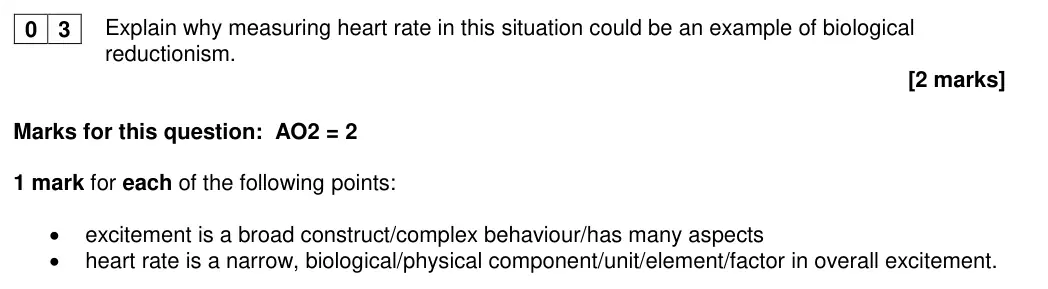
Explain why measuring heart rate in this situation could be an example of biological
reductionism.
[2 marks]
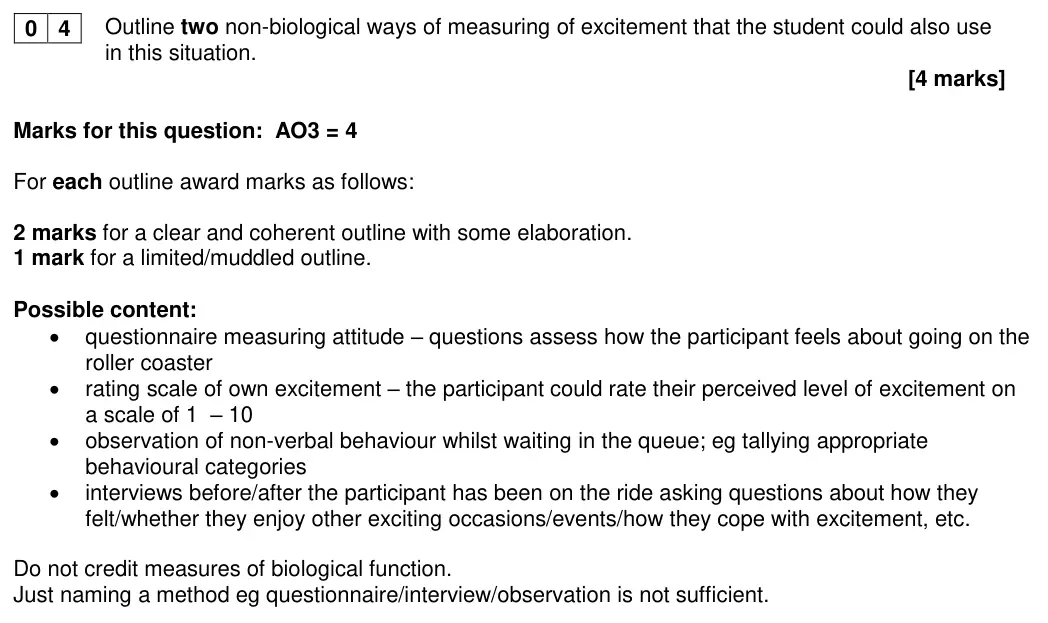
June 2018 · Paper 3 · Q4 4 marks AO3=4 Research methods research methods
0 4
Outline two non-biological ways of measuring excitement that the student could also use
in this situation.
[4 marks]
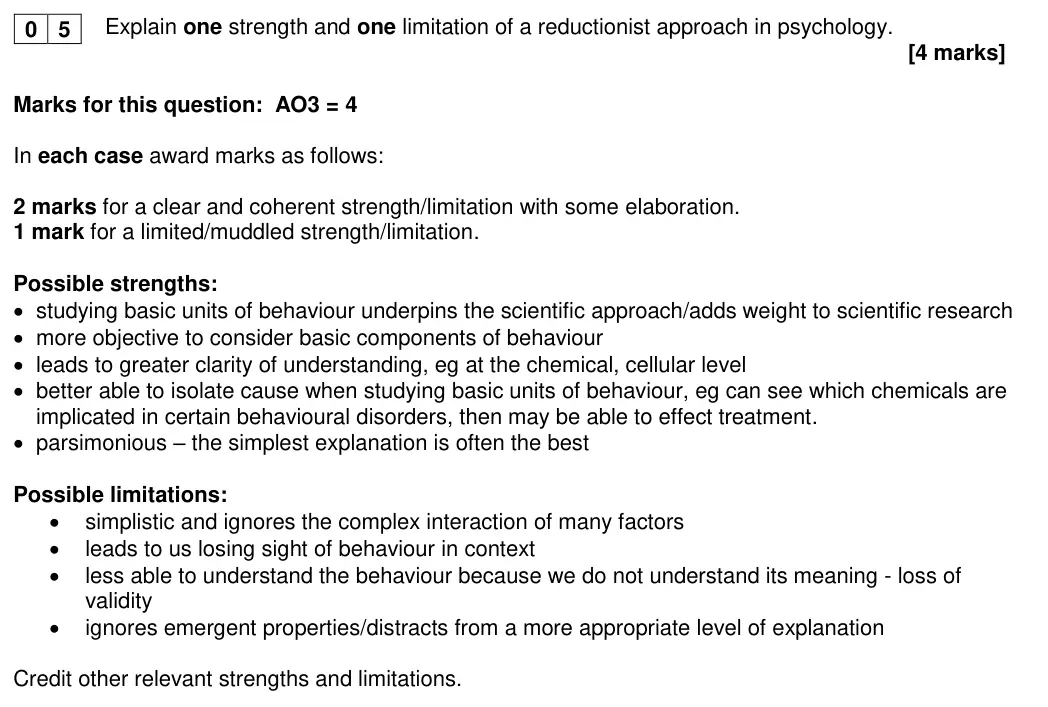
June 2018 · Paper 3 · Q5 4 marks AO3=4 Evaluate (short) issues and debates
0 5
Explain one strength and one limitation of a reductionist approach in psychology.
[4 marks]
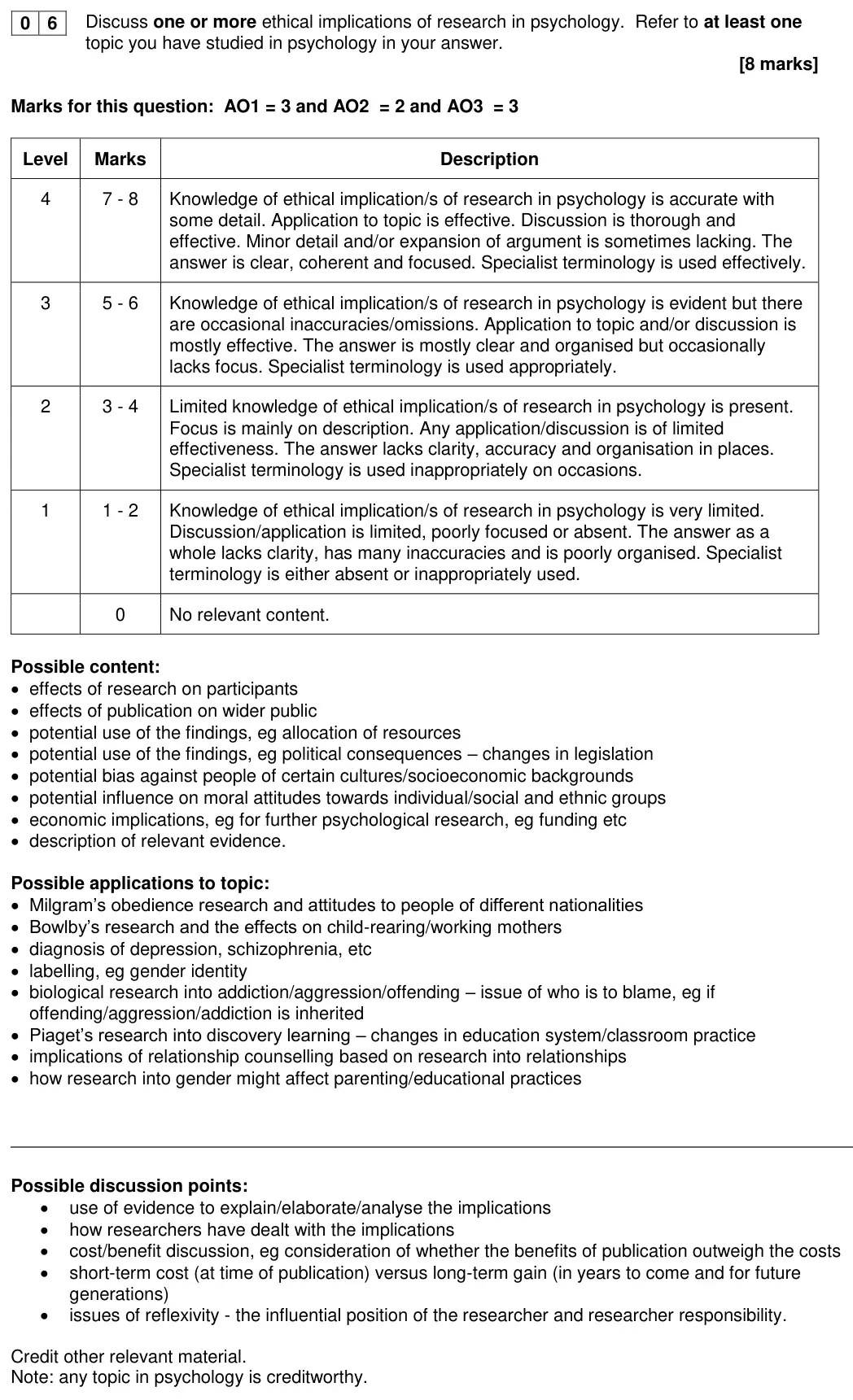
June 2018 · Paper 3 · Q6 8 marks AO1=3, AO2=2, AO3=3 Extended writing issues and debates
0 6
Discuss one or more ethical implications of research in psychology.
Refer to at least one topic you have studied in psychology in your answer.
[8 marks]
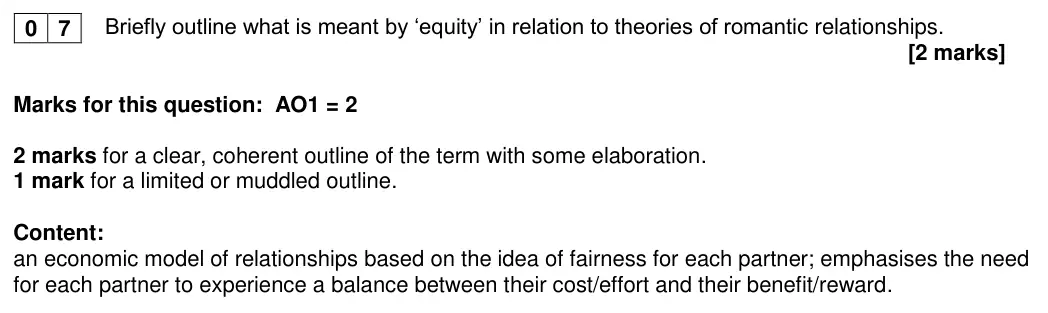
June 2018 · Paper 3 · Q7 2 marks AO1=2 Outline relationships
0 7
Briefly outline what is meant by ‘equity’ in relation to theories of romantic relationships.
[2 marks]
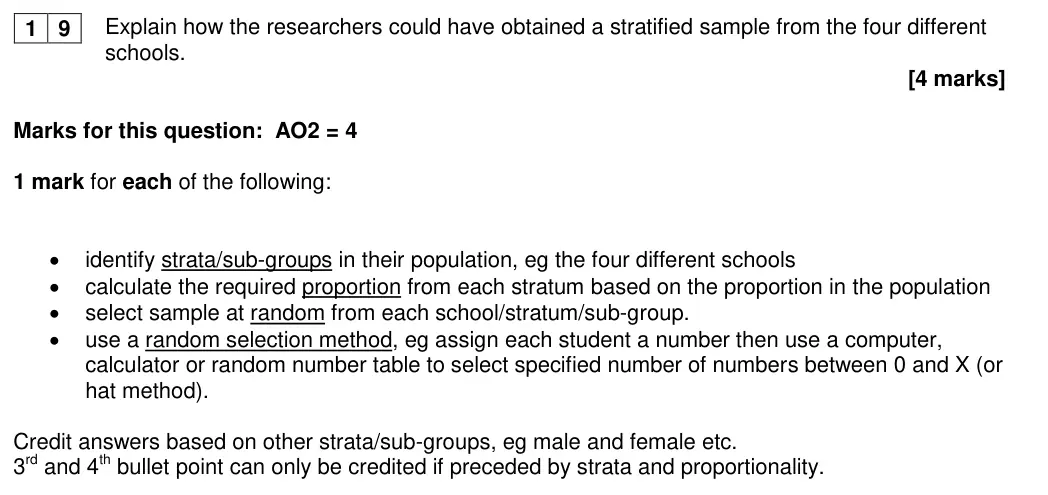
June 2018 · Paper 3 · Q9 4 marks AO2=4 Research methods scientific processes
Researchers wished to study the link between attachment and parasocial relationships.
They surveyed a stratified sample of 100 18-year-old students from four different schools.
Some schools had a large number of students and others had a smaller number of
students.  The students were asked questions about their childhood, their feelings
towards celebrities and about their friendships at school.
0 9
Explain how the researchers could have obtained a stratified sample from the four
different schools.
[4 marks]
June 2018 · Paper 3 · Q10 4 marks AO3=4 Research methods scientific processes
At the end of the survey, researchers wished to treat the students ethically.  They used
the following statement in their debriefing:
‘Thank you for taking part in the survey.  Your data will be very useful.  Have you any
questions?’
1 0
Suggest two additional points that could be added to the debriefing statement to better
ensure ethical treatment of the students.
[4 marks]
June 2018 · Paper 3 · Q11 8 marks AO1=3, AO2=2, AO3=3 Extended writing relationships
1 1
Discuss the attachment theory explanation for parasocial relationships.  Refer to the likely
findings of the study above in your answer.
[8 marks]
June 2018 · Paper 3 · Q12 2 marks AO1=2 Outline gender
1 2
Briefly outline what is meant by ‘gender schema’.
[2 marks]
June 2018 · Paper 3 · Q13 6 marks AO1=3, AO3=3 Outline gender
1 3
Outline social learning theory as an explanation for gender development.
Explain one strength of social learning theory as an explanation for gender development.
[6 marks]
June 2018 · Paper 3 · Q14 4 marks AO2=4 Research methods scientific processes
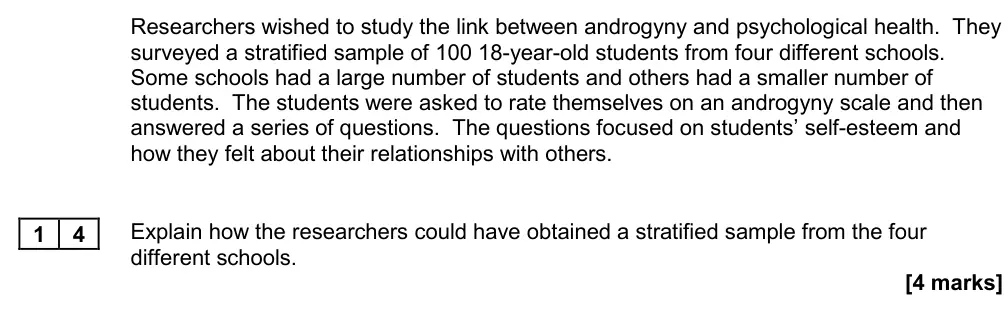
Researchers wished to study the link between androgyny and psychological health.  They
surveyed a stratified sample of 100 18-year-old students from four different schools.
Some schools had a large number of students and others had a smaller number of
students.  The students were asked to rate themselves on an androgyny scale and then
answered a series of questions.  The questions focused on students’ self-esteem and
how they felt about their relationships with others.
1 4
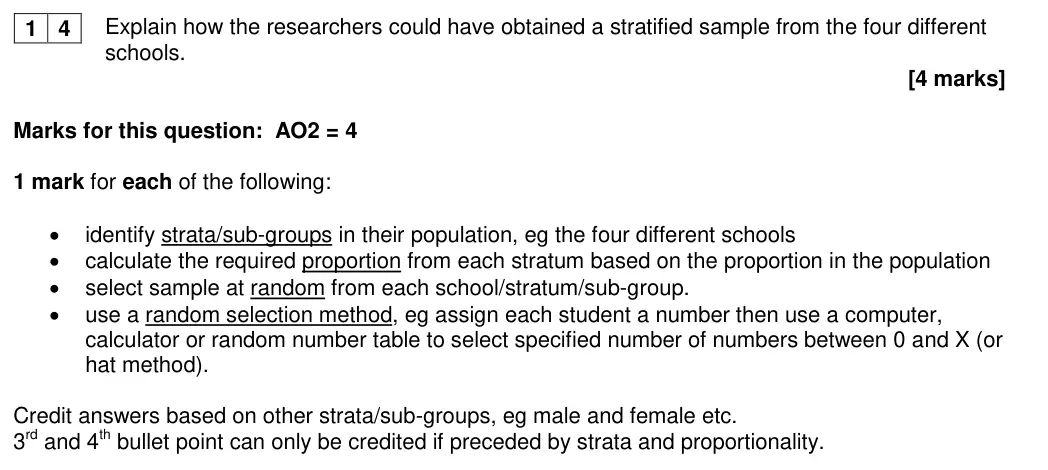
Explain how the researchers could have obtained a stratified sample from the four
different schools.
[4 marks]
June 2018 · Paper 3 · Q15 4 marks AO3=4 Research methods scientific processes
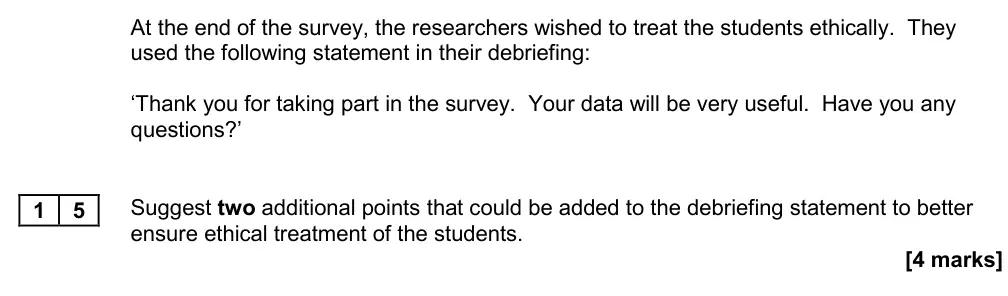
At the end of the survey, the researchers wished to treat the students ethically.  They
used the following statement in their debriefing:
‘Thank you for taking part in the survey.  Your data will be very useful.  Have you any
questions?’
1 5
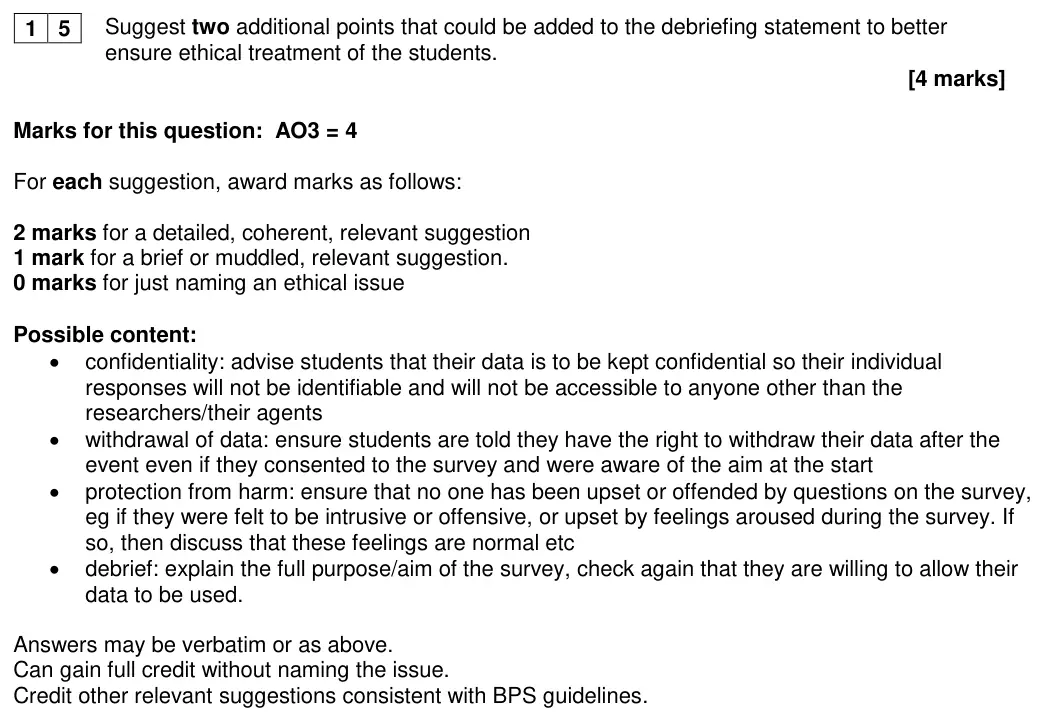
Suggest two additional points that could be added to the debriefing statement to better
ensure ethical treatment of the students.
[4 marks]
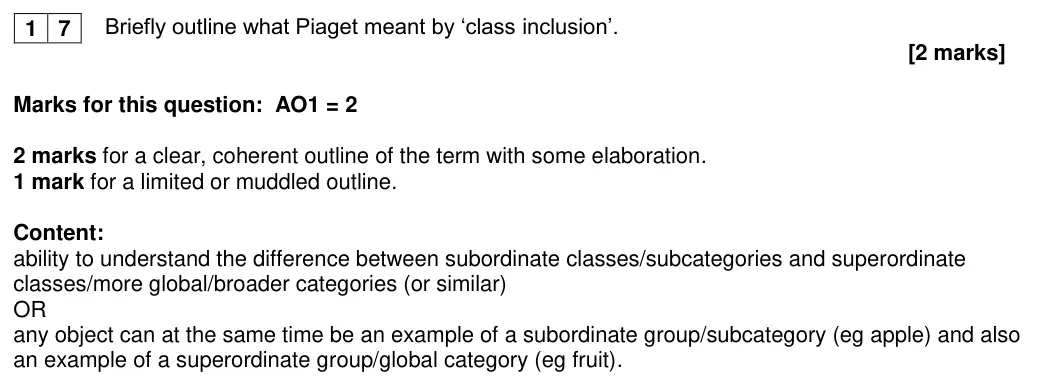
June 2018 · Paper 3 · Q17 2 marks AO1=2 Outline cognition and development
1 7
Briefly outline what Piaget meant by ‘class inclusion’.
[2 marks]
June 2018 · Paper 3 · Q19 4 marks AO2=4 Research methods scientific processes
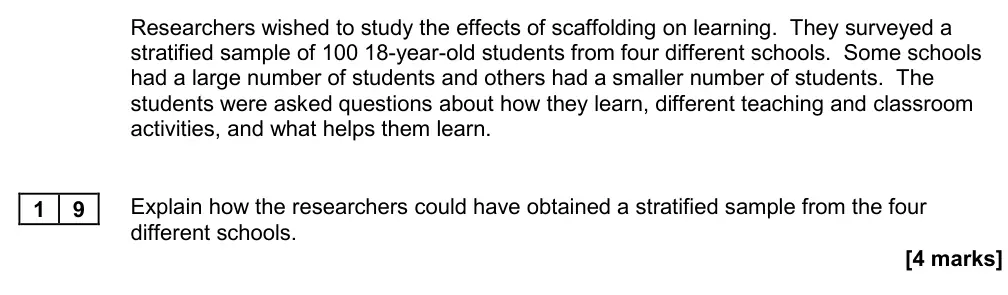
Researchers wished to study the effects of scaffolding on learning.  They surveyed a
stratified sample of 100 18-year-old students from four different schools.  Some schools
had a large number of students and others had a smaller number of students.  The
students were asked questions about how they learn, different teaching and classroom
activities, and what helps them learn.
1 9
Explain how the researchers could have obtained a stratified sample from the four
different schools.
[4 marks]
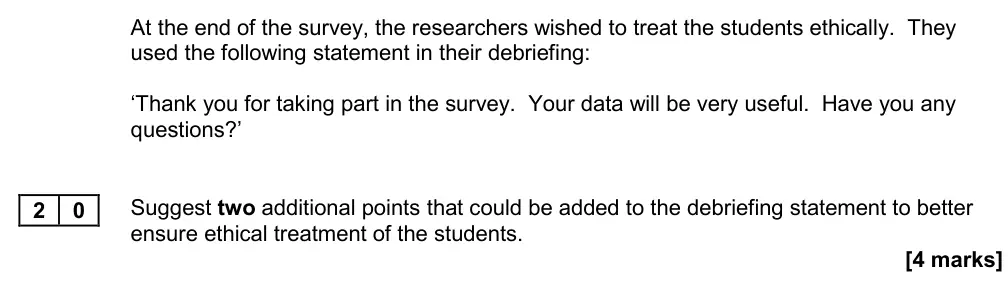
June 2018 · Paper 3 · Q20 4 marks AO3=4 Research methods scientific processes
At the end of the survey, the researchers wished to treat the students ethically.  They
used the following statement in their debriefing:
‘Thank you for taking part in the survey.  Your data will be very useful.  Have you any
questions?’
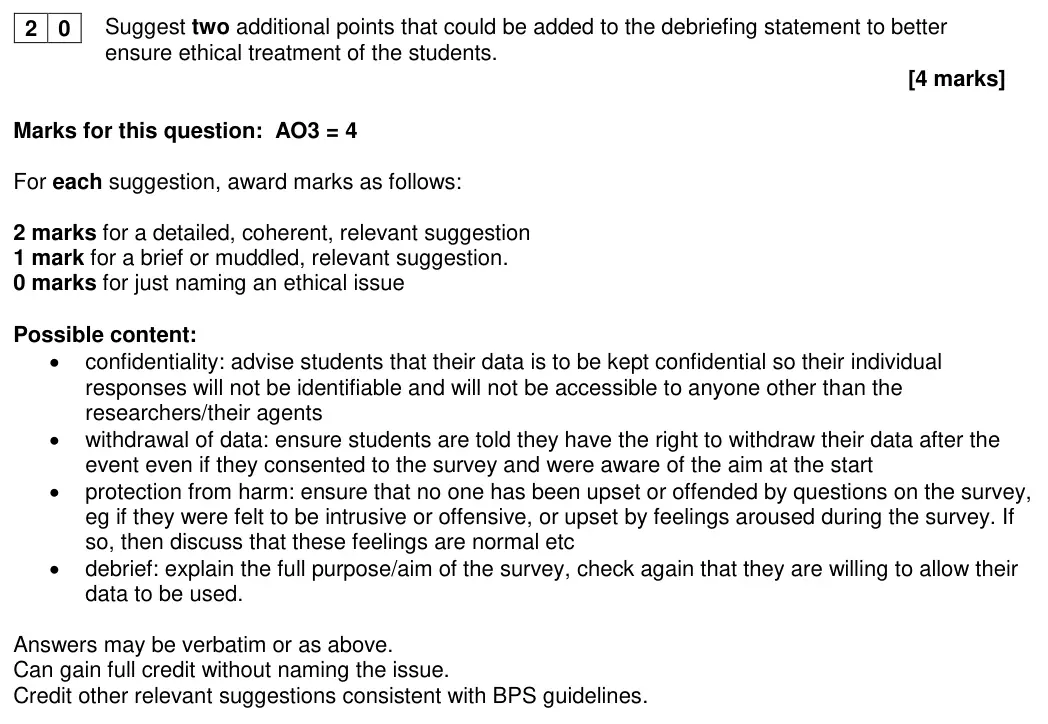
2 0
Suggest two additional points that could be added to the debriefing statement to better
ensure ethical treatment of the students.
[4 marks]
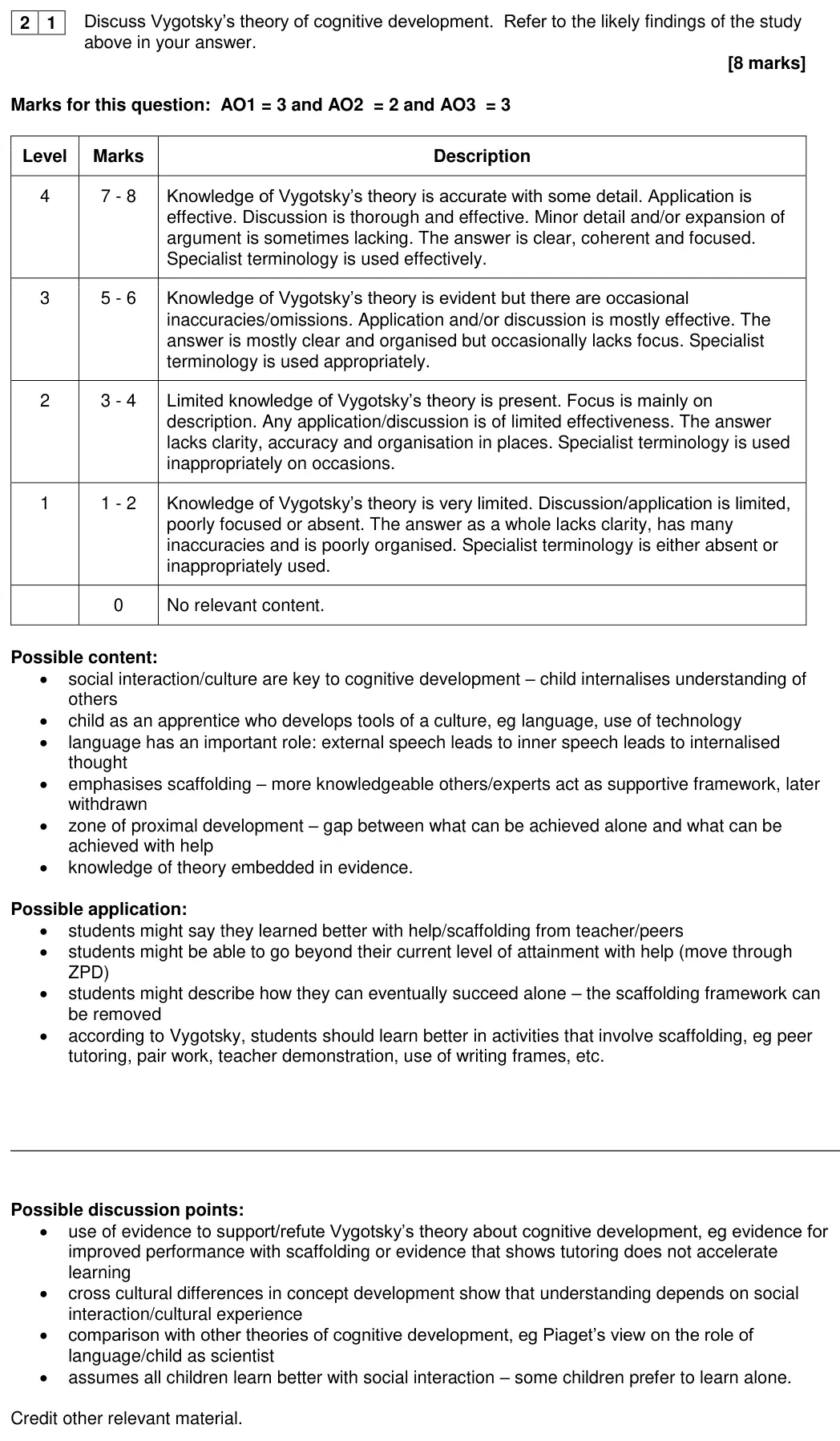
June 2018 · Paper 3 · Q21 8 marks AO1=3, AO2=2, AO3=3 Extended writing cognition and development
2 1
Discuss Vygotsky’s theory of cognitive development.  Refer to the likely findings of the
study above in your answer.
[8 marks]
June 2018 · Paper 3 · Q22 2 marks AO1=2 Outline schizophrenia
2 2
In the context of schizophrenia, outline what is meant by co-morbidity.
[2 marks]
June 2018 · Paper 3 · Q23 2 marks AO3=2 Explain schizophrenia
2 3
Explain how symptom overlap might lead to problems with the diagnosis and/or
classification of schizophrenia.
[2 marks]
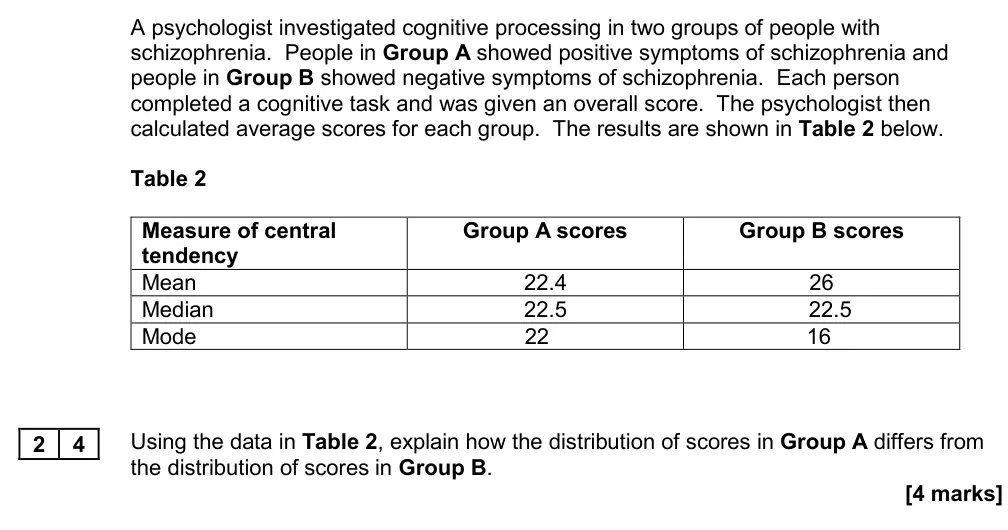
June 2018 · Paper 3 · Q24 4 marks AO2=4 Research methods data handling
A psychologist investigated cognitive processing in two groups of people with
schizophrenia.  People in Group A showed positive symptoms of schizophrenia and
people in Group B showed negative symptoms of schizophrenia.  Each person
completed a cognitive task and was given an overall score.  The psychologist then
calculated average scores for each group.  The results are shown in Table 2 below.
Table 2
Measure of central
Group A scores
Group B scores
tendency
Mean
22.4
26
Median
22.5
22.5
Mode
22
16
2 4
Using the data in Table 2, explain how the distribution of scores in Group A differs from
the distribution of scores in Group B.
[4 marks]
June 2018 · Paper 3 · Q25 16 marks AO1=6, AO3=10 16-mark essay schizophrenia
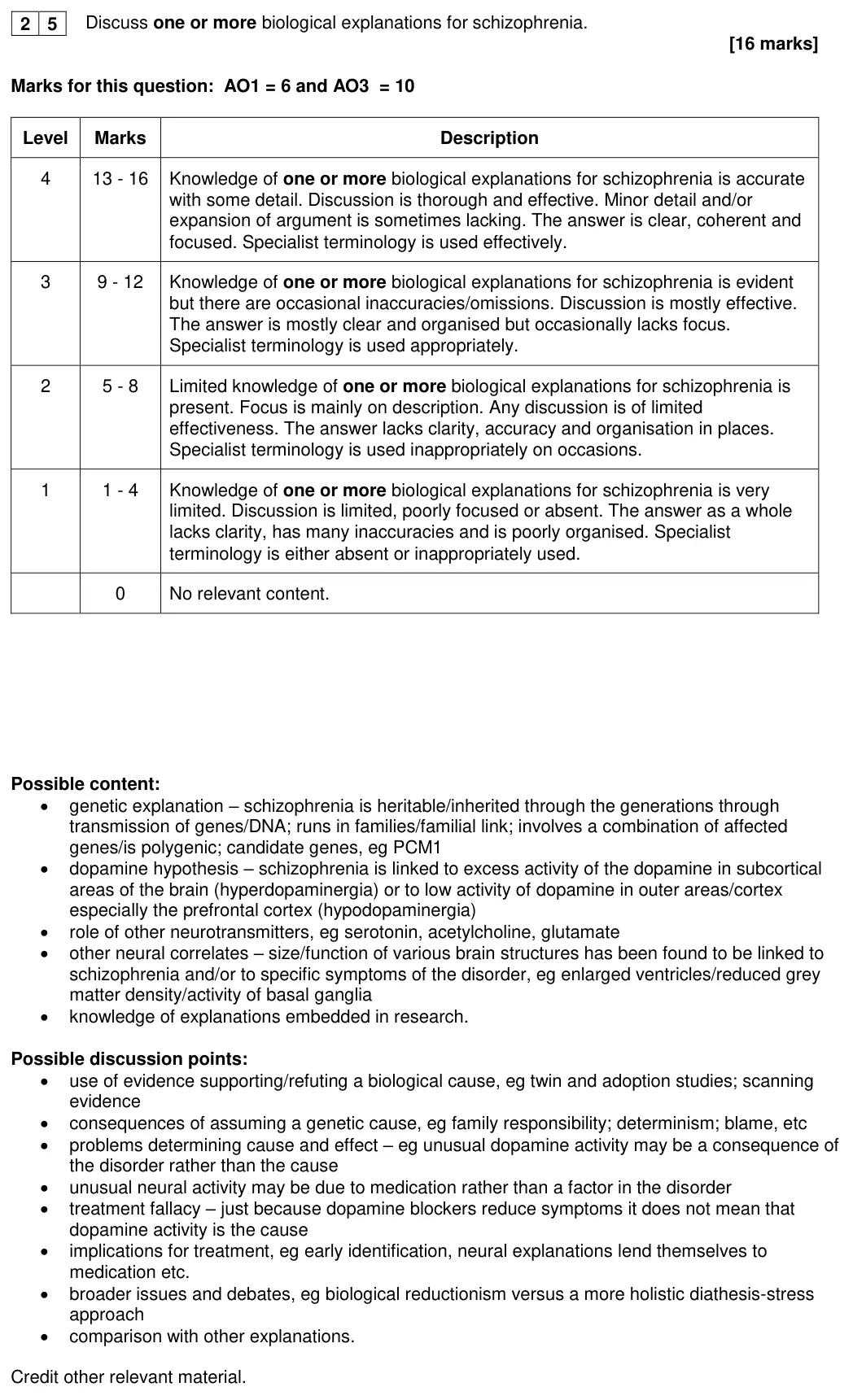
2 5
Discuss one or more biological explanations for schizophrenia.
[16 marks]
June 2018 · Paper 3 · Q26 2 marks AO1=2 Outline eating behaviour
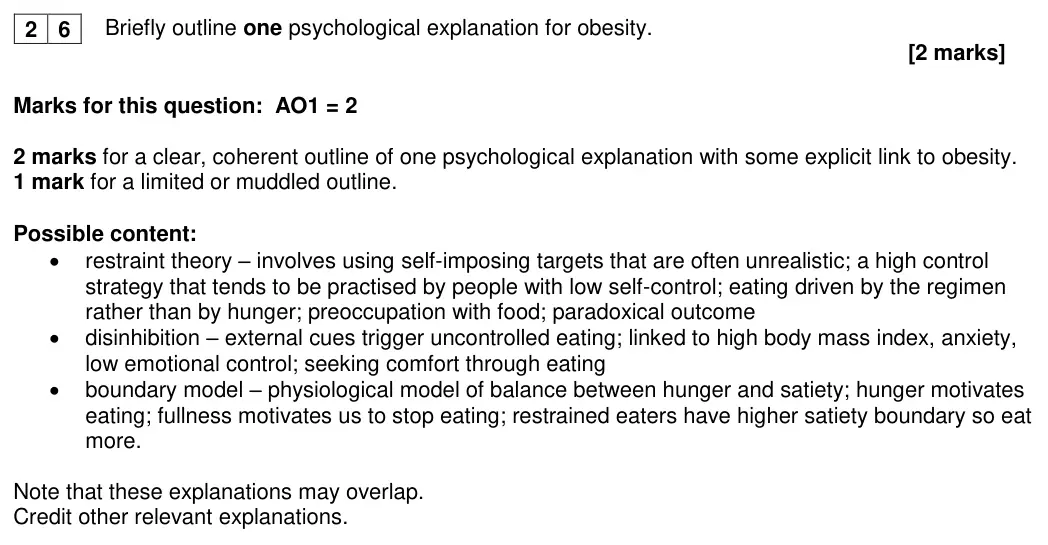
2 6
Briefly outline one psychological explanation for obesity.
[2 marks]
June 2018 · Paper 3 · Q27 2 marks AO3=2 Evaluate (short) eating behaviour
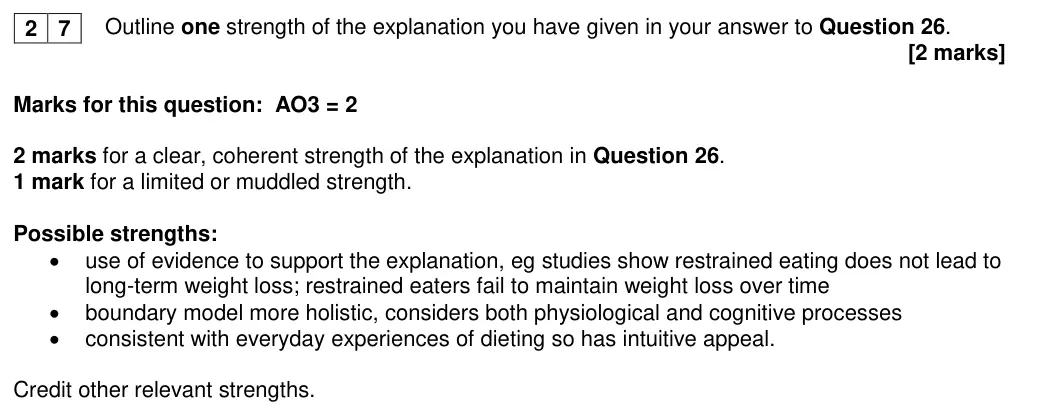
2 7
Outline one strength of the explanation you have given in your answer to Question 26.
[2 marks]
June 2018 · Paper 3 · Q28 4 marks AO2=4 Research methods data handling
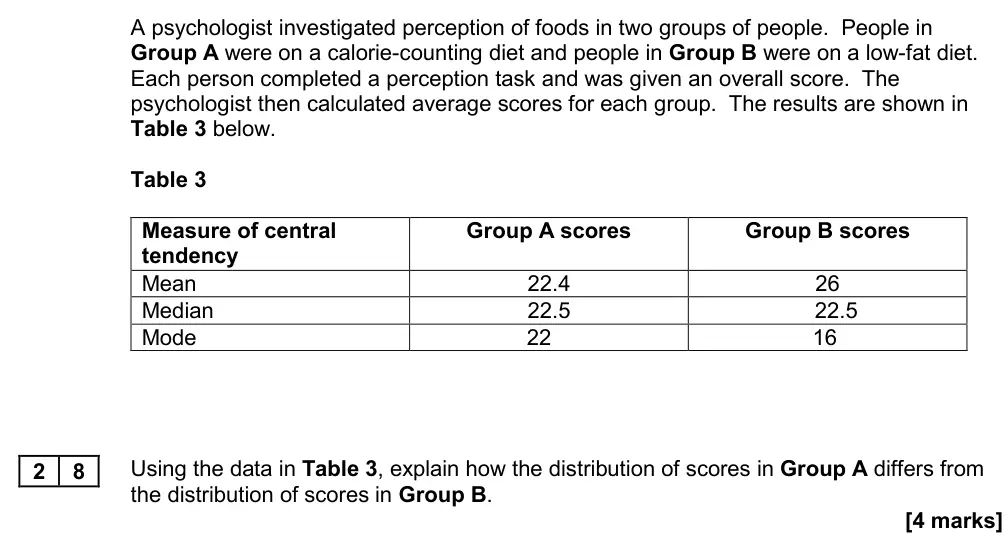
A psychologist investigated perception of foods in two groups of people.  People in
Group A were on a calorie-counting diet and people in Group B were on a low-fat diet.
Each person completed a perception task and was given an overall score.  The
psychologist then calculated average scores for each group.  The results are shown in
Table 3 below.
Table 3
Measure of central
Group A scores
Group B scores
tendency
Mean
22.4
26
Median
22.5
22.5
Mode
22
16
2 8
Using the data in Table 3, explain how the distribution of scores in Group A differs from
the distribution of scores in Group B.
[4 marks]
June 2018 · Paper 3 · Q29 16 marks AO1=6, AO3=10 16-mark essay eating behaviour
2 9
Discuss one or more biological explanations for anorexia nervosa.
[16 marks]
June 2018 · Paper 3 · Q30 2 marks AO1=2 Outline stress
3 0
Briefly outline one therapy used to manage stress.
[2 marks]
June 2018 · Paper 3 · Q31 2 marks AO3=2 Evaluate (short) stress
3 1
Outline one limitation of the therapy in your answer to Question 30.
[2 marks]
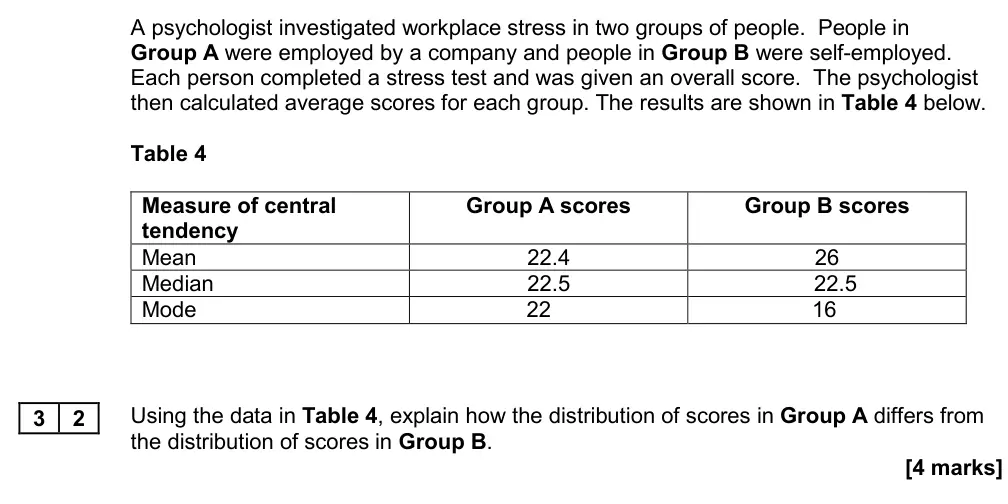
June 2018 · Paper 3 · Q32 4 marks AO2=4 Research methods data handling
A psychologist investigated workplace stress in two groups of people.  People in
Group A were employed by a company and people in Group B were self-employed.
Each person completed a stress test and was given an overall score.  The psychologist
then calculated average scores for each group. The results are shown in Table 4 below.
Table 4
Measure of central
Group A scores
Group B scores
tendency
Mean
22.4
26
Median
22.5
22.5
Mode
22
16
3 2
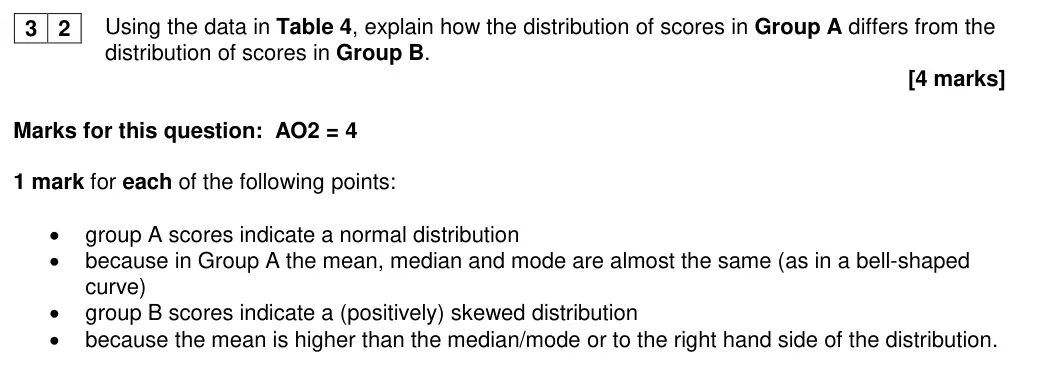
Using the data in Table 4, explain how the distribution of scores in Group A differs from
the distribution of scores in Group B.
[4 marks]
June 2018 · Paper 3 · Q33 16 marks AO1=6, AO3=10 16-mark essay stress
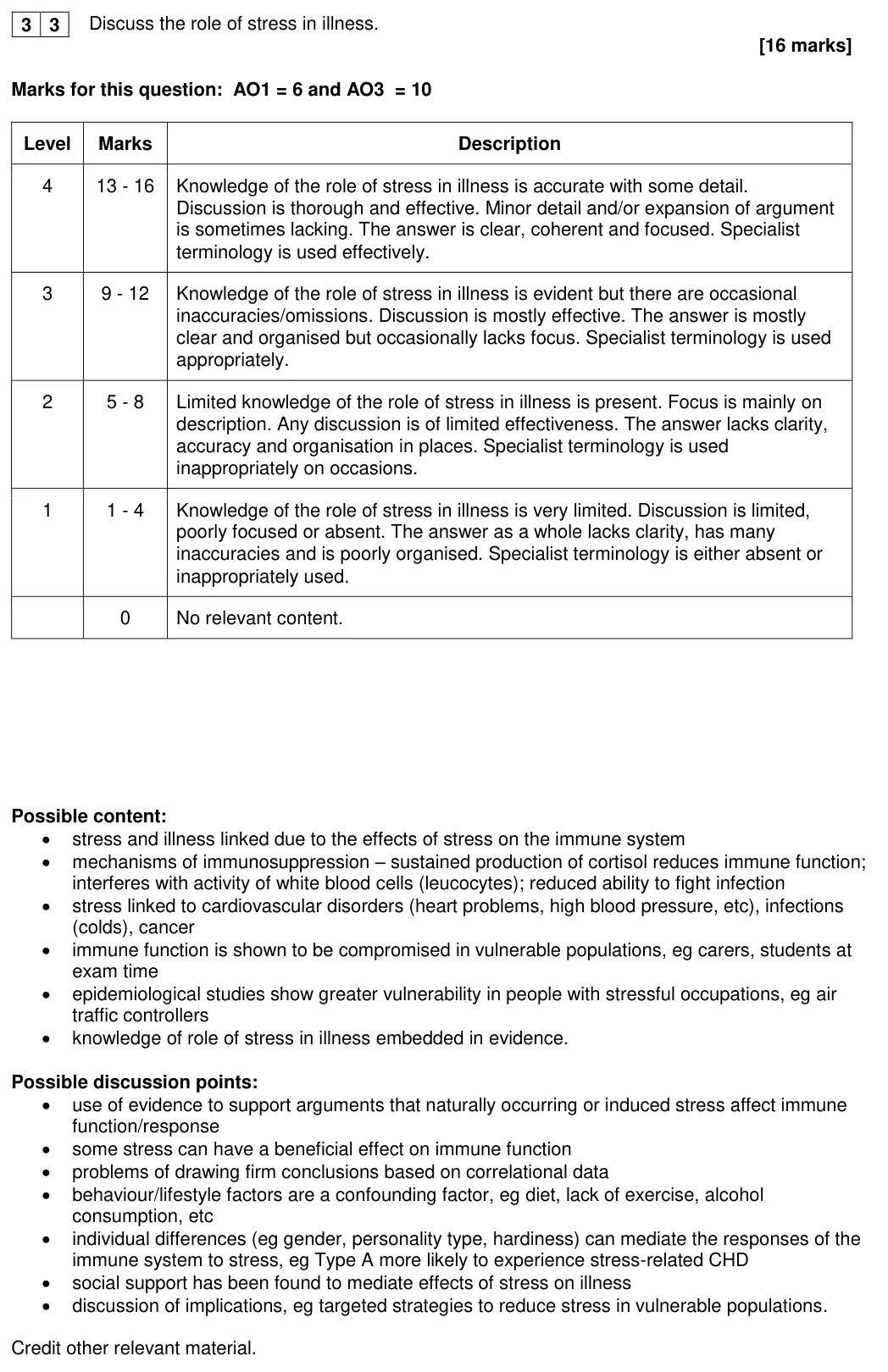
3 3
Discuss the role of stress in illness.
[16 marks]
June 2018 · Paper 3 · Q34 2 marks AO1=2 Multiple choice aggression
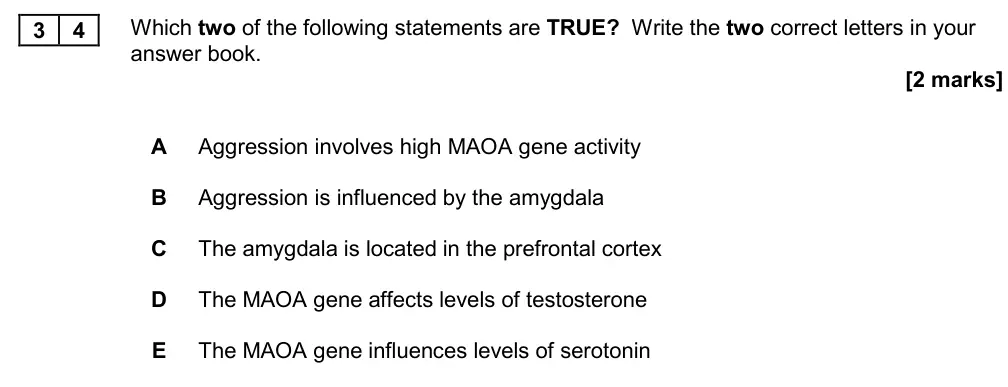
3 4
Which two of the following statements are TRUE?  Write the two correct letters in your
answer book.
[2 marks]
A
Aggression involves high MAOA gene activity
B
Aggression is influenced by the amygdala
C
The amygdala is located in the prefrontal cortex
D
The MAOA gene affects levels of testosterone
E
The MAOA gene influences levels of serotonin
June 2018 · Paper 3 · Q35 6 marks AO3=6 Evaluate (short) aggression
3 5
Some people suggest that the media influences aggression through desensitisation.
Evaluate desensitisation as an explanation for aggression.
[6 marks]
June 2018 · Paper 3 · Q36 16 marks AO1=6, AO2=4, AO3=6 16-mark essay aggression
John was arrested for fighting with supporters of a rival team after a football match.
He explained to the police officer why he was aggressive.  The police officer noted John’s
comments in her notebook.  Table 5 below shows some of John’s comments.
Table 5
The players were fighting on the pitch
Our team lost again – it’s not fair
Supporters of the other team ganged up on us
I was with my mates – we were all punching at once
Everyone else was fighting, so I just joined in
3 6
Discuss one or more social psychological explanations for aggression.  Refer to some of
the comments in Table 5 in your answer.
[16 marks]
June 2018 · Paper 3 · Q37 2 marks AO1=2 Multiple choice forensic psychology
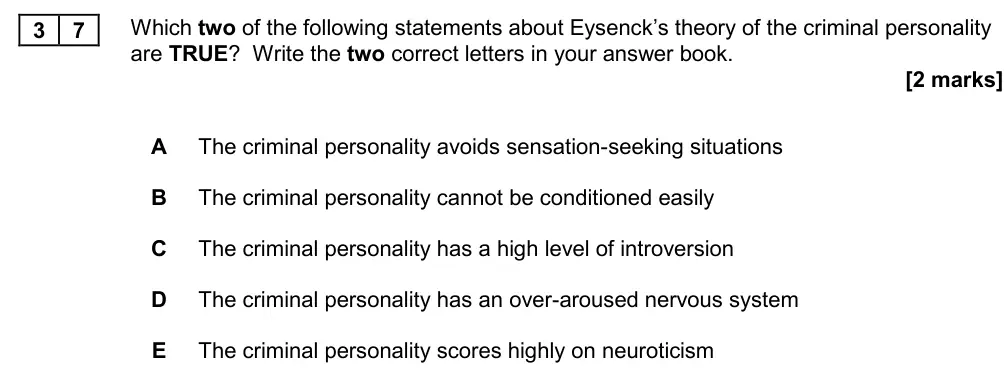
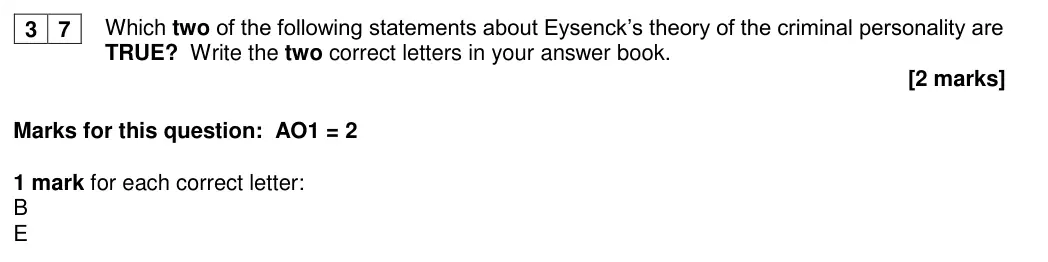
3 7
Which two of the following statements about Eysenck’s theory of the criminal personality
are TRUE?  Write the two correct letters in your answer book.
[2 marks]
A
The criminal personality avoids sensation-seeking situations
B
The criminal personality cannot be conditioned easily
C
The criminal personality has a high level of introversion
D
The criminal personality has an over-aroused nervous system
E
The criminal personality scores highly on neuroticism
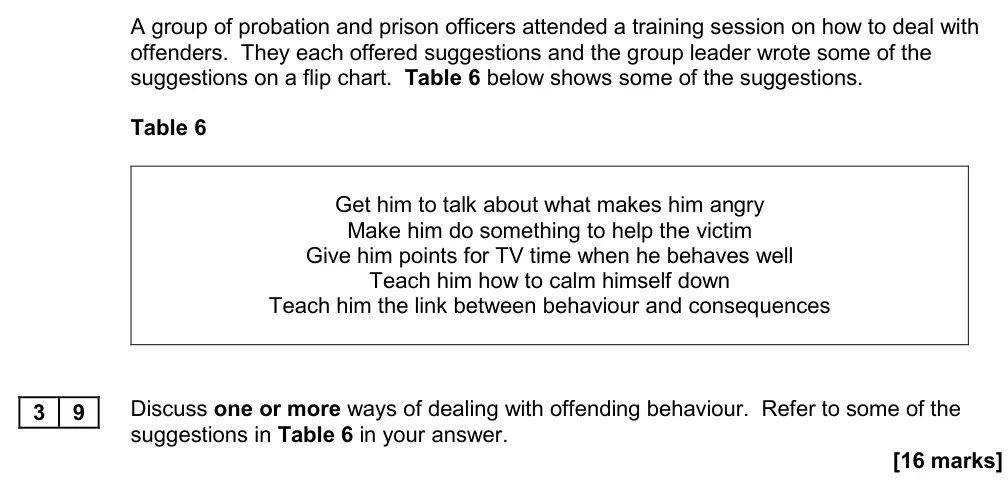
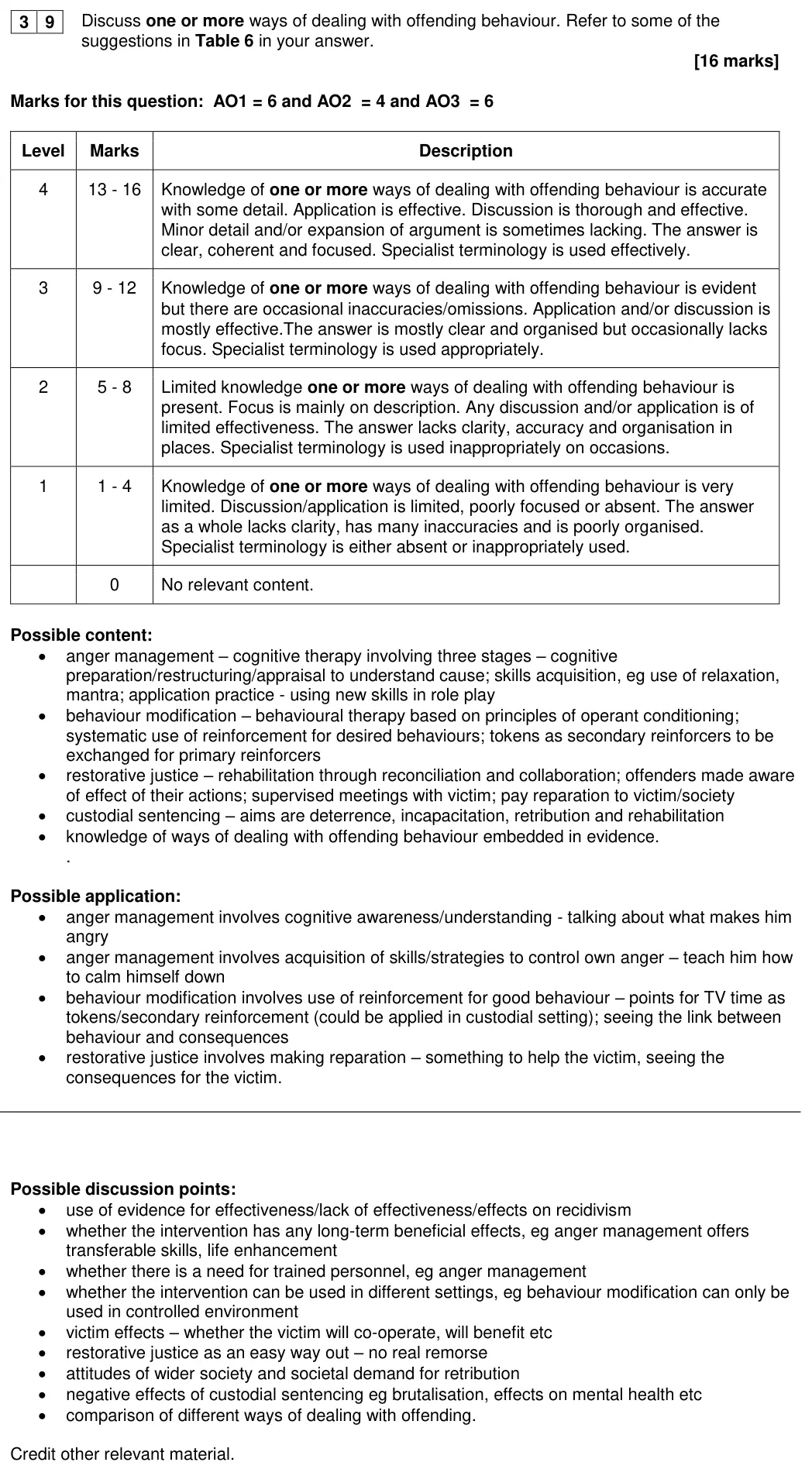
June 2018 · Paper 3 · Q39 16 marks AO1=6, AO2=4, AO3=6 16-mark essay forensic psychology
A group of probation and prison officers attended a training session on how to deal with
offenders.  They each offered suggestions and the group leader wrote some of the
suggestions on a flip chart.  Table 6 below shows some of the suggestions.
Table 6
Get him to talk about what makes him angry
Make him do something to help the victim
Give him points for TV time when he behaves well
Teach him how to calm himself down
Teach him the link between behaviour and consequences
3 9
Discuss one or more ways of dealing with offending behaviour.  Refer to some of the
suggestions in Table 6 in your answer.
[16 marks]
June 2018 · Paper 3 · Q40 2 marks AO1=2 Multiple choice Easy addiction
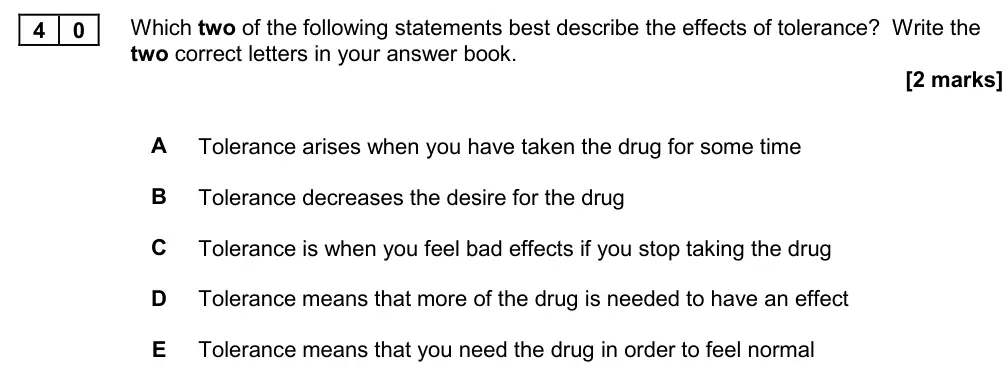
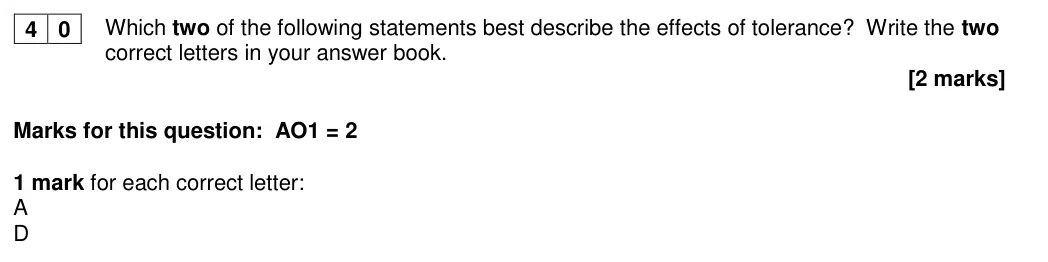
4 0
Which two of the following statements best describe the effects of tolerance?  Write the
two correct letters in your answer book.
[2 marks]
A
Tolerance arises when you have taken the drug for some time
B
Tolerance decreases the desire for the drug
C
Tolerance is when you feel bad effects if you stop taking the drug
D
Tolerance means that more of the drug is needed to have an effect
E
Tolerance means that you need the drug in order to feel normal
June 2018 · Paper 3 · Q41 6 marks AO3=6 Evaluate (short) addiction
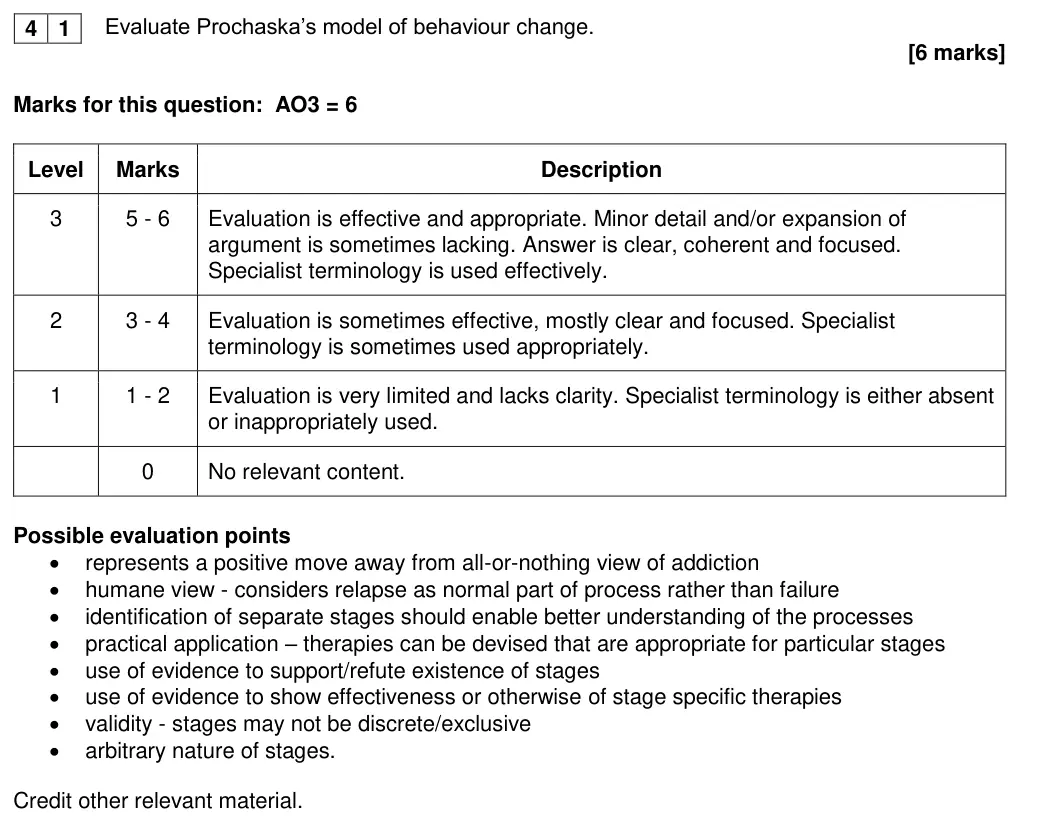
4 1
Evaluate Prochaska’s model of behaviour change.
[6 marks]
June 2018 · Paper 3 · Q42 16 marks AO1=6, AO2=4, AO3=6 16-mark essay addiction
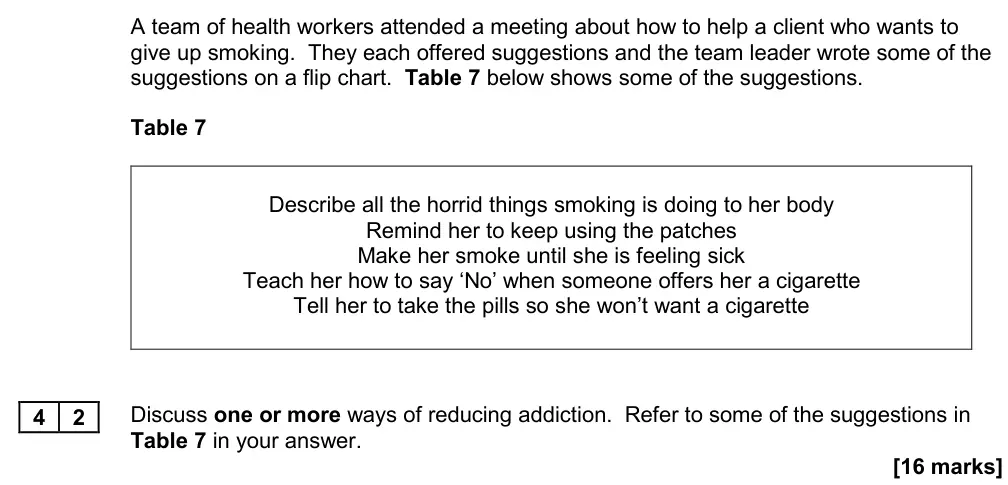
A team of health workers attended a meeting about how to help a client who wants to
give up smoking.  They each offered suggestions and the team leader wrote some of the
suggestions on a flip chart.  Table 7 below shows some of the suggestions.
Table 7
Describe all the horrid things smoking is doing to her body
Remind her to keep using the patches
Make her smoke until she is feeling sick
Teach her how to say ‘No’ when someone offers her a cigarette
Tell her to take the pills so she won’t want a cigarette
4 2
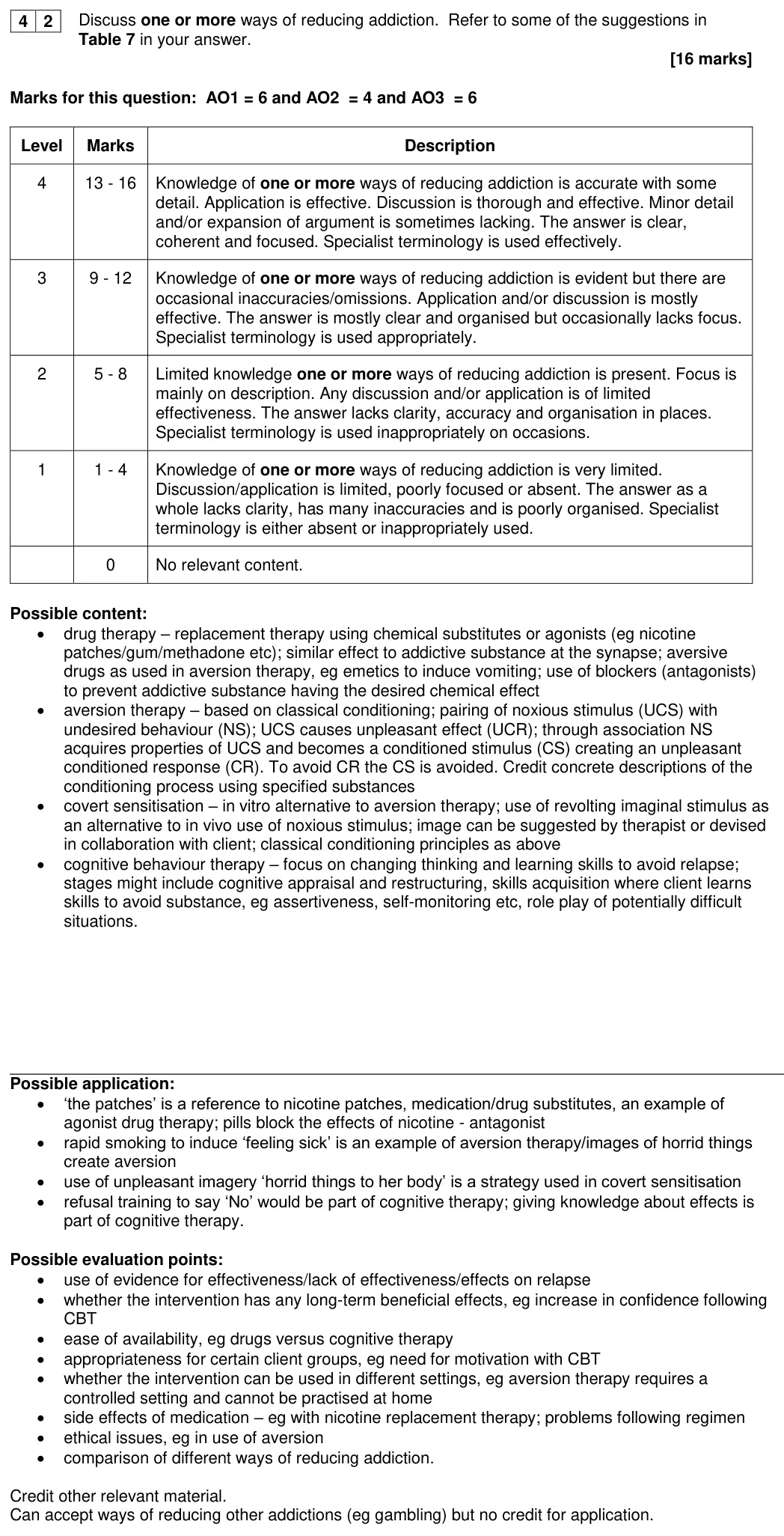
Discuss one or more ways of reducing addiction.  Refer to some of the suggestions in
Table 7 in your answer.
[16 marks]

Work with an AQA psychology tutor

Want a paper marked and gone through with you? Message us.

Prefer email? Send an enquiry

If you are under 18, please include a parent's contact details. Enquiries go to enquiries@alevelpsychologytutor.com and are deleted once handled. All tutoring is online.