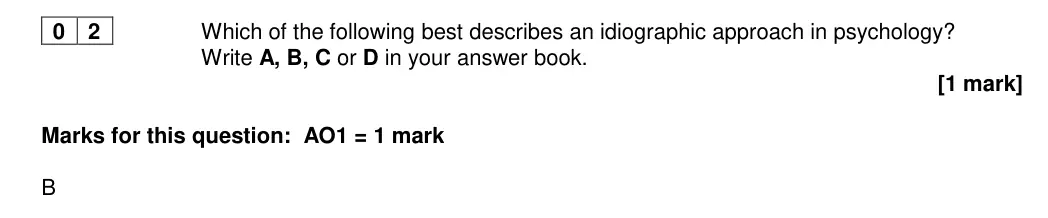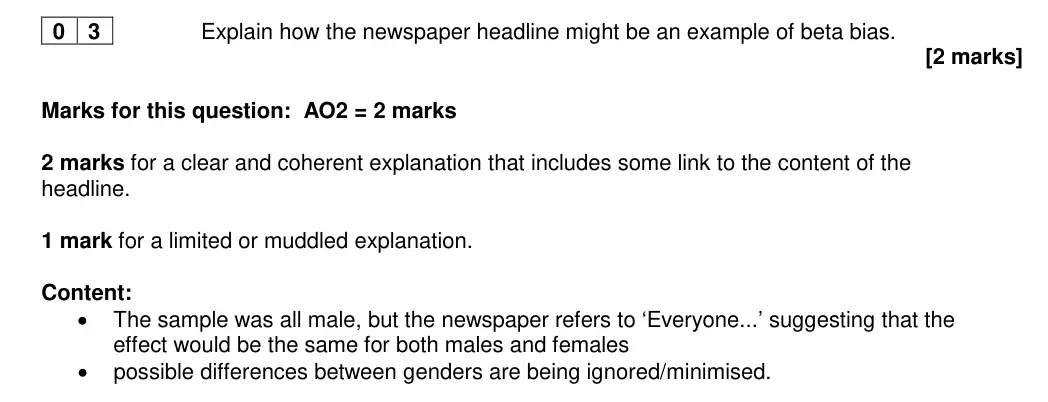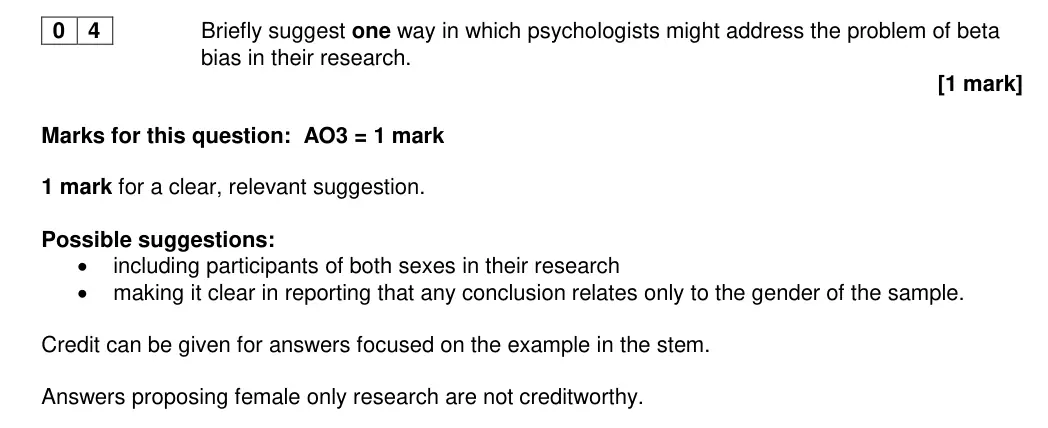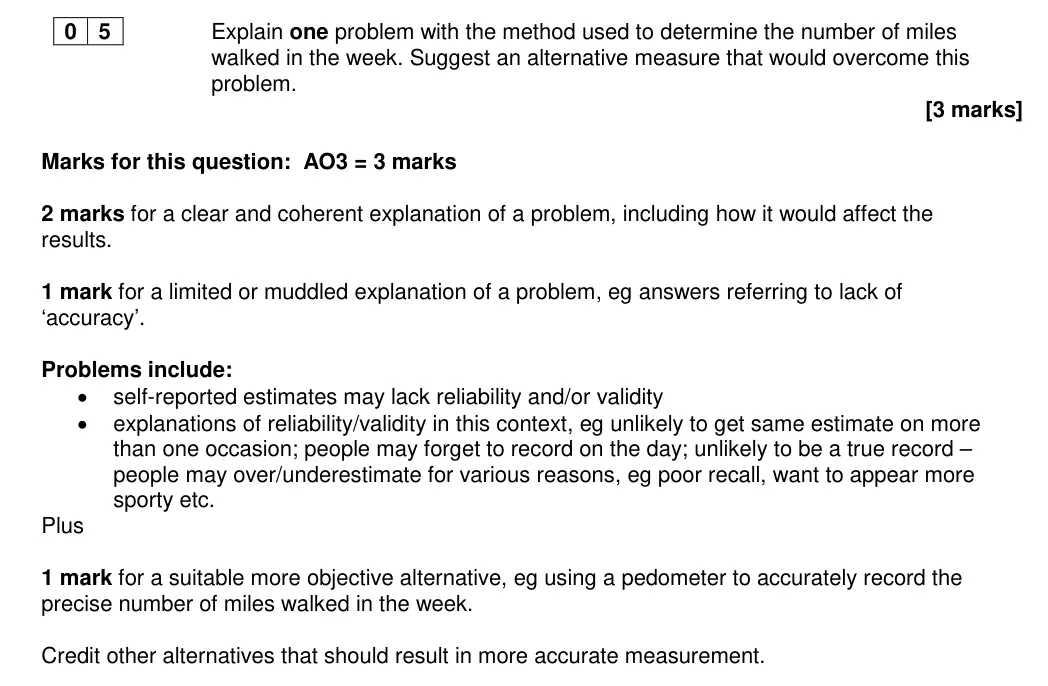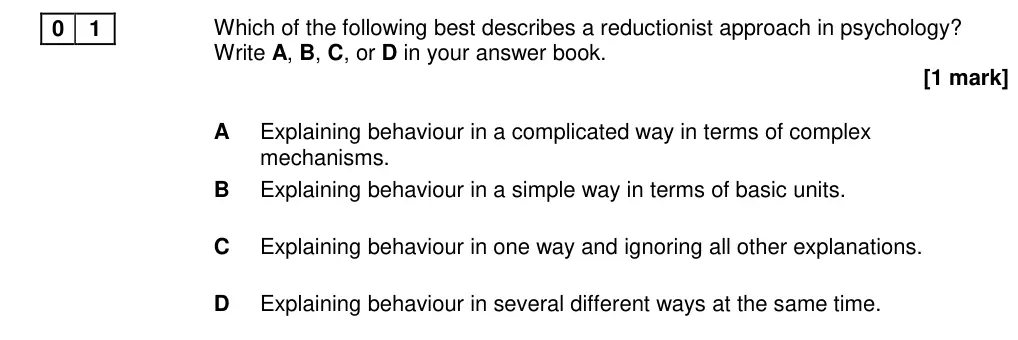
Answer
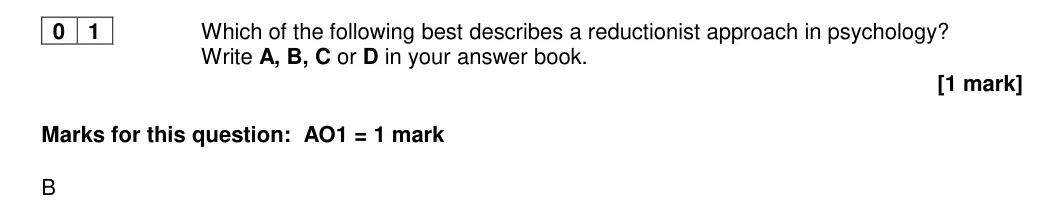
B
Mark scheme, including level descriptors and indicative content
Examiner's comment
This question was answered correctly by 62% of students.
Notes from the mark scheme and report
- answer B (simple terms, basic units)
- 62% correct
240 marks · 45 question parts · AQA no longer hosts this series; the copies here come from third-party archives
This paper was set on the previous specification. 5 parts are on content removed in the 2025 specification and are marked "Old spec only".
| Q | Topic | Marks | AO | Type |
|---|---|---|---|---|
| 1 | Issues and debates | 1 | AO1=1 | Multiple choice |
| 2 | Issues and debates | 1 | AO1=1 | Multiple choice |
| 3 | Issues and debates | 2 | AO2=2 | Application |
| 4 | Issues and debates | 1 | AO3=1 | Explain |
| 5 | Research methods: scientific processes, Research methods: methods and techniques | 3 | AO3=3 | Research methods |
| 6 | Issues and debates | 16 | AO1=6,AO2=4,AO3=6 | Extended writing |
| 7 | Relationships | 2 | AO1=2 | Multiple choice |
| 8 | Research methods: scientific processes | 2 | AO3=2 | Research methods |
| 9 | Relationships | 4 | AO2=4 | Application |
| 10 | Relationships | 16 | AO1=6,AO3=10 | Extended writing |
| 11 | Approaches in psychologyOld spec | 2 | AO1=2 | Multiple choice |
| 12 | Research methods: scientific processes | 2 | AO3=2 | Research methods |
| 13 | Gender | 4 | AO2=4 | Application |
| 14 | Gender | 16 | AO1=6,AO3=10 | Extended writing |
| 15 | Cognition and development | 2 | AO1=2 | Multiple choice |
| 16 | Research methods: scientific processes | 2 | AO3=2 | Research methods |
| 17 | Cognition and development | 4 | AO2=4 | Application |
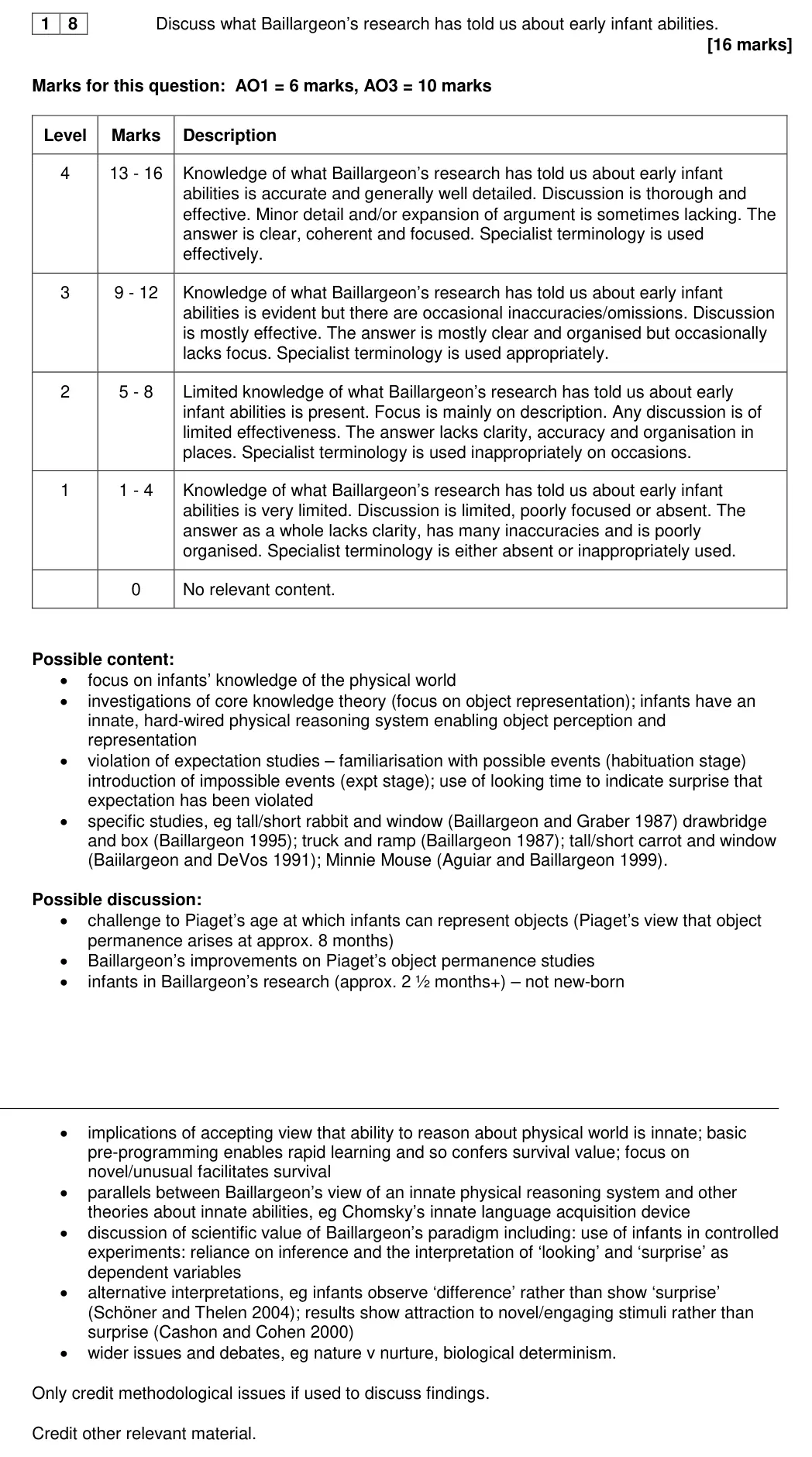
| 18 | Cognition and development | 16 | AO1=6,AO3=10 | Extended writing |
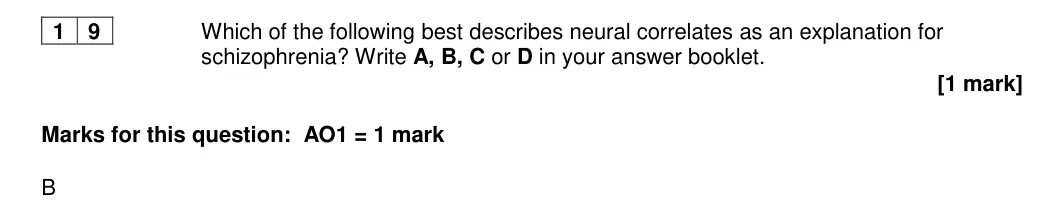
| 19 | Schizophrenia | 1 | AO1=1 | Multiple choice |
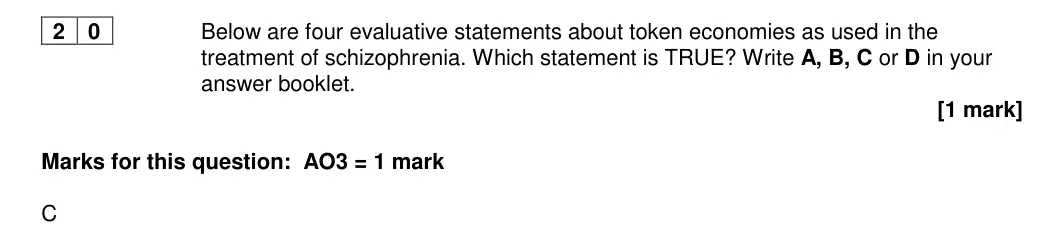
| 20 | Schizophrenia, Approaches in psychologyOld spec | 1 | AO3=1 | Multiple choice |
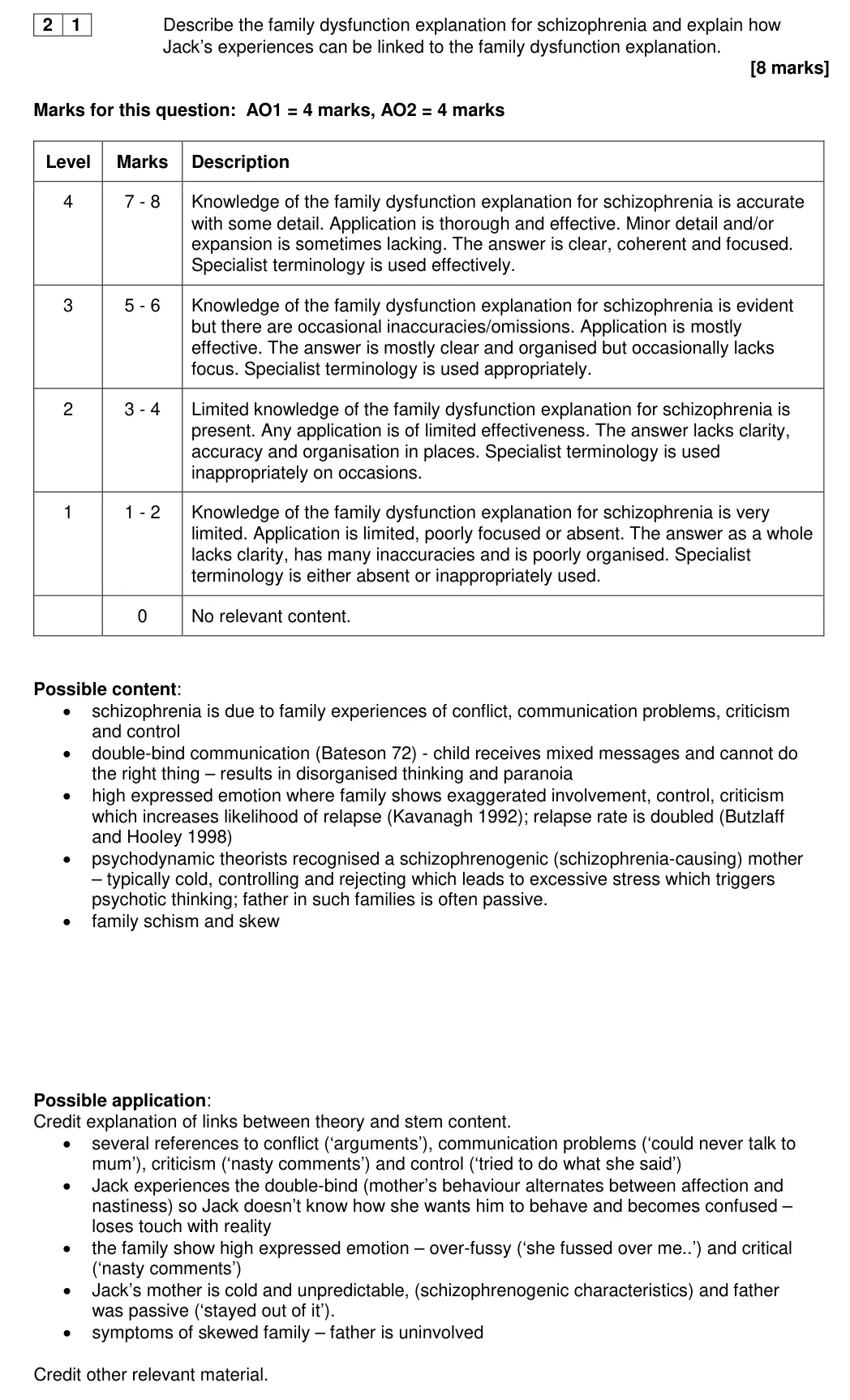
| 21 | Schizophrenia | 8 | AO1=4,AO2=4 | Extended writing |
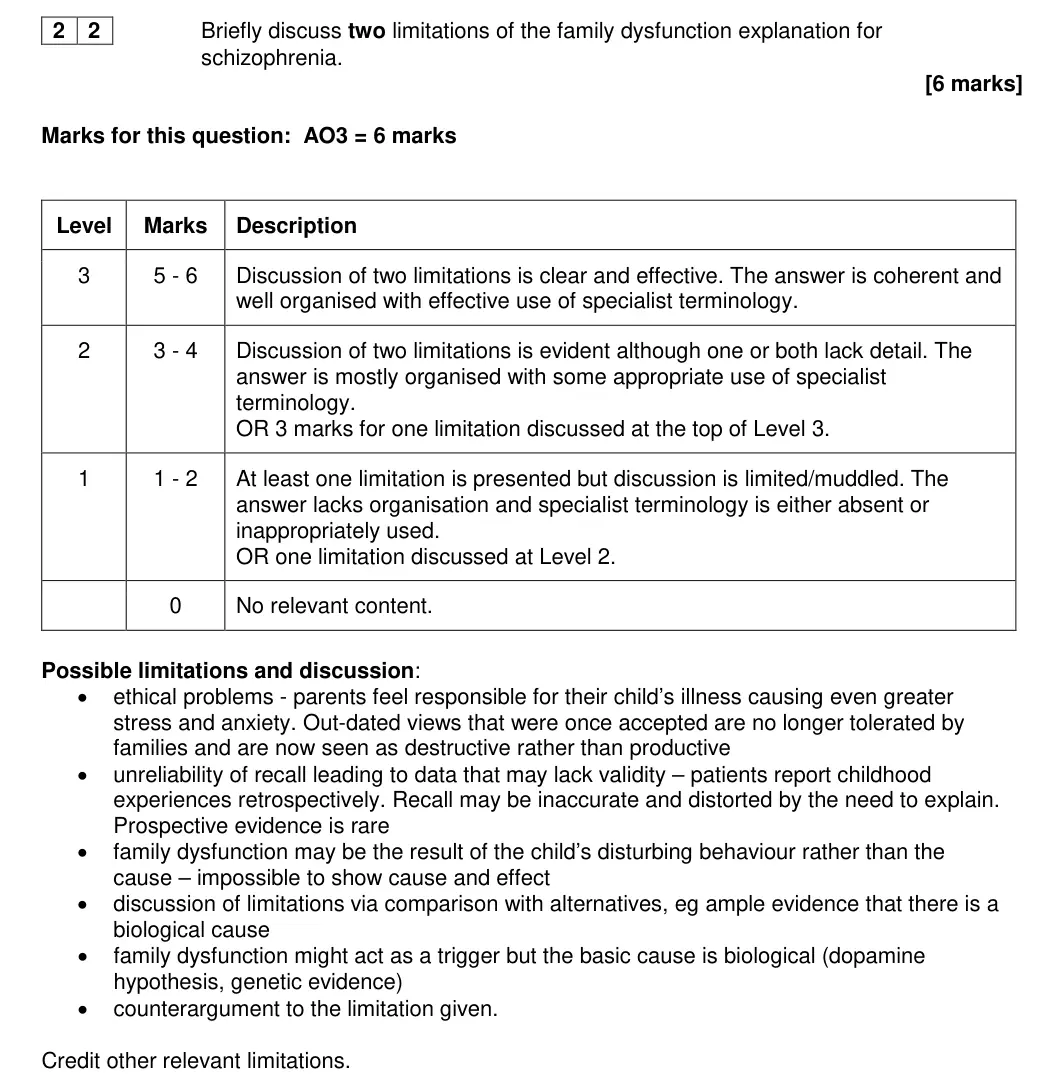
| 22 | Schizophrenia | 6 | AO3=6 | Evaluate (short) |
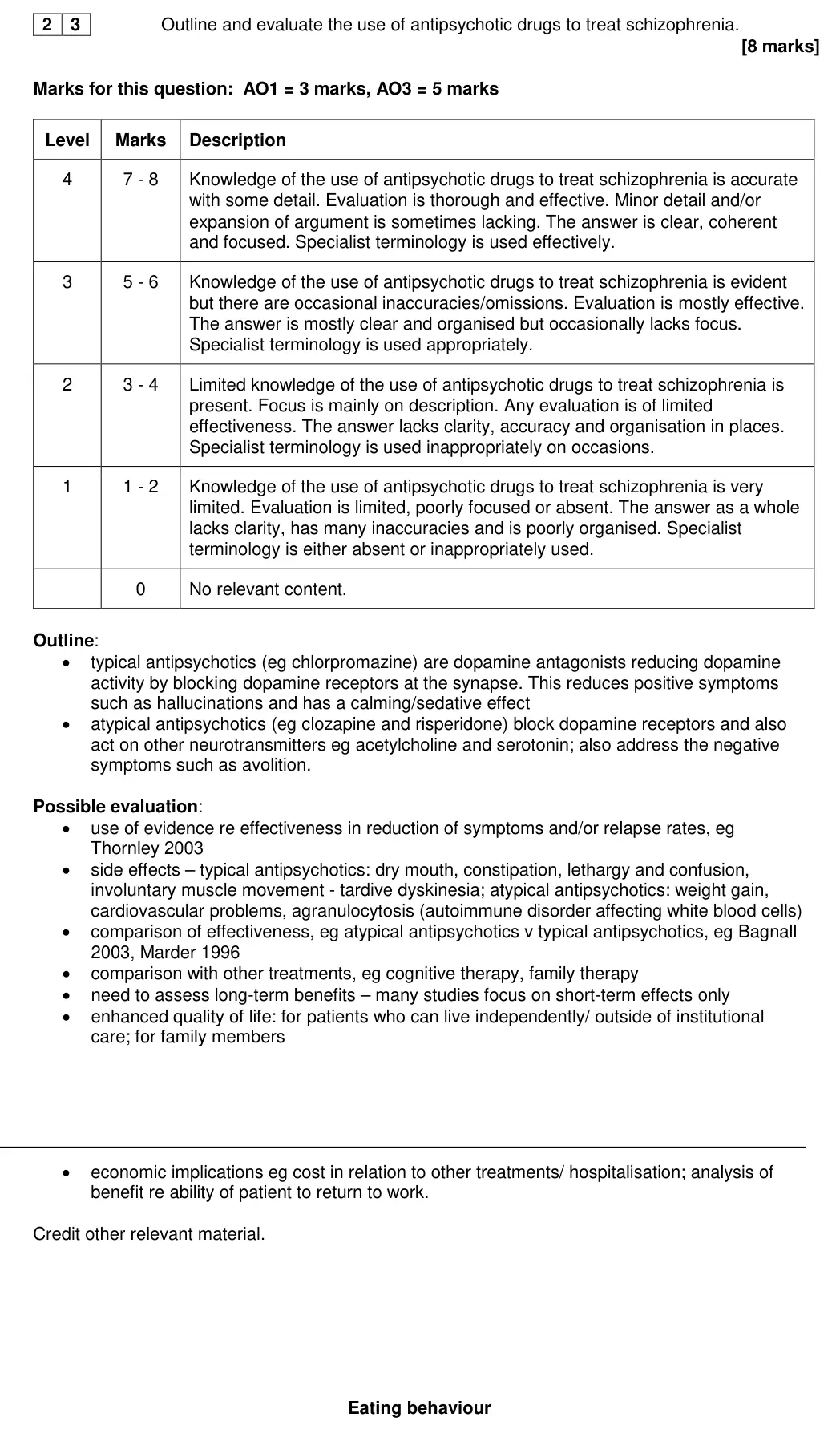
| 23 | Schizophrenia | 8 | AO1=3,AO3=5 | Extended writing |
| 24 | Eating behaviour | 1 | AO1=1 | Multiple choice |
| 25 | Eating behaviour | 1 | AO3=1 | Multiple choice |
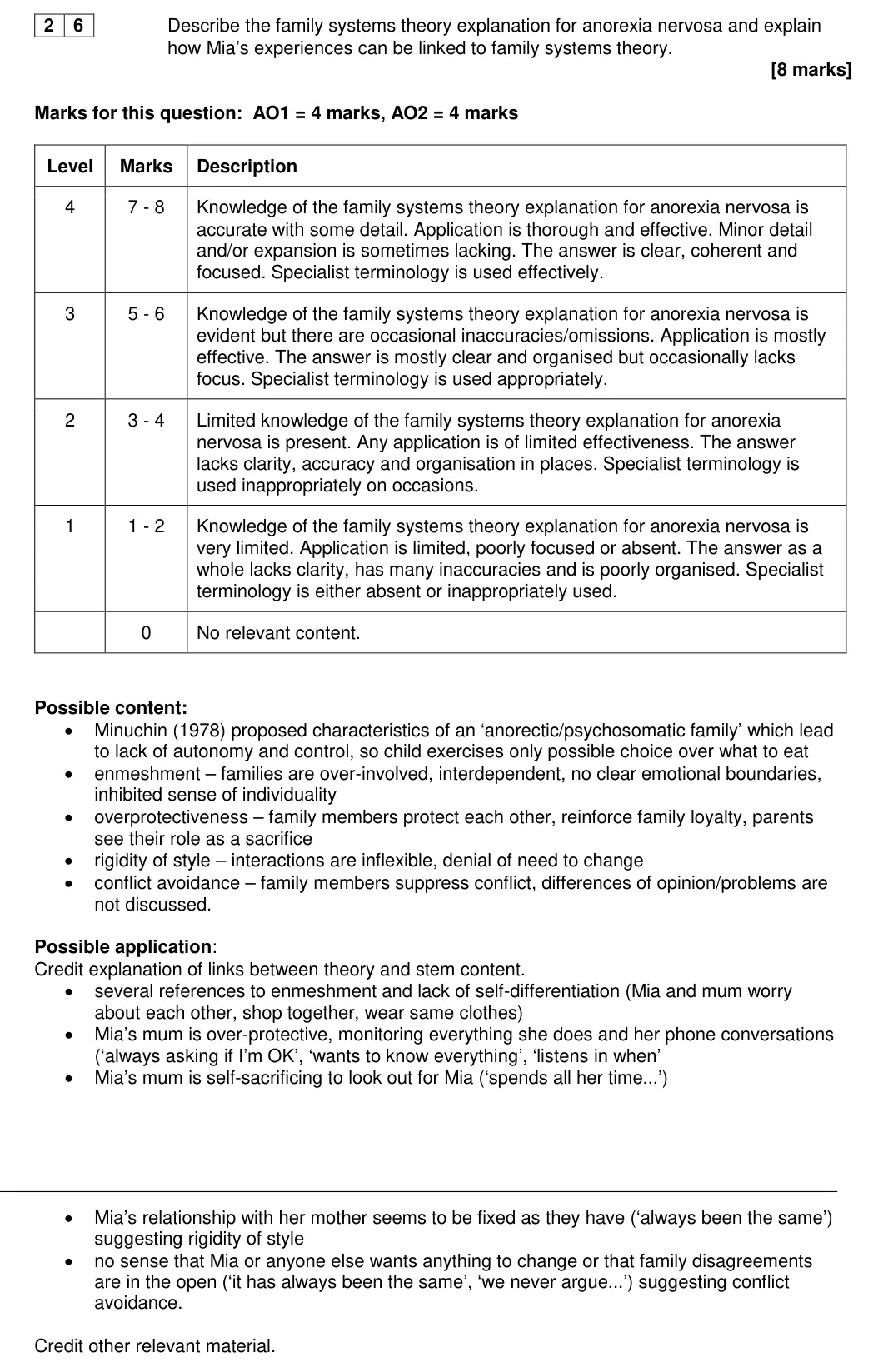
| 26 | Eating behaviour | 8 | AO1=4,AO2=4 | Extended writing |
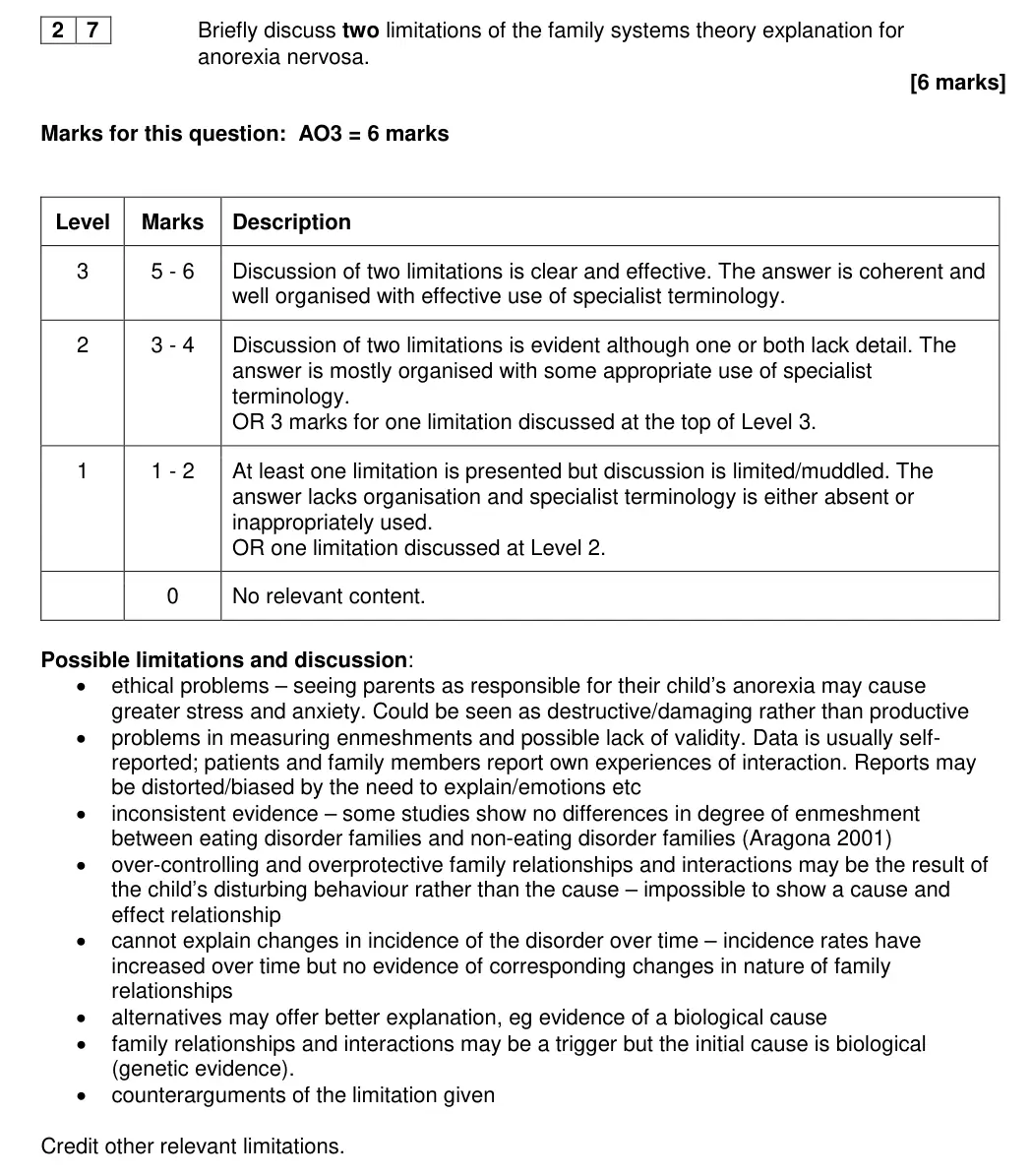
| 27 | Eating behaviour | 6 | AO3=6 | Evaluate (short) |
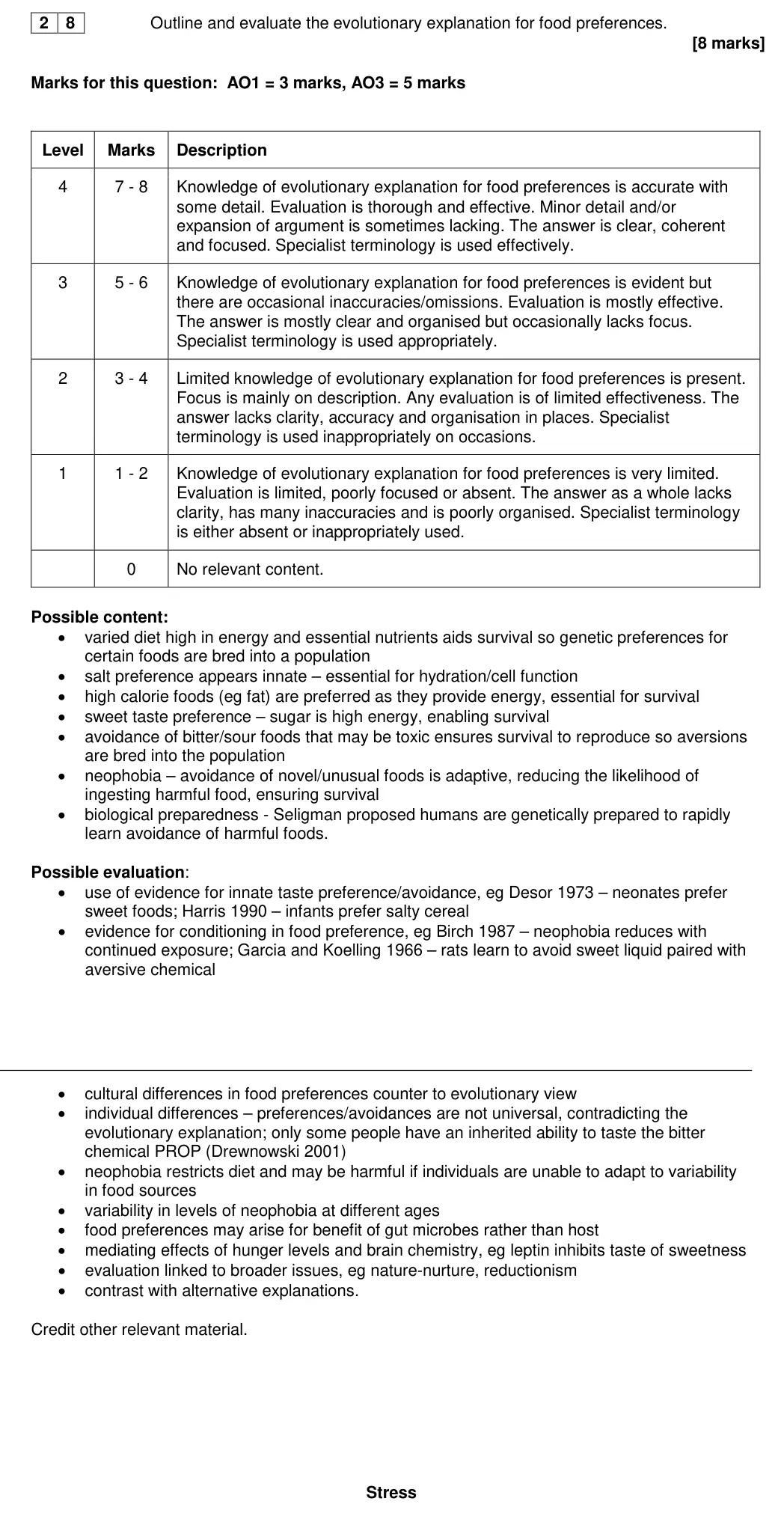
| 28 | Eating behaviour | 8 | AO1=3,AO3=5 | Extended writing |
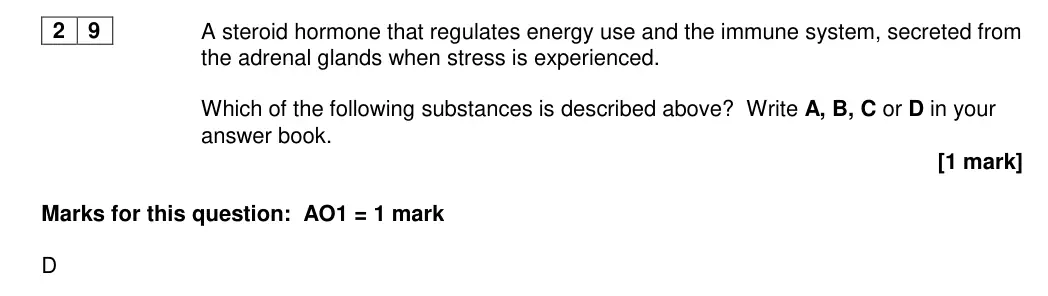
| 29 | Stress | 1 | AO1=1 | Multiple choice |
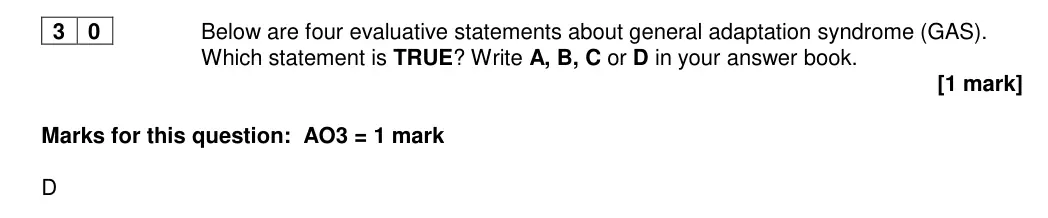
| 30 | Stress | 1 | AO3=1 | Multiple choice |
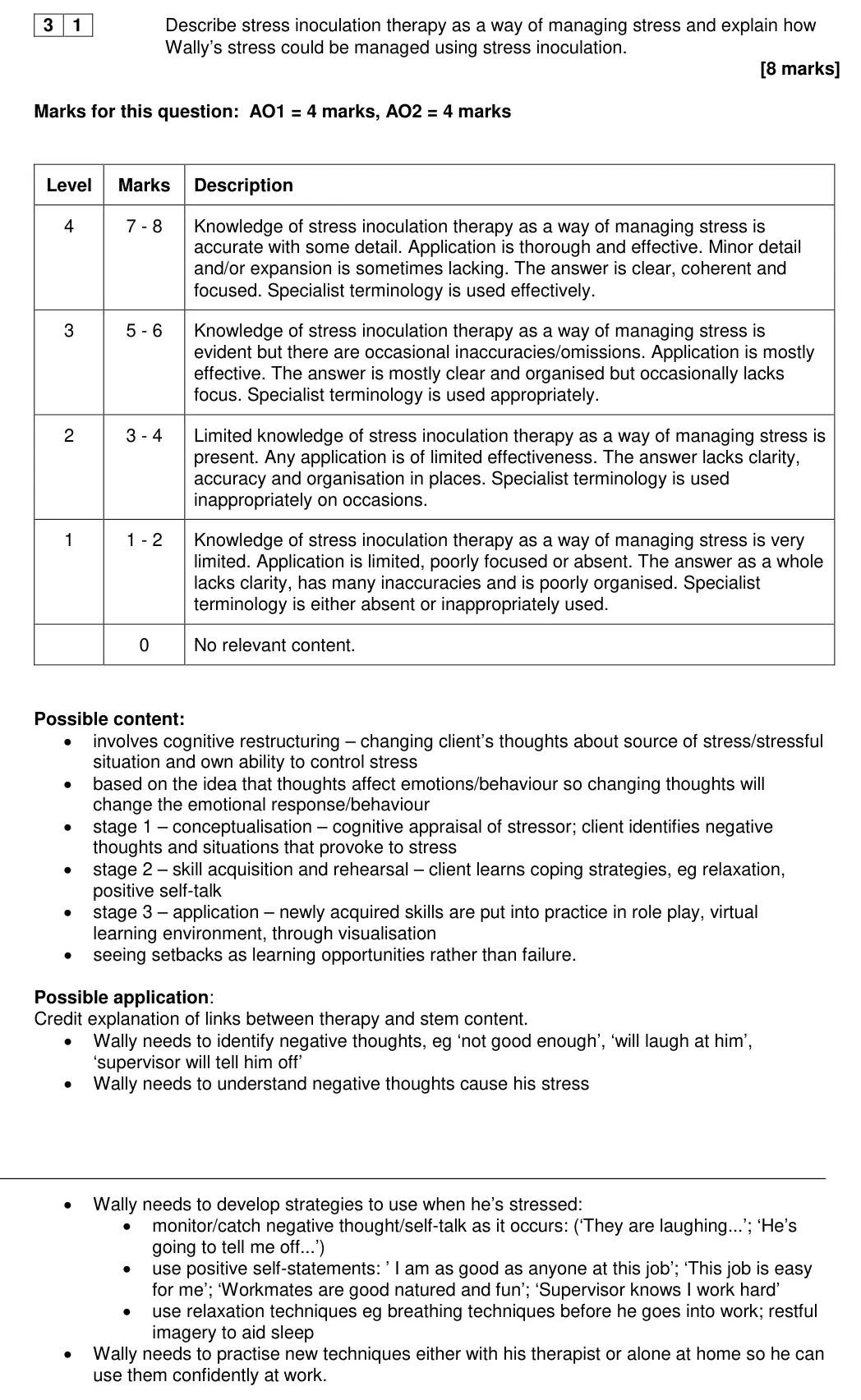
| 31 | Stress | 8 | AO1=4,AO2=4 | Extended writing |
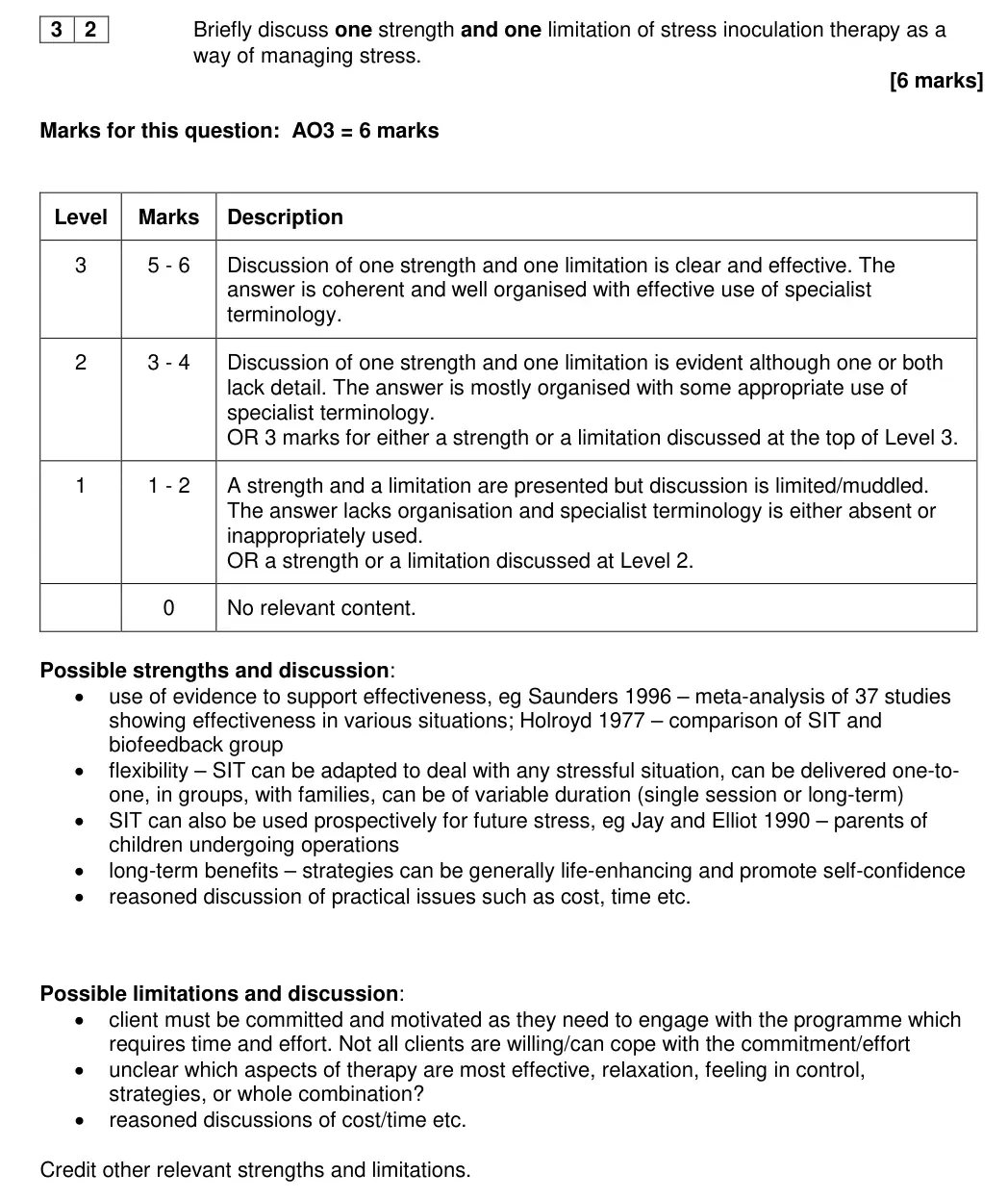
| 32 | Stress | 6 | AO3=6 | Evaluate (short) |
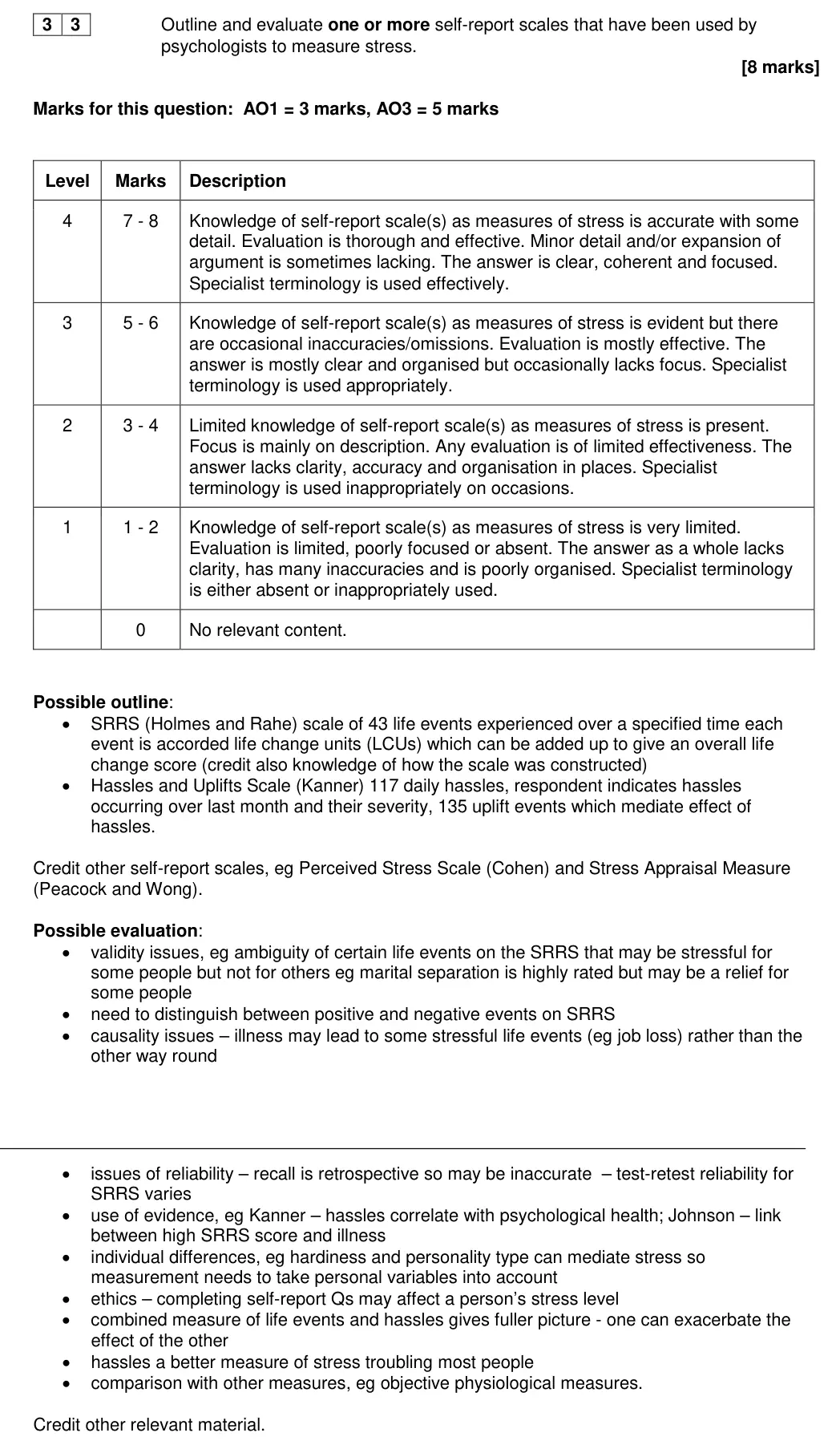
| 33 | Stress | 8 | AO1=3,AO3=5 | Extended writing |
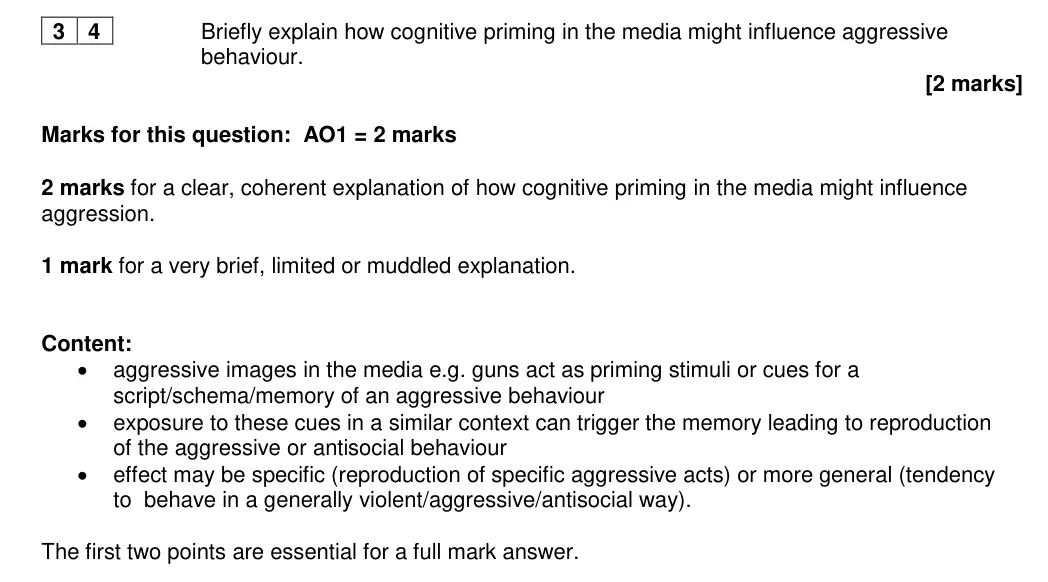
| 34 | Aggression | 2 | AO1=2 | Explain |
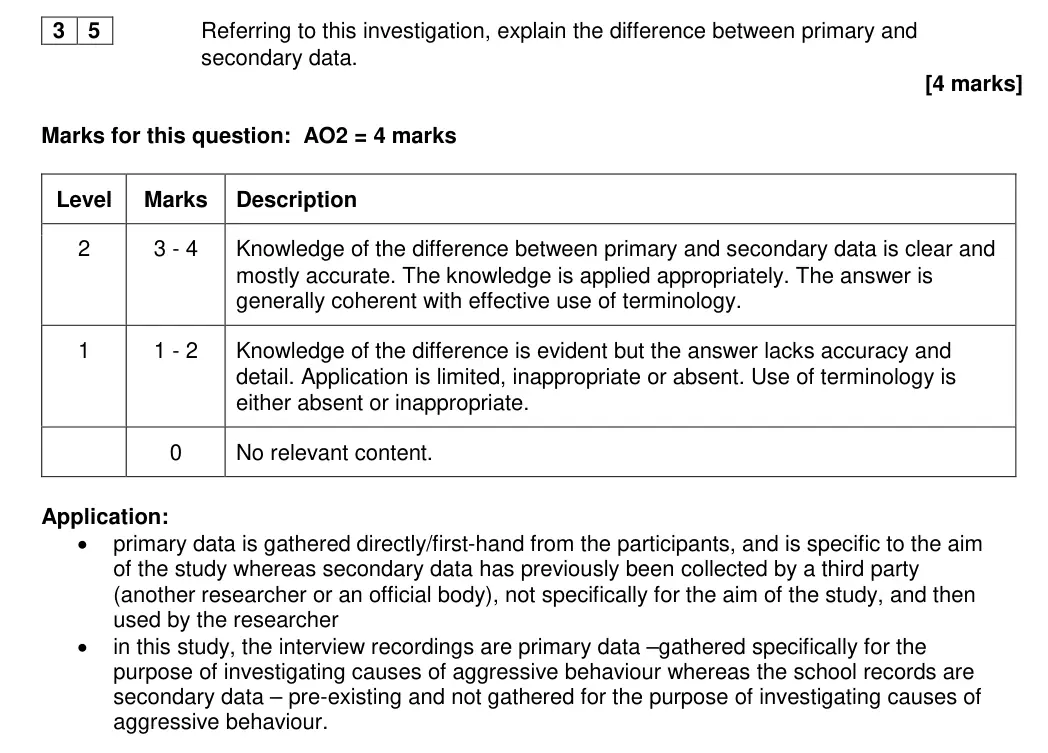
| 35 | Research methods: data handling and analysis | 4 | AO2=4 | Research methods |
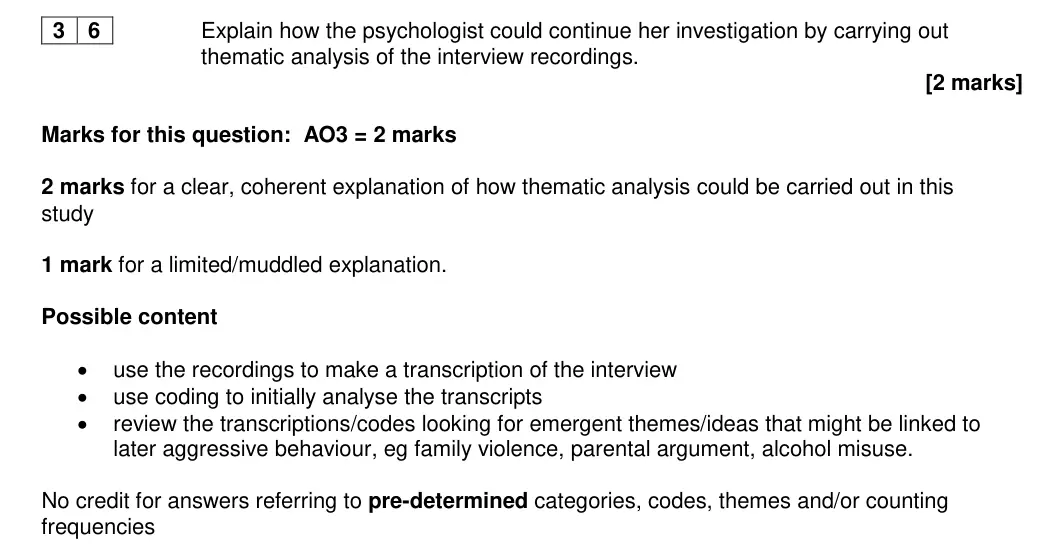
| 36 | Research methods: methods and techniques, Research methods: data handling and analysisOld spec | 2 | AO3=2 | Research methods |
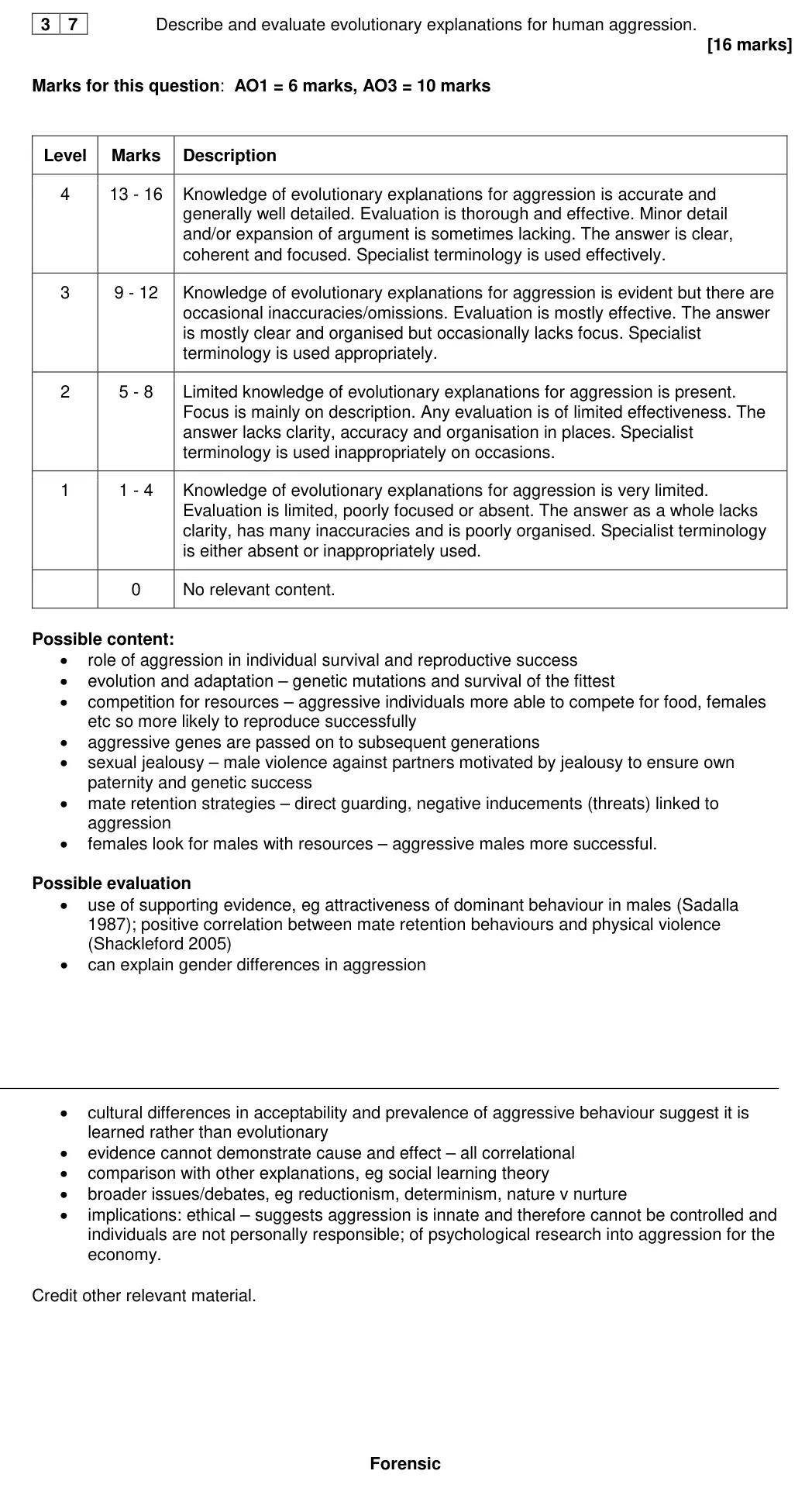
| 37 | Aggression | 16 | AO1=6,AO3=10 | Extended writing |
| 38 | Forensic psychology | 2 | AO1=2 | Explain |
| 39 | Research methods: data handling and analysis | 4 | AO2=4 | Research methods |
| 40 | Research methods: methods and techniques, Research methods: data handling and analysisOld spec | 2 | AO3=2 | Research methods |
| 41 | Forensic psychology | 16 | AO1=6,AO3=10 | Extended writing |
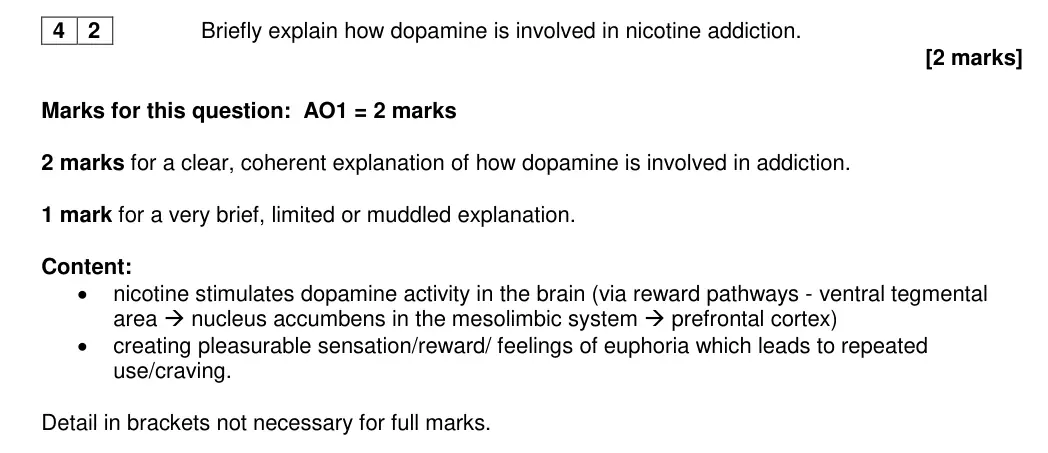
| 42 | Addiction | 2 | AO1=2 | Explain |
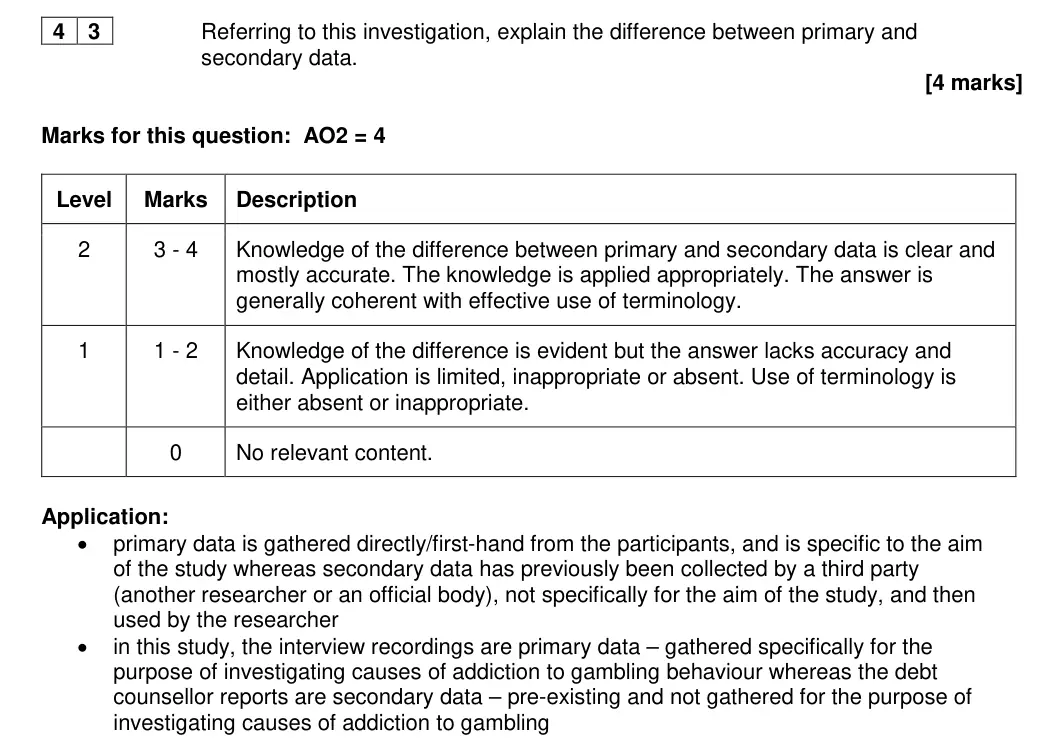
| 43 | Research methods: data handling and analysis | 4 | AO2=4 | Research methods |
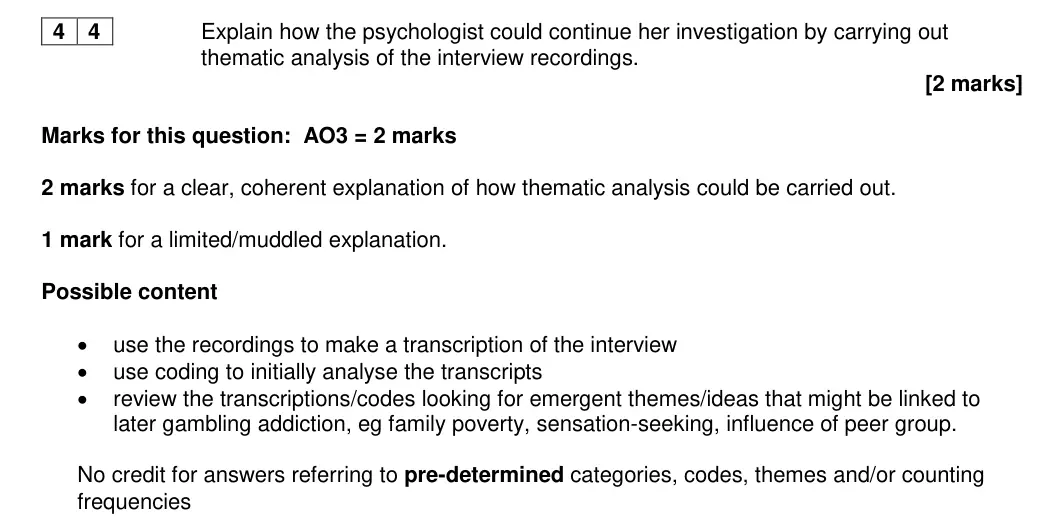
| 44 | Research methods: methods and techniques, Research methods: data handling and analysisOld spec | 2 | AO3=2 | Research methods |
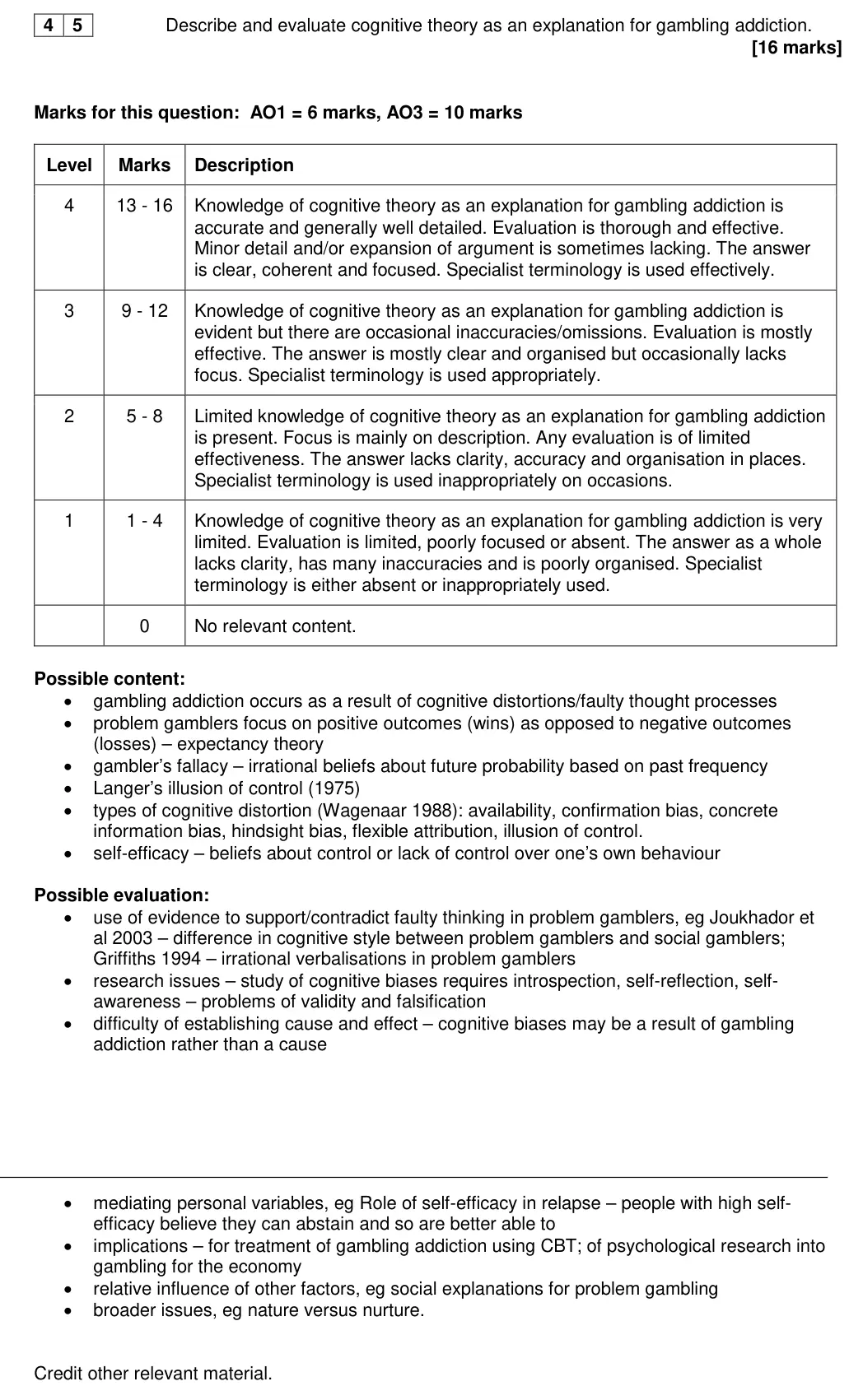
| 45 | Addiction | 16 | AO1=6,AO3=10 | Extended writing |
B
This question was answered correctly by 62% of students.
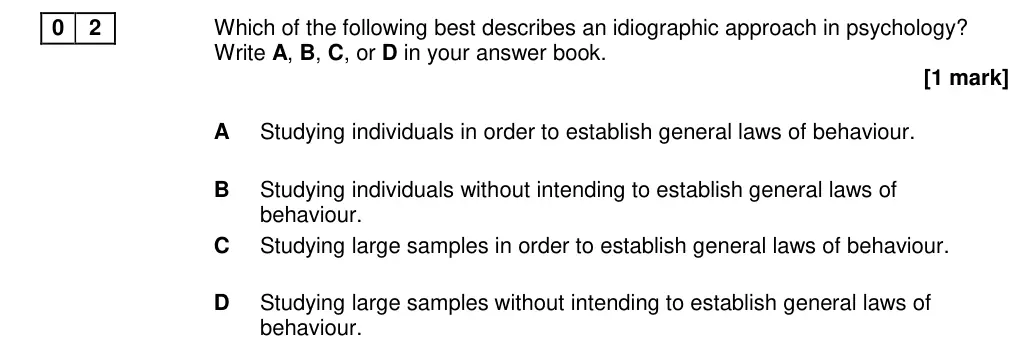
B
This question was answered correctly by 71% of students.
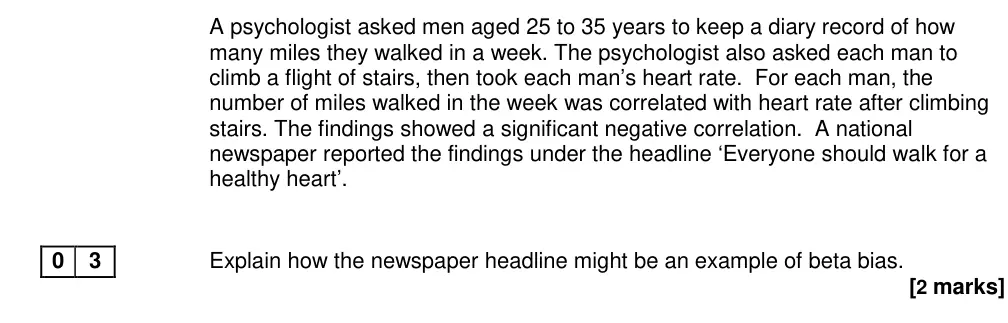
This was generally well answered, although students sometimes forgot to make reference to the headline and simply provided a definition of beta bias. Occasionally, the response focused on the issue of age rather than gender.

Where students understood the concept of beta bias this was well answered. The most common suggestion was to include women in the sample, but the equally creditworthy suggestion of ensuring that the results of the male only study were generalised only to males was also seen occasionally. Responses suggesting female only research did not gain credit, although a lenient view was taken here if the response implied that findings from a female only sample would be considered alongside the existing male only sample.

This question was generally well answered. Most students could suggest a valid problem and included some explanation of how it might have affected the outcome of the study. Less successful responses cited concepts such as social desirability or demand characteristics without offering any explanation of how these factors might operate in this situation. Suggestions for alternative ways of measuring the distance usually focused on some sort of technological device, for example steppers, GPS trackers, phone apps and fit-bits. Occasionally, students forgot to offer any alternative or offered an impractical suggestion, such as covert observation. Some students appeared to have completely misapprehended the question and offered bizarre solutions, for example measuring the height and tread of the stairs and converting this into miles.
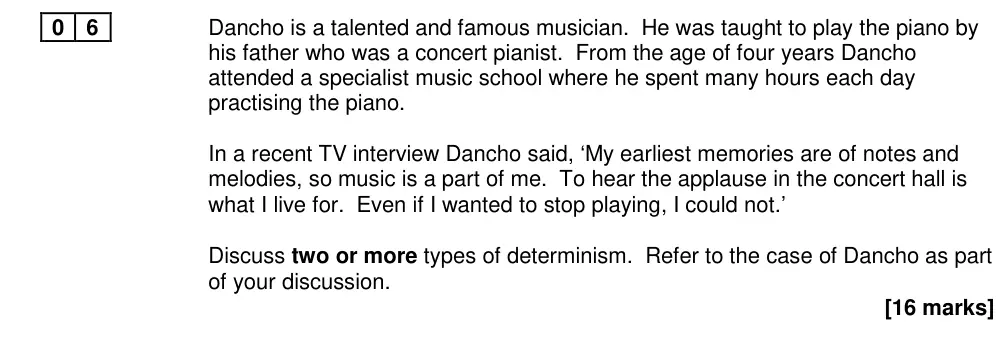
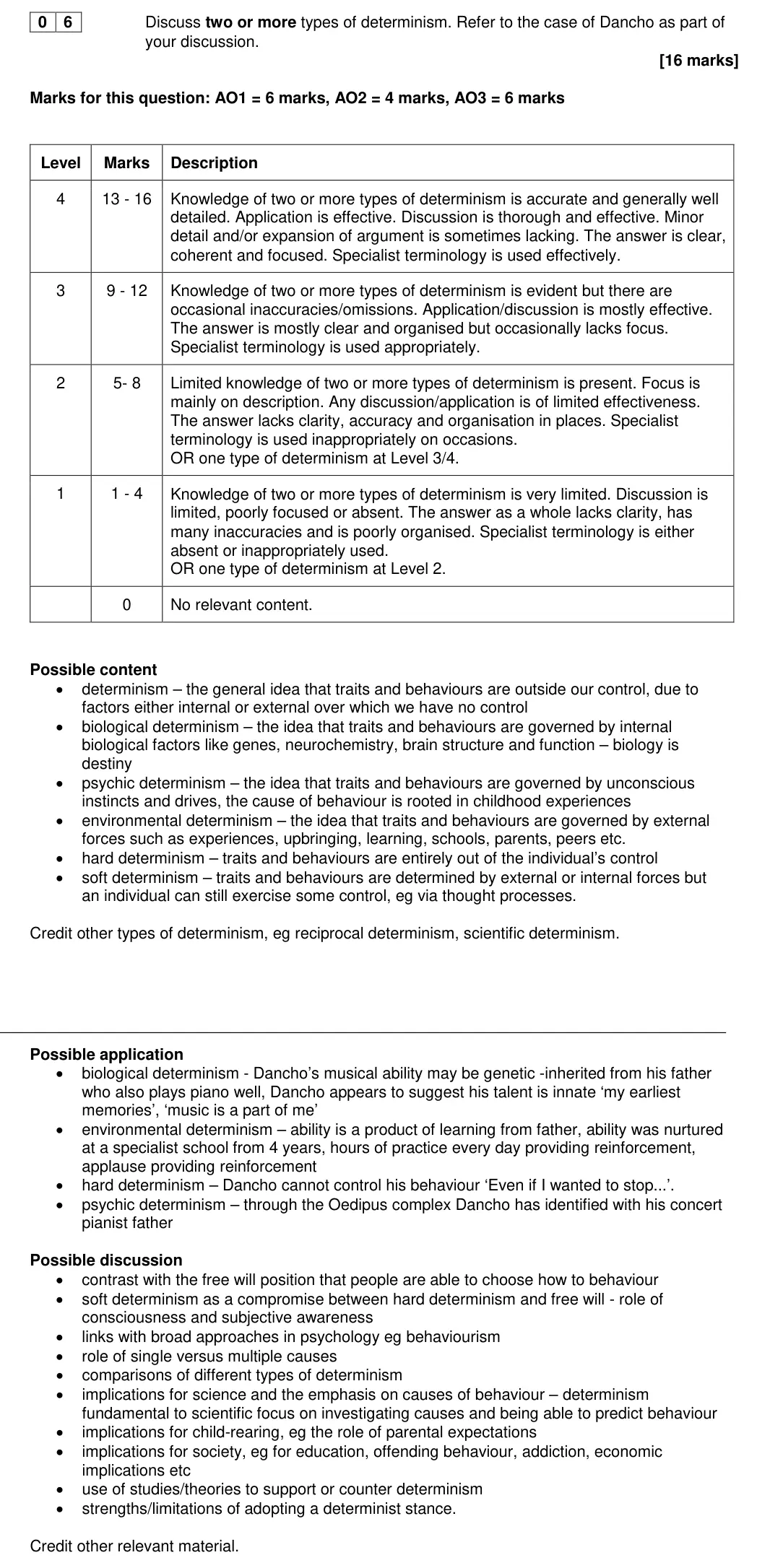
Most students were able to identify at least two types of determinism, although descriptions that followed were often vague. Use of terminology was frequently inappropriate, for example ‘behavioural determinism’ and ‘psychological determinism’ were seen in place of environmental and psychic determinism. Whilst understanding of biological and environmental determinism was usually sound, psychic determinism was less well presented, with many students failing to explain the key point, that behaviour is governed by the unconscious. There was a widespread tendency to conflate broad types, such as hard and soft, with specific types, such as biological and environmental. Application was usually sensible, if fairly perfunctory, although many better answers showed thoughtful and sustained application. Quite sensibly, discussions considered the types of determinism in relation to the various approaches in psychology and often illustrated their points with reference to specific topics. Unfortunately, some students became side-tracked into a discussion on the approaches or nature-nurture debate and completely lost focus on the question. Many discussions confused determinism and reductionism. Consideration of the implications of accepting the various types of determinism provided an effective route to discussion in better answers. A number of students presented fairly ineffective pre-prepared essays on the free-will and determinism debate.
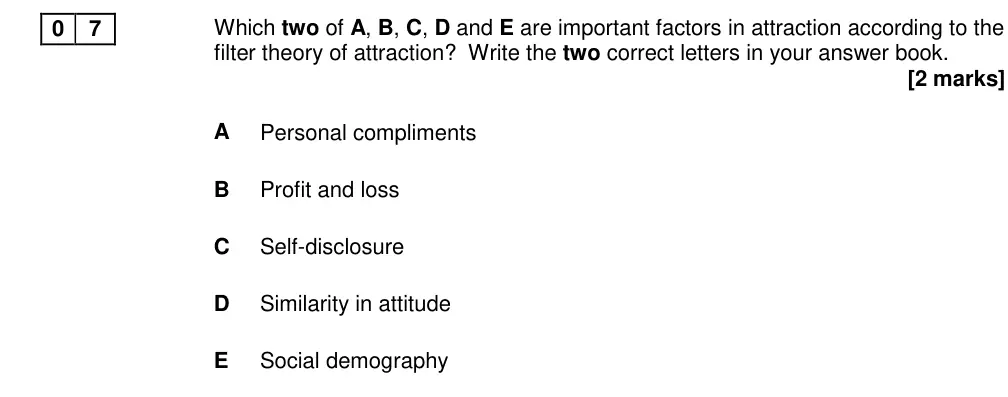
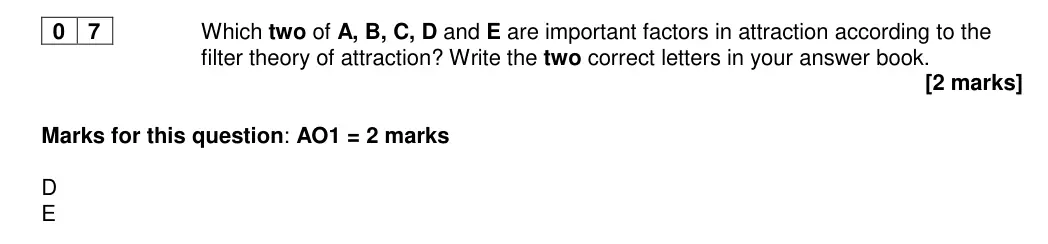
D and E
Students did well on this question with the majority getting the full 2 marks.
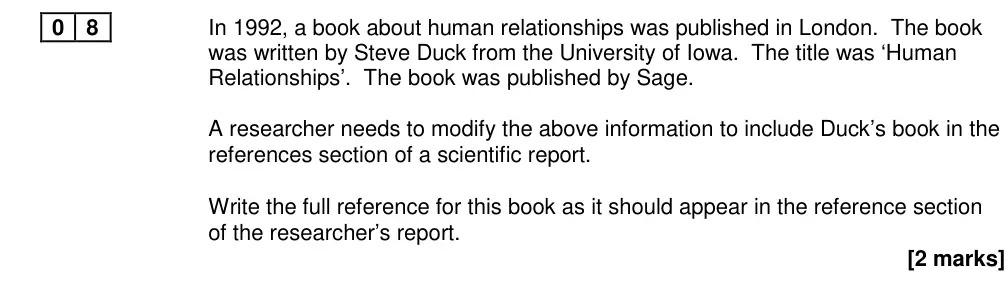
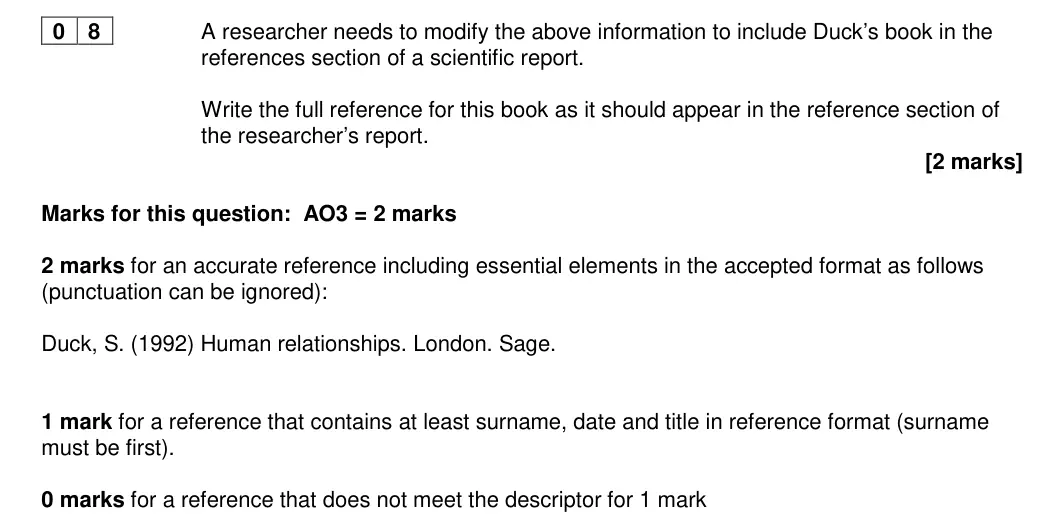
This question appeared to be unexpected despite ‘referencing’ appearing on the specification. Very rarely did responses receive full credit for the correct information in the correct order. The mark scheme was relaxed to enable a small proportion of responses to be awarded 1 mark for including the surname, date and title, with the surname first. Referencing is a crucial skill which students will find invaluable as they continue their studies beyond A-level and, whilst it was disappointing to see so few students gaining credit on this question, all students were equally affected because the same question appeared across all three options.
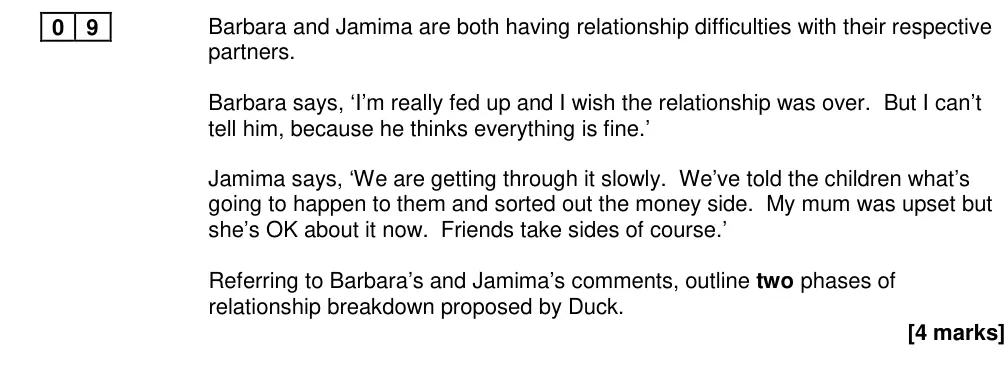
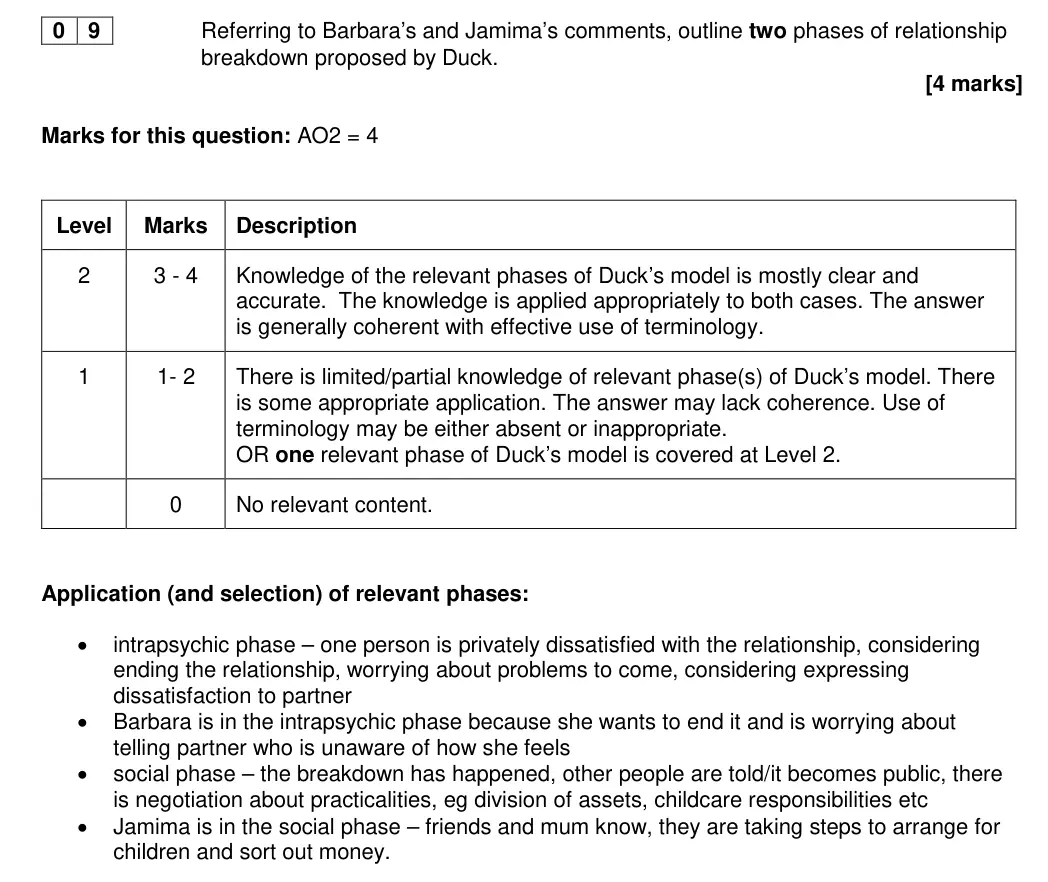
There were many full-mark responses to this question, although a significant number incorrectly identified Jamima’s situation as the grave-dressing phase. The simplest route to achieving full credit was to identify the relevant phase, summarise the main aspects, then link this to the stem material. Weaker responses were those where the student contributed no knowledge or understanding of the stage but merely copied whole chunks of the stem, although even then some minimal credit could be achieved by matching the characters with the correct phase. As this was an application question, answers without any links to stem received no credit.

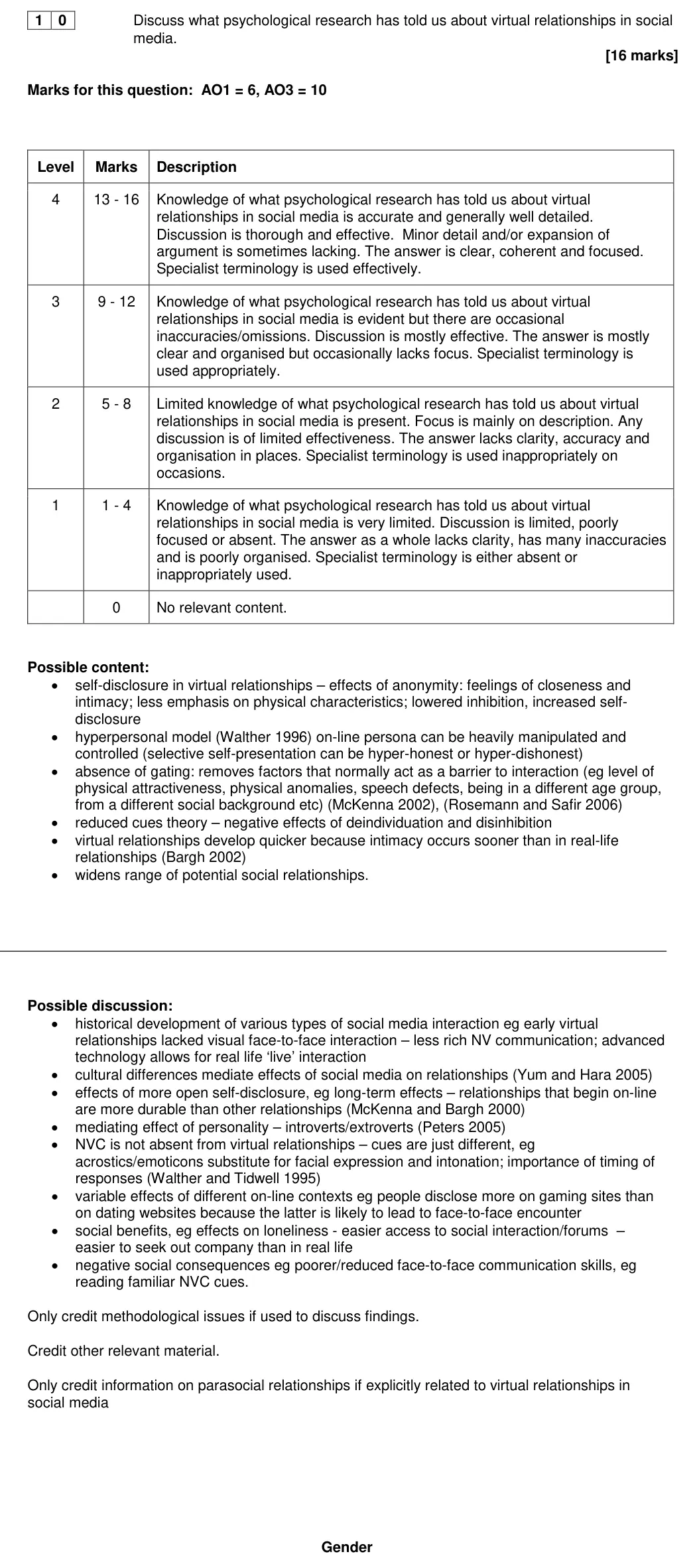
Answers focused mainly on the reduced cues theory, the hyperpersonal model and absence of gating, and the implications of some or all of these for levels of self-disclosure. Weaker responses tended to simply describe these ‘theories’ and were often repetitive. Better answers included the use of evidence to support arguments and analysis in relation to more general psychological concepts, such as deindividuation and anonymity. Analysis of the differences between face-to-face relationships and relationships in social media provided a useful route to discussion for many. Information on parasocial relationships was awarded credit if it was explained in the context of social media, which was rarely the case. More than most other topic areas, this is one where appropriate use of psychological terminology and specific reference to evidence can help to elevate an answer which might otherwise seem like a common-sense response.
Not on the 2025 specification: psychoanalytic explanation of gender development - identification and internalisation, removed from the Gender topic in v1.4
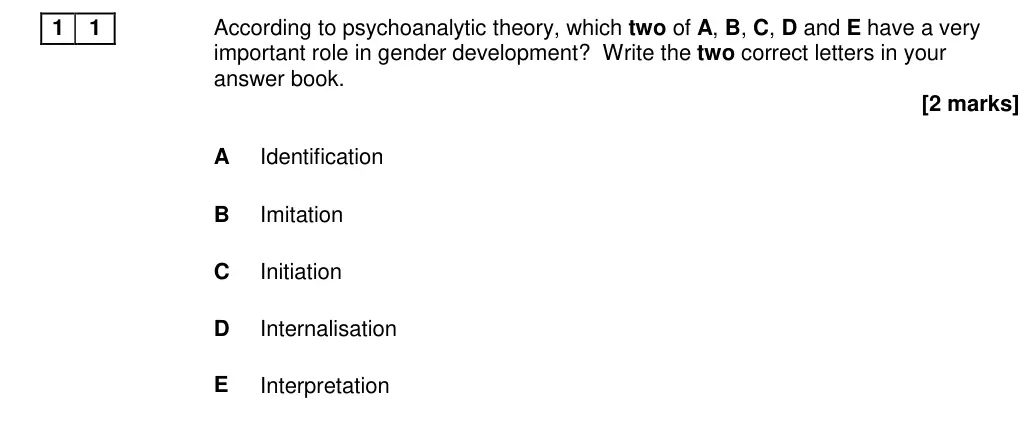
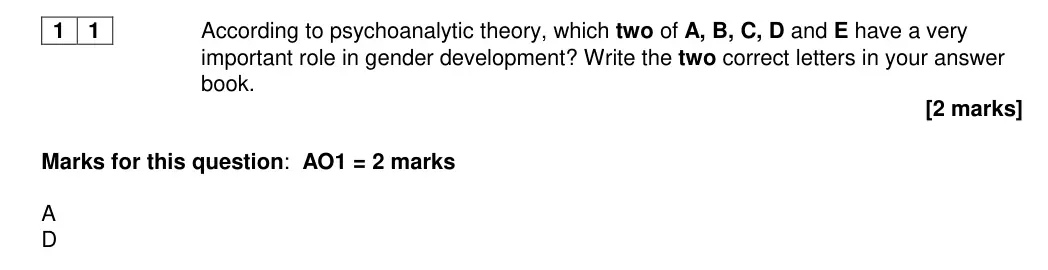
A and D
The vast majority of students were able to pick up at least one mark on this question, with many able to identify two key features of the psychoanalytic explanation of gender development.
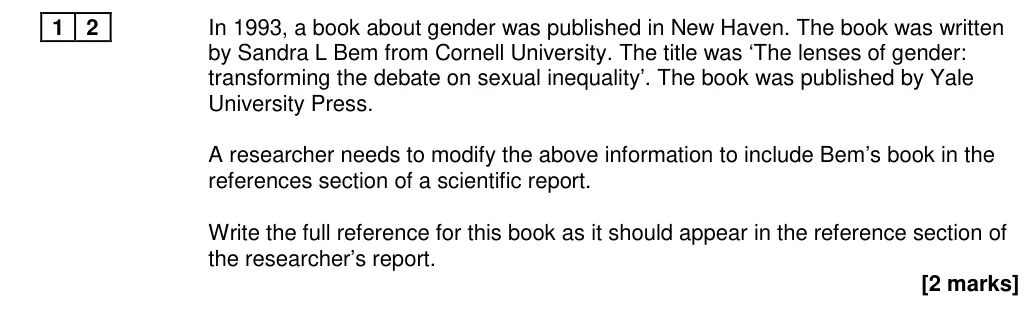
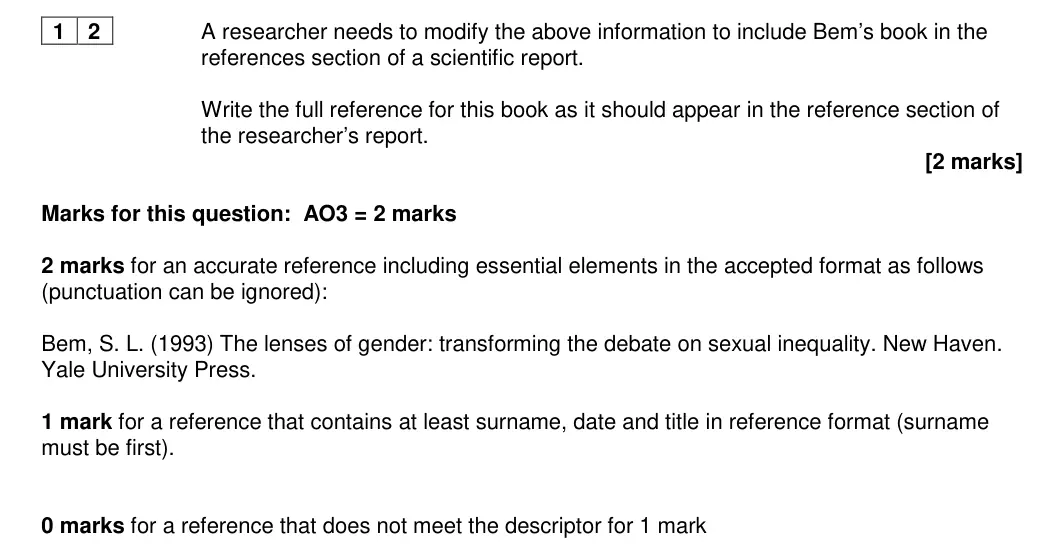
This question appeared to be unexpected despite ‘referencing’ appearing on the specification. Very rarely did responses receive full credit for the correct information in the correct order. The mark scheme was relaxed to enable a small proportion of responses to be awarded 1 mark for including the surname, date and title, with the surname first. Referencing is a crucial skill which students will find invaluable as they continue their studies beyond A-level and, whilst it was disappointing to see so few students gaining credit on this question, all students were equally affected because the same question appeared across all three options.
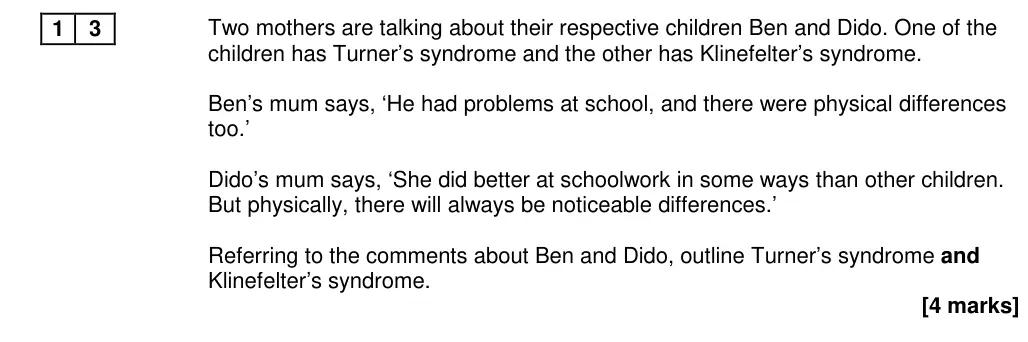
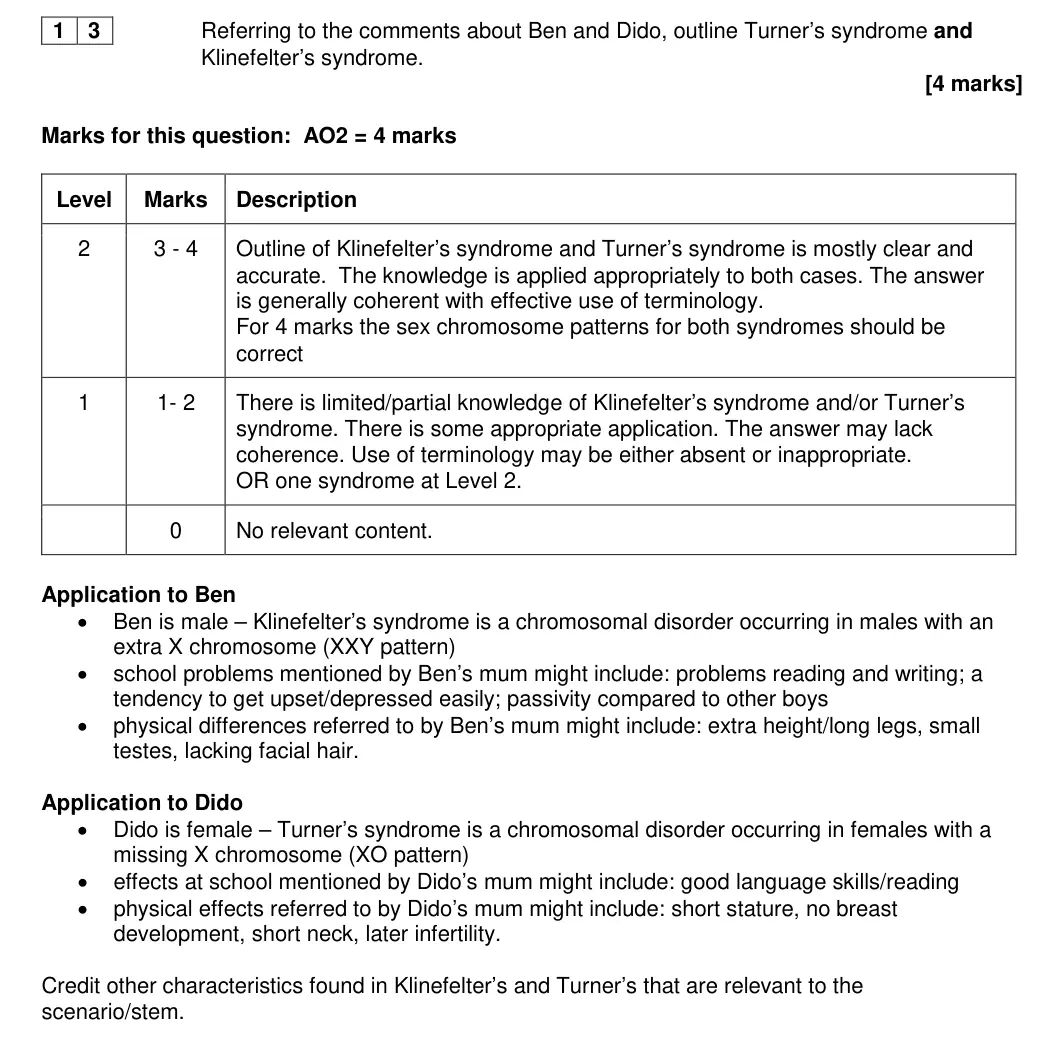
This question was generally well answered, with many students gaining full marks. As it was an application question, students needed to refer to the stem to gain credit. This was usually achieved by simply stating that the ‘physical differences would be ….’ or Dido did ‘better at school because she …’. Some students confused Turner’s syndrome and Klinefelter’s syndrome completely. It was fairly common to see confusion about which of the two conditions involved better language skills, mathematical skills and spatial ability. Just occasionally, an otherwise very good answer did not receive full credit because the relevant sex chromosome patterns were omitted.

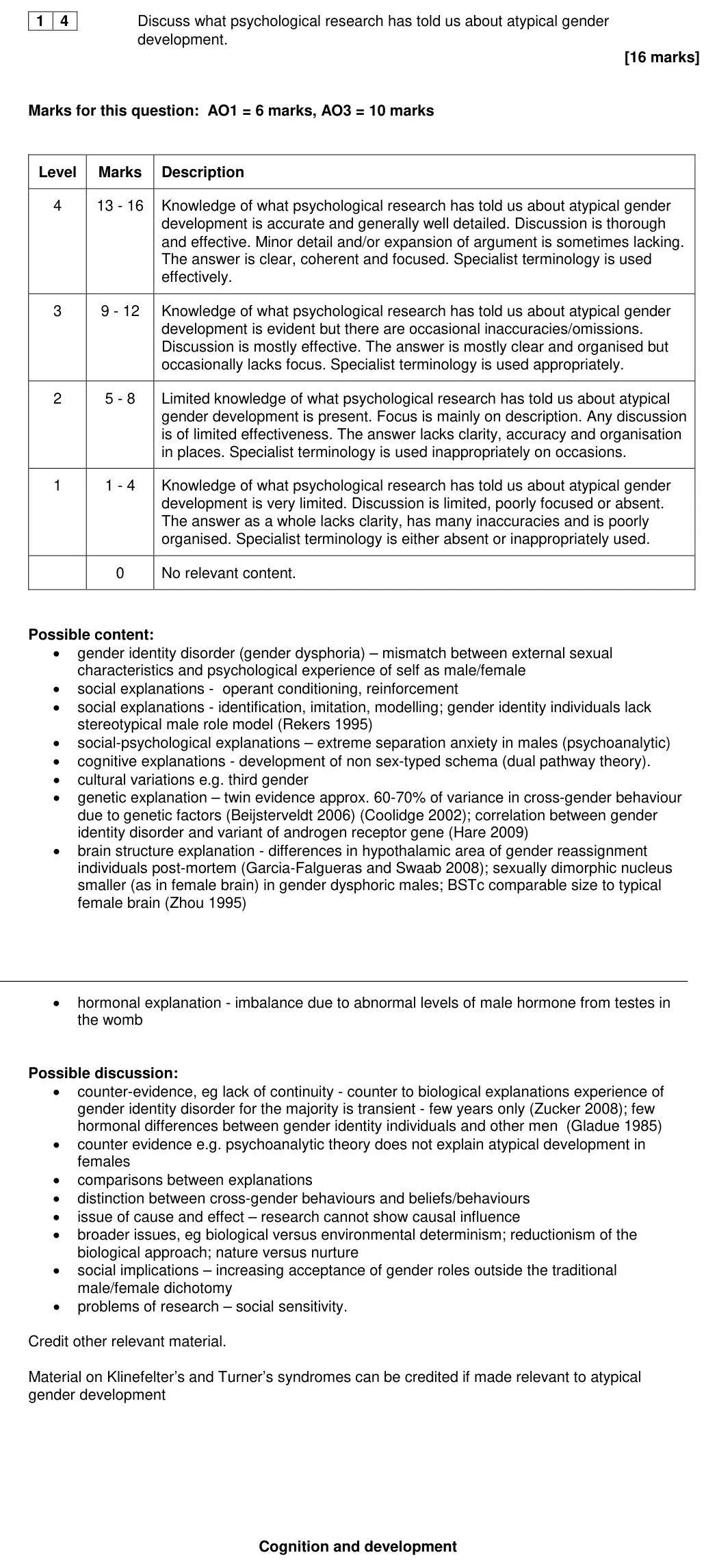
Despite the fact that the term ‘atypical gender development’ appears at the start of the final bullet point in section 4.3.3 of the specification, some students appeared ill-prepared to answer this question, possibly because they were looking more specifically for ‘Gender Identity Disorder’, or because they felt somewhat wrong-footed by the preceding question on atypical sex chromosome patterns. In the event, any material that could be linked to atypical gender development was credited, including material on Klinefelter’s and Turner’s syndromes, as long as the focus was on atypical gender development. Whilst many answers focused on biological research into gender dysphoria, also successful were those where students took a more eclectic approach, including material on atypical cases such as David Reimer, cultural variations in gender, Freudian identification and gender schema theory.
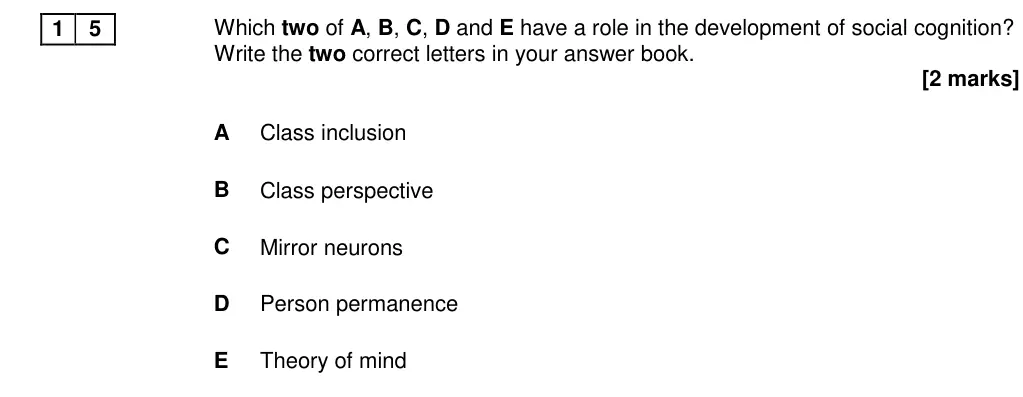
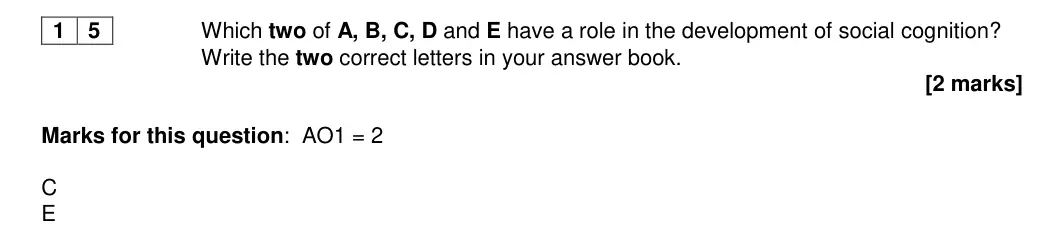
C and E
The vast majority of students were able to pick up at least one mark on this question, with many able to identify both relevant concepts.
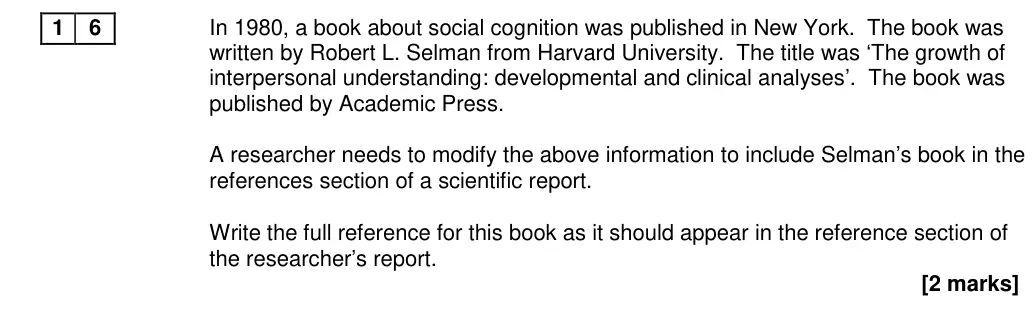
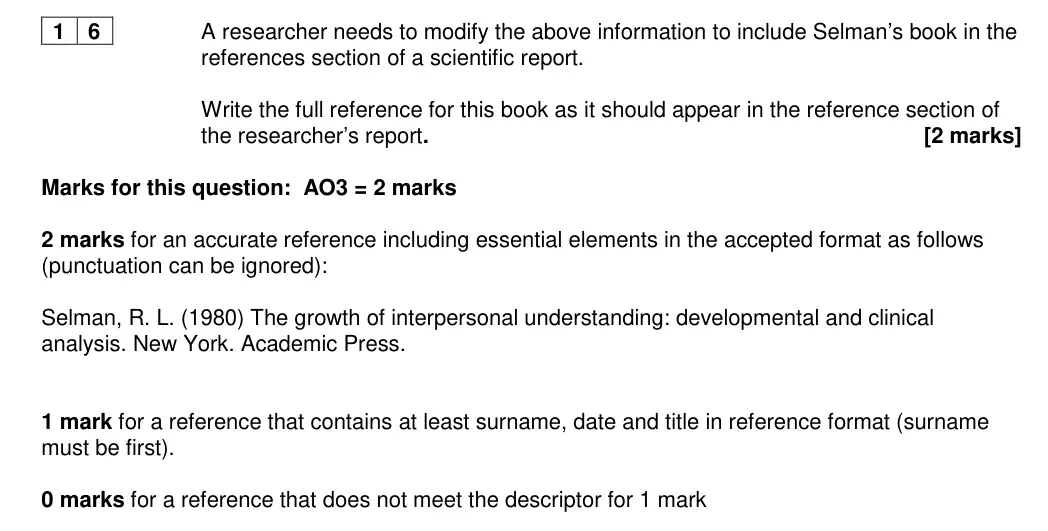
This question appeared to be unexpected despite ‘referencing’ appearing on the specification. Very rarely did responses receive full credit for the correct information in the correct order. The mark scheme was relaxed to enable a small proportion of responses to be awarded 1 mark for including the surname, date and title, with the surname first. Referencing is a crucial skill which students will find invaluable as they continue their studies beyond A-level and, whilst it was disappointing to see so few students gaining credit on this question, all students were equally affected because the same question appeared across all three options.
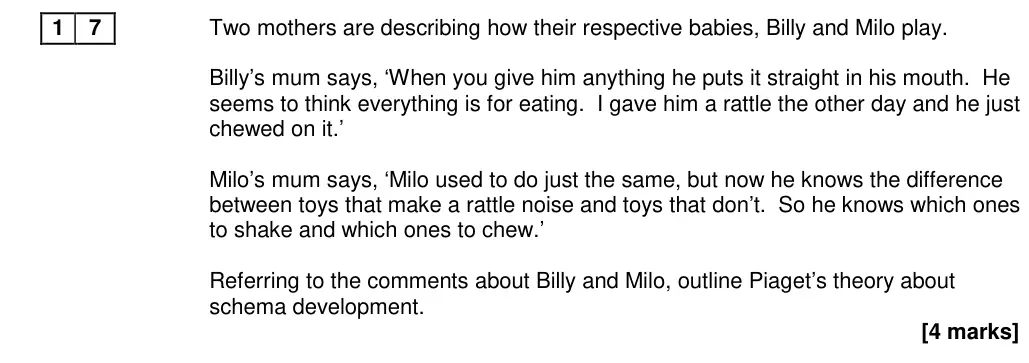
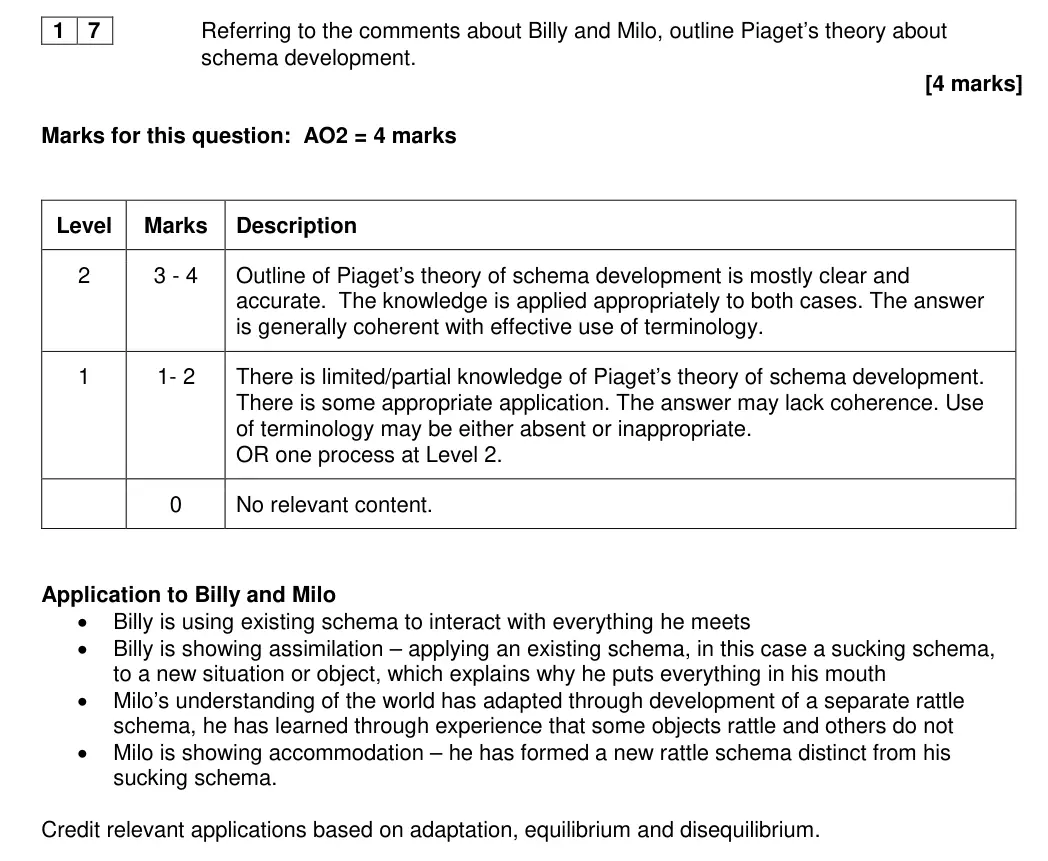
This was probably the most badly answered of the 4-mark application questions in Section B. Sound understanding of Piagetian concepts and a good grasp of terminology were necessary to enable effective application to the cases of Billy and Milo. Many students did not even refer to assimilation and accommodation, or completely confused the two. Whilst assimilation and accommodation were probably the most obvious concepts to apply to the stem material, some capable students managed to achieve credit by appropriate application of alternative Piagetian notions, such as equilibrium and disequilibrium. Completely irrelevant descriptions of Piaget’s stages were sometimes presented.

This question was generally competently answered, although there was a tendency to give lengthy methodological descriptions of the violation of expectation research rather than focus on what the research has shown. Weaker answers gave detailed and often muddled descriptions of the antics of rabbits of all sizes and barely mentioned the findings, or crucially omitted the ages of the children. Better discussions were those that considered not just the experimental work, but also the more general core knowledge theory, a route that enabled broader analysis in relation to nature- nurture and determinism. Comparisons with Piaget’s work on object permanence were usually effective.
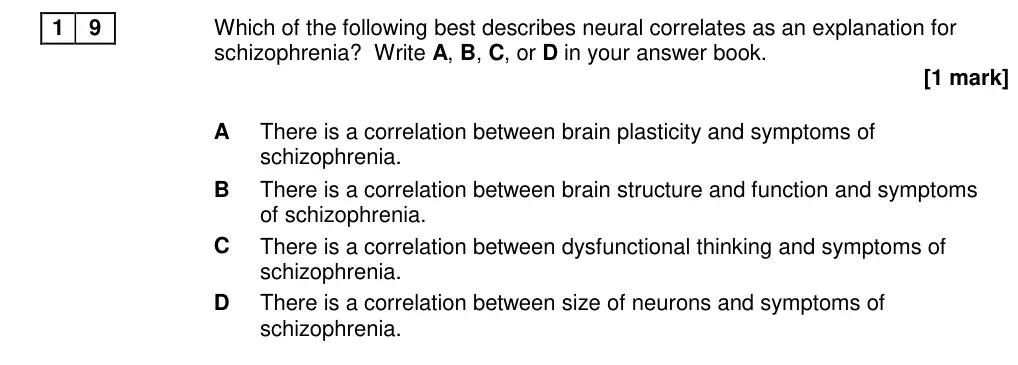
B
This question was answered correctly by the vast majority of students.
Not on the 2025 specification: token economies in the management of schizophrenia, removed in v1.4
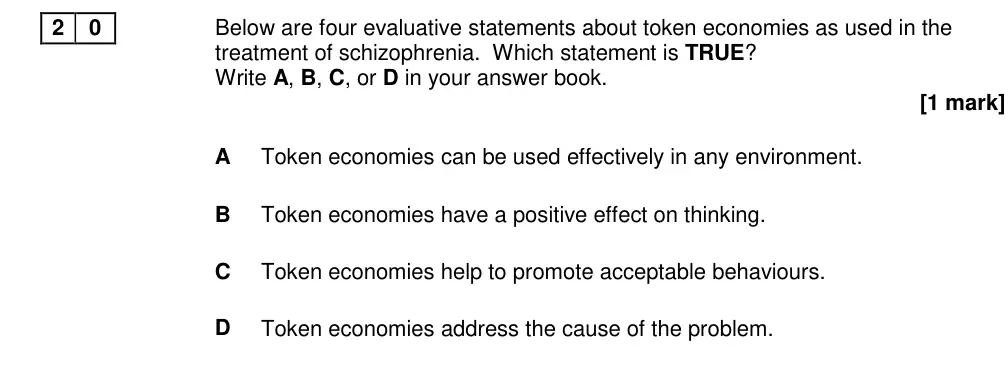
C
This question was answered correctly by the majority of students.
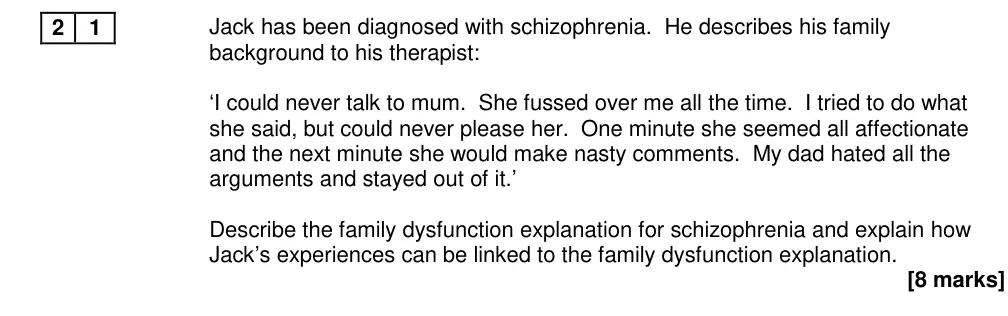
Students tended to respond well to this question up to a point and the stem afforded ample opportunity for application. Most could offer useful description of behaviours typical of family dysfunction and were able to pick out relevant material from the stem for application to Jack. It was less common to see full coverage of the family dysfunction explanation for schizophrenia, in other words, students often failed to make the link between the particular dysfunction (high expressed emotion, double bind, etc) and behaviours typical of schizophrenia. Only students who fully explored this in their answers achieved higher level marks. Other issues noted included confusion between double bind and high expressed emotion, and an unfortunate but understandable tendency for students to refer to the ‘schizophrenic mother’ rather than ‘the schizophrenogenic mother’. Only very rarely did students pick up on the reference to ‘the dad’ who ‘stayed out of it’ as a reference to family schism/skew. Some students wasted time offering evaluation, having then to re-write the same material when they came to the next question.

Most students could offer two valid imitations, although these were often cursory or insufficiently discussed. Blaming the family and the issue of cause and effect were usually effective routes to credit. Comparisons with other explanations, mainly biological, were not always very effective as they tended to stray into discussion of the alternative. A number of answers focused on family therapy rather than on the explanation. The frequently seen assertion that the family dysfunction explanation is ‘reductionist’ was surprising given the many and varied ways in which families might be dysfunctional, and only serves to illustrate the widespread misuse of the term.

This question was usually well answered. Despite the fact that named drugs were often misspelt or the names appeared to have been deliberately obscured by use of wiggly handwriting, there were some excellent accounts of their action. In less competent answers, typical and atypical antipsychotics were confused, both in terms of names, action and side effects. Evaluations tended to cover side effects, effectiveness and comparison with alternatives. Just occasionally, students considered the implications for the economy to good effect.
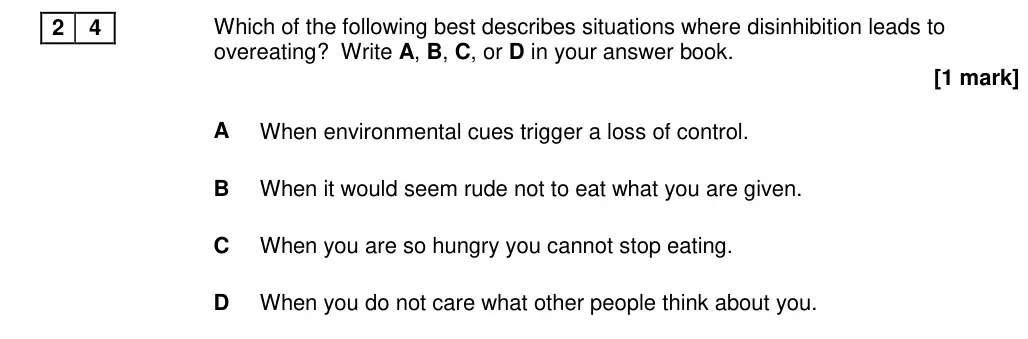
A
This question was answered correctly by the vast majority of students.
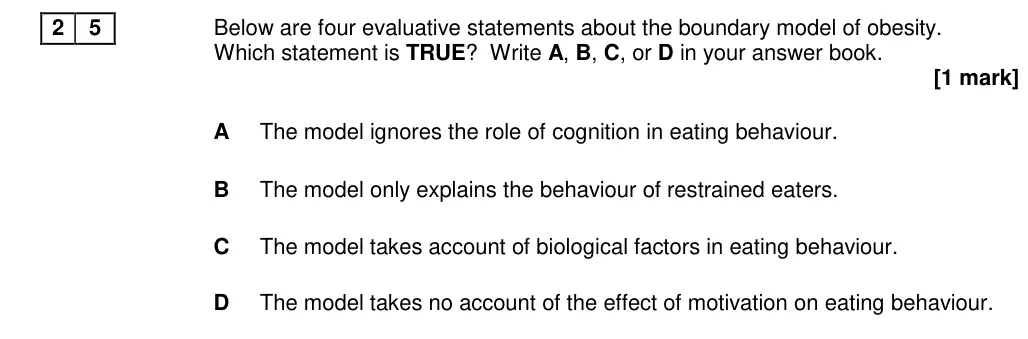
C
Surprisingly, this question was not answered well by a significant proportion of students. It seems that students have limited understanding of the boundary model and teachers are encouraged to address this.
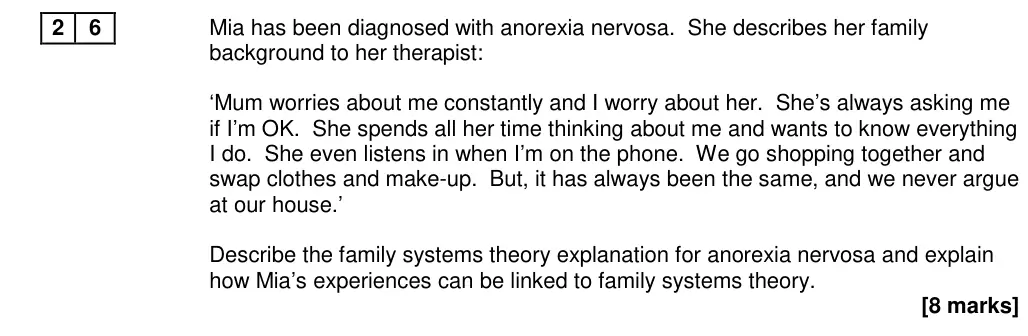
Students tended to respond well to this question up to a point and the stem afforded ample opportunity for application. Most could offer useful description of family systems theory and were able to pick out relevant material from the stem for application to Mia. It was less common to see full coverage of the family systems theory explanation for anorexia nervosa, in other words, students often failed to describe how the behaviours (enmeshment, control, etc) might lead to the development of anorexia nervosa. Only students who fully explored this in their answers achieved higher level marks. Weaker responses consisted of repetition of the stem or basic paraphrasing of the stem in common sense terms, and thus showed no evidence of psychological knowledge or understanding.

Blaming the family and the issue of cause and effect were probably the most effective limitations, although these were often quite brief. Comparisons with other explanations, mainly biological, were not always very effective, as they tended to stray into discussion of the alternative. A number of answers focused on therapy rather than on the explanation. As with the parallel question on schizophrenia, many students asserted inappropriately that the family dysfunction explanation is ‘reductionist’.

Despite evident knowledge, this question was not usually well answered. Most students could happily give a long list of innate food preferences, often supporting the information with references to research, but in many cases there was no explanation of these preferences in terms of evolution. As an example, it was often stated that people have an ‘innate dislike of bitter tasting foods because they are toxic’, but there was no explanation of how this might have come about, ie only people who had this dislike would have survived and their genes would thus continue in the gene pool, perpetuating and reinforcing the dislike in the population.
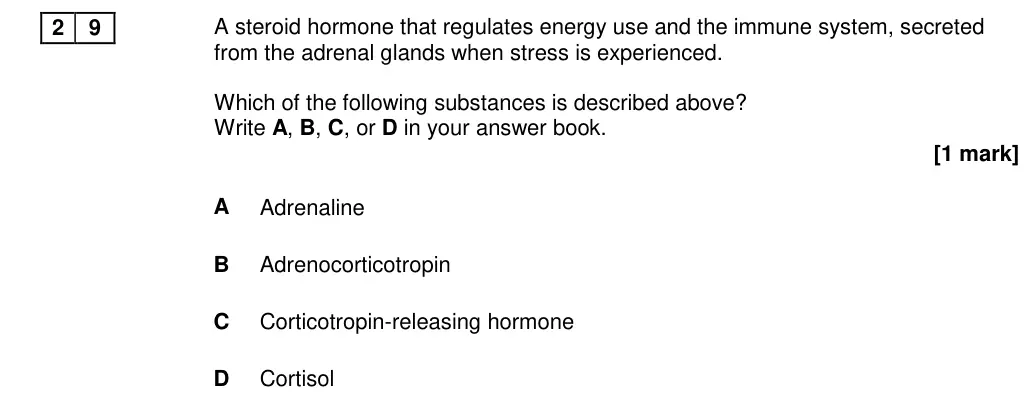
D
This question was answered correctly by around half of students.
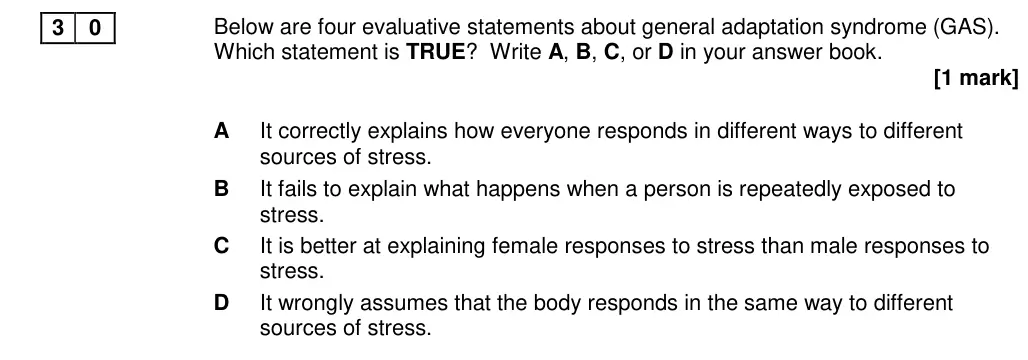
D
This question was answered correctly by the vast majority of students.
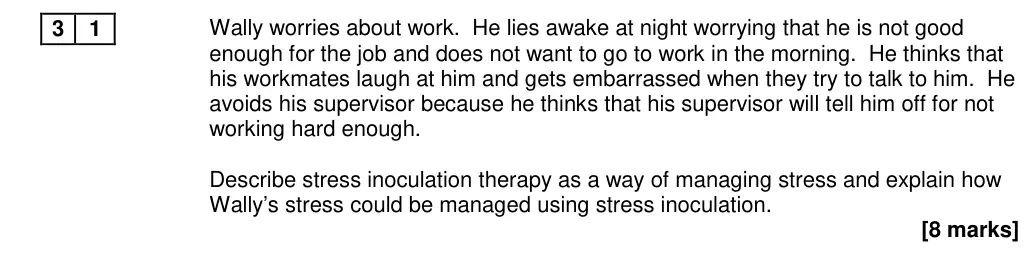
Better students gave sound descriptions of the stages and techniques involved in stress inoculation therapy and were able to apply their knowledge to Wally’s situation. Weaker answers consisted of vague descriptions of therapy where the therapist and client would ‘talk about it’, then Wally would ‘realise there was nothing to worry about’, so he could ‘chat happily to his colleagues’. Effective application is that which is concrete and specific to the scenario. As an example, instead of saying ‘Wally could then use the strategies from his therapy’, it is more effective to say ‘Wally could use his breathing exercise, and repeat a positive self-statement such as…in the car each morning before he goes into work’.

This question was usually answered competently, although sufficient elaboration for full marks was quite rare. The most common strength was the long-term benefit, for example, how the techniques acquired in therapy could be used in other similar situations in the future. Limitations tended to focus on the requirement for commitment and engagement on the part of the client and how this might not always be possible.

This fairly straightforward question was usually competently answered, with most students offering both the SRRS and the Hassles and Uplifts scale. Some detailed accounts of the types of items and the scoring of the SRRS were seen. Effective evaluations tended to consider the appropriateness of having a fixed LCU for each life event when different individuals would experience the same event quite differently and comparisons between the scales. Appropriateness of the SRRS for various age groups was also a useful discussion point. Weaker discussions referred to internal validity, external validity, reductionism and determinism, without any sensible explanation.

A surprising number of students based their response on social learning theory or social norms, making no mention of cognitive factors. Of those who did understand the concept, many managed to gain one mark for the idea of an aggressive ‘script’ as a memory based on past experience of aggressive situations on television, film or computer games. Relatively few students gained the second mark for pointing out how the script could be triggered by a similar situation. Note that reference to media was essential for credit in this question.
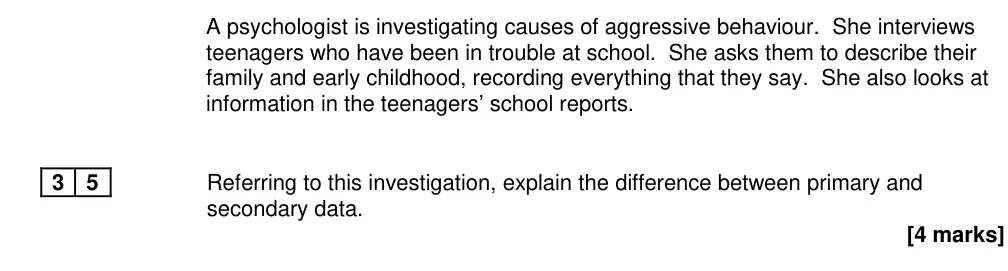
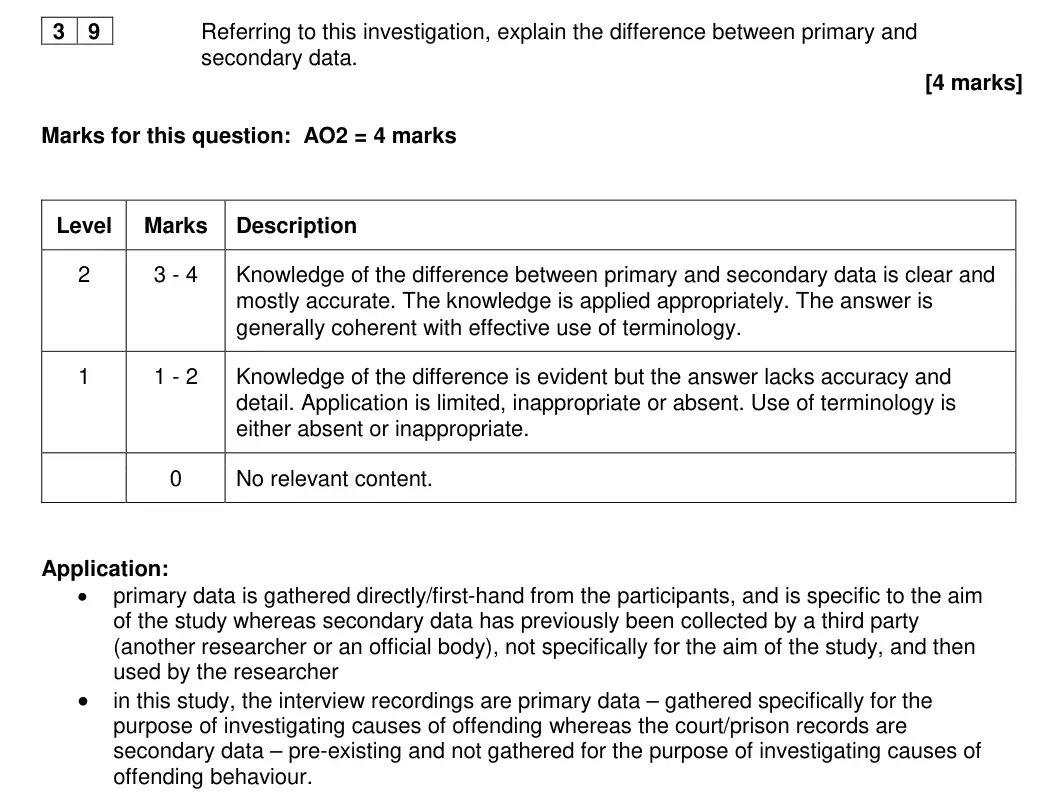
Most students could happily identify the primary and secondary data in the stem material and gained marks for doing so. However, very few answers received full credit for properly explaining the difference between primary and secondary data. There was widespread misunderstanding that the distinction hinges on who collects the data, with many answers stating that primary data is that which is ‘collected by the researcher’ whilst secondary data is ‘collected by someone else’. Such answers failed to recognise the proper distinctions, ie that primary data comes directly from the source (the participants) and is collected for the purposes of the study, whereas secondary data does not come directly from the source and is not specific to the purpose of the study. Various ways of making either of these points were accepted, for example, reference to primary as original data and secondary as not original.
Not on the 2025 specification: thematic analysis, removed in v1.4

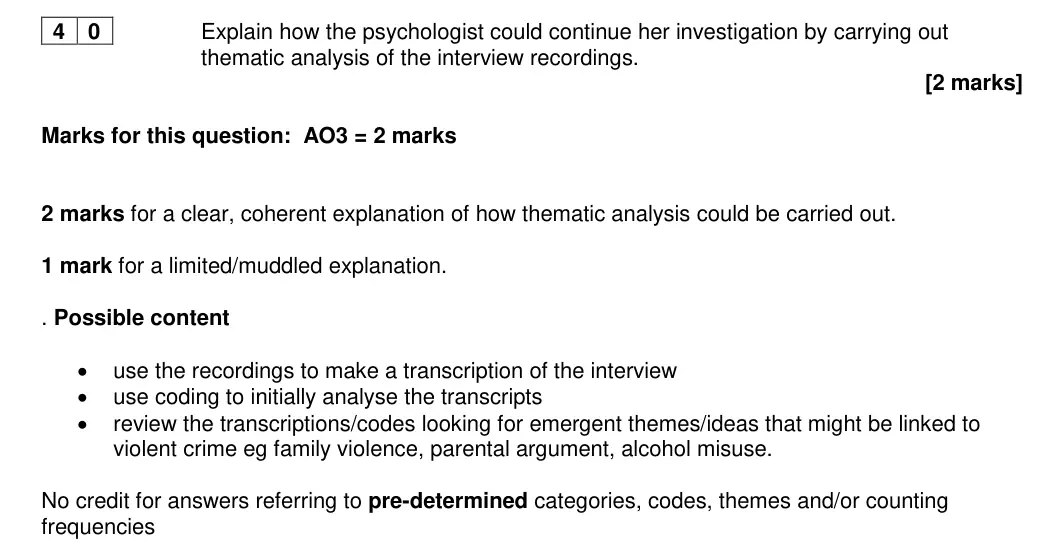
Many students left this question blank and most of those who did attempt an answer based their response on some form of quantitative analysis, referring to categories being established prior to analysis and tallying or counting frequencies. Very rarely did students refer to transcription of the recordings, coding or emergent themes.

Most students could offer reasonable descriptions of dominance, sexual jealousy and mate retention strategies but these often failed to include any explicit mention of aggression or any explanation of how these behaviours have evolved. More able students emphasised the key mate retention tactics explicitly linked to aggression. Warfare and bullying were also used effectively. Despite the wording of the question, it was fairly common to see description of animal studies, often sticklebacks, which could only gain credit if used as part of an evaluation. The way that evolutionary explanations ‘ignore biological explanations’ or ‘ignore genetic explanations’ was a common evaluative point, showing basic misunderstanding. Similarly, it was sometimes stated that evolutionary explanations for aggression could not explain cases of genocide, with an apparent failure to recognise how elimination of an entire race would thereby confer advantage on the perpetrators who could survive, prosper and propagate their own genes.

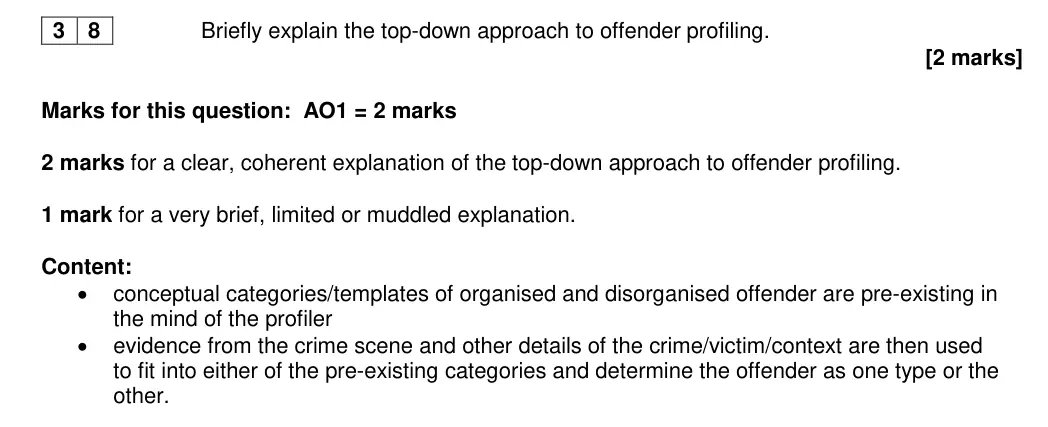
Most students gained one mark for referring to the organised/disorganised distinction. Rather fewer could explain that this categorisation was dependent on analysis of evidence from the crime scene. Some students provided unnecessary background information about the origins of the top-down approach or gave detailed information about the stages of profile generation.
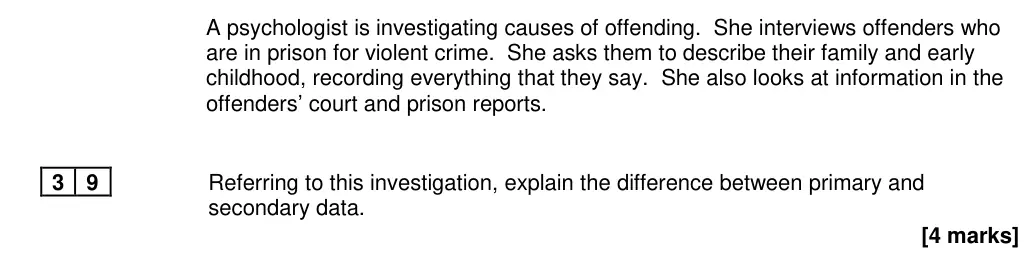
Most students could happily identify the primary and secondary data in the stem material and gained marks for doing so. However, very few answers received full credit for properly explaining the difference between primary and secondary data. There was widespread misunderstanding that the distinction hinges on who collects the data, with many answers stating that primary data is that which is ‘collected by the researcher’ whilst secondary data is ‘collected by someone else’. Such answers failed to recognise the proper distinctions, ie that primary data comes directly from the source (the participants) and is collected for the purposes of the study, whereas secondary data does not come directly from the source and is not specific to the purpose of the study. Various ways of making either of these points were accepted, for example, reference to primary as original data and secondary as not original.
Not on the 2025 specification: thematic analysis, removed in v1.4

Many students left this question blank and most of those who did attempt an answer based their response on some form of quantitative analysis, referring to categories being established prior to analysis and tallying or counting frequencies. Very rarely did students refer to transcription of the recordings, coding or emergent themes.

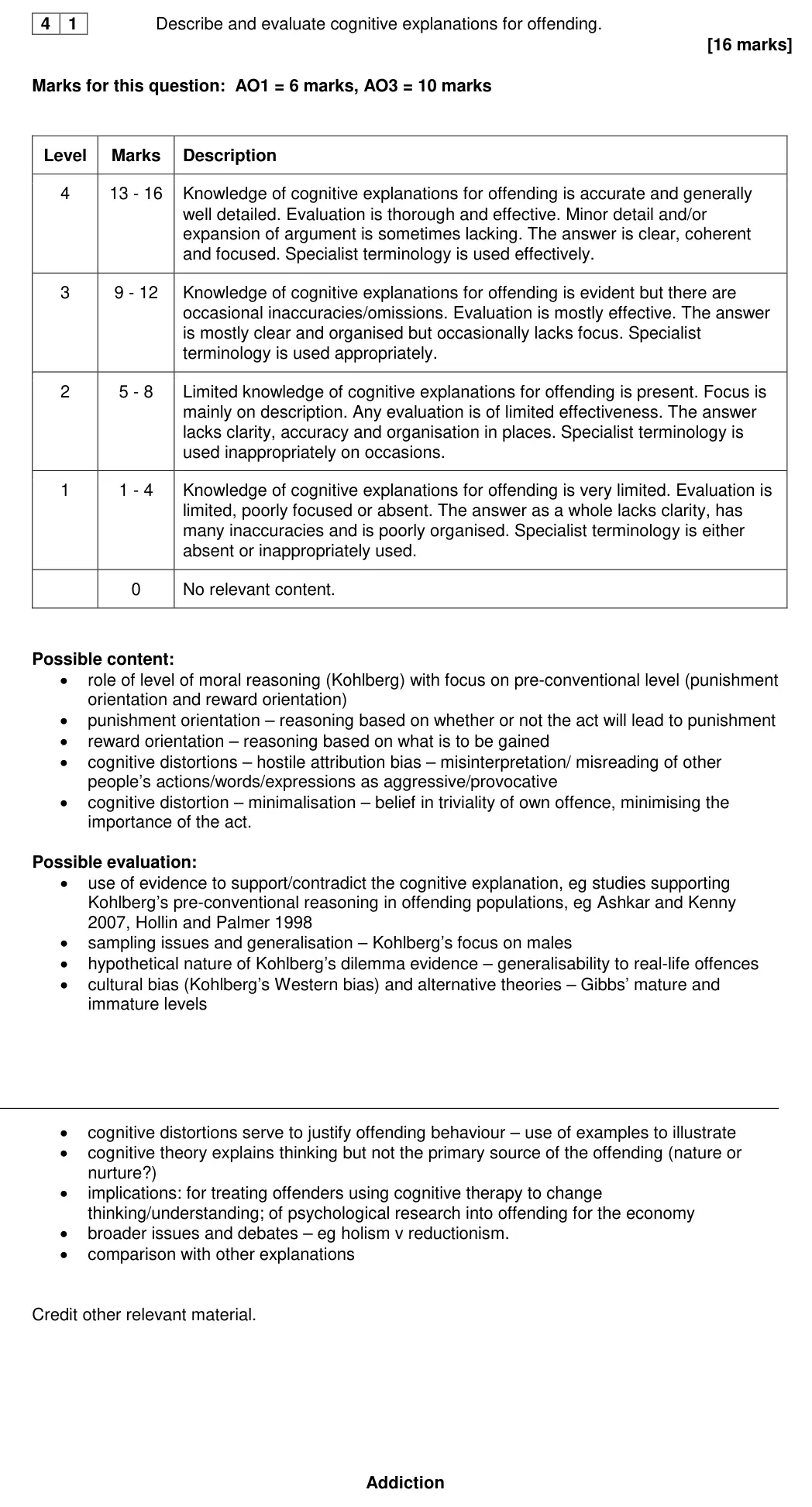
This straightforward question clearly posed a problem for many students. Most could give some descriptive account of appropriate material, such as theory of moral reasoning, hostile attribution bias and minimalisation. Unfortunately, there was often insufficient focus on offending, where students presented long accounts of Kohlberg’s theory of moral development, with details of stages and the Heinz dilemma, but with no mention of offending. Better answers focused primarily on the pre-conventional level and explanation of how reasoning at this level might lead to offending behaviour. Similarly, hostile attribution bias was outlined, but relatively infrequently did students explain how it might lead to offending. With minimalisation, it was not often clear how it operates to enable the offender to justify the offending act to him or herself and thus avoid feelings of guilt. A significant number of students tried to use Eysenck, differential association or psychodynamic theory to answer this question. Unless some cognitive element was obvious, these answers gained no credit.

This question was generally well answered, with over half of students gaining full marks.
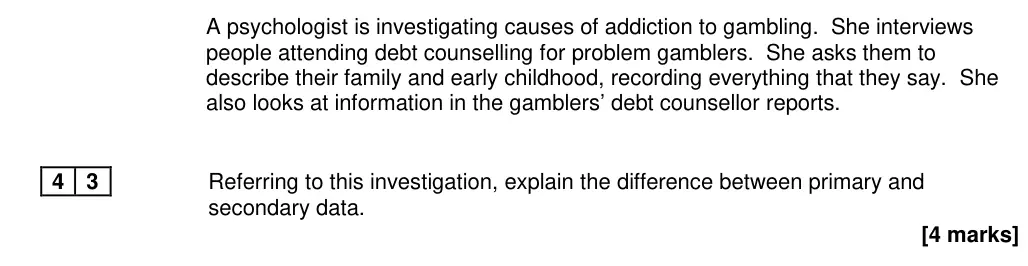
Most students could happily identify the primary and secondary data in the stem material and gained marks for doing so. However, very few answers received full credit for properly explaining the difference between primary and secondary data. There was widespread misunderstanding that the distinction hinges on who collects the data, with many answers stating that primary data is that which is ‘collected by the researcher’ whilst secondary data is ‘collected by someone else’. Such answers failed to recognise the proper distinctions, ie that primary data comes directly from the source (the participants) and is collected for the purposes of the study, whereas secondary data does not come directly from the source and is not specific to the purpose of the study. Various ways of making either of these points were accepted, for example, reference to primary as original data and secondary as not original.
Not on the 2025 specification: thematic analysis, removed in v1.4

Many students left this question blank and most of those who did attempt an answer based their response on some form of quantitative analysis, referring to categories being established prior to analysis and tallying or counting frequencies. Very rarely did students refer to transcription of the recordings, coding or emergent themes.

This was a straightforward question that elicited many good responses. The mark scheme was inclusive of any content relevant to cognition, such as expectancy theory, cognitive biases, and self-efficacy. In the event, cognitive biases formed the basis of most answers and such answers tended to score well. Students often went for depth, with a few well-chosen cognitive biases plus illustrative examples. Other students covered a greater number in less depth. The latter approach sometimes resulted in a list-like answer without sufficient explanation. Discussion often made good use of research by Griffiths and the potential practical applications to come out of cognitive explanations for gambling.
Want a paper marked and gone through with you? Message us.