Mark scheme, including level descriptors and indicative content
Examiner's comment
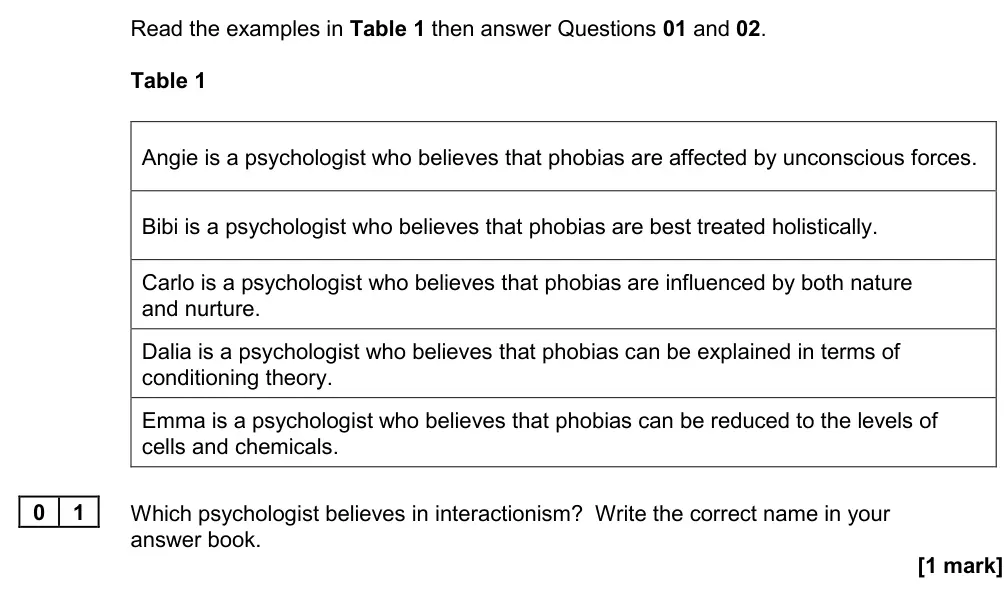
For questions 01 and 02, most students were able to correctly identify ‘Carlo’ in the first instance, and ‘Dalia’ in the second, though there was a considerable number who got these the wrong way round. Some students ‘hedged their bets’ by writing the same name for both of their answers. Of the wrongly selected names, ‘Emma’ was by some distance the most popular, and usually for Question 02.
Notes from the mark scheme and report
answer Carlo (interactionism)
some reversed answers to 01/02 or wrote the same name for both
Mark scheme, including level descriptors and indicative content
Examiner's comment
For questions 01 and 02, most students were able to correctly identify ‘Carlo’ in the first instance, and ‘Dalia’ in the second, though there was a considerable number who got these the wrong way round. Some students ‘hedged their bets’ by writing the same name for both of their answers. Of the wrongly selected names, ‘Emma’ was by some distance the most popular, and usually for Question 02.
Mark scheme, including level descriptors and indicative content
Examiner's comment
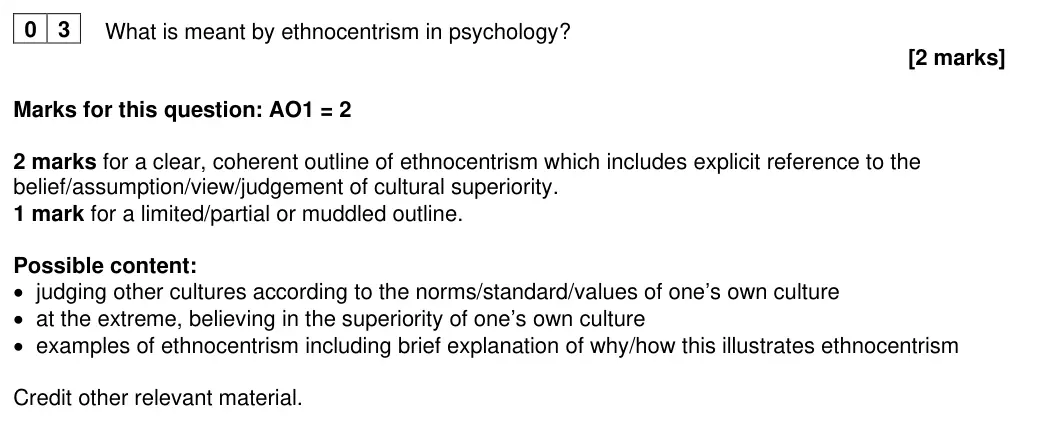
In Question 03, many students were able to provide a clear and coherent definition of ‘ethnocentrism’, and often one that very closely mirrored the suggested content in the mark scheme. Those who fell short often gave a definition of ‘culture bias’, which failed to include appropriate reference to the notion of cultural superiority. Some offered examples of ethnocentric research, but again, the nub of the answer – the implied cultural superiority – was absent.
Notes from the mark scheme and report
2 marks need explicit reference to belief/judgement of cultural superiority
judging other cultures by own culture's norms
defining culture bias generally without superiority scored 1
Mark scheme, including level descriptors and indicative content
Examiner's comment
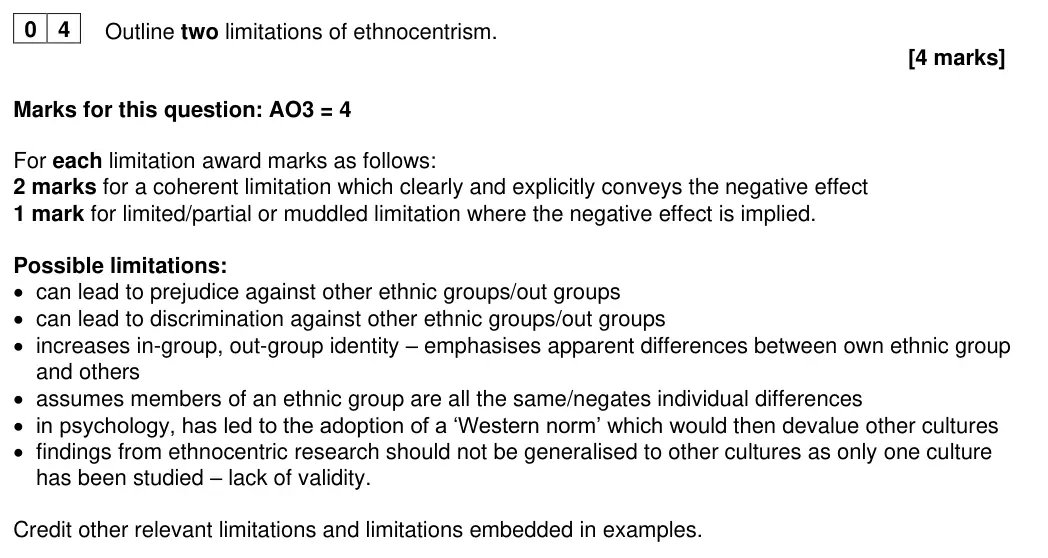
Despite dropping marks in Question 03, many students were still able to access all four marks for Question 04. Again, many interpreted ethnocentrism within the context of ethnocentric/culturally biased research. Thus, the most popular answer was the methodological problem of being unable to generalise findings any further than the culture studied.
Notes from the mark scheme and report
2 marks per limitation where the negative effect is explicit (prejudice, discrimination, in-group/out-group, Western norm devalues other cultures, cannot generalise beyond culture studied)
generalisation point most popular
June 2024 · Paper 3 · Q516 marksAO1=6, AO2=4, AO3=616-mark essayissues and debates
Mark scheme, including level descriptors and indicative content
Examiner's comment
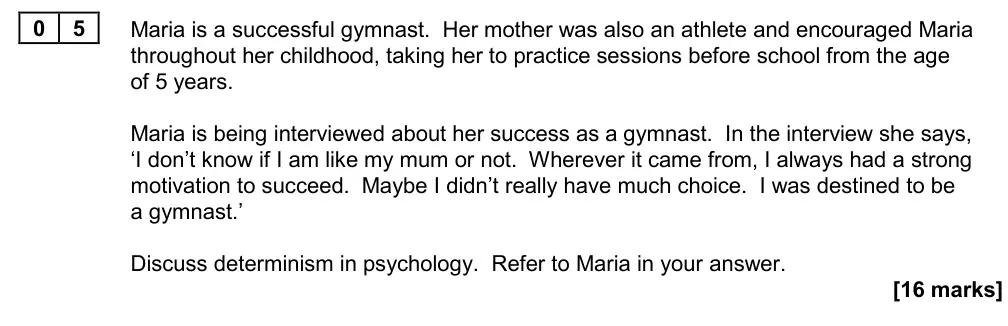
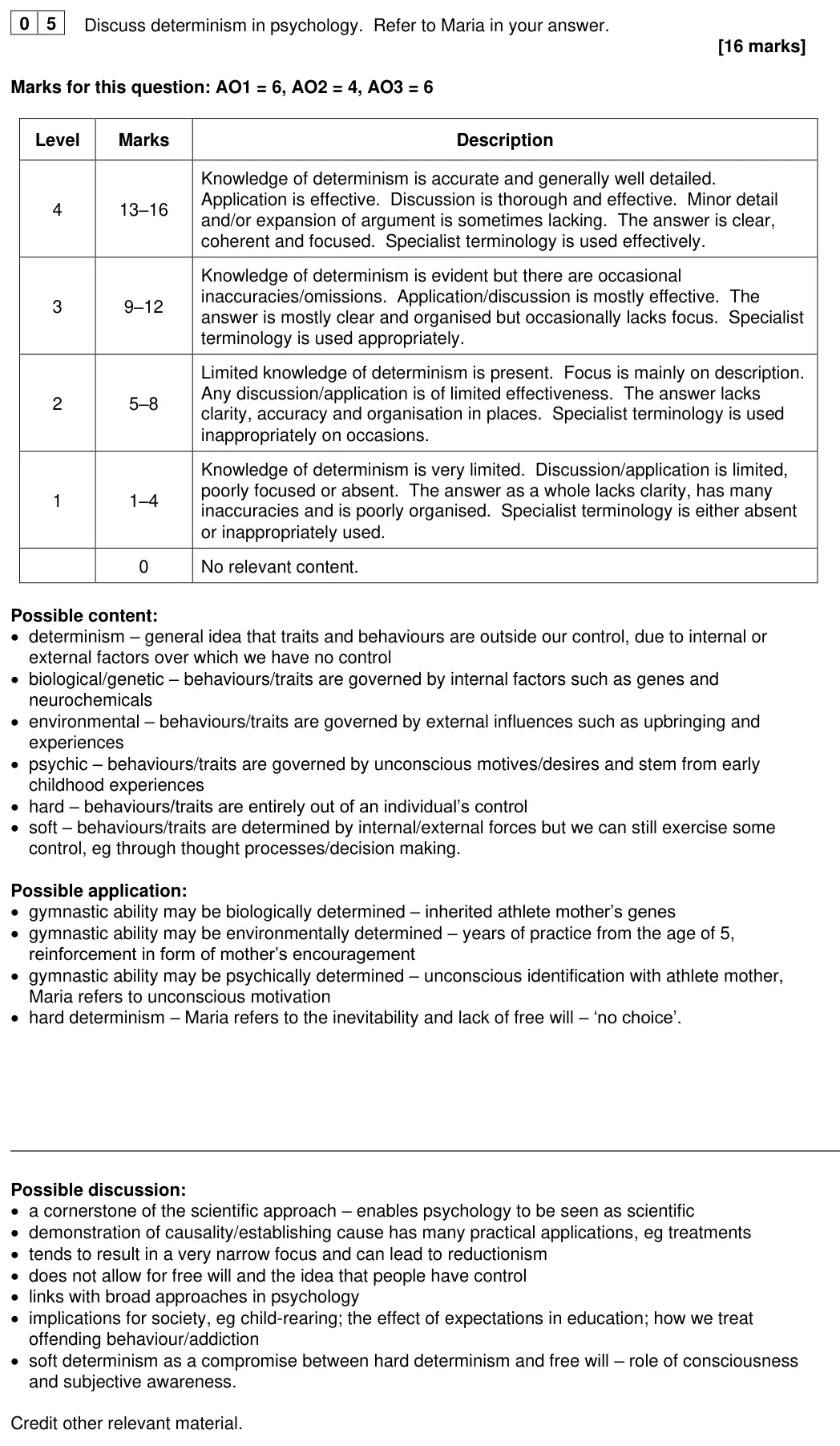
Question 05 was the first of three applied 16-marks extended response questions on the paper, and many students fared well. There was sound knowledge of the different forms of determinism, and there was often effective application to most aspects of the stem. Similarly, there was evidence of good discussion: Libet’s research was typically used effectively to support hard/biological determinism. The argument that deterministic ideas are at odds with the legal system’s notion of moral responsibility was also well-made. Of those students who struggled, many presented their essay as a straightforward debate between free will and determinism which missed the point of the question somewhat. Lots of students tried to reframe the stem as illustrating soft determinism, often unsuccessfully. There was also frequent confusion with other debates, such as nature-nurture and holism-reductionism.
Notes from the mark scheme and report
biological (mother's genes), environmental (practice from age 5, encouragement), psychic (unconscious motivation/identification), hard determinism ('no choice', 'destined')
a straight free will vs determinism debate missed the point
confusion with nature-nurture and holism-reductionism
Mark scheme, including level descriptors and indicative content
Examiner's comment
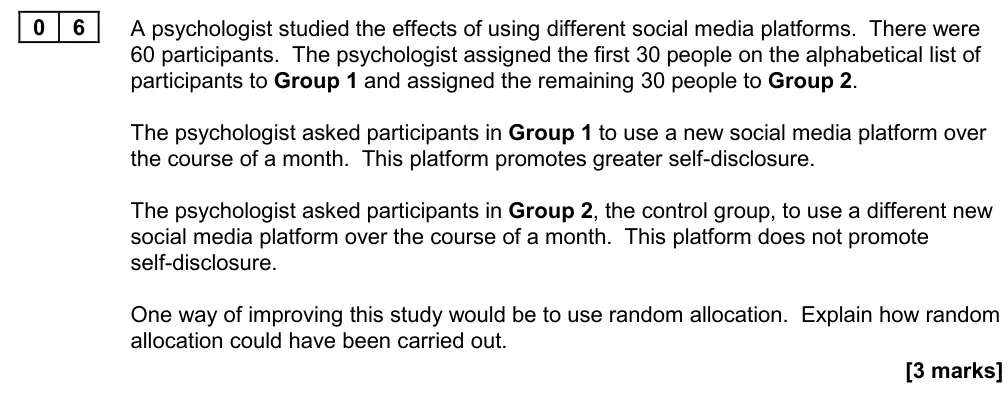
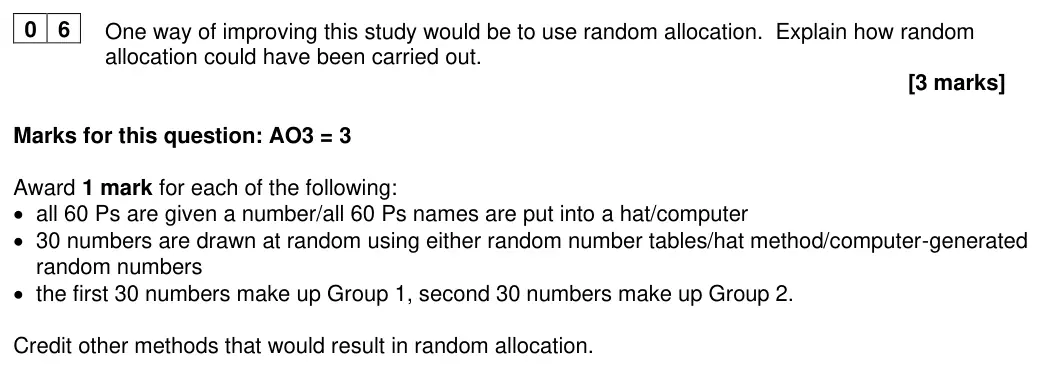
For Question 06, most students were able to access at least two marks by stating that all the names/numbers of the people in the study would be subject to some sort of lottery method. The third mark, for explaining how those names/numbers would be allocated to Group 1 or Group 2 proved more elusive for some. Generally, though, this was a very well-answered question.
Notes from the mark scheme and report
1 mark each: number/name all 60 Ps
draw at random (hat, random number table/generator)
first 30 drawn = Group 1, rest = Group 2
third (allocation) mark most often missed
June 2024 · Paper 3 · Q72 marksAO2=1, AO3=1Research methodsdata handling
Mark scheme, including level descriptors and indicative content
Examiner's comment
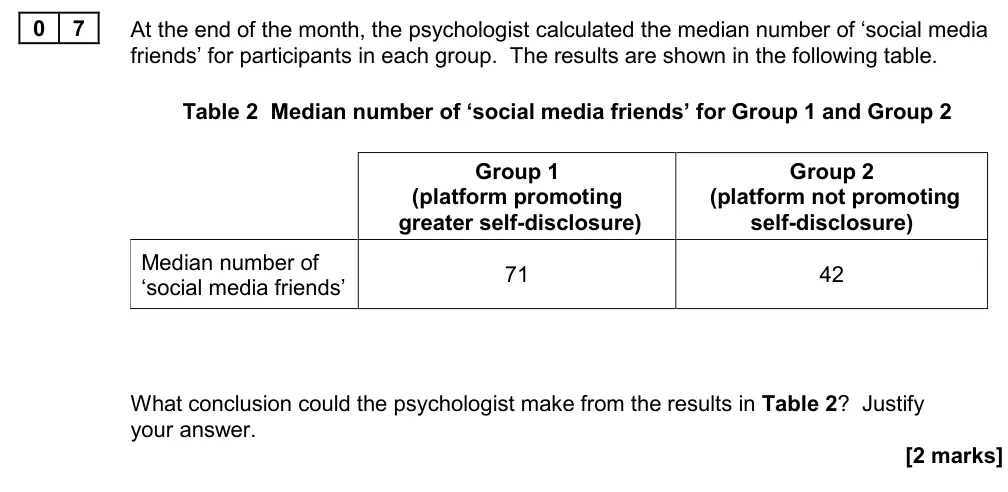
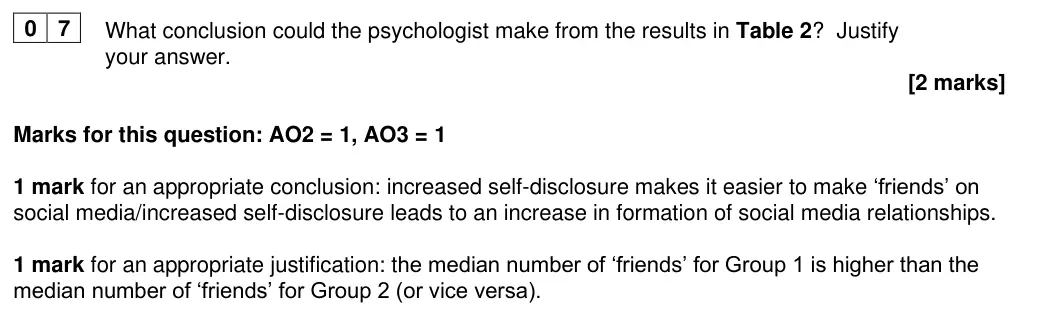
In Question 07, some students simply restated the figures in the table, and failed to score any marks as a result. Others were able to claim the justification mark, but their conclusion lacked the required clarity for the second mark.
Notes from the mark scheme and report
1 mark conclusion (greater self-disclosure leads to more social media friends) + 1 mark justification (Group 1 median 71 > Group 2 median 42)
Mark scheme, including level descriptors and indicative content
Examiner's comment
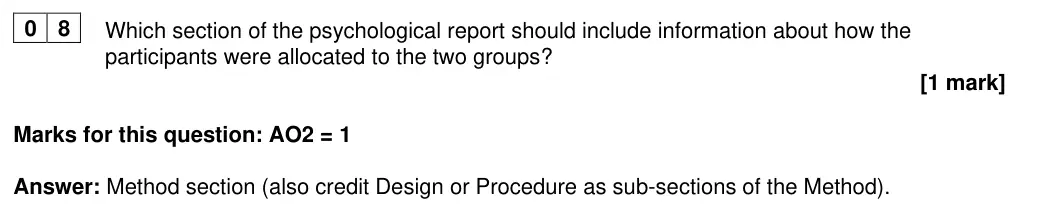
For Question 08, most students were able to identify either the ‘method’, ‘design; or ‘procedure’ as creditworthy alternatives and as such were awarded a mark. There were no marks given for ‘methodology’, although this was a popular answer. Other common incorrect answers were the ‘abstract’ and the ‘introduction’.
Notes from the mark scheme and report
Method section (also credit Design or Procedure)
'methodology' not credited
abstract and introduction common wrong answers
June 2024 · Paper 3 · Q92 marksAO2=2Applicationrelationships
Mark scheme, including level descriptors and indicative content
Examiner's comment
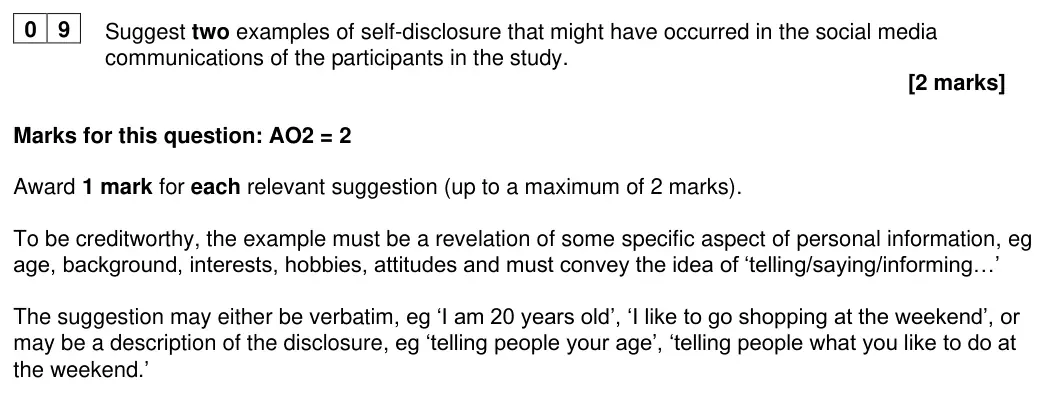
The key watchword in Question 09 was ‘specific’. For this reason, answers that simply read, ‘disclosing personal information’ were judged to be too vague for credit. That said, this question posed most students little difficulty and there was a wide variety of correct answers.
Notes from the mark scheme and report
1 mark each
example must reveal a SPECIFIC piece of personal information (age, hobbies, attitudes) as telling/saying
'disclosing personal information' too vague
June 2024 · Paper 3 · Q108 marksAO1=3, AO3=5Extended writingrelationships
Mark scheme, including level descriptors and indicative content
Examiner's comment
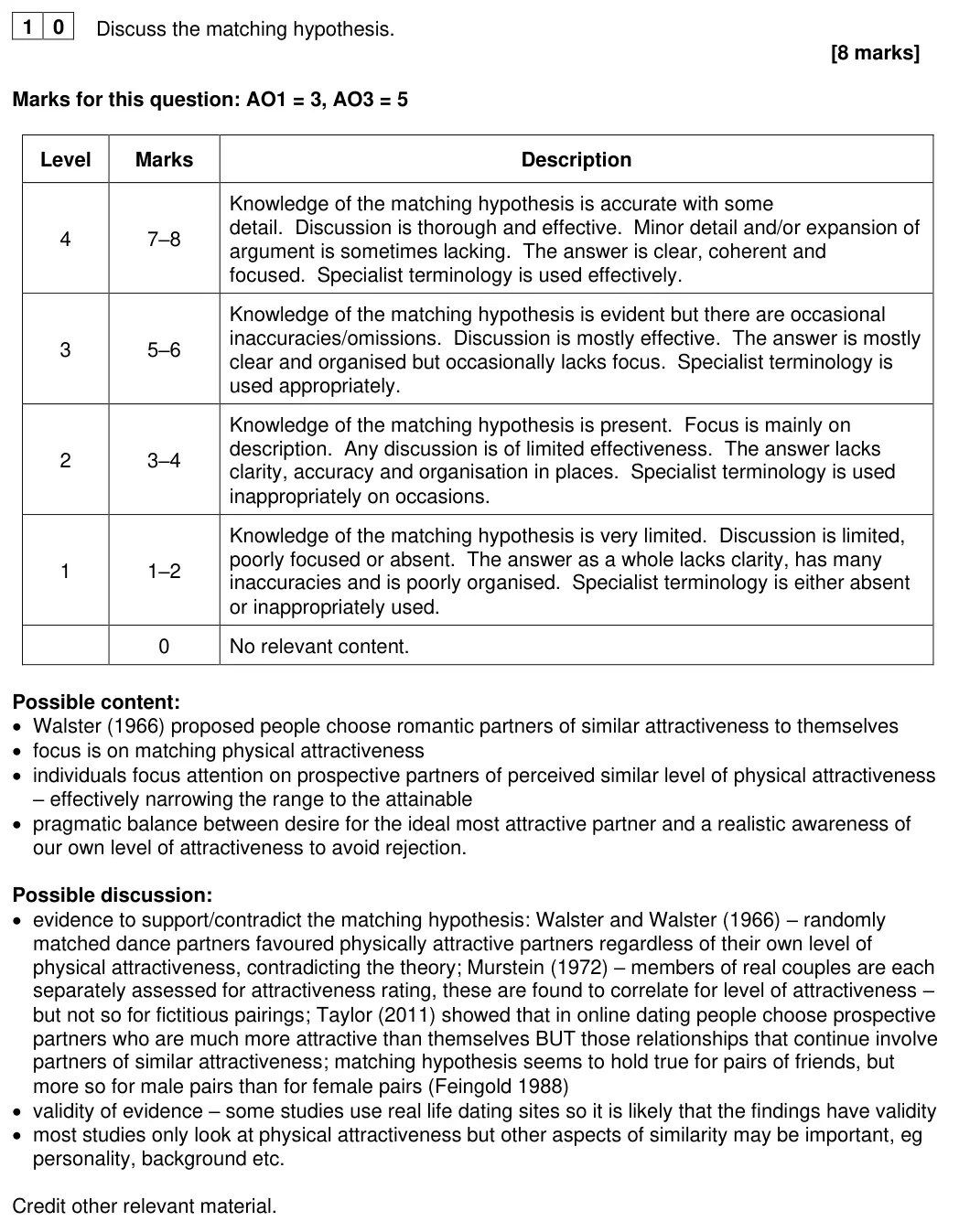
Question 10 was surprisingly poorly answered. Many students described the matching hypothesis not in terms of physical attractiveness, but as a host of other potentially matched traits, such as wealth or hobbies and interests. Many wrongly interpreted the Walster dance study as supporting the predictions of the theory, and there were some vague real-life examples masquerading as evidence, such as the use of dating apps. There were very few answers in the top level.
Notes from the mark scheme and report
matching on PHYSICAL attractiveness (Walster)
many described matching on wealth/hobbies
Walster dance study wrongly cited as support (it contradicts)
real-life anecdotes as evidence
June 2024 · Paper 3 · Q118 marksAO1=3, AO3=5Extended writingOld spec only
Not on the 2025 specification: sexual selection and human reproductive behaviour / evolutionary partner preferences, removed in v1.4
Mark scheme, including level descriptors and indicative content
Examiner's comment
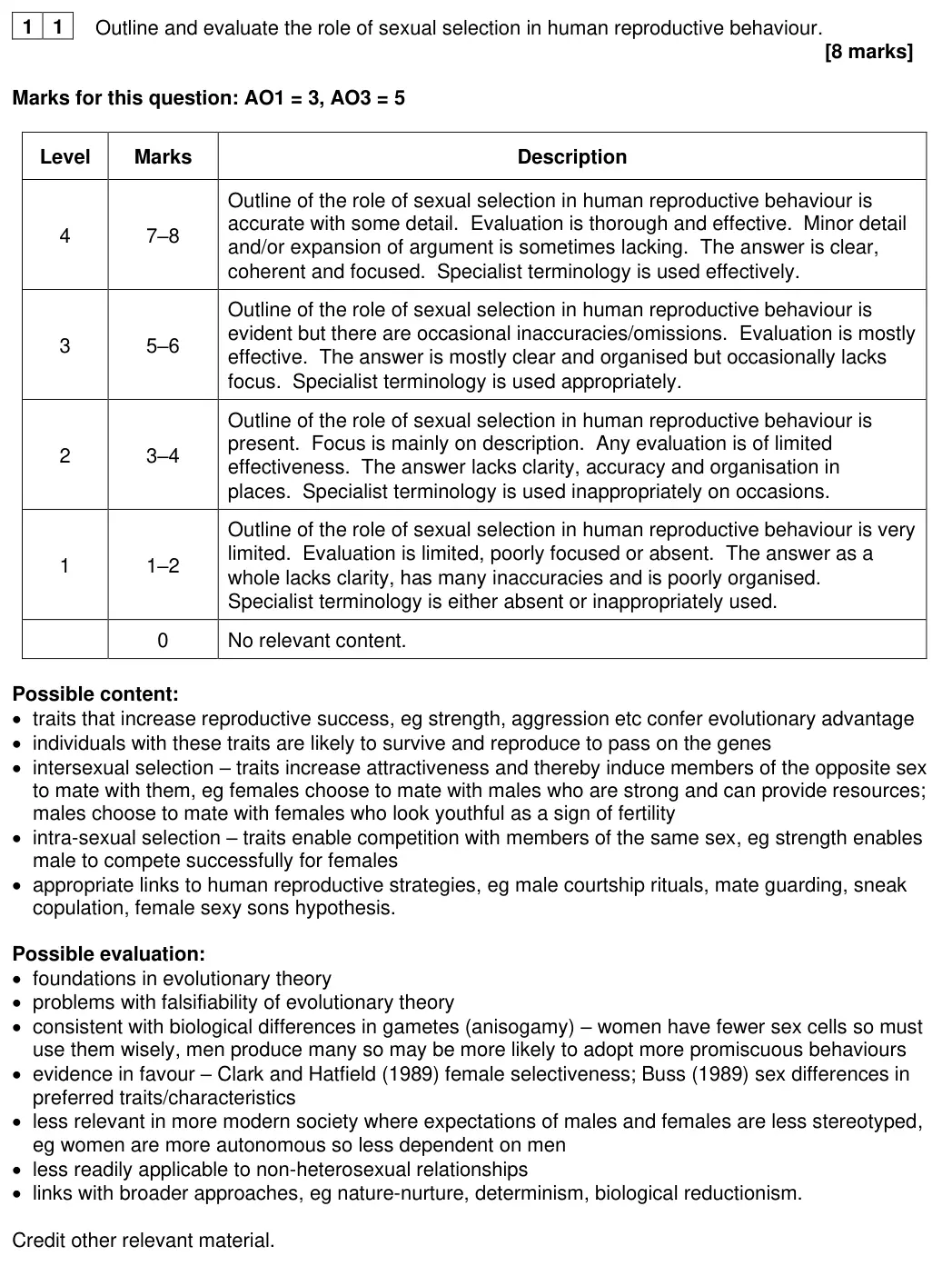
So too with Question 11. There were some muddled accounts of anisogamy, with intersexual and intra-sexual selection often presented the wrong way round. Many answers were let down by descriptions of evolutionary mating strategies as some kind of conscious choice, rather than being part of our genetic make-up. Discussion was mostly made up of research studies, with Clark and Hatfield, and Buss, the most cited.
Notes from the mark scheme and report
Off-spec: sexual selection and human reproductive behaviour / evolutionary partner preferences, removed in v1.4
Mark scheme, including level descriptors and indicative content
Examiner's comment
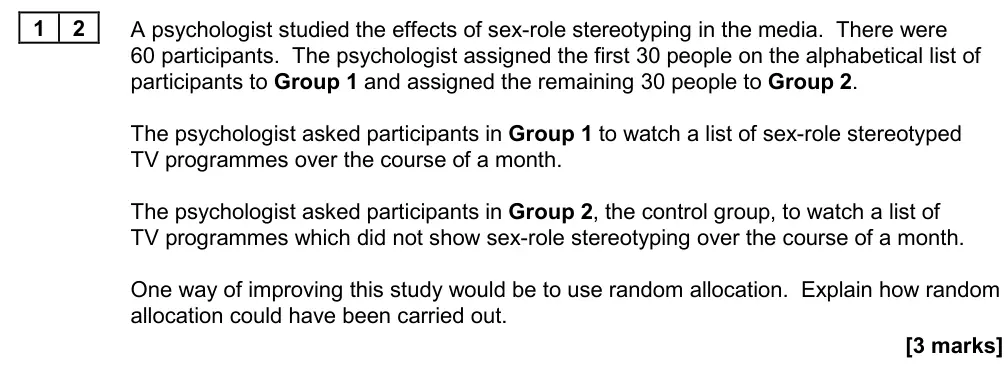
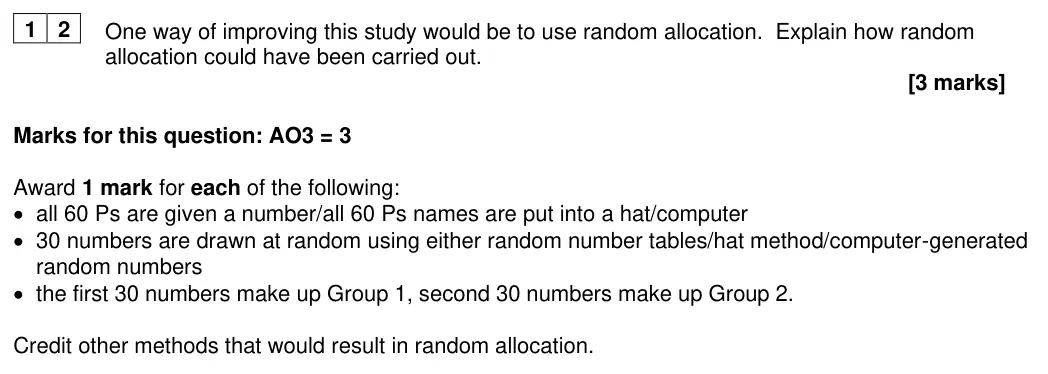
For Question 12, most students were able to access at least two marks by stating that all the names/numbers of the people in the study would be subject to some sort of lottery method. The third mark, for explaining how those names/numbers would be allocated to Group 1 or Group 2 proved more elusive for some. Generally, though, this was a very well-answered question.
Notes from the mark scheme and report
1 mark each: number/name all 60 Ps
draw at random
first 30 drawn = Group 1, rest = Group 2
stem study on sex-role stereotyping in TV (the 'sex-role stereotypes' heading was removed in v1.4, media influence on gender roles remains)
June 2024 · Paper 3 · Q132 marksAO2=1, AO3=1Research methodsdata handling
Mark scheme, including level descriptors and indicative content
Examiner's comment
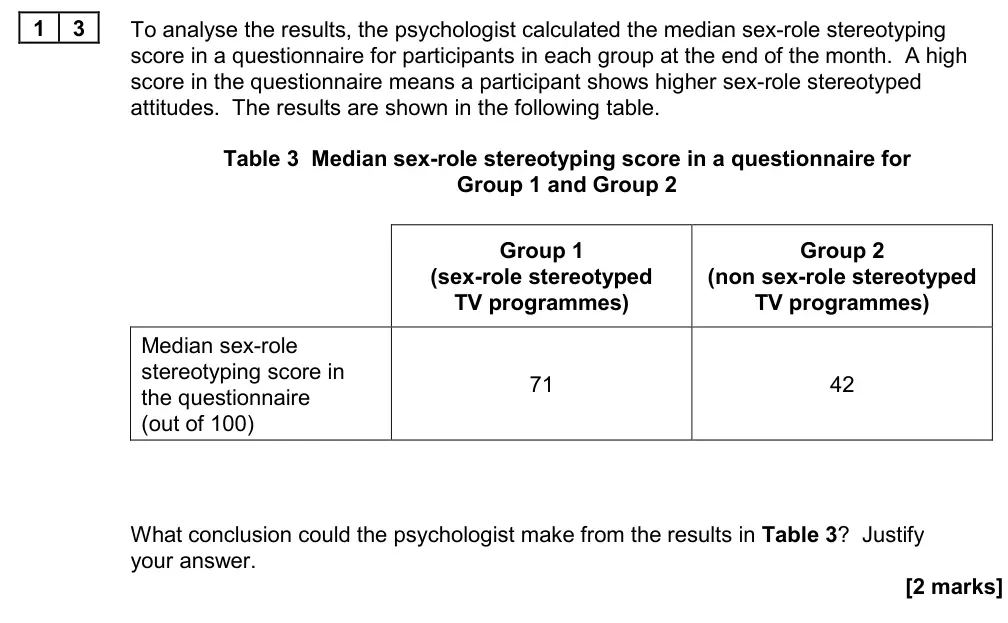
In Question 13, some students simply restated the figures in the table, and failed to score any marks as a result. Others were able to claim the justification mark, but their conclusion lacked the required clarity for the second mark.
Notes from the mark scheme and report
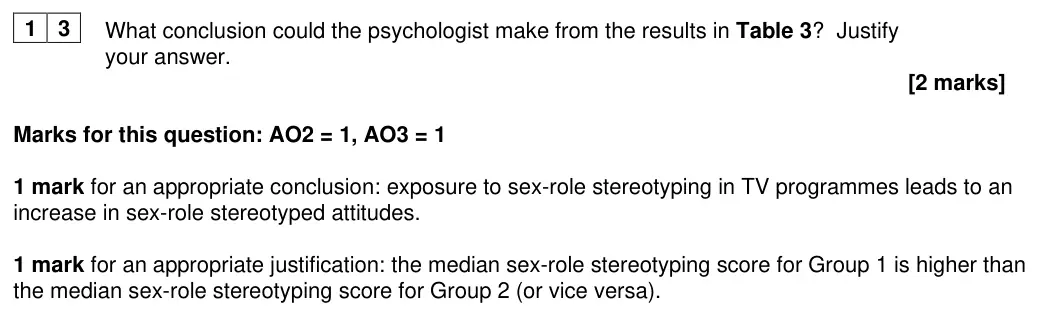
1 mark conclusion (exposure to stereotyped TV increases stereotyped attitudes) + 1 mark justification (median 71 > 42)
Mark scheme, including level descriptors and indicative content
Examiner's comment
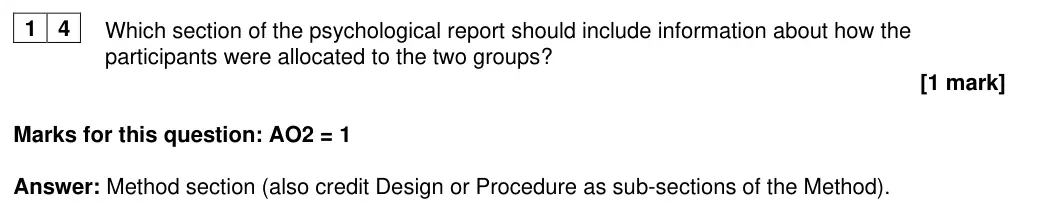
For Question 14, most students were able to identify either the ‘method’, ‘design; or ‘procedure’ as creditworthy alternatives and as such were awarded a mark. There were no marks given for ‘methodology’, although this was a popular answer. Other common incorrect answers were the ‘abstract’ and the ‘introduction’.
Notes from the mark scheme and report
Method section (also credit Design or Procedure)
'methodology' not credited
abstract and introduction common wrong answers
June 2024 · Paper 3 · Q152 marksAO2=2Applicationgender
Mark scheme, including level descriptors and indicative content
Examiner's comment
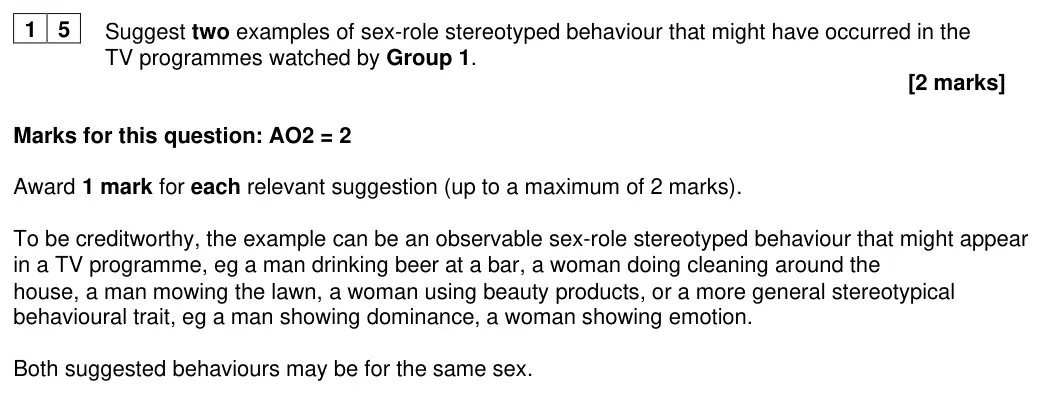
Question 15 caused few problems, particularly because students could either give examples of sex-stereotyped behaviours, or more general behavioural traits. Those who did lose marks gave examples that would not necessarily be associated with one sex or the other, such as keeping fit.
Notes from the mark scheme and report
1 mark each: observable gender-stereotyped behaviour on TV (man mowing lawn, woman cleaning) or trait (male dominance, female emotion)
both may be the same sex
not credited if not sex-typed (e.g. keeping fit)
'sex-role stereotypes' heading removed in v1.4 but media influence on gender roles remains
June 2024 · Paper 3 · Q168 marksAO1=3, AO3=5Extended writinggender
Mark scheme, including level descriptors and indicative content
Examiner's comment
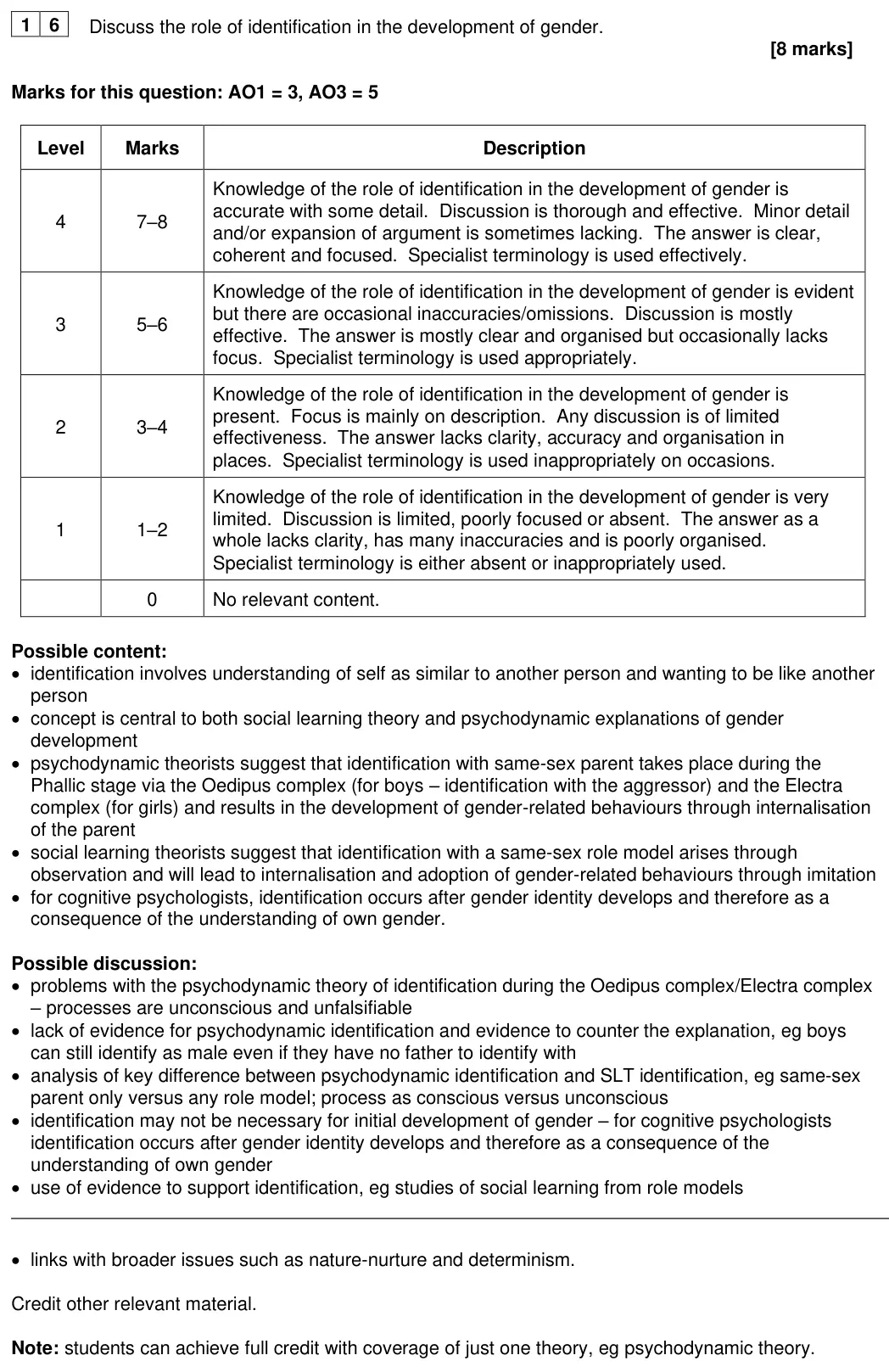
Question 16 wrongfooted many students who seemed underprepared for a question of this type. There were some good answers though, mainly from those who discussed the psychodynamic and social learning theory versions of identification, resulting in effective analyses of both.
Notes from the mark scheme and report
MS also credits psychodynamic identification (Oedipus/Electra complex), removed in v1.4, and says full credit possible for one theory: answer via SLT identification (current)
many underprepared
best answers compared psychodynamic and SLT identification
June 2024 · Paper 3 · Q178 marksAO1=3, AO3=5Extended writingOld spec onlygender
Mark scheme, including level descriptors and indicative content
Examiner's comment
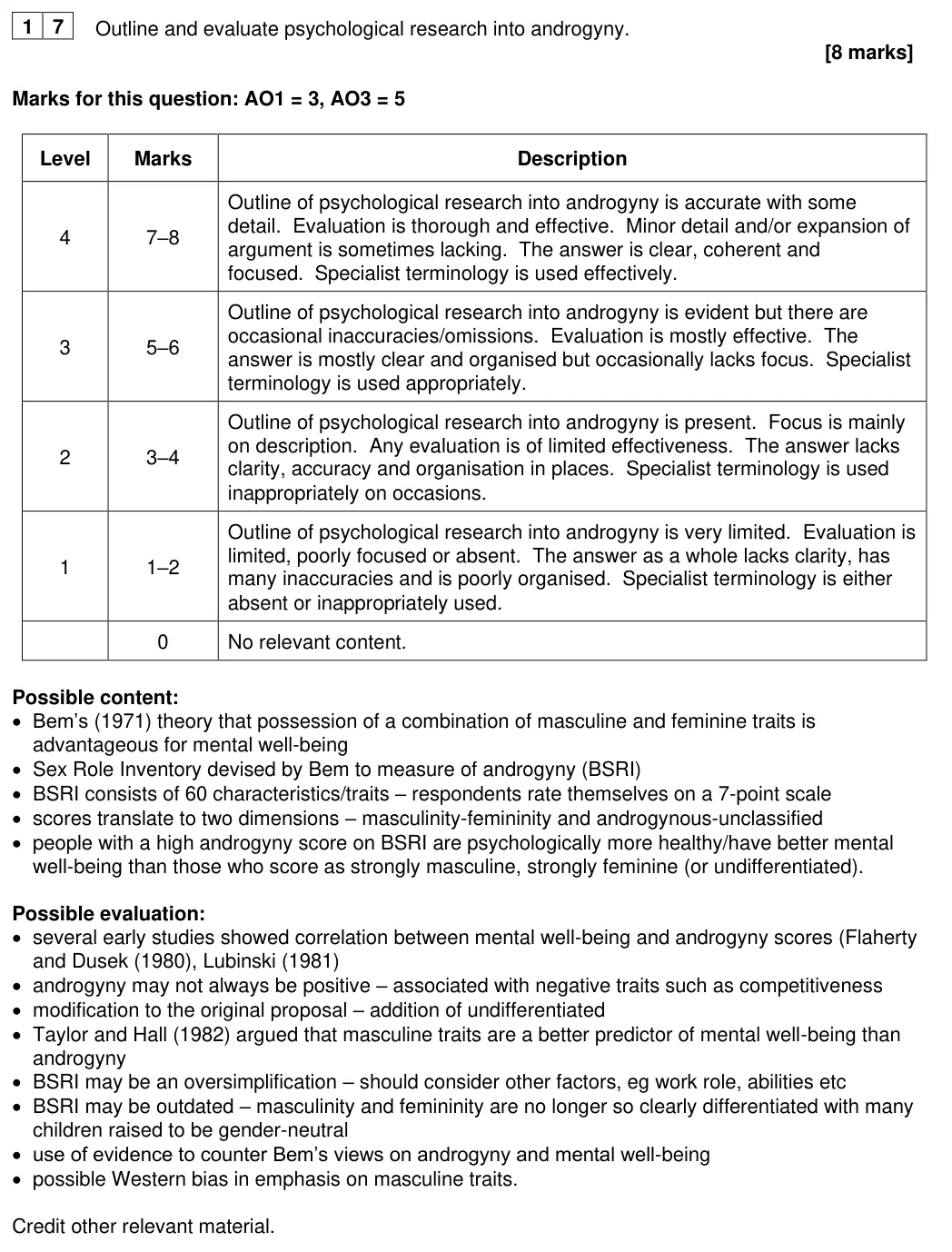
Question 17 was one of the better answered 8-marks questions on the paper. Many students gave convincing accounts of Bem’s methodology and were able to assess the sex role inventory in terms of its reliability and validity.
Notes from the mark scheme and report
(androgyny and Bem's androgyny/well-being research removed in v1.4
measuring gender with the BSRI remains)
good accounts of BSRI methodology, reliability and validity
Mark scheme, including level descriptors and indicative content
Examiner's comment
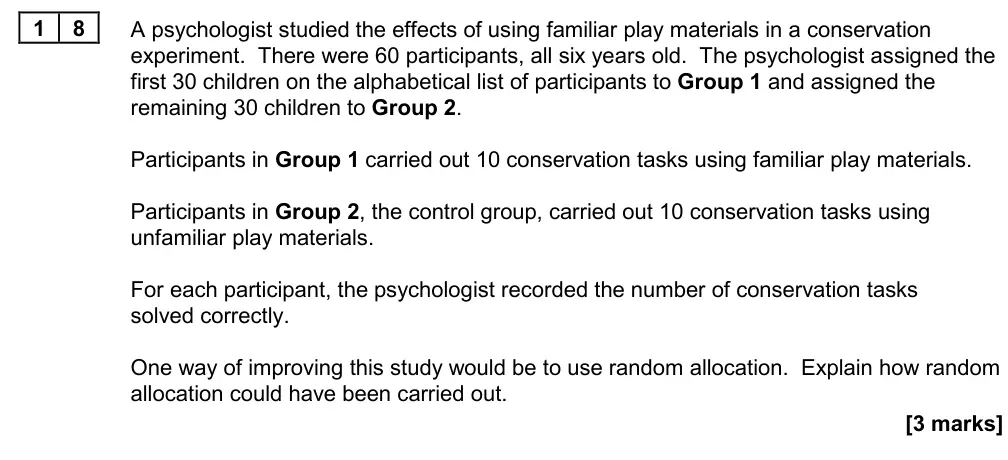
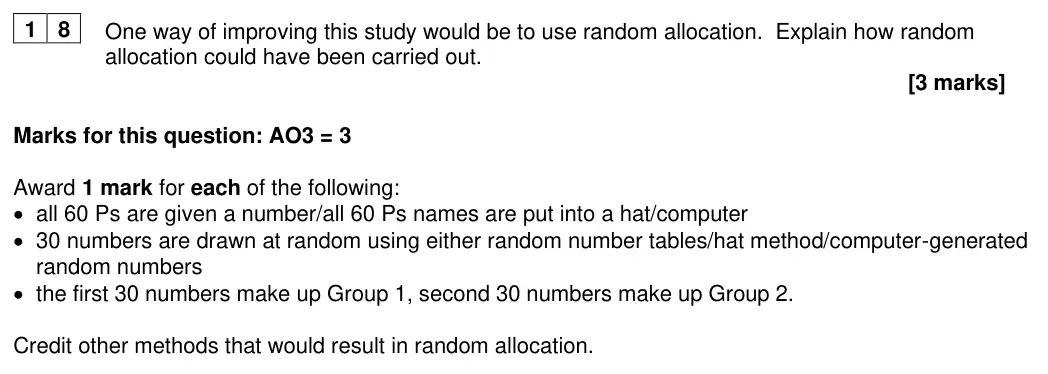
For Question 18, most students were able to access at least two marks by stating that all the names/numbers of the people in the study would be subject to some sort of lottery method. The third mark, for explaining how those names/numbers would be allocated to Group 1 or Group 2 proved more elusive for some. Generally, though, this was a very well-answered question.
Notes from the mark scheme and report
1 mark each: number/name all 60 Ps
draw at random
first 30 drawn = Group 1, rest = Group 2
third (allocation) mark most often missed
June 2024 · Paper 3 · Q192 marksAO2=1, AO3=1Research methodsdata handling
Mark scheme, including level descriptors and indicative content
Examiner's comment
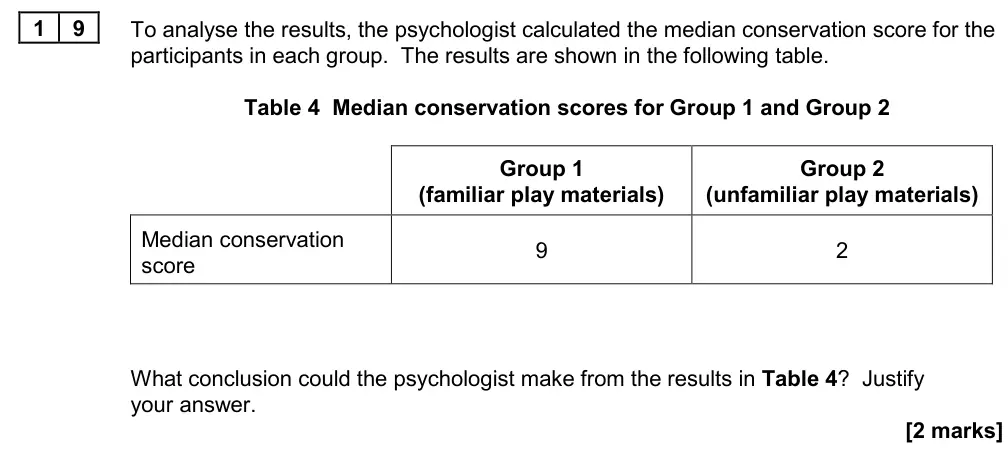
In Question 19, some students simply restated the figures in the table, and failed to score any marks as a result. Others were able to claim the justification mark, but their conclusion lacked the required clarity for the second mark.
Notes from the mark scheme and report
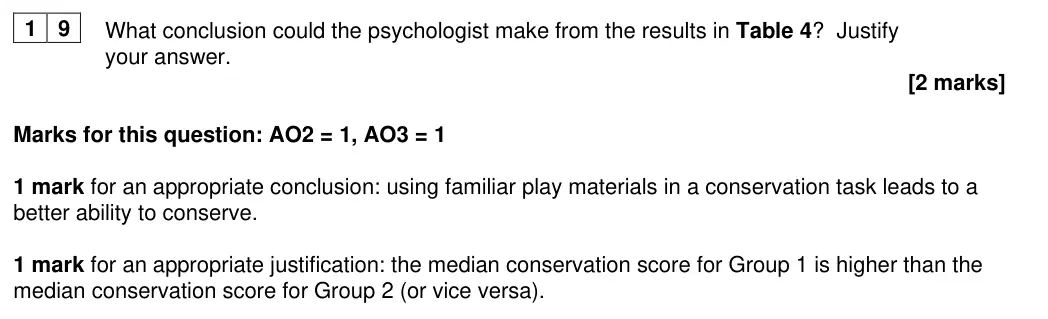
1 mark conclusion (familiar materials improve conservation) + 1 mark justification (median 9 > 2)
Mark scheme, including level descriptors and indicative content
Examiner's comment
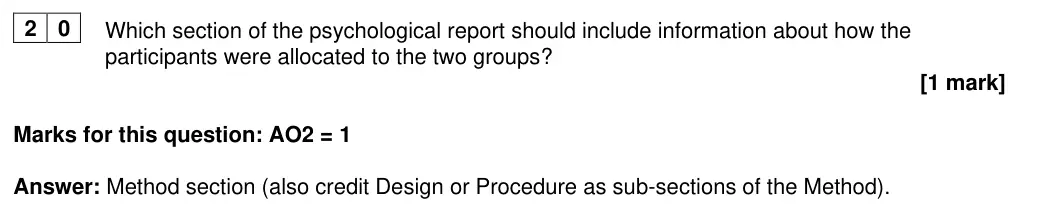
For Question 20, most students were able to identify either the ‘method’, ‘design; or ‘procedure’ as creditworthy alternatives and as such were awarded a mark. There were no marks given for ‘methodology’, although this was a popular answer. Other common incorrect answers were the ‘abstract’ and the ‘introduction’.
Mark scheme, including level descriptors and indicative content
Examiner's comment
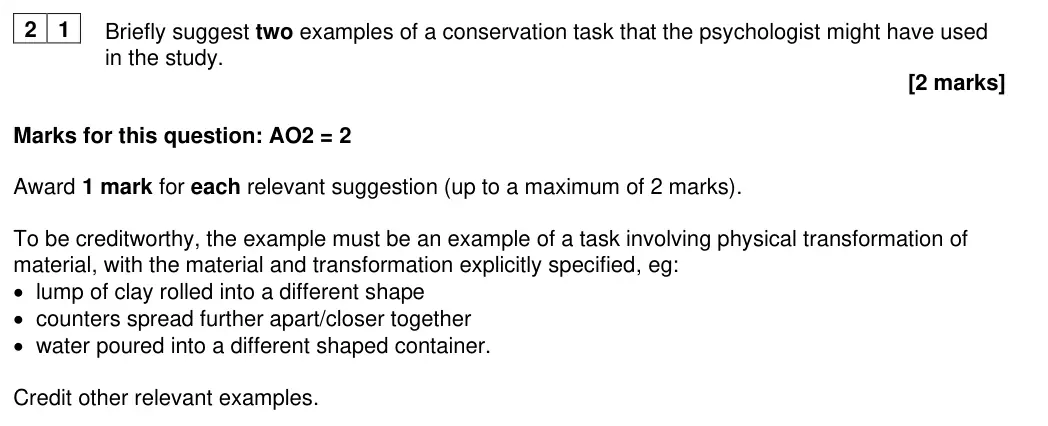
In Question 21, most students were able to provide two examples of conservation tasks, mostly based on the work of Piaget. There were some bizarre answers though; perhaps some students assumed they were not able to draw on Piaget’s original conservation tasks and felt compelled to invent their own, with varying degrees of success.
Notes from the mark scheme and report
1 mark each
must specify the material AND the transformation (clay rolled, counters spread, water poured into different container)
Mark scheme, including level descriptors and indicative content
Examiner's comment
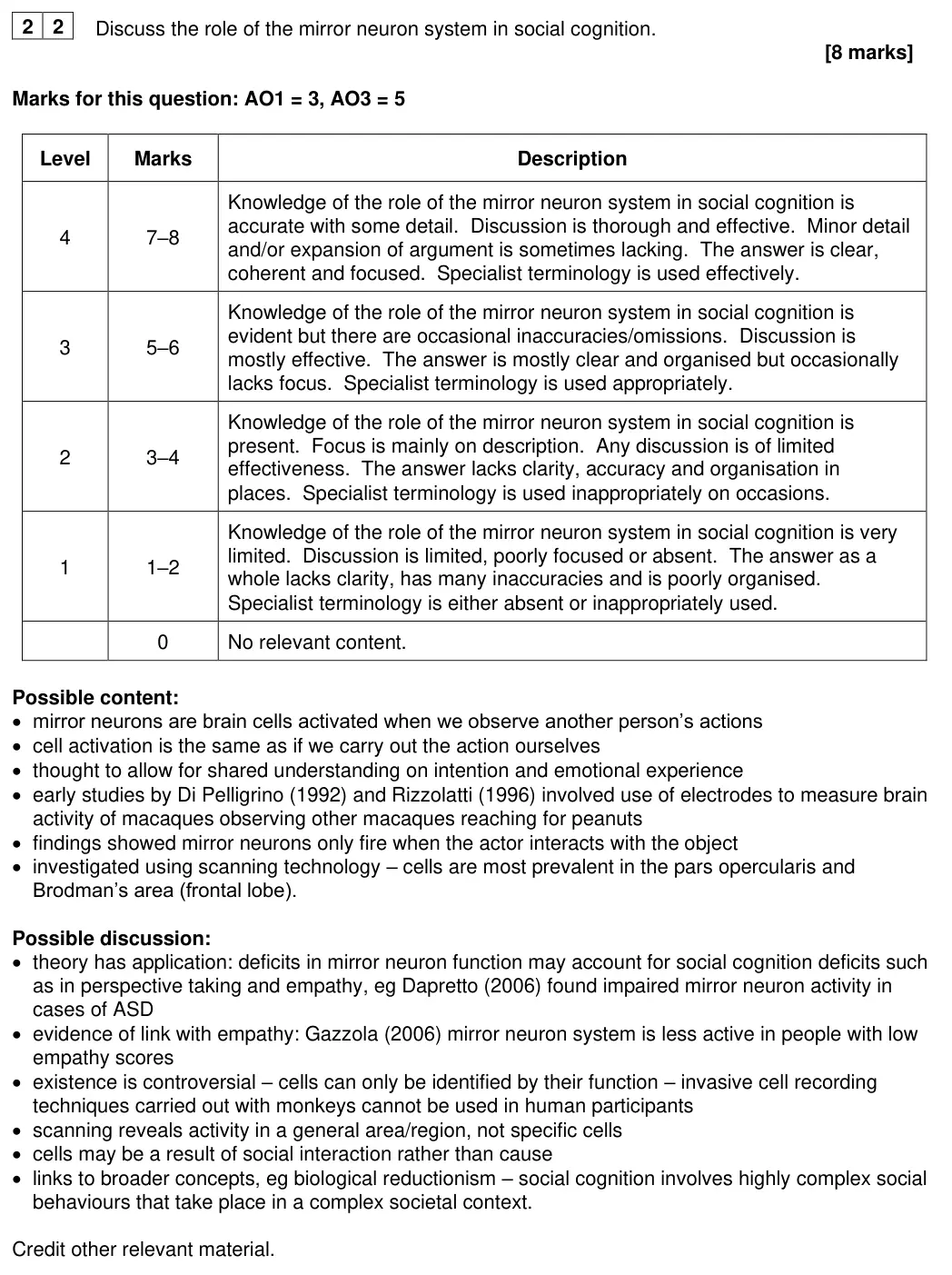
Question 22 produced some good answers. Many students were able to describe mirror neurons and their role in social cognition. There was frequent reference to the links with ASD as well as effective use of evidence, of which the work of Rizzolatti was the most oft cited.
Notes from the mark scheme and report
mirror neurons fire when observing and performing an action
Rizzolatti macaque studies
links to ASD/empathy
evaluation: existence controversial, cannot record single cells in humans, cause vs effect
Mark scheme, including level descriptors and indicative content
Examiner's comment
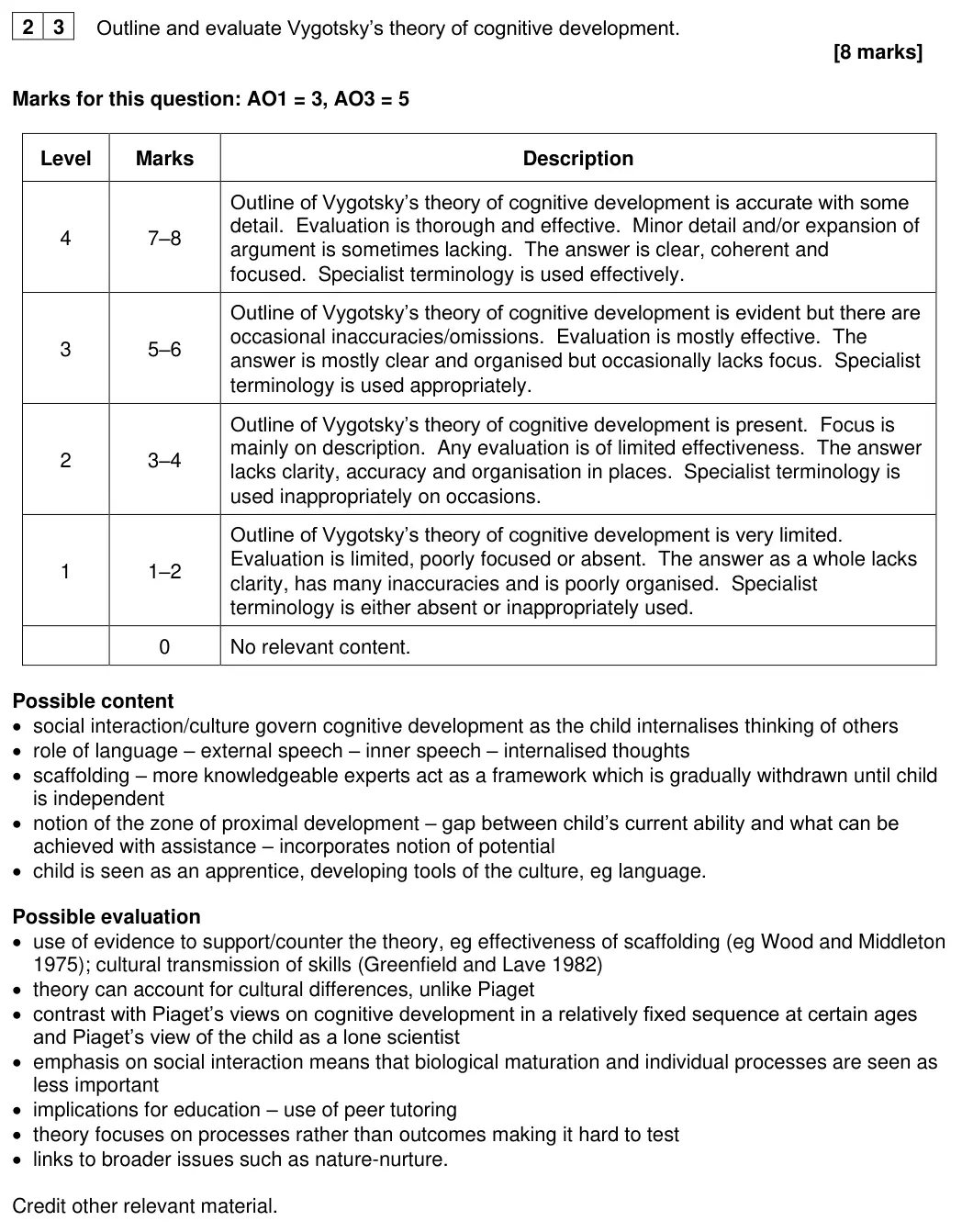
Question 23 also gave rise to coherent responses, although these tended to be overly descriptive so that students penalised themselves in terms of time. There was very good technical detail of Vygotsky’s theory, alongside effective use of terminology, and when students did evaluate, there was decent analysis of the applications of Vygostkian concepts to education. Many students tried to compare Vygotsky’s theory to Piaget’s, but this was less impressive, as Piaget’s theory was often simply described rather than used as effective comparison.
Notes from the mark scheme and report
ZPD, scaffolding, role of language/culture
answers overly descriptive
comparison with Piaget often just described Piaget
Mark scheme, including level descriptors and indicative content
Examiner's comment
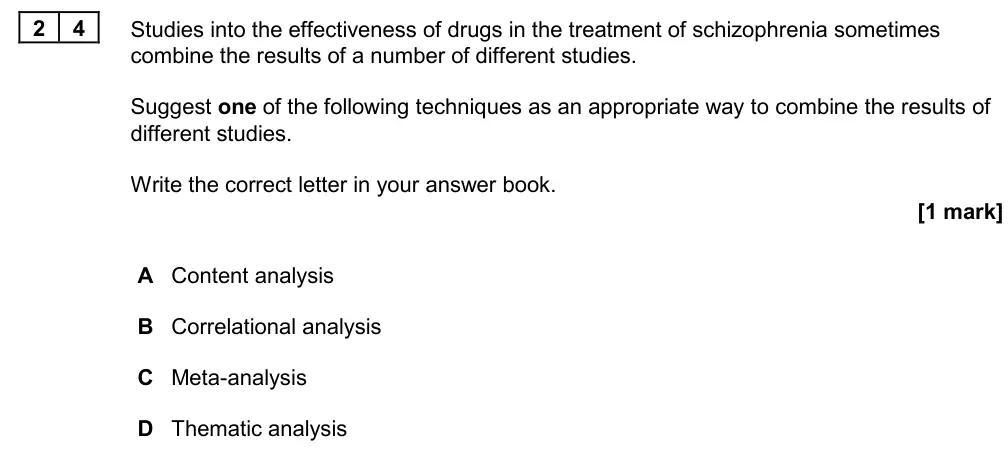
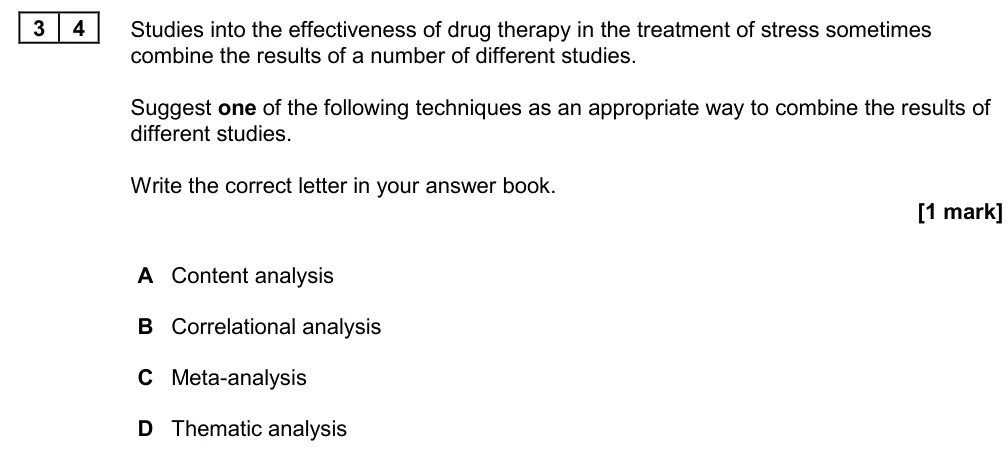
There were very few students indeed who did not know that Question 24 was describing meta-analysis.
Notes from the mark scheme and report
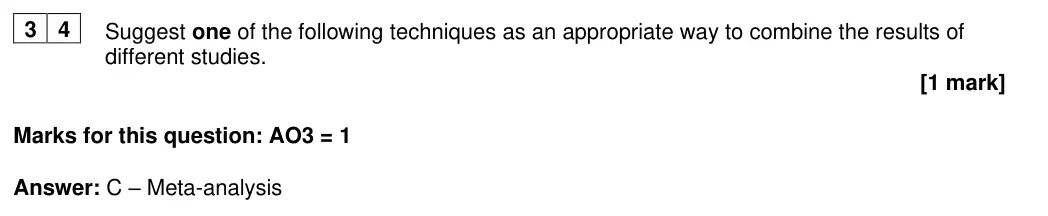
answer C meta-analysis
distractors content analysis, correlational analysis and thematic analysis (thematic analysis removed in v1.4)
almost all correct
June 2024 · Paper 3 · Q251 markAO1=1Multiple choiceschizophrenia
Answer
A
Mark scheme, including level descriptors and indicative content
Examiner's comment
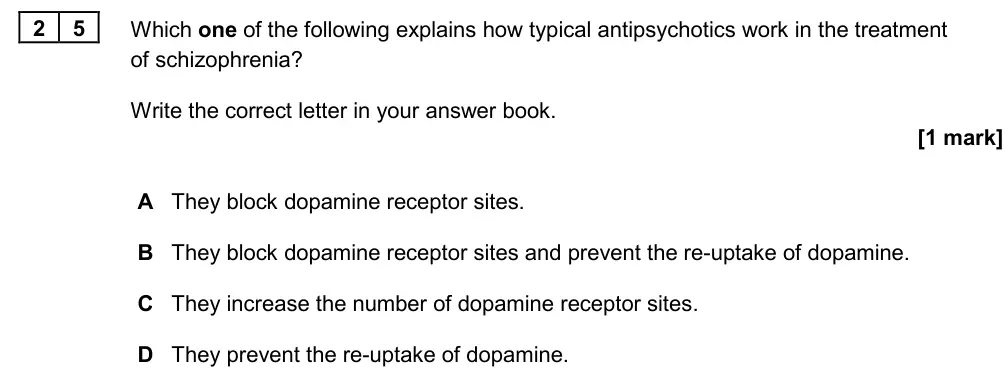
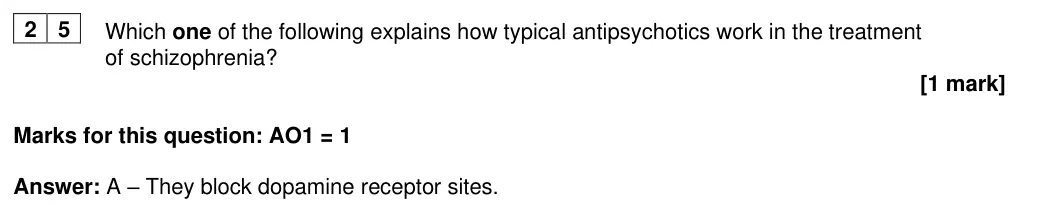
However, there were far fewer who correctly identified option A for Question 25, and those who got it wrong invariably selected option B as their answer.
Notes from the mark scheme and report
answer A (block dopamine receptor sites)
most common wrong answer B (block receptors AND prevent re-uptake)
June 2024 · Paper 3 · Q262 marksAO3=2Evaluate (short)schizophrenia
Mark scheme, including level descriptors and indicative content
Examiner's comment
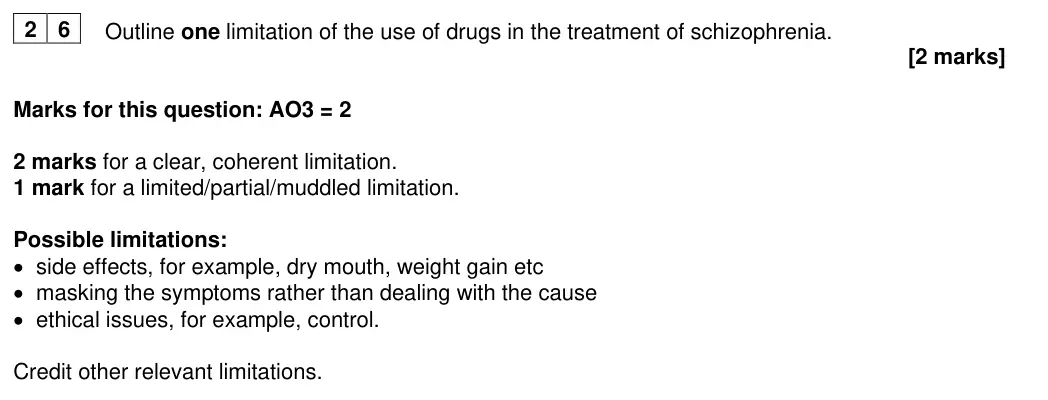
For Question 26, the majority talked about the possible side-effects associated with drug treatment and many went on to point out that these may lead to discontinuation of use as part of their elaboration.
Notes from the mark scheme and report
2 marks for a clear limitation, e.g. side effects (leading to discontinuation), masks symptoms, ethics of control
June 2024 · Paper 3 · Q274 marksAO1=2, AO3=2Explainschizophrenia
Mark scheme, including level descriptors and indicative content
Examiner's comment
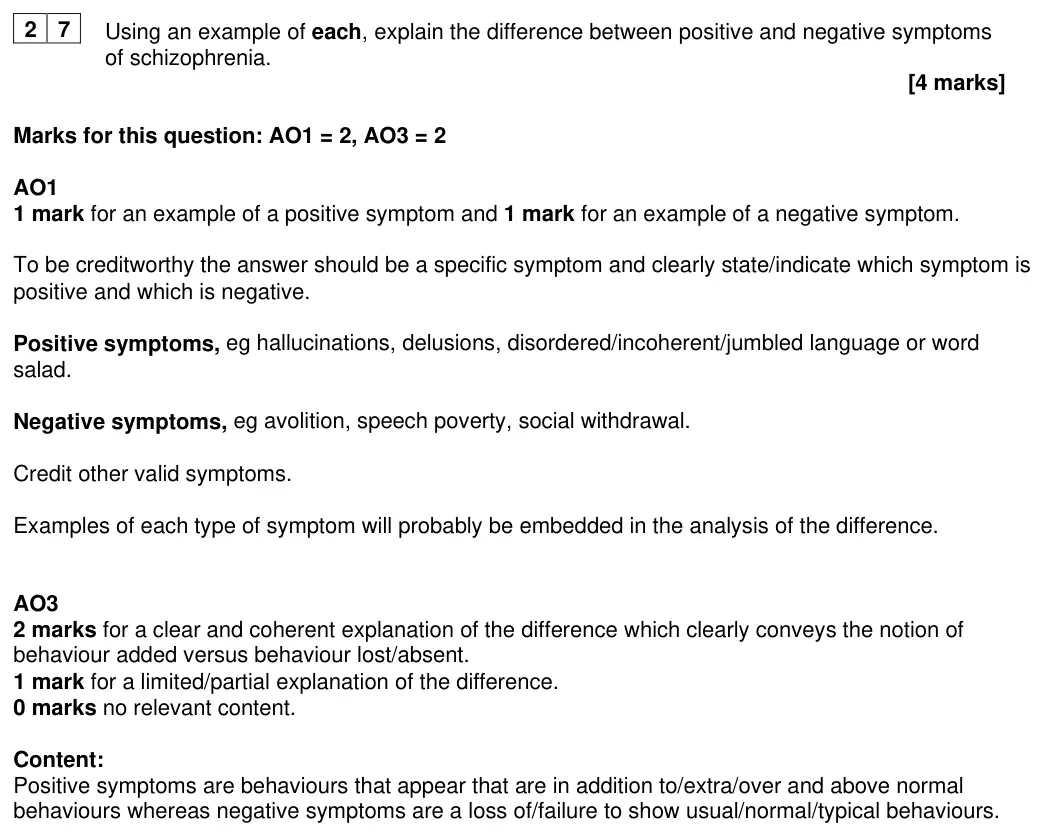
Most students found it relatively straightforward to identify a positive and negative symptom of schizophrenia as part of their answer to Question 27. Popular choices were hallucinations and avolition, respectively. It was also the case that most students could provide a clear and coherent explanation of the difference, though some lost a mark due to the brevity of the response, often offering little more than the words ‘added’ and ‘taken away’.
Notes from the mark scheme and report
AO1: 1 mark positive example + 1 mark negative example, clearly labelled
AO3: 2 marks for difference = behaviour added vs behaviour lost/absent
bare 'added/taken away' lost a mark
June 2024 · Paper 3 · Q2816 marksAO1=6, AO2=4, AO3=616-mark essayschizophrenia
Mark scheme, including level descriptors and indicative content
Examiner's comment
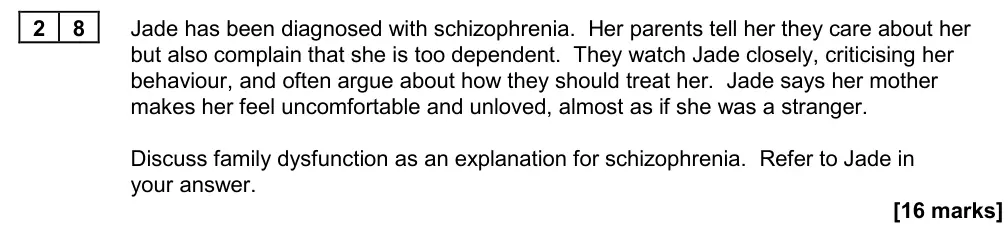
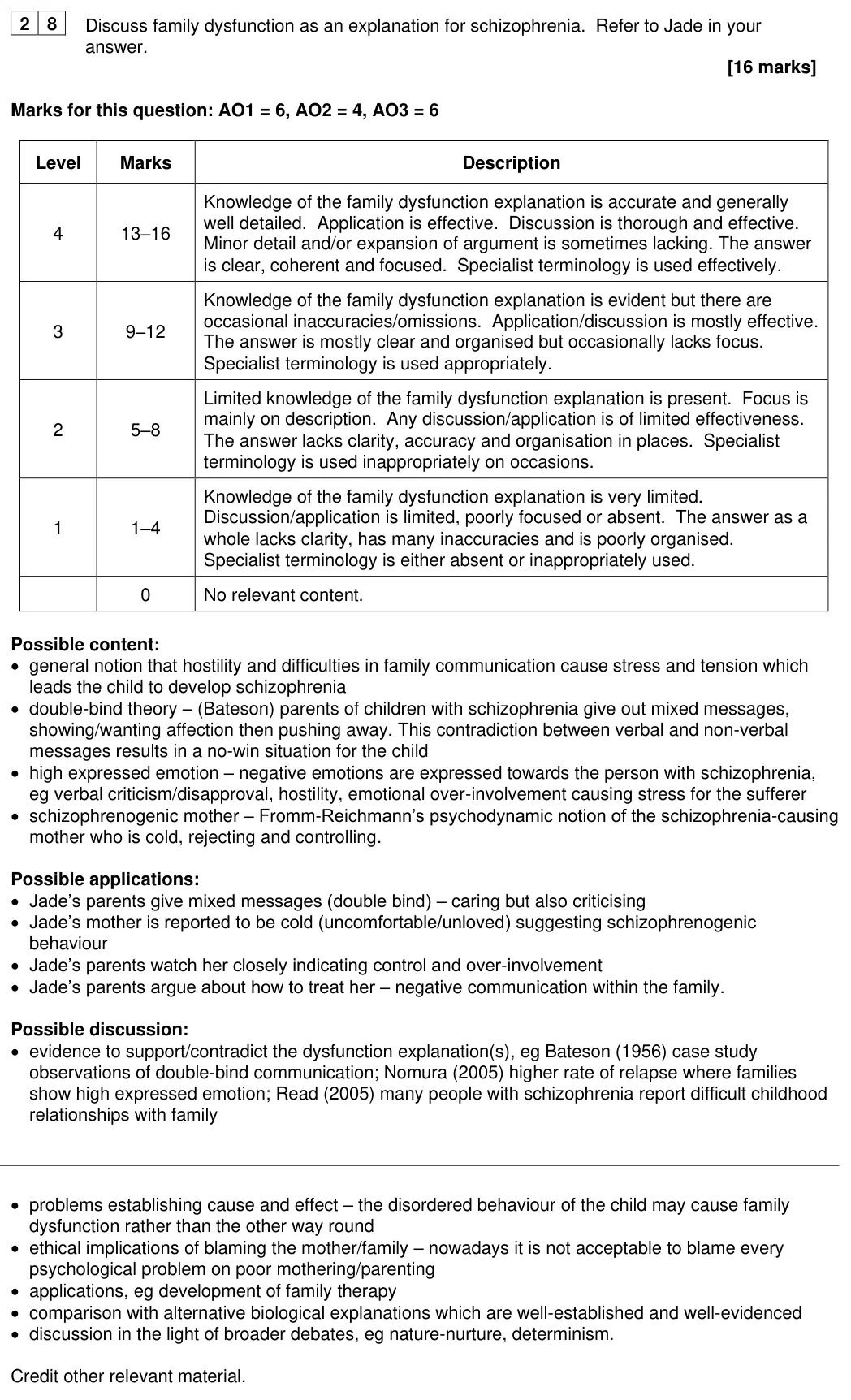
There were some very good answers to the extended response question on the family dysfunction explanation for schizophrenia (Question 28). Most students adopted a breadth over depth approach and talked about all three explanations on the mark scheme. However, this occasionally meant that each was reduced to little more than a couple of sentences which may have restricted access to the top level. It did mean though that students were able to deal with most aspects of the stem. Some very detailed discussions dealt with the ethical implications of blaming the family, practical application to family therapy and the problem of establishing causation.
Notes from the mark scheme and report
double bind (care vs criticism), expressed emotion (watching, criticising), schizophrenogenic mother (cold mother)
breadth approach common but very brief coverage of each limited access to top level
Mark scheme, including level descriptors and indicative content
Examiner's comment
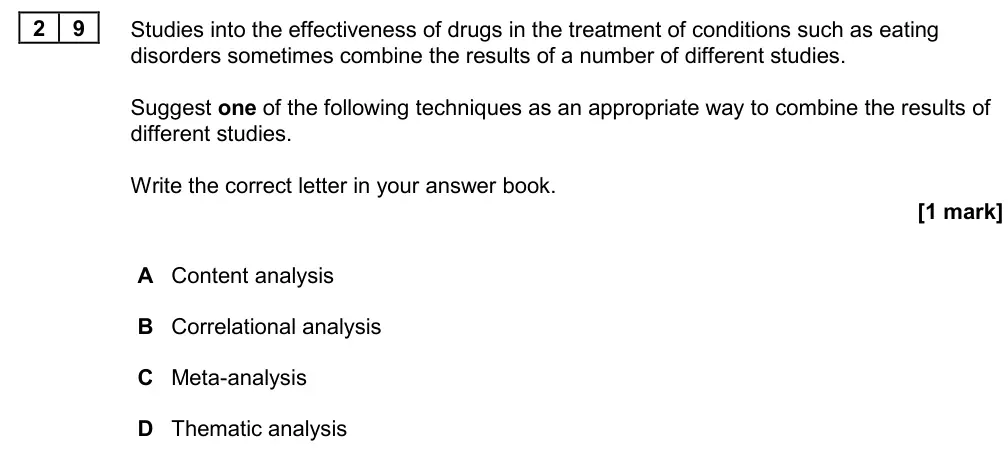
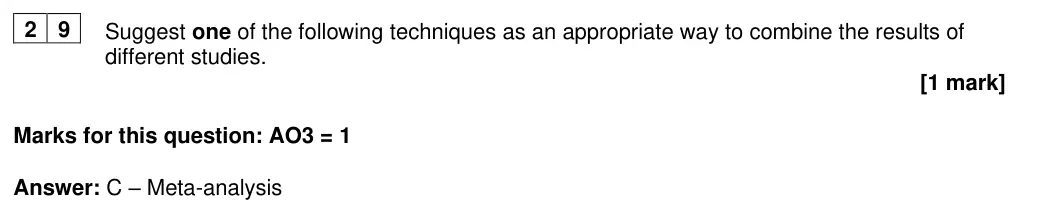
There were very few students indeed who did not know that Question 29 was describing meta-analysis.
Notes from the mark scheme and report
answer C meta-analysis
distractors content analysis, correlational analysis and thematic analysis (thematic analysis removed in v1.4)
June 2024 · Paper 3 · Q301 markAO1=1Multiple choiceeating behaviour
Answer
B
Mark scheme, including level descriptors and indicative content
Examiner's comment
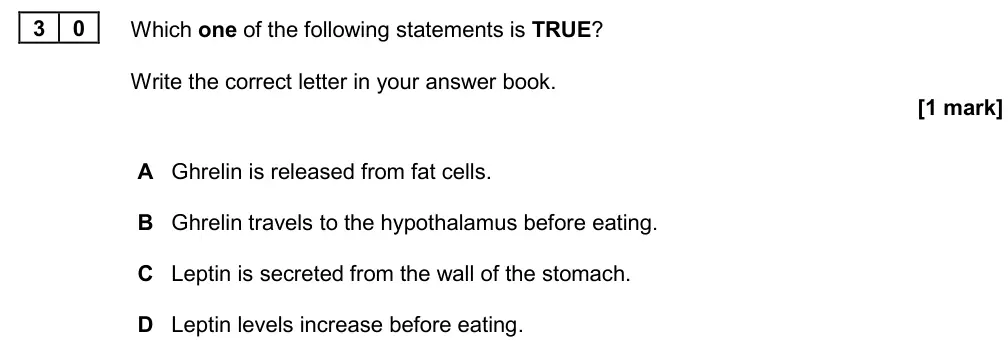
Almost as many were able to correctly identify the true statement as option B for Question 30.
Notes from the mark scheme and report
answer B (ghrelin travels to the hypothalamus before eating)
distractors swap ghrelin (stomach) and leptin (fat cells) sources/timing
June 2024 · Paper 3 · Q312 marksAO3=2Evaluate (short)eating behaviour
Mark scheme, including level descriptors and indicative content
Examiner's comment
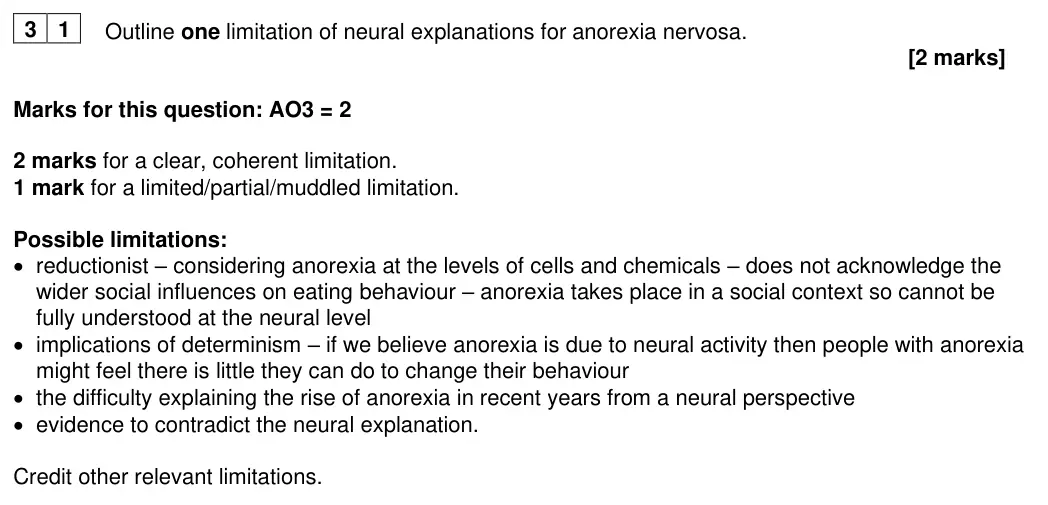
A number of students found Question 31 difficult. They often simply listed alternative explanations for eating disorders without any meaningful comparison with the neural explanation. Those who talked about ‘reductionism’ were usually the most successful.
Notes from the mark scheme and report
2 marks for a clear limitation, e.g. reductionist, deterministic, cannot explain recent rise in incidence, contradictory evidence
listing alternatives without comparison scored little
reductionism answers most successful
June 2024 · Paper 3 · Q324 marksAO1=2, AO3=2Explaineating behaviour
Mark scheme, including level descriptors and indicative content
Examiner's comment
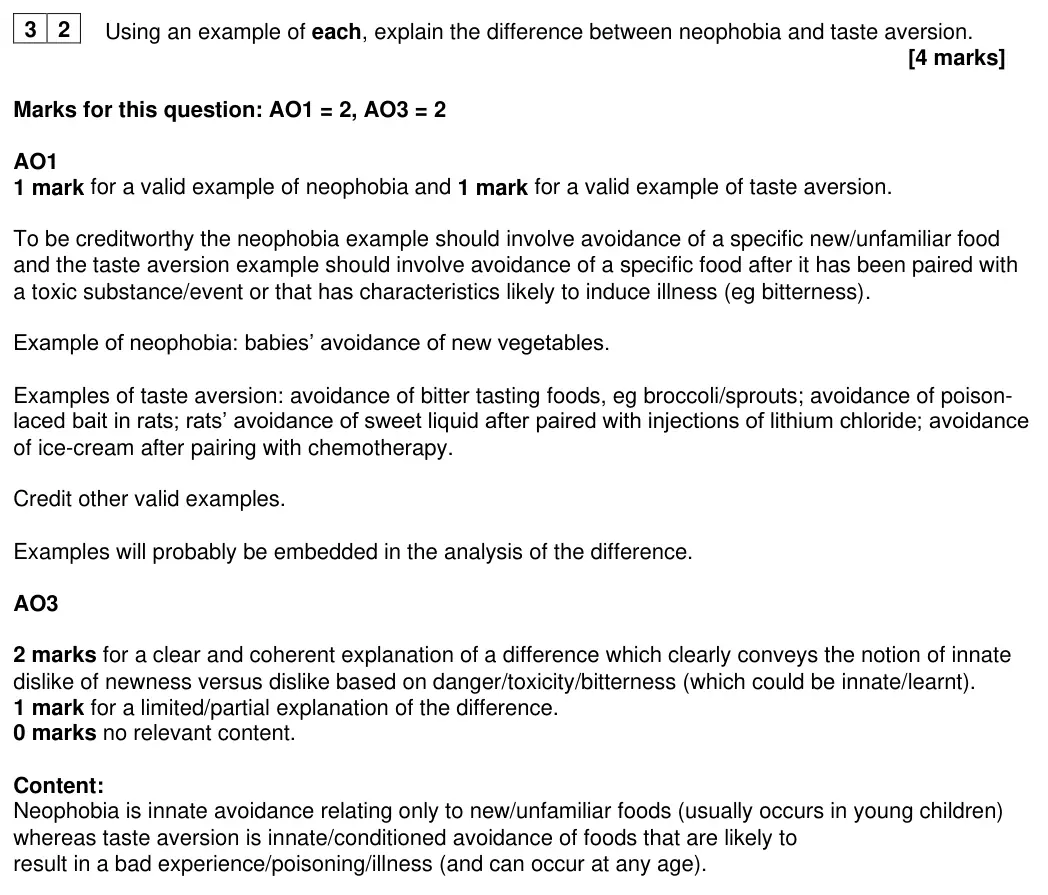
Question 32 proved not to be straightforward. Some students got their definitions of neophobia and taste aversion the wrong way round, and there was a general tendency to offer up a partial repeat of the definition as the example. This was especially true of neophobia.
Notes from the mark scheme and report
AO1: 1 mark specific example of neophobia (new/unfamiliar food) + 1 mark taste aversion (food paired with illness/bitterness)
AO3: 2 marks innate fear of newness vs avoidance after illness/toxicity
definitions often reversed
examples just repeated definitions
June 2024 · Paper 3 · Q3316 marksAO1=6, AO2=4, AO3=616-mark essayeating behaviour
Mark scheme, including level descriptors and indicative content
Examiner's comment
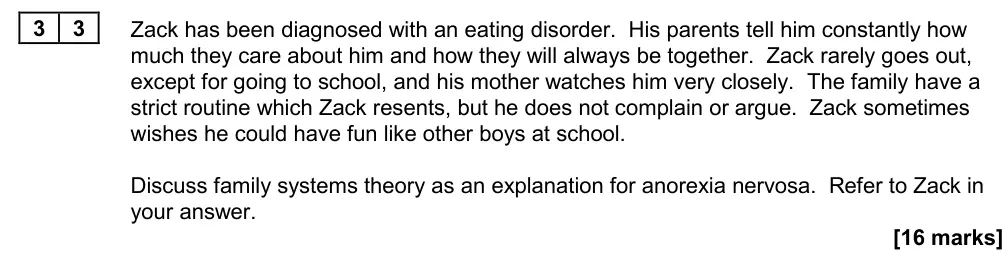
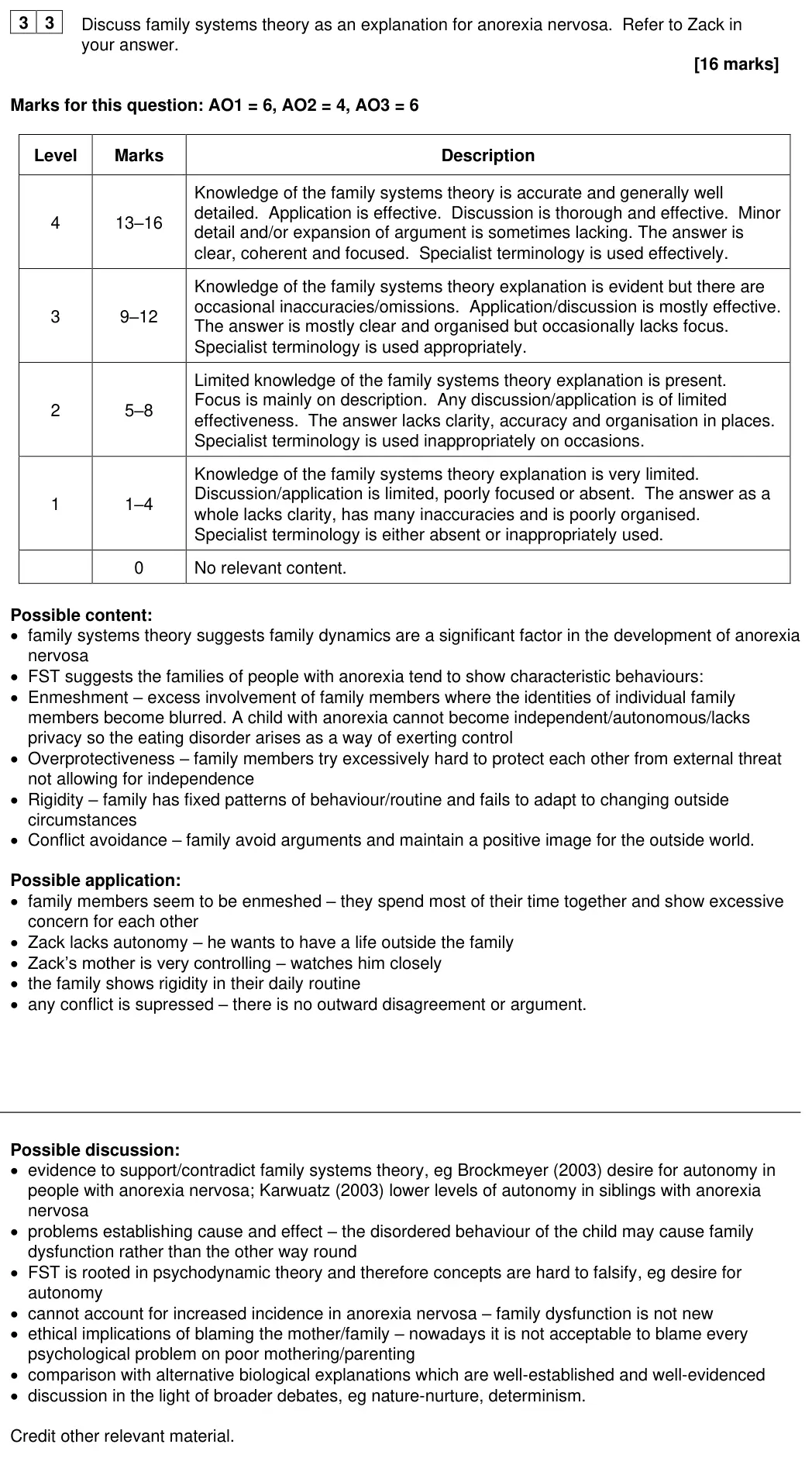
As with the corresponding Schizophrenia question, there were some very good top-level answers for Question 33. Those who knew the key elements of family systems theory were able to describe these succinctly, and then match their description to the appropriate part of the stem. It was striking how well evidence was used in this essay; students who had been taught this topic seemed to have lots of studies at their disposal.
Notes from the mark scheme and report
enmeshment, overprotectiveness, rigidity (strict routine), conflict avoidance (doesn't argue), lack of autonomy (wants fun like other boys), controlling mother
Mark scheme, including level descriptors and indicative content
Examiner's comment
There were very few students indeed who did not know that Question 34 was describing meta-analysis.
Notes from the mark scheme and report
answer C meta-analysis
distractors content analysis, correlational analysis and thematic analysis (thematic analysis removed in v1.4)
June 2024 · Paper 3 · Q351 markAO1=1Multiple choicestress
Answer
B
Mark scheme, including level descriptors and indicative content
Examiner's comment
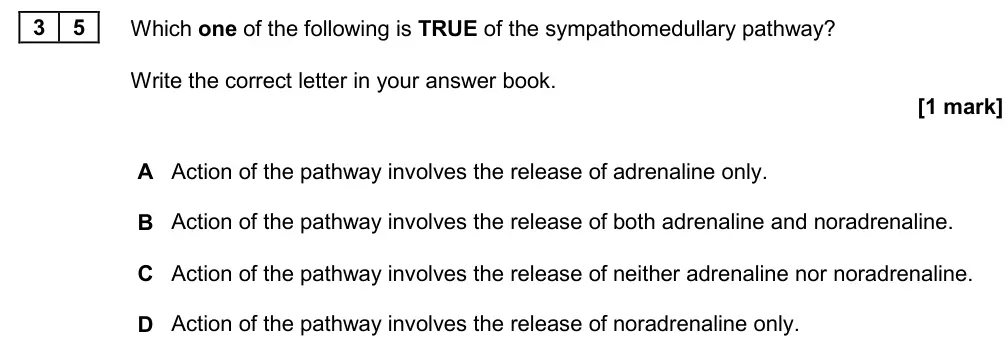
Although Question 35 proved slightly more problematic, there were still lots of correct answers.
Notes from the mark scheme and report
answer B (SAM releases both adrenaline and noradrenaline)
slightly more problematic than other MCQs
June 2024 · Paper 3 · Q362 marksAO3=2Evaluate (short)stress
Mark scheme, including level descriptors and indicative content
Examiner's comment
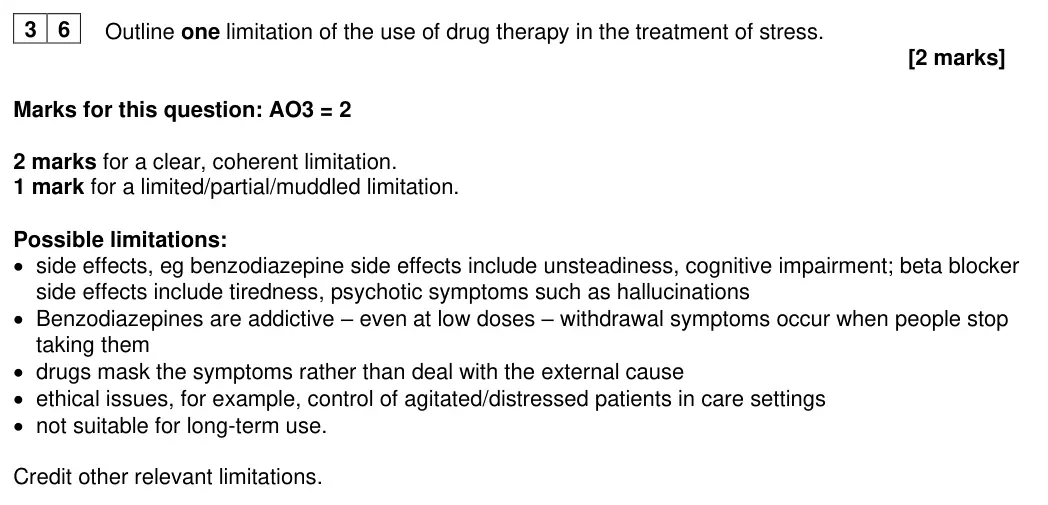
Students approached Question 36 in a similar way to the corresponding Schizophrenia question, and so marks were often awarded for reference to side-effects, plus some elaboration. For this section, students were more likely to talk about the issue of drugs ‘masking’ the problem and not tackling the true source of stress.
Notes from the mark scheme and report
2 marks for a clear limitation: side effects, addiction/withdrawal, masks symptoms not cause, not for long-term use
MS examples name benzodiazepines/beta blockers (named drugs removed in v1.4) but generic drug therapy limitations suffice
June 2024 · Paper 3 · Q374 marksAO1=2, AO3=2Explainstress
Mark scheme, including level descriptors and indicative content
Examiner's comment
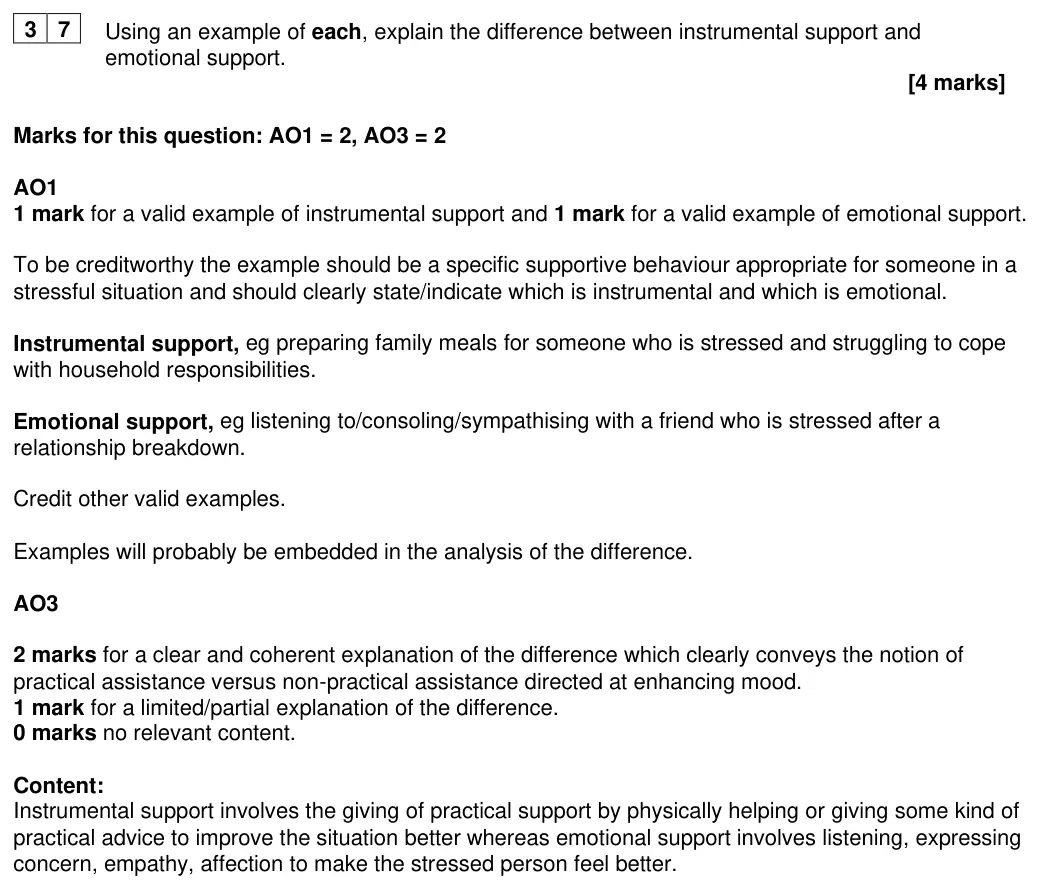
In Question 37, students were typically much more effective when outlining and giving examples of instrumental support than emotional support. For the latter, definitions and examples too often overlapped and were somewhat repetitive.
Notes from the mark scheme and report
AO1: 1 mark specific instrumental example (practical help) + 1 mark emotional example (listening/consoling), clearly labelled
AO3: 2 marks practical help vs mood-enhancing support
emotional support examples often overlapped with definitions
June 2024 · Paper 3 · Q3816 marksAO1=6, AO2=4, AO3=616-mark essaystress
Mark scheme, including level descriptors and indicative content
Examiner's comment
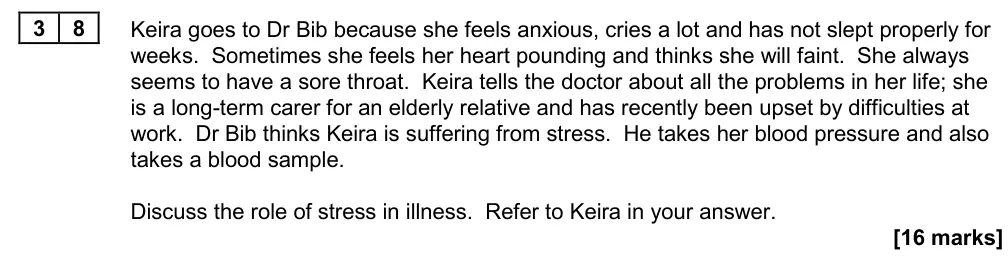
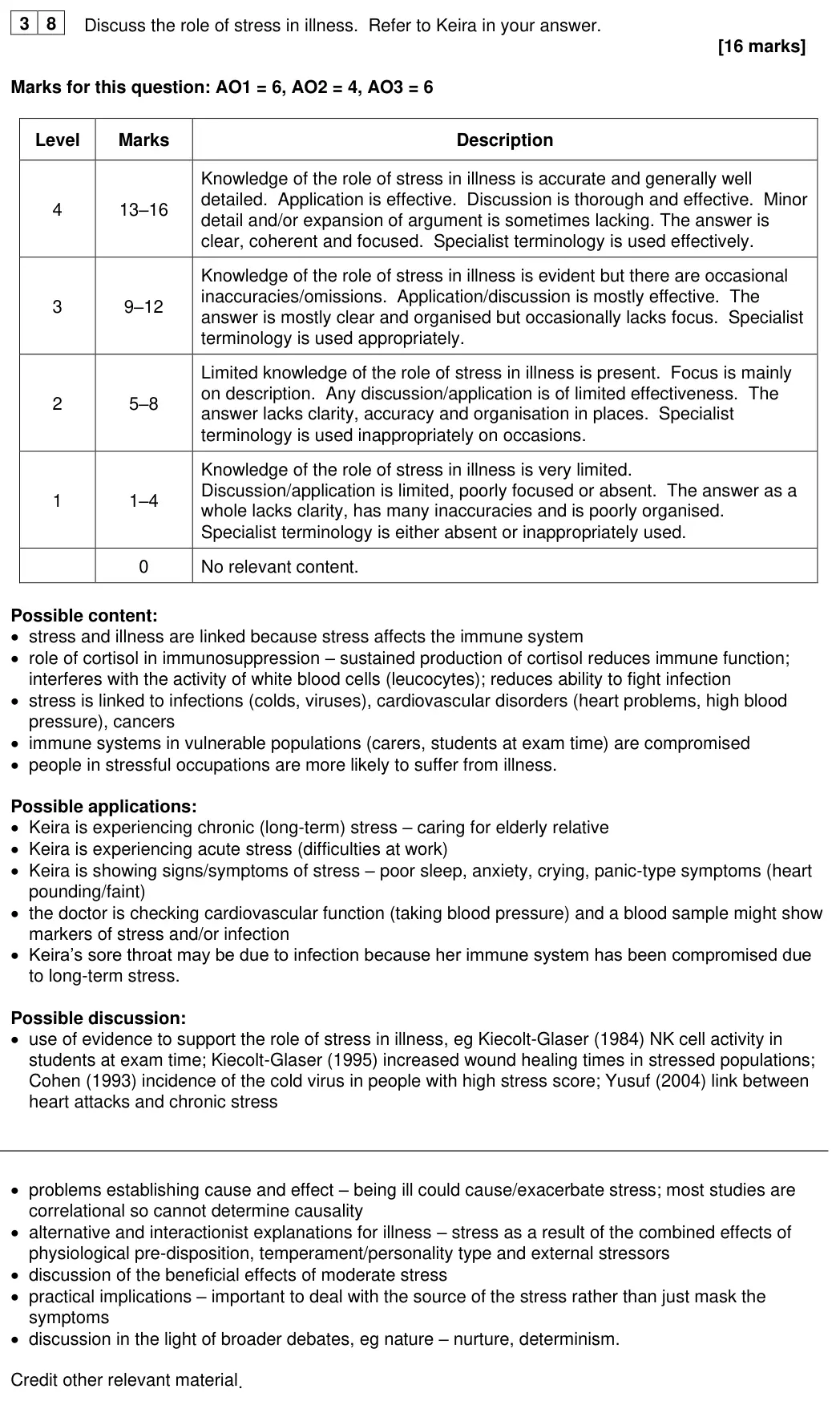
Answers for the extended response question (Q38) were probably the weakest of the three in Section C, although there were some very good responses, nevertheless. Most students went down the route of describing research evidence, and picked up knowledge marks that way, rather than describing the biological links between stress and illness. Some of the evidence presented was muddled, with an amalgam of two or three different studies at once. This also meant that students were less able to successfully apply their knowledge to the example of Kiera in the question. In terms of discussion, many students recognised the problem of mediating variables, usually diet and/or personality, when trying to assess the impact of stress on illness.
Notes from the mark scheme and report
immunosuppression via cortisol, cardiovascular disorders
Mark scheme, including level descriptors and indicative content
Examiner's comment
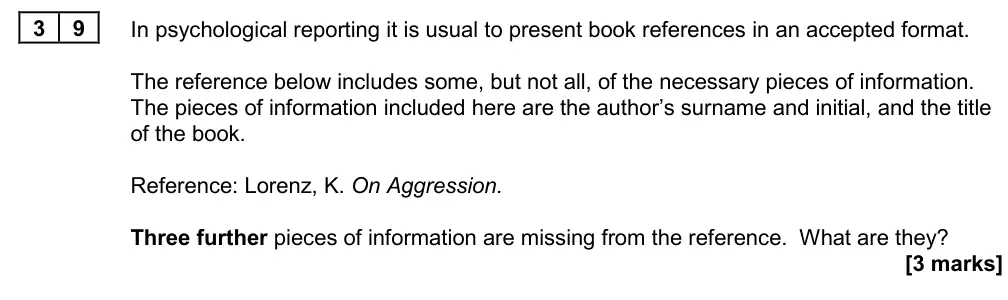
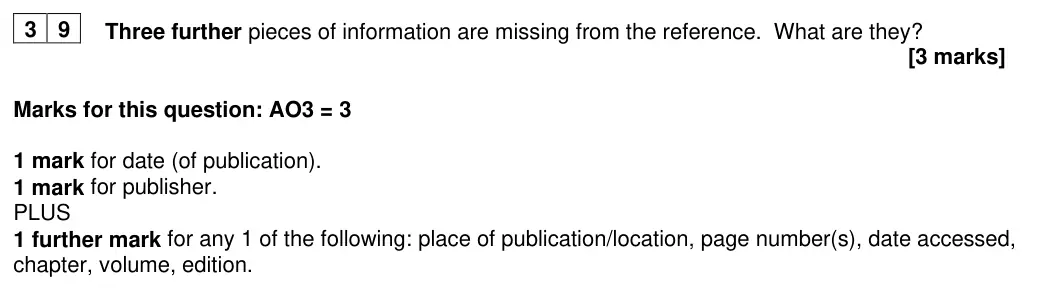
The question on referencing, albeit worth only 3 marks, also proved challenging for many. Question 39 produced a wide variety of answers and discriminated well between those students who had clearly come across the structure of a reference before, and those who were left to guess. Many students knew that the date of publication was missing but far fewer were able to identify other details, such as the name and location of the publisher.
Notes from the mark scheme and report
1 mark date of publication + 1 mark publisher + 1 mark for one of place of publication, page numbers, edition etc
Mark scheme, including level descriptors and indicative content
Examiner's comment
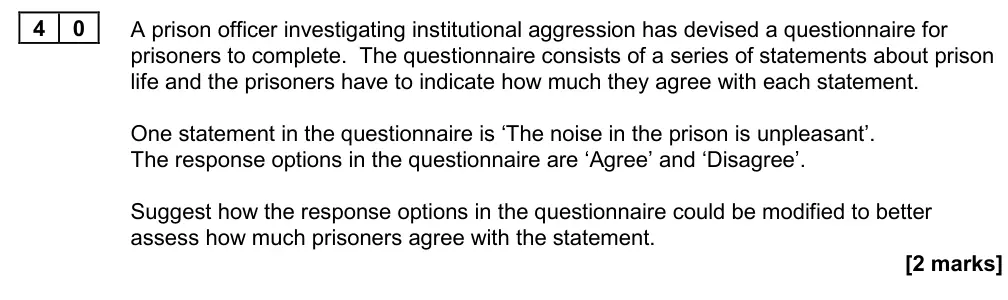
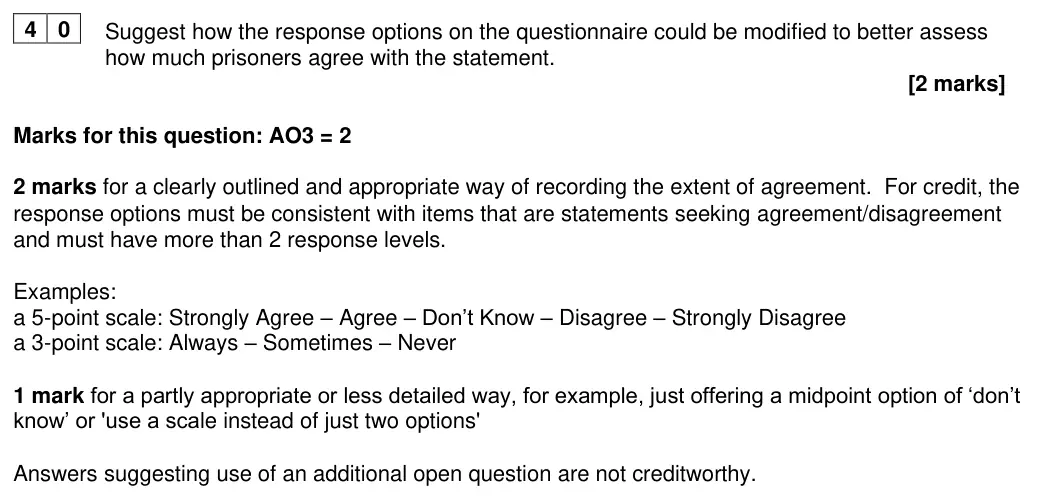
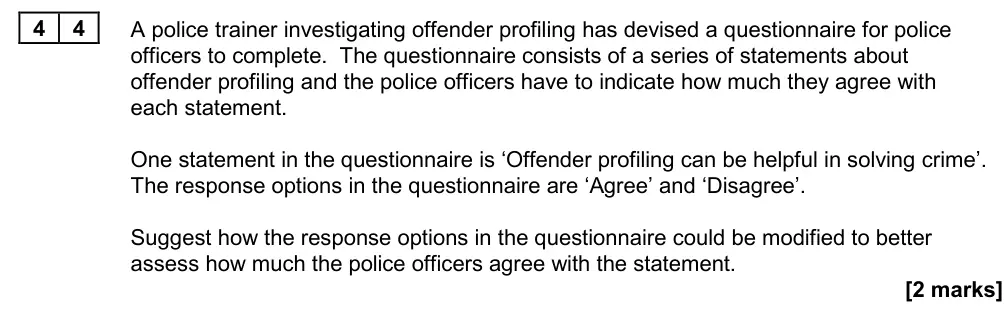
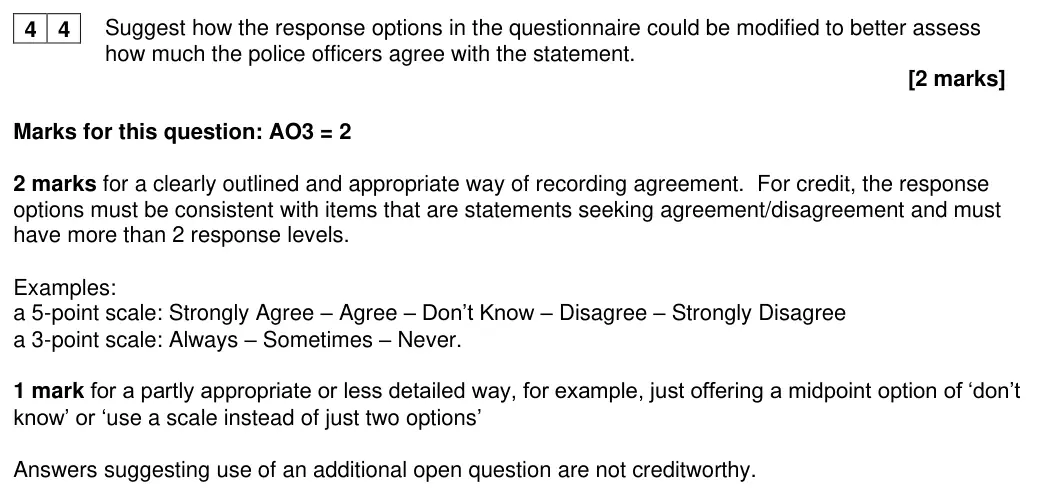
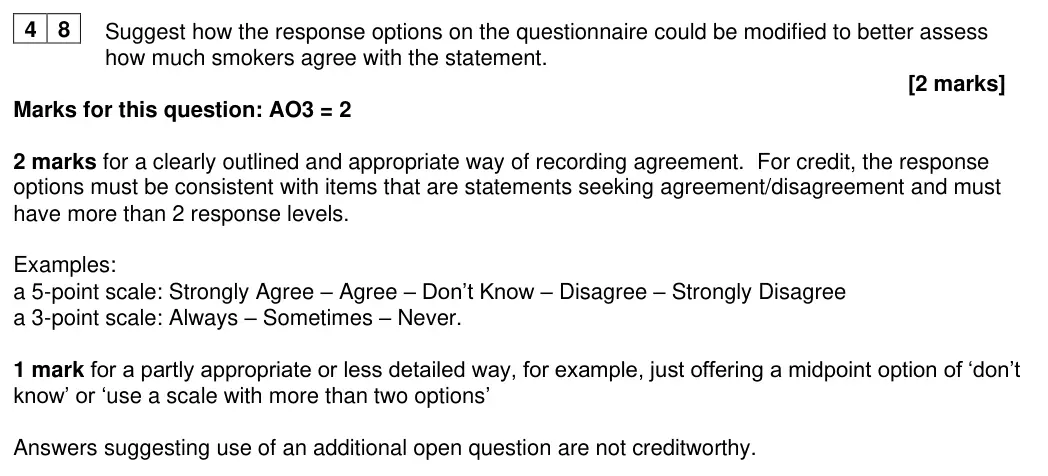
Question 40 also proved challenging for many students. There was widespread misunderstanding of the key requirement of the question; namely, to modify the response options on the questionnaire, rather than create a completely new ‘open’ question – which was the suggestion that many students gave. A high number of students said there should be a numbered scale between the two extreme options of ‘agree’ and ‘disagree’ but did not elaborate further. Answers of this type were awarded one mark.
Notes from the mark scheme and report
2 marks: more than two response levels consistent with an agreement statement (e.g. 5-point Likert scale)
1 mark for just adding 'don't know' or 'use a scale'
adding an open question not creditworthy (common error)
June 2024 · Paper 3 · Q413 marksAO1=3Short answeraggression
Mark scheme, including level descriptors and indicative content
Examiner's comment
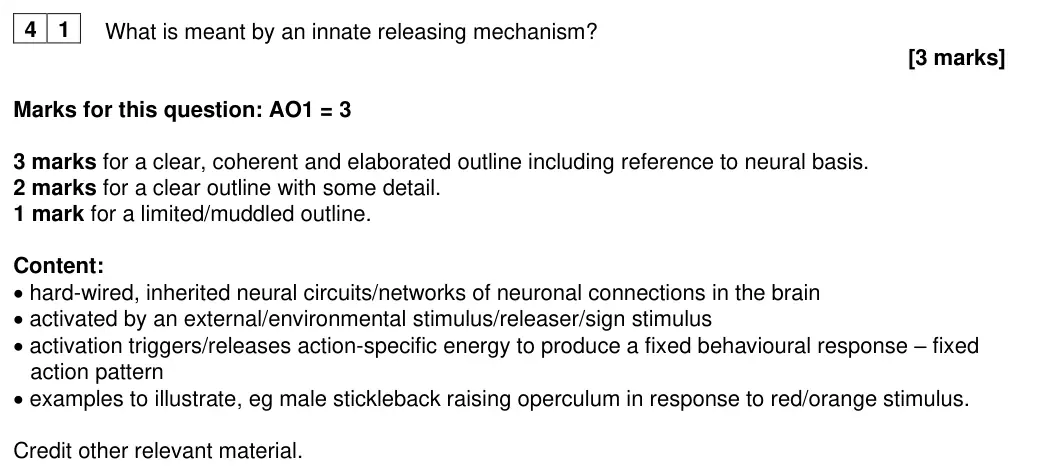
For Question 41, a high percentage of answers was awarded two marks. Most students knew that an innate releasing mechanism produces a fixed action pattern in response to an environmental stimulus, but far fewer talked about the neural system that underpins this process.
Notes from the mark scheme and report
3 marks need reference to the neural basis (inherited neural circuits) + external sign stimulus triggering fixed action pattern
most gained 2 by omitting neural basis
June 2024 · Paper 3 · Q4216 marksAO1=6, AO2=4, AO3=616-mark essayaggression
Mark scheme, including level descriptors and indicative content
Examiner's comment
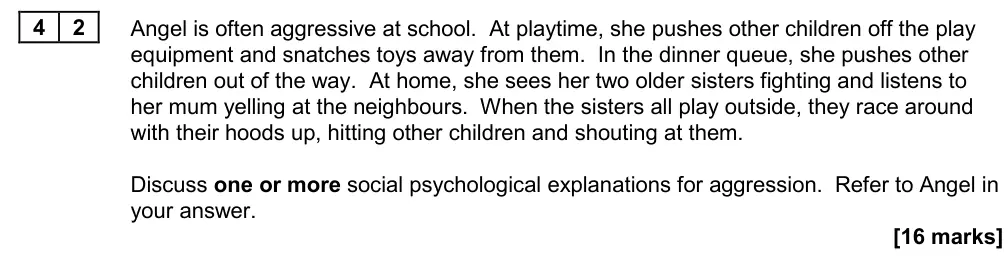
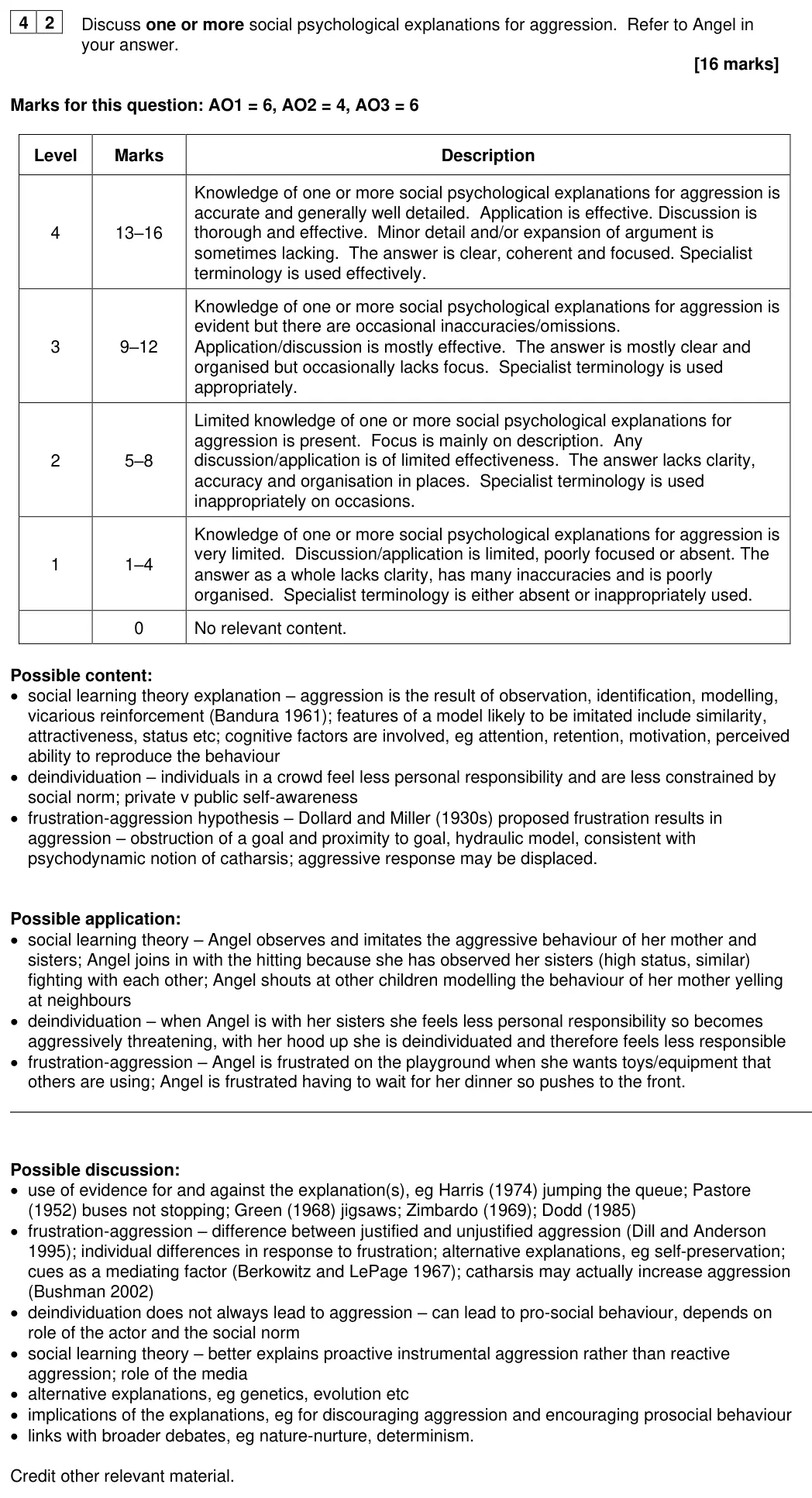
There were some well-crafted answers for Question 42. All three explanations on the mark scheme were seen, and sometimes within the same answer. Some students had to rely on alternatives which only met the threshold of social-psychological if there was some justification as part of the answer, such as the importation model. Many students produced accounts of social learning theory that were not distinct from operant conditioning – though in the context of the question, these gained some credit. Those students who discussed deindividuation generally did so adroitly, producing lots of relevant knowledge and discussion. The frustration-aggression hypothesis was done less impressively on the whole, and applied links to the stem were sometimes somewhat speculative.
Notes from the mark scheme and report
SLT (sisters/mother as models), de-individuation (hoods up, in a group), frustration-aggression (play equipment, dinner queue)
other explanations (e.g. importation model) only credited if justified as social psychological
Mark scheme, including level descriptors and indicative content
Examiner's comment
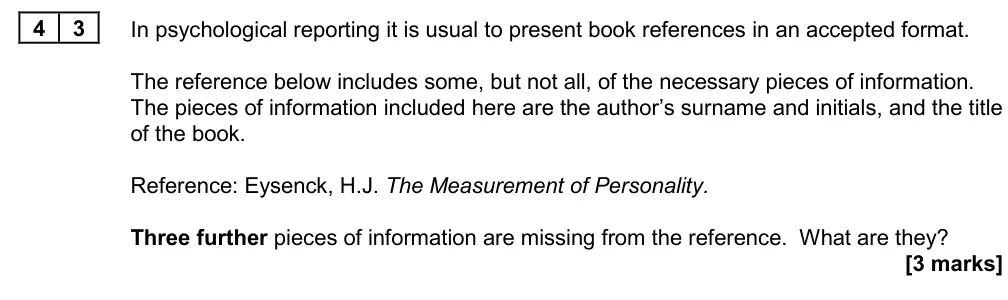
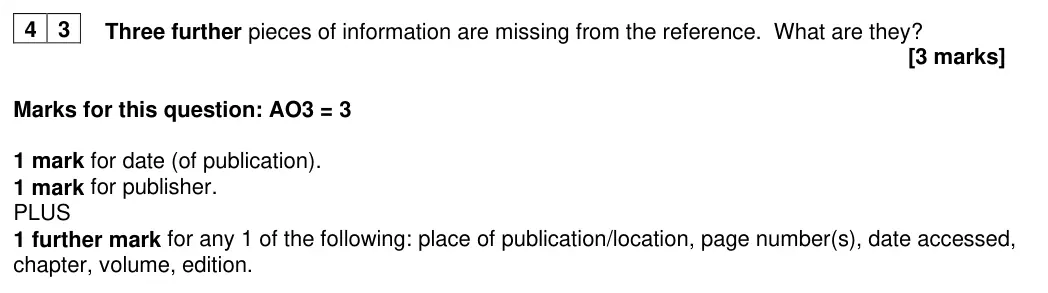
The question on referencing, albeit worth only 3 marks, also proved challenging for many. Question 43 produced a wide variety of answers and discriminated well between those students who had clearly come across the structure of a reference before, and those who were left to guess. Many students knew that the date of publication was missing but far fewer were able to identify other details, such as the name and location of the publisher.
Notes from the mark scheme and report
1 mark date of publication + 1 mark publisher + 1 mark for one of place of publication, page numbers, edition etc
Mark scheme, including level descriptors and indicative content
Examiner's comment
Question 44 also proved challenging for many students. There was widespread misunderstanding of the key requirement of the question; namely, to modify the response options on the questionnaire, rather than create a completely new ‘open’ question – which was the suggestion that many students gave. A high number of students said there should be a numbered scale between the two extreme options of ‘agree’ and ‘disagree’ but did not elaborate further.
Notes from the mark scheme and report
2 marks: more than two response levels consistent with an agreement statement (e.g. 5-point Likert scale)
1 mark for just adding 'don't know' or 'use a scale'
adding an open question not creditworthy (common error)
Mark scheme, including level descriptors and indicative content
Examiner's comment
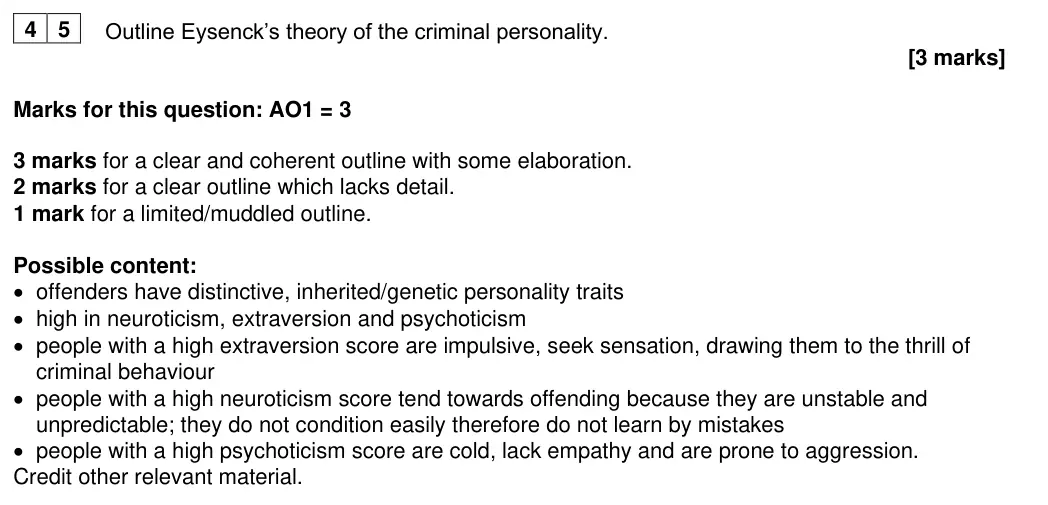
For Question 45, most students could state the three elements of the criminal personality – or two elements for those students who drew on Eysenck’s original work. There was also frequent creditworthy reference to the biological basis of personality. Although not a requirement of the question, if there was sufficient other information present, a surprising number of students did not make it clear why someone who scored highly on all three traits would be more likely to offend.
Notes from the mark scheme and report
extraversion, neuroticism, psychoticism with link to offending
innate/biological basis creditworthy
many did not explain why high scores lead to offending
June 2024 · Paper 3 · Q4616 marksAO1=6, AO2=4, AO3=616-mark essayforensic psychology
Mark scheme, including level descriptors and indicative content
Examiner's comment
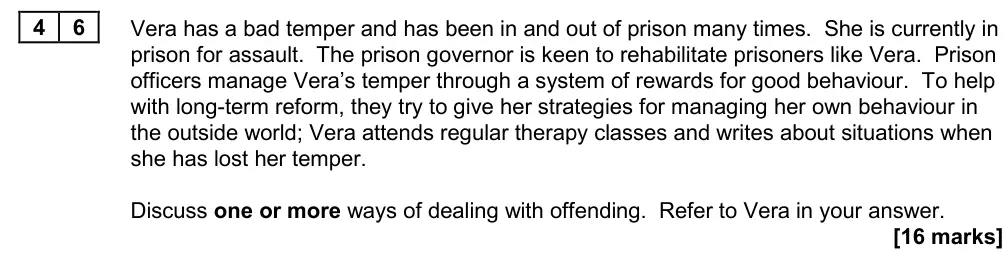
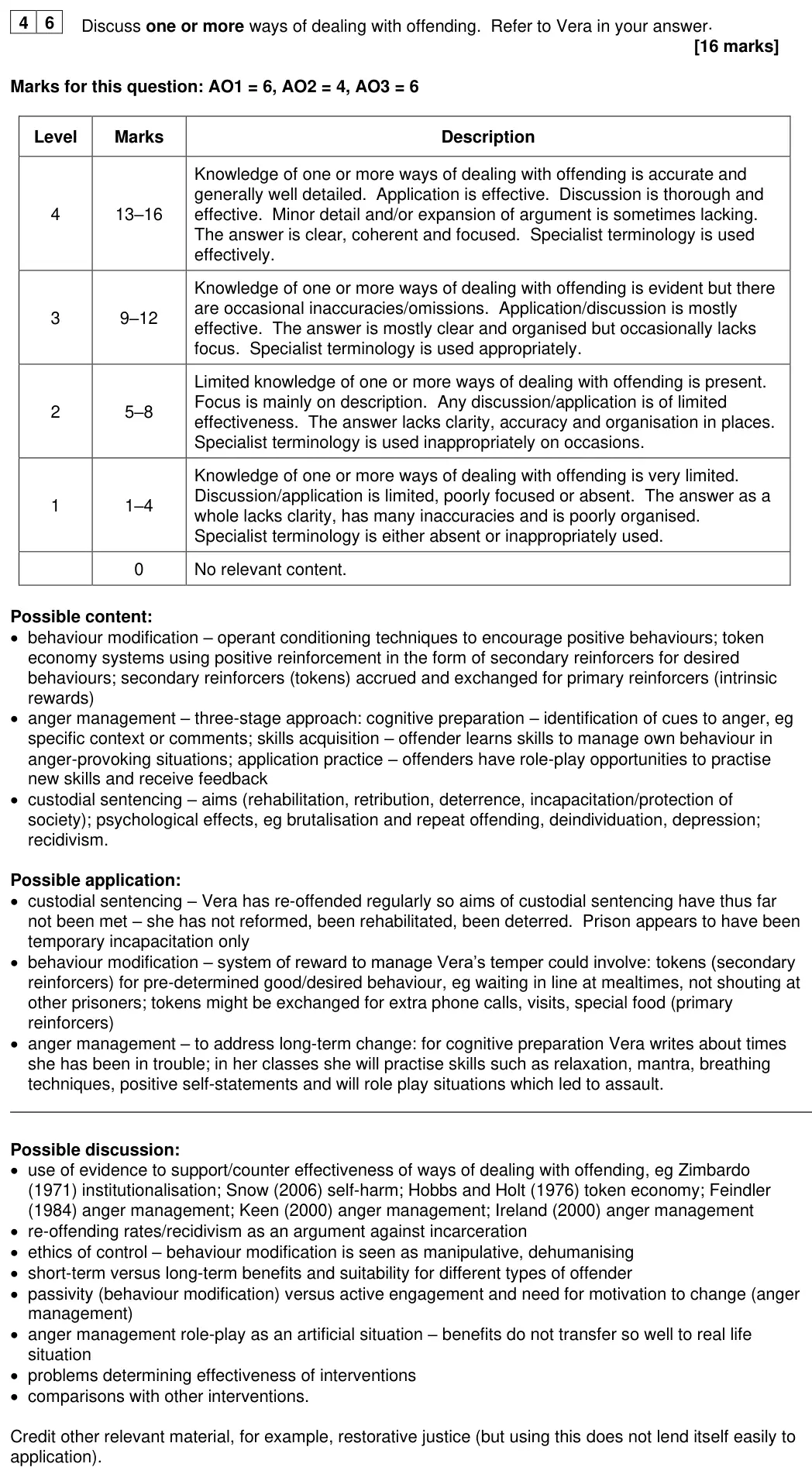
Again, for Question 46, a breadth rather than depth approach proved most popular as many students sought to describe three ways of dealing with offending to broaden the scope for application. Even with those who did not pursue this route, behaviour modification/token economy was by far the most chosen option, followed by anger management. Those who discussed custodial sentencing produced the least convincing accounts, and often seemed unsure of which material to include. Restorative justice was also included in some essays, and was reasonably well-described and discussed, although in terms of application, students quickly ‘ran out of road’ as there were no obvious links in the stem.
Notes from the mark scheme and report
behaviour modification/token economy (rewards), anger management (therapy classes, writing about lost temper), custodial sentencing (repeat imprisonment)
Mark scheme, including level descriptors and indicative content
Examiner's comment
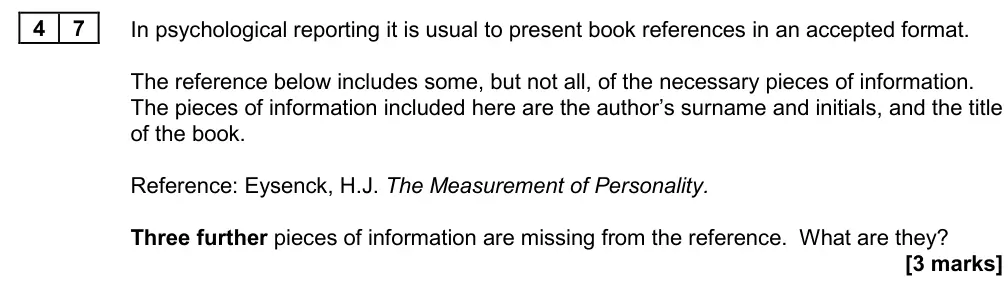
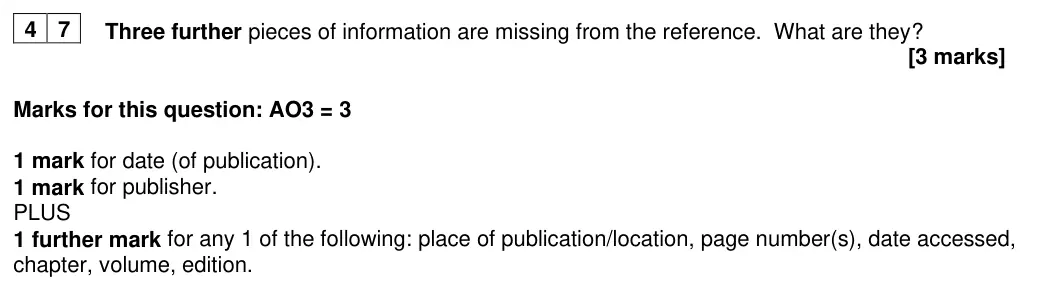
The question on referencing, albeit worth only 3 marks, also proved challenging for many. Question 47 produced a wide variety of answers and discriminated well between those students who had clearly come across the structure of a reference before, and those who were left to guess. Many students knew that the date of publication was missing but far fewer were able to identify other details, such as the name and location of the publisher.
Notes from the mark scheme and report
1 mark date of publication + 1 mark publisher + 1 mark for one of place of publication, page numbers, edition etc
Mark scheme, including level descriptors and indicative content
Examiner's comment
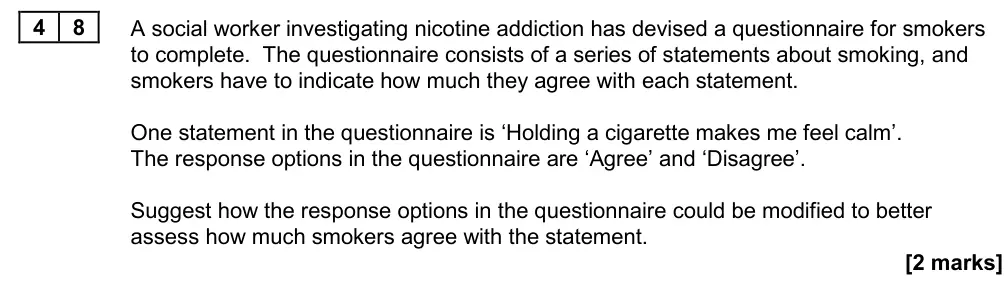
Question 48 also proved challenging for many students. There was widespread misunderstanding of the key requirement of the question; namely, to modify the response options on the questionnaire, rather than create a completely new ‘open’ question – which was the suggestion that many students gave. A high number of students said there should be a numbered scale between the two extreme options of ‘agree’ and ‘disagree’ but did not elaborate further.
Notes from the mark scheme and report
2 marks: more than two response levels consistent with an agreement statement (e.g. 5-point Likert scale)
1 mark for just adding 'don't know' or 'use a scale'
adding an open question not creditworthy (common error)
June 2024 · Paper 3 · Q493 marksAO1=3Outlineaddiction
Mark scheme, including level descriptors and indicative content
Examiner's comment
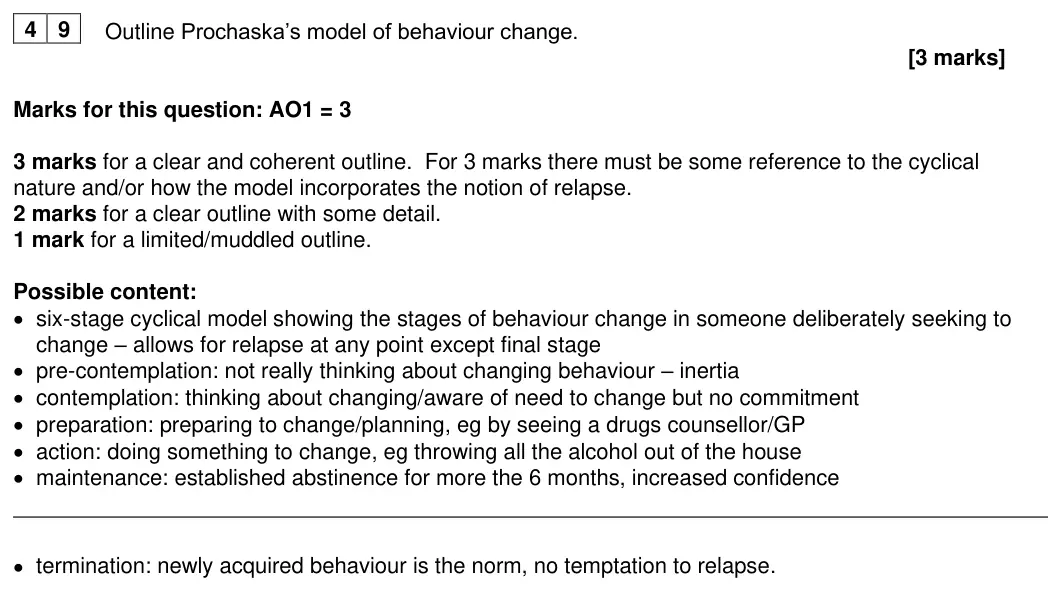
There were some good answers to Question 49. The most economical path to three marks was some reference to the cyclical nature of Prochaska’s model, a list of the six stages and the notion that relapse is an integral part. Some students perhaps penalised themselves in terms of time by producing lengthy descriptions of each stage.
Notes from the mark scheme and report
3 marks need reference to cyclical nature and/or relapse
six stages pre-contemplation to termination
lengthy stage descriptions wasted time
June 2024 · Paper 3 · Q5016 marksAO1=6, AO2=4, AO3=616-mark essayaddiction
Mark scheme, including level descriptors and indicative content
Examiner's comment
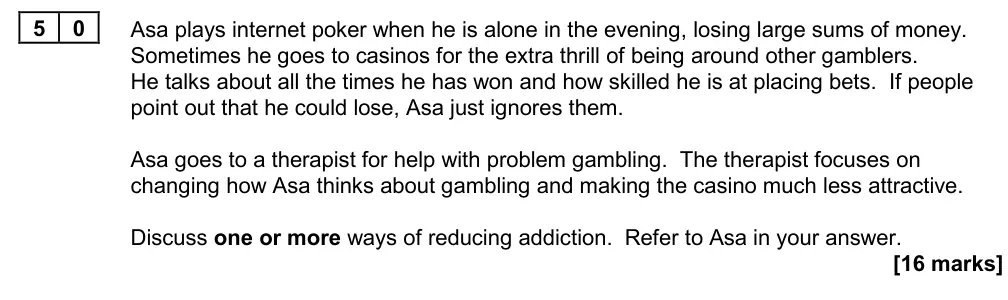
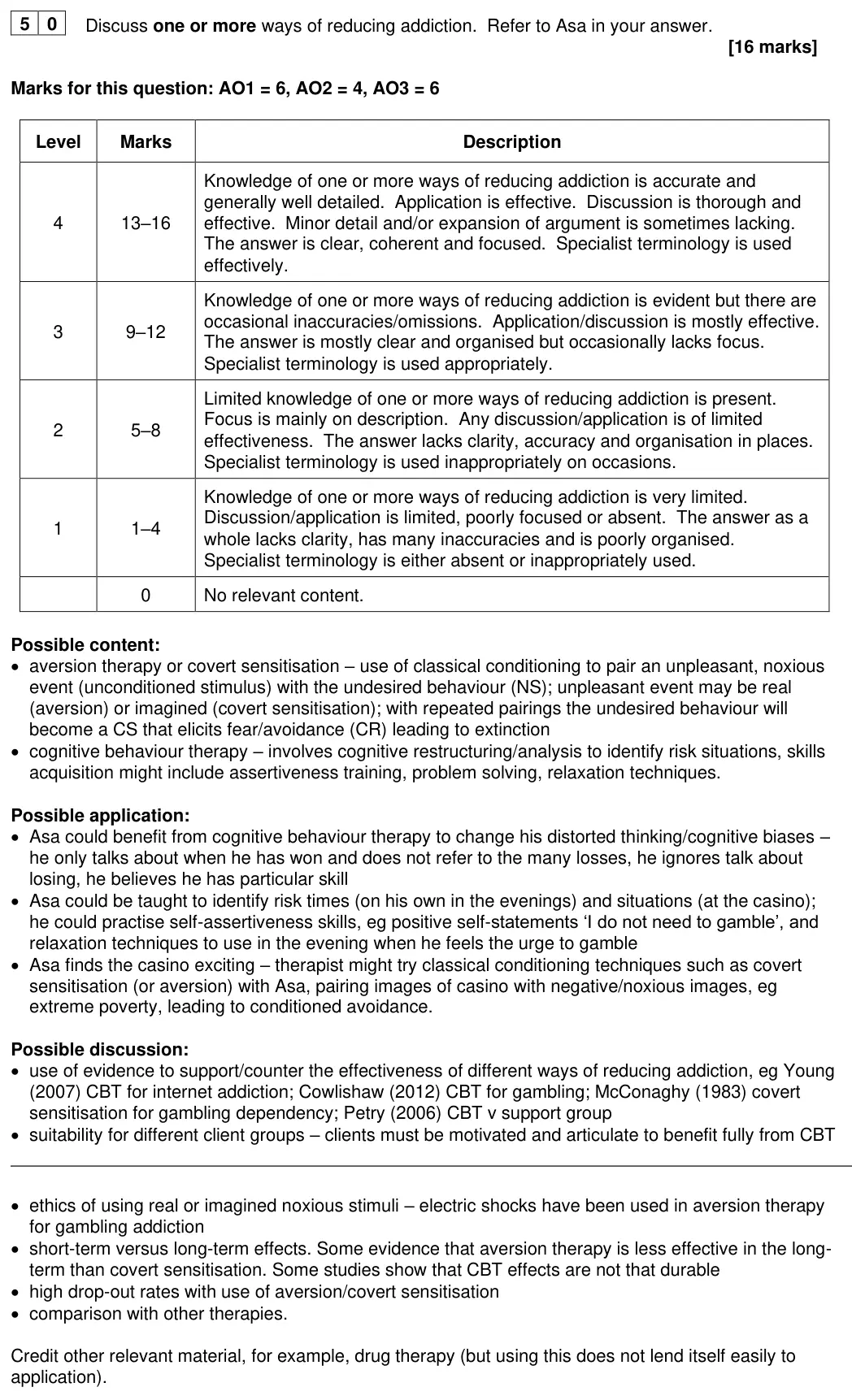
Overall, the standard of responses for Question 50 was rather broad. There were some very good and clear accounts of aversion therapy and/or covert sensitisation which included explicit links to behaviourist principles as well as to the stem. Others provided impressive knowledge of cognitive behaviour therapy and how this could be used to tackle Asa’s evident ‘skill bias’. Other answers were much less convincing, however. Attempted discussion was often vague, involving efficacy studies which appeared to have been made up on the spot, and some fairly speculative remarks related to time and cost of different treatment methods.
Notes from the mark scheme and report
CBT for cognitive biases (skill bias, selective recall of wins), aversion therapy/covert sensitisation to make the casino less attractive
drug therapy creditworthy but hard to apply
Work with an AQA psychology tutor
Want a paper marked and gone through with you? Message us.