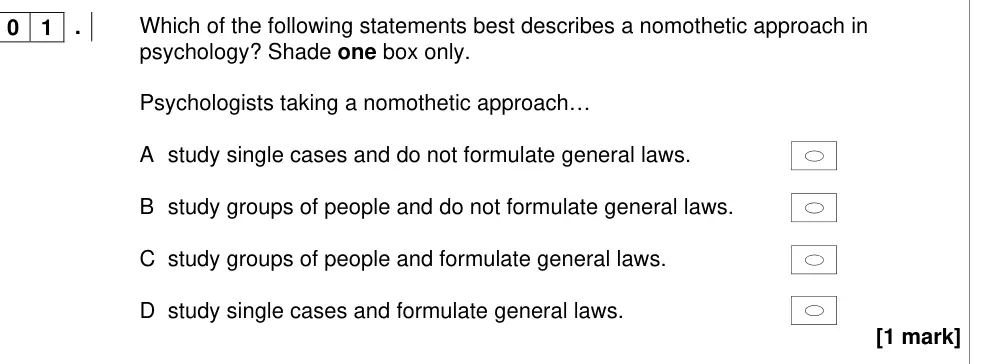
Specimen set 2 · Paper 3 · Q11 markAO1=1Multiple choiceissues and debates
Answer
C
Mark scheme, including level descriptors and indicative content
Notes from the mark scheme and report
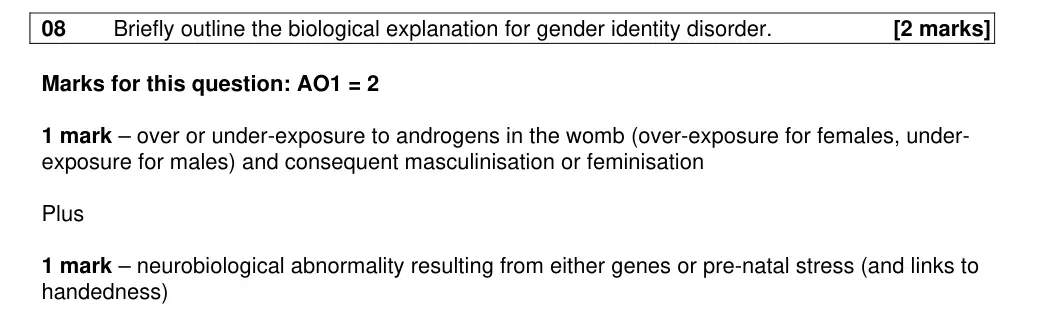
answer C (groups of people, general laws)
A describes idiographic
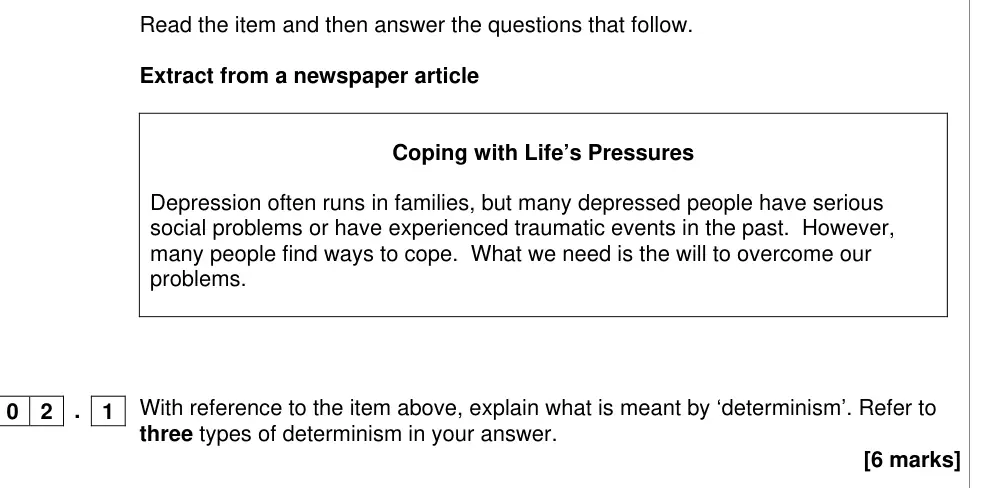
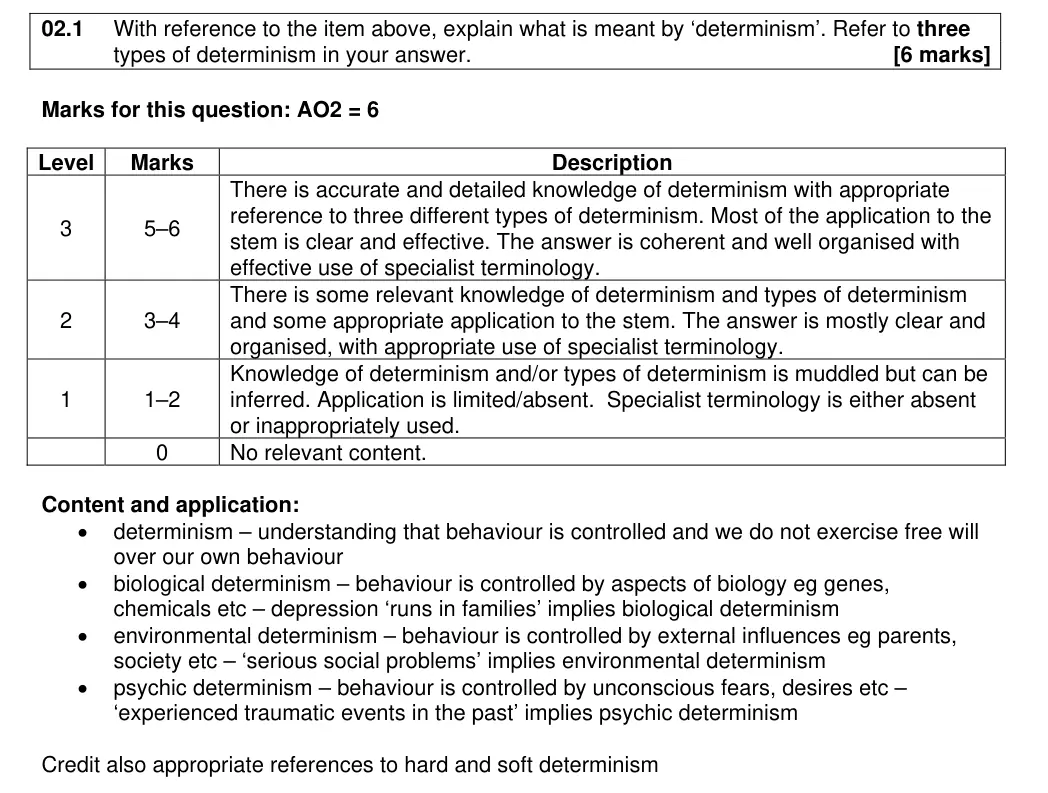
Specimen set 2 · Paper 3 · Q2.16 marksAO2=6Applicationissues and debates
Mark scheme, including level descriptors and indicative content
Notes from the mark scheme and report
define determinism (behaviour controlled, no free will) + three types applied to the extract: biological ('runs in families'), environmental ('social problems'), psychic ('traumatic events in the past')
hard/soft also credited
little application = Level 1
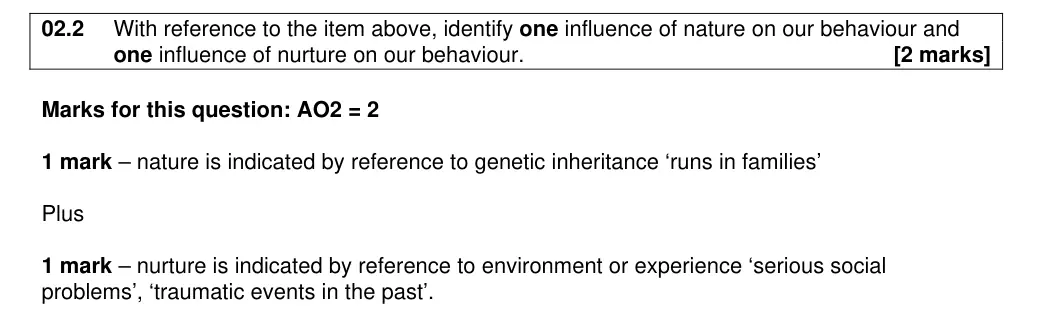
Specimen set 2 · Paper 3 · Q2.22 marksAO2=2Applicationissues and debates
Mark scheme, including level descriptors and indicative content
Notes from the mark scheme and report
1 mark nature = genetic inheritance ('runs in families')
1 mark nurture = environment/experience ('social problems', 'traumatic events')
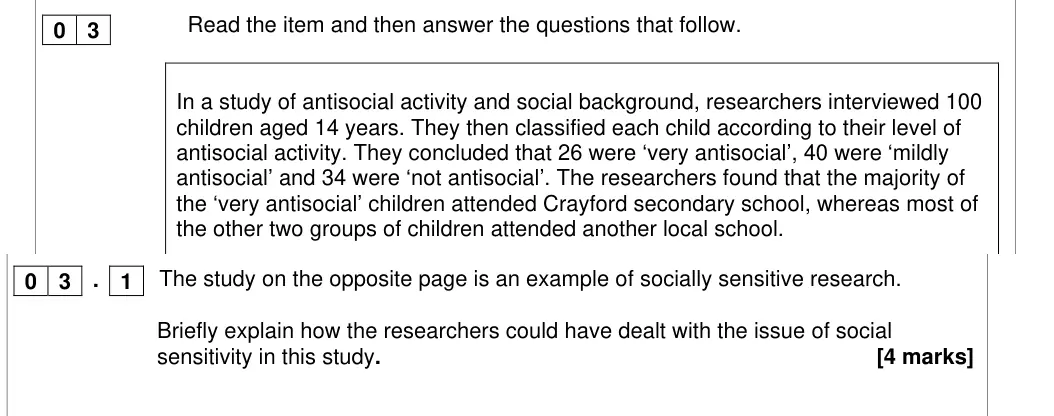
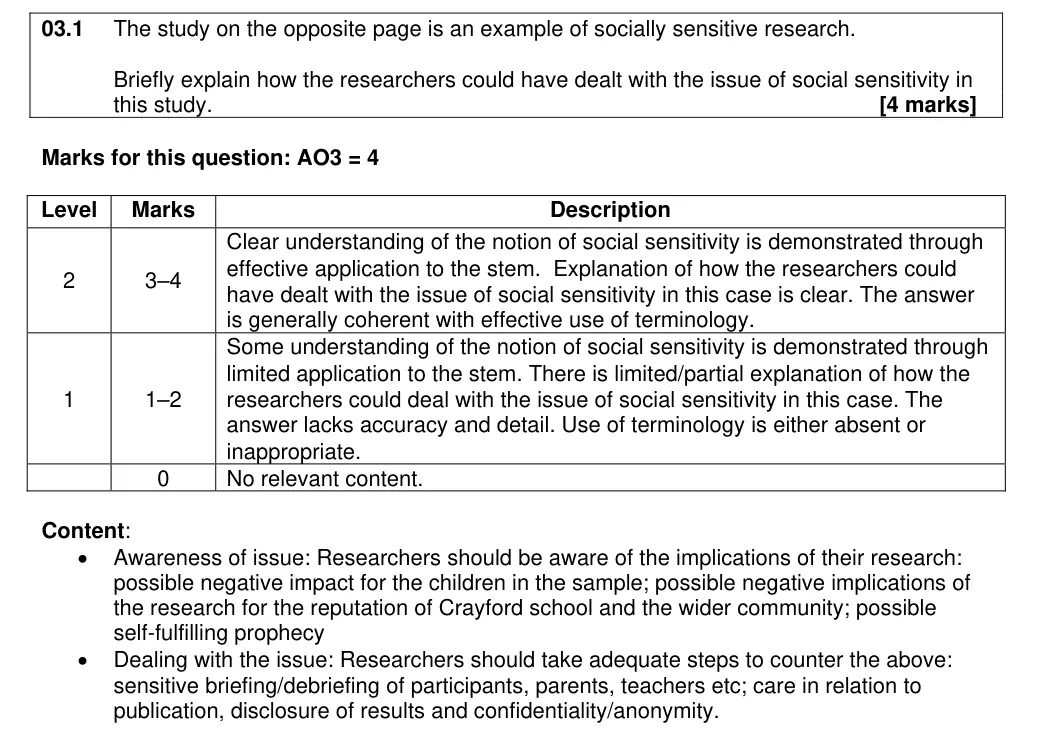
Specimen set 2 · Paper 3 · Q3.14 marksAO3=4Applicationissues and debates
Mark scheme, including level descriptors and indicative content
Notes from the mark scheme and report
awareness of implications (stigma for the children, reputation of Crayford school/community, self-fulfilling prophecy) + how to deal with it (sensitive debriefing, care with publication, confidentiality/anonymity)
must be applied to the stem
Specimen set 2 · Paper 3 · Q3.21 markAO2=1Research methodsdata handling
Mark scheme, including level descriptors and indicative content
Notes from the mark scheme and report
nominal (categorical)
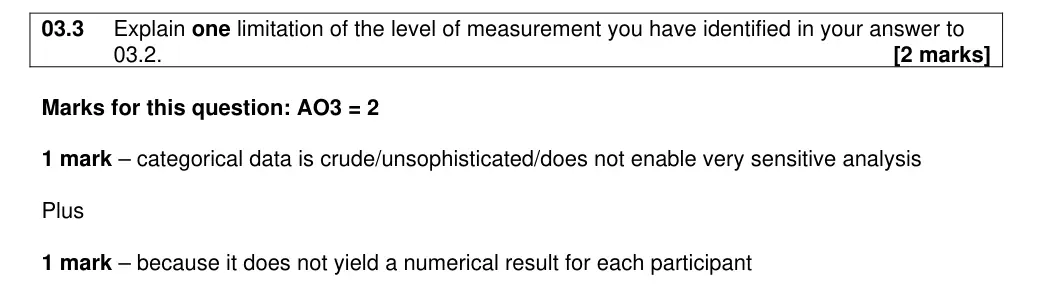
Specimen set 2 · Paper 3 · Q3.32 marksAO3=2Research methodsdata handling
Mark scheme, including level descriptors and indicative content
Notes from the mark scheme and report
1 mark crude/does not allow sensitive analysis + 1 mark no numerical score for each participant
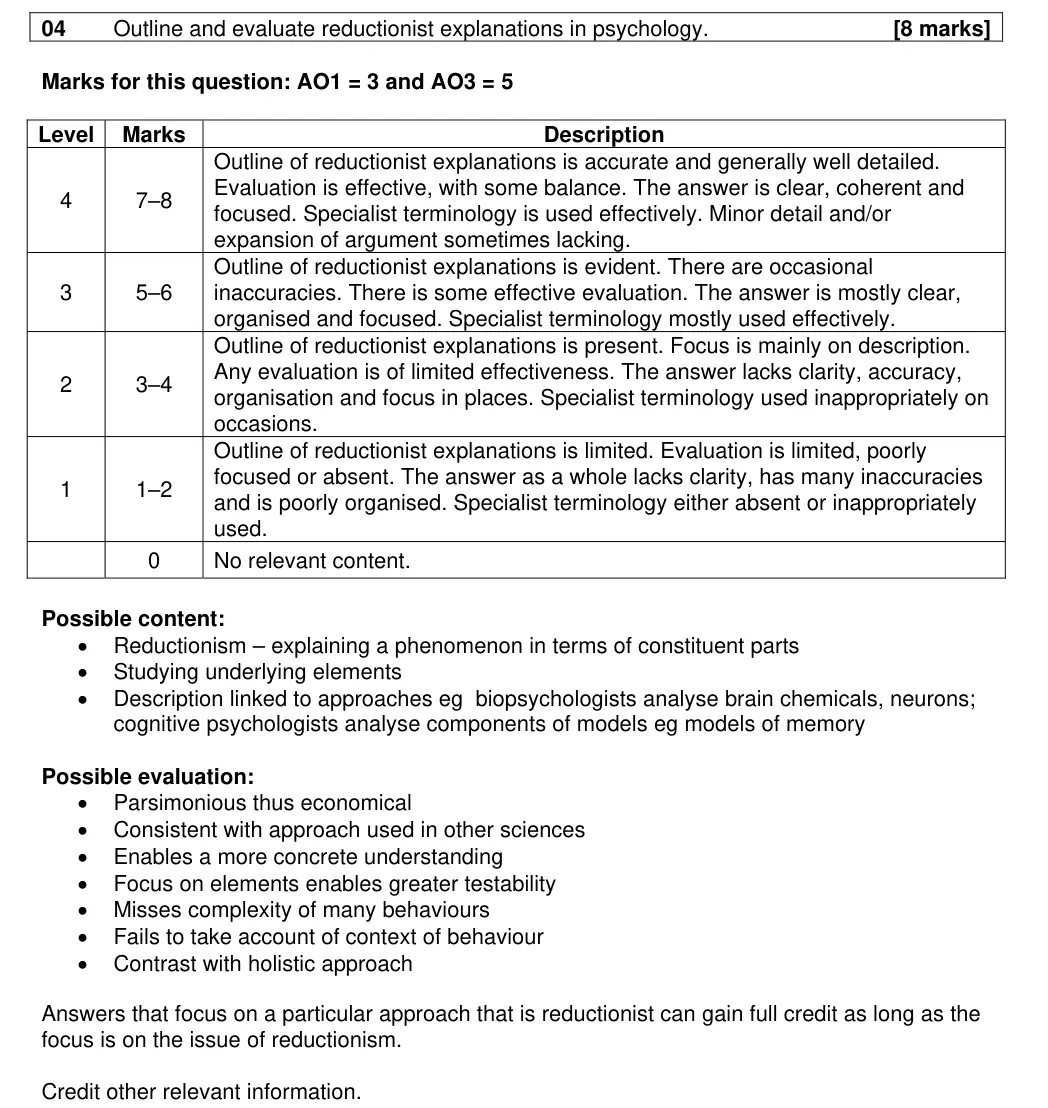
Specimen set 2 · Paper 3 · Q48 marksAO1=3, AO3=5Extended writingissues and debates
Mark scheme, including level descriptors and indicative content
Notes from the mark scheme and report
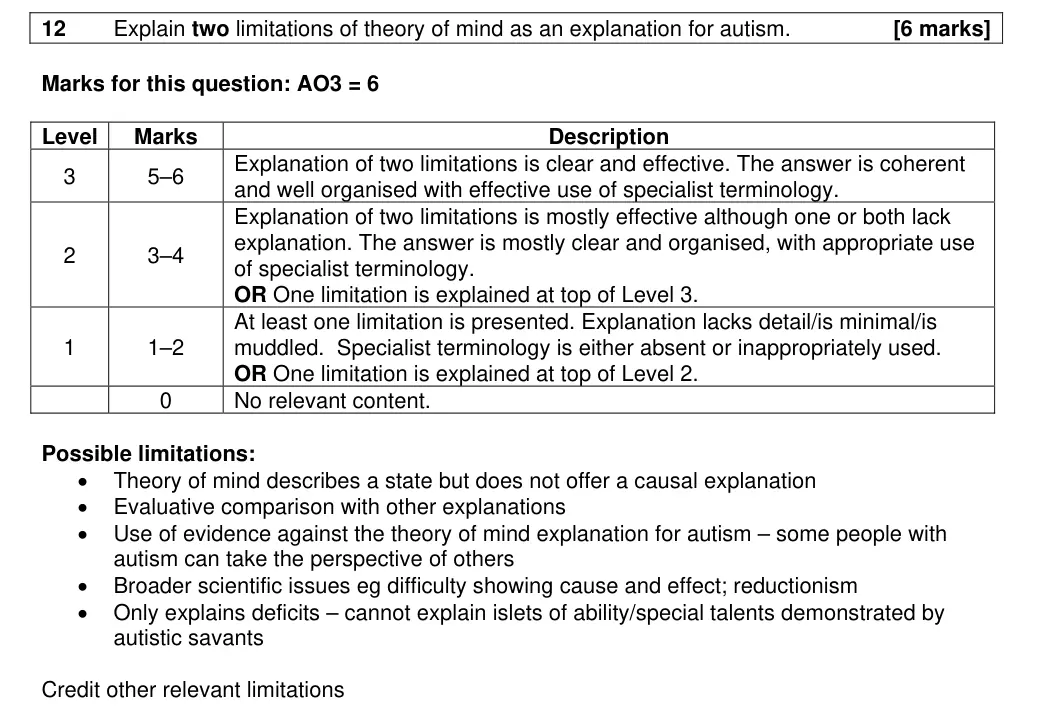
reductionism = explaining in terms of constituent parts, with examples from approaches
evaluation: parsimony, scientific testability vs missing complexity/context, contrast with holism
answers on a reductionist approach credited if focused on the issue
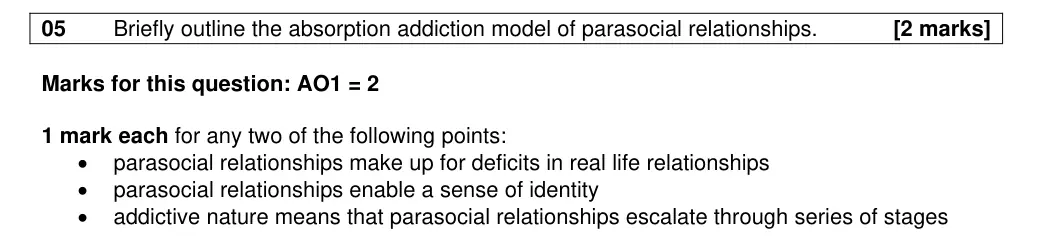
Specimen set 2 · Paper 3 · Q52 marksAO1=2Outlinerelationships
Mark scheme, including level descriptors and indicative content
Notes from the mark scheme and report
1 mark each: compensates for deficits in real relationships
gives a sense of identity
addictive escalation through stages
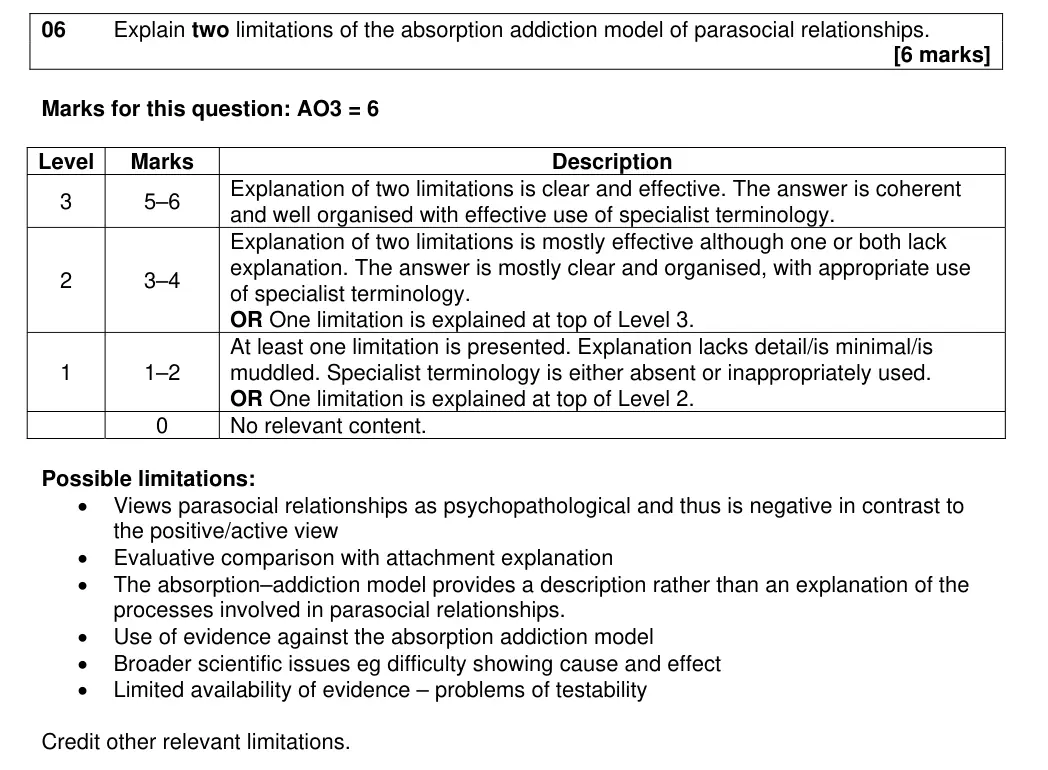
Specimen set 2 · Paper 3 · Q66 marksAO3=6Evaluate (short)relationships
Mark scheme, including level descriptors and indicative content
Notes from the mark scheme and report
two limitations needed above Level 1 unless one is very well explained
e.g. pathologises PSRs, descriptive not explanatory, cause and effect, comparison with attachment explanation
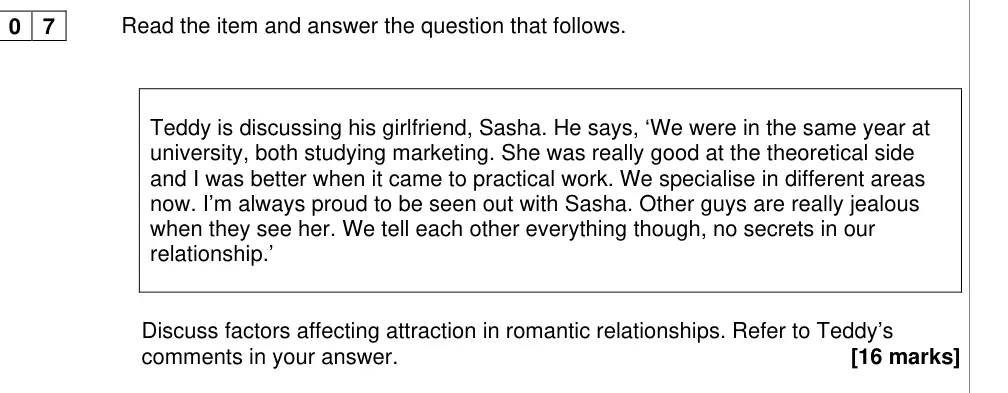
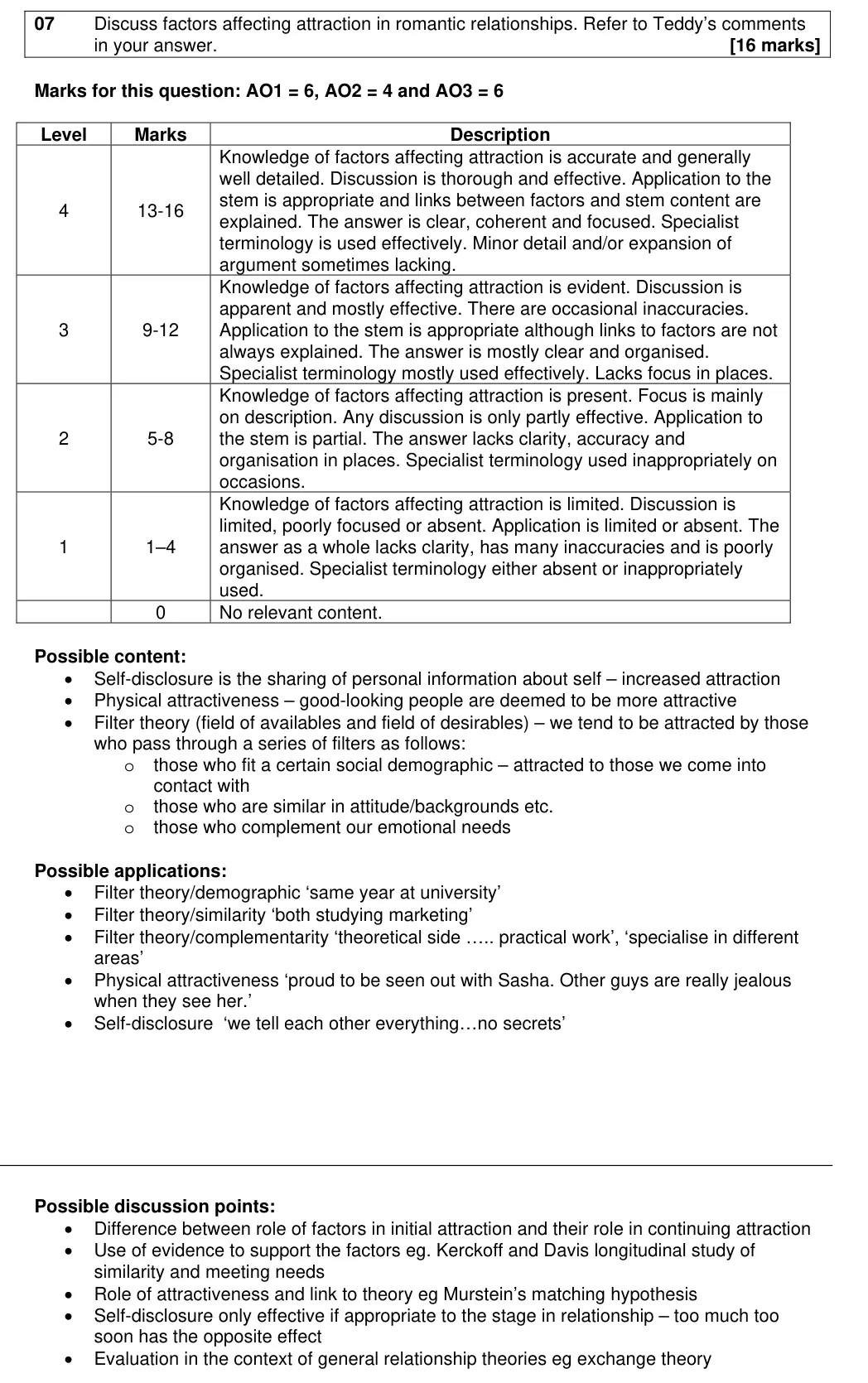
Specimen set 2 · Paper 3 · Q716 marksAO1=6, AO2=4, AO3=616-mark essayrelationships
Mark scheme, including level descriptors and indicative content
Notes from the mark scheme and report
apply filter theory (same year = social demography
both marketing = similarity
theory vs practical = complementarity), physical attractiveness ('proud to be seen out'), self-disclosure ('no secrets')
Level 4 needs links between factors and stem explained
Specimen set 2 · Paper 3 · Q82 marksAO1=2Outlinegender
Mark scheme, including level descriptors and indicative content
Notes from the mark scheme and report
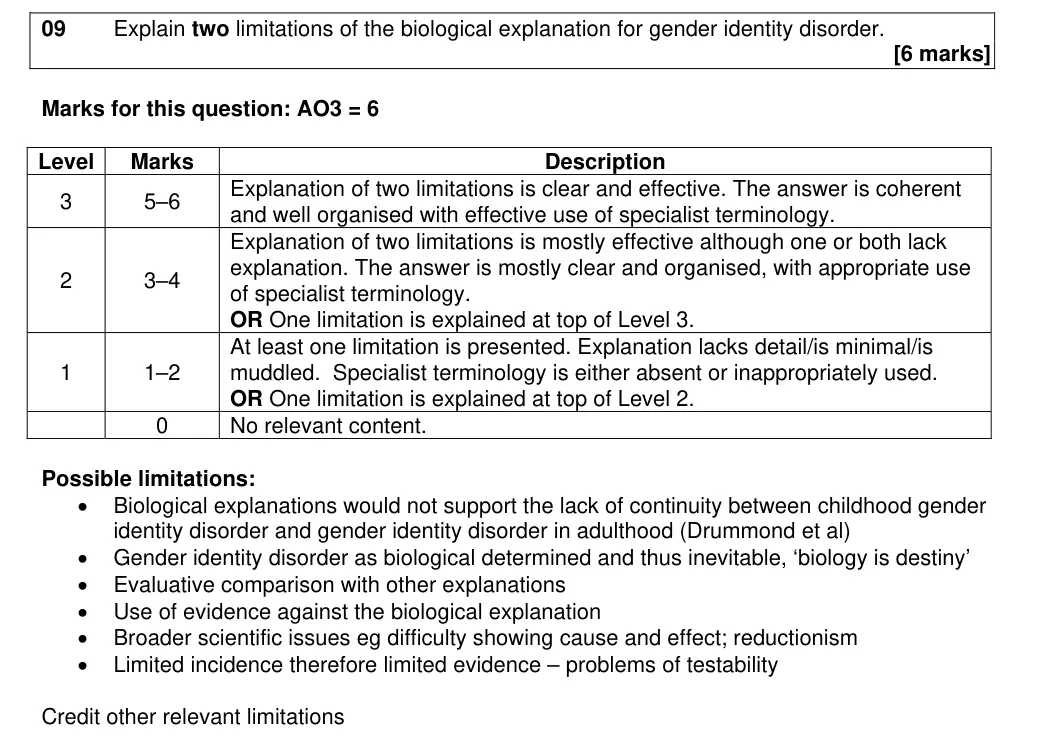
1 mark prenatal over/under-exposure to androgens + 1 mark neurobiological abnormality from genes or prenatal stress
'gender identity disorder' is now 'gender incongruence' in v1.4
Specimen set 2 · Paper 3 · Q96 marksAO3=6Evaluate (short)gender
Mark scheme, including level descriptors and indicative content
Notes from the mark scheme and report
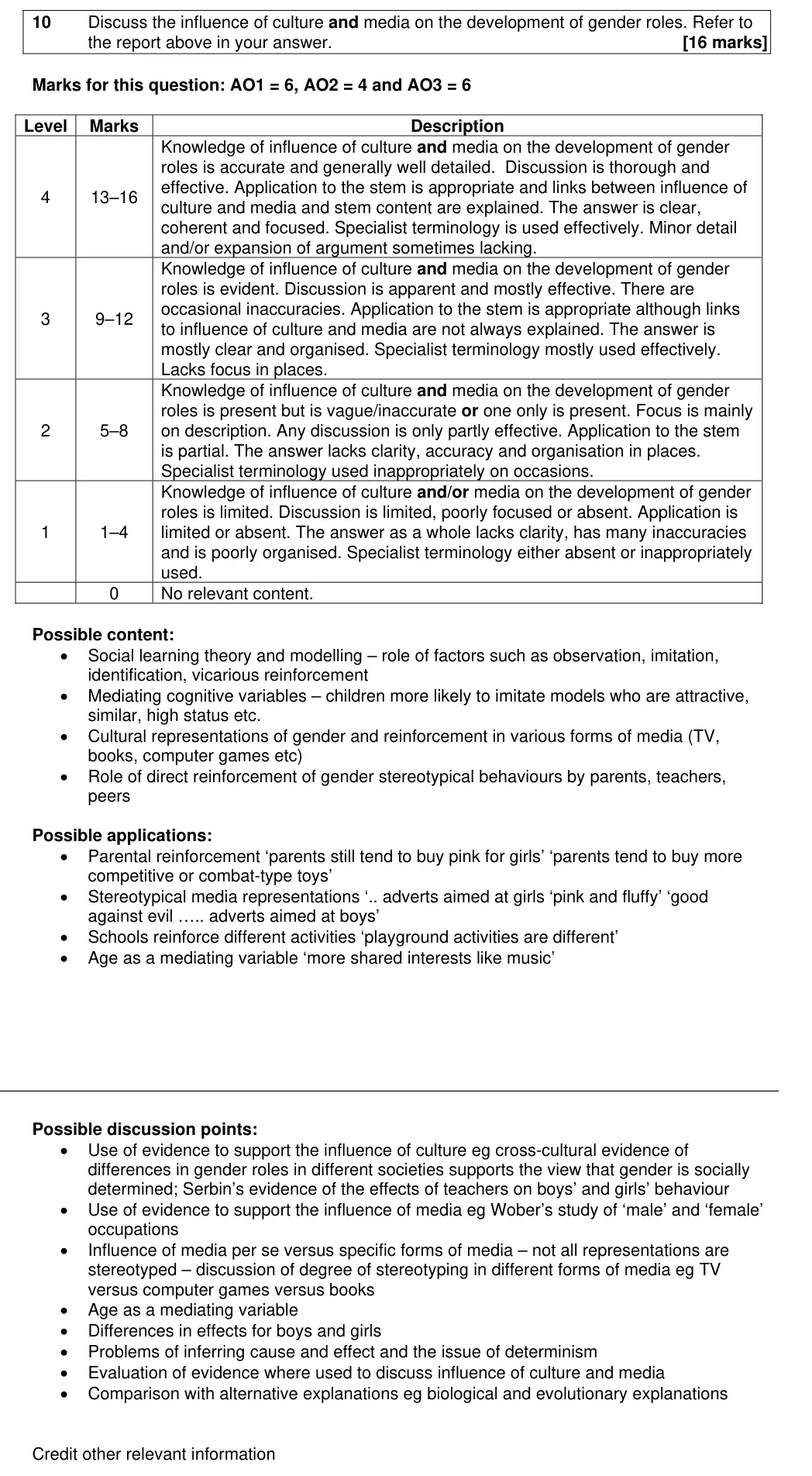
two limitations, e.g. discontinuity between childhood and adult cases (Drummond), biological determinism, reductionism, limited evidence due to low incidence
'gender identity disorder' is now 'gender incongruence' in v1.4
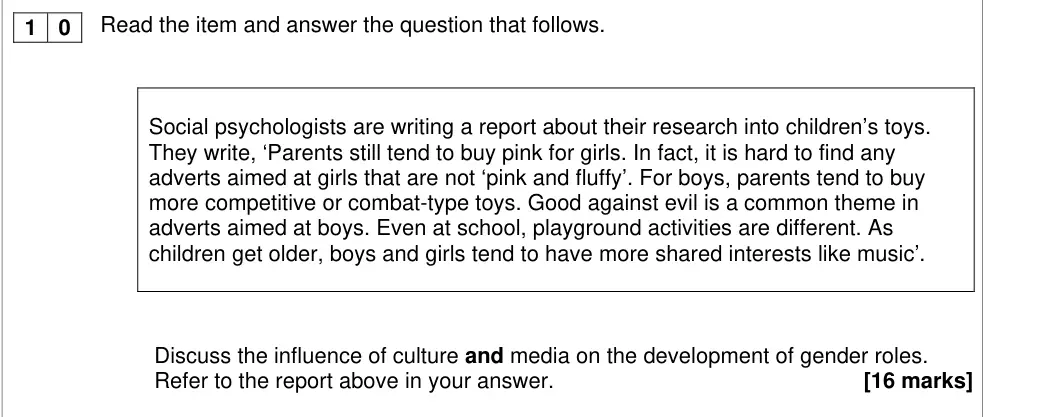
Specimen set 2 · Paper 3 · Q1016 marksAO1=6, AO2=4, AO3=616-mark essaygender
Mark scheme, including level descriptors and indicative content
Notes from the mark scheme and report
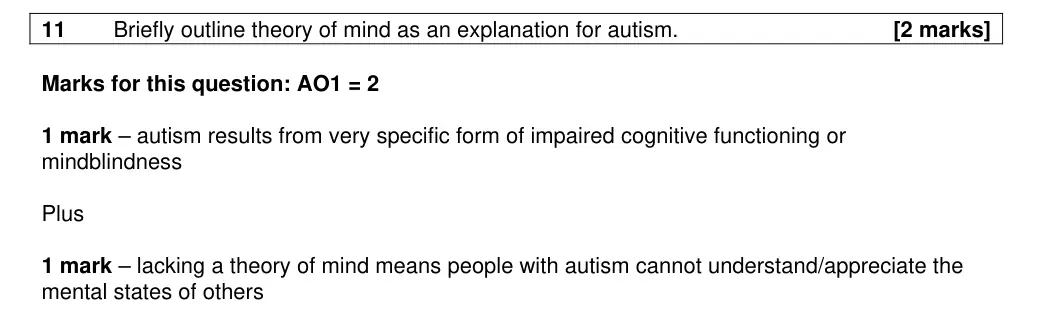
SLT (observation, imitation, vicarious and direct reinforcement) and media/cultural representations applied to the report (pink toys, combat toys, adverts, playground, age)
evaluation e.g. cross-cultural evidence, cause and effect, biological alternatives
Mark scheme, including level descriptors and indicative content
Notes from the mark scheme and report
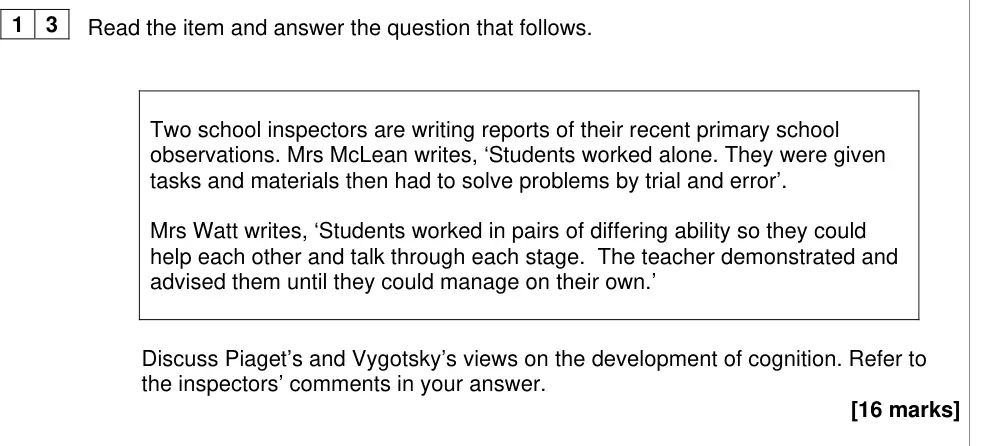
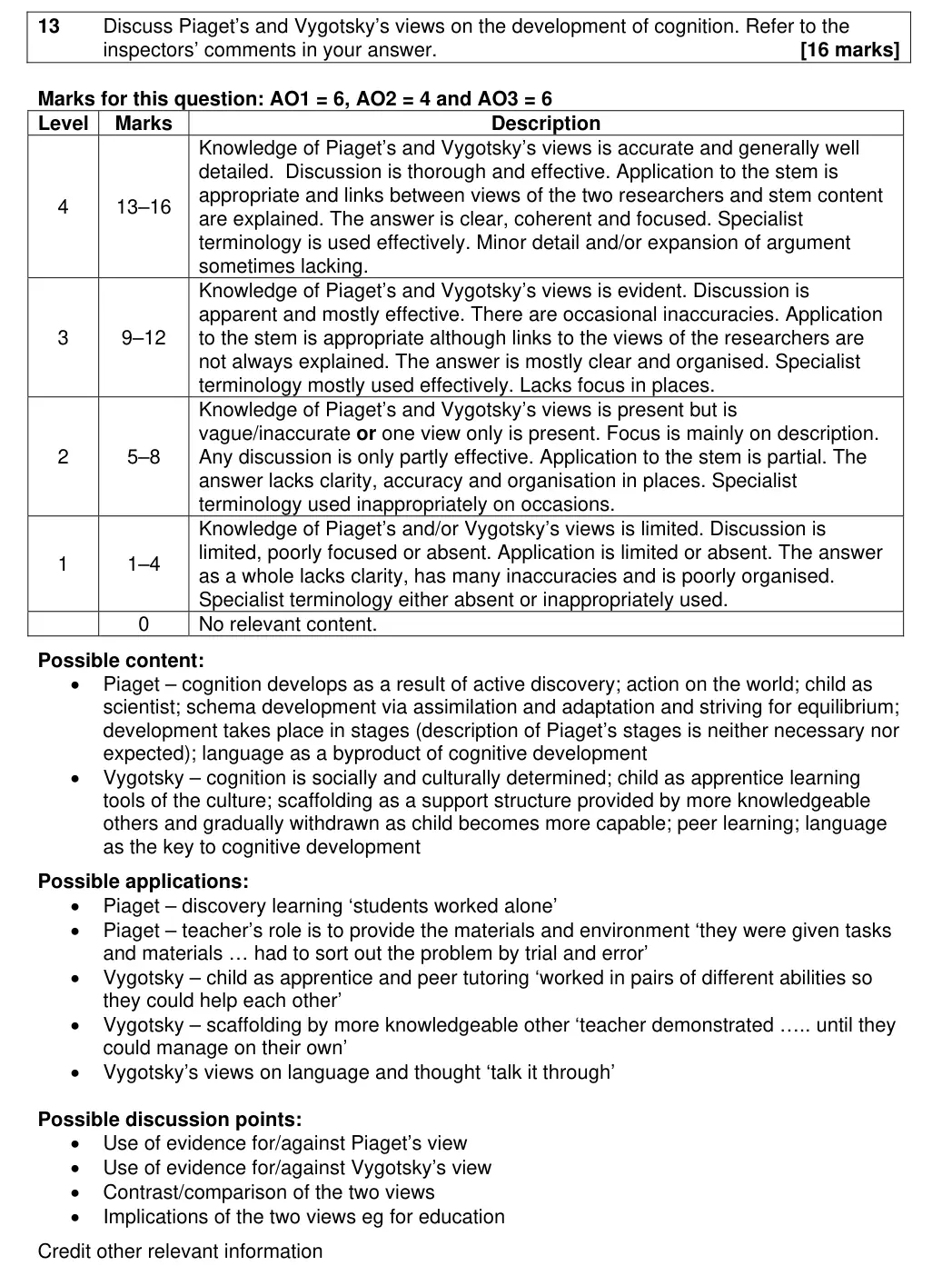
Piaget (discovery learning - 'worked alone', trial and error) vs Vygotsky (peer tutoring, scaffolding by teacher, language - 'talk through')
stage descriptions not needed
one theorist only = max Level 2
Specimen set 2 · Paper 3 · Q148 marksAO1=3, AO3=5Extended writingOld spec onlyschizophrenia
Mark scheme, including level descriptors and indicative content
Notes from the mark scheme and report
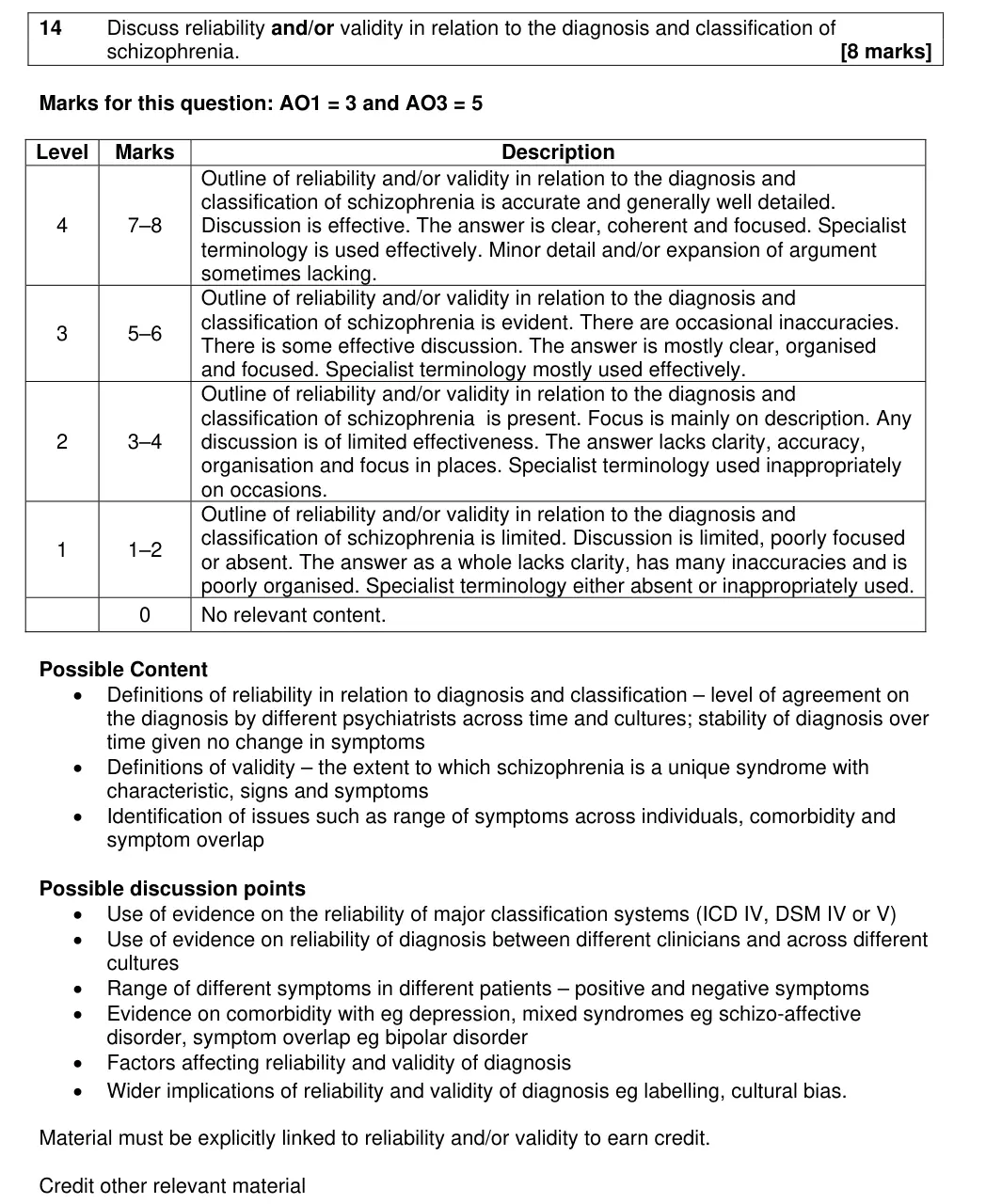
(reliability and validity in diagnosis and classification of schizophrenia, removed in v1.4
co-morbidity, symptom overlap, culture/gender bias remain as 'issues in diagnosis')
material must be explicitly linked to reliability and/or validity
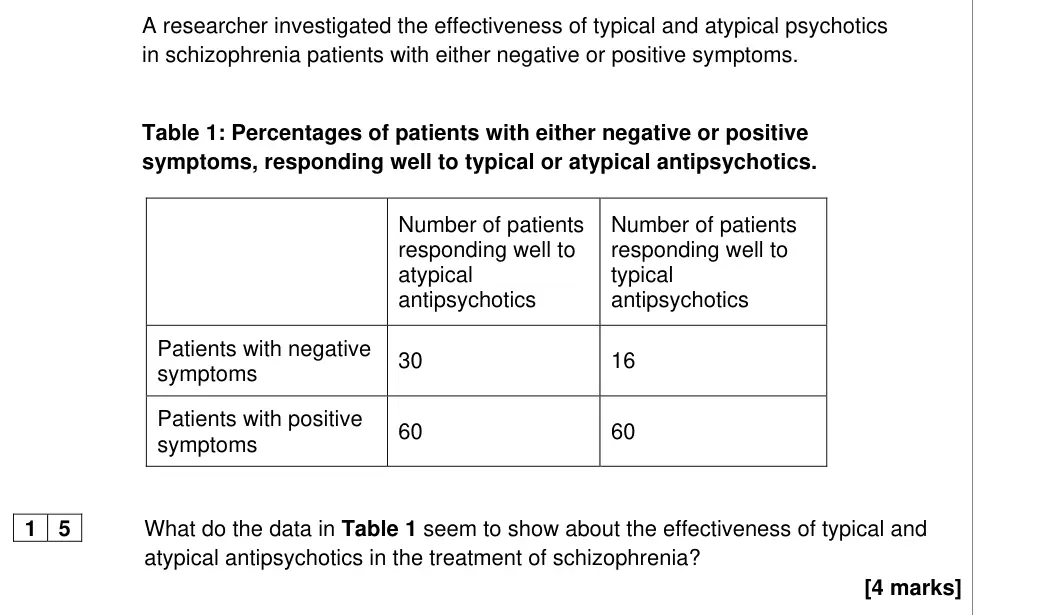
Specimen set 2 · Paper 3 · Q154 marksAO2=4Applicationschizophrenia
Mark scheme, including level descriptors and indicative content
Notes from the mark scheme and report
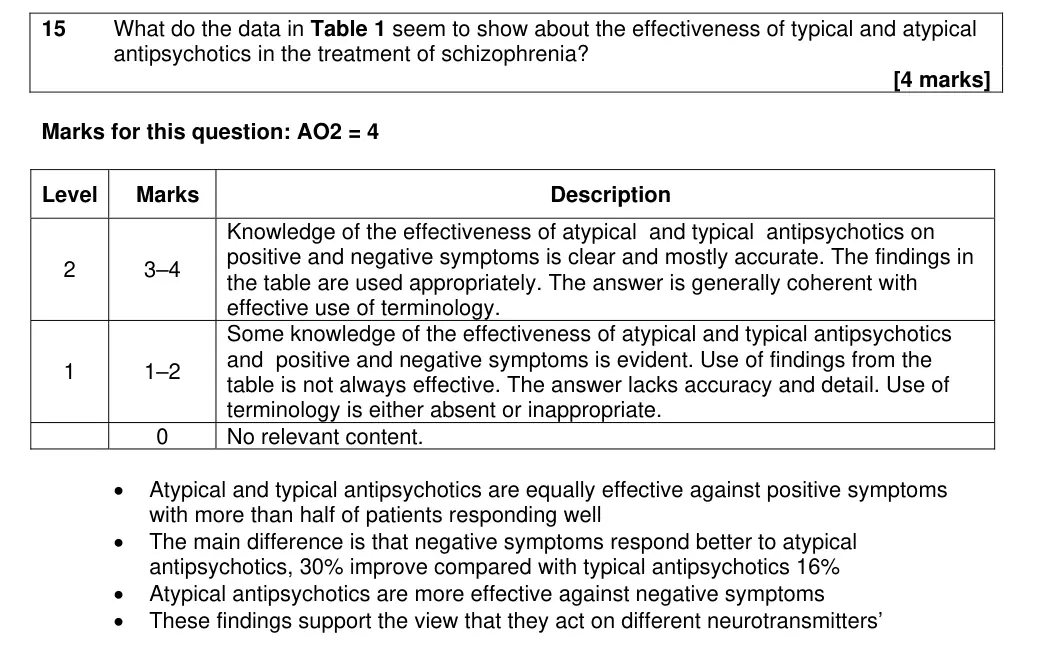
both drug types equally effective for positive symptoms
atypicals better for negative symptoms (30% vs 16%)
supports different neurotransmitter action
table columns/percentages must be read carefully
Specimen set 2 · Paper 3 · Q162 marksAO3=2Evaluate (short)schizophrenia
Mark scheme, including level descriptors and indicative content
Notes from the mark scheme and report
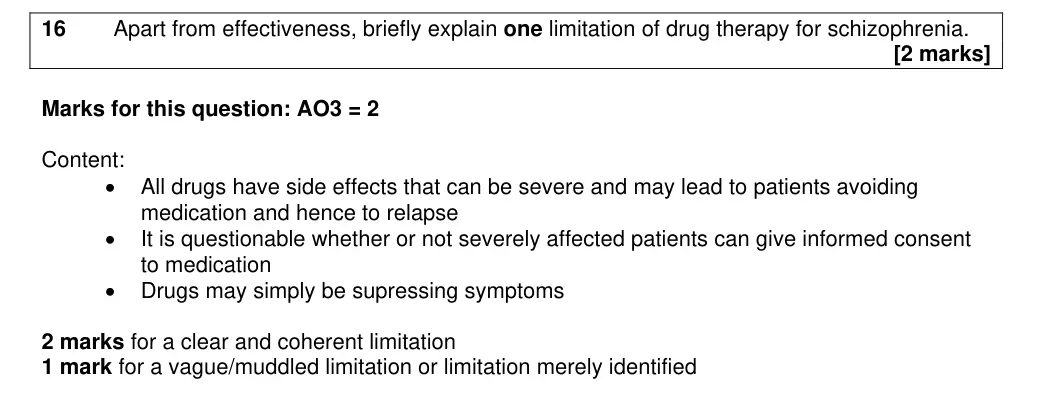
apart from effectiveness: side effects leading to non-compliance and relapse, informed consent, suppresses symptoms only
merely identified = 1 mark
Specimen set 2 · Paper 3 · Q172 marksAO1=2Outlineschizophrenia
Mark scheme, including level descriptors and indicative content
Notes from the mark scheme and report
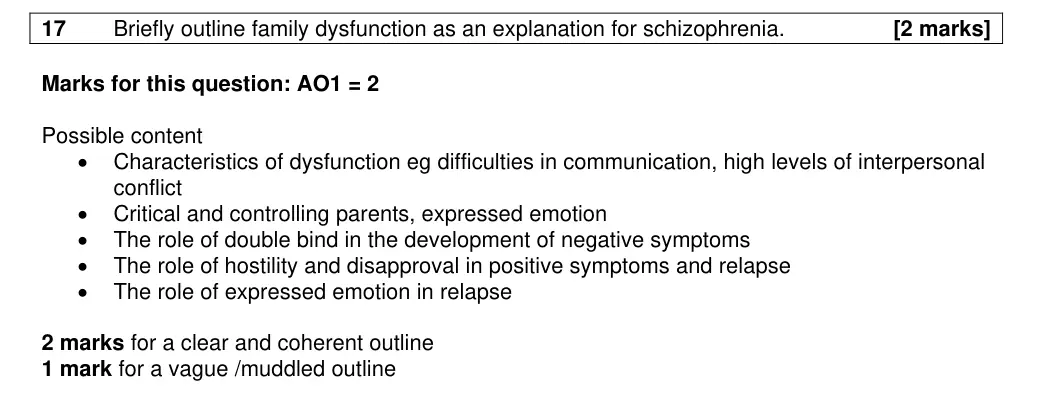
communication difficulties, conflict, double bind, expressed emotion, critical/controlling parents
Specimen set 2 · Paper 3 · Q188 marksAO1=3, AO3=5Extended writingOld spec onlyschizophreniaapproaches
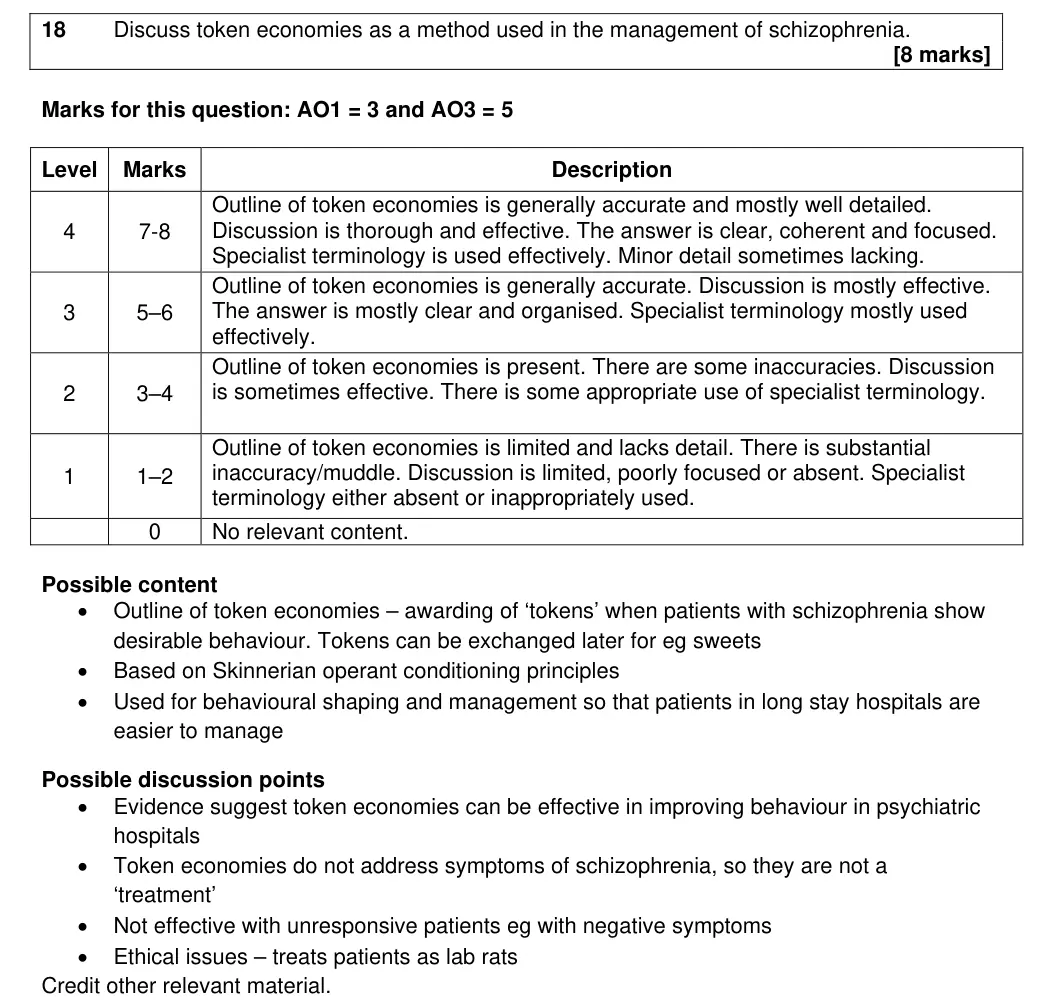
Not on the 2025 specification: token economies in the management of schizophrenia, removed in v1.4
Mark scheme, including level descriptors and indicative content
Notes from the mark scheme and report
Off-spec: token economies in the management of schizophrenia, removed in v1.4
operant conditioning, tokens exchanged for rewards
management not treatment, ethics
Specimen set 2 · Paper 3 · Q198 marksAO1=3, AO3=5Extended writingeating behaviour
Mark scheme, including level descriptors and indicative content
Notes from the mark scheme and report
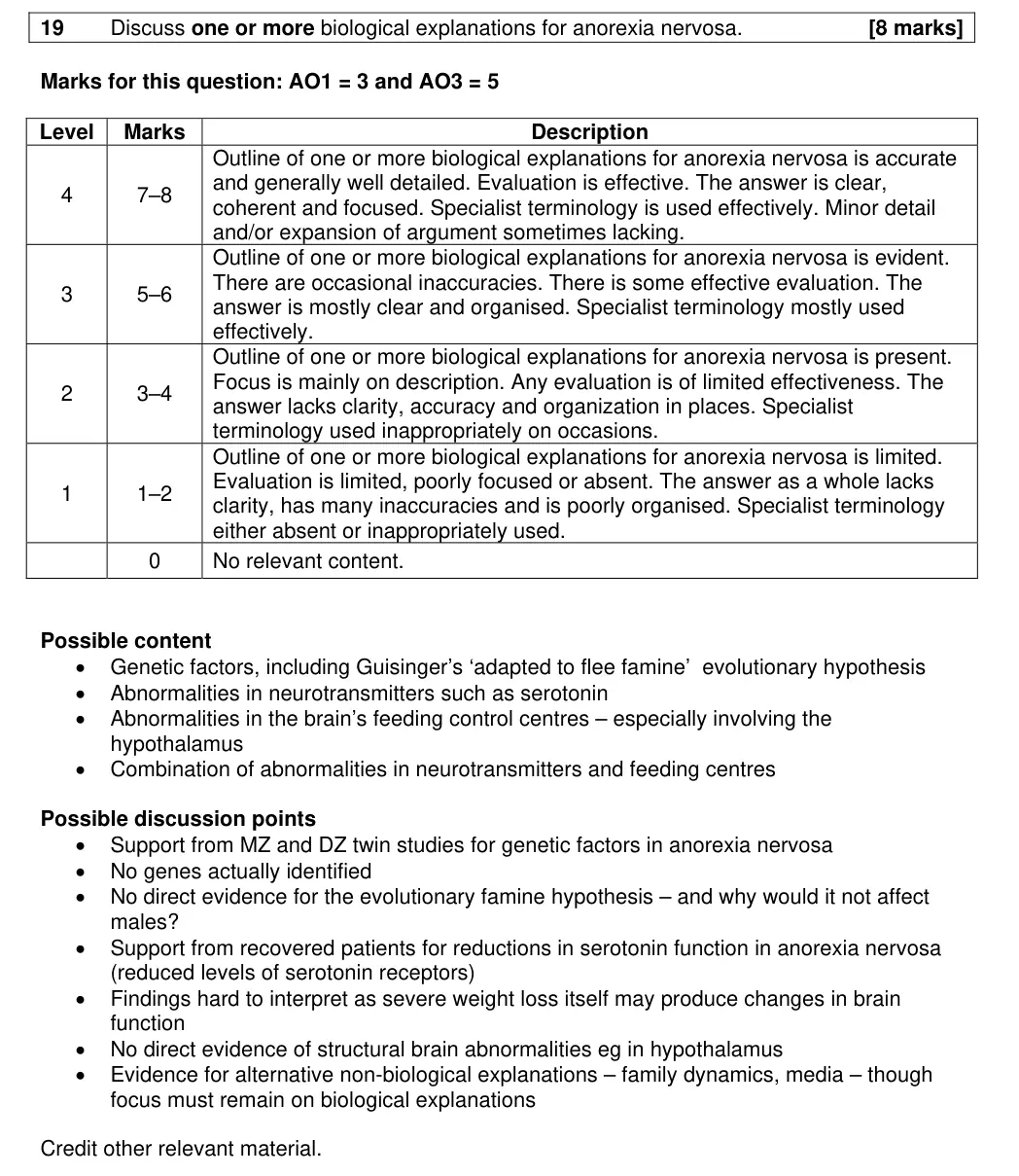
genetic (twin studies), serotonin, hypothalamus
discussion e.g. no genes identified, weight loss may cause brain changes
MS also credits Guisinger's evolutionary famine hypothesis
alternatives only if focus stays biological
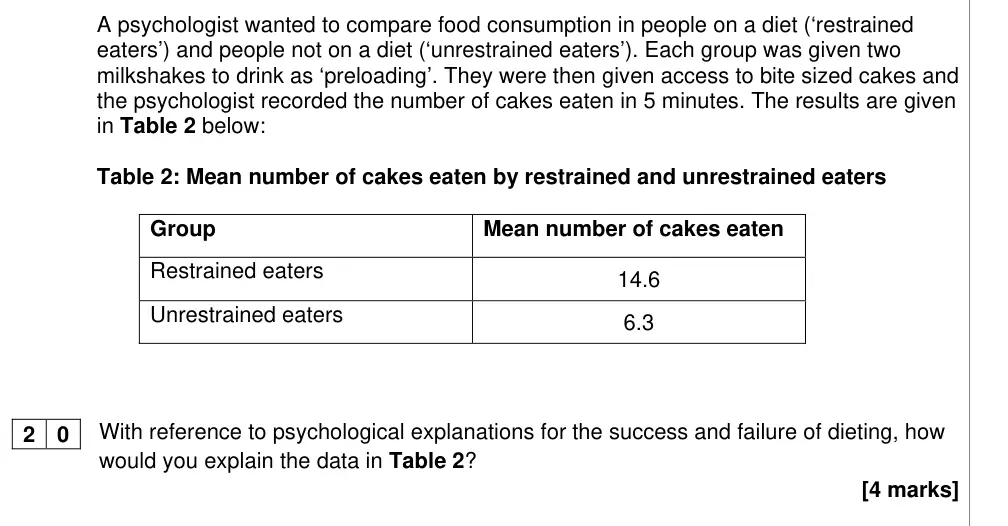
Specimen set 2 · Paper 3 · Q204 marksAO2=4Applicationeating behaviour
Mark scheme, including level descriptors and indicative content
Notes from the mark scheme and report
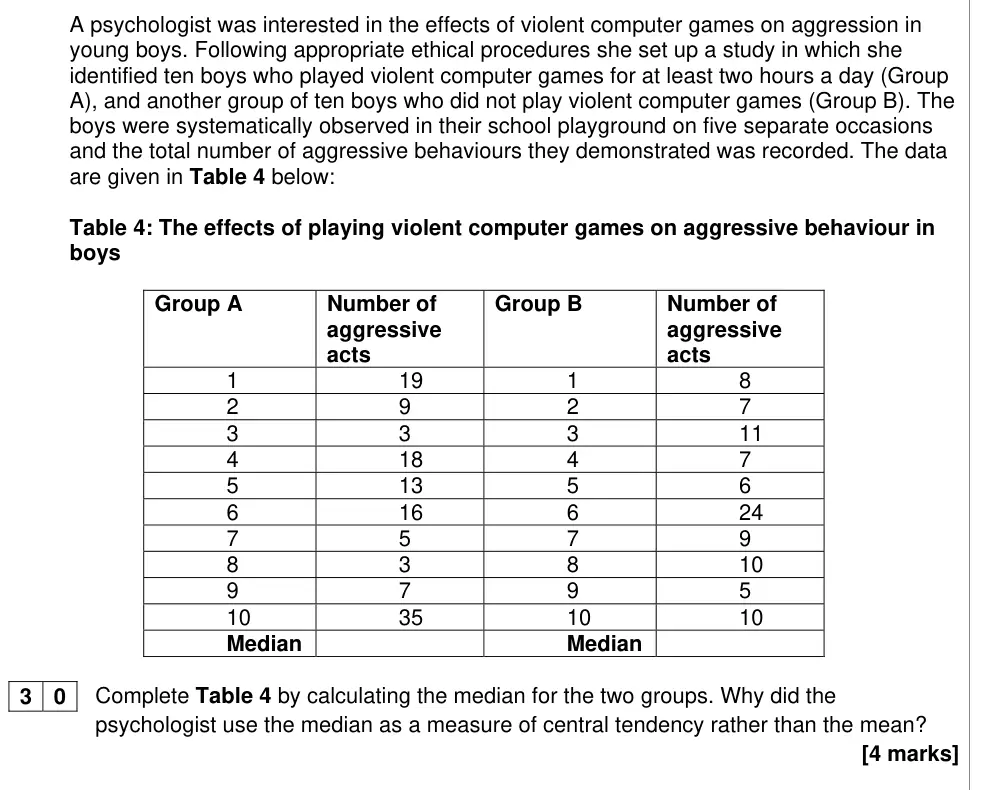
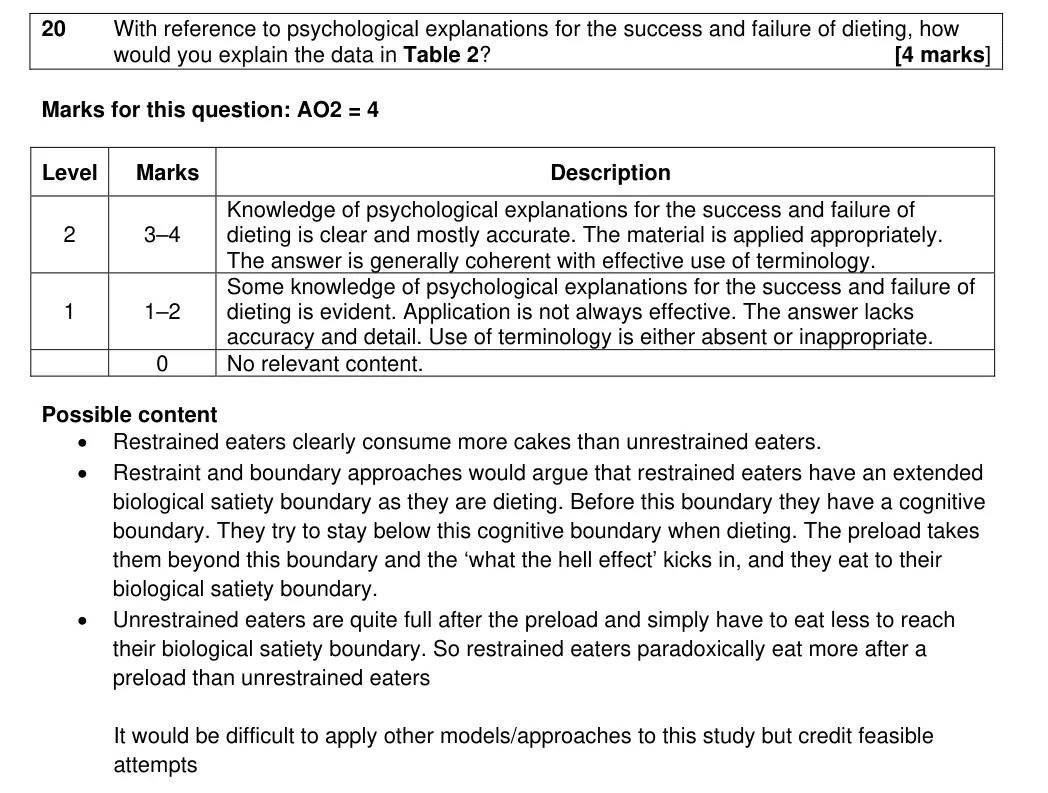
restraint theory/boundary model: preload breaks the diet's cognitive boundary, 'what the hell' effect, restrained eaters eat to satiety boundary so eat more (14.6 vs 6.3)
stem frames this as explanations for the success and failure of dieting (removed in v1.4) but credited content is restraint theory and the boundary model
Specimen set 2 · Paper 3 · Q218 marksAO1=3, AO3=5Extended writingeating behaviour
Mark scheme, including level descriptors and indicative content
Notes from the mark scheme and report
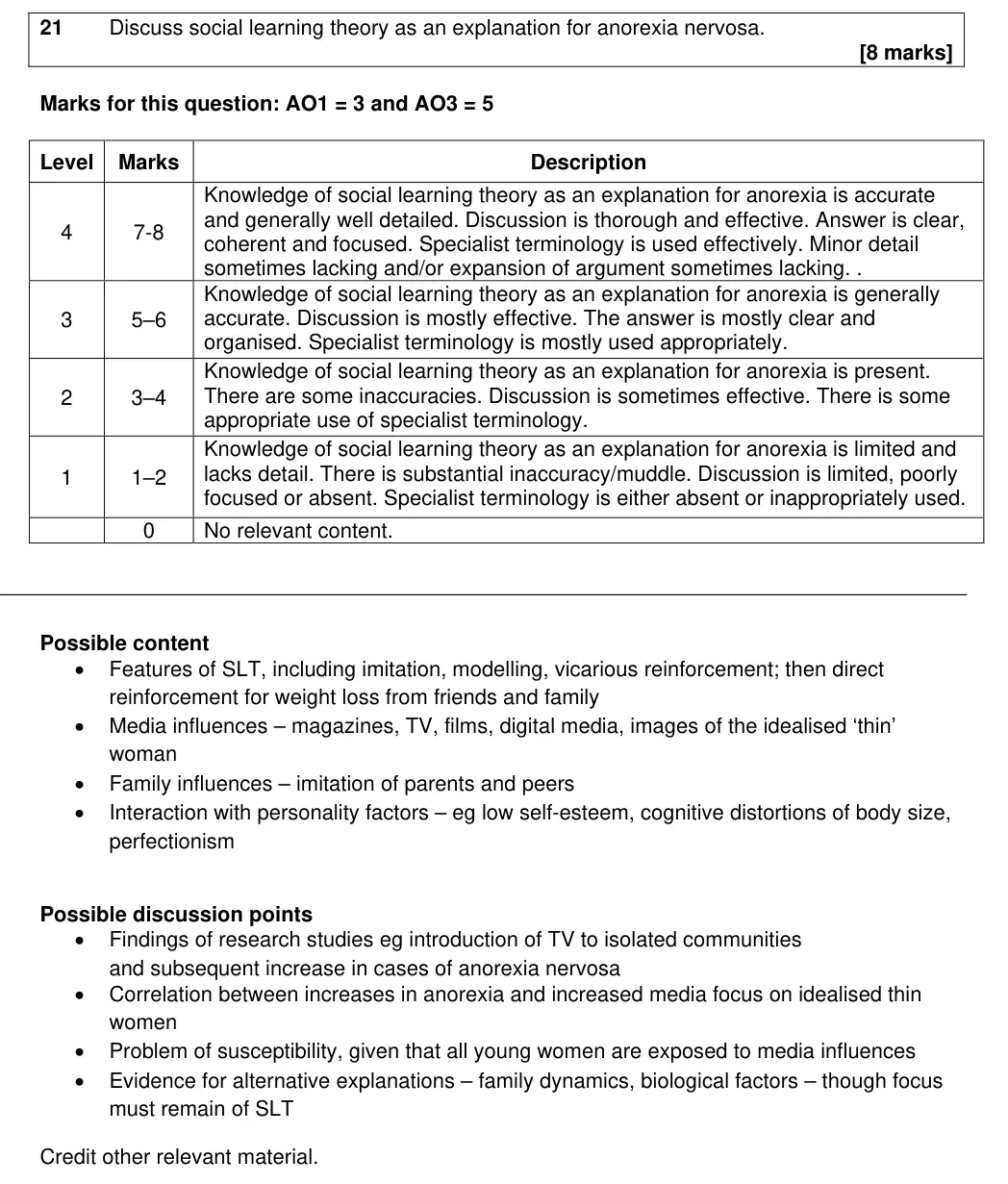
modelling, imitation, vicarious/direct reinforcement, media thin ideal
evaluation e.g. TV introduction studies (Fiji), susceptibility problem, alternatives with focus kept on SLT
Specimen set 2 · Paper 3 · Q222 marksAO3=2Evaluate (short)eating behaviour
Mark scheme, including level descriptors and indicative content
Notes from the mark scheme and report
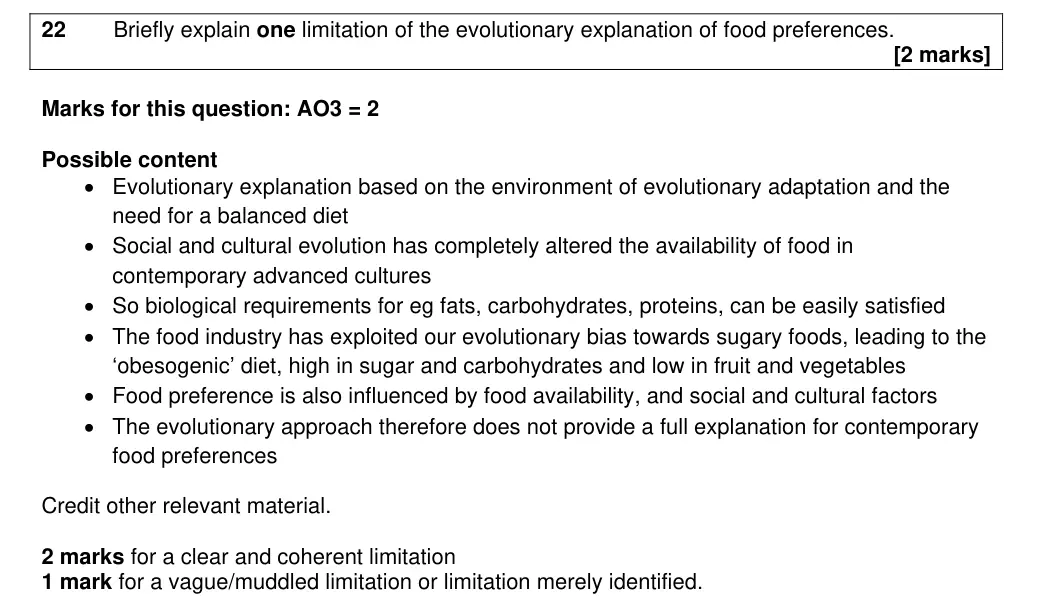
mismatch between environment of evolutionary adaptation and modern food availability
ignores social/cultural factors
merely identified = 1 mark
Specimen set 2 · Paper 3 · Q232 marksAO1=2Outlineeating behaviour
Mark scheme, including level descriptors and indicative content
Notes from the mark scheme and report
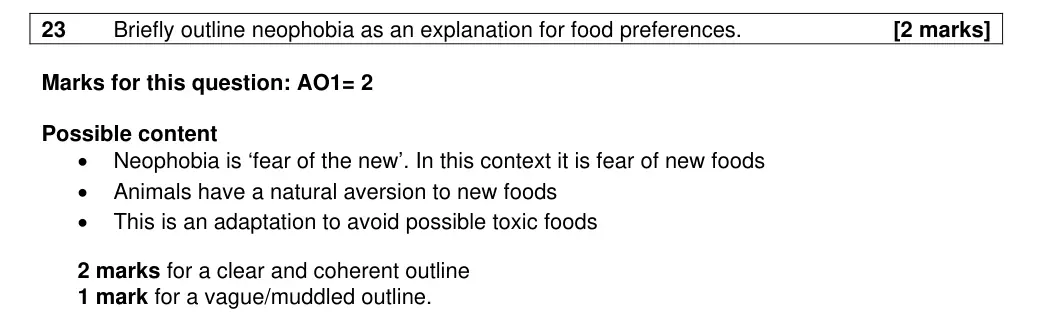
fear/avoidance of new foods
adaptive to avoid toxins
Specimen set 2 · Paper 3 · Q242 marksAO1=2Short answerstress
Mark scheme, including level descriptors and indicative content
Notes from the mark scheme and report
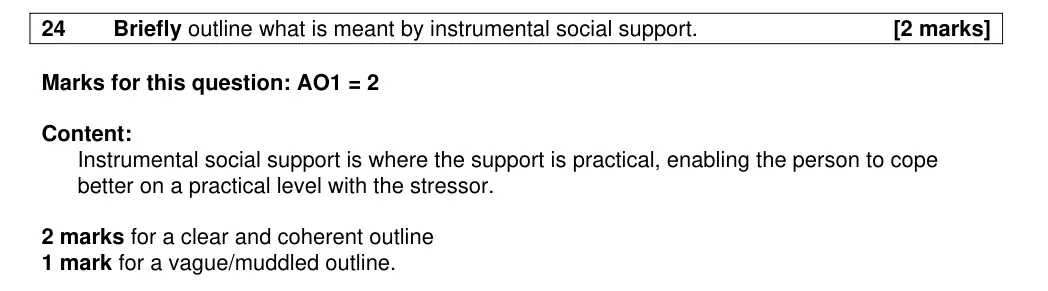
practical/tangible help enabling coping with the stressor
Specimen set 2 · Paper 3 · Q254 marksAO2=4Applicationstress
Mark scheme, including level descriptors and indicative content
Notes from the mark scheme and report
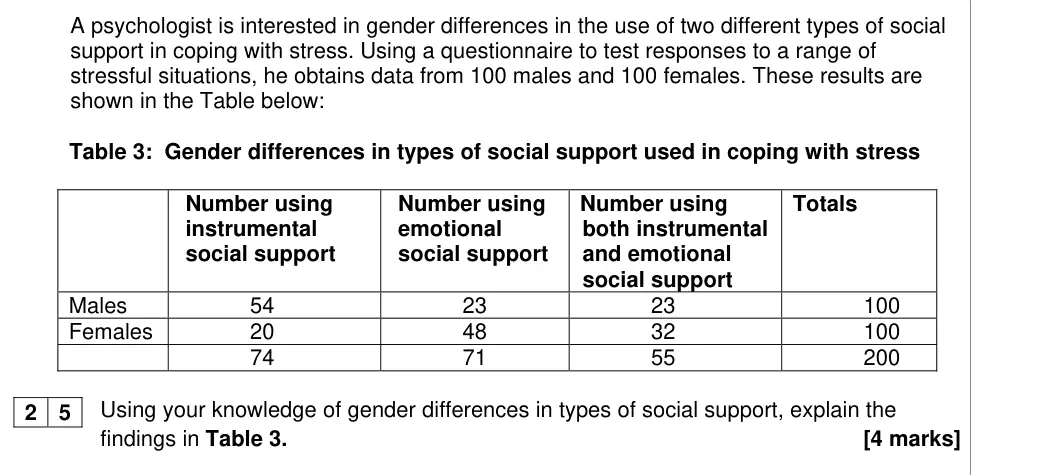
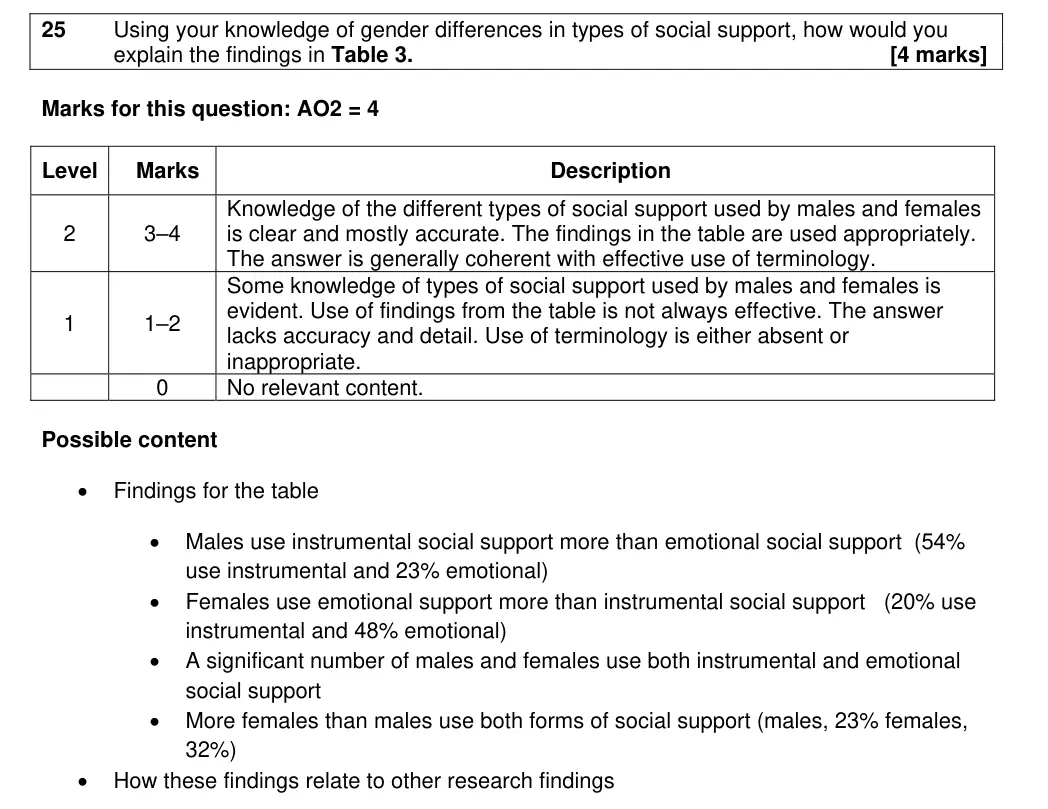
males mostly instrumental (54 vs 23), females mostly emotional (48 vs 20), more females use both (32 vs 23)
relate to research on gender differences
Specimen set 2 · Paper 3 · Q268 marksAO1=3, AO3=5Extended writingstress
Mark scheme, including level descriptors and indicative content
Notes from the mark scheme and report
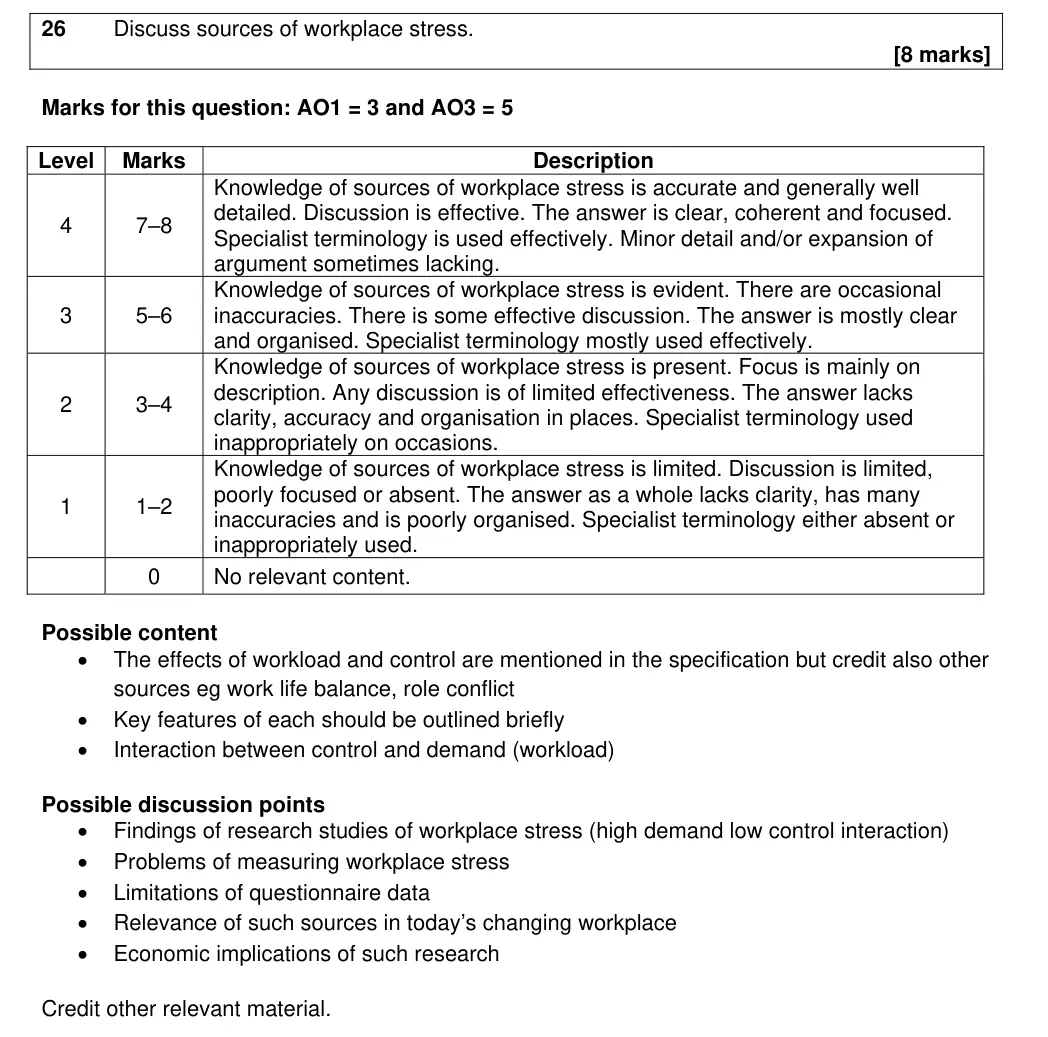
workload and control (high demand/low control interaction)
other sources e.g. role conflict also credited
evaluation e.g. Marmot, measurement problems, changing workplace
Specimen set 2 · Paper 3 · Q272 marksAO3=2Evaluate (short)stress
Mark scheme, including level descriptors and indicative content
Notes from the mark scheme and report
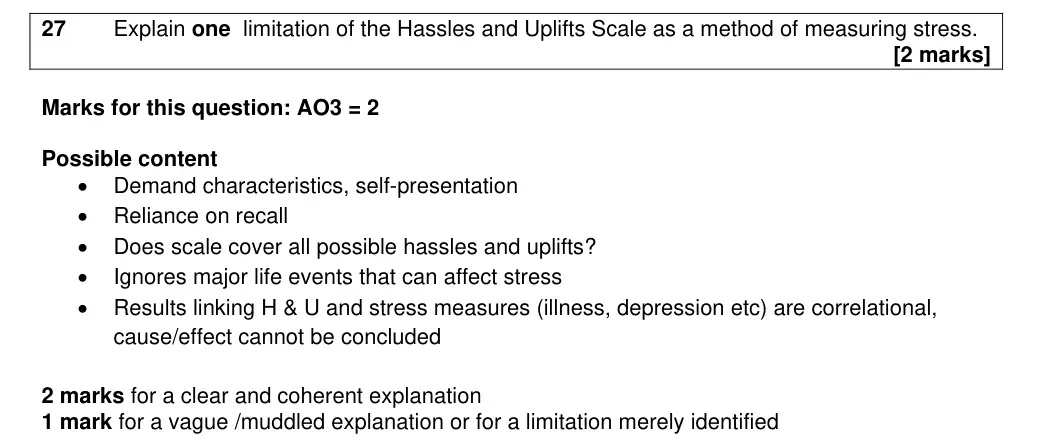
social desirability, reliance on recall, coverage of hassles, ignores major life events, correlational
merely identified = 1 mark
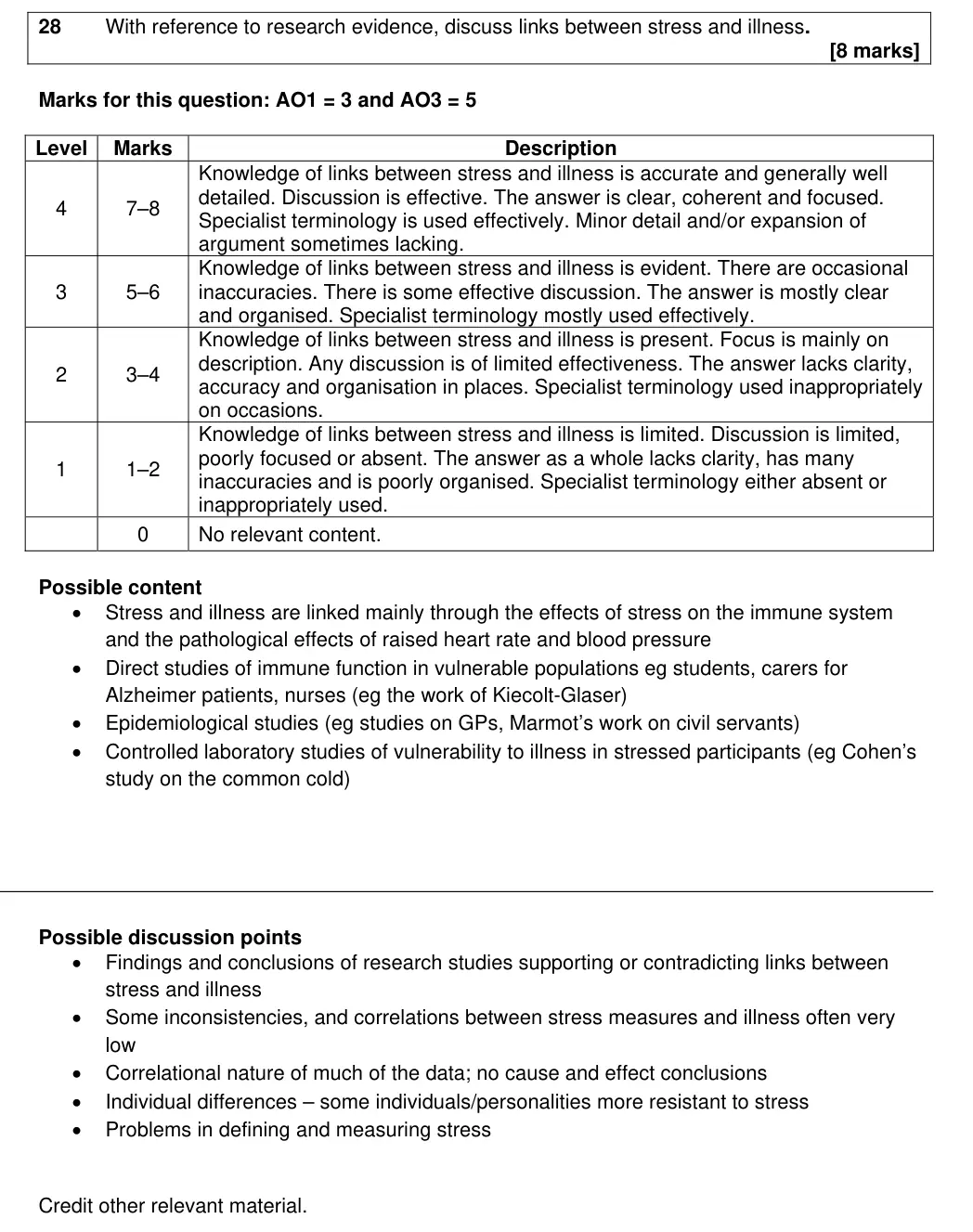
Specimen set 2 · Paper 3 · Q288 marksAO1=3, AO3=5Extended writingstress
Mark scheme, including level descriptors and indicative content
Notes from the mark scheme and report
immunosuppression (Kiecolt-Glaser, Cohen) and cardiovascular effects (Marmot)
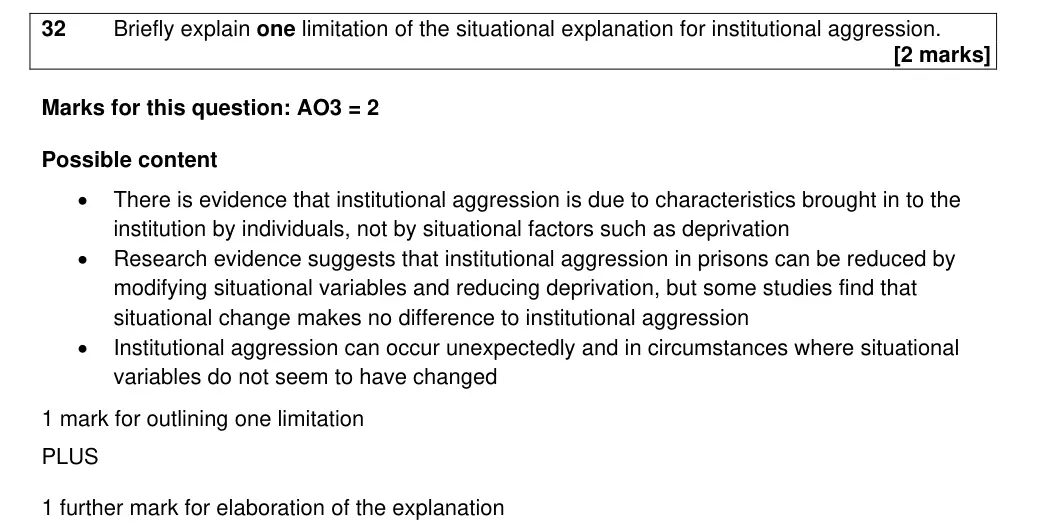
Mark scheme, including level descriptors and indicative content
Notes from the mark scheme and report
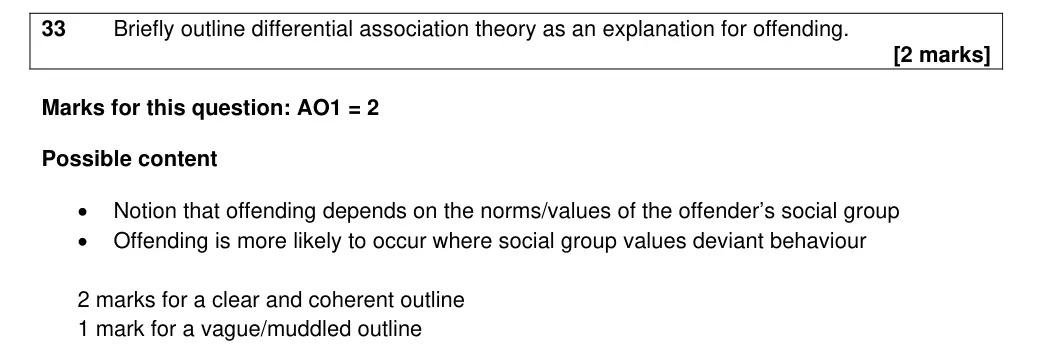
offending learned from norms/values of social group
more likely where group values deviance
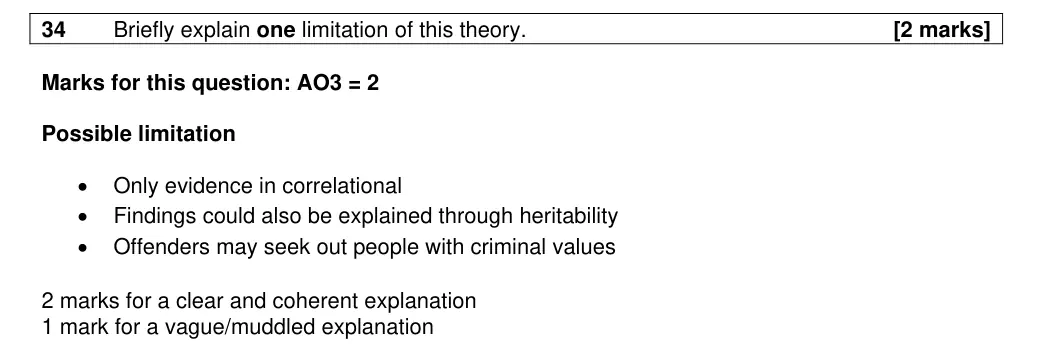
Specimen set 2 · Paper 3 · Q342 marksAO3=2Evaluate (short)forensic psychology
Mark scheme, including level descriptors and indicative content
Notes from the mark scheme and report
correlational evidence only, heritability alternative, offenders may seek out criminal peers
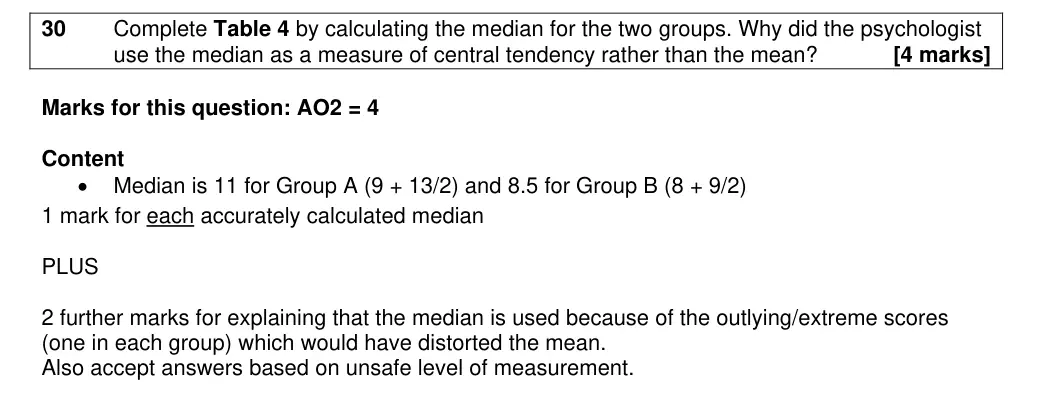
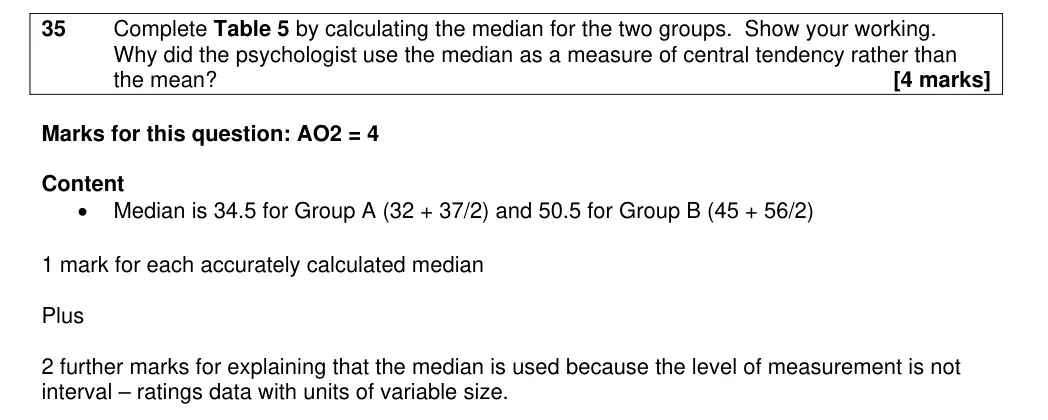
Specimen set 2 · Paper 3 · Q354 marksAO2=4Calculationdata handling
Mark scheme, including level descriptors and indicative content
Notes from the mark scheme and report
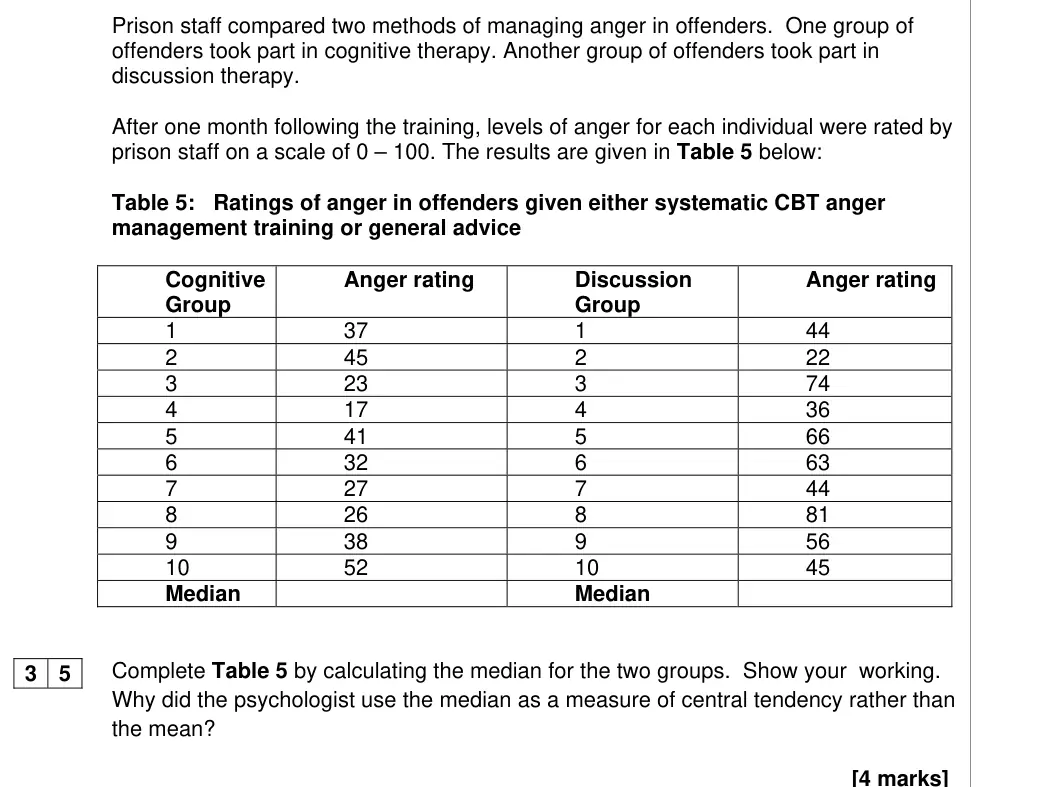
median cognitive group 34.5, discussion group 50.5 (1 mark each, show working) + 2 marks median used because ratings are not interval data (units of variable size)
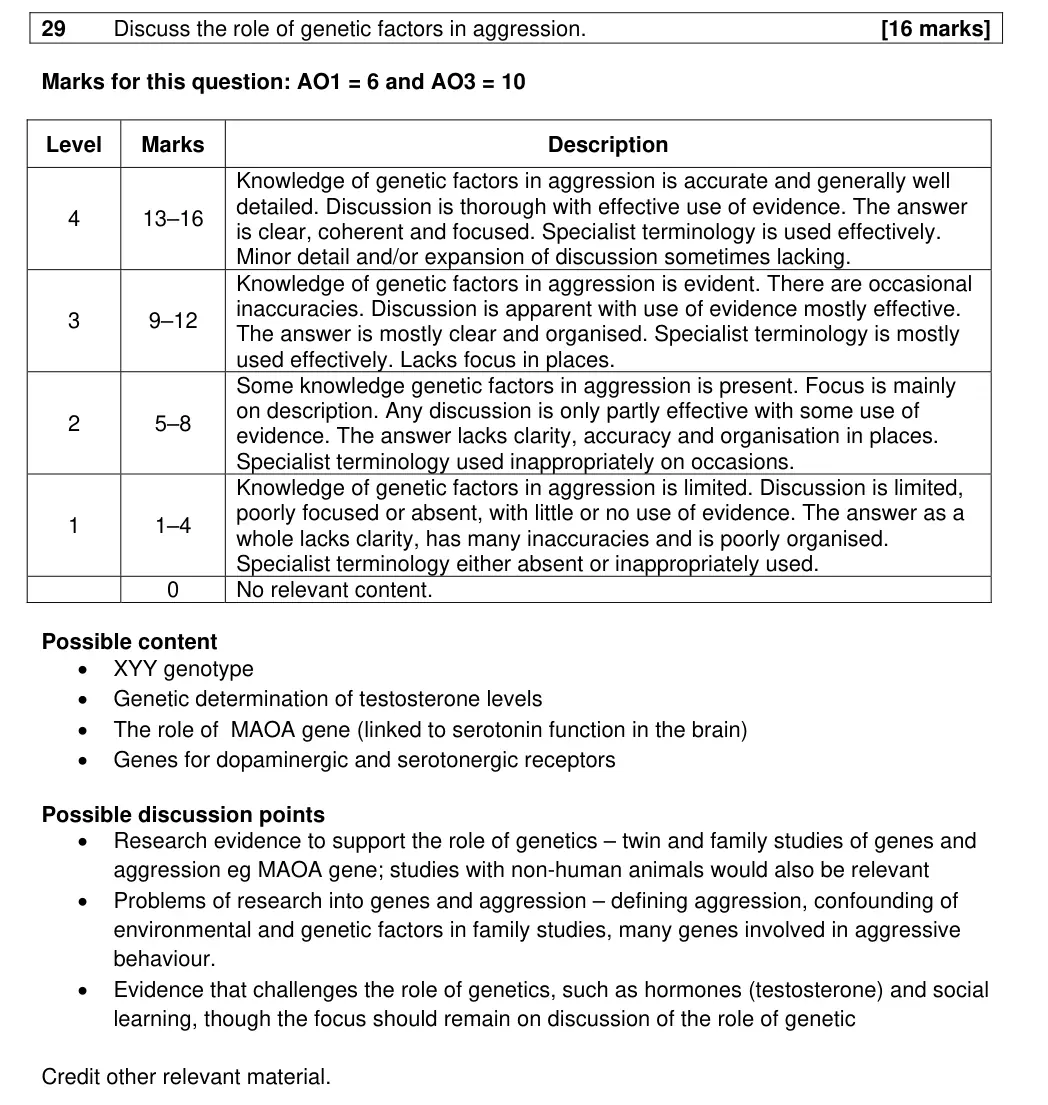
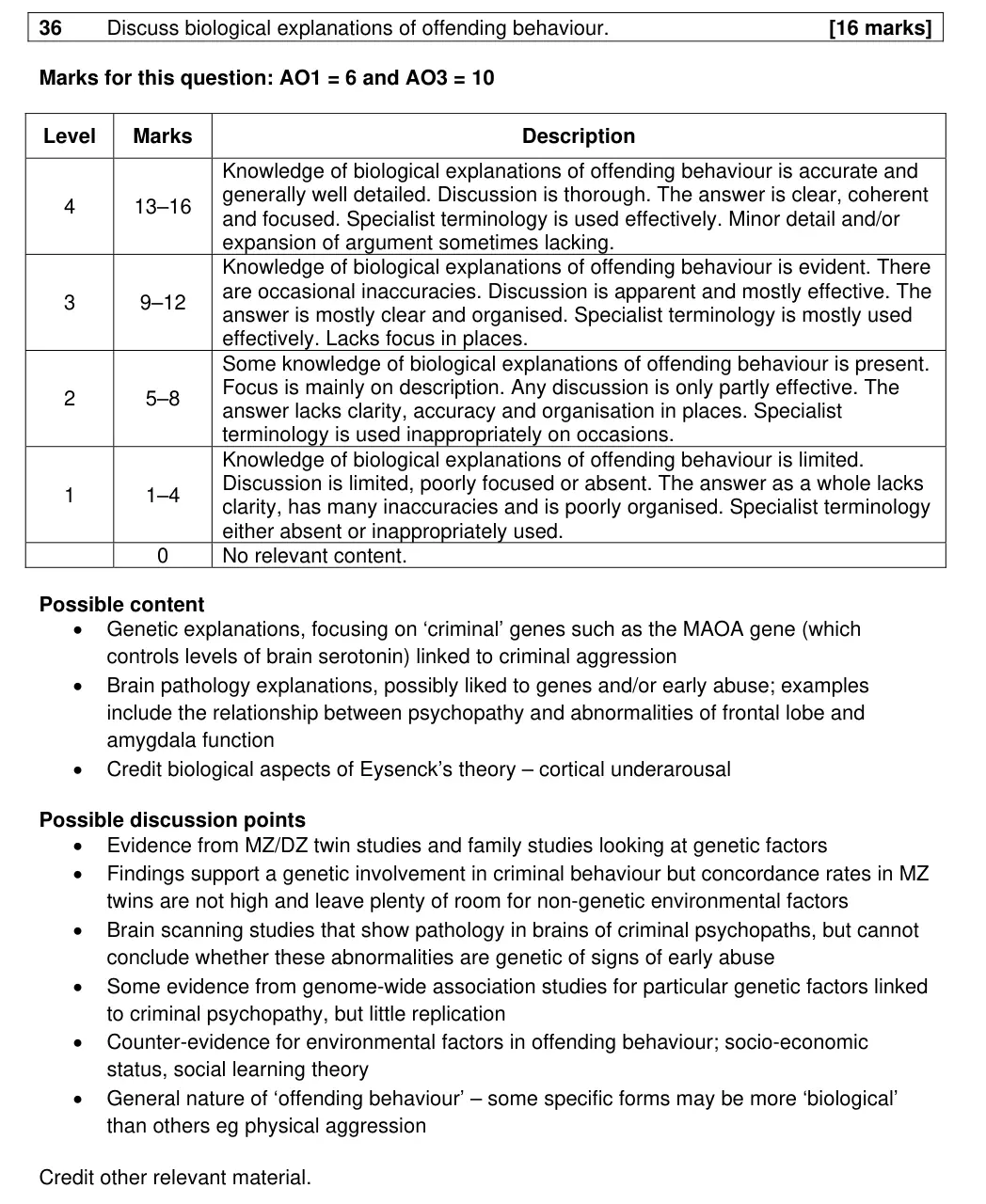
Specimen set 2 · Paper 3 · Q3616 marksAO1=6, AO3=1016-mark essayforensic psychology
Mark scheme, including level descriptors and indicative content
Notes from the mark scheme and report
genetic (MAOA, twin/family studies), neural (frontal lobe, amygdala in psychopathy)
Eysenck's cortical under-arousal also credited
evaluation: modest concordance, scanning can't separate genes from abuse, environmental alternatives
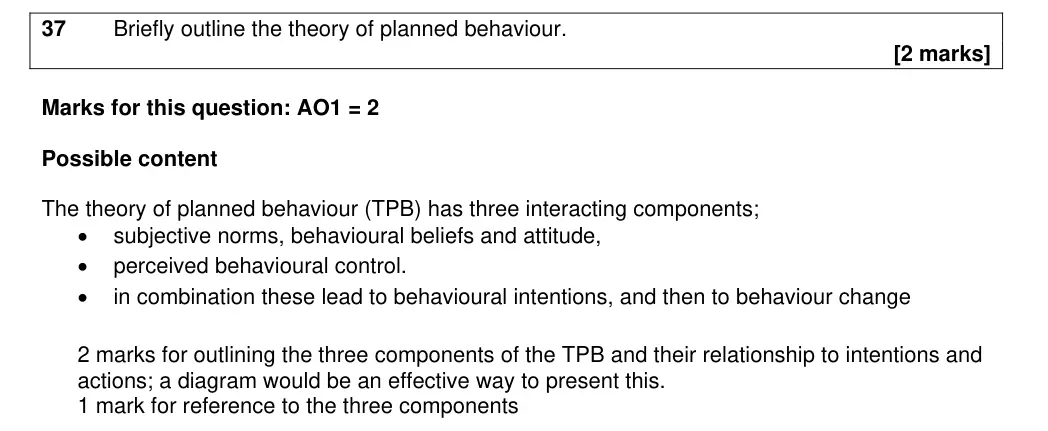
Specimen set 2 · Paper 3 · Q372 marksAO1=2OutlineOld spec onlyaddiction
Not on the 2025 specification: theory of planned behaviour, removed in v1.4
Mark scheme, including level descriptors and indicative content
Notes from the mark scheme and report
Off-spec: theory of planned behaviour, removed in v1.4
2 marks needs the three components (attitudes, subjective norms, perceived behavioural control) and their link to intention and behaviour
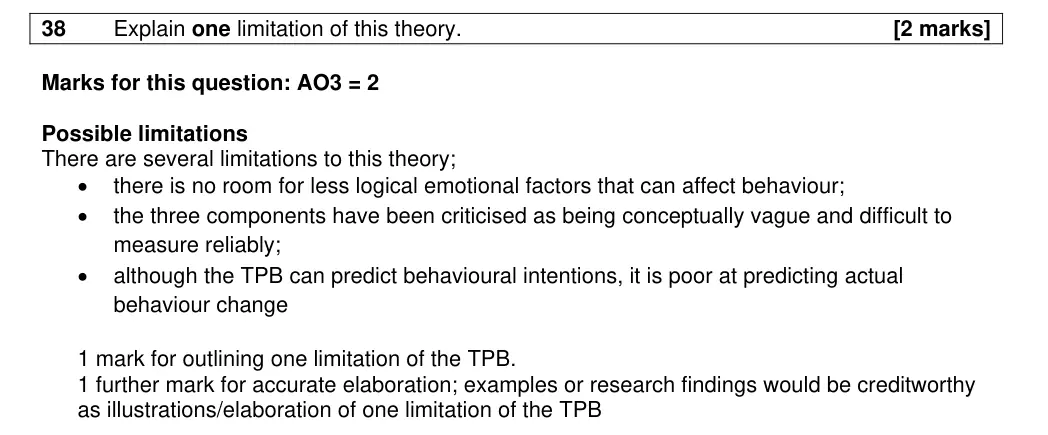
Specimen set 2 · Paper 3 · Q382 marksAO3=2Evaluate (short)Old spec onlyaddiction
Not on the 2025 specification: theory of planned behaviour, removed in v1.4
Mark scheme, including level descriptors and indicative content
Notes from the mark scheme and report
Off-spec: theory of planned behaviour, removed in v1.4
e.g. ignores emotional factors, vague components, predicts intention better than behaviour
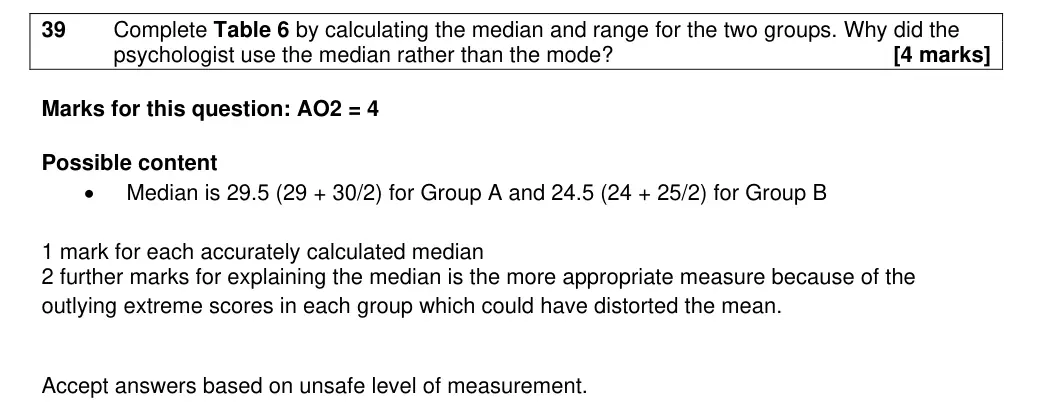
Specimen set 2 · Paper 3 · Q394 marksAO2=4Calculationdata handling
Mark scheme, including level descriptors and indicative content
Notes from the mark scheme and report
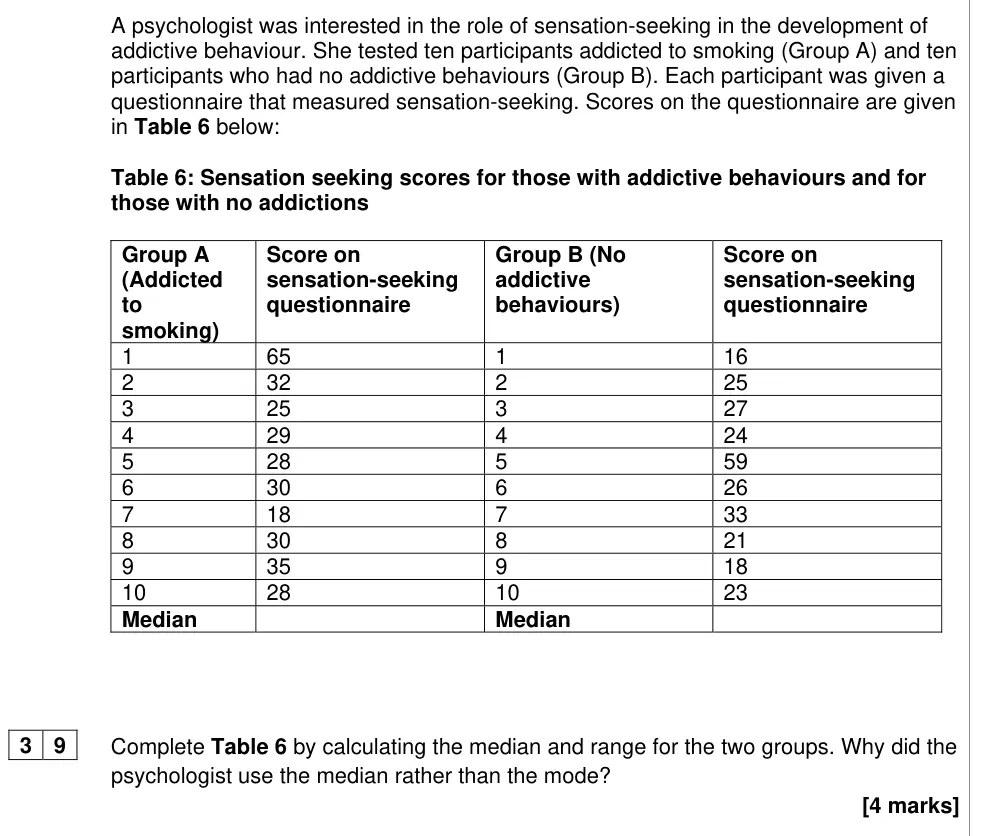
median Group A 29.5, Group B 24.5 (1 mark each) + 2 marks for extreme scores (65, 59)
question asks median rather than MODE but MS answer refers to the mean
MS gives no marks for the range despite the question asking for it
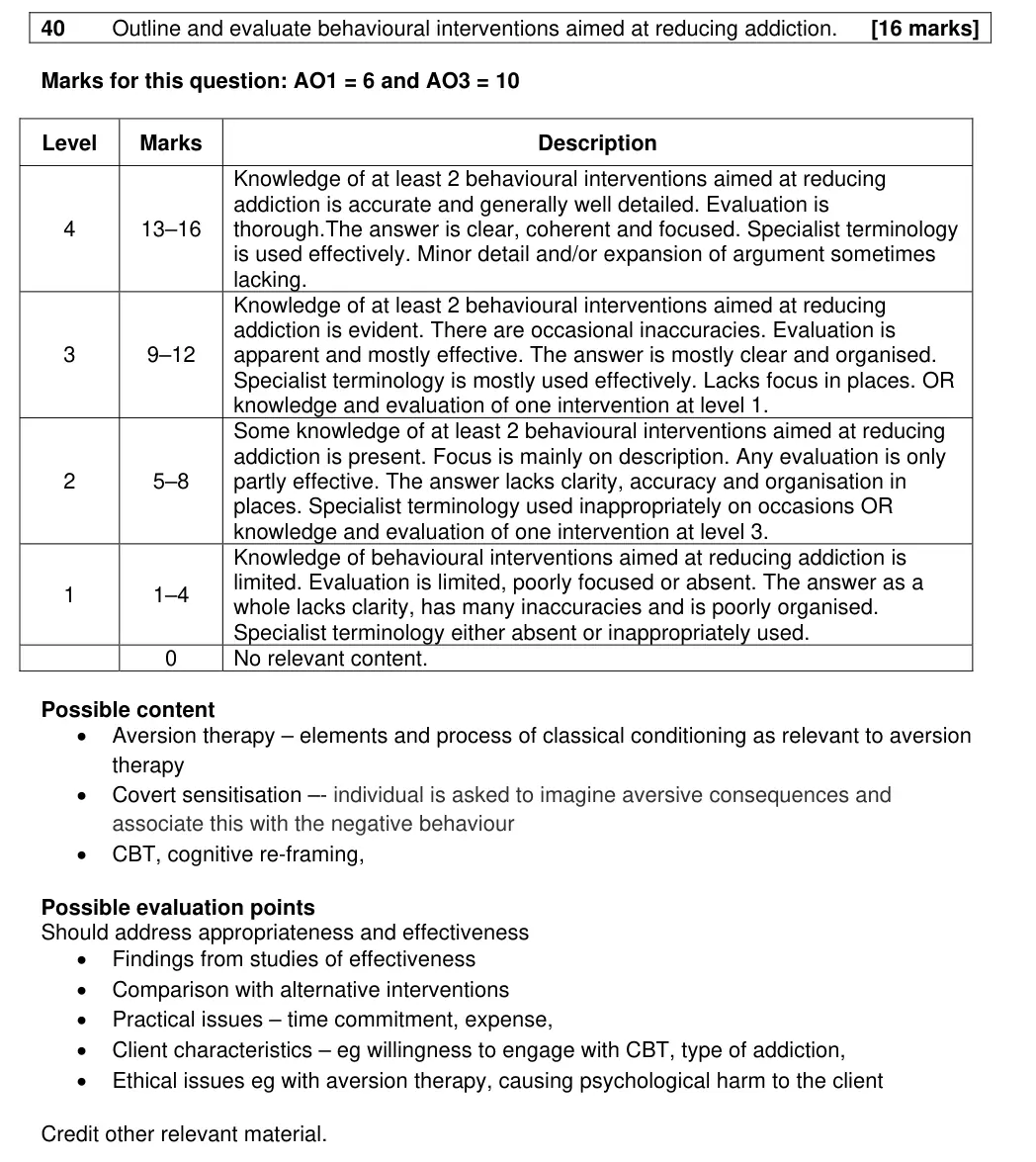
Specimen set 2 · Paper 3 · Q4016 marksAO1=6, AO3=1016-mark essayaddiction
Mark scheme, including level descriptors and indicative content
Notes from the mark scheme and report
at least two interventions needed above Level 2 (aversion therapy, covert sensitisation
MS also lists CBT)
evaluation of effectiveness, ethics, practicality, client characteristics
Work with an AQA psychology tutor
Want a paper marked and gone through with you? Message us.