November 2020: Paper 2

96 marks · 25 question parts · Paper, mark scheme and report on AQA's site

This paper was set on the previous specification. 1 part is on content removed in the 2025 specification and is marked "Old spec only".
Question by question

QTopicMarksAOType
1 Approaches in psychology 1AO1=1Multiple choice
2 Approaches in psychology 1AO1=1Multiple choice
3 Approaches in psychology 2AO1=2Outline
4 Approaches in psychology 4AO3=4Evaluate (short)
5 Approaches in psychology 16AO1=6,AO2=4,AO3=6Extended writing
6 Biopsychology 4AO1=4Multiple choice
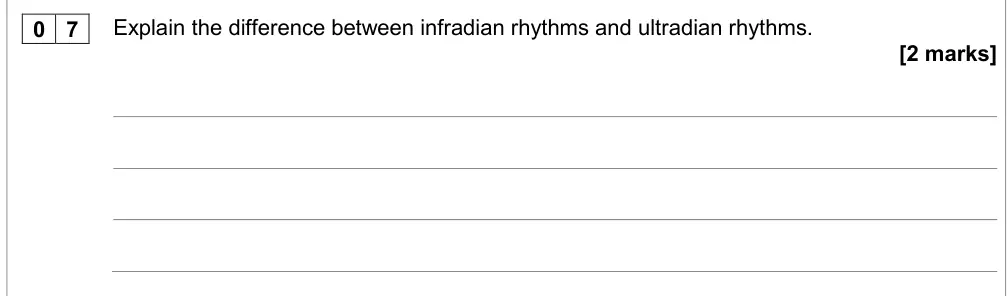
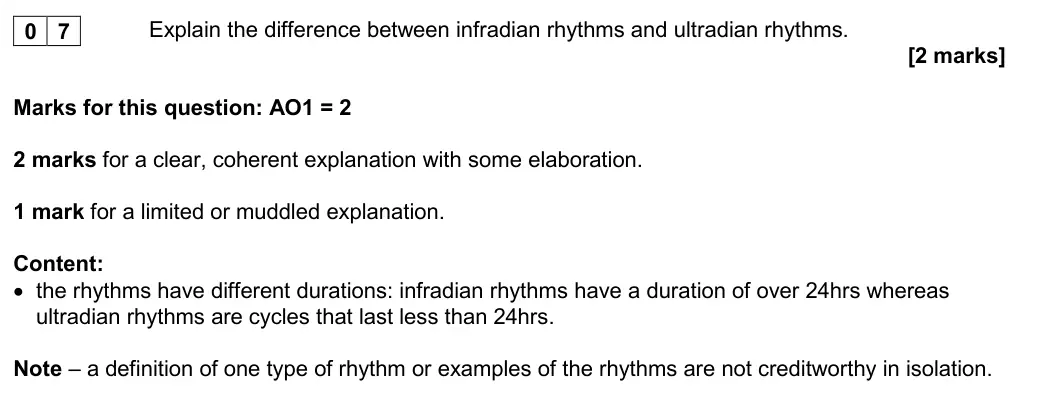
7 Old spec 2AO1=2Explain
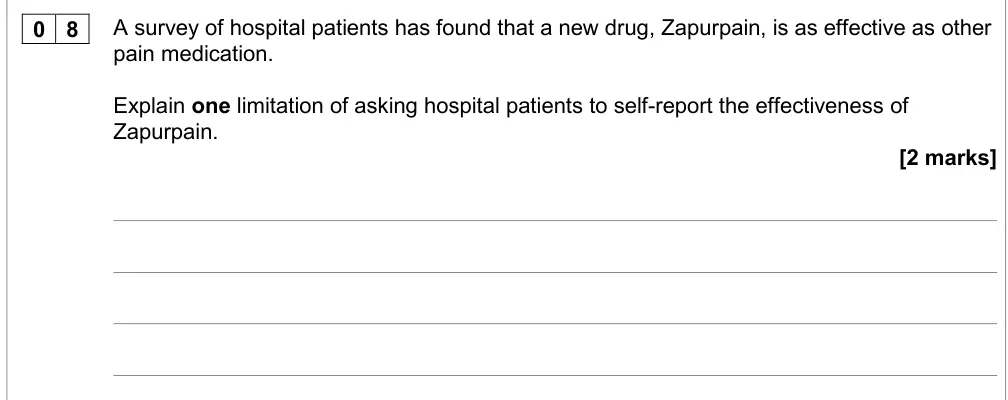
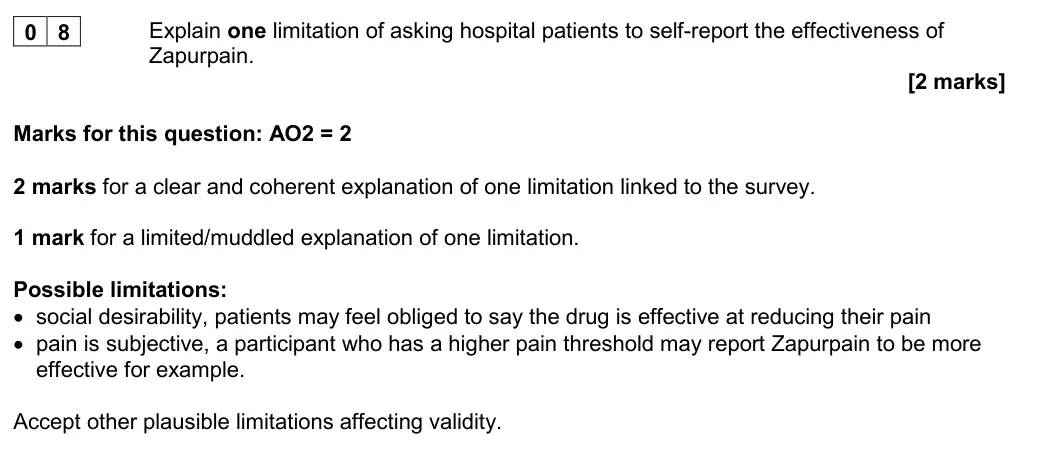
8 Research methods: methods and techniques, Research methods: scientific processes 2AO2=2Research methods
9 Biopsychology 4AO2=4Application
10 Biopsychology 4AO1=4Explain
11 Biopsychology 8AO1=3,AO3=5Extended writing
12 Research methods: scientific processes 1AO1=1Multiple choice
13 Research methods: data handling and analysis 1AO2=1Multiple choice
14 Research methods: data handling and analysis, Research methods: methods and techniques 3AO2=3Research methods
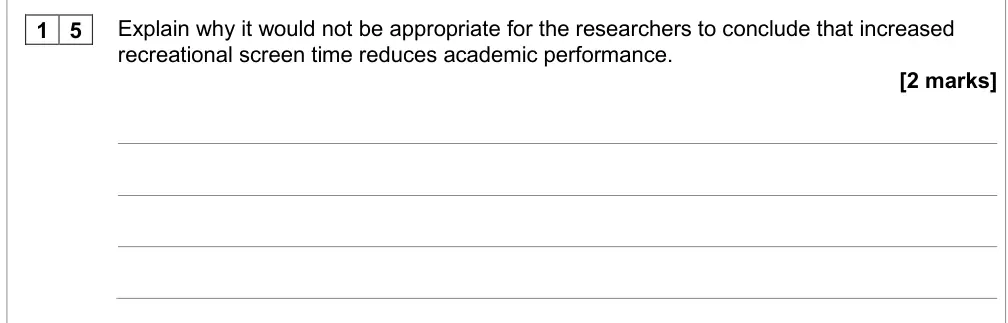
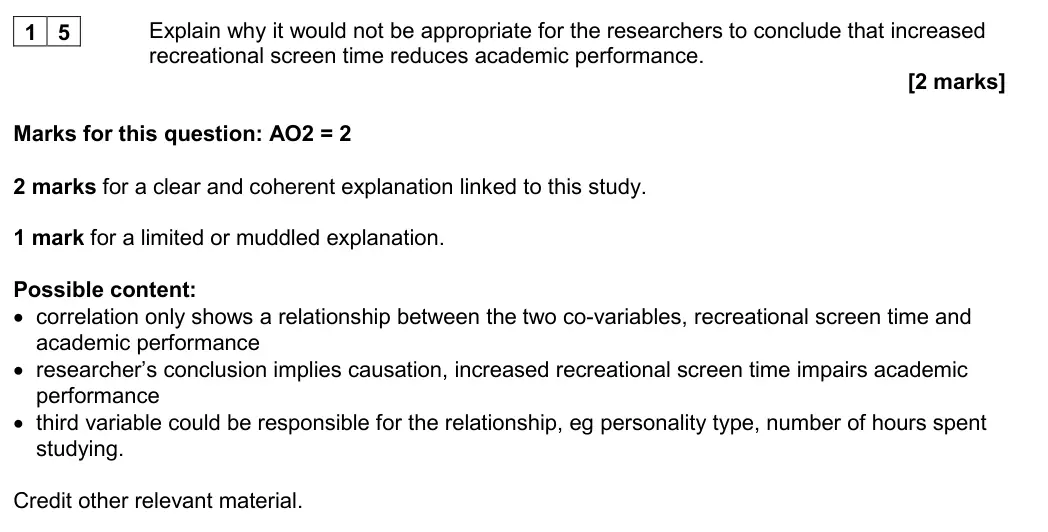
15 Research methods: methods and techniques 2AO2=2Research methods
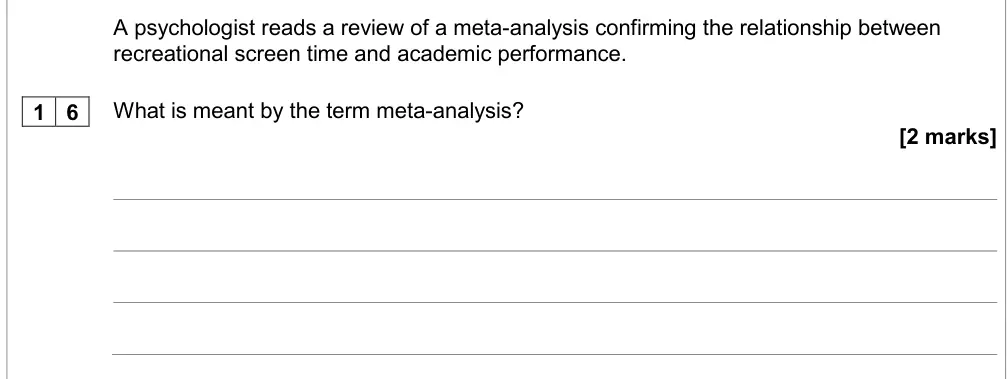
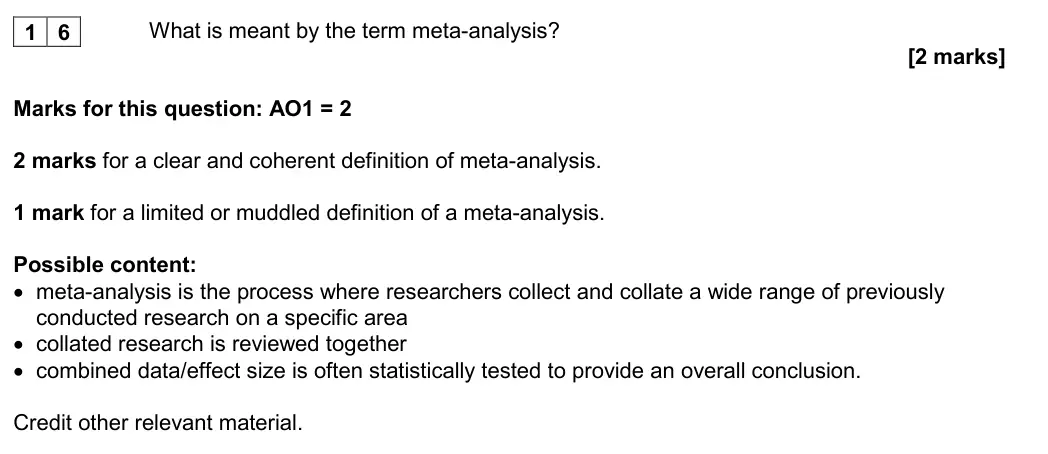
16 Research methods: data handling and analysis 2AO1=2Research methods
17 Research methods: scientific processes 2AO2=2Multiple choice
18 Research methods: scientific processes 1AO2=1Research methods
19 Research methods: scientific processes 3AO2=3Research methods
20 Research methods: data handling and analysis 4AO2=4Research methods
21 Research methods: data handling and analysis 4AO2=2,AO3=2Research methods
22 Research methods: inferential testing, Research methods: data handling and analysis 7AO2=7Research methods
23 Research methods: scientific processes 4AO2=4Research methods
24 Research methods: scientific processes 2AO2=2Research methods
25 Research methods: methods and techniques, Research methods: scientific processes 12AO2=6,AO3=6Extended writing

The questions

12345678910111213141516171819202122232425

November 2020 · Paper 2 · Q1 1 mark AO1=1 Multiple choice approaches
0 1
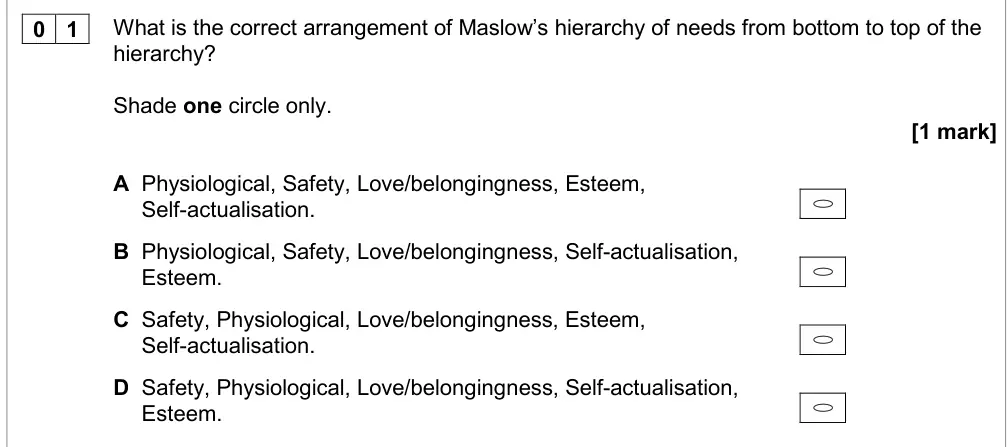
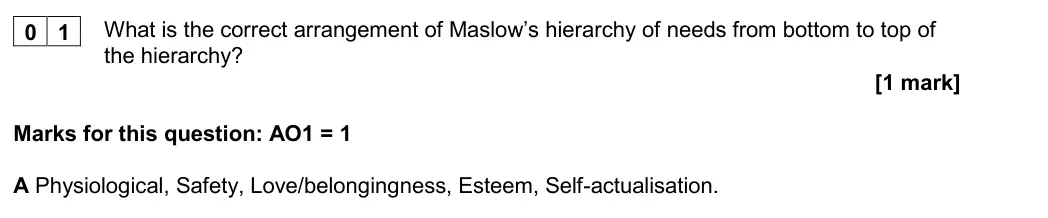
What is the correct arrangement of Maslow’s hierarchy of needs from bottom to top of the
hierarchy?
[1 mark]
A Physiological, Safety, Love/belongingness, Esteem,
Self-actualisation.
B Physiological, Safety, Love/belongingness, Self-actualisation,
Esteem.
C Safety, Physiological, Love/belongingness, Esteem,
Self-actualisation.
D Safety, Physiological, Love/belongingness, Self-actualisation,
Esteem.
November 2020 · Paper 2 · Q2 1 mark AO1=1 Multiple choice approaches
0 2
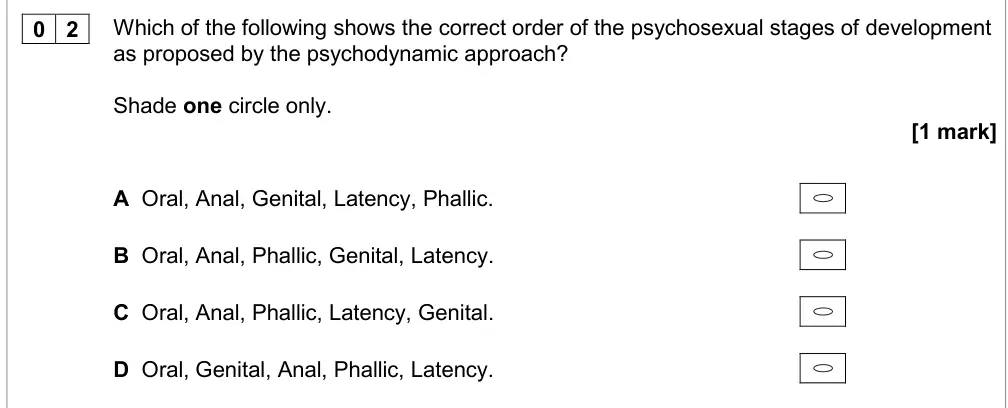
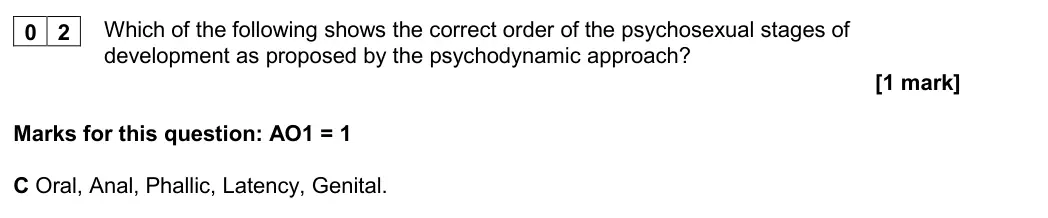
Which of the following shows the correct order of the psychosexual stages of development
as proposed by the psychodynamic approach?
[1 mark]
A Oral, Anal, Genital, Latency, Phallic.
B Oral, Anal, Phallic, Genital, Latency.
C Oral, Anal, Phallic, Latency, Genital.
D Oral, Genital, Anal, Phallic, Latency.
November 2020 · Paper 2 · Q3 2 marks AO1=2 Outline approaches
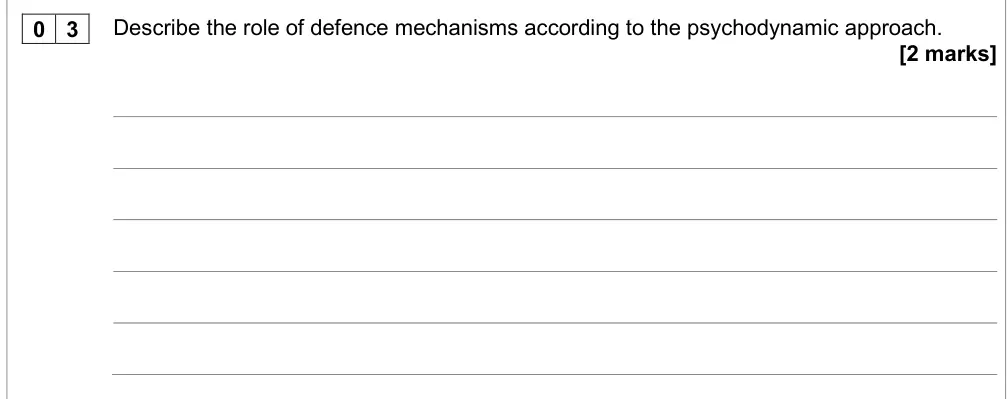
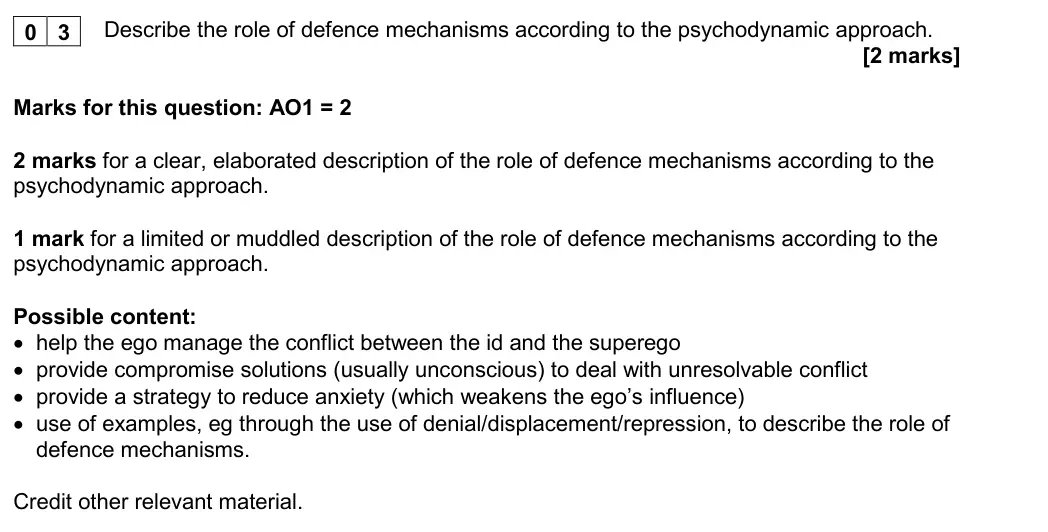
0 3
Describe the role of defence mechanisms according to the psychodynamic approach.
[2 marks]
November 2020 · Paper 2 · Q4 4 marks AO3=4 Evaluate (short) approaches
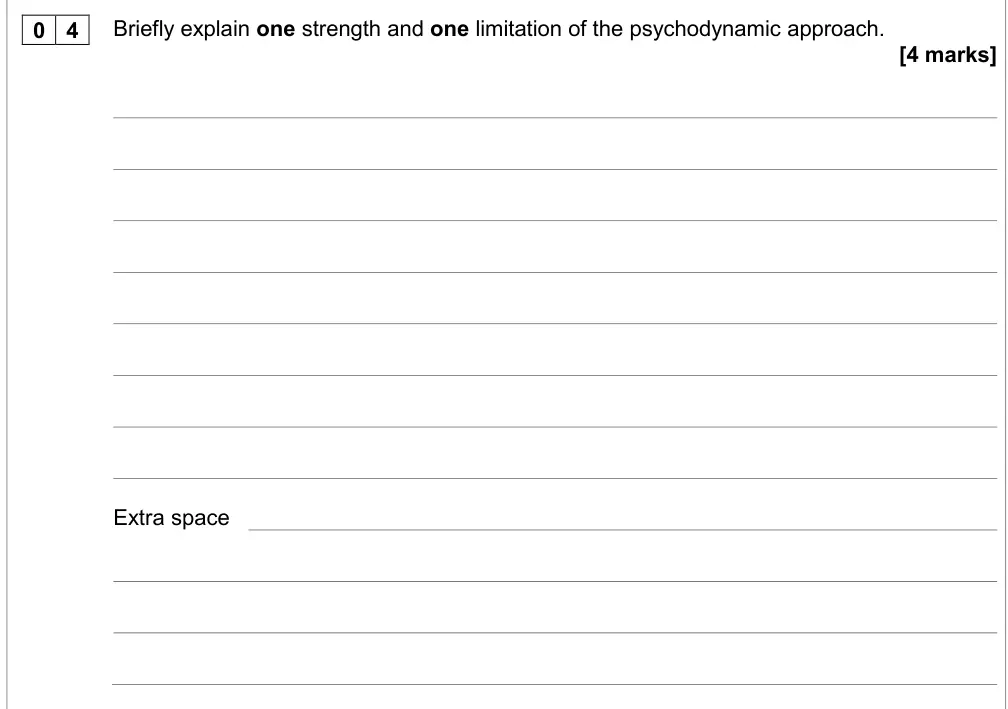
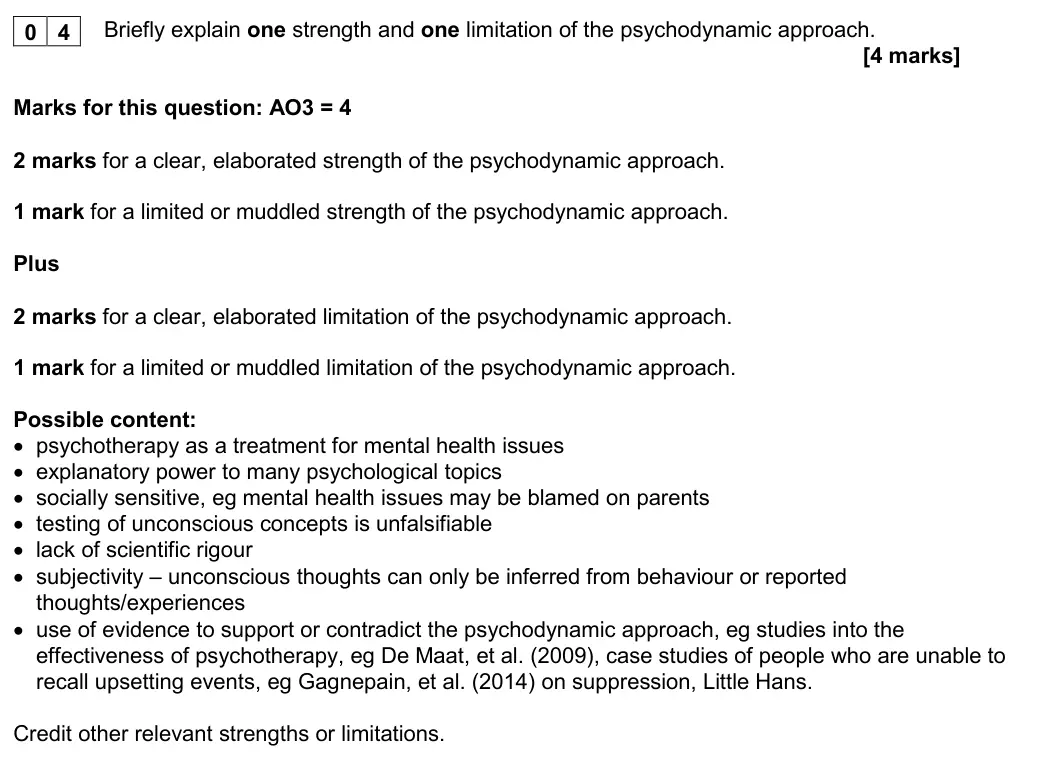
0 4
Briefly explain one strength and one limitation of the psychodynamic approach.
[4 marks]
Extra space
November 2020 · Paper 2 · Q5 16 marks AO1=6, AO2=4, AO3=6 16-mark essay approaches
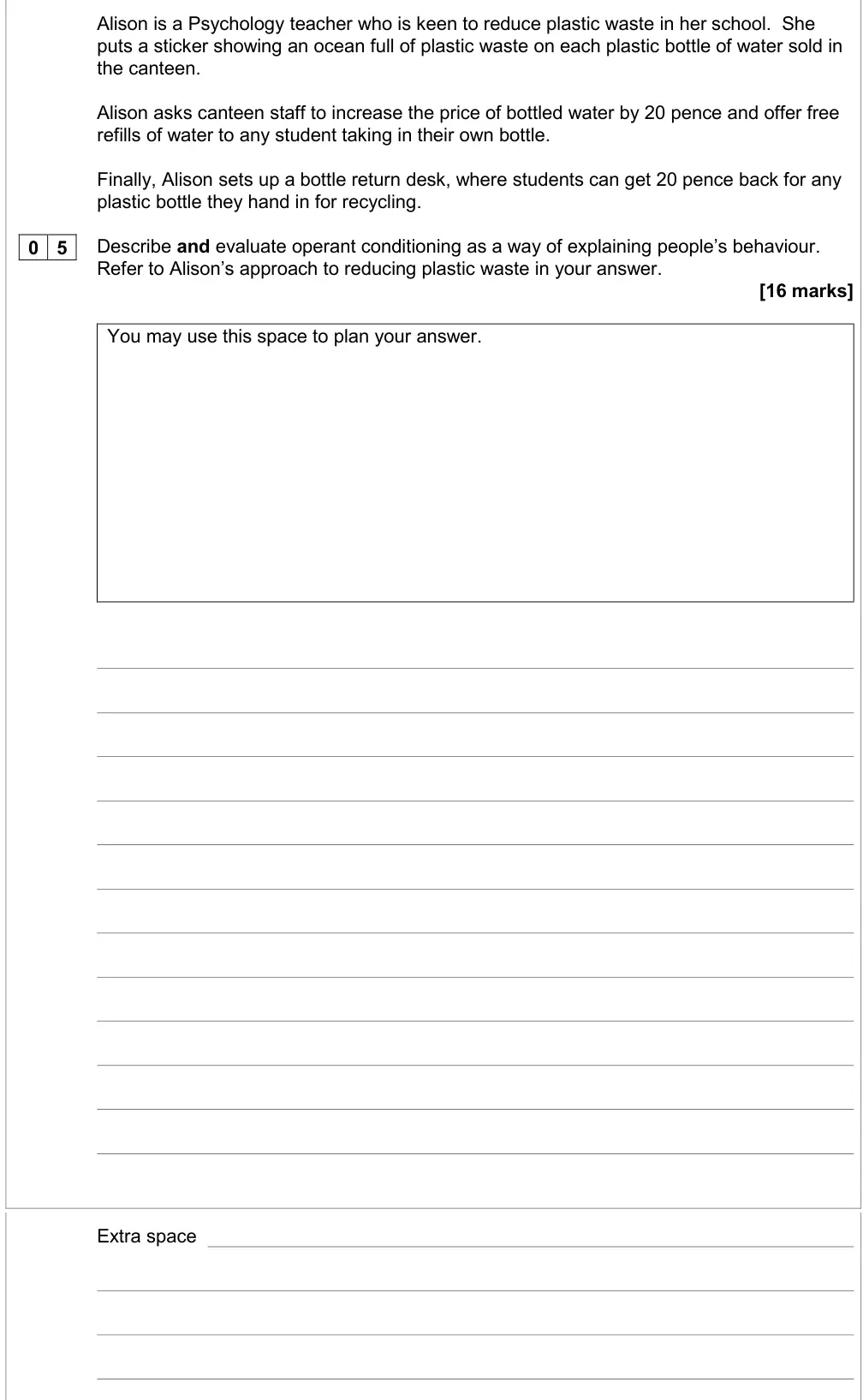
Alison is a Psychology teacher who is keen to reduce plastic waste in her school.  She
puts a sticker showing an ocean full of plastic waste on each plastic bottle of water sold in
the canteen.
Alison asks canteen staff to increase the price of bottled water by 20 pence and offer free
refills of water to any student taking in their own bottle.
Finally, Alison sets up a bottle return desk, where students can get 20 pence back for any
plastic bottle they hand in for recycling.
0 5
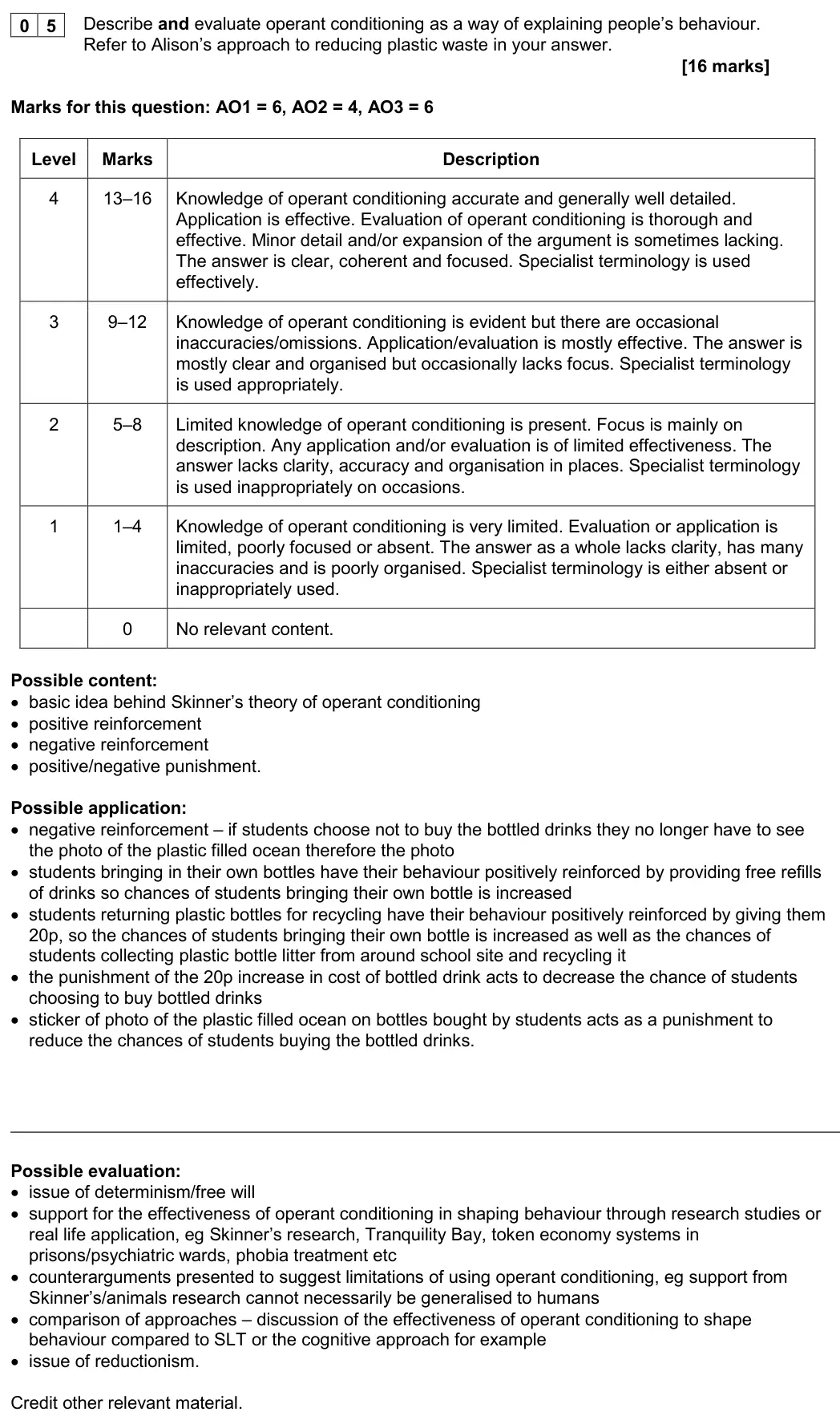
Describe and evaluate operant conditioning as a way of explaining people’s behaviour.
Refer to Alison’s approach to reducing plastic waste in your answer.
[16 marks]
You may use this space to plan your answer.
Extra space
November 2020 · Paper 2 · Q6 4 marks AO1=4 Multiple choice biopsychology
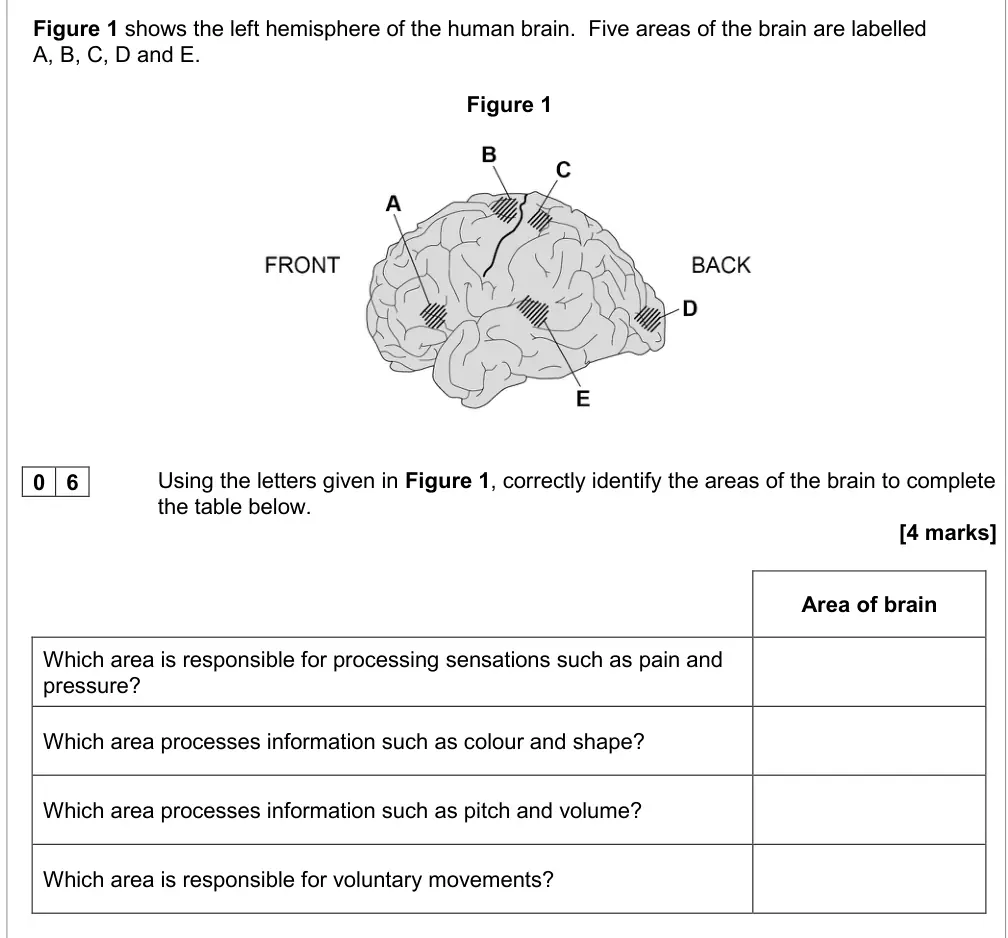
Figure 1 shows the left hemisphere of the human brain.  Five areas of the brain are labelled
A, B, C, D and E.
Figure 1
0 6
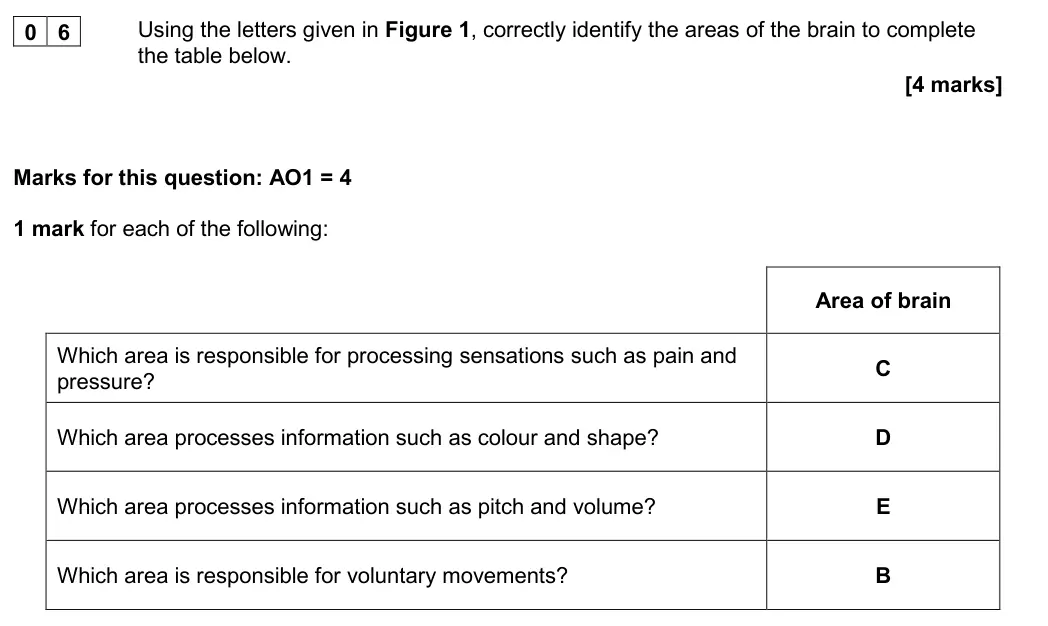
Using the letters given in Figure 1, correctly identify the areas of the brain to complete
the table below.
[4 marks]
Area of brain
Which area is responsible for processing sensations such as pain and
pressure?
Which area processes information such as colour and shape?
Which area processes information such as pitch and volume?
Which area is responsible for voluntary movements?
November 2020 · Paper 2 · Q8 2 marks AO2=2 Research methods research methodsscientific processes
0 8
A survey of hospital patients has found that a new drug, Zapurpain, is as effective as other
pain medication.
Explain one limitation of asking hospital patients to self-report the effectiveness of
Zapurpain.
[2 marks]
November 2020 · Paper 2 · Q9 4 marks AO2=4 Application biopsychology
0 9
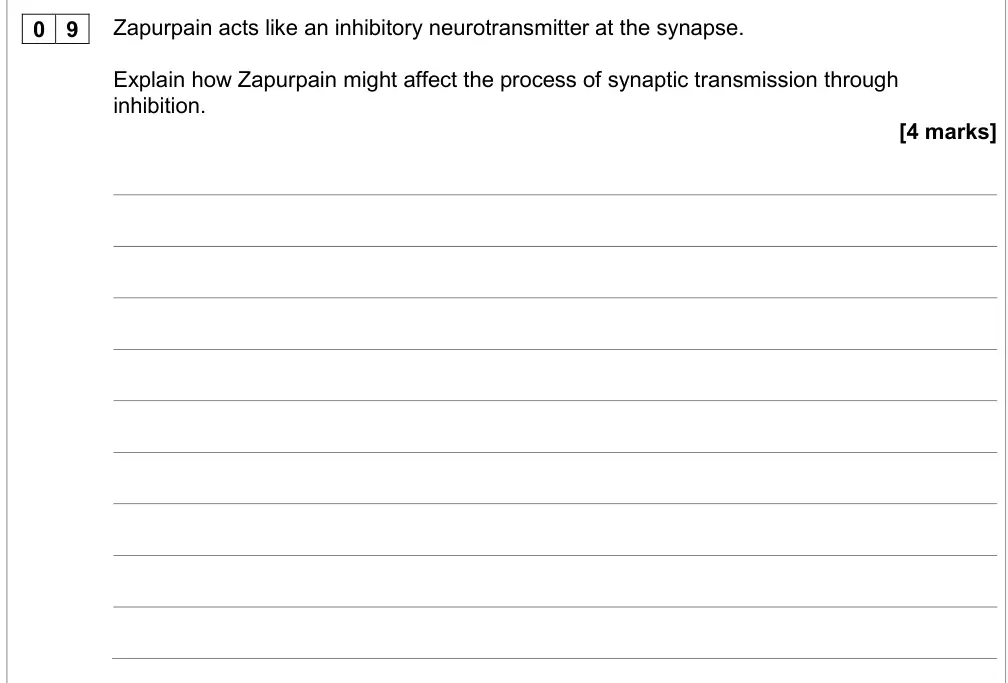
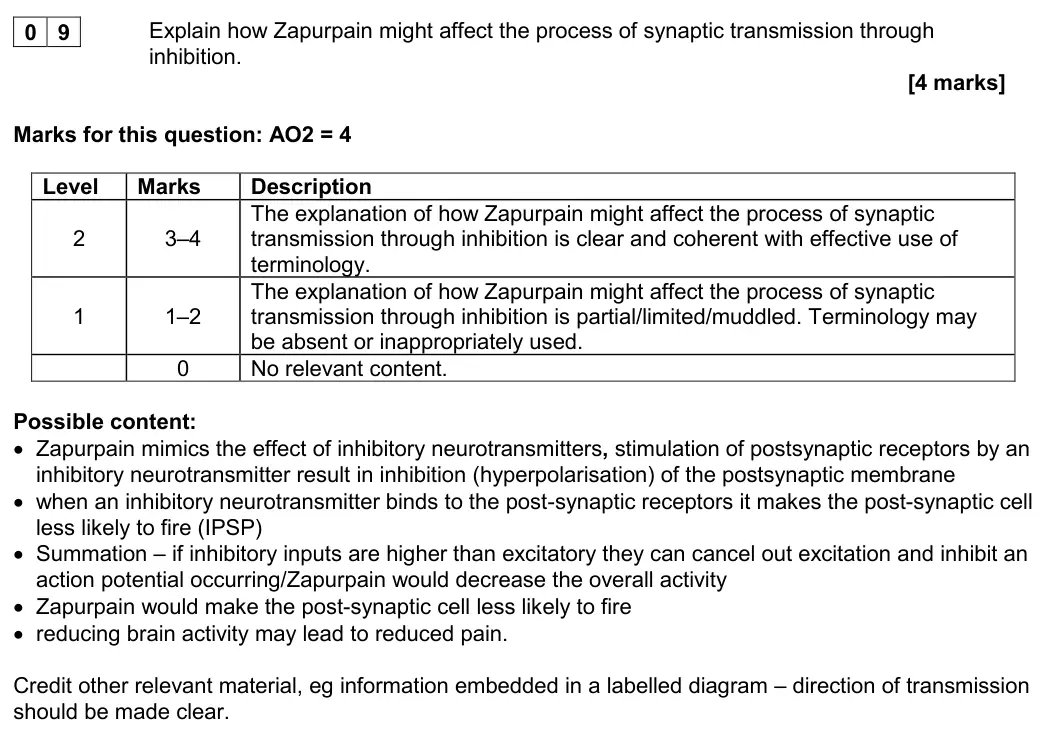
Zapurpain acts like an inhibitory neurotransmitter at the synapse.
Explain how Zapurpain might affect the process of synaptic transmission through
inhibition.
[4 marks]
November 2020 · Paper 2 · Q10 4 marks AO1=4 Explain biopsychology
1 0
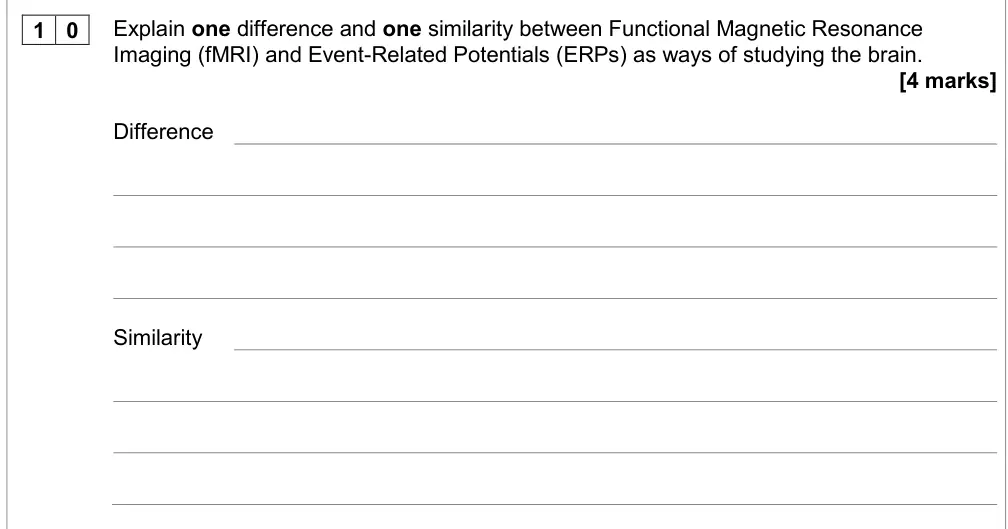
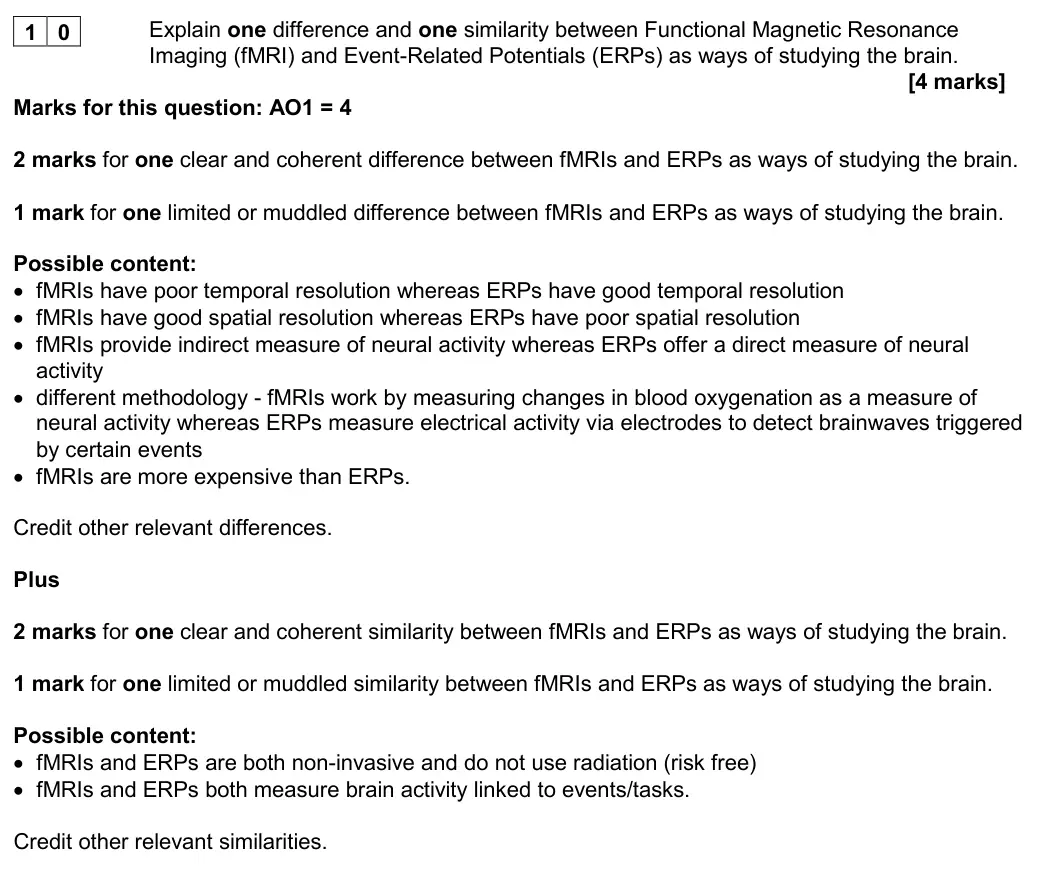
Explain one difference and one similarity between Functional Magnetic Resonance
Imaging (fMRI) and Event-Related Potentials (ERPs) as ways of studying the brain.
[4 marks]
Difference
Similarity
November 2020 · Paper 2 · Q11 8 marks AO1=3, AO3=5 Extended writing biopsychology
1 1
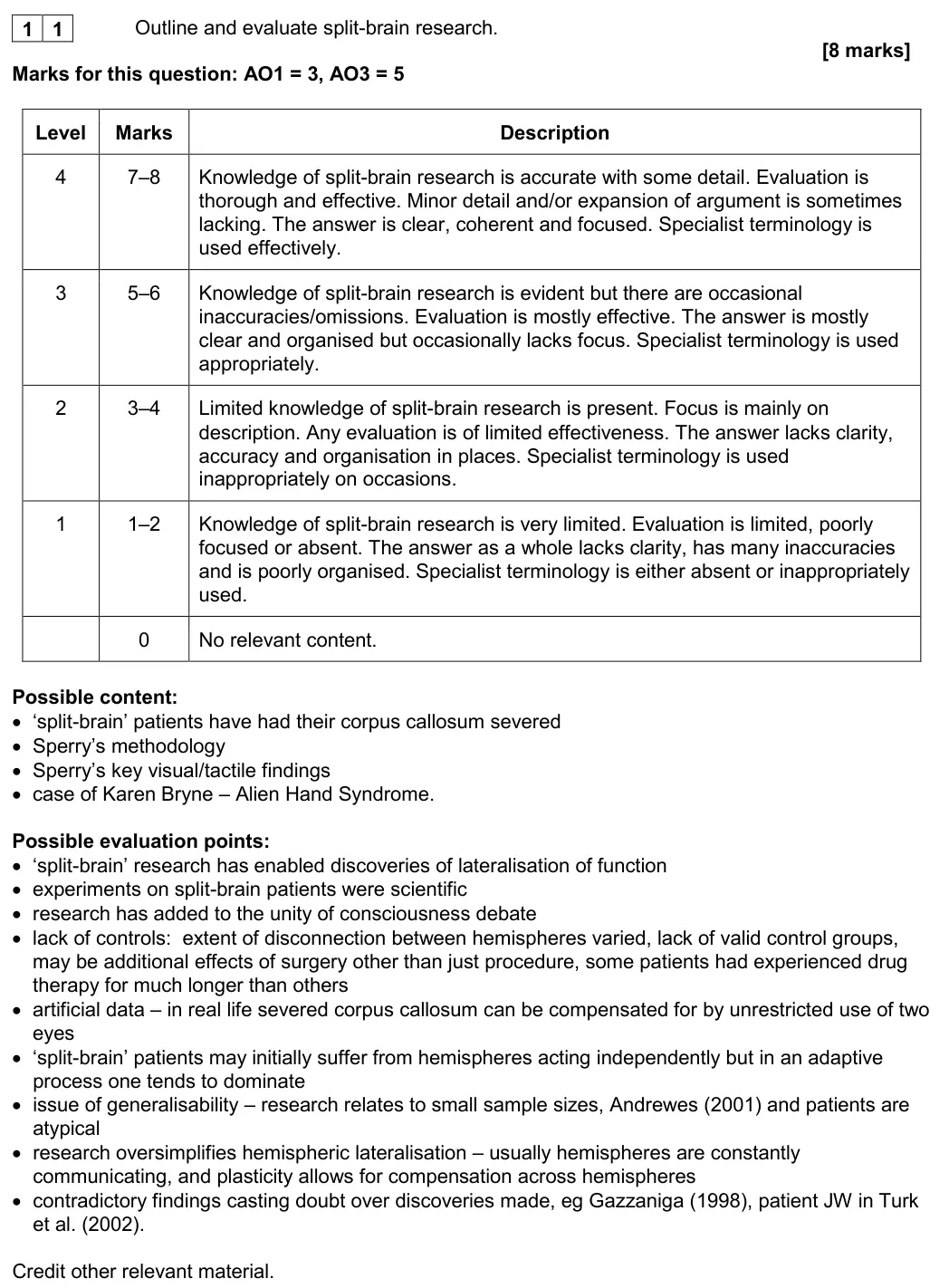
Outline and evaluate split-brain research.
[8 marks]
November 2020 · Paper 2 · Q12 1 mark AO1=1 Multiple choice Hard scientific processes
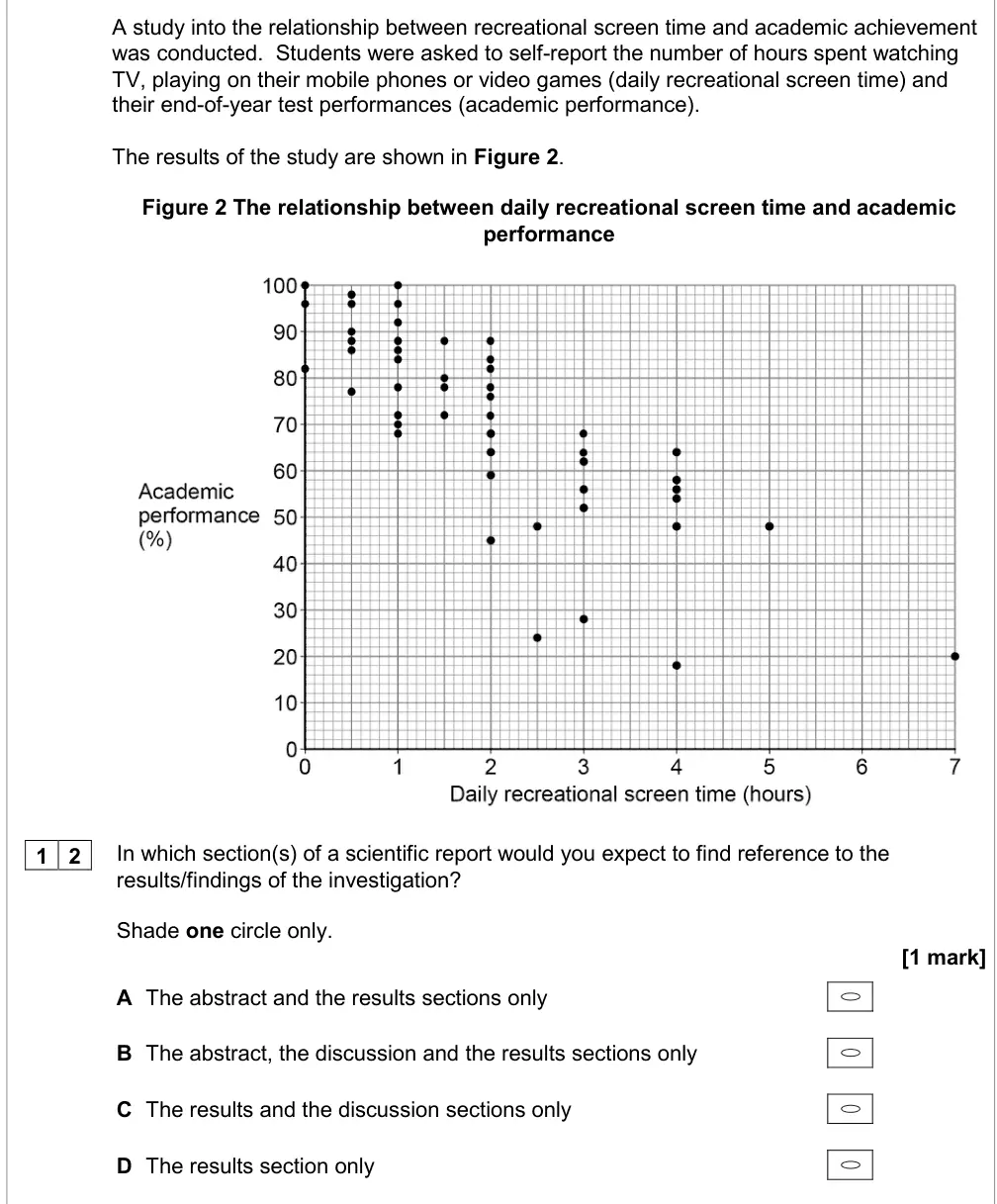
A study into the relationship between recreational screen time and academic achievement
was conducted.  Students were asked to self-report the number of hours spent watching
TV, playing on their mobile phones or video games (daily recreational screen time) and
their end-of-year test performances (academic performance).
The results of the study are shown in Figure 2.
Figure 2 The relationship between daily recreational screen time and academic
performance
1 2
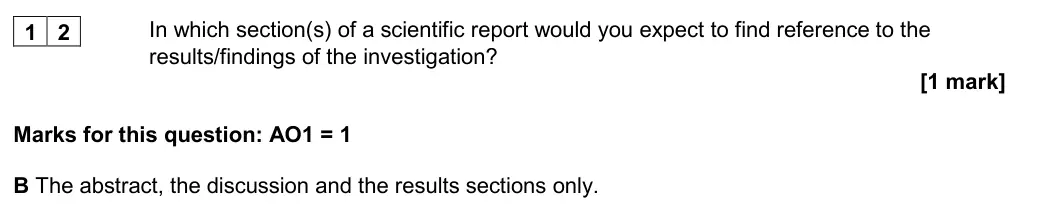
In which section(s) of a scientific report would you expect to find reference to the
results/findings of the investigation?
[1 mark]
A The abstract and the results sections only
B The abstract, the discussion and the results sections only
C The results and the discussion sections only
D The results section only
November 2020 · Paper 2 · Q13 1 mark AO2=1 Multiple choice data handling
1 3
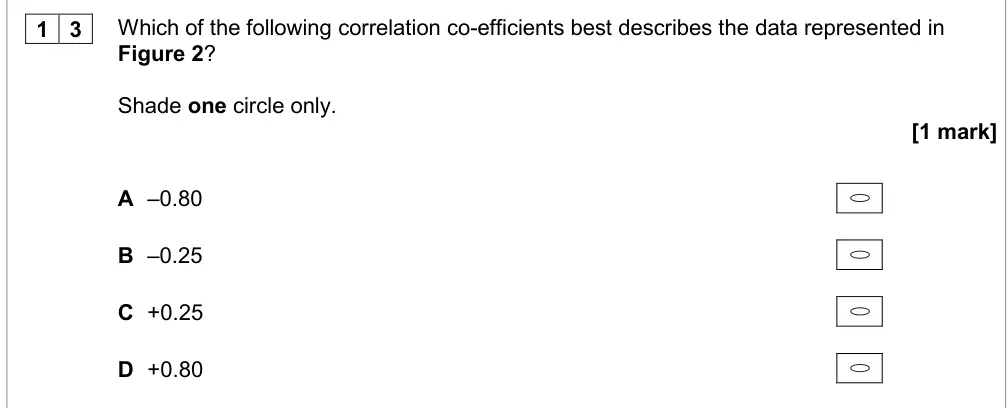
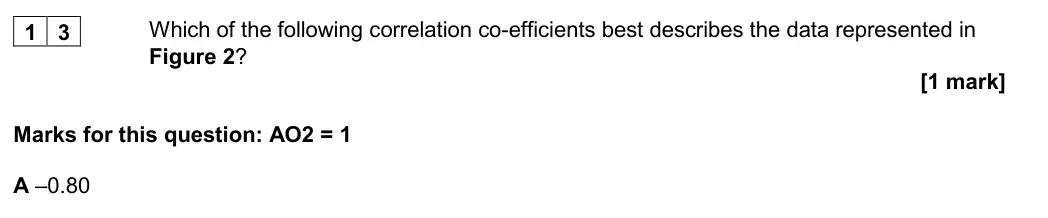
Which of the following correlation co-efficients best describes the data represented in
Figure 2?
[1 mark]
A –0.80
B –0.25
C +0.25
D +0.80
November 2020 · Paper 2 · Q14 3 marks AO2=3 Research methods data handlingresearch methods
1 4
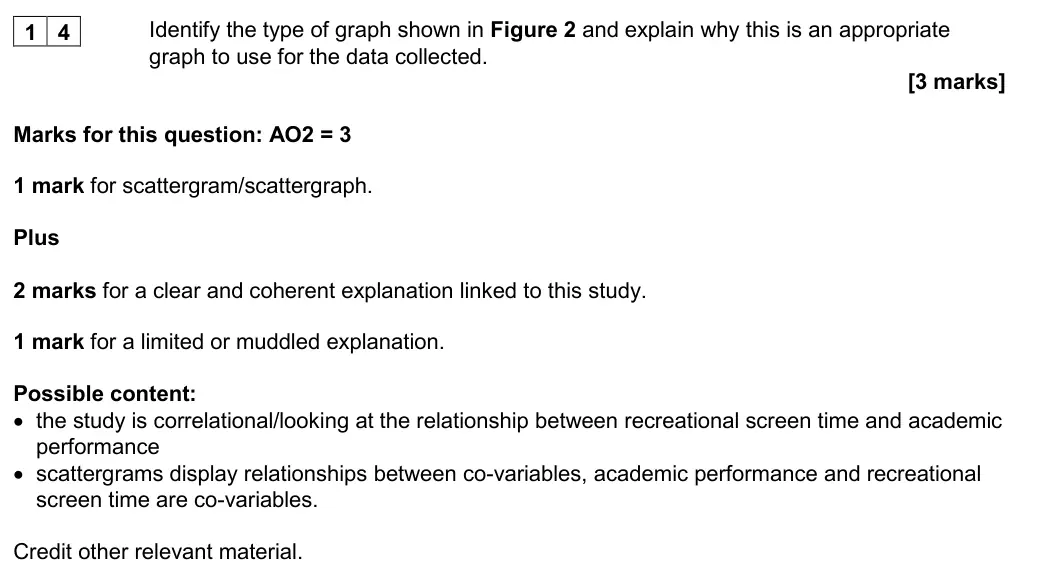
Identify the type of graph shown in Figure 2 and explain why this is an appropriate graph
to use for the data collected.
[3 marks]
November 2020 · Paper 2 · Q15 2 marks AO2=2 Research methods research methods
1 5
Explain why it would not be appropriate for the researchers to conclude that increased
recreational screen time reduces academic performance.
[2 marks]
November 2020 · Paper 2 · Q16 2 marks AO1=2 Research methods data handling
A psychologist reads a review of a meta-analysis confirming the relationship between
recreational screen time and academic performance.
1 6
What is meant by the term meta-analysis?
[2 marks]
November 2020 · Paper 2 · Q17 2 marks AO2=2 Multiple choice scientific processes
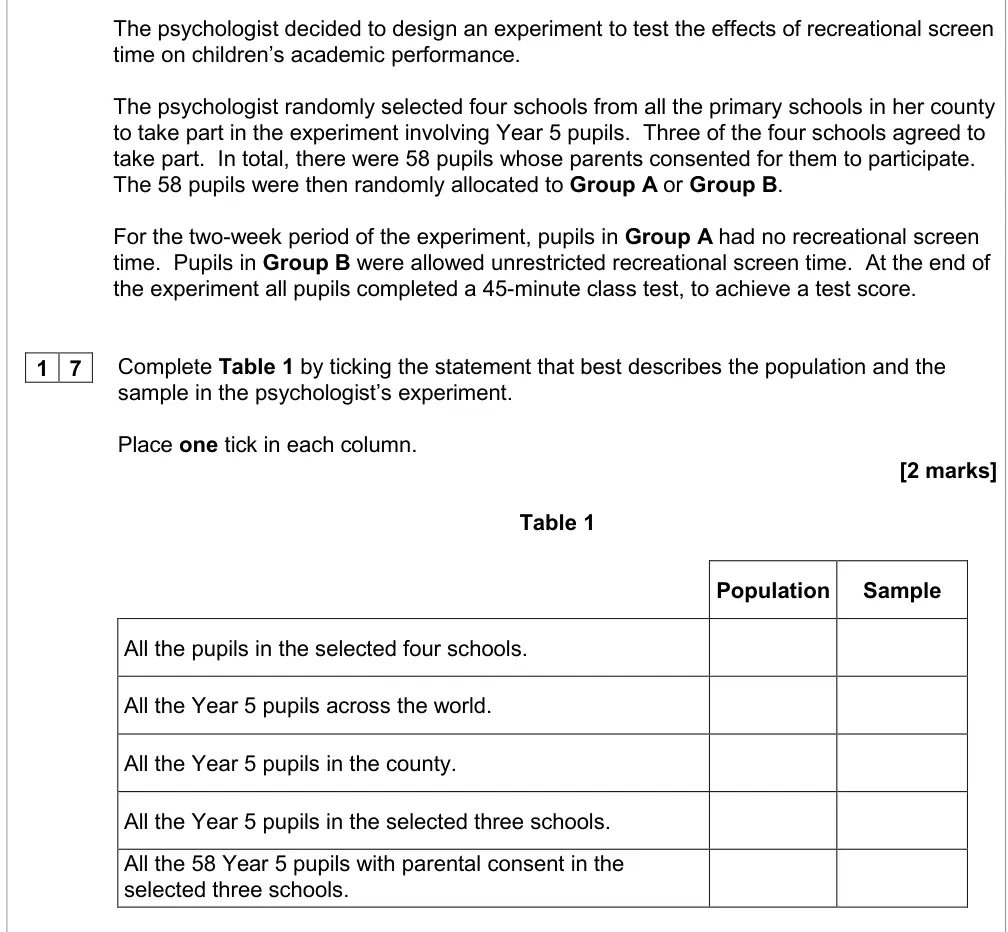
The psychologist decided to design an experiment to test the effects of recreational screen
time on children’s academic performance.
The psychologist randomly selected four schools from all the primary schools in her county
to take part in the experiment involving Year 5 pupils.  Three of the four schools agreed to
take part.  In total, there were 58 pupils whose parents consented for them to participate.
The 58 pupils were then randomly allocated to Group A or Group B.
For the two-week period of the experiment, pupils in Group A had no recreational screen
time.  Pupils in Group B were allowed unrestricted recreational screen time.  At the end of
the experiment all pupils completed a 45-minute class test, to achieve a test score.
1 7
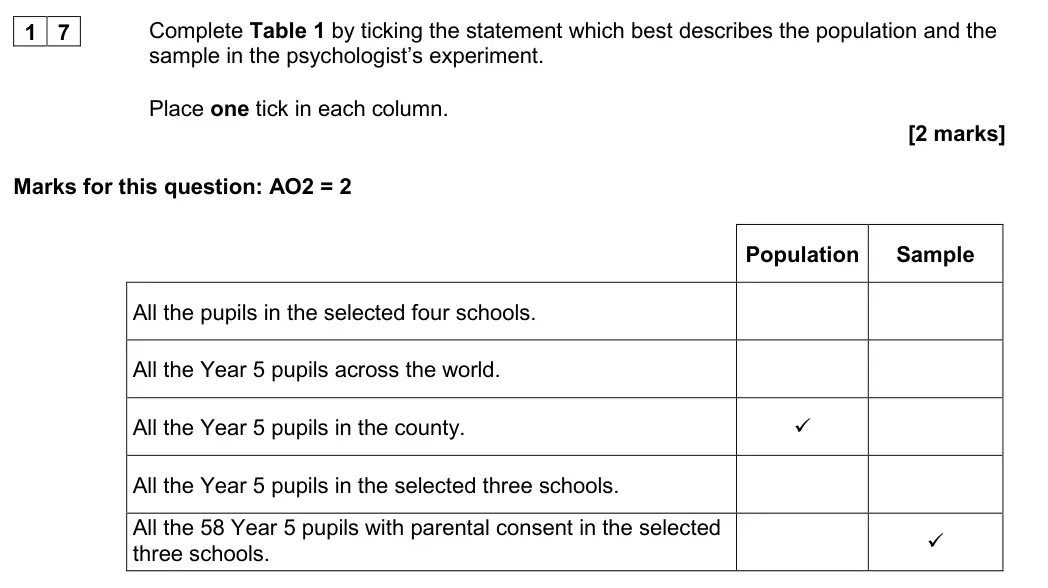
Complete Table 1 by ticking the statement that best describes the population and the
sample in the psychologist’s experiment.
Place one tick in each column.
[2 marks]
Table 1
Population
Sample
All the pupils in the selected four schools.
All the Year 5 pupils across the world.
All the Year 5 pupils in the county.
All the Year 5 pupils in the selected three schools.
All the 58 Year 5 pupils with parental consent in the
selected three schools.
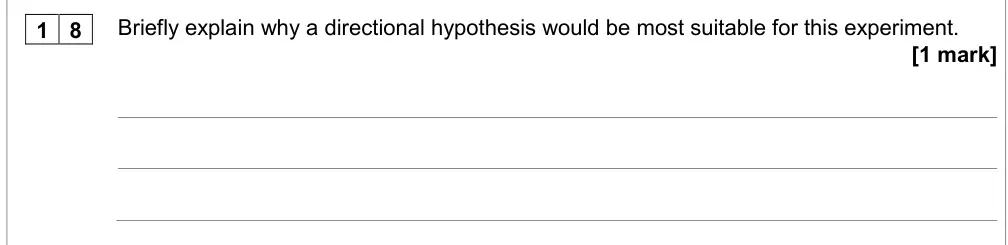
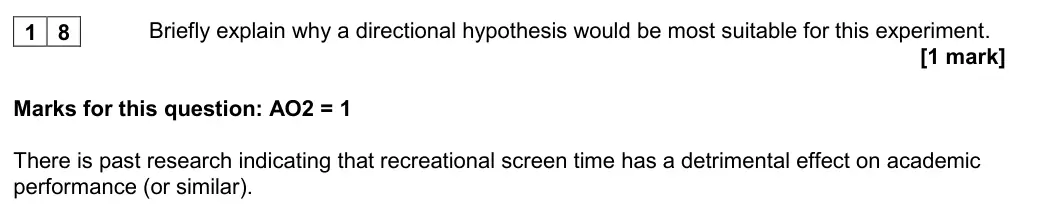
November 2020 · Paper 2 · Q18 1 mark AO2=1 Research methods Medium scientific processes
1 8
Briefly explain why a directional hypothesis would be most suitable for this experiment.
[1 mark]
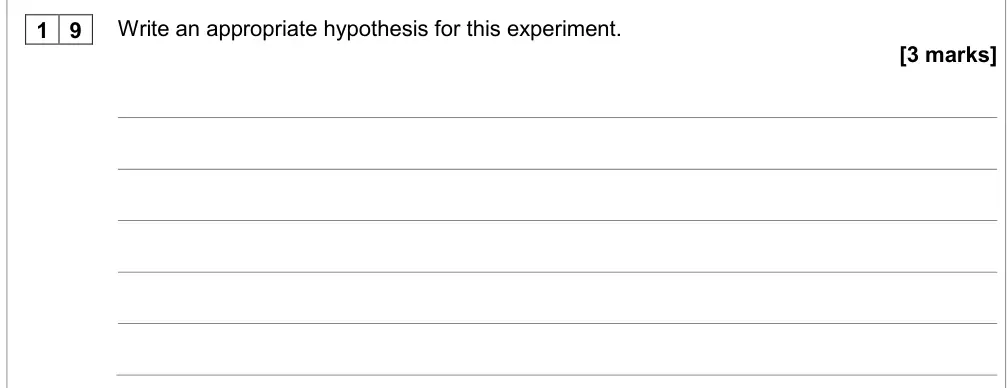
November 2020 · Paper 2 · Q19 3 marks AO2=3 Research methods scientific processes
1 9
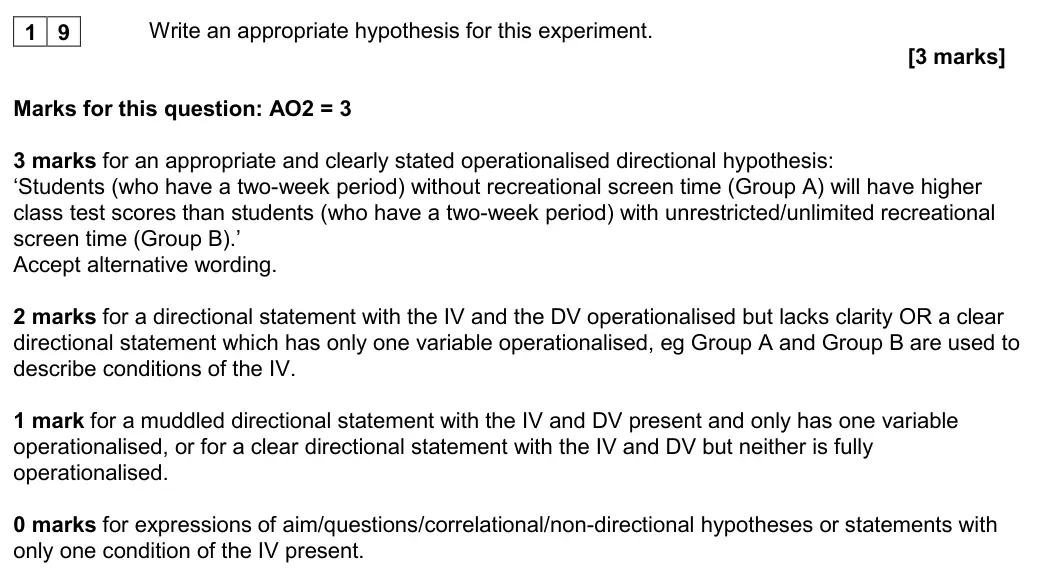
Write an appropriate hypothesis for this experiment.
[3 marks]
November 2020 · Paper 2 · Q20 4 marks AO2=4 Research methods Medium data handling
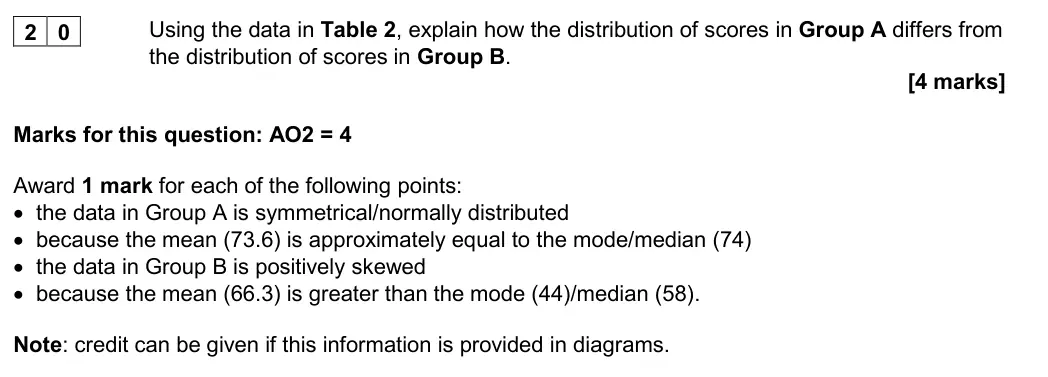
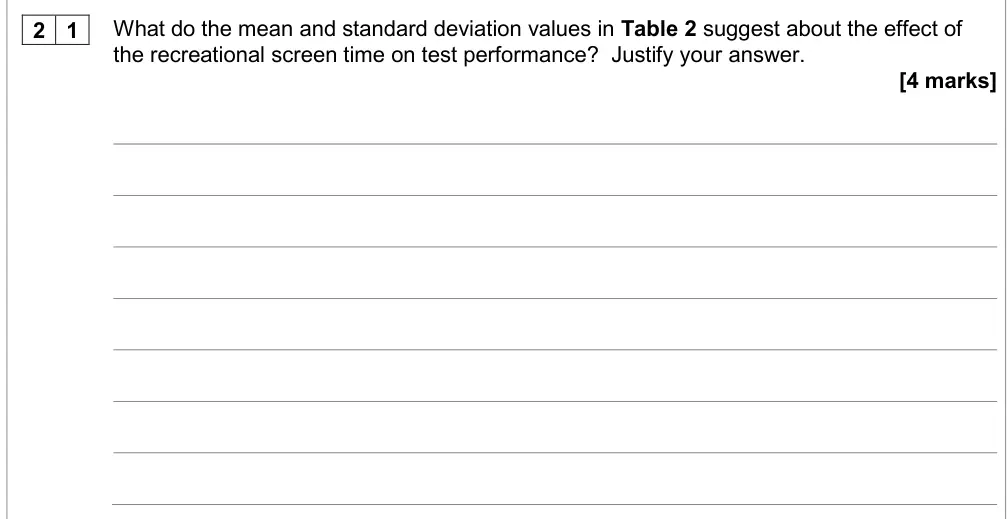
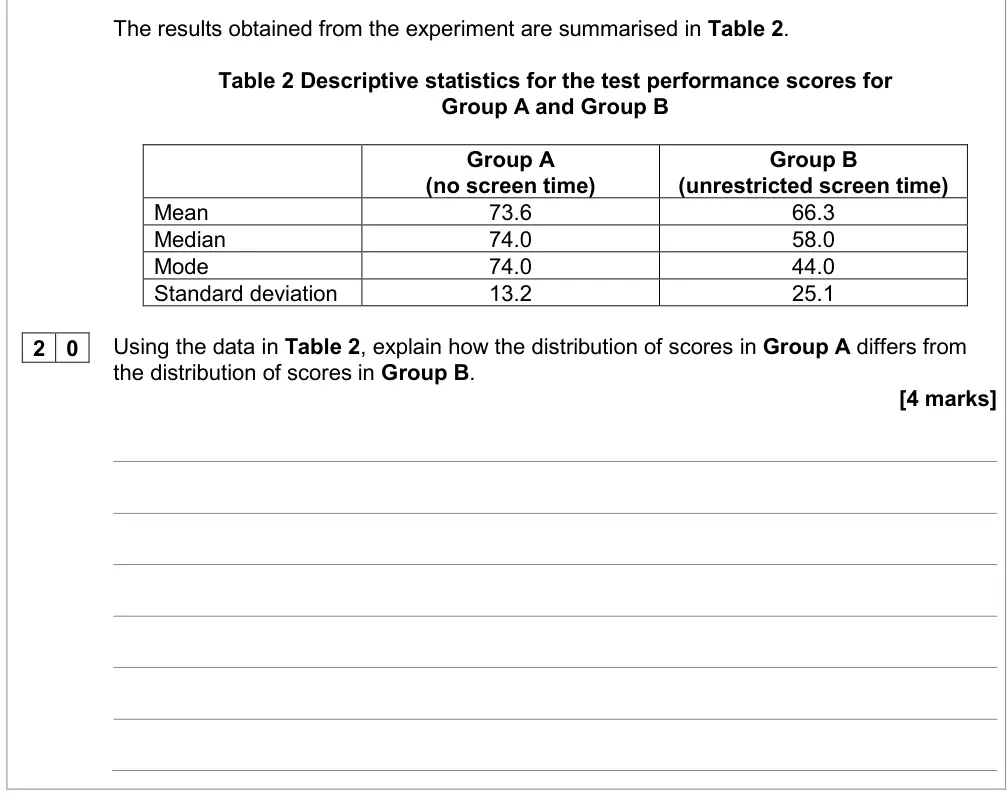
The results obtained from the experiment are summarised in Table 2.
Table 2 Descriptive statistics for the test performance scores for
Group A and Group B
Group A
Group B
(no screen time)
(unrestricted screen time)
Mean
73.6
66.3
Median
74.0
58.0
Mode
74.0
44.0
Standard deviation
13.2
25.1
2 0
Using the data in Table 2, explain how the distribution of scores in Group A differs from
the distribution of scores in Group B.
[4 marks]
November 2020 · Paper 2 · Q21 4 marks AO2=2, AO3=2 Research methods data handling
2 1
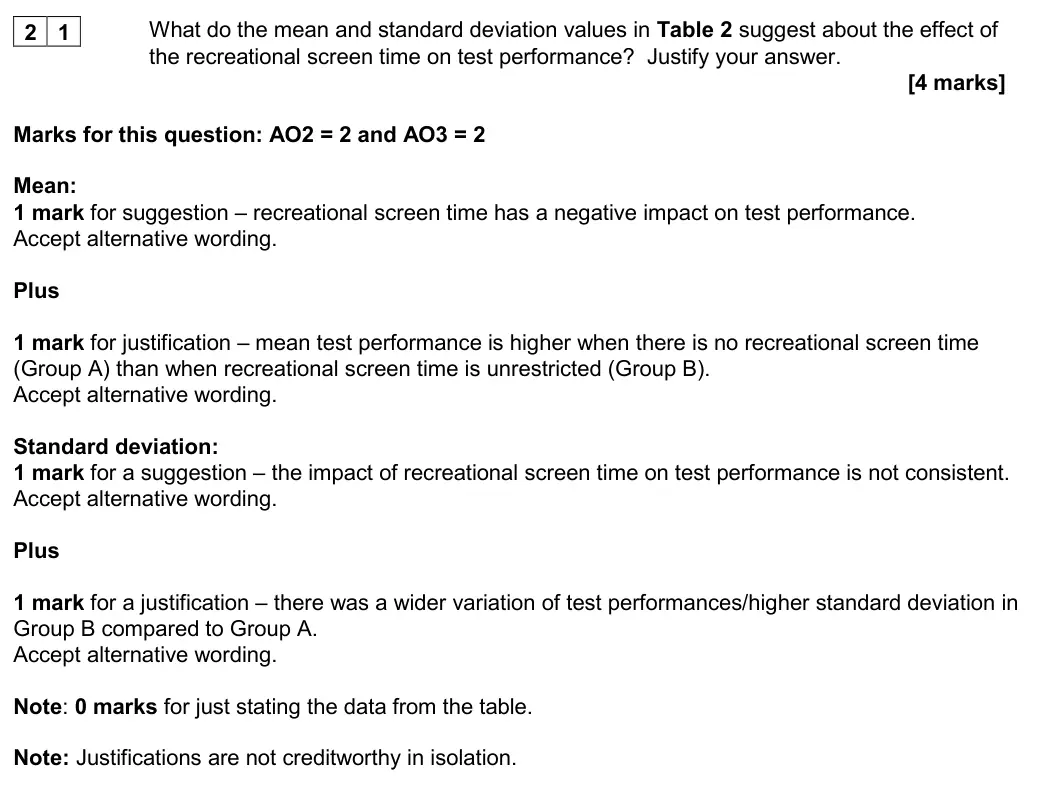
What do the mean and standard deviation values in Table 2 suggest about the effect of
the recreational screen time on test performance?  Justify your answer.
[4 marks]
November 2020 · Paper 2 · Q22 7 marks AO2=7 Research methods inferential testingdata handling
2 2
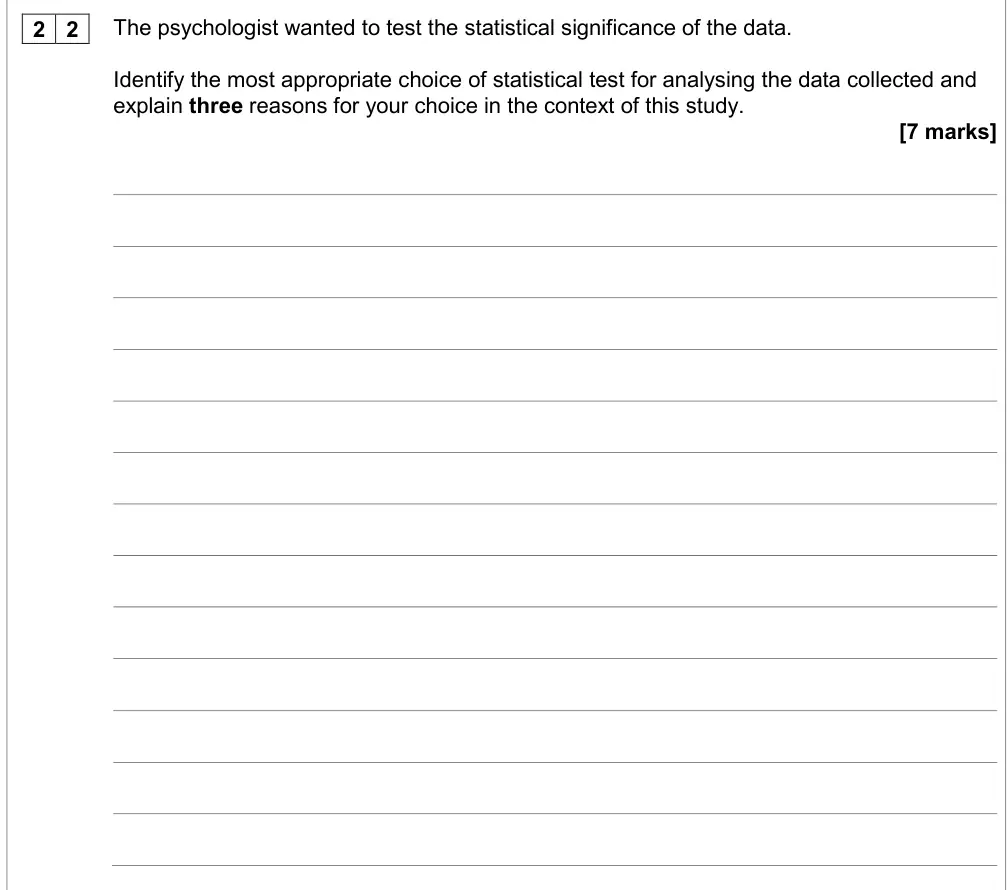
The psychologist wanted to test the statistical significance of the data.
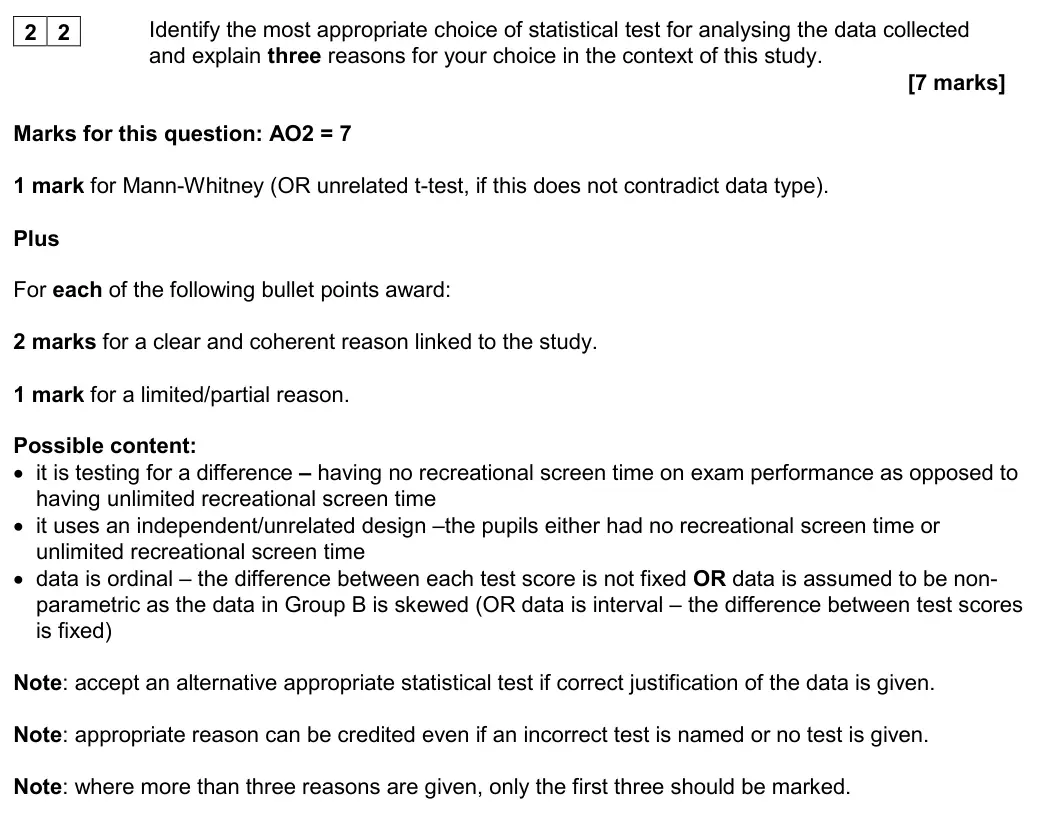
Identify the most appropriate choice of statistical test for analysing the data collected and
explain three reasons for your choice in the context of this study.
[7 marks]
November 2020 · Paper 2 · Q23 4 marks AO2=4 Research methods scientific processes
2 3
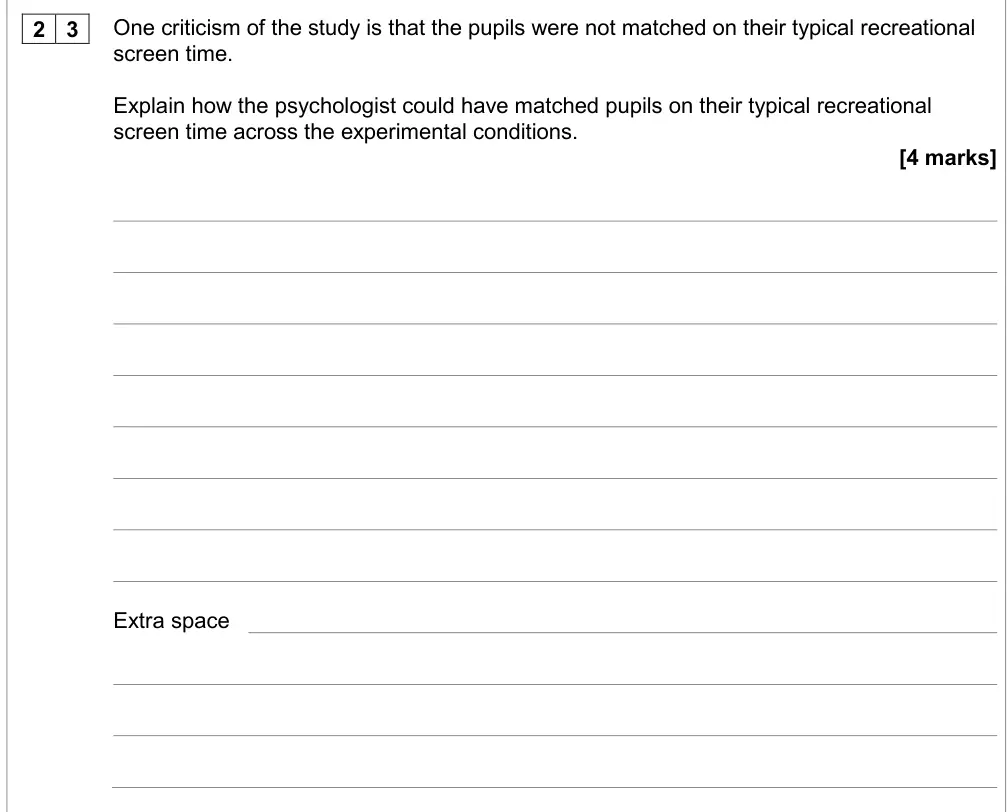
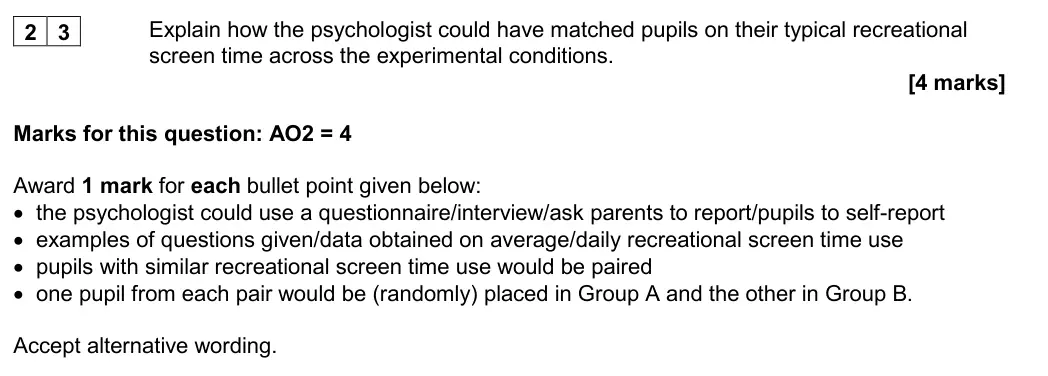
One criticism of the study is that the pupils were not matched on their typical recreational
screen time.
Explain how the psychologist could have matched pupils on their typical recreational
screen time across the experimental conditions.
[4 marks]
Extra space
November 2020 · Paper 2 · Q24 2 marks AO2=2 Research methods scientific processes
2 4
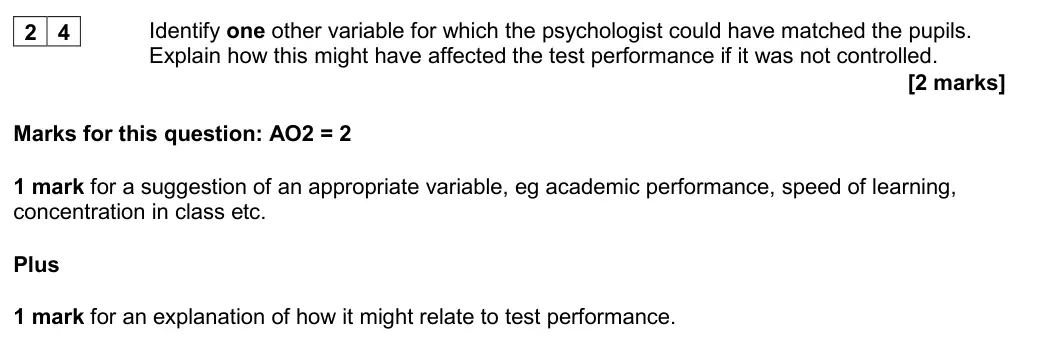
Identify one other variable for which the psychologist could have matched the pupils.
Explain how this might have affected the test performance if it was not controlled.
[2 marks]
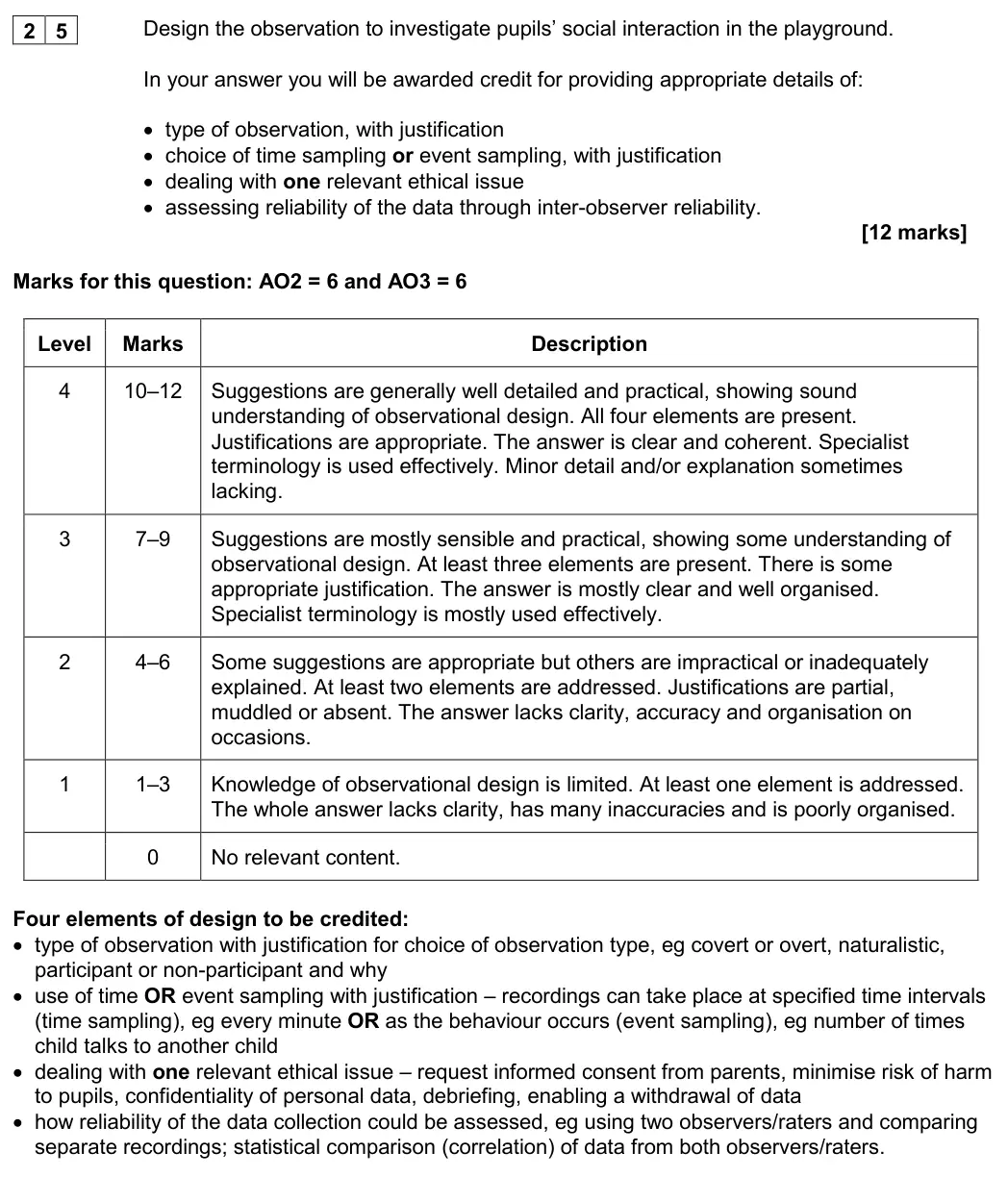
November 2020 · Paper 2 · Q25 12 marks AO2=6, AO3=6 Extended writing research methodsscientific processes
The feedback from one of the schools was that recreational screen time affected pupils’
social interactions.  The psychologist decided to investigate this further by using an
observation of social interaction during playtime at the school.
2 5
Design the observation to investigate pupils’ social interaction in the playground.
In your answer you will be awarded credit for providing appropriate details of:
• type of observation, with justification
• choice of time sampling or event sampling, with justification
• dealing with one relevant ethical issue
• assessing reliability of the data through inter-observer reliability.
[12 marks]
You may use this space to plan your answer.
Extra space

Work with an AQA psychology tutor

Want a paper marked and gone through with you? Message us.

Prefer email? Send an enquiry

If you are under 18, please include a parent's contact details. Enquiries go to enquiries@alevelpsychologytutor.com and are deleted once handled. All tutoring is online.