4.2.2-01 The divisions of the nervous system: central and peripheral (somatic and autonomic).AS
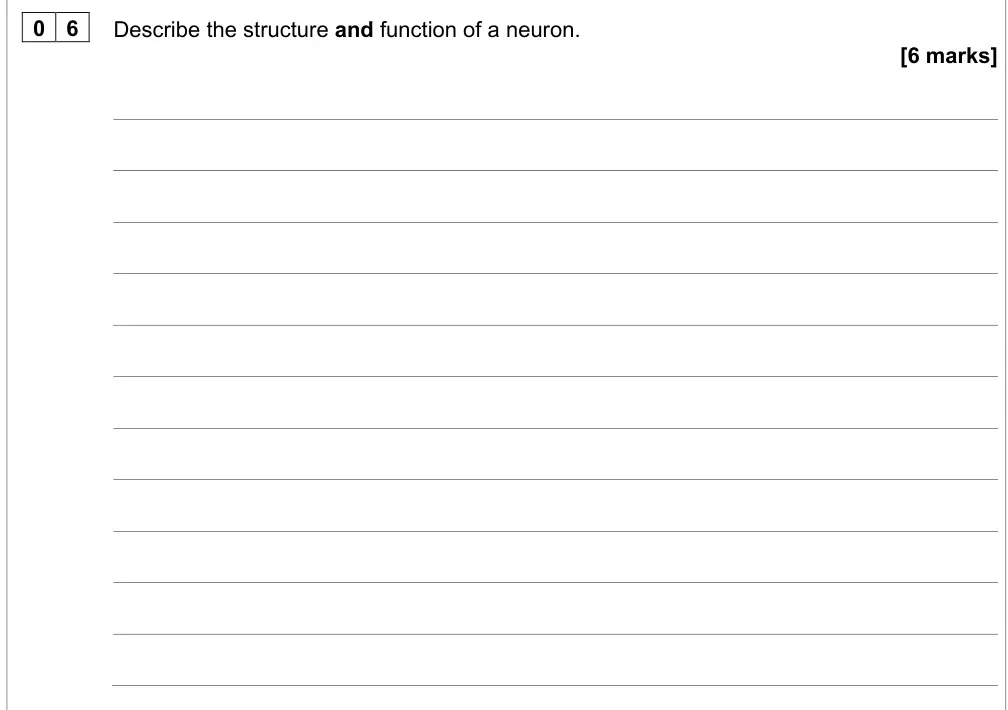
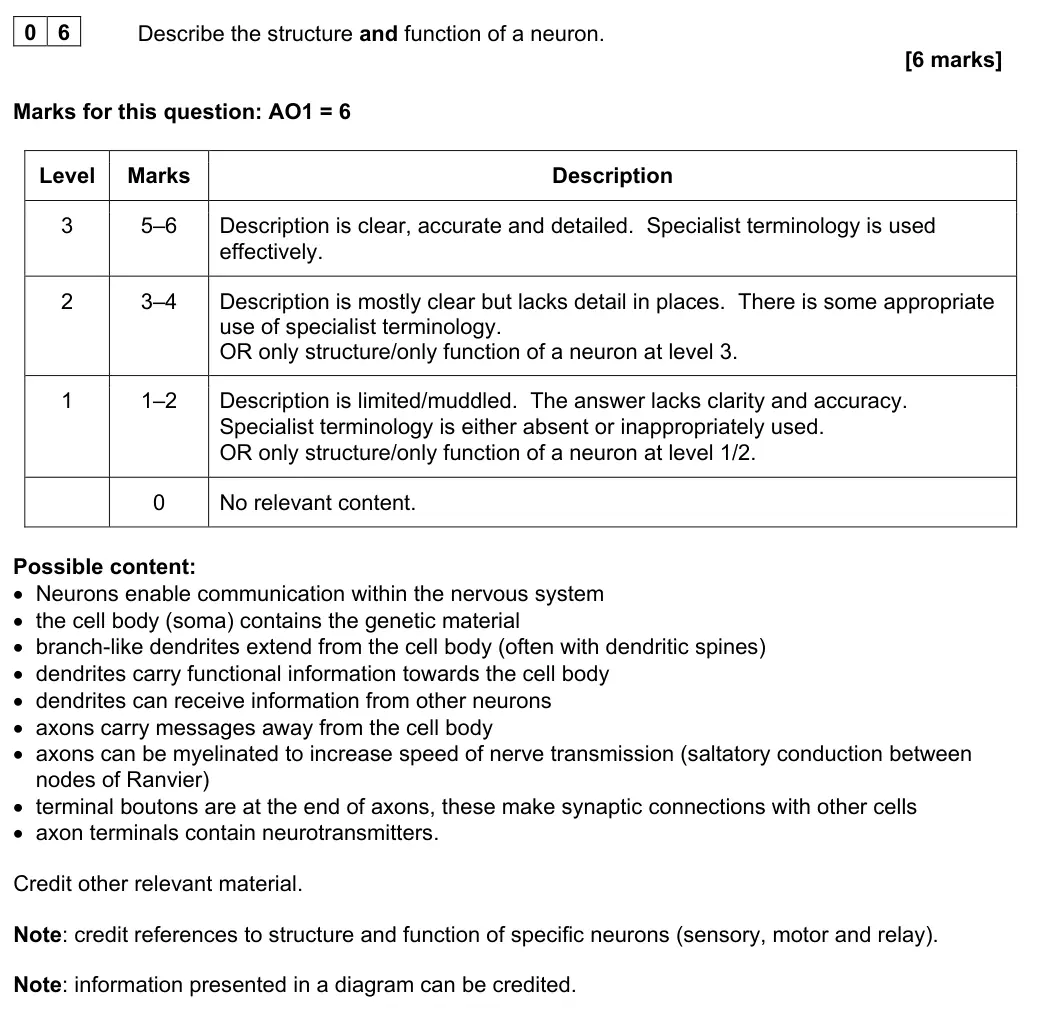
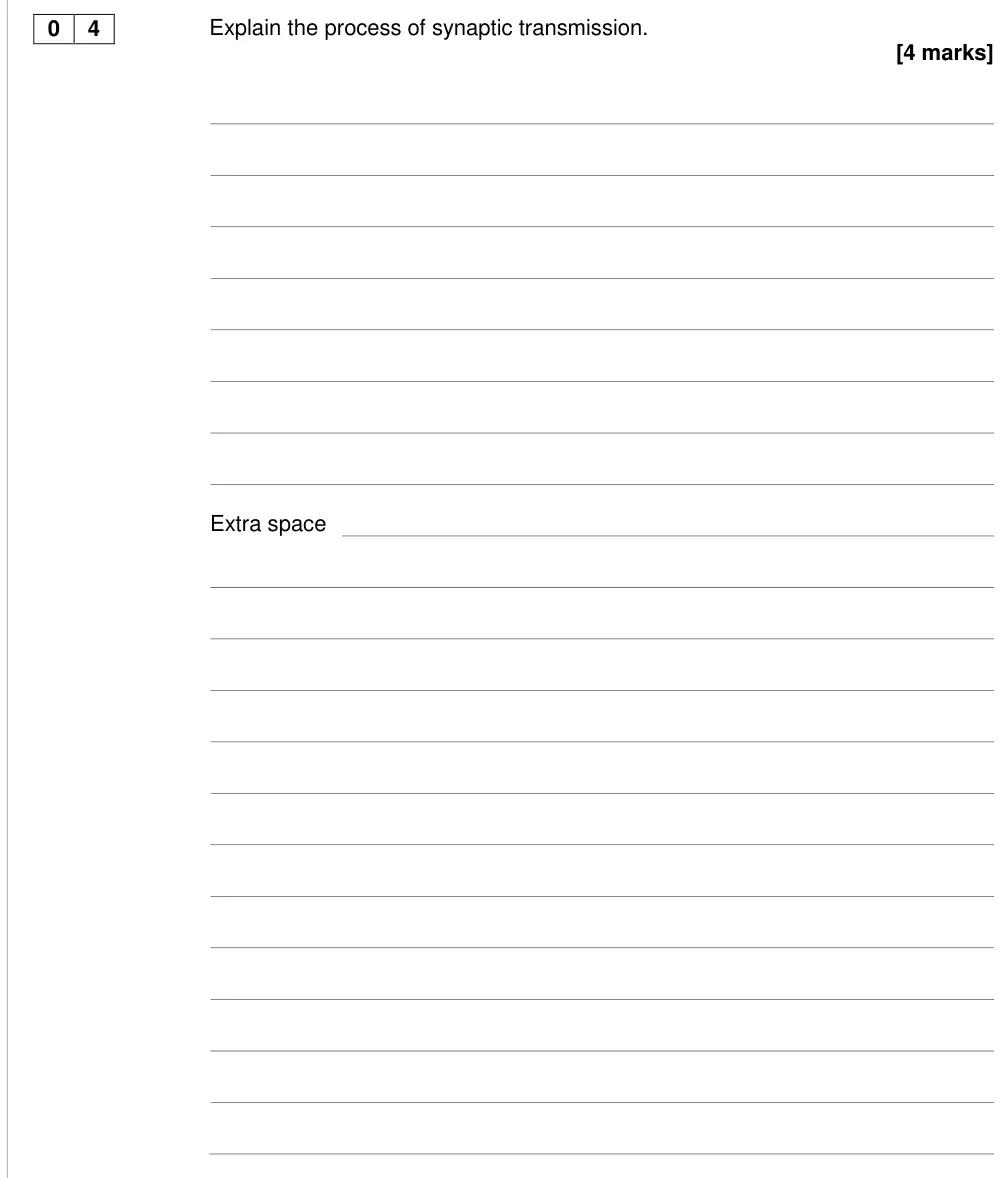
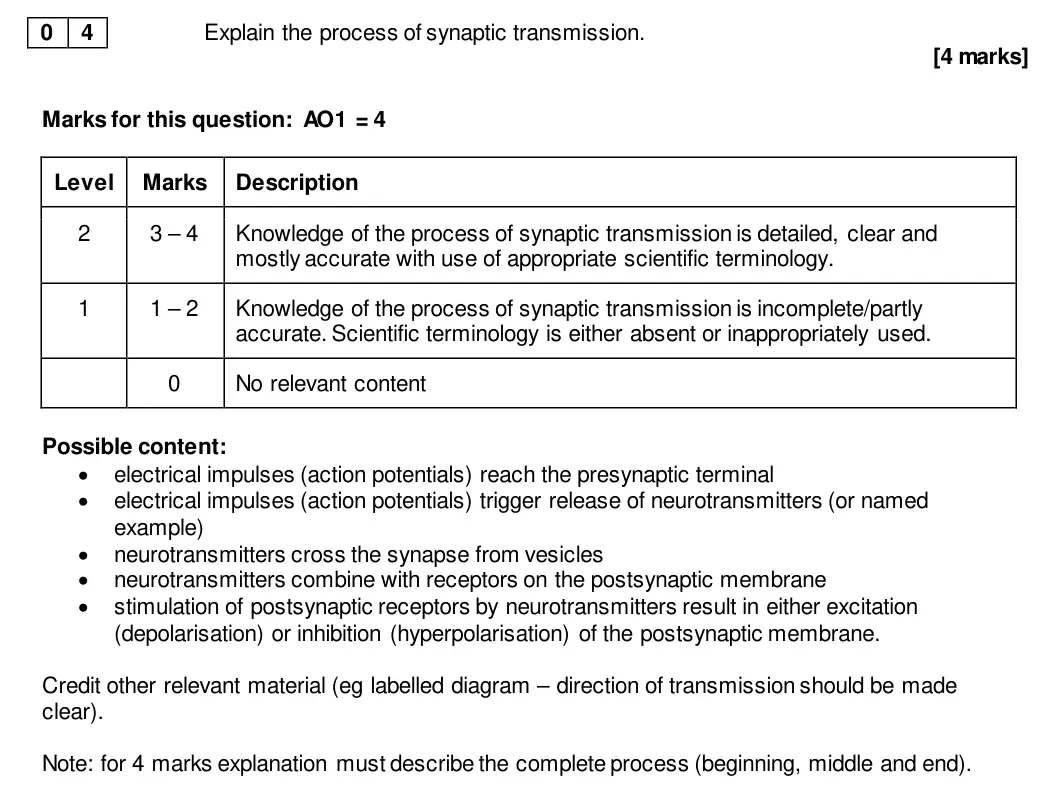
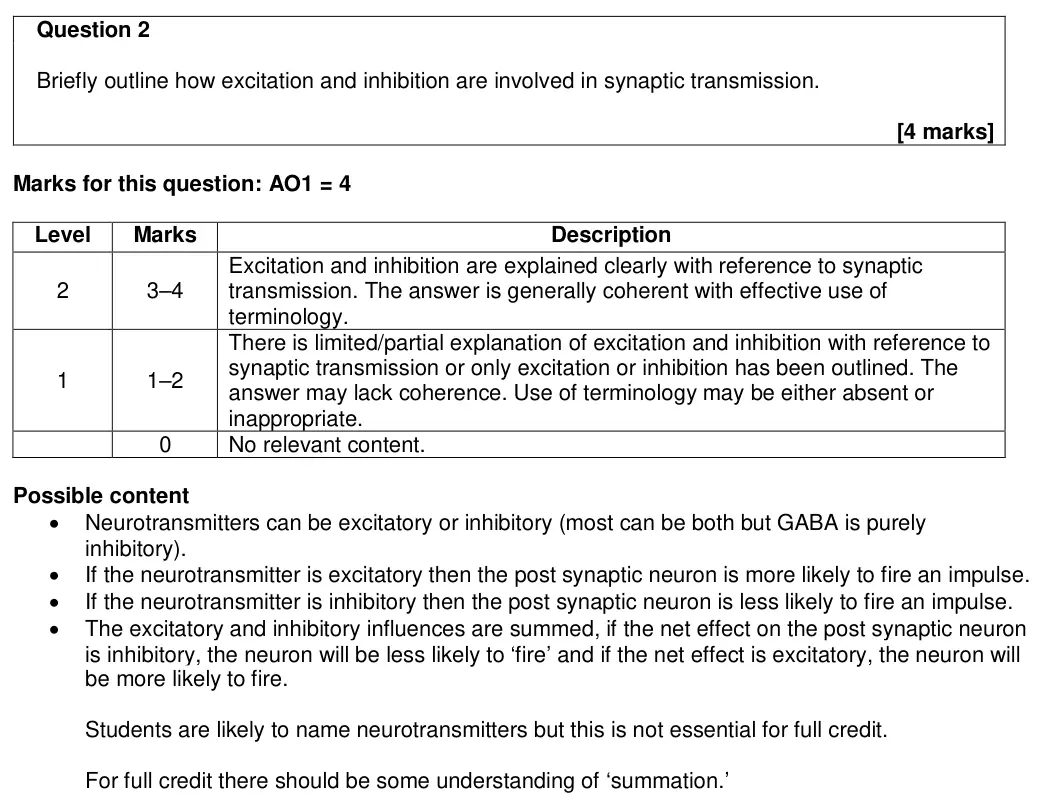
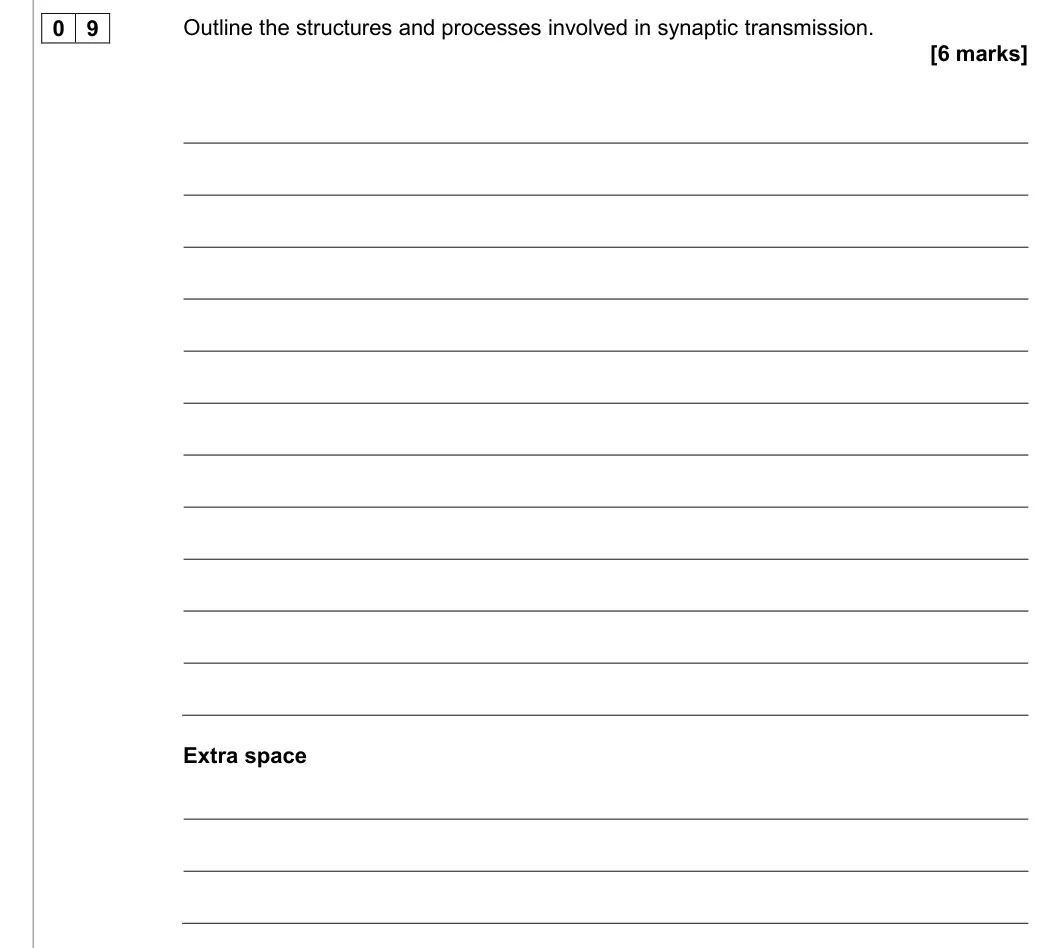
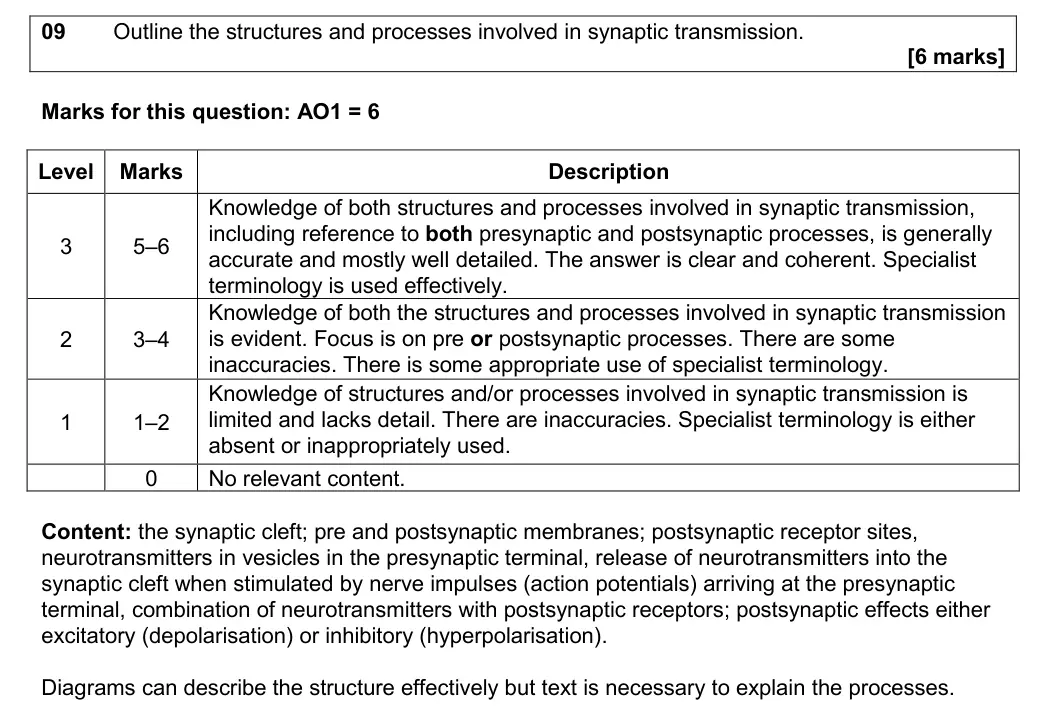
4.2.2-02 The structure and function of sensory, relay and motor neurons. The process of synaptic transmission, including reference to neurotransmitters, excitation and inhibition.AS
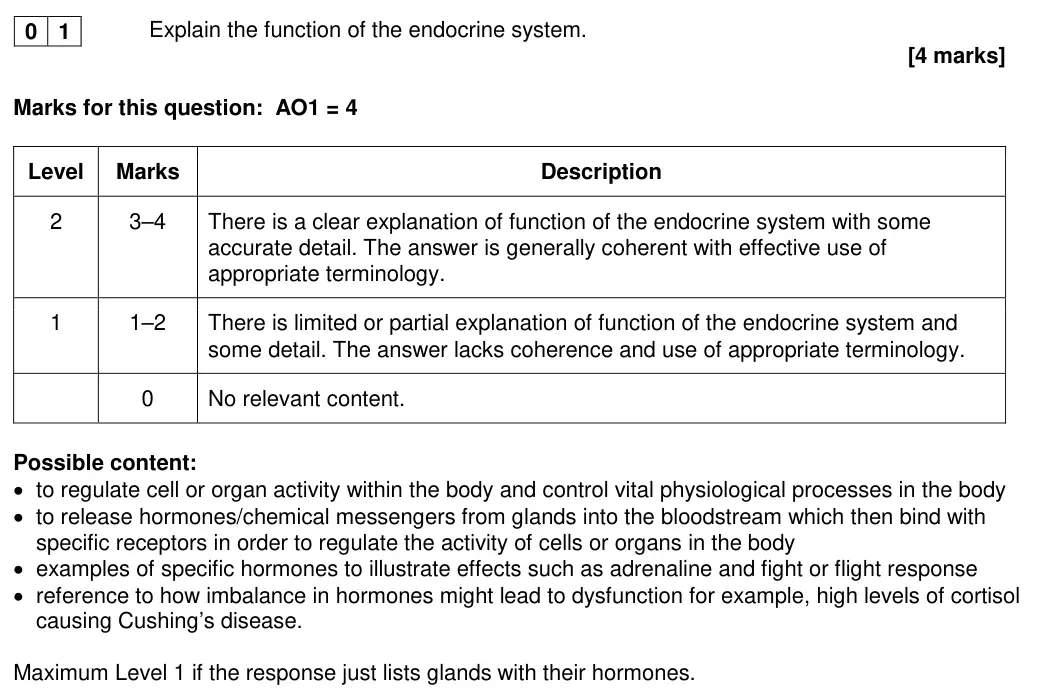
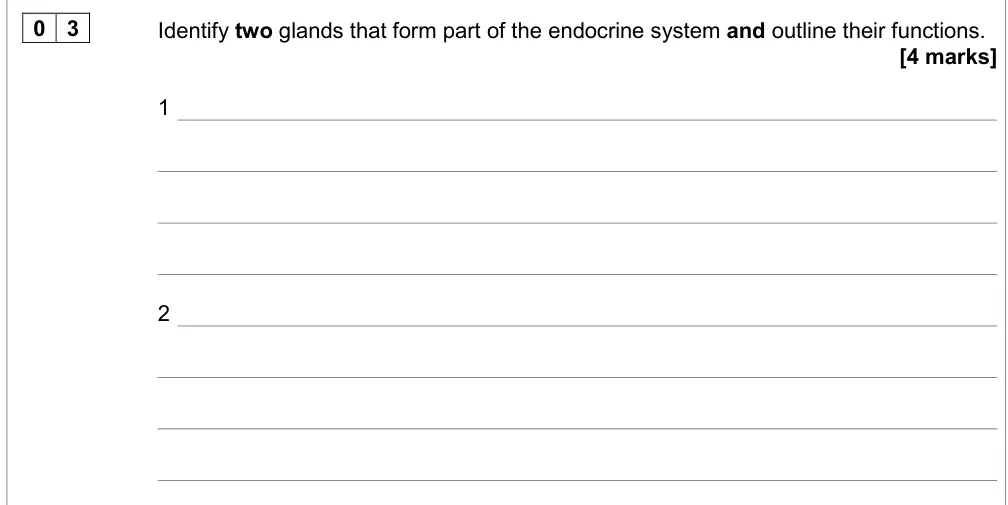
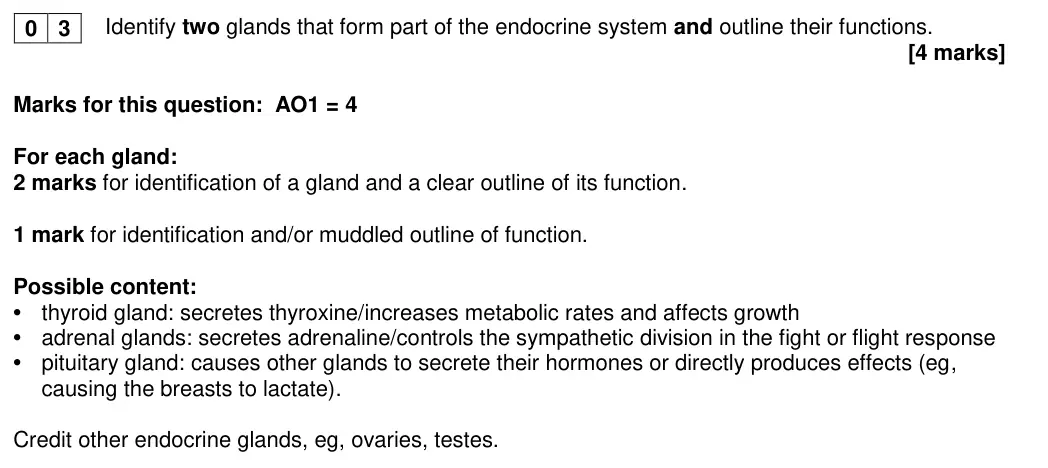
4.2.2-03 The function of the endocrine system: glands and hormones.AS
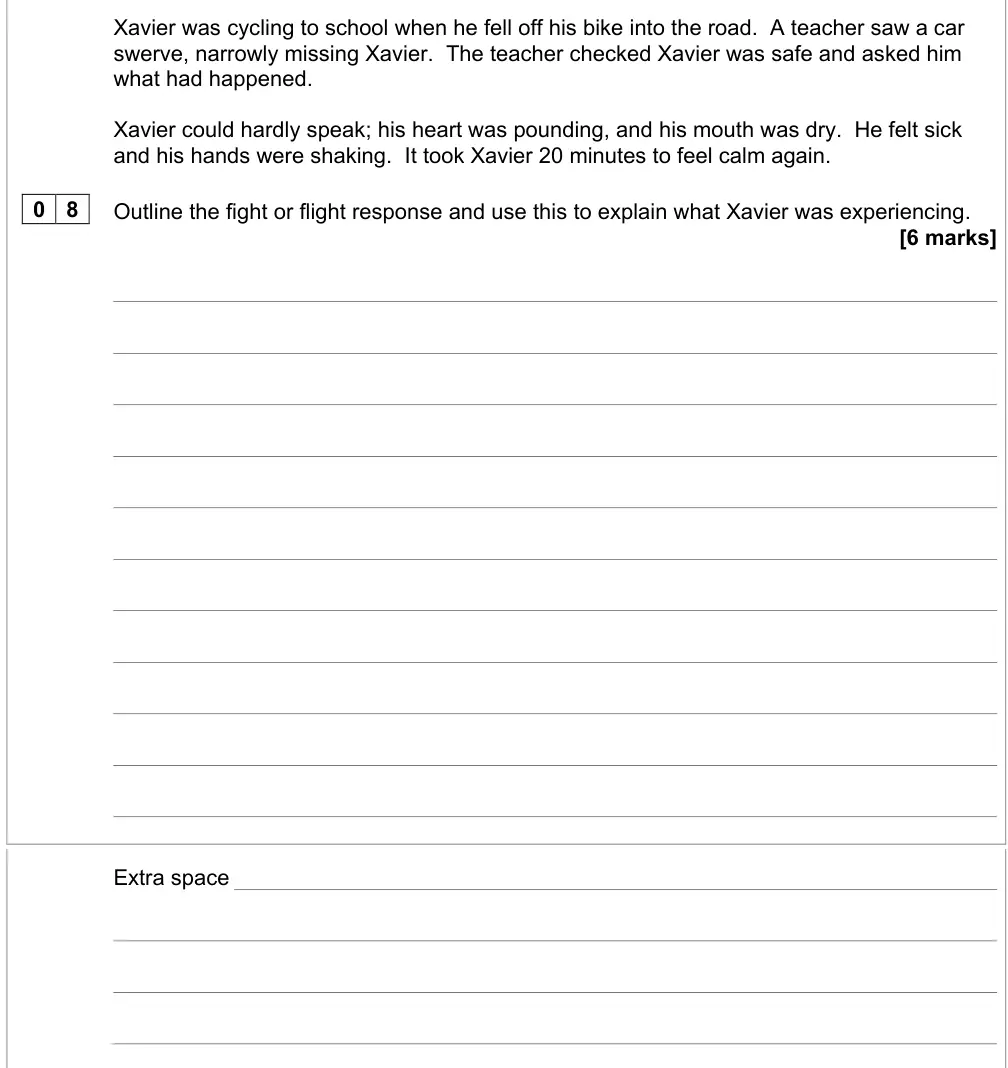
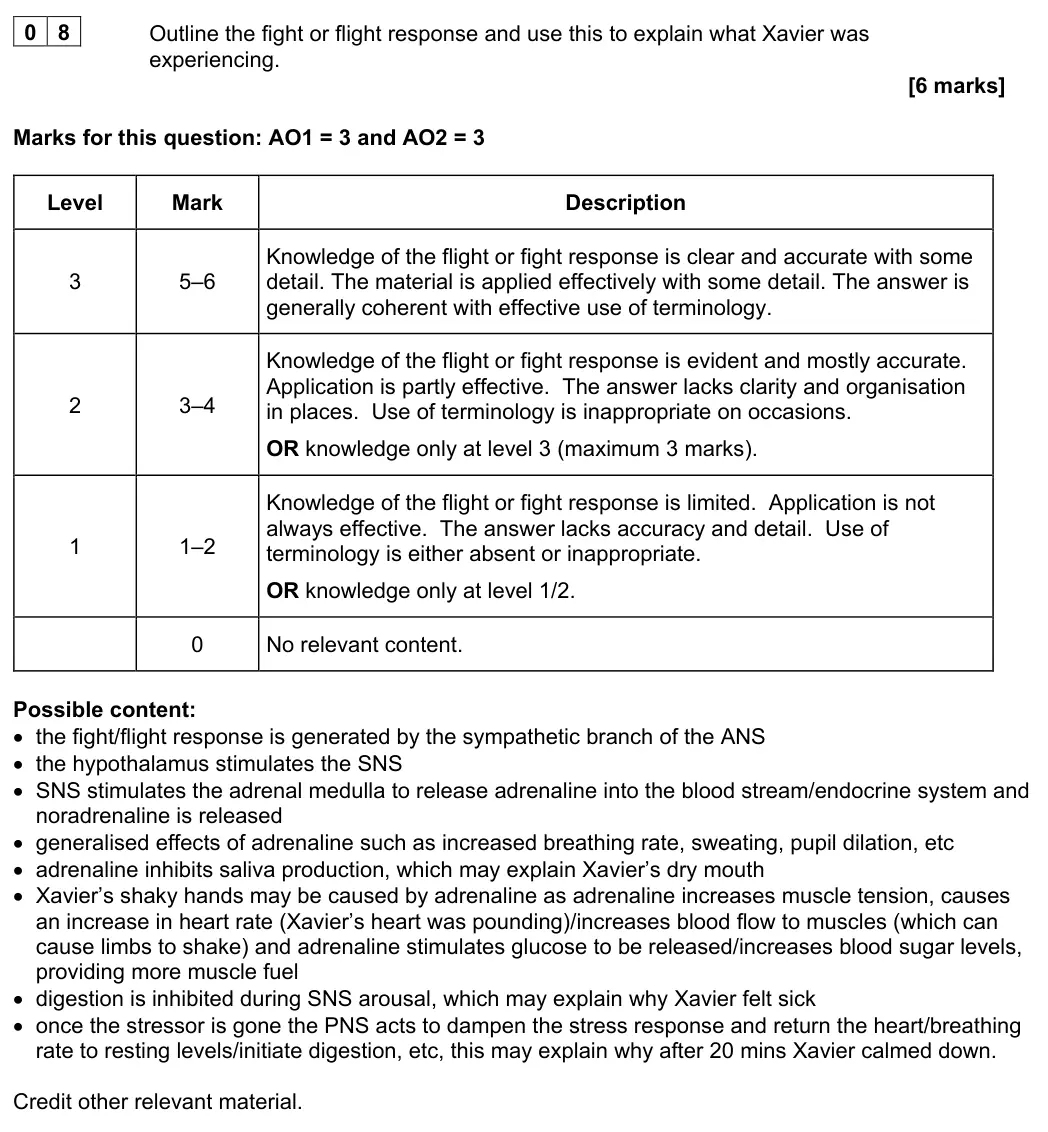
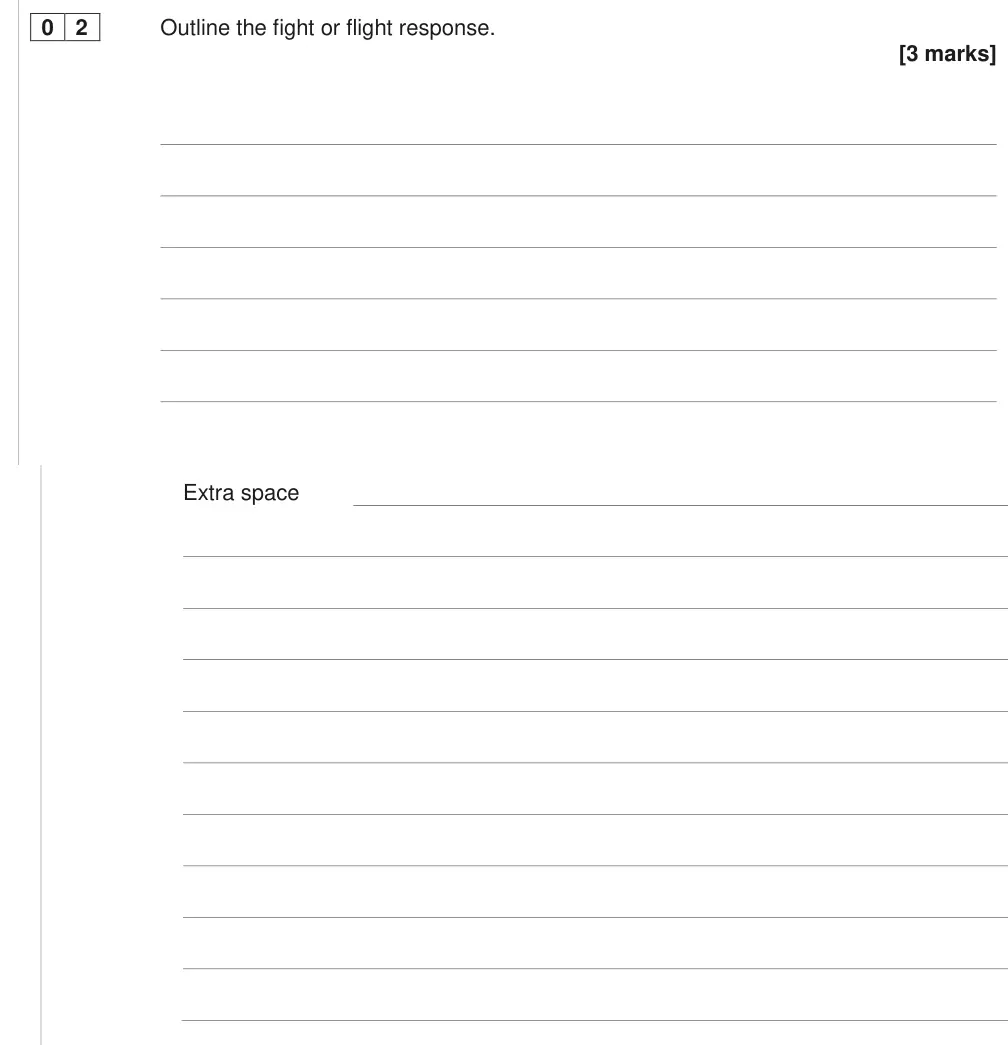
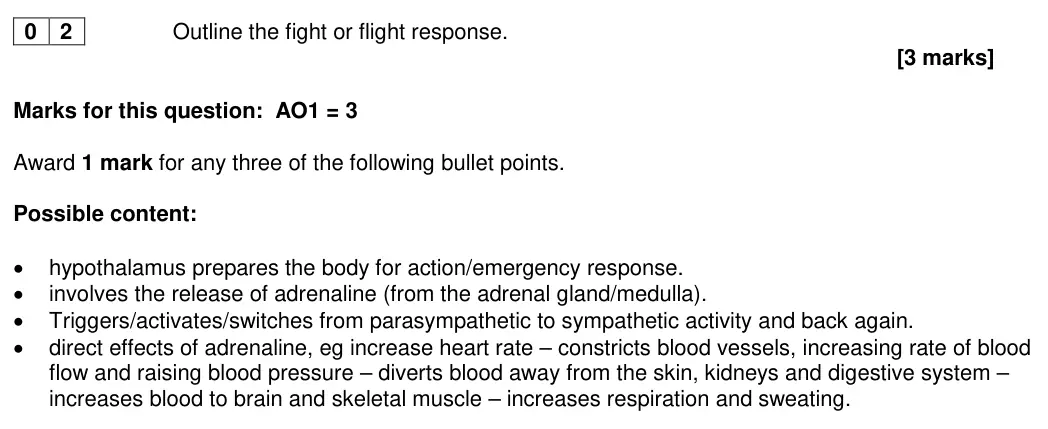
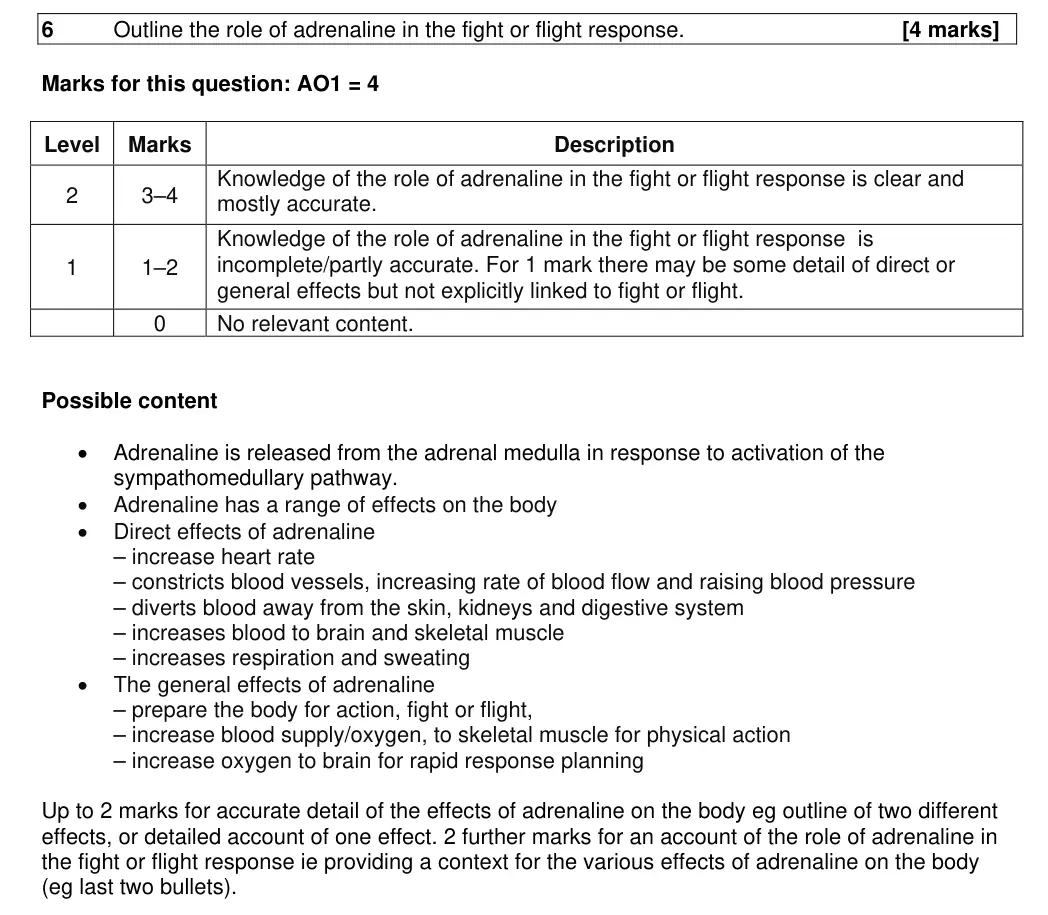
4.2.2-04 The fight or flight response including the role of adrenaline.AS
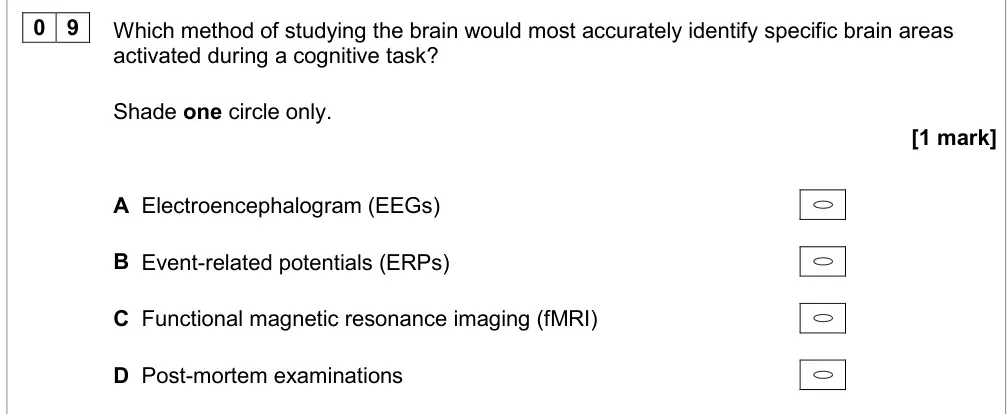
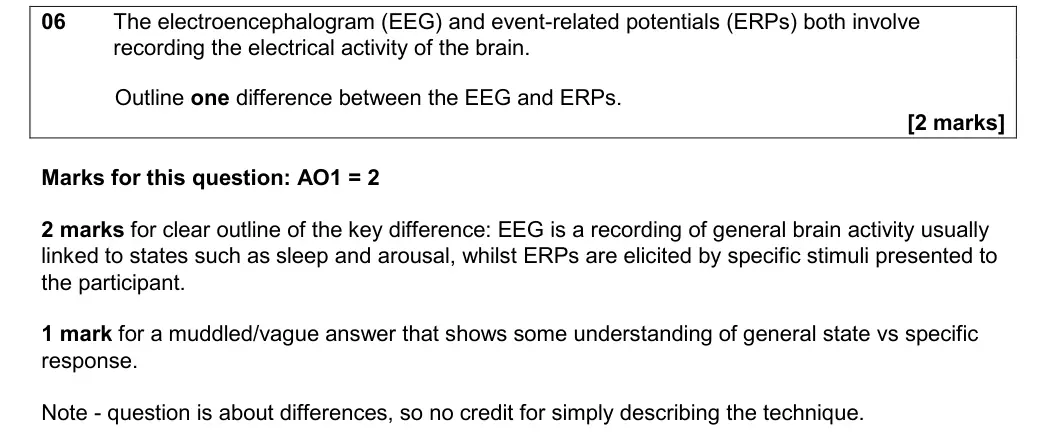
4.2.2-05 Ways of studying the brain: scanning techniques, including functional magnetic resonance imaging (fMRI); electroencephalogram (EEGs) and event-related potentials (ERPs); post-mortem examinations.
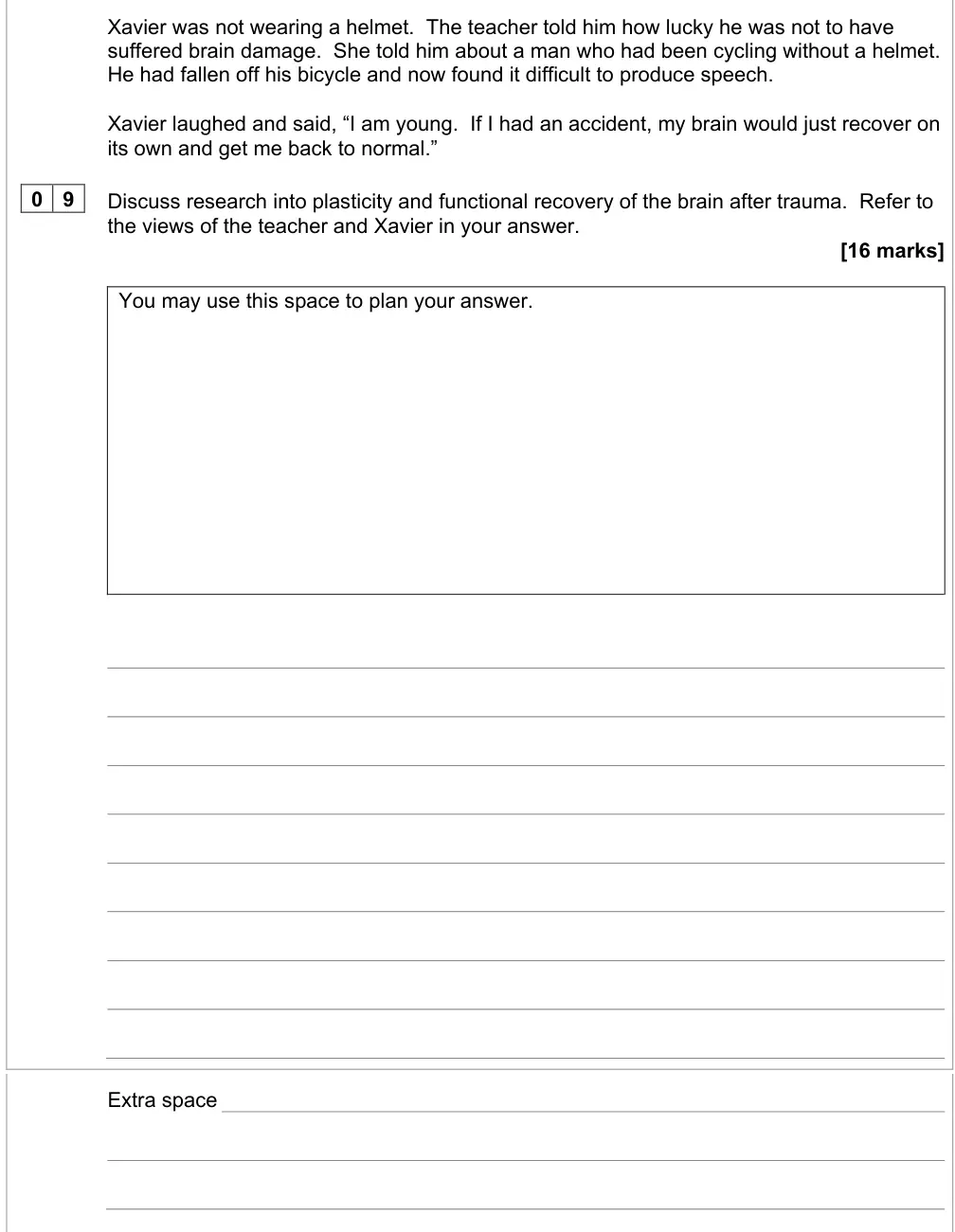
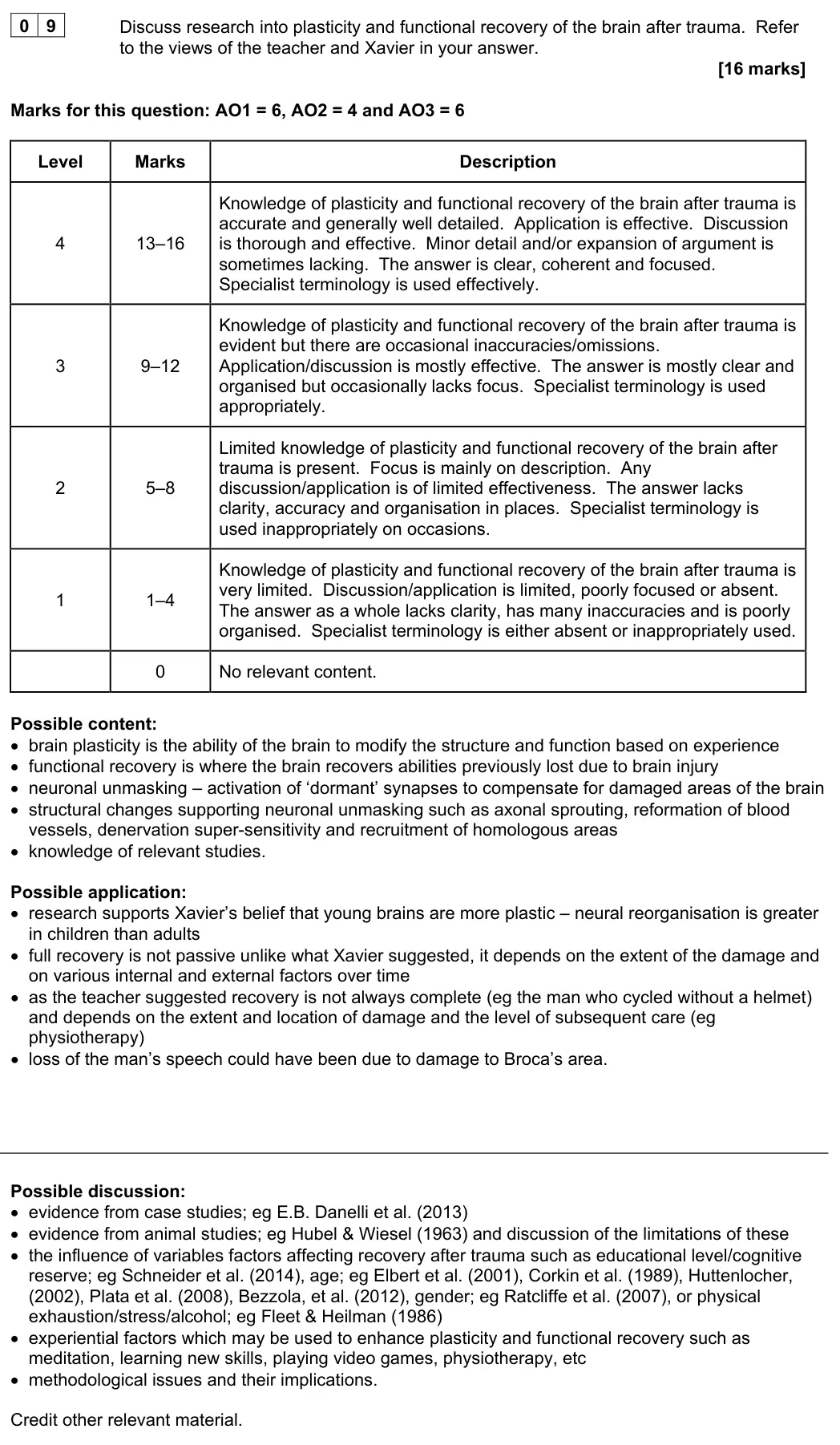
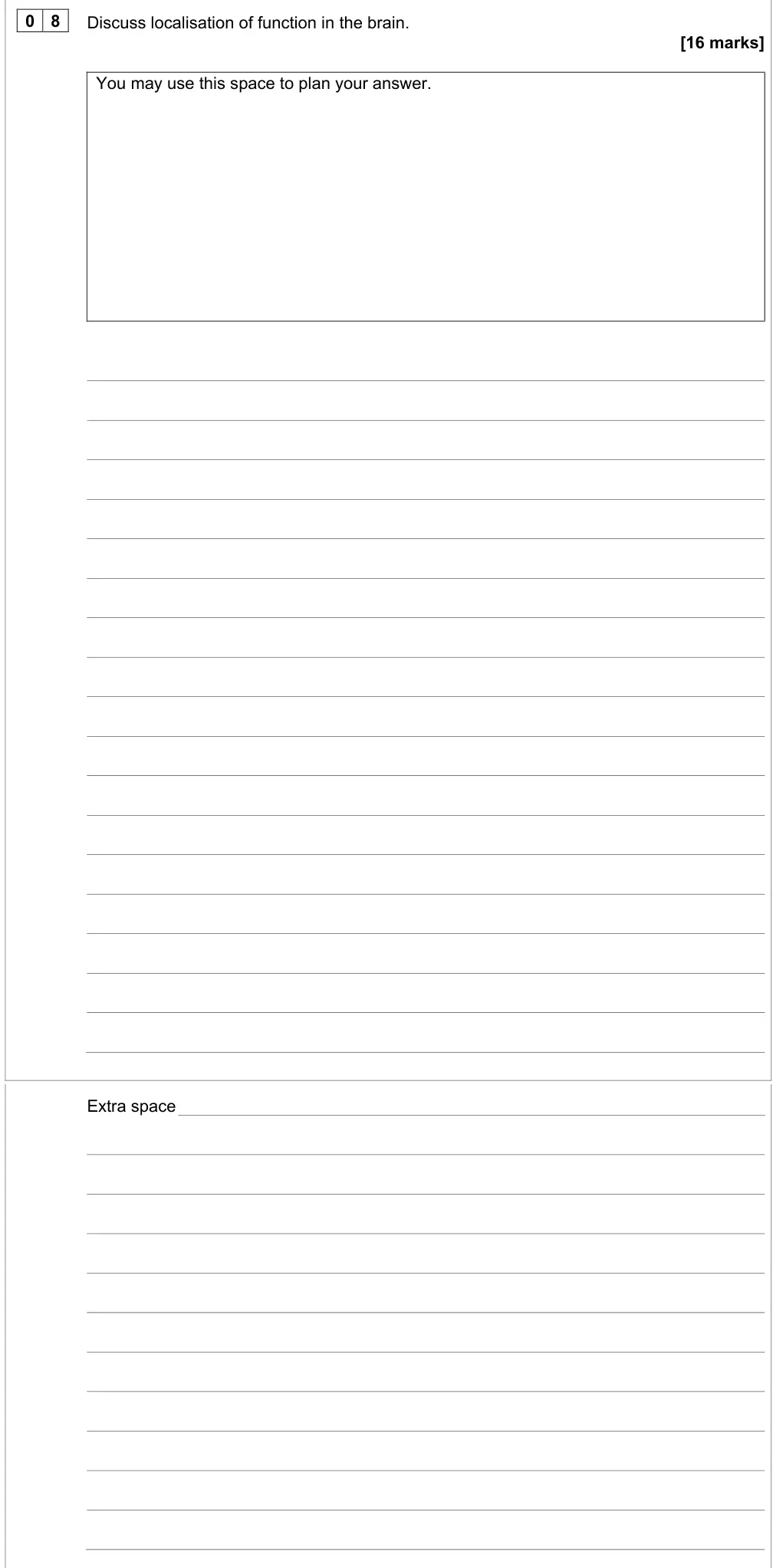
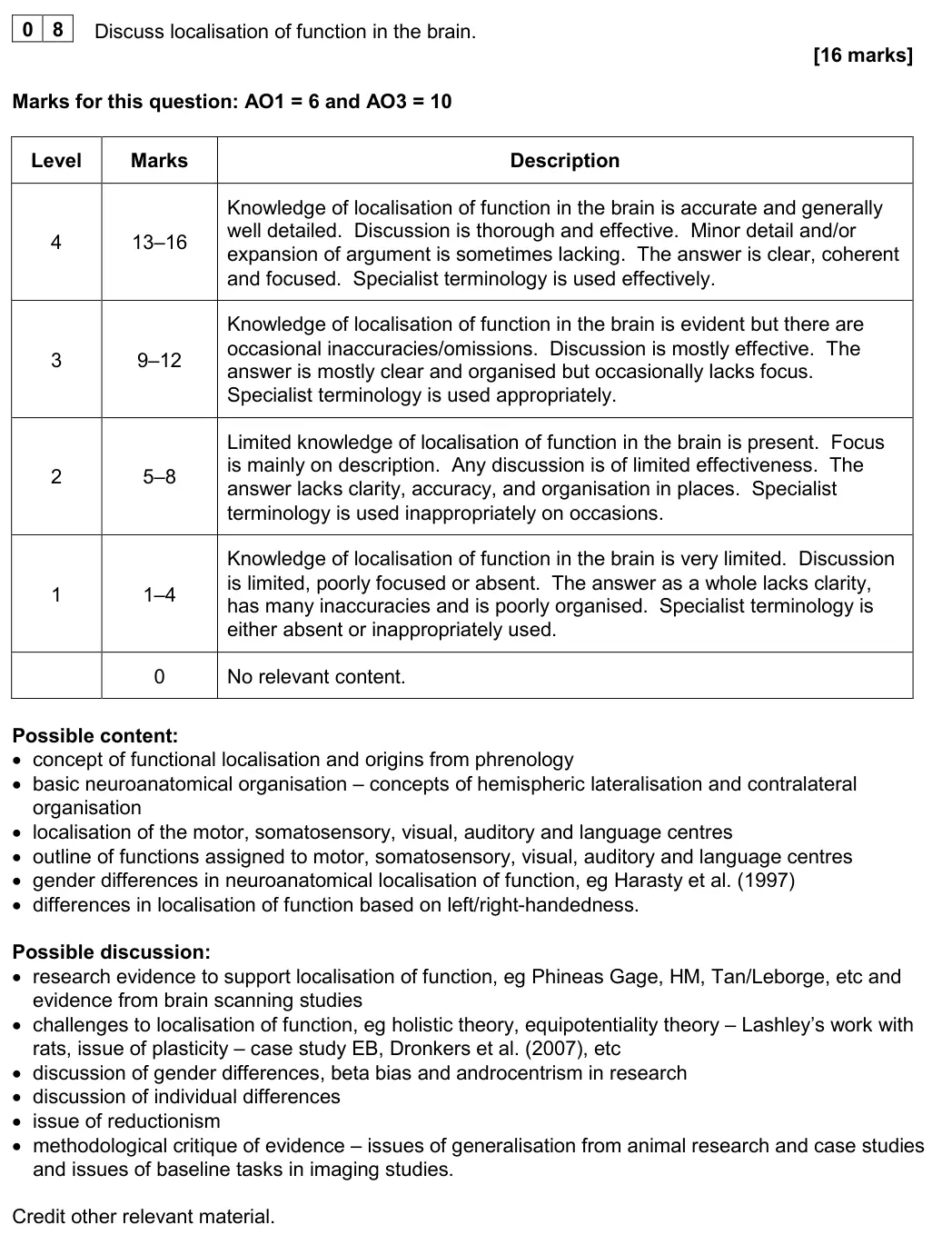
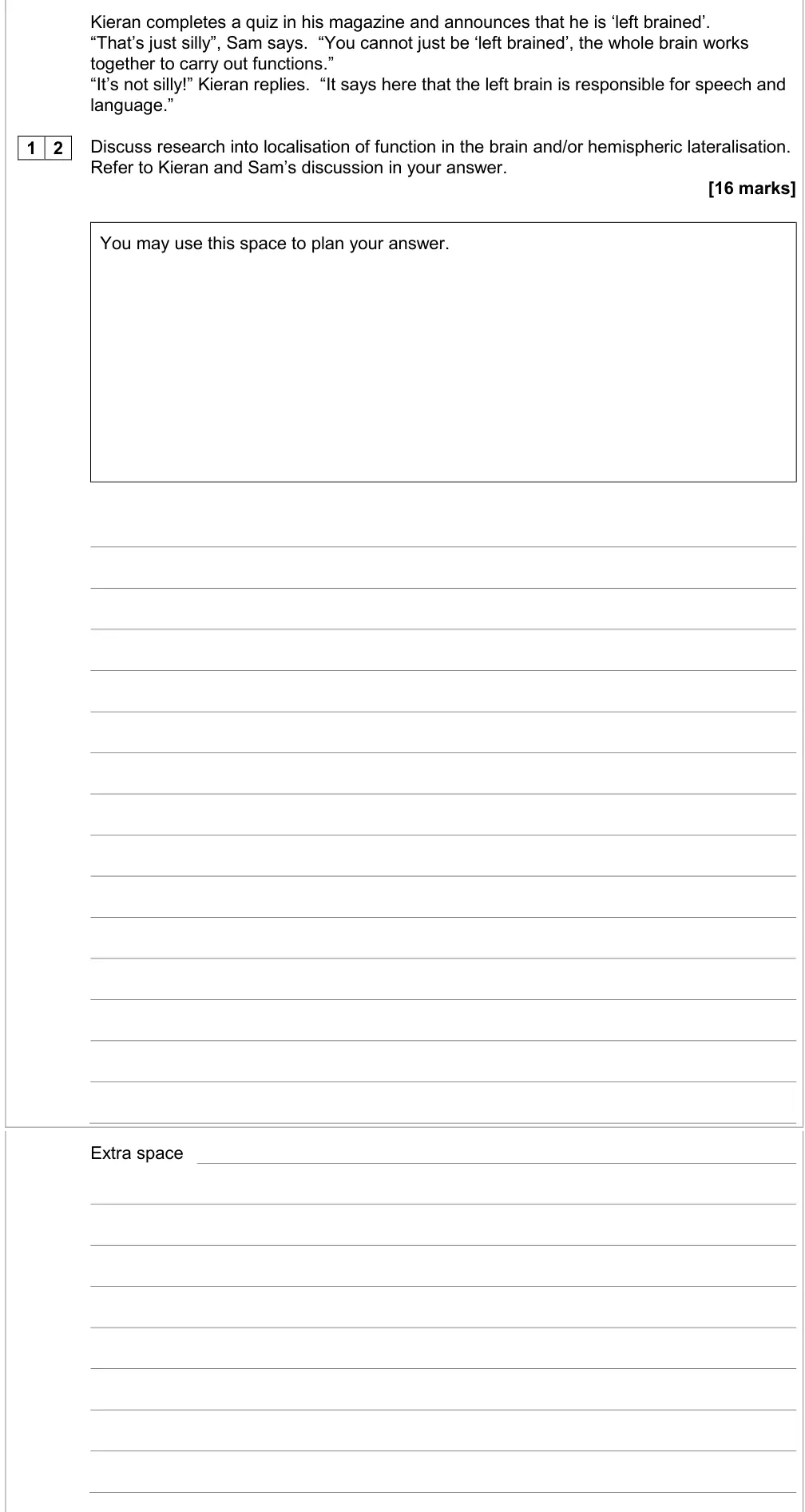
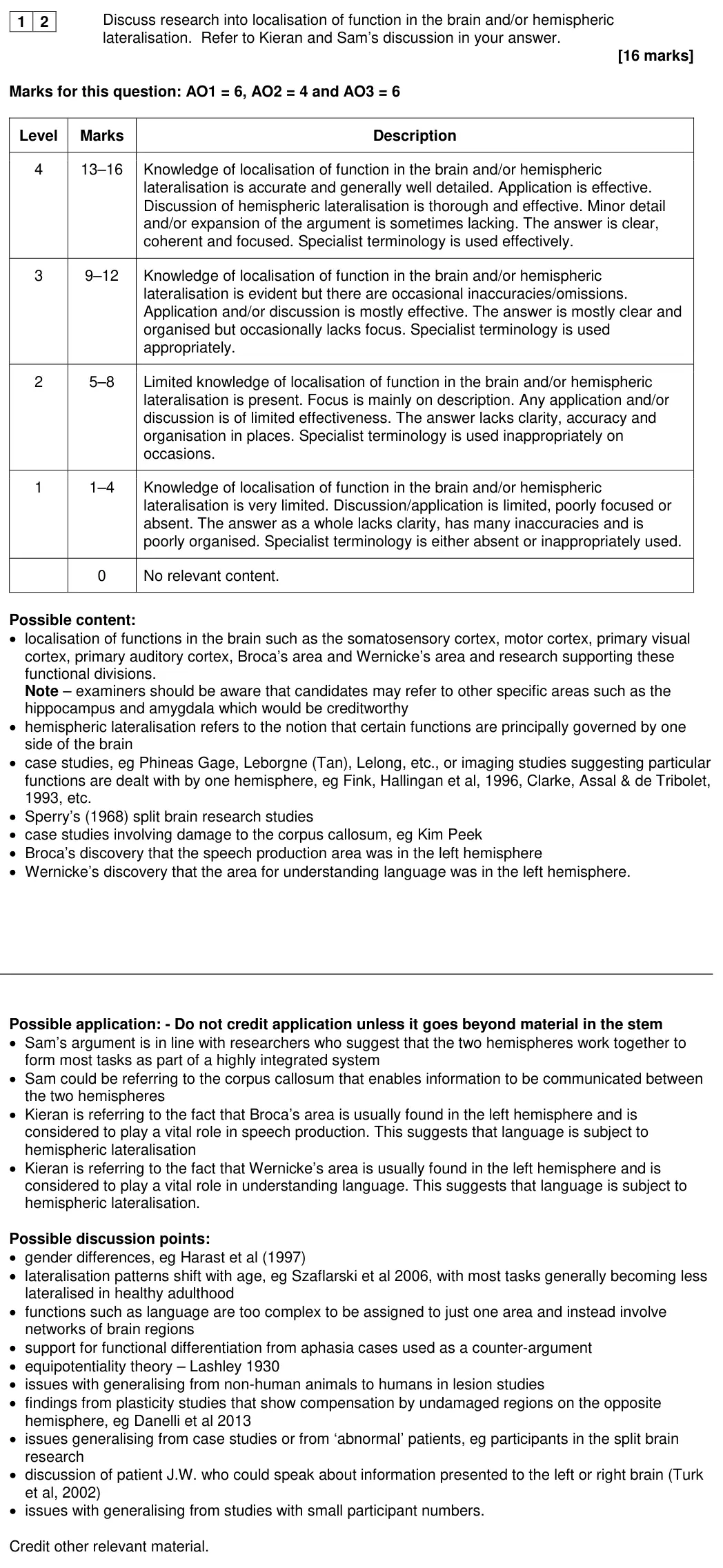
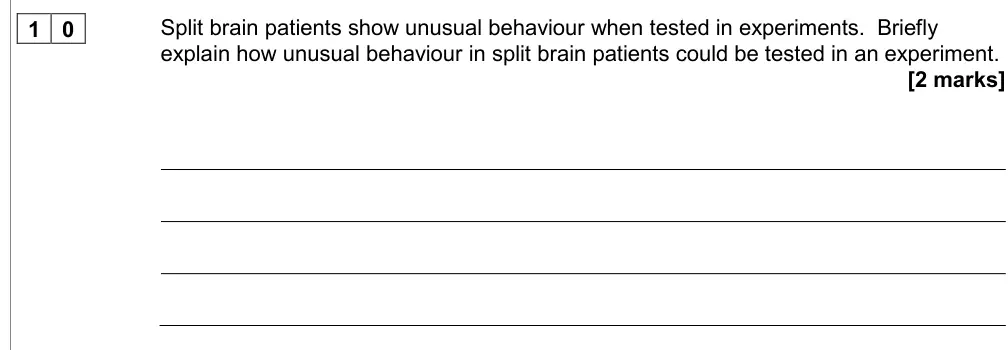
4.2.2-06 Localisation of function in the brain and hemispheric lateralisation: motor, somatosensory, visual, auditory and language centres; Broca’s and Wernicke’s areas, split brain research. Plasticity and functional recovery of the brain after trauma.
Tap a question to zoom it. Mark scheme and examiner's comment open under each question.
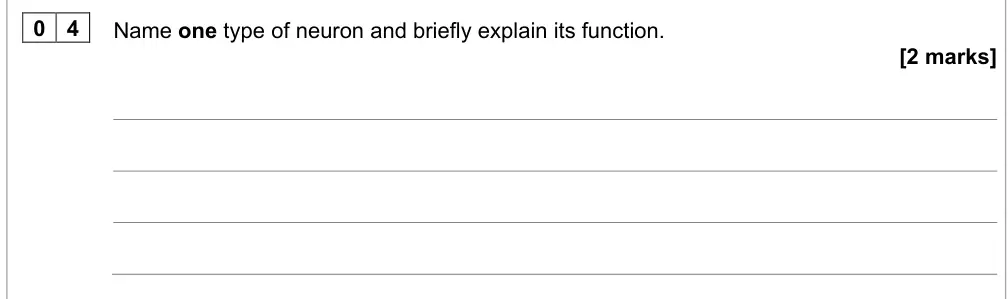
June 2025 · Paper 2 · Q42 marksAO1=2Short answerEasy
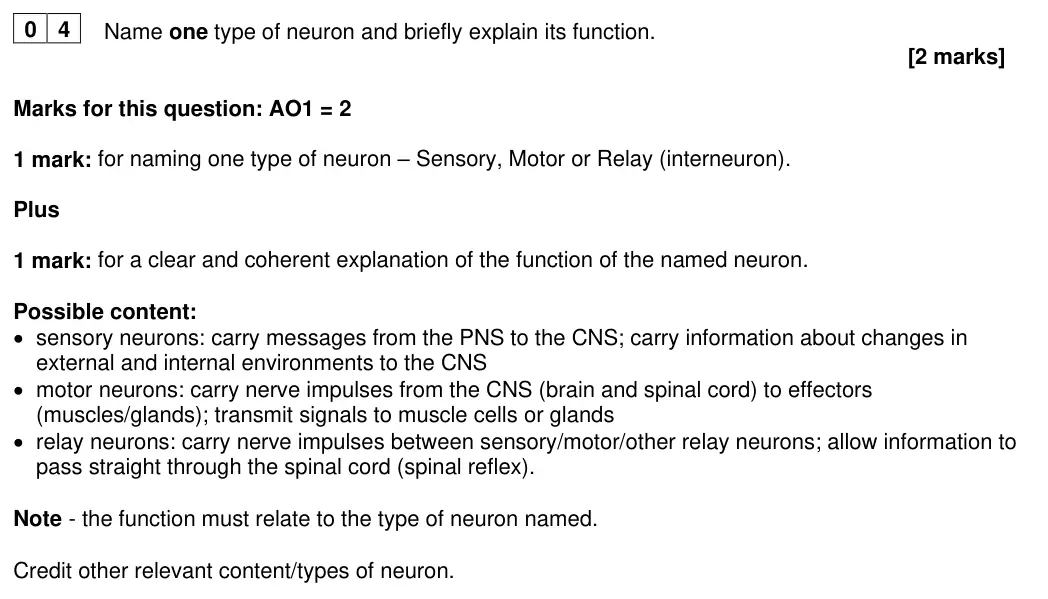
Mark scheme, including level descriptors and indicative content
Examiner's comment
This was a very well answered question with students demonstrating strong knowledge of neurons and their functions. Some answers muddled the functions of sensory and motor neurons, resulting in 1 mark for naming the neuron. The majority of students achieved both marks here.
Notes from the mark scheme and report
1 mark name (sensory/motor/relay) + 1 mark function, which must match the named neuron
sensory and motor functions sometimes swapped
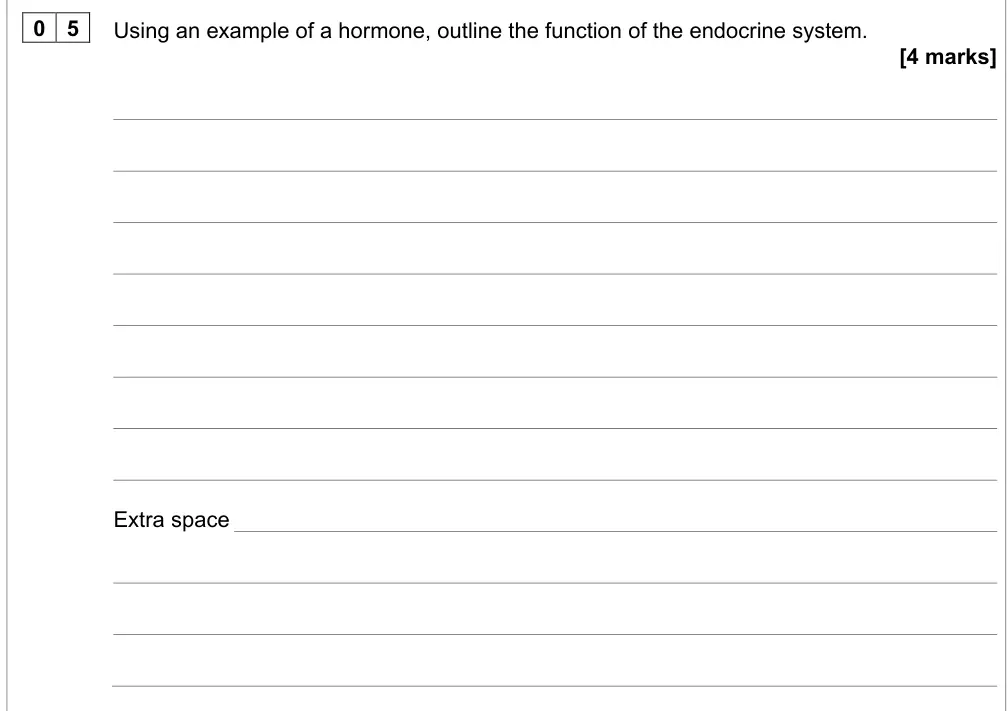
June 2025 · Paper 2 · Q54 marksAO1=4Outline
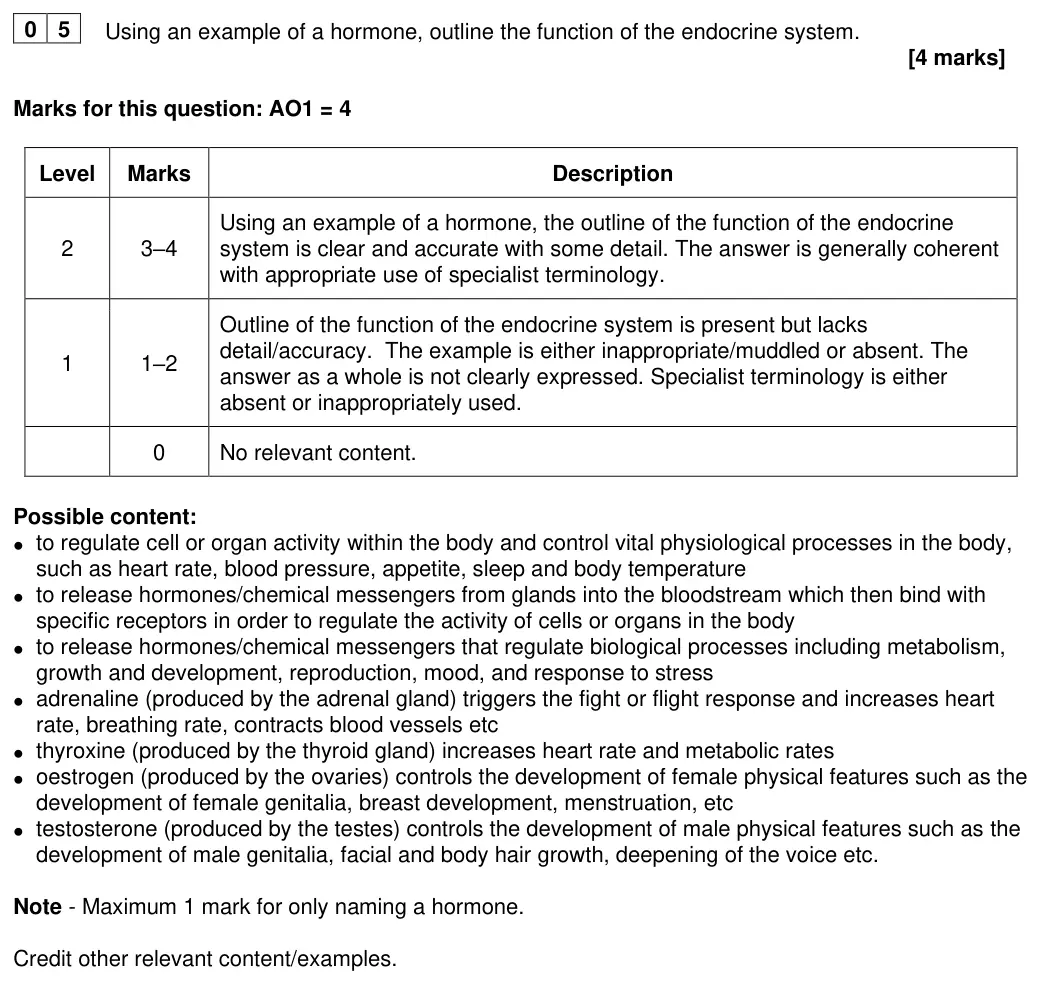
Mark scheme, including level descriptors and indicative content
Examiner's comment
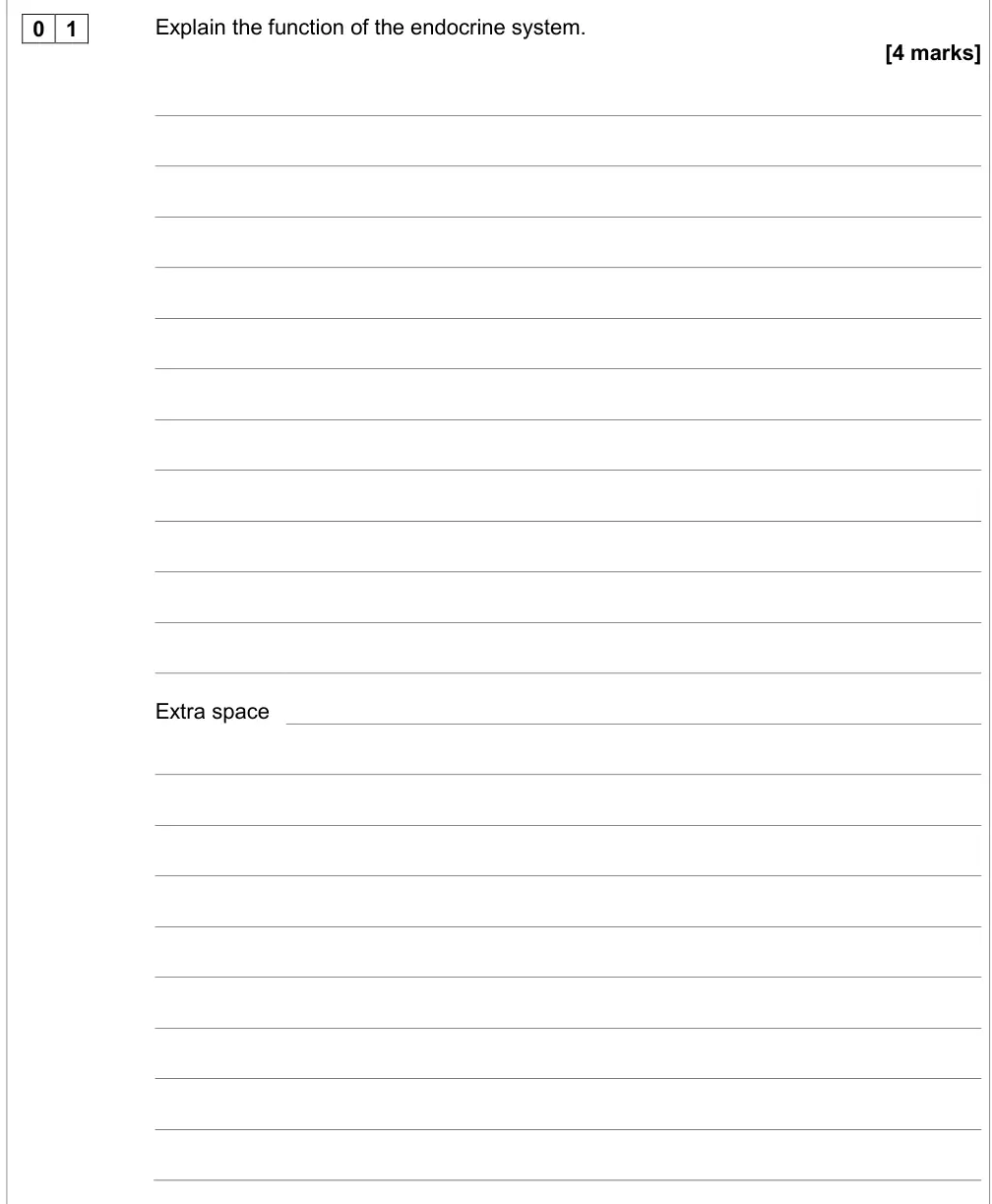
This question yielded a spread of marks with a wide range of examples of hormone. Most students were able to name a hormone but found it more challenging to outline the function of the endocrine system using their example. Many treated it as two separate questions, outlining the function of the endocrine system and then stating a hormone or just naming a hormone and outlining the function of that hormone. Adrenaline was the most common example, but melatonin and insulin were also common responses. Those who demonstrated an understanding of the function of the endocrine system and shaped their response to the question achieved the highest marks. Some impressive responses focussed on homeostasis and used an example such as insulin to explain its role in blood glucose regulation. Many struggled to address the issue of function and instead focussed on the structure of the endocrine system.
Notes from the mark scheme and report
max 1 mark for only naming a hormone
must use the hormone to illustrate the function of the system (chemical messengers from glands into bloodstream to target receptors), not treat as two separate questions or describe structure
June 2025 · Paper 2 · Q64 marksAO1=4Explain
Mark scheme, including level descriptors and indicative content
Examiner's comment
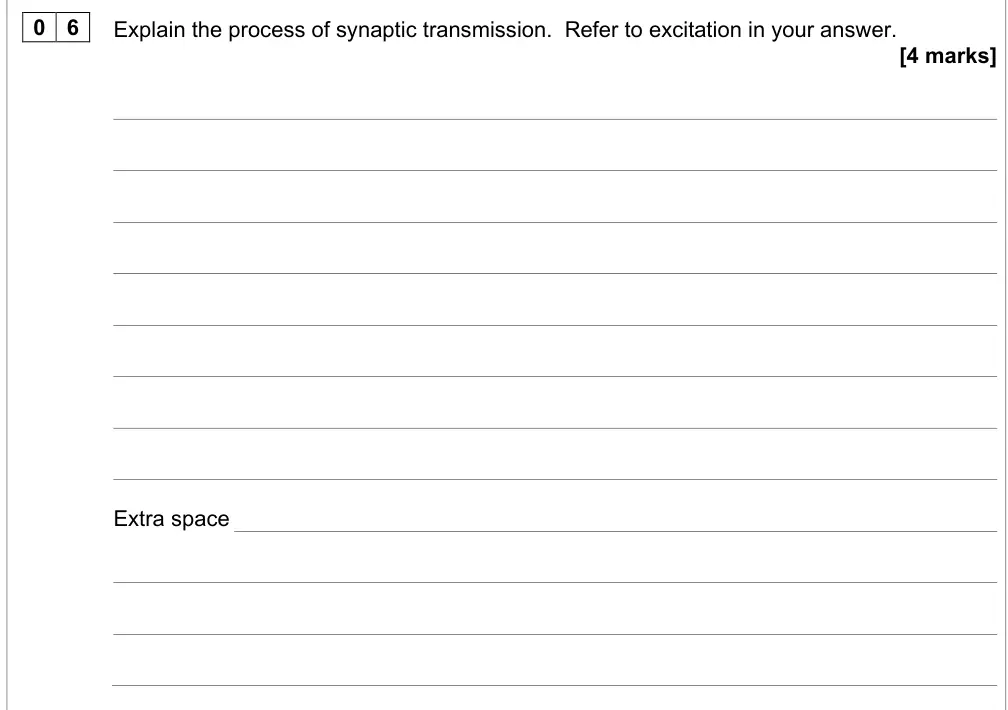
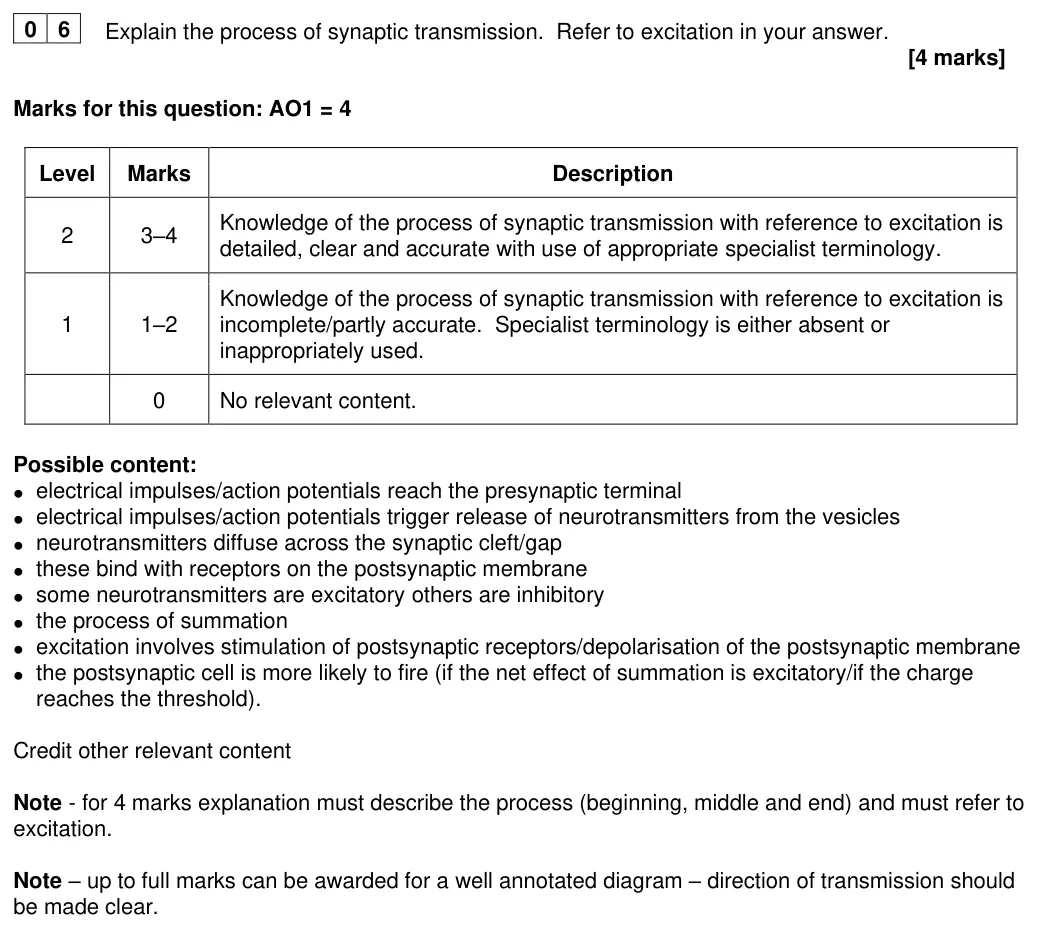
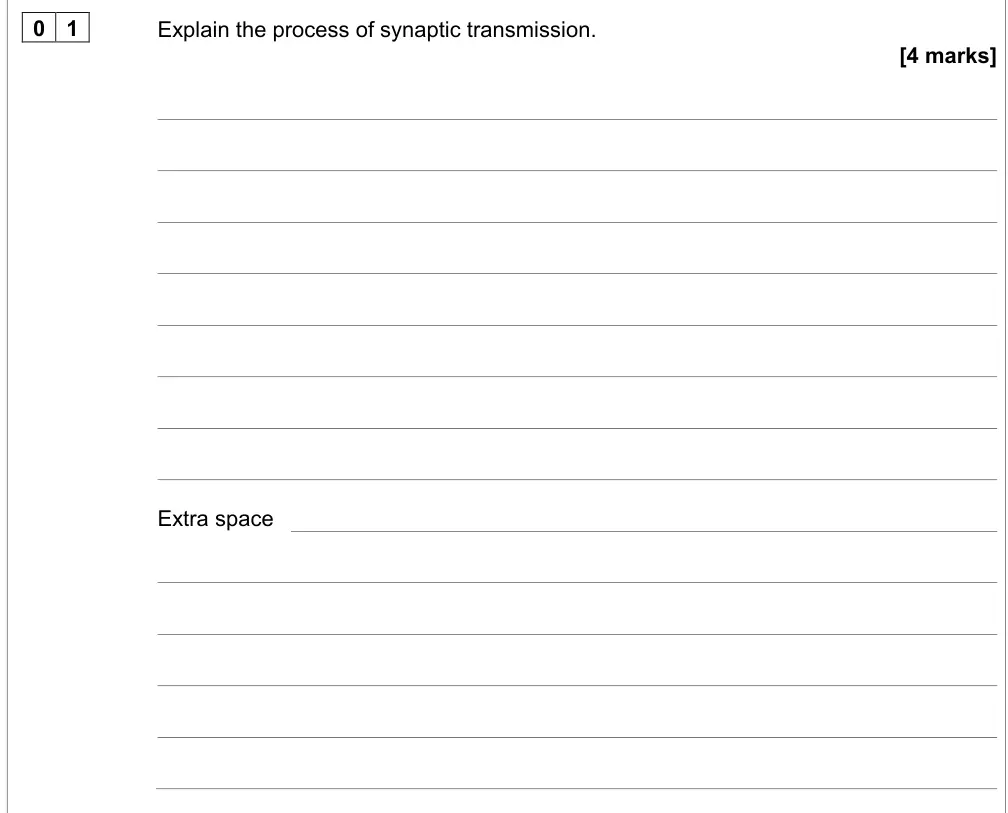
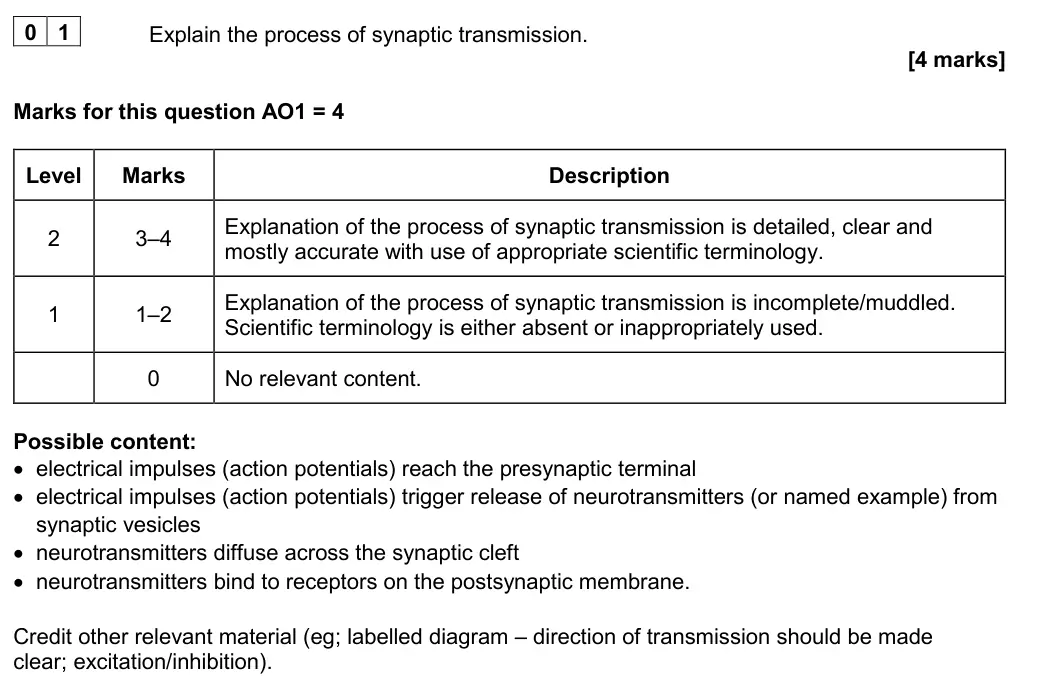
This question discriminated well with some strong responses seen. Most students had some knowledge of synaptic transmission, but this was often muddled, especially in the references to excitation. Common misconceptions included: vesicles diffusing across the synapse, action potentials travelling directly across the synaptic cleft, excitation determining the speed of the action potential or determining the number of neurotransmitters released, neurotransmitters being excitatory due to being positively charged and entering the post synaptic neuron to make it more positive. An impressive array of terminology was seen but unfortunately it was often not used appropriately. Whilst there were some excellent answers, overall, the responses suggested the need for a better understanding of excitation, inhibition and summation rather than reliance on rote learned information.
Notes from the mark scheme and report
for 4 marks must describe beginning, middle and end AND refer to excitation
full marks possible for annotated diagram showing direction
misconceptions: vesicles or action potentials crossing the cleft, excitation affecting speed
June 2025 · Paper 2 · Q76 marksAO2=6Application
Mark scheme, including level descriptors and indicative content
Examiner's comment
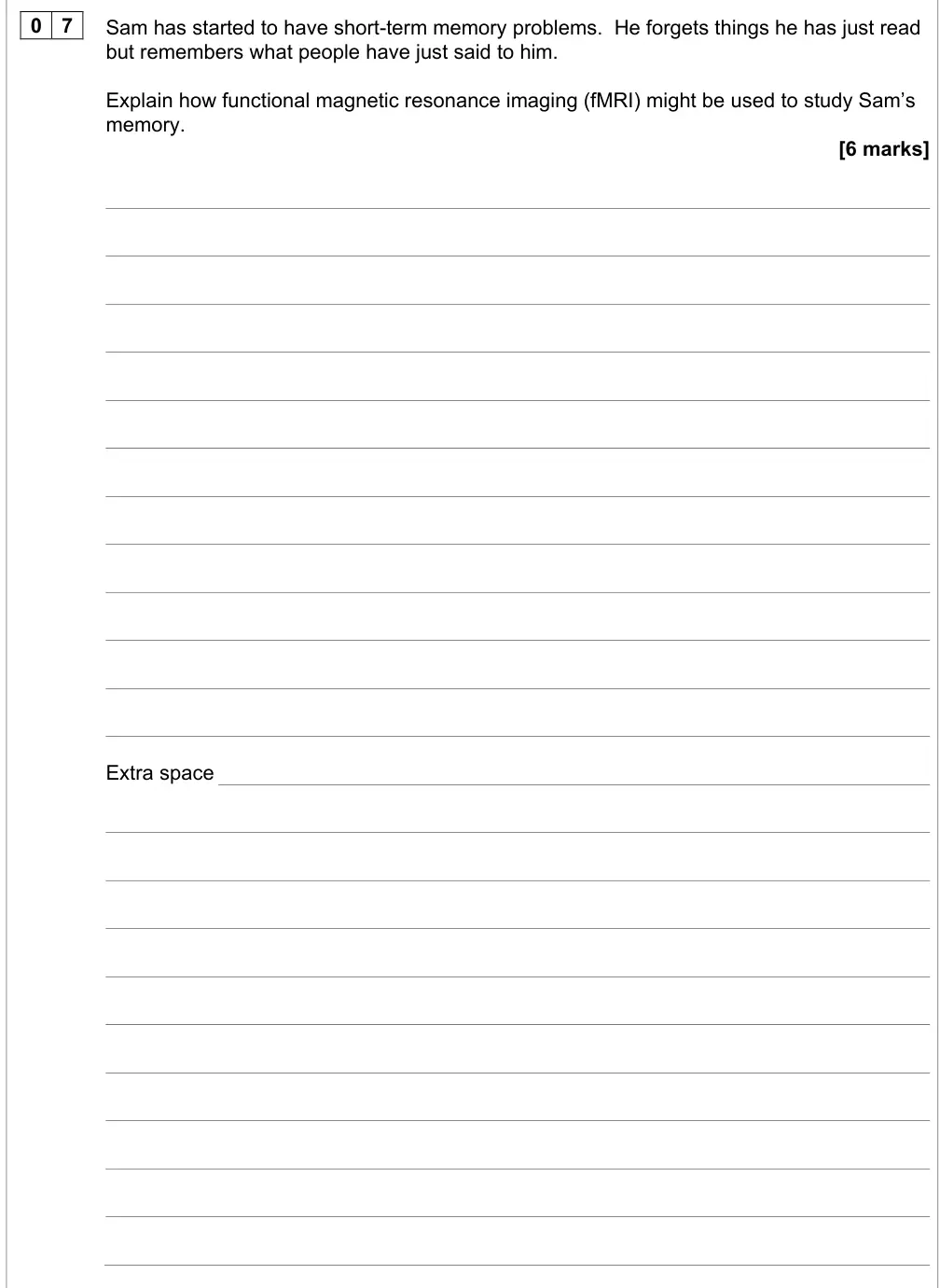
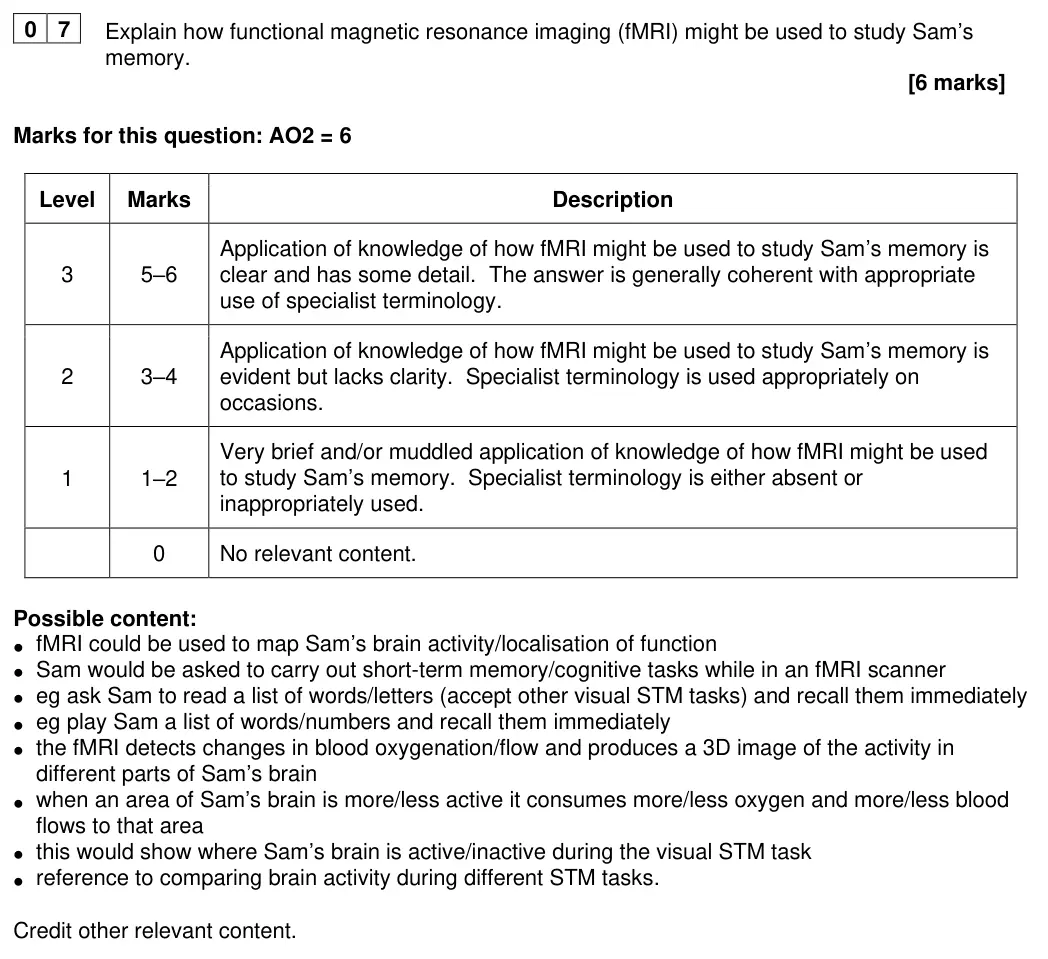
This question was not well understood. Students often did not focus on the demands of the question in terms of ‘how’ functional magnetic resonance imaging (fMRI) might be used to study Sam’s memory and/or they did not have sufficient understanding of how it worked. Students were often able to provide knowledge of fMRIs, sometimes with evaluation, but very few students could apply their information in the context of the question. Neither generic descriptions of fMRI nor evaluation was creditworthy without any application. When answers were applied, they often tried to explain which parts of Sam’s brain might be affected, focussing on localisation of function and Broca and Wernicke’s areas rather than on STM tasks. Unfortunately, many tasks suggested by students related to language and visual processing, rather than explicitly to memory. The strongest responses gave practical and appropriate STM tasks to do in the fMRI and referred to comparison of the 3D image / blood flow differences for the two tasks with a neurotypical brain scan/baseline task to gain meaningful results. Students should be reminded to read and respond to the question set to properly demonstrate understanding.
Notes from the mark scheme and report
must apply to Sam: STM tasks (visual reading vs heard words) done in the scanner, blood oxygenation/flow, compare activity between tasks
generic description or evaluation of fMRI not creditworthy
many drifted to Broca/Wernicke or language tasks
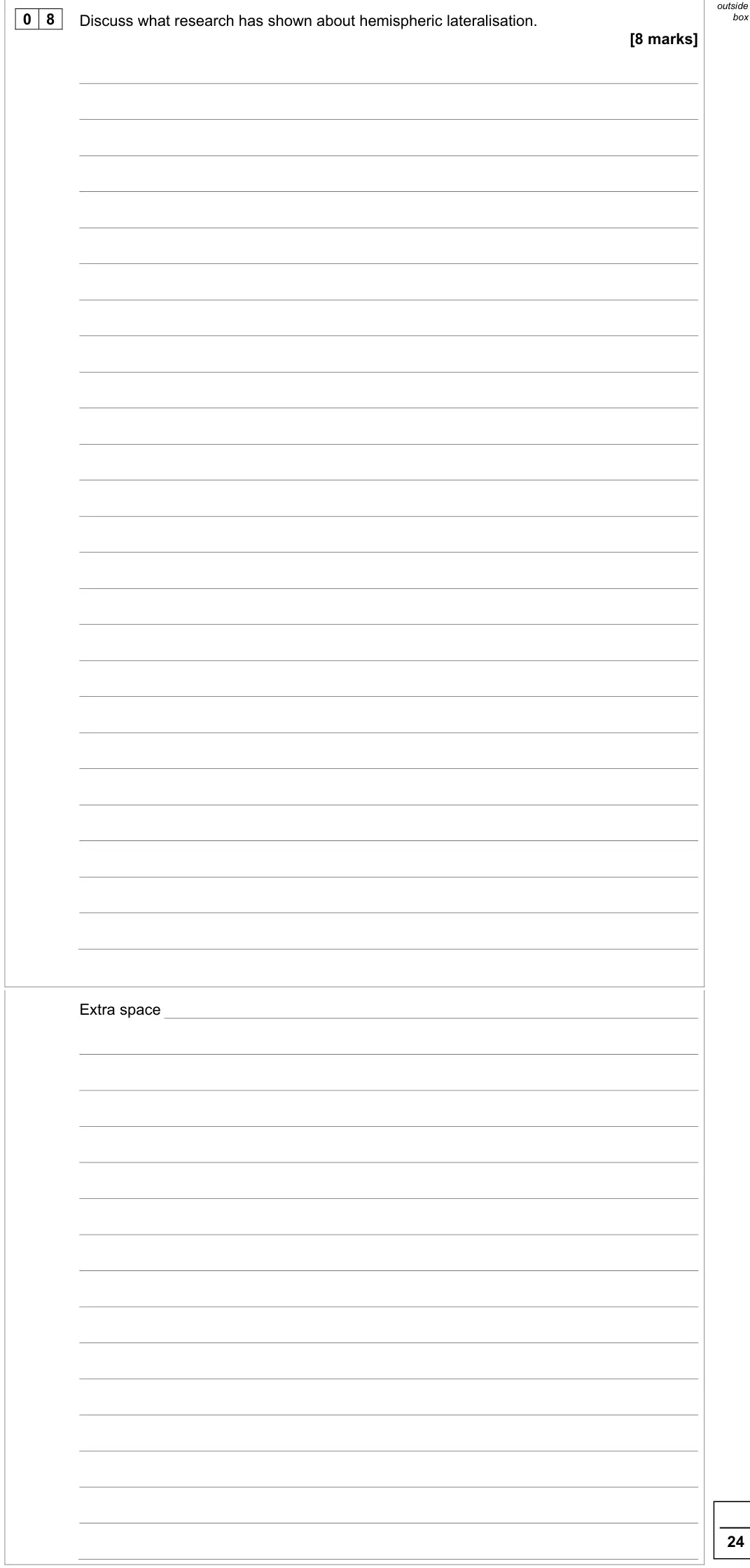
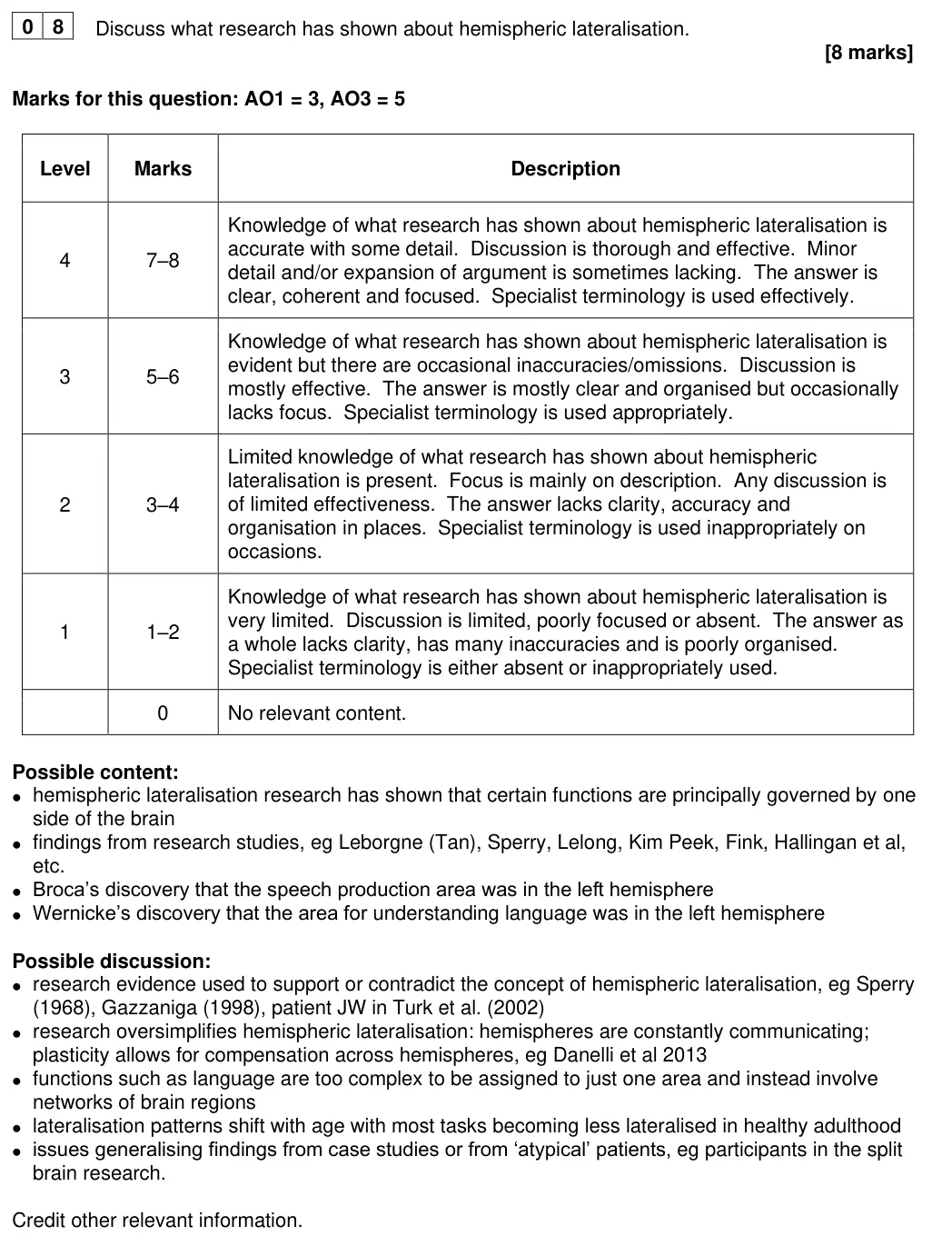
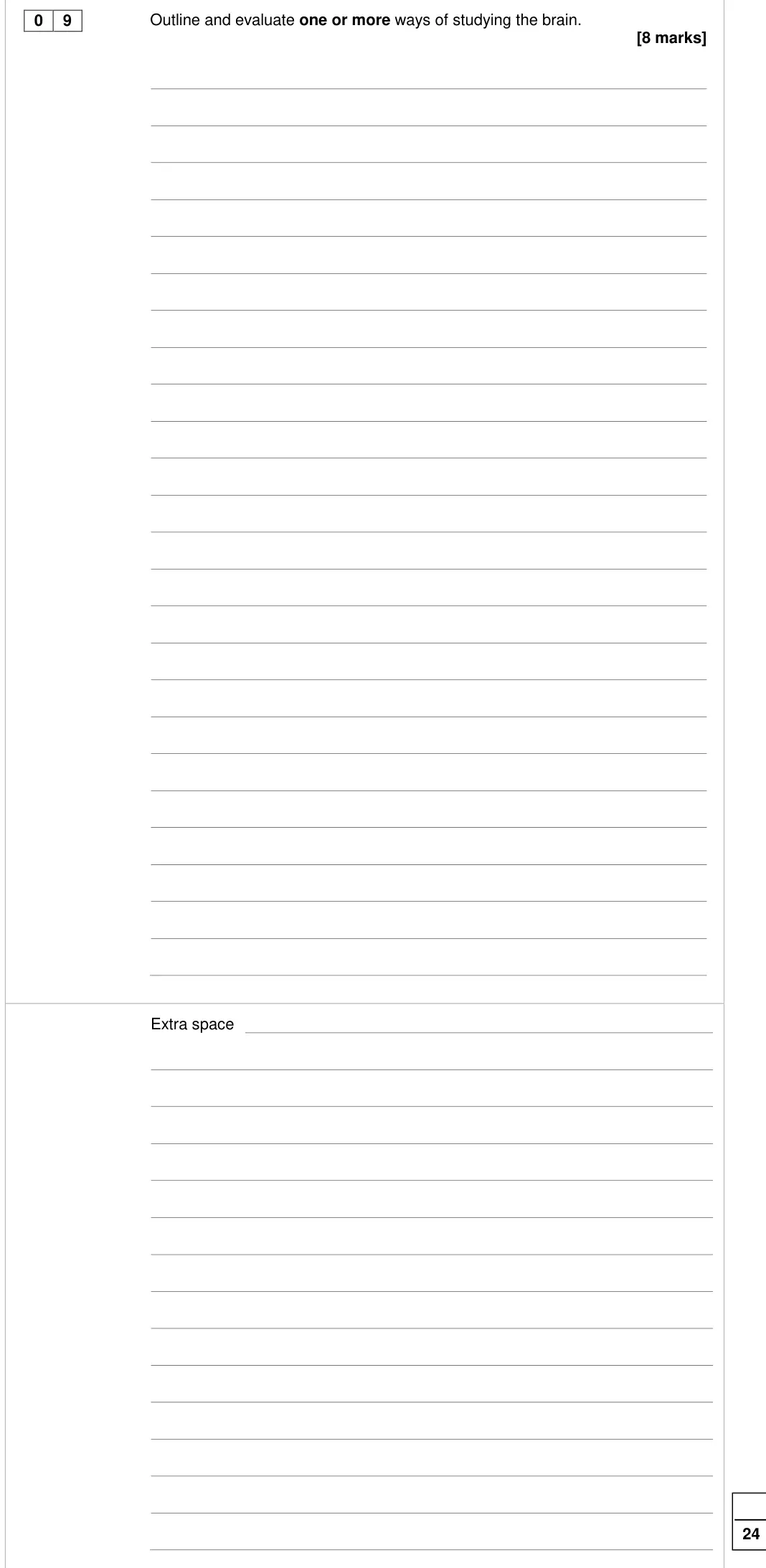
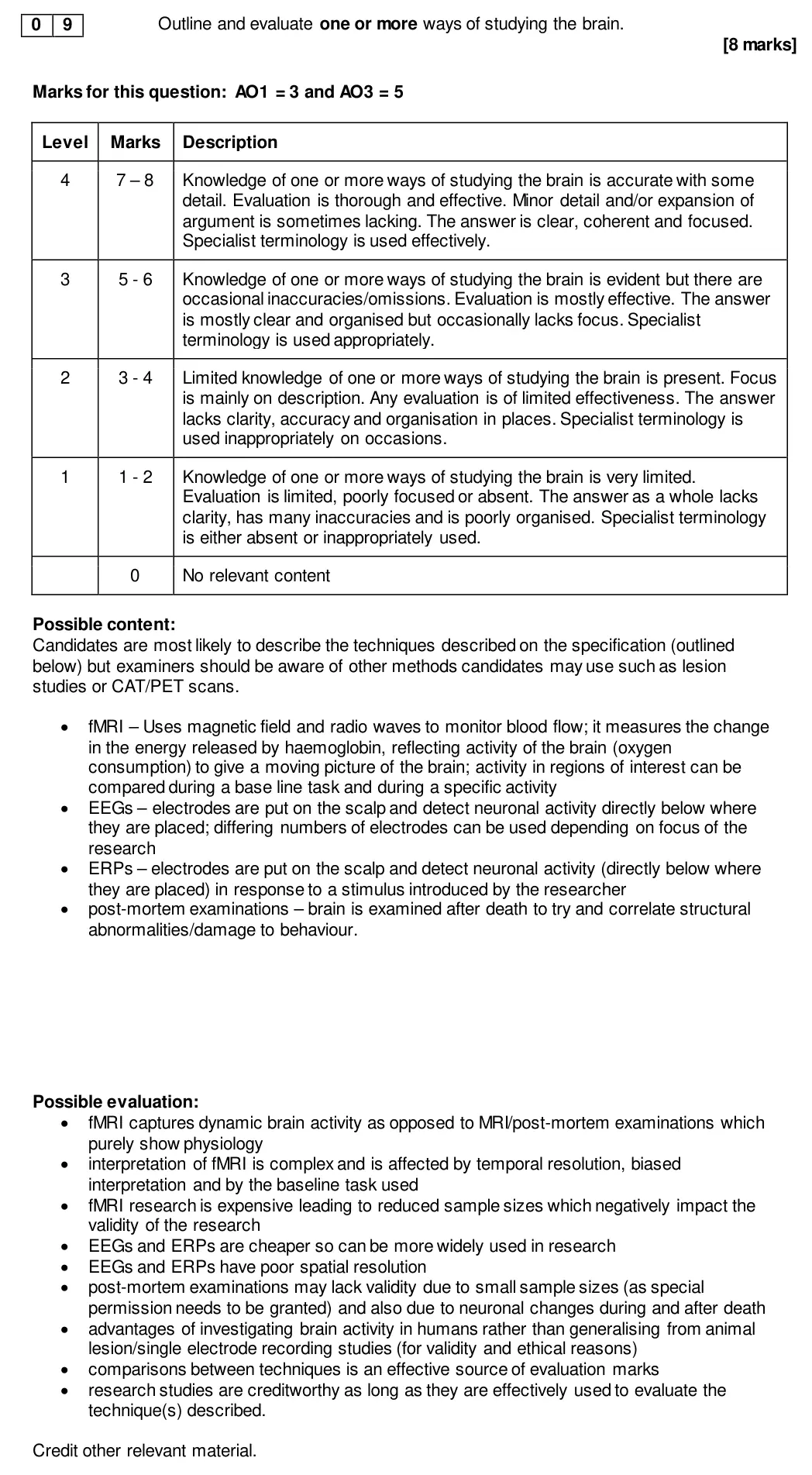
June 2025 · Paper 2 · Q88 marksAO1=3, AO3=5Extended writing
Mark scheme, including level descriptors and indicative content
Examiner's comment
This question discriminated well but was generally not well answered as responses often did not focus on the ‘show’ aspect of the question. For many responses there was a narrow focus on Sperry’s research including good detail of split-brain procedure but without focus on what research has shown, which unfortunately resulted in little credit. Evaluation of Sperry’s research was often not linked back to the impact on the question set on hemispheric lateralisation. Whilst many students had detailed knowledge of the procedure used in Sperry’s research, the findings were often brief and muddled. A common misconception about split brain patients was that all motor function is in the right hemisphere so the left hemisphere has no motor control so the right hand cannot draw. There were also inappropriate references to a control group. The terms ipsilateral and contralateral were often inappropriately used. Better responses focussed on what research has shown about hemispheric lateralisation with use of a range of studies to support or challenge the concept. Although those who focussed on the question generally achieved higher marks, it was rare to see thorough and effective discussion.
Notes from the mark scheme and report
focus on what research has SHOWN (functions governed by one hemisphere, Broca/Wernicke, Sperry, Gazzaniga)
procedural detail of Sperry with brief findings scored little
evaluation must link back to lateralisation (plasticity, networks, case-study generalisation)
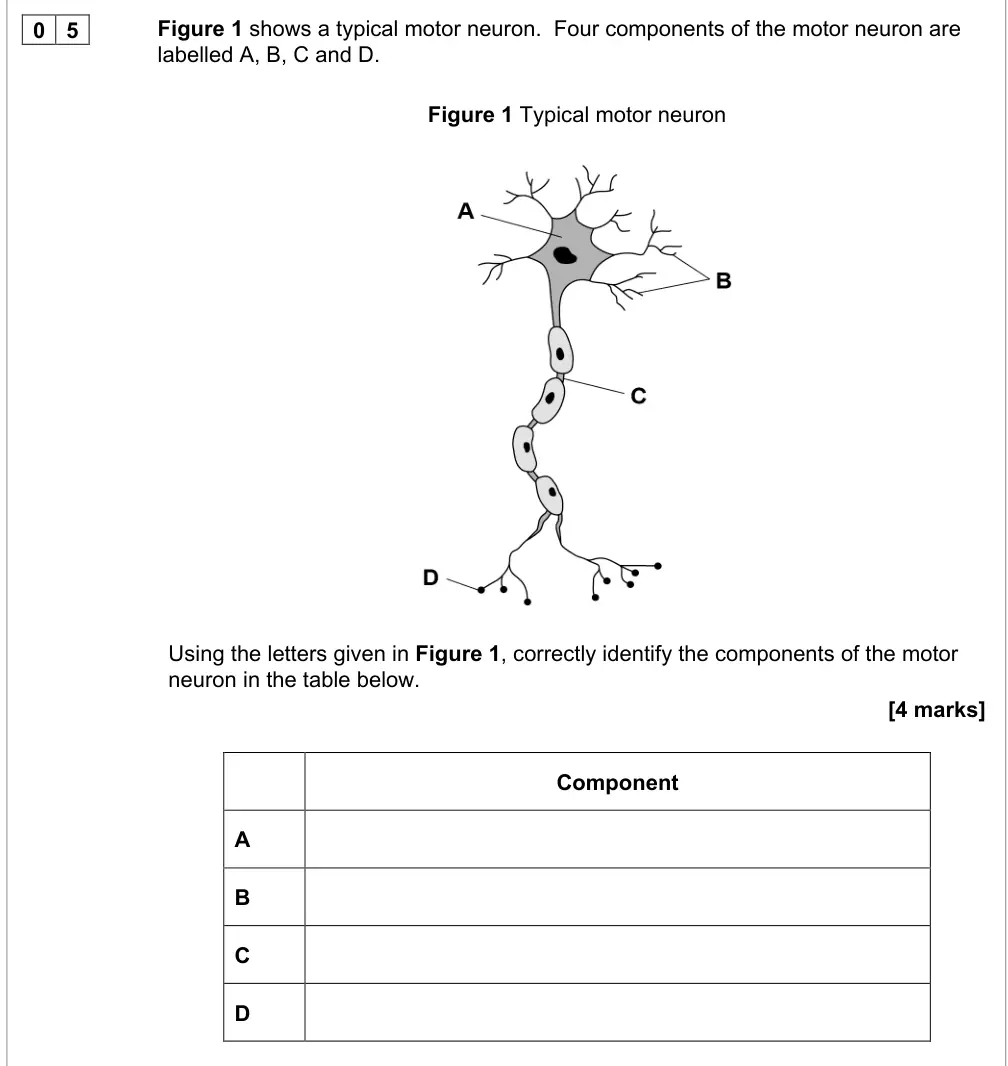
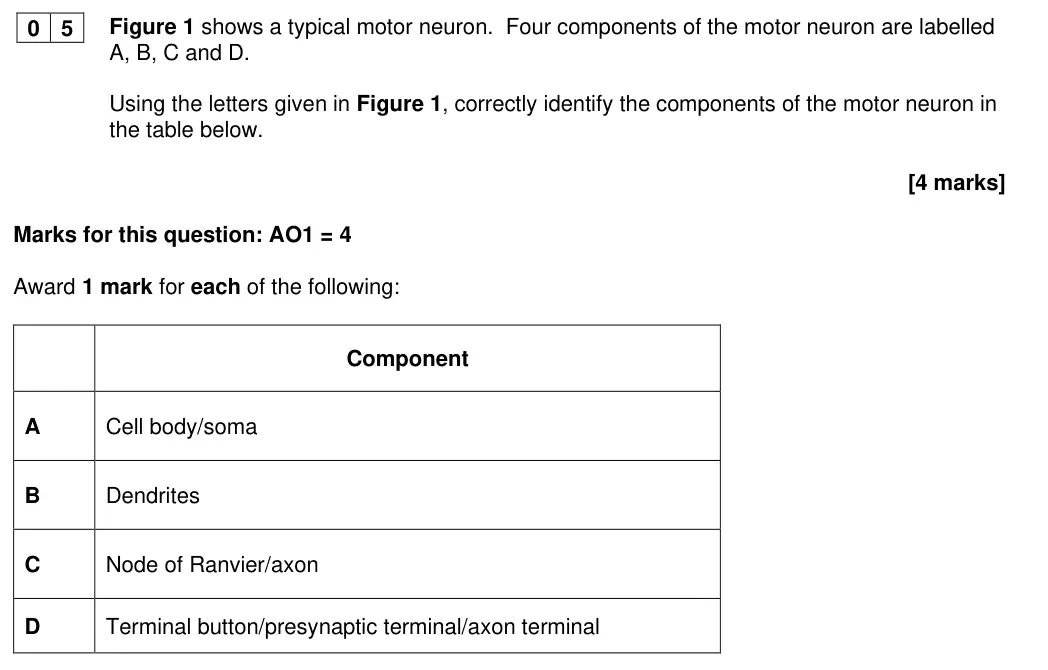
June 2024 · AS Paper 2 · Q54 marksAO1=4Short answerMedium
Mark scheme, including level descriptors and indicative content
Examiner's comment
Students generally performed well in Q3, explaining a limitation of Bandura methodology, and in Q5, labelling a typical neuron. Students also performed relatively well on Q5 where they were asked to label a typical neuron. Over two thirds of students achieved 2 marks or more. The most common mistake students made here was labelling component D as a ‘receptor’ or ‘receptor site’ but these would be found on the post synaptic neuron.
Notes from the mark scheme and report
A cell body/soma, B dendrites, C node of Ranvier/axon, D terminal button/axon terminal
common error labelling D as receptor site
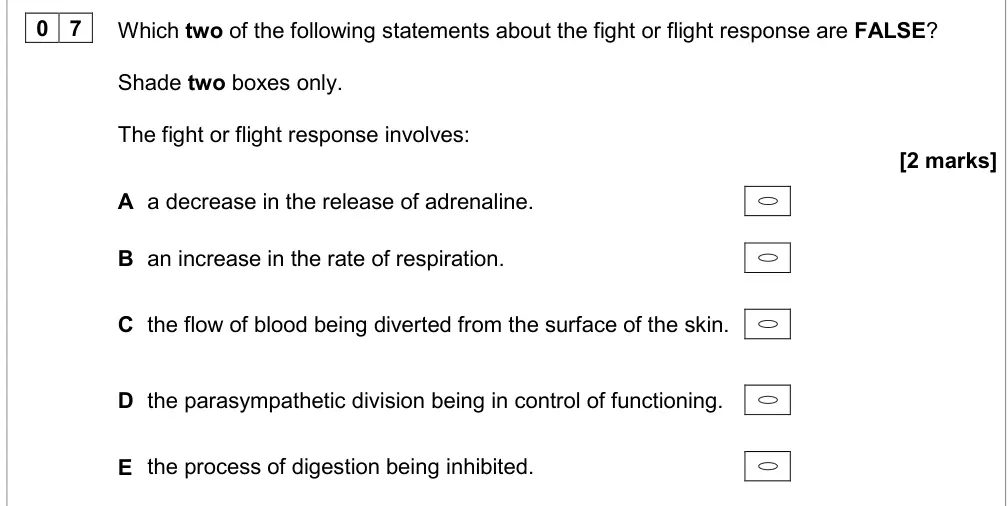
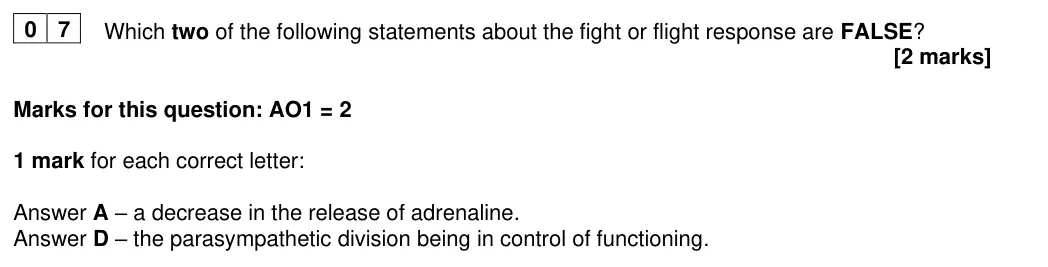
June 2024 · Paper 2 · Q72 marksAO1=2Multiple choice
Answer
A and D
Mark scheme, including level descriptors and indicative content
Examiner's comment
Overall, most students successfully identified the correct responses, demonstrating a good knowledge of the flight/fight system. The most common incorrect response was C (‘Blood flow diverted from surface of skin’). It appeared that some missed the word ‘false’ in the question resulting in an incorrect selection of responses.
Notes from the mark scheme and report
FALSE statements: A (decrease in adrenaline) and D (parasympathetic division in control), 1 mark each
most common wrong answer C (blood diverted from skin)
some missed the word FALSE
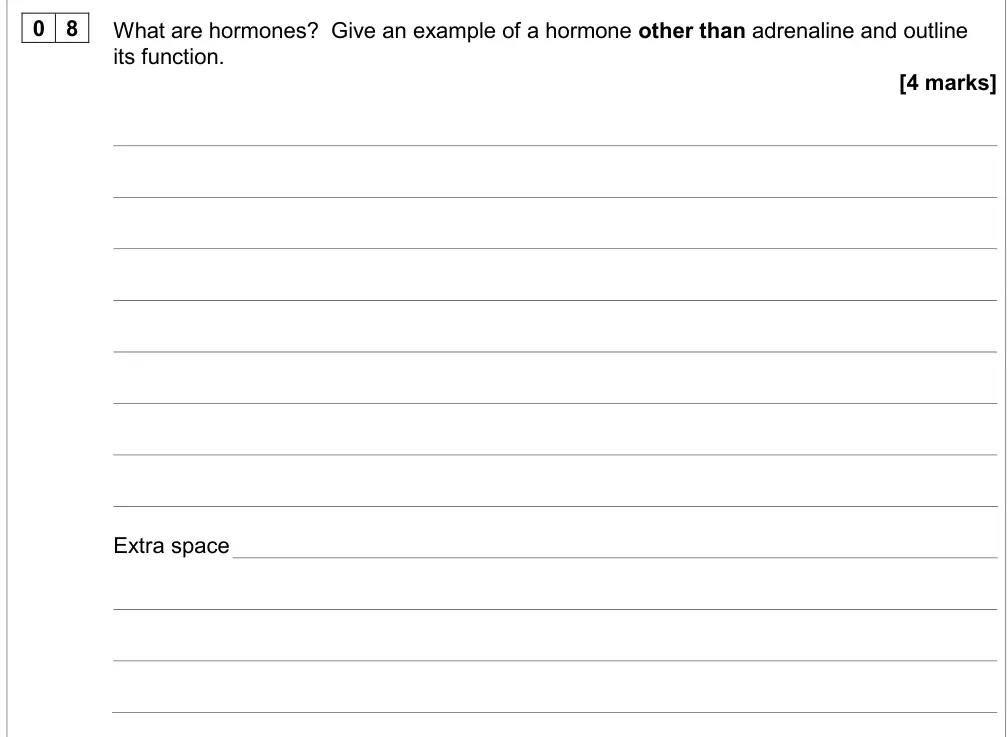
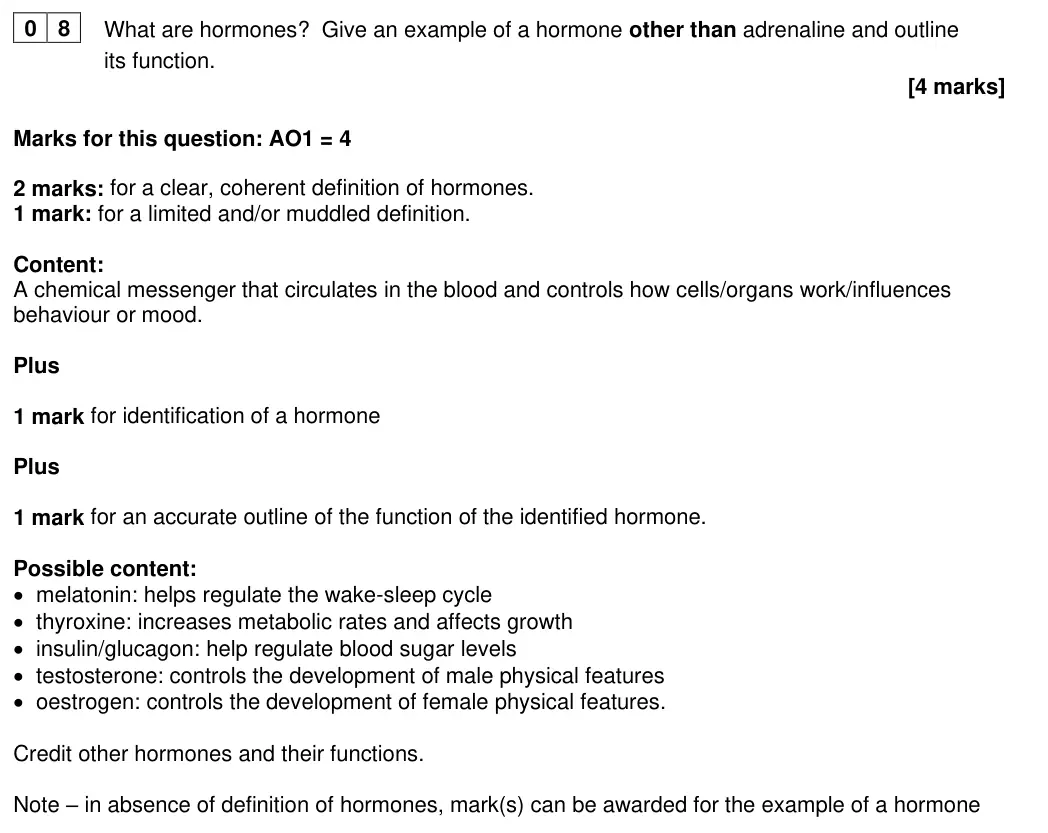
June 2024 · Paper 2 · Q84 marksAO1=4Outline
Mark scheme, including level descriptors and indicative content
Examiner's comment
This question was generally well answered. Most students were able to give an example of a hormone and provide some outline of its function with a good range of hormones presented. The most common hormones stated were thyroxine, melatonin, insulin, testosterone and oestrogen. The definition of hormones provided more differentiation with some students providing very limited or disjointed definitions whilst others provided a very detailed and comprehensive definition with effective use of terminology. Some unfortunately did not answer the first part of the question and thus missed out on the 2 marks for the definition. Some students gave examples of neurotransmitters which can also act as hormones, these were able to gain a mark for the identification of a named hormone but only achieved the mark for the accurate outline of the function if describing the function of the chemical acting as a hormone specifically. Although noradrenaline was not a common response, when stated, the function was often a confused description.
Notes from the mark scheme and report
definition (chemical messenger in blood controlling organs/behaviour) 2 marks + named hormone other than adrenaline + its function (e.g. thyroxine, melatonin, insulin, testosterone)
many omitted the definition
neurotransmitter examples credited only for hormonal function
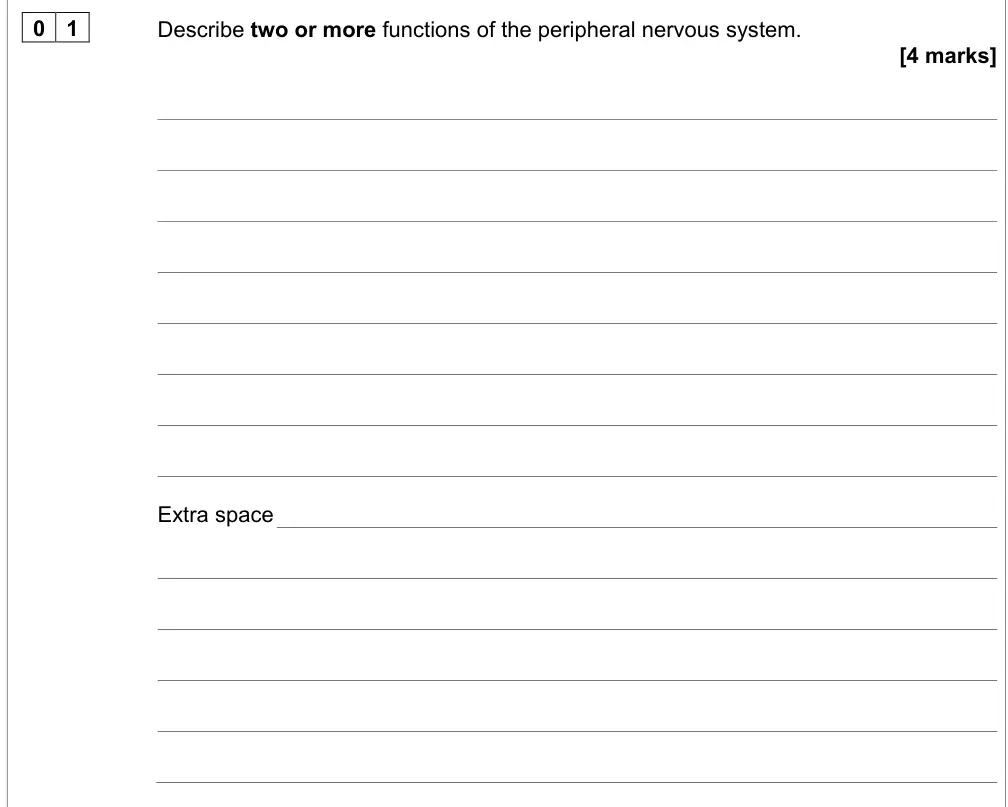
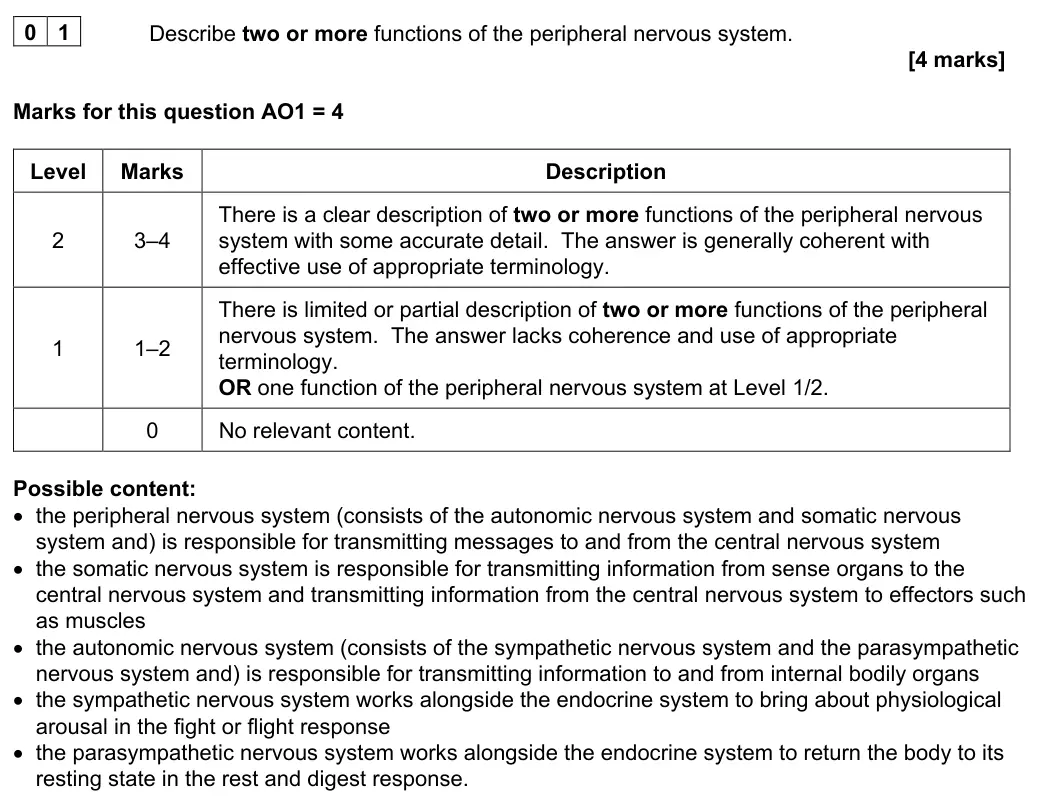
June 2023 · AS Paper 2 · Q14 marksAO1=4Outline
Mark scheme, including level descriptors and indicative content
Examiner's comment
There were some detailed and accurate responses to this question. However, other responses simply involved a general description of the structure of the peripheral nervous system rather than clearly focusing on the functions that the question demanded. It is important that students read the question carefully and understand the demands of the question before they attempt a response.
Notes from the mark scheme and report
focus on functions (somatic: senses to CNS, CNS to muscles
autonomic: internal organs
sympathetic/parasympathetic), not structure
one function only = max Level 1
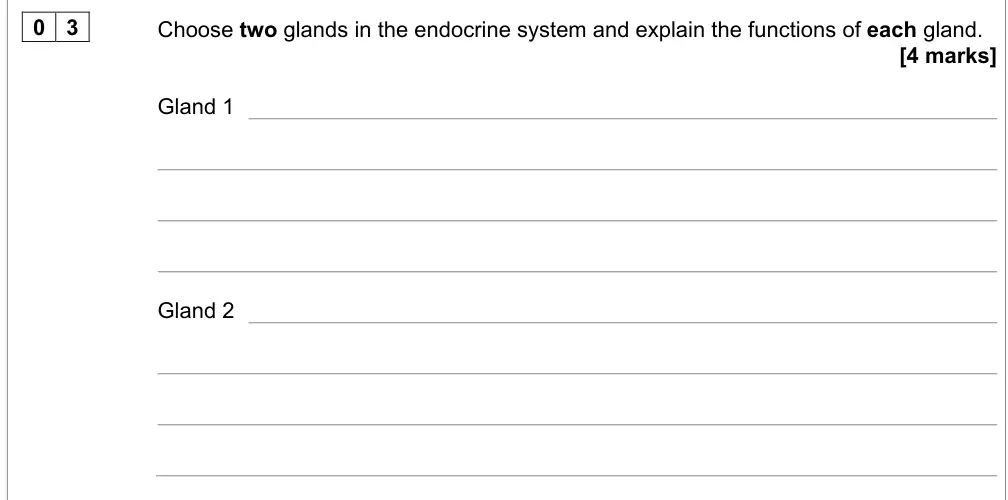
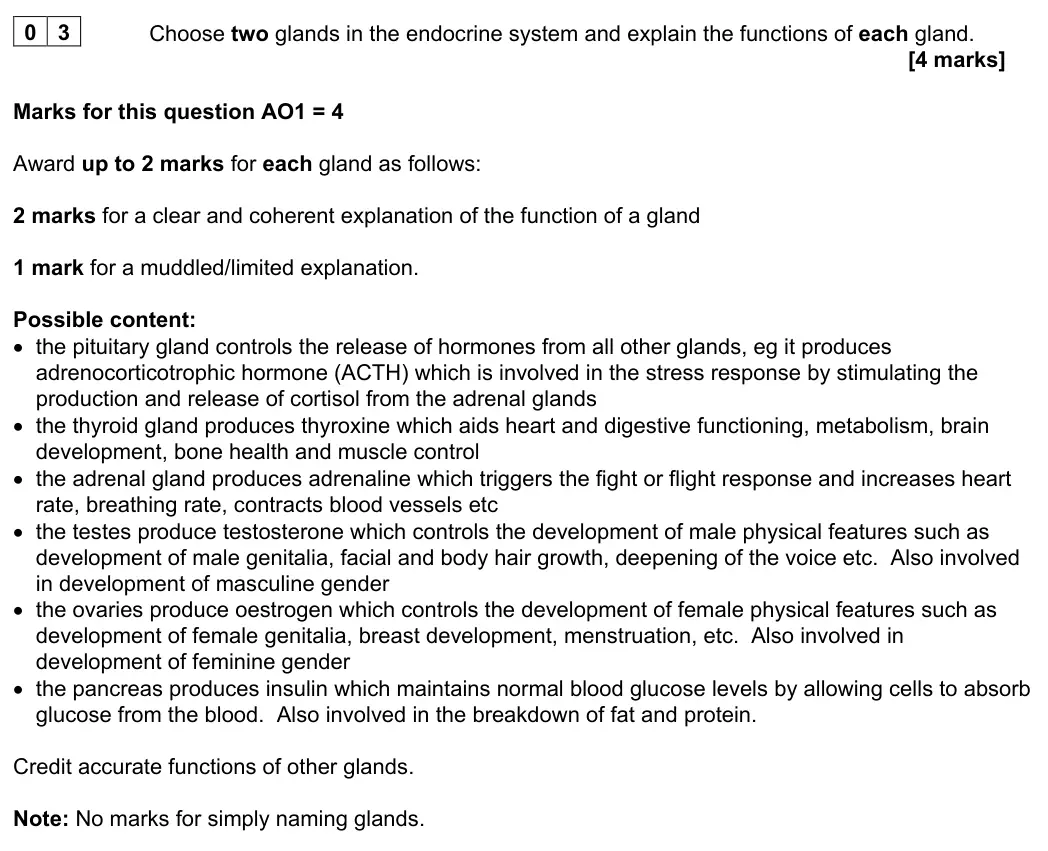
June 2023 · AS Paper 2 · Q34 marksAO1=4Explain
Mark scheme, including level descriptors and indicative content
Examiner's comment
Many students appeared to have a sound knowledge of the endocrine system and were able to effectively explain the functions of two glands. As adrenaline is named on the specification, many students understandably chose the adrenal gland as one of their choices and focused upon its function in the fight or flight response. However, some students appeared to confuse the role of the adrenal gland (and the hormones it produces) and the role of the sympathetic nervous system. It is important that they understand the functional differences of these in the fight or flight response.
Notes from the mark scheme and report
2 marks per gland
no marks for simply naming glands
e.g. pituitary (ACTH), thyroid (thyroxine), adrenal (adrenaline), testes, ovaries, pancreas
confusion of adrenal gland role with sympathetic nervous system
June 2023 · Paper 2 · Q86 marksAO1=3, AO2=3Application
Mark scheme, including level descriptors and indicative content
Examiner's comment
This question was generally well answered. Most students were able to demonstrate some understanding of the fight-flight response and apply this to the stem of the question to achieve marks in level 2 or 3. The question discriminated well between students who could describe an overview of the fight-flight response, rewording the question stem to recite the symptoms as evidence of the fight-flight response, and those who genuinely understood the process and were able to provide well written and detailed descriptions with effective use of terminology and application, where the biological bases of the symptoms described were discussed. Generally, students demonstrated good knowledge of the effects of activating the sympathetic and parasympathetic nervous system and the role of adrenaline. However, for some students, there was some muddled understanding of the role of noradrenaline and between the sympathetic and parasympathetic nervous system. The requirement for effective application, with some detail in level 3, often limited students to level 2. Copying phrases from the question stem is not effective application.
Notes from the mark scheme and report
hypothalamus, SNS, adrenal medulla, adrenaline
apply to pounding heart, dry mouth, nausea, shaking, calming after 20 min (PNS)
knowledge only = max 3
copying symptoms from the stem is not effective application
confusion of SNS/PNS and noradrenaline
June 2023 · Paper 2 · Q916 marksAO1=6, AO2=4, AO3=616-mark essay
Mark scheme, including level descriptors and indicative content
Examiner's comment
Students appeared well-prepared for this question, and a wealth of material was produced. The full range of marks was awarded, and marks were well-distributed. It was a good differentiator between students who can recall a prepared answer (or related content) and those who have developed an understanding of the topic and can use their knowledge flexibly to demonstrate their understanding and answer the question fully and holistically. Many students struggled to relate their chosen studies to the question, or did so inappropriately, eg Phineas Gage was often provided as a good example of recovery from trauma. Better answers used studies effectively and evaluated their contributions, but only a few students were able to explain the impact of this on our understanding of plasticity and functional recovery of the brain after trauma. There were some very impressive answers, which demonstrated a real depth and breadth of knowledge and use of research evidence. Effective application was sophisticatedly woven throughout the response. However, application appeared to be a surprisingly challenging skill, potentially fuelled by students relying on prepared material for this question and a lack of ability to use their knowledge flexibly and select studies appropriately to fit the question stem. Many provided application which merely repeated what was given in the question stem, although most students were able to link the inability to produce speech to likely damage in Broca’s area. There was some lack of focus seen where responses concentrated on localisation of function without relating this to plasticity, potentially because of past paper practice on localisation of function. The volume of detailed information recalled (including relevant studies) was very impressive. However, students should be aware that it is often not the volume of material presented but how effective it is which determines the overall mark; with application needing to be discussed appropriately to demonstrate their understanding of the topics and issues within these. Limited responses often described plasticity as changes to the brain, and functional recovery as the brain recovering from an accident or stroke, without further detail. More able students were able to explain the processes involved in functional recovery. Many knew axonal sprouting, reformation of blood vessels and recruitment of homologous areas. The better responses knew several research studies to support their points. Students often knew a wealth of information and research studies, but focussed on describing rather than discussing how this material supported or refuted the arguments posed and/or related to the question stem. This limited effectiveness. Most responses described Maguire et al.’s (2006) taxi driver study with varying degrees of accuracy. Better responses were able to explain how this provided strong evidence for plasticity in adults, not just for young people, therefore disputing Xavier’s comments. Likewise, the Bezzola et al. (2012) golfing study was often discussed effectively as evidence for plasticity at any age, with Schneider et al.’s (2014) cognitive reserve study discussed in relation to the number of years of education being lower the younger Xavier was, and thus the potential for disability free recovery. Occasionally phantom limb research was discussed in terms of plasticity in somatosensory cortex, and thus the counterargument to Xavier being unaffected because he was young.
Notes from the mark scheme and report
plasticity and functional recovery (neuronal unmasking, axonal sprouting, recruitment of homologous areas)
apply to Xavier (age) and teacher (incomplete recovery, Broca's area)
discussion via case studies, animal studies, age, cognitive reserve, gender
Phineas Gage wrongly used as recovery example
application often just repeated the stem
June 2022 · AS Paper 2 · Q14 marksAO1=4Explain
Mark scheme, including level descriptors and indicative content
Examiner's comment
Some wrote excessive amounts of content, which was particularly noticeable in questions 1, 5 and 8. There were some detailed and thorough responses to this question, but others simply involved a general description of the structure of a neuron or a synapse, rather than being clearly focussed on the process of synaptic transmission as the question demanded. A significant minority of students wrote excessive amounts of relevant content and used all the extra space as well as additional space at the back of the question paper. Although students did not lose marks for this, they did potentially lose valuable time which could have been better spent elsewhere.
Notes from the mark scheme and report
focus on the process, not structure of a neuron/synapse
credit labelled diagram with direction of transmission, excitation/inhibition
June 2022 · AS Paper 2 · Q26 marksAO1=3, AO2=3Application
Mark scheme, including level descriptors and indicative content
Examiner's comment
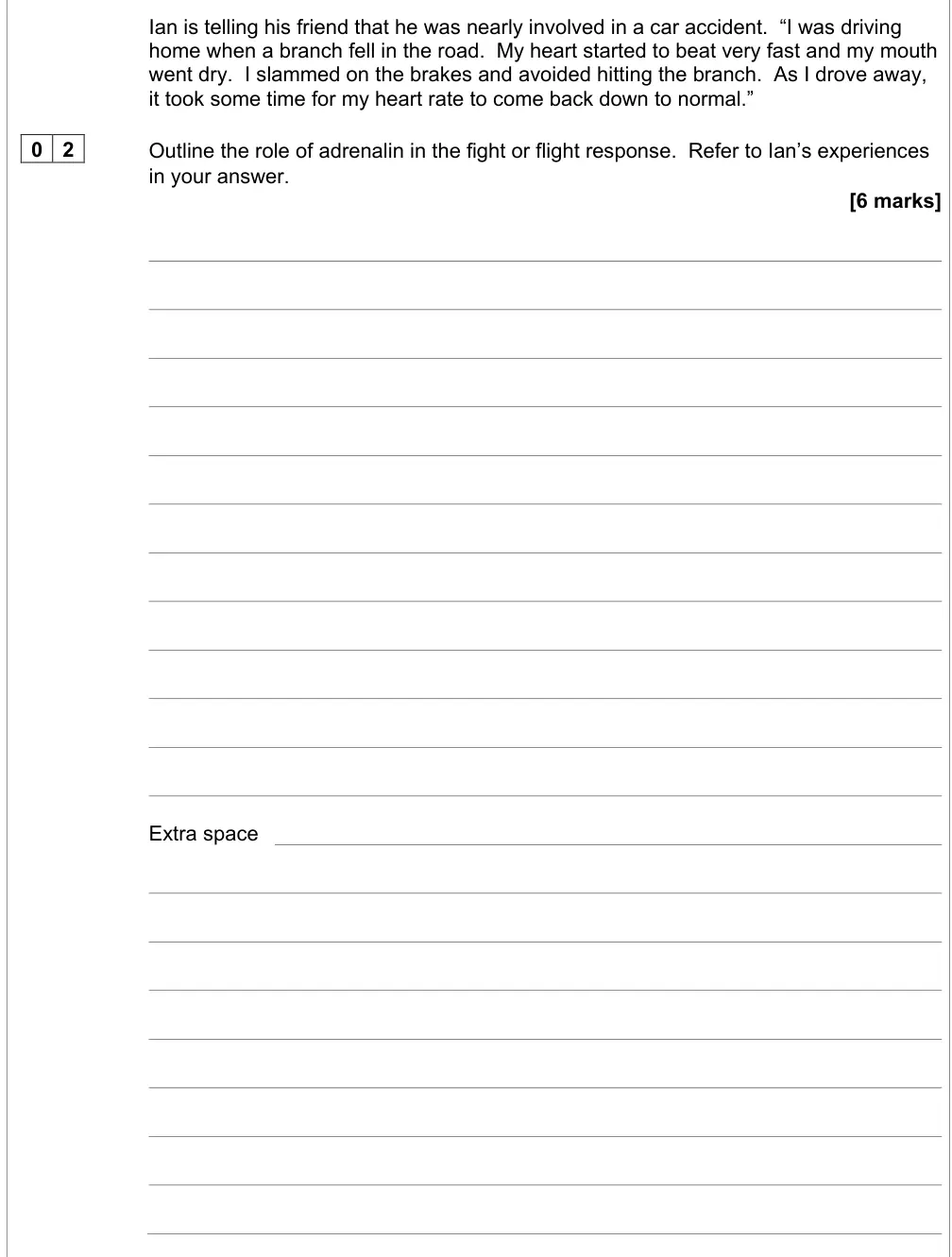
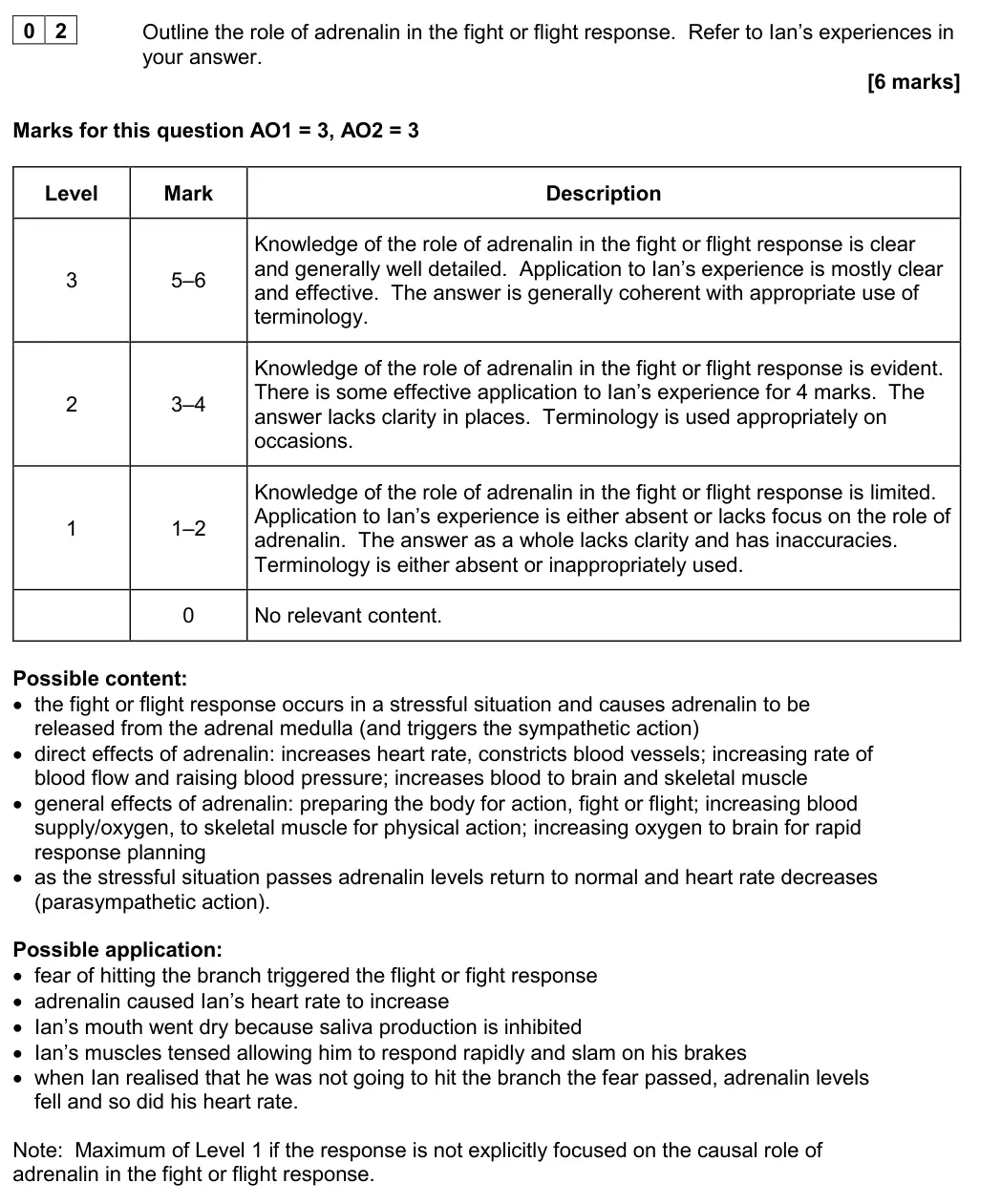
Students produced some lengthy and, at times, detailed responses to this question. However, as in previous series, there was some confusion between hormones and neurotransmitters. Some students gave lengthy descriptions of the fight or flight response and so were focussed on the action of the nervous system rather than the role of adrenaline as the question demanded. It is important that students read the question carefully and understand the demands of the question before they attempt a response.
Notes from the mark scheme and report
max Level 1 if not explicitly focused on the causal role of adrenaline
confusion of hormones with neurotransmitters
describing the nervous system's fight-or-flight action instead of adrenaline
June 2022 · Paper 2 · Q51 markAO1=1Multiple choice
Answer
D
Mark scheme, including level descriptors and indicative content
Examiner's comment
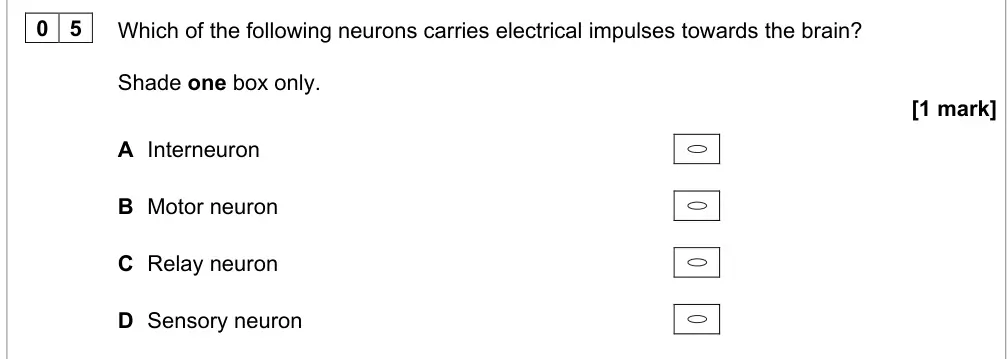
This question was generally well answered with most students selecting the correct response. The most common incorrect response was distractor C.
Notes from the mark scheme and report
correct answer D (sensory neuron)
most common wrong answer C (relay)
June 2022 · Paper 2 · Q61 markAO1=1Multiple choiceEasy
Answer
A
Mark scheme, including level descriptors and indicative content
Examiner's comment
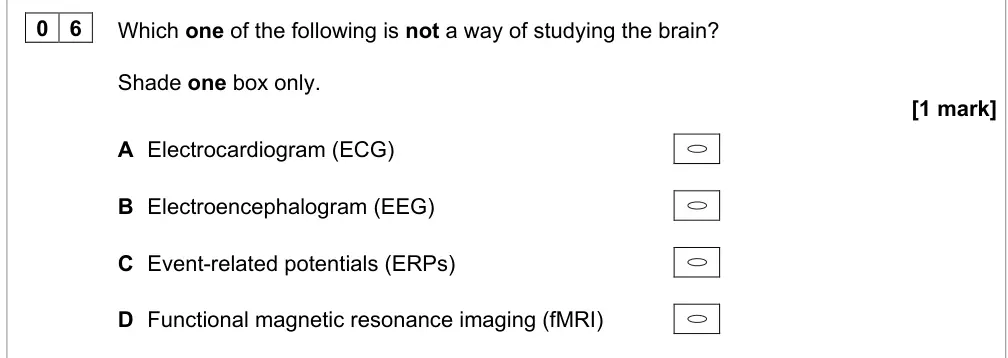
This question was generally very well answered with the majority of students selecting the correct response. The most common incorrect response was distractor C.
Notes from the mark scheme and report
correct answer A (ECG is NOT a way of studying the brain)
most common wrong answer C
June 2022 · Paper 2 · Q76 marksAO1=6Outline
Mark scheme, including level descriptors and indicative content
Examiner's comment
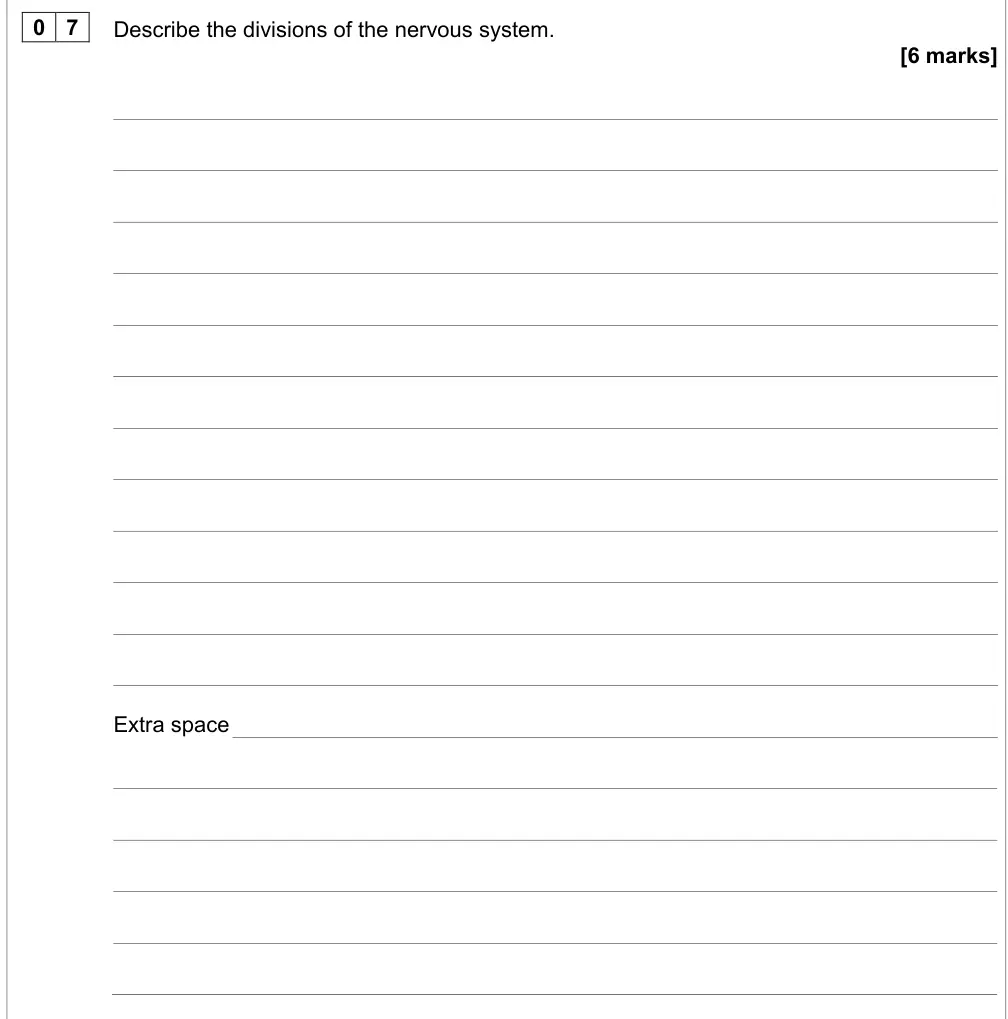
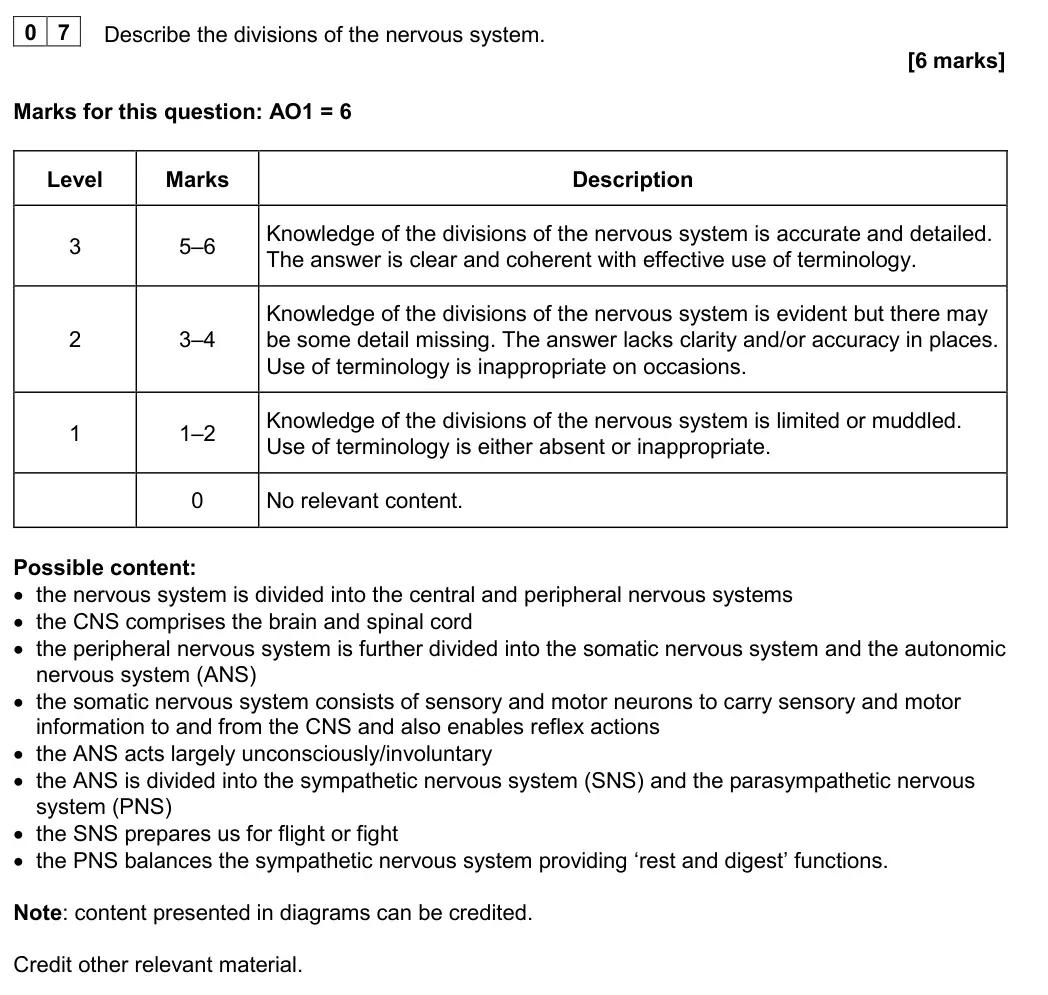
This question discriminated well, with the full range of marks seen. Most students seemed to have prepared for this question and generally demonstrated excellent knowledge of the nervous system, with some good detail and use of specialist terminology. The discriminator here was accuracy. A frequent confusion was seen between the functions of the sympathetic and parasympathetic nervous systems.
Notes from the mark scheme and report
CNS (brain, spinal cord) and PNS, somatic and autonomic, sympathetic and parasympathetic with functions
diagrams creditable
accuracy discriminated
frequent confusion of sympathetic and parasympathetic functions
June 2022 · Paper 2 · Q816 marksAO1=6, AO3=1016-mark essay
Mark scheme, including level descriptors and indicative content
Examiner's comment
Students demonstrated an excellent knowledge and understanding of localisation of function in the brain, giving detailed accounts of the various lobes and their functions. They also showed detailed understanding of Broca’s and Wernicke’s areas and where these are located. The evaluative discussion was more varied. Stronger evaluative responses incorporated good lines of argument to create analysis, using research evidence and linking this back to the theory. Many weaker responses limited evaluation to descriptions of case studies, such as Phineas Gage, before providing generic evaluative points regarding population validity, etc, which lacked focus. Some used Sperry’s research as evaluation, describing and/or evaluating the research without linking it to localisation. Teachers should continue to encourage students to use evidence effectively to evaluate how it supports or refutes the theory, and the impact of this and any counterarguments, as opposed to simply describing or stating the supporting/critical research.
Notes from the mark scheme and report
motor, somatosensory, visual, auditory, language centres
discussion via case studies and scanning evidence, holism/equipotentiality, plasticity, gender differences, reductionism
AO3 = 10
weak answers described Phineas Gage then gave generic population-validity points
Sperry used without linking to localisation
November 2021 · Paper 2 · Q66 marksAO1=6Outline
Mark scheme, including level descriptors and indicative content
Examiner's comment
Overall, descriptions of the structure of a neuron were generally accurate but the function was less well addressed. Although some students muddled terminology, there were some really excellent descriptions relating structure to function with an impressive level of detail. There was a range of approaches to answering this question, some described a reflex arc, others described the structural and functional differences between different types of neuron and others focused on the general structure of a neuron. These were all creditworthy and there were different ways to achieve the 6 marks depending on the depth/breadth of knowledge presented. Unfortunately, some students described the process of synaptic transmission rather than focusing their response on the question given. Surprisingly few diagrams were seen. Students should be reminded that they can gain credit for information presented in a diagram and should be encouraged to use diagrams to help explain the structure for both clarity and to avoid wasting precious examination time writing lengthy descriptions.
Notes from the mark scheme and report
both structure (soma, dendrites, axon, myelin, terminal boutons) AND function needed - only one = max 4
sensory/relay/motor and reflex arc approaches credited
describing synaptic transmission instead
diagrams creditable but rarely used
November 2021 · Paper 2 · Q72 marksAO1=2OutlineEasy
Mark scheme, including level descriptors and indicative content
Examiner's comment
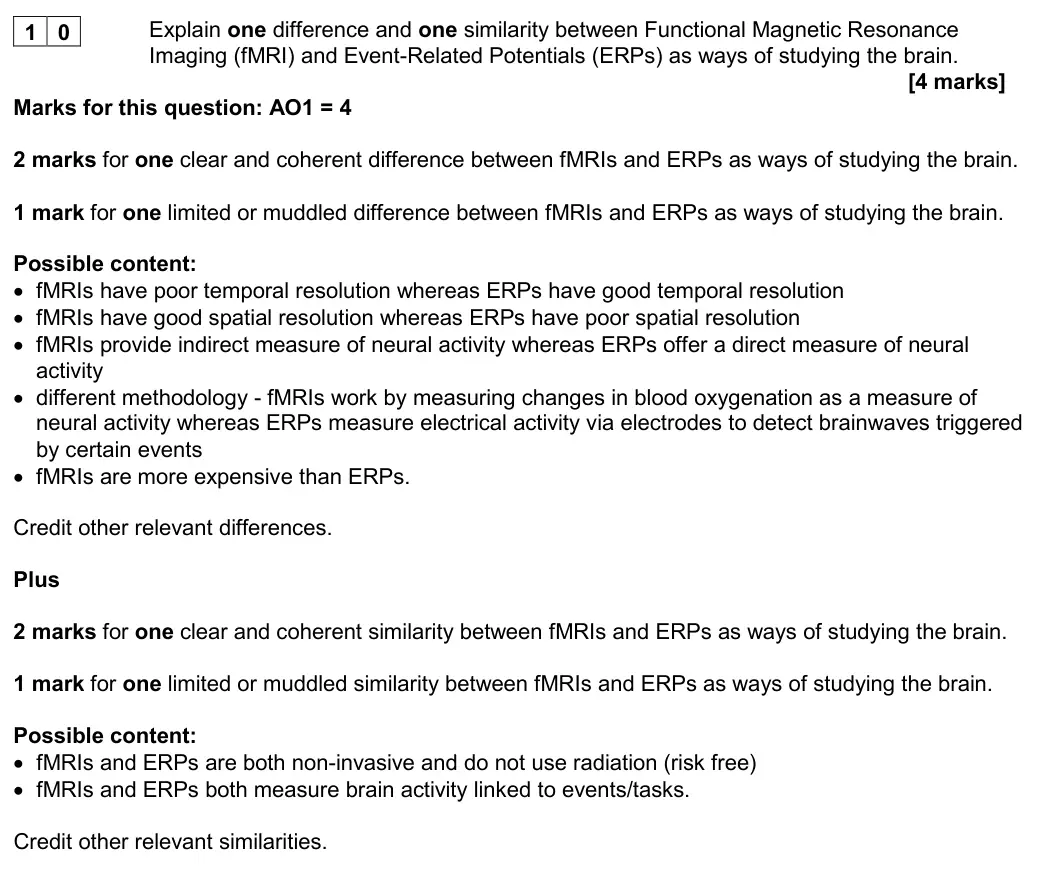
This was a generally well answered question with the majority of students achieving full marks. Most answers focused on the first bullet point in the mark scheme. Some students gave differences based on functional differences reported from imaging studies, which were also creditworthy. The most common error on this question was muddling the function of Broca’s area and Wernicke’s area.
Notes from the mark scheme and report
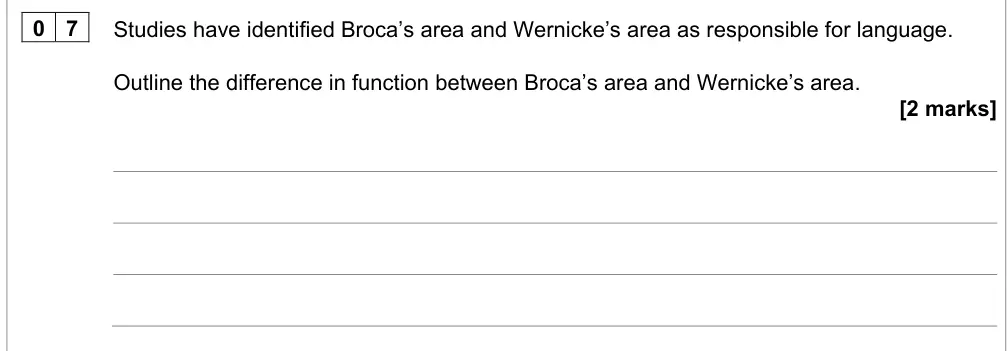
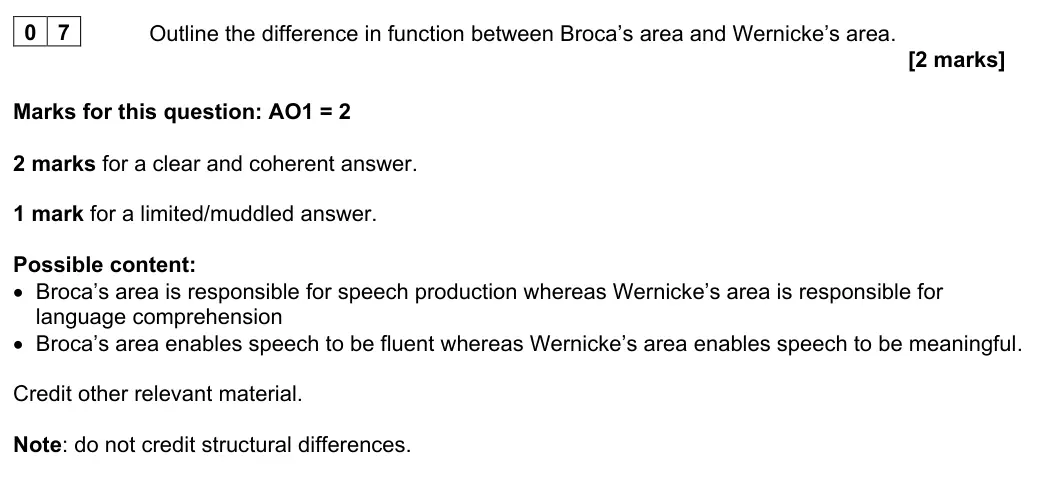
Broca = speech production, Wernicke = language comprehension
structural differences not credited
most common error muddling the two
November 2021 · Paper 2 · Q816 marksAO1=6, AO3=1016-mark essay
Mark scheme, including level descriptors and indicative content
Examiner's comment
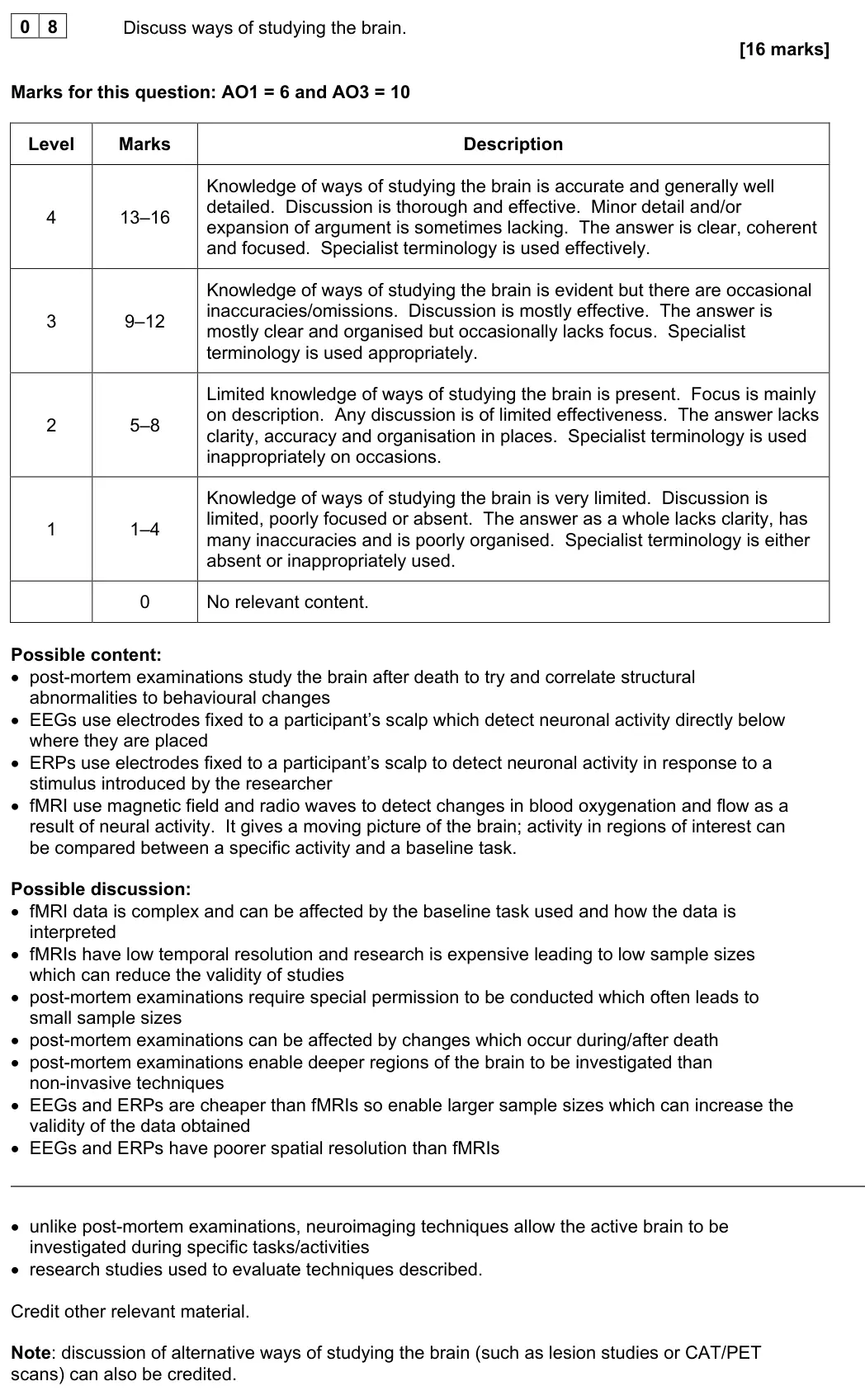
This question discriminated well, with the full range of marks achieved across the cohort, with six being the mean mark awarded. Most students could generally identify relevant ways of studying the brain. Higher-attaining students focused on fMRIs, EEGs, ERPs, and post-mortem examinations, describing how these could be used to study the brain and offering effective evaluation and comparison between these. Lower-attaining students discussed more general ways of studying the brain through material taught elsewhere on the specification. There was a clear breadth/depth trade off, with some students focusing on descriptions of four or more ways of studying the brain at the expense of their discussion. Students should be reminded of the need to select material carefully, being aware of the breadth/depth trade off and the importance of effective evaluation. There was some confusion between EEG and ERP and lower-attaining students often overly focused on ethical issues of post-mortem examinations. Encouragingly temporal and spatial resolution were used more effectively and accurately than seen in previous series.
Notes from the mark scheme and report
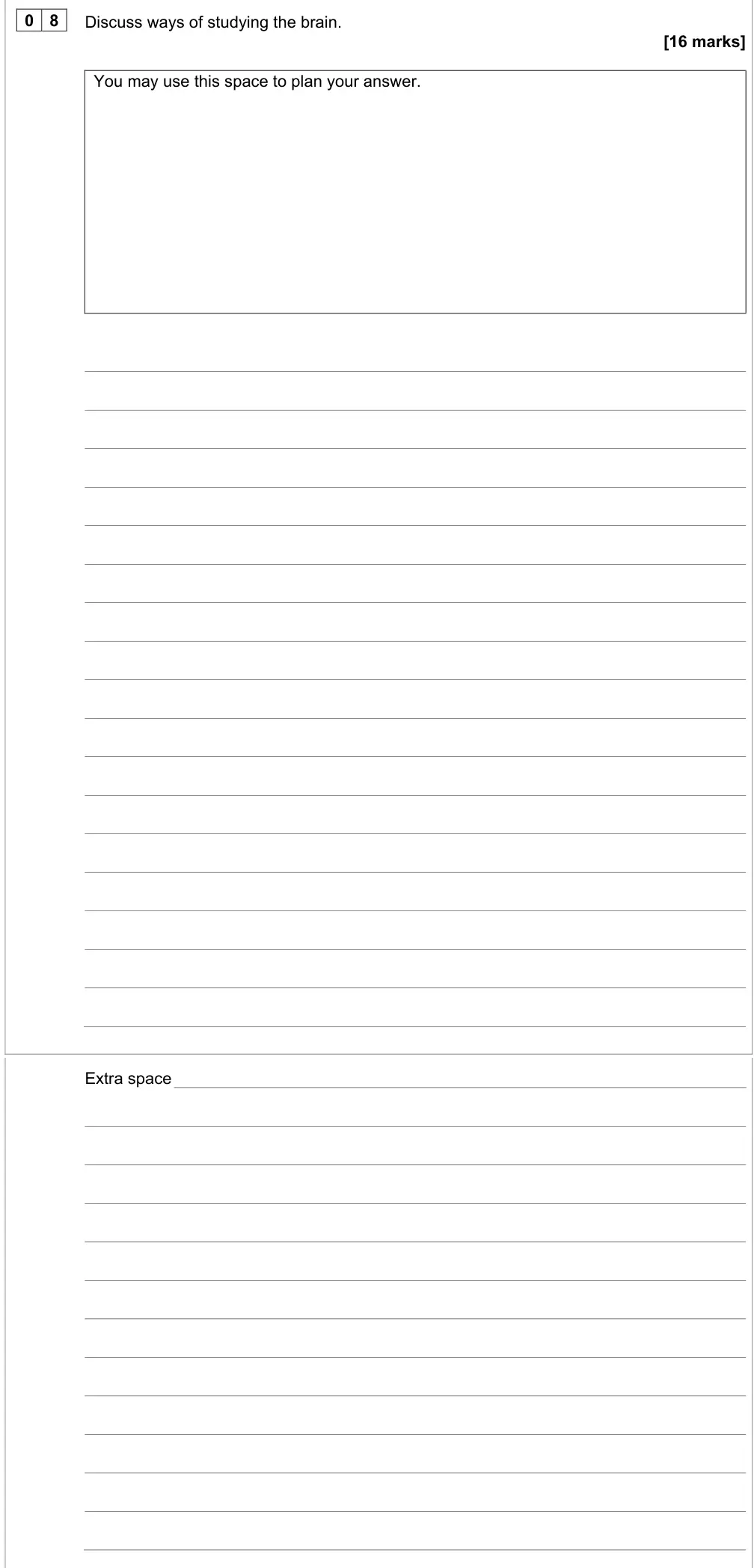
fMRI, EEG, ERP, post-mortem
discussion via spatial/temporal resolution, cost, sample size, active vs dead brain
AO3 = 10 so discussion dominates
breadth/depth trade-off
lesion studies, CAT/PET also creditable
confusion of EEG and ERP
over-focus on ethics of post-mortems
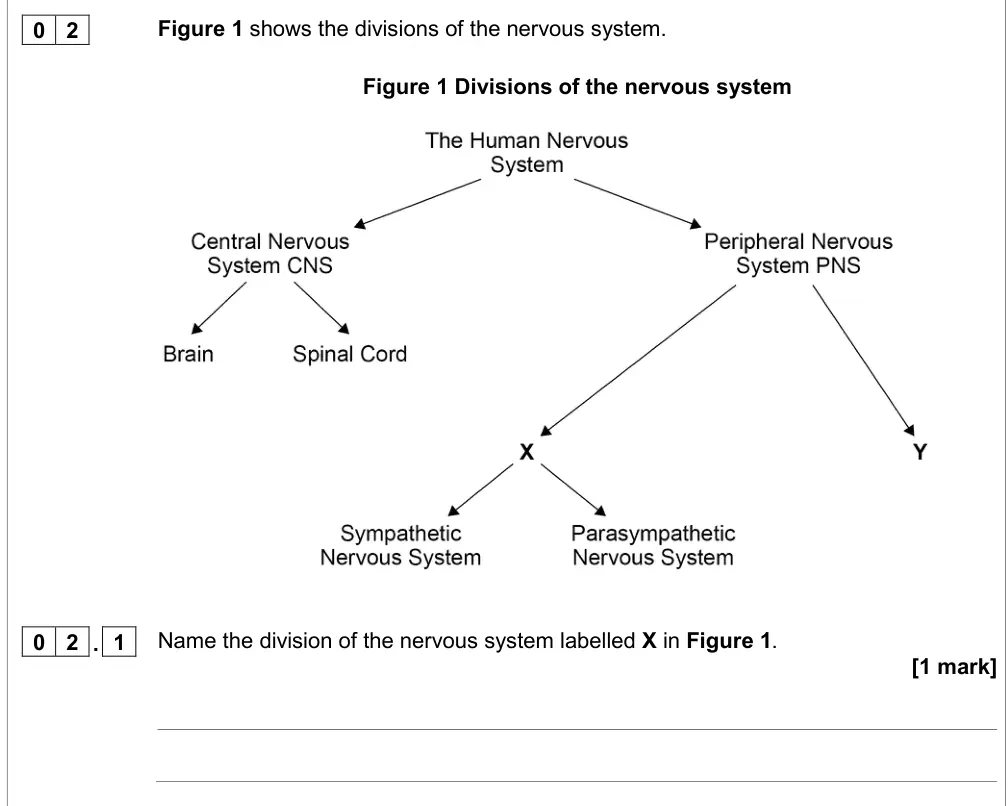
November 2020 · AS Paper 2 · Q2.11 markAO1=1Short answer
Mark scheme, including level descriptors and indicative content
Notes from the mark scheme and report
X = autonomic nervous system
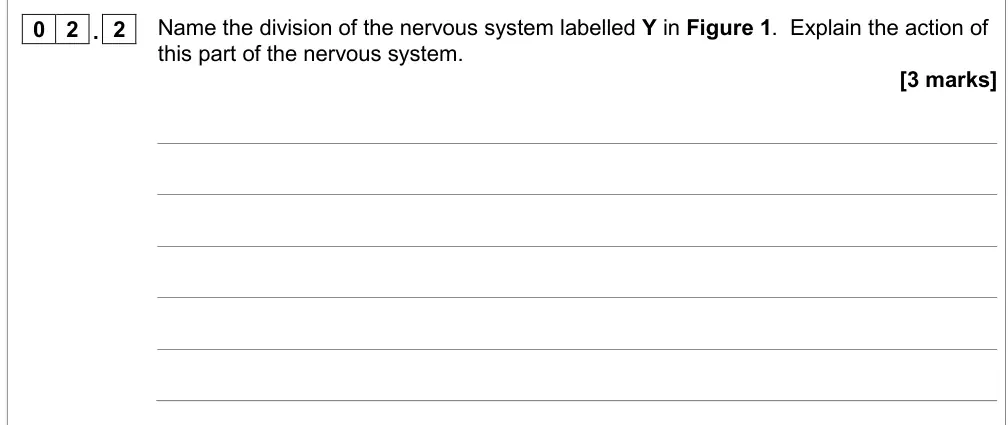
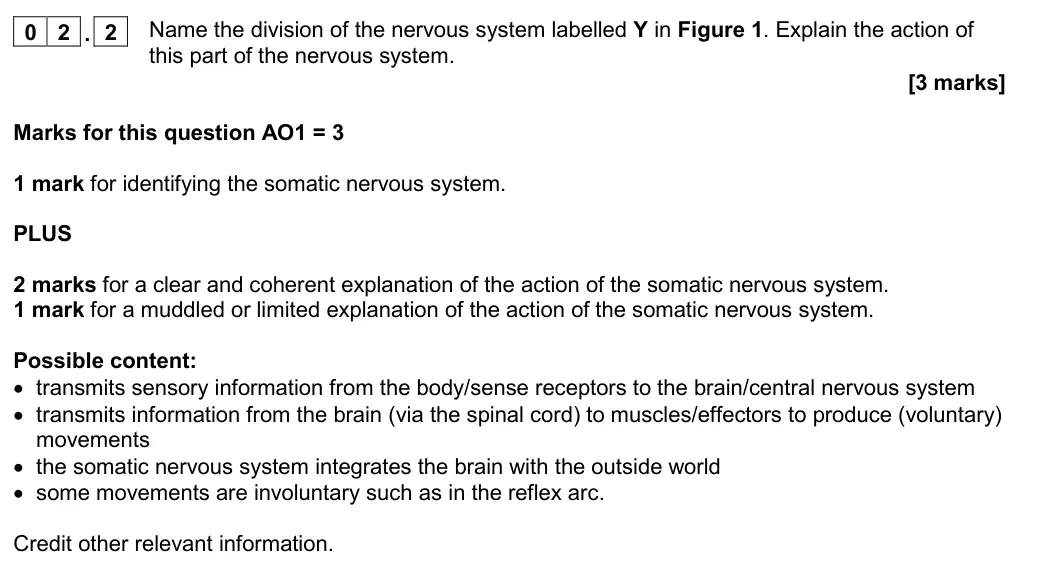
November 2020 · AS Paper 2 · Q2.23 marksAO1=3Explain
Mark scheme, including level descriptors and indicative content
Notes from the mark scheme and report
1 mark somatic nervous system + 2 marks action (sensory information to CNS, CNS to muscles for voluntary movement, reflex arc)
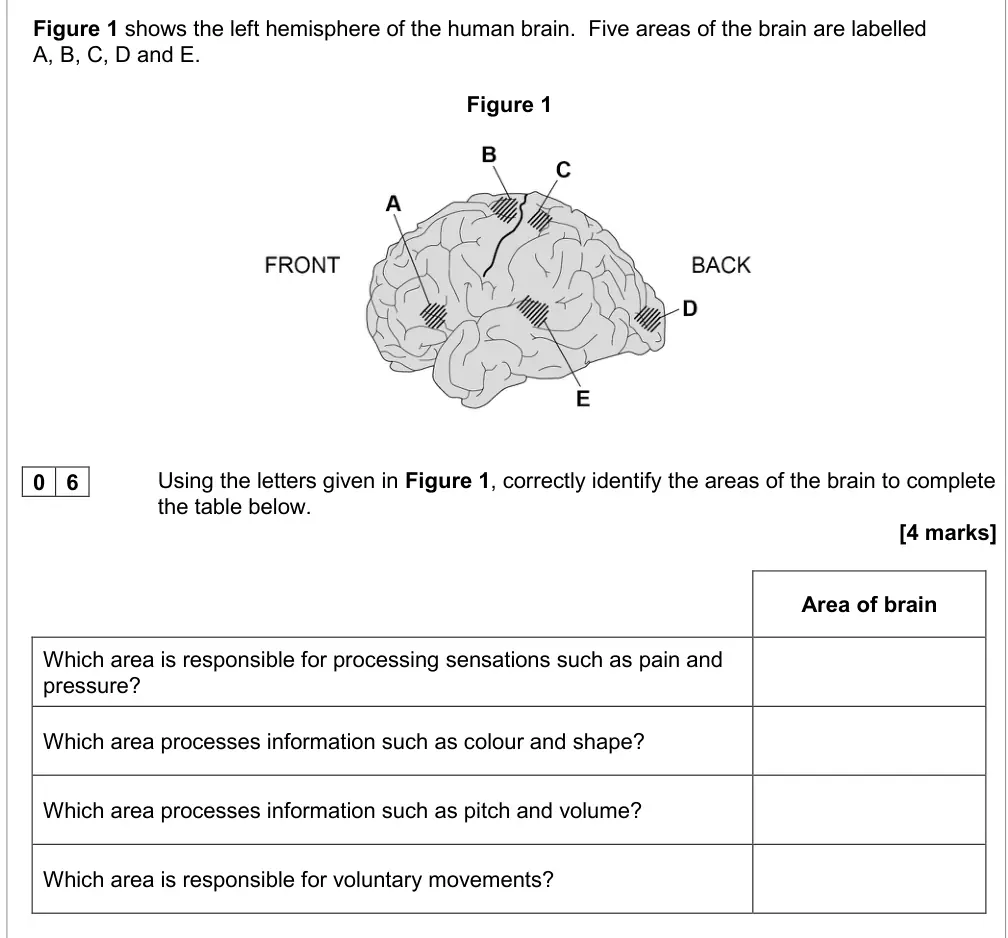
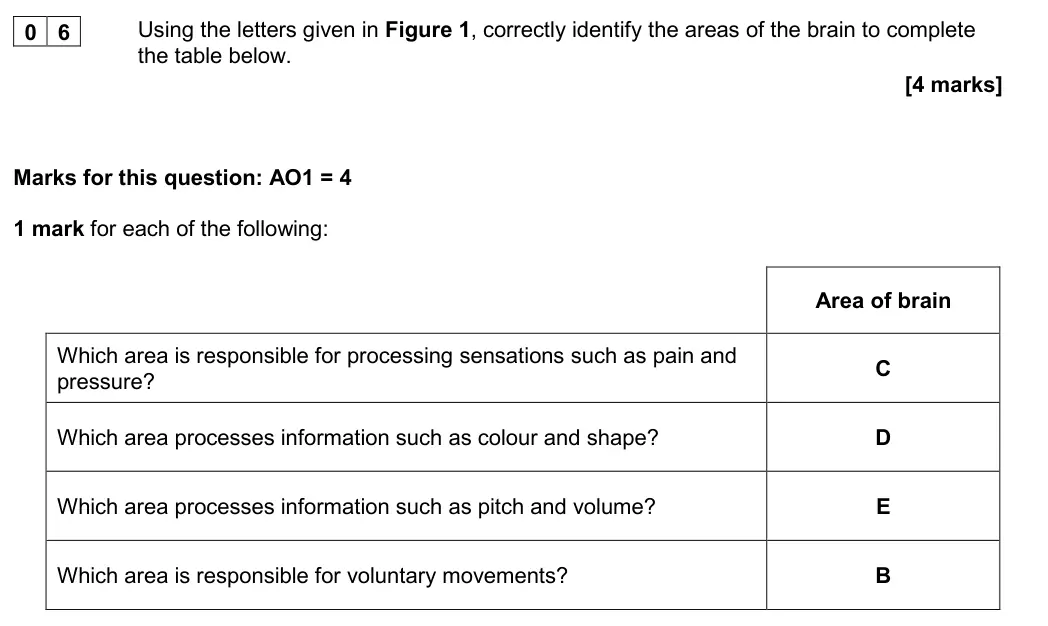
November 2020 · Paper 2 · Q64 marksAO1=4Multiple choice
Answer
C and D and E and B
Mark scheme, including level descriptors and indicative content
Examiner's comment
It was pleasing to see many correct answers to this challenging question with a modal mark of 4; however, there was a wide range of incorrect responses. A number of students wrote names of areas rather than identifying areas by giving the appropriate letters, suggesting that they either did not read the instructions provided in the question or more likely that they lacked knowledge of the neuroanatomical localisation of the functions. The most common muddle was between B and C but B and A were also frequently confused.
Notes from the mark scheme and report
four letters from the brain diagram: somatosensory (C), visual (D), auditory (E), motor (B)
writing area names instead of letters
B/C and B/A most commonly confused
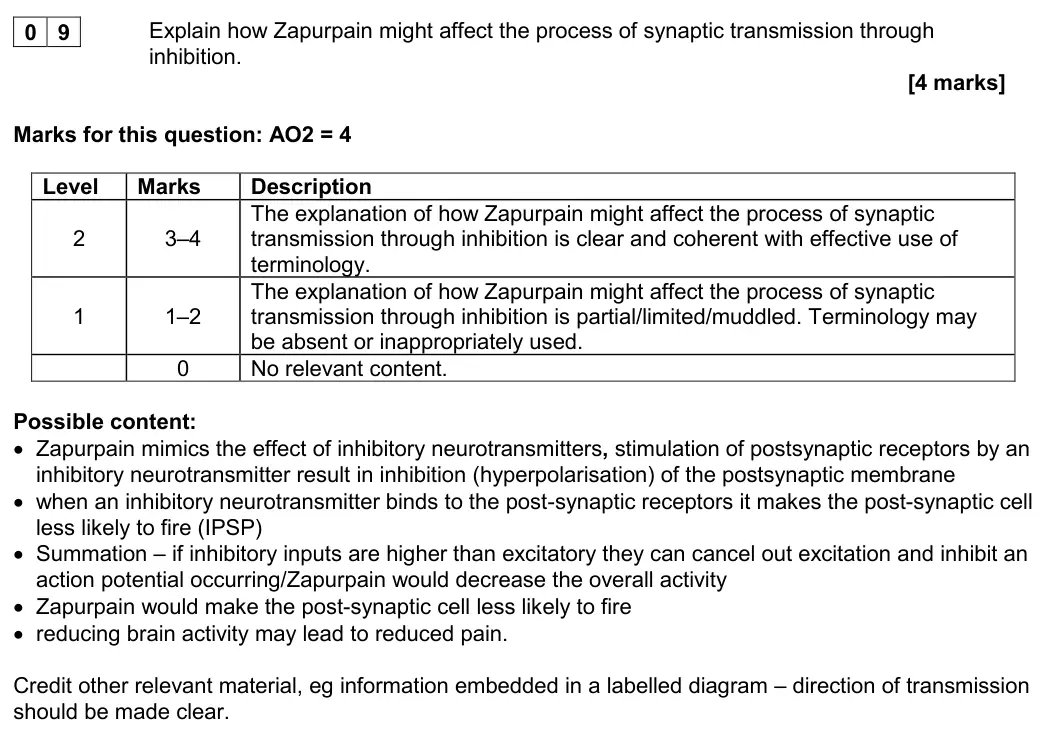
November 2020 · Paper 2 · Q94 marksAO2=4Application
Mark scheme, including level descriptors and indicative content
Examiner's comment
This was a challenging question which highlighted a general lack of understanding of inhibition. The majority of responses fitted the level 1 description mainly due to muddling processes and/or using inappropriate terminology. Surprisingly few students discussed IPSPs or the effect of inhibition on summation; those that did this accurately generally achieved full marks. There were some impressive neurobiological responses discussing the impact of inhibition on the permeability of the post-synaptic membrane to chloride and potassium ions and the consequential hyperpolarisation of the membrane and subsequent difficulty reaching threshold to initiate an action potential. However, too many students described inhibition as a slowing down of action potentials, failing to grasp the ‘all or nothing’ principle.
Notes from the mark scheme and report
inhibitory neurotransmitter mimicked: hyperpolarisation/IPSP, summation, post-synaptic neuron less likely to fire
many described inhibition as slowing action potentials (ignoring all-or-nothing)
few mentioned IPSPs or summation
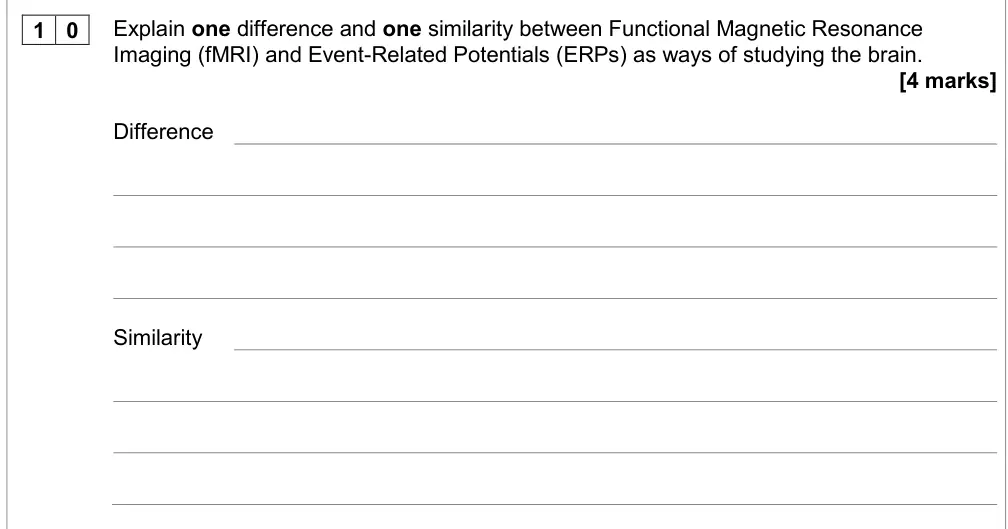
November 2020 · Paper 2 · Q104 marksAO1=4Explain
Mark scheme, including level descriptors and indicative content
Examiner's comment
Most students demonstrated some understanding of fMRIs and ERPs and were able to present a difference and a similarity, although these were often limited. Generally, differences were presented better than similarities. Good responses generally focussed on the differences in spatial/temporal resolution and similarities in being able to measure brain activity linked to specific tasks.
Notes from the mark scheme and report
difference (temporal/spatial resolution, indirect vs direct measure, blood oxygenation vs electrical activity) and similarity (non-invasive, activity linked to tasks), 2 marks each
similarities weaker
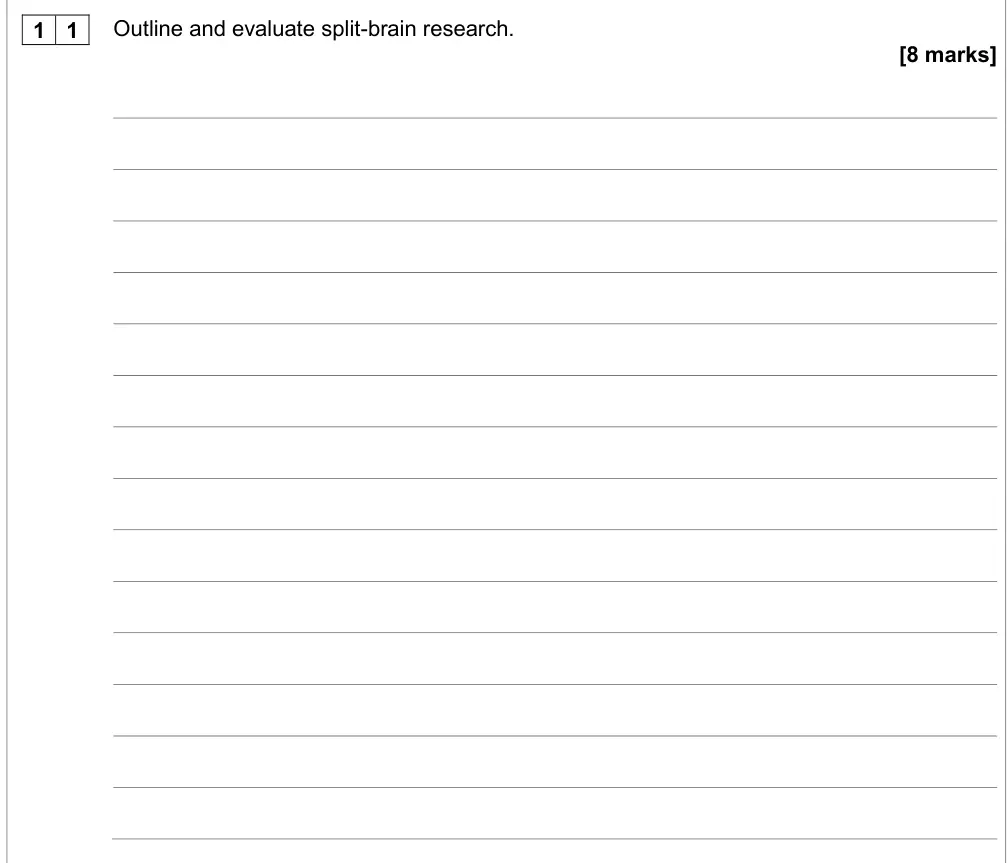
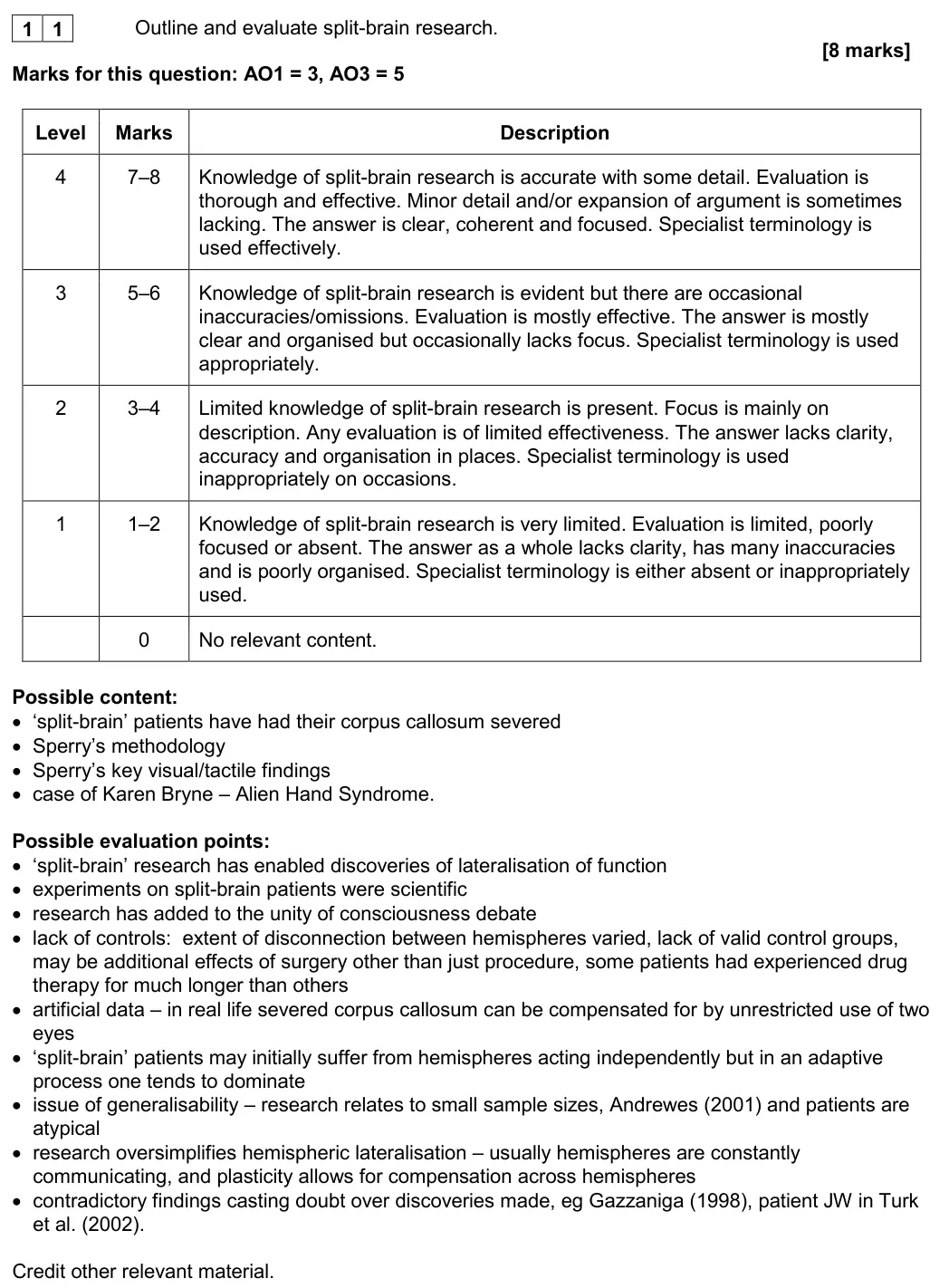
November 2020 · Paper 2 · Q118 marksAO1=3, AO3=5Extended writing
Mark scheme, including level descriptors and indicative content
Examiner's comment
This question discriminated well. There were some excellent responses, demonstrating accurate and detailed knowledge of split-brain research with relevant evaluation points effectively explained with appropriate use of terminology. Unfortunately, some students confused split brain research with localisation of function providing evidence from case studies such as Phineas Gage. Whilst other students seemed to be trying to repackage pre-learned essays on general hemispheric lateralisation. As in previous series, students often fell in the trap of including detailed knowledge but often with quite limited/generic evaluation which was costly given the division of marks for these skills.
Notes from the mark scheme and report
severed corpus callosum, Sperry's method and findings
evaluation: lateralisation discoveries, lack of controls, small atypical samples, oversimplification, contradictory findings (JW)
confusing with localisation case studies (Phineas Gage)
repackaged lateralisation essays
only 3 AO1 marks
June 2019 · AS Paper 2 · Q14 marksAO1=4Explain
Mark scheme, including level descriptors and indicative content
Examiner's comment
There were some good responses seen to this question, but many others simply involved a general description of the components of the endocrine system rather than clearly being focussed on its function as the question demanded. There was some confusion between hormones and neurotransmitters and some students gave lengthy descriptions of the fight or flight response, focussing on the action of the nervous system rather than the endocrine system.
Notes from the mark scheme and report
hormones released from glands into the bloodstream, bind to receptors to regulate cells/organs
examples (adrenaline)
just listing glands and hormones = max Level 1
confusion of hormones with neurotransmitters
long fight or flight accounts focused on the nervous system
June 2019 · Paper 2 · Q91 markAO1=1Multiple choice
Answer
C
Mark scheme, including level descriptors and indicative content
Examiner's comment
It was pleasing to see that this challenging question was answered correctly by approximately half of the students. The most common incorrect response was B.
Notes from the mark scheme and report
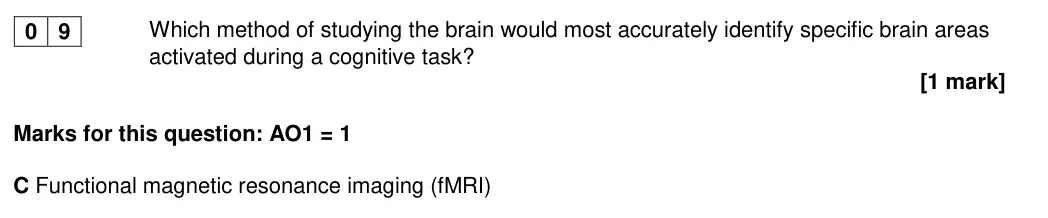
correct answer C (fMRI)
about half correct
most common wrong answer B (ERPs)
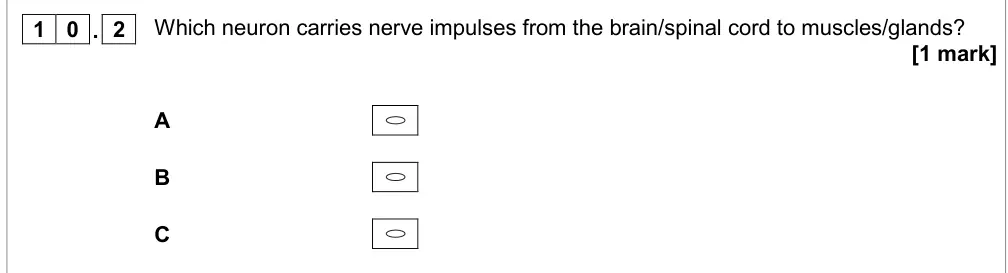
June 2019 · Paper 2 · Q10.11 markAO1=1Multiple choiceMedium
Answer
A
Mark scheme, including level descriptors and indicative content
Examiner's comment
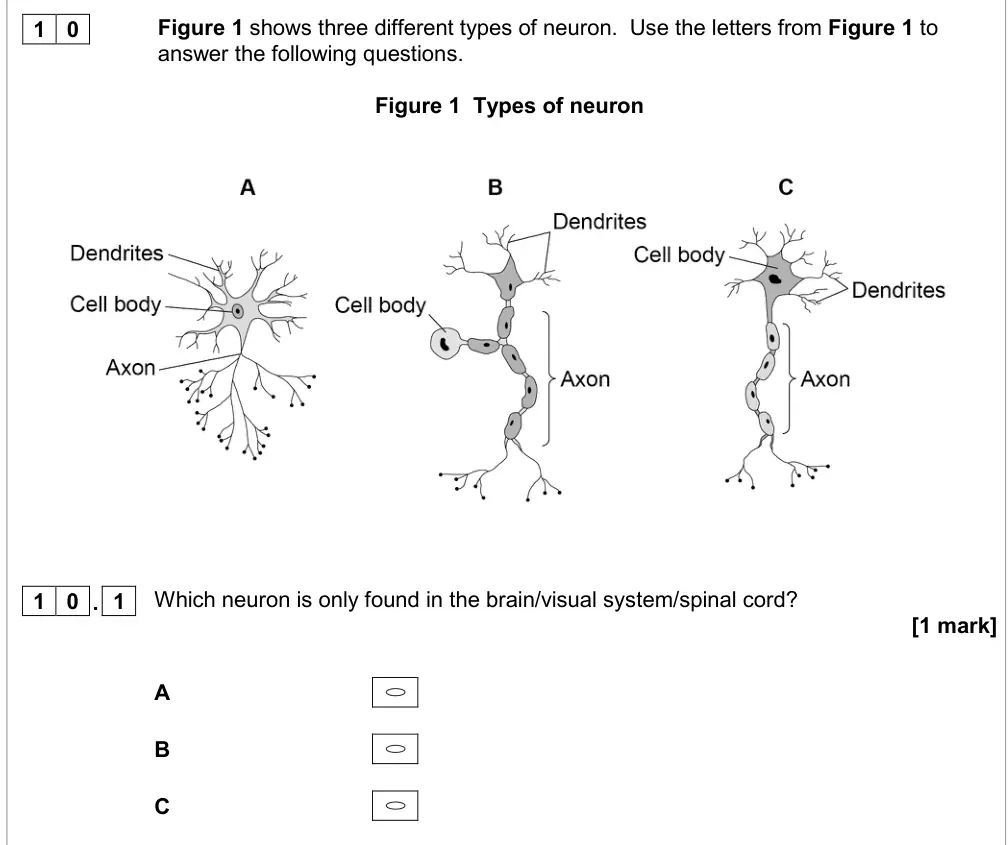
This question proved challenging with only half of the students correctly identifying each of the neurons. Students who correctly identified and labelled the neurons in the figure were then able to respond correctly to the questions regarding function. It appears that students were better at knowing the function of each neuron type rather than the structure of each type of neuron.
Notes from the mark scheme and report
answer A (relay neuron), identified from structural diagram in Figure 1
only about half identified each neuron correctly - students knew function better than structure
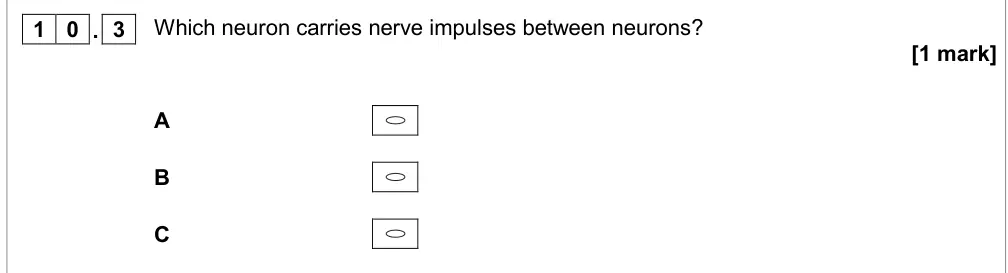
June 2019 · Paper 2 · Q10.21 markAO1=1Multiple choiceMedium
Answer
C
Mark scheme, including level descriptors and indicative content
Examiner's comment
This question proved challenging with only half of the students correctly identifying each of the neurons. Students who correctly identified and labelled the neurons in the figure were then able to respond correctly to the questions regarding function. It appears that students were better at knowing the function of each neuron type rather than the structure of each type of neuron.
Notes from the mark scheme and report
answer C (motor neuron)
June 2019 · Paper 2 · Q10.31 markAO1=1Multiple choiceMedium
Answer
A
Mark scheme, including level descriptors and indicative content
Examiner's comment
This question proved challenging with only half of the students correctly identifying each of the neurons. Students who correctly identified and labelled the neurons in the figure were then able to respond correctly to the questions regarding function. It appears that students were better at knowing the function of each neuron type rather than the structure of each type of neuron.
Notes from the mark scheme and report
answer A (relay neuron)
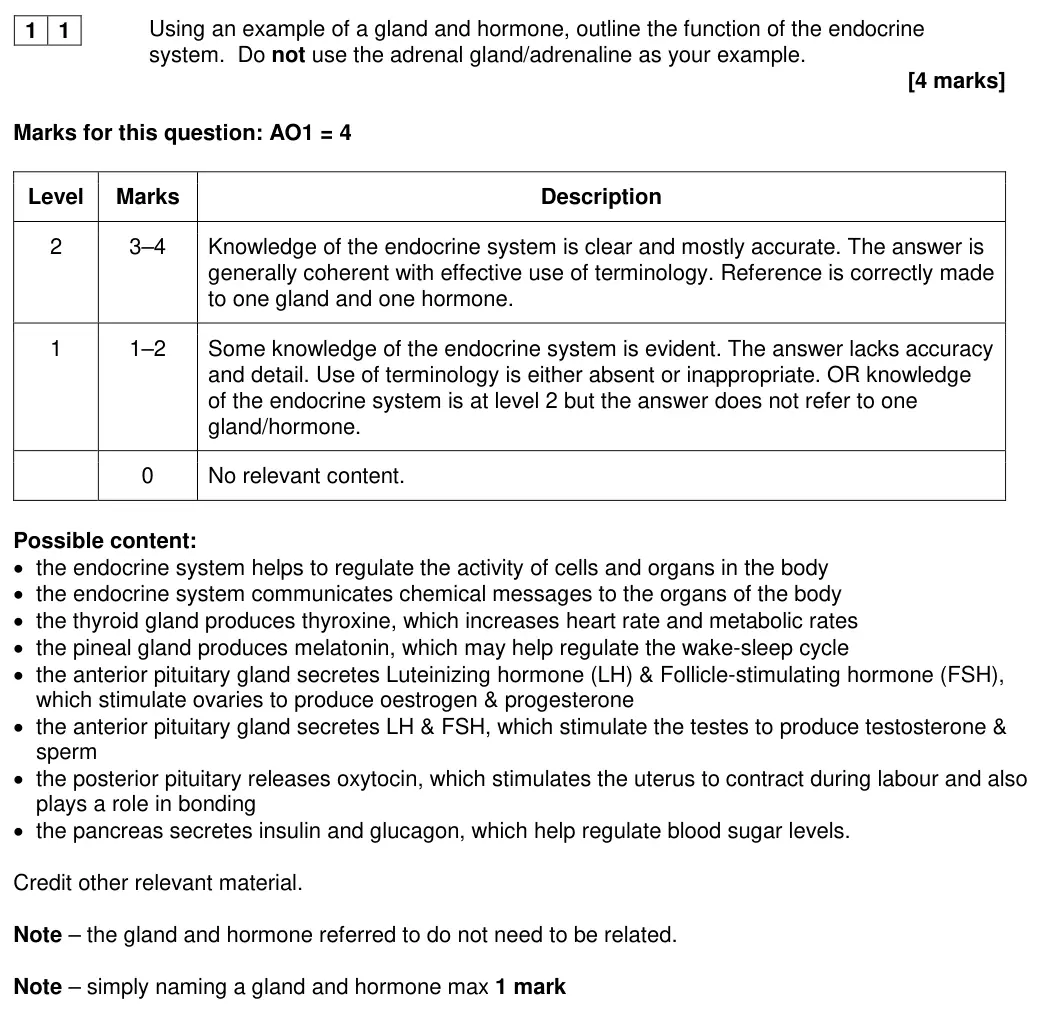
June 2019 · Paper 2 · Q114 marksAO1=4Outline
Mark scheme, including level descriptors and indicative content
Examiner's comment
This question produced mixed responses. Most students were able to identify a gland and a hormone but lacked detail in their answer with many muddling the nervous system with the endocrine system. There were some were very effective responses who gave the overall function of the endocrine system and then went on to give a specific example of this with a named gland and hormone and good use of terminology. However, too many responses focused on describing the endocrine system rather than providing its general function and some referred inappropriately to the adrenal gland/adrenaline in their answer. Students should be encouraged to take their time to read the question carefully, highlighting key words.
Notes from the mark scheme and report
must NOT use adrenal gland/adrenaline
overall function (chemical messages regulating organs) plus one named gland and hormone
simply naming a gland and hormone max 1
gland and hormone need not be related
many muddled nervous and endocrine systems
June 2019 · Paper 2 · Q1216 marksAO1=6, AO2=4, AO3=616-mark essay
Mark scheme, including level descriptors and indicative content
Examiner's comment
Overall, students demonstrated a good breadth and depth of knowledge of hemispheric lateralisation and localisation. It seems a shame that so many students relied on a limited range older research when there is a wealth of fascinating up-to-date research on this subject available. The evaluation generally lacked effectiveness due to limited/generic descriptions of methodological issues or due to providing detailed descriptions of studies to support their point. Unfortunately, many students focused on only providing a detailed outline of Sperry’s split-brain studies with largely generic evaluations. These responses tended to be poorly focused with weak application and the excessively detailed description of the study limited both the breadth of knowledge provided and the opportunities for effective discussion and application. Students should be reminded that only six of the available 16 marks are for knowledge and thus their responses should reflect this. They should be encouraged to focus on how the methodological issues or studies support/refute their point, rather than giving detailed description. Some students tended to struggle with appropriate use of terminology, often muddling hemispheric lateralisation with holistic function, and ecological validity for internal or population validity, as well as confusing different areas of the brain. There were some good discussions of equipotentiality and plasticity, with case studies and research to identify the limitations of oversimplifying the brain to localised functions and the issue of age-related changes. Many students provided weak application often simply stating the research supported or refuted what Sam/Kieran had said. However, there were some excellent cases where they engaged with application well describing how research into localisation of function and lateralisation supported Kieran’s point. More effective answers also covered the more sophisticated interpretation of Sam’s response in terms of the need to coordinate specialised areas of the brain for complex function and to modify networks due to damage or specialised learning, providing detailed research support. More effective responses were able to draw well from other areas of the specification and make these relevant.
application only credited if it goes beyond the stem (e.g. corpus callosum, Broca's area in left hemisphere)
evaluation via plasticity, equipotentiality, generalising from case studies
over-detailed descriptions of Sperry and generic methodological evaluation
only 6 AO1 marks
June 2018 · AS Paper 2 · Q34 marksAO1=4OutlineMedium
Mark scheme, including level descriptors and indicative content
Examiner's comment
This question was answered well by the majority of students who attempted it. Many of these students could correctly identify two glands and the vast majority could correctly identify at least one. Students generally performed less well when outlining the function of the gland and there was some confusion, muddling and/or inaccuracy in some responses. When outlining the function of the gland, students could focus on either the hormones they secreted or on the physiological effect of those hormones. There were many responses which correctly identified and outlined the function of other glands not mentioned on the mark scheme and these were awarded full credit. Unfortunately, there was a significant minority of ‘blank’ responses where no answer was attempted suggesting that some students did not have the knowledge to enable them to answer this question.
Notes from the mark scheme and report
per gland: identify + outline function (thyroid/thyroxine, adrenal/adrenaline, pituitary as master gland
ovaries/testes credited)
function often muddled
many blanks
June 2018 · Paper 2 · Q51 markAO1=1Short answerMedium
Mark scheme, including level descriptors and indicative content
Examiner's comment
This question provided another opportunity to distinguish understanding as opposed to rote learning with just over half of students achieving the mark. There was generally little understanding of the divisions of the nervous system, with many relying on structural differences or muddling functional differences.
Notes from the mark scheme and report
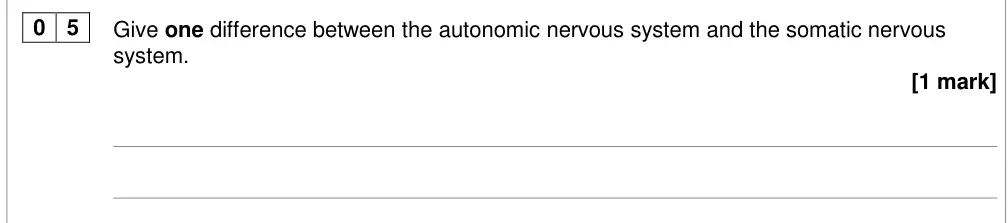
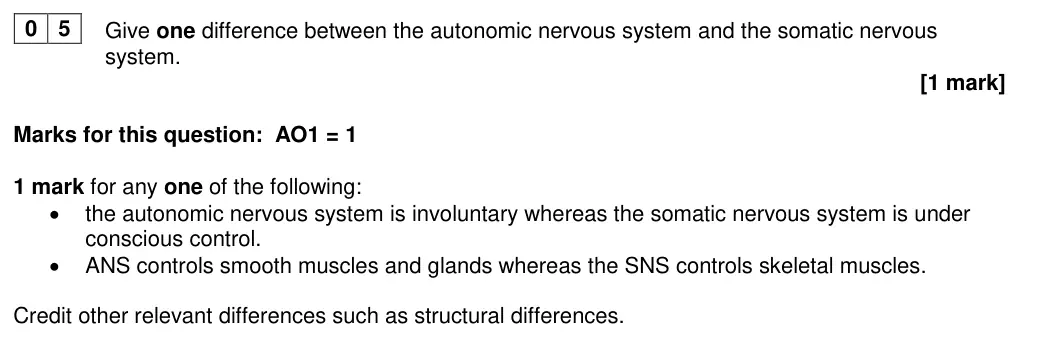
autonomic involuntary vs somatic voluntary, or smooth muscles/glands vs skeletal muscles
just over half correct
June 2018 · Paper 2 · Q63 marksAO1=3Short answerEasy
Mark scheme, including level descriptors and indicative content
Examiner's comment
This question was generally well answered with over 80% of students achieving full marks.
Notes from the mark scheme and report
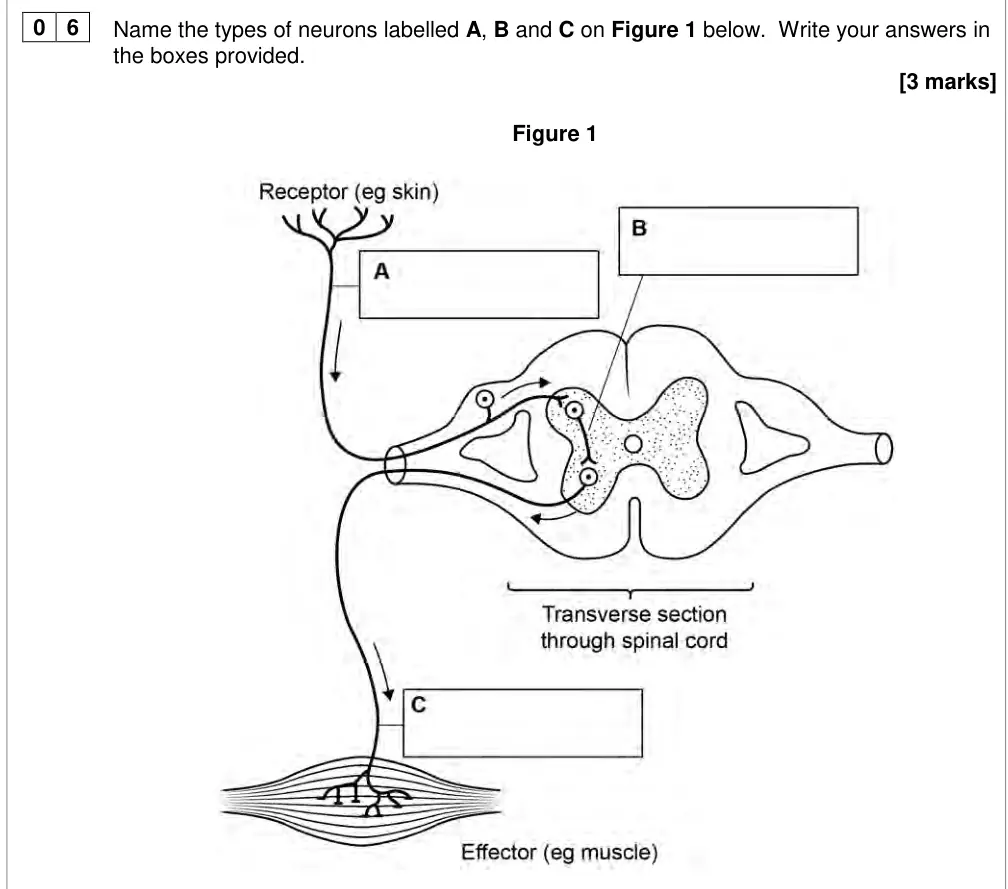
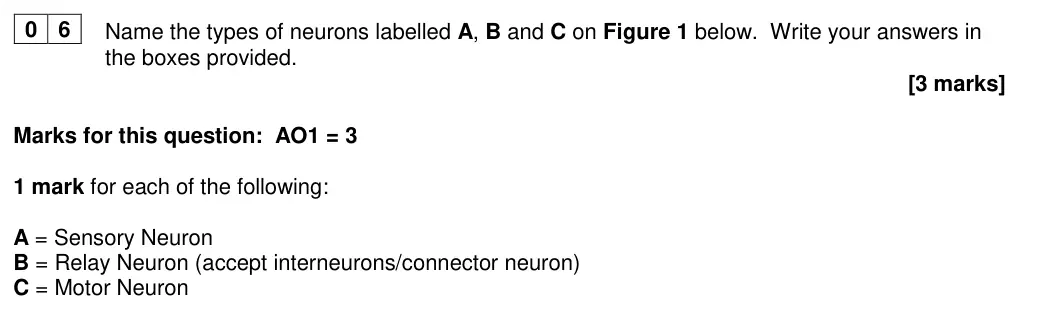
A sensory, B relay (interneuron/connector accepted), C motor, from Figure 1
over 80% full marks
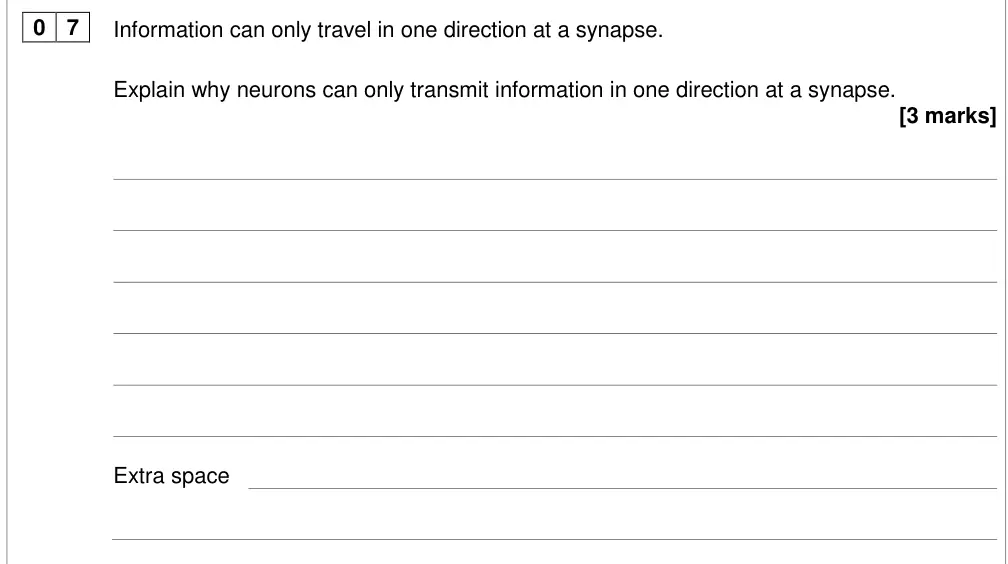
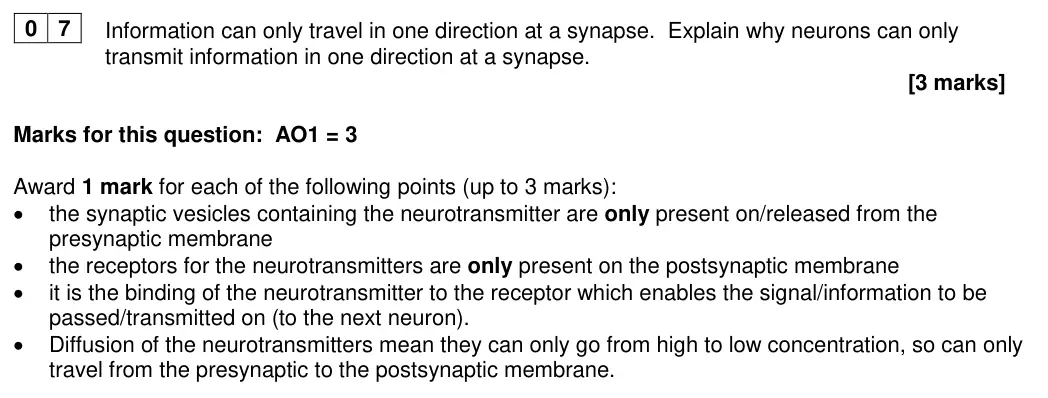
June 2018 · Paper 2 · Q73 marksAO1=3Explain
Mark scheme, including level descriptors and indicative content
Examiner's comment
This question provided an excellent discriminator between students who could recall the process of synaptic transmission and those who genuinely understood the process. A very small number of clear and detailed responses demonstrated sound understanding, but too many students simply explained synaptic transmission instead of using their knowledge to answer the question. Many attempted to address the question but muddled terminology, such as the pre- and post-synaptic membrane, preventing them from achieving the marks. Overall, it appeared that students are learning the required knowledge and terminology but do not understand it well enough to be able to use their knowledge flexibly. Some students gave a biological explanation of why information passes in one direction within a neuron rather than between neurons, focusing on why action potentials are unidirectional, with reference to refractory periods, voltage-gated ion channels and hyperpolarisation. Understanding of the process of synaptic transmission is an area that perhaps teachers need to look at more in the classroom and students should always be prepared to apply their knowledge to explain unfamiliar contexts.
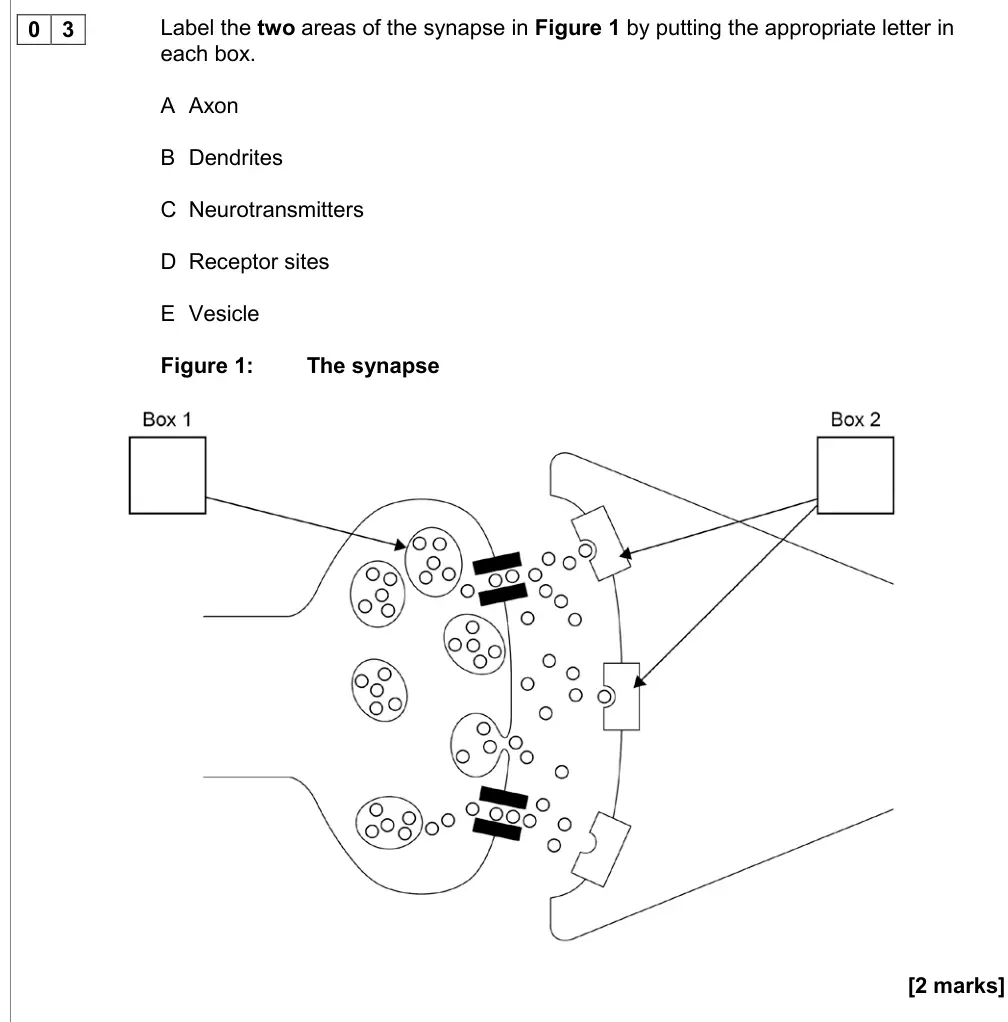
Notes from the mark scheme and report
1 mark each: vesicles only in presynaptic terminal, receptors only on postsynaptic membrane, binding passes the signal, diffusion high to low
many just described synaptic transmission or explained one-way conduction within a neuron
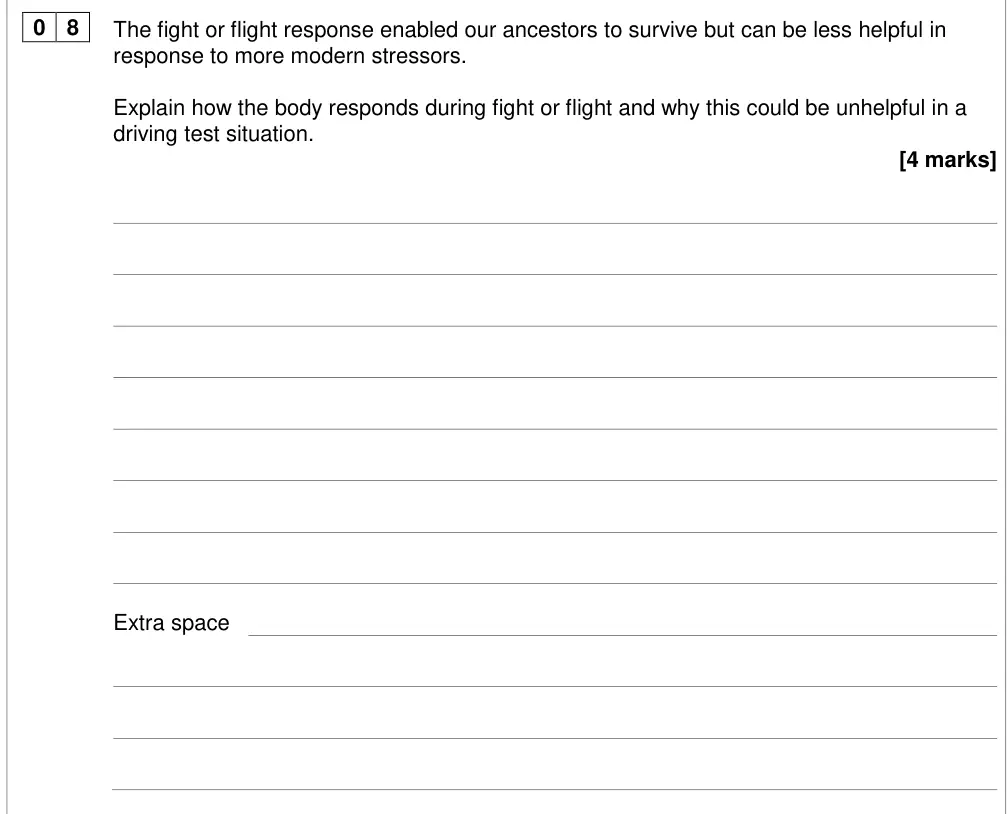
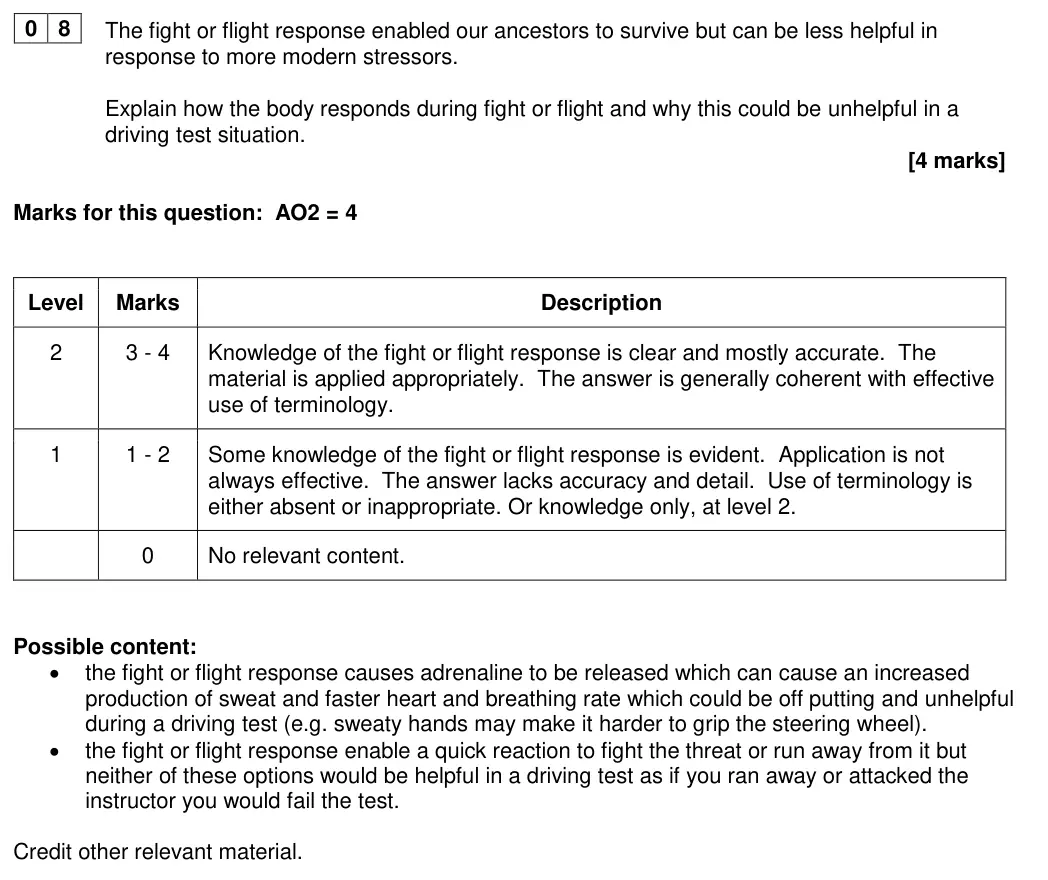
June 2018 · Paper 2 · Q84 marksAO2=4Application
Mark scheme, including level descriptors and indicative content
Examiner's comment
Generally, students seemed to have secured a good knowledge of how the body responds during the fight or flight response but struggled to apply it to the real world. The explanations of the response were generally accurate and often well detailed, although frequently included or were muddled, with reactions to chronic stress. Overall, the application was less successful, with a lot of general comments such as, ‘raised heartbeat would make you nervous/panic’. Many focussed on potential cognitive impairments which were more challenging to link to the way the body responds during fight or flight. Occasionally, students described why the body response would be helpful. Where application was done well, students generally referred to the problems of sweaty palms gripping the wheel, issues of feeling sick due to blood being diverted away from your digestive system and erratic movements.
Notes from the mark scheme and report
adrenaline effects (sweating, heart rate, breathing, digestion) + why unhelpful in a driving test (sweaty hands on wheel, fighting/fleeing would fail)
knowledge only = max Level 1
muddled with chronic stress
general 'makes you nervous' comments
June 2017 · AS Paper 2 · Q23 marksAO1=3OutlineHard
Mark scheme, including level descriptors and indicative content
Examiner's comment
There were some very good responses to this question in which students displayed a good understanding of the fight or flight response. A minority wrote more than sufficient content for full marks. Weaker responses lacked detail and only included a limited amount of information about the processes involved. Some students provided a long list of the physiological effects of the fight or flight response with little else, which limited the mark awarded. A small minority of answers had no focus on biology and simply described the behavioural characteristics of ‘fight’ and ‘flight’, which could not gain any credit.
Notes from the mark scheme and report
1 mark each: hypothalamus, adrenaline from adrenal medulla, sympathetic activation (and parasympathetic return), direct effects of adrenaline
a long list of effects alone limited marks
behavioural 'fight' and 'flight' only = 0
June 2017 · Paper 2 · Q44 marksAO1=4Explain
Mark scheme, including level descriptors and indicative content
Examiner's comment
Questions that discriminated the best were 03, 04, 09, 16, 17 and 21. This question offered good discrimination. There were some very complex and detailed responses that went beyond the requirements of the specification, although these were not always well focussed. Weaker students mainly struggled with either poor focus on the process of synaptic transmission or a lack of specific detail or inaccuracies, especially regarding the use of scientific terminology. Common misunderstandings included vesicles crossing the synaptic gap, action potentials being excitatory/inhibitory, neurotransmitters being ‘fired’ across the gap and confusion between chemical and electrical transmission. Few made use of a diagram and those that did generally were ineffective in explaining the process.
Notes from the mark scheme and report
4 marks need the complete process (beginning, middle, end)
misconceptions: vesicles crossing the gap, action potentials excitatory/inhibitory, confusing electrical and chemical transmission
June 2017 · Paper 2 · Q54 marksAO2=4Application
Mark scheme, including level descriptors and indicative content
Examiner's comment
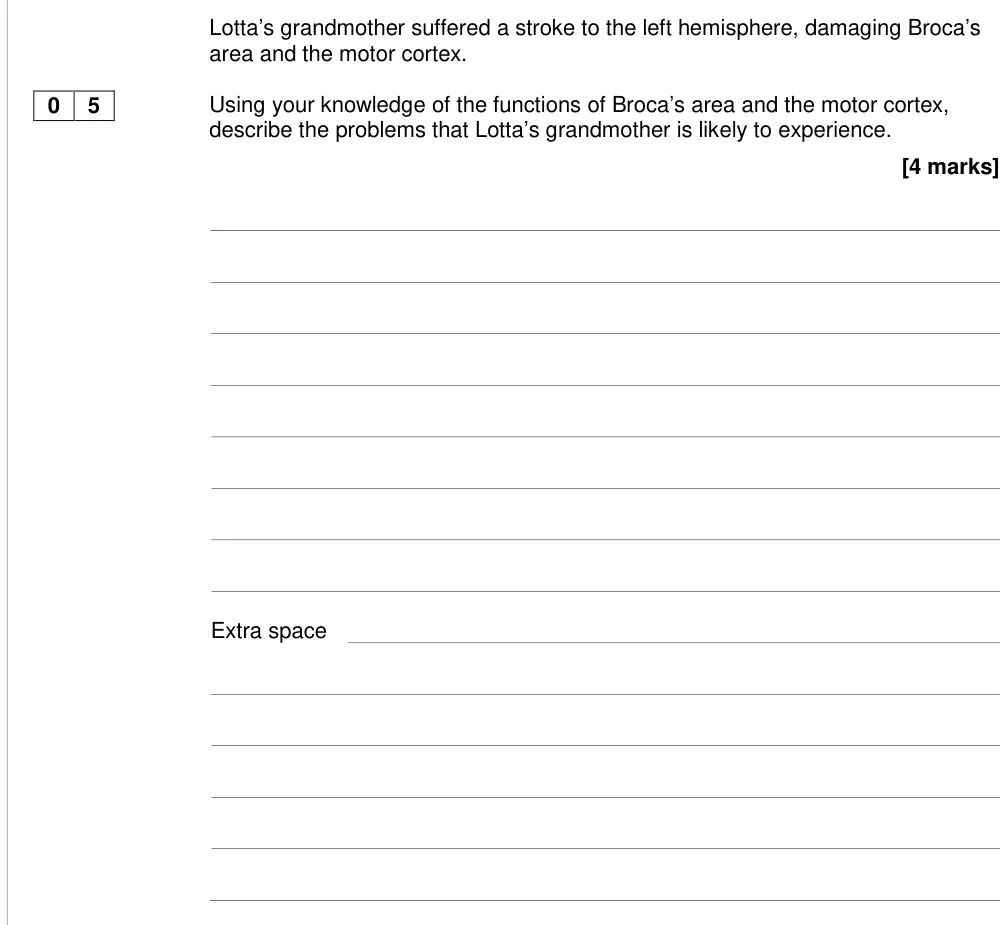
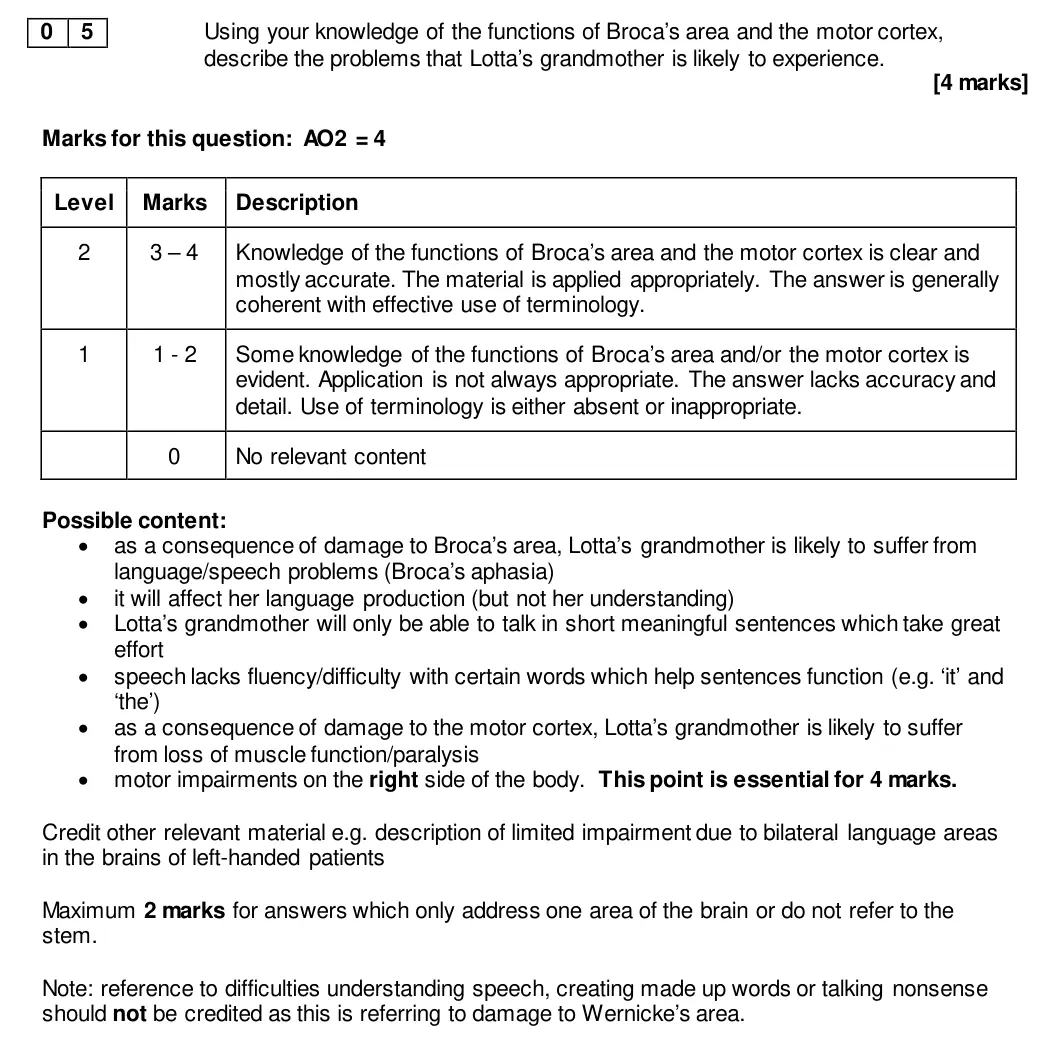
Overall, a well answered question indicating sound knowledge of anatomy and function with accuracy and detail, as well as appropriate application. Most students achieved level two. However, many failed to mention the implications of a left hemisphere stroke in terms of right-sided movement. Surprisingly, whilst descriptions of the problems resulting from damage to Broca’s area were mainly accurate and detailed, some confused the function of the motor cortex or failed to refer to the motor cortex at all.
Notes from the mark scheme and report
Broca's aphasia (production not comprehension, effortful non-fluent speech) + right-sided paralysis from motor cortex damage (essential for 4 marks)
one area or no stem reference = max 2
Wernicke's symptoms not credited
many omitted right-side implication
June 2017 · Paper 2 · Q64 marksAO2=4Application
Mark scheme, including level descriptors and indicative content
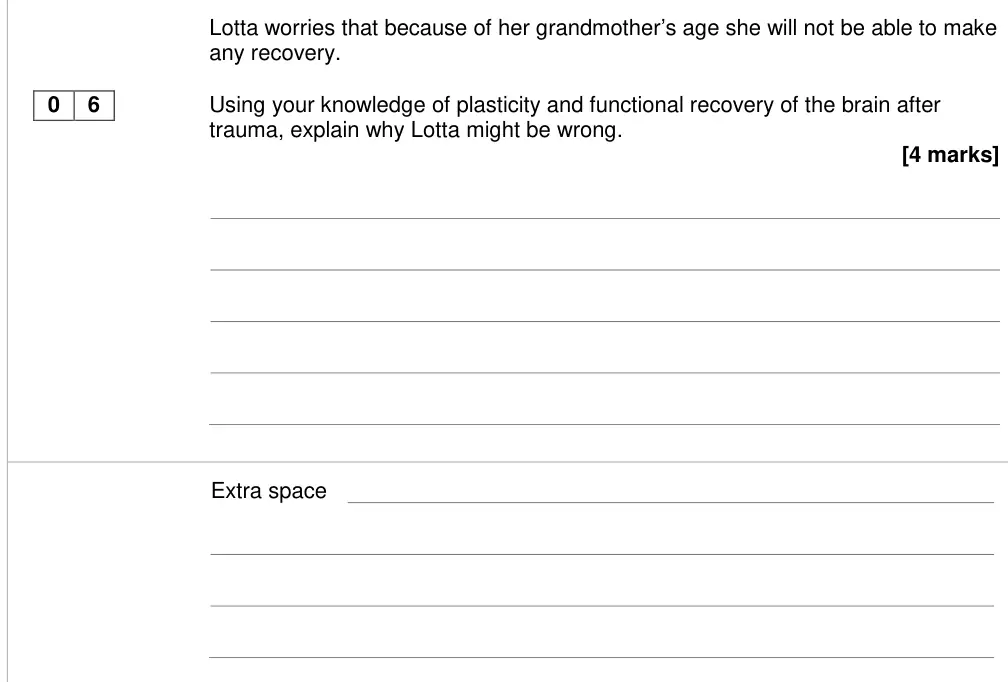
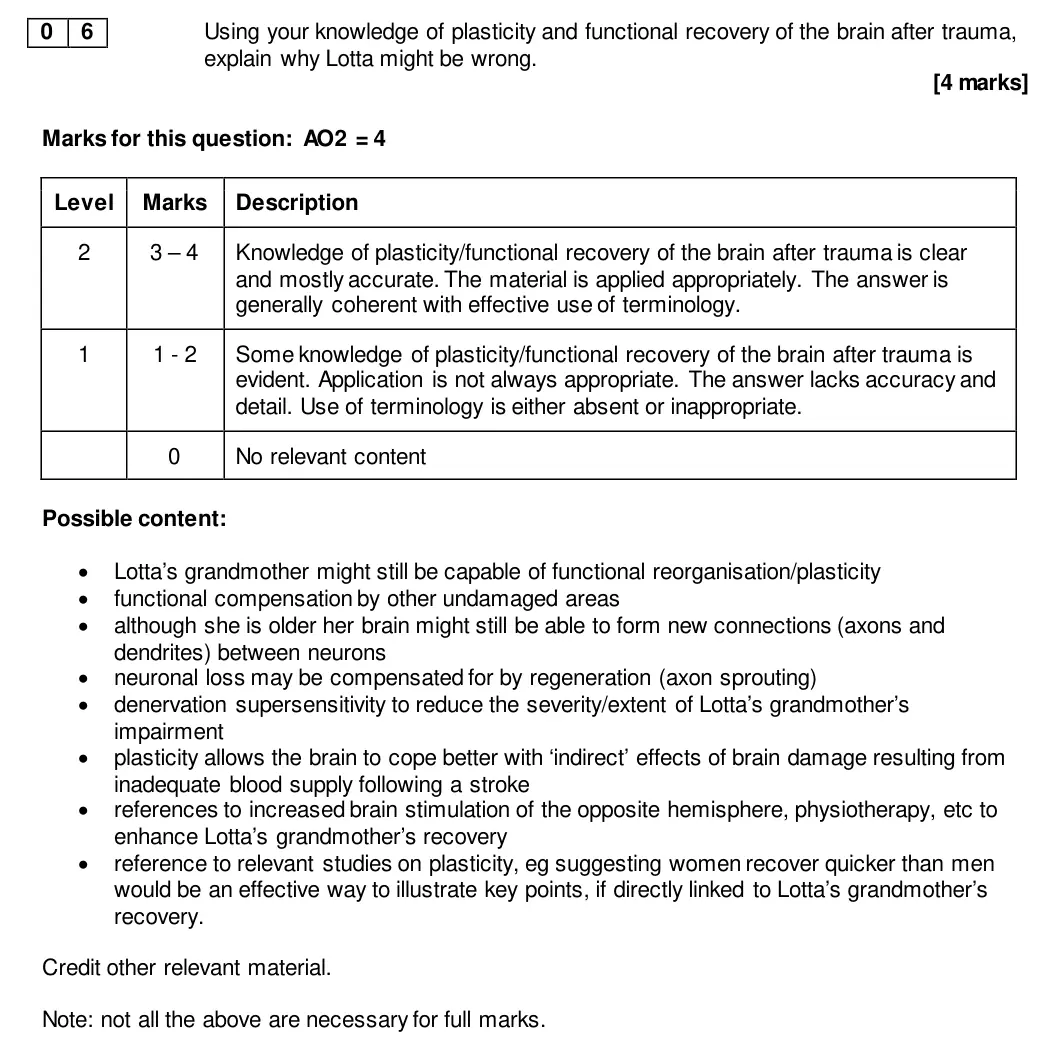
Examiner's comment
This question required students to apply their knowledge of plasticity and functional recovery of the brain after trauma to explain why Lotta’s grandmother may still be able to make some recovery in spite of her age. Generally there was a good knowledge of the concepts but weaker students struggled to move beyond level 1 due to a lack of appropriate application. Many simply described what plasticity and functional recovery were, with application limited to inclusion of the term ”Lotta’s grandmother”, rather than focussing on age. However, there were some excellent answers, where students had thought about the question and selected and shaped material accordingly. Students often went above and beyond what was required, clearly linking their knowledge to the scenario. There were refreshingly good accounts of processes and factors, including well detailed information about plasticity alongside research evidence regarding the effects of age, gender and education.
June 2017 · Paper 2 · Q98 marksAO1=3, AO3=5Extended writing
Mark scheme, including level descriptors and indicative content
Examiner's comment
Questions that discriminated the best were 03, 04, 09, 16, 17 and 21. Generally, the outline of ways of studying the brain was accurate and sufficiently detailed, with most students presenting two or even three well described ways of studying the brain. Although most chose to use those named on the specification, other legitimate ways of studying the brain, such as split-brain research, were credited, although the majority of these were poorly focussed. Overall, evaluation was less successful, with students offering only weak, generic points, for example ”it is very expensive”, without any comparison or effective elaboration. However, there were some good comparative discussions regarding other scanning techniques, such as PET scans. Surprisingly, evaluative points often focussed on minor issues, such as consent for post- mortems or lack of movement in fMRI scans, when there are far more important points to consider. Some evaluation was inappropriately focussed on the NHS rather than on scientific research, discussing issues of funding and patient care decisions and/or the benefits of the technique for the patients undergoing them. The lack of specialist terminology was also disappointing. Responses that focused on fMRI studies generally gave a detailed description but often failed to evaluate the core areas of discussion around temporal and spatial issues, and the implications of these in any depth. The majority of answers that focussed on post-mortems were poor, where lengthy accounts were given for why post-mortems may be unethical with weak references to post death consent, alongside some quite humorous and somewhat worrying misunderstandings. Where relevant references were made to the work of Broca and Wernicke, these were not often discussed in enough detail to shape the evaluation convincingly to the question. Overall, students appear to have a superficial understanding of a wide range of techniques and have rote learned a number of advantages and disadvantages of each but lack the deeper understanding to discuss any of these effectively. Schools and colleges should remind students that less is more, as many presented numerous techniques and evaluative points but these lacked elaboration/detail and therefore struggled to move beyond level 2.
evaluation often weak/generic ('expensive'), focused on NHS/patient care or post-mortem consent
temporal/spatial resolution under-used
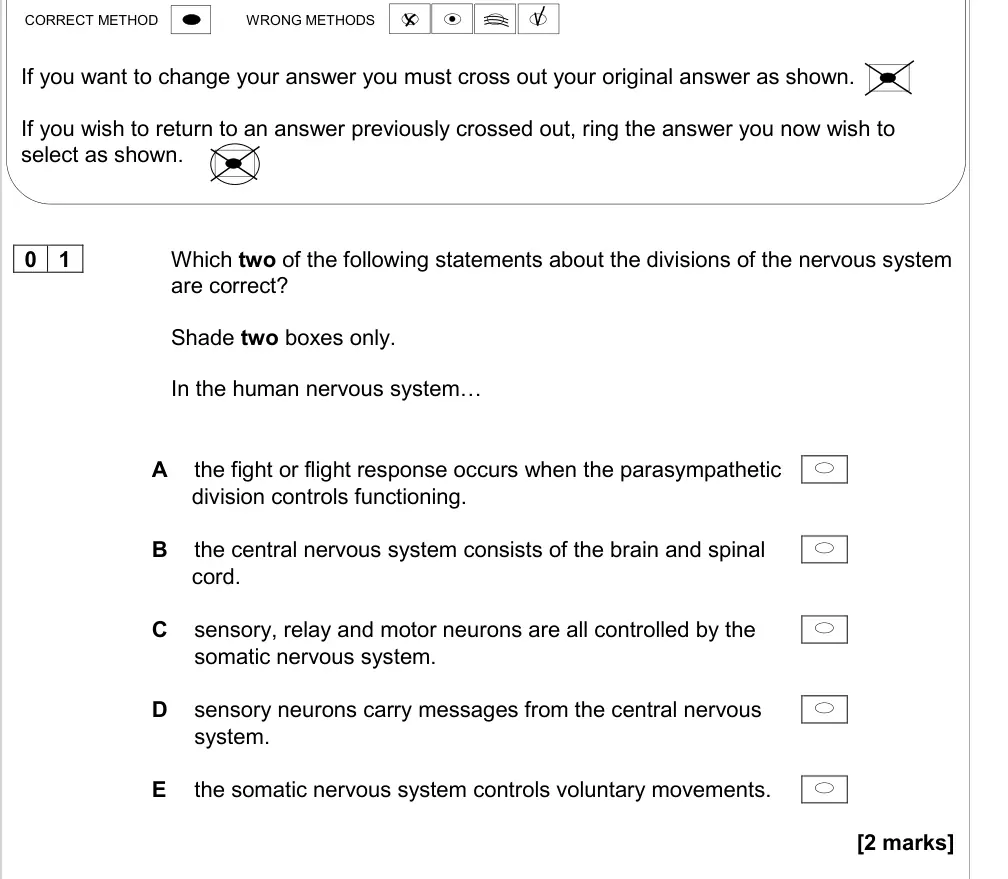
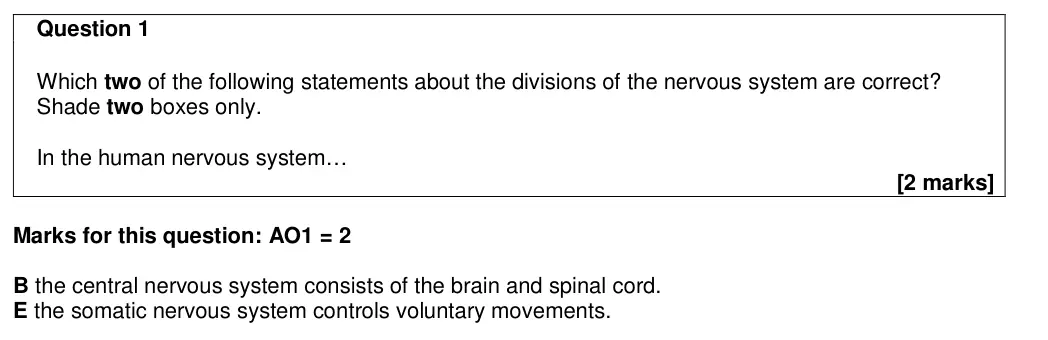
June 2016 · AS Paper 2 · Q12 marksAO1=2Multiple choice
Answer
B and E
Mark scheme, including level descriptors and indicative content
Examiner's comment
This was answered quite well although a significant number of students struggled with the instructions about how to indicate their choice of response in the appropriate mark box and even more with how to amend their choices correctly.
Notes from the mark scheme and report
correct answers B (CNS = brain and spinal cord) and E (somatic controls voluntary movement)
distractors need fight or flight = sympathetic and sensory neurons carry to the CNS
many mis-shaded/amended boxes incorrectly
June 2016 · AS Paper 2 · Q24 marksAO1=4Outline
Mark scheme, including level descriptors and indicative content
Examiner's comment
There were some issues with the accuracy of knowledge here and many students produced answers that were very confused. There was only a superficial/limited understanding of how excitation and inhibition are involved in synaptic transmission. Often there was no knowledge that excitation and inhibition occur at the post synaptic membrane and some students suggested that synapses were firing or that excitation caused more neurotransmitter and inhibition caused less. Other responses suggested that excitation referred to more firing and inhibition to less firing but an understanding of the summation of excitatory and inhibitory influences was rare, even in knowledgeable answers. At the simplest level students should be aware of the general idea that transmission is halted if there are more inhibitory effects in total and proceeds if there are more excitatory effects overall.
Notes from the mark scheme and report
excitatory NT makes the postsynaptic neuron more likely to fire, inhibitory less likely
full credit needs some understanding of summation
misconceptions: synapses 'firing', excitation = more neurotransmitter released
Specimen set 2 · Paper 2 · Q64 marksAO1=4Outline
Mark scheme, including level descriptors and indicative content
Notes from the mark scheme and report
up to 2 marks effects of adrenaline (adrenal medulla, heart rate, blood pressure, blood to muscles) + 2 marks role in preparing for fight or flight
effects not linked to fight or flight = max 1-2
Specimen set 2 · Paper 2 · Q716 marksAO1=6, AO2=4, AO3=616-mark essay
Mark scheme, including level descriptors and indicative content
Notes from the mark scheme and report
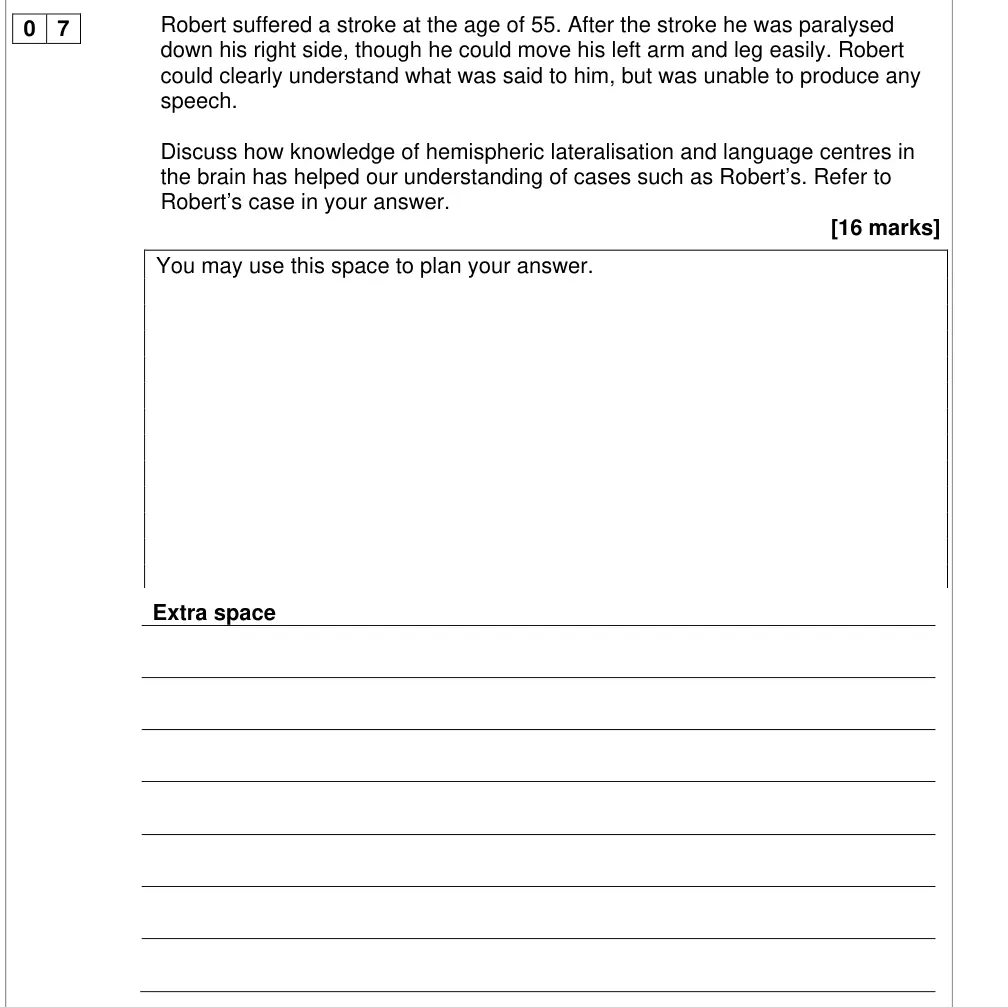
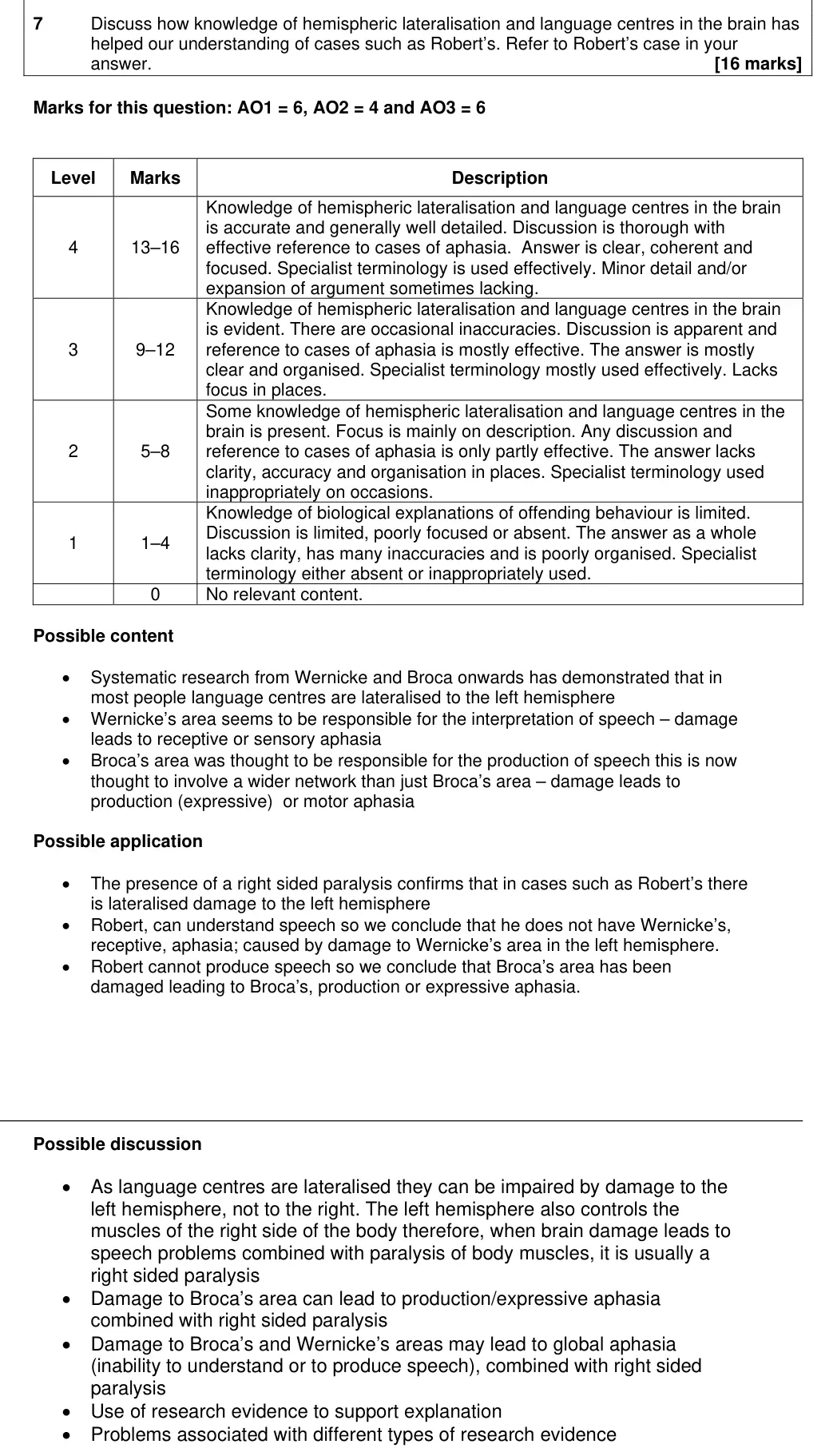
left-hemisphere lateralisation, Broca's (production) vs Wernicke's (comprehension) aphasia
apply: right-side paralysis = left hemisphere damage, understands speech so Wernicke's intact, no speech so Broca's damaged
MS Level 1 wording wrongly refers to 'offending behaviour' (AQA typo)
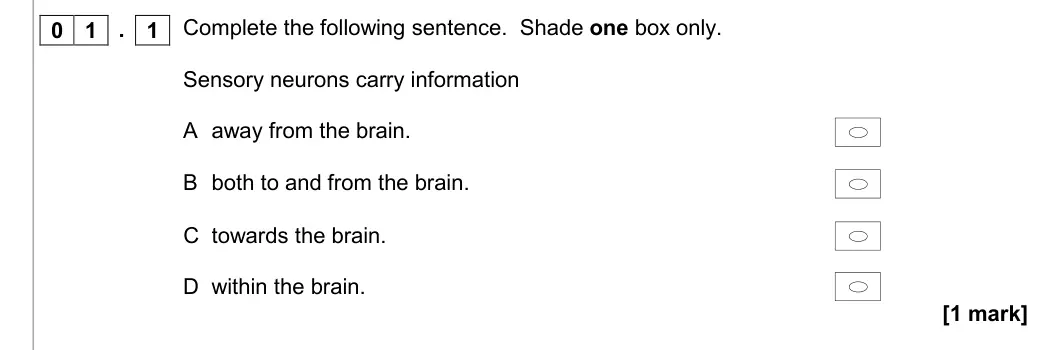
Specimen set 1 · AS Paper 2 · Q1.11 markAO1=1Multiple choice
Answer
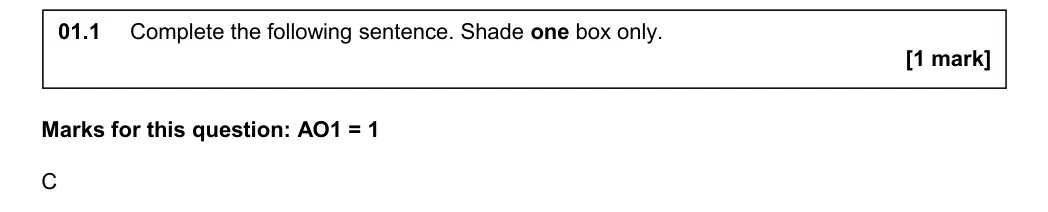
C
Mark scheme, including level descriptors and indicative content
Notes from the mark scheme and report
correct answer C (towards the brain)
distractors describe motor/relay neurons
Specimen set 1 · AS Paper 2 · Q1.21 markAO1=1Multiple choice
Answer
B
Mark scheme, including level descriptors and indicative content
Notes from the mark scheme and report
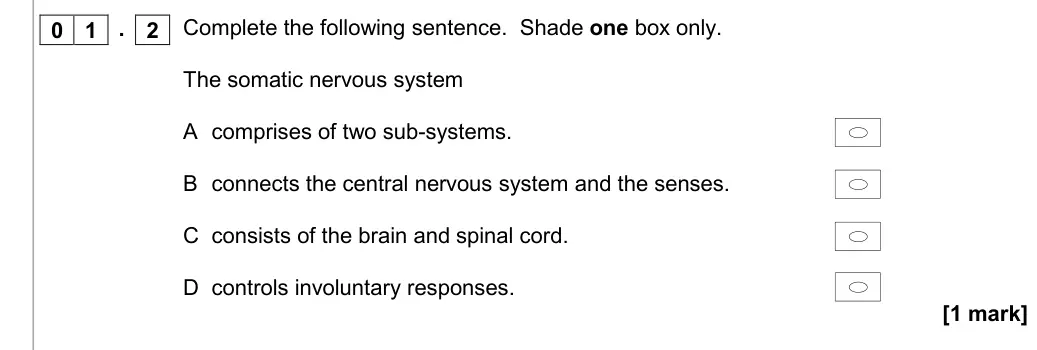
correct answer B (connects the CNS and the senses)
distractors describe ANS (two sub-systems, involuntary) and CNS
Specimen set 1 · AS Paper 2 · Q21 markAO1=1Multiple choice
Answer
C
Mark scheme, including level descriptors and indicative content
Notes from the mark scheme and report
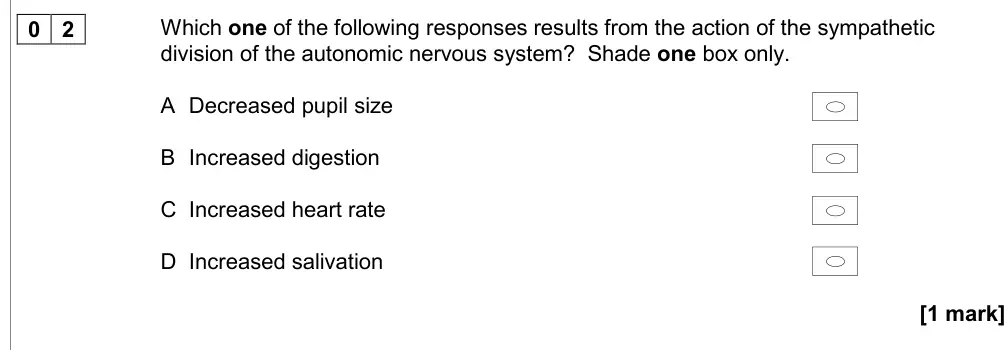
correct answer C (increased heart rate)
other options are parasympathetic effects
Specimen set 1 · AS Paper 2 · Q32 marksAO1=2Multiple choice
Answer
E and D
Mark scheme, including level descriptors and indicative content
Notes from the mark scheme and report
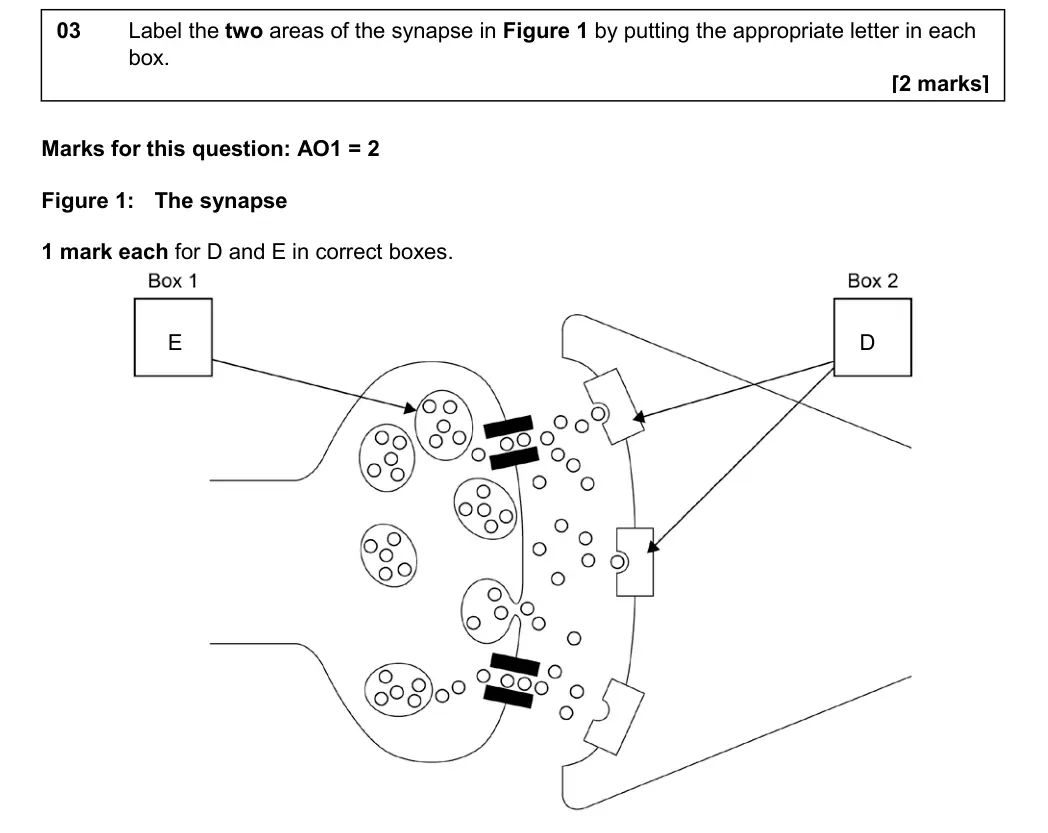
1 mark each: E (vesicle) and D (receptor sites) in the correct boxes
Specimen set 1 · Paper 2 · Q5.11 markMultiple choice
Answer
A
Mark scheme, including level descriptors and indicative content
Notes from the mark scheme and report
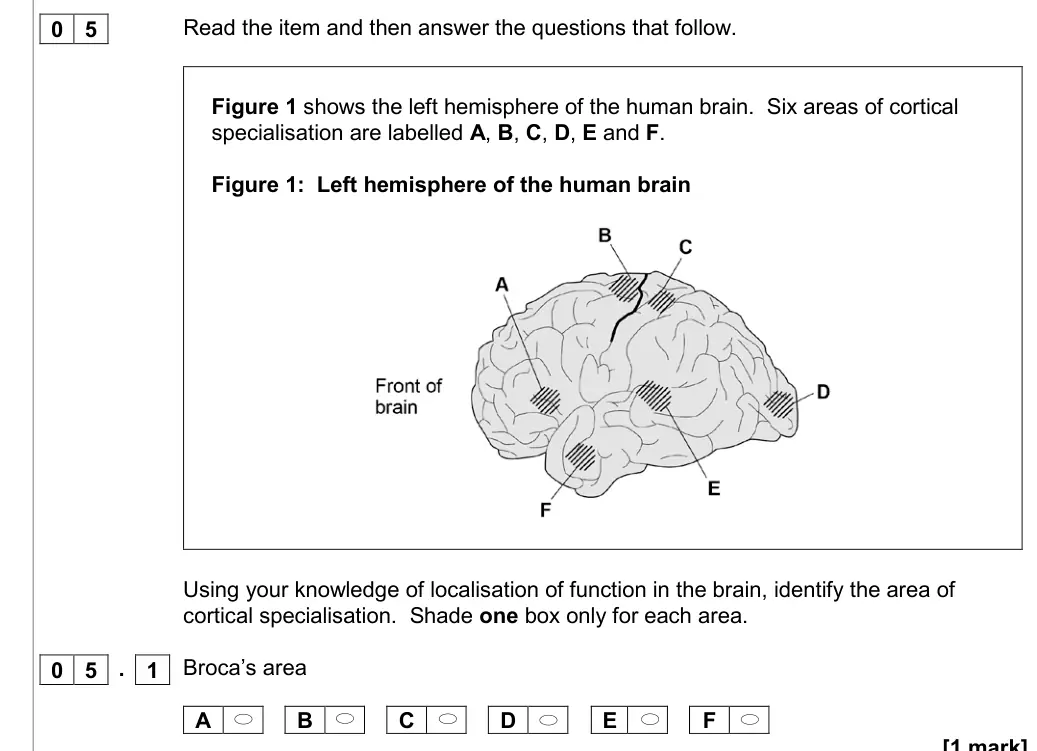
answer A (Broca's area) on the labelled left-hemisphere diagram
Specimen set 1 · Paper 2 · Q5.21 markMultiple choice
Answer
C
Mark scheme, including level descriptors and indicative content
Notes from the mark scheme and report
answer C (somatosensory cortex)
Specimen set 1 · Paper 2 · Q5.31 markMultiple choice
Answer
D
Mark scheme, including level descriptors and indicative content
Notes from the mark scheme and report
answer D (visual cortex)
Specimen set 1 · Paper 2 · Q5.41 markMultiple choice
Answer
E
Mark scheme, including level descriptors and indicative content
Notes from the mark scheme and report
answer E (Wernicke's area)
Specimen set 1 · Paper 2 · Q5.51 markMultiple choice
Answer
B
Mark scheme, including level descriptors and indicative content
Notes from the mark scheme and report
answer B (motor cortex)
Specimen set 1 · Paper 2 · Q62 marksAO1=2Outline
Mark scheme, including level descriptors and indicative content
Notes from the mark scheme and report
key difference: EEG = general brain activity/states (sleep, arousal), ERPs = responses elicited by specific stimuli
no credit for describing a technique without a difference
Specimen set 1 · Paper 2 · Q96 marksAO1=6Outline
Mark scheme, including level descriptors and indicative content
Notes from the mark scheme and report
Level 3 needs both pre- and postsynaptic processes
Mark scheme, including level descriptors and indicative content
Notes from the mark scheme and report
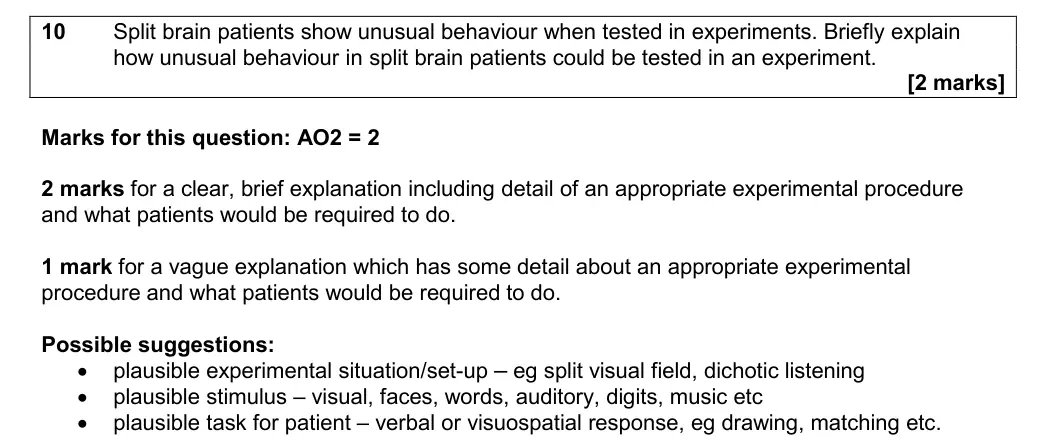
plausible set-up (split visual field, dichotic listening), stimulus and patient task (verbal or visuospatial response)
Specimen set 1 · Paper 2 · Q114 marksAO3=4Evaluate (short)
Mark scheme, including level descriptors and indicative content
Notes from the mark scheme and report
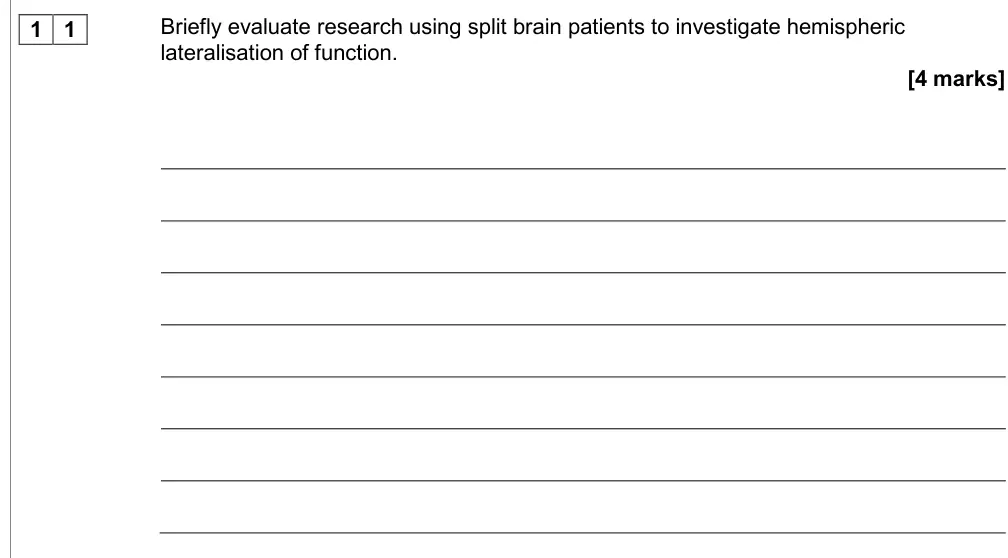
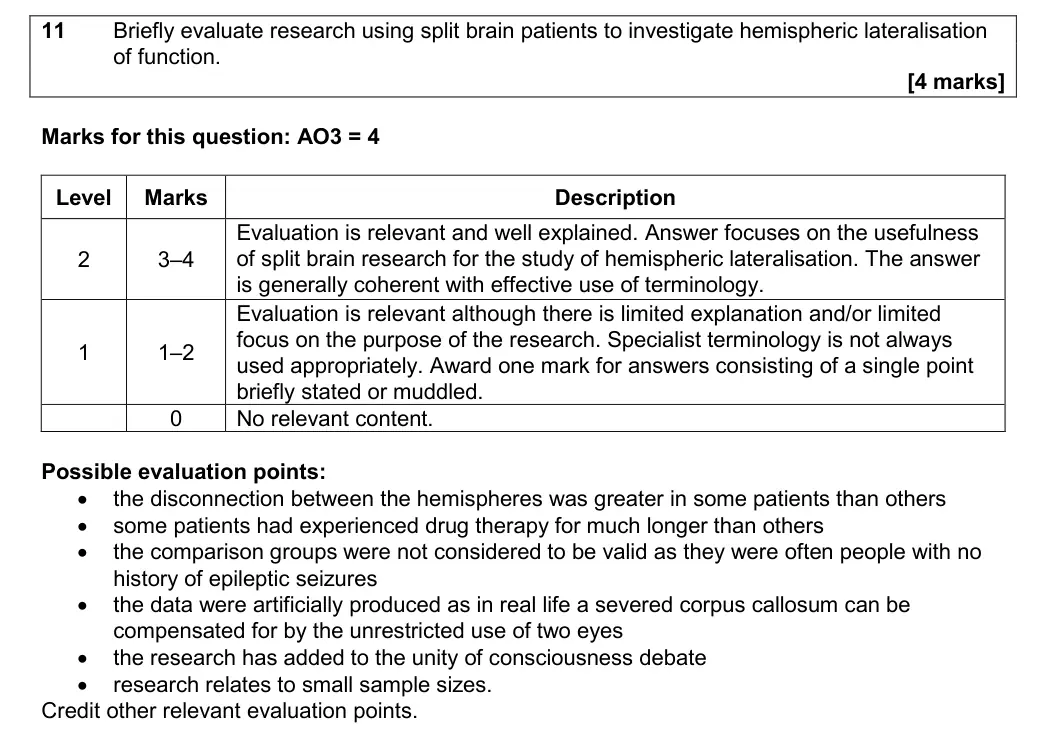
focus on usefulness for studying hemispheric lateralisation: variable disconnection, drug history, comparison groups, artificial conditions, small samples
single point = 1 mark
Work with an AQA psychology tutor
Essays not reaching the top band? Book a session with Andy, a former AQA examiner.