November 2020: AS Paper 2

72 marks · 22 question parts · Paper, mark scheme and report on AQA's site

This paper was set on the previous specification. 1 part is on content removed in the 2025 specification and is marked "Old spec only".

Question by question

QTopicMarksAOType
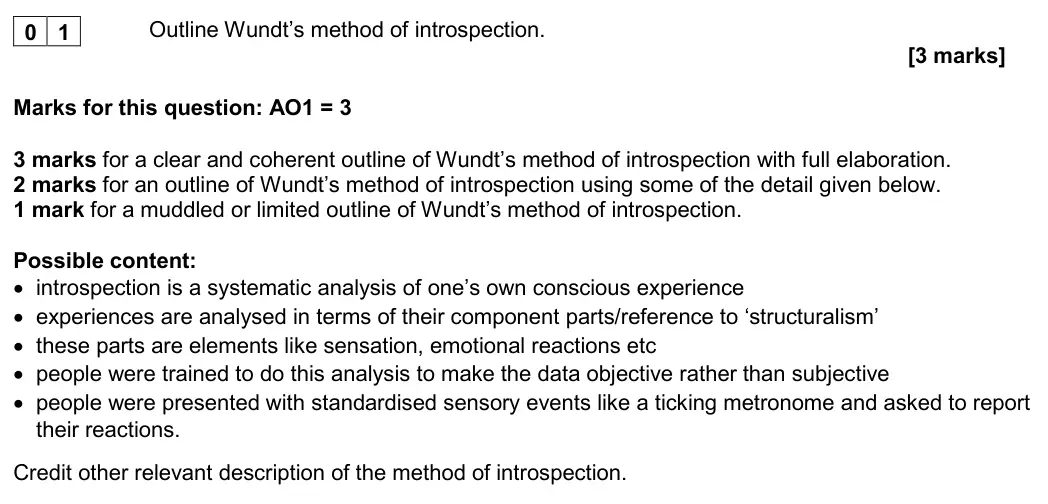
1 Approaches in psychologyOld spec 3AO1=3Outline
2.1 Biopsychology 1AO1=1Short answer
2.2 Biopsychology 3AO1=3Explain
3 Approaches in psychology 4AO2=4Application
4.1 Approaches in psychology 2AO1=2Outline
4.2 Approaches in psychology 3AO2=3Application
4.3 Research methods: scientific processes 2AO3=2Research methods
5 Approaches in psychology 3AO1=3Explain
6 Approaches in psychology 3AO3=3Evaluate (short)
7 Clinical psychology and mental health (psychopathology) 4AO1=2,AO2=2Application
8 Research methods: methods and techniques 2AO3=2Research methods
9 Clinical psychology and mental health (psychopathology) 4AO2=4Application
10 Clinical psychology and mental health (psychopathology) 2AO1=2Outline
11 Clinical psychology and mental health (psychopathology) 12AO1=6,AO3=6Extended writing
12 Research methods: scientific processes 2AO2=2Research methods
13 Research methods: methods and techniques, Research methods: scientific processes 2AO2=2Multiple choice
14 Research methods: scientific processes, Research methods: methods and techniques 2AO2=2Research methods
15 Research methods: data handling and analysis 4AO2=2,AO3=2Research methods
16 Research methods: scientific processes, Research methods: data handling and analysis 2AO3=2Research methods
17 Research methods: methods and techniques 4AO2=2,AO3=2Research methods
18 Research methods: scientific processes 4AO2=4Research methods
19 Research methods: scientific processes 4AO1=2,AO3=2Research methods

The questions

12.12.234.14.24.35678910111213141516171819

November 2020 · AS Paper 2 · Q2.1 1 mark AO1=1 Short answer biopsychology
0 2
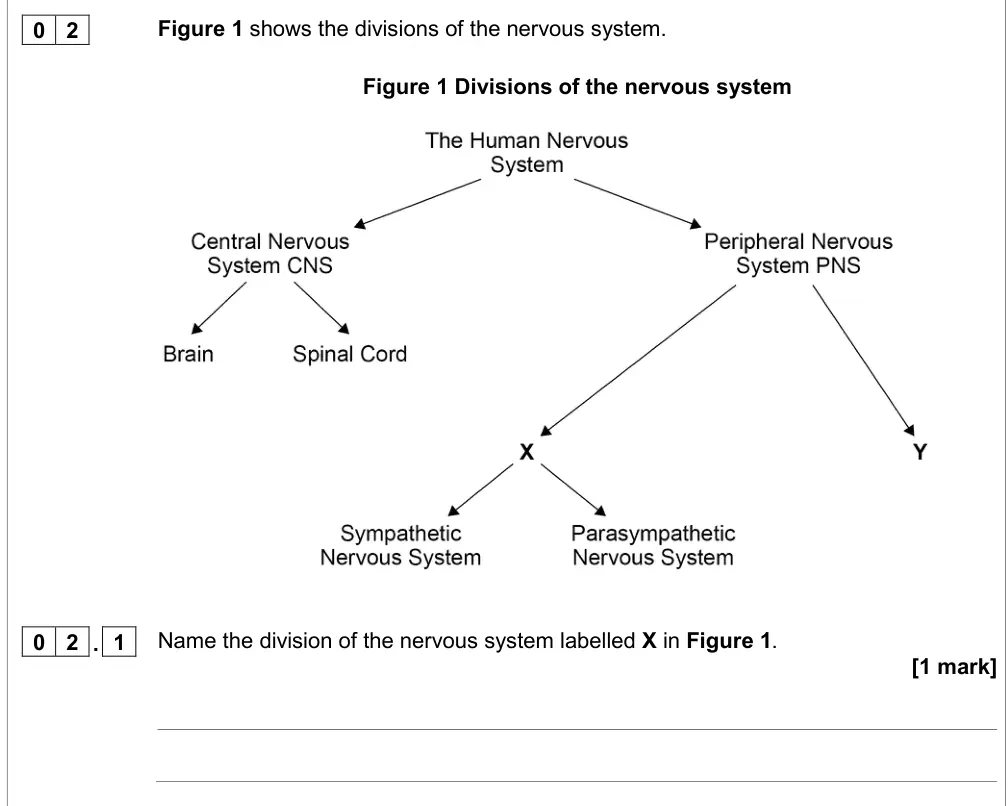
Figure 1 shows the divisions of the nervous system.
Figure 1 Divisions of the nervous system
0 2 . 1
Name the division of the nervous system labelled X in Figure 1.
[1 mark]
November 2020 · AS Paper 2 · Q2.2 3 marks AO1=3 Explain biopsychology
0 2 . 2
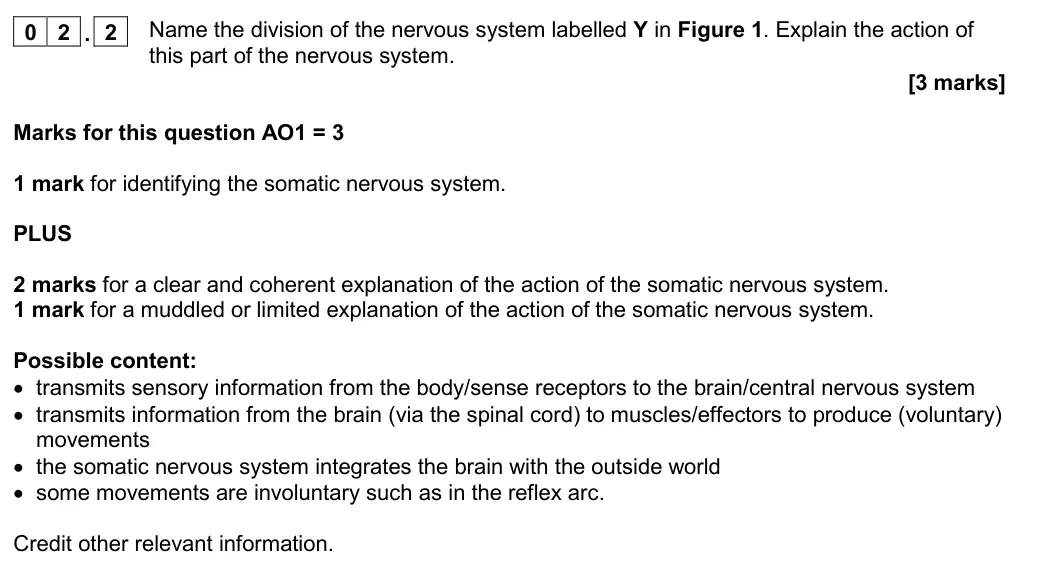
Name the division of the nervous system labelled Y in Figure 1.  Explain the action of
this part of the nervous system.
[3 marks]
November 2020 · AS Paper 2 · Q3 4 marks AO2=4 Application approaches
0 3
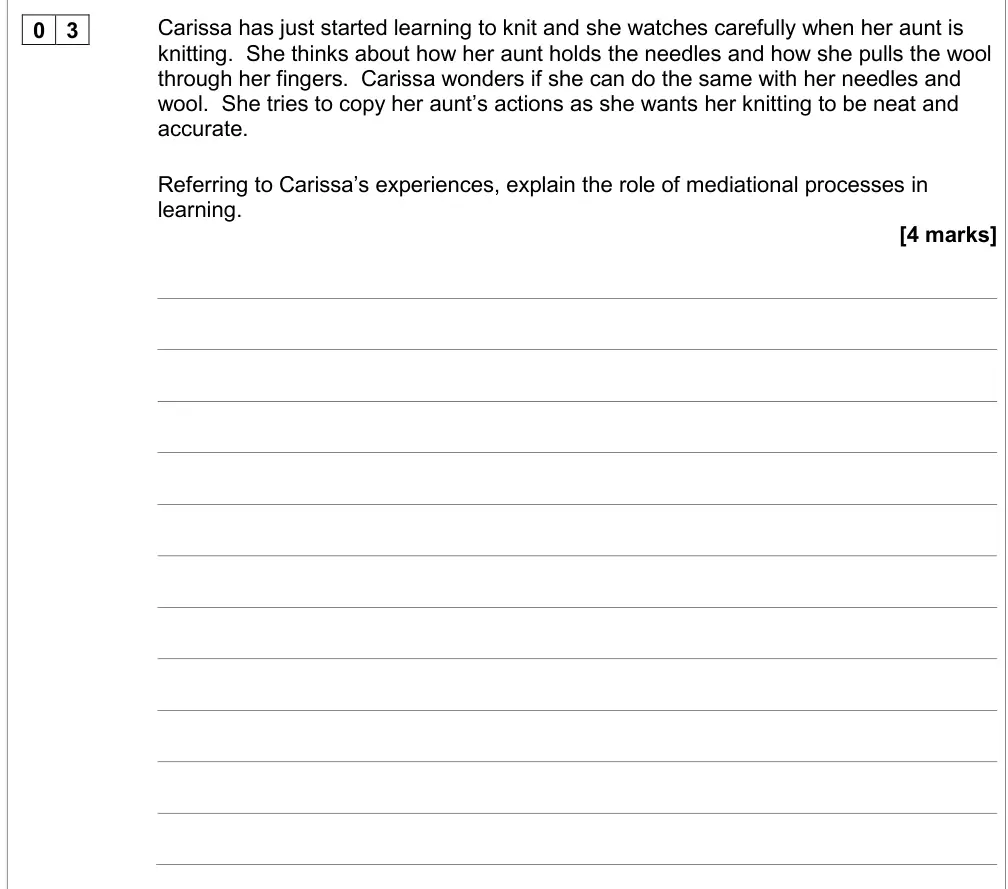
Carissa has just started learning to knit and she watches carefully when her aunt is
knitting.  She thinks about how her aunt holds the needles and how she pulls the wool
through her fingers.  Carissa wonders if she can do the same with her needles and
wool.  She tries to copy her aunt’s actions as she wants her knitting to be neat and
accurate.
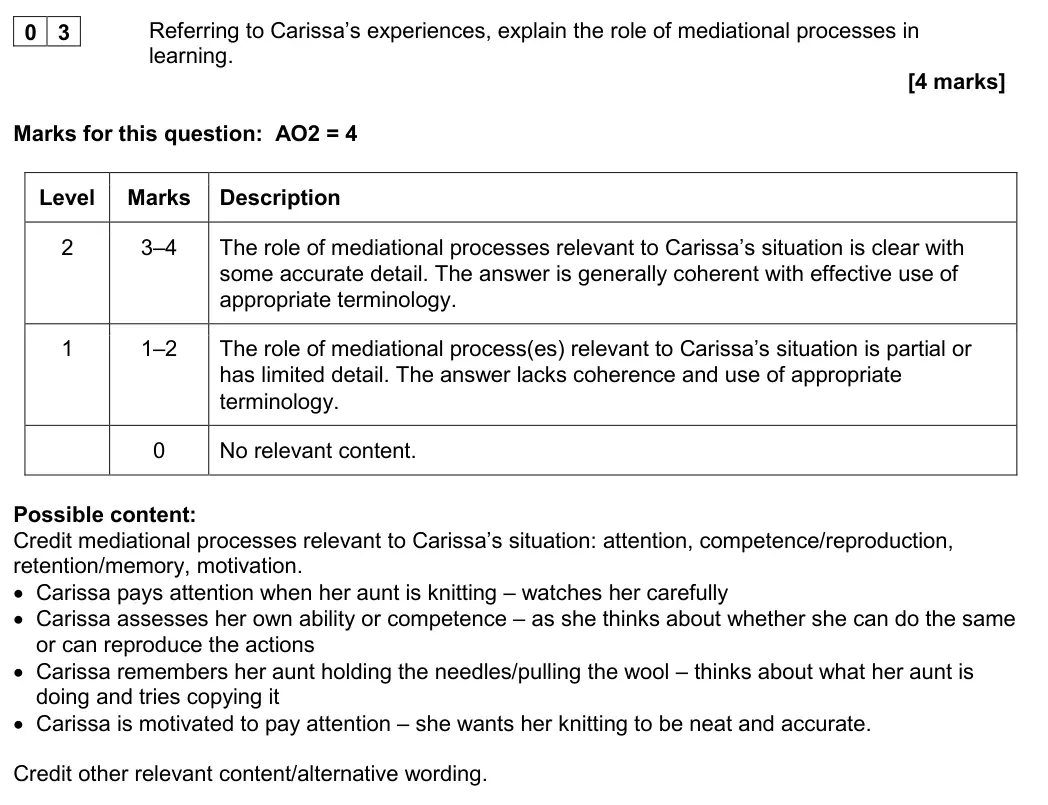
Referring to Carissa’s experiences, explain the role of mediational processes in
learning.
[4 marks]
November 2020 · AS Paper 2 · Q4.1 2 marks AO1=2 Outline approaches
0 4
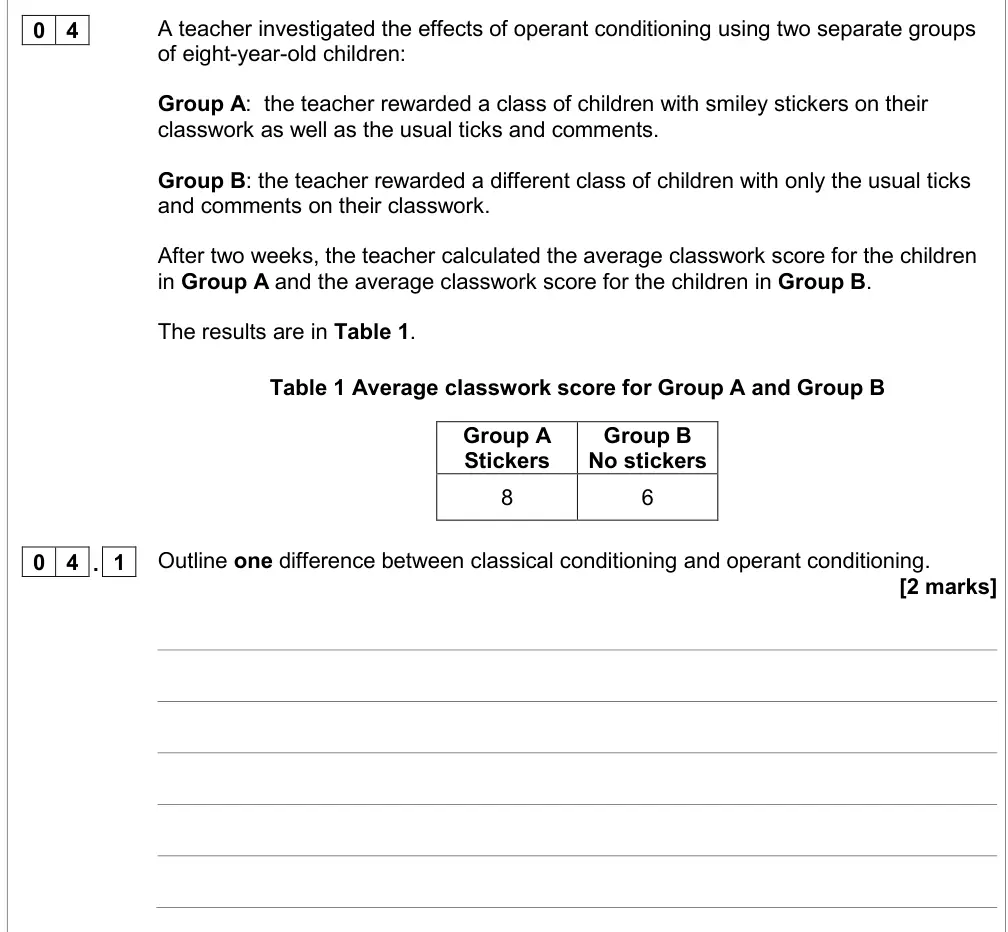
A teacher investigated the effects of operant conditioning using two separate groups
of eight-year-old children:
Group A:  the teacher rewarded a class of children with smiley stickers on their
classwork as well as the usual ticks and comments.
Group B: the teacher rewarded a different class of children with only the usual ticks
and comments on their classwork.
After two weeks, the teacher calculated the average classwork score for the children
in Group A and the average classwork score for the children in Group B.
The results are in Table 1.
Table 1 Average classwork score for Group A and Group B
Group A
Group B
Stickers
No stickers
8
6
0 4 . 1
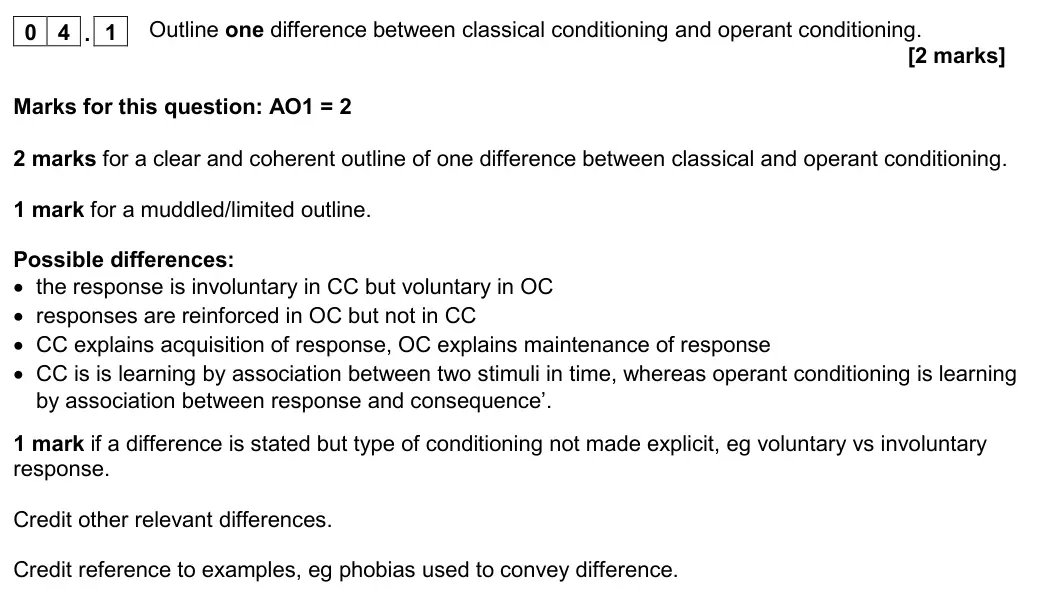
Outline one difference between classical conditioning and operant conditioning.
[2 marks]
November 2020 · AS Paper 2 · Q4.2 3 marks AO2=3 Application approaches
0 4 . 2
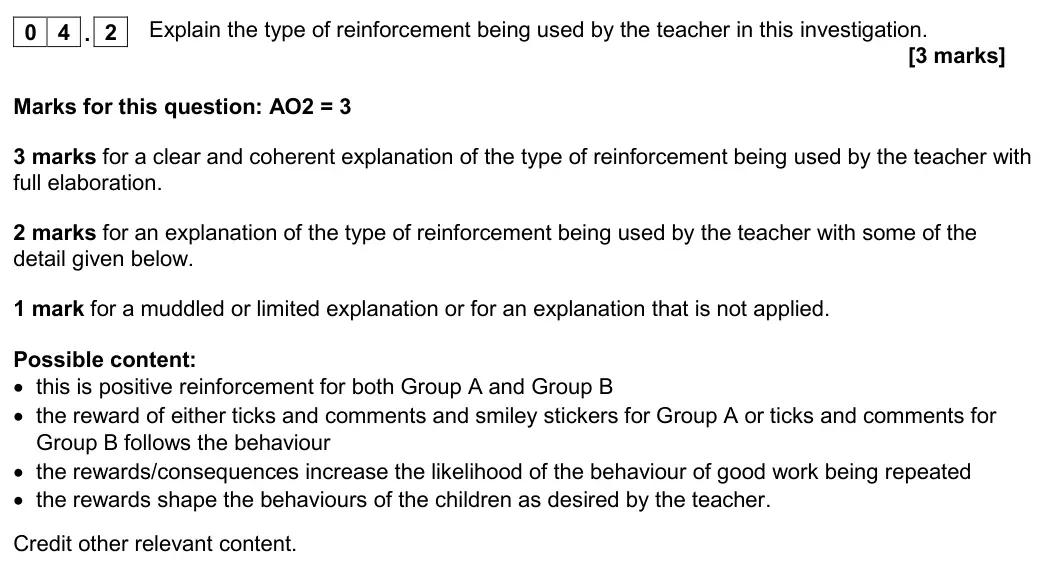
Explain the type of reinforcement being used by the teacher in this investigation.
[3 marks]
November 2020 · AS Paper 2 · Q4.3 2 marks AO3=2 Research methods scientific processes
0 4 . 3
The teacher concluded that smiley stickers may not have been the only thing that
caused the difference in average scores between Group A and Group B.  The
teacher was concerned because the children in each class were different.
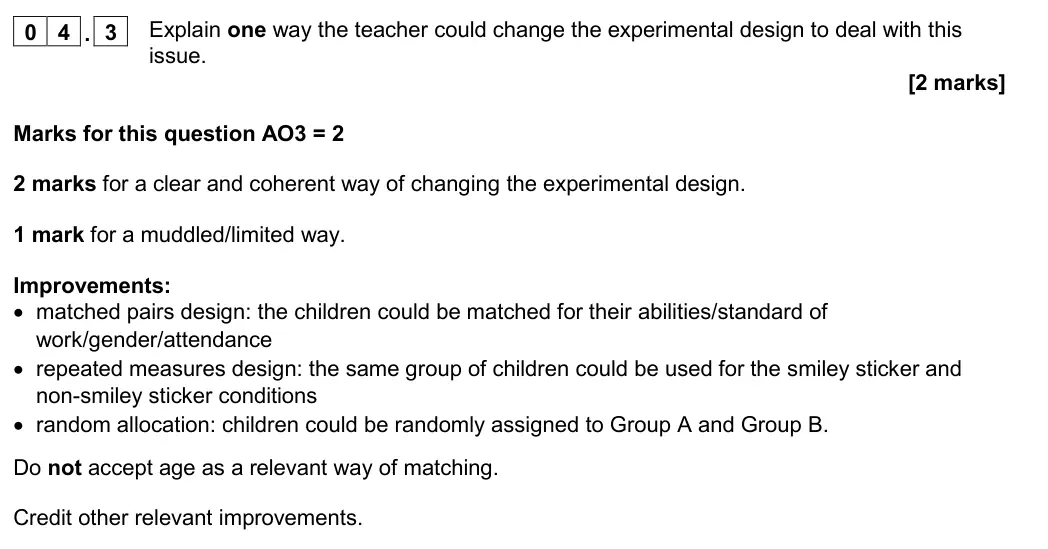
Explain one way the teacher could change the experimental design to deal with this
issue.
[2 marks]
November 2020 · AS Paper 2 · Q5 3 marks AO1=3 Explain approaches
0 5
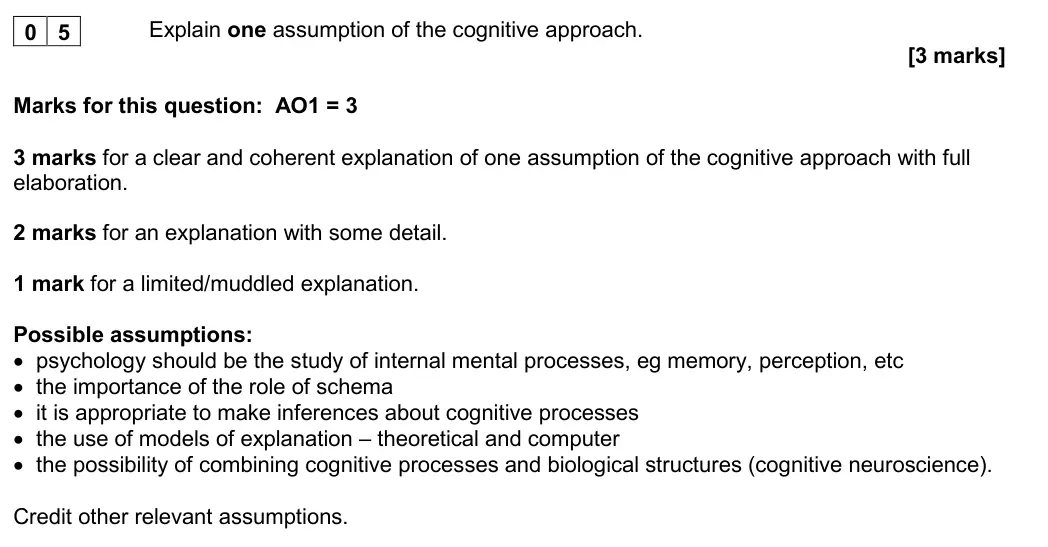
Explain one assumption of the cognitive approach.
[3 marks]
November 2020 · AS Paper 2 · Q6 3 marks AO3=3 Evaluate (short) approaches
0 6
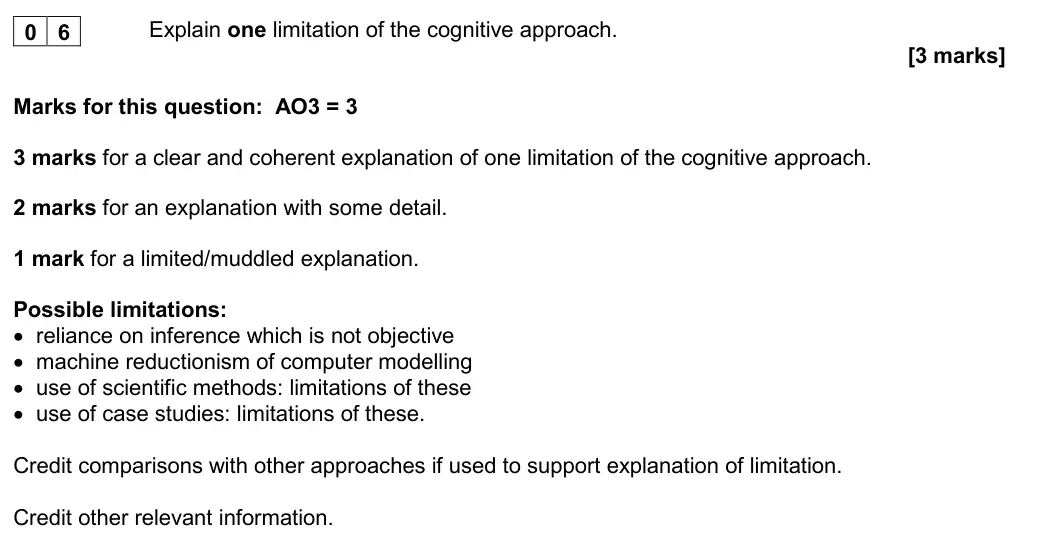
Explain one limitation of the cognitive approach.
[3 marks]
November 2020 · AS Paper 2 · Q7 4 marks AO1=2, AO2=2 Application clinical psychology
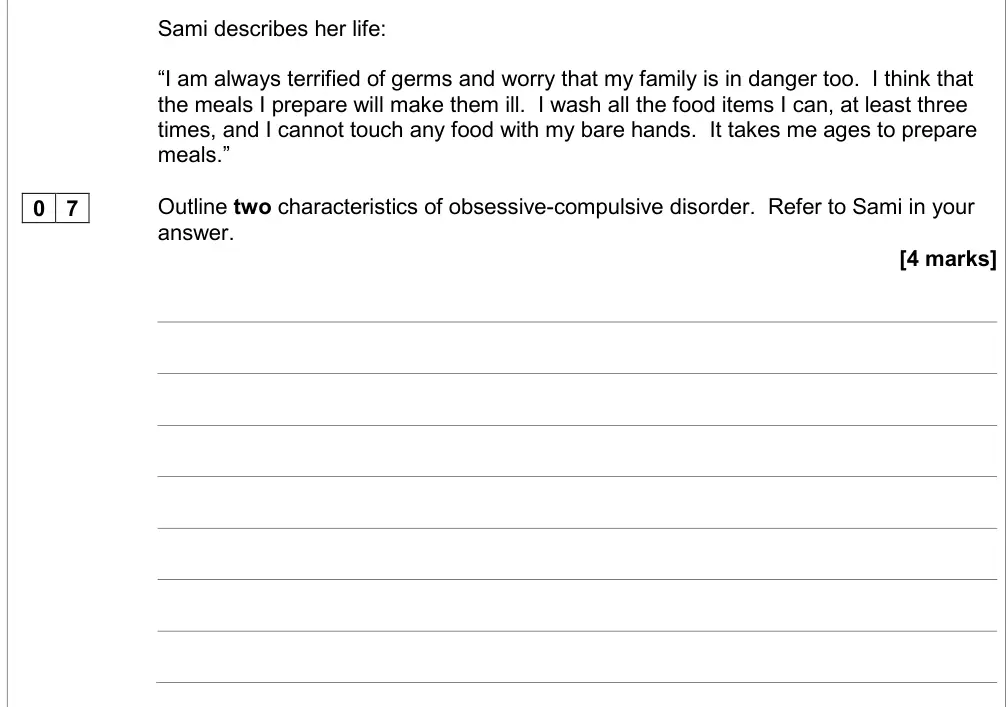
Sami describes her life:
“I am always terrified of germs and worry that my family is in danger too.  I think that
the meals I prepare will make them ill.  I wash all the food items I can, at least three
times, and I cannot touch any food with my bare hands.  It takes me ages to prepare
meals.”
0 7
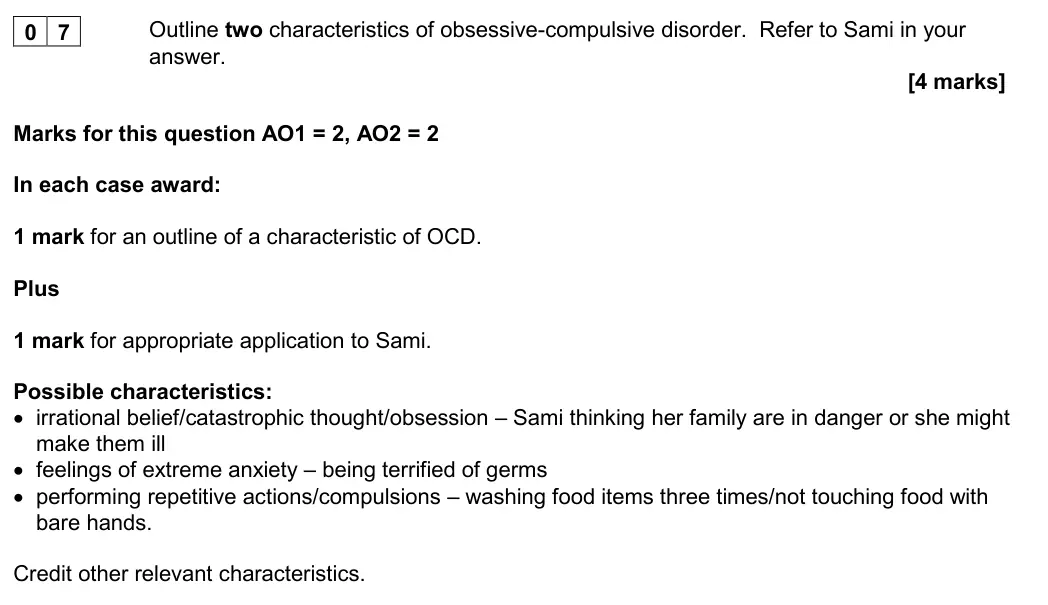
Outline two characteristics of obsessive-compulsive disorder.  Refer to Sami in your
answer.
[4 marks]
November 2020 · AS Paper 2 · Q8 2 marks AO3=2 Research methods research methods
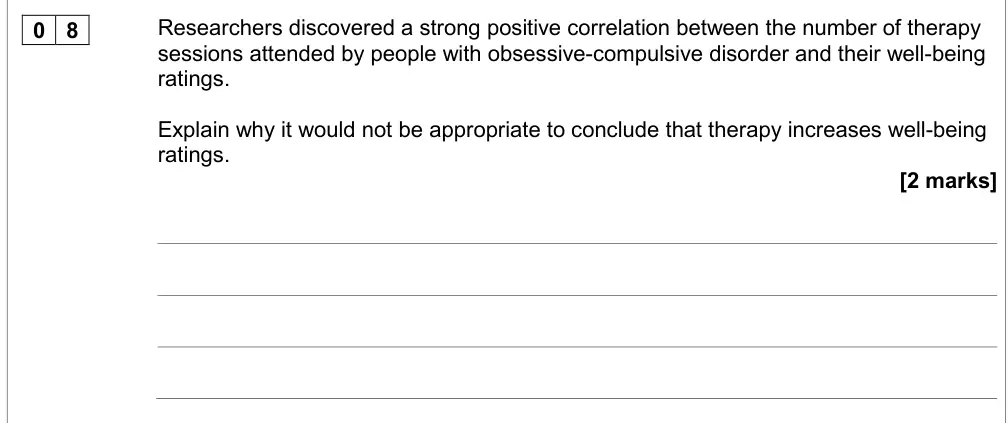
0 8
Researchers discovered a strong positive correlation between the number of therapy
sessions attended by people with obsessive-compulsive disorder and their well-being
ratings.
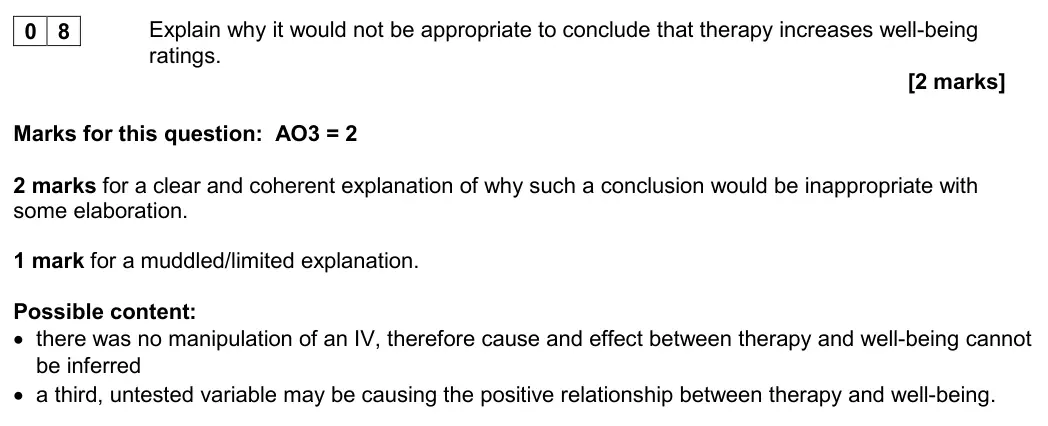
Explain why it would not be appropriate to conclude that therapy increases well-being
ratings.
[2 marks]
November 2020 · AS Paper 2 · Q9 4 marks AO2=4 Application clinical psychology
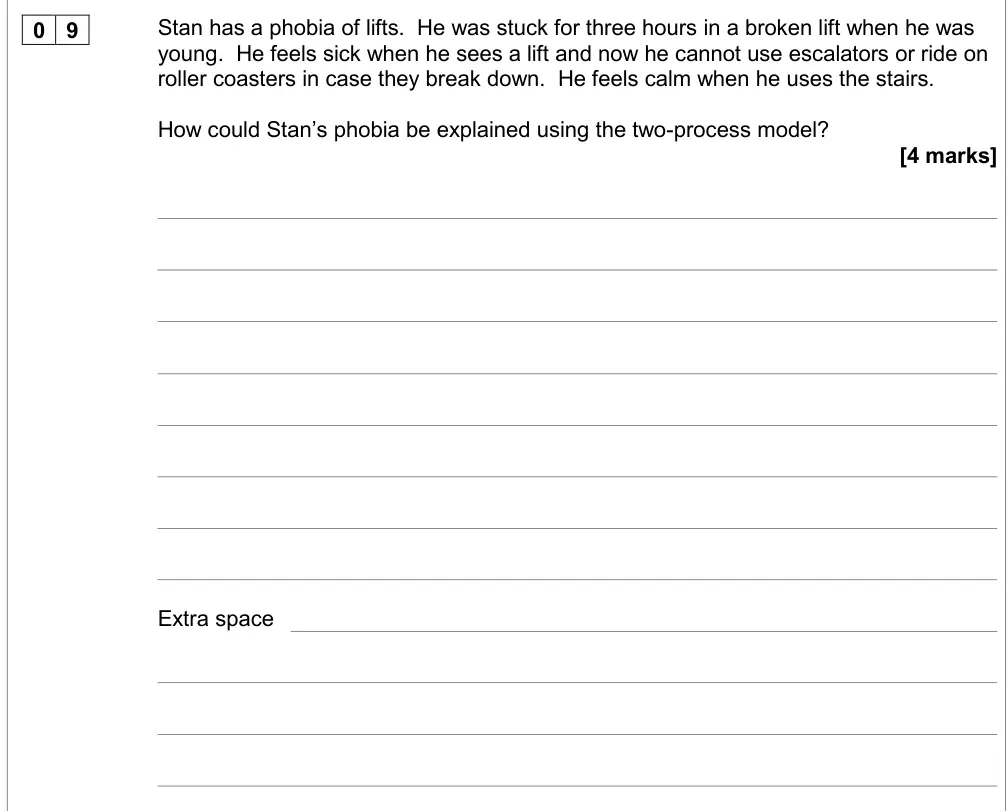
0 9
Stan has a phobia of lifts.  He was stuck for three hours in a broken lift when he was
young.  He feels sick when he sees a lift and now he cannot use escalators or ride on
roller coasters in case they break down.  He feels calm when he uses the stairs.
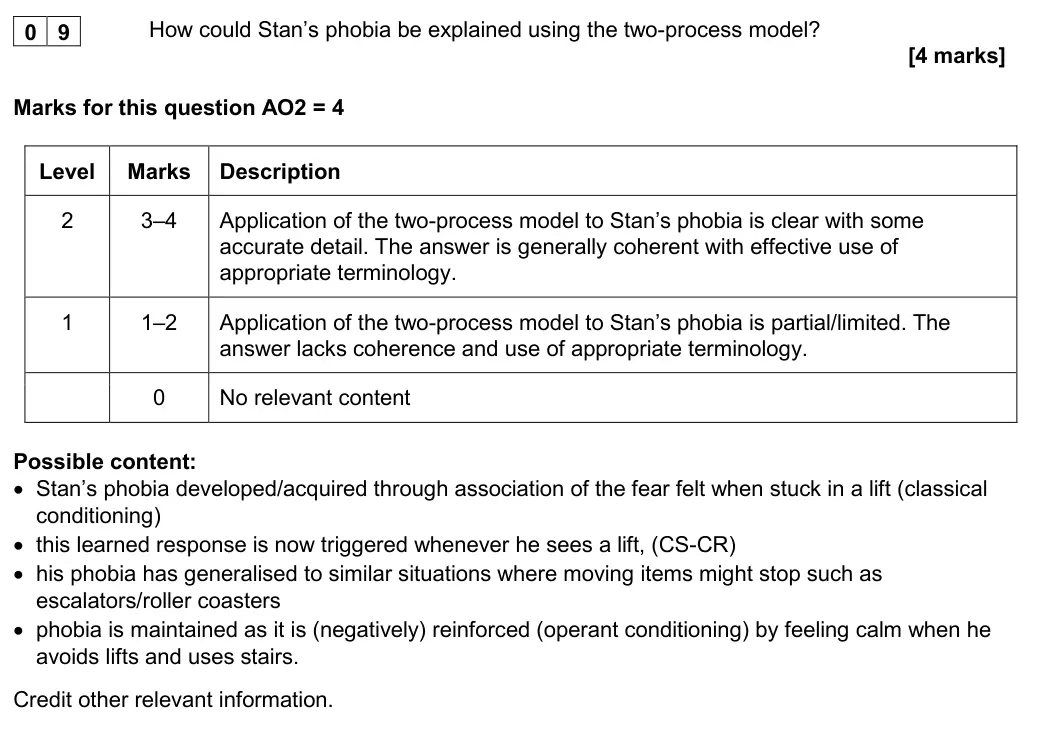
How could Stan’s phobia be explained using the two-process model?
[4 marks]
Extra space
November 2020 · AS Paper 2 · Q10 2 marks AO1=2 Outline clinical psychology
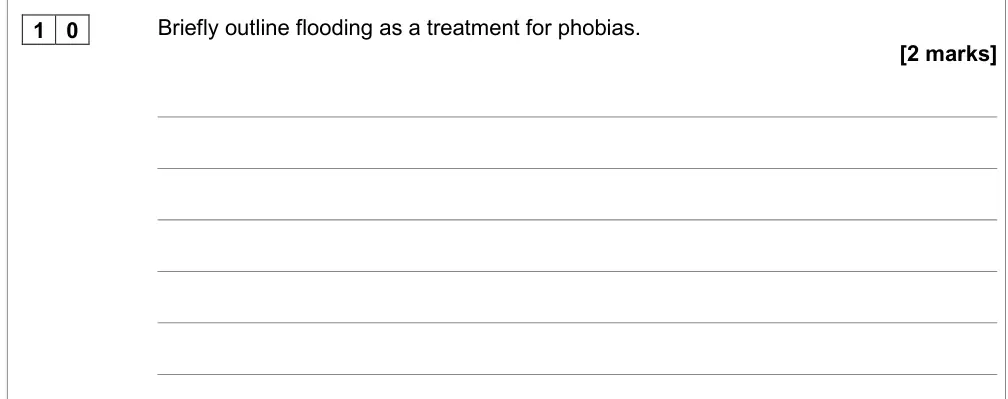
1 0
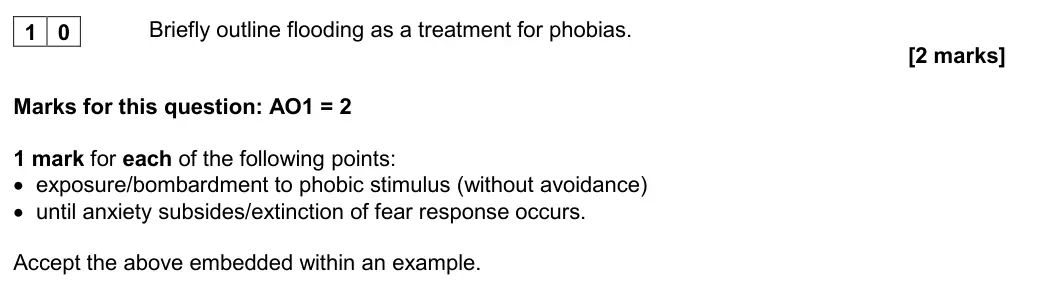
Briefly outline flooding as a treatment for phobias.
[2 marks]
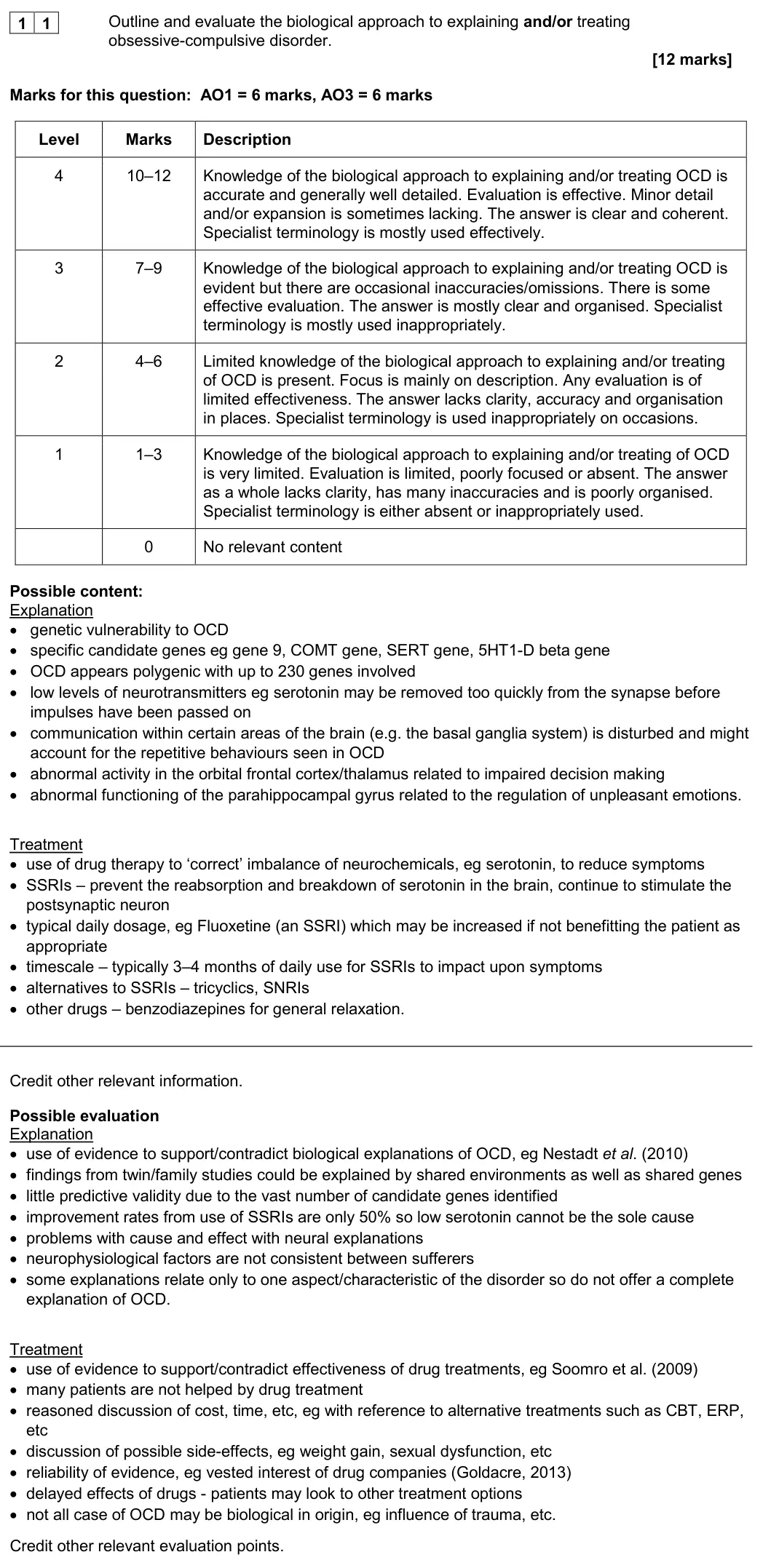
November 2020 · AS Paper 2 · Q11 12 marks AO1=6, AO3=6 Extended writing clinical psychology
1 1
Outline and evaluate the biological approach to explaining and/or treating
obsessive-compulsive disorder.
[12 marks]
You may use this space to plan your answer.
Extra space
November 2020 · AS Paper 2 · Q12 2 marks AO2=2 Research methods scientific processes
Researchers wanted to see if there was a difference in the number of students
choosing to use various work spaces in the college library.  Previous research findings
on this topic were inconsistent.
There were three types of work space available in the library:
• single desks with a chair
• large tables with chairs
• settees with low tables.
The researchers used CCTV camera recordings of the different work space areas
taken over three days.  From each day, they analysed two hours’ worth of recordings
from the morning and two hours’ worth of recordings from the afternoon.  They noted
down the number of students seen working at each of the three work spaces.
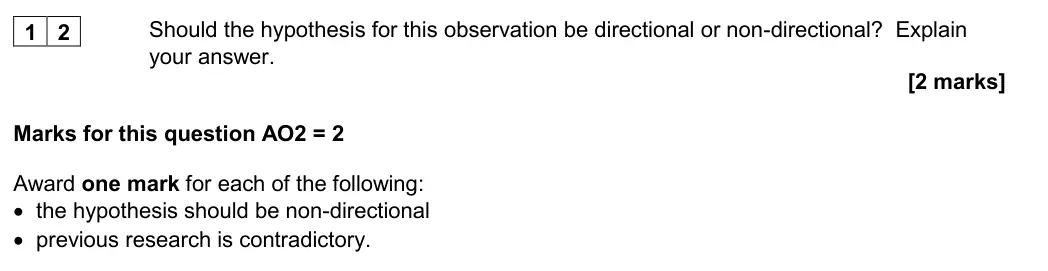
1 2
Should the hypothesis for this observation be directional or non-directional?
Explain your answer.
[2 marks]
November 2020 · AS Paper 2 · Q13 2 marks AO2=2 Multiple choice research methodsscientific processes
1 3
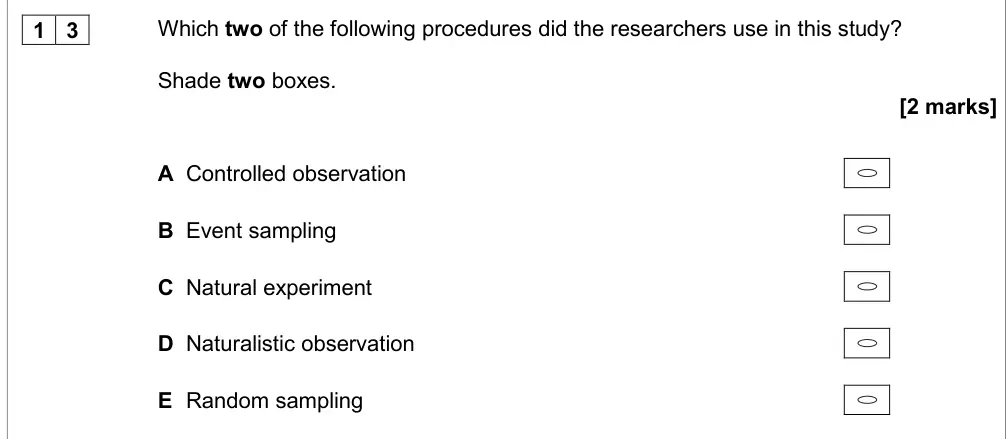
Which two of the following procedures did the researchers use in this study?
[2 marks]
A Controlled observation
B Event sampling
C Natural experiment
D Naturalistic observation
E Random sampling
November 2020 · AS Paper 2 · Q14 2 marks AO2=2 Research methods scientific processesresearch methods
1 4
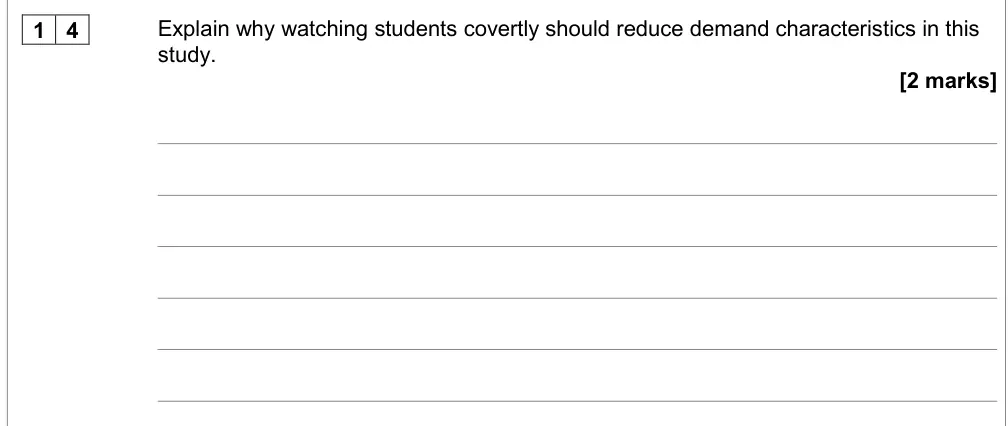
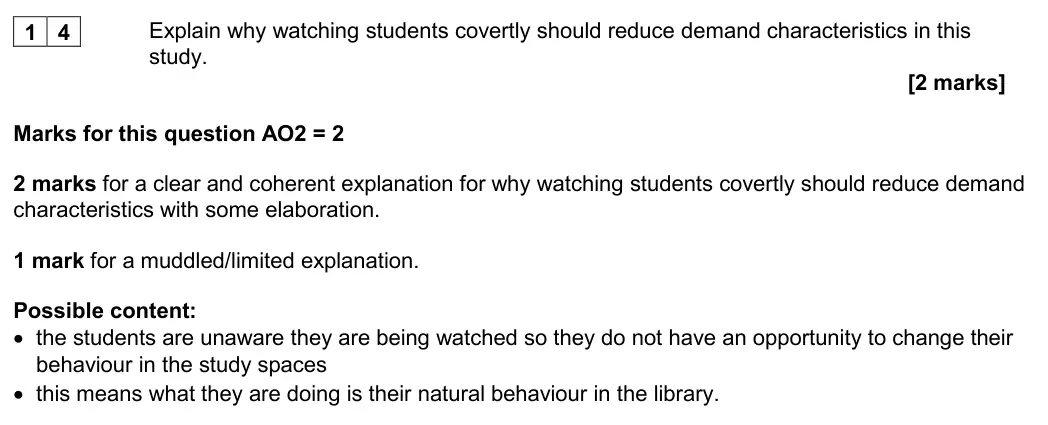
Explain why watching students covertly should reduce demand characteristics in this
study.
[2 marks]
November 2020 · AS Paper 2 · Q15 4 marks AO2=2, AO3=2 Research methods data handling
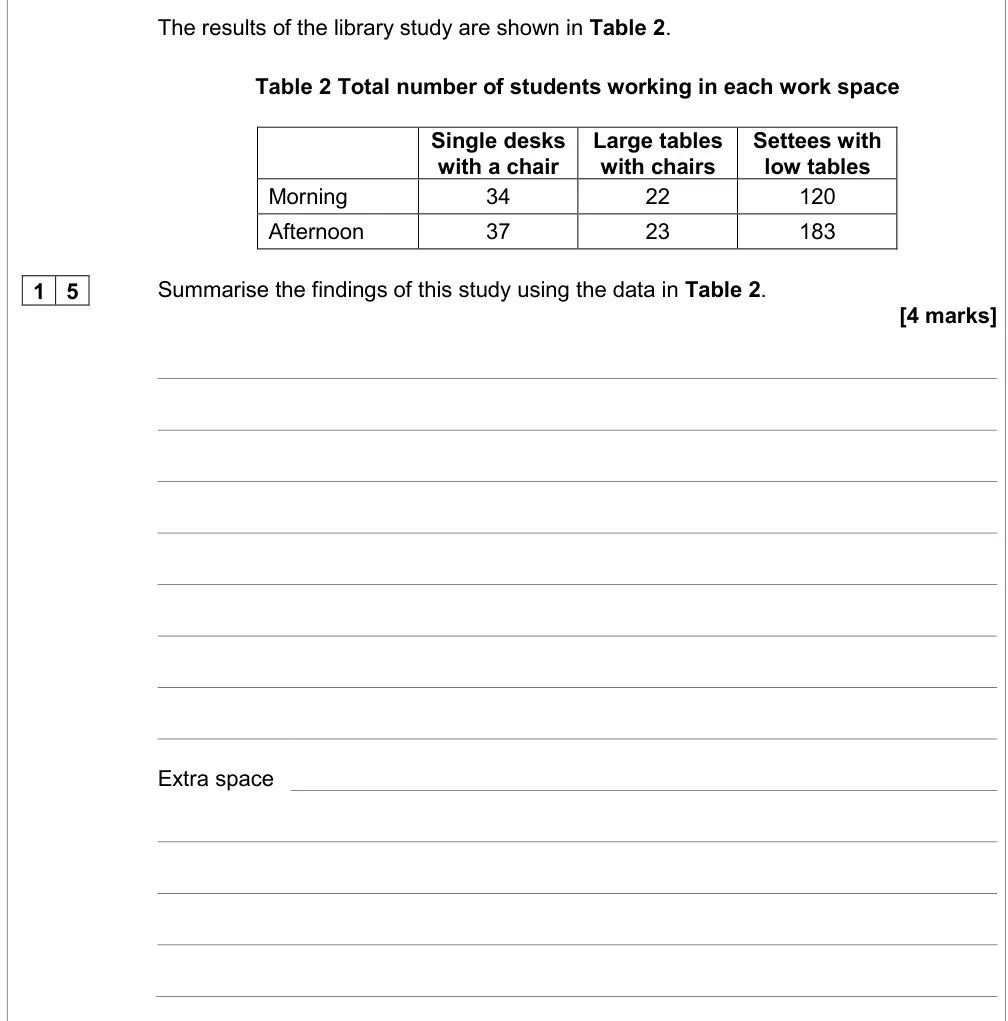
The results of the library study are shown in Table 2.
Table 2 Total number of students working in each work space
Single desks
Large tables
Settees with
with a chair
with chairs
low tables
Morning
34
22
120
Afternoon
37
23
183
1 5
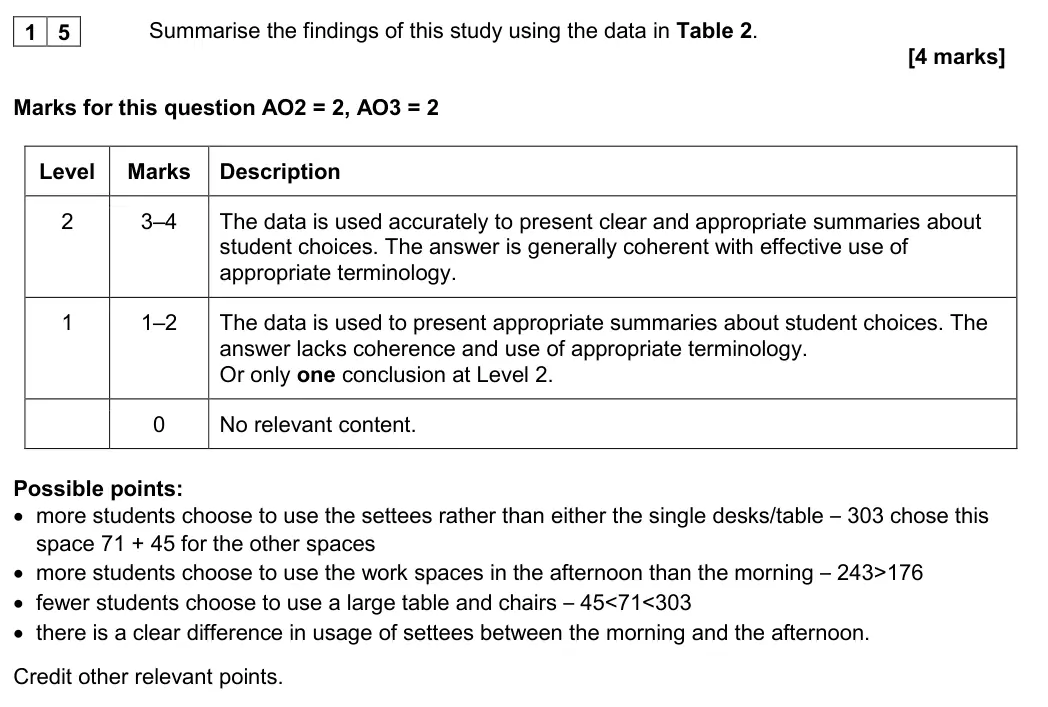
Summarise the findings of this study using the data in Table 2.
[4 marks]
Extra space
November 2020 · AS Paper 2 · Q16 2 marks AO3=2 Research methods scientific processesdata handling
Students who were in the library over the three-day period were asked to complete a
questionnaire about their work space use.
The questionnaire contained only closed questions.
1 6
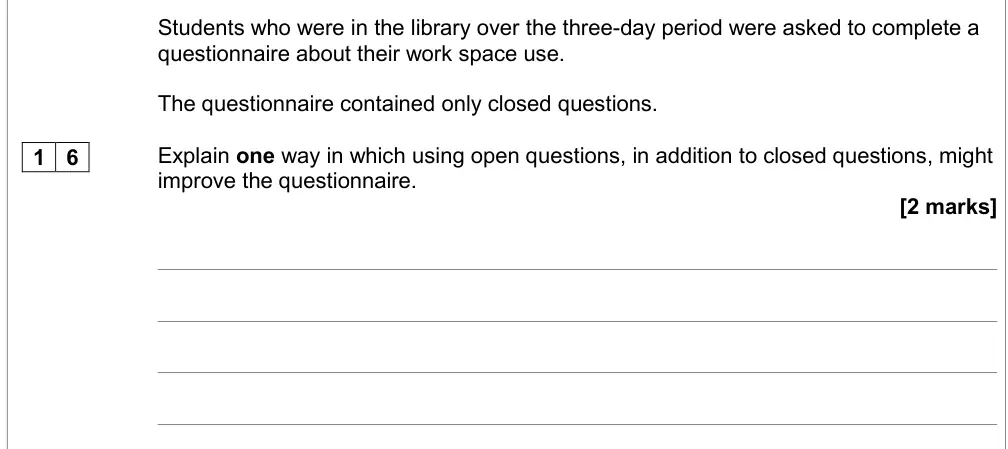
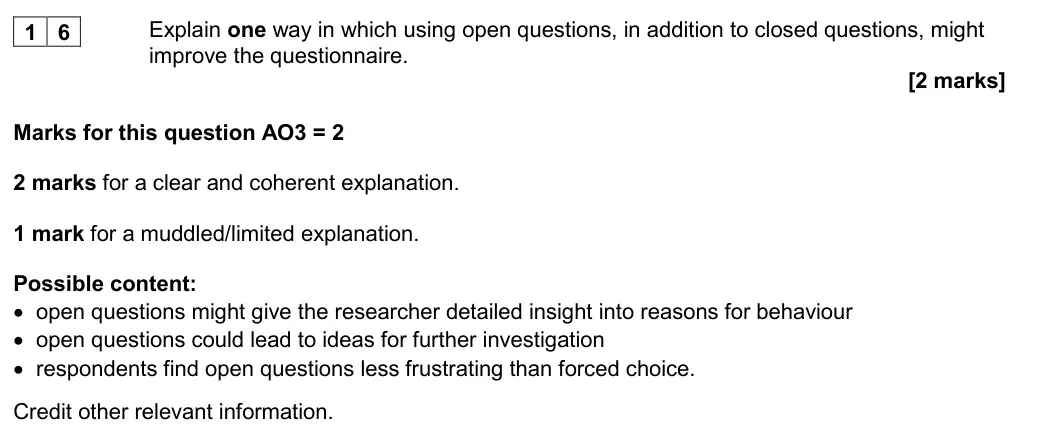
Explain one way in which using open questions, in addition to closed questions, might
improve the questionnaire.
[2 marks]
November 2020 · AS Paper 2 · Q17 4 marks AO2=2, AO3=2 Research methods research methods
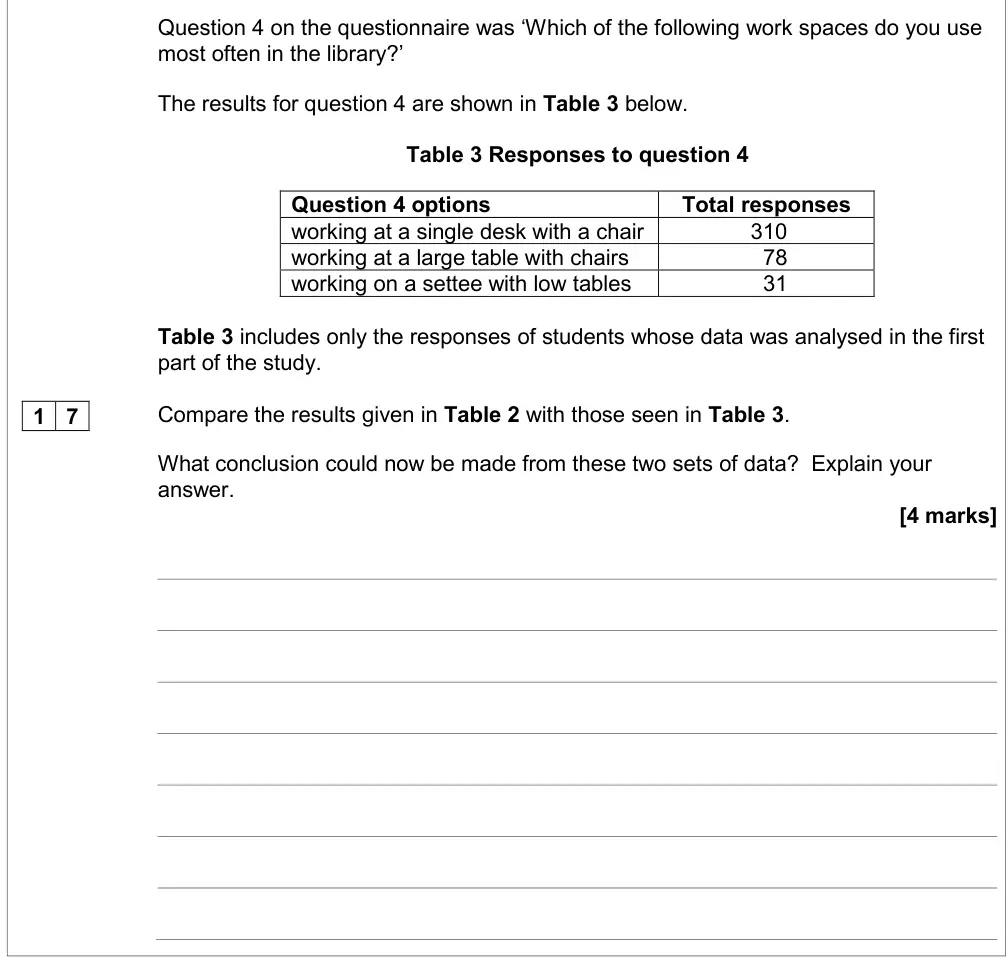
Question 4 on the questionnaire was ‘Which of the following work spaces do you use
most often in the library?’
The results for question 4 are shown in Table 3 below.
Table 3 Responses to question 4
Question 4 options
Total responses
working at a single desk with a chair
310
working at a large table with chairs
78
working on a settee with low tables
31
Table 3 includes only the responses of students whose data was analysed in the first
part of the study.
1 7
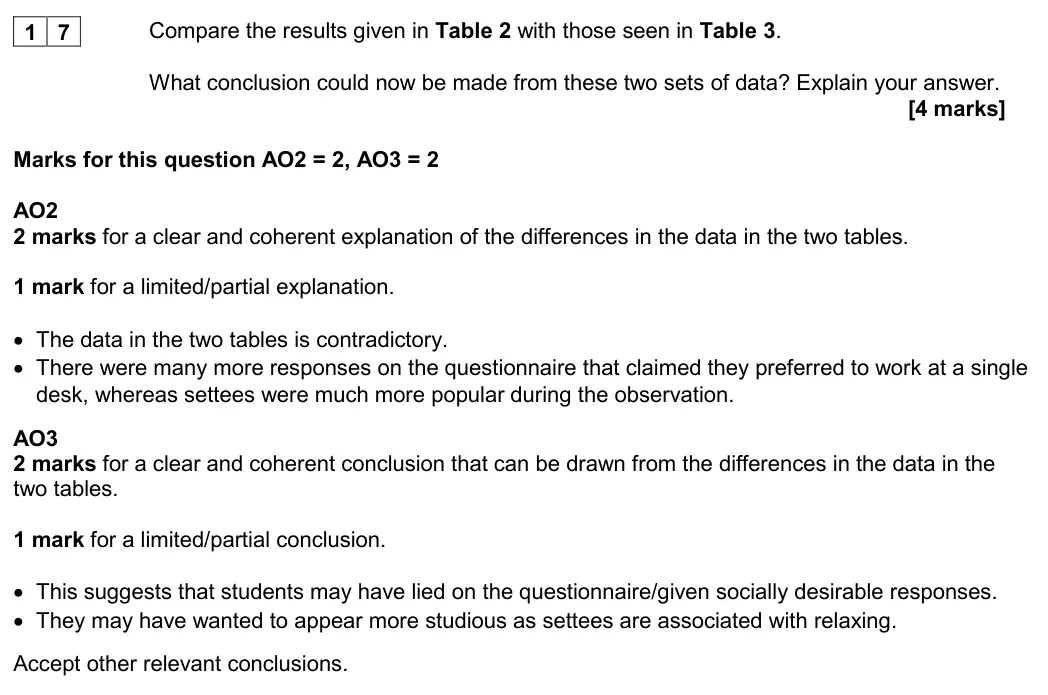
Compare the results given in Table 2 with those seen in Table 3.
What conclusion could now be made from these two sets of data?  Explain your
answer.
[4 marks]
November 2020 · AS Paper 2 · Q18 4 marks AO2=4 Research methods scientific processes
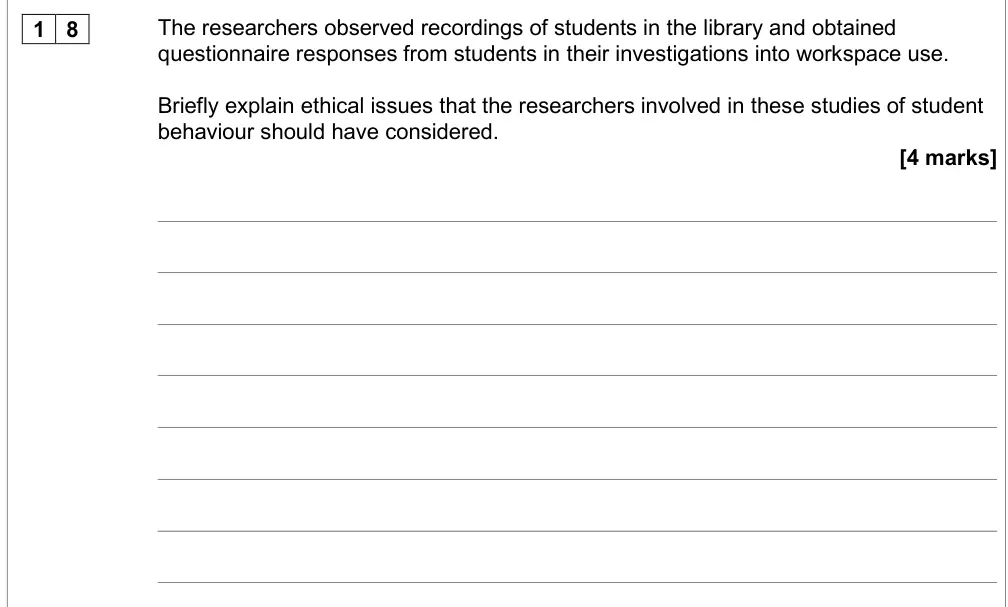
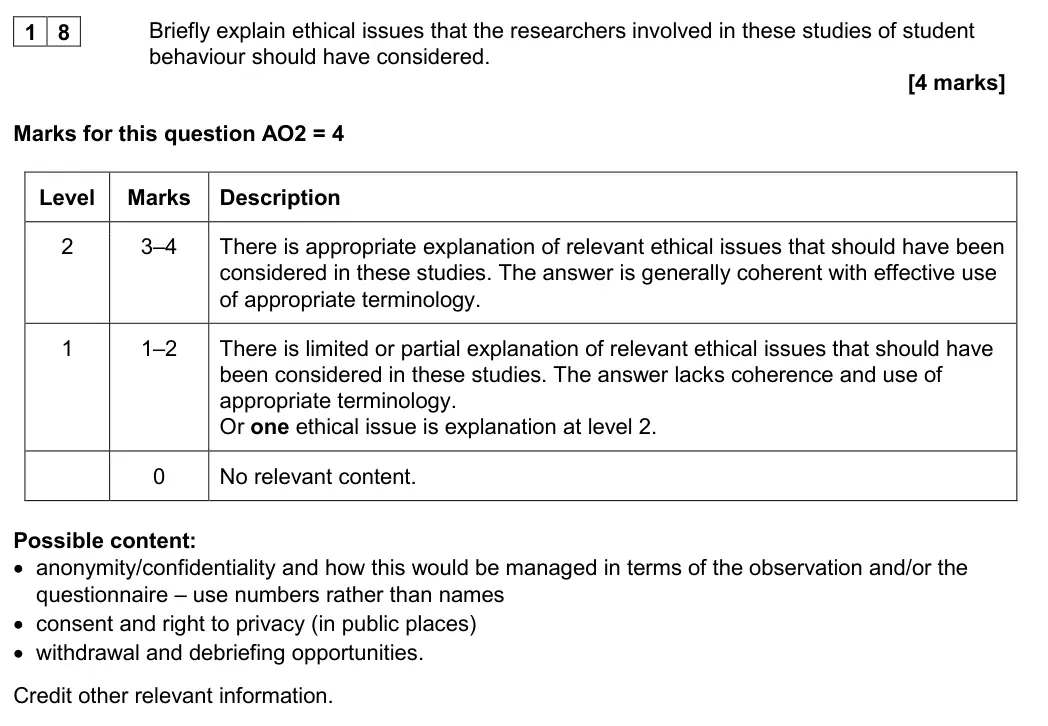
1 8
The researchers observed recordings of students in the library and obtained
questionnaire responses from students in their investigations into workspace use.
Briefly explain ethical issues that the researchers involved in these studies of student
behaviour should have considered.
[4 marks]
November 2020 · AS Paper 2 · Q19 4 marks AO1=2, AO3=2 Research methods scientific processes
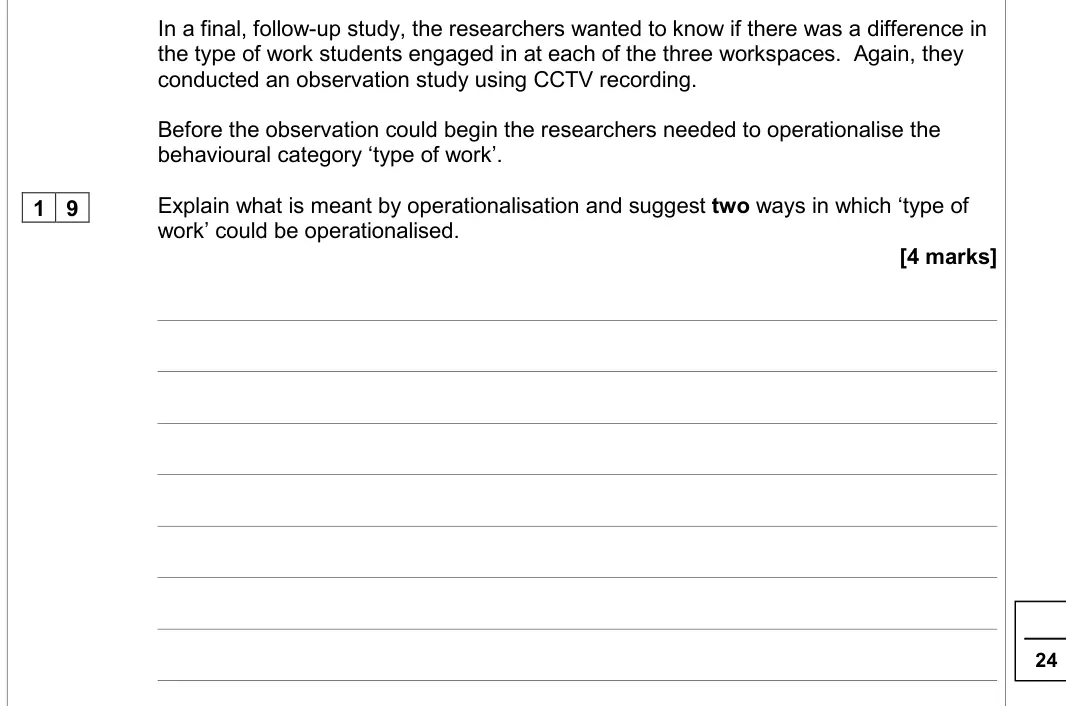
In a final, follow-up study, the researchers wanted to know if there was a difference in
the type of work students engaged in at each of the three workspaces.  Again, they
conducted an observation study using CCTV recording.
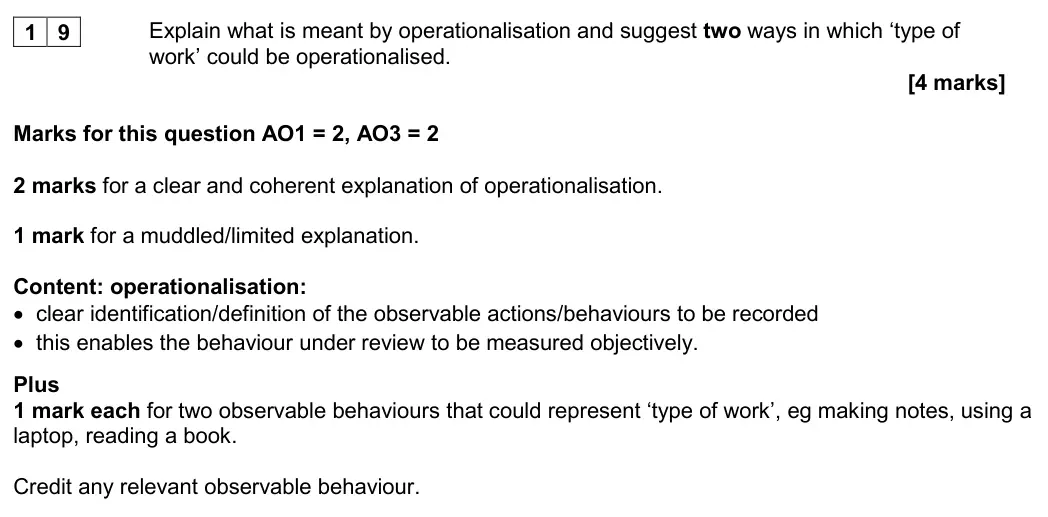
Before the observation could begin the researchers needed to operationalise the
behavioural category ‘type of work’.
1 9
Explain what is meant by operationalisation and suggest two ways in which ‘type of
work’ could be operationalised.
[4 marks]

Work with an AQA psychology tutor

Want a paper marked and gone through with you? Message us.
Prefer email? Send an enquiry

If you are under 18, please include a parent's contact details. Enquiries go to enquiries@alevelpsychologytutor.com and are deleted once handled. All tutoring is online.