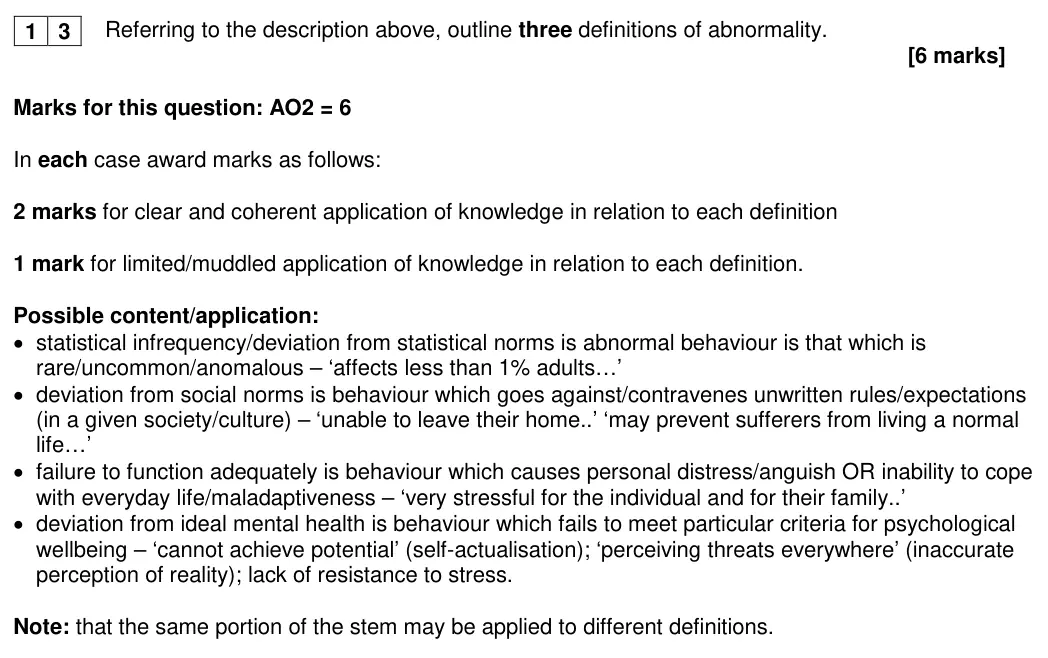
4.1.4-01 Definitions in the field of mental health; deviation from ideal mental health, deviation from social/cultural norms, failure to function adequately and statistical infrequency.AS
4.1.4-02 The behavioural, emotional and cognitive characteristics of phobias, depression and obsessive-compulsive disorder (OCD).AS
4.1.4-03 The behavioural approach to explaining and treating phobias: the two-process model, including classical and operant conditioning; systematic desensitisation, including relaxation and use of hierarchy; flooding.AS
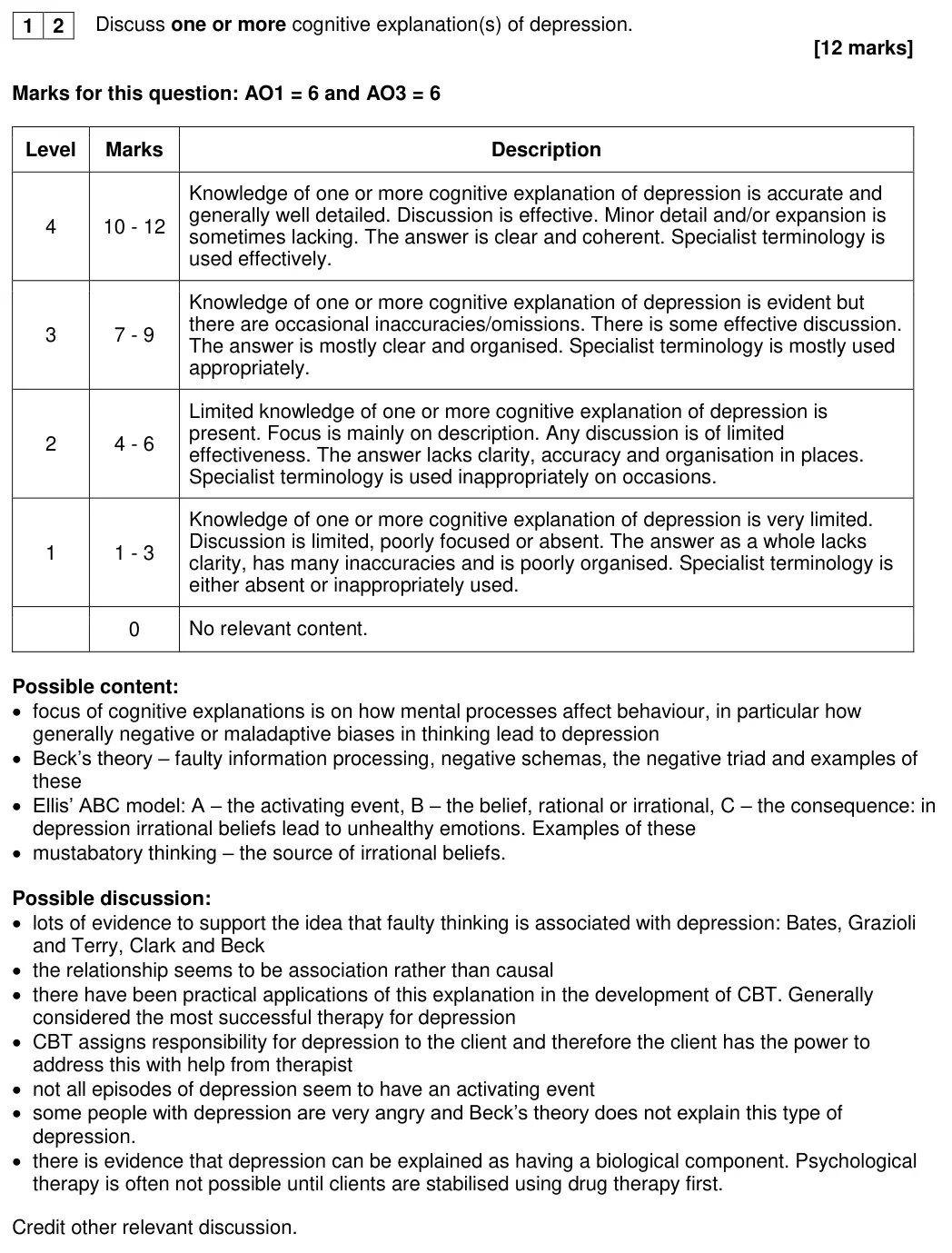
4.1.4-04 The cognitive approach to explaining and treating depression: Beck’s negative triad and Ellis’s ABC model; cognitive behaviour therapy (CBT), including challenging irrational thoughts.AS
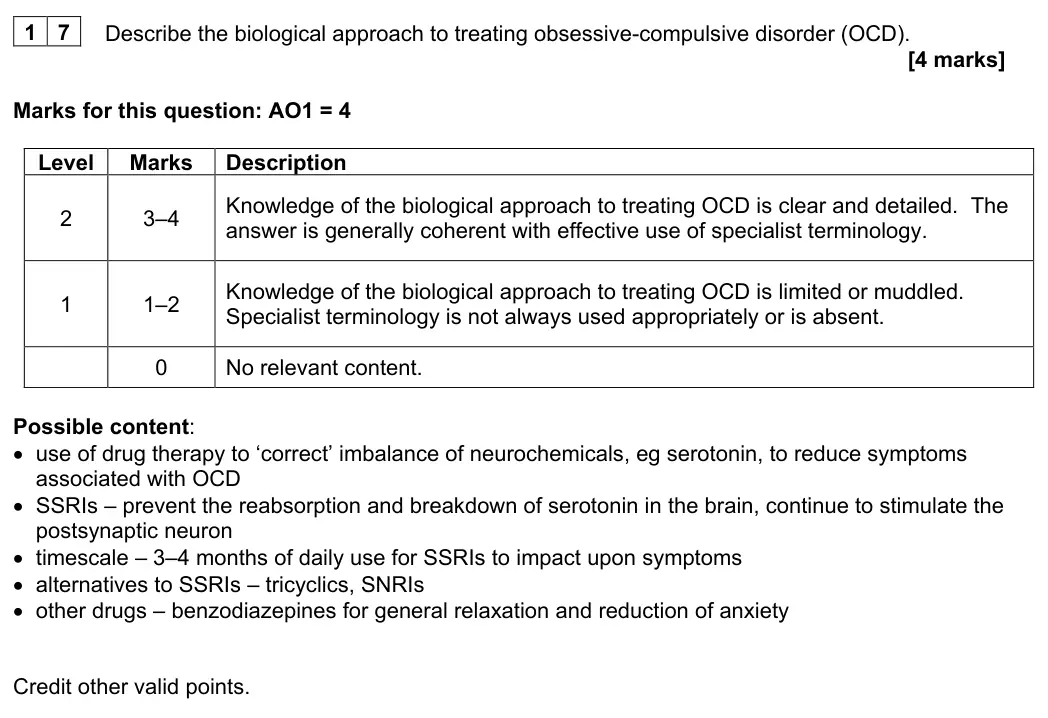
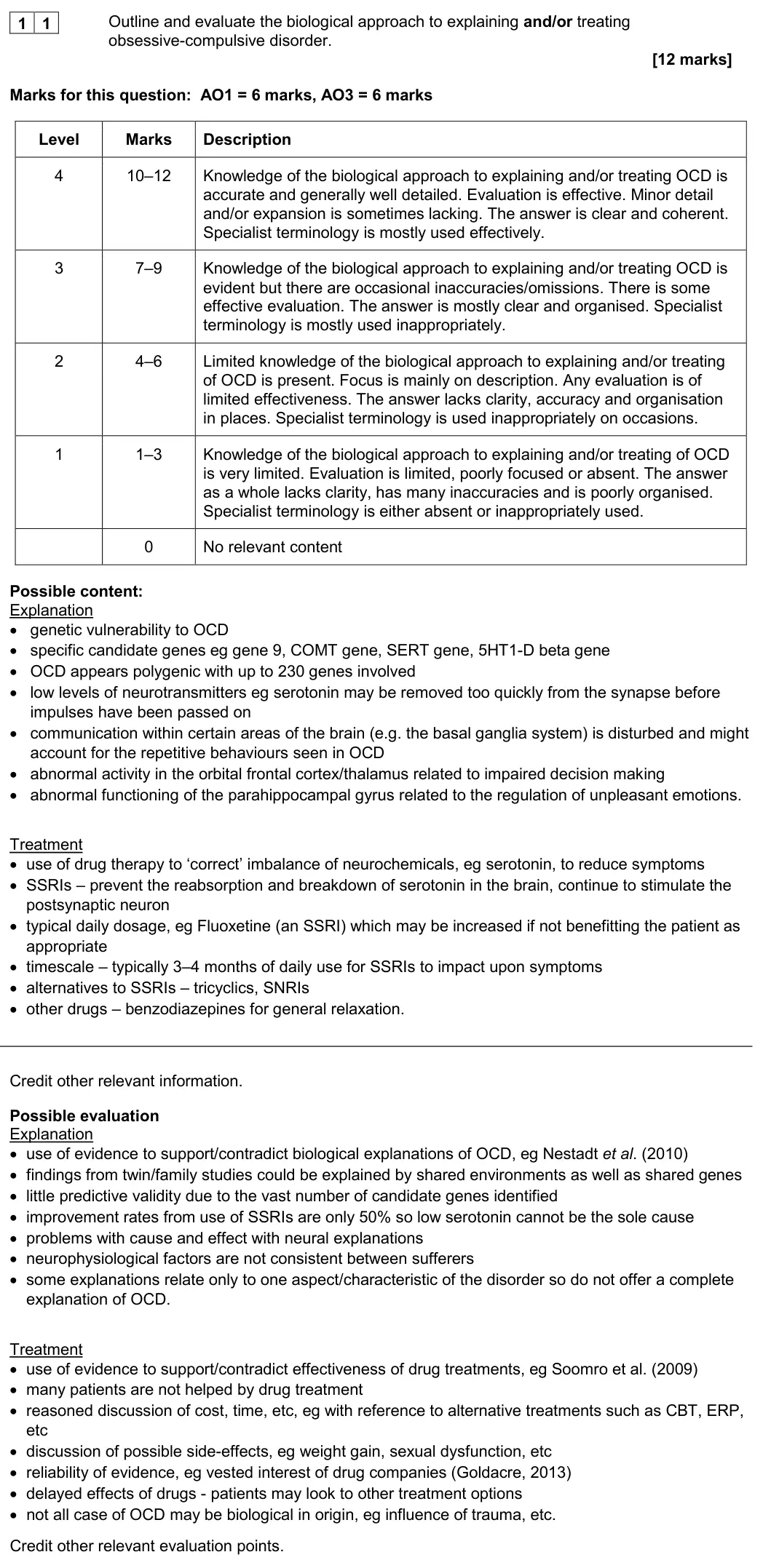
4.1.4-05 The biological approach to explaining and treating OCD: genetic and neural explanations; drug therapy.AS
Tap a question to zoom it. Mark scheme and examiner's comment open under each question.
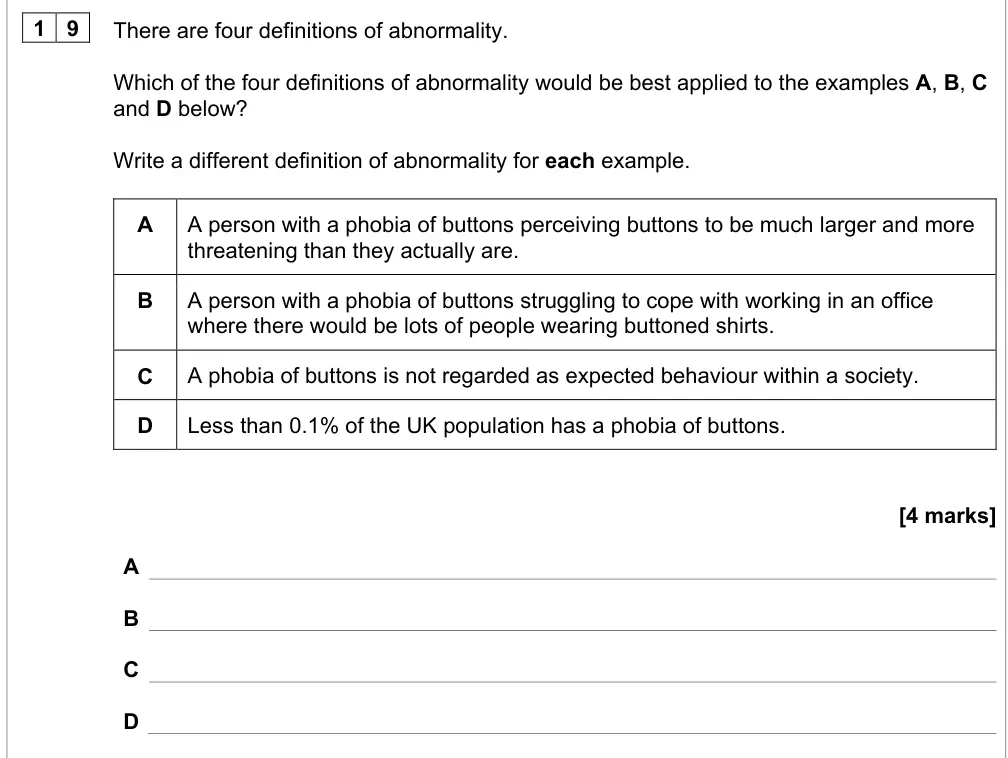
June 2025 · Paper 1 · Q194 marksAO2=4ApplicationEasy
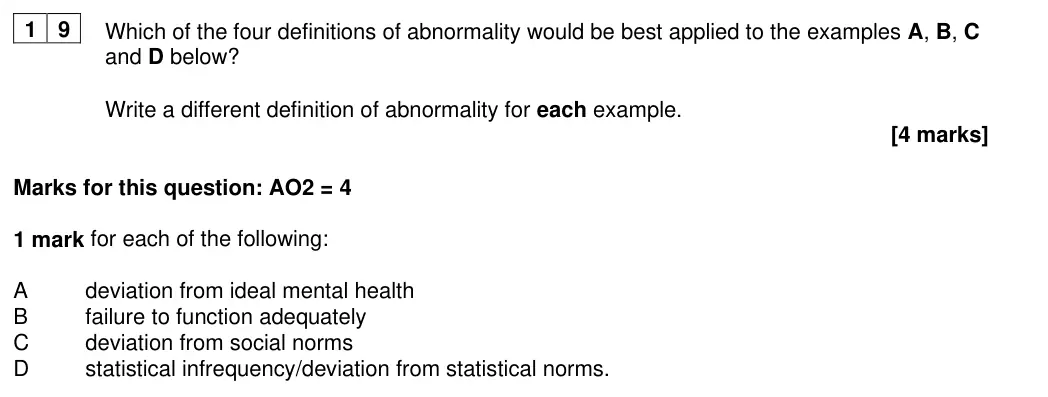
Mark scheme, including level descriptors and indicative content
Examiner's comment
Many students were able to identify the relevant definitions of abnormity with ease, with over 75% of students gaining full marks. A very small minority of students gained no marks, possibly due to misunderstanding the question and thus offering specific features of the definition as opposed to the definition itself, or perhaps simply due to lack of knowledge.
Notes from the mark scheme and report
A ideal mental health, B failure to function, C social norms (now 'social/cultural norms' in v1.4), D statistical infrequency
over 75% full marks
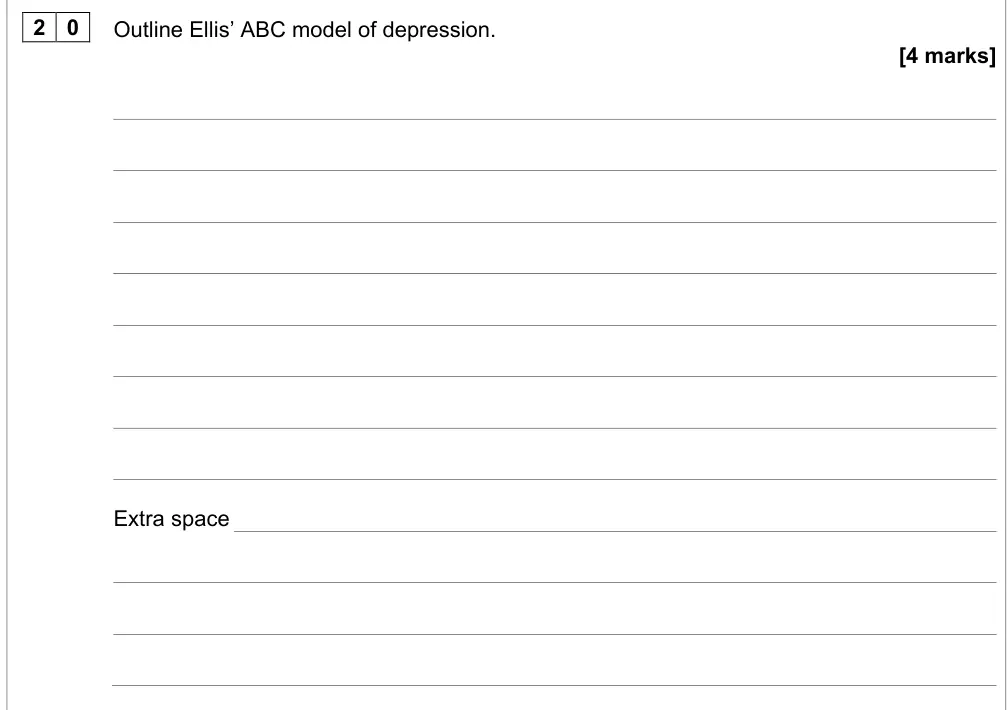
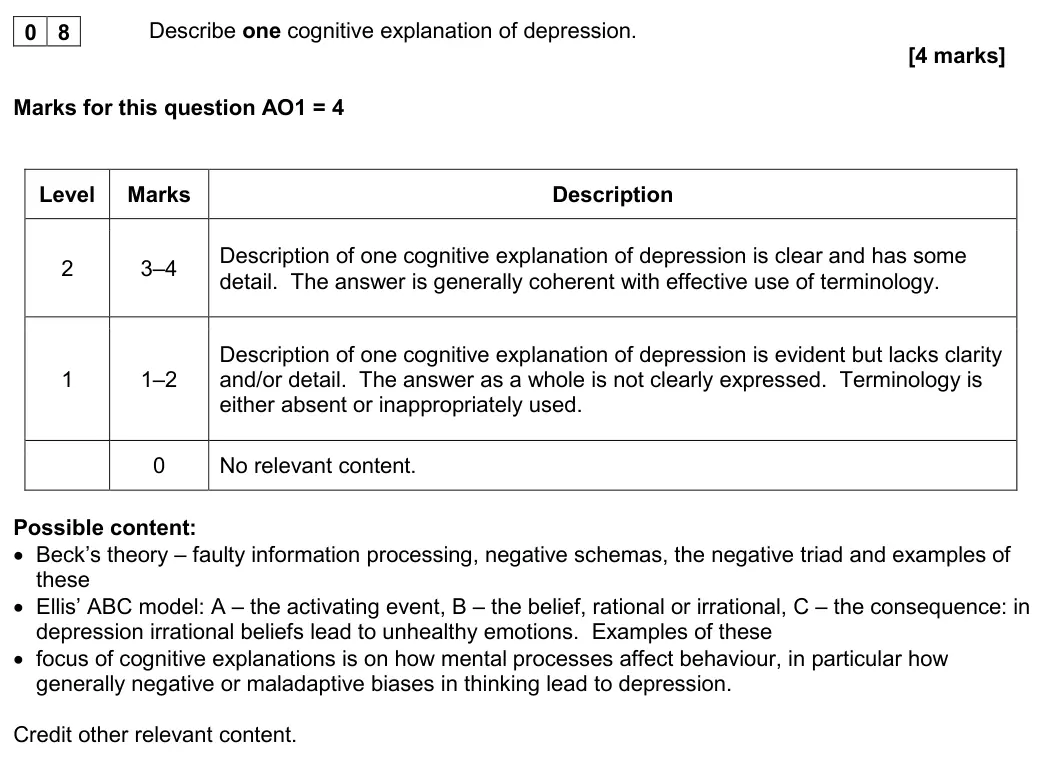
June 2025 · Paper 1 · Q204 marksAO1=4OutlineMedium
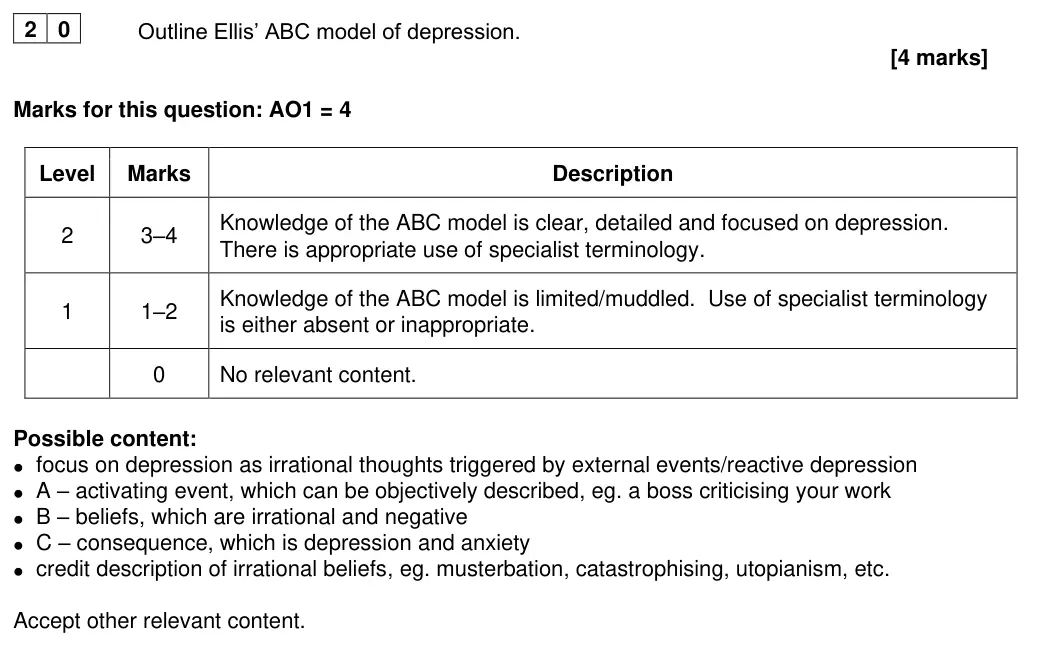
Mark scheme, including level descriptors and indicative content
Examiner's comment
Most students were able to gain marks in this question with slightly less than 50% of students gaining level 2 marks. Many students could describe the ABC model effectively and emphasise the role of irrational beliefs as the causal factor in depression. Some students used worthy examples of irrational beliefs to elaborate their responses e.g. utopianism or catastrophising. One common error was for students to overemphasise negative thinking and specific negative life events as activating events, which is not necessarily the case for the ABC model. Finally, students would be well advised to focus their responses on depression and/or depressive symptoms, as opposed to just negative events.
Notes from the mark scheme and report
must focus on depression
irrational beliefs as causal factor
common error: over-emphasising negative events as activating events
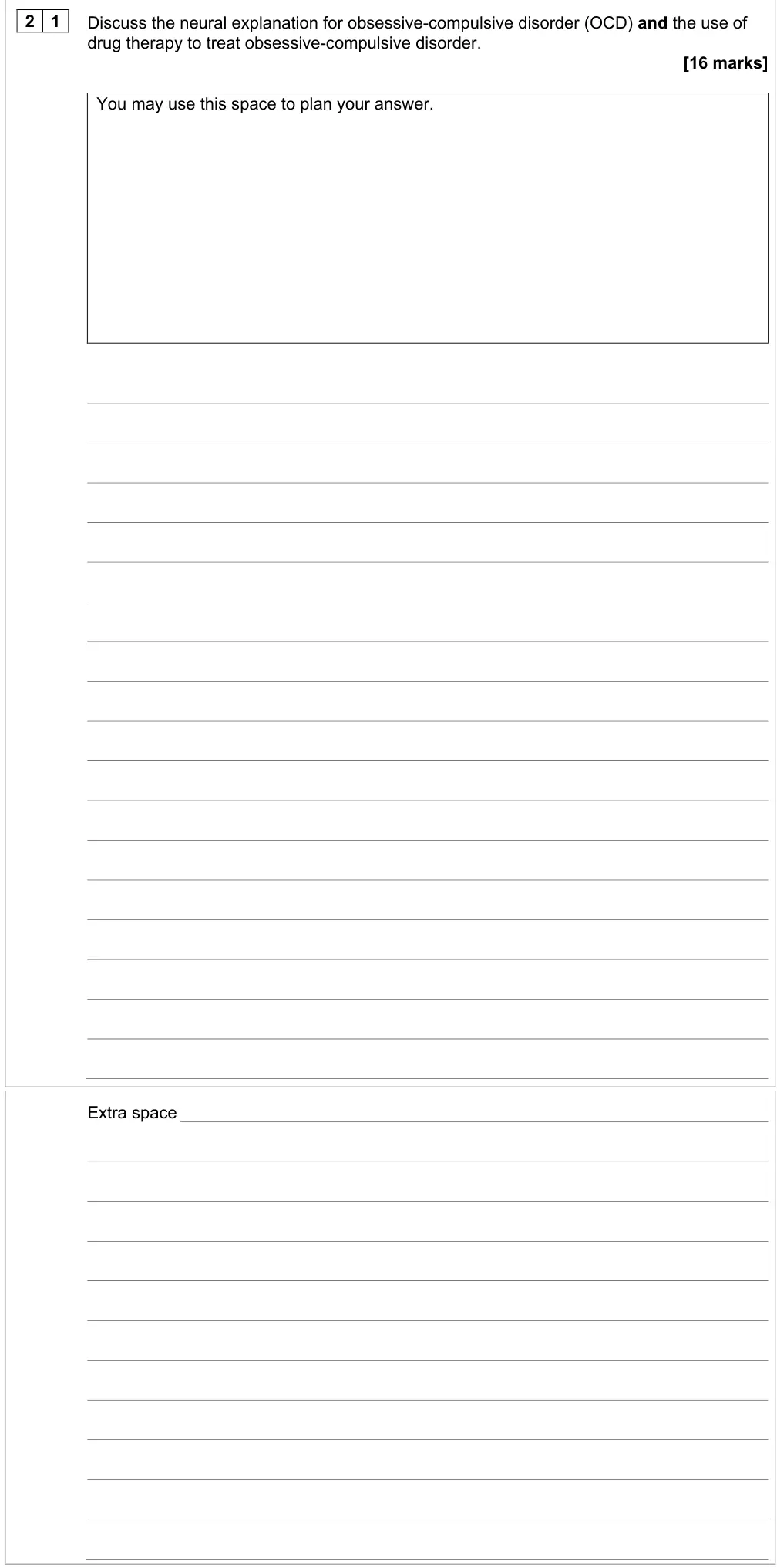
June 2025 · Paper 1 · Q2116 marksAO1=6, AO3=1016-mark essay
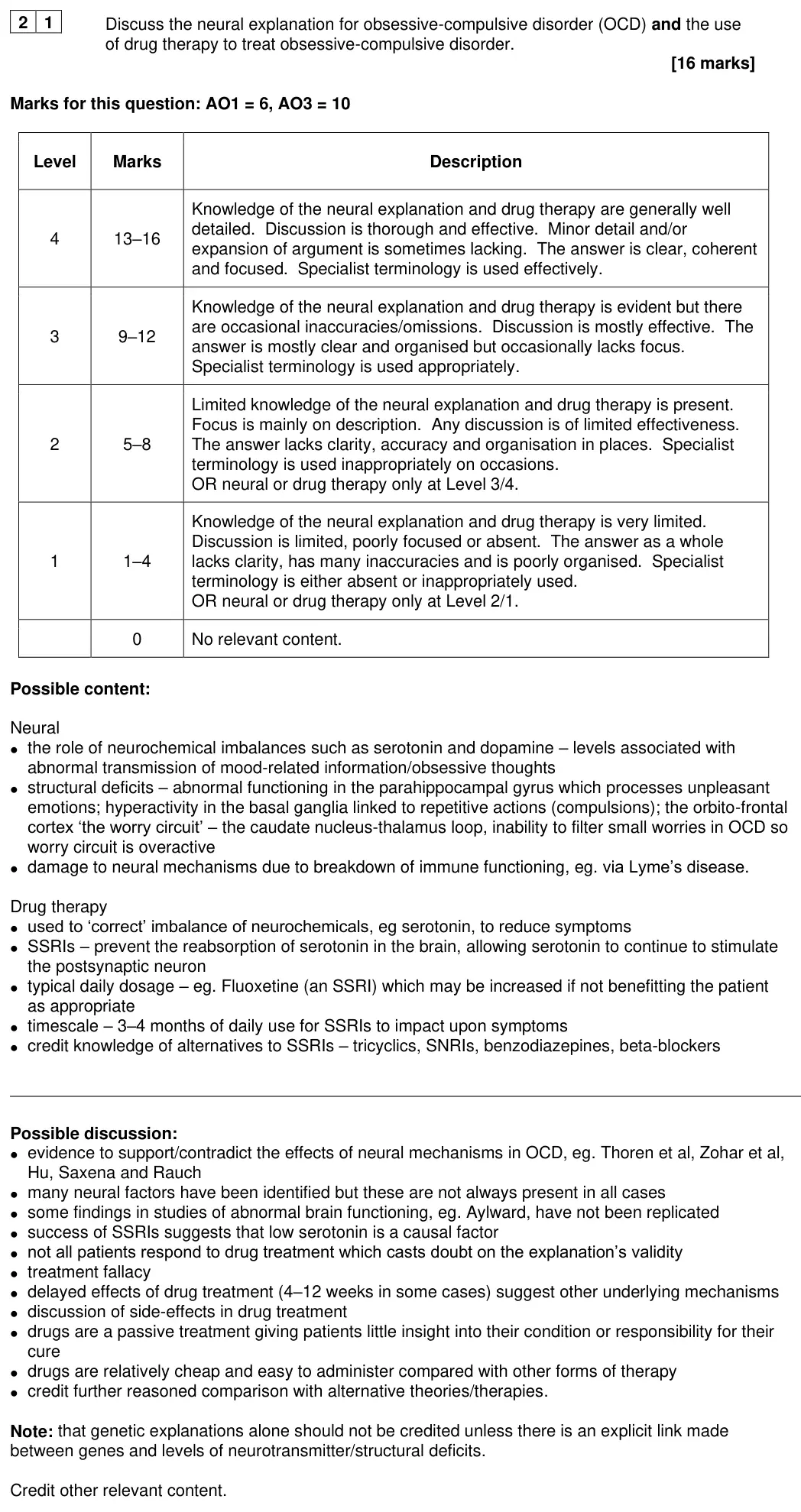
Mark scheme, including level descriptors and indicative content
Examiner's comment
This inclusive question discriminated well. As the question requested discussion of both neural factors and drug therapies, students had an abundance of material to draw upon. Most common responses included reference to both serotonin and dopamine levels, as well as structural deficits e.g. an impaired caudate nucleus. Generally, reference to structural deficits lent themselves to detailed descriptions, yet students should be advised to focus more exclusively on describing the structural deficits as opposed to general functioning of these areas. Most common drug therapies included SSRIs, as well as other types of anti-depressants (e.g. tricyclics), and anxiolytics. An effective strategy for many students was to cite brief information about multiple drugs, including references to dosages. Useful discussion often revolved around the use of evidence to illustrate points, alternative explanations e.g. the role of trauma and consideration of cause and effect. With drug therapies students often cited side effects and the economic benefits. Better discussions of side effects were specific to key medications rather than more generic commentary.
Notes from the mark scheme and report
neural or drug therapy only = max Level 2
genetic explanations not credited unless linked to neurotransmitters/structures
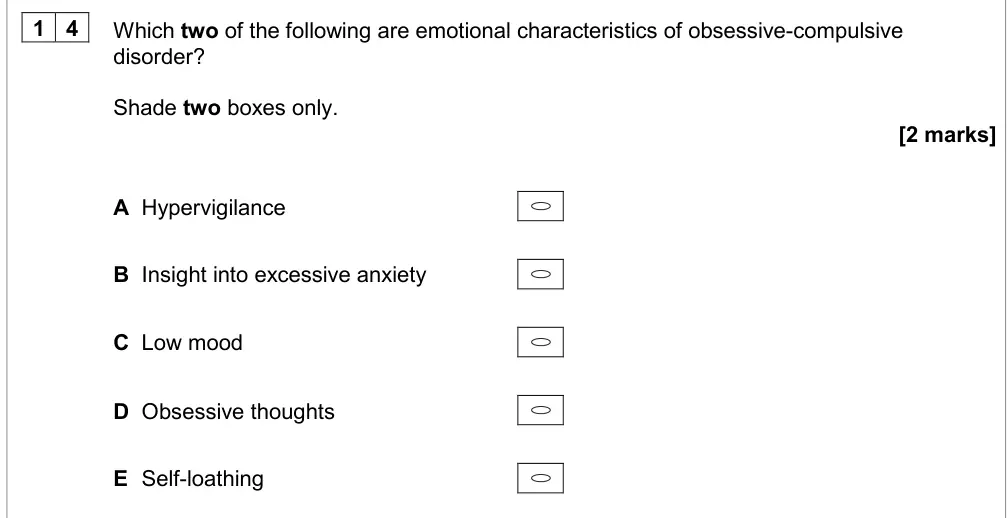
June 2024 · Paper 1 · Q142 marksAO1=2Multiple choice
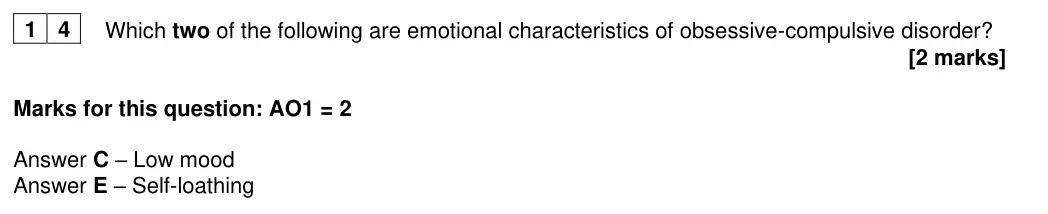
Answer
C and E
Mark scheme, including level descriptors and indicative content
Examiner's comment
Surprisingly, students found this multiple-choice question quite challenging. They were typically able to identify that one of the characteristics was low mood, yet often struggled to identify that self-loathing was the second emotional characteristic. In particular, option B (insight into excessive anxiety) was regularly mistaken as an emotional characteristic. Students would be advised to develop a greater understanding of the term ‘anxiety’ as used to describe characteristics of disorders.
Notes from the mark scheme and report
correct C (low mood) and E (self-loathing)
B (insight into excessive anxiety) often wrongly chosen
self-loathing often missed
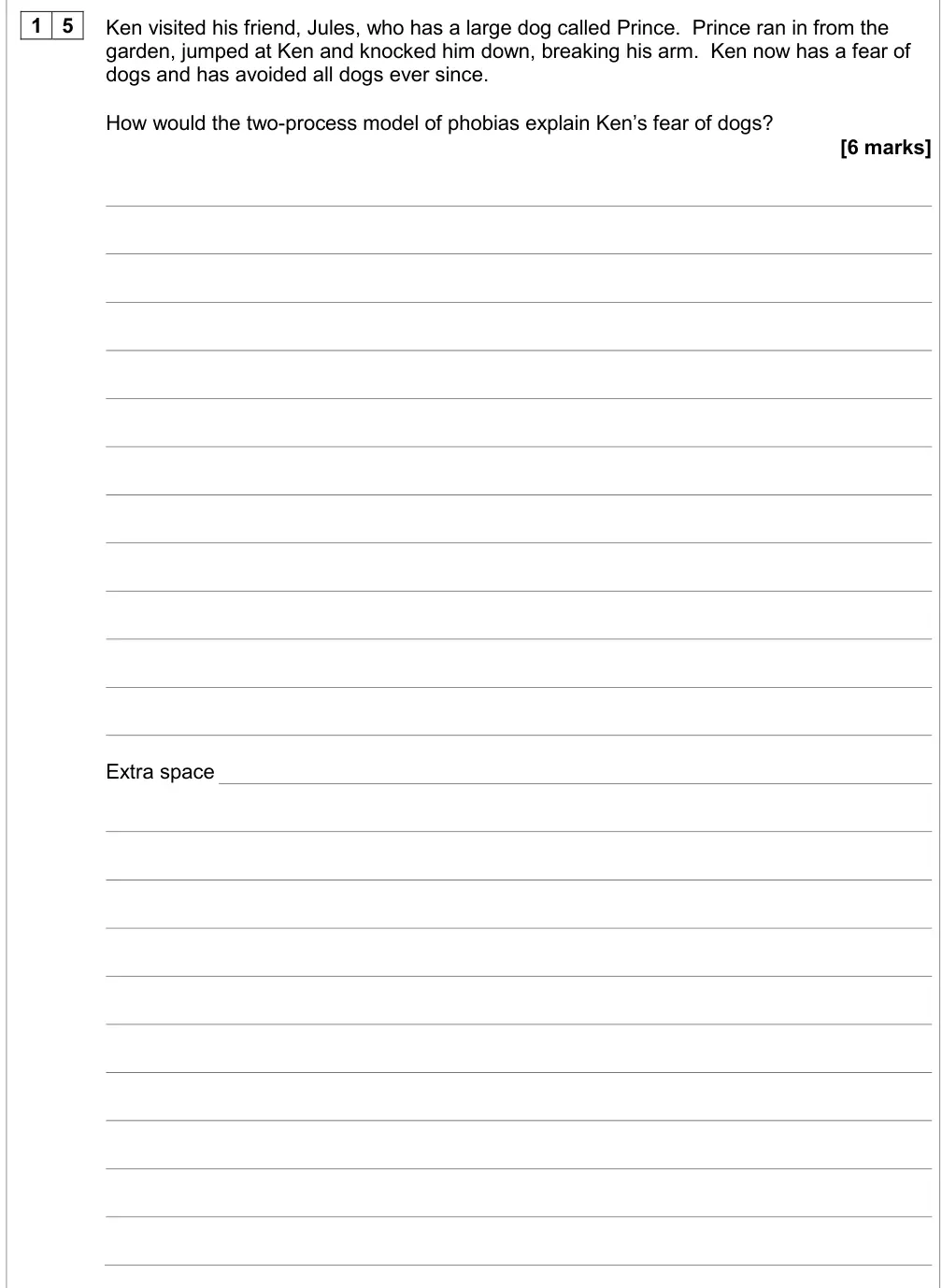
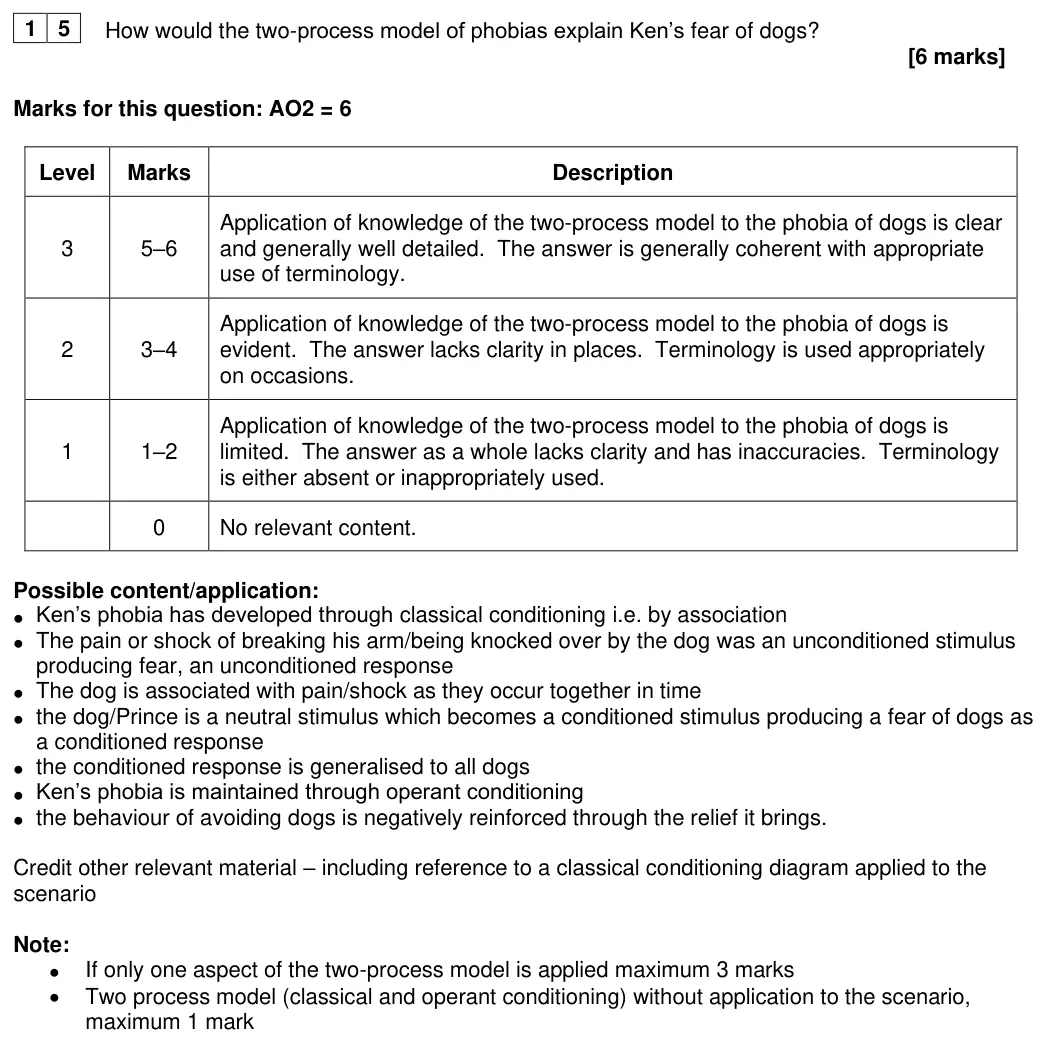
June 2024 · Paper 1 · Q156 marksAO2=6ApplicationMedium
Mark scheme, including level descriptors and indicative content
Examiner's comment
In a similar fashion, students were able to access application marks in question D15 when applying the two-process model of phobias to a novel scenario. Most students’ responses managed to score well on this question, with a mean of 3.3 marks. Just over five percent of students failed to score marks on this question. As the question requested students to apply knowledge of the ‘two-process’ model to a novel phobia, it demanded reference to both classical and operant conditioning being applied to the scenario. Most students were able to apply both aspects of the two-process model to a phobia of dogs and scored well, yet students did not find this question as accessible as either question A2 or A3. This could be due to the time constraints inherent in A level examinations.
Notes from the mark scheme and report
classical conditioning (pain/shock UCS, dog NS to CS, fear CR, generalisation) + operant (avoidance negatively reinforced)
only one process applied = max 3
no application = max 1
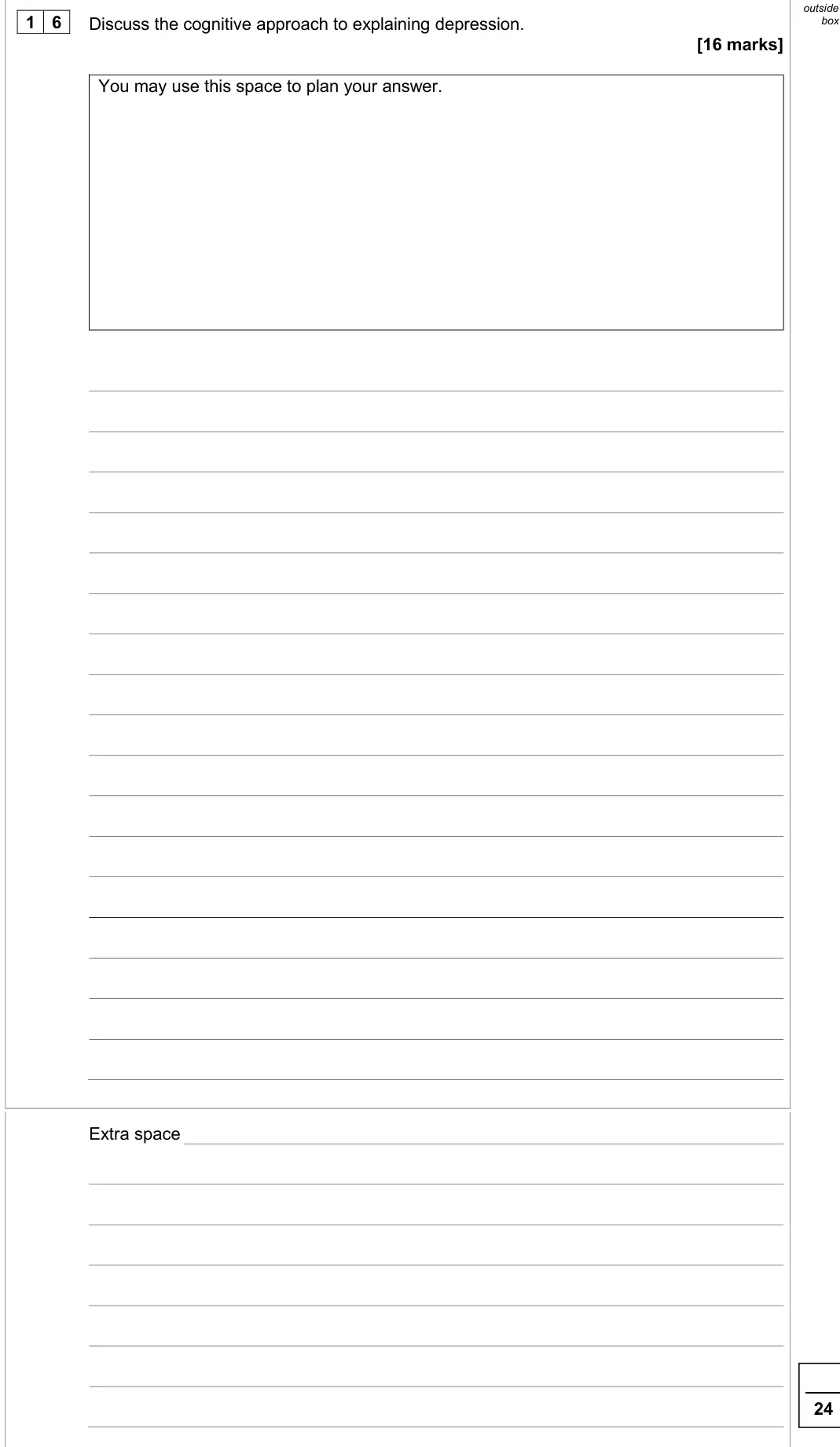
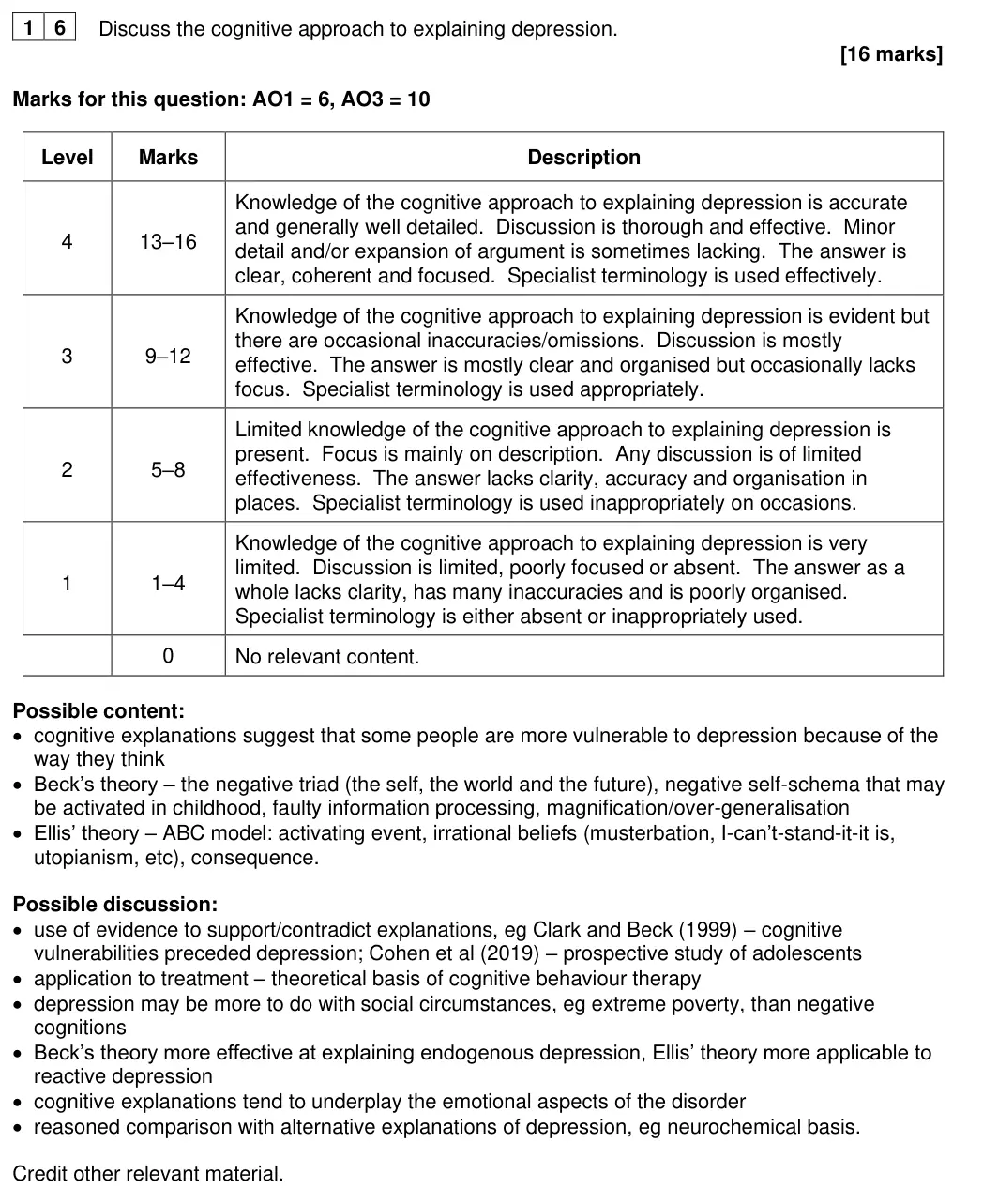
June 2024 · Paper 1 · Q1616 marksAO1=6, AO3=1016-mark essayHard
Mark scheme, including level descriptors and indicative content
Examiner's comment
Although this question overlapped with content from last year’s exam students struggled with this 16 marks essay, with an average of 46% being scored for the question. Although students would typically cite relevant content, it was often brief, without elaboration. This often entailed lists of factors that both Beck and Ellis claimed were involved with the onset of depression, without any further development e.g. simply listing the parts of the negative triad without any further elaboration. In addition, with Ellis’s ABC model students would be well advised to over-emphasise the causal factor of ‘irrational beliefs’ as opposed to the activating event. Unusually, the ‘discussion’ element of the question saw more detailed and perhaps well-rehearsed points, that included reference to evidence, the practical application of CBT and Ellis’s approach being more suited to explain reactive as opposed to endogenous depression. Overall, less than nine percent of students managed to access top level marks for this question.
emphasise irrational beliefs not the activating event
evidence, CBT, reactive vs endogenous
June 2024 · AS Paper 2 · Q72 marksAO1=2Multiple choiceEasy
Answer
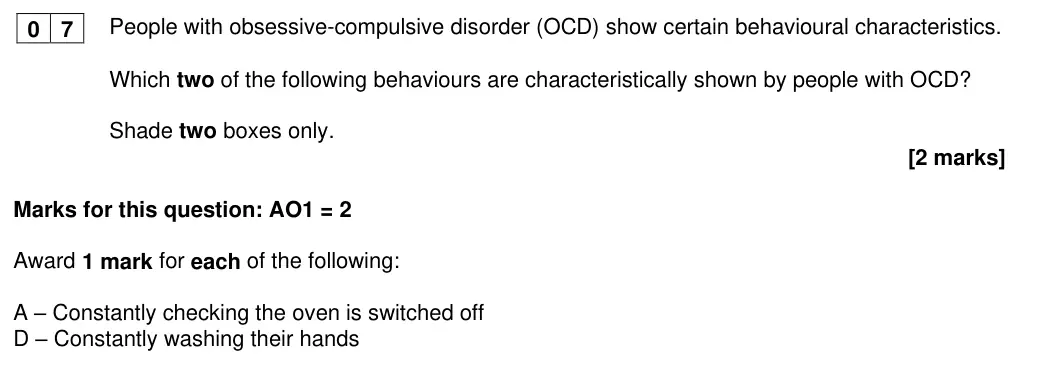
A and D
Mark scheme, including level descriptors and indicative content
Examiner's comment
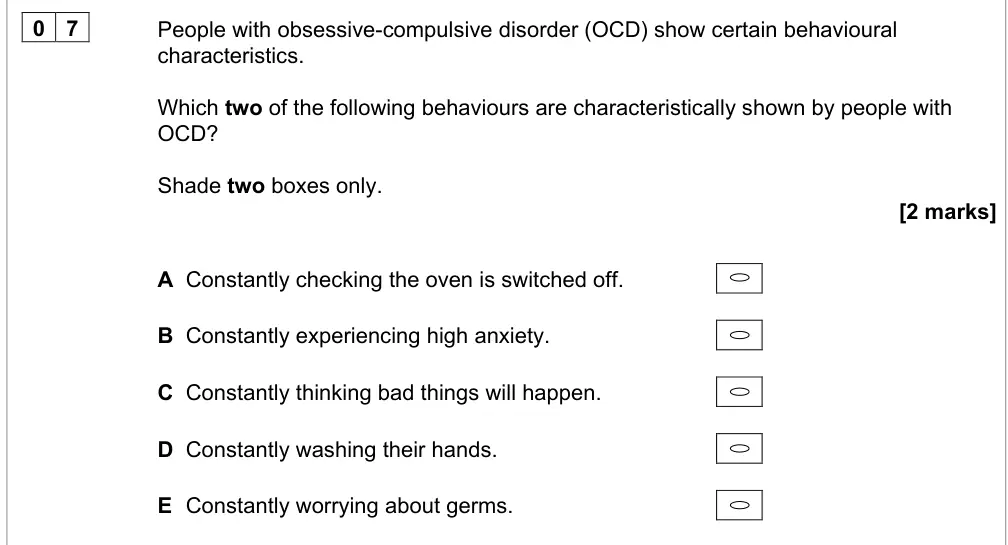
This was particularly evident in Q7, a multiple-choice question on behaviours characteristically shown by people with OCD, and in Q8.1 and Q8.2, two research methods questions asking students to calculate a mean and use this to draw a conclusion. Around three quarters of responses for each of these questions were awarded full marks. In Q7, the multiple-choice question, students were asked to identify two behavioural characteristic of OCD which over two thirds of them were able to do correctly.
Notes from the mark scheme and report
answers A (checking) and D (hand washing)
distractors are emotional (B) and cognitive (C, E) characteristics
June 2024 · AS Paper 2 · Q96 marksAO2=6Application
Mark scheme, including level descriptors and indicative content
Examiner's comment
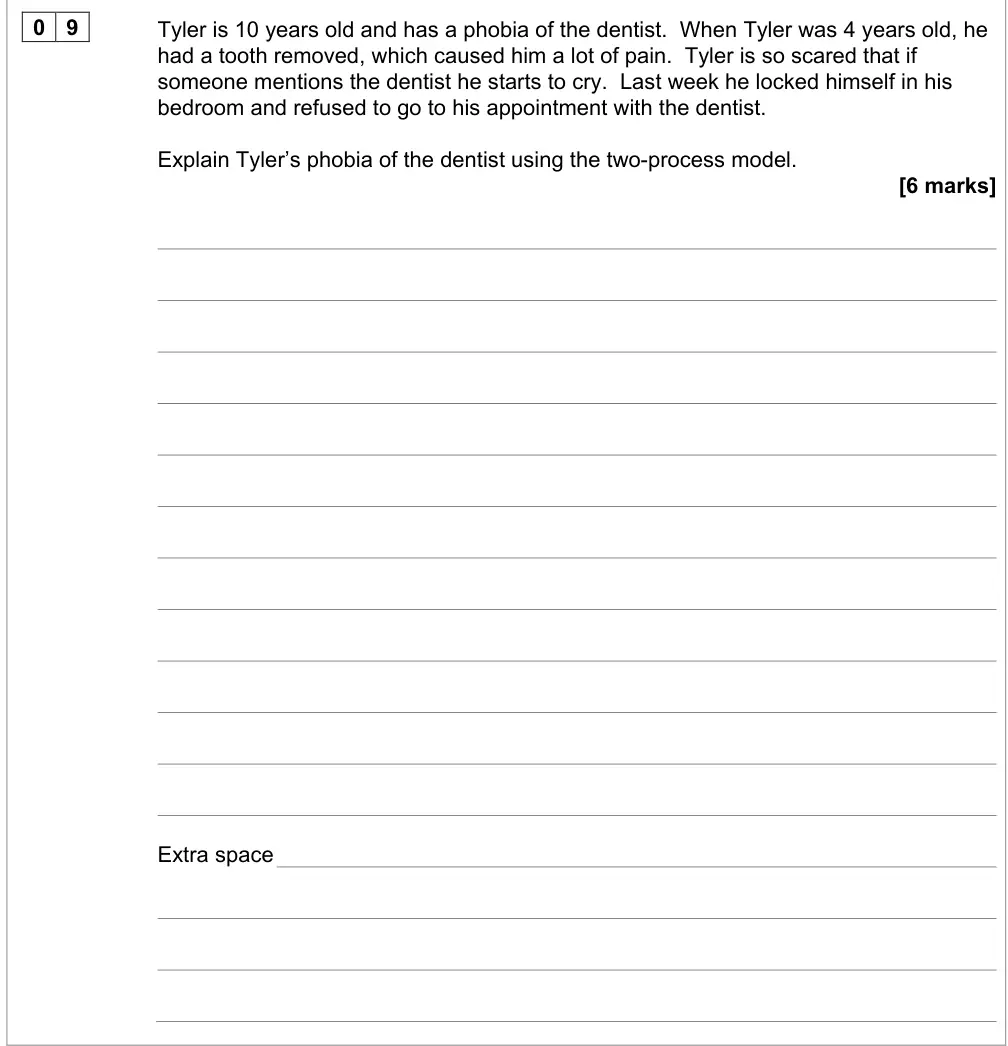
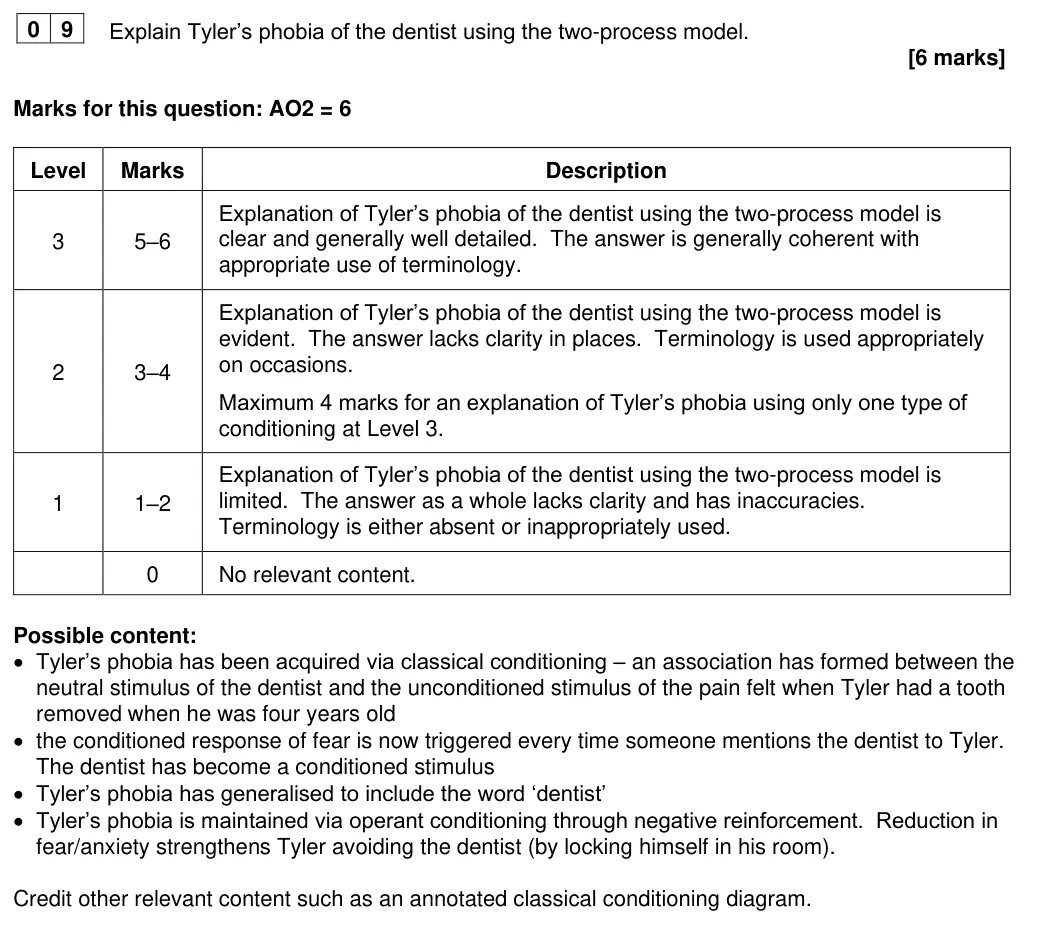
Students generally performed relatively well applying their knowledge to novel situations such as in Q9. For Q9 students were required to apply their knowledge of the two-process model to a phobia of the dentist. Encouragingly, students performed relatively well on this question and there appeared to be a notable improvement in this area (application of knowledge) from previous series. However, it is important that students apply their knowledge to the scenario and do not waste valuable time writing generic knowledge which does not address the demands of the question. It was also important for students to use some accurate specialist terminology from classical and operant conditioning if they are to access the higher levels/marks.
generalisation to the word 'dentist') and operant maintenance (negative reinforcement of avoidance, locking himself in room)
one type of conditioning only = max 4
must apply to Tyler, not generic
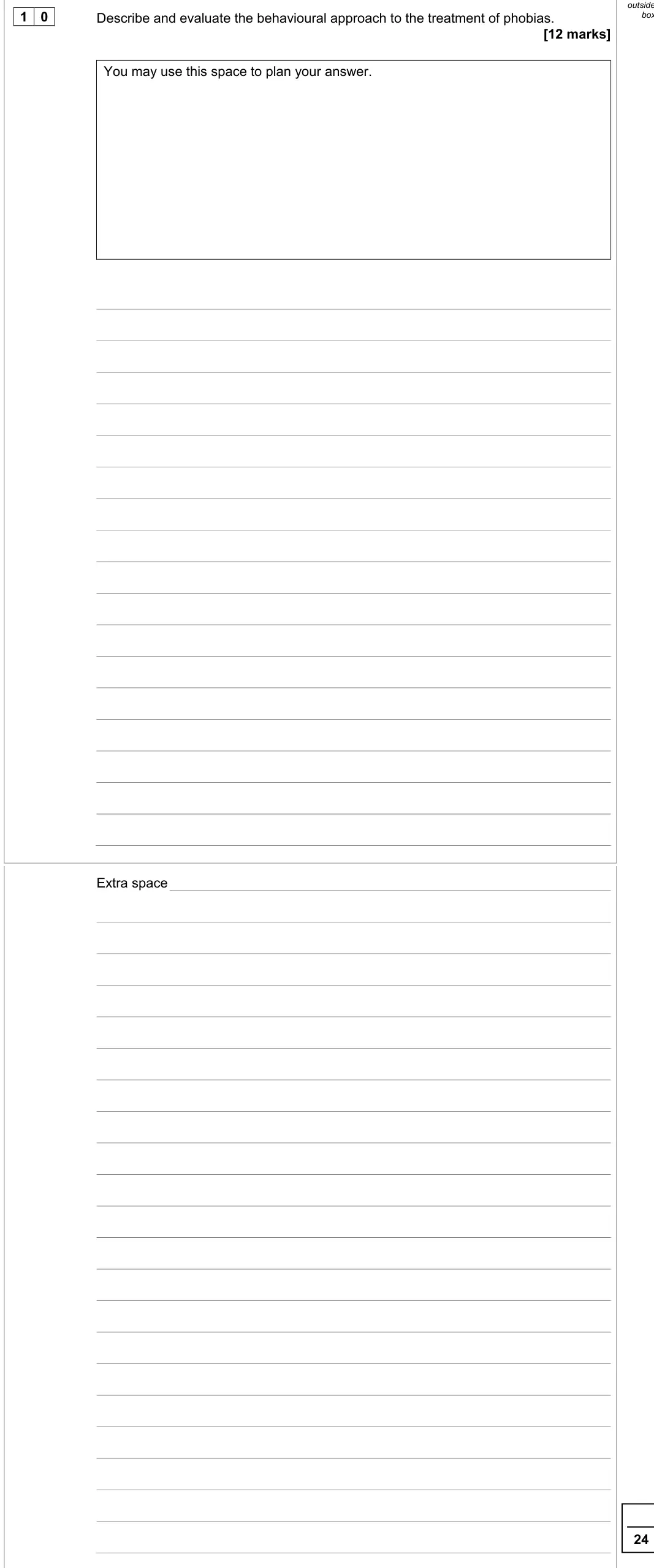
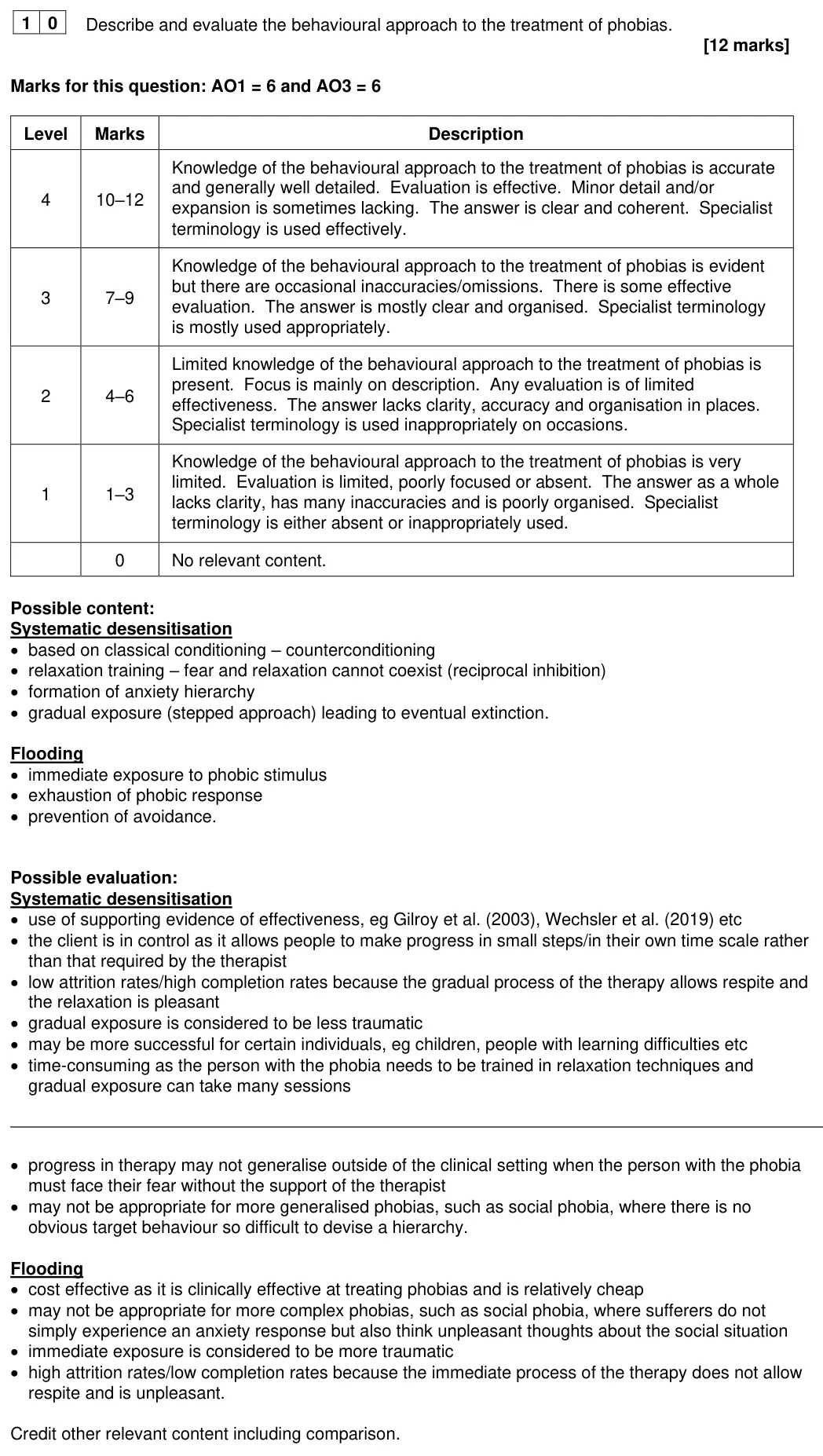
June 2024 · AS Paper 2 · Q1012 marksAO1=6, AO3=6Extended writing
Mark scheme, including level descriptors and indicative content
Examiner's comment
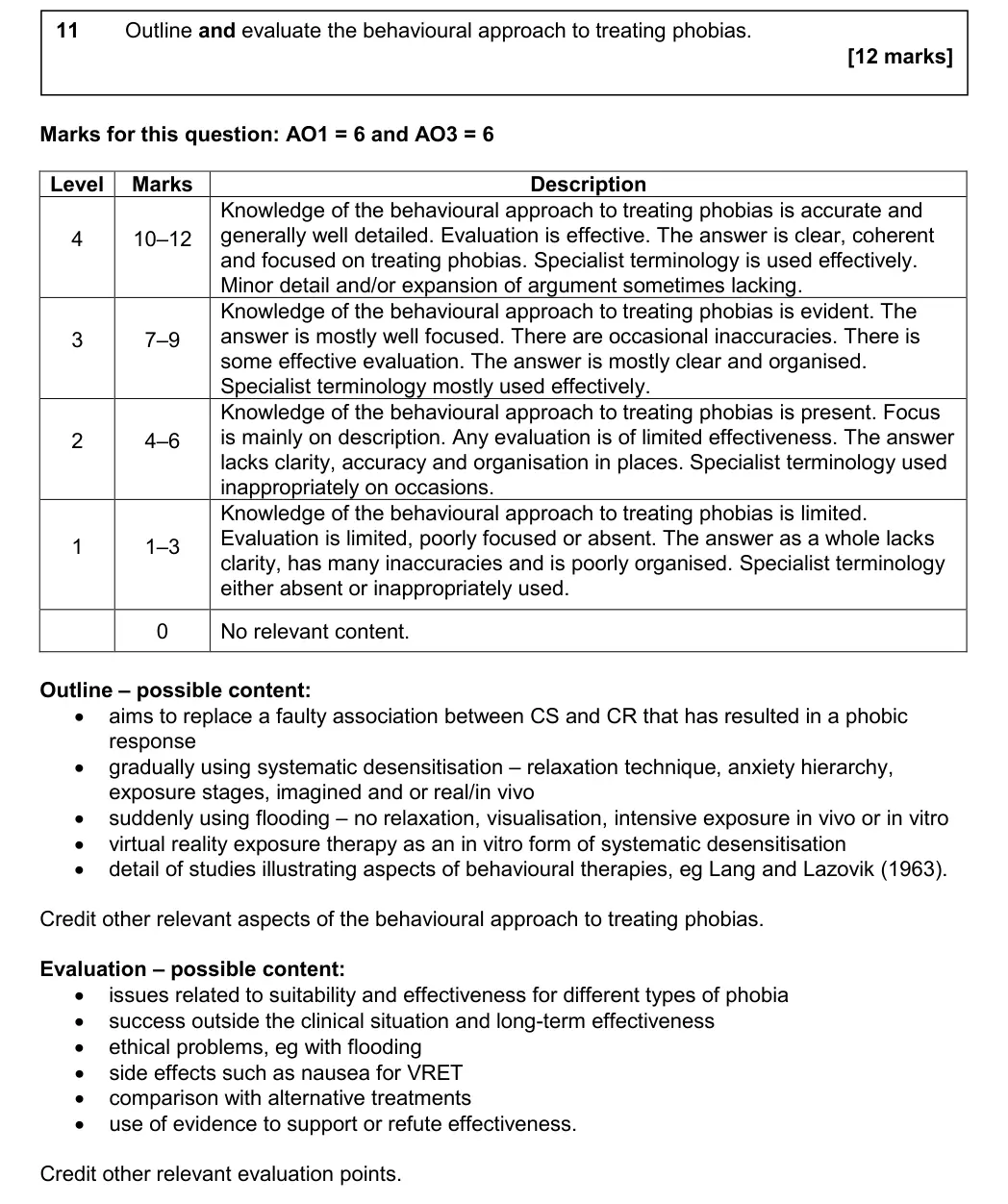
Q10 asked students to describe and evaluate the behavioural approach to the treatment of phobias for 12 marks. Students could focus their answer on one treatment in depth or on two in less detail and it was encouraging to see both breadth and depth of knowledge across many responses. Many students also demonstrated some excellent evaluation and reassuringly their performance in this assessment objective (AO3) is improving year on year. As in Q9, it is important that students include relevant specialist terminology from behavioural treatments (likely from flooding and/or systematic desensitisation) to enable them to access the higher levels/marks.
Notes from the mark scheme and report
systematic desensitisation and/or flooding
one in depth or two in less detail acceptable
evaluation: evidence of effectiveness, attrition, trauma, cost, generalisation, appropriateness for complex phobias
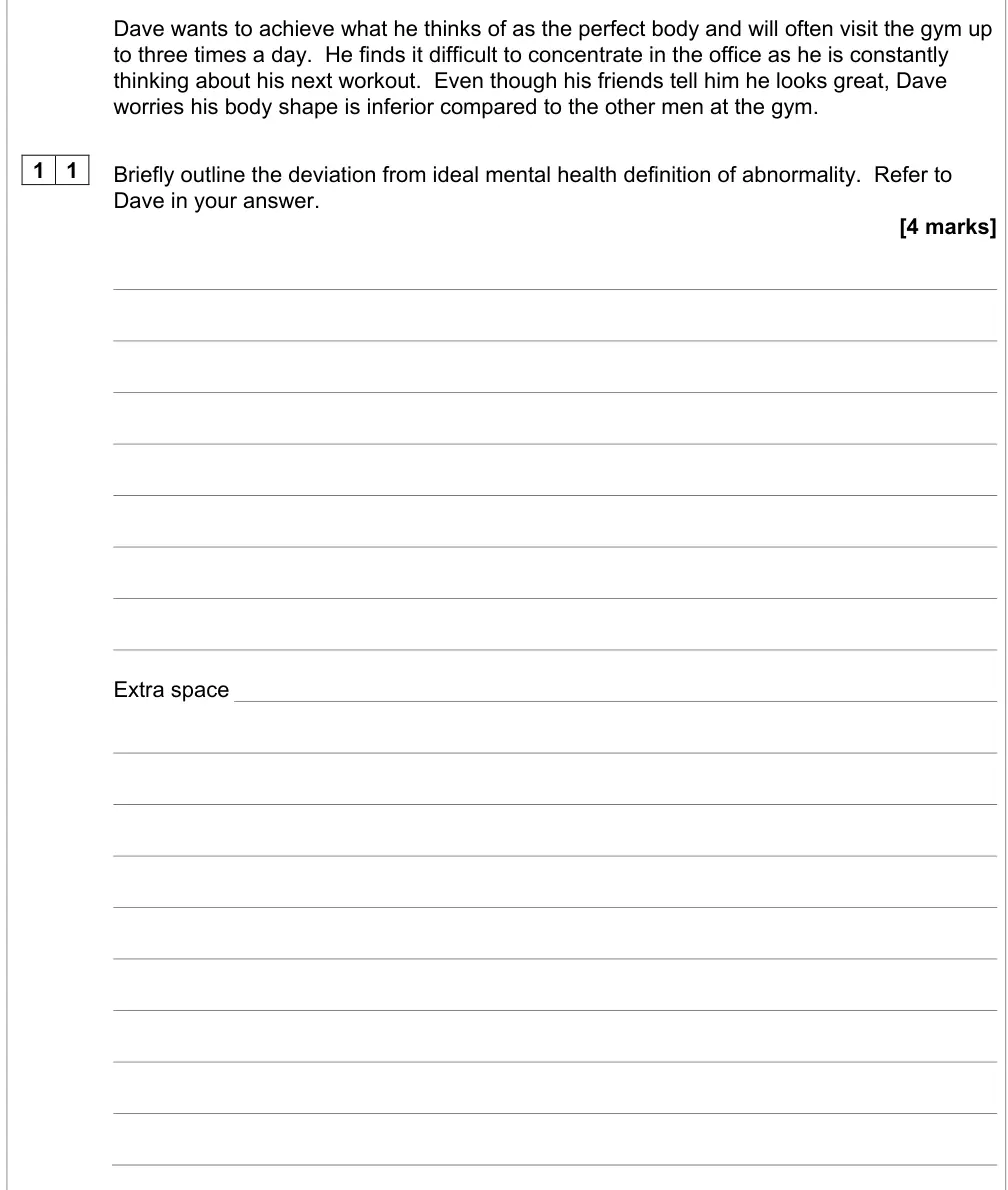
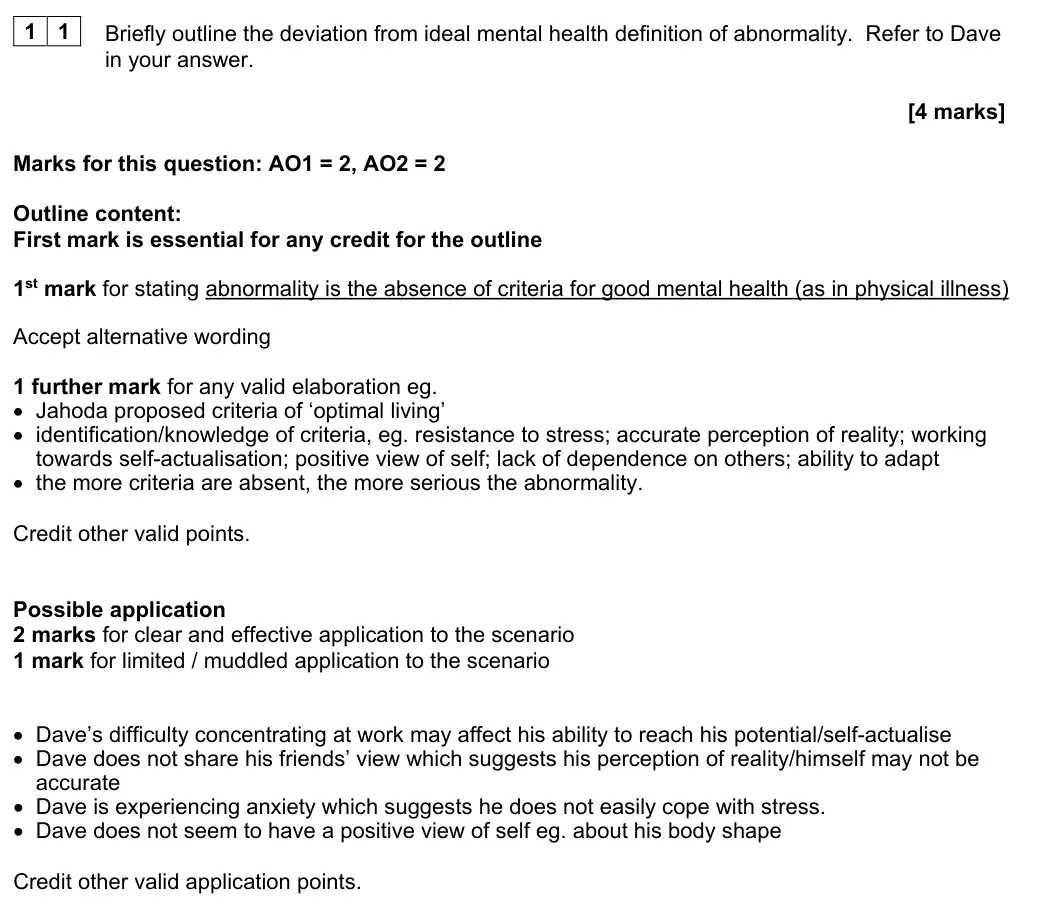
June 2023 · Paper 1 · Q114 marksAO1=2, AO2=2Application
Mark scheme, including level descriptors and indicative content
Examiner's comment
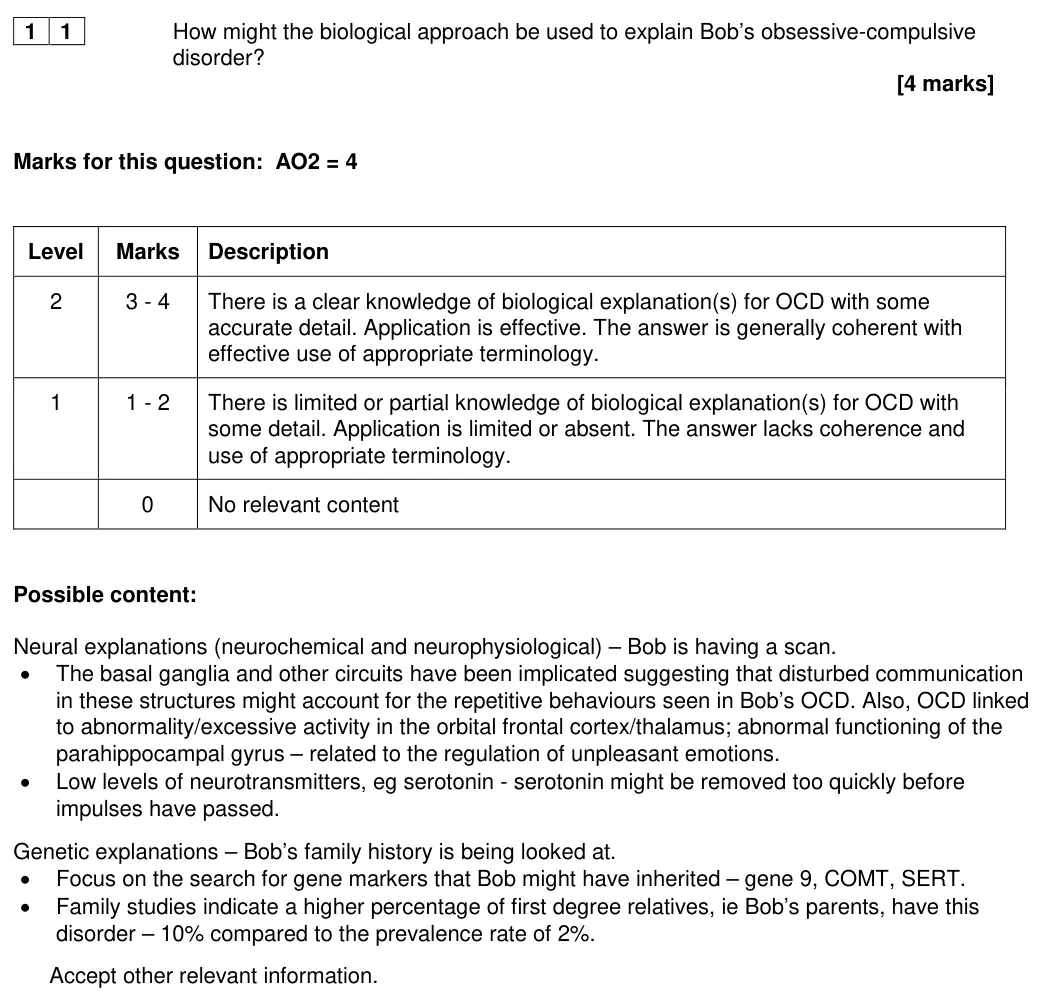
This question saw a variety of responses from students. Although many students were able to outline the definition effectively, there was some considerable overlap with other definitions of abnormality, which restricted students’ marks. The application to the scenario was generally completed very well, with students often suggesting the specific criteria related to Dave’s poor mental health. Effective use was made of resistance to stress, positive self-attitudes, and accurate perception of reality.
Notes from the mark scheme and report
first mark (absence of criteria for good mental health) is essential for the outline
overlap with other definitions limited marks
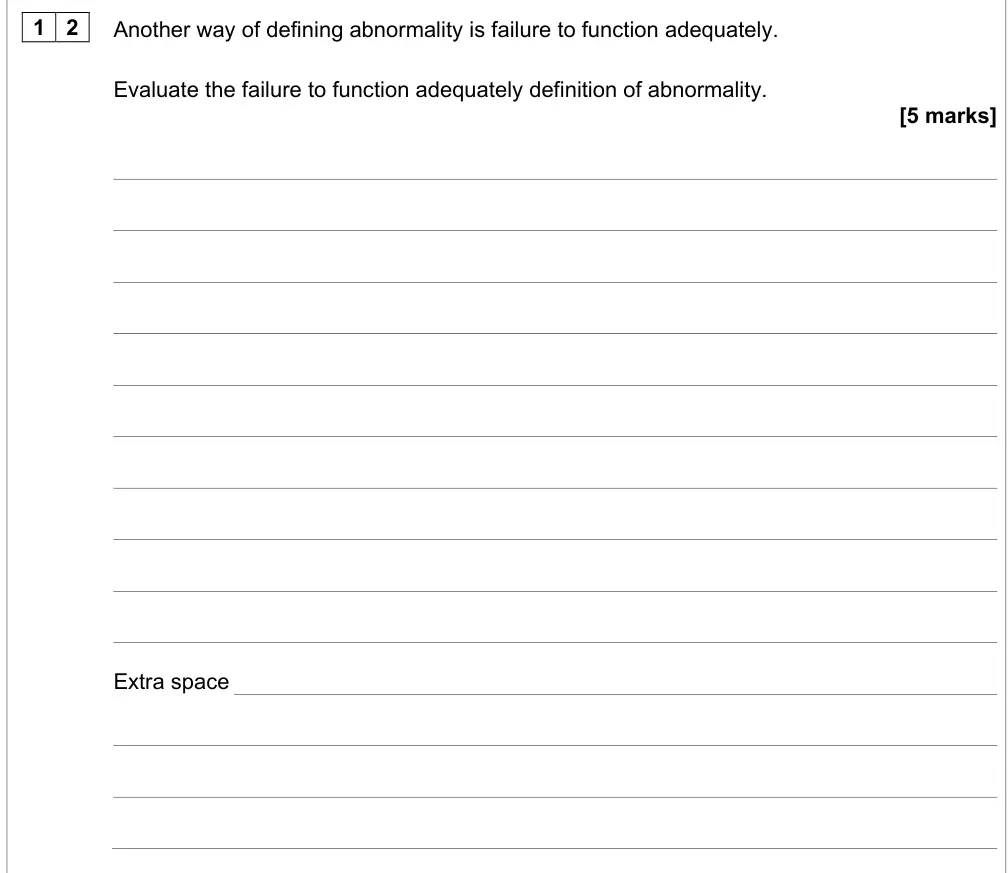
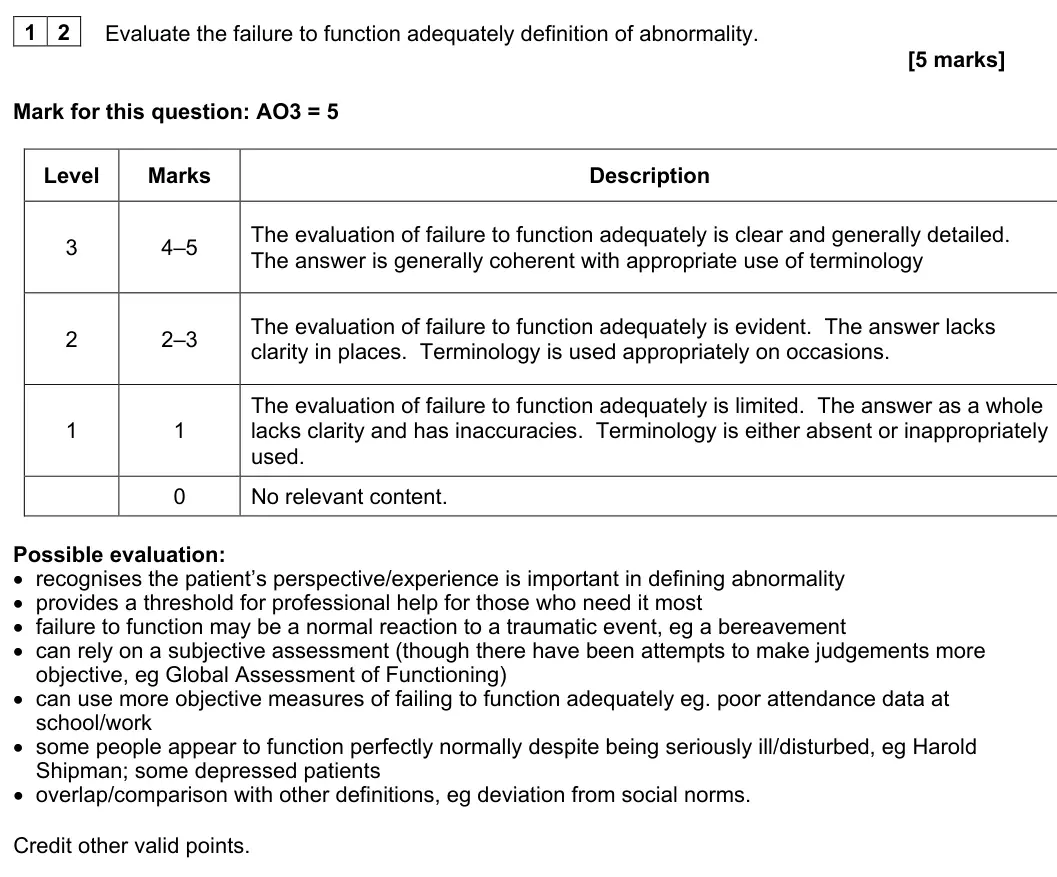
June 2023 · Paper 1 · Q125 marksAO3=5Evaluate (short)
Mark scheme, including level descriptors and indicative content
Examiner's comment
Lots of accurate and detailed responses were given to this question. Students often cited well- learnt points that related explicitly to failure to function adequately. However, students must avoid making generic evaluative comments that relate to all definitions of abnormality. For instance, many responses centred around how the definition is culturally biased, but then failed to make clear links to how this specific definition suffers from this problem. Higher marks could have been gained by making explicit links to the failure to function adequately definition eg suggesting how violating moral standards is likely to vary between cultures.
Notes from the mark scheme and report
generic evaluation that fits every definition (e.g. cultural bias) not linked to failure to function adequately
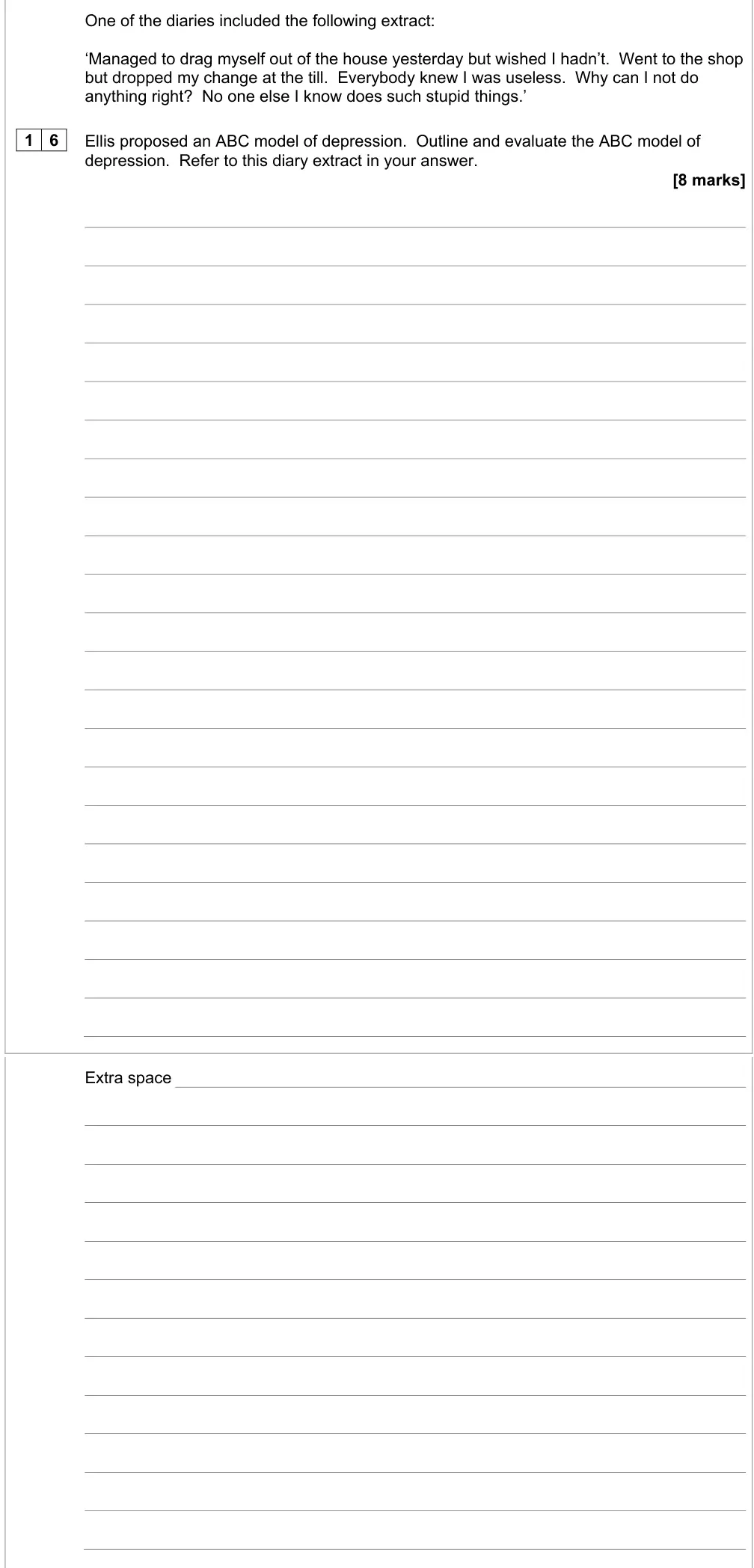
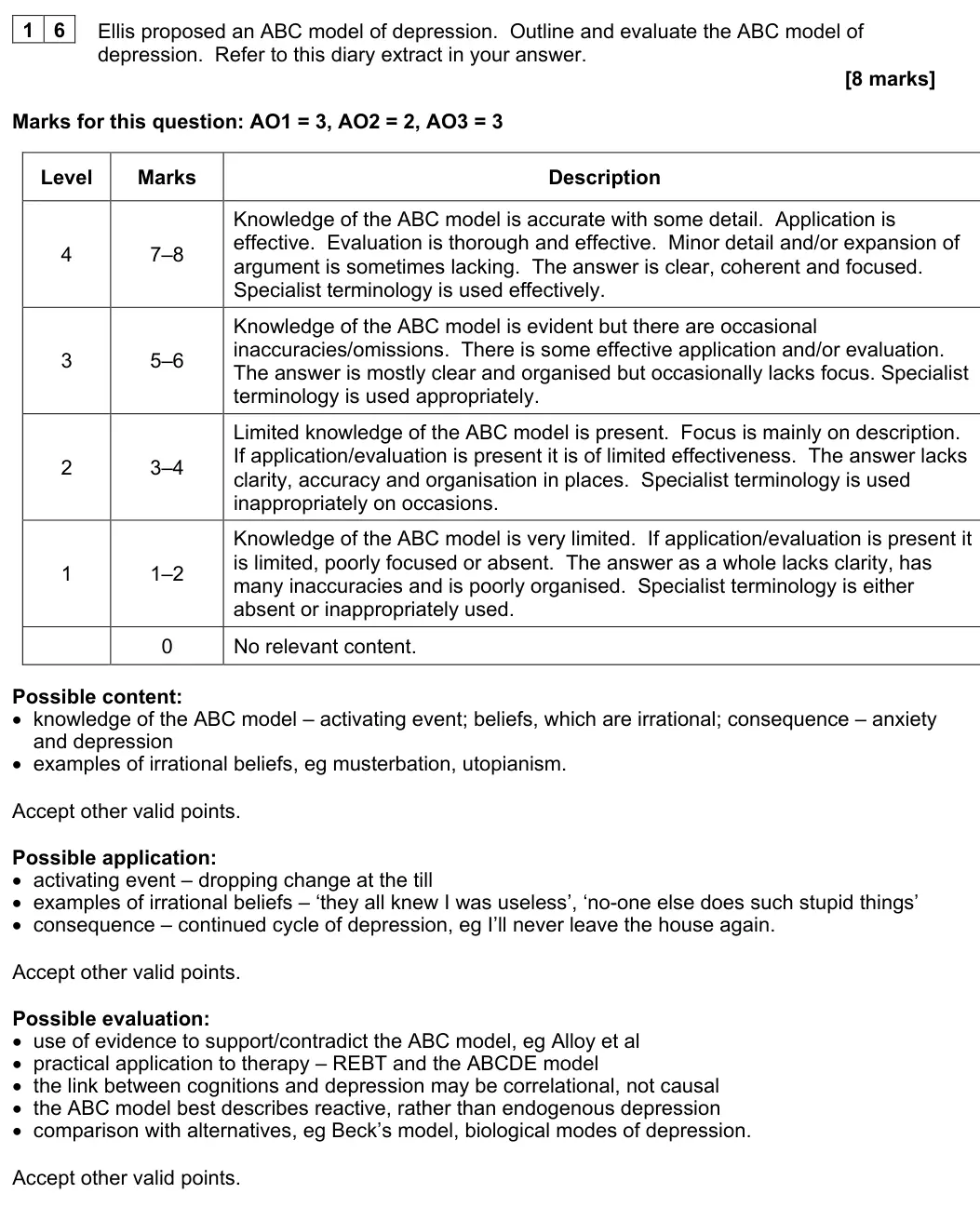
June 2023 · Paper 1 · Q168 marksAO1=3, AO2=2, AO3=3Extended writingMedium
Mark scheme, including level descriptors and indicative content
Examiner's comment
Most students effectively completed this short essay question, with almost 60% of students gaining level 3 marks or higher. Many were able to competently outline the three parts to Ellis’s ABC model of depression and extract the relevant application points to match some parts. More detailed responses often incorporated further examples of irrational beliefs eg utopianism and musterbatory thoughts. Likewise, students were able to provide some notable discussion points, typically making effective use of: REBT/ CBT as a practical application, problems of explaining endogenous depression as well as citing alternative explanations of depression that Ellis’s model does not consider. In some cases, students understandably gave some short responses (at the end of this paper), but they still managed to address all three assessment objectives.
Notes from the mark scheme and report
outline A, B, C with examples of irrational beliefs
apply to the diary extract
evaluation e.g. REBT/CBT, reactive vs endogenous depression, Beck as alternative
June 2023 · AS Paper 2 · Q51 markAO1=1Multiple choiceMedium
Answer
D
Mark scheme, including level descriptors and indicative content
Examiner's comment
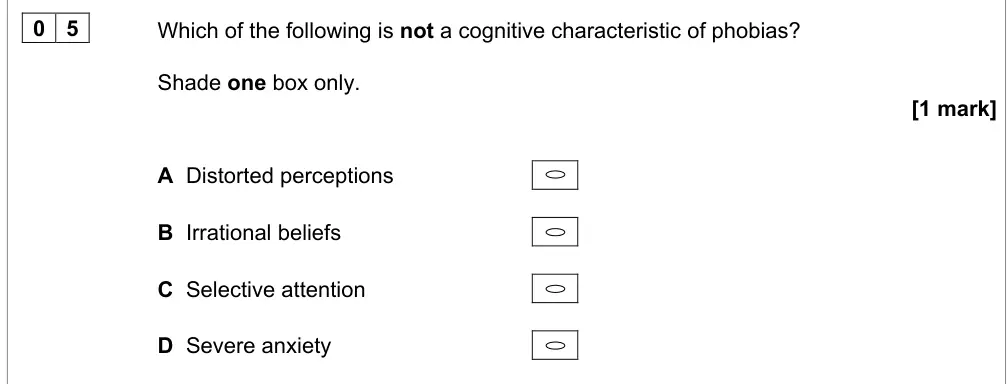
Disappointingly, little over half of the students were able to correctly answer this multiple-choice question. It is important that students learn a variety of behavioural, cognitive and emotional characteristics for phobias, depression and obsessive-compulsive disorder.
Notes from the mark scheme and report
answer D (severe anxiety is emotional)
distractors are cognitive characteristics
only just over half correct
June 2023 · AS Paper 2 · Q6.14 marksAO1=2, AO2=2ApplicationEasy
Mark scheme, including level descriptors and indicative content
Examiner's comment
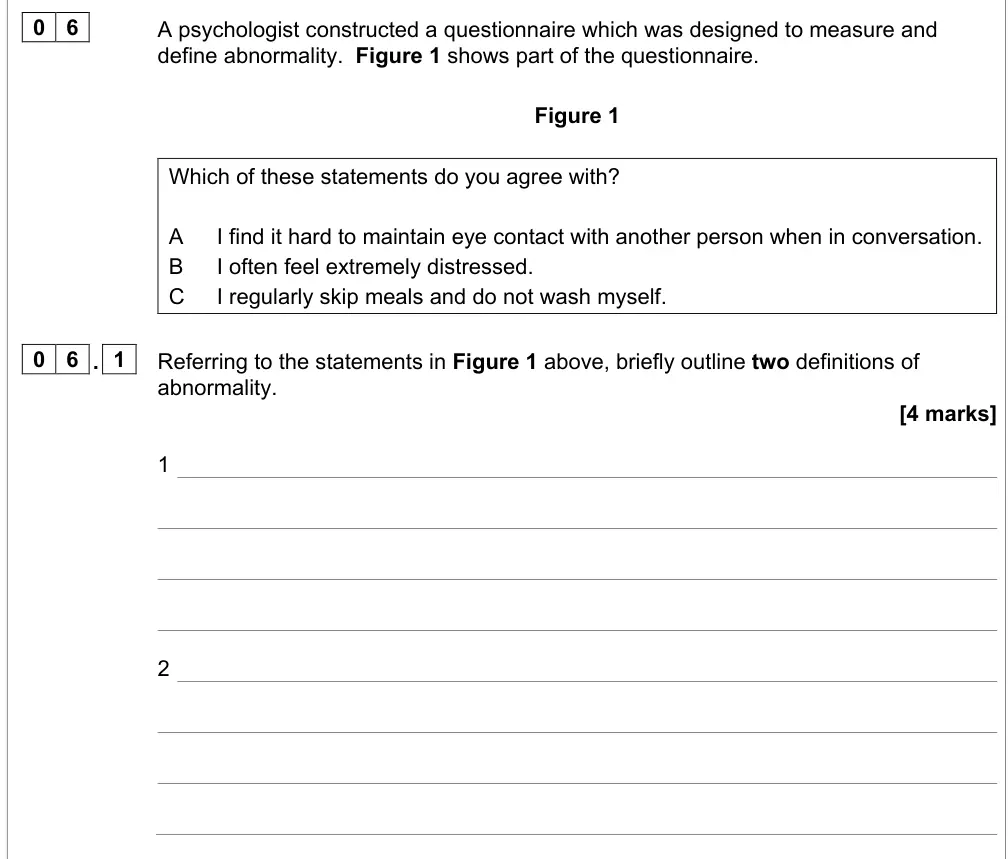
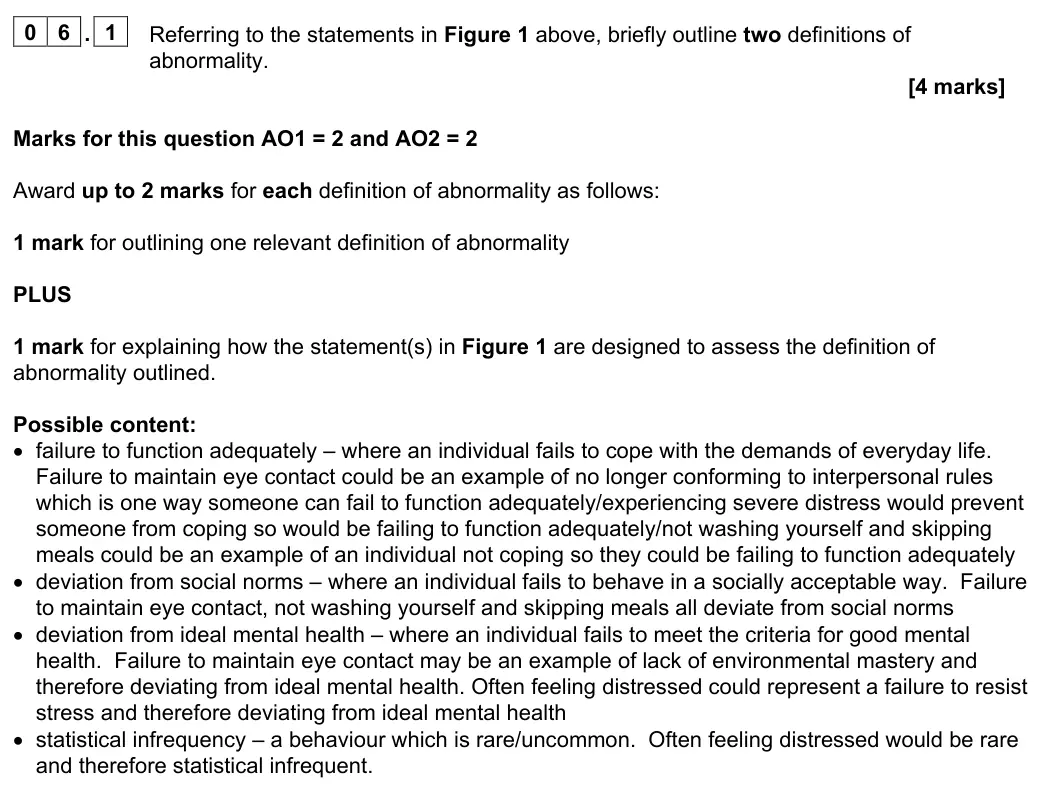
Most students were able to accurately outline two definitions of abnormality. Many were also able to apply their chosen definitions to the statements in the stimulus material. The mean as a percentage of the maximum mark for this question was around 60%. However, some students simply named two definitions rather than outline them and thus did not address the demands of the question. Other students failed to apply their definitions or simply wrote vague comments such as ‘shown in statement A.’ Students needed to explain why some content in one of the statements was an example of a particular definition of abnormality.
Notes from the mark scheme and report
1 mark per definition outlined + 1 mark for linking to statements in Figure 1
failure to function adequately, deviation from social/cultural norms, ideal mental health, statistical infrequency
naming only or vague 'shown in statement A' not credited
June 2023 · AS Paper 2 · Q6.23 marksAO3=3Evaluate (short)
Mark scheme, including level descriptors and indicative content
Examiner's comment
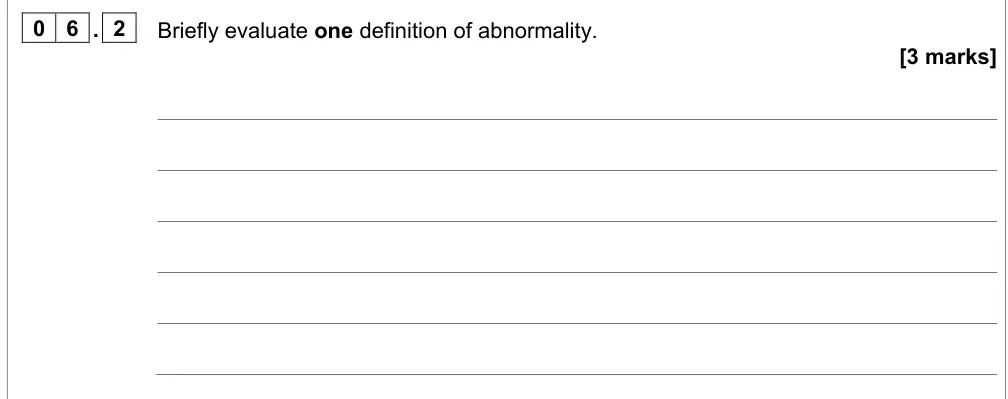
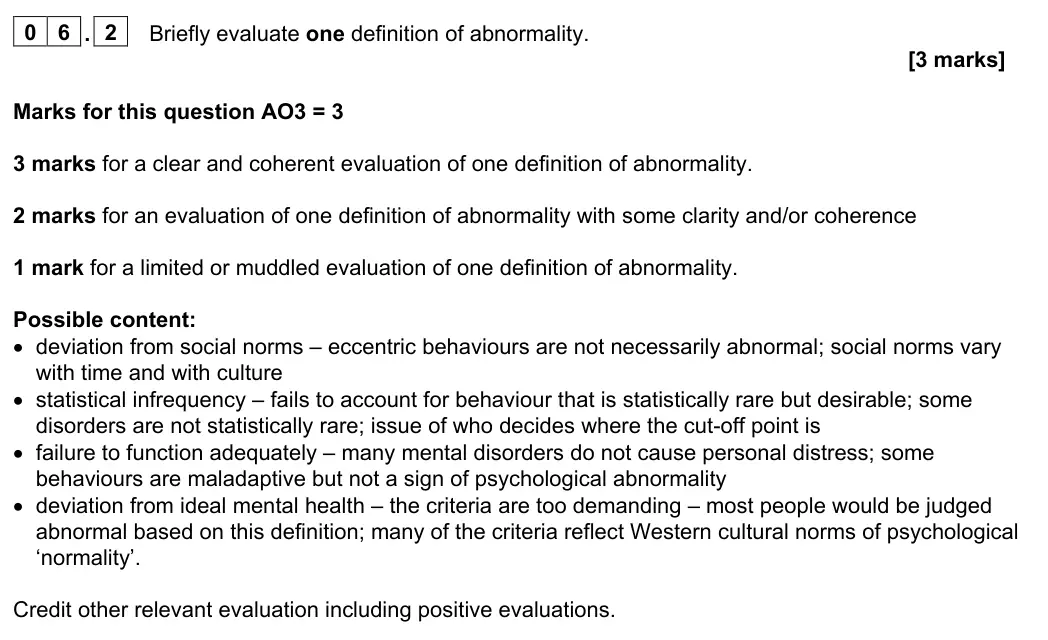
This question was generally answered well, suggesting that many students were able to evaluate one definition of abnormality clearly and coherently. Some students clearly explained one point in detail whilst others explained two (or more) points in less detail. It is important that students explicitly identify which definition of abnormality they are evaluating, as there were some responses where this was unclear. Additionally, a minority of students simply described a definition of abnormality and were awarded zero marks as they had failed to address the demands of the question.
Notes from the mark scheme and report
must make clear which definition is being evaluated
description only = 0
June 2023 · AS Paper 2 · Q74 marksAO1=4Outline
Mark scheme, including level descriptors and indicative content
Examiner's comment
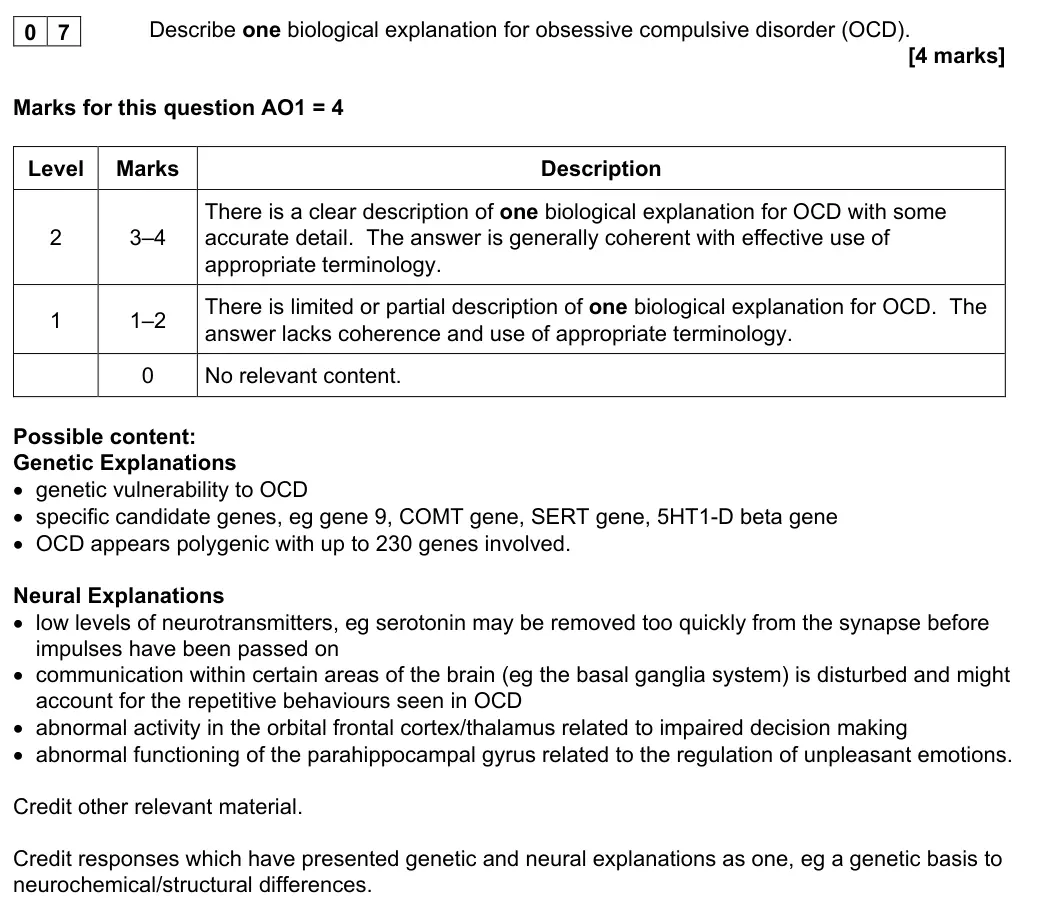
Many students were able to give some description of one biological explanation for OCD, but the detail and accuracy of responses varied significantly. Some students clearly had detailed and thorough knowledge and were able to skilfully combine knowledge of genetics and neural explanations into one coherent explanation. Indeed, some students wrote excessively long responses, often going on to the additional pages at the back of the question paper. Although students did not lose marks for this, they did potentially lose valuable time which could have been better spent elsewhere. However, other students appeared to have little, if any, knowledge. A significant minority of students could say little more than ‘OCD is passed down through genes’.
Notes from the mark scheme and report
genetic (candidate genes e.g. COMT, SERT
polygenic) or neural (serotonin, basal ganglia, orbitofrontal cortex)
combined genetic-neural accepted as one
'passed down through genes' scored little
June 2023 · AS Paper 2 · Q88 marksAO1=4, AO3=4Extended writing
Mark scheme, including level descriptors and indicative content
Examiner's comment
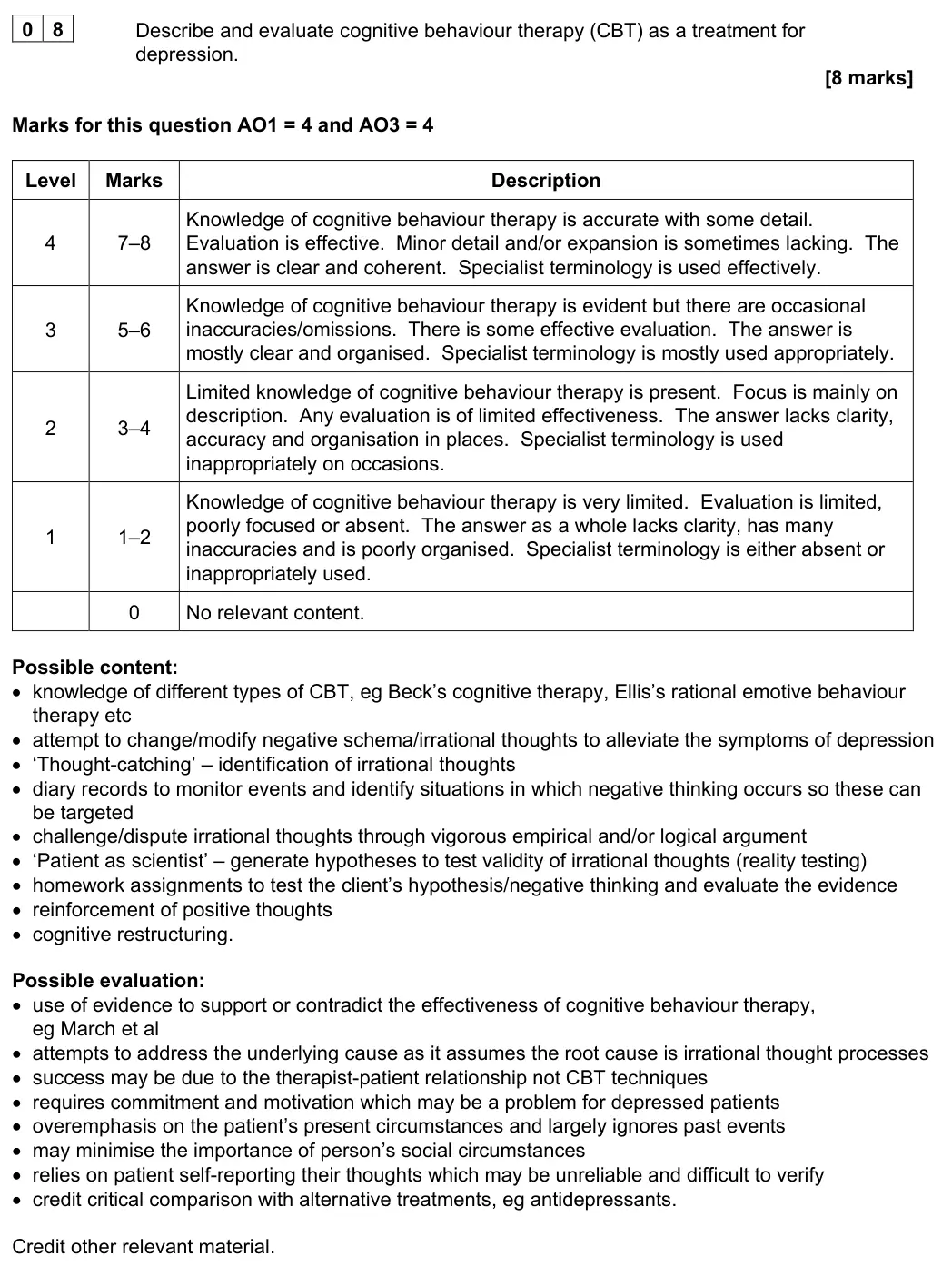
A wide range of responses to this question were seen, but most students were unable to produce level 3 or 4 answers. Most responses demonstrated some knowledge of CBT, but many lacked sufficient detail. Many students attempted some evaluation but, as with question 4, few were able to explain their points to make them effective. Many responses did not focus on the use of CBT to treat depression and thus did not fully address the demands of the question. It is important that students focus their answers upon this, especially in their evaluation.
Notes from the mark scheme and report
CBT for depression: thought-catching, challenging irrational thoughts, patient as scientist, homework
must be focused on depression, especially the evaluation
evaluation often undeveloped
June 2022 · Paper 1 · Q136 marksAO1=6Outline
Mark scheme, including level descriptors and indicative content
Examiner's comment
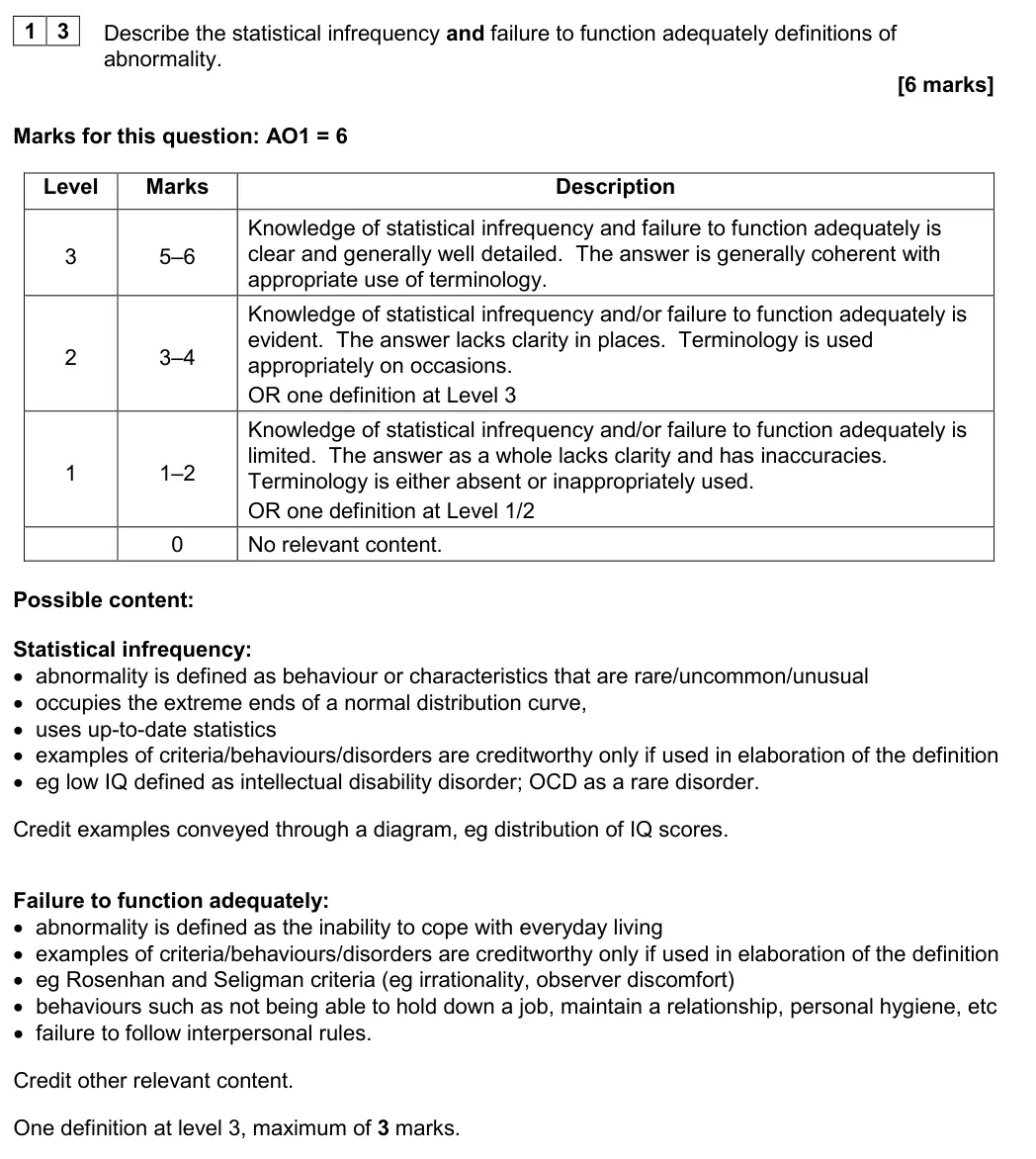
Most students accessed some marks on this question. The top level required some detail/ elaboration of the basic definitions, for example through reference to statistics, the normal distribution curve and standard deviations, or to Rosenhan and Seligman’s criteria for failure to function adequately. Examples could earn credit if used explicitly to illustrate the definition. Overall, this question was done well, though a number of answers provided evaluation, which was not creditworthy.
Notes from the mark scheme and report
one definition at Level 3 = max 3
examples only credited if they elaborate the definition
normal distribution/SD, Rosenhan and Seligman criteria
evaluation not creditworthy
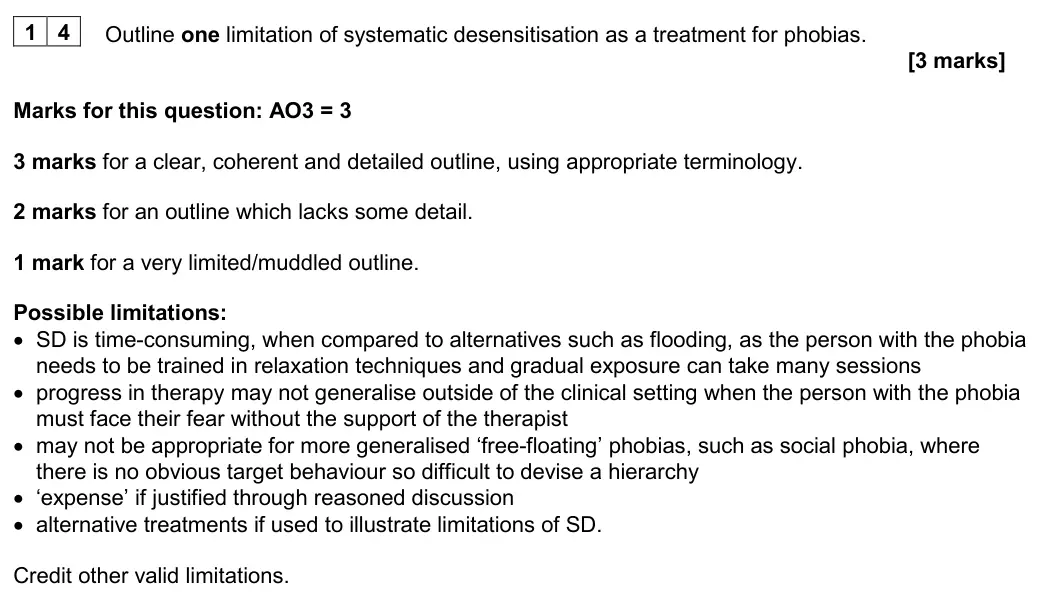
June 2022 · Paper 1 · Q143 marksAO3=3Evaluate (short)
Mark scheme, including level descriptors and indicative content
Examiner's comment
There was a variety of answers to this question, with most students earning some marks. The most popular response was the time issue, which could be elaborated by reference to multiple sessions, relaxation and exposure to the hierarchy of phobic stimuli. Appropriateness of SD was also popular, although there was often some confusion over which phobias were less susceptible to SD, for example social phobia and other ’free-floating’ phobias. Other limitations, such as generalising outside the clinical setting or expense, were less common and treated on their merits. Elaboration had to be clear and coherent to earn marks.
Notes from the mark scheme and report
one limitation, 3 marks for detail: time-consuming vs flooding, generalisation outside clinic, unsuitable for free-floating/social phobias, expense if reasoned
confusion over which phobias are less suitable
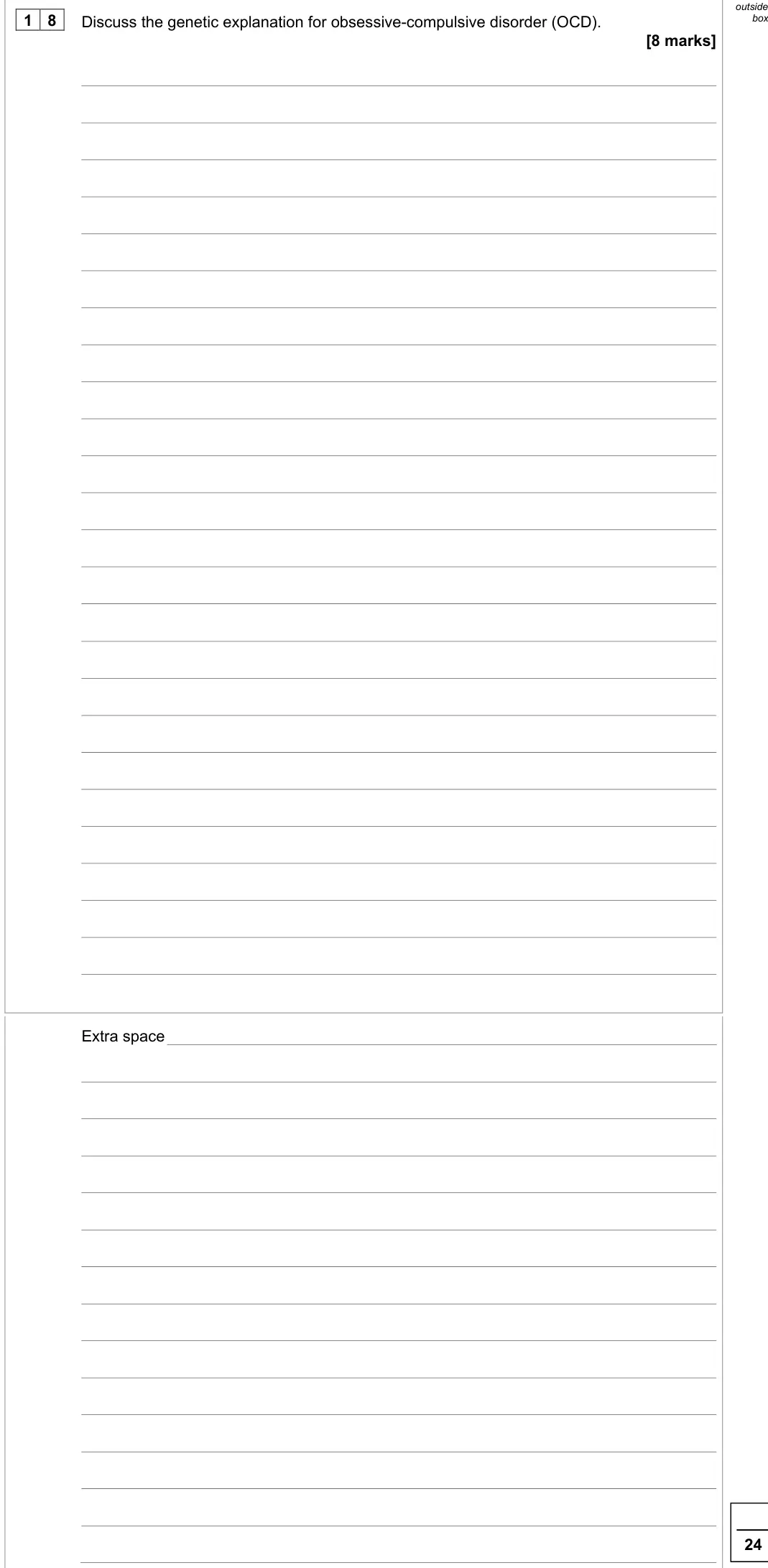
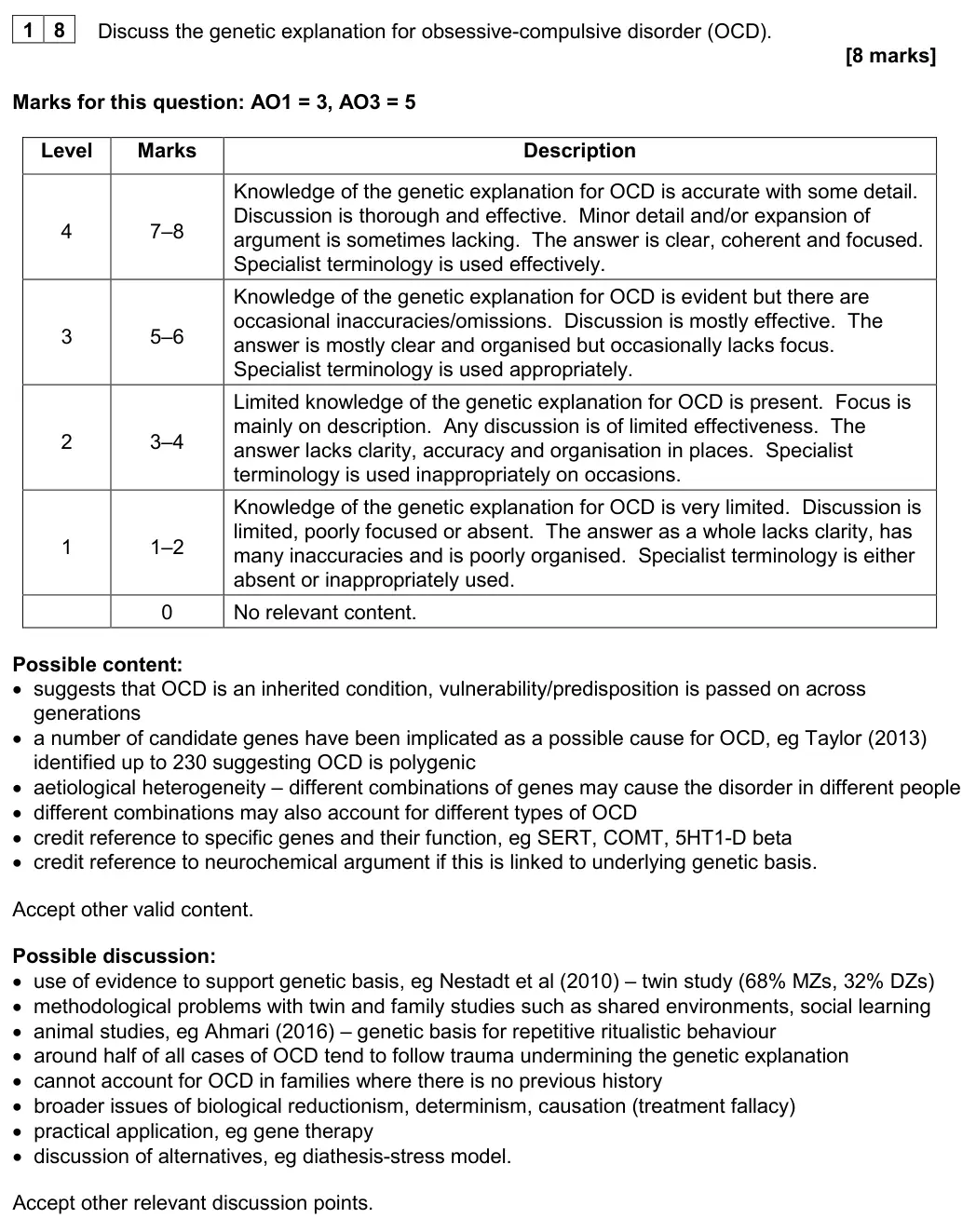
June 2022 · Paper 1 · Q188 marksAO1=3, AO3=5Extended writing
Mark scheme, including level descriptors and indicative content
Examiner's comment
There were some excellent outlines of the involvement of genes in OCD, focusing on the SERT and COMT genes, serotonin and dopamine levels, and the aetiological heterogeneity of the disorder. In better answers this was linked to specific symptoms. Evaluation generally used family and twin studies, with some students able to link concordance rates in MZ twins as evidence for non-genetic factors. A few answers also provided impressive analysis of the ‘similar environments’ assumption behind the comparison of MZ and DZ twins. The diathesis-stress model was popular, and at the top end this was combined with research evidence for the involvement of trauma in the onset of OCD. Surprisingly, few answers linked the SERT gene effect on serotonin levels with the effectiveness of antidepressants such as SSRIs in OCD, a key point of evaluation. Some students confused genetic with biological explanations, and covered brain structure and neurotransmitters without any link to genetics.
Notes from the mark scheme and report
must link to genes (SERT, COMT, polygenic, aetiological heterogeneity)
brain structure/neurotransmitters not linked to genetics not creditworthy
twin/family studies, diathesis-stress, trauma
few linked SERT to SSRI effectiveness
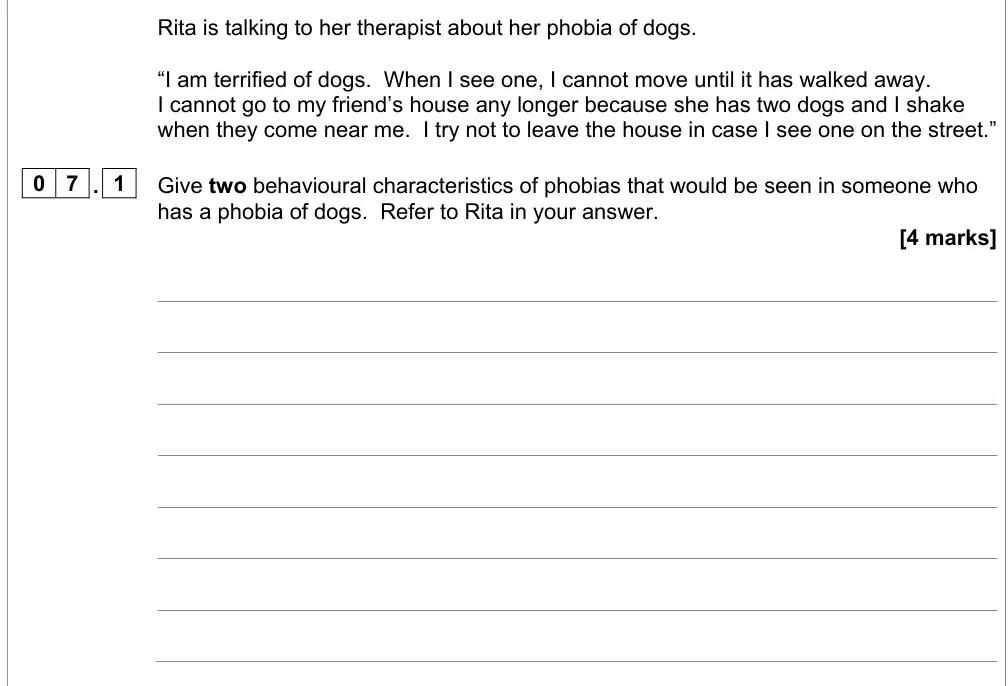
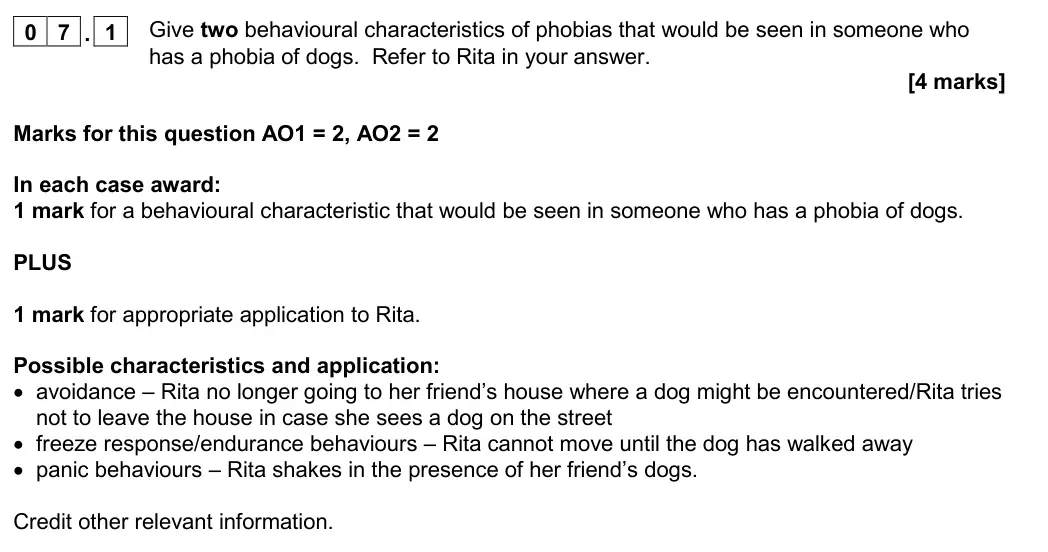
June 2022 · AS Paper 2 · Q7.14 marksAO1=2, AO2=2Application
Mark scheme, including level descriptors and indicative content
Examiner's comment
Most students were able to accurately name two behavioural characteristics of phobias but there was some confusion with other characteristics and other mental disorders. Some students wrote extensive outlines or descriptions of the behavioural characteristics. Although they did not lose marks for this, it was not a requirement of the question and so they potentially lost valuable time, which could have been spent elsewhere. Where students had named two correct behavioural characteristics, most students were then able to successfully apply these to the scenario. There was some confusion between panic behaviours (a behavioural characteristic) and anxiety/fear (an emotional characteristic). Some students either incorrectly named an emotional characteristic or incorrectly applied panic behaviours with an example of an emotional response.
Notes from the mark scheme and report
1 mark characteristic + 1 mark application to Rita each
avoidance, freeze/endurance, panic
confusing panic behaviours with emotional characteristics (anxiety/fear)
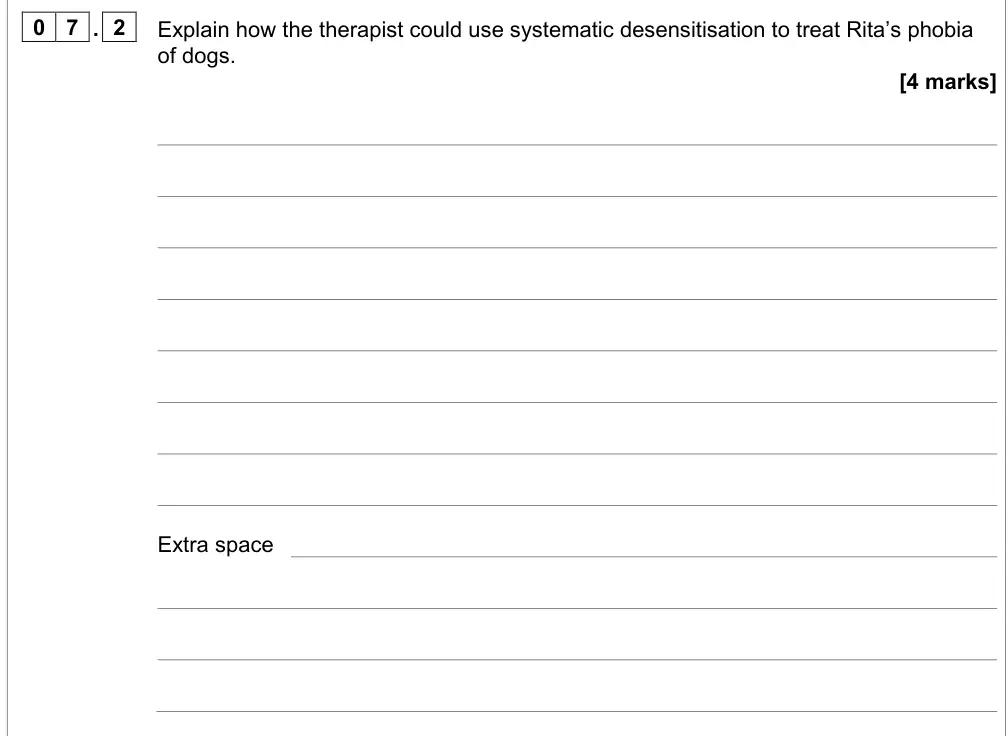
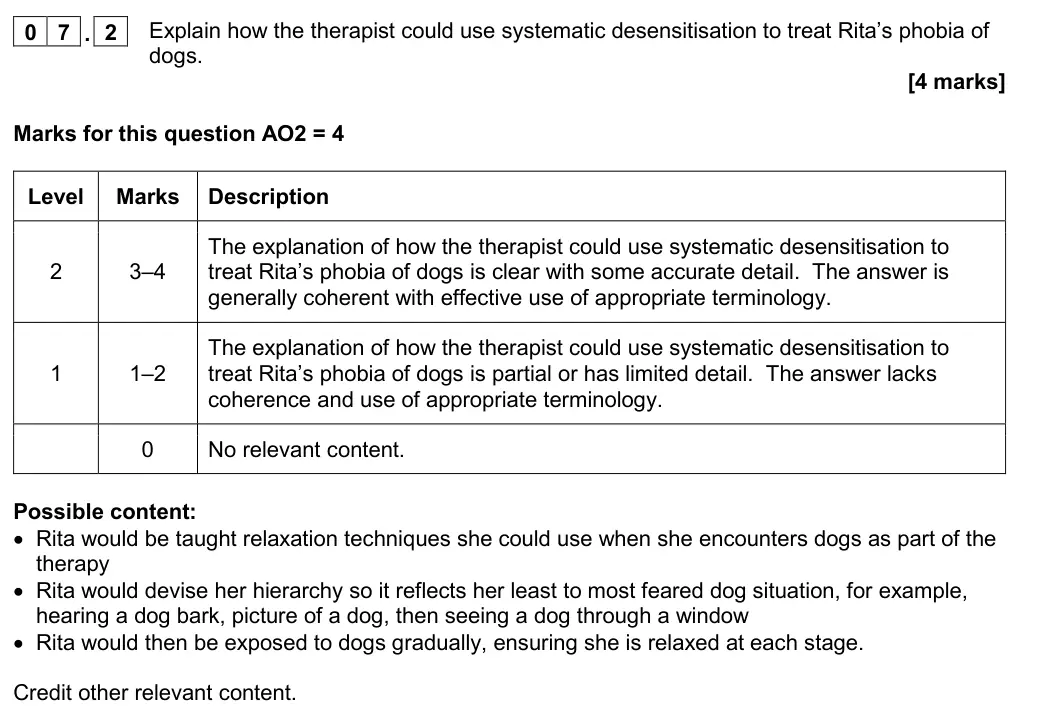
June 2022 · AS Paper 2 · Q7.24 marksAO2=4Application
Mark scheme, including level descriptors and indicative content
Examiner's comment
Most students had good knowledge of systematic desensitisation and demonstrated sound understanding of the key elements of relaxation, anxiety hierarchy and gradual exposure. However, some students failed to apply this knowledge to the scenario and thus did not address the demands of the question. As with questions 2 and 3, it was important for students to use appropriate terminology as it was required for Level 2 responses.
Notes from the mark scheme and report
all AO2: relaxation, hierarchy of dog situations, gradual exposure applied to Rita
generic description without application limited
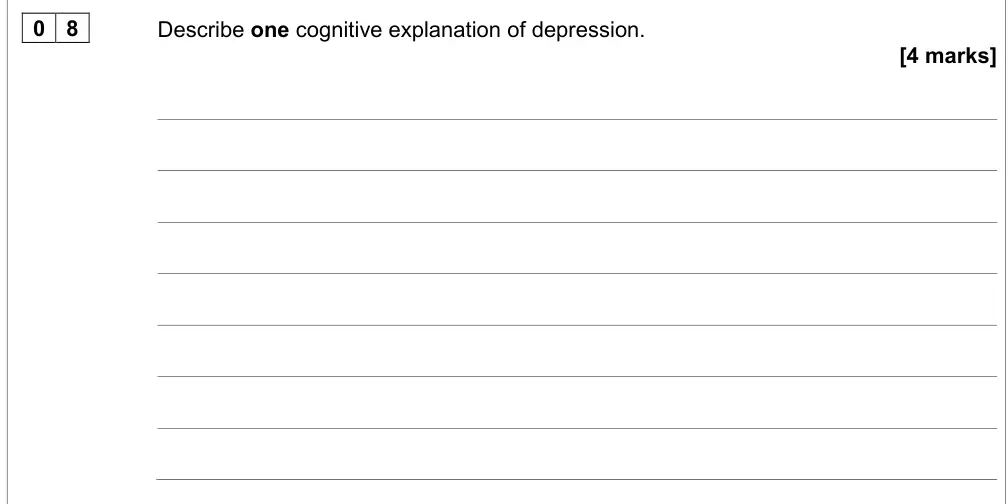
June 2022 · AS Paper 2 · Q84 marksAO1=4Outline
Mark scheme, including level descriptors and indicative content
Examiner's comment
Some wrote excessive amounts of content, which was particularly noticeable in questions 1, 5 and 8. This question was generally answered very well suggesting that students had a detailed and thorough knowledge of cognitive explanations of depression. Some students described the underlying theory of Beck or Ellis but failed to use this effectively to explain depression and thus did not fully address the demands of the question. Some students wrote excessively long responses, including the use of several examples, often going on to the additional pages at the back of the question paper. Although students did not lose marks for this, they did potentially lose valuable time which could have been better spent elsewhere.
Notes from the mark scheme and report
Beck's negative triad or Ellis's ABC
describing the theory without linking to depression did not fully address the question
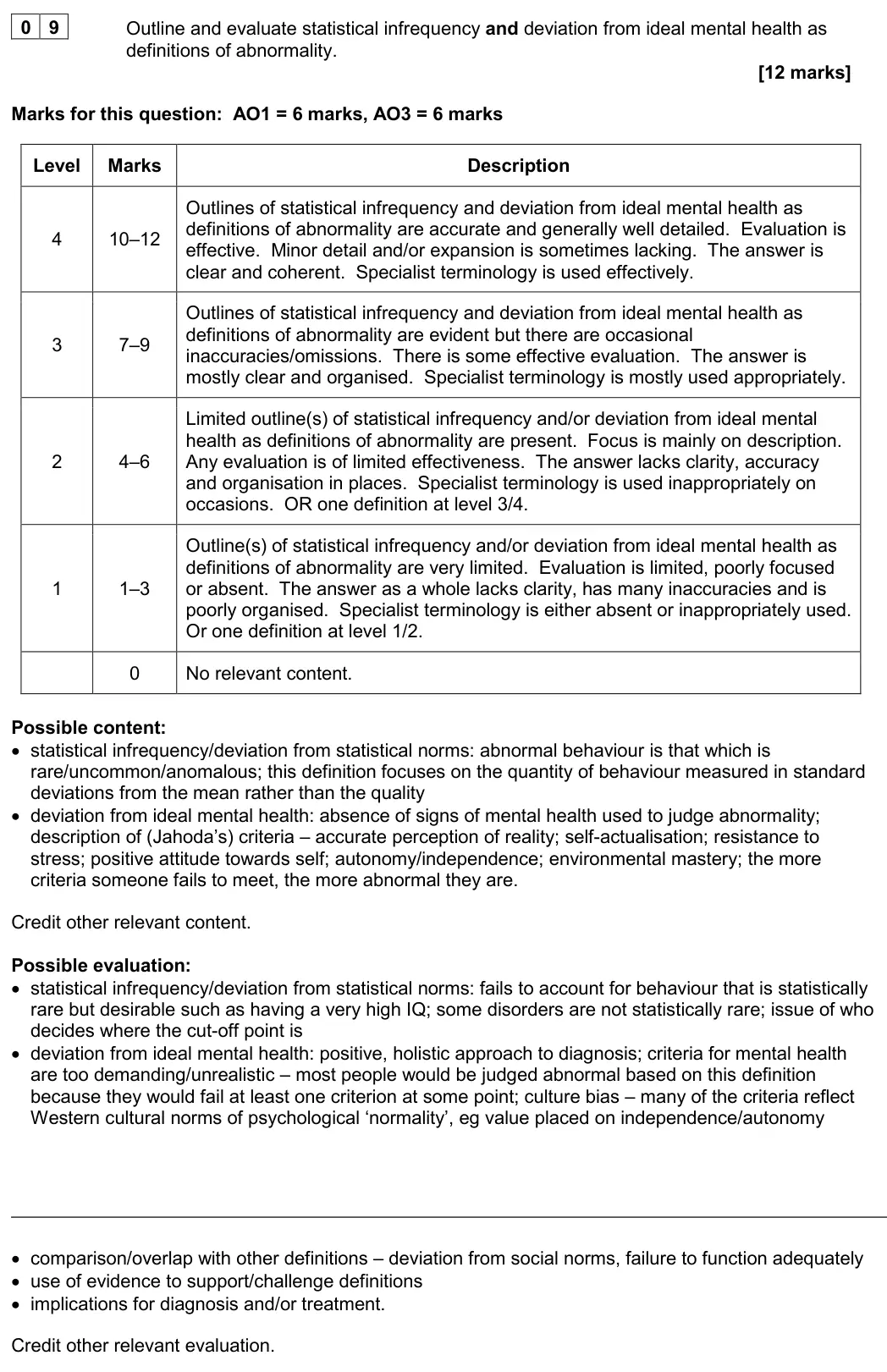
June 2022 · AS Paper 2 · Q912 marksAO1=6, AO3=6Extended writing
Mark scheme, including level descriptors and indicative content
Examiner's comment
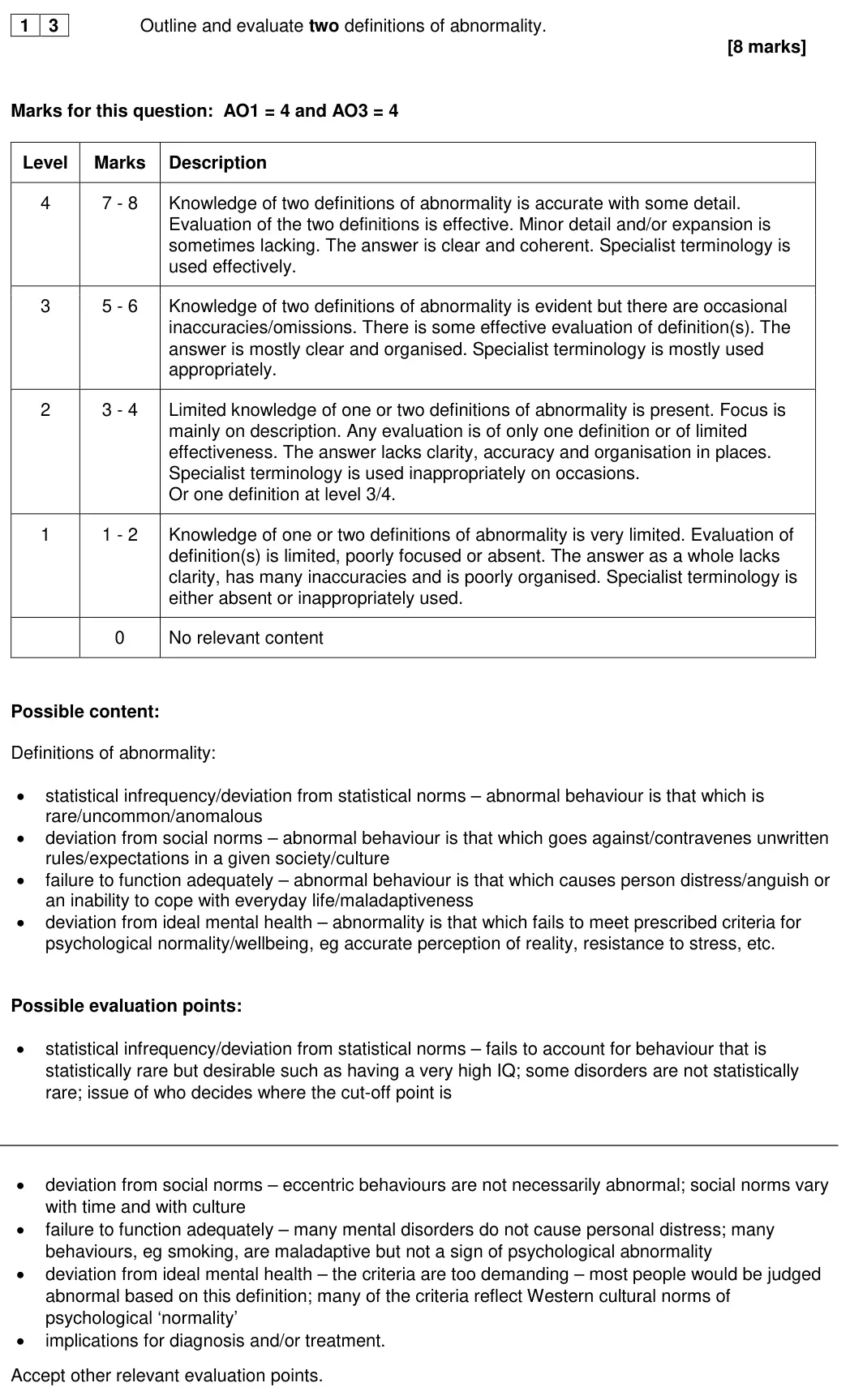
Students should also be minded to think carefully about their choice of examples used to illustrate concepts. In several instances, these examples were not psychological and were therefore inappropriate. This was particularly noticeable in question 9. However, others wrote very little and did not include sufficient detail, which was noticeable in the AO1 content for question 9, particularly for statistical infrequency. Students should also take care with the balance of assessment objectives in questions which involve extended writing, such as question 9. In these questions there should be an equal amount of AO1 and AO3, but some students were producing excessive amounts of one assessment objective and minimal amounts of the other and thus were not able to access the higher levels of the marking scheme. A good range of responses was seen across the cohort with many students producing level 3 and 4 answers. These responses tended to outline both definitions of abnormality accurately with some detail and also included some effective evaluation. Poorer responses tended to focus solely on only one of the definitions or contained no effective evaluation. Some students simply provided a very brief and thus limited outline, particularly for statistical infrequency. It is important to note that outlines should be of definitions of abnormality and not normality. This is especially important when describing deviation from ideal mental health, as some students just described ideal mental health and omitted the idea that to be abnormal you had to deviate from these characteristics. It is also imperative to ensure that all content is linked clearly to psychology, as there were some very poor examples used when attempting to illustrate statistical infrequency.
Notes from the mark scheme and report
one definition only = max Level 2
must outline deviation from ideal mental health as abnormality (failing Jahoda's criteria), not just describe ideal mental health
very brief outlines of statistical infrequency common
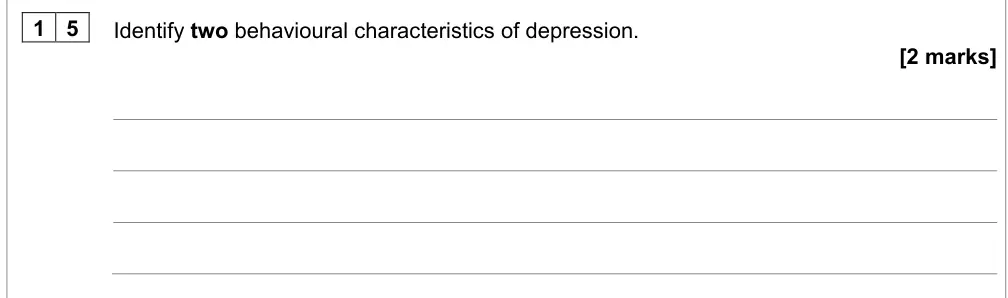
November 2021 · Paper 1 · Q152 marksAO1=2Short answer
Mark scheme, including level descriptors and indicative content
Notes from the mark scheme and report
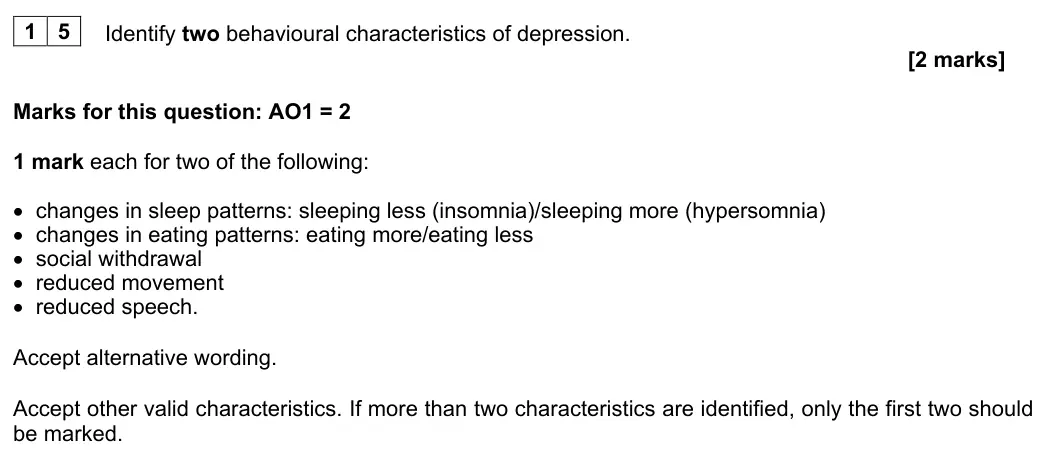
behavioural only: sleep/eating changes, social withdrawal, reduced movement/speech
only first two marked
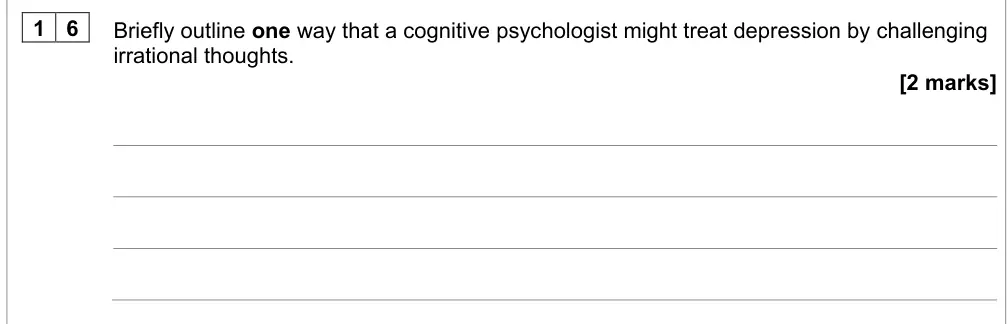
November 2021 · Paper 1 · Q162 marksAO1=2Outline
Mark scheme, including level descriptors and indicative content
Examiner's comment
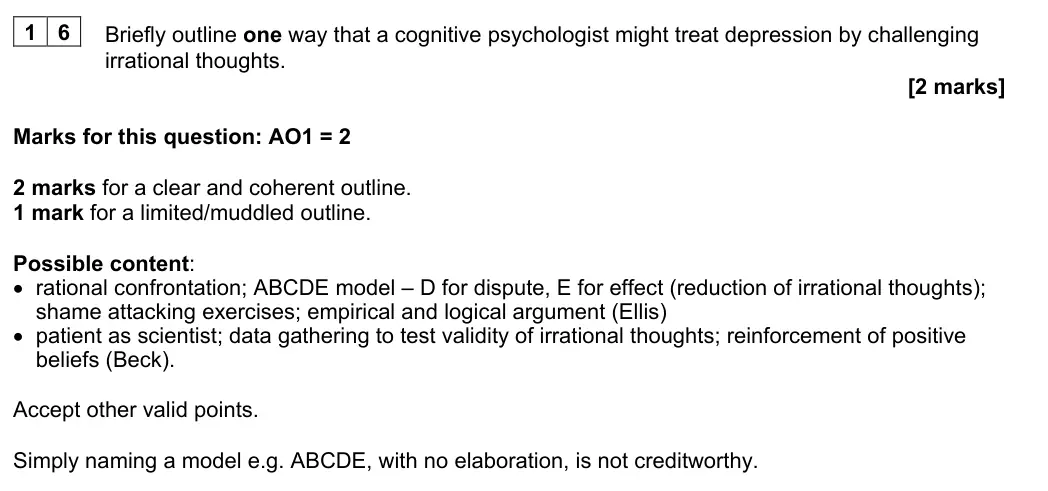
Although some students were clearly unfamiliar with the cognitive approach and simply restated the question and/or outlined inappropriate methods such as systematic desensitisation, there were some excellent answers showing impressive understanding of e.g. the models of Ellis and Beck.
Notes from the mark scheme and report
simply naming a model (e.g. ABCDE) with no elaboration not creditworthy
dispute/rational confrontation (Ellis), patient as scientist (Beck)
some outlined systematic desensitisation
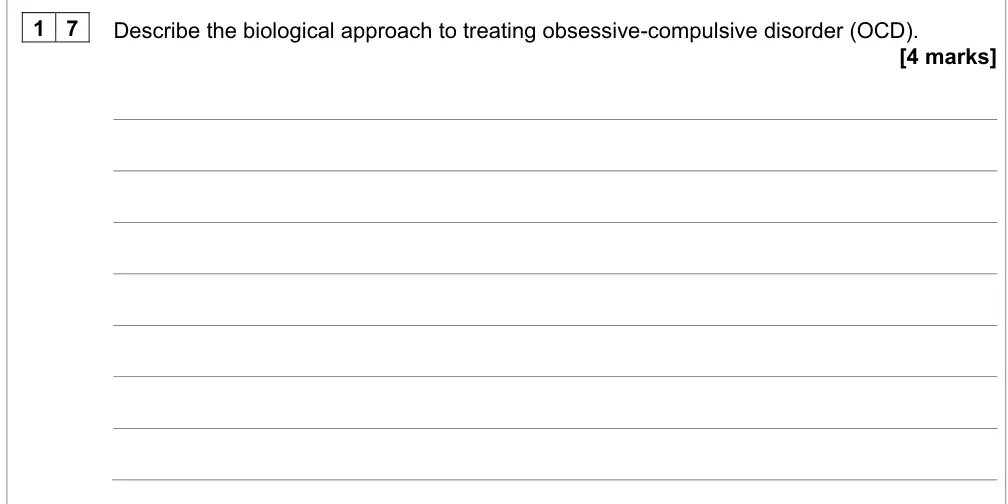
November 2021 · Paper 1 · Q174 marksAO1=4Outline
Mark scheme, including level descriptors and indicative content
Examiner's comment
Some excellent answers demonstrated detailed understanding of the use of drug therapy for OCD, describing the synaptic action of e.g. SSRIs. There was occasional confusion on exactly how they worked, while a significant minority of answers focused on the biological approach to explaining OCD, rather than to treating it – indicating a failure to read the question carefully.
Notes from the mark scheme and report
treatment, not explanation: SSRIs and synaptic action, timescale, tricyclics/SNRIs
significant minority described the biological explanation of OCD
November 2021 · Paper 1 · Q1816 marksAO1=6, AO3=1016-mark essay
Mark scheme, including level descriptors and indicative content
Examiner's comment
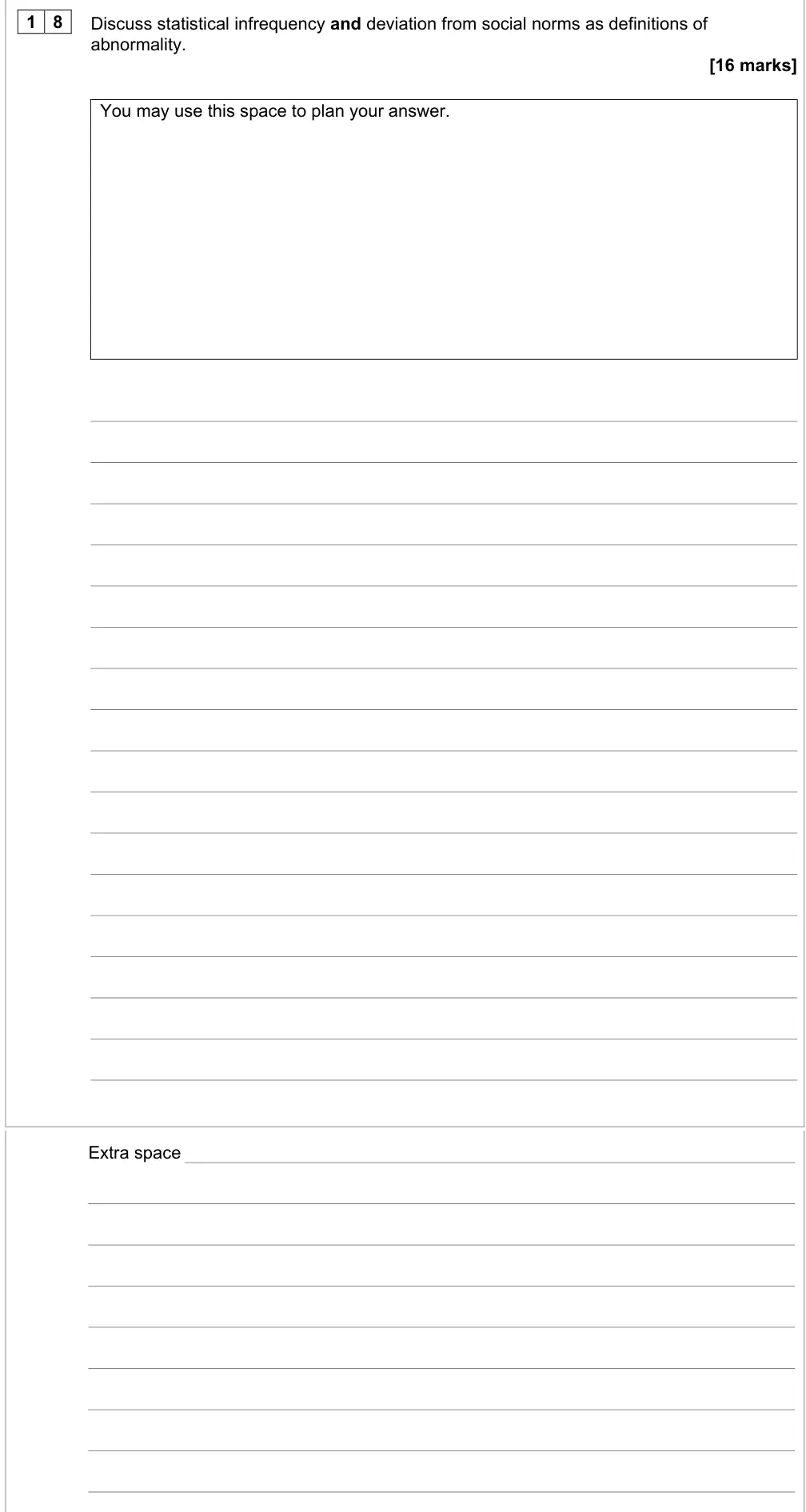
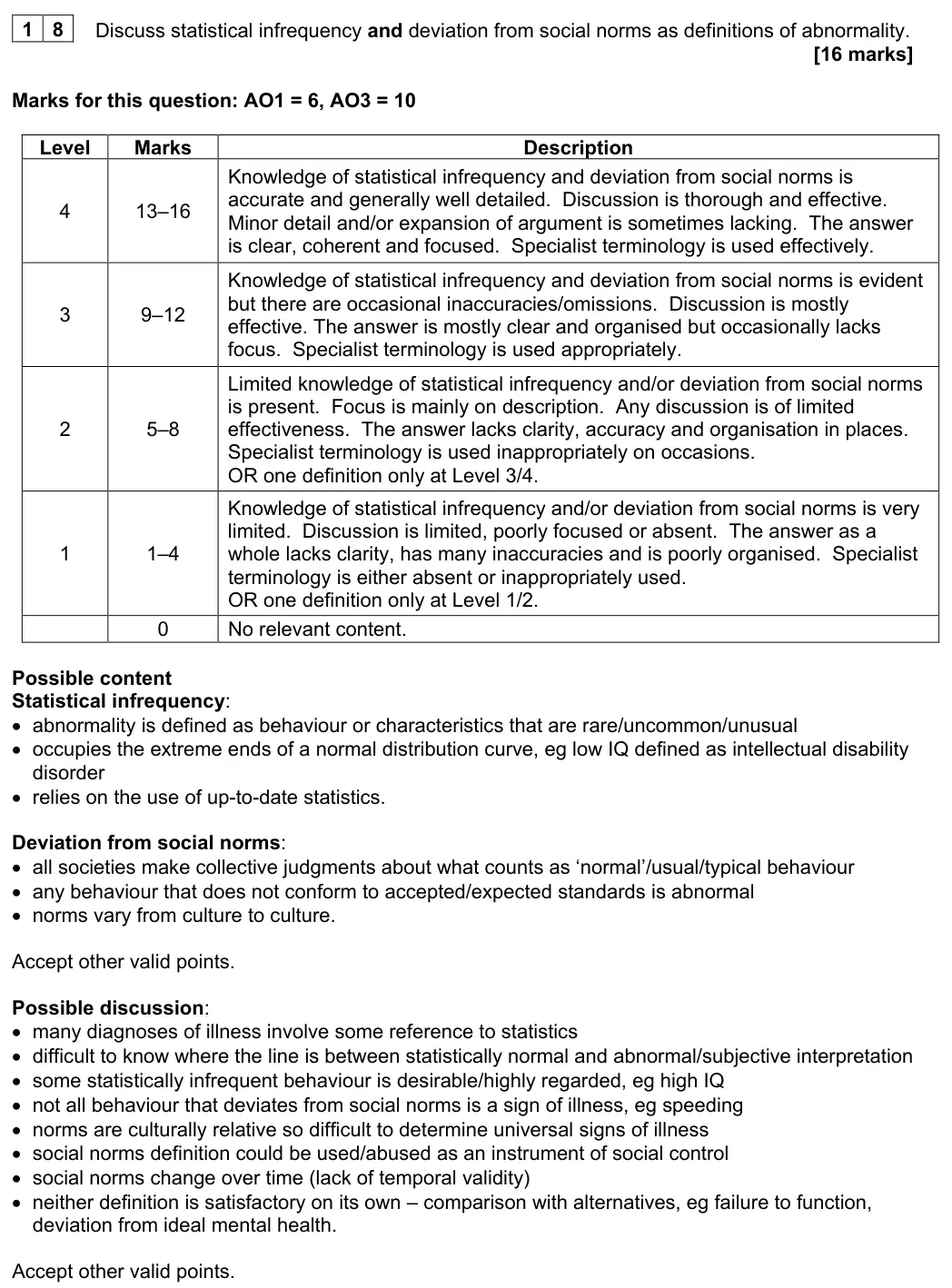
Students tended to struggle with the statistical infrequency definition, providing weak examples (e.g. weight) rather than focusing on behaviour. There was also a tendency to confuse deviation from social norms with failure to function adequately. Although cultural issues were popular as evaluation, AO3 in general was limited. At the top end students used effective examples e.g. depression being quite frequent rather than infrequent, and realised that they could use alternative definitions of abnormality to evaluate statistical infrequency and deviation from social norms.
Notes from the mark scheme and report
one definition only = max Level 2
'deviation from social norms' reworded to social/cultural norms in v1.4
weak examples for statistical infrequency (e.g. weight)
confusing social norms with failure to function adequately
alternative definitions can be used as evaluation
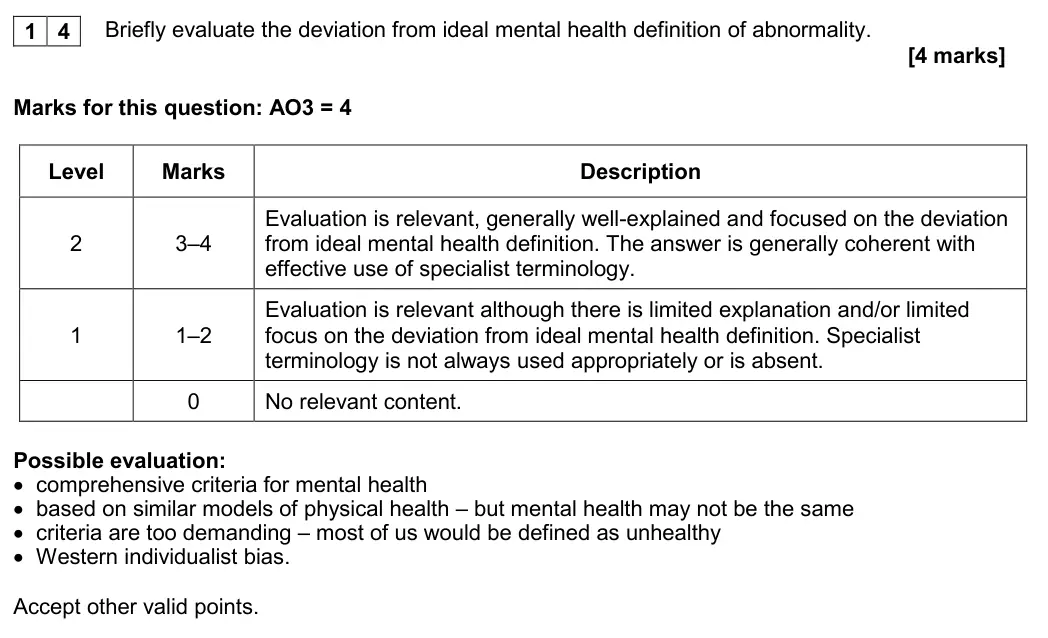
November 2020 · Paper 1 · Q144 marksAO3=4Evaluate (short)
Mark scheme, including level descriptors and indicative content
Examiner's comment
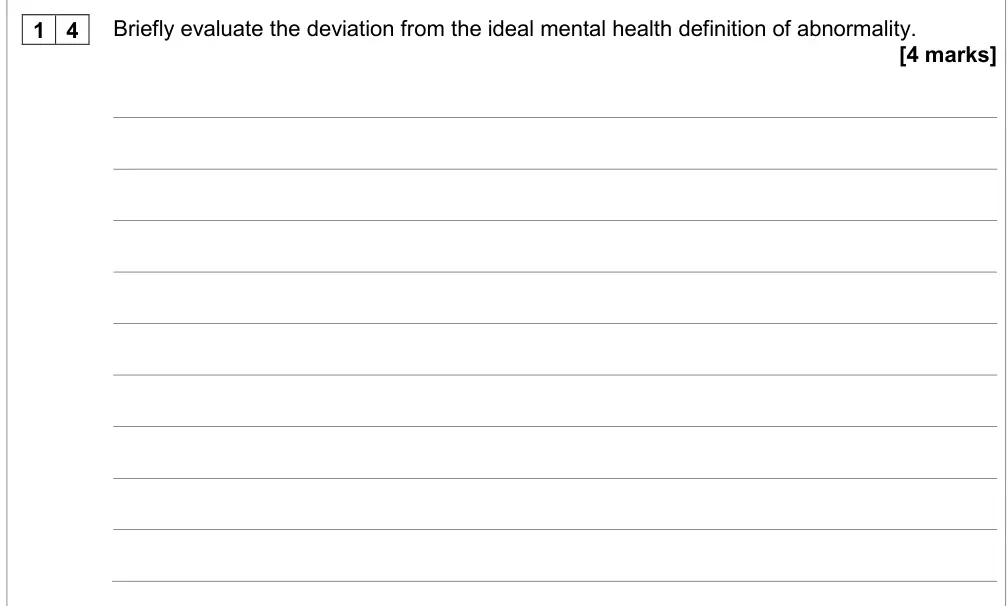
Although some answers provided too much detail of the IMH definition of abnormality, generally responses were focused on evaluation. The most common error was not to provide sufficient elaboration to access full marks. At the top end there was reference to e.g. cultural differences, or problems with satisfying specific examples of Jahoda’s criteria.
Notes from the mark scheme and report
evaluation only: too demanding, Western individualist bias, comparison with physical health models
lack of elaboration most common error
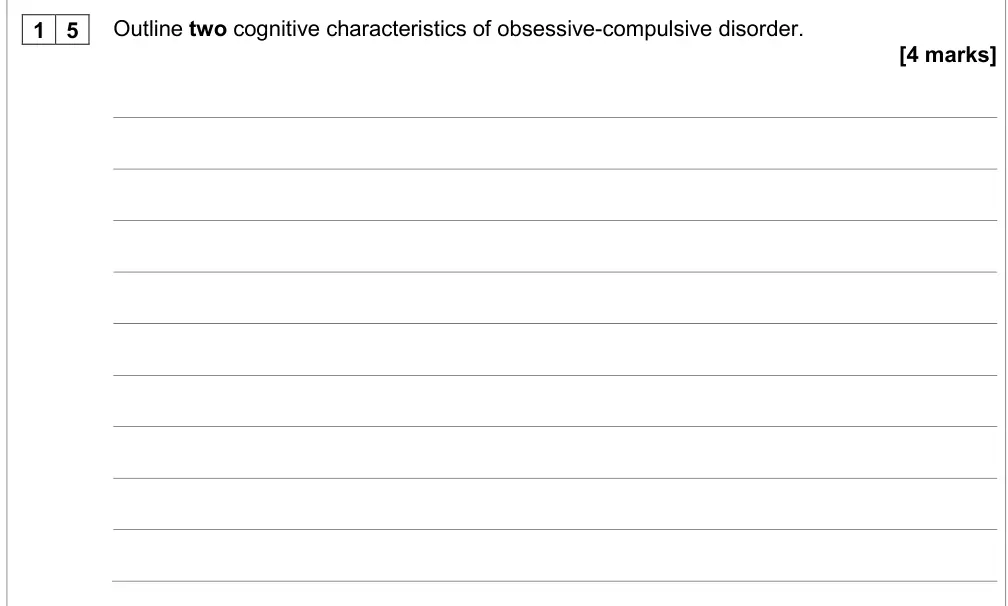
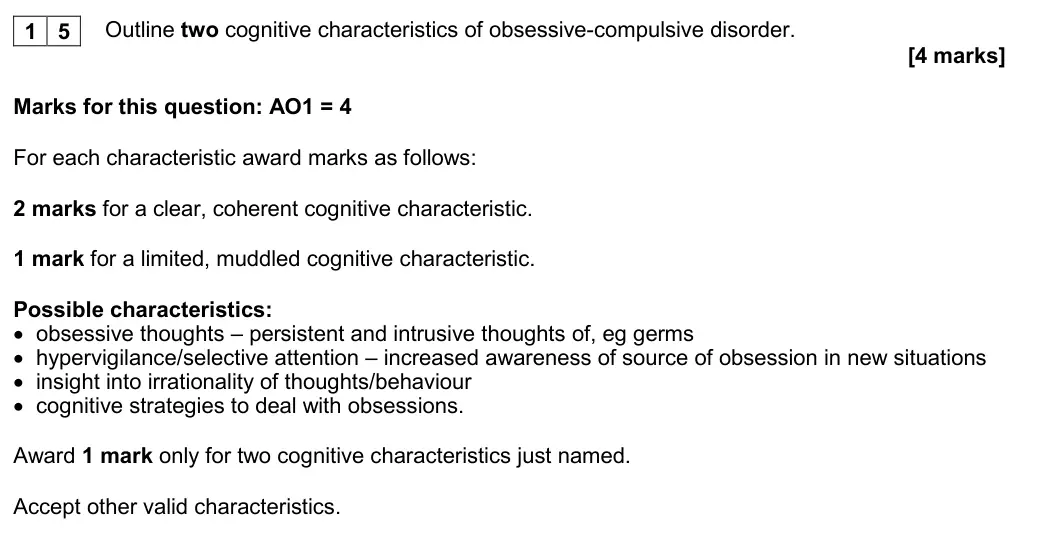
November 2020 · Paper 1 · Q154 marksAO1=4Outline
Mark scheme, including level descriptors and indicative content
Examiner's comment
Although most students could outline one cognitive characteristic of OCD (usually obsessive thoughts), many could not provide a second example. There were references to insight into the condition, and cognitive strategies for dealing with obsessions, but a number of answers veered off into non-cognitive characteristics such as compulsive behaviours and anxiety.
Notes from the mark scheme and report
2 marks each: obsessive thoughts, hypervigilance/selective attention, insight into irrationality, cognitive coping strategies
two just named = 1
many drifted into compulsions or anxiety
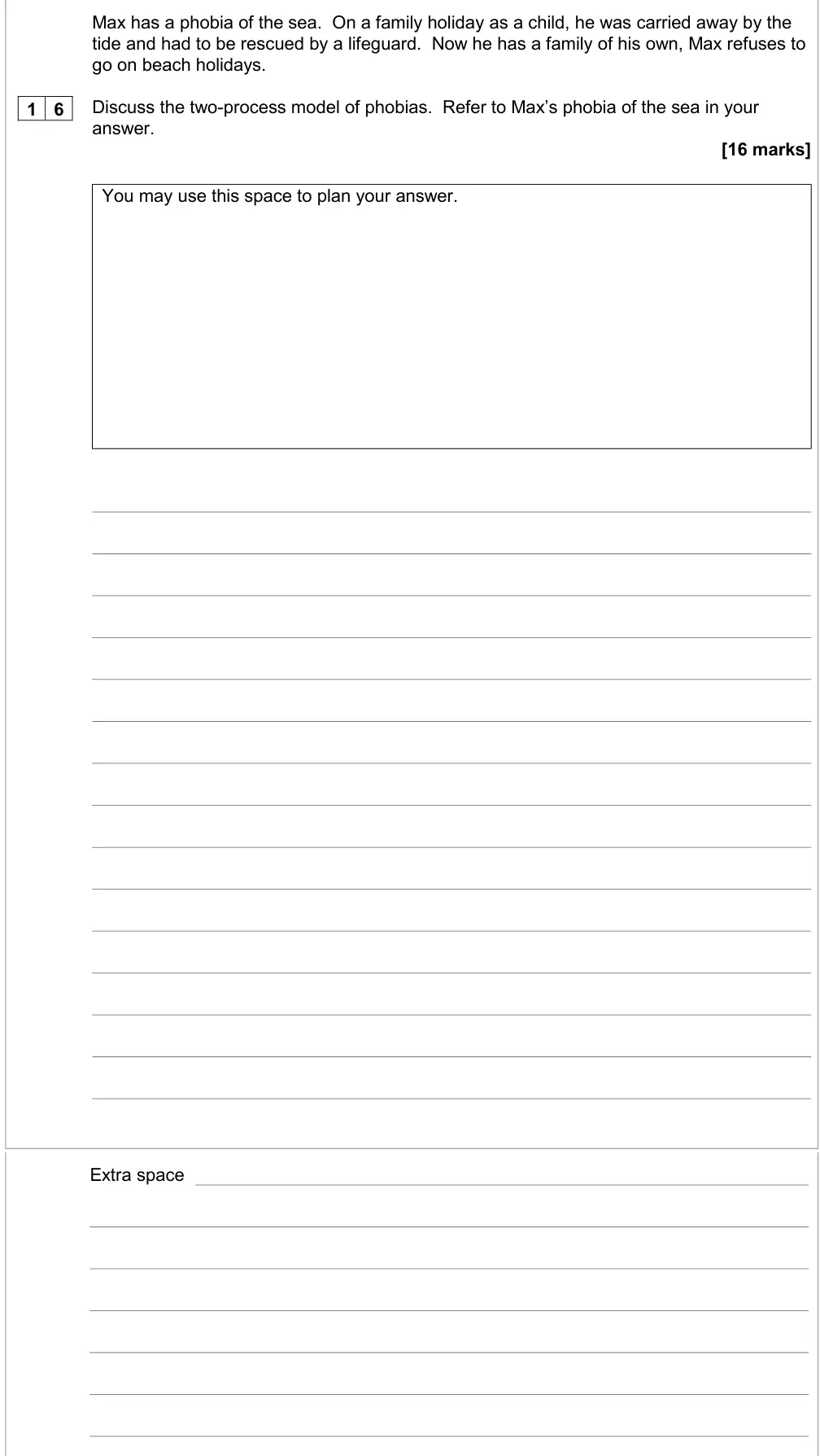
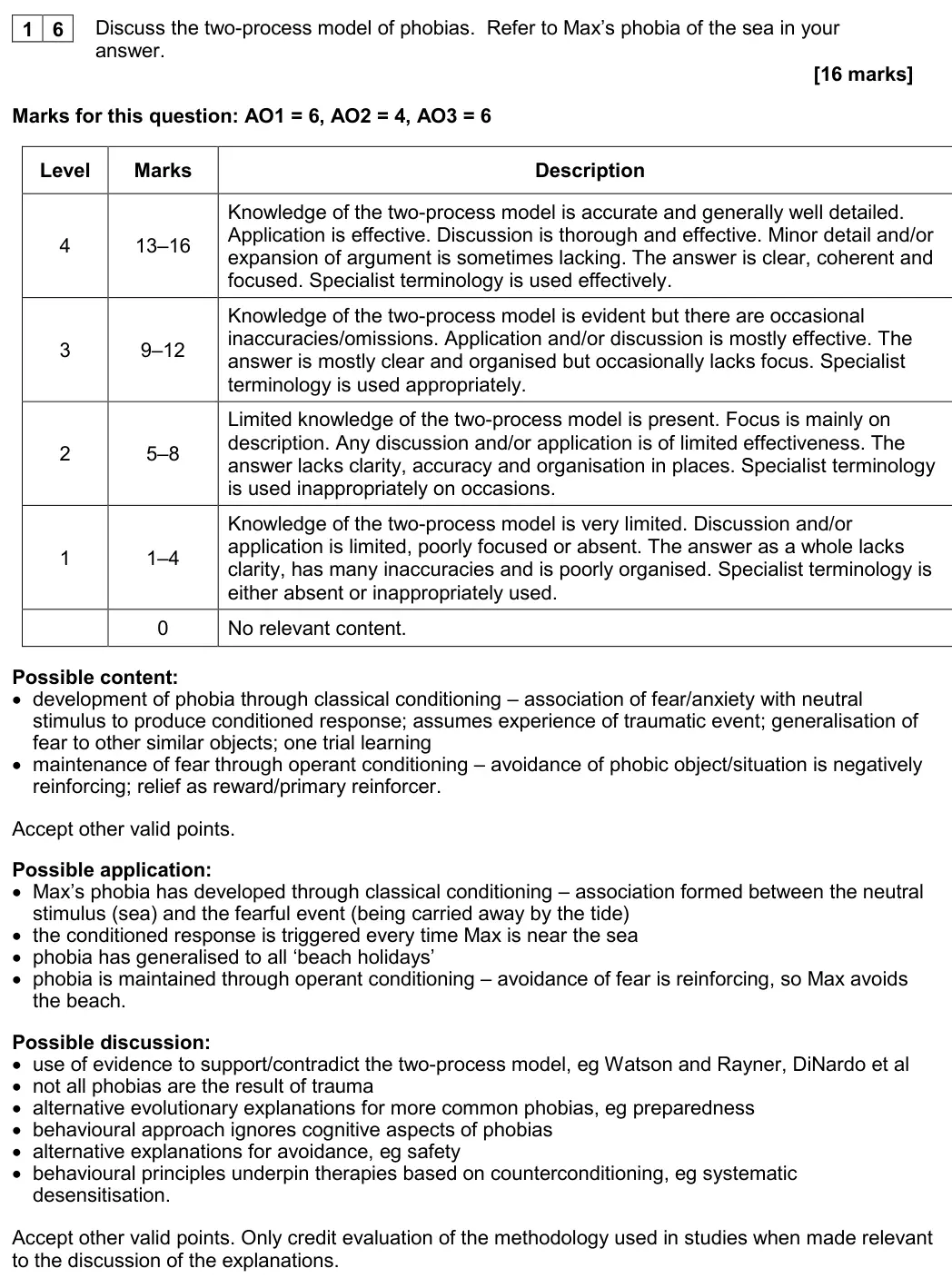
November 2020 · Paper 1 · Q1616 marksAO1=6, AO2=4, AO3=616-mark essay
Mark scheme, including level descriptors and indicative content
Examiner's comment
This question provided the greatest range of answers. At the top end there was impressive and accurate knowledge of the two-process model, with clear distinctions between classical and operant conditioning. Application to Max was usually accurate. Evaluation was varied, from Pavlov’s dogs, Little Albert, alternative biological/evolutionary explanations, studies on the link (or not) between phobias and traumatic experiences, and therapies based on the two-process model. Weaker answers were unclear on the distinction between operant and classical conditioning and failed to apply them effectively to Max’s situation. A number of essays referred e.g. to Little Albert or to systematic desensitisation without detailing their specific relevance to the two-process model.
Notes from the mark scheme and report
classical (sea + traumatic event, generalisation to beach holidays) and operant (avoidance negatively reinforced) applied to Max
evaluation: Little Albert, DiNardo, preparedness, cognitive aspects, SD
references to Little Albert/SD must be linked to the model
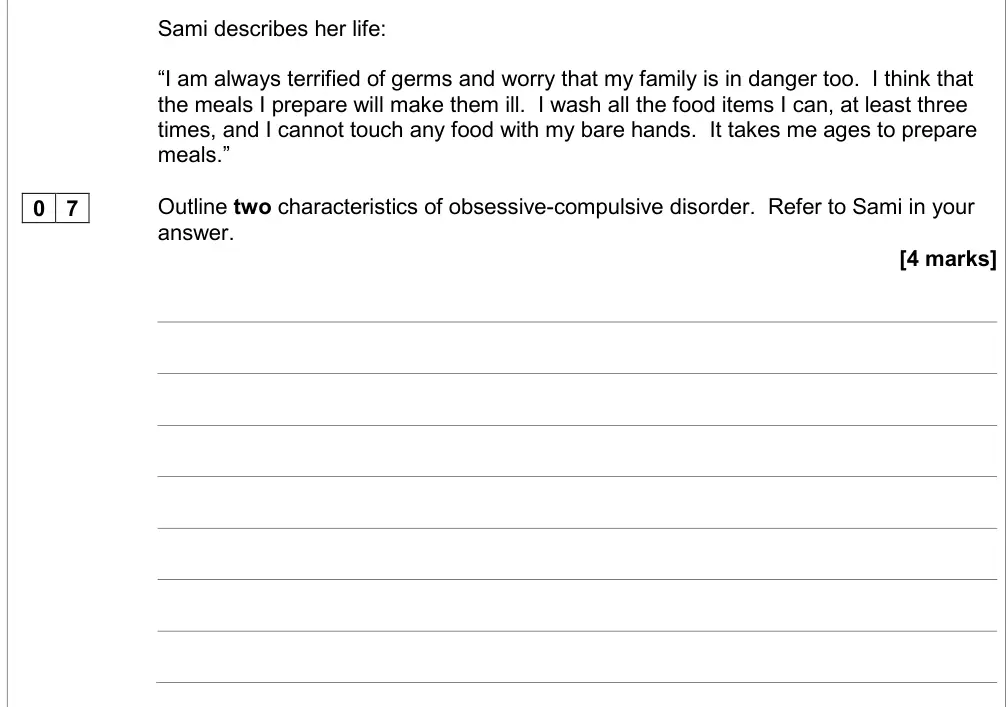
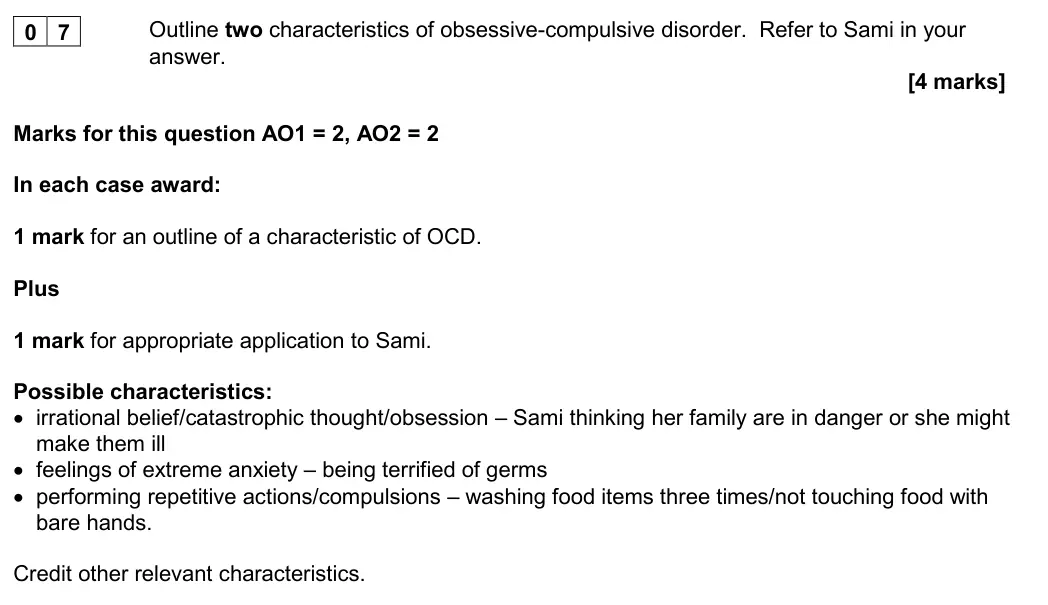
November 2020 · AS Paper 2 · Q74 marksAO1=2, AO2=2Application
Mark scheme, including level descriptors and indicative content
Notes from the mark scheme and report
per characteristic: 1 outline + 1 application to Sami (obsession that family will be ill, extreme anxiety about germs, compulsive washing three times)
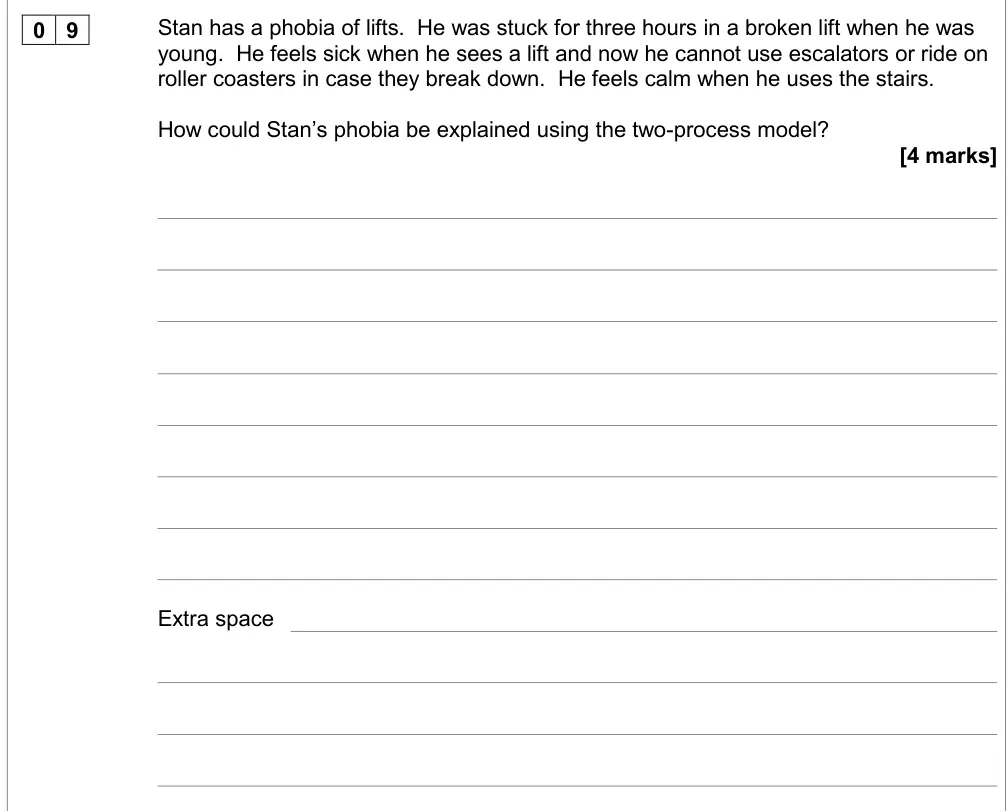
November 2020 · AS Paper 2 · Q94 marksAO2=4Application
Mark scheme, including level descriptors and indicative content
Notes from the mark scheme and report
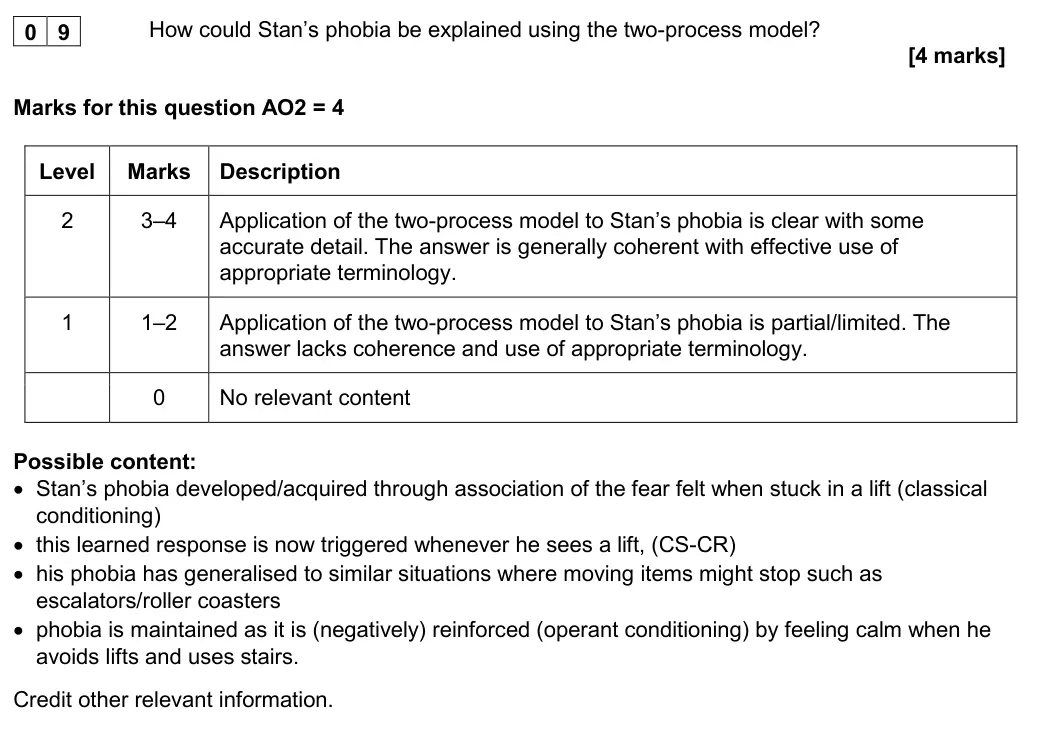
classical conditioning acquires fear of lifts (CS-CR), generalisation to escalators/roller coasters, operant: avoidance (using stairs, feels calm) negatively reinforces
November 2020 · AS Paper 2 · Q102 marksAO1=2Outline
Mark scheme, including level descriptors and indicative content
Notes from the mark scheme and report
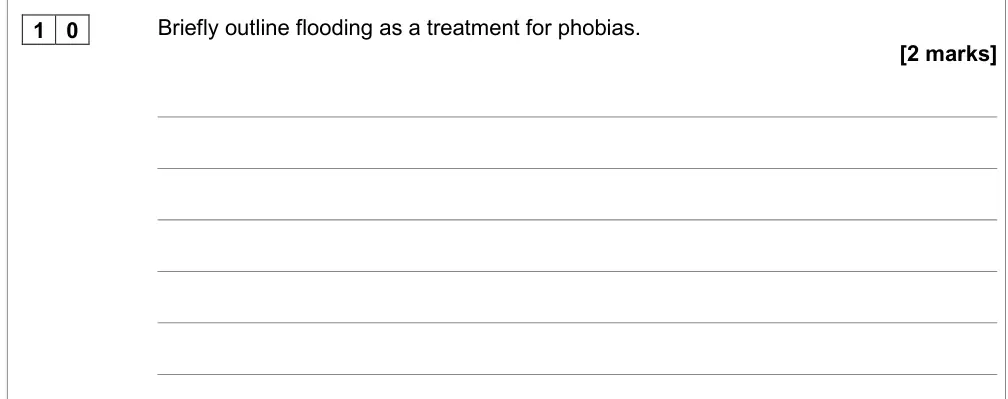
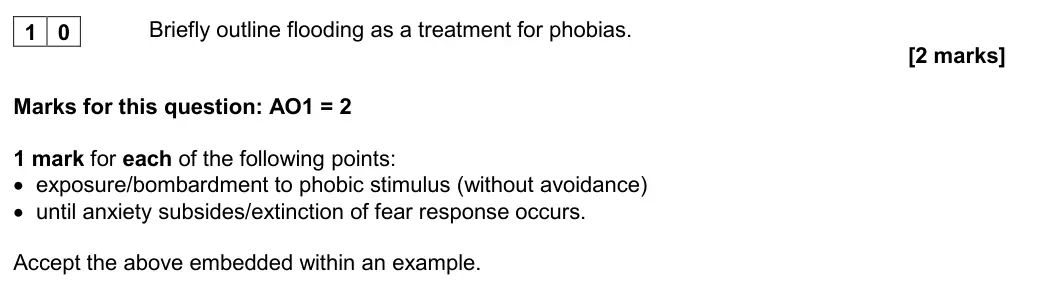
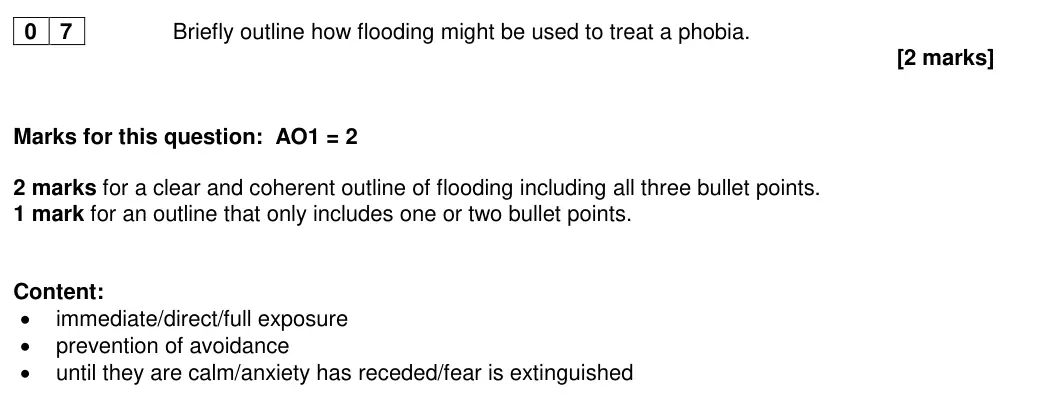
1 mark exposure/bombardment without avoidance + 1 mark until anxiety subsides/extinction
November 2020 · AS Paper 2 · Q1112 marksAO1=6, AO3=6Extended writing
Mark scheme, including level descriptors and indicative content
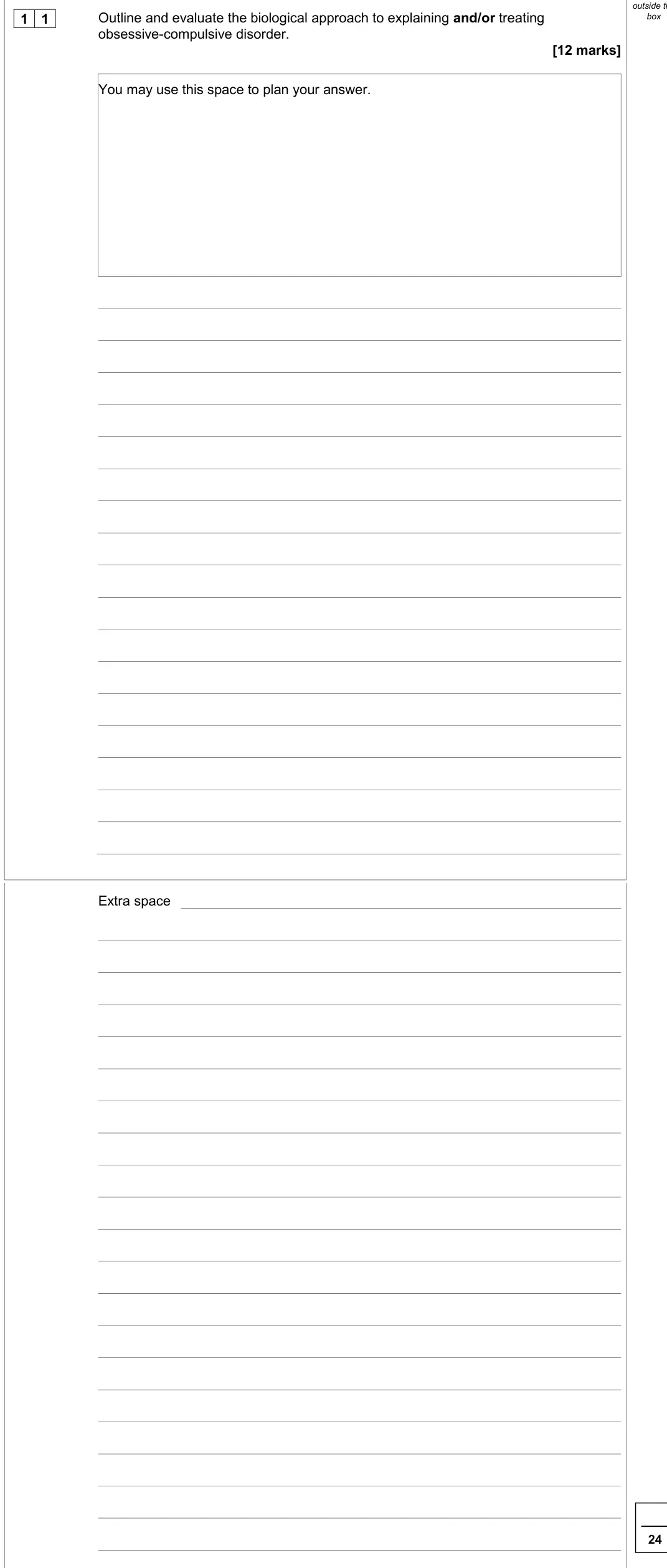
evaluation: twin/family evidence, 50% SSRI improvement, side effects, CBT/ERP comparison
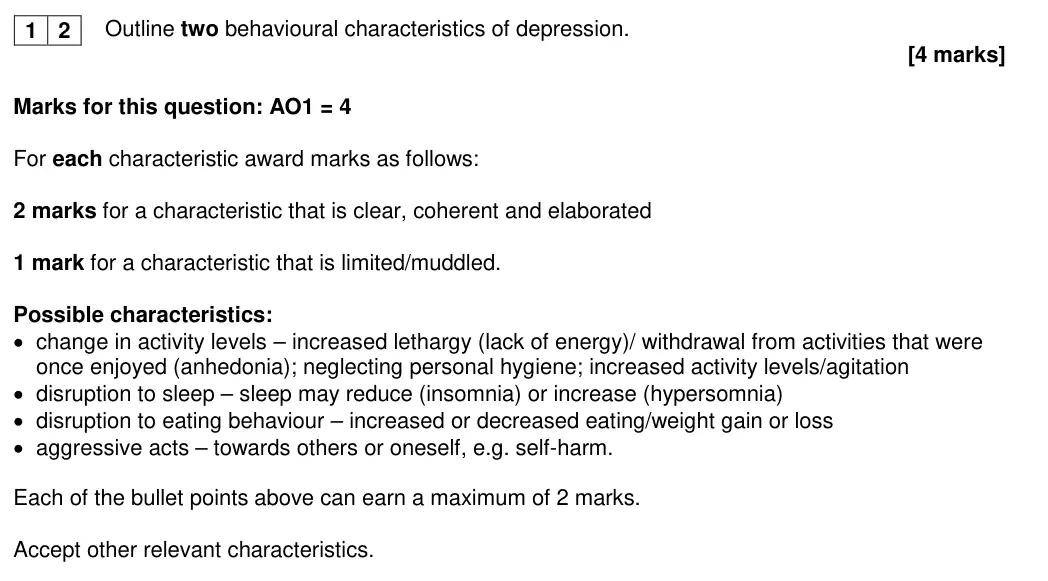
June 2019 · Paper 1 · Q124 marksAO1=4Outline
Mark scheme, including level descriptors and indicative content
Examiner's comment
Many students achieved full marks on this question by providing brief outlines of behavioural changes such as disruption to activity levels, sleeping patterns, eating behaviour or aggression. Simple statements such as ‘change to sleeping pattern’ did not provide sufficient detail for full marks. A few answers focused on emotional or cognitive characteristics and did not earn marks. One surprisingly common approach was to combine changes to sleeping and eating patterns and present them as one symptom, which of course they are not.
Notes from the mark scheme and report
2 marks each: activity levels, sleep, eating, aggression/self-harm
brief statements only = 1
sleep and eating are separate characteristics
emotional/cognitive characteristics = 0
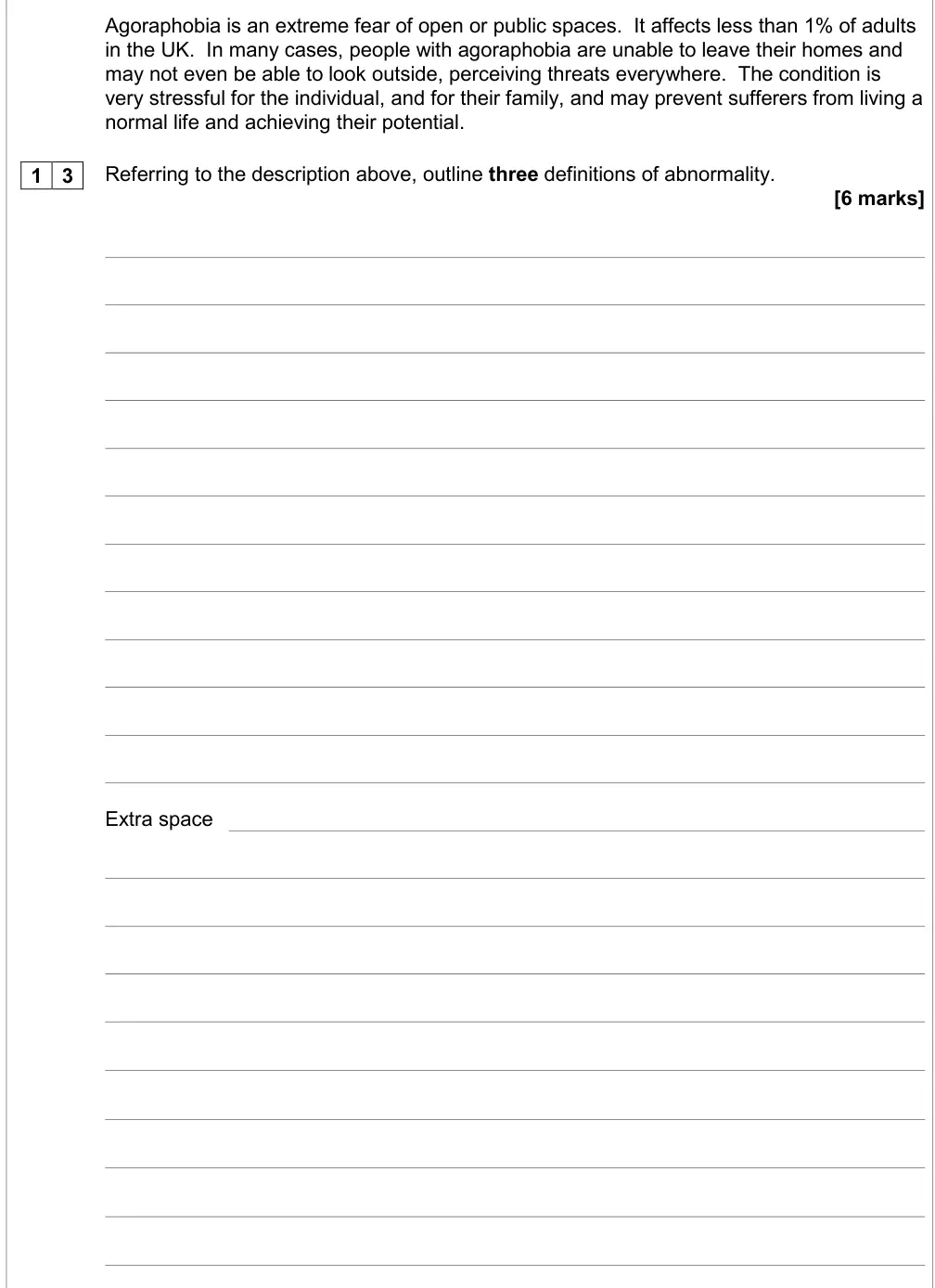
June 2019 · Paper 1 · Q136 marksAO2=6Application
Mark scheme, including level descriptors and indicative content
Examiner's comment
Overall this question was done well. Many students achieved full marks by providing clear outlines of three definitions of abnormality and applying them to the description of agoraphobia in the stem. Some became muddled over deviation from ideal mental health, confusing it with deviation from social norms and/or forgetting the ‘deviation’ aspect. There was also a tendency to give far too much detail of the criteria for ideal mental health. Statistical infrequency and failure to function adequately were generally handled effectively. A few students failed to address the need to refer to the description of agoraphobia in the stem and so could not access these marks.
Notes from the mark scheme and report
2 marks per definition applied to agoraphobia (less than 1% = statistical infrequency
June 2019 · Paper 1 · Q142 marksAO3=2Evaluate (short)
Mark scheme, including level descriptors and indicative content
Examiner's comment
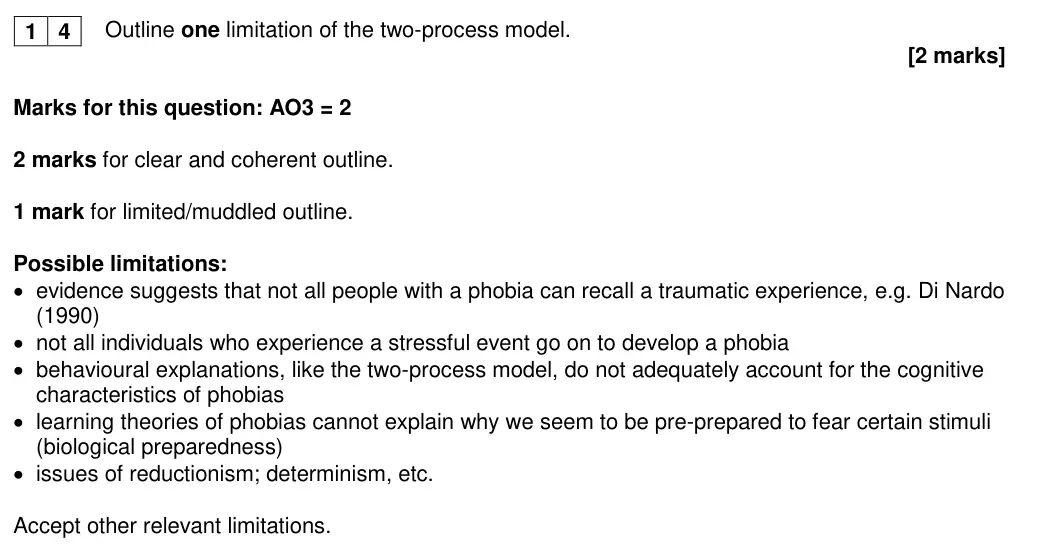
Again, a question done well with most students achieving full marks. The most popular limitations were the development of phobias in the absence of a traumatic event and the possible role of biological preparedness in the origin of phobias. The failure of the model to account for the cognitive characteristics of phobias was rare but creditworthy. Although ‘reductionism’ was sometimes used, a few students clearly did not understand the concept as it applies to behavioural models.
Notes from the mark scheme and report
e.g. no traumatic event recalled (Di Nardo), biological preparedness, ignores cognitive characteristics
reductionism often misunderstood
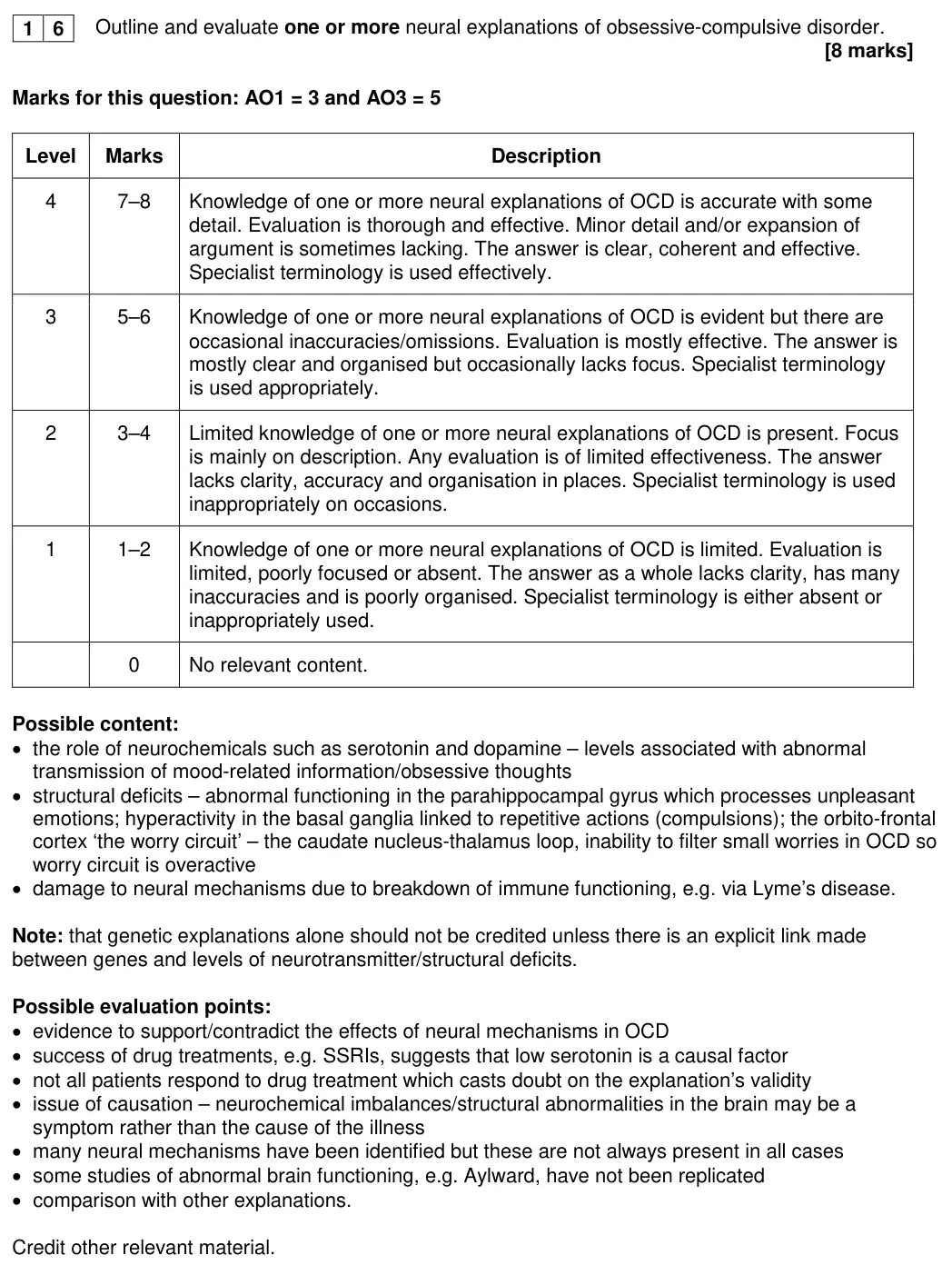
June 2019 · Paper 1 · Q168 marksAO1=3, AO3=5Extended writing
Mark scheme, including level descriptors and indicative content
Examiner's comment
The specification clearly separates ‘genetic’ from ‘neural’ explanations of obsessive-compulsive disorder (OCD). A small minority of students focused only on genetic explanations and did not receive credit. However, answers covering the explicit link between specific genes and levels of neurotransmitters such as serotonin and dopamine were creditworthy. A number of answers provided impressive detail of possible structural deficits in OCD (involvement of basal ganglia, parahippocampal gyrus, orbito-frontal cortex and the ‘worry’ circuit etc). This was often combined with reference to low levels of serotonin and high levels of dopamine. Hence, marks for outlines of neural explanations were generally good. However, evaluation was on the whole less effective. A minority of better answers referred to relevant scanning studies of structural change in OCD and the success of drug therapy supporting the serotonin explanation. This was sometimes extended to an awareness that not all OCD patients show structural change or respond to drug therapy, undermining the explanations. Animal research on OCD-like repetitive behaviours produced by high dopamine levels was not common but relevant. There were many muddled references to reductionism and determinism. Less effective answers were usually able to refer to drug therapy but often became diverted into irrelevant material on problems with such therapy, such as side effects or addiction. However, many students considered the cause/effect problem with neural explanations. Comparison with alternative behavioural/cognitive explanations and the success of therapies based on them was rare but often effective. Finally, a general problem was a lack of organisation in many answers, with evaluation points scattered around and so reducing the coherence of the essay.
genetic explanations only credited if linked to neurotransmitters/structures
evaluation e.g. SSRI success, cause vs effect, non-replication
drug side effects irrelevant
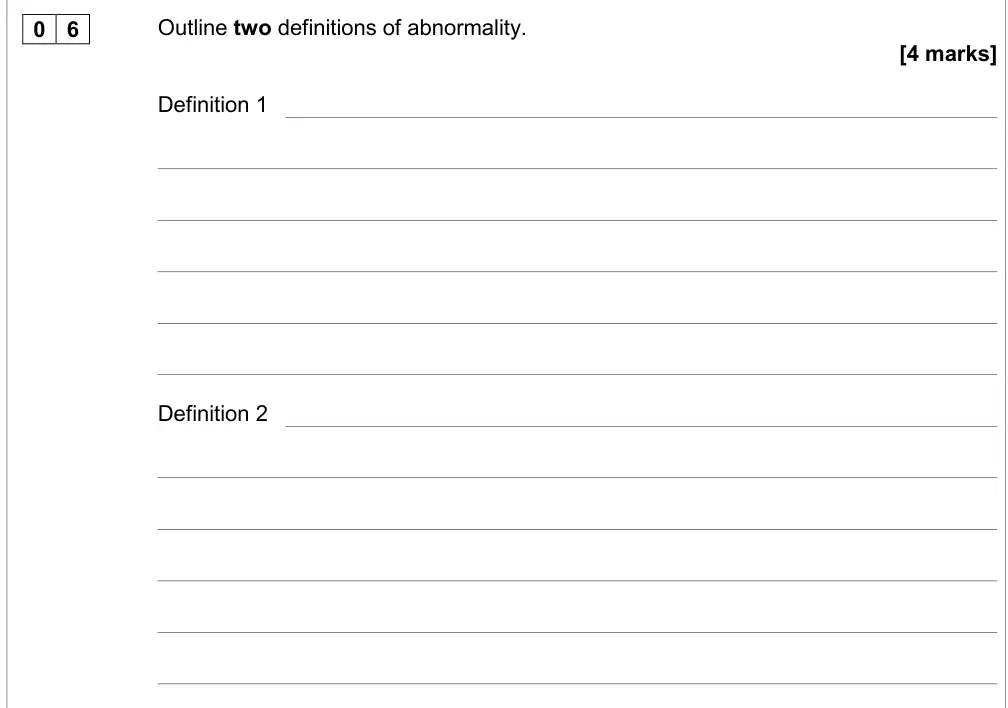
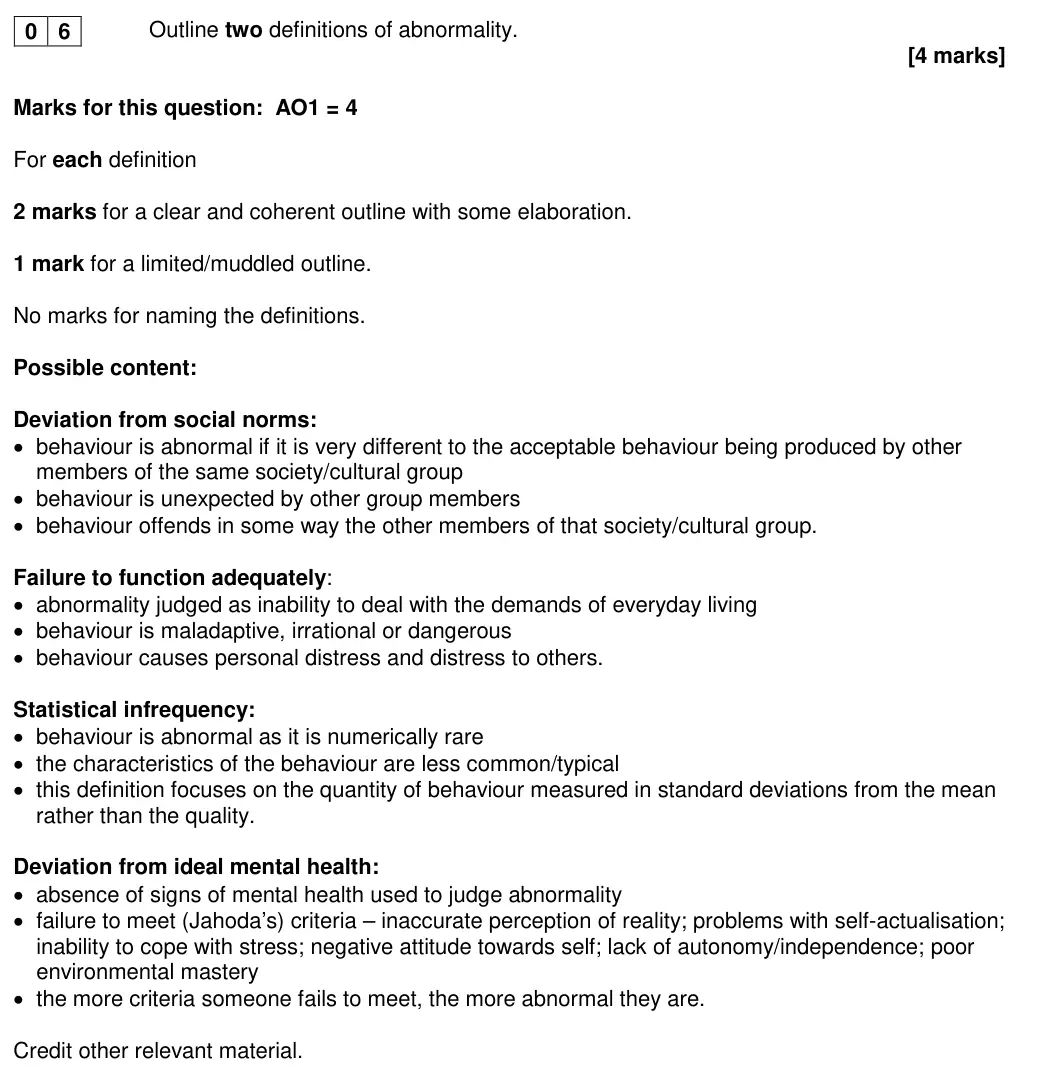
June 2019 · AS Paper 2 · Q64 marksAO1=4Outline
Mark scheme, including level descriptors and indicative content
Examiner's comment
Most students were able to produce accurate responses to this question with many demonstrating clear and coherent knowledge of two definitions of abnormality. Some students simply named the definitions and others only provided a very brief and thus limited outline. It is important to remind students that their outlines should be of definitions of abnormality not normality. This is especially important when describing deviation from ideal mental health, as some students just described ideal mental health and omitted the idea that to be abnormal you had to deviate from these characteristics. As in question 5, students should be reminded to ensure all content is linked clearly to psychology, as some very poor examples were used when attempting to illustrate definitions of abnormality.
Notes from the mark scheme and report
2 marks per definition
naming alone = 0
must define ABNORMALITY (e.g. deviation FROM ideal mental health)
deviation from social norms now 'social/cultural norms'
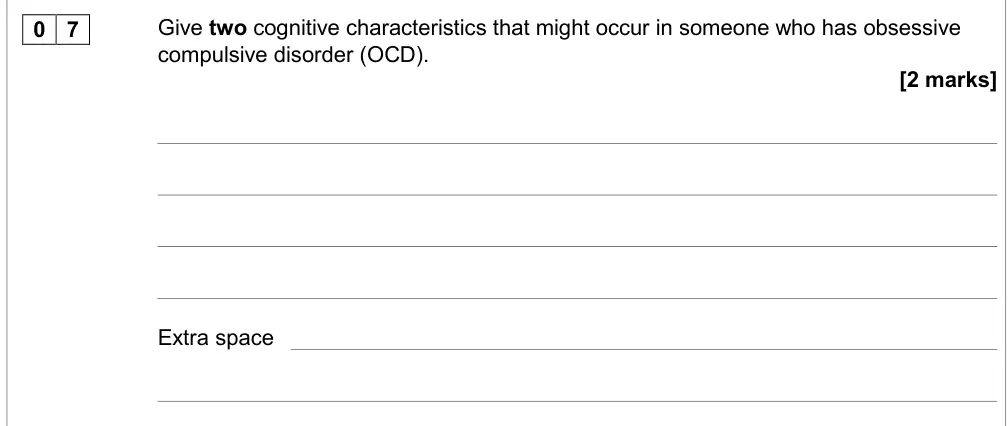
June 2019 · AS Paper 2 · Q72 marksAO1=2Short answer
Mark scheme, including level descriptors and indicative content
Examiner's comment
Most students clearly had good knowledge of cognitive characteristics of obsessive compulsive disorder and there were many relevant characteristics stated. However, there was some confusion with both emotional and behavioural characteristics, as well as confusion with cognitive characteristics of other disorders, most notably depression.
Notes from the mark scheme and report
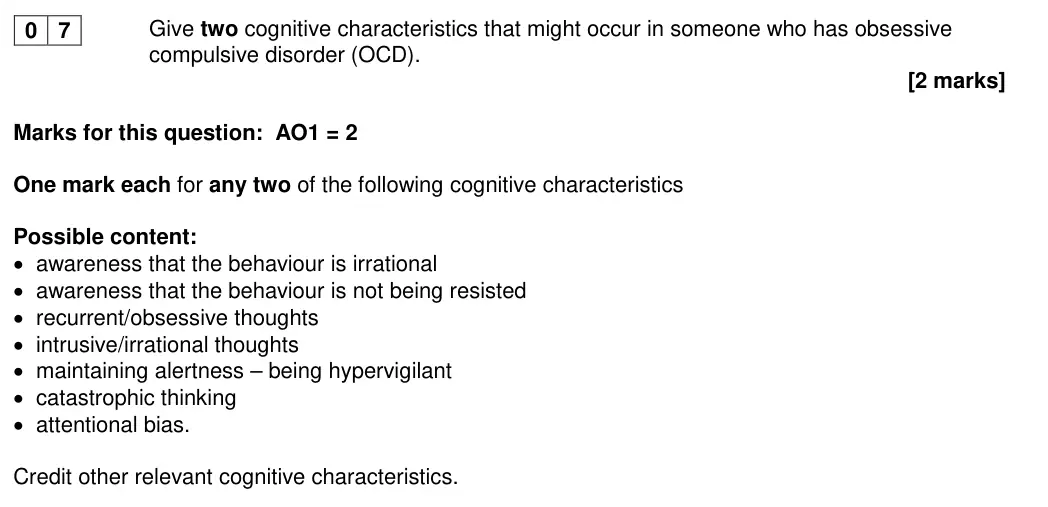
e.g. recurrent/intrusive thoughts, awareness behaviour is irrational, hypervigilance, catastrophic thinking
confusion with emotional/behavioural characteristics and with depression
June 2019 · AS Paper 2 · Q128 marksAO1=4, AO3=4Extended writing
Mark scheme, including level descriptors and indicative content
Examiner's comment
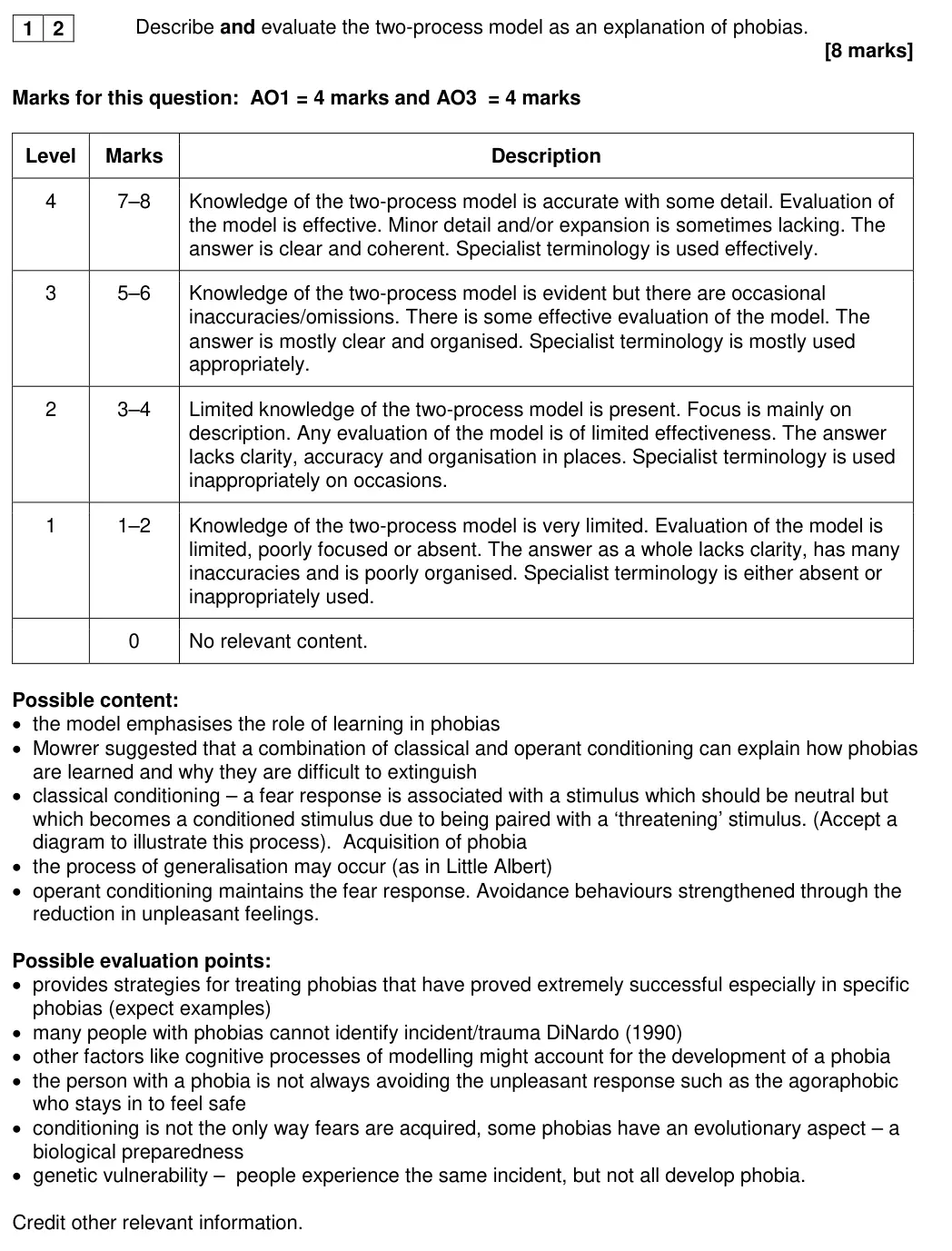
Students should also take care with the balance of assessment objectives in questions which involve extended writing such as questions 5 and 12. In these questions, there should be an equal balance of knowledge/understanding and discussion/evaluation, but some students were producing excessive amounts of one assessment objective and minimal amounts of the other and thus were not able to access the higher levels and marks. A good range of responses was seen across the cohort with many students producing level 3 and 4 answers. These responses tended to outline accurately the roles of classical conditioning in the acquisition of a phobia and operant conditioning in the maintenance of a phobia. They also included at least some effective evaluation. There were some responses which exceeded the demands of the question and were detailed enough for a response to a longer 12-mark question. It is important that students tailor their responses to the actual question posed so they do not waste time writing excessive material which might mean that they run out of time on other questions. Poorer responses tended to focus solely on classical conditioning or contained no evaluation. There were also several responses which were not tailored to the development of a phobia and contained generic information on classical and/or operant conditioning or on Pavlov’s and/or Skinner’s research.
Notes from the mark scheme and report
Mowrer: classical conditioning acquires, operant (negative reinforcement of avoidance) maintains
June 2018 · Paper 1 · Q131 markAO2=1Multiple choice
Answer
A
Mark scheme, including level descriptors and indicative content
Examiner's comment
Very straightforward and answered very well.
Notes from the mark scheme and report
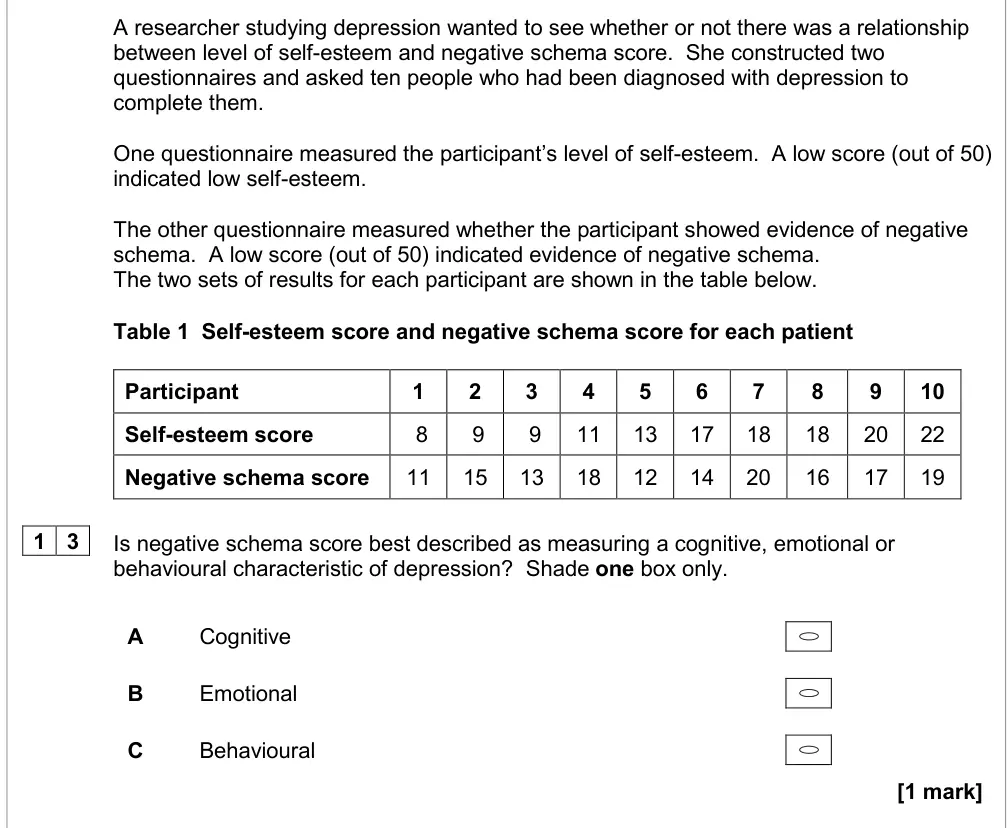
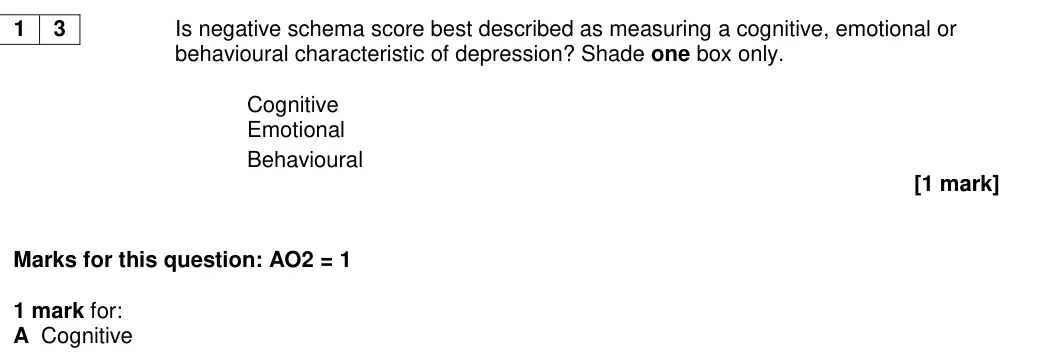
answer A cognitive
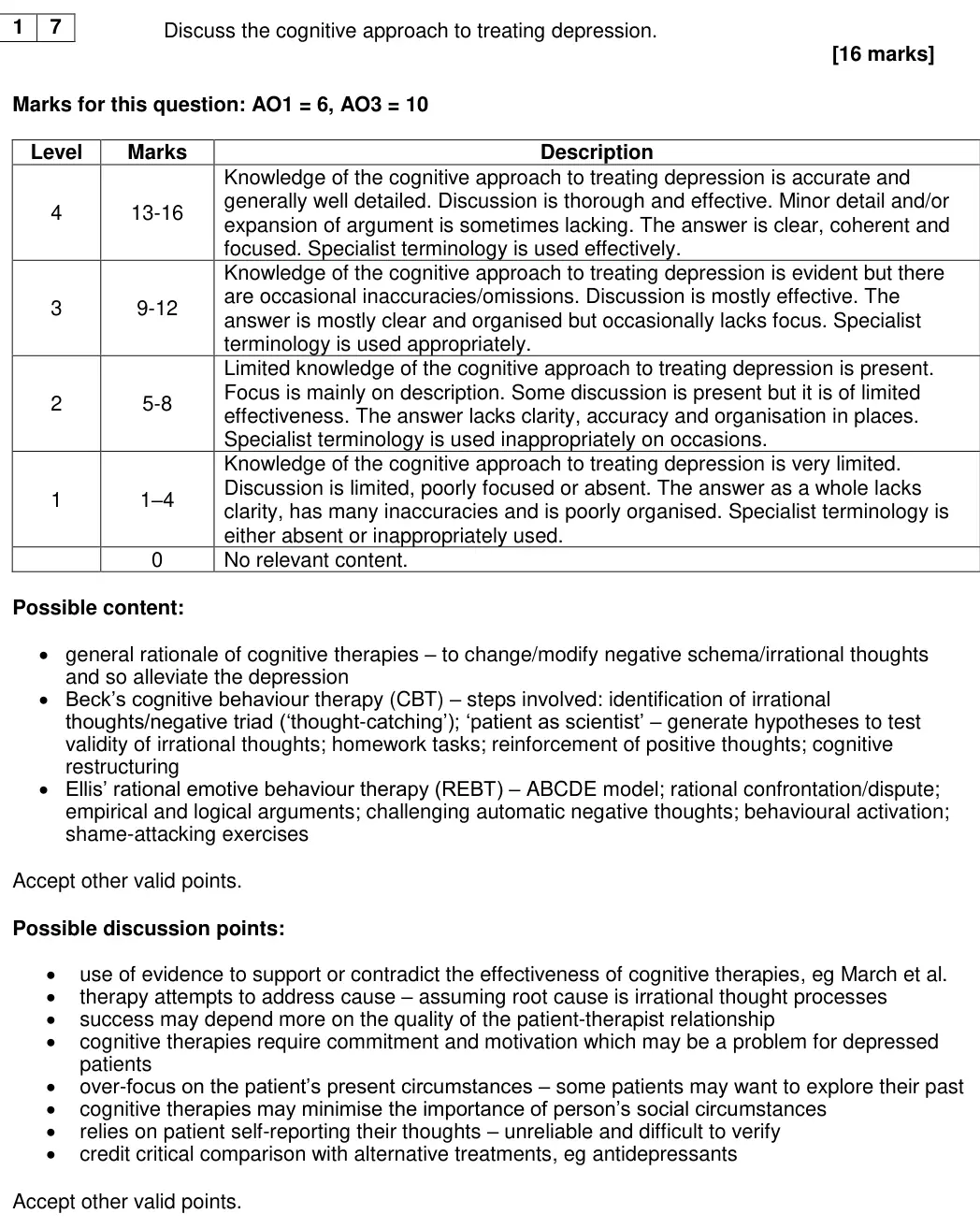
June 2018 · Paper 1 · Q1716 marksAO1=6, AO3=1016-mark essay
Mark scheme, including level descriptors and indicative content
Examiner's comment
There were three 16 mark questions on this year’s paper, which required even more careful time planning. It was clear from the number of short or absent answers to Q17 that some students failed to do this, and missed out on marks. Finally, in Question 17 some students demonstrated impressive understanding of the cognitive approach to depression, but focused on explanations rather than treatments as explicitly required by the question. Although a straightforward question, overall performance on this question was not as impressive as Question 12. This was mainly due to the number of short or absent answers, suggesting a failure of time allocation across the examination. However many students were able to outline the treatment methods used by the cognitive approach, and at the top end distinguished between the methods developed by Beck and by Ellis (a number of answers referred to patient as scientist, homework tasks, cognitive restructuring, empirical and logical arguments, behavioural activation etc). The most effective evaluation was the use of studies comparing cognitive methods with e.g. drug therapy, demonstrating their effectiveness. Comments on relapse rates, time and cost were also relevant, along with the client/therapist relationship, limitations in terms of client suitability (e.g. severity of depression) and the narrow range of the approach in terms of causality (e.g. focus on present circumstances). Less impressive answers spent too much time on cognitive theory and explanations for depression without focusing on treatment for depression. In addition, critical comparison with drug therapy and/or the role of serotonin in some cases led to an overemphasis on drug therapy and the biological approach, as though this was the essay the student really wanted to write.
Notes from the mark scheme and report
Beck's CBT and/or Ellis's REBT
evaluation e.g. March et al, therapist relationship, motivation, comparison with drugs
many short/absent (timing)
too much on cognitive explanations of depression or drug therapy
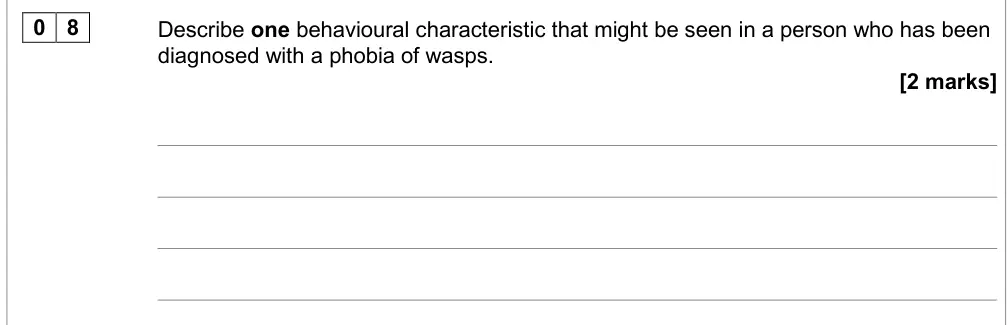
June 2018 · AS Paper 2 · Q82 marksAO1=1, AO2=1Application
Mark scheme, including level descriptors and indicative content
Examiner's comment
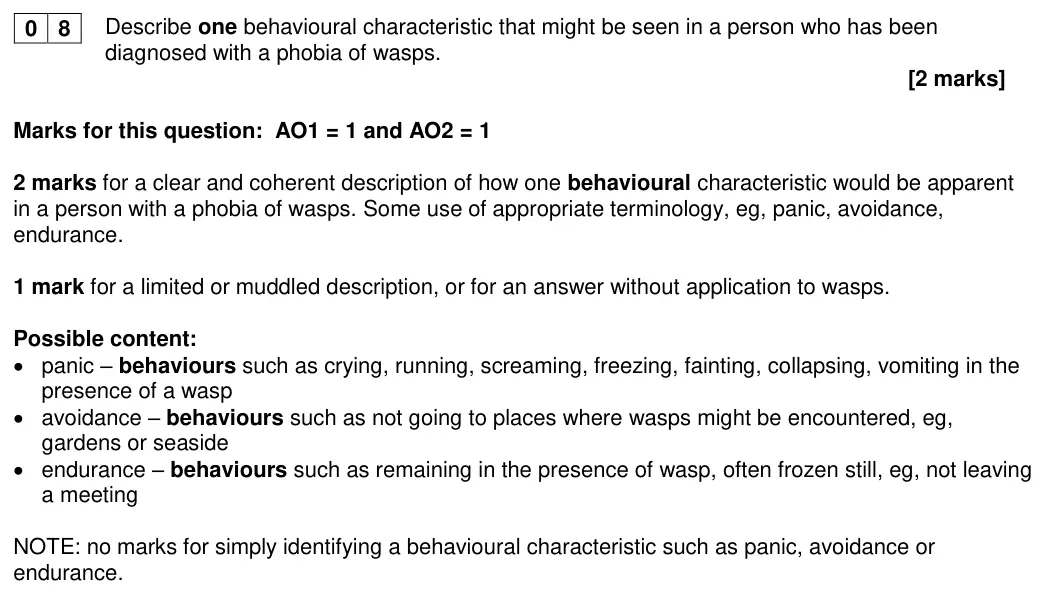
A significant majority of students clearly had knowledge of behavioural characteristics of phobias and there were many clear and coherent descriptions of a behavioural characteristic which might be seen in someone with a phobia of wasps. However, some students simply named the characteristics and did not describe it as the question asked and others failed to apply the behavioural characteristic to a person who has been diagnosed with a phobia of wasps.
Notes from the mark scheme and report
panic, avoidance or endurance described and applied to wasps
naming alone = 0
unapplied = 1 mark
June 2018 · AS Paper 2 · Q92 marksAO1=1, AO2=1Application
Mark scheme, including level descriptors and indicative content
Examiner's comment
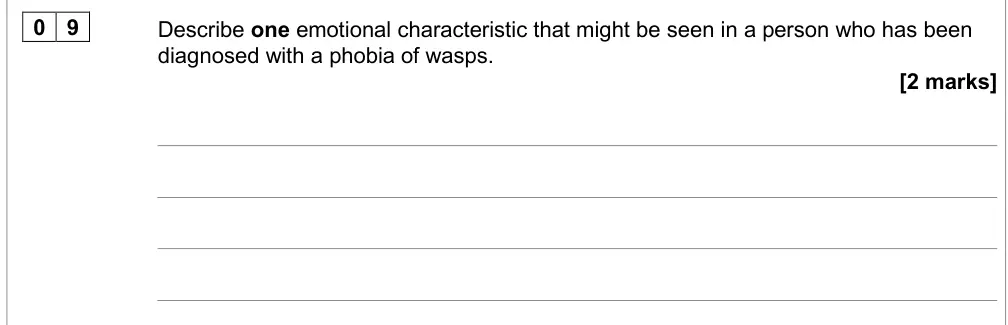
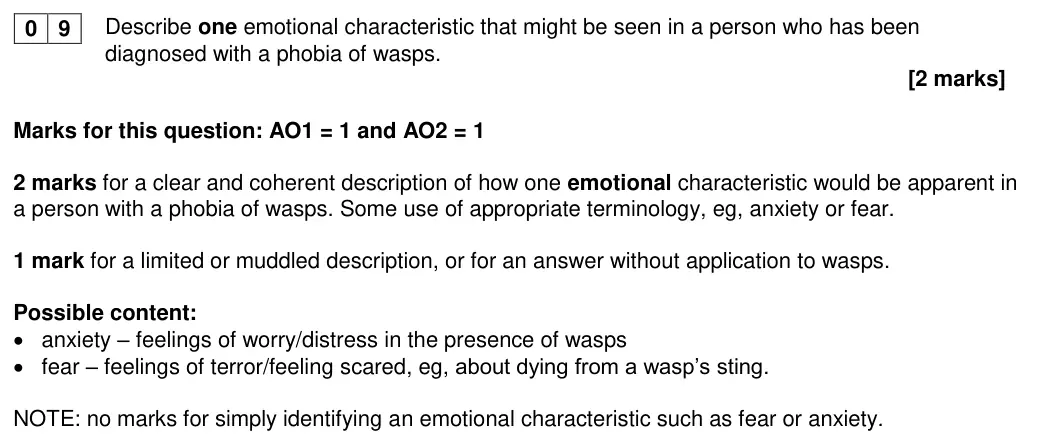
This question was generally answered less well than question 8 suggesting that either students had better knowledge of behavioural characteristics than of emotional characteristics or found it easier to apply the phobia of wasps to a behavioural characteristic rather than an emotional one. The majority of students could name an emotional characteristic but many of them failed to either provide a clear description of that characteristic and/or apply it to a phobia of wasps. There was also some confusion and muddling with cognitive characteristics.
Notes from the mark scheme and report
anxiety or fear described and applied to wasps
naming alone = 0
confusion with cognitive characteristics
answered less well than Q08
June 2018 · AS Paper 2 · Q104 marksAO1=2, AO2=2Application
Mark scheme, including level descriptors and indicative content
Examiner's comment
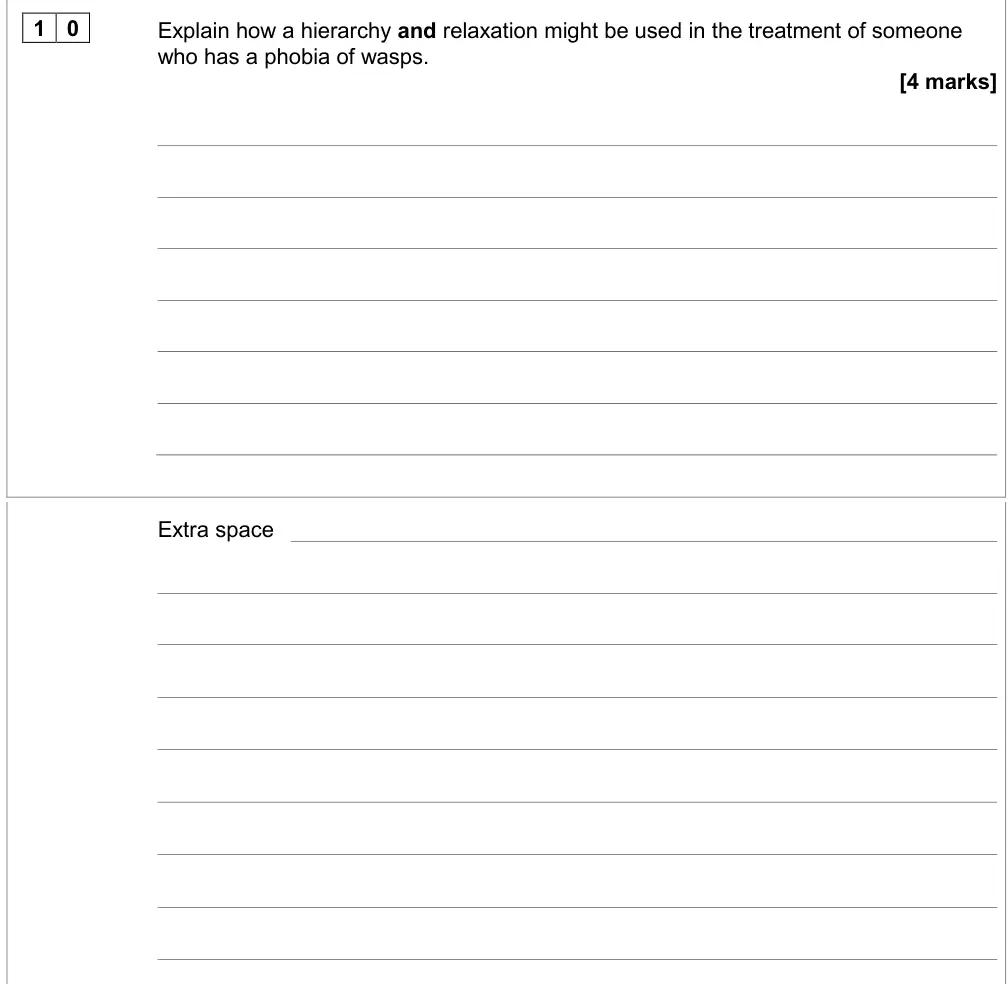
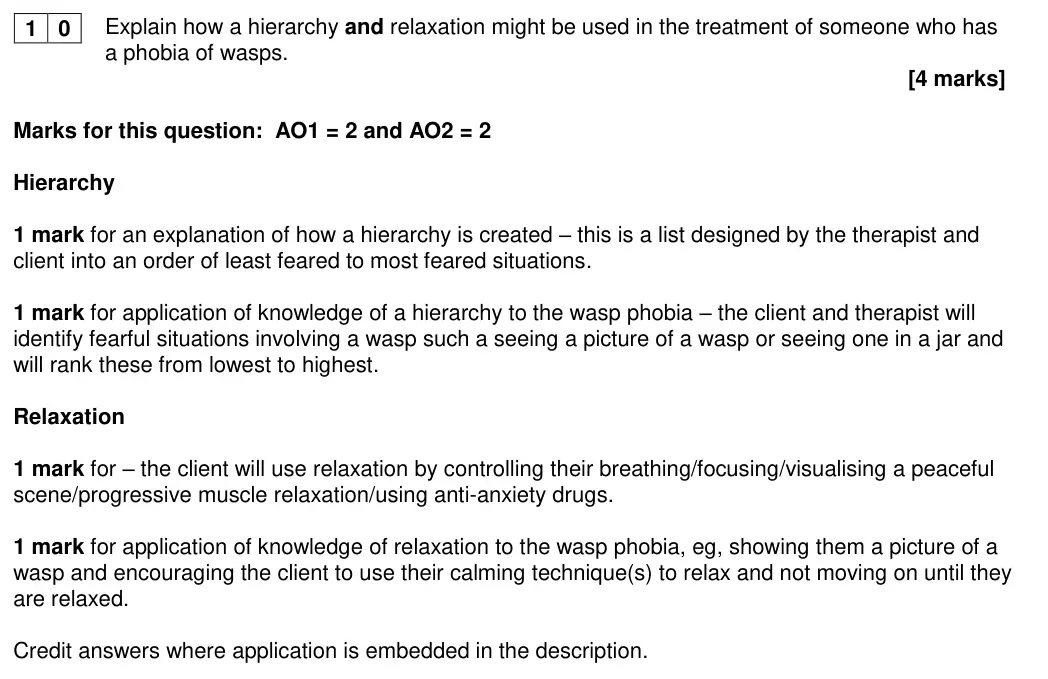
In Section A and B there were two questions (7 and 10) where students appeared to produce pre-prepared answers on a different question to that posed. Many responses did not focus upon the question and appeared to have been pre-planned answers to a different question about systematic desensitisation in general. As a consequence, many responses either did not include the specific material required to correctly answer the question or included additional content which was not required. Of those students who did focus on the question, some failed to apply this information to treating someone with a phobia of wasps as thus could not attain the AO2 marks. Some students did focus clearly on the use of hierarchy and relaxation in treating someone with a phobia of wasps and produced some excellent responses.
Notes from the mark scheme and report
1 mark hierarchy (least to most feared) + 1 application to wasps
1 mark relaxation technique + 1 application
pre-planned generic SD answers lost AO2 marks
June 2018 · AS Paper 2 · Q114 marksAO1=4Outline
Mark scheme, including level descriptors and indicative content
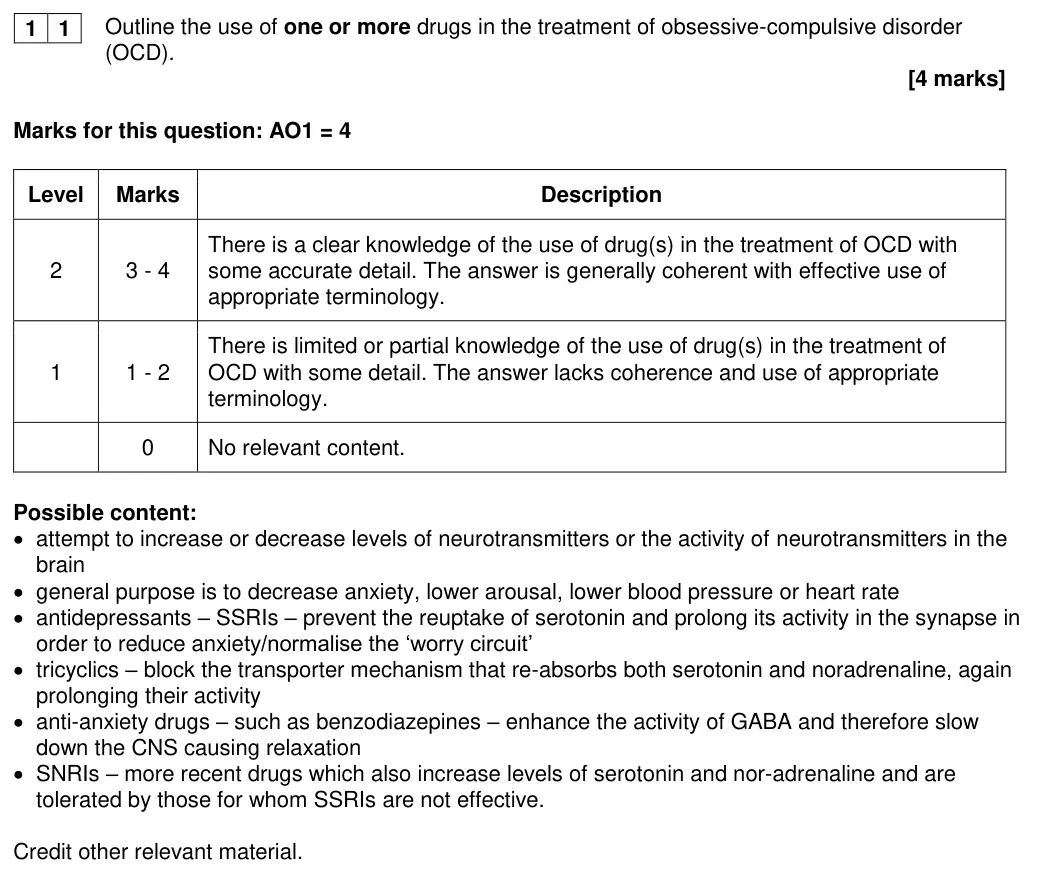
Examiner's comment
There were excellent responses from some students who provided clear and detailed knowledge of the use of drugs in the treatment of OCD. A variety of different drugs was seen in student responses with SSRIs being the most common and the focus varied from the biological action of the drug to the impact it had on the symptoms of OCD. There were many possible accurate responses to this question and students could choose to outline one drug in detail or more than one in less detail. Most students demonstrated some knowledge of the use of drugs to treat OCD and thus most gained some marks but some responses lacked detail and there was some confusion and/or muddling in others.
June 2018 · AS Paper 2 · Q1212 marksAO1=6, AO3=6Extended writing
Mark scheme, including level descriptors and indicative content
Examiner's comment
This question was generally answered well with many students producing Level 3 responses which demonstrated accurate and detailed knowledge of one or more cognitive explanation(s) with some effective evaluation. Most students were able to provide some knowledge of cognitive explanations of depression with most focusing on Beck’s theory and Ellis’ ABC model. The level of detail of knowledge varied greatly; some responses included excessive detail clearly linked to depression which was more than sufficient whilst others were vague, limited or not clearly focused on explanations of depression. Unfortunately, some responses were more focused on treatment rather than explanation which limited the level and mark awarded. The discussion of these explanations was equally varied but was generally weaker than the knowledge demonstrated. There was a lack of focus on explanations in places and substantial brief, unexplained and ineffective discussion points. Some students did produce highly effective evaluative responses and, when combined with accurate and detailed knowledge, this allowed them to produce some excellent Level 4 responses.
discussion: research support, correlation not causation, CBT applications, not all depression has an activating event
treatment-focused answers limited
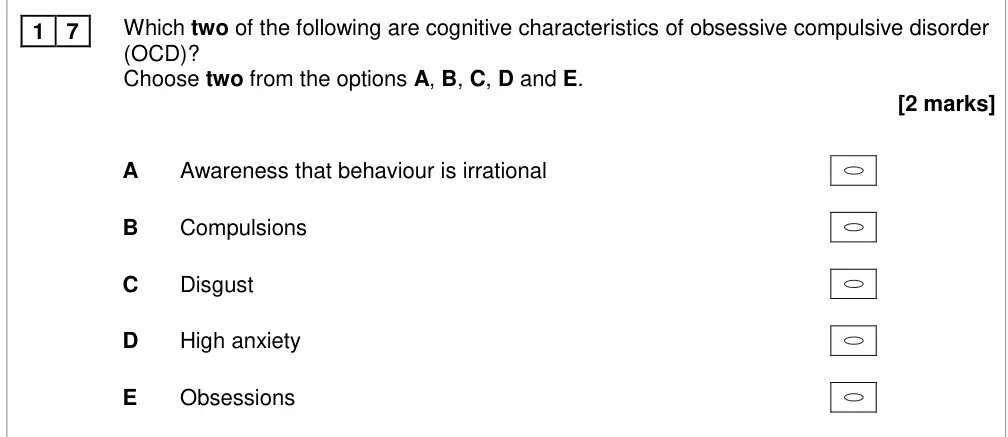
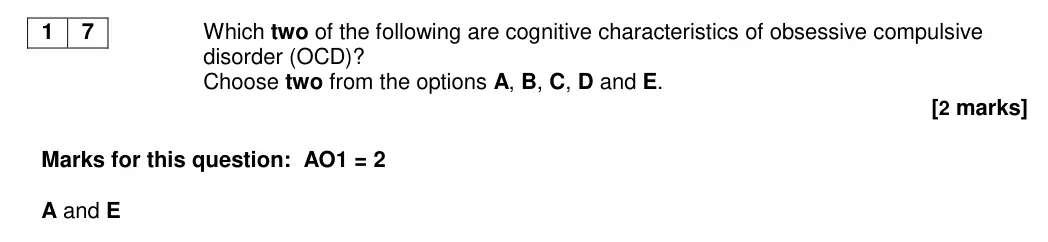
June 2017 · Paper 1 · Q172 marksAO1=2Multiple choice
Answer
A and E
Mark scheme, including level descriptors and indicative content
Examiner's comment
This was a multiple choice Question where the answers were A and E. This was done reasonably well, but it was clear that a minority of students had not read the question carefully and had missed the key word, ‘cognitive’.
Notes from the mark scheme and report
answers A and E (cognitive)
B behavioural, C and D emotional
some missed the word 'cognitive'
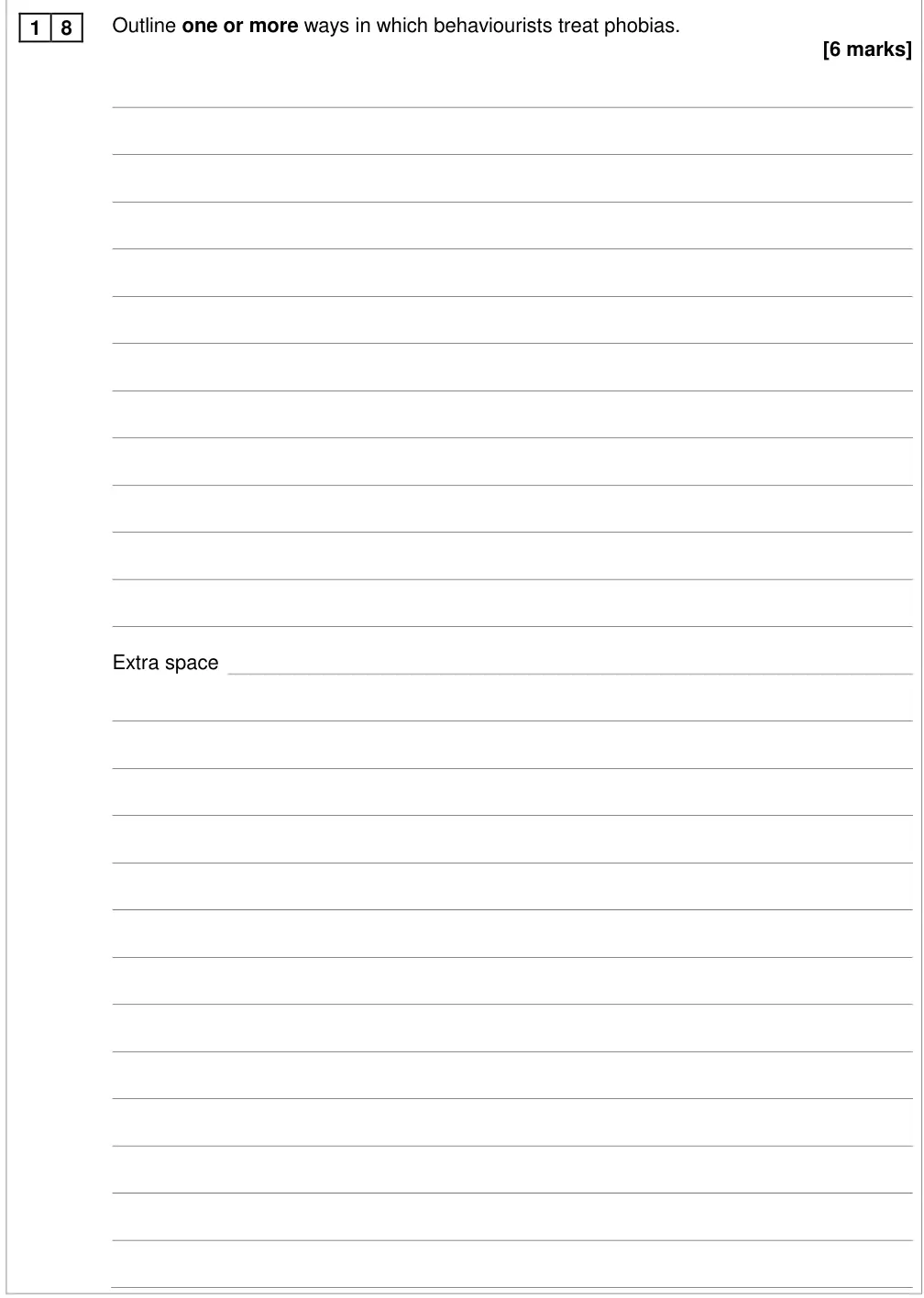
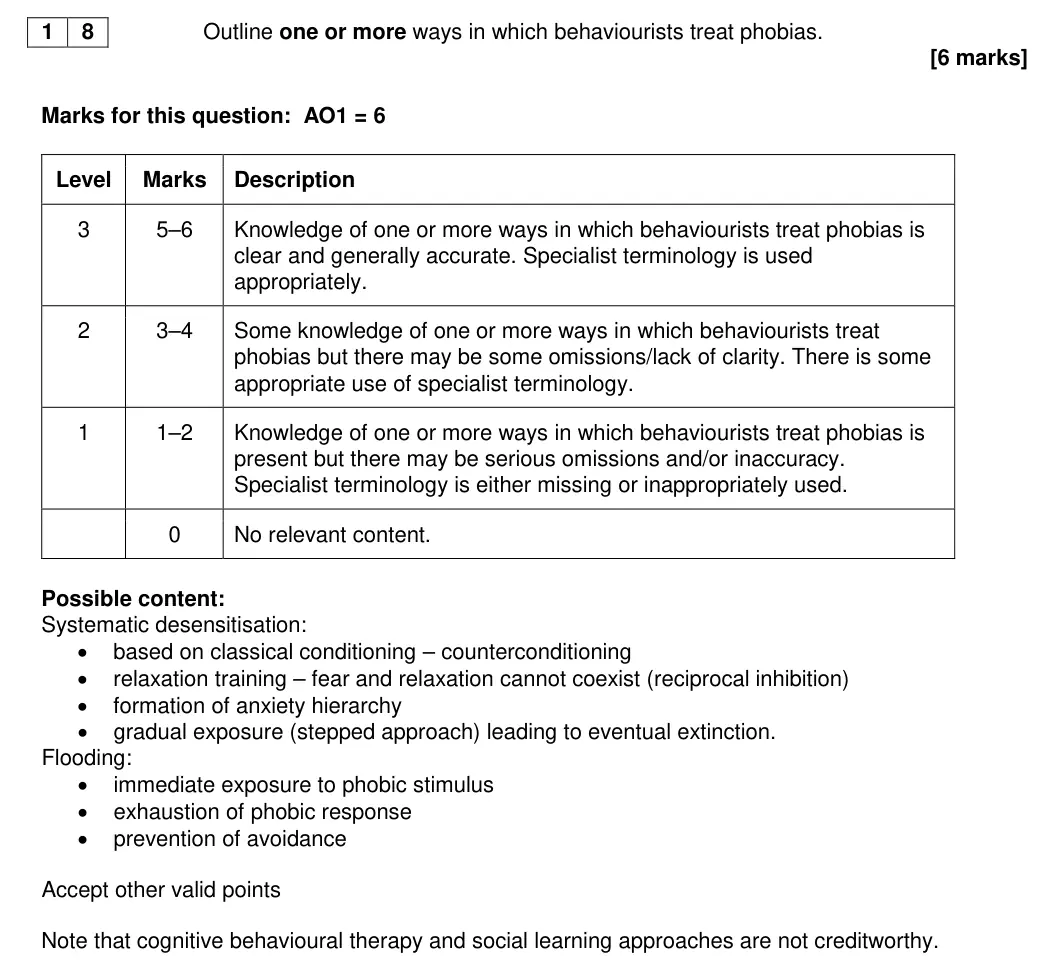
June 2017 · Paper 1 · Q186 marksAO1=6Outline
Mark scheme, including level descriptors and indicative content
Examiner's comment
This question required outlines of ways in which behaviourists treat phobias, and most students could provide some details of the procedures involved in systematic desensitisation and/or flooding. The key discriminator was the use of specialist terminology. Better answers referred to classical conditioning, hierarchies, counter-conditioning, reciprocal inhibition, extinction etc. Moderate answers used one or two of these terms, but at the lower end there was little evidence that students understood the behaviourist background to these techniques. Other weaknesses included lack of detail and providing evaluation of the techniques which was not required by the question and may have contributed to a lack of effective detail of procedures.
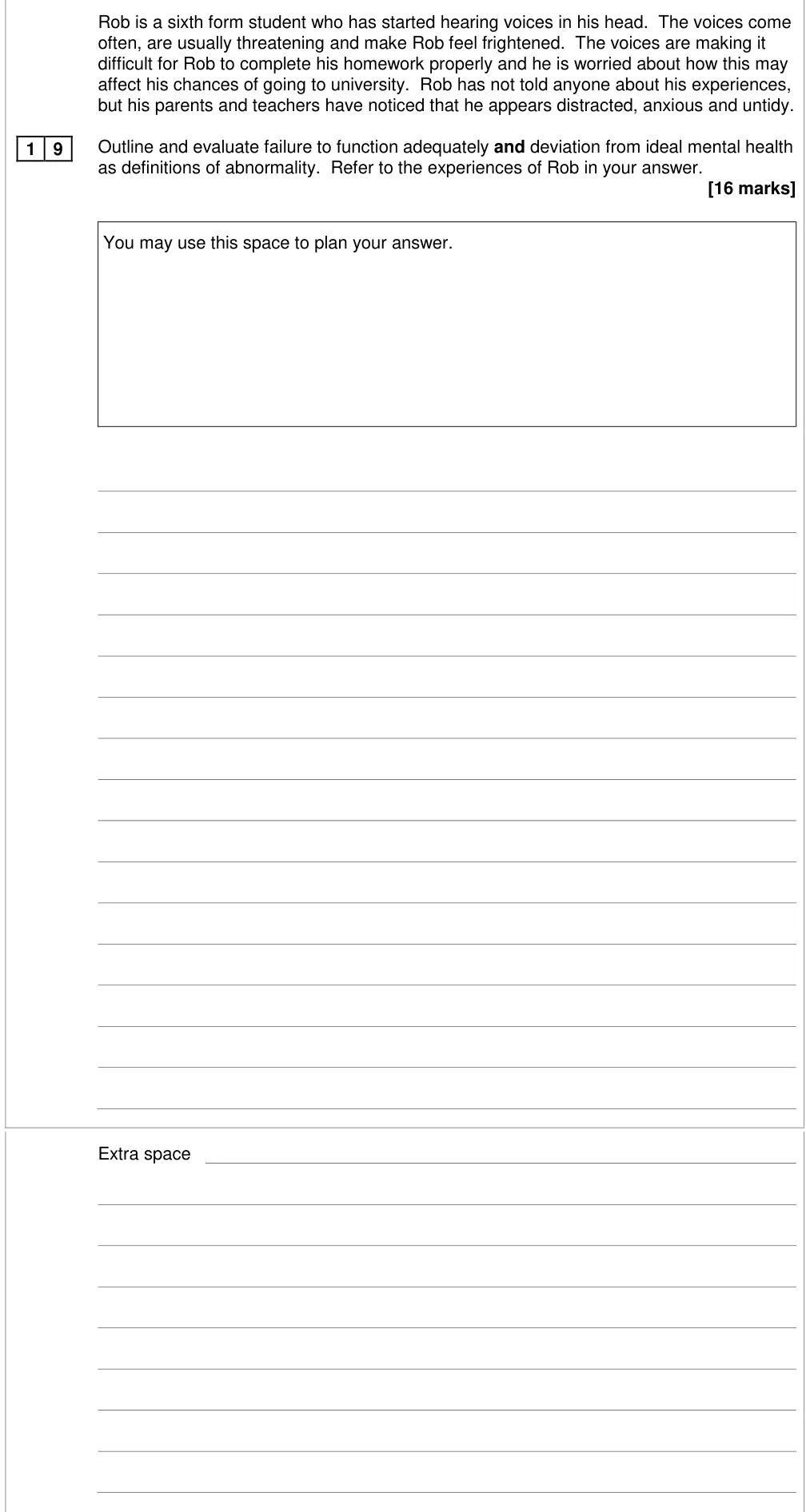
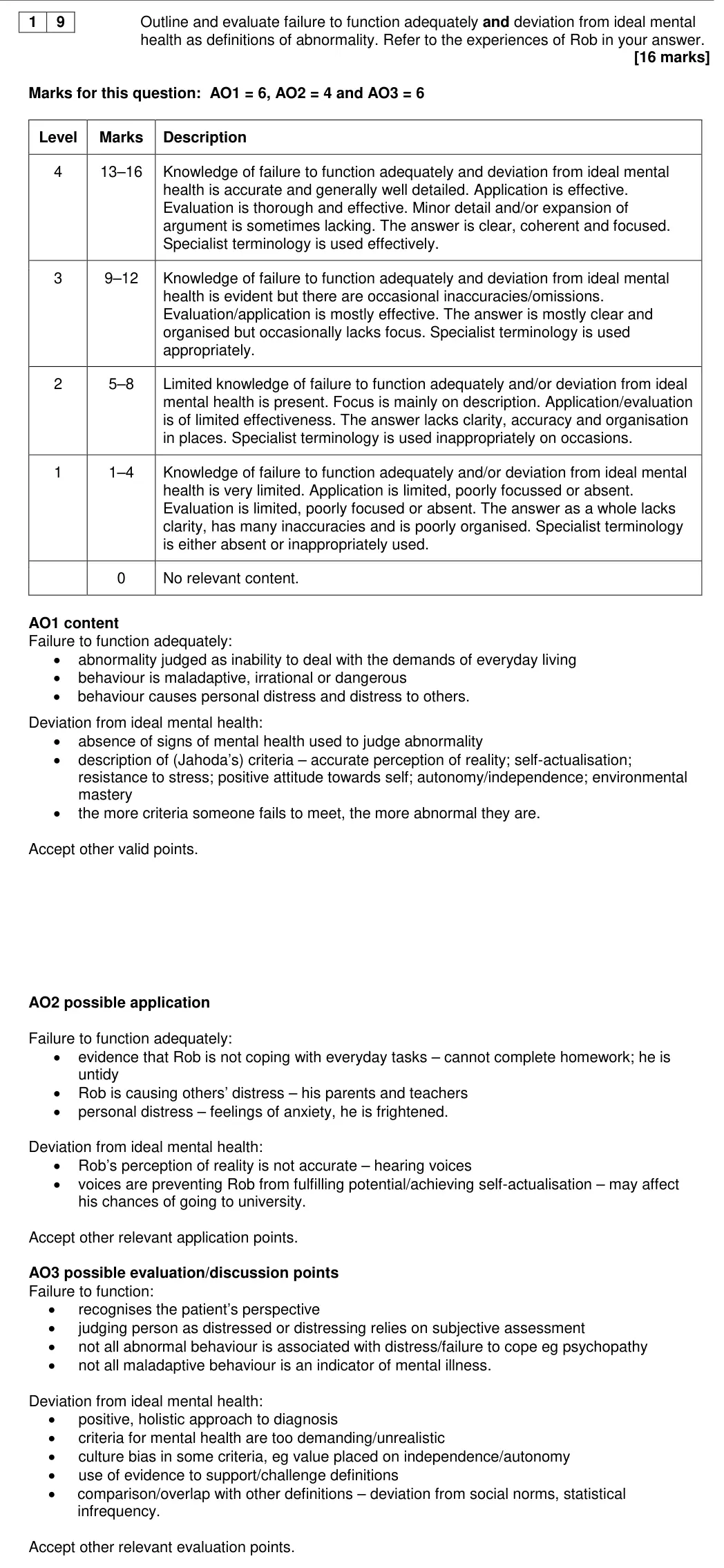
June 2017 · Paper 1 · Q1916 marksAO1=6, AO2=4, AO3=616-mark essay
Mark scheme, including level descriptors and indicative content
Examiner's comment
Effective application is a test of understanding of material and it was clear that some students were vulnerable in this respect. For instance, some could list Jahoda’s criteria (question 19) but in their attempts to apply them to Rob demonstrated that they did not clearly understand them. Perhaps the most demanding question on the paper, as students had to outline definitions of abnormality, evaluate them and at the same time apply their material to Rob’s experiences. There was enormous variability in knowledge of failure to function adequately (FFA) and deviation from ideal mental health (DIMH) definitions of abnormality, with some candidates clearly unprepared for one or the other. When applying the definitions to Rob it also became clear that while some students could list most of Jahoda’s criteria they did not fully understand what they meant. Similarly with FFA, where hearing voices in itself is not a symptom of FFA some students thought it was. Better answers accurately linked aspects of the definitions to Rob’s symptoms, for example causing distress to self and others (FFA), or lacking an accurate perception of reality by hearing voices (DIMH). In many answers evaluation tended to be generic and lacking in effectiveness e.g. cultural relativity was often mentioned in relation to both FFA and DIMH, but usually without sufficient specific detail to make it effective as an evaluative point. This was a question with several elements that required planning and a coherent structure, and this was seen in better answers. It was clear that many less successful responses would have benefited from a few minutes planning at the start; with the same material but a clear and coherent structure they would have earned more credit.
Notes from the mark scheme and report
apply both definitions to Rob (cannot complete homework, distress to self and others
inaccurate perception of reality, self-actualisation threatened)
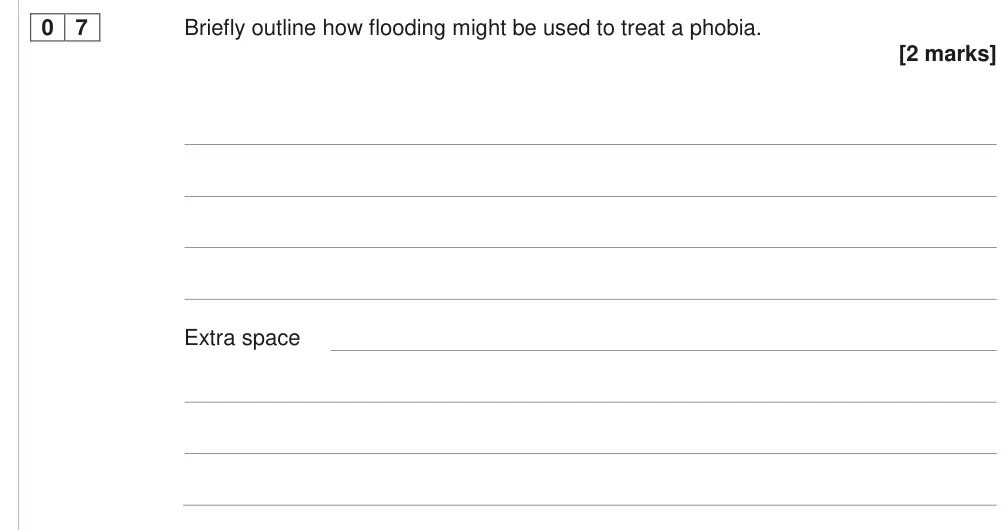
June 2017 · AS Paper 2 · Q72 marksAO1=2OutlineMedium
Mark scheme, including level descriptors and indicative content
Examiner's comment
Most students understood that flooding meant an immediate exposure to the stimulus as well as the requirement that this is done until the person is calm or they no longer fear the stimulus. However, few referred to the prevention of avoidance and thus only a minority achieved full marks. A number of students wrote answers in the context of treating a particular phobia, which could gain credit, providing their answer included the three key components required for a complete description of the procedures undertaken in flooding.
Notes from the mark scheme and report
full marks need all three: immediate/full exposure, prevention of avoidance, until anxiety subsides
few mentioned prevention of avoidance
June 2017 · AS Paper 2 · Q82 marksAO1=2Outline
Mark scheme, including level descriptors and indicative content
Examiner's comment
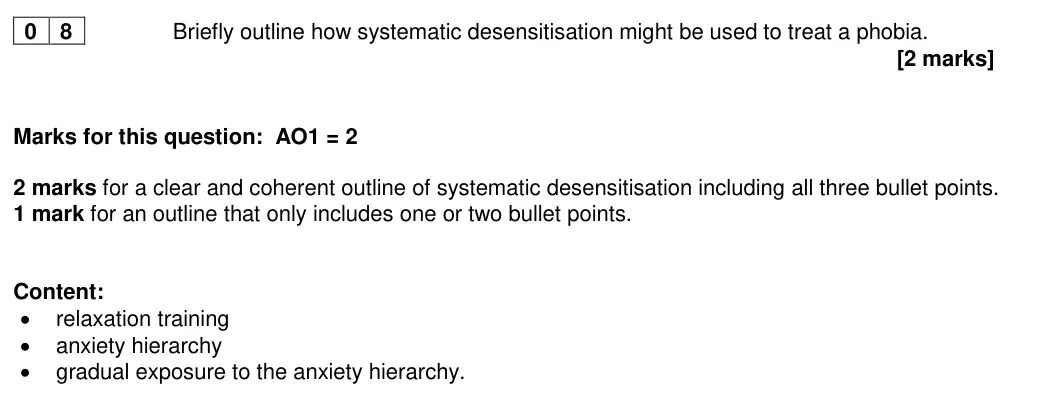
This question was generally answered very well. The majority of students evidently had an excellent understanding of systematic desensitisation and thus produced answers which contained a complete description of the procedures involved. Where one mark was awarded, this was usually because students failed to refer to relaxation training or to the gradual exposure to the stimulus. Again, a number of students wrote answers in the context of treating a particular phobia, which could gain credit providing their answer was a complete description of the procedure.
Notes from the mark scheme and report
full marks need relaxation training, anxiety hierarchy and gradual exposure
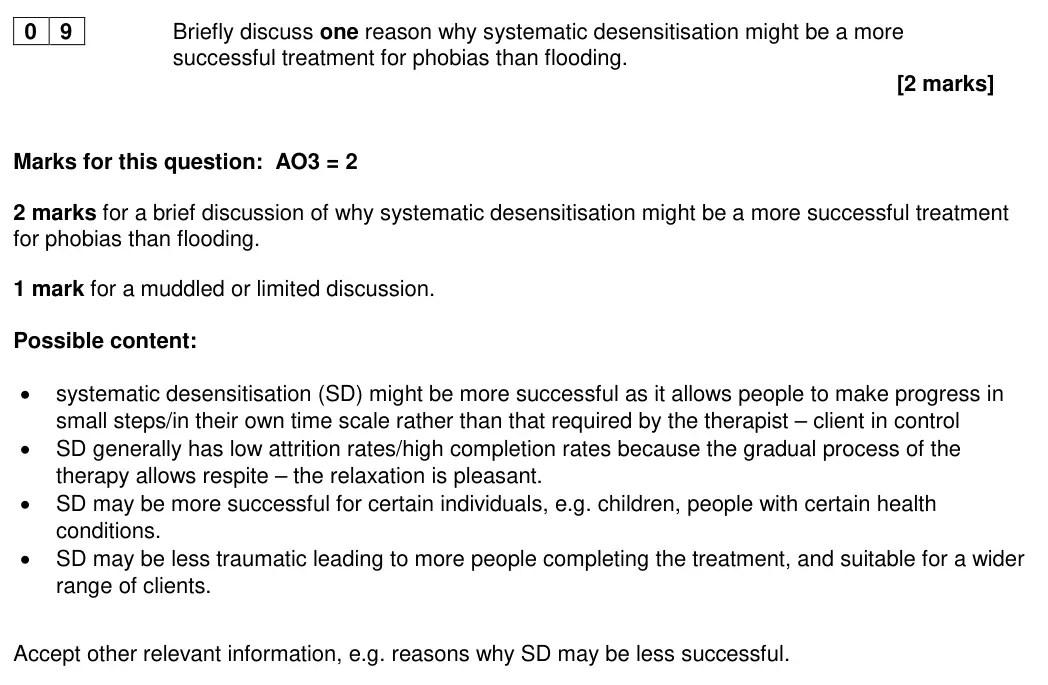
June 2017 · AS Paper 2 · Q92 marksAO3=2Evaluate (short)
Mark scheme, including level descriptors and indicative content
Examiner's comment
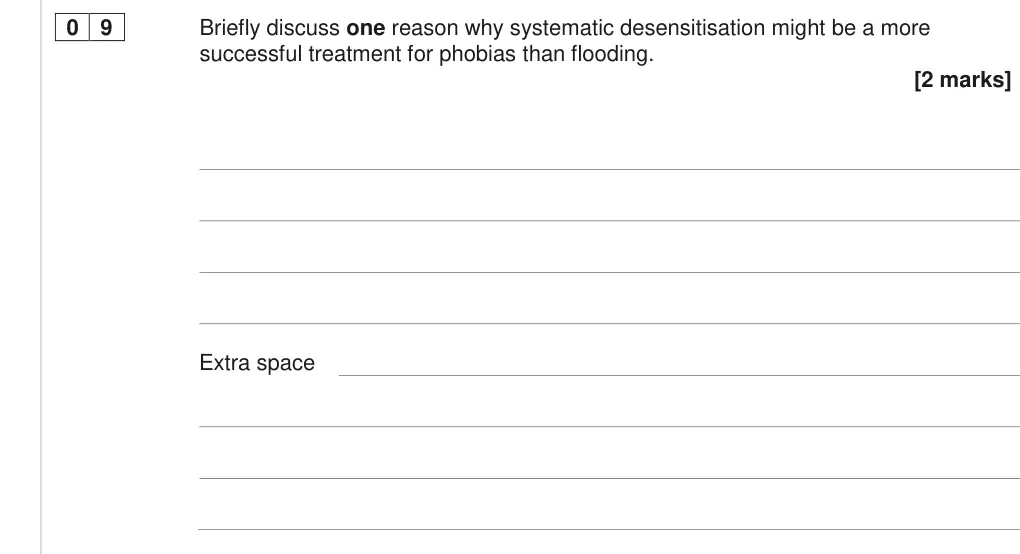
Most students were able to give a reason why systematic desensitisation was more successful than flooding, although many did not go on to discuss this reason and thus only gained one mark. The most common response was that systematic desensitisation was ‘more ethical’ or ‘less traumatic’ than flooding but many did not discuss this further, such as relating this aspect to attrition rates. Fewer responses referred to other possible answers, such as the success it would have for certain individuals.
Notes from the mark scheme and report
e.g. client in control/own pace, low attrition, suitable for children
'more ethical/less traumatic' needed discussion (e.g. attrition) for 2 marks
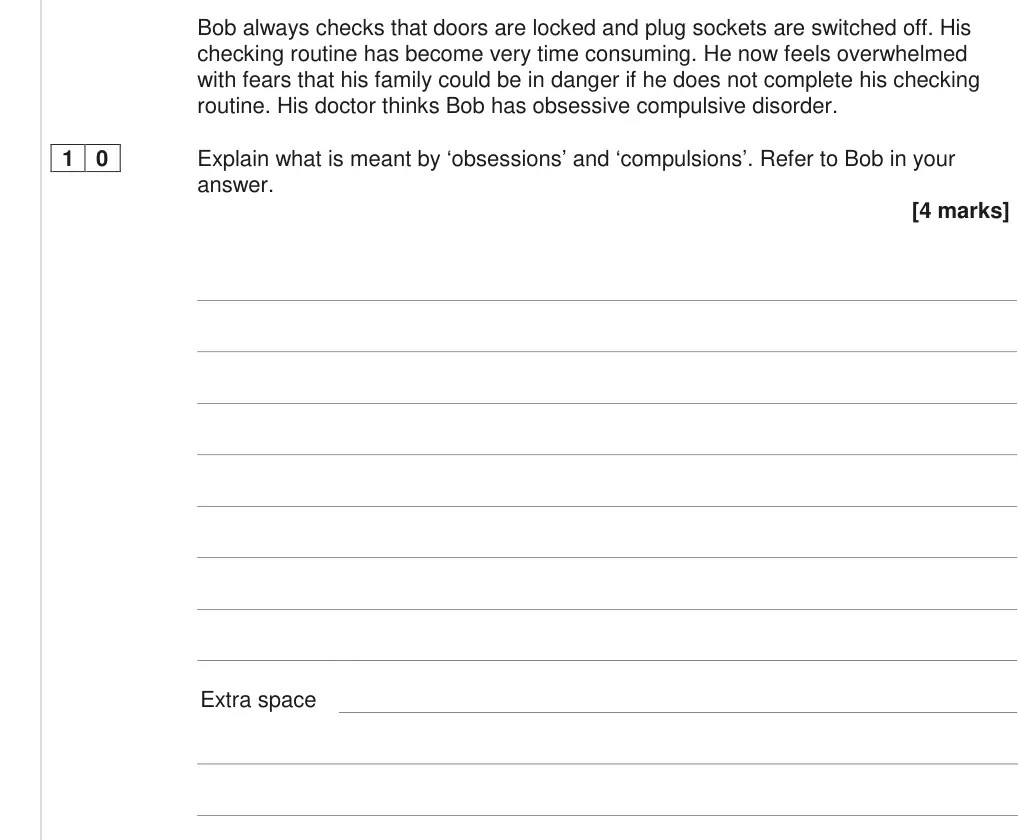
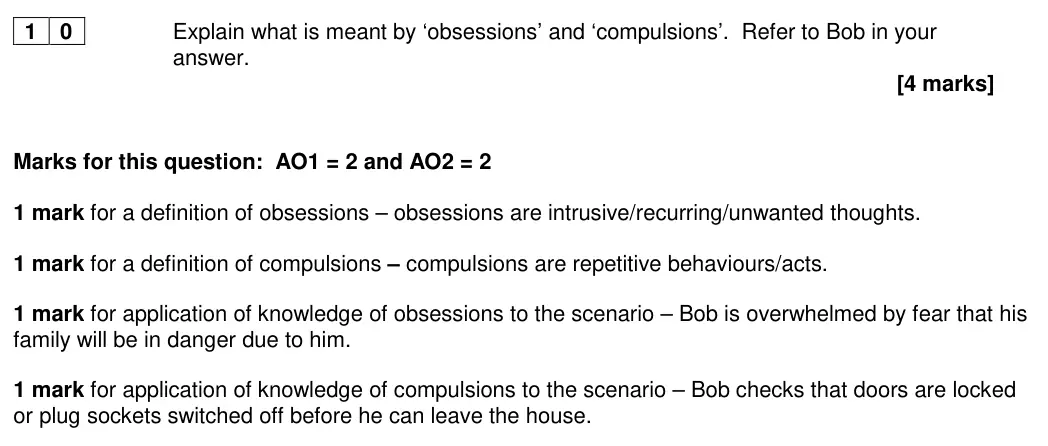
June 2017 · AS Paper 2 · Q104 marksAO1=2, AO2=2Application
Mark scheme, including level descriptors and indicative content
Examiner's comment
Where students clearly understood what was meant by obsessions and compulsions, there were some excellent answers provided, which gained full marks. However, it was disappointing to see a significant minority who did not understand the terms or who had muddled obsessions and compulsions. Knowledge of the terms was sometimes incomplete, which limited the number of marks awarded. For example, some students simply referred to obsessions as ‘thoughts’ without the addition of some other relevant descriptor (eg ‘intrusive’) and others referred to compulsions as ‘behaviours/acts’ without the ‘repetitive’ aspect. The application to ‘Bob’ was often accurate and clear where students had a clear understanding of obsessions and compulsions. However, those who muddled the terms also tended to also muddle the application and thus didn’t get the marks.
Notes from the mark scheme and report
1 mark each definition (obsessions = intrusive/recurring thoughts
compulsions = repetitive behaviours) + 1 each application to Bob
'thoughts' or 'behaviours' alone incomplete
terms often muddled
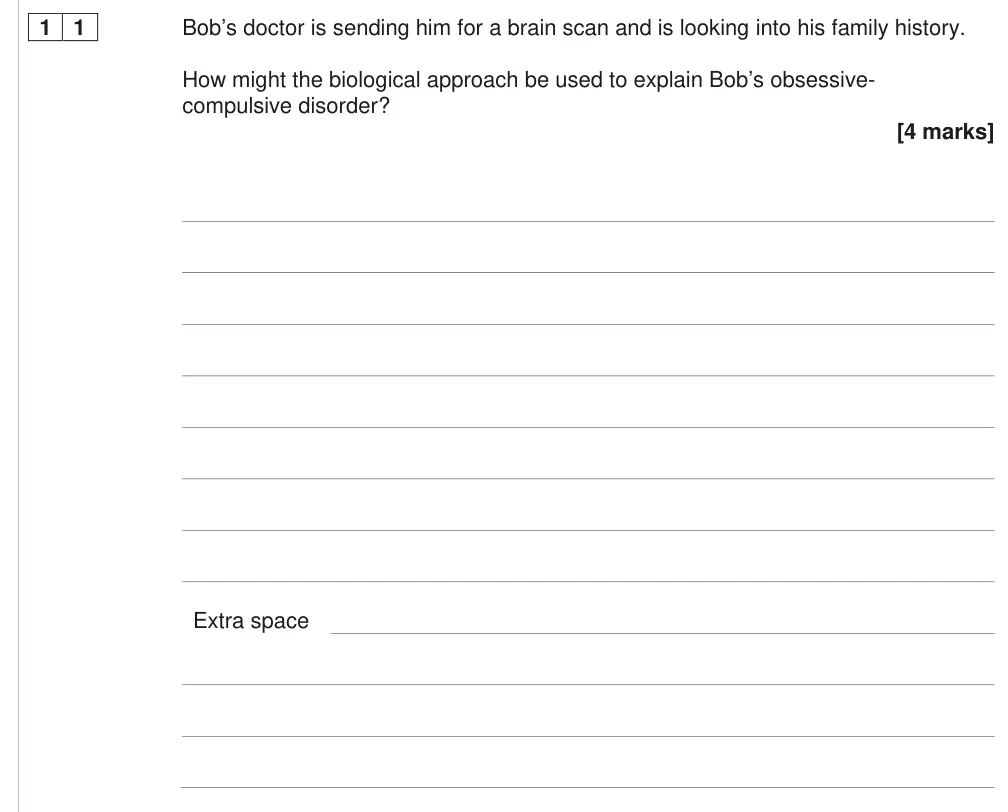
June 2017 · AS Paper 2 · Q114 marksAO2=4Application
Mark scheme, including level descriptors and indicative content
Examiner's comment
There were excellent responses from some students who provided clear and detailed knowledge of biological explanations of OCD, which were effectively applied to ‘Bob’. Superb detailed knowledge was seen in some students’ answers relating to the COMT/SERT genes and the role of the orbital frontal cortex. A variety of biological explanations were given with genetic explanations being the most common but typically these responses tended to be less detailed than those answers that focussed on the neural aspect. Unfortunately, a minority of students produced accurate and detailed knowledge of biological explanations but had no application in their response, thereby limiting marks to level 1. Most students demonstrated some knowledge of biological explanations of OCD and thus most gained some marks but a minority simply wrote generic answers about genes and inheritance without explicit links to OCD.
Notes from the mark scheme and report
neural (basal ganglia, OFC, serotonin) linked to the brain scan
genetic (COMT, SERT, family studies) linked to family history
no application = Level 1
generic genes answers not linked to OCD
June 2017 · AS Paper 2 · Q138 marksAO1=4, AO3=4Extended writing
Mark scheme, including level descriptors and indicative content
Examiner's comment
Many students produced level 3 responses, which demonstrated knowledge of two definitions with some effective evaluation. However, few students accessed level 4 due to either a lack of detailed knowledge of two definitions or due to ineffective evaluation. There were some effective evaluative responses in relation to cultural bias but overall evaluation tended to be weak or superficial. Students frequently struggled with the evaluation of the definitions described, producing answers with poorly expressed points, significant irrelevance and confusion between definitions. Reference to irrelevant examples that did not relate to psychopathology did not gain credit.
Notes from the mark scheme and report
two definitions
evaluation of only one = max Level 2
deviation from social norms now 'social/cultural norms'
evaluation often superficial/confused between definitions
examples not related to psychopathology not credited
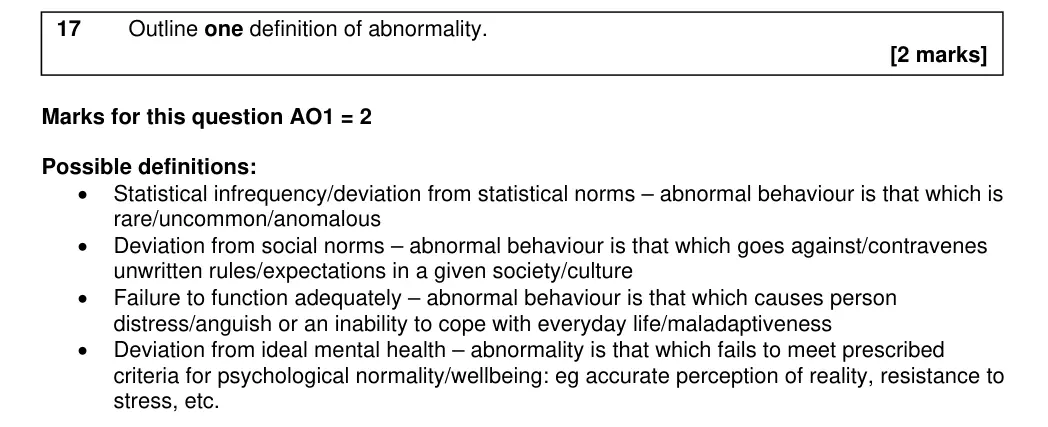
Specimen set 2 · Paper 1 · Q172 marksAO1=2Outline
Mark scheme, including level descriptors and indicative content
Notes from the mark scheme and report
statistical infrequency, deviation from social/cultural norms, failure to function adequately, or deviation from ideal mental health
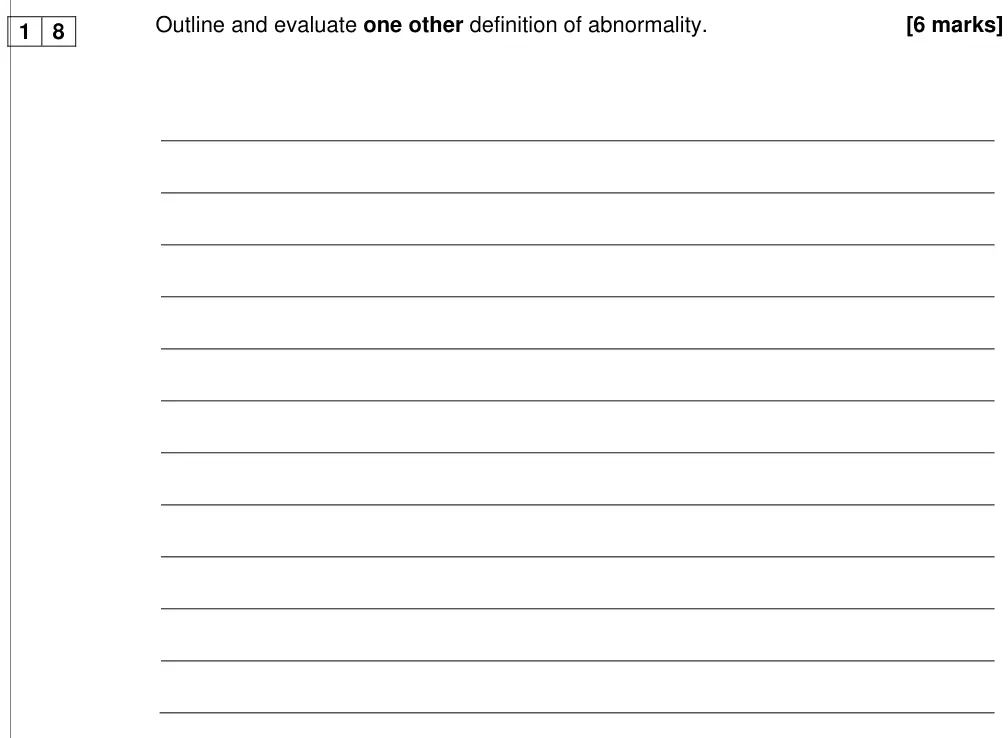
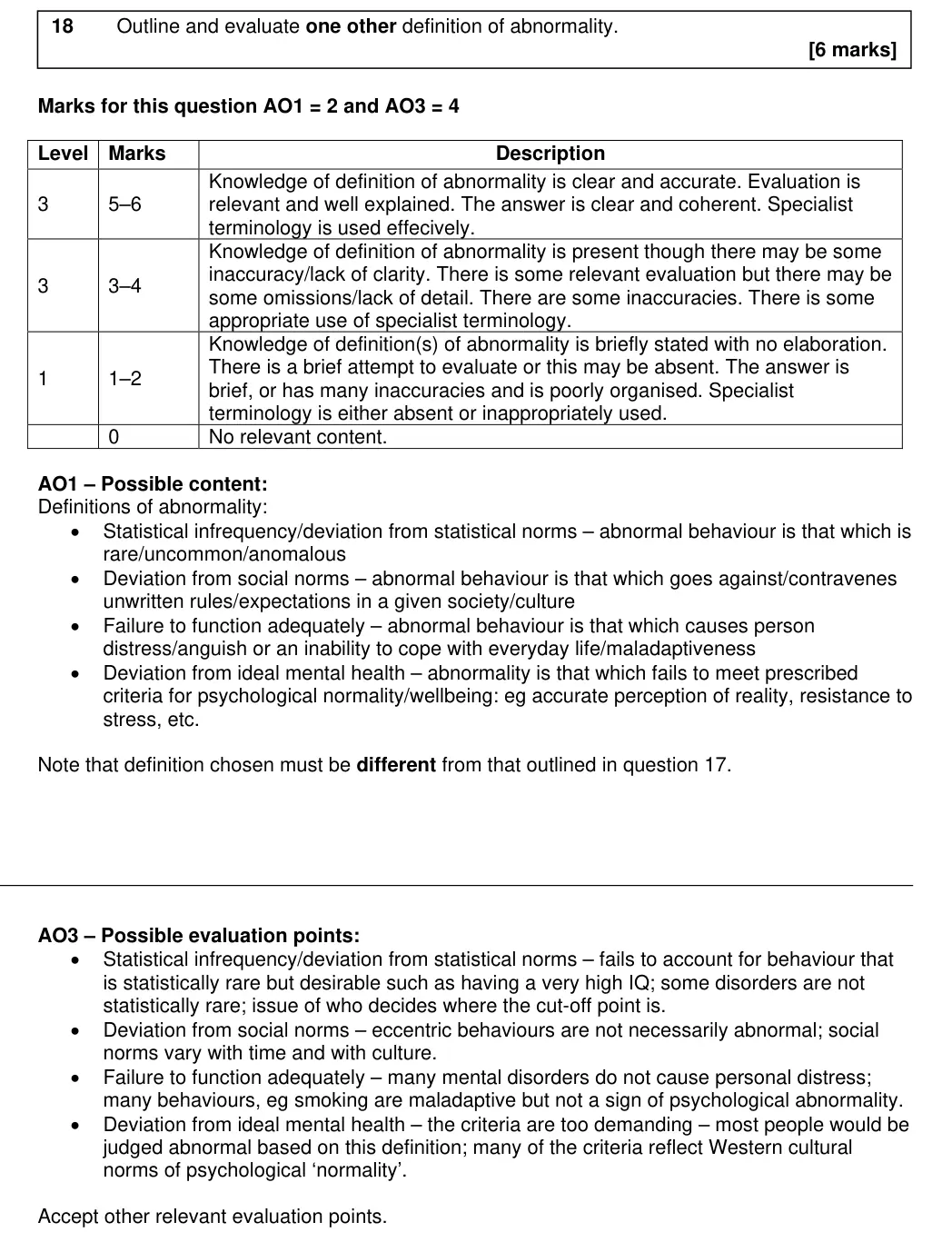
Specimen set 2 · Paper 1 · Q186 marksAO1=2, AO3=4Evaluate (short)
Mark scheme, including level descriptors and indicative content
Notes from the mark scheme and report
must be a different definition from 17
evaluation e.g. desirable rare behaviours, cultural/temporal variation of norms, too demanding criteria
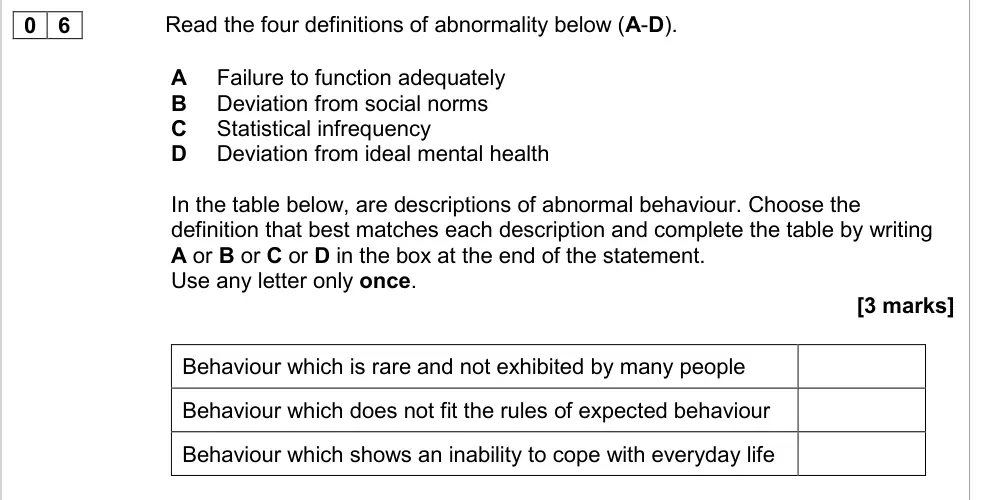
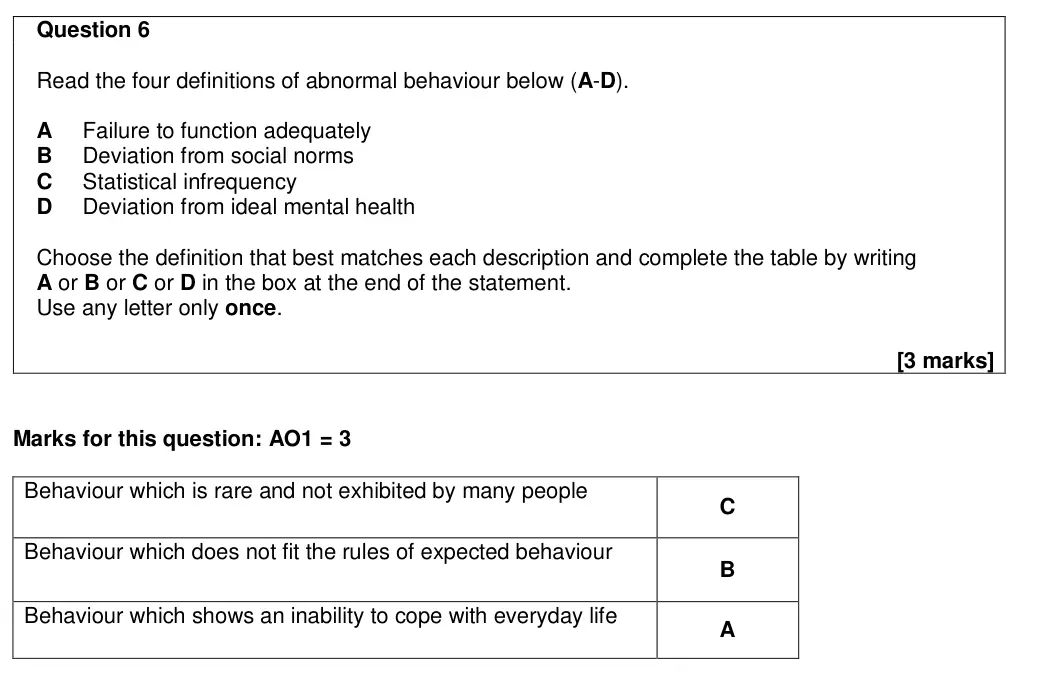
June 2016 · AS Paper 2 · Q63 marksAO1=3Multiple choice
Answer
C and B and A
Mark scheme, including level descriptors and indicative content
Examiner's comment
This question was generally answered well.
Notes from the mark scheme and report
rare = C (statistical infrequency)
does not fit rules = B (deviation from social norms, now 'social/cultural norms')
inability to cope = A (failure to function adequately)
D is the unused distractor
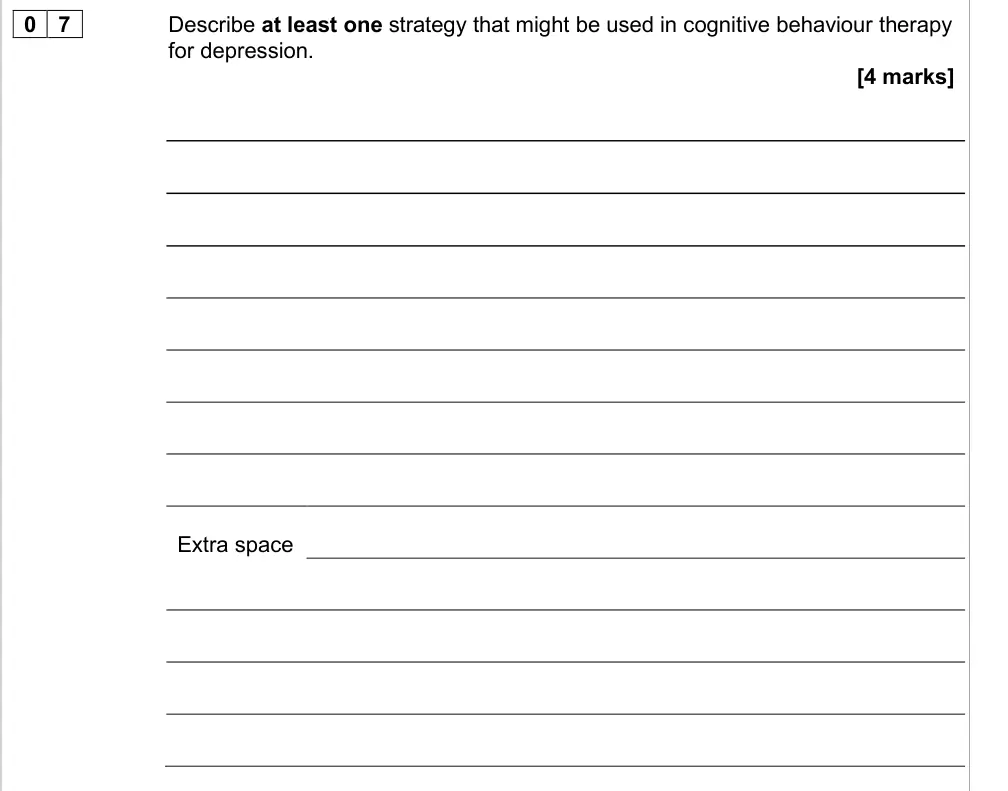
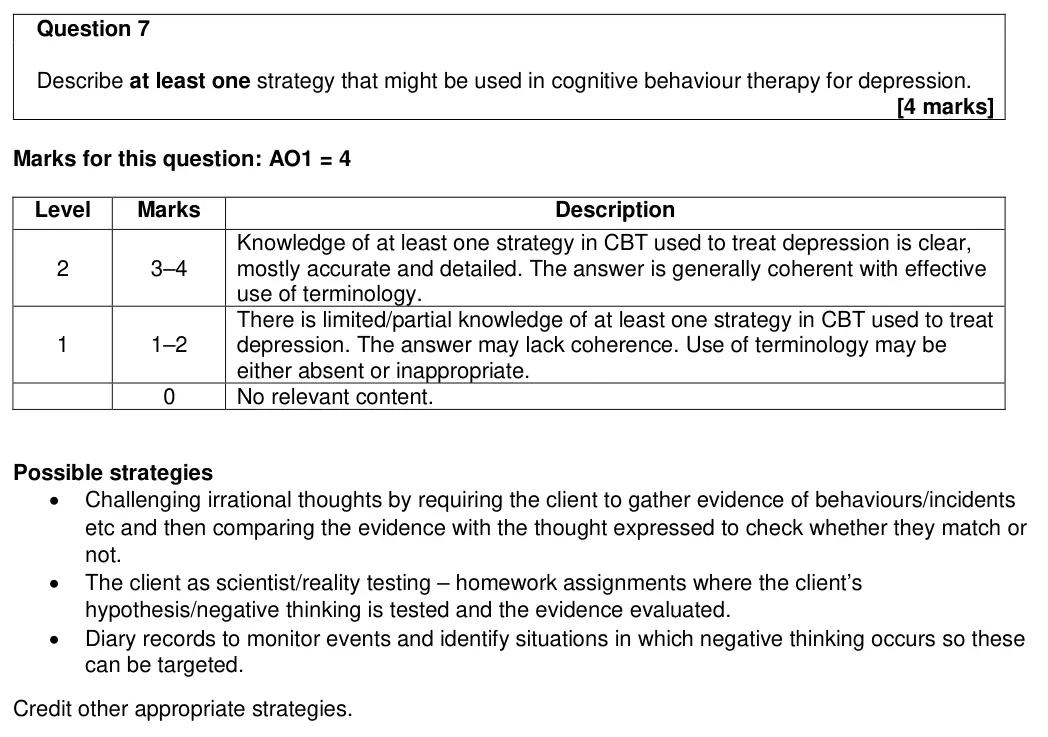
June 2016 · AS Paper 2 · Q74 marksAO1=4Outline
Mark scheme, including level descriptors and indicative content
Examiner's comment
Unfortunately, students often wasted time and effort outlining theory in response to this question. When answers mentioned therapy, the focus was not always on describing one or more strategies used in Cognitive Behavioural Therapy (CBT), but instead on offering superficial points such as homework tasks, activities, disputing and so on, but without any expansion of these to show practical usage.
Notes from the mark scheme and report
e.g. challenging irrational thoughts by gathering evidence, client as scientist/reality testing homework, diary records
many wasted time outlining the cognitive theory
strategies named without practical expansion
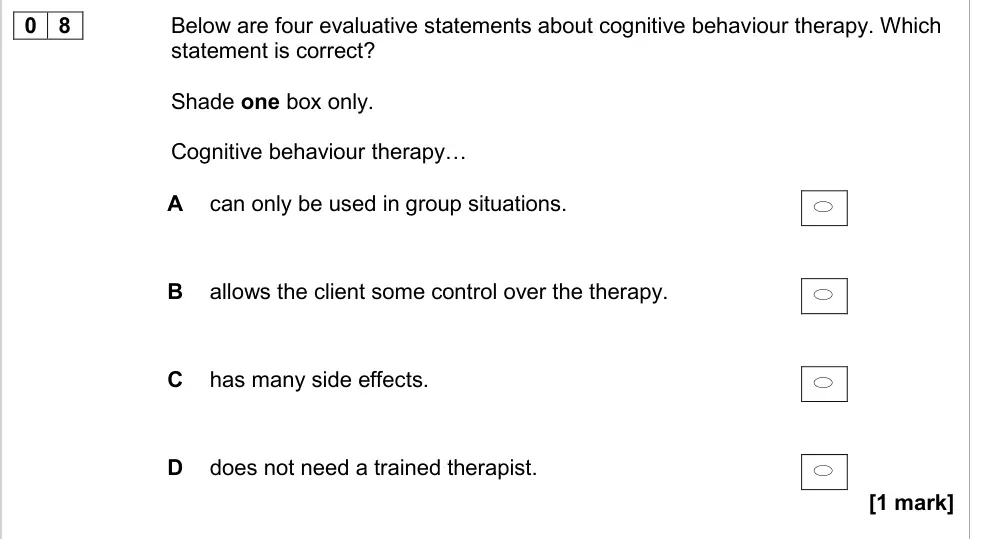
June 2016 · AS Paper 2 · Q81 markAO3=1Multiple choice
Answer
B
Mark scheme, including level descriptors and indicative content
Examiner's comment
There were many correct answers to this question although the same issues about question completion occurred here as in Question 01. Also, some students provided two answers rather than one when the instruction clearly stated ‘Shade one box only’.
Notes from the mark scheme and report
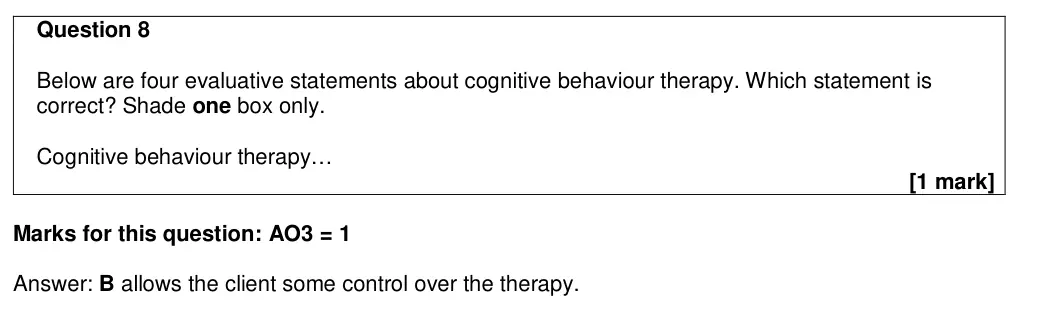
correct answer B (allows the client some control over the therapy)
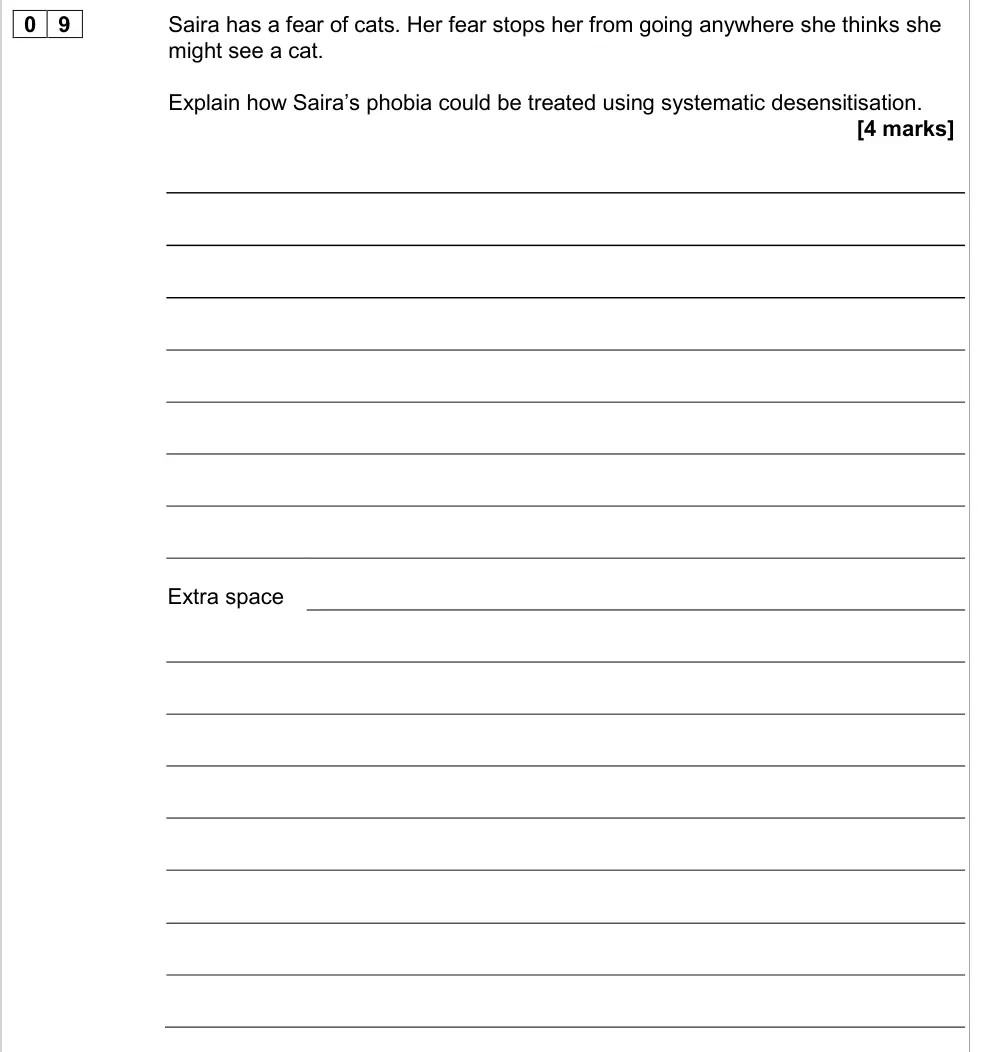
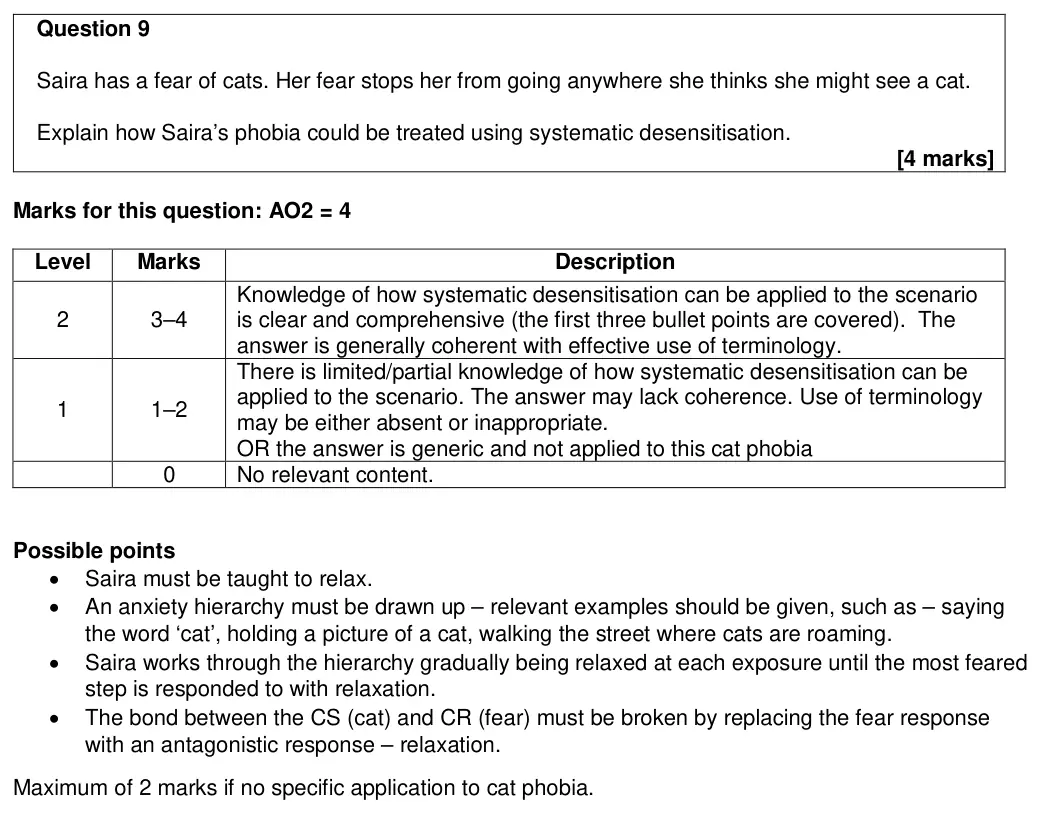
June 2016 · AS Paper 2 · Q94 marksAO2=4Application
Mark scheme, including level descriptors and indicative content
Examiner's comment
There were some very good answers to this question in which students showed clear understanding of how systematic desensitisation could be used in treatment for this specific fear of cats. Some students did not emphasise the element of relaxation and just referred to gradual exposure as a calming process. These responses seemed to be more related to flooding.
Notes from the mark scheme and report
relaxation, anxiety hierarchy with cat examples, gradual exposure while relaxed (reciprocal inhibition)
max 2 marks if not applied to cat phobia
some omitted relaxation and drifted to flooding
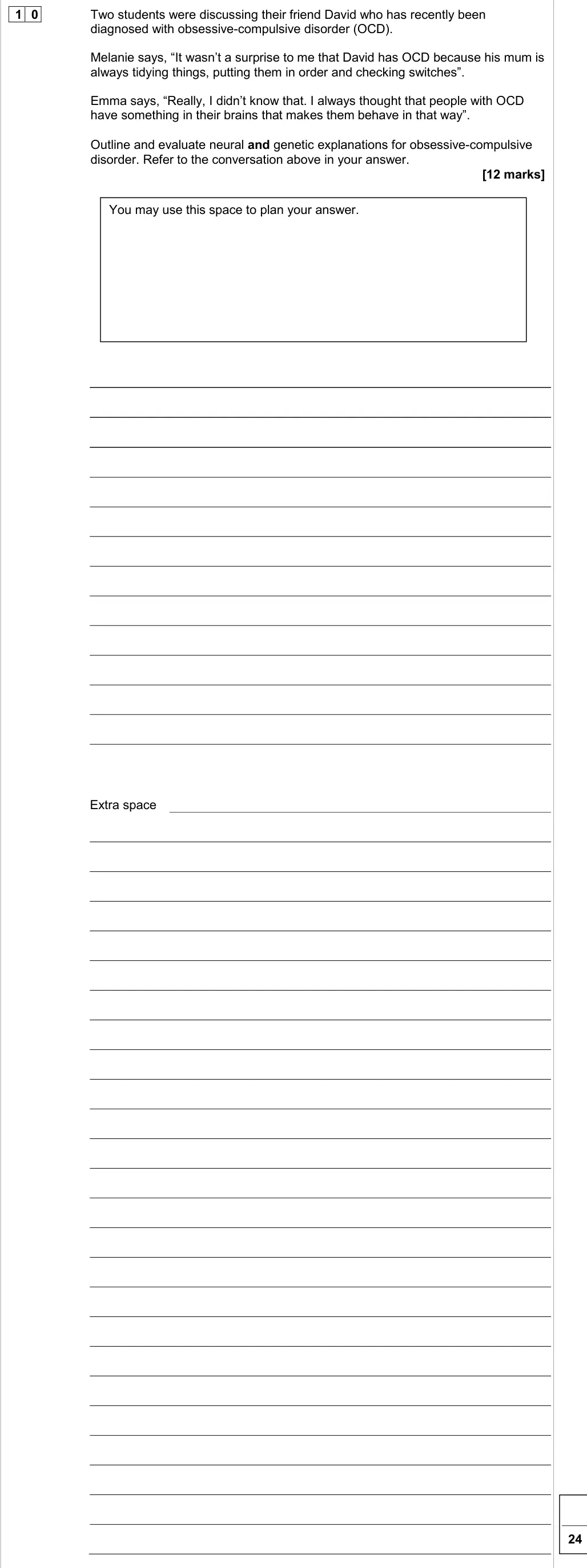
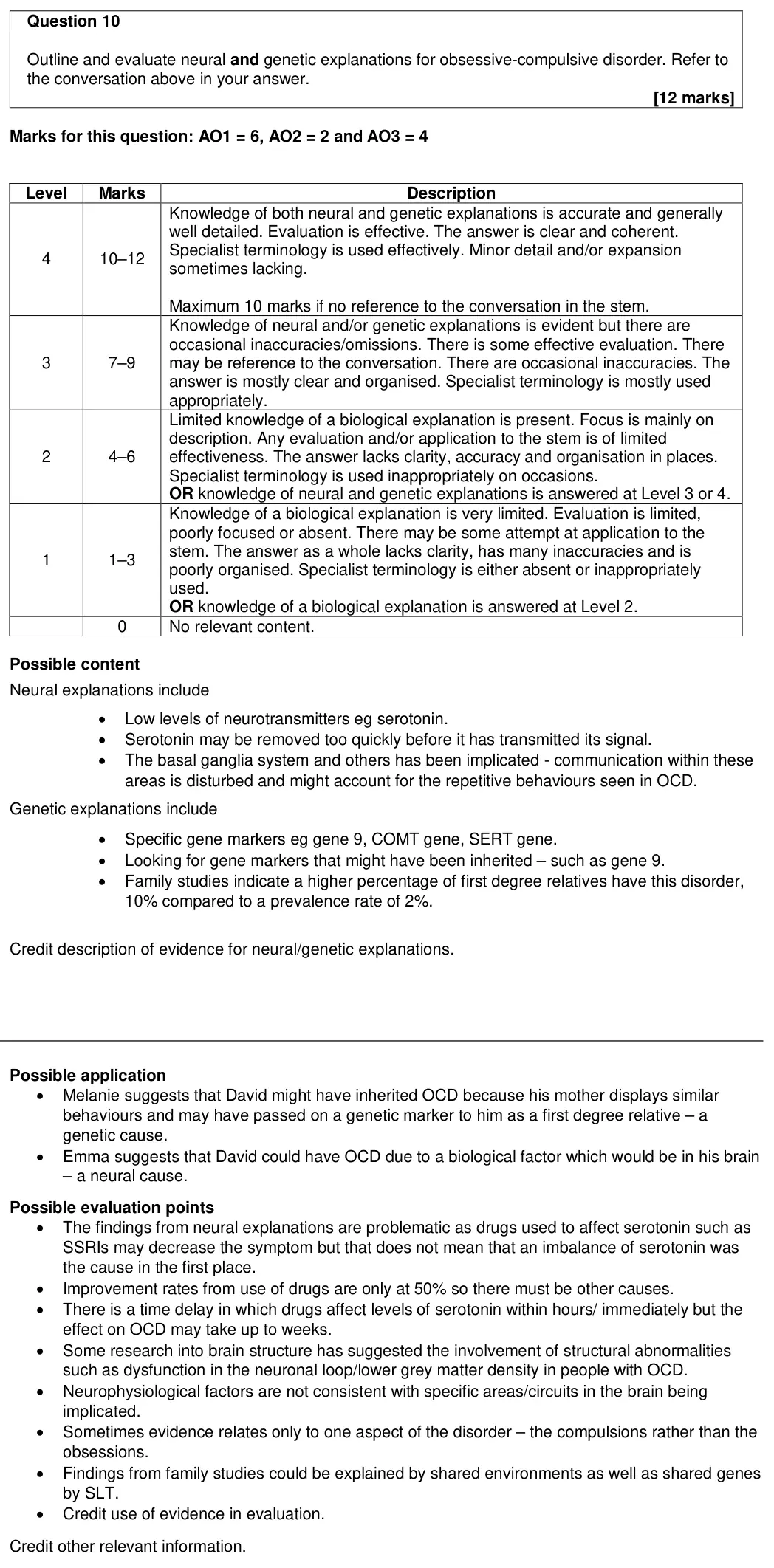
June 2016 · AS Paper 2 · Q1012 marksAO1=6, AO2=2, AO3=4Extended writing
Mark scheme, including level descriptors and indicative content
Examiner's comment
There were some exceptionally good answers to this question as well as some examples of extended writing that achieved very low marks. Quite a few students related Emma’s response to ‘thinking’ rather than biology – presumably linking thoughts to the information given, ie, ‘something in their brains’. The question clearly asked for neural and genetic explanations, so such material was not relevant. A number of responses failed to mention the stem, which was unfortunate as the application marks were then lost although others related Melanie’s response to both genetic causes and also to the possibility of the behaviour described as being acquired through observation. The most common error was for muddle in the description of catechol-o-methyl transferase (COMT) and serotonin transporter (SERT) genes and when serotonin or dopamine might be increased or decreased. Attempts at evaluation were sometimes limited as they related to perceived general issues with biological explanations rather than those specific to neural and genetic explanations.
Notes from the mark scheme and report
neural (serotonin, basal ganglia/OFC loop) and genetic (COMT, SERT, family studies) explanations
max 10 marks if no reference to the conversation
Melanie = genetic, Emma = neural
some linked Emma to 'thinking'
COMT/SERT muddled
generic evaluation of biological approach
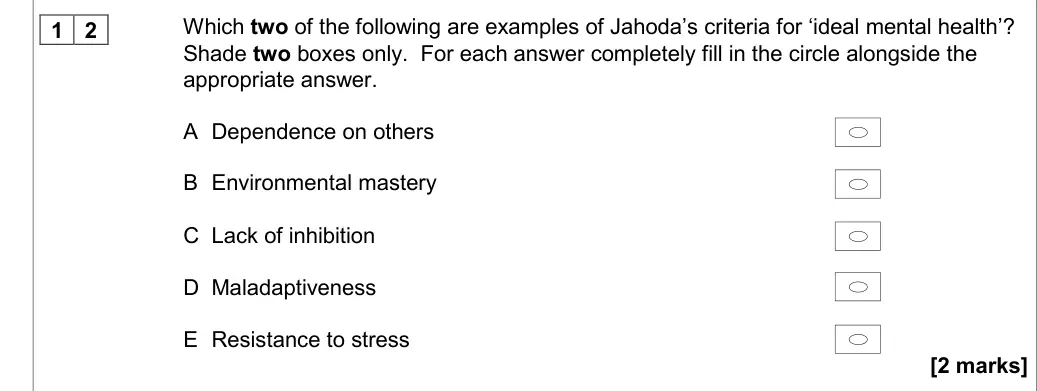
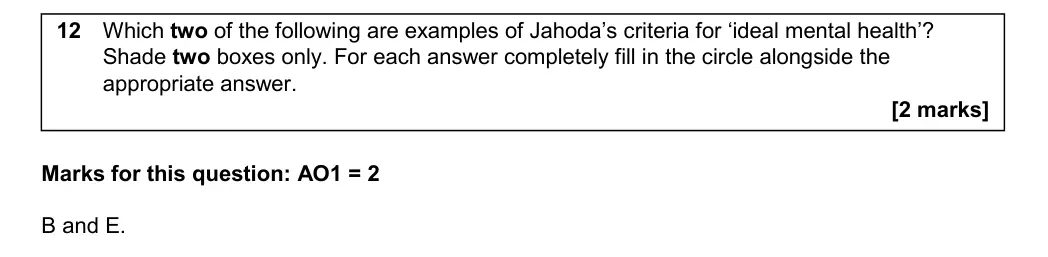
Specimen set 1 · Paper 1 · Q122 marksAO1=2Multiple choice
Answer
B and E
Mark scheme, including level descriptors and indicative content
Notes from the mark scheme and report
answers B (environmental mastery) and E (resistance to stress)
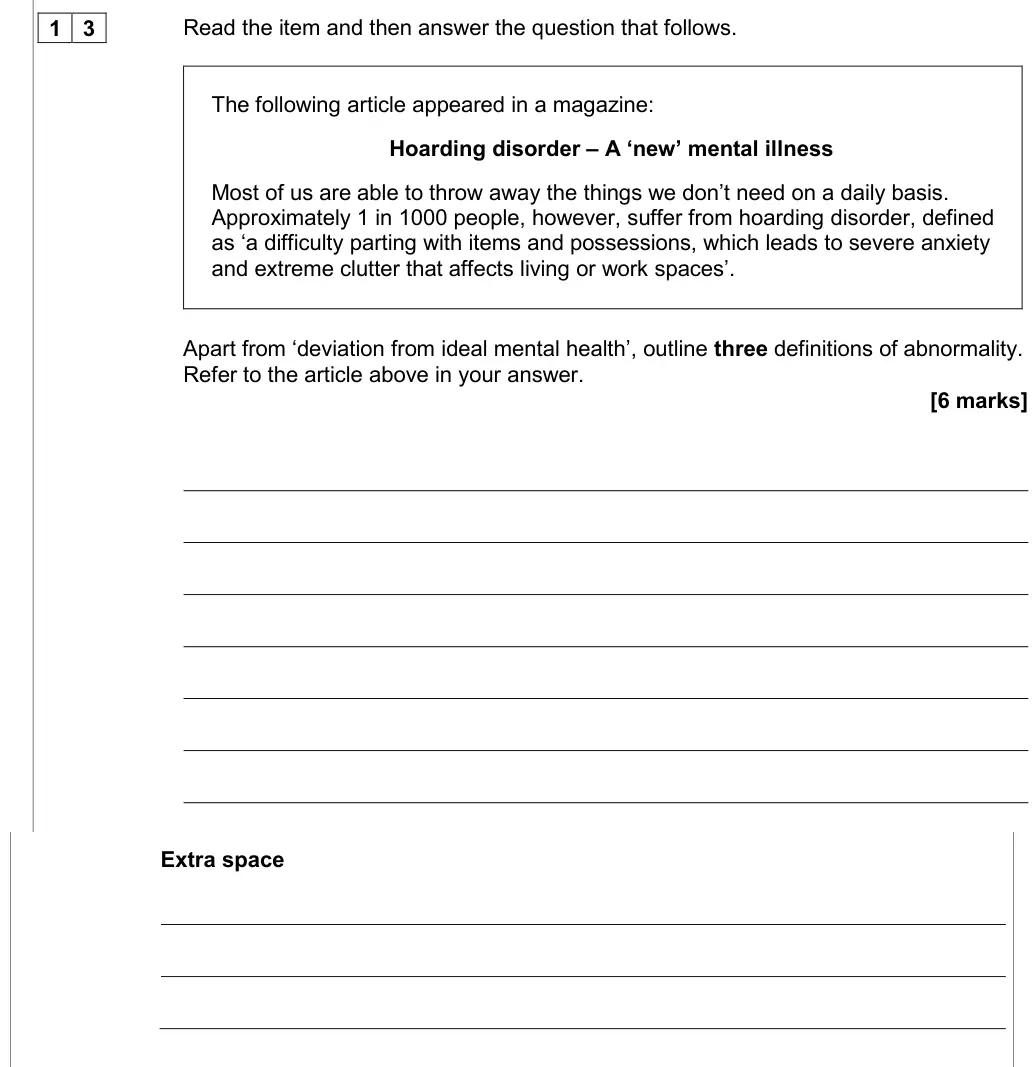
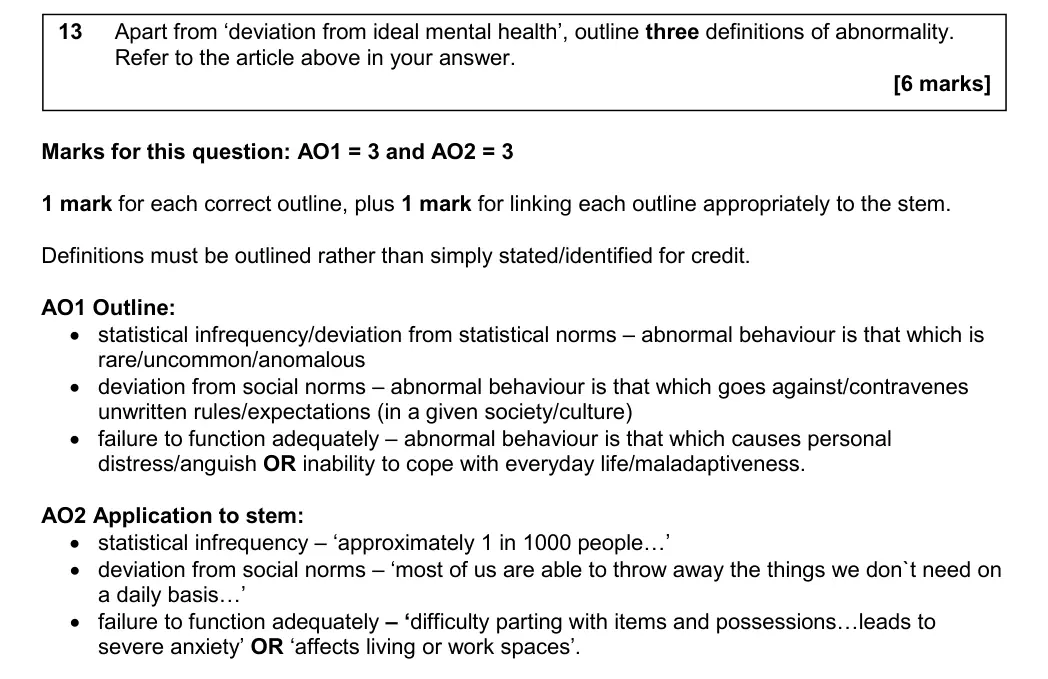
Specimen set 1 · Paper 1 · Q136 marksAO1=3, AO2=3Application
Mark scheme, including level descriptors and indicative content
Notes from the mark scheme and report
1 mark outline + 1 mark link to article for each of statistical infrequency (1 in 1000), deviation from social/cultural norms (most throw things away), failure to function adequately (severe anxiety, affects living spaces)
stating names only not credited
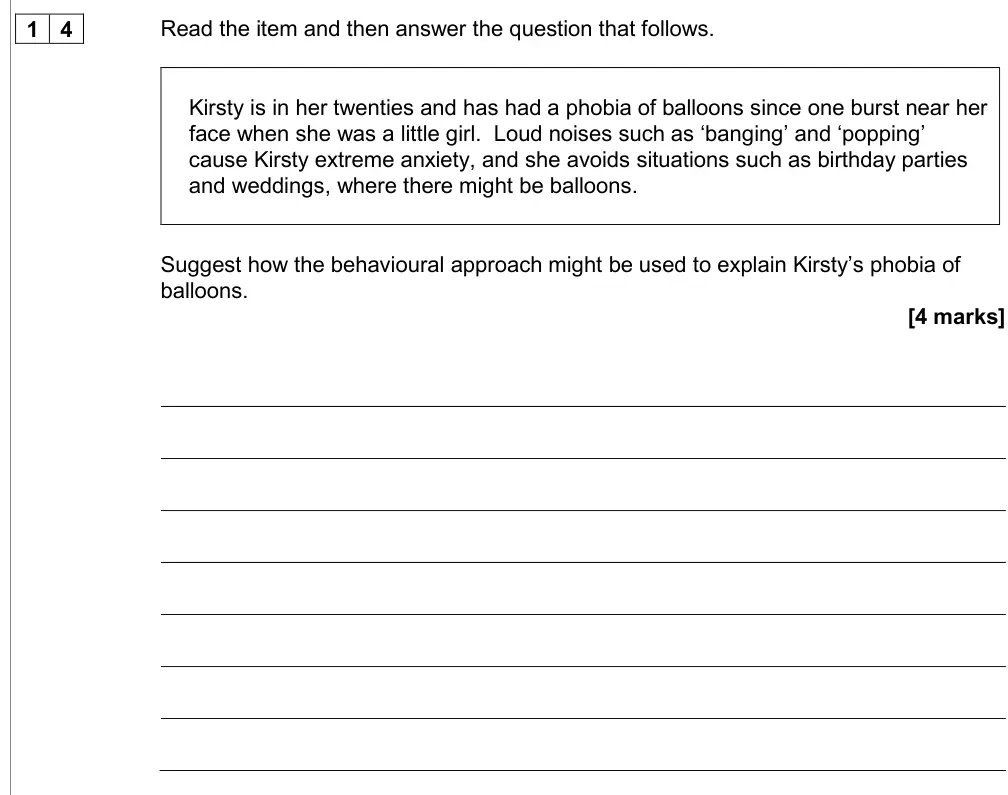
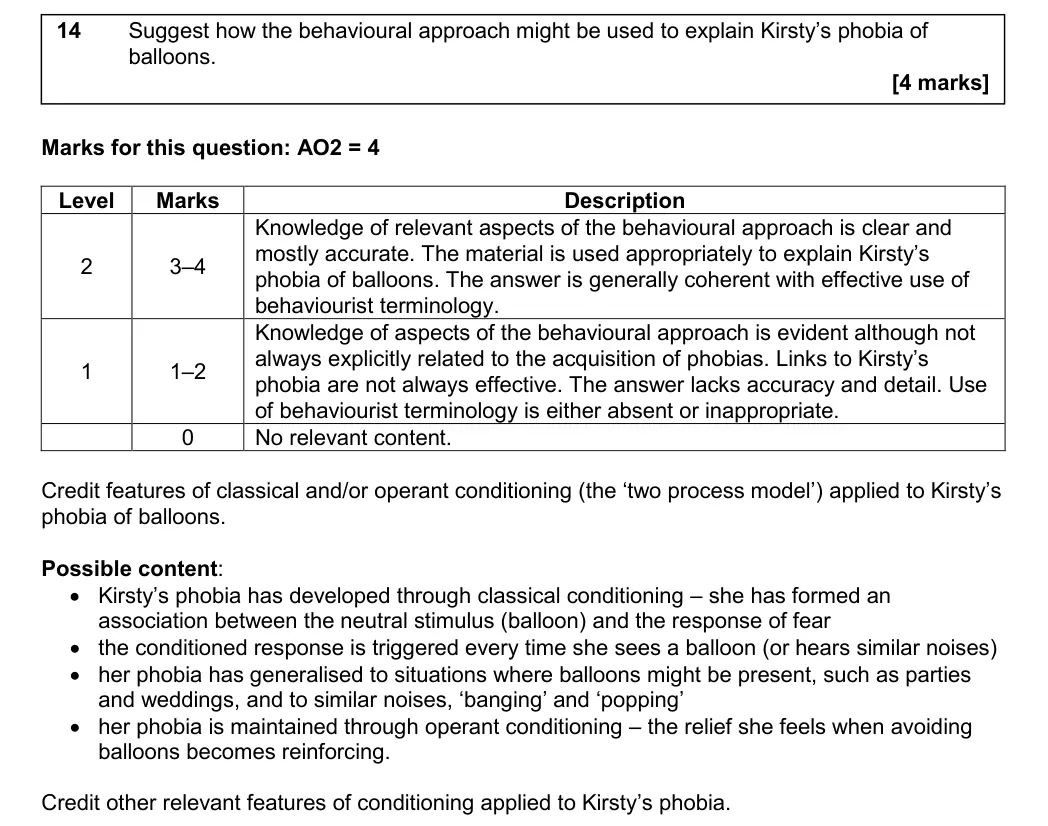
Specimen set 1 · Paper 1 · Q144 marksAO2=4Application
Mark scheme, including level descriptors and indicative content
Notes from the mark scheme and report
classical conditioning (balloon associated with fear, generalisation to bangs/popping and parties) and/or operant maintenance (relief from avoidance reinforcing) applied to Kirsty
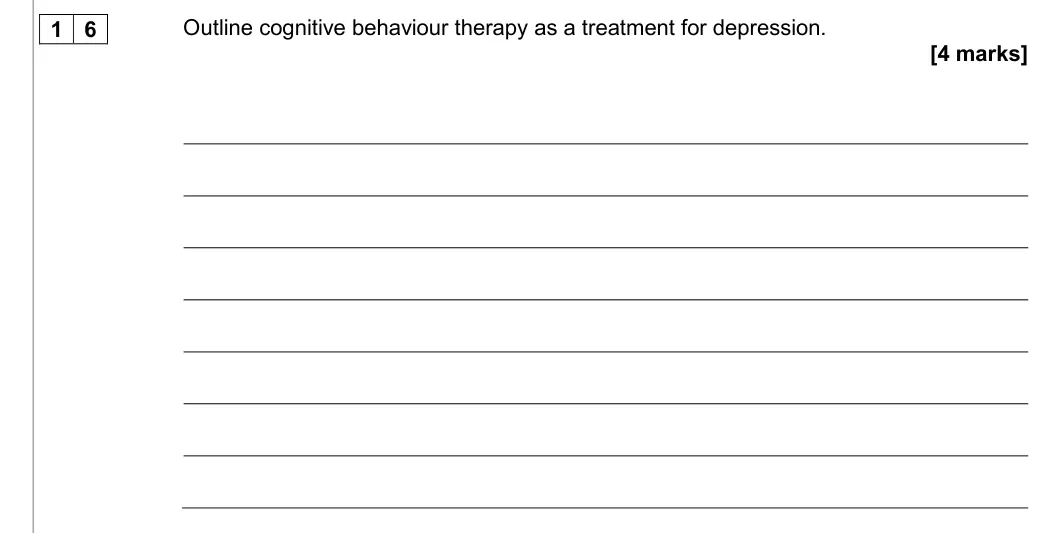
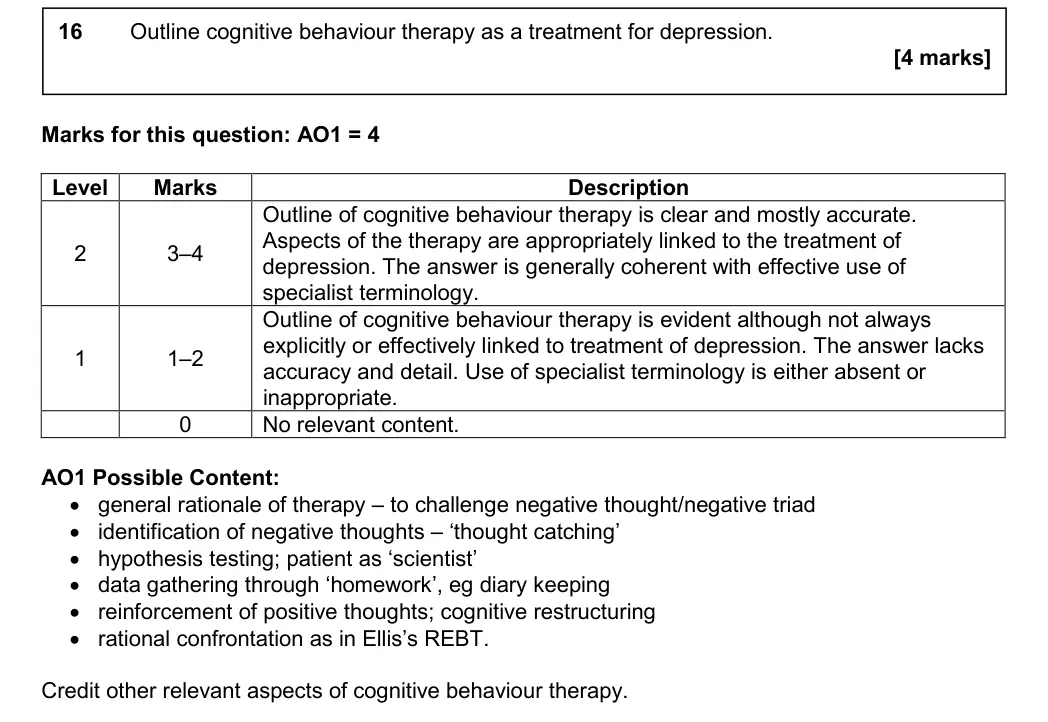
Specimen set 1 · Paper 1 · Q164 marksAO1=4Outline
Mark scheme, including level descriptors and indicative content
Notes from the mark scheme and report
must be linked to depression: challenging negative triad, thought-catching, patient as scientist, homework, REBT
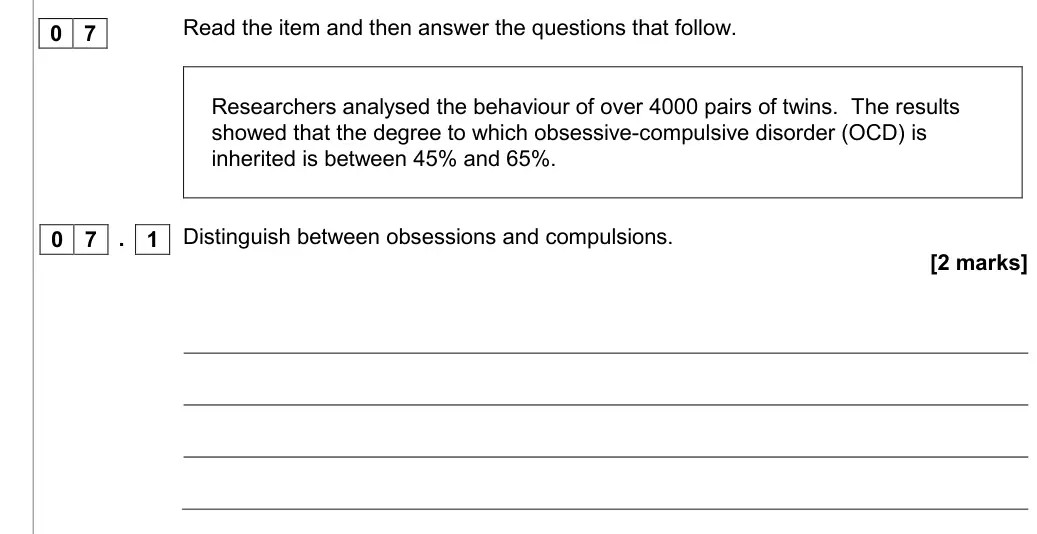
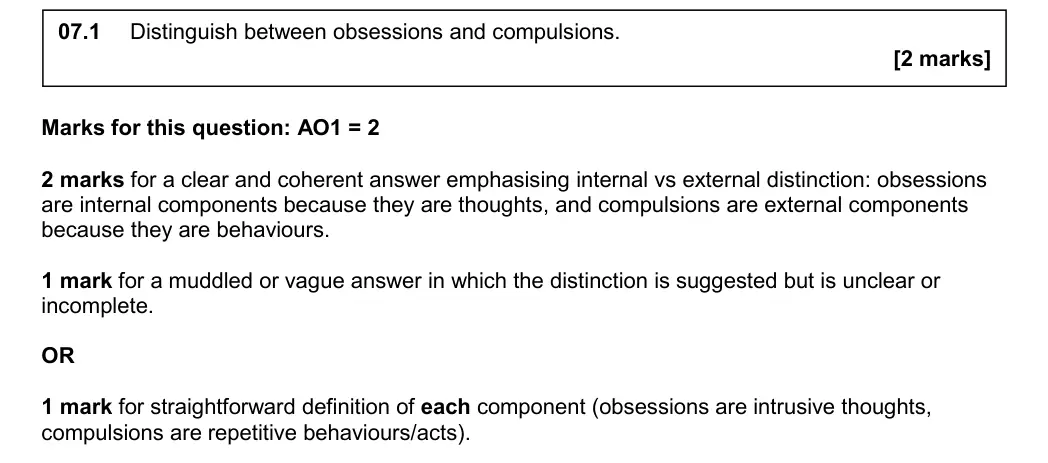
Specimen set 1 · AS Paper 2 · Q7.12 marksAO1=2Short answer
Mark scheme, including level descriptors and indicative content
Notes from the mark scheme and report
2 marks for internal (thoughts) vs external (behaviours) distinction
simple definition of each = 1 mark
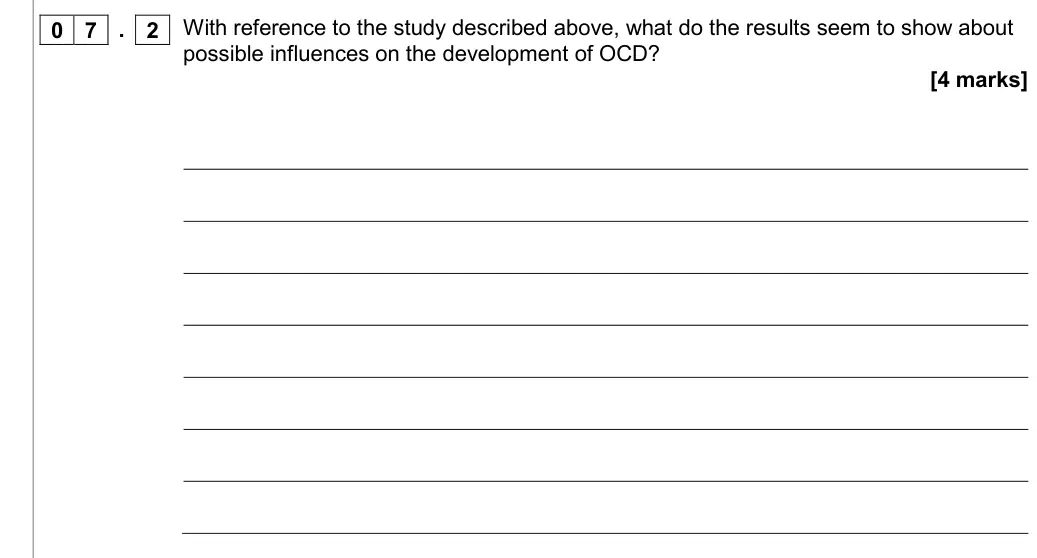
Specimen set 1 · AS Paper 2 · Q7.24 marksAO2=4Application
Mark scheme, including level descriptors and indicative content
Notes from the mark scheme and report
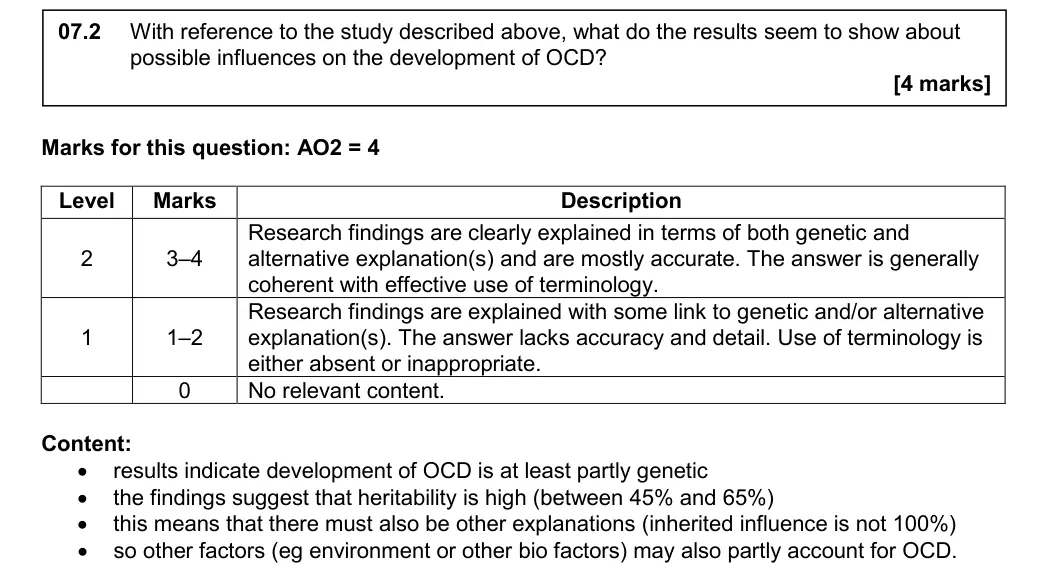
heritability 45-65% shows a partly genetic influence but not 100%, so environmental/other factors also involved
Level 2 needs both genetic and alternative explanations
Specimen set 1 · AS Paper 2 · Q82 marksAO2=2Application
Mark scheme, including level descriptors and indicative content
Notes from the mark scheme and report
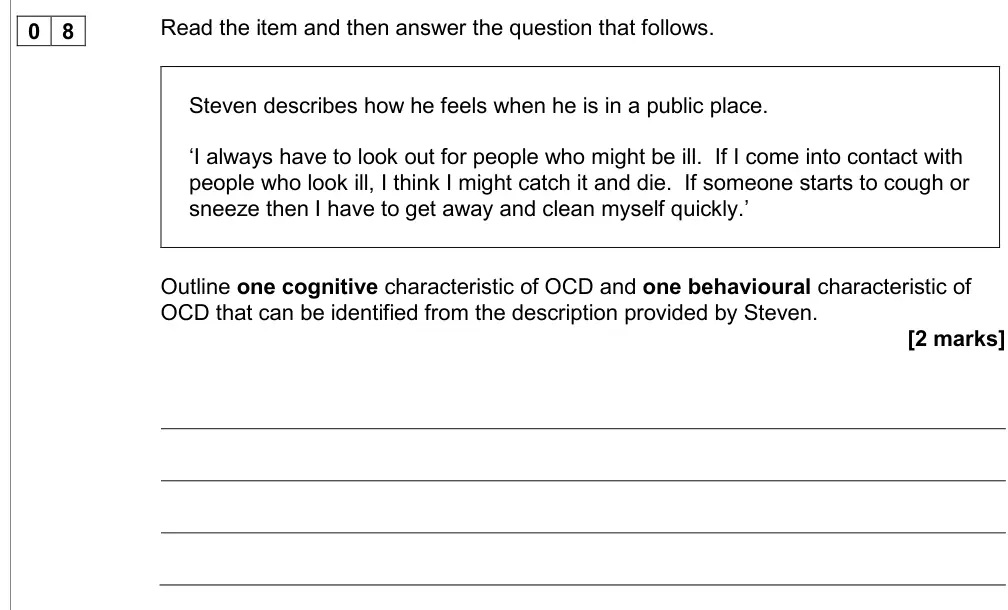
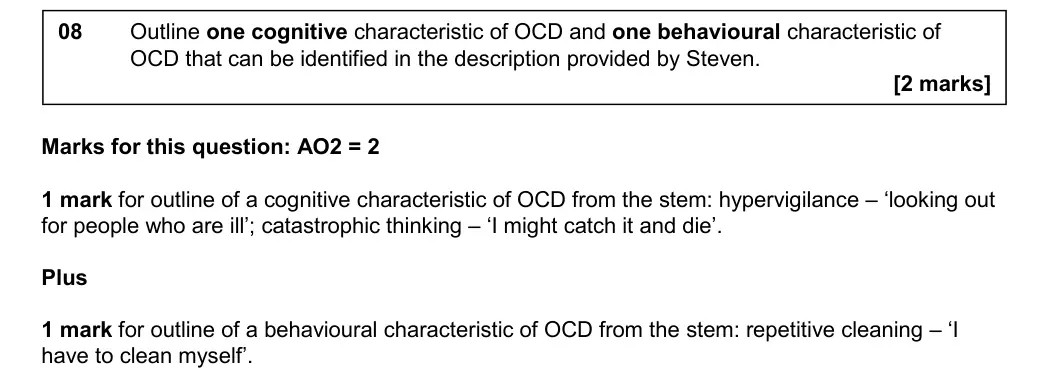
cognitive: hypervigilance/catastrophic thinking ('I might catch it and die')
behavioural: repetitive cleaning
must be identified from Steven's description
Specimen set 1 · AS Paper 2 · Q92 marksAO1=2Short answer
Mark scheme, including level descriptors and indicative content
Notes from the mark scheme and report
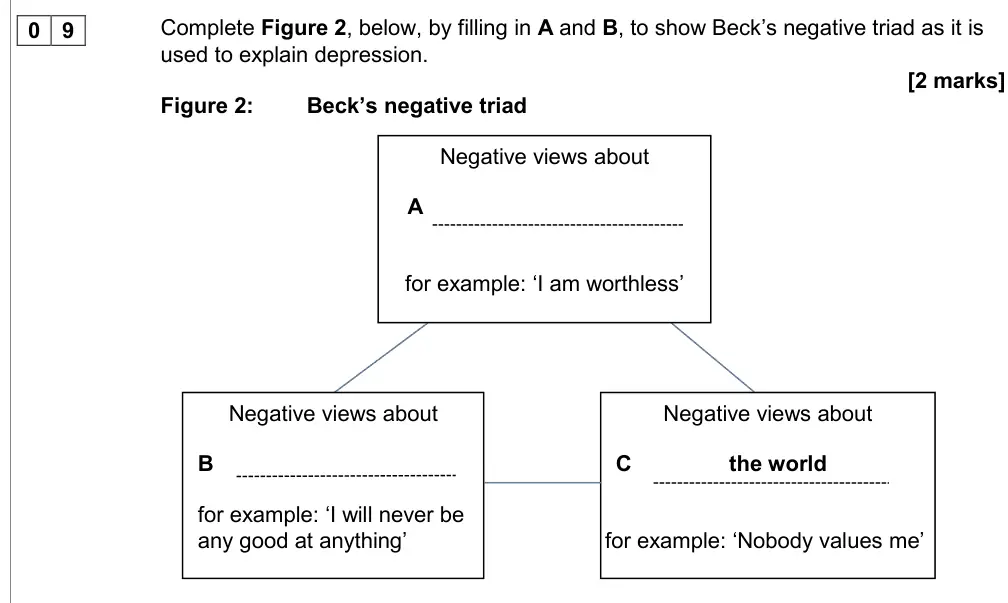
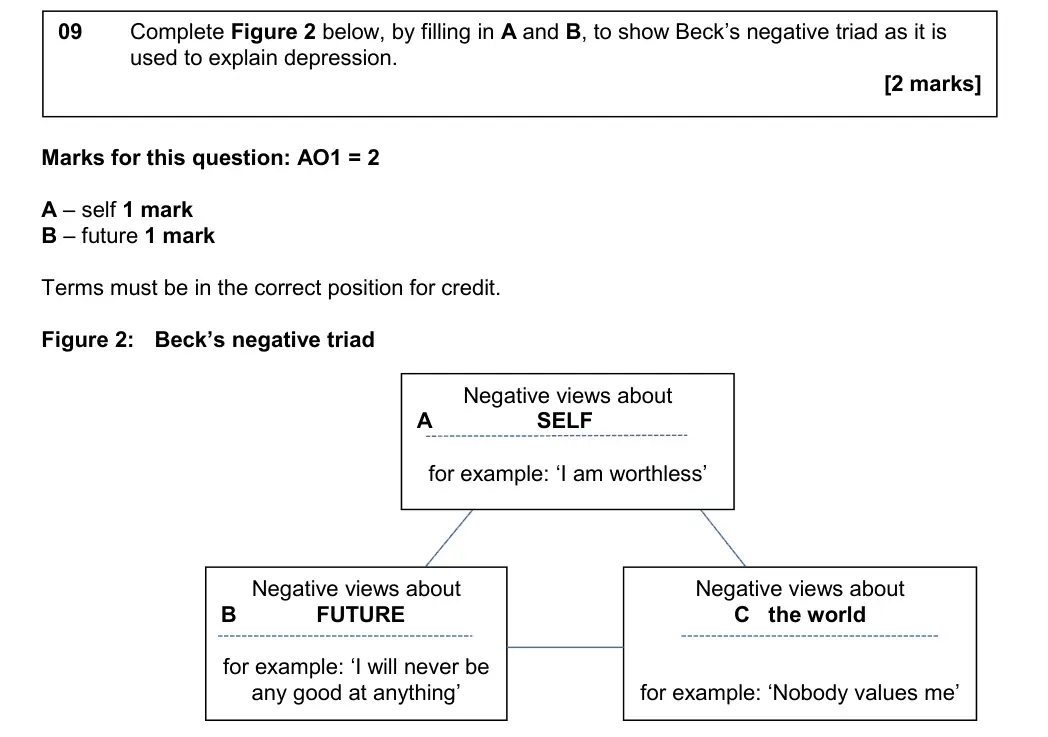
A = self, B = future
terms must be in the correct position
Specimen set 1 · AS Paper 2 · Q102 marksAO3=2Evaluate (short)
Mark scheme, including level descriptors and indicative content
Notes from the mark scheme and report
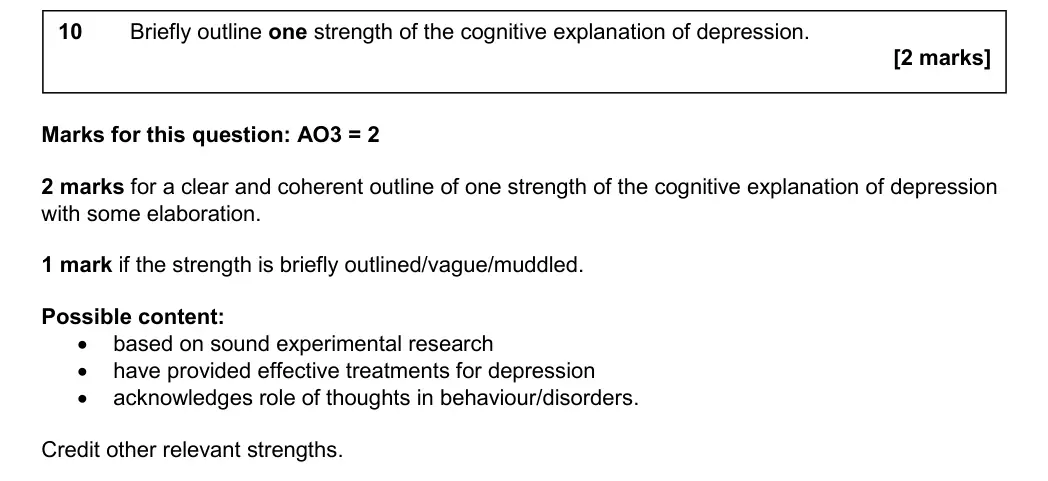
e.g. experimental research support, effective treatments (CBT), role of thoughts
Specimen set 1 · AS Paper 2 · Q1112 marksAO1=6, AO3=6Extended writing
Mark scheme, including level descriptors and indicative content
Notes from the mark scheme and report
systematic desensitisation (relaxation, hierarchy, in vivo/in vitro) and flooding
VRET credited
evaluation: effectiveness for different phobias, long-term success, ethics of flooding, comparison with alternatives
Work with an AQA psychology tutor
Essays not reaching the top band? Book a session with Andy, a former AQA examiner.