June 2024: Paper 2

96 marks · 25 question parts · Paper, mark scheme and report on AQA's site
This paper was set on the previous specification. 2 parts are on content removed in the 2025 specification and are marked "Old spec only".
Question by question

QTopicMarksAOType
1 Approaches in psychology 4AO1=4Outline
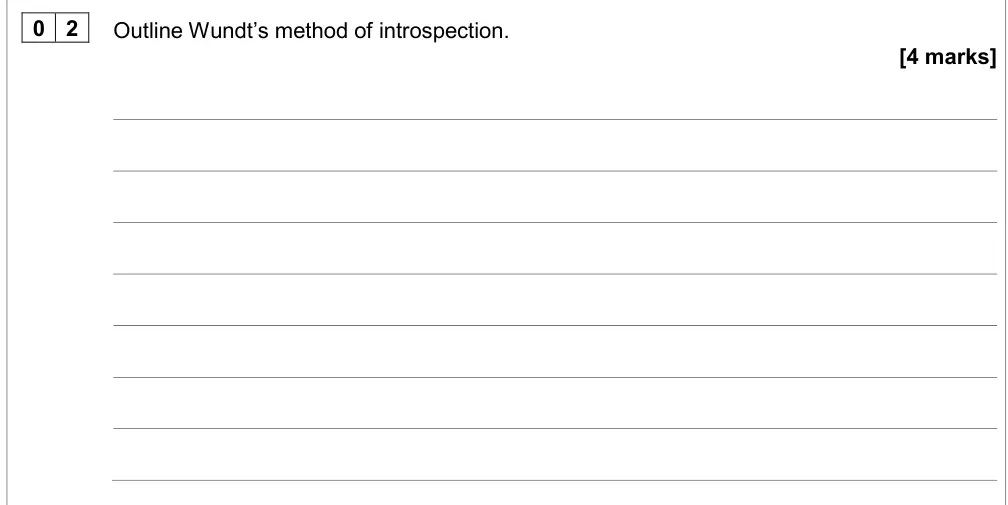
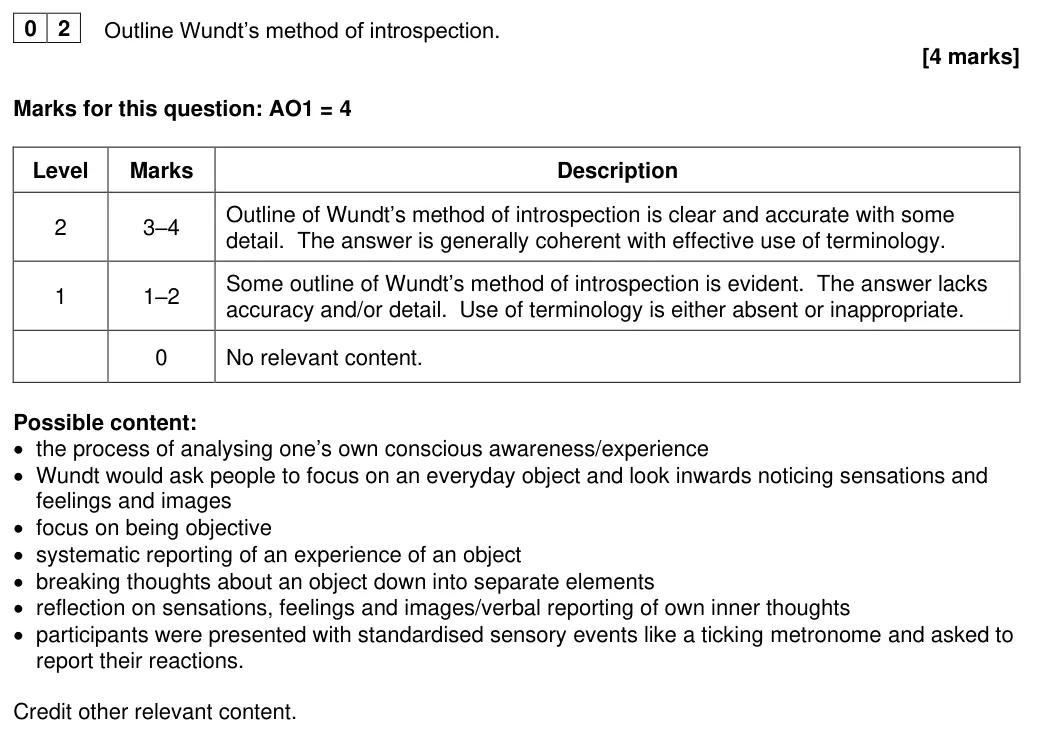
2 Approaches in psychologyOld spec 4AO1=4Outline
3 Approaches in psychology 3AO1=3Outline
4 Approaches in psychology 2AO2=2Application
5 Approaches in psychology 3AO2=3Application
6 Approaches in psychology 8AO1=3,AO3=5Extended writing
7 Biopsychology 2AO1=2Multiple choice
8 Biopsychology 4AO1=4Outline
9 Research methods: scientific processes 2AO2=2Research methods
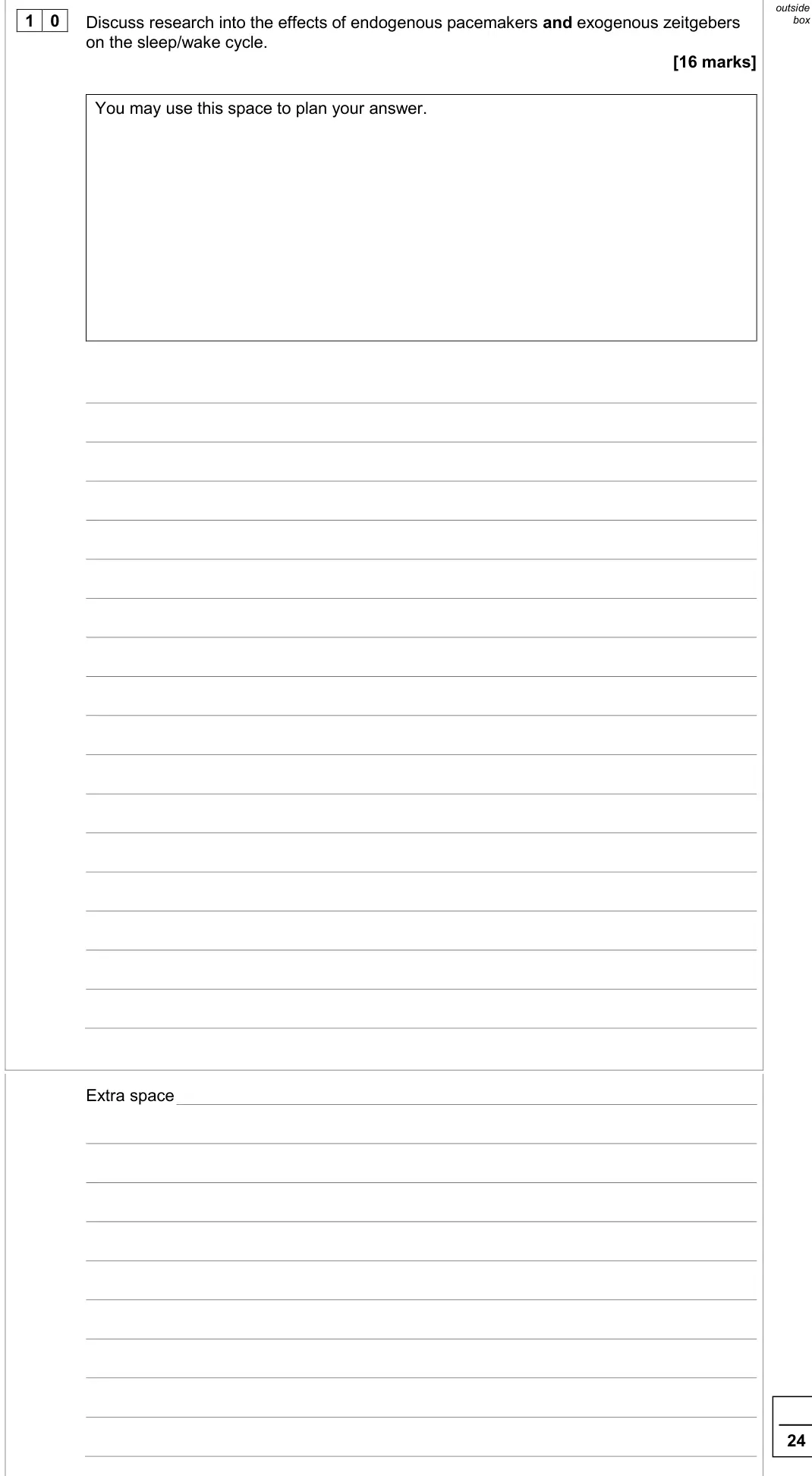
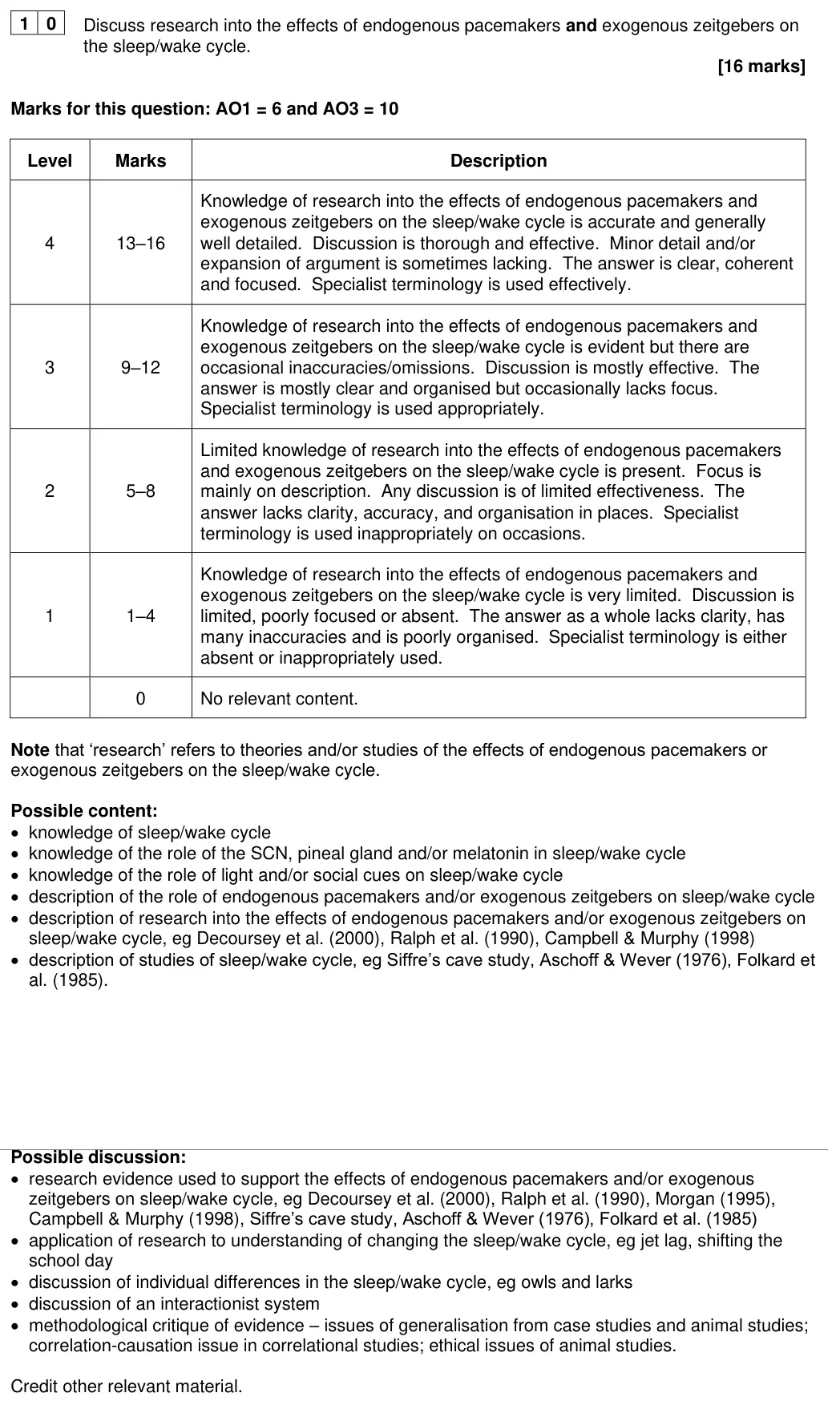
10 Old spec 16AO1=6,AO3=10Extended writing
11 Research methods: data handling and analysis 2AO2=2Research methods
12 Research methods: methods and techniques, Research methods: data handling and analysis 4AO2=4Research methods
13 Research methods: scientific processes, Research methods: methods and techniques 4AO2=4Research methods
14 Research methods: methods and techniques 3AO3=3Research methods
15 Research methods: scientific processes, Research methods: data handling and analysis 2AO2=2Research methods
16 Research methods: data handling and analysis 1AO3=1Research methods
17 Research methods: scientific processes 4AO2=4Research methods
18 Research methods: methods and techniques 3AO2=3Research methods
19 Research methods: scientific processes 4AO3=4Research methods
20 Research methods: scientific processes 4AO2=4Research methods
21 Research methods: data handling and analysis 4AO2=4Research methods
22 Research methods: data handling and analysis 2AO2=2Research methods
23 Research methods: inferential testing, Research methods: data handling and analysis 6AO2=6Research methods
24 Research methods: inferential testing 2AO2=2Research methods
25 Research methods: inferential testing 3AO2=3Research methods

The questions

12345678910111213141516171819202122232425

June 2024 · Paper 2 · Q1 4 marks AO1=4 Outline approaches
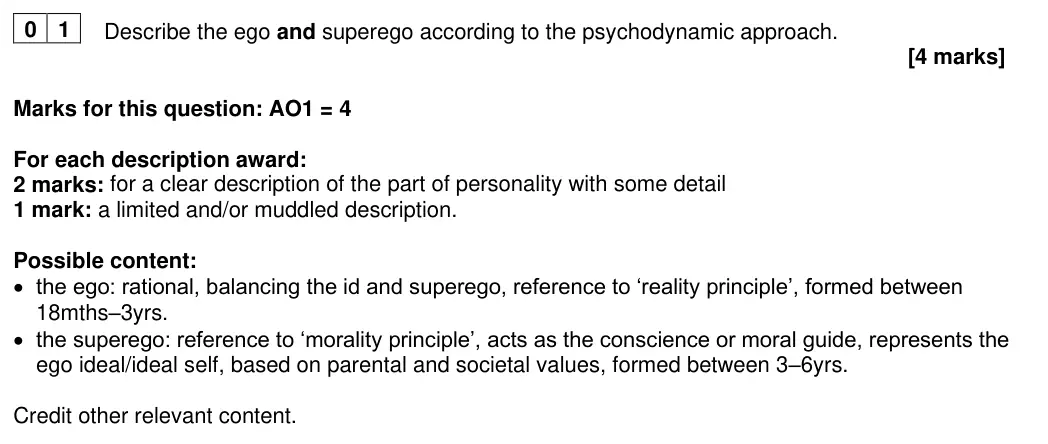
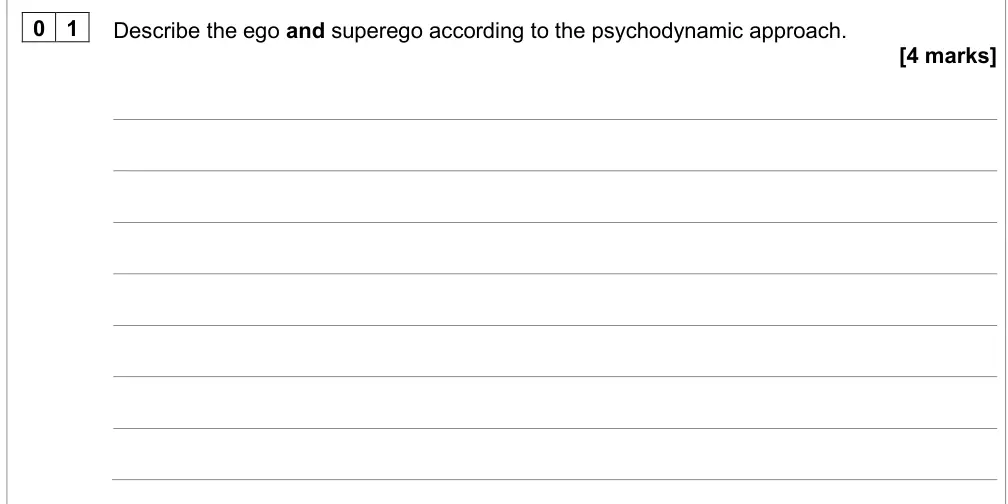
0 1
Describe the ego and superego according to the psychodynamic approach.
[4 marks]
June 2024 · Paper 2 · Q3 3 marks AO1=3 Outline approaches
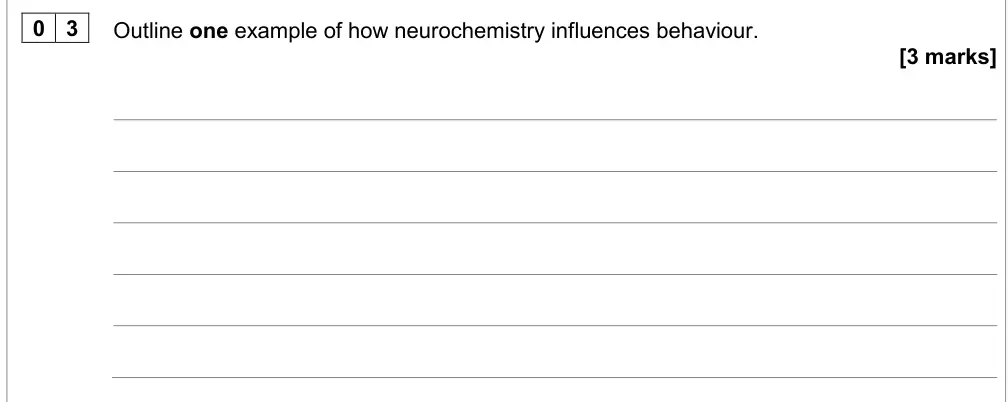
0 3
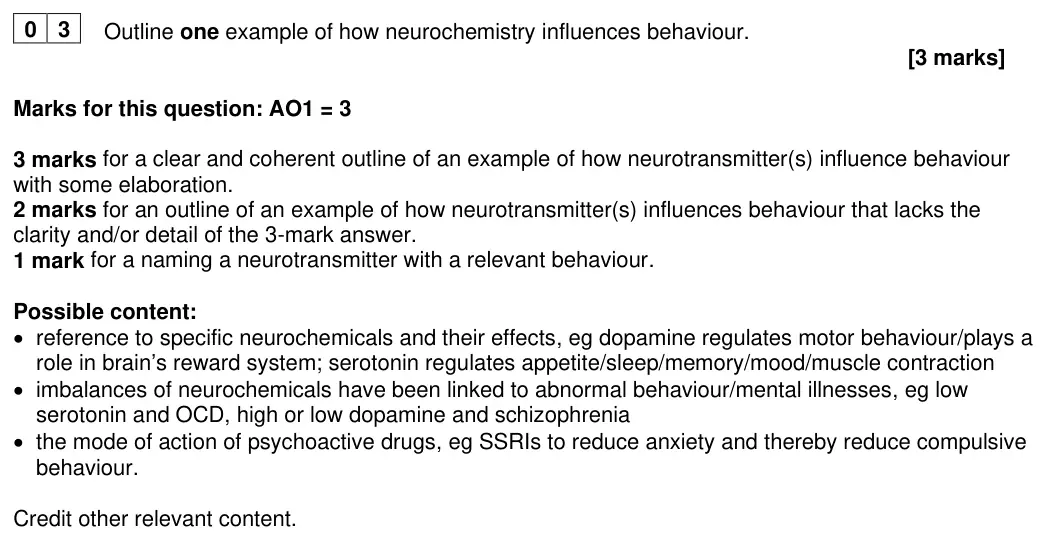
Outline one example of how neurochemistry influences behaviour.
[3 marks]
June 2024 · Paper 2 · Q4 2 marks AO2=2 Application approaches
0 4
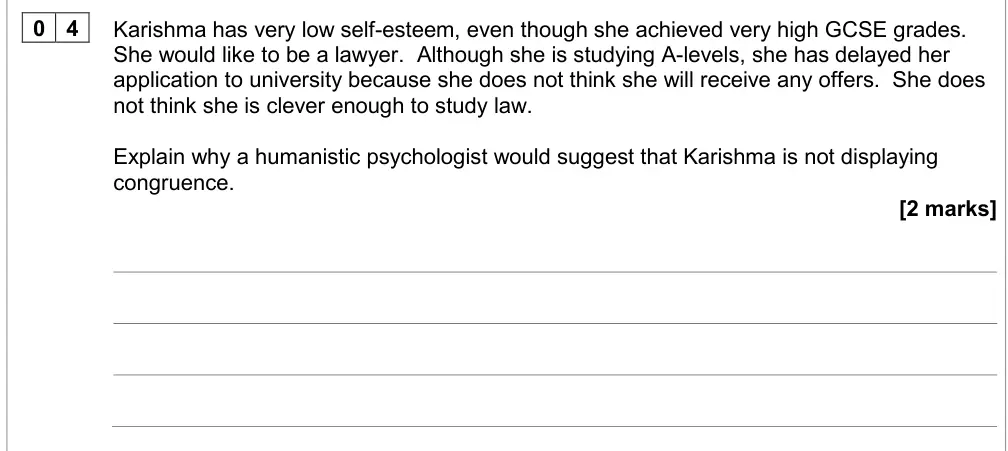
Karishma has very low self-esteem, even though she achieved very high GCSE grades.
She would like to be a lawyer.  Although she is studying A-levels, she has delayed her
application to university because she does not think she will receive any offers.  She does
not think she is clever enough to study law.
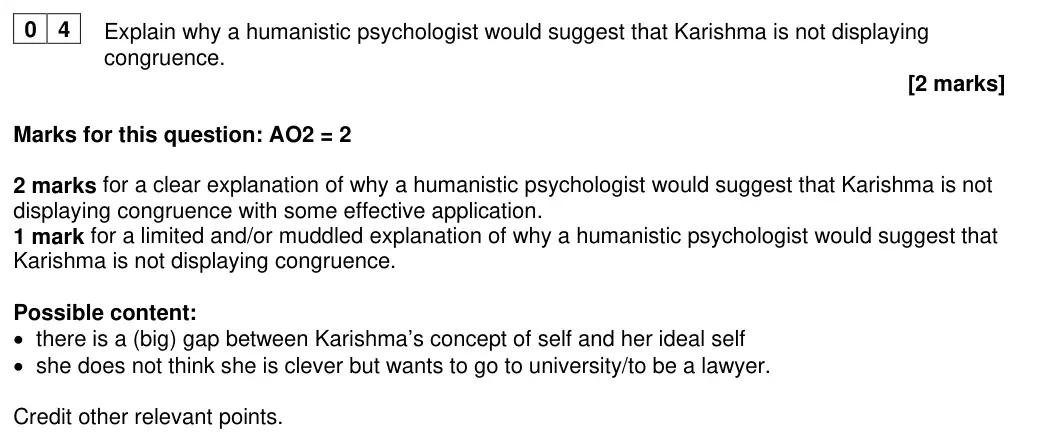
Explain why a humanistic psychologist would suggest that Karishma is not displaying
congruence.
[2 marks]
June 2024 · Paper 2 · Q5 3 marks AO2=3 Application Medium approaches
0 5
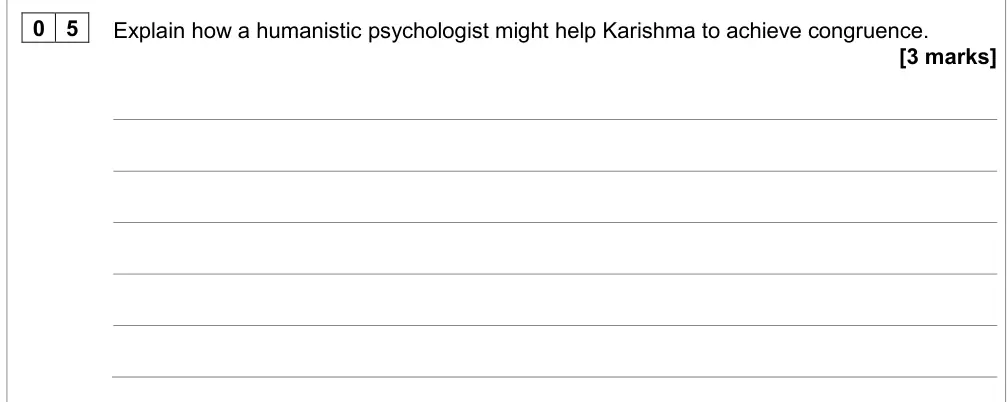
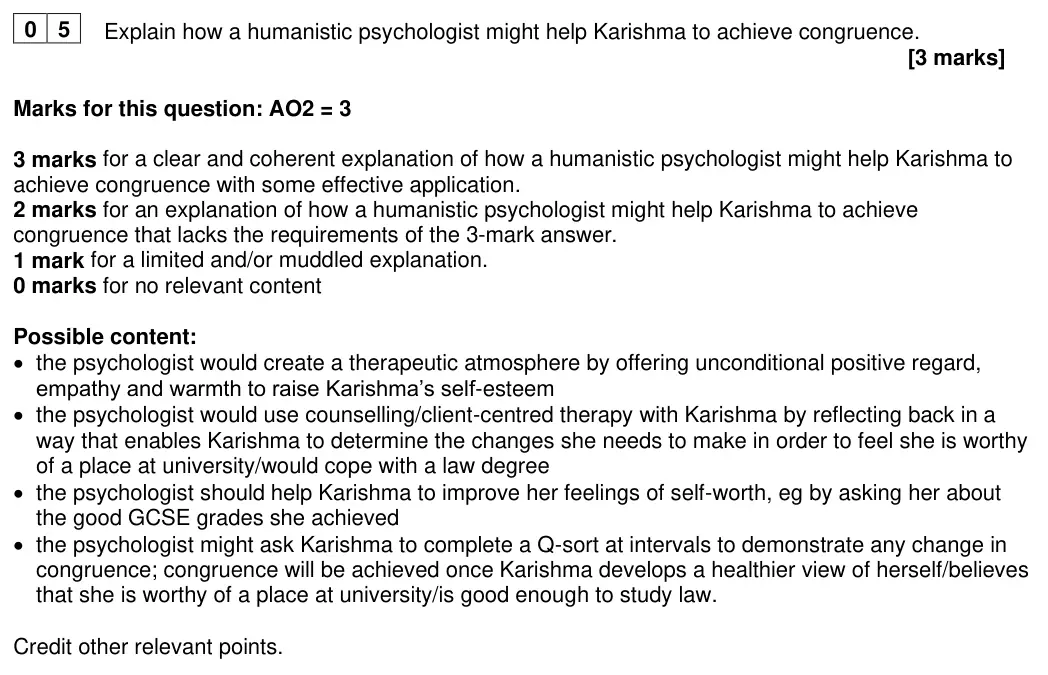
Explain how a humanistic psychologist might help Karishma to achieve congruence.
[3 marks]
June 2024 · Paper 2 · Q6 8 marks AO1=3, AO3=5 Extended writing approaches
0 6
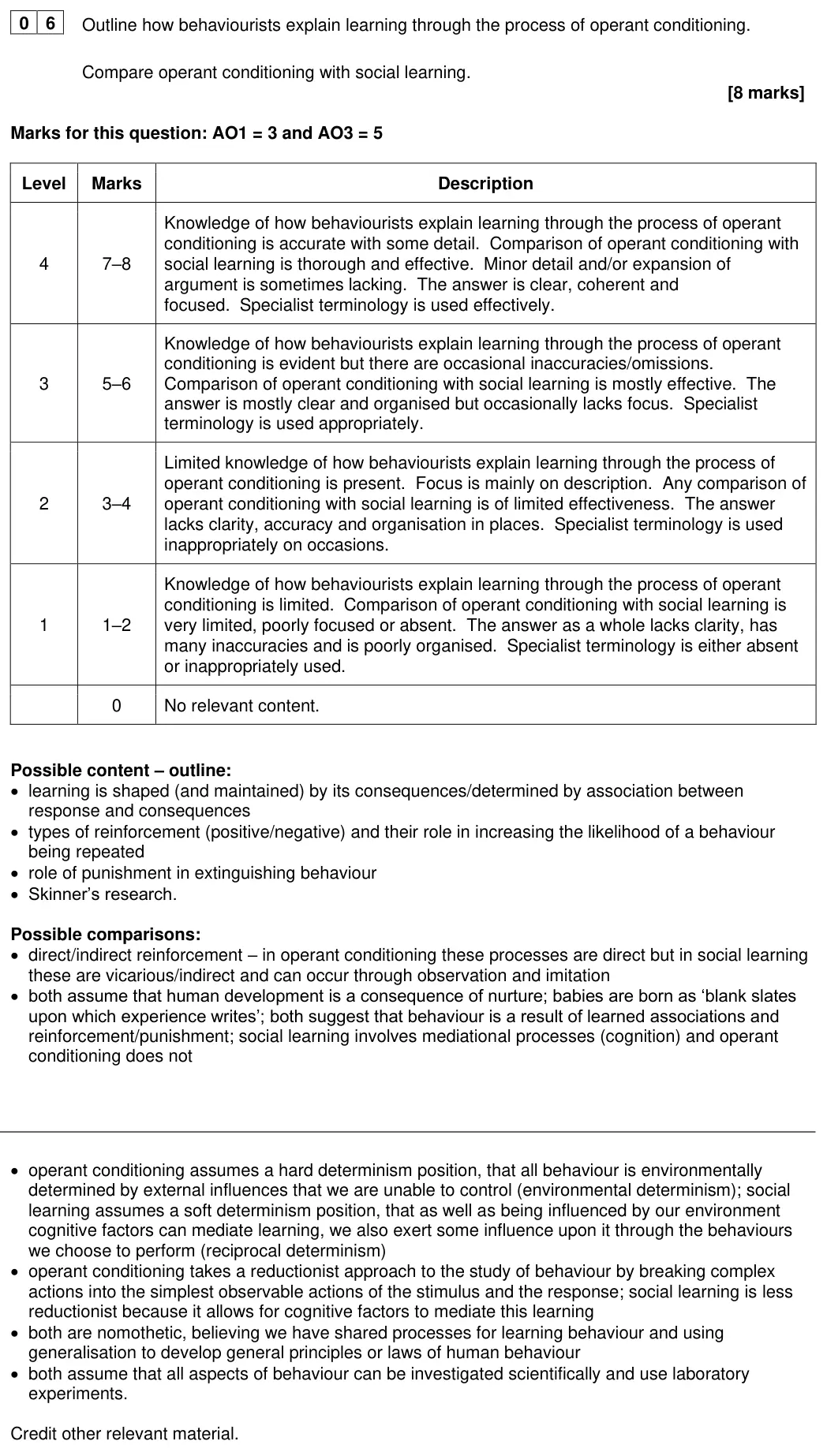
Outline how behaviourists explain learning through the process of operant conditioning.
Compare operant conditioning with social learning.
[8 marks]
Extra space
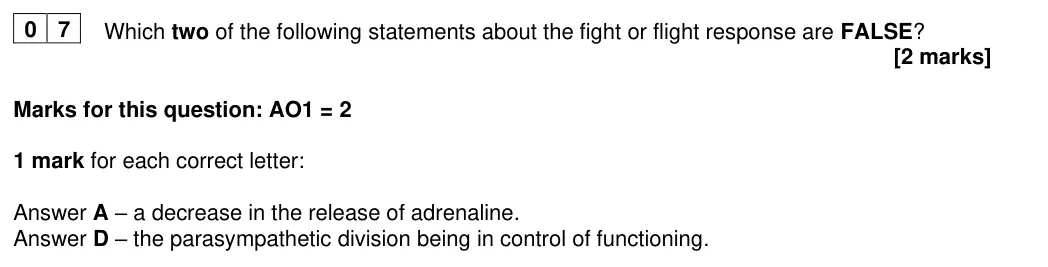
June 2024 · Paper 2 · Q7 2 marks AO1=2 Multiple choice biopsychology
0 7
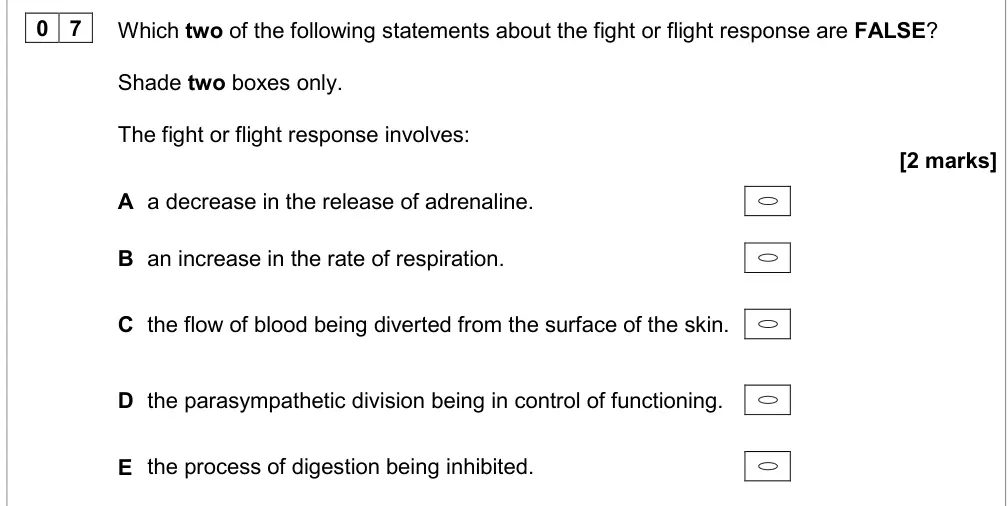
Which two of the following statements about the fight or flight response are FALSE?
The fight or flight response involves:
[2 marks]
A a decrease in the release of adrenaline.
B an increase in the rate of respiration.
C the flow of blood being diverted from the surface of the skin.
D the parasympathetic division being in control of functioning.
E the process of digestion being inhibited.
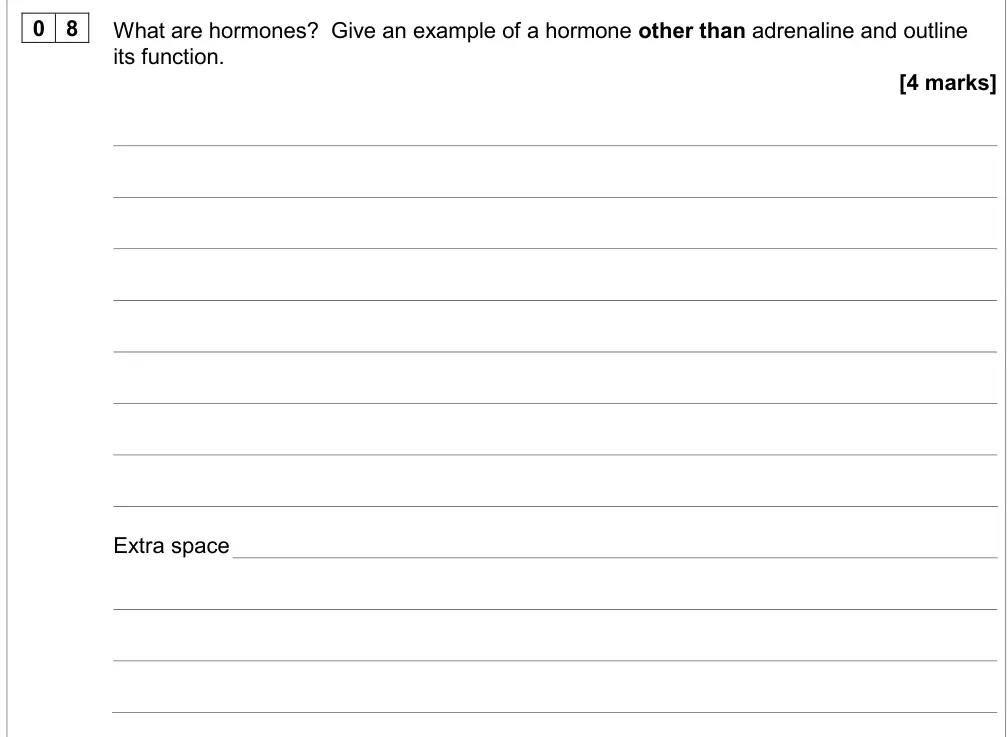
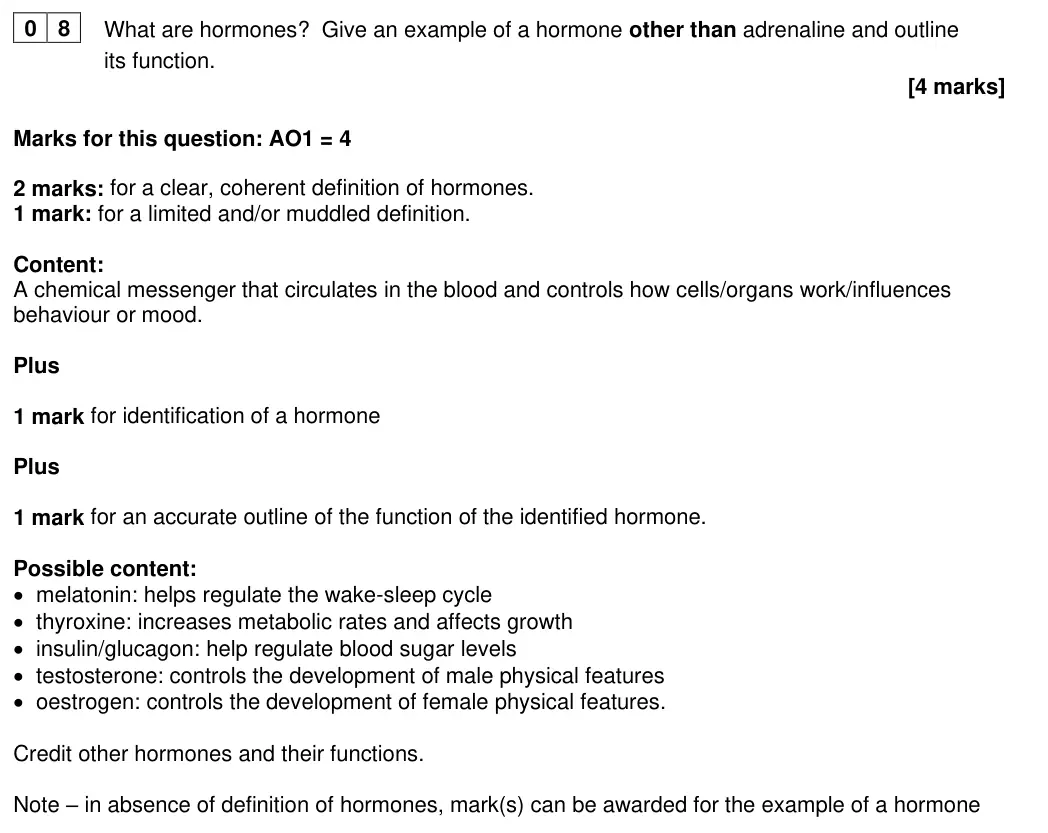
June 2024 · Paper 2 · Q8 4 marks AO1=4 Outline biopsychology
0 8
What are hormones?  Give an example of a hormone other than adrenaline and outline
its function.
[4 marks]
Extra space
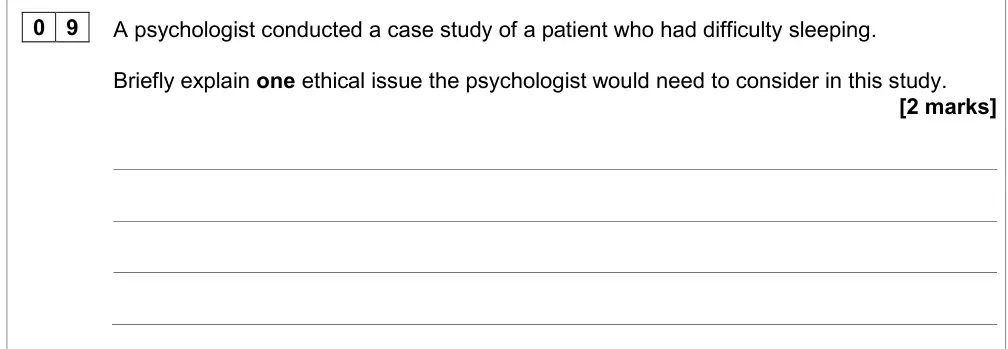
June 2024 · Paper 2 · Q9 2 marks AO2=2 Research methods scientific processes
0 9
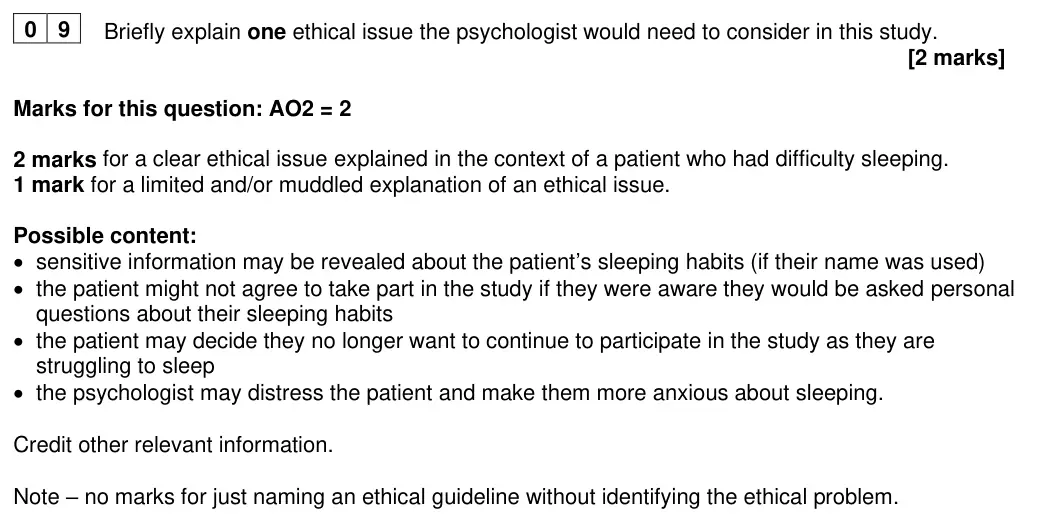
A psychologist conducted a case study of a patient who had difficulty sleeping.
Briefly explain one ethical issue the psychologist would need to consider in this study.
[2 marks]
June 2024 · Paper 2 · Q11 2 marks AO2=2 Research methods data handling
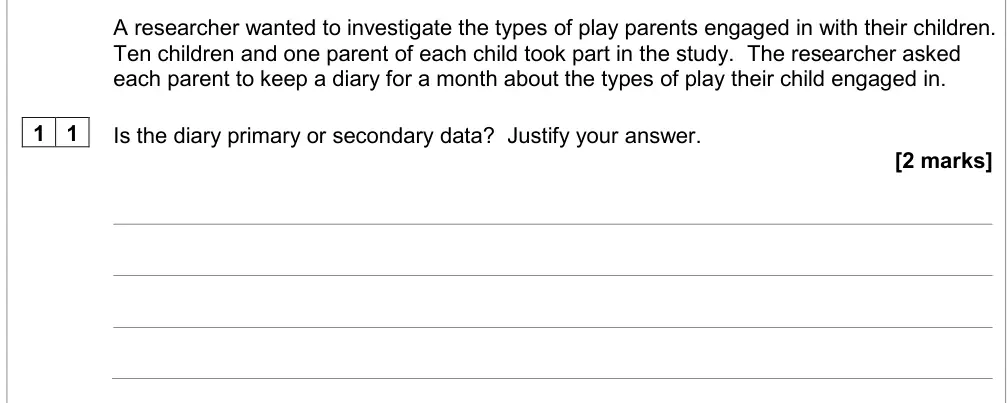
A researcher wanted to investigate the types of play parents engaged in with their children.
Ten children and one parent of each child took part in the study.  The researcher asked
each parent to keep a diary for a month about the types of play their child engaged in.
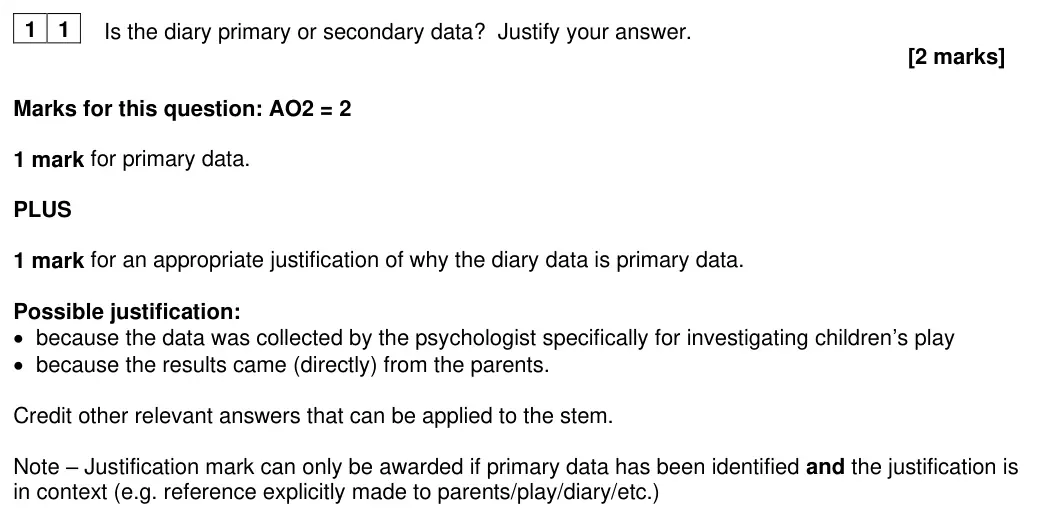
1 1
Is the diary primary or secondary data?  Justify your answer.
[2 marks]
June 2024 · Paper 2 · Q12 4 marks AO2=4 Research methods research methodsdata handling
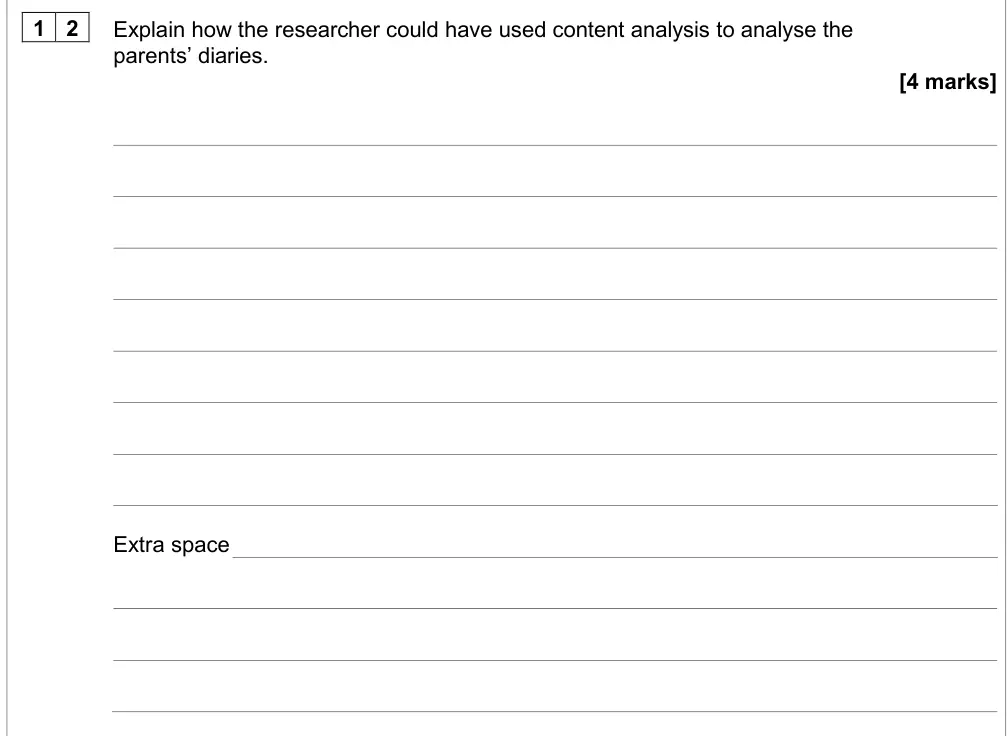
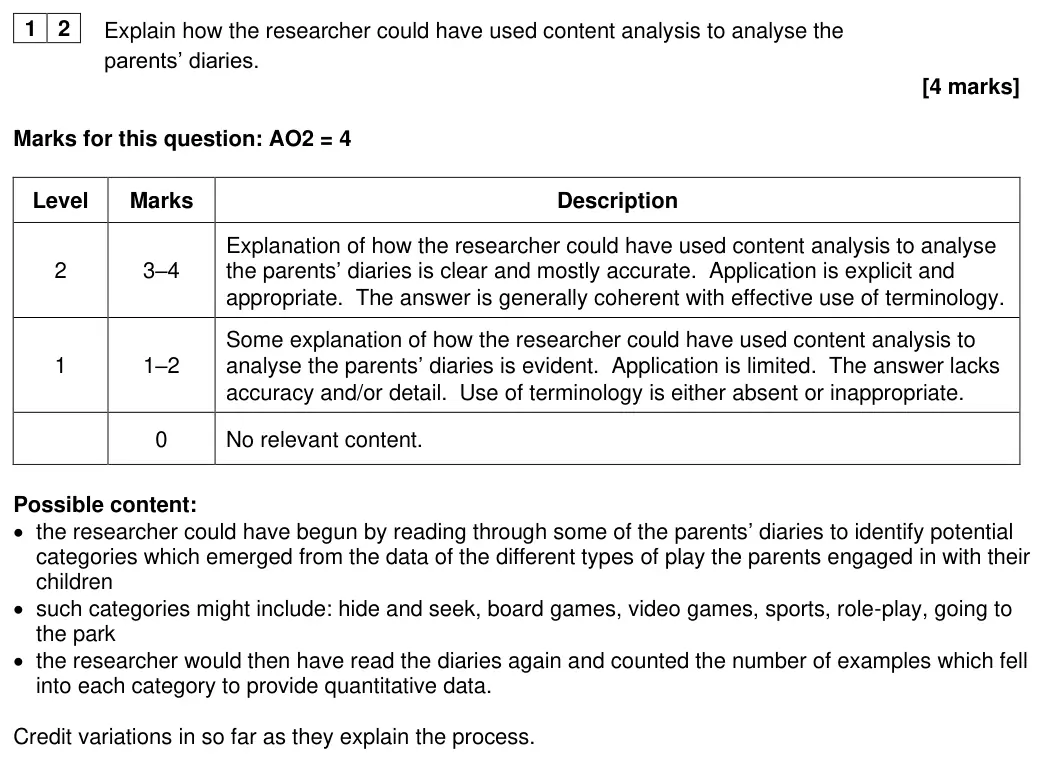
1 2
Explain how the researcher could have used content analysis to analyse the
parents’ diaries.
[4 marks]
Extra space
June 2024 · Paper 2 · Q13 4 marks AO2=4 Research methods scientific processesresearch methods
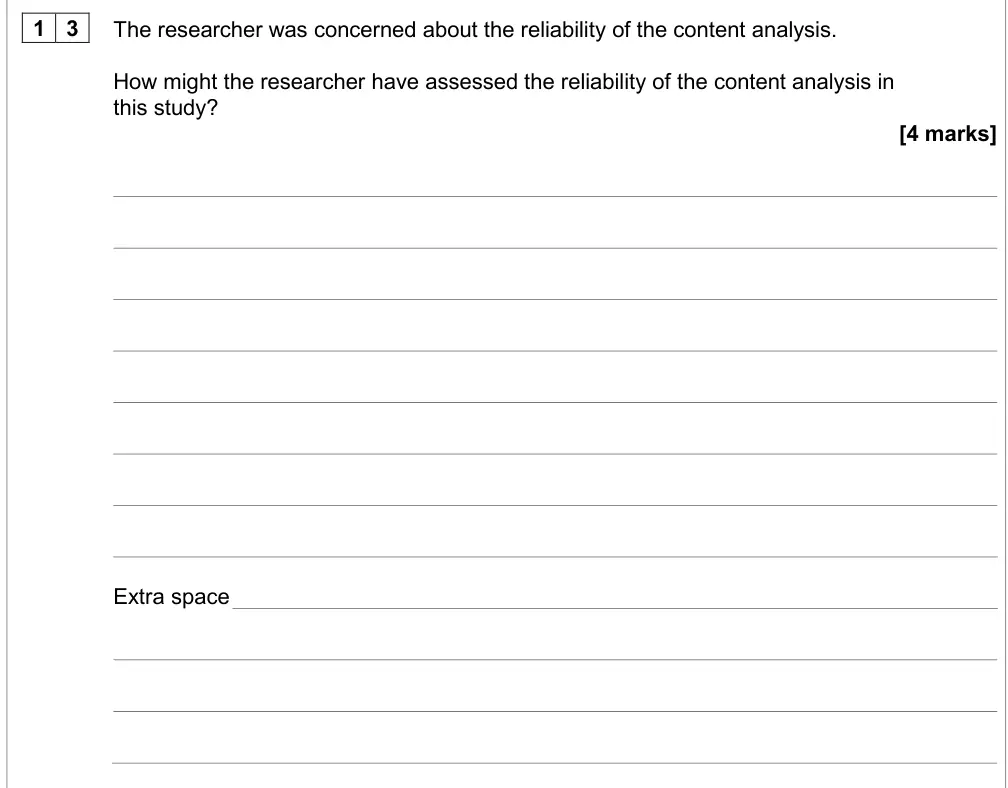
1 3
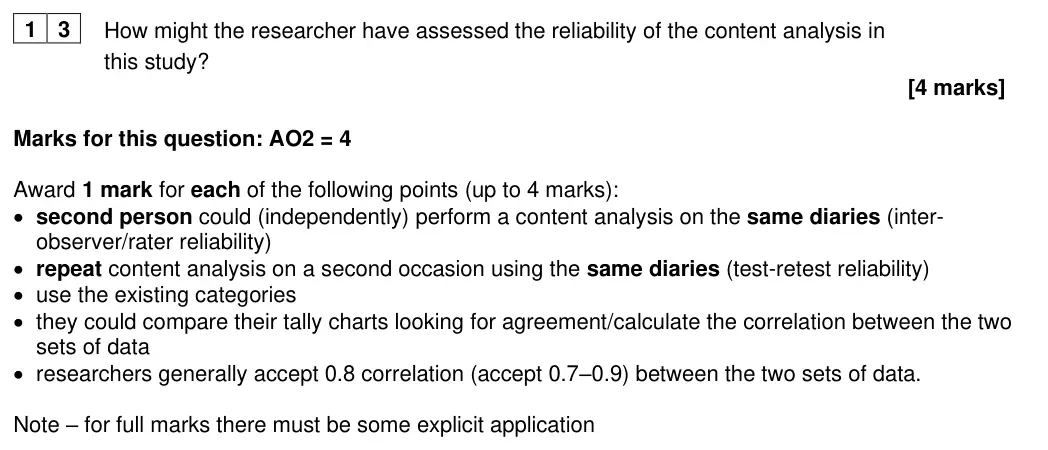
The researcher was concerned about the reliability of the content analysis.
How might the researcher have assessed the reliability of the content analysis in
this study?
[4 marks]
Extra space
June 2024 · Paper 2 · Q14 3 marks AO3=3 Research methods research methods
1 4
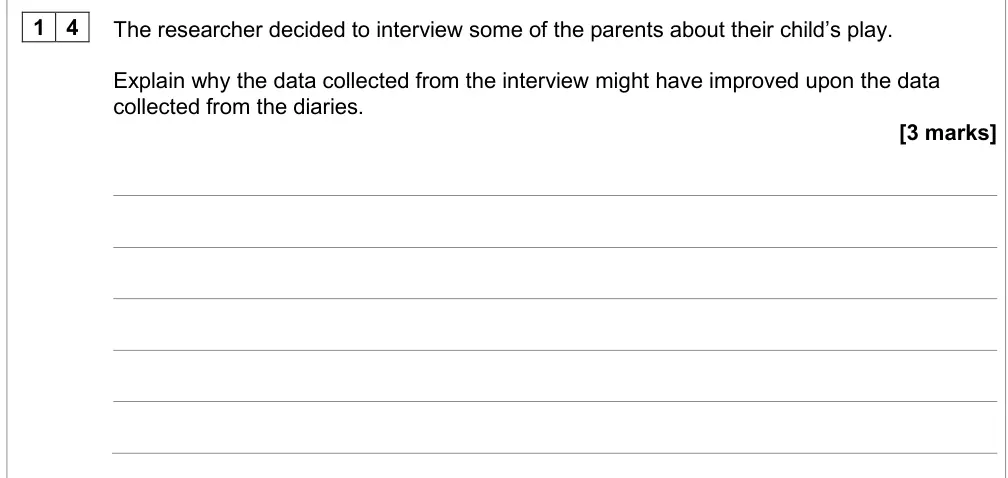
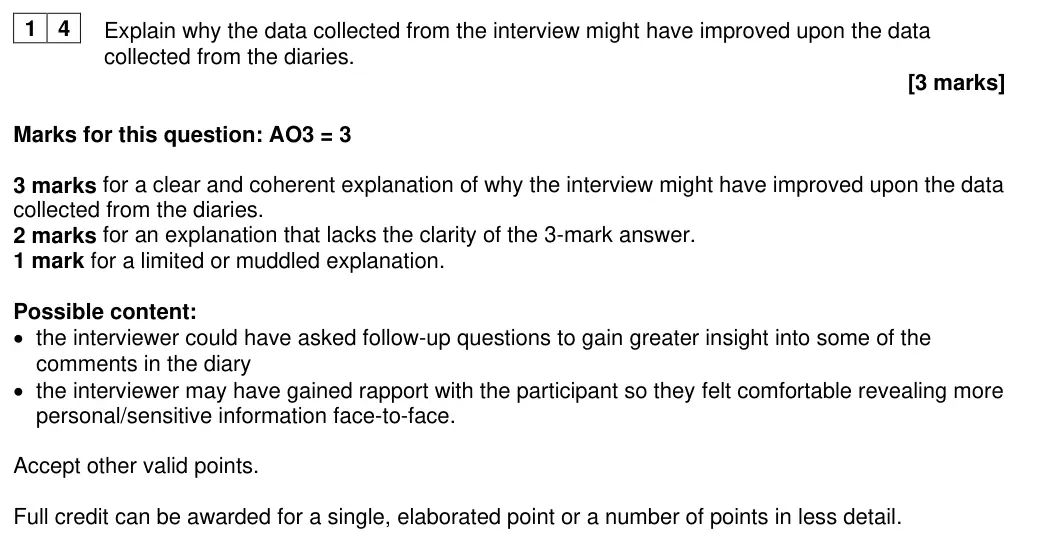
The researcher decided to interview some of the parents about their child’s play.
Explain why the data collected from the interview might have improved upon the data
collected from the diaries.
[3 marks]
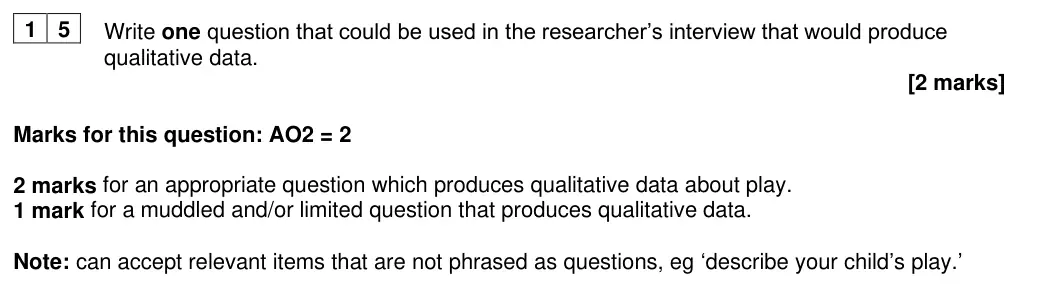
June 2024 · Paper 2 · Q15 2 marks AO2=2 Research methods scientific processesdata handling
1 5
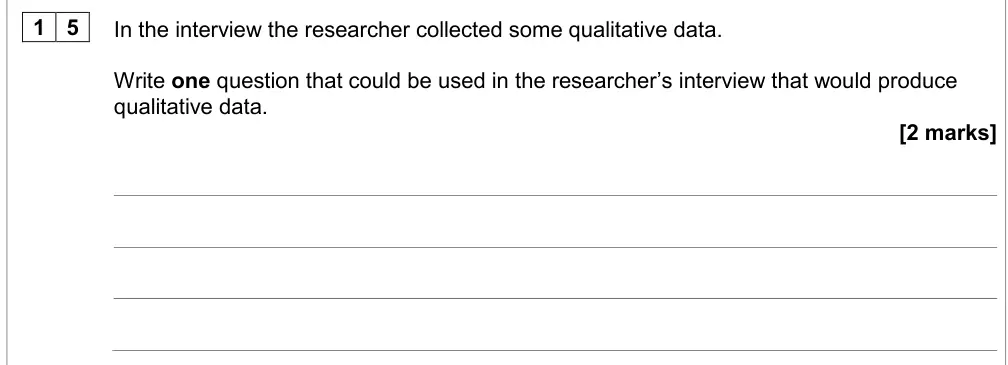
In the interview the researcher collected some qualitative data.
Write one question that could be used in the researcher’s interview that would produce
qualitative data.
[2 marks]
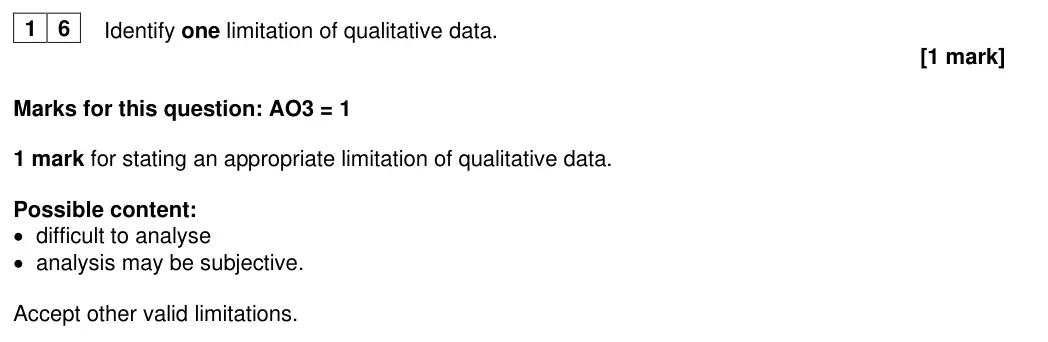
June 2024 · Paper 2 · Q16 1 mark AO3=1 Research methods data handling
1 6
Identify one limitation of qualitative data.
[1 mark]
June 2024 · Paper 2 · Q17 4 marks AO2=4 Research methods scientific processes
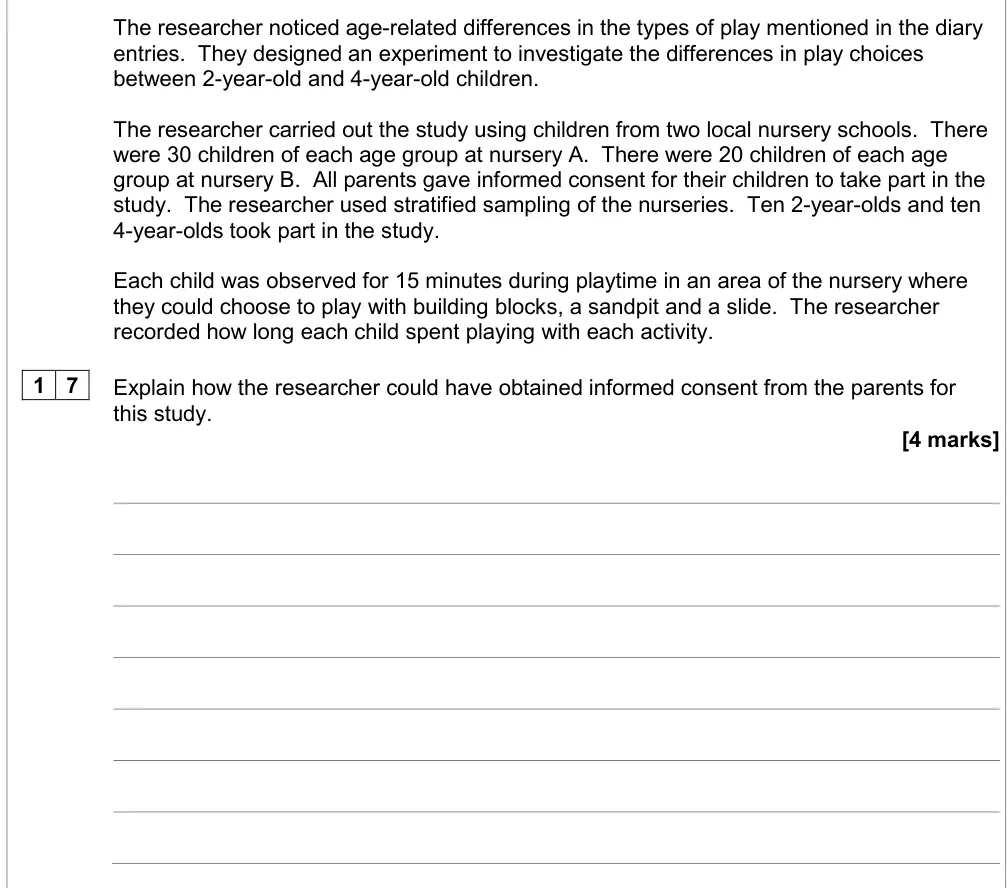
The researcher noticed age-related differences in the types of play mentioned in the diary
entries.  They designed an experiment to investigate the differences in play choices
between 2-year-old and 4-year-old children.
The researcher carried out the study using children from two local nursery schools.  There
were 30 children of each age group at nursery A.  There were 20 children of each age
group at nursery B.  All parents gave informed consent for their children to take part in the
study.  The researcher used stratified sampling of the nurseries.  Ten 2-year-olds and ten
4-year-olds took part in the study.
Each child was observed for 15 minutes during playtime in an area of the nursery where
they could choose to play with building blocks, a sandpit and a slide.  The researcher
recorded how long each child spent playing with each activity.
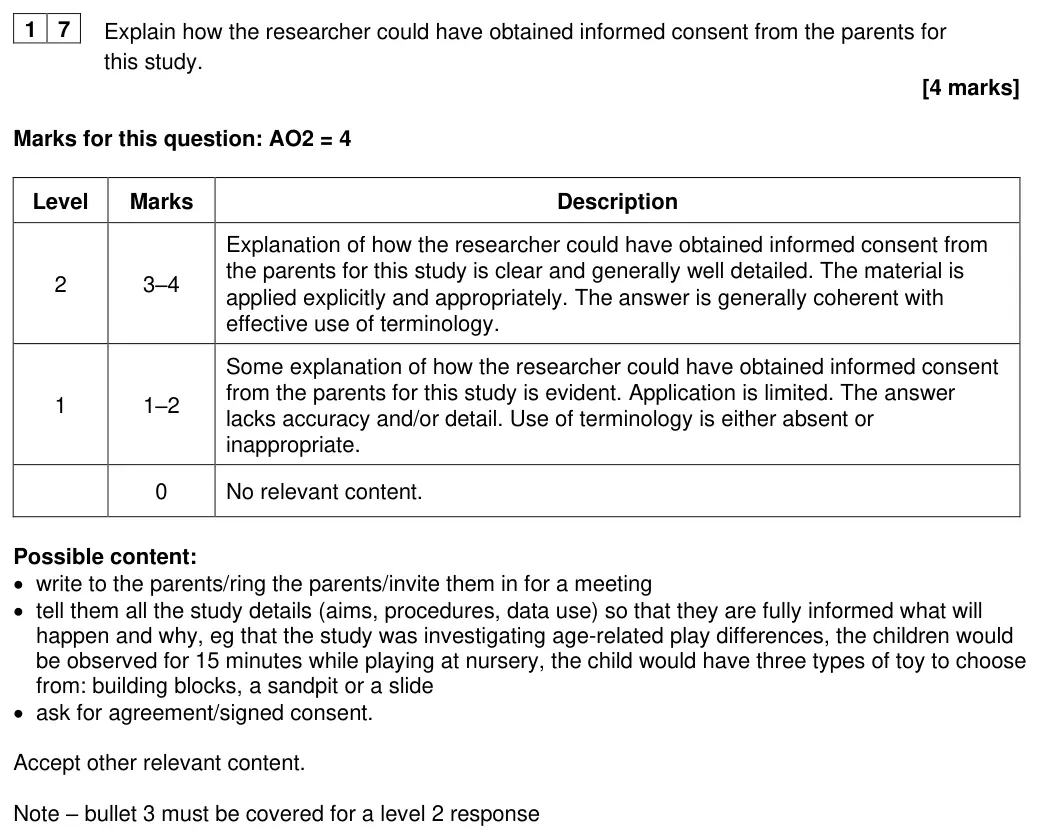
1 7
Explain how the researcher could have obtained informed consent from the parents for
this study.
[4 marks]
June 2024 · Paper 2 · Q18 3 marks AO2=3 Research methods research methods
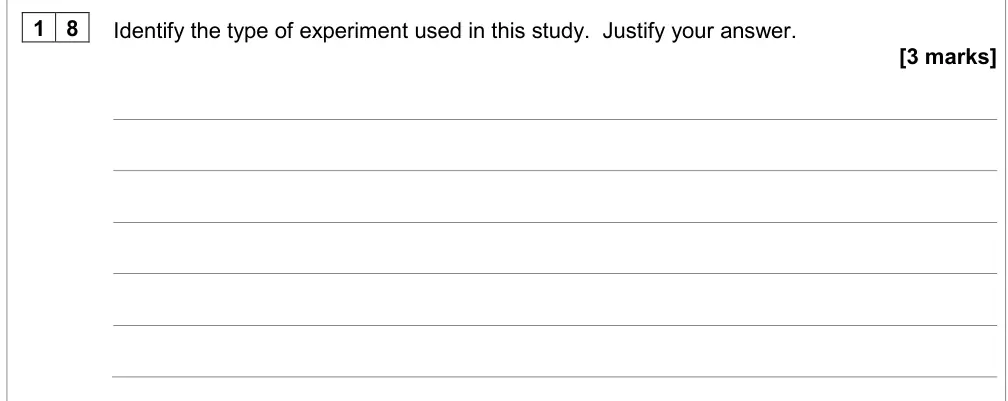
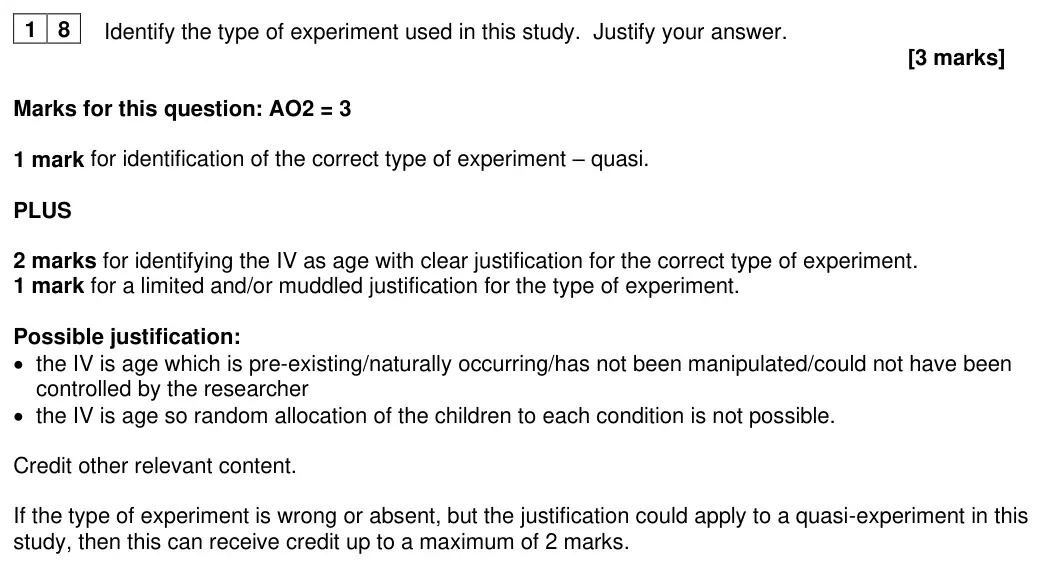
1 8
Identify the type of experiment used in this study.  Justify your answer.
[3 marks]
June 2024 · Paper 2 · Q19 4 marks AO3=4 Research methods scientific processes
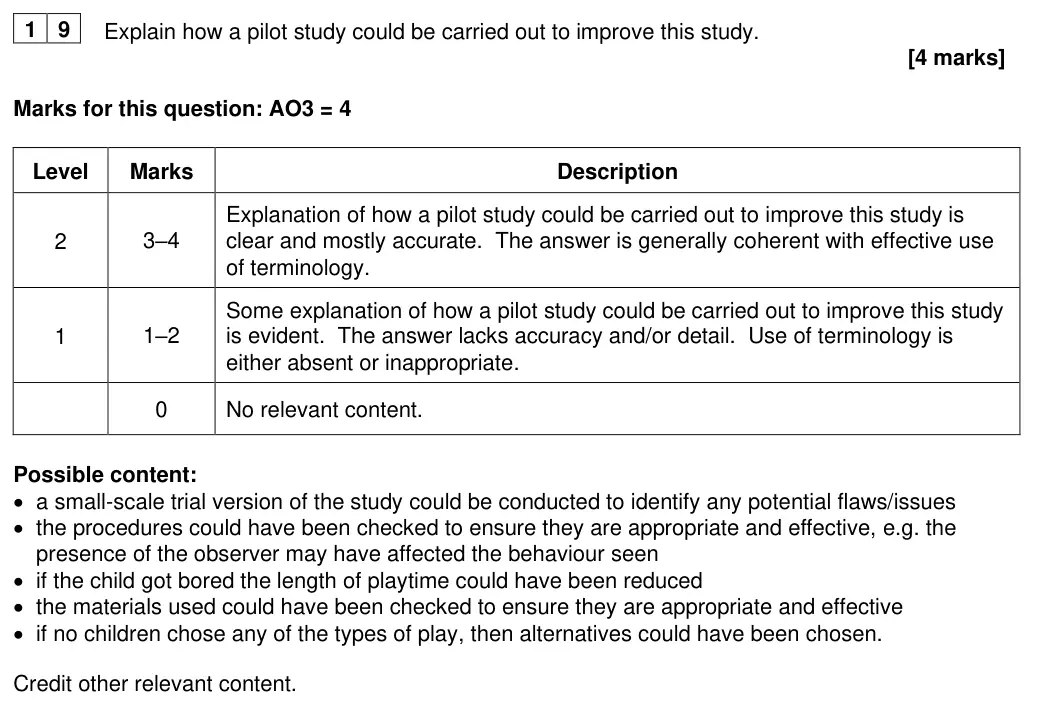
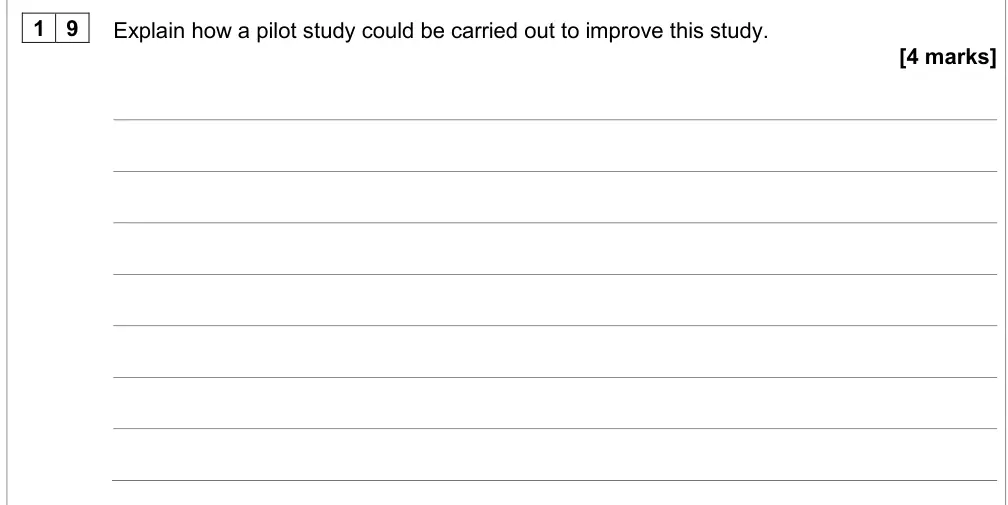
1 9
Explain how a pilot study could be carried out to improve this study.
[4 marks]
June 2024 · Paper 2 · Q20 4 marks AO2=4 Research methods scientific processes
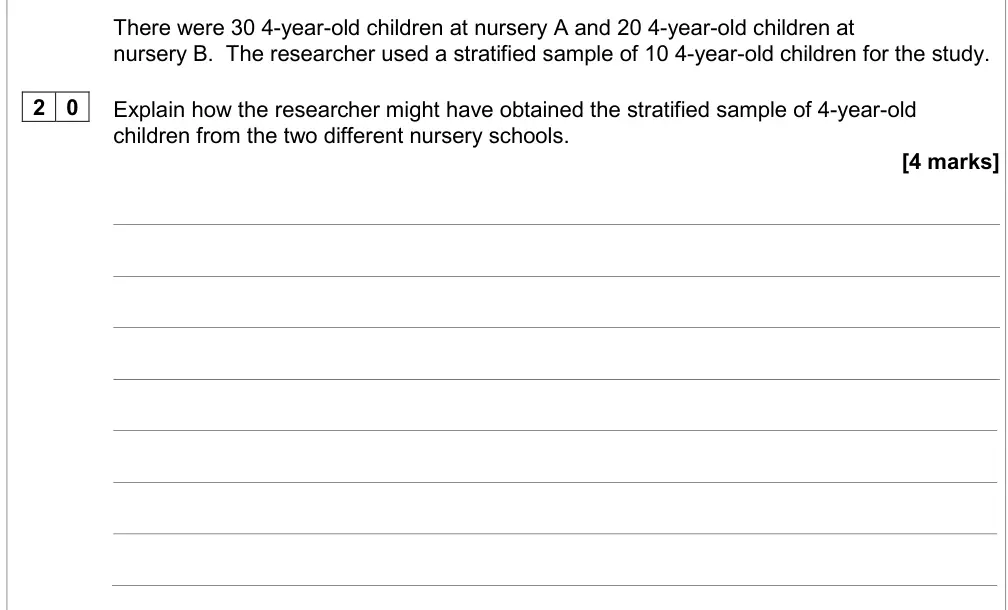
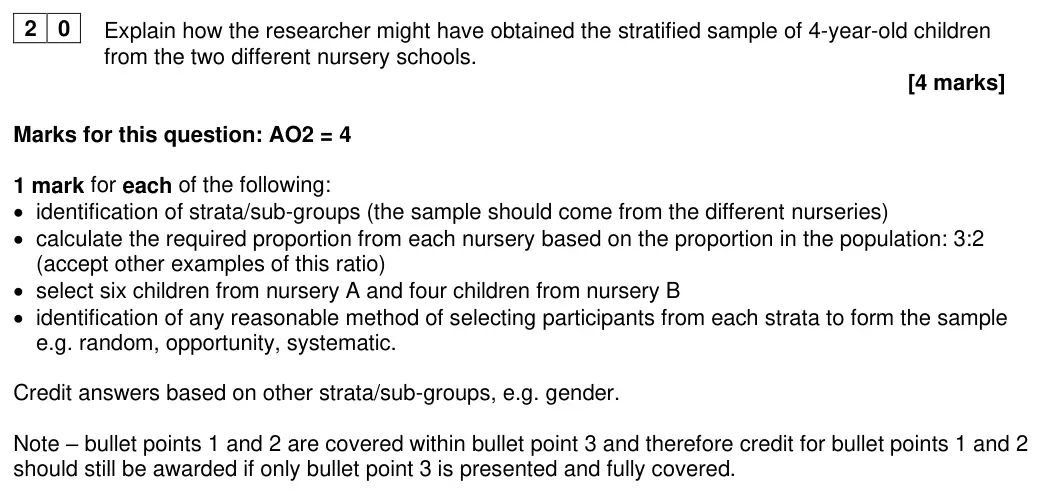
There were 30 4-year-old children at nursery A and 20 4-year-old children at
nursery B.  The researcher used a stratified sample of 10 4-year-old children for the study.
2 0
Explain how the researcher might have obtained the stratified sample of 4-year-old
children from the two different nursery schools.
[4 marks]
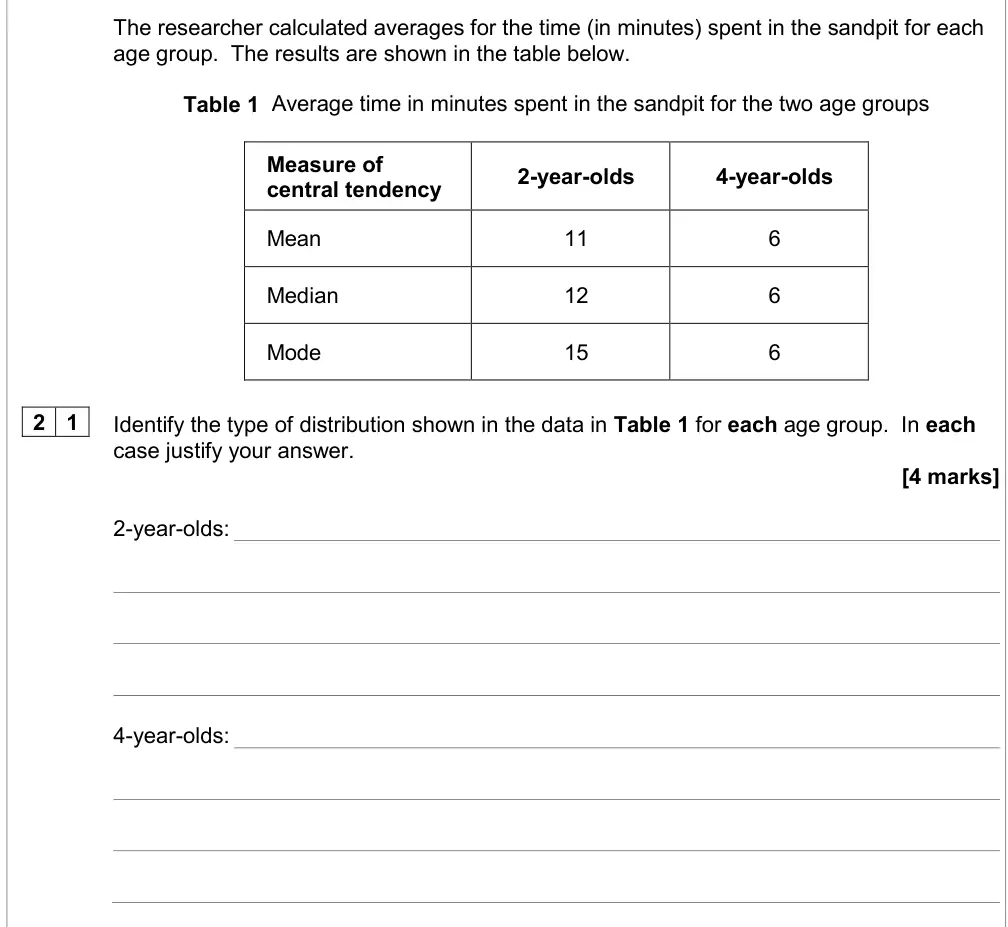
June 2024 · Paper 2 · Q21 4 marks AO2=4 Research methods data handling
The researcher calculated averages for the time (in minutes) spent in the sandpit for each
age group.  The results are shown in the table below.
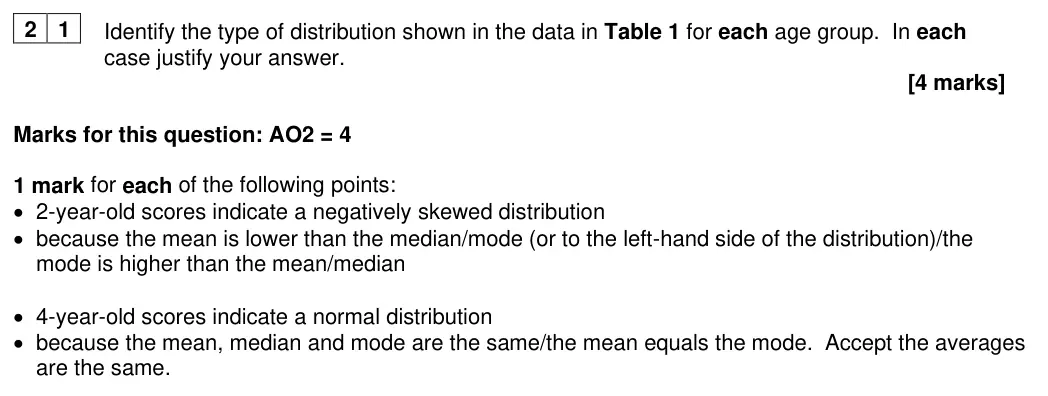
Table 1  Average time in minutes spent in the sandpit for the two age groups
Measure of
2-year-olds
4-year-olds
central tendency
Mean
11
6
Median
12
6
Mode
15
6
2 1
Identify the type of distribution shown in the data in Table 1 for each age group.  In each
case justify your answer.
[4 marks]
2-year-olds:
4-year-olds:
June 2024 · Paper 2 · Q22 2 marks AO2=2 Research methods data handling
2 2
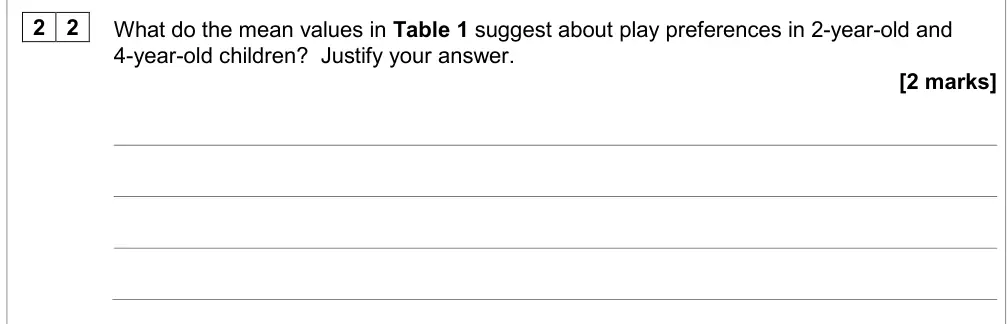
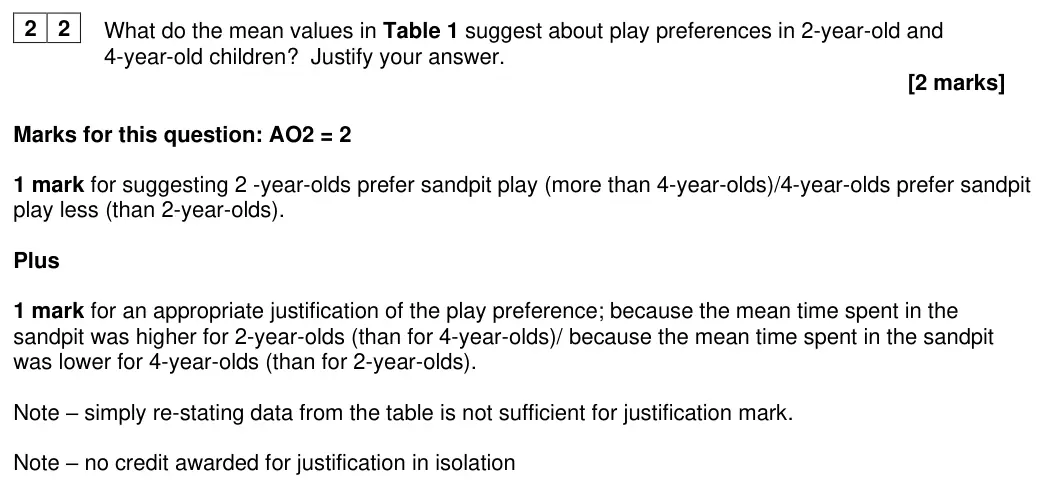
What do the mean values in Table 1 suggest about play preferences in 2-year-old and
4-year-old children?  Justify your answer.
[2 marks]
June 2024 · Paper 2 · Q23 6 marks AO2=6 Research methods inferential testingdata handling
2 3
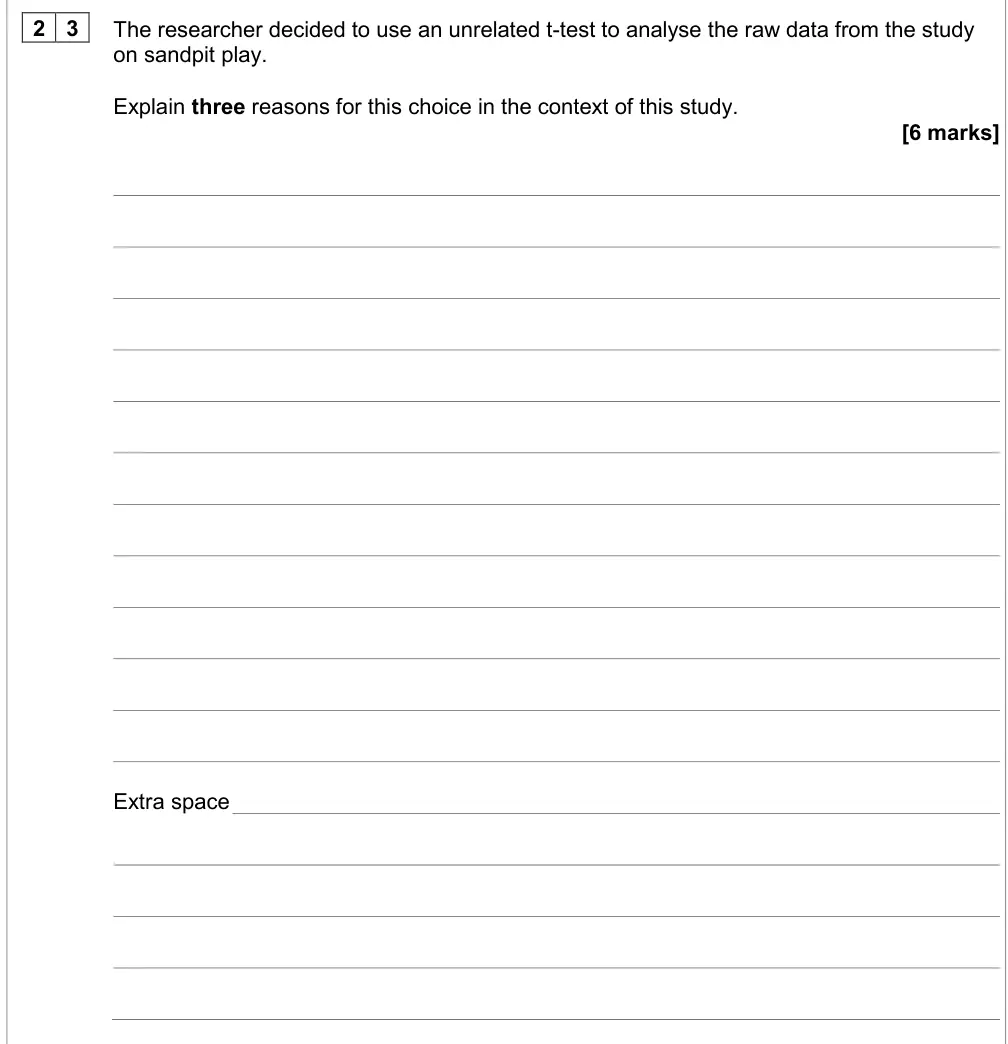
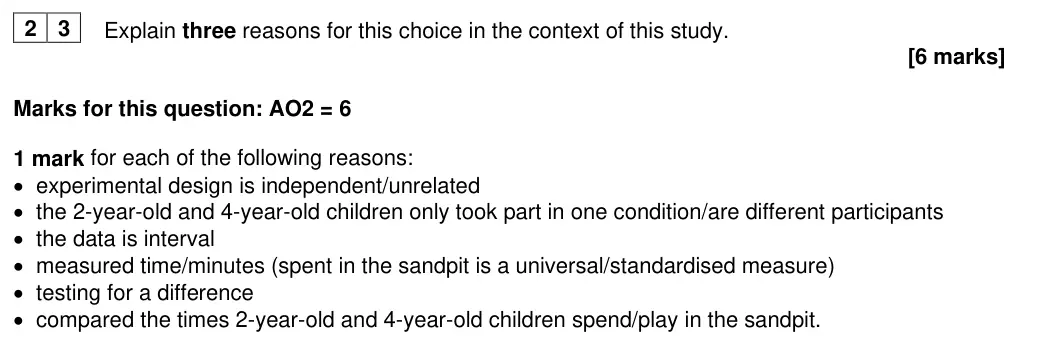
The researcher decided to use an unrelated t-test to analyse the raw data from the study
on sandpit play.
Explain three reasons for this choice in the context of this study.
[6 marks]
Extra space
June 2024 · Paper 2 · Q24 2 marks AO2=2 Research methods inferential testing
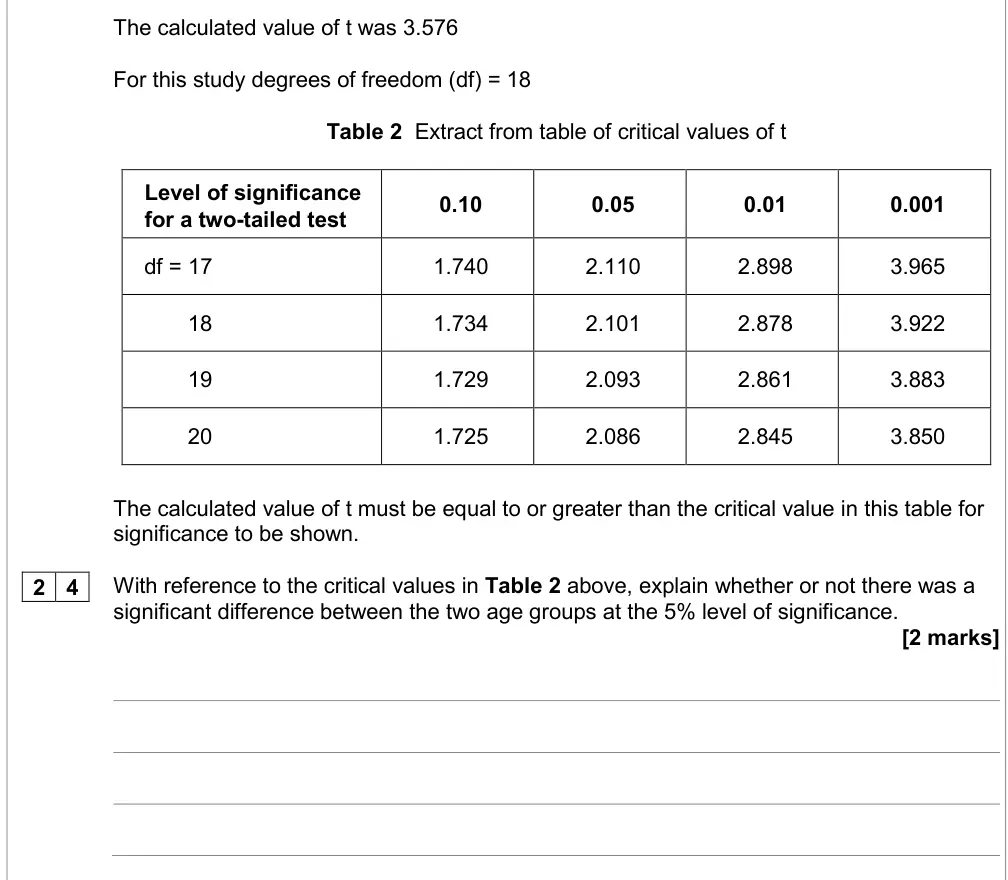
The calculated value of t was 3.576
For this study degrees of freedom (df) = 18
Table 2  Extract from table of critical values of t
Level of significance
for a two-tailed test
0.10
0.05
0.01
0.001
df = 17
1.740
2.110
2.898
3.965
18
1.734
2.101
2.878
3.922
19
1.729
2.093
2.861
3.883
20
1.725
2.086
2.845
3.850
The calculated value of t must be equal to or greater than the critical value in this table for
significance to be shown.
2 4
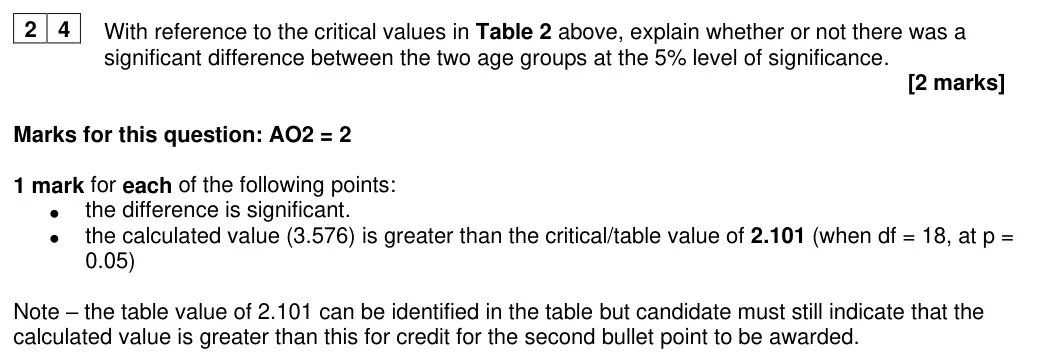
With reference to the critical values in Table 2 above, explain whether or not there was a
significant difference between the two age groups at the 5% level of significance.
[2 marks]
June 2024 · Paper 2 · Q25 3 marks AO2=3 Research methods inferential testing
2 5
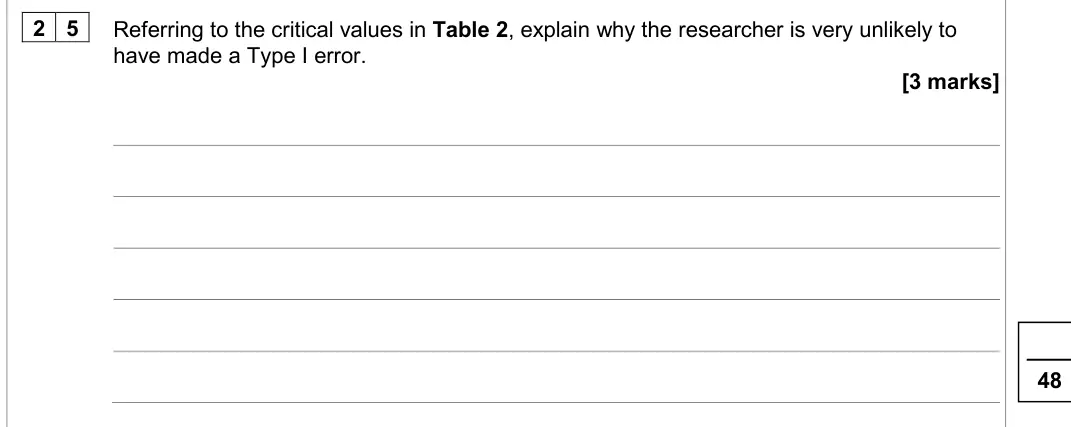
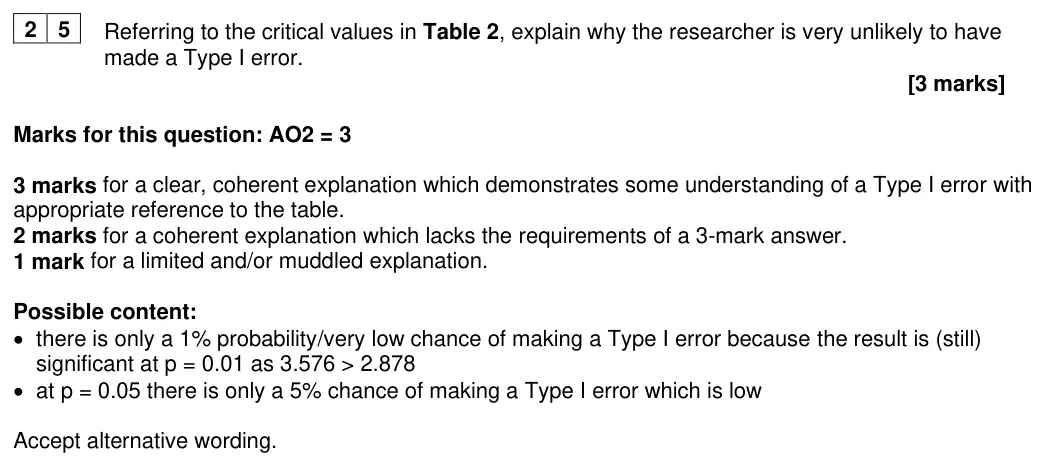
Referring to the critical values in Table 2, explain why the researcher is very unlikely to
have made a Type I error.
[3 marks]

Work with an AQA psychology tutor

Want a paper marked and gone through with you? Message us.

Prefer email? Send an enquiry

If you are under 18, please include a parent's contact details. Enquiries go to enquiries@alevelpsychologytutor.com and are deleted once handled. All tutoring is online.