Examiner's comment
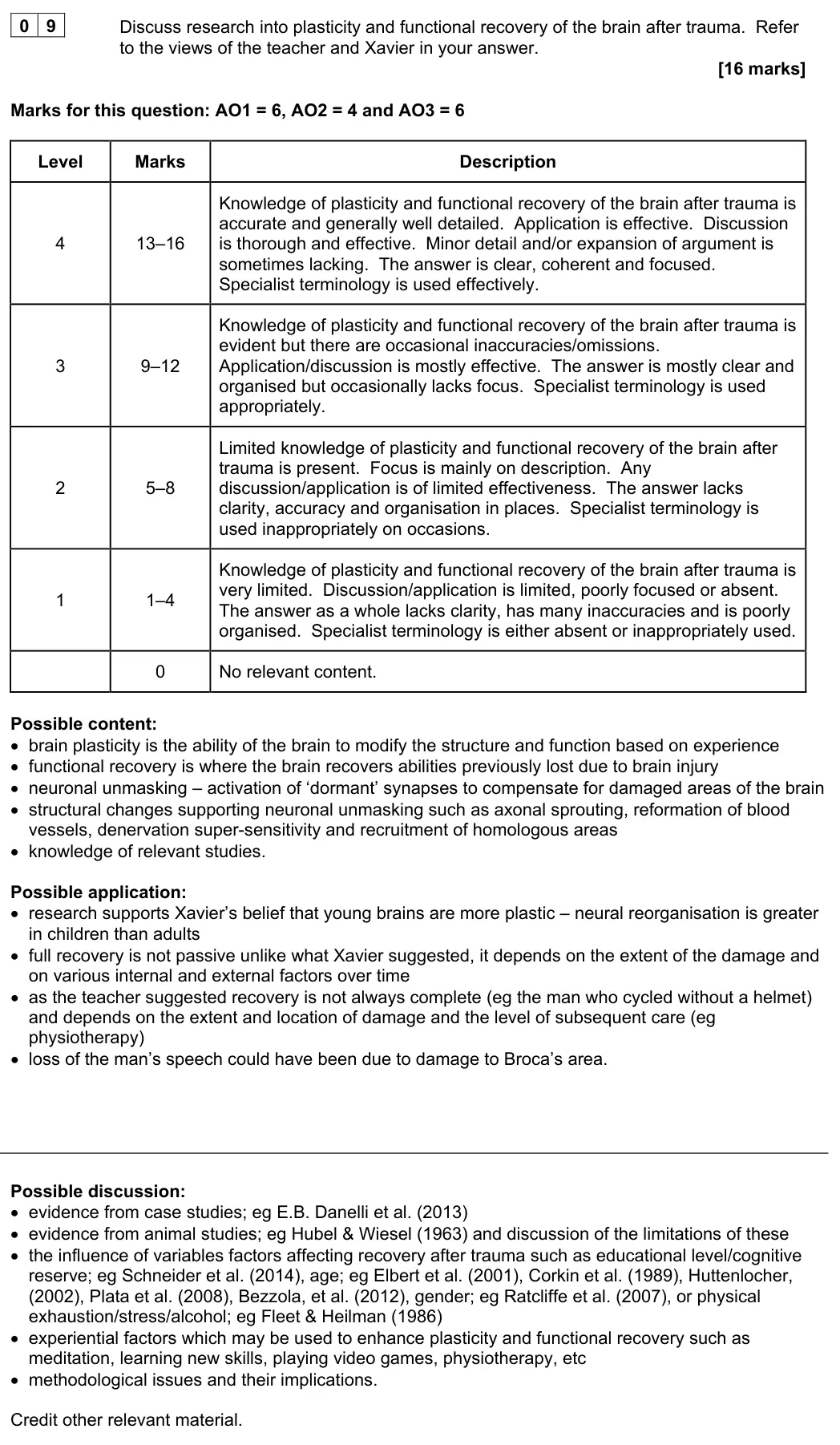
Students appeared well-prepared for this question, and a wealth of material was produced. The full range of marks was awarded, and marks were well-distributed. It was a good differentiator between students who can recall a prepared answer (or related content) and those who have developed an understanding of the topic and can use their knowledge flexibly to demonstrate their understanding and answer the question fully and holistically. Many students struggled to relate their chosen studies to the question, or did so inappropriately, eg Phineas Gage was often provided as a good example of recovery from trauma. Better answers used studies effectively and evaluated their contributions, but only a few students were able to explain the impact of this on our understanding of plasticity and functional recovery of the brain after trauma. There were some very impressive answers, which demonstrated a real depth and breadth of knowledge and use of research evidence. Effective application was sophisticatedly woven throughout the response. However, application appeared to be a surprisingly challenging skill, potentially fuelled by students relying on prepared material for this question and a lack of ability to use their knowledge flexibly and select studies appropriately to fit the question stem. Many provided application which merely repeated what was given in the question stem, although most students were able to link the inability to produce speech to likely damage in Broca’s area. There was some lack of focus seen where responses concentrated on localisation of function without relating this to plasticity, potentially because of past paper practice on localisation of function. The volume of detailed information recalled (including relevant studies) was very impressive. However, students should be aware that it is often not the volume of material presented but how effective it is which determines the overall mark; with application needing to be discussed appropriately to demonstrate their understanding of the topics and issues within these. Limited responses often described plasticity as changes to the brain, and functional recovery as the brain recovering from an accident or stroke, without further detail. More able students were able to explain the processes involved in functional recovery. Many knew axonal sprouting, reformation of blood vessels and recruitment of homologous areas. The better responses knew several research studies to support their points. Students often knew a wealth of information and research studies, but focussed on describing rather than discussing how this material supported or refuted the arguments posed and/or related to the question stem. This limited effectiveness. Most responses described Maguire et al.’s (2006) taxi driver study with varying degrees of accuracy. Better responses were able to explain how this provided strong evidence for plasticity in adults, not just for young people, therefore disputing Xavier’s comments. Likewise, the Bezzola et al. (2012) golfing study was often discussed effectively as evidence for plasticity at any age, with Schneider et al.’s (2014) cognitive reserve study discussed in relation to the number of years of education being lower the younger Xavier was, and thus the potential for disability free recovery. Occasionally phantom limb research was discussed in terms of plasticity in somatosensory cortex, and thus the counterargument to Xavier being unaffected because he was young.