June 2018 · Paper 2 · Q11 markAO1=1Multiple choiceapproaches
Answer
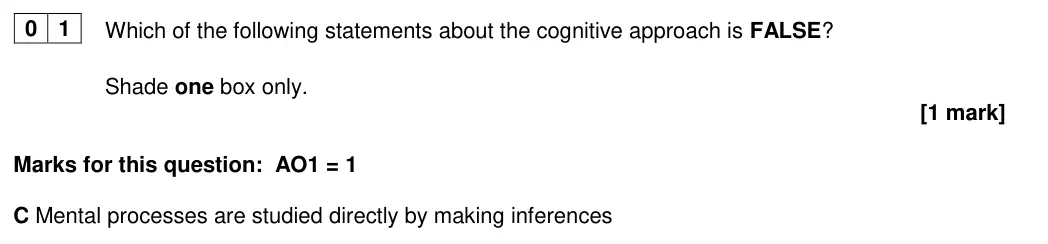
C
Mark scheme, including level descriptors and indicative content
Examiner's comment
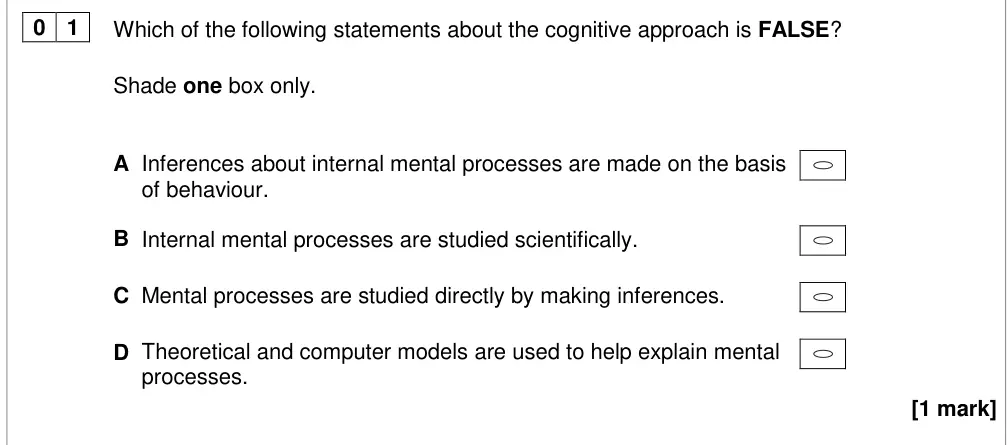
This question was answered correctly by just under half of the students. The distractors worked well to distinguish those who understood the cognitive approach as opposed to those who had just learned the definition of the approach, with incorrect answers representing all the alternative choices.
Notes from the mark scheme and report
false statement is C (mental processes are studied indirectly by inference)
just under half correct, all distractors chosen
option D wording 'theoretical and computer models' reworded to 'the use of models' in v1.4
June 2018 · Paper 2 · Q24 marksAO1=4Explainapproaches
Mark scheme, including level descriptors and indicative content
Examiner's comment
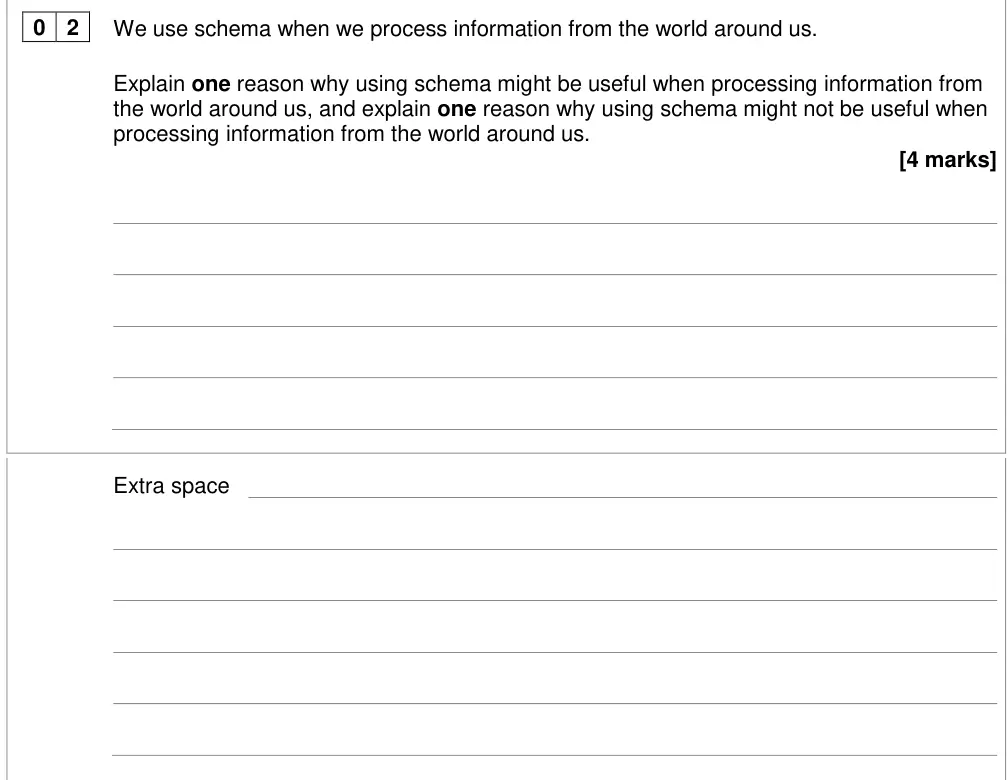
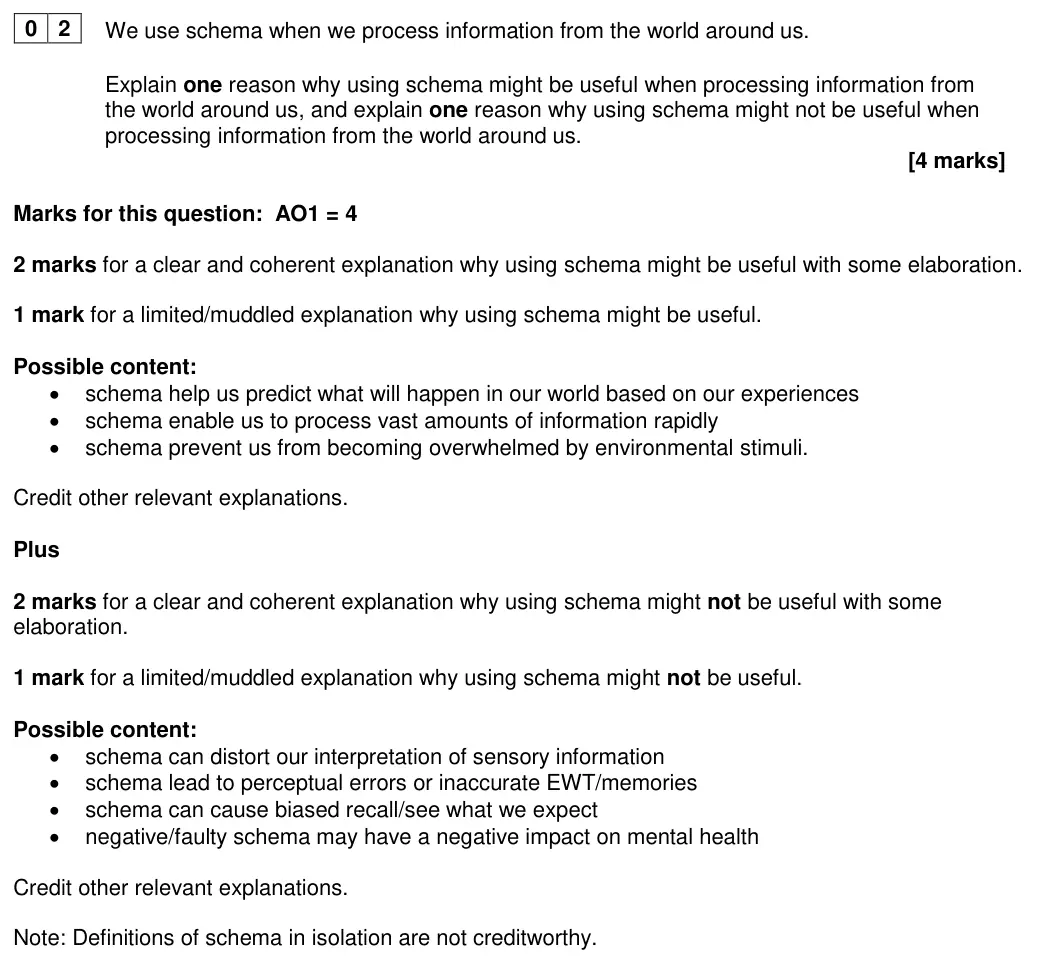
This question was reasonably well answered, although students were generally better at explaining why schemas might not be useful, with some good examples drawn from EWT and some on negative self-schema and depression. Unfortunately, the strengths were weaker and often gave little beyond definitions.
Notes from the mark scheme and report
2 marks why useful (prediction, rapid processing, not overwhelmed) + 2 marks why not useful (distortion, inaccurate EWT/recall, negative schema and mental health)
definitions alone not creditworthy
strengths often weak
June 2018 · Paper 2 · Q33 marksAO1=1, AO2=2ApplicationEasyapproaches
Mark scheme, including level descriptors and indicative content
Examiner's comment
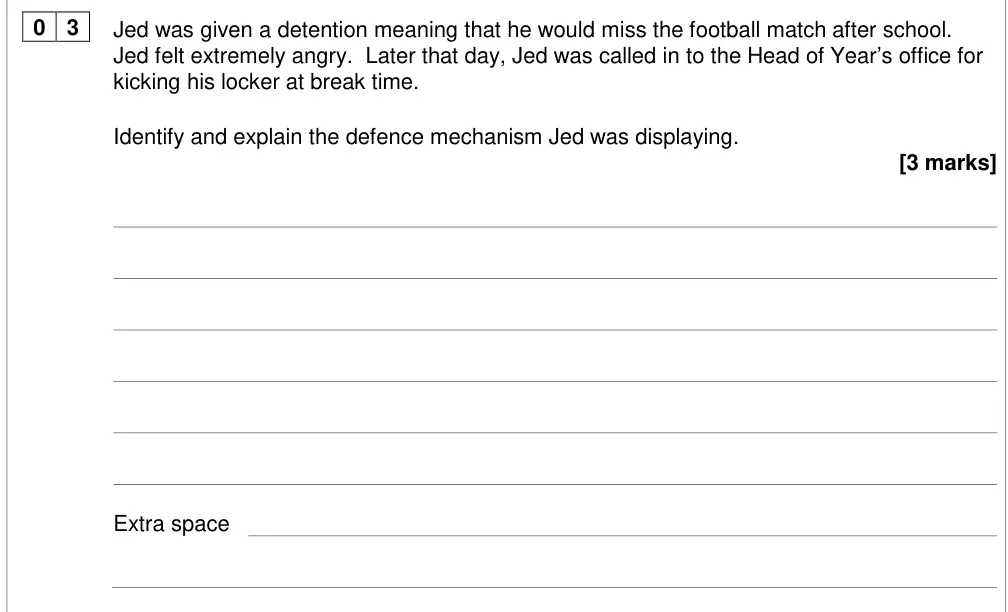
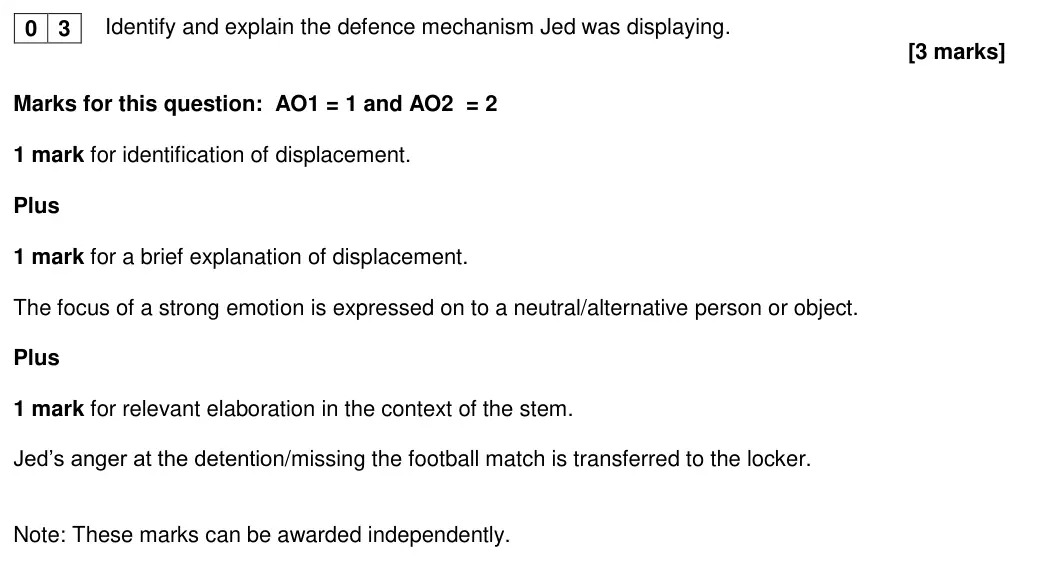
This question was generally well answered with just under half of the students achieving full marks. There were very few incorrect defence mechanisms presented and application was clear, however, explanations were sometimes limited. Teachers should remind students to explain terms fully, ie not using the term ‘displace’ to describe what ‘displacement’ means.
Notes from the mark scheme and report
1 mark displacement + 1 mark explanation (emotion redirected to a neutral object) + 1 mark application (anger at detention transferred to locker)
marks independent
using 'displace' to define displacement not enough
June 2018 · Paper 2 · Q416 marksAO1=6, AO3=1016-mark essayapproaches
Mark scheme, including level descriptors and indicative content
Examiner's comment
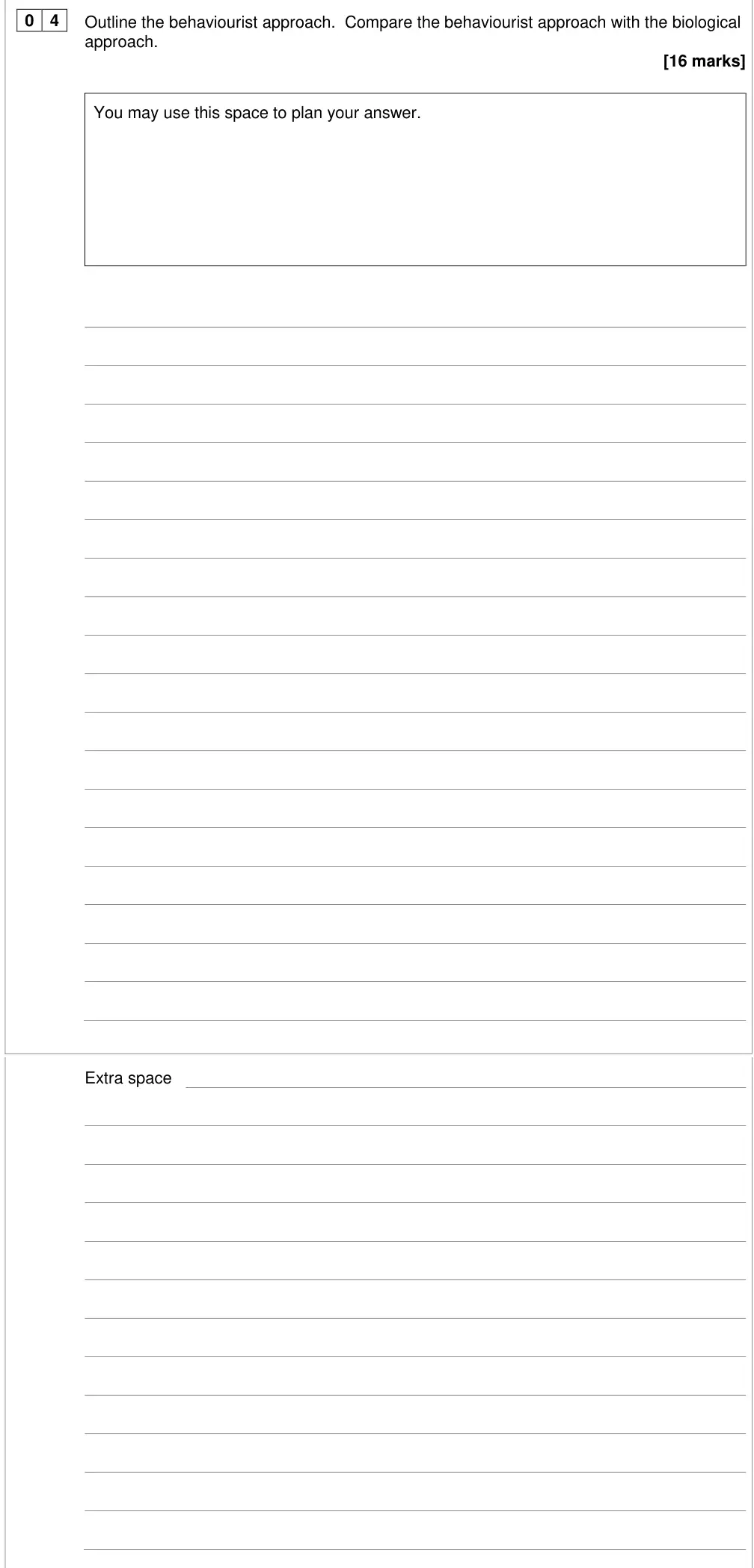
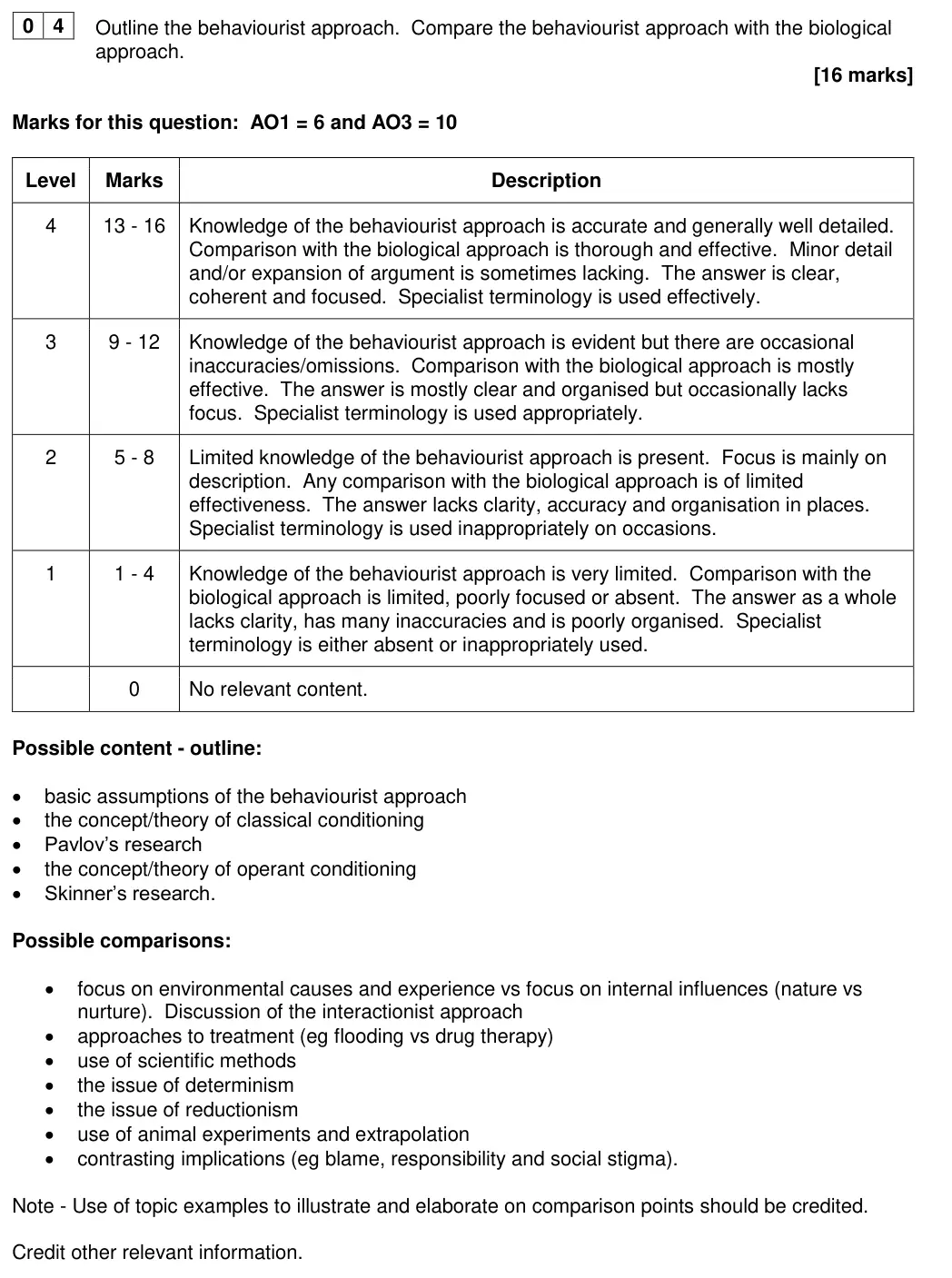
Overall this question was well answered with some impressive responses. Students appeared to be well prepared, demonstrating good, detailed knowledge of classical and operant conditioning and of Pavlov and Skinner’s research, with stronger students outlining general assumptions upon which the approach is founded. Some schools/colleges appear to be teaching all the learning approaches together rather than distinguishing between the behaviourist approach and social learning theory therefore many students incorrectly included the social learning theory in their outline of the behaviourist approach. The comparisons given were variable. Whilst there were some excellent, well discussed and effective comparisons, weaker students exposed their limited knowledge of the approaches and terminology in the inappropriate comparisons given. A worrying number of students claimed that the biological approach does not use animals in their research and poses no ethical issues. Furthermore, some claimed the behaviourist approach focusses on free will and is subjective and unscientific in its methodology. Understanding of reductionism was often limited and nature and nurture were frequently muddled. The most successful comparisons tended to focus their discussion around determinism and comparing and contrasting explanations and treatments for phobias. Unfortunately, many students provided pre-learned essays, focussing on outlining and evaluating the approaches, as opposed to providing effective comparison. This meant that students often wasted time providing a wealth of material which lacked relevance but could have easily been rearranged to provide effective comparison.
many wrote pre-learned outline/evaluate essays rather than comparisons
June 2018 · Paper 2 · Q51 markAO1=1Short answerMediumbiopsychology
Mark scheme, including level descriptors and indicative content
Examiner's comment
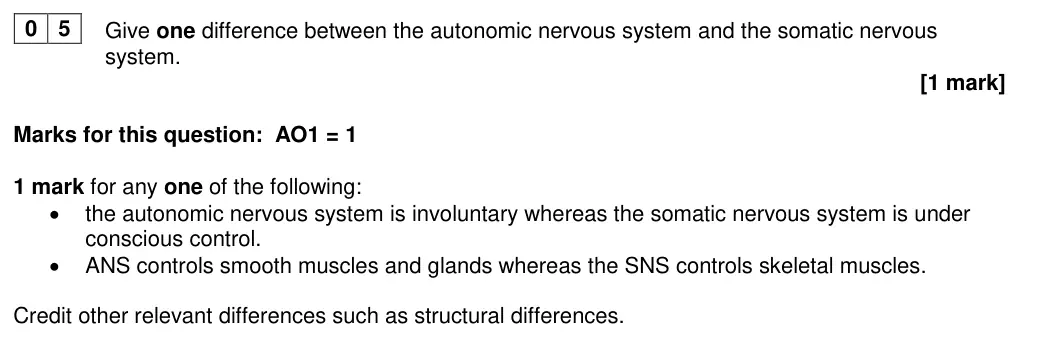
This question provided another opportunity to distinguish understanding as opposed to rote learning with just over half of students achieving the mark. There was generally little understanding of the divisions of the nervous system, with many relying on structural differences or muddling functional differences.
Notes from the mark scheme and report
autonomic involuntary vs somatic voluntary, or smooth muscles/glands vs skeletal muscles
just over half correct
June 2018 · Paper 2 · Q63 marksAO1=3Short answerEasybiopsychology
Mark scheme, including level descriptors and indicative content
Examiner's comment
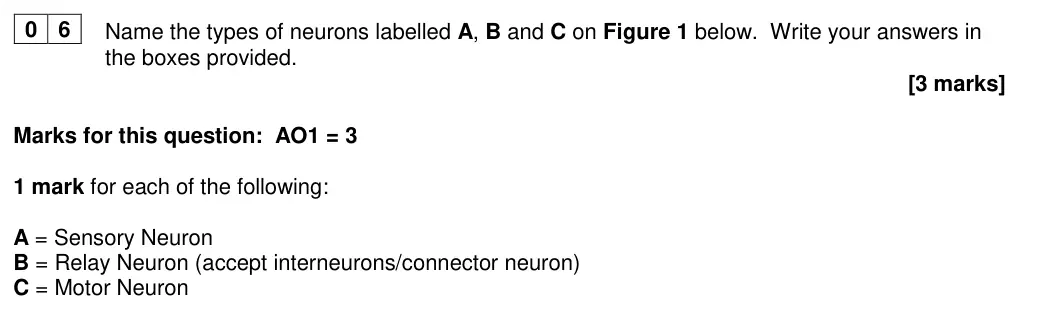
This question was generally well answered with over 80% of students achieving full marks.
Notes from the mark scheme and report
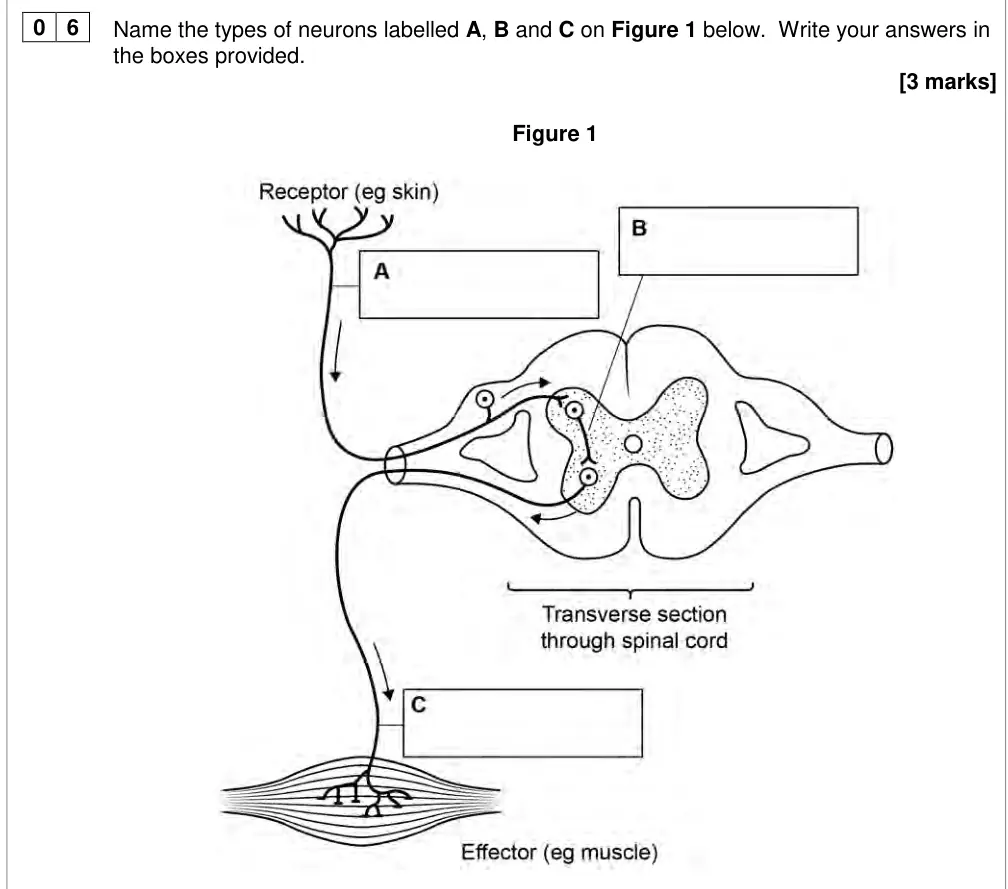
A sensory, B relay (interneuron/connector accepted), C motor, from Figure 1
over 80% full marks
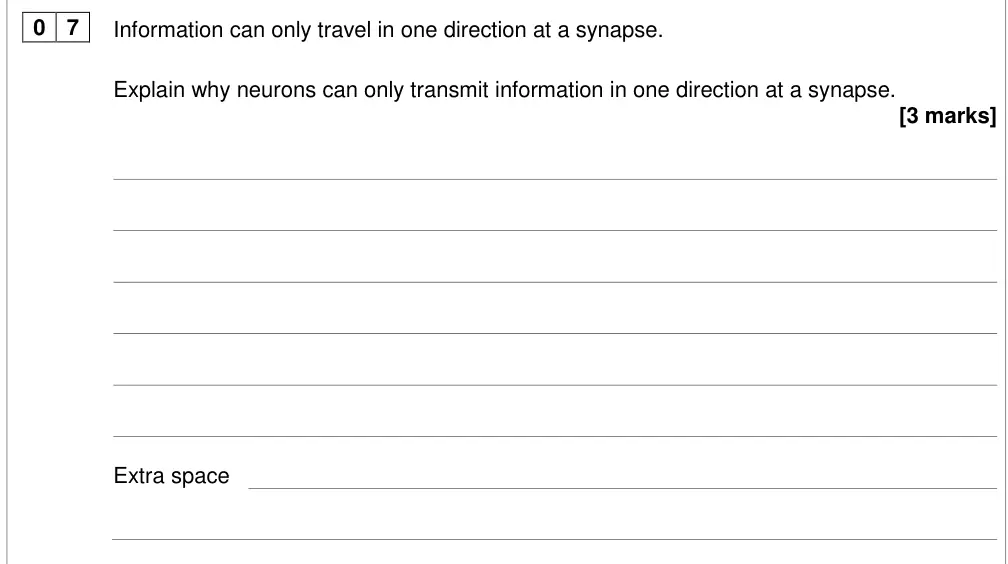
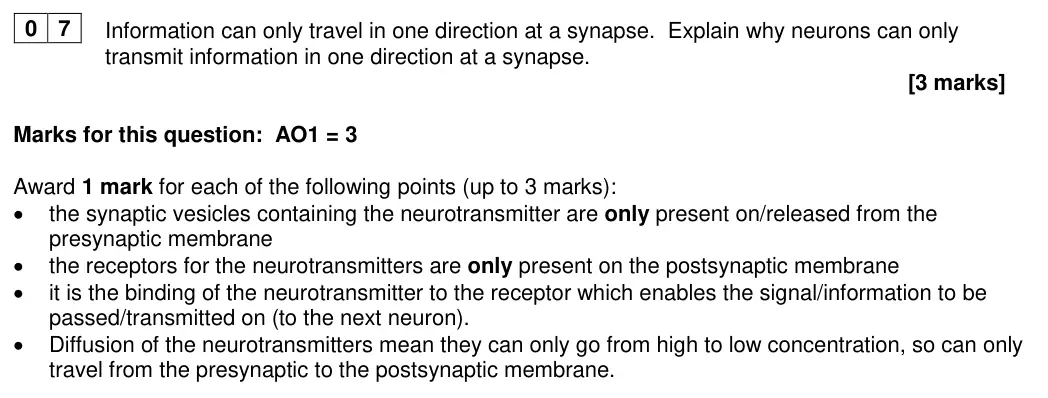
June 2018 · Paper 2 · Q73 marksAO1=3Explainbiopsychology
Mark scheme, including level descriptors and indicative content
Examiner's comment
This question provided an excellent discriminator between students who could recall the process of synaptic transmission and those who genuinely understood the process. A very small number of clear and detailed responses demonstrated sound understanding, but too many students simply explained synaptic transmission instead of using their knowledge to answer the question. Many attempted to address the question but muddled terminology, such as the pre- and post-synaptic membrane, preventing them from achieving the marks. Overall, it appeared that students are learning the required knowledge and terminology but do not understand it well enough to be able to use their knowledge flexibly. Some students gave a biological explanation of why information passes in one direction within a neuron rather than between neurons, focusing on why action potentials are unidirectional, with reference to refractory periods, voltage-gated ion channels and hyperpolarisation. Understanding of the process of synaptic transmission is an area that perhaps teachers need to look at more in the classroom and students should always be prepared to apply their knowledge to explain unfamiliar contexts.
Notes from the mark scheme and report
1 mark each: vesicles only in presynaptic terminal, receptors only on postsynaptic membrane, binding passes the signal, diffusion high to low
many just described synaptic transmission or explained one-way conduction within a neuron
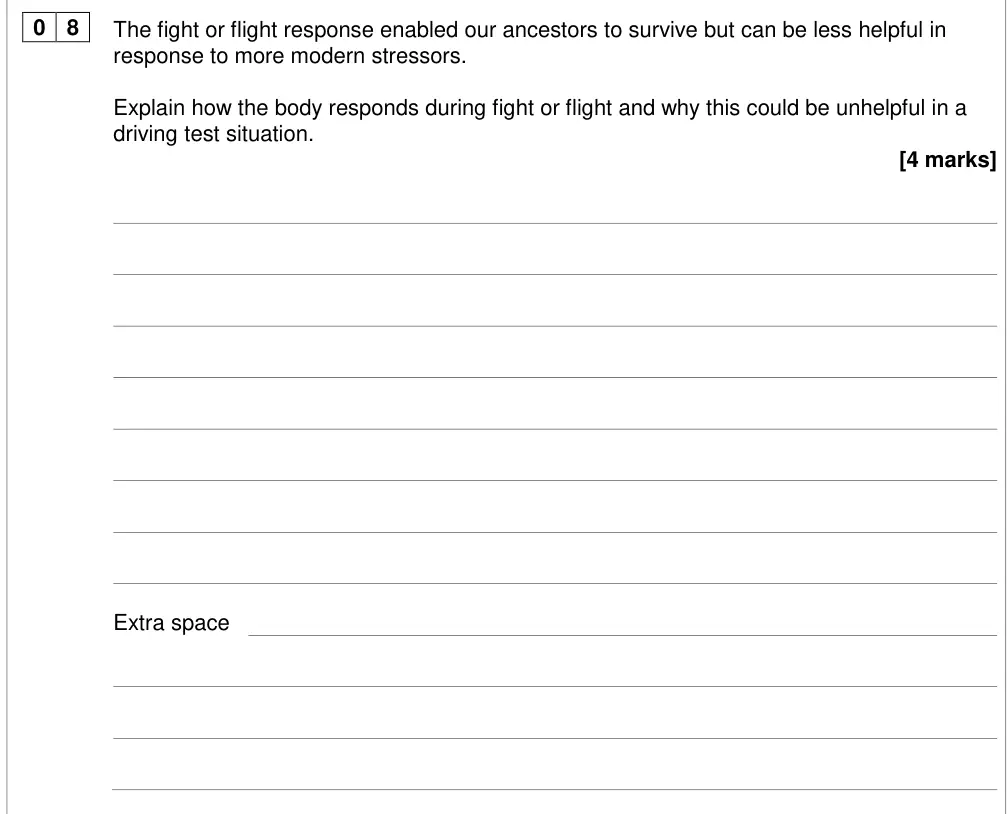
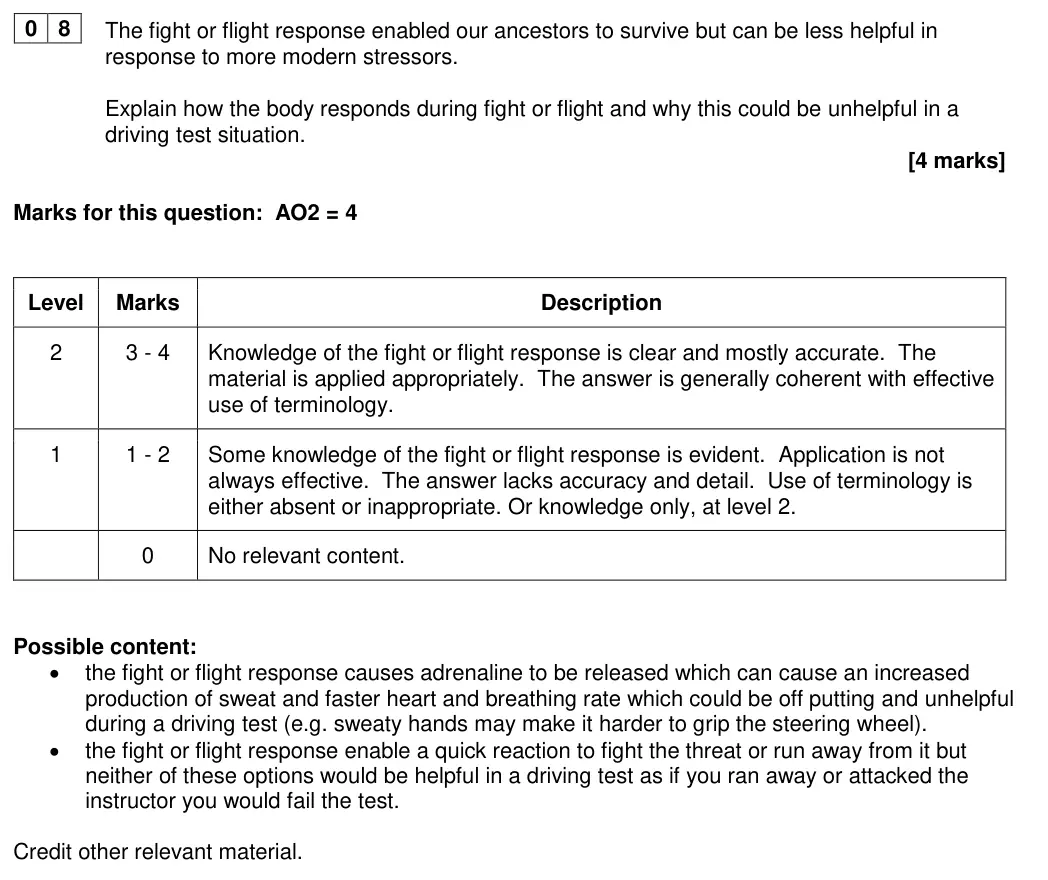
June 2018 · Paper 2 · Q84 marksAO2=4Applicationbiopsychology
Mark scheme, including level descriptors and indicative content
Examiner's comment
Generally, students seemed to have secured a good knowledge of how the body responds during the fight or flight response but struggled to apply it to the real world. The explanations of the response were generally accurate and often well detailed, although frequently included or were muddled, with reactions to chronic stress. Overall, the application was less successful, with a lot of general comments such as, ‘raised heartbeat would make you nervous/panic’. Many focussed on potential cognitive impairments which were more challenging to link to the way the body responds during fight or flight. Occasionally, students described why the body response would be helpful. Where application was done well, students generally referred to the problems of sweaty palms gripping the wheel, issues of feeling sick due to blood being diverted away from your digestive system and erratic movements.
Notes from the mark scheme and report
adrenaline effects (sweating, heart rate, breathing, digestion) + why unhelpful in a driving test (sweaty hands on wheel, fighting/fleeing would fail)
knowledge only = max Level 1
muddled with chronic stress
general 'makes you nervous' comments
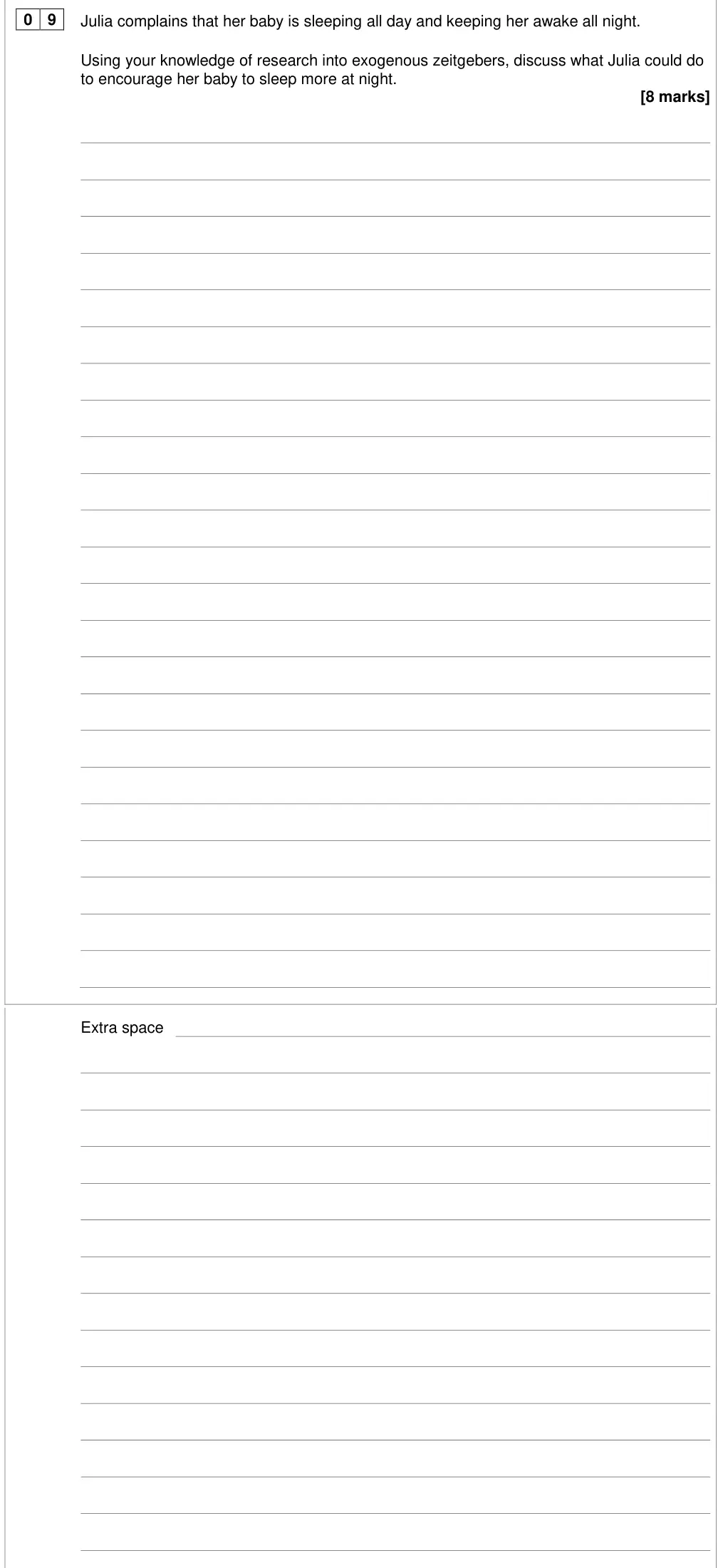
June 2018 · Paper 2 · Q98 marksAO1=3, AO2=2, AO3=3Extended writingOld spec only
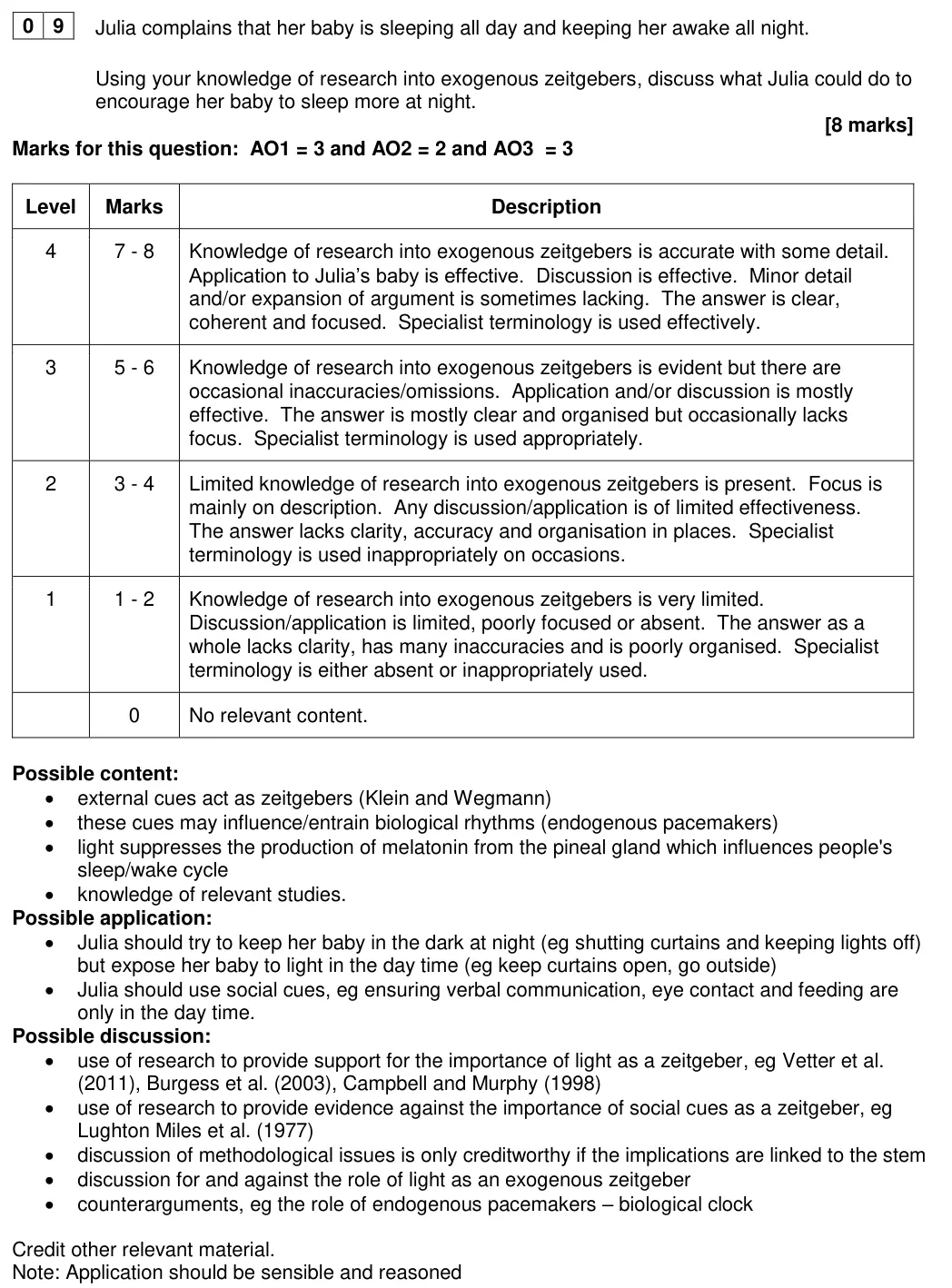
Not on the 2025 specification: exogenous zeitgebers and endogenous pacemakers in the sleep/wake cycle, biological rhythms removed in v1.4
Mark scheme, including level descriptors and indicative content
Examiner's comment
There were some excellent responses but generally this question was not answered very well. Overall, students tended to be less knowledgeable in this area, with answers focussed mainly on application, but this was not always appropriate. There was some excellent knowledge of studies but these were often inappropriately selected or not used effectively. Some students gave a lot of biological detail of endogenous pacemakers and made this relevant though entrainment. Light as an exogenous zeitgeber was generally applied well and often supported with biological knowledge of the effects of light on the production of melatonin; although some students mistakenly suggested trying to replicate daytime conditions at night time with night lights, etc. Students struggled more with temperature, suggesting the baby should be kept warm and cosy, and with social cues, which frequently led into learning / classical conditioning or focussed on tiring the baby out with activities. Discussion was the weakest element overall, with a lot of time wasted on generic evaluations and often research which could have provided excellent discussion, was simply described. Where discussion was done well, students tended to provide counterarguments of the role of endogenous pacemakers and compared contrasting research findings. Some students also effectively discussed issues with generalising from adults to babies and/or animals to humans. The best responses were those which were able to provide a sophisticated blend of application and discussion with knowledge intertwined throughout.
Notes from the mark scheme and report
Off-spec: exogenous zeitgebers and endogenous pacemakers in the sleep/wake cycle, biological rhythms removed in v1.4
light/melatonin and social cues applied to Julia's baby
discussion weakest element
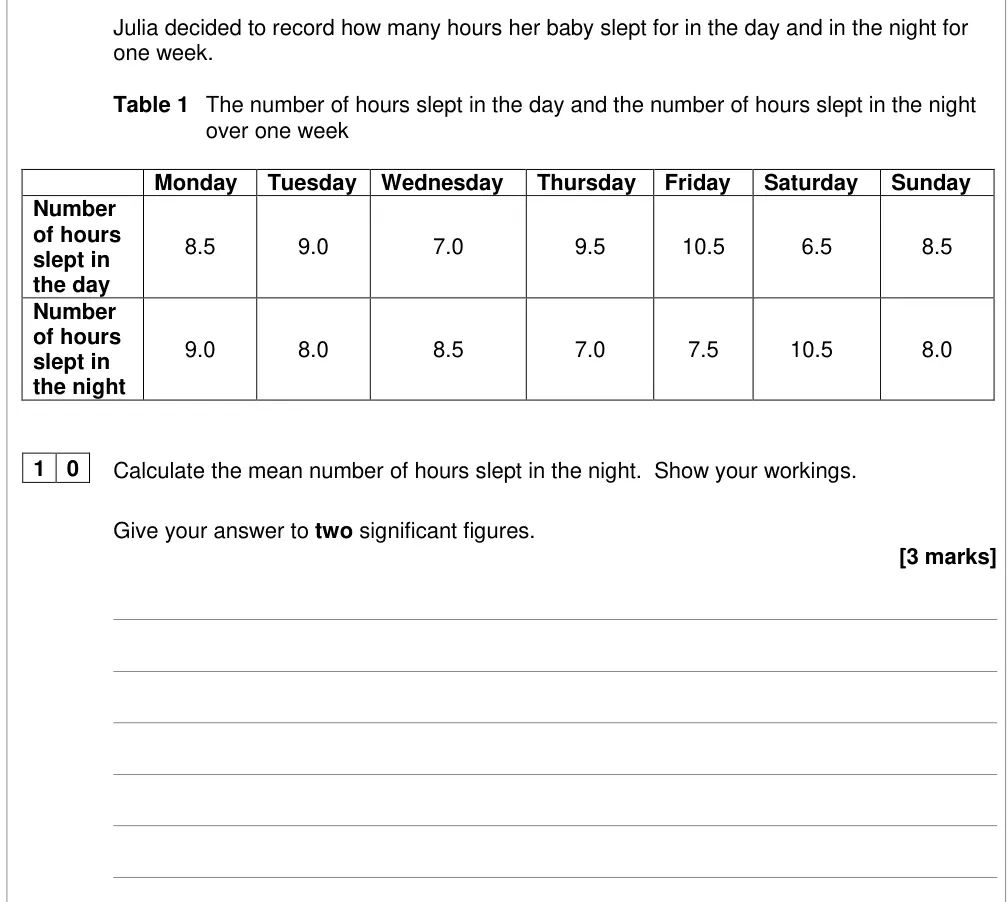
June 2018 · Paper 2 · Q103 marksAO2=3CalculationEasydata handling
Mark scheme, including level descriptors and indicative content
Examiner's comment
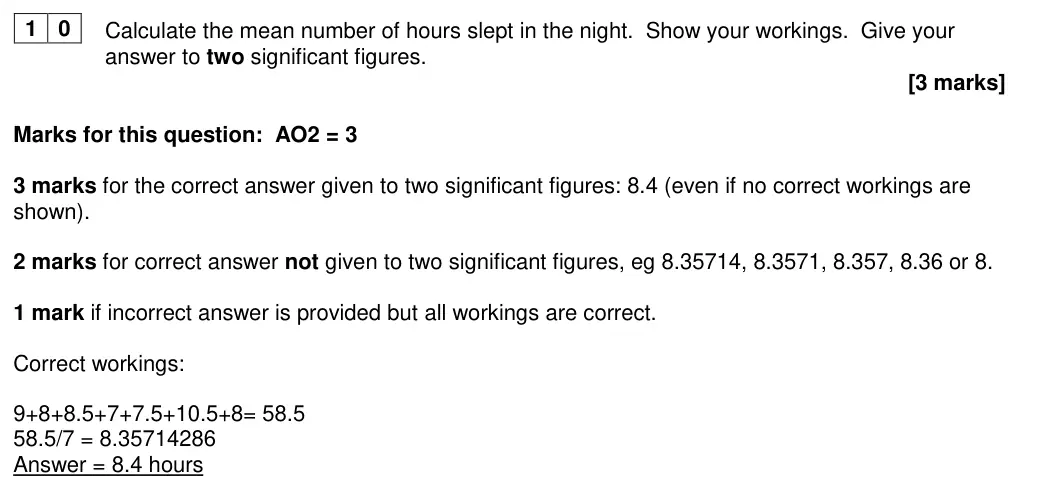
Generally this question was answered well, with over half of the students achieving all three marks available. The vast majority of students showed all the correct workings but many did not know what two significant figures meant, with many answers being given to two decimal places or students missing marks due to incorrect rounding up. Unfortunately, despite having all the correct workings, some students gave the wrong answer due to incorrect mental arithmetic. Students should be reminded to use a calculator to check their workings and save them time in the examination.
Notes from the mark scheme and report
58.5/7 = 8.4 hours (2 s.f.)
2 marks if not 2 s.f.
1 mark wrong answer with correct workings
many gave 2 d.p. or rounded wrongly
June 2018 · Paper 2 · Q112 marksAO2=2Research methodsMediumdata handling
Mark scheme, including level descriptors and indicative content
Examiner's comment
Although there were some strong responses, students generally found this harder than anticipated, with nearly one third of students failing to achieve any marks. The majority of responses given were muddled or limited, achieving only 1 mark.
Notes from the mark scheme and report
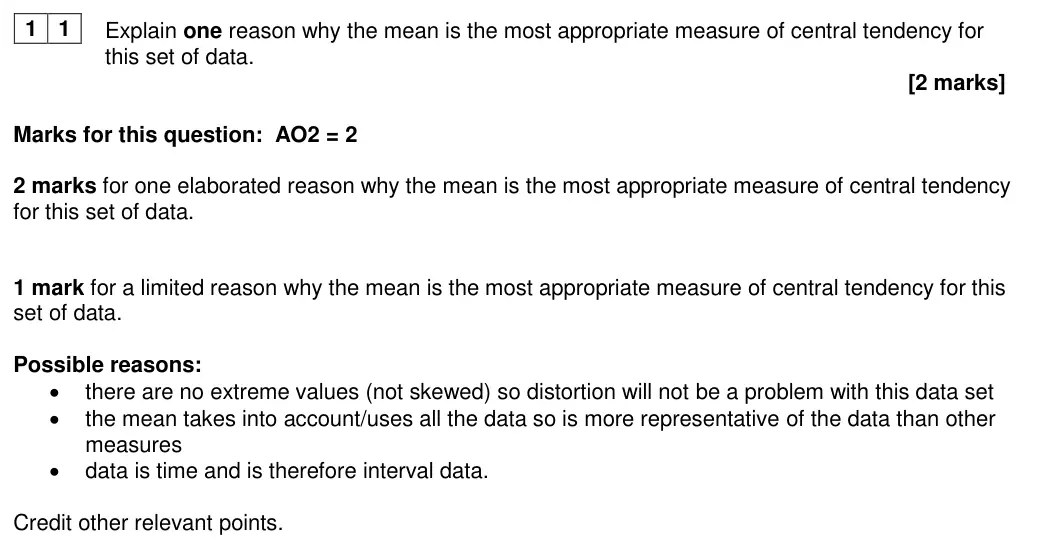
no extreme values/not skewed, uses all the data, time is interval data
nearly a third scored 0
June 2018 · Paper 2 · Q121 markAO2=1Multiple choicedata handling
Answer
C
Mark scheme, including level descriptors and indicative content
Examiner's comment
This question was answered correctly by the vast majority of students.
Notes from the mark scheme and report
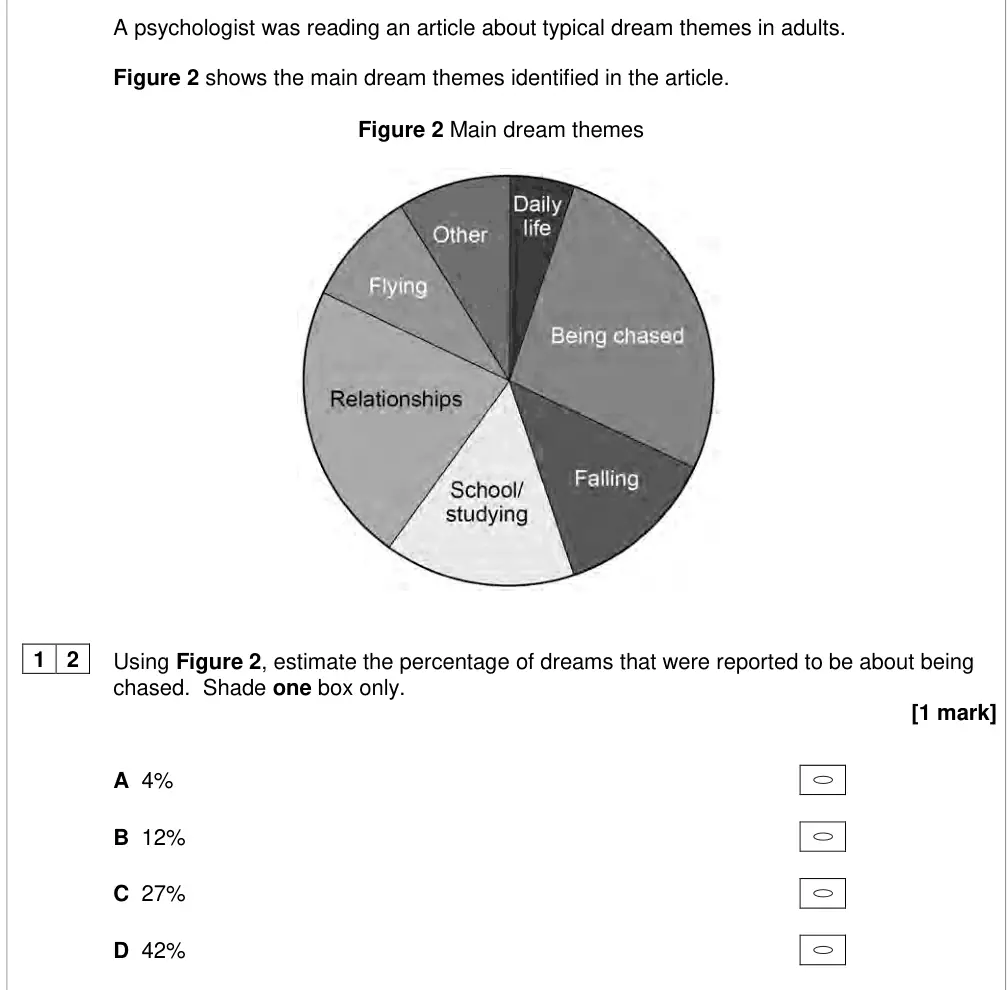
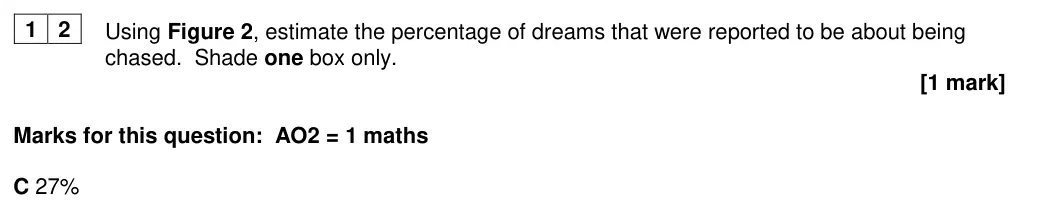
answer C 27% estimated from Figure 2
vast majority correct
June 2018 · Paper 2 · Q133 marksAO1=1, AO2=2Research methodsMediumscientific processes
Mark scheme, including level descriptors and indicative content
Examiner's comment
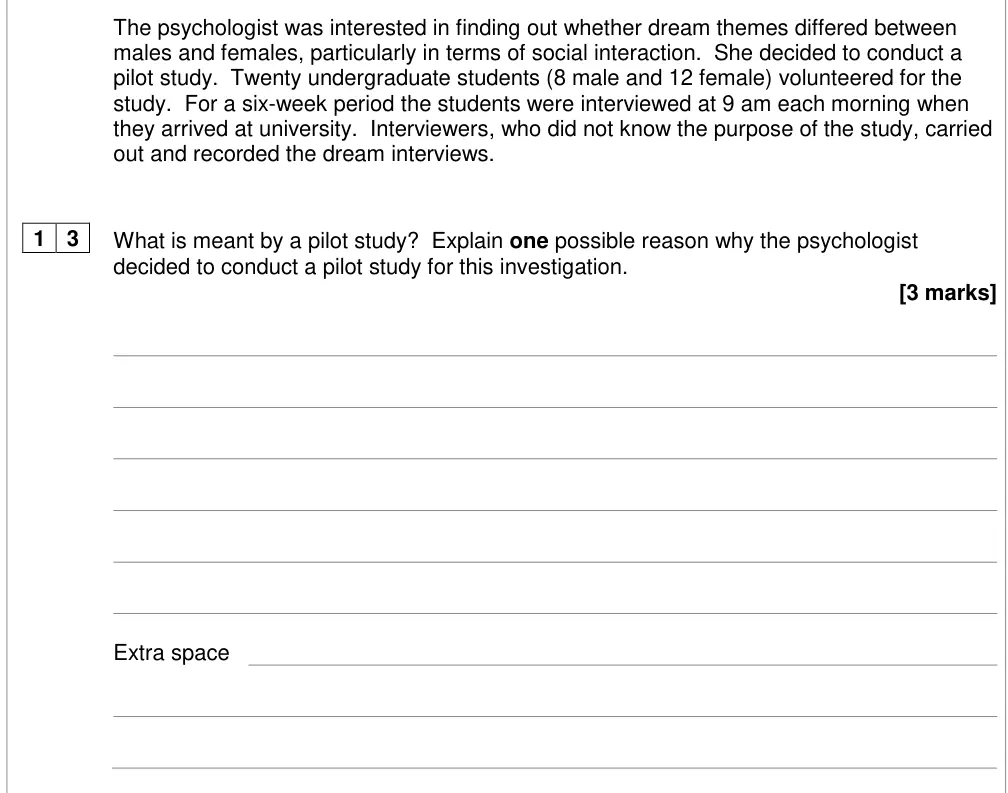
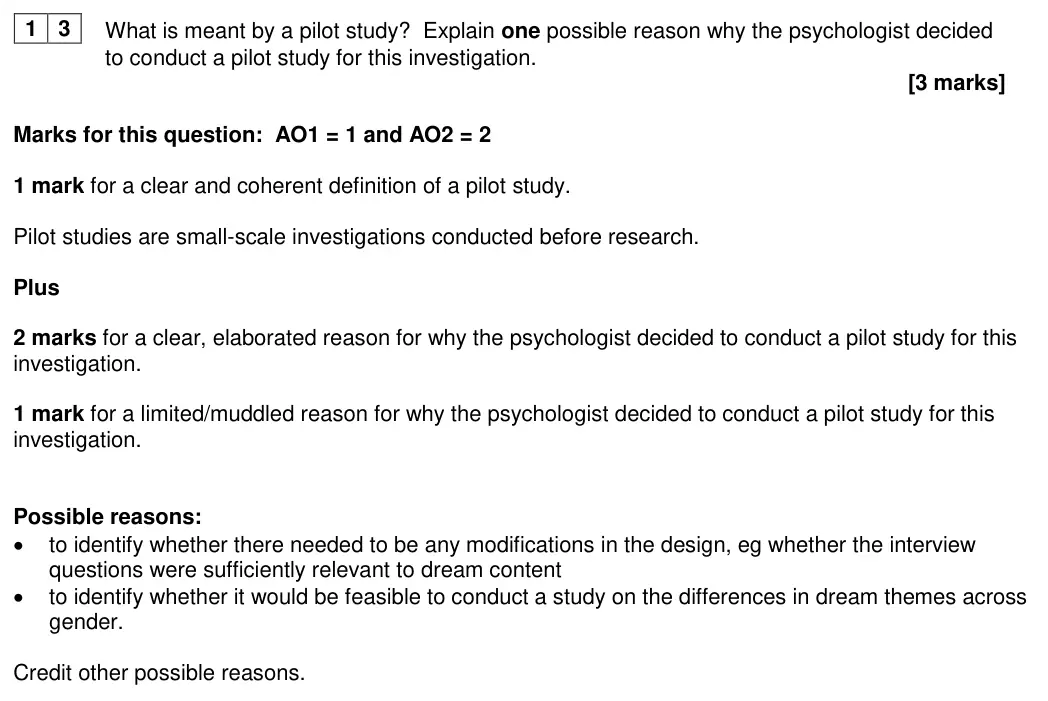
Most students understood what is meant by a pilot study, with the vast majority of students achieving at least 1 mark but only half of these students were able to provide a reason why a pilot study should be conducted in the context of the investigation, with many giving elaborated generic responses but unable to use their knowledge flexibly to apply it appropriately. Of the approximate one quarter of students achieving full marks, the most common route was to focus on whether participants would be able to recall their dreams by 9am each morning or whether the questions asked by the interviewers were clear and appropriate for gathering the necessary detail regarding dream themes.
Notes from the mark scheme and report
1 mark definition (small-scale trial run) + 2 marks reason applied (e.g. can participants recall dreams by 9 am, are interview questions appropriate)
generic elaborated reasons common
June 2018 · Paper 2 · Q142 marksAO1=1, AO2=1Research methodsdata handling
Mark scheme, including level descriptors and indicative content
Examiner's comment
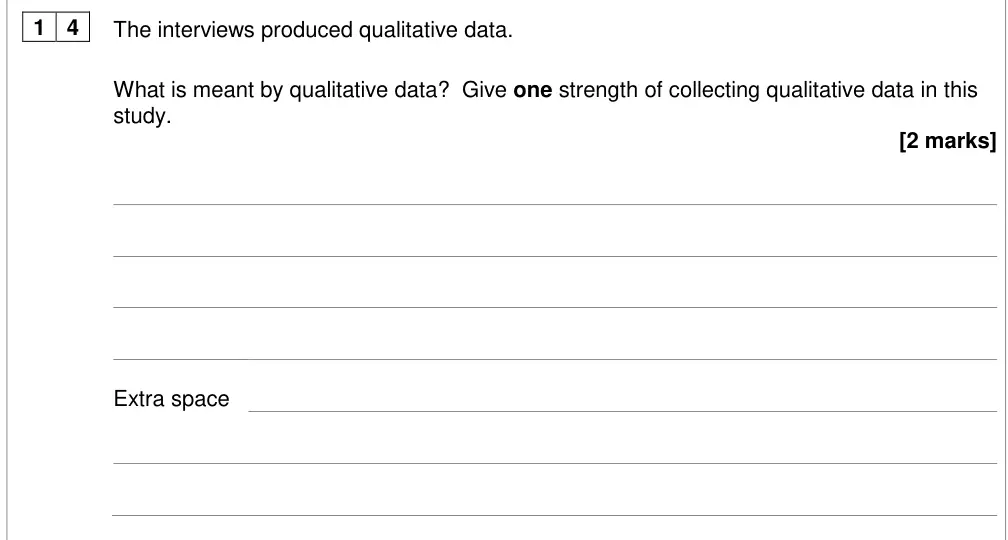
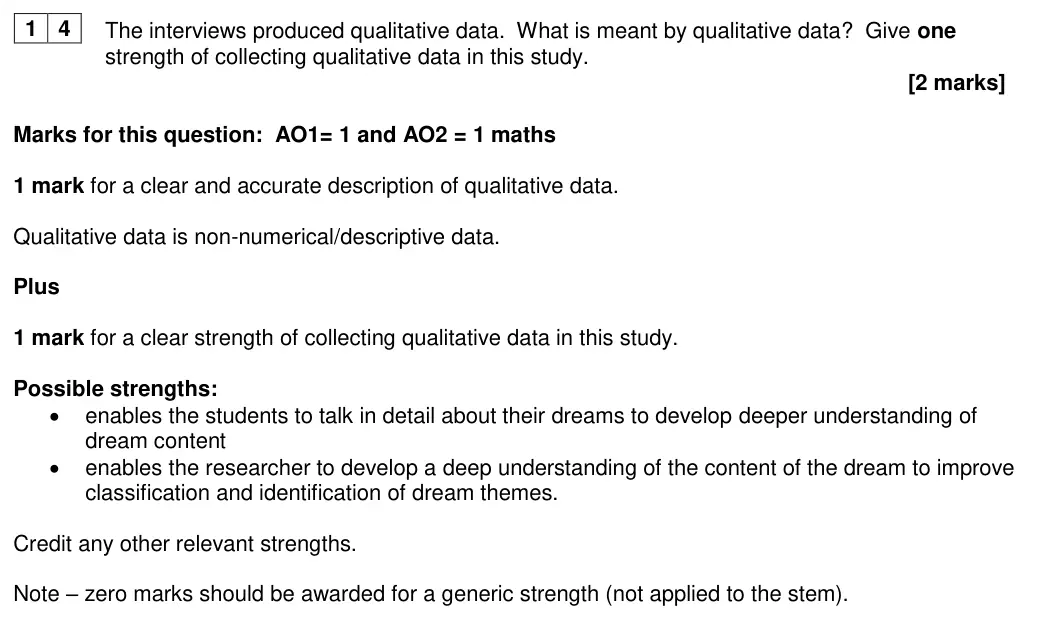
The vast majority of students were able to give an accurate description of qualitative data but less than half of these students were able to apply this to the practical scenario to gain the second mark. Many students wasted time giving generic strengths of collecting qualitative data.
Notes from the mark scheme and report
1 mark non-numerical/descriptive + 1 mark strength applied to dreams
generic strength = 0 for that mark
June 2018 · Paper 2 · Q153 marksAO1=1, AO3=2Research methodsHardscientific processes
Mark scheme, including level descriptors and indicative content
Examiner's comment
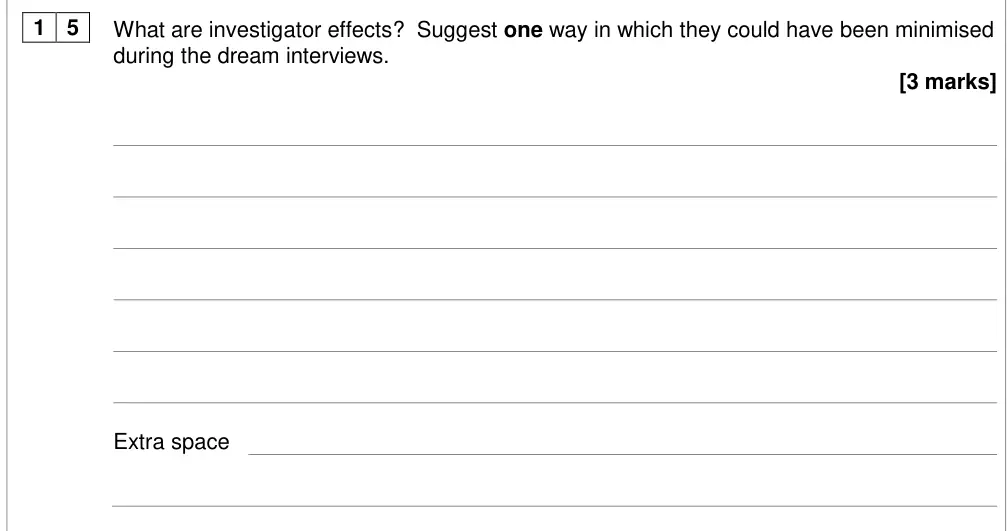
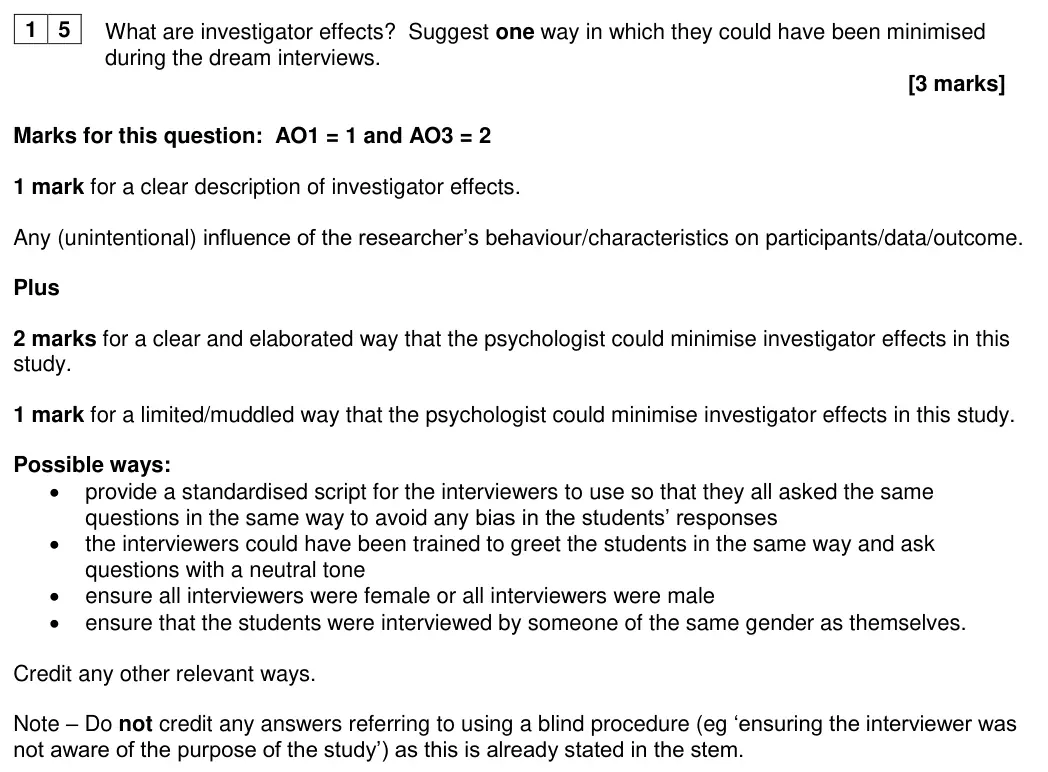
Overall, this question was poorly answered. Although over two thirds of students managed to give a description of investigator effects, it was clear that many students do not fully understand the term. Students often failed to distinguish between investigator effects and deliberate fraud with others muddling investigator effects up with demand characteristics or simply stating ‘the effects of the investigators’. Application was poor with less than a third of students achieving marks for their suggestions. Most common errors were to suggest employing a blind procedure despite the stem stating that interviewers ‘did not know the purpose of the study’. Students either did not read the stem material carefully enough or do not actually understand what a blind procedure is and therefore did not spot this in the stem but instead just provided a generic response to deal with issues in research.
Notes from the mark scheme and report
1 mark definition (unintentional influence of researcher) + 2 marks way to minimise (standardised script, neutral tone, same-gender interviewers)
blind procedure not credited as already in the stem (most common error)
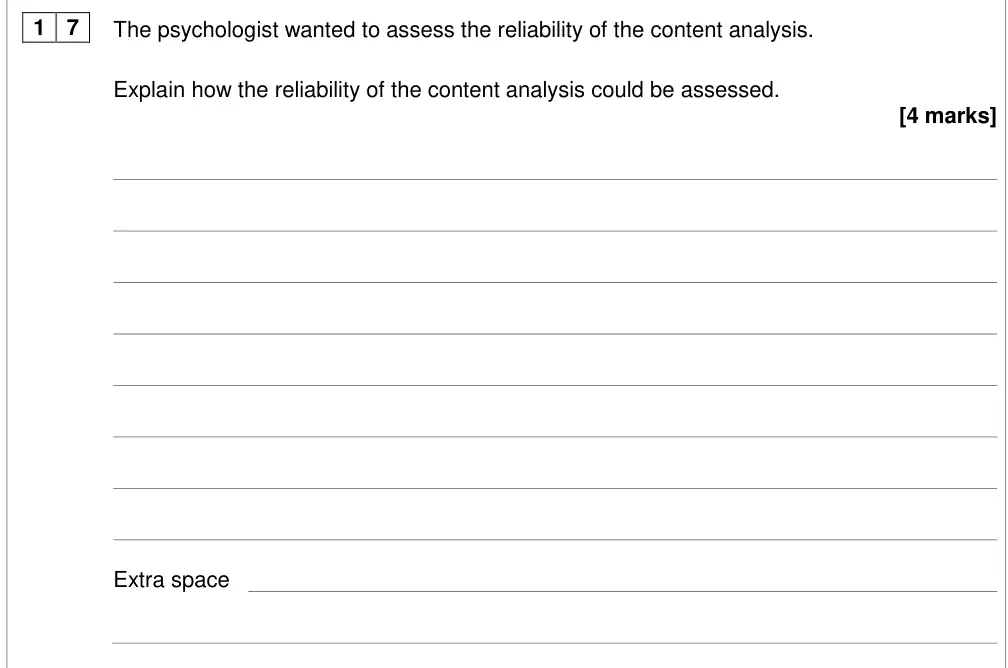
Mark scheme, including level descriptors and indicative content
Examiner's comment
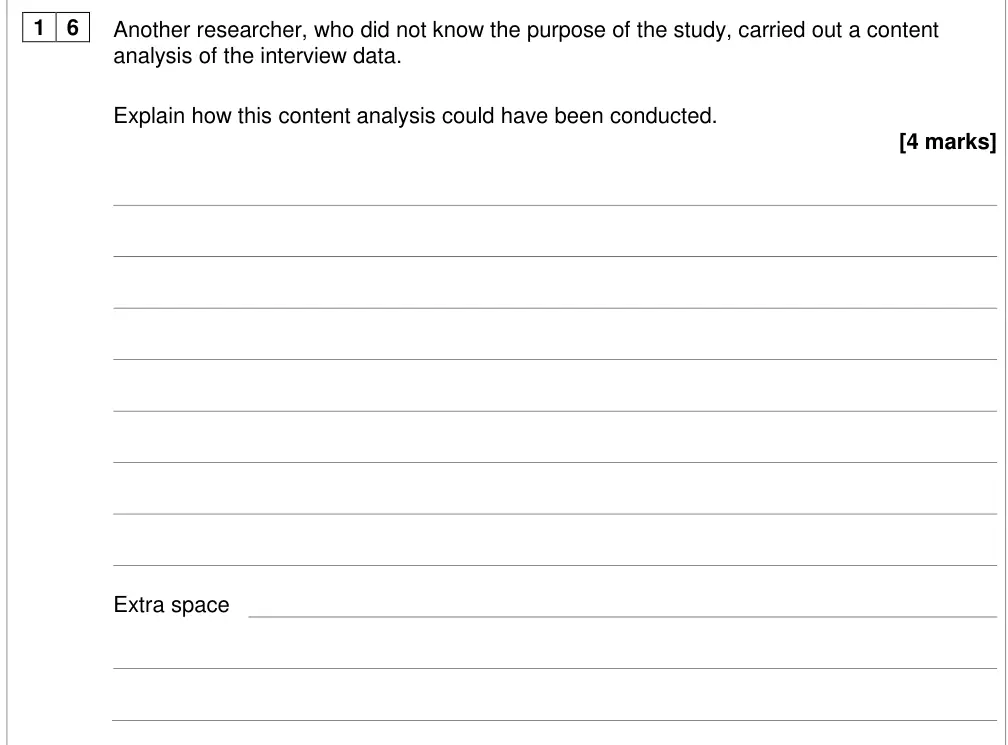
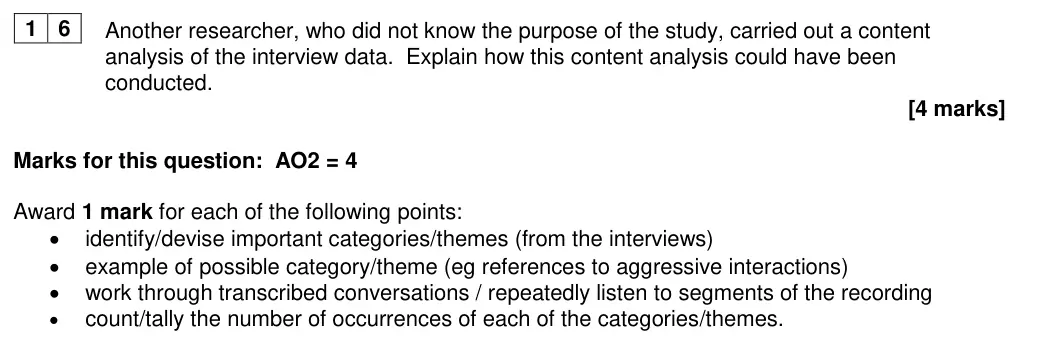
When students understood the concept of content analysis, this was well answered; however, over one third of students failed to achieve any marks. A worrying number of students had no idea what content analysis is, with students frequently describing correlational analysis, statistical analysis, concurrent validity, descriptive statistics and even peer review in an attempt to explain how the content (data) from an experiment could be analysed. Those that understood the term generally explained how occurrences of each category could be tallied, with better students able to explain how categories would be identified from the interview data and giving appropriate examples of these. A surprisingly small number of students seemed to have a sound practical understanding of how content analysis should be conducted and teachers should be encouraged to offer further opportunities for students to develop their understanding of content analysis through practical research.
Notes from the mark scheme and report
1 mark each: devise categories/themes, example category, work through transcripts, tally occurrences
over a third scored 0, many did not know what content analysis is
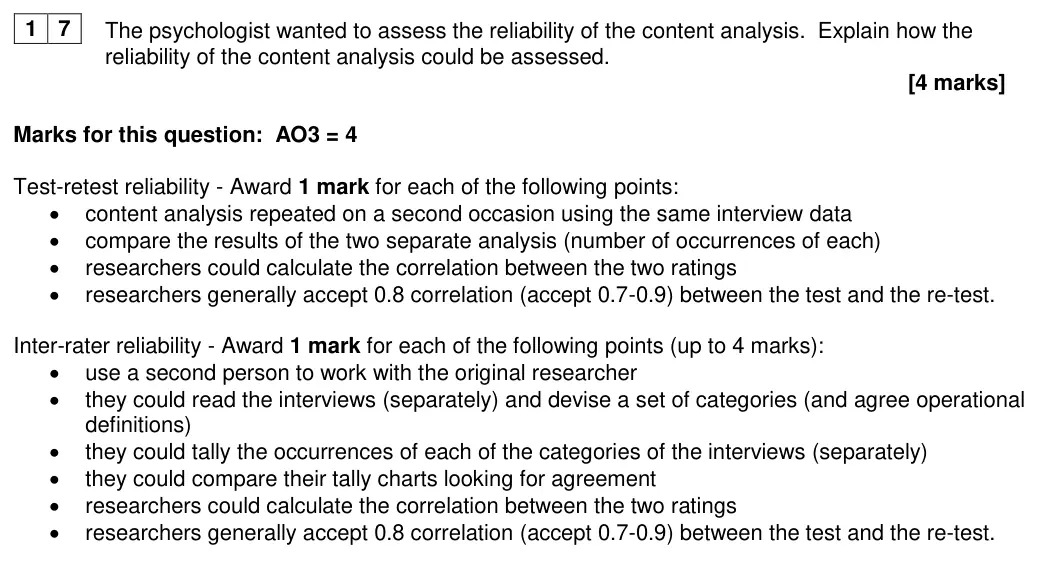
Mark scheme, including level descriptors and indicative content
Examiner's comment
Following on from question 16, those students who did not know what content analysis was focussed on how reliability of experiments could be improved more generally, focussing on repeating experiments, peer review or statistically analysing the results. Those who did understand what content analysis was often demonstrated excellent knowledge, although there was some muddle between test-retest and inter-rater reliability. Unfortunately some responses were poorly focussed, concentrating on how reliability can be ensured rather than assessed.
Notes from the mark scheme and report
test-retest or inter-rater: repeat/second coder, compare tallies, correlate, accept about +0.8
focus on ensuring rather than assessing reliability lost marks
muddle between test-retest and inter-rater
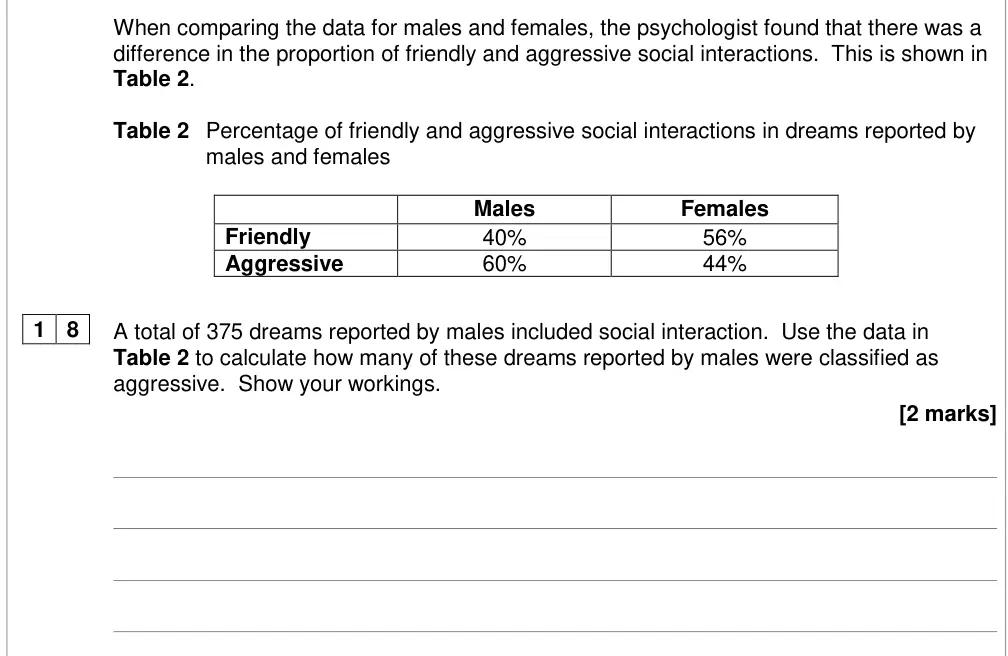
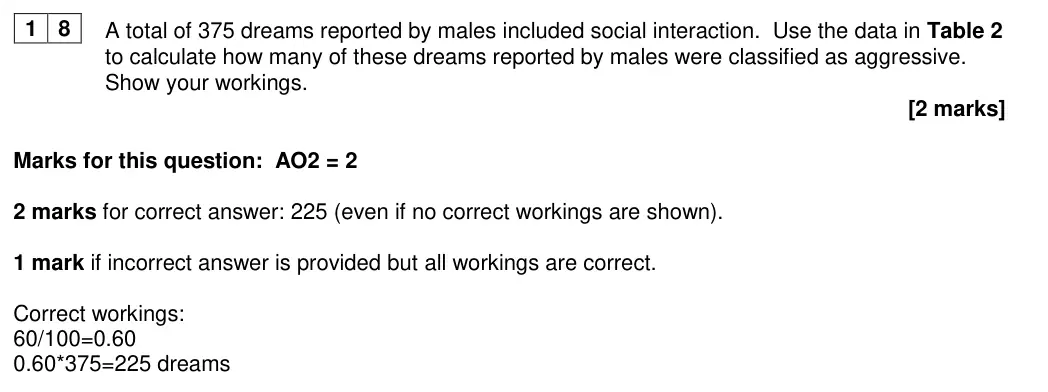
June 2018 · Paper 2 · Q182 marksAO2=2CalculationEasydata handling
Mark scheme, including level descriptors and indicative content
Examiner's comment
This question was well answered with the vast majority of students achieving full marks. Those students who lost marks generally lost them due to not answering the question posed, with students working out friendly rather than aggressive dreams or trying to calculate the number of males opposed to number of dreams or assuming that 375 dreams were classified as friendly as opposed to including social interactions. There were a small number of students who provided the right workings but gave the wrong answer, wasting valuable time unsuccessfully calculating the answer by hand. Students need to take care when reading questions and data given in tables and should use a calculator to check their answers to avoid losing unnecessary marks.
Notes from the mark scheme and report
60% of 375 = 225
1 mark correct workings wrong answer
errors: calculating friendly dreams or numbers of males
June 2018 · Paper 2 · Q194 marksAO2=4Research methodsEasydata handling
Mark scheme, including level descriptors and indicative content
Examiner's comment
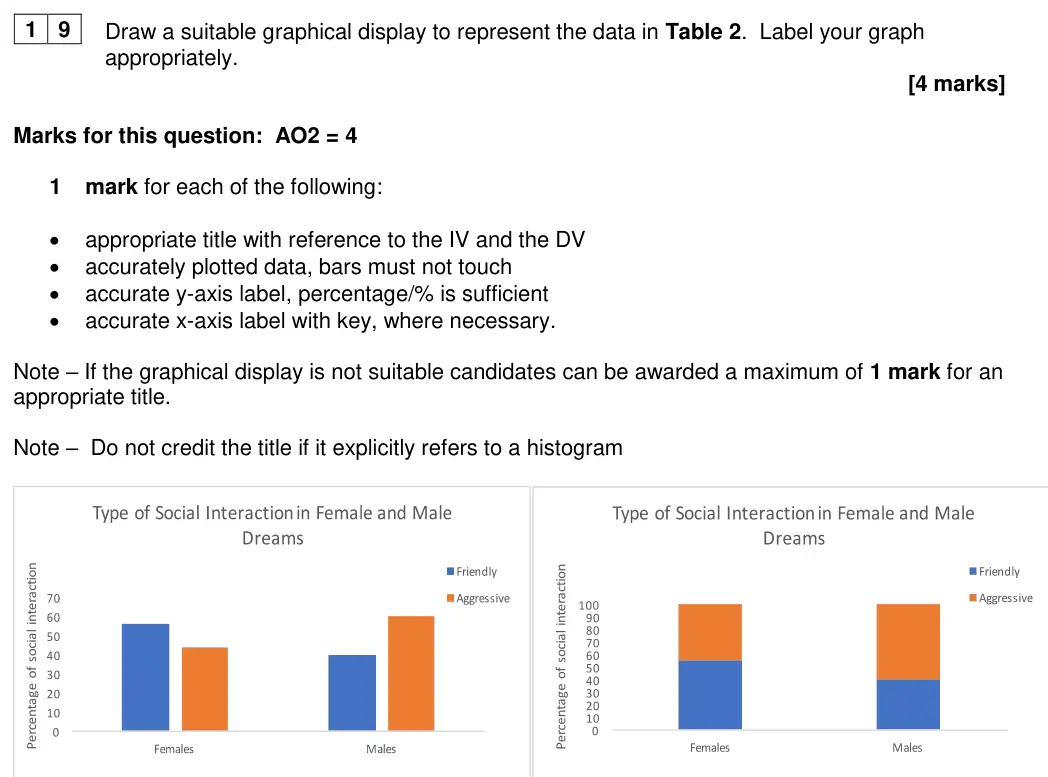
This question was generally answered well with over three quarters of students achieving at least three marks. Most commonly students lost marks for not giving both conditions of the IV in their titles or referring incorrectly to histograms or for having the bars touching. Teachers should make students aware that with discontinuous/discrete data bars should not be touching on a graph.
Notes from the mark scheme and report
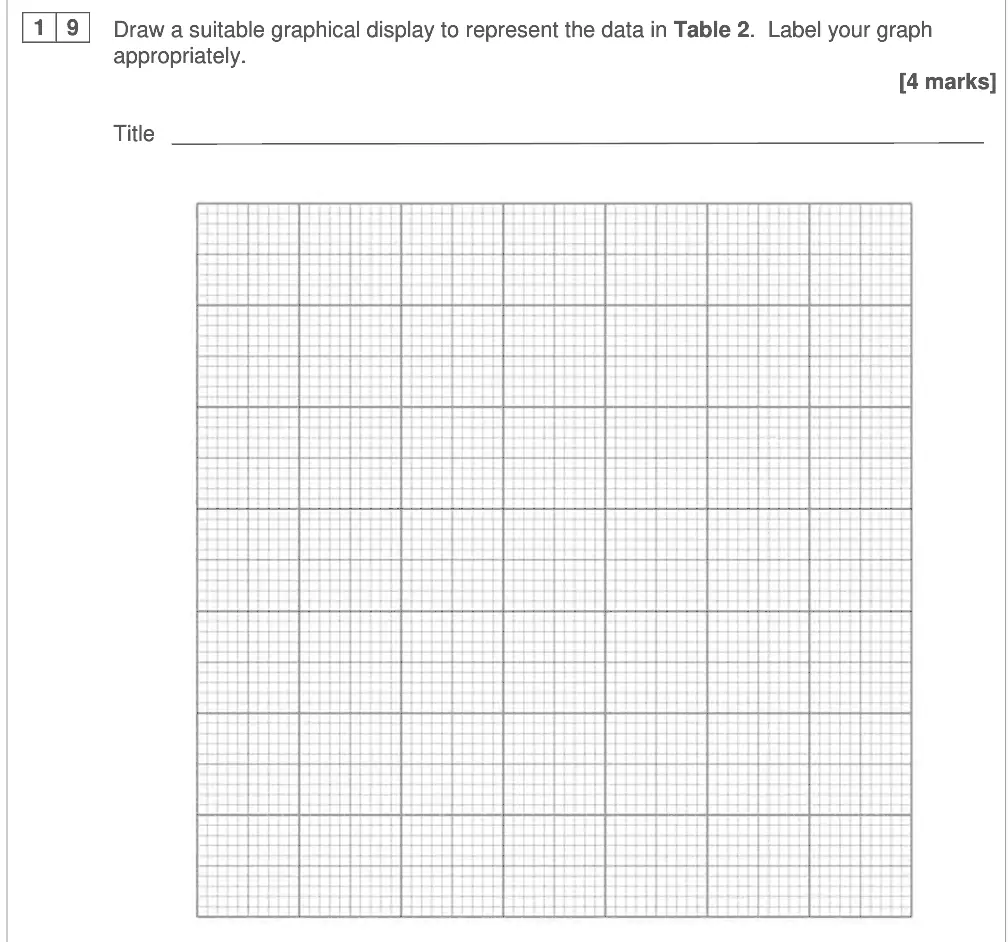
1 mark each: title with IV and DV, accurate bars not touching, y-axis %, x-axis label with key
Mark scheme, including level descriptors and indicative content
Examiner's comment
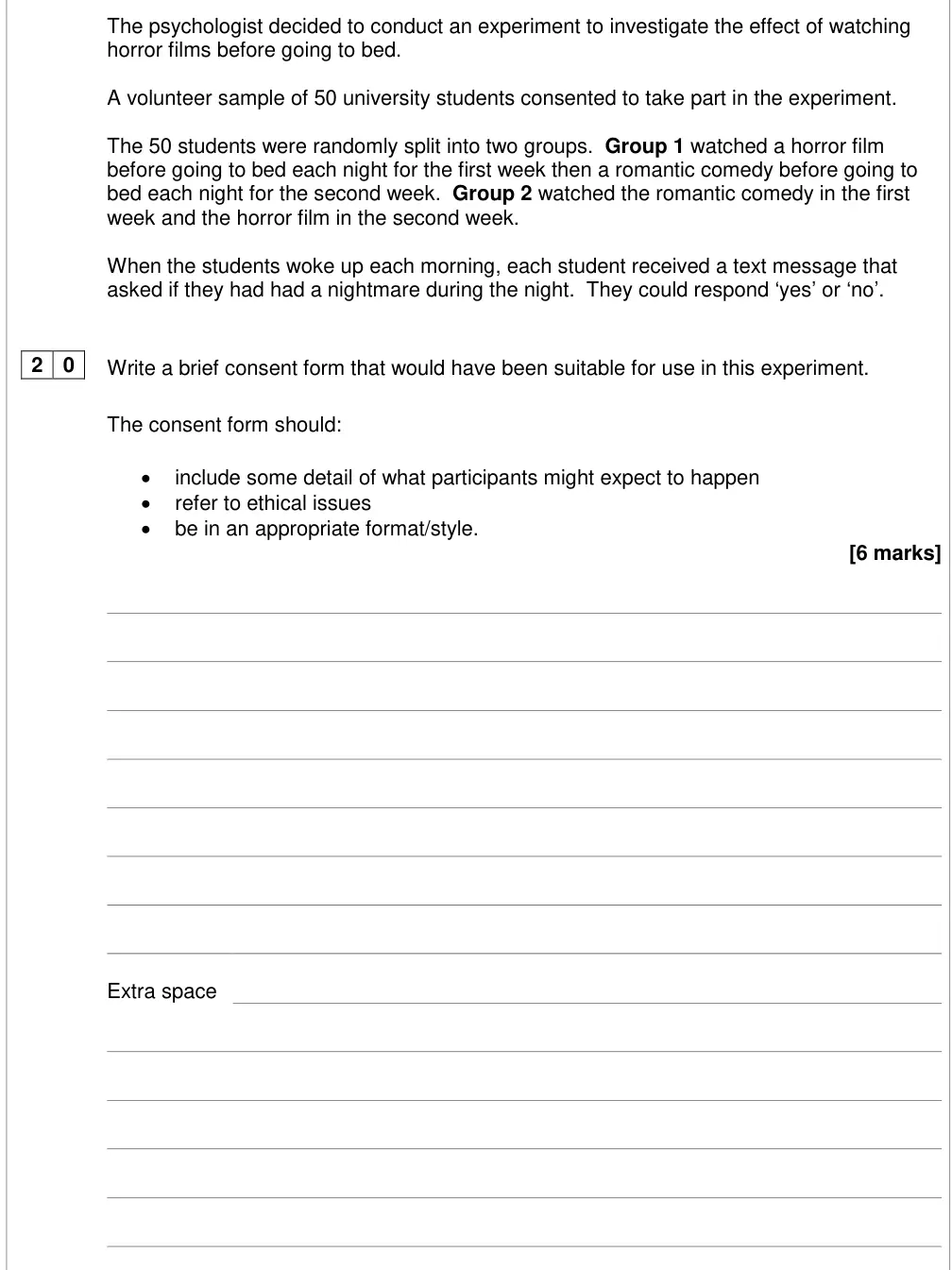
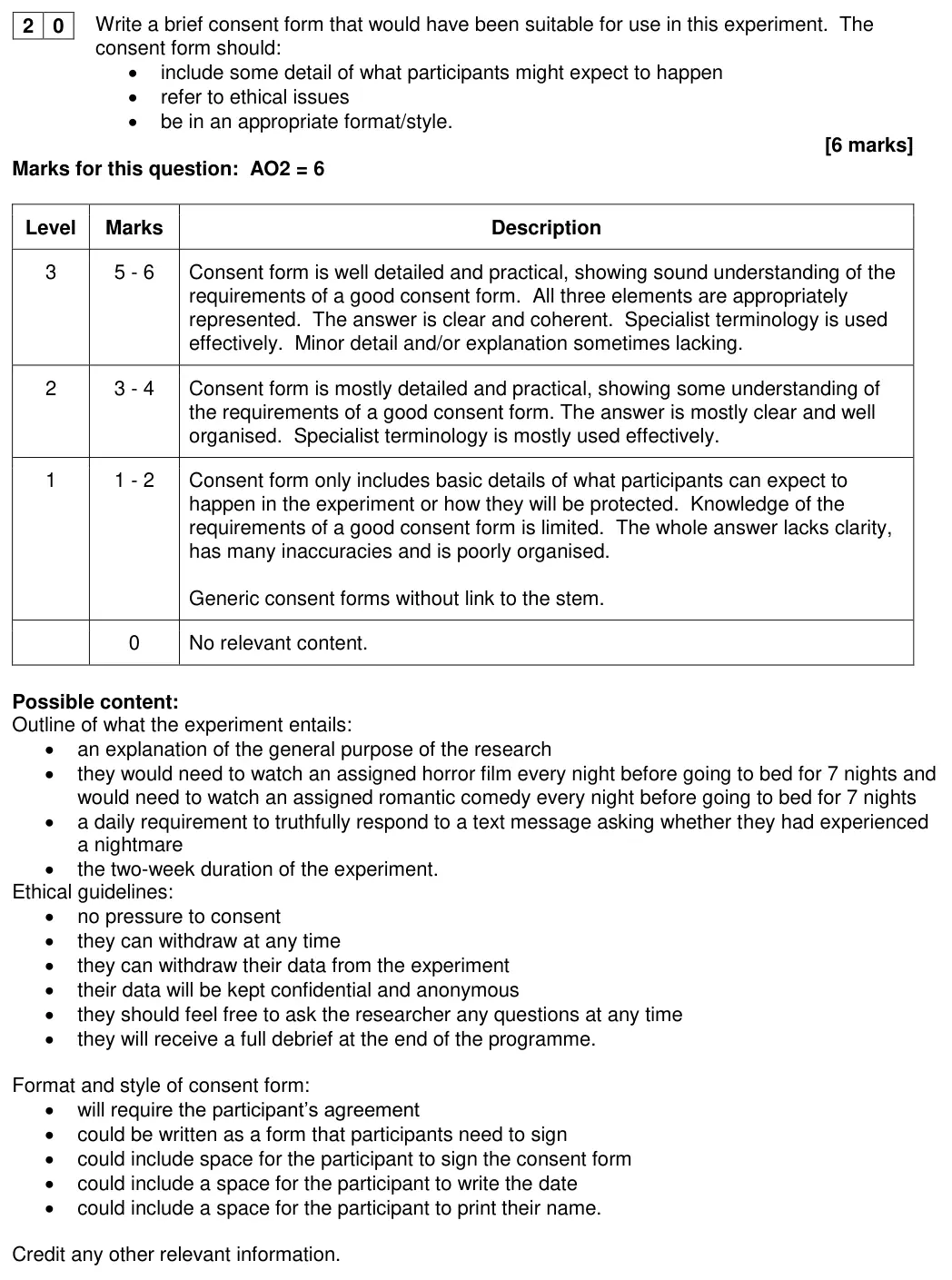
This question was generally quite poorly answered. Although many students could gain some credit for providing detail from the study and/or giving ethical issues, few were able to demonstrate sound understanding of the requirements of a practical consent form with many not referring to consent at all. Ethical issues were generally covered reasonably well and were the strongest of the three elements, whilst format/style was the weakest and was often inappropriate (eg ‘You will’, or ‘You must’, or ‘You have taken part’). Although there were some excellent responses, generally it appeared that the students had not really thought about the nature of giving informed consent, with sparse experimental detail and the incorrect tone used, often reading more like a brief/debrief from or a legal disclaimer. This is perhaps an area that schools/colleges could look at in more detail.
Notes from the mark scheme and report
consent form: detail of procedure (films each night for two weeks, text replies), ethical issues (withdrawal, confidentiality, debrief), appropriate format (signature, date)
Mark scheme, including level descriptors and indicative content
Examiner's comment
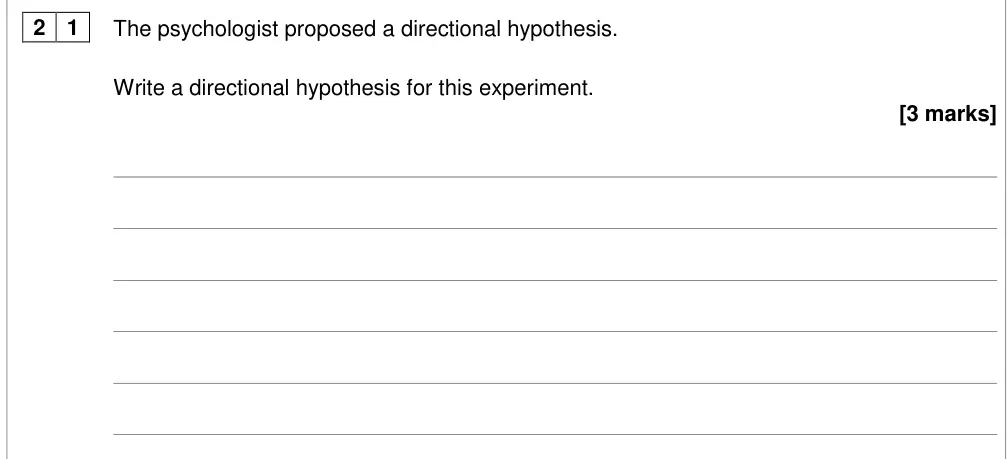
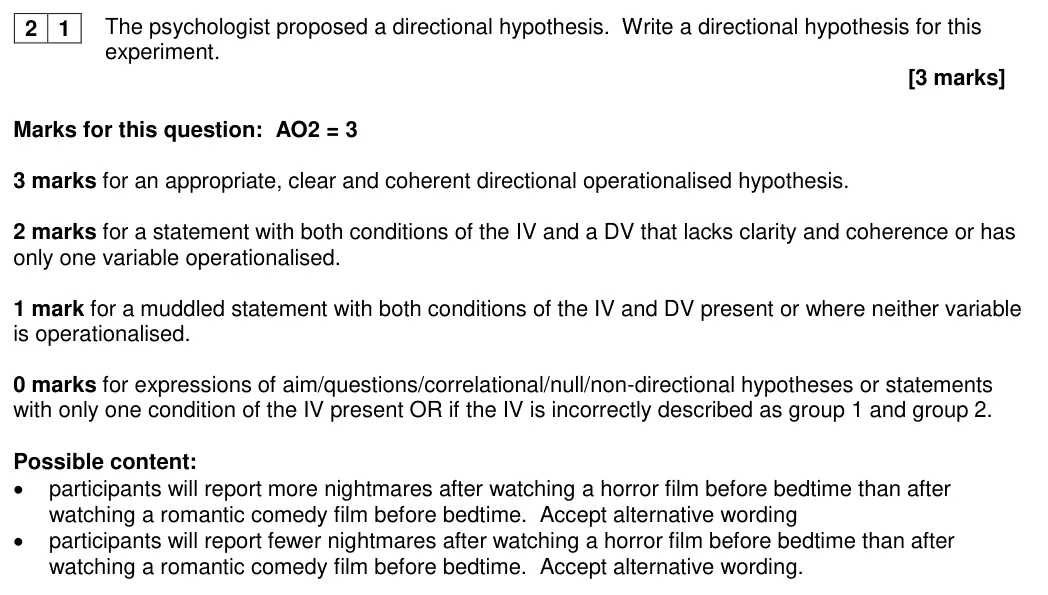
Despite many students showing an understanding of directional hypothesis, just less than half failed to achieve any marks, mainly due to a focus on horror films leading to more nightmares with no reference to the romantic comedy condition. Additionally, many students failed to fully operationalise the variables and some struggled to write an appropriate hypothesis for a repeated measures design, employing a writing frame for an independent measures design.
Notes from the mark scheme and report
directional operationalised hypothesis naming both conditions (horror vs romantic comedy) and nightmares reported
null, non-directional, one condition only or 'group 1/group 2' = 0
Mark scheme, including level descriptors and indicative content
Examiner's comment
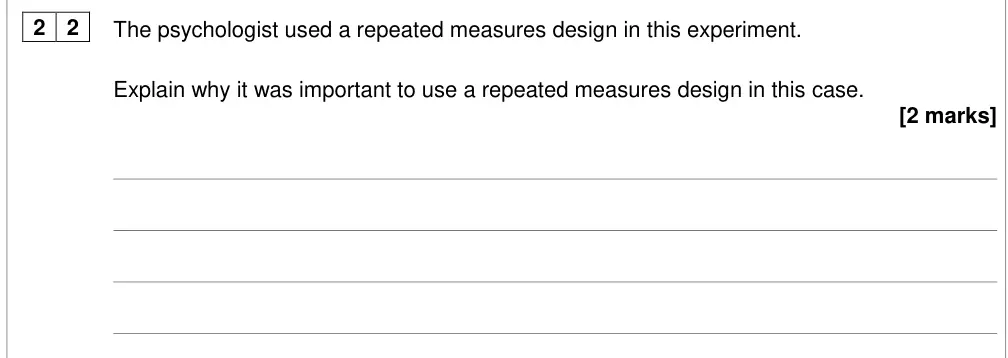
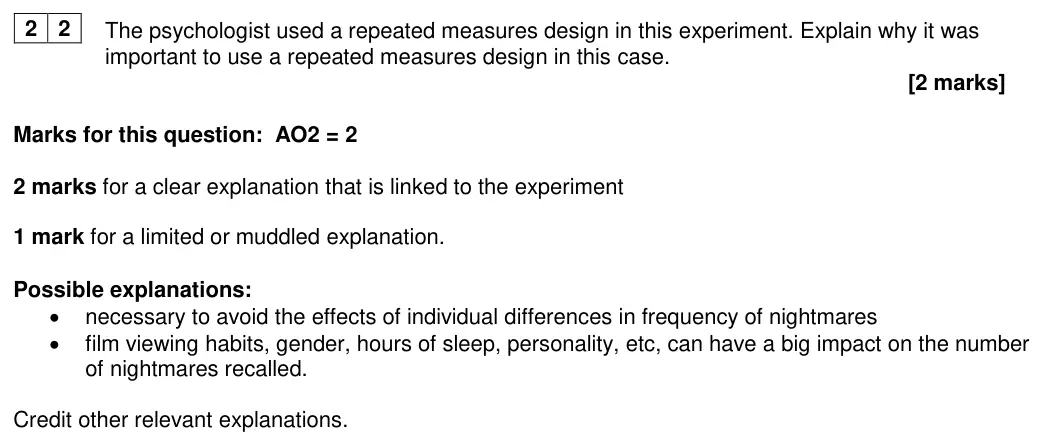
Most students identified individual differences as a reason to use a repeated measures design but only about half of these students managed to clearly link their reason to the experiment. Surprisingly, there was some confusion over the term ‘repeated measures’, with some students focussing their answers on reliability and others on order effects. Responses to this question again suggest that students need to gain more practical experience of designing and conducting experiments as part of their course, rather than focussing on theoretical learning of these concepts.
Notes from the mark scheme and report
removes individual differences in nightmare frequency, linked to the experiment
some confused with reliability or order effects
June 2018 · Paper 2 · Q232 marksAO1=1, AO2=1Research methodsHardscientific processes
Mark scheme, including level descriptors and indicative content
Examiner's comment
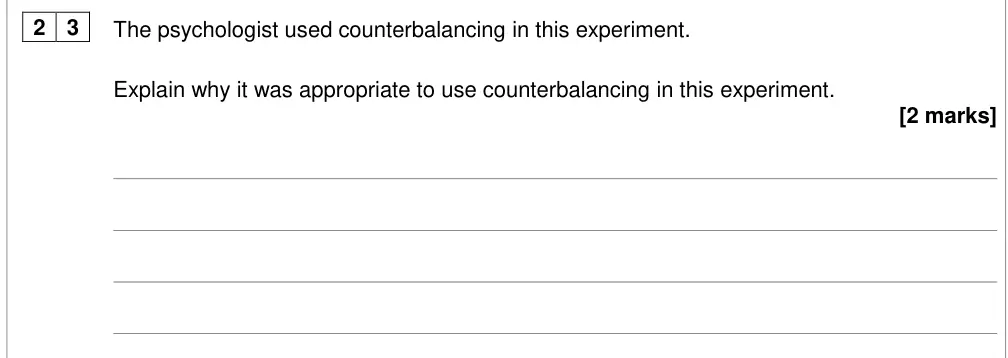
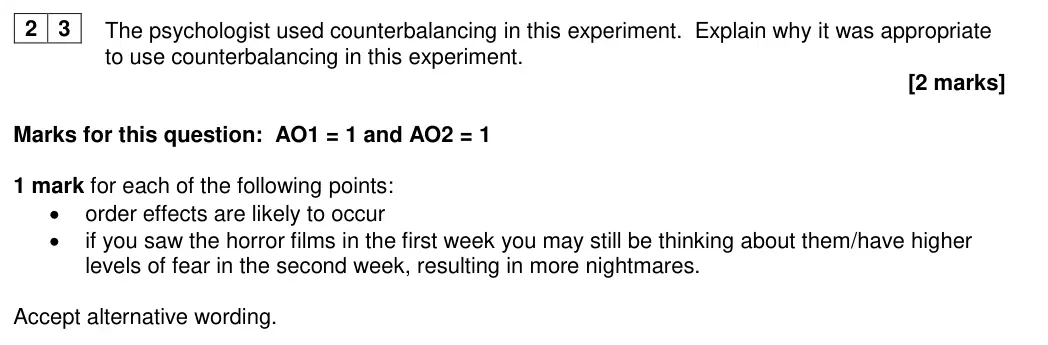
This question offered a great opportunity to distinguish genuine understanding of reasoning behind the use of counterbalancing as opposed to whether students had merely rote learned what it is and why it is used. Overall, there appeared very little understanding with approximately half of students failing to achieve any marks and approximately one tenth of students accessing both marks. Most students achieving marks identified the issue of order effects but application to the experiment was limited, with many rote learned, inappropriate responses such as boredom/tiredness given rather than engaging with this study.
Notes from the mark scheme and report
1 mark order effects + 1 mark application (fear from horror week carrying into the next week)
Mark scheme, including level descriptors and indicative content
Examiner's comment
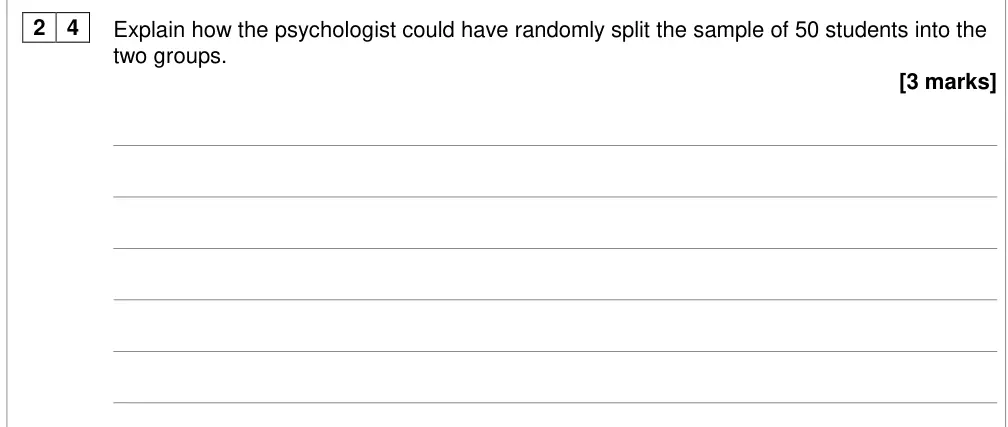
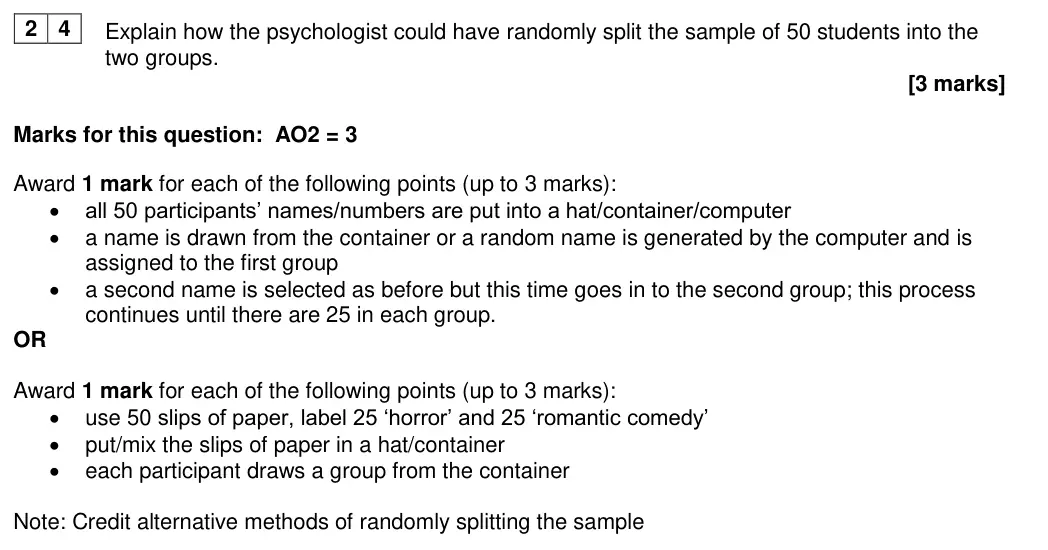
This question was generally well answered with over half of the students accessing all 3 marks. Generally, answers referring to a hat/container were more successful than those involving a random number generator/computer, as these responses often failed to fully describe the process.
Notes from the mark scheme and report
names in a hat/computer, alternate draws into groups until 25 each (or slips labelled by condition)
computer methods often not fully described
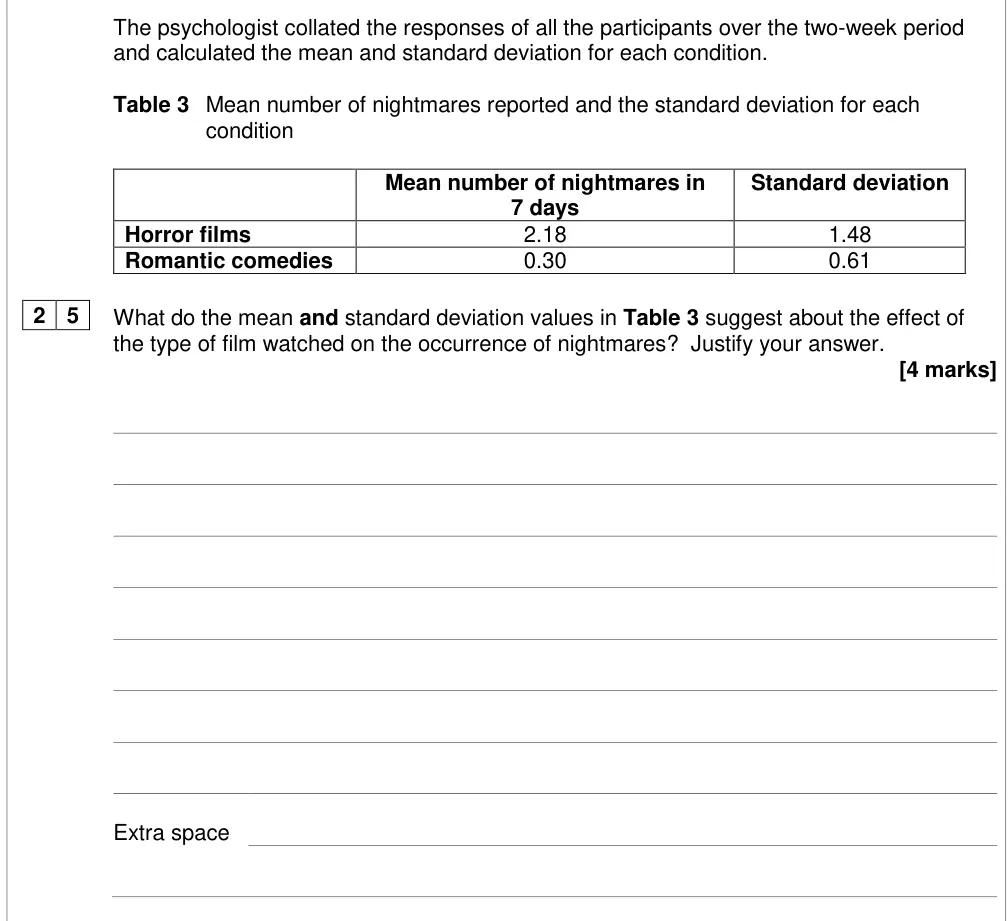
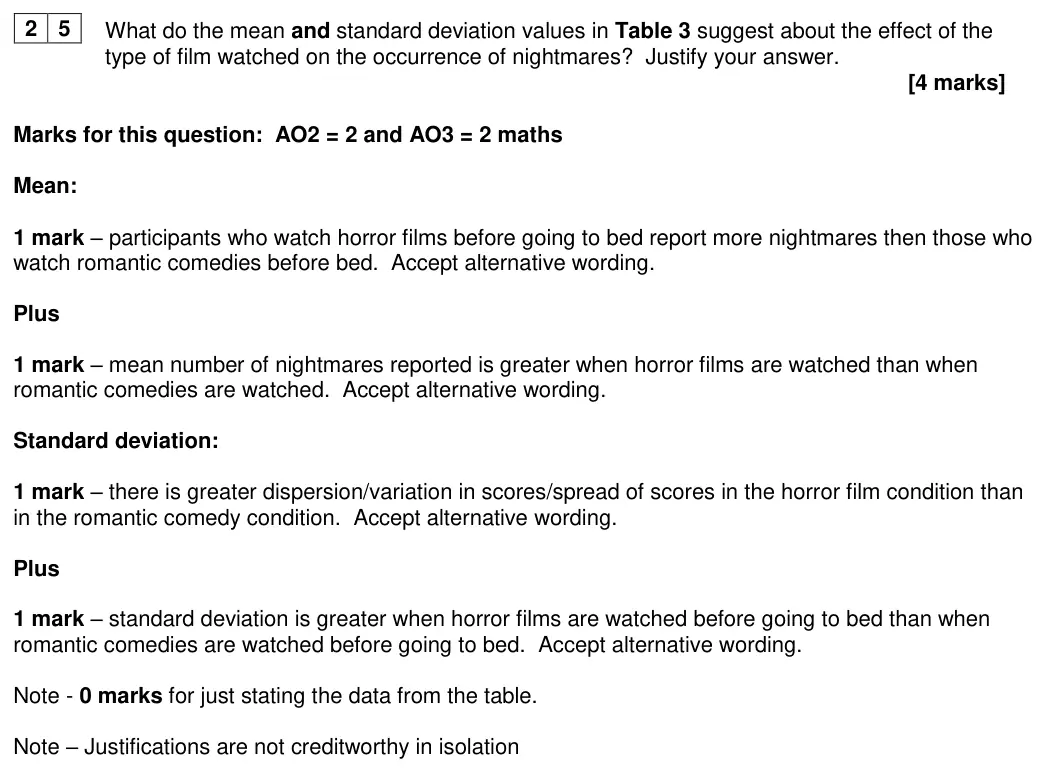
June 2018 · Paper 2 · Q254 marksAO2=2, AO3=2Research methodsdata handling
Mark scheme, including level descriptors and indicative content
Examiner's comment
Overall, students were able to answer this question well, although understanding of mean scores was generally better than standard deviation. It appeared that students often understood the data but failed to appropriately justify their suggestions, often simply restating information given in the table. There were also a few costly examples of justifications given without suggestions.
Notes from the mark scheme and report
mean: more nightmares after horror films + justification
SD: greater spread in horror condition + justification
Mark scheme, including level descriptors and indicative content
Examiner's comment
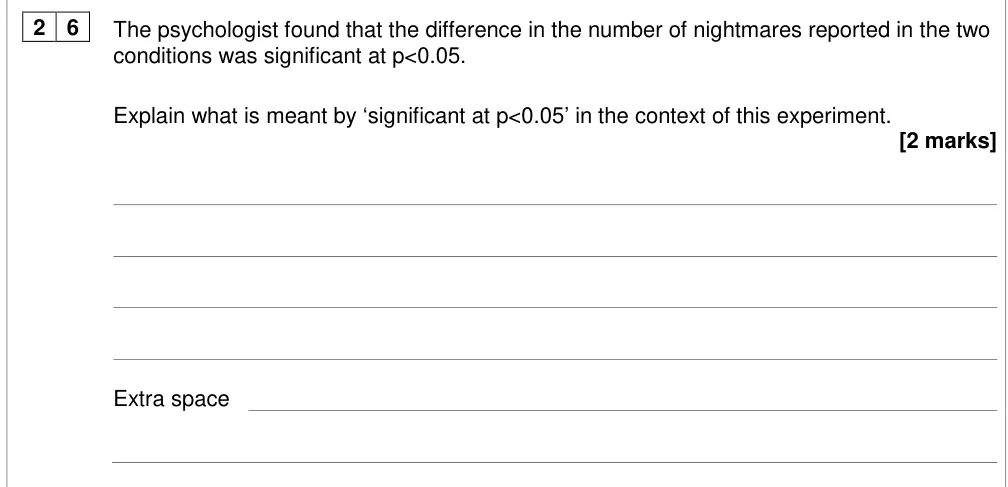
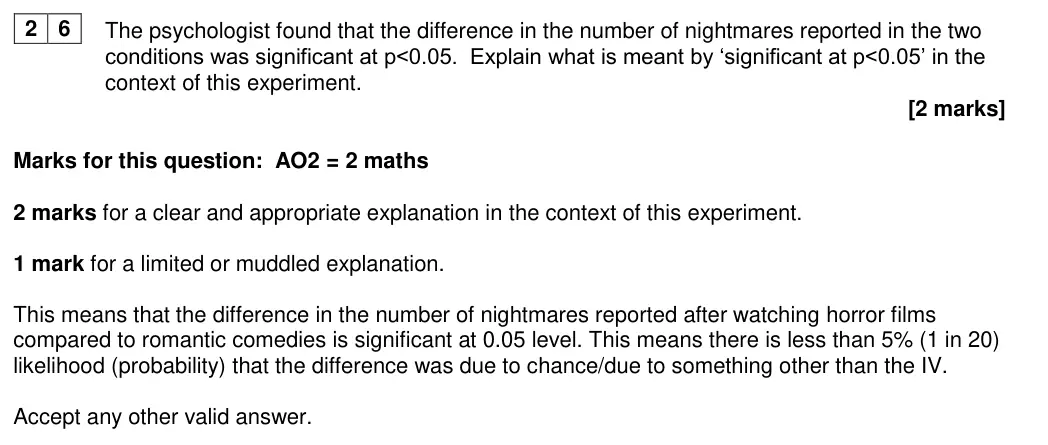
This question was a good differentiator, with some excellent responses by students who clearly explained what ‘significant at p<0.05’ meant and successfully managed to do so in the context of the experiment. Weaker students generally gave a rote learned reason for why psychologists generally use the 5% level or failed to contextualise their response. Unfortunately, many students failed to explain that the ‘<0.05’ sign meant less than 5%. Teachers should ensure that students are familiar with the mathematical symbols required by the new specification.
Notes from the mark scheme and report
less than 5% probability the difference in nightmares was due to chance, in context
many failed to explain '<0.05' means less than 5%
rote answers about why 5% is used
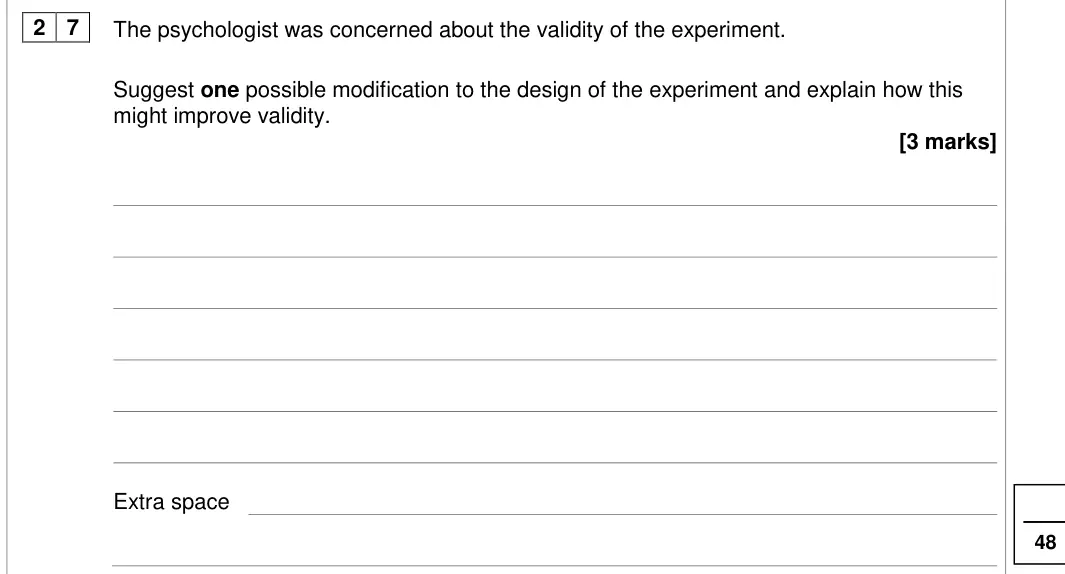
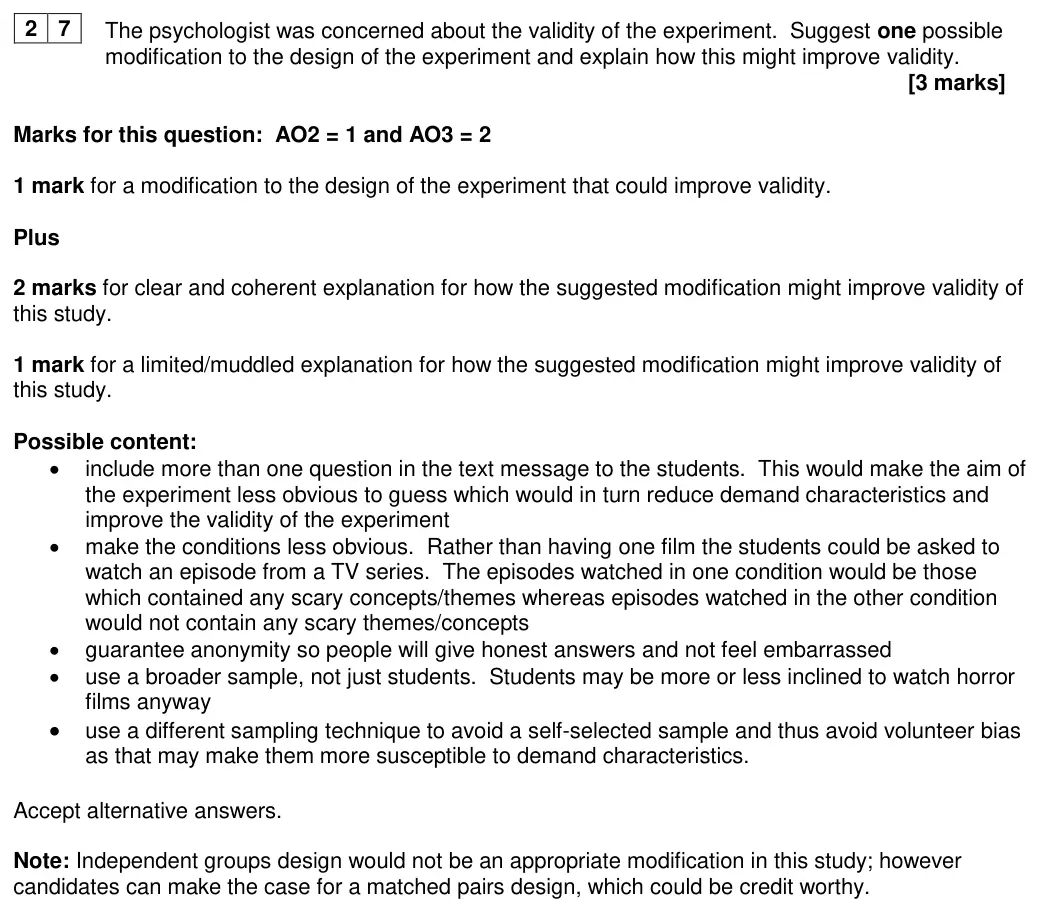
June 2018 · Paper 2 · Q273 marksAO2=1, AO3=2Research methodsscientific processes
Mark scheme, including level descriptors and indicative content
Examiner's comment
This question was generally not well answered. A huge range of modifications to the design of the experiment were given but unfortunately a lot of these were inappropriate, such as ‘use a control group’, ‘use a blind procedure’, ‘use a repeated measures design’ or ‘use an independent measures design’, suggesting either a lack of understanding of the reasoning for experimental design or a failure to recall the experimental protocol. Some students suggested using a matched pairs design and went on to explain effectively how this could improve validity by reducing the likelihood of participants guessing the aim of the study which would reduce demand characteristics. More commonly students justified the modified design by inappropriately suggesting that it would avoid individual differences. Changing the sample was a common answer but it was often not clear how this would improve validity, with few being able to give more than a generic explanation. Stronger responses generally focussed on the problem of using a text message to ascertain whether a nightmare had been experienced, suggesting a questionnaire/interview to reduce the chances of participants lying or to help distinguish nightmares from unpleasant dreams.
Notes from the mark scheme and report
1 mark modification + 2 marks how it improves validity (more text questions/less obvious aim reduces demand characteristics, anonymity, broader sample)
independent groups not appropriate (matched pairs can be argued)
inappropriate suggestions: control group, blind procedure
Work with an AQA psychology tutor
Want a paper marked and gone through with you? Message us.