June 2017: AS Paper 2

72 marks · 22 question parts · AQA no longer hosts this series; the copies here come from third-party archives

This paper was set on the previous specification. All of its content is still on the 2025 specification.

Question by question

QTopicMarksAOType
1 Approaches in psychology 1AO1=1Multiple choice
2 Biopsychology 3AO1=3Outline
3 Approaches in psychology 3AO1=3Outline
4 Approaches in psychology 3AO2=3Application
5 Approaches in psychology 2AO2=2Application
6 Approaches in psychology 12AO1=6,AO2=2,AO3=4Extended writing
7 Clinical psychology and mental health (psychopathology) 2AO1=2Outline
8 Clinical psychology and mental health (psychopathology) 2AO1=2Outline
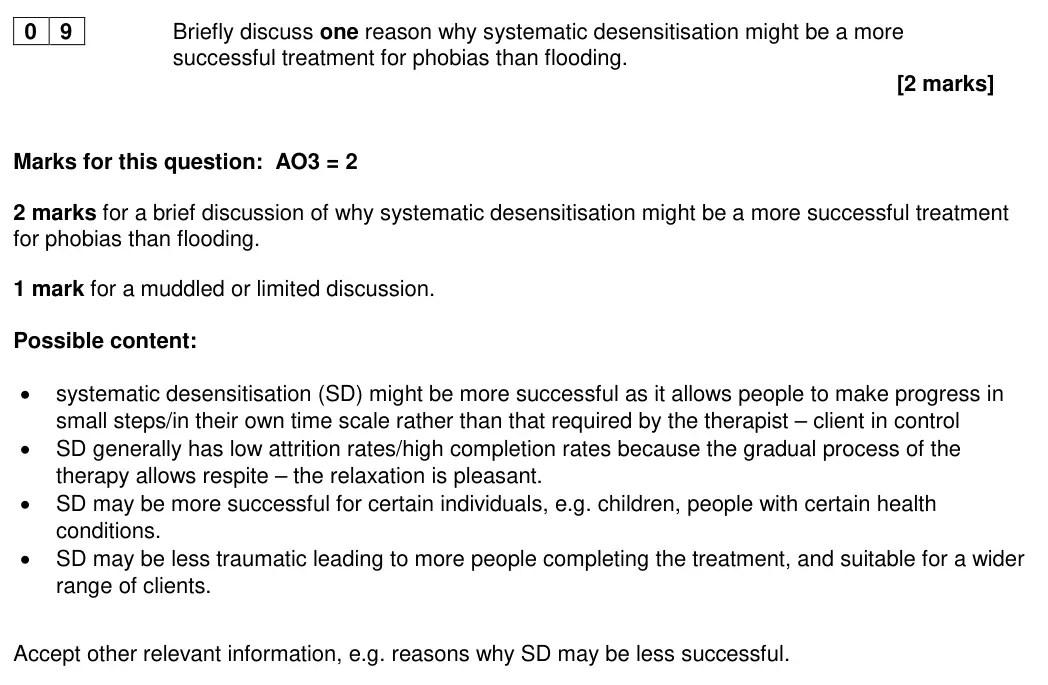
9 Clinical psychology and mental health (psychopathology) 2AO3=2Evaluate (short)
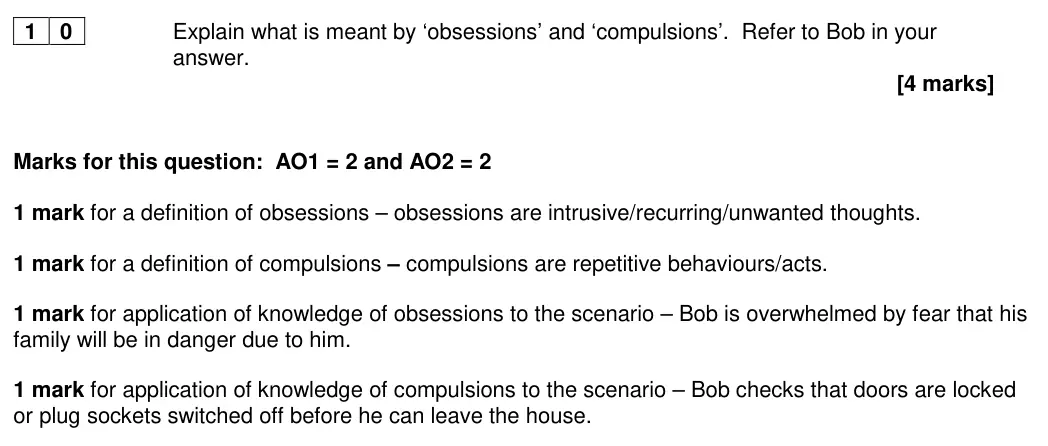
10 Clinical psychology and mental health (psychopathology) 4AO1=2,AO2=2Application
11 Clinical psychology and mental health (psychopathology) 4AO2=4Application
12 Research methods: scientific processes 2AO2=2Research methods
13 Clinical psychology and mental health (psychopathology) 8AO1=4,AO3=4Extended writing
14 Research methods: scientific processes 2AO2=2Research methods
15 Research methods: data handling and analysis 2AO2=2Calculation
16 Research methods: scientific processes 2AO3=2Research methods
17 Research methods: data handling and analysis 2AO1=2Research methods
18 Research methods: data handling and analysis 2AO2=2Research methods
19 Research methods: data handling and analysis 4AO2=4Calculation
20 Research methods: scientific processes 3AO3=3Research methods
21 Research methods: scientific processes 3AO2=3Research methods
22 Research methods: methods and techniques 4AO3=4Research methods

The questions

12345678910111213141516171819202122

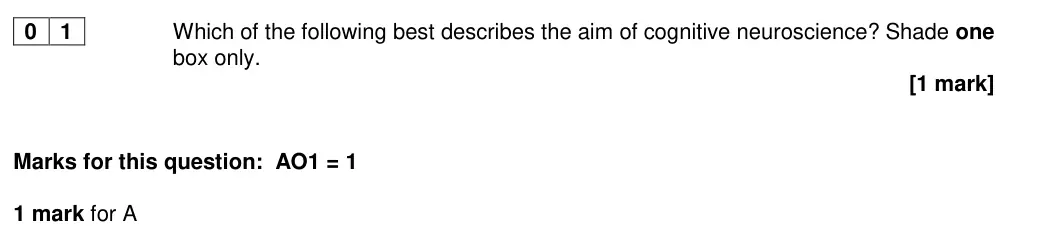
June 2017 · AS Paper 2 · Q1 1 mark AO1=1 Multiple choice approaches
0 1
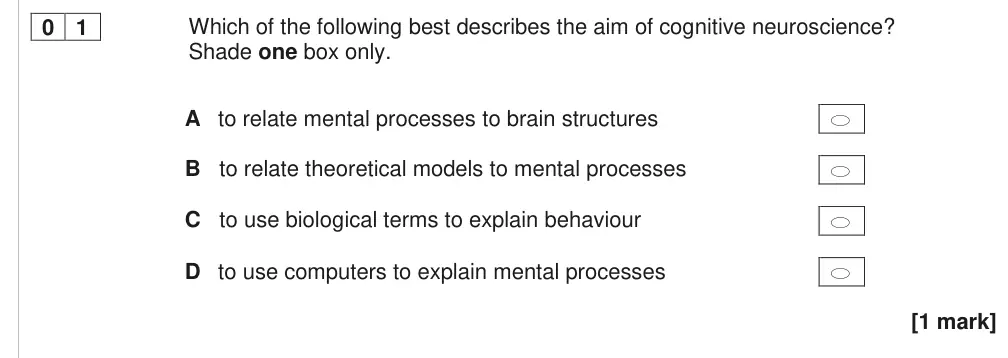
Which of the following best describes the aim of cognitive neuroscience?
A to relate mental processes to brain structures
B to relate theoretical models to mental processes
C to use biological terms to explain behaviour
D to use computers to explain mental processes
[1 mark]
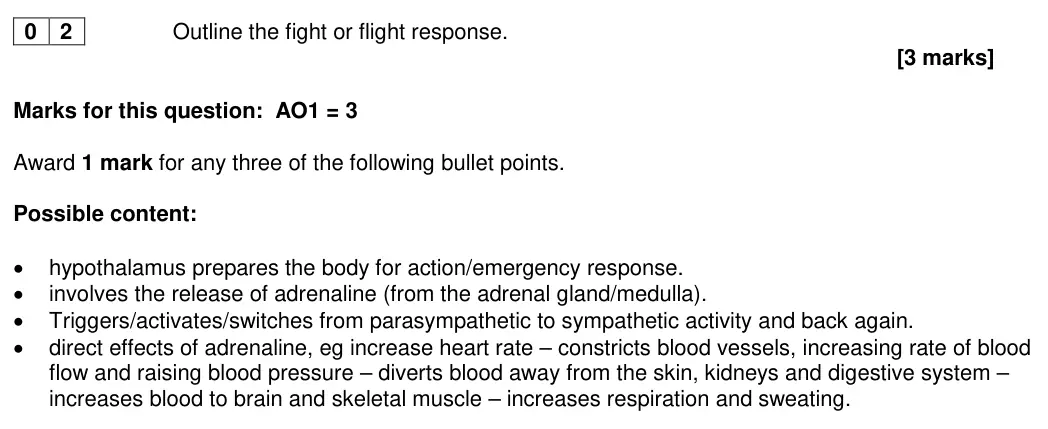
June 2017 · AS Paper 2 · Q2 3 marks AO1=3 Outline Hard biopsychology
0 2
Outline the fight or flight response.
[3 marks]
Extra space
June 2017 · AS Paper 2 · Q3 3 marks AO1=3 Outline approaches
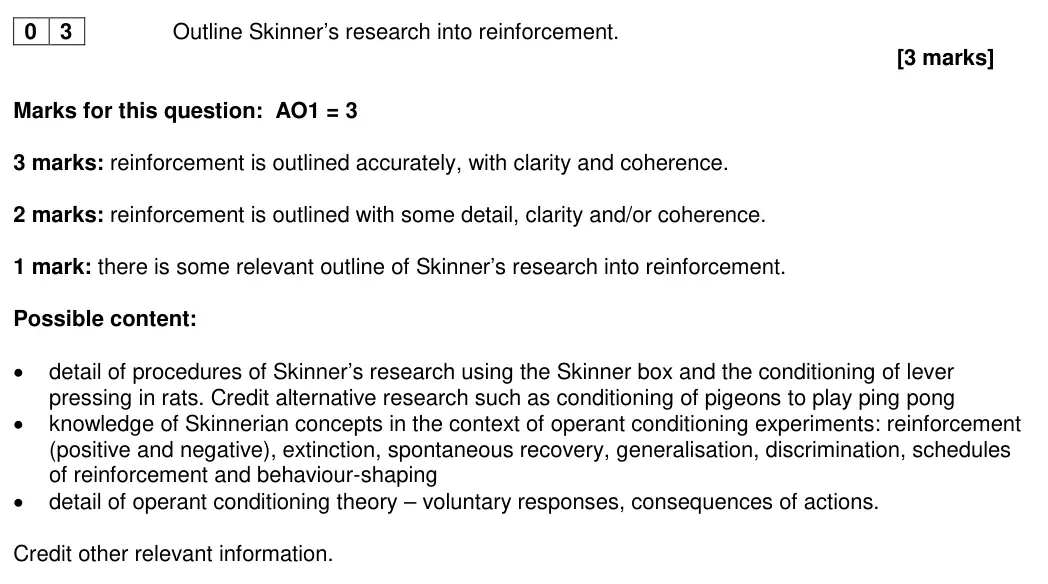
0 3
Outline Skinner’s research into reinforcement.
[3 marks]
Extra space
June 2017 · AS Paper 2 · Q4 3 marks AO2=3 Application approaches
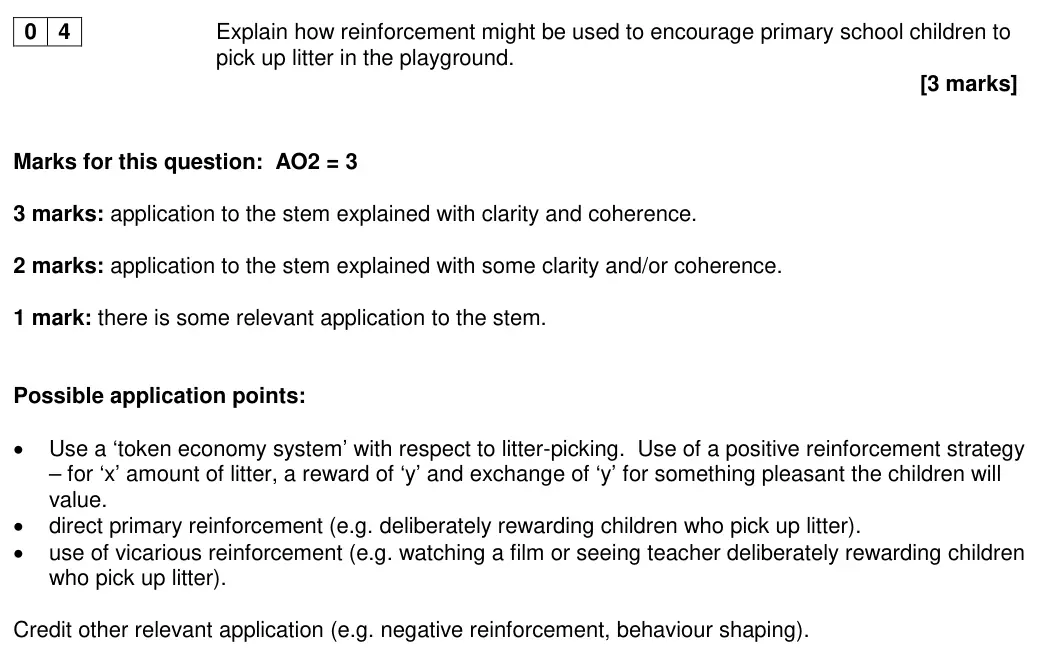
0 4
Explain how reinforcement might be used to encourage primary school children to
pick up litter in the playground.
[3 marks]
Extra space
June 2017 · AS Paper 2 · Q5 2 marks AO2=2 Application approaches
0 5
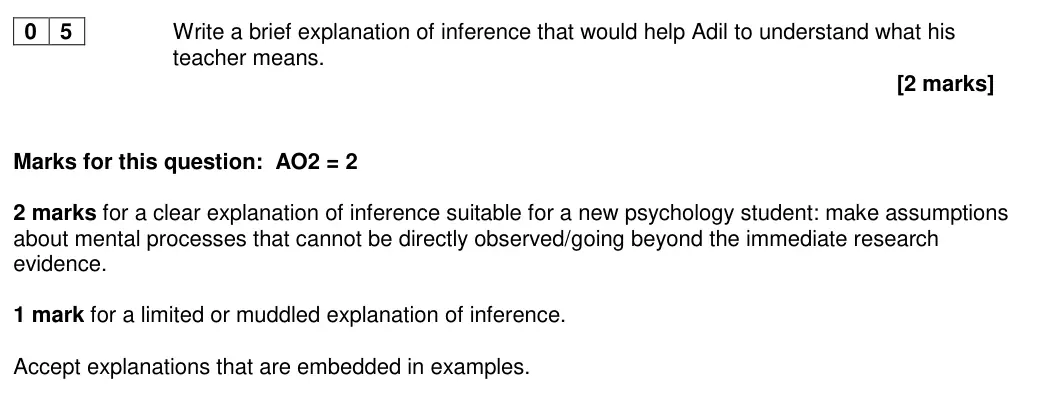
Adil has just started studying the cognitive approach in psychology but does not
understand when his teacher tells him that cognitive psychologists use the results of
experiments to make inferences about behaviour.
Write a brief explanation of inference that would help Adil to understand what his
teacher means.
[2 marks]
Extra space
June 2017 · AS Paper 2 · Q6 12 marks AO1=6, AO2=2, AO3=4 Extended writing approaches
0 6
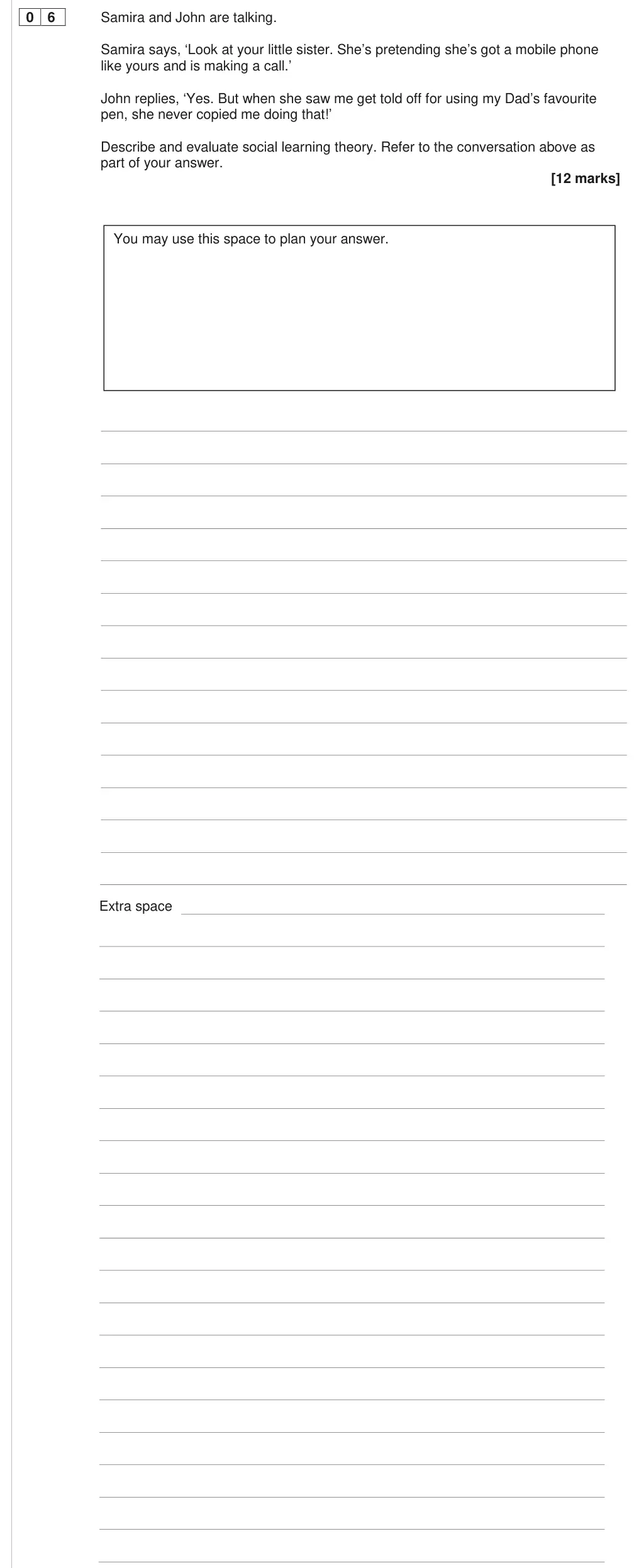
Samira and John are talking.
Samira says, ‘Look at your little sister. She’s pretending she’s got a mobile phone
like yours and is making a call.’
John replies, ‘Yes. But when she saw me get told off for using my Dad’s favourite
pen, she never copied me doing that!’
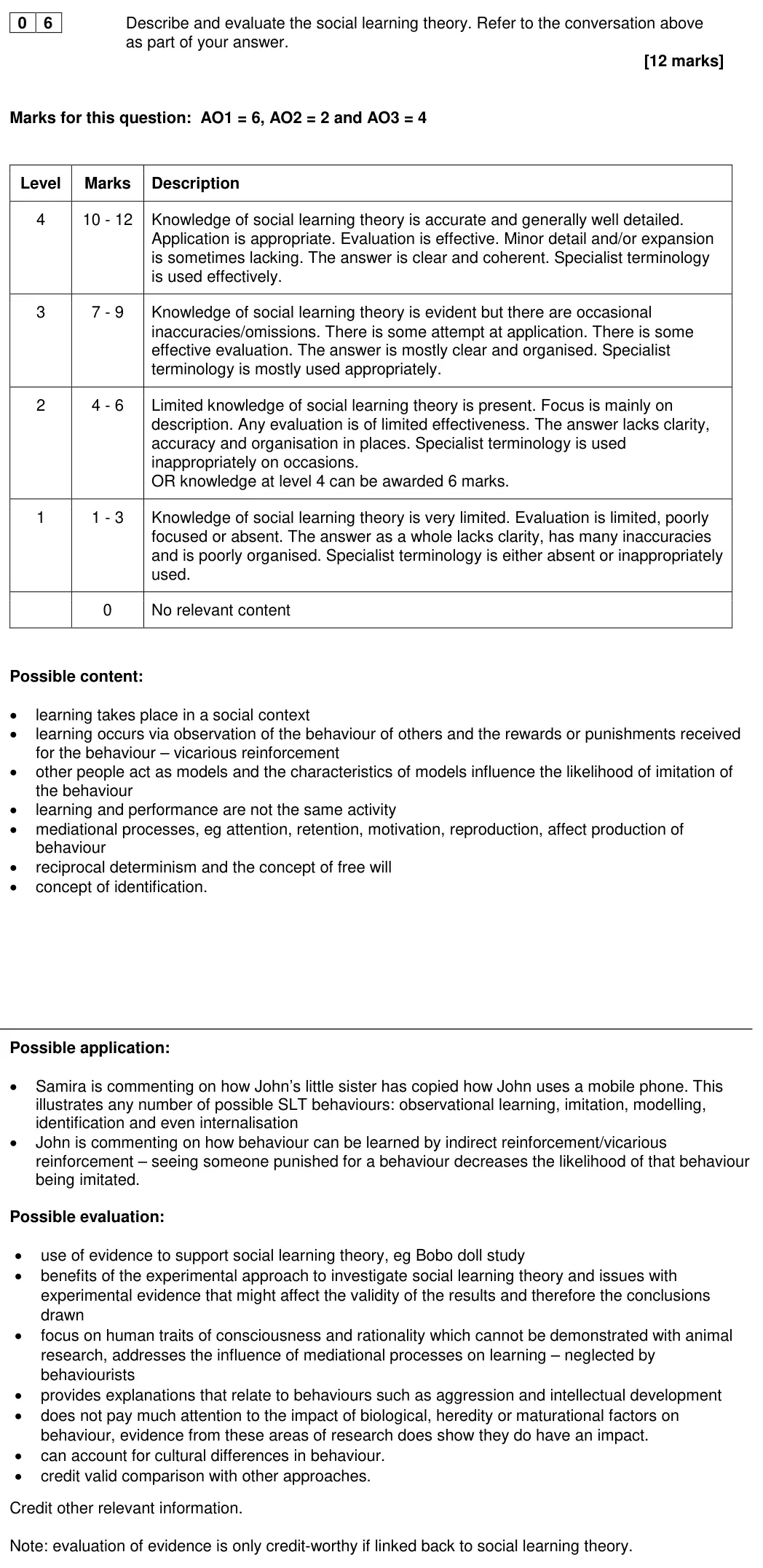
Describe and evaluate social learning theory. Refer to the conversation above as
part of your answer.
[12 marks]
You may use this space to plan your answer.
Extra space
June 2017 · AS Paper 2 · Q7 2 marks AO1=2 Outline Medium clinical psychology
0 7
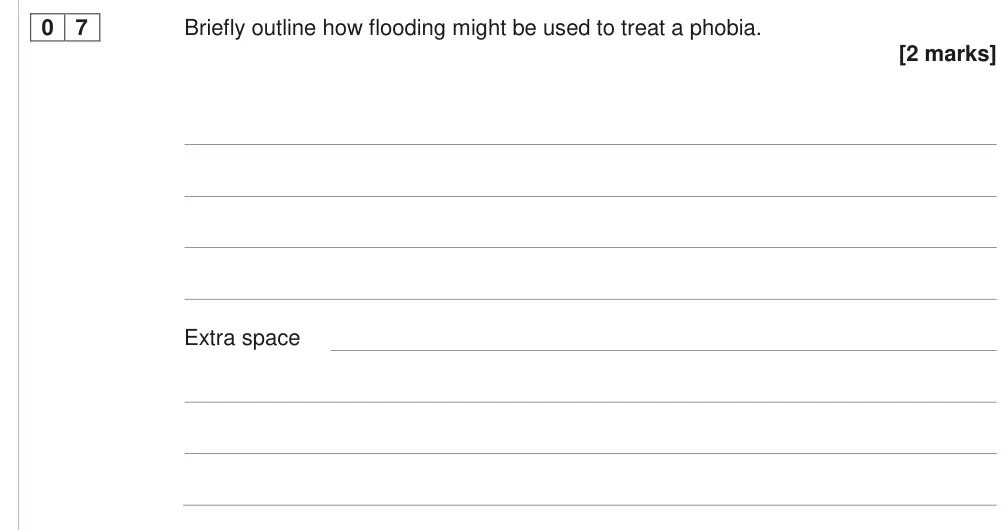
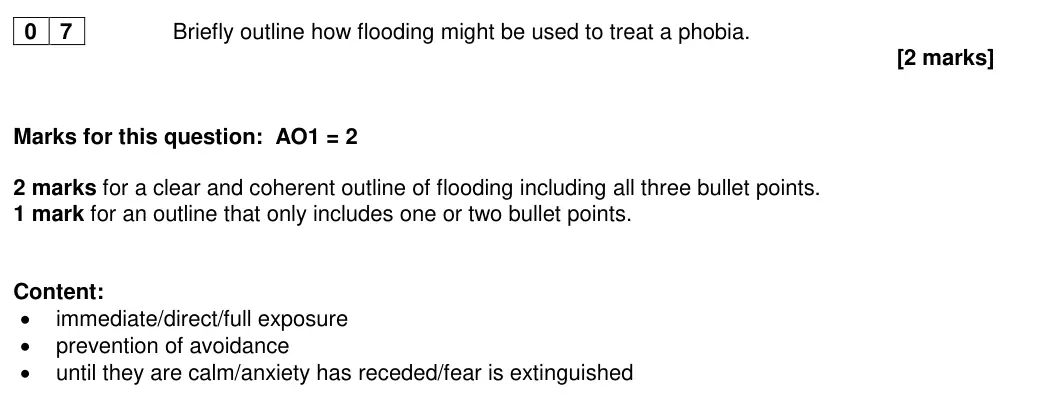
Briefly outline how flooding might be used to treat a phobia.
[2 marks]
Extra space
June 2017 · AS Paper 2 · Q8 2 marks AO1=2 Outline clinical psychology
0 8
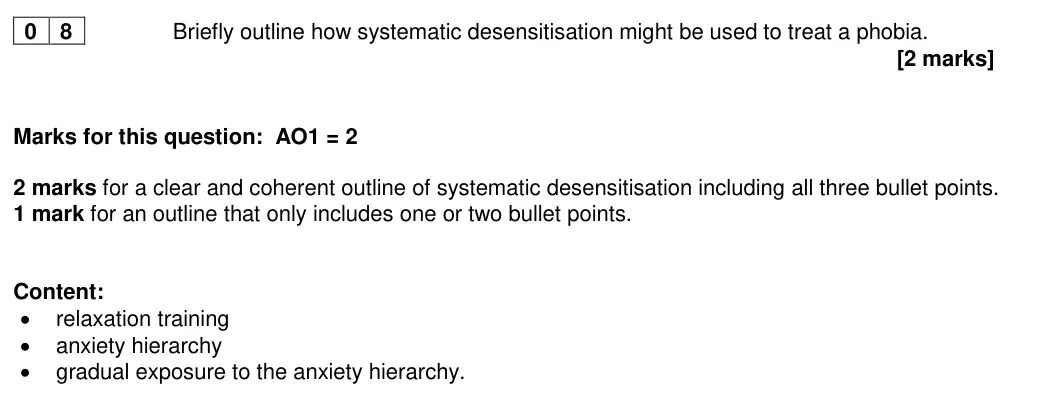
Briefly outline how systematic desensitisation might be used to treat a phobia.
[2 marks]
Extra space
June 2017 · AS Paper 2 · Q9 2 marks AO3=2 Evaluate (short) clinical psychology
0 9
Briefly discuss one reason why systematic desensitisation might be a more
successful treatment for phobias than flooding.
[2 marks]
Extra space
June 2017 · AS Paper 2 · Q10 4 marks AO1=2, AO2=2 Application clinical psychology
Bob always checks that doors are locked and plug sockets are switched off. His
checking routine has become very time consuming. He now feels overwhelmed
with fears that his family could be in danger if he does not complete his checking
routine. His doctor thinks Bob has obsessive compulsive disorder.
1 0
Explain what is meant by ‘obsessions’ and ‘compulsions’. Refer to Bob in your
answer.
[4 marks]
Extra space
June 2017 · AS Paper 2 · Q11 4 marks AO2=4 Application clinical psychology
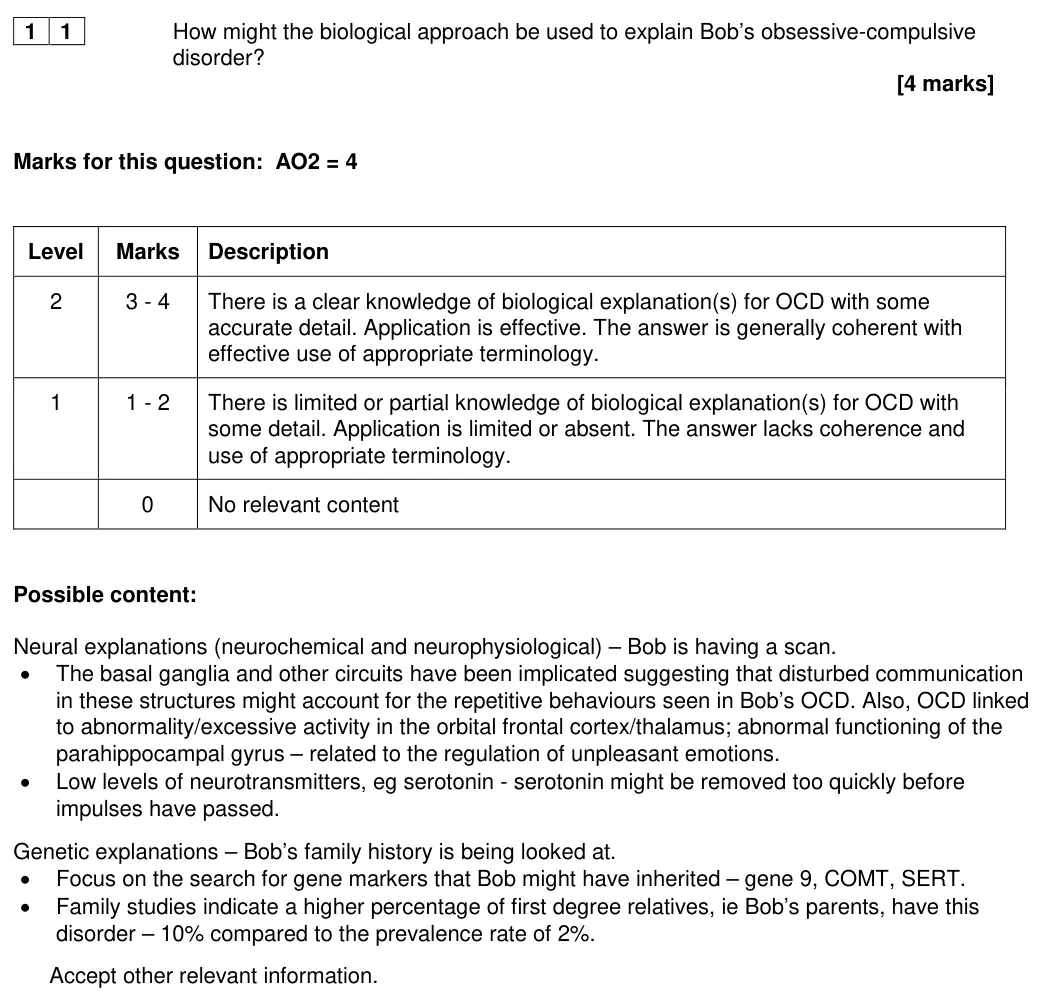
1 1
Bob’s doctor is sending him for a brain scan and is looking into his family history.
How might the biological approach be used to explain Bob’s obsessive-
compulsive disorder?
[4 marks]
Extra space
June 2017 · AS Paper 2 · Q12 2 marks AO2=2 Research methods scientific processes
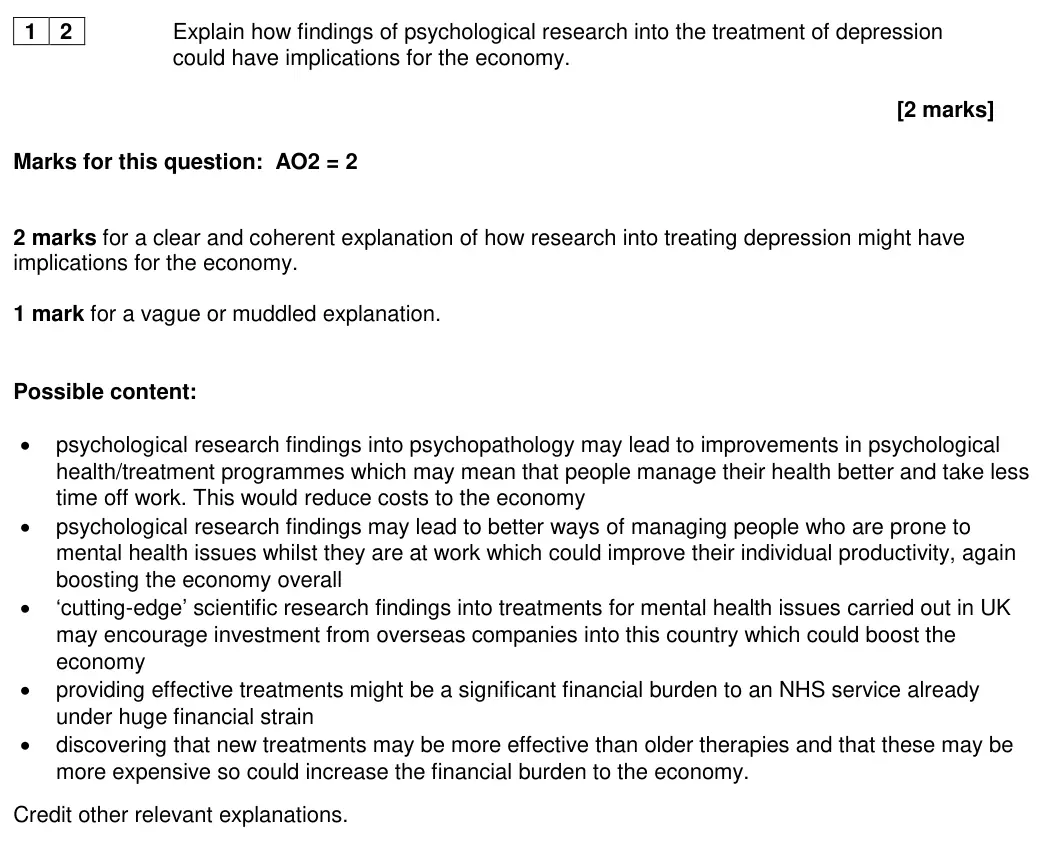
1 2
Explain how findings of psychological research into the treatment of depression
could have implications for the economy.
[2 marks]
Extra space
June 2017 · AS Paper 2 · Q13 8 marks AO1=4, AO3=4 Extended writing clinical psychology
1 3
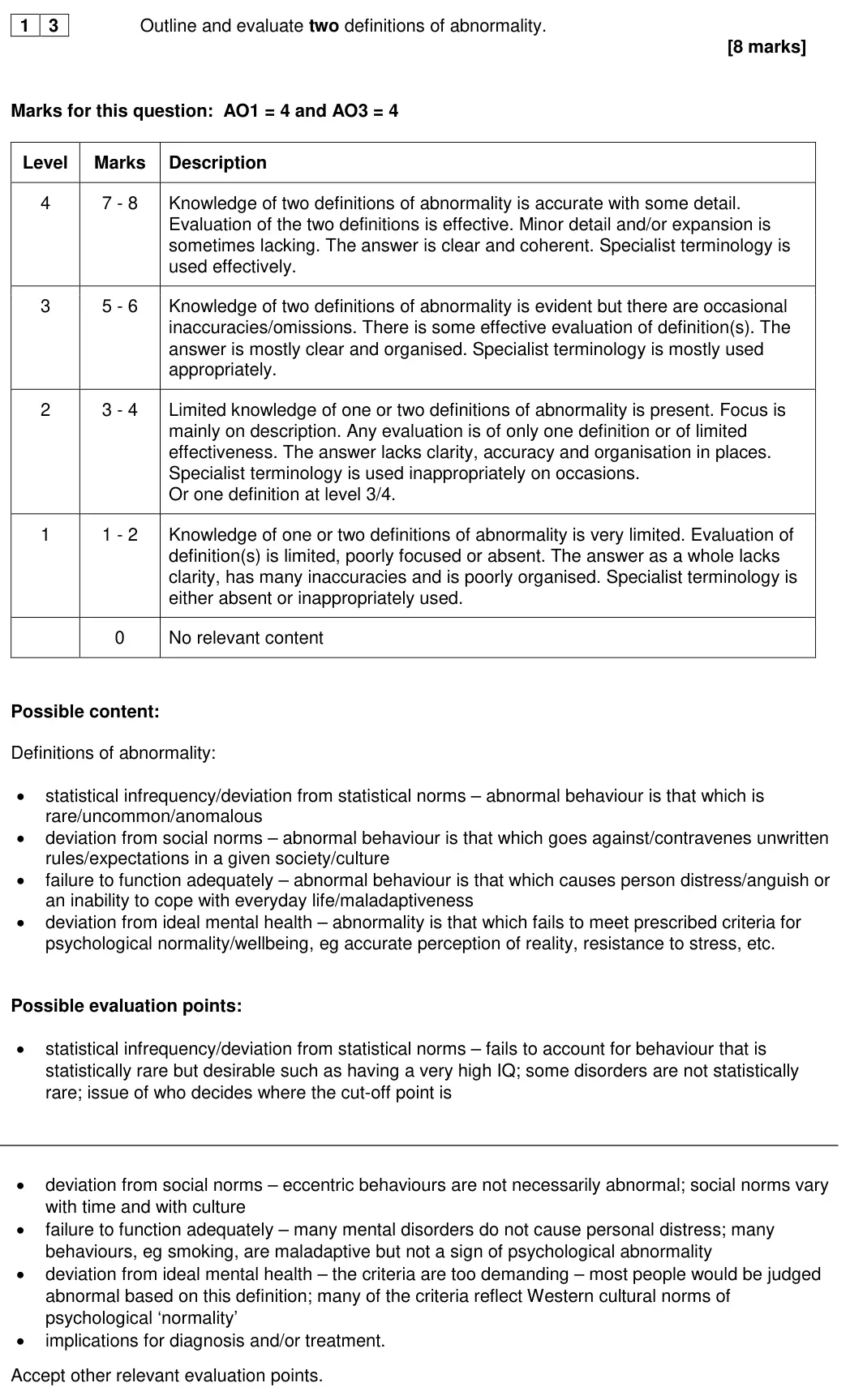
Outline and evaluate two definitions of abnormality.
[8 marks]
Extra space
June 2017 · AS Paper 2 · Q14 2 marks AO2=2 Research methods scientific processes
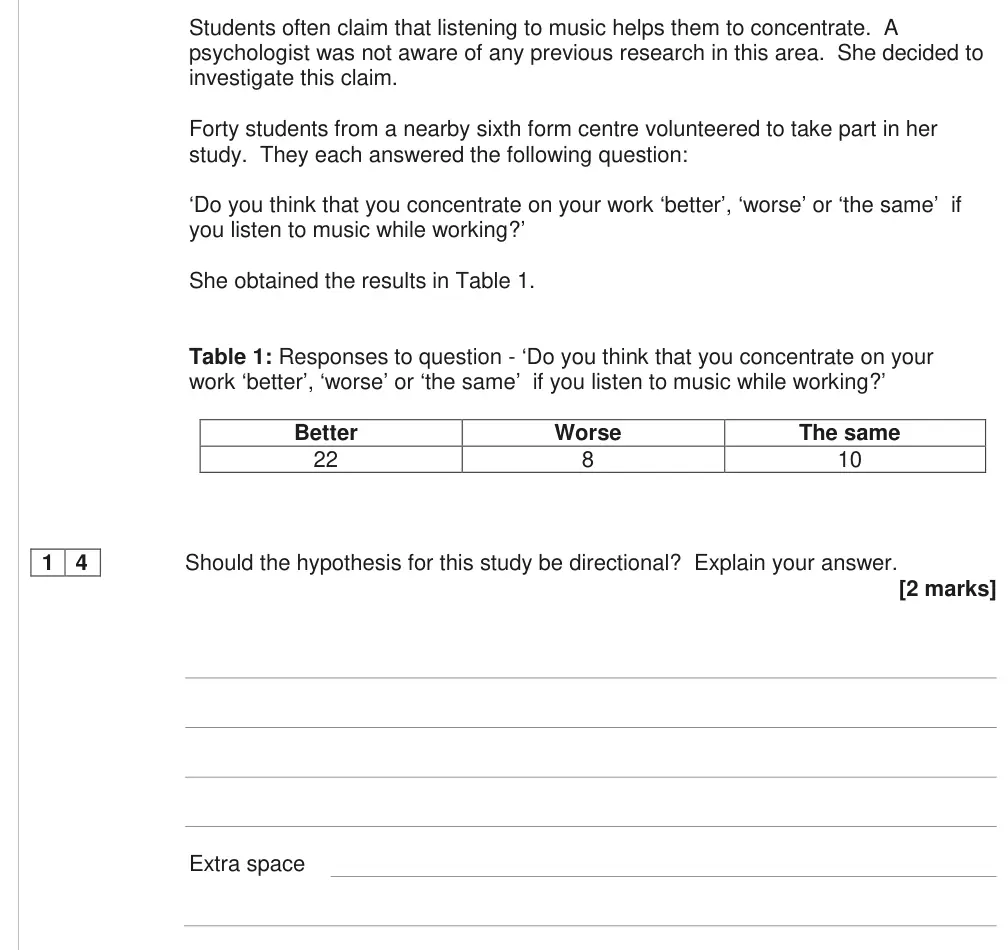
Students often claim that listening to music helps them to concentrate.  A
psychologist was not aware of any previous research in this area.  She decided to
investigate this claim.
Forty students from a nearby sixth form centre volunteered to take part in her
study.  They each answered the following question:
‘Do you think that you concentrate on your work ‘better’, ‘worse’ or ‘the same’  if
you listen to music while working?’
She obtained the results in Table 1.
Table 1: Responses to question - ‘Do you think that you concentrate on your
work ‘better’, ‘worse’ or ‘the same’  if you listen to music while working?’
Better
Worse
The same
22
8
10
1 4
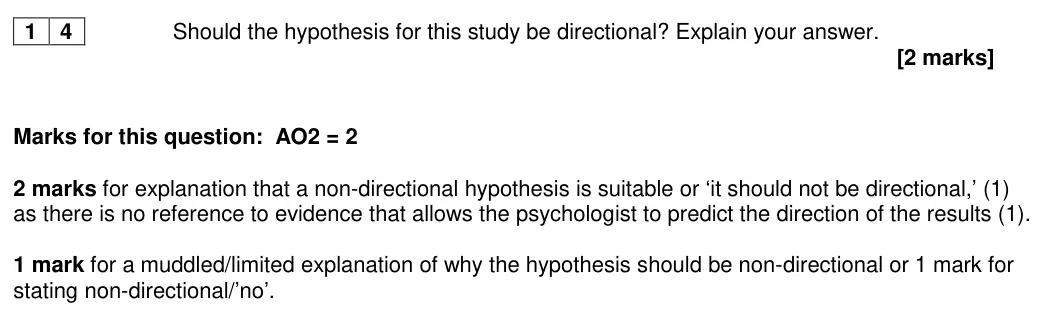
Should the hypothesis for this study be directional?  Explain your answer.
[2 marks]
Extra space
June 2017 · AS Paper 2 · Q15 2 marks AO2=2 Calculation data handling
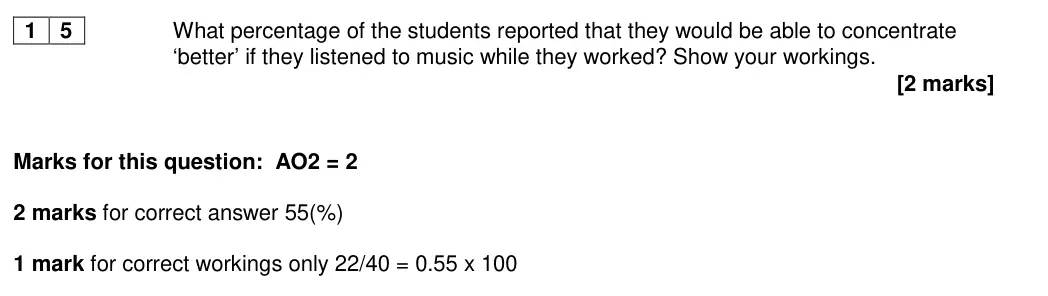
1 5
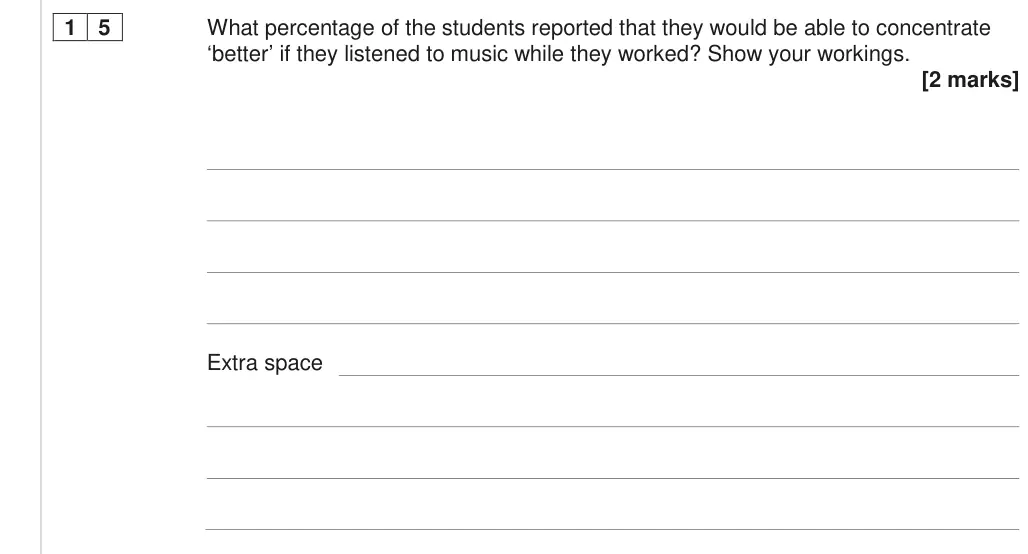
What percentage of the students reported that they would be able to concentrate
‘better’ if they listened to music while they worked? Show your workings.
[2 marks]
Extra space
June 2017 · AS Paper 2 · Q16 2 marks AO3=2 Research methods scientific processes
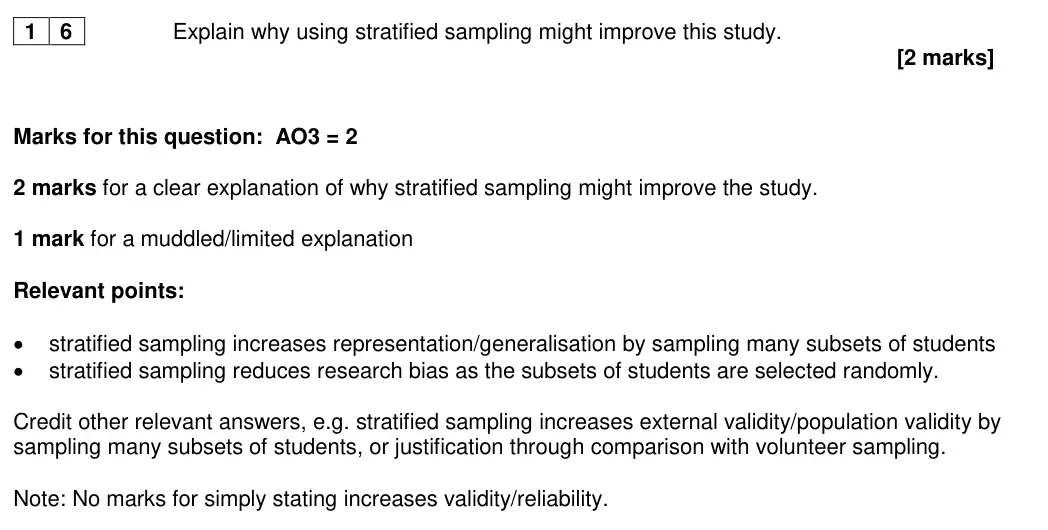
1 6
Explain why using stratified sampling might improve this study.
[2 marks]
Extra space
June 2017 · AS Paper 2 · Q17 2 marks AO1=2 Research methods data handling
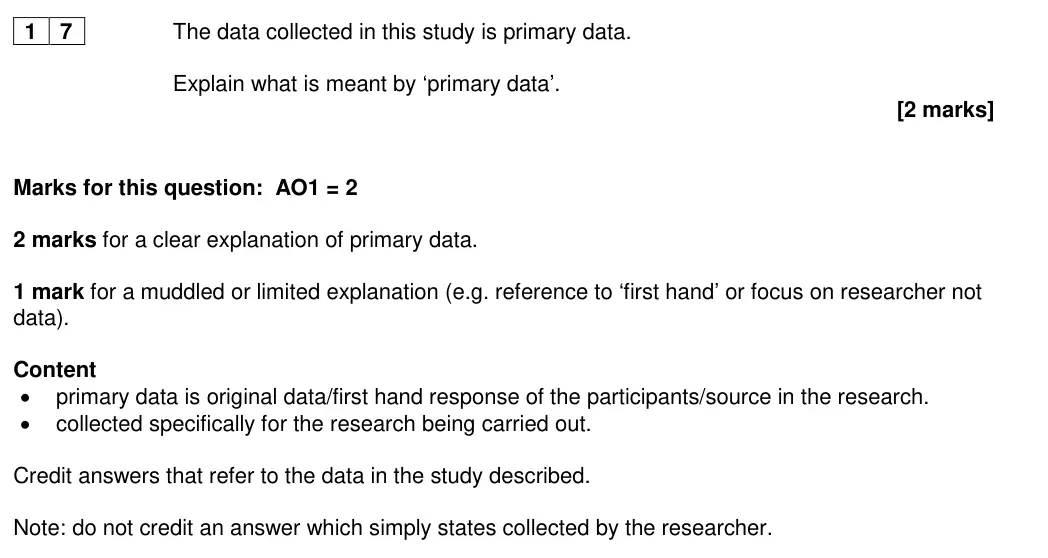
1 7
The data collected in this study is primary data.
Explain what is meant by ‘primary data’.
[2 marks]
Extra space
June 2017 · AS Paper 2 · Q18 2 marks AO2=2 Research methods data handling
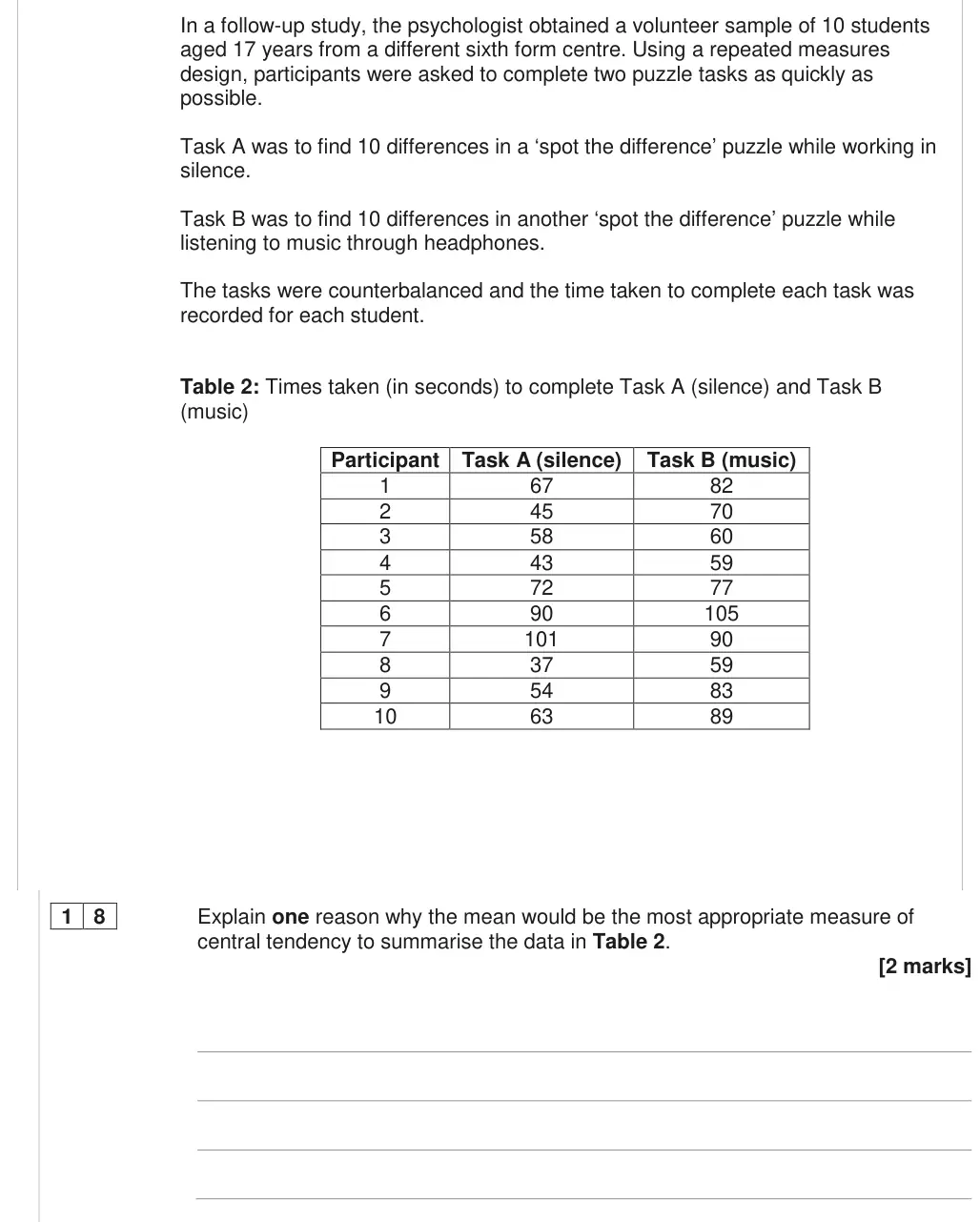
In a follow-up study, the psychologist obtained a volunteer sample of 10 students
aged 17 years from a different sixth form centre. Using a repeated measures
design, participants were asked to complete two puzzle tasks as quickly as
possible.
Task A was to find 10 differences in a ‘spot the difference’ puzzle while working in
silence.
Task B was to find 10 differences in another ‘spot the difference’ puzzle while
listening to music through headphones.
The tasks were counterbalanced and the time taken to complete each task was
recorded for each student.
Table 2: Times taken (in seconds) to complete Task A (silence) and Task B
(music)
Participant Task A (silence)
Task B (music)
1
67
82
2
45
70
3
58
60
4
43
59
5
72
77
6
90
105
7
101
90
8
37
59
9
54
83
10
63
89
1 8
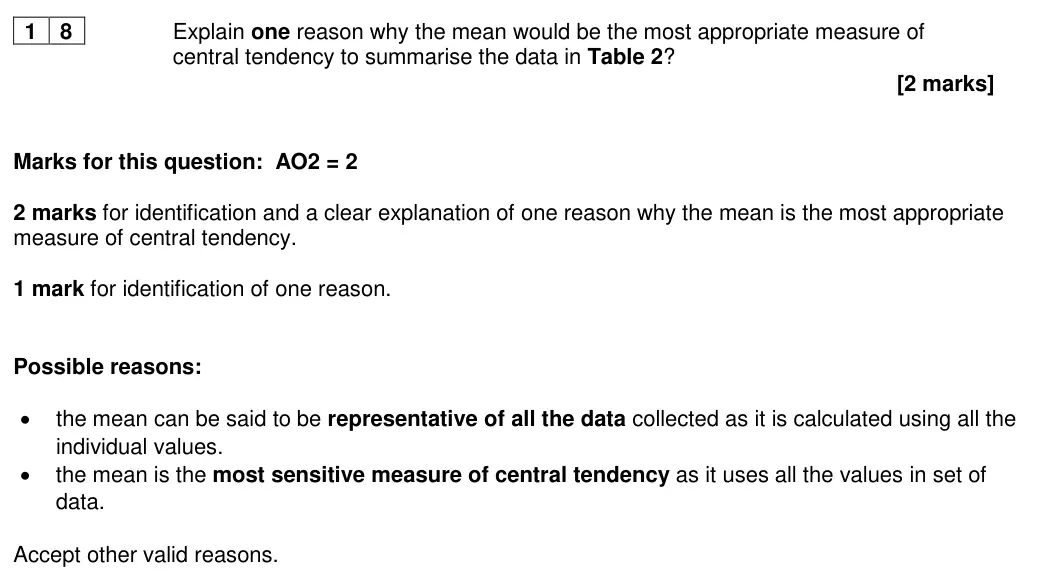
Explain one reason why the mean would be the most appropriate measure of
central tendency to summarise the data in Table 2.
[2 marks]
June 2017 · AS Paper 2 · Q19 4 marks AO2=4 Calculation Easy data handling
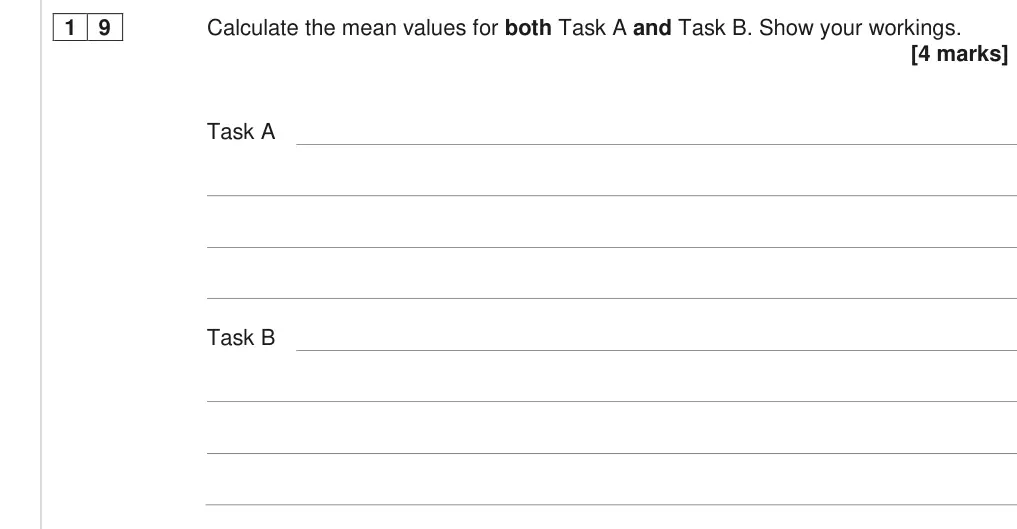
1 9
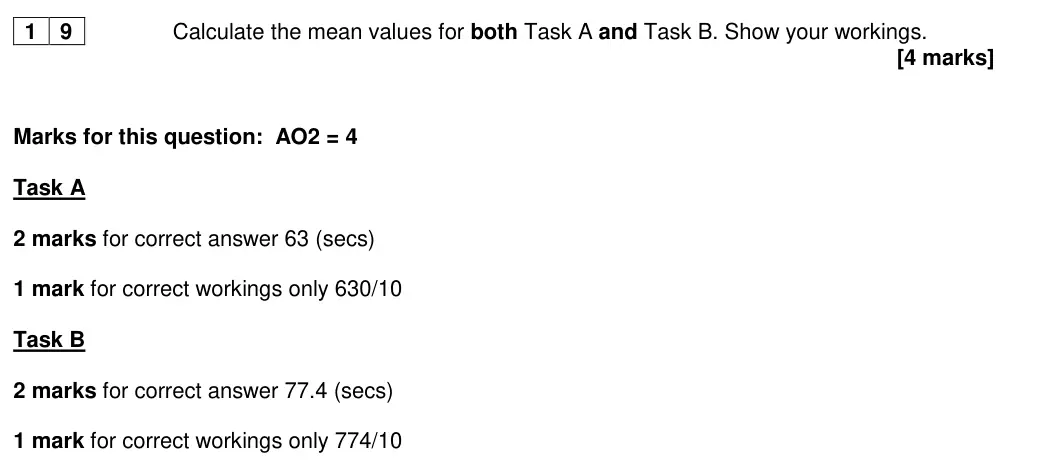
Calculate the mean values for both Task A and Task B. Show your workings.
[4 marks]
Task A
Task B
June 2017 · AS Paper 2 · Q20 3 marks AO3=3 Research methods scientific processes
2 0
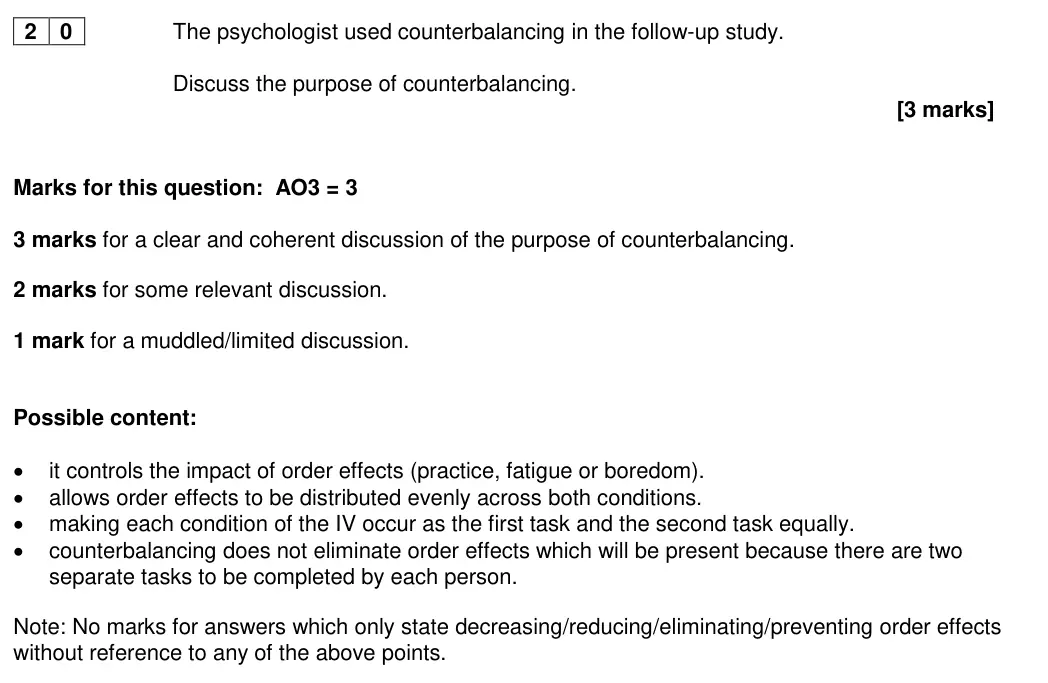
The psychologist used counterbalancing in the follow-up study.
Discuss the purpose of counterbalancing.
[3 marks]
Extra space
June 2017 · AS Paper 2 · Q21 3 marks AO2=3 Research methods Medium scientific processes
2 1
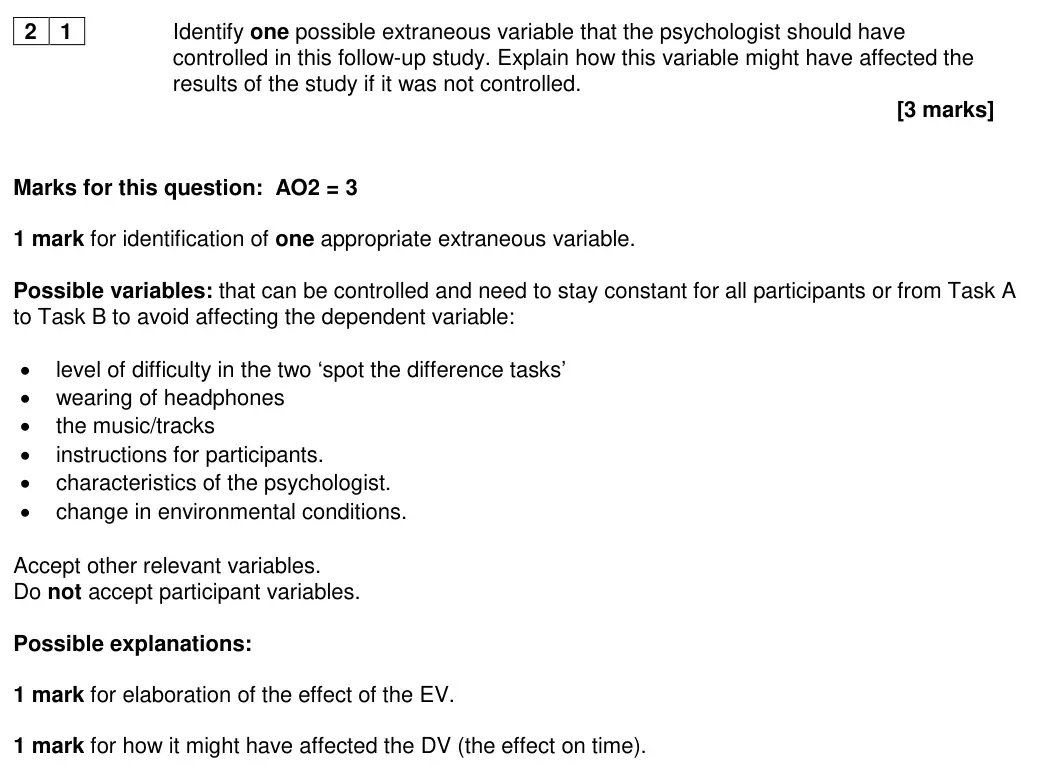
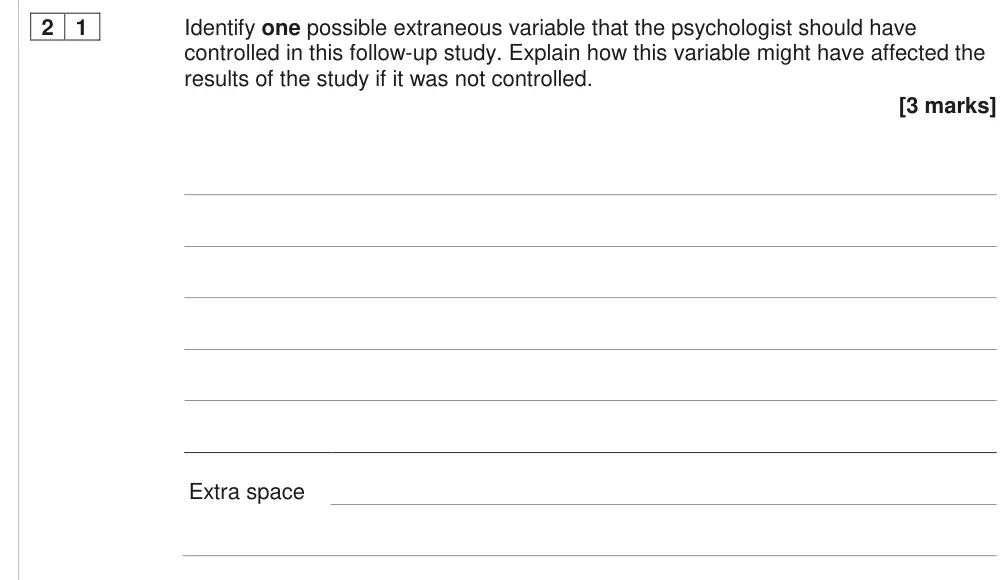
Identify one possible extraneous variable that the psychologist should have
controlled in this follow-up study. Explain how this variable might have affected the
results of the study if it was not controlled.
[3 marks]
Extra space
June 2017 · AS Paper 2 · Q22 4 marks AO3=4 Research methods research methods
2 2
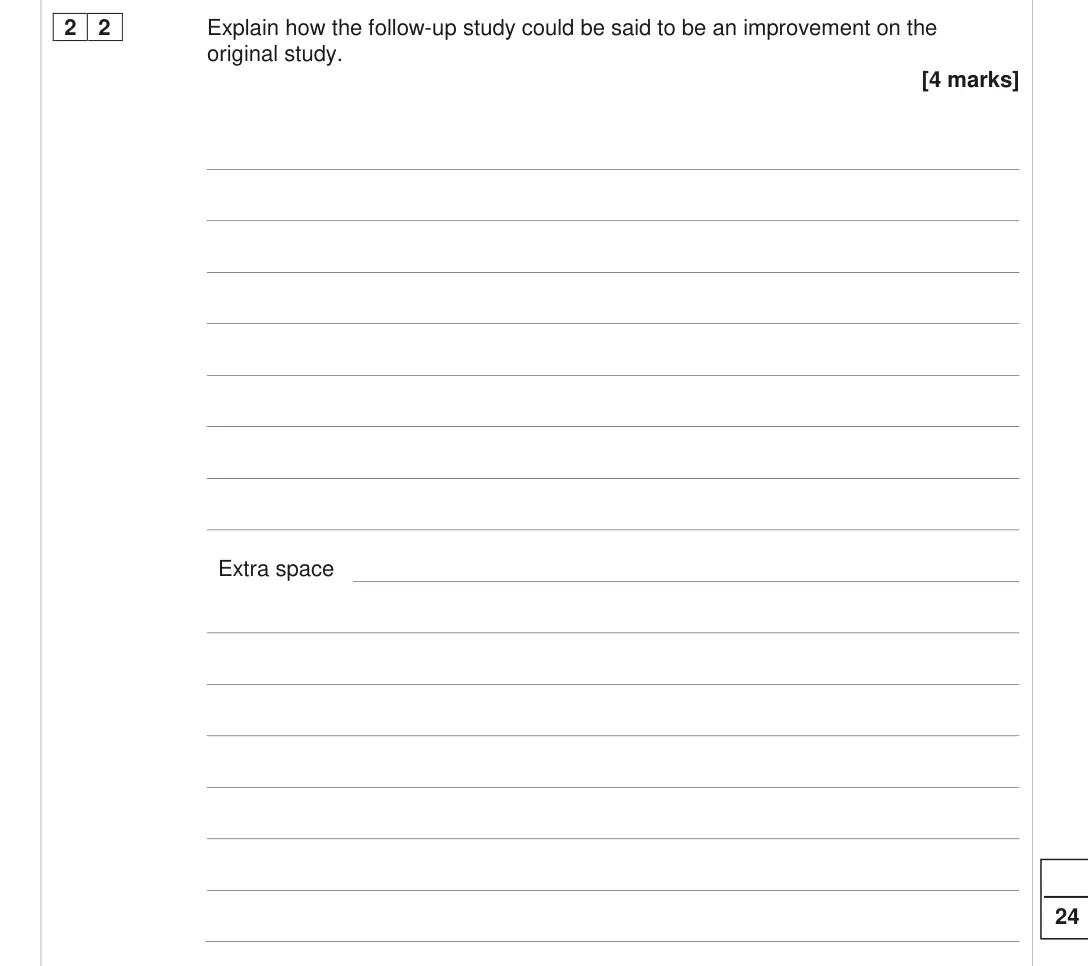
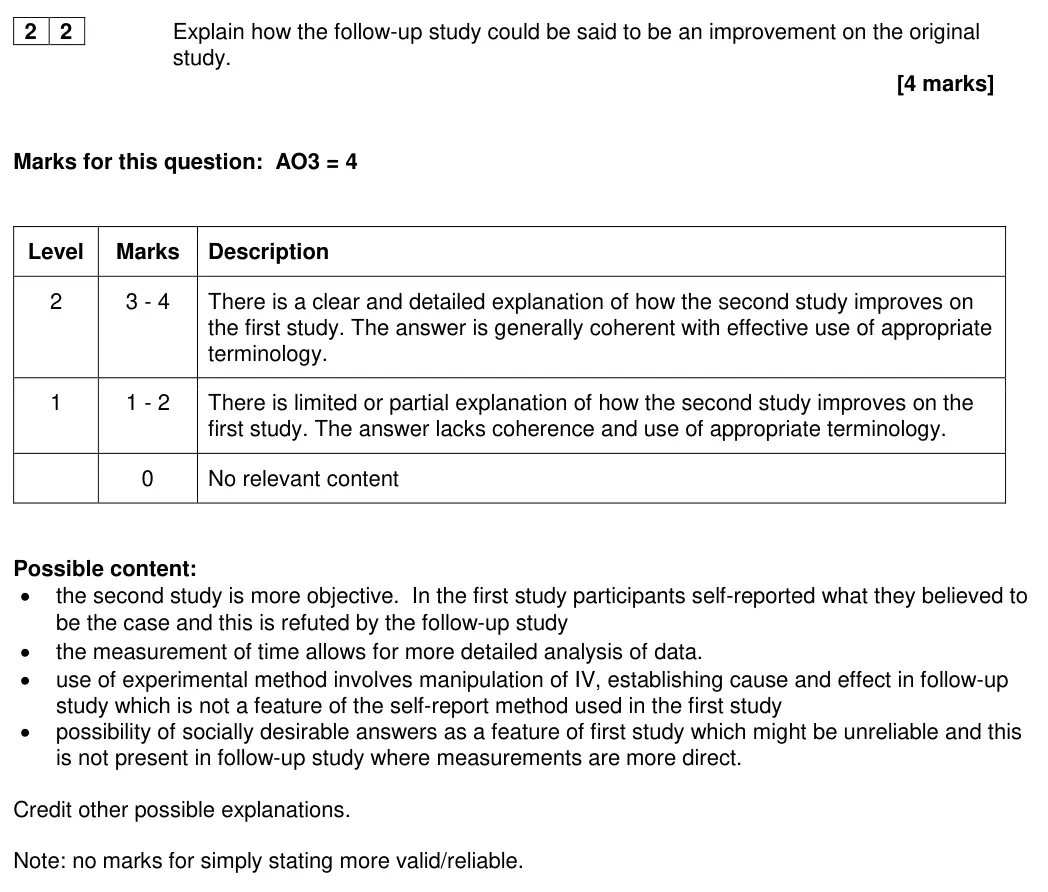
Explain how the follow-up study could be said to be an improvement on the
original study.
[4 marks]
Extra space

Work with an AQA psychology tutor

Want a paper marked and gone through with you? Message us.

Prefer email? Send an enquiry

If you are under 18, please include a parent's contact details. Enquiries go to enquiries@alevelpsychologytutor.com and are deleted once handled. All tutoring is online.