June 2017: AS Paper 1

72 marks · 18 question parts · AQA no longer hosts this series; the copies here come from third-party archives

This paper was set on the previous specification. All of its content is still on the 2025 specification.

Question by question

QTopicMarksAOType
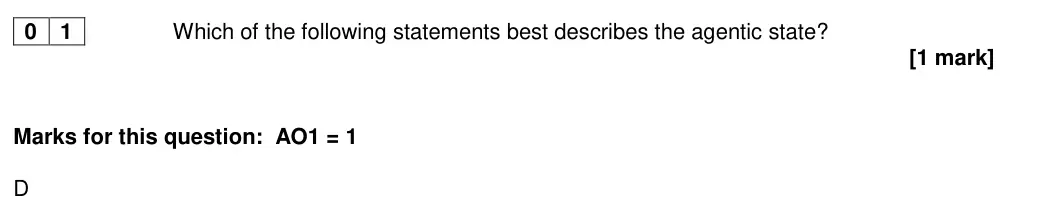
1 Social influence 1AO1=1Multiple choice
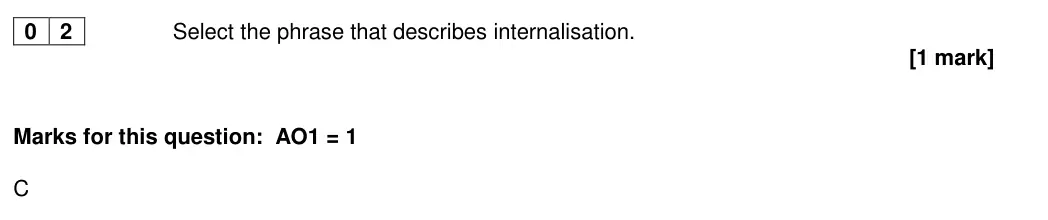
2 Social influence 1AO1=1Multiple choice
3 Social influence 4AO1=2,AO3=2Evaluate (short)
4 Social influence 4AO2=4Application
5 Social influence 2AO2=2Application
6 Social influence 12AO1=6,AO3=6Extended writing
7 Memory 2AO1=2Short answer
8 Research methods: scientific processes, Research methods: methods and techniques 4AO3=4Research methods
9 Memory 4AO2=4Application
10 Research methods: scientific processes 2AO2=2Research methods
11 Memory 12AO1=6,AO3=6Extended writing
12 Attachment 2AO1=2Short answer
13 Research methods: data handling and analysis 2AO2=2Calculation
14 Research methods: data handling and analysis 2AO2=2Calculation
15 Research methods: data handling and analysis 4AO2=4Research methods
16 Attachment 3AO1=3Outline
17 Attachment 3AO3=3Evaluate (short)
18 Attachment 8AO1=4,AO3=4Extended writing

The questions

123456789101112131415161718

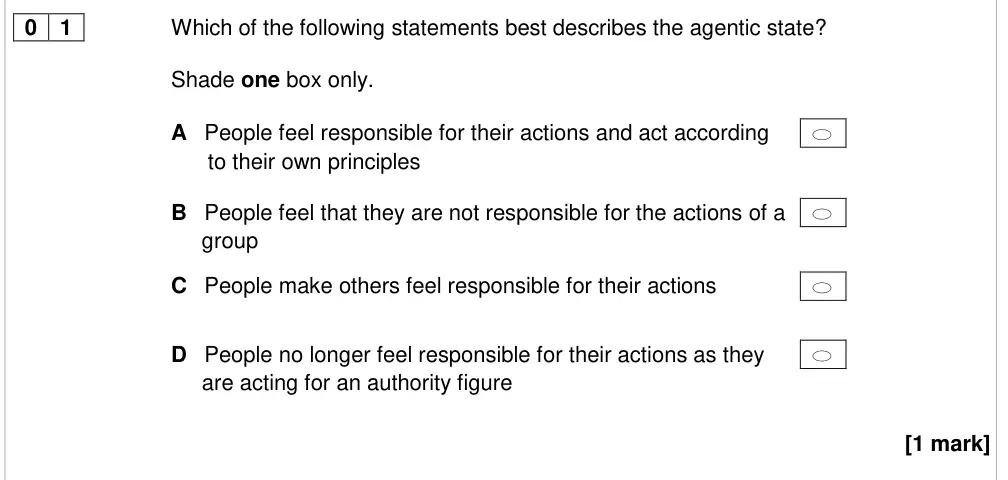
June 2017 · AS Paper 1 · Q1 1 mark AO1=1 Multiple choice social influence
0 1
Which of the following statements best describes the agentic state?
A People feel responsible for their actions and act according
to their own principles
B People feel that they are not responsible for the actions of a
group
C People make others feel responsible for their actions
D People no longer feel responsible for their actions as they
are acting for an authority figure
[1 mark]
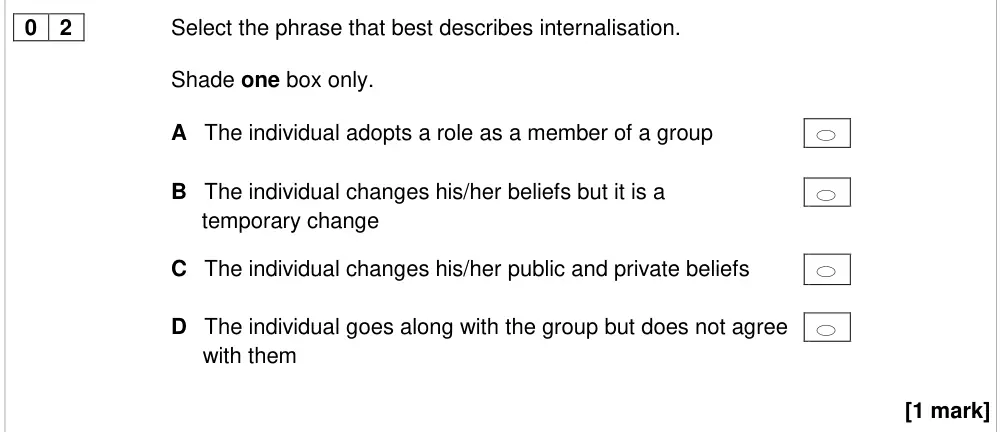
June 2017 · AS Paper 1 · Q2 1 mark AO1=1 Multiple choice social influence
0 2
Select the phrase that best describes internalisation.
A The individual adopts a role as a member of a group
B The individual changes his/her beliefs but it is a
temporary change
C The individual changes his/her public and private beliefs
D The individual goes along with the group but does not agree
with them
[1 mark]
June 2017 · AS Paper 1 · Q3 4 marks AO1=2, AO3=2 Evaluate (short) social influence
0 3
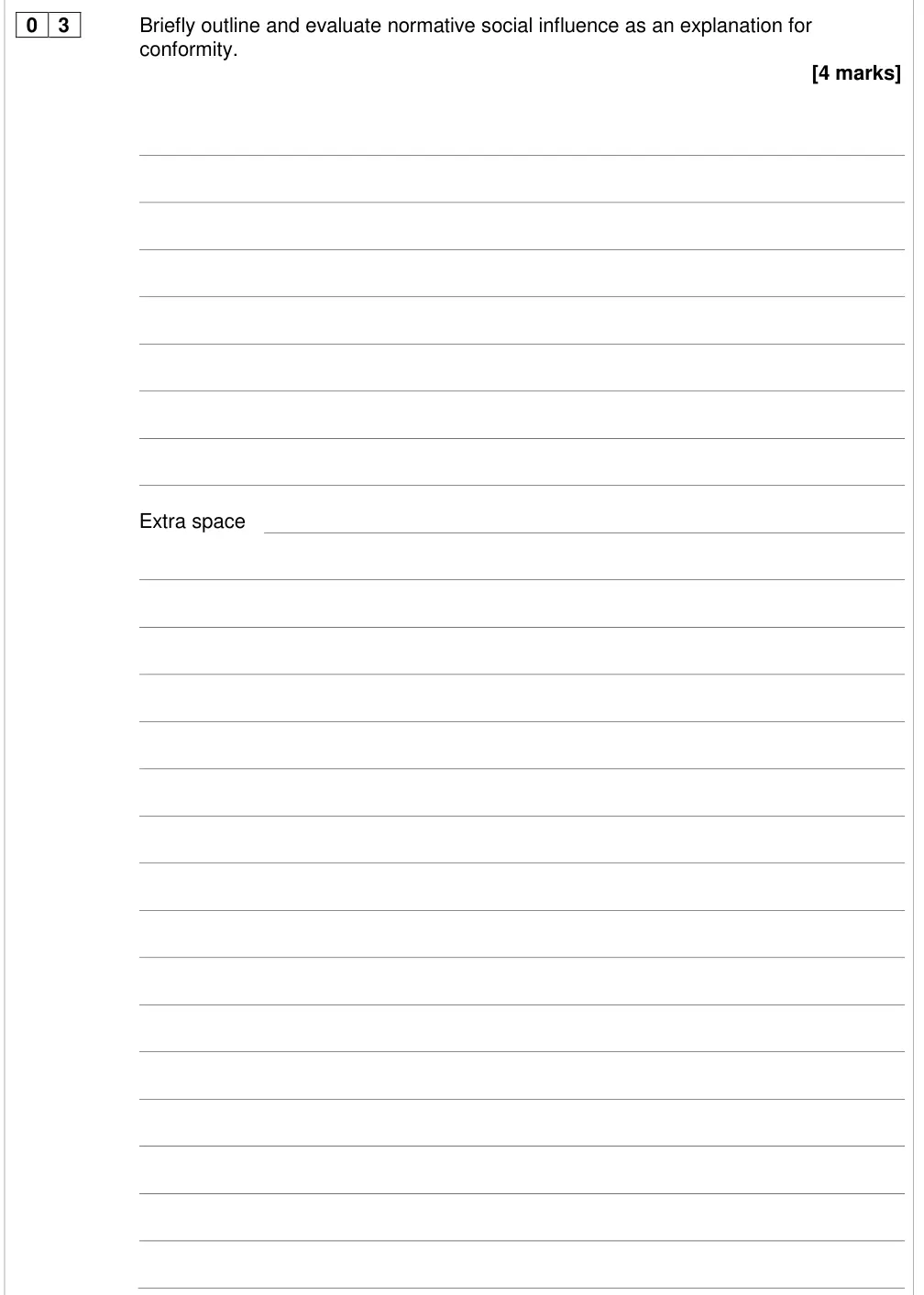
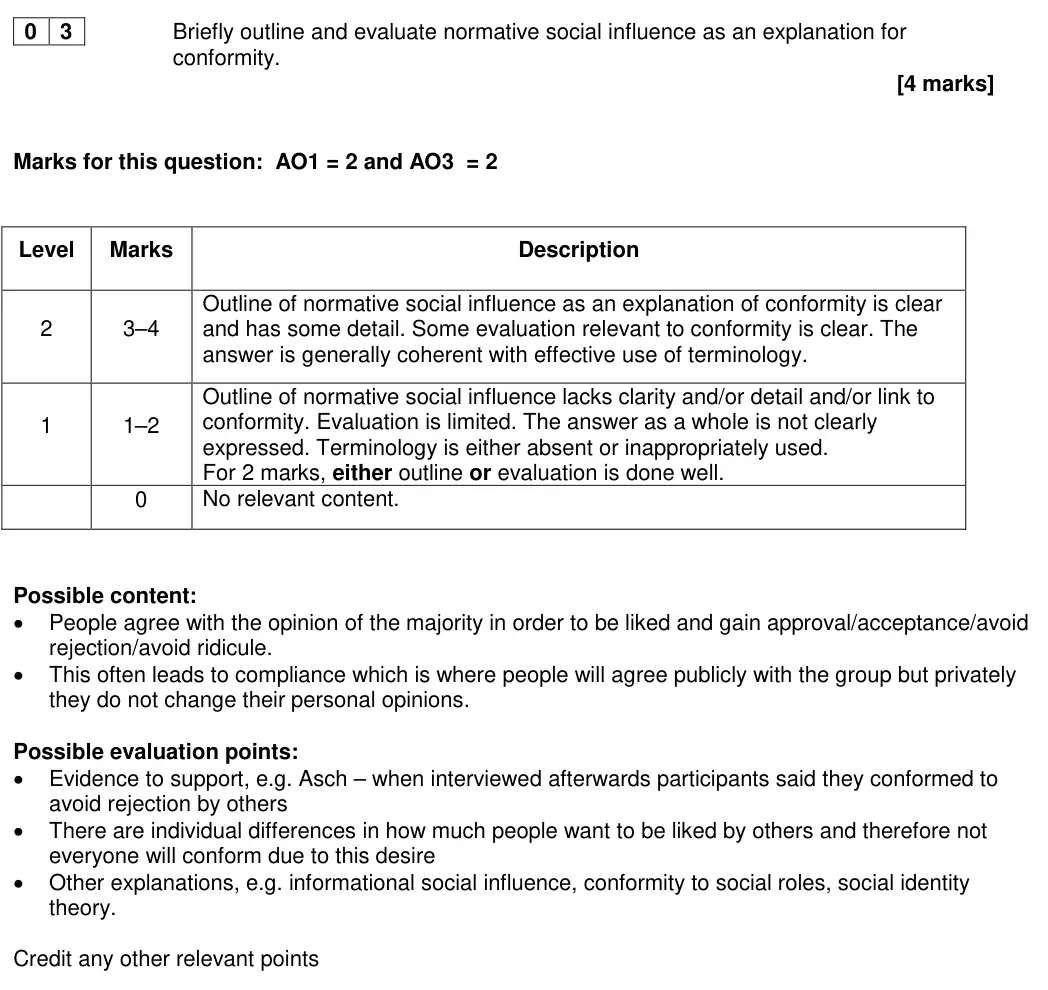
Briefly outline and evaluate normative social influence as an explanation for
conformity.
[4 marks]
Extra space
June 2017 · AS Paper 1 · Q4 4 marks AO2=4 Application social influence
0 4
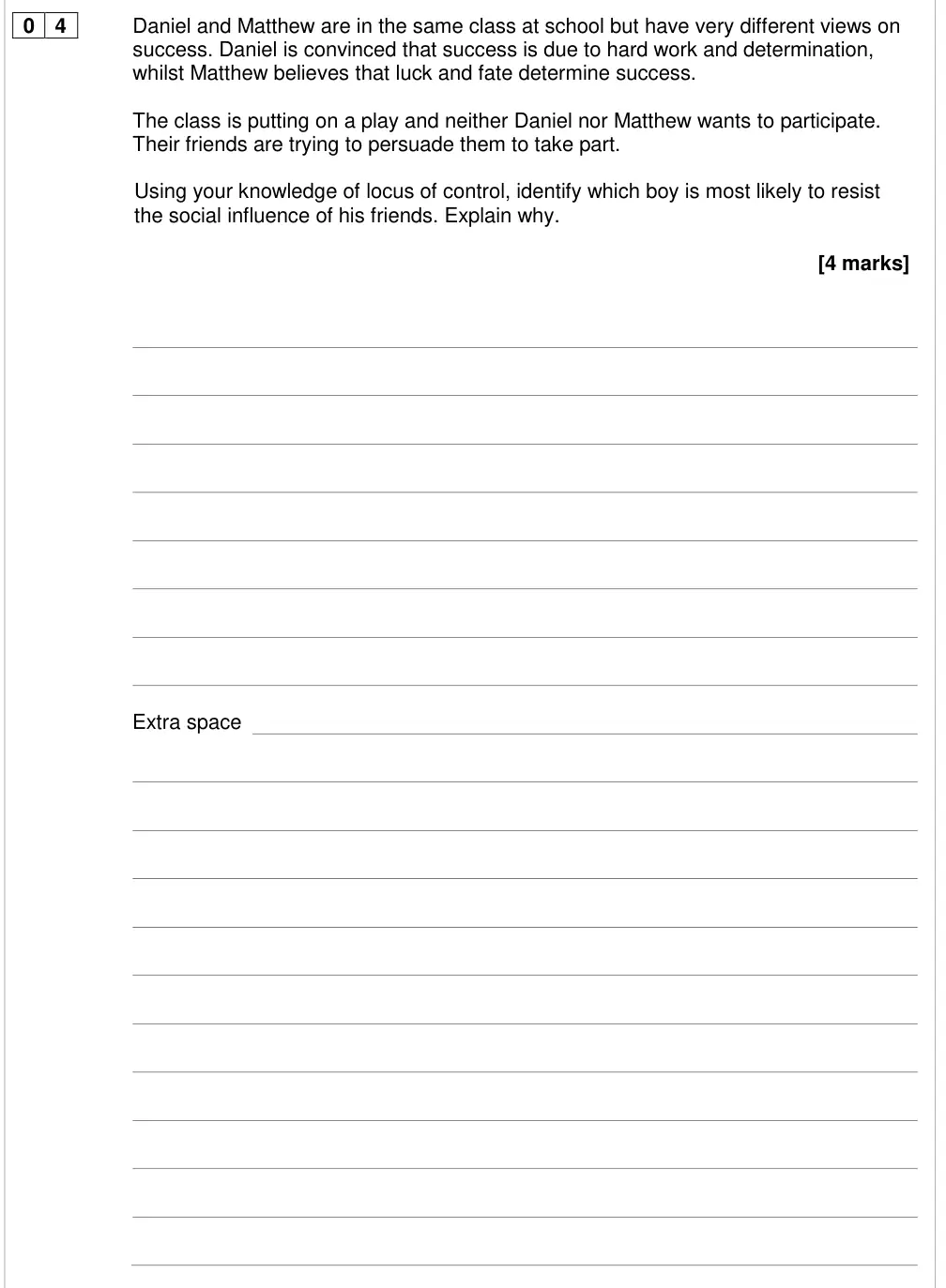
Daniel and Matthew are in the same class at school but have very different views on
success. Daniel is convinced that success is due to hard work and determination,
whilst Matthew believes that luck and fate determine success.
The class is putting on a play and neither Daniel nor Matthew wants to participate.
Their friends are trying to persuade them to take part.
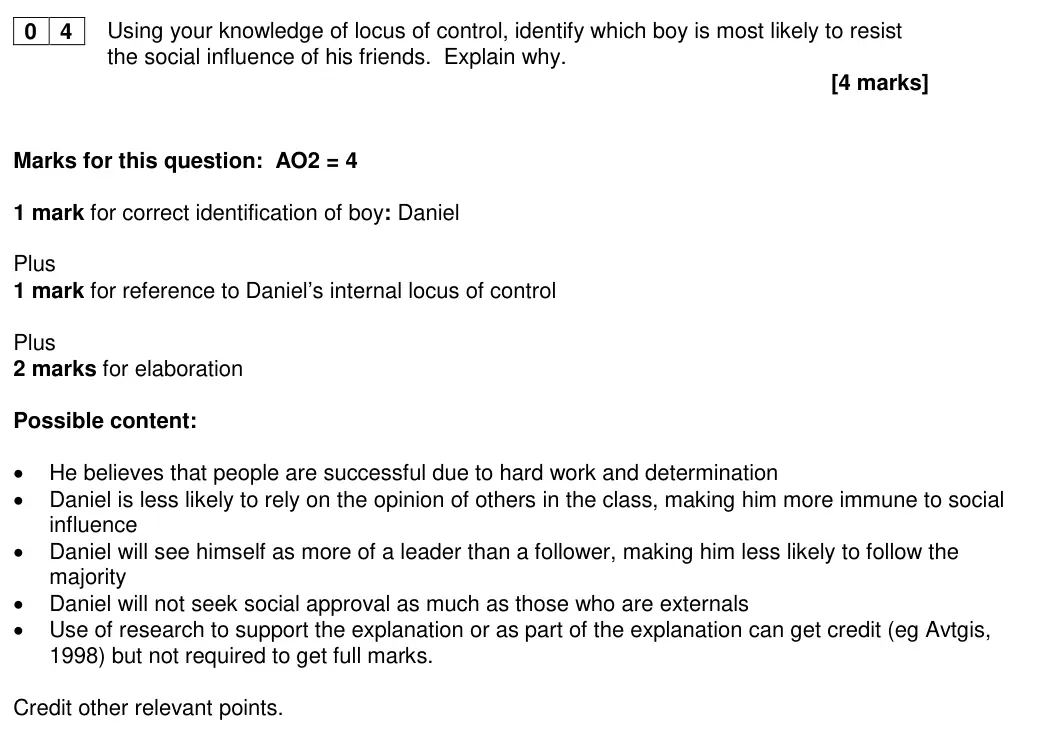
Using your knowledge of locus of control, identify which boy is most likely to resist
the social influence of his friends. Explain why.
[4 marks]
Extra space
June 2017 · AS Paper 1 · Q5 2 marks AO2=2 Application social influence
0 5
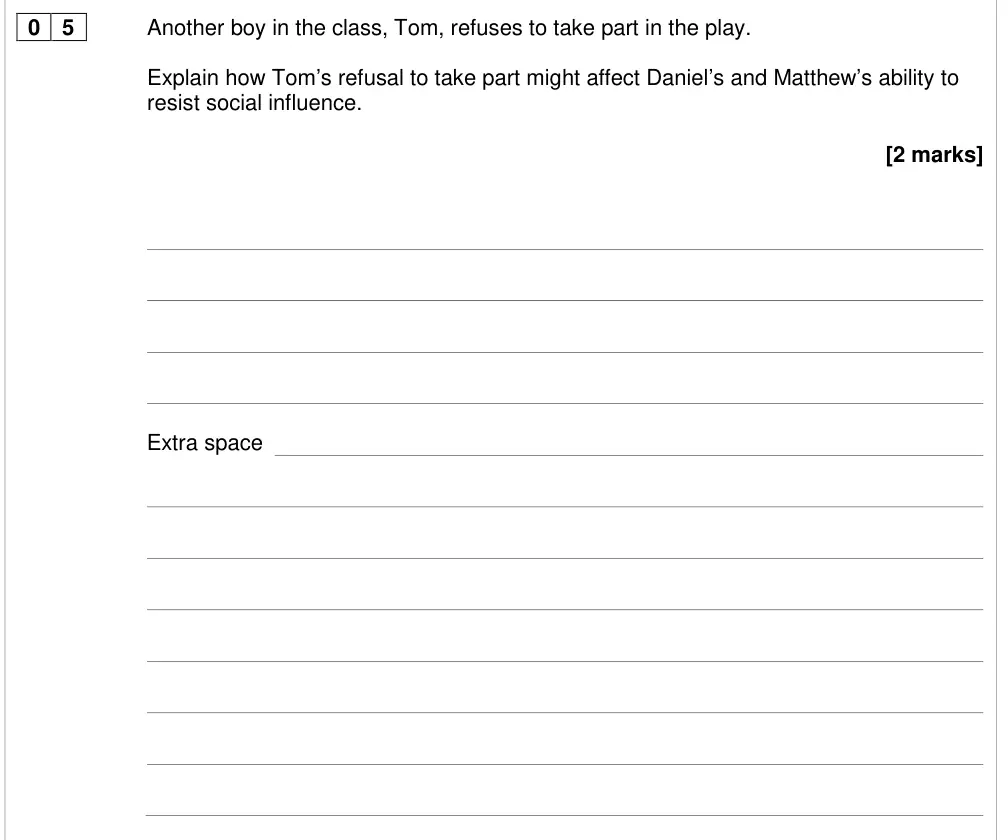
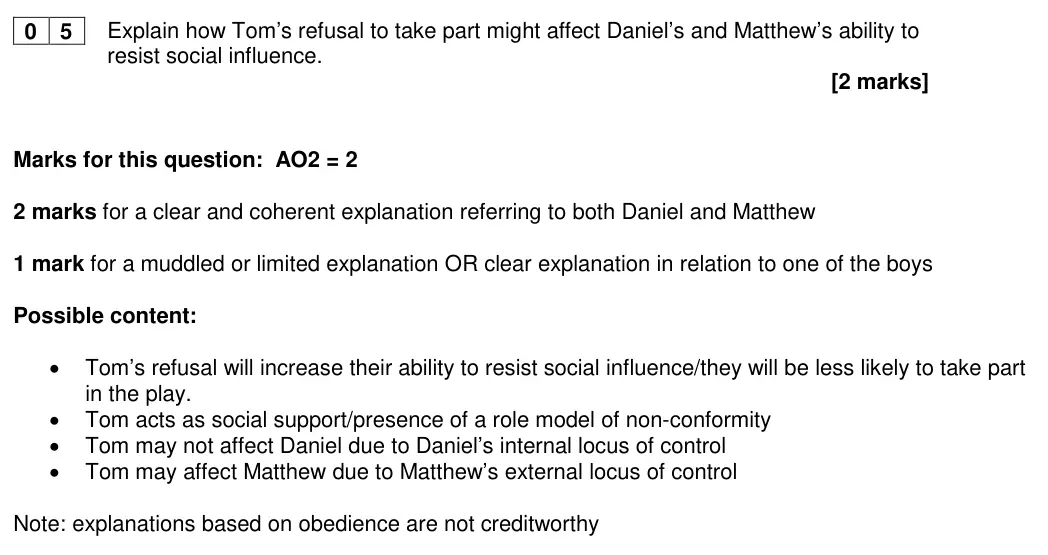
Another boy in the class, Tom, refuses to take part in the play.
Explain how Tom’s refusal to take part might affect Daniel’s and Matthew’s ability to
resist social influence.
[2 marks]
Extra space
June 2017 · AS Paper 1 · Q6 12 marks AO1=6, AO3=6 Extended writing social influence
0 6
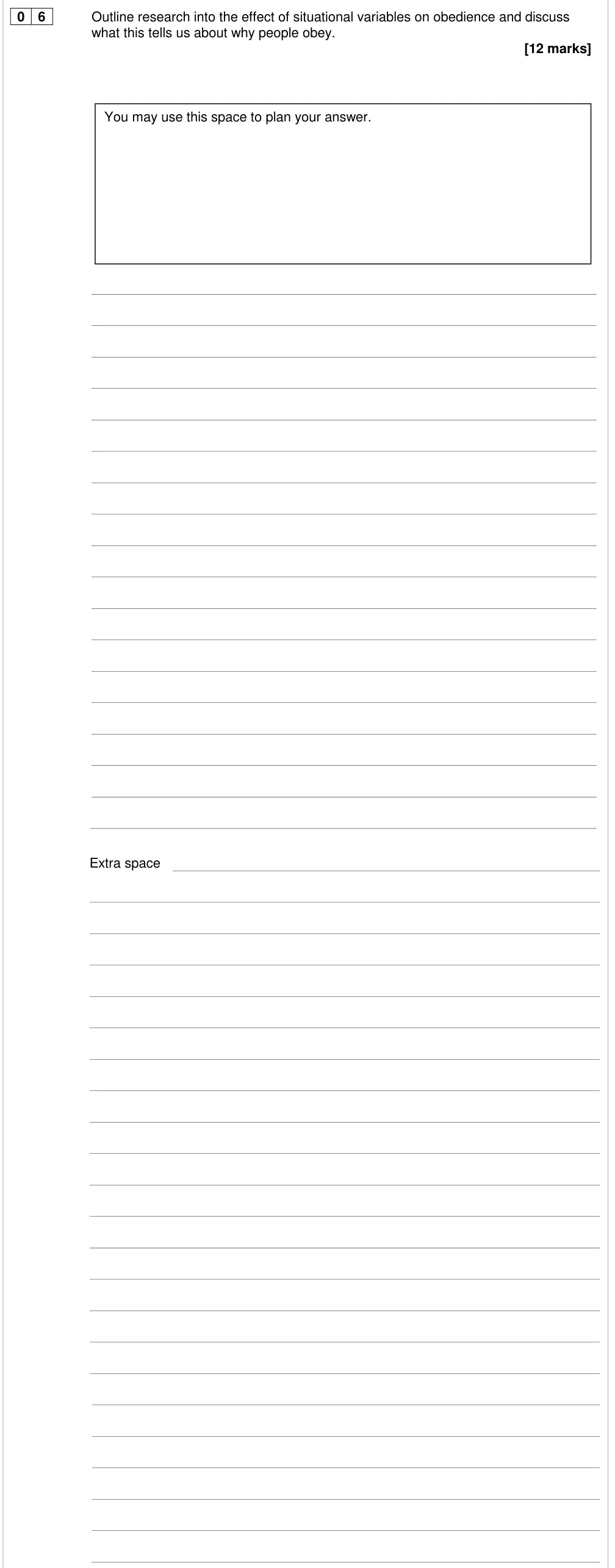
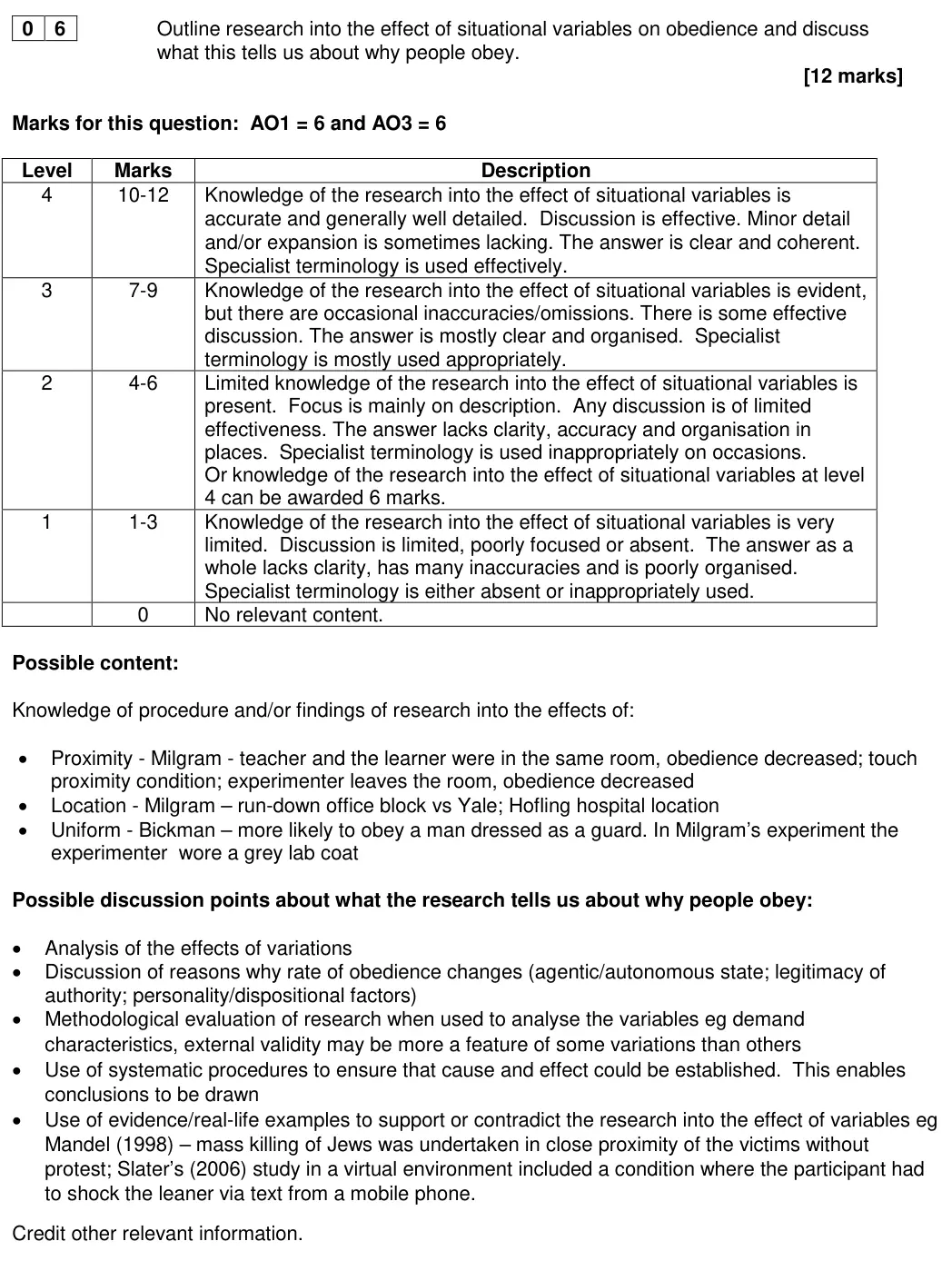
Outline research into the effect of situational variables on obedience and discuss
what this tells us about why people obey.
[12 marks]
You may use this space to plan your answer.
Extra space
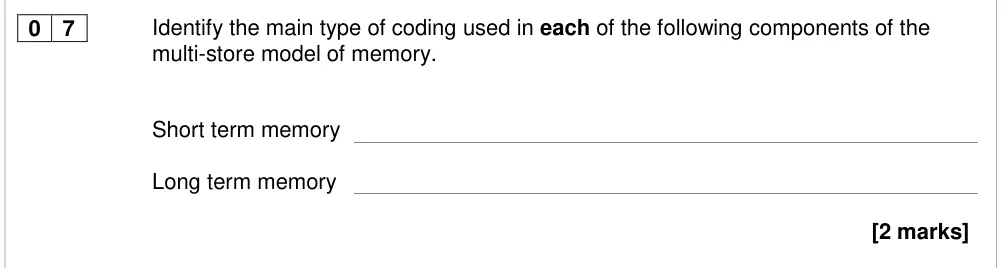
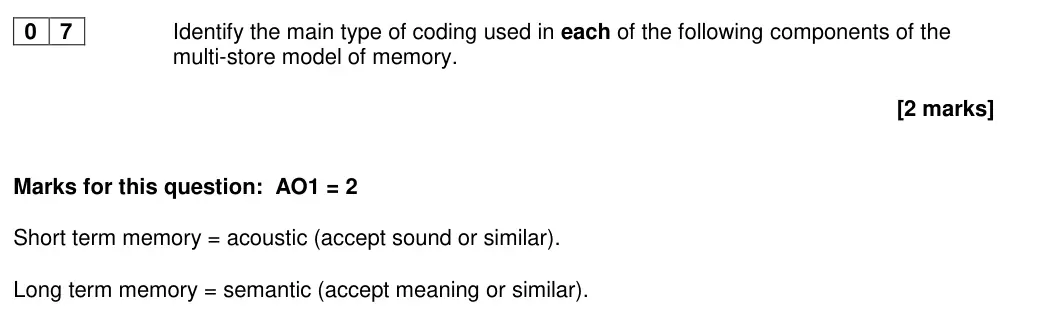
June 2017 · AS Paper 1 · Q7 2 marks AO1=2 Short answer memory
0 7
Identify the main type of coding used in each of the following components of the
multi-store model of memory.
Short term memory
Long term memory
[2 marks]
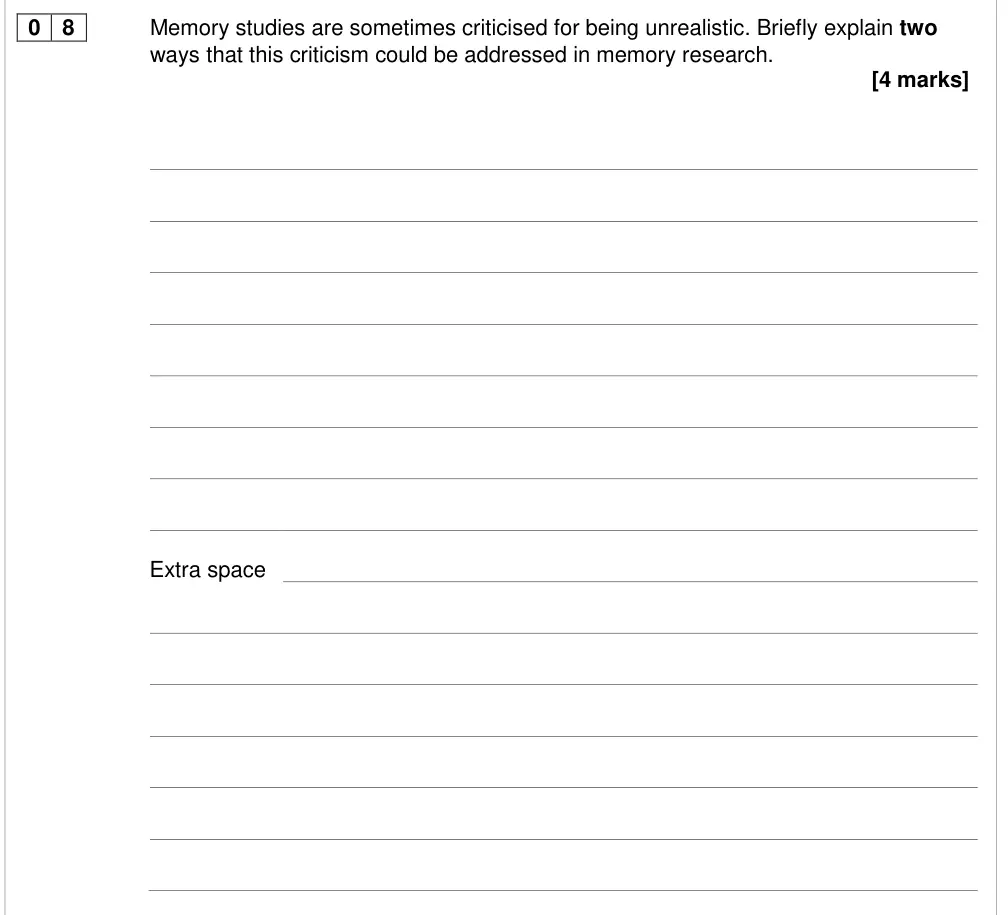
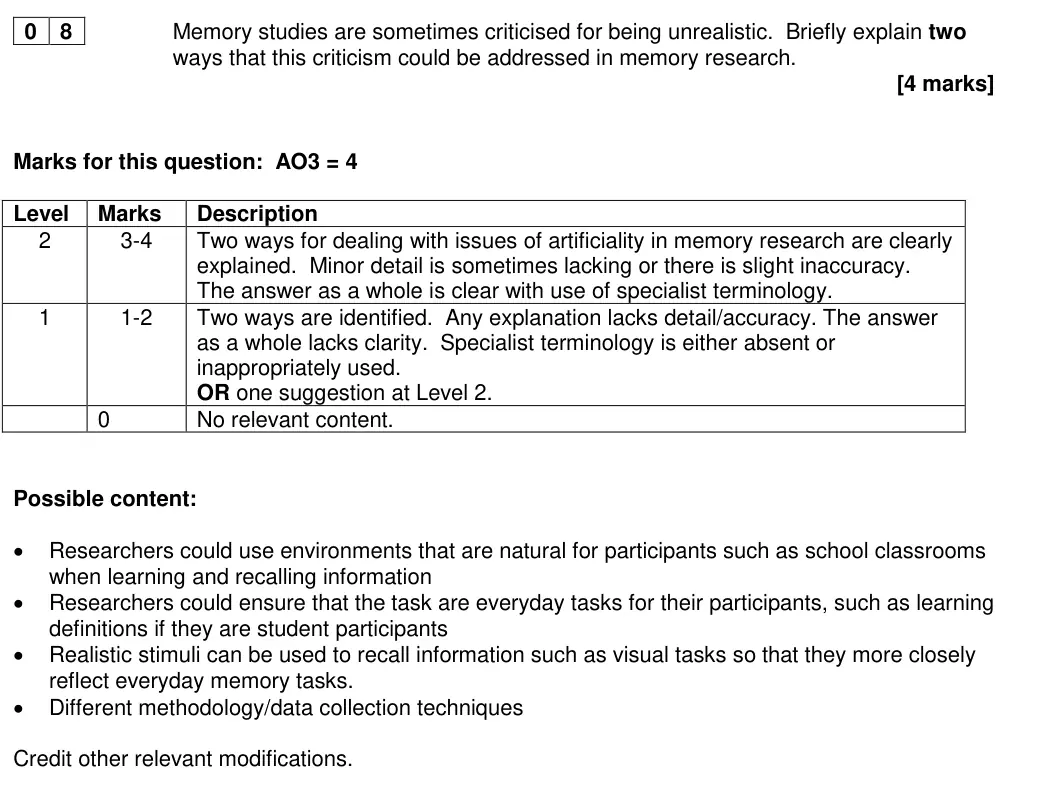
June 2017 · AS Paper 1 · Q8 4 marks AO3=4 Research methods scientific processesresearch methods
0 8
Memory studies are sometimes criticised for being unrealistic. Briefly explain two
ways that this criticism could be addressed in memory research.
[4 marks]
Extra space
June 2017 · AS Paper 1 · Q9 4 marks AO2=4 Application memory
0 9
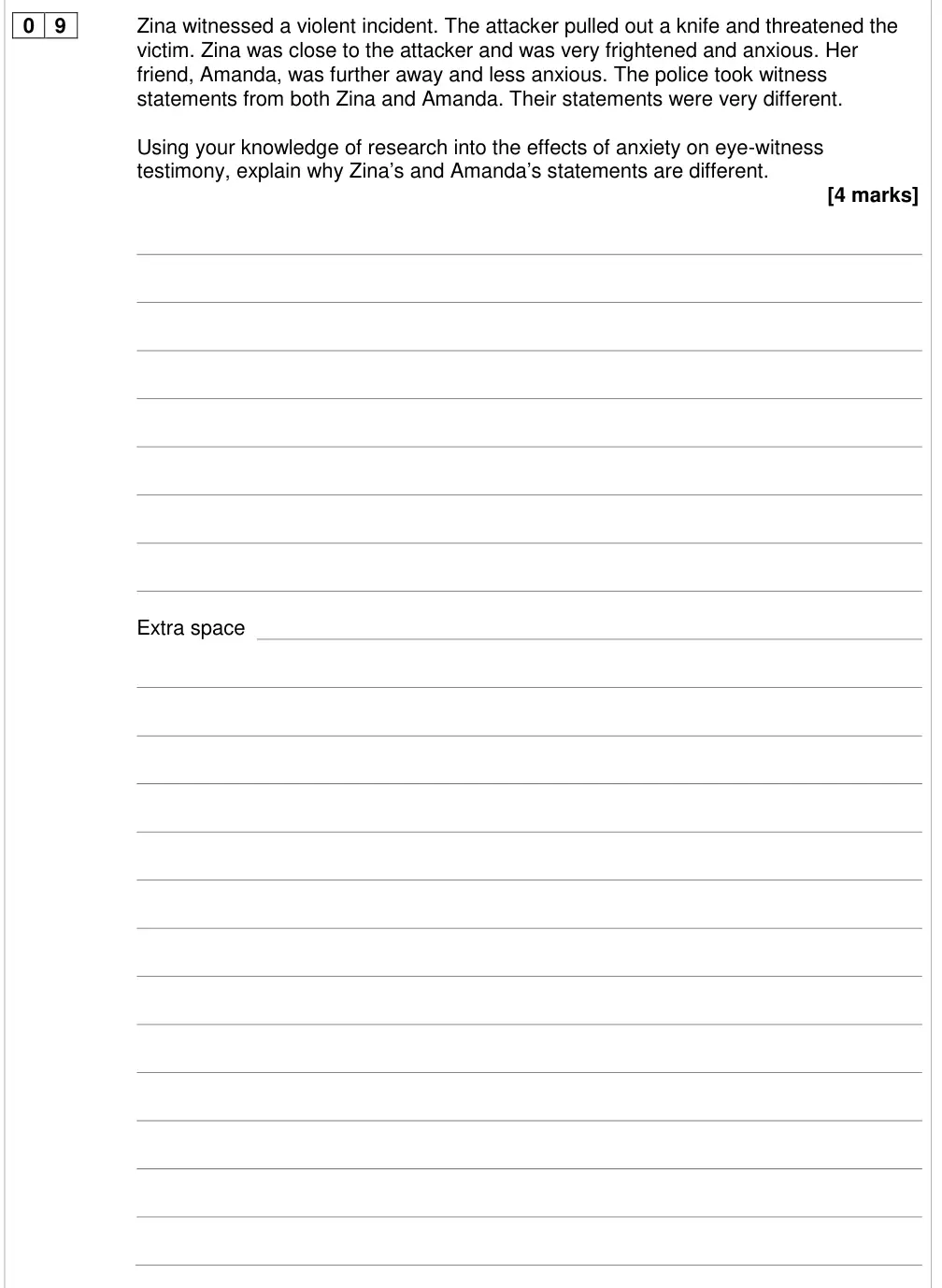
Zina witnessed a violent incident. The attacker pulled out a knife and threatened the
victim. Zina was close to the attacker and was very frightened and anxious. Her
friend, Amanda, was further away and less anxious. The police took witness
statements from both Zina and Amanda. Their statements were very different.
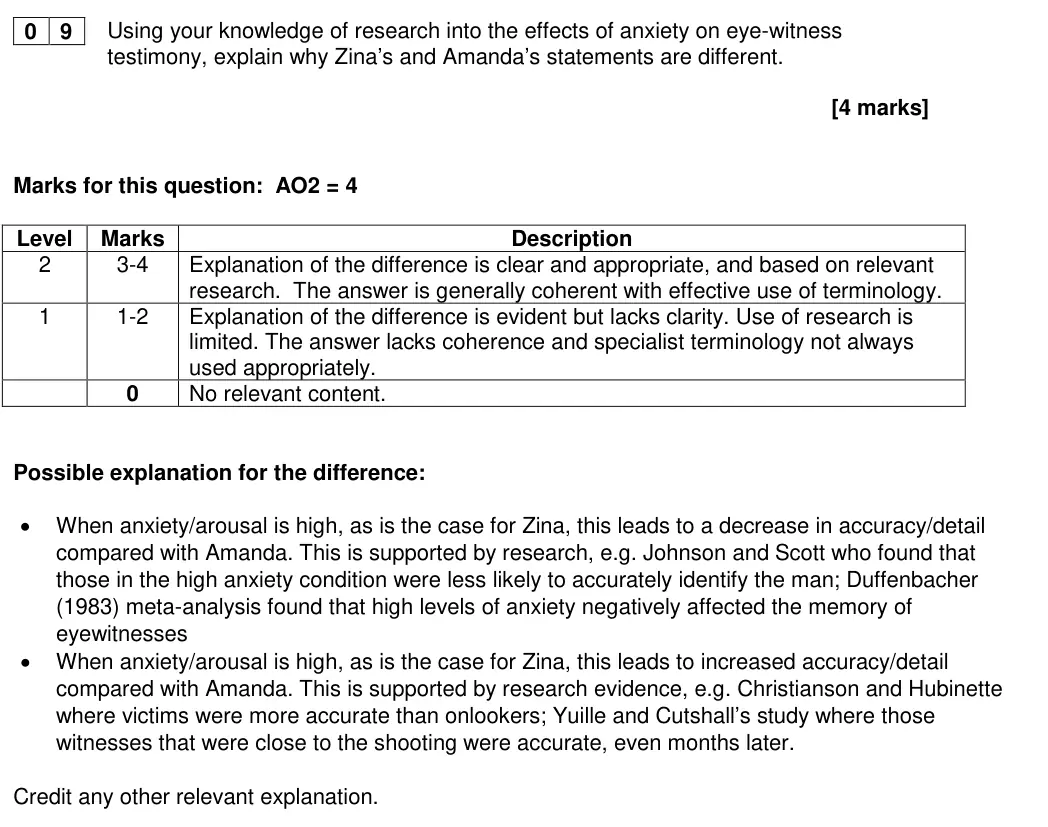
Using your knowledge of research into the effects of anxiety on eye-witness
testimony, explain why Zina’s and Amanda’s statements are different.
[4 marks]
Extra space
June 2017 · AS Paper 1 · Q10 2 marks AO2=2 Research methods Easy scientific processes
1 0
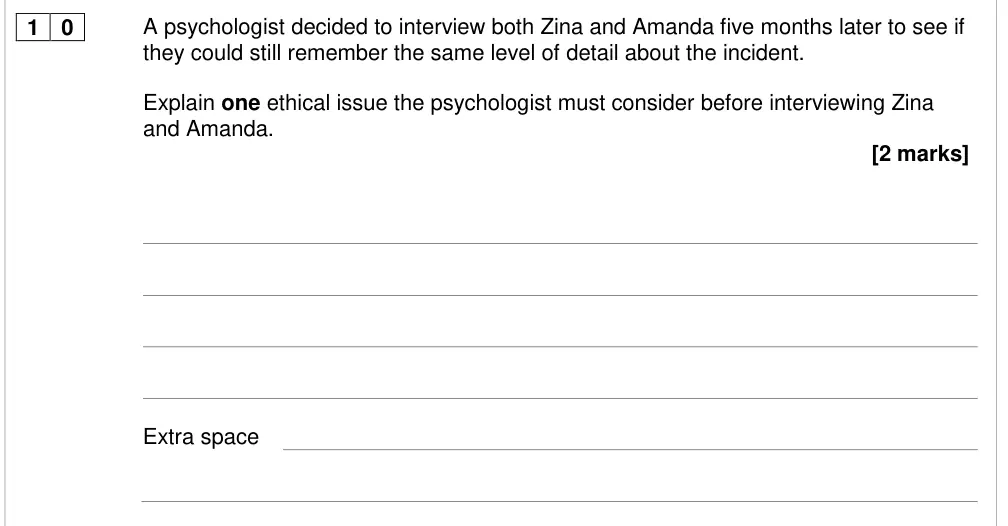
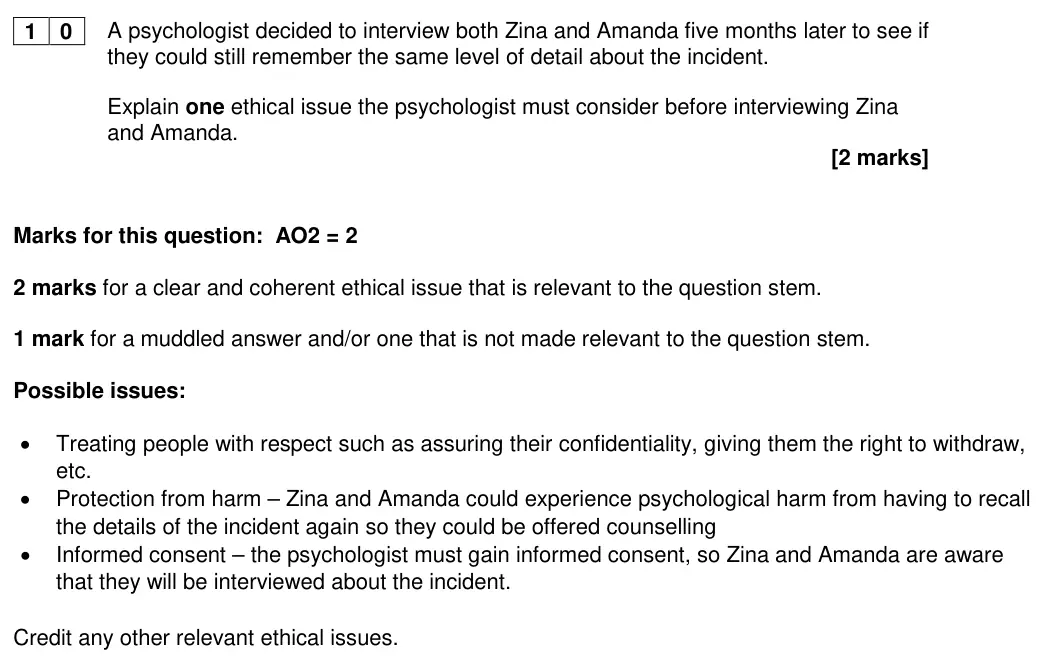
A psychologist decided to interview both Zina and Amanda five months later to see if
they could still remember the same level of detail about the incident.
Explain one ethical issue the psychologist must consider before interviewing Zina
and Amanda.
[2 marks]
Extra space
June 2017 · AS Paper 1 · Q11 12 marks AO1=6, AO3=6 Extended writing memory
1 1
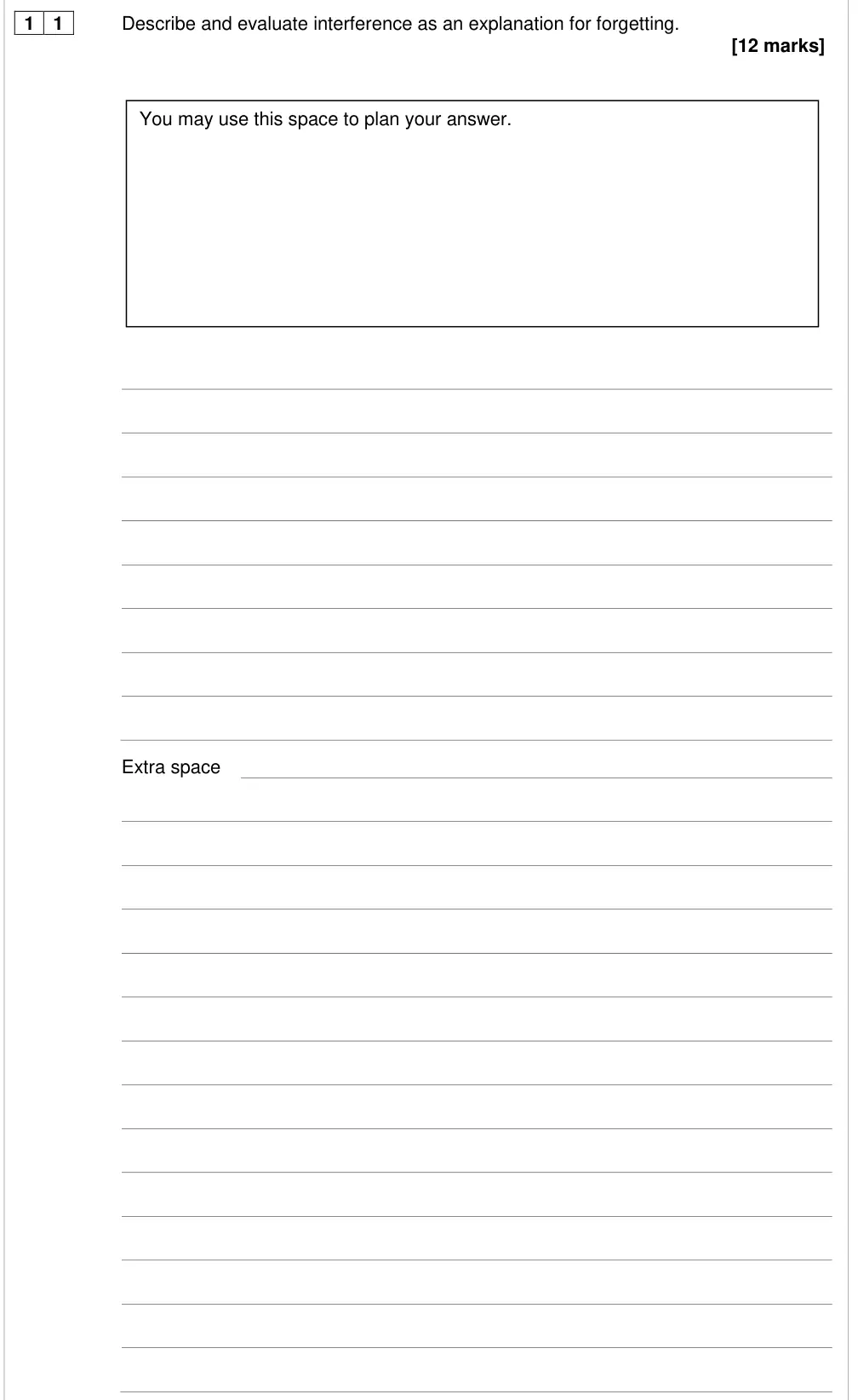
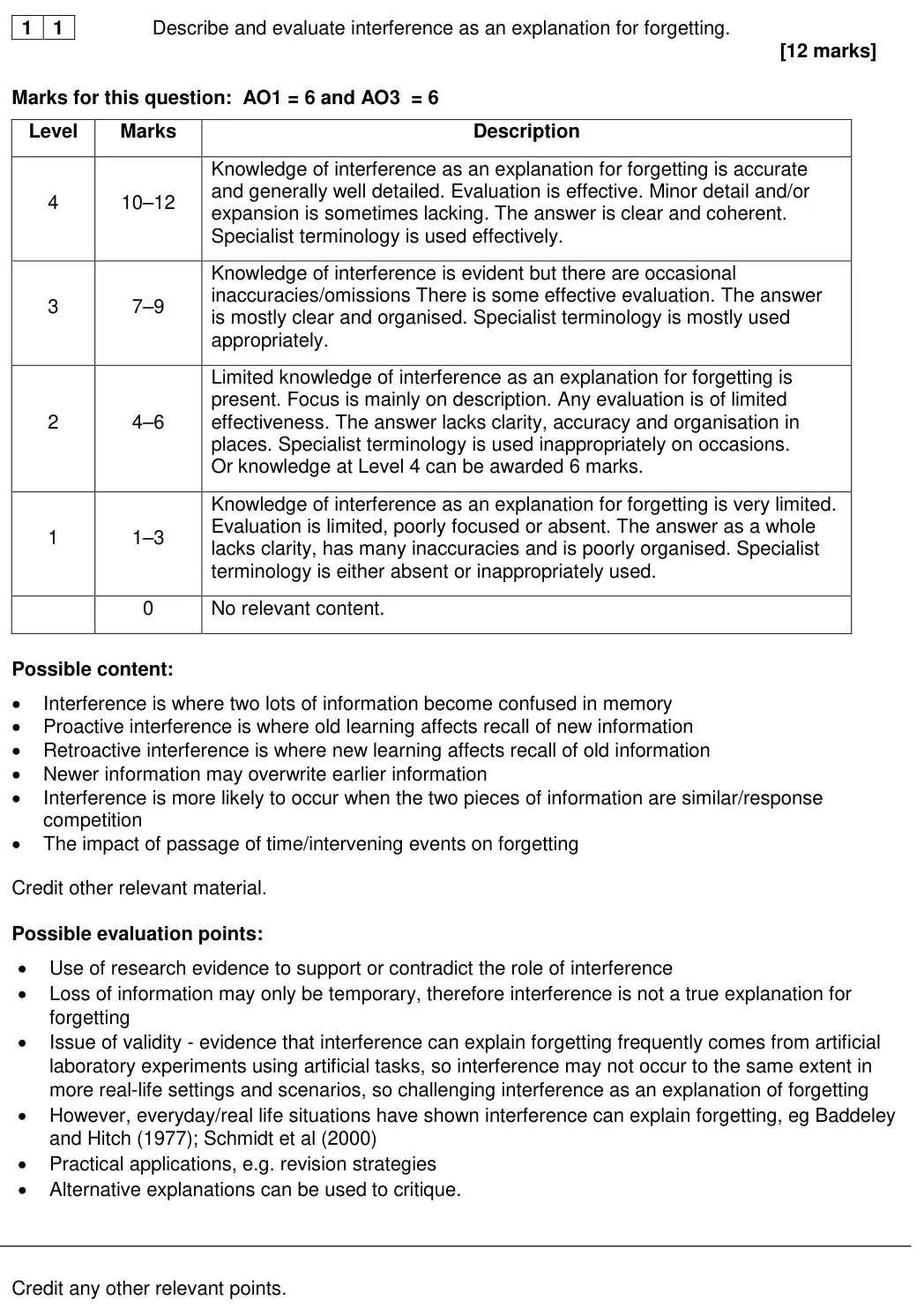
Describe and evaluate interference as an explanation for forgetting.
[12 marks]
You may use this space to plan your answer.
Extra space
June 2017 · AS Paper 1 · Q12 2 marks AO1=2 Short answer attachment
1 2
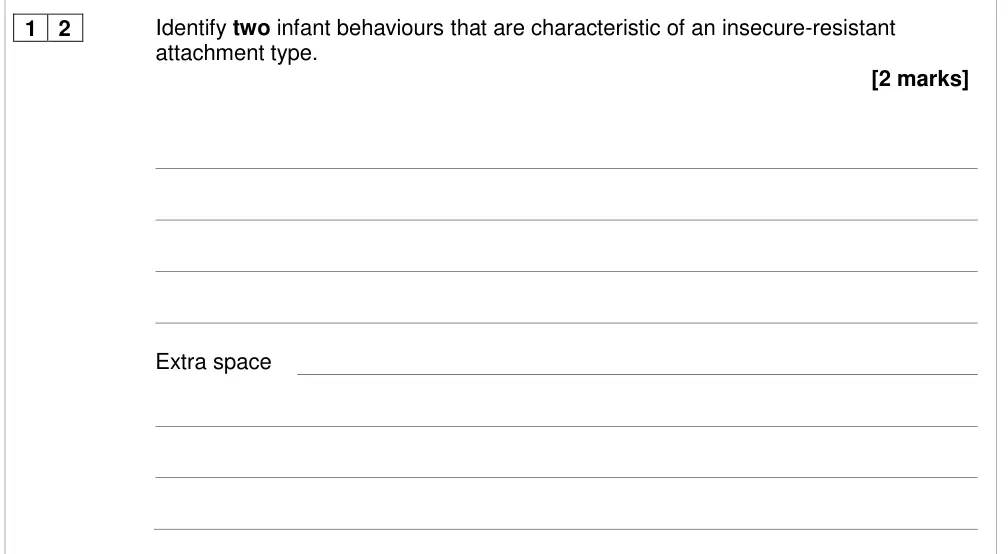
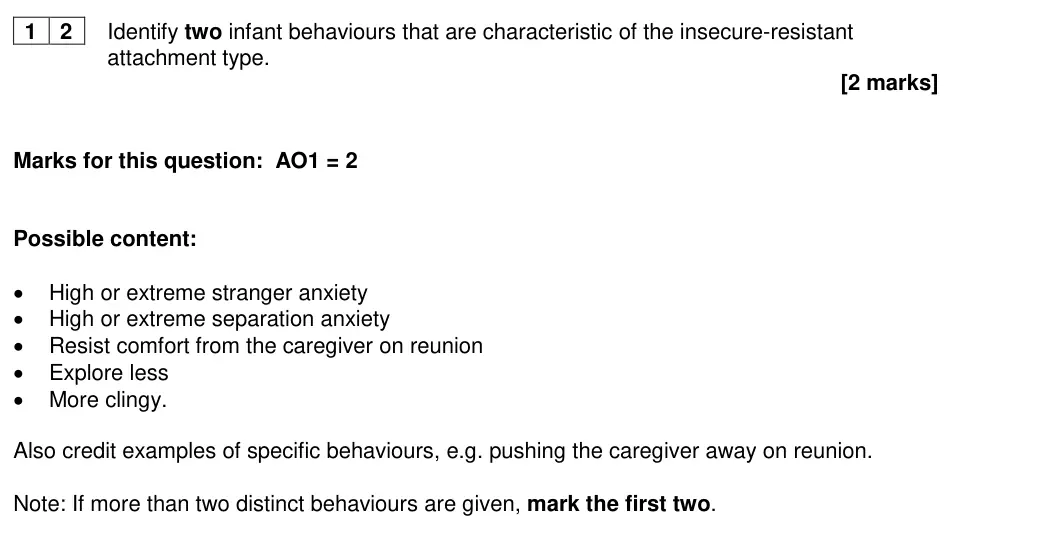
Identify two infant behaviours that are characteristic of an insecure-resistant
attachment type.
[2 marks]
Extra space
June 2017 · AS Paper 1 · Q13 2 marks AO2=2 Calculation data handling
1 3
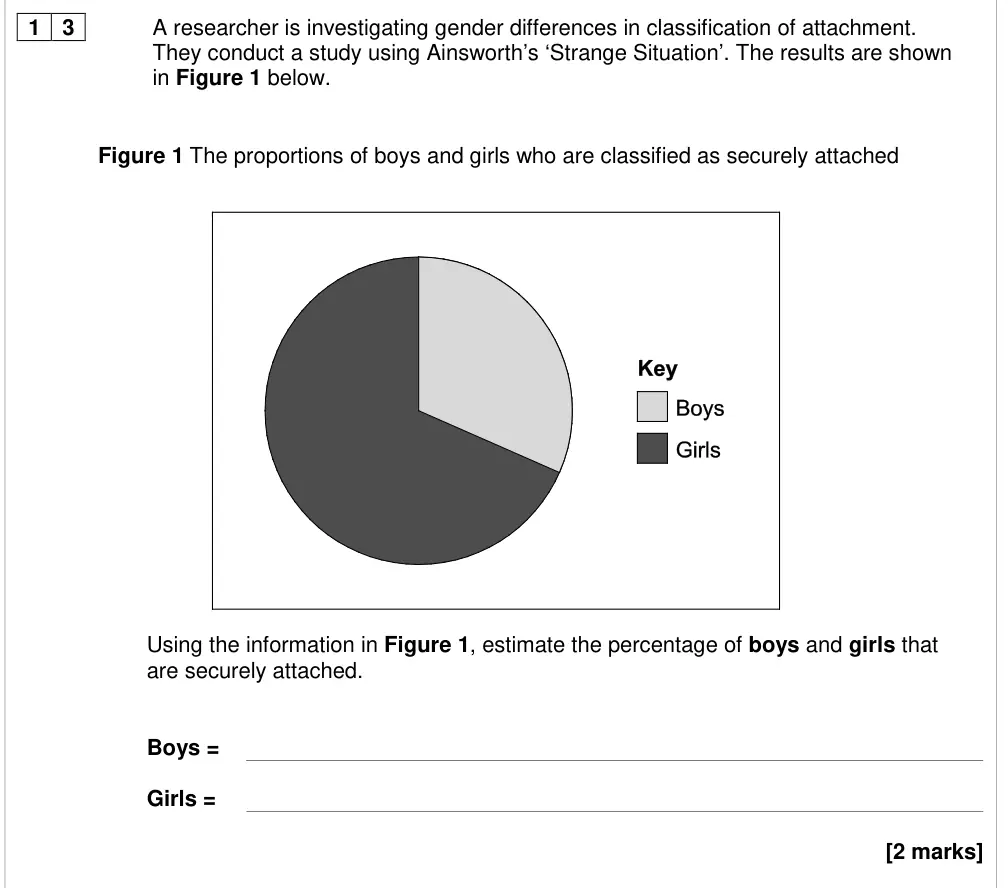
A researcher is investigating gender differences in classification of attachment.
They conduct a study using Ainsworth’s ‘Strange Situation’. The results are shown
in Figure 1 below.
Figure 1 The proportions of boys and girls who are classified as securely attached
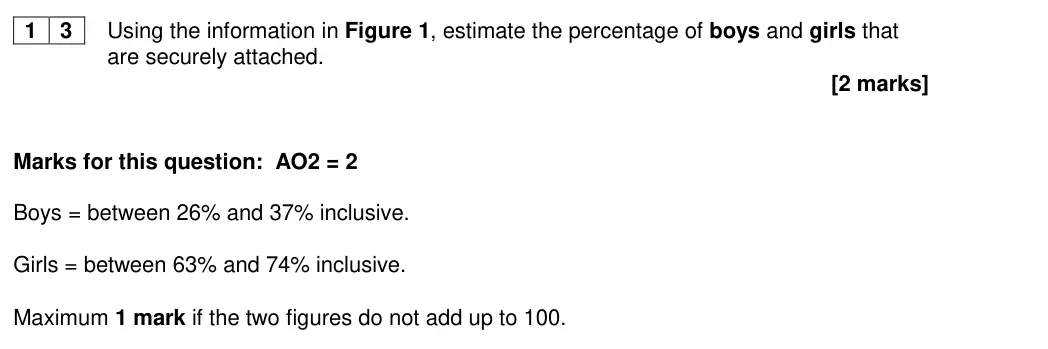
Using the information in Figure 1, estimate the percentage of boys and girls that
are securely attached.
Boys =
Girls =
[2 marks]
June 2017 · AS Paper 1 · Q14 2 marks AO2=2 Calculation Easy data handling
1 4
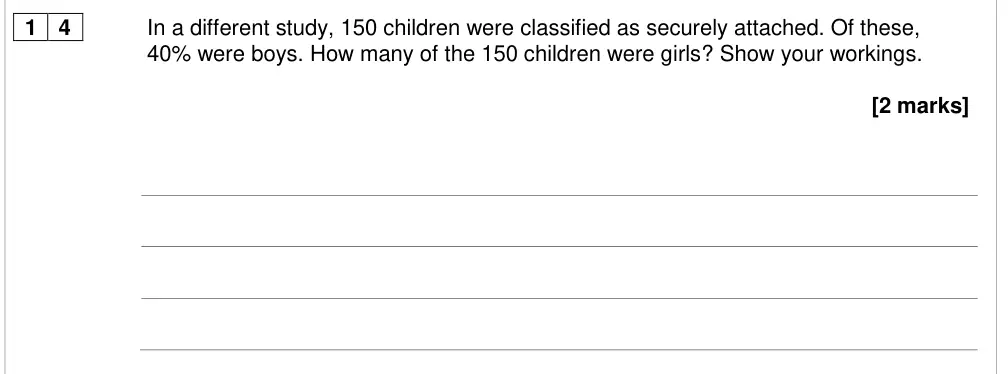
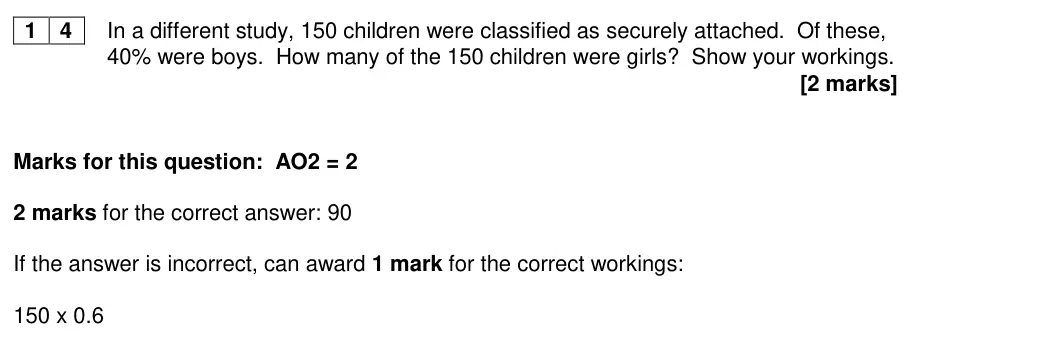
In a different study, 150 children were classified as securely attached. Of these,
40% were boys. How many of the 150 children were girls? Show your workings.
[2 marks]
June 2017 · AS Paper 1 · Q15 4 marks AO2=4 Research methods data handling
1 5
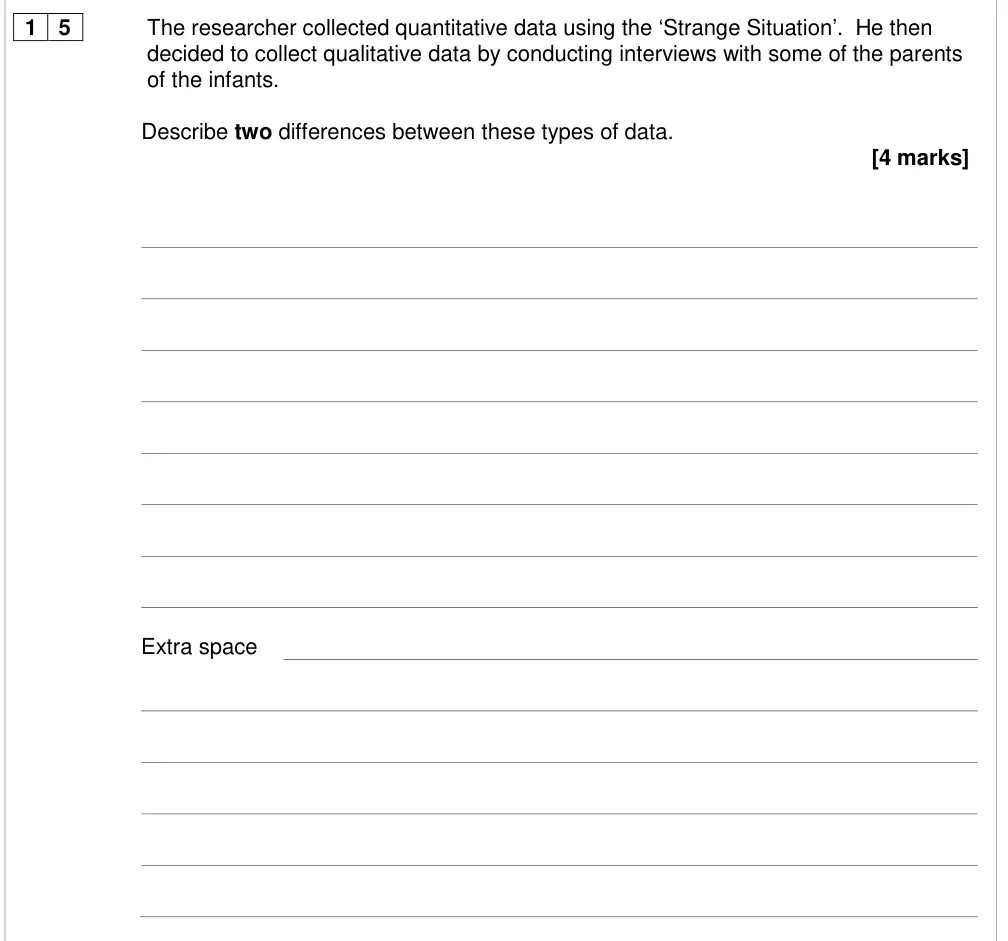
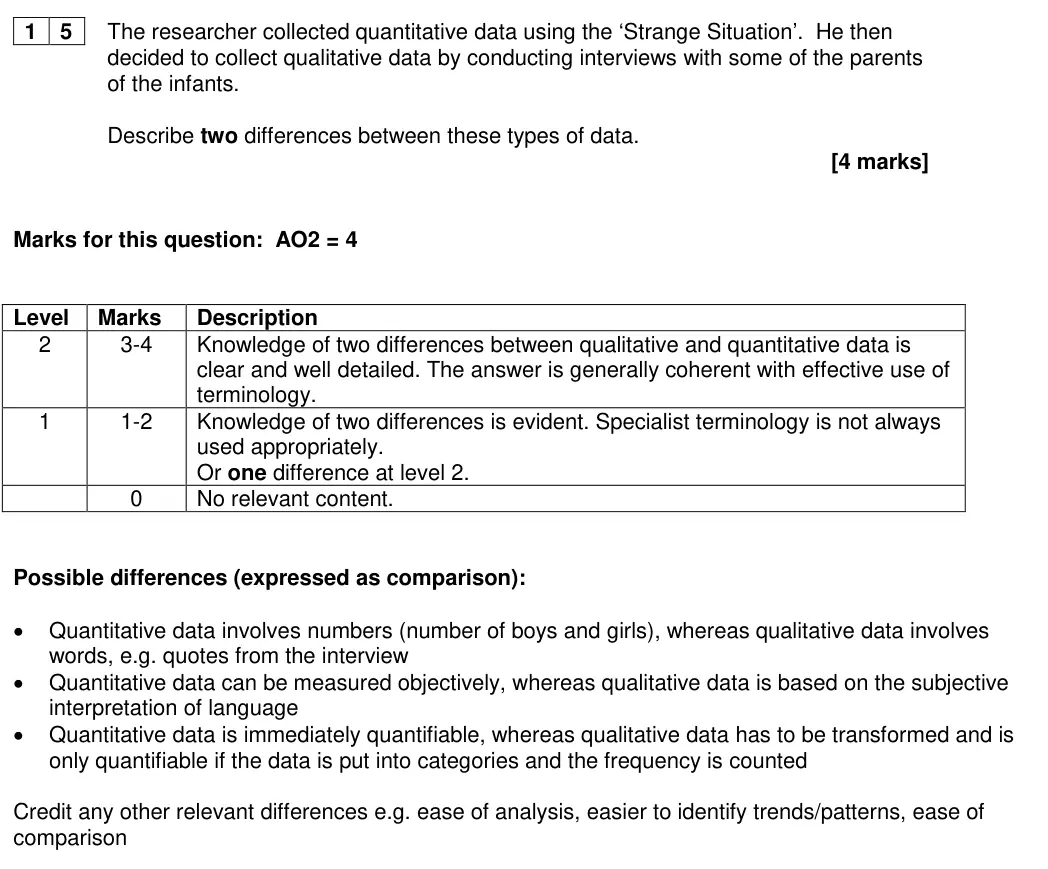
The researcher collected quantitative data using the ‘Strange Situation’.  He then
decided to collect qualitative data by conducting interviews with some of the parents
of the infants.
Describe two differences between these types of data.
[4 marks]
Extra space
June 2017 · AS Paper 1 · Q16 3 marks AO1=3 Outline attachment
1 6
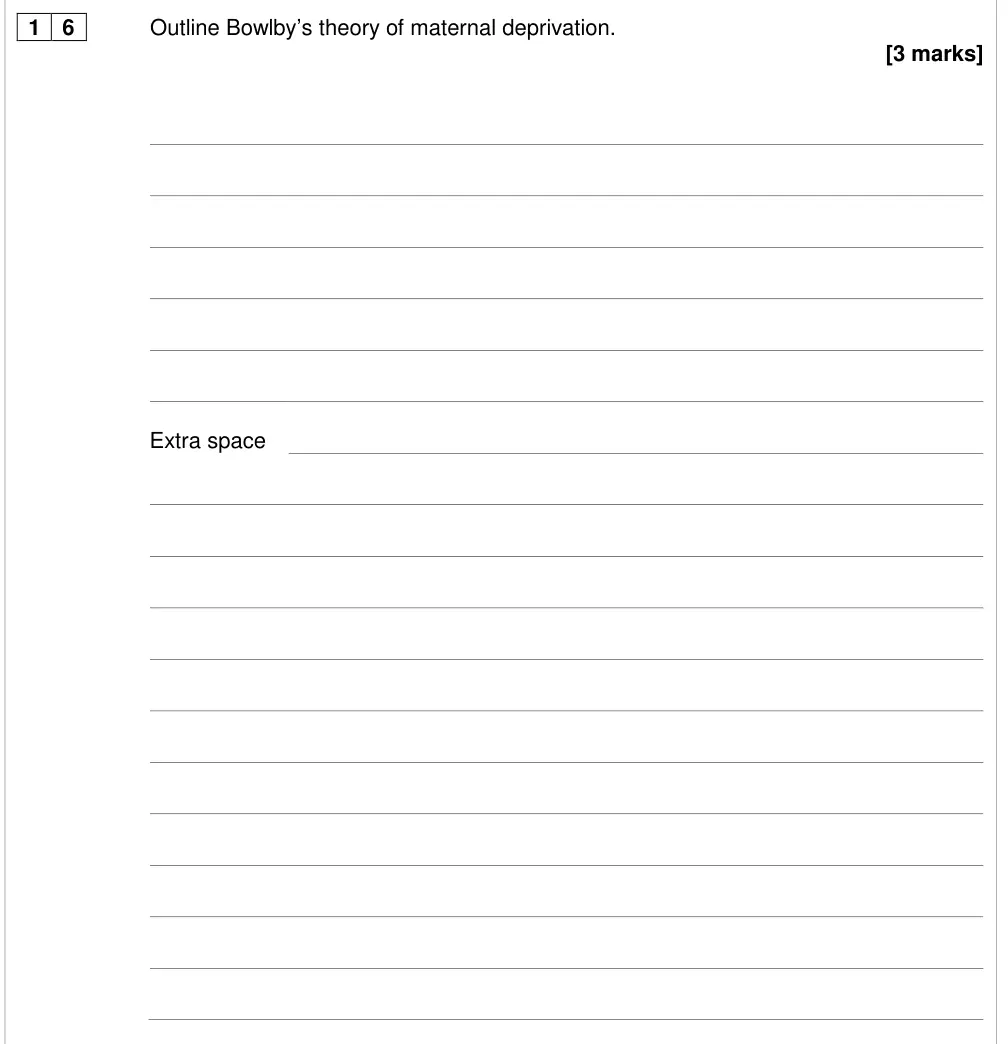
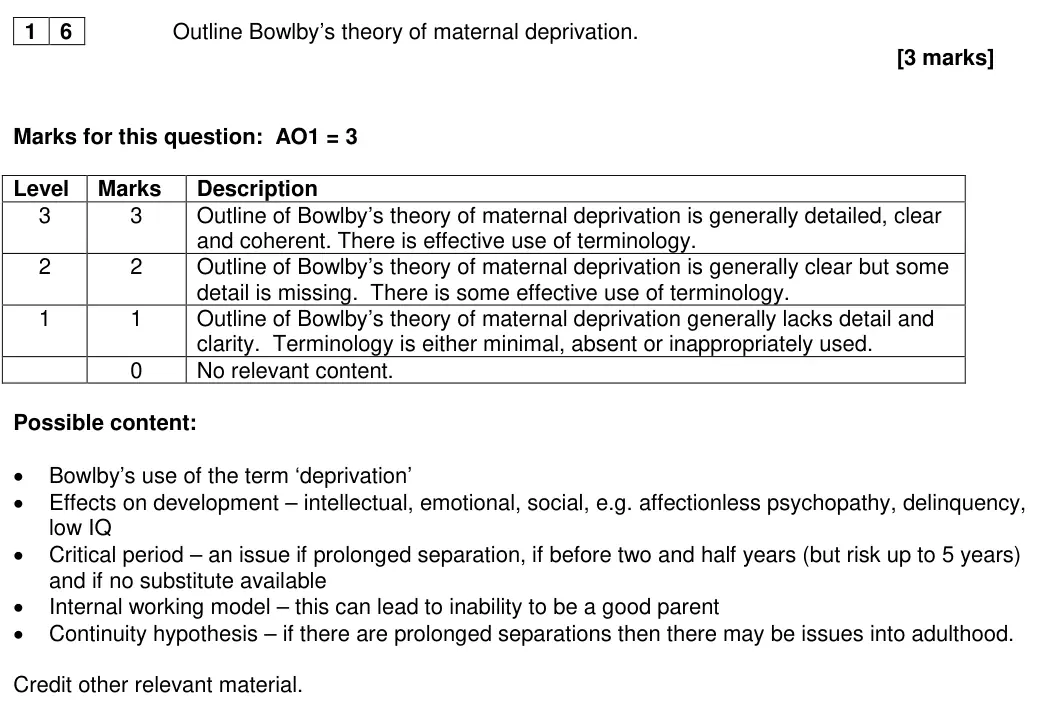
Outline Bowlby’s theory of maternal deprivation.
[3 marks]
Extra space
June 2017 · AS Paper 1 · Q17 3 marks AO3=3 Evaluate (short) attachment
1 7
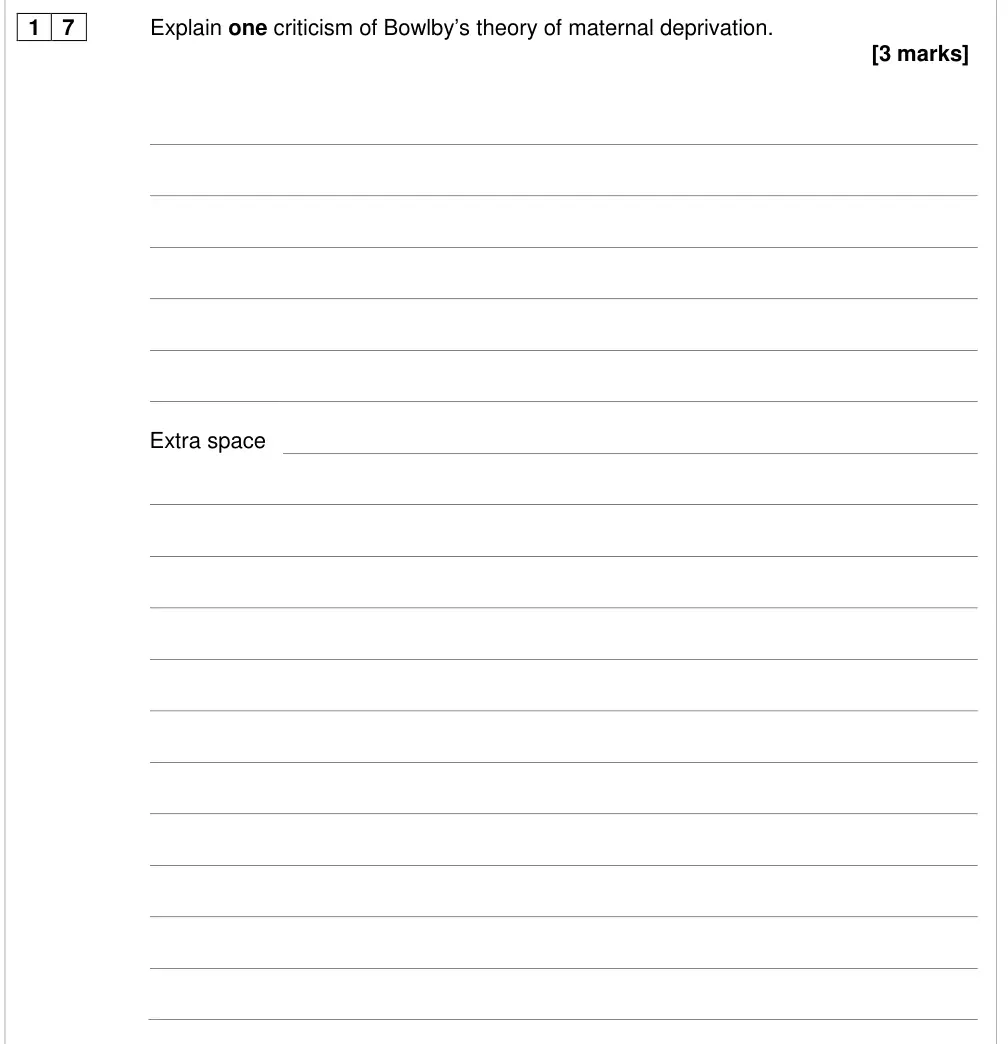
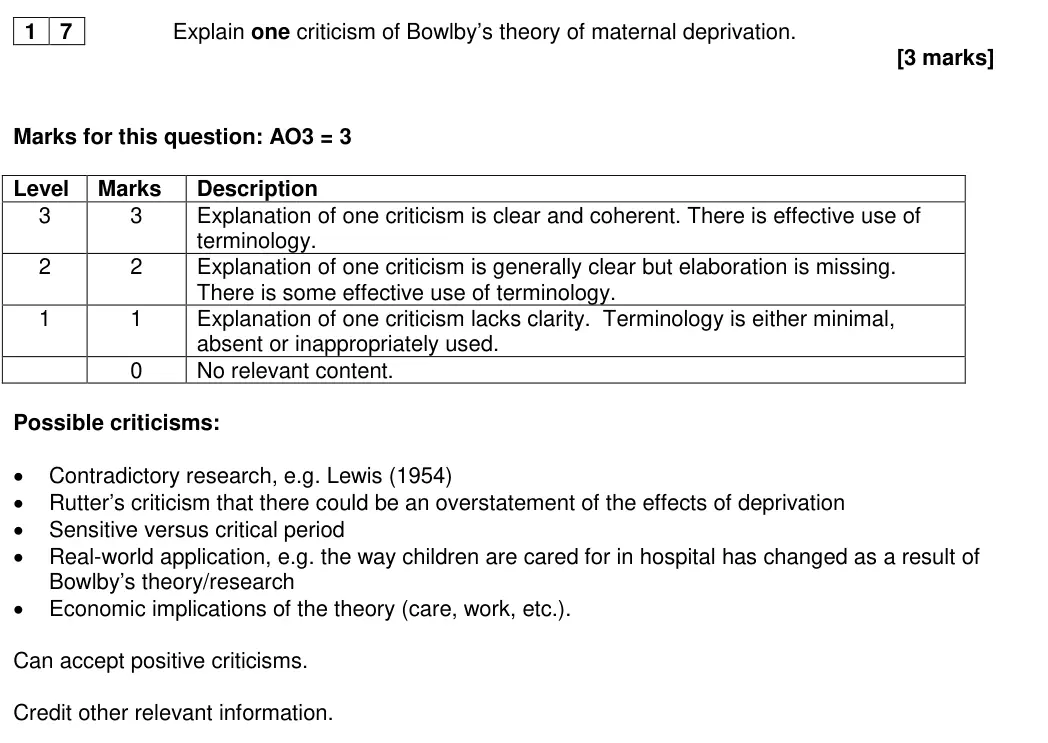
Explain one criticism of Bowlby’s theory of maternal deprivation.
[3 marks]
Extra space
June 2017 · AS Paper 1 · Q18 8 marks AO1=4, AO3=4 Extended writing attachment
1 8
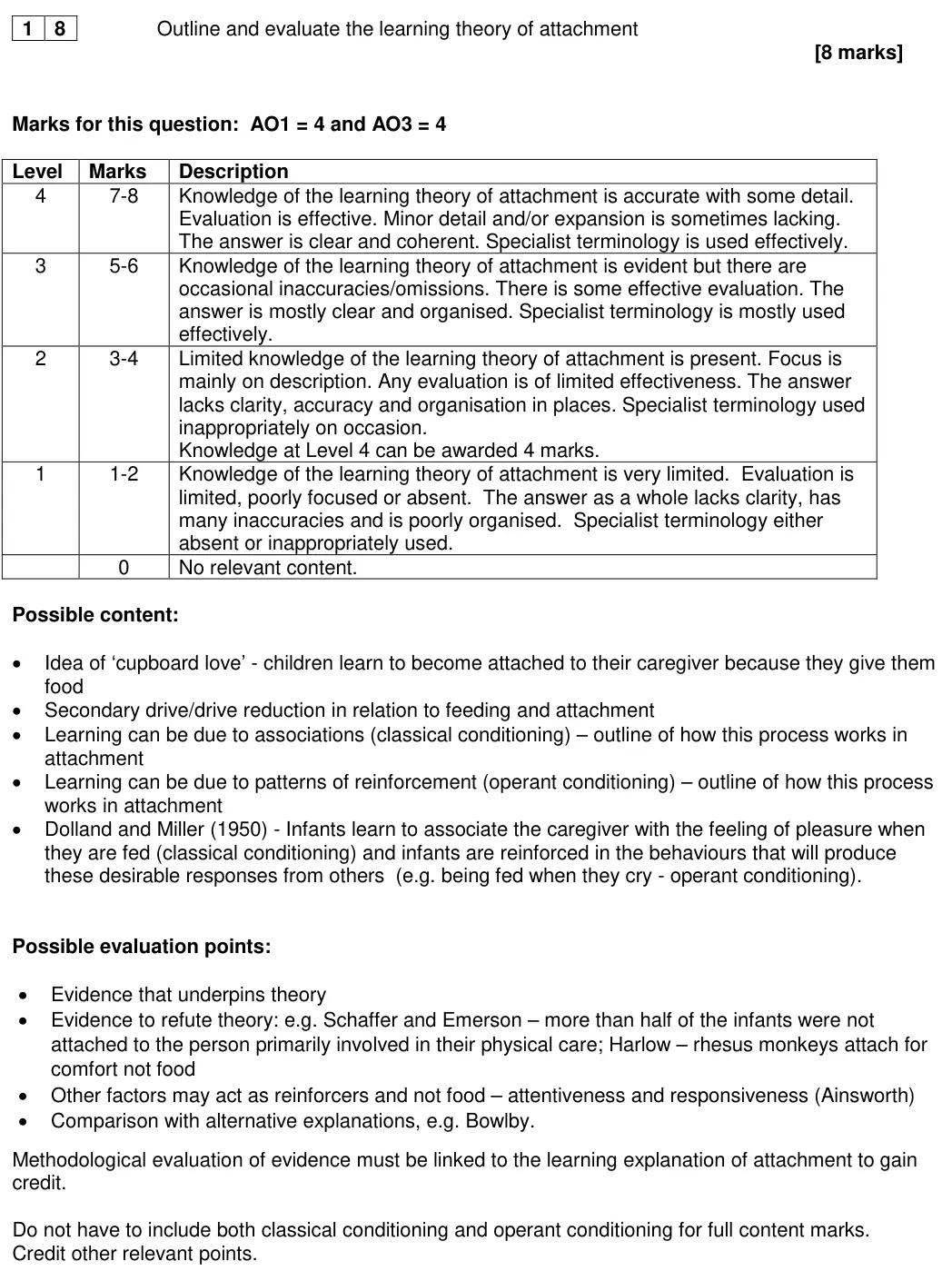
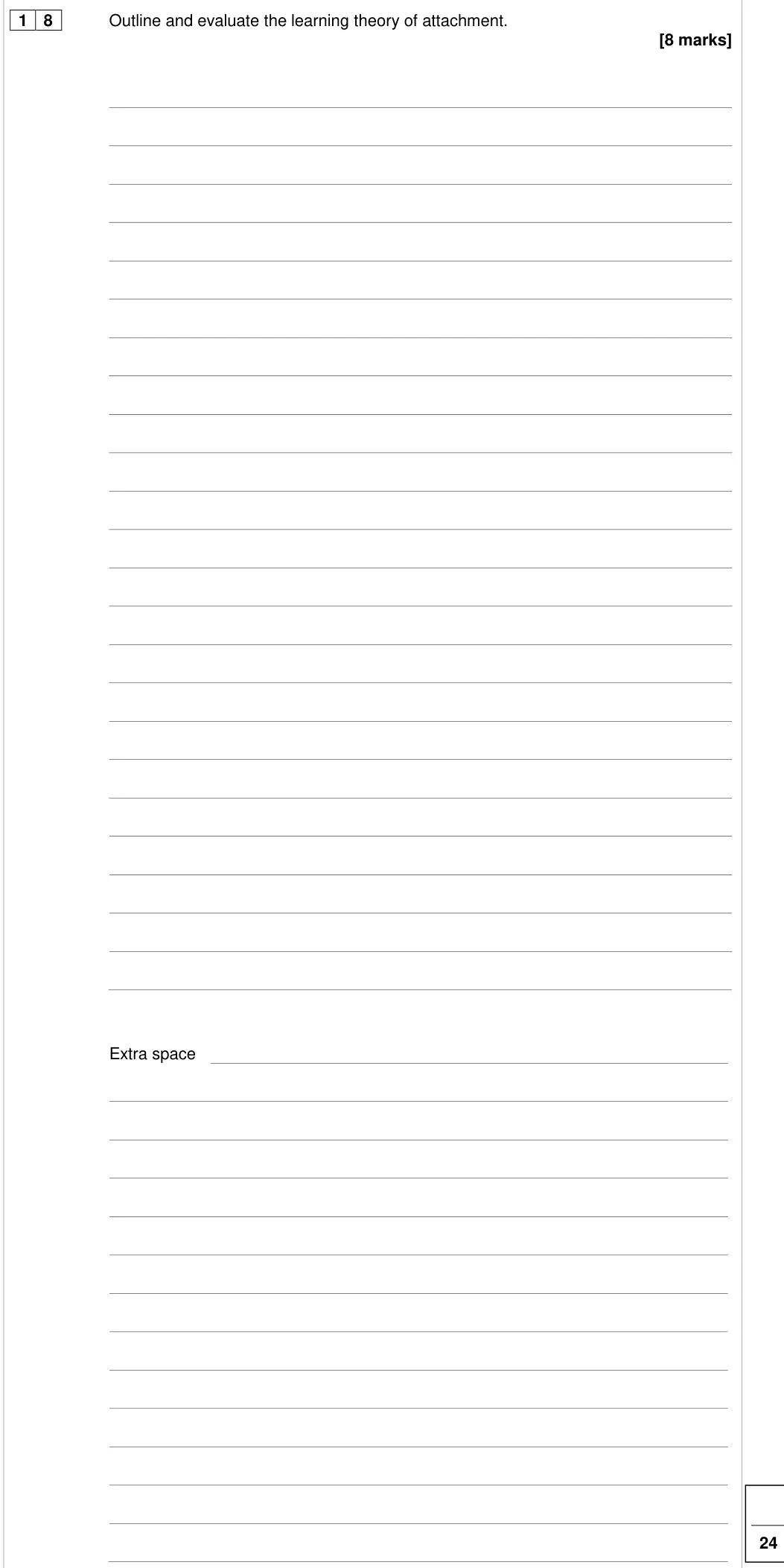
Outline and evaluate the learning theory of attachment.
[8 marks]
Extra space

Work with an AQA psychology tutor

Want a paper marked and gone through with you? Message us.

Prefer email? Send an enquiry

If you are under 18, please include a parent's contact details. Enquiries go to enquiries@alevelpsychologytutor.com and are deleted once handled. All tutoring is online.