4.1.1-01 Types of conformity: internalisation, and compliance. Explanations for conformity: informational social influence and normative social influence, and variables affecting conformity including group size, unanimity and task difficulty as investigated by Asch.AS
4.1.1-02 Explanations for obedience: agentic state and legitimacy of authority, and situational variables affecting obedience including proximity and location, as investigated by Milgram, and uniform. Dispositional explanation for obedience: the Authoritarian Personality.AS
4.1.1-03 Explanations of resistance to social influence, including social support and locus of control.AS
4.1.1-04 Minority influence including reference to consistency, commitment and flexibility.AS
Tap a question to zoom it. Mark scheme and examiner's comment open under each question.
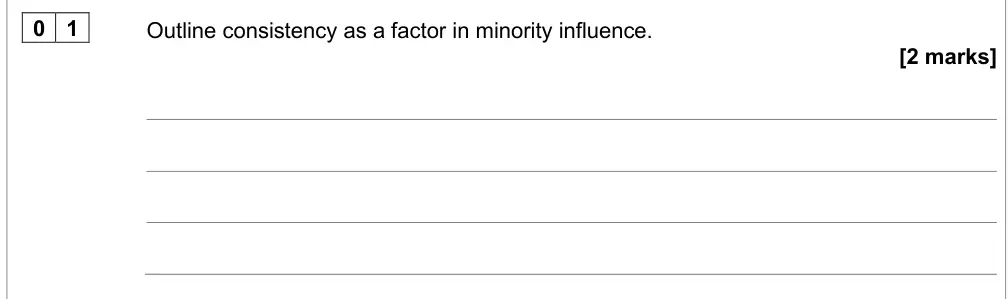
June 2025 · AS Paper 1 · Q12 marksAO1=2OutlineMedium
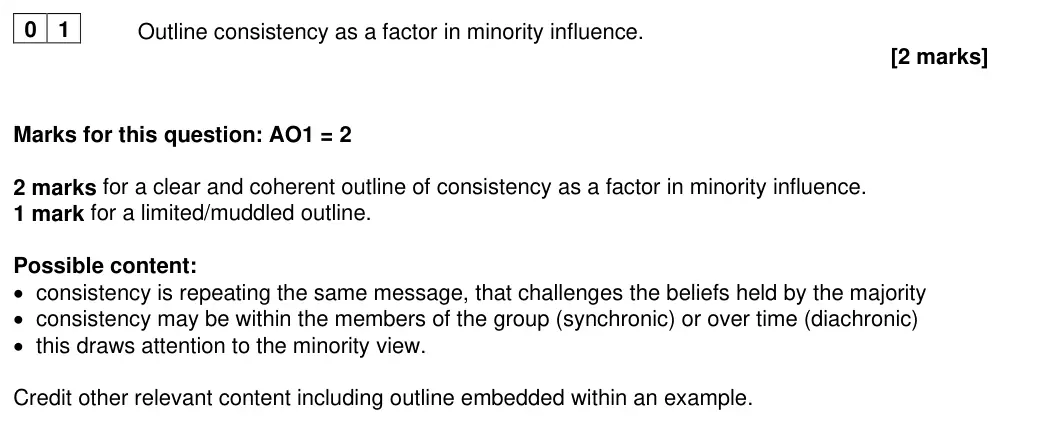
Mark scheme, including level descriptors and indicative content
Examiner's comment
This was a straightforward knowledge question and about 75% of students scored at least half marks. However, there were some answers which gave a circular definition, and some seemed to be describing commitment, not consistency. Successful answers contained elaboration, with many students using examples effectively. Others just stated an example without explaining how the example demonstrated consistency as a factor in minority influence.
Notes from the mark scheme and report
repeating the same message (synchronic/diachronic), draws attention to minority view
circular definitions
some described commitment instead of consistency
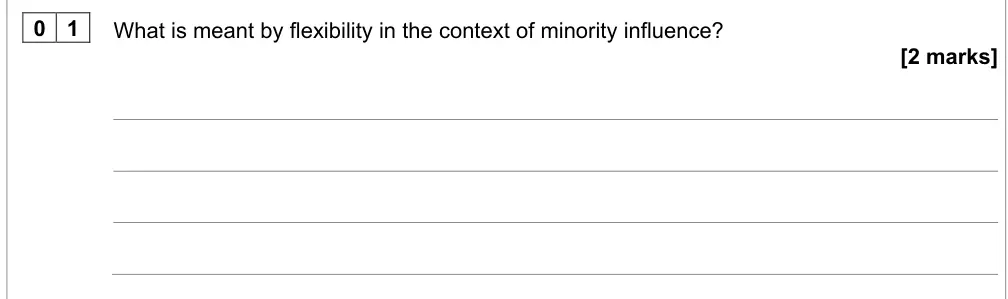
June 2025 · Paper 1 · Q12 marksAO1=2Short answerEasy
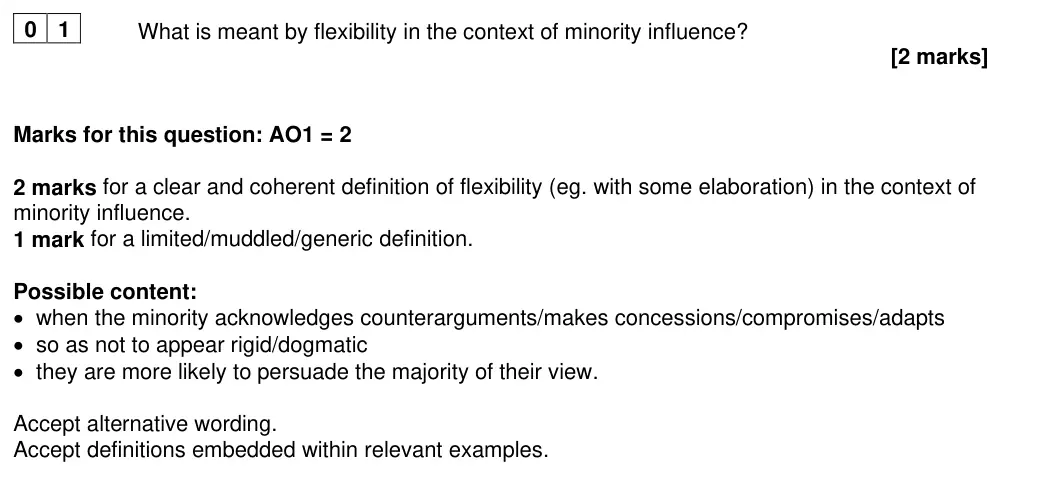
Mark scheme, including level descriptors and indicative content
Examiner's comment
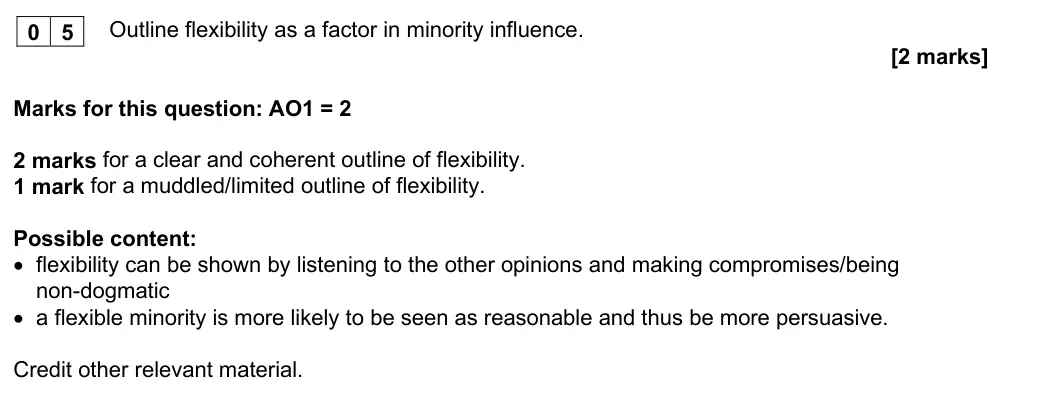
This was typically answered well by students. The fact that flexibility and minority influence has appeared in the last three exam papers meant many students were well prepared and over 50% of students were able to access full marks. Most responses cited how the minority may need to adapt their view to help convince the majority. Apart from minor issues of tautology, no problems emerged with this question.
Notes from the mark scheme and report
2 marks: concessions/compromise/adapting so as not to appear rigid/dogmatic, more persuasive
1 mark limited/generic definition
answered well, minor tautology
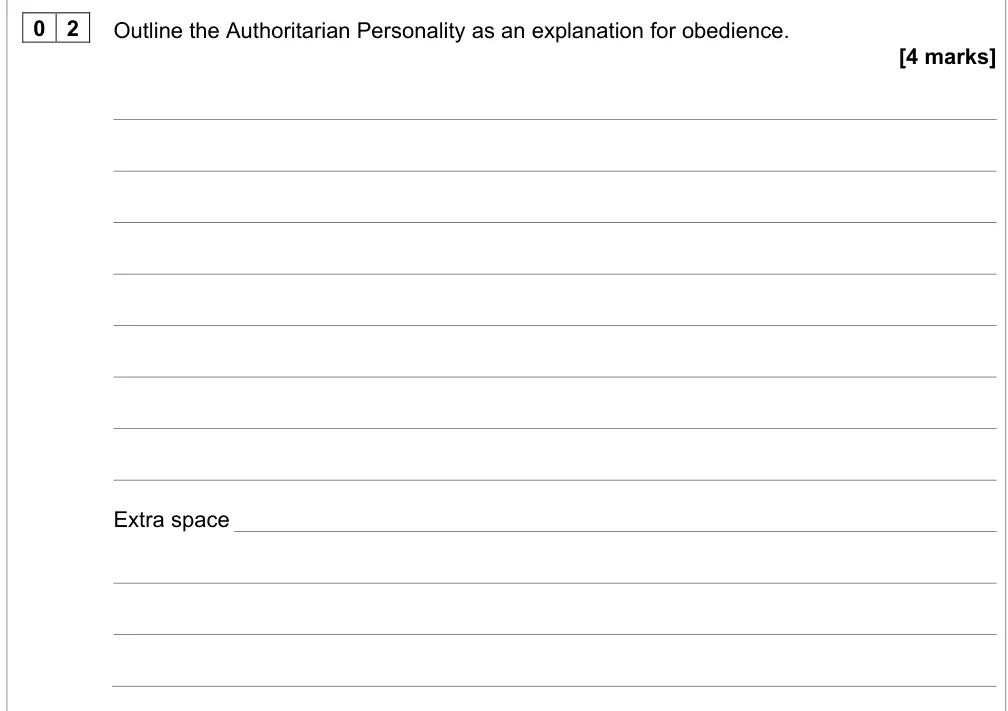
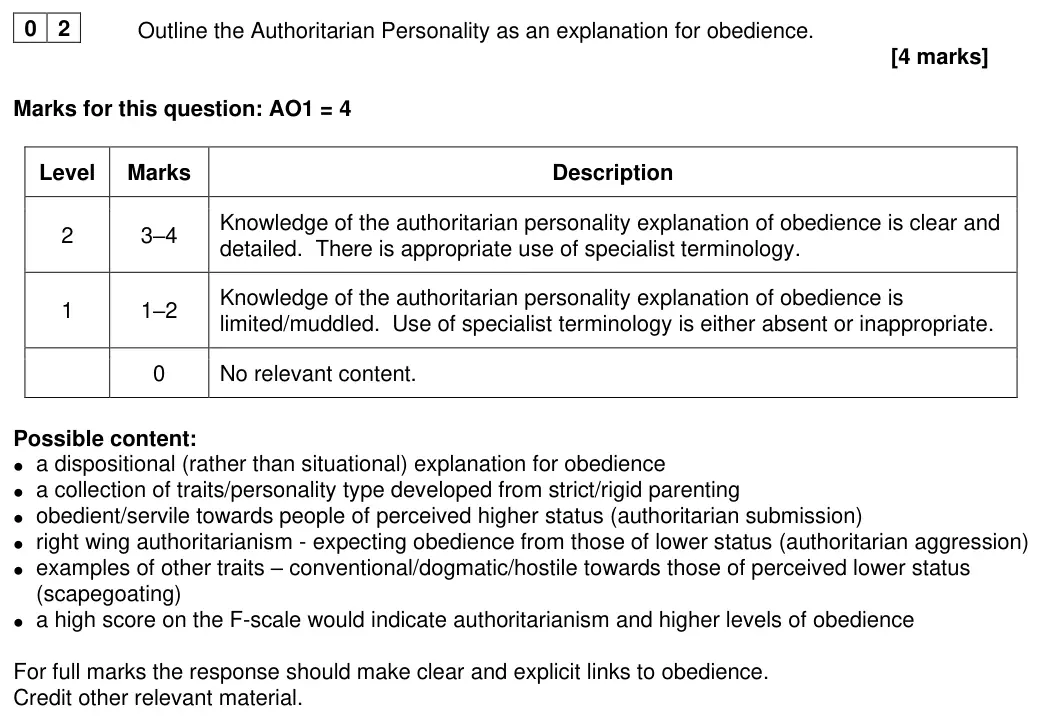
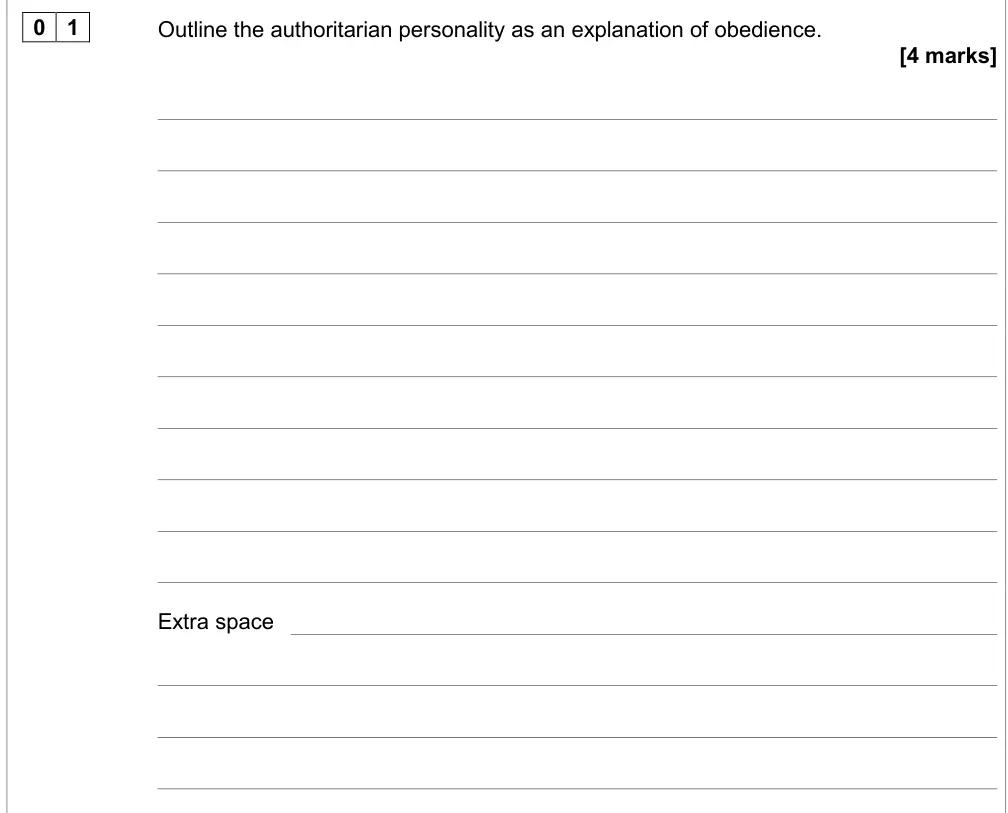
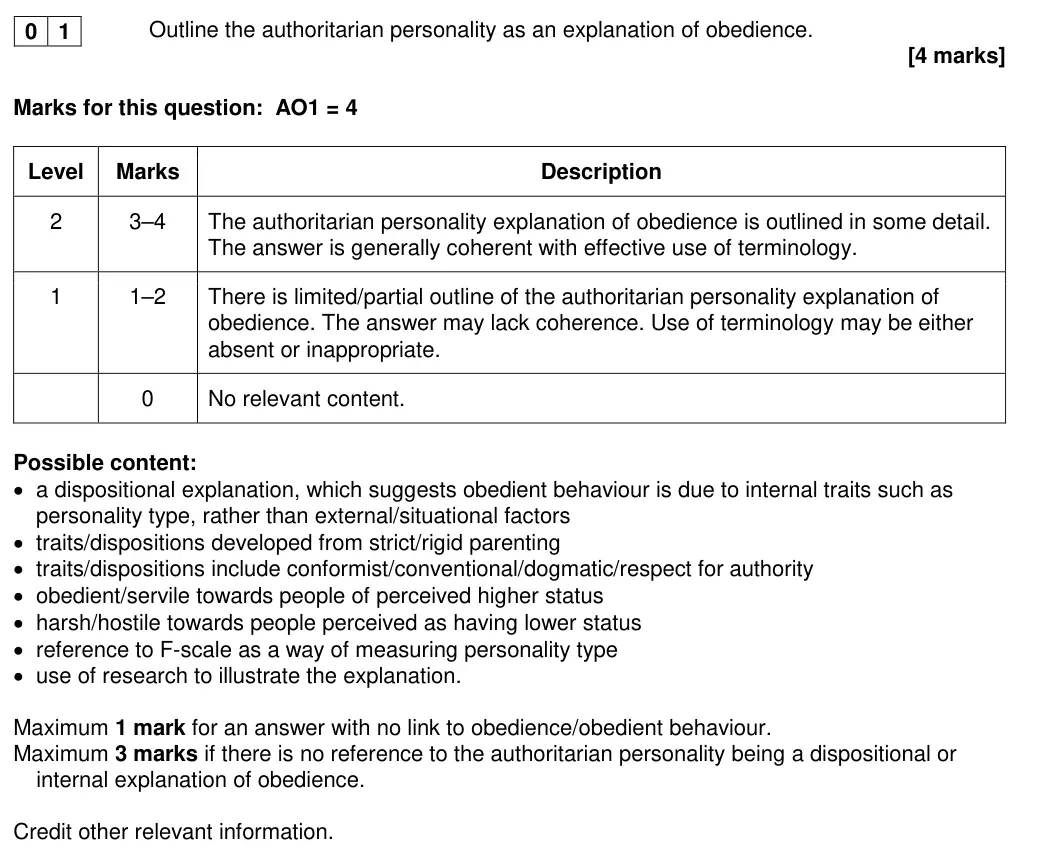
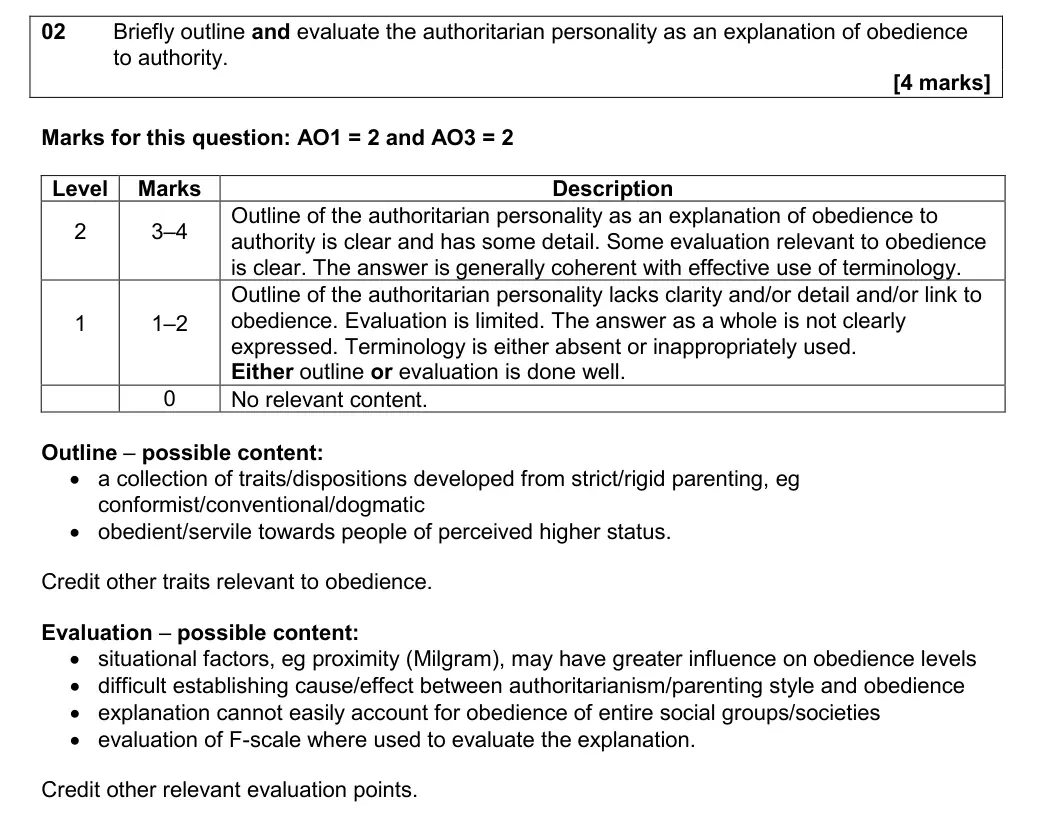
June 2025 · Paper 1 · Q24 marksAO1=4OutlineMedium
Mark scheme, including level descriptors and indicative content
Examiner's comment
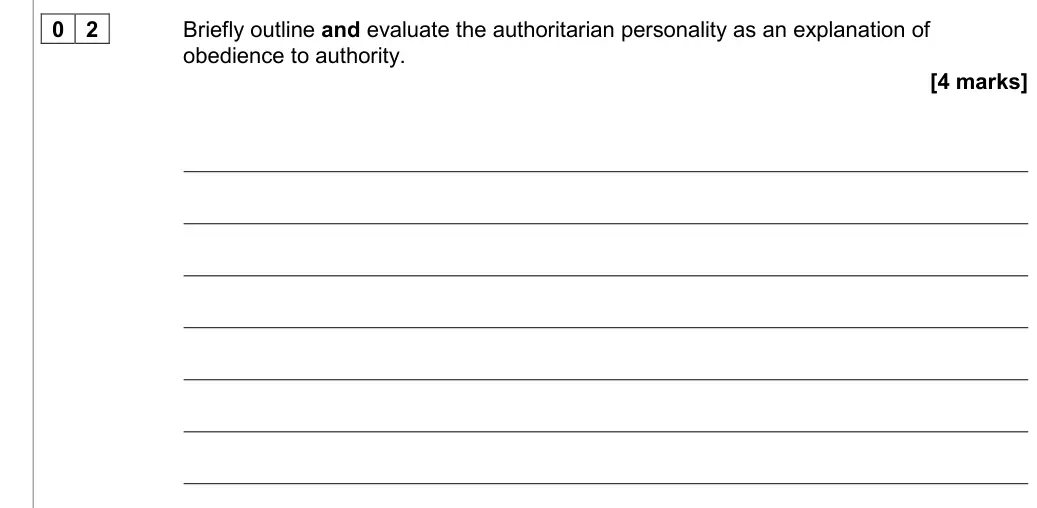
In contrast to the two previous series, students performed less well in the social influence section. This could be partially attributed to minor issues with both question 2 and question 3 (see below). This question was answered well with over 53% of students gaining level 2 marks. However, a common mistake that could easily be corrected was that many responses did not focus on exclusively on authoritarian personality and obedience, instead drifting on to detailed explanations of prejudice and/or a bland description of this personality type.
common error: drifting into prejudice or a bland description of the personality type
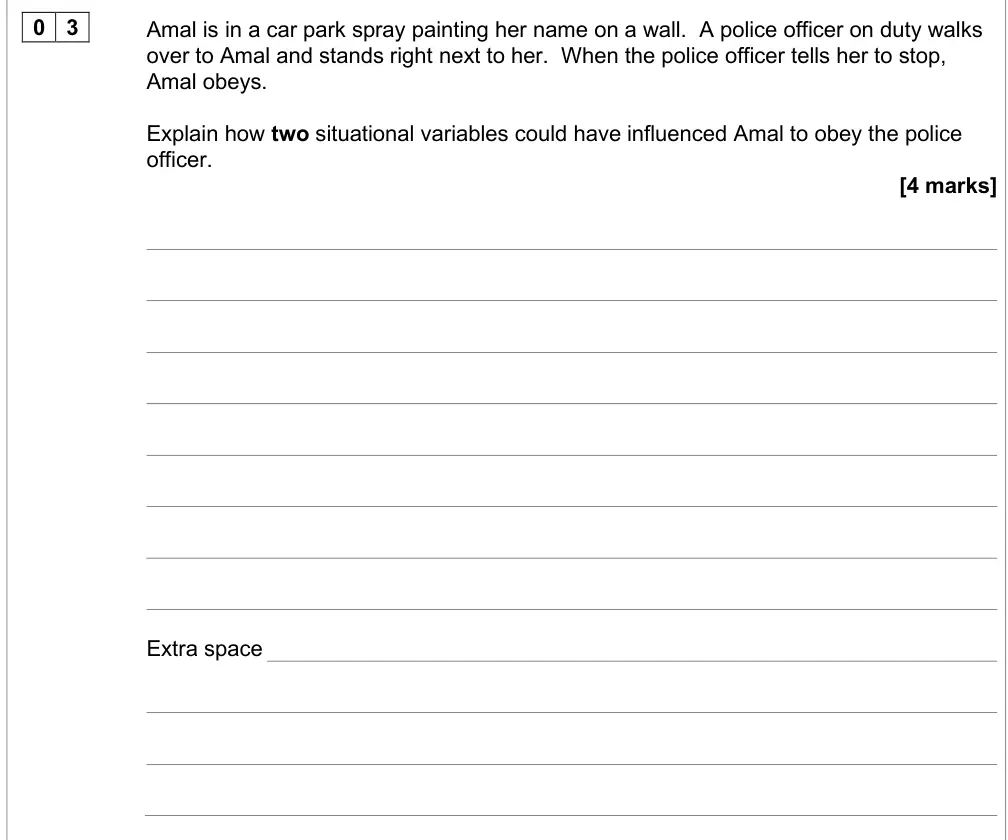
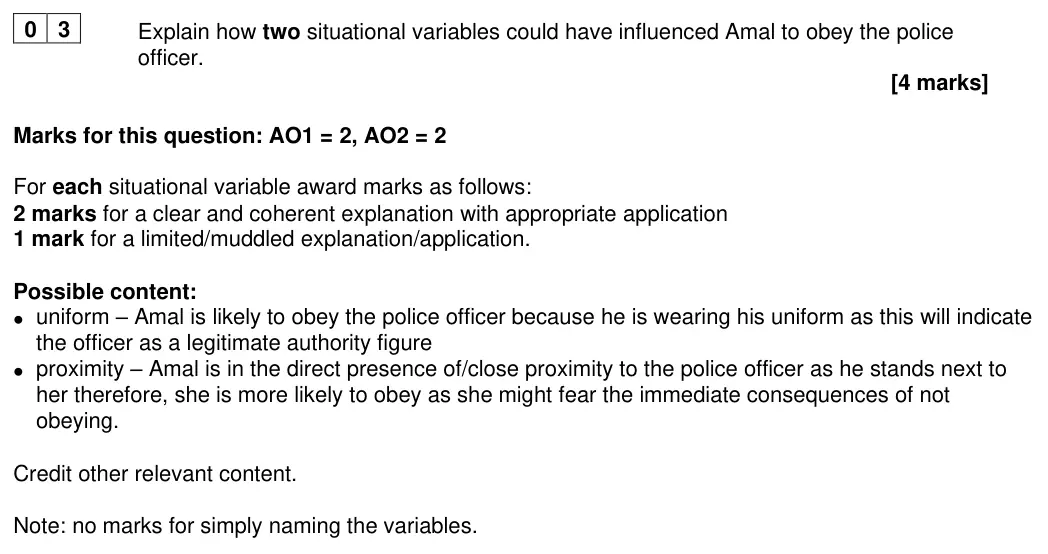
June 2025 · AS Paper 1 · Q34 marksAO1=2, AO2=2ApplicationMedium
Mark scheme, including level descriptors and indicative content
Examiner's comment
Performance on Q3, Q13 and Q23 suggested that many students should work to improve their AO2 skills. They need to ensure they fully engage with the stem/scenario and do not just state the name of the person in the stem, which is not effective application. They must use their knowledge and understanding to explain what is happening in the scenario. This was the first of three questions on the paper where students had to outline knowledge and apply that knowledge to a scenario. Just over half of the students achieved a level 2 mark. Many were able to identify and explain how the policeman’s uniform was a symbol of legitimate authority which would signal to Amal the need to obey the officer. Many students also recognised that the police offer standing next to Amal reflected proximity, but few were able to explain how this would influence obedience, e.g. by fearing the immediate consequences of not obeying. Some students referred to agentic shift which is not a situational variable or evident in the scenario. Not all answers were applied to the stem and a minority of students only gave one variable. Most students realised that they needed to do more than just name the variables, as the question asked for explanations of the behaviour.
Notes from the mark scheme and report
uniform (legitimate authority) and proximity (officer stands next to her)
no marks for simply naming the variables
agentic state is not a situational variable
few explained HOW proximity increases obedience
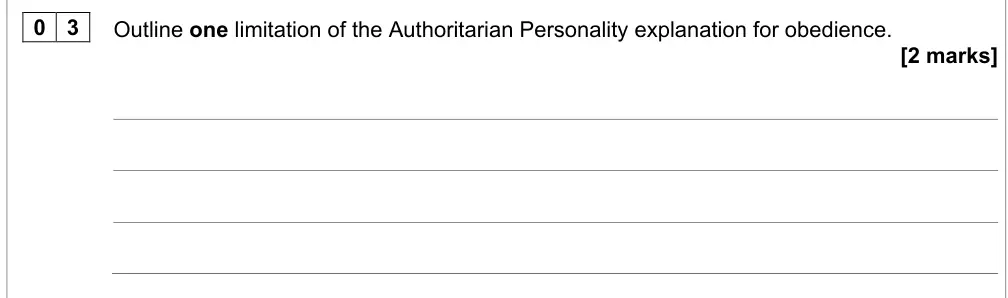
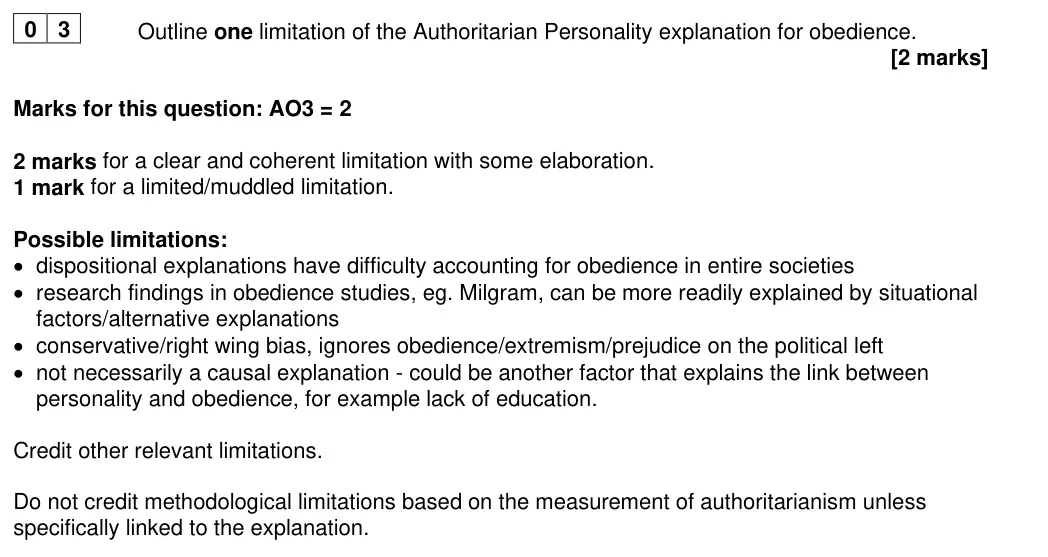
June 2025 · Paper 1 · Q32 marksAO3=2Evaluate (short)
Mark scheme, including level descriptors and indicative content
Examiner's comment
In contrast to the two previous series, students performed less well in the social influence section. This could be partially attributed to minor issues with both question 2 and question 3 (see below). Although this was a straightforward question many students did not score marks. The most common issue was students citing methodological limitations that were not clearly linked to the authoritarian personality. These comments tended to revolve around problems with the F -Scale and Adorno’s original sample of participants. More effective responses often cited political bias or problems with this dispositional account in explaining the obedience of entire societies.
Notes from the mark scheme and report
limitations: cannot explain obedience of whole societies, situational factors explain Milgram better, right-wing bias, not causal
F-scale/Adorno sample methodological points not credited unless linked to the explanation (common error)
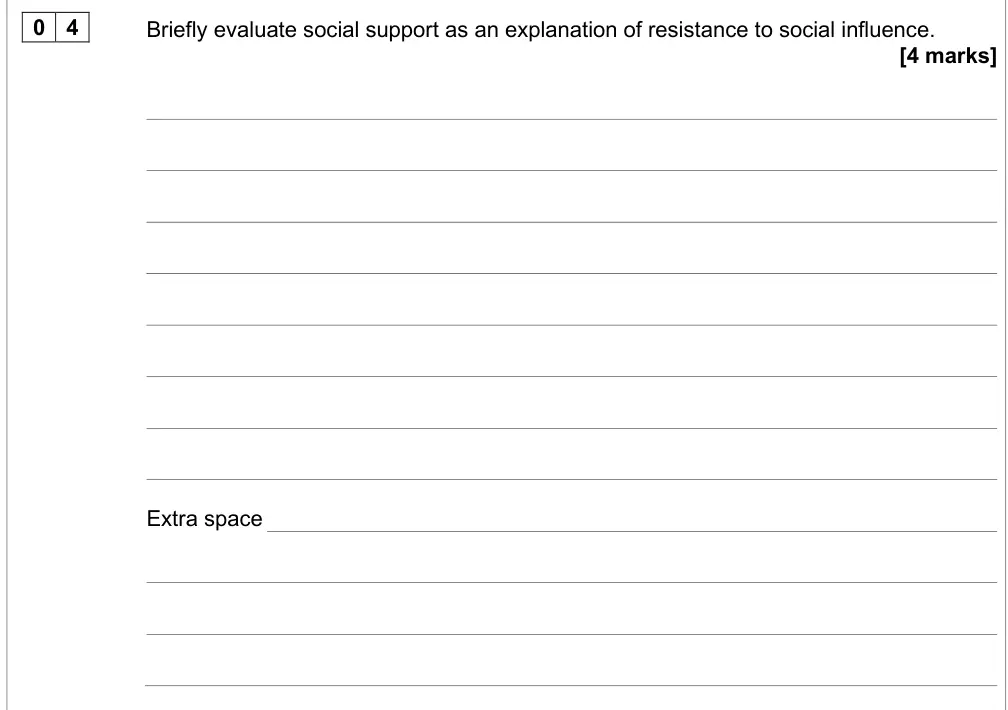
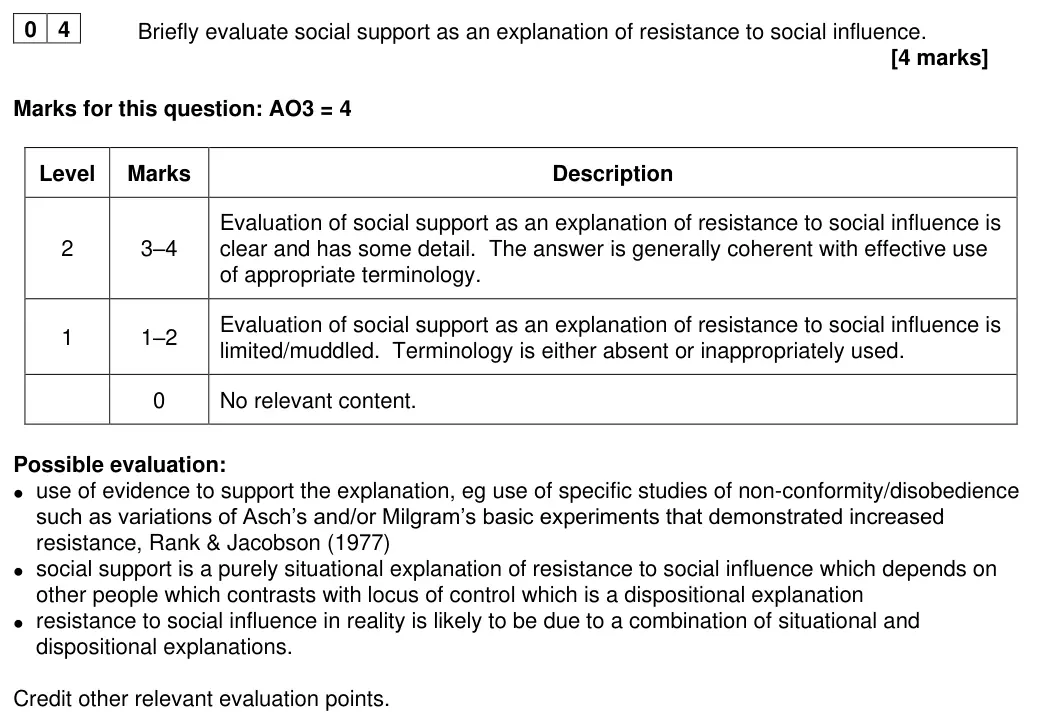
June 2025 · AS Paper 1 · Q44 marksAO3=4Evaluate (short)Medium
Mark scheme, including level descriptors and indicative content
Examiner's comment
On some questions, some students neglected to address the demands of the question. This was most noticeable on Q4, where students were asked to evaluate social support as an explanation of resistance to social influence. Some students defined social support or simply described research, which did not demonstrate the AO3 skill required. This question required evaluation of social support as an explanation of resistance to social influence and was one of the lowest scoring questions on the paper. It had one of the lowest means as % of max marks. Almost 4% of students did not attempt an answer. It was also the 3rd highest not attempted question on the paper and just over a third of students scored no marks. Questions that require students to ‘evaluate’ still appear to confuse some students, as a good number explained social support (in relation to resistance) which was not creditworthy. Higher-scoring answers referred to evidence to show how social support could increase resistance. Some students chose appropriate research but did not link it to the question. Others referred to the Rosenstrasse protests but did not always explain how this reflected social support and/or how it impacted resistance. This question was a good discriminating question with more successful answers either offering one evaluation point in some depth, or more than one with some elaboration of each evaluation point.
Notes from the mark scheme and report
one of the lowest-scoring questions
many explained social support instead of evaluating it
credit research support (Asch/Milgram variations, Rank & Jacobson), situational vs dispositional (locus of control)
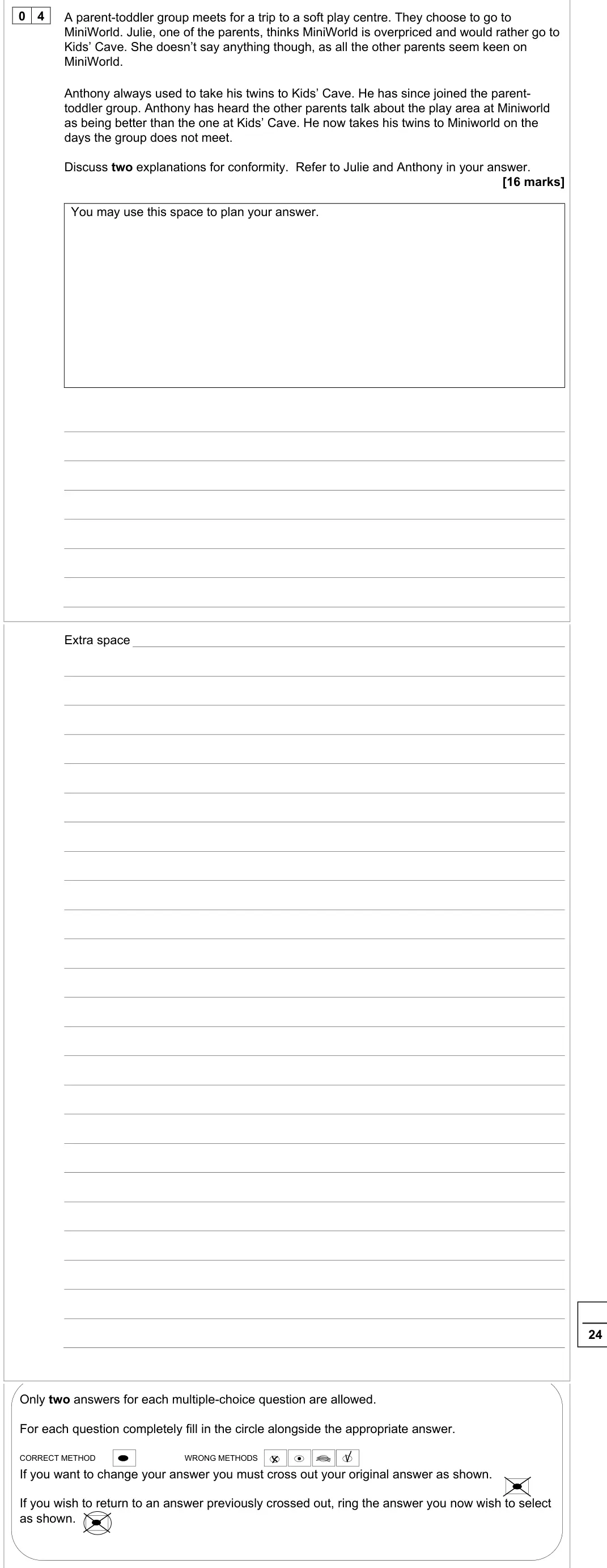
June 2025 · Paper 1 · Q416 marksAO1=6, AO2=4, AO3=616-mark essayMedium
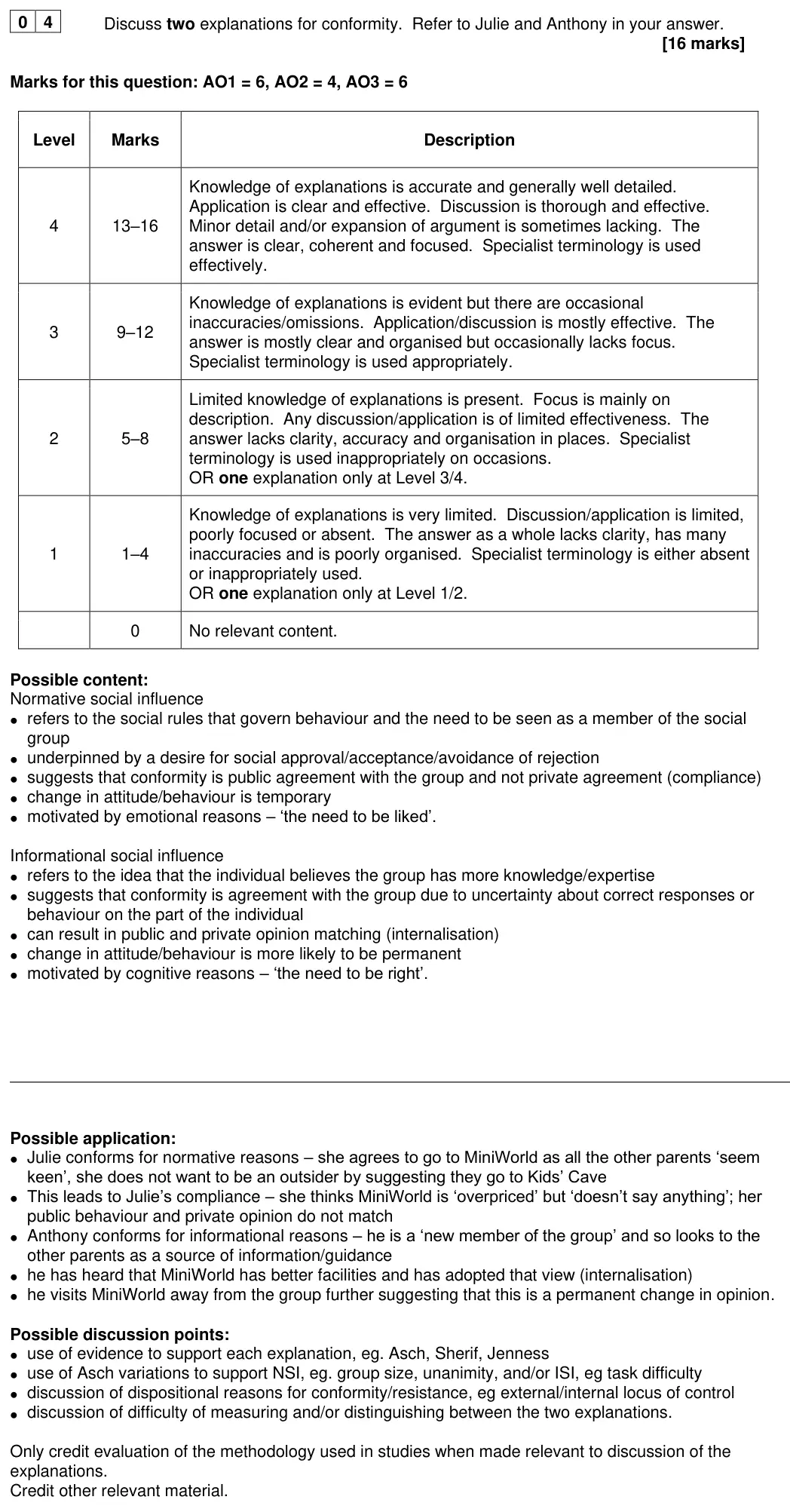
Mark scheme, including level descriptors and indicative content
Examiner's comment
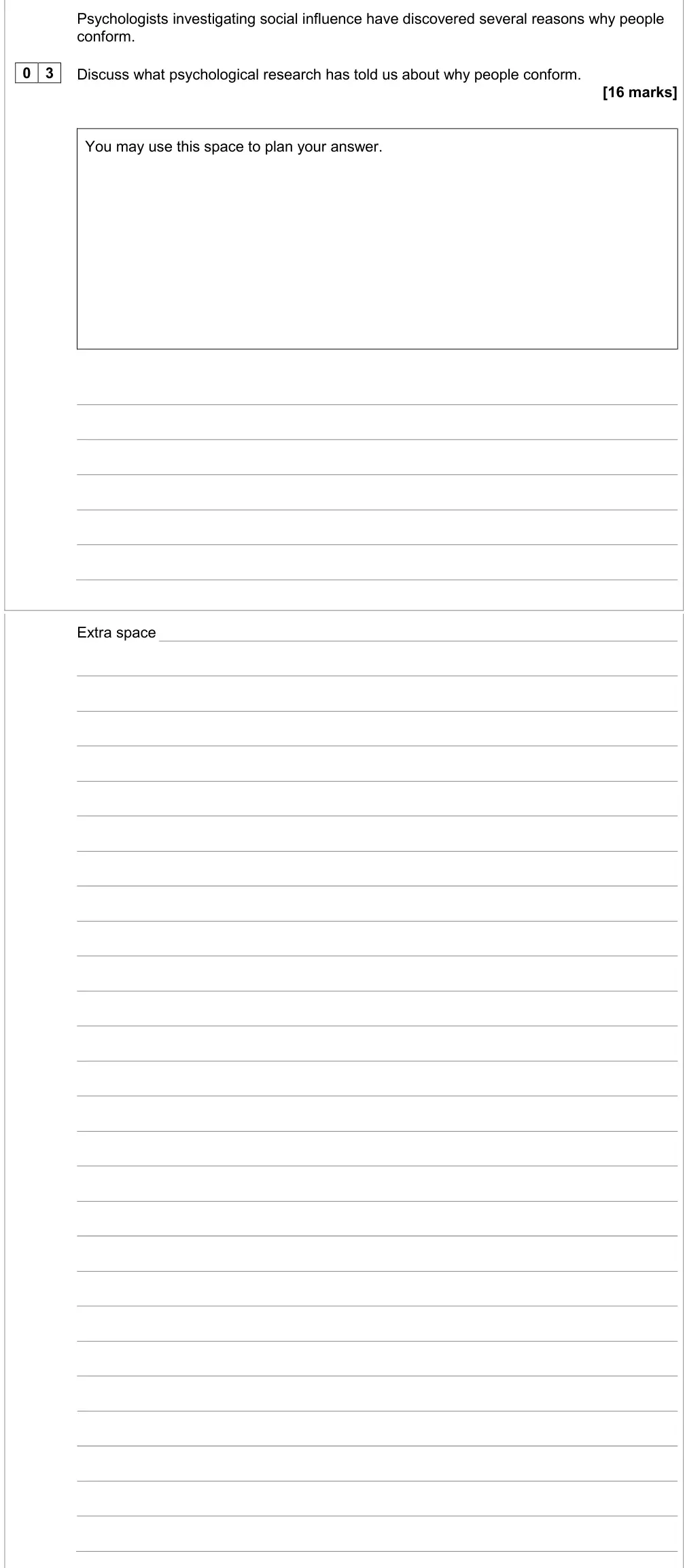
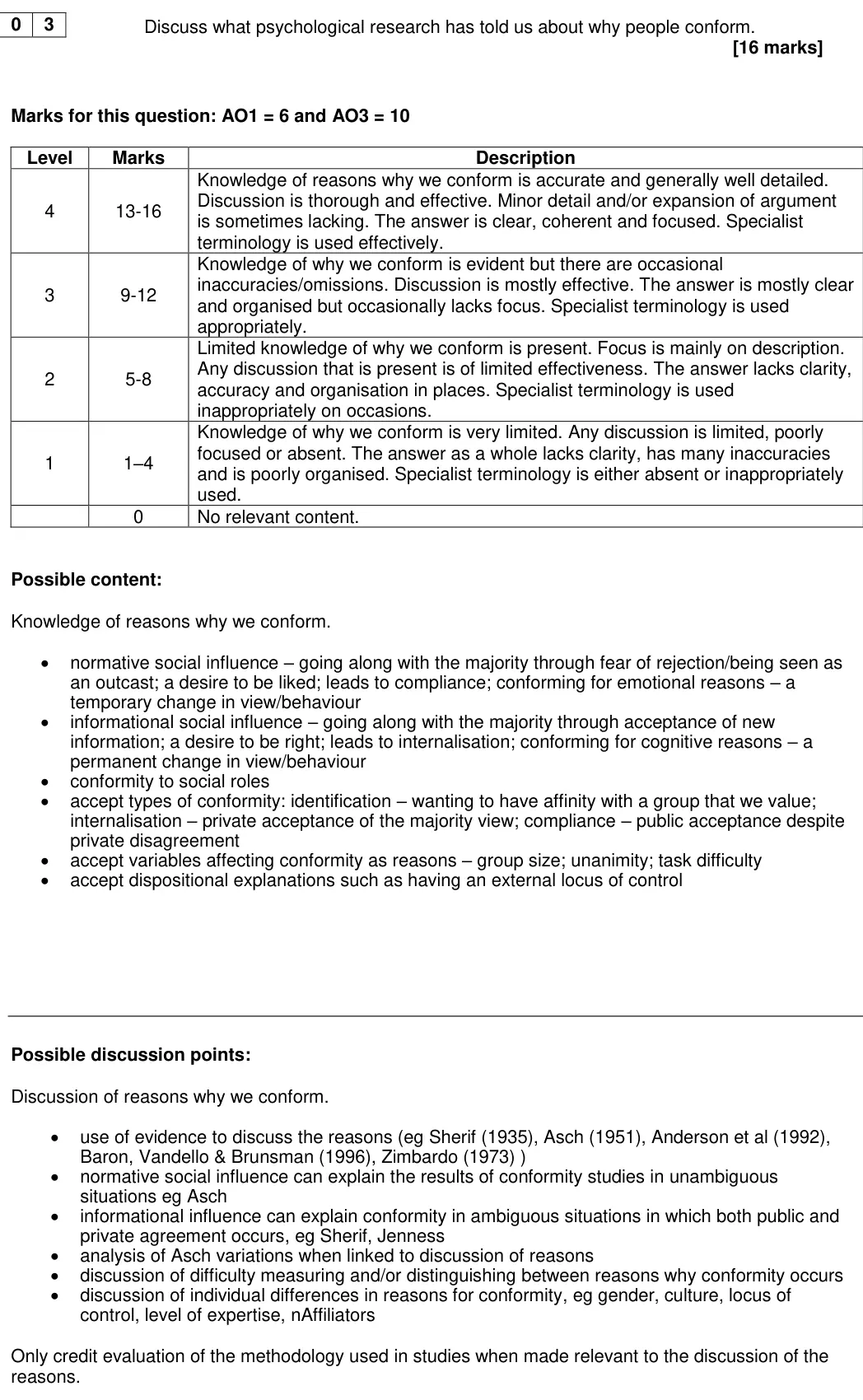
The average mark for this question was higher than question 21, with nearly 50% of students gaining level 3 marks or above. Effective responses provided significant details of both normative and informational social influence e.g. whether they lead to a permanent or temporary change, if they are driven by emotional or cognitive reasoning, situations where they are likely to occur; how they link to types of conformity. This detail often demonstrated knowledge at level 4. However, a common error was just lifting quotes from the stem to gain application marks without offering further elaboration. For discussion marks, effective use was made of several research studies linked back to the explanations (e.g. Asch’s research, Asch’s variation studies and Lucas’ research). Alternative dispositional accounts of conformity to dispute normative and informational social influence e.g. external locus of control or Affiliators were also used to good effect. Common errors including citing methodological issues with studies that were not made relevant to the discussion of the explanations or simply citing research studies with no link to explanations of conformity. Finally, a minority of students wrongfully cited types of conformity without any connection to explanations, significantly reducing their marks for the question.
Notes from the mark scheme and report
one explanation only = max Level 2
Julie = NSI/compliance, Anthony = ISI/internalisation
lifting quotes from the stem without elaboration
types of conformity with no link to explanations
methodology only if linked to the explanations
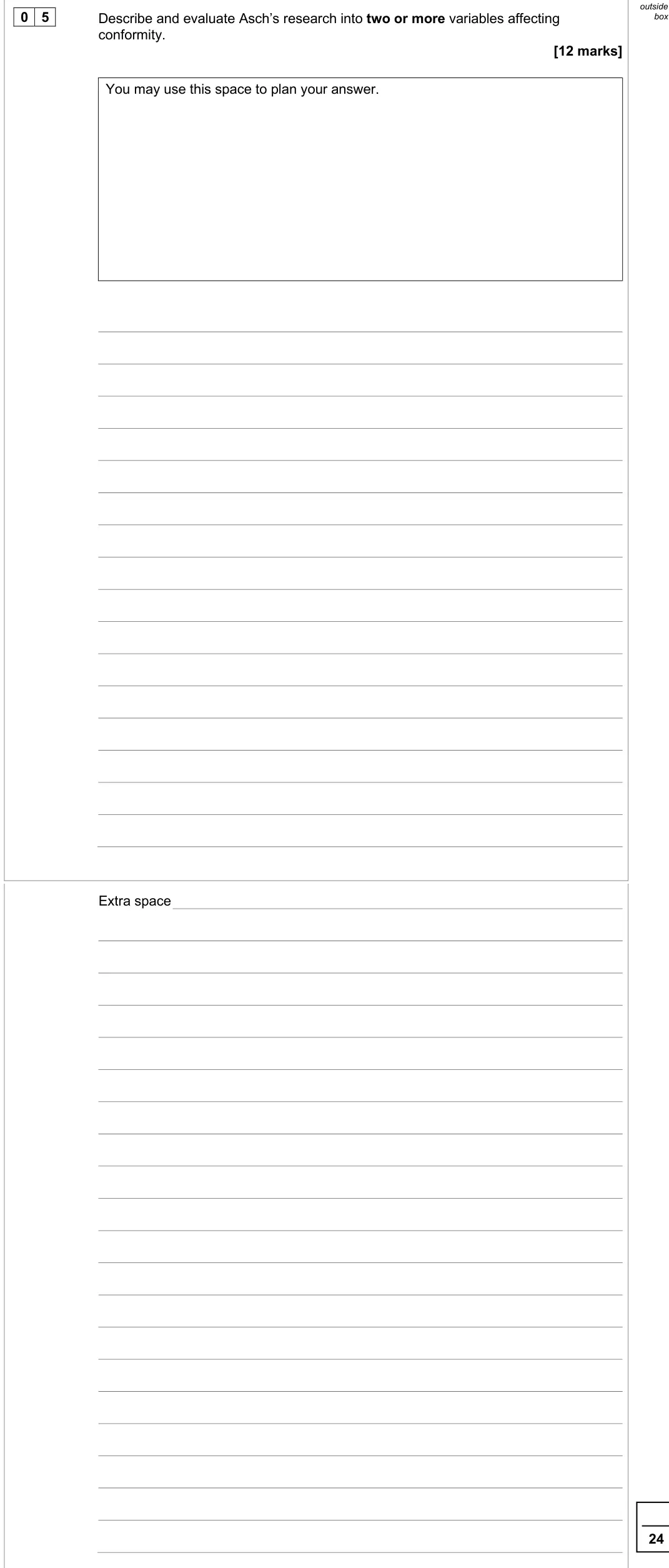
June 2025 · AS Paper 1 · Q512 marksAO1=6, AO3=6Extended writing
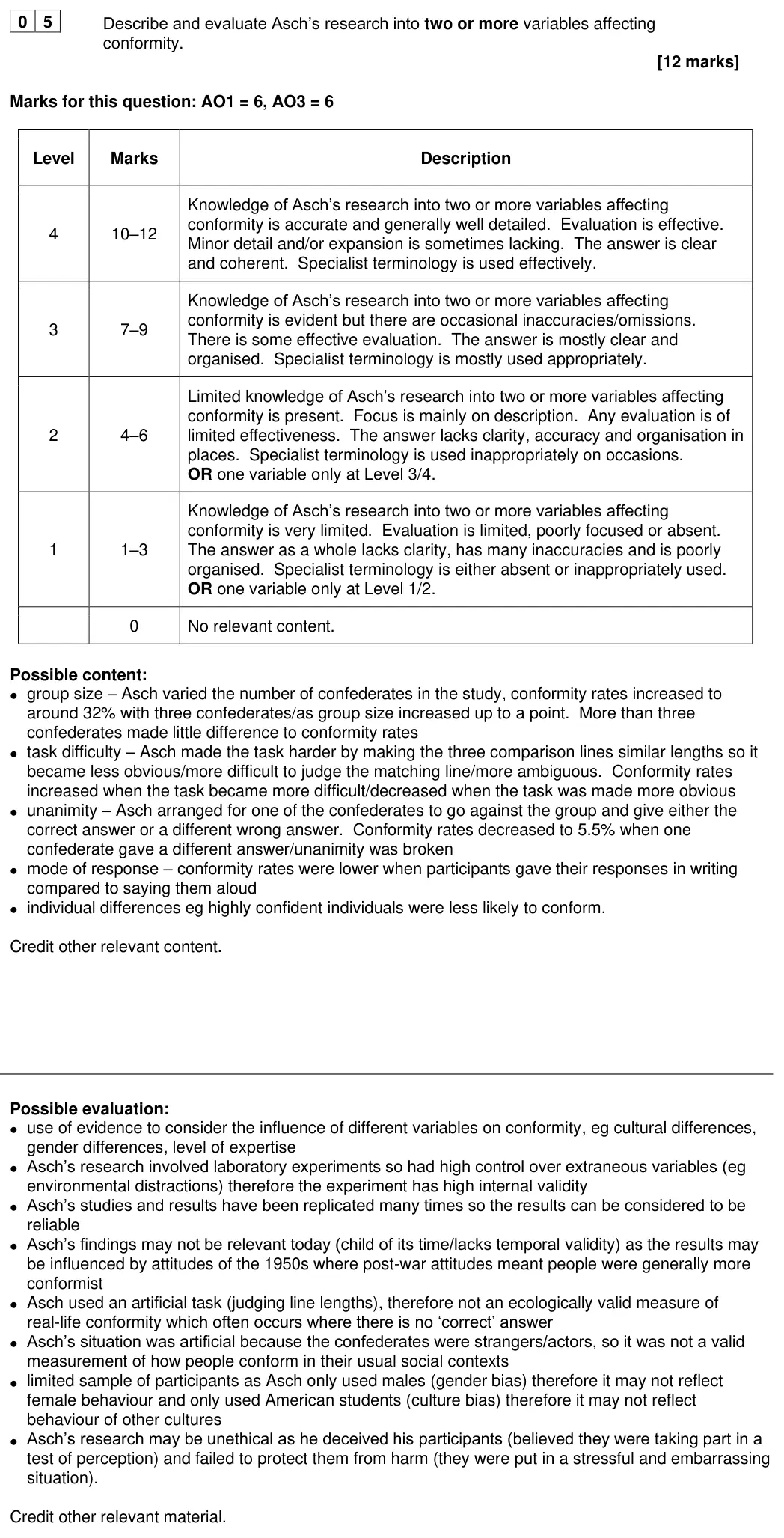
Mark scheme, including level descriptors and indicative content
Examiner's comment
While there were some impressive responses, some students did not include sufficient detail in their answers, particularly in the extended response questions, Q5 and Q24. The mean mark for the 12-mark essay was much higher this year, even though it was a question focused on Asch variations, a point some students missed when writing their responses. Performance on this question was pleasing, with a good spread of scores across the range of marks available. Performance was slightly skewed towards the top end. Overall, it was a good discriminating question. Many students answered this 12-mark essay question well, with a mean mark of just over half the marks available, and just over half of the students scoring at levels 3 and 4. Some students did not focus on the question - which was about two variables affecting conformity and simply outlined the original Asch study. Very successful answers described how each variable was manipulated and the measured impact it had on conformity. Some answers only contained description without evaluation or gave very limited evaluation which was sometimes generic. More successful answers discussed the strengths and limitations of the variation research. Only a very few students did not attempt this question, fewer than in previous years for essays worth12-marks. There was also only a small percentage of students who scored no marks. Again, this was a better outcome than in previous years.
Notes from the mark scheme and report
group size, unanimity, task difficulty (mode of response credited)
one variable only = max Level 2
describing only the original Asch study did not focus on variables
evaluation often generic
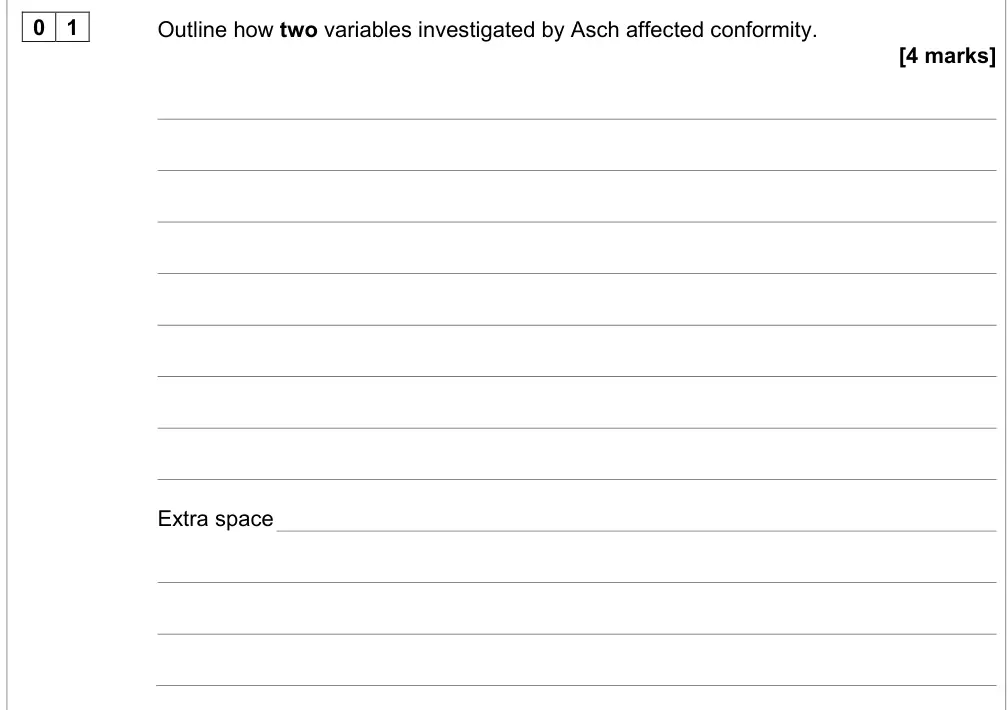
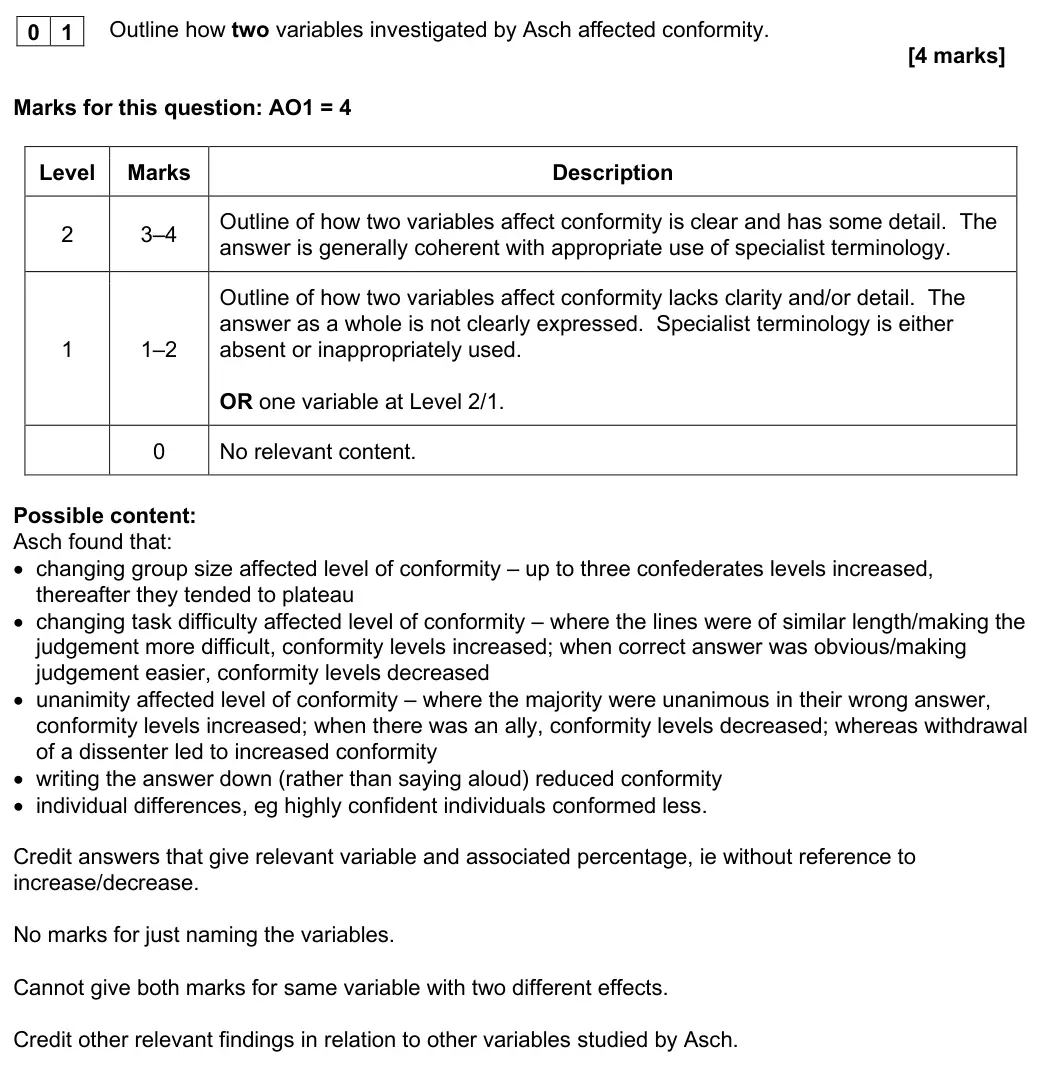
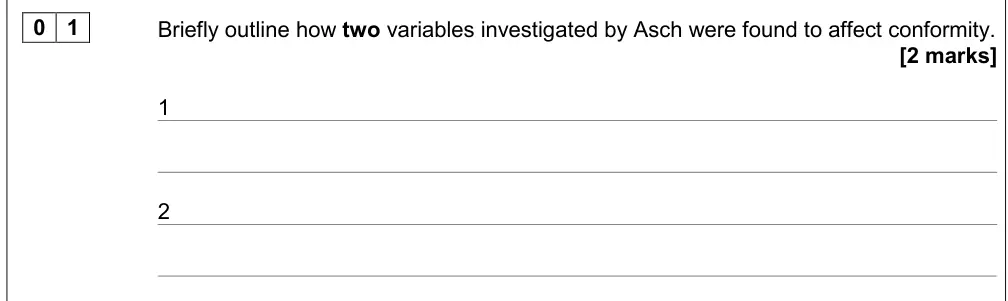
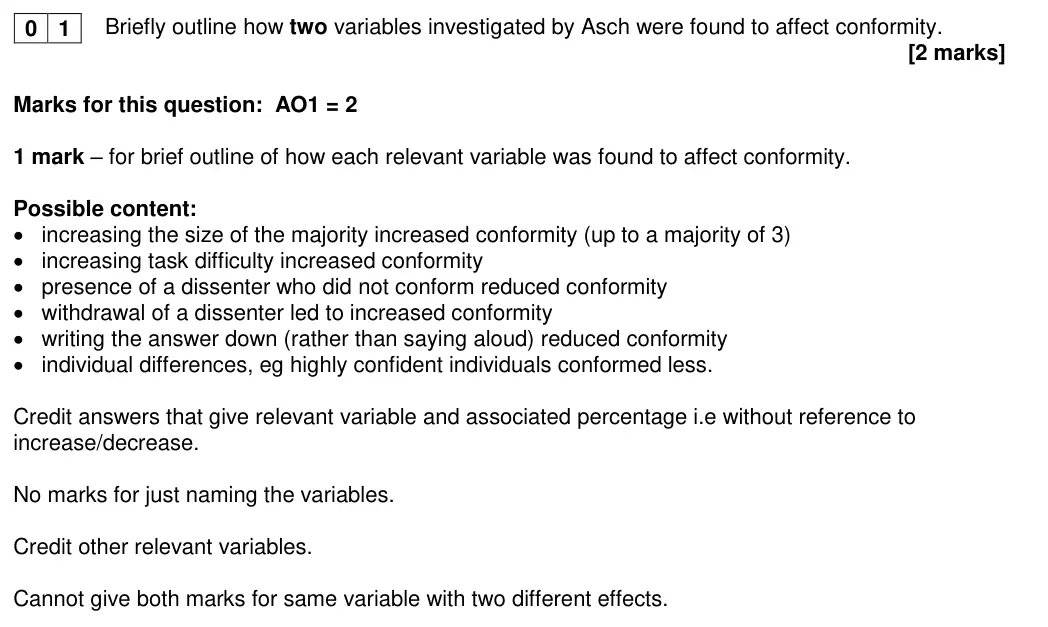
June 2024 · AS Paper 1 · Q14 marksAO1=4OutlineEasy
Mark scheme, including level descriptors and indicative content
Examiner's comment
This question was one of the easier questions on the paper, with the second highest mean as a percentage of the maximum marks (77%). Knowledge of how variables investigated by Asch affected conformity was generally good with over 87% scoring half marks or more and 50% gaining full marks. Some students only named one or more variable which was not creditworthy. Good answers explained how each variable was manipulated and the impact of each on conformity (increase/decrease/percentage conformity). Students would benefit from understanding the difference in requirements between ‘naming’ and ‘outlining how.’
Notes from the mark scheme and report
how each variable affected conformity (increase/decrease or percentage)
naming variables = 0
one variable only = max Level 1
same variable with two effects cannot get both marks
50% full marks
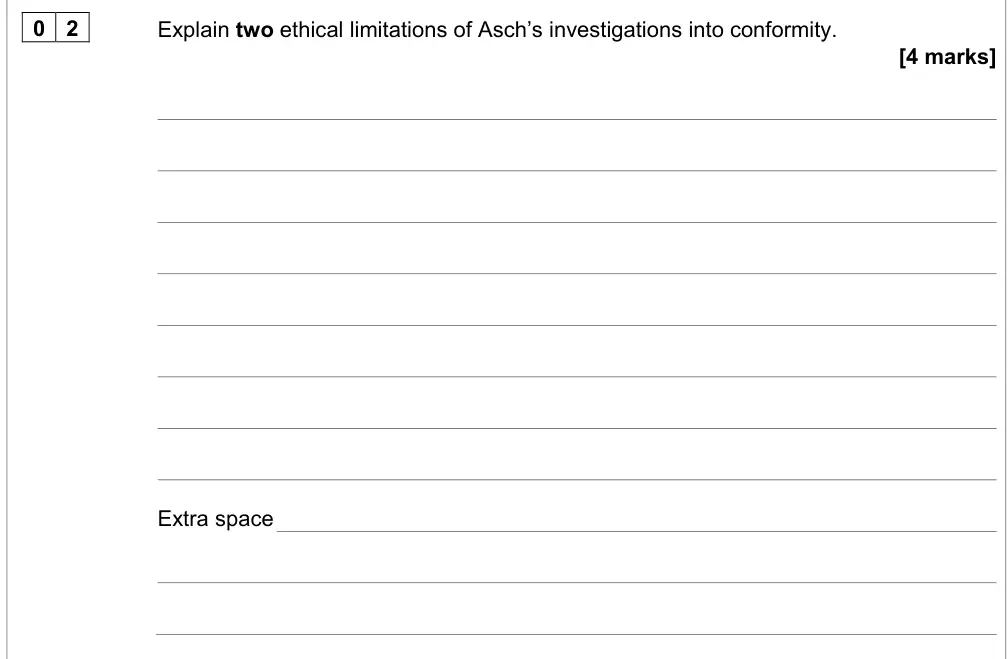
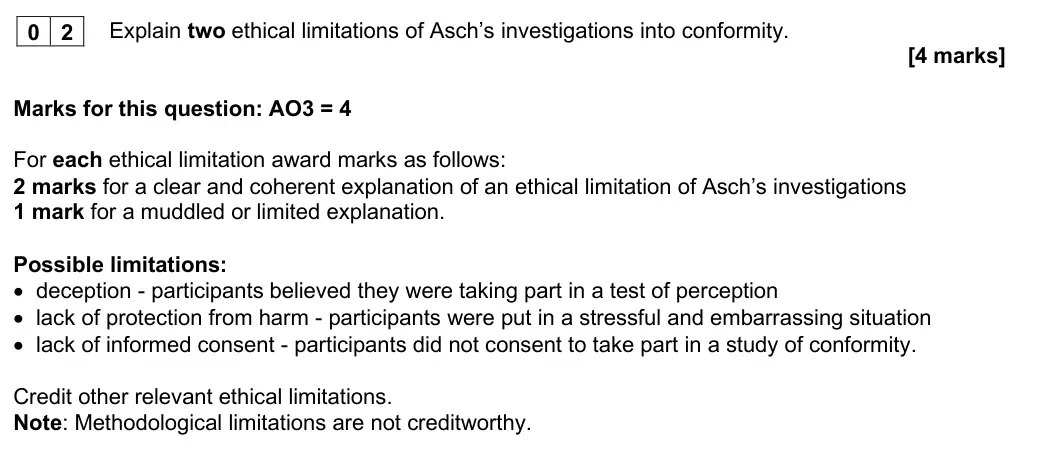
June 2024 · AS Paper 1 · Q24 marksAO3=4Evaluate (short)Medium
Mark scheme, including level descriptors and indicative content
Examiner's comment
Another Asch question which many students answered well, with 30% of students gaining full marks. However, some students did not read the question and their answer did not focus on ethical limitations. Some students gave general weaknesses of Asch’s research: students need to be reminded to read the question carefully and address the question set. Good answers explained their chosen ethical limitations within the context of Asch’s investigations.
Notes from the mark scheme and report
two ETHICAL limitations explained in the context of Asch (deception about perception test, protection from harm/stress and embarrassment, informed consent)
methodological limitations not creditworthy
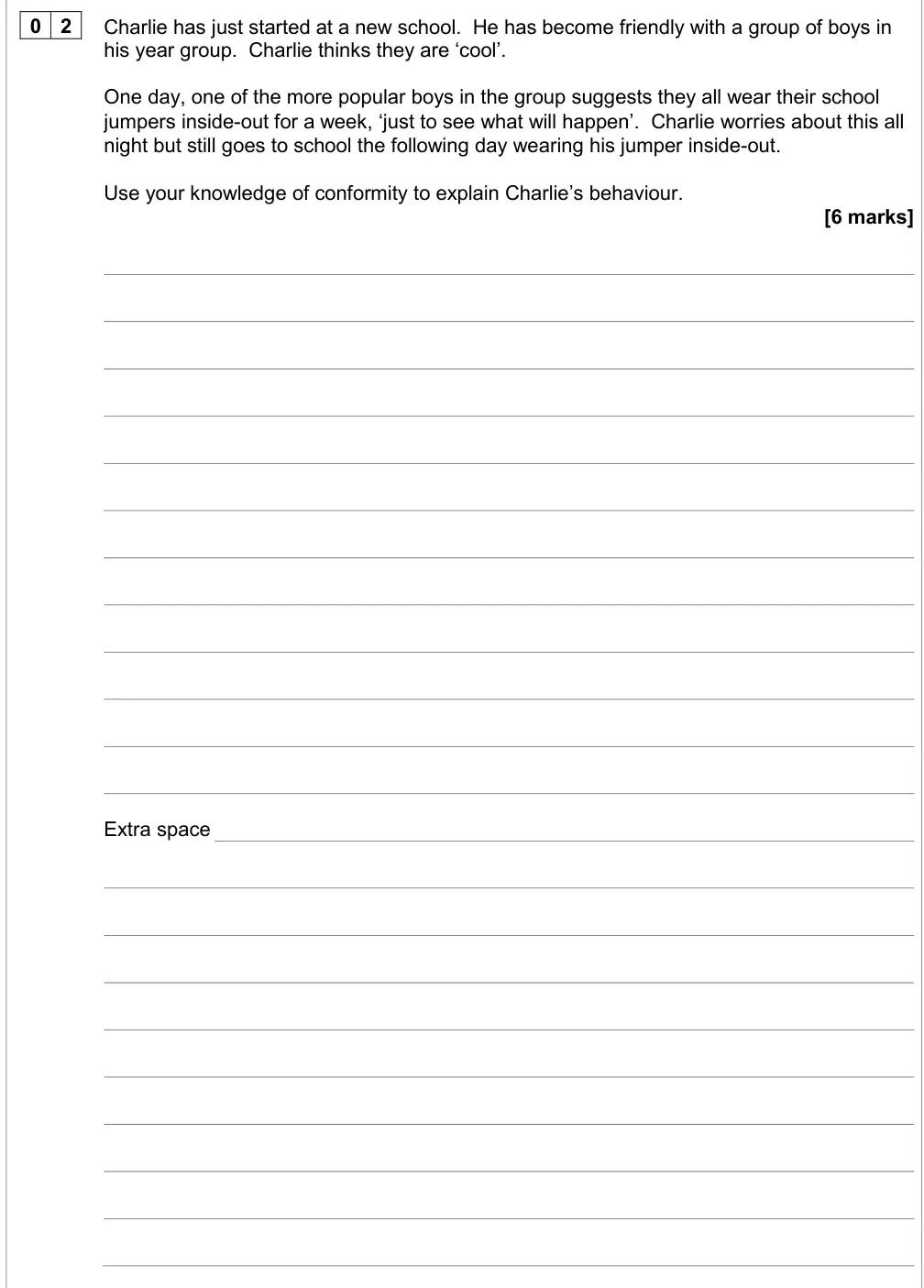
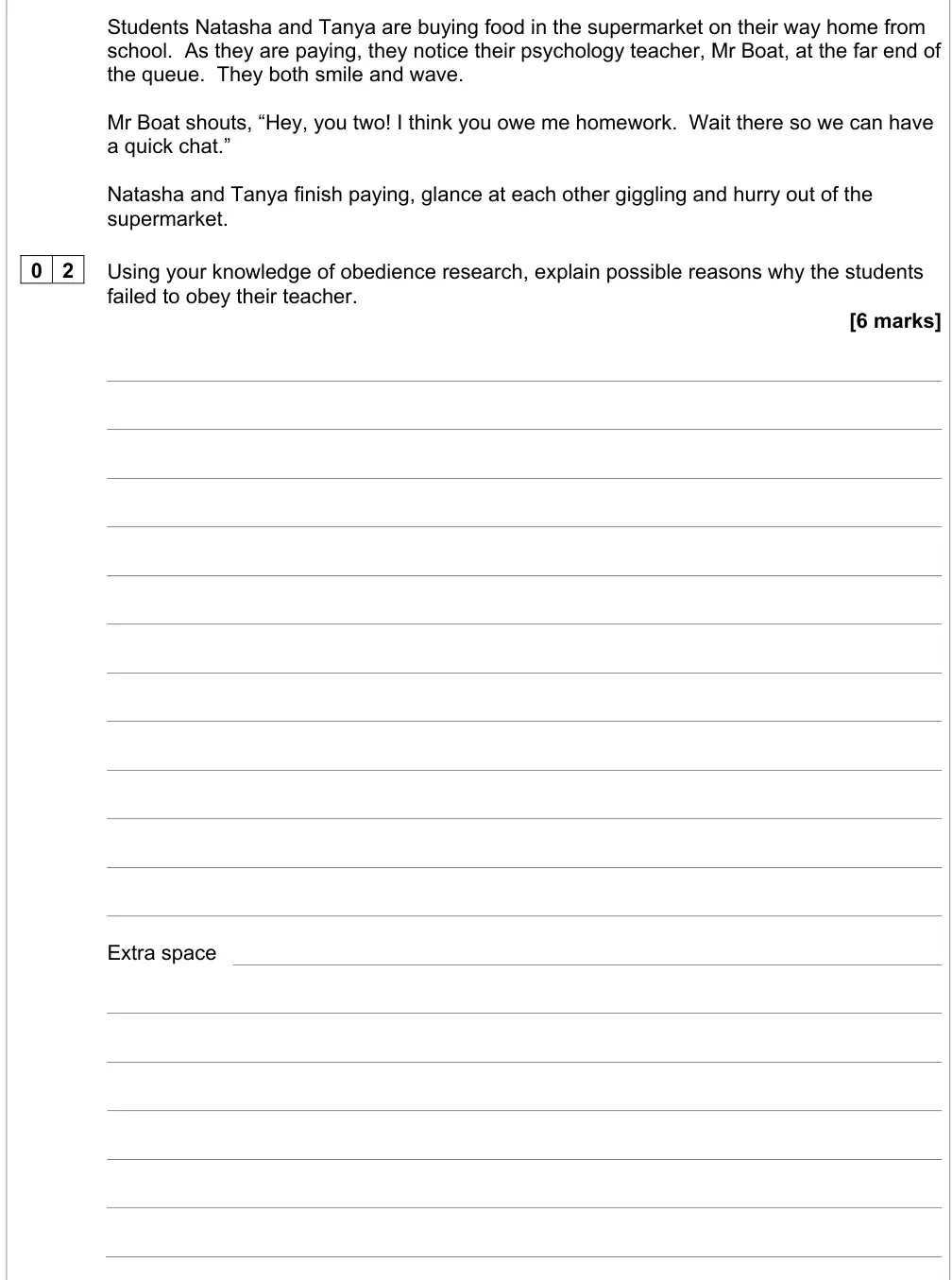
June 2024 · Paper 1 · Q26 marksAO2=6Application
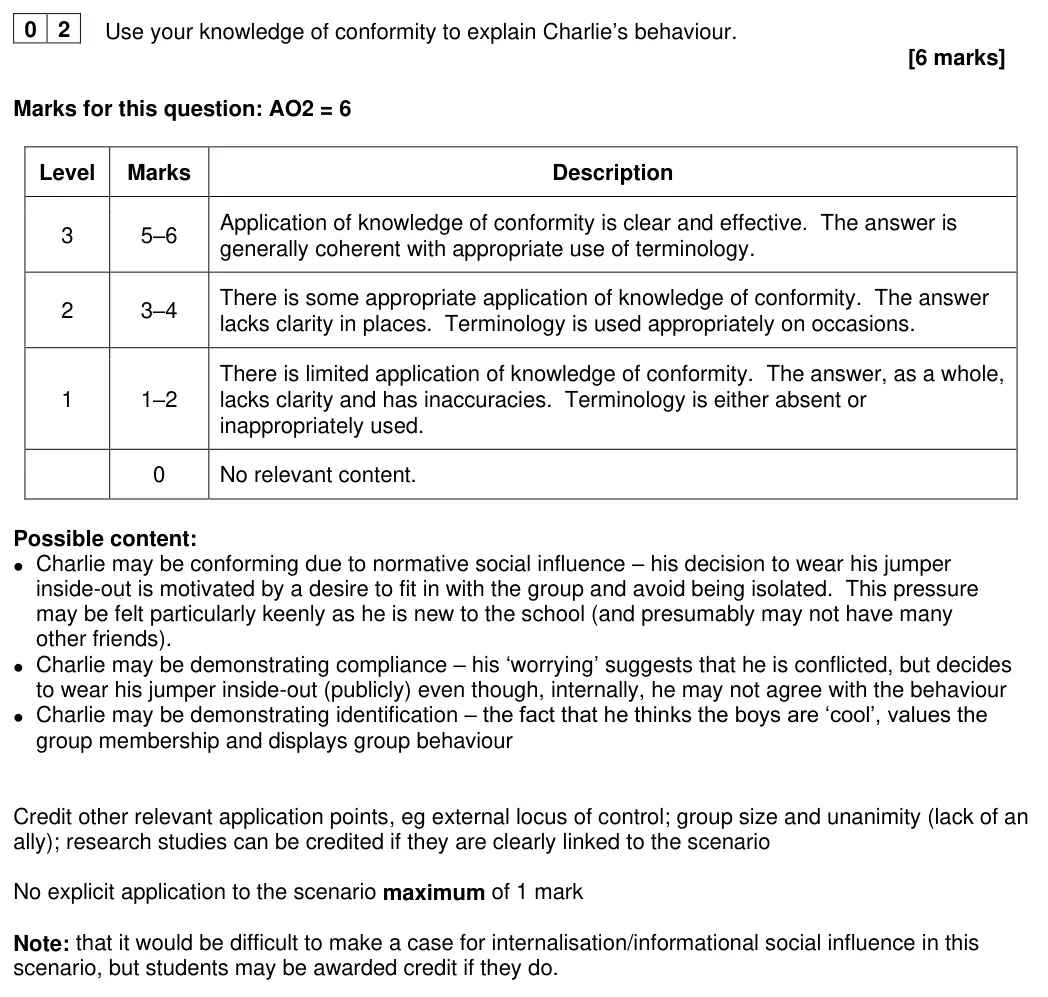
Mark scheme, including level descriptors and indicative content
Examiner's comment
This year, in Social influence these application questions totalled 12 marks, and in both questions the mean average was well over half marks. These application questions had very similar demands to a question in last year’s paper about obedience. However, here, both questions were centred on the same scenario and question A2 required students to apply concepts from conformity whereas question A3 required students to apply concepts from obedience. Although application of knowledge is typically an area of difficulty, students were able to engage with these questions well and applied a variety of knowledge to the scenario, from explanations to variables that affect conformity and obedience, respectively. Over twenty percent of students, (in both questions,) were able to gain level 3 marks, with the average mark for both questions exceeding 3.5 This student’s response has included accurate and detailed knowledge of three conformity concepts (compliance, normative social influence as well as identification). Each concept has been correctly applied to the scenario. This was fitting of level 3 mark scheme descriptors This type of response was less effective than that of student A. The knowledge is not always carefully applied to the scenario, and as such was classified as limited. With these types of application questions this kind of response was less common, illustrating students’ growing capabilities with application of knowledge
Notes from the mark scheme and report
NSI (desire to fit in, new to school), compliance (worries but publicly conforms)
also credits locus of control, group size, unanimity
ISI/internalisation hard to justify
no explicit application = max 1
MS also credits identification, removed in v1.4
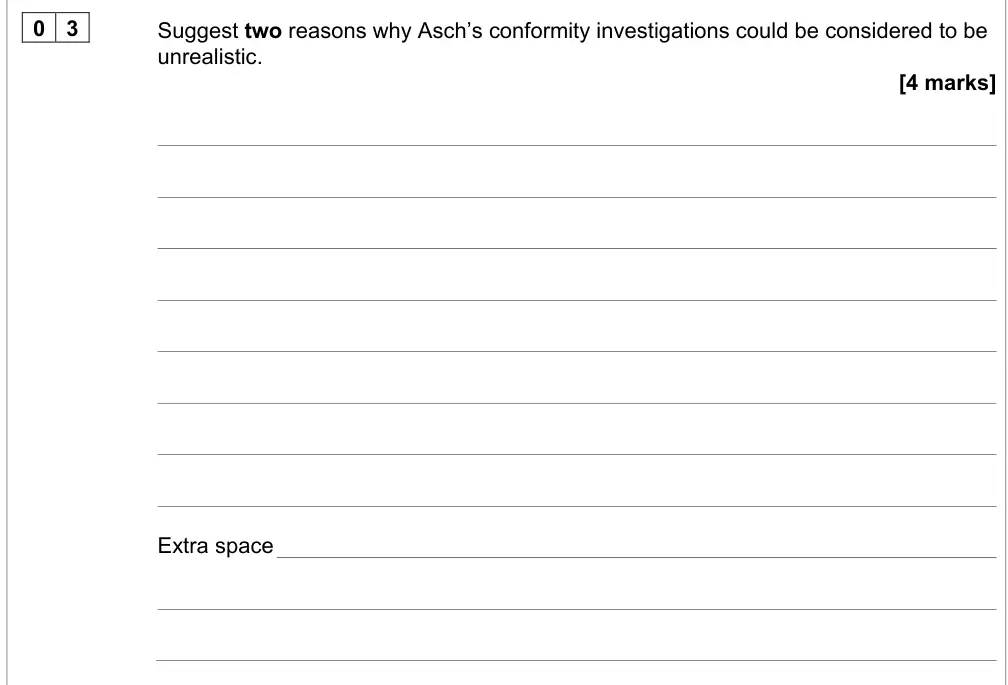
June 2024 · AS Paper 1 · Q34 marksAO3=4Evaluate (short)Medium
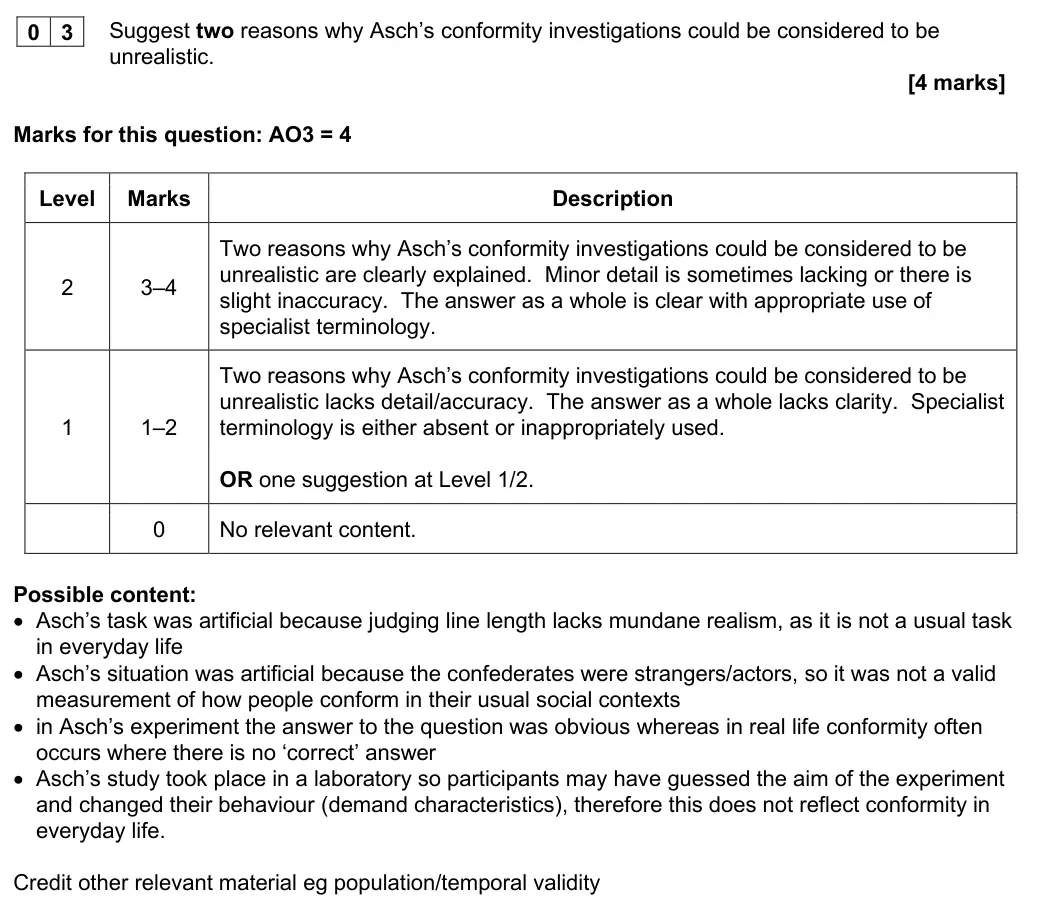
Mark scheme, including level descriptors and indicative content
Examiner's comment
Some students gave particularly good answers outlining two distinct reasons why Asch’s conformity investigations could be considered unrealistic within the context of Asch’s research, with 25% of students achieving full marks. The strongest answers also used specialist terminology appropriately, for example, lack of mundane realism. Some students only gave general weaknesses of Asch’s research without explaining why it was unrealistic or they were only able to give one suggestion.
Notes from the mark scheme and report
two reasons Asch is unrealistic (mundane realism of line task, strangers as confederates, obvious answer, lab/demand characteristics)
general weaknesses not explained as unrealistic
one reason only = max Level 1
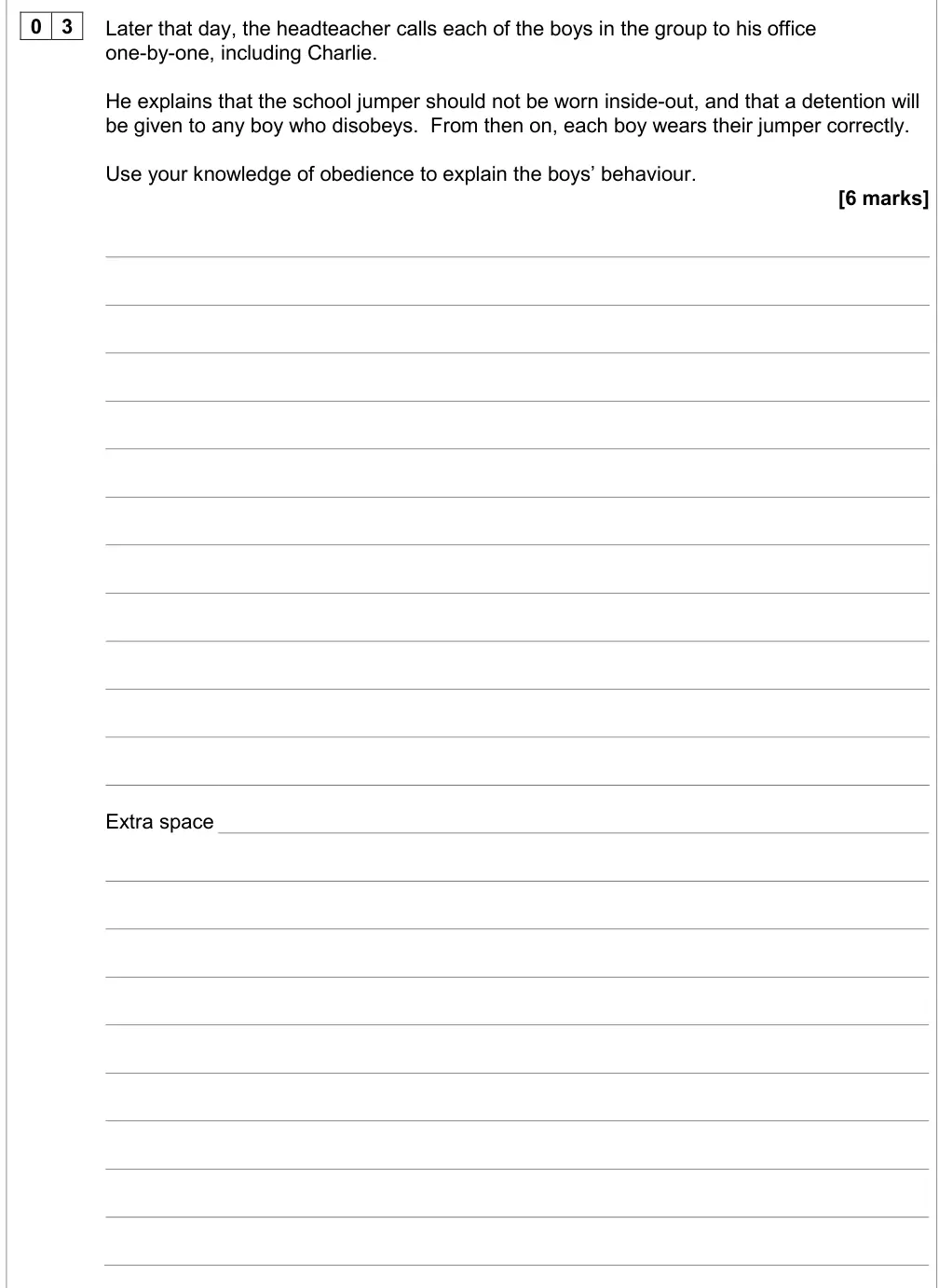
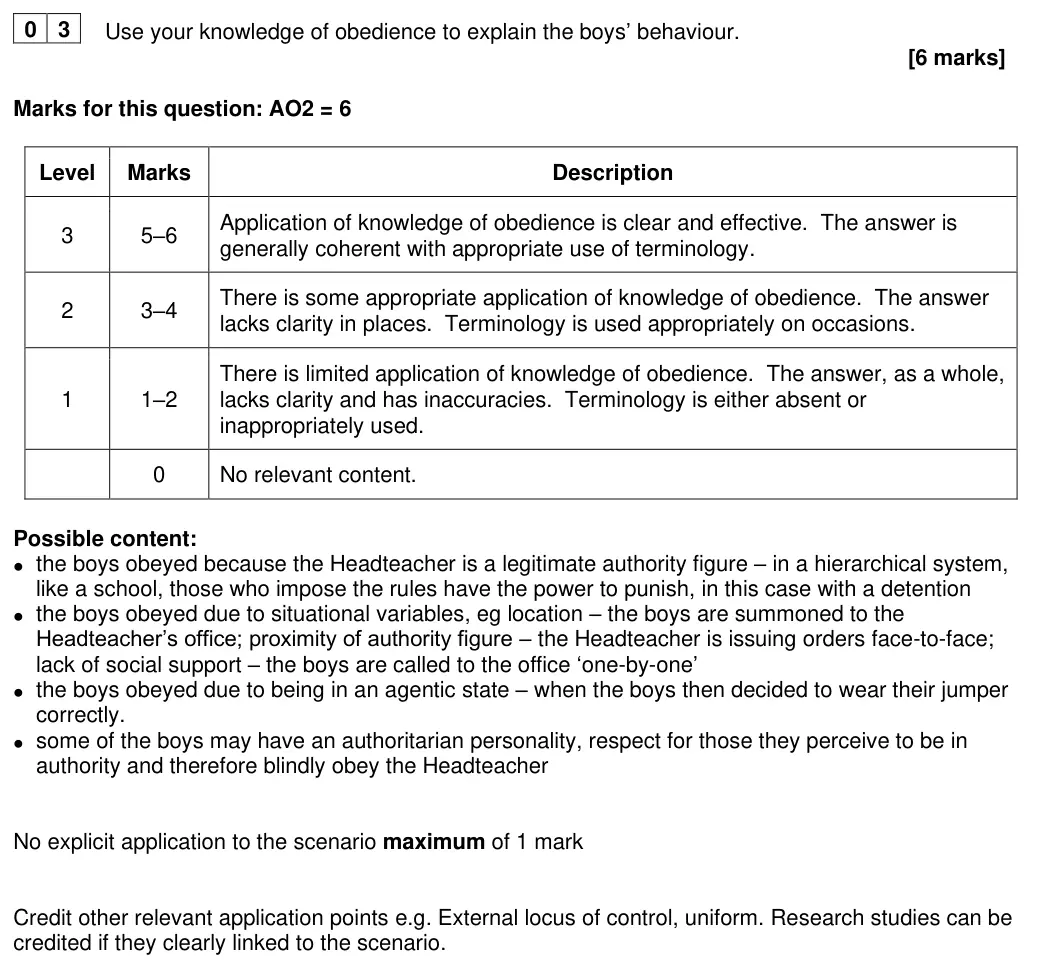
June 2024 · Paper 1 · Q36 marksAO2=6Application
Mark scheme, including level descriptors and indicative content
Examiner's comment
This year, in Social influence these application questions totalled 12 marks, and in both questions the mean average was well over half marks. These application questions had very similar demands to a question in last year’s paper about obedience. However, here, both questions were centred on the same scenario and question A2 required students to apply concepts from conformity whereas question A3 required students to apply concepts from obedience. Although application of knowledge is typically an area of difficulty, students were able to engage with these questions well and applied a variety of knowledge to the scenario, from explanations to variables that affect conformity and obedience, respectively. Over twenty percent of students, (in both questions,) were able to gain level 3 marks, with the average mark for both questions exceeding 3.5
Notes from the mark scheme and report
legitimate authority/power to punish, location (head's office), proximity, lack of social support (one-by-one), agentic state, authoritarian personality
no explicit application = max 1
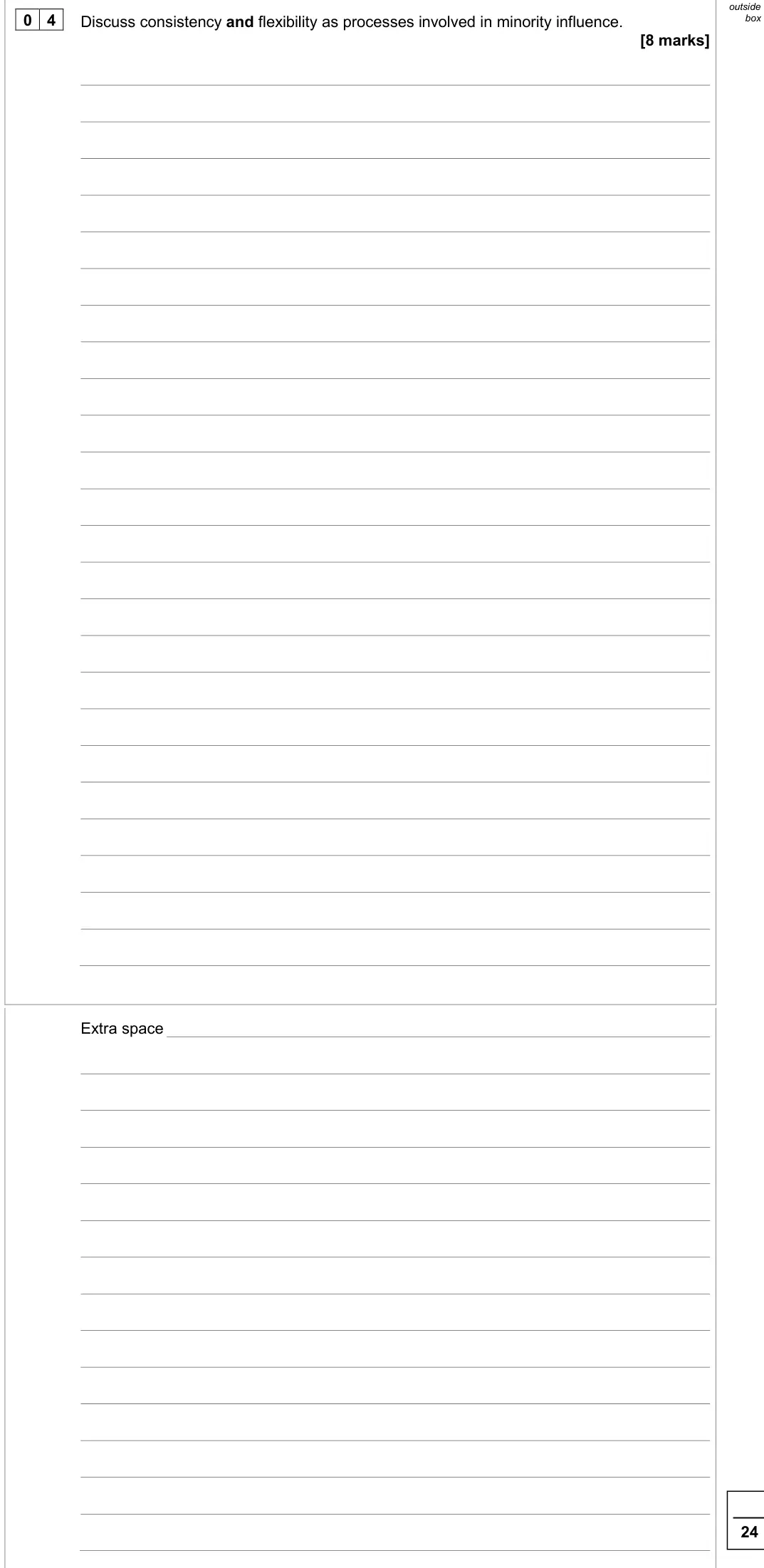
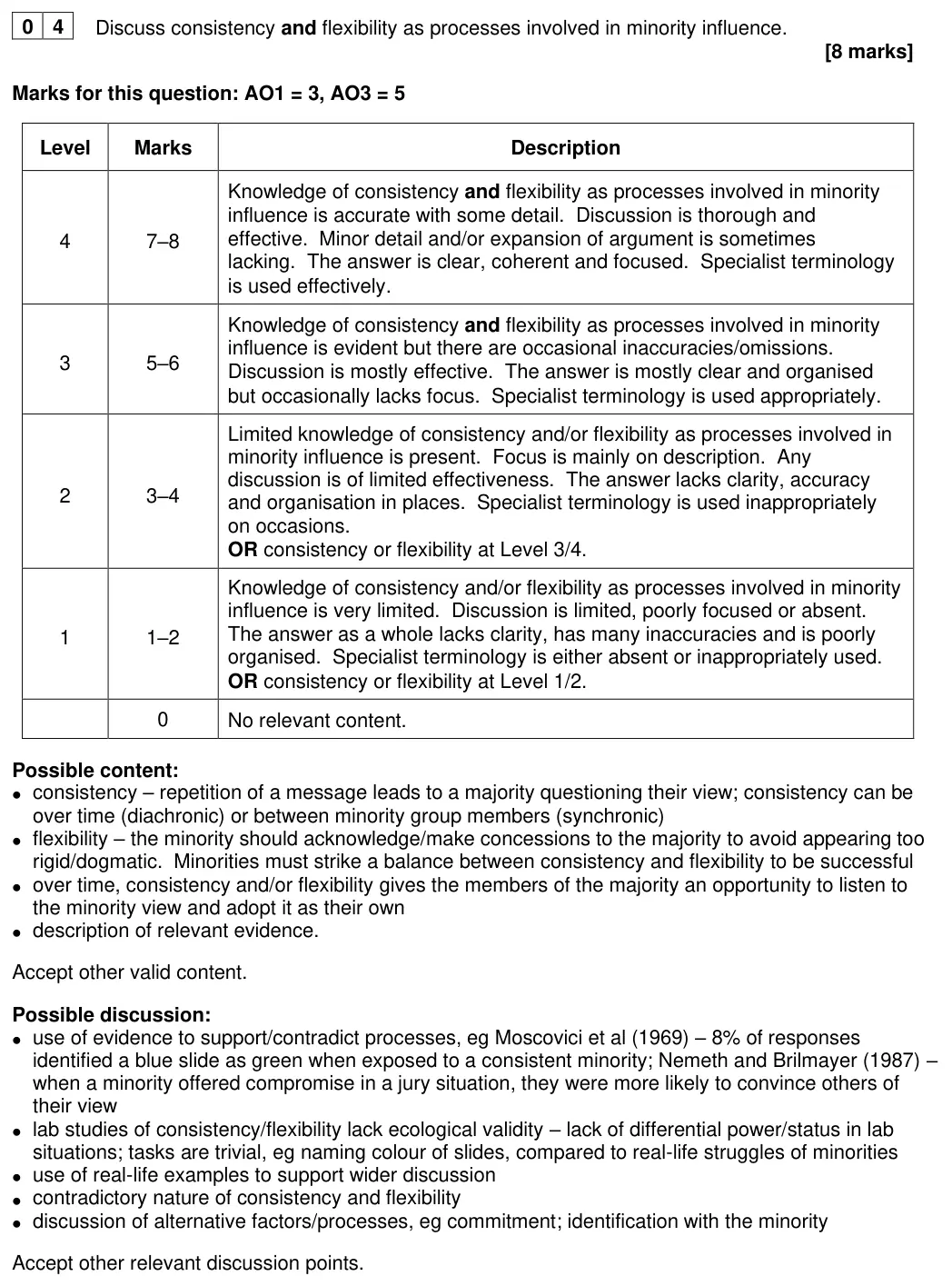
June 2024 · Paper 1 · Q48 marksAO1=3, AO3=5Extended writing
Mark scheme, including level descriptors and indicative content
Examiner's comment
This question overlapped with some of the content from last year’s paper, yet many were able to score well in this question. Despite the occasional amount of tautology seen in some responses, students typically made good use of diachronic and synchronic consistency and appeared well versed with flexibility. Further effective use was made of real-life examples e.g. the suffragettes’ campaigns, civil rights movement, as well as research from Moscovici, Nemeth and Brilmayer and to a lesser extent Wood et al’s meta-analysis of the role of consistency in minority influence. Typically, students were able to gain the ‘knowledge’ marks rapidly, and only a small minority struggled to gain ‘discussion’ marks. Nearly all students scored marks in this question, with ten percent scoring level 4 marks. This level 4 response cited excessive amounts of discussion, accurate and precise knowledge and presented the response with a coherent structure throughout. Effective use was made of research support as well as real life examples. Another strength of this response is seen when the student briefly evaluates Moscovici’s research with commentary that relates back to the explanation of consistency. In contrast to student A, this reponse lacks sufficent depth. Although some valid ‘knowledge’ and ‘discussion’ points are included, the whole response is lacking in elaborative commentary focused on the question. In addition, the repsonse has failed to include sufficient terminology that is needed to access higher marking levels.
Notes from the mark scheme and report
consistency or flexibility only = max Level 2
diachronic/synchronic consistency
Moscovici, Nemeth and Brilmayer, Wood et al
real-life examples (suffragettes, civil rights)
some tautology
June 2024 · AS Paper 1 · Q52 marksAO1=2OutlineEasy
Mark scheme, including level descriptors and indicative content
Examiner's comment
Most students answered this question well, with just over 50% scoring full marks. There was generally a good understanding of what flexibility was and how it acted as a factor in minority influence. A minority of students confused flexibility with consistency in their description. A few students did not attempt this question. In this section of the paper, this question had the highest percentage of students, approximately 13%, gaining no marks.
Notes from the mark scheme and report
listening/compromising/non-dogmatic -> seen as reasonable and more persuasive
confused with consistency
~13% scored zero
June 2024 · AS Paper 1 · Q68 marksAO1=4, AO2=4Extended writingHard
Mark scheme, including level descriptors and indicative content
Examiner's comment
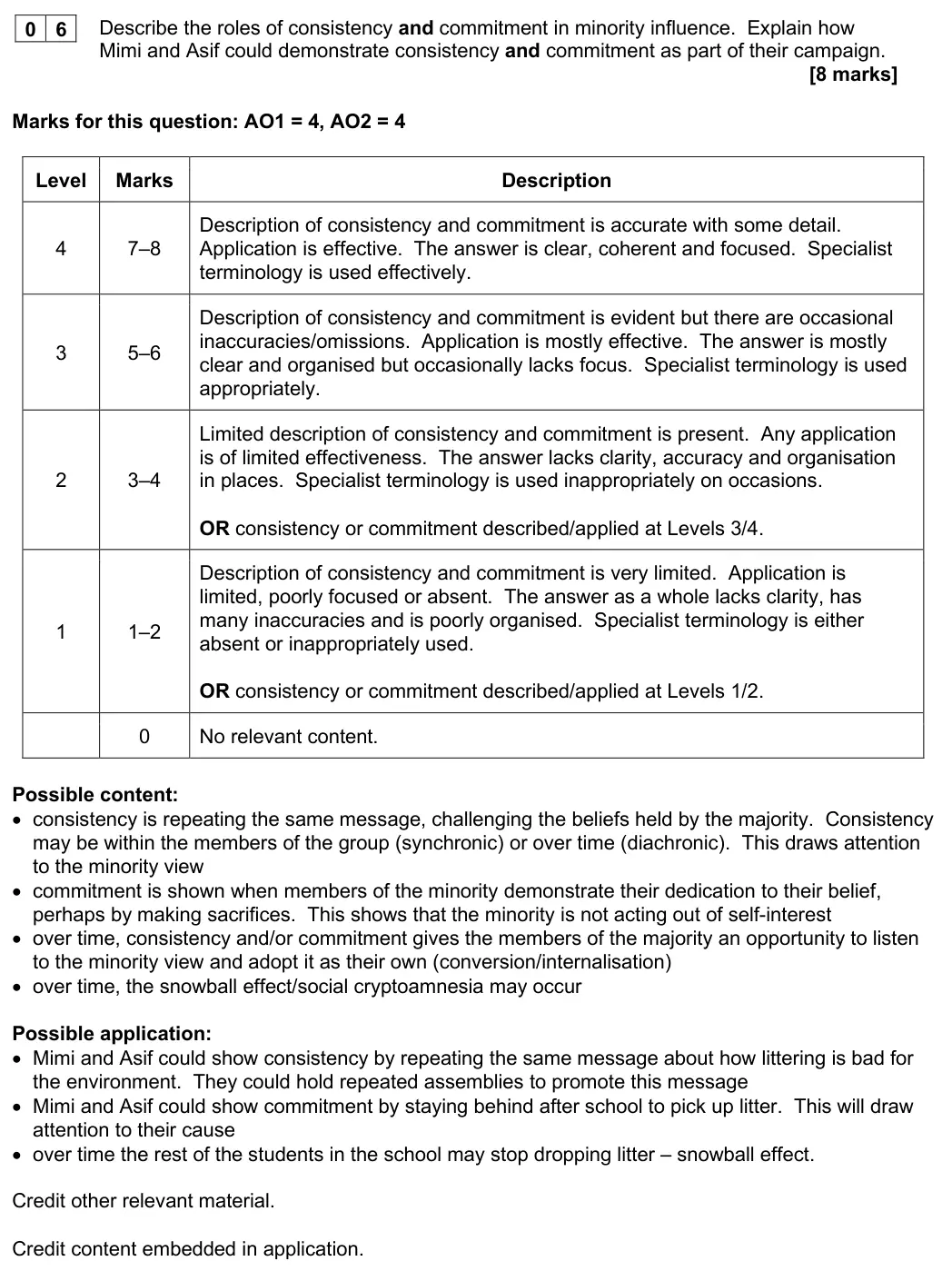
This question was the most challenging in the Social Influence section, with the lowest mean score of just half the available marks. This question required a description of the roles of both consistency and commitment in minority influence as well as application of both to the scenario. This was different from previous 8-mark questions that required description and evaluation. It was clear that a lot of students did not focus on the demands of the question, instead offering evaluation in their answer, which was not creditworthy. Students need to pay careful attention to the command terms in the question. Stronger students explained commitment and consistency and then applied them to the scenario. Only 10% of students described both terms with some detail, effective application, and appropriate use of specialist terminology, achieving level 4 marks. Some students used circular definitions which did not display understanding of the terms.
Notes from the mark scheme and report
describe consistency (synchronic/diachronic) and commitment AND apply both to Mimi and Asif's litter campaign
only one factor at Level 3/4 = max Level 2
evaluation not creditworthy (no AO3)
circular definitions
MS also credits snowball effect/social cryptomnesia (social change, removed in v1.4)
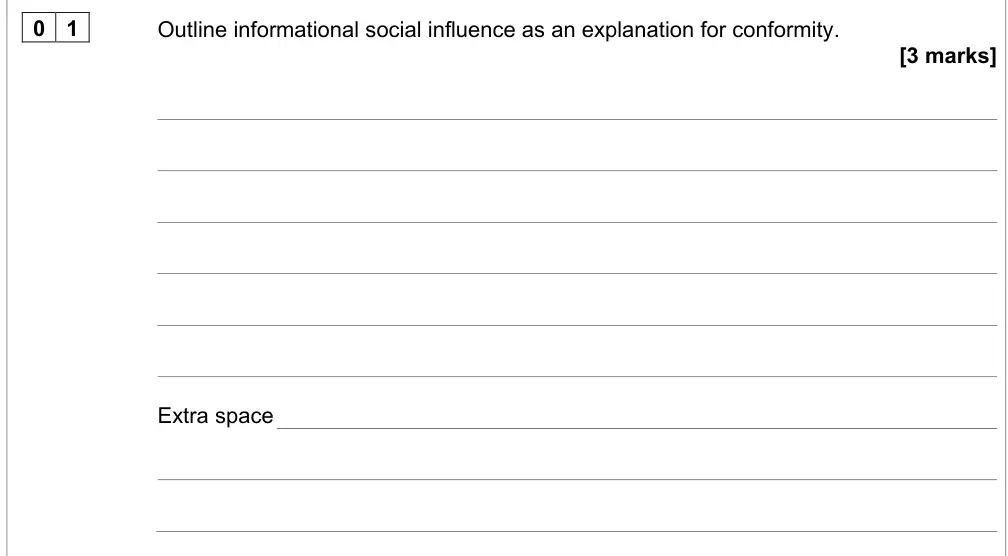
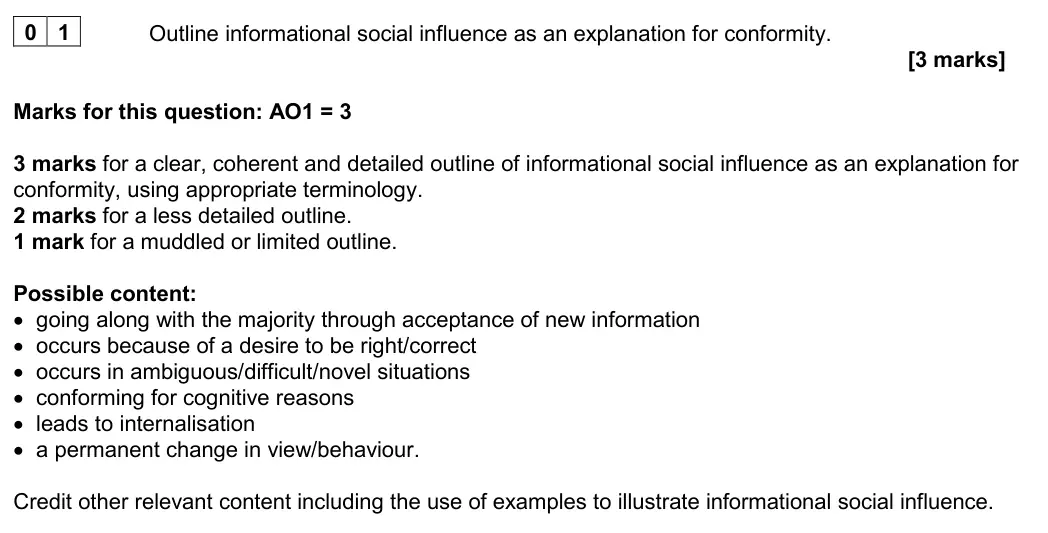
June 2023 · AS Paper 1 · Q13 marksAO1=3OutlineMedium
Mark scheme, including level descriptors and indicative content
Examiner's comment
This question was generally answered well, suggesting that students had a good knowledge of informational social influence (ISI). However, some students muddled ISI with normative social influence. Only a quarter of students gave sufficient detail in their answer for full marks.
Notes from the mark scheme and report
desire to be right, ambiguous/difficult situations, cognitive reasons, leads to internalisation
muddled with NSI
only a quarter gave enough detail for full marks
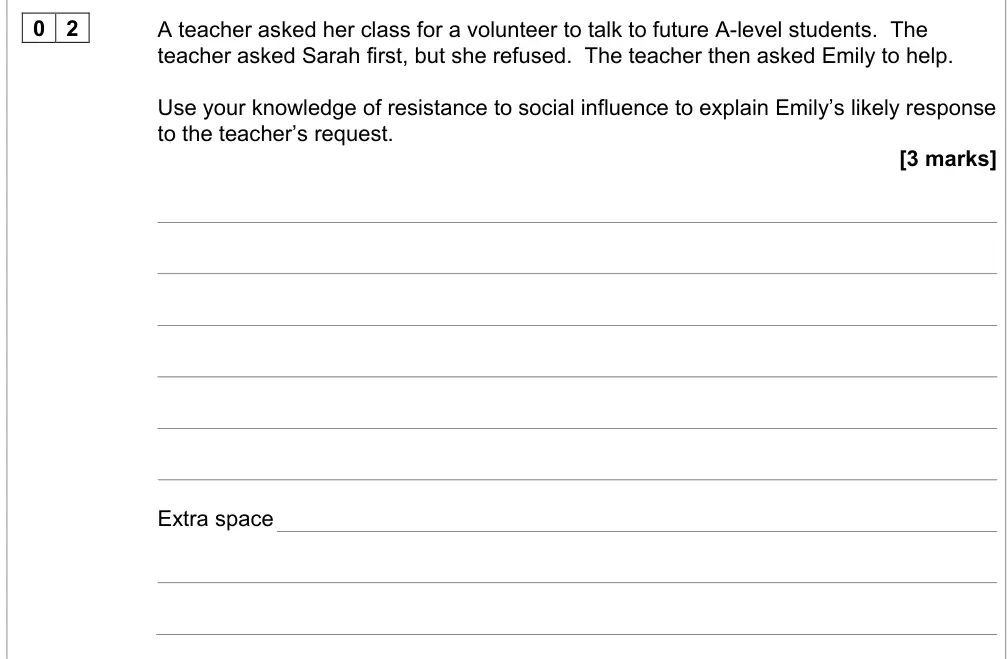
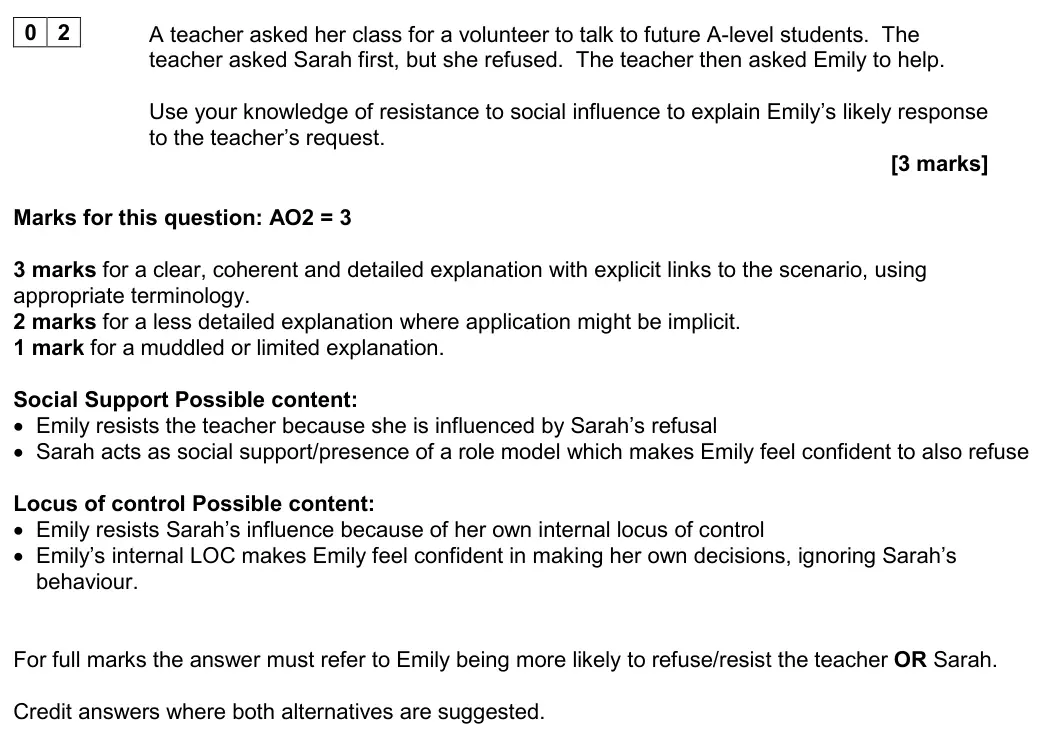
June 2023 · AS Paper 1 · Q23 marksAO2=3Application
Mark scheme, including level descriptors and indicative content
Examiner's comment
Although it was acceptable to refer to resisting Sarah’s influence or resisting the teacher’s influence, some students failed to use knowledge of resistance to social influence to explain Emily’s behaviour, instead referring to conformity to Sarah or obedience to the teacher. Students need to read the question carefully. Lack of appropriate terminology and/or not fully explaining why Emily would also resist (eg through increased confidence) limited many responses to 2 marks.
Notes from the mark scheme and report
social support (Sarah as model of resistance) or internal locus of control
full marks need explicit statement that Emily is likely to refuse/resist
answers about conformity to Sarah or obedience to the teacher not credited
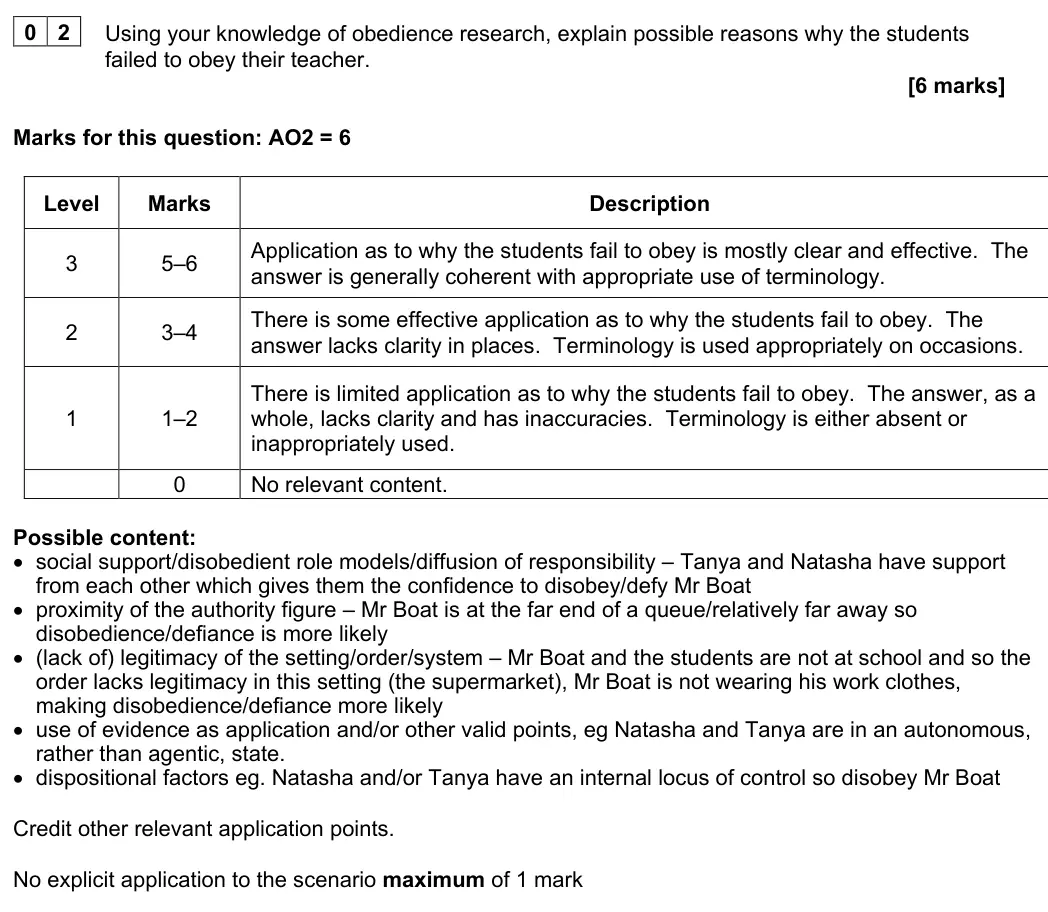
June 2023 · Paper 1 · Q26 marksAO2=6ApplicationEasy
Mark scheme, including level descriptors and indicative content
Examiner's comment
Many students were able to score well in this question, with a variety of knowledge being suitable to apply to the question. Over 60% of students scored four or more marks. Occasionally students cited conformity knowledge, but this was often framed around the scenario and was able to score some marks. A minority of students made limited use of dispositional factors eg locus of control and/or a lack of authoritarian personality. However, this was not done as effectively as the abundance of situational factors that matched the scenario more clearly. A significant minority of responses revolved around common sense type answers with minimal psychological knowledge, as well as many responses that did not match their explanation to the correct theory eg lack of proximity and legitimacy of authority.
Notes from the mark scheme and report
credit for proximity, legitimacy of authority/setting, uniform, autonomous vs agentic state (4.1.1-02) and social support, internal locus of control (4.1.1-03)
no explicit link to the scenario = max 1 mark
common-sense answers with little psychology
mismatching explanation to theory (e.g. proximity vs legitimacy)
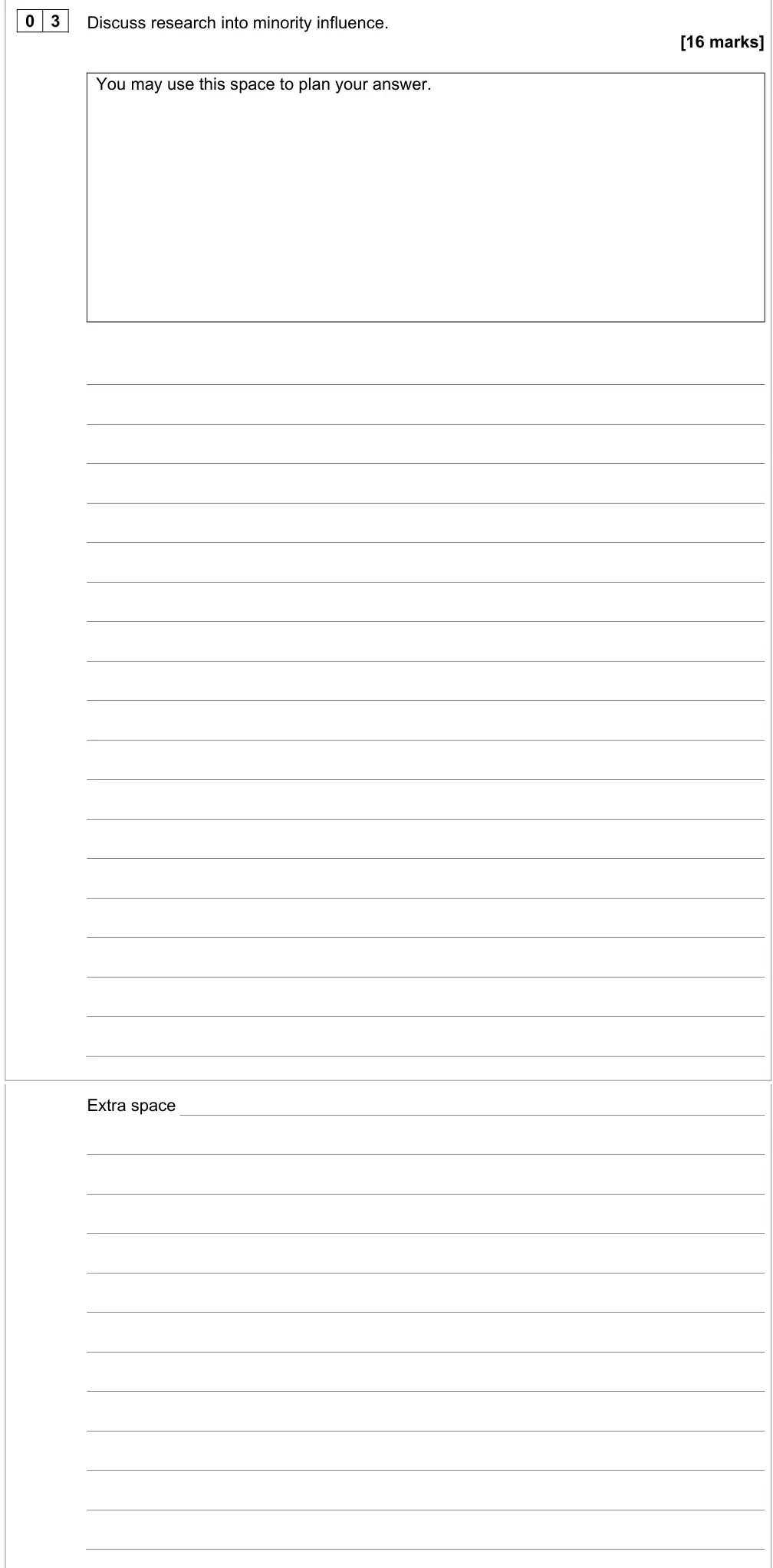
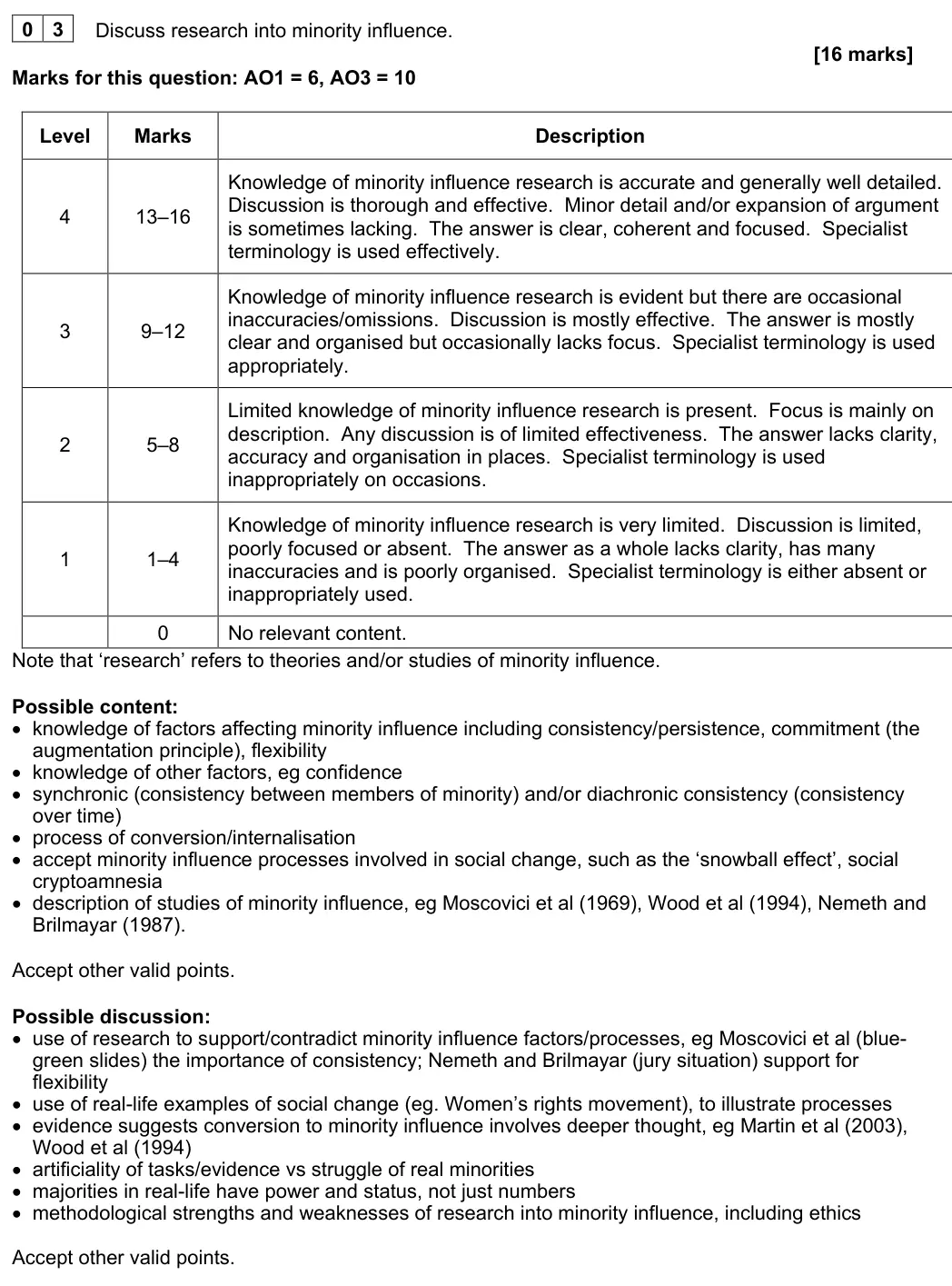
June 2023 · Paper 1 · Q316 marksAO1=6, AO3=1016-mark essay
Mark scheme, including level descriptors and indicative content
Examiner's comment
They answered with material from a different area of the specification eg with question 3 on minority influence a significant number of students gave a response centred around conformity in general, which struggled to score any marks. Most students were able to access this question effectively, with many making effective use of research studies. The most popular and effective pieces of research used here were Moscovici’s work on consistency and Nemeth and Brilmayar’s work on flexibility. Other pieces of research that were useful to this question included Wood’s meta-analysis on consistency and minority influence, as well as Martin’s research outlining deeper thinking and minority perspectives. The depth provided in these pieces of research varied, but many students were able to cite accurate detail which was awarded higher marks. The discussion part of the question was completed less effectively. Students often made very generic comments about the artificiality of the research and ethical implications. However, stronger responses tended to explicitly connect these points with the question. They considered what minority influence looks like in the real world in contrast to laboratory-based research. To gain higher marks, students need to remember to relate their evaluations of studies back to the question. In addition, there was some effective use of real-life examples such as women’s rights movements and the civil rights movements, as well as considering some practical applications of minority influence research.
Notes from the mark scheme and report
discussion often generic (artificiality, ethics) unless linked back
MS also credits social change processes (snowball effect, social cryptomnesia), removed in v1.4
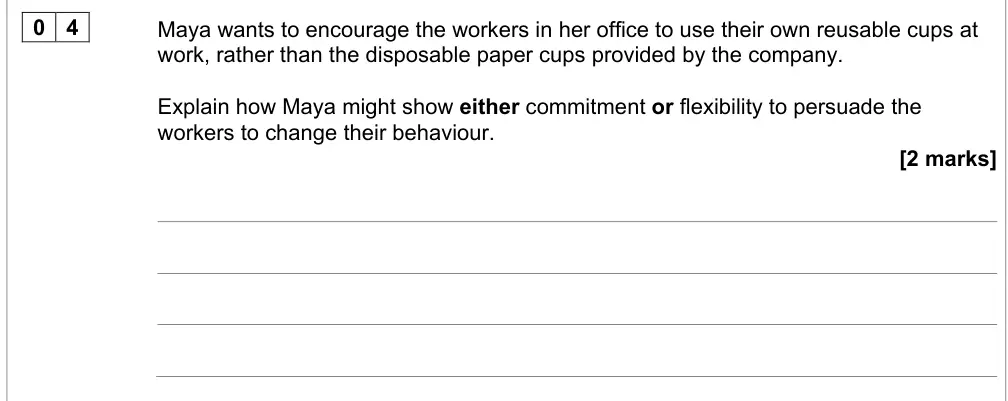
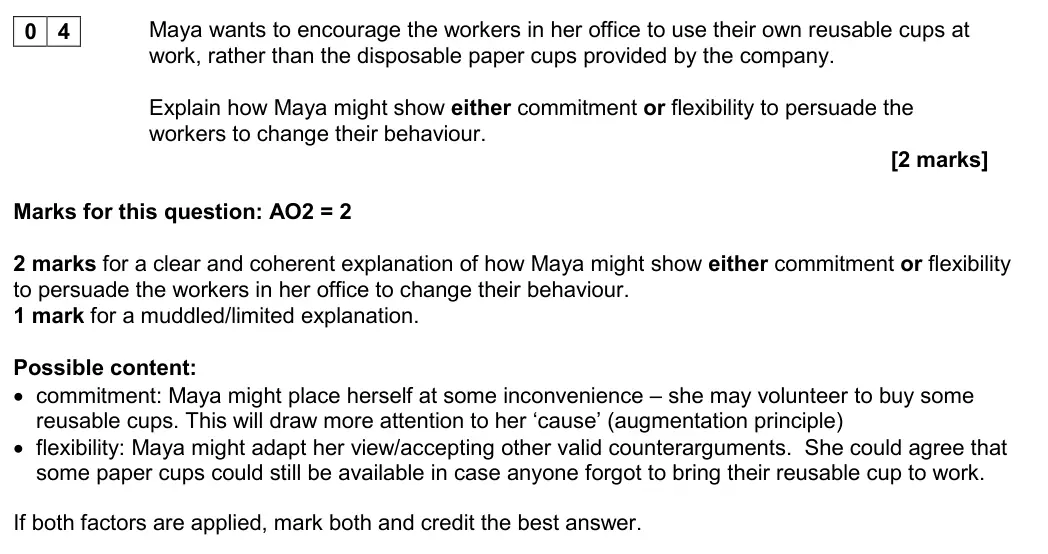
June 2023 · AS Paper 1 · Q42 marksAO2=2ApplicationMedium
Mark scheme, including level descriptors and indicative content
Examiner's comment
This was one of the less challenging questions on the paper, with over 70% of students scoring half marks or more. This style of question has been asked before but with a different scenario context. Students who did lose marks either did not apply their answer to the scenario or gave an example that illustrated consistency rather than flexibility or commitment.
Notes from the mark scheme and report
commitment (augmentation - buying reusable cups) or flexibility (allowing some paper cups)
best of both credited
examples showing consistency instead not credited
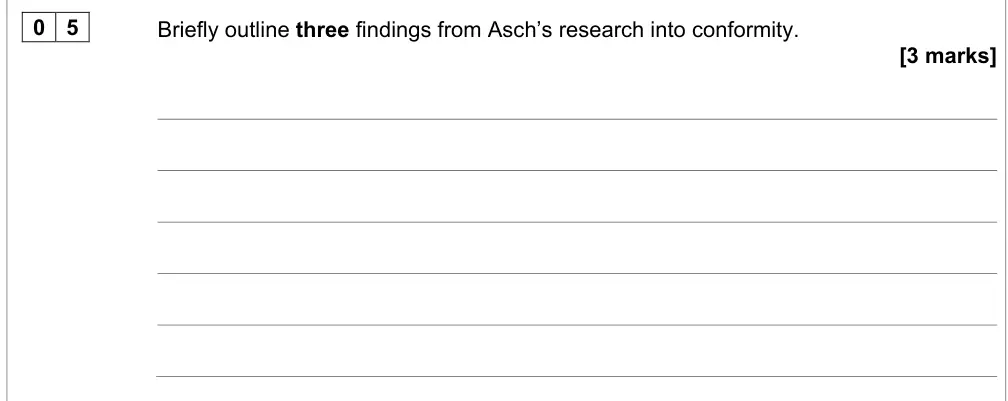
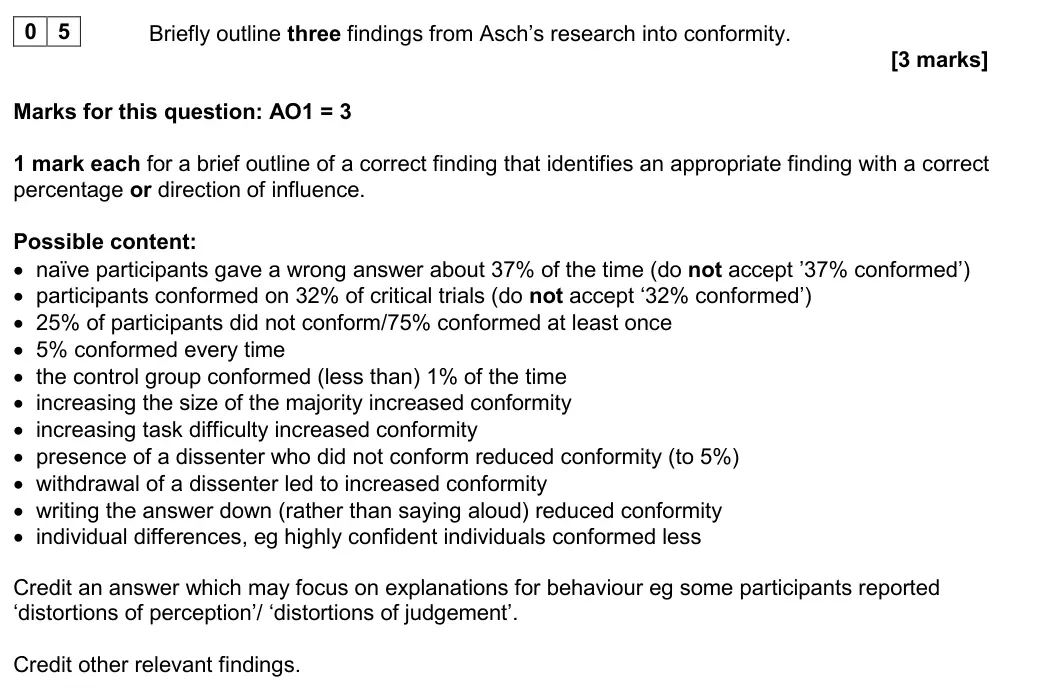
June 2023 · AS Paper 1 · Q53 marksAO1=3Outline
Mark scheme, including level descriptors and indicative content
Examiner's comment
Whilst many students clearly had detailed knowledge of some of the findings from Asch’s research into conformity, some answers gave muddled statistics. For example, some muddled ‘32% of critical trials’ by saying that there was ‘32% conformity’. Some answers expressed the same finding in two different ways (75% conformed at least once/25% never conformed). It is worth reminding students that they should give different findings. Some students did not refer to percentages, but instead gave the direction of effect eg increasing task difficulty increased conformity. A number of students appeared to misunderstand the meaning of unanimity.
Notes from the mark scheme and report
three different findings with correct percentage or direction
'32% conformed' (vs 32% of critical trials) not accepted
same finding twice (75% at least once/25% never)
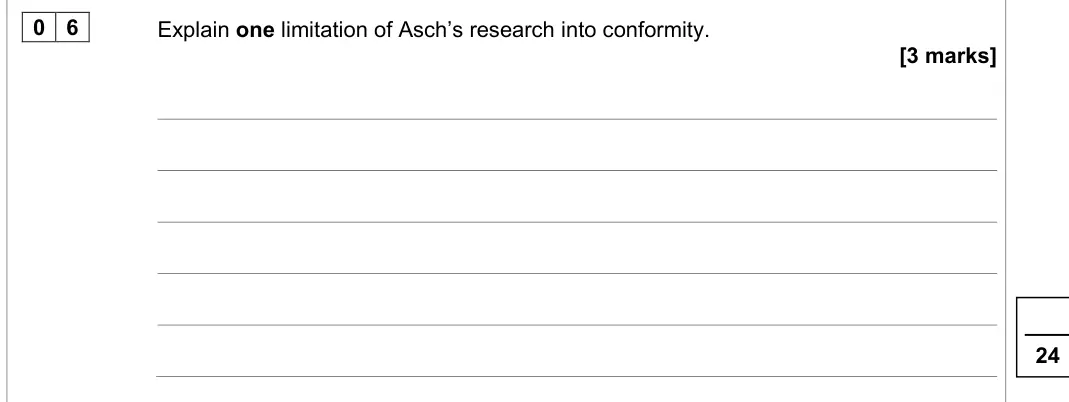
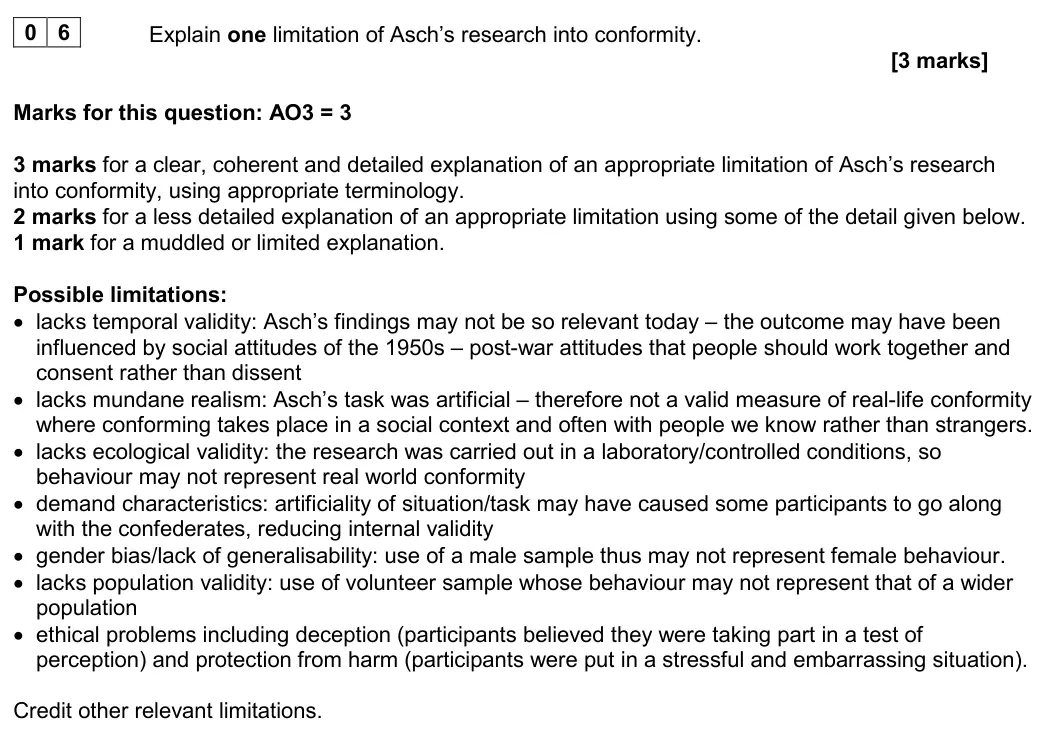
June 2023 · AS Paper 1 · Q63 marksAO3=3Evaluate (short)Easy
Mark scheme, including level descriptors and indicative content
Examiner's comment
This question was particularly well answered, with 80% of students scoring at least 2 marks, and half scoring full marks. Weaker answers lacked detail in their explanation of the limitation and/or lacked appropriate terminology.
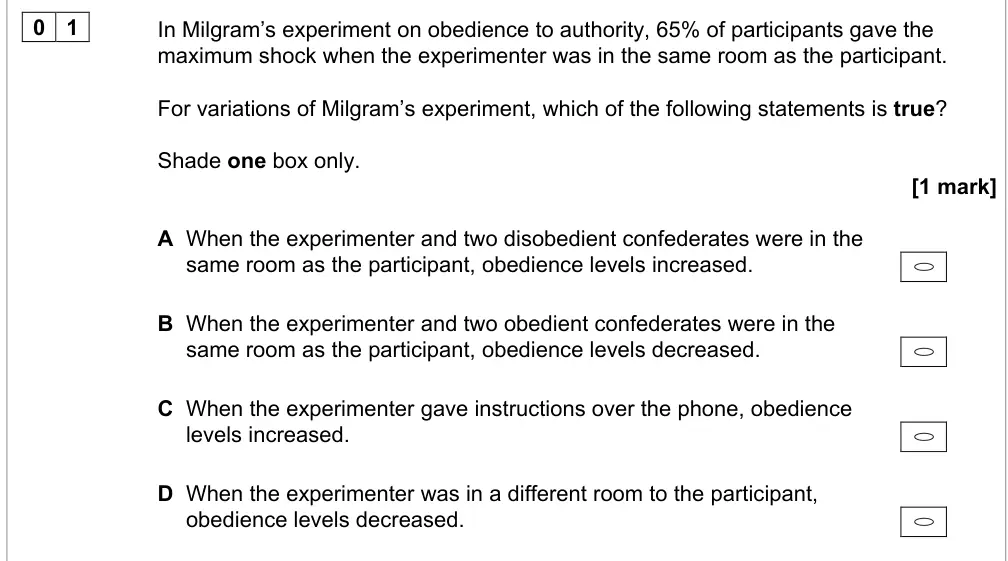
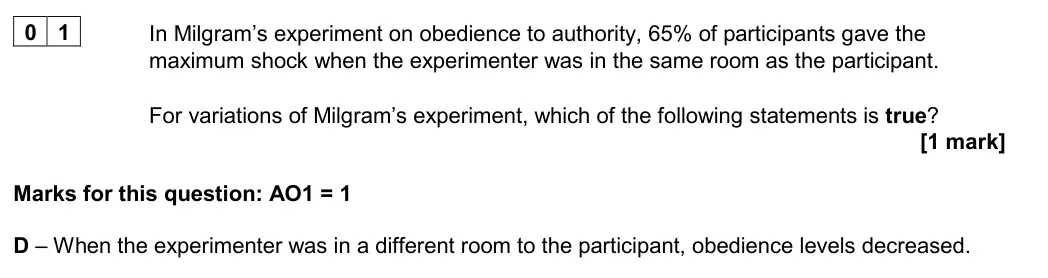
June 2022 · AS Paper 1 · Q11 markAO1=1Multiple choice
Answer
D
Mark scheme, including level descriptors and indicative content
Examiner's comment
Most students were able to correctly answer this question and appeared to have sufficient knowledge of Milgram’s variations to be able to correctly identify the true statement.
Notes from the mark scheme and report
correct D (experimenter in different room -> obedience decreased)
distractors mis-state disobedient-peer, obedient-peer and telephone variations
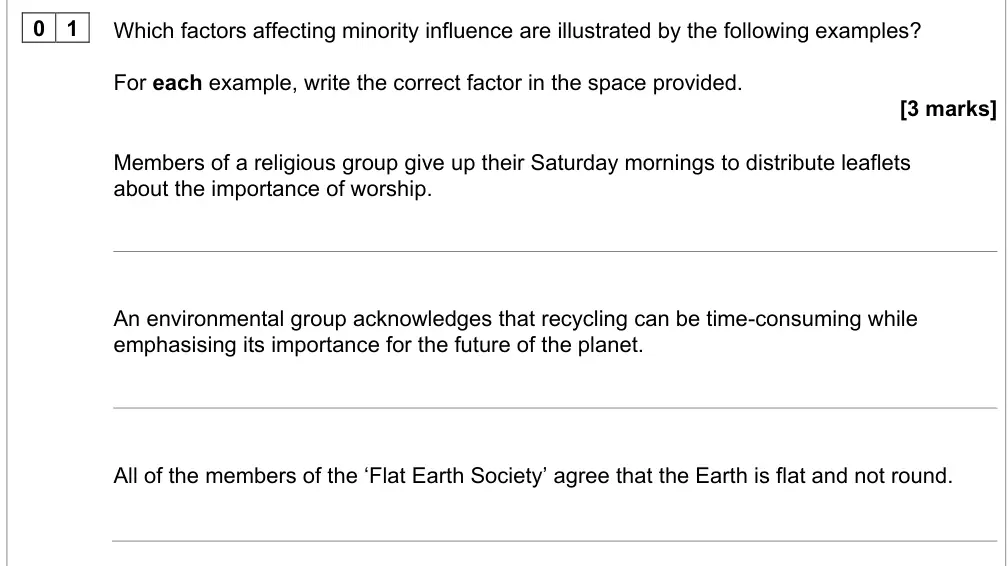
June 2022 · Paper 1 · Q13 marksAO2=3Application
Mark scheme, including level descriptors and indicative content
Examiner's comment
This question was done extremely well, providing a positive introduction to the paper. Along with Questions 01 and 02, 09 was the best answered on the paper.
Notes from the mark scheme and report
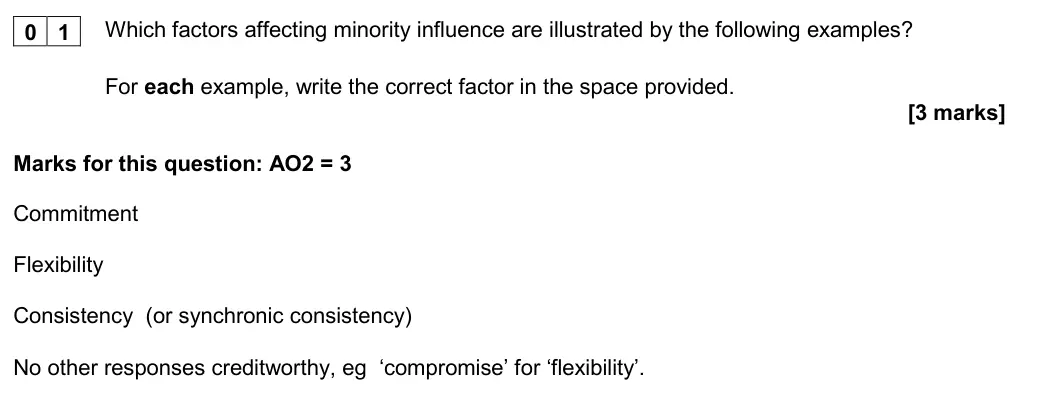
three examples: commitment, flexibility, consistency (synchronic accepted)
no other responses creditworthy (e.g. 'compromise' for flexibility)
done extremely well
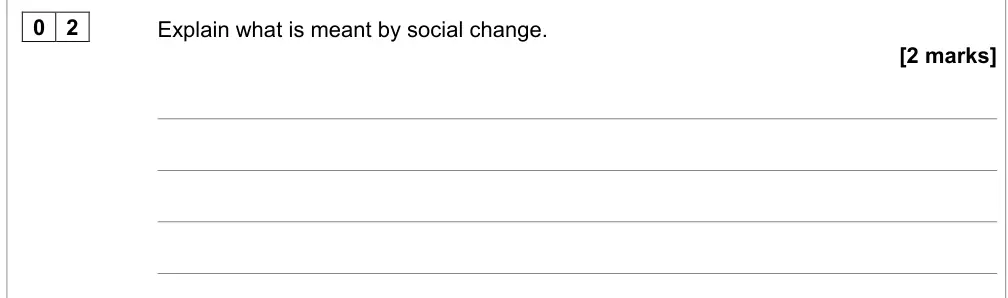
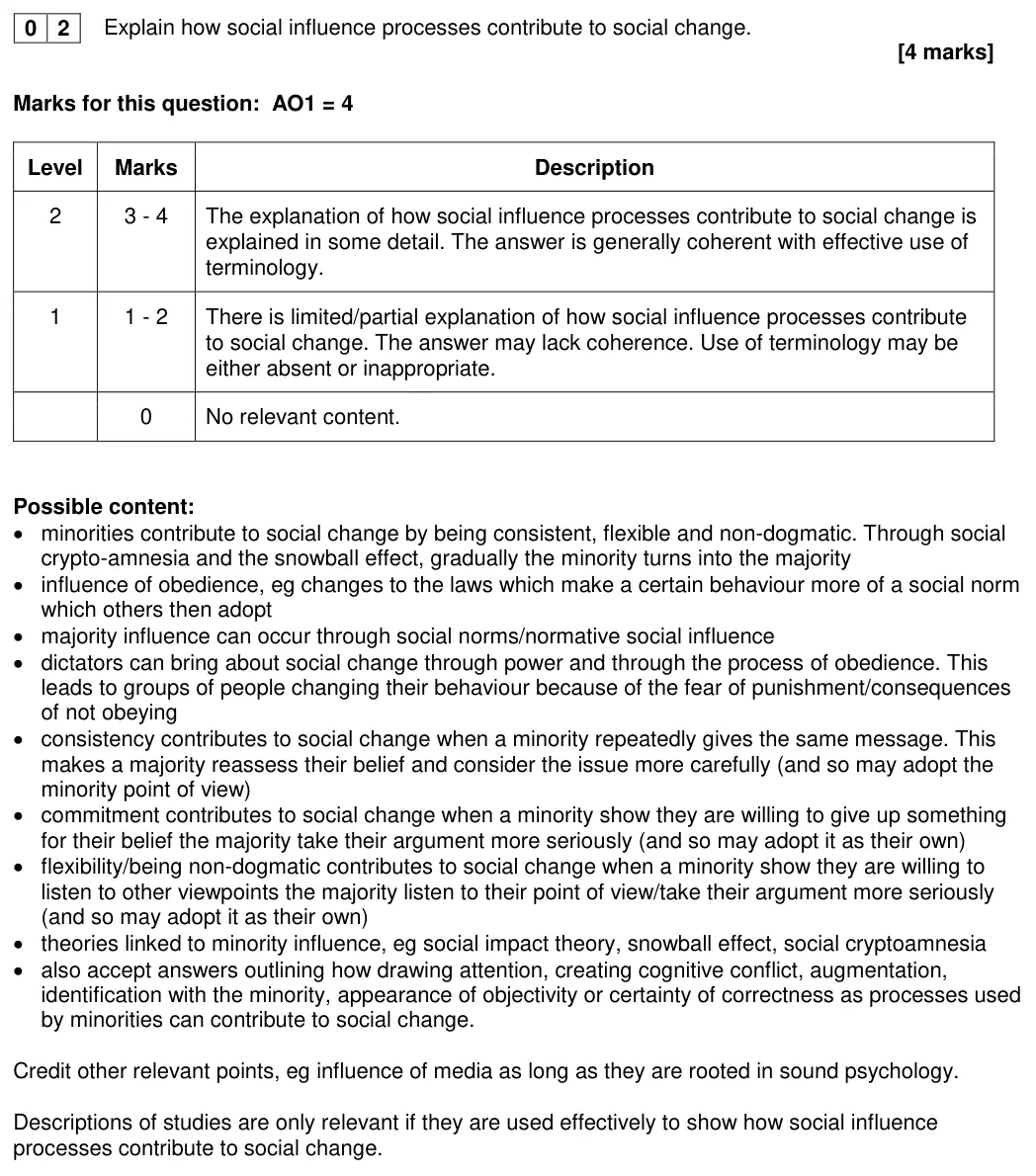
June 2022 · AS Paper 1 · Q22 marksAO1=2Short answerOld spec only
Not on the 2025 specification: social change / role of social influence processes in social change, removed in v1.4
Mark scheme, including level descriptors and indicative content
Examiner's comment
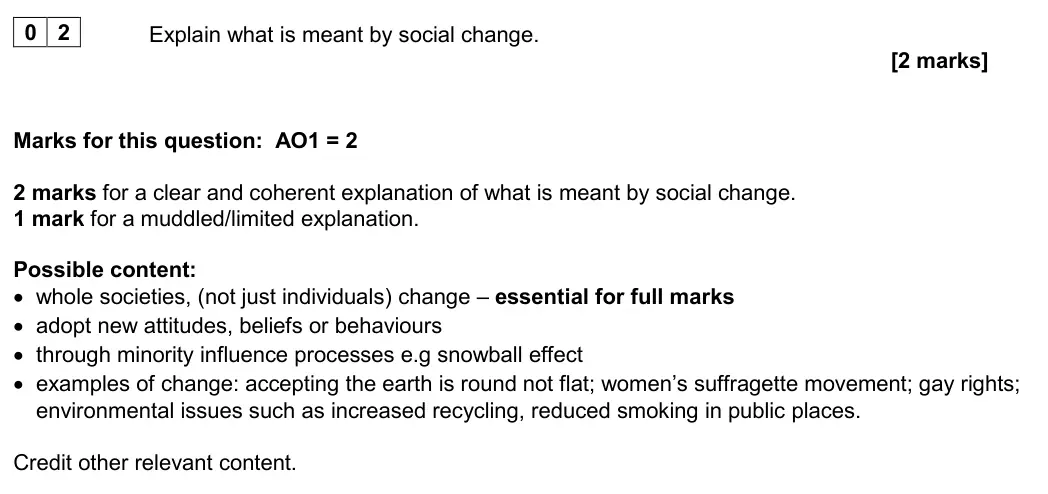
Most students scored at least half marks on this question. However, many only described minority influence or the snowball effect, and not social change. To gain full marks students needed to make it clear that whole societies and not just individuals changed (attitudes or beliefs). Some students did not have sufficient knowledge to answer this question and there were a small number who did not attempt the question.
Notes from the mark scheme and report
Off-spec: social change / role of social influence processes in social change, removed in v1.4
whole societies (not individuals) adopt new attitudes/beliefs - essential for full marks
many only described minority influence or the snowball effect
June 2022 · Paper 1 · Q21 markAO1=1Short answer
Mark scheme, including level descriptors and indicative content
Examiner's comment
Most students could name either locus of control or social support. A few gained marks for alternative explanations, such as autonomous state or absence of Authoritarian personality. Along with Questions 01 and 02, 09 was the best answered on the paper.
Notes from the mark scheme and report
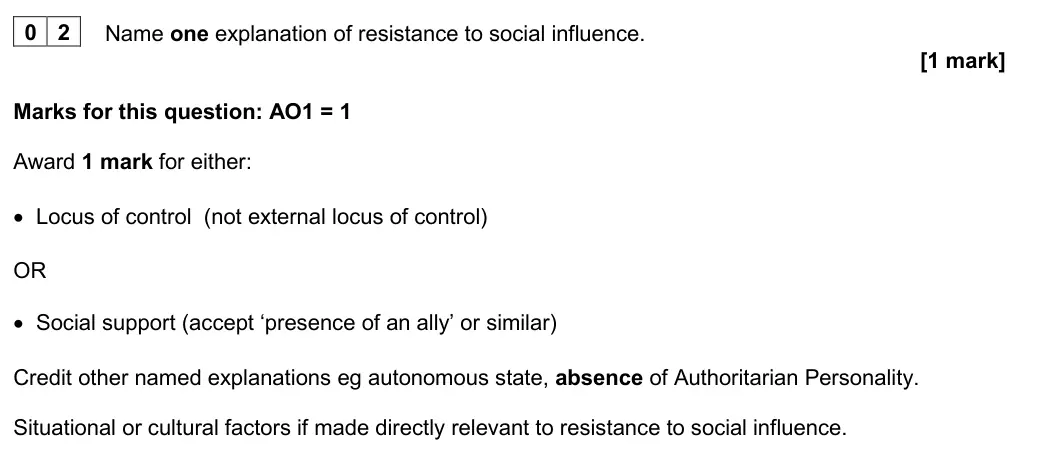
locus of control (not 'external') or social support/presence of an ally
also credits autonomous state, absence of Authoritarian Personality
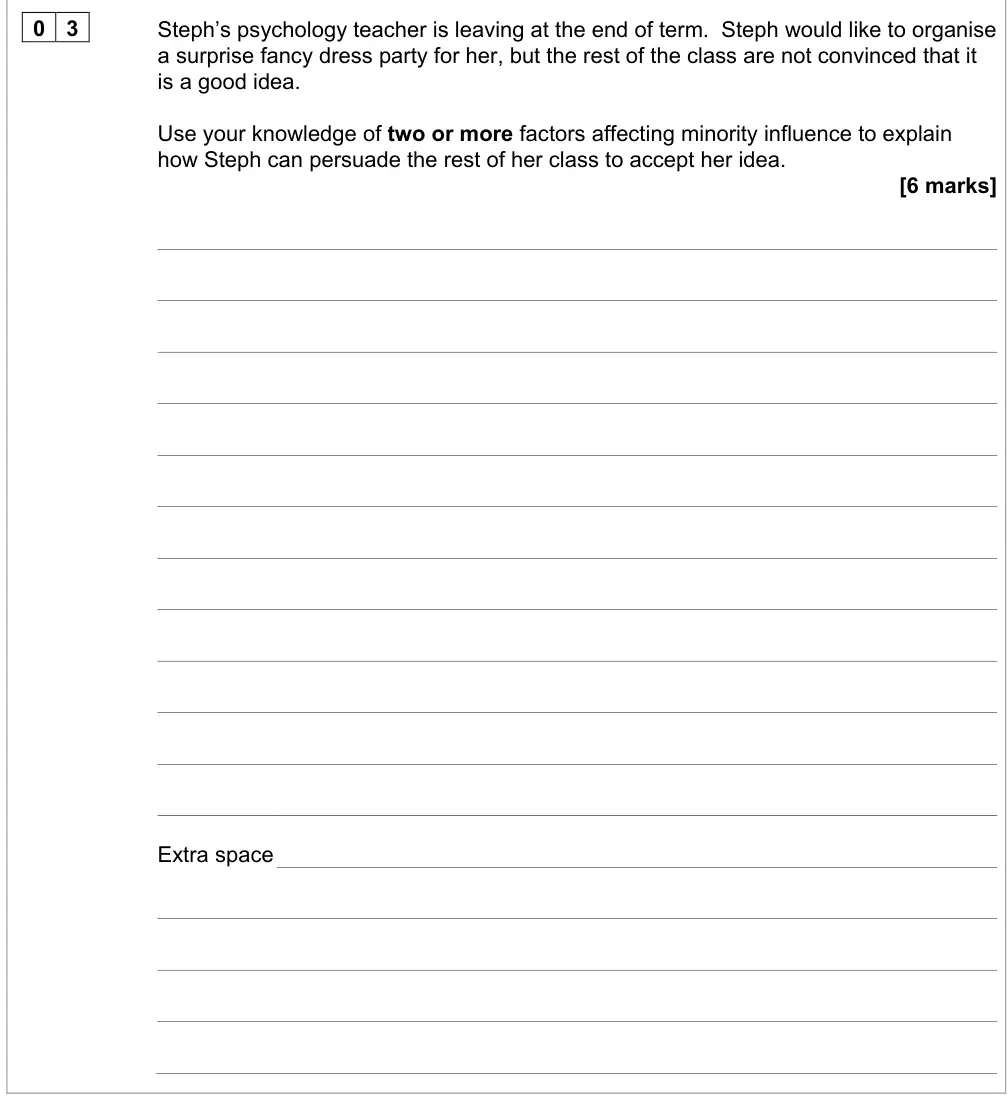
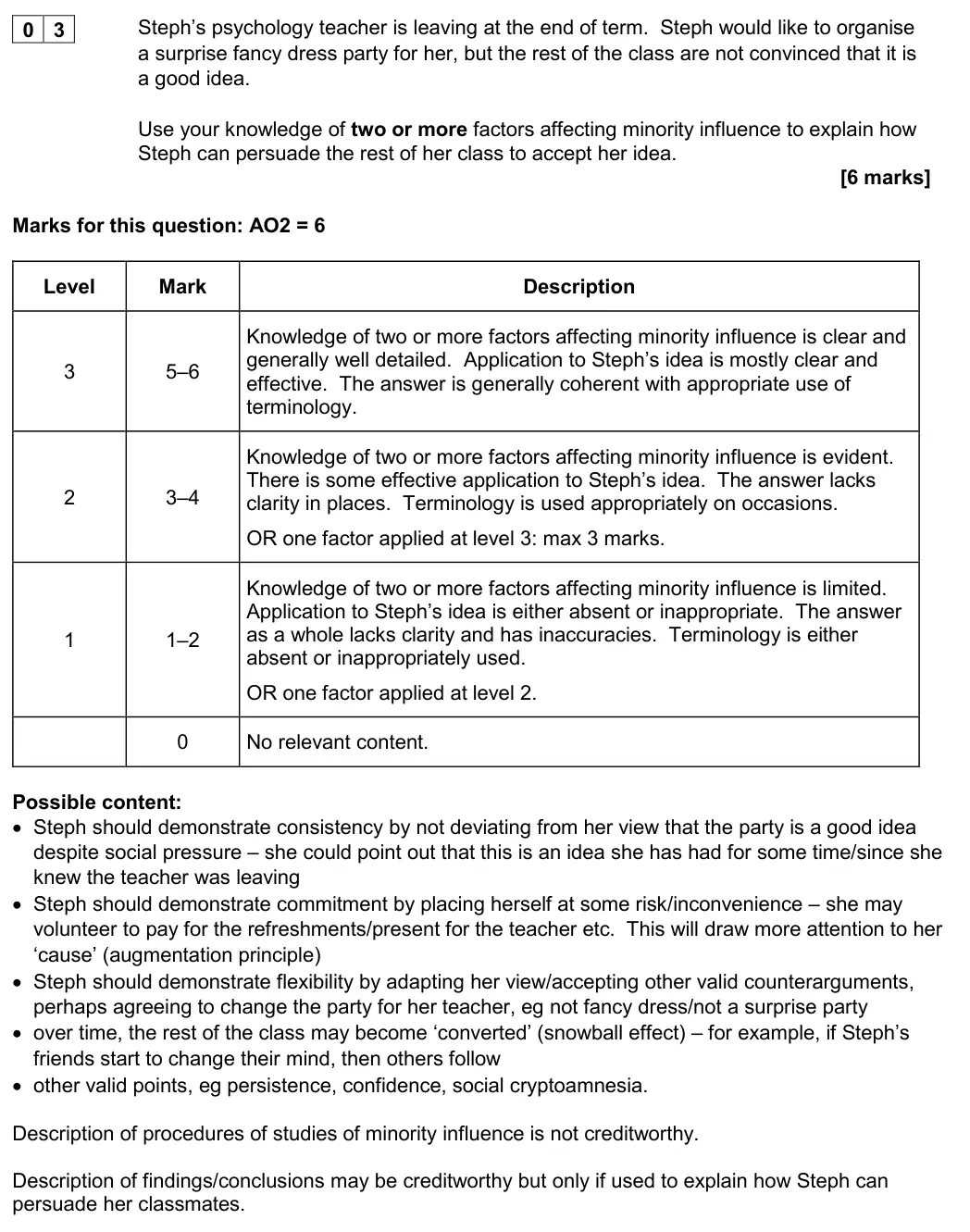
June 2022 · AS Paper 1 · Q36 marksAO2=6Application
Mark scheme, including level descriptors and indicative content
Examiner's comment
Most students clearly had knowledge of factors affecting minority influence and many were able to clearly and explicitly apply this knowledge to the scenario. However, some students simply named or outlined factors and did not apply them to the scenario as the question asked. Where students did attempt to apply their knowledge to the scenario, this application was varied with some fully applying the factors affecting minority influence, making good practical suggestions of how Steph could use the factors to persuade her class. However, weaker answers did not offer any suggestions of how Steph could put these factors into practice in the context of the scenario. It is important that students used appropriate terminology here as this was required for Level 2 and Level 3 responses.
Notes from the mark scheme and report
two or more factors (consistency, commitment/augmentation, flexibility) applied practically to Steph and the class party
one factor only = max 3
study procedures not creditworthy
naming/outlining factors without application
MS also credits snowball effect/social cryptomnesia (social change, removed in v1.4)
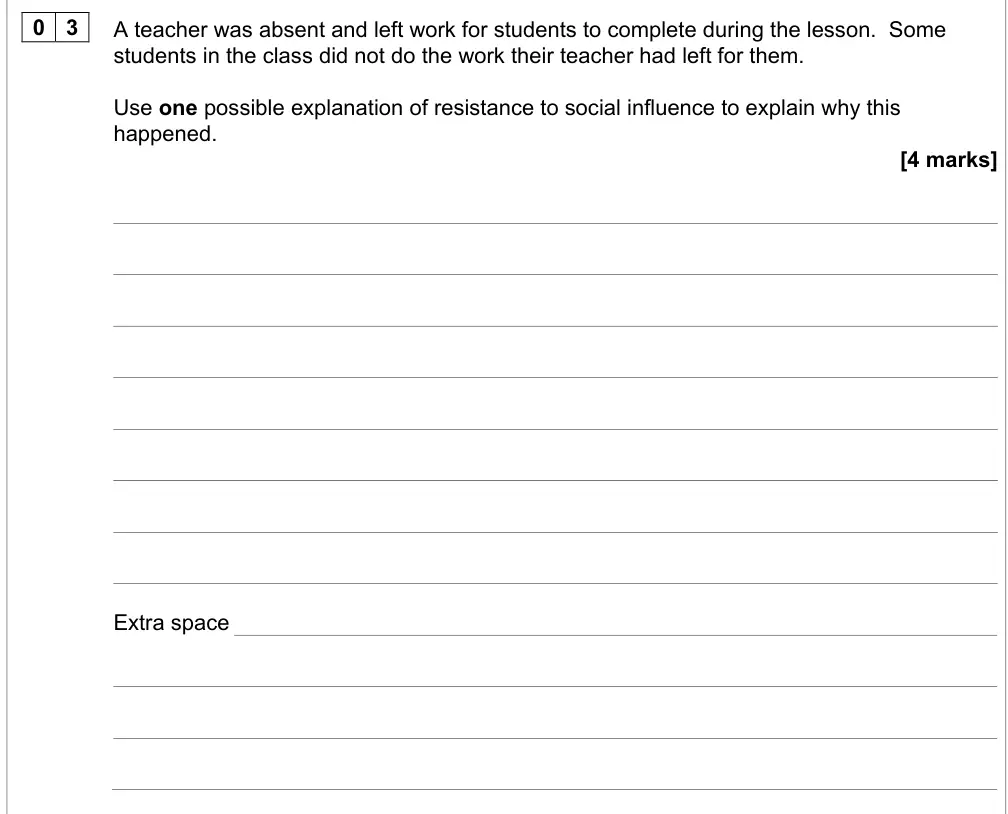
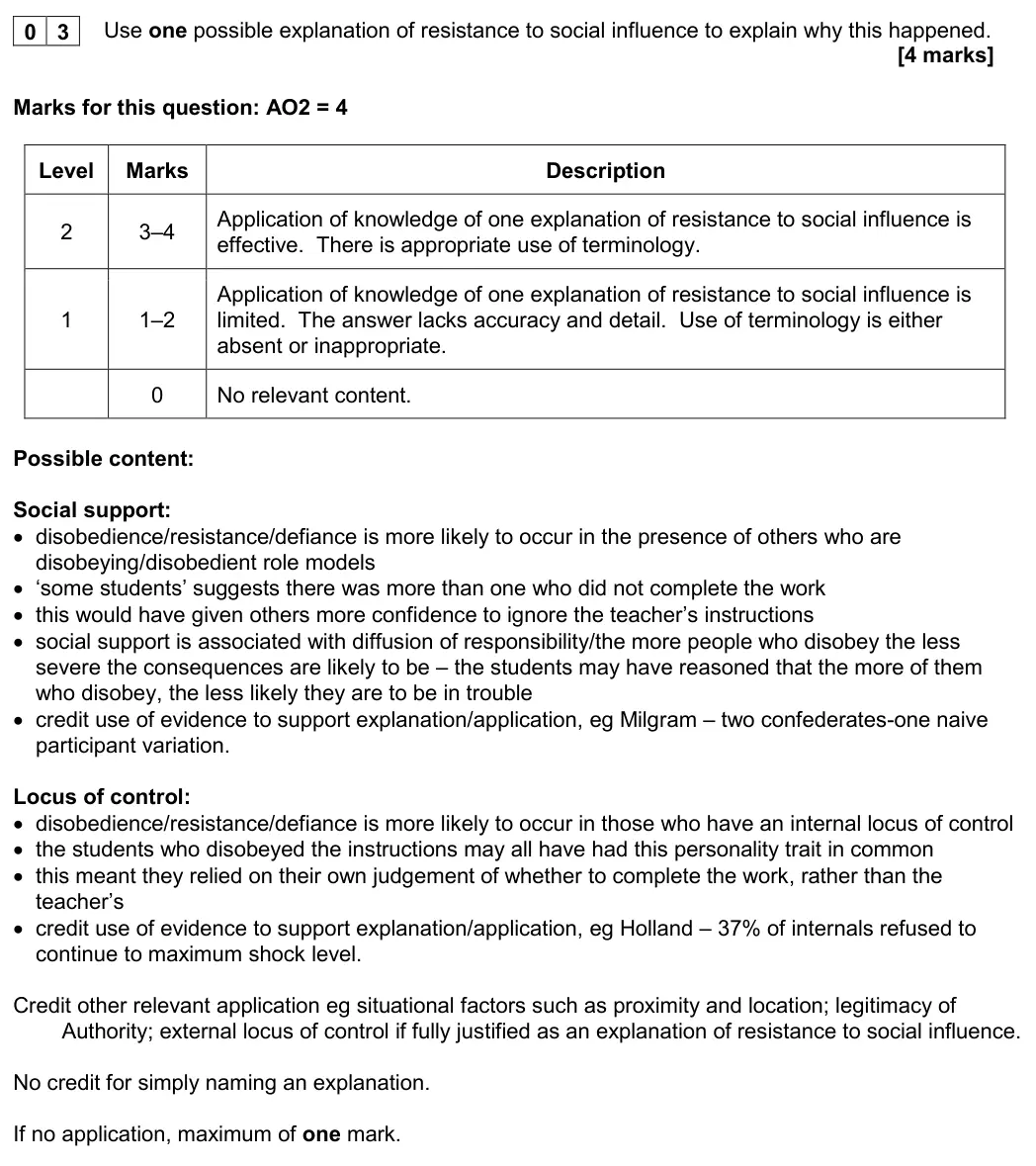
June 2022 · Paper 1 · Q34 marksAO2=4Application
Mark scheme, including level descriptors and indicative content
Examiner's comment
Answers focused on social support or locus of control, and to a lesser extent, proximity (absence of the teacher) and legitimacy of authority. Although most students earned some marks, there was often a lack of detail and/or specialist terminology that prevented full marks being awarded, especially in relation to social support. Some responses used research support (eg Milgram, Asch) effectively.
Notes from the mark scheme and report
no application = max 1
no credit for simply naming
'some students' = social support
internal locus of control
also credits proximity/legitimacy of authority
answers often lacked detail and terminology, especially for social support
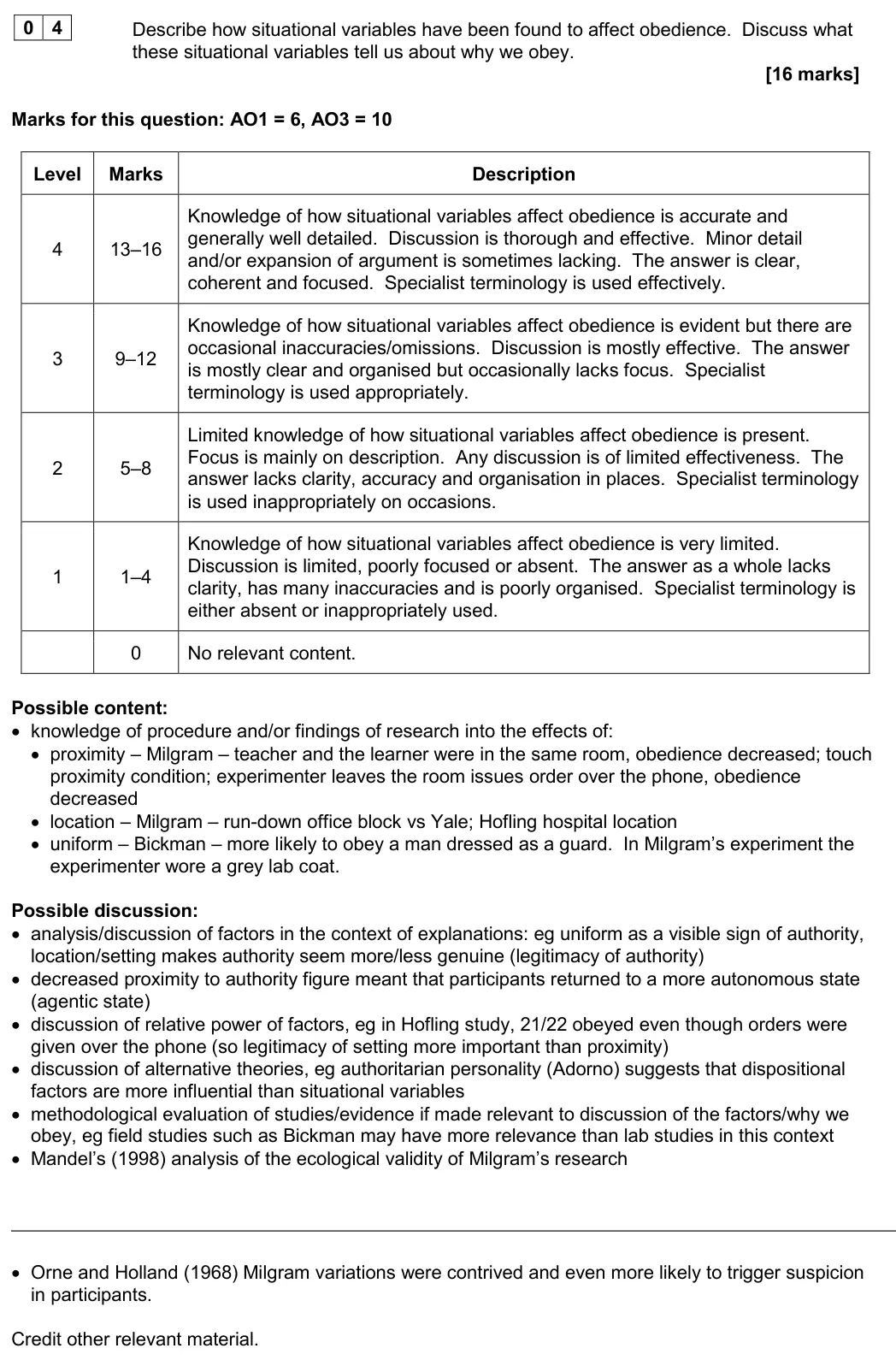
June 2022 · Paper 1 · Q416 marksAO1=6, AO3=1016-mark essay
Mark scheme, including level descriptors and indicative content
Examiner's comment
Perhaps the main message from students’ performances was seen in the three 16-mark essays. In Question 04, for AO3 credit students were required to discuss what situational variables tell us about ‘why we obey’. Virtually all responses could describe the relevant research, in varying degrees of detail, but the AO3 requirement was a clear discriminator. Many students produced evaluation of the original studies (Milgram, Lorenz, Harlow), without linking that explicitly to the AO3 requirements in the questions. Virtually all answers focused on Milgram’s studies, with some impressive descriptions of his work on situational variables and obedience. Occasionally these descriptions were over-detailed. Better answers used specialist terminology in their description/discussion, such as legitimacy of authority, and autonomous and agentic states. Bickman’s study was often used effectively to support Milgram’s findings, and at the top end students discussed the value of the field study as making findings more generalisable. Discussion should have focused on what research into situational variables has told us about why we obey, but many answers diverted into evaluating the work of Milgram. This was creditable where there were links to the question, but detailed accounts of, for example, ethical issues, rarely earned marks. Replications of Milgram’s original study were sometimes used effectively, and there were some good discussions of cultural aspects of obedience. Also popular were real life examples, though accurate analysis was sometimes lacking. At the top end, students discussed the fact that other factors must be involved as obedience in Milgram’s studies on situational variables was rarely zero or 100%. This was followed by a consideration of dispositional variables, such as Authoritarian personality and locus of control. However, many responses failed to provide any general discussion of what situational variables tell us about why we obey.
discussion must address why we obey (legitimacy, agentic state), dispositional alternatives
evaluation of Milgram (e.g. ethics) only creditworthy if linked to the question
many failed to discuss what situational variables tell us about why we obey
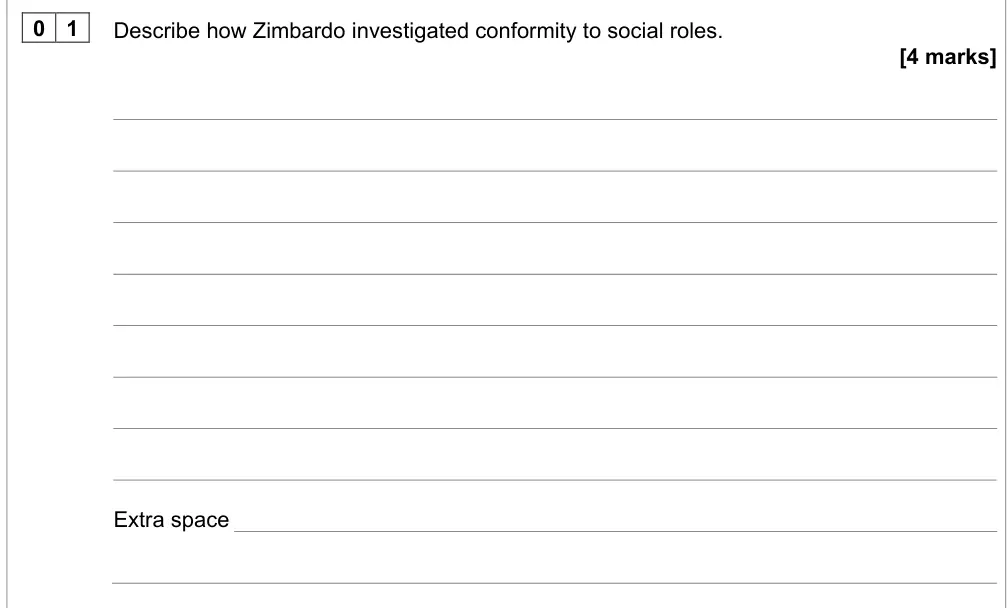
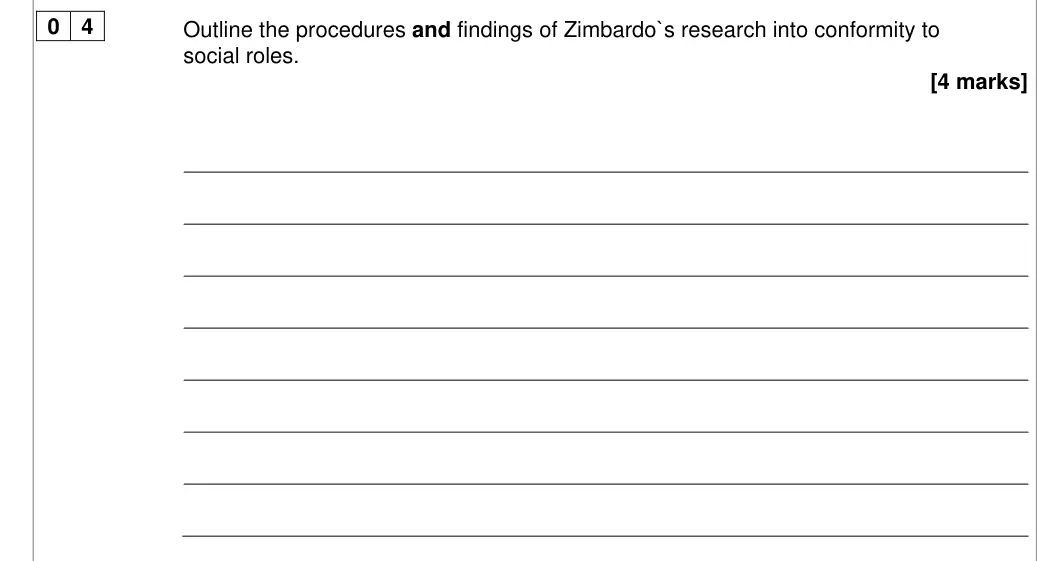
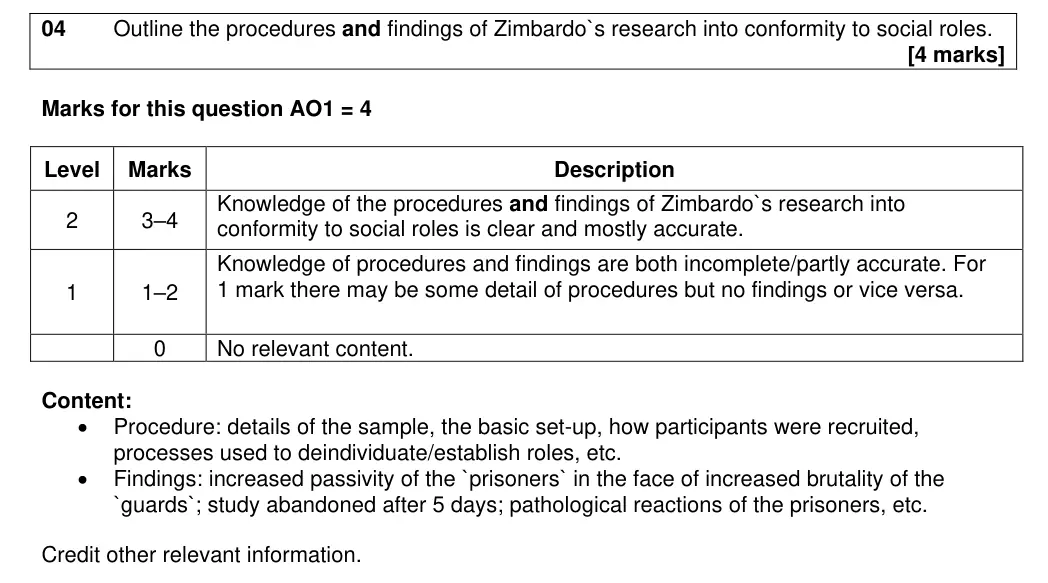
November 2021 · Paper 1 · Q14 marksAO1=4OutlineOld spec only
Mark scheme, including level descriptors and indicative content
Examiner's comment
Virtually all answers focused on Zimbardo’s Prison study. Many good answers had full details of the methods used, some in fact writing too much for four marks. A common mistake was to provide details of findings, which were not required by the question.
Notes from the mark scheme and report
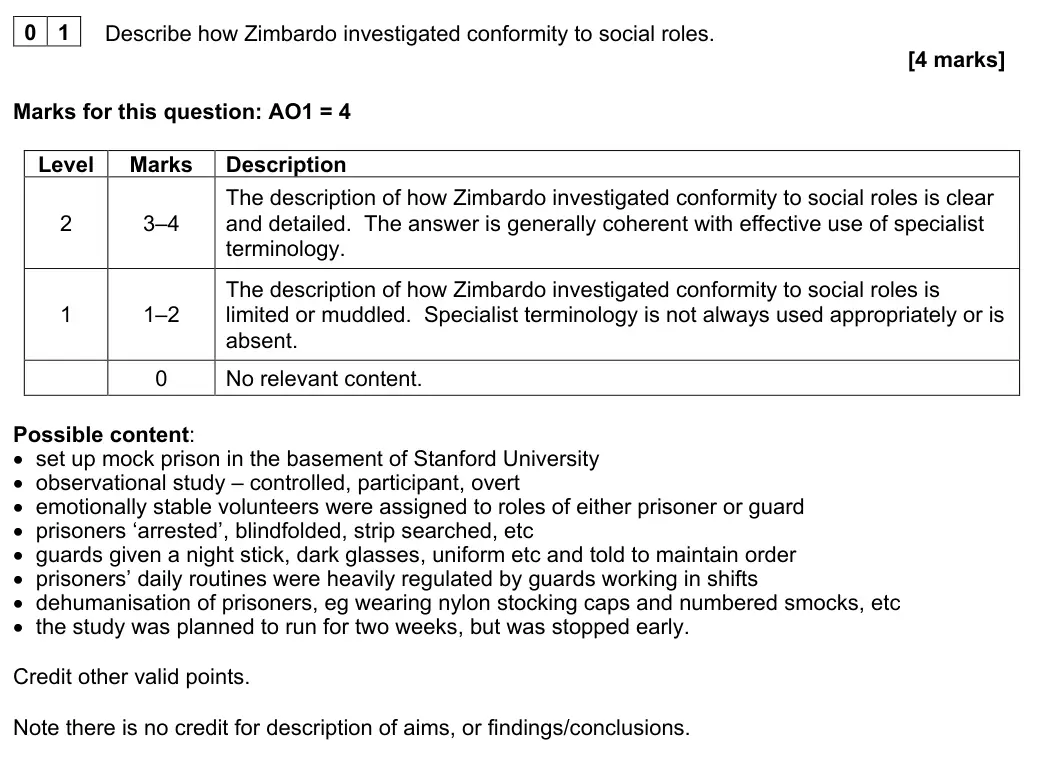
(needs knowledge of Zimbardo's prison study
conformity to social roles was removed in v1.4)
no credit for aims, findings or conclusions
common error: describing findings
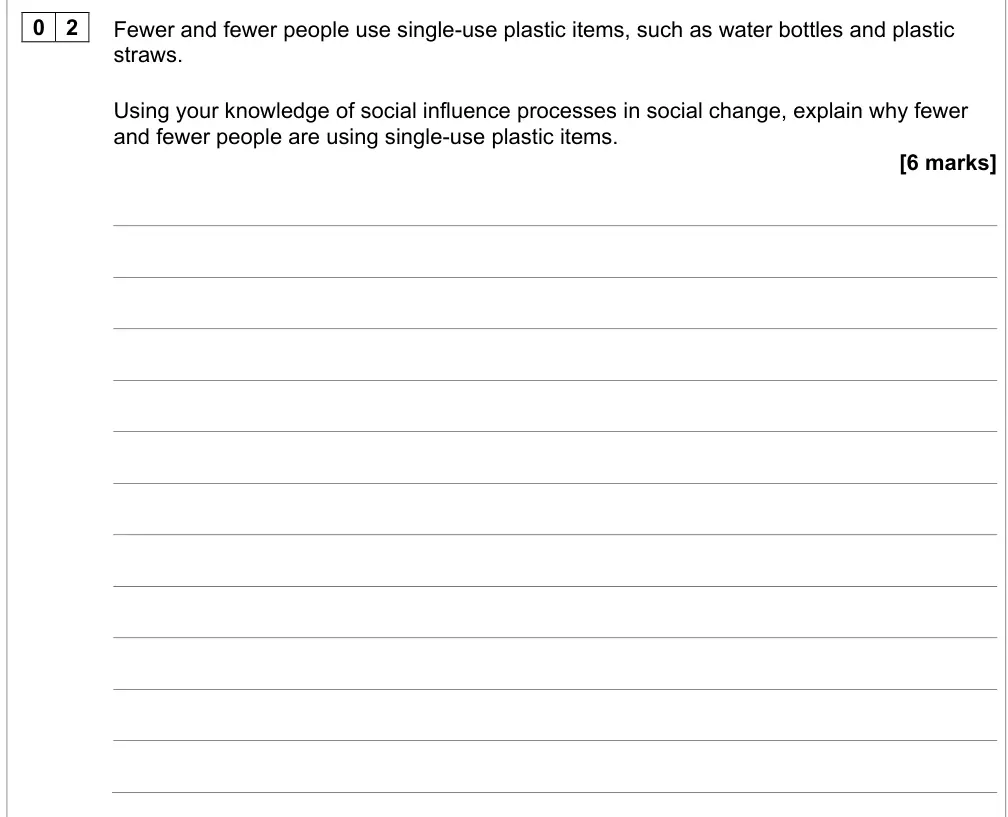
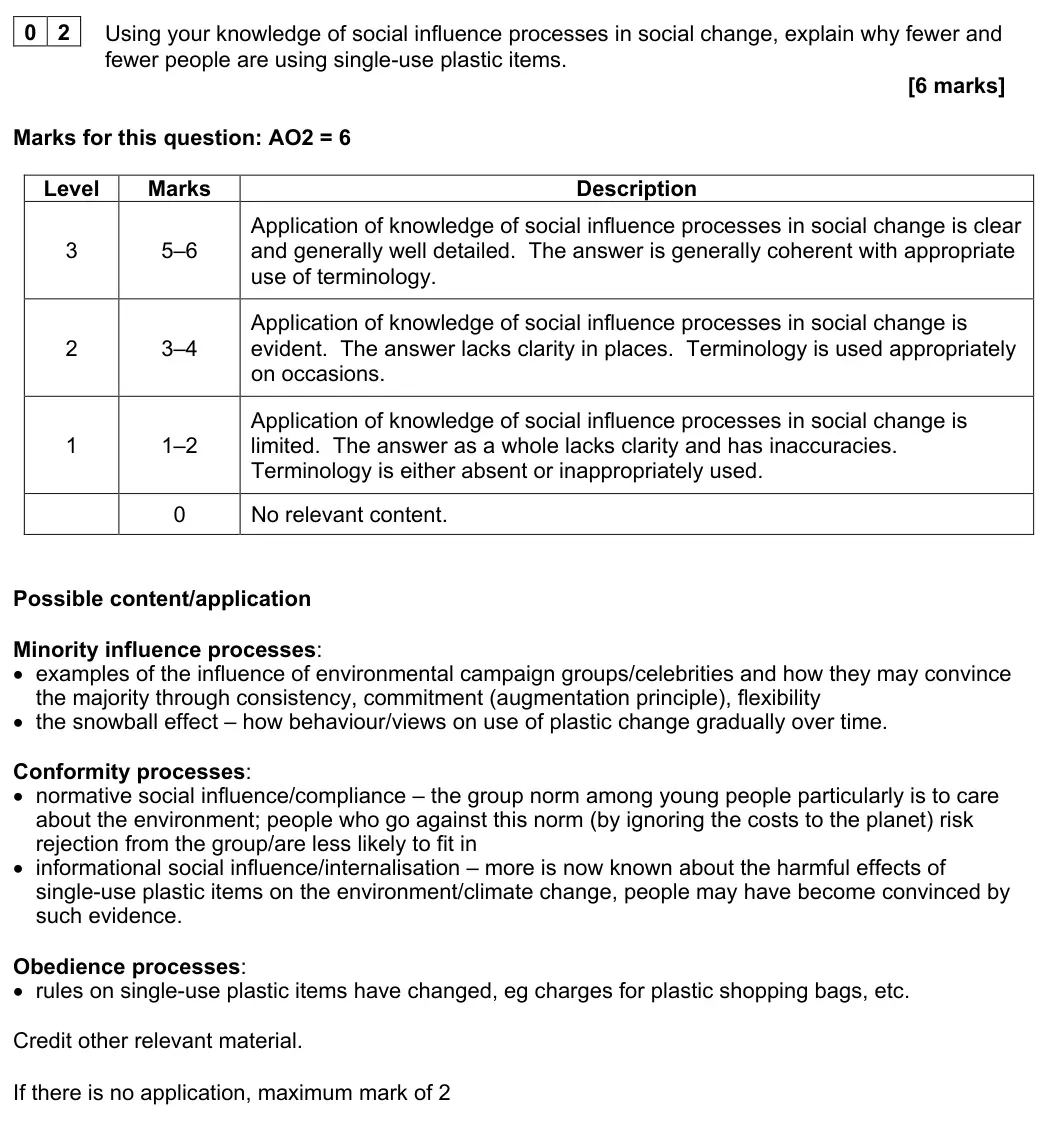
November 2021 · Paper 1 · Q26 marksAO2=6ApplicationOld spec only
Mark scheme, including level descriptors and indicative content
Examiner's comment
Again, many answers demonstrated impressive knowledge of social influence processes and applied them effectively. There was occasional confusion over the elements of minority influence, while some answers tried to cover too many approaches (e.g. minority influence, informational and normative social influence).
Notes from the mark scheme and report
(framed on the role of social influence processes in social change, removed in v1.4
answerable with current minority influence and NSI/ISI content)
MS credits consistency, commitment, flexibility, snowball effect, NSI/compliance, ISI/internalisation, obedience to rule changes
no application = max 2
confusion over elements of minority influence
trying to cover too many processes
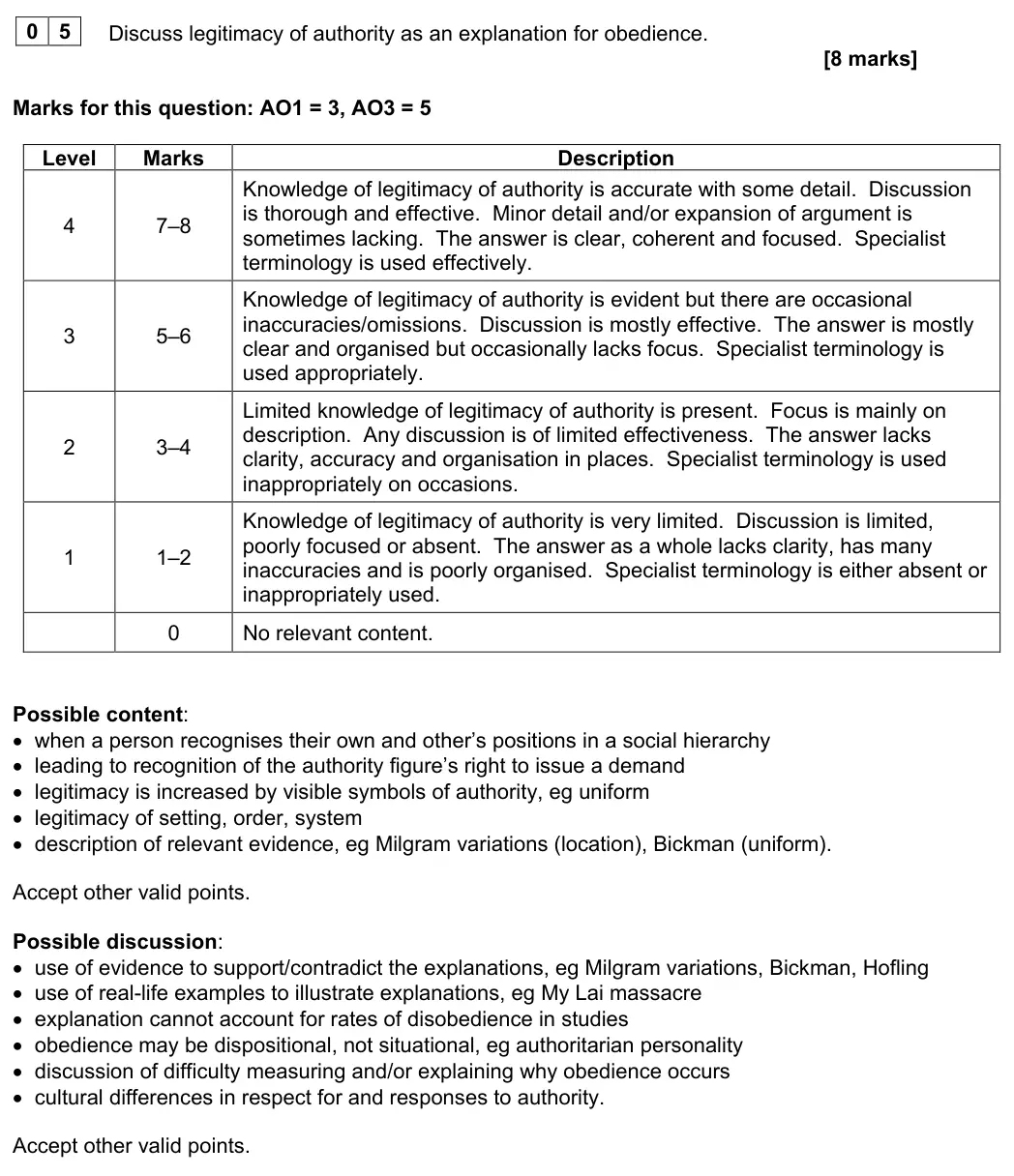
November 2021 · Paper 1 · Q58 marksAO1=3, AO3=5Extended writing
Mark scheme, including level descriptors and indicative content
Examiner's comment
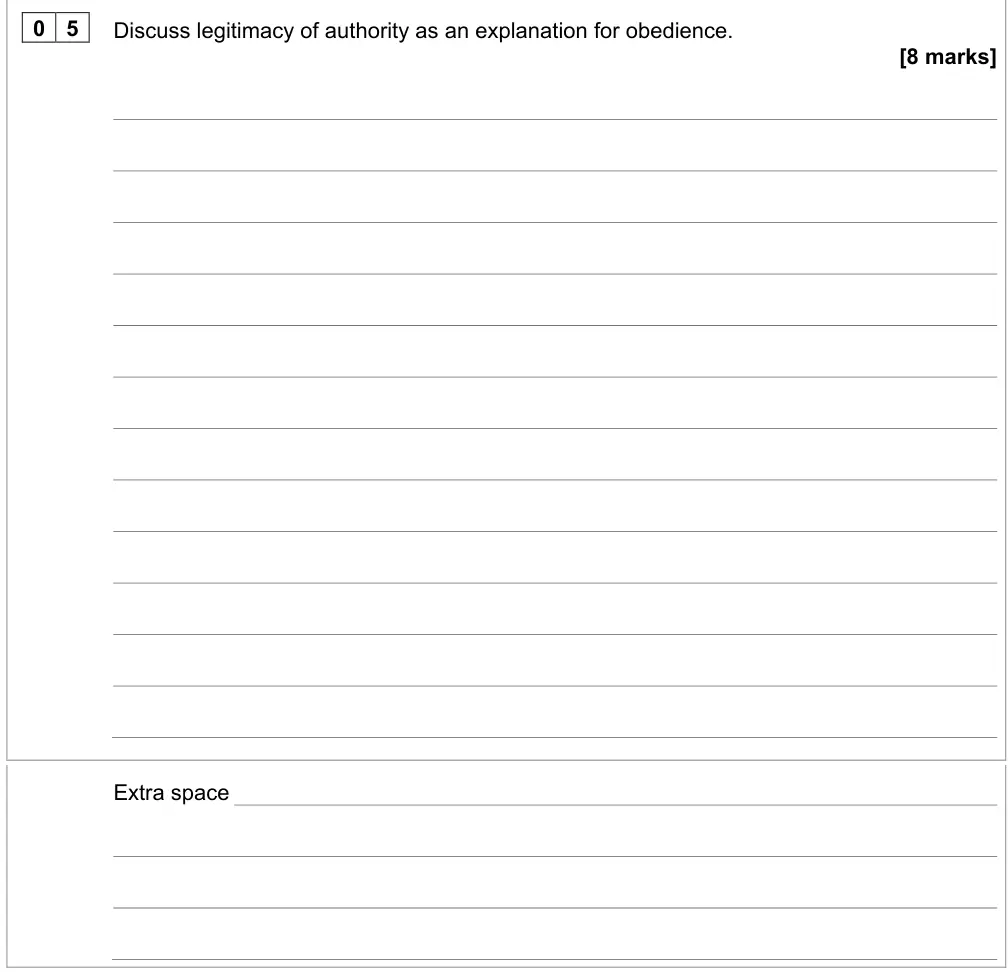
Although most students had access to relevant material (especially Milgram and Bickman), some did not shape it to the issue of legitimacy of authority but wrote generally on obedience. Better answers used Milgram’s variations effectively, and introduced alternative ideas such as personality variables (locus of control, authoritarian personality) as AO3.
Notes from the mark scheme and report
must be shaped to legitimacy of authority, not obedience generally
authoritarian personality/locus of control credited as alternative explanations in AO3
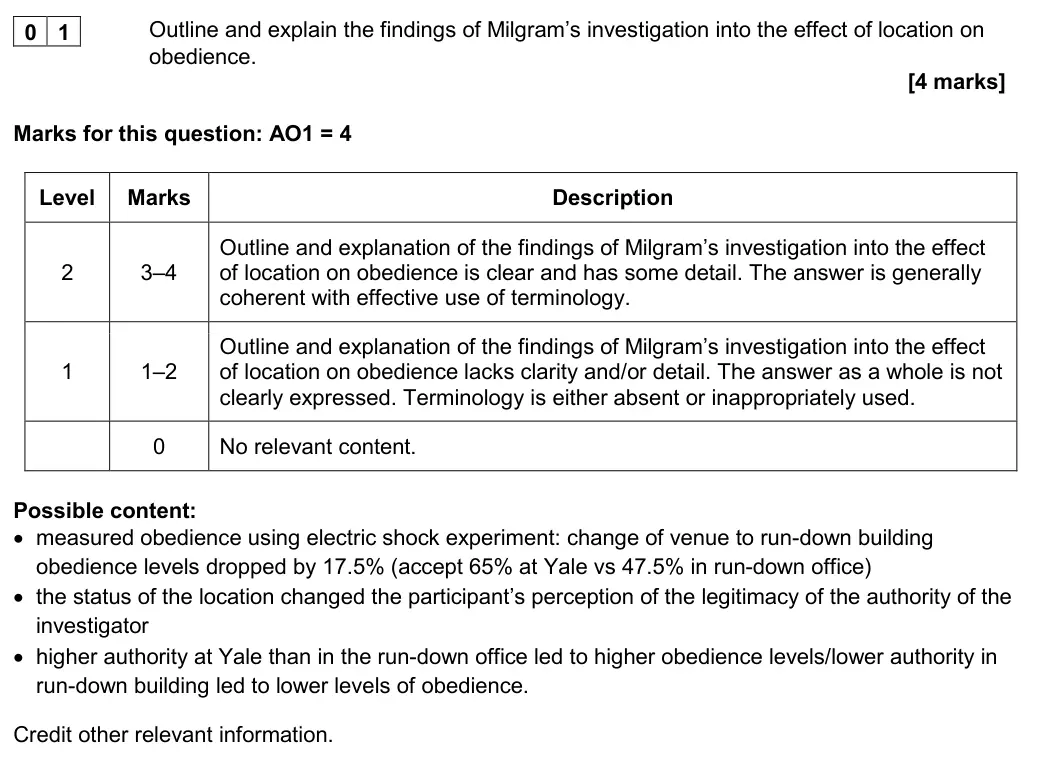
November 2020 · AS Paper 1 · Q14 marksAO1=4Outline
Mark scheme, including level descriptors and indicative content
Notes from the mark scheme and report
outline findings (65% at Yale vs 47.5% in run-down office) AND explain via perceived legitimacy of authority
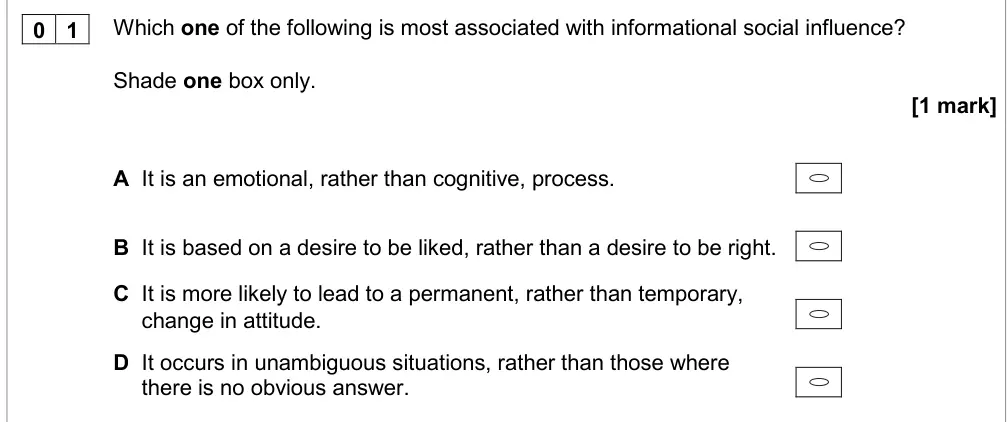
November 2020 · Paper 1 · Q11 markAO1=1Multiple choice
Answer
C
Mark scheme, including level descriptors and indicative content
Notes from the mark scheme and report
answer C (permanent change in attitude)
distractors describe normative influence (A emotional, B desire to be liked) and D reverses ambiguity
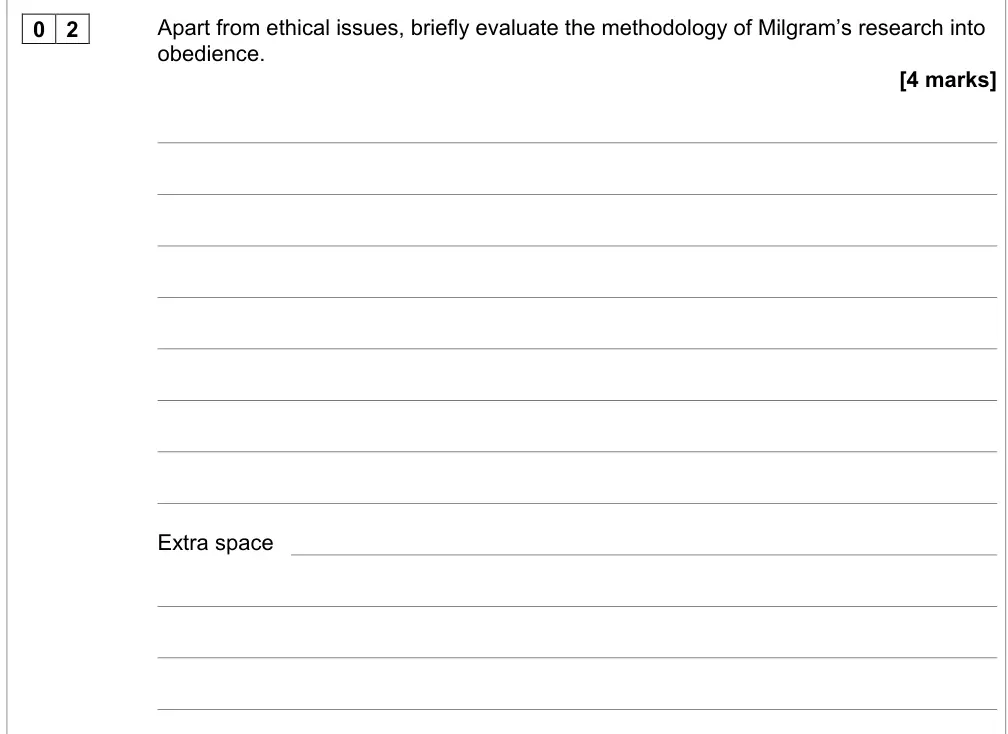
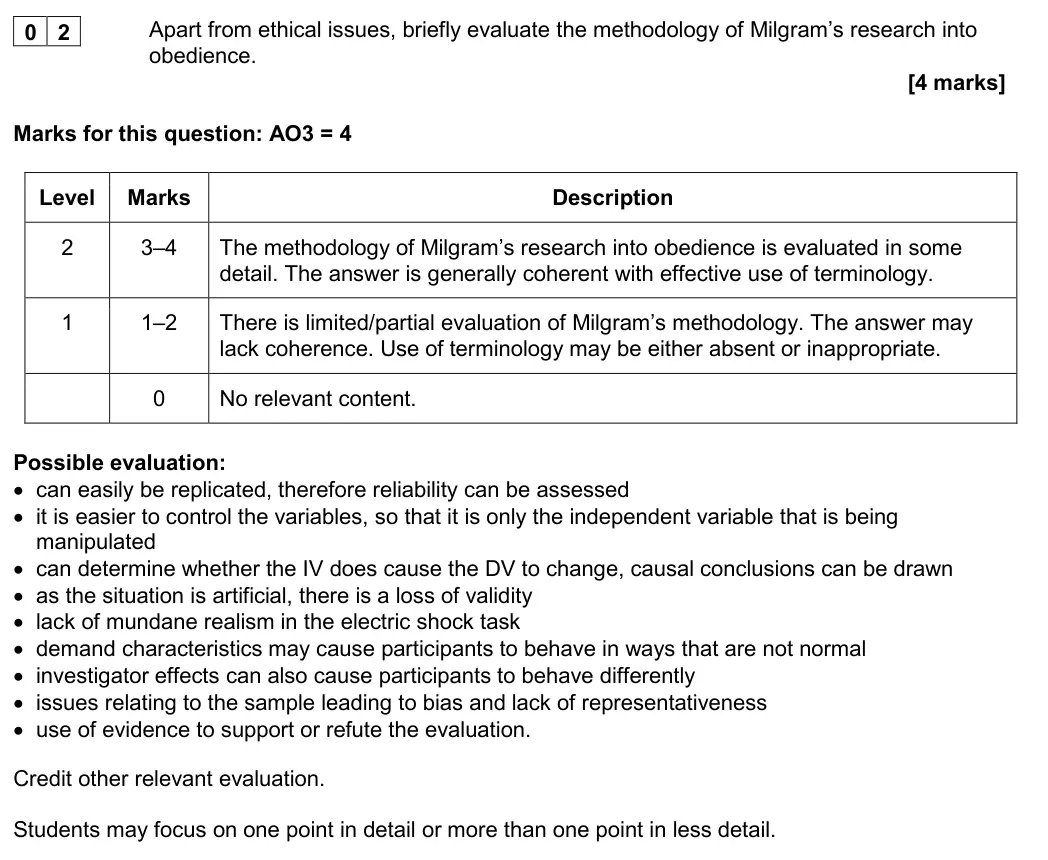
November 2020 · AS Paper 1 · Q24 marksAO3=4Evaluate (short)
Mark scheme, including level descriptors and indicative content
Notes from the mark scheme and report
ethical issues excluded
methodological evaluation of lab experiment (control, replicability, causal conclusions vs artificiality/mundane realism, demand characteristics, sample bias)
one point in detail or several in less detail
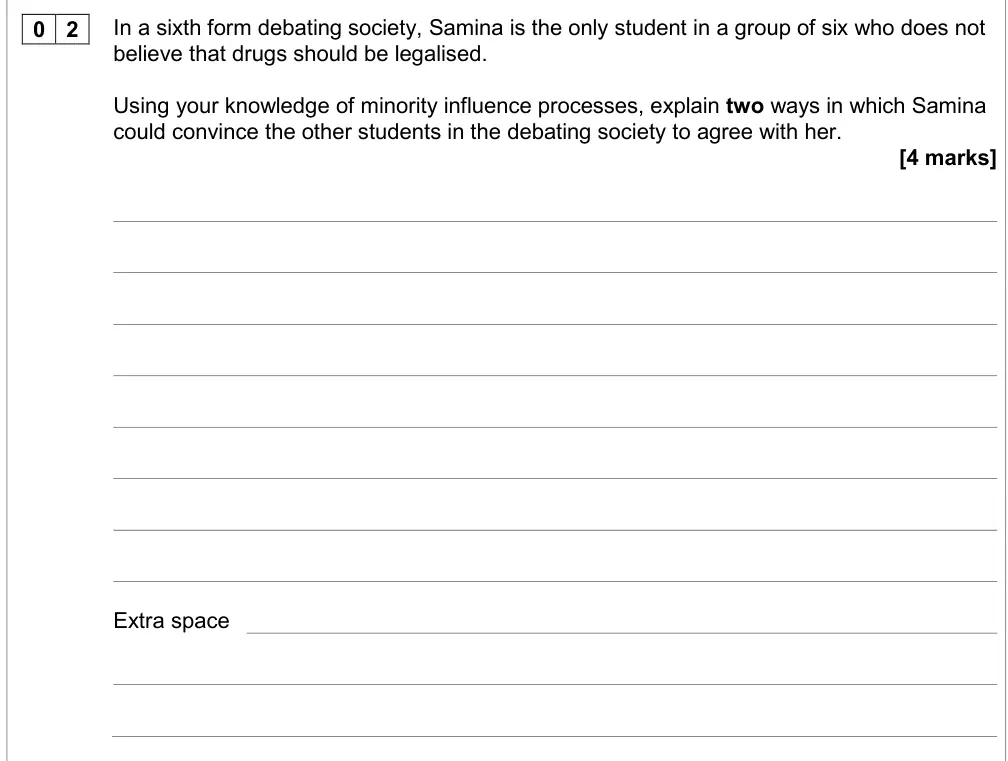
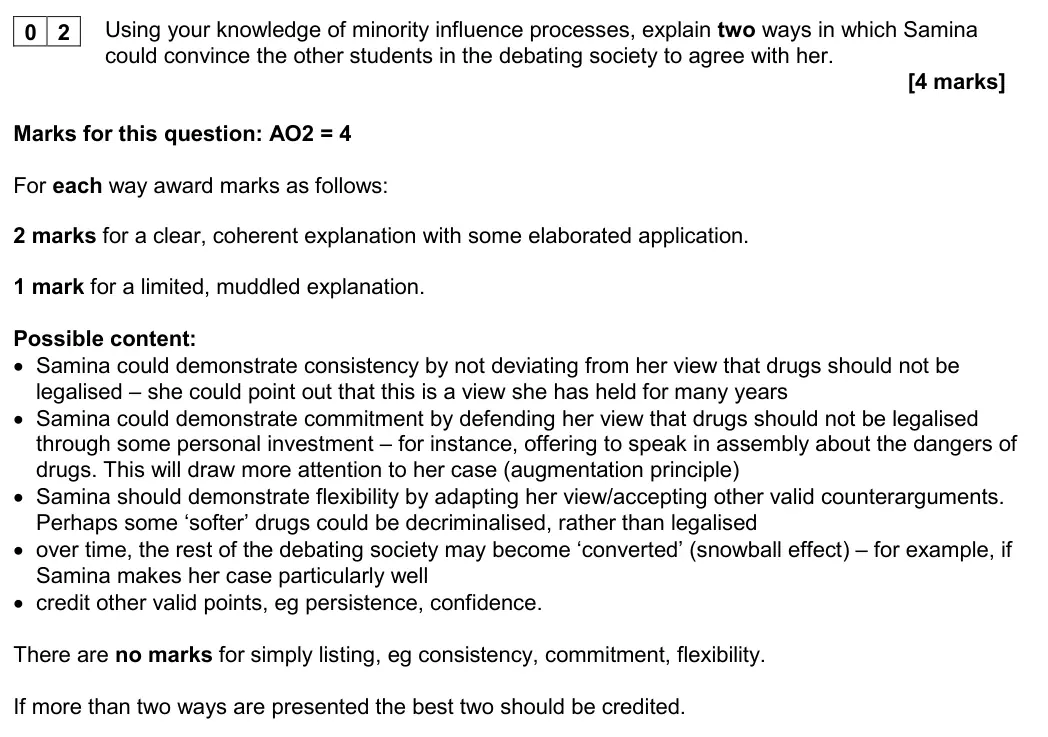
November 2020 · Paper 1 · Q24 marksAO2=4Application
Mark scheme, including level descriptors and indicative content
Examiner's comment
Good knowledge of minority influence was generally evident, (occasional confusion between commitment and consistency) but a number of answers lacked the element of elaboration necessary for 2 marks, while some did not refer to Samina, as required by the question.
Notes from the mark scheme and report
2 marks per way with elaborated application to Samina (consistency, commitment/augmentation, flexibility)
listing = 0
best two credited
confusion of commitment and consistency
MS also credits the snowball effect (social change), removed in v1.4
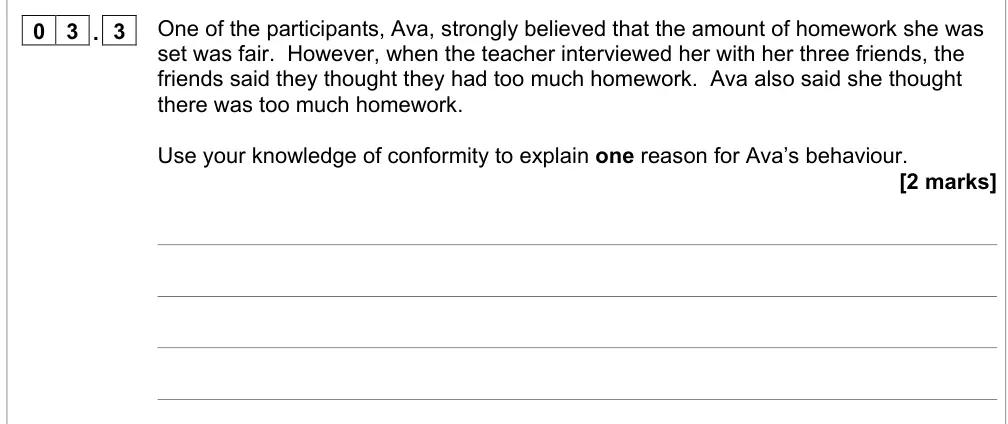
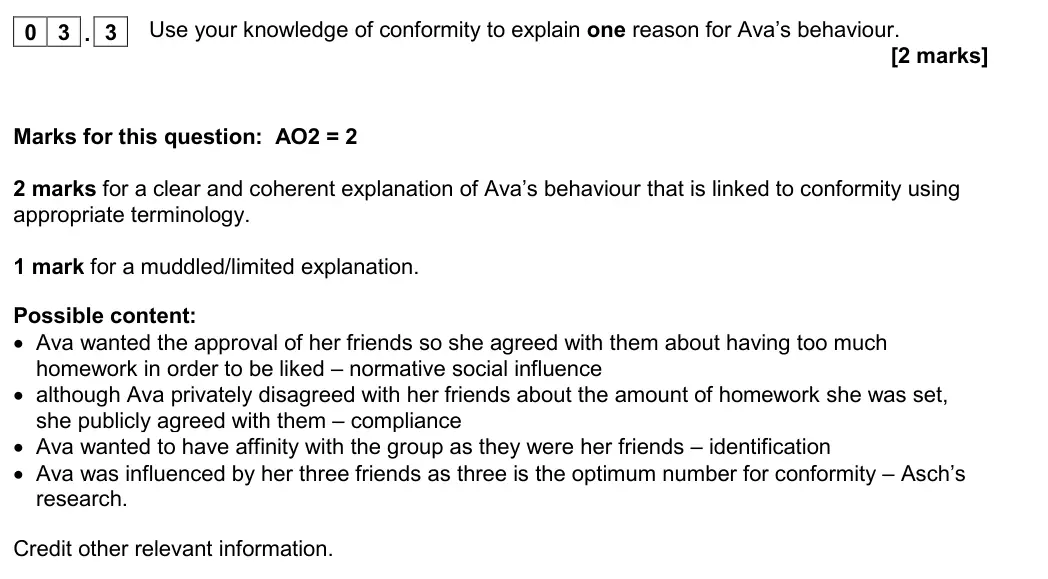
November 2020 · AS Paper 1 · Q3.32 marksAO2=2Application
Mark scheme, including level descriptors and indicative content
Notes from the mark scheme and report
NSI/compliance (public agreement, private disagreement), Asch group size of three
MS also credits identification (removed as a type of conformity in v1.4)
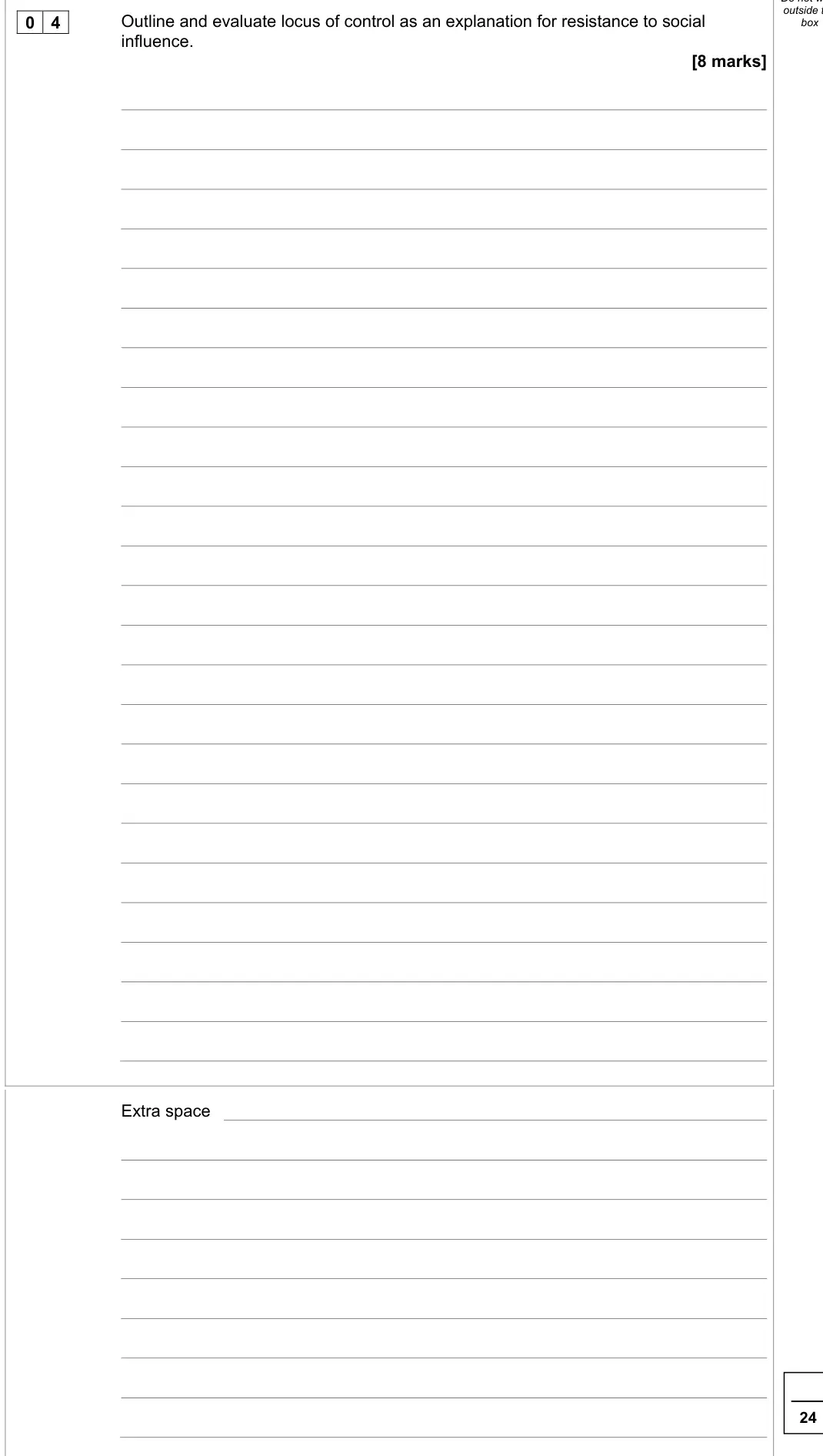
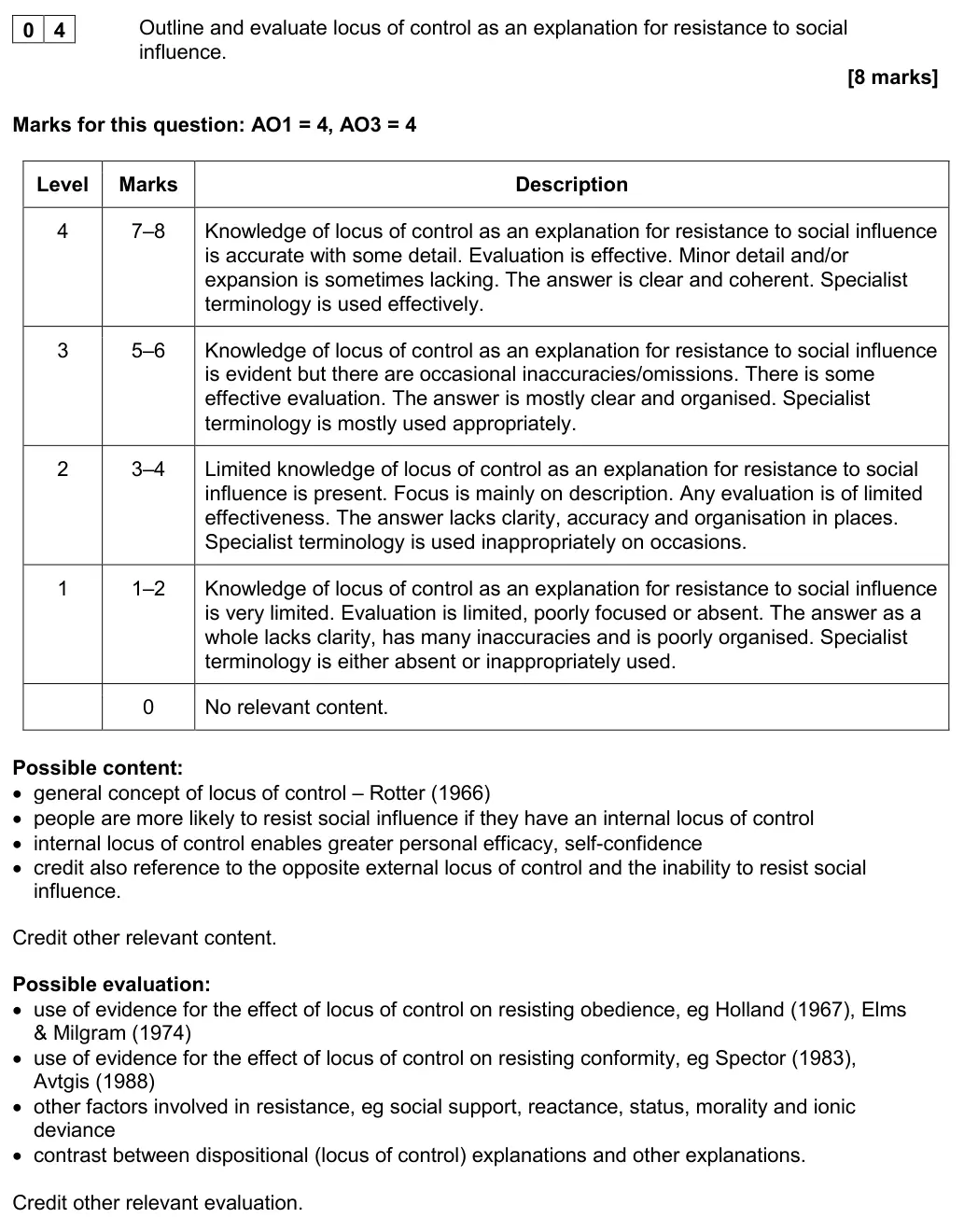
November 2020 · AS Paper 1 · Q48 marksAO1=4, AO3=4Extended writing
Mark scheme, including level descriptors and indicative content
Notes from the mark scheme and report
internal vs external locus of control (Rotter)
evaluation via evidence (Holland, Elms and Milgram, Spector, Avtgis), other factors such as social support, dispositional vs situational
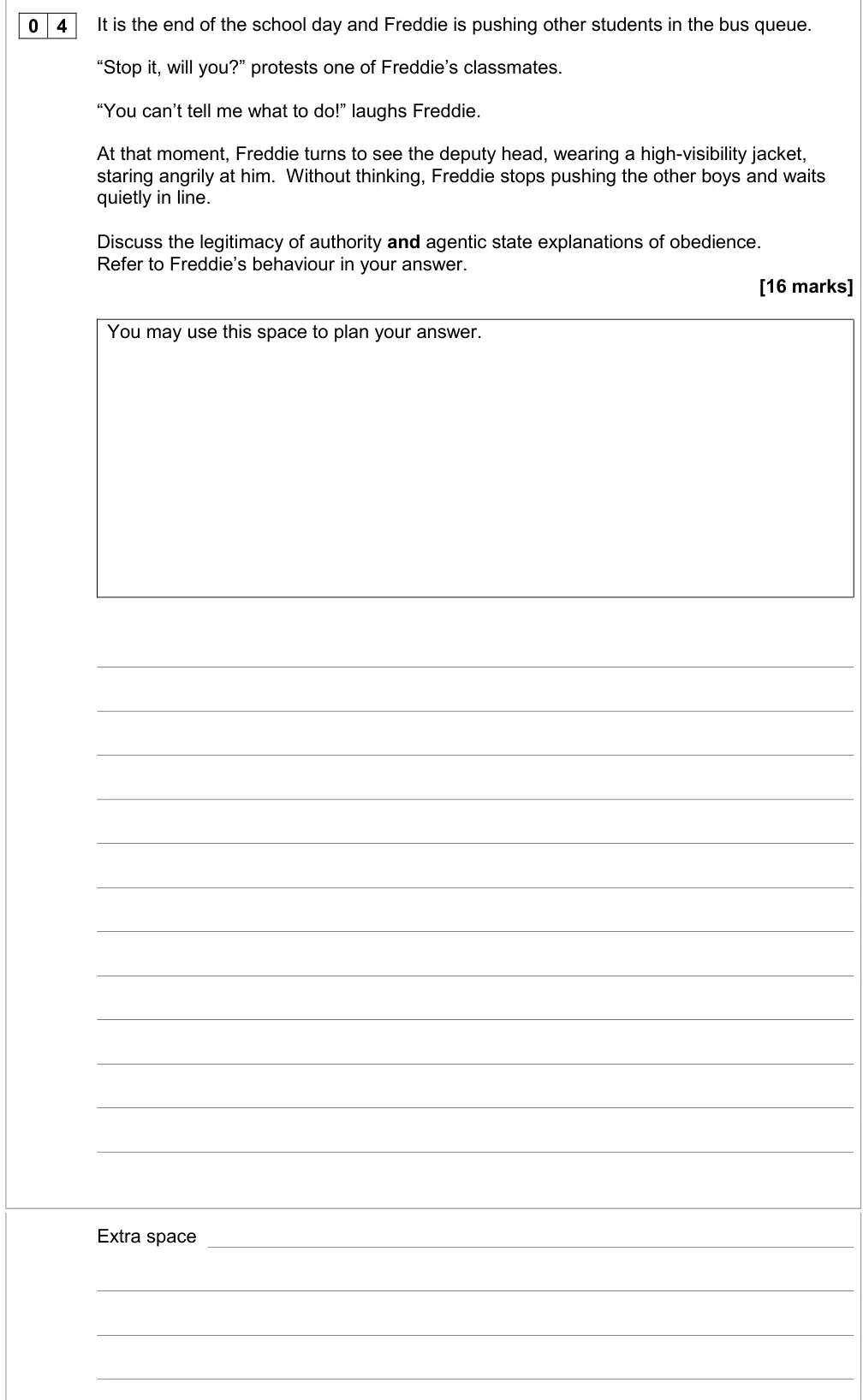
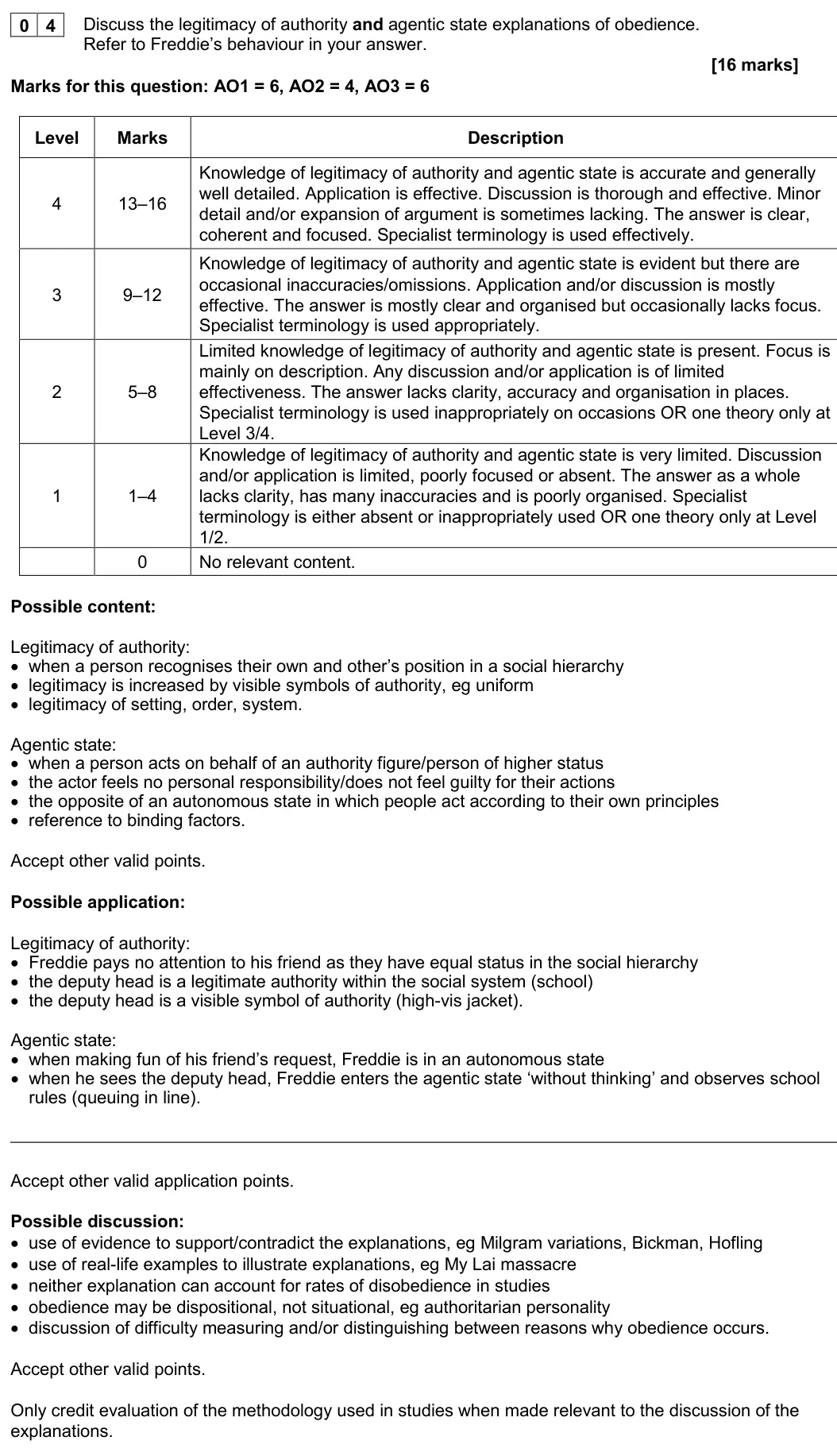
November 2020 · Paper 1 · Q416 marksAO1=6, AO2=4, AO3=616-mark essay
Mark scheme, including level descriptors and indicative content
Examiner's comment
This was a demanding question, requiring two aspects of obedience to be discussed, along with application to the stem. However, there were some excellent answers, with students demonstrating sound knowledge of legitimacy of authority and the agentic state, and the relationship between them. Application to the stem was usually competent. At the top end, evaluation focused on research support along with real-life examples, and the occasional reference to alternative explanations of obedience such as upbringing, locus of control and the Authoritarian personality. A significant number of answers provided far too much methodological detail of Milgram’s various studies, and provided generic and ineffective evaluation e.g. ethical issues.
Notes from the mark scheme and report
both explanations needed, one only = max Level 2
apply high-vis jacket/deputy head (legitimacy), 'without thinking' (agentic shift from autonomous state)
evaluation via Milgram variations, Bickman, Hofling, dispositional alternatives
too much Milgram methodology and generic ethics
June 2019 · AS Paper 1 · Q14 marksAO1=4OutlineMedium
Mark scheme, including level descriptors and indicative content
Examiner's comment
Questions that tended to differentiate best were questions 1, 3, 6, 10 and 11. While most students were able to describe some features of the authoritarian personality, many did not outline how it could explain obedience/obedient behaviour. This demonstrates the importance of reading the question carefully. Of those students who did use the theory to explain obedience, very few identified that it was a dispositional/internal explanation of obedience, which was required for full marks. Some of the weaker answers were based mainly around the F-scale, although it was not always clear that this was used to measure the authoritarian personality.
Notes from the mark scheme and report
max 1 mark if no link to obedience
max 3 marks if not identified as a dispositional/internal explanation
weaker answers centred on the F-scale
June 2019 · Paper 1 · Q14 marksAO1=4Outline
Mark scheme, including level descriptors and indicative content
Examiner's comment
This question was answered well by the majority of students. The majority used social support and locus of control as explanations of resistance to social influence. Descriptions were usually accurate, though a few answers had internal and external locus of control the wrong way round. An effective route for social support was to provide brief examples from the research literature. Students who referred to autonomous state, high level of moral reasoning, situational factors in Milgram’s studies and so on often did well, but references to the authoritarian personality were usually inappropriate. Unusually, many students actually provided too much detail for a 2-mark explanation.
Notes from the mark scheme and report
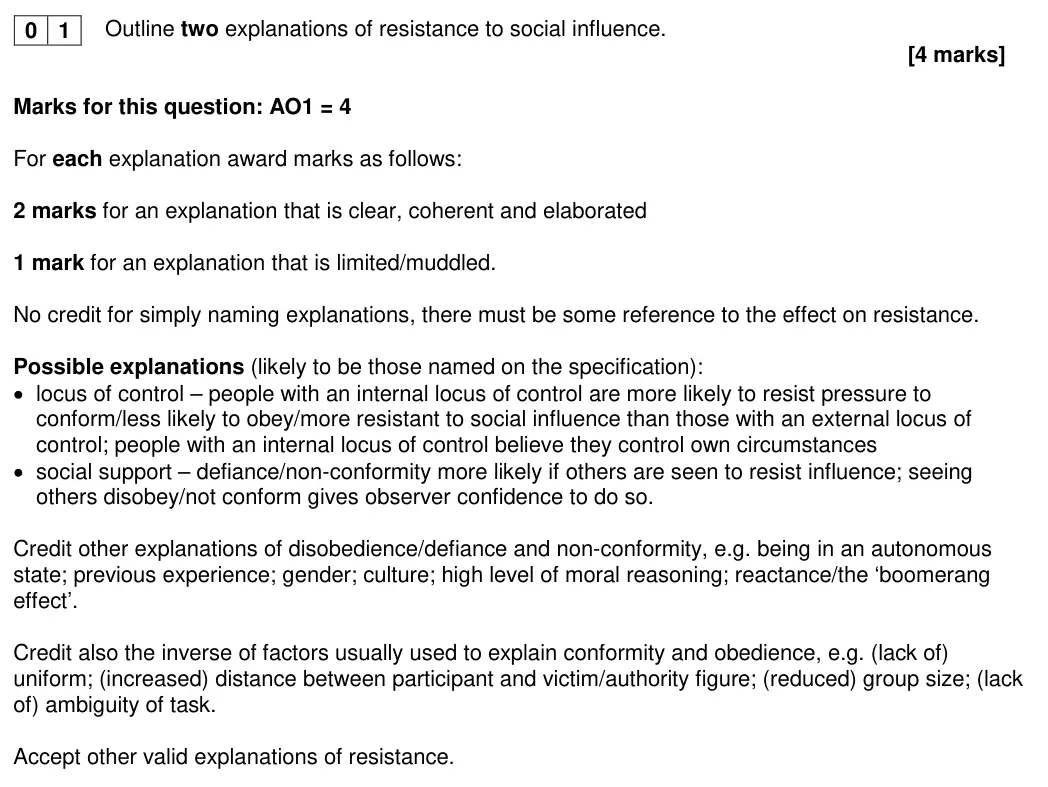
2 marks per explanation
must refer to effect on resistance, naming alone = 0
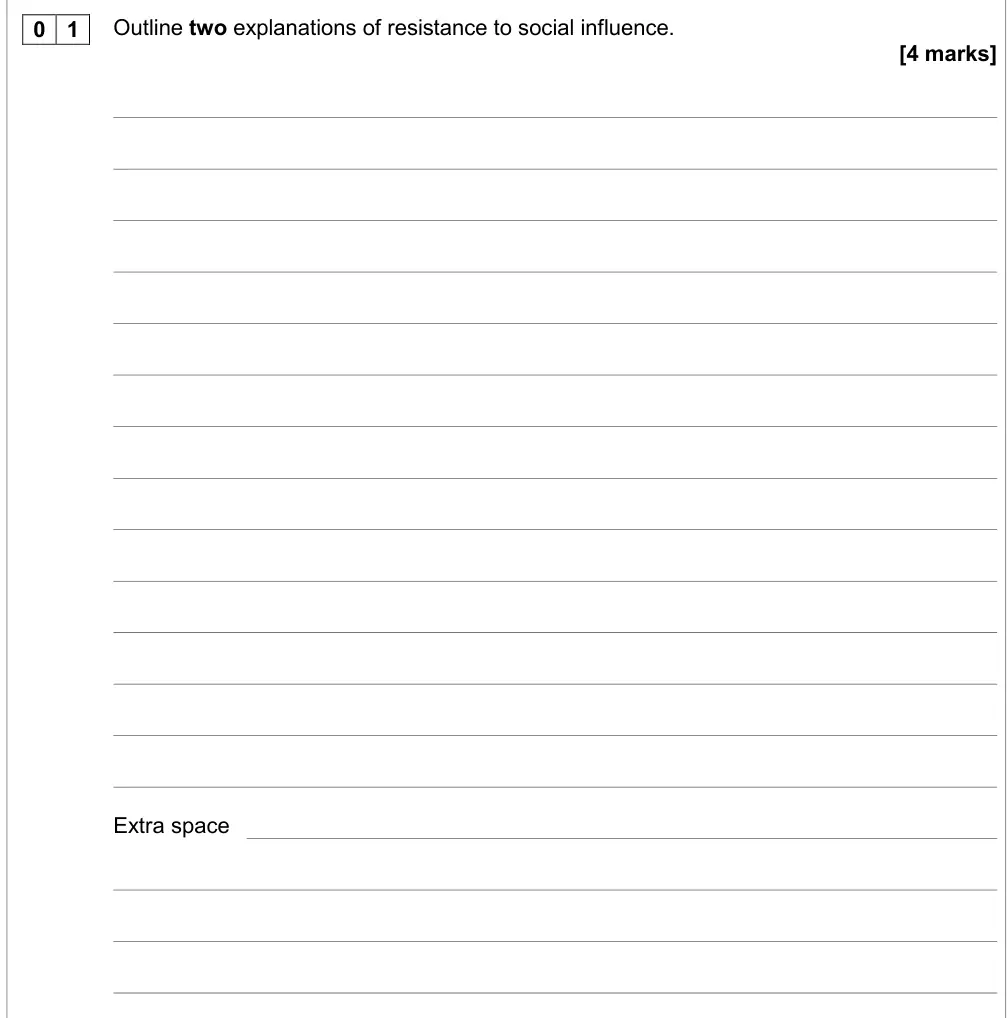
social support and locus of control most common, other explanations (autonomous state, moral reasoning) credited
internal/external locus of control reversed
authoritarian personality usually inappropriate
June 2019 · AS Paper 1 · Q22 marksAO3=2Evaluate (short)
Mark scheme, including level descriptors and indicative content
Examiner's comment
This question seemed to be one of the more challenging questions on the paper, even though it was a short answer question worth 2 marks. It required students to ‘briefly explain’ one limitation, which involves more than just identifying a limitation. Although some students wrote detailed answers worth full marks, there were also many who failed to gain any marks. From the range of answers seen, and the number of students who left this question blank, many students were not prepared for this question. Some students gave a limitation of the F-scale but did not explain why this was a problem for the authoritarian personality explanation of obedience. Some students gained credit for answers describing how other situational factors had been shown to have a greater influence on obedience. Better answers identified a specific situational factor and explained what effect it had, for example, closer proximity increases obedience.
Notes from the mark scheme and report
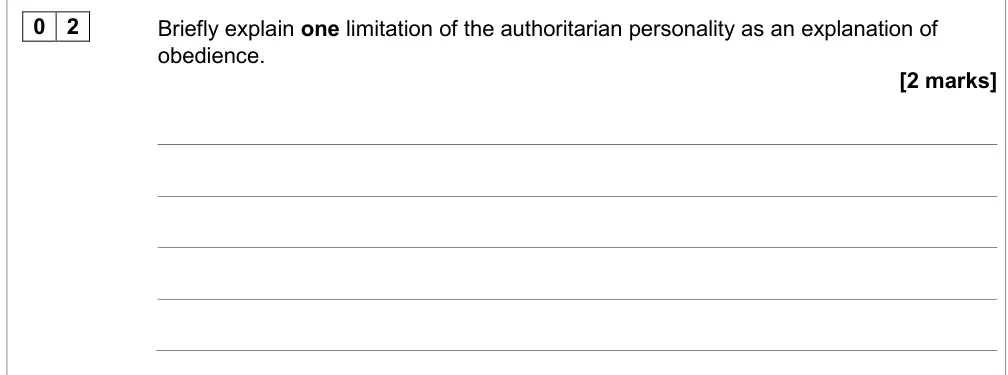
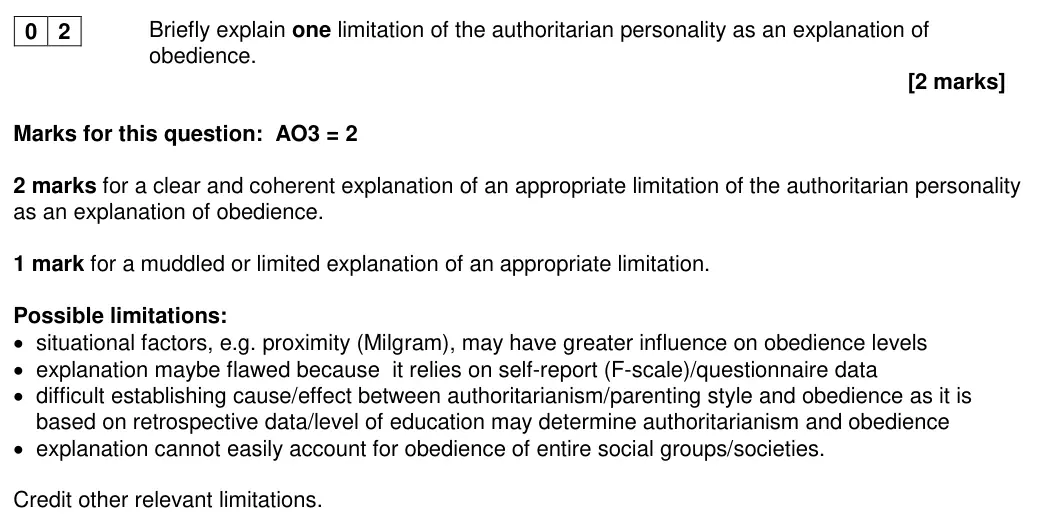
limitation must be explained not just stated (e.g. situational factors such as proximity more influential, F-scale self-report, cause/effect, whole societies)
F-scale limitations needed linking to the explanation
many left blank
June 2019 · AS Paper 1 · Q38 marksAO1=4, AO3=4Extended writing
Mark scheme, including level descriptors and indicative content
Examiner's comment
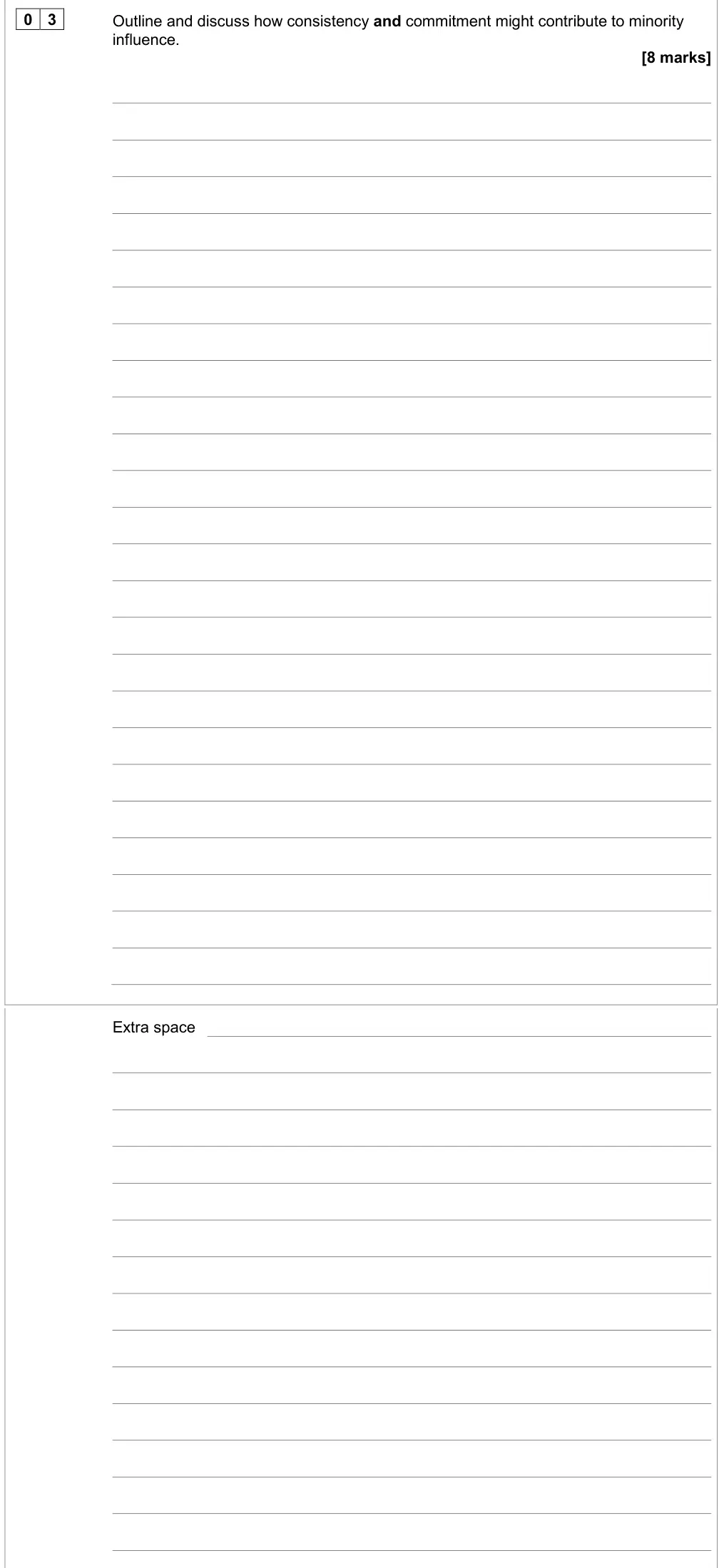
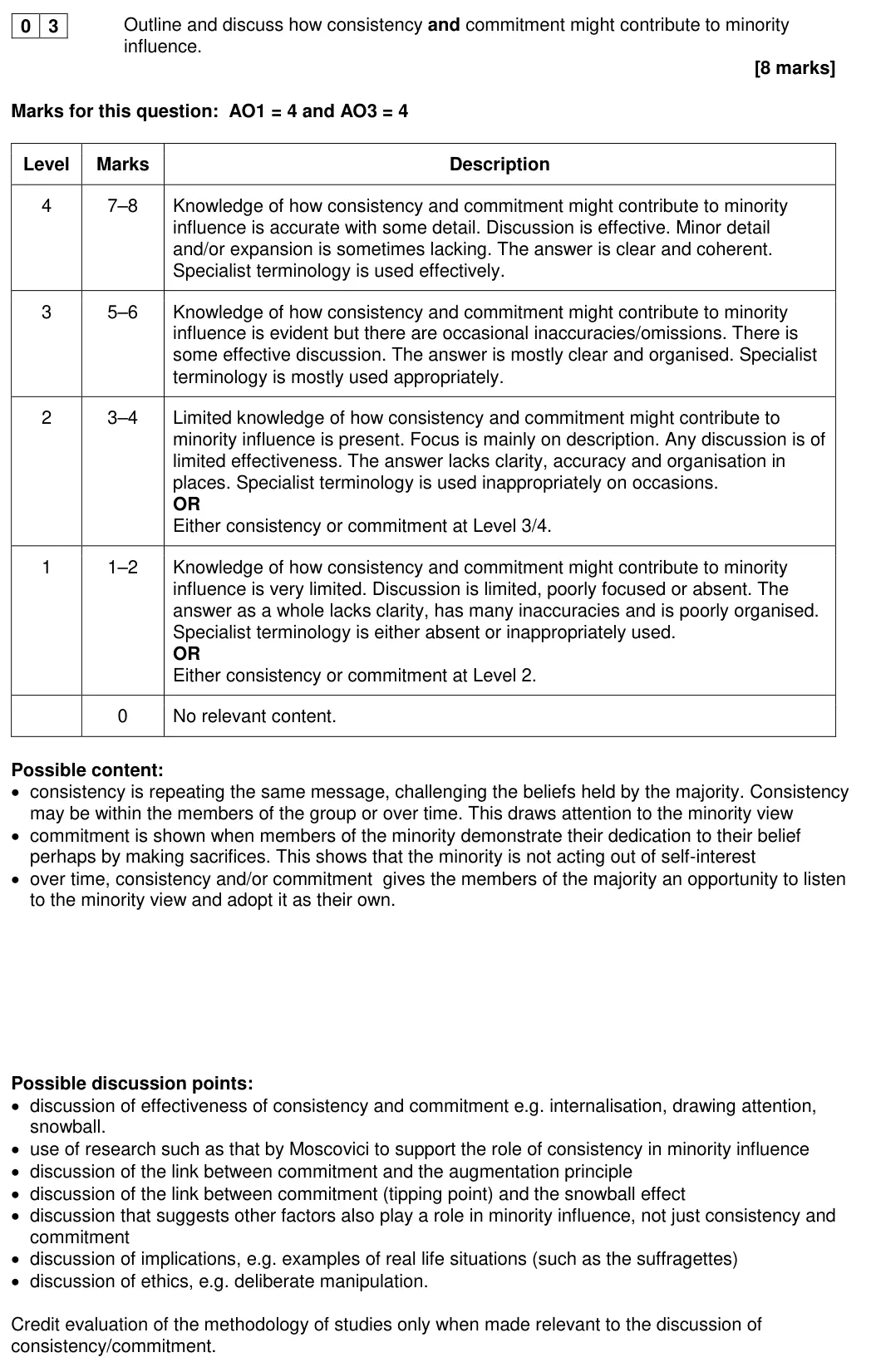
Questions that tended to differentiate best were questions 1, 3, 6, 10 and 11. This was a challenging question which discriminated well. There were some excellent answers, with detailed knowledge of how both consistency and commitment might contribute to minority influence and extremely effective evaluation, including use of research to support the role of consistency. Lengthy descriptions of Moscovici’s research were of little relevance and did not add much to the answer. At the other end were those students with muddled knowledge of consistency and commitment. Some students were able to achieve effective evaluation by explaining how other factors, such as flexibility, were also important. However, some students appeared to have prepared for a different question, focussing just on flexibility rather than using it in discussion of consistency and/or commitment. Again, this question also demonstrated the importance of reading the question carefully. While knowledge was often well detailed, the discussion was not as effective for most students. Weaker answers used only real-life examples such as the suffragettes, without explaining how they illustrated the role of consistency and/or commitment.
Notes from the mark scheme and report
either consistency or commitment only at Level 3/4 = max Level 2
Moscovici used as support not long description
flexibility only creditable as discussion
real-life examples (suffragettes) need explaining
methodological evaluation only if linked to consistency/commitment
June 2019 · Paper 1 · Q46 marksAO2=6ApplicationOld spec only
Not on the 2025 specification: role of social influence processes in social change, removed in v1.4
Mark scheme, including level descriptors and indicative content
Examiner's comment
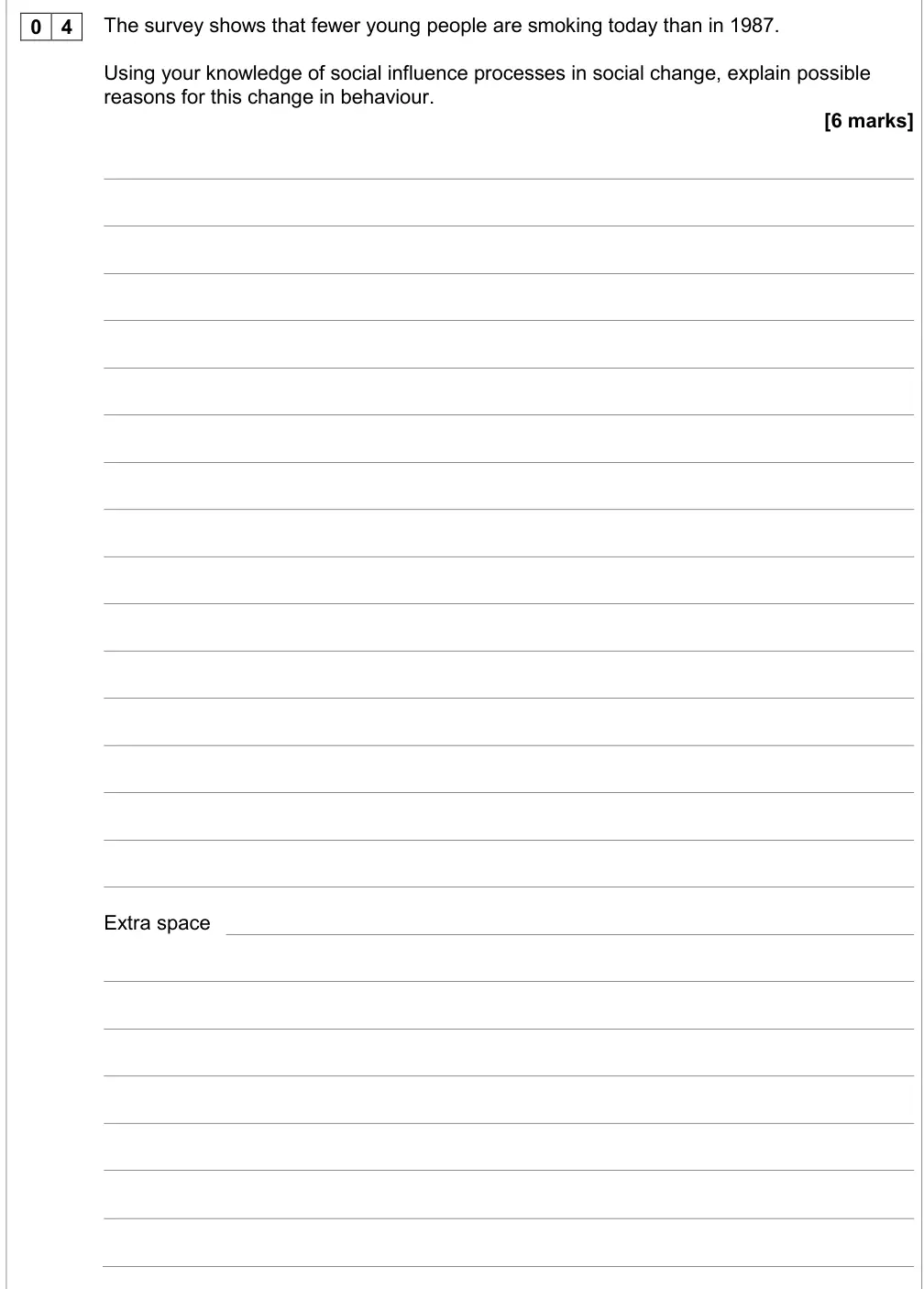
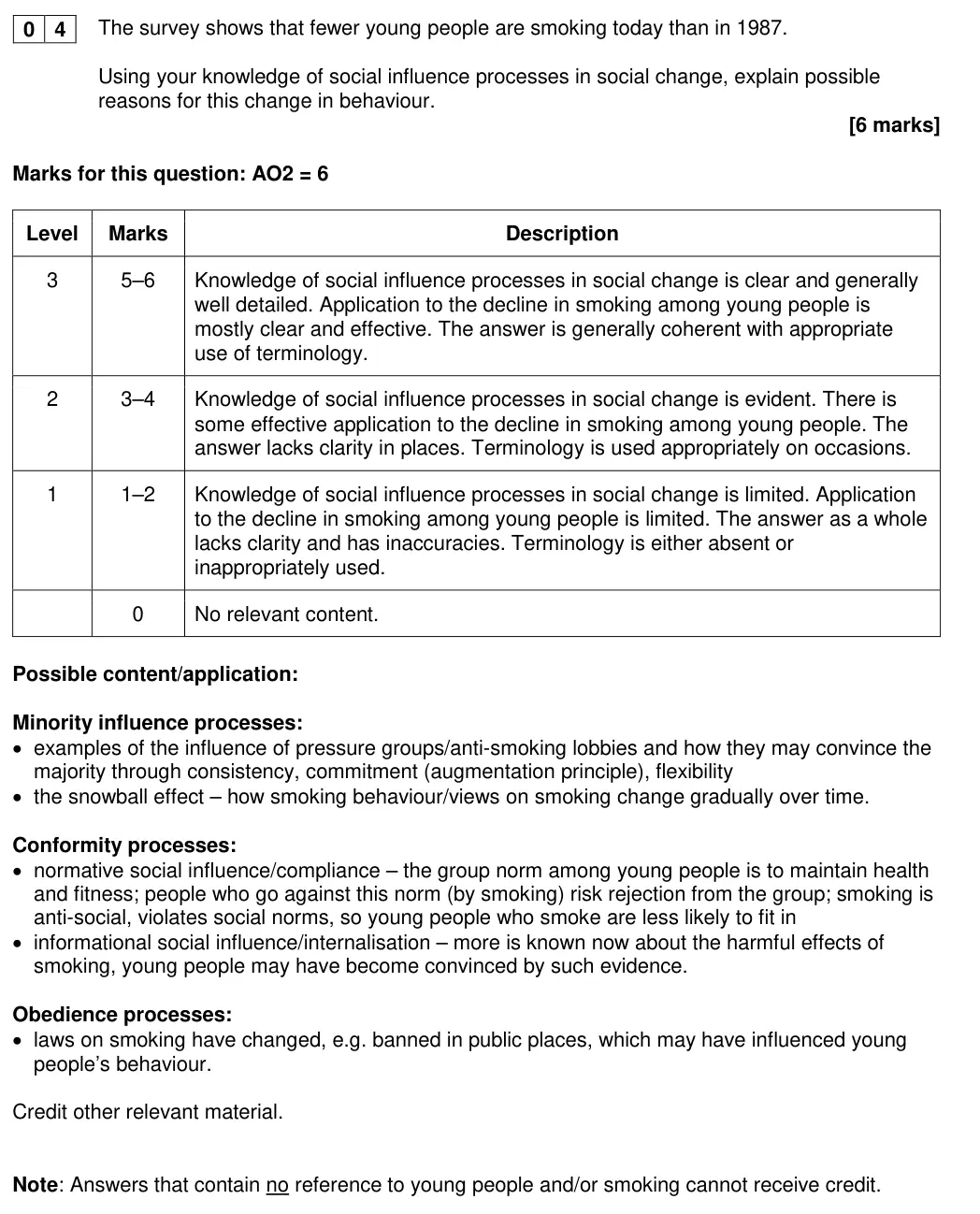
The question referred to changes in smoking behaviour in young people between 1987 and today and answers needed to refer to this specific issue to earn marks. There were some excellent outlines of the key elements of minority influence, applied to smoking behaviour. Some students were confused over specific details of concepts such as the augmentation effect or social cryptoamnesia, but still earned reasonable marks. Occasionally the processes of minority influence were outlined but not linked to smoking behaviour in young people and did not earn marks. There were some effective answers focusing on normative and informational social influence, but often this approach had problems dealing with the process of change from 1987 to the present day. The informational approach tended to be more effective in this respect.
Notes from the mark scheme and report
Off-spec: role of social influence processes in social change, removed in v1.4
credit minority influence (consistency, commitment, augmentation, snowball effect), NSI/ISI and obedience to smoking laws, all applied to young people and smoking
no reference to young people/smoking = 0
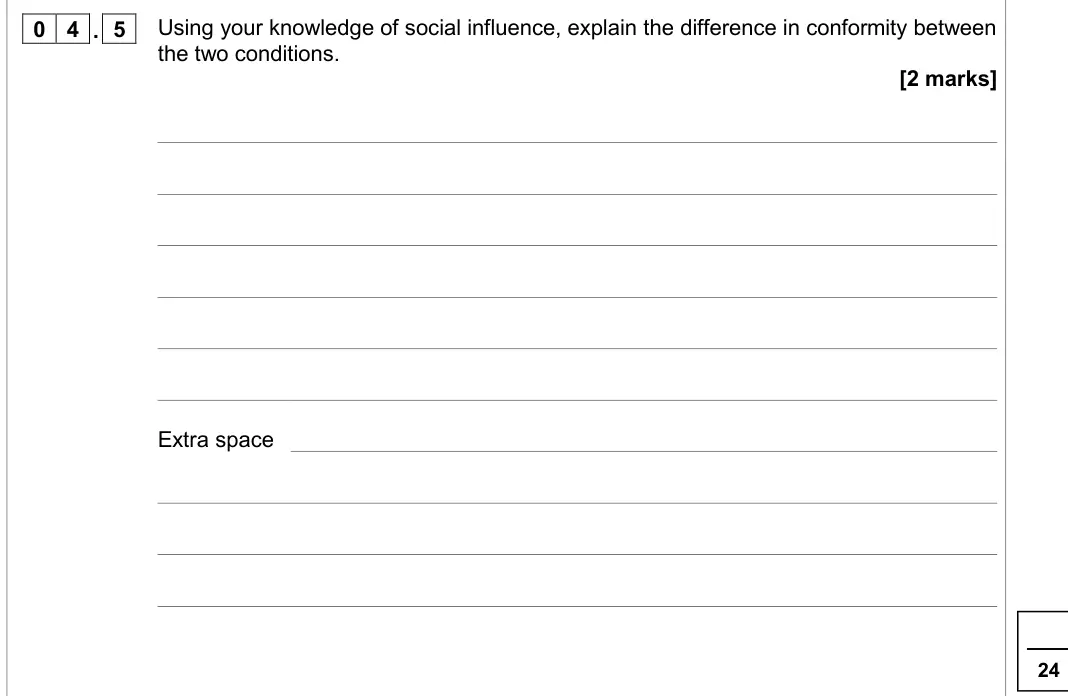
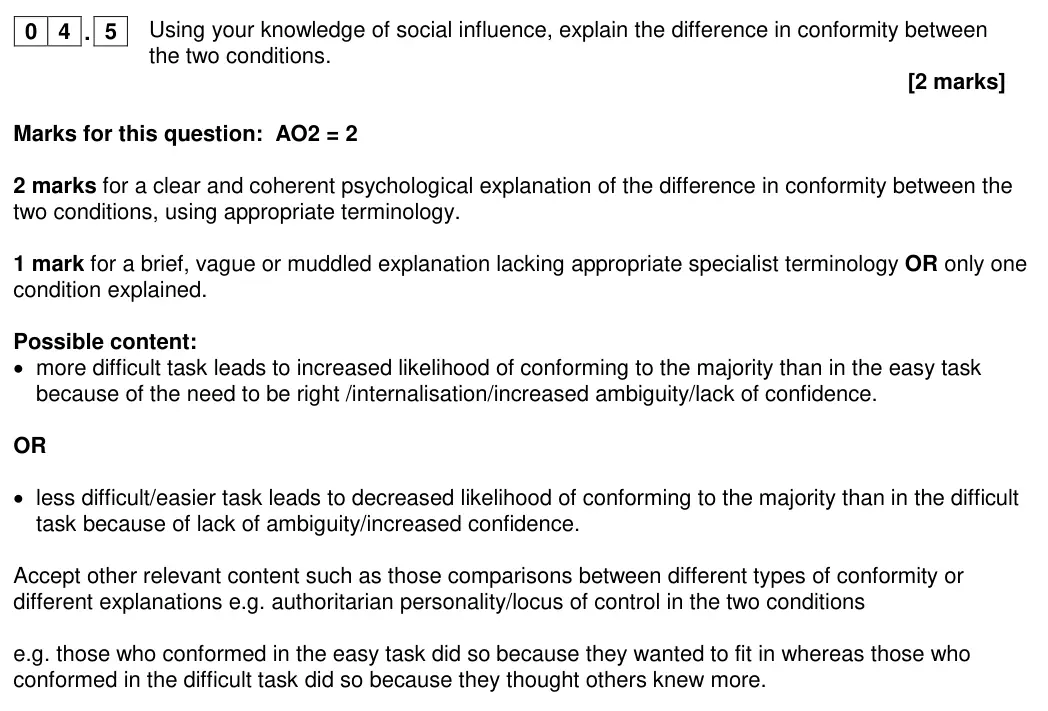
June 2019 · AS Paper 1 · Q4.52 marksAO2=2Application
Mark scheme, including level descriptors and indicative content
Examiner's comment
Question 04.5 There were excellent responses from some students who provided a clear understanding of different reasons for conformity applied to the stem. Good answers explained that in the more difficult condition informational social influence/increased ambiguity/lack of confidence led to greater conformity than in the easy condition, where those that did conform did so because of normative social influence/to fit in. Students who did not achieve full marks tended to explain what caused conformity in one of the conditions without comparing it to the other condition.
Notes from the mark scheme and report
must compare both conditions (ISI/ambiguity/lack of confidence in difficult vs NSI in easy)
one condition only = max 1
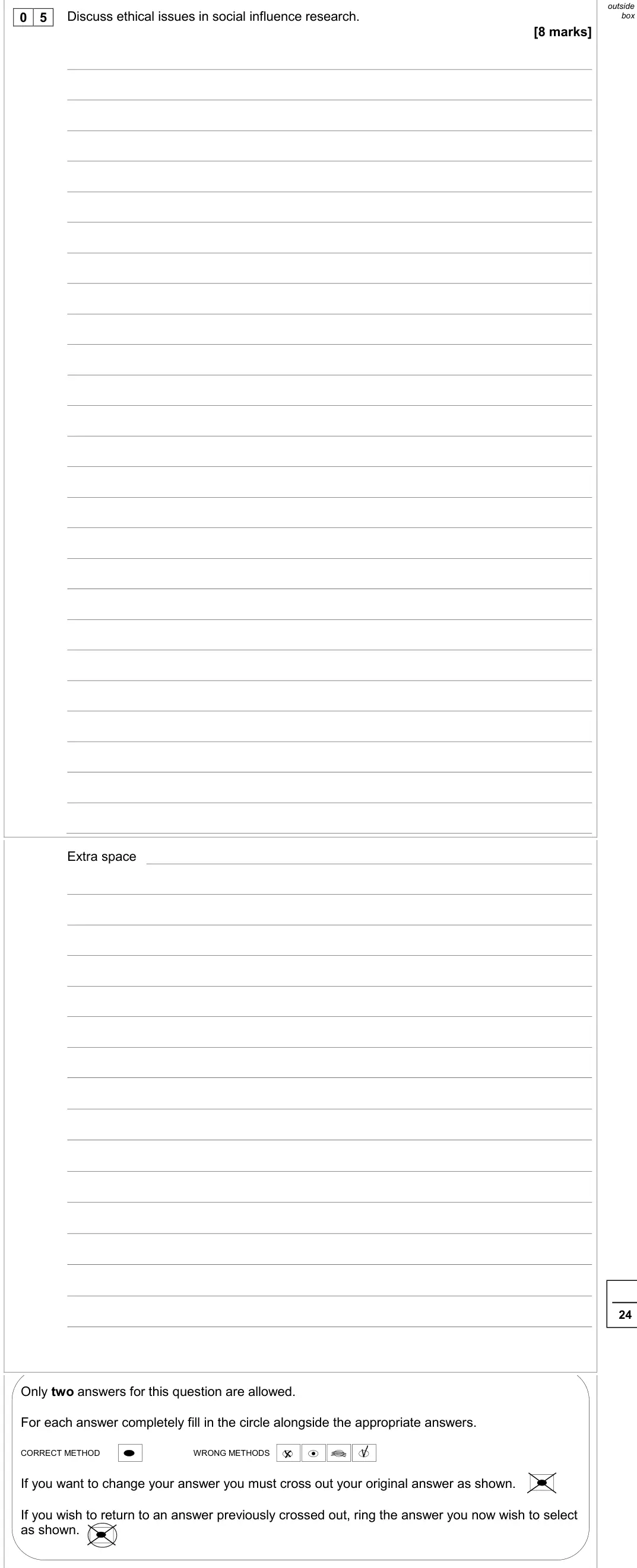
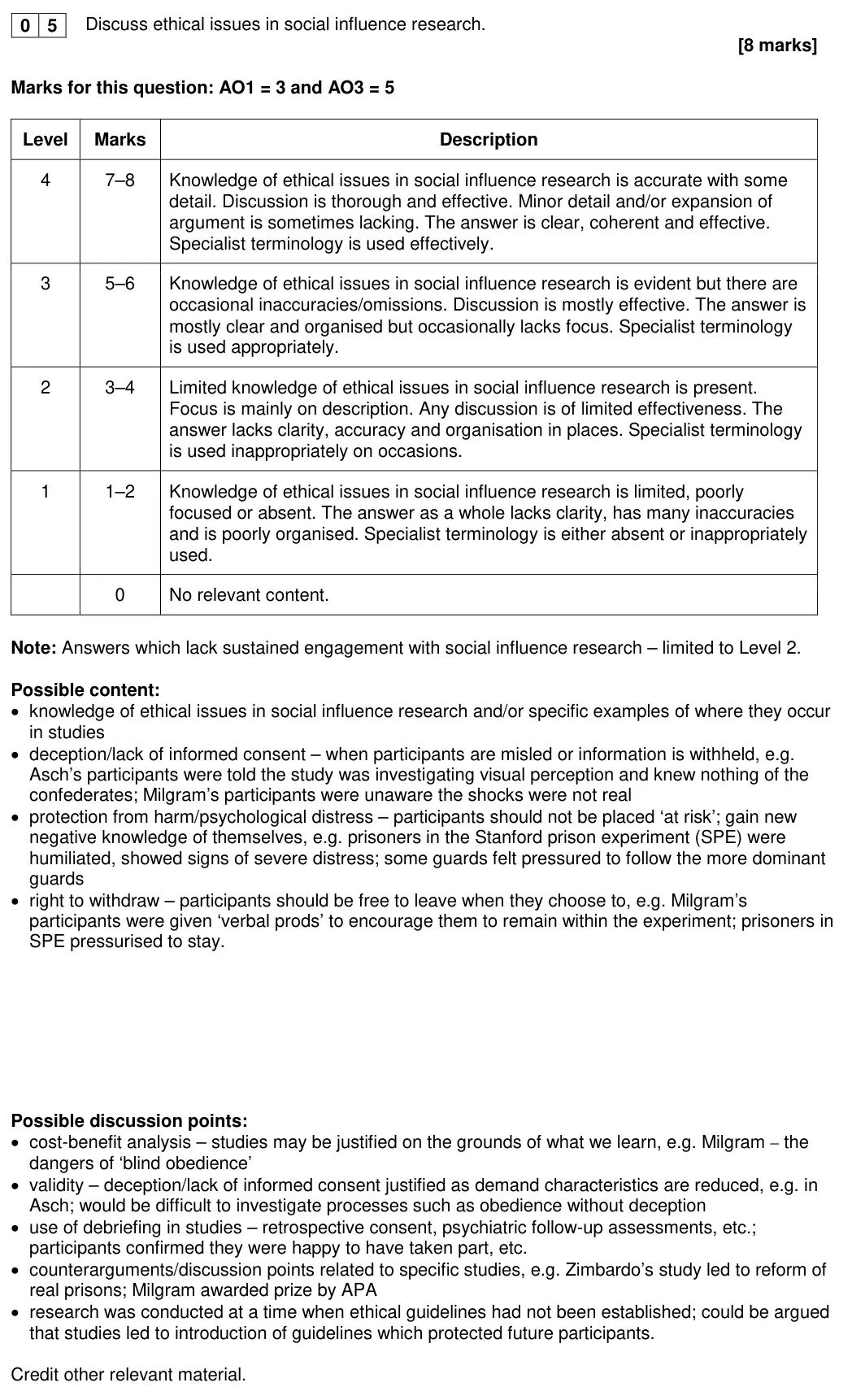
June 2019 · Paper 1 · Q58 marksAO1=3, AO3=5Extended writing
Mark scheme, including level descriptors and indicative content
Examiner's comment
Similarly, in question 5 there were many excellent outlines describing ethical issues in social influence research, but a frequent failure to discuss them. This question was not generally done well. Students tended to focus too much on describing actual ethical issues, which were often given in overwhelming detail, and not enough on discussing various relevant aspects. The most popular issues covered included deception/lack of consent, protection from harm and right to withdraw. There were a variety of aspects to discuss. These included the need for deception to prevent demand characteristics and improve the validity of studies; presumptive or retrospective consent; debriefing and psychological support after the study; the social/cultural significance of findings (cost-benefit analysis); the positive impact on ethical approaches in psychology, etc.
Notes from the mark scheme and report
no sustained engagement with social influence research = max Level 2
deception (Asch, Milgram), protection from harm, right to withdraw
discussion via cost-benefit, validity, debriefing, historical guidelines
most over-described issues with too little discussion
MS also credits Zimbardo's prison study, removed in v1.4
June 2018 · AS Paper 1 · Q12 marksAO1=2Outline
Mark scheme, including level descriptors and indicative content
Examiner's comment
While the majority of students correctly identified relevant variables, such as task difficulty, unanimity of group and group size, they then failed to explain how it affected conformity. There needed to be some indication as to whether it increased or decreased conformity.
Notes from the mark scheme and report
must state direction of effect (increase/decrease) for each variable
naming variables alone = 0
same variable with two effects cannot get both marks
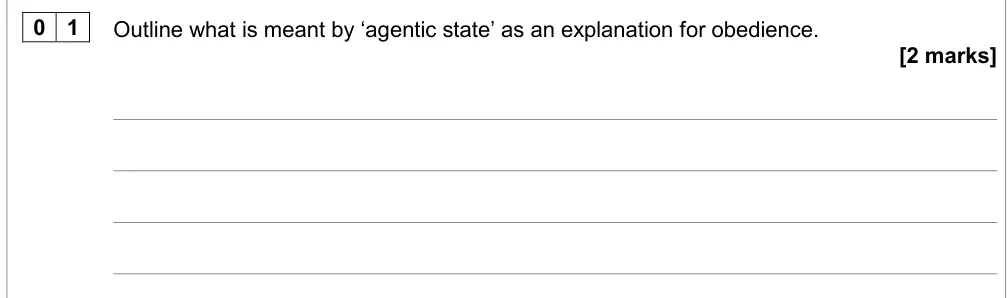
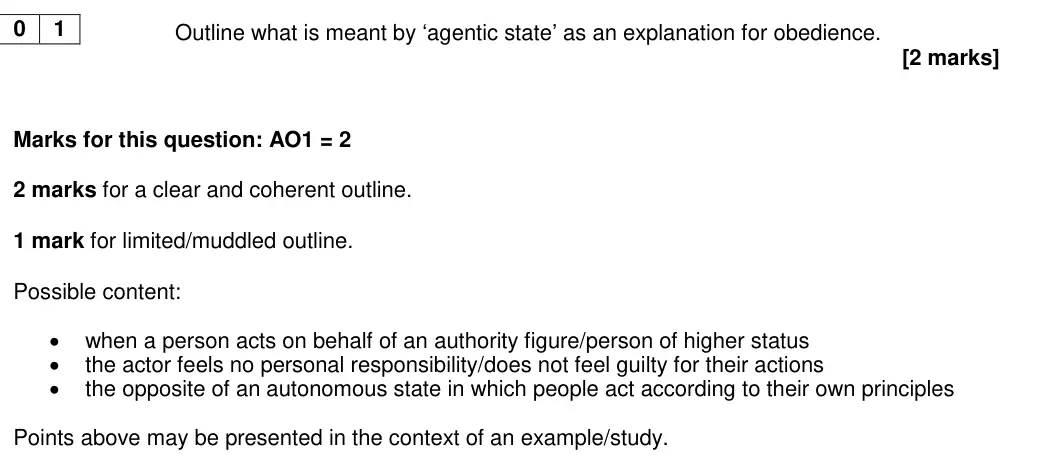
June 2018 · Paper 1 · Q12 marksAO1=2Outline
Mark scheme, including level descriptors and indicative content
Examiner's comment
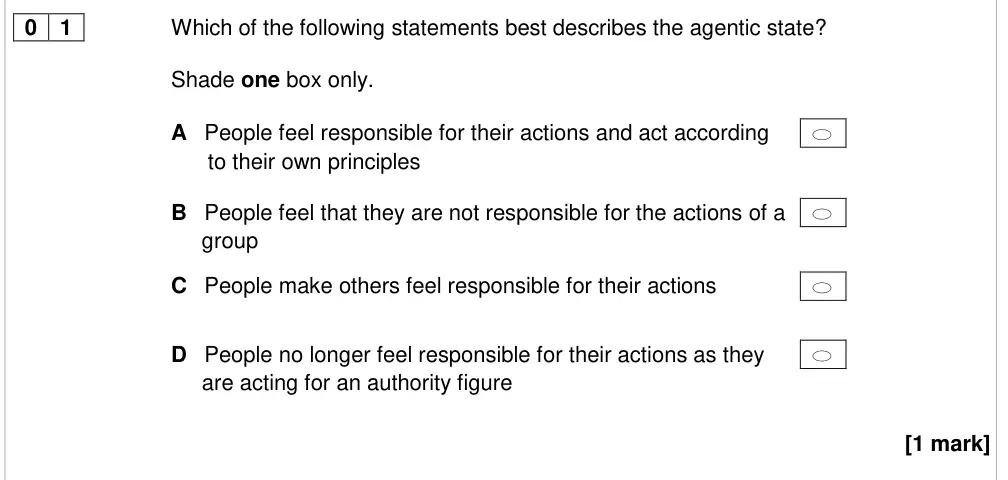
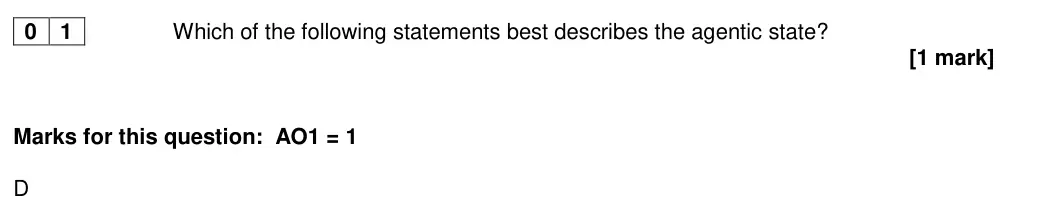
A straightforward question with many students earning maximum marks. Those that did not tended to forget the importance of an ‘authority figure’ in the agentic state, while referring accurately to the loss of personal responsibility.
Notes from the mark scheme and report
acting on behalf of an authority figure + no personal responsibility (opposite of autonomous state)
many forgot the authority figure
June 2018 · AS Paper 1 · Q24 marksAO1=4ExplainOld spec only
Not on the 2025 specification: role of social influence processes in social change, removed in v1.4
Mark scheme, including level descriptors and indicative content
Examiner's comment
This question was answered well, mainly focusing on the impact a minority had on bringing about social change. Concepts such as flexibility, consistency, role of conflict, and the augmentation principle were described well. However, students should avoid writing lists, there does need to be some elaboration of these concepts. Those students who offered concepts such as normative social influence and informational social influence were often unable to link them to social change, even though they could have been made relevant. While examples can sometimes help add to an answer, detailed descriptions of, e.g. the suffragettes or Rosa Parks seldom added much.
Notes from the mark scheme and report
Off-spec: role of social influence processes in social change, removed in v1.4
MS credits minority influence behaviours (consistency, commitment, flexibility), snowball effect, social cryptomnesia, NSI, obedience
lists without elaboration limited
long descriptions of suffragettes/Rosa Parks added little
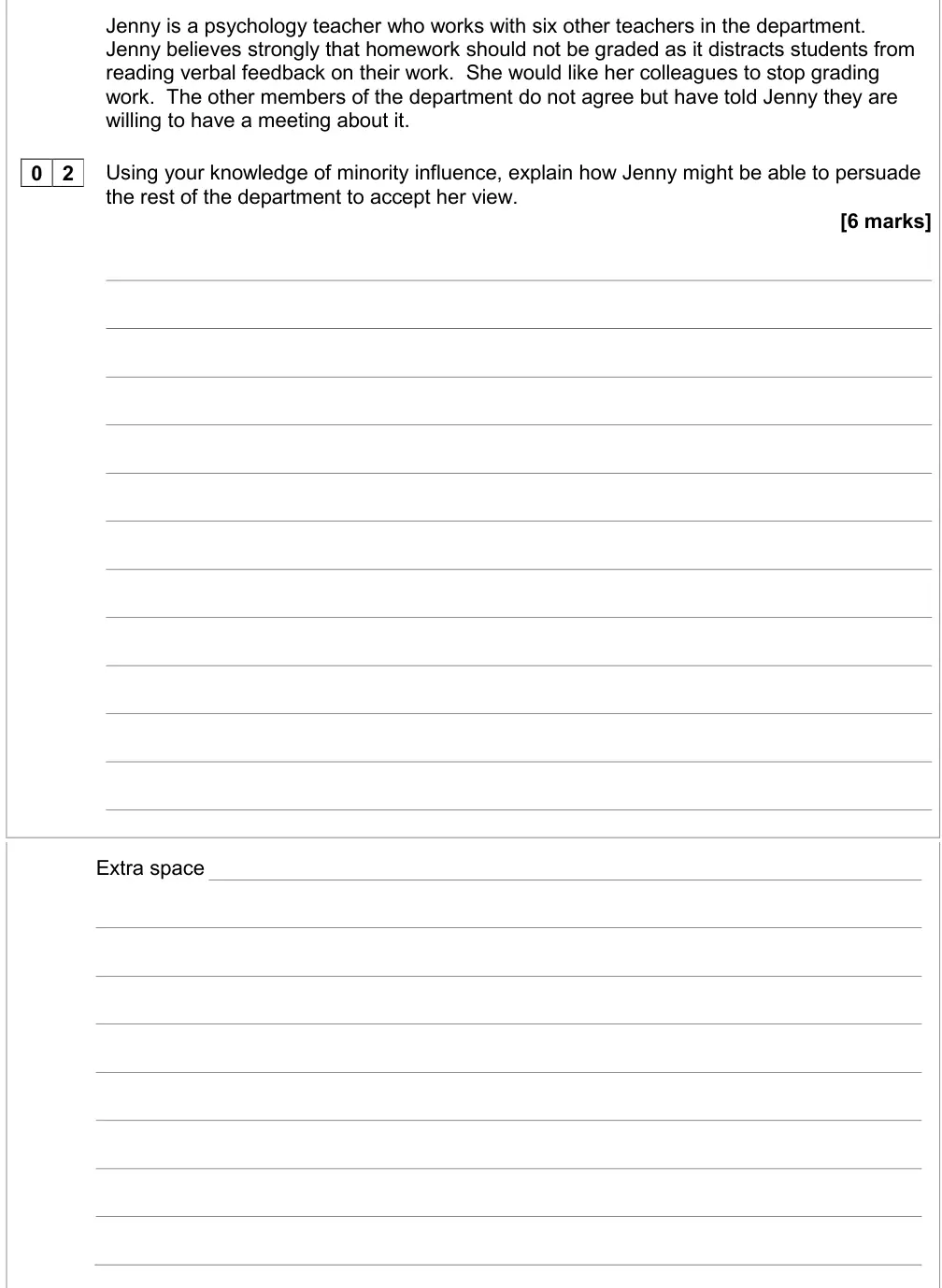
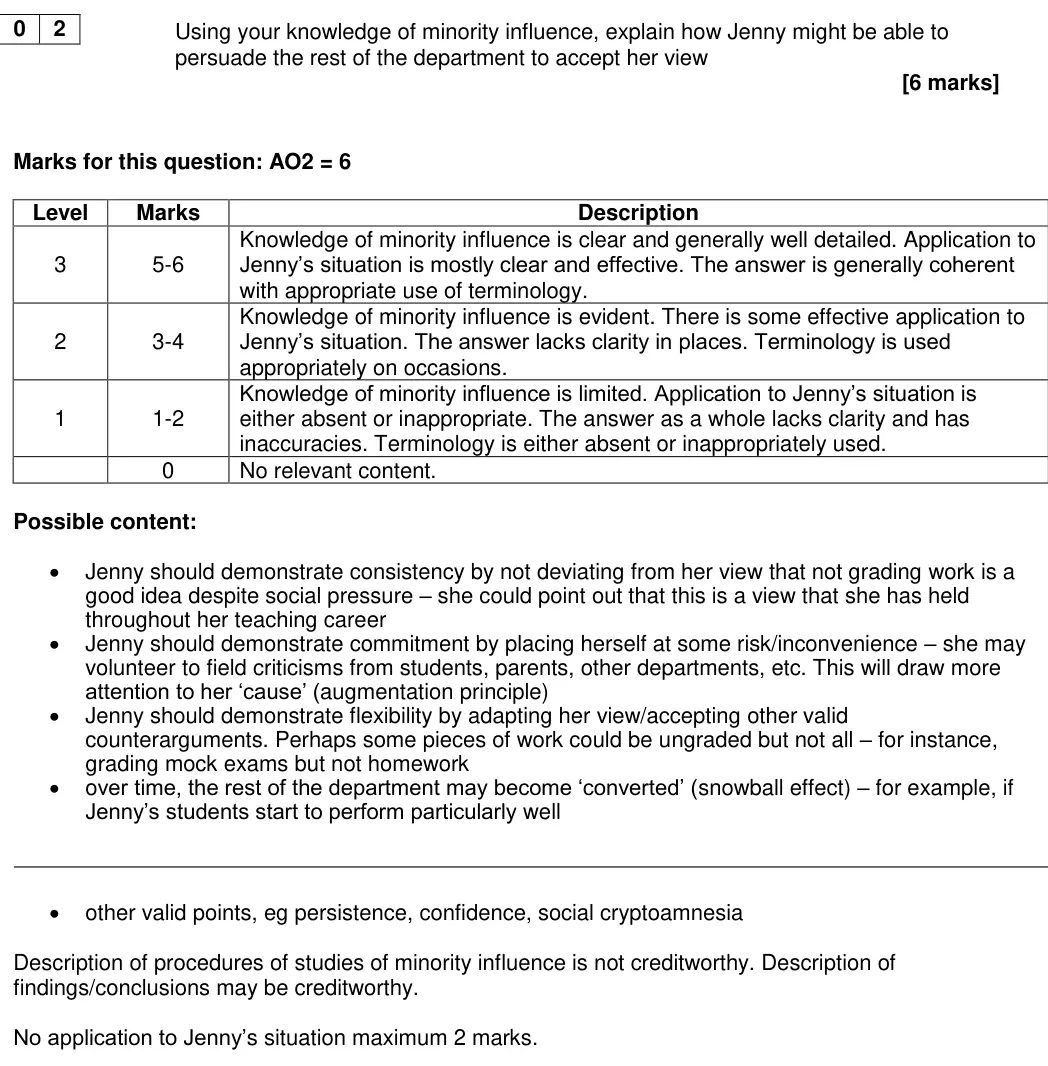
June 2018 · Paper 1 · Q26 marksAO2=6Application
Mark scheme, including level descriptors and indicative content
Examiner's comment
Overall knowledge of the processes involved in minority influence was impressive, though some students did not differentiate clearly between commitment and consistency. There was variability in the extent of application to the scenario. Some examples of how Jenny might persuade the rest of the department were realistic and appropriate, but others, such as going on hunger strike, were inappropriate and clearly linked to examples such as the suffragettes. At the top end there was reference to augmentation, conversion and the snowball effect.
Notes from the mark scheme and report
consistency, commitment (augmentation), flexibility applied to Jenny
procedures of minority influence studies not creditworthy
no application = max 2
inappropriate examples (hunger strike)
MS also credits snowball effect/social cryptomnesia (social change), removed in v1.4
June 2018 · Paper 1 · Q316 marksAO1=6, AO3=1016-mark essay
Mark scheme, including level descriptors and indicative content
Examiner's comment
Question 03 was on ‘why people conform’ i.e. explanations for conformity, and this needed to be the focus of the answer; studies were central to good answers, but needed to be linked to explanations to receive credit. Lists of probably rote-learnt evaluations of studies, without reference to explanations, receive little credit – how can ethical issues be made relevant to explanations? An example from this year’s paper was Question 03 on ‘why people conform’. Asch’s studies are central to this area, and some students were able to discuss the results in terms of normative and information social influence, demonstrating good understanding of reasons why people conform. Variations of Asch and later studies, leading to conclusions on gender, individual and cultural differences in reasons for conformity, could be integrated into the discussion. Too often, however, comments on e.g. gender or cultural bias in Asch’s work, were too brief and list-like to be fully creditworthy. The key phrase in the question was ‘why people conform’, meaning that the focus needed to be on explanations for conformity. Some students produced excellent essays, outlining key elements of explanations for conformity and then using research findings (Asch, Sherif, Jenness etc) to evaluate explanations e.g. the roles of normative and informational social influence in explaining Asch’s findings. However for many students the key term ‘conformity’ simply triggered Asch’s studies. They described his procedures and findings but did not link them clearly to explanations for conformity; instead they focused on methodological and ethical evaluations of Asch and other conformity research (e.g. Zimbardo) that were rarely made relevant to explanations (how could ethical issues be relevant to explanations ?). Better answers used a range of studies linked to explanations, and also considered relevant aspects such as gender, culture, and individual differences such as locus of control. Some students confused conformity with obedience and received little or no credit.
Notes from the mark scheme and report
focus on WHY people conform: NSI/ISI, types of conformity, Asch variables, locus of control
describing Asch procedures/ethics not linked to explanations scored little
confusion with obedience
MS also credits conformity to social roles and identification, removed in v1.4
June 2017 · AS Paper 1 · Q11 markAO1=1Multiple choice
Answer
D
Mark scheme, including level descriptors and indicative content
Examiner's comment
Most students were able to correctly answer these questions, with 91% and 87% getting the marks respectively.
Notes from the mark scheme and report
correct D
91% correct
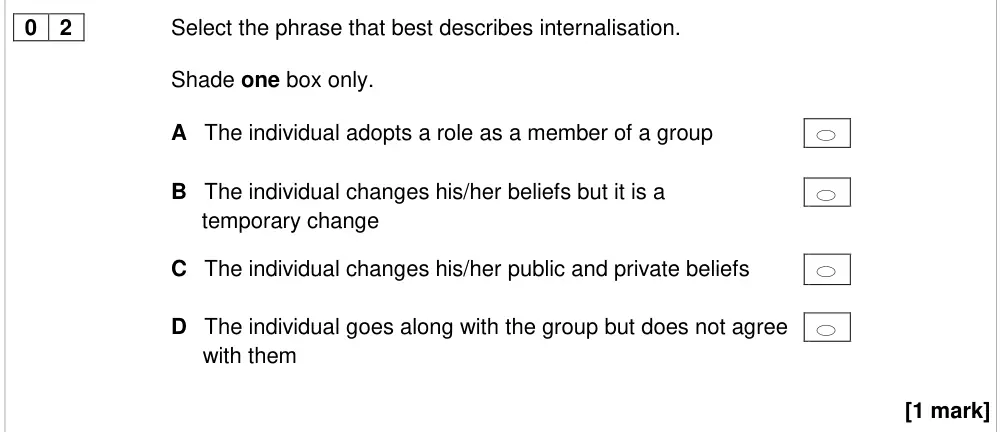
June 2017 · AS Paper 1 · Q21 markAO1=1Multiple choice
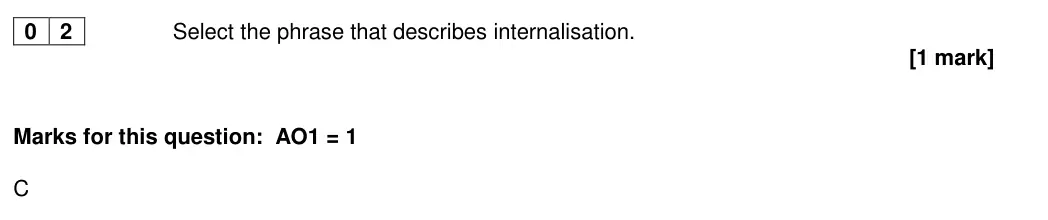
Answer
C
Mark scheme, including level descriptors and indicative content
Examiner's comment
Most students were able to correctly answer these questions, with 91% and 87% getting the marks respectively.
Notes from the mark scheme and report
correct C (public and private change)
distractors describe social roles (A), identification-like temporary change (B) and compliance (D)
87% correct
June 2017 · Paper 1 · Q23 marksAO2=3Application
Mark scheme, including level descriptors and indicative content
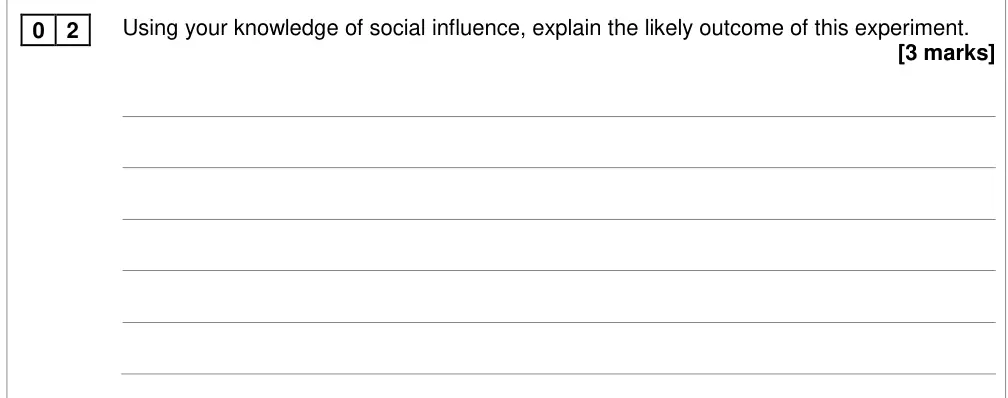
Examiner's comment
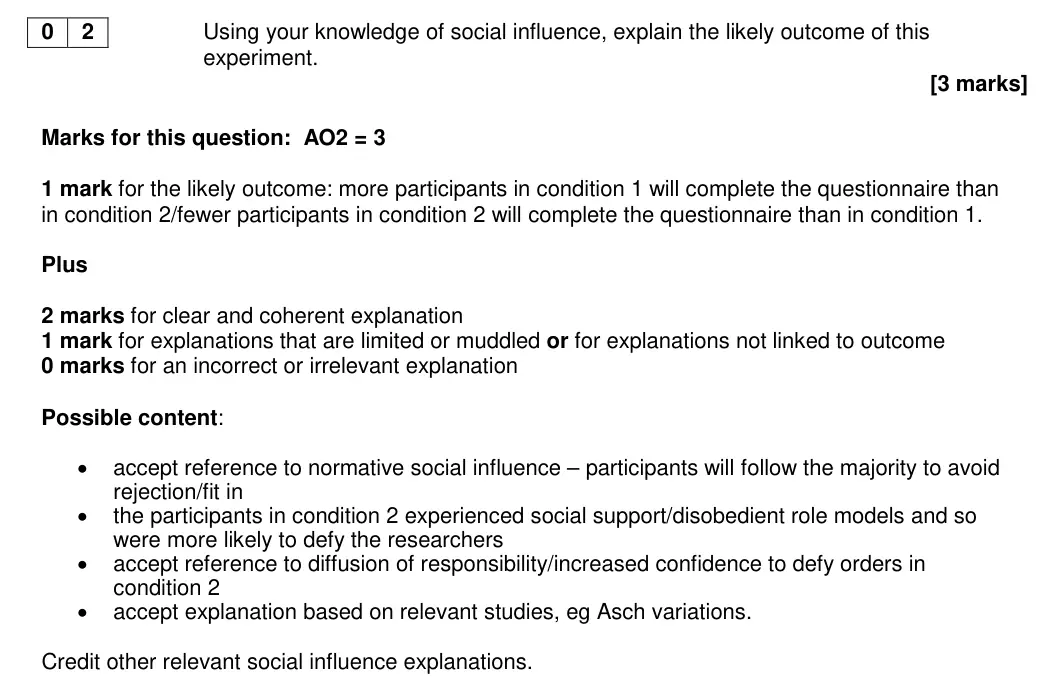
Most answers provided an accurate statement of the likely outcome of the experiment and could provide some sort of explanation. However, many students missed the final mark by not providing accurate detail of the type of social influence being displayed, especially in condition 2. Weaker answers were largely common sense, lacking psychological terminology.
Notes from the mark scheme and report
1 mark outcome (more complete the questionnaire in condition 1) + 2 for explanation e.g. normative social influence, social support/disobedient role models in condition 2
many lacked detail of the social influence in condition 2
common-sense answers lacked terminology
June 2017 · AS Paper 1 · Q34 marksAO1=2, AO3=2Evaluate (short)
Mark scheme, including level descriptors and indicative content
Examiner's comment
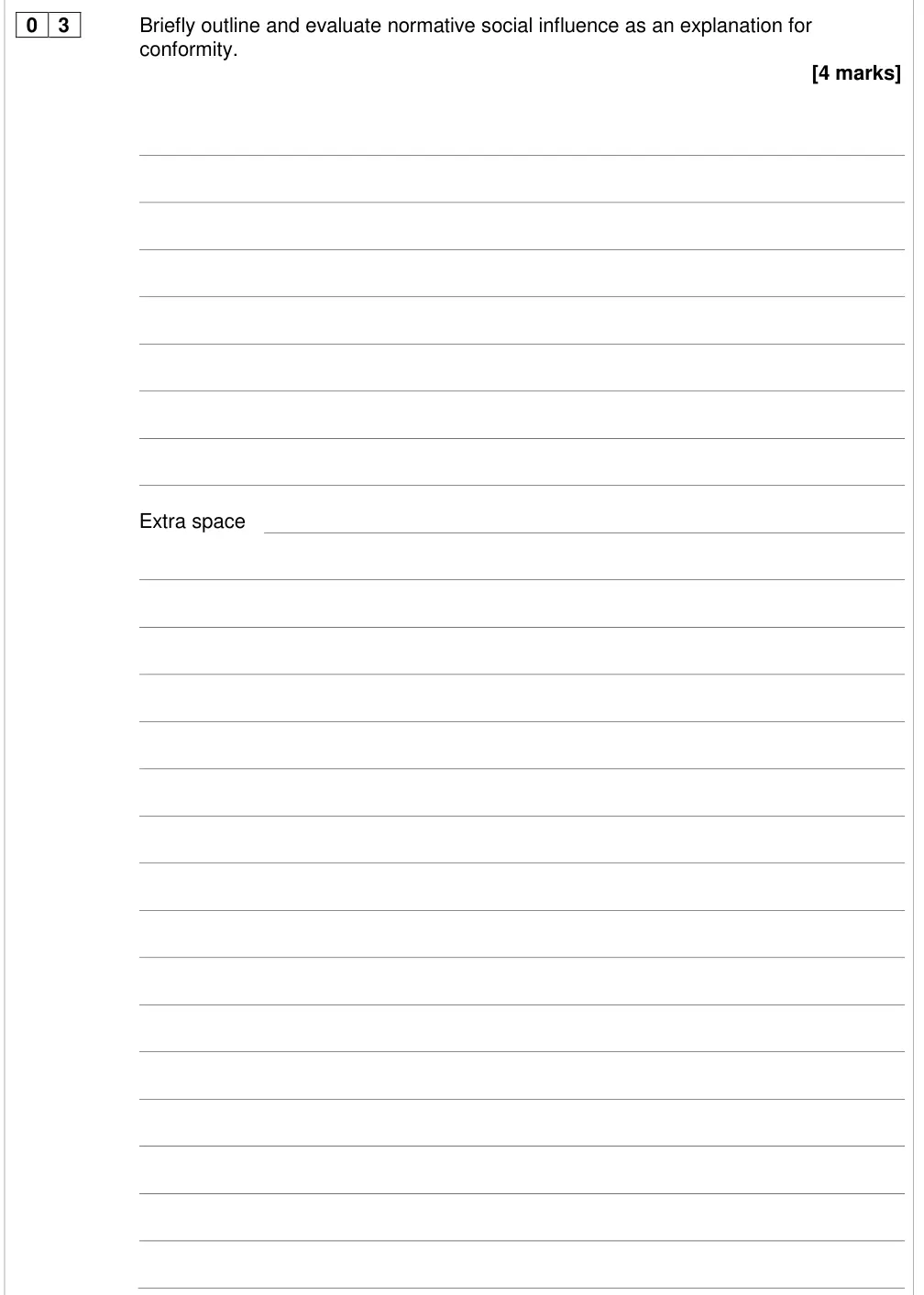
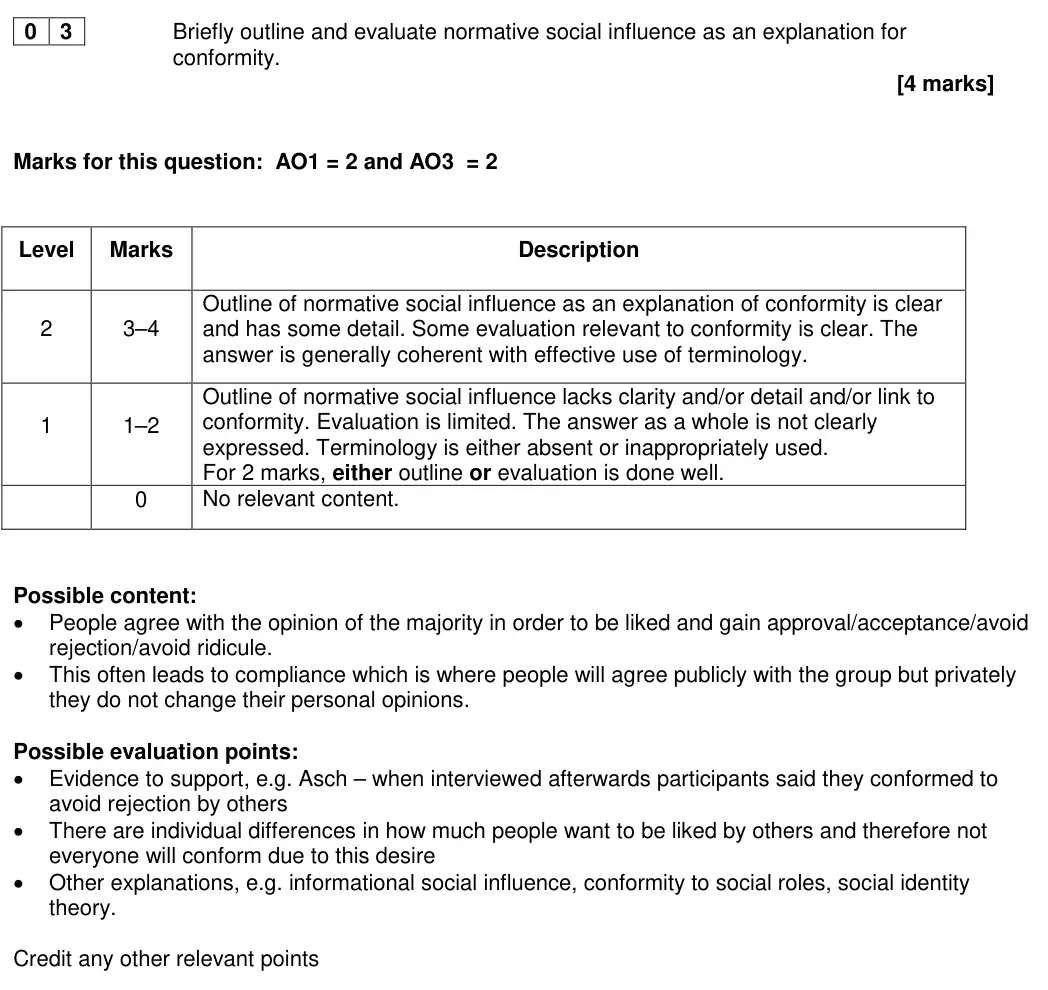
Most students could give an outline of normative social influence that involved reference to conforming due to the need to be liked or approved by the group. This often included reference to compliance and to public acceptance but private rejection of the behaviour. While knowledge was usually good, many students simply did not provide creditworthy evaluation. For some this was due to not providing any evaluation at all and for others it was their inability to use studies effectively to evaluate normative social influence as an explanation for conformity. To use a study such as Asch’s effectively, there needed to be some reference to the fact that his participants themselves commented that they knew their answers were wrong, but they didn’t want to be rejected by the group. A study being used as evaluation for an explanation can only receive credit if it is clear how the findings support or challenge the explanation.
Notes from the mark scheme and report
outline: desire to be liked/accepted, often leads to compliance
studies only credited as evaluation if clear how findings support/challenge NSI (e.g. Asch participants said they knew answers were wrong)
many gave no creditworthy evaluation
June 2017 · AS Paper 1 · Q44 marksAO2=4Application
Mark scheme, including level descriptors and indicative content
Examiner's comment
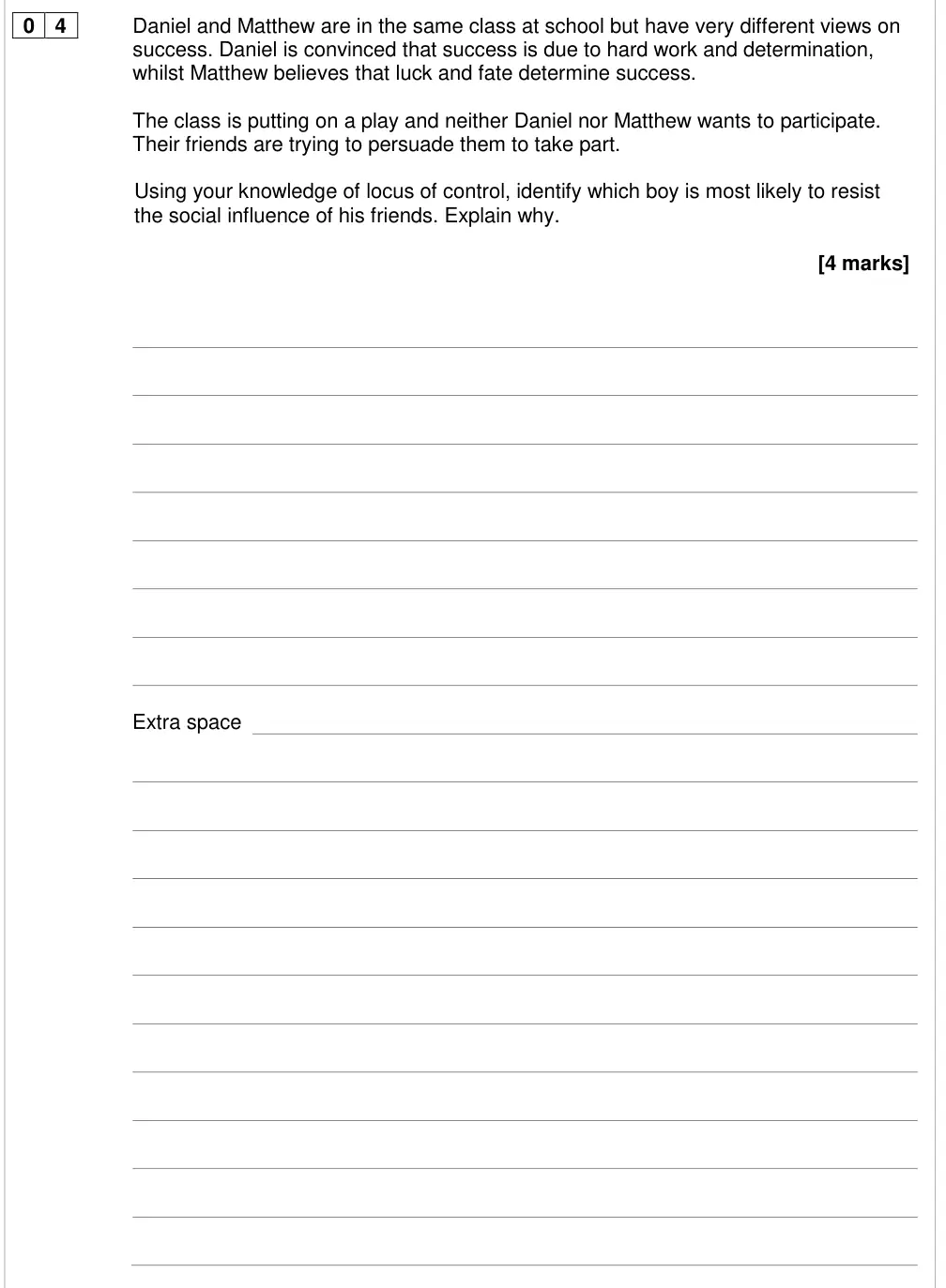
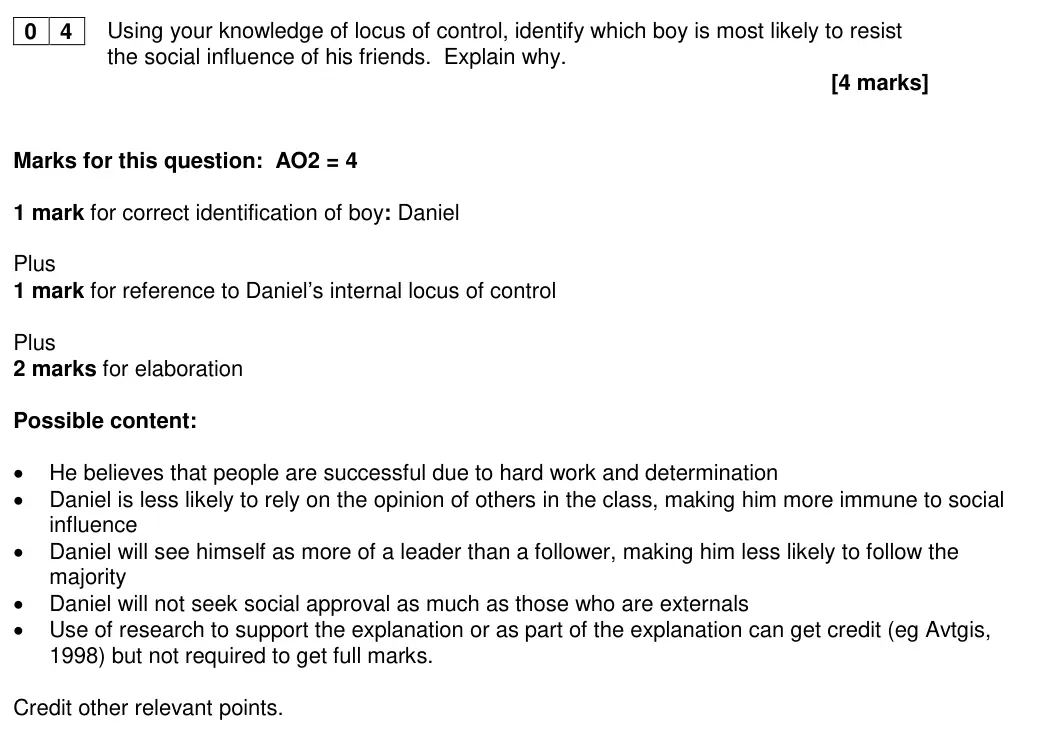
This question was usually answered well, with most students getting 3 or 4 marks. Most students were able to correctly identify Daniel as the boy most likely to resist, due to his internal locus of control (LOC). Students were able to explain that those with an internal LOC have characteristics that make them better able to resist and that they do not seek social approval from others. The problem for some students was spending too long writing about Matthew, or by referring to “high LOC” or “low LOC” but with no reference to internal or external LOC.
Notes from the mark scheme and report
1 mark Daniel, 1 mark internal locus of control, 2 marks elaboration
'high/low LOC' without internal/external not credited
too much on Matthew
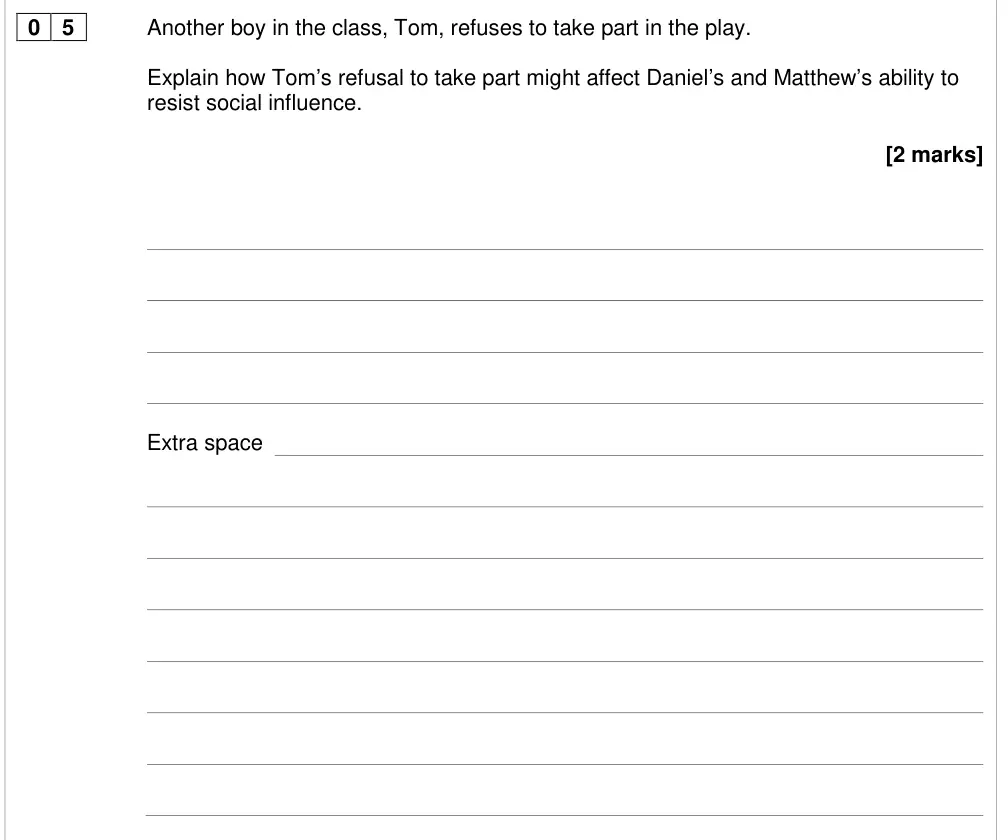
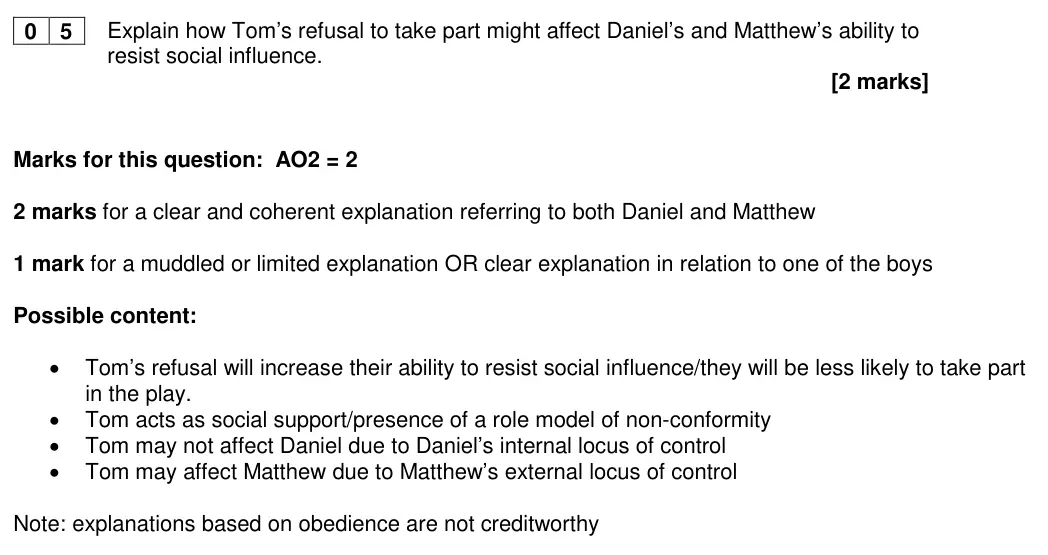
June 2017 · AS Paper 1 · Q52 marksAO2=2Application
Mark scheme, including level descriptors and indicative content
Examiner's comment
This was answered well, with the majority of students referring to Tom being an ally or providing social support. Tom acted as a role model and helped the other two boys resist.
Notes from the mark scheme and report
Tom acts as social support/ally/role model of non-conformity
must refer to both boys for 2 marks
explanations based on obedience not creditworthy
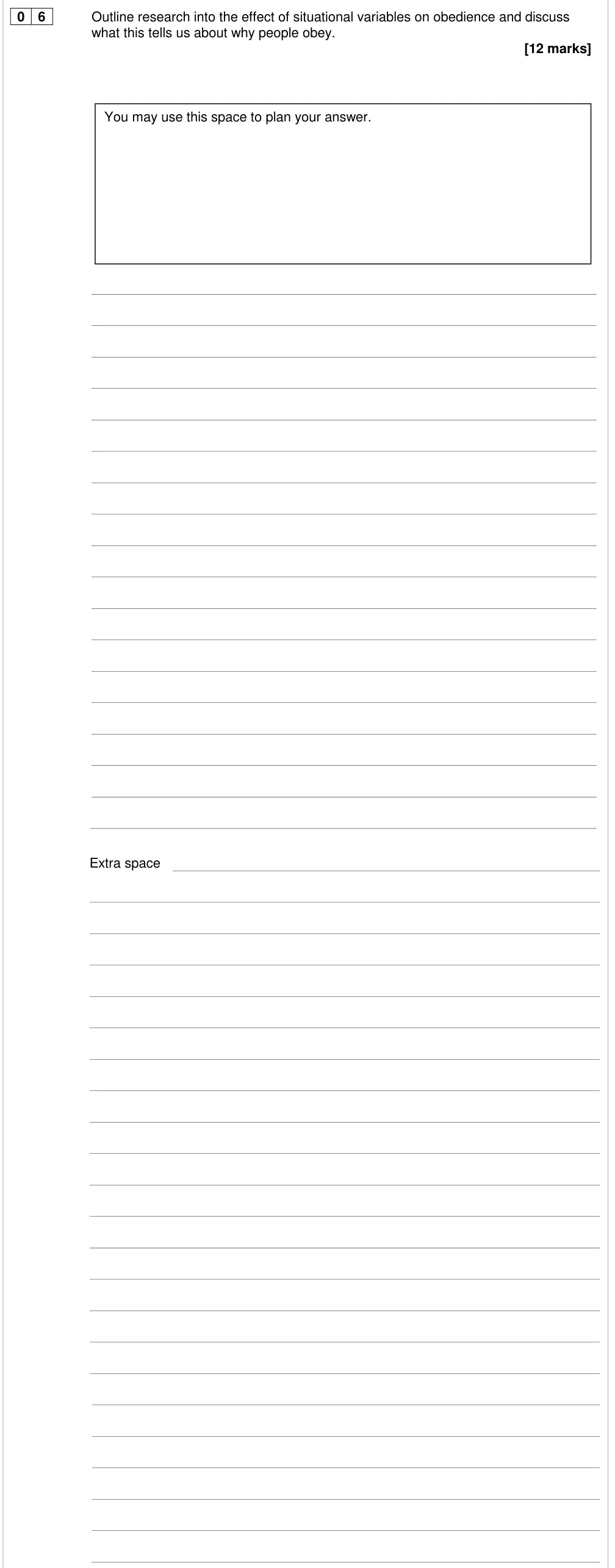
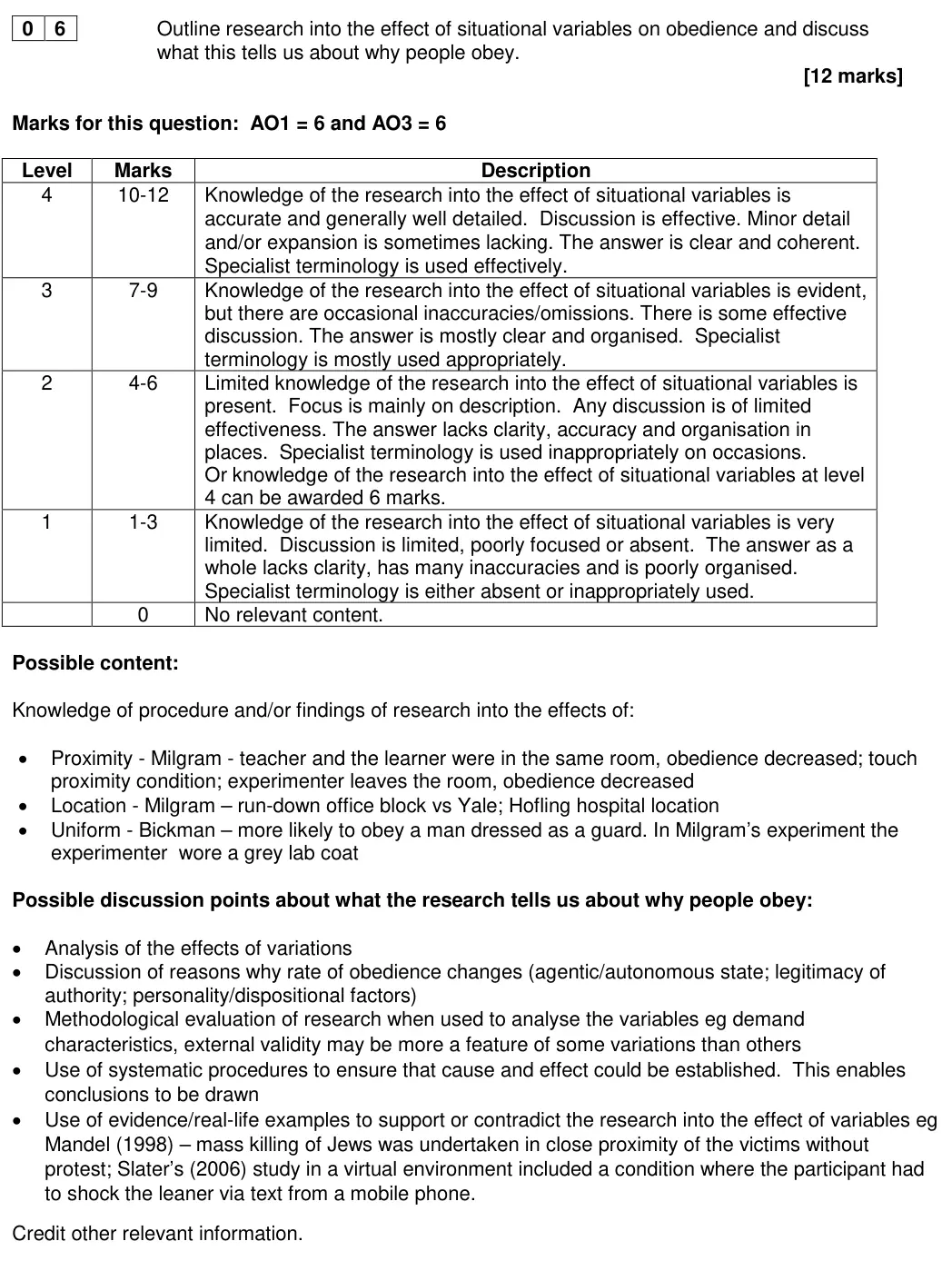
June 2017 · AS Paper 1 · Q612 marksAO1=6, AO3=6Extended writing
Mark scheme, including level descriptors and indicative content
Examiner's comment
Assessment of extended writing as in Q6, Q11 and Q18 differentiated well. Weaker responses to these questions suggest that students need to focus on developing their higher order skills. Students should take time to read the specific demands of each question carefully, rather than simply writing everything they know about the topic. This was particularly the case for Question 6, where much time was wasted in lengthy descriptions of the procedures of Milgram’s original study. Just like the Asch question in 2016, this was a question where students needed to select the relevant aspects of research. Students often wrote detailed and unnecessarily lengthy descriptions of Milgram’s original study, before getting round to outlining the relevant variations thereby answering the question. Students’ knowledge of research into proximity, location and uniform was often good, however relatively few students addressed the second part of the question, ie “what this tells us about why people obey”. Students need to read each question carefully and make sure they deal with all aspects of it to access Level 3 or Level 4. Better answers made use of other studies to support or challenge Milgram’s findings. Good use was made of Hofling’s study to challenge Milgram’s findings relating to proximity. Bickman’s findings regarding the power of uniform were also used effectively. While elements of Zimbardo’s prison simulation could have been made relevant to this question, such material was often used ineffectively. Students should also be aware that the terms “obedience” and “conformity” are not interchangeable, and that they mean very different things.
Notes from the mark scheme and report
research on proximity, location, uniform (Milgram variations, Hofling, Bickman) AND what it tells us about why people obey (agentic state, legitimacy)
knowledge only at Level 4 = max 6
lengthy description of baseline Milgram
few addressed 'why people obey'
obedience and conformity confused
June 2017 · Paper 1 · Q68 marksAO1=3, AO3=5Extended writing
Mark scheme, including level descriptors and indicative content
Examiner's comment
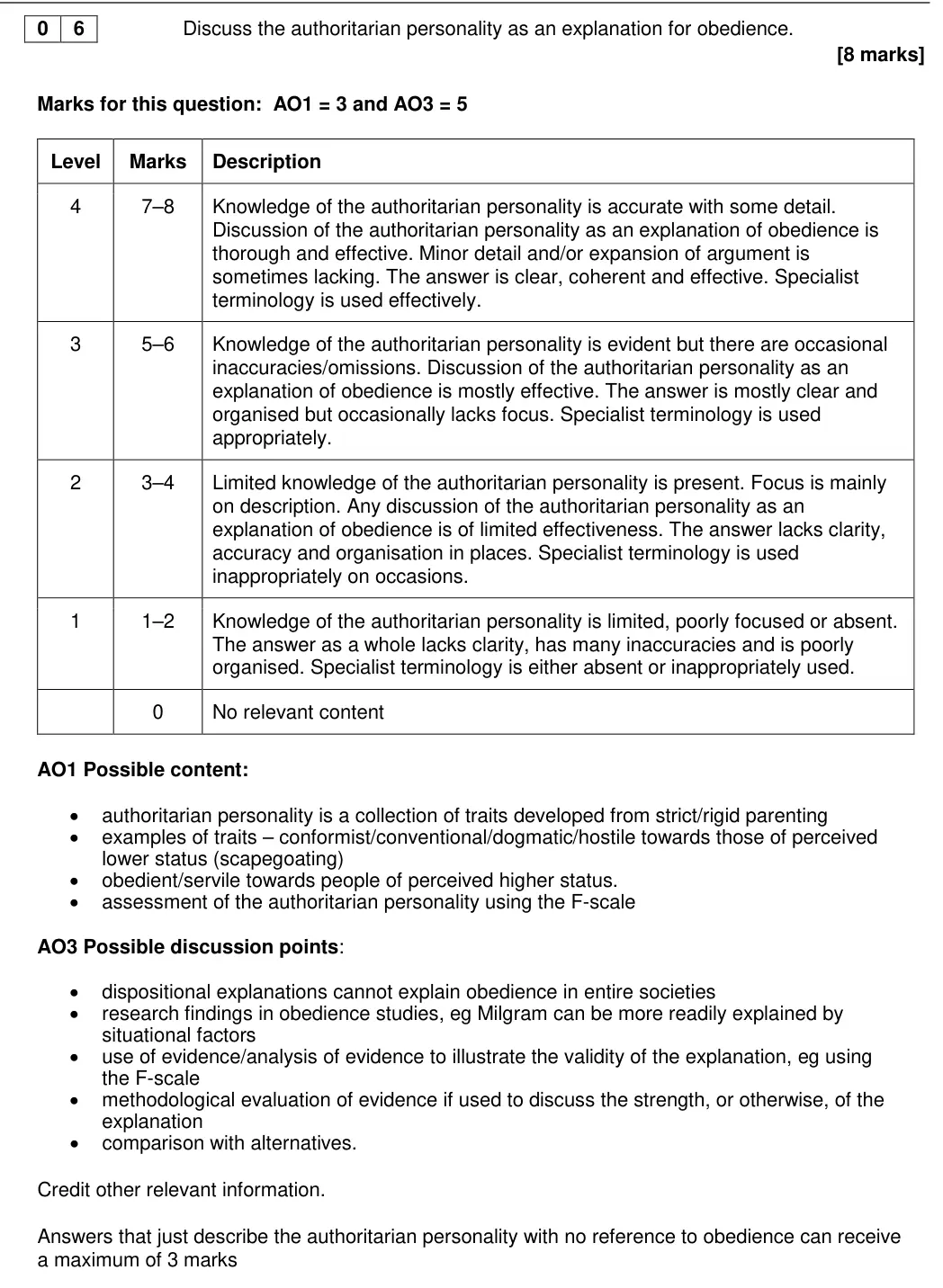
Although there were some impressive answers to this question the majority of students spent far too long providing extensive descriptions of the authoritarian personality (AP) and the background to Adorno’s work. The question required discussion of the AP as an explanation for obedience, not simply a description. Even when discussion was attempted, it was often unsuccessful; for instance, methodological issues with the F-scale only earned credit if linked to the discussion of the AP as an explanation for obedience. There were some effective references to the role of the AP in Milgram’s studies, while at the weaker end answers confused the AP with ‘legitimate authority’. Most common were general comments on the role of AP in Nazi Germany, a relevant issue but often presented with little detail or discussion; for instance this would have been an opportunity to introduce alternative explanations for obedience, but few students attempted this.
Notes from the mark scheme and report
describing the AP with no reference to obedience = max 3
most over-described Adorno's work
F-scale methodology only credited if linked to AP as an explanation of obedience
confusing AP with legitimate authority
June 2017 · Paper 1 · Q73 marksAO1=3Outline
Mark scheme, including level descriptors and indicative content
Examiner's comment
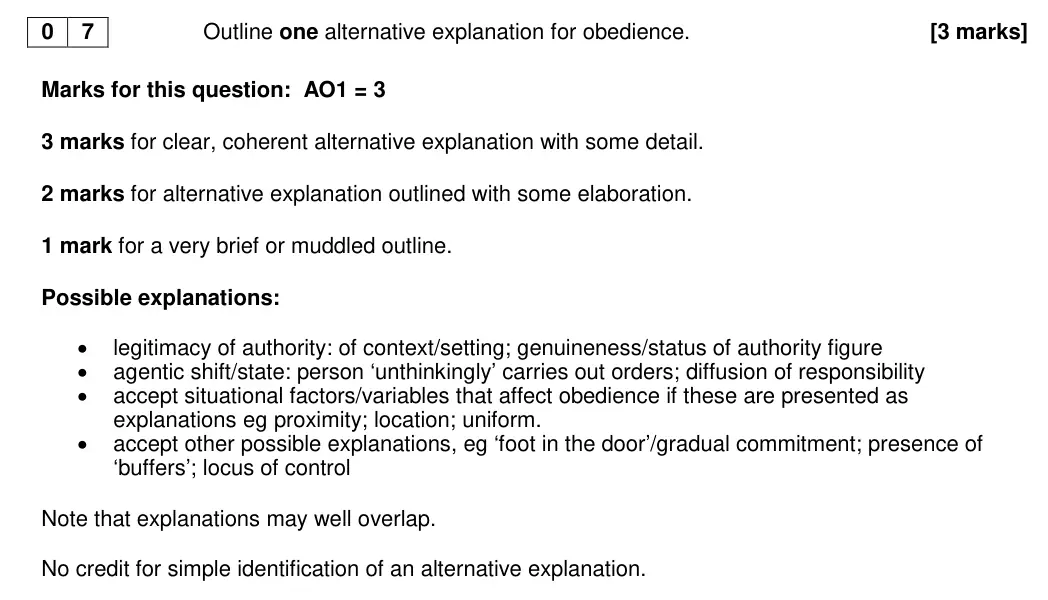
This was done reasonably well, with the agentic state being the most popular alternative. Some answers failed to include sufficient detail for full credit, but others covered the autonomous state and legitimate authority impressively. Reference to locus of control was creditworthy, but a number of answers reflected confusion over internal and external versus ‘high’ and ‘low’, and which would be more or less obedient.
Notes from the mark scheme and report
agentic state most popular
legitimacy of authority, situational variables presented as explanations, locus of control accepted
identification only = 0
confusion over internal/external locus of control
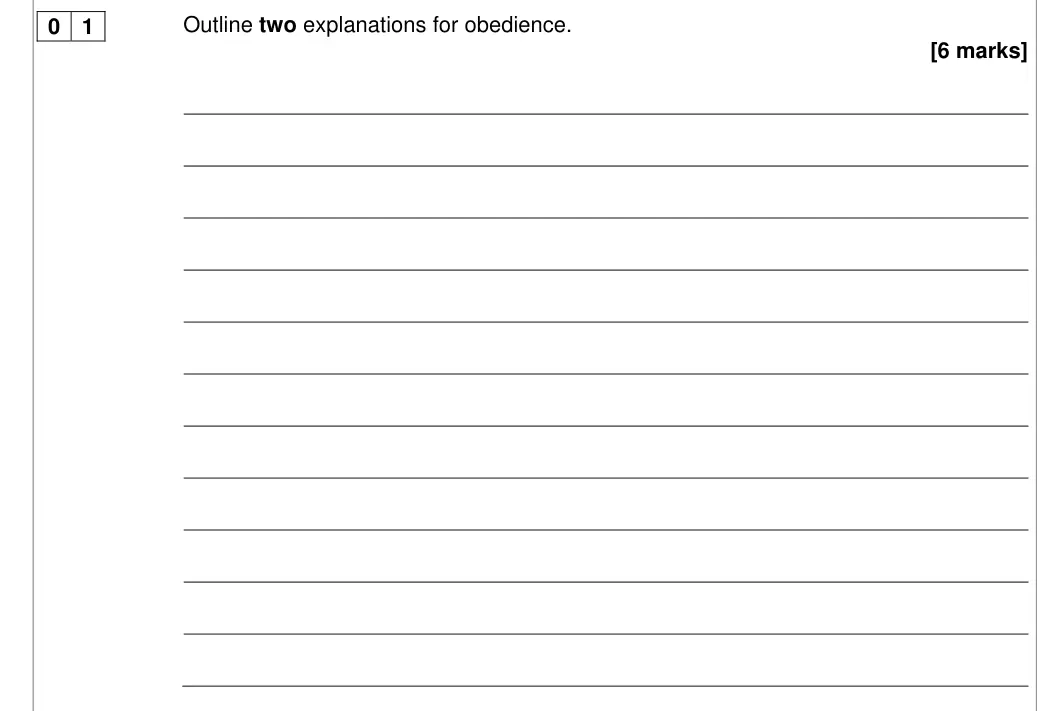
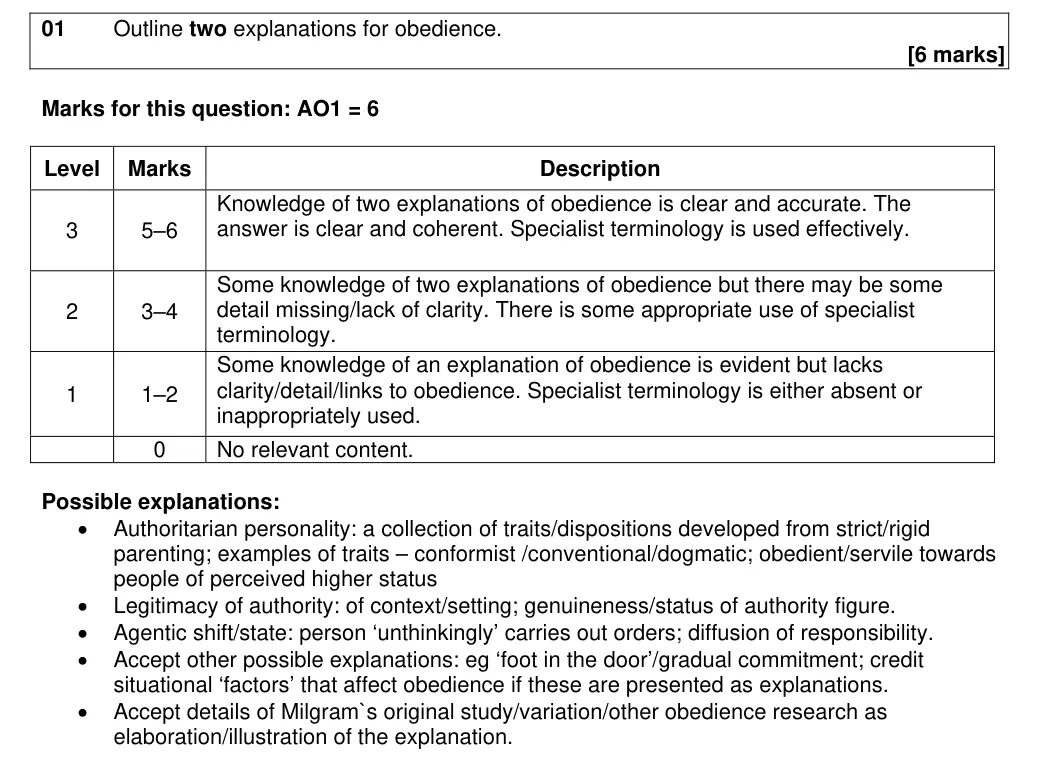
Specimen set 2 · Paper 1 · Q16 marksAO1=6Outline
Mark scheme, including level descriptors and indicative content
Notes from the mark scheme and report
e.g. authoritarian personality, legitimacy of authority, agentic state
gradual commitment and situational factors accepted if presented as explanations
Milgram research credited as elaboration
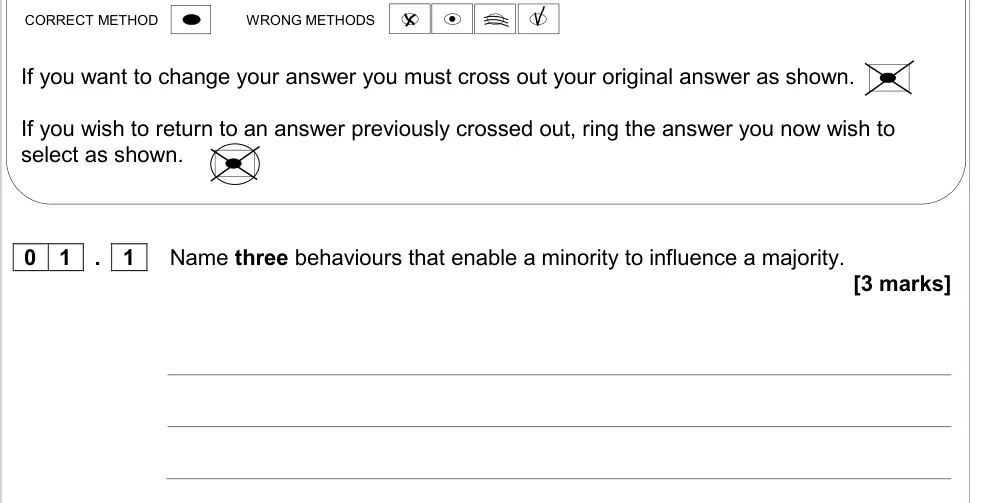
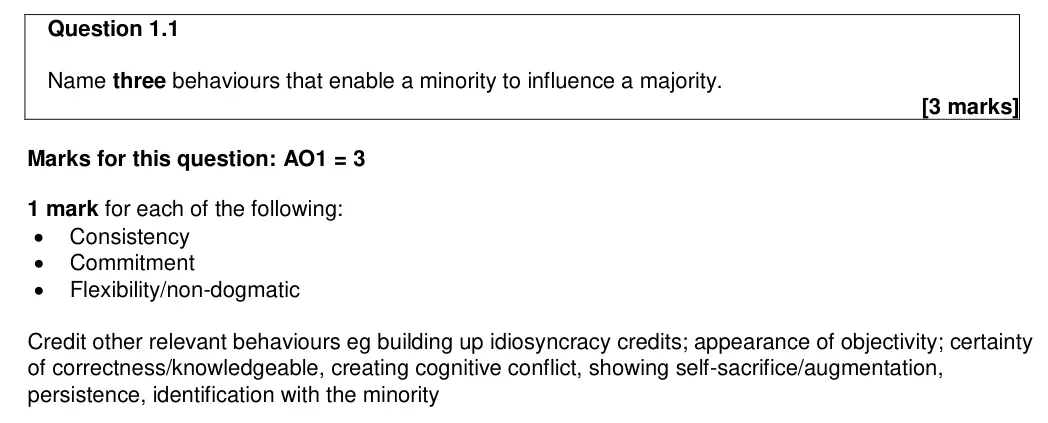
June 2016 · AS Paper 1 · Q1.13 marksAO1=3Short answer
Mark scheme, including level descriptors and indicative content
Examiner's comment
Question 01.1 Many students were able to name three relevant behaviours, and although most chose to use those named on the specification, other legitimate behaviours, such as self-sacrifice, were credited. Some students presented broader concepts related to minority influence, eg the snowball effect, which were not credited as they are not ways of behaving that could be demonstrated by a minority wishing to influence a majority.
Notes from the mark scheme and report
consistency, commitment, flexibility
other behaviours credited (e.g. self-sacrifice)
broader concepts such as the snowball effect not credited
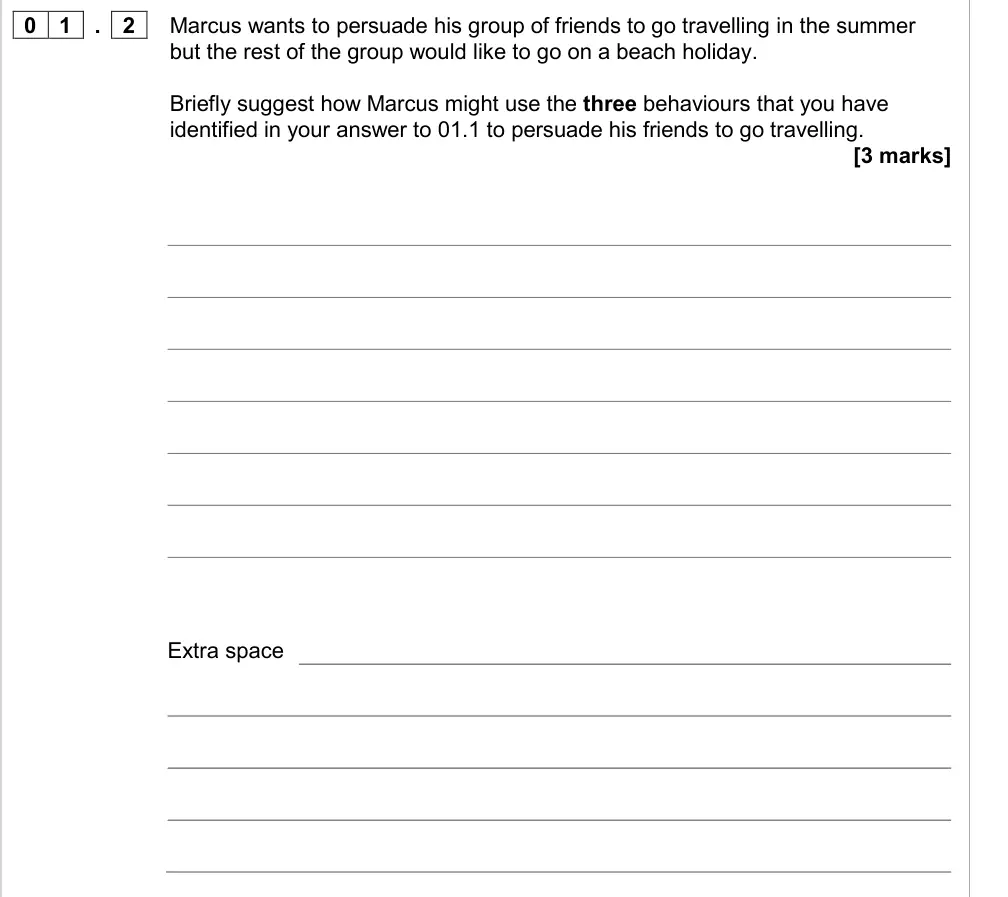
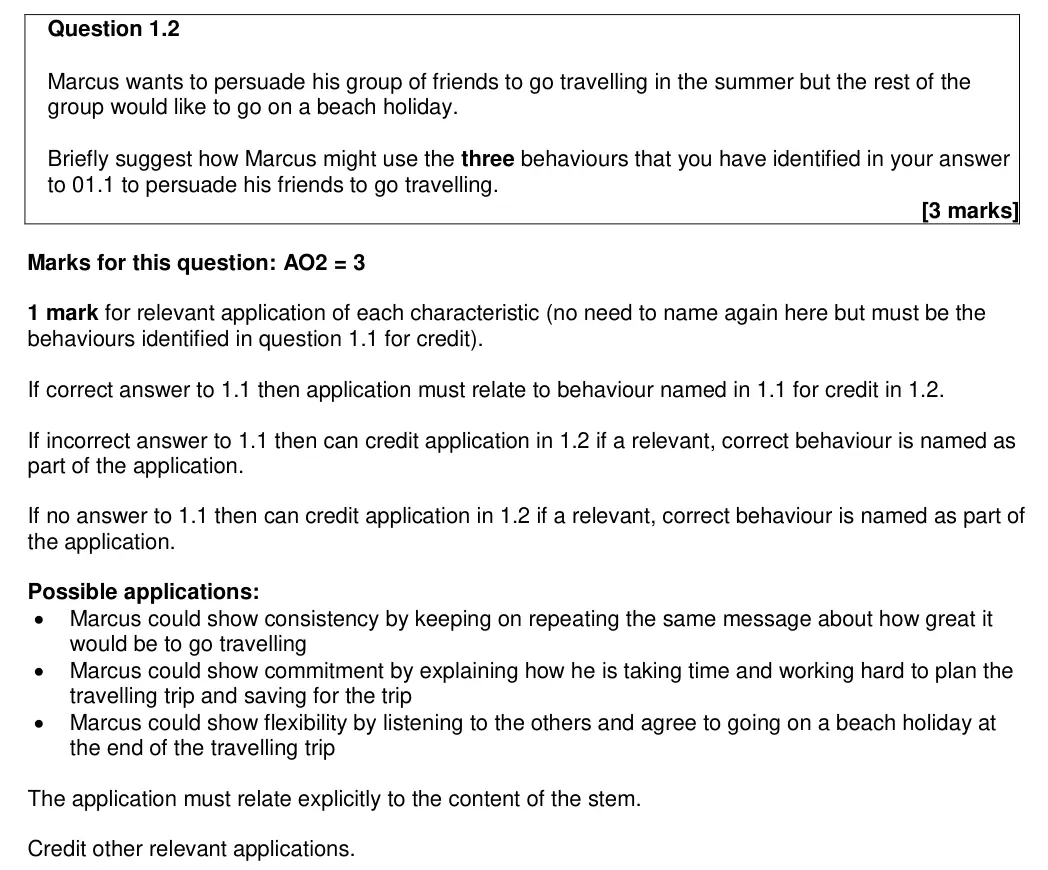
June 2016 · AS Paper 1 · Q1.23 marksAO2=3Application
Mark scheme, including level descriptors and indicative content
Examiner's comment
Questions that tended to differentiate best were questions 1.2, 3, 8, 11 and 12. This question was answered with varying degrees of success. Many students simply embellished or elaborated their answer to 1.1, typically stating that ‘Marcus should show consistency by being consistent in his point of view.’ Better responses explained clearly what Marcus could do to show his consistency in a practical sense, for example, ‘He would repeat to his friends over and over how good it would be to go travelling.’ Of the three behaviours, applications that were most successful tended to be those explaining how Marcus would show flexibility. Some students chose to illustrate commitment by offering implausible and probably ineffective suggestions, for example, that Marcus could go on hunger strike or refuse to speak to his friends to persuade them to go travelling.
Notes from the mark scheme and report
application must relate explicitly to Marcus and the travelling scenario and to the behaviours named in 01.1
many just restated 01.1 ('be consistent by being consistent')
implausible commitment examples (hunger strike)
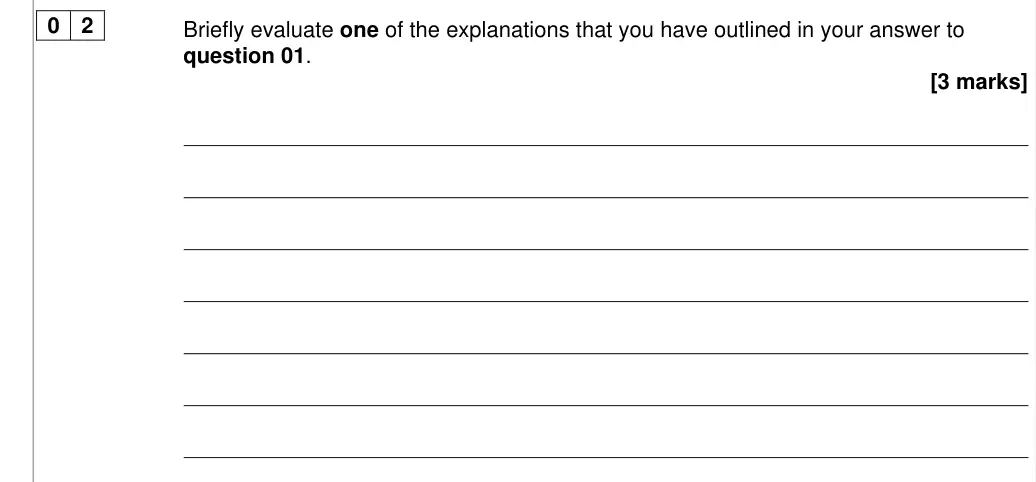
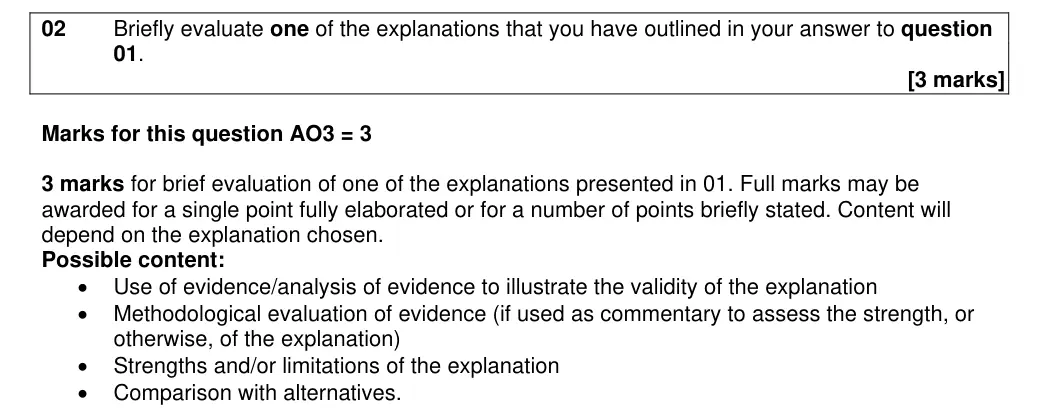
Specimen set 2 · Paper 1 · Q23 marksAO3=3Evaluate (short)
Mark scheme, including level descriptors and indicative content
Notes from the mark scheme and report
evaluation of one explanation from 01: evidence, methodology only as commentary on the explanation, strengths/limitations, comparison
one elaborated point or several brief points
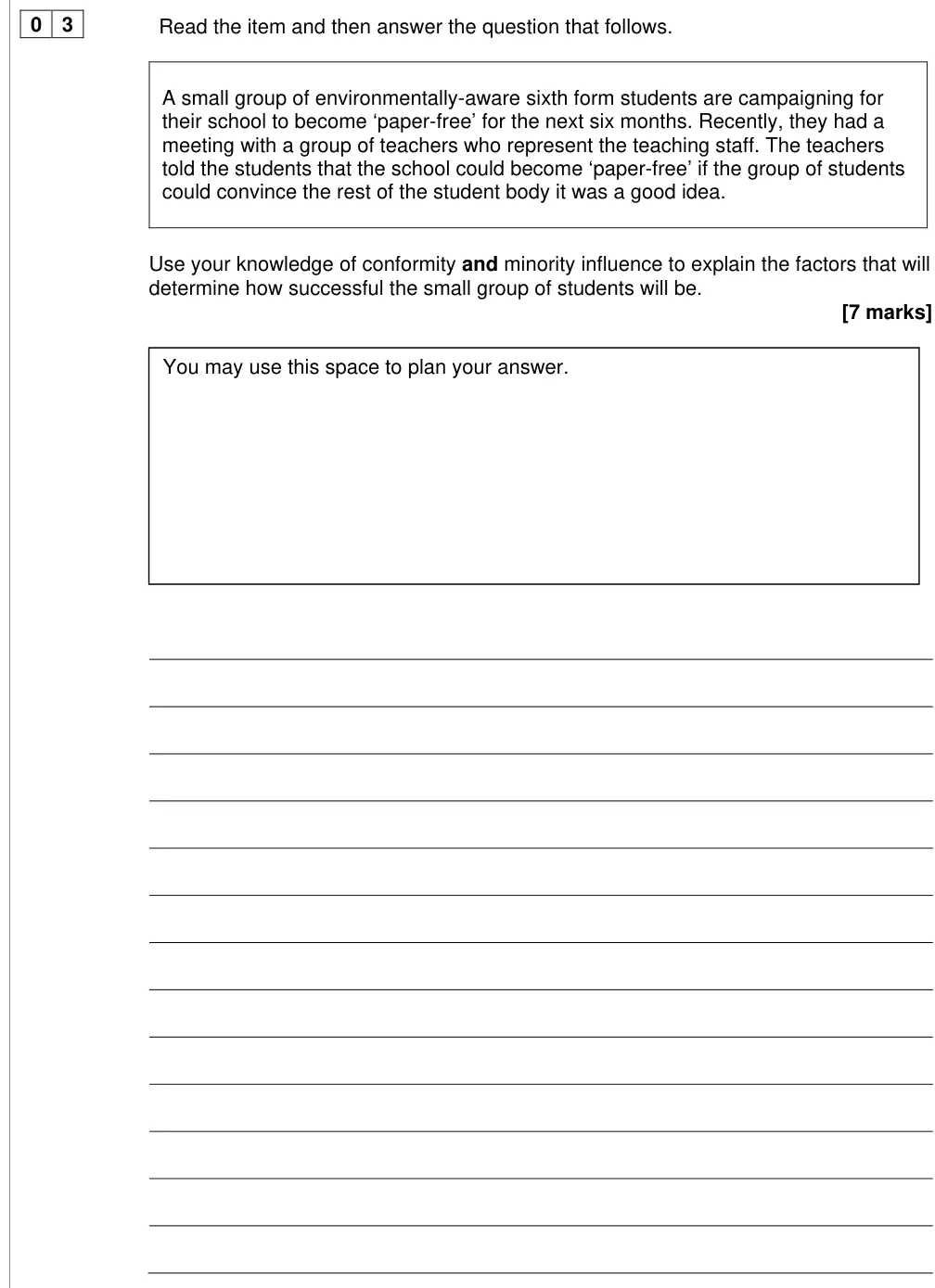
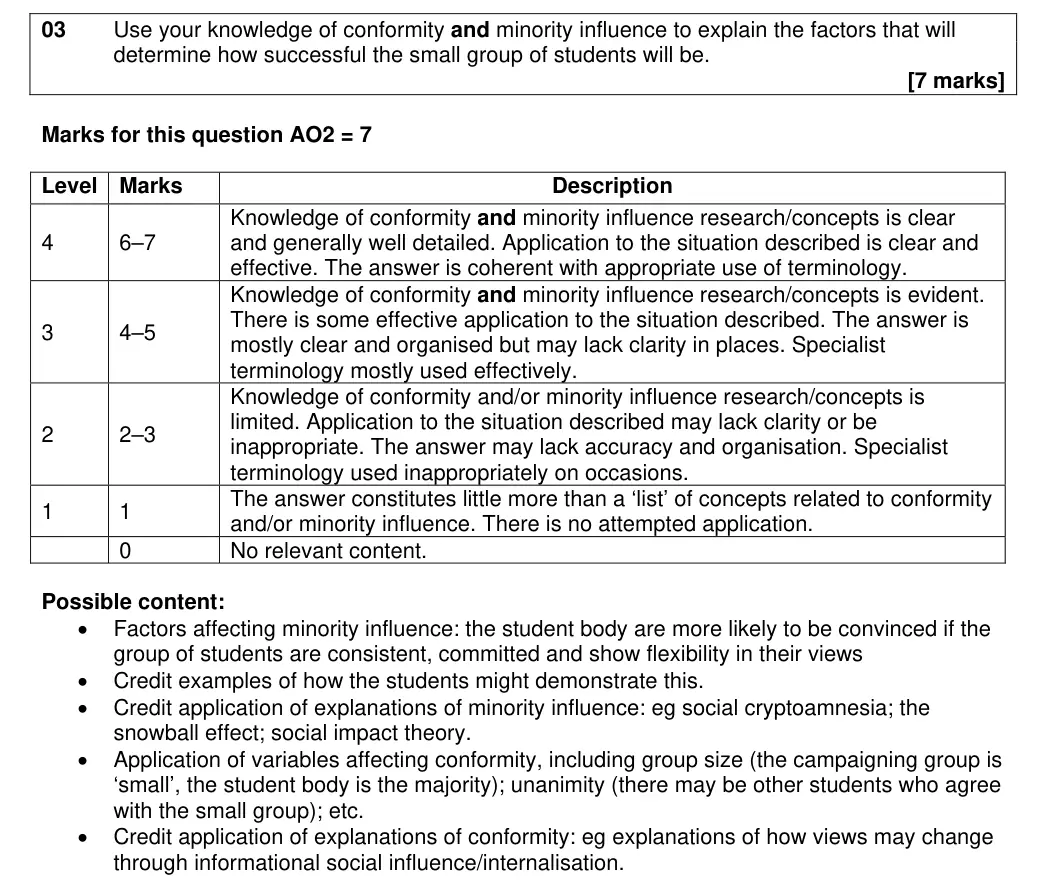
Specimen set 2 · Paper 1 · Q37 marksAO2=7Application
Mark scheme, including level descriptors and indicative content
Notes from the mark scheme and report
consistency, commitment, flexibility applied to the campaigning students
group size and unanimity, informational social influence/internalisation
a list of concepts with no application = 1 mark
MS also credits social cryptomnesia/snowball effect (social change), removed in v1.4
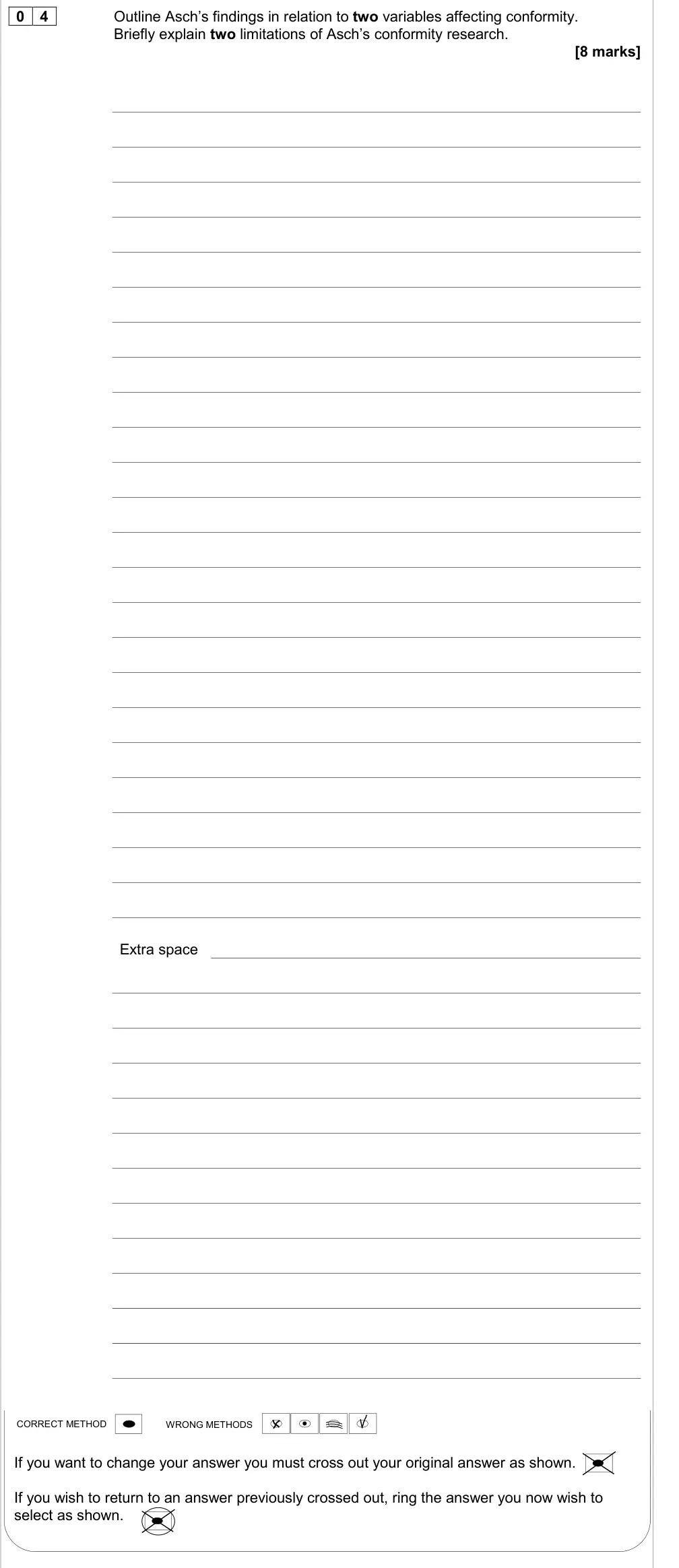
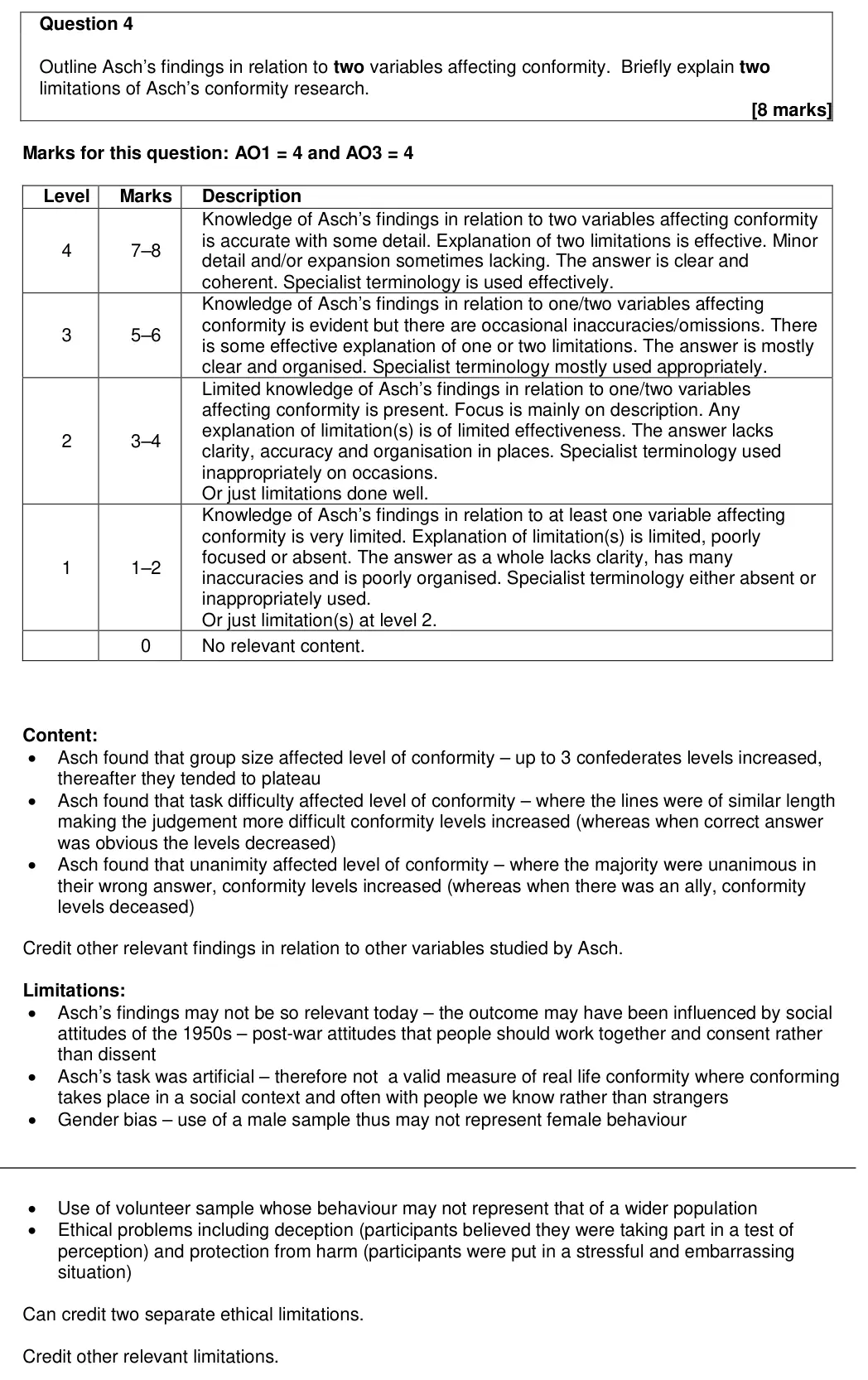
June 2016 · AS Paper 1 · Q48 marksAO1=4, AO3=4Extended writing
Mark scheme, including level descriptors and indicative content
Examiner's comment
Many students started their response with a detailed and unnecessary description of Asch’s original study, before eventually getting round to describing Asch’s variations in answer to the question. Group size, unanimity and task difficulty were the most common variables presented. Some students evidently misunderstood the term ‘variables’ in the question, incorrectly assuming that this was a reference to informational and normative social influence. Although the question clearly required an outline rather than a discussion, some students wasted time explaining possible reasons for increased or decreased conformity in variations of the study. The limitations tended to be sensible although they were not always sufficiently elaborated or explained. Completely generic limitations were not creditworthy. Sometimes limitations were conflated, for example, when discussing the time bound nature of Asch’s findings some students offered Perrin and Spencer’s alternative findings as an elaboration, apparently failing to realise that this research better illustrates the problem of the combined effect of individual differences in competence and the nature of the task in Asch’s findings.
Notes from the mark scheme and report
findings for two variables (group size, unanimity, task difficulty) + two explained limitations
unnecessary description of the baseline study
some misread 'variables' as ISI/NSI
generic limitations not credited
Specimen set 2 · Paper 1 · Q44 marksAO1=4OutlineOld spec only
Mark scheme, including level descriptors and indicative content
Notes from the mark scheme and report
(procedures and findings of Zimbardo's Stanford prison study
conformity to social roles removed in v1.4)
procedures without findings or vice versa = max 2
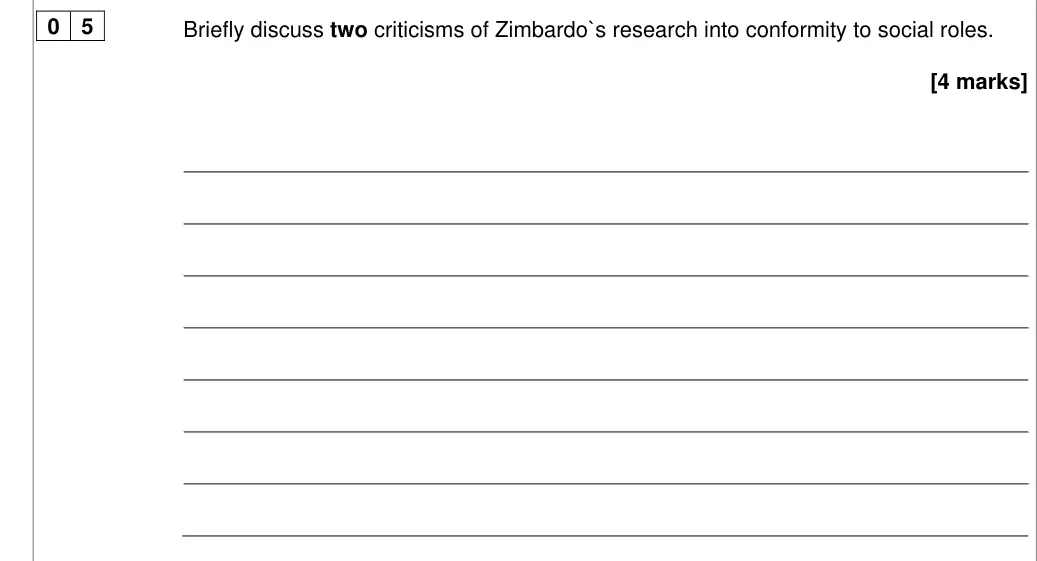
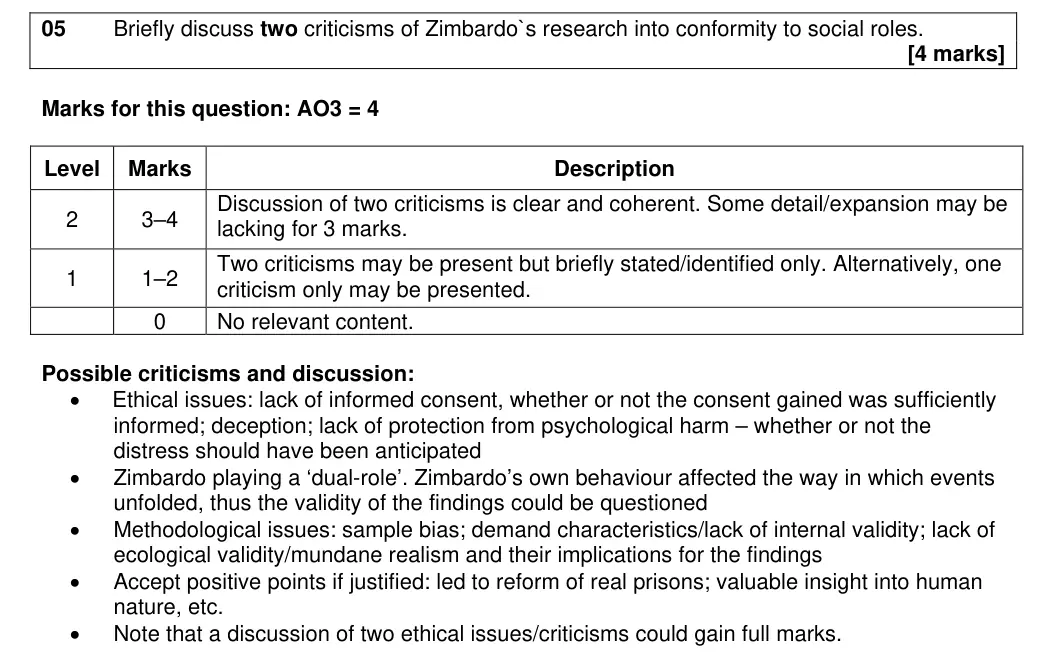
Specimen set 2 · Paper 1 · Q54 marksAO3=4Evaluate (short)Old spec only
Not on the 2025 specification: criticisms of Zimbardo's research into conformity to social roles, removed in v1.4
Mark scheme, including level descriptors and indicative content
Notes from the mark scheme and report
Off-spec: criticisms of Zimbardo's research into conformity to social roles, removed in v1.4
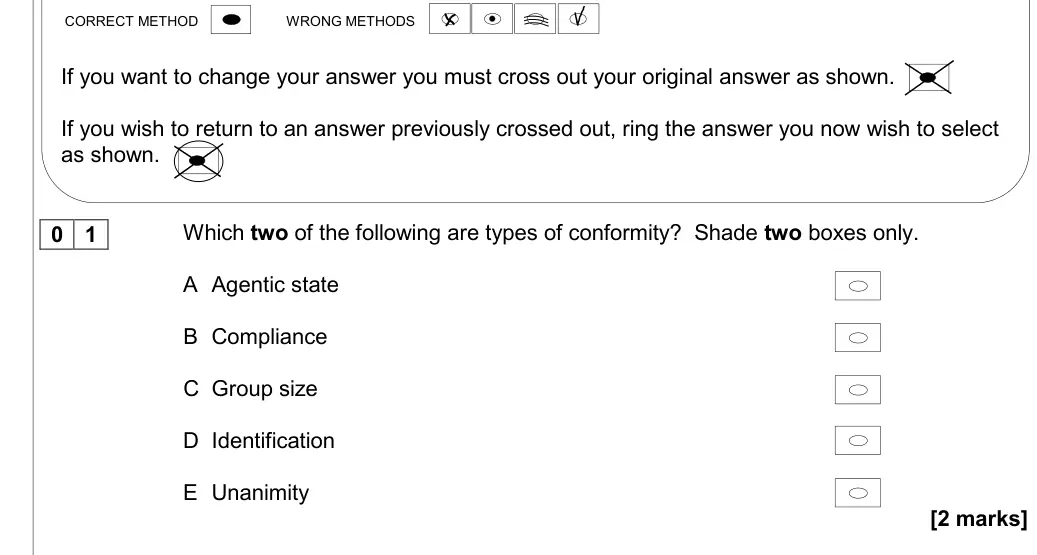
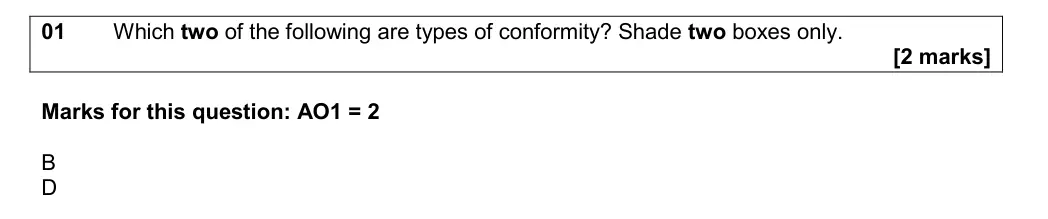
Specimen set 1 · AS Paper 1 · Q12 marksAO1=2Multiple choiceOld spec only
Answer
B and D
Mark scheme, including level descriptors and indicative content
Notes from the mark scheme and report
(correct answer D 'identification' as a type of conformity was removed in v1.4
B compliance still current)
distractors agentic state (obedience), group size and unanimity (variables affecting conformity)
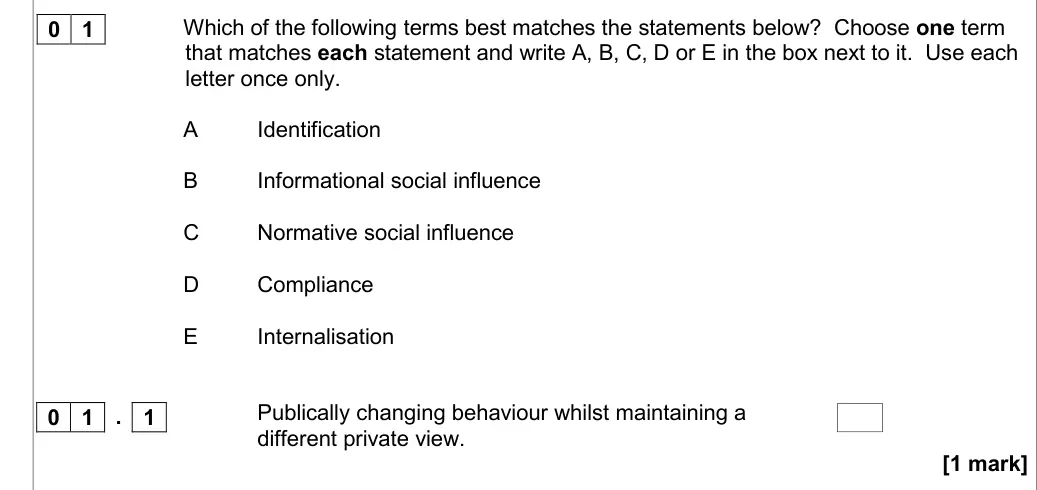
Specimen set 1 · Paper 1 · Q1.11 markMultiple choice
Answer
D
Mark scheme, including level descriptors and indicative content
Notes from the mark scheme and report
answer D (compliance)
each letter used once
option A identification removed in v1.4
Specimen set 1 · Paper 1 · Q1.21 markMultiple choice
Answer
C
Mark scheme, including level descriptors and indicative content
Notes from the mark scheme and report
answer C (normative social influence)
option A identification removed in v1.4
Specimen set 1 · Paper 1 · Q1.31 markMultiple choice
Answer
B
Mark scheme, including level descriptors and indicative content
Notes from the mark scheme and report
answer B (informational social influence)
option A identification removed in v1.4
Specimen set 1 · Paper 1 · Q1.41 markMultiple choiceOld spec only
Not on the 2025 specification: answer A, identification as a type of conformity, removed in v1.4
Answer
A
Mark scheme, including level descriptors and indicative content
Notes from the mark scheme and report
Off-spec: answer A, identification as a type of conformity, removed in v1.4
Specimen set 1 · AS Paper 1 · Q24 marksAO1=2, AO3=2Evaluate (short)
Mark scheme, including level descriptors and indicative content
Notes from the mark scheme and report
outline must link authoritarian personality traits to obedience
evaluation e.g. situational factors (Milgram proximity), cause/effect problems, cannot explain obedience of whole societies, F-scale
either outline or evaluation done well = max Level 1
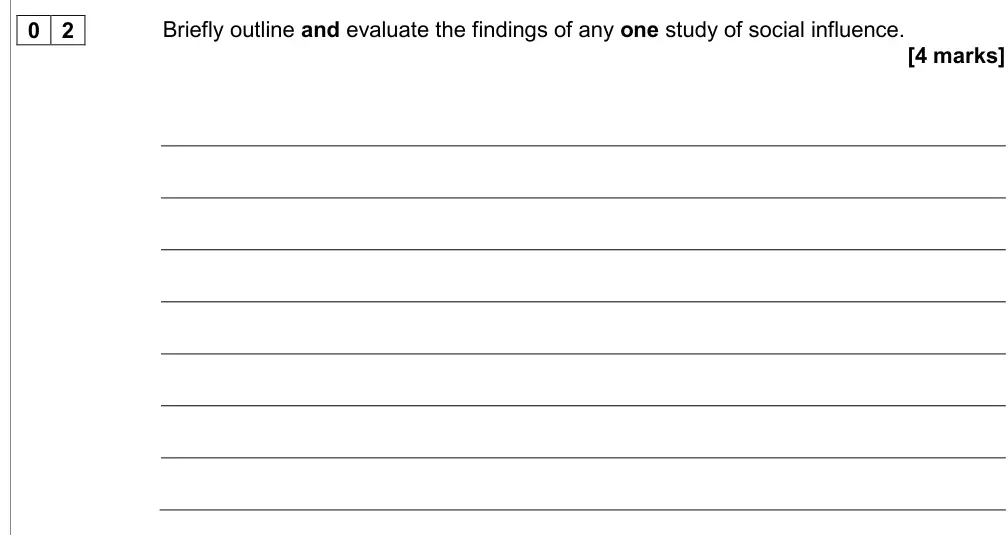
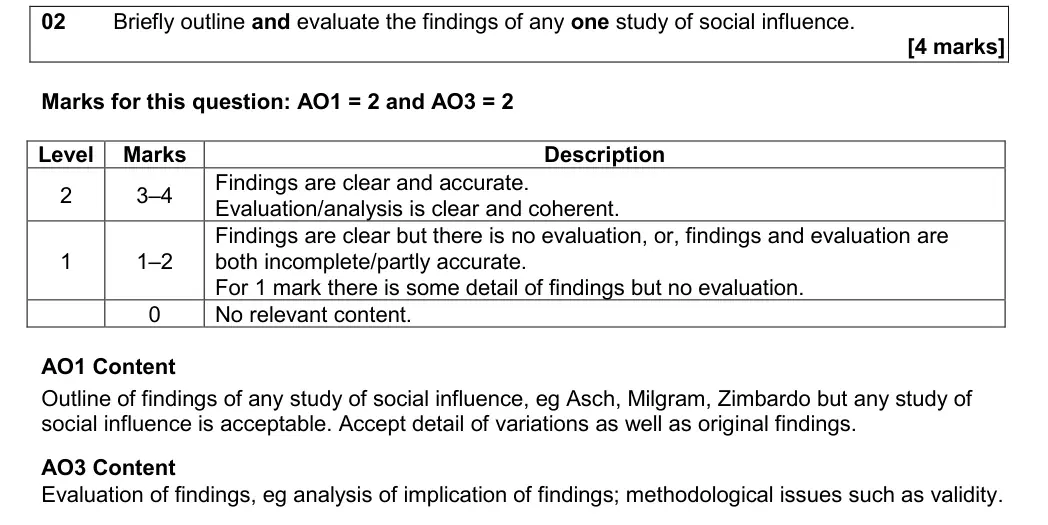
Specimen set 1 · Paper 1 · Q24 marksAO1=2, AO3=2Evaluate (short)
Mark scheme, including level descriptors and indicative content
Notes from the mark scheme and report
findings (not procedure) of any one social influence study, e.g. Asch or Milgram, variations accepted
findings without evaluation = max 2
MS also credits Zimbardo, removed in v1.4
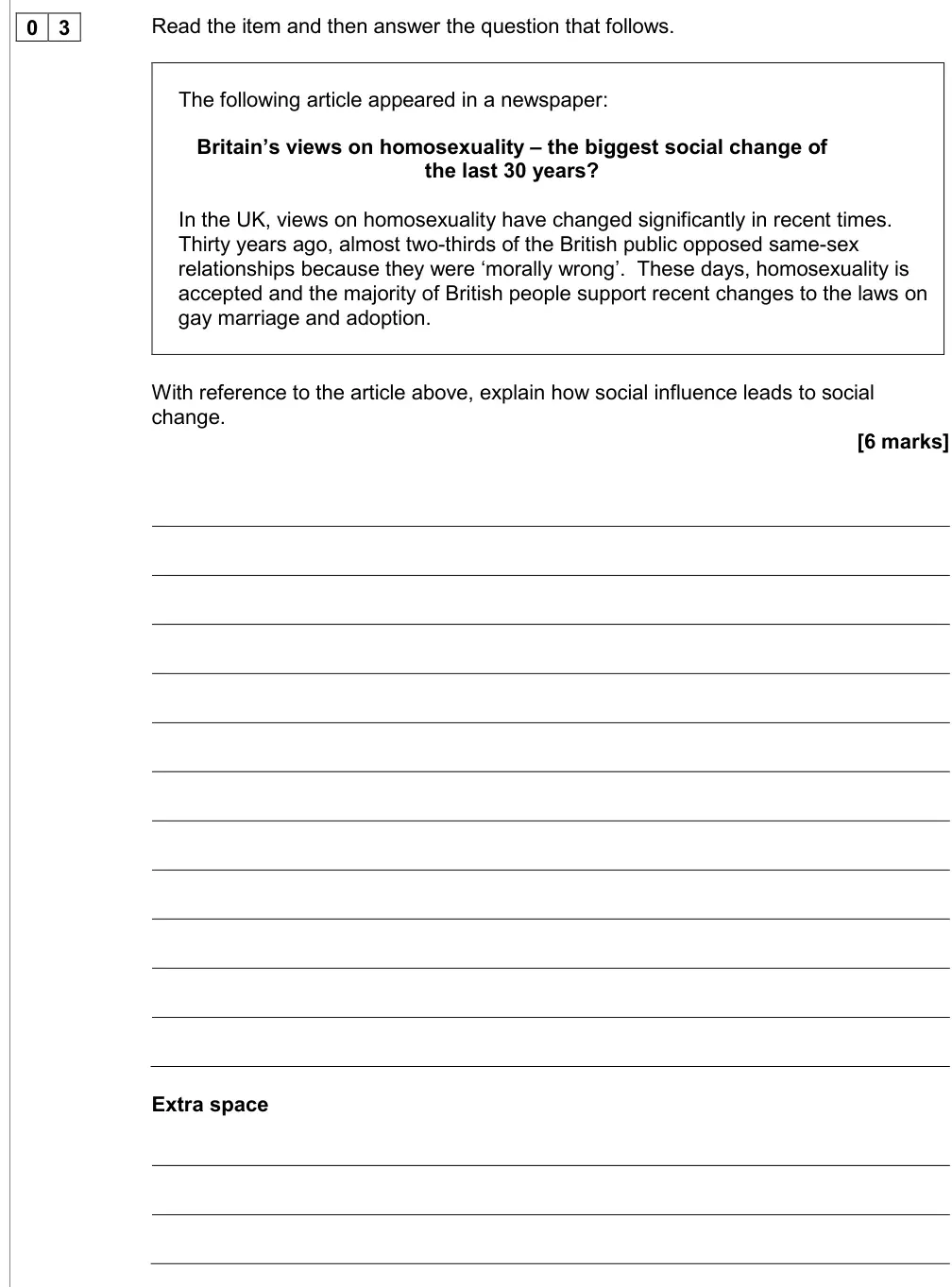
Specimen set 1 · AS Paper 1 · Q36 marksAO2=6ApplicationOld spec only
Not on the 2025 specification: role of social influence processes in social change, removed in v1.4
Mark scheme, including level descriptors and indicative content
Notes from the mark scheme and report
Off-spec: role of social influence processes in social change, removed in v1.4
MS credits minority influence (consistency, commitment, flexibility), ISI/internalisation, snowball effect, social cryptomnesia applied to changing views on homosexuality
all marks AO2 so application to the article is essential
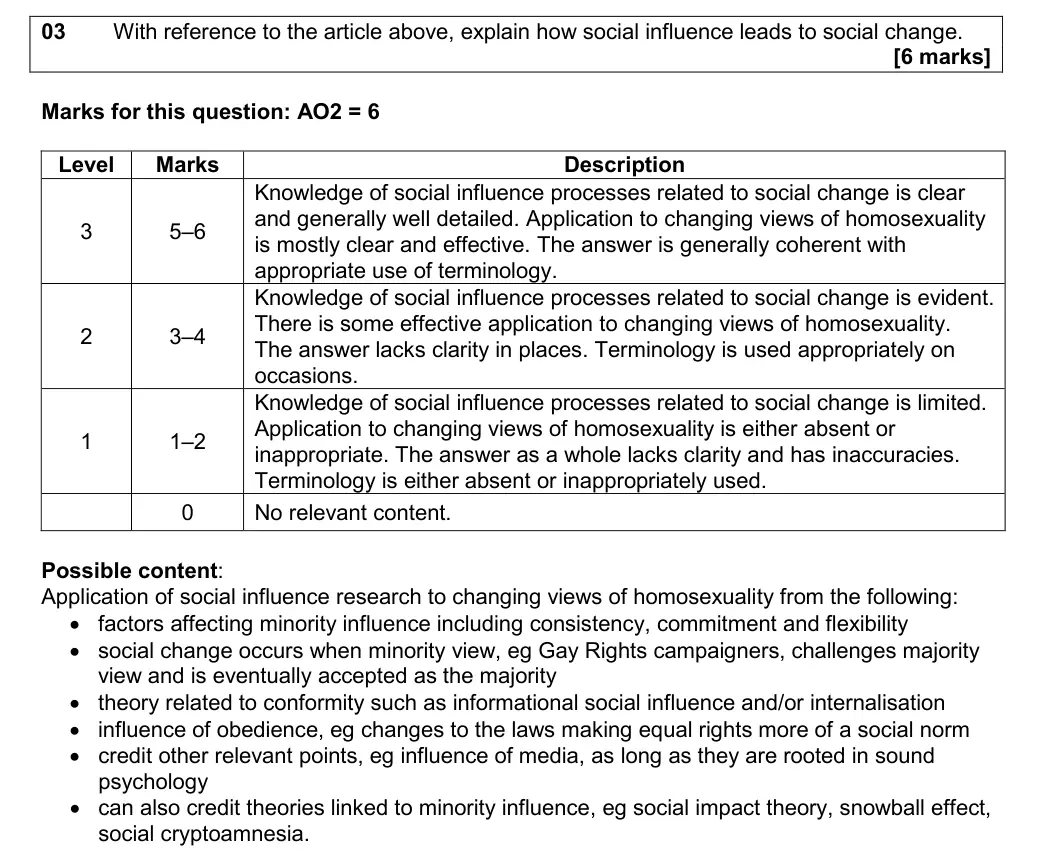
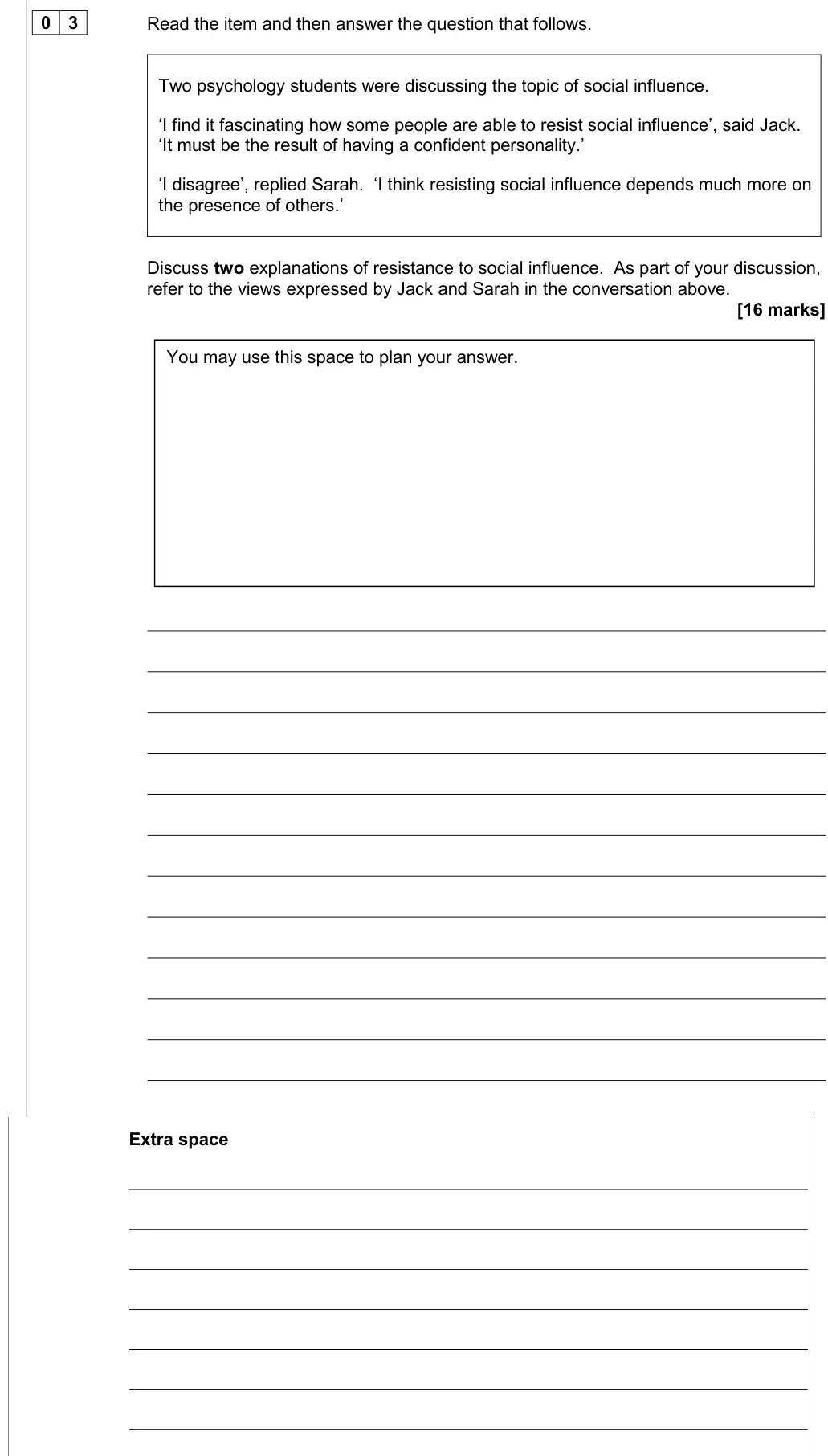
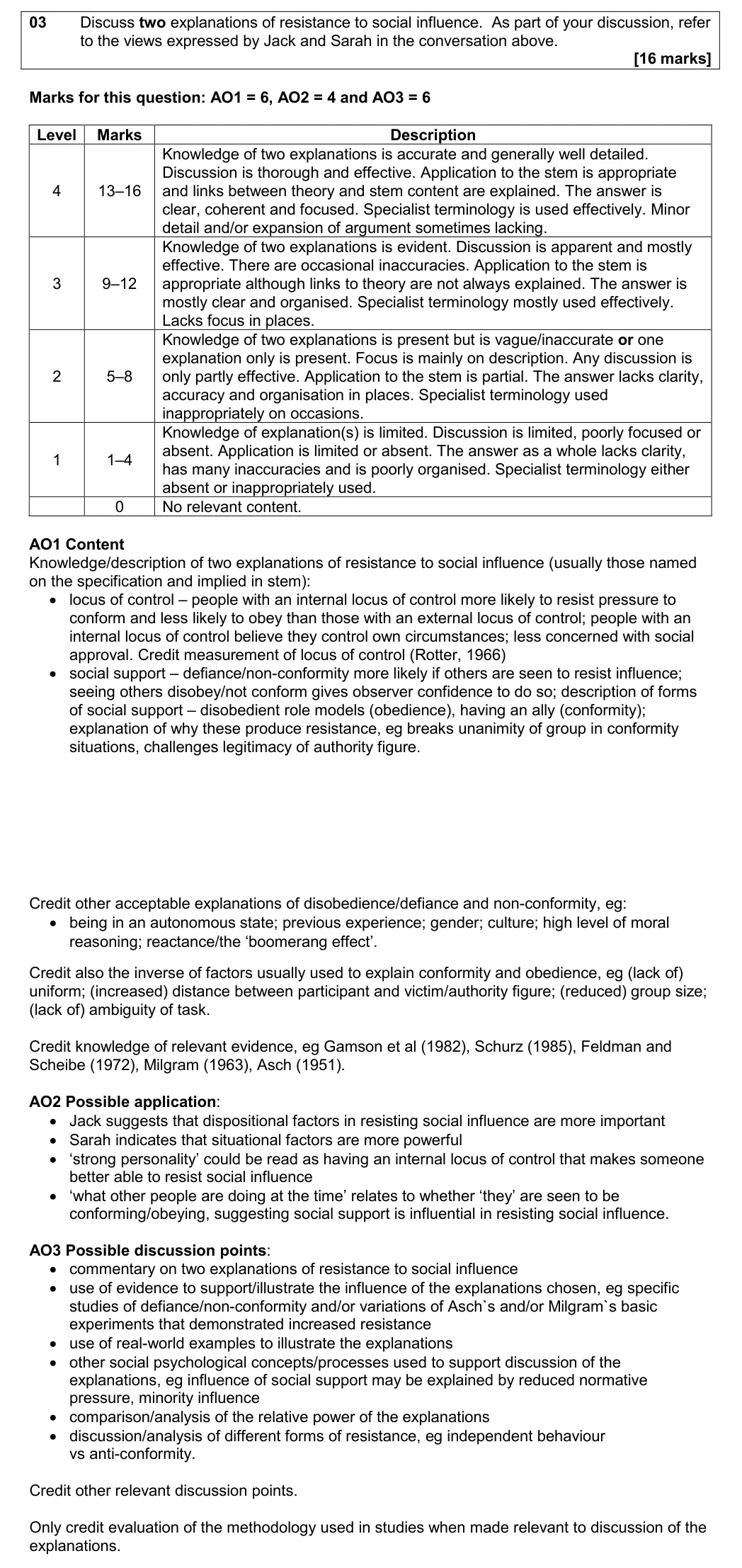
Specimen set 1 · Paper 1 · Q316 marksAO1=6, AO2=4, AO3=616-mark essay
Mark scheme, including level descriptors and indicative content
Notes from the mark scheme and report
two explanations, usually locus of control (Jack: dispositional) and social support (Sarah: situational)
one explanation only = max Level 2
other explanations credited (autonomous state, inverse of Milgram/Asch variables)
methodology only credited if linked to the explanations
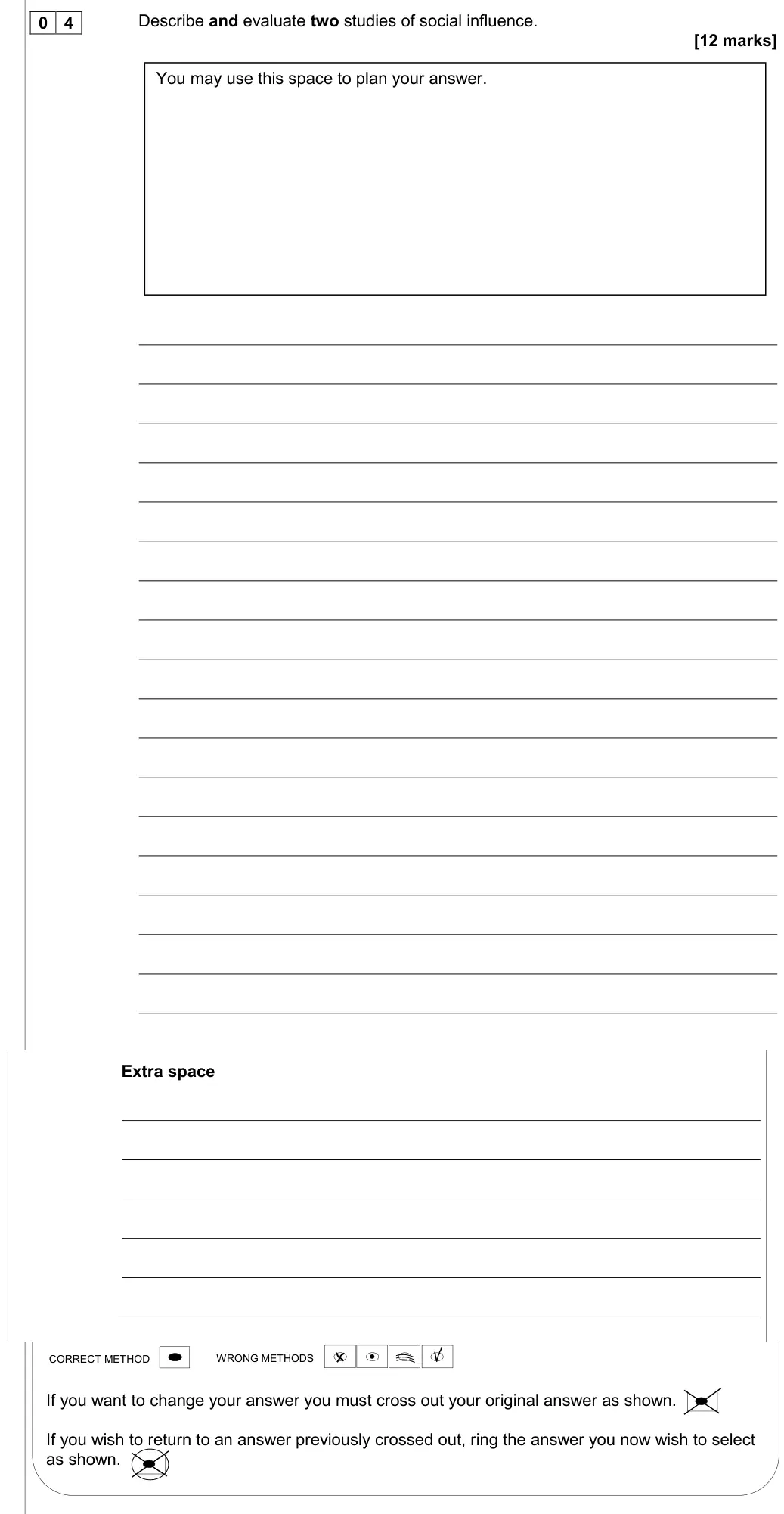
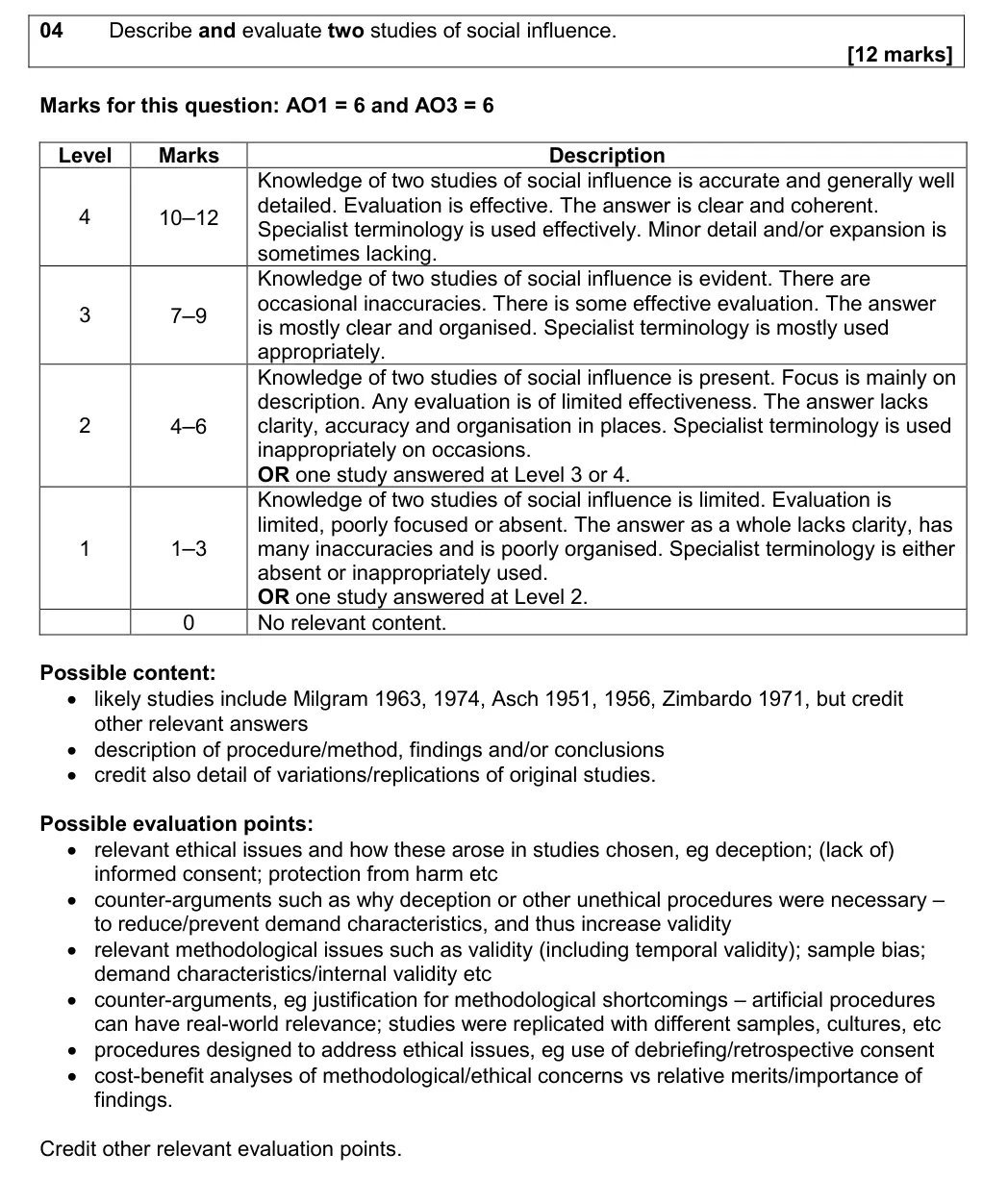
Specimen set 1 · AS Paper 1 · Q412 marksAO1=6, AO3=6Extended writing
Mark scheme, including level descriptors and indicative content
Notes from the mark scheme and report
two studies needed
one study only = max Level 2 (if Level 3/4 quality)
likely Milgram and Asch
MS also credits Zimbardo (conformity to social roles, removed in v1.4)
evaluation via ethical and methodological issues of the chosen studies
Work with an AQA psychology tutor
Essays not reaching the top band? Book a session with Andy, a former AQA examiner.