4.1.2-01 The multi-store model of memory: sensory register, short-term memory and long-term memory. Features of each store: coding, capacity and duration.AS
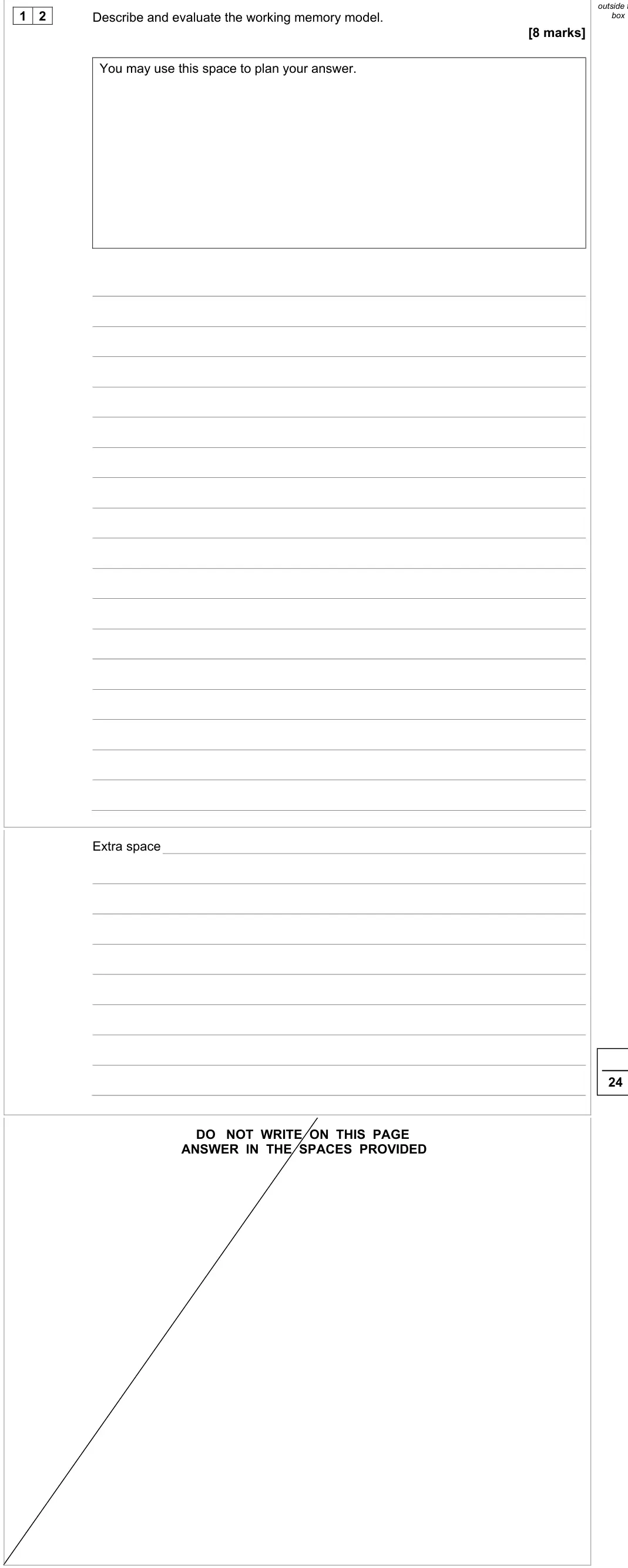
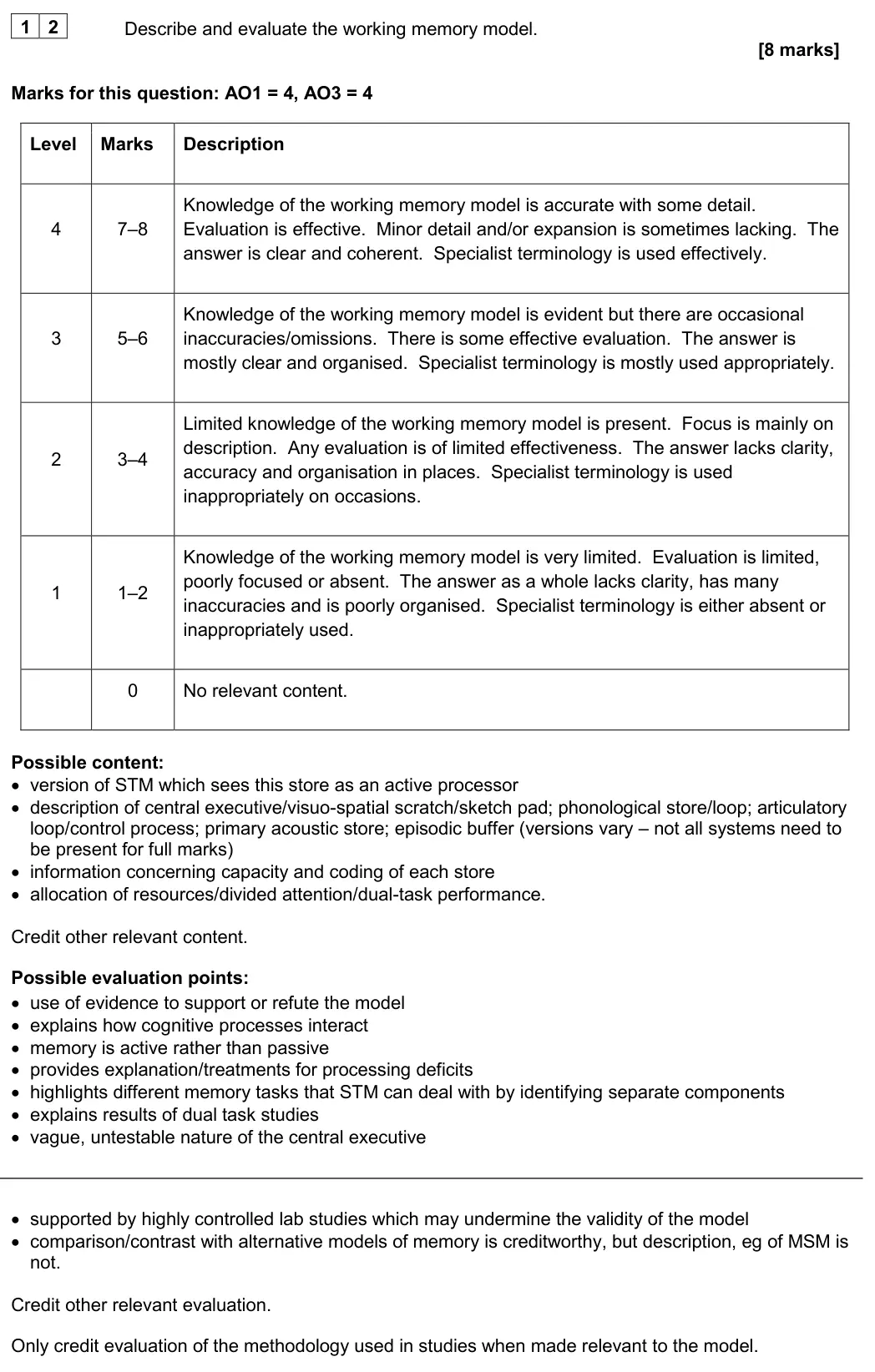
4.1.2-02 The working memory model: central executive, phonological loop, visuo-spatial sketchpad and episodic buffer. Features of the model: coding and capacity.AS
4.1.2-03 Explanations for forgetting: proactive and retroactive interference and retrieval failure due to absence of cues.AS
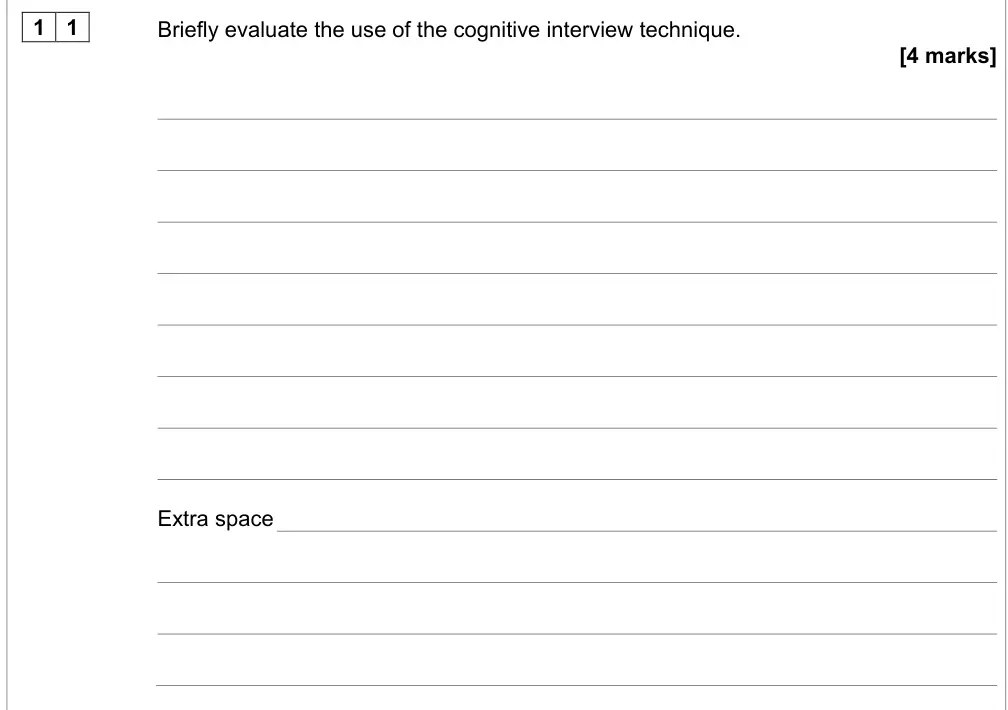
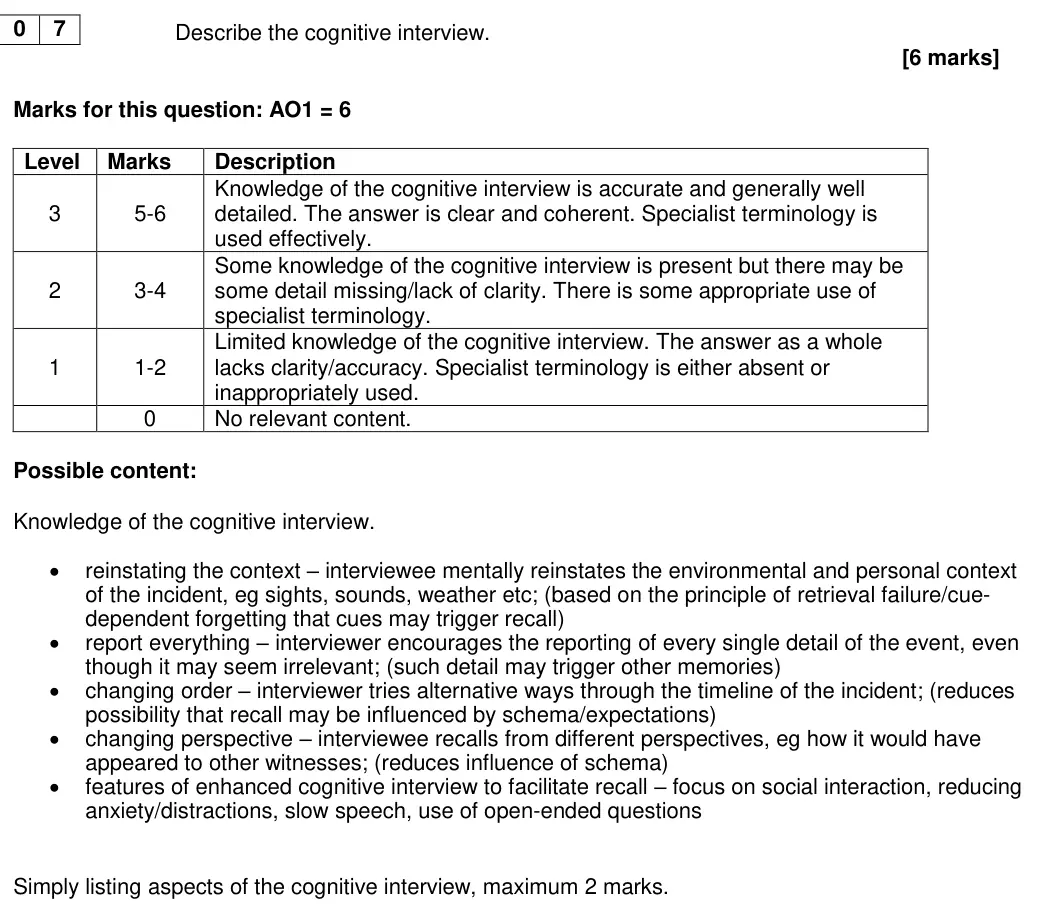
4.1.2-04 Factors affecting the accuracy of eyewitness testimony: leading questions, post-event discussion, and anxiety; the use of the cognitive interview.AS
Tap a question to zoom it. Mark scheme and examiner's comment open under each question.
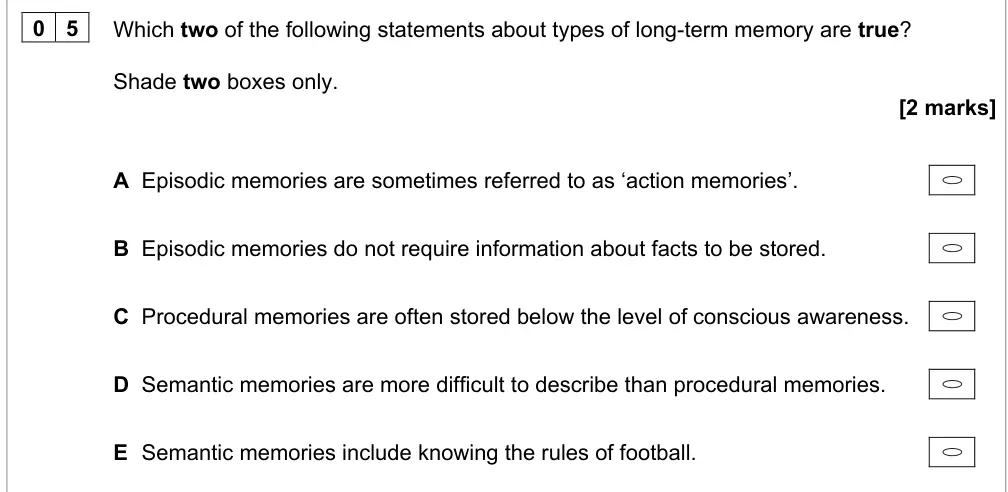
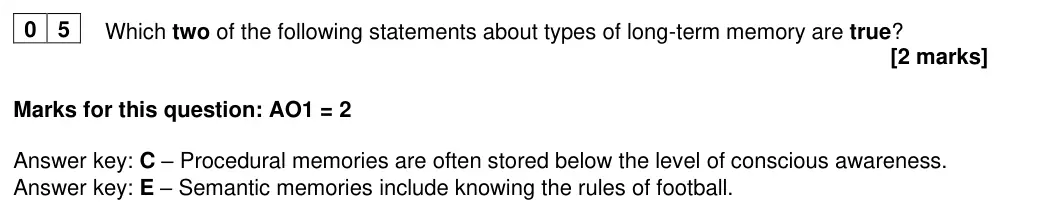
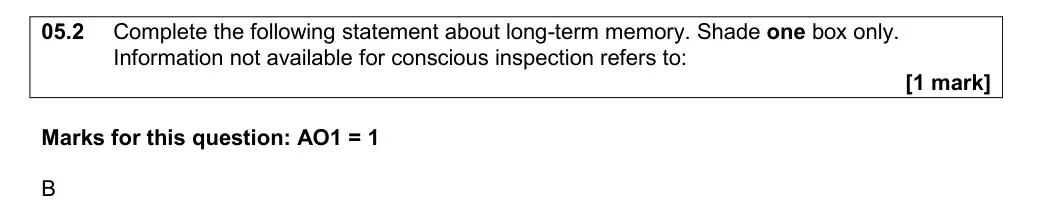
June 2025 · Paper 1 · Q52 marksAO1=2Multiple choiceEasyOld spec only
Not on the 2025 specification: types of long-term memory: episodic, semantic, procedural, removed in v1.4
Mark scheme, including level descriptors and indicative content
Examiner's comment
Students performed well in this multiple-choice question on types of long-term memory. Over 50% of students scored full marks, with an overall average of 1.47 for this question.
Notes from the mark scheme and report
Off-spec: types of long-term memory: episodic, semantic, procedural, removed in v1.4
correct C (procedural below conscious awareness) and E (semantic includes rules of football)
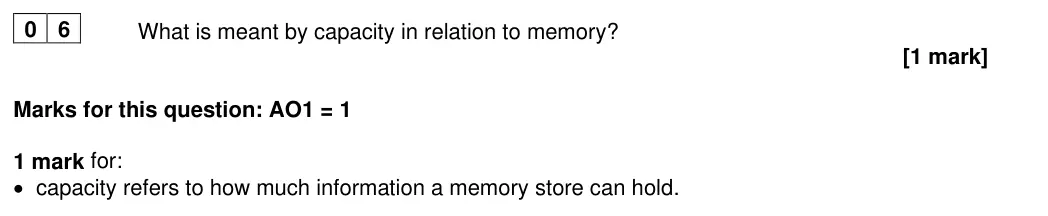
June 2025 · AS Paper 1 · Q61 markAO1=1Short answerEasy
Mark scheme, including level descriptors and indicative content
Examiner's comment
This question worth one mark was easily accessible and answered very well, with over 90% of students achieving the mark. Only a handful of students did not attempt the question. A few students gave an answer that lacked clarity e.g. ‘how the information is stored’ which might also refer to coding rather than capacity of memory. Students need to ensure that their definitions of specialist terms are clear.
Notes from the mark scheme and report
how much information a store can hold
'how information is stored' confused with coding
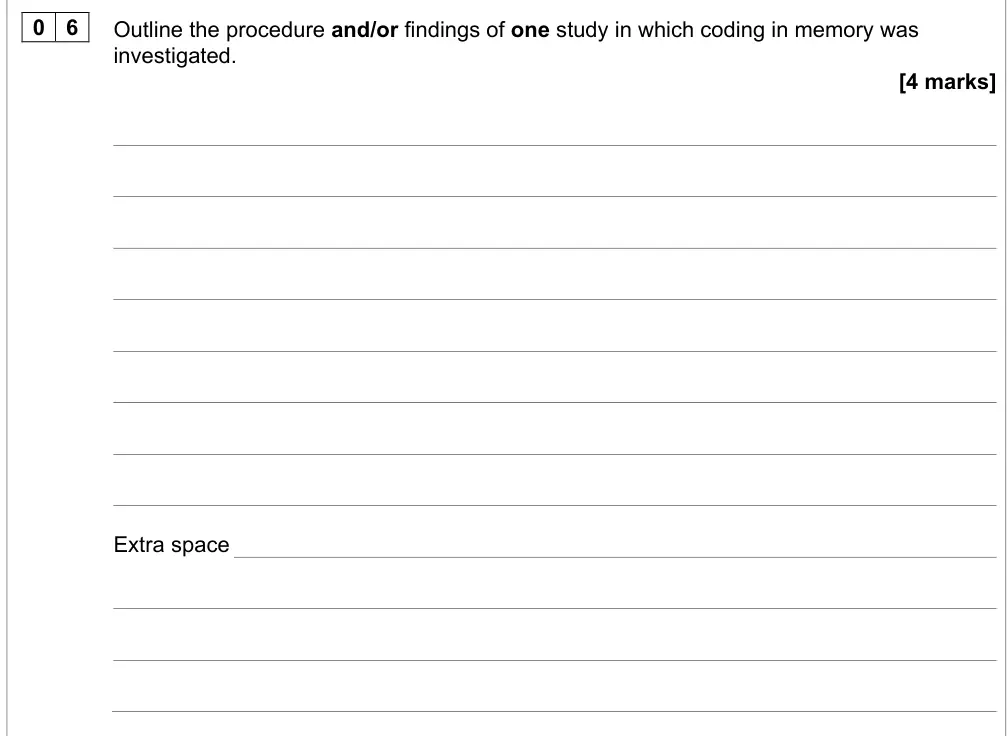
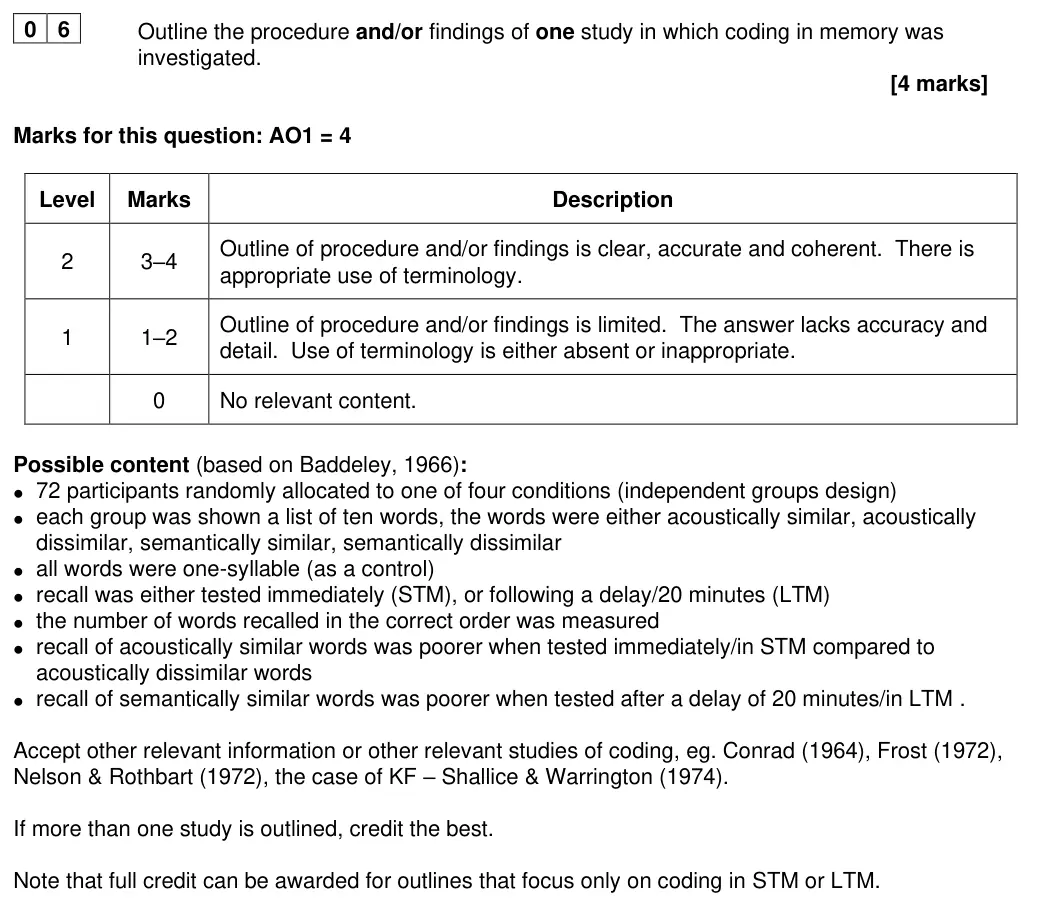
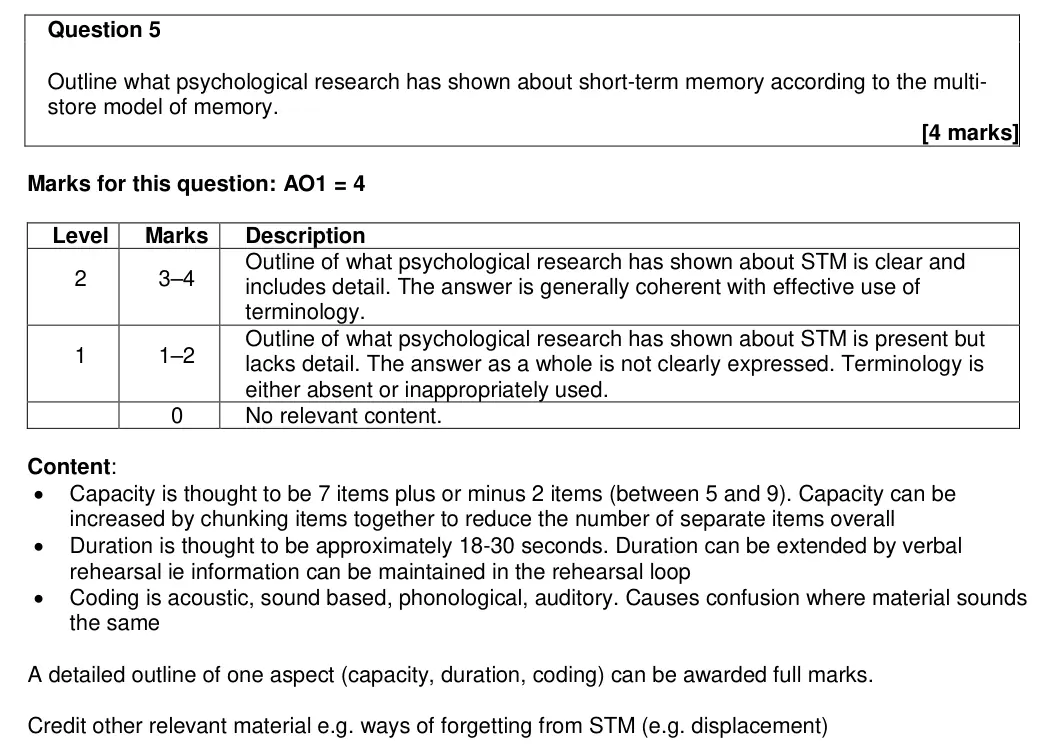
June 2025 · Paper 1 · Q64 marksAO1=4Outline
Mark scheme, including level descriptors and indicative content
Examiner's comment
Several students encountered difficulty with this question. Although many made effective use of Baddeley’s research, answers often lacked sufficient details and/or included reference to the aims and conclusions of the study. Students would be advised to examine and acknowledge the differences between findings and conclusions. Other creditworthy studies included Conrad’s research and a small minority referred to the case of KF. Some students wrongfully cited research into capacity of memory e.g. Jacob’s research, or duration of memories e.g. Peterson and Petersons research into short term memory
Notes from the mark scheme and report
procedure and/or findings only, best study credited (Baddeley 1966, Conrad, Frost, KF)
STM or LTM coding alone can get full marks
aims and conclusions not credited
some described capacity (Jacobs) or duration (Peterson and Peterson) studies
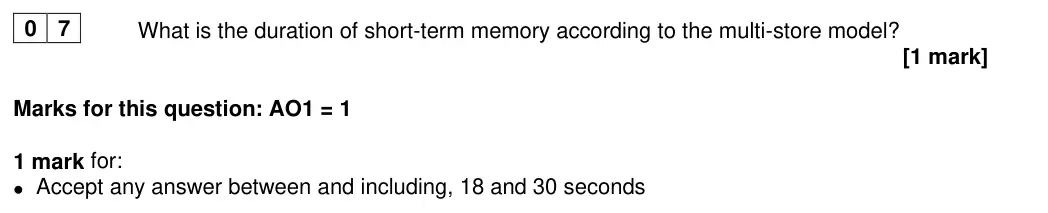
June 2025 · AS Paper 1 · Q71 markAO1=1Short answer
Mark scheme, including level descriptors and indicative content
Examiner's comment
This question worth one mark on the duration of short-term memory according to the multi- store model was also successfully answered with about 80% of students giving an accurate answer. However, some students clearly guessed answers e.g. one month, 4-6 seconds. Some students muddled duration with capacity. Again, only a handful of students did not attempt the question.
Notes from the mark scheme and report
accept 18-30 seconds
some muddled duration with capacity
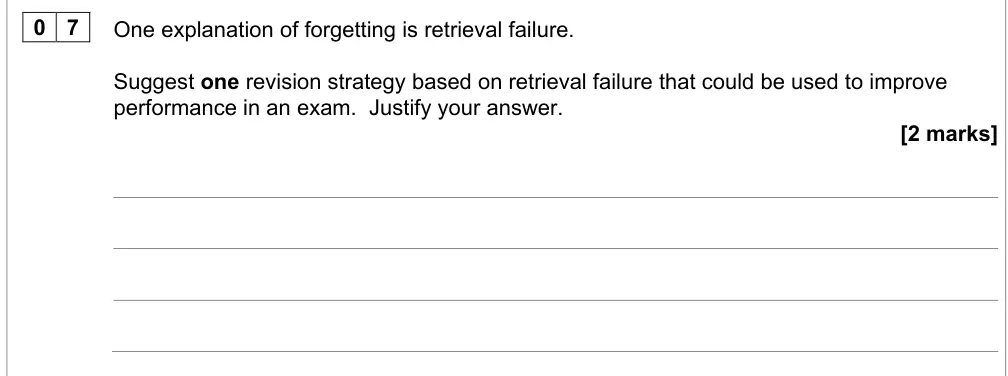
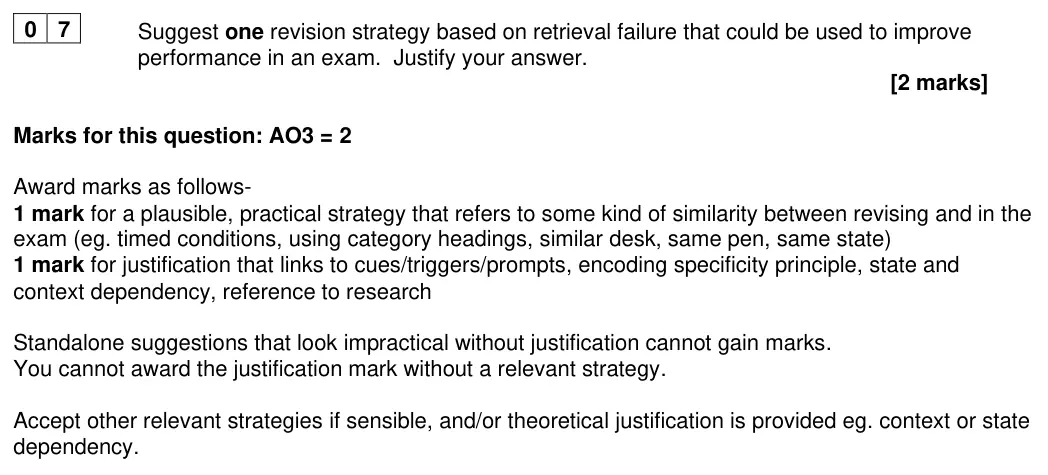
June 2025 · Paper 1 · Q72 marksAO3=2ApplicationEasy
Mark scheme, including level descriptors and indicative content
Examiner's comment
Students gave various worthy suggestions of revision strategies based on retrieval failure and offered sensible justification relating to the encoding specificity principle. The average mark was 1.33 but nearly 60% of students scored full marks. Common errors included responses that focused on general revision strategies that did not relate to retrieval failure e.g. rehearsal of notes.
Notes from the mark scheme and report
1 mark practical strategy matching revision and exam context/state + 1 mark justification (cues, encoding specificity)
no justification mark without a relevant strategy
general revision strategies (rehearsal) not credited
June 2025 · AS Paper 1 · Q81 markAO1=1Short answerMedium
Mark scheme, including level descriptors and indicative content
Examiner's comment
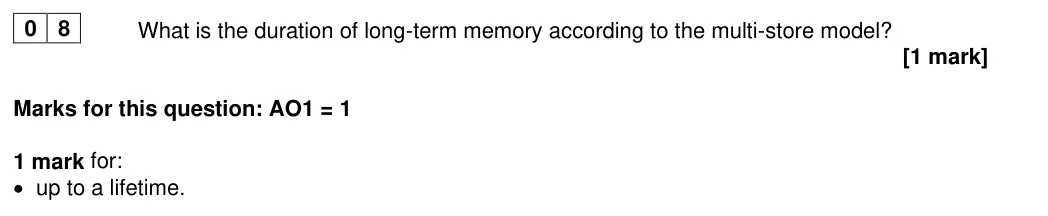
This question was the least successfully answered of the memory questions, with just over a third of students achieving the mark available. While some students understood that the duration of LTM was potentially a lifetime, others wrote ‘infinite,’ which lacks accuracy or ‘forever’ which is not true as memory is lost at the end of a life. Some gave unqualified answers such as ‘very high’.
Notes from the mark scheme and report
'up to a lifetime'
'infinite'/'forever' not credited
lowest-scoring memory item
June 2025 · Paper 1 · Q86 marksAO3=6Evaluate (short)Hard
Mark scheme, including level descriptors and indicative content
Examiner's comment
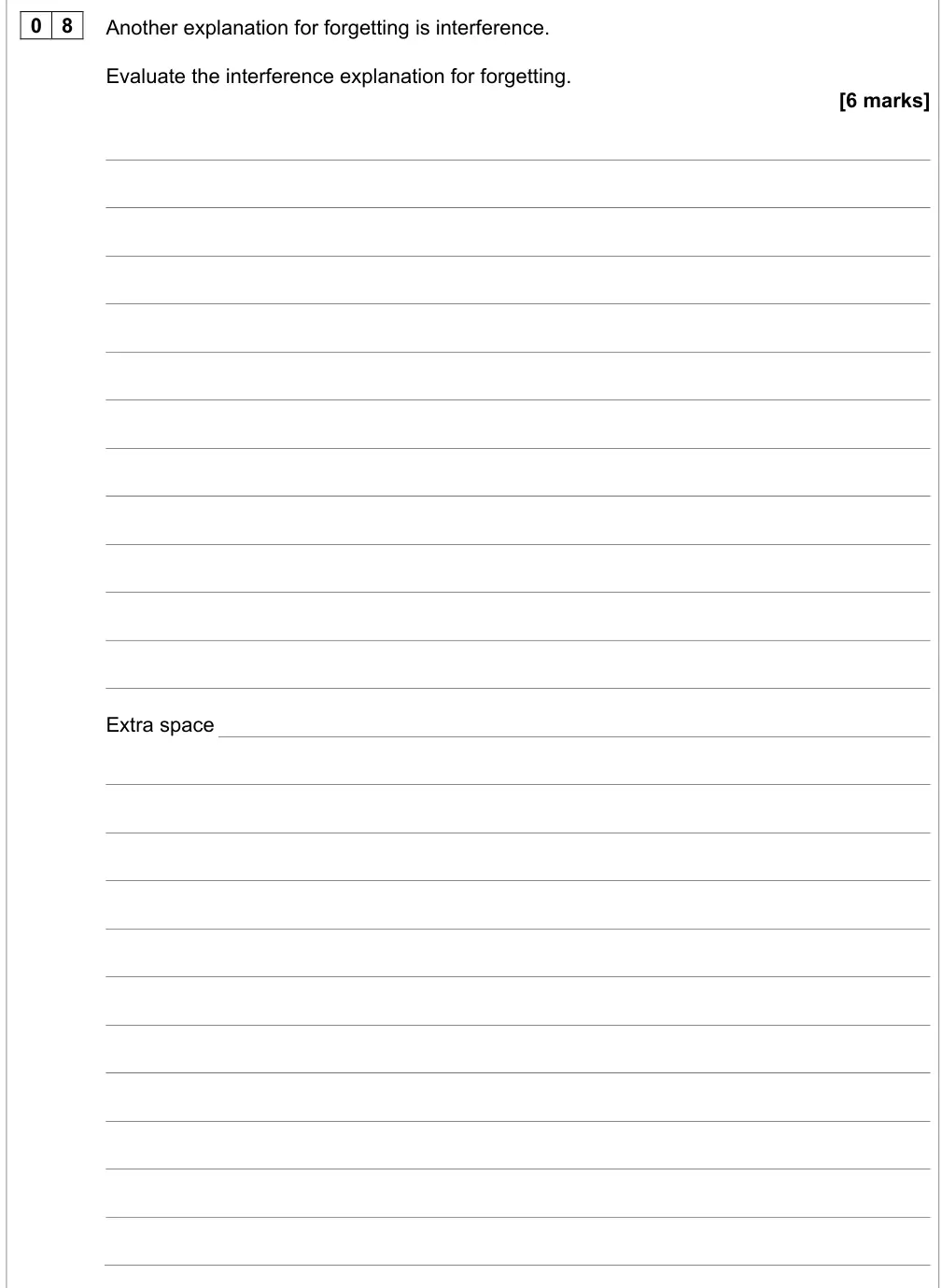
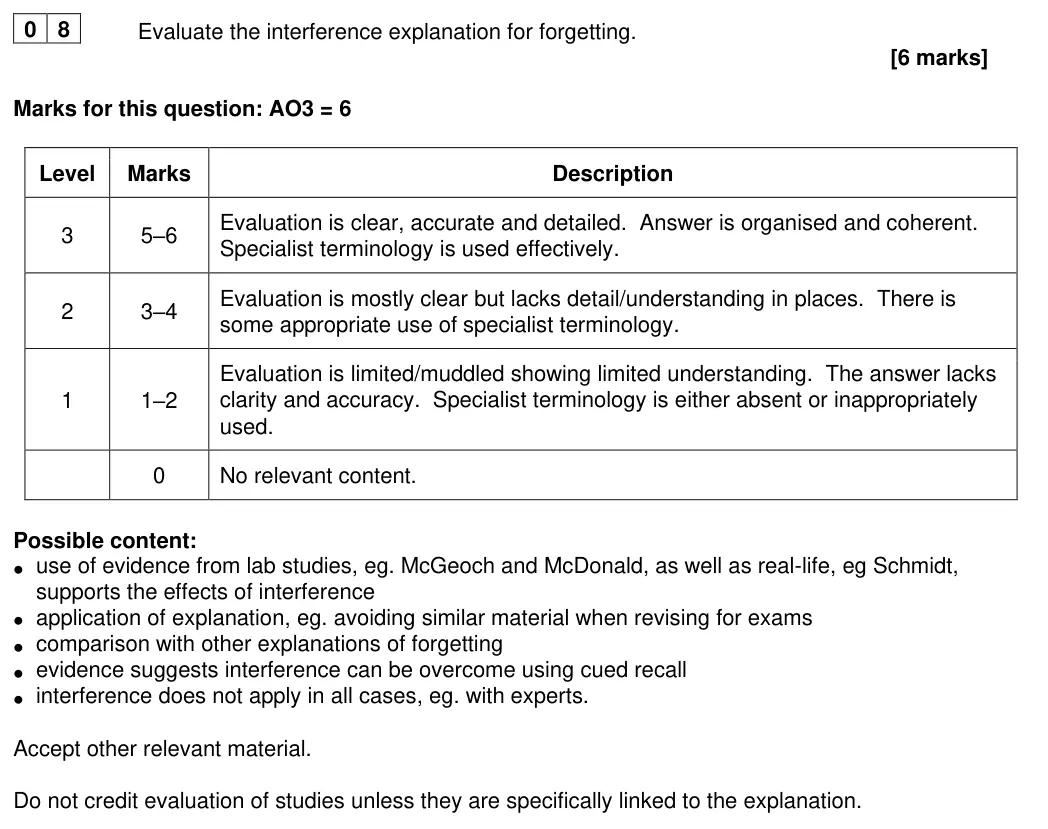
This question was challenging for many students, with only 15% of responses gaining level 3 marks. Strong responses often included research support e.g. Baddeley and Hitch’s research with rugby players, contradictory findings, e.g. Tulving and Psotka, more effective alternative explanations of forgetting e.g. retrieval failure due to absence of cues, and real-life applications. The question discriminated well between higher and lower attaining students. Common errors were offering irrelevant description or giving generic criticism of research without any link to interference theory.
evaluation of studies only if linked to the explanation
generic criticism of research and irrelevant description common
only 15% reached Level 3
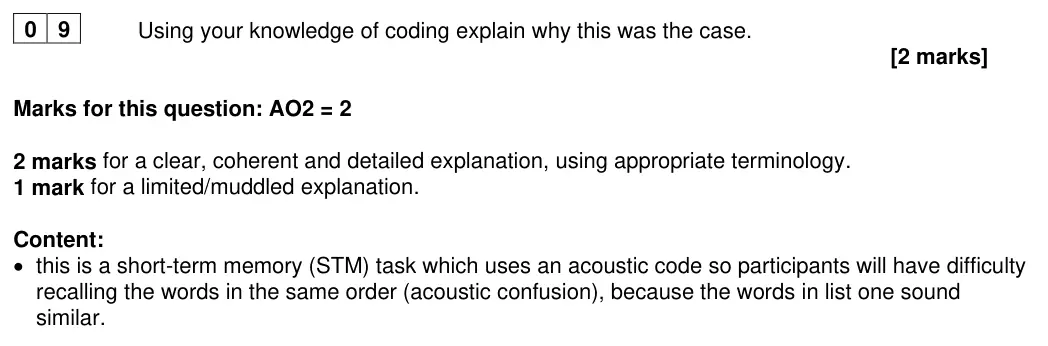
June 2025 · AS Paper 1 · Q92 marksAO2=2ApplicationEasy
Mark scheme, including level descriptors and indicative content
Examiner's comment
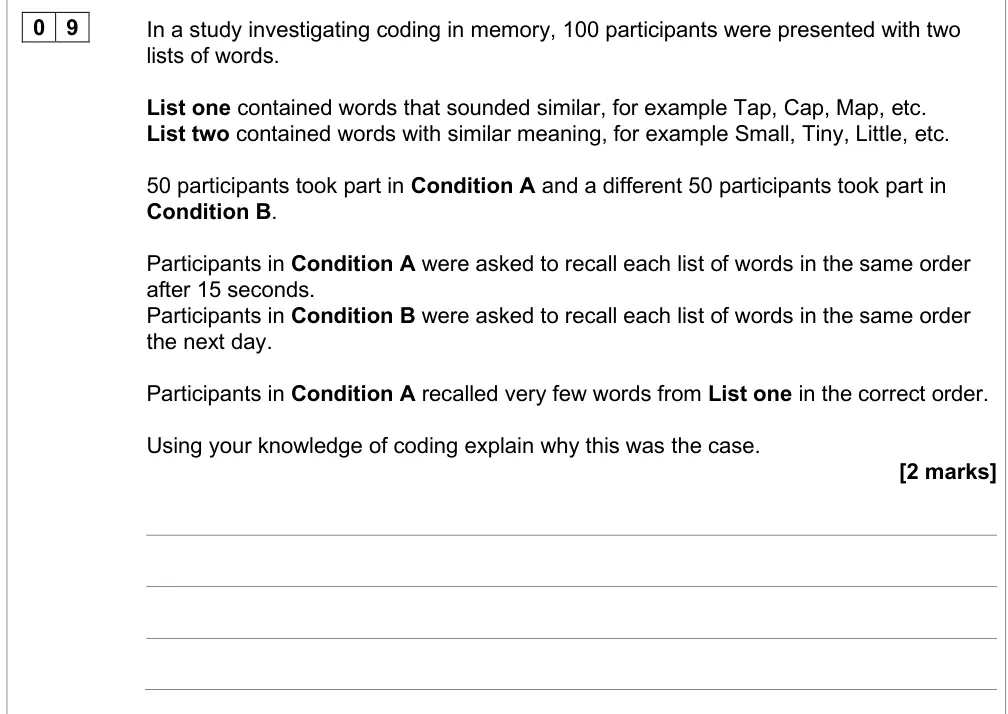
This question was answered reasonably well with many students identifying that it was a task testing STM which codes acoustically. Answers obtaining full marks then explained the effect on memory i.e. that the ‘similar sounding’ words get muddled/confused, making it harder to recall them. Almost 50% of students scored the full two marks, and about 75% scored one mark. There were some successful examples of clear, coherent answers which used appropriate terminology. Pleasingly, only a minority of students did not attempt the question.
Notes from the mark scheme and report
STM task (15 s) codes acoustically so similar-sounding words are confused
second mark needs the effect on recall
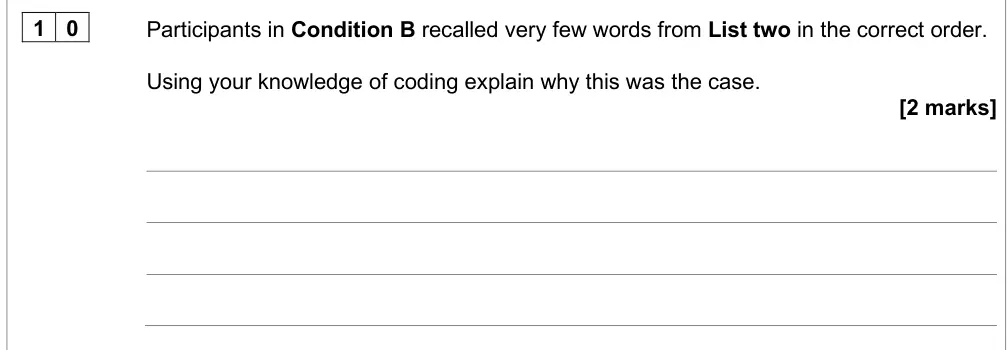
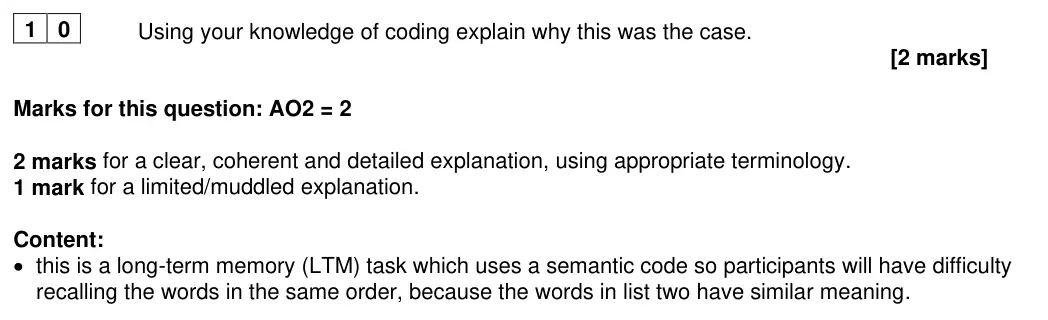
June 2025 · AS Paper 1 · Q102 marksAO2=2Application
Mark scheme, including level descriptors and indicative content
Examiner's comment
Performance on this question was very similar to the previous question, which was not surprising as the questions involved similar knowledge and application skills. Many students identified that it was a task testing LTM which codes semantically. Answers obtaining full marks explained the effect on memory i.e. that the ‘similar meaning’ words get muddled/confused making it harder to recall them. Again, there were some nice examples of clear, coherent answers which used appropriate terminology.
Notes from the mark scheme and report
LTM task (next day) codes semantically so similar-meaning words are confused
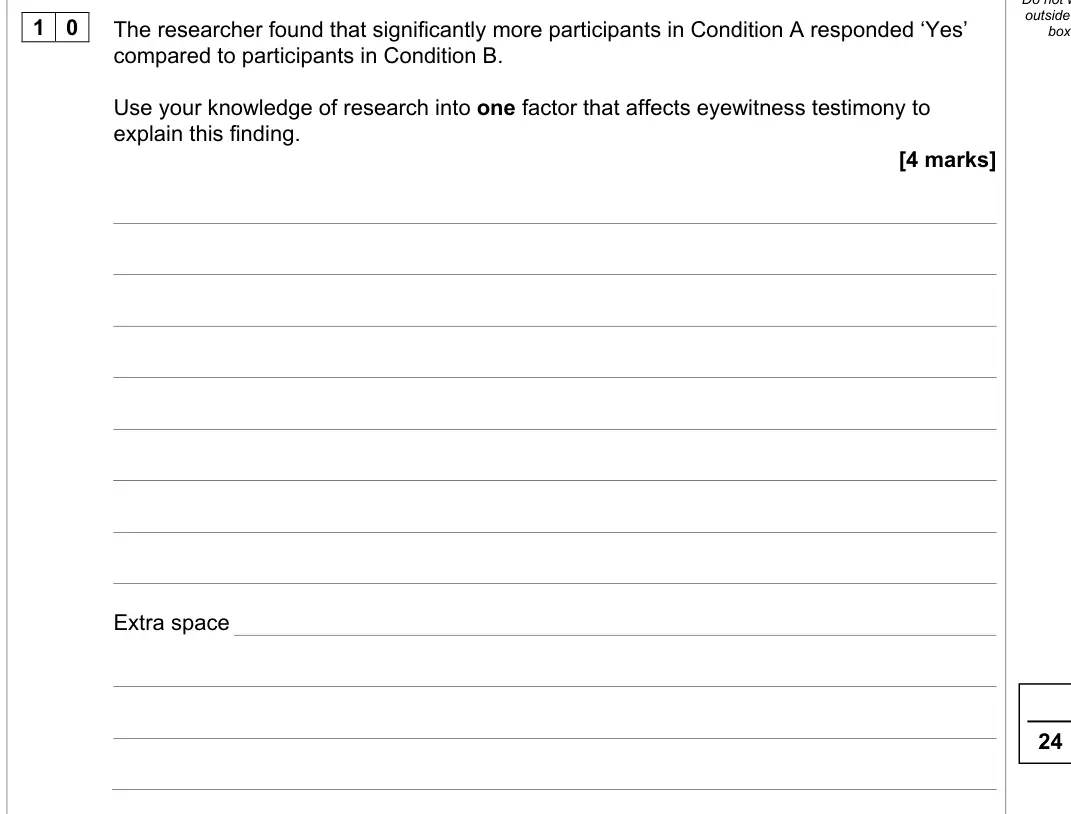
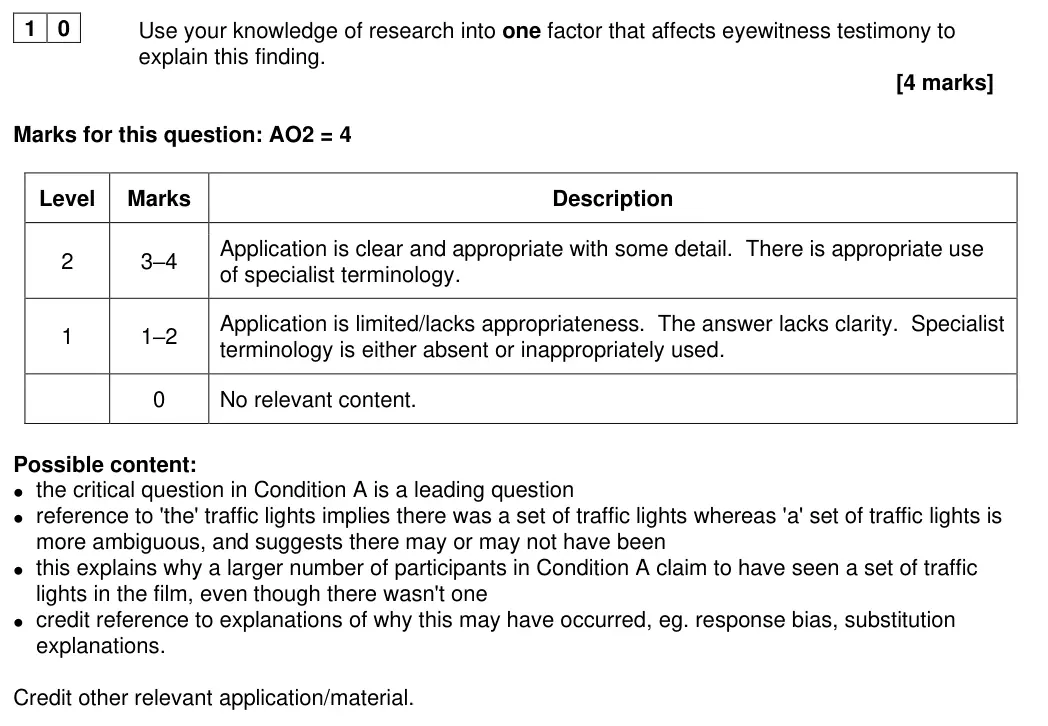
June 2025 · Paper 1 · Q104 marksAO2=4Application
Mark scheme, including level descriptors and indicative content
Examiner's comment
Most students were able to identify leading questions as the factor to explain the findings. Effective responses often used a research study e.g. Loftus and Zanni, to help illustrate the role of leading questions and then linked this effectively to both conditions of the investigation. A common problem was inadequate application whereby students would cite leading questions and/or describe a research study but make no explicit link to the scenario.
Notes from the mark scheme and report
leading question ('the' implies the lights existed)
response bias/substitution
Loftus and Zanni
naming leading questions or describing a study without explicit link to both conditions = limited
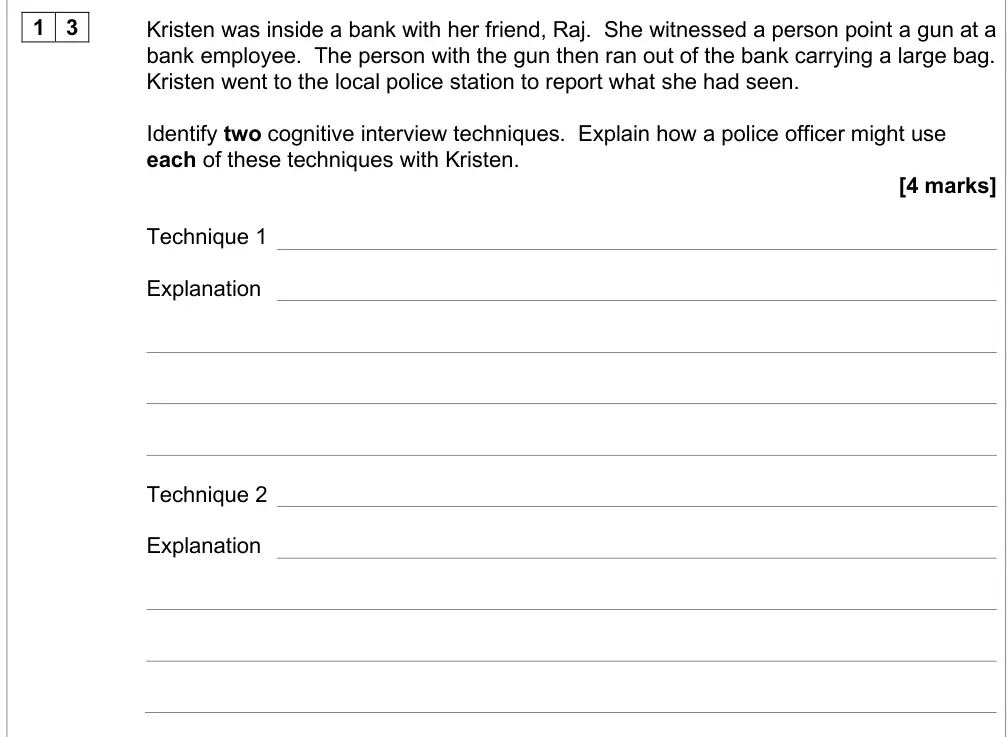
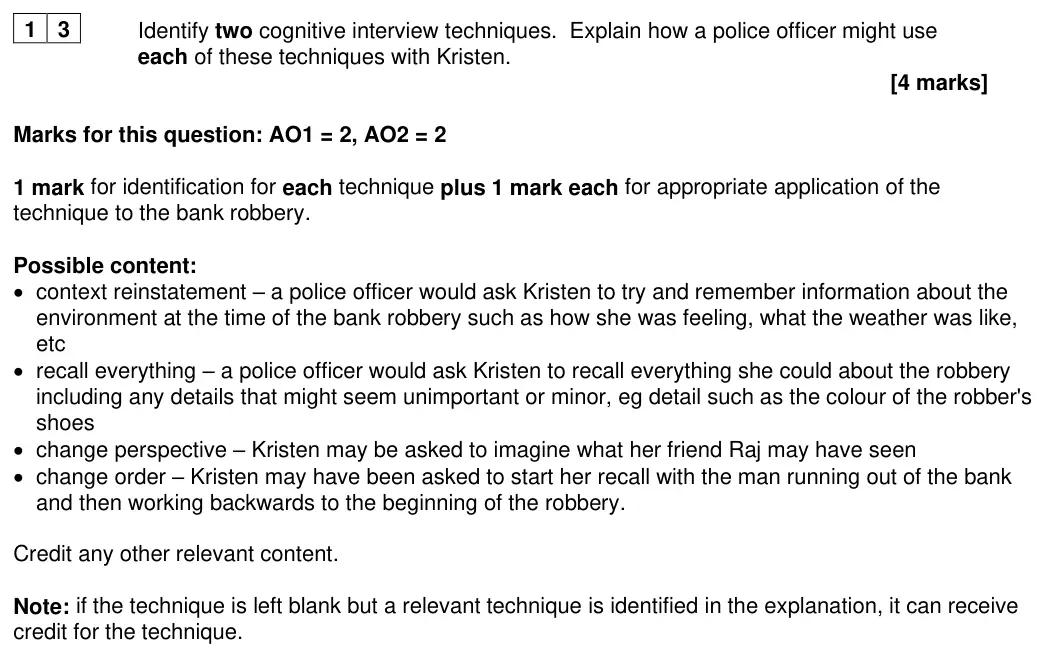
June 2025 · AS Paper 1 · Q134 marksAO1=2, AO2=2Application
Mark scheme, including level descriptors and indicative content
Examiner's comment
Performance on Q3, Q13 and Q23 suggested that many students should work to improve their AO2 skills. They need to ensure they fully engage with the stem/scenario and do not just state the name of the person in the stem, which is not effective application. They must use their knowledge and understanding to explain what is happening in the scenario. The cognitive interview style of questioning has appeared on previous papers and many students were able to identify two relevant techniques used in cognitive interviews. Some applied these techniques explicitly to the scenario. Others wrote a generic explanation and did not engage with the stem: merely stating ‘Kristen’ should do ‘x’ was not effective application. Others tried to explain why a technique would increase accuracy in recall, not how it would be used in this scenario. Students need to focus on identifying and interpreting the command words in questions.
Notes from the mark scheme and report
1 mark per CI technique + 1 for application to the bank robbery (context reinstatement, report everything, change perspective - Raj, change order)
generic explanations or why CI works not credited
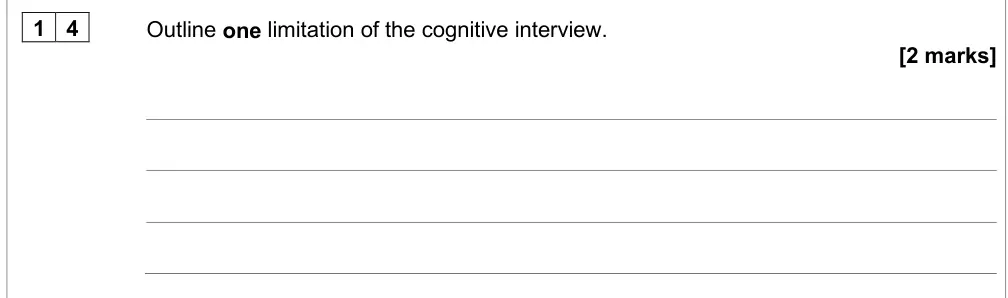
June 2025 · AS Paper 1 · Q142 marksAO3=2Evaluate (short)Medium
Mark scheme, including level descriptors and indicative content
Examiner's comment
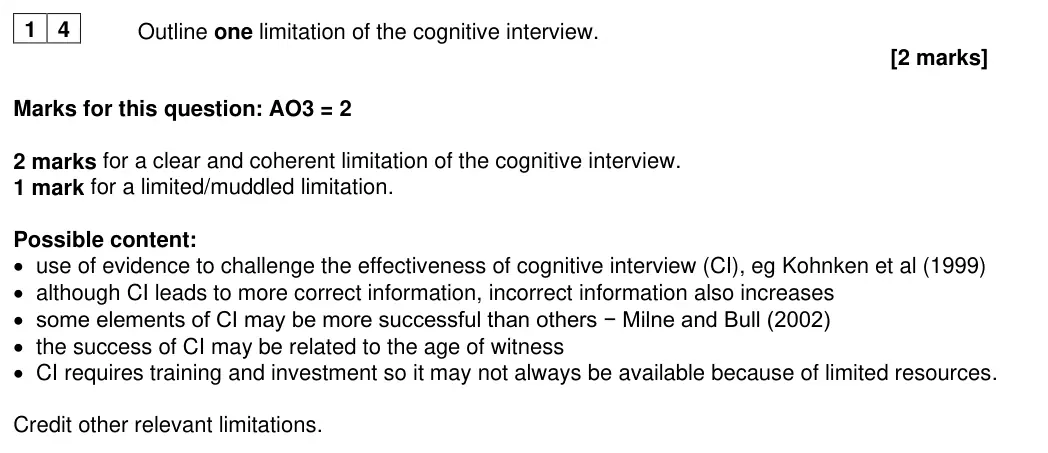
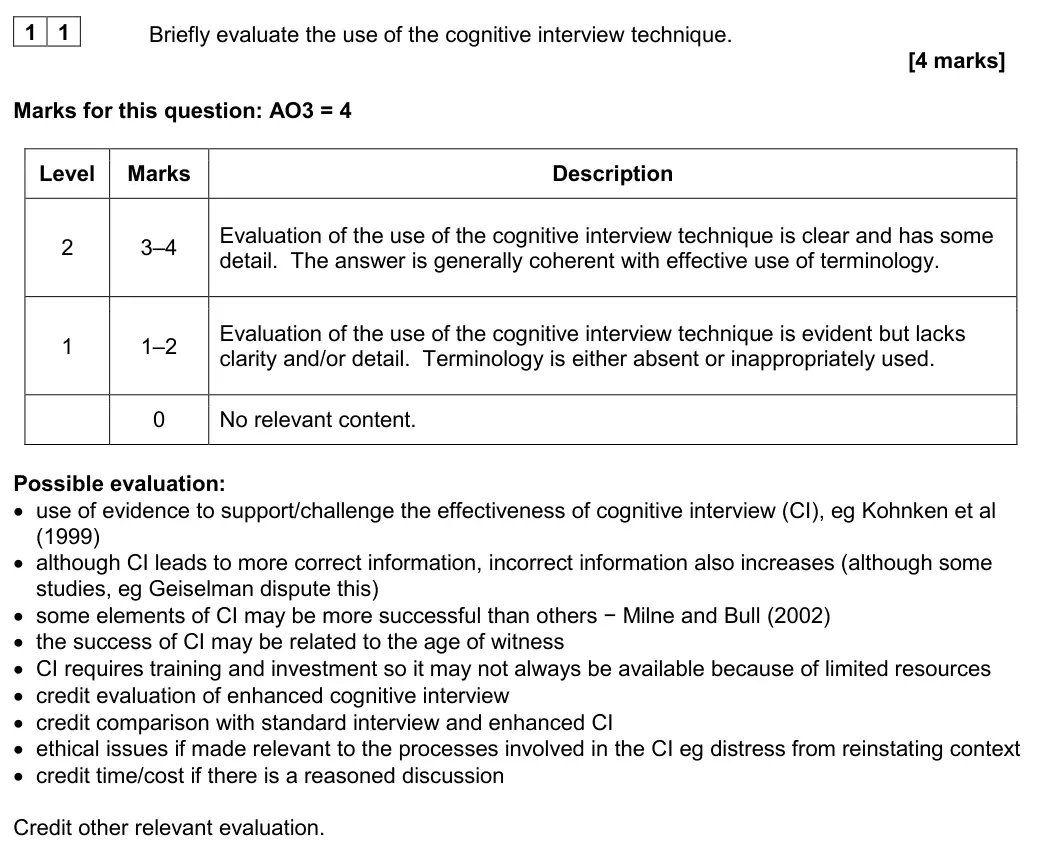
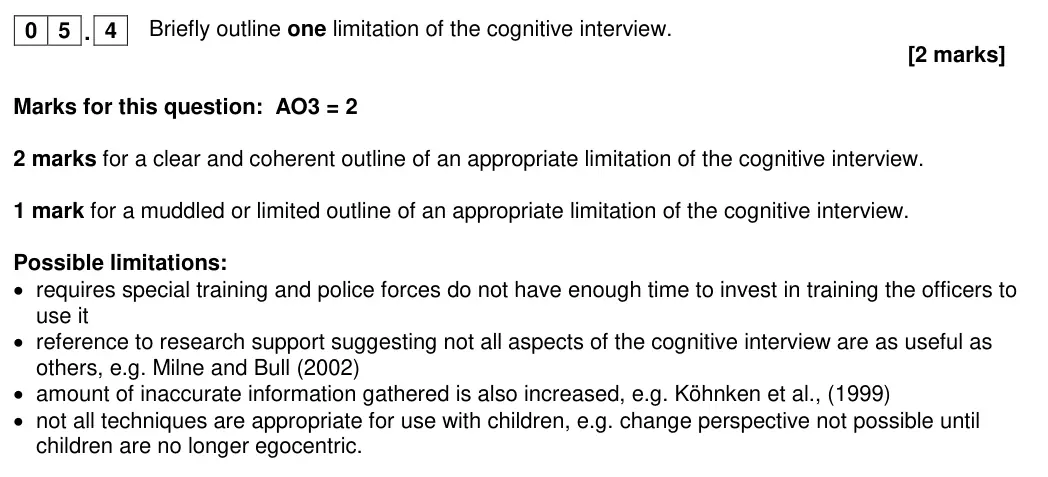
Over 40% of students gave a clear and coherent limitation of the cognitive interview earning full marks. Some good answers gave detail in the description of the limitation, often citing evidence from research e.g. Kohnken et al., (1999, Milne & Bull (2002). However, about 25% of students scored zero marks. Some students are still using ‘costly’ as a limitation without any clarification of what it is about the cognitive interview that is costly e.g. the specialist training it requires. Some students mistakenly referred to the use of leading questions.
Notes from the mark scheme and report
e.g. incorrect information also increases, Kohnken et al, Milne and Bull, training costs
unqualified 'costly' not credited
some referred to leading questions
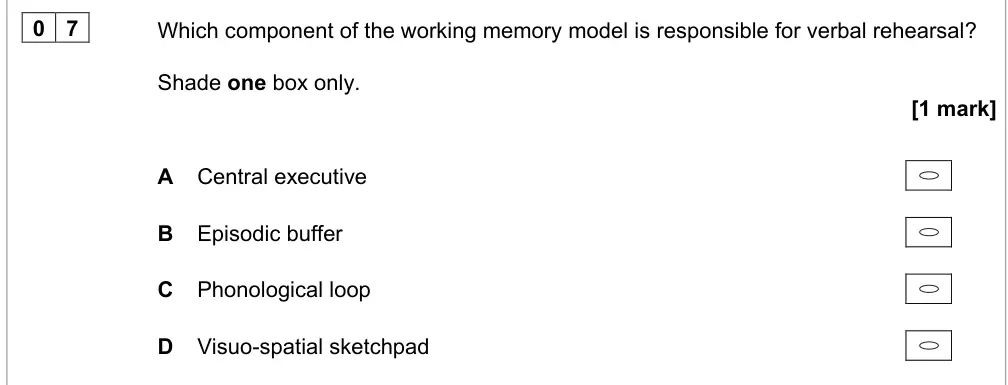
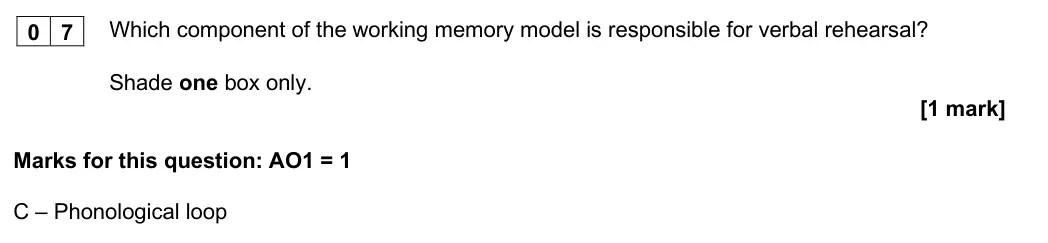
June 2024 · AS Paper 1 · Q71 markAO1=1Multiple choiceEasy
Answer
C
Mark scheme, including level descriptors and indicative content
Examiner's comment
This was an straightforward multiple-choice question with 89% of the students able to identify the correct answer. Very few students did not attempt the question and most students marked only one answer. There was no obvious distractor with the other options chosen in equal measure.
Notes from the mark scheme and report
correct C phonological loop
89% correct
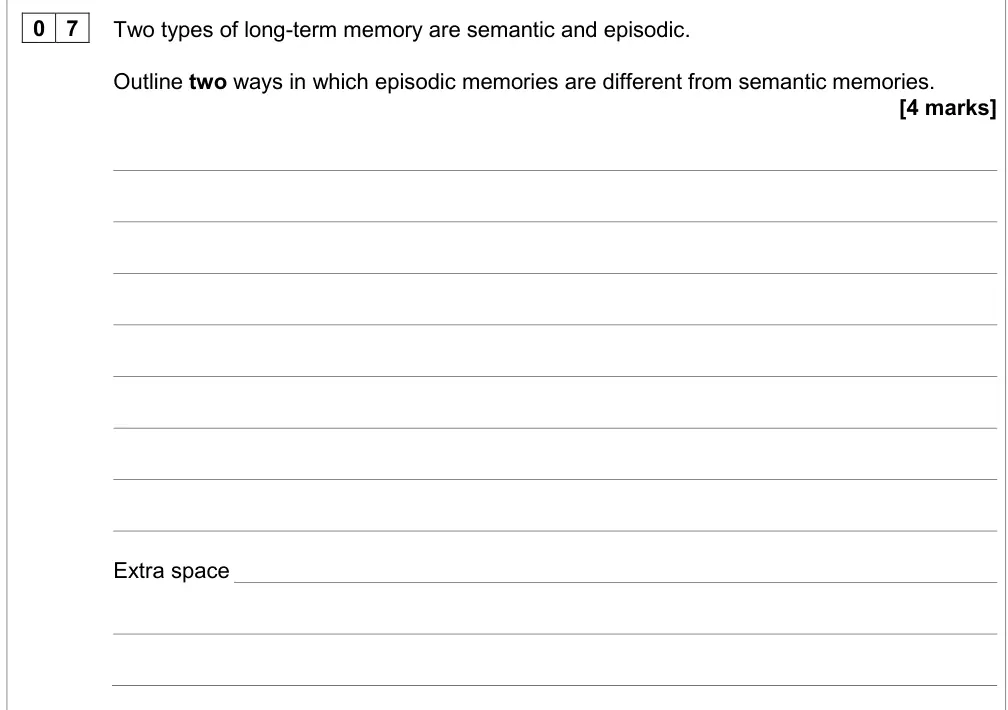
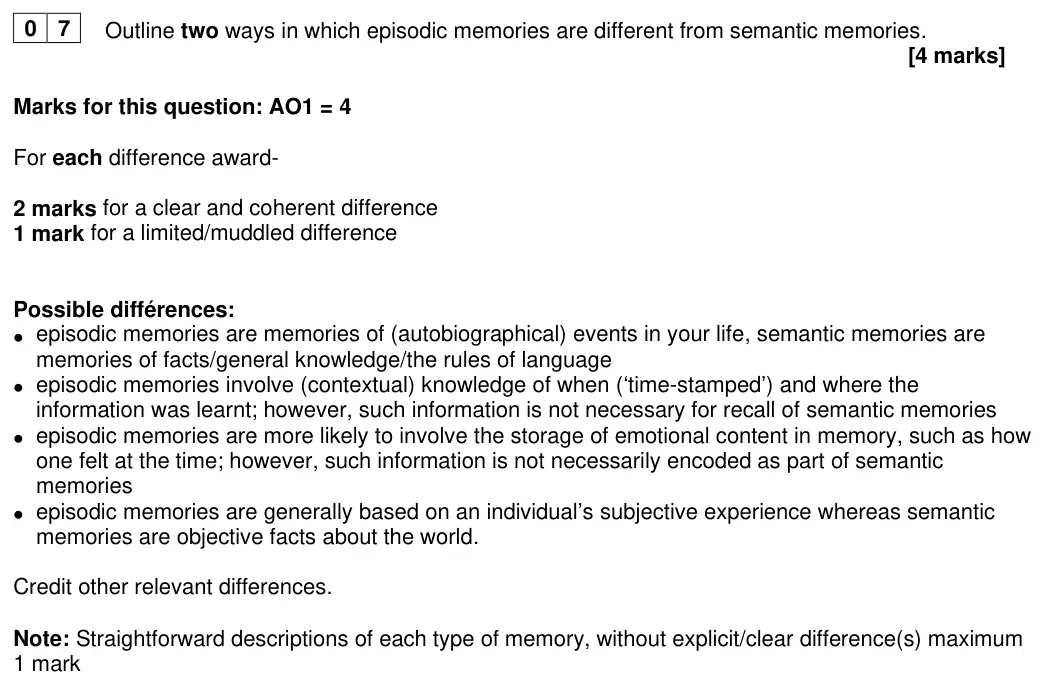
June 2024 · Paper 1 · Q74 marksAO1=4OutlineEasyOld spec only
Not on the 2025 specification: types of long-term memory, episodic vs semantic, removed in v1.4
Mark scheme, including level descriptors and indicative content
Examiner's comment
Over fifty percent of students were able to outline detailed differences between episodic and semantic memories and provide sufficient depth to gain between 3 and 4 marks. Common differences cited revolved around whether the memories seemed to be time-stamped, the general location of these memories in the brain, as well as commentary surrounding whether memories were autobiographical in nature. The average mark for this question was over 2.5, and less than seven percent of students failed to score marks here. This is an excellent example from a student who has focused exclusively on the wording of the question. The answer contains two coherent and clear differences between episodic and semantic memories, with the student using language of comparison with clear structure and depth in their response.
Notes from the mark scheme and report
Off-spec: types of long-term memory, episodic vs semantic, removed in v1.4
descriptions of each type without explicit difference = max 1
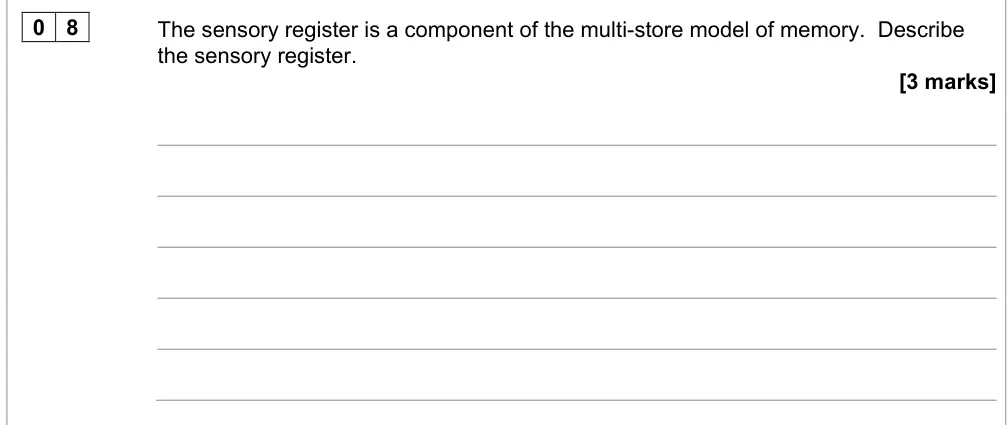
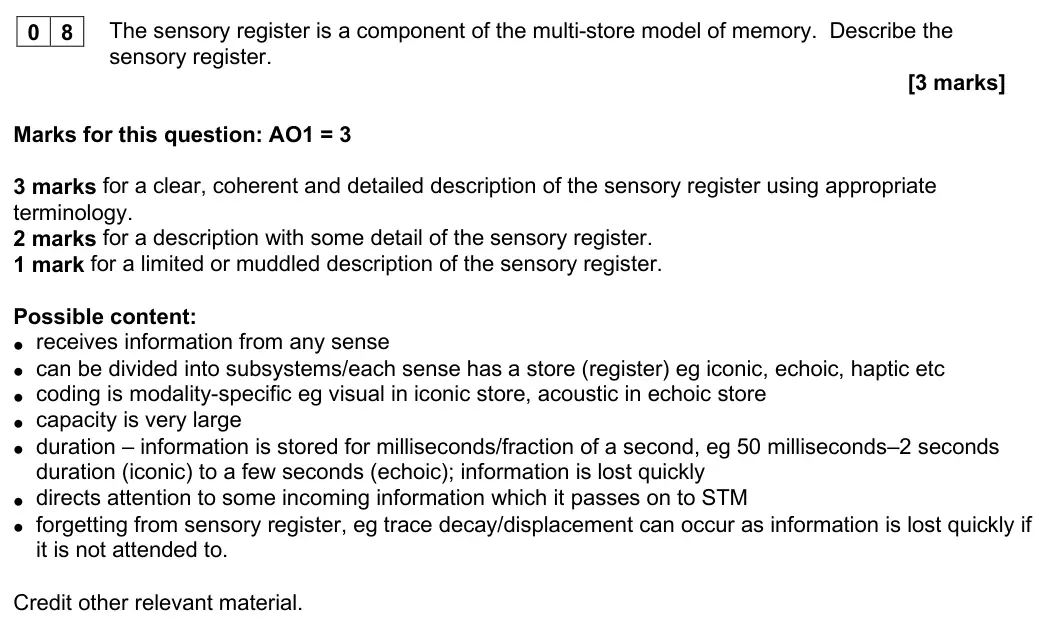
June 2024 · AS Paper 1 · Q83 marksAO1=3OutlineEasy
Mark scheme, including level descriptors and indicative content
Examiner's comment
This appeared to be another straightforward question for students. Many students could describe the sensory register often including several accurate features of the store in some detail. Almost 46% of students scored full marks and only 6% received no marks. Weaker responses simply stated that it was the first store of the multi-store model, with no detail of the features. Stronger responses referred to capacity, coding and/or duration of the store.
Notes from the mark scheme and report
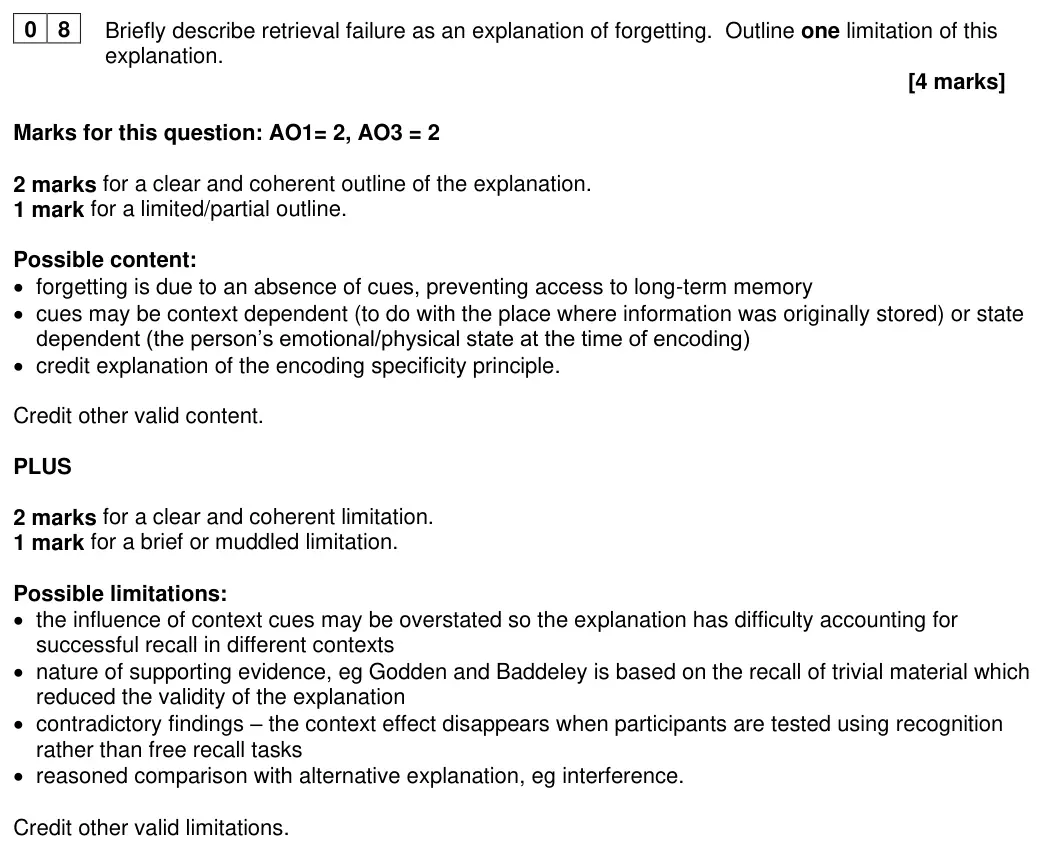
modality-specific stores (iconic, echoic), very large capacity, duration milliseconds-seconds, attention passes info to STM
'first store of the MSM' alone weak
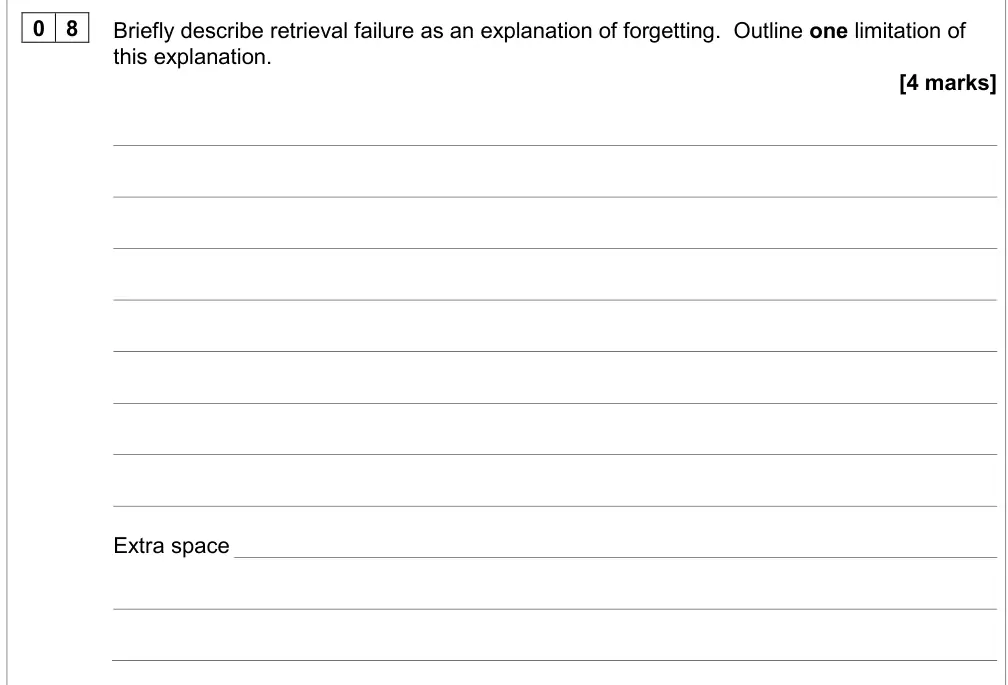
June 2024 · Paper 1 · Q84 marksAO1=2, AO3=2OutlineMedium
Mark scheme, including level descriptors and indicative content
Examiner's comment
Students generally did well in the knowledge element of the question yet struggled with the limitation. The knowledge tended to be well focused, and good use was made of the encoding specificity principle as well as descriptions of both state dependent and context dependent forgetting. The limitations offered tended to focus on criticising research that supports the model. However, many students did not link this back to the explanation and subsequently lost marks on the question. A smaller issue with the responses was when a minority of students misunderstood that the focus needed to be on retrieval failure due to an absence of cues, and wrongfully cited knowledge of interference theory. Nevertheless, the mean for the question was 2.04 marks, with less than twenty percent of students failing to score marks here. This type of response was quite typical of students with this question. The description of retrieval failure was the only part of the answer that gained credit, referring to the absence of both environmental and state cues. However, the limitation centred on research that supports the model, where the generic comment failed to link back to any impact on the explanation of forgetting.
Notes from the mark scheme and report
2 marks description (absence of cues, context/state-dependent, encoding specificity) + 2 marks limitation
limitations criticising supporting research often not linked back to the explanation
some described interference
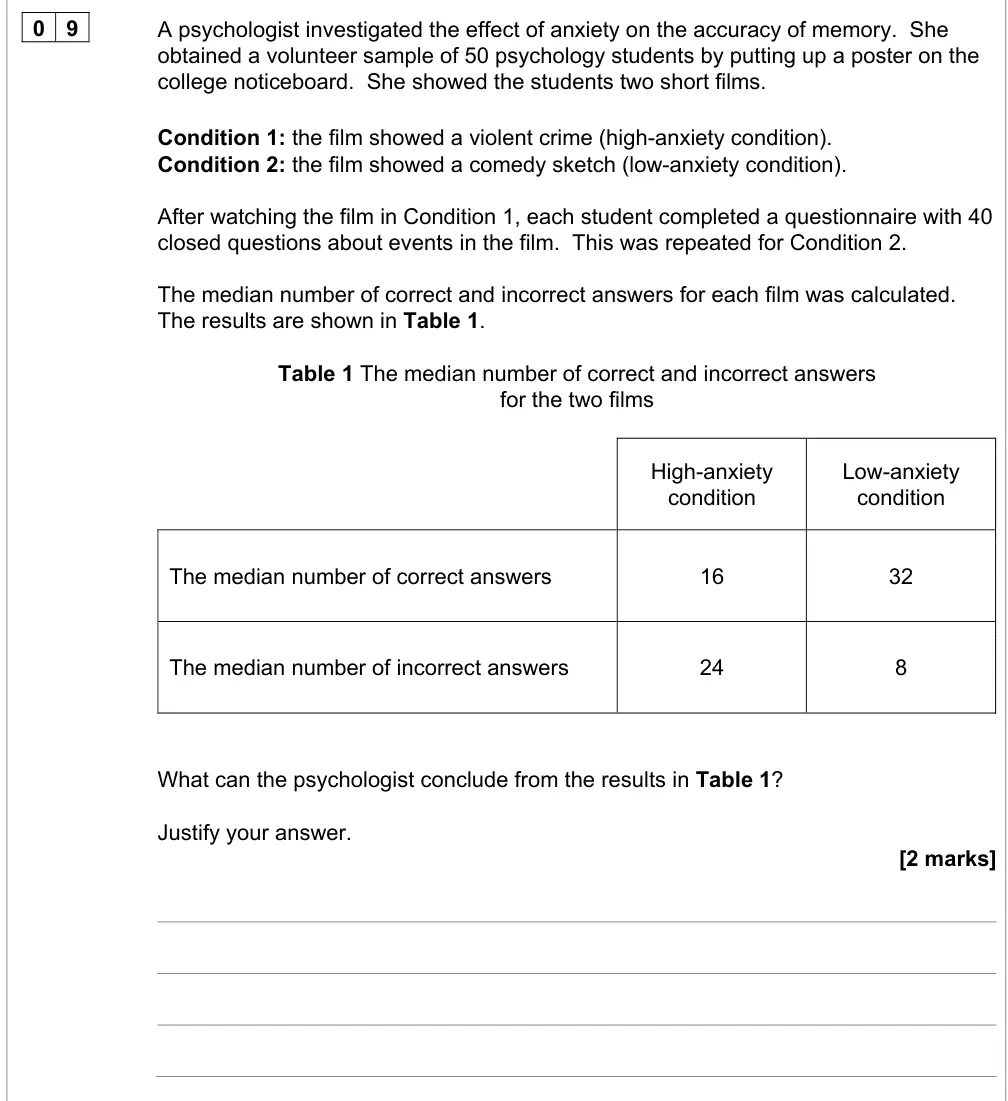
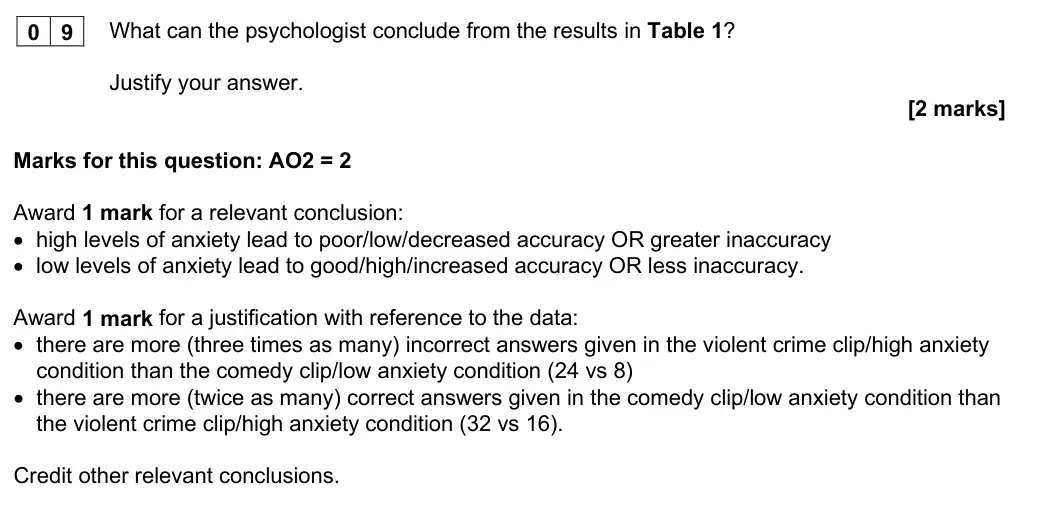
June 2024 · AS Paper 1 · Q92 marksAO2=2Research methodsMedium
Mark scheme, including level descriptors and indicative content
Examiner's comment
Whilst 36% of students scored full marks on this question, there were many who did not know what a conclusion was/how it was different from a finding. Weaker students did not make a comparison between the two conditions, just restating the data in table 1. Strong answers demonstrated that the conclusion needed to refer to accuracy rather than overall memory. Some students expressed their conclusion as a correlation which was not acceptable as this was study comparing high and low anxiety conditions, not measuring levels of anxiety. There were the fewest not attempted parts for this question, with less than 1% leaving the answer blank.
Notes from the mark scheme and report
conclusion about ACCURACY (high anxiety reduces accuracy) + justification from medians (24 vs 8 incorrect, 16 vs 32 correct)
many confused conclusion with finding or restated data
correlational conclusions rejected
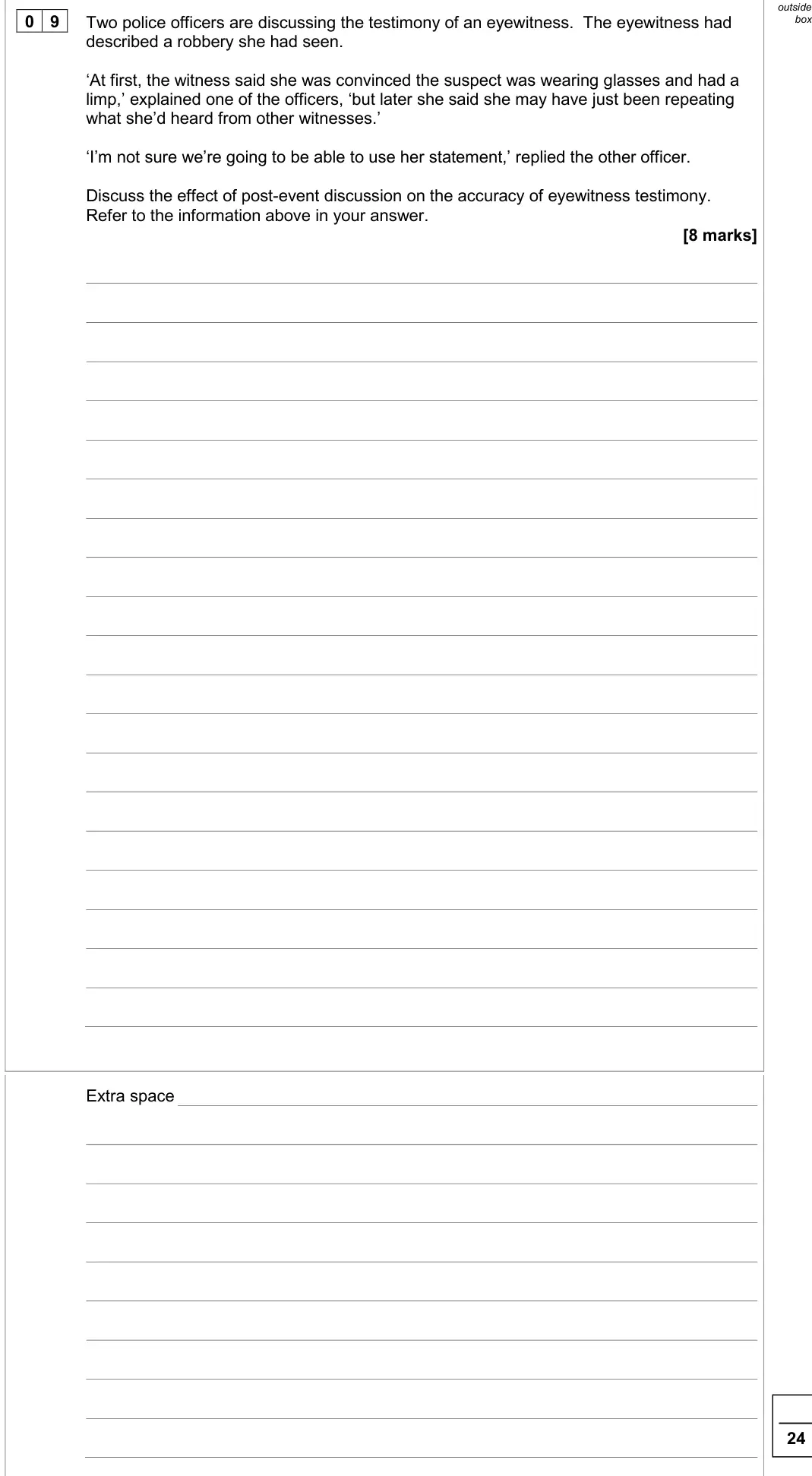
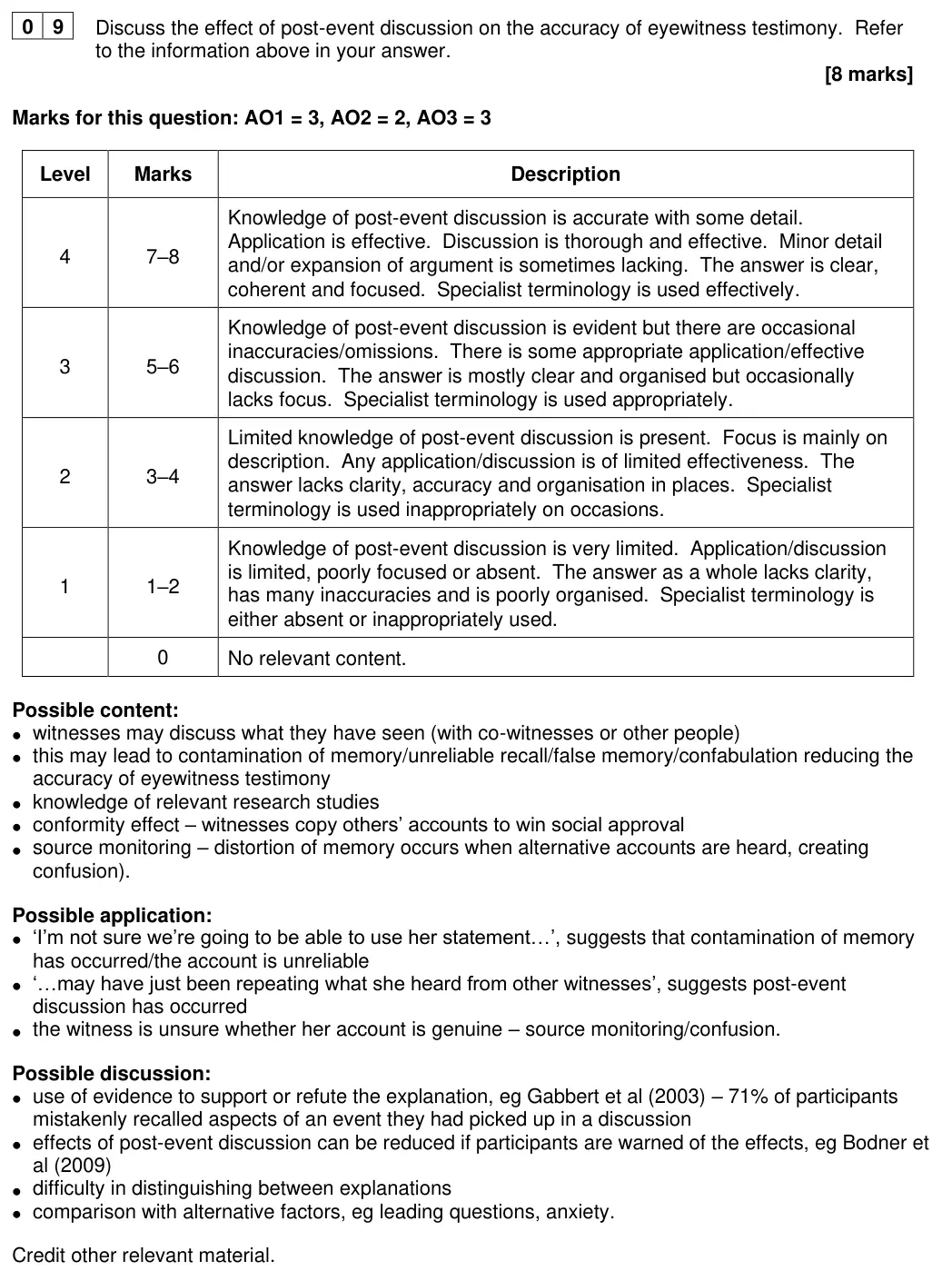
June 2024 · Paper 1 · Q98 marksAO1=3, AO2=2, AO3=3Extended writing
Mark scheme, including level descriptors and indicative content
Examiner's comment
In the short essay question, it appeared that students were either poorly prepared for this type of question, and/or had a limited amount to say on this topic. This short essay question, which incorporated an element of application of knowledge was difficult for some students. Some appeared to only have a limited amount to say on this topic. More effective answers largely revolved around Gabbert’s research, source monitoring and memory conformity. When students outlined these concepts, they tended to score well in this question. In addition, unfortunately many answers contained very little psychological content and scored poorly. As such, less than thirty-five percent of students gained level 3 or 4 marks. This response managed to attempt all assessment objective skills and include some specialist terminology. However, to have been awarded more marks, the student needed to develop some of the evident ‘knowledge’ ideas and add to the ‘discussion’ element of the response. In contrast to the response from student A, this was a typical response that was seen from a surprisingly large minority of students. The ‘knowledge’ and ‘application’ are very limited, yet the ‘discussion’ contains some creditworthy material. This type of response scored very little compared with the former.
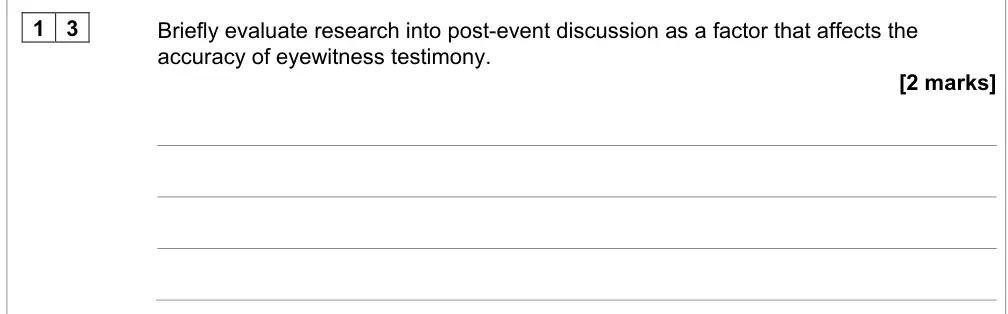
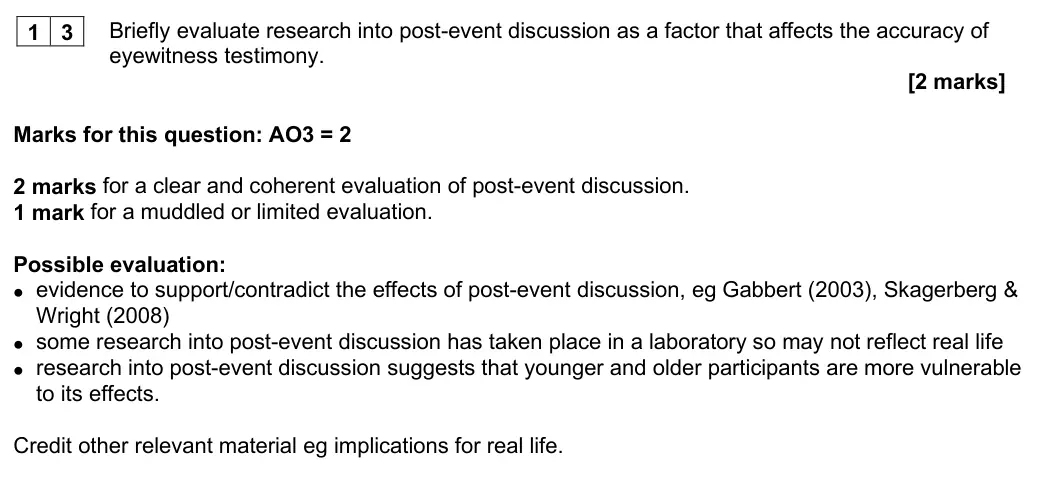
June 2024 · AS Paper 1 · Q132 marksAO3=2Evaluate (short)Medium
Mark scheme, including level descriptors and indicative content
Examiner's comment
This question was answered poorly by many students: mean of 36% of available marks, 52% receiving no marks, with 3.54% of students not attempting the question. This was the first time this question had been asked and many students did not address the command word, describing what post-event discussion was, instead of evaluating. Stronger responses understood the command term ‘evaluate’ and offered a strength or weakness of the research with some elaboration. Answers which presented research findings needed to offer it as strength or limitation, not simply a description of a study, as this did not address the question. Some students used inappropriate studies where no post-event discussion had taken place. Students would benefit from understanding the difference between post-event discussion and post-event information. This question was a good discriminator of student responses.
Notes from the mark scheme and report
evaluation not description (Gabbert et al, Skagerberg and Wright, lab artificiality, age vulnerability)
52% scored zero
studies without post-event discussion (post-event information) not relevant
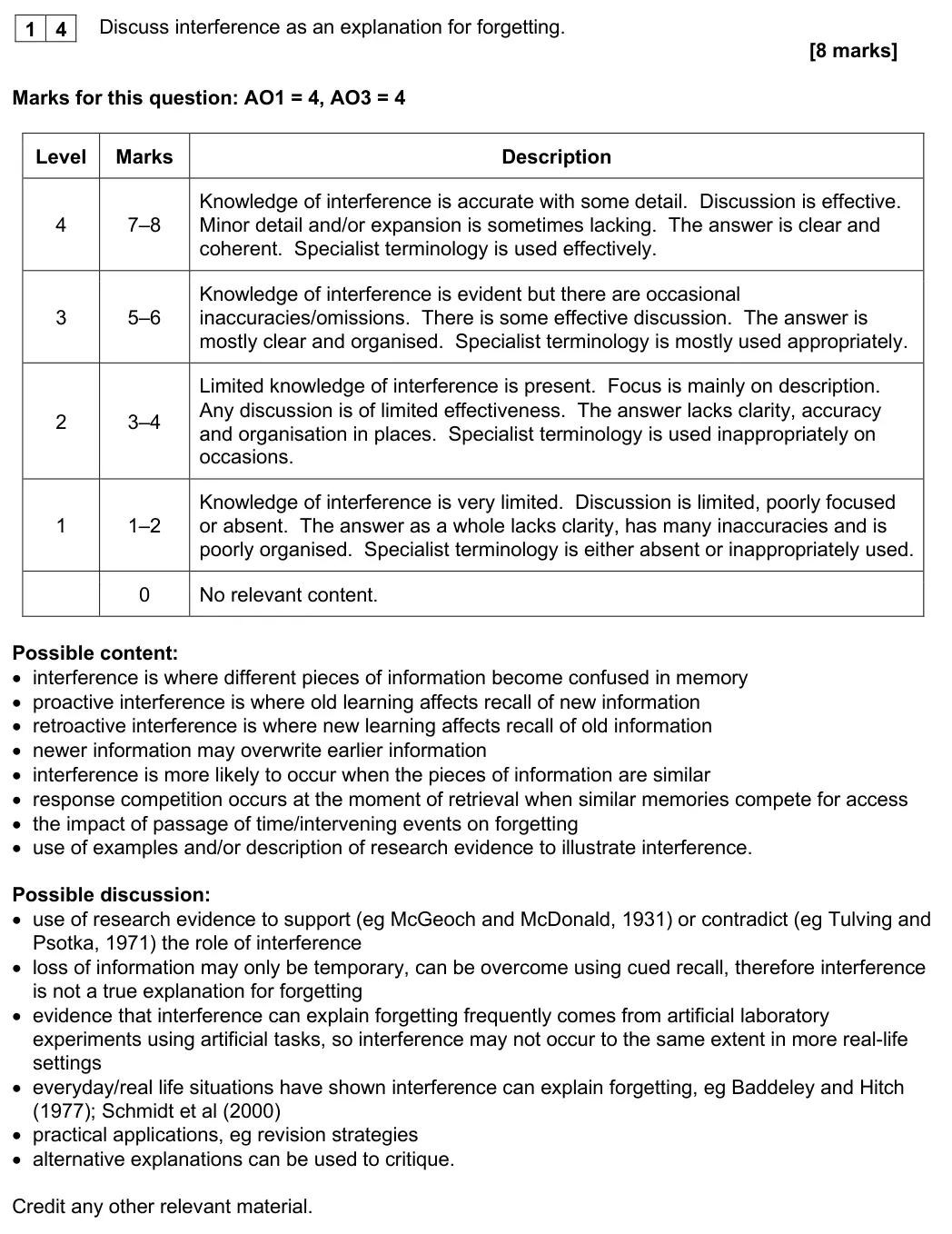
June 2024 · AS Paper 1 · Q148 marksAO1=4, AO3=4Extended writingHard
Mark scheme, including level descriptors and indicative content
Examiner's comment
This was another question which discriminated between students. Weaker responses tended to focus solely on description or contained no/limited effective evaluation. Some students simply provided a very brief and thus limited description, only defining proactive and retroactive interference. It is important to remind students that in these questions there should be an equal amount of knowledge and discussion/evaluation. Some students gave the definitions the wrong way round. The best description included reference to the effect of similarity and explained why interference leads to forgetting. Good evaluation used evidence to support or contradict the theory and some students did this extremely well. There were a number of students who muddled retrieval failure theory with interference theory. A few students wrote long essays more suited to a 12-mark essay, and thus students need to be mindful of how much to write for an 8-mark question, and not use valuable time on material that is not needed. Just under 8% of students achieved level 4 marks, with a mean mark of 43% of the available marks.
discussion via McGeoch and McDonald, Tulving and Psotka cued recall, artificial tasks, Baddeley and Hitch
definitions reversed
muddled with retrieval failure
overlong answers
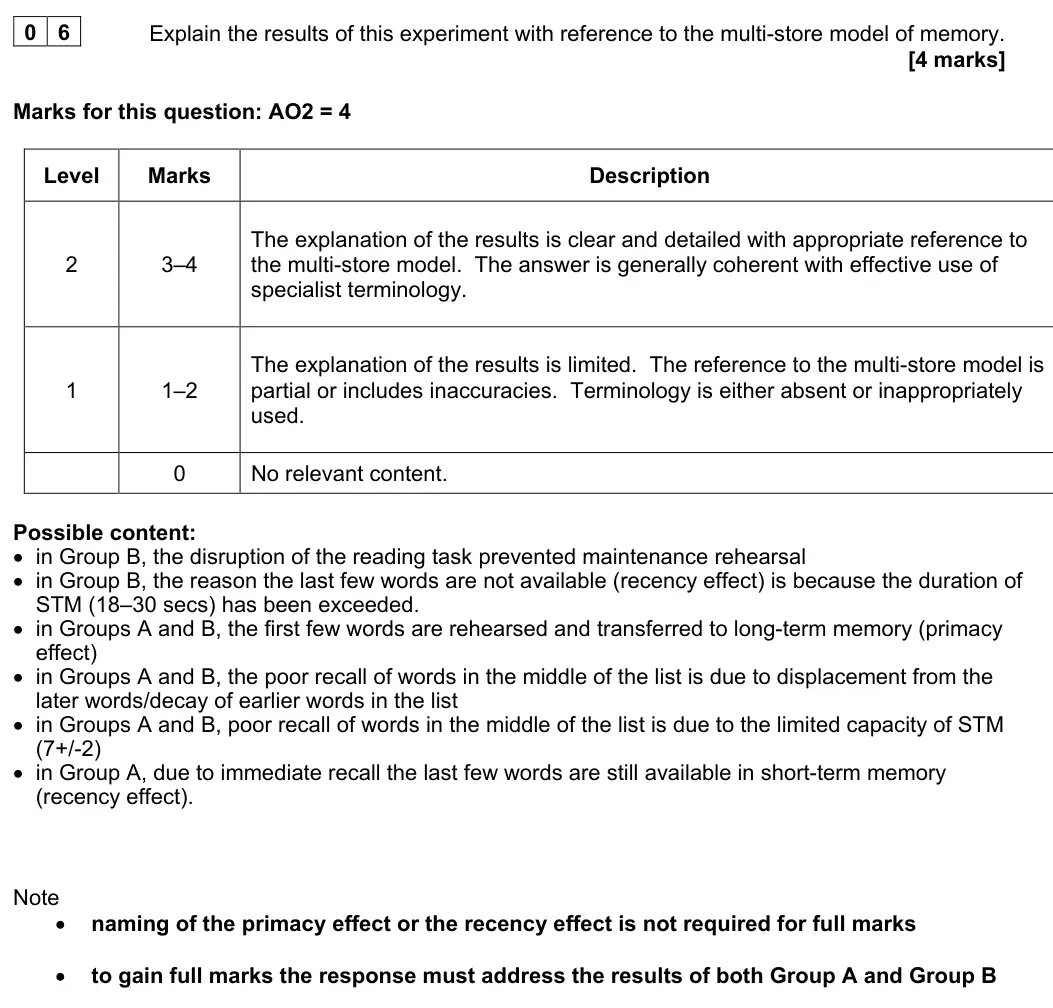
June 2023 · Paper 1 · Q64 marksAO2=4Application
Mark scheme, including level descriptors and indicative content
Examiner's comment
A variety of responses were seen with this question. Some students completely understood the results of the experiment and could explain them in the context of the multi-store model. Knowledge of the primacy and recency effects was often put to good use, but students were able to score maximum marks without this knowledge. Some responses showed various levels of confusion. Some students assumed all the results of both groups could be solely explained by short term memory, whereas some students wrongfully responded with knowledge of the working memory model. In addition, further confusion was seen with students citing the sensory register to explain the results of the study.
Notes from the mark scheme and report
must address both Group A and Group B for full marks
using the working memory model or the sensory register instead of STM/LTM
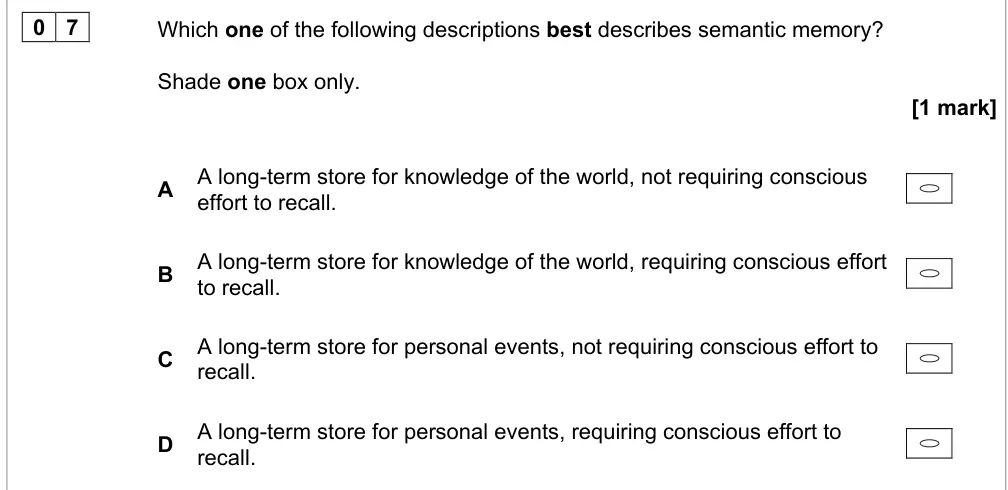
June 2023 · AS Paper 1 · Q71 markAO1=1Multiple choiceMediumOld spec only
Not on the 2025 specification: types of LTM - semantic memory - removed in v1.4
Answer
B
Mark scheme, including level descriptors and indicative content
Examiner's comment
Just over half of the students were able to identify the correct answer in this multiple choice question. Those who chose incorrectly, chose C and D in equal measure. Whilst most students marked only one answer, some marked more than one, with one student marking all four boxes. Students must read the instructions.
Notes from the mark scheme and report
Off-spec: types of LTM - semantic memory - removed in v1.4
correct B
just over half correct, C and D (episodic descriptions) chosen equally
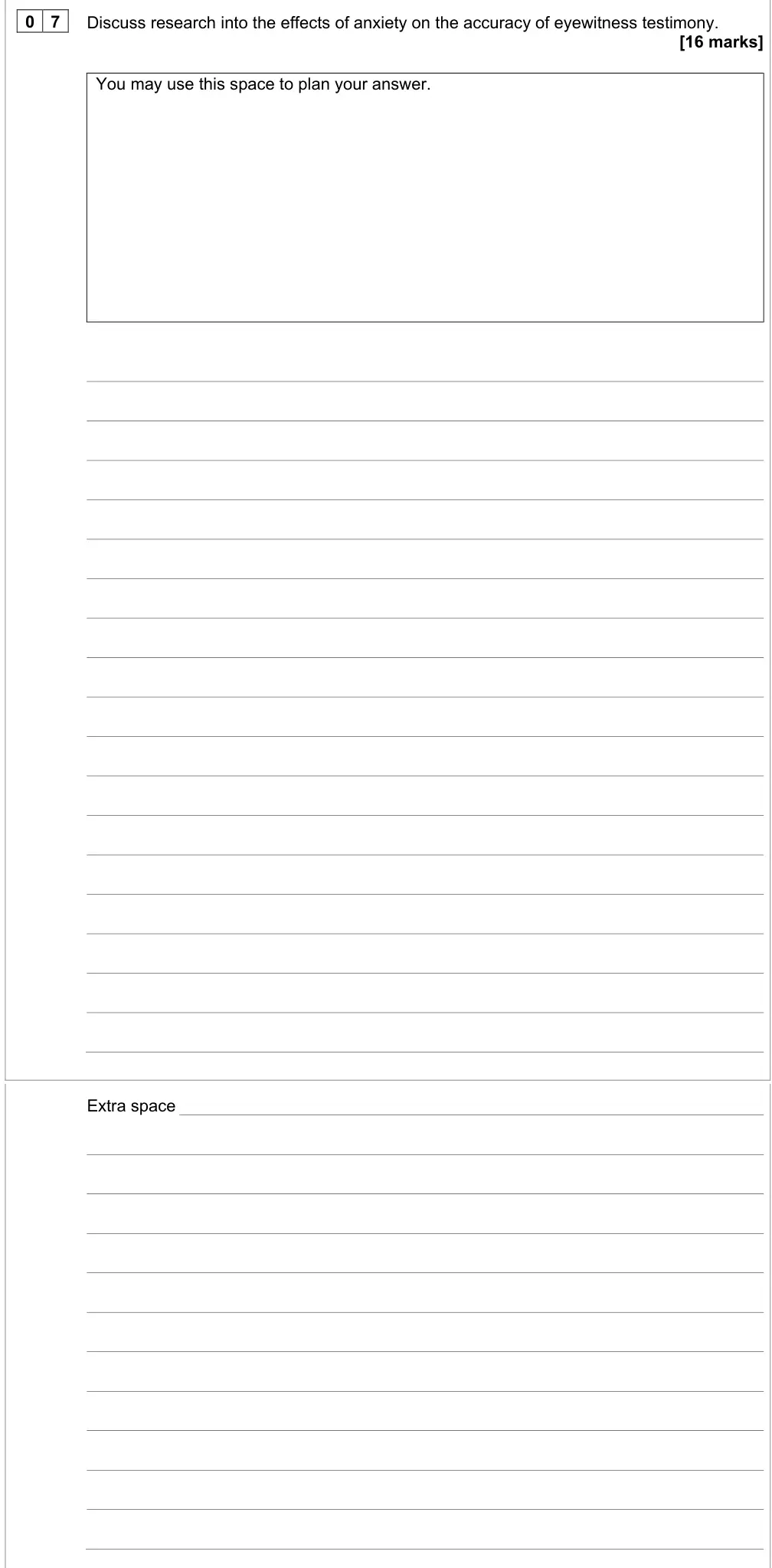
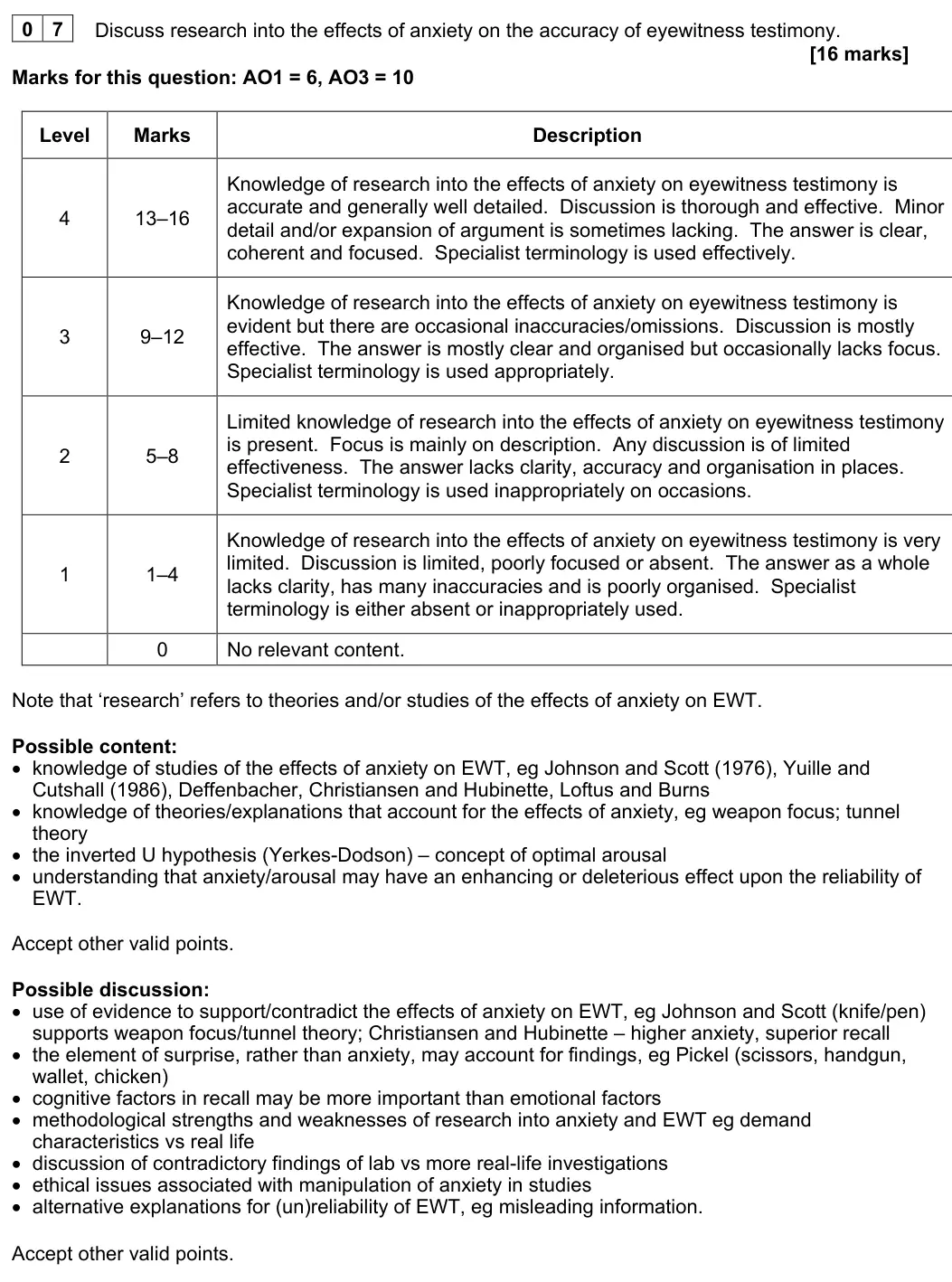
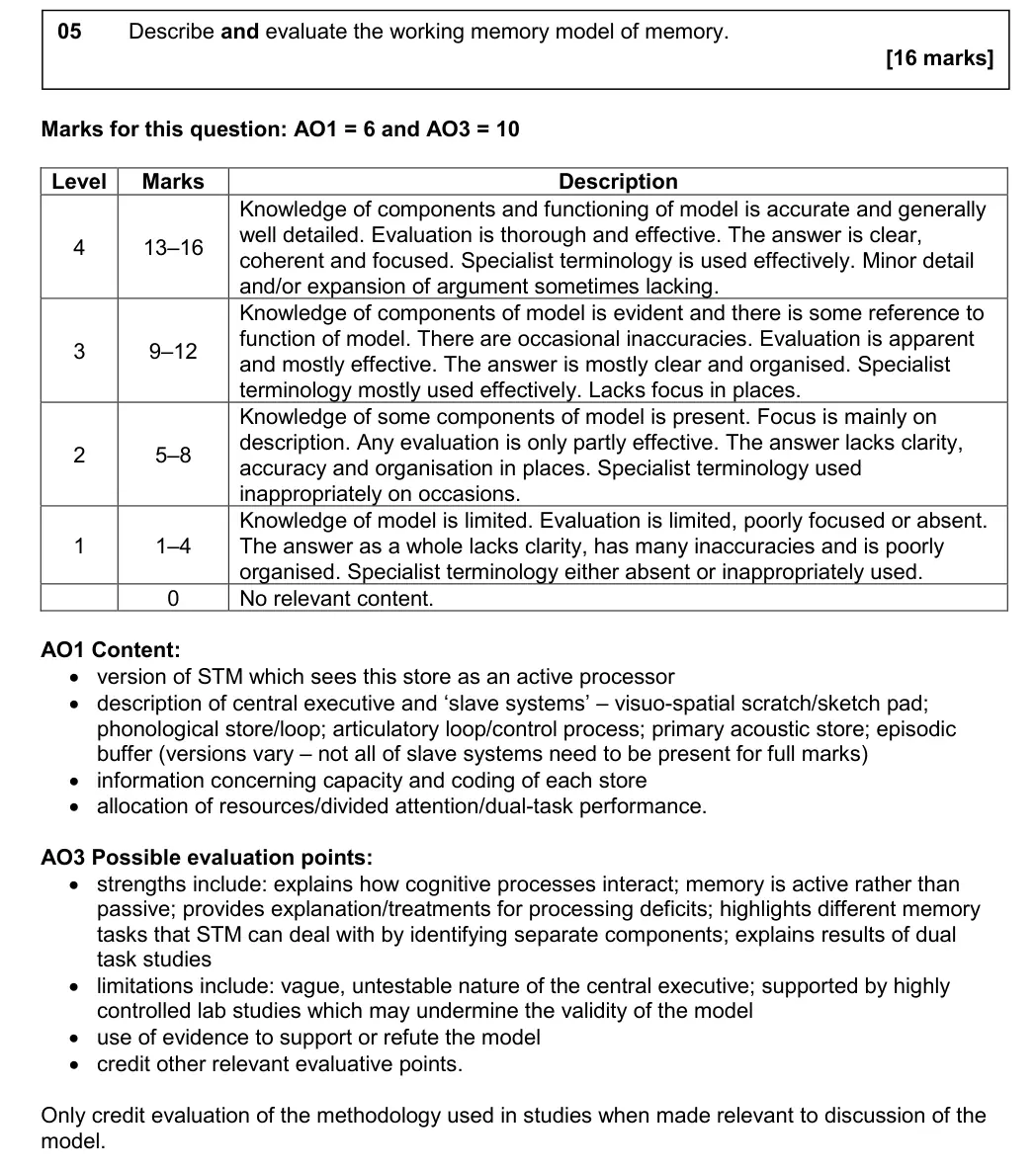
June 2023 · Paper 1 · Q716 marksAO1=6, AO3=1016-mark essayMedium
Mark scheme, including level descriptors and indicative content
Examiner's comment
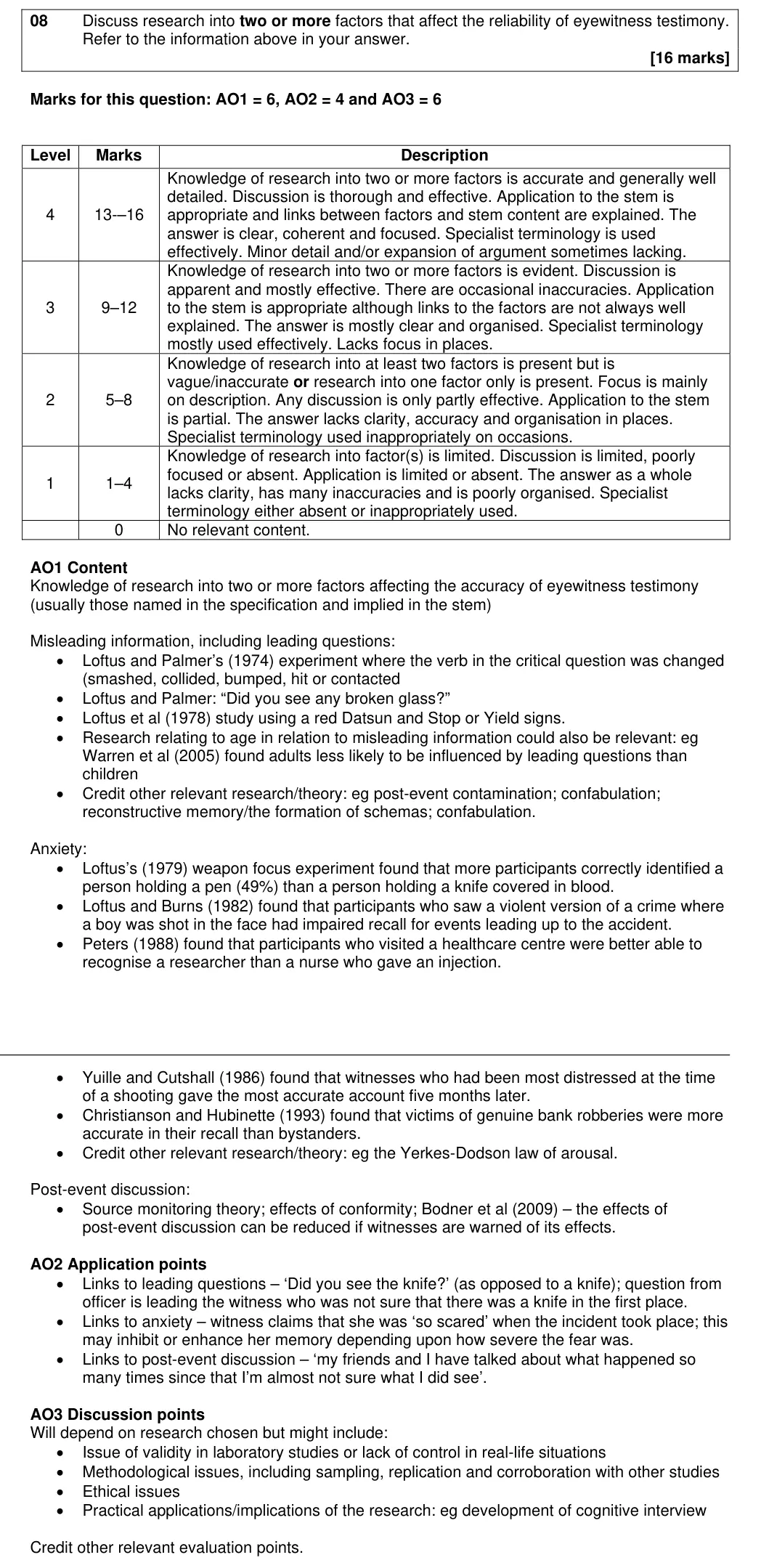
Students appeared well prepared for this question and were able to cite a variety of research studies and theory to gain significant credit. The mark scheme allowed students to respond with either theory and/or research and many were able to write a significant amount for this question. The most popular and effective material used included the Yerkes-Dodson law, Johnson and Scott’s research as well as Yuille and Cutshall’s real life research. Many students were able to successfully discuss the contradictory findings of research into this area in relation to the level of anxiety experienced. However, some answers lost focus and described research into misleading information and/or post event discussion. Discussion commentary was more effective than that seen in question 3, with students often citing further evidence, such as Pickle’s contradictory research into the element of surprise as well as some real-life applications of research. Over 40% of students were able to gain level 3 marks or higher in this question.
Notes from the mark scheme and report
drifting into misleading information/post-event discussion
Yerkes-Dodson, weapon focus, Johnson and Scott, Yuille and Cutshall most used
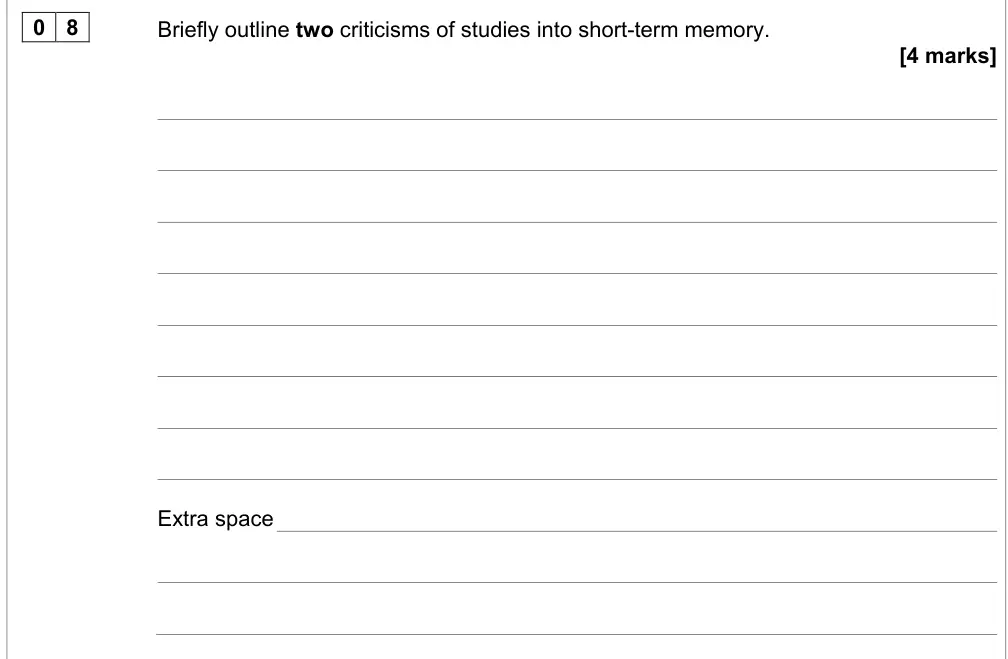
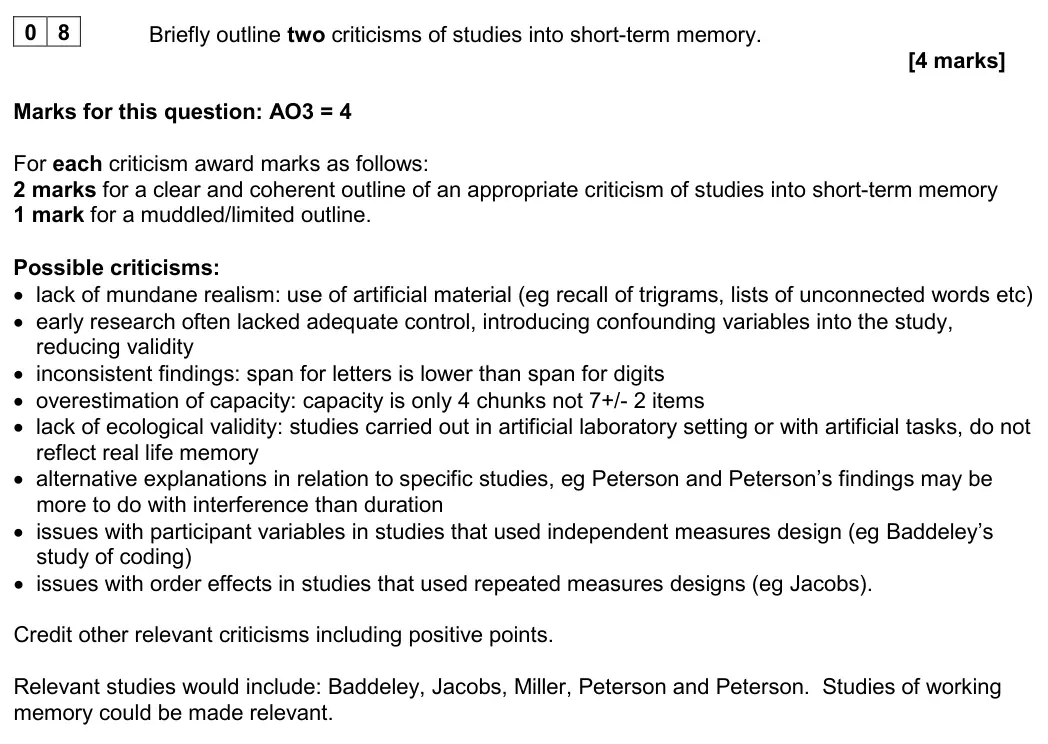
June 2023 · AS Paper 1 · Q84 marksAO3=4Evaluate (short)
Mark scheme, including level descriptors and indicative content
Examiner's comment
This question seemed challenging for a number of students, with few scoring full marks. Some students criticised models of memory, not studies of short-term memory. Some students were only able to give one criticism, not two. Weaker criticisms were often generic. The best answers offered criticisms that were tied to specific studies.
Notes from the mark scheme and report
criticisms of STUDIES of STM (Jacobs, Miller, Peterson and Peterson, Baddeley) e.g. artificial material, poor control, order effects/participant variables, interference alternative
criticising models not credited
generic criticisms weak
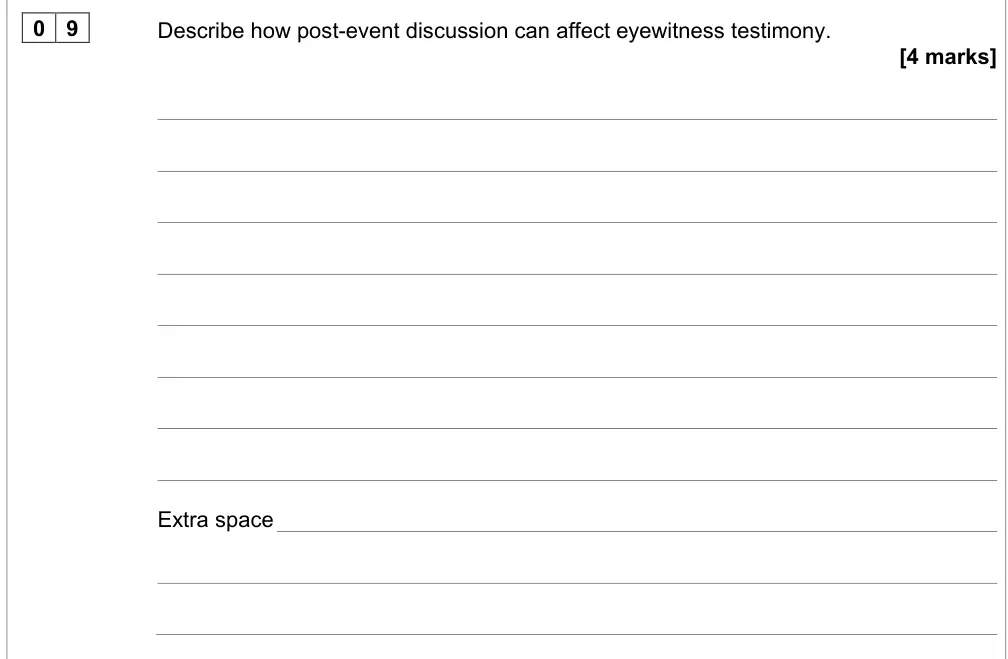
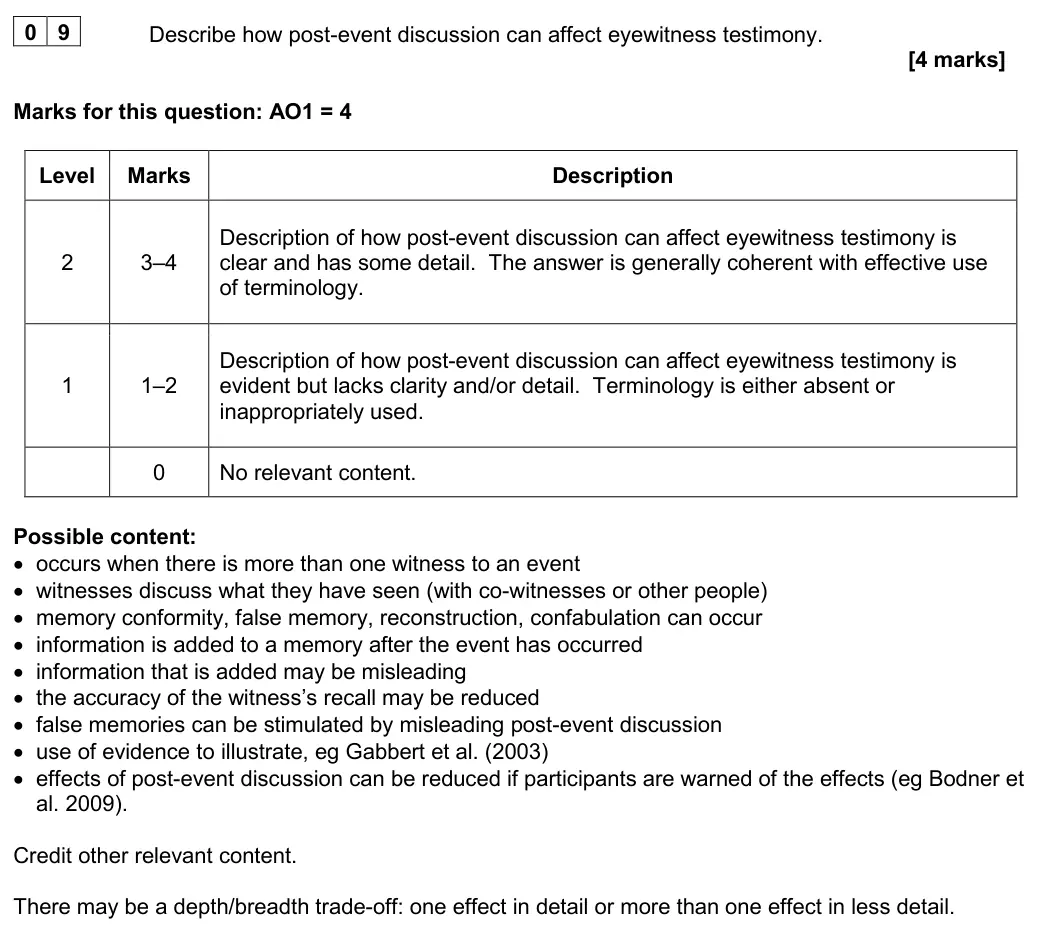
June 2023 · AS Paper 1 · Q94 marksAO1=4Outline
Mark scheme, including level descriptors and indicative content
Examiner's comment
Many students scored at least half marks on this question. Some students used inappropriate studies as part of their description, where no post-event discussion had taken place. Students would benefit from understanding the difference between post-event discussion and post-event information. Better answers explained what post-event discussion was, explained how it could affect eyewitness testimony and used specialist terminology.
Notes from the mark scheme and report
memory conformity, reconstruction, accuracy reduced, Gabbert et al
studies without post-event discussion (e.g. post-event information/leading questions) not relevant
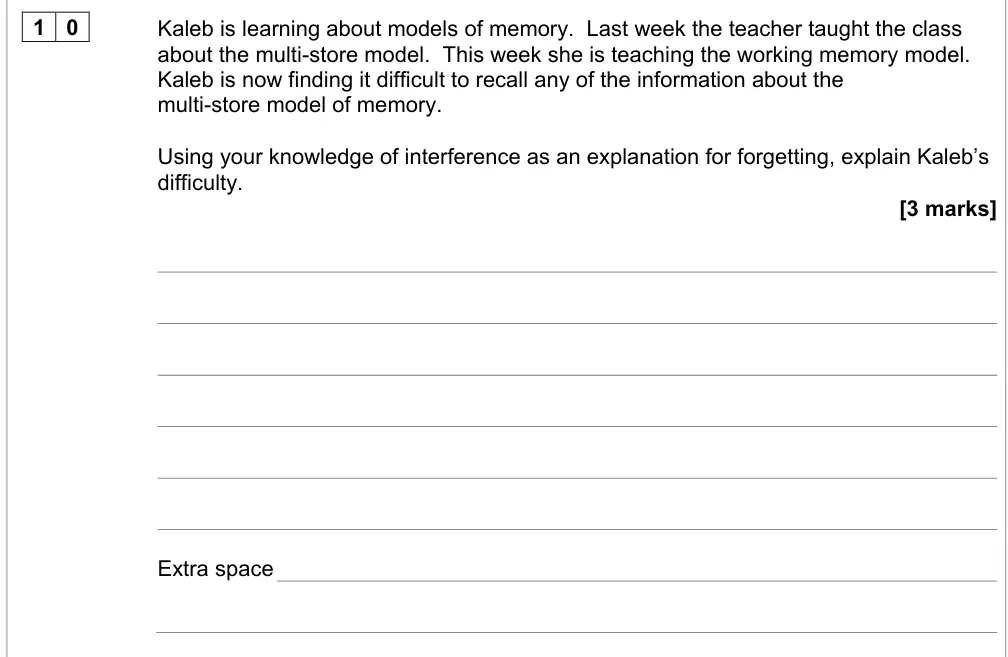
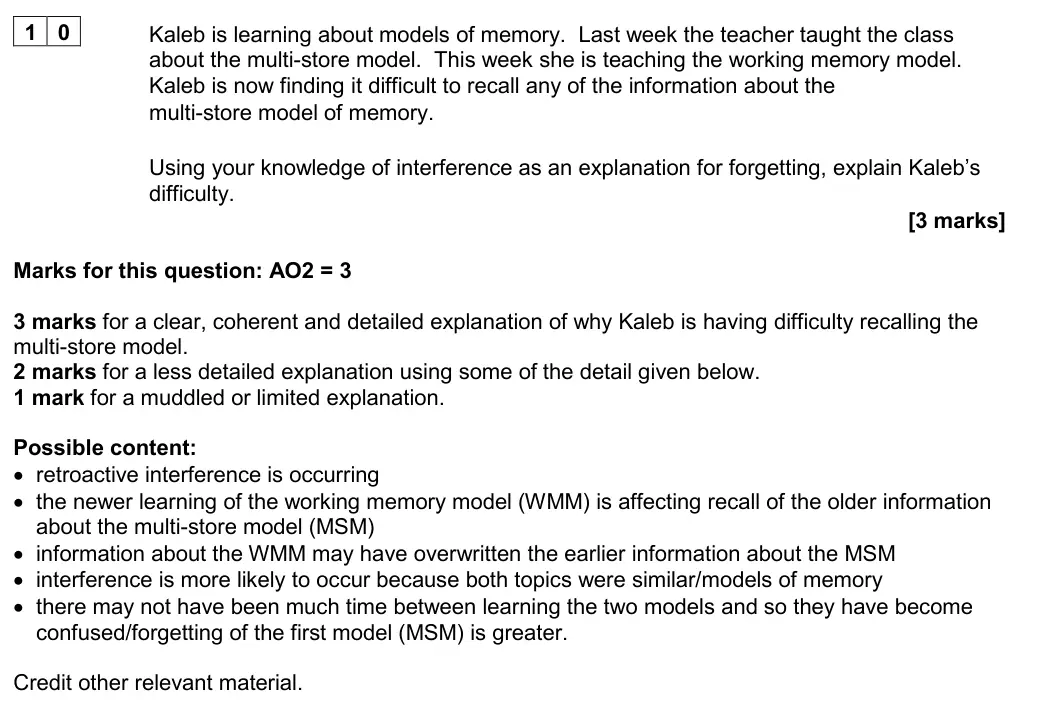
June 2023 · AS Paper 1 · Q103 marksAO2=3Application
Mark scheme, including level descriptors and indicative content
Examiner's comment
This question was one of the less challenging questions with many students scoring at least 2 marks. Some students continue to muddle retro-active and pro-active interference. A few failed to link their answer to the scenario, though this was not common on this question. Weak answers offered circular definitions of interference as one model ‘interfering’ with the recall of the other. Better answers recognised the role of similarity of the two models as contributing to Kaleb’s forgetting.
Notes from the mark scheme and report
retroactive interference: new WMM learning disrupts recall of older MSM learning
similarity of material
retro/proactive muddled
circular 'interfering' definitions
June 2023 · AS Paper 1 · Q114 marksAO3=4Evaluate (short)
Mark scheme, including level descriptors and indicative content
Examiner's comment
This question appeared to discriminate well between students as a wide range of responses were seen. A number of students did not read the question and offered descriptions of the cognitive interview rather than evaluation, which was not creditworthy. Better student answers referred to research to support their evaluation. Students who referred to time consuming as an evaluation point needed to explain why it was more time consuming. Weaker students listed evaluation without elaborating and a small number of students did not attempt the question.
Notes from the mark scheme and report
evaluation only (description not credited): Kohnken et al, more incorrect info too, Milne and Bull, age of witness, training/resources
'time-consuming' must be explained
June 2023 · AS Paper 1 · Q128 marksAO1=4, AO3=4Extended writing
Mark scheme, including level descriptors and indicative content
Examiner's comment
This was another question which discriminated between students. Poorer responses tended to focus solely on description or contained no/limited effective evaluation. Some students simply provided a very brief and thus limited description. It is important to remind students that in these questions there should be an equal amount of AO1 and AO3. The best evaluation linked evidence to the model and some students did this extremely well. There were a number of students who muddled the working memory model with the multi-store model. A few students wrote very long essays more suited to a 12-mark essay, and thus students need to be mindful of how much to write for an 8-mark question, and not use valuable time on material that is not needed.
Notes from the mark scheme and report
components, capacity and coding
evaluation via dual-task evidence, KF, vague central executive, lab studies
description of MSM not creditable (comparison is)
muddled with MSM
overlong answers
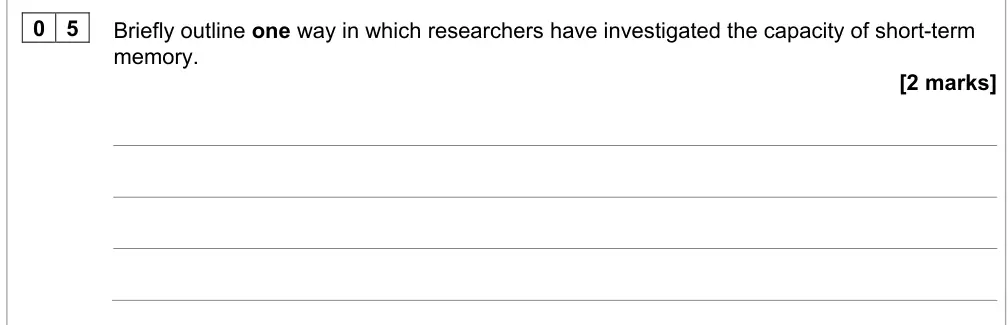
June 2022 · Paper 1 · Q52 marksAO1=2Outline
Mark scheme, including level descriptors and indicative content
Examiner's comment
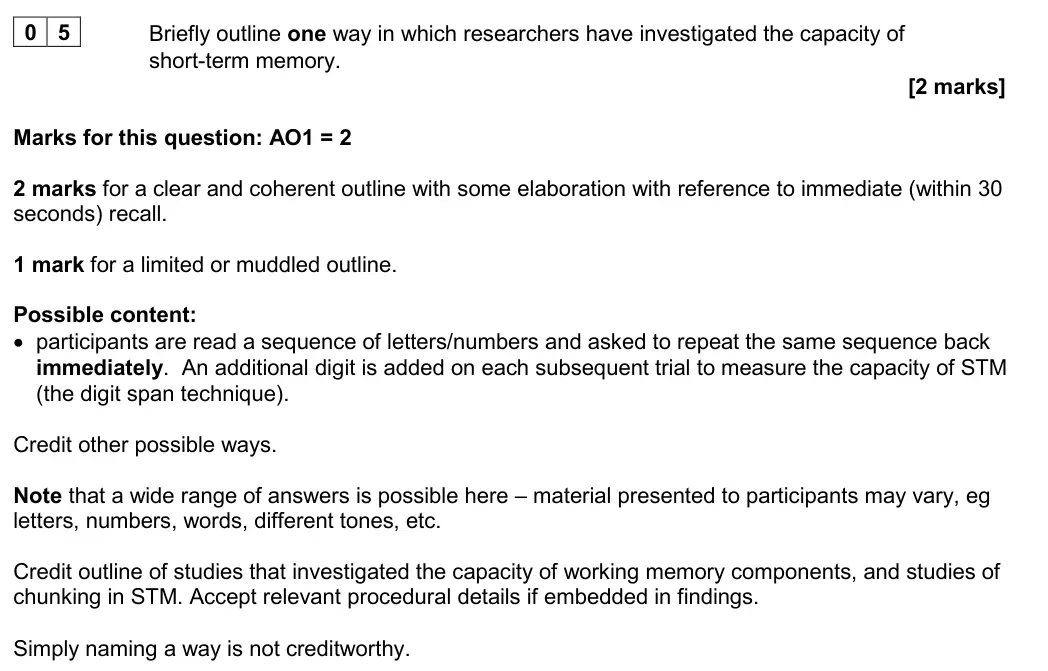
Questions 05 and 06 (ways of investigating capacity and duration of short-term memory) did pose problems for some students. Jacob’s digit span study was the overwhelming favourite choice of investigation in responses to this question. Although a number of students could outline the study with impressive detail, this question was not done well overall. Some answers confused Questions 05 and 06, while others simply stated results of studies and not the methods used. Other answers were too vague for credit. A proportion of students did not gain the second mark as there was no reference to immediate recall.
Notes from the mark scheme and report
2nd mark needs reference to immediate recall
digit span (Jacobs) most popular
simply naming a way not creditworthy
many stated results not method
some confused 05 and 06
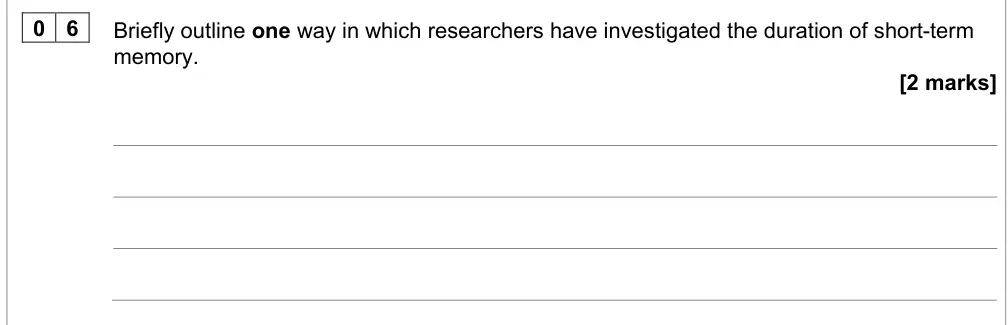
June 2022 · Paper 1 · Q62 marksAO1=2Outline
Mark scheme, including level descriptors and indicative content
Examiner's comment
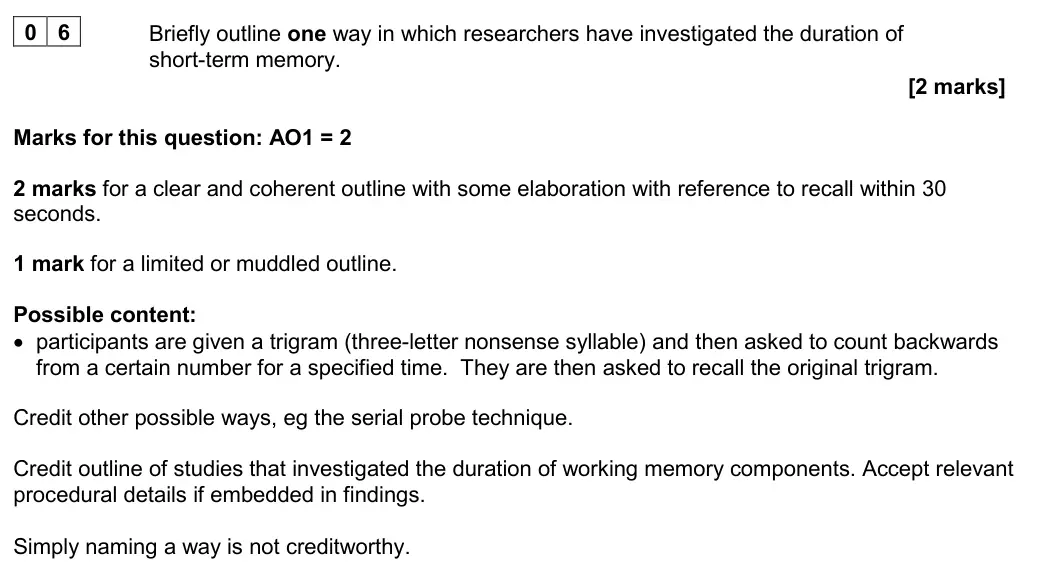
Questions 05 and 06 (ways of investigating capacity and duration of short-term memory) did pose problems for some students. Answers focused on Petersen & Petersen’s trigram study, and there were some excellent outlines with reference to counting backwards to prevent rehearsal, and variable recall periods (up to 30 seconds). But, as in Question 05, many students simply stated conclusions or the responses were too vague or muddled for credit.
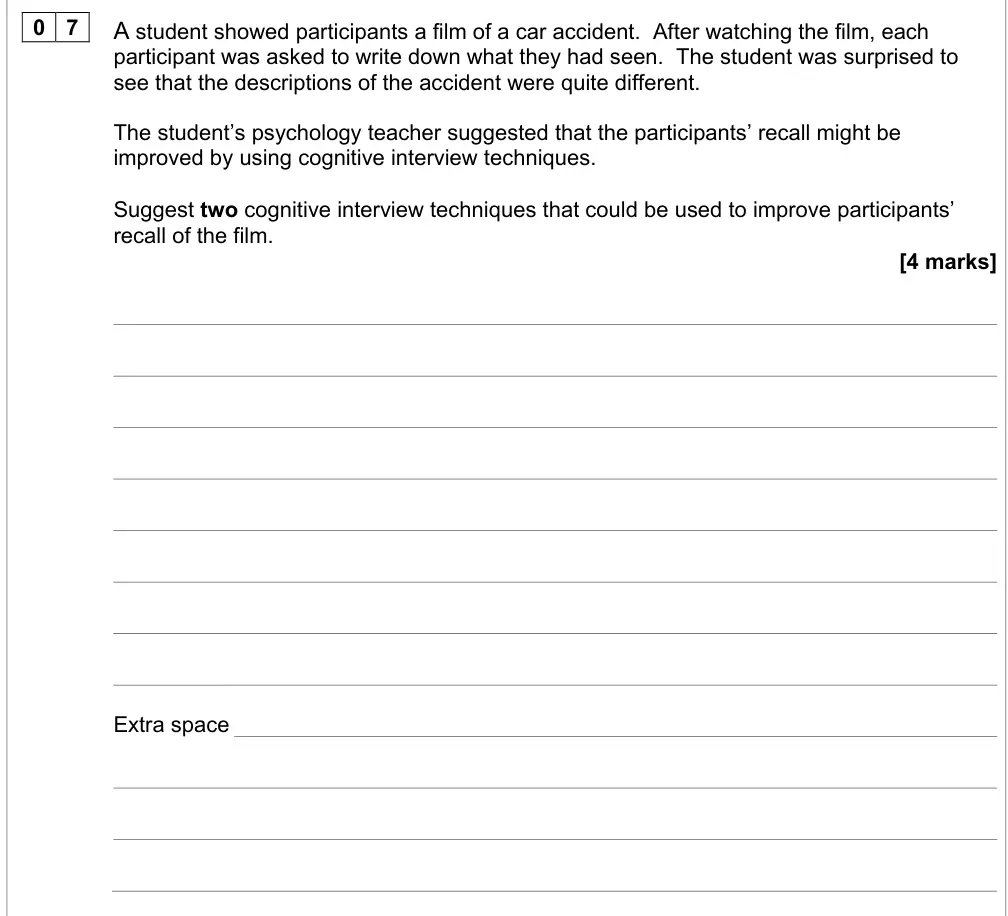
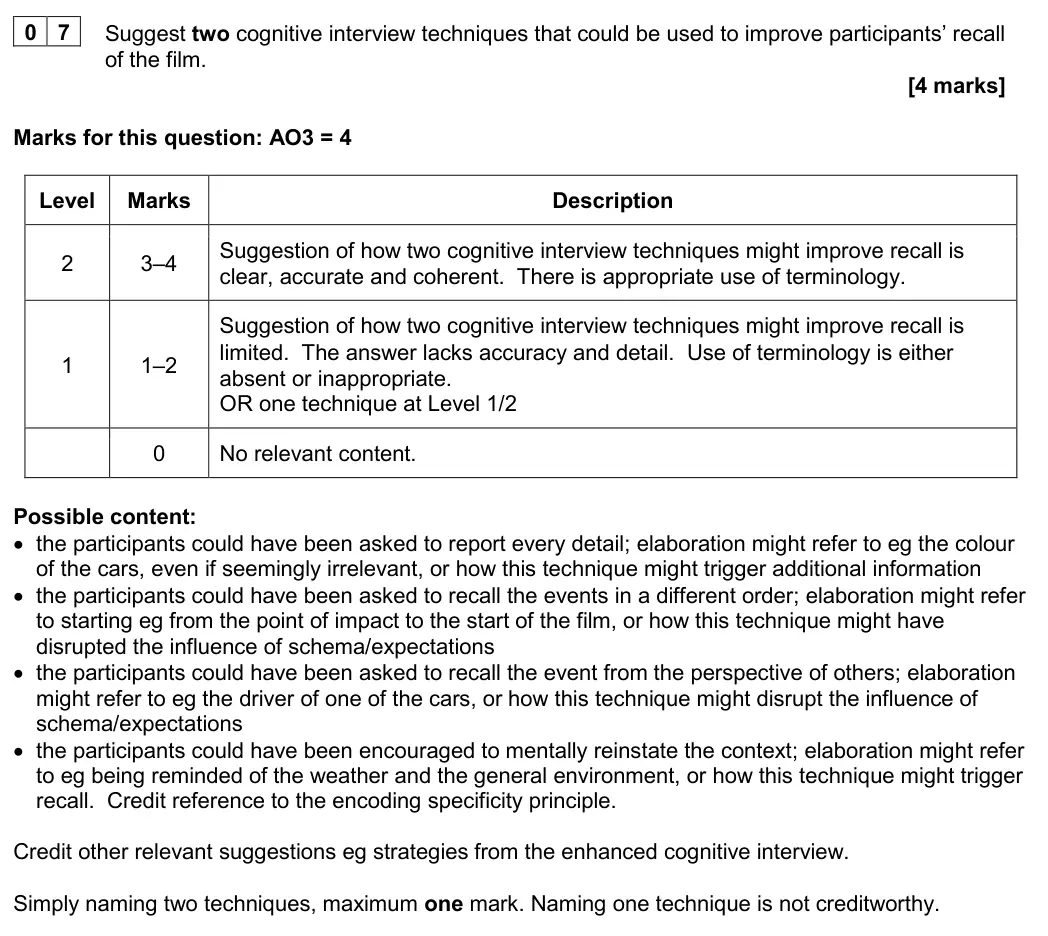
Mark scheme, including level descriptors and indicative content
Examiner's comment
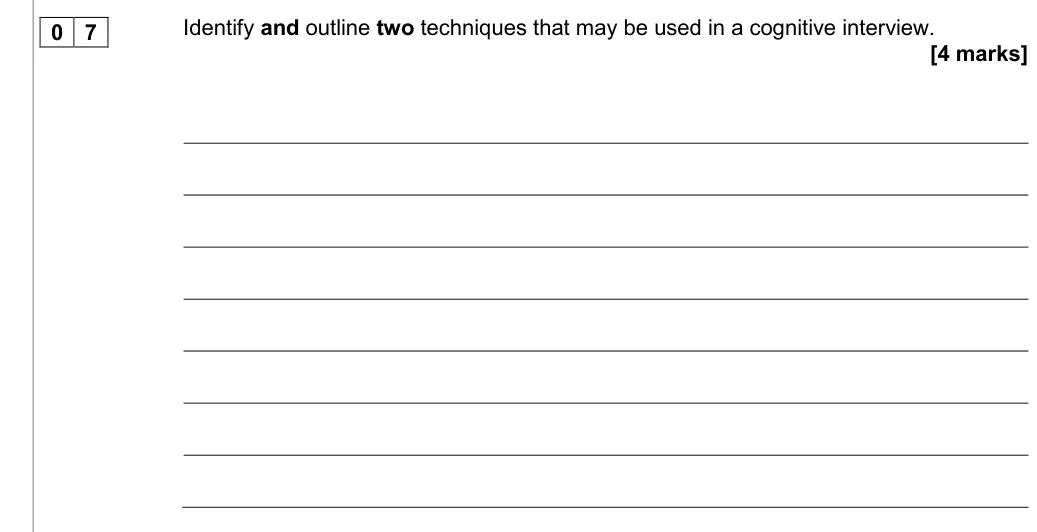
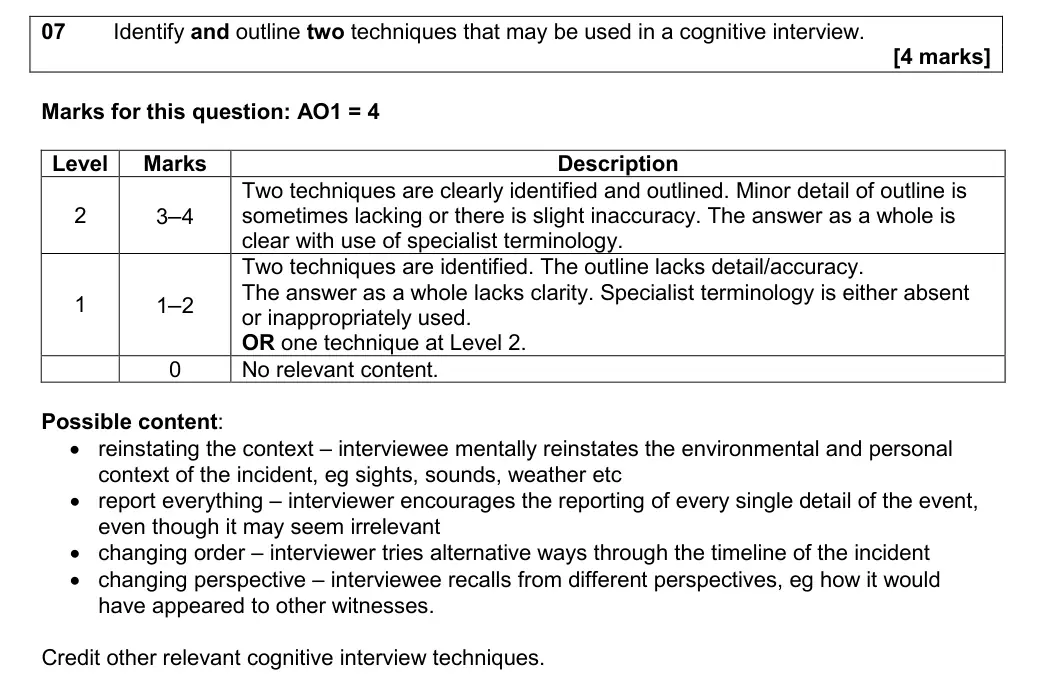
This question was done well. Virtually all students could pick up some marks, while many could provide two techniques, with elaboration (detail of how it could be applied to the scenario, or how it might aid recall) sufficient for 4 marks.
Notes from the mark scheme and report
naming two techniques only = max 1
naming one = 0
elaboration via application to the film or how it aids recall (report everything, change order, change perspective, context reinstatement)
done well
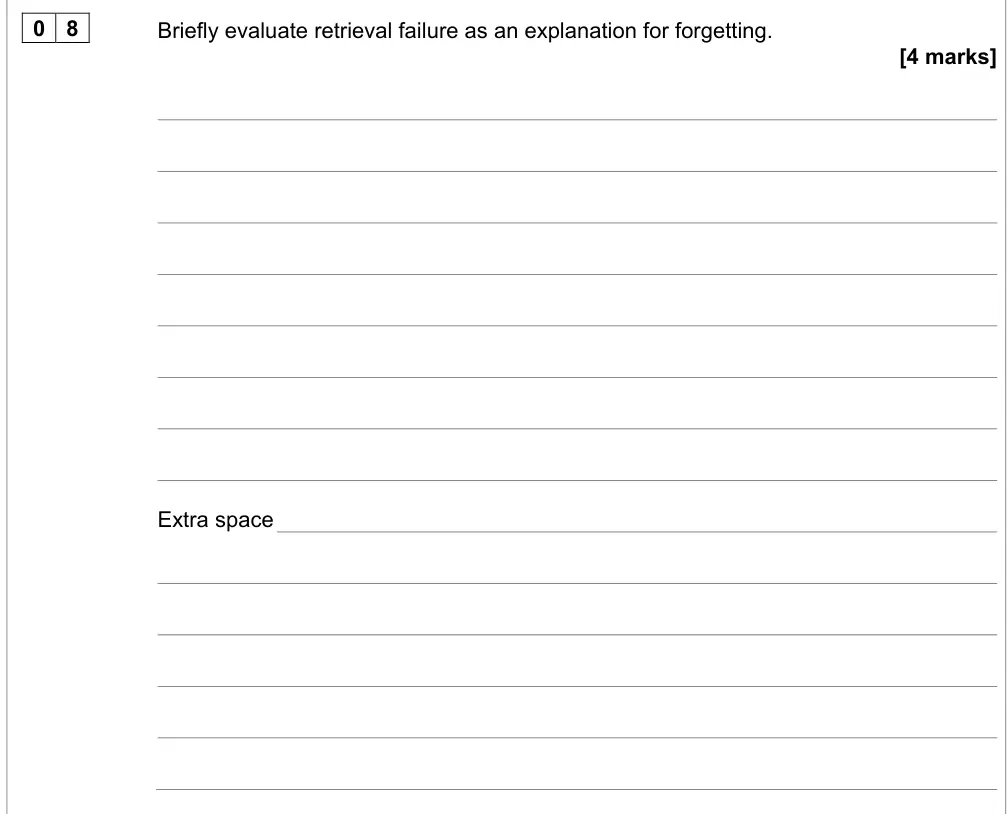
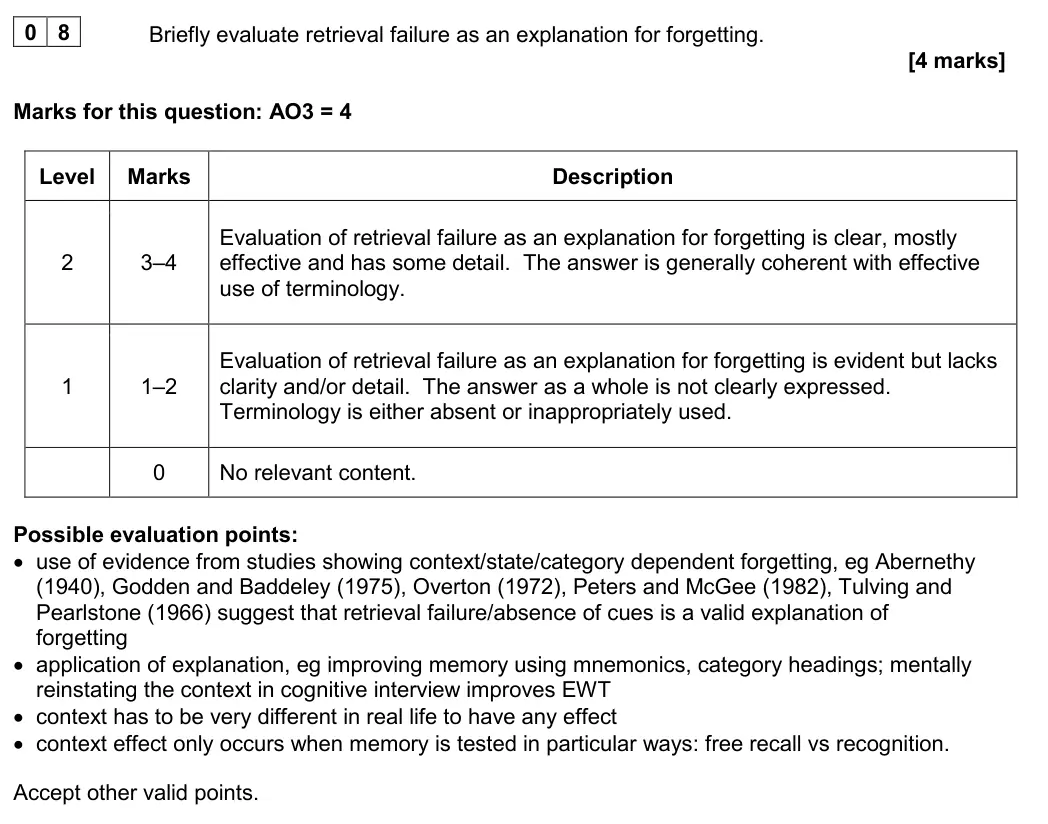
June 2022 · AS Paper 1 · Q84 marksAO3=4Evaluate (short)
Mark scheme, including level descriptors and indicative content
Examiner's comment
Some wrote much more than was required, which was particularly noticeable in questions 4, 8 and 14. On some questions a number of students failed to address the demands of the question. This was most noticeable on question 8, where the command word was ‘evaluate’ but many students ‘described’, which was not creditworthy. This question appeared to discriminate well between students as a wide range of responses were seen. There were some students who simply described the retrieval failure theory and thus scored zero marks. This question highlighted that students must pay careful attention to the wording of the question and tailor their answer to it. Some students both described and evaluated, and thus wasted time writing about content for which they received no credit. Some students muddled retrieval failure theory with interference theory. Better answers identified a strength or limitation and then used research to back up their claim.
Notes from the mark scheme and report
evaluation only - description scores zero
context/state/category-dependent evidence (Godden and Baddeley, Abernethy, Tulving and Pearlstone), applications (CI, mnemonics), context must be very different, recall vs recognition
muddled with interference
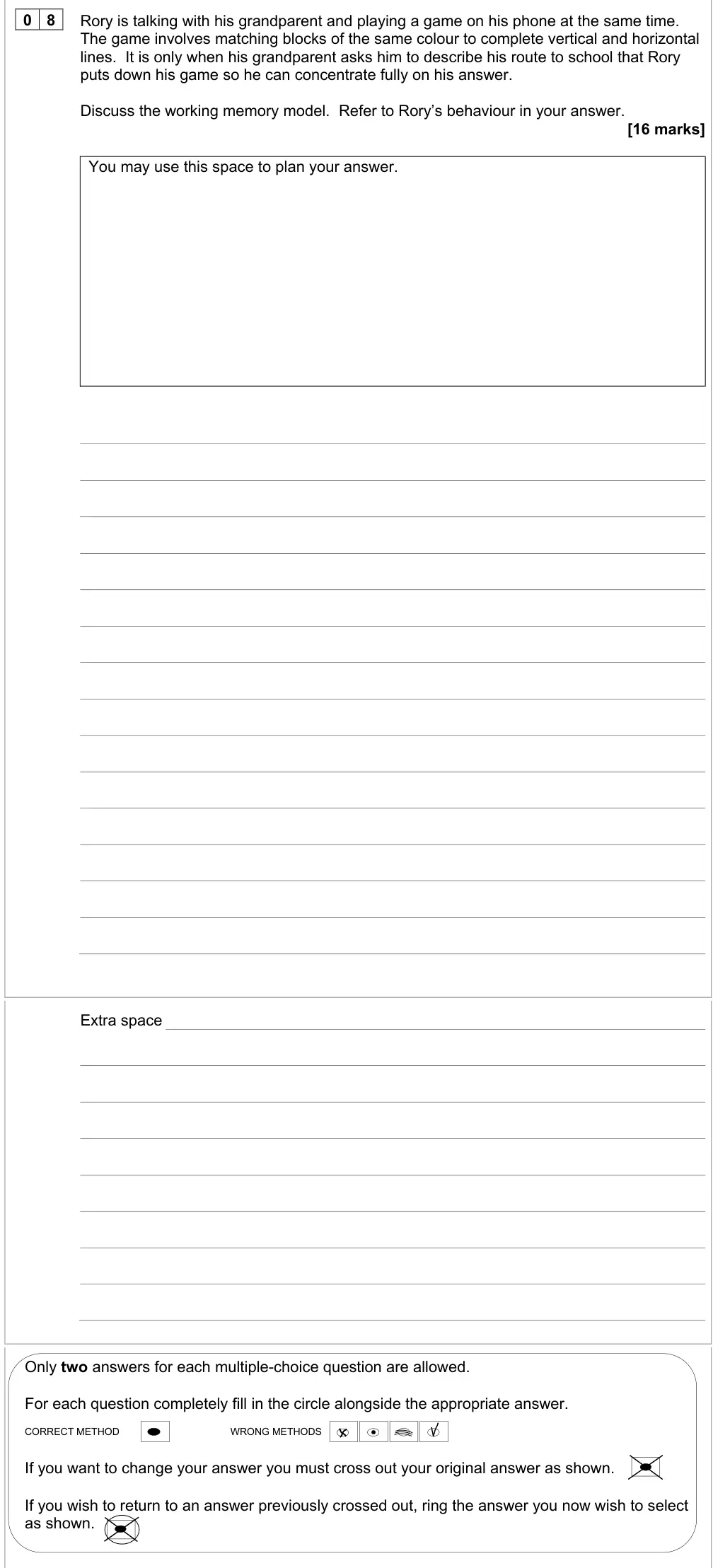
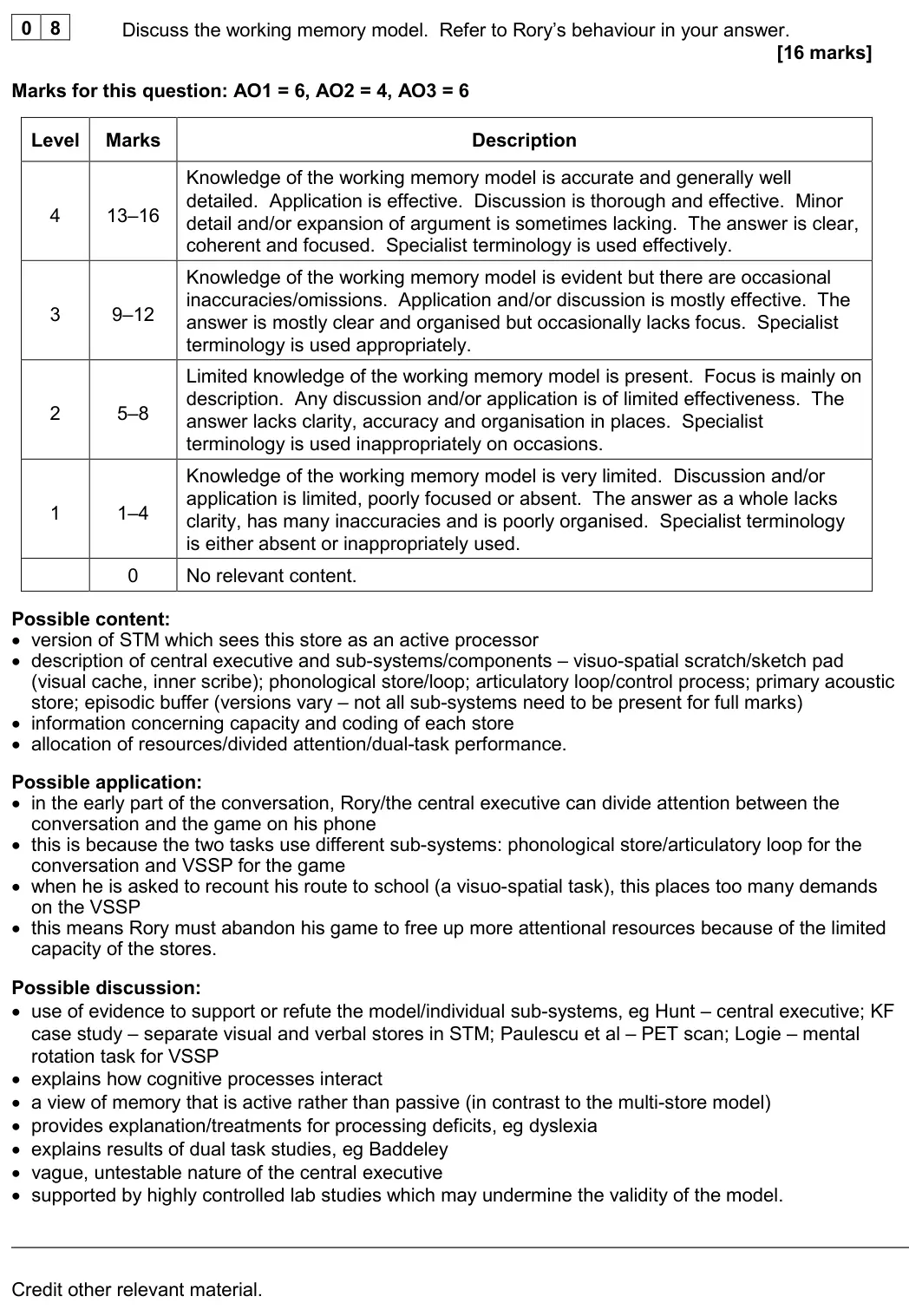
June 2022 · Paper 1 · Q816 marksAO1=6, AO2=4, AO3=616-mark essay
Mark scheme, including level descriptors and indicative content
Examiner's comment
This question produced a range of answers. At the lower end there was confusion between the multistore model and working memory, but at the upper end there were excellent outlines of the WM model, its application to the scenario, and effective evaluation. Although most answers covered the basic components of the model, only a few referred to characteristics such as capacity and duration. There was also occasional confusion as to the role of the episodic buffer, which was sometimes confused with episodic memory. Application was generally sound, but some students confused themselves over the roles of central executive, episodic buffer and retrieval from long term memory, rather than focusing on the phonological loop and visuo-spatial sketch pad. Evaluation tended to focus on dual task studies, with some answers providing good detail of how these studies were carried out. KF was a popular case study, but a few students had his impairments the wrong way round (he demonstrated intact VSSP, impaired phonological loop), and confused him with HM and/or Clive Wearing. The vagueness of the central executive was also popular, while at the top end of performance, brain scanning studies were used effectively. Some answers stated that a criticism of the WMM was that it was not clear on the role or structure of long-term memory. Students should be aware that it was not designed/modelled to do this, so this point was not creditworthy, although reference to the role of the episodic buffer in linking WM and LTM could earn AO1 marks.
Notes from the mark scheme and report
apply: dual task (phonological loop for conversation + VSSP for game), route to school overloads VSSP
KF impairments often reversed or confused with HM
episodic buffer confused with episodic memory
criticising WMM for not explaining LTM not creditworthy
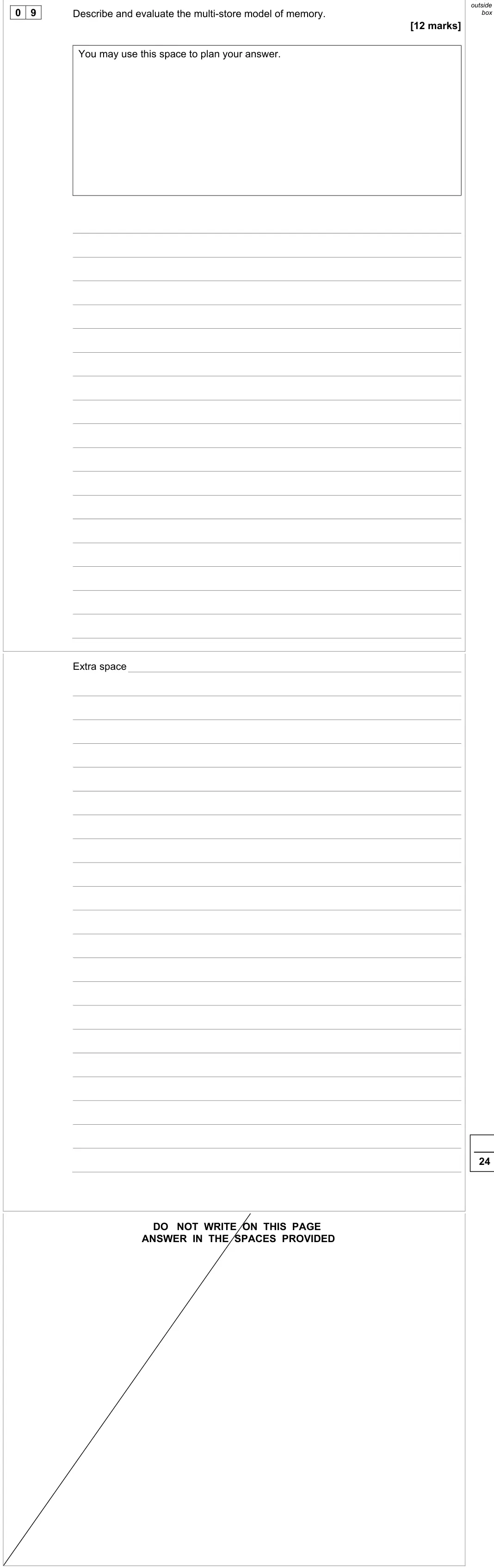
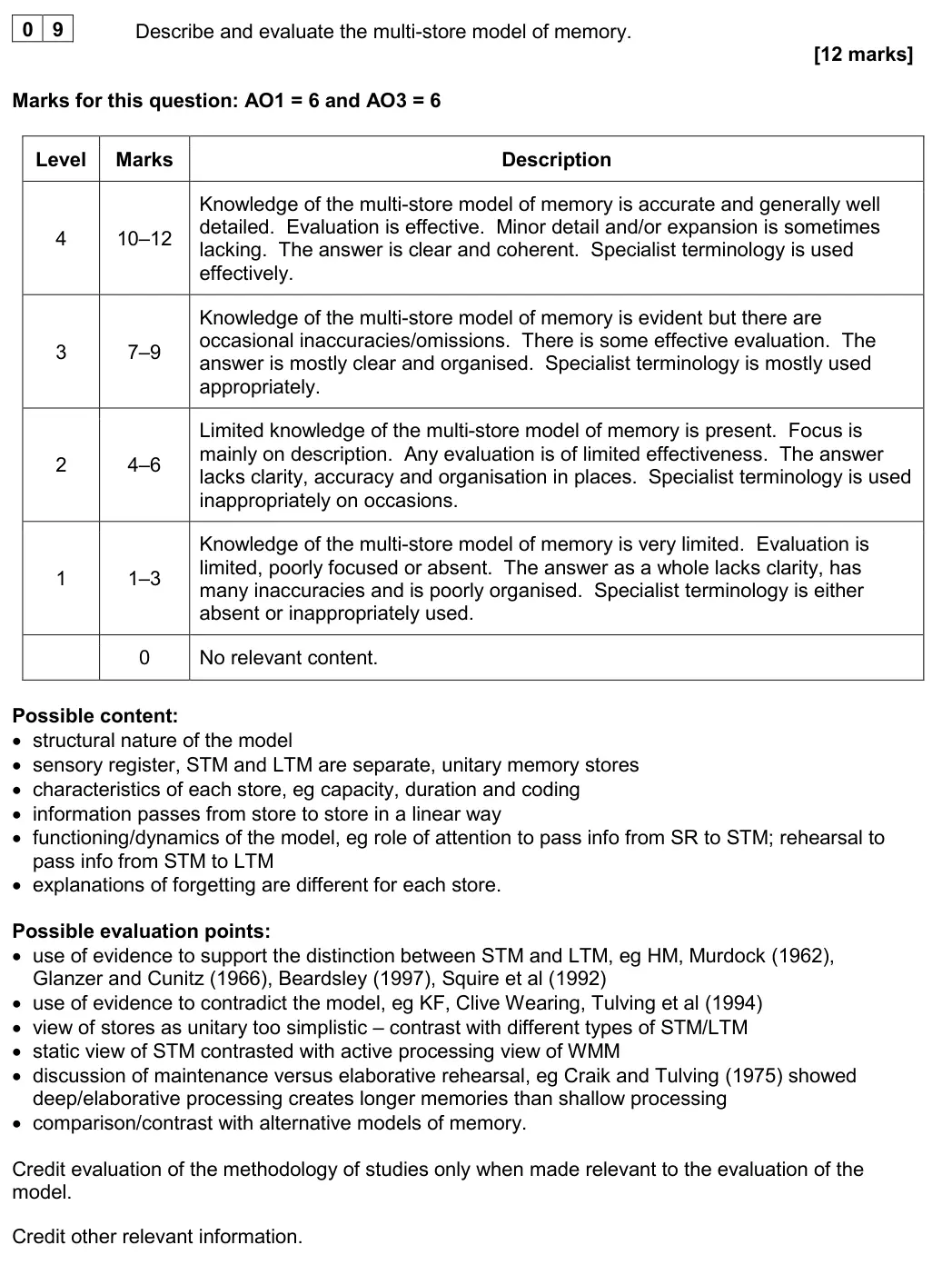
June 2022 · AS Paper 1 · Q912 marksAO1=6, AO3=6Extended writing
Mark scheme, including level descriptors and indicative content
Examiner's comment
However, others wrote very little and did not include sufficient detail, particularly in questions 9 and 14. Performance on questions 4, 9 and 14 suggested that many students should work to improve the higher order skills of evaluation/discussion. A good range of responses were seen across the cohort with many students producing level 3 and 4 answers. These responses tended to accurately describe the multi-store model with some detail and also included some effective evaluation. Poorer responses tended to focus solely on description or contained no/limited effective evaluation. Some students simply provided a very brief and thus limited description. It is important to remind students that in these questions there should be an equal amount of AO1 and AO3. The best evaluation linked evidence to specific assumptions of the model and some students did this extremely well.
Notes from the mark scheme and report
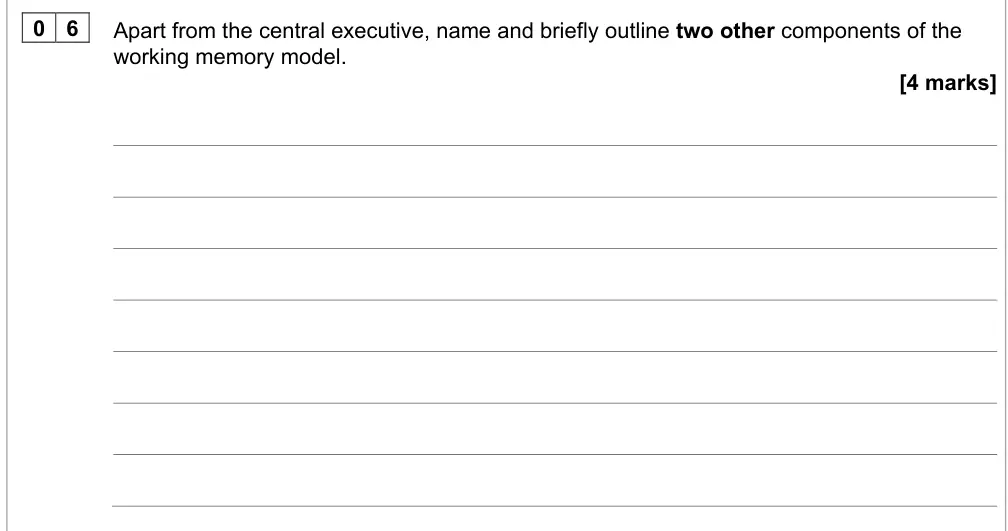
SR, STM, LTM with capacity/duration/coding, attention and rehearsal
evaluation via HM, KF, Clive Wearing, Glanzer and Cunitz, WMM, Craik and Tulving
methodology only credited if linked to the model
balance AO1 and AO3
November 2021 · Paper 1 · Q64 marksAO1=4Outline
Mark scheme, including level descriptors and indicative content
Examiner's comment
Straightforward, and overall performance impressive.
Notes from the mark scheme and report
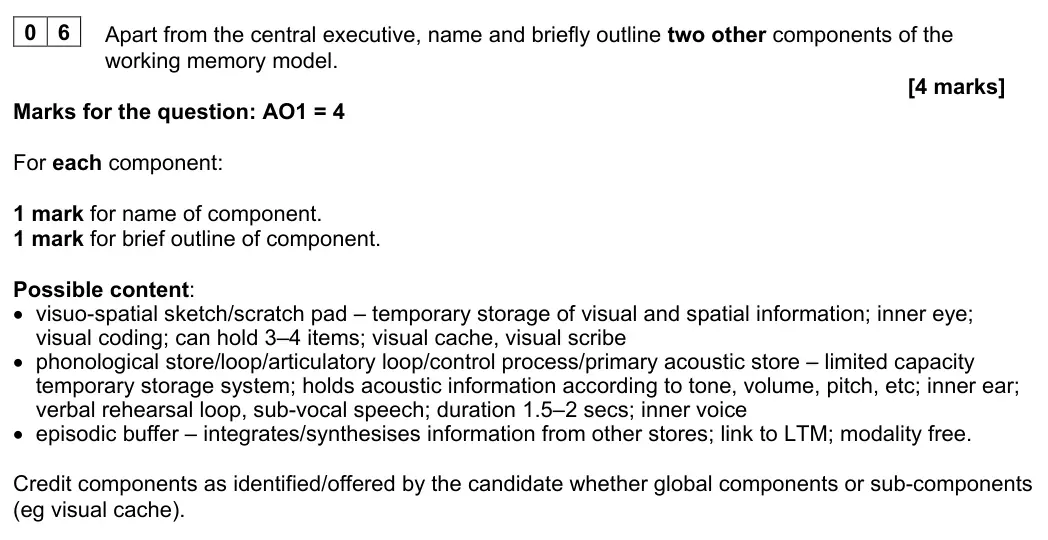
for each of two components (not central executive): 1 mark name + 1 mark outline
sub-components (e.g. visual cache) credited
performance impressive
November 2021 · Paper 1 · Q74 marksAO3=4Evaluate (short)
Mark scheme, including level descriptors and indicative content
Examiner's comment
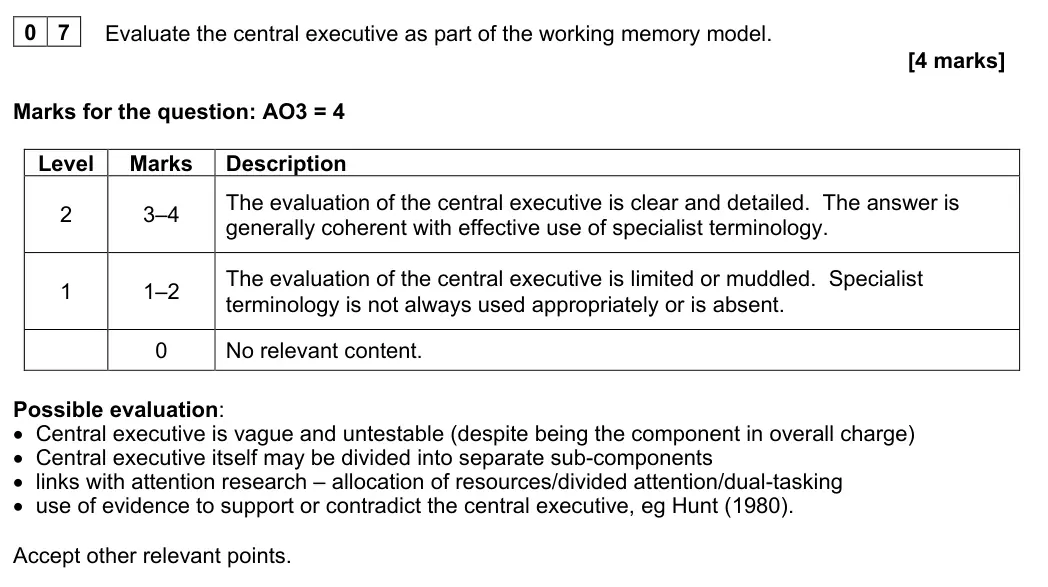
Many students simply described the central executive rather than evaluating it. There was little use of research studies, and virtually no positive evaluation.
Notes from the mark scheme and report
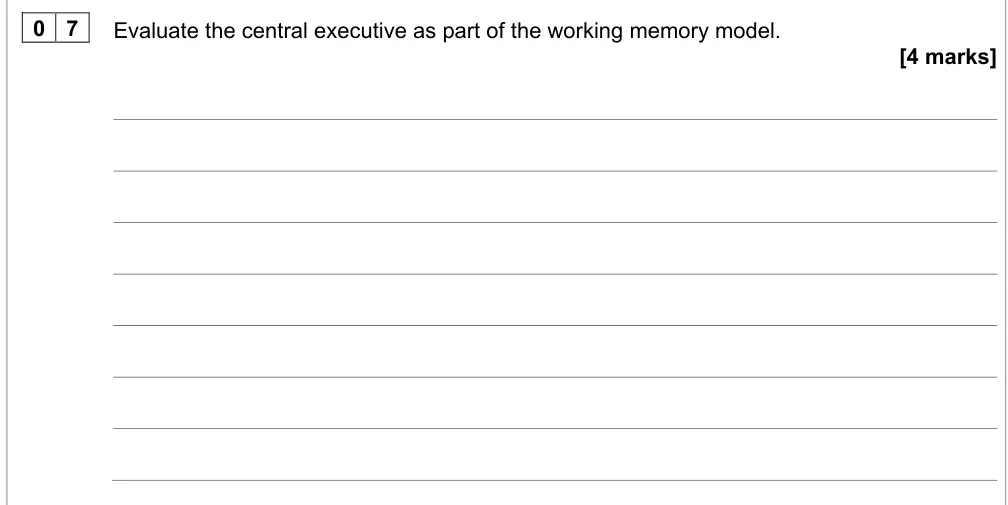
evaluation only: vague/untestable, may be fractionated, attention/dual-task links, evidence
many simply described the central executive
little use of research, virtually no positive evaluation
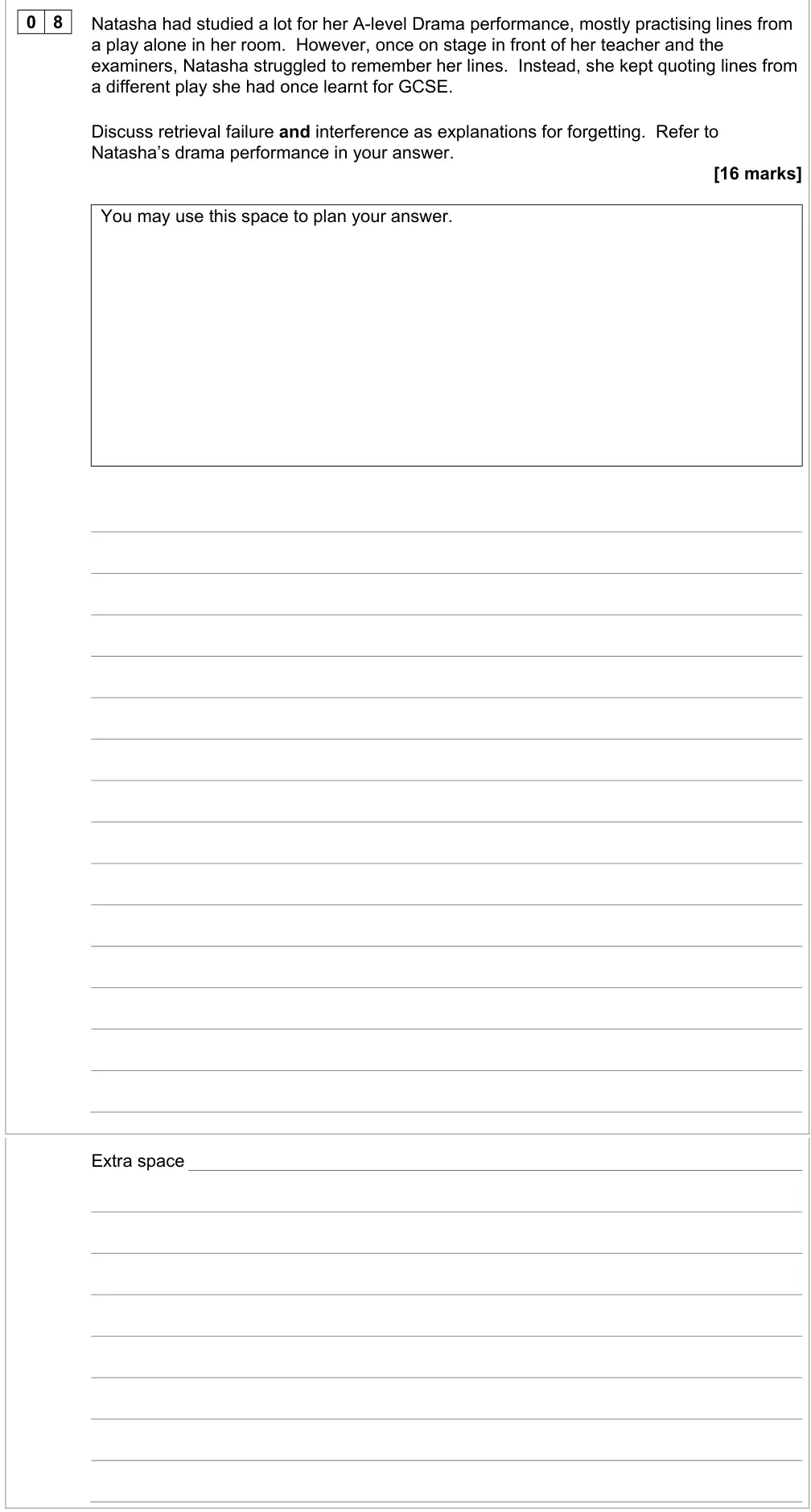
November 2021 · Paper 1 · Q816 marksAO1=6, AO2=4, AO3=616-mark essay
Mark scheme, including level descriptors and indicative content
Examiner's comment
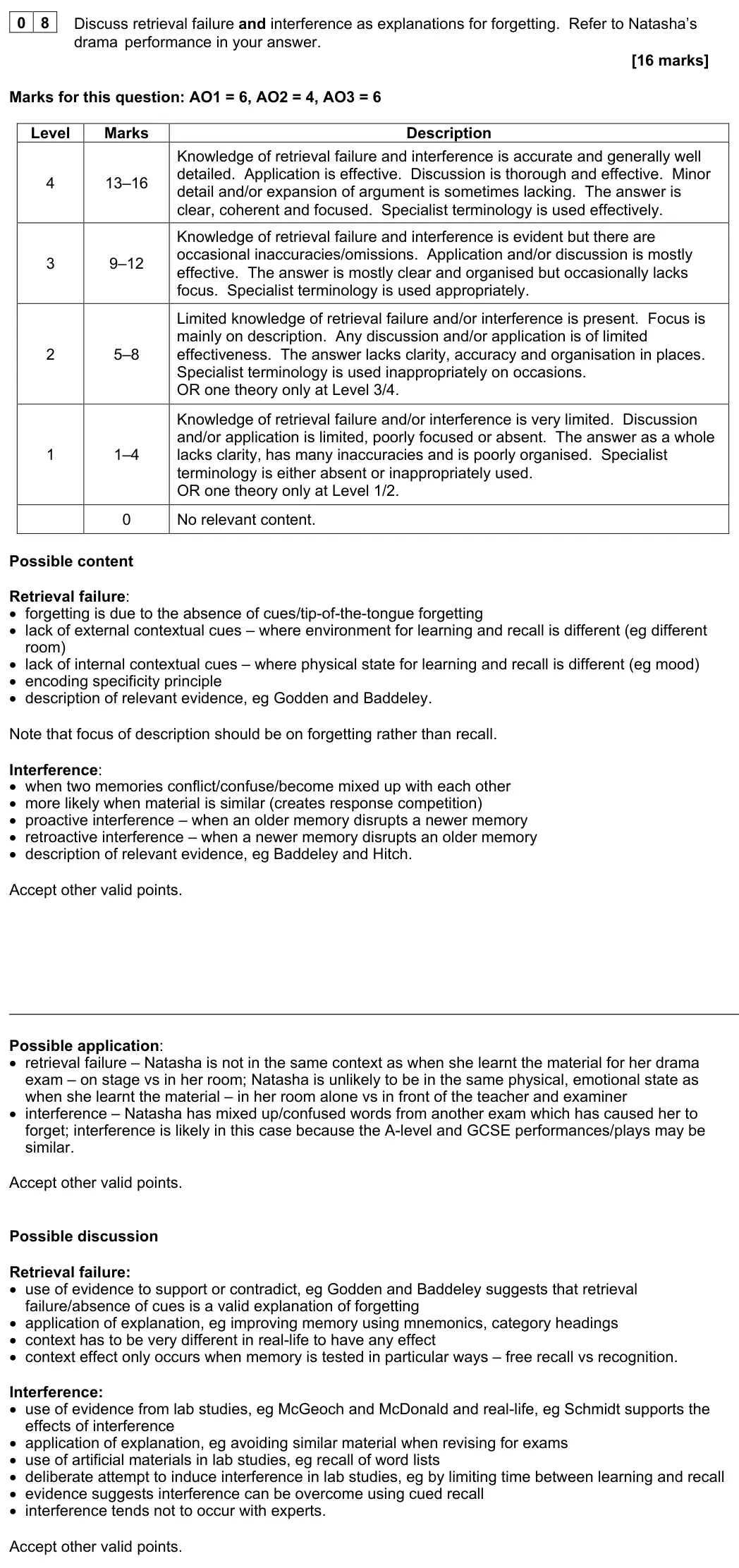
This question produced a range of performance. At the top end answers were clear on the differences between proactive and retroactive interference, and on state and context-dependent retrieval. Research studies were used effectively, and application was detailed. At the lower end there was confusion between types of forgetting, some inaccurate application and limited evaluation, especially of interference theory.
Notes from the mark scheme and report
one theory only = max Level 2
apply both explanations to Natasha (context/state cues: room vs stage
proactive interference from GCSE play)
focus of retrieval failure description should be forgetting not recall
confusion between types of forgetting and inaccurate application at lower end
November 2020 · AS Paper 1 · Q5.12 marksAO2=1, AO3=1Research methods
Mark scheme, including level descriptors and indicative content
Notes from the mark scheme and report
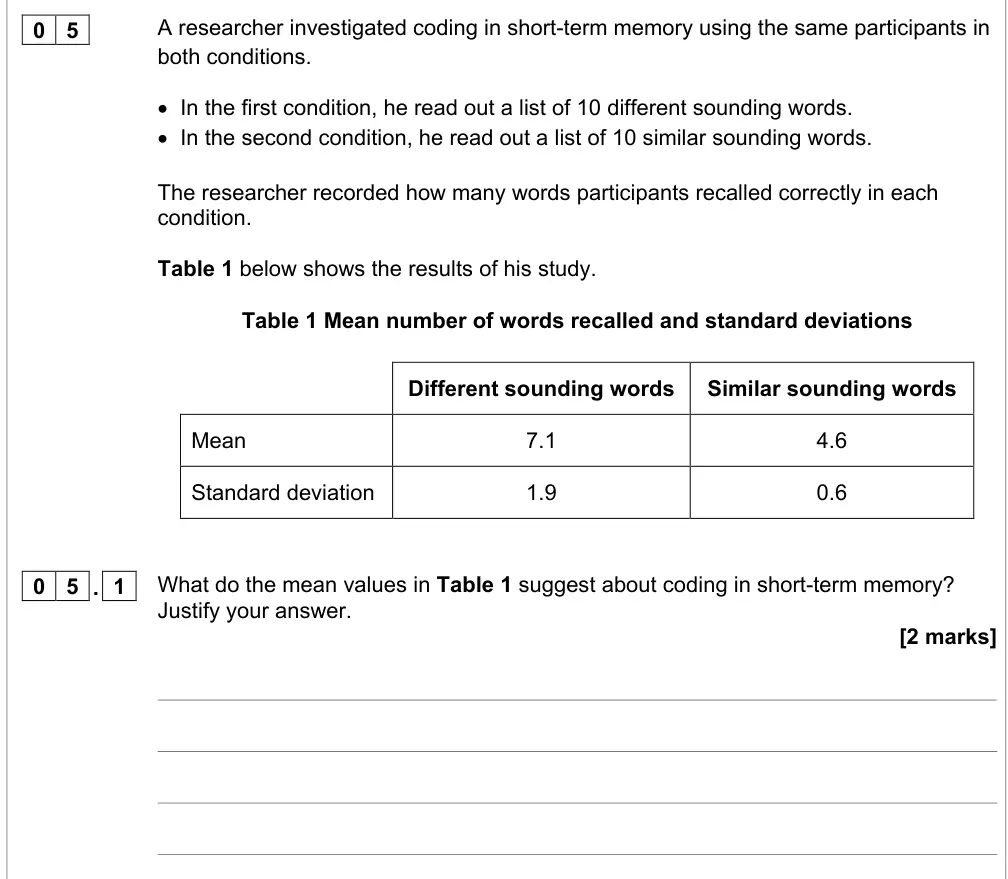
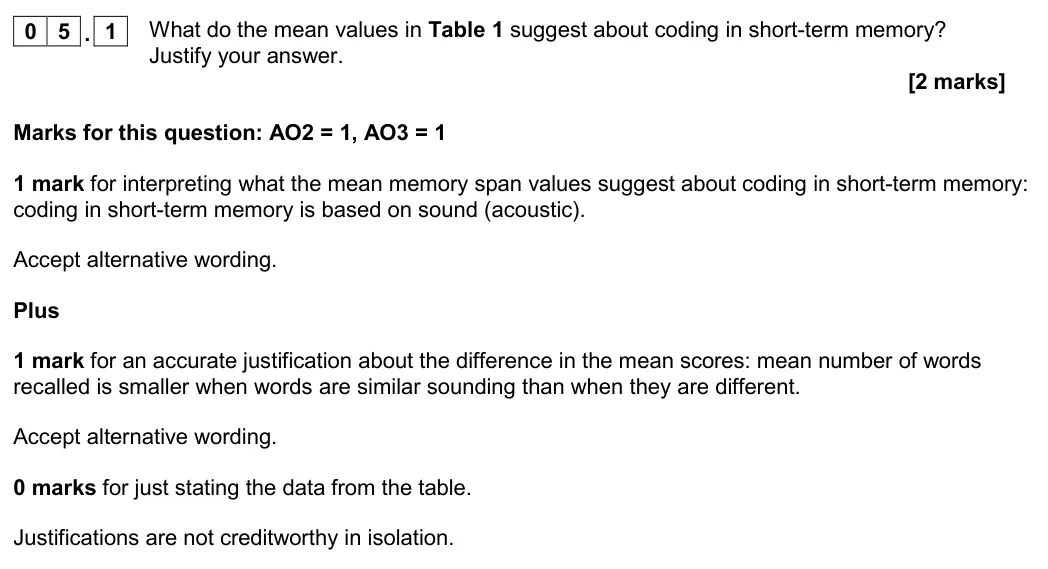
STM coding is acoustic + justification from lower mean for similar-sounding words
stating data alone = 0
justification not creditworthy in isolation
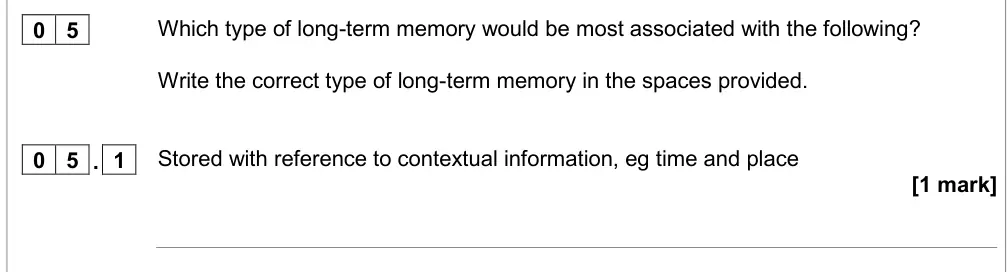
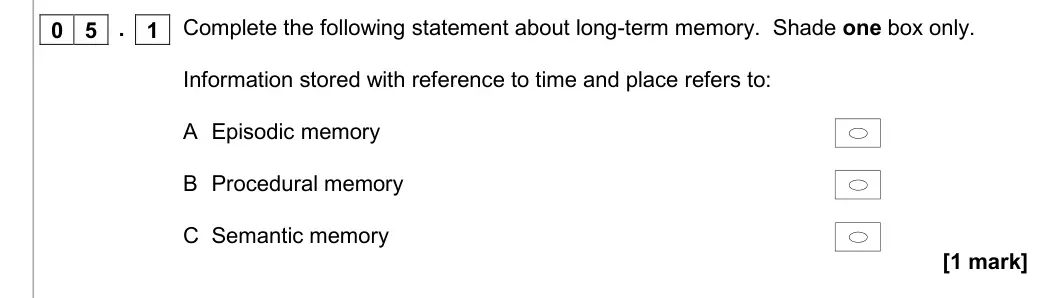
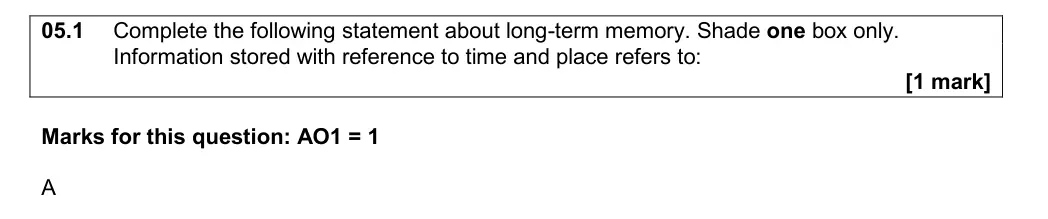
November 2020 · Paper 1 · Q5.11 markAO1=1Short answerOld spec only
Not on the 2025 specification: types of long-term memory: episodic, removed in v1.4
Mark scheme, including level descriptors and indicative content
Notes from the mark scheme and report
Off-spec: types of long-term memory: episodic, removed in v1.4
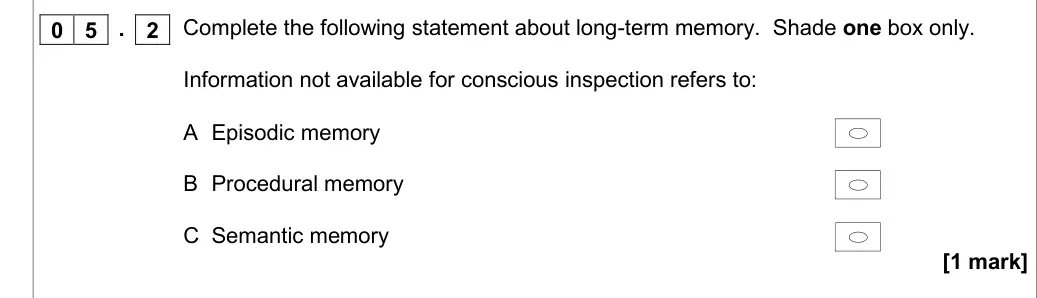
November 2020 · Paper 1 · Q5.21 markAO1=1Short answerOld spec only
Not on the 2025 specification: types of long-term memory: procedural, removed in v1.4
Mark scheme, including level descriptors and indicative content
Notes from the mark scheme and report
Off-spec: types of long-term memory: procedural, removed in v1.4
November 2020 · Paper 1 · Q5.31 markAO1=1Short answerOld spec only
Not on the 2025 specification: types of long-term memory: semantic, removed in v1.4
Mark scheme, including level descriptors and indicative content
Notes from the mark scheme and report
Off-spec: types of long-term memory: semantic, removed in v1.4
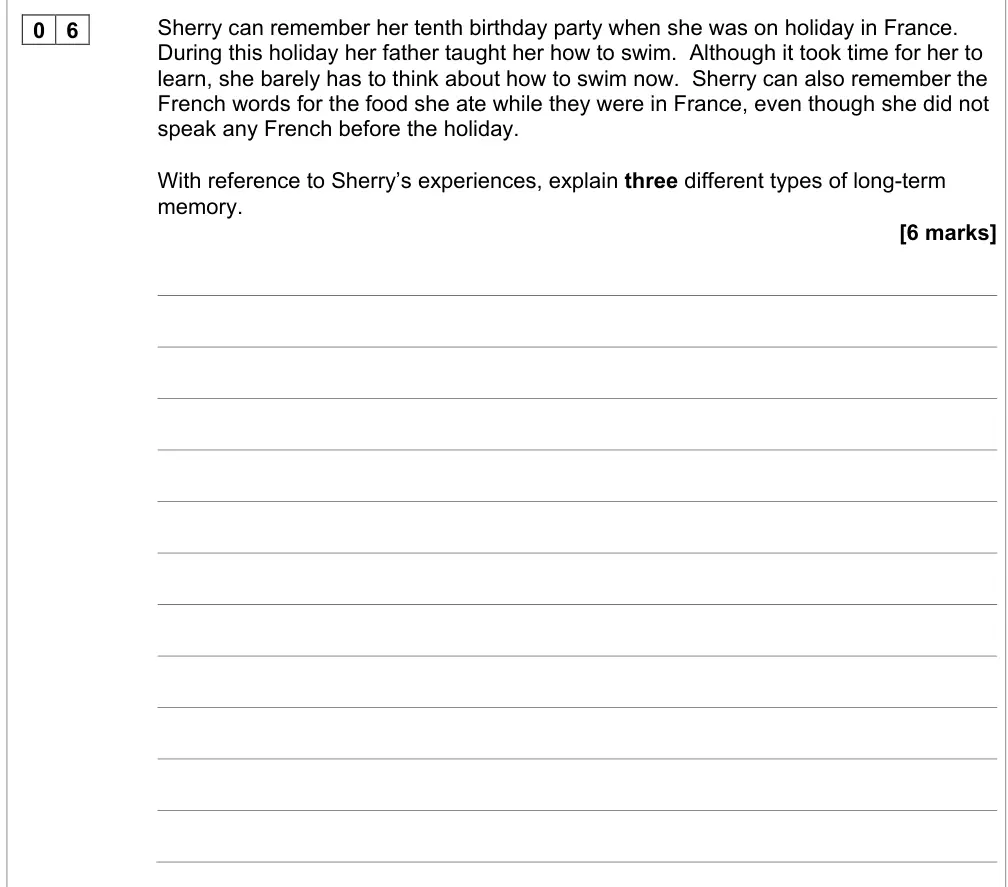
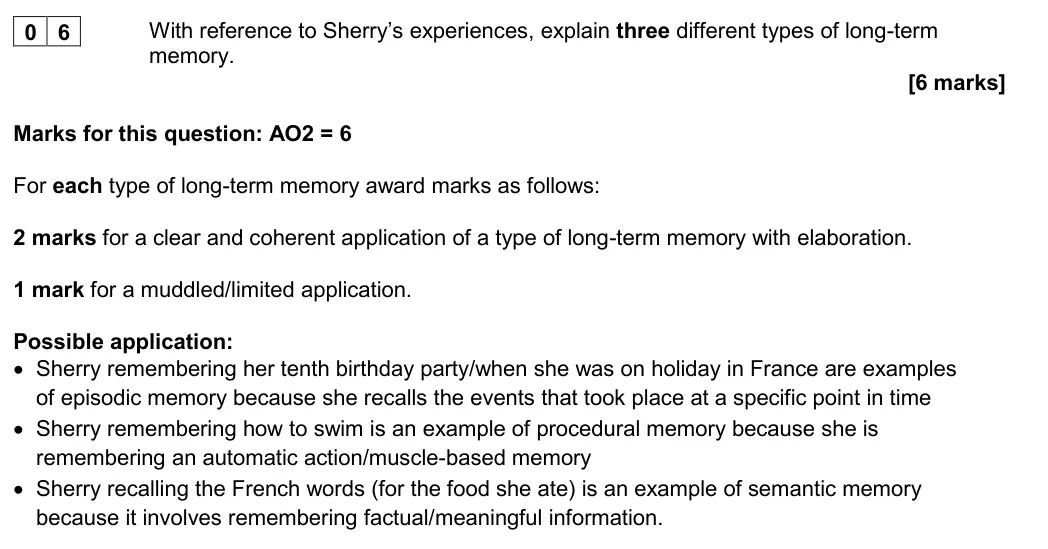
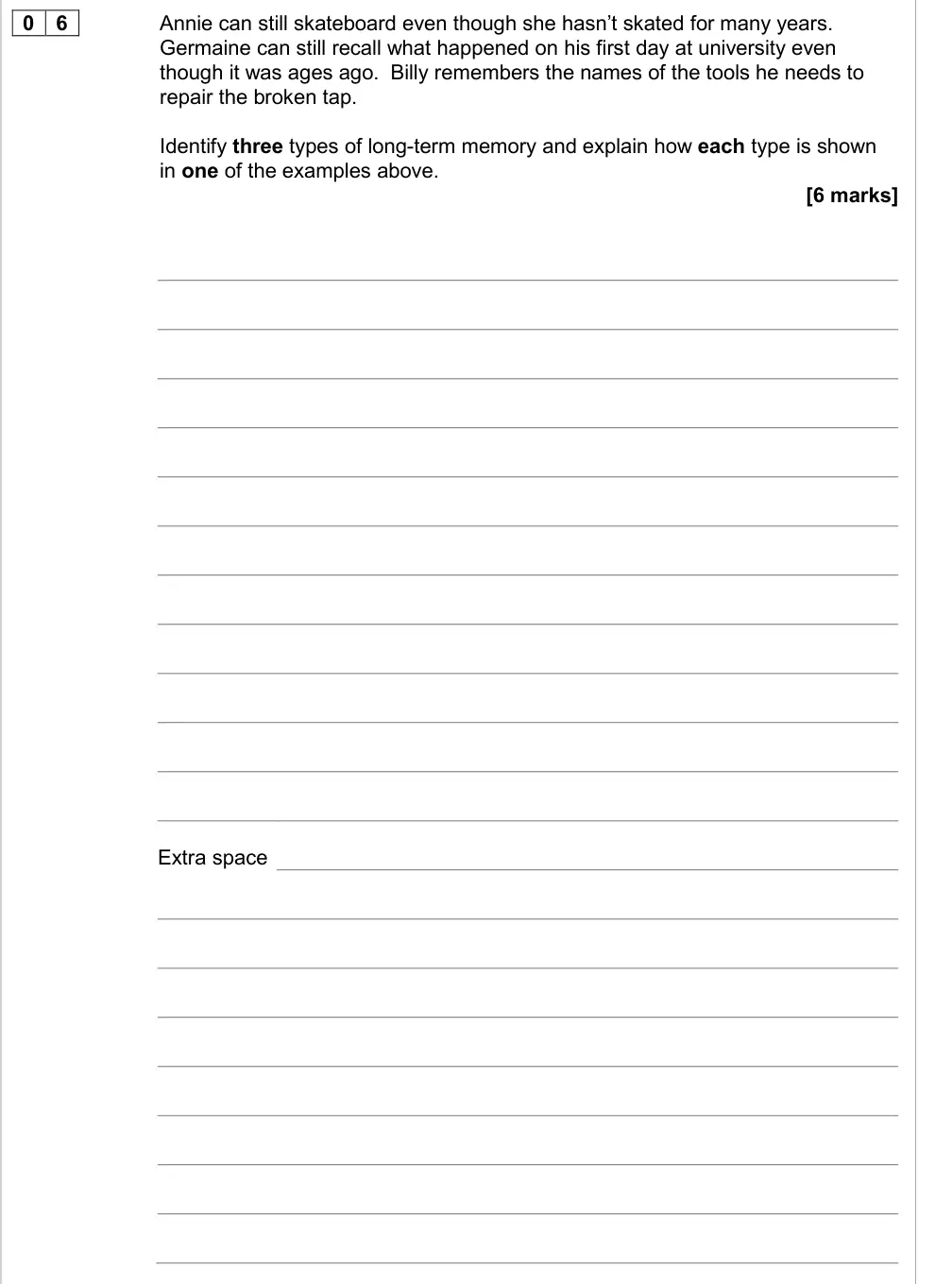
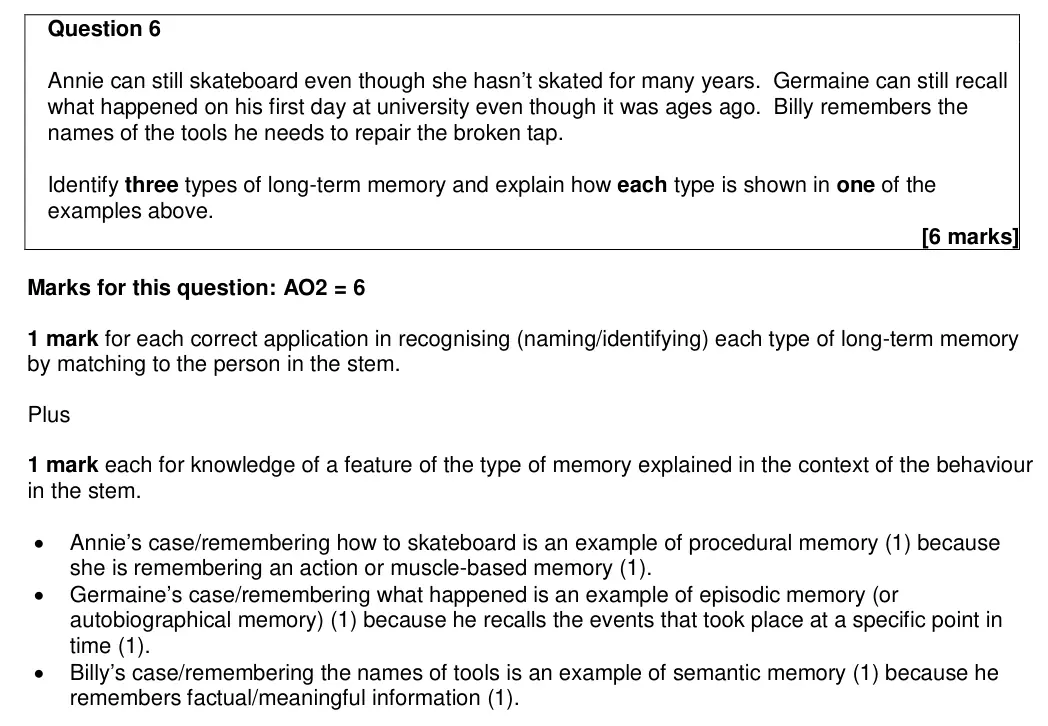
November 2020 · AS Paper 1 · Q66 marksAO2=6ApplicationOld spec only
Not on the 2025 specification: types of LTM: episodic, procedural, semantic - removed in v1.4
Mark scheme, including level descriptors and indicative content
Notes from the mark scheme and report
Off-spec: types of LTM: episodic, procedural, semantic - removed in v1.4
2 marks per type applied to Sherry with elaboration
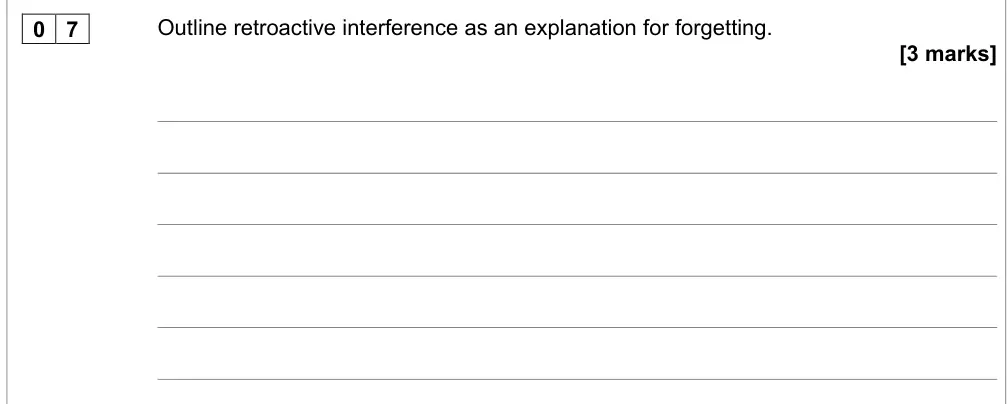
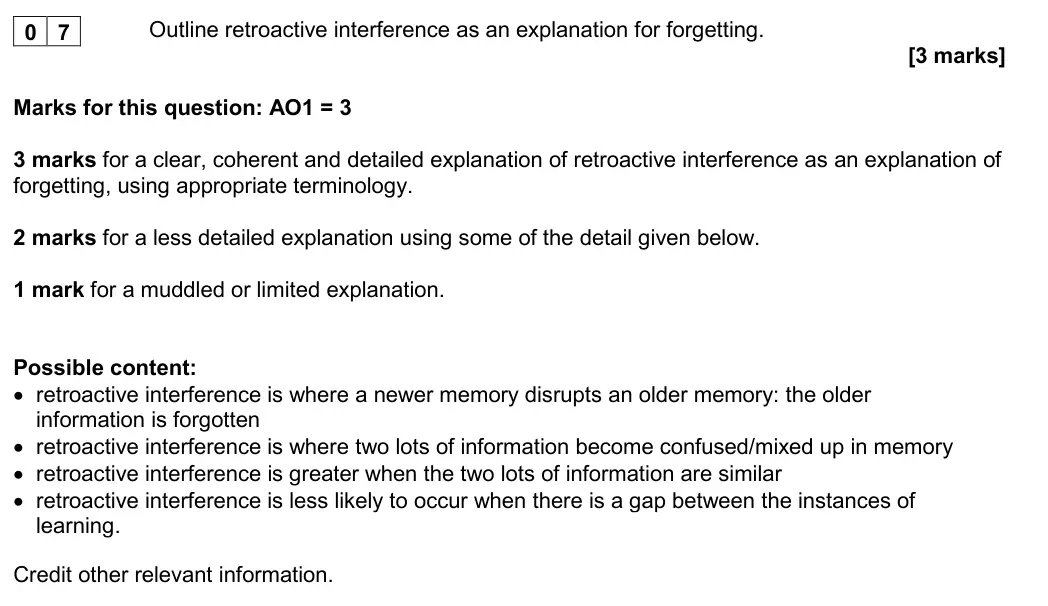
November 2020 · AS Paper 1 · Q73 marksAO1=3Outline
Mark scheme, including level descriptors and indicative content
Notes from the mark scheme and report
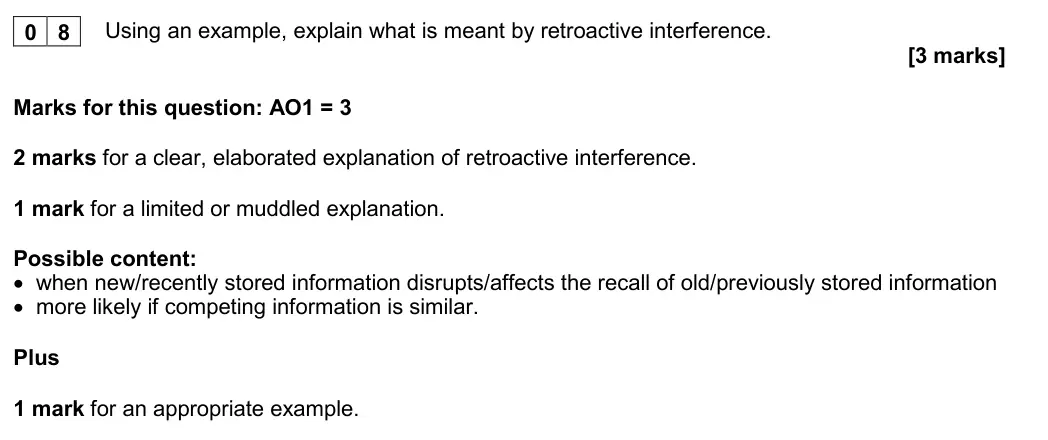
newer learning disrupts recall of older
greater when material similar
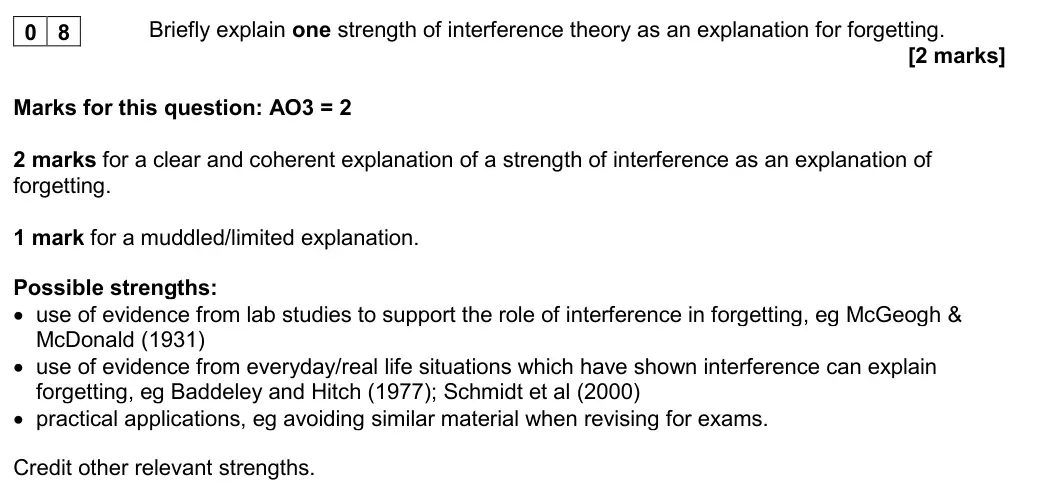
November 2020 · AS Paper 1 · Q82 marksAO3=2Evaluate (short)
Mark scheme, including level descriptors and indicative content
Notes from the mark scheme and report
lab evidence (McGeoch and McDonald), real-life evidence (Baddeley and Hitch rugby players, Schmidt et al), practical applications
November 2020 · Paper 1 · Q83 marksAO1=3Short answer
Mark scheme, including level descriptors and indicative content
Examiner's comment
A significant number of answers confused retroactive and proactive interference, while others failed to provide sufficient elaboration for full marks e.g. referring to similarity of material.
Notes from the mark scheme and report
new information disrupts recall of old (+ similarity) and an appropriate example
confusion with proactive interference
November 2020 · AS Paper 1 · Q94 marksAO1=4Outline
Mark scheme, including level descriptors and indicative content
Notes from the mark scheme and report
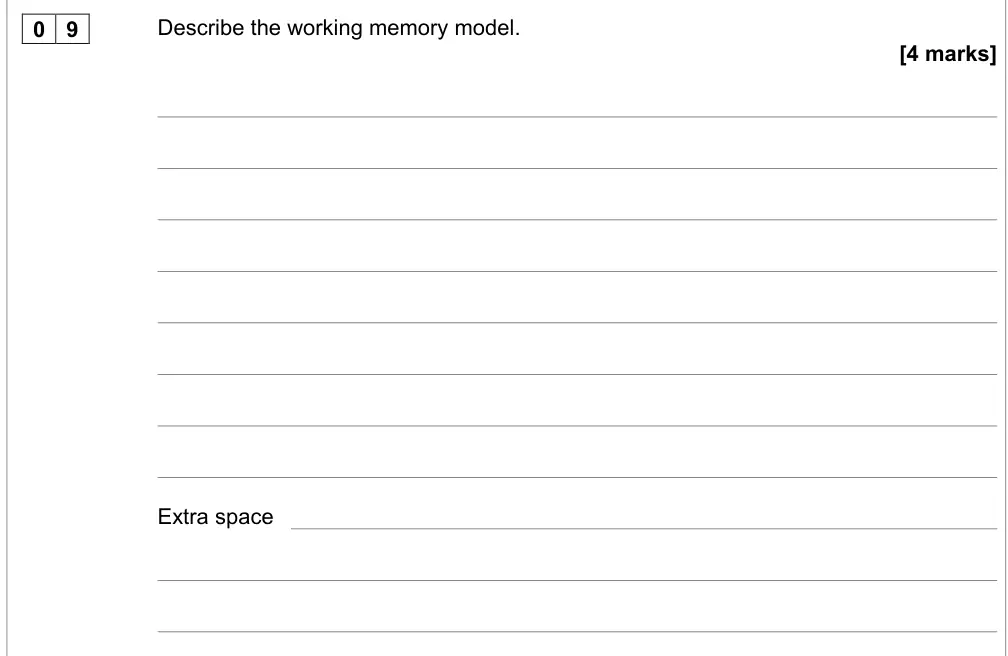
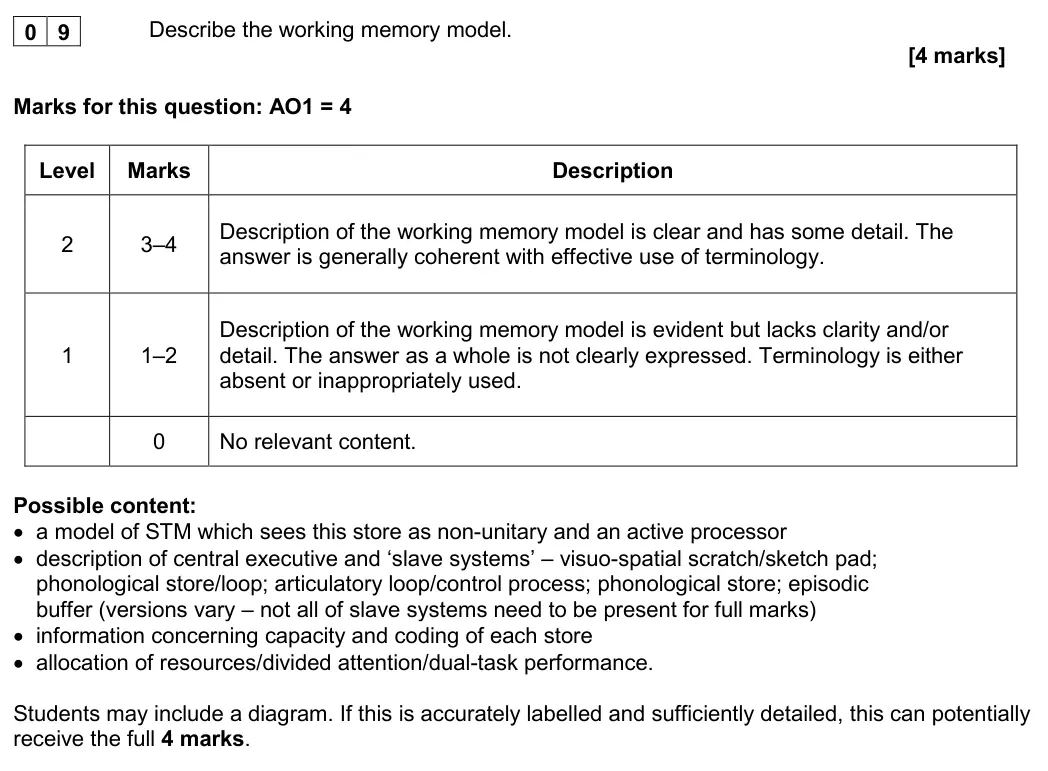
non-unitary active STM
central executive and slave systems (not all needed)
capacity and coding
accurately labelled diagram can gain full marks
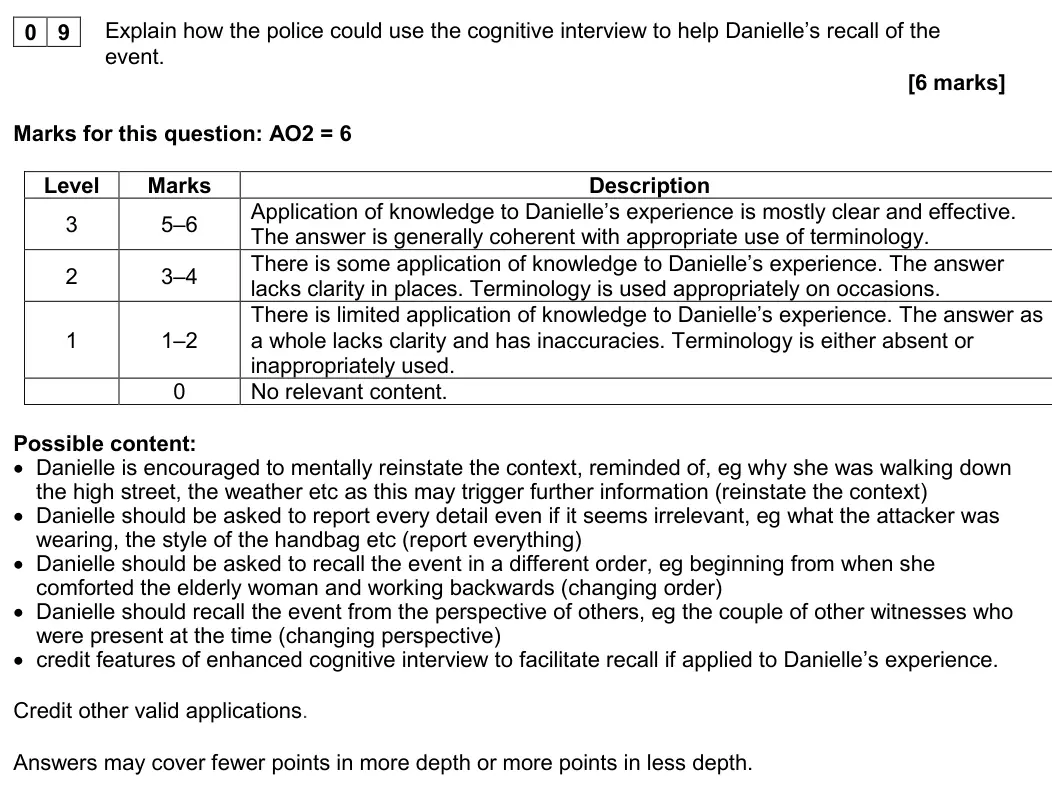
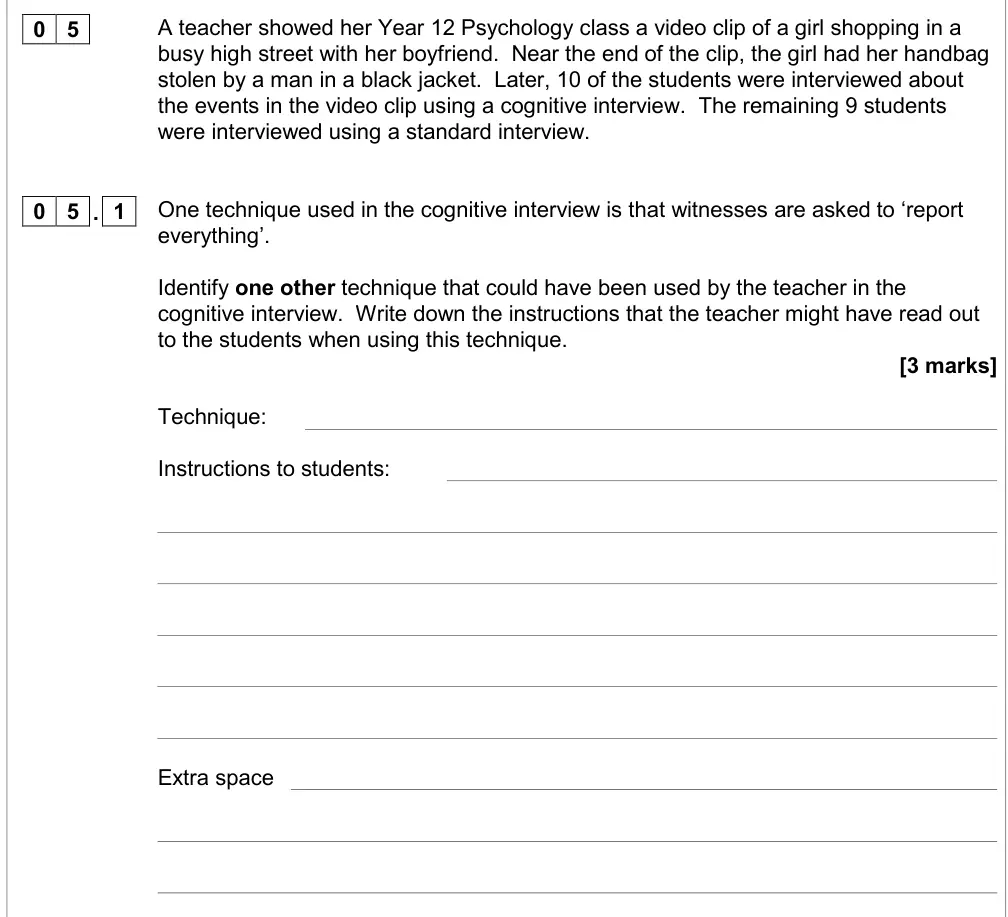
November 2020 · Paper 1 · Q96 marksAO2=6Application
Mark scheme, including level descriptors and indicative content
Examiner's comment
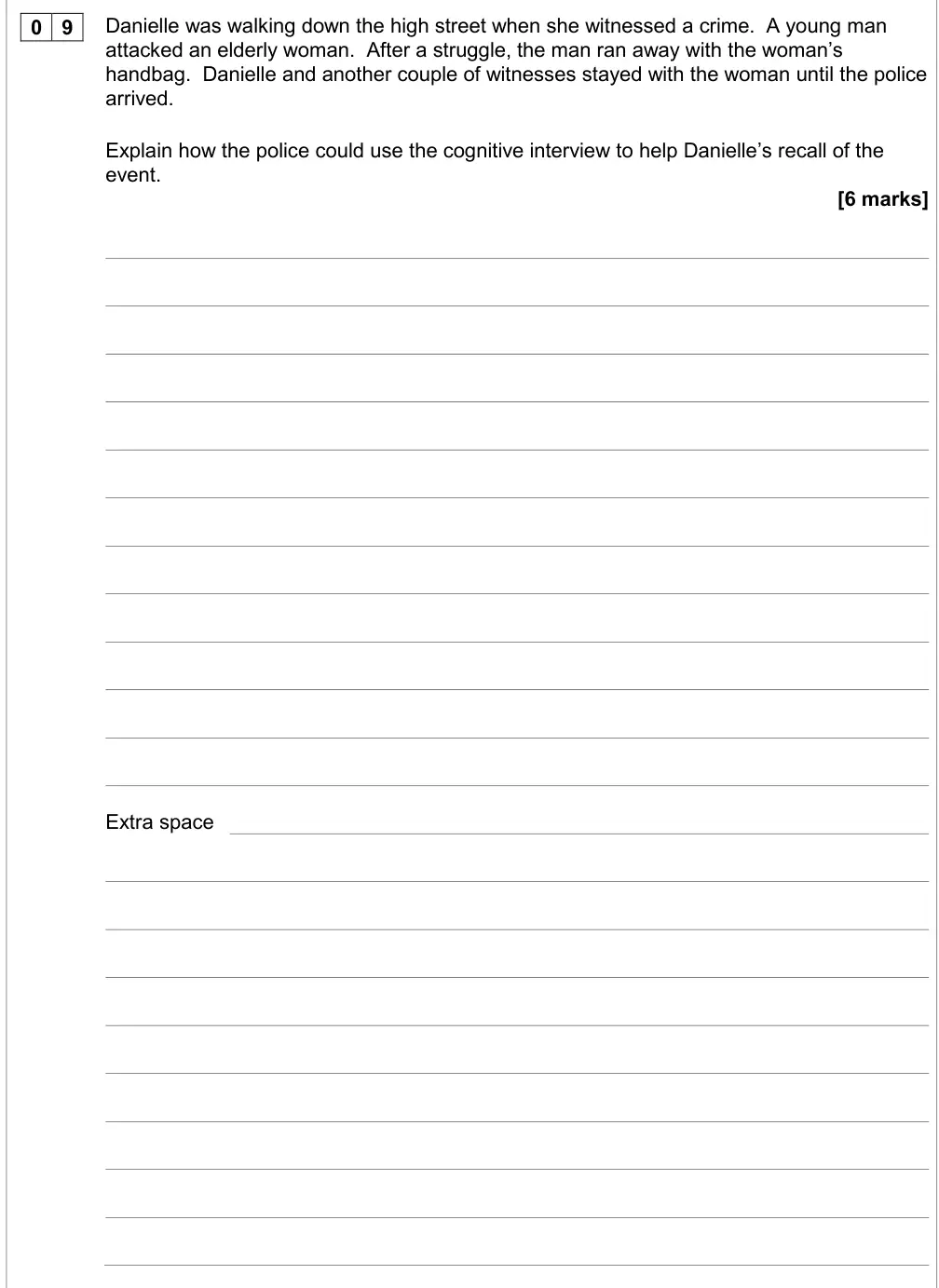
Most students demonstrated clear understanding of the principles behind the cognitive interview, but failed to apply it appropriately ‘to help Danielle’s recall of the event’; this required reference to details of the situation provided in the stem.
Notes from the mark scheme and report
reinstate context, report everything, change order, change perspective applied to Danielle's details (high street, handbag, other witnesses)
understanding of CI without applying to Danielle limited
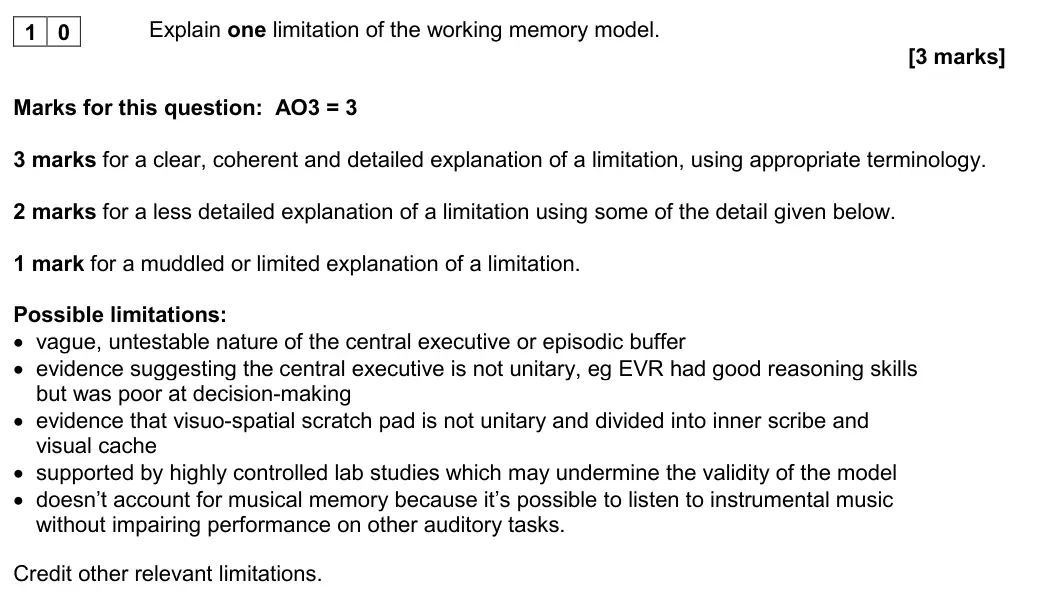
November 2020 · AS Paper 1 · Q103 marksAO3=3Evaluate (short)
Mark scheme, including level descriptors and indicative content
Notes from the mark scheme and report
e.g. vague central executive, EVR case, VSS not unitary, lab-based support, musical memory
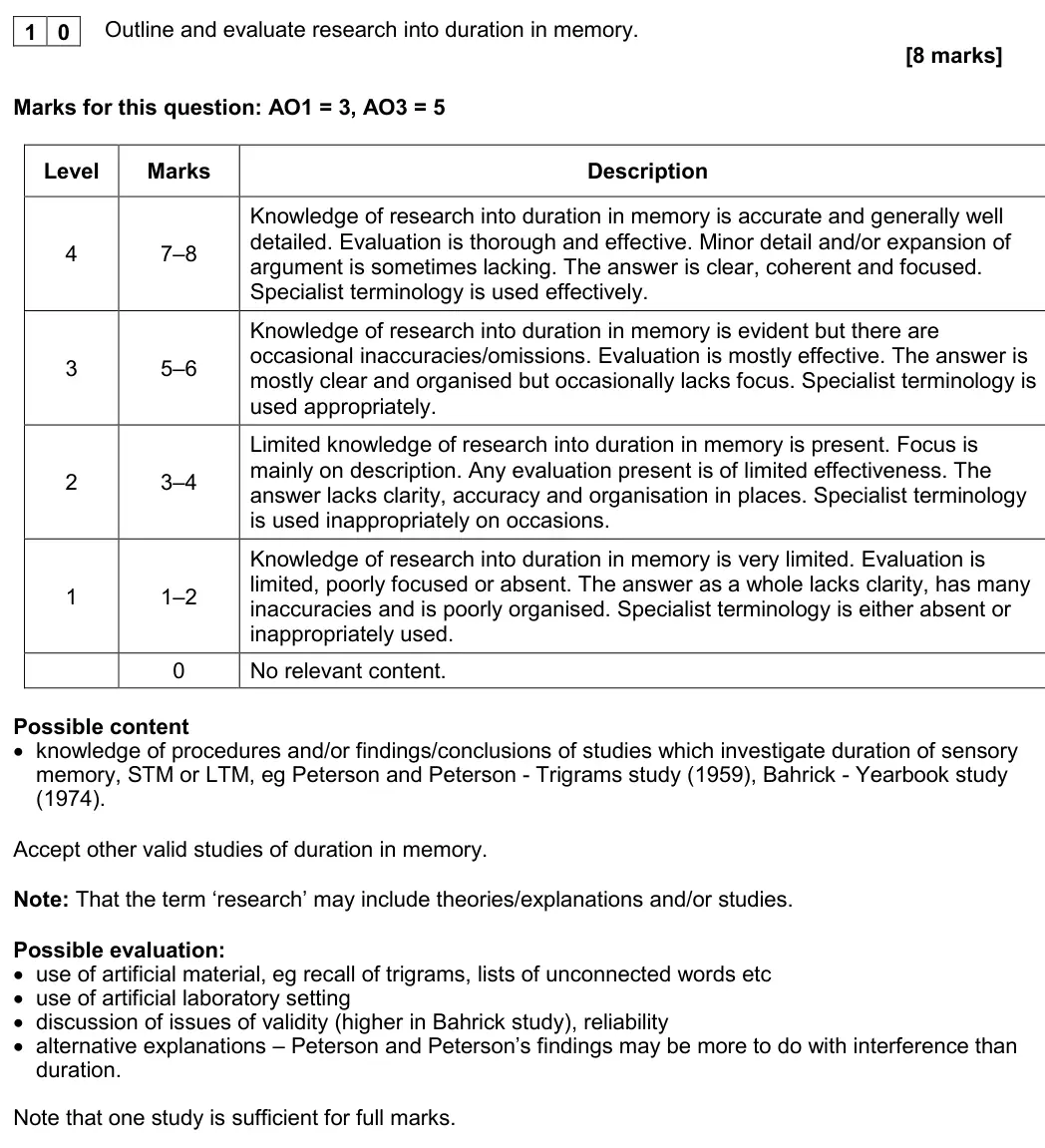
November 2020 · Paper 1 · Q108 marksAO1=3, AO3=5Extended writing
Mark scheme, including level descriptors and indicative content
Examiner's comment
This question was not done well. Although the term ‘research’ can apply to theories and/or studies, virtually all answers focused on studies. Petersen & Petersen and Bahrick were uniformly popular, though the variety of methodological details indicated that many students were confused over precisely how these key studies were carried out. Evaluation was often rather generic and limited to the artificiality of the stimuli and setting (Petersen & Petersen), though better answers elaborated on this. They could also explicitly compare P & P with the naturalistic approach of Bahrick, and then discuss issues with the Bahrick study. Weaker answers gave general descriptions of memory stores, often inaccurately, and without a focus on ‘duration’.
Notes from the mark scheme and report
duration studies e.g. Peterson and Peterson (trigrams), Bahrick (yearbooks)
general store descriptions not focused on duration
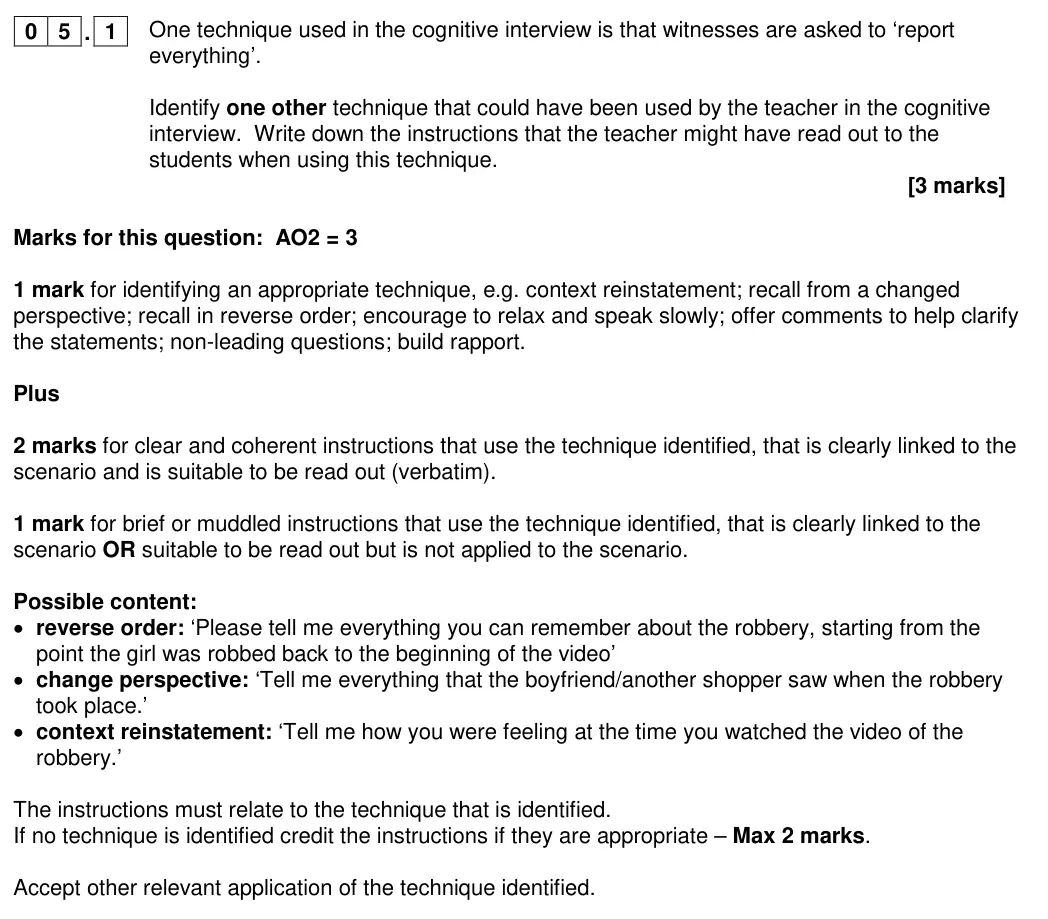
June 2019 · AS Paper 1 · Q5.13 marksAO2=3Application
Mark scheme, including level descriptors and indicative content
Examiner's comment
Students should take time to read the specific demands of each question carefully. This was particularly the case for Questions 5.1 and 9, where some answers suffered because students did not pay close attention to the question. Question 05.1 Although most students found this question straightforward, some failed to read the stem carefully and found it difficult to write an answer that was worth full marks. It was insufficient to identify the ‘context reinstatement’ technique as 'mental re-instatement'. Students were required to suggest that the context was being mentally re-instated. Where students chose to write about mental re- instatement of the context, they needed to remember that they should refer to the context of watching a video of a robbery. Many focussed on creating mental context within the video rather than of watching the video. Students who chose 're-instate the context' sometimes muddled their instructions to give instructions to 'recall everything'. Generally, those who focused on 'recall from a changed perspective', or 'recall in reverse order' found it easier to write instructions for the participants. Some students showed knowledge of the cognitive interview but did not apply it to the stem of the question. A few students did not write instructions in direct speech and were limited to a maximum of one mark for the instructions. There was some evidence that a few a students had not read the question carefully and chose ‘report everything’, when the question had idenitifed this as one technique used in the cognitive interview but asked for one other technique.
Notes from the mark scheme and report
1 mark technique (not 'report everything') + 2 marks instructions in direct speech linked to watching the video of the robbery
context reinstatement must reinstate context of watching the video
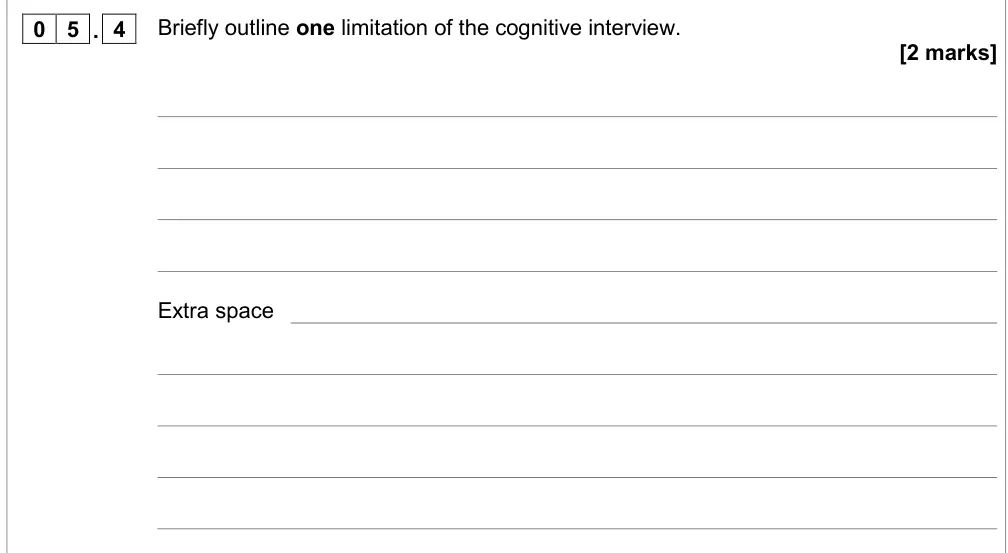
June 2019 · AS Paper 1 · Q5.42 marksAO3=2Evaluate (short)
Mark scheme, including level descriptors and indicative content
Examiner's comment
Question 05.4 While some students were able to provide accurate answers showing good understanding, others struggled with this question. Many failed to achieve marks because they merely stated that the cognitive interview was time-consuming rather than explaining why this was a limitation. ‘Time- consuming’ needs to be qualified to get credit: it requires specialist training and police forces do not have enough time to invest in training the officers to use it. Good answers used evidence to show that not all aspects of the cognitive interview are as useful as others, or that it also increased the amount of inaccurate information gathered. Some students had a good understanding that not all techniques were appropriate for use with some groups of people, for example, change perspective is not possible with young children.
Notes from the mark scheme and report
'time-consuming' must be qualified (training police officers)
Milne and Bull, Kohnken et al increased inaccurate information, unsuitable for children
June 2019 · AS Paper 1 · Q612 marksAO1=6, AO2=2, AO3=4Extended writing
Mark scheme, including level descriptors and indicative content
Examiner's comment
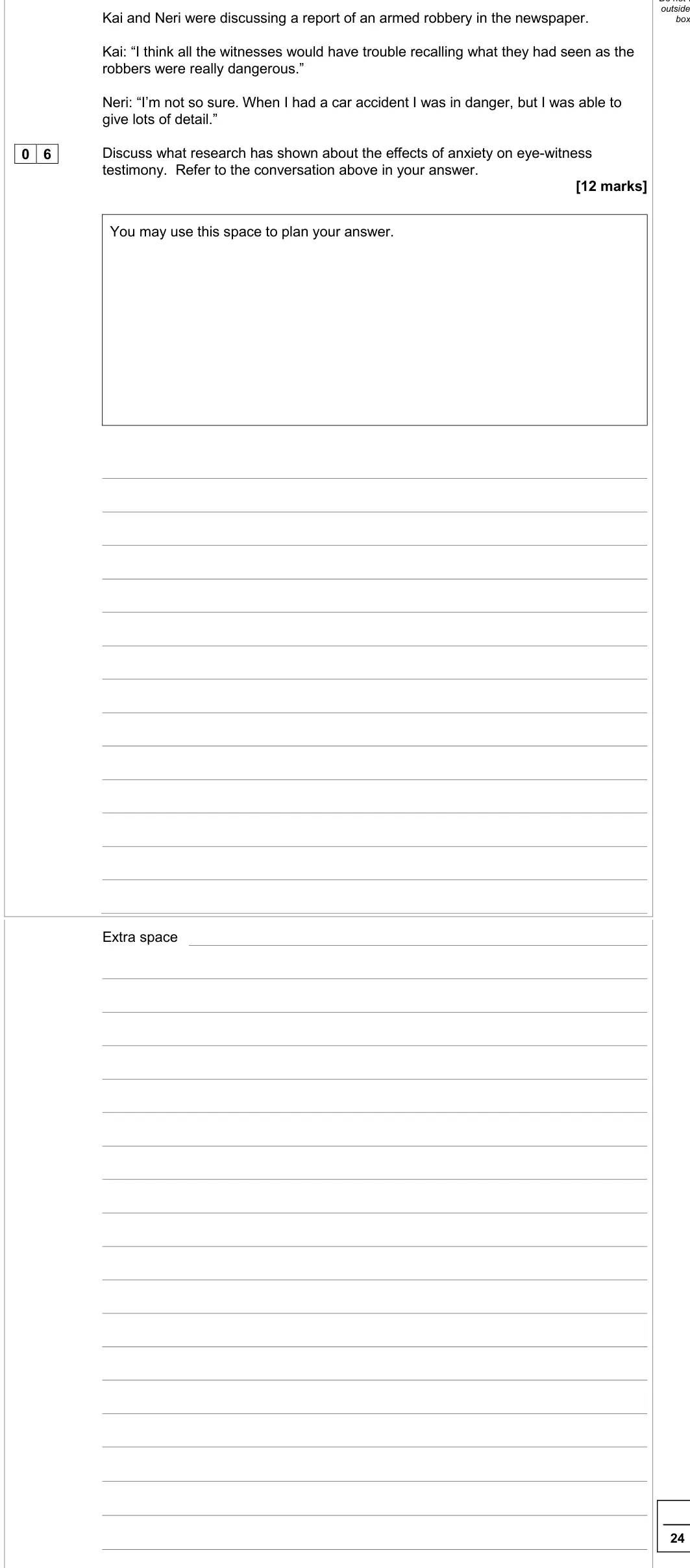
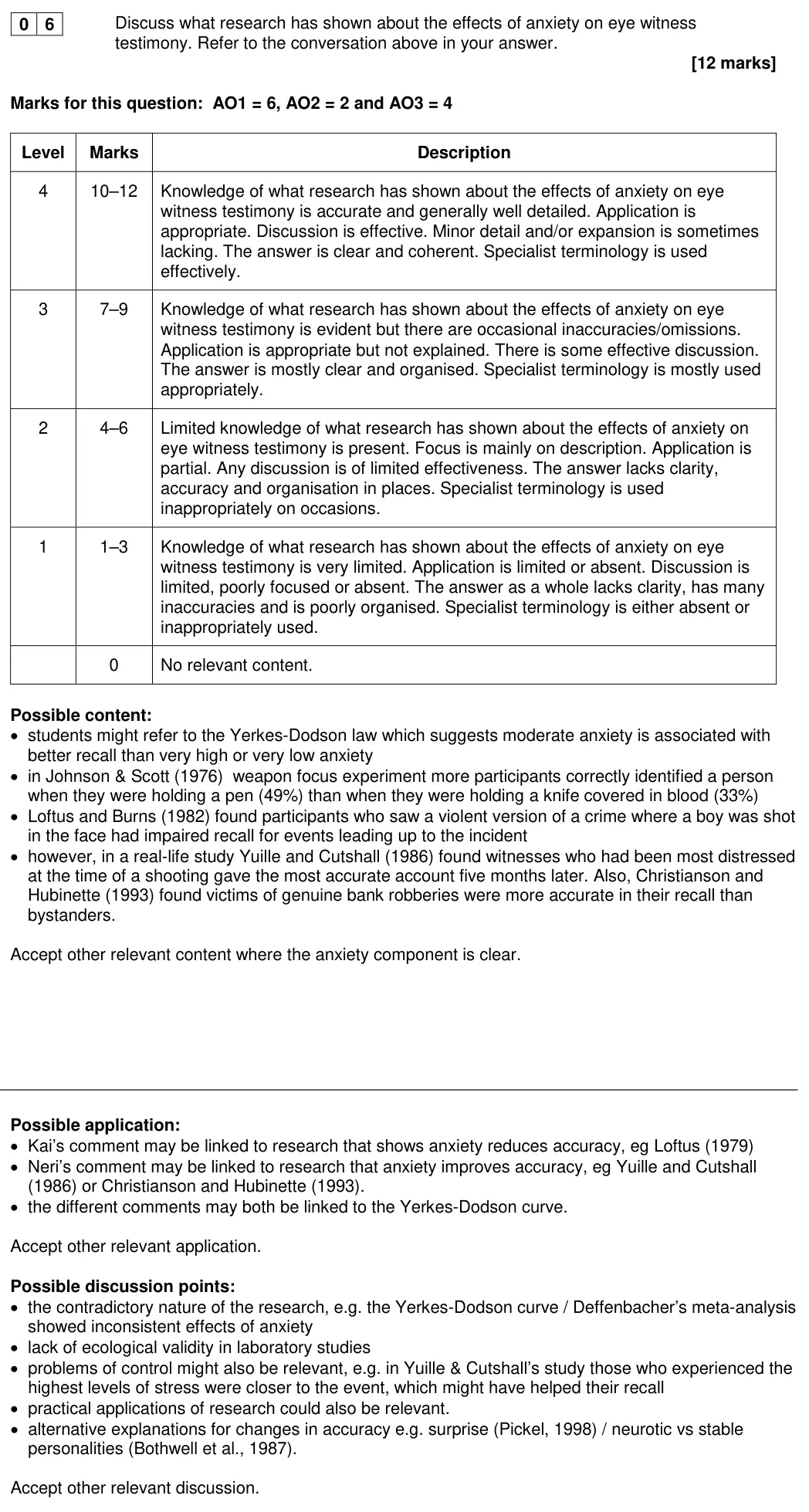
Questions that tended to differentiate best were questions 1, 3, 6, 10 and 11. This was a challenging question, which discriminated well. The studies by Johnson and Scott and Yuille and Cutshall were the most common studies used, with some students showing accurate and detailed knowledge of the results. At the other end were those students who focused on lengthy descriptions of procedures rather than what these studies had shown about the effects of anxiety on eye witness testimony. Other studies were also used effectively either as knowledge or in discussion. These included research by Loftus and Burns and Christianson and Hubinette, among others. While knowledge was often well detailed, the discussion was not as effective. Better answers discussed the contradictory nature of research, with some using the Yerkes-Dodson law to explain them. Methodological issues with the research were not always used effectively and students needed to explain how these issues affect the conclusions about the effects of anxiety in eye witness testimony. Some students made effective use of research by Pickel to illustrate how changes in accuracy may be explained by surprise rather than anxiety. Occasionally students neglected to refer to the conversation, although most made at least some attempt to engage with the conversation.
Notes from the mark scheme and report
Johnson and Scott, Loftus and Burns, Yuille and Cutshall, Christianson and Hubinette, Yerkes-Dodson
AO2 link Kai to anxiety reducing accuracy and Neri to anxiety improving it
methodological issues must be tied to conclusions about anxiety
lengthy procedures
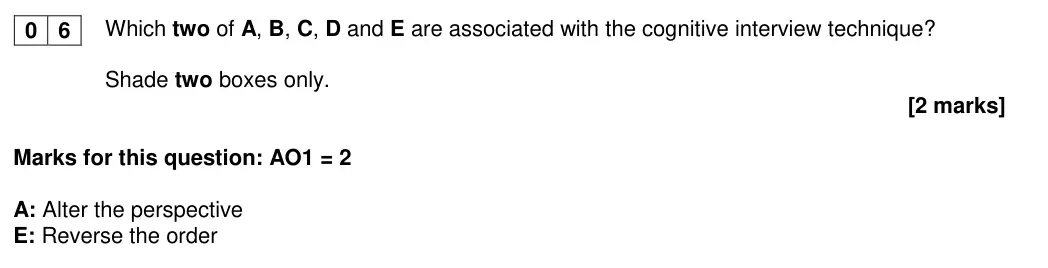
June 2019 · Paper 1 · Q62 marksAO1=2Multiple choiceEasy
Answer
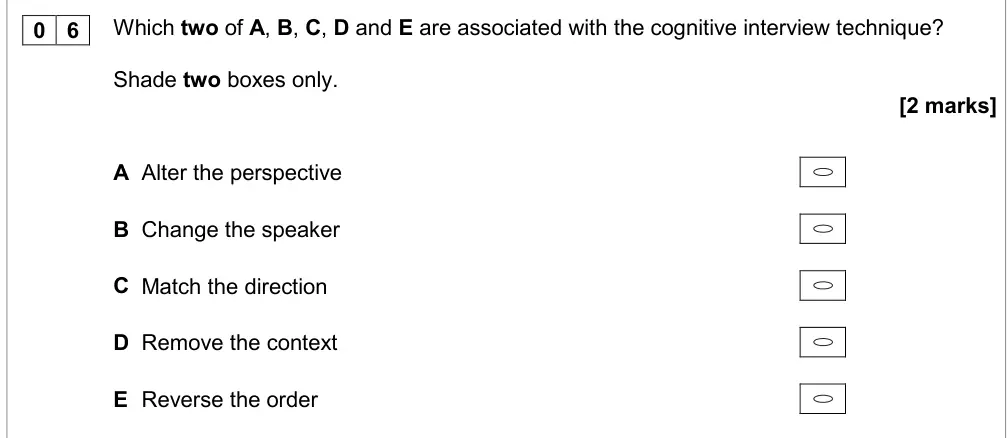
A and E
Mark scheme, including level descriptors and indicative content
Examiner's comment
This multiple-choice question was done very well, with the vast majority of students earning 2 marks.
Notes from the mark scheme and report
answers A (alter the perspective) and E (reverse the order)
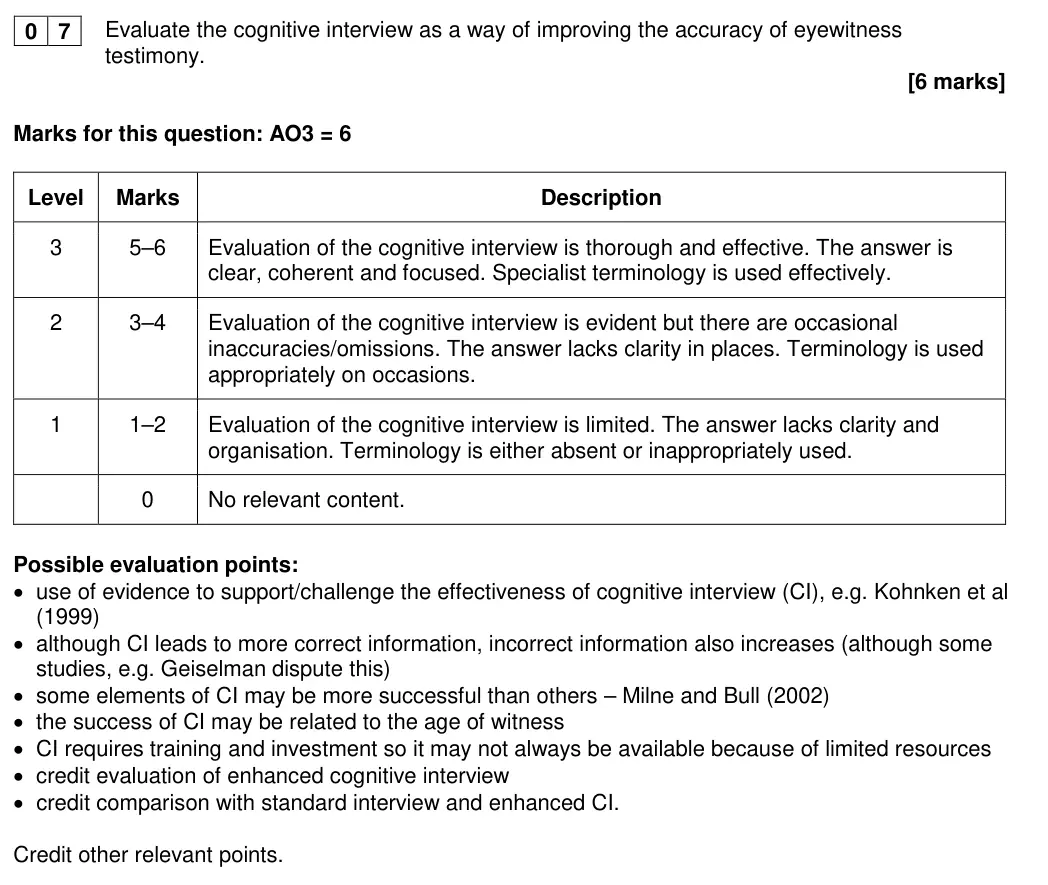
June 2019 · Paper 1 · Q76 marksAO3=6Evaluate (short)
Mark scheme, including level descriptors and indicative content
Examiner's comment
Question 7 was a pure evaluation question, but again there were many long descriptions of techniques used in the cognitive interview. In contrast to question 6, performance on this question was more mixed. Although this was clearly an evaluation question, many students spent too long describing the features of the cognitive interview and too little evaluating the technique. Evaluation was often limited to a mention of how a particular feature of the cognitive interview might improve recall accuracy. More effective evaluation referred to research studies of comparative effectiveness of the cognitive interview versus standard techniques (eg increases in both correct and incorrect information or appropriateness for different age groups). Other relevant points included the investment in time and money in training police in the technique, the time the full cognitive interview takes and the fact that some elements might be more effective than others (so reducing the time the cognitive interview takes).
Notes from the mark scheme and report
evaluation only: Kohnken meta-analysis (more correct and incorrect information), Milne and Bull (elements differ), age of witness, training costs, enhanced CI
many described the CI instead
'improving accuracy of EWT' heading removed in v1.4 but the cognitive interview remains
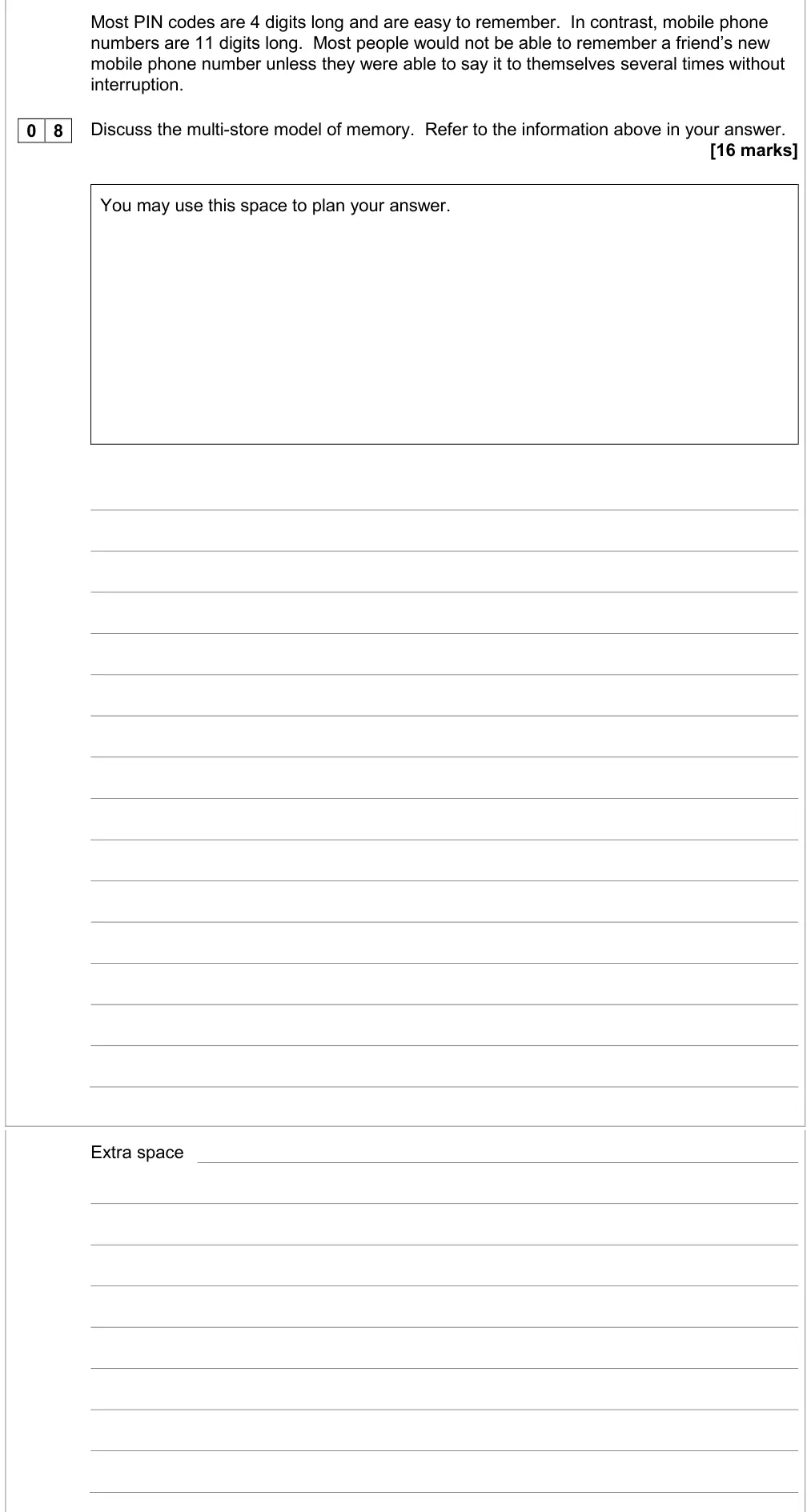
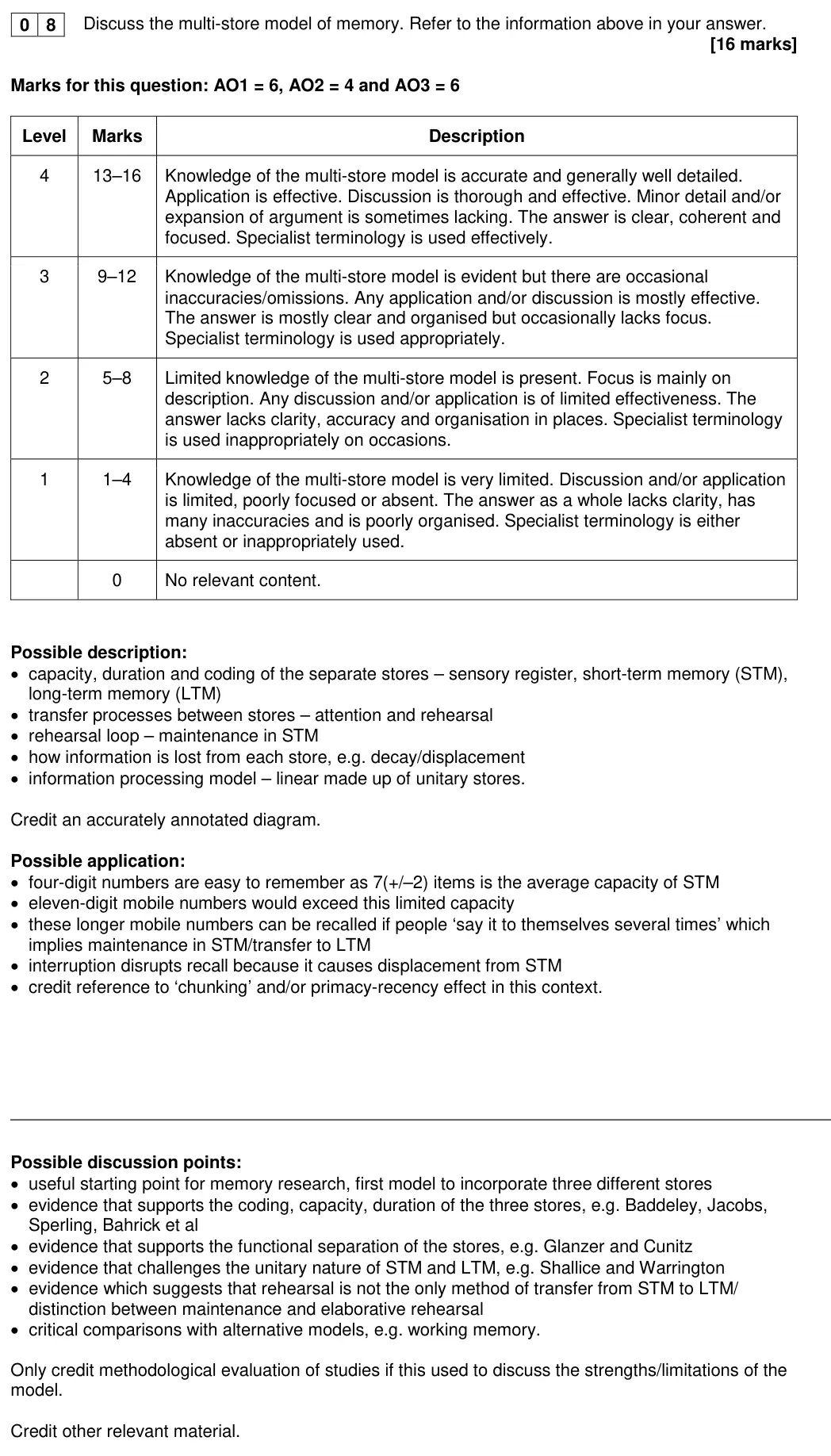
June 2019 · Paper 1 · Q816 marksAO1=6, AO2=4, AO3=616-mark essay
Mark scheme, including level descriptors and indicative content
Examiner's comment
For example, for question 8 a significant minority of students failed to gain marks as they did not address the need to refer to the stem material. There were some excellent descriptions of the multi-store model (MSM), covering all or most aspects. These included the three stores, their capacity, duration and coding and the role of attention and rehearsal in information transfer. At the top end, answers referred to the linear nature of the model and its role as the first complex model of human memory. Students were also required to refer to issues in the stem, such as remembering PIN codes and mobile phone numbers. Most answers were able to link these to the limited capacity of short-term memory (STM) and the vital role of rehearsal and chunking. However, a minority of answers failed to address this aspect of the question and failed to access the marks available. General evaluation of the MSM was varied. At the top end there was effective use of studies to support capacity, coding and duration of the three stores. Use of case studies showed more variation in accurate description and interpretation of findings. For instance, HM was sometimes confused with split-brain work. However, some excellent answers not only covered the relevance of case studies to the MSM, but were able to outline how they provide counter-evidence in the form of separate long-term memory stores (episodic, procedural, semantic; HM and Clive Wearing). KF was often used effectively to support the more complex view of STM provided by the working memory model. Less effective answers simply stated points without elaboration, for example ‘the working memory model provided a better account of STM’, without reference to research evidence. Some also spent too long on methodological evaluation of studies without linking it to the strength/limitations of the MSM of memory. Overall, another common weakness was in the organisation of the answer. Essays often contained sufficient relevant material to do well but then presented it in a disorganised fashion, jumping from one aspect to another. With three elements to cover (outline of the MSM, application to the stem, evaluation/discussion of the MSM) a few minutes spent planning the answer was very beneficial.
Notes from the mark scheme and report
apply STM capacity 7±2 (PIN vs 11-digit number), maintenance rehearsal, displacement through interruption, chunking
failing to refer to the stem limited marks
HM confused with split-brain work
methodology only credited if used to evaluate the model
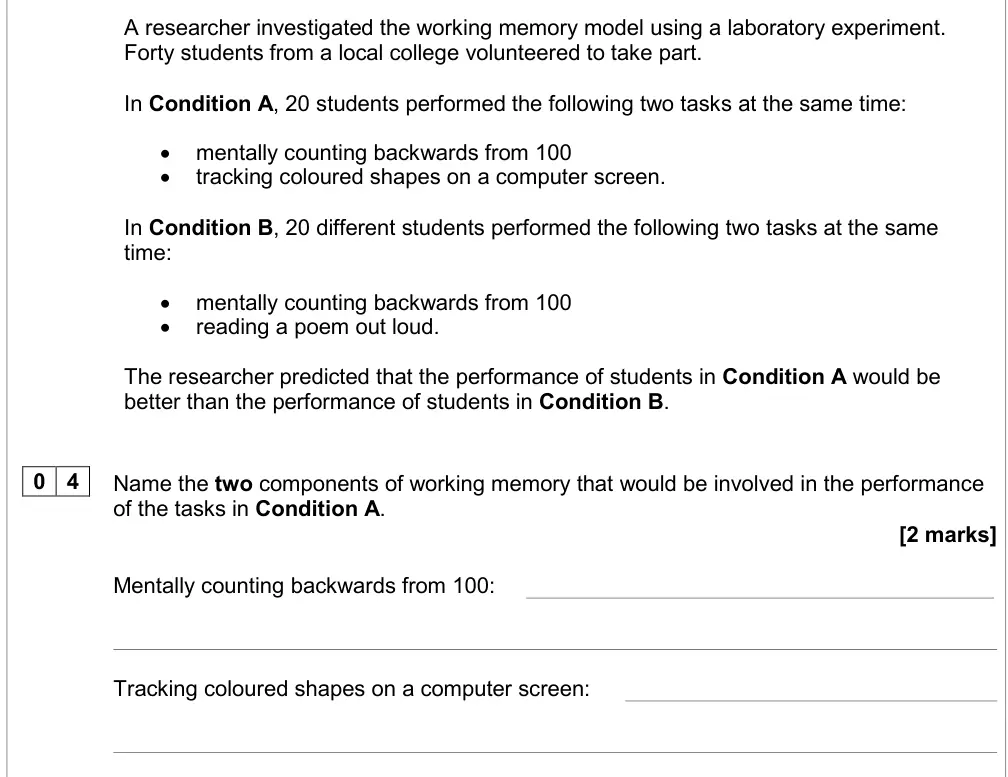
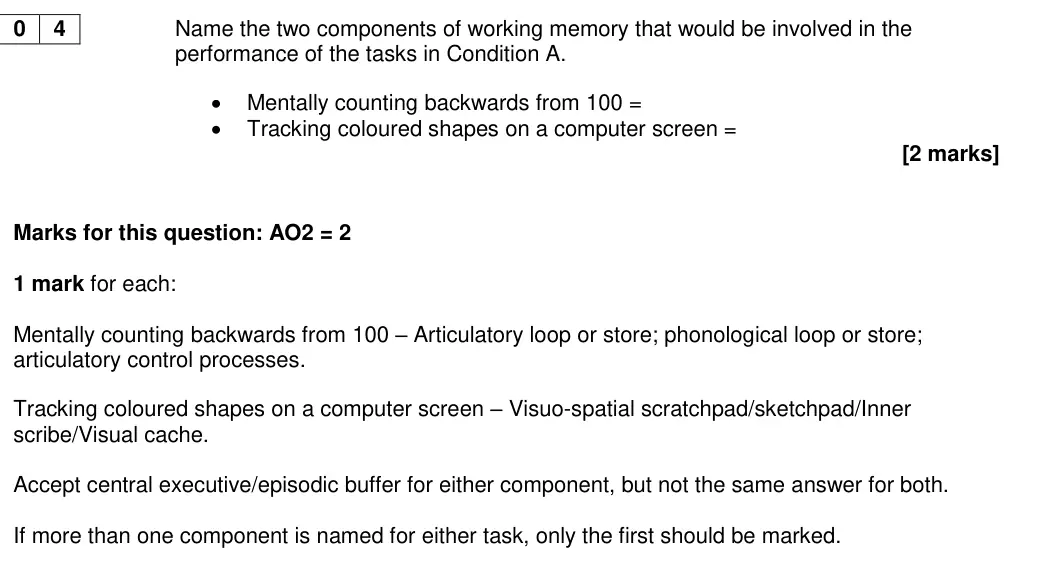
June 2018 · Paper 1 · Q42 marksAO2=2Application
Mark scheme, including level descriptors and indicative content
Examiner's comment
A straightforward question with most students receiving maximum marks.
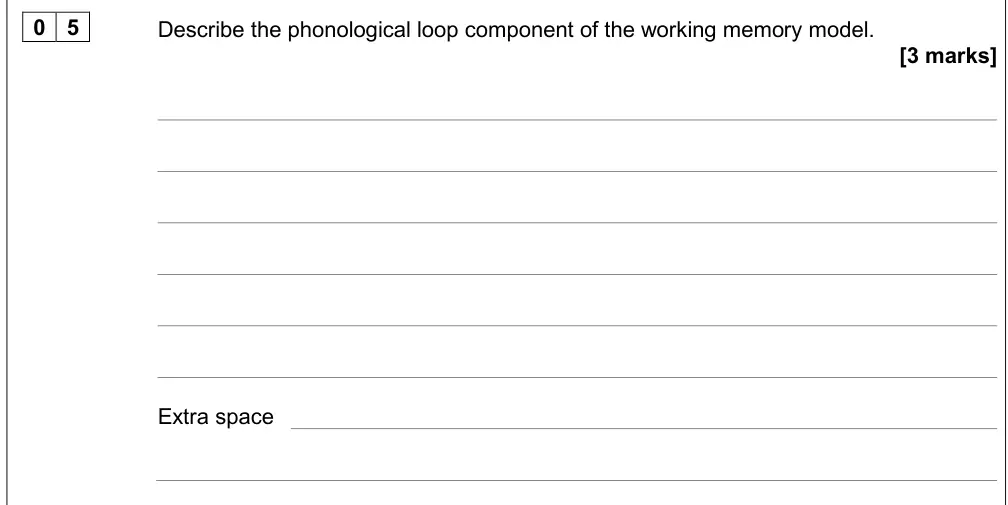
Mark scheme, including level descriptors and indicative content
Examiner's comment
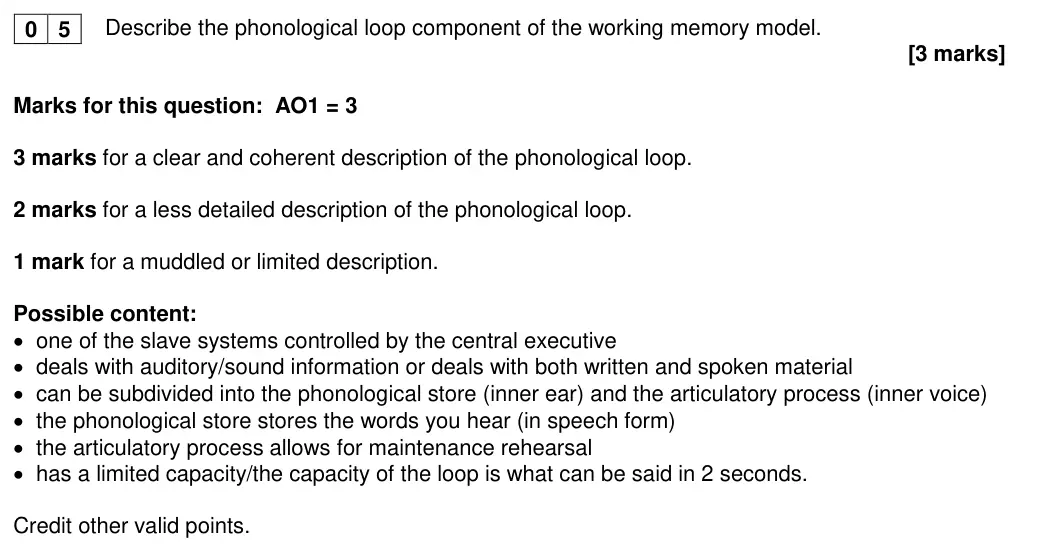
The questions that seemed to differentiate well were 05, 07, 08, 09.4 and 14. At the top end were some extremely accurate and well-described answers, showing very good knowledge. Such answers referred to the type of material encoded, the sub-division into phonological store and articulatory process. These answers could go beyond simply naming and were able to explain their role. Weaker answers confused aspects of STM with the multi-store model.
Notes from the mark scheme and report
slave system of central executive, phonological store (inner ear) and articulatory process (inner voice), capacity about 2 seconds of speech
weaker answers confused with STM in the MSM
June 2018 · AS Paper 1 · Q61 markAO3=1Explain
Mark scheme, including level descriptors and indicative content
Examiner's comment
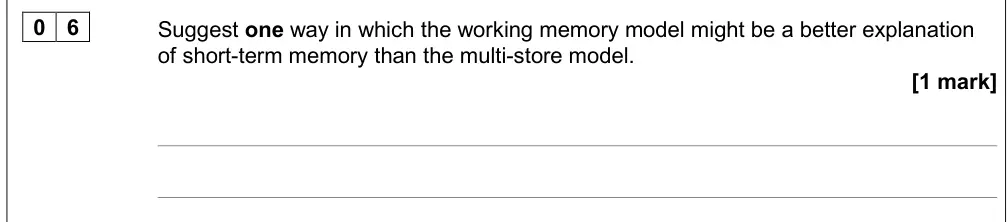
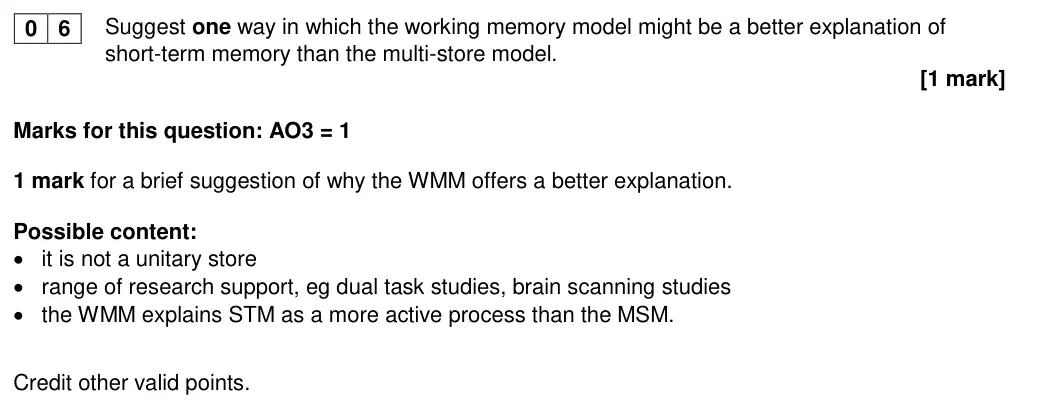
Most students could suggest one way, that the working memory model was not a unitary store.
Notes from the mark scheme and report
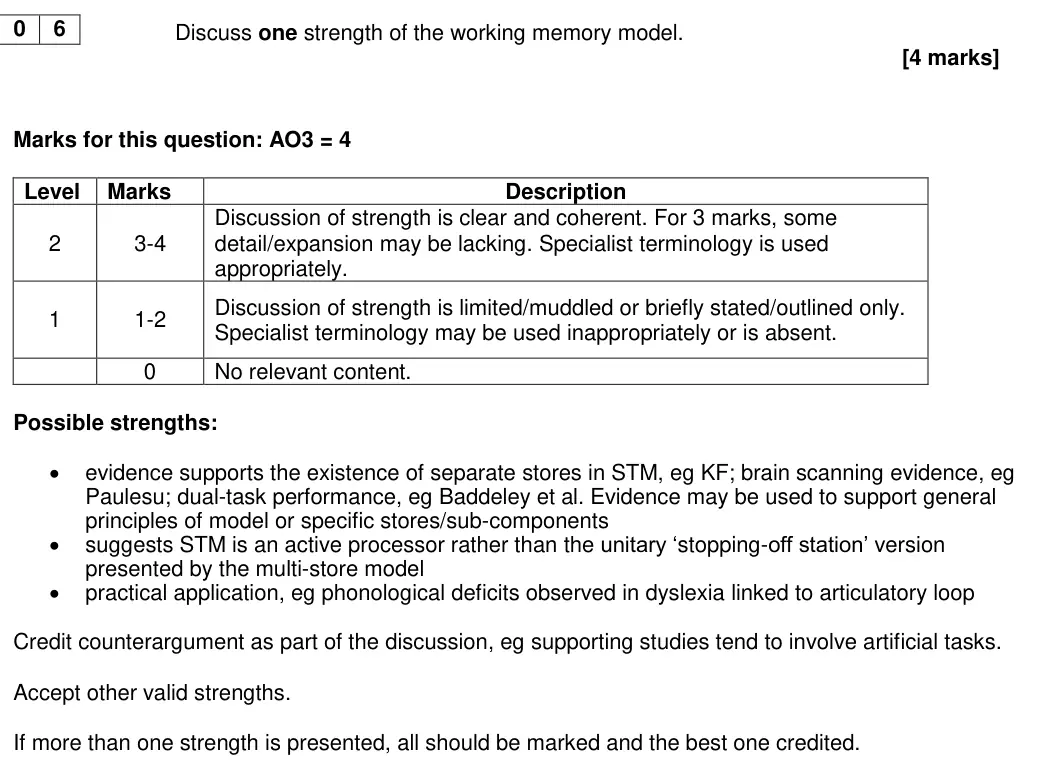
e.g. STM not a unitary store, dual-task/brain-scan support, STM as active process
June 2018 · Paper 1 · Q64 marksAO3=4Evaluate (short)
Mark scheme, including level descriptors and indicative content
Examiner's comment
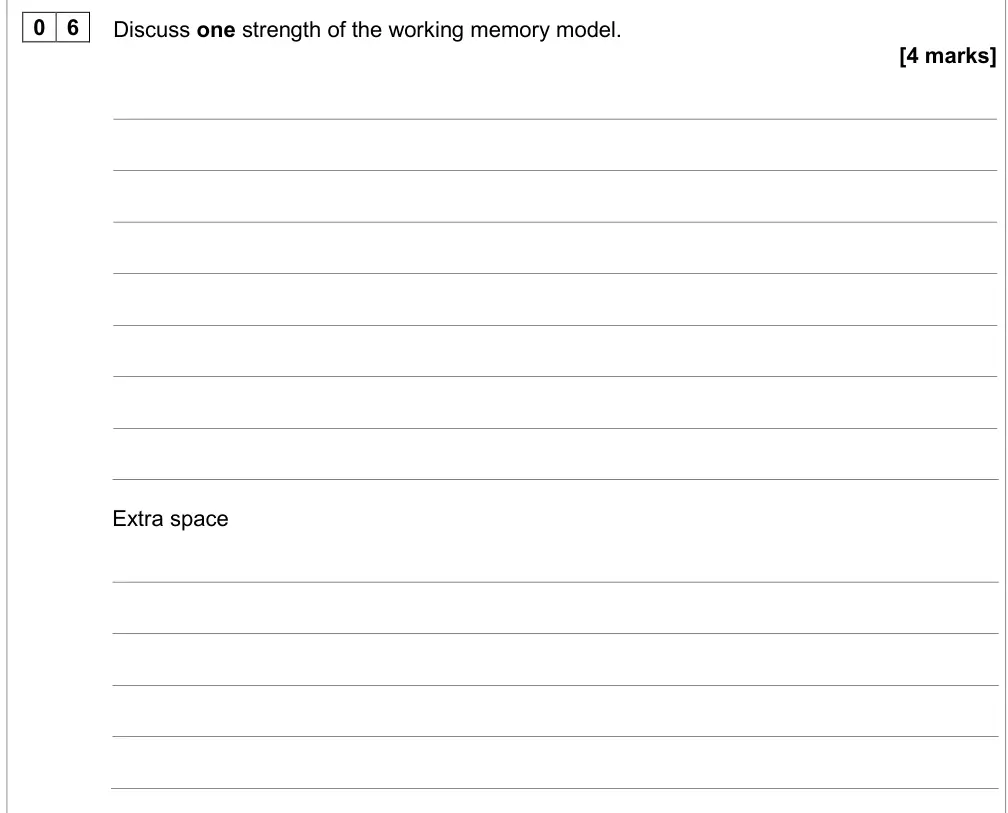
There were various ways this question could be answered. Probably the most effective was reference to evidence from case studies. Although some students confused KF with HM and Clive Wearing, in general KF was used well to illustrate the possible roles of phonological loop and visuo-spatial scratchpad. Dual task performance was another effective approach. General outlines comparing the complexity of the working memory model with the multistore model of STM could do well, but sometimes lacked a focus on one strength.
Notes from the mark scheme and report
evidence (KF, Paulesu scans, dual-task studies), STM as active processor vs MSM, application (dyslexia)
counterargument credited
best of several strengths credited
KF confused with HM/Clive Wearing
June 2018 · AS Paper 1 · Q74 marksAO2=4Application
Mark scheme, including level descriptors and indicative content
Examiner's comment
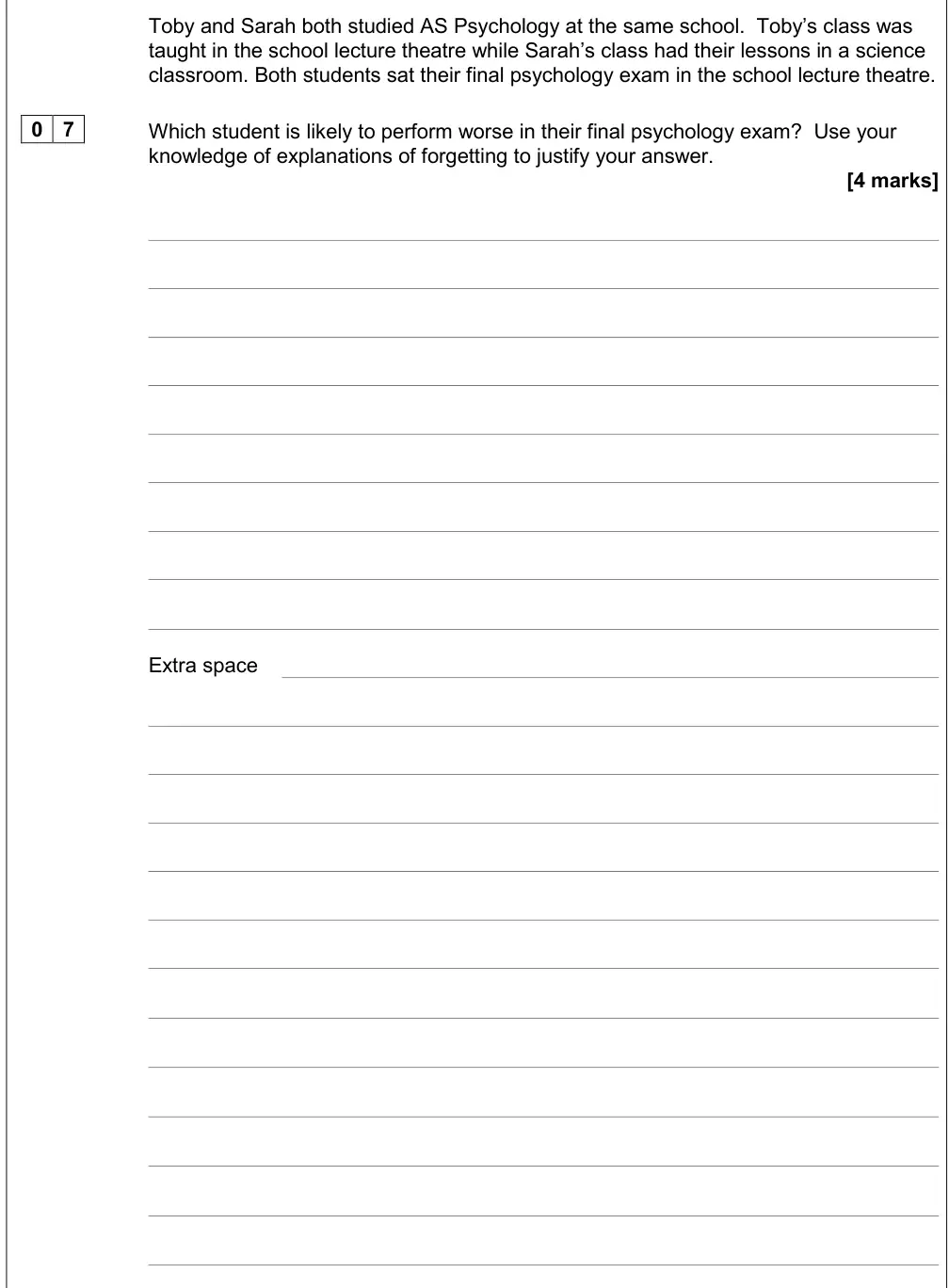
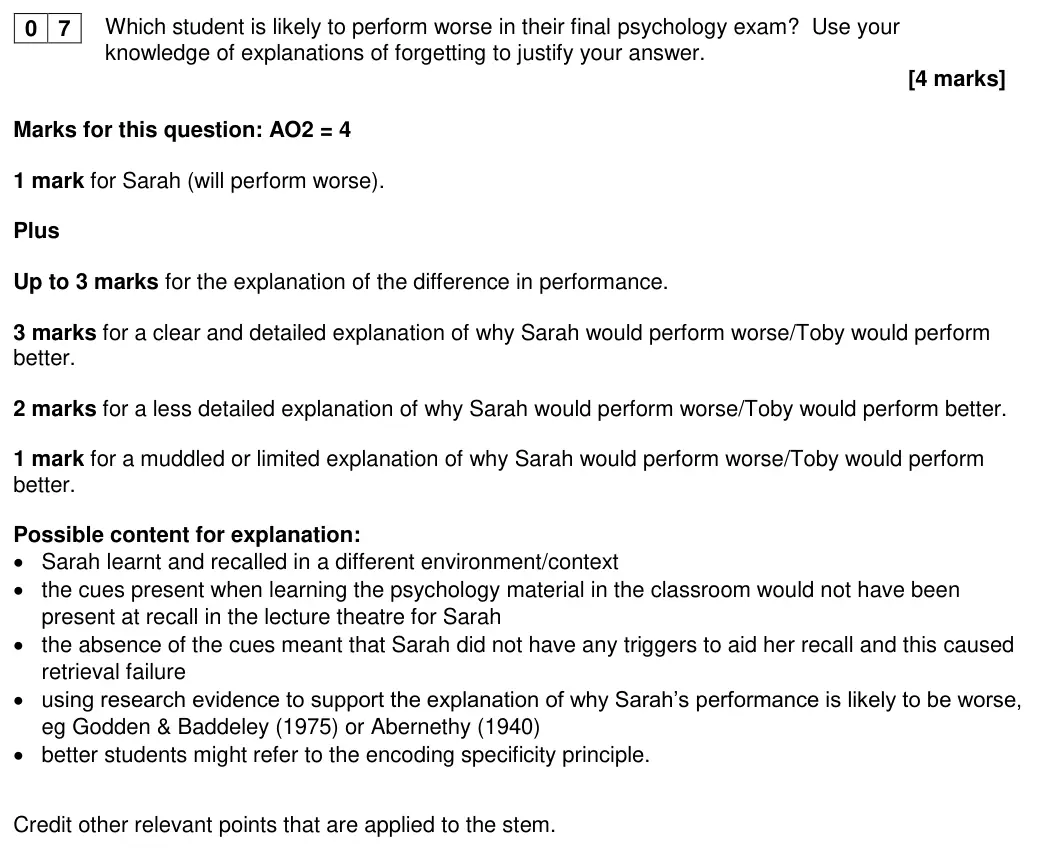
The questions that seemed to differentiate well were 05, 07, 08, 09.4 and 14. This is an example of a question where students could benefit from developing their ability to “use knowledge of explanations of forgetting”. It appears to be an area in which they struggle. Using their knowledge requires them to select appropriate studies and/or theories to explain what is going on in the scenario. Some students simply described in great detail relevant studies or theories, but without any reference to either Sarah or Toby. Other students described what was going on in the scenario, almost re-writing it, but without any reference to relevant research. The question also asked which student is likely to perform worse in their final exam. Many students failed to state this, even though their knowledge was evident, thus failing to get full marks for this question. Better answers were able to include reference to the encoding specificity principle.
Notes from the mark scheme and report
1 mark Sarah + up to 3 for explanation: context-dependent retrieval failure, absence of cues, encoding specificity, Godden and Baddeley
many failed to state which student
research without application or application without research
June 2018 · Paper 1 · Q76 marksAO1=6Outline
Mark scheme, including level descriptors and indicative content
Examiner's comment
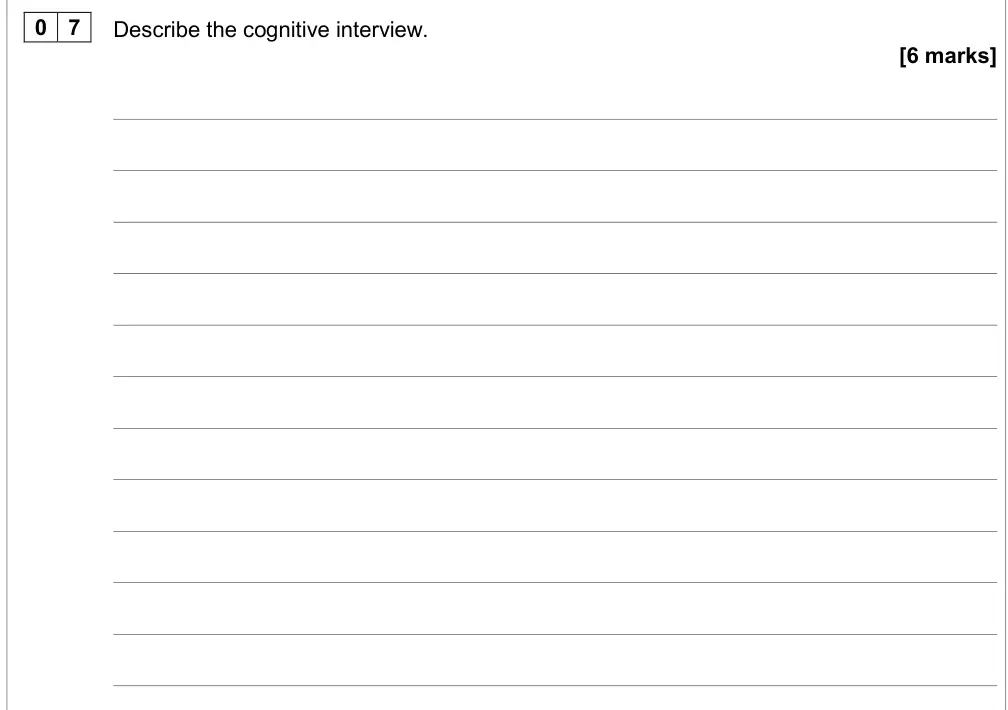
Overall this was done well with most students showing good knowledge of the techniques used in the cognitive interview. An effective route (though not essential) to the top band was to briefly explain why a technique was effective i.e. referring to context-dependent recall, reducing the influence of schemas etc.
Notes from the mark scheme and report
reinstate context, report everything, change order, change perspective, enhanced CI
listing only = max 2
June 2018 · AS Paper 1 · Q88 marksAO1=4, AO3=4Extended writing
Mark scheme, including level descriptors and indicative content
Examiner's comment
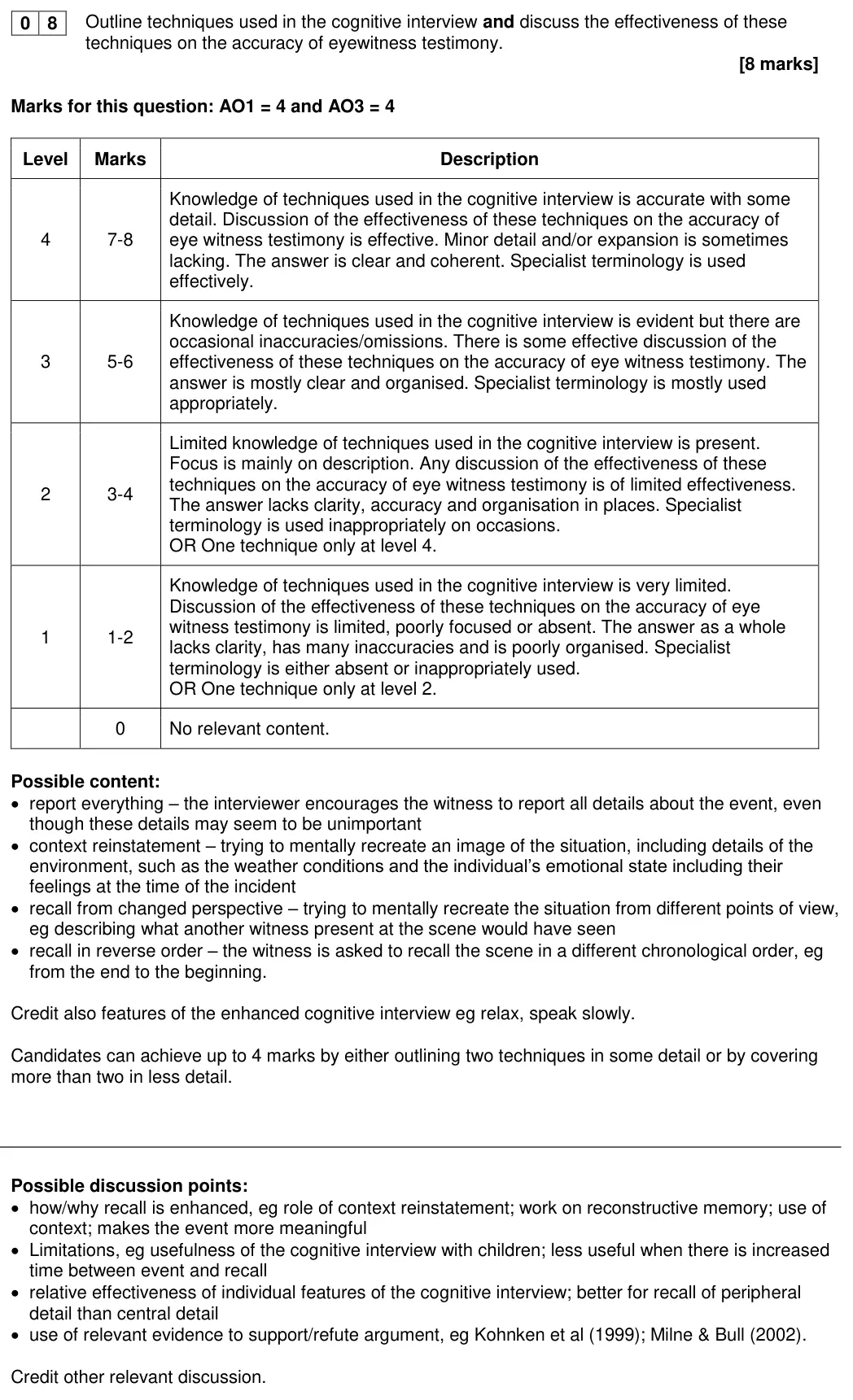
The questions that seemed to differentiate well were 05, 07, 08, 09.4 and 14. The outline of the techniques used in the cognitive interview was usually very detailed. However, the discussion of their effectiveness in terms of the accuracy of eyewitness testimony was limited. While using studies as support of their effectiveness is an successful strategy, evaluation of the studies is not relevant unless it is linked back to the question of effectiveness. Similarly, the police not having time or not wanting to use the cognitive interview are not relevant to the effectiveness in terms of accuracy. This is another example where students need to shape their material to fit the requirements of the question.
Notes from the mark scheme and report
outline CI techniques (report everything, context reinstatement, change perspective, reverse order
enhanced CI credited) AND discuss effectiveness for accuracy
one technique only at Level 4 = max Level 2
evaluation of studies only relevant if linked to effectiveness
police time/reluctance not relevant to accuracy
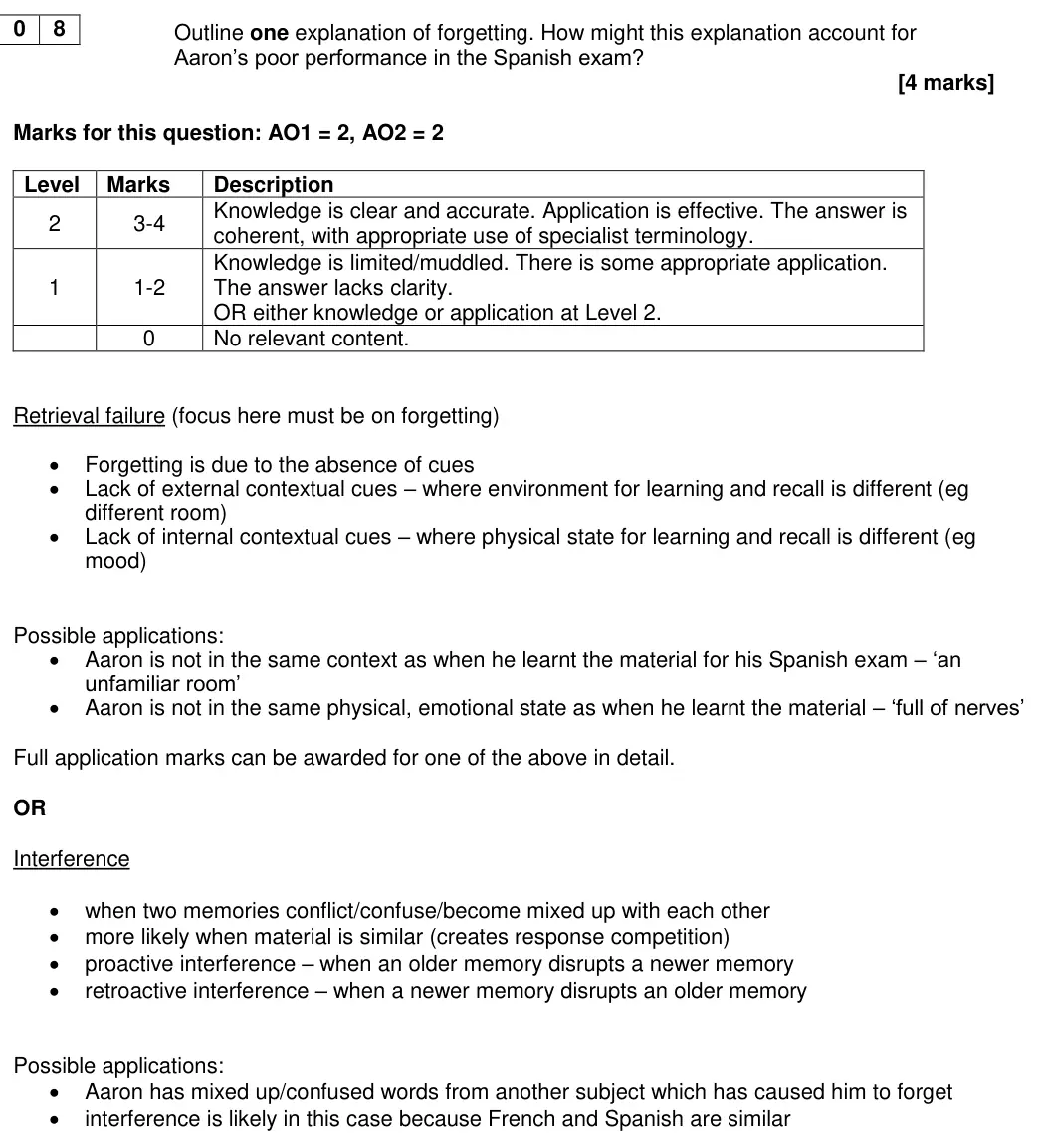
June 2018 · Paper 1 · Q84 marksAO1=2, AO2=2Application
Mark scheme, including level descriptors and indicative content
Examiner's comment
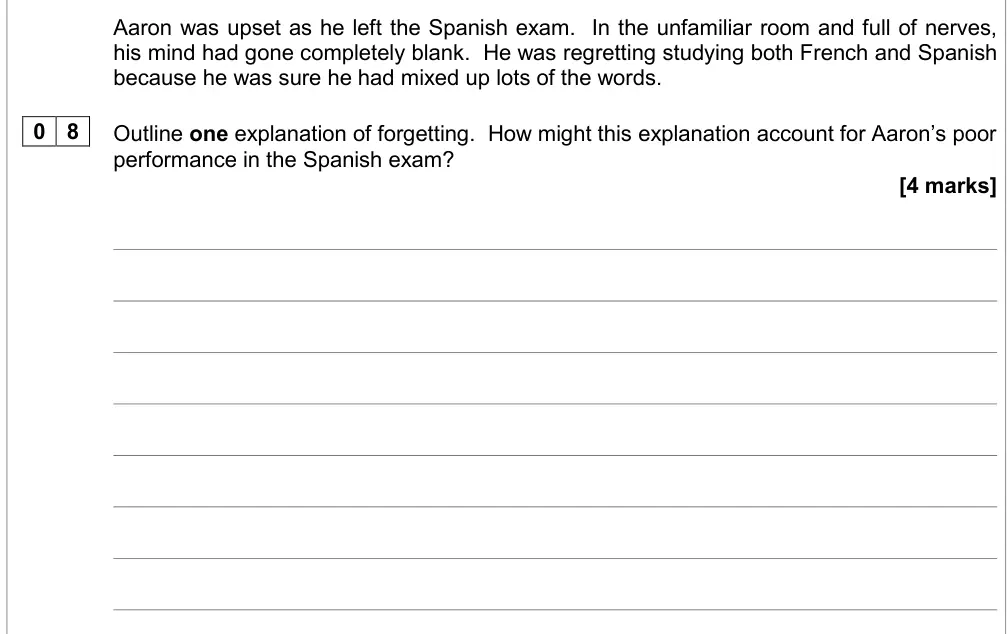
Finally, it is worth reading through the whole paper at the start, as some questions are clearly linked. Question 08 required an explanation of forgetting, while Question 09 then required this explanation to be evaluated. A significant minority of students outlined one explanation in Question 08, then had to cross it out and do another when they saw that they had to evaluate the explanation in Question 09, costing them valuable time. Whether the answer referred to interference theory or to contextual cues this question was done well. With interference some answers missed the key element of ‘similarity of material’, but virtually all could apply the explanation to Aaron’s performance in the exam. One complication for some students was that they had not looked at Question 09, and when they did realised that Question 09 was easier if they had done e.g. contextual cues rather than interference in Question 08. A few then redid Question 08. Some had also put research findings in Question 08 that were more relevant to Question 09. Only a small minority evaluated a different explanation in Question 09.
Notes from the mark scheme and report
retrieval failure (unfamiliar room, nerves = absent external/internal cues) or interference (French and Spanish similar)
knowledge or application only = max 2
some missed 'similarity of material'
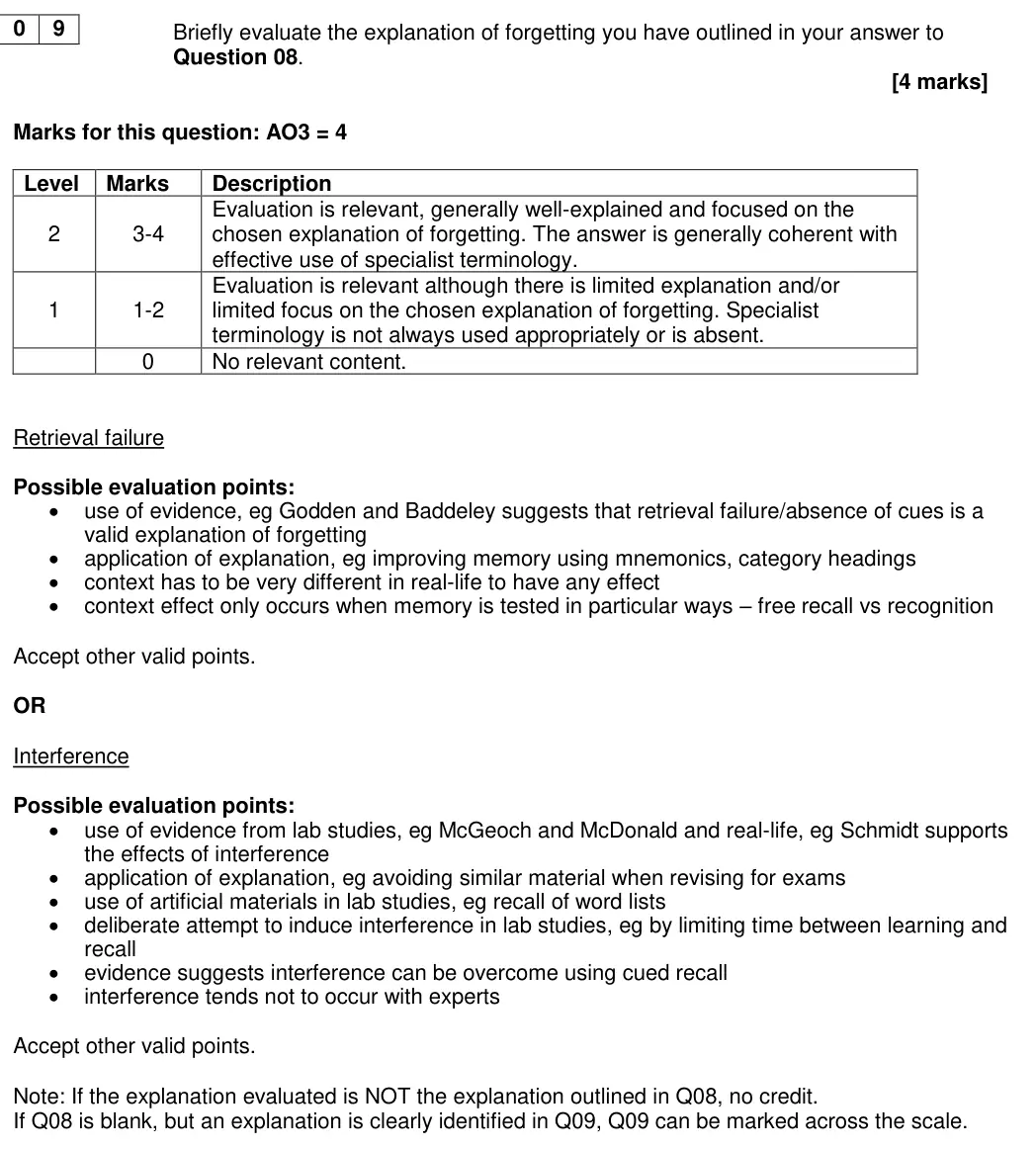
June 2018 · Paper 1 · Q94 marksAO3=4Evaluate (short)
Mark scheme, including level descriptors and indicative content
Examiner's comment
Finally, it is worth reading through the whole paper at the start, as some questions are clearly linked. Question 08 required an explanation of forgetting, while Question 09 then required this explanation to be evaluated. A significant minority of students outlined one explanation in Question 08, then had to cross it out and do another when they saw that they had to evaluate the explanation in Question 09, costing them valuable time. Students performed reasonably well on this question, but context-dependent retrieval failure was clearly easier to evaluate in terms of accessible research studies. Studies on interference effects tend to be more methodologically complicated and some answers became bogged down in confused detail. Although not necessary for the top band, some answers evaluated the studies used e.g pointing out that some studies on context are highly artificial.
Notes from the mark scheme and report
must evaluate the explanation from 08 (otherwise 0)
Godden and Baddeley, McGeoch and McDonald, artificial materials, cued recall overcomes interference
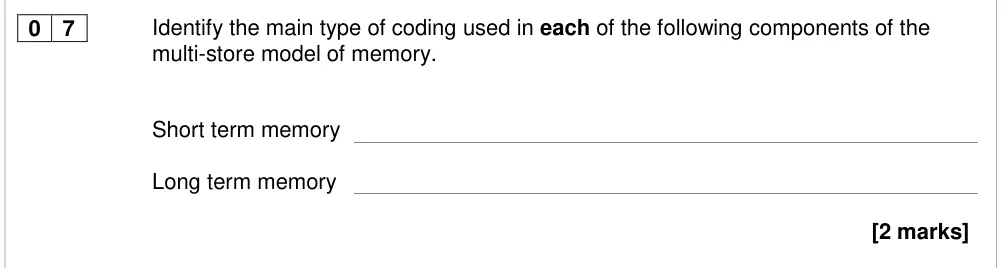
June 2017 · AS Paper 1 · Q72 marksAO1=2Short answer
Mark scheme, including level descriptors and indicative content
Examiner's comment
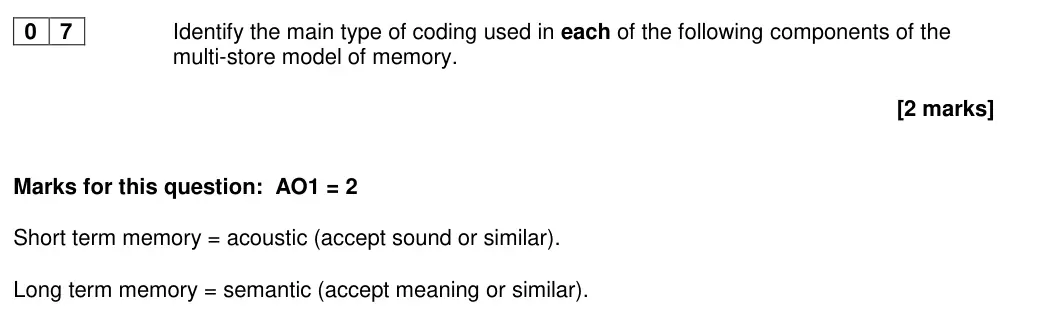
The majority of answers were correct. 83% of students were able to identify the main type of coding used in each component (short-term and long-term memory) of the multi-store model of memory.
Notes from the mark scheme and report
STM acoustic, LTM semantic
83% correct
June 2017 · Paper 1 · Q84 marksAO3=4ExplainOld spec only
Not on the 2025 specification: types of long-term memory: procedural and episodic, removed in v1.4
Mark scheme, including level descriptors and indicative content
Examiner's comment
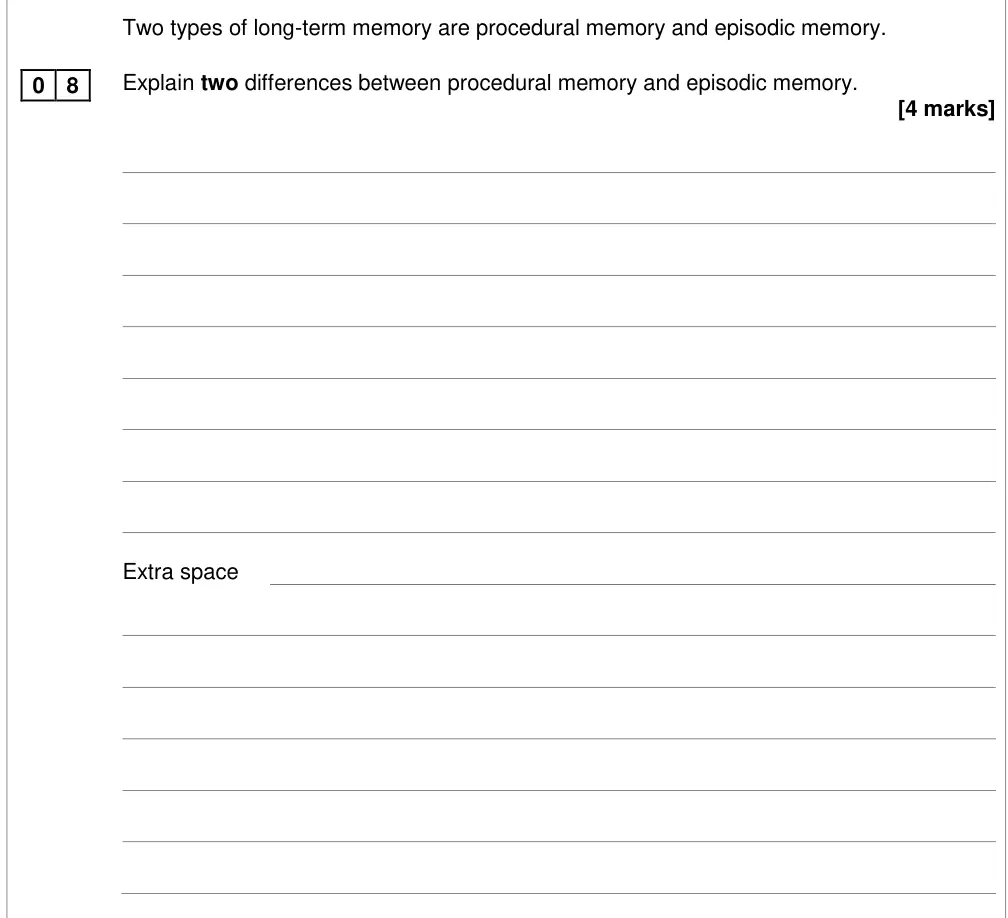
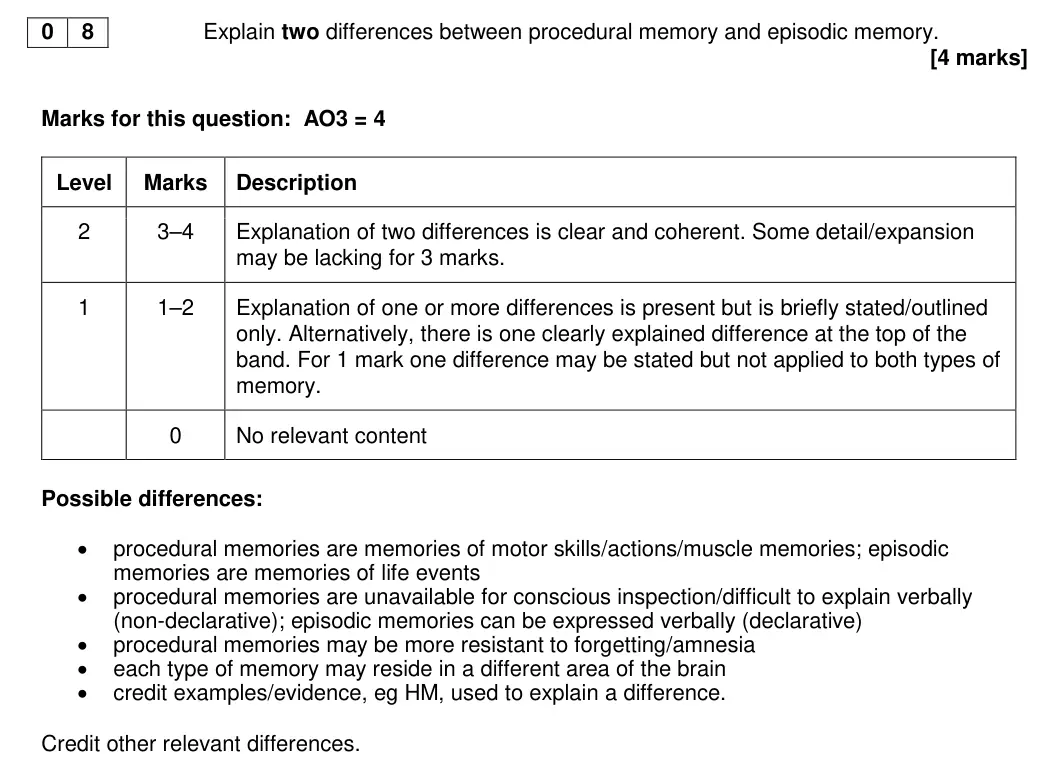
Although most answers provided accurate descriptions of procedural and episodic memory these were sometimes not structured around ‘differences’, but simply presented as two separate descriptions. To earn full credit, two clear differences had to be explicit, for example types of material, availability to conscious inspection, vulnerability to amnesia, location within the brain etc. Some students provided more than two differences, costing themselves time that could have been spent on other questions.
Notes from the mark scheme and report
Off-spec: types of long-term memory: procedural and episodic, removed in v1.4
differences must be explicit, not two separate descriptions
June 2017 · AS Paper 1 · Q94 marksAO2=4Application
Mark scheme, including level descriptors and indicative content
Examiner's comment
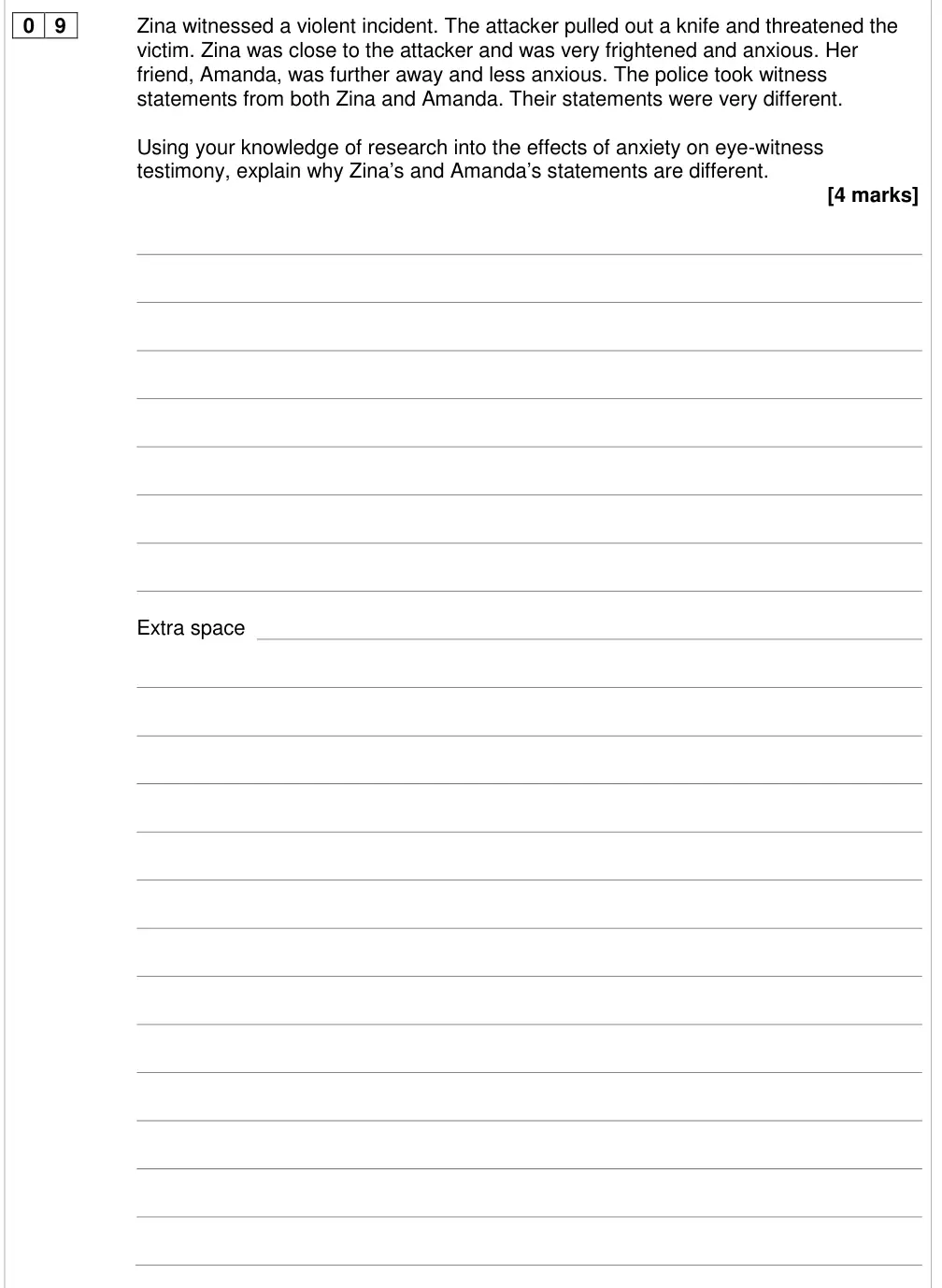
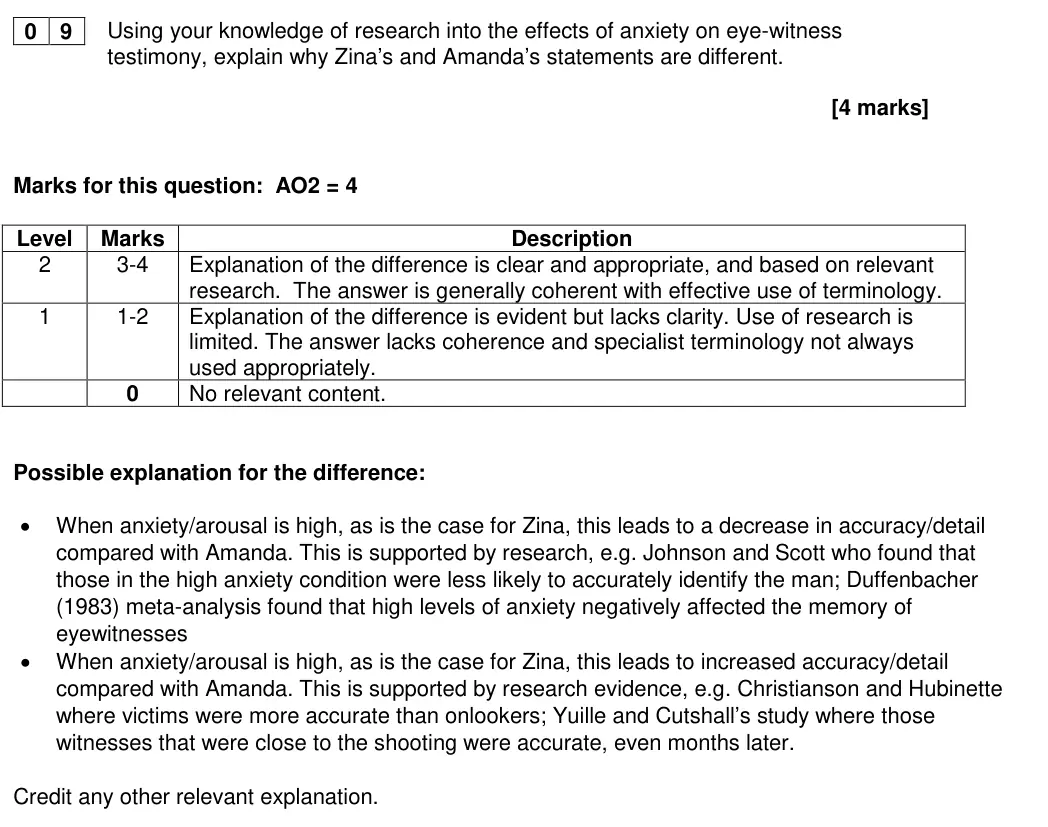
This is an example of a question where students could benefit from developing their ability to “use knowledge of research”. It appears to be an area in which they struggle. Using their knowledge requires them to select appropriate studies and/or theories to explain what is going on in the scenario. Some students simply described, in great detail, relevant studies or theories, but without any reference to either Zina or Amanda. Other students described what was going on in the scenario, almost re-writing it, but without any reference to relevant research. For example, Zina was near to the attacker and so was very anxious, more so than Amanda who was further away and so was less anxious. Neither of these strategies gained credit. Better responses referred to relevant research and then applied it to the scenario, such as Zina may have experienced the weapons effect and so would be less likely to recall the attacker. Or Yuille and Cutshall showed that those who were closer to the event were more accurate in their recall, so Zina may remember more than Amanda.
Notes from the mark scheme and report
anxiety either decreases (Johnson and Scott weapon focus, Deffenbacher) or increases accuracy (Christianson and Hubinette, Yuille and Cutshall)
must use research AND apply to Zina/Amanda - either alone gained no credit
June 2017 · Paper 1 · Q94 marksAO2=4Application
Mark scheme, including level descriptors and indicative content
Examiner's comment
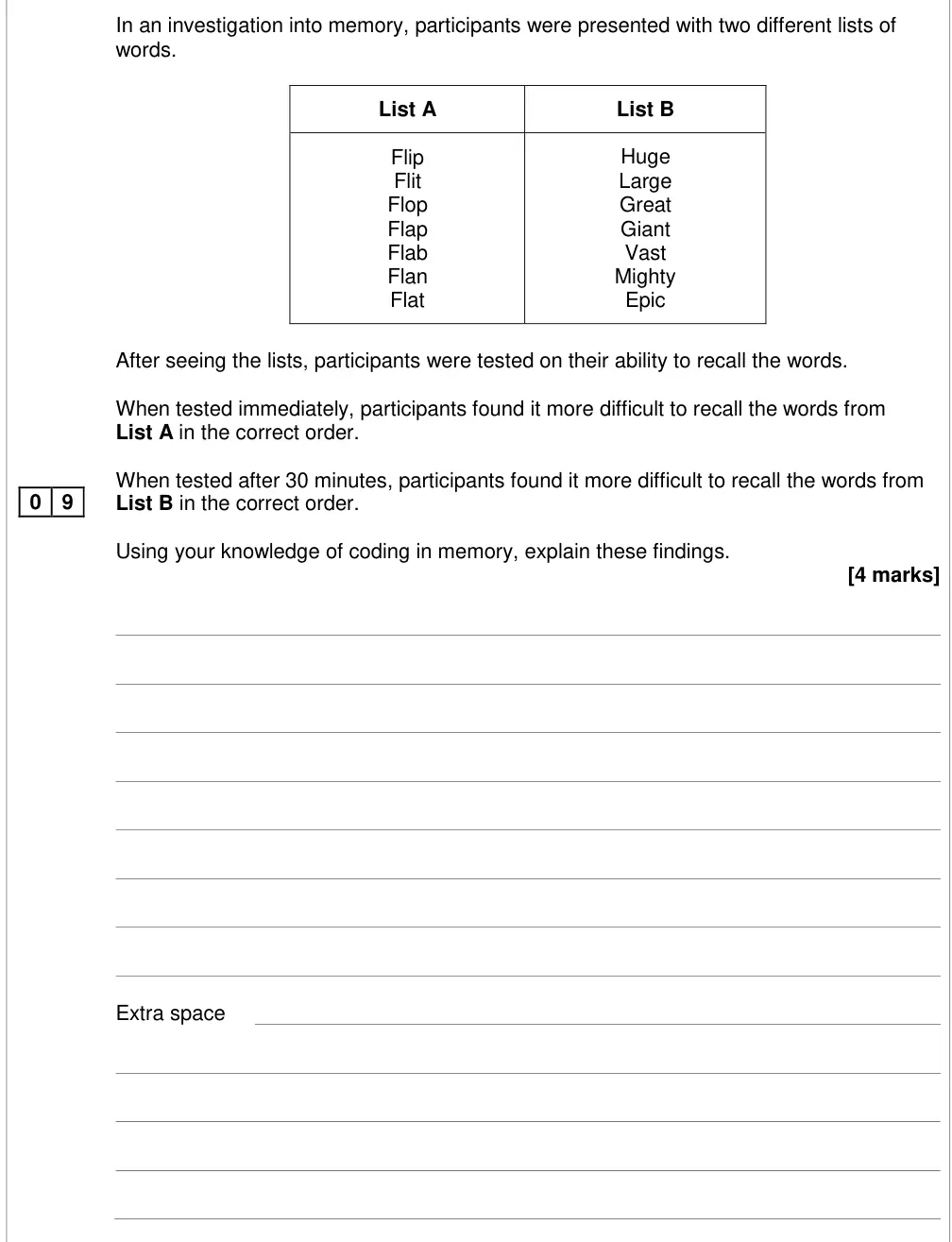
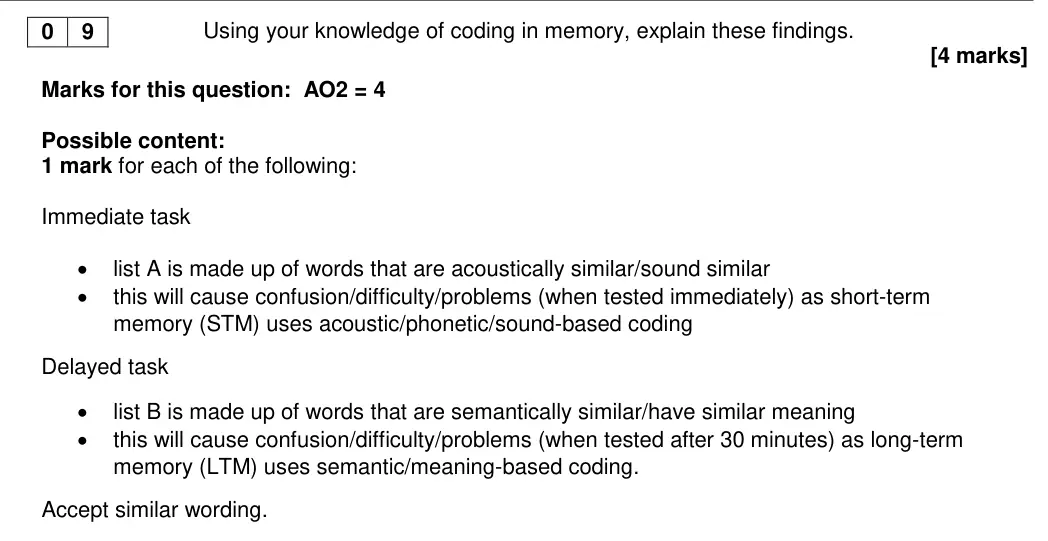
This question was done well, with may answers showing an impressive grasp of coding differences between short and long-term memory (acoustic versus semantic). However some students failed to see this as a coding question and referred mistakenly to, for example pro- and retro-active interference, or to capacity issues. There were many references to Baddeley’s key findings, but a few answers failed to link these findings to the specific study outlined on the question paper, and so received little credit.
Notes from the mark scheme and report
List A acoustically similar, confusing in STM (acoustic coding)
List B semantically similar, confusing in LTM (semantic coding)
some wrongly used interference or capacity
Baddeley findings must be linked to this study
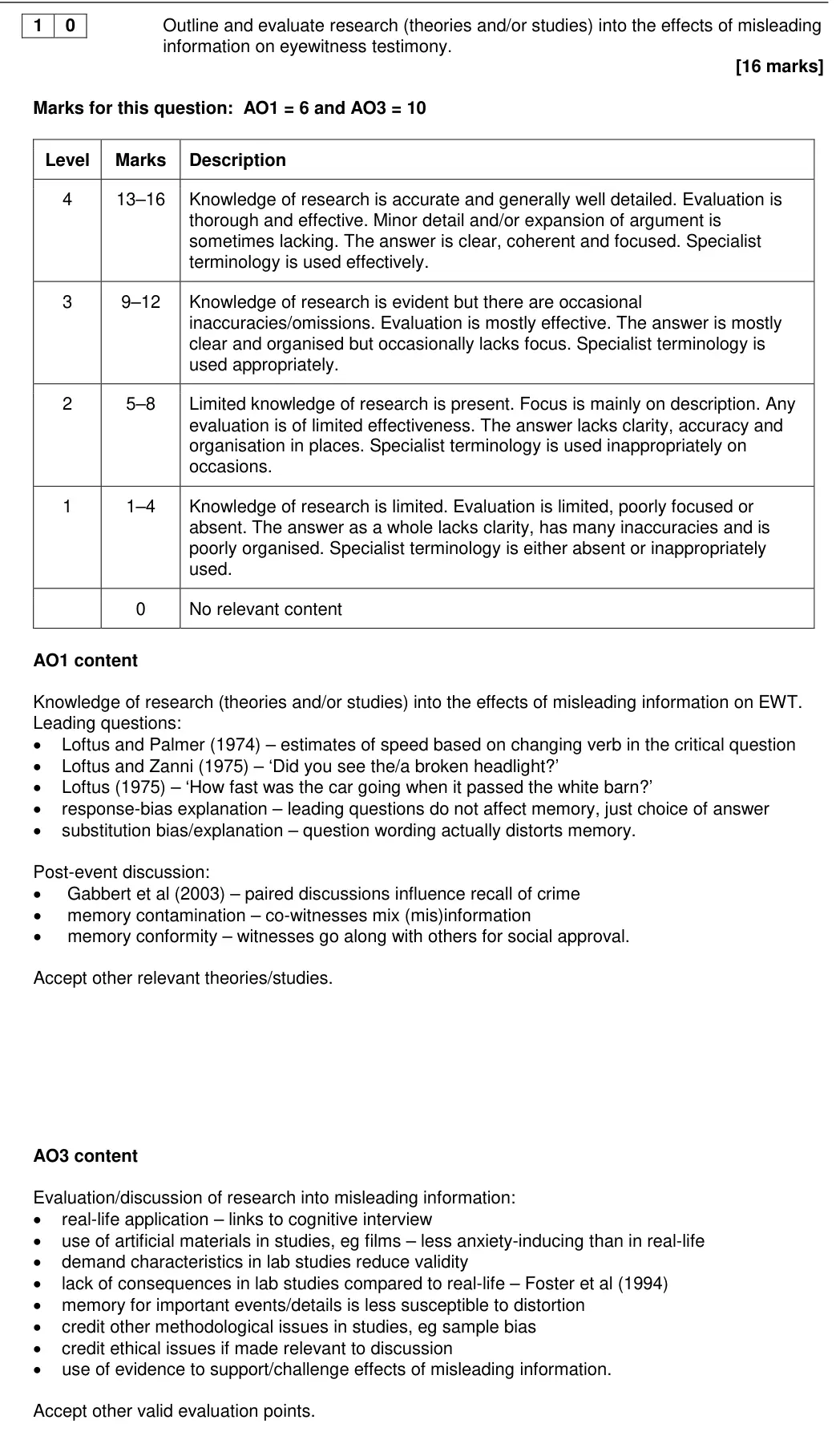
June 2017 · Paper 1 · Q1016 marksAO1=6, AO3=1016-mark essay
Mark scheme, including level descriptors and indicative content
Examiner's comment
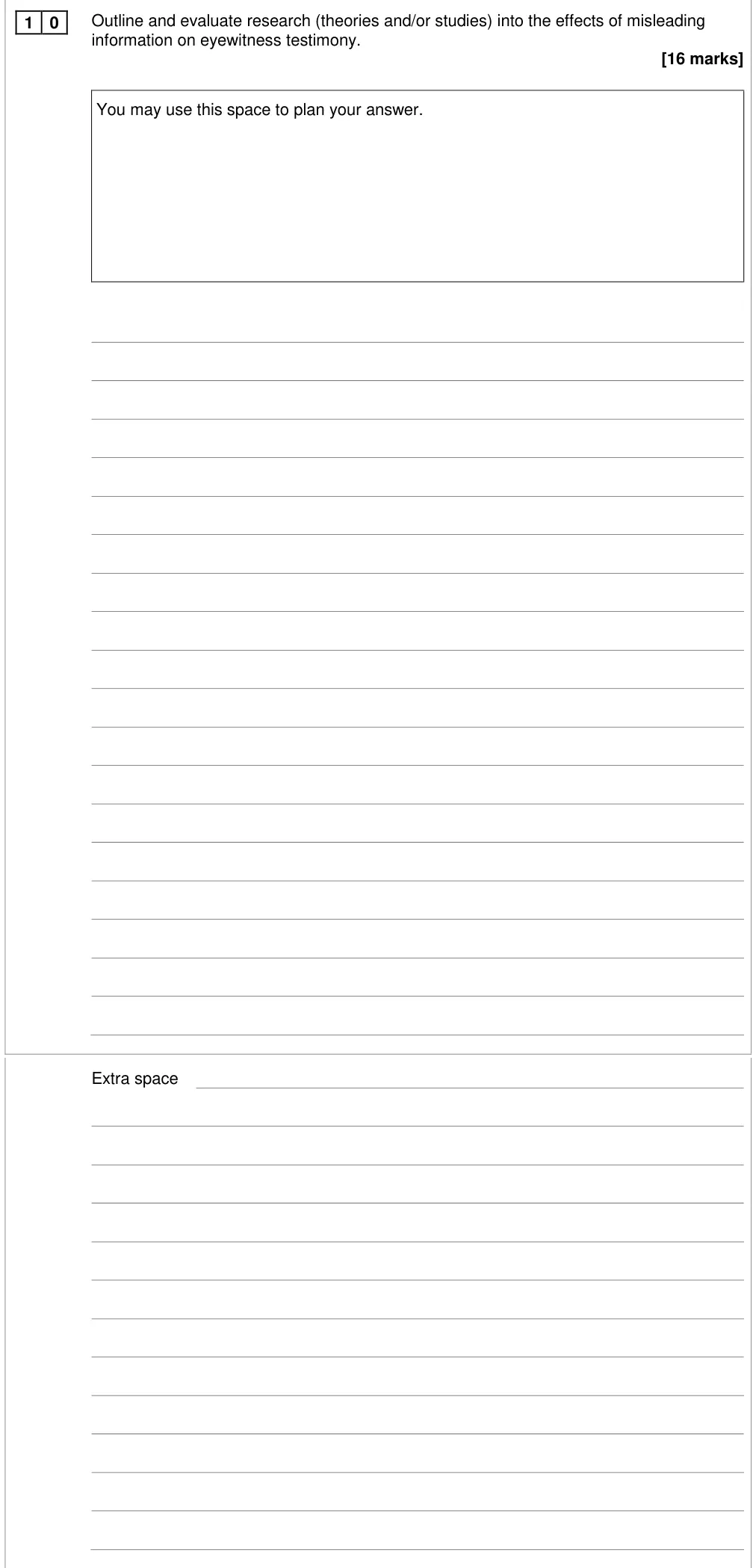
In ‘discuss’ or ‘outline and evaluate’ questions, students often spent too much time on descriptive material, leaving too little time to develop effective discussion and evaluation. This was particularly the case in questions 10 and 16. There were some excellent answers to this question that focused on the effects of misleading information, succinct outlines of relevant studies (mostly the various Loftus studies, but also studies on post-event discussion), and effective evaluation. This could be methodological (artificial materials, lack of consequences in lab studies, demand characteristics, etc), or in terms of applications, for example development of the cognitive interview. Weaker answers tended to provide inaccurate descriptions of relevant studies and rote learned evaluation not clearly linked to the specific question of misleading information and eye witness testimony. Stronger answers demonstrated effective use of material, for example using evidence for the effects of age and anxiety on eye witness testimony, as evaluative material (a failure in some key studies to control for confounding variables). Weaker responses simply wandered away from the question and discussed studies on age and anxiety (in particular the weapons effect) as though they were automatically relevant.
Notes from the mark scheme and report
leading questions (Loftus and Palmer, response-bias vs substitution) and post-event discussion (Gabbert, memory conformity)
evaluation e.g. artificial materials, lack of consequences, cognitive interview
drifting into anxiety/weapon focus as description not credited
'misleading information' heading removed in v1.4 but its content (leading questions, post-event discussion) remains
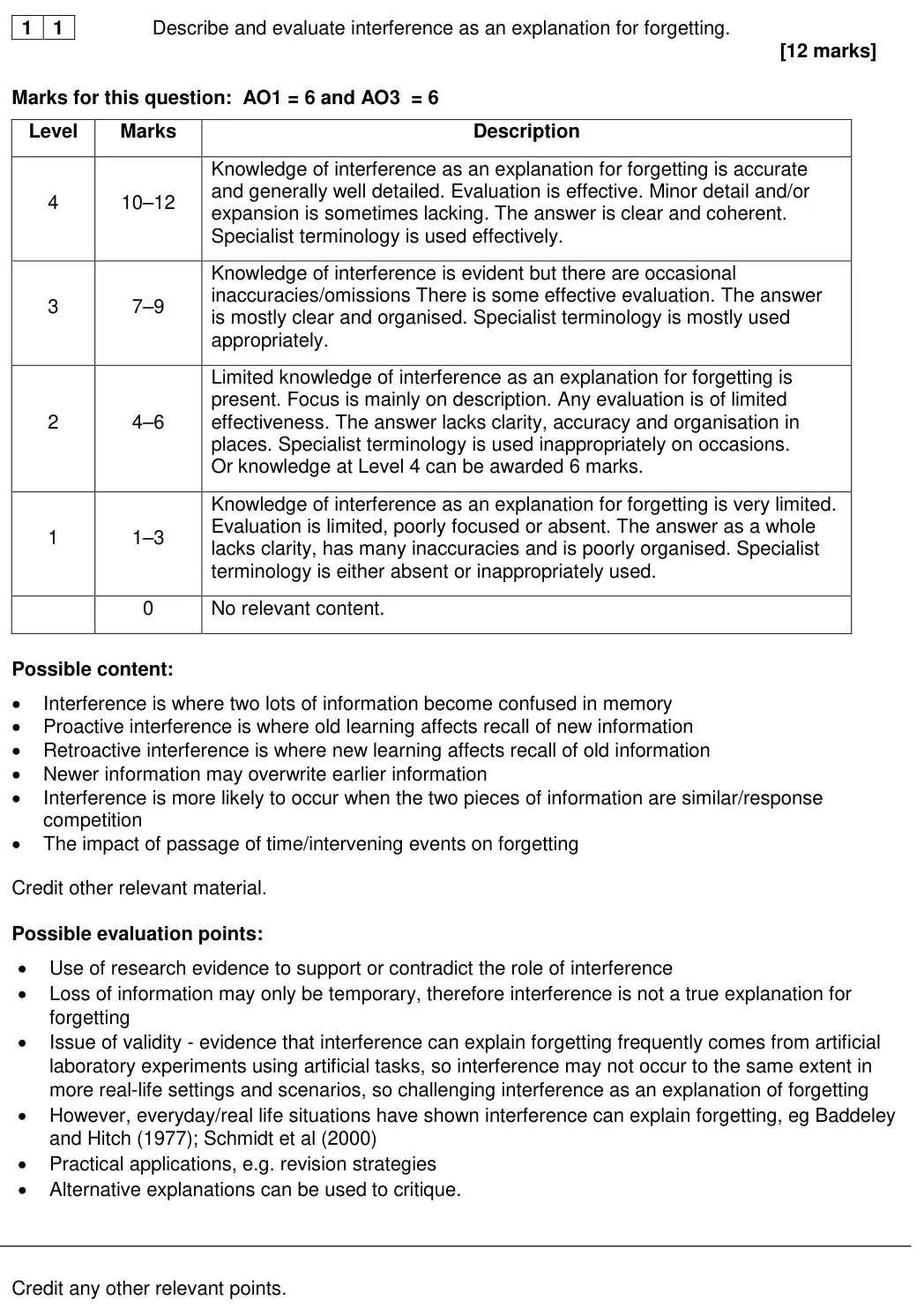
June 2017 · AS Paper 1 · Q1112 marksAO1=6, AO3=6Extended writing
Mark scheme, including level descriptors and indicative content
Examiner's comment
Assessment of extended writing as in Q6, Q11 and Q18 differentiated well. Weaker responses to these questions suggest that students need to focus on developing their higher order skills. Most students could describe retroactive and proactive interference, even if the name and the actual description were muddled. They understood that sometimes old material interferes with new, and sometimes it is the other way round. Answers were often illustrated with good examples. Students were also able to comment on the fact that similarity of material is also important in interference. However, students appeared to find the evaluation more difficult. Once again students wasted time by giving lengthy and detailed descriptions of studies, without using them effectively. For evaluation of an explanation, it is the findings of a study that are relevant and whether or not they support or challenge the explanation. The study by Baddeley and Hitch using rugby players was often cited, but few students understood exactly how it supports interference. One way of evaluating an explanation is to consider alternative explanations. This is not the same as merely describing alternative explanations in detail. Yet again, it is how such material is used that determines its effectiveness. Some students confused interference with retrieval failure. They appeared to understand retrieval failure as being an aspect of interference and wrote at length about context-dependent or state-dependent forgetting, which was not creditworthy.
Notes from the mark scheme and report
proactive and retroactive interference, similarity
evaluation via research findings (Baddeley and Hitch rugby players), artificial tasks, temporary loss, alternatives
knowledge at Level 4 = max 6
retrieval failure/context- or state-dependent forgetting not creditworthy
June 2016 · AS Paper 1 · Q54 marksAO1=4Outline
Mark scheme, including level descriptors and indicative content
Examiner's comment
Students who confined themselves to information about the characteristics of short-term memory tended to do well on this question. Whilst it was quite legitimate to focus on evidence, credit could only be awarded for the findings/conclusions of studies and not for the method. Students presenting detailed information on Baddeley’s coding studies frequently misreported the outcome, stating that acoustically similar words were better recalled in short-term tasks. Unfortunately, several students misinterpreted this as a more general question about the multistore model as a whole and consequently presented a great deal of peripheral information, touching on characteristics of short-term memory, either incidentally or not at all. Another common error was to present an outline of the working memory model.
Notes from the mark scheme and report
capacity, duration, coding of STM
detailed outline of one feature can gain full marks
findings not method
common errors: outlining whole MSM or the working memory model, misreporting Baddeley's acoustic coding finding
June 2016 · AS Paper 1 · Q66 marksAO2=6ApplicationOld spec only
Not on the 2025 specification: types of LTM: procedural, episodic, semantic - removed in v1.4
Mark scheme, including level descriptors and indicative content
Examiner's comment
Most students recognised this as a question about episodic, semantic and procedural memory and most could successfully identify the three types in the cases presented. Unfortunately, not all students could adequately explain how the cases presented in the stem illustrated the three types of memory. This was evident in answers that attempted to explain using the same terms, eg ‘Annie’s is a procedural memory because she is remembering a procedure’. It is worth noting that describing procedural memory as a ‘how to’ memory is somewhat ambiguous, since remembering ‘how to bake a cake’ could mean recalling the action of stirring the mixture (procedural memory) but is more likely to mean remembering the list of ingredients and sequence of steps involved (semantic memory). Procedural memory is much more effectively explained as an action or skills- based memory. A small number of students chose a completely alternative interpretation of the question to that intended and tried to link the three types of memory to just one of the cases in the stem. In such cases, students were credited for legitimate, plausible applications, eg ‘Billy shows semantic memory because he is remembering factual information about tools and their use, he is using episodic memory because he remembers which tools he used last time he fixed a tap, and he is showing procedural memory recalling the muscle action required to use the tools’. Although it was rarely used, the term ‘declarative memory’ was accepted in place of either semantic or episodic memory, but not for both.
Notes from the mark scheme and report
Off-spec: types of LTM: procedural, episodic, semantic - removed in v1.4
1 mark per correct identification matched to person + 1 mark per explained feature in context
tautological explanations ('procedure') not credited
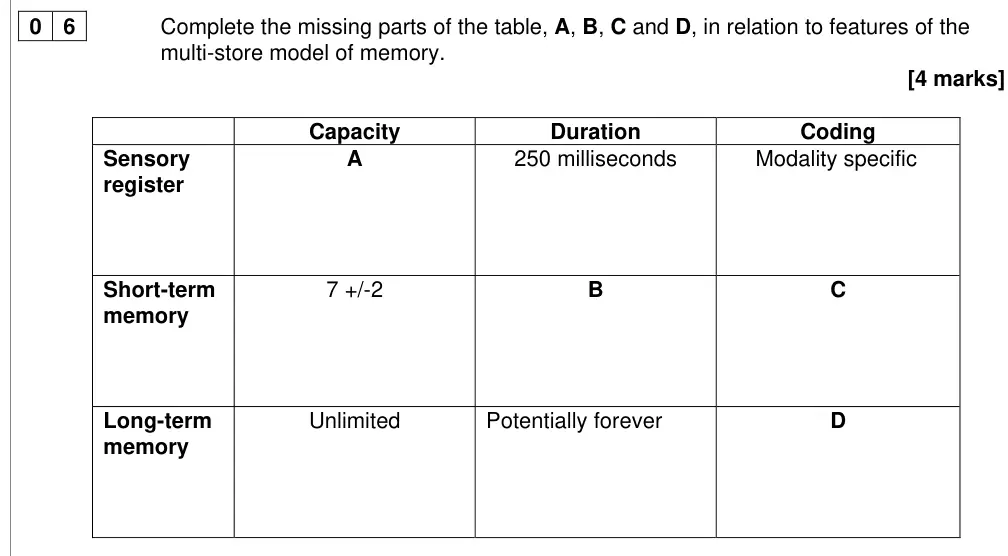
Specimen set 2 · Paper 1 · Q64 marksAO1=4Short answer
Mark scheme, including level descriptors and indicative content
Notes from the mark scheme and report
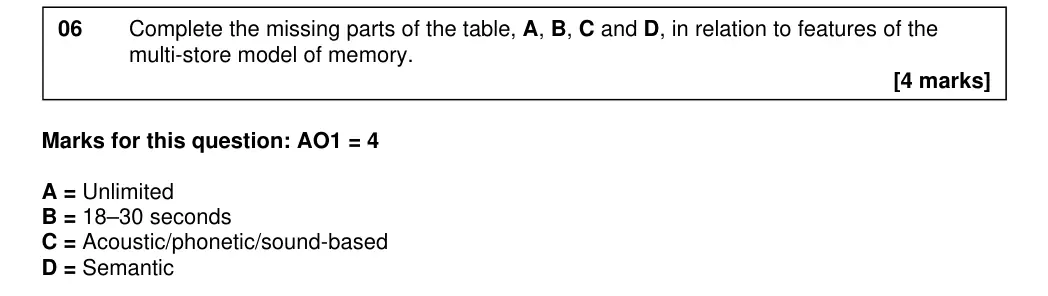
A = unlimited, B = 18-30 seconds, C = acoustic, D = semantic
June 2016 · AS Paper 1 · Q72 marksAO3=2Multiple choice
Answer
B and D
Mark scheme, including level descriptors and indicative content
Examiner's comment
Nearly all students managed to gain at least one mark and many gained full credit.
Notes from the mark scheme and report
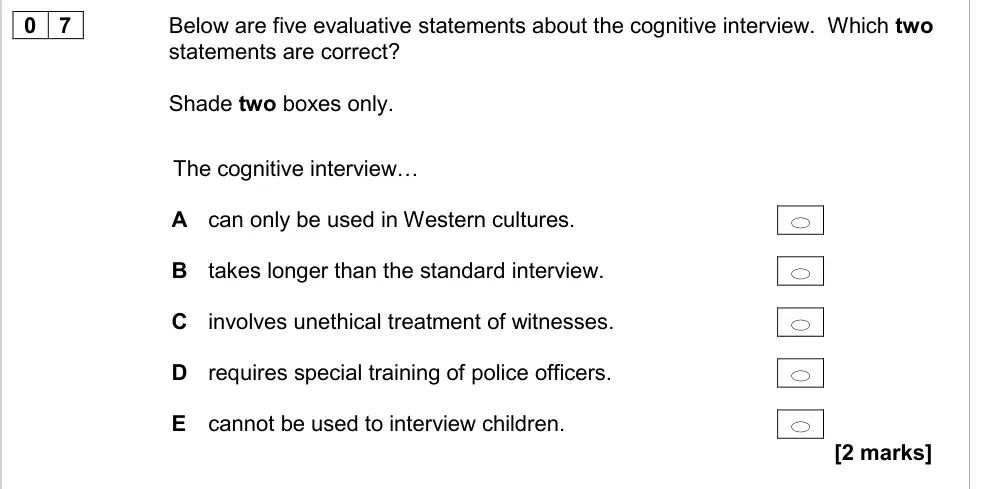
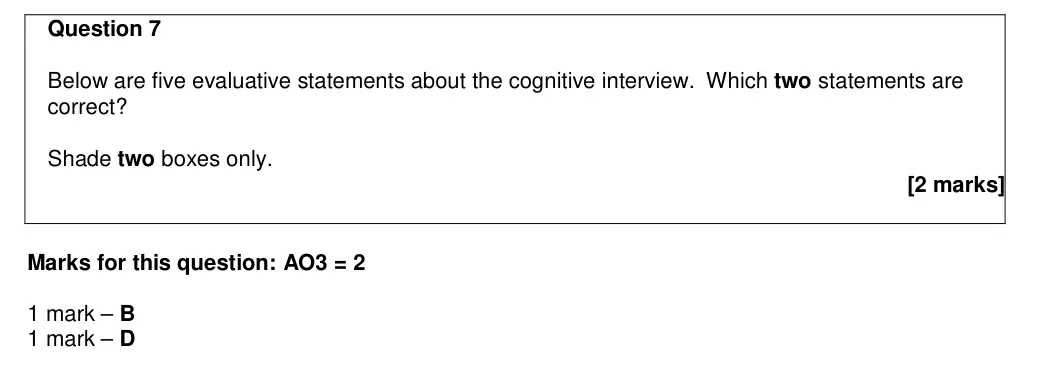
correct B (takes longer) and D (needs special training)
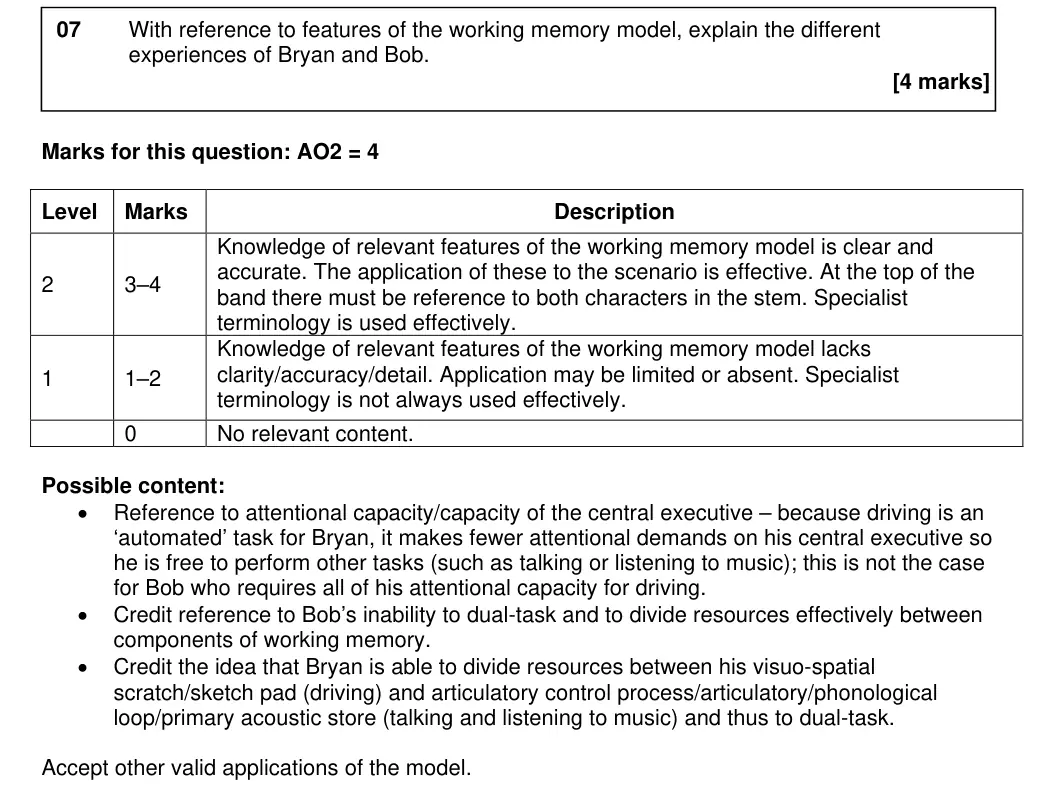
Specimen set 2 · Paper 1 · Q74 marksAO2=4Application
Mark scheme, including level descriptors and indicative content
Notes from the mark scheme and report
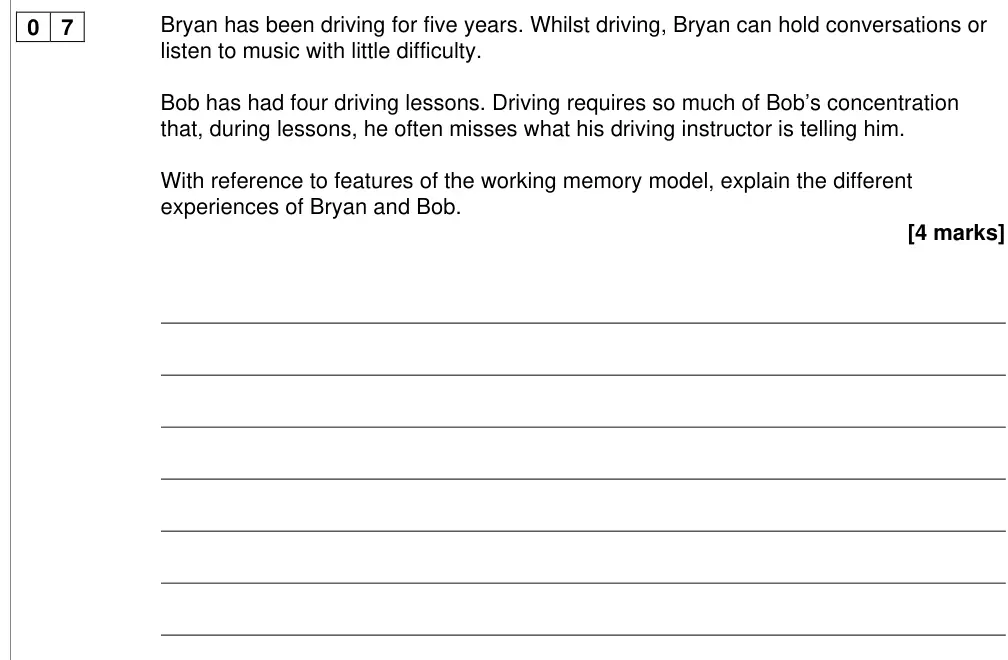
central executive attentional capacity, automated driving for Bryan
Bryan divides between VSS (driving) and phonological loop (talking/music), Bob cannot dual-task
top band needs reference to both characters
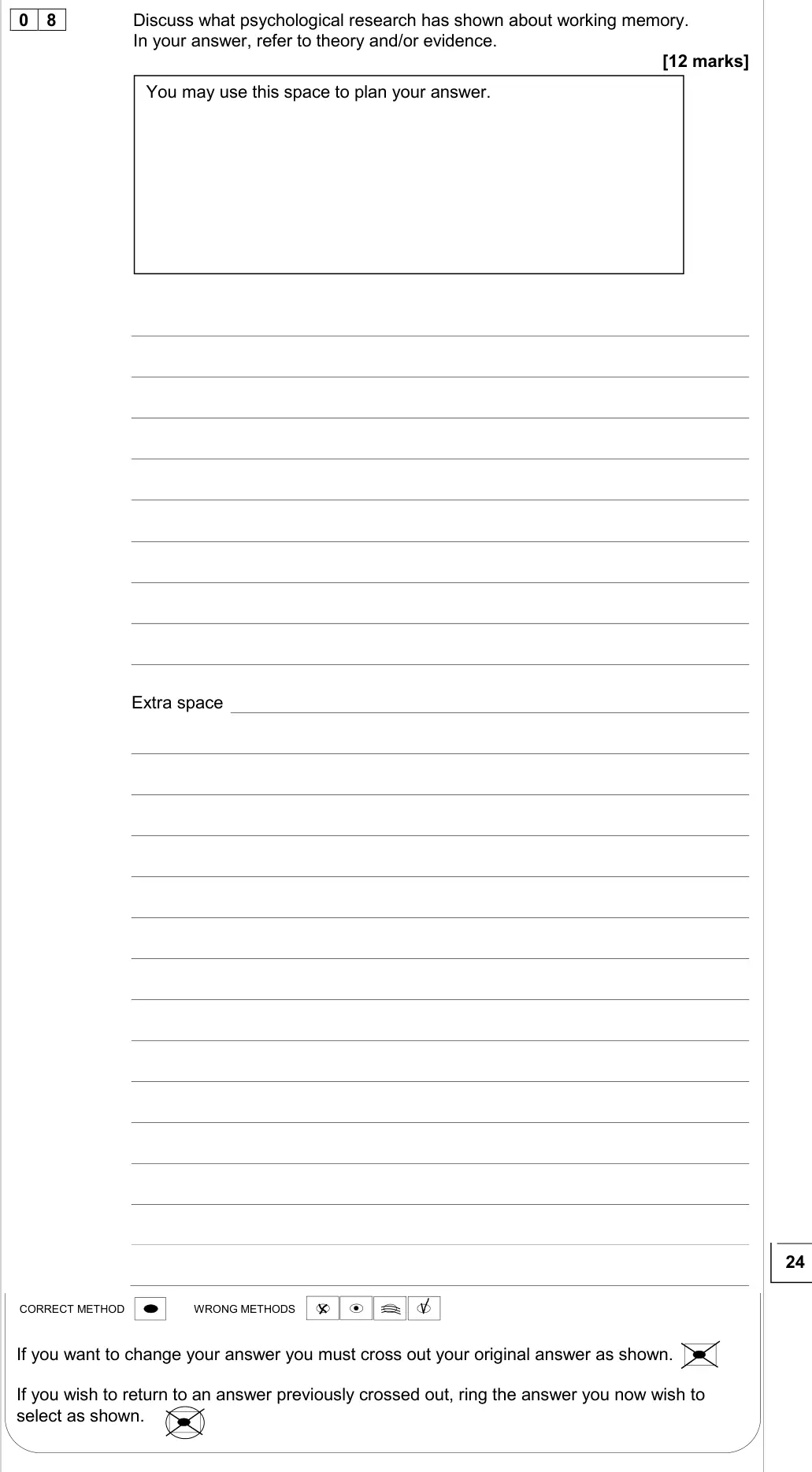
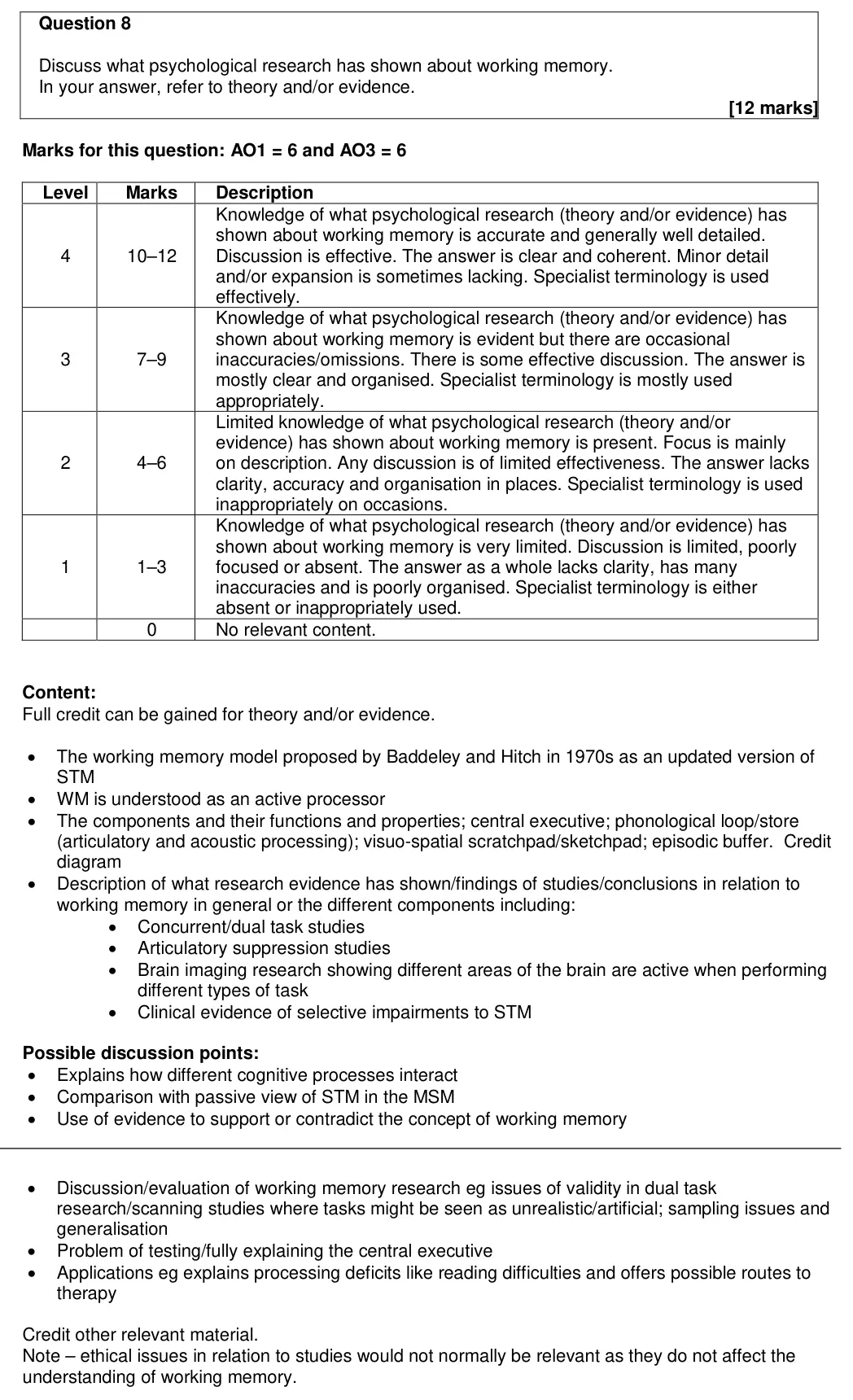
June 2016 · AS Paper 1 · Q812 marksAO1=6, AO3=6Extended writing
Mark scheme, including level descriptors and indicative content
Examiner's comment
Questions that tended to differentiate best were questions 1.2, 3, 8, 11 and 12. Most students presented a combination of theory and research evidence. The quality of extended writing varied enormously, with many students evidently struggling to describe such abstract ideas using specialist terminology. Whilst it was quite legitimate to focus on studies of working memory, with credit awarded for what the research ‘has shown’, it was most appropriate to focus on the findings/conclusions rather than on elaborate detail of the method. Confusion was often evident, particularly in relation to the outcome of dual task studies. Discussions were often based on the use of evidence to support the working memory model, although explanations of how the findings supported the theory were often missing or confused, with relatively few students touching on the key issue of limited capacity. Generic evaluation points were frequently seen and did not contribute to the overall worth of answers. A number of students misinterpreted this as a question about the multistore model and a surprising number of answers included discussions of long-term memory.
Notes from the mark scheme and report
theory and/or evidence
dual-task, articulatory suppression, brain scans, KF case
evaluation often generic
discussion of ethics not relevant
many drifted into MSM or LTM
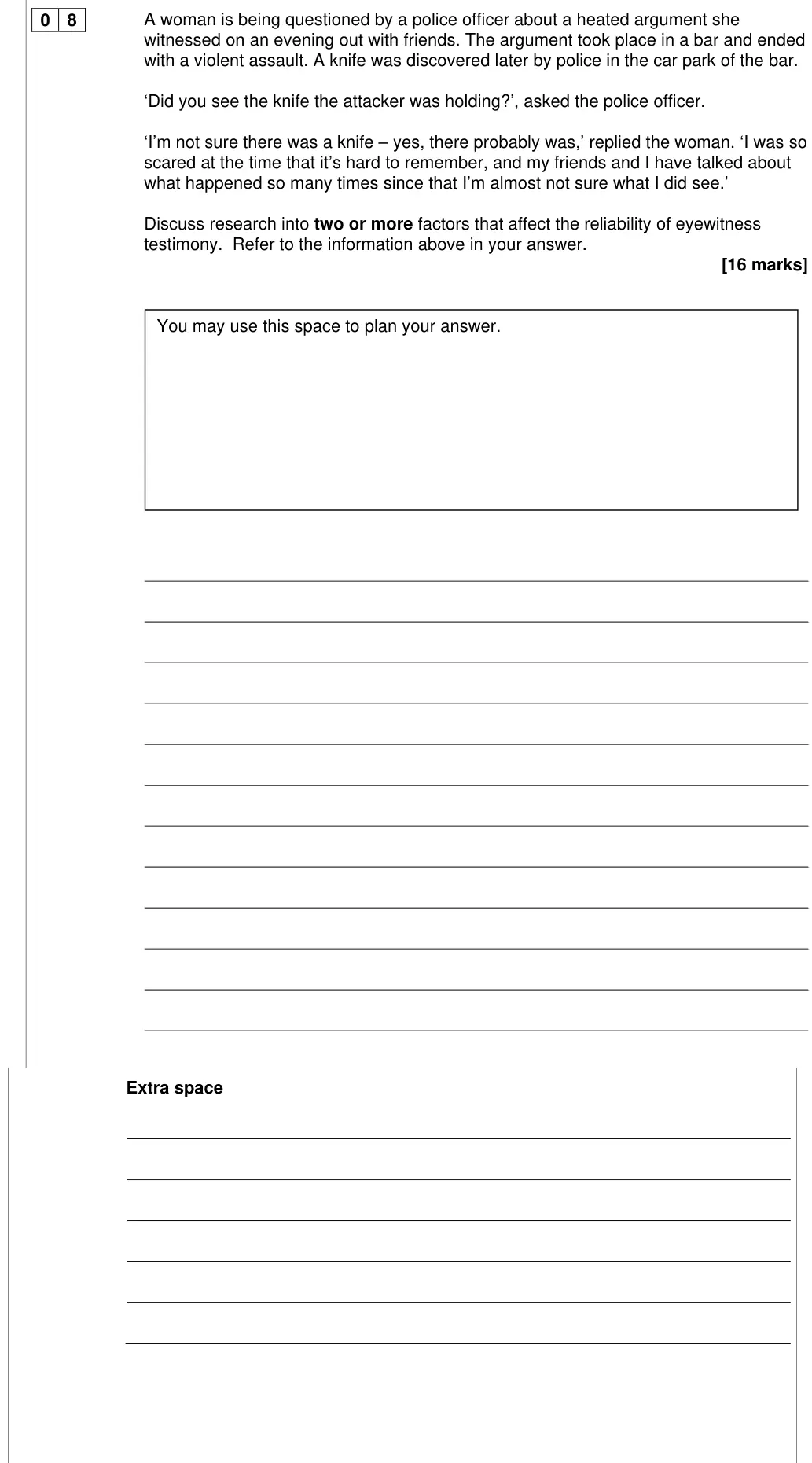
Specimen set 2 · Paper 1 · Q816 marksAO1=6, AO2=4, AO3=616-mark essay
Mark scheme, including level descriptors and indicative content
Notes from the mark scheme and report
leading questions ('the knife'), anxiety ('so scared'), post-event discussion (talking with friends) applied to the stem
research into one factor only = max Level 2
Loftus and Palmer, weapon focus, Yuille and Cutshall
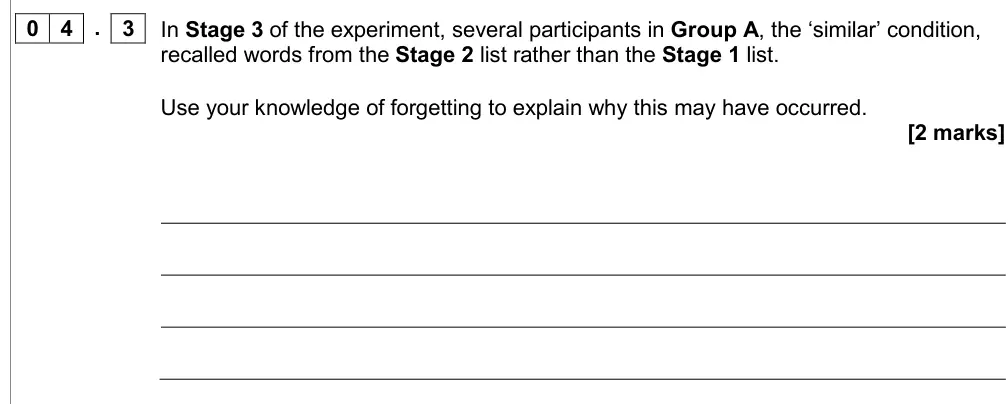
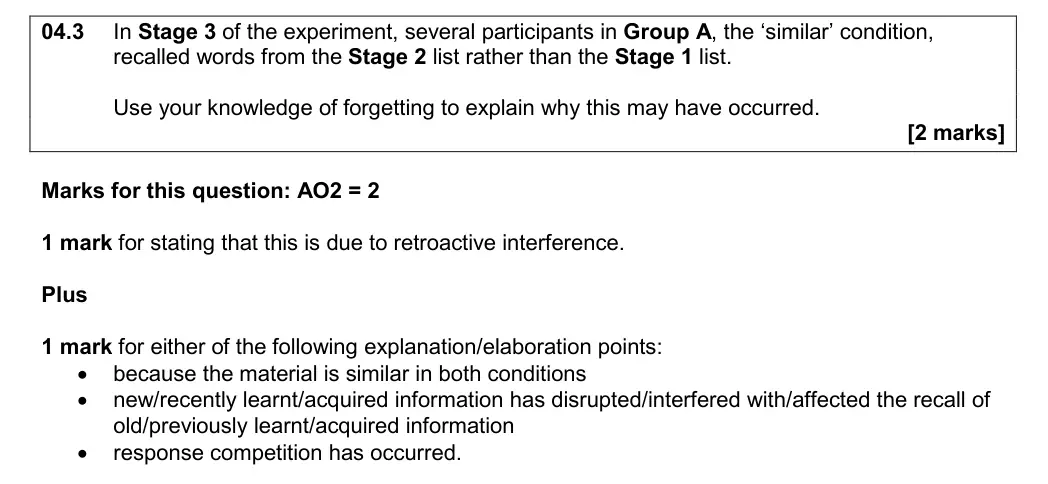
Specimen set 1 · Paper 1 · Q4.32 marksAO2=2Application
Mark scheme, including level descriptors and indicative content
Notes from the mark scheme and report
retroactive interference + elaboration (similar material, new information disrupting recall of old, response competition)
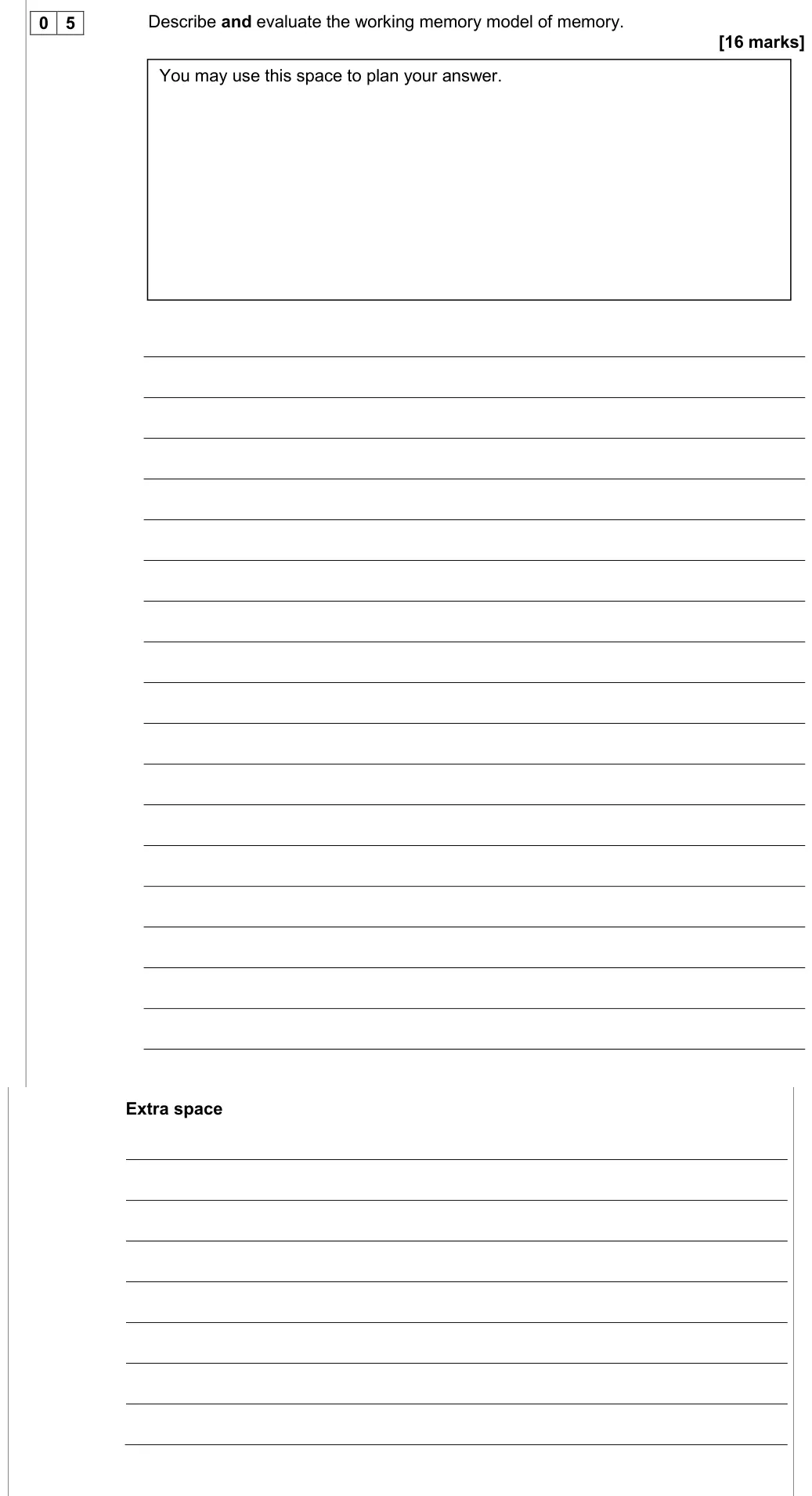
Specimen set 1 · Paper 1 · Q516 marksAO1=6, AO3=1016-mark essay
Mark scheme, including level descriptors and indicative content
Notes from the mark scheme and report
central executive, slave systems (not all needed), capacity and coding of each, dual-task performance
methodology only credited if related to the model
Specimen set 1 · AS Paper 1 · Q5.11 markAO1=1Multiple choiceOld spec only
Not on the 2025 specification: types of LTM - episodic memory - removed in v1.4
Answer
A
Mark scheme, including level descriptors and indicative content
Notes from the mark scheme and report
Off-spec: types of LTM - episodic memory - removed in v1.4
Specimen set 1 · AS Paper 1 · Q5.21 markAO1=1Multiple choiceOld spec only
Not on the 2025 specification: types of LTM - procedural memory - removed in v1.4
Answer
B
Mark scheme, including level descriptors and indicative content
Notes from the mark scheme and report
Off-spec: types of LTM - procedural memory - removed in v1.4
Specimen set 1 · AS Paper 1 · Q74 marksAO1=4Outline
Mark scheme, including level descriptors and indicative content
Notes from the mark scheme and report
two techniques identified and outlined (context reinstatement, report everything, change order, change perspective)
one technique only = max 2
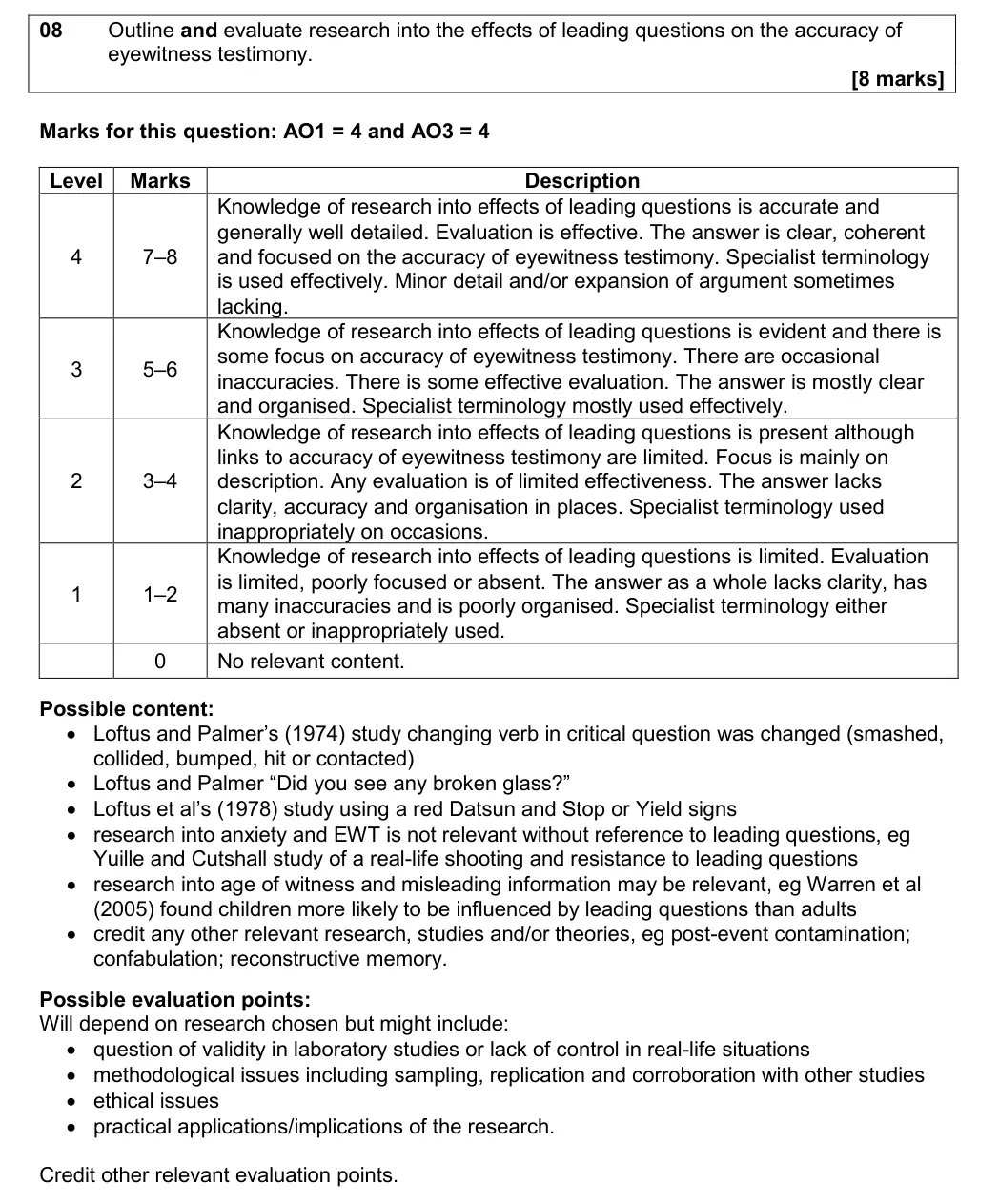
Specimen set 1 · AS Paper 1 · Q88 marksAO1=4, AO3=4Extended writing
Mark scheme, including level descriptors and indicative content
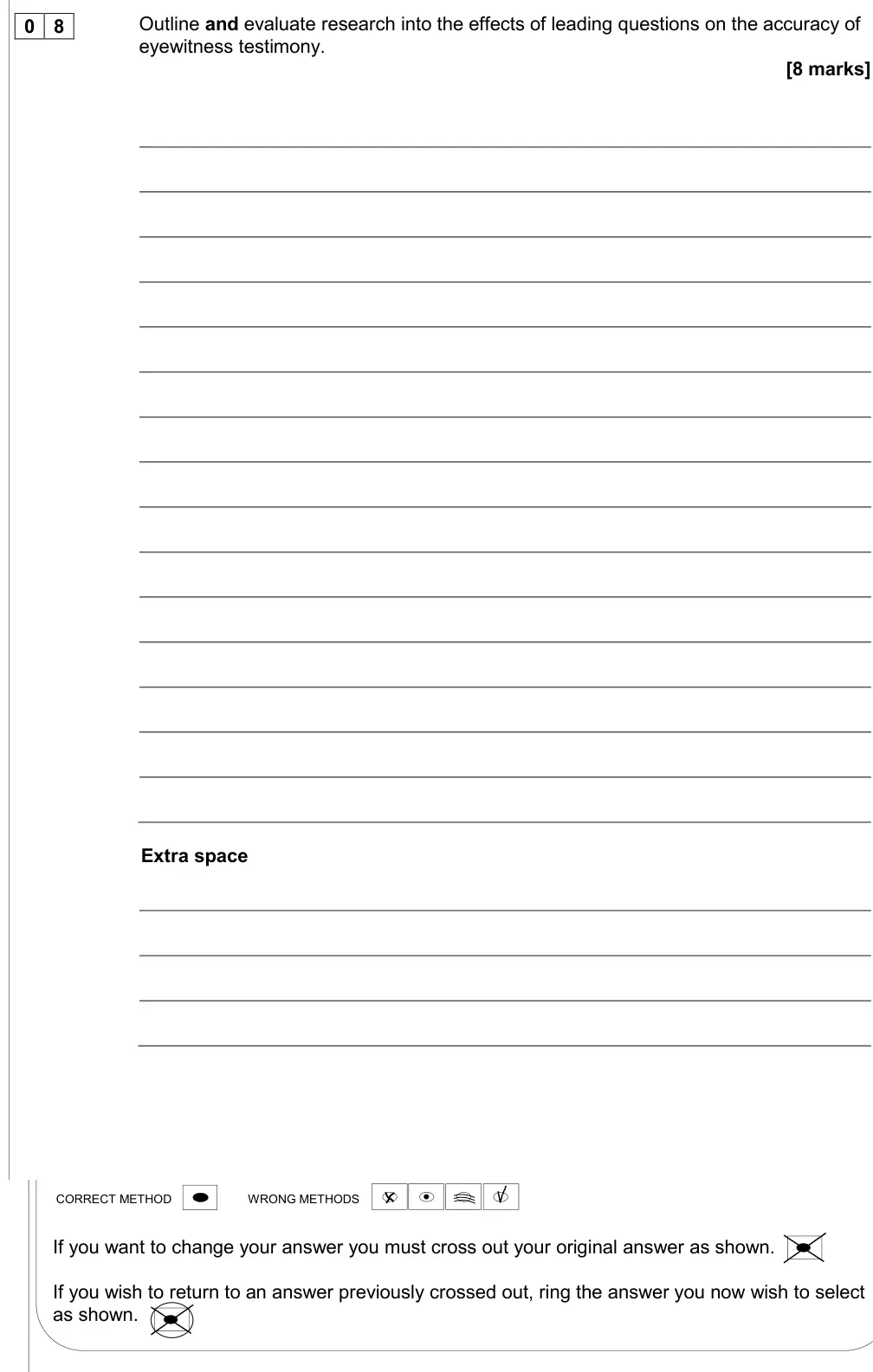
Notes from the mark scheme and report
anxiety research (e.g. Yuille and Cutshall) only creditworthy if linked to leading questions
Loftus and Palmer most likely
MS also credits post-event contamination/misleading information - leading questions remain current although 'misleading information' heading removed in v1.4
Work with an AQA psychology tutor
Essays not reaching the top band? Book a session with Andy, a former AQA examiner.