Specimen set 1: AS Paper 2

72 marks · 26 question parts · Paper, mark scheme and report on AQA's site

This paper was set on the previous specification. All of its content is still on the 2025 specification.

Question by question

QTopicMarksAOType
1.1 Biopsychology 1AO1=1Multiple choice
1.2 Biopsychology 1AO1=1Multiple choice
2 Biopsychology 1AO1=1Multiple choice
3 Biopsychology 2AO1=2Multiple choice
4 Approaches in psychology 2AO2=2Application
5.1 Approaches in psychology 2AO2=2Application
5.2 Research methods: data handling and analysis 2AO2=2Calculation
5.3 Research methods: data handling and analysis 1AO3=1Multiple choice
6.1 Approaches in psychology 6AO1=2,AO2=4Application
6.2 Approaches in psychology 6AO3=6Evaluate (short)
7.1 Clinical psychology and mental health (psychopathology) 2AO1=2Short answer
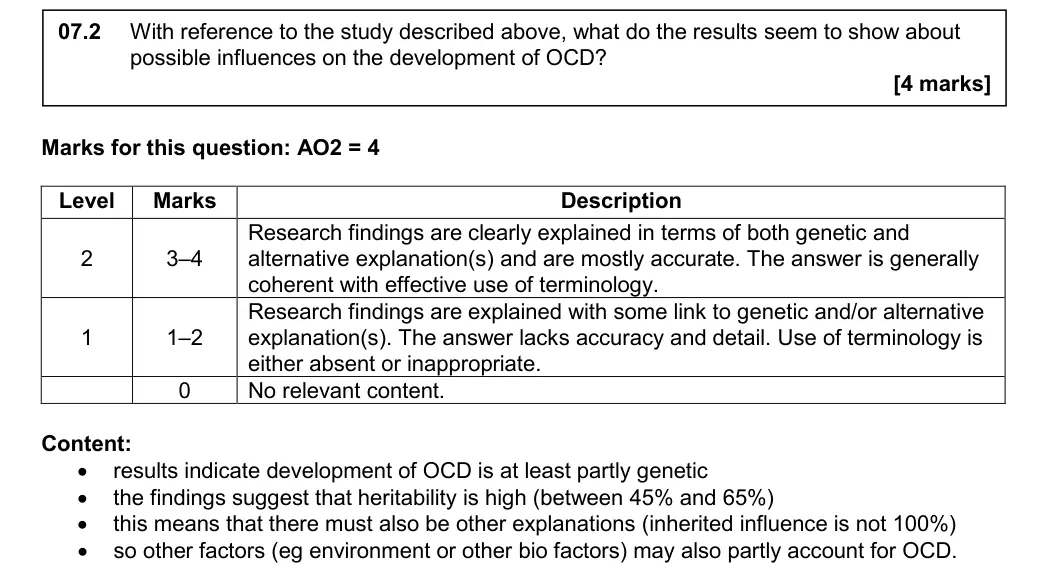
7.2 Clinical psychology and mental health (psychopathology) 4AO2=4Application
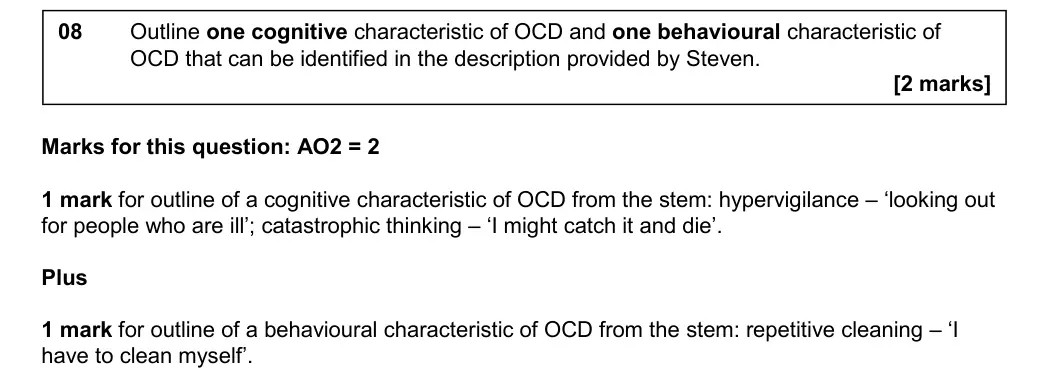
8 Clinical psychology and mental health (psychopathology) 2AO2=2Application
9 Clinical psychology and mental health (psychopathology) 2AO1=2Short answer
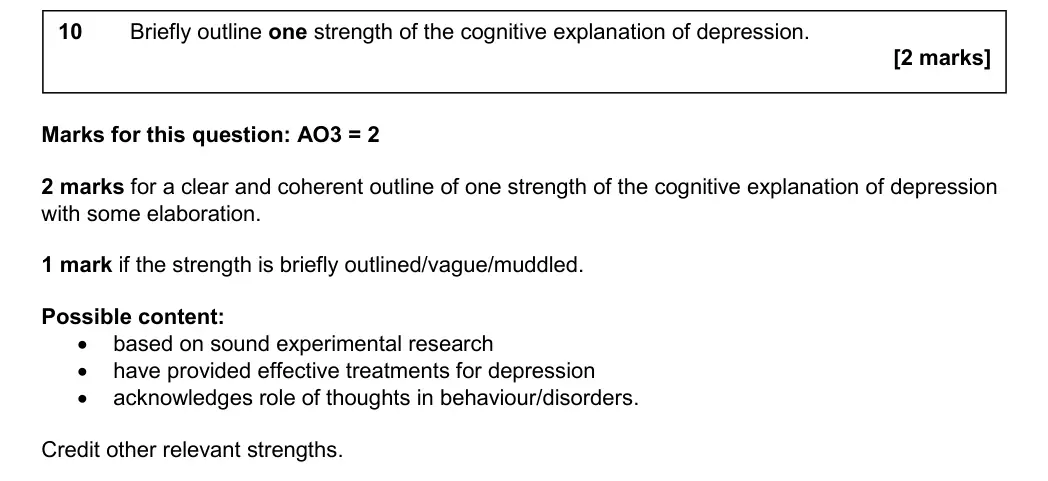
10 Clinical psychology and mental health (psychopathology) 2AO3=2Evaluate (short)
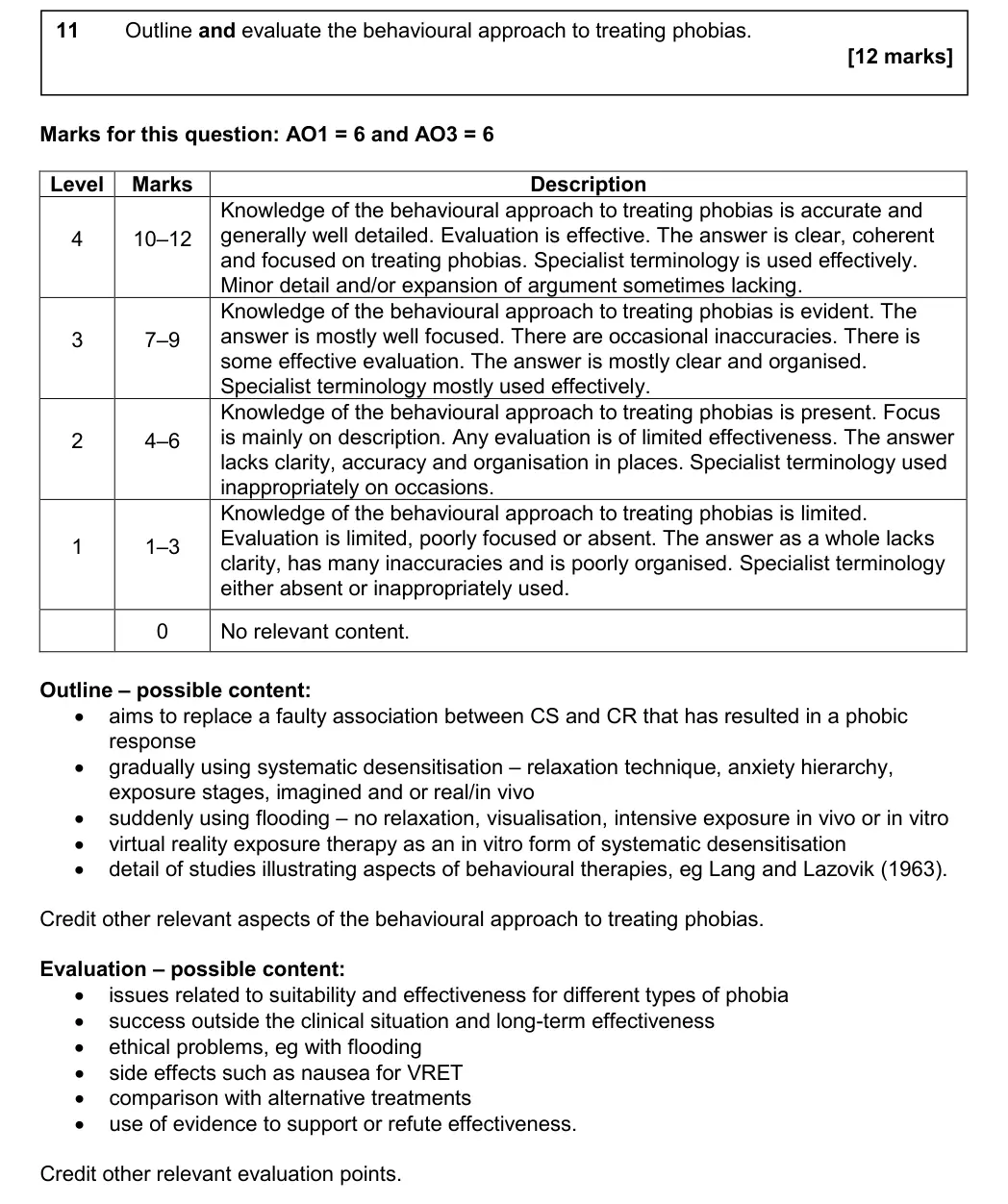
11 Clinical psychology and mental health (psychopathology) 12AO1=6,AO3=6Extended writing
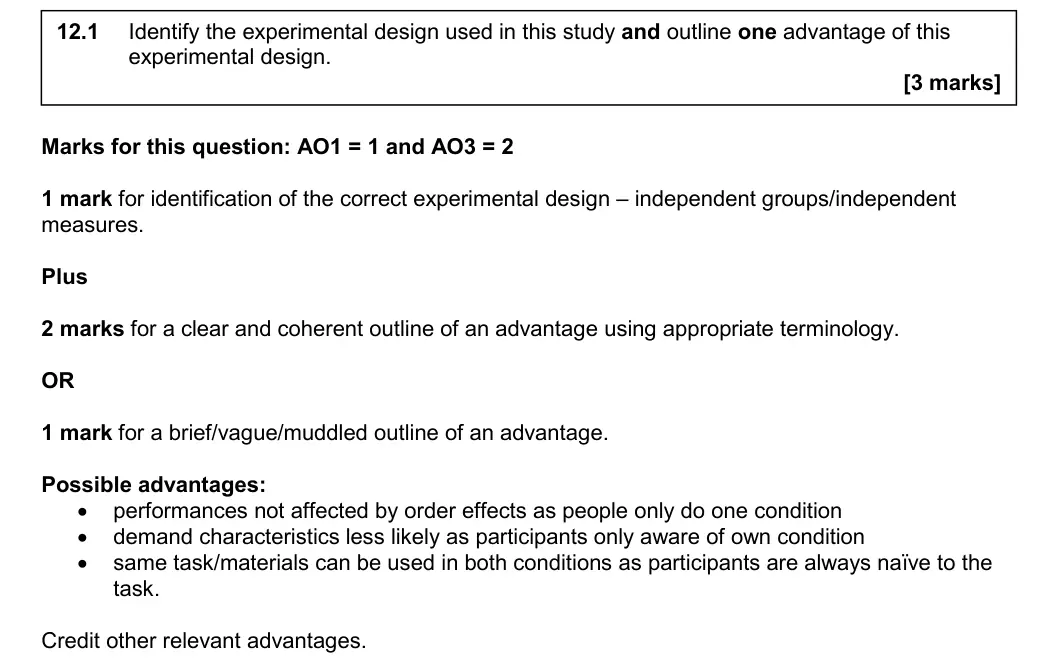
12.1 Research methods: scientific processes 3AO1=1,AO3=2Research methods
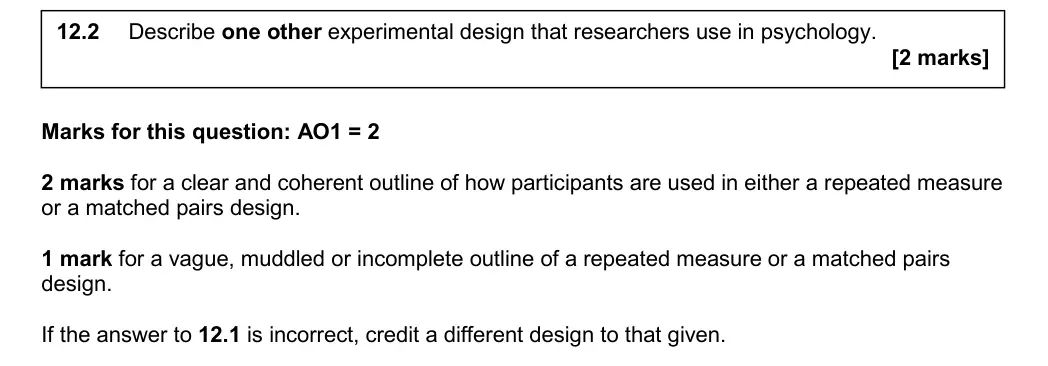
12.2 Research methods: scientific processes 2AO1=2Research methods
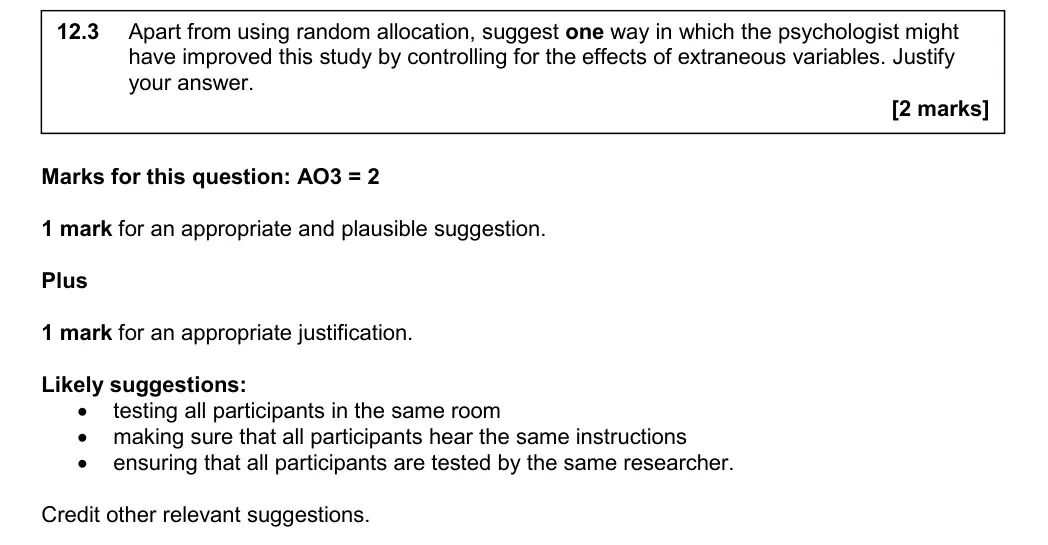
12.3 Research methods: scientific processes 2AO3=2Research methods
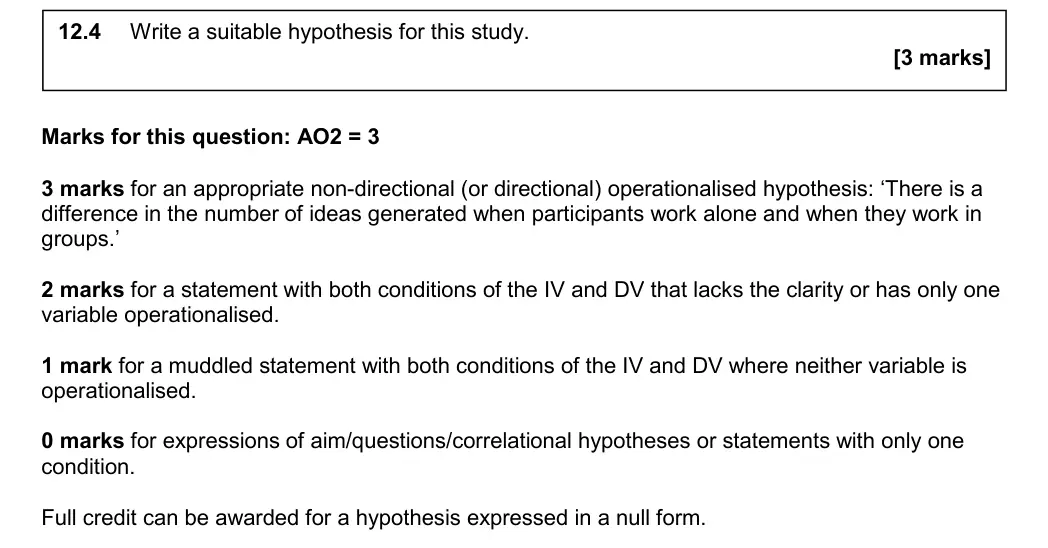
12.4 Research methods: scientific processes 3AO2=3Research methods
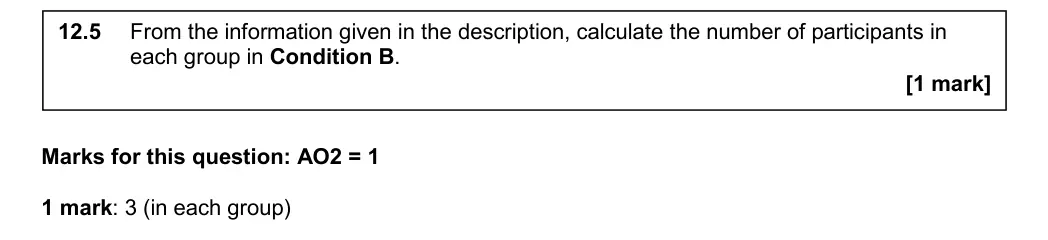
12.5 Research methods: data handling and analysis 1AO2=1Calculation
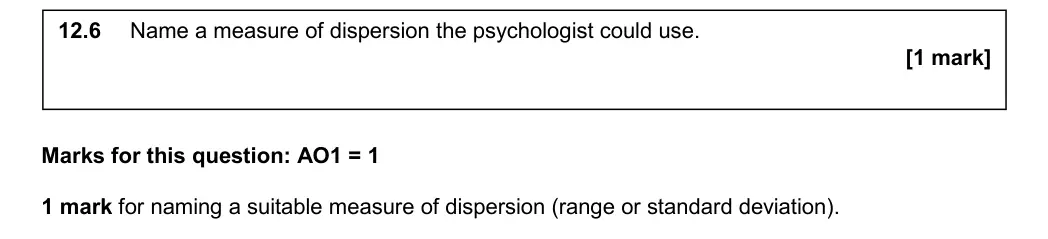
12.6 Research methods: data handling and analysis 1AO1=1Research methods
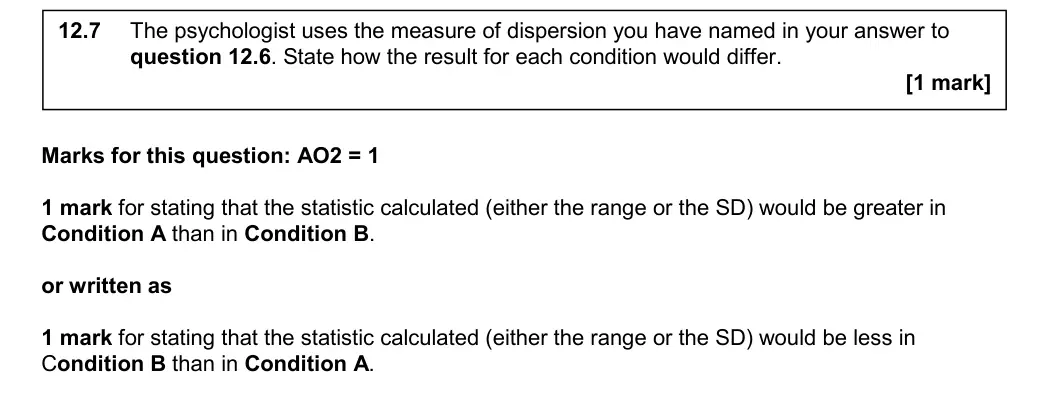
12.7 Research methods: data handling and analysis 1AO2=1Research methods
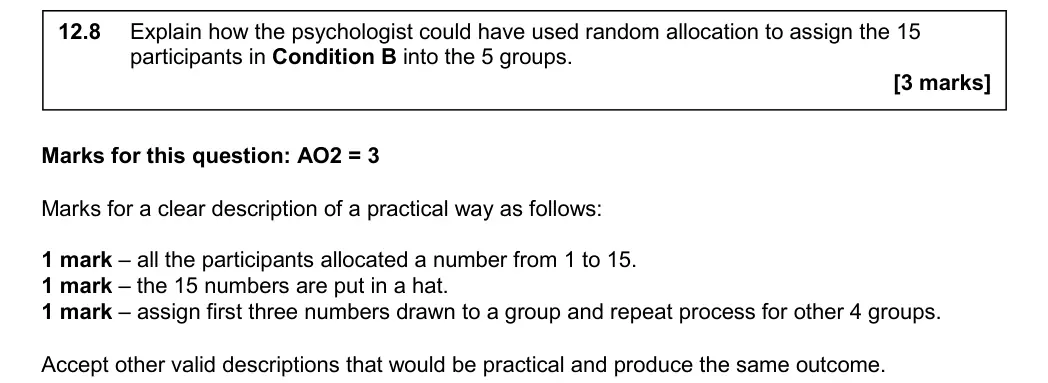
12.8 Research methods: scientific processes 3AO2=3Research methods
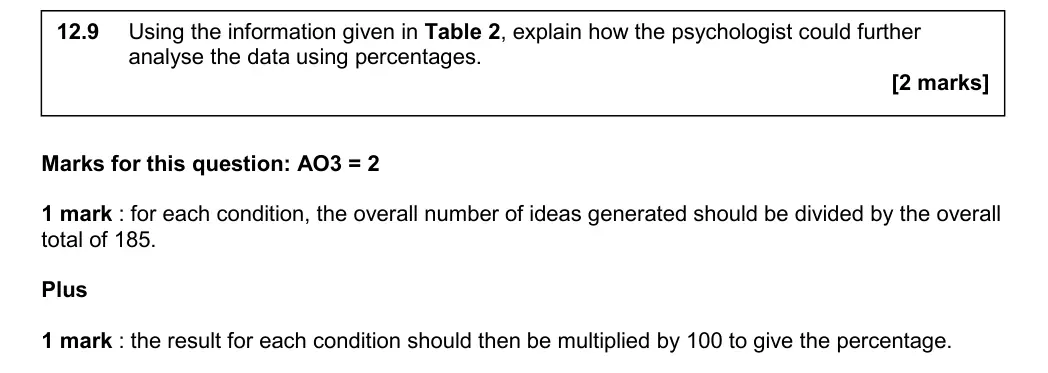
12.9 Research methods: data handling and analysis 2AO3=2Research methods
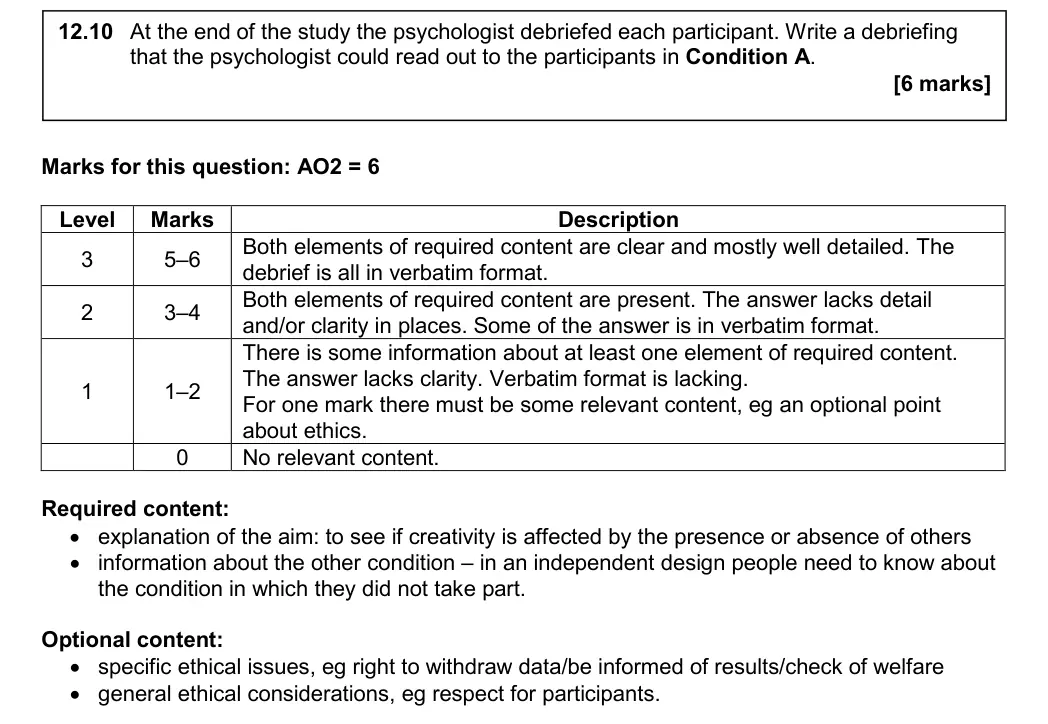
12.10 Research methods: scientific processes 6AO2=6Research methods

The questions

1.11.22345.15.25.36.16.27.17.289101112.112.212.312.412.512.612.712.812.912.10

Specimen set 1 · AS Paper 2 · Q1.1 1 mark AO1=1 Multiple choice biopsychology
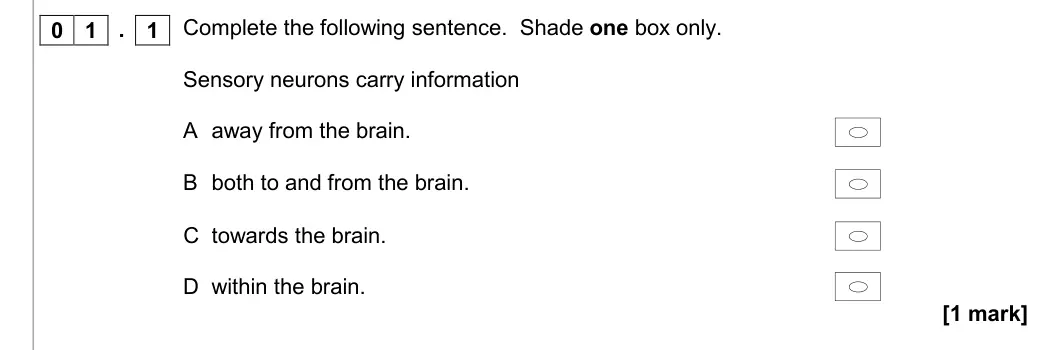
0 1 . 1
Complete the following sentence.  Shade one box only.
Sensory neurons carry information
A away from the brain.
B both to and from the brain.
C towards the brain.
D within the brain.
[1 mark]
Specimen set 1 · AS Paper 2 · Q1.2 1 mark AO1=1 Multiple choice biopsychology
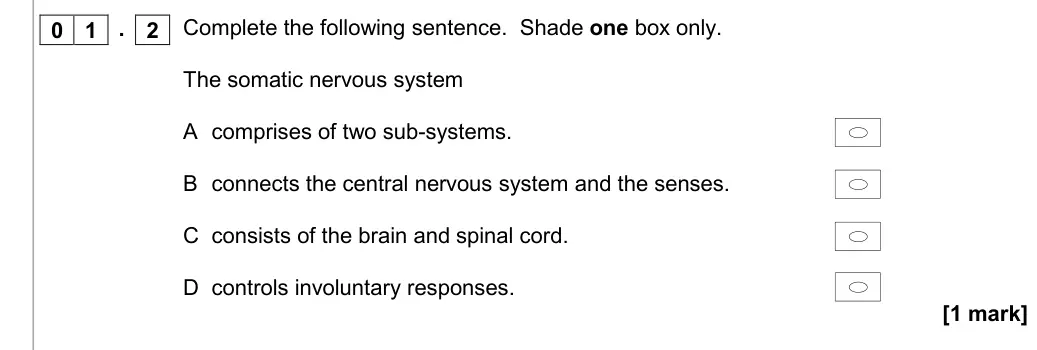
0 1 . 2
Complete the following sentence.  Shade one box only.
The somatic nervous system
A comprises of two sub-systems.
B connects the central nervous system and the senses.
C consists of the brain and spinal cord.
D controls involuntary responses.
[1 mark]
Specimen set 1 · AS Paper 2 · Q2 1 mark AO1=1 Multiple choice biopsychology
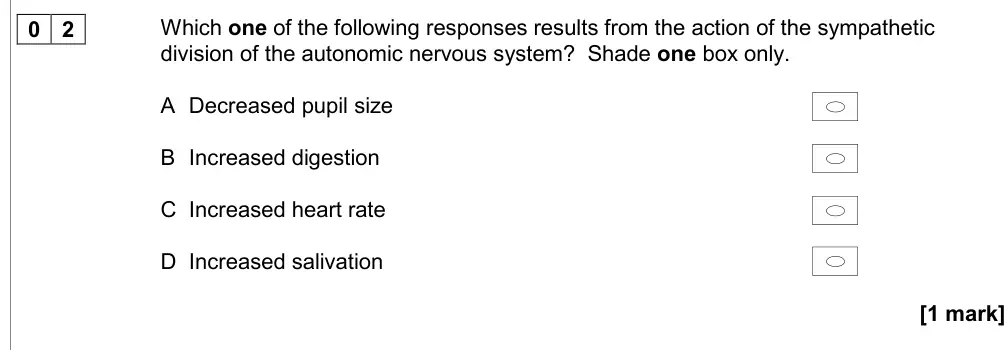
0 2
Which one of the following responses results from the action of the sympathetic
division of the autonomic nervous system?  Shade one box only.
A Decreased pupil size
B Increased digestion
C Increased heart rate
D Increased salivation
[1 mark]
Specimen set 1 · AS Paper 2 · Q3 2 marks AO1=2 Multiple choice biopsychology
0 3
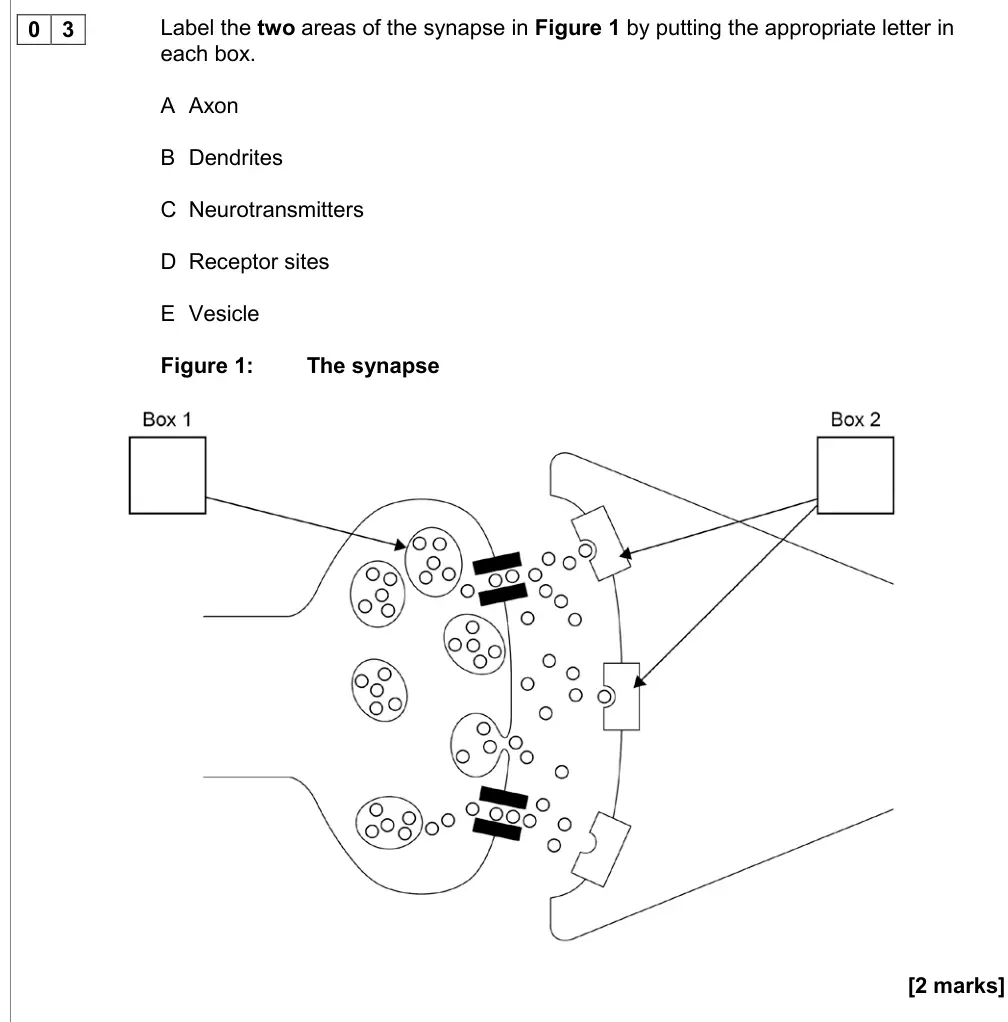
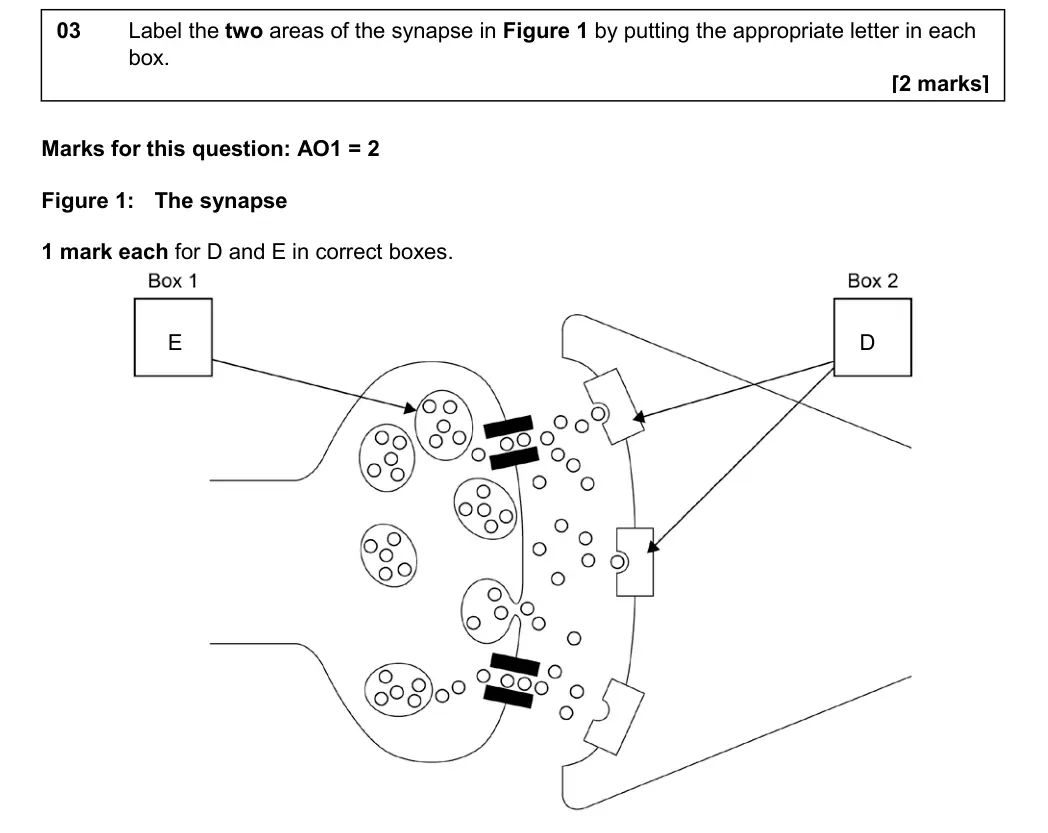
Label the two areas of the synapse in Figure 1 by putting the appropriate letter in
each box.
A Axon
B Dendrites
C Neurotransmitters
D Receptor sites
E Vesicle
Figure 1:
The synapse
[2 marks]
Specimen set 1 · AS Paper 2 · Q4 2 marks AO2=2 Application approaches
0 4
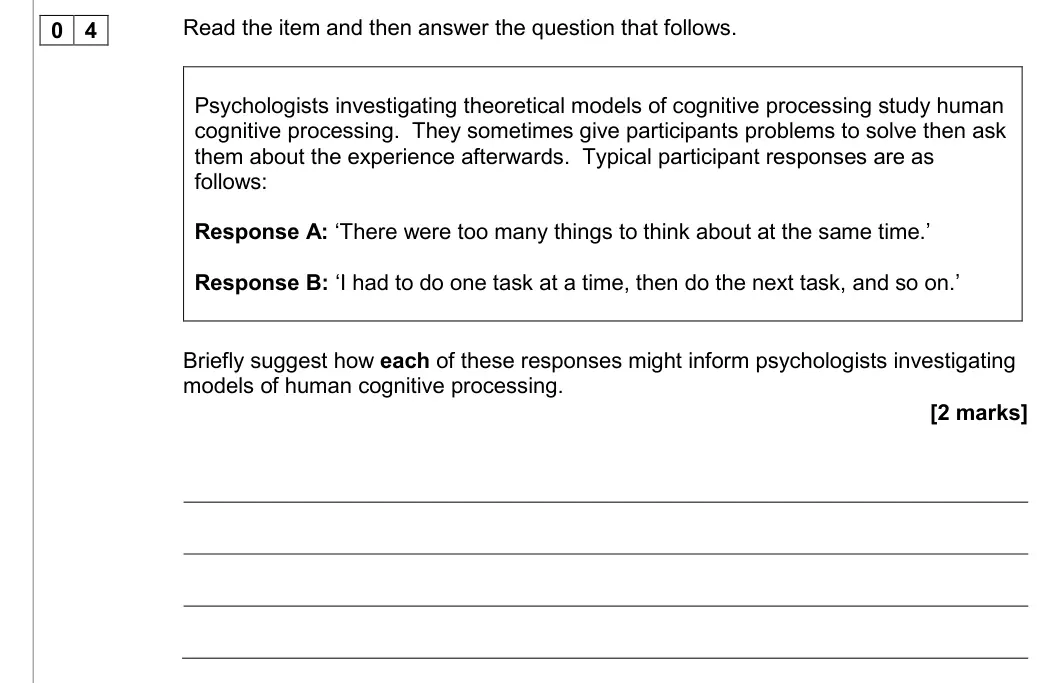
Read the item and then answer the question that follows.
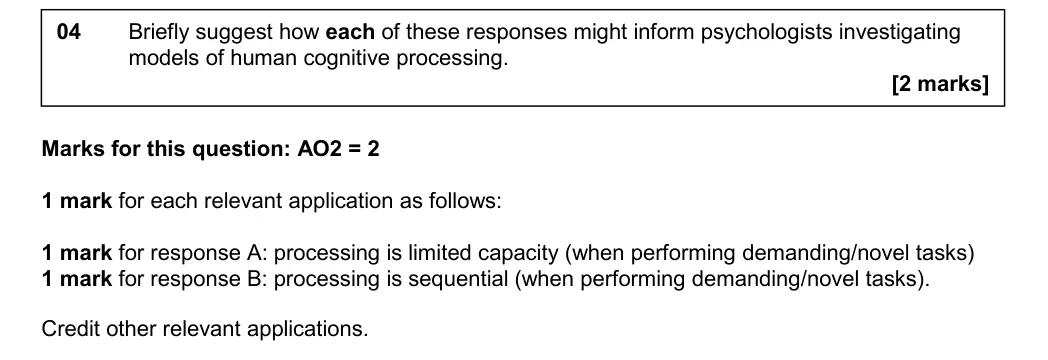
Psychologists investigating theoretical models of cognitive processing study human
cognitive processing.  They sometimes give participants problems to solve then ask
them about the experience afterwards.  Typical participant responses are as
follows:
Response A: ‘There were too many things to think about at the same time.’
Response B: ‘I had to do one task at a time, then do the next task, and so on.’
Briefly suggest how each of these responses might inform psychologists investigating
models of human cognitive processing.
[2 marks]
Specimen set 1 · AS Paper 2 · Q5.1 2 marks AO2=2 Application approaches
0 5
Read the item and then answer the questions that follow.
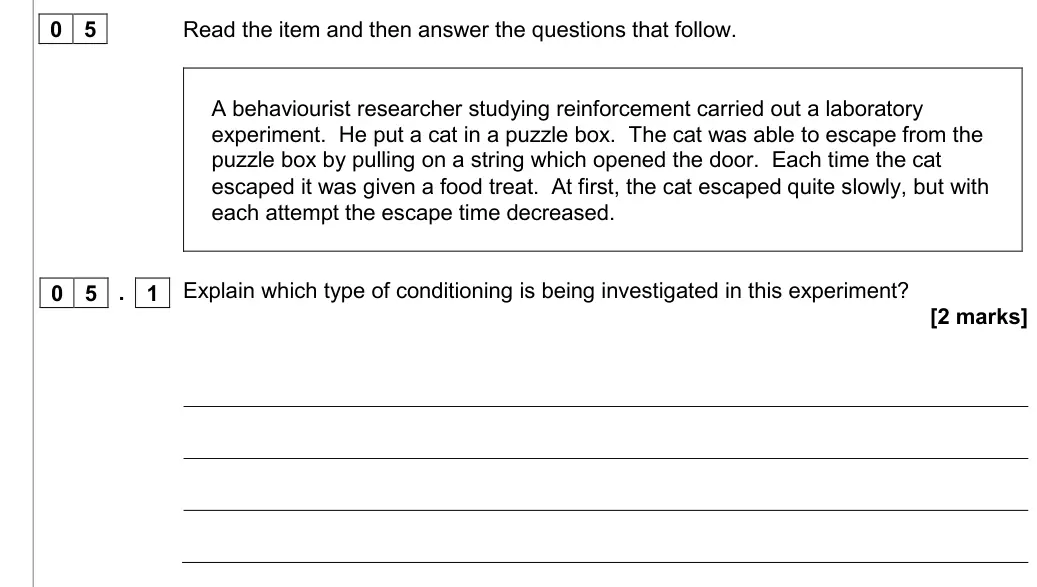
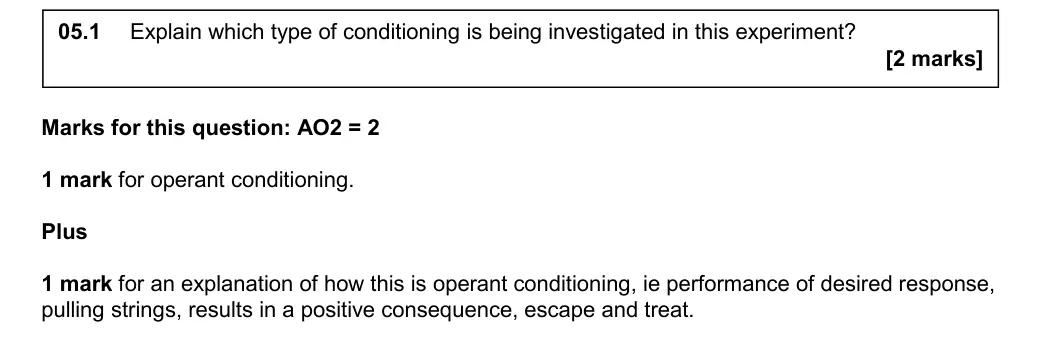
A behaviourist researcher studying reinforcement carried out a laboratory
experiment.  He put a cat in a puzzle box.  The cat was able to escape from the
puzzle box by pulling on a string which opened the door.  Each time the cat
escaped it was given a food treat.  At first, the cat escaped quite slowly, but with
each attempt the escape time decreased.
0 5 . 1
Explain which type of conditioning is being investigated in this experiment?
[2 marks]
Specimen set 1 · AS Paper 2 · Q5.2 2 marks AO2=2 Calculation data handling
0 5
Read the item and then answer the questions that follow.
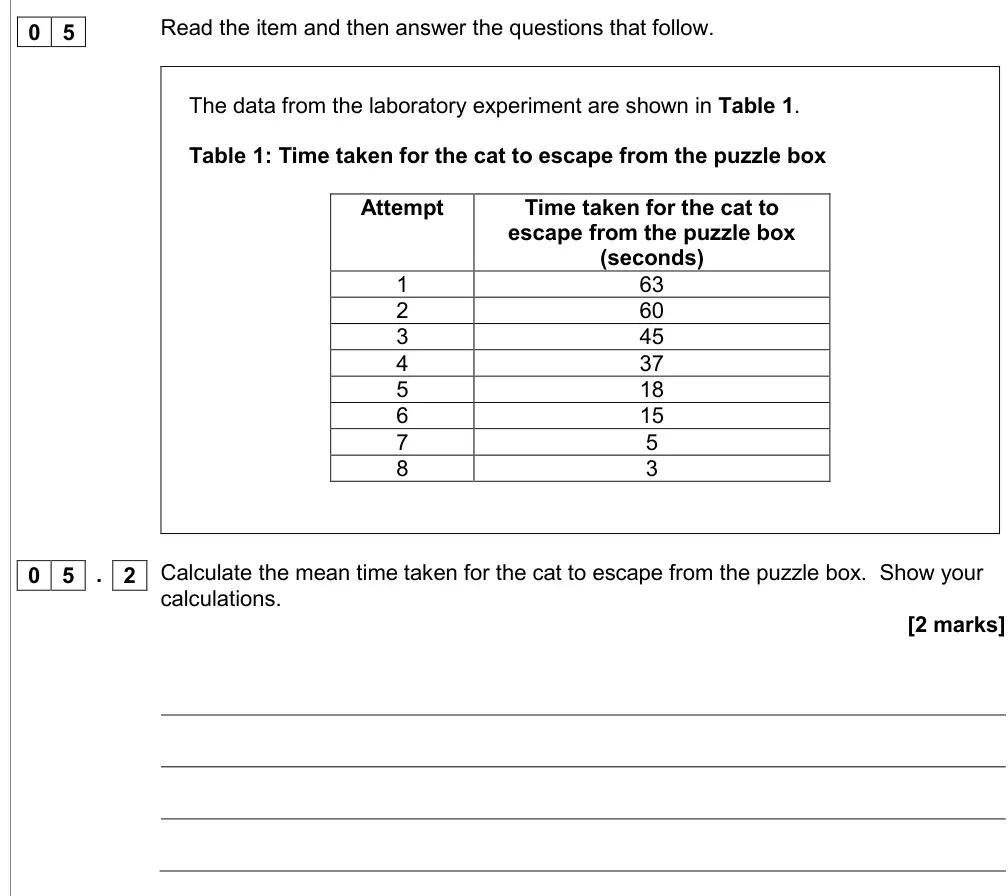
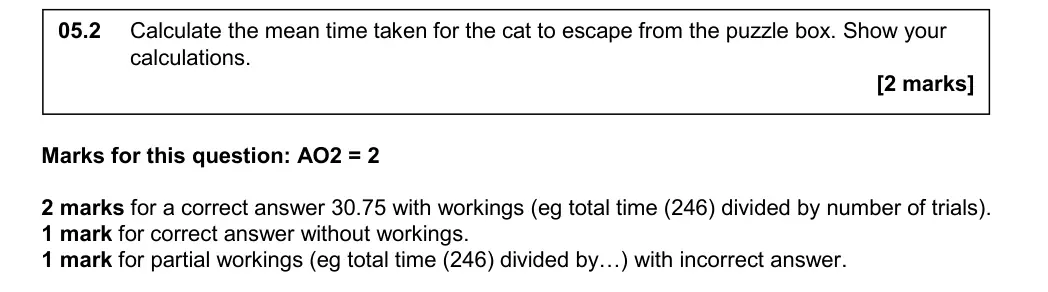
The data from the laboratory experiment are shown in Table 1.
Table 1: Time taken for the cat to escape from the puzzle box
Attempt
Time taken for the cat to
escape from the puzzle box
(seconds)
1
63
2
60
3
45
4
37
5
18
6
15
7
5
8
3
0 5 . 2
Calculate the mean time taken for the cat to escape from the puzzle box.  Show your
calculations.
[2 marks]
Specimen set 1 · AS Paper 2 · Q5.3 1 mark AO3=1 Multiple choice data handling
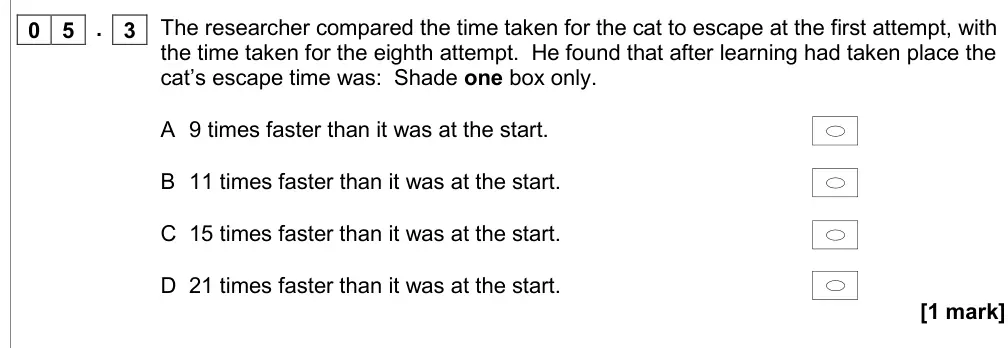
0 5 . 3
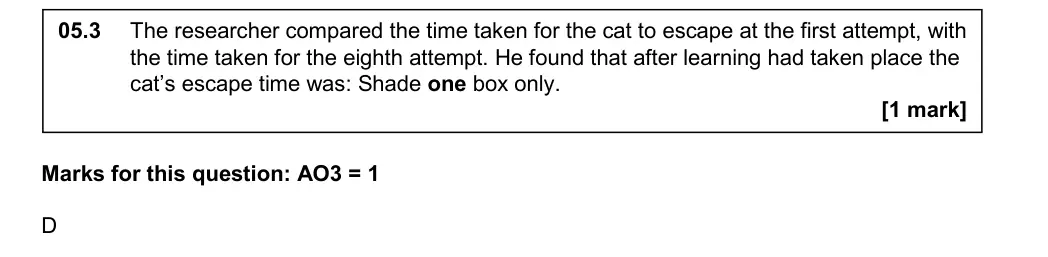
The researcher compared the time taken for the cat to escape at the first attempt, with
the time taken for the eighth attempt.  He found that after learning had taken place the
cat’s escape time was:  Shade one box only.
A 9 times faster than it was at the start.
B 11 times faster than it was at the start.
C 15 times faster than it was at the start.
D 21 times faster than it was at the start.
[1 mark]
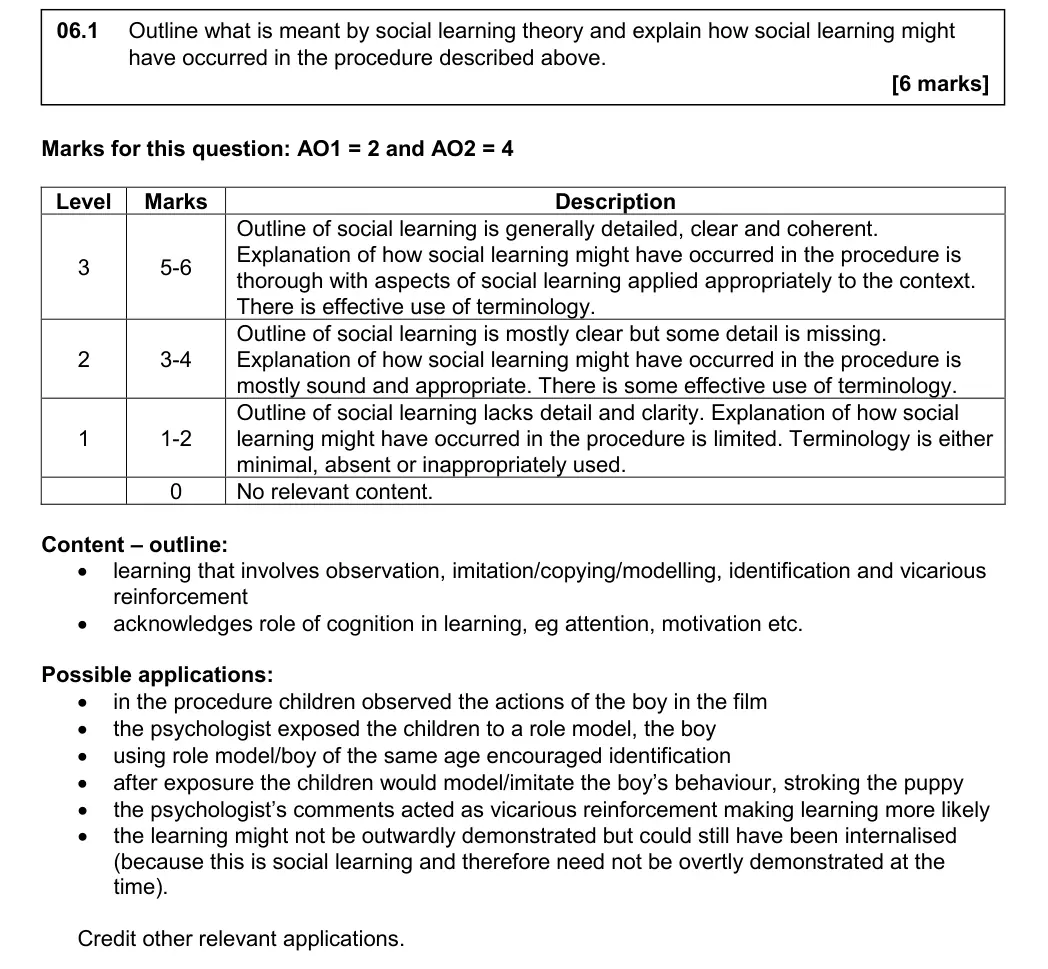
Specimen set 1 · AS Paper 2 · Q6.1 6 marks AO1=2, AO2=4 Application approaches
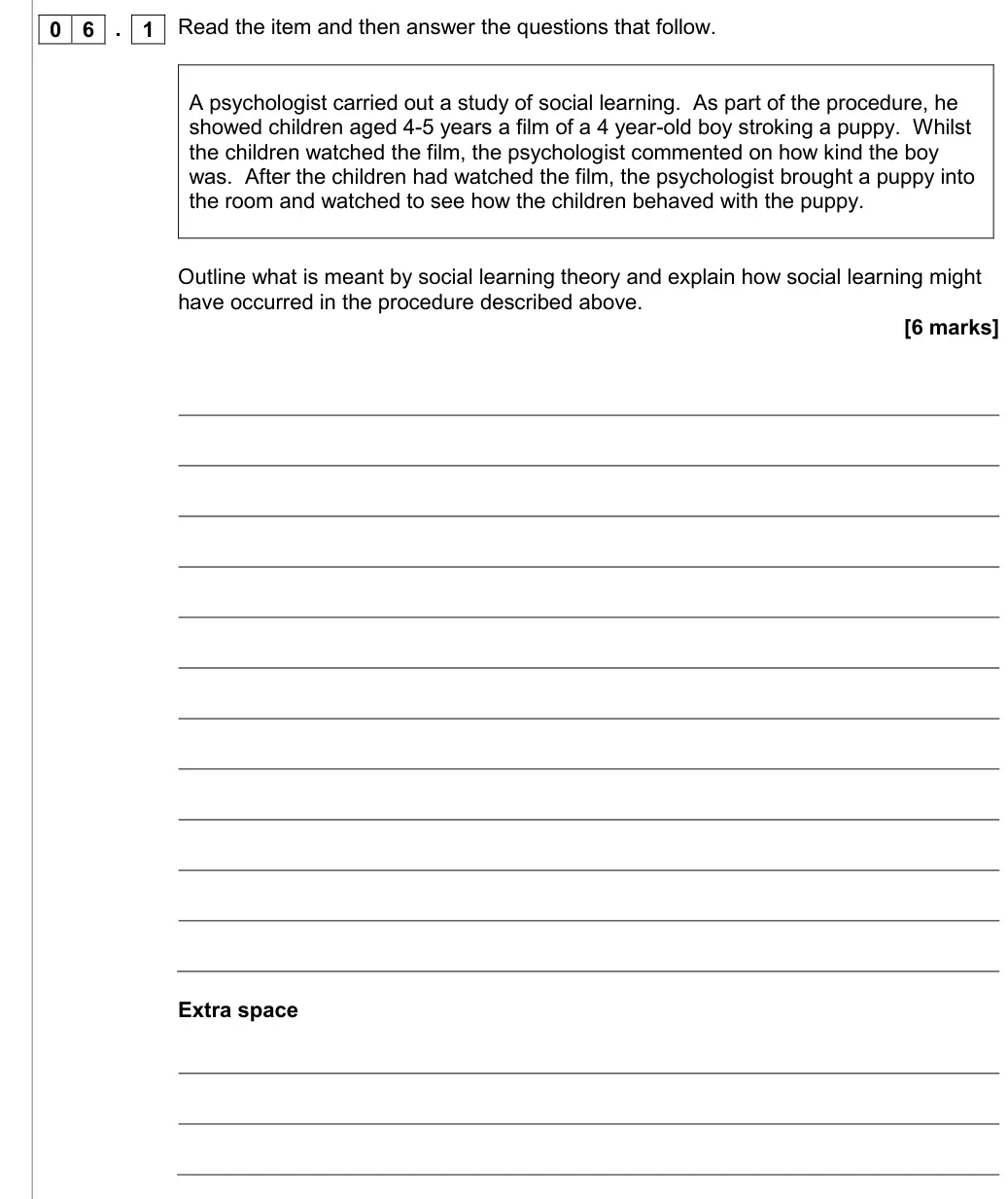
0 6 . 1
Read the item and then answer the questions that follow.
A psychologist carried out a study of social learning.  As part of the procedure, he
showed children aged 4-5 years a film of a 4 year-old boy stroking a puppy.  Whilst
the children watched the film, the psychologist commented on how kind the boy
was.  After the children had watched the film, the psychologist brought a puppy into
the room and watched to see how the children behaved with the puppy.
Outline what is meant by social learning theory and explain how social learning might
have occurred in the procedure described above.
[6 marks]
Extra space
Specimen set 1 · AS Paper 2 · Q6.2 6 marks AO3=6 Evaluate (short) approaches
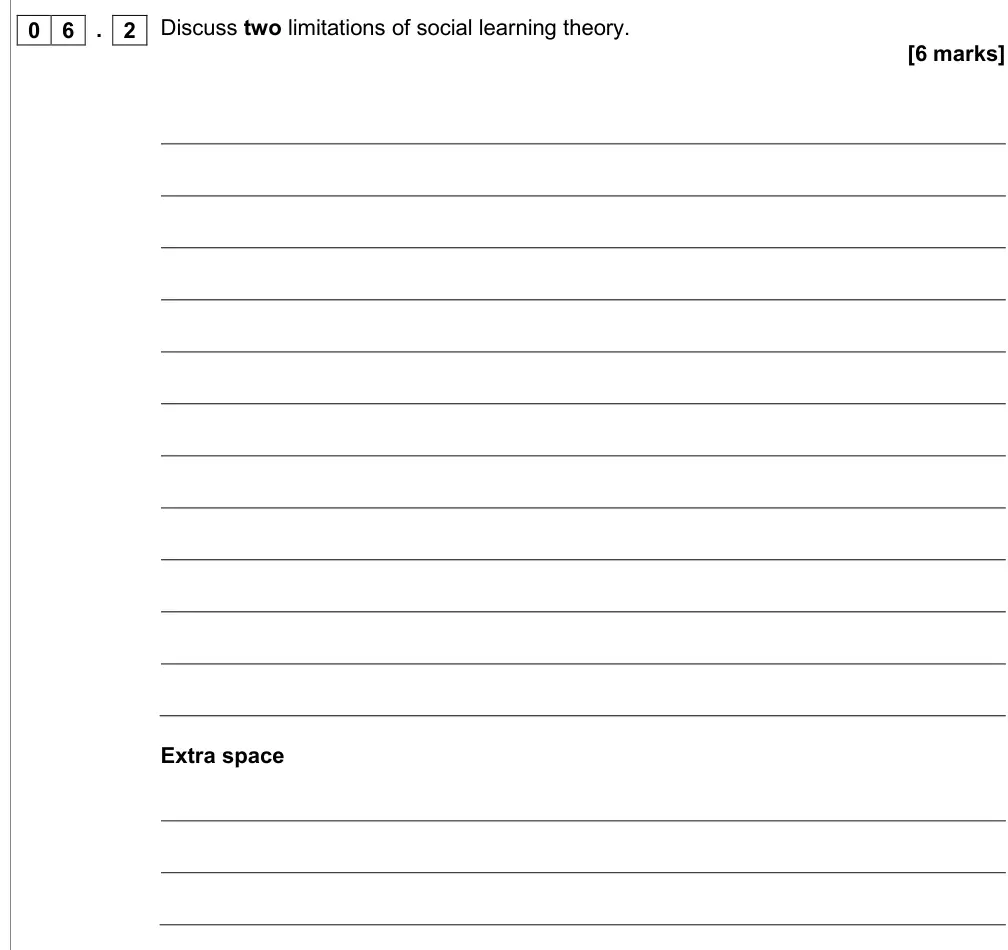
0 6 . 2
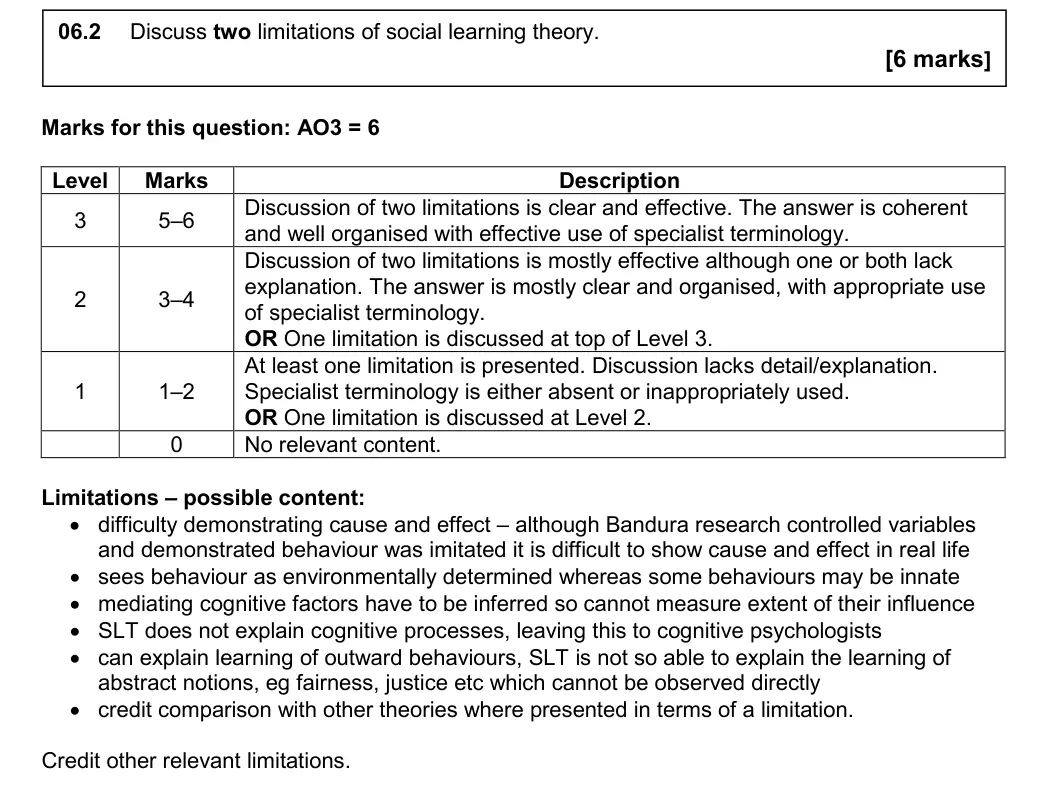
Discuss two limitations of social learning theory.
[6 marks]
Extra space
Specimen set 1 · AS Paper 2 · Q7.1 2 marks AO1=2 Short answer clinical psychology
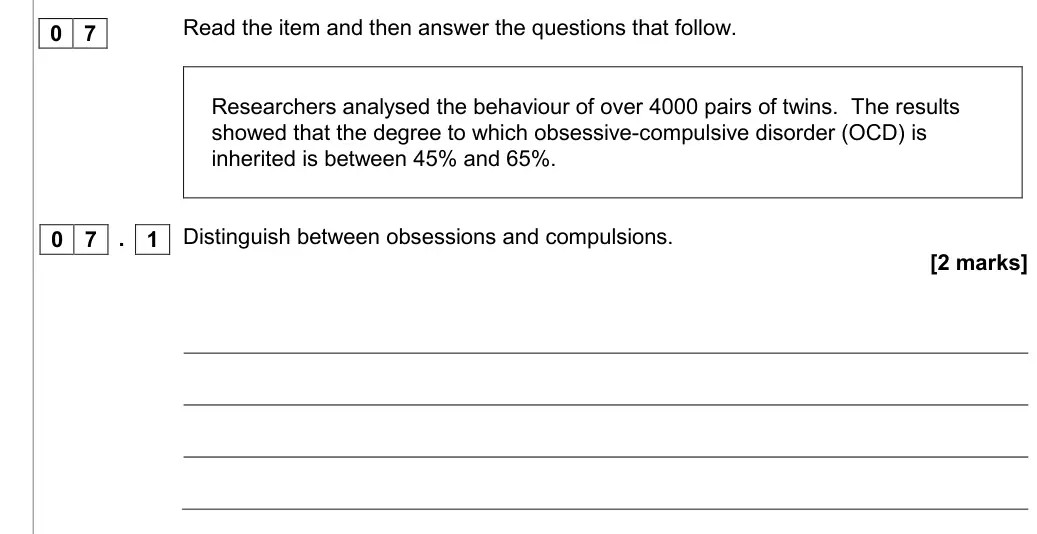
0 7
Read the item and then answer the questions that follow.
Researchers analysed the behaviour of over 4000 pairs of twins.  The results
showed that the degree to which obsessive-compulsive disorder (OCD) is
inherited is between 45% and 65%.
0 7 . 1
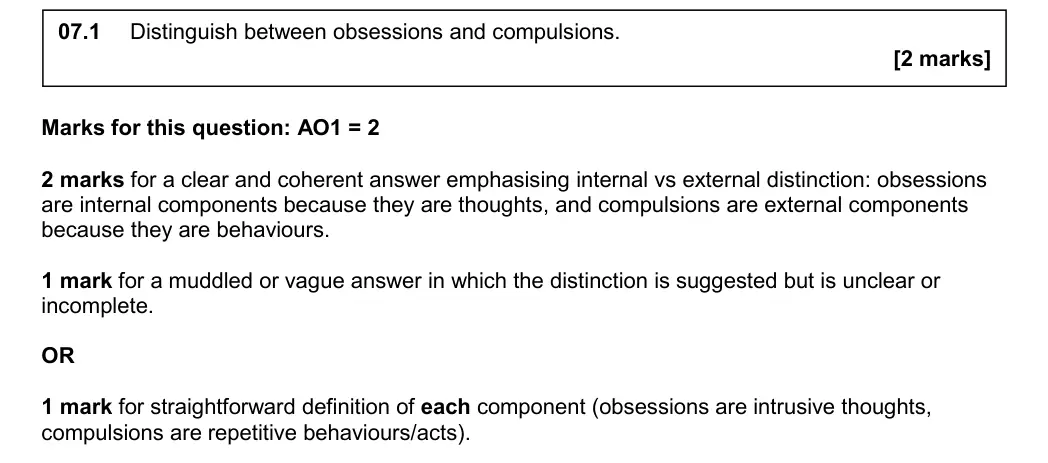
Distinguish between obsessions and compulsions.
[2 marks]
Specimen set 1 · AS Paper 2 · Q7.2 4 marks AO2=4 Application clinical psychology
0 7 . 2
With reference to the study described above, what do the results seem to show about
possible influences on the development of OCD?
[4 marks]
Specimen set 1 · AS Paper 2 · Q8 2 marks AO2=2 Application clinical psychology
0 8
Read the item and then answer the question that follows.
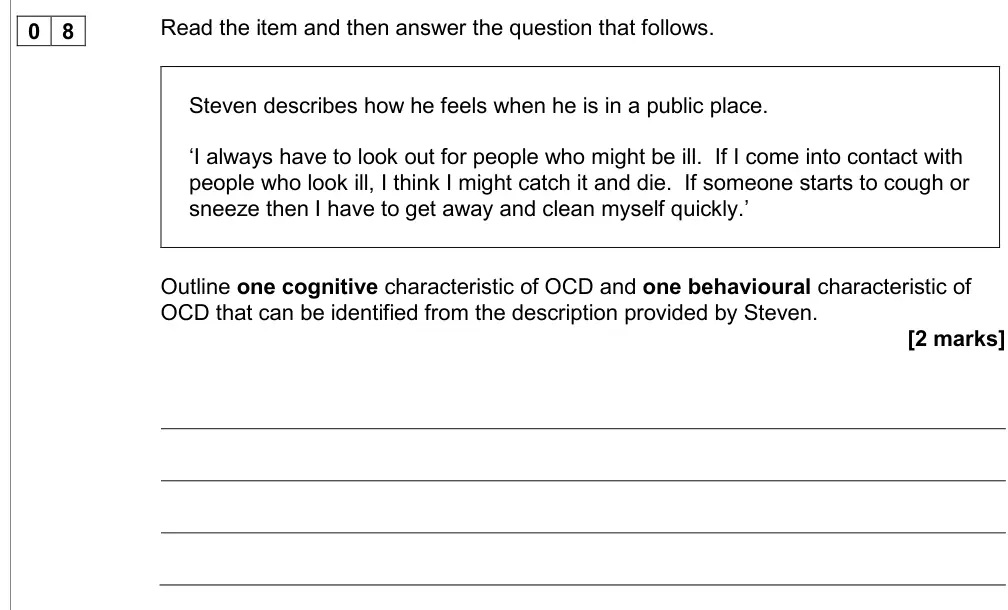
Steven describes how he feels when he is in a public place.
‘I always have to look out for people who might be ill.  If I come into contact with
people who look ill, I think I might catch it and die.  If someone starts to cough or
sneeze then I have to get away and clean myself quickly.’
Outline one cognitive characteristic of OCD and one behavioural characteristic of
OCD that can be identified from the description provided by Steven.
[2 marks]
Specimen set 1 · AS Paper 2 · Q9 2 marks AO1=2 Short answer clinical psychology
0 9
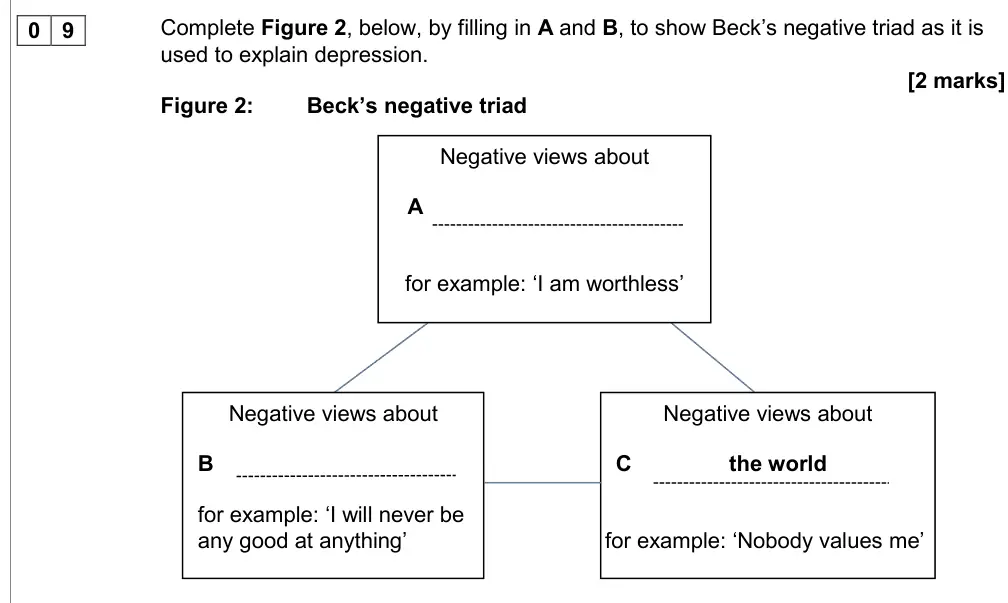
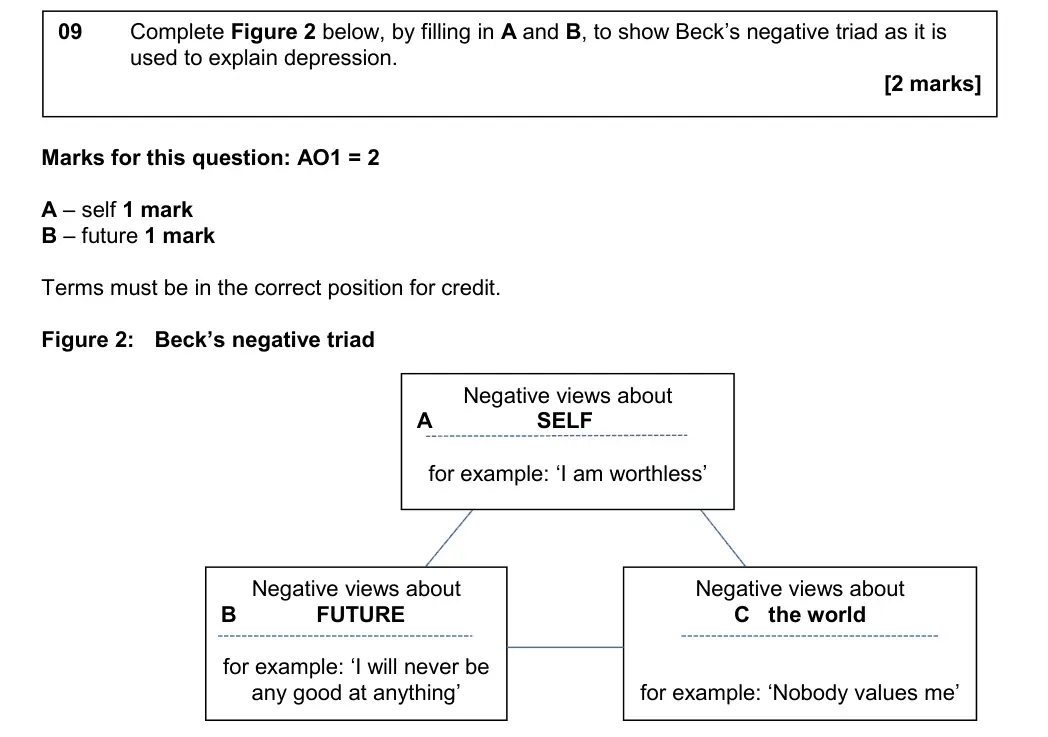
Complete Figure 2, below, by filling in A and B, to show Beck’s negative triad as it is
used to explain depression.
[2 marks]
Figure 2:
Beck’s negative triad
Negative views about
A
for example: ‘I am worthless’
Negative views about
B
C
the world
for example: ‘I will never be
any good at anything’
for example: ‘Nobody values me’
Specimen set 1 · AS Paper 2 · Q10 2 marks AO3=2 Evaluate (short) clinical psychology
1 0
Briefly outline one strength of the cognitive explanation of depression.
[2 marks]
Specimen set 1 · AS Paper 2 · Q11 12 marks AO1=6, AO3=6 Extended writing clinical psychology
1 1
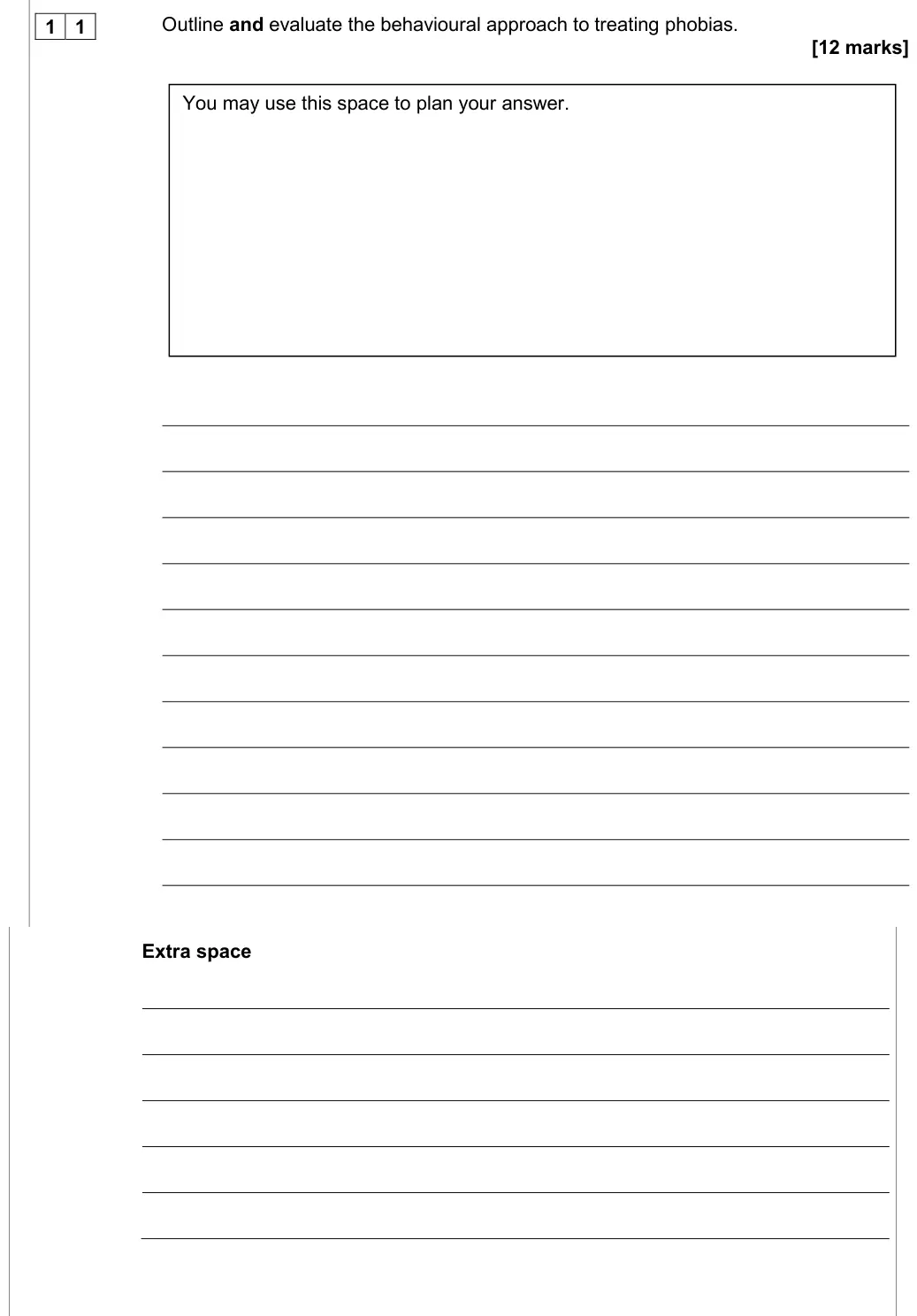
Outline and evaluate the behavioural approach to treating phobias.
[12 marks]
You may use this space to plan your answer.
Extra space
Specimen set 1 · AS Paper 2 · Q12.1 3 marks AO1=1, AO3=2 Research methods scientific processes
1 2
Read the item and then answer the questions that follow.
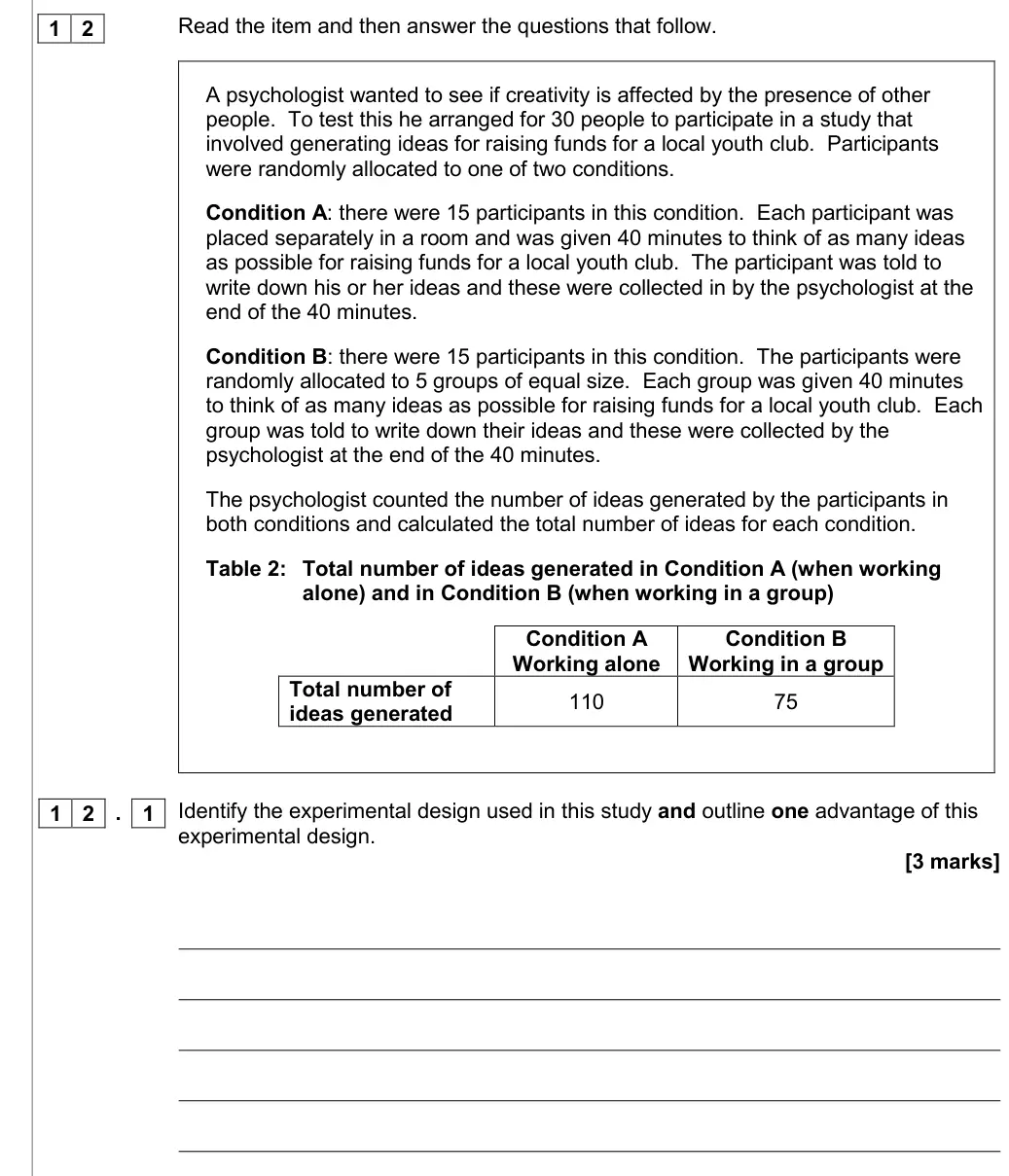
A psychologist wanted to see if creativity is affected by the presence of other
people.  To test this he arranged for 30 people to participate in a study that
involved generating ideas for raising funds for a local youth club.  Participants
were randomly allocated to one of two conditions.
Condition A: there were 15 participants in this condition.  Each participant was
placed separately in a room and was given 40 minutes to think of as many ideas
as possible for raising funds for a local youth club.  The participant was told to
write down his or her ideas and these were collected in by the psychologist at the
end of the 40 minutes.
Condition B: there were 15 participants in this condition.  The participants were
randomly allocated to 5 groups of equal size.  Each group was given 40 minutes
to think of as many ideas as possible for raising funds for a local youth club.  Each
group was told to write down their ideas and these were collected by the
psychologist at the end of the 40 minutes.
The psychologist counted the number of ideas generated by the participants in
both conditions and calculated the total number of ideas for each condition.
Table 2: Total number of ideas generated in Condition A (when working
alone) and in Condition B (when working in a group)
Condition A
Condition B
Working alone
Working in a group
Total number of
110
75
ideas generated
1 2 . 1
Identify the experimental design used in this study and outline one advantage of this
experimental design.
[3 marks]
Specimen set 1 · AS Paper 2 · Q12.2 2 marks AO1=2 Research methods scientific processes
1 2 . 2
Describe one other experimental design that researchers use in psychology.
[2 marks]
Specimen set 1 · AS Paper 2 · Q12.3 2 marks AO3=2 Research methods scientific processes
1 2 . 3
Apart from using random allocation, suggest one way in which the psychologist might
have improved this study by controlling for the effects of extraneous variables.  Justify
your answer.
[2 marks]
Specimen set 1 · AS Paper 2 · Q12.4 3 marks AO2=3 Research methods scientific processes
1 2 . 4
Write a suitable hypothesis for this study.
[3 marks]
Specimen set 1 · AS Paper 2 · Q12.5 1 mark AO2=1 Calculation data handling
1 2 . 5
From the information given in the description, calculate the number of participants in
each group in Condition B.
[1 mark]
Specimen set 1 · AS Paper 2 · Q12.6 1 mark AO1=1 Research methods data handling
1 2
Read the item and then answer the questions that follow.
The psychologist noticed that the number of ideas generated by each of the
individual participants in Condition A varied enormously whereas there was little
variation in performance between the 5 groups in Condition B.  He decided to
calculate a measure of dispersion for each condition.
1 2 . 6
Name a measure of dispersion the psychologist could use.
[1 mark]
Specimen set 1 · AS Paper 2 · Q12.7 1 mark AO2=1 Research methods data handling
1 2 . 7
The psychologist uses the measure of dispersion you have named in your answer to
question 12.6.  State how the result for each condition would differ.
[1 mark]
Specimen set 1 · AS Paper 2 · Q12.8 3 marks AO2=3 Research methods scientific processes
1 2 . 8
Explain how the psychologist could have used random allocation to assign the
15 participants in Condition B into the 5 groups.
[3 marks]
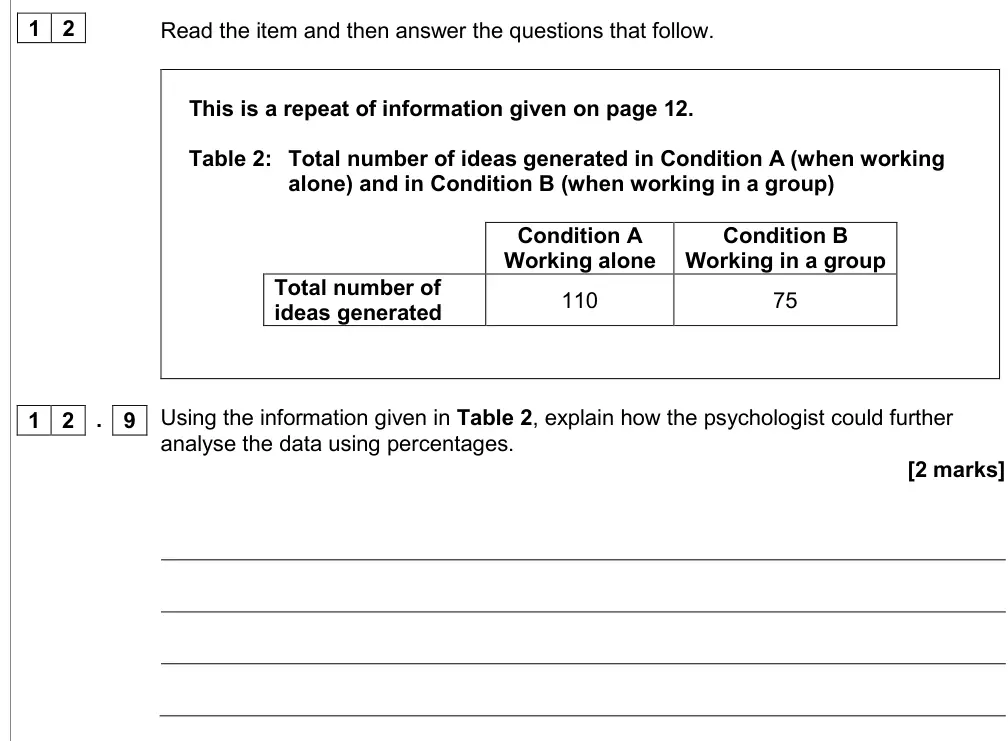
Specimen set 1 · AS Paper 2 · Q12.9 2 marks AO3=2 Research methods data handling
1 2
Read the item and then answer the questions that follow.
This is a repeat of information given on page 12.
Table 2: Total number of ideas generated in Condition A (when working
alone) and in Condition B (when working in a group)
Condition A
Condition B
Working alone
Working in a group
Total number of
ideas generated
110
75
1 2 . 9
Using the information given in Table 2, explain how the psychologist could further
analyse the data using percentages.
[2 marks]
Specimen set 1 · AS Paper 2 · Q12.10 6 marks AO2=6 Research methods scientific processes
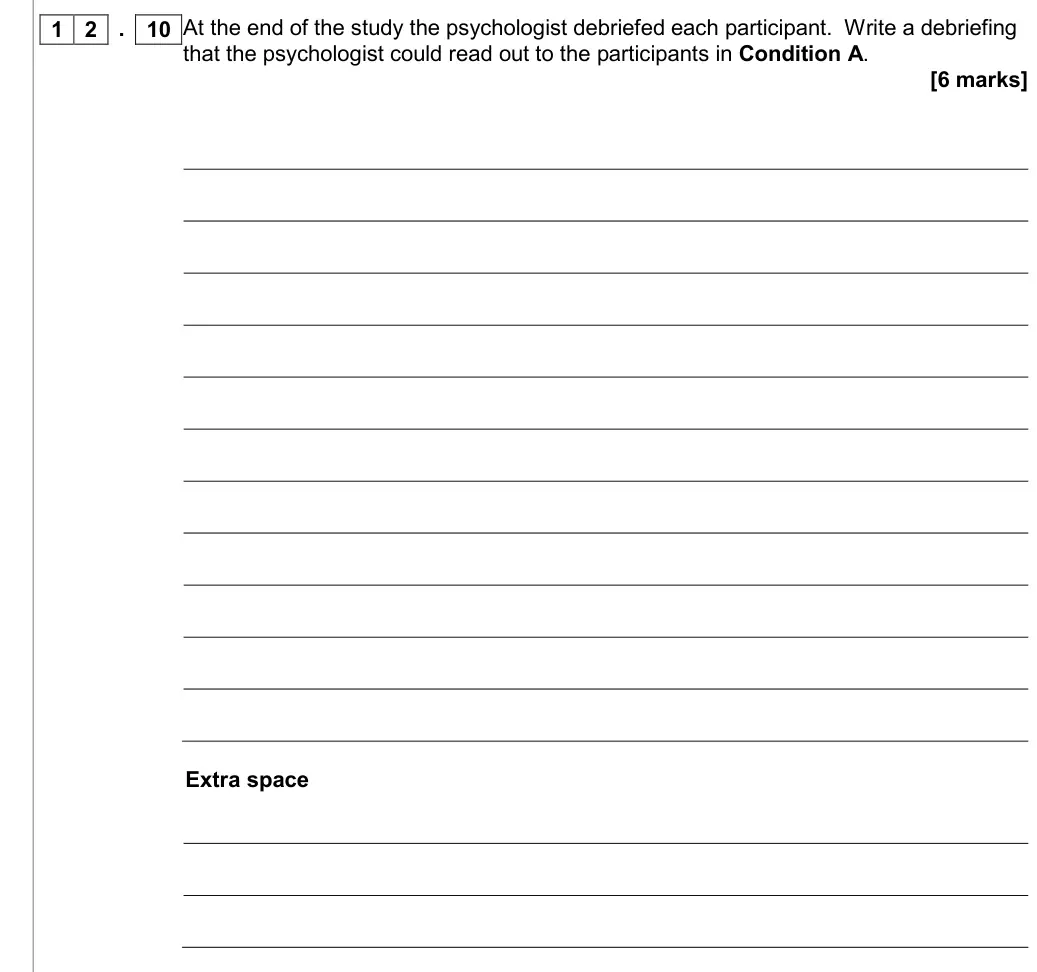
1 2 . 10
At the end of the study the psychologist debriefed each participant.  Write a debriefing
that the psychologist could read out to the participants in Condition A.
[6 marks]
Extra space

Work with an AQA psychology tutor

Want a paper marked and gone through with you? Message us.

Prefer email? Send an enquiry

If you are under 18, please include a parent's contact details. Enquiries go to enquiries@alevelpsychologytutor.com and are deleted once handled. All tutoring is online.