June 2022 · AS Paper 1 · Q11 markAO1=1Multiple choicesocial influence
Answer
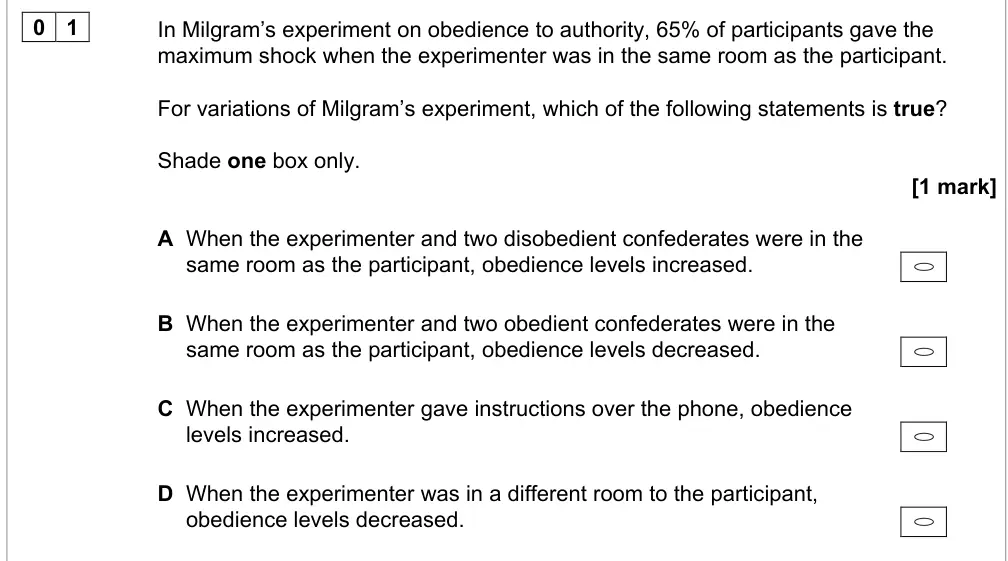
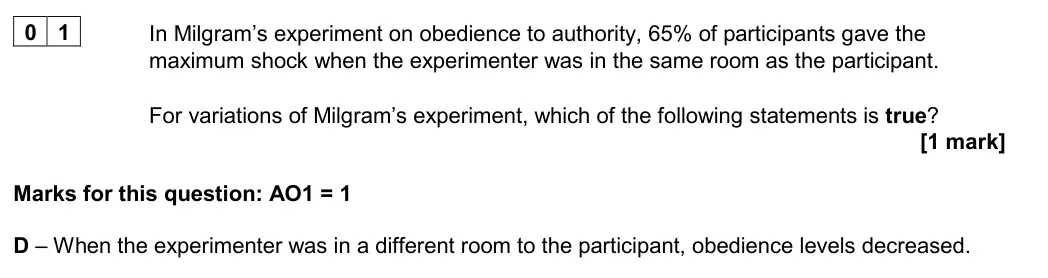
D
Mark scheme, including level descriptors and indicative content
Examiner's comment
Most students were able to correctly answer this question and appeared to have sufficient knowledge of Milgram’s variations to be able to correctly identify the true statement.
Notes from the mark scheme and report
correct D (experimenter in different room -> obedience decreased)
distractors mis-state disobedient-peer, obedient-peer and telephone variations
June 2022 · AS Paper 1 · Q22 marksAO1=2Short answerOld spec onlysocial influence
Not on the 2025 specification: social change / role of social influence processes in social change, removed in v1.4
Mark scheme, including level descriptors and indicative content
Examiner's comment
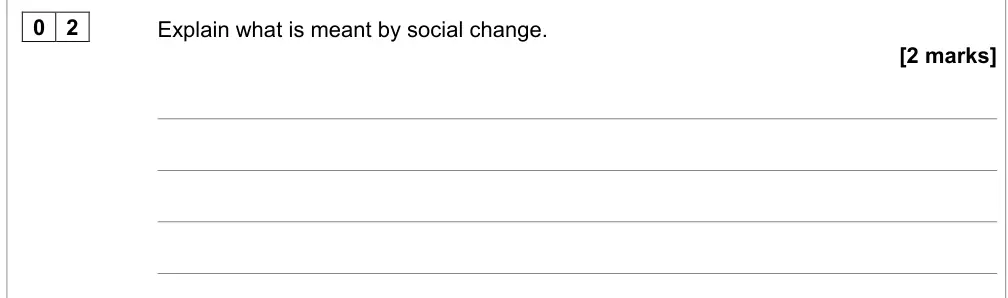
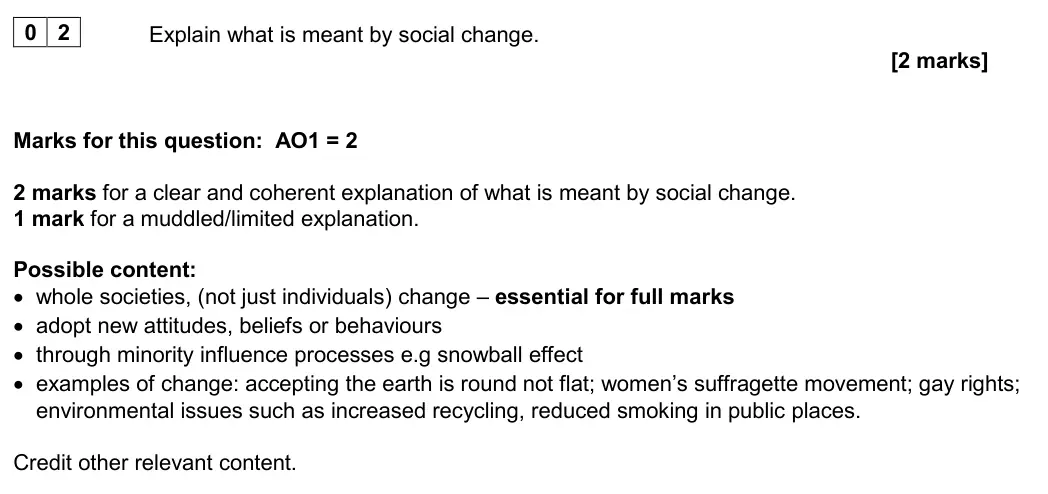
Most students scored at least half marks on this question. However, many only described minority influence or the snowball effect, and not social change. To gain full marks students needed to make it clear that whole societies and not just individuals changed (attitudes or beliefs). Some students did not have sufficient knowledge to answer this question and there were a small number who did not attempt the question.
Notes from the mark scheme and report
Off-spec: social change / role of social influence processes in social change, removed in v1.4
whole societies (not individuals) adopt new attitudes/beliefs - essential for full marks
many only described minority influence or the snowball effect
June 2022 · AS Paper 1 · Q36 marksAO2=6Applicationsocial influence
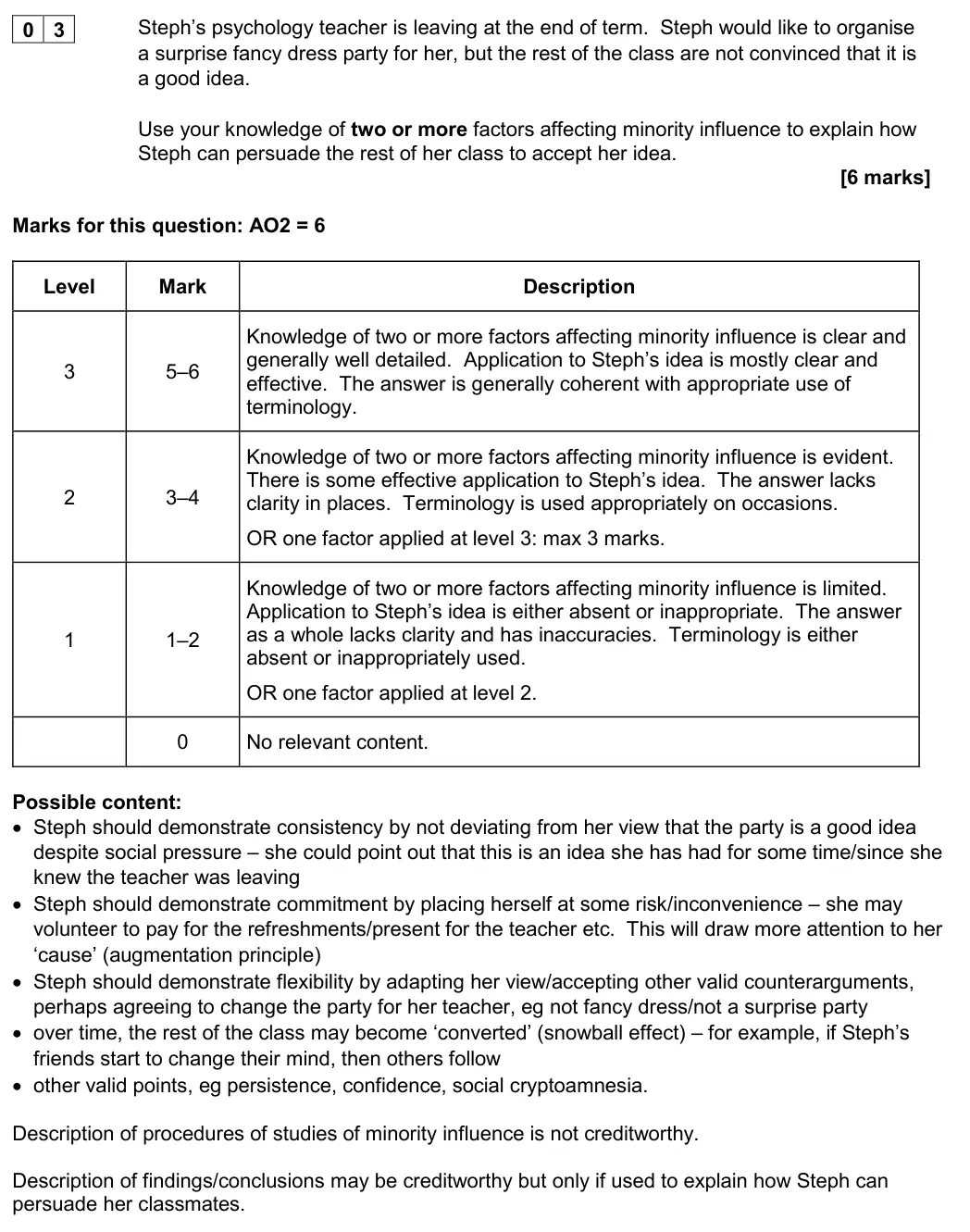
Mark scheme, including level descriptors and indicative content
Examiner's comment
Most students clearly had knowledge of factors affecting minority influence and many were able to clearly and explicitly apply this knowledge to the scenario. However, some students simply named or outlined factors and did not apply them to the scenario as the question asked. Where students did attempt to apply their knowledge to the scenario, this application was varied with some fully applying the factors affecting minority influence, making good practical suggestions of how Steph could use the factors to persuade her class. However, weaker answers did not offer any suggestions of how Steph could put these factors into practice in the context of the scenario. It is important that students used appropriate terminology here as this was required for Level 2 and Level 3 responses.
Notes from the mark scheme and report
two or more factors (consistency, commitment/augmentation, flexibility) applied practically to Steph and the class party
one factor only = max 3
study procedures not creditworthy
naming/outlining factors without application
MS also credits snowball effect/social cryptomnesia (social change, removed in v1.4)
June 2022 · AS Paper 1 · Q46 marksAO1=6OutlineOld spec only
Not on the 2025 specification: procedure of Zimbardo's Stanford Prison study / conformity to social roles, removed in v1.4
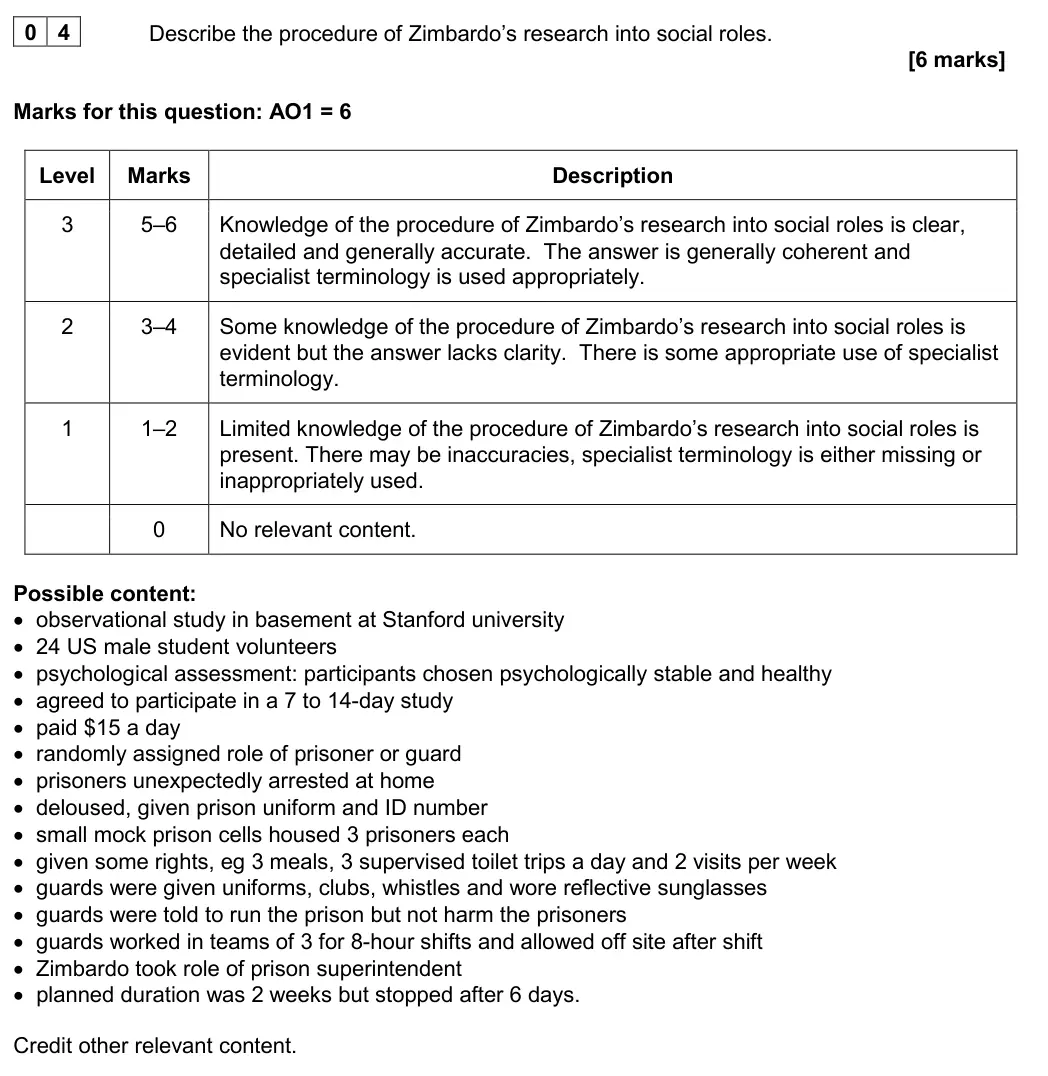
Mark scheme, including level descriptors and indicative content
Examiner's comment
Some wrote much more than was required, which was particularly noticeable in questions 4, 8 and 14. Performance on questions 4, 9 and 14 suggested that many students should work to improve the higher order skills of evaluation/discussion. This question appeared to discriminate well between students as a wide range of responses were seen. Many students gained some marks on this question. Some students clearly had a detailed understanding of Zimbardo’s research into social roles and wrote excessively long answers, often going on to the additional pages at the back of the question paper. Although students did not lose marks for this, they did potentially lose valuable time which could have been better spent elsewhere. Some students who wrote long answers did not focus on the requirements of the question, with a good number of students outlining findings, and not focusing on the procedure as the question asked. Good answers had accurate details of different aspects of the procedure. A small minority of students did not seem to realise that it was a ‘mock’ prison.
Notes from the mark scheme and report
Off-spec: procedure of Zimbardo's Stanford Prison study / conformity to social roles, removed in v1.4
procedure not findings
overlong answers
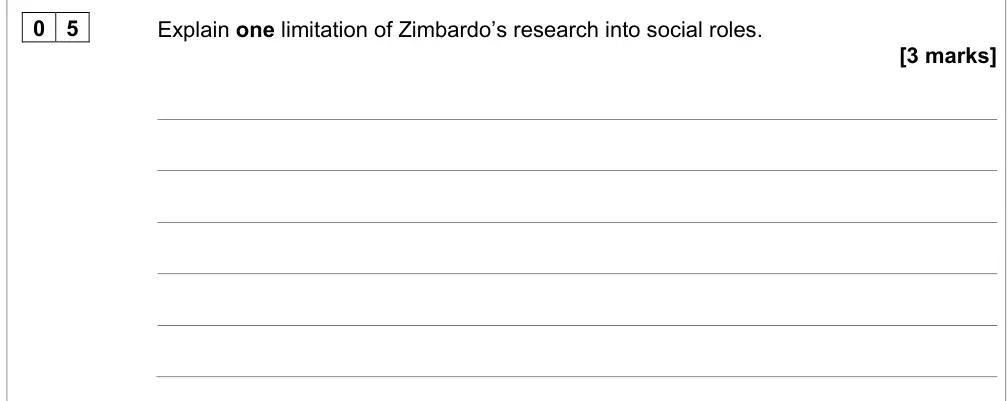
June 2022 · AS Paper 1 · Q53 marksAO3=3Evaluate (short)Old spec only
Not on the 2025 specification: limitation of Zimbardo's research into social roles, removed in v1.4
Mark scheme, including level descriptors and indicative content
Examiner's comment
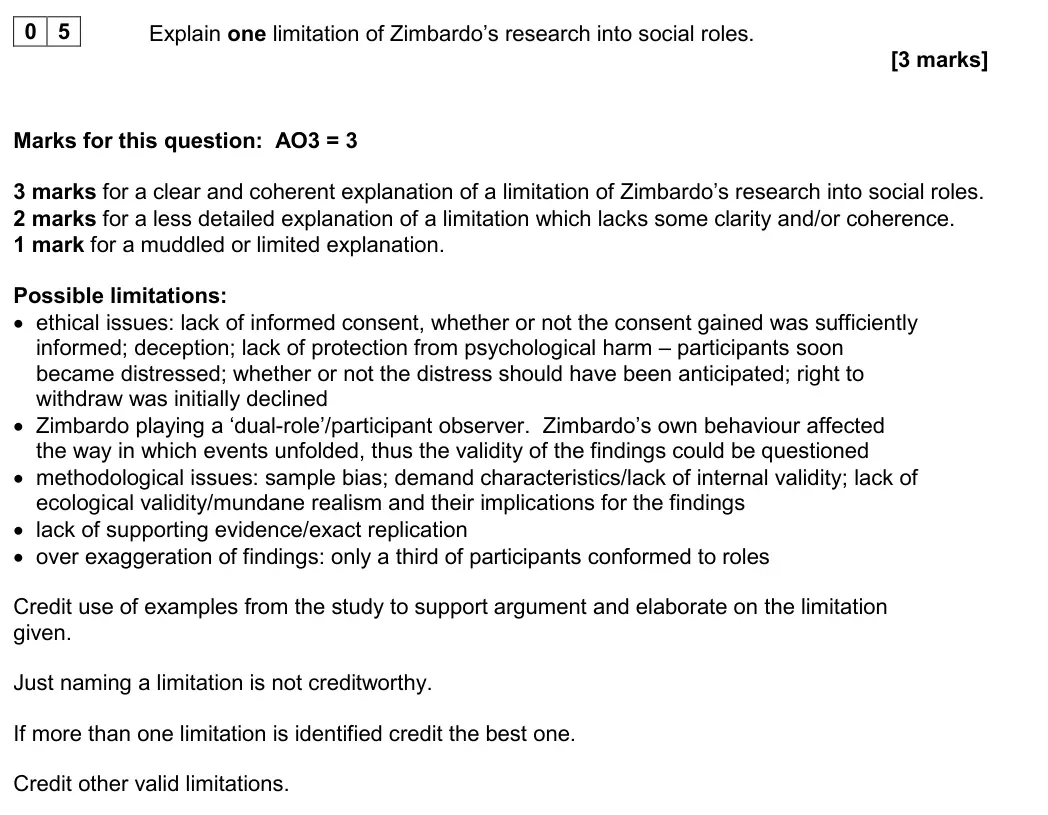
This question was generally answered well, suggesting that students had a clear knowledge of the limitations of Zimbardo’s research into social roles. The majority of correct responses were based around ethical issues, although some explained the issue of Zimbardo playing a dual role, and a few focused on demand characteristics. Better answers identified the limitation then elaborated on it in the context of Zimbardo’s research. Weaker answers either did not elaborate or did not clearly identify what the limitation was.
Notes from the mark scheme and report
Off-spec: limitation of Zimbardo's research into social roles, removed in v1.4
ethics, dual role, demand characteristics, only a third conformed to roles
naming a limitation alone = 0
best limitation credited
June 2022 · AS Paper 1 · Q6.14 marksAO2=4Research methodsdata handling
Mark scheme, including level descriptors and indicative content
Examiner's comment
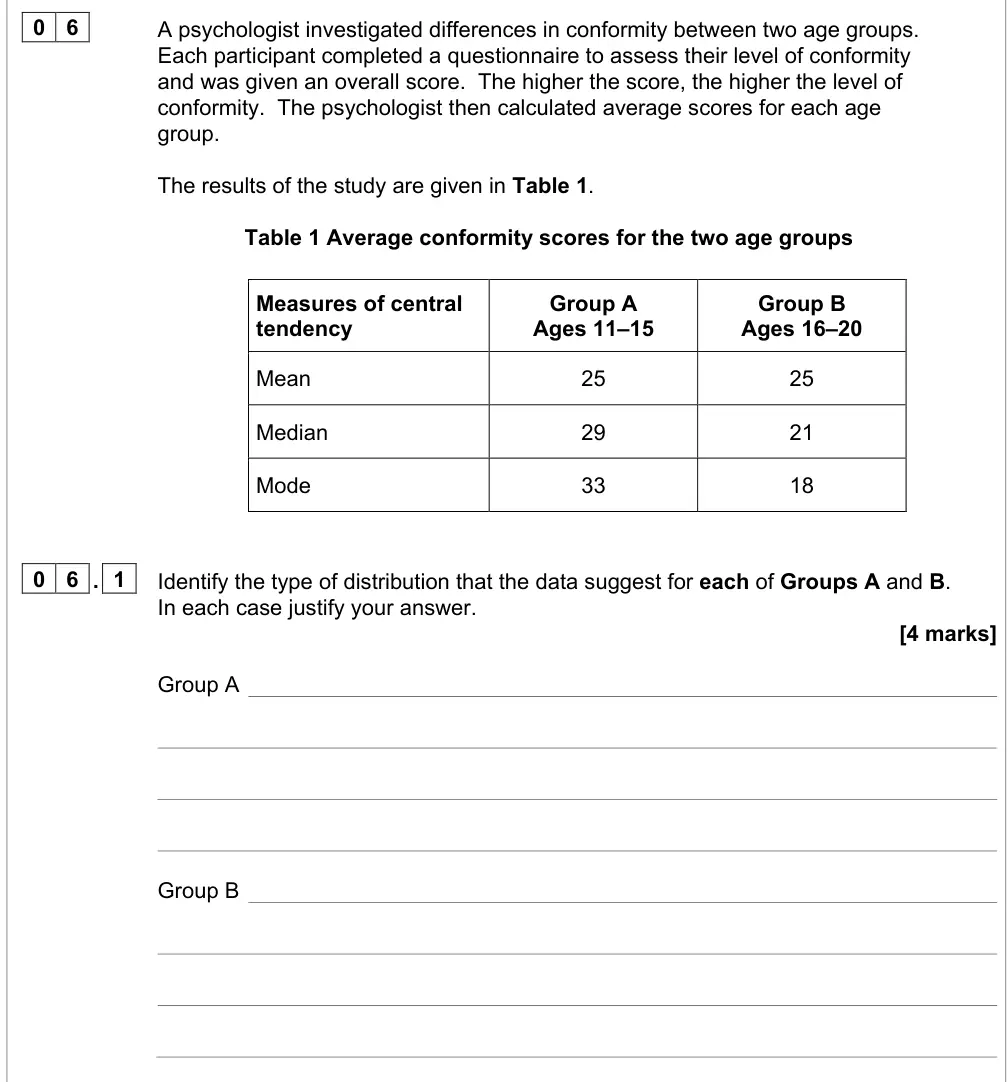
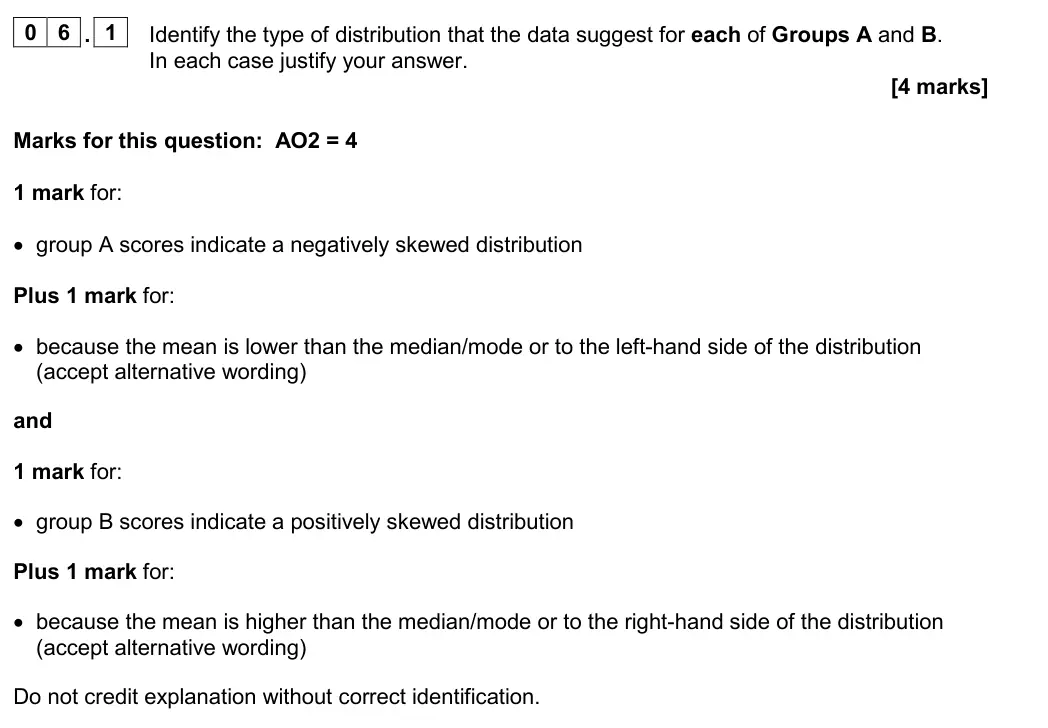
This was one of the most challenging questions on the paper, with many students demonstrating a lack of understanding of the research methods knowledge required to answer it. Many students were unable to identify the type of distribution and then justify their answer. Some students did score full marks and had a clear understanding of negatively and positively skewed distributions. However, many gave muddled answers and approximately 10% of students did not attempt the question.
Notes from the mark scheme and report
A negatively skewed (mean < median < mode), B positively skewed (mean > median > mode)
explanation not credited without correct identification
one of the hardest questions, ~10% blank
June 2022 · AS Paper 1 · Q6.22 marksAO2=2Research methodsdata handling
Mark scheme, including level descriptors and indicative content
Examiner's comment
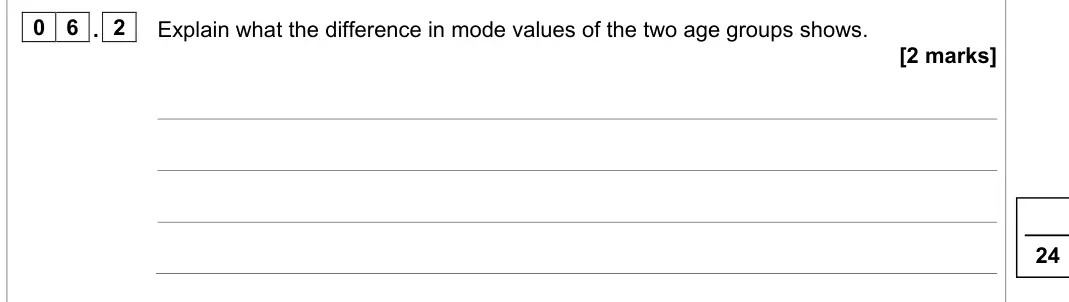
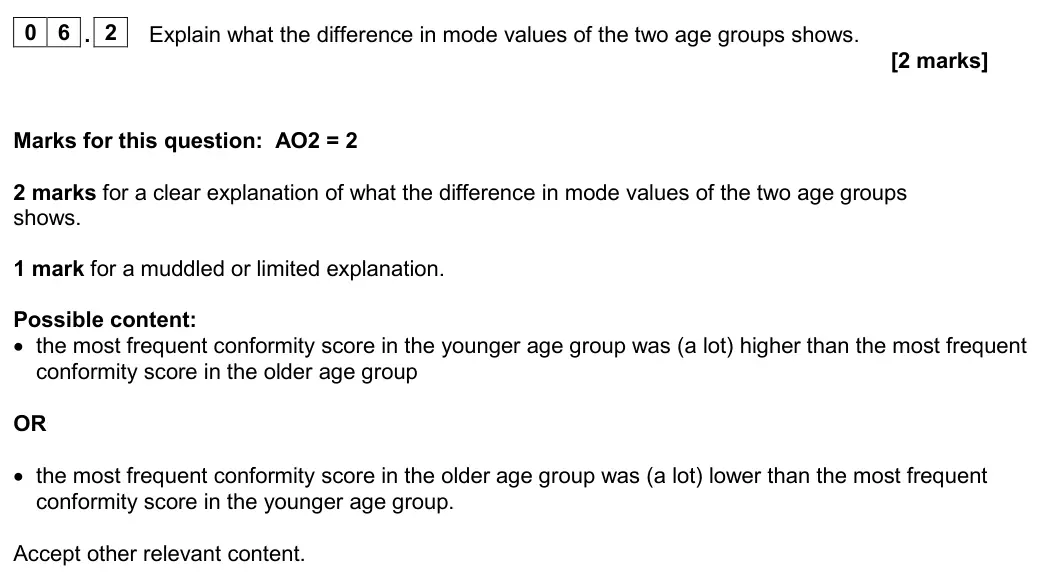
This was another question that students found challenging and again appeared to demonstrate a general lack of understanding of the research methods knowledge needed to answer it. Many students offered erroneous conclusions. Students needed to show that they understood what the mode of a set of data indicated: the most common score, and then compare the two age groups. A few students did score full marks, although most answers scored zero with a small percentage of these not having attempted the question.
Notes from the mark scheme and report
most frequent conformity score much higher in younger group
Mark scheme, including level descriptors and indicative content
Examiner's comment
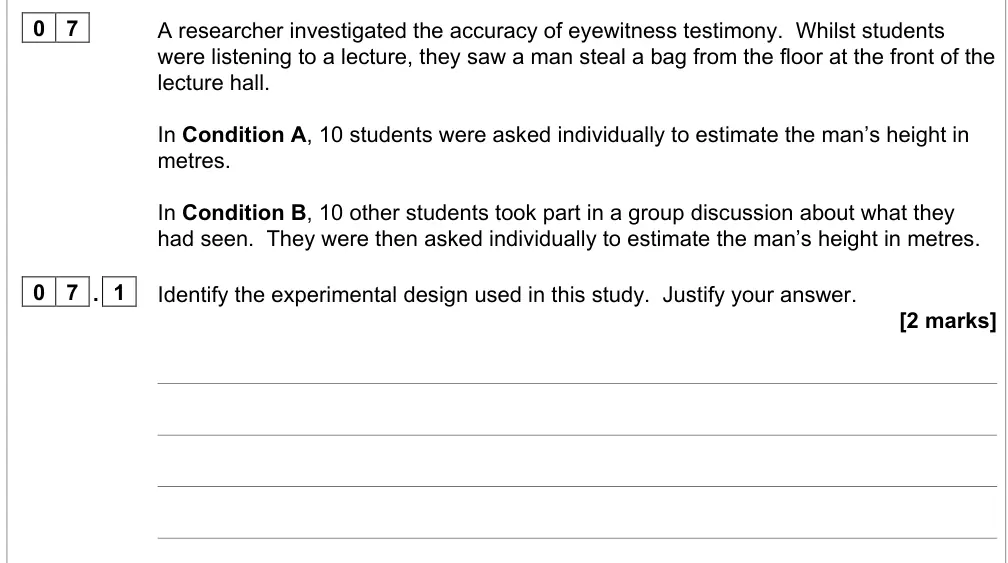
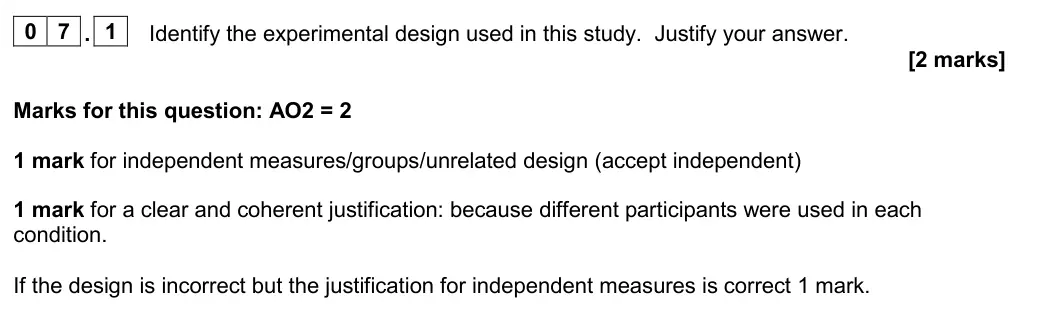
It was pleasing to see that a good number of students had understood the question and focused on experimental design. However, as with previous series, there were still a reasonable number of students that confused the term experimental design with experimental method. Of those who identified the design correctly, only just over half of these students were able to correctly justify their answer. The focus of future students should be on the correct definitions for experimental designs as many justifications were muddled or incomplete.
Notes from the mark scheme and report
independent groups + different participants in each condition
experimental design confused with experimental method
Mark scheme, including level descriptors and indicative content
Examiner's comment
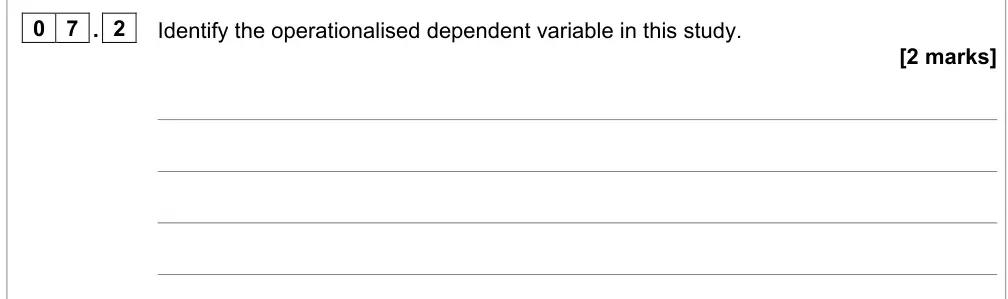
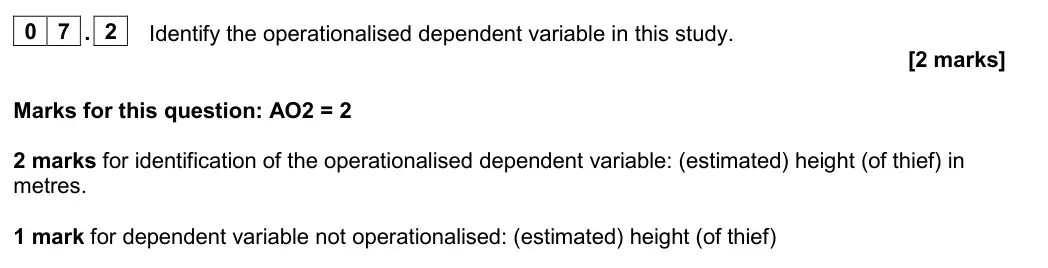
It was pleasing to see that the majority of students could identify the dependent variable (DV). However, not all of them understood how to operationalise it by referring to how it was measured (in metres). As with previous series, a number of students are still confusing the independent variable (IV) and DV and those scoring no marks often gave the IV. It is important that students have sufficient practice at identifying IVs and DV so they understand the difference and can then apply this understanding to a novel situation in an examination setting.
Notes from the mark scheme and report
(estimated) height of thief in metres
without 'metres' = 1 mark
IV and DV confused
June 2022 · AS Paper 1 · Q7.32 marksAO2=2Research methodsdata handling
Mark scheme, including level descriptors and indicative content
Examiner's comment
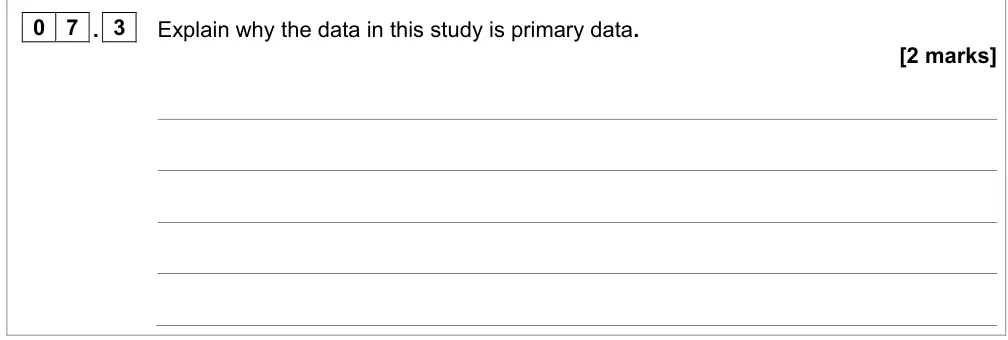
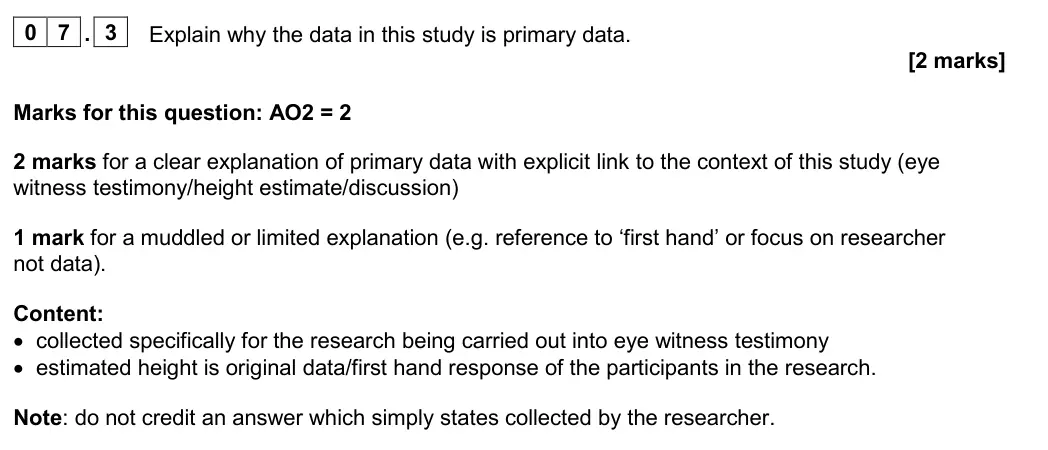
Most students scored half marks or more on this question. Most lost the second mark because they did not link their answer to the scenario/to ‘this’ study. This was a recurrent theme for the research methods questions and students need to practice applying knowledge to scenarios in order to prepare fully for the novel situation they will face in the examination.
Notes from the mark scheme and report
collected first-hand specifically for this EWT study
explicit link to this study needed for second mark
'collected by the researcher' alone not credited
June 2022 · AS Paper 1 · Q7.42 marksAO2=2Research methodsdata handling
Mark scheme, including level descriptors and indicative content
Examiner's comment
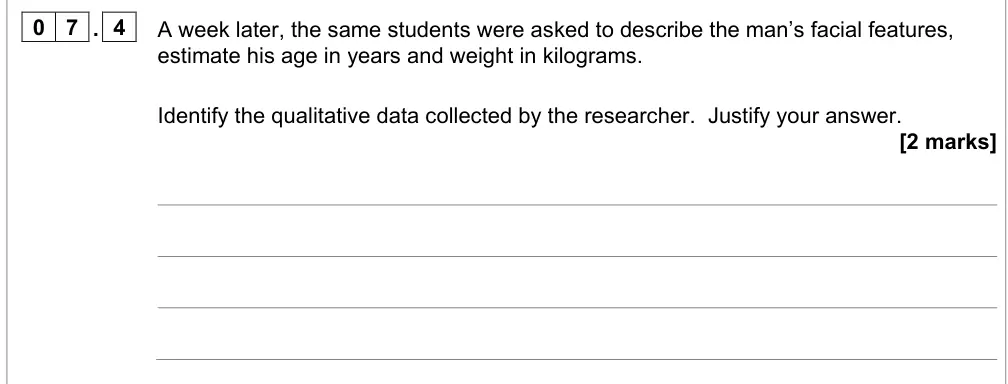
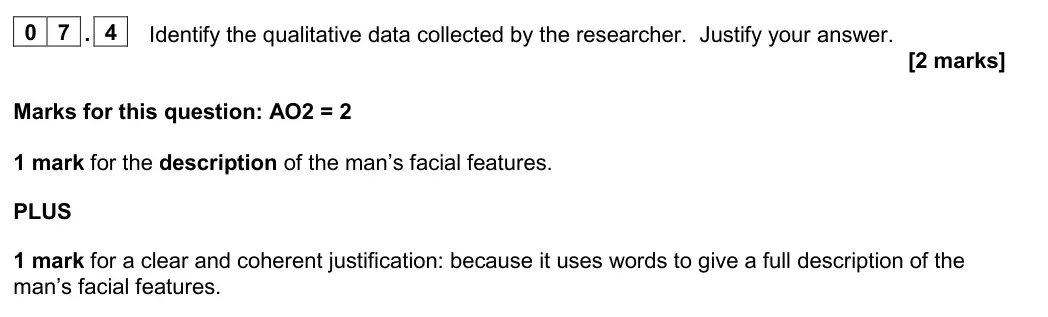
A reasonable number of students failed to identify the qualitative data because they referred only to ‘the man’s facial features’. It was the description of the man’s facial features that provided the qualitative data and this was a crucial difference. As with previous examination questions, students tried to justify their answer by saying what qualitative data is not (numbers) rather than explaining what it is (words). Saying what something is not does not answer the question. Students must read and process the demands of the question carefully.
Notes from the mark scheme and report
the DESCRIPTION of facial features (not 'facial features') + justification that it is in words
saying what qualitative data is not (numbers) did not justify
June 2022 · AS Paper 1 · Q84 marksAO3=4Evaluate (short)memory
Mark scheme, including level descriptors and indicative content
Examiner's comment
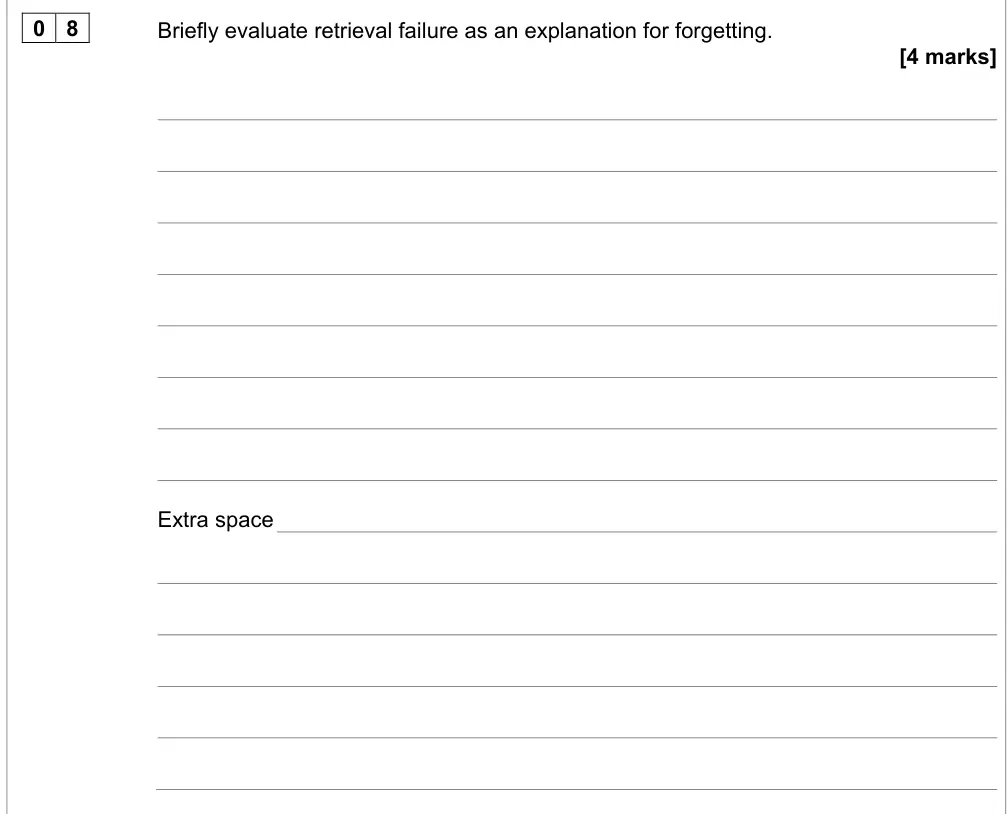
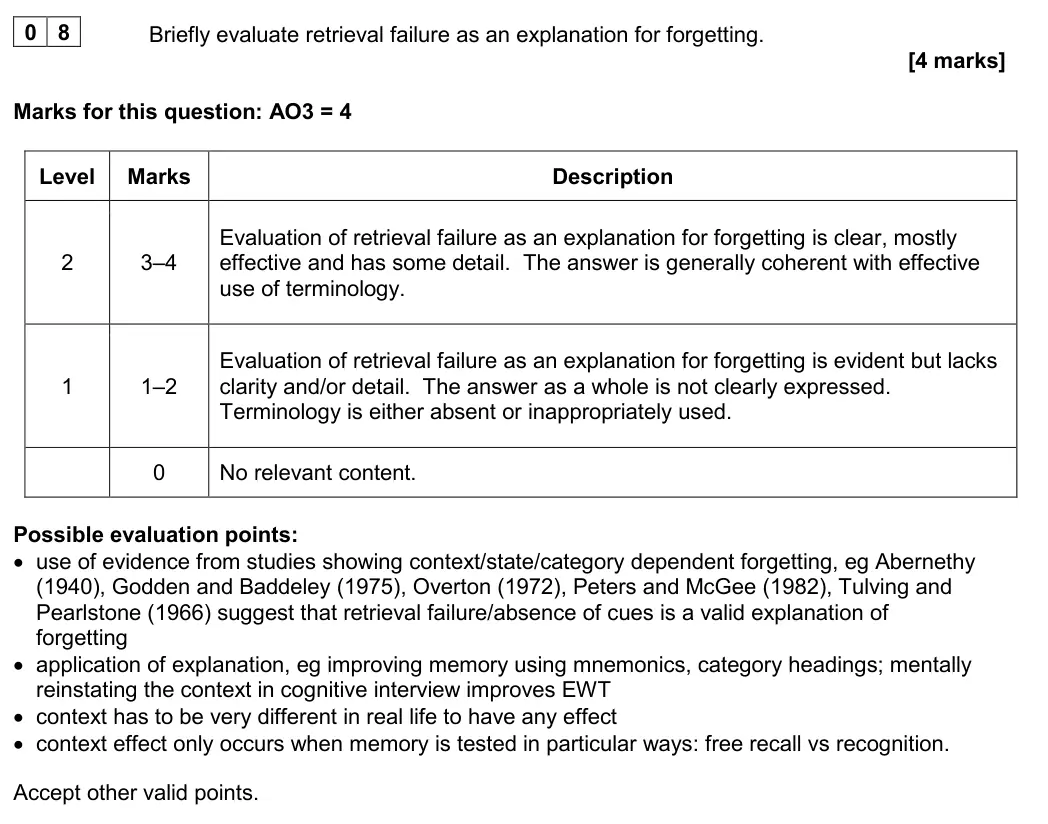
Some wrote much more than was required, which was particularly noticeable in questions 4, 8 and 14. On some questions a number of students failed to address the demands of the question. This was most noticeable on question 8, where the command word was ‘evaluate’ but many students ‘described’, which was not creditworthy. This question appeared to discriminate well between students as a wide range of responses were seen. There were some students who simply described the retrieval failure theory and thus scored zero marks. This question highlighted that students must pay careful attention to the wording of the question and tailor their answer to it. Some students both described and evaluated, and thus wasted time writing about content for which they received no credit. Some students muddled retrieval failure theory with interference theory. Better answers identified a strength or limitation and then used research to back up their claim.
Notes from the mark scheme and report
evaluation only - description scores zero
context/state/category-dependent evidence (Godden and Baddeley, Abernethy, Tulving and Pearlstone), applications (CI, mnemonics), context must be very different, recall vs recognition
muddled with interference
June 2022 · AS Paper 1 · Q912 marksAO1=6, AO3=6Extended writingmemory
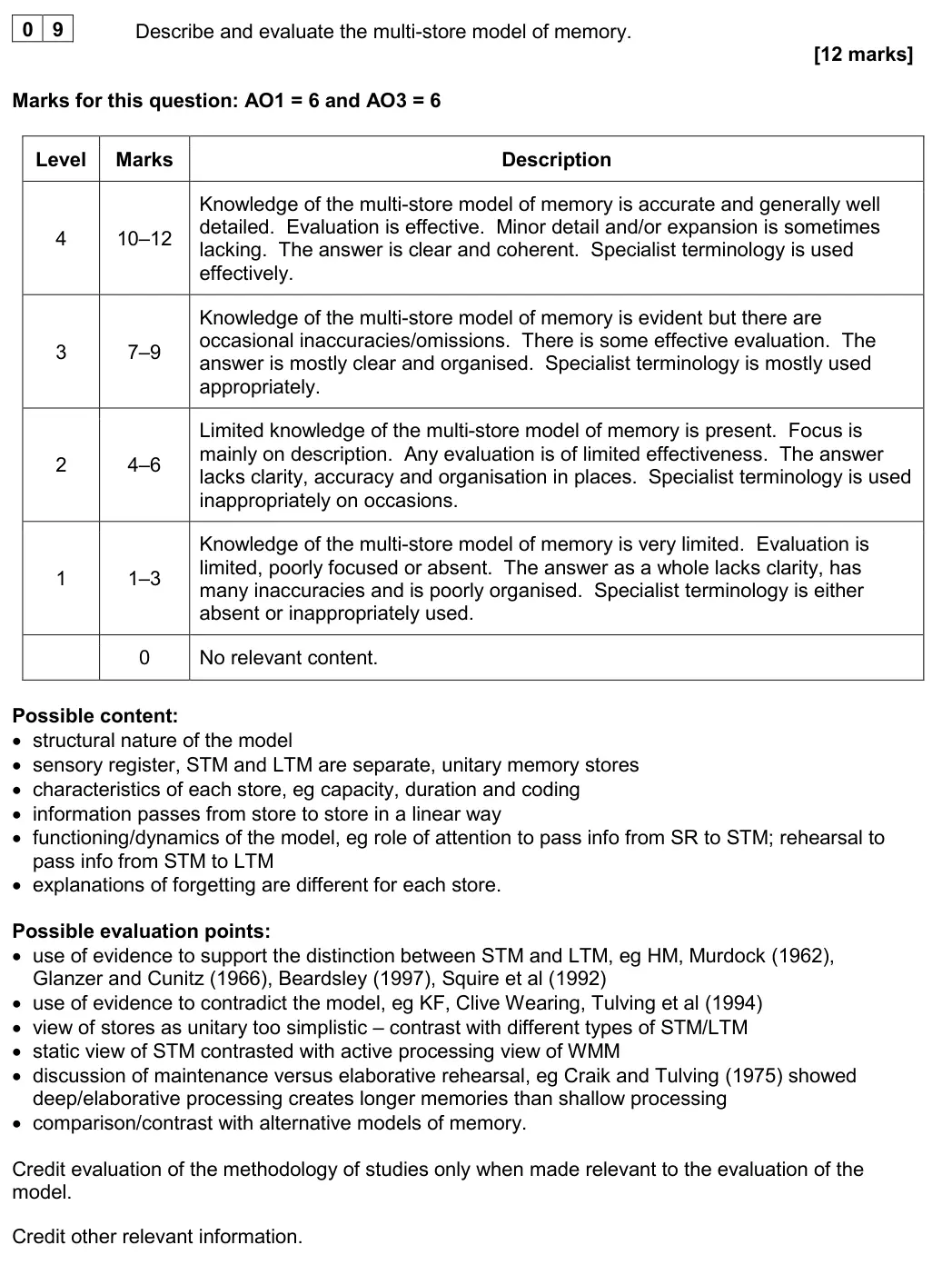
Mark scheme, including level descriptors and indicative content
Examiner's comment
However, others wrote very little and did not include sufficient detail, particularly in questions 9 and 14. Performance on questions 4, 9 and 14 suggested that many students should work to improve the higher order skills of evaluation/discussion. A good range of responses were seen across the cohort with many students producing level 3 and 4 answers. These responses tended to accurately describe the multi-store model with some detail and also included some effective evaluation. Poorer responses tended to focus solely on description or contained no/limited effective evaluation. Some students simply provided a very brief and thus limited description. It is important to remind students that in these questions there should be an equal amount of AO1 and AO3. The best evaluation linked evidence to specific assumptions of the model and some students did this extremely well.
Notes from the mark scheme and report
SR, STM, LTM with capacity/duration/coding, attention and rehearsal
evaluation via HM, KF, Clive Wearing, Glanzer and Cunitz, WMM, Craik and Tulving
methodology only credited if linked to the model
balance AO1 and AO3
June 2022 · AS Paper 1 · Q104 marksAO1=4Outlineattachment
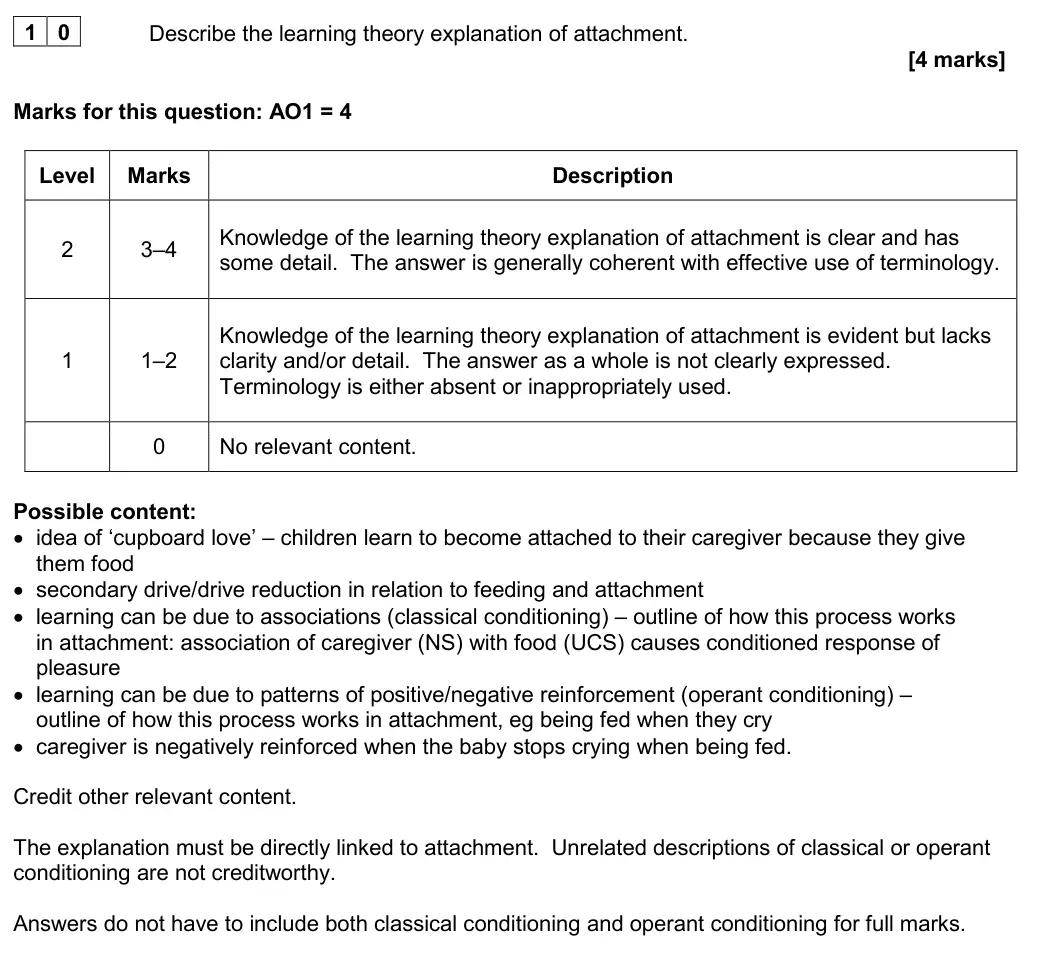
Mark scheme, including level descriptors and indicative content
Examiner's comment
Many students appeared to have a detailed and thorough knowledge of how learning theory explains attachment and used appropriate terminology in their answers. A significant minority of students did not focus their answer on how learning theory explained attachment and gave, what appeared to be, rote learnt responses which simply described the process of classical and/or operant conditioning. It was important for students to use appropriate classical/operant conditioning terminology in this question as this was required for top level responses. A small number of students confused learning theory with Bowlby’s theory of attachment or gave details of Pavlov’s dog study, both of which were not creditworthy.
Notes from the mark scheme and report
cupboard love, classical and/or operant conditioning linked directly to attachment
rote descriptions of conditioning or Pavlov not credited
one form of conditioning can gain full marks
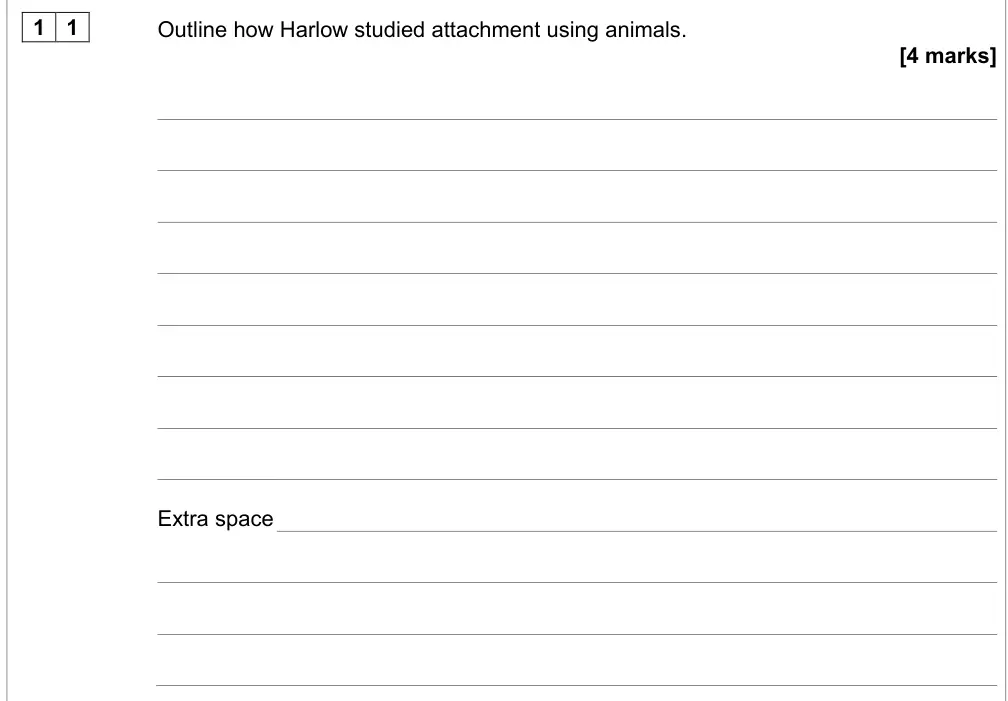
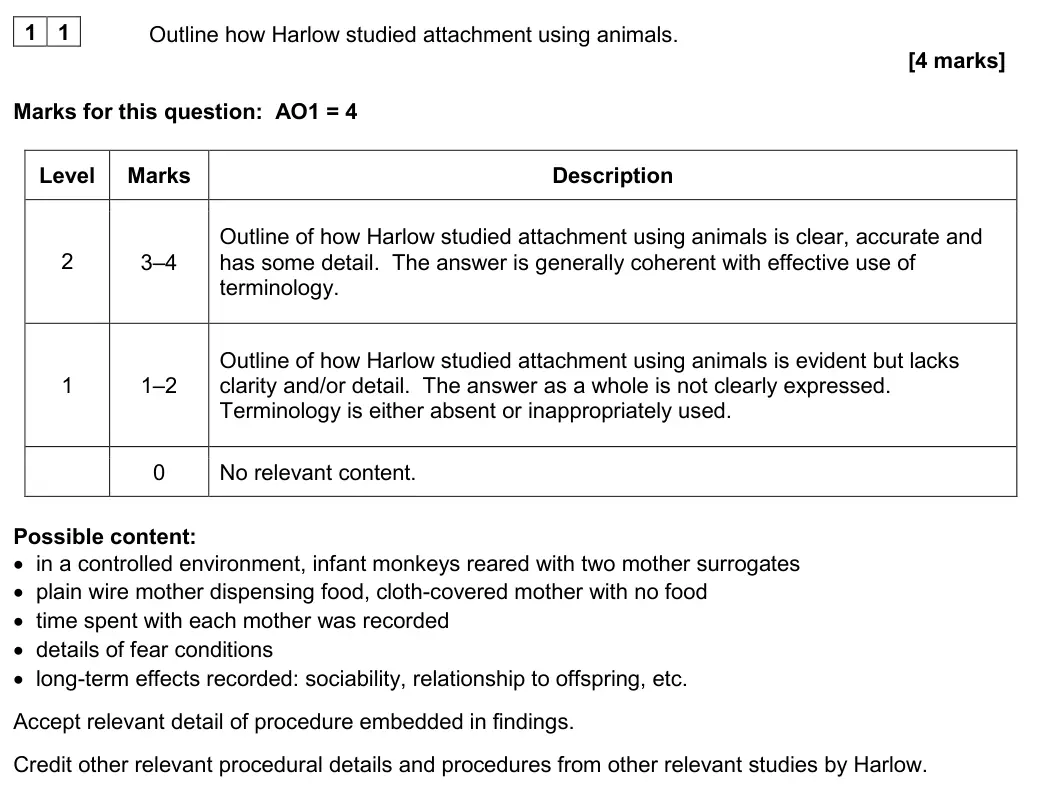
June 2022 · AS Paper 1 · Q114 marksAO1=4Outlineattachment
Mark scheme, including level descriptors and indicative content
Examiner's comment
This appeared to be a relatively accessible question with many students scoring at least half marks. Student responses indicated there was clearly a good understanding of Harlow’s research. However, some students wrote everything they knew about the study and did not focus on the wording of the question: how he studied attachment. This meant many wasted time giving details that did not attract any credit.
Notes from the mark scheme and report
how Harlow studied attachment (wire vs cloth surrogates, time recorded, fear conditions, long-term effects)
everything-I-know answers wasted time
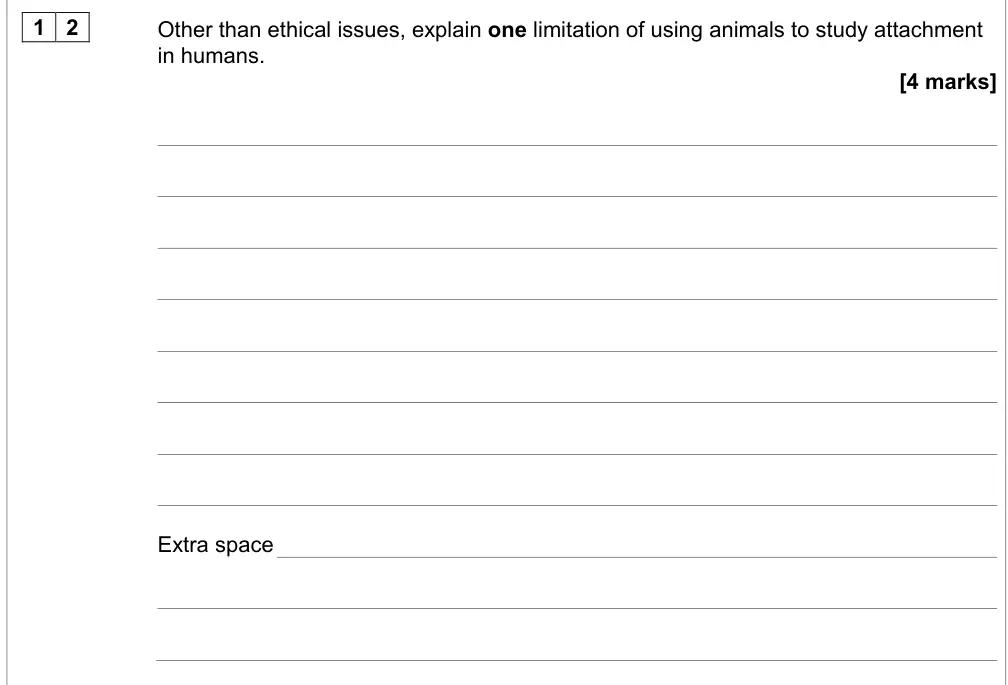
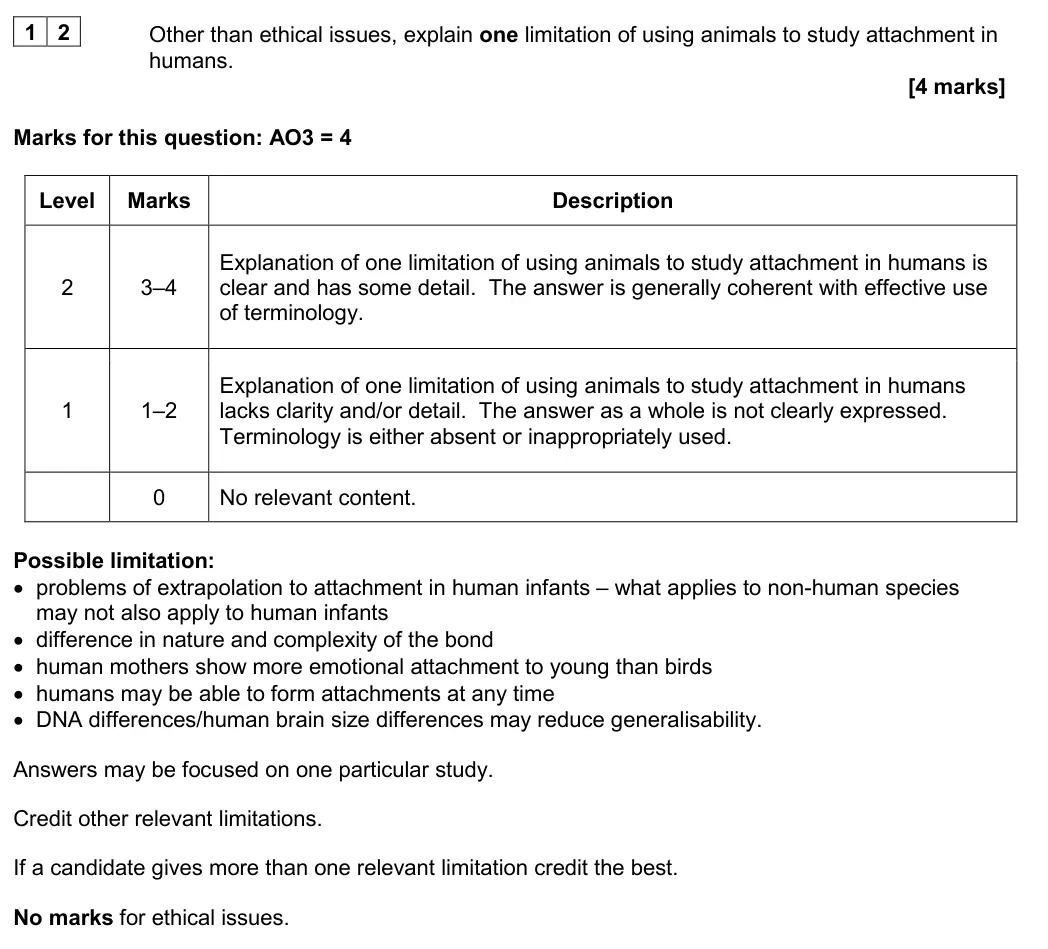
June 2022 · AS Paper 1 · Q124 marksAO3=4Evaluate (short)attachment
Mark scheme, including level descriptors and indicative content
Examiner's comment
This question was relatively well answered with many students scoring level 2 marks. Some answers did not fully address the question, for example some students evaluated animal research but did not go on to explain why this was a limitation for understanding human attachment. It was pleasing to see that almost all students read the question carefully and only a very few offered an ethical issue in their answer.
Notes from the mark scheme and report
ethics excluded
extrapolation to human attachment, complexity of bond, brain differences
must explain why it limits understanding of HUMAN attachment
Mark scheme, including level descriptors and indicative content
Examiner's comment
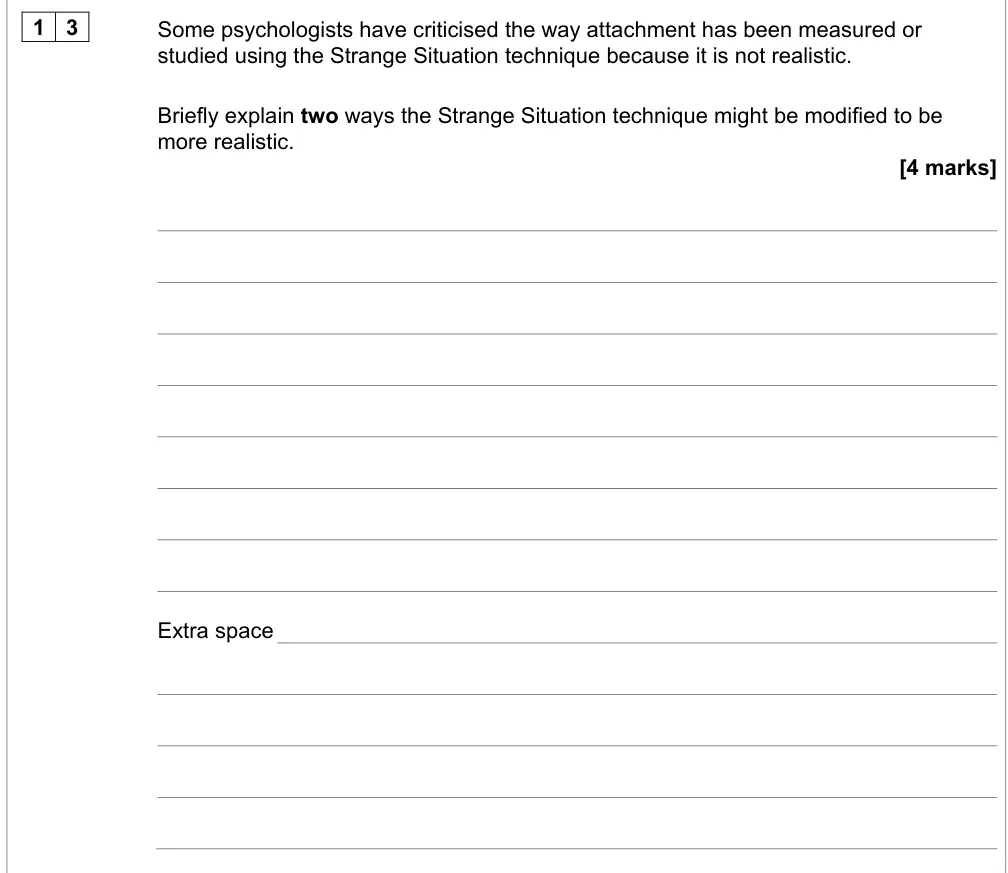
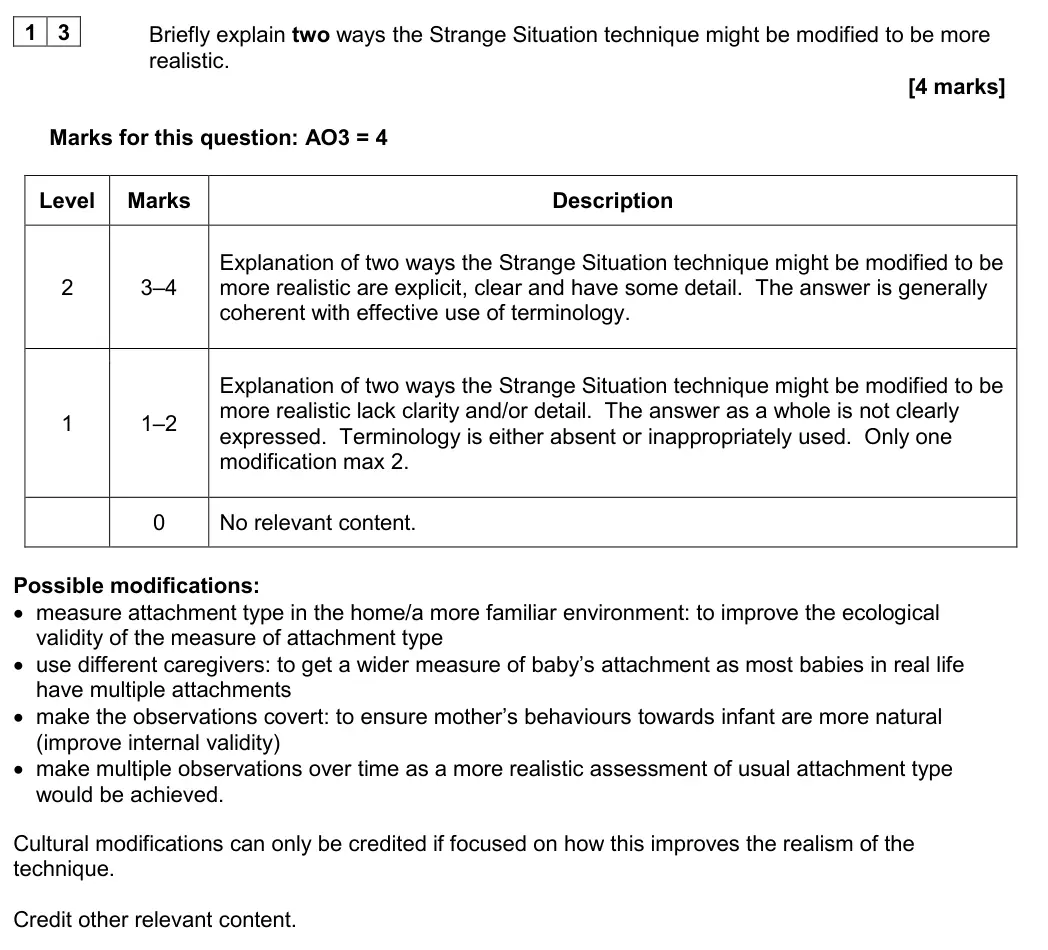
Most students were able to give some accurate explanation of at least one way of modifying the strange situation technique to make it more realistic. Many students focused on changing the setting to a more natural environment like the home. However, only a minority of students were able to give two suggestions. Other students incorrectly evaluated the strange situation without giving any modifications. Some suggestions were inappropriate or not focused on modifying the technique. A small minority of students did not attempt the question.
Notes from the mark scheme and report
two modifications to increase realism (home setting/ecological validity, covert observation, repeated observations, different caregivers)
one only = max 2
evaluating without modification not credited
MS rationale for 'different caregivers' cites multiple attachments (removed in v1.4)
June 2022 · AS Paper 1 · Q148 marksAO1=4, AO3=4Extended writingattachment
Mark scheme, including level descriptors and indicative content
Examiner's comment
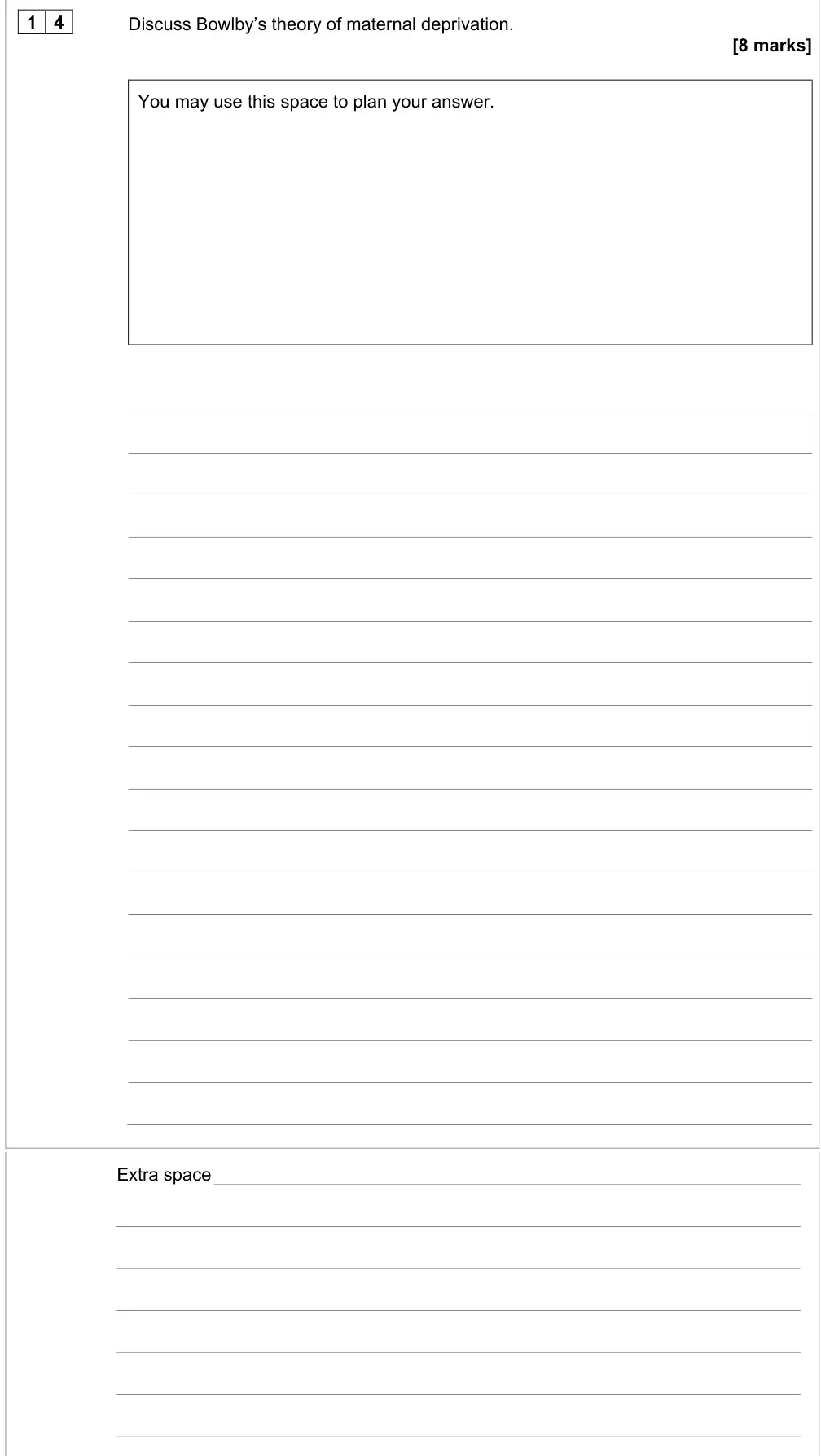
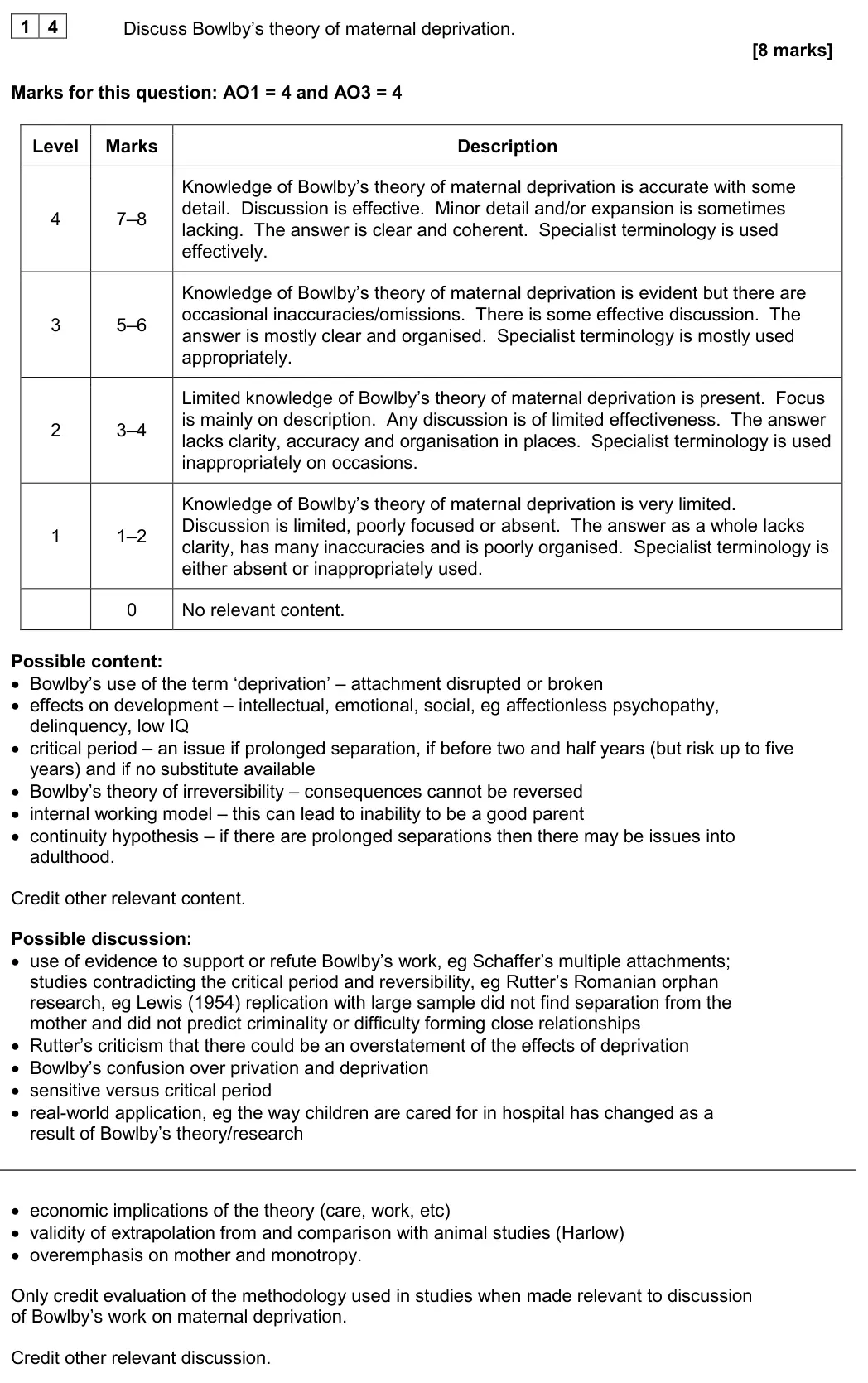
Some wrote much more than was required, which was particularly noticeable in questions 4, 8 and 14. However, others wrote very little and did not include sufficient detail, particularly in questions 9 and 14. Performance on questions 4, 9 and 14 suggested that many students should work to improve the higher order skills of evaluation/discussion. It was pleasing to note that nearly all students attempted this question and therefore did not run out of time on the paper. A good range of responses were seen across the cohort with many students producing level 3 and 4 answers. These responses tended to accurately describe Bowlby’s theory of maternal deprivation with some detail and also included some effective discussion. Poorer responses tended to focus solely on description or contained no/limited discussion. Some students simply provided a very brief and thus limited description. Some students focused on Bowlby’s attachment theory which did not fully address the question. The best discussion linked evidence to specific assumptions of the theory and some students did this extremely well.